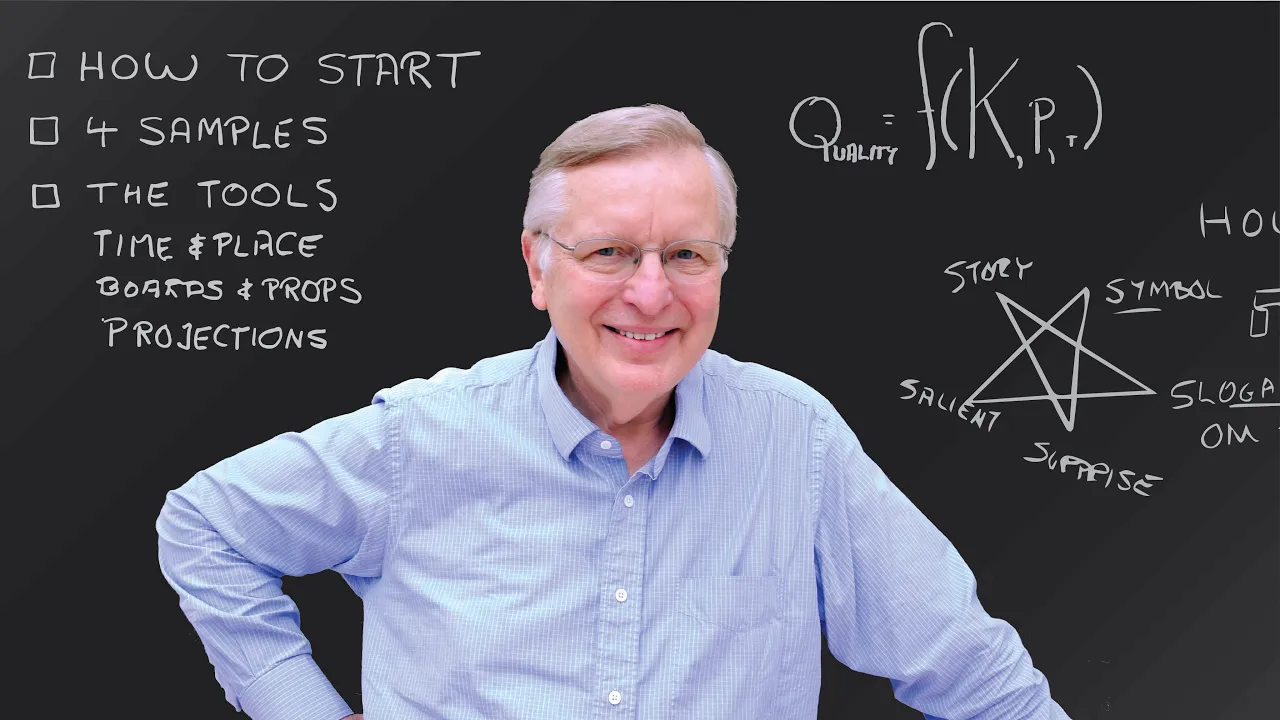
MIT's Winston Ranks Speaking Ahead of Idea Quality for Career Success
MIT OpenCourseWare
Professional achievement is determined primarily by the ability to speak and write rather than concept quality, with deliberate technique and practice heavily outweighing innate talent.
Professional success depends on a strict hierarchy—speaking ability, writing ability, and the quality of ideas, in that order—governed by the formula Knowledge × Practice × talent, where talent is the smallest factor. (0:19)
Audience members possess only a single language processor, making simultaneous reading and listening cognitively impossible and necessitating a strict ban on open laptops and text-heavy slides. (3:11)
For job talks and faculty hiring, candidates have a narrow five-minute window to articulate a clear vision and demonstrate concrete accomplishments before losing audience interest. (44:02)
Memorable research requires five elements starting with 'S' (Symbol, Slogan, Surprise, Salient Idea, Story), while presentations should close with a 'Contributions' slide and avoid concluding with 'Thank you.' (50:11)
Detailed notes
## Background
Published on YouTube by MIT OpenCourseWare on December 20, 2019, this video captures the late MIT professor Patrick Winston delivering his renowned annual Independent Activities Period (IAP) lecture, "How to Speak." A campus tradition spanning more than 40 years, the talk outlines practical heuristics and presentation techniques designed to help students and researchers communicate effectively in high-stakes academic and professional settings.
## TL;DR
Winston argues that professional success is governed primarily by the ability to speak, write, and generate quality ideas, emphasizing that speaking is a learned skill where knowledge and practice far outweigh innate talent. He breaks down the physical and structural mechanics of effective presentations, advising speakers to avoid opening jokes, ban open laptops, write on blackboards for pacing, simplify slides, and build natural verbal punctuation. Transitioning to professional persuasion, he provides concrete frameworks for passing oral exams, pitching academic job talks within five minutes, and branding memorable research through "Winston’s Star." Winston concludes by urging presenters to treat their final slide as prime real estate dedicated to personal contributions rather than generic conclusions, closing with a memorable salute to the audience instead of a weak thank-you.
## Atmosphere & style
The lecture carries the warm, theatrical, and slightly wry atmosphere of a master educator completely at home in front of a live MIT lecture hall. Winston blends dry humor, physical demonstrations—such as snapping a wooden pointer over his knee—and personal anecdotes with sharp, no-nonsense critiques of modern academic presentation crimes. Listening feels like receiving an insider masterclass from an eccentric yet deeply caring mentor who insists on high standards, creating an experience that is both intellectually grounding and quietly inspiring.
## Bulletin
- [00:19](https://www.youtube.com/watch?v=Unzc731iCUY&t=19s) Professional success depends on a strict hierarchy—speaking ability, writing ability, and the quality of ideas, in that order—governed by the formula Knowledge × Practice × talent, where talent is the smallest factor.
- [03:11](https://www.youtube.com/watch?v=Unzc731iCUY&t=191s) Audience members possess only a single language processor, making simultaneous reading and listening cognitively impossible and necessitating a strict ban on open laptops and text-heavy slides.
- [44:02](https://www.youtube.com/watch?v=Unzc731iCUY&t=2642s) For job talks and faculty hiring, candidates have a narrow five-minute window to articulate a clear vision and demonstrate concrete accomplishments before losing audience interest.
- [50:11](https://www.youtube.com/watch?v=Unzc731iCUY&t=3011s) Memorable research requires five elements starting with 'S' (Symbol, Slogan, Surprise, Salient Idea, Story), while presentations should close with a 'Contributions' slide and avoid concluding with 'Thank you.'
## Key takeaways
- [00:19](https://www.youtube.com/watch?v=Unzc731iCUY&t=19s) Speaking and writing effectiveness is largely learnable through knowledge and practice, easily outweighing innate talent.
- [03:11](https://www.youtube.com/watch?v=Unzc731iCUY&t=191s) Open laptops and phones impair audience comprehension, distract neighbors, and degrade speaker performance due to the brain's single language processor.
- [04:15](https://www.youtube.com/watch?v=Unzc731iCUY&t=255s) Presentations should open with an empowerment promise defining what listeners will gain, avoiding opening jokes which fall flat before an audience settles.
- [05:38](https://www.youtube.com/watch?v=Unzc731iCUY&t=338s) Core heuristics for retention include cycling through key ideas three times, fencing concepts against near-misses, verbal punctuation, and waiting seven seconds for question responses.
- [10:17](https://www.youtube.com/watch?v=Unzc731iCUY&t=617s) Presentations perform best at 11:00 AM in fully lit rooms sized to keep seats more than half full, avoiding dark spaces that induce sleep.
- [13:27](https://www.youtube.com/watch?v=Unzc731iCUY&t=807s) Blackboards excel at informing because handwriting naturally paces instruction to human absorption speed and gives the speaker's hands a functional target.
- [16:53](https://www.youtube.com/watch?v=Unzc731iCUY&t=1013s) Physical props and live chalk writing trigger empathetic mirroring in audiences, grounding abstract concepts and creating enduring memories.
- [23:53](https://www.youtube.com/watch?v=Unzc731iCUY&t=1433s) Slide design must prioritize radical simplicity: eliminate sentences, remove redundant logos and titles, stand close to the screen, and use font sizes of at least 40 to 50 points.
- [29:37](https://www.youtube.com/watch?v=Unzc731iCUY&t=1777s) Laser pointers degrade audience connection by forcing speakers to turn their backs; static on-slide arrows should be used instead.
- [31:48](https://www.youtube.com/watch?v=Unzc731iCUY&t=1908s) Hopelessly convoluted diagrams should only be used as a 'hapax legomenon'—permitted exactly once per presentation solely to illustrate overwhelming complexity.
- [36:23](https://www.youtube.com/watch?v=Unzc731iCUY&t=2183s) Inspiring an audience requires pairing genuine subject enthusiasm with teaching students how to think using narrative structures.
- [41:30](https://www.youtube.com/watch?v=Unzc731iCUY&t=2490s) Oral exam prep requires situating the research context globally, rehearsing before uninformed peers rather than lab mates, and selecting senior faculty committees.
- [50:11](https://www.youtube.com/watch?v=Unzc731iCUY&t=3011s) Academic recognition ('Winston's Star') relies on five key components: a Symbol, a Slogan, a Surprise, a Salient Idea, and a Story.
- [53:55](https://www.youtube.com/watch?v=Unzc731iCUY&t=3235s) Final slides should be titled 'Contributions' rather than 'Conclusions' or collaborator lists, capturing prime screen real estate during the question period.
- [56:32](https://www.youtube.com/watch?v=Unzc731iCUY&t=3392s) Presenters should avoid concluding with 'Thank you,' opting instead for an ending joke, an explicit closure convention, or saluting the audience.
## Detailed walkthrough
### [00:19](https://www.youtube.com/watch?v=Unzc731iCUY&t=19s) The Formula for Success and the Power of Knowledge
Patrick Winston begins with an analogy to military discipline: under the Uniform Code of Military Justice, an officer faces court-martial for sending a soldier into combat without a weapon. Winston argues that academic institutions owe students a comparable duty of care, as no graduate should enter professional life unable to communicate effectively. In his view, professional trajectory hinges on a strict hierarchy of skills, arguing that “your success in life will be determined largely by your ability to speak, your ability to write, and the quality of your ideas, in that order.”
He explains that speaking and writing skills are not governed by innate genius, but by a simple formula: communication quality is a function of knowledge, practice, and talent, with talent playing by far the smallest role. To illustrate that knowledge and practice easily outweigh raw gift, Winston recalls a ski trip to Sun Valley during a “Celebrity Weekend.” Olympic gymnast Mary Lou Retton—famous for scoring perfect 10s on the vault—was on the novice slope. Winston watched a woman lose her balance and recover with extraordinary athletic agility, instantly recognizing her as the Olympian. Yet despite her world-class physical gifts, she was a novice skier, and Winston was far better on the mountain simply because he possessed the knowledge and practice that she had not yet developed. His goal is to provide students with actionable heuristics for their personal “armamentarium,” noting that public speaking is an intensely nonlinear endeavor: adopting even a single technique could be the deciding factor that lands someone a job.
- **The Communication Formula**: Success in speaking and writing depends on $Knowledge \times Practice \times talent$, where talent ($t$) is the smallest factor.
- **The Core Promise**: Over the course of 60 minutes, attendees will encounter specific heuristics to add to their personal repertoire, maximizing the likelihood that their ideas are heard, valued, and accepted.
[03:11](https://www.youtube.com/watch?v=Unzc731iCUY&t=191s) Rules of Engagement: Laptops, Phones, and the Single Language Processor
Before diving into the core curriculum, Winston establishes a strict rule of engagement: no laptops and no cell phones. He pauses the presentation and waits until audience members close their open screens, explaining the cognitive science underpinning this demand.
Winston stresses that human beings possess only a single internal language processor. When an audience member reads email or browses the web, that processor is fully occupied, making it physiologically impossible to process what the speaker is saying. Screen use does not merely impair the user; studies demonstrate that open laptops distract neighboring attendees sitting in view of the display. Furthermore, visible laptops directly undermine the speaker's delivery. As Winston puts it bluntly: “And worse yet, if I see a open laptop somewhere back there or up here, it drives me nuts, and I do a worse job.” By closing screens, listeners protect their own focus, protect their peers from visual distraction, and ensure the speaker delivers their best possible performance.
[04:15](https://www.youtube.com/watch?v=Unzc731iCUY&t=255s) How to Start: The Empowerment Promise vs. the Opening Joke
Turning to the opening moments of a lecture or presentation, Winston directly challenges the conventional wisdom that a speaker should begin with a joke. He considers jokes a poor opening choice because arriving audience members are still settling into their seats, putting belongings away, and adjusting to the speaker’s vocal parameters and cadence. Because listeners are not yet primed or comfortable, introductory jokes almost invariably fall flat.
Instead of trying to be funny, a speaker should begin with an “empowerment promise.” This promise explicitly states what the audience will understand or be able to do at the end of the presentation that they could not do at the start. It gives listeners an immediate, tangible justification for investing their time. Winston illustrates this technique by reflecting on his own opening statement: “At the end of this 60 minutes, you will know things about speaking you don't know now, and something among those things you know will make a difference in your life.”
[05:38](https://www.youtube.com/watch?v=Unzc731iCUY&t=338s) Four Core Heuristics: Cycling, Fencing, Punctuation, and Questions
Winston introduces four sample heuristics that he routinely relies on when designing and delivering talks. The first heuristic is cycling: repeating and circling back to core points multiple times throughout a presentation. Winston explains that at any given moment in an audience, roughly 20 percent of listeners are temporarily “fogged out” or lost in thought. To guarantee that key takeaways land across an entire audience, a speaker must cycle through them repeatedly. As Winston emphasizes: “So if you want to ensure that the probability that everybody gets it is high, you need to say it three times.”
```mermaid
flowchart TD
accTitle: Four Sample Presentation Heuristics
accDescr: Diagram showing the four heuristics for audience retention and engagement.
subgraph Retention["Audience Retention Tools"]
A["1. Cycling"] -->|"Repeat core ideas 3x"| R["Bridges the 20% fogged-out gap"]
B["2. Build a Fence"] -->|"Distinguish idea from rivals"| S["Prevents confusion with existing work"]
end
subgraph Navigation["Audience Re-entry Tools"]
C["3. Verbal Punctuation"] -->|"Provide seams and milestones"| T["Allows drifting listeners to re-board"]
D["4. Ask Questions"] -->|"Wait up to 7 seconds"| U["Stimulates active cognition"]
end
```
The second heuristic is building a fence around the idea. To prevent audience confusion, a speaker must deliberately contrast their concept with neighboring or similar concepts. Drawing on his classic artificial intelligence work teaching the concept of an “arch,” Winston demonstrates that defining an arch requires showing examples of what is an arch alongside near-misses of what is *not* an arch. In technical lectures, this means explicitly contrasting one's contribution with existing alternatives—such as explaining that while one's algorithm may resemble an established method by Jones, the new approach runs in linear rather than exponential time.
The third heuristic is verbal punctuation. Because listeners periodically zone out, speakers must build clear seams, milestones, and enumerations into the structure of the talk, allowing daydreamers a visible moment to “get back on the bus.”
The fourth heuristic, offered by an audience member when prompted, is asking a question. Winston notes that when a speaker asks a question, they must be prepared to tolerate what feels like an eternity of dead air. Pausing for seven seconds is typical and necessary to give listeners time to formulate a response. Moreover, the question must occupy a narrow sweet spot: it cannot be so obvious that audience members feel embarrassed to say the answer out loud, yet it cannot be so difficult that nobody knows where to begin.
- **Cycling**: Circle back to key ideas repeatedly to account for the roughly 20% of listeners daydreaming at any instant.
- **Fencing**: Explicitly differentiate your idea from preexisting or adjacent concepts to avoid ambiguity.
- **Verbal Punctuation**: Enumerate sections and signal transitions so drifting listeners can rejoin the flow.
- **Questioning**: Select balanced questions and wait out the uncomfortable seven-second silence required for audience processing.
[10:17](https://www.youtube.com/watch?v=Unzc731iCUY&t=617s) Setting the Stage: Optimizing Time and Place
Winston next analyzes the environmental context of a presentation, breaking it down into time and physical venue. When asked for the ideal lecture time, he endorses 11:00 AM. In an academic community like MIT, 11:00 AM ensures that students and faculty are fully awake, have not yet gone back to sleep, and are not suffering from post-lunch fatigue.
For the venue itself, lighting is the single most critical factor. Human physiology associates dim lighting with sleep. Audio-visual technicians often insist on dropping the room lights so slide projections appear sharper, but Winston strongly objects to this practice: “Oh, they might reply, people will see the slides better if we turn the lights off, and then I reply, it's extremely hard to see slides through closed eyelids.”
Beyond lighting, Winston recommends that speakers “case” the room prior to speaking—scouting the space beforehand much like a burglar casing a bank before a robbery. Touring the lecture hall ahead of time uncovers unexpected physical quirks, sightline issues, or audio oddities, allowing the speaker to adapt or request corrections before the audience arrives. When visiting an unfamiliar hall, Winston mentally visualizes every seat filled with disinterested farm animals; that way, real listeners will always surpass his baseline expectations. Finally, the room must be reasonably populated—comfortably more than half full. Speaking in a cavernous auditorium to an audience of ten makes attendees wonder what better event everyone else attended, sapping the energy from the talk.
- **Optimal Time**: 11:00 AM provides peak alertness and avoids the postprandial dip.
- **Full Lighting**: Always insist on keeping the room fully lit; darkness triggers sleep cycles.
- **Casing the Venue**: Inspect the hall in advance to identify technical or spatial anomalies.
- **Room Density**: Select a space sized so the audience fills more than 50% of the seats, preventing an impression of low relevance.
[13:27](https://www.youtube.com/watch?v=Unzc731iCUY&t=807s) The Tools of the Trade: Why the Blackboard Works
Patrick Winston turns to examining the physical instruments of presentation: boards, props, and slides. He makes a fundamental distinction between their purposes: slides serve to expose an audience to ideas, whereas the blackboard is the tool of choice when the primary objective is informing, teaching, or lecturing.
The blackboard offers three distinct operational advantages:
```mermaid
flowchart LR
accTitle: Virtues of the Blackboard
accDescr: Three core benefits of using a board in presentations: graphic quality, pacing speed, and acting as a physical target for the speaker's hands.
A["Blackboard"] --> B["Graphic Quality"]
A --> C["Pacing Speed"]
A --> D["Physical Target"]
B --> B1["Exploit visual diagrams"]
C --> C1["Matches human absorption rate"]
D --> D1["Gives hands purposeful work"]
```
First, it provides a natural graphic quality, enabling the speaker to easily integrate drawings and diagrams directly into the flow of the lecture. Second, it possesses a built-in speed regulation property: “The speed with which you write on the blackboard is approximately the speed at which people can absorb ideas.” Flipping rapidly through slides moves far too quickly for human cognition.
Third, the board serves as a physical target for the speaker's hands. Novice speakers frequently feel self-conscious about their arms, treating them almost as if they were private parts that ought to be hidden away in public. They either shove their hands into their pockets or clasp them behind their backs. Winston illustrates the hazards of body language through an anecdote from a convent in Serbia. Upon arrival, a nun offered him a local refreshment. Winston instinctively moved to politely decline, only to have his host whisper urgently: “Eat that stuff or die.” Before he could react, the nun grabbed Winston's hands and pulled them forward from behind his back. Clasping hands behind the back was seen as an extraordinary cultural insult, rooted in the ancient suspicion that a person might be concealing a weapon. A blackboard neutralizes this anxiety by giving the speaker a legitimate physical target: you can simply use your hands to point at the material. Winston recalls watching his MIT colleague Seymour Papert deliver an exceptional lecture:
> “And what I discovered is that Papert was constantly pointing at the board. And then I thought about it a little while, and I noted that none of the stuff he was pointing to had anything to do with what he was saying. Nevertheless, it was an effective technique.”
---
[16:53](https://www.youtube.com/watch?v=Unzc731iCUY&t=1013s) Props: From Henrik Ibsen to Gyroscopic Precession
Shifting focus to props, Winston notes that playwrights are the true custodians of this theatrical knowledge. Decades prior, Winston attended Henrik Ibsen’s play *Hedda Gabler*. The plot centers around a woman in an unhappy marriage whose academic husband faces career failure against a brilliant rival who has just written a magnificent, irreplaceable manuscript in an era long before copy machines or personal computers existed. Right from the opening scene, Ibsen installs a potbellied stove with slightly glowing embers in the background. As the dramatic tension mounts, the audience watches the manuscript and watches the fire grow larger, hotter, and all-consuming:
> “This memorable thing is what I remember about the play.”
Because the prop is placed in front of them the entire time, everyone in the audience intuitively anticipates the tragic moment when the manuscript will inevitably be consumed by the flames.
```mermaid
flowchart TD
accTitle: The Gyroscope Prop Demonstration
accDescr: Contrasting the standard mechanical engineering right-hand rule approach against the intuitive duct-tape chunk visualization.
subgraph IntuitiveApproach["Papert's Duct-Tape Chunk Method"]
P1["Isolate duct-taped rim segment"] --> P2["Puff of air deflects segment sideways"]
P2 --> P3["Segment continues falling along trajectory"]
P3 --> P4["Every successive piece follows: wheel tilts"]
end
```
Props are just as powerful in technical domains. Winston cites another demonstration pioneered by Seymour Papert that exposes how counterintuitive physics can be, allowing one to embarrass friends in mechanical engineering. Papert would spin a bicycle wheel and ask which direction the wheel tilts when a torque is applied to the axle—or equivalently, when one blows a puff of air against the rim. Mechanical engineers typically invoke the right-hand screw rule, bending their fingers in awkward orientations, forgetting how to align the axes, and ultimately guessing correctly only about 50% of the time: “So their very fancy education gets them up to the point where they’re equivalent to flipping a coin.”
Papert resolved the puzzle using an ordinary strip of duct tape taped over a segment of the rim. Rather than trying to analyze the entire wheel simultaneously, you follow just that taped piece:
- As the taped segment rolls over the apex, the puff of air hits it and pushes it sideways.
- The piece is already in downward rotational motion, so the sideways blow deflects its path in that lateral direction.
- The subsequent piece of the rim undergoes the exact same force and trajectory.
- Consequently, the wheel tilts over smoothly in that direction, permanently demystifying gyroscopic precession without abstract vector math.
---
[20:44](https://www.youtube.com/watch?v=Unzc731iCUY&t=1244s) The Pendulum, Empathetic Mirroring, and Student Preferences
Winston shares a vivid memory from his undergraduate days taking 8.01 physics under instructor Alan Lazarus in MIT’s large lecture hall, Room 26-100. Lazarus demonstrated the conservation of potential and kinetic energy using a massive steel ball suspended by a long cable anchored to the high ceiling. Lazarus backed completely up against the wall, firmly planted his head flat against the surface to eliminate any movement, drew the heavy steel ball right to the tip of his nose, and let it drop:
> “And Lazarus took the ball up against the wall like this. He put his head flat against the wall to steady himself, and then he let go, and the pendulum takes many seconds to go over and back, and then gently kisses Lazarus’s nose.”
During the agonizingly long seconds while the pendulum swung out across the lecture hall and returned, the students realized the instructor genuinely trusted the law of conservation of energy. Winston warns the audience never to replicate the demonstration without caution: “The problem is that, the first time you do this, you may not just let go. There’s a natural human tendency to push.”
When student evaluations are collected across universities, the results invariably demand “more chalk, less PowerPoint.” Winston attributes this preference to what he calls his “lunatic fringe view”: **empathetic mirroring**.
- Watching a live speaker physically write on a blackboard activates mirror neurons in the brains of the audience; students internally feel the physical sensation of writing alongside the lecturer.
- When a speaker handles a physical object like a swinging steel weight, observers vicariously feel the mass, motion, and peril in a way no flat digital visual can reproduce.
- Physical props and blackboard delivery anchor the presentation directly into shared physical reality, reinforcing attention and retention.
---
[23:53](https://www.youtube.com/watch?v=Unzc731iCUY&t=1433s) Slide Crimes and Radical Simplification
Winston emphasizes that slides should be reserved for exposing ideas—such as during professional job talks or conference presentations—rather than deep classroom instruction. Yet even within these domains, slide design is universally abused.
Winston recounts an encounter in Logan Airport’s Terminal A. Having just endured a miserable academic conference followed by an extremely turbulent flight that felt like being trapped inside an “unbalanced washing machine,” he made an uncharacteristic stop to grab a cup of coffee. A young traveler approached him to ask if he was Professor Winston, explaining that he was en route to Europe for an academic job interview and wondered if Winston would critique his presentation slides. Without looking at them, Winston stated immediately:
> “Not at all, I said. You have too many, and they have too many words.”
When the astonished applicant asked how Winston could possibly know that without having seen them, Winston answered flatly: “Because it’s always true. There are always too many slides, always too many words.”
To demonstrate standard slide design pitfalls, Winston walks far away from the podium to the opposite side of the stage and puts up a cluttered, poorly configured slide. He points out the resulting presentation blunders:
| Blunder / Crime | The Audience Experience | Winston's Fix |
|:--- |:--- |:--- |
| **Reading the slide** | Reading verbatim insults the audience's basic literacy and causes immediate irritation. | Eliminate the sentences; speak the ideas aloud without putting them in print. |
| **Too many words** | Causes cognitive overload; audience tries to read while listening. | Strip the slide down to essential keywords or short bullet phrases. |
| **Physical distance from screen** | Speaker stands far away from the display, creating a distracting "tennis match" where eyes bounce back and forth. | Stand adjacent to your content so slides act as subtle condiments rather than competing spectacles. |
| **Visual junk & logos** | Background clutter and university/corporate logos distract the eye without adding informational value. | Strip away background graphics and delete decorative logos entirely. |
| **Redundant slide titles** | Displaying an explicit header like "Rules for Slide Preparation" is unnecessary when the speaker says it aloud. | Remove the title completely; let spoken words establish the context. |
By ruthlessly pruning background textures, decorative institutional logos, full sentences, and redundant slide titles, the slide is converted into a modest condiment to the talk. The speaker is freed to actually deliver the insight verbally instead of reading aloud what is already on the screen.
[27:24](https://www.youtube.com/watch?v=Unzc731iCUY&t=1644s) The Crime of Too Many Words and Illegible Fonts
Patrick Winston explains that stripping excess words from slides directly benefits the audience: it frees their attention so they can concentrate on the speaker rather than attempting to read. Humans possess only a single language processor, meaning they cannot simultaneously process written text and spoken speech. Forcing an audience to choose invariably causes them to prioritize the slide over the speaker's voice.
To substantiate this, Winston recounts an experiment conducted by one of his students, who taught web-based programming concepts to freshman fraternity brothers. Half the content was placed on slides while the student spoke the other half; the distribution was then flipped for a control group. When tested on retention, the subjects overwhelmingly remembered what they had read on the slides rather than what they had heard spoken out loud. One participant even stated in the post-experiment report:
> “I wish you hadn't talked so much. It was distracting.”
Winston cautions against unnecessary clutter—such as pointless bullet points—and points an accusing finger at presentation software. He frames the issue of text-heavy slides as “a crime Microsoft has committed by allowing you to use fonts that are too small.” To combat this, presenters should test a calibration slide to establish the bare minimum readable font size. Polling the audience, a member suggests that a font size of 40 or 50 points looks right, which Winston endorses. Once type drops down to 35 points, it becomes problematic not just due to legibility, but because small fonts actively tempt speakers to cram far too many words onto a single slide.
---
[29:37](https://www.youtube.com/watch?v=Unzc731iCUY&t=1777s) The Laser Pointer Crime and Physical Props
Winston transitions to pointer etiquette. Before laser pointers existed, presenters relied on wooden sticks, frequently twirling them until the lecture resembled a baton twirling contest. As a visual demonstration of how to manage that problem, Winston snaps a wooden pointer in half over his knee. This act serves as a classic example of a memorable prop. He points toward the audience and notes that Jim Glass, sitting among them, had seen him deliver this lecture roughly twenty years earlier and told him:
> “Oh, yeah, I remember that talk. That's the one where you broke the pointer.”
Moving to modern equivalents, Winston describes laser pointers as visual hazards, remarking that it is a wonder they do not trigger epileptic seizures. The primary flaw of a laser pointer is behavioral: to aim the beam, the presenter must pivot away from the audience. Winston demonstrates by projecting a recursive camera feed on screen and beaming the laser dot directly onto the back of his own head on display. In that position, eye contact and engagement vanish completely. Recalling a talk he once attended with a student, Winston quotes her blunt assessment of a disengaged presenter:
> “You know what, we could all leave, and he wouldn't know.”
Presenters should instead incorporate static graphic elements directly into their visuals. Adding a small arrow on the slide and directing the audience to observe the item indicated by arrow number one achieves clarity without forcing the speaker to turn their back on the room.
---
[31:48](https://www.youtube.com/watch?v=Unzc731iCUY&t=1908s) The "Too-Heavy" Crime and the Hapax Legomenon
When asked to critique a presentation, Winston uses a tactile diagnostic: he prints the slides out and spreads them across a table. This bird's-eye view instantly exposes whether a deck is "too heavy"—choked with tiny text, devoid of white space, and lacking visual air or imagery. He displays an example of an excessively dense slide deck where the author abused miniature fonts to squeeze in every conceivable scrap of text.
By contrast, Winston shares an overview of a less technical talk he gave years prior. That deck had room to breathe, consisting almost entirely of images, alongside three or four slides bearing deliberate text passages. When displaying those, he paused to allow attendees time to read. Those slides carried historical weight, such as an excerpt from the foundational proposal for the 1957 Dartmouth AI conference.
Winston then introduces an essential rhetorical concept:
```mermaid
flowchart TD
accTitle: The Rule of Hapax Legomenon
accDescr: Flowchart illustrating the purpose and single-use constraint of an impossibly complex slide.
subgraph Rule ["Hapax Legomenon Concept"]
A["Impossibly Complex Slide"] --> B["Intended Effect: Show overwhelming difficulty"]
B --> C["Strict Constraint: Use only ONCE per work"]
end
subgraph Application ["Allowed Usage"]
C --> D["One per presentation"]
C --> E["One per paper"]
C --> F["One per book"]
end
```
He highlights a famously convoluted diagram depicting the complexity of governance in Afghanistan. Such an incomprehensible graphic serves as a *hapax legomenon*—a device justified solely to demonstrate that an issue is hopelessly tangled. Because the audience cannot digest the contents, it is only acceptable once:
> “You can have one per work, one per presentation, one per paper, one per book.”
---
[34:06](https://www.youtube.com/watch?v=Unzc731iCUY&t=2046s) Presentation Crimes in the Wild
To demonstrate that these speaking blunders occur regularly in real academic environments, Winston shares actual photographs captured on campus:
- **Hands in pockets:** Presenters adopting casual, unengaged postures that diminish their authority.
- **The Bartos Theater venue trap:** Reaching MIT's Bartos Theater requires ascending Media Lab steps, navigating an expansive empty space, and traversing an ominous corridor that makes Winston feel as though “there are torture implements around the corner.” The destination is dark, cavernous, and suitable for screening a movie, but completely hostile to interactive lecturing.
- **The Stata Center talk:** A speaker standing far removed from their slides, waving a laser pointer on slide 80 of an interminable presentation. The slide itself carried the demoralizing heading: *“This is the first of 10 conclusions slides.”*
Winston shares photos of the audience's live reactions to that 80th slide: the primary meeting sponsor had abandoned all pretense and was openly checking email; the co-sponsor was engrossed in studying the lunch menu; and an attendee who appeared attentive in still photos was, in live motion, succumbing to a massive yawn.
---
[36:23](https://www.youtube.com/watch?v=Unzc731iCUY&t=2183s) Informing and Inspiring: The Role of Passion
Winston transitions from presentation tools to the objective of informing an audience. Any informative talk should open with a clear promise outlining what attendees will gain. Addressing how to inspire an audience, Winston shares that a former department chair once asked him to instruct junior faculty on how to be genuinely inspiring—a question Winston had never explicitly analyzed.
To find out, he surveyed colleagues and students across all academic stages. The findings revealed a progression of what moves people at different career milestones:
| Audience Group | Source of Inspiration |
|:--- |:--- |
| **Incoming Freshmen** | A high school teacher who expressed confidence that they could succeed. |
| **Senior Faculty** | A colleague or mentor who helped them view an intractable problem from an entirely new perspective. |
| **All Groups Combined** | A speaker who exhibited genuine, unvarnished passion for their subject matter. |
Winston explains that expressing enthusiasm in Artificial Intelligence is natural because the field is intrinsically captivating:
> “I mean, if you're not interested in artificial intelligence, you're probably not interested in interesting things.”
To illustrate how to open an informative lecture with passion, Winston uses his introductory lecture on resource allocation—a framework applied to factory scheduling or routing aircraft. Rather than leading with abstractions, he frames it as coloring the states of the United States map so that no two neighboring states share a color.
He demonstrates an initial, brute-force approach running on screen. When asking students if they want to wait for it to complete, he remarks:
> “Well, we're not going to wait till it finishes because the sun will have exploded and consumed the earth before this program finishes.”
He then reveals that with a single algorithmic tweak—which the class will master over the next 50 minutes—the exact same task resolves in mere seconds. Combining a tangible promise with genuine enthusiasm generates immediate buy-in.
Winston wraps up the segment by pivoting to how MIT faculty perceive their primary mission: when asked what matters most, professors invariably respond that their highest duty is to teach people how to think.
[40:26](https://www.youtube.com/watch?v=Unzc731iCUY&t=2426s) Teaching How to Think: Storytelling Animals
When educators are asked how they actually teach students to think, they typically respond with a blank stare because the question is surprisingly hard to answer directly. Patrick Winston proposes that human cognition is fundamentally rooted in narrative, explaining that humans are defined by their capacity for narrative: “Well, I believe that we are storytelling animals.” Narrative competence begins in early childhood with fairy tales and extends straight through adult professional training in law, business, and medicine.
Because thinking relies so heavily on stories, teaching someone how to think requires equipping them with the right narrative toolkit. Instructors must supply students with the essential stories of a discipline, teach them what critical questions to ask about those stories, give them mechanisms to analyze and assemble narratives, and guide them in evaluating whether an account is reliable.
[41:30](https://www.youtube.com/watch?v=Unzc731iCUY&t=2490s) Persuading and Oral Exams: Context, Practice, and Committee Gray Hair
Winston shifts the discussion from informing students to persuading audiences, categorizing persuasion into oral exams, job talks, and getting famous. Oral examinations at universities used to be far more terrifying than they are now, often featuring foreign-language literature requirements and high failure rates. When examining why candidates stumble, Winston identifies two primary pitfalls: “And when you look back on those failures, the most usual reason for people failing an oral exam is failure to situate and a failure to practice.” Situating research requires establishing context by showing that researchers worldwide are pursuing the problem, framing its historical intractability (such as no progress occurring in thirty years), and explaining the broad downstream impact of finding a solution.
Practicing for an exam requires the right audience. Practicing in front of lab mates or faculty advisors is a trap because their intimate familiarity with the project causes them to hallucinate clarity and imagine explanations that the speaker never actually uttered. Candidates should instead rehearse before peers who know nothing about the topic, laying down a strict ground rule: “So you need to get together with some friends who don't know what you're doing and have them-- well, you start the practice session by saying, if you can't make me cry, I won't value as a friend anymore.” Furthermore, when selecting an examining committee, candidates should deliberately seek out older professors with gray hair; senior academics already know their place in the world, whereas younger faculty members are eager to demonstrate their brilliance to their elders and can turn subtly vicious.
- **Situating research:** Must clarify where the problem sits in time, place, and field, showing its global relevance and potential impact.
- **Audience hallucination:** Advisors and close peers inadvertently fill in missing technical gaps in their minds, making them poor test subjects for debugging a talk.
- **Committee selection heuristic:** The amount of flak a candidate encounters is inversely proportional to committee members' age and security.
[44:02](https://www.youtube.com/watch?v=Unzc731iCUY&t=2642s) The Job Talk: Expressing Vision and Accomplishment in Five Minutes
Reflecting on his time serving on the Naval Research Advisory Committee, Winston recalls sitting at a San Diego bar with colleagues Delores Etter from the University of Colorado (whose twenty-one authored books made him jokingly jealous of his seventeen) and Bill Weldon from the University of Texas, an expert in electromagnetism who used railguns to punch steel rods through tank armor. When asked what they look for in a prospective faculty hire, Etter immediately stated that candidates must show vision, while Weldon added that they must demonstrate they have done something concrete. Crucially, both agreed that a candidate has an extraordinarily brief window to make this impression: five minutes.
Patrick Winston warns candidates that failing to act quickly is fatal: “So if you haven't expressed your vision, if you haven't told people that you've done something in five minutes, you've already lost.” A vision requires identifying a problem that people care about coupled with a novel approach. For example, Winston illustrates his own research stump speech: the problem is understanding human intelligence, and the approach investigates what fundamentally separates humans from chimpanzees and Neanderthals. The distinction is not merely quantitative; humans possess a unique symbolic capacity that enables them to construct symbolic descriptions of relations and events, string them together into narratives, and create stories.
To demonstrate actual achievement within the talk, a speaker does not need to have solved the entire grand problem. Instead, they must enumerate the necessary steps to achieve the solution—such as specifying a target behavior, defining constraints, and implementing a working system. Because engineers believe they only truly understand something once they can build it, demonstrating a built system proves tangible progress. The job talk then concludes by enumerating contributions in a way that mirrors those initial steps.
```mermaid
flowchart TD
accTitle: Job Talk Architecture
accDescr: Structural framework of a technical job talk divided into opening, steps, and conclusion.
subgraph Opening["First Five Minutes"]
V["Express Vision: Problem + Novel Approach"]
S["Enumerate Steps: Roadmap to Solution"]
end
subgraph Body["Body of Talk"]
E["Demonstrate System: Show Implementation"]
end
subgraph Closing["Ending"]
C["Enumerate Contributions: Mirroring the Steps"]
end
Opening --> Body
Body --> Closing
```
[48:12](https://www.youtube.com/watch?v=Unzc731iCUY&t=2892s) Packaging Your Ideas: Julia Child and Why Fame Matters
After securing a faculty position, the next challenge is getting recognized for your work. Winston justifies the pursuit of recognition by recounting a charity event dedicated to saving Venice from floodwaters and preserving its art. He found himself seated next to the renowned chef Julia Child, who was interrupted all evening by admirers asking for autographs and professing how she had transformed their lives. When Winston asked her if being famous was enjoyable, Child paused and replied that one gets used to it.
Child's response sparked a deeper realization for Winston: while someone can adjust to celebrity, being ignored is intolerable. Scholars must take packaging seriously to protect their intellectual labor, as Winston argues: “Your ideas are like your children.” If ideas are treated with the care given to children, a researcher cannot bear to send them out into the world dressed in rags; they must learn presentation techniques to ensure the underlying value of their thinking is recognized and appreciated rather than overlooked.
[50:11](https://www.youtube.com/watch?v=Unzc731iCUY&t=3011s) Winston's Star: The Five S's of Memorable Work
To make ideas endure in the academic community, Winston presents a mnemonic framework called "Winston's Star," in which every core element begins with the letter S. He illustrates the concept using his own doctoral thesis on machine learning of structural configurations, which unexpectedly achieved widespread recognition because it intuitively embodied all five components. The first element is a **Symbol**, exemplified in his work by the physical image of an arch made of toy blocks. The second element is a **Slogan**, a concise phrase that grants audiences an intellectual handle on the concept; in his thesis, this was "one-shot learning," reflecting software that acquired a concrete rule from each single example.
The third element is a **Surprise**, which subverted the standard expectation that machine learning requires millions of data points by proving that a single well-analyzed example can suffice. The fourth element is a **Salient Idea**, which Winston distinguishes from mere importance: “Now, when I say salient idea, I don't mean important.” Some dissertations fail because they contain too many good ideas, leaving audiences confused about the central takeaway. A salient idea is one that visibly sticks out; in Winston's arch work, this was the concept of the "near miss," an example that fails to match a model by only a single attribute. Finally, the work needs a **Story** explaining how it was created, how it functions, and why it matters.
```mermaid
flowchart TD
accTitle: Winston's Star Framework
accDescr: Five S elements required to make research ideas memorable and recognized.
subgraph Star["Winston's Star"]
S1["Symbol: Arch"]
S2["Slogan: One-Shot Learning"]
S3["Surprise: Learning from Single Example"]
S4["Salient Idea: Near Miss"]
S5["Story: How, Operation, and Importance"]
end
```
[53:06](https://www.youtube.com/watch?v=Unzc731iCUY&t=3186s) How to Stop: Choosing the Final Slide
As the presentation nears its end, Winston turns to the closing mechanics of a lecture, noting that the final moments center on two decisions: what visual slide to show and what final words to utter. He previews how speakers typically handle their ending before demonstrating why common slide choices fall flat, beginning with a critique of slides that display generic faculty counts or lackluster wrap-ups that leave audiences uninspired.
[53:55](https://www.youtube.com/watch?v=Unzc731iCUY&t=3235s) Designing the Final Slide: Contributions Over Conclusions
Patrick Winston explains why common habits for final slides fail the speaker. Placing a massive list of collaborators on the concluding slide completely dilutes individual achievement: if the audience divides the accomplishment by a thousand names, it looks like a minuscule effort and leaves everyone wondering whether the speaker did anything significant at all. Collaborators must be recognized, but Winston insists that acknowledgment belongs on the very first slide, never the last. Similarly, ending on a slide that simply reads "Questions?" or offers an unrecorded bibliography squanders valuable presentation real estate. Because this slide often remains visible on the screen for up to twenty minutes during questions and while attendees file out, it should be treated as prime territory.
```mermaid
flowchart LR
accTitle: Designing the Final Slide
accDescr: Contrast between weak final slides that squander real estate and effective slides that showcase contributions.
subgraph WeakEnds["Ineffective Final Slides"]
A["Collaborator Lists"]
B["'Questions?' Slides"]
C["Generic 'Conclusions'"]
end
subgraph StrongEnd["Effective Final Slide"]
D["Contributions Slide"]
E["Demonstrated Work"]
F["Value & Impact"]
end
WeakEnds -.->|"Avoid: Wastes Real Estate"| StrongEnd
D --> E
E --> F
```
Labeling the final slide "Conclusions" is equally flawed because conclusions are often generic takeaways that audiences do not care about. Instead, the final slide must be titled "Contributions" to highlight what the speaker has actually accomplished. Winston compares this directly to his "sandwich" model for job talks, where contributions frame the presentation at both ends. Showing an example from his own stump speech, he walks through how he lists the specific systems he demonstrates, leaves the text on screen long enough for people to digest it, and finishes with what is gained from the work.
As Winston emphasizes:
> “And the final slide, the one that's up there while people are asking questions and filing out, it ought to be the one that has your contributions on it.”
- **Collaborator placement**: Must be credited on the first slide, not the last, to avoid diminishing personal attribution.
- **Wasted slide options**: "Questions?", collaborator walls, and uncopied URLs/references waste precious screen time.
- **The right framing**: "Conclusions" reflects points nobody cares about; "Contributions" shows what you actually delivered.
---
[56:32](https://www.youtube.com/watch?v=Unzc731iCUY&t=3392s) Final Words: Jokes, the Trap of "Thank You," and the Power of Benediction
Once the contribution slide is visible, a speaker must find a definitive way to conclude the presentation. Winston reviews several closing tactics, starting with ending on a joke. He recalls a conversation in an Austin, Texas bar with his colleague Doug Lenat, a renowned public speaker. When Winston asked Lenat for the secret behind his engaging speaking style, Lenat replied that he always ends with a joke because it tricks the audience into believing they were entertained the entire time.
By contrast, Winston strongly advises against concluding with "Thank you" or, worse, "Thank you for listening." He cautions that thanking an audience makes it seem as though they merely stayed out of politeness while nursing a deep desire to be elsewhere. While it is acceptable to mouth a quiet thank-you once wild applause has already erupted, speaking it as the planned final phrase is an inherently weak exit. To illustrate alternatives, Winston plays clips of keynote speeches from the Republican and Democratic national conventions. He shares Chris Christie's 2012 address and Bill Clinton's nomination speech for Barack Obama, both of which conclude powerfully with a traditional benediction: *"God bless you, and God bless America."* Replaying the Clinton footage, Winston points out Clinton tightly pressing his lips together to resist blurting out "Thank you," followed by a crisp salute to the crowd.
As Winston puts it:
> “When you say thank you, even worse, thank you for listening, it suggests that everybody has stayed that long out of politeness and that they had a profound desire to be somewhere else.”
- **Telling a joke**: Works at the end because the audience has adjusted to your voice parameters and leaves with a positive memory.
- **Doug Lenat's advice**: Ending on humor leaves people with the impression that the entire presentation was fun.
- **The problem with "Thank you"**: Signals low confidence and assumes the audience suffered through the talk out of obligation.
- **The political ending**: The classic benediction (*"God bless you, and God bless America"*) provides closure without apologizing or thanking.
---
[01:01:04](https://www.youtube.com/watch?v=Unzc731iCUY&t=3664s) Conventions of Closure and Saluting the Audience
While Winston notes that ending an MIT talk with *"God bless you, and God bless the Massachusetts Institute of Technology"* might feel out of place, history offers many recognized cultural cues that signal an event has ended. In the traditional Catholic Latin Mass, the dismissal formula *ite, missa est* effectively communicated that the mass was over and the congregation could go home. In classical music concerts, audiences recognize the performance has officially concluded not at the final note, but when the conductor steps over to shake hands with the concertmaster.
A particularly effective closing technique for academic and professional presentations is to salute the audience. A speaker can compliment the attendees by valuing the time spent with them, praising their questions, and expressing a sincere desire to return. Winston then enacts this exact advice for his own closing: he tells the MIT audience that by attending the lecture, they have proven they recognize the vital importance of packaging and presenting ideas. He offers them his salute, invites them to return next time with their friends, and brings the session to a close amidst warm laughter and applause.
As Winston observes:
> “And of course, at musical concerts, you know that it's time to clap not at the end of the song, but rather when the conductor goes over and shakes hands with the concertmaster.”
- **Historical closures**: *Ite, missa est* served as the recognized, functional cue to leave the Latin mass.
- **Performance cues**: Shaking hands with the concertmaster signals the precise moment for concert applause.
- **Saluting the audience**: Praise the listeners for their intellect, curiosity, or recognition that packaging ideas matters, creating an inspiring final impression.
## Notable quotes
> [00:19](https://www.youtube.com/watch?v=Unzc731iCUY&t=19s) your success in life will be determined largely by your ability to speak, your ability to write, and the quality of your ideas, in that order. — Patrick Winston
> [13:27](https://www.youtube.com/watch?v=Unzc731iCUY&t=807s) The speed with which you write on the blackboard is approximately the speed at which people can absorb ideas. — Patrick Winston
> [56:32](https://www.youtube.com/watch?v=Unzc731iCUY&t=3392s) When you say thank you, even worse, thank you for listening, it suggests that everybody has stayed that long out of politeness and that they had a profound desire to be somewhere else. — Patrick Winston
> [23:53](https://www.youtube.com/watch?v=Unzc731iCUY&t=1433s) There are always too many slides, always too many words. — Patrick Winston
## Mentioned
Patrick Winston, Mary Lou Retton, Seymour Papert, Henrik Ibsen, Hedda Gabler, Alan Lazarus, Jim Glass, Delores Etter, Bill Weldon, Julia Child, Doug Lenat, Chris Christie, Bill Clinton, Barack Obama, MIT, Microsoft, Bartos Theater, Stata Center, Naval Research Advisory Committee
## Video description
MIT How to Speak, IAP 2018
Instructor: Patrick Winston
View the complete course: https://ocw.mit.edu/courses/res-tll-005-how-to-speak-january-iap-2018/pages/how-to-speak/
Patrick Winston's How to Speak talk has been an MIT tradition for over 40 years. Offered every January, the talk is intended to improve your public speaking ability in critical situations by teaching you a few heuristic rules.
0:16 Introduction
3:11 Rules of Engagement
4:15 How to Start
5:38 Four Sample Heuristics
10:17 The Tools: Time and Place
13:24 The Tools: Boards, Props, and Slides
36:30 Informing: Promise, Inspiration, How To Think
41:30 Persuading: Oral Exams, Job Talks, Getting Famous
53:06 How to Stop: Final Slide, Final Words
56:35 Final Words: Joke, Thank You, Examples
This video has been dubbed using an artificial voice via https://aloud.area120.google.com to increase accessibility.
The traditional Chinese captions courtesy of 高嘉宏. Used with permission. The captions are reviewed and edited by MIT OpenCourseWare. The simplified Chinese captions are by MIT OpenCourseWare.
License: Creative Commons BY-NC-SA
More information at https://ocw.mit.edu/terms
More courses at https://ocw.mit.edu
Patrick Winston argues that professional achievement is largely governed by speaking and writing abilities rather than innate talent, outlining a heuristic toolkit designed around human cognitive constraints.
The Communication Formula and Cognitive Limits (0:19)
Winston asserts that career success hinges on a strict hierarchy: speaking ability, writing ability, and idea quality. He frames communication competence through the formula Knowledge × Practice × talent, where innate talent plays by far the smallest role. To illustrate this, he recalls watching Olympic gymnast Mary Lou Retton struggle on a novice ski slope at Sun Valley; despite world-class athletic gifts, she was outperformed by experienced skiers because she lacked skiing-specific knowledge and practice.
Because human beings possess only a single internal language processor, Winston bans open laptops and cell phones during presentations. When attendees read text on a screen, that processor is fully saturated, making it physiologically impossible to absorb what a speaker says. He also rejects the convention of opening with a joke, observing that arriving listeners are still adjusting to the speaker's cadence and vocal parameters. Instead, speakers should begin with an empowerment promise that explicitly defines what the audience will understand or be able to do by the end of the talk.
Four Delivery Heuristics for Audience Retention (5:38)
To maintain audience engagement, Winston outlines four core heuristics: cycling, fencing, verbal punctuation, and questioning. Estimating that roughly 20 percent of an audience is fogged out or daydreaming at any given moment, he advocates cycling back to core points three times across a talk to maximize retention. To eliminate ambiguity, speakers must also build a fence around their idea, explicitly contrasting their contribution with adjacent or rival concepts using near misses.
Verbal punctuation introduces structured milestones, enumerations, and seams into the lecture, providing drifting listeners with a clear opportunity to re-engage. When prompting an audience with questions, speakers must tolerate an uncomfortable seven-second silence to give attendees time to formulate a reply. Winston cautions that these questions must occupy a narrow middle ground: neither so simple that attendees feel insulted, nor so difficult that no one knows how to answer.
Environmental Staging and Tactile Teaching Tools (10:17)
Winston recommends scheduling technical talks at 11:00 AM to capture peak audience alertness and avoid post-lunch fatigue. He insists on keeping lecture rooms fully illuminated, rejecting audio-visual practices that dim lights for projection clarity on the grounds that darkness triggers natural sleep reflexes. Presenters should also scout venues in advance to uncover blind spots and choose rooms sized so the audience fills more than half the available seats.
For teaching and lecturing, Winston favors blackboards over digital slides. Blackboards naturally pace delivery to the rate at which human minds absorb ideas, allow direct integration of drawings, and provide a physical target for the speaker's hands to avoid awkward postures like hands shoved into pockets or clasped behind the back. Physical props also leverage what Winston terms empathetic mirroring, creating tangible physical drama—such as Seymour Papert demystifying gyroscopic precession using a bicycle wheel and a piece of duct tape, or Alan Lazarus demonstrating the conservation of energy by releasing a ceiling-suspended steel cannonball against his nose.
Eliminating Slide Clutter and Pointer Hazards (23:53)
Winston reserves slides strictly for exposing ideas in short venues like job talks, warning that presenters universally crowd slides with excessive text. Citing a study where students overwhelmingly remembered slide text while ignoring spoken explanations, he stresses that wordy slides force an audience's single language processor to choose between reading and listening. Speakers should establish a minimum font size of 40 to 50 points to prevent cramming, strip out decorative logos, and eliminate redundant headers. Exceptionally dense graphics should appear at most once per work as a hapax legomenon, used exclusively to demonstrate that a subject is tangled.
He also advises against using laser pointers, noting that aiming a beam forces the speaker to turn away from the audience and break eye contact. To maintain engagement and avoid visual distraction, speakers should instead embed static visual cues, such as numbered arrows, directly into their slides.
Persuading Committees and Structuring Strong Closings (44:02)
In high-stakes persuasion, such as academic job talks, Winston emphasizes that candidates have roughly five minutes to articulate their vision—a problem people care about paired with a novel approach—and demonstrate concrete progress by showing a built system. To ensure ideas achieve long-term recognition, he presents Winston's Star, a framework requiring a Symbol, a Slogan, a Surprise, a Salient Idea, and a Story.
For the conclusion, Winston cautions against ending on lists of collaborators, bibliographies, or slides marked "Questions?" Because the final slide remains visible during post-talk discussions, it should be titled "Contributions" and summarize tangible accomplishments. Finally, speakers should avoid ending with "Thank you" or "Thank you for listening," which implies the audience remained purely out of polite tolerance. Presenters should conclude definitively using a joke, a traditional benediction, or by saluting the audience's time and intellect.
Winston concludes that researchers owe their ideas the dignity of effective packaging, warning that brilliant work will be ignored if presented poorly. While the lecture offers concrete rules for classroom lecturing and academic job talks, its principles are tailored primarily toward academic and technical presentations rather than informal or conversational workplace exchanges.
## Background
本内容由 MIT OpenCourseWare 于 2019 年 12 月 20 日发布在 YouTube 平台上。该视频记录了 Patrick Winston 教授在 2018 年 1 月独立活动期(IAP)讲授的经典讲座《How to Speak》;作为麻省理工学院延续逾 40 年的传统项目,讲座旨在通过实用的启发式规则,帮助师生与学者在关键场合显著提升公共演讲与学术沟通能力。
## TL;DR
Patrick Winston 教授指出,人生成就很大程度上取决于口头表达、写作以及思想质量这三者的顺序组合,而沟通能力完全可以通过知识与刻意练习习得。讲座系统拆解了演讲的开场策略、四项核心启发式技巧(循环往复、筑起栅栏、言语标点、抛出提问)以及时间与场地的选择法则。Winston 进一步对比了黑板、道具与幻灯片的不同定位,力主幻灯片必须做彻底的文字减法以契合大脑单一语言处理器的生理限制,坚决摒弃激光笔滥用。针对博士口试与求职演讲,他提出了前 5 分钟确立远见与成果的硬核标准、包装学术成果的“温斯顿之星”(五 S 要素),并示范了如何以“贡献幻灯片”和“致敬听众”有力收尾,而非以软弱的“谢谢”草草了事。
## Atmosphere & style
整场讲座兼具麻省理工学院式的极度理性与老派学者的幽默机智。Winston 教授气场从容不迫,语速沉稳,他在讲台上果断折断木教鞭、现场保持长达 7 秒的戏剧性静默、甚至现场督促听众合上笔记本电脑,让整场教学充满了强烈的现场控制力与具身在场感。娓娓道来的亲历逸闻与犀利一针见血的现场示范交替展开,既有对糟糕幻灯片无情而好笑的批判,又有对学术探索真挚纯粹的激情感染,让观众在阵阵会心笑声中深刻体会到表达技巧背后的神经认知机理与思想分量。
## Bulletin
- [00:19](https://www.youtube.com/watch?v=Unzc731iCUY&t=19s) Patrick Winston 提出人生成功的决定因素排序为口头表达、书面写作以及思想质量,而沟通能力主要由可习得的知识与练习决定,先天才能仅占微小比例。
- [04:15](https://www.youtube.com/watch?v=Unzc731iCUY&t=255s) 开场应摒弃讲笑话并改为给出明确的“赋能承诺”;同时在幻灯片制作上应极力做减法,因为大脑只有一个语言处理器,无法同时阅读大量文字和听讲。
- [44:05](https://www.youtube.com/watch?v=Unzc731iCUY&t=2645s) 学术求职演讲(Job Talk)在前 5 分钟内必须讲清研究远见与已做成的具体成果,否则候选人基本直接出局。
- [53:55](https://www.youtube.com/watch?v=Unzc731iCUY&t=3235s) 演说尾声切忌以“谢谢倾听”或“提问环节”收场,而应保留展示实质学术成果的“贡献幻灯片”,并以向听众致敬或明确的祈福式结语有力收官。
## Key takeaways
- [00:19](https://www.youtube.com/watch?v=Unzc731iCUY&t=19s) 人生成就的决定因素按重要性依次为表达能力、写作能力和思想质量,沟通能力的核心在于掌握方法与刻苦练习而非先天禀赋。
- [03:11](https://www.youtube.com/watch?v=Unzc731iCUY&t=191s) 听讲环境必须杜绝笔记本电脑与手机,避免人类大脑唯一的语言处理器被分流,同时防止干扰他人和演讲者的思路。
- [04:15](https://www.youtube.com/watch?v=Unzc731iCUY&t=255s) 开场切忌讲笑话破冰,因为听众生理与心理尚未就绪;优秀的开篇应给出明确的“赋能承诺”,告知听众在一小时后将获得什么认知提升。
- [05:38](https://www.youtube.com/watch?v=Unzc731iCUY&t=338s) 演讲中应运行四项启发式规则:循环往复重复要点、为概念筑起栅栏划定边界、使用言语标点重聚走神听众、提出恰当问题并保持 7 秒耐受沉默。
- [10:17](https://www.youtube.com/watch?v=Unzc731iCUY&t=617s) 上午 11 点是演讲的最佳时间段,会场必须保持灯火通明、入座率过半,并如同抢银行踩点般提前勘察现场以防意外。
- [13:27](https://www.youtube.com/watch?v=Unzc731iCUY&t=807s) 黑板是最适合传授知识的工具,具备图形呈现力、与大脑思考匹配的书写节奏,并为无处安放的双手提供了自然的指向落点。
- [22:24](https://www.youtube.com/watch?v=Unzc731iCUY&t=1344s) 黑板板书和实物道具能激活观众大脑中的镜像神经元,产生具身认知的共情效果,形成静态投影幻灯片无法企及的记忆深度。
- [23:53](https://www.youtube.com/watch?v=Unzc731iCUY&t=1433s) 幻灯片的功能是曝光和展示成果而非教学;必须删减杂乱背景、机构徽标、标题和大段文字,避免逼迫听众阅读而彻底屏蔽演讲者的口述声音。
- [29:37](https://www.youtube.com/watch?v=Unzc731iCUY&t=1777s) 坚决禁用激光笔和乱晃的教鞭,转头照屏幕会导致演讲者与观众眼神失联,推荐直接在图片上添加带数字的标记箭头。
- [31:48](https://www.youtube.com/watch?v=Unzc731iCUY&t=1908s) 整套演讲幻灯片应当留足透气的“空气感”,极端复杂的图表(孤例)全篇仅限使用一次,用以传达“问题极其复杂”的信息本身。
- [36:30](https://www.youtube.com/watch?v=Unzc731iCUY&t=2190s) 启迪听众与学生的核心在于展现对所从事事业的纯粹激情,并引导他们学会如何剖析、融会贯通与评判故事。
- [41:30](https://www.youtube.com/watch?v=Unzc731iCUY&t=2490s) 口试失败多因缺乏宏观情境构建或演练方式错误;试讲绝不能找熟知课题的室友或导师,而应找不懂的外行朋友进行残酷提问。
- [44:05](https://www.youtube.com/watch?v=Unzc731iCUY&t=2645s) 学术求职演讲在前 5 分钟内必须明确建立“远见”(重大问题与独特视角)并证明“实质成果”,尾声镜像呼应核心贡献。
- [48:16](https://www.youtube.com/watch?v=Unzc731iCUY&t=2896s) 通过“温斯顿之星”的 5 个 S(象征符号、口号标语、意外惊喜、凸显思想、故事叙事)对学术思想进行包装,避免核心贡献被埋没。
- [53:55](https://www.youtube.com/watch?v=Unzc731iCUY&t=3235s) 合作者名单应放在幻灯片首页而非尾页,尾页打出大量合作者会在问答期间稀释演讲者本人的学术贡献。
- [53:55](https://www.youtube.com/watch?v=Unzc731iCUY&t=3235s) 禁止将“问题环节”或 URL 作为收尾幻灯片,最后一页必须展示“贡献幻灯片”,列出核心成果与所带来的价值,贯穿整个问答时间。
- [56:32](https://www.youtube.com/watch?v=Unzc731iCUY&t=3392s) 严禁用“谢谢”或“谢谢倾听”收场,这在潜意识中暗示听众是出于礼貌勉强留下;结束语应采用讲笑话、祈福式或真诚“致敬听众”。
## Detailed walkthrough
### [00:19](https://www.youtube.com/watch?v=Unzc731iCUY&t=19s) 成功的沟通公式与授课承诺
Patrick Winston 教授以军法作为开场切入点,指出美国《统一军事司法法典》(Uniform Code of Military Justice)明确规定:任何军官如果派遣没有配备武器的士兵上战场,都必须接受军事法庭的审判。Winston 认为,对于学生也应当有类似的保护机制,因为绝不能让学生在毫无沟通能力的情况下步入社会。他强调,一个人在人生中的成功程度,在很大程度上取决于其表达能力、写作能力以及思想的质量,并且这三者的重要性恰恰就是这个先后顺序:“There ought to be a similar protection for students because students shouldn't go out into life without the ability to communicate, and that's because your success in life will be determined largely by your ability to speak, your ability to write, and the quality of your ideas, in that order.”
为了说明演讲能力并非遥不可及,Winston 给出了一个沟通质量的决定公式:沟通能力取决于所掌握的知识量(Knowledge)、针对这些知识所进行的练习量(Practice),以及先天的天赋(Talent)。在这个公式中,代表天赋的“T”所占的比例极其微小,真正起决定性作用的是你掌握的知识与方法。为了佐证这一点,他回忆起数十年前在太阳谷(Sun Valley)滑雪的经历。当时恰逢“名人滑雪周末”,著名体操奥运冠军、跳马满分获得者玛丽·卢·雷顿(Mary Lou Retton)也在现场,且她是一名滑雪初学者。Winston 在初级道上看到一位年轻女性在身体失去平衡时本能地做出了极度敏捷的体操平衡姿势,他立刻认出那就是雷顿。随后 Winston 意识到,自己虽然面对的是一位顶尖的奥运冠军,但自己的滑雪技术却远胜于她——原因就在于他拥有滑雪的知识与充分的练习,而雷顿当时仅有纯粹的身体天赋。
基于知识和方法的可习得性,Winston 向全场做出了承诺:在接下来的 60 分钟内,听众将会接触到大量可纳入个人演讲武器库(armamentarium)的技术与启发式规则(heuristics)。在这些方法中,哪怕最终只有其中某一条技巧发挥了作用,都可能成为未来帮你拿下心仪工作的关键转折点。
```mermaid
flowchart LR
accTitle: 演讲成功决定因素
accDescr: 展示决定沟通质量的公式构成以及成功的三大决定要素。
subgraph Formula["演讲质量公式"]
K["知识 (K) - 核心"]
P["练习 (P) - 关键"]
T["天赋 (t) - 微小"]
end
subgraph Impact["人生成就决定排序"]
direction TB
S1["1. 口头表达能力"]
S2["2. 书面写作能力"]
S3["3. 思想本身的质量"]
S1 --> S2 --> S3
end
Formula -.->|"决定"| S1
```
---
### [03:11](https://www.youtube.com/watch?v=Unzc731iCUY&t=191s) 课堂约定:禁用笔记本电脑与手机
在正式讲授技巧之前,Winston 提出了唯一的听课准则(Rule of Engagement):全场必须关掉所有笔记本电脑并收起手机。他甚至在讲台上停顿下来,现场监督学生合上电脑后才继续发言。
之所以制定如此严格的规则,是因为人类大脑只有一个语言处理器。如果语言处理器正忙于浏览网页、查阅邮件,注意力必然会被彻底分散;更糟糕的是,多项研究已经证实,使用笔记本电脑的人还会分散周围所有同学的注意力。此外,从演讲者的心理角度来看,讲台上下只要出现一台打开的笔记本电脑,就会严重干扰 Winston 的思路并令他抓狂,进而导致整场演讲的水准下滑,最终损害的是所有专心听讲者的利益。
---
### [04:15](https://www.youtube.com/watch?v=Unzc731iCUY&t=255s) 如何开场:杜绝笑话,给出赋能承诺
针对“如何开场”这一议题,Winston 明确反对许多人推崇的“以讲笑话破冰”的做法。他解释道,在演讲刚刚开始的阶段,听众往往还在整理物品、收起电脑,并且听觉神经还在艰难地适应演讲者的语速、音量和发音参数。在听众心理和生理都未就绪时讲笑话,笑话极易冷场(fall flat),起不到预期的效果。
相反,优秀的开场应该是一个“赋能承诺”(empowerment promise)——明确告诉听众在这一小时结束时,他们将学到哪些来之前所不知道的知识,向听众阐明坐在这里的意义所在。例如他在本场开场时所示范的:“At the end of this 60 minutes, you will know things about speaking you don't know now, and something among those things you know will make a difference in your life.”
---
### [05:38](https://www.youtube.com/watch?v=Unzc731iCUY&t=338s) 演讲必备的四项启发式规则(Heuristics)
Winston 随后分享了他在每次演讲时都会在脑海中运行的四项核心启发式技巧:
1. **循环往复(Cycling)**:围绕核心主题反复阐述。传统观点常说“告诉你将要讲什么,讲它,然后再重复讲了什么”,这并非把听众当成傻瓜,而是因为客观现实决定了在任何一场讲座中的任意时刻,无论内容多精彩,都会有约 20% 的听众处于走神断线(fogged out)的状态。如果想确保所有人真正理解,关键要点必须重复三遍。
2. **筑起栅栏(Build a Fence)**:为了防止自己的思想与他人的概念混淆,演讲者必须为自己的观点建立明确的边界。Winston 在黑板上画出拱门(arch)以及几个非拱门的几何结构作为直观演示;在技术学术报告中,这相当于明确指出:“我的算法看起来可能和琼斯(Jones)的算法很像,但他的算法时间复杂度是指数级的,而我的是线性的。”
3. **言语标点(Verbal Punctuation)**:由于听众难免会在途中走神,演讲者必须提供如同地标般的提示点,让掉队的听众能够重新“回到车上”(get back on the bus)。这种技巧可以通过枚举大纲、罗列数字编号(例如“我们刚才讲完了第一点循环,第二点筑栅栏,现在进入第三点言语标点”)来为演讲制造接缝(seams),让听众意识到新的板块开始。
4. **抛出问题(Ask a Question)**:通过提问再次召回听众的注意力。Winston 现场向台下提问,并在提问后刻意保持了整整 7 秒钟的沉默(dead air)。他指出,7 秒钟在台上仿佛漫长得像一个世纪,但这是等待观众思考并回答的标准时长。同时,问题的难度必须经过精密把控:太浅显的问题会让听众觉得回答出来很尴尬弱智,太深奥的问题则会导致全场无人能答。
Winston 指出,只要听众能意识到这些系统性知识的存在,并开始有意识地观察和剖析那些令自己钦佩的优秀演讲者,就能提炼出属于自己的技巧库并建立个人风格。
---
### [10:17](https://www.youtube.com/watch?v=Unzc731iCUY&t=617s) 演讲工具:时间与地点的选择法则
演讲的成败还受制于外部物理环境,Winston 针对时间和地点提出了具体的考量标准:
- **演讲时间**:上午 11 点是举办讲座的最佳黄金时间。在这个时段,绝大多数麻省理工学院(MIT)的师生都已经起床清醒,且还没人去睡回合觉;此时尚未进食午餐,人们既不会遭遇餐后嗜睡,也不会因一整天的劳累而疲惫不堪。
- **光线明亮(Well Lit)**:演讲场地必须灯火通明。人类的生理本能决定了一旦周围环境变暗,大脑就会接收到该睡觉的生理信号。Winston 表示自己每次演讲前与视听(AV)人员交涉的第一件事,就是要求将全场灯光开到最大。当音视频人员以“关灯能让投影幻灯片看得更清楚”为由辩解时,Winston 会直接反驳:“闭着眼皮是极其难以看清幻灯片的”(“It's extremely hard to see slides through closed eyelids.”)。
- **提前踩点(Casing the Place)**:必须像抢银行踩点一样提前勘察演讲场地,确保现场没有意料之外的怪异布局与突发状况,以便提前干预或做好应对准备。Winston 幽默地分享了自己的心理调节机制:每次早上踏进演讲厅时,他都会先在脑海中把所有座位假想成坐满了“毫无兴趣的农场牲畜”,这样无论真实听众的表现有多糟,都不会比这个假想更坏。
- **适度的人口密度(Reasonably Populated)**:演讲场地必须具有合理的人员入座率,不必挤得水泄不通,但必须超过半满。如果一个能容纳数百人的大厅里只零星坐了 10 个人,到场的听众就会不自觉地分心猜测:“外面到底发生了什么更精彩的事情,导致这里竟然没人来?”
### [13:27](https://www.youtube.com/watch?v=Unzc731iCUY&t=807s) 工具的选择:黑板的三大优势与肢体语言的安放
讲座工具主要涵盖黑板(boards)、道具(props)与幻灯片(slides)。Patrick Winston 明确划分了它们的分工:如果演讲目的是传授知识、教学或讲课(informing, teaching, lecturing),黑板才是最正确的工具;而幻灯片则更适合用于向公众展示或曝光研究成果(exposing)。他之所以坚持用黑板来传授知识,核心原因有三点:
1. **图形呈现能力(graphic quality):** 黑板天然允许演讲者随手绘制图表,方便在讲解中自如地穿插视觉图像。
2. **节奏控制(speed property):** 在黑板上书写的速度,大致与观众大脑吸收新知识的速度相当。若是一味快速翻阅幻灯片,观众根本无法跟上那种节奏。
3. **肢体的落点(a target for hands):** 许多初涉演讲的人会突然对自己的双手感到手足无措,“It's as if their hands were private parts that shouldn't be exposed in public, so right away, they go into the pockets, and this is considered insulting in some parts of the world.”(仿佛他们的双手是绝不能公之于众的私密部位,于是立刻插进裤兜,而在世界上某些地方,这被视为极不礼貌的行为。)
为了说明双手摆放位置带来的文化冲击,Winston 分享了一段在塞尔维亚某修道院的亲身经历。当时他刚进门,一位修女便端来茶点,Winston 本想婉拒,同行东道主却严厉告诫他:“吃下去,否则死路一条(eat that stuff or die)”——这关乎当地的礼节与规矩。紧接着,那位修女突然伸手把 Winston 背在身后的双手拉到了身前,因为在当地文化中,把双手背在背后被视为极其无礼。背后逻辑很简单:人们会下意识怀疑你是不是在口袋或背后藏匿了武器。由此可见,黑板提供了最完美的解法:黑板就是双手的落点,你可以用手指向板书。
Winston 随后提到,自己曾观摩计算机科学家兼教育家 Seymour Papert 的演讲。第一次听觉得极佳,于是又去听了第二次——第一次吸收内容,第二次观察台风。结果他惊讶地发现,Papert 几乎全程都在用手指着黑板;但仔细一琢磨,Papert 手指的内容其实跟嘴里讲的话毫无干系。即便如此,这依然是一种行之有效的演讲技巧。
---
### [16:53](https://www.youtube.com/watch?v=Unzc731iCUY&t=1013s) 道具的力量:从易卜生戏剧、陀螺进动到物理单摆
谈及道具(props),Winston 指出剧作家才是运用道具的真正大师。他回忆起数十年前看过的 Henrik Ibsen(亨利克·易卜生)的名剧《海达·高布乐》(*Hedda Gabler*)。故事讲述一位深陷不幸婚姻的女人,其丈夫正与另一位学者竞争一个学术职位;丈夫之所以面临落败,一方面是他本人枯燥乏味,另一方面则是对手刚写出了一部惊世之作(当时尚无复印机与电脑,原稿举足轻重)。大幕拉开时,舞台上放着一个大肚炉(potbellied stove),敞开的炉门里起初只有几星微弱的余烬。然而,随着剧情张力不断攀升,桌上显眼的手稿与始终存在的火炉形成了强烈的心理暗示;炉火越烧越旺,最终烈焰熊熊。观众在台下心知肚明——那份唯一的手稿终将被付之一炬。数十年后,这件贯穿全剧的道具成了 Winston 对整部戏最深刻的记忆。
然而,道具不仅属于剧作家,学术与理工科教学中同样威力惊人:
* **Seymour Papert 的自行车轮演示:** 针对机械工程系学生常常搞混的角动量/进动问题,Papert 给出过一个经典演示。让一个自行车轮旋转起来,随后在轴上施加扭矩(或朝轮缘吹气),轮子会朝哪个方向偏转?机械系学生往往立刻摆出“右手螺旋定则”的手势,却常常忘记手指该如何与物理量对应,准确率大概只有 50%——“So their very fancy education gets them up to the point where they're equivalent to flipping a coin.”(他们受过的顶级精英教育,让他们达到的水平其实就等同于抛硬币。)但如果换一种道具思路:在轮圈某处贴上一小段电工绝缘胶带(duct tape),不要去想整个轮子,只关注胶带覆盖的那一小块:当那一小块滚过顶部时被一股气流吹向一侧,它必然会顺着受力方向偏过去;下一小块也是如此。观众立刻直观理解了整个轮子为何会发生倾斜,彻底摆脱了复杂的抽象规则。
* **Alan Lazarus 的 8.01 物理课单摆:** Winston 回忆自己在 MIT 上大一物理课(8.01)时,授课教师 Alan Lazarus 为讲解动能与势能守恒定律,在 26-100 大阶梯教室高高的天花板上垂下一根长钢丝,吊着一颗巨大的钢球。Lazarus 将钢球拉到紧贴墙壁的位置,将后脑勺紧靠墙壁以固定身体,然后松手放开钢球。重球呼啸着荡向教室另一端,数秒后荡回,在众人的屏息凝神中,轻柔地吻上 Lazarus 的鼻尖。“And so you have many seconds to think, this guy really believes in the conservation of energy.”(在这漫长的几秒钟里你有充裕的时间去思考:这家伙是真的坚信能量守恒定律啊。)Winston 幽默地提醒台下学生千万不要在家模仿,因为初学者第一次尝试时很难做到纯粹松手,人类的本能往往会在松手瞬间下意识推上一把。
---
### [22:24](https://www.youtube.com/watch?v=Unzc731iCUY&t=1344s) 具身认知:共情镜像神经元假说
每当有教学问卷调查时,学生们的反馈总是惊人的一致:多用粉笔板书,少用 PowerPoint。道具同样能带来极其深刻的记忆。为什么会这样?
Winston 提出了他自称为“边缘激进派(lunatic fringe)”的个人理论——**共情镜像(empathetic mirroring):**
```mermaid
flowchart LR
accTitle: 共情镜像理论运作机制
accDescr: 展示从黑板书写与道具物理演示,如何激活观众大脑中的镜像神经元,进而产生身临其境的感知效果。
subgraph Input ["外部物理刺激"]
B["黑板即时板书"]
P["真实道具的物理动态"]
end
subgraph Brain ["观众神经机制"]
MN["激活大脑镜像神经元<br/>(Mirror Neurons)"]
end
subgraph Effect ["具身认知体验"]
EM["共情镜像感知<br/>(仿佛亲手书写 / 亲身感受钢球重力)"]
end
Input --> Brain
Brain --> Effect
```
“When you're sitting up there watching me write on the board, all those little mirror neurons in your head, I believe, become actuated, and you can feel yourself writing on the blackboard.”(我相信,当你坐在那里看着我在黑板上写字时,你大脑中所有微小的镜像神经元都会被激活,你能真切地感受到仿佛是自己正在黑板上书写。)同理,当台下看着讲台上摆动的重球时,也能借由物理实物感受到重力的分量。这种深度的神经共鸣是平面的投影幻灯片和静止图片绝对无法复刻的,观众必须在真实的物理世界中亲眼见证。
---
### [23:53](https://www.youtube.com/watch?v=Unzc731iCUY&t=1433s) 幻灯片的减法艺术:机场偶遇与错误范式纠正
回到第三种工具——幻灯片(slides)。Winston 再次重申其定位:幻灯片的作用是**展示/曝光观点(exposing ideas)**,而非**传授/教会观点(teaching ideas)**。在求职演讲(job talk)或学术会议报告中,演讲者的核心任务正是展示,因此幻灯片必不可少。
关于幻灯片制作的通病,Winston 分享了自己在波士顿洛根机场(Logan Airport)A 航站楼的一段往事。当时他刚参加完一场糟糕透顶的学术会议返程,飞机一路颠簸得像一台失去平衡的洗衣机。身心俱疲的他在走向停车场的路上破天荒地停下来喝杯咖啡。这时一名学者走上前问:“您是 Winston 教授吗?” Winston 开玩笑回答:“我想是的。” 对方随即表示自己正准备飞往欧洲进行求职演讲,能否请 Winston 顺便给他的幻灯片提提意见。Winston 连看都没看便脱口而出:“毫无疑问,你的幻灯片页数太多了,而且上面的字也太多了。” 对方大为震惊,以为 Winston 以前听过他的报告。Winston 的回答极其干脆:“因为事实向来如此。幻灯片总是太多,字也总是太多。”
为了让现场观众感同身受,Winston 走到了演讲台的最远端,展示了一页典型的糟糕幻灯片,并故意逐字照读上面的文字:“你不应该念你的投影片,观众识字,念字只会惹恼他们……” 他指出这种演示方式犯下的一连串严重错误:
- **文字过载(too many words):** 幻灯片上堆满大段文字,逼迫观众去读,破坏听讲注意力。
- **身位割裂(tennis match feeling):** 演讲者站得远远的,与投影屏幕拉开巨大间距,迫使台下观众的视线在演讲者与屏幕之间来回剧烈扫视,宛如看一场网球赛。Winston 强调:“幻灯片应当是你演讲内容的调味佐料(condiments),而不该是主菜,反之亦然。”
- **逐字朗读(reading the transparencies):** 这是最大的失误。演讲者必须通过给幻灯片做“大减法”来找回掌控权:
1. **清除背景杂物(get rid of the background junk):** 去掉所有花哨繁复的背景图案与干扰线条。
2. **删减文字至极简:** 当幻灯片上只剩下几个核心关键词时,演讲者就获得了展开阐述的自由——“我不再是照本宣科念幻灯片,而是在用口语讲述上一版幻灯片里堆砌的内容。”
3. **拿掉机构徽标(logos):** 毫无保留价值,纯属视觉噪音。
4. **拿掉幻灯片标题(titles):** 演讲者张口就能说出“接下来我想聊聊幻灯片制作的几条规则”,嘴巴已经把标题传达清楚了,屏幕顶端根本无需再挂着大字标题。
### [02:27:24](https://www.youtube.com/watch?v=Unzc731iCUY&t=8844s) 幻灯片字数陷阱与单一语言处理器
幻灯片上文字过多的根本问题,在于人类大脑在生理结构上只有一个语言处理器。正如 Patrick Winston 所指出的,听众的大脑资源要么用来阅读文字,要么用来倾听演讲者说话,两者无法同时进行;一旦幻灯片密密麻麻塞满了句子,听众就会被迫转去阅读文字,从而彻底对演讲者的声音充耳不闻。为了彻底改善这种注意力割裂,演讲者必须大幅删减字数并清除无意义的项目符号(bullet points)等视觉杂乱元素,让注意力重新回到演讲者本人身上。
为了验证这一认知冲突,Patrick Winston 的一名学生数年前做过一个极具说服力的对照实验。这名学生向其兄弟会的大一新生讲授基于网页的编程概念,实验将教学信息对半拆分——一半放在幻灯片上,另一半通过口头讲解传授,并在对照组中将两者的内容完全对调。测试结果表明,受试者牢固记住的全都是在幻灯片上读到的文字,而非口头听到的内容。当幻灯片信息量过大时,演讲者不仅被完全无视,甚至在事后评估报告中,还有一名新生抱怨道:“我真希望你别讲那么多话,太让人分心了。”
```mermaid
flowchart LR
accTitle: 单一语言处理器冲突
accDescr: 幻灯片文字过多会导致听众的语言处理器被阅读占用,从而忽略口头演讲。
subgraph Attention["听众认知带宽"]
LP["大脑单一语言处理器"]
end
subgraph Input["信息输入冲突"]
Text["幻灯片大量文字<br/>(占据视觉与语言通道)"]
Voice["演讲者口头讲解<br/>(被大脑自动屏蔽)"]
end
Text -->|"抢占"| LP
Voice -.->|"被迫忽略"| LP
```
* “We have only one language processor, and we can either use it to read stuff or to listen to the speaker.” —— Patrick Winston 强调人类无法一边阅读文字一边听讲。
* 微软允许用户使用过小的字号,间接助长了演讲者塞入过多字数的坏习惯。
* 检查幻灯片字号时,应制作专门的字号测试页;现场听众建议最小字号应保持在 40 到 50 磅左右,35 磅就已经开始偏小,其主要危险在于会诱使演讲者往幻灯片里堆砌过量文字。
---
### [02:29:37](https://www.youtube.com/watch?v=Unzc731iCUY&t=8977s) 指示棒之罪:从物理道具到激光笔的灾难
在幻灯片工具的使用上,Patrick Winston 列举了臭名昭著的“指示棒之罪”。在激光笔尚未普及的年代,人们习惯使用木质长教鞭,但演讲者往往会无意识地在台上挥舞教鞭,让现场看起来像是一场杂耍魔棒锦标赛。面对这种情况,Winston 当场演示了他当年对付这种教鞭的招牌动作——双手发力将木质教鞭当场折断。台下的 Jim Glass 教授在二十年前听过这门课,至今仍对当年折断教鞭的一幕记忆犹新。这生动说明了实物道具(prop)具有极强的记忆留存效果。
如今物理教鞭变成了激光笔,情况却变得更加糟糕,乱晃的光斑甚至快把人逼出癫痫。演讲者使用激光笔时,必须转过身去寻找屏幕上的目标,导致整个后脑勺对着观众。此时眼神交流和互动完全归零,观众只能看着演讲者的后脑勺。Winston 回忆,自己曾和一名学生听讲座,那位演讲者一直背对着大家用激光笔照屏幕,学生忍不住低声吐槽说:“就算我们全走光了,他也根本不会知道。”
* “You can't use a laser pointer without turning your head and pointing it at something, and when you do that, you lose contact with the audience.” —— Patrick Winston 指出激光笔必然导致演讲者与听众失联。
* 替代激光笔的最佳做法:直接在投影图片上添加一个小箭头标上数字(如“箭头 1 处的对象”),演讲者便无需回头乱照,完全保留与听众的眼神接触。
---
### [02:31:48](https://www.youtube.com/watch?v=Unzc731iCUY&t=9108s) 演讲“过重”之罪与孤例幻灯片(Hapax Legomenon)
评判一场演讲是否犯了“过重”(too-heavy)的罪过,有一个简单粗暴的方法:将整套演示文稿全部打印出来,平铺在桌面上审视。如果整套幻灯片黑压压一片、全是小字号文本、缺乏留白和图像,缺少呼吸的“空气”,那么这场演讲就是严重的过重反面教材。相比之下,优秀的幻灯片应当充满“空气感”,主要由图像构成。即便出现三四张纯文字幻灯片,也必须给予听众充足的默读时间,并且这些文字必须具备独特的历史厚度,例如 Winston 展示的 1957 年达特茅斯人工智能夏季研讨会提案原文摘录。
在此基础上,Winston 引入了一个语言学概念“孤例”(hapax legomenon),用以定义全篇只允许出现一次的极端幻灯片。他展示了一张曾广为流传的阿富汗局势管理复杂度示意图,图上交织着密密麻麻、如同乱麻一般的节点与箭头,观众根本不可能看懂。Winston 指出,这种极端复杂的图表本身就是在传达“这件事情不可能理清”这一信息,听众看不懂正是其设计意图;但这种把戏在一篇论文、一本书或一场演讲中只能使用一次,多用则全盘崩溃。
* “This is the kind of slide you can get away with exactly once in your presentation.” —— Patrick Winston 解释“hapax legomenon”幻灯片的使用极限。
* 纯文字幻灯片必须有重大历史价值或不可替代的依据,翻到此类幻灯片时必须彻底停顿,留足时间给观众阅读。
---
### [02:34:06](https://www.youtube.com/watch?v=Unzc731iCUY&t=9246s) 现实中的现场惨案:从阴暗剧场到催眠总结
许多人怀疑这些演讲禁忌是否真的有人会犯,Winston 随后出示了一系列现场实拍照片证明这些低级错误在现实中屡见不鲜。除了将双手插在口袋里的肢体语言错误外,场地选择失误更是灾难性的。以麻省理工学院媒体实验室(Media Lab)底层的巴托斯剧场(Bartos Theater)为例,观众必须先爬上大台阶,穿过空旷中庭,再拐进一条狭长阴森的长廊——Winston 调侃道每次走进去都怀疑转角处是不是摆着刑具。好不容易进入剧场,里面又是一个昏暗压抑的黑盒子,这种地方只适合放电影,根本不适合发表学术演讲。
更具毁灭性的案例发生在地标建筑 Stata Center 的一场学术会议上。照片记录了一名演讲者站在远离屏幕的角落,拿着激光笔背对听众,而屏幕上赫然显示着整场演示的第 80 页,顶部大标题竟然写着“这是 10 张总结幻灯片的第一张”。台下听众的反应堪称绝妙的讽刺画卷:会议的出资赞助商正低头刷手机看邮件,联合赞助商正聚精会神研究中午的外卖菜单,而另一位看似全神贯注盯着前方的观众,在实况录像里其实正张大嘴巴打着长长的哈欠。
* 会场如果陷入黑暗与阴森,演讲的互动能量将被彻底吞噬,选址应坚决避开缺乏光线与活力的影院式封闭空间。
* 拖沓冗长的幻灯片(如 80 页以上且带有长达 10 页的总结)会迅速击垮包括出资人在内的所有核心听众。
---
### [02:36:30](https://www.youtube.com/watch?v=Unzc731iCUY&t=9390s) 启迪听众的艺术:展现激情与承诺
在转向告知型演讲(Informing)时,首要法则是以明确的承诺开篇,紧接着便是如何真正启迪(inspire)学生与听众。Winston 提到,MIT 计算机系主任曾邀请他给新入职的青年教师讲课,特别叮嘱他要讲透“如何启迪学生”。为此,Winston 针对大一新生一直到资深教授展开了广泛调研,探寻他们究竟是如何被他人启迪的。调研发现了不同群体的启迪来源,但贯穿所有人的唯一共同要素,就是演讲者对自己所做之事展现出的纯粹激情。
为了说明如何在告知型演讲的开篇兑现承诺并展现这种令人震撼的激情,Winston 举了自己在 AI 课堂上讲授资源分配算法的经典案例。为了解决美国地图相邻州不可涂同种颜色的着色问题,他首先在屏幕上运行基础算法,然后微笑着问学生愿不愿意坐在教室里等它跑完。当学生拒绝时,他幽默地指出:“我们绝不会坐在这里等它跑完,因为在程序跑完之前,太阳早就爆炸并把地球吞噬了。”随后,他向学生承诺,只要在接下来的 50 分钟内听懂算法的一处微调,程序就能在短短几秒钟内彻底搞定。
```mermaid
flowchart TD
accTitle: 启迪学生的认知层次与核心动力
accDescr: 调研显示不同群体的启迪来源各异,但热情是贯穿所有人的核心驱动力。
subgraph Drivers["启迪的不同来源"]
A["大一新生:高中老师鼓励'你能做到'"]
B["资深教授:同行帮助从全新视角审视问题"]
end
subgraph Core["唯一共通的核心动力"]
P["演讲者展现对所做事业的狂热激情 (Passion)"]
end
A --> P
B --> P
```
* “What I saw from everyone is that they were inspired when someone exhibited passion about what they were doing.” —— Patrick Winston 总结启迪人心的最大公约数在于展现激情。
* “If you're not interested in artificial intelligence, you're probably not interested in interesting things.” —— Patrick Winston 幽默阐述自己对研究领域的天然热爱。
* 开篇立下承诺的最佳范式:展示一个需要耗费比太阳系寿命还要漫长的计算任务,并承诺在 50 分钟后教会听众如何在数秒内将其解决。
* MIT 教师普遍认为自身最重要的职责并非单纯灌输知识,而是“教会人们如何思考”(teach people how to think)。
### [40:26](https://www.youtube.com/watch?v=Unzc731iCUY&t=2426s) 如何教人思考:人类是讲故事的动物
当有人声称教育的核心在于教人思考时,大家都会随声附和;但若追问一句究竟该如何教人思考,得到的往往只是一片茫然的注视。Patrick Winston 针对这个问题给出了自己的核心论断:人类本质上是讲故事的动物。人类的故事理解与驾驭能力始于童年的童话故事,随后在法学院、商学院、医学院等专业教育中不断深化,并贯穿人的一生。
在 Winston 看来,思考的核心正在于此。因此,如果要教人如何思考,教育者需要向学生提供几个关键支柱:他们需要知晓的故事、针对这些故事必须提出的问题、剖析故事的内在机制、将不同故事融会贯通的方法,以及评判一个故事可信度的高阶准则。
### [41:30](https://www.youtube.com/watch?v=Unzc731iCUY&t=2490s) 说服与口试通关策略:情境化与找对人演练
谈完面向知识传递的教育本身,Winston 将焦点转向说服性演讲,其细分领域包括口试、求职演讲以及如何成名。谈到博士资格考试等口试,Winston 指出过去的口试比现在吓人得多,不仅包含外语文献阅读,淘汰率还相当高。而回顾那些口试失败的案例,最主要的两大败因是“未能构建情境”以及“演练不当”。所谓情境化,就是要把研究置于宏观背景中:说明这是一个全世界都在探索的难题、过去30年未有实质突破、所有人都在寻找解法,以及它的解决将对广泛领域带来怎样的链式影响。
在演练方面,向同实验室朝夕相处的室友或自己的导师试讲往往适得其反。因为他们太熟悉你的课题,即使 PPT 存在严重漏洞,“他们会在脑海中产生幻觉,误以为你的演示中包含了那些其实根本不存在的内容。”Winston 建议找完全不懂你研究的朋友试讲,并在开始前直截了当地给他们施压:“要是你们今天不能把我怼哭,我就不再把你们当朋友了。”这番话引来全场大笑。此外,面对答辩评审团时还有一个微妙的人性法则:年轻教授往往急于向资深前辈展示自己有多聪明,因而提问往往格外刁钻刻薄;反而是白发苍苍的老教授更通透包容,因此答辩委员会里“满头白发的人越多越好”。
```mermaid
flowchart TD
accTitle: Oral Exam Preparation and Pitfalls
accDescr: 口试失败的常见原因与正确的演练及答辩策略对比
subgraph Failures ["口试两大核心败因"]
F1["缺乏情境构建 (Failure to Situate)"]
F2["错误演练方式 (Flawed Practice)"]
end
subgraph Hallucination ["熟人的认知盲区"]
H1["室友 / 导师完全知晓内情"]
H2["大脑自动脑补缺失论据与信息"]
H1 --> H2
end
subgraph Solutions ["破局建议"]
S1["找外行朋友残酷试讲:不怼哭不算朋友"]
S2["评审团尽量挑选资深白发教授"]
end
F2 --> Hallucination
Hallucination --> S1
Failures --> Solutions
```
### [44:05](https://www.youtube.com/watch?v=Unzc731iCUY&t=2645s) 求职演讲的生死线:五分钟讲透远见与成果
关于学术求职演讲(Job Talk),Winston 回忆起多年前在圣迭戈一家酒吧的往事。当时他作为美国海军研究委员会(Navy Science Board)的成员,与另外两位委员坐在一起喝酒:一位是来自科罗拉多大学、写过21本书的 Delores Etter(Winston 幽默地调侃自己只写了17本,嫉妒得想吐口水);另一位是来自德克萨斯大学、精通电磁学并研发过用电磁轨道炮发射钢棒击穿坦克装甲的 Bill Weldon。
当 Winston 询问他们挑选教职候选人时最看重什么时,两人迅速给出了高度一致的硬核标准:
- Delores Etter 几乎在一微秒内脱口而出:“候选人必须向我们展现出某种远见(Vision)。”
- Bill Weldon 随即补充道:“他们必须向我们证明他们确实做出过实质成果(Done something)。”
- 确立这两点的时限极端严苛:**五分钟**。“如果你没能在五分钟之内表达出你的远见,没能告诉大家你已经做成了某些事情,你就已经出局了。”
针对如何落地这两点,Winston 拆解了具体的操作架构:
```mermaid
flowchart LR
accTitle: Five-Minute Job Talk Framework
accDescr: 求职演讲在前五分钟内展示远见与成果的推进结构
subgraph Step1 ["前5分钟:核心定调"]
A["展现远见 (Vision)"] -->|"界定重要问题 + 创新视角"| B["证明已做成果 (Done Something)"]
end
subgraph Step2 ["主体推进与收尾"]
B --> C["列举攻克难题的步骤清单"]
C --> D["展示工程实现与系统 Demo"]
D --> E["结尾镜像呼应:列出核心贡献"]
end
```
在阐述远见时,必须包含“有人在乎的重大问题”以及“全新的研究切入点”。Winston 以自己的研究作为竞选演说范例:问题是理解人类智能的本质,而切入点是探究人类与黑猩猩、尼安德特人之间的本质差异——这究竟是连续性的微小量变,还是质的飞跃?答案是质的飞跃。人类是符号生物,能够构建关系和事件的符号化描述,并将它们串联成故事,这就是人类的独特性。在证明成果方面,并不需要已经彻底解决整个宏观难题,而是要清晰罗列出实现该远见所需的逻辑步骤(规范行为、提炼约束、工程实现并现场 Demo 验证),并在演讲结尾镜像般地列举出自己的实质学术贡献。
### [48:16](https://www.youtube.com/watch?v=Unzc731iCUY&t=2896s) 成名与学术包装:温斯顿之星(Winston's Star)的五个 S
在获得教职之后,学者必须思考如何让自己的工作获得认可。Winston 提到了自己参加的一场拯救威尼斯艺术品免遭水患的慈善筹款晚宴。当时他与著名电视名厨 Julia Child 坐在一起,整晚不断有粉丝上前请求签名,感激她改变了他们的人生。Winston 忍不住问她成名的感觉是否有趣,Julia Child 思索片刻回答:“你终究会习惯的。”但这让 Winston 产生了一个深刻的反向领悟:“你永远无法习惯被所有人忽视。”他总结道:“你的学术思想就像你的孩子,你绝不希望他们衣衫褴褛地走向世界。”因此,对学术成果进行精心包装不仅合理,而且至关重要。
为了让思想被世人牢记,Winston 提出了著名的“温斯顿之星”(Winston's Star),其五个要素均以字母 **S** 开头:
| 元素 (Element) | 核心定义与要求 | Winston 博士论文案例(拱门学习理论) |
|:--- |:--- |:--- |
| **象征符号 (Symbol)** | 具有极高视觉辨识度的代表性形象 | 经典的三块积木搭成的“拱门”结构 |
| **口号标语 (Slogan)** | 便于传播、能让人迅速抓住研究核心的短语 | “单样本学习”(One-shot learning) |
| **意外惊喜 (Surprise)** | 颠覆常识认知、反直觉的核心发现 | 机器学习不一定需要百万级海量样本,只要善用案例,单一样本即可学到确定性规则 |
| **凸显思想 (Salient Idea)** | 并不单指重要,而是必须极其抓人眼球、鹤立鸡群的独特概念 | “近失”(Near Miss):一个差一点就成为拱门的负例 |
| **故事叙事 (Story)** | 完整讲述研究从何而来、如何运作以及为何重要的故事 | 阐释机器如何根据“近失”样本迅速推导出顶部横梁必须置于上方的全过程 |
Winston 强调,很多论文之所以被埋没,讽刺的是因为好点子太多,反而让人抓不住焦点,因此必须有一个最凸显的思想。完成温斯顿之星的包装后,演讲便进入了收尾环节——如何处理最终幻灯片(Final Slide)以及最后的结语(Final Words)。针对最终幻灯片的常见误区,Winston 现场打出了一张反面典型示例,展开后续的剖析。
### [53:55](https://www.youtube.com/watch?v=Unzc731iCUY&t=3235s) 演讲幻灯片的收尾禁忌与“贡献幻灯片”
Patrick Winston 指出,在演讲结束时展示庞大的合作者名单是一个严重失策,因为观众会将你的贡献除以合作者总数:“如果除以 1000,那你的工作就只剩下一丁点儿了。”观众甚至会怀疑你是否做过任何实质性的贡献。合作者固然需要感谢,但绝对不能放在最后一页,而应该放在演讲的第一张幻灯片上。随后,Winston 逐一展示并批评了几种糟糕的收尾幻灯片:写着“问题与提问”(Questions?)的幻灯片堪称“最糟糕的收尾方式”,因为在问答环节它可能在屏幕上停留整整 20 分钟,白白浪费了向全场展现自身价值的绝佳视觉版面;列出 URL 链接的页面也毫无意义,因为从来没人会当场记下来;至于写着“结论”(Conclusions)的幻灯片同样不理想,哪怕上面写着完全合理的推论,观众其实并不在乎那些抽象结论,他们真正在意的是“你究竟做成了什么”。
Winston 强调,求职演说(job talk)应遵循“三明治法则”,最后一页必须明确打出“贡献”(Contributions)这一标题。当全场进入提问环节、观众陆续离席时,这页幻灯片将持续展示你的核心价值。Winston 展示了他自己常规演讲中的贡献幻灯片作为范例:左侧列出他所论证的核心成果,右侧明确写出“我们从中获得了什么”,给足观众阅读和消化的时间。
```mermaid
flowchart TD
accTitle: 幻灯片收尾设计对比
accDescr: 对比错误与正确的演讲最后一页幻灯片设计
subgraph Bad["常见错误收尾幻灯片"]
B1["致谢合作者名单<br/>(稀释个人贡献,应移至首页)"]
B2["提问环节 / Questions?<br/>(浪费长达 20 分钟的视觉展示版面)"]
B3["参考链接 URL<br/>(根本没人会当场记录)"]
B4["结论 / Conclusions<br/>(观众不关心抽象推论)"]
end
subgraph Good["推荐方案"]
G1["贡献 / Contributions<br/>(展示具体成果与价值,贯穿整个问答环节)"]
end
Bad -.->|"应当替换为"| Good
```
- 合作者名单应置于首页展示,避免在尾页分散和稀释演讲者本人的学术贡献。
- 最后一页幻灯片在问答和离场期间会停留数十分钟,是确立演讲者专业形象的黄金版面。
- 终页幻灯片应当明确标为“贡献”(Contributions),列出具体成果以及观众能从中获得的实际价值。
### [56:32](https://www.youtube.com/watch?v=Unzc731iCUY&t=3392s) 结束语的艺术:为什么不要说“谢谢”
确立了“贡献幻灯片”之后,演讲者需要通过结语向听众传递演讲结束的信号。Winston 首先分析了讲笑话(joke)的可行性:在演讲结束时讲笑话是可行的,因为听众经过整场演讲已经完全适应了演讲者的语调与语音节奏。他回忆起在德克萨斯州奥斯汀的一家酒吧里与同行 Doug Lenat 的交谈。Doug Lenat 是一位极具魅力的演讲大师,当 Winston 向他请教演讲秘诀时,Doug 透露:“‘噢,我总是用一个笑话来收尾,这样大家就会觉得全程都过得很有趣。’”(“Oh, I always finish with a joke, and that way, people think they've had fun the whole time.”)
然而,Winston 坚决不推荐用“谢谢”(Thank you)来结尾,尤其是“谢谢大家倾听”(Thank you for listening)。他将此定性为一种“软弱的举动”(weak move):“虽然以说谢谢来结束演讲不至于让你下地狱,但这确实是个软弱的招数。”这种表达在潜意识里暗示听众只是出于礼貌才强忍着留在现场,心里其实早就想去别的地方了。Winston 指出,只有当全场爆发出雷鸣般的掌声之后,演讲者才可以默默用口型表达感谢,但绝不能把“谢谢”当作整场演说的最后一个发音。面对“难道大家不都说谢谢吗”的质疑,Winston 直言大家都做的事情未必就是对的。
- 在演讲收尾处讲笑话是合理的,因为听众此时已经完全适应演讲者的语音特征与节奏。
- 严禁以“谢谢”或“谢谢倾听”作为收尾词,这会暗示听众留下来只是出于勉强的礼貌。
- 观众主动热烈鼓掌后,可以用口型示意致谢,但发声的最后一句话绝不能是“谢谢”。
### [58:41](https://www.youtube.com/watch?v=Unzc731iCUY&t=3521s) 政治演说的收尾示范与“致敬听众”
为了展示不用“谢谢”也能完美收尾,Winston 剖析了政治演说中的技巧。他首先播放了新泽西州州长 Chris Christie 在共和党全国代表大会上的主旨演讲片段。Christie 在演说最后高呼为子孙后代重振美国的伟大,并以“上帝保佑你们,上帝保佑美国”(“God bless you, and God bless America.”)这一经典的祈福式(benediction)语句有力结案,瞬间引爆全场掌声。为了体现不偏不倚,Winston 又播放了民主党大会上比尔·克林顿(Bill Clinton)的主旨演讲录像。克林顿号召大家为奥巴马连任投票,同样以“上帝保佑你们,上帝保佑美国”收尾。Winston 特意回放了克林顿的录像细节,让听众观察克林顿在讲完最后一句话时紧抿双唇、强忍着不说“谢谢”的微妙神情,以及随后向全场致敬的手势。
这种明确的结束信号在人类文明中由来已久。例如天主教会的传统拉丁弥撒以“Ite, missa est”结尾,字面意思是“弥撒结束了,你们可以回家了”;交响音乐会上,观众不是在乐曲收音的瞬间鼓掌,而是等到指挥转身与首席小提琴手(concertmaster)握手时才开始鼓掌。除了讲笑话或祈福式收尾,Winston 推荐了一种极具感染力的结尾方式:“致敬听众”(salute the audience)——真诚表达对听众和现场氛围的赞赏。
在全场讲座的最后,Winston 现场演示了如何向听众致敬。他对台下的 MIT 师生说道:“‘你们知道吗?我很高兴你们能来这里。原因在于,你们的到场证明了你们明白如何展示和包装自己的思想是多么重要的一件事。我为此向你们致敬。’”(“And the reason is by being here, I think you have demonstrated an understanding that how you present and how you package your ideas is an important thing. And I salute you for that.”)最后,他在听众的笑声与掌声中风趣地建议大家下次再来听讲,并记得带上自己的朋友,圆满结束了整场演说。
- 政治演讲常使用庄严的祈福语(如“God bless you and God bless America”)作为清晰的停顿收尾符号。
- 各种社会文化仪式都具备成熟的收尾约定(如拉丁弥撒的“Ite, missa est”、交响乐指挥与首席握手),无需言语上的道谢。
- 极佳的高级收尾策略是“致敬听众”(Salute the audience),通过肯定听众的专业水准与现场价值来强化演讲的余味。
## Notable quotes
> [02:27:24](https://www.youtube.com/watch?v=Unzc731iCUY&t=8844s) We have only one language processor, and we can either use it to read stuff or to listen to the speaker. — Patrick Winston
> [02:29:37](https://www.youtube.com/watch?v=Unzc731iCUY&t=8977s) You can't use a laser pointer without turning your head and pointing it at something, and when you do that, you lose contact with the audience. — Patrick Winston
> [02:36:30](https://www.youtube.com/watch?v=Unzc731iCUY&t=9390s) What I saw from everyone is that they were inspired when someone exhibited passion about what they were doing. — Patrick Winston
> [23:53](https://www.youtube.com/watch?v=Unzc731iCUY&t=1433s) 幻灯片应当是你演讲内容的调味佐料(condiments),而不该是主菜,反之亦然。 — Patrick Winston
> [48:16](https://www.youtube.com/watch?v=Unzc731iCUY&t=2896s) 你的学术思想就像你的孩子,你绝不希望他们衣衫褴褛地走向世界。 — Patrick Winston
> [44:05](https://www.youtube.com/watch?v=Unzc731iCUY&t=2645s) 如果你没能在五分钟之内表达出你的远见,没能告诉大家你已经做成了某些事情,你就已经出局了。 — Patrick Winston
> [56:32](https://www.youtube.com/watch?v=Unzc731iCUY&t=3392s) 虽然以说谢谢来结束演讲不至于让你下地狱,但这确实是个软弱的招数。 — Patrick Winston
> [10:17](https://www.youtube.com/watch?v=Unzc731iCUY&t=617s) It's extremely hard to see slides through closed eyelids. — Patrick Winston
## Mentioned
Patrick Winston, Mary Lou Retton, Seymour Papert, Henrik Ibsen, Alan Lazarus, Jim Glass, Delores Etter, Bill Weldon, Julia Child, Doug Lenat, Chris Christie, Bill Clinton, Barack Obama, MIT (Massachusetts Institute of Technology), MIT Media Lab, Stata Center, Logan Airport, Bartos Theater, Hedda Gabler, Uniform Code of Military Justice, Navy Science Board, Dartmouth Summer Research Project on Artificial Intelligence, Winston's Star
## Video description
MIT How to Speak, IAP 2018
Instructor: Patrick Winston
View the complete course: https://ocw.mit.edu/courses/res-tll-005-how-to-speak-january-iap-2018/pages/how-to-speak/
Patrick Winston's How to Speak talk has been an MIT tradition for over 40 years. Offered every January, the talk is intended to improve your public speaking ability in critical situations by teaching you a few heuristic rules.
0:16 Introduction
3:11 Rules of Engagement
4:15 How to Start
5:38 Four Sample Heuristics
10:17 The Tools: Time and Place
13:24 The Tools: Boards, Props, and Slides
36:30 Informing: Promise, Inspiration, How To Think
41:30 Persuading: Oral Exams, Job Talks, Getting Famous
53:06 How to Stop: Final Slide, Final Words
56:35 Final Words: Joke, Thank You, Examples
This video has been dubbed using an artificial voice via https://aloud.area120.google.com to increase accessibility.
The traditional Chinese captions courtesy of 高嘉宏. Used with permission. The captions are reviewed and edited by MIT OpenCourseWare. The simplified Chinese captions are by MIT OpenCourseWare.
License: Creative Commons BY-NC-SA
More information at https://ocw.mit.edu/terms
More courses at https://ocw.mit.edu
[Source](https://www.youtube.com/watch?v=Unzc731iCUY)
Source quotes
[147:24] Patrick Winston: We have only one language processor, and we can either use it to read stuff or to listen to the speaker.
[149:37] Patrick Winston: You can't use a laser pointer without turning your head and pointing it at something, and when you do that, you lose contact with the audience.
[156:30] Patrick Winston: What I saw from everyone is that they were inspired when someone exhibited passion about what they were doing.
[23:53] Patrick Winston: 幻灯片应当是你演讲内容的调味佐料(condiments),而不该是主菜,反之亦然。
[48:16] Patrick Winston: 你的学术思想就像你的孩子,你绝不希望他们衣衫褴褛地走向世界。
[44:05] Patrick Winston: 如果你没能在五分钟之内表达出你的远见,没能告诉大家你已经做成了某些事情,你就已经出局了。
[56:32] Patrick Winston: 虽然以说谢谢来结束演讲不至于让你下地狱,但这确实是个软弱的招数。
[10:17] Patrick Winston: It's extremely hard to see slides through closed eyelids.
Source quotes
[0:19] Patrick Winston: your success in life will be determined largely by your ability to speak, your ability to write, and the quality of your ideas, in that order.
[13:27] Patrick Winston: The speed with which you write on the blackboard is approximately the speed at which people can absorb ideas.
[56:32] Patrick Winston: When you say thank you, even worse, thank you for listening, it suggests that everybody has stayed that long out of politeness and that they had a profound desire to be somewhere else.
[23:53] Patrick Winston: There are always too many slides, always too many words.
Original transcript
[0:19] PATRICK WINSTON: The Uniform
Code of Military Justice
[0:23] specifies court martial for
any officer who sends a soldier
[0:27] into battle without a weapon.
[0:30] There ought to be a similar
protection for students
[0:32] because students
shouldn't go out
[0:34] into life without the
ability to communicate,
[0:38] and that's because
your success in life
[0:40] will be determined largely
by your ability to speak,
[0:43] your ability to write, and
the quality of your ideas,
[0:47] in that order.
[0:50] I know that I can be
successful in this
[0:52] because the quality
of communication,
[0:57] your speaking, your
writing, is largely
[0:59] determined by this formula.
[1:01] It's a matter of how
much knowledge you have,
[1:05] how much you practice
with that knowledge,
[1:07] and your inherent
talent, and notice
[1:10] that the T is very small.
[1:12] What really matters
is what you know.
[1:15] This point came to me suddenly
a few decades ago when
[1:19] I was skiing at Sun Valley.
[1:22] I had heard that it was
Celebrity Weekend, and one
[1:25] of the celebrities
was Mary Lou Retton,
[1:30] famous Olympic gymnast,
perfect 10s in the vault.
[1:35] And I heard that she
was a novice at skiing,
[1:38] so when the opportune
moment arrived,
[1:40] I looked over on
the novice slope
[1:42] and saw this young woman who,
when she became unbalanced,
[1:46] went like that.
[1:48] And I said that's got to be her.
[1:50] That must be the gymnast.
[1:53] But then, it occurred to
me, I'm a much better skier
[1:56] than she is, and she's an
Olympic athlete-- not only
[1:58] an ordinary Olympic
athlete, an outstanding one.
[2:03] And I was a better skier because
I had the K, and I had the P,
[2:08] and all she had
was the T. So you
[2:10] can get a lot better
than people who
[2:12] may have inherent
talents if you have
[2:15] the right amount of knowledge.
[2:17] So that's what my objective is
today, and here's my promise.
[2:20] Today, you will
see some examples
[2:24] of what you can put in your
armamentarium of speaking
[2:28] techniques, and it
will be the case
[2:32] that some one of those examples,
some heuristic, some technique,
[2:37] maybe only one, will make--
[2:40] will be the one that
gets you the job.
[2:43] And so this is a very
non-linear process.
[2:45] You never know when
it's going to happen,
[2:47] but that is my promise.
[2:48] By the end of the
next 60 minutes,
[2:52] you'll have been exposed to
a lot of ideas, some of which
[2:55] you'll incorporate into
your own repertoire,
[2:58] and they will ensure that you
get the maximum opportunity
[3:03] to have your ideas
valued and accepted
[3:09] by the people you speak with.
[3:11] Now, in order to
do that, we have
[3:14] to have a rule of
engagement, and that
[3:17] is no laptops, no cell phones.
[3:22] So if you could
close those, I'll
[3:24] start up as soon as you're done.
[3:27] Some people ask why that
is a rule of engagement,
[3:31] and the answer
is, we humans only
[3:34] have one language processor.
[3:36] And if your language
processor is enga--
[3:38] could you shut the
laptop, please?
[3:40] If your language processor
is engaged browsing the web
[3:44] or reading your email,
you're distracted.
[3:48] And worse yet, you distract
all of the people around you.
[3:50] Studies have shown that.
[3:52] And worse yet, if I see a
open laptop somewhere back
[3:56] there or up here, it drives
me nuts, and I do a worse job.
[4:02] And so that ensures
that all of your friends
[4:04] who are paying attention
don't get the performance
[4:08] that they came to have.
[4:11] So that's it for preamble.
[4:13] Let's get started.
[4:16] First thing we talk about,
of course, is how to start.
[4:25] Some people think
the right thing to do
[4:28] is to start a talk with a joke.
[4:39] I don't recommend
it, and the reason
[4:44] is that, in the
beginning of a talk,
[4:46] people are still putting
their laptops away.
[4:49] They're becoming adjusted
to your speaking parameters,
[4:52] to your vocal parameters, and
they're not ready for a joke.
[4:58] So it doesn't work very well.
[5:00] They usually fall flat.
[5:02] What you want to do instead is
start with empowerment promise.
[5:09] You want to tell
people what they're
[5:11] going to know at
the end of the hour
[5:13] that they didn't know at
the beginning of the hour.
[5:16] It's an empowerment promise.
[5:17] It's the reason for being here.
[5:21] What would be an example?
[5:22] Oh, I see.
[5:24] At the end of this 60
minutes, you will know things
[5:28] about speaking you
don't know now,
[5:30] and something among
those things you know
[5:32] will make a difference
in your life.
[5:34] Yeah, that's an
empowerment promise,
[5:36] so that's the best way to start.
[5:38] So now that I've talked a
little bit about how to start,
[5:41] what I want to do is give you
some samples of heuristics
[5:44] that are always on my
mind when I give a talk,
[5:48] and first of these heuristics is
that it's a good idea to cycle
[5:53] on the subject.
[5:56] Go around it.
[5:57] Go round it again.
[5:59] Go round it again.
[6:01] Some people say, tell him
what you want to tell him.
[6:05] Tell him again, and then
tell him a third time,
[6:08] as if people
weren't intelligent.
[6:11] But the point is--
[6:12] the reason is-- well, there
are many reasons, one of which
[6:16] is, at any given
moment, about 20% of you
[6:19] will be fogged out no
matter what the lecture is.
[6:22] So if you want to ensure that
the probability that everybody
[6:24] gets it is high, you need
to say it three times.
[6:29] So cycling is one of
the things that I always
[6:31] think about when I give a talk.
[6:33] Another thing I think about
is, in explaining my idea,
[6:38] I want to build a fence around
it so that it's not confused
[6:45] with somebody else's idea.
[6:48] So if you were from Mars,
and I was teaching you
[6:50] about what an arch is,
I might say to you,
[6:53] well, that's an arch.
[6:55] And that's not to be confused
with some other things
[6:57] that other people
might think is--
[6:58] this is not an arch.
[7:02] That's not an arch.
[7:04] I'm building a
fence around my idea
[7:05] so that it can be distinguished
from somebody else's idea.
[7:09] So in a more technical
sense, I might say, well,
[7:12] my algorithm might similar--
[7:13] might seem similar
to Jones's algorithm,
[7:15] except his is exponential,
and mine's linear.
[7:18] That's putting a
fence around your idea
[7:19] so that people can not
be confused about how it
[7:23] might relate to something else.
[7:26] The third thing on
this list of samples
[7:30] is the idea of
verbal punctuation.
[7:44] And the idea here is
that, because people
[7:48] will occasionally fog out and
need to get back on the bus,
[7:52] you need to provide some
landmark places where
[7:56] you're announcing that it's
a good time to get back on.
[8:00] So I might, in this
talk, say something
[8:02] about this being my outline.
[8:05] The first thing we're going to
do is talk about how to start.
[8:09] Then we're going to deal
with these four samples,
[8:11] and among these
four samples, I've
[8:13] talked about the first
idea-- that's cycling.
[8:16] The second idea,
building-- and now,
[8:18] the third idea is
verbal punctuation.
[8:22] So I'm enumerating
and providing numbers.
[8:24] I'm giving you a sense that
there's a seam in the talk,
[8:28] and you can get back on.
[8:33] So now, we're on a roll,
and since we're on a roll,
[8:38] can you guess what fourth
idea might be here--
[8:42] an idea that helps people
get back on the bus?
[8:48] AUDIENCE: Ask a question.
[8:51] PATRICK WINSTON: Yes?
[8:52] AUDIENCE: Ask a question.
[8:53] [INAUDIBLE]
[8:53] PATRICK WINSTON:
Ask a question, yes.
[8:55] Thank you.
[8:58] So ask a question.
[9:05] And so I will ask a question--
how much dead air can there be?
[9:09] How long can I pause?
[9:11] I counted seven seconds.
[9:13] It seemed like an eternity to
me to wait and not say anything
[9:16] for seven seconds, but that's
the standard amount of time
[9:19] you can wait for an answer.
[9:20] And of course, the question
has to be carefully chosen.
[9:23] It can't be too obvious
because then people
[9:25] will be embarrassed to say
it, but the answers can't
[9:28] be too hard because then nobody
will have anything to say.
[9:32] So here are some
sample heuristics
[9:34] you can put in
your armamentarium
[9:37] and build up your repertoire
of ideas about presentation.
[9:43] And now, if this
persuades you that there
[9:47] is something to know,
that there is knowledge,
[9:52] then I've already succeeded
because what I want to convince
[9:55] you of, is if you watch the
speakers you admire and feel
[9:59] are effective,
and ask yourselves
[10:01] why they're successful,
then you can
[10:03] build up your own
personal repertoire
[10:06] and develop your
own personal style.
[10:08] And that's my
fundamental objective,
[10:10] and the rest of this
talk is about some
[10:12] of the things that are
in my armamentarium
[10:15] that I think are effective.
[10:17] So next thing on
our agenda, as we
[10:20] start to discuss
these other things,
[10:22] is a discussion
of time and place.
[10:25] So what do you think is a
good time to have a lecture?
[10:30] 11 AM?
[10:31] Yeah.
[10:38] And the reason is most people
at MIT are awake by then,
[10:44] and hardly anyone has
gone back to sleep.
[10:48] It's not right after a meal.
[10:50] People aren't fatigued
from this or that.
[10:52] It's a great time
to have a lecture.
[10:54] So that brings me, next,
to the question of what
[10:56] about the place?
[10:58] And the most important
thing about the place
[11:01] is that it be well lit.
[11:09] This room is well lit.
[11:11] Problem with other kinds
of rooms is that we humans,
[11:16] whenever the lights
go down, or whenever
[11:18] the room is dimly
lighted, it signals
[11:21] that we should go to sleep.
[11:23] So whenever I go
somewhere to give a talk,
[11:25] even today, the
first thing I do when
[11:27] I speak to the
audio-visual people
[11:29] is say, keep the lights full up.
[11:34] Oh, they might reply, people
will see the slides better
[11:39] if we turn the lights
off, and then I reply,
[11:42] it's extremely hard to see
slides through closed eyelids.
[11:50] What else can you
say about the place?
[11:53] Well, the place
should be cased, and I
[11:58] mean that in a colloquial
sense, of like if you're
[12:01] robbing a bank, you
would go to the bank
[12:05] some occasions before
to see what it's like,
[12:08] so there are no surprises
when you do your robbery.
[12:13] So whenever I go
somewhere to speak,
[12:15] the first thing I ask my host
to do is to take me to the place
[12:18] where I'll be speaking so that
if there are any weirdnesses,
[12:22] I'll be able to deal with it.
[12:26] Sometimes, it might
require some intervention.
[12:29] Sometimes, it just might
require me to understand
[12:31] what the challenges are.
[12:33] So when I came
here this morning,
[12:36] I did what I typically do.
[12:39] I imagined that
all the seats were
[12:40] filled with disinterested
farm animals,
[12:44] and that way, I knew that,
no matter how bad it was,
[12:46] it wouldn't be as bad as that.
[12:51] So finally, it should
be reasonably--
[12:55] it should be
reasonably populated.
[13:03] It should be the case that--
[13:07] if there were 10
people in this hall,
[13:09] everyone would be
wondering, what's
[13:11] going on that's so much more
interesting that nobody's here.
[13:14] So you want to get a
right sized place that's--
[13:17] doesn't have to
be packed, but it
[13:18] has to be more than half full.
[13:20] So those are some thoughts
about a time and place.
[13:24] Next thing I want to
talk about is a subject
[13:27] of boards and props and slides.
[13:38] Well, these are the
tools of the trade.
[13:41] I believe that this is the
right tool for speaking
[13:49] when your purpose is informing.
[13:52] The slides are good when
your purpose is exposing,
[13:56] but this is what I use when I'm
informing, teaching, lecturing,
[14:00] and there's several
reasons why I use it.
[14:02] For one thing, when
you use the board,
[14:04] you have a graphic quality.
[14:10] It's the case that, when
you have a board, then
[14:14] you can easily exploit the
fact that you can use graphics
[14:19] in your presentation.
[14:22] So that's the graphic quality
that I like, and the next thing
[14:25] I like is the speed property.
[14:30] The speed with which you
write on the blackboard
[14:32] is approximately the speed at
which people can absorb ideas.
[14:36] If you go flipping
through a bunch of slides,
[14:39] nobody can go that fast.
[14:44] Finally, one great
property of a board
[14:47] is that it can be a target.
[14:53] Many people who are
novices at speaking
[14:59] find themselves suddenly
aware of their hands.
[15:04] It's as if their hands were
private parts that shouldn't
[15:06] be exposed in public, so right
away, they go into the pockets,
[15:10] and this is considered insulting
in some parts of the world.
[15:14] Or alternatively,
maybe the hands
[15:16] will go in back like this.
[15:19] I was once in a convent
in Serbia, and my host--
[15:27] as soon as we entered,
a nun came up to us
[15:30] and offered us a refreshment.
[15:32] And I was about to
say, no, thank you,
[15:33] and he said, eat
that stuff or die.
[15:38] It's a question of local
custom and politeness.
[15:42] But then before
anything happened there,
[15:46] the nun pulled my
hands out like this
[15:49] because it was extraordinarily
insulting in that culture
[15:52] to have your hands
behind your back.
[15:54] So why is that?
[15:56] Well, it's usually
supposed that that's
[15:59] that it has to do with whether
you're concealing a weapon.
[16:02] So if your hands are in your
pockets or behind your back,
[16:05] then it looks like you
might have a weapon,
[16:09] and that's what I
mean by the virtue--
[16:12] one of these virtues
of the board.
[16:13] Now, you have something
to do with your hands.
[16:15] You can point out the stuff.
[16:20] I was once watching Seymour
Papert give a lecture,
[16:22] and I thought it was terrific.
[16:24] So I went a second time--
[16:25] first time to absorb
the content, second time
[16:28] to note style.
[16:29] And what I discovered is
that Papert was constantly
[16:32] pointing at the board.
[16:33] And then I thought
about it a little while,
[16:35] and I noted that none of
the stuff he was pointing to
[16:38] had anything to do with
what he was saying.
[16:43] Nevertheless, it was
an effective technique.
[16:49] So that's just a little
bit about the virtue
[16:52] of blackboards.
[16:53] Now, I want to talk about props.
[16:56] The custodians of
knowledge about props
[16:59] are the playwrights.
[17:01] Many decades ago, I saw
a play by Henrik Ibsen.
[17:05] It was Hedda Gabler.
[17:07] I remember vaguely that it was
about a woman in an unhappy
[17:11] marriage, and her husband was in
competition for an academic job
[17:16] with somebody else.
[17:17] And he was going to lose
partly because he was boring,
[17:20] and partly because the
competitor had just
[17:23] written a magnificent book.
[17:25] By the way, this
is back in the days
[17:27] before there were copying
machines and computers.
[17:30] Anyhow, as the play opens,
there's a potbellied stove,
[17:43] and in the beginning
of the play,
[17:47] the potbelly stove,
with its open door,
[17:50] just has some slightly
glowing embers.
[17:54] But the potbellied
stove is always there,
[17:57] and as tension
mounts in the play,
[17:59] and you see this
manuscript, this
[18:01] prop that Ibsen so artfully
used, you just know
[18:06] that something's
going to happen,
[18:08] because as the play goes on,
the fire gets bigger and hotter
[18:13] and finally all
consuming, and you just
[18:15] know that that manuscript is
going to go into that fire.
[18:21] This memorable thing is what
I remember about the play.
[18:26] So playwrights have got
this all figured out,
[18:29] but on the other hand,
they're not the only people
[18:31] who can use props.
[18:34] Here's an example of
the use of a prop, also
[18:38] due to Seymour Papert.
[18:39] He was talking about how
it's important to look
[18:42] at the problem in the
right way, and here's
[18:45] an example that not only teaches
that, but makes it possible
[18:50] for you to embarrass
your friends
[18:51] in mechanical engineering.
[18:53] So here's what you do.
[18:55] Take a bicycle wheel, and
you start it spinning.
[18:58] And then you put some
torque on the axle,
[19:02] or equivalently, you
blow on the edge.
[19:06] And the issue is,
does it go that way,
[19:09] or does it go that way?
[19:12] Now, the mechanical engineers
will immediately say, oh, yes,
[19:16] I see-- right hand screw wheel.
[19:18] And they'll put their
fingers in this position,
[19:20] but forget exactly how
to align their fingers
[19:24] with the various
aspects of the problem.
[19:27] And so it's usually the
case that they get it right
[19:30] with about a 50% probability.
[19:34] So their very fancy
education gets them up
[19:38] to the point where they're
equivalent to flipping a coin.
[19:43] But it doesn't
have to be that way
[19:45] because you can think about the
problem a little differently.
[19:49] So here's what you do.
[19:50] You take some duct
tape, and you put it
[19:54] around the part of
the wheel like that.
[19:57] And now, you start to think
about, not the whole wheel,
[20:00] but just a little piece that's
underneath the duct tape.
[20:03] So here, that piece comes
rolling over the top,
[20:06] and at this point, you blow
on it with a puff of air.
[20:09] Forgetting about the
rest of the wheel,
[20:11] what happens to that
little piece that's
[20:12] under the duct tape?
[20:13] It must want to go
that way because you
[20:15] banged on it like that.
[20:17] It's already going
down like that.
[20:19] And what about the next piece?
[20:20] Same thing.
[20:21] Next piece?
[20:22] Same thing.
[20:23] So the only thing
that can happen
[20:25] is that the wheel
goes over like that.
[20:28] And so now, you'll
never wonder again
[20:30] because you're thinking about
the problem in the right way,
[20:33] and it's demonstrated
by the use of a prop.
[20:38] You can try this
after we're done.
[20:44] Another example I
like to remember
[20:47] is one from when
I was taking 8.01.
[20:50] Alan Lazarus was the
instructor at the time,
[20:53] and he was talking about the
conservation of energy, kinetic
[20:57] and potential.
[20:59] And there was a long wire in
a ceiling in 26-100 attached
[21:04] to a much bigger
steel ball, but one--
[21:07] not one like this.
[21:09] And Lazarus took the ball up
against the wall like this.
[21:15] He put his head flat against
the wall to steady himself,
[21:19] and then he let go,
and the pendulum
[21:22] takes many seconds
to go over and back,
[21:25] and then gently
kisses Lazarus's nose.
[21:31] And so you have many
seconds to think,
[21:33] this guy really believes in
the conservation of energy.
[21:43] Do not try this at home.
[21:46] The problem is that, the
first time you do this,
[21:50] you may not just let go.
[21:51] There's a natural
human tendency to push.
[22:01] So that's a little bit
on a subject of props.
[22:24] It's interesting.
[22:25] Whenever surveys are taken,
students always say more chalk,
[22:29] less PowerPoint.
[22:31] And why would that be?
[22:34] Props are also very effective.
[22:37] Why would that be?
[22:39] I'll give you my lunatic
fringe view on this.
[22:42] It has to do with what I would
call empathetic mirroring.
[23:02] When you're sitting up there
watching me write on the board,
[23:05] all those little mirror neurons
in your head, I believe,
[23:08] become actuated, and
you can feel yourself
[23:11] writing on the blackboard.
[23:13] And even more so, when I talk
about this steel ball going
[23:18] that way and this way,
you can feel the ball
[23:22] as if you were me, and you
can't do that with a slide.
[23:26] You can't do it with a picture.
[23:28] You need to see it in
the physical world.
[23:31] That's why I think that--
[23:34] oh, yes, of course, it's--
[23:35] there are speed
questions involved, too,
[23:37] that have to be separated out.
[23:39] But I think the
empathetic mirroring
[23:41] is why props and the use of a
blackboard are so effective.
[23:47] Well, let's see-- oh, yes,
there is one more thing
[23:53] by way of the
tools, and that has
[23:57] to do with the use of slides.
[24:02] I repeat, I think they're
for exposing ideas,
[24:05] not for teaching ideas, but
that's what we do in a job talk
[24:08] or conference talk--
[24:11] expose ideas.
[24:12] We don't teach them.
[24:14] So let me tell you a little
bit about my views on that.
[24:20] I remember, once, I was in
Terminal A at Logan Airport.
[24:29] I'd just come back from a
really miserable conference,
[24:33] and the flight was
really horrible.
[24:35] It was one of those that feels
like an unbalanced washing
[24:37] machine.
[24:39] And for the only
time in my life,
[24:40] I decided to stop on my way to
my car and have a cup of coffee
[24:46] and relax a little bit.
[24:48] And as I was there for a few
minutes, someone came up to me
[24:51] and said, are you
Professor Winston?
[24:54] I think so, I said.
[24:57] I don't know.
[24:58] I guess I was
trying to be funny.
[25:00] In any event, he said,
I'm on my way to Europe
[25:02] to give a job talk.
[25:04] Would you mine
critiquing my slides?
[25:07] Not at all, I said.
[25:08] You have too many, and
they have too many words.
[25:12] How did you know, he
said, thinking perhaps I
[25:15] had seen a talk of his before.
[25:17] I hadn't.
[25:19] My reply was, because
it's always true.
[25:22] There are always too many
slides, always too many words.
[25:26] So let me show you some extreme
examples of how not to use
[25:29] slides.
[25:34] Well, for this demonstration,
I need to be way over here
[25:42] and when I get over here, then
I can start to say things like,
[25:48] one of the things you shouldn't
do is read your transparencies.
[25:51] People in your audience
know how to read,
[25:53] and reading will
just annoy them.
[25:55] Also, you should
be sure that you
[25:56] have only a few words
on each transparency,
[25:59] and that the words
are easy to read.
[26:02] And I hope I'm driving
you crazy because I'm
[26:05] committing all kinds of
crimes, the first of which
[26:08] is that there are too
many words on the slide.
[26:12] Second of which is,
I'm way over there,
[26:14] and the slide's way over there.
[26:16] So you get into this
tennis match feeling
[26:20] of shifting back and
forth between the slide
[26:23] and the speaker.
[26:24] You want the slides to
be condiments to what
[26:26] you're saying, not the main
event or the opposite way
[26:29] around.
[26:31] So how can we fix this?
[26:33] Step number one is to get
rid of the background junk.
[26:37] That's always distraction.
[26:40] Step number two is to
get rid of the words.
[26:43] When I reduced the
words to these,
[26:46] then everything I
read a previous time,
[26:50] I'm not licensed to say,
because it's not on the slide.
[26:53] I'm not reading
my slides anymore,
[26:55] but I'm saying what was
written on the slides
[26:58] in a previous example.
[27:02] So what else can we
do to simplify this?
[27:05] Well, we can get
rid of the logos.
[27:07] We don't need them.
[27:10] Simplification.
[27:13] What else can we do?
[27:15] Get rid of the title.
[27:17] Now, I want to talk to you
about some rules for slide
[27:20] preparation.
[27:21] I'm telling you the title.
[27:22] It doesn't have to be up there.
[27:24] By reducing the number
of words on the slide,
[27:27] I'm allowing you to pay
more attention to me
[27:29] and less to what's
written on the slide.
[27:32] I mentioned it before--
we-- have only one language
[27:34] processor, and we can
either use it to read stuff
[27:38] or to listen to the speaker.
[27:40] And so if we have too
many words on the slide,
[27:43] it forces people in the
audience to read this stuff
[27:45] and not listen.
[27:49] A student of mine did an
experiment a few years ago.
[27:52] He taught some students some
web-based programming ideas.
[28:00] Half the information was on
slides, he said the other half,
[28:04] and then for a control
group, he reversed it.
[28:07] And the question was,
what did the subjects--
[28:10] that is to say, freshmen
at his fraternity--
[28:13] what did the subjects
remember best, what he said,
[28:18] or what they read on the slide?
[28:21] And the answer is, what
they read on the slide.
[28:26] When their slides have
a lot of material on it,
[28:28] they don't pay attention
to the speaker.
[28:30] In fact, in the after action
report, one of the subjects
[28:33] said, I wish you
hadn't talked so much.
[28:36] It was distracting.
[28:41] Well, the last item
is eliminate clutter.
[28:44] Here's some clutter.
[28:46] No reason even
for those bullets.
[28:49] So the too many words
problem is a consequence
[28:51] of a crime Microsoft
has committed
[28:55] by allowing you to use
fonts that are too small.
[28:59] So you should all have
a sample slide like this
[29:03] that you can use to determine
what the minimum font
[29:06] size is that's easily legible.
[29:09] [INAUDIBLE],, what do
you think of those?
[29:14] AUDIENCE: Which size is right?
[29:16] PATRICK WINSTON: What's that?
[29:17] AUDIENCE: Did you ask
me what size is right?
[29:19] PATRICK WINSTON:
Yeah, minimum, maybe.
[29:21] AUDIENCE: 40 or 50.
[29:22] PATRICK WINSTON: Yeah,
he says 40 or 50.
[29:24] I think that's about right.
[29:27] 35 is beginning to get
too small, not necessarily
[29:29] because you can't read it,
but because you're probably
[29:32] using it to get too
many words on the slide.
[29:37] What other crimes do we have?
[29:39] Well, we have the
laser pointer crime.
[29:43] And for that-- in
the old days, when
[29:46] we didn't have laser
pointers, we used wooden ones,
[29:49] and people would go waving
these things around.
[29:52] And pretty soon it became almost
like a baton twirling contest,
[29:59] so here's what I
recommended in the old days
[30:02] for dealing with
this kind of pointer.
[30:08] This is an example
of use of a prop.
[30:14] Jim Glass up there saw this
talk about 20 years ago,
[30:17] and said, oh, yeah,
I remember that talk.
[30:19] That's the one where
you broke the pointer.
[30:23] It's amazing how
props tend to be
[30:25] the things that are remembered.
[30:27] Well, now, we don't have
physical pointers anymore.
[30:32] We've got laser pointers.
[30:35] It's a wonder more people aren't
driven into epileptic fits
[30:39] over this sort of stuff.
[30:41] Well, here's what
tends to happen.
[30:43] Look at that.
[30:44] It's a lovely recursive picture,
and I can become part of it
[30:49] by putting that laser beam
right on the back of my head
[30:52] up there.
[30:56] Then what do you see?
[30:58] You see the back of my head.
[31:01] I have no eye contact,
no engagement, nothing.
[31:04] I was sitting with a student
watching a talk one day,
[31:08] and she said, you know
what, we could all leave,
[31:11] and he wouldn't know.
[31:16] So what happens when
you use a laser pointer?
[31:17] You can't use a laser pointer
without turning your head
[31:21] and pointing it at something,
and when you do that,
[31:25] you lose contact
with the audience.
[31:27] You don't want to do it.
[31:29] So what do you do if you
need to identify something
[31:32] in your image,
and you don't want
[31:34] to point at it with a laser?
[31:35] This is what you do.
[31:36] Put a little arrow
on there and say,
[31:38] now, look at that guy at
the end of arrow number one.
[31:41] You don't need to have
laser pointer to do that.
[31:48] The too-heavy
crime-- when people
[31:52] ask me to review
a presentation, I
[31:55] ask them to print it out
and lay it out on a table.
[32:01] When they do that, it's easy
to see whether the talk is
[32:04] too heavy, too much
text, not enough air, not
[32:08] enough white space,
not enough imagery.
[32:12] This is a good example
of such a talk--
[32:16] way too heavy.
[32:19] The presenter has taken
advantage of a small font sizes
[32:22] to get as much on the
slide as he wanted.
[32:27] Lots of other crimes here,
but the too-heavy-- the fact
[32:31] that it's too heavy is what
I wanted to illustrate.
[32:33] So here, by contrast,
another talk--
[32:36] one I gave a few years ago.
[32:37] It's not-- it wasn't a
deeply technical talk,
[32:41] but I show it to you
because there's air in it.
[32:46] It's mostly pictures of things.
[32:49] There are three or four
slides that have text on them,
[32:52] but when I come to those, I give
the audience time to read them.
[32:56] And they're there
because they might have
[32:57] some historical significance.
[33:00] The first slide with
a lot of text on it
[33:02] is an extraction from the 1957--
[33:06] from the proposal for the 1957
AI conference at Dartmouth.
[33:10] Extraordinarily
interesting event,
[33:13] and that historical
extraction from the proposal
[33:17] helps drive that point home.
[33:20] What else have we got here?
[33:23] Oh, yeah, your vocabulary
word for the day.
[33:25] This is an hapax legomenon.
[33:28] What that means is, this
is the kind of slide
[33:31] you can get away with exactly
once in your presentation.
[33:36] This is a slide that got
some currency some years
[33:38] ago because it shows the
complexity of governing
[33:43] in Afghanistan by showing
how impossibly complex it is.
[33:49] It's something you in the
audience can't understand,
[33:52] and that's the point, but
you can't have many of these.
[33:55] You can have one per work,
one per presentation,
[33:58] one per paper, one per book.
[34:00] That's what hapax legomenon is,
and this is an example of it.
[34:06] Well, I've shown
you some crimes.
[34:08] So you might be asking, do
these crimes actually occur?
[34:12] So they do.
[34:16] [LAUGHTER]
[34:21] There's the hands in
the pockets crime.
[34:26] There's a crime and time
and place selection here.
[34:32] This is how you get
to the Bartos Theater.
[34:35] First thing you do is
you get on these steps
[34:37] over at the Media Lab, then you
cross this large open space,
[34:44] then you turn right
down this corridor.
[34:45] [LAUGHTER]
[34:47] At this point,
whenever I go in there,
[34:48] I wonder if there are torture
implements around the corner.
[34:51] [LAUGHTER]
[34:52] And then when you
get in there, you
[34:54] get into this
dark, gloomy place.
[34:57] So it's well named when they
call it the Bartos Theater
[35:00] because it's a place where
you can watch a movie,
[35:02] but it's not a place
where you can give a talk.
[35:07] Now, on a subject
of does it happen,
[35:10] here's a talk I attended
a while back in Stata.
[35:14] Notice that the speaker is
far away from the slides.
[35:19] Speaker's using a laser pointer.
[35:22] And you say to me, well,
what's happening here?
[35:26] It's, by the way,
the 80th - 80th!
[35:29] slide of the presentation.
[35:31] Notice that it extends
with the words,
[35:33] this is the first of
10 conclusions slides.
[35:35] [LAUGHTER]
[35:37] So what's the audience reaction?
[35:41] That's the sponsor
of the meeting.
[35:43] [LAUGHTER]
[35:44] He's reading his email.
[35:47] This is the co-sponsor
of the meeting.
[35:50] He's examining the lunch menu.
[35:52] [LAUGHTER]
[35:54] What about this person?
[35:58] This person looks like
he's paying attention,
[36:02] but just because
it's a still picture.
[36:04] If you were to see a
video, what you would see
[36:06] is something like this [YAWNS].
[36:10] [LAUGHTER]
[36:14] So yeah, it does happen.
[36:17] Well, now, that's a
quick review of tools.
[36:23] Now, I want to talk
about some special cases.
[36:30] We could talk a little
bit about the informing
[36:32] or to say another way,
doing what I'm doing now.
[36:38] But I'll just say a
few words about that.
[36:40] In that kind of
presentation, you
[36:42] want to start with a promise
like I did for this hour
[36:46] that we're going through now.
[36:48] And then it comes
to the question
[36:49] of how do you inspire people?
[36:52] I've given this talk
for a long time,
[36:54] and a few years ago,
our department chairman
[36:58] said, would you please give
this talk to a new faculty,
[37:02] and be sure to emphasize what
it takes to inspire students.
[37:06] And strangely, I hadn't thought
about that question before.
[37:09] So I started a survey.
[37:11] I'd talked to some of my
incoming freshmen advisees,
[37:14] and I talked to senior
faculty and everything
[37:17] in between about how
they've been inspired.
[37:21] What I found from
the incoming freshmen
[37:23] is that they were inspired by
some high school teacher who
[37:26] told them they could do it.
[37:29] What I found in
the senior faculty,
[37:32] they were inspired
by someone who
[37:35] helped them see a
problem in a new way.
[37:38] And what I saw from everyone
is that they were inspired when
[37:44] someone exhibited passion
about what they were doing,
[37:49] exhibited passion about
what they were doing.
[37:52] So that's one way
to be inspiring.
[37:57] It's easy for me because I
do artificial intelligence.
[38:03] And how can you
not be interested
[38:06] in artificial intelligence?
[38:07] [LAUGHTER]
[38:08] I mean, if you're not interested
in artificial intelligence,
[38:10] you're probably not interested
in interesting things.
[38:15] So when I'm lecturing in my
AI class, it's natural for me
[38:20] to talk about what
I think is cool
[38:23] and how exciting
some new idea is.
[38:27] So that's the kind of
expression of passion
[38:31] that makes a difference
while informing with respect
[38:34] to this question of inspiring.
[38:39] Oh, yeah and of course,
during this promise phase,
[38:43] you can also express
how cool stuff is.
[38:47] Let me give you an example of
a lecture that starts this way.
[38:50] I'm talking about
resource allocation.
[38:53] It's the same sort of stuff
you would think of when your--
[38:55] it's the same sort
of ideas you would
[38:57] need if you're allocating
aircraft to a flight schedule
[39:01] or trying to schedule a
factory or something like that.
[39:04] But the example
is putting colors
[39:06] on the states in
the United States
[39:08] without any bordering states
having the same color.
[39:11] So here it goes.
[39:15] This is what I show at the
beginning of the class.
[39:18] This is a way of
doing that coloring.
[39:21] And you might say, well, why
don't we wait till it finishes?
[39:25] Would you like to do that?
[39:27] No?
[39:29] Well, we're not going
to wait till it finishes
[39:31] because the sun will have
exploded and consumed the earth
[39:33] before this program finishes.
[39:35] [LAUGHTER]
[39:36] But with a slight adjustment
to how the program works, which
[39:41] I tell my students you will
understand in the next 50
[39:44] minutes, this is what you get.
[39:49] Isn't that cool?
[39:53] You got to be
amazed by stuff that
[39:55] takes a computation from
longer than the lifetime
[39:57] of the solar system
into a few seconds.
[40:00] So that's what I mean by
providing a promise upfront
[40:05] and expressing some
passion about what
[40:07] you're talking about.
[40:10] Well, the last item
in this little block
[40:12] here is it has to
do with what people
[40:15] think that they do it at MIT.
[40:16] You ask faculty what the
most important purpose is,
[40:19] and they'll say, well, the
most important thing I do
[40:23] is teach people how to think.
[40:26] And then you say
oh, that's great.
[40:29] How do you teach
people how to think?
[40:32] Blank stare.
[40:35] No one can quite
respond to that part,
[40:38] that natural next question.
[40:40] So how do you teach
people how to think?
[40:42] Well, I believe that we
are storytelling animals.
[40:48] And that we start
developing our story,
[40:52] understanding and
manipulating skills
[40:54] with fairy tales in
childhood and continue on
[40:57] through professional schools
like law, business, medicine,
[41:02] everything.
[41:03] And we continue doing
that throughout life.
[41:06] So if that is what
thinking is all about.
[41:09] And we want to teach
people how to think,
[41:11] you provide them with the
stories they need to know,
[41:14] the questions they need to
ask about those stories,
[41:17] mechanisms for
analyzing those stories,
[41:19] ways of putting
stories together,
[41:20] ways of evaluating how
reliable a story is.
[41:24] And that's what I think you
need to do when you teach people
[41:28] how to think.
[41:29] But that's all about education.
[41:31] And many of you here
are not necessarily
[41:35] for that, but rather
for this part,
[41:39] for persuading, which breaks
down into several categories,
[41:43] oral exams, not shown,
shop talks, getting famous.
[41:48] I won't say much about oral
exams other than the fact
[41:51] that they used to be a lot
scarier than they are today.
[41:54] In the old days,
reading the literature
[41:59] in a foreign language
was a part of that.
[42:01] And there was a
high failure rate.
[42:04] And when you look back
on those failures,
[42:08] the most usual reason for
people failing an oral exam
[42:12] is failure to situate and
a failure to practice.
[42:17] By situate, I mean,
it's important to talk
[42:20] about your research in context.
[42:22] This is a problem that's being
pursued all over the world.
[42:25] There hasn't been any progress
before me in the past 30 years.
[42:30] Everyone is looking
for a solution
[42:32] because it will
have impact on so
[42:33] many other things, such
situating and time and place
[42:37] and feel.
[42:38] And then as far as
practice is concerned, yes,
[42:41] practice is important.
[42:43] But that doesn't mean showing
your slides to the people
[42:48] you share an with.
[42:50] The problem with that is that if
people know what you're doing,
[42:54] they will hallucinate
that there's
[42:55] material in your
presentation that isn't there
[42:57] if it isn't there.
[42:59] A variation on the
scene, by the way,
[43:01] is your faculty supervisor
is not a very good person
[43:06] to help you debug a talk
because they, in fact, know
[43:09] what you're doing.
[43:10] And they will, in
fact, hallucinate
[43:11] there's material in your
presentation that isn't there.
[43:14] So you need to get together
with some friends who
[43:16] don't know what you're
doing and have them--
[43:20] well, you start the
practice session by saying,
[43:23] if you can't make me cry,
I won't value as a friend
[43:27] anymore.
[43:27] [LAUGHTER]
[43:28] And then when you get to
the faculty on a oral exam,
[43:33] it will be easy.
[43:35] You see, difficulty--
the amount of flak
[43:39] you'll get from somebody
is proportional to age.
[43:41] The older somebody
is, the more they
[43:45] understand where they
are in the world.
[43:47] But the young people are
trying to show the old people
[43:49] how smart they are, so
it's subtly vicious.
[43:52] So whenever you
have an opportunity
[43:53] to have an examining
committee that's
[43:55] full of people with gray
hair, that's what you want.
[43:59] Well, that's just a word
or two about something
[44:01] I haven't listed here.
[44:02] Let's get into the
subject of job talks.
[44:05] So I was sitting in a bar
many years ago in San Diego.
[44:14] I was a member of the
Navy Science Board,
[44:16] and I was sitting with a couple
of my colleagues on the board
[44:21] Delores Etter from the
University of Colorado.
[44:24] She made me so jealous I could
spit because she'd written 21
[44:27] books, and I'd only written 17.
[44:30] And then the other
one was Bill Weldon
[44:35] from the University of Texas.
[44:38] He was an electromagnetism
guy, and he
[44:41] knew how to use rail guns to
drive steel rods through tank
[44:45] armor.
[44:45] These were interesting people.
[44:47] So I said, what do you look
for in a faculty candidate?
[44:53] And within one
microsecond, Delores
[44:58] said, they have
to show us they've
[45:00] got some kind of vision, quickly
followed by Bill who said,
[45:05] they have to show us that
they've done something.
[45:15] Oh, that sounds good, I said.
[45:18] And then I said
to them, how long
[45:20] does a candidate have to
establish these two things?
[45:24] What do you think?
[45:26] Well, compare your
answer to theirs.
[45:33] Five minutes.
[45:36] So if you haven't
expressed your vision,
[45:38] if you haven't told people that
you've done something in five
[45:42] minutes, you've already lost.
[45:45] So you have to be
able to do that.
[45:47] And let me just mention a couple
of things in that connection.
[45:51] Here, the vision is
in part, a problem
[45:54] that somebody cares about and
something new in your approach.
[46:06] So the problem is
understanding the nature
[46:08] of human intelligence.
[46:10] And the approach
is asking questions
[46:12] about what makes us
different from chimpanzees
[46:16] and Neanderthals.
[46:18] Is it merely a
matter of quantity,
[46:19] or we're just a little bit
smarter in some continuous way?
[46:23] Or do we have something
that's fundamentally different
[46:26] that chimpanzees don't have
and Neanderthals either?
[46:30] And the answer is yes, we
do have something different.
[46:34] We are symbolic creatures.
[46:36] And because we're
symbolic creatures,
[46:39] we can build
symbolic descriptions
[46:44] of relations and events.
[46:46] We can string them
together and make stories.
[46:48] And because we can make stories,
that's what makes us different.
[46:51] So that's my stump speech.
[46:54] That's how I start
most of my talks
[46:56] on my own personal research.
[46:59] How do you express the notion
that you've done something?
[47:04] By listing the steps that need
to be taken in order to achieve
[47:10] the solution to that problem.
[47:12] You don't have to have
done all of those steps.
[47:14] But you can say here's
what needs to be done.
[47:18] An example, here's
what needs to be done.
[47:20] We need to specify
some behavior.
[47:23] We need to enumerate
the constraints that
[47:25] make it possible to
deal with that behavior.
[47:28] We have to implement a system
because we're engineers,
[47:31] and we don't think that
we've understood something
[47:33] unless we can build it.
[47:35] And we've built such
a system, and we're
[47:37] about to demonstrate
it to you today.
[47:38] That would be an example of
enumerating a series of steps
[47:42] needed to realize the vision.
[47:45] So then blah, blah, blah,
blah, blah, blah, blah, blah.
[47:49] And then you conclude by--
[47:51] you conclude by enumerating
your contributions.
[48:01] It's kind of mirror
of these steps.
[48:03] And it helps to establish
that you've done something.
[48:06] So that's a kind of
general purpose framework
[48:08] for doing a technical talk.
[48:12] Now, only a few more
things left to do today.
[48:16] Getting famous is the
next item on our agenda
[48:19] because once you've
got the job, you
[48:20] need to think a
little bit about how
[48:22] you're going to be
recognized for what you do.
[48:25] So oh, first of all, why should
you care about getting famous?
[48:38] I thought about
this in connection
[48:40] with a fundraising
event I attended
[48:44] once, a fundraising
event for raising money
[48:49] to save Venice from going under
water and having all of its art
[48:52] destroyed.
[48:53] Anyway, I was sitting here,
and JC was sitting here.
[49:00] That was Julia, the
late Julia Child.
[49:08] And as the evening wore
on, more and more people
[49:10] would come up and ask Julia
to autograph something
[49:14] or express a feeling that
she had changed their life.
[49:19] And it just happened
over and over again.
[49:23] So eventually, I turned to
Julia, and I said, Ms. Child,
[49:27] is it fun to be famous?
[49:30] And she thought about
it for a second.
[49:31] And she said, you
get used to it.
[49:34] [LAUGHTER]
[49:35] But you know what occured to me?
[49:38] You never get used
to being ignored.
[49:41] So it's-- here's a
way to think about it.
[49:45] Your ideas are
like your children.
[49:47] And you don't want them to
go into the world in rags.
[49:50] So what you want
to do is to be sure
[49:51] that you have these
techniques, these mechanisms,
[49:55] these thoughts about how to
present ideas that you have so
[49:58] that they're recognized for
the value that is in them.
[50:02] So that's why it's a legitimate
thing to concern yourself
[50:05] with packaging.
[50:08] Now, how do you get remembered?
[50:11] Well, there's something I
like to call Winston's star.
[50:14] And every one of the items
I'm about to articulate starts
[50:20] with an S. So if you want
your presentation ideas
[50:24] to be remembered, one of
the things you need to do
[50:27] is to make sure that you have
some kind of symbol associated
[50:32] with your work.
[50:34] So this arch example is
actually from my PhD thesis
[50:37] many, many years ago.
[50:39] And in the course of
my work at that time,
[50:45] this work on arch learning
became mildly famous,
[50:47] and I didn't know why.
[50:49] It was only many years
later that I realized
[50:51] that that work accidentally
had all of the elements
[50:54] on this star.
[50:56] So the first element is that
there was a kind of symbol.
[50:59] It's the arch itself.
[51:05] Next thing you need is
some kind of slogan,
[51:10] a kind of phrase that
provides a handle on the work.
[51:13] And in this case, the phrase
was one shot learning.
[51:20] And it was one shot
because the program I wrote
[51:23] learned something definite
from every example that
[51:27] was presented to us.
[51:28] So in going from a model
based on this configuration
[51:32] to something that isn't an arch
base on that configuration,
[51:35] the program learned that
it has to be on top,
[51:38] one shot learning.
[51:41] So that's a symbol, slogan.
[51:45] And now we need a surprise.
[51:51] Yeah, the surprise is you
don't need a million examples
[51:54] of something to learn.
[51:55] You can do it with
one example if you're
[51:58] smart enough to make use of
that example appropriately.
[52:02] So that was the surprise.
[52:03] You can learn something
definite from each example.
[52:07] Next item was a salient idea.
[52:13] Now, when I say salient
idea, I don't mean important.
[52:16] What I mean is an
idea that sticks out.
[52:21] Some theses, funnily enough,
have too many good ideas,
[52:24] and you don't know what it's all
about because which one is it?
[52:27] So you need an idea
that sticks out.
[52:29] And the idea that stuck out here
was the notion of a near miss.
[52:39] You see, this is not an arch,
but it doesn't miss by much.
[52:43] So it's a near miss.
[52:45] And finally, you need
to tell the story
[52:50] of how you did it, how it
works, why it's important.
[52:56] So that's a bit on how to
not so much get famous,
[53:01] but how to ensure that
your work is recognized.
[53:06] Well, we're almost
finished because now we're
[53:08] down to this last item,
which is how to stop.
[53:13] And when we come
to that, there's
[53:15] a question of all right,
well, what is the final slide?
[53:22] And what are the final words?
[53:30] So for the final
slide, let me give you
[53:32] some examples of possibilities.
[53:37] How about this one?
[53:42] Well, you might see that
slide and think to yourself,
[53:50] there are 1,000 faculty at MIT.
[53:53] Nice piece of work,
but not so much,
[53:55] but it's only a tiny piece of
work if you divide by 1,000.
[54:01] So when you show a whole
gigantic list of collaborators
[54:03] at the end of a talk,
it's a kind of let down
[54:07] because it suggests
that nobody knows.
[54:09] Well, did you do
anything significant?
[54:12] Now, you've got to recognize
your collaborators, right?
[54:15] So where do you do that?
[54:16] Not on the last slide,
on the first slide.
[54:19] All this was on the first slide.
[54:21] These are the
collaborators, so you don't
[54:23] want to put them at the end.
[54:24] You don't want a
slide like this.
[54:28] How about this one?
[54:31] This is the worst possible
way to end a talk.
[54:33] [LAUGHTER]
[54:34] Because this slide can be
up there for 20 minutes.
[54:39] I've seen it happen.
[54:40] It squanders real estate.
[54:43] It squanders an opportunity
to tell people who you are.
[54:47] It's just--
[54:51] What about this one?
[54:56] I often see it.
[54:57] I never see anybody
write it down.
[55:01] Also, it wastes opportunity.
[55:06] Oh my God, even worse.
[55:14] All of these lines
do nothing for you.
[55:18] They waste an opportunity
for you to tell people--
[55:21] to leave people with what you--
[55:23] with who you are.
[55:26] Well, what about this?
[55:29] Is this a good one?
[55:31] It might seem so at first,
but here's the problem.
[55:38] If you say these
are my conclusions,
[55:41] these are perfectly
legitimate conclusions
[55:42] that nobody cares about.
[55:44] What they care about
is what you have done.
[55:47] And that's why your
final slide should
[55:49] have this label, contributions.
[55:53] It's a mirror of what I said
over there about how job talks
[55:56] ought to be like a sandwich.
[55:57] And the final slide,
the one that's
[55:59] up there while people are
asking questions and filing out,
[56:02] it ought to be the one that
has your contributions on it.
[56:05] Here's an example from
my own stump speech.
[56:09] Yeah, this is what
I talk about a lot.
[56:13] Yes, here are the things
that I typically demonstrate.
[56:21] And I wait for
people to read it.
[56:23] And the final element there is
this is what we get out of it,
[56:27] so that's an example of
a contribution slide.
[56:32] All right, now, what
about the other part?
[56:37] You got your final
slide up there.
[56:39] It's a contribution slide.
[56:41] Somehow you have to tell
people you're finished.
[56:44] So let's see it, check
out a few possibilities.
[56:50] One thing you could
do in the final words
[56:54] is you could tell a joke.
[56:59] It's OK.
[57:02] By the time you're done,
people have adjusted themselves
[57:04] to your voice parameters.
[57:05] They're ready for a joke.
[57:10] I was sitting in another bar,
this time in Austin, Texas
[57:13] with a colleague of
mine named Doug Lenat.
[57:16] And Doug's a fantastic speaker.
[57:18] And so I said to
Doug, Doug, you're
[57:21] a fantastic speaker,
what's your secret?
[57:24] And he said, oh, I always
finish with a joke,
[57:29] and that way, people think
they've had fun the whole time.
[57:32] [LAUGHTER]
[57:35] So yeah, a joke will
work down there.
[57:39] How about this one?
[57:50] Thank you.
[57:54] I don't recommend it.
[57:55] It's a weak move.
[57:58] You will not go to
hell if you conclude
[58:00] your talk by saying thank
you, but it's a weak move,
[58:02] and here's why.
[58:04] When you say thank you, even
worse, thank you for listening,
[58:08] it suggests that
everybody has stayed
[58:10] that long out of politeness and
that they had a profound desire
[58:14] to be somewhere else.
[58:15] But they're so polite,
they stuck it out.
[58:17] And that's what you're
thanking them for.
[58:20] So once wild
applause has started,
[58:21] you can mouth a thank
you, and there's
[58:24] nothing wrong with that.
[58:25] But the last thing you do
should not be saying thank you.
[58:29] Now, you say to me, well,
doesn't everybody say
[58:31] thank you?
[58:33] Well, what everybody does is
not necessarily the right thing.
[58:37] And I like to illustrate
how some talks can
[58:40] end without saying thank you.
[58:41] I like to draw from
political speeches,
[58:45] but the ones that I've heard
recently aren't so good, so--
[58:47] [LAUGHTER]
[58:50] So I'm going to have to
go go back a little bit.
[58:55] So here is Governor Christie.
[58:57] He gave the Republican
keynote address one year.
[59:03] This is the end of his talk.
[59:05] Let's see what he does.
[59:07] [APPLAUSE]
[59:08] CHRIS CHRISTIE: And together,
everybody, together.
[59:11] We will stand up once again
for American greatness
[59:16] for our children
and grandchildren.
[59:18] God bless you, and
God bless America.
[59:20] [APPLAUSE]
[59:23] PATRICK WINSTON: So that's a
classic benediction ending.
[59:27] God bless you,
God bless America.
[59:30] Now, I don't want to
be partisan about this.
[59:32] So I think I'd better switch
to the keynote address
[59:35] in the Democratic Convention.
[59:38] It was delivered that year
by Bill Clinton, who knows
[59:42] something about how to speak.
[59:45] [APPLAUSE]
[59:46] BILL CLINTON: If that
is what you want,
[59:48] if that is what you
believe, you must vote,
[59:52] and you must re-elect
President Barack Obama.
[59:57] God bless you, and
God bless America.
[59:58] [APPLAUSE]
[60:00] [LAUGHTER]
[60:09] PATRICK WINSTON:
Now, watch this.
[60:11] Let's go back a little
bit and redo it.
[60:13] What I want you to see
is that at one point,
[60:15] he seems to be almost pressing
his lips together, forcing
[60:18] himself not to say thank you.
[60:20] Then there's another place
where he does a little salute.
[60:22] So watch for those
this time around.
[60:24] [APPLAUSE]
[60:25] BILL CLINTON: If that
is what you want,
[60:28] if that is what you
believe, you must vote,
[60:31] and you must re-elect
President Barack Obama.
[60:36] God bless you., and
God bless America.
[60:38] [APPLAUSE]
[60:39] PATRICK WINSTON: That's
where he's pursing his lips.
[60:42] [LAUGHTER]
[60:43] There's the salute.
[60:45] [LAUGHTER]
[60:49] Yeah, I think
that's pretty good.
[60:50] Now, what are we gonna
take away from this?
[60:52] Well, I suppose I could conclude
this talk by saying God bless
[60:57] you, and God bless the
Massachusetts Institute
[61:00] of Technology, but it
might not work so well.
[61:04] But what you can
get out of this is
[61:06] you don't have to say thank you.
[61:08] There are other
things you can do.
[61:09] And it's interesting that over
time, people figure this out,
[61:13] and there's some stock
ways of ending things.
[61:15] So in the Catholic church,
and the good old Latin mass,
[61:21] it ended with ite
missa est, which
[61:27] translates approximately
to OK, the mass is over,
[61:31] you can go home now.
[61:32] [LAUGHTER]
[61:34] And of course, at
musical concerts,
[61:37] you know that it's time to clap
not at the end of the song,
[61:42] but rather when the conductor
goes over and shakes hands
[61:45] with the concert master.
[61:47] Those are conventions that tell
you that the event is over.
[61:53] So those are all
possibilities for here.
[61:58] But one more
possibility, and that
[62:00] is that you can
salute the audience.
[62:07] And by that, I mean,
you can say something
[62:09] about how much you value
your time at a place.
[62:13] So I could say, well, it's
been great fun being here.
[62:20] It's been fascinating to see
what you folks are doing here
[62:22] at MIT.
[62:24] I've been much
stimulated and provoked
[62:27] by the kinds of questions
you've been asking,
[62:29] it's been really great.
[62:30] And I look forward
to coming back
[62:33] on many occasions in the future.
[62:35] So that salutes the audience.
[62:36] You can do that.
[62:40] Well, there it is.
[62:42] You know what?
[62:45] I'm glad you're here.
[62:46] And the reason is
by being here, I
[62:48] think you have demonstrated
an understanding
[62:51] that how you present and how
you package your ideas is
[62:54] an important thing.
[62:56] And I salute you for that.
[62:58] [LAUGHTER] And I suggest that
you come back again and bring
[63:03] your friends.
[63:05] [APPLAUSE]