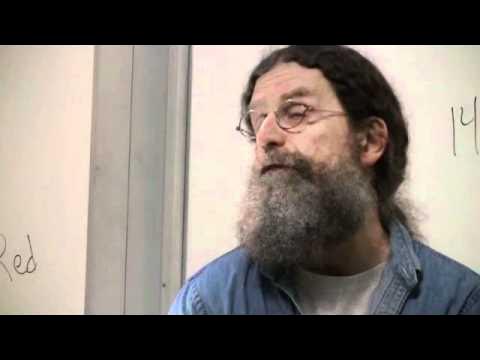
Sapolsky Dismantles Single-Cause Buckets in Human Behavioral Biology
Stanford
Human actions cannot be explained by isolated disciplines like genetics or psychology because every behavior stems from an unbroken causal continuum linking acute neural firing to evolutionary selection.
Robert Sapolsky establishes that human behavior is driven by a continuous, bidirectional feedback loop where somatic states alter brain function and cognitive states alter peripheral physiology. (6:16)
Categorical thinking provides cognitive shortcuts for memory and recall, but systematically distorts reality by exaggerating differences across arbitrary boundaries and blinding observers to variations within categories. (11:42)
Behavioral biology demonstrates three distinct relationships between humans and animals: direct physiological equivalence, shared physiology deployed for purely cognitive triggers, and entirely unique human behaviors. (33:06)
Single-discipline reductionism in science has historically yielded catastrophic results, from Watsonian behaviorism to prefrontal lobotomies and Konrad Lorenz's Nazi eugenics propaganda. (25:18)
Detailed notes
## Background
This opening lecture of BIO 150 (Human Behavioral Biology) was delivered by Professor Robert Sapolsky at Stanford University on March 29, 2010, and published on YouTube by the Stanford channel on February 1, 2011. According to the page description, Sapolsky introduces the core premise of the course and explains his central goal of avoiding categorical thinking when analyzing human behavior.
## TL;DR
Professor Robert Sapolsky introduces the foundational principles of human behavioral biology by examining the continuous, bidirectional feedback loop between the body's internal physiology and the brain's thoughts and actions. He critiques reductionist, categorical thinking, demonstrating how dividing continuous phenomena into rigid disciplinary buckets leads to intellectual distortion and historic scientific atrocities like eugenics and lobotomies. To navigate this complexity, the course adopts a multidisciplinary framework that traces behaviors chronologically—from acute neural firing and sensory cues back through hormones, early development, genetics, and evolutionary selective pressures. Sapolsky also outlines three major intellectual hurdles in studying behavior: recognizing where humans are ordinary animals, seeing where common physiology is used in unique cognitive ways, and identifying behaviors that have no animal precedent.
## Atmosphere & style
The lecture is fast-paced, intellectually playful, and grounded in a sharp, dry wit that keeps a massive lecture hall engaged from the opening thought experiment. Sapolsky balances dark historical reflections—such as the misuse of biology in Nazi eugenics—with lighthearted self-deprecation, playful jabs at departmental politics, and casual banter with students over missing bagels. The delivery feels spontaneous yet deeply structured, blending rigorous neuroendocrine examples with relatable analogies to create an accessible, invigorating classroom atmosphere.
## Bulletin
- [06:16](https://www.youtube.com/watch?v=NNnIGh9g6fA&t=376s) Robert Sapolsky establishes that human behavior is driven by a continuous, bidirectional feedback loop where somatic states alter brain function and cognitive states alter peripheral physiology.
- [11:42](https://www.youtube.com/watch?v=NNnIGh9g6fA&t=702s) Categorical thinking provides cognitive shortcuts for memory and recall, but systematically distorts reality by exaggerating differences across arbitrary boundaries and blinding observers to variations within categories.
- [33:06](https://www.youtube.com/watch?v=NNnIGh9g6fA&t=1986s) Behavioral biology demonstrates three distinct relationships between humans and animals: direct physiological equivalence, shared physiology deployed for purely cognitive triggers, and entirely unique human behaviors.
- [25:18](https://www.youtube.com/watch?v=NNnIGh9g6fA&t=1518s) Single-discipline reductionism in science has historically yielded catastrophic results, from Watsonian behaviorism to prefrontal lobotomies and Konrad Lorenz's Nazi eugenics propaganda.
## Key takeaways
- [00:00](https://www.youtube.com/watch?v=NNnIGh9g6fA&t=0s) Abrupt, radical behavioral unravelings can stem directly from biological pathology, such as single-gene mutations affecting brain function.
- [03:17](https://www.youtube.com/watch?v=NNnIGh9g6fA&t=197s) Physical and biological states, including menstruation, brain tumors, blood sugar volatility, and anabolic steroid abuse, have been successfully used in courts to exonerate or mitigate sentences for murder.
- [06:16](https://www.youtube.com/watch?v=NNnIGh9g6fA&t=376s) The core axiom of human behavioral biology is the bidirectional feedback loop: internal bodily physiology directs brain output, while mental imagery and emotions directly alter peripheral physiological states.
- [11:42](https://www.youtube.com/watch?v=NNnIGh9g6fA&t=702s) Categorical thinking is an essential human tool to manage complexity, but it distorts perception by blinding people to differences within the same category and exaggerating differences across arbitrary boundaries.
- [13:27](https://www.youtube.com/watch?v=NNnIGh9g6fA&t=807s) Linguistic and conceptual categories fundamentally alter sensory perception and pattern recognition, as shown by cross-cultural color memory, phonetic distinctions, and number chunking habits.
- [19:56](https://www.youtube.com/watch?v=NNnIGh9g6fA&t=1196s) Disciplinary scientific 'buckets'—such as endocrinology, genetics, and neurology—are not isolated explanations, but temporary platforms describing an interconnected chain stretching from immediate neuronal firing to evolutionary deep time.
- [25:18](https://www.youtube.com/watch?v=NNnIGh9g6fA&t=1518s) Historical overreliance on single-bucket explanations has caused severe harm, including John Watson's extreme behaviorism, António Egas Moniz's invention of lobotomies, and Konrad Lorenz's justification of Nazi racial extermination.
- [33:59](https://www.youtube.com/watch?v=NNnIGh9g6fA&t=2039s) Human behavior mirrors that of other mammals in direct olfactory neuroendocrine phenomena, such as menstrual synchrony driven by social dominance and pheromones (the Wellesley Effect).
- [36:51](https://www.youtube.com/watch?v=NNnIGh9g6fA&t=2211s) Humans frequently recruit standard animal physiology—such as the acute stress response—purely through abstract cognition, mental imagery, and symbolic competition like chess.
- [39:16](https://www.youtube.com/watch?v=NNnIGh9g6fA&t=2356s) Humans exhibit entirely unprecedented behaviors in the animal kingdom, including chronic non-reproductive sexual habits paired with verbal communication and the intertwining of sex with physical aggression.
- [44:29](https://www.youtube.com/watch?v=NNnIGh9g6fA&t=2669s) Understanding behavioral biology is an essential civic skill required for informed jury deliberations, social policy voting, and addressing mental illness.
- [45:36](https://www.youtube.com/watch?v=NNnIGh9g6fA&t=2736s) Traditional reductionism fails to explain human behavior; as detailed in James Gleick's 'Chaos', complex biological systems behave like non-linear clouds rather than mechanical clocks.
## Detailed walkthrough
### [00:00](https://www.youtube.com/watch?v=NNnIGh9g6fA&t=0s) A Man Unravels: Three Explanations for Bizarre Behavior
Professor Robert Sapolsky opens the lecture for BIO 150 (Human Behavioral Biology) at Stanford University by verifying the room and immediately plunging the audience into a concrete thought experiment. He describes a 40-year-old man who has lived a quiet, stereotypical suburban existence: married for 15 years, father of two children, owner of “3.5 dogs,” with everything proceeding smoothly and standardly. Then, out of nowhere, an abrupt series of bizarre, escalating behaviors shatters this life. First, standing around a workplace water cooler, he takes offense at a casual remark about a baseball team and punches a colleague square in the face. Three months pass quietly until his wife discovers he is carrying on an affair with a 16-year-old cashier at the local Safeway grocery store. Another three months later, he embezzles all the money from his employer, absconds with the cash, and vanishes without a trace.
Sapolsky presents the lecture hall with three potential explanations for this rapid unraveling:
1. The man is simply a fundamentally deep creep.
2. He is experiencing the most immature midlife crisis imaginable.
3. He has a mutation in a single gene expressed in his brain.
Sapolsky points out that this exact behavioral trajectory matches the clinical profile of a specific neurological disorder driven by just one malfunctioning gene.
```mermaid
flowchart TD
accTitle: The Degradation of Behavior Thought Experiment
accDescr: Sequence of escalating behaviors in a hypothetical 40-year-old man leading to three potential causal interpretations.
subgraph Progression["Escalating Incidents"]
A["Quiet suburban life: 15-yr marriage, 2 kids"] --> B["Incident 1: Punches coworker at water cooler"]
B --> C["Incident 2 (3 mos later): Affair with 16-yr-old cashier"]
C --> D["Incident 3 (3 mos later): Embezzles company funds & disappears"]
end
subgraph Explanations["Hypothesized Causes"]
D --> E1["Option 1: Truly deep creep"]
D --> E2["Option 2: Immature midlife crisis"]
D --> E3["Option 3: Single-gene neurological mutation"]
end
```
[01:33](https://www.youtube.com/watch?v=NNnIGh9g6fA&t=93s) Gauging the Room: From Prenatal Politics to Free Will
To survey the perspectives and assumptions of the students, Sapolsky conducts an informal show-of-hands poll across a spectrum of controversial and biological topics. He asks whether sexual orientation carries a genetic influence, and whether events occurring in the prenatal environment could shape a person's political opinions three decades later. He questions if biology can reasonably account for religious belief, noting fewer hands raised for that premise. Pushing further into personal metaphysics, he asks how many believe in God, souls, or evil, before probing the audience on free will:
> “How many people believe in free will? That's going to change.” — Robert Sapolsky
Sapolsky then playfully asks if anyone actually believes in evolution, joking that he wants to see what he is dealing with. The survey turns to biological sex differences in aggression and intelligence, followed by the classic nature-versus-nurture debate. When the vast majority raise their hands for a nuanced, interactive synthesis between nature and nurture, Sapolsky remarks with a laugh that everyone can get an A+ because they apparently have the course material mastered already.
- **Survey topics probed by hand-raising:**
- Genetic influence on sexual orientation
- Prenatal influences on political beliefs 30 years later
- Biological underpinnings of religiosity
- Belief in God, souls, evil, and free will
- Acceptance of evolutionary theory
- Biological sex differences in aggression vs. intelligence
- Nature alone vs. nurture alone vs. nature-nurture interaction
[03:17](https://www.youtube.com/watch?v=NNnIGh9g6fA&t=197s) Four Circumstances and Legal Exoneration for Murder
Sapolsky challenges the audience to discover an unexpected common denominator linking four seemingly unrelated physical states:
1. Having your period (menstruation).
2. Having a brain tumor.
3. Eating a large amount of junk food.
4. Taking anabolic steroids (testosterone derivatives used by bodybuilders).
When a student suggests hormones, Sapolsky affirms the connection but presses the room to guess the narrower, far more dramatic link. Seeing hesitant half-raised hands, he reveals the answer:
> “All of these have been used successfully in courts of law to explain the behavior of a murderer.” — Robert Sapolsky
He details the historical and physiological precedents behind each defense:
- **Menstruation:** Multiple legal cases have seen juries exonerate women on murder charges based on arguments that crimes coincided with their menstrual cycles, drawing upon scientific literature documenting heightened female aggression around the time of menses.
- **Brain tumor:** An abnormality or tumor located within the amygdala—a critical limbic region involved in fear and aggression that the class will study intensively—has been shown to produce sudden, uncontrollable violence and has yielded successful legal defenses.
- **Junk food:** In local San Francisco political history, former supervisor Dan White assassinated Mayor George Moscone and Supervisor Harvey Milk. White’s legal team mounted the famous "Twinkie defense," successfully arguing that an addiction to junk food caused severe blood sugar swings that impaired his mental state, leading to a manslaughter verdict and a remarkably light sentence.
- **Anabolic steroids:** Violent offenders who were heavy weightlifters have successfully argued that massive, abusive dosages of synthetic testosterone derivatives triggered explosive, uncontrollable aggression ("roid rage").
[06:16](https://www.youtube.com/watch?v=NNnIGh9g6fA&t=376s) Two Core Premises: The Mind-Body Feedback Loop
Synthesizing these four legal defenses leads Sapolsky directly to the first overarching axiom of human behavioral biology: what occurs within the physical body can exert a profound influence on brain function and decision-making.
He then illustrates the reverse dynamic through an exercise in somatic imagery. He instructs the students to imagine lying down in bed later that evening, completely relaxed, with their heart beating slowly and steadily. He tells them to deliberately contemplate their mortality: picturing that their heart will not beat forever, imagining the blood flow slowing to a halt, their lips turning blue, and their toes and feet growing cold. Contemplating those morbid thoughts immediately triggers autonomic arousal, elevating their heart rate.
This experiment proves the second core foundation of the course: thoughts and emotions generated in the head can instantly reverberate throughout the peripheral outposts of the body. Sapolsky emphasizes that human behavioral biology is fundamentally about this continuous, bidirectional interplay between internal physiology and overt social behavior, emotion, memory, and thought.
[07:27](https://www.youtube.com/watch?v=NNnIGh9g6fA&t=447s) The Complexity of Human Behavior and Categorical Thinking
Sapolsky acknowledges that decoding this bidirectional feedback is extraordinarily difficult because human social behavior—and particularly gross behavioral pathology—is messy, complicated, and multifaceted. If the class were studying why wild wildebeests synchronize their mating into a single week each year, or how migrating birds navigate across continents without getting lost, the biological mechanisms would be far simpler to isolate.
To cope with this staggering complexity, humans universally rely on a cognitive shortcut: categorical thinking. Rather than perceiving reality as fluid, unbroken continua, humans establish boundaries, slice continuous phenomena into discrete conceptual buckets, and assign labels to those buckets. Categorical thinking eases the cognitive burden of memory and communication:
- **Spatial length:** A continuous measurement is categorized as "about a foot" by benchmarking it against the familiar mental prototype of a 12-inch ruler or standard paper dimensions (8.5 by 11 inches).
- **Athletic performance:** Running speed exists along an infinite gradient of times, yet culture imposes a rigid threshold: breaking the "four-minute mile" separates average runners from legendary, impressive athletes.
- **Inapplicable categories:** If someone attempts to praise an artist by claiming they are exceptional because they paint using "11 different colors," the claim falls flat because color count is not an established evaluative category in art.
- **Color perception:** Wavelengths of light form an unbroken continuum across the visible spectrum from violet to red. English speakers impose arbitrary linguistic divisions at specific wavelengths, assigning names such as "red" or "orange." Sapolsky points out that cross-linguistic studies reveal that linguistic groups that divide the color spectrum at different boundary markers actually recall color shades differently, particularly when a shade falls squarely in the center of their linguistic category rather than near a boundary.
[11:42](https://www.youtube.com/watch?v=NNnIGh9g6fA&t=702s) The Cognitive Function and Pitfalls of Categories
```mermaid
flowchart TD
accTitle: The Two-Sided Nature of Categorical Thinking
accDescr: Diagram contrasting the cognitive benefits of categorical thinking with its three major analytical distortions.
subgraph Benefits["Cognitive Advantages"]
B1["Compress continua into chunks"] --> B2["Faster recall & evaluation"]
end
subgraph Pitfalls["Cognitive Distortions"]
P1["Intra-category blindness:<br/>Underestimating differences inside a bucket"]
P2["Boundary exaggeration:<br/>Overestimating differences across a boundary"]
P3["Tunnel vision:<br/>Missing the overarching pattern"]
end
Categorical thinking serves as an essential cognitive shortcut for dealing with complex continuous information. When human perception encounters a continuum—whether of wavelengths of light or phonetic sounds—breaking it into discrete chunks makes the data far easier to store, recall, and evaluate. For example, when subjects are shown colors located solidly in the middle of a named color range, they remember whether they previously saw that exact color significantly better than if they are shown a borderline hue sitting at a linguistic boundary. Similarly, when presented with four shapes where the first three correspond to common labels and the fourth is merely an unanalytical “squiggly whatever,” people show much higher recognition accuracy for the categorized shapes an hour later simply because they possess a label for them.
However, relying on categorical boundaries introduces serious distortions into how we interpret reality. Continuous phenomena exist in virtually every sensory domain; human speech sounds form an infinite continuum, yet distinct languages slice that spectrum in arbitrary places. English speakers, for instance, distinguish between phonetic sounds like two subtle variations of the "th" sound with varying degrees of success, while other languages impose altogether different divisions. When a mind pays excessive attention to categories, it struggles to differentiate items that happen to fall within the exact same category, while vastly overestimating the difference between items separated by an arbitrary line.
- People show superior memory for colors squarely within a named color category compared to boundary shades, dependent on the language they speak.
- Geometric shapes with analytical labels are recalled far more accurately than unnamed squiggly shapes.
- Different languages create unique acoustic boundaries, dictating which phonetic differences native speakers can perceive.
[13:27](https://www.youtube.com/watch?v=NNnIGh9g6fA&t=807s) Practicing on a Bear: Phonetic Boundaries and Arbitrary Cutoffs
To illustrate the danger of being unable to differentiate two things within a single linguistic category, Robert Sapolsky recounts an anecdote from his own research career. Years earlier, finding himself in the unusual position of needing to perform testicular biopsies on baboons—a procedure he had never learned—he called a Finnish urologist at the medical school for guidance. The physician patiently explained the required instruments, how to acquire them in bulk holiday packages of a dozen, and the step-by-step technique. At the conclusion of the advice, the doctor insisted that Sapolsky needed hands-on practice before touching a live baboon:
> “What I want you to do, the thing to do at this point, is get some practice. I want you to practice on a bear.”
Bewildered and alarmed, Sapolsky asked if he was joking, to which the urologist replied, “I know it sounds crazy, but we have all the residents do that. It's a very good learning device. Either practice on a bear or an apple.” Only then did Sapolsky realize that Finnish does not differentiate between the voiced bilabial stop "B" and the voiceless bilabial stop "P"—the doctor was advising him to practice on a *pear*. As Sapolsky observes, this mix-up highlights the first major problem of categorical thinking: “when you are paying too much attention to categories, you can't differentiate two facts that fall within the same category.”
The inverse distortion occurs when an arbitrary boundary separates two virtually identical points. Sapolsky recalls the acute anxiety of university exams, where a score of 65 represented failure and a score of 66 meant passing. Although the 1-point difference in objective performance is negligible, the placement of a categorical grading cutoff causes people to treat the two scores as worlds apart: “When you put up boundaries, you have trouble seeing how similar things are on either side of it.”
[15:29](https://www.youtube.com/watch?v=NNnIGh9g6fA&t=929s) The Chunking Trap and the 42nd Street Subway Test
The third major limitation of categorical thought is that it prevents people from perceiving the larger picture. To demonstrate this to the lecture hall, Sapolsky instructs students to flip over their questionnaire sheets and transcribe a rapid sequence of dictated numbers as accurately as possible. He reads aloud nine multi-digit sequences:
Sapolsky notes that performance invariably collapses the moment a number sequence violates the standard North American telephone template of three digits followed by four digits. When cognitive chunking expects a phone number format, an unexpected one-digit or two-digit break derails short-term processing entirely, causing transcription accuracy to tank. Concentrating strictly on the expected category causes the listener to lose the flow of information.
```mermaid
flowchart LR
accTitle: Sequence Recognition Based on Mental Categories
accDescr: Progression of numbers leading to divergent interpretations between mathematical extrapolation and New York subway stops.
He then writes a numerical sequence on the board to test how internal categories shape reasoning: `4th, 14th, 23rd, 34th...` and asks the class to identify the next entry. Students guess a variety of mathematical patterns, proposing 42, 45, 44th, and even "seven billionth." Finally, a student correctly shouts "42nd," identifying the sequence as major express subway stops along Manhattan's transit lines. The student earns applause and the promise of a bagel with cream cheese. The exercise demonstrates that while New Yorkers instantly recognize the pattern through transit categories, those applying purely mathematical categories see only an irregular numerical series.
[19:56](https://www.youtube.com/watch?v=NNnIGh9g6fA&t=1196s) Crossing the Road: Avoiding the Single-Bucket Trap
```mermaid
flowchart TD
accTitle: Multidisciplinary Framework for Analyzing Behavior
accDescr: The temporal and biological levels of inquiry used to investigate a behavior without relying on a single categorical bucket.
Sapolsky synthesizes the three core hazards of categorical thinking that the class must actively resist:
1. Underestimating how different two facts are when they fall in the same category.
2. Overestimating how different two facts are when an arbitrary boundary separates them.
3. Losing sight of the big picture by fixating exclusively on boundary lines.
The central mission of Human Behavioral Biology is to tackle the intricate biology of behavior without succumbing to reductionist buckets. To illustrate the trap of disciplinary silos, Sapolsky poses a classic riddle: imagine a hen standing in a field; across the road, a rooster performs a sexually solicitive display, and the hen runs across to mate. If asked why the chicken crossed the road, different scientists retreat into their respective professional buckets:
- An **endocrinologist** explains that high circulating estrogen levels sensitized the hen's hypothalamic nuclei to the mating stimulus.
- An **anatomist** explains that the structural fulcrum of the avian pelvis permitted rapid locomotion.
- An **evolutionary biologist** explains that ancestral hens responding to sexual solicitations maximized their relative reproductive success and gene replication over millennia.
Relying exclusively on any one explanation—a single gene, a neurotransmitter, or a childhood trauma—blinds the investigator to reality. As Sapolsky emphasizes:
> “What we are going to be doing over and over in here as the main point of the course is looking at how what goes on in your body influences behavior, emotions, memories. How what goes on there influences your body, looping over. And at every one of those points, resisting the pull to think categorically.”
To execute this, the course will examine behaviors chronologically rather than categorically. Every behavior will first be described objectively. Next, the inquiry asks what happened within the nervous system one half-second before the action occurred—identifying the firing circuits and activated brain regions. Immediately after, rather than settling into that neurobiological bucket, the analysis will step back to identify the external sensory stimuli—the specific sights, sounds, or smells in the environment—that triggered those exact neurons to fire.
[23:22](https://www.youtube.com/watch?v=NNnIGh9g6fA&t=1402s) Deconstructing the Buckets: Temporal Platforms of Biological Influence
Continuing his breakdown of behavior, Robert Sapolsky demonstrates how any single biological explanation inevitably forces an investigator backward through time. A neurobiological trigger—a sight or smell activating a neuron—is directly shaped by hormone levels circulating in the bloodstream during the preceding hours. Those hormones, in turn, are encoded by genes, instantly shifting the conversation from endocrinology to genetics. Because those genes were shaped by selective pressures over millennia, the discussion immediately expands into evolutionary biology; simultaneously, acute sensory triggers are bounded by fetal and early developmental environments that calibrated sensory sensitivity in the first place.
Because every biological level is merely a downstream consequence of earlier influences, categorical distinctions vanish upon close inspection. Sapolsky emphasizes that disciplinary "buckets" (such as endocrinology, genetics, or neurology) are not isolated outposts, but rather temporary, convenient platforms for describing the vast sequence of causes stretching back through evolution. As Sapolsky summarizes the premise: “And in that regard, there's no buckets. All they are, are temporary platforms. And each platform is simply the easiest, most convenient way of describing the outcome of everything that came beforehand starting with millennia back in evolution.”
```mermaid
flowchart TD
accTitle: Timeline of Biological Influences on Behavior
accDescr: A backward causal chain linking evolutionary history to immediate behavioral responses.
subgraph DeepTime["Deep Time & Development"]
EVO["Evolutionary Selection (Millennia)"]
GEN["Genetic Makeup & Population (Species)"]
DEV["Fetal Life & Early Development"]
end
subgraph ImmediateState["Acute Biology"]
HOR["Hormone Levels (Past Hours)"]
SENS["Sensory Stimuli (Smells, Sounds)"]
NEUR["Neural Activation & Behavior"]
end
EVO --> GEN
GEN --> DEV
DEV --> HOR
HOR --> SENS
SENS --> NEUR
```
[25:18](https://www.youtube.com/watch?v=NNnIGh9g6fA&t=1518s) Pathological Categorical Thinking: The Founding Extremes of Behaviorism
Anticipating student skepticism, Sapolsky addresses the suspicion that warning against categorical thinking attacks a mere strawman. While one might assume professional biologists already recognize that systems interact, Sapolsky reads historical quotes demonstrating how major scientists pathologically locked themselves into single-bucket explanations, leading to disastrous intellectual and real-world outcomes.
He introduces the school of behaviorism through its founder, John Watson, reading Watson's famous 1912 declaration: “Give me a child at birth from any background, and let me control the total environment in which he is raised, and I will turn him into anything I wish him to be-- whether doctor, lawyer, or beggar, or thief.” Watson believed that total control over positive and negative reinforcements could entirely manufacture human outcomes, a paradigm later brought to its apogee by B.F. Skinner in the 1950s. Sapolsky points out the absurdity of this claim by introducing simple biological counter-variables—such as severe protein malnutrition during fetal development—which decisively derail environmental conditioning. Sapolsky adds a biographical irony about Watson's fall from grace:
- Following an academic scandal, John Watson was driven out of academia.
- He transitioned into a lucrative career as a prominent advertising executive, demonstrating that while he could not mold infants into whatever he wanted, he proved exceptionally capable of manipulating the public into purchasing consumer goods and "geegaw nonsense."
[27:52](https://www.youtube.com/watch?v=NNnIGh9g6fA&t=1672s) Mechanistic Hubris: Egas Moniz and the Invention of Lobotomies
Sapolsky presents a second quotation illustrating neurobiological reductionism: “Normal psychic life depends upon the good functioning of brain synapses, and mental disorders appear as a result of the synaptic derangements. Synaptic adjustments will then modify the corresponding ideas and force them into different channels. Using this approach, we obtained cures and improvements but no failures.”
When Sapolsky asks the class to guess what procedure this scientist meant by euphemistic "synaptic adjustments," students guess electroshock therapy before realizing the true answer: the prefrontal lobotomy, which involved severing roughly the anterior third of a patient's brain.
- The quote was spoken by António Egas Moniz, the Portuguese neurologist who developed the frontal lobotomy.
- Moniz uttered these words during his acceptance speech for the 1949 Nobel Prize in Physiology or Medicine, awarded specifically for inventing the procedure.
- Sapolsky denounces the era as "one of the darkest chapters of where psychiatry gets in bed with ideology," noting that tens to hundreds of thousands of people who had nothing pathologically wrong with them were subjected to massive, irreversible brain damage under the guise of an infallible medical cure.
[29:48](https://www.youtube.com/watch?v=NNnIGh9g6fA&t=1788s) Ideology as Biology: Konrad Lorenz and the Nazi State
The third and most destructive quotation presented by Sapolsky addresses racial hygiene and degenerating domestic stocks: “The selection for social utility must be accomplished by some social institution if mankind is not to be ruined by domestication induced degeneracy. The racial idea as the basis of our state has already accomplished much in this respect. We may, and we must, rely on the healthy instincts of the best of our people for the extermination of elements of the population loaded with dregs.”
While a student guesses Adolf Hitler, Sapolsky corrects the room: Hitler was a politician, whereas this statement came directly from one of his foremost scientific propagandists, Konrad Lorenz. Lorenz is universally remembered in popular culture as the charming, cherubic, Austrian ethologist in suspenders photographed with imprinted ducklings trailing behind him. Yet, as Sapolsky makes clear:
- Konrad Lorenz was a founding father of animal ethology who discovered avian imprinting, but also an unrepentant Nazi propagandist who defended his eugenic writings until his death.
- These examples were not obscure, fourth-rate academics from low-profile institutions; they were among the most influential scientists of the twentieth century.
- Their narrow intellectual buckets directly rationalized the institutional destruction of hundreds of thousands of psychiatric patients' brains, stunted educational policies, and the extermination of nine million people during the Holocaust.
Sapolsky reasserts that the central mission of the course is resisting this exact temptation when analyzing complex or disturbing human behaviors: “They're not even temporary buckets. There's no buckets. That will be our goal.”
[33:06](https://www.youtube.com/watch?v=NNnIGh9g6fA&t=1986s) Intellectual Challenge #1: Humans as Animals (The Hamster Effect)
Moving to the core material, Sapolsky outlines three overarching intellectual challenges students will face when studying the biology of human social behavior. The first challenge is confronting and accepting the circumstances where human beings are completely unexceptional—occasions where humans operate precisely like every other animal.
To illustrate this, Sapolsky sets up an experiment in mammalian neuroendocrinology using female hamsters:
- A lone female hamster housed in a cage exhibits a regular, spontaneous estrous cycle, ovulating roughly every five days.
- When an unfamiliar female hamster is introduced into the same cage, chemical communication alters their endocrine systems.
- Over the following month, the two females begin lengthening their ovulatory cycles until their reproductive timing fully synchronizes.
[33:59](https://www.youtube.com/watch?v=NNnIGh9g6fA&t=2039s) Olfactory Communication and Menstrual Synchrony
Robert Sapolsky illustrates the first challenge of human behavioral biology—realizing that humans are often simply ordinary animals—by examining ovulatory and menstrual synchrony. In female hamsters, synchrony is mediated by airborne olfactory signals, or pheromones. Researchers can verify this either by taking electrical recordings from the olfactory system or, as Sapolsky jokes for those lacking research grant funding, by simply putting a paper clip over a female hamster's nose, which immediately halts synchronization.
This process is strictly non-random and highly regulated. Introducing a male hamster disrupts the synchrony; male pheromones cause the females' cycles to shorten and desynchronize. Furthermore, when two females are housed together, the dominant female invariably synchronizes the subordinate one. This biological mechanism is thoroughly documented across species including goats, sheep, dogs, cats, and pigs. Sapolsky quips that one could theoretically walk into a 7-Eleven in Iowa, purchase an aerosol can of pig ovulatory synchronization spray off the shelf alongside cans of Cheez Whiz, take it home, and run wild—though why anyone would desire to do so remains a mystery.
In humans, this phenomenon manifests identically as the "Wellesley Effect," named after the 1970 study documenting how freshman female college roommates began to lengthen and synchronize their menstrual cycles over the academic year. Olfaction mediates the effect in humans as well; women with olfactory impairments do not synchronize, and having a close, intimate relationship with an outside male breaks up the synchrony. Moreover, human synchronization follows the same social asymmetry seen in other animals: the individual who is more outgoing, extroverted, and socially dominating drives the synchronization of the other roommate. Reflecting on his own undergraduate days, Sapolsky recalls biology peers boasting casually over dinner that they had their roommates synchronized by August 1st. Sapolsky emphasizes that humans share virtually the identical genome with chimpanzees, stating: “Some of the time, we are just a plain old off-the-rack animal.”
- Hamster ovulatory synchrony relies on airborne pheromonal signaling detectable via olfactory system recordings.
- Disruption occurs upon exposure to male pheromones, which shorten and desynchronize female estrous cycles.
- Social hierarchy dictates synchrony: dominant female hamsters synchronize subordinate females.
- The Wellesley Effect was first formally documented in 1970 among freshman college roommates.
- Roommates with olfactory deficits fail to synchronize, and intimate relationships with men prevent synchrony.
- Extroverted, socially dominant human roommates drive cycle synchronization in their peers.
[36:51](https://www.youtube.com/watch?v=NNnIGh9g6fA&t=2211s) Common Physiology Used in Novel Ways: The Chess Grandmaster
The second major conceptual challenge arises when humans share typical, baseline animal physiology with other species but deploy it in completely unprecedented ways. Sapolsky describes two individuals sitting motionless across a table in complete silence, making zero eye contact, performing no physical work other than occasionally lifting a hand to move a small wooden piece. In a grandmaster chess tournament, these competitors will maintain sustained elevated blood pressure for six hours straight—levels comparable to a marathon runner—and burn thousands of calories a day purely through cognition.
A chess grandmaster who captures an opponent's queen mounts the exact physiological response as a male baboon on the savannah ripping open the stomach of his fiercest rival. While the underlying neuroendocrine mechanisms are identical, humans activate them purely with internal mental representations. Humans elevate their stress responses through thoughts of mortal inevitability, reading a newspaper report about an injured child on the opposite side of the globe, feeling economically inadequate after being passed by a faceless driver in an expensive sports car, or reading about tragedies happening to fictional characters in novels. On the reverse side, humans recruit standard neurobiology for empathy and social bonding not just for immediate offspring, but across the globe to distant refugees in camps, or across taxonomic boundaries to injured household pets.
```mermaid
flowchart TD
accTitle: Divergent Triggers for Identical Stress Physiology
accDescr: A diagram contrasting the physical triggers of a baboon with the cognitive triggers of a human chess grandmaster, both driving identical physiology.
subgraph Triggers["Evolutionary vs. Cognitive Stimuli"]
A["Male Baboon:<br/>Physical savannah battle with rival"]
B["Chess Grandmaster:<br/>Moving a wooden piece across a board"]
C["Human Cognition:<br/>Abstract mortality, novels, distant news"]
end
subgraph Physiology["Identical Physiological Machinery"]
D["Massive sustained blood pressure"]
E["Burning thousands of calories per day"]
F["Surge in systemic stress endocrinology"]
end
A --> D
A --> E
A --> F
B --> D
B --> E
B --> F
C --> D
C --> E
C --> F
```
[39:16](https://www.youtube.com/watch?v=NNnIGh9g6fA&t=2356s) Human Uniqueness and the Course Roadmap
The third category involves domains of behavior where humans exhibit traits without any animal precedent. Sapolsky humorously paints a scenario of a human domestic couple coming home from work, talking, eating dinner, talking, having sex, talking, and sleeping, only to repeat this sequence consecutively for 30 straight days. Non-reproductive sex sustained day after day, capped by verbal debriefing, is practically unheard of across the animal kingdom; as Sapolsky remarks, “Hippos would be repulsed by this.” Unique human adaptations include complex language, elaborate non-reproductive sexual habits, and tragic dysfunctions such as intertwining sexual behavior with physical aggression.
Sapolsky reiterates that avoiding categorical thinking is paramount to prevent grave real-world damage. He lays out the pedagogical architecture of the semester:
1. **First Half of the Course (The Buckets):** Introductions to distinct disciplines—evolutionary theory, molecular genetics, behavioral genetics, ethology, neuroscience, and endocrinology. Sapolsky warns that this segment is “a total pain in the rear” because every two to three lectures switch to an entirely new technical vocabulary.
2. **Second Half of the Course (Dismantling the Buckets):** Applying the integrated toolbox to complex behaviors—aggression, parental behavior, sexuality, schizophrenia, depression, personality disorders, and language—tracing each act from the triggering action potential a second before, back through sensory cues, hormone levels, neurodevelopment, and evolutionary selective pressures millions of years in the past.
The course deliberately requires no prerequisites because Sapolsky believes behavioral biology is an essential field for every human being. After taking a quick survey of the room—checking for biology majors, human biology majors, psychologists, anthropologists, and giving kudos to an English literature graduate student—he explains the academic support structure. To help non-science students keep pace with the rotating disciplines, weekly "catch-up sections" led by teaching assistants will introduce basic vocabulary before the main lectures. The first catch-up session is scheduled for Thursday at 7:30 PM in the adjacent room to prepare students without background knowledge for the upcoming lectures on evolutionary theory.
- The first half of the course alternates topics every 2.5 lectures, spanning evolutionary theory, molecular genetics, behavioral genetics, ethology, neuroscience, and endocrinology.
- The second half explores integrated behavioral syndromes: sexual behavior, aggression, parenting, schizophrenia, depression, personality disorders, and linguistics.
- Analysis ranges from the immediate millisecond neuronal firing to selective evolutionary pressures 10 million years prior.
- Catch-up sections are introduced to bridge gaps for students outside the sciences, starting with an evolutionary biology primer on Thursday at 7:30 PM.
[44:29](https://www.youtube.com/watch?v=NNnIGh9g6fA&t=2669s) Catchup Sections and the Everyday Need for Behavioral Biology
Robert Sapolsky encourages students lacking a formal science background to check the introductory handout for terminology lists across the various disciplines. If those terms look unfamiliar, it serves as a clear signal to attend the catchup sessions. For non-majors simply being adventurous, taking the course pass/fail is strongly recommended to remove grade pressure and allow them to focus purely on the material. He emphasizes that prior scientific training is not required, arguing that behavioral biology is an essential life skill rather than just an academic subject:
> “Because the obvious argument I would make is everybody has to learn behavioral biology because we're being behavioral biologists every time we serve on a jury.”
Sapolsky points out that people constantly act as behavioral biologists in everyday civic and personal contexts. Whether voting on whether public funds should target specific problems, evaluating whether a social issue is biologically or environmentally solvable, or trying to understand if a family member with severe depression is suffering from an underlying biochemical disorder or merely indulging themselves, informed biological thinking is indispensable. Taking advantage of the catchup sections ensures everyone reaches that baseline.
[45:36](https://www.youtube.com/watch?v=NNnIGh9g6fA&t=2736s) Course Structure, Assessments, and Assigned Readings
The mechanics of the course rely on weekly discussion sections rather than mandatory assignments to specific time slots. Approximately 18 sections will run each week across diverse times, allowing students to attend whichever fits their schedule. Grading is straightforward: there is an evening midterm administered once the class completes the introductory disciplinary "buckets," followed by a final exam, with no term papers required. Lectures will also incorporate a five-minute break midway through so students can stand up and stretch.
```mermaid
flowchart TD
accTitle: Course Structure and Reading Trajectory
accDescr: Flowchart illustrating the course progression from disciplinary buckets through the midterm into chaos, complexity, and the final exam.
subgraph Part1["First Half: The Disciplinary Buckets"]
A["Disciplinary Foundation Lectures"] --> B["Catchup & Weekly Discussion Sections"]
B --> C["Midterm Exam (Evening)"]
end
subgraph Part2["Second Half: Integrative Complexity"]
C --> D["Chaos & Complexity Lectures"]
D --> E["Assigned Texts (Gleick & Sapolsky)"]
E --> F["Final Exam"]
end
```
Turning to reading materials, Sapolsky jokes about his own assigned book, telling students they do not even have to read it so long as they buy multiple copies and show him the receipts. The other core text is James Gleick’s *Chaos*. Over the years, the book has polarized students sharply: a quarter despise it as irrelevant, about half never fully comprehend its purpose, and another quarter experience a near-spiritual epiphany where they find lasting peace without needing meditation. The book mounts a profound challenge to 500 years of scientific reductionism—the notion that complex systems are understood merely by dismantling them into small pieces and gluing them back together:
> “Behavior is not like a clock. Behavior is like a cloud. And you don't understand rainfall by breaking a cloud down into its component pieces and gluing them back together.”
- Gleick's *Chaos* is the only book besides the children's classic *Baby Beluga* that prompted Sapolsky to flip immediately back to page one upon finishing it; he considers it the single most influential science book he has read since college.
- Lectures in the second half of the course specifically unpack chaos and complexity, upending traditional reductionist paradigms of behavior.
- To spare students textbook costs, there is currently no paper course reader; readings consist of downloadable online papers and abstracts, with specific instructions on whether to read the full text or simply absorb the abstract as an illustration of how a particular disciplinary "bucket" frames a problem.
[49:48](https://www.youtube.com/watch?v=NNnIGh9g6fA&t=2988s) Course Logistics, Going Paperless, and the Teaching Team
The class will lean heavily on its online CourseWork site for materials. Lecture notes spanning 5 to 10 pages per lecture will be posted up through roughly the middle of the semester—at which point Sapolsky admits he will likely "run out of steam." Aside from the opening day, printed handouts are discontinued because distributing paper to a class of this size consumes approximately 5,000 sheets per lecture even when double-sided. Handouts will appear on CourseWork the day prior, though students without digital access can speak to him privately for physical copies.
```mermaid
flowchart LR
accTitle: Lecture Inflow and Outflow Logistics
accDescr: Diagram depicting classroom flow where incoming students enter from the top of the lecture hall to displace the prior class.
A["Incoming Behavioral Biology Students"] -->|"Enter from top doors"| B["Flow down lecture hall stairs"]
B -->|"Displace exiting students"| C["Exit bottom doors"]
```
To resolve the bottleneck caused by the massive class preceding theirs in the lecture hall, Sapolsky suggests incoming students enter through the top doors and flow down the stairs to sweep the previous audience out the lower exits. He introduces the graduate teaching assistant team, having them stand up in the lecture hall to applause. The TAs bring diverse expertise across the various disciplinary buckets; some have taken or TA'd the class before. Later in the term, advanced sections will be offered alongside standard review sections for students wanting deeper analysis.
- Discussion sections begin the first Thursday, whereas official office hours commence the following week.
- Lecture recordings will be uploaded to CourseWork within roughly 24 hours of each meeting to accommodate students with scheduling conflicts during the two-hour block.
[52:52](https://www.youtube.com/watch?v=NNnIGh9g6fA&t=3172s) Course Units, Condoleezza Rice Anecdote, and Wrap-Up
Addressing a student inquiry regarding credits, Sapolsky explains that the course carries five units due to the unusually high number of instructional hours. He reveals that the course briefly yielded six units in previous years as an act of departmental retaliation:
> “Actually, for a while the class was a six-unit course. And that was because of Condoleezza Rice. Because when she was the provost here, she totally screwed the biology department by upping our teaching requirements under really nasty conditions.”
In response, the biology faculty used every trick available to inflate the unit counts of their offerings. Stanford administrators eventually caught on and rolled the class back to five units, prompting Sapolsky to joke that Rice first burdened biology teaching before moving on to weapons of mass destruction, telling students to say hello to her if they spot her on campus. Before closing, he checks in on student questions and confirms with the "bagel guy" from earlier in the lecture that his missing breakfast had indeed been successfully recovered rather than eaten by someone else.
[54:30](https://www.youtube.com/watch?v=NNnIGh9g6fA&t=3270s) Exam Dates and Assessment Formats
Fielding administrative questions from the audience, Robert Sapolsky first clarifies the schedule for the course's major examinations. After momentarily forgetting the exact day to laughter from the lecture hall, he confirms that the midterm is scheduled for Monday, May 3rd, at 7:30 in the evening, while the final exam will take place on June 4th. When an audience member asks about the specific format these exams will take, Sapolsky contrasts pedagogical ideals with the logistical realities of running an enormous lecture course. In a perfect setting without rigid disciplinary categories, he explains, student evaluation would look radically different:
> “In an ideal world, given the whole emphasis here on no buckets, blah blah, et cetera, it would be long essays, and requirements of sonnets, and sensitive haikus about the hypothalamus.”
Because of sheer student enrollment numbers, the course is forced into pragmatic grading compromises. The assessments rely heavily on multiple-choice questions to preserve the sanity of the teaching assistants, who would otherwise face an impossible grading volume in an exceptionally short turnaround window. Sapolsky emphasizes that the two exams serve distinct pedagogical roles across the term:
- **Midterm Exam**: Designed primarily to touch base and ensure students have mastered the baseline facts and foundational concepts within each individual disciplinary "bucket," while introducing a slight amount of interdisciplinary reasoning.
- **Final Exam**: Designed almost entirely to test integrative, synthetic thinking, forcing students to bridge concepts across multiple disciplines rather than simply recalling siloed facts.
[56:10](https://www.youtube.com/watch?v=NNnIGh9g6fA&t=3370s) Review Sessions and Logistics Clarifications
Sapolsky turns to the teaching assistants to resolve logistical questions about supplemental resources and catch-up sections. The TAs clarify that while catch-up sessions will not be videotaped, audio recordings will be captured and uploaded to Stanford's CourseWork platform alongside critical handouts and lecture visuals for students who cannot attend in person or need review.
Sapolsky confirms that assigned preparation materials will be posted in advance of each of the upcoming three lectures. The session concludes with a brief, humorous sequence of corrections regarding the precise scheduling of the final exam. After initially misstating the time as 7:30 and then guessing 5:15, Sapolsky checks the official schedule and confirms to the laughing lecture hall that the final will occur at 12:15. With the administrative details settled, he opens the floor for any final questions before closing the introductory lecture.
## Notable quotes
> [45:36](https://www.youtube.com/watch?v=NNnIGh9g6fA&t=2736s) Behavior is like a cloud. And you don't understand rainfall by breaking a cloud down into its component pieces and gluing them back together. — Robert Sapolsky
> [13:27](https://www.youtube.com/watch?v=NNnIGh9g6fA&t=807s) When you put up boundaries, you have trouble seeing how similar things are on either side of it. — Robert Sapolsky
> [33:59](https://www.youtube.com/watch?v=NNnIGh9g6fA&t=2039s) Some of the time, we are just a plain old off-the-rack animal. — Robert Sapolsky
## Mentioned
Robert Sapolsky, Dan White, George Moscone, Harvey Milk, John Watson, B.F. Skinner, António Egas Moniz, Konrad Lorenz, Adolf Hitler, Condoleezza Rice, James Gleick, Stanford University, Wellesley College, Chaos: Making a New Science, Baby Beluga
## Video description
(March 29, 2010) Stanford professor Robert Sapolsky gave the opening lecture of the course entitled Human Behavioral Biology and explains the basic premise of the course and how he aims to avoid categorical thinking.
Stanford University
http://www.stanford.edu
Stanford Department of Biology
http://biology.stanford.edu/
Stanford University Channel on YouTube
http://www.youtube.com/stanford
In an introductory lecture for Stanford's Human Behavioral Biology course, Professor Robert Sapolsky argues that human behavior cannot be understood through isolated disciplines, but must instead be analyzed as a continuous, bidirectional feedback loop between physiology and the environment stretching from split-second neural events to evolutionary history.
Bidirectional Mind-Body Feedback and Legal Precedents (3:17)
Sapolsky establishes that internal physiology directly alters brain function and overt decision-making, citing successful legal defenses where bodily states—such as menstruation, amygdala brain tumors, blood sugar crashes from junk food in the Dan White trial, and massive anabolic steroid abuse—were used to explain homicidal aggression. Conversely, purely mental processes instantly produce peripheral physiological reactions; deliberately contemplating one's own mortality triggers autonomic arousal and elevates heart rate. Sapolsky frames behavioral biology as the continuous investigation of this two-way loop.
The Hazards of Categorical Thinking (7:27)
To handle cognitive complexity, humans divide continuous phenomena into discrete categories, as seen in color naming, grading thresholds, and telephone number chunking. Sapolsky warns that categorical thinking introduces three major analytical distortions: underestimating differences between items placed within the same bucket (such as confusing a bear with a pear due to phonetic boundaries), overestimating differences between items separated by an arbitrary line (such as a failing exam score of 65 versus a passing score of 66), and failing to grasp the wider context.
The Destructive History of Disciplinary Silos (25:18)
Sapolsky warns that biological reductionism is not a benign academic error but has repeatedly produced severe intellectual and social damage. He points to behavioral psychologist John Watson’s claim that controlled environmental reinforcement could manufacture any human outcome regardless of biology; Portuguese neurologist António Egas Moniz’s Nobel Prize-winning invention of the prefrontal lobotomy, which rationalized widespread irreversible brain mutilation; and ethologist Konrad Lorenz using biological arguments to justify Nazi racial hygiene and eugenics.
Three Tiers of Human Behavioral Comparison (33:06)
To evaluate behavior without single-bucket bias, Sapolsky outlines three distinct tiers. First, humans often function as ordinary animals, exemplified by pheromonal ovulatory synchrony occurring in female hamsters and mirrored in college roommates as the Wellesley Effect. Second, humans use shared mammalian physiology in unprecedented ways, such as chess grandmasters elevating their blood pressure for hours and burning thousands of calories purely through abstract cognitive stress rather than physical combat. Third, humans display behaviors without clear animal parallels, including non-reproductive sex sustained across decades paired with language debriefing, or the pairing of sexual behavior with physical violence.
Course Methodology and Structural Design (19:56)
The course approaches behavior through an expanding chronological sequence: beginning with the firing action potential 0.5 seconds before an act, tracing back to sensory triggers minutes earlier, circulating hormones hours prior, fetal environment, genetics, and ultimately evolutionary pressures spanning millennia. The syllabus spends its first half introducing individual disciplines—including evolutionary theory, genetics, ethology, neuroscience, and endocrinology—before dismantling those buckets in the second half through James Gleick’s chaos theory to examine complex phenomena like aggression, depression, and language.
Sapolsky contends that mastering behavioral biology is a vital civic responsibility for evaluating public policy, juries, and personal relationships. However, despite advocating for an open-ended, essay-based evaluation that rejects rigid academic categorizations, the practical reality of managing an enormous lecture enrollment forces the course to rely primarily on multiple-choice midterm and final examinations.
## Background
该视频由斯坦福大学(Stanford University)于2011年2月1日发布在YouTube平台上。视频记录了罗伯特·萨波尔斯基(Robert Sapolsky)教授在2010年3月29日讲授的《人类行为生物学》(BIO 150)开篇导论,主要阐释了课程的核心前提以及如何抵制和避免单一学科的“分类思维”。
## TL;DR
萨波尔斯基教授通过行为异常案例与法庭生理抗辩,揭示了生理机制与外显行为之间深刻的双向互动,并系统剖析了人类依赖“分类思维”带来的认知便利与三大盲区。他援引行为主义、额叶切除术和纳粹优生学的历史教训,警示将复杂行为割裂归因于单一学科“水桶”的巨大危害,主张从即时神经回路一路回溯至数百万年演化的全时序视角。讲座还提出了理解人类行为生物学的三重维度——从人类作为普通动物的生理同步(如韦尔斯利效应),到将普通生理机制用于纯认知刺激,再到人类独有的行为模式,并倡导以超越经典还原论的混沌复杂性视角来理解生命。
## Atmosphere & style
整堂讲座充满冷面幽默与机智自嘲,萨波尔斯基用把“梨”听成“熊”的活检轶事以及曼哈顿地铁站台猜谜等生动桥段,引得阶梯教室笑声与掌声频起。然而在剖析脑白质切除术与纳粹优生理论等学术黑历史时,语调又骤然转为冷峻与警惕,展现出极强的知识分量与道德审视。这种在轻松戏谑与严肃思辨之间的自如切换,赋予了课堂极其抓人的智识张力,让听众在打破既有学科框架的冲击中,真切体会到探索复杂生命本质的震撼与魅力。
## Bulletin
- [07:27](https://www.youtube.com/watch?v=NNnIGh9g6fA&t=447s) 人类大脑倾向于使用分类思维来降低记忆和认知成本,但这会带来三大陷阱:低估同类内部差异、夸大跨边界微小差异,以及过度依赖既定范式而忽视全局。
- [25:18](https://www.youtube.com/watch?v=NNnIGh9g6fA&t=1518s) 历史上约翰·华生、埃加斯·莫尼斯及康拉德·洛伦兹等顶尖科学家,因深陷单一学科“水桶”的决定论偏见,曾分别导致了激进环境论、额叶切除术滥用以及纳粹种族清洗等灾难性后果。
- [33:06](https://www.youtube.com/watch?v=NNnIGh9g6fA&t=1986s) 理解人类行为生物学面临三重挑战:首先承认人类有时仅是普通动物(如与啮齿类相同的排卵同步现象),其次是人类能用普通生理机制应对独特的认知刺激(如棋手静坐消耗数千卡路里),最后是人类拥有无动物先例的独特行为(如非繁殖性高频性行为与复杂语言)。
- [46:24](https://www.youtube.com/watch?v=NNnIGh9g6fA&t=2784s) 萨波尔斯基指出复杂行为不能采用拆解零件的传统还原论来解释,它更像不可分割的云朵而非钟表,因此课程引入了复杂性与混沌学范式。
## Key takeaways
- [03:17](https://www.youtube.com/watch?v=NNnIGh9g6fA&t=197s) 生理状态与外显行为之间存在强烈的双向机制:身体的生理改变会剧烈影响大脑与行为(如经期、脑瘤、垃圾食品在法庭上的脱罪辩护),而大脑中的纯认知念头也能迅速改变外周生理指标(如想象死亡引发心率飙升)。
- [11:42](https://www.youtube.com/watch?v=NNnIGh9g6fA&t=702s) 连续体与分类思维的权衡:现实世界中的光谱和声学频率是完全连续的,人类为了便于记忆和处理而强行划分离散边界,这构成了分类思维的基础。
- [14:44](https://www.youtube.com/watch?v=NNnIGh9g6fA&t=884s) 分类思维存在三大核心陷阱:一是低估同类内部差异(如芬兰语不区分B与P导致把梨听成熊),二是过度夸大边界两侧微小差距(如65分及格与64分不及格),三是只见标签模式而丧失宏观视野(如非标准格式电话号码导致记错)。
- [23:22](https://www.youtube.com/watch?v=NNnIGh9g6fA&t=1402s) 学科划分的“水桶”是人为且虚构的:无论是内分泌学、神经生物学还是进化生物学,都只是描述同一种生物学因果链条在不同时间尺度上的便捷切入点。
- [20:22](https://www.youtube.com/watch?v=NNnIGh9g6fA&t=1222s) 行为分析需要自近端至远端的系统性时间轴回溯:从行为发生前半秒的神经回路放电、前数秒的感官刺激感知,逐层退回到过去数小时的激素水平、胎儿发育期,直至数百万年前的进化选择。
- [27:50](https://www.youtube.com/watch?v=NNnIGh9g6fA&t=1670s) 单一学科决定论在科学史上曾造成巨大灾难:华生的绝对环境决定论、莫尼斯推崇的额叶切除术,以及洛伦兹为纳粹种族优生学背书,都暴露出学术“水桶思维”的致命危险。
- [35:59](https://www.youtube.com/watch?v=NNnIGh9g6fA&t=2159s) 人类与动物的生理同源性:以雌性仓鼠及人类大一女生的“韦尔斯利效应”为例,排卵同步现象均由嗅觉系统与信息素介导,并受到个体社会主导地位的影响。
- [36:35](https://www.youtube.com/watch?v=NNnIGh9g6fA&t=2195s) 人类擅长用普通动物生理机制处理抽象心理认知:国际象棋大师仅靠静坐脑力思考就能单日消耗数千卡路里并维持马拉松级的血压激增,与狒狒在自然界生死搏杀的生理应激完全一致。
- [39:11](https://www.youtube.com/watch?v=NNnIGh9g6fA&t=2351s) 人类拥有动物界绝无仅有的行为领域:例如复杂的象征性语言、日常非繁殖目的性行为与长谈,以及将攻击暴力与性欲高度混淆的心理结构。
- [44:29](https://www.youtube.com/watch?v=NNnIGh9g6fA&t=2669s) 行为生物学是每个现代公民的必备知识:在担任陪审团成员判定刑责、公共政策投票,或面对抑郁症等亲友健康问题时,普通人每时每刻都在实践行为生物学的判断。
- [47:35](https://www.youtube.com/watch?v=NNnIGh9g6fA&t=2855s) 经典还原论不适用于解释人类行为:行为如同云朵而非机械钟表,无法通过将其拆碎成微小零件研究后再简单拼装来理解整体行为。
- [54:30](https://www.youtube.com/watch?v=NNnIGh9g6fA&t=3270s) 课程考核设计遵循从“打牢事实”到“融会贯通”:前半学期重点掌握各学科分支的专业词汇与基础事实,后半学期及期末考试则要求彻底打破分类边界、跨学科整合具体行为案例。
## Detailed walkthrough
### [00:00](https://www.youtube.com/watch?v=NNnIGh9g6fA&t=0s) 课程开场与一个突变案例
罗伯特·萨波尔斯基(Robert Sapolsky)教授在斯坦福大学开启了《人类行为生物学》(BIO 150)的第一堂课。为了让学生迅速进入思考状态,他抛出了一个虚构的案例场景:一名 40 岁的男子,过着典型的郊区平静生活,结婚 15 年,育有两个孩子,养着“3.5 条狗”,一切平稳顺利。然而毫无征兆地,他在饮水机旁因为别人对某支棒球队的评价感到不顺眼,突然挥拳揍向同事的脸。三个月后,与他恩爱 15 年的妻子发现,他竟在当地 Safeway 超市与一名 16 岁收银员发生婚外情。又过了三个月,他卷走了公司的全部资产潜逃,从此人间蒸发。
面对这个案例,萨波尔斯基列出了三种解释可能性:第一,这人从骨子里就是个大混蛋(creep);第二,他正在经历一场人类所能想象到的最不成熟的中年危机;第三,他的脑内存在一个单一基因的突变。萨波尔斯基向全班明确指出,在后续课程中大家会发现,某种神经系统疾病的典型临床表征正与此完全吻合,而那背后的罪魁祸首仅仅是一个失常的基因。
### [01:33](https://www.youtube.com/watch?v=NNnIGh9g6fA&t=93s) 课堂观念调查:从自由意志到天性与教养
萨波尔斯基随后通过举手调查来摸底在座学生的既有观念。调查的问题层层递进,涉及认知偏好与哲学信仰:从性取向是否存在遗传影响、产前事件是否可能影响 30 年后的政治观点,再到是否能借助生物学来解释宗教信仰。在涉及形而上学的追问中,他调查了相信上帝、灵魂、邪恶与自由意志的人数。当看到大量学生为自由意志举手时,他微笑着调侃道:“这一情况将会改变。”随后全场爆发出笑声。
在确认全场是否有人“真正相信演化论”后,他转向攻击性与智力上的性别生物学差异,并向学生抛出经典的天性与教养(nature vs. nurture)之争。当全班几乎一致认同“天性与教养之间存在美妙、迷人且细致的互动”时,萨波尔斯基打趣称大家都已经把课程吃透了,可以直接拿 A+ 毕业。
```mermaid
flowchart TD
accTitle: Class Survey on Biological Influence and Beliefs
accDescr: A branching chart showing the sequence of philosophical and biological questions Sapolsky posed to survey students' assumptions.
A["课堂观念摸底调查"] --> B["生物学与认知"]
A --> C["哲学与形而上学"]
A --> D["天性与教养争论"]
B --> B1["性取向遗传影响"]
B --> B2["产前环境对政治倾向的影响"]
B --> B3["性别的攻击性与智力差异"]
C --> C1["上帝与灵魂信仰"]
C --> C2["邪恶与演化论"]
C --> C3["自由意志('这将会改变')"]
D --> D1["纯天性论"]
D --> D2["纯教养论"]
D --> D3["复杂细致的交互作用"]
```
### [03:17](https://www.youtube.com/watch?v=NNnIGh9g6fA&t=197s) 凶杀辩护与生理-行为的双向机制
萨波尔斯基接着列出了看似毫不相关的四种情况,让学生猜测它们的共同点:经期来潮、脑部肿瘤、大量食用垃圾食品、注射促合成代谢类固醇(anabolic steroids)。在学生猜出“激素”这一中间环节后,他揭晓了终极答案:这四种生理状态都在法庭上被成功采纳过,用来为谋杀犯脱罪或争取轻判。
他逐一拆解了这四起法律先例:
- **经期**:有判例表明,因当事女性在行凶时正处于经期,陪审团据此对其予以脱罪;文献也表明女性攻击行为有相当一部分发生在经期前后。
- **脑瘤**:长在杏仁核(amygdala)上的肿瘤会导致不可控的暴力行为,这已在法庭辩护中得到有效采纳。
- **垃圾食品**:旧金山历史上刺杀市长与哈维·米尔克(Harvey Milk)的丹·怀特(Dan White),其律师提出了著名的“Twinkie 辩护”(Twinkie defense),称对垃圾食品的成瘾导致其血糖剧烈波动,最终促成了罪行,并成功换取了极短的刑期。
- **类固醇**:健美运动员因大剂量滥用睾酮衍生类固醇导致失控暴力的案例比比皆是。
借由这四件事,萨波尔斯基提炼出了整门课程的第一个核心论点:“有时候,你身体里发生的生理变化,会剧烈影响你的大脑活动。”
紧接着,他展示了相反方向的影响机制:如果今晚睡前身心放松、心跳缓慢时,你开始专注想象自己的心脏不可能永远跳动、嘴唇开始发青、血液循环放缓、脚趾逐渐冰凉,你的心率就会随之飙升。这引出了第二个核心论点:“有时候,你脑子里的想法会波及身体的每一个哨所。”萨波尔斯基强调,本门课探讨的正是生理机制与外显行为、底层情绪、认知与记忆之间的双向深层交织。
### [07:27](https://www.youtube.com/watch?v=NNnIGh9g6fA&t=447s) 分类思维的优势与认知局限
面对人类极端复杂且异常的社会行为,大脑为了简化并处理连续流动的庞杂信息,往往会采取一种本能策略——分类思维(categorical thinking)。人类倾向于将原本连续的事物强行切割成带有离散边界的类别并打上标签。
为了证明这一认知习惯的存在,萨波尔斯基现场画了一条线,学生们立刻以“一英尺”(12 英寸)为标准(联想到 8.5×11 英寸的标准纸张)进行估算;在谈及优秀跑者时,人们脑海中存在一条“4 分钟跑完 1 英里”的离散优劣分界线;但在评价画家时,若说“这位画家能用 11 种颜色作画”就毫无意义,因为人类大脑并没有针对颜料数量建立质量评价分类。
随后,萨波尔斯基以彩虹的连续光谱(从紫到红)为例解释分类思维的本质机理。物理上的光波波长是无限连续的,但语言规则却人为地划定界限:“从这里到这里是红色的,这里是橙色的。”人类之所以采用分类思维,核心原因在于“它让信息的存储变得更加容易”,人们只需记住“这是一个亚 4 分钟跑者”、“一条尺子长短的线”或“橙色”,而无需记忆绝对精确的物理数值。萨波尔斯基指出,跨语言研究证明了这一点:不同语言族群在划分光谱边界时的位置完全不同,导致其母语者对色彩特征的记忆认知画像也呈现出截然不同的差异。
- 萨波尔斯基对本门课的核心任务做出警示:“我们并不想去弄明白鸟类迁徙为何不会迷路;我们要理解的是人类的行为。比这更糟糕、更困难的是人类的社会行为,而在某些情况下,最困难的是理解那些严重异常的人类行为。”
### [11:42](https://www.youtube.com/watch?v=NNnIGh9g6fA&t=702s) 连续体与认知便利:分类思维的起源与代价
人类的大脑在面对复杂而连续的外部世界时,天然倾向于将其强行切分成离散的类别。如果给人们展示一种处于该颜色定义范围正中心的标准色,随后测试他们是否见过这种颜色,人们的记忆准确率要远远高于展示处于两种颜色过渡边界上的颜色;而且这种记忆差异直接取决于受测者所使用的语言如何划分色谱。面对无限连续的光波长,大脑必须将其打碎成片段,因为唯有这样处理事实才更轻松。
在图形认知中也是同样的道理。如果画出四个几何图形,其中前三个有明确的语言类别可以定义,而第四个只是一团无法名状的卷曲乱线,一小时后再询问受试者是否见过这些图形,人们辨认有名字图形的准确率会压倒性地高于那团乱线。对此,Robert Sapolsky 总结道:“Thinking in categories makes it easier for us to remember stuff.” 这是一种针对复杂现实的经典认知妥协,但这种思维方式也伴随着巨大的认知缺陷。
```mermaid
flowchart TD
accTitle: 现实连续体与分类思维的认知转化
accDescr: 展示客观连续的世界如何被人类语言与认知强行切分为类别,从而带来利弊。
subgraph Reality["客观现实(连续体)"]
R1["无限连续的波长(颜色)"]
R2["连续变化的声学频谱"]
R3["复杂的非规则几何形态"]
end
subgraph Cognition["认知加工(分类处理)"]
C1["强行划定范畴边界"]
C2["打上语言标签与名称"]
end
subgraph Consequences["结果与代价"]
Adv["认知优势:便于记忆与评估"]
Dis["认知缺陷:陷入范畴陷阱,割裂全局"]
end
Reality --> C1
C1 --> C2
C2 --> Adv
C2 --> Dis
```
---
### [12:44](https://www.youtube.com/watch?v=NNnIGh9g6fA&t=764s) “在熊身上练习”:跨越范畴边界与无法分辨同类事物
连续体不仅存在于光波中,也同样存在于人类发音的声学频谱中,不同语言会在不同的频段划定界限。例如英语中有两种微妙的 “th” 发音,母语者往往难以清晰辨别,但对于其他语音界限却极其敏感。而在芬兰语中,人们在生理听觉和认知上并不严格区分爆破音 “B” 和 “P” 的差别。为了说明这种语音分类造成的荒谬误解,Robert Sapolsky 分享了自己早年一段令人捧腹的真实经历:数年前因为某种连他自己都觉得匪夷所思的研究需求,他必须给狒狒做睾丸活检(testicular biopsies)。
由于初中显然没有教过这项技能,他便打电话向医学院泌尿科一位芬兰籍医生请教。对方非常热情地为他讲解了手术细节、需要购买的器材以及成打批发的优惠包装。讲解完毕后,那位芬兰医生认真地对他说,现在你需要做的是积累实操经验,“I want you to practice on a bear.”(我想让你先找只熊练练手)。Sapolsky 彻底惊呆了,反复追问“你开玩笑吧?”对方依然无比笃定地解释,所有住院医都是这么训练的,这是绝佳的练习手段,并补充道:“Either practice on a bear or an apple.” 听到“苹果”那一瞬间,Sapolsky 才恍然大悟——对方说的根本不是狗熊(bear),而是梨子(pear)。针对这种由于缺乏边界区分而闹出的笑话,Sapolsky 指出:“So we see one of the dangers there, which is when you are paying too much attention to categories, you can't differentiate two facts that fall within the same category.”
- 人类发音器官能产生的物理声音是完全连续的光谱,语言人为切分了音素的边界。
- 芬兰语使用者不区分 /b/ 与 /p/ 的发音差异,导致“pear”(梨)被发音为类似“bear”(熊)。
- **分类思维的第一大陷阱**:当你过度关注范畴标签时,你将无法辨别落在同一个类别内部的两个客观事实之间的差异。
---
### [15:01](https://www.youtube.com/watch?v=NNnIGh9g6fA&t=901s) 考试及格线与电话号码:边界夸大与只见树木不见森林
与“低估同类内部差异”相对的,是分类思维带来的第二个弊端:过度夸大边界两侧微小差异的严重程度。每个人在学生时代经历考试焦虑时都能切身体会到这一点——考 65 分与考 66 分在实际掌握的知识水平上几乎没有任何实质性差异,但因为 65 分与 66 分之间恰好被学校划定了一条“及格”与“不及格”的制度红线,原本微不足道的 1 分差距就被无限放大成了天壤之别。一旦在连续体上人为筑起一道界限,人们就再也无法看清边界两端的事物本质上有多么相近。
为了展示分类思维的第三个弊端,Sapolsky 让在场所有学生翻过手中的调查问卷背面,准备记录他即将念出的一串电话号码。他以极快的语速念出一连串数字:`243-2649`、`650-3260`、`256-5779`、`832-2449`、`291-3171`、`231-4026`、`593-2449`、`743-8840`、`831-5287`。虽然这并不计入课程成绩,但 Sapolsky 打趣说,今晚当自己处于拖延症爆发的强迫状态下去批改这些答案时,一定会发现一个现象:一旦数字的排列破坏了“前三位、后四位”的经典电话号码分组范式,记录的准确率就会瞬间崩塌。人们的大脑会在那一瞬间卡壳并陷入恐慌:“等等,这不是电话号码吗?怎么只有一位?接着又是两位?”就在这一瞬间的迷茫中,下一组数字已经溜走了。Sapolsky 指出:“And what we see there is the third example, which is when you pay too much attention to boundaries, you don't see the big picture.” 人们只看到了预设的模式与类别,却丧失了感知整体信息流的能力。
---
### [17:11](https://www.youtube.com/watch?v=NNnIGh9g6fA&t=1031s) 地铁站台猜谜:分类思维如何局限我们的认知模式
为了进一步向学生演示思维定势如何被特定知识背景下的“分类”所绑架,Sapolsky 在黑板上写下了一组数字序列:`4th, 14th, 23rd, 34th`,并现场询问学生下一个数字应该是什么、为什么。台下的学生们开始了五花八门的数学推演,有人猜测是 42,有人计算出振荡幅度后猜测是 45,甚至还有人猜是“70 亿”(7 billionth)。大家全都在数学逻辑、数列递增规律或者奇偶数交叉的常规类别中绞尽脑汁。
随后,一位学生喊出了 “42nd”,当被问及原因时,该学生回答是因为“地铁线路”。Sapolsky 兴奋地宣布答对了,并当场承诺奖励这位学生一个抹了奶油奶酪的百吉饼(bagel with cream cheese)。全场爆发出一阵掌声与欢笑。这串数字根本不是什么数学公式,而是纽约曼哈顿百老汇第七大道线(IRT Broadway – Seventh Avenue Line)等地铁线路的典型停靠站:4街、14街、23街、34街,下一站自然就是时代广场的 42 街。只有纽约客的大脑中预装了这套特定的分类体系。Sapolsky 借此总结了分类思维的三大核心缺陷:
```mermaid
flowchart LR
accTitle: 分类思维的三大陷阱
accDescr: 总结由于强行设定范畴边界而导致的三种认知偏差
subgraph Pitfalls["分类思维的三大陷阱"]
P1["陷阱一:低估同类内部差异<br/>同一范畴内的两个事实被视作毫无区别(如 Bear 与 Pear)"]
P2["陷阱二:夸大跨边界微小差异<br/>仅一墙之隔的相似事物被视作天壤之别(如 65 分与 66 分)"]
P3["陷阱三:只见标签不见全局<br/>过度死守既定分组范式而丧失宏观视野(如固守电话号码格式)"]
end
```
---
### [20:22](https://www.youtube.com/watch?v=NNnIGh9g6fA&t=1222s) 鸡为什么过马路:跨学科“桶思维”与行为生物学的层层推进
这门课程的核心目标,就是研究“人类行为生物学”这一高度复杂的议题,同时竭力避免陷入分类思维的窠臼。Sapolsky 用一个经典的生物学场景做比喻:一只母鸡站在路边,马路对面有一只公鸡做出了某种具有性挑逗和性诱惑的求偶举动;母鸡见状,立刻迈开步子穿过马路跑向公鸡。面对这个古老的问题——“鸡为什么过马路?”不同学科的人会本能地钻进自己所属的学科分类“桶”(bucket)中去寻找自圆其说的单一答案:
| 学科阵营(所属的“桶”) | 针对“鸡为什么过马路”的解释范式 | 潜在的片面性陷阱 |
|:--- |:--- |:--- |
| **内分泌学家** (Endocrinologist) | 母鸡血液中的雌激素水平达到了特定阈值,使得下丘脑的关键脑区对该刺激产生了响应。 | 将复杂行为完全简化为单一激素浓度的驱动。 |
| **解剖学家** (Anatomist) | 母鸡骨盆的支点结构及其特定的运动解剖构造,赋予了其奔跑穿过马路的能力。 | 仅从生物力学和机械执行层面解释行为。 |
| **进化生物学家** (Evolutionary Biologist) | 在数百万年的漫长岁月中,对雄性求偶信号不产生反应的雌鸡留下的后代基因更少。 | 纯粹诉诸于终极基因选择,忽略即时生理机制。 |
沉溺于单一的学科分类桶中,会让学者患上严重的认知狭隘症:过度拔高自己身处的那个学科桶的地位,误以为某个基因、某种神经递质或某次童年创伤就是解释某种复杂行为的“终极钥匙”。本门课程的根本立意在于跳出所有这些人为设定的范畴限制,正如 Sapolsky 所强调的:“And at every one of those points, resisting the pull to think categorically.”
在后续探讨具体人类行为时,课程将摒弃非黑即白的标签,采取一种自近端向远端层层逆向推导的时序全景框架:
- **客观描述行为本身**:首先明确该行为在外观上到底是什么模样,这往往需要比人们预想中更多的客观性。
- **行为发生前半秒(神经回路)**:追溯动作发出前半秒大脑内部发生了什么?哪些神经元在发放?哪些神经环路被激活?
- **行为发生前数秒至数分钟(环境感知)**:在学生刚刚打算安逸地停留在“神经生物学”这个桶里时,立即退后一步追问:究竟是外界环境中的何种气味、声音或感官刺激诱发了这批神经元的放电,进而催生了该行为?从神经再推及感知,拉开系统性多层因果分析的序幕。
### [23:22](https://www.youtube.com/watch?v=NNnIGh9g6fA&t=1402s) 行为背后的时间轴与虚构的“分类水桶”
萨波尔斯基教授将探讨生物学影响的视角进一步向过去推演。如果某种特定的声音或气味激活了神经元并引发行为,那么就要追问:该个体血液中过去几小时的激素水平,是如何改变它对这些刺激的敏感度的?然而,激素并不是孤立存在的。一旦指出某种行为由“激素 X”引起,而激素 X 是由基因编码的,学科讨论便立刻从内分泌学跃迁到了遗传学;既然存在特定基因,它必然受到自然选择的塑造,讨论便随之跨入进化生物学的范畴。同理,讨论引发行为的即时感官刺激,其根源必然牵涉到胚胎发育时期感官系统敏感度的建立。
```mermaid
flowchart TD
accTitle: 行为生物学时间追溯链
accDescr: 展示从即时行为一路向过去追溯至远古进化的因果链条
subgraph Recent ["近端触发"]
A["即时感官刺激<br/>声音 / 气味"] --> B["神经元激活与行为输出"]
C["血液激素水平<br/>过去数小时"] --> A
end
subgraph Developmental ["发育与遗传"]
D["胎儿期与早期发育"] --> C
E["个体与种群基因组成"] --> D
end
subgraph Evolutionary ["终极根源"]
F["数千年进化压力与自然选择"] --> E
end
```
所谓的内分泌学、神经生物学、遗传学或进化生物学,并非各自独立的领域,它们不过是在用不同方式表达同一种生物学影响。在萨波尔斯基看来,学科划分的“水桶”从根本上讲是虚构的。任何一个被详细剖析的学科领域,都只是描述先前所有影响最便捷的切入点。正如罗伯特·萨波尔斯基所强调的那样:“在这一层面上,根本就不存在所谓的水桶。它们不过是临时的平台,而每个平台仅仅是用来描述在此之前发生的一切——从数千年以前的进化开始——所产生结果的最轻松、最便捷的方式。”(“And in that regard, there's no buckets. All they are, are temporary platforms. And each platform is simply the easiest, most convenient way of describing the outcome of everything that came beforehand starting with millennia back in evolution.”)
### [25:18](https://www.youtube.com/watch?v=NNnIGh9g6fA&t=1518s) 行为主义的傲慢:约翰·华生的环境决定论
打破分类思维听起来像是一套显而易见、人人皆知的漂亮话,许多人可能会质疑:专业生物学家难道不知道这些机制是相互交织的吗?难道这不只是立了一个无人会犯的稻草人靶子吗?萨波尔斯基指出,历史证明许多顶级学者正是由于极端的学科封闭而陷入了灾难性的偏执。他引述了行为主义心理学奠基人之一约翰·华生(John Watson)在 1912 年的名言,展示了环境决定论者的绝对妄自尊大。
华生曾宣称,无论婴儿的出身背景如何,只要允许他完全控制抚养环境,他就能将孩子培养成医生、律师,甚至是乞丐或盗贼。这种思想在 20 世纪 50 年代 B.F. 斯金纳(B. F. Skinner)的研究中达到了顶峰,认为行为可以完全通过奖惩机制与正负强化来塑造。萨波尔斯基反驳道,只要在模型中引入一个最粗糙的变量——例如胎儿时期的严重蛋白质营养不良——华生的断言就会彻底瓦解。华生完全被困在“奖惩机制解释一切”的思维水桶里。萨波尔斯基还顺带提及了一段轶事:华生因一场丑闻被迫离开学术界后,转行成为极其成功的广告高管。正如萨波尔斯基调侃的那样:“这向你证明了一件事——他或许没能如愿将人们塑造成任何他想要的模样,但他显然有本事让人掏钱购买各种各样的无聊小玩意。”
- 约翰·华生(1912年)代表性观点:“给我一个健康且没有残疾的婴儿,以及由我自己指定的抚养环境,我保证能把其中任意一个随机挑选的婴儿,训练成我所选定的任何类型的专家——医生、律师、艺术家、商界巨擘,甚至是乞丐和盗贼。”(“Give me a child at birth from any background, and let me control the total environment in which he is raised, and I will turn him into anything I wish him to be-- whether doctor, lawyer, or beggar, or thief.”)
- 行为主义的理论缺陷:完全忽视遗传特质、胎儿期营养状况及生理发育对大脑功能的决定性限制。
### [27:50](https://www.youtube.com/watch?v=NNnIGh9g6fA&t=1670s) 额叶切除术的狂妄:埃加斯·莫尼斯的“突触调整”
萨波尔斯基给出的第二段引言来自葡萄牙神经学家埃加斯·莫尼斯(Egas Moniz)。引言声称,正常的心理生活依赖于脑突触的良好运作,心理障碍源于突触失调,因此通过微调突触就能引导思想走入不同通道,并在治疗中取得“只有治愈与好转,绝无失败”的战果。当萨波尔斯基让台下学生猜测这种所谓的“突触微调”究竟是指什么时,有学生回答电休克疗法。
萨波尔斯基纠正道,现实远比电休克更加血腥暴力——莫尼斯所指的正是额叶切除术(Frontal Lobotomy)。所谓调整突触,手段竟是直接切除或毁损患者大脑前部约三分之一的脑组织。莫尼斯甚至凭借发明该手术获得了诺贝尔生理学或医学奖。这段宣言正是他接受诺贝尔奖时的发言。萨波尔斯基严肃地指出,这是精神病学与意识形态合谋的最黑暗篇章之一,导致成千上万原本脑部没有任何器质性病变的患者惨遭不可逆的脑损毁。莫尼斯完全活在“只要理解突触并调整突触就能解决一切问题”的单一学科牢笼中。
- 埃加斯·莫尼斯诺贝尔奖获奖演说核心主张:“正常的精神生活依赖于脑突触的良好运作,而精神障碍的出现则是突触紊乱的结果。因此,突触调整将改变相应的思维并迫使它们进入不同的渠道。使用这种方法,我们获得了治愈和改善,但没有失败。”(“Normal psychic life depends on the good functioning of brain synapses, and mental disorders appear as a result of the synaptic derangements. Synaptic adjustments will then modify the corresponding ideas and force them into different channels. Using this approach, we obtained cures and improvements but no failures.”)
- 历史后果:该理论导致数十万患者在缺乏充分科学证据的情况下被实施了不可逆的破坏性脑外科手术。
### [29:48](https://www.youtube.com/watch?v=NNnIGh9g6fA&t=1788s) 种族清洗与印刻理论:康拉德·洛伦兹的致命盲区
第三段引言则展现了分类思维最为致命的一面。引言主张:人类若不被“驯化导致的退化”所毁灭,就必须依靠社会组织进行选择;国家建立在种族理念之上,必须依靠优秀族群的健康本能来“消灭人口中充满残渣的成分”。当学生猜测发言者是否是希特勒时,萨波尔斯基指出希特勒当时忙于政务,发言者实际上是纳粹的核心科学宣传者之一、动物行为学(Ethology)的奠基人康拉德·洛伦兹(Konrad Lorenz)。
洛伦兹因发现鸟类的“印刻现象”(Imprinting)而闻名于世,大众文化常将其描绘为蓄着慈祥白胡须、身穿奥地利背带短裤、身后跟着一群把他当成母亲的小鸭子的和蔼老人。然而,他同时也是狂热的纳粹御用学者,终其一生都未曾对自己在种族清洗理论中的所作所为表示悔过。萨波尔斯基强调,华生、莫尼斯、洛伦兹绝非不入流的三流学者,他们是上个世纪最具影响力的科学家,其思想深刻改变了教育制度、导致成千上万无辜者的大脑被物理摧毁,甚至直接为消灭数百万人生命的浩劫提供了伪科学支撑。这些灾难的根源,正是在于顶尖科学家病态地龟缩在各自狭隘的“水桶”里解释整个世界。因此,本课程的核心目标,就是直面复杂、甚至令人惊骇的人类行为,抵制寻找单一解释的诱惑。
### [33:06](https://www.youtube.com/watch?v=NNnIGh9g6fA&t=1986s) 人类行为生物学的第一大智力挑战:我们其实只是普通动物
在进入具体人类行为的研究之前,萨波尔斯基列举了学习人类行为生物学将面临的三大智力挑战。第一项挑战是:承认并接受在某些情况下人类并不具有任何特殊性,我们同自然界中的其他动物完全一样。
为了生动说明这一点,萨波尔斯基举了雌性仓鼠排卵周期的经典生物学案例。一只雌性仓鼠单独生活在笼子里时,通常维持约每五天一次的规律排卵周期。然而,一旦将另一只雌性仓鼠放入同一个笼子共同生活,在接下来大约一个月的时间里,两只仓鼠的生理周期都会开始延长,并最终逐步走向同步化。萨波尔斯基以此为引子,准备揭示这类看似纯粹属于低等啮齿类的化学通信与生理同步机制,同样在人类身上精密地上演着。
### [33:59](https://www.youtube.com/watch?v=NNnIGh9g6fA&t=2039s) 仓鼠、家畜与韦尔斯利效应:排卵同步现象
在仓鼠等动物中,雌性个体的月经与排卵同步化机制已经被完全破解。这种现象是通过嗅觉与信息素(气味化学信号)在雌性之间传递而实现的;科研人员可以通过对嗅觉系统的电生理记录来证明这一点,或者采用极其低成本的手段——用回形针夹住雌仓鼠的鼻子,同步化现象便会立刻消失。如果向两只雌仓鼠中引入一只雄仓鼠,其释放的雄性信息素会迅速打破这种平衡,导致周期打乱、缩短并去同步化。更为精妙的是,同步化的方向并非随机,永远是由优势地位(Dominant)的雌性来同步从属地位(Subordinate)的雌性。这种由信息素介导的同步机制在山羊、绵羊、狗、猫以及猪身上普遍存在,甚至在爱荷华州的 7-Eleven 便利店里,人们都能像买喷射奶酪(Cheese Whiz)一样买到一罐母猪排卵同步喷雾。
而在人类身上,这一现象同样精准存在,被称为“韦尔斯利效应”(Wellesley Effect)。这项 1970 年在韦尔斯利学院(Wellesley College)针对大一新生宿舍开展的经典研究显示,在合住一年的过程中,同寝室女生的月经周期会逐渐延长并走向同步。这完全是由嗅觉线索介导的:嗅觉存在缺陷的女性无法与室友同步;若女性与男性保持着亲密伴侣关系,这种同步性也会被打破;最为残酷的是,谁同步谁绝非偶然,多项研究显示,性格更加外向、活跃且具主导性的个体往往会主导并同步室友的生理周期。罗伯特·萨波尔斯基教授打趣说,当年读大学时如果和一群生物学家坐在一起吃饭,常会听到诸如“夏天合住时,我赶在 8 月 1 号前就把她的周期给同步了”这类对话。
```mermaid
flowchart TD
accTitle: 排卵同步化机制流程图
accDescr: 展示雌性之间通过嗅觉信息素实现排卵同步的过程及雄性信息素或嗅觉缺失造成的干扰
subgraph Signals["信号输入"]
Pheromone["主导雌性释放信息素"]
MalePhero["雄性信息素介入"]
Anosmia["嗅觉缺失 / 物理阻隔"]
end
subgraph Processing["嗅觉感知与个体地位"]
Olfactory["从属雌性嗅觉系统接收"]
SocialStatus["优势地位个体主导同步方向"]
end
subgraph Outcome["生理响应"]
Sync["周期延长并实现同步化<br/>(仓鼠 / 猪 / 韦尔斯利效应)"]
Desync["去同步化 / 周期缩短破裂"]
end
Pheromone --> SocialStatus --> Olfactory --> Sync
MalePhero --> Desync
Anosmia --> Desync
```
---
### [36:35](https://www.youtube.com/watch?v=NNnIGh9g6fA&t=2195s) 人类与动物比较的三重境界:从普通生物到独一无二
理解人类行为生物学的第一重挑战,在于承认人类并不特殊——萨波尔斯基教授指出,比较人类与黑猩猩的基因组会发现两者几乎完全一致,“有时,我们不过是一种极其普通、现成量产的动物(plain old off-the-rack animal)”。然而第二重挑战更为微妙:人类拥有与其他动物完全相同的普通生理机制,却能以完全不可思议的方式运用它。
以国际象棋特级大师巡回赛为例,两位棋手在棋盘前相对而坐,全程静默无声、毫无眼神交流,身体唯一的物理动作仅仅是偶尔抬起手移动一小枚木质棋子。然而在这长达六小时的对局中,他们体内维持的极高血压与长跑马拉松选手完全无异,单凭纯粹的思考就能一天消耗数千卡路里。在干掉对手的王后时,棋手体内的生理激增反应与一头在塞伦盖蒂草原上撕开宿敌腹部的雄性狒狒一模一样。人类可以用完全普通的生理机制去应对独有的认知刺激:我们会因意识到死亡的不可避免而产生压力,会因读到地球另一端某个受苦儿童的新闻而焦虑,会因一辆跑车飞驰而过、连车主脸都没看清就自惭形秽陷入经济挫败感,甚至会因小说虚构角色的不幸遭遇而心痛不已;反过来,人类同样能对素未谋面的远方难民或受伤的宠物产生跨越物种的同理心与情感纽带。
第三重挑战,则是某些人类行为在整个动物界没有任何先例可循。萨波尔斯基举了一个充满戏剧性的反差例子:一对情侣下班回家,聊天、吃晚饭、再聊天,然后上床发生性关系,接着继续聊天入睡;第二天他们重复完全一模一样的流程,日复一日持续整整三十天。“河马要是看到这场景都会觉得恶心反胃,”因为在整个动物界中,几乎没有任何物种会日复一日地进行非繁殖目的的性行为,更不用提在事后彻夜长谈。语言的复杂运用、特殊的性行为模式、乃至将性与暴力攻击性严重混淆的破坏性心理,都是完全属于人类的独有领域。
- “有时,我们不过是一种极其普通、现成量产的动物。”(Robert Sapolsky)
- “象棋大师们单凭思考这一项,每天就消耗掉数千卡路里。”(Robert Sapolsky)
---
### [40:26](https://www.youtube.com/watch?v=NNnIGh9g6fA&t=2426s) 课程路线图与零门槛机制:拆解思维盒子的跨学科挑战
正是为了应对这些复杂性,本课程的核心策略就是反复抵制分类思维(Categorical Thinking)。萨波尔斯基强调,拒绝分类不仅仅是为了追求精妙与细微的学术美感,更是因为一旦堕入分类思维,“你可能会在一个关乎重大的科学领域里造成无法挽回的恶果。”整个课程的架构被清晰划分为前后两大部分:
前半学期是对各个传统学科“分类盒子”(Buckets)的基础巡礼与工具掌握,涵盖演化理论、分子遗传学、行为遗传学、动物行为学(Ethology)、神经科学以及内分泌学等。萨波尔斯基坦言,前半学期在学习体验上将是一场“彻头彻尾的折磨”(a total pain in the rear),因为通常每隔两堂半讲座,正当学生刚勉强掌握一套专业术语时,教学内容就会突然跳跃到一个全新的学科分类中,令人应接不暇。然而到了后半学期,拆解分类的回报便会集中显现:课程将逐一攻克具体的行为大类——攻击行为、性行为、亲代抚育行为、精神分裂症、抑郁症、人格障碍以及语言使用。届时,每个行为都将从“行为发生前一秒的大脑神经电活动”一路层层追溯到“感官刺激输入”、“激素调节”直至“一千万年前的演化选择压力”,彻底打破各个学科之间的藩篱。
为了让这门关乎人类自身的知识触达所有人,课程被刻意设计为“零先修要求”(No prerequisites)。萨波尔斯基在课堂上笑称:“我由衷地认为,地球上的每个人都应该被拿枪指着头强迫学习这门课。”现场举手表决显示,除了生物学、人类生物学、心理学和人类学背景的学生外,甚至还有英国文学专业的研究生跨界选课。为了帮助完全没有自然科学背景的学生跟上进度,课程除常规的每周讨论班(Sections)外,在前半学期还会针对每次跳跃的学科主题增设专门的“基础补习课”(Catch-up Section)。第一场补习课定于周四晚 7:30 在隔壁教室举行,由经验丰富的助教团队带教演化理论基础,为后续的演化模块讲座做好充足准备。
- “掉进分类思维的陷阱,你可能会在一个关乎重大的科学领域里造成无法挽回的恶果。”(Robert Sapolsky)
- “我由衷地认为,地球上的每个人都应该被拿枪指着头强迫学习这门课。”(Robert Sapolsky)
### [44:29](https://www.youtube.com/watch?v=NNnIGh9g6fA&t=2669s) 选课建议与行为生物学的现实意义
Robert Sapolsky 建议学生仔细阅读课程讲义中的专业术语。如果在某些学科领域对这些词汇感到非常陌生,就应当积极参加基础补习小课(catch-up sections)。对于那些没有任何科学背景、抱着冒险心态选修本门课的同学,他建议选择及格/不及格(pass/fail)的计分方式,这样可以有效减轻成绩压力,把精力真正放在理解课堂内容上。Sapolsky 强调,即便缺乏理科基础,每个人也完全有必要、并且能够学好这门课程,因为行为生物学与日常生活的社会决策息息相关。
正如 Robert Sapolsky 所说:“Because the obvious argument I would make is everybody has to learn behavioral biology because we're being behavioral biologists every time we serve on a jury.” 无论是担任陪审团成员去衡量罪责,还是参与投票决定是否拨付公共资金解决社会问题,抑或是面对深陷抑郁症的家庭成员——去思考他们究竟是遭受了生物化学层面的病理紊乱还是单纯在放纵自我——每个人在现实中时刻都在扮演行为生物学家的角色,因此成为具备科学常识的公民至关重要。
- **讨论班与考核方式**:本学期每周开设约 18 个讨论小班(sections),不采用硬性分配机制,学生可根据个人时间自由选择适合的时段参加。
- **考试设置**:课程仅安排期中考试和期末考试,不要求撰写学期论文(paper)。期中考试将在学期中段完成所有学科分类讲解(buckets)后进行。
- **课堂微歇(break)**:为了让学生在长时间的高强度听讲中清醒头脑,每次较长的课时中间会安排一次 5 分钟的中场休息。Sapolsky 开玩笑称这刚好够大家站起来排到卫生间队伍的最前端,然后课程就会在大家进门前准时重新开讲。
---
### [46:24](https://www.youtube.com/watch?v=NNnIGh9g6fA&t=2784s) 课程指定书目与“还原论”的局限
Sapolsky 为课程指定了两本必读书籍。第一本是他自己的著作,他幽默地调侃学生甚至不需要阅读它,“只要去多买几本把收据拿给我看,你就能在这门课拿到好成绩”。该书的内容主要与学期后半段紧密挂钩,届时教学团队会提供推荐阅读的核心章节清单。
第二本书则是 James Gleick 所著的《混沌》(*Chaos*)。Sapolsky 指出,这本书历年来在学生群体中都会引发极其极端的两极评价:大约四分之一的人认为它是整门课中最恼人、最无关紧要的阅读材料,对此深恶痛绝;约有一半的人始终没搞明白它到底在讲什么;而剩下的四分之一学生,人生观则会被彻底重塑,“他们不再需要冥想,不再需要别的,他们内心归于平静”。
```mermaid
flowchart TD
accTitle: 复杂系统的认知范式对比
accDescr: 对比经典还原论将复杂系统拆解为零件的钟表模型,与混沌学中理解行为与天气的整体云朵模型。
subgraph 传统还原论范式 ["传统还原论范式 (500年历史)"]
A["复杂系统"] --> B["拆解为微小零件"]
B --> C["逐一理解零件"]
C --> D["重新组装 = 理解整体 (钟表模型)"]
end
subgraph 混沌与复杂性范式 ["混沌与复杂性科学范式 (行为生物学)"]
E["生命行为"] --> F["非线性互动系统"]
F --> G["无法靠拆解碎片来理解整体 (云朵与降水模型)"]
end
```
这种思想颠覆源于对还原论(reductionism)的打破。过去 500 年来,人类理解复杂系统的主流模型是将其拆分成微小零件,弄懂零件后再拼装复原。然而混沌学表明,这种方法适合修钟表,却根本无法解释复杂的行为。Sapolsky 鲜明地指出:“Behavior is not like a clock. Behavior is like a cloud. And you don't understand rainfall by breaking a cloud down into its component pieces and gluing them back together.”
- **学术影响与个人感悟**:Sapolsky 坦言这是自童年绘本《小白鲸》(*Baby Beluga*)以来,第一本让他读到最后一页后立刻翻回封面从头重读的著作,也是大学毕业以来对自己科学思维模式影响最深的书籍。
- **后续课程安排**:课程后半段将有数堂专题讲座探讨混沌与复杂性(complexity),这将迫使学生彻底转变思考行为生物学的既有框架。
- **论文阅读资料**:为避免让学生破费购买厚重且昂贵的论文合辑(reader),Sapolsky 正在全力将所有指定读物转换为可在 Coursework 平台下载的电子论文。有些文献需要精读全文,有些只需阅读摘要以了解特定流派学者的思考视角,具体要求会在布置时明确说明。
---
### [49:47](https://www.youtube.com/watch?v=NNnIGh9g6fA&t=2987s) 课程平台、讲义无纸化与助教团队
Sapolsky 详细说明了网络平台(Coursework)上的资源配置。平台上将提供讲义备份、常见问题答疑(Q&A)、课程事务通知以及讲座幻灯片。Sapolsky 本人还亲自为学期前半段的每堂讲座撰写了约 5 至 10 页的详尽讲义,但他坦言随着学期推进自己可能会“精疲力竭”,因此后半学期将不再提供这套详尽笔记。对于旁听或未正式注册的学生,课程团队也正在寻找让他们获取在线资源的方法。
从下次课起,讲义将全面停止纸质发放。全班每次讲座如果打印双面讲义,将消耗约 5,000 张纸,因此材料会在前一天上传至 Coursework;对于少数不习惯看屏幕的学生,他笑称如果是“斯坦福最后一个脱离电脑屏幕无法生存的人”,可以私下来找他领取特例打印版。
此外,由于上一个时段的课程人数规模极大,进出教室的人流在门口形成严重拥堵,Sapolsky 建议后续来上课的学生统一从阶梯教室顶部的门进入,顺着台阶顺畅向下流动,顺势把上一堂课还没走出去的学生“赶出”教室。随后,Sapolsky 让在场的助教(TAs)起立亮相:“TAs, stand up and be embarrassed.” 助教团队成员大多修读过本课程甚至曾经担任过助教,各自专精于行为生物学的不同细分领域。几周之后,小班讨论将分流为常规巩固班与面向进阶背景学生的提高班。
---
### [52:52](https://www.youtube.com/watch?v=NNnIGh9g6fA&t=3172s) 学分内幕轶事与课堂录像安排
在提问答疑环节,有学生询问该课程为何设置为 5 个学分(units)。Sapolsky 解释这是因为每周面授课时非常长,接着他爆料了一段关于学分的大学行政内幕。该课程在过去有一段时间曾被评定为 6 个学分,这直接源于时任斯坦福教务长(Provost)的康多莉扎·赖斯(Condoleezza Rice)。
Sapolsky 回忆道,当年赖斯在极其苛刻的条件下大幅提高了生物系教授的教学工作量要求,“彻底把生物系整惨了”(totally screwed the biology department)。为了反制,全系教授串通一气,使尽了各种“见不得光的把戏”来虚报和注水各自课程的学分量,于是这门 5 学分的课被生生拔高到了 6 学分;直到后来校方发现了其中的猫腻,这项操作才被叫停。Sapolsky 随即讽刺道:“So first she did that, and then weapons of mass destruction.” 引发全场大笑,他还打趣让学生如果在校园里碰见赖斯代他问声好。
- **学分与负担**:目前的 5 学分设定符合其实际工作量与密集的授课时长。
- **课堂录像上线**:每堂课的录像都会在课后一天左右上传至 Coursework。因为两小时的连排大课经常会导致学生与其他课程发生时间冲突,在线录像能方便不得不缺席其中一小时的学生自主补课。
- **片尾互动**:讲座临近尾声时,Sapolsky 还关切地向台下之前带食物的学生确认:“Bagel guy. Did you get your bagel, or did somebody eat it?” 得知对方顺利吃到了百吉饼后,全场在轻松的气氛中结束了本节课程。
### [54:30](https://www.youtube.com/watch?v=NNnIGh9g6fA&t=3270s) 考试时间与考核形式安排
在课程进入答疑环节后,学生们首先关心的核心事务是期中与期末考试的时间及形式。Robert Sapolsky 教授起初记不清具体日期,引来台下一阵笑声,随后确认期中考试定于 5 月 3 日(周一)晚间 7:30,期末考试则定在 6 月 4 日。面对学生关于考试题型的提问,Sapolsky 幽默地反思了课程理念与现实操作之间的冲突。按照课程彻底打破“思维框架/分类分类”(buckets)的理想设想,考核形式本应是长篇论文,甚至要求学生写十四行诗、就下丘脑创作细腻感性的俳句;然而面对庞大的选课人数,为了避免助教团队(TAs)在短时间内批改海量试卷而彻底崩溃,课程只能退而求其次,采取包含大量选择题的形式,寻找“最低公倍数”以维持评分的可操作性。
在学术侧重点上,期中考试与期末考试有着截然不同的考查目标:期中考试主要是打好基础,检验学生是否扎实掌握了各个学科框架内的基本事实,附带少量跨学科思考;而期末考试则将重心完全转移到跨学科整合上,强制要求学生串联不同领域。Sapolsky 总结了两者在智力导向上的区别:“Midterm-- have the facts down. Hopefully it won't be quite as mindless as that, but that's the main function of the midterm.”
```mermaid
flowchart LR
accTitle: 考核重点对比
accDescr: 展示期中考试与期末考试在考核重点和思维要求上的差异
subgraph Midterm["期中考试 (5月3日)"]
M1["掌握各领域核心事实"] --> M2["初步尝试跨学科思考"]
end
subgraph Final["期末考试 (6月4日)"]
F1["打破思维分类与框架"] --> F2["全方位跨学科整合应用"]
end
```
- **期中考试时间**:5 月 3 日,星期一,晚上 7:30。
- **期末考试时间**:6 月 4 日,时长两小时。
- **考核题型**:以多选题(Multiple-choice questions)为主,兼顾助教评分负荷与基础知识覆盖面。
- **教学重心划分**:期中重在掌握各个分支学科的事实细节;期末侧重打破分类框架、跨越学科边界进行综合思考。
### [56:10](https://www.youtube.com/watch?v=NNnIGh9g6fA&t=3370s) 辅导课录制与期末考试具体时间修正
随后,学生就辅导课(catchup section)的资源共享形式进行了确认。Sapolsky 现场向助教团队核实,助教确认辅导课将进行音频录制,随后会上传至斯坦福的 Coursework 平台。除了录音之外,任何关键的讲义、视觉图表等辅助材料也都会同步发布到该系统,以便学生随时查阅复习;后续三次讲座的相关材料也会提前发放到位。
在解答考试具体时间段的追问时,现场出现了一点关于期末考试开始时间的小波折。Sapolsky 先是将期末时间误说成晚间 7:30,随后改口为 5:15,经学生纠正提醒后,最终明确修正为下午 12:15 开始,时长两小时。Sapolsky 将正确的时间写在黑板上以确保全班知晓,并在确认无其他问题后结束了本次导论课程的答疑环节。
- **辅导课资源**:现场进行音频录制,并连同重要讲义与图表上传至 Coursework 教学平台。
- **讲座资料预发**:未来三节课的配套资料将提前发放给学生。
- **期末考试最终确认时间**:6 月 4 日中午 12:15 开始,考试时长为 2 小时。
## Notable quotes
> [11:42](https://www.youtube.com/watch?v=NNnIGh9g6fA&t=702s) Thinking in categories makes it easier for us to remember stuff. — Robert Sapolsky
> [12:44](https://www.youtube.com/watch?v=NNnIGh9g6fA&t=764s) So we see one of the dangers there, which is when you are paying too much attention to categories, you can't differentiate two facts that fall within the same category. — Robert Sapolsky
> [15:01](https://www.youtube.com/watch?v=NNnIGh9g6fA&t=901s) And what we see there is the third example, which is when you pay too much attention to boundaries, you don't see the big picture. — Robert Sapolsky
> [23:22](https://www.youtube.com/watch?v=NNnIGh9g6fA&t=1402s) 在这一层面上,根本就不存在所谓的水桶。它们不过是临时的平台,而每个平台仅仅是用来描述在此之前发生的一切——从数千年以前的进化开始——所产生结果的最轻松、最便捷的方式。 — 罗伯特·萨波尔斯基
> [46:24](https://www.youtube.com/watch?v=NNnIGh9g6fA&t=2784s) Behavior is not like a clock. Behavior is like a cloud. And you don't understand rainfall by breaking a cloud down into its component pieces and gluing them back together. — Robert Sapolsky
> [44:29](https://www.youtube.com/watch?v=NNnIGh9g6fA&t=2669s) Because the obvious argument I would make is everybody has to learn behavioral biology because we're being behavioral biologists every time we serve on a jury. — Robert Sapolsky
> [03:17](https://www.youtube.com/watch?v=NNnIGh9g6fA&t=197s) 有时候,你身体里发生的生理变化,会剧烈影响你的大脑活动。 — 罗伯特·萨波尔斯基
> [03:17](https://www.youtube.com/watch?v=NNnIGh9g6fA&t=197s) 有时候,你脑子里的想法会波及身体的每一个哨所。 — 罗伯特·萨波尔斯基
## Mentioned
Robert Sapolsky, John Watson, B. F. Skinner, Egas Moniz, Konrad Lorenz, Dan White, Harvey Milk, James Gleick, Condoleezza Rice, Stanford University, Wellesley College, Safeway, Coursework, Chaos, Baby Beluga
## Video description
(March 29, 2010) Stanford professor Robert Sapolsky gave the opening lecture of the course entitled Human Behavioral Biology and explains the basic premise of the course and how he aims to avoid categorical thinking.
Stanford University
http://www.stanford.edu
Stanford Department of Biology
http://biology.stanford.edu/
Stanford University Channel on YouTube
http://www.youtube.com/stanford
[Source](https://www.youtube.com/watch?v=NNnIGh9g6fA)
Source quotes
[11:42] Robert Sapolsky: Thinking in categories makes it easier for us to remember stuff.
[12:44] Robert Sapolsky: So we see one of the dangers there, which is when you are paying too much attention to categories, you can't differentiate two facts that fall within the same category.
[15:01] Robert Sapolsky: And what we see there is the third example, which is when you pay too much attention to boundaries, you don't see the big picture.
[23:22] 罗伯特·萨波尔斯基: 在这一层面上,根本就不存在所谓的水桶。它们不过是临时的平台,而每个平台仅仅是用来描述在此之前发生的一切——从数千年以前的进化开始——所产生结果的最轻松、最便捷的方式。
[46:24] Robert Sapolsky: Behavior is not like a clock. Behavior is like a cloud. And you don't understand rainfall by breaking a cloud down into its component pieces and gluing them back together.
[44:29] Robert Sapolsky: Because the obvious argument I would make is everybody has to learn behavioral biology because we're being behavioral biologists every time we serve on a jury.
[3:17] 罗伯特·萨波尔斯基: 有时候,你身体里发生的生理变化,会剧烈影响你的大脑活动。
[3:17] 罗伯特·萨波尔斯基: 有时候,你脑子里的想法会波及身体的每一个哨所。
Source quotes
[45:36] Robert Sapolsky: Behavior is like a cloud. And you don't understand rainfall by breaking a cloud down into its component pieces and gluing them back together.
[13:27] Robert Sapolsky: When you put up boundaries, you have trouble seeing how similar things are on either side of it.
[33:59] Robert Sapolsky: Some of the time, we are just a plain old off-the-rack animal.
Original transcript
[0:00] [MUSIC PLAYING]
[0:04] Stanford University.
[0:09] This is BIO 150, isn't it?
[0:12] OK, just wanted to make sure.
[0:15] So we start off with a scenario.
[0:18] 40-year-old guy--
quiet, suburban life.
[0:22] Married 15 years,
two kids, 3.5 dogs.
[0:27] Everything's standard.
[0:28] Everything's going wonderfully.
[0:29] And one day out of nowhere,
he punches somebody
[0:33] in the face at work.
[0:35] Totally bizarre,
out of character.
[0:37] The guy is standing
there by the water cooler
[0:40] and makes some comment
on some baseball team,
[0:42] takes exception to it,
punches him in the face.
[0:45] Utterly strange.
[0:47] Things are quiet.
[0:49] Three months later, his wife
of 15 years happy marriage
[0:52] discovers he's having an affair
with a 16-year-old checkout
[0:55] kid down at the Safeway.
[0:57] Really weird.
[0:58] Then three months
after that, he absconds
[1:02] with all the money at work,
embezzles it, disappears,
[1:04] and is never seen again.
[1:06] Three possibilities.
[1:08] First one-- this guy
is a truly deep creep.
[1:12] Second, he is having the
most immature midlife
[1:15] crisis you could ever imagine.
[1:17] Third possibility--
he has a mutation
[1:20] in one gene in his head.
[1:22] And what we will
be seeing is this
[1:24] is exactly the
profile that you get
[1:26] in a certain
neurological disease
[1:29] where it's one gene
that's out of whack.
[1:31] First demonstration of that.
[1:33] OK, just to get a
sense of who's here,
[1:36] how many of you think there
is a genetic influence
[1:40] on sexual orientation?
[1:43] OK, how many think it is
possible for prenatal events
[1:47] to influence your political
opinions 30 years later?
[1:53] OK, how many think that there
is a valid way of using biology
[1:58] to understand who's
religious and who isn't?
[2:02] Not quite as many hands there.
[2:04] OK, as long as we're
in that terrain,
[2:06] how many people believe in God?
[2:09] How many people
believe in souls?
[2:12] How many people believe in evil?
[2:19] How many people
believe in free will?
[2:24] That's going to change.
[2:25] [LAUGHTER]
[2:28] Oh, I might as well ask.
[2:29] Is there anybody in
this room who actually
[2:31] does believe in evolution?
[2:35] Just wanted to make sure.
[2:36] See what we're
dealing with here.
[2:38] OK, how many think that
there is a genetic influence
[2:41] and that there is a basic
biological difference, sex
[2:45] difference, in
levels of aggression?
[2:49] How many think there's
biological basis of sex
[2:51] differences in intelligence?
[2:55] OK, who thinks it's all
explained by nature?
[3:00] Who thinks it's all
explained by nurture?
[3:02] Who thinks there's a
magnificent, fascinating,
[3:06] nuanced interaction
between nature and nurture?
[3:08] [LAUGHTER]
[3:09] Yay.
[3:10] OK, well everybody's
going to get an A+ then.
[3:14] You already have the
course under control.
[3:17] So we start off trying to
find something in common.
[3:22] Look at these four
events here-- or not,
[3:27] in terms of being
scraped out there.
[3:28] But these are four
circumstances that have
[3:30] something surprising in common.
[3:33] Having your period.
[3:35] Having a brain tumor.
[3:38] Eating a lot of junk food.
[3:40] Taking anabolic steroids.
[3:42] Those of you who
are not oriented
[3:43] to with, that's the ones
that build up your muscles
[3:45] like testosterone derivatives.
[3:47] OK, these all have something
in common-- having your period,
[3:51] having a brain tumor,
eating a lot of junk food,
[3:53] and taking a lot of
anabolic steroids.
[3:56] Anybody want to fathom a
guess what's the commonality
[3:59] amongst the four of them?
[4:01] Yeah.
[4:02] Hormones?
[4:03] Hormones.
[4:04] Good.
[4:04] OK, we're off and
running with hormones.
[4:07] Good.
[4:07] Even more specific than that.
[4:10] Something they all
have in common.
[4:13] Oh, come on, somebody
want to guess?
[4:17] I see these brief
movements of hands
[4:19] there as people
change their mind.
[4:22] OK, it all has to
do with hormones.
[4:25] They all have
hormones in common,
[4:26] I say, trying to facilitate
somebody making the next guess.
[4:29] Oh, come on.
[4:30] They all have something.
[4:32] OK, we gotta get outta
here at some point.
[4:34] These all have four
things in common.
[4:36] All of these have been used
successfully in courts of law
[4:40] to explain the
behavior of a murderer.
[4:44] [LAUGHTER]
[4:47] In the first case,
a number of cases
[4:52] where the fact that
a woman was having
[4:55] her period at the time
of killing someone
[4:57] was part of what a jury said led
them to exonerate the person.
[5:01] A literature showing that
a disproportionate share
[5:04] of female aggression comes
around the time of menses.
[5:08] Next one-- there is an area of
the brain you will know so much
[5:12] about over the next three
months called the amygdala
[5:15] that has something
to do with aggression
[5:18] and has something
to do with fear.
[5:20] And you get a brain tumor
there, and in a number of cases,
[5:23] you get someone who is
uncontrollably violent.
[5:26] And this has also been used
successfully in a court of law.
[5:30] Junk food-- any of you who are
San Francisco history buffs
[5:34] will know 20 years
ago, 30 years ago
[5:37] that Dan White, a
disappointed office seeker,
[5:41] assassinated the mayor of San
Francisco along with Harvey
[5:44] Milk.
[5:44] And as part of his
remarkably successful defense
[5:48] for a double murderer that
led to a remarkably short jail
[5:51] sentence, was the
famed Twinkie defense.
[5:54] The argument that his
addiction to junk food
[5:58] caused wild fluctuations
in his blood sugar levels,
[6:01] which caused him to do that.
[6:03] Finally, anabolic steroids.
[6:06] Any number of cases of people
having uncontrolled violence
[6:09] arguing because they were
weight lifters and a wildly
[6:12] abusive range of
taking this stuff
[6:14] had something to
do with violence.
[6:16] Put all four of these
together, and we
[6:18] get the first of the two
points of this entire course.
[6:22] Which is, sometimes the stuff
that's going on in your body
[6:26] can dramatically influence
what goes on in your brain.
[6:30] Second critical point-- tonight,
when you've settled back down,
[6:34] and you're ready to go to sleep,
and you're nice and relaxed,
[6:37] and your heart's
beating nice and slow,
[6:39] think the following thought.
[6:40] You know, that heart isn't
going to beat forever.
[6:45] Think about your lips
turning blue after.
[6:49] Think about the blood
flow slowing down.
[6:51] Think about your feet and
your toes getting cold.
[6:54] And at that point,
you will probably
[6:56] be increasing the rate at
which that heart beats.
[6:59] And you will have just
seen the second key thing
[7:01] in this course,
which is sometimes
[7:04] what's going on
in your head will
[7:06] affect every single
outpost in your body.
[7:09] And what this course is
about is the intertwining,
[7:12] the interconnections
between your physiology
[7:15] and your behavior-- the
underlying emotions,
[7:18] thoughts, memories, all of
that, and the capacity of each
[7:22] to deeply influence the
other under all sorts
[7:25] of circumstances.
[7:27] Now, what we're going
to be doing with this
[7:28] is trying to understand
this under fairly
[7:31] difficult circumstances.
[7:32] If everybody here was
here because they really
[7:36] wanted to understand why
all the wildebeest on earth
[7:39] mate in the same
week each year, we'd
[7:42] have a fighting chance
of figuring that one out.
[7:44] But that's not what
we want to understand.
[7:46] We don't want to
understand why birds
[7:48] migrate and don't get lost.
[7:50] We want to understand
human behavior.
[7:53] Worse than that, harder than
that, human social behavior.
[7:57] And hardest of all in some
cases, some grossly abnormal
[8:00] human behavior.
[8:02] And if you're going to
try to do that, there
[8:04] is a problem which is,
officially, it's complicated.
[8:08] It is a huge, messy
process trying
[8:10] to make sense of the biology
of human social behavior.
[8:14] And just as all
sorts of realms when
[8:17] one deals with messy,
complicated problems
[8:20] that you need to think about
in some wildly interacting way,
[8:23] we all have a strategy
that we come up with.
[8:27] A strategy to make
things easier-- which
[8:30] is that we think in categories.
[8:33] We think in categories.
[8:34] We take things
that are continua,
[8:36] and we break them
into categories.
[8:38] And we label those categories.
[8:41] And we do that in
various settings
[8:43] because it could be
extremely useful.
[8:46] For example, somebody give
me an estimate on how long
[8:51] this line is.
[8:52] [INAUDIBLE]
[8:55] A foot.
[8:56] OK, people who said a
foot, what is it that
[8:59] went through your
head to figure it out?
[9:02] You imagined how
long a ruler is.
[9:05] Is this 11.5 inches because and
it's 11 inches-- an 8.5 by 11.
[9:11] But everybody in here has this
category in their head things
[9:15] that are kind of the
same length as a ruler.
[9:19] A continua of lengths, and
there's a category for that.
[9:22] Suppose I'm telling you I have
some friend who's a runner.
[9:25] He runs the mile.
[9:26] He's incredibly fast.
[9:28] In fact, he's one
of the best runners
[9:29] in the country at this point.
[9:31] How fast does he have to have
run the mile or better for you
[9:34] to be deeply impressed?
[9:36] Under four minutes.
[9:38] And thus, we have another
categorical boundary
[9:40] there of there's an
infinite variety of speeds
[9:44] with which you can run a mile.
[9:45] Yet we have in our heads
this boundary-- people
[9:48] who are under four
minute milers,
[9:51] you are very impressed with.
[9:53] OK, now I want to impress you
with another friend of mine
[9:56] who's a painter.
[9:57] And this person is
such a great painter
[9:59] that they paint with
11 different colors.
[10:03] That doesn't work because that's
not a category that we have.
[10:06] We don't classify the
quality-- hopefully
[10:09] not-- we don't classify quality
of paintings along those lines.
[10:14] But we begin to see here
is in the right areas,
[10:17] we have categories that
we impose on things
[10:21] that are not categorical.
[10:23] Here's an example.
[10:24] Why should you do this?
[10:26] Where'd the example go?
[10:27] Here's one of the
classic continua
[10:29] that we ever deal with, which
is the continua of color--
[10:32] the varying wavelengths that
take the rainbow from violet
[10:36] to red.
[10:36] And there's an infinite
number of spaces in between.
[10:39] And what do we do?
[10:40] We have rules in English that
you can divide the continua
[10:44] here and here, or whatever, and
that's what you call a color.
[10:49] This is red.
[10:50] Everything from here is red.
[10:52] Everything here
is orange, so on.
[10:54] You take a continua, and you
break it into boundaries.
[10:57] Why do we do that?
[10:59] Because it makes it easier to
store the information away.
[11:03] Instead of remembering the
absolute features of something,
[11:06] you simply say, it's a.
[11:08] It's a sub-four minute miler.
[11:10] It's a line that's about
the length of a ruler.
[11:14] It's the color orange.
[11:16] How do you know that's the case?
[11:18] Because go and take people
from other language groups,
[11:20] where their language
arbitrarily divides the rainbow
[11:24] at other points with completely
different color terms,
[11:27] and they remember different
profiles of colors differently
[11:31] than an English speaker might.
[11:33] Take a color.
[11:34] And if the color comes right in
the center of somebody's color
[11:40] characterization,
if it comes right
[11:42] in the middle of the range
of what counts as that color,
[11:45] people remember whether they
saw that color or not far better
[11:49] than if you show them a
color at the boundary.
[11:52] And people will show that as
a function of what language
[11:55] they speak.
[11:56] Taking a continua, and
you break it into pieces,
[11:59] because it's easier to
deal with the facts.
[12:01] Another example of it.
[12:02] Here we have four objects.
[12:05] And as drawn here, simply
because we have categories
[12:09] to describe the
first three, do one
[12:11] of those tests of show
people a bunch of shapes,
[12:14] and they come back an
hour later and ask them,
[12:15] Have you seen this shape before?
[12:17] And people are going to be
far more accurate with this
[12:20] than whether they saw
this or not because we
[12:23] don't have a word for it.
[12:24] We don't have a word that's
at all sort of analytical
[12:27] that some squiggly whatever.
[12:29] We don't have a
clear cut category.
[12:31] Thinking in categories
makes it easier
[12:34] for us to remember stuff.
[12:36] And it makes it easier
for us to evaluate stuff.
[12:38] So that's a classic
sort of response
[12:41] that we have cognitively
to complicated things.
[12:44] But there's a bunch of problems
with categorical thinking.
[12:48] First example--
and first one you
[12:51] can see from a realm of
language differences--
[12:54] in that not only is there a
continua of infinite number
[12:57] of wavelengths, there
is a continua of sounds
[13:00] that humans can make.
[13:02] And different languages draw
boundaries at different points
[13:05] as to what count as similar
sounds or different sounds.
[13:09] There's like two different
T-H sounds in English,
[13:12] which apparently we're
not very good at hearing.
[13:15] But there's other ones we are.
[13:16] And that will
affect your ability
[13:18] to remember stuff-- what
word it was-- depending on
[13:22] whether it is on a dramatically
different boundary, whether it
[13:25] is a sound that sounds
different to you or not.
[13:27] Example of this-- apparently
in Finnish, people
[13:32] do not differentiate
between the sound of a B
[13:35] and the sound of a P, whereas
we have no trouble with that.
[13:38] But people from Finland do
not make that differentiation.
[13:41] And I discovered this
one day a number of years
[13:43] ago where, for reasons
I don't even understand,
[13:46] I found myself needing to
take to testicular biopsies
[13:49] on baboons.
[13:52] Not having sort of learned that
in junior high how you do that,
[13:55] I called up this guy at
urology the med school
[13:57] who happened to be Finnish.
[13:59] And I explained to him
what I wanted to do.
[14:01] And he sort of took
me through the paces
[14:03] and told me what thingy I needed
to buy, and that sort of stuff,
[14:07] and holiday packages of those
where you can get a dozen.
[14:10] And sort of telling
me how to do that.
[14:12] And once we went through he
said, What I want you to do,
[14:15] the thing to do at this
point, is get some practice.
[14:18] I want you to
practice on a bear.
[14:21] [LAUGHTER]
[14:22] And I said, What?
[14:24] He said, Yeah.
[14:25] Practice on a bear.
[14:27] And I said, Are you kidding me?
[14:29] He said, I know.
[14:30] I know it sounds crazy, but we
have all the residents do that.
[14:33] It's a very good
learning device.
[14:36] Either practice on
a bear or an apple.
[14:40] Oh.
[14:41] Oh.
[14:42] Here we see the dangers
of making mistakes
[14:45] about differences between B and
P under certain circumstances.
[14:50] So we see one of
the dangers there,
[14:52] which is when you are paying too
much attention to categories,
[14:56] you can't differentiate
two facts that
[14:59] fall within the same category.
[15:01] Next example.
[15:02] I remember back at various
points of anxiety during exams,
[15:06] and such back when
where there was
[15:08] a world of difference between
getting a 65 on a test and a 66
[15:13] on a test.
[15:14] Not particularly different.
[15:15] But because there is
this boundary drawn there
[15:18] between passing and failing,
there is this dramatic
[15:21] differentiating we make.
[15:23] When you put up
boundaries, you have
[15:24] trouble seeing how
similar things are
[15:27] on either side of it.
[15:29] Next example, one
additional problem
[15:32] that you get when you
think categorically.
[15:34] And for this,
everybody needs to turn
[15:36] over one of the
pieces of paper--
[15:37] the paper you're going to
hand in, the questionnaire.
[15:40] And what I'm going to do is read
you a series of phone numbers,
[15:44] and I want you to write them
down as accurately as possible.
[15:50] OK, ready?
[15:52] 243-2649, 650-3260, 256-5779,
832-2449, 291-3171, 231-4026,
[16:08] 593-2449, 743-8840, 831-5287.
[16:18] OK.
[16:19] Now what that
exercise is-- and no,
[16:22] that doesn't count
towards the grade.
[16:24] What that will
show, I'm sure, when
[16:27] in some obsessive burst
of procrastination
[16:29] I actually look
through the answers
[16:31] tonight, what it's going
to show is the accuracy
[16:34] is going to tank the second
you go from the phone number
[16:37] pattern of three digits followed
by four, break up that pattern.
[16:42] And suddenly we all get screwed
up because we're saying,
[16:44] Wait a second.
[16:45] I thought it was a phone number.
[16:46] That was one digit.
[16:47] Now two digits.
[16:48] I can't.
[16:49] And it's gone, and you're
on to the next one.
[16:51] And what we see there is
the third example, which
[16:54] is when you pay too much
attention to boundaries,
[16:57] you don't see the big picture.
[17:00] All you see are categories.
[17:02] All you see are, Wait
a second, phone numbers
[17:05] are supposed to come with
three digits followed by four.
[17:08] Another example where we
use categorical thinking.
[17:11] OK, I'm putting up a
number series here.
[17:20] OK.
[17:21] What's-- oh, my god.
[17:26] OK, what's the next
number in this series?
[17:31] And why?
[17:31] [INAUDIBLE]
[17:34] 42.
[17:35] How come?
[17:36] [INAUDIBLE]
[17:42] OK, so we're kind of oscillating
all over the place there.
[17:47] OK, so that's as valid
as anybody else's.
[17:51] Who else has a next
number in line there?
[17:53] [INAUDIBLE]
[17:54] What's that?
[17:54] [INAUDIBLE]
[17:55] 45.
[17:56] How come?
[17:56] [INAUDIBLE]
[18:03] OK.
[18:03] Are you going to take that?
[18:06] 45.
[18:07] That's very-- OK.
[18:08] What else?
[18:08] Let me make it a
little bit easier here.
[18:17] OK.
[18:18] So what's the next
number in that series?
[18:20] And what I'm telling
you is if you think
[18:23] about the world with a certain
set of categories in your head,
[18:27] you will know the next
number in the sequence.
[18:29] So what's the next one?
[18:30] [INAUDIBLE]
[18:32] Seven billion.
[18:33] [INAUDIBLE]
[18:37] OK.
[18:38] That one.
[18:40] OK.
[18:41] Seven billion.
[18:42] That's another possibility.
[18:44] Although presumably, it
would be seven billionth.
[18:47] Anything else?
[18:48] Any other guesses here
as to what happens next?
[18:51] 4th, 14th, 23rd, 34th.
[18:54] What's the next one
in the sequence yes?
[18:56] [INAUDIBLE]
[18:57] 44.
[18:57] How come?
[18:58] [INAUDIBLE]
[19:11] OK.
[19:12] But remember, it's
got to be 44th.
[19:15] What's that?
[19:16] Ordinal?
[19:16] Cardinal?
[19:17] Whatever it is.
[19:17] What?
[19:18] 42nd.
[19:19] How come?
[19:20] The subway?
[19:21] You were right.
[19:22] You were right.
[19:23] Anybody who is a New Yorker
will know what the next one is.
[19:29] These are the subway stops.
[19:31] And you get a bagel
with cream cheese.
[19:33] [APPLAUSE]
[19:43] So you get New Yorkers,
and while everybody else
[19:46] is thinking logical things
like 43, and 41, and 45,
[19:50] and seven billion,
and all of that,
[19:52] you've got this whole world
of dividing numbers by.
[19:55] Subway stops.
[19:56] We think in categories.
[19:58] We think in categories.
[19:59] But as you just saw,
there are these problems.
[20:02] First one being, when
you think in categories,
[20:05] you underestimate how
different two facts are when
[20:08] they fall in the same category.
[20:10] When you think in
categories, you
[20:12] overestimate how
different they are
[20:15] when there happens to be a
boundary in between them.
[20:18] And when you pay attention
to categorical boundaries,
[20:20] you don't see big pictures.
[20:22] Now, what our goal in this
class is going to be is
[20:25] think about this
big, complex issue
[20:28] of the biology of
behavior without falling
[20:30] into thinking in categories.
[20:32] What do I mean in this regard?
[20:34] Thinking categorically
about a subject like this?
[20:36] There's some chicken.
[20:39] And the chicken is
standing somewhere.
[20:41] And there's some
rooster over there
[20:43] that does some sexually
solicitive, exciting thing
[20:47] for the female.
[20:48] And in response to
that, the female
[20:50] picks up and goes running
over to the rooster.
[20:53] And thus, we have our first
behavioral biology question
[20:56] here.
[20:56] Why did that chicken
cross the road?
[20:58] To get to that rooster.
[21:00] So you could answer that
like an endocrinologist
[21:03] and say, Well the female had
certain levels of estrogen
[21:05] in her bloodstream, which
made this key hypothalic areas
[21:08] responsive to the stimulus.
[21:10] Or you could answer
it like an anatomist,
[21:12] saying, Well, because
the fulcrum of her pelvis
[21:15] or whatever it is chickens
have that allow them to run.
[21:18] Or you could answer
it in the category
[21:20] of an evolutionary biologist.
[21:22] That over the
millennia, chickens
[21:24] that didn't respond to sexually
solicitive gesture from males
[21:27] left fewer copies
of their genes.
[21:29] And there's all these
different categories
[21:31] that we can use to
explain what's going on.
[21:34] All of these different buckets.
[21:37] All of these different
buckets which
[21:38] begin to pull you towards all
of the problems we just saw.
[21:43] Now, having trouble telling how
different or similar two facts
[21:46] are.
[21:47] Having trouble
seeing big pictures.
[21:49] Over emphasizing the
importance of the bucket
[21:52] you happen to live inside of.
[21:54] And thus, suddenly everything
about this behavior
[21:57] is explained by a gene, a
neurotransmitter, a childhood
[22:02] trauma, a living
inside one bucket.
[22:05] Whet we are going to be
doing over and over in here
[22:08] as the main point of the course
is looking at how what goes on
[22:11] in your body influences
behavior, emotions, memories.
[22:14] How what goes on there
influences your body,
[22:16] looping over.
[22:17] And at every one
of those points,
[22:19] resisting the pull to
think categorically.
[22:22] Oh, this is the explanation for
where this behavior came from.
[22:27] Here's what we're going
to be doing instead
[22:29] throughout in terms of
the structure of the class
[22:31] when we get to actual behaviors.
[22:33] For each behavioral
category, we will start off
[22:37] by looking at what the
behavior looks like.
[22:39] Because often, that takes
a lot more objectivity
[22:42] than we initially assume.
[22:44] What does the
behavior look like?
[22:46] Then we will say, Well, what
went on in that organism
[22:49] a half second before
that behavior occurred
[22:53] to cause it to occur?
[22:54] Which is the world of what's
going on with neurons.
[22:57] What's going on with circuitry.
[22:59] Where's the explanation
for the behavior.
[23:02] Aha.
[23:02] This behavior happened
because this part of the brain
[23:06] got activated.
[23:07] But just as we're about
to settle in happily
[23:09] into that bucket,
we push back a bit
[23:11] and say, Well, what
smell, what sound,
[23:15] what sensory stimulation
in the environment
[23:18] caused those neurons
to get activated
[23:20] and produce that behavior?
[23:22] And then pushing one
step further behind.
[23:24] OK, well, what do hormone
levels, various hormones
[23:28] in the bloodstream of
that animal or individual
[23:30] for the past few hours,
how do those hormones
[23:33] change how sensitive you
are to those sounds, smells,
[23:37] et cetera, that
cause those neurons
[23:39] to get activated and
produce the behavior?
[23:41] And all we're going to be
doing is working our way back,
[23:44] all the way through early
development, fetal life,
[23:47] the genetic makeup up of an
individual, the genetic makeup
[23:50] up entire populations, species,
the evolutionary pressure
[23:54] on, all the way back to there.
[23:56] How do you explain each
one of these behaviors
[23:59] in the context of
those outposts?
[24:01] And how are they
not really outposts?
[24:04] All they are, are different
ways of expressing
[24:07] the same biological influences.
[24:09] If you say, Ooh,
here's a hormone
[24:12] that explains this behavior.
[24:13] This behavior is caused
by Hormone X. Hormone
[24:17] X is coded for by a gene.
[24:19] So suddenly you're not just
talking about endocrinology.
[24:22] You're talking about genetics.
[24:23] And if there's a
gene there, it has
[24:25] been the subject to selection.
[24:27] So suddenly you're
talking about evolution.
[24:29] If you were talking about what
smells, sights, et cetera,
[24:33] are the acute triggers
for a behavior,
[24:35] by definition
you're also talking
[24:37] about fetal development
that determined
[24:39] how sensitive those systems
were to those sorts of stimuli.
[24:43] What we're going to be
having over and over again is
[24:46] any one of these buckets
that we spend some time in,
[24:50] all we're going to do is think
of that bucket is at that point
[24:54] the most convenient
way of describing
[24:57] all of the influences
that came beforehand.
[25:00] And in that regard,
there's no buckets.
[25:03] All they are, are
temporary platforms.
[25:05] And each platform is simply the
easiest, most convenient way
[25:10] of describing the outcome of
everything that came beforehand
[25:14] starting with millennia
back in evolution.
[25:18] OK.
[25:18] So that sounds great.
[25:20] That's what we're going to do.
[25:21] We're going to do this.
[25:22] And we're going to be very
sophisticated and fancy
[25:25] in our thinking about it.
[25:26] And we're not going to fall
for categorical thinking.
[25:29] OK, this is a complicated
subject, and we're smart.
[25:32] So we're going to try to
think about it smartly.
[25:34] That's great.
[25:35] But like maybe this is just an
irritating song and dance here
[25:39] of, Ooh, we're not going to
fall for categorical thinking
[25:42] like people out there.
[25:43] Obviously when
people are thinking
[25:45] about stuff like behavior, and
they do this professionally,
[25:48] professional biologists, yes,
and they understand also.
[25:53] This is just the strawman.
[25:55] Ooh, we're going to be more
sophisticated in our thinking
[25:57] than endocrinologists, and
geneticists, and all of those.
[26:01] They obviously know that
these things interact,
[26:04] and there's not just
one explanation.
[26:06] And it's just the
area they focus on.
[26:08] They understand that.
[26:09] Let me read you a
few quotes to show
[26:12] just how much some of these
folks don't understand that.
[26:17] First quote.
[26:19] "Give me a child at birth
from any background,
[26:22] and let me control the total
environment in which he
[26:25] is raised, and I will
turn him into anything
[26:27] I wish him to be--
whether doctor, lawyer,
[26:30] or beggar, or thief."
[26:32] This was John Watson, 1912,
one of the founding fathers
[26:36] of the school of psychology
called behaviorism.
[26:40] Behaviorism-- that sort
of reached its apogee
[26:42] with this guy BF
Skinner in the 1950s.
[26:45] This notion that if
you could control
[26:47] the rewards, the
punishments, the positive,
[26:49] the negative reinforcements,
you could turn anybody
[26:52] into anything you want,
whether doctor, lawyer, beggar,
[26:55] or thief.
[26:56] And we know that isn't the case.
[26:59] We know that's not possible.
[27:01] We know that.
[27:02] All you have to do is
throw in one other factor
[27:05] and like a lot of protein
malnutrition during fetal life,
[27:08] and you're not going
to be able to do that.
[27:11] That being a crude example of
just how wrong this guy was.
[27:14] You cannot have all the control
over the environment and turn
[27:18] somebody into whatever you want.
[27:20] Here's a guy living
pathologically in this bucket
[27:24] that behavior could be explained
solely by understanding reward
[27:27] and punishment.
[27:29] Interesting factoid--
this John Watson guy.
[27:31] Shortly after that,
he was driven out
[27:33] of academia for a wild scandal
that he was involved in.
[27:37] And he spent the
rest of his career
[27:39] apparently as an extremely
successful advertising
[27:42] executive.
[27:43] Going to show you
something-- he may not
[27:44] have been able to turn
people into anything
[27:46] he wanted, but
apparently he could
[27:47] make them buy all sorts
of geegaw nonsense.
[27:50] OK, next quote.
[27:52] "Normal psychic life depends
upon the good functioning
[27:56] of brain synapses."
[27:58] If you don't know what synapses
are, don't panic at this point.
[28:01] They're ways brain cells
connect with each other.
[28:04] OK. "Normal psychic life
depends on the good functioning
[28:06] of brain synapses,
and mental disorders
[28:09] appear as a result of the
synaptic derangements.
[28:12] Synaptic adjustments will then
modify the corresponding ideas
[28:17] and force them into
different channels.
[28:19] Using this approach, we
obtained cures and improvements
[28:22] but no failures."
[28:25] Synaptic adjustments.
[28:27] What do you suppose those little
old synaptic adjustments are
[28:31] that this guy is referring to?
[28:32] Any guesses?
[28:33] [INAUDIBLE]
[28:36] Somebody shout it out.
[28:37] [INAUDIBLE]
[28:38] Electroshock therapy.
[28:40] Electroshock therapy-- you
know, a little synaptic.
[28:43] You wish it were as gentle
as electroshock therapy.
[28:47] This is even more dramatic
synaptic adjustments.
[28:50] Any other guesses?
[28:51] [INAUDIBLE]
[28:52] Yeah, frontal lobotomies.
[28:54] You want to adjust
somebody's synapses,
[28:57] so you slice off the front
third of their brain or so.
[29:01] This was Egas Moniz, a
Portuguese neurologist who
[29:05] invented frontal lobotomies.
[29:07] It had a different
name at the time.
[29:08] But was the person
who started this,
[29:10] and something that was done to
tens and hundreds of thousands
[29:14] of people who had absolutely
nothing wrong with them.
[29:18] One of the darkest chapters
of where psychiatry
[29:21] gets in bed with ideology.
[29:23] Massive criminal destruction
of people's brains.
[29:27] This is what he had to say about
the procedure on his acceptance
[29:31] of his Nobel Prize in
Physiology and Medicine
[29:33] for having invented it.
[29:35] So here we have
somebody pathologically
[29:37] living in a world of understand
how synapses are working,
[29:42] adjust them.
[29:43] And with that, we obtain
cures and improvements
[29:46] but no failures.
[29:48] Final quote.
[29:49] Worst one of all.
[29:51] "The selection
for social utility
[29:54] must be accomplished by
some social institution
[29:57] if mankind is not to be
ruined by domestication
[30:00] induced degeneracy.
[30:02] The racial idea as
the basis of our state
[30:04] has already accomplished
much in this respect.
[30:07] We may, and we must, rely
on the healthy instincts
[30:11] of the best of our people
for the extermination
[30:13] of elements of the population
loaded with dregs."
[30:17] Anybody want to
guess who that was?
[30:19] [INAUDIBLE]
[30:20] Hitler?
[30:21] Hitler, that
behavioral biologist.
[30:23] He was a little bit
busy at the time.
[30:24] This was instead one of Hitler's
main scientific propagandists.
[30:29] This was somebody living
pathologically in a box--
[30:33] a box that doesn't even
exist-- having notion of race,
[30:37] and ethnicity, and
genetics, and all of that,
[30:41] saying let me fix that one.
[30:43] Let me exterminate the elements
of the population loaded
[30:46] with dregs, and I'll fix up
that little problem of fixing
[30:49] something that ain't broken.
[30:50] Who was this?
[30:51] This was a scientist
named Conrad Lorenz.
[30:55] Conrad Lorenz, who probably a
lot of us are familiar with.
[30:58] Conrad Lorenz was one of the
founding fathers of ethology.
[31:01] We'll learn all about that.
[31:02] But he, like everybody
knows him winding up
[31:05] in all the little
kid nature books,
[31:07] Conrad Lorenz discovered
imprinting in birds.
[31:10] And he'd be going around.
[31:11] He was this little Austrian guy
with this cherubic white beard.
[31:14] And he'd always have these
little Austrian shorts
[31:16] and suspenders.
[31:17] And there would be a whole
bunch of duckies following him
[31:20] because they thought he
was mom, and he was totally
[31:22] charming and irresistible.
[31:24] This sort of old imprinting
with his ducky kids.
[31:28] And he also happened to be a
rabid Nazi propagandists who
[31:32] went to his grave
saying that there was
[31:35] nothing wrong with what he did.
[31:37] These are not crappy,
fourth-rate scientists.
[31:41] These are not people working
at the University of the Desert
[31:45] of Podunk or whatever.
[31:47] These are among the most
influential scientists
[31:50] of the last century.
[31:52] These are people who influenced
how people were educated,
[31:55] and when we decided it wasn't
worth the effort of doing it.
[31:58] These are people whose influence
led to the brains being
[32:02] destroyed of
hundreds of thousands
[32:04] of people who had
nothing wrong with them.
[32:06] These are the people
who led to the notion
[32:09] that you fix up a problem that
doesn't exist by exterminating
[32:12] nine million people.
[32:13] These are not minor scientists.
[32:16] These are the most
influential people
[32:18] of the last century coming
out of science in many ways
[32:21] living pathologically
inside their own buckets
[32:25] and how they could
explain the entire world.
[32:28] And thus, again, our goal is
going to not fall for that.
[32:33] To think about human
behaviors, and in some cases
[32:36] to think about some
of the most disturbed,
[32:38] some of the most
frightening, damaged human
[32:40] behaviors, and
resist the temptation
[32:43] to think inside a bucket
and find the explanation.
[32:47] Again, every level we're
going to talk about-- genes,
[32:51] hormones, neurons, environmental
influence, whatever it is--
[32:54] that point will simply
be the easiest way
[32:57] of describing all of the
influences that came before.
[33:01] They're not even
temporary buckets.
[33:03] There's no buckets.
[33:04] That will be our goal.
[33:06] Now, in thinking about
this and approaching
[33:08] human behavior, the biology
of human social behavior,
[33:11] often the biology of abnormal
human social behavior,
[33:15] we're going to have three
intellectual challenges.
[33:18] The first one is
recognizing circumstances
[33:21] where there is nothing
fancy about us whatsoever.
[33:25] We are just like every
other animal out there.
[33:28] And where the challenge
is to accept that.
[33:30] Let me give you an example.
[33:32] You are a hamster.
[33:34] You are a female hamster.
[33:36] And you're sitting in your cage.
[33:38] And, as a female
hamster, what you do
[33:40] is you ovulate every
five days or so.
[33:42] And you're going
about your business,
[33:44] and everything's great.
[33:45] Now, somebody puts
another female hamster
[33:48] in the cage with you.
[33:49] And over the subsequent month or
so, what happens is both of you
[33:54] will begin to
lengthen your cycles
[33:56] and eventually synchronize
them so that you are both
[33:59] ovulating the same afternoon
on a regular basis.
[34:04] Amazing.
[34:04] This actually works this way.
[34:07] And menstrual ovulatory
synchrony-- people
[34:09] understand how this
works in hamsters.
[34:11] It is done with olfaction,
with pheromones,
[34:14] with chemical airborne signals
from one female to another.
[34:18] And you can prove this
by electrically recording
[34:21] from olfactory systems.
[34:23] Or, if you don't
have much funding,
[34:24] you could take like a paper clip
over the female hamster's nose,
[34:27] and she doesn't
synchronize then.
[34:29] It's all done with olfaction.
[34:30] And what's most amazing is you
put the two females together,
[34:34] and there is a way
of disrupting it.
[34:37] Put a male hamster in there,
and suddenly the cycles
[34:41] desynchronize and shorten,
and you break it up
[34:43] with male pheromones.
[34:45] And what's even more remarkable
is you put the two females
[34:48] together, and it's not random
who synchronizes the other one.
[34:53] The dominant female synchronizes
the subordinate one.
[34:57] Totally understood.
[34:58] People have been working
on this for years.
[35:00] And it works this way in goats,
and sheep, and dogs, and cats,
[35:06] and pigs.
[35:07] Apparently, you could go to
a 7-Eleven somewhere in Iowa,
[35:11] and you could buy a can of pig
ovulatory synchronization spray
[35:16] and take it home,
and just run wild.
[35:18] I have no idea why you
would want to do that.
[35:21] But nonetheless,
that's how you--
[35:23] it's up there with the cans
of Cheese Whiz or whatever.
[35:27] And it's that well understood.
[35:29] And what's remarkable is it
works exactly the same way
[35:33] in us humans, where it is
known as the Wellesley Effect.
[35:38] The fact that over
the course of freshman
[35:41] year, this was first
shown in Wellesley, 1970.
[35:44] Over the course of
freshman year, women--
[35:47] freshman year roommates-- tended
to lengthen and synchronize
[35:50] their cycles.
[35:51] And it was done with olfaction.
[35:53] Women who had olfactory
deficits didn't synchronize
[35:56] with their roommates.
[35:57] They would synchronize
unless they
[35:59] were having close
intimate relationships
[36:01] with a male, in which
case they desynchronized.
[36:04] And what's most cruel of
all is, it's not random
[36:08] who synchronizes to who.
[36:10] The studies tend to show is the
individual who is more socially
[36:14] outgoing, extroverted,
dominating, is the one who
[36:17] synchronizes the other one.
[36:18] And this is well
enough understood
[36:20] that when I went
in college, people
[36:22] would sit around at the dinner
table and say stuff like,
[36:24] Oh, when we roomed
together in the summer,
[36:26] I had her synchronized
by August 1st.
[36:30] This is what happens if you
hang out with biologists.
[36:32] But we're exactly the same.
[36:35] The challenge here
is recognizing there
[36:37] is nothing fancy about us.
[36:39] At various points
in the class, we
[36:40] will look at comparisons between
the human and the chimp genome,
[36:45] and it's virtually the same.
[36:47] Some of the time, we are just a
plain old off-the-rack animal.
[36:51] Second challenge is going to be
circumstances where we appear
[36:55] to be just like everybody
else, all the other organisms
[36:59] out there, but we
do something very
[37:01] different with the similarity.
[37:03] Let me give you an example here.
[37:05] You have two humans,
two individuals,
[37:08] who are going through a ritual.
[37:10] They are sitting at a table.
[37:12] They're absolutely silent.
[37:13] They're making no
eye contact, and they
[37:16] do nothing more physically
taxing than every now
[37:19] and then, one of them
picks up their hand
[37:21] and moves a little piece
of wood on the table.
[37:24] And if these happen
to be the right two
[37:26] individuals in the middle of a
chess grandmaster tournament,
[37:30] these people are
maintaining blood pressure
[37:33] for six hours running that you
only see in a marathon runner.
[37:37] These people are going through
thousands of calories a day
[37:41] doing nothing more
than thinking.
[37:44] And this is outrageous.
[37:46] Because you look at
one of these chess
[37:48] grandmasters who's just
taken down an opponent
[37:50] and took their
queen, or whatever,
[37:52] and they will have the
exact same physiology
[37:55] as some male baboon
on the Savannah
[37:57] who's just ripped the stomach
open of his worst rival.
[38:00] And we're doing it
there just with thought.
[38:03] And some of the time what's
remarkable about us is we
[38:05] have absolutely typical,
boring physiology,
[38:09] but we use it in ways that
no other animal could.
[38:13] We get stressed by the
inevitability of our mortality.
[38:17] We get stressed by reading
something awful that
[38:20] has happened to a child on
the other side of the planet.
[38:23] We get stressed by
somebody zooming past us
[38:27] in some sports car, and
we decide that we are now
[38:29] economically inadequate.
[38:31] And you never even
see the person's face.
[38:33] You just see the car.
[38:34] We get stressed reading about
something awful happening
[38:37] to a character in a novel.
[38:40] This is a whole realm
of things that we
[38:43] could do that nobody else does.
[38:44] And on the flip side, we can
feel compassion and empathy
[38:48] for a loved one.
[38:49] But we can also do
the same for someone
[38:51] on the other side of the
planet in a refugee camp.
[38:54] We can feel compassion for
a member of another species.
[38:58] We feel badly when
our pets are injured.
[39:01] This is another realm where the
physiology of the response--
[39:05] the empathy, the emotional
bonding, all of that--
[39:08] it's the same boring physiology
as every other animal
[39:11] out there, and we are
using it in a way that
[39:13] is unrecognizable.
[39:16] Now, some of the
time the challenge
[39:17] is the third category, which
is when we are doing something
[39:21] that no other
animal out there has
[39:23] anything remotely similar to.
[39:26] Let me give you an example
here, a shocking example.
[39:29] You have a couple.
[39:31] They live together.
[39:32] They come back at the
end of the day from work.
[39:34] They talk.
[39:35] They eat dinner.
[39:36] They talk some more.
[39:37] They go to bed,
and they have sex.
[39:38] They talk some more.
[39:39] They fall asleep.
[39:40] The next day, they do
the same exact thing.
[39:44] They come home from work.
[39:45] They talk.
[39:46] They eat.
[39:46] They talk.
[39:46] They go to bed.
[39:47] They have sex.
[39:48] They talk some more.
[39:49] They do this every single
night for 30 days running.
[39:53] Hippos would be
repulsed by this.
[39:56] Because hardly anybody out
there in the animal kingdom
[39:59] has non-reproductive sex,
let alone day after day.
[40:02] And nobody else out there
talks about it afterward.
[40:06] And what we've got here
is a whole novel domain
[40:09] of human behavior-- language
use, aspects of our sexuality,
[40:13] this profoundly damaging
human uniqueness
[40:16] of some individuals confusing
aspects of sexuality
[40:19] with aggression.
[40:21] In some cases, we are going
to be out there on our own
[40:24] trying to understand what's up.
[40:26] OK.
[40:26] So that will be the general
strategy for the course.
[40:29] We will resist
categorical thinking
[40:31] over, and over, and over.
[40:32] Not just because that's cool,
and nuanced, and subtle,
[40:35] all of that.
[40:35] But fall into
categorical thinking,
[40:38] and you can do unspeakable
damage in a realm of science
[40:42] that makes the difference.
[40:43] We will do so thinking
constantly about ourselves
[40:47] as a boring species just like
all the others out there.
[40:50] As a species that has the
same boring physiology,
[40:53] but uses it in ways
that are unrecognizable.
[40:56] As a species that does
some things that are simply
[40:59] without precedent out there.
[41:00] And constantly struggling
with what does biology
[41:04] have to do with it?
[41:05] General structure of the
course-- the first half
[41:08] of the course is going
to be an overview,
[41:11] an introduction to
the various buckets,
[41:14] the various categories.
[41:16] And what we're
going to go through
[41:17] is understanding an introduction
to evolutionary theory,
[41:22] an introduction to what
molecular genetics has
[41:26] to do with behavior,
behavioral genetics, ethology,
[41:30] the brain, endocrinology,
each of these buckets.
[41:33] And you know what
happens next, which
[41:35] is in the second
half of the course.
[41:37] We will look at specific
behaviors, and in each case rip
[41:41] apart the buckets.
[41:42] And in each case,
do the strategy
[41:44] of what does the
behavior look like?
[41:46] What happened a second before?
[41:48] The world of neurons.
[41:50] What happened with the
sensory stimuli that trigger
[41:52] those neurons, et cetera?
[41:54] All the way back to the
evolutionary selective
[41:56] pressures.
[41:57] So the first half
of the course is
[41:59] going to be the
introduction to the buckets.
[42:01] And I will tell you
right off the bat
[42:03] it is a total pain in the rear.
[42:04] Because what we're
going to be doing
[42:06] is like every 2.5 lectures--
just when you were getting
[42:09] the vocabulary
down-- we're going
[42:11] to jump to a completely
different bucket.
[42:13] It is going to be dizzying, and
unpleasant, and all of that.
[42:17] And then second
half of the course,
[42:18] oh, the rewards finally come
of then putting all the pieces
[42:22] together, looking at individual
categories of behavior--
[42:26] sexual behavior, aggressive
behavior, parental behavior,
[42:31] schizophrenia, depression,
personality disorders, language
[42:36] use.
[42:36] In each of these cases, what's
going on a second before?
[42:40] What's going on 10
million years before?
[42:42] Where do all these buckets
disappear in the interactions?
[42:47] So that's going to be the
strategy for the course.
[42:49] Something critical about
how the course was designed
[42:52] is it's got no prerequisites.
[42:55] Because I really think this is a
subject that everybody on Earth
[42:58] should be forced to learn
about it at gunpoint.
[43:00] And thus, it's a
good thing, I think,
[43:03] to have this not be one of
those upper level bio classes.
[43:06] Let me just get a
sense of who's here.
[43:07] How many of you are bio
types, bio majors, hum bio?
[43:12] Psychology?
[43:14] Anthro?
[43:16] Are there any English Lit
grad students in here?
[43:19] Yeah.
[43:20] OK.
[43:23] Good for you.
[43:23] Thank you for coming here.
[43:26] See what you think
in three months.
[43:28] But nonetheless, the class
has been designed explicitly
[43:31] to have no background
whatsoever.
[43:33] How are we going to do that?
[43:35] We're going to do the usual song
and dance of weekly sections,
[43:38] and reviews, and all
that sort of thing.
[43:40] But in addition,
during this first half
[43:43] of the course when we're jumping
from category to category,
[43:46] we're going to have each
week additional sections--
[43:48] a catchup section--
which is for people
[43:51] who have no background
in that area,
[43:53] getting you through the
basics, and getting you
[43:55] up to speed so that you
will be able to then know
[43:58] what's up during the lectures.
[44:00] So those will be posted.
[44:01] The first one of these is--
let me make sure I've got this.
[44:05] Yes.
[44:05] It will be Thursday at
7:30 in the room next door.
[44:10] And this is going to
be the introduction
[44:12] to evolutionary
theory and getting
[44:14] you ready for what will be the
evolution lectures Wednesday
[44:18] and Friday of this week.
[44:19] If you don't have a
strong background,
[44:21] go to these catchup sections.
[44:23] The TAs who will be
giving that are really
[44:26] expert in those areas, lots
of background, and this
[44:29] will be your chance to catchup.
[44:31] Look through the handout.
[44:32] I think I have a
bunch of terms there
[44:34] or something where if
you are not terribly
[44:36] familiar with those terms in
some discipline, that's a sign
[44:39] that you should probably go
for some of the catchup stuff.
[44:42] If you really are
just doing this,
[44:44] sort of being very adventurous
with no background, if you can
[44:47] take it pass/fail,
that will take off
[44:49] a lot of the pressure as well.
[44:51] Because you could then actually
pay attention to stuff here.
[44:53] And the whole
point here is to be
[44:55] able to do this even if
you don't have a science
[44:58] background.
[44:59] Because the obvious
argument I would make
[45:01] is everybody has to
learn behavioral biology
[45:04] because we're being behavioral
biologists every time
[45:07] we serve on a jury.
[45:08] Every time we vote
whether or not
[45:11] money should be spent
on solving some problem,
[45:14] whether it's a problem, and
whether it's solvable or not.
[45:16] Every time we try to
make sense of a family
[45:19] member sunk in depression.
[45:21] Are they having a
biochemical disorder,
[45:23] or are they just
indulging themselves?
[45:26] We're behavioral
biologists all the time.
[45:28] So it's probably a good thing
that we be informed ones.
[45:31] So the catchup sections
there-- take advantage of them.
[45:35] What else?
[45:36] We will have weekly
sections, the usual type.
[45:38] People are not
assigned to sections.
[45:40] There's going to be 18 of them
or so a week at various times.
[45:44] Go to whichever works for you.
[45:46] There will be a midterm in
the middle, the midterm coming
[45:50] as we finish the last of
those categories, last
[45:53] of those buckets.
[45:54] There will be a final.
[45:55] There's no paper or
anything like that.
[45:58] So that will be the pattern.
[45:59] What else?
[46:00] Other stuff here.
[46:02] Office hours-- my office
hours are up on the handout.
[46:05] Other things-- breaks.
[46:06] We will, with any
luck, be able to be
[46:10] able to be organized enough
so that during each stretch
[46:13] of class, there will be a five
minute break in the middle
[46:15] so you can stand
up, and just get
[46:17] to the front of the
line for the bathroom,
[46:19] and then we will resume promptly
before you get in there.
[46:22] So just to let you
clear your heads a bit.
[46:24] Assignments, books, reading.
[46:26] There are two books that I
have assigned for the course.
[46:29] One is by me.
[46:31] And you don't even
have to read it.
[46:33] Just go buy a bunch of copies
of and bring me the receipt,
[46:37] and you've got a
great grade in there.
[46:39] OK, so that's what
is going to be
[46:40] pertinent to the second
half of the course.
[46:43] We're going to give you a
list of the chapters that
[46:46] make the most sense to read.
[46:47] The other book is a
book by an author named
[46:50] James Gleick called Chaos.
[46:52] Chaos, year, after year,
after year, in this class
[46:55] provokes the strongest opinions.
[46:57] A quarter of the
people decide it
[46:59] is the most irritating,
irrelevant thing that
[47:01] could possibly have been
assigned in the class
[47:04] and hate it.
[47:05] About half the
people never quite
[47:06] figure out what's up with it.
[47:08] And a quarter of the people,
their life is transformed.
[47:12] They no longer have to meditate.
[47:14] They no longer have to
have a-- they are at peace.
[47:19] At peace, I tell you.
[47:20] Because what this
book does is introduce
[47:23] this whole radically different
way of thinking about biology,
[47:27] taking apart a world
of reductionism.
[47:30] For 500 years, we all have
been using a very simple model
[47:35] for thinking about
living systems.
[47:36] Which is, if you want
to understand something
[47:39] that's complicated, you break
it apart into its little pieces.
[47:43] And once you understand
the little pieces
[47:45] and put it back
together, you will
[47:48] understand the complex thing.
[47:50] And what Chaos as an
entire field is about--
[47:53] and this was pretty
much the first book that
[47:55] was meant for the lay public
about it-- what Chaos shows
[47:58] is that's how you fix clocks.
[48:00] That's not how
you fix behaviors.
[48:02] That's not how you
understand behaviors.
[48:04] Behavior is not like a clock.
[48:07] Behavior is like a cloud.
[48:08] And you don't
understand rainfall
[48:10] by breaking a cloud down
into its component pieces
[48:13] and gluing them back together.
[48:15] So read through that book.
[48:16] A lot of it is from physical
sciences rather than
[48:19] biological, so we'll
just be suggesting
[48:21] the chapters you should read.
[48:22] I will tell you it
is the first book
[48:25] since Baby Beluga where
I've gotten to the last page
[48:29] and immediately started reading
it over again from the front.
[48:32] Because along with
Baby Beluga, it's
[48:34] had the greatest
influence on my life.
[48:36] I found this to be the most
influential book in my thinking
[48:40] about science since college.
[48:42] So that is a sign.
[48:43] There will also be
a bunch of lectures
[48:45] in the second half of the course
covering these fields of chaos
[48:49] and complexity.
[48:50] And if you really
think about it,
[48:52] it is going to force a
change in everything else
[48:54] that you bring to thinking
about this subject.
[48:57] In addition, at this moment
there is not a reader.
[49:01] Because I'm trying to
avoid having to get
[49:02] you guys to have
to buy a reader.
[49:04] I'm trying to redo all
the assigned readings
[49:07] so that will just be from papers
that are available online,
[49:10] that you'll be able to download.
[49:12] I'm about halfway through
getting them there.
[49:14] With any luck, there will
not have to be a reader.
[49:16] But if it does exist,
it's not going to be big.
[49:18] It won't be terribly expensive.
[49:20] But there will be a bunch of
readings online to download,
[49:24] and it will vary.
[49:25] In some cases, it will be
reading the whole paper.
[49:28] In some cases, I'll
be suggesting you just
[49:31] read the abstract.
[49:32] In some cases, it will be to
understand what's happening
[49:36] in the paper in detail.
[49:37] In some cases,
this is an example
[49:39] of how people in this bucket
think about this problem.
[49:43] Just read the abstract.
[49:44] So all of that will be
assigned and made clear.
[49:47] What other stuff?
[49:48] There's going to be a huge
amount of information online.
[49:51] The coursework is going to
be set up for the class.
[49:54] There will be copies
of the handouts.
[49:57] There will be lecture notes.
[49:58] Lecture notes that I have that
will be about five to 10 pages
[50:02] covering each lecture,
which we'll get to about
[50:05] the middle of the course.
[50:06] And I suspect I will run
out of steam by then.
[50:09] So they won't occur
for the second half.
[50:11] There will be commonly
asked questions.
[50:13] There will be a Q&A. There
will be course logistics.
[50:16] Some of the slides will
be put up in there.
[50:19] Make use of that.
[50:20] There will be announcements
about time changing for office
[50:23] hours, and things like that.
[50:25] Make sure you make use of that.
[50:26] And people who are
not formally enrolled,
[50:28] we are figuring
out a way for you
[50:30] to get access to it as well.
[50:32] We've also made the decision
that after this lecture,
[50:35] the handouts will
not be on paper.
[50:38] And that is because
roughly for each lecture,
[50:42] we will go through about
5000 pieces of paper,
[50:45] even double sided.
[50:46] All of this stuff will get
posted on Coursework the day
[50:49] before.
[50:50] And if that's going
to make it impossible
[50:52] for you to follow what happens
in class because you are
[50:55] the last human on Stanford
who was not living off
[50:58] of a computer screen,
come and talk to me.
[51:00] And we will slip you an actual
paper copy of the handouts.
[51:04] Most of them, with
any luck, we can
[51:06] avoid using paper just because
of how many people there
[51:08] are in here.
[51:09] Let's see.
[51:10] Other stuff.
[51:13] Sections will start
this Thursday.
[51:16] The regular sections-- all
of those will be posted,
[51:18] the times for that.
[51:20] Office hours won't
start until next week.
[51:23] The midterm will
be in an evening
[51:26] rather than during a class time.
[51:28] And if we are on schedule,
the class time that day
[51:30] will be used for review.
[51:32] And anything else?
[51:33] Oh, a very good suggestion
just now given that
[51:35] the class before
here is humongous,
[51:38] and thus we have the
impossible problem
[51:40] of a lot of people
trying to get out
[51:42] of that while a lot of people
are trying to get into that.
[51:44] It might work best for everybody
to come in from the top
[51:47] so that you flow down
the stairs seamlessly
[51:50] and drive out those other people
before us out the door there.
[51:54] That might work a
whole lot better.
[51:56] Final thing is we have
a team of TAs here.
[51:59] And they are great.
[52:01] Here they are.
[52:02] TAs, stand up and
be embarrassed.
[52:04] OK, stand up, guys.
[52:08] There they are.
[52:10] There is all but one of
them, who is in transit.
[52:13] There you are.
[52:13] These guys are great.
[52:15] They have either taken
the course before.
[52:17] In some cases they have
TA'd the course before.
[52:19] They are grad
students in various
[52:21] of the bucket specialties.
[52:23] I would strongly suggest taking
advantage of the sections.
[52:26] What will evolve after
the first few weeks
[52:29] is there will be the regular
sections going over the course
[52:32] material in the usual way.
[52:34] There are also being more
advanced sections for people
[52:37] who have stronger backgrounds.
[52:39] Take advantage.
[52:40] OK, you guys can sit down.
[52:42] Leaving them standing there
awkwardly for hours afterward.
[52:45] Take advantage of the sections.
[52:47] Really greatly skilled TAs.
[52:50] OK so that's basically
what we got going here.
[52:52] Are there any questions?
[52:53] [INAUDIBLE]
[52:58] Units.
[52:59] OK, somebody
emailed about units.
[53:02] The class is five
units, and it's
[53:04] because we are meeting
for so many hours a week.
[53:07] Actually, for a while the
class was a six-unit course.
[53:10] And that was because
of Condoleezza Rice.
[53:13] Because when she was
the provost here,
[53:15] she totally screwed
the biology department
[53:17] by upping our
teaching requirements
[53:20] under really nasty conditions.
[53:22] So what we all decided
was to find ways,
[53:25] every single sleazy
trick we could
[53:27] do to puff up the
number of units
[53:29] we were supposedly teaching.
[53:31] So for a while,
the five unit class
[53:32] here would get you six units.
[53:34] But eventually they caught
us, so we stopped doing that.
[53:37] So first she did that, and then
weapons of mass destruction.
[53:41] [LAUGHING]
[53:41] So it's a five unit
class at the moment.
[53:44] Say hi for me if you
run into her on campus.
[53:47] So five units.
[53:50] The workload, I think, will
be commensurate with that.
[53:53] But it's mainly because
of heavy class time.
[53:55] One additional
thing-- lectures are
[53:57] going to be taped and put
up online with a day or so
[54:01] on Coursework.
[54:01] The reason for that is given
that this spans two hour
[54:04] block, a lot of people have to
miss one of the hour blocks.
[54:07] And in the past, it has worked
to be able to get the stuff up
[54:11] online.
[54:11] So that will be
advantageous for some folks.
[54:15] OK.
[54:15] Question?
[54:16] Yes, there was a
question up there.
[54:18] [INAUDIBLE]
[54:19] OK, you take it back.
[54:21] OK, any other questions?
[54:24] Bagel guy.
[54:25] Did you get your bagel,
or did somebody eat it?
[54:27] [INAUDIBLE]
[54:28] OK, good.
[54:30] Good.
[54:30] The social contract
comes through.
[54:32] Yeah?
[54:32] [INAUDIBLE]
[54:34] What's that?
[54:35] [INAUDIBLE]
[54:38] Yes.
[54:40] I don't remember.
[54:41] [LAUGHTER]
[54:43] May 3rd.
[54:43] May 3rd for the midterm.
[54:46] 7:30 in the evening.
[54:48] It is a Monday.
[54:51] June 4th for the final.
[54:56] OK, more questions?
[54:57] Yeah?
[54:57] [INAUDIBLE]
[54:59] What's the format of the
midterm and the final?
[55:02] In an ideal world,
given the whole emphasis
[55:05] here on no buckets,
blah blah, et cetera,
[55:08] It would be long essays,
and requirements of sonnets,
[55:11] and sensitive haikus
about the hypothalamus.
[55:14] But simply because
of numbers in here,
[55:16] we are reduced to sort of like
the lowest common denominator,
[55:20] a lot of multiple
choice questions,
[55:22] just to make things
saner for the TAs.
[55:24] Because it is an
unbelievable job
[55:26] to try to grade this
many papers that quickly.
[55:29] Broadly, intellectually,
what the midterm
[55:31] is going to be about
is just touching base,
[55:34] making sure you understand
the basics of each
[55:37] of those buckets, each
of those disciplines.
[55:39] A little bit of forcing you
to think across disciplines.
[55:42] What the final is going
to be entirely about
[55:45] is forcing you to think
across the disciplines,
[55:48] across the buckets there.
[55:49] So it's going to be some very
different intellectual foci
[55:52] in there.
[55:52] Midterm-- have the facts down.
[55:54] Hopefully it won't be
quite as mindless as that,
[55:56] but that's the main
function of the midterm.
[55:58] OK, more questions?
[55:59] [INAUDIBLE]
[56:10] OK.
[56:10] TAs, did you guys decide to
videotape the catchup section?
[56:13] [INAUDIBLE]
[56:15] Audio, OK.
[56:16] [INAUDIBLE]
[56:19] OK.
[56:19] Other office hours, or it's
going to be taped and put up
[56:23] online on Coursework.
[56:24] And if there's critical
handouts, visuals,
[56:27] those will be posted
there as well.
[56:29] Good.
[56:30] More questions?
[56:30] [INAUDIBLE]
[56:35] Yes.
[56:36] And it's going to be for each.
[56:38] It's going to be in advance
of the next three lectures.
[56:40] [INAUDIBLE]
[56:45] Final is at 7:30 for two hours.
[56:47] [INAUDIBLE]
[56:48] The final?
[56:49] Oh, the final, the final.
[56:50] 5:15.
[56:51] [INAUDIBLE]
[56:54] 12:15.
[56:54] [LAUGHTER]
[57:01] Just to get that up there.
[57:02] 12:15.
[57:03] More questions?
[57:10] For more, please visit
us at standord.edu.