Autonomous Fleets Threaten Public Transit and Deepen Urban Sprawl
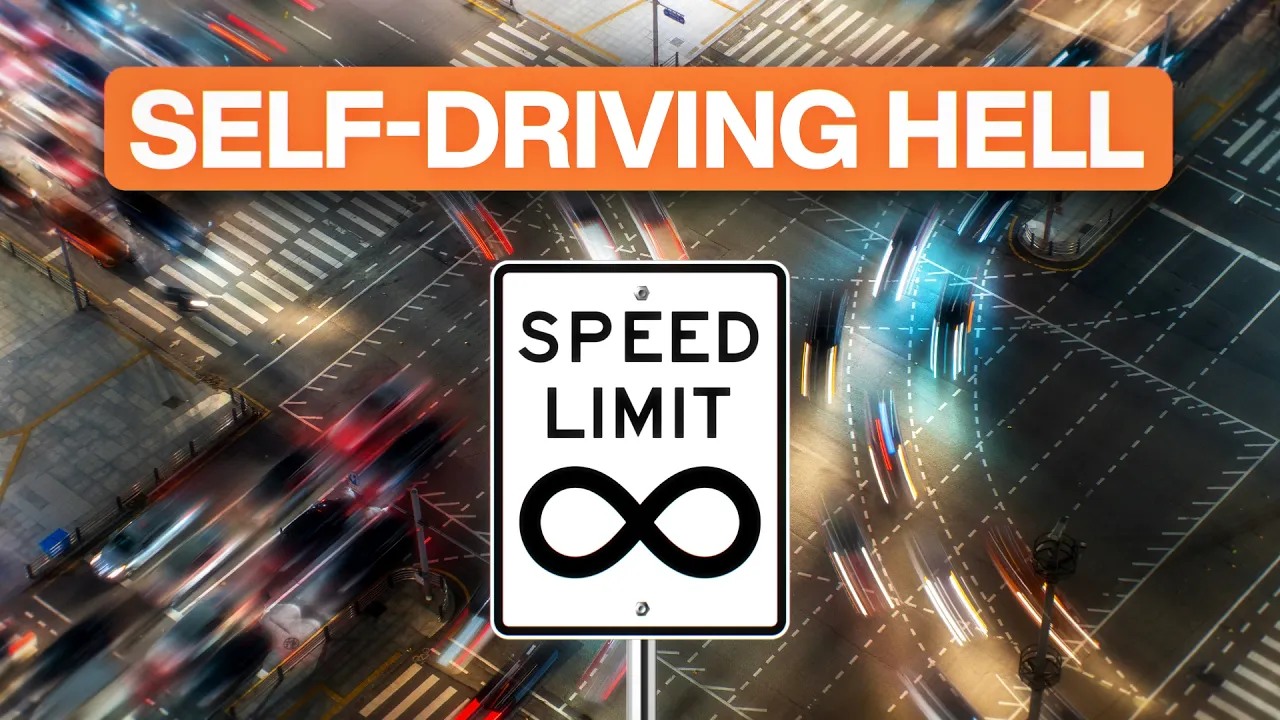
How Self-Driving Cars will Destroy Cities (and what to do about it) — Not Just Bikes

Not Just Bikes

Cities need car-less drivers rather than driverless cars, because autonomous fleets will cannibalize mass transit and induce gridlock unless municipalities implement road pricing and pedestrian protections.

AI-assisted summary of How Self-Driving Cars will Destroy Cities (and what to do about it) — original source. Check the original for full context.

Source published:

Key ideas

  • Over $160 billion in venture capital has poured into autonomous vehicles, incentivizing companies to deploy unvetted fleets onto municipal streets despite safety concerns. (1:18)
  • Rather than technological shortcomings, hostile road engineering accounts for most traffic fatalities; adopting Sweden's Vision Zero street design could reduce US traffic deaths by more than 80% without autonomous technology. (11:05)
  • Widespread autonomous vehicle deployment threatens to induce travel demand, leading to longer commutes, exurban sprawl, empty 'ghost cruising' to evade parking fees, and increased vehicle miles traveled. (19:16)
  • To prevent urban destruction, cities must proactively implement dynamic per-mile road pricing, install modal filtering, build protected bike networks, and stop subsidizing car infrastructure. (48:33)

Detailed notes

## Background Published on YouTube by Not Just Bikes on November 10, 2024, this video essay investigates the consequences of autonomous vehicle technology on urban development. The video description provides an extensive bibliography of urban planning studies, municipal crash records, and related channel essays on car-centric infrastructure, while directing viewers to an ad-free version hosted on Nebula.

## TL;DR The video argues that autonomous vehicles (AVs), rather than solving congestion and traffic fatalities, threaten to accelerate urban degradation by incentivizing sprawl, increasing vehicle miles traveled, and undermining mass transit. Drawing parallels to mid-century highway construction and the venture capital rideshare model, it shows how AV deployment encourages anti-pedestrian infrastructure such as sidewalk fences and signal-free intersections. Comparing the car dependency of London, Ontario to the transit- and bicycle-oriented design of Utrecht, the essay contends that true road safety and universal mobility require human-scale street design rather than technological fixes. It concludes with actionable municipal recommendations, including dynamic road pricing, removing urban highways, and prioritizing active transportation over autonomous fleets.

## Atmosphere & style The presentation carries Not Just Bikes' signature sardonic and analytical tone, combining biting humor with an underlying moral urgency regarding road safety and corporate accountability. Stark historical parallels and technical deconstructions of fatal AV failures transition into eerie 3D visualizations of pedestrian-free, signal-less streetscapes, creating an uneasy look at an aggressively motorized future. This technological dystopia is sharply contrasted against tranquil, vibrant footage of Dutch cycle paths, leaving viewers with a persuasive, grounded sense of urbanist clarity.

## Bulletin - [01:18](https://www.youtube.com/watch?v=040ejWnFkj0&t=78s) Over $160 billion in venture capital has poured into autonomous vehicles, incentivizing companies to deploy unvetted fleets onto municipal streets despite safety concerns. - [11:05](https://www.youtube.com/watch?v=040ejWnFkj0&t=665s) Rather than technological shortcomings, hostile road engineering accounts for most traffic fatalities; adopting Sweden's Vision Zero street design could reduce US traffic deaths by more than 80% without autonomous technology. - [19:16](https://www.youtube.com/watch?v=040ejWnFkj0&t=1156s) Widespread autonomous vehicle deployment threatens to induce travel demand, leading to longer commutes, exurban sprawl, empty 'ghost cruising' to evade parking fees, and increased vehicle miles traveled. - [48:33](https://www.youtube.com/watch?v=040ejWnFkj0&t=2913s) To prevent urban destruction, cities must proactively implement dynamic per-mile road pricing, install modal filtering, build protected bike networks, and stop subsidizing car infrastructure.

## Key takeaways - [01:18](https://www.youtube.com/watch?v=040ejWnFkj0&t=78s) Venture capital pressures force autonomous vehicle operators to deploy fleets prematurely, prioritizing investor returns over public street safety. - [02:33](https://www.youtube.com/watch?v=040ejWnFkj0&t=153s) Autonomous vehicles struggle heavily with software edge cases, repeatedly blocking active emergency services and failing in real-world scenarios. - [05:58](https://www.youtube.com/watch?v=040ejWnFkj0&t=358s) AV companies engage in heavy political lobbying for self-certification frameworks, immunity from moving violation citations, and reduced data transparency. - [11:05](https://www.youtube.com/watch?v=040ejWnFkj0&t=665s) Traffic deaths in the US stem primarily from hostile road design like stroads, which can be dramatically lowered using proven street engineering rather than autonomous tech. - [14:27](https://www.youtube.com/watch?v=040ejWnFkj0&t=867s) Machine-learning systems trained on car-centric cities incentivize AV companies to lobby against municipal street reorganizations like bike lanes to avoid costly fleet retraining. - [17:03](https://www.youtube.com/watch?v=040ejWnFkj0&t=1023s) Following the ride-hailing playbook, robotaxi operators initially subsidize fares to undermine public transit before transitioning to profit-maximizing monopoly pricing. - [21:48](https://www.youtube.com/watch?v=040ejWnFkj0&t=1308s) Lower travel friction and the elimination of driving stress induce demand, encouraging longer exurban commutes and fragmenting passenger trips. - [25:19](https://www.youtube.com/watch?v=040ejWnFkj0&t=1519s) Corporate marketing for autonomous vehicles mirrors historical campaigns like GM's 1939 Futurama, falsely promising that new automotive products will resolve traffic gridlock. - [29:56](https://www.youtube.com/watch?v=040ejWnFkj0&t=1796s) Autonomous vehicle lobbies threaten public transit funding by promoting point-to-point private subscription fleets over high-capacity mass transit. - [34:02](https://www.youtube.com/watch?v=040ejWnFkj0&t=2042s) To preserve vehicle throughput against pedestrians who cause AVs to yield, automotive lobbies may advocate sidewalk fencing or pedestrian transponders, severely harming street vitality. - [38:05](https://www.youtube.com/watch?v=040ejWnFkj0&t=2285s) Electric autonomous fleets fail to resolve pollution and noise issues, as vehicle weight amplifies non-exhaust particulate emissions and tire-pavement friction dominates noise at urban speeds. - [39:41](https://www.youtube.com/watch?v=040ejWnFkj0&t=2381s) Autonomous intersection models eliminate traffic signals in favor of high-speed vehicle interleaving, effectively severing surface crossings for pedestrians. - [46:15](https://www.youtube.com/watch?v=040ejWnFkj0&t=2775s) Utrecht demonstrates that universal accessibility and mobility are best achieved through active transit infrastructure and car-free design rather than speculative AI technology. - [48:33](https://www.youtube.com/watch?v=040ejWnFkj0&t=2913s) Cities must insulate themselves against autonomous vehicle saturation by enacting road usage pricing, modal filters, and protected infrastructure for pedestrians and cyclists.

## Detailed walkthrough ### [00:00](https://www.youtube.com/watch?v=040ejWnFkj0&t=0s) Introduction: The Polarized Debate on Self-Driving Cars

Public discourse surrounding the future of autonomous vehicles tends to split into two extreme camps. On one side are the skeptics who dismiss the entire concept as a pipe dream and an overhyped tech-industry delusion that will never materialize in the real world. Yet in several American cities, anyone can open an app, hail a ride, and watch an empty car pull up to the curb and drive them autonomously to their destination. On the other side are techno-optimists who insist that autonomous vehicles (AVs) have arrived, will soon blanket every municipality, and are poised to magically cure every modern transportation woe—slashing road fatalities, eliminating traffic congestion, cleaning up the environment, expanding mobility to underserved populations, and revitalizing urban centers.

Both narratives miss the reality. Autonomous vehicles are fundamentally real, the underlying technology improves daily, and commercial fleets will inevitably enter every city in the near future. However, if these technologies continue along their current trajectory, the outcome will not be an urbanist utopia. As the host bluntly summarizes his thesis: “The technology is getting getting better every day, and, if these improvements continue on this track, they will fundamentally destroy the fabric of our cities.”

[01:18](https://www.youtube.com/watch?v=040ejWnFkj0&t=78s) Urbanist Optimism vs. Capitalist Realities

It is easy to understand why some urbanists feel cautious optimism about autonomous transit. The vast majority of chronic municipal dysfunctions stem directly from private automobiles: suffocating traffic jams, toxic air pollution, ambient noise, and deadly streets. Urban space is systematically squandered, leaving sidewalks squeezed, bike lanes absent, and parks paved over to make room for multi-lane arterial roads and sprawling surface parking lots. Furthermore, navigating a car-dominated city on foot or by bike exposes people to dangerous human behavior, from speeding to widespread distracted driving. Under those harrowing conditions, placing navigation in the hands of a computer algorithm appears on paper to be an obvious upgrade.

With rigorous regulation and intentional public planning, automated fleets might have contributed to safer cities. That benevolent outcome, however, is vanishingly unlikely when examined against the 20th-century historical precedent of automotive expansion and the brutal realities of venture capital. More than $160 billion has already been poured into autonomous vehicle development. That immense financial outlay creates an intense imperative for corporate backers to generate returns immediately, rushing untested vehicles onto municipal streets regardless of public readiness.

[02:33](https://www.youtube.com/watch?v=040ejWnFkj0&t=153s) Moving Fast and Breaking People

Witnessing a driverless car smoothly navigate the streets of San Francisco might convince onlookers that fully autonomous driving has arrived. These vehicles observe posted speed limits and appear to handle traffic cautiously without anyone seated behind the wheel. That appearance is largely a facade: the vehicles are not operating strictly by autonomous computation. As recently as November 2023, Cruise confirmed that its robotaxis required human intervention every four to five miles. When vehicles encounter unexpected scenarios, remote teleoperation centers must step in to rescue them. Footage reveals robotaxis paralyzed behind construction toilet trailers waiting for a remote operator to steer around them, or frozen through multiple traffic light cycles because the computer could not decide if it was safe to make a right turn, forcing frustrated human motorists to detour around them.

The software inevitably struggles with the long tail of edge cases and unusual urban occurrences. In engineering and software development, the initial 90% of a project consumes 90% of the timeline, while the final 10% takes the other 90%. Autonomous vehicles remain fundamentally rigid systems that commit bizarre blunders. At a San Francisco Waymo holding lot, dozens of autonomous vehicles repeatedly drove in tight circles and honked at one another at 4:00 AM for days on end, infuriating nearby residents. Far more dangerously, official municipal records document dozens of cases where robotaxis obstructed emergency services by blocking ambulances mid-transit and colliding with active fire trucks.

```mermaid flowchart TD accTitle: Autonomous Vehicle Failure and Public Resistance accDescr: The cycle showing technical limitations of autonomous vehicles, resulting public incidents, and community protests.

subgraph TechFlaws ["Technical Realities"] A["Driverless Perception Algorithms"] --> B["Remote Intervention Needed\n(Every 4-5 Miles for Cruise)"] A --> C["Edge Case Failures\n(Stall outs, phantom braking)"] end

subgraph UrbanHarm ["Real-World Disruptions"] B & C --> D["Blocked Ambulances & Fire Trucks"] B & C --> E["Erratic Behavior & Severe Collisions"] end

subgraph Backlash ["Public Response"] D & E --> F["Grassroots Protests & AV Sabotage\n('Coning' by Safe Street Rebel)"] F --> G["Corporate Pressure & Deregulation Lobbying"] G --> A end ```

The human cost of these deployment experiments escalated dramatically in October 2023. A human driver struck a female pedestrian in San Francisco, propelling her directly into the path of an oncoming Cruise robotaxi. While the autonomous system braked hard to reduce impact—reacting faster than a human driver might have—the system's fundamental lack of real-world comprehension turned tragic. Once the woman fell beneath the chassis, the car's sensors lost sight of her. Lacking the object permanence of a human toddler, the vehicle determined the roadway ahead was clear and attempted to pull over, dragging the trapped woman beneath its wheels. Cruise leadership subsequently attempted to conceal this footage from both regulators and the media.

- Estimated capital invested in AV development: over $160 billion. - Intervention frequency admitted by Cruise (late 2023): human teleoperator assistance required every 4 to 5 miles. - Observed system failures: phantom braking, blocking emergency services, trapping pedestrians under vehicles, and early-morning parking lot gridlock with continuous honking.

[05:58](https://www.youtube.com/watch?v=040ejWnFkj0&t=358s) Public Backlash, "Coning", and Regulatory Capture

Citizens never consented to having their public roadways converted into beta-testing grounds for multi-billion-dollar technology firms. This lack of consent has sparked protests throughout California, culminating in actions where an autonomous Waymo vehicle was set on fire. Grassroots organizations such as Safe Street Rebel have systematically documented self-driving fleets committing dangerous moving violations: running red lights, cutting off pedestrians, obstructing public transit buses, straddling bike lanes, blocking intersections, and driving uncomfortably close to elderly pedestrians. The marketing myth that programmed vehicles will reliably follow traffic regulations has dissolved under empirical scrutiny.

In response, Safe Street Rebel popularized direct-action campaigns like the "Week of Cone." Because autonomous vehicle perception engines are hardwired to treat traffic cones as immovable hazards, placing a standard traffic cone directly onto the vehicle's hood immediately paralyzes the car. This act of civil disobedience, dubbed "coning," renders the vehicle inert until field personnel intervene.

Tech executives routinely champion the Silicon Valley motto to "move fast and break things." As the host observes: “And maybe that broken thing will be your spine under a robotaxi, but that's a risk they’re willing to take.” Rather than admitting their software is not ready for prime-time deployment, autonomous vehicle firms have applied heavy political lobbying to shield themselves from accountability. They have secured self-certification frameworks, fought off mandatory safety-data disclosures, and supported legislation in California preventing police from issuing moving-violation citations directly to self-driving car operators.

[08:50](https://www.youtube.com/watch?v=040ejWnFkj0&t=530s) The Fatal Uber Crash and Algorithmic Blindness

Automated vehicles rely on an array of external sensors—cameras, radar, and lidar—to scan their surroundings. However, physical sensors are useless without the underlying software interpreting their data. Software engineers face a perpetual trade-off: prevent the vehicle from striking genuine obstacles, but ensure it does not execute emergency stops for benign artifacts, like floating trash bags or irrelevant roadside clutter. Striking that balance incorrectly can yield fatal consequences, such as when a Tesla operating in an automated driving mode slammed on its brakes on a freeway without cause, triggering an eight-car pileup.

This software limitation was laid bare in March 2018 in Tempe, Arizona, during the world's first recorded pedestrian fatality caused by an autonomous vehicle. An automated Uber test vehicle—a modified Volvo SUV—struck and killed Elaine Herzberg as she walked her bicycle across a multi-lane road at night. The vehicle's suite of sensors had picked up her presence well in advance of the crash, but the onboard classification software failed to understand what she was. The system erraticly toggled its internal classifications, labeling her alternately as an unidentified vehicle, then a bicycle, then shifting to an ambiguous "other" category, before deciding she was a stationary object outside the travel lane. The software only recognized that Herzberg was an actual hazard directly in the vehicle's path 1.2 seconds before impact—far too late to execute an emergency stop.

The terrifying implication of machine perception is clear: “So when a self-driving car starts driving toward you, you’d better hope it hasn’t detected you as ‘other’.”

- Date and location of the crash: March 2018 in Tempe, Arizona. - Vehicle configuration: Uber Advanced Technologies Group automated software mounted on a Volvo SUV. - Software perception timeline: toggled between contradictory categories ("vehicle", "bicycle", "other", stationary object) for seconds; calculated an imminent collision path just 1.2 seconds prior to impact.

[10:34](https://www.youtube.com/watch?v=040ejWnFkj0&t=634s) The Real Road Safety Issue: Flawed Street Design

Examining sensor failures and software classifications obscures the structural culprit behind pedestrian deaths: hostile roadway design. The Tempe crash did not occur in a vacuum; it occurred on an arterial street engineered precisely like a highway, complete with elevated speed limits and virtually no safe accommodations for people traveling on foot. The roadway sat directly between a commuter rail station and recreational hiking trails, ensuring pedestrian crossings would occur.

Compounding the hazard, the roadway median featured an asphalt cut-through that was intended exclusively for emergency vehicle access whenever nearby bridges were shut down. To any normal person navigating the area on foot, this paved strip appeared to be an intentional mid-block crosswalk. This design flaw lured pedestrians into crossing high-speed traffic lanes with no signal protection—a failure of traffic engineering that an autonomous vehicle's software proved incapable of navigating safely.

[11:05](https://www.youtube.com/watch?v=040ejWnFkj0&t=665s) Hostile Infrastructure and the Real Road Safety Issue

The physical environment around the fatal 2018 Tempe, Arizona crash site reveals a structural contempt for pedestrians. The location was a natural crossing point regularly used by people, yet instead of installing an actual crosswalk, the city posted superficial “use crosswalk” signs that remain to this day. Making matters worse, in 2018 it was physically impossible to reach the designated crosswalk from that path due to dense landscaping and trees. Following the crash, the city’s retrofitted “solution” was replacing the brick roadway median with a rough stone surface deliberately engineered to be hostile to foot traffic. While a narrow opening was eventually cut through the cacti, reaching the legal crossing still requires walking more than 200 meters out of the way, on top of enduring lengthy signal waits to cross the multi-lane highway.

```mermaid flowchart TD accTitle: Evolution of Tempe Pedestrian Crossing accDescr: Progression of street infrastructure changes at the Tempe crash site from 2018 to the present.

subgraph State2018["2018 Conditions"] A["Natural pedestrian desire line"] B["No physical crosswalk"] C["Greenery and trees block access to signals"] A --> B B --> C end

subgraph Alterations["City 'Solutions' Post-Crash"] D["Median converted to rough, hostile stone path"] E["Hole cut through cacti landscape"] C --> D C --> E end

subgraph Reality["Modern Reality"] F["Pedestrians forced to detour 200+ meters"] G["Long signal wait times across highway"] E --> F D --> F F --> G end ```

This dynamic illustrates how American traffic engineering consistently prioritizes driver convenience at the expense of non-motorized road users, only to blame pedestrians when crashes occur. The scale of the carnage is immense: approximately 42,000 people are killed and hundreds of thousands are seriously or permanently injured in American car crashes annually. Self-driving car firms seize upon this slaughter by marketing safety as their primary virtue. Yet the fundamental problem lies in street design, specifically the prevalence of "stroads"—hybrid corridors attempting to combine high-speed traffic with destination access—which are ubiquitous across the United States and Canada but largely absent from cities in other developed nations. Known engineering approaches like Sweden's "Vision Zero" framework could eliminate the vast majority of these casualties without requiring any unproven gadgets:

> “In fact, if the US had roads as safe as Sweden they would cut their road fatalities by over 80%. Without any new technology at all.”

Because safe street designs demand slowing or restricting motor traffic, they are politically untenable in an automotive-dominated society. Moreover, street safety improvements generate no private corporate profit. Autonomous vehicle (AV) manufacturers are not public-interest organizations; their concern for human preservation ends the moment liability drops below the threshold required to sell hardware and software. Once regulators are appeased, the corporate pitch will inevitably normalize autonomous fatalities as an acceptable statistical improvement over human error.

- Around 42,000 fatalities and hundreds of thousands of life-altering injuries occur annually on US roadways. - Adopting Swedish Vision Zero roadway principles would reduce US road fatalities by over 80% without novel technology. - Self-driving developers care about safety only insofar as it secures regulatory approval and facilitates vehicle sales.

---

[14:27](https://www.youtube.com/watch?v=040ejWnFkj0&t=867s) Training Cars on "Easy Mode" and Exporting Car-Centricity

Autonomous vehicle operations have deliberately established their roots in hyper-car-dependent environments. Companies originally gravitated toward regions like Phoenix, Arizona, not merely for favorable weather, but because Phoenix represents "driving on easy mode." The metropolitan area is composed of one-mile square grid blocks with exceptionally wide roads, almost no operational restrictions on cars, near-universal driving rates, and an urban fabric exceptionally deadly to people on foot:

> “If anthropomorphic cars could design cities, they would design Phoenix.”

Even San Francisco, while more urban, transit-rich, and walkable than Sun Belt sprawl, remains profoundly car-oriented when judged against standard European urban design. This training bias poses an immense barrier for international deployment. Autonomous systems are explicitly calibrated to the behavioral norms of American drivers, who operate under the legal and spatial presumption that motor vehicles reign supreme over every other transport mode. Tech corporations are unlikely to undertake the painstaking, multi-year task of re-training their fleets for the narrow, complex streets of European towns; instead, market pressures will encourage cities abroad to sanitize and widen their streets to accommodate American autonomous navigation.

```mermaid flowchart LR accTitle: Autonomous Vehicle Training Lock-In Cycle accDescr: How training self-driving fleets on car-centric US streets creates political resistance to street modernization.

subgraph Training["Current Baseline"] A["Trained on wide American grids<br>(Phoenix, SF)"] B["Systems inherit car-first behavioral norms"] A --> B end

subgraph Deployment["Global Export"] C["Deployed to compact European / international cities"] B --> C end

subgraph LockIn["Municipal Gridlock"] D["City tries to remodel street<br>(transit, bike lanes)"] E["Car companies lobby against alterations<br>to avoid costly re-training"] C --> D D --> E E -.->|"Blocks changes"| D end ```

A far more insidious risk stems from the foundational architecture of these systems. Because AVs learn primarily through billions of data points gathered by human drivers on existing roadways rather than simple rule-following algorithms, modernizing urban layouts becomes far more difficult:

> “It won’t be enough to just put up a sign and update the rules of the road, governments will need to convince every self-driving car company to re-train their cars.”

Should a municipality attempt to claim road space for separated cycling tracks, widen sidewalks, or dedicate lanes to surface public transit, multi-billion-dollar AV firms backed by lobbying machines have a direct financial incentive to block those projects. Street networks risk becoming frozen in their current, car-dominated forms.

---

[17:03](https://www.youtube.com/watch?v=040ejWnFkj0&t=1023s) The Illusion of Cheaper Taxis and the Ride-Hail Playbook

Strip away high-tech rhetoric, and an autonomous vehicle is fundamentally an app-based taxi operating without a human driver inside the cabin. Believing that cheaper taxis represent a panacea for systemic metropolitan mobility failure ignores basic urban geometry and economic history. The autonomous industry is duplicating the venture-capital playbook pioneered by Uber and Lyft:

```mermaid flowchart TD accTitle: The Venture Capital Ride-Hail Playbook accDescr: The cycle of venture capital subsidies undercutting transit, followed by monopoly pricing.

subgraph Phase1["Phase 1: Market Saturation"] A["Massive venture capital subsidies"] B["Artificially low passenger fares"] C["Municipalities defund public transit for rideshare vouchers"] A --> B B --> C end

subgraph Phase2["Phase 2: Entrenchment"] D["Public transit eroded / competition weakened"] C --> D end

subgraph Phase3["Phase 3: Profit Extraction"] E["Venture capital dries up"] F["Fares aggressively raised to maximize investor returns"] D --> E E --> F end ```

In their expansion phases, ride-hailing services burned billions to keep passenger fares artificially low. This predatory pricing convinced multiple American municipalities to cut fixed-route public transit budgets in favor of subsidizing private ride-hail trips. Yet as soon as market dominance was achieved and capital markets tightened, fares surged. The assumption that removing the driver permanently lowers customer fares misapprehends how monopoly pricing operates:

> “They charge as much as possible to maximise profits and once they've eliminated or colluded with the competition they can charge whatever they want.”

Ceding municipal mobility networks to a consolidated cartel of autonomous software conglomerates will inevitably enrich corporate shareholders while degrading the travel options available to the broader public.

---

[19:16](https://www.youtube.com/watch?v=040ejWnFkj0&t=1156s) Parking Realities, Mobility Myths, and Induced Congestion

Promoters regularly assert that autonomous vehicles will clear away parking lots because self-driving cars can drop commuters off and depart. Yet personal car ownership persists precisely because drivers value personal storage, privacy, and immediate availability over hailing cabs. The notion that private owners will willingly lease their personal vehicles out as robotaxis during the workday ignores the unappealing reality of opening one’s personal vehicle to the smells and wear of the general public.

Consequently, privately owned autonomous cars will still need parking near their owners. If municipal parking fees are higher than the operating cost per mile, autonomous vehicles will simply be programmed to endlessly cruise surrounding city blocks, worsening ground-level traffic while their owners work or dine.

Claims of universal accessibility for disabled people are similarly overstated. Many disabled individuals require physical boarding assistance or help securing mobility devices within the vehicle—needs an unstaffed robotaxi cannot fulfill without an attendant. App-based services also demand credit cards and smartphones, excluding unbanked and non-digitized populations. Rather than delivering true universal mobility, robotaxis function as an expensive distraction from actual accessible mass transit.

```mermaid flowchart TD accTitle: The Autonomous Congestion Trap accDescr: The feedback loop of induced travel demand caused by cheaper or hands-free autonomous vehicles.

subgraph Intervention["AV Deployment"] A["Driverless tech promises reduced congestion"] B["Perceived cost and cognitive effort of travel drop"] A --> B end

subgraph Behavior["Traveler Response"] C["People take more trips"] D["Trips extend over longer distances"] B --> C B --> D end

subgraph Consequence["Structural Bottleneck"] E["Ghost cruising to avoid parking fees"] F["Induced demand overwhelms road space"] G["Net traffic congestion worsens"] C --> E D --> F E --> G F --> G end ```

The assertion that autonomous vehicles will cure traffic congestion contradicts basic transportation physics. Every historical reduction in travel friction induces more traffic:

> “Every single time that we have done anything to make transportation cheaper or more convenient, the inevitable outcome is that people travel more often, and they travel longer distances.”

Much like highway widening projects induce more driving through latent demand, making automotive travel passive and cheaper will incentivize longer commutes, redundant trips, and phantom vehicle cruising, ultimately worsening citywide gridlock.

- Privately owned AVs face an economic incentive to cruise local streets endlessly ("ghost cruising") to avoid paid parking garages. - Autonomous fleets still exclude vulnerable and disabled passengers who require physical boarding assistance or lack modern smartphones and credit accounts. - Induced demand dictates that reducing the friction or perceived effort of car travel inevitably generates greater aggregate vehicle miles traveled.

[21:48](https://www.youtube.com/watch?v=040ejWnFkj0&t=1308s) Traffic Congestion Will Be Even Worse

When Uber and Lyft entered cities, they claimed they would reduce traffic congestion, yet the exact opposite occurred: vehicle miles traveled increased significantly. This dynamic will worsen with robotaxis because people will hail them even more frequently, particularly while services remain heavily subsidized. While some argue that robotaxis will reduce the number of vehicles downtown by parking in peripheral lots and entering the city only when requested, that assertion ignores corporate incentives. In a competitive market, response time is paramount. People grow impatient waiting for an elevator; nobody will tolerate waiting 14 minutes for a robotaxi pickup. Consequently, self-driving car fleets park directly in the heart of cities like San Francisco.

```mermaid flowchart TD accTitle: The Subsidized Autonomous Vehicle Congestion Loop accDescr: Diagram illustrating how free street access and sub-divided personal trips drive up vehicle miles traveled and suburban sprawl.

subgraph Operations["Street-Level Dynamics"] FreeRoads["Free road usage & zero street user fees"] --> Circling["Cars circle blocks indefinitely to cut response times"] SplitTrips["Single family trips fragment into multiple robotaxis"] --> IncreasedVMT["Massive surge in Vehicle Miles Traveled (VMT)"] MicroDeliveries["Trivial on-demand deliveries replace consolidated errands"] --> IncreasedVMT end

subgraph LandUse["Urban & Suburban Sprawl"] IncreasedVMT --> TrafficCollapse["Severe gridlock on urban arterials and highways"] PassiveCommute["Passengers work/relax during long commutes"] --> ExtremeSprawl["Commuters move farther into peripheral countryside"] ExtremeSprawl --> InfraDebt["Suburban infrastructure liabilities expand & compound"] end ```

The economics of city streets make this dynamic far more destructive. Aside from gas taxes, there are virtually no user fees for utilizing municipal roadways. Future robotaxis will be electric, charged at private depots, and completely immune to fuel-based taxes. Because street access is free, operators have zero incentive not to keep their fleets circling city blocks continuously to minimize wait times. This massive influx of low-capacity vehicles will displace far more efficient modes:

> “As long as the roads are free to use there is zero incentive for these companies not to have robotaxis constantly circling the block so that they can respond to customers as quickly as possible.”

Individual travel patterns will fragment into multiple trips. Today, a suburban parent might drop one child off at elementary school, another at high school, and then proceed to an office in a single vehicle. With robotaxis, each passenger can be dispatched in an independent vehicle, turning one car trip into three. This trend is already unfolding in San Francisco. While independent youth mobility is desirable, running separate cars for every passenger worsens street capacity. The same issue plagues instant commerce. European cities have already documented the chaos of 10-minute delivery services, while gig couriers frequently take single-item trips, such as delivering a single tube of toothpaste. Autonomous logistics will supercharge this model, putting a separate car on the street for every minor errand.

Furthermore, autonomous travel will drive outward development. Just as the mass adoption of early automobiles triggered post-war suburban sprawl by untethering workers from their job centers, autonomous vehicles will detach commuters entirely. When drivers are freed from steering and can answer emails, handle paperwork, or attend conference calls, living in an inner suburb loses its necessity. Commuters will move out to remote cottages with cheap land and low municipal taxes. Funneling millions of long-distance commuters onto arterial networks will exponentially increase vehicle miles traveled, severely worsening the structural financial insolvency facing North American suburbs.

---

[25:19](https://www.youtube.com/watch?v=040ejWnFkj0&t=1519s) The Promised Future (Past and Present)

The autonomous vehicle industry markets a radically frictionless future. Industry promotions claim that vehicle-to-vehicle communication, seamless highway merging, platooning, and high-speed autonomous corridors will render existing traffic delays completely archaic. A corporate marketing video by Ford exemplifies this narrative: it presents the modern city as riddled with gridlock and inefficiencies—problems caused by car dominance in the first place—and promises that buying their next-generation vehicles will resolve them. In Ford’s rendered vision, the city suddenly accommodates futuristic trains, vacuum tubes, parks, e-bikes, blue skies, pedestrian plazas, and dynamic smart crosswalks that appear out of nowhere whenever a pedestrian chooses to cross.

> “Of course, these problems were caused by people using their cars in the first place, but don’t worry about that, because buying their new cars will fix everything, so it’s fine!”

These promotional concepts match the historical playbook of the automotive industry. At the 1939 New York World's Fair, General Motors unveiled its massive Futurama exhibit, designed to showcase the utopian city of 1960. Futurama featured life-sized urban mockups and an overhead ride showing visitors how advanced grade-separated motorways would eliminate vehicular delays by segregating cars from cross-traffic:

- **Futurama's Vision (1939):** Pedestrians were promised quiet, elevated footbridges above traffic, while high-speed highways below whisked personal cars safely into the metropolis without delay. - **The Mid-Century Reality:** The highways were constructed, but rather than relieving traffic, they induced unprecedented demand for personal vehicle travel. Elevated urban freeways shattered and divided historic neighborhoods, saturated city street grids with cross-town traffic, multiplied urban air pollution, and saddled municipalities with overwhelming infrastructure maintenance debts that modern cities now spend billions of tax dollars trying to demolish.

---

[28:04](https://www.youtube.com/watch?v=040ejWnFkj0&t=1684s) How AVs Will Destroy Cities

New transportation technologies invariably reshape the built environment when substantial profit is at stake. To prepare for autonomous vehicles, cities must recognize how these systems will alter urban form. Mass consumer adoption will begin in affluent suburbs across the United States and Canada, where drivers face lengthy commutes and road networks are simpler to navigate than complex urban cores:

> “So we need to seriously consider how AVs could negatively affect cities, so that we can prepare for them today.”

As safety records surpass those of human drivers, corporate lobbying will demand exclusive AV-only lanes on highways and suburban arterials. Suburban municipalities will seize on subsidized robotaxis to justify cutting or eliminating fixed-route public transit. Developers will introduce entire suburban enclaves accessible strictly by autonomous vehicles, creating a tech-enabled evolution of the modern gated community to enforce socioeconomic exclusion:

- **Suburban Growth:** Subdivisions will sprawl across remote land, requiring vastly extended utility runs for power, sewer, and water mains. - **Deferred Liabilities:** As in the mid-20th-century suburban boom, developers and local officials will welcome short-term debt and development cash, ignoring that catastrophic maintenance bills will come due decades later.

---

[29:56](https://www.youtube.com/watch?v=040ejWnFkj0&t=1796s) Eliminating Public Transit

Once autonomous vehicle operators exhaust suburban expansion, their business models will demand urban growth. In dense cities, their primary strategy will be dismantling the competition: public transportation.

This dynamic closely mirrors the history of American streetcar networks. During the 1920s, Los Angeles operated the world's most extensive electric streetcar system. As unmanaged private cars entered the streets, streetcars became trapped in mixed-traffic congestion. Rail transit could not maintain parity with a street system heavily subsidized by government road spending. Subsequently, private streetcar operators across the United States were bought up by National City Lines—a front consortium backed by General Motors, tire producers, and oil companies. National City Lines dismantled the rail networks and replaced them with motorized buses, eliminating public rail options to force consumer reliance on personal cars:

> “Because well-functioning public transit is a threat to car companies.”

Autonomous vehicle companies will follow this blueprint:

```mermaid flowchart LR accTitle: Transit Cannibalization Sequence accDescr: How autonomous vehicle firms target transit networks to force users into private subscriptions. A["Transit Underfunding & Delays"] --> B["AV Lobbying Against Rail Funding"] B --> C["Rail Right-of-Way Converted to AV Lanes"] C --> D["Public Transit Cancelled for Robotaxis"] D --> E["Captive Urban Subscription Market"] ```

AV operators will lobby governments to cancel capital rail projects, divert municipal funding away from transit agencies, and pitch door-to-door robotaxis as modern transit replacements. While operators will showcase token autonomous bus concepts, their revenue model relies on private passenger vehicles and pay-per-mile robotaxis.

Converting train corridors into autonomous vehicle rights-of-way causes a massive collapse in carrying capacity:

| Transit Corridor / Mode | Peak Daily Volume / Physical Footprint | |:--- |:--- | | **Toronto 18-Lane Highway (Hwy 401)** | Over 100 meters wide, carries **fewer total daily passengers** than a single subway track. | | **Single Subway Line** | Operates within a narrow right-of-way, moving **more passengers per day** than an 18-lane highway. | | **Brooklyn Bridge with Streetcars (Early 1900s)** | Moved over **420,000 people per day** with dual rail transit tracks. | | **Brooklyn Bridge for Cars Only (1950s–Present)** | Trolley tracks were removed in the 1950s; traffic has **never exceeded 180,000 people per day** since. |

Replacing space-efficient shared transit with low-occupancy vehicles will flood urban street grids with gridlock. Autonomous vehicle firms will respond by lobbying cities to designate major corridors as autonomous-only. While marketed under the guise of optimizing system efficiency and human safety, the real intent is to outlaw human drivers, eliminate transit alternatives, and convert urban populations into recurring software subscribers. An example of this strategy is the "Loop NYC" proposal pitched by a New York engineering firm, which envisioned designating critical city streets strictly for self-driving vehicles under the claim that algorithmic optimization would streamline urban throughput.

[32:52](https://www.youtube.com/watch?v=040ejWnFkj0&t=1972s) Consuming All Streets

Car company marketing suggests that autonomous vehicles (AVs) will allow road space to be recovered, imagining urban corridors blocked off entirely from car traffic and converted into lush, linear parks. In reality, autonomous vehicle companies depend on door-to-door convenience for commercial viability, meaning they cannot afford to surrender access to urban street networks. Instead of retreating from roads, AV lobbies will argue for access to pedestrian zones, asserting that computer-driven cars are safer than human operators and provide critical access for individuals with mobility challenges.

```mermaid flowchart TD accTitle: Autonomous Vehicle Urban Space Feedback Loop accDescr: Diagram showing how AV market dynamics lead to increased street consumption and parking infrastructure.

subgraph Dynamics["Street Saturation Dynamics"] A["AV Market Goal:<br>Door-to-Door Service"] --> B["Demand Access to All Streets & Pedestrian Zones"] B --> C["Zero Driver Labor Cost:<br>Continuous Cruising"] end

subgraph Congestion["Urban Space Consequences"] C --> D["Robotaxis Circle Blocks for Quick Dispatch"] C --> E["Private AVs Roam for Cheap Parking Rates"] D & E --> F["Surface Parking Converted to Solar Charging Hubs"] F --> G["Net Expansion of Automobile Footprint in Cities"] end ```

Without the operational cost of paying human drivers or pricing on road usage, robotaxis will circulate continuously around city blocks to preserve the fastest possible dispatch response times. Private AVs will cruise autonomously while owners work, hopping between locations to seek lower parking fees or cheaper electric charging rates. Former surface parking spaces will not become civic parks; they will transition into high-density charging hubs servicing fleets of private AVs and commercial robotaxis. Rather than shrinking the automotive footprint, autonomous fleets will require even greater municipal spatial concessions.

- AV business viability hinges on door-to-door transit, blocking efforts to pedestrianize corridors or install linear parks. - Cruising without passengers becomes cost-effective without labor expenses, worsening deadhead street congestion. - Parking structures will transform into charging stations rather than green space, preserving automobile priority.

---

[34:02](https://www.youtube.com/watch?v=040ejWnFkj0&t=2042s) Eliminating Pedestrians

The dynamic between automated software and foot traffic creates an operational bottleneck. As pedestrians discover that self-driving programming enforces a complete stop when encountering human obstructions, people will freely cross streets mid-block. AV operators will find their systems brought to a standstill by predictable yielding behavior. To maintain high vehicle velocity, operators will lobby municipalities to install physical barriers to ban mid-block crossings and fence off sidewalk edges along major transit arteries.

This historical policy pattern played out in Bamberg, South Carolina. Bamberg's traditional Main Street doubled as a state highway. Downtown pedestrian traffic frequently interrupted through-traveling vehicles, prompting town planners to widen the corridor and install longitudinal fence lines along the sidewalks to physically bar mid-block crossings. Car throughput improved immediately, but the enclosed, high-speed corridor drove foot traffic away. Within several years of project completion, every single retail storefront in downtown Bamberg shuttered, turning the commercial core into a ghost town.

The outcome contradicted the projections of local leadership, as the narrator observes: “This was a monumentally stupid idea of course, but I bring this up because before the project, the director of the chamber of commerce said that the project will, quote, ‘be a major boost to the economy for the county and downtown Bamberg.’” Traffic engineers frequently operate under the assumption that expedited vehicular throughput bolsters local retail, ignoring that cars do not make retail transactions—pedestrians do. Confining pedestrians behind fences alongside high-speed automated traffic creates hostile streetscapes that destroy street-level civic life.

- Bamberg, South Carolina installed sidewalk fencing to prevent street crossing, resulting in the eventual closure of all downtown retail shops. - High-speed AV corridors require physical pedestrian fencing to prevent autonomous safety systems from halting traffic. - Eliminating foot accessibility diminishes local commercial districts, exchanging street vibrancy for vehicular throughput.

---

[36:05](https://www.youtube.com/watch?v=040ejWnFkj0&t=2165s) Eliminating Speed Limits and the Modern "Jaywalking"

With public transit dismantled and pedestrians boxed out by protective barricades, autonomous vehicle developers will push to abolish municipal speed limits. The central justification will be that speed restrictions are arbitrary artifacts created for human reaction delays rather than millisecond computer processing. Removing speed caps will temporarily boost corridor throughput, which transportation authorities will celebrate as an operational triumph. However, higher travel speeds dramatically increase fatality rates for cyclists and pedestrians, because vehicle braking distance remains fundamentally governed by kinetic laws that software reaction times cannot override.

```mermaid flowchart LR accTitle: Historic vs Modern Pedestrian Displacement Strategies accDescr: Historical progression showing how the automotive lobby shifted collision culpability from drivers to pedestrians.

subgraph Century20["1920s Pedestrian Marginalization"] A["1920s Public Backlash:<br>High Pedestrian Fatalities"] --> B["Municipal Proposals for<br>Speed Governors & Fines"] B --> C["Automotive Lobby Inverts Blame:<br>Creation of 'Jaywalking'"] end

subgraph Century21["21st-Century AV Marginalization"] D["High-Speed AVs Cause Pedestrian & Cyclist Deaths"] --> E["AV Industry Shifts Liability to Non-Car Users"] E --> F["Mandated Wearable Transponders & LIDAR Reflectors"] end ```

Public outrage over crashes will mirror the anti-car sentiment of the 1920s, when rising vehicular fatalities spurred cities to propose mandatory mechanical speed governors and severe reckless driving fines. In that era, the automotive lobby countered public opposition by inventing and aggressively publicizing the concept of "jaywalking," effectively shifting legal and moral culpability from motorists onto victims. In the autonomous vehicle era, this paradigm will shift responsibility through wearable technology. Pedestrians will be expected to wear tracking transponders or LIDAR-reflective patches when walking near public roads, ensuring that crash investigations focus on whether the pedestrian properly transmitted their coordinates rather than addressing vehicle speed within urban spaces.

- Urban speed caps will face industry pressure for abolition under the claim that algorithmic perception eliminates driver human error. - Kinetic braking limits remain unchanged regardless of reaction speeds, elevating pedestrian and cyclist collision lethality. - The automotive lobby previously deflected public safety backlashes in the 1920s by manufacturing the concept of "jaywalking." - The modern equivalent threatens to be wearable electronic transponders or LIDAR tags, shifting collision fault onto unprotected pedestrians.

---

[38:05](https://www.youtube.com/watch?v=040ejWnFkj0&t=2285s) Pollution and Noise

Fleet electrification will fail to eradicate the environmental damage associated with automotive volume. Although zero tailpipe emissions improve roadside air quality, a primary proportion of urban particulate pollution stems from mechanical tire abrasion, brake wear, asphalt degradation, and pulverized road markings. Particulate emission volumes scale upward with vehicle mass and travel velocity. Because autonomous vehicles incorporate heavy sensor arrays, computing platforms, and structural reinforcements, their increased weight, combined with higher travel speeds, will generate high particulate concentrations along AV express corridors.

| Environmental Factor | Internal Combustion Vehicles | Electric / Autonomous Vehicles | Real-World Urban Consequence | |:--- |:--- |:--- |:--- | | **Tailpipe Emissions** | High ($CO_2$, $NO_x$, particulate) | Zero direct exhaust emissions | Eliminates exhaust, but leaves non-exhaust particulates unaddressed. | | **Non-Exhaust Particulates** | Baseline tire, brake, and asphalt wear | Increased microparticle shed due to higher vehicle curb weight | Heavier AVs and faster speeds accelerate roadway and tire degradation. | | **Acoustic Signature** | Dominated by combustion engine below 50 km/h | Engine noise eliminated; tire noise unchanged | Above 50 km/h, road tire friction drowns out engine sound regardless of powertrain. |

Similarly, electric powertrains do not resolve traffic noise. Above roughly 50 kilometers per hour, tire friction against pavement out-volumes internal combustion powertrains. Even in locations like Oslo, where electric vehicle adoption is widespread, pedestrian overpasses across multilane corridors remain loud due to high-speed tire friction. As heavier, computer-operated cars accelerate down converted surface streets, ambient noise will reach decibel levels that trigger chronic physiological stress responses in nearby residents, rendering adjacent pedestrian environments unusable.

- Non-exhaust particulate matter—generated from tires, brakes, and roadway wear—increases with vehicle weight and operational speed. - Above approximately 50 km/h, tire-pavement contact produces more ambient noise than an internal combustion engine. - High EV penetration in cities like Oslo has not resolved highway corridor noise pollution.

---

[39:41](https://www.youtube.com/watch?v=040ejWnFkj0&t=2381s) Eliminating Traffic Lights

The push for vehicular throughput culminates in the elimination of conventional traffic signals. Over a decade ago, researchers at the University of Texas at Austin published demonstration models for Autonomous Intersection Management (AIM). The protocol modeled autonomous vehicles interleaving through high-speed intersections at full velocity without stopping, using machine-to-machine communication. While mathematically efficient for passenger throughput, it turns the street surface into an impassable, continuous stream of high-speed vehicles that completely excludes pedestrians and cyclists.

The narrator recalled his immediate impression when first viewing the concept: “This is the animation that made me really think twice about the future of self-driving cars. Because when I looked at it, the first thing that crossed my mind was, ‘huh. It would really suck to have to cross this intersection while walking or cycling.’”

```mermaid flowchart TD accTitle: Urban Segregation via Autonomous Intersection Management accDescr: Progression from continuous autonomous traffic flow to neighborhood severance and monopolized transit.

A["Autonomous Intersection Management (AIM) Eliminates Traffic Signals"] --> B["Continuous High-Speed Traffic Precludes Surface Crossings"] B --> C["Compensatory Pedestrian Infrastructure:<br>Ramped Concrete Overpasses"] C --> D["Neighborhoods Physically Severed into Inaccessible Islands"] D --> E["Walking & Cycling Become Infeasible"] E --> F["Monopolized Urban Mobility:<br>Residents Dependent on Paid AV Fleet Subscriptions"] ```

To quell public blowback over neighborhood severance, authorities will offer compensatory infrastructure via grade-separated pedestrian bridges. However, past highway construction in New York City demonstrates that such overpasses function as punitive, noisy bypasses designed to keep human beings from hindering traffic flow below. Pedestrians must climb switchback ramps into chain-link enclosures, exposed to ambient particulate pollution and road noise. Dividing urban grids with grade-separated AV corridors leaves neighborhoods isolated. By destroying safe pedestrian movement, bicycle networks, and public mass transit, private AV operators gain a monopoly over urban mobility, giving them unchecked power to inflate transit fares across entire metropolitan populations.

- University of Texas at Austin’s Autonomous Intersection Management (AIM) model removes traffic lights in favor of continuous vehicle interleaving. - Uninterrupted intersection movement eliminates the breaks in traffic required for street-level pedestrian crossings. - Pedestrian overpasses built over high-speed corridors serve to clear vehicle paths while subjecting pedestrians to lengthy ramps, noise, and fumes. - Eliminating walkable alternatives gives autonomous fleet networks a closed monopoly on local transportation.

---

[42:16](https://www.youtube.com/watch?v=040ejWnFkj0&t=2536s) Do We Actually Need AVs? Utrecht vs. Fake London

The perceived necessity of the autonomous car stems from the car-dependent environments common in suburban North America. Growing up in London, Ontario, Canada—a municipality the narrator refers to as "Fake London"—reveals how suburban land-use policies enforce vehicular reliance. Fake London features placename homages like the Thames River, Oxford Street, and Covent Garden Market, yet lacks genuine urban fabric. Arriving by passenger rail places travelers onto a high-speed stroad fronting asphalt surface parking lots. The urban core is hollowed out, the urban boundary is sprawled, transit buses operate on slow, infrequent schedules, and cycling feels unsafe. Daily errands require driving along dangerous, multi-lane stroads where crashes and traffic deaths are a regular occurrence.

```mermaid flowchart TD accTitle: The Car Dependency Solipsism Loop accDescr: Flowchart contrasting how car-centric design breeds high-tech vehicle fixes versus human-scale planning.

subgraph FakeLondon["Suburban North America: Fake London"] FL1["Sprawling Land Use & Stroads"] --> FL2["Unreliable Public Transit & Hostile Cycling"] FL2 --> FL3["Driving Compulsory for Daily Errands"] FL3 --> FL4["Traffic Congestion & Road Fatalities"] FL4 --> FL5["Apparent Necessity:<br>Self-Driving Cars to Automate Miserable Commutes"] end

subgraph Utrecht["Human-Scale Urbanism: Utrecht"] UT1["Compact Land Use & Traffic Evaporation"] --> UT2["Extensive Bike Infrastructure & Reliable Rail"] UT2 --> UT3["Driving Rendered Unnecessary"] UT3 --> UT4["Safe, Walkable Streets & Minimal Fatalities"] UT4 --> UT5["Technological Panaceas Like AVs Become Irrelevant"] end ```

Under these conditions, turning personal transportation over to vehicle computers seems like an appealing solution to stressful daily commutes. Yet this approach frames a built-environment failure as a computer software problem. The contrasting paradigm is Utrecht, a municipality in the central Netherlands with a population comparable to Fake London. A century ago, both cities possessed compact, human-scale footprints with similar street designs. Over the decades that followed, Fake London razed its historical fabric to accommodate high-speed vehicular traffic, while Utrecht preserved its historic core and built out dense transit networks and protected bicycle infrastructure, keeping mobility options broad and streets accessible without requiring automated driving.

- London, Ontario ("Fake London") features disconnected urban sprawl, underfunded transit networks, and stroad environments that make driving compulsory. - The impulse to automate personal driving is a coping mechanism for hostile, car-dependent infrastructure. - Utrecht shares an equivalent municipal population with London, Ontario, and historical photos show both were comparably walkable century ago before their planning paths diverged.

[44:04](https://www.youtube.com/watch?v=040ejWnFkj0&t=2644s) Utrecht vs. Fake London: Two Paths from the Same Car-Centric Past

Both Utrecht and London, Ontario ("Fake London") were founded long before the automobile, originally growing around mixed-use neighborhoods linked by streetcar networks. Over the course of the 20th century, however, both cities went down the same destructive path: embracing car supremacy, widening thoroughfares, bulldozing neighborhoods, and demolishing parts of their historic cores to erect suburban-style indoor shopping malls—the first of their kind in their respective nations. Utrecht even filled in its historic central moat canal (the Catharijnesingel) to build a multi-lane sunken expressway. Utrecht was about a decade behind London in executing these urban renewal projects, but otherwise tracked the exact same car-centric trajectory.

```mermaid flowchart TD accTitle: Divergence of Utrecht and Fake London accDescr: Historical progression comparing Utrecht and London Ontario from shared origins to opposite urban design outcomes.

subgraph Past["Shared 20th-Century History"] A["Pre-Automobile Era:<br/>Mixed-use & streetcars"] --> B["Mid-Century Modernization:<br/>Canals/homes bulldozed for urban highways & malls"] end

subgraph Divergence["The 1990s Turning Point"] B --> C["Fake London (Ontario):<br/>Continued car dependency, stroads & surface parking"] B --> D["Utrecht (Netherlands):<br/>Deliberate pivot to people-first infrastructure"] end

subgraph Present["Modern Utrecht Outcome"] D --> E["Highway restored to historic canal"] D --> F["Busiest train station (200k+ daily users)"] D --> G["World's largest bike garage (12k+ spaces)"] D --> H["Low noise, independent mobility for all"] end ```

The split came around the 1990s, when Utrecht made a conscious choice to reverse course due to mounting public alarm over the environmental and social consequences of car dependence. The city committed to reclaiming public space, slashing motor vehicle traffic, and prioritizing pedestrians and cyclists. In a dramatic act of urban repair, the sunken highway wrapping around the city center was excavated and restored back into a flowing canal, erasing all obvious traces of the concrete trench. Today, Utrecht's central shopping complex integrates seamlessly with the surrounding historic core on one side and connects directly through a wide pedestrian plaza to a modernized central railway station on the other.

Arriving by train in Utrecht highlights the stark gulf between the two cities. Despite having nearly the same population as Fake London, Utrecht Centraal is the busiest railway station in the Netherlands, carrying over 200,000 passengers each day across more than 1,000 national and international departures. The station anchors an expansive public transport network—including modern light rail trams—with hundreds of destinations within an easy walk. Directly beneath the terminal sits the world's largest bicycle parking facility, housing over 12,000 bikes. Travelers can tap a transit smart card, unlock one of hundreds of shared OV-fiets rental bicycles, and pedal anywhere in complete comfort.

- Utrecht and London both demolished city center fabric for suburban-style shopping malls, representing the first facilities of that design in their respective countries. - Utrecht Centraal handles over 200,000 daily travelers and over 1,000 train departures per day. - The underground bicycle garage beneath Utrecht Centraal accommodates more than 12,000 bicycles.

[46:15](https://www.youtube.com/watch?v=040ejWnFkj0&t=2775s) Car-Less Drivers Over Driverless Cars

Cycling and walking through Utrecht feel effortless because the built environment is designed to minimize car interference. Speed limits are strictly curbed, motor traffic volumes are kept exceptionally low, and main corridors beside the railway hub are restricted strictly to walking, cycling, and public transit. Along one of the busiest cycling paths in the world, the sheer volume of cyclists passing by in five minutes easily eclipses what someone might see over an entire lifetime living in Fake London.

The streets are quiet, animated by storefronts and sidewalk cafes rather than asphalt wastelands. Surface parking lots have been eliminated from the center, reinforcing the principle that cities are not inherently loud—cars make them loud. Because people are given high-quality alternatives, nobody is forced behind the wheel; only those who truly need or genuinely want to drive do so. This punctures the common Silicon Valley pitch that autonomous vehicles are indispensable for unlocking mobility for children, the elderly, and disabled individuals. In Utrecht, people across every age and mobility level already navigate the city autonomously on foot, on adaptive bikes, or via public transit. As the speaker highlights:

> “Because universal access to mobility isn't a fundamental issue: it's a problem caused by car dependency.”

Utrecht is not without flaws, and lingering scars of 1960s urban renewal remain visible. Yet the city solved the very mobility crises that autonomous vehicles promise to address without pinning its hopes on speculative artificial intelligence, without sinking hundreds of billions of dollars into unproven tech, and without ceding its civic streets to the algorithms of private corporations. Flooding those vibrant streets with self-driving cars would actively degrade them. As the speaker summarizes:

> “So it seems what we really need is not driverless cars, it's car-less drivers.”

[48:33](https://www.youtube.com/watch?v=040ejWnFkj0&t=2913s) Fortifying Cities Before the Autonomous Onslaught

To protect urban spaces from the threat of autonomous vehicle (AV) congestion, cities should treat Utrecht as a functional blueprint and aggressively reshape their street networks before AVs achieve widespread commercial deployment. First, municipalities must place strict geographic limits on where private automobiles can travel. While cities like Utrecht preserve essential vehicular access for deliveries, emergency responders, and residents with disabilities, passenger cars should be barred from cutting through downtown cores. Urban freeways dividing neighborhoods must be dismantled and converted into housing, parks, and local businesses.

Transit networks need modal filtering so that the fastest, most direct route across a city center is reserved exclusively for walking, cycling, and mass transit. Simultaneously, speed limits must be reduced immediately to cut down noise, limit pollution, and lock in road safety before corporate lobbies can push for higher autonomous operational speeds. Once lower speed limits are established, public support to maintain them is nearly universal.

Parking policy requires an immediate transformation. Municipalities must stop financing new multi-story parking garages—taking AV promoters at their word that privately owned parked cars will soon be obsolete—and begin converting existing surface lots into dense, productive mixed-use infill. Sidewalks and protected bike lanes should be mandated by standard street design manuals on every new build. Transit infrastructure must focus on modes that cannot easily be cannibalized by car lanes, like dedicated rail, trams, and busways under strict democratic, public oversight.

Crucially, road pricing must be implemented to stop empty autonomous vehicles from cruising endlessly to evade parking fees or zero-fare periods:

> “And most importantly of all, and I cannot stress this enough, we need to put a price on driving.”

With electric vehicles eroding conventional gas tax revenues, governments should institute dynamic road usage pricing that charges vehicles per mile traveled, scaling rates upward during peak travel periods. If cities implement these safeguards, autonomous vehicles can be deployed selectively on the public's terms where genuinely helpful, rather than where they maximize tech profits. And even if self-driving technology turns out to be an overhyped pipe dream that never achieves mass adoption:

> “And if the naysayers are correct, that self-driving cars really are just a pipe dream, and they never reach mass-adoption, then I guess we'll do all that work and just be left with beautiful, functional, efficient, and sustainable cities accessible to all.”

- Ban through-traffic in core neighborhoods using modal filters; motor vehicles should navigate around cities, not slice through them. - Tear down dividing urban freeways to build housing, parks, and commercial spaces. - Cease all new municipal parking garage construction and systematically repurpose surface parking lots. - Institutionalize protected bike tracks and wide sidewalks as baseline, mandatory requirements for street construction. - Prioritize rail, tramways, and protected transit rights-of-way over bus routes vulnerable to lane reallocation. - Replace declining fuel taxes with dynamic congestion- and distance-based vehicle travel fees.

[51:53](https://www.youtube.com/watch?v=040ejWnFkj0&t=3113s) Creator-Owned Media: Supporting Independent Urbanism on Nebula

Viewers looking to explore broader urban design topics can find complementary coverage from channels like *City Beautiful*, *City Nerd*, and *RMTransit*. *City Beautiful*, for instance, provides a detailed analysis of the exact regulatory and planning blueprints used by municipal leaders in his video, "How to Remove a Highway."

All of these creators, along with Not Just Bikes, publish their work on the independent streaming service Nebula. Described jokingly as "like Netflix … but for people who love trains," Nebula offers an ad-free, sponsorship-free viewing experience with early releases and platform originals like the competition show *The Getaway* and Abigail Thorn's film *Dracula's Ex-Girlfriend*.

Because Nebula is directly owned and operated by creators rather than media conglomerates or venture capital investors, revenue directly funds ambitious physical productions—including the on-location shooting and custom 3D environmental animations that made this deep-dive documentary possible. Subscriptions are available at $60 per year, or $36 annually (a 40% discount) via `go.nebula.tv/notjustbikes`, alongside a $6 monthly option. Active subscribers also receive one guest pass per month (accessible via the blue balloon icon) to grant a friend a free seven-day trial, and gift subscriptions can be purchased using standard payment cards or the Dutch payment system iDEAL.

## Notable quotes > [46:15](https://www.youtube.com/watch?v=040ejWnFkj0&t=2775s) So it seems what we really need is not driverless cars, it's car-less drivers. — Not Just Bikes

> [19:16](https://www.youtube.com/watch?v=040ejWnFkj0&t=1156s) Every single time that we have done anything to make transportation cheaper or more convenient, the inevitable outcome is that people travel more often, and they travel longer distances. — Not Just Bikes

> [11:05](https://www.youtube.com/watch?v=040ejWnFkj0&t=665s) In fact, if the US had roads as safe as Sweden they would cut their road fatalities by over 80%. Without any new technology at all. — Not Just Bikes

## Mentioned Cruise, Waymo, Uber, Lyft, Tesla, Volvo, Ford, General Motors, Safe Street Rebel, Elaine Herzberg, Futurama (1939 New York World's Fair), National City Lines, Highway 401, Brooklyn Bridge, Loop NYC, Bamberg, South Carolina, University of Texas at Austin, Autonomous Intersection Management (AIM), London, Ontario, Utrecht, Catharijnesingel, Utrecht Centraal, OV-fiets, Nebula, City Beautiful, City Nerd, RMTransit, Abigail Thorn, Not Just Bikes, iDEAL

## Video description Support Not Just Bikes by signing up to Nebula: http://go.nebula.tv/notjustbikes

Watch this video ad-free and sponsor-free on Nebula: https://nebula.tv/videos/notjustbikes-how-selfdriving-cars-will-destroy-cities

Patreon: https://patreon.com/notjustbikes Mastodon: @notjustbikes@notjustbikes.com NJB Live (my live-streaming channel): https://youtube.com/@njblive

--- Related Videos

Stroads are Ugly, Expensive, and Dangerous (and they're everywhere) [ST05] https://nebula.tv/videos/not-just-bikes-the-ugly-dangerous-and-inefficient-stroads-found-all-over-the-us-canada-st05 https://youtu.be/jN7mSXMruEo

More Lanes are (Still) a Bad Thing https://nebula.tv/videos/notjustbikes-more-lanes-are-still-a-bad-thing https://youtu.be/CHZwOAIect4

Cities Aren't Loud: Cars Are Loud https://nebula.tv/videos/not-just-bikes-cities-aren-t-loud-cars-are-loud https://youtu.be/CTV-wwszGw8

--- References & Further Reading

Safe Street Rebel - Not without a fight https://www.safestreetrebel.com/

Person dies after 2 driverless cars block ambulance on way to hospital https://www.scrippsnews.com/us-news/person-dies-after-2-driverless-cars-block-ambulance-on-way-to-hospital

Explore: See the 55 reports — so far — of robot cars interfering with SF fire dept. https://missionlocal.org/2023/08/cruise-waymo-autonomous-vehicle-robot-taxi-driverless-car-reports-san-francisco/

What is Vision Zero? https://visionzeronetwork.org/about/what-is-vision-zero/

Uber Takes Us for a Ride https://www.powerswitchaction.org/resources/uber-takes-us-for-a-ride

Robotaxis Won’t Get Us There, So Let’s Stop Being Used to Sell a Future that Doesn’t Serve Us https://disabilityvisibilityproject.com/2023/12/02/robotaxis-wont-get-us-there-so-lets-stop-being-used-to-sell-a-future-that-doesnt-serve-us/

Segregation by Design https://www.segregationbydesign.com/

cars.destroyed.our.cities https://www.instagram.com/cars.destroyed.our.cities/

Bamberg merchants, city officials say downtown open for business https://thetandd.com/news/bamberg-merchants-city-officials-say-downtown-open-for-business/article_fec5d451-61bd-5fe2-904c-bdfecdb19392.html

Historical photos of Utrecht https://hetutrechtsarchief.nl/

Historical photos of Fake London https://search.ourontario.ca/ https://images.ourontario.ca/london/search

De Markt in gebruik als parkeerplaats voor auto's. https://hdl.handle.net/21.12115/NL-DtAD211303220

The number of references far exceeds the maximum length that YouTube allows in descriptions, but you can access the full list of references on Nebula or at this link: https://notjustbikes.com/references/selfdrivingcars.txt

This video was made with video filmed on location by Not Just Bikes, stock footage from Getty Images, and specialty scenes filmed by videographers who were hired for this project. The 3D scenes were created by a professional 3D artist.

No generative AI or AI voices were used in the making of this video

--- Chapters

0:00 Intro 1:17 Reasons for optimism & skepticism 2:33 Moving fast and breaking people 8:50 Fatal Uber Crash 10:34 The Real Road Safety Issue 14:27 Promoting car-centric cities 17:03 Cheaper taxis (yay?) 21:07 Traffic congestion will be even worse 25:19 The promised future (past and present) 28:04 How AVs will destroy cities 29:56 Eliminating public transit 32:37 Consuming all streets 34:02 Eliminating pedestrians 36:05 Eliminating speed limits 38:05 Pollution and noise 39:41 Eliminating traffic lights 42:16 Do we actually need AVs? 43:28 Utrecht vs Fake London 48:33 What should we do about it? 51:53 Where to learn more & Nebula

[Source](https://www.youtube.com/watch?v=040ejWnFkj0)

中文简报

自动驾驶车队威胁公共交通并加剧城市无序扩张 城市需要的是摆脱对汽车的依赖,而非无人驾驶汽车;除非各市政府推行道路收费和行人保护措施,否则自动驾驶车队将蚕食大众交通并导致交通瘫痪。 视频指出,自动驾驶汽车(AV)不仅无法解决拥堵和交通事故死亡问题,反而可能通过刺激城市无序蔓延、增加车辆行驶里程以及削弱大众交通,进而加速城市环境恶化。视频将当下情况与20世纪中叶的高速公路建设以及风险投资支持的网约车模式进行了类比,展示了自动驾驶的部署如何催生人行道护栏、无信号灯路口等不利于行人的基础设施。通过对比安大略省伦敦对汽车的高度依赖与乌得勒支以公交和自行车为导向的设计,文章认为,实现真正的道路安全和普及出行需要以人为本的街道设计,而非单纯的技术手段。最后,视频向市政部门提出了切实可行的建议,包括实行动态道路收费、拆除城市高速公路,以及优先发展主动出行而非自动驾驶车队。 超过1600亿美元的风投资金已涌入自动驾驶汽车领域,促使企业在存在安全隐患的情况下,仍将未经充分检验的车队投放至城市街道。 (1:18) 绝大多数交通事故死亡是由不合理的道路工程设计造成的,而非技术缺陷;若采用瑞典的“零伤亡愿景”(Vision Zero)街道设计,即便不借助自动驾驶技术,也能将美国的交通事故死亡人数减少80%以上。 (11:05) 自动驾驶汽车的大规模普及可能引发诱导性出行需求,导致通勤时间延长、远郊无序蔓延、为逃避停车费而空驶“游荡”,并推高车辆总行驶里程。 (19:16) 为防止城市遭受破坏,各城市必须积极推行按里程动态道路收费、设置通行模式过滤、建设受保护的自行车道网络,并停止对汽车基础设施的补贴。 (48:33)

Reading summary

Not Just Bikes argues that autonomous vehicles (AVs) will exacerbate urban decay, traffic congestion, and infrastructure costs rather than solve them, asserting that the primary solution to mobility crises is human-scale street design rather than unproven automotive technology. Technological Shortcomings and Safety Deficits (2:33) While proponents portray driverless technology as fully realized and benevolent, the host emphasizes that systems remain fragile and heavily reliant on human intervention. In late 2023, Cruise confirmed its robotaxis required teleoperator assistance every four to five miles, with vehicles frequently freezing at intersections or blocking emergency responders. Severe safety failures, such as a Cruise vehicle dragging a struck pedestrian in San Francisco and Uber's fatal 2018 crash of Elaine Herzberg in Tempe, Arizona, illustrate algorithmic blind spots and classification delays. Street Design as the True Safety Culprit (10:34) The analysis asserts that automotive fatalities—totaling roughly 42,000 annually in the United States—stem fundamentally from hazardous, car-centric road engineering rather than human reaction limits. High-speed hybrid corridors or 'stroads' create lethal conditions for pedestrians, as demonstrated by the Tempe crash site's lack of safe, direct crossings. The host points to Sweden's Vision Zero framework, contending that proven physical infrastructure interventions could slash road fatalities by over 80% without introducing speculative vehicle automation. Induced Congestion and Transit Cannibalization (21:48) Rather than reducing traffic, the host forecasts that autonomous fleets will drastically increase vehicle miles traveled through induced demand, zero-fare cruising, and trip fragmentation. Operating without labor costs or street-use fees gives companies an economic incentive to have empty vehicles circle blocks indefinitely to minimize wait times. Furthermore, autonomous vehicle firms are expected to emulate the historical playbook of automotive lobbies by challenging public transit funding, pushing to convert rail corridors into autonomous lanes, and creating captive subscription markets. Spatial Exclusion and Urban Enclosure (34:02) To keep autonomous systems operating at high speeds, corporate lobbies are projected to push for the removal of municipal speed limits and the installation of physical fences along sidewalks to prevent pedestrian crossings, echoing the retail-destroying corridor fencing implemented in Bamberg, South Carolina. Additionally, concepts like Autonomous Intersection Management eliminate conventional traffic signals in favor of continuous vehicle flow, severing neighborhoods and banishing pedestrians to ramped overpasses. Particulate pollution from tire and brake wear, alongside high-speed road noise, will persist regardless of vehicle electrification. Prioritizing Car-Less Drivers Over Driverless Fleets (42:16) Contrasting the sprawled, car-dependent environment of London, Ontario ('Fake London') with Utrecht in the Netherlands, the host illustrates that genuine universal mobility requires reforming the built environment rather than automating vehicles. Both cities followed car-centric paths in the mid-20th century, but Utrecht reversed course in the 1990s by dismantling urban highways, building extensive cycling infrastructure, and investing in transit hubs like Utrecht Centraal. To safeguard against autonomous disruption, municipalities are urged to implement modal filtering, ban downtown through-traffic, mandate protected bike tracks, eliminate surface parking, and establish per-mile road usage pricing. The presentation concludes that whether autonomous vehicles achieve mass adoption or collapse as an overhyped tech venture, proactive municipal restructuring toward walkability, cycling, and robust mass transit creates sustainable, functional cities that render speculative autonomous vehicles unnecessary.

精炼阅读摘要

Not Just Bikes 频道指出,自动驾驶汽车(AV)并非解决城市交通危机的灵丹妙药;若放任科技资本主导的现有轨迹推进,它非但不能消除拥堵与伤亡,反而会加剧对城市空间的侵占并瓦解公共交通体系。 技术现实与安全神话的破灭 (2:33) 自动驾驶行业累计投入已超过 1600 亿美元,但在应对复杂城市长尾边缘场景时,系统仍显脆弱。截至 2023 年底,Cruise 承认其自动驾驶出租车平均每 4 至 5 英里就需要远程人工接管一次。在旧金山等地,无人车频繁出现幽灵刹车、凌晨停车场内无故鸣笛打转、阻碍救护车与消防车通行等事故;2023 年 10 月旧金山发生的行人卷入事故中,车辆因缺乏对遮挡物体的持续认知,在制动后仍拖拽伤者靠边停靠,管理层随后还试图对监管方隐瞒录像。更早之前,Uber 测试车于 2018 年 3 月在亚利桑那州坦佩撞死 Elaine Herzberg 的事故表明,算法在感知行人与自行车时反复错误归类,直到碰撞前 1.2 秒才识别出危险,暴露了机器感知的致命局限。 道路暴力根源与空间锁死危机 (11:05) 作者强调,美国每年因车祸死亡约 4.2 万人并导致数十万人重伤,核心元凶是汽车至上的道路工程学(如兼顾高速通行与商业出口的“stroad”),而非缺少自动驾驶技术。若采用瑞典不依赖新技术的“零伤亡愿景”(Vision Zero)道路设计,美国交通死亡人数可减少 80% 以上。然而,自动驾驶公司选择在凤凰城等拥有超宽道路网与极少行人的“简易模式”城市训练模型,将其系统深度绑定于美国汽车霸权的驾驶规范中。由于自动驾驶系统依靠海量现实数据训练而非简单规则算法,未来城市若试图缩窄车道、扩建人行道或增设隔离自行车道,将面临科技公司的政治游说阻力,导致城市网络被锁死在现有的汽车导向形态中。 诱导需求、巡游拥堵与公交挤占 (21:48) 自动驾驶本质上是没有人类司机的网约车,无法摆脱交通诱导需求的基本物理法则:每次交通成本或门槛降低,都会促使出行频次和距离剧增。若道路免收使用费且停车费高昂,私家无人车和商业车队为节省费用或缩短响应时间,会在街头无休止低速空驶(ghost cruising),使地面拥堵进一步恶化。此外,原本拼车的家庭行程会分散为多辆无人车单独接送,单件物品的微型即时物流也会充斥街头。更危险的是,科技资本正在复刻 20 世纪通用汽车等财团瓦解有轨电车的模式,游说削减重轨等公共交通预算,企图将道路资源占为己有并使乘客沦为其私有出行订阅服务的受众,然而单条地铁线的运力远胜于 18 车道高速公路,小汽车根本无法承载高密度城市流量。 城市空间割裂与对非机动群体的排挤 (34:02) 为了维持算法的通行效率,行业最终将推动彻底排挤行人的政策。由于自驾系统面对阻挡会自动刹车,行人随意横穿将迫使车流瘫痪;为保车速,城市可能重演南卡罗来纳州班伯格安装沿街围栏彻底摧毁沿线商业街的悲剧。除修建封闭式天桥外,行业甚至可能仿照 20 世纪 20 年代汽车游说集团发明“乱穿马路”(jaywalking)罪名的做法,转而要求行人佩戴电子应答器或反光标贴以规避车企责任。此外,德克萨斯大学奥斯汀分校提出的“自动交叉路口管理”(AIM)模型若取消红绿灯实现车流高速交错,将使地面成为无法穿行的急流。加之车辆增重导致非尾气颗粒物排放与轮胎路噪激增,街道宜居性将遭受毁灭性打击。 人本主义重塑:乌特勒支的启示与应对策略 (42:16) 面对汽车依赖的死局,荷兰乌特勒支提供了另一条路径。该市与加拿大伦敦市(被作者称为“假伦敦”)规模相当,虽在 20 世纪中叶走过拆除历史核心区、填平运河修高速路和商场的弯路,但自 1990 年代起乌特勒支果断纠偏,将高速公路重新挖开还原为历史运河,打造日吞吐 20 万客流的火车站及容纳超 1.2 万辆自行车的地下车库。其安全与通达并非依靠虚幻的算法,而是通过紧凑土地规划和保障非机动出行得以实现。城市必须在自动驾驶全面普及前建立防线:强制采用交通模式过滤阻断过境小汽车穿过核心街区、拆除割裂社区的高速路、停止新建市政停车楼、将受保护自行车道纳入设计规范,并设立动态道路拥堵与里程收费机制以杜绝空车巡游。 解决交通与出行权利问题的根本在于减少依赖小汽车的驾驶者,而非制造没有驾驶员的小汽车。即便自动驾驶技术最终被证明是无法大规模落地的科技炒作,提前推动以人为本的道路与空间改造,也将为公众留下一座健康、高效、安全且可持续的现代化城市。

Detailed notes — zh

## Background 该视频由知名城市规划频道 Not Just Bikes(主讲人 Jason Slaughter)于 2024 年 11 月 10 日发布在 YouTube 平台。视频简介提供了大量参考文献与相关推荐,指出自动驾驶技术的持续推进不仅无法拯救城市,反而会从根本上瓦解城市肌理,并呼吁公众反思汽车中心主义与科技乌托邦的危害。 ## TL;DR 视频深入批判了科技巨头针对自动驾驶汽车(AV)营造的“解决拥堵与安全”的虚假叙事,指出在巨额资本驱动下,AV 正将未经成熟验证的系统强推至公共道路并引发严重事故。作者结合 20 世纪汽车工业摧毁欧美城市的历史教训,阐明 AV 普及将通过诱导需求导致道路更拥堵、加速低密度郊区蔓延,并系统性绞杀空间效率极高的大运量公共交通。最后,视频通过对比加拿大汽车重度依赖型城市“假伦敦”与荷兰以人为本的乌得勒支,提出包括设立机动车禁行区、拆除穿城高速、大幅降速及征收动态拥堵费等八项防御策略,强调城市需要的是摆脱汽车依赖而非无人驾驶的汽车。 ## Atmosphere & style 全片充溢着主讲人标志性的犀利批判、讽刺幽默与严谨求实的愤怒感,叙事节奏紧凑且逻辑层层递进。从曝光硅谷科技公司草菅人命的事故黑料,到拆解历史骗局与资本收割套路,情绪体验既冷峻警醒又发人深省。而当镜头从北美令人绝望的千篇一律“斯创德”(stroad)宽道切换至荷兰乌得勒支静谧宜人的运河与繁忙自行车道时,观感又转为开阔与充满希望,形成了一种从反乌托邦警示到人本城市主义救赎的鲜明心理张力。 ## Bulletin - [01:18](https://www.youtube.com/watch?v=040ejWnFkj0&t=78s) 自动驾驶行业研发投入已超1600亿美元,在巨大商业变现压力下,科技企业将未成熟车辆推上公共道路测试,并借助游说力量推行企业自我认证与监管豁免。 - [21:08](https://www.youtube.com/watch?v=040ejWnFkj0&t=1268s) 依靠更便宜的 Robotaxi 无法解决拥堵问题,零边际道路使用成本与接驾竞争将引发无乘客巡航(Deadheading)与诱导需求,加剧城市拥堵和郊区蔓延。 - [44:04](https://www.youtube.com/watch?v=040ejWnFkj0&t=2644s) 荷兰乌得勒支通过复原运河、建设地下自行车库及投资轨道交通,在无需尖端自动驾驶技术的情况下实现了安全、高效且全年龄段独立出行的宜居城市环境。 - [48:33](https://www.youtube.com/watch?v=040ejWnFkj0&t=2913s) 为防止自动驾驶侵蚀城市空间,城市必须提前推行防御策略,包括划定机动车禁行区、拆除穿城高速、大幅降低限速、停建停车楼以及实施动态道路拥堵收费。 ## Key takeaways - [02:33](https://www.youtube.com/watch?v=040ejWnFkj0&t=153s) 自动驾驶技术面临极端复杂的长尾场景缺陷,缺乏客体永久性认知,脱离视野后易引发严重误判与安全事故。 - [06:32](https://www.youtube.com/watch?v=040ejWnFkj0&t=392s) 民间团体发起“路锥行动”反抗未授权的公共道路公测,而科技巨头则通过游说免除交警直接开罚单并限制数据公开。 - [08:50](https://www.youtube.com/watch?v=040ejWnFkj0&t=530s) 2018年 Uber 撞击致死惨剧揭示了传感器分类算法的死锁漏洞,以及过度依赖阈值判断带来的新型安全风险。 - [10:34](https://www.youtube.com/watch?v=040ejWnFkj0&t=634s) 美国道路安全恶化的根源在于宽马路(Stroad)等以车为本的工程缺陷,瑞典“零伤亡愿景”证明无需新技术即可减少80%以上车祸死亡。 - [13:30](https://www.youtube.com/watch?v=040ejWnFkj0&t=810s) 自动驾驶算法大多在汽车依赖度极高的美式网格城市中训练,将其推向海外会迫使其他国家城市形态逆向“美国化”。 - [17:05](https://www.youtube.com/watch?v=040ejWnFkj0&t=1025s) Robotaxi 依靠巨额补贴打价格战的模式是网约车资本套路的重演,一旦形成垄断将不可避免地大幅涨价并收割利润。 - [19:16](https://www.youtube.com/watch?v=040ejWnFkj0&t=1156s) 高昂停车费促使自动驾驶车辆在街头持续空车巡航,且传统出租车与私家车属性决定了它无法真正消除停车需求与空间占用。 - [21:48](https://www.youtube.com/watch?v=040ejWnFkj0&t=1308s) 无人驾驶出租车将单次多目的拼车出行裂变为多次独立出行,车内可办公的特性进一步刺激了低密度郊区无序蔓延。 - [25:19](https://www.youtube.com/watch?v=040ejWnFkj0&t=1519s) 当代车企描绘的自动驾驶乌托邦与1939年通用汽车“飞向未来”展如出一辙,其核心目的始终是推销更多汽车以获取商业利益。 - [29:56](https://www.youtube.com/watch?v=040ejWnFkj0&t=1796s) 车企与资本正重演20世纪拆毁有轨电车的历史策略,试图通过游说设立专用道路来绞杀高空间效率的公共交通。 - [34:02](https://www.youtube.com/watch?v=040ejWnFkj0&t=2042s) 为保障算法通行效率,自驾企业或将游说加装人行隔离护栏并取消限速,如同20世纪创造“乱穿马路”罪名一样将安全责任转嫁给行人。 - [38:05](https://www.youtube.com/watch?v=040ejWnFkj0&t=2285s) 电动化无法化解重型自动驾驶车辆造成的轮胎刹车磨损微粒污染,且车速超过50公里/小时后剧烈的胎噪依然会破坏街区宜居性。 - [39:41](https://www.youtube.com/watch?v=040ejWnFkj0&t=2381s) 拆除交通信号灯的全自动交叉路口将彻底阻断行人和骑行者的穿行可能,使城市退化为必须付费乘车才能脱离的孤岛。 - [42:16](https://www.youtube.com/watch?v=040ejWnFkj0&t=2536s) 乌得勒支与加拿大安大略省伦敦市的百年历史对比证明,城市交通死局的根本解法是人本导向的城市设计而非无人驾驶算法。 - [48:33](https://www.youtube.com/watch?v=040ejWnFkj0&t=2913s) 城市应在自动驾驶全面渗透前采取八项防御措施,包括推行紧凑混合用途开发、强制落实自行车道标准与实施动态道路定价。 ## Detailed walkthrough ### [00:00](https://www.youtube.com/watch?v=040ejWnFkj0&t=0s) 自动驾驶的两种极端叙事与残酷现实 关于自动驾驶汽车的未来,互联网上的舆论始终处于激烈的极化割裂之中。一方面,悲观主义者断言自动驾驶纯属天方夜谭,斥之为科技公司典型的过度炒作与无意义包装,认定它永远无法真正落地。然而现实却直接击碎了这种论调——如今在数个美国城市,人们只要打开手机应用输入目的地,一辆空无一人的汽车就会准时出现,全自动地将乘客送往目的地。自动驾驶绝非遥远的科幻,它在今天已经真真切切地行驶在城市道路上。 另一派评论则走向了极度狂热的乐观主义,坚信自动驾驶汽车很快将普及到每一座城市,并彻底解决人类所有的交通顽疾。他们宣称自动驾驶会让道路更加安全、彻底根除交通拥堵、实现绿色环保、为所有人提供平等的出行能力,进而让城市变得前所未有的美好。Jason 对这两种观点皆不赞同,这也正是制作本期视频的初衷。他指出,技术的日新月异是不争的事实,但如果照目前的技术发展轨迹推进下去,结果绝非拯救城市,而是走向彻底的毁灭。 > “The technology is getting getting better every day, and, if these improvements continue on this track, they will fundamentally destroy the fabric of our cities.” —— Jason Slaughter --- ### [01:18](https://www.youtube.com/watch?v=040ejWnFkj0&t=78s) 资本重压下的狂奔:从谨慎乐观到城市噩梦 在许多城市规划倡导者(Urbanists)中间,曾经存在过一种谨慎的乐观情绪。毕竟在现代城市里,绝大多数令人头痛的问题追根溯源都来自于汽车:难以忍受的交通拥堵、尾气污染、刺耳噪音以及时刻威胁生命的危险街道。城市中似乎永远腾不出空间来修建宽敞的人行道、受保护的自行车道或公园绿地,因为所有的土地指标都被野蛮地让渡给了动辄数车道的宽阔公路和一望无际的露天停车场。任何曾尝试在“汽车至上”的城市中步行的居民,都切身体会过人类司机超速和分心驾驶带来的恐惧。因此直觉上会让人产生错觉:交给计算机控制的汽车,总不可能比现有的混乱状况更糟糕吧? 然而,如果审视20世纪汽车工业彻底摧毁欧美城市的历史,再加上当下疯狂涌入的资本力量,这种美好的幻想便不攻自破。据行业估算,目前投入到自动驾驶汽车研发中的资金已经超过了惊人的1600亿美元。如此庞大的资本沉淀带来了巨大的套现与商业化变现压力,迫使各家科技巨头不惜一切代价,争先恐后地将尚未成熟的自动驾驶车辆推向公共街头。 - 行业累计研发投入:已超过1600亿美元,形成巨大的商业倒逼压力。 - 资本核心诉求:缩短测试周期,以最快速度完成商业落地与市场占领,忽视社会系统成本。 --- ### [02:33](https://www.youtube.com/watch?v=040ejWnFkj0&t=153s) 硅谷的“快速行动破损万物”:当被压碎的是行人的脊椎 当人们走在旧金山街头,看着没有驾驶员的 Robotaxi 遵守限速、小心翼翼地穿梭接送乘客时,往往误以为完全自动化的时代已近在咫尺。但驾驶座上空无一人,并不意味着车辆时刻都在由人工智能自主掌控。以通用旗下的 Cruise 为例,该公司公开承认其 Robotaxi 平均每行驶4到5英里就需要人工介入一次。镜头下频频出现令人啼笑皆非的场面:一辆车辆被工地上随处可见的移动厕所拖车死死卡住,寸步难行,直到后台呼叫中心的操作员进行远程接管;另一辆车则因为无法判定红灯能否右转,在路口生生停滞了好几个信号灯周期,逼得后方所有人类司机崩溃变道绕行。 ```mermaid flowchart TD accTitle: 自动驾驶感知与决策盲区链条 accDescr: 展示自动驾驶在复杂城市环境中由于边缘案例失误导致严重事故的流程 subgraph SystemFailure ["系统局限与误判"] A["传感器检测到复杂障碍物"] --> B["算法置信度不足或误分类"] B --> C["系统死锁停止 / 依赖远程人工接管"] end subgraph EdgeCase ["致命长尾场景 (如 Cruise 事故)"] D["突发严重碰撞"] --> E["行人落入车底 (脱离视野)"] E --> F["系统误判目标已脱离危险"] F --> G["车辆再次起步拖拽伤员"] end SystemFailure -.-> EdgeCase ``` 更为致命的是系统底层的愚钝。软件项目管理中有一句名言:“前90%的代码消耗90%的时间,剩下的10%长尾问题又消耗另外90%的时间。”自动驾驶在城市道路中面临着海量极端罕见的突发长尾场景(Long-tail rare occurrences),缺乏真正的人类认知与“客体永久性”(Object permanence)概念。例如在旧金山的一处露天停车场内,Waymo 车辆曾连续多天在凌晨4点疯狂原地兜圈并不停互鸣喇叭,把邻近居民折磨得苦不堪言。更恶劣的是,各品牌无人车数十次阻碍火警救援与救护车通行。 2023年10月旧金山发生的 Cruise 惨剧将这种技术草率暴露无遗:一名被人类肇事车辆撞飞的女性落入一辆 Cruise 的行驶路线上。Cruise 辩称系统紧急制动比人类反应更快,但由于女性随后卷入车底、脱离了传感器的直接视野,车辆竟判定道路清空,随即继续行驶起步,将这名受害女性生生拖拽了数十英尺。事后,Cruise 管理层甚至蓄意向新闻界与监管机构隐瞒了这一核心拖拽细节。 > “And maybe that broken thing will be your spine under a robotaxi, but that's a risk they’re willing to take.” —— Jason Slaughter --- ### [06:32](https://www.youtube.com/watch?v=040ejWnFkj0&t=392s) 公共街头的反抗:“甜甜圈计划”与毫无监管的特权 未经验证的自动驾驶车辆被直接扔到公众赖以生存的公共道路上进行大规模“公测”,而生活在这些城市的纳税人从未签署过任何同意书,沦为了万亿美元科技公司的无偿实验小白鼠。在加利福尼亚,以 Safe Street Rebel 为代表的民间倡导团体掀起了激烈的反抗浪潮,甚至有极端抗议者在街头直接焚烧 Waymo 车辆。该组织公布了大量第一手监控与行车记录视频,揭发自动驾驶车辆在城市中频繁闯红灯、别停正常行驶的汽车、恶意挤压逼退行人、瘫痪十字路口、阻断公共交通轻轨以及堂而皇之地违章停放在自行车道内。 针对自动驾驶系统“无论如何都极力躲避交通路锥”的底层预设,Safe Street Rebel 发起了风靡一时的“路锥行动”(Week of Cone):只要悄悄将一个普通的橙色交通路锥放置在车辆的前引擎盖上,就能瞬间彻底瘫痪这台价值数十万美元的精密机器,被称为“Coning”。面对市民的反弹,科技巨头则展示了强大的政治游说能力。它们成功推动了允许完全依赖企业“自我认证”的宽松政策,压制了要求企业强制公布全面安全隐患数据的立法;加利福尼亚州甚至通过法案,规定警察不得直接对违反交通规则的无人驾驶汽车开具违章罚单。科技巨头们宁愿绑架城市安全、破坏公共秩序,也绝不肯承认现有技术尚未成熟的真相。 > “So the idea that these cars will always obey the rules of the road is a fantasy.” —— Jason Slaughter --- ### [08:50](https://www.youtube.com/watch?v=040ejWnFkj0&t=530s) 致命的传感器误判:2018年优步撞击惨剧与技术盲点 自动驾驶支持者常断言计算机终究会比人类更安全,但这一判断极其天真,因为它完全忽视了自动化系统带来的新型安全风险。自动驾驶汽车全身布满了激光雷达(LiDAR)、毫米波雷达和摄像头,但传感器获取的数据必须交由复杂的算法去解析和分类。系统一方面绝不能撞上真实存在的物体,另一方面又不能草木皆兵——如果塑料袋被风吹过路面或者路旁树影晃动都会触发急刹车,就会引发灾难。此前一辆开启自动驾驶模式的特斯拉在高速公路中央毫无征兆地幽灵急刹(Phantom braking),直接引发了8车连环追尾事故。 这种分类与阈值权衡的致命缺陷,导致了全球首例自动驾驶致死事故。2018年亚利桑那州坦佩市(Tempe),一辆由优步(Uber)改装的沃尔沃 SUV 在自动驾驶状态下,将推着自行车横穿马路的女性 Elaine Herzberg 当场撞击身亡。美国国家运输安全委员会(NTSB)的调查报告显示,悲剧发生的根本原因在于车机大脑的逻辑死锁:在长达数秒的时间内,系统在“机动车”、“自行车”和“其他物体”三种分类之间疯狂反复横跳,一会儿判定她在相邻车道,一会儿又判定她是静止不动的不相干障碍物。算法判定她是一个“无关紧要、不会进入行车轨迹的目标”,直到碰撞发生前短短1.2秒,系统才真正拉响警报,但此时物理制动距离已无法阻止悲剧发生。 > “So when a self-driving car starts driving toward you, you’d better hope it hasn’t detected you as ‘other’.” —— Jason Slaughter --- ### [10:34](https://www.youtube.com/watch?v=040ejWnFkj0&t=634s) 真正的道路安全症结:美国恶劣的交通工程设计 将目光完全局限在传感器精度、芯片算力与代码算法上,实际上彻底掩盖了这起惨剧背后最根本的制度性根源:美国极其恶劣且残缺的现代交通工程设计体系。发生致命车祸的路段,其本质是在城市内部以高速公路标准修建的宽马路(Stroad)。这条宽阔平直的干道设计了极高的车辆限速,却几乎没有为任何非机动车或步行横过马路的人提供任何合法的安全庇护措施。 荒谬的是,事发地点恰恰位于一个公共轨道交通站点与一条深受市民欢迎的徒步步道之间。两个重要的公共人行节点被这条如同天堑般的机动车高速干道生生切断。道路中央的隔离带内甚至铺设了一条平整的硬化路面,该区域原本仅用于一座桥梁关闭时临时分流汽车通行,但在视觉直觉上,它看起来就像是一条引导行人穿越马路的人行步道。在这样完全以车为本、对行人充满敌意的城市空间规划下,无论驾驶座上坐的是分心的人类还是充满算法盲点的自动驾驶计算机,惨烈的伤亡事故都只是迟早必然降临的工程学宿命。 - 事故发生地核心矛盾:横穿在轻轨车站与休闲步道之间的类高速干道(Arterial / Stroad)。 - 致命的设计诱导:中央隔离带修筑了酷似步道的硬化路面,却没有任何地面斑马线或信号灯保护。 - 根本成因:科技公司将不成熟的算法直接植入本质上完全敌视步行者的脆弱城市道路工程之中。 ### [11:05](https://www.youtube.com/watch?v=040ejWnFkj0&t=665s) 致命事故现场的虚伪改造与美国道路的结构性危险 在发生致命事故的道路上,人们过去经常横穿马路。然而,市政部门并没有建设任何实际的行人过街基础设施,仅仅立了几个“请走人行横道”(use crosswalk)的警示牌,至今这些牌子依然立在那里。交通工程师在人们自然需要过马路的地方立牌警告,却不肯真正去修一座斑马线,这种做法令人不齿。更恶劣的是,在 2018 年事故发生时,由于绿化带中栽种了树木和植被,行人甚至在物理层面上根本无法走到那处人行横道。 事故发生后,当地给出的所谓“解决方案”,竟然是将原本的砖石路面改造成对行人极其不友好的粗糙碎石路,同时在仙人掌丛中强行开凿出一个缺口,使行人理论上终于能够走到人行横道。然而,行人为此依然需要绕行超过 200 米,并且还要忍受漫长的红绿灯等待才能穿过这条宽阔的公路。 讲者对此严厉批评道:“American traffic engineers routinely bend over backwards to make driving as convenient as possible, while making these places actively hostile to pedestrians, then blame the pedestrians when they’re hit by a car.”(美国交通工程师经常竭尽所能地让开车变得无比便利,同时让这些地方对行人充满敌意,然后在行人被车撞倒时把责任全推到行人身上。) 在美国,道路安全形势极为严峻,这正是自动驾驶公司大肆宣传其安全性的切入点: - 每年全美约有 4.2 万人死于车祸,数十万人遭受严重伤害,部分伤残甚至终身无法痊愈。 - 美国拥有发达国家中最危险的道路环境,其中最致命的道路形态是“斯创德”(stroad)——一种既试图实现公路(road)的高速行驶功能,又试图充当街道(street)商业目的地的混合怪物。 - 非营利组织“强力城镇”(Strong Towns)十多年来一直针对斯创德设计的危害发出警告;这类道路在其他国家(尤其是城市内部)极为罕见,但在美国和加拿大却随处可见。 - 道路安全研究已发展数十年,解决办法早已成熟。例如瑞典在 1990 年代提出的“零伤亡愿景”(Vision Zero);如果美国能拥有与瑞典相同水平的道路安全性,在完全不需要任何新技术的情况下,道路死亡人数就能减少 80% 以上。 ```mermaid flowchart TD accTitle: Road Safety Dilemma in the US accDescr: Diagram showing the contrast between proven Vision Zero design and tech-driven AV market approaches to traffic safety. subgraph Proven["成熟的系统方案 (Vision Zero)"] A["调整道路设计 / 降低车速"] --> B["道路死亡率减少 80% 以上"] B --> C["无需任何新科技,但限制汽车便利性"] end subgraph Profit["商业利益驱动模式"] D["维持高危险性 Stroad 道路设计"] --> E["资本拒绝降低车速 / 限制汽车"] E --> F["唯一解法变成:购买新的自动驾驶车辆"] F --> G["科技企业将安全当做营销卖点"] end ``` ### [13:30](https://www.youtube.com/watch?v=040ejWnFkj0&t=810s) 自动驾驶公司的商业算计与“美式特调”算法 对于美国来说,降低车速或限制汽车通行被视为不可接受的底线。改善街道安全本身无法带来利润,因此在现存体制下,解决“旧汽车”带来危险的唯一商业方案变成了“购买新汽车”。自动驾驶公司关心的并不是道路安全本身,他们关心的是销售汽车和输出技术,安全只是他们用来兜售产品的卖点。一旦他们能够说服监管机构和普通大众,让大家相信自动驾驶汽车已经“足够安全”,他们就会立刻停止在安全上的持续投入。届时,公众听到的话术将迅速从“消除交通事故死亡”退化为“虽然我们的车确实撞死了人,但市场部门的数据表明,事故率仍低于人类驾驶员,所以完全没问题”。 不仅如此,这些技术在全球范围内的扩张前景更加令人担忧。目前自动驾驶车辆全都是在地球上汽车依赖度最高的地方进行算法训练的: - 首批测试地点之所以选择亚利桑那州菲尼克斯(Phoenix),除了天气晴朗之外,更因为那里的驾驶环境宛如“简单模式”(easy mode)。 - 菲尼克斯的道路极其宽阔,对汽车通行几乎没有任何限制,全城由每边一英里的正方形网格街区组成,几乎所有人在所有时间都依赖开车出行。“如果拟人化的汽车能够设计城市,它们设计出来的就会是菲尼克斯。”但与此同时,那里也是全发达国家中对行人最危险的地区之一。 - 相比之下,旧金山虽然城市化程度更高,拥有步行者、骑行者和公共交通,但与大多数欧洲城市相比,旧金山依然是高度以汽车为中心的。 讲者警告,这套在汽车凌驾于一切交通工具之上的文化环境中训练出的算法,一旦直接出口海外将带来灾难:“Have you seen an American when they try to drive in Europe for the first time? It’s not pretty.”(你看过美国人第一次在欧洲开车时的样子吗?那场面惨不忍睹。)科技公司不可能耗费数年时间重新训练车辆去适应欧洲街道,更可能的结果是它们反过来向欧洲城市施压,迫使欧洲街道“美国化”以适应自动驾驶。由于这些车辆不是靠硬编码逻辑而是靠观察人类驾驶海量数据训练出来的,未来城市如果想要缩减车道、提速公交或增加自行车道,不仅需要修改交规,还必须迫使所有拥有庞大游说力量的跨国巨头重新训练系统。这最终会导致城市形态被永久“锁定”在当下的汽车主导状态,再也无法推行任何减少汽车数量的改革。 ### [17:05](https://www.youtube.com/watch?v=040ejWnFkj0&t=1025s) “更便宜的出租车”神话与风险投资的资本收割 剥除掉虚幻的安全光环后,自动驾驶汽车的本质承诺仅仅是“更便宜的出租车”。尽管车内没有人类司机坐在身旁,或者由远程人员监管,但它归根结底只是一辆出租车。讲者发出反问:难道城市所有的交通困境,只要给出租车降价就能彻底迎刃而解吗? 更重要的是,“更便宜”本身就是一个谎言: - 当年 Uber 和 Lyft 以“拼车”(ride-sharing)的名义横空出世时,依靠源源不断的风险投资补贴打价格战,车费极其低廉。 - 当时美国甚至有数座城市为了节省开支,削减了对公共交通的财政投入,转而去补贴网约车出行。 - 随着风投资本寻求超额回报,网约车价格大幅攀升。这一涨价过程无法用运营成本增加、行业法规出台或通货膨胀来解释,其核心就是资本对利润的索取。 - 如今同样的资本套路正在自动驾驶领域全盘复制:数千亿美元的风投资金涌入自动驾驶领域,像 Waymo 这样的公司正在利用这些补贴压低价格,使其能与传统出租车竞争。 针对网络上鼓吹“未来自动驾驶没有司机工资支出,因此车费必然暴跌”的言论,讲者反驳道:“They charge as much as possible to maximise profits and once they've eliminated or colluded with the competition they can charge whatever they want.”(他们会尽可能把价格定得最高以实现利润最大化,一旦他们消灭了竞争对手或者彼此达成价格垄断,他们就可以随心所欲地随意要价。)把整个城市的交通命脉托付给少数几家巨型跨国科技公司,除了这些企业的掌控者之外,绝不会给任何普通人带来好结果。 ### [19:16](https://www.youtube.com/watch?v=040ejWnFkj0&t=1156s) 停车位消除的伪命题与无障碍移动的借口 支持自动驾驶的人常声称,自动驾驶车辆可以实现“门到门”接送,从而消灭私家车并彻底消除路面停车场。然而,这种逻辑在现实中完全站不住脚: - 依靠出租车通勤在今天技术上完全可行,但即使是完全负担得起车费的富裕阶层,也很少有人天天打车上班;人们天然拥有对自己专属私人空间的占有欲与偏好。 - 某些车企许诺私家车可以在车主上班时代替车主去跑出租赚钱,但根本没有多少车主愿意让自己昂贵的私家车在下班时变成一辆既脏乱又散发异味的出租车。 - 这些车辆依然需要停放,而且车主为了避免下班用车时等待过久,必然要求车辆停在离自己尽可能近的地方。 - 此外,路边停车收费机制也将彻底失效:一旦停车费高于车辆怠速巡航的能耗成本,人们就会直接设定程序让空车在街道街区周围无限绕圈,反而进一步堵塞城市道路。 ```mermaid flowchart LR accTitle: Deadheading and Cruising Problem accDescr: Flow diagram showing how expensive parking incentivizes AVs to continuously cruise blocks, worsening congestion. A["高昂的城市停车费"] --> B{"车主决策"} B -->|"成本权衡"| C["指令空车在街区低速巡航绕圈"] C --> D["制造大量无乘客行驶 (Deadheading)"] D --> E["城市街道被空载漫游的汽车挤爆"] ``` 关于“自动驾驶能为所有人(特别是残障人士)提供通用出行自由”的说辞同样充满硬伤: - 许多行动不便的残疾人乘车时需要他人协助上下车、固定轮椅,车辆内部始终需要人工陪同或服务人员,完全无人化的机器人出租车根本无法独立解决这些痛点。 - 呼叫机器人出租车强制绑定智能手机与信用卡,这就直接将大量弱势群体拒之门外。 - 那些患有髋关节疾病但拥有充足财力的高龄富裕人群,如今本就可以随时叫传统出租车,不需要自动驾驶来拯救;残障权益倡导者早已指出,自动驾驶只是转移了社会对无障碍公共交通真正需求的注意力。 ### [21:08](https://www.youtube.com/watch?v=040ejWnFkj0&t=1268s) 交通拥堵的恶化:诱导需求的历史规律 在自动驾驶鼓吹者的所有论调中,最荒谬绝伦的就是“自动驾驶将减少交通拥堵”。历史上没有任何证据支持这一假设,相反,所有历史经验都得出了完全相反的结论。 人类交通史反复证明了一条铁律:每一次我们设法让交通出行变得更便宜、更便捷,其不可避免的唯一结果就是人们出行的频次变得更高,出行的物理距离变得更远。数十年来记录详实的交通数据表明,每一次拓宽道路或修建新的高速公路,最终只会引来更多的车流量——这便是被反复证实的“诱导需求”(induced demand)。寄希望于用更便宜、更容易打到的自动驾驶汽车来消除交通拥堵,完全是反常识的空中楼阁。 ### [21:48](https://www.youtube.com/watch?v=040ejWnFkj0&t=1308s) 拥堵加剧与诱导需求:自动驾驶出租车如何让道路更拥堵 当年 Uber 和 Lyft 涌入各大城市时,曾大肆宣称自己能缓解交通拥堵,但现实却恰恰相反——车辆行驶总里程(VMT)出现了大幅激增。随着无人驾驶出租车(Robotaxi)的普及,这一问题只会变本加厉,因为在巨额资本补贴的刺激下,人们叫车的频率会远远超过现在的网约车。有人天真地认为,自动驾驶出租车平时可以停在城市外围的边缘停车场,只在被呼叫时才进城,从而减少市中心的汽车总量。但主讲人对此嗤之以鼻,因为各大 Robotaxi 公司之间最核心的竞争壁垒就是“接驾速度”: > “There’s no way in hell that people in the future will want to wait 14 minutes for a robotaxi pickup.”(未来的乘客绝不可能忍受为了一辆自动驾驶出租车空等 14 分钟。) 正因如此,如今旧金山的自动驾驶车队停车场全都设在寸土寸金的市中心。更严峻的是,在绝大多数城市,道路通行几乎是零边际成本的;除了汽油税勉强算是一种“道路使用费”之外,根本没有其他收费手段。而未来的自动驾驶车辆清一色是电动汽车,并在私人充电设施中补能。只要道路依然免费,运营公司就没有任何动力让车辆停下,反而有充足的动机让车辆全天候在街区周边不断空转巡游,以便在乘客下单的瞬间秒级响应。 此外,自动驾驶还会将原本集约的单次出行拆解为多次出行。例如在郊区,以前一位家长开车出门,可以顺路送大儿子去小学、小女儿去高中,然后再自己开车去上班;但在自动驾驶时代,家长完全可能叫两辆独立的 Robotaxi 分别送两个孩子,原本一趟车程瞬间裂变为三趟。这种场景如今已经在旧金山真实上演。类似的现象还延伸到了微型配送领域——如同当前外卖骑手开着车仅仅去送一支牙膏一样,极度廉价便捷的自动驾驶车队将演变为“为每一件微小物品专门派一辆车”。 随着驾驶员从握方向盘中解放出来,他们可以在车里处理工作邮件、参加视频会议,这让人们搬迁到更遥远荒僻郊区的门槛荡然无然。这种生活方式的扩散不仅将导致行驶总里程呈指数级爆发,更将彻底恶化北美郊区本就难以为继的市政基建财政危机。 - **空转巡航(Cruising)**:零边际道路使用成本加上电动化,促使运营商让车辆空跑以压缩接驾等待时间。 - **出行裂变**:以往家长“一车多送”的连带出行,被解构成多辆 Robotaxi 各自独立的单人出行。 - **极端微配送**:极其廉价的运力让无人汽车被频繁指派去送牙膏等琐碎小件。 - **极端外溢蔓延**:通勤时间转化为车内办公时间后,人们会迁往更远的荒郊野岭,造成灾难性的车公里数增长。 ```mermaid flowchart TD accTitle: 自动驾驶出租车引发交通拥堵恶化的因果循环 accDescr: 展示免费道路与竞争机制如何导致空驶、裂变出行以及极端郊区蔓延,最终导致城市拥堵崩溃。 subgraph Operation["运营机制"] A["免费道路与电动补能"] --> B["车辆持续在街头空转巡游"] C["竞相压缩接驾时间"] --> B end subgraph Demand["需求诱导与裂变"] D["高度补贴与低成本叫车"] --> E["单次拼车出行裂变为多次独立出行"] F["免除驾驶精力消耗"] --> G["居民迁往极远郊区,长途通勤剧增"] end B --> H["城市车流总里程与占地面积爆炸"] E --> H G --> H H --> I["城市道路陷入极度拥堵与财政负担"] ``` --- ### [25:19](https://www.youtube.com/watch?v=040ejWnFkj0&t=1519s) 乌托邦承诺的幻灭:从 1939 年“飞向未来”到当代车企画饼 面对这些质疑,自动驾驶拥趸和车企绘制的蓝图往往极具科技乐观主义色彩:车辆之间彼此联网通讯(V2X)、无缝交汇并道、在专用高架上以高速“列队行驶(platooning)”,现代交通拥堵似乎弹指间就会灰飞烟灭。福特汽车等厂商发布的宣传片更是将未来描绘成一幅唯美画卷——路面有电动自行车穿行、公园绿地环抱、真空管道列车飞驰、魔术般的斑马线随行人步伐自动浮现,甚至连私家车曾经造成的空气污染和噪音也奇迹般消失了。主讲人讽刺道,造成当今城市种种弊病的正是私家车本身,但汽车行业的逻辑却是“只要买我们更新型的汽车,所有问题都会迎刃而解”。 这种宣传套路与历史惊人地相似。在 1939 年纽约世博会上,通用汽车(General Motors)倾力打造了轰动一时的“飞向未来”(Futurama)微缩景观展,向大众描摹 1960 年的高科技城市愿景。 > “In Futurama, car traffic would be eliminated completely with advanced motorways.”(在‘飞向未来’展中,先进的高速路网将彻底消除汽车交通拥堵。) 通用汽车承诺,行人在架空步道上惬意漫步,私家车在完全隔离的下沉式高速公路上飞速通行。然而现实却无比残酷:按照这一构想修建的城市高速公路,不仅没有消除拥堵,反而引发了前所未有的“诱导需求”,促使更多人买车上路。高架公路将原本紧密相连的城市街区拦腰切断、彻底摧毁,把庞大的车流与毒气灌入市中心,并给市政留下了几十亿美元的沉重维护赤字。几十年后,全球众多城市不得不倒贴数十亿美元去拆除这些高架桥,以挽回被摧残的城市空间。历史经验表明,汽车工业的乌托邦包装背后,唯一的真正目的始终是卖出更多的车。 - **1939 年通用汽车 Futurama 展**:包含穿越城市的轨道缆车及等比例城市街区模型,鼓吹人车立体彻底分离。 - **被掩盖的真实目的**:通过高速公路网络诱导小汽车消费,实现车企利润最大化。 - **惨痛后果**:高架公路撕裂社区、恶化财政,迫使后世城市耗巨资拆除并实施城市缝合。 --- ### [28:04](https://www.youtube.com/watch?v=040ejWnFkj0&t=1684s) 郊区沦陷:私有自动驾驶如何加剧隔离与低密蔓延 随着自动驾驶技术成熟并装配在私家车上,其第一波大规模普及注定发生在美加两国的广袤郊区。相较于路况复杂喧嚣的市中心,郊区宽阔单调的道路网在工程上更容易攻破,商业落地也更迅速。对于本就忍受漫长通勤之苦的富裕郊区中产而言,自动驾驶能将路上耗费的时间转化为生产力或休闲时间,这让他们觉得物有所值。 技术的落地随即会转变为政治游说力量。自动驾驶公司将以“算法比人类司机更安全”为由,强力游说政府在高速公路和郊区干道上划分出“自动驾驶专用车道”。对于买不起私家自动驾驶车辆的底层群体,郊区地方政府则会顺水推舟,以补贴无人驾驶网约车来全盘取代传统的公共交通。这种演变将催生出全新的空间隔离形态——完全只能依靠自动驾驶汽车进出的封闭式郊区住宅区: > “Entire suburban neighbourhoods will be built that are only accessible by autonomous vehicles, which has the added benefit of keeping any undesirable people out.”(整座整座的郊区社区将被建设成唯有自动驾驶车辆才能驶入,而这还能带来将所谓‘不受欢迎群体’拒之门外这一附带好处。) 这是美国传统门禁社区(gated communities)在算法与技术加持下的逻辑终点。郊区将以前所未有的速度侵吞周边的农田与自然用地。电网、自来水管、下水道等庞大市政基建将拉扯得更为稀疏与漫长。在“未来科技之城”的宏大狂热下,滚滚而来的债务遮蔽了人们的理智,由于维护管网的巨额账单要几十年后才到期,上世纪二战后郊区无序蔓延(suburban sprawl)导致的财政崩溃陷阱正在以完全相同的剧本再度上演。 - **郊区成为首发试验场**:路网简单易识别,郊区通勤族付费意愿高。 - **公共交通被挤出**:市政当局倾向于取消常规公交,转而用财政补贴私人 Robotaxi。 - **技术筑墙与新型隔离**:非自动驾驶车辆或无权限者无法进入的算法门禁社区形成。 - **基建隐形债务**:超低密度的管网铺设埋下长达数十年的财政负债隐患。 --- ### [29:56](https://www.youtube.com/watch?v=040ejWnFkj0&t=1796s) 绞杀公共交通:重蹈电车被毁覆辙与空间效率崩塌 尽管郊区业务能让自动驾驶公司赚得盆满钵满,但追逐无限增长的资本逻辑终究会驱使它们把触角伸向城市核心区。而在市中心,它们的核心战略目标极其明确:消灭真正的竞争对手——公共交通。这与历史上的恶劣行径如出一辙。20 世纪 20 年代,洛杉矶曾拥有全球规模最大的有轨电车网络,但随着私家车涌入并堵死轨道,加上政府对公路体系的片面巨额补贴,电车运营日益艰难。最终,由通用汽车等多家汽车及石化巨头注资成立的“全国城市线”(National City Lines)买下了全美各地的电车系统,其唯一目的就是系统性地拆毁有轨电车轨道,逼迫大众依赖燃油汽车与巴士。 > “Because well-functioning public transit is a threat to car companies.”(因为运转良好的公共交通对汽车公司而言就是一种生存威胁。) 同样的商业阴谋将在自动驾驶时代全面复辟。资助自动驾驶的财阀正在动用一切游说资源,阻击公共轨道项目的审批与拨备,鼓吹用“更灵活的门到门”Robotaxi 取代大运量公共交通。虽然他们偶尔也会展示几款概念性的自动驾驶巴士,但这仅仅是公关幌子,其商业根本在于兜售私有 AV 车辆与订阅服务。然而,从几何学和空间利用率来看,任何小汽车都无法与轨道交通相提并论: | 交通载体 / 设施 | 空间尺度 / 车道规模 | 运载效率对比 | |:--- |:--- |:--- | | **多伦多 401 高速公路** | 18 车道,宽度超过 100 米 | 每日实际运载的人数**少于**一条平行单线地铁 | | **纽约布鲁克林大桥(20世纪初)** | 配备有轨电车(Trolley)轨道 | 每日运送旅客超过 **42 万**人次 | | **纽约布鲁克林大桥(1950年代至今)** | 拆除电车,路面全盘汽车化 | 每日运客量骤降至 **18 万**人次以下(不足原先一半) | 当低空间效率的私家小车全面挤占集约化的公共交通,加上廉价叫车补贴引发的需求井喷,市中心将遭遇灭顶之灾。不仅如此,AV 公司已开始游说将某些城市核心道路划为“自动驾驶专属道路”。例如工程咨询公司提出的“Loop NYC”方案,试图将纽约的多条主干道改造为完全排斥人类驾驶和常规公交的自动驾驶走廊。车企以“安全和畅通”为诱饵,真正的终极目标却是逐步将公共交通与人类自主路权彻底绞杀,逼迫整座城市的居民成为其自动驾驶软件生态下的付费订阅囚徒。 ### [32:52](https://www.youtube.com/watch?v=040ejWnFkj0&t=1972s) 自动驾驶车辆将吞噬所有街道 自动驾驶公司并不会甘心放弃任何一条城市道路,更不会把街道改造成人们所设想的带状公园。这些公司的商业模式完全建立在提供“门到门”服务的承诺之上,因此它们会要求自动驾驶车辆(AV)能够驶入每一处角落。它们甚至会以“自动驾驶比人类司机更安全”、“为行动不便者提供关键服务”为由,游说政府允许车辆驶入步行街和步行区。 更严重的问题在于路面资源的争夺。在没有道路收费机制的情况下,相互竞争的 Robotaxi 会在街区周围不断绕圈巡游,以保证乘客叫车时能拥有最快的响应时间;私家自动驾驶车辆则会在车主上班期间,在城区内四处游荡寻找最廉价的停车位。曾经宣传中许诺“将不再需要”的露天停车场,绝不会变成绿地,反而会被改造成专供自动驾驶车辆和 Robotaxi 使用的太阳能充电场站,车辆还会在不同充电站之间来回穿梭套利低电价。正如主讲人所警示的:“Autonomous vehicles will demand even more space in our cities. And they’re going to get it.”(自动驾驶车辆将向我们的城市索取更多空间,而且它们必然会如愿以偿。) - 自动驾驶依赖“门到门”接送,使得彻底封闭机动车道改造为线性公园成为泡影。 - 零边际驾驶成本促使空载 Robotaxi 持续巡游以缩短接单时间,私家 AV 则在街头游荡寻找廉价车位。 - 传统的市中心露天停车场将被高密度的充电站取代,而非转换为公共绿地空间。 --- ### [34:02](https://www.youtube.com/watch?v=040ejWnFkj0&t=2042s) 行人被边缘化与班伯格镇的教训 随着自动驾驶技术普及,行人会很快意识到这些装满传感器的车辆绝不会撞人,因而会开始随意横穿马路。自动驾驶公司绝不可能容忍这种情况长期存在,因为这会严重拖慢算法预设的通行效率。它们会公开指责行人横穿马路“瘫痪了整个交通系统”,并强硬要求沿主干道全面安装隔离围栏,彻底把行人封堵在人行道上。 ```mermaid flowchart TD accTitle: 汽车优先思维导致商业衰败的恶性循环 accDescr: 展示道路改造如何优先保证车流通过,进而剥夺步行环境并最终导致沿街商业死亡 subgraph TrafficEngineering["交通工程改造"] A["街道拓宽并加装步行隔离栏"] --> B["行车流速与通行效率提升"] end subgraph UrbanDegradation["街道环境恶化"] B --> C["人行空间被压缩至狭窄围栏内"] C --> D["步行体验极度恶劣、丧失逛街欲望"] end subgraph EconomicCollapse["商业全面崩溃"] D --> E["客流归零,商铺相继倒闭破产"] E --> F["繁华市镇主街沦为'鬼城'"] end ``` 美国南卡罗来纳州的小镇班伯格(Bamberg)就是一个血淋淋的历史先例。班伯格原本拥有一条充满活力的传统主街,后来该街成了穿城公路,穿梭往来的行人和市中心活动被认为“严重干扰了机动车通行”。为了让汽车开得更快,当地政府拓宽了道路,并在人行道边缘安装了长长的隔离铁丝网,阻止行人中途过马路。虽然工程结束后汽车通畅无阻,但短短几年内,市中心的商店全军覆没,如今沦为鬼城。当时商会会长甚至宣称该项目将是“对该县和班伯格市中心经济的重大提振”,对此主讲人尖锐反驳道:“Cars don’t buy things, people do.”(买东西的是人,不是汽车。)一旦街道安装隔离栅栏,自动驾驶车辆便会毫无顾忌地全速飞驰,使整座城市彻底沦为令人窒息的班伯格。 --- ### [36:05](https://www.youtube.com/watch?v=040ejWnFkj0&t=2165s) 取消限速与21世纪的新型“乱穿马路”罪名 在排除了公共交通、人类驾驶员与行人的干扰后,自动驾驶企业势必会游说政府取消城市道路限速。它们会宣称传统限速只是为了适应人类笨拙的反应能力,对车载超级计算机而言毫无必要。尽管车辆通行能力因提速大幅增加并被包装为技术壮举,但物理规律是残酷的——极速行驶下的动能暴增,意味着一旦发生碰撞,行人和骑行者的致死率将飙升。 面对公众的抗议与降速呼声,汽车工业将再次重演20世纪初的历史把戏。在1920年代,汽车频繁在城市街道撞死成千上万的市民,引发了强烈的反汽车运动,多座城市甚至准备立法强制安装限速器并课以重罚。然而汽车行业通过资助亲汽车政客、大肆发明并宣传“乱穿马路”(jaywalking)这一概念,硬生生将责任推卸给受害者,把属于所有人的公共街道转变为机动车专用领地。 主讲人预言,这种道德绑架在21世纪将换一副面具卷土重来:“The ‘jaywalking’ of the 21st century will be the transponder that everyone will be required to wear when walking outside, if they want to avoid being killed by a car.”(21世纪的新型‘乱穿马路’,将是每个人出门时为了避免被撞死而被迫佩戴的应答器。)未来当有人被撞身亡,公众和媒体的第一反应将不再是问责车企,而是冷漠地质问:“受害者当时佩戴了激光雷达反光标记(LIDAR reflector)吗?” --- ### [38:05](https://www.youtube.com/watch?v=040ejWnFkj0&t=2285s) 无法消除的磨损污染与胎噪地狱 许多人寄希望于电动化能解决自动驾驶带来的环境灾难,但这完全忽略了汽车污染的核心机制。城市中机动车造成的局部污染,相当大一部分并非来自尾气管,而是来自轮胎磨损、刹车片消耗以及对沥青路面和道路标线的碾压粉尘。由于搭载了大量额外的计算硬件、传感器套件以及庞大的电池组,自动驾驶车辆比传统燃油车更为沉重,再加上更高的巡航速度,这些非尾气微粒排放将急剧增加。 噪音污染同样无法被“纯电”化解。一旦车速超过大约每小时50公里,轮胎与路面摩擦产生的高速胎噪就会彻底盖过发动机声浪。即便是在电动车高度普及的挪威奥斯陆,横跨城市高速公路的行人天桥上依然震耳欲聋。重型化、超速行驶的自动驾驶车辆将在城市内部创造出一条条空气充满有毒微粒、路面噪音震耳欲聋的“微型高速公路”,彻底摧毁附近街区宜居的步行环境。 - 汽车主要局部污染源:轮胎磨损、刹车碎屑、沥青路面剥落和标线磨损微粒。 - 车辆重量与行驶速度正向放大物理磨损,自驾车辆的高自重与高车速会恶化空气质量。 - 超过 50 km/h 后胎噪成为绝对主导噪音源,纯电驱动无法消除高速交通的噪音污染。 --- ### [39:41](https://www.youtube.com/watch?v=040ejWnFkj0&t=2381s) 拆除红绿灯与被割裂的城市孤岛 自动驾驶全面接管道路的终极形态,就是彻底拆除城市交叉路口的交通信号灯。主讲人提到多年前得克萨斯大学奥斯汀分校展示的一套名为 AIM(Autonomous Intersection Management,自主交叉路口管理)的概念动画,各方向的高速车流在算法控制下精准穿插、呼啸而过。这种在工程师眼中极致高效的蓝图,对行人和骑行者而言却是彻底的灾难——人类根本不可能徒步穿越这种全自动交叉口。 面对社区被自驾公路拦腰截断的强烈民怨,有关部门通常会许诺修建人行天桥作为“妥协”,但往往因成本缩减而寥寥无几。纽约市在修建穿城高速公路时便留下过这类恶劣案例:高耸逼仄的混凝土斜坡、肮脏如战壕的通道、阻隔飞车的铁丝网,行人必须承受剧烈的噪音与污浊废气绕道攀爬。在未来的自驾城市中,自由穿行街道将不复存在,行人只能绕远路攀爬天桥。城市被自驾快速路切割成一座座无法徒步离开的孤岛,居民无论通勤、上学还是买菜,都必须向垄断道路的自动驾驶公司付费乘车;一旦所有替代交通方式被彻底消灭,这些商业巨头便能毫无顾忌地上调票价,实施毫无选择的垄断收割。 --- ### [42:16](https://www.youtube.com/watch?v=040ejWnFkj0&t=2536s) 我们真的需要自驾车吗?从“假伦敦”到乌得勒支 这一系列反乌托邦预言揭示了自动驾驶构想背后的本质谬误。主讲人回忆起自己在加拿大安大略省伦敦市(他戏称为“Fake London / 假伦敦”)的成长经历。虽然有着与英国伦敦相同的泰晤士河与牛津街,但那是一座极端依赖汽车、极度蔓延的城市。乘火车抵达该市,迎接旅客的是一条高等级的危险宽道(Stroad)和巨大的露天停车场;公交车班次稀疏且延误严重,骑行毫无安全感,不握方向盘就几乎寸步难行,交通事故致死的新闻更是家常便饭。 当一个人每天被困在假伦敦拥堵、单调且危险的宽道车流中时,由计算机接管这繁重无聊的驾驶任务自然显得极其诱人。然而,主讲人指出这是一种被畸形环境规训出的假象:“So when I’m sitting on a giant stroad, stuck in traffic, the idea of having the car take care of all this boring, dangerous driving seems pretty great. But then I think about Utrecht.”(所以,当我坐在巨大的宽道上被堵得动弹不得时,让车来接管所有这些枯燥又危险的驾驶过程,听起来确实棒极了。但随后,我便想到了乌得勒支。) | 对比维度 | 加拿大安大略省伦敦(“Fake London”) | 荷兰乌得勒支(Utrecht) | |:--- |:--- |:--- | | **人口规模** | 与乌得勒支相近(约数十万人级别) | 与假伦敦人口规模几乎相同 | | **火车站出站体验** | 面向高车速的危险宽道与地面露天停车场 | 紧密缝合的高效城市核心与步行街区 | | **城市交通结构** | 极度依赖小汽车,公交迟缓且不可靠 | 拥有发达的世界级自行车与公共交通网络 | | **历史起点(约100年前)** | 紧凑、可步行的传统街区形态 | 紧凑、可步行的传统街区形态 | | **面临的交通诱惑** | 彻底向汽车妥协,沦为平庸的汽车附庸城市 | 探索出摆脱汽车依赖、尊重人本尺度的现代范式 | 人口体量相当的两座城市,在经历了一个世纪的发展后走向了截然不同的终局。百年前的它们同样紧凑宜居且利于步行,但随后的规划抉择彻底重塑了一切。面对现代交通困境,真正的出路并非依赖更复杂的无人驾驶算法,而是重新审视城市设计的本质。 ### [44:04](https://www.youtube.com/watch?v=040ejWnFkj0&t=2644s) 乌得勒支与“假伦敦”:两条截然不同的发展轨迹 乌得勒支(Utrecht)与讲述者的家乡加拿大安大略省伦敦市(被其戏称为“假伦敦”,Fake London)在历史上拥有高度相似的起点。这两座城市早在汽车发明前就已建立,最初都拥有紧凑的混合用途社区,并由有轨电车网络连接。然而进入20世纪后,两座城市双双倒向汽车主义,开始大肆兴建宽阔的主干道与城市高速公路。乌得勒支填平了市中心历史悠久的环城运河改建为高速公路;伦敦则直接用推土机铲平整片街区,将宽阔的马路硬塞进市中心。两座城市甚至都在市中心拆除街区,建造了郊区风格的大型室内购物中心,而且这两座商场在各自国家都是同类设施中的首创。虽然乌得勒支的汽车化改造比伦敦晚了大约十年,但两者的轨迹原本完全一致。 转折点发生在1990年代左右。面对以汽车为中心的城市开发所带来的种种负面影响,乌得勒支做出了根本性的战略转向:全力转向步行与自行车友好型城市,削减机动车流量,重塑高品质公共空间。最为标志性的举措,是将市中心那条原本填河造路的高速公路重新挖开,恢复为秀丽的运河。如今走在水岸边,人们完全无法想象这里曾是一条车流不息的高速公路。那座市中心商场也被重新改造,通过步行区与全新的中央火车站融为一体,并与运河另一侧的历史老城区紧密连接。 乘火车抵达乌得勒支中央车站的体验,与抵达“假伦敦”有着天壤之别。乌得勒支的人口规模与加拿大伦敦相差无几,但其火车站却是荷兰最繁忙的交通枢纽,日均运送旅客超20万人次,每天进出超过1,000班国内和国际列车。从车站出发,数百个目的地均在步行范围内,同时无缝接驳包括新电车系统在内的各种公共交通工具。 - **火车站客流**:乌得勒支中央车站每天运送旅客超20万人次,每日有1,000多班列车出发。 - **地下自行车车库**:中央车站地下建有全球规模最大的自行车车库,拥有超过1.2万个停车位。 - **共享单车体系**:乘客刷同一张公共交通卡即可取用数百辆共享出租自行车,骑行通达全城。 - **运河复原工程**:20世纪填平的高速公路被重新引水变回运河,彻底消除了当年的混凝土疤痕。 --- ### [46:15](https://www.youtube.com/watch?v=040ejWnFkj0&t=2775s) 无车城市的现实:解决问题并不需要自动驾驶 在乌得勒支,完善的高标准基础设施让骑行和步行变得极其轻松安全。道路上的汽车流量极少,车速限制极低,人们在出行时几乎感受不到危险。车站旁有一条仅对步行、自行车与公共交通开放的街道,是全球最繁忙的自行车道之一;讲述者坦言,在这里站上5分钟看到的骑行人次,比他在加拿大“假伦敦”生活一辈子见过的还要多。市中心街道两旁遍布特色商店和餐厅,地面上早已看不到大片毫无生气的停车场,取而代之的是静谧宜人的居住区。正如讲述者多年来的体悟:“城市本不吵,是汽车太吵闹(cities aren’t loud, cars are loud)”。 正因城市拥有完备的替代出行方式,人们不再被迫依赖驾车,开车的只有真正需要或极度想开的人。这种环境直接动摇了自动驾驶汽车(AV)的宣传逻辑。科技公司常宣称自动驾驶能为儿童、残疾人和老年人提供“独立出行能力”,但在乌得勒支,这些群体早已能够极其自如地独立出行。科技企业描绘的所谓“普遍出行难题”,归根结底只是“汽车依赖症”引发的次生灾害。乌得勒支并未彻底消除1960年代汽车化开发的痕迹,但它完全没有陷入自动驾驶公司承诺要解决的交通死局。更重要的是,乌得勒支实现这一目标并未依赖任何尖端科技,没有耗费数千亿美元研发经费,更没有将城市命脉拱手让给以营利为目的的科技巨头。 > “所以我们真正需要的不是无人驾驶汽车,而是远离汽车的驾驶员。” —— 讲述者(Not Just Bikes) ```mermaid flowchart TD accTitle: 两种城市发展逻辑的对比 accDescr: 对比传统科技公司兜售的自动驾驶汽车方案与乌得勒支采取的人本主义城市设计方案。 subgraph TechSolution["科技公司宣传的自动驾驶路径"] A["维持汽车中心主义"] --> B["耗资数千亿开发算法与算力"] B --> C["私营科技巨头垄断道路与出行"] C --> D["诱导更多车流与拥堵,加剧空间割裂"] end subgraph UtrechtSolution["乌得勒支人本规划路径"] E["改变道路空间分配"] --> F["投资自行车、轨道与步行网络"] F --> G["公共空间回归市民,全年龄段自主出行"] G --> H["安全、安静、低成本的宜居城市"] end ``` --- ### [48:33](https://www.youtube.com/watch?v=040ejWnFkj0&t=2913s) 抵御自动驾驶侵蚀的八项城市防御策略 乌得勒支的经验为全球城市提供了一份抵御自动驾驶潜在灾难的行动蓝图。讲述者强调,城市必须抢在自动驾驶全面渗透之前进行防御性重塑,将其活动范围严格限制在合理的框架内: 1. **严格限制车辆通行区域**:参考乌得勒支设立广泛的“机动车禁行区”,仅允许特许的配送货车、急救车辆及残障辅助车辆进入。 2. **拆除城市内部高速公路**:拆除割裂社区的高速公路,将用地归还为公园、住宅和商业区,迫使过境车流绕城而行,杜绝穿城捷径;市中心最便捷的直线路径必须完全保留给步行、骑行与公交,并通过物理路障(modal filters)强制执行。 3. **全面大幅下调道路限速**:立即降低城市道路限速以保障安全并减少噪音与污染。降低限速在推行之初虽有争议,但一旦落地往往能获得压倒性民意支持,必须趁自动驾驶普及前推行到位。 4. **清理地面停车场并停建停车楼**:鉴于自动驾驶车辆未来能够自行巡航,传统停车收费手段将失效,城市应立即着手拆除地面露天停车场,将土地转为更有价值的用途;同时顺应科技公司的说辞全面停建停车楼。 5. **推行紧凑型混合用途开发**:将居住、工作与商业有机混合,缩短日常出行半径,使居民无需依赖任何车辆即可满足基本生活。 6. **将安全人行道与受保护自行车道纳入强制设计规范**:将其设定为城市道路改建与新建项目的默认强制标准,实现道路施工时一体化落成。 7. **大力投资不可逆的公共交通资产**:由于常规公交车道极易被机动车非法蚕食,城市必须下重金投资有轨电车、轻轨和重轨等难以轻易拆除的硬质基础设施,并保留全隔离独立路权,坚决确保公共交通处于民主监督之下,严防被私营企业蚕食收购。 8. **征收动态道路拥堵拥车税(道路定价)**:随着电动汽车普及,传统燃油税收入日渐萎缩,城市必须出台基于行驶里程与出行时段的动态收费机制,在拥堵高峰期加收高额费用,从经济杠杆上杜绝无人车为免停放而无休止空驶巡游、堵塞路网。 如果城市做好了上述防御布局,未来即便引入自动驾驶,也能按照公众制定的游戏规则让其在真正有需要的领域提供补充接驳,而不是任由科技企业收割暴利。而退一步讲,如果怀疑论者的判断成立——自动驾驶技术终究只是一场无法大规模落地的科技泡影,那么这套改造方案留给人类的,依然是一座美丽、高效、安全、可持续且人人可享的高品质城市。 --- ### [51:53](https://www.youtube.com/watch?v=040ejWnFkj0&t=3113s) 深度拓展资源与创作者平台 Nebula 倡议 对于渴望深入了解优秀城市规划的观众,讲述者推荐了若干优质的城市主义分析频道,包括深入剖析不同城市拆除高架桥策略的 **City Beautiful**(如其代表作《How to Remove a Highway》)、**City Nerd** 以及专注于公共交通解析的 **RMTransit**。 讲述者指出,观看这些内容的最佳去处是由创作者联合自主运营的独立流媒体平台 **Nebula**。与依赖算法、广告赞助商或风险投资资本的传统商业视频平台不同,Nebula 旨在打破科技垄断,直接将平台收益回馈给创作者与观众群体: - **会员特权与免广告体验**:用户在 Nebula 上可以提前观看全网首发视频,且完全不受广告、赞助植入的打扰。 - **独家高规格内容**:平台资助了包括原创娱乐剧集《The Getaway》、Abigail Thorn 编导的电影《Dracula’s Ex-Girlfriend》等独家精品内容。 - **制作支持**:本期长视频中所包含的高规格定制 3D 动画、跨国实地专业取景拍摄等高昂制作成本,全赖 Nebula 的直接资金扶持才得以完成。 - **价格与订阅机制**:Nebula 年费标准定价为 60 美元,通过专属链接(go.nebula.tv/notjustbikes)可享 40% 折扣(年费优惠至 36 美元,或选择每月 6 美元订阅)。 - **分享与支付便利**:每位 Nebula 会员每月可获赠一枚“访客通行证”(Guest Pass,点击界面内的蓝色气球图标即可生成),可向朋友免费赠送为期一周的无门槛完整体验;平台同时提供年卡礼品卡,并支持荷兰常用的 iDEAL 线上免信用卡支付。 ## Notable quotes > [11:05](https://www.youtube.com/watch?v=040ejWnFkj0&t=665s) American traffic engineers routinely bend over backwards to make driving as convenient as possible, while making these places actively hostile to pedestrians, then blame the pedestrians when they’re hit by a car. — Jason Slaughter > [36:05](https://www.youtube.com/watch?v=040ejWnFkj0&t=2165s) The ‘jaywalking’ of the 21st century will be the transponder that everyone will be required to wear when walking outside, if they want to avoid being killed by a car. — Jason Slaughter > [46:15](https://www.youtube.com/watch?v=040ejWnFkj0&t=2775s) 我们真正需要的不是无人驾驶汽车,而是远离汽车的驾驶员。 — Jason Slaughter > [00:00](https://www.youtube.com/watch?v=040ejWnFkj0&t=0s) The technology is getting getting better every day, and, if these improvements continue on this track, they will fundamentally destroy the fabric of our cities. — Jason Slaughter > [28:04](https://www.youtube.com/watch?v=040ejWnFkj0&t=1684s) Entire suburban neighbourhoods will be built that are only accessible by autonomous vehicles, which has the added benefit of keeping any undesirable people out. — Jason Slaughter > [32:52](https://www.youtube.com/watch?v=040ejWnFkj0&t=1972s) Autonomous vehicles will demand even more space in our cities. And they’re going to get it. — Jason Slaughter ## Mentioned Not Just Bikes, Jason Slaughter, Cruise, Waymo, Uber, Lyft, Tesla, General Motors, Ford, Safe Street Rebel, Strong Towns, National City Lines, Nebula, City Beautiful, City Nerd, RMTransit, Abigail Thorn, Elaine Herzberg, Vision Zero, Futurama, Loop NYC, Autonomous Intersection Management (AIM), Utrecht, Bamberg, South Carolina, London, Ontario, Phoenix, Arizona, San Francisco ## Video description Support Not Just Bikes by signing up to Nebula: http://go.nebula.tv/notjustbikes Watch this video ad-free and sponsor-free on Nebula: https://nebula.tv/videos/notjustbikes-how-selfdriving-cars-will-destroy-cities Patreon: https://patreon.com/notjustbikes Mastodon: @notjustbikes@notjustbikes.com NJB Live (my live-streaming channel): https://youtube.com/@njblive --- Related Videos Stroads are Ugly, Expensive, and Dangerous (and they're everywhere) [ST05] https://nebula.tv/videos/not-just-bikes-the-ugly-dangerous-and-inefficient-stroads-found-all-over-the-us-canada-st05 https://youtu.be/jN7mSXMruEo More Lanes are (Still) a Bad Thing https://nebula.tv/videos/notjustbikes-more-lanes-are-still-a-bad-thing https://youtu.be/CHZwOAIect4 Cities Aren't Loud: Cars Are Loud https://nebula.tv/videos/not-just-bikes-cities-aren-t-loud-cars-are-loud https://youtu.be/CTV-wwszGw8 --- References & Further Reading Safe Street Rebel - Not without a fight https://www.safestreetrebel.com/ Person dies after 2 driverless cars block ambulance on way to hospital https://www.scrippsnews.com/us-news/person-dies-after-2-driverless-cars-block-ambulance-on-way-to-hospital Explore: See the 55 reports — so far — of robot cars interfering with SF fire dept. https://missionlocal.org/2023/08/cruise-waymo-autonomous-vehicle-robot-taxi-driverless-car-reports-san-francisco/ What is Vision Zero? https://visionzeronetwork.org/about/what-is-vision-zero/ Uber Takes Us for a Ride https://www.powerswitchaction.org/resources/uber-takes-us-for-a-ride Robotaxis Won’t Get Us There, So Let’s Stop Being Used to Sell a Future that Doesn’t Serve Us https://disabilityvisibilityproject.com/2023/12/02/robotaxis-wont-get-us-there-so-lets-stop-being-used-to-sell-a-future-that-doesnt-serve-us/ Segregation by Design https://www.segregationbydesign.com/ cars.destroyed.our.cities https://www.instagram.com/cars.destroyed.our.cities/ Bamberg merchants, city officials say downtown open for business https://thetandd.com/news/bamberg-merchants-city-officials-say-downtown-open-for-business/article_fec5d451-61bd-5fe2-904c-bdfecdb19392.html Historical photos of Utrecht https://hetutrechtsarchief.nl/ Historical photos of Fake London https://search.ourontario.ca/ https://images.ourontario.ca/london/search De Markt in gebruik als parkeerplaats voor auto's. https://hdl.handle.net/21.12115/NL-DtAD211303220 The number of references far exceeds the maximum length that YouTube allows in descriptions, but you can access the full list of references on Nebula or at this link: https://notjustbikes.com/references/selfdrivingcars.txt This video was made with video filmed on location by Not Just Bikes, stock footage from Getty Images, and specialty scenes filmed by videographers who were hired for this project. The 3D scenes were created by a professional 3D artist. No generative AI or AI voices were used in the making of this video --- Chapters 0:00 Intro 1:17 Reasons for optimism & skepticism 2:33 Moving fast and breaking people 8:50 Fatal Uber Crash 10:34 The Real Road Safety Issue 14:27 Promoting car-centric cities 17:03 Cheaper taxis (yay?) 21:07 Traffic congestion will be even worse 25:19 The promised future (past and present) 28:04 How AVs will destroy cities 29:56 Eliminating public transit 32:37 Consuming all streets 34:02 Eliminating pedestrians 36:05 Eliminating speed limits 38:05 Pollution and noise 39:41 Eliminating traffic lights 42:16 Do we actually need AVs? 43:28 Utrecht vs Fake London 48:33 What should we do about it? 51:53 Where to learn more & Nebula [Source](https://www.youtube.com/watch?v=040ejWnFkj0)

Source quotes

[11:05] Jason Slaughter: American traffic engineers routinely bend over backwards to make driving as convenient as possible, while making these places actively hostile to pedestrians, then blame the pedestrians when they’re hit by a car. [36:05] Jason Slaughter: The ‘jaywalking’ of the 21st century will be the transponder that everyone will be required to wear when walking outside, if they want to avoid being killed by a car. [46:15] Jason Slaughter: 我们真正需要的不是无人驾驶汽车,而是远离汽车的驾驶员。 [0:00] Jason Slaughter: The technology is getting getting better every day, and, if these improvements continue on this track, they will fundamentally destroy the fabric of our cities. [28:04] Jason Slaughter: Entire suburban neighbourhoods will be built that are only accessible by autonomous vehicles, which has the added benefit of keeping any undesirable people out. [32:52] Jason Slaughter: Autonomous vehicles will demand even more space in our cities. And they’re going to get it.

Source quotes

[46:15] Not Just Bikes: So it seems what we really need is not driverless cars, it's car-less drivers. [19:16] Not Just Bikes: Every single time that we have done anything to make transportation cheaper or more convenient, the inevitable outcome is that people travel more often, and they travel longer distances. [11:05] Not Just Bikes: In fact, if the US had roads as safe as Sweden they would cut their road fatalities by over 80%. Without any new technology at all.

Original transcript

[0:00] A lot has been said about the  future of self-driving cars. [0:03] Some people take a very negative position,  claiming that autonomous vehicles are a pipe [0:08] dream and will never become a reality. They’re just another example of the [0:12] overhyped nonsense that’s typical  of tech companies these days. [0:17] And that may be true, but  in several US cities today, [0:20] you can literally open an  app, select your destination. [0:23] And a car with nobody in it, will pick you up. [0:27] And drive you there, automatically.  So self-driving cars are here today. [0:32] Which leads to the other kind of commentary often  I see online. That self-driving cars are real. [0:37] They will be coming to more cities soon. And they will solve all of [0:40] our transportation problems. They’ll make the roads safer. They’ll eliminate [0:44] traffic congestion. They’ll be environmentally  friendly They’ll provide mobility to everyone [0:49] And our cities will be better than ever. I actually disagree with both of these positions, [0:55] which is why I wanted to make this video. Because I do believe that self-driving [0:59] cars are real and they will be  in every city in the near future. [1:02] The technology is getting  getting better every day, and, [1:06] if these improvements continue on this track, they will fundamentally destroy the fabric of [1:11] our cities. [NJB Intro] [1:18] There is a cautious optimism among  many urbanists about self-driving cars. [1:22] After all, the majority of problems  within cities are caused by cars: [1:27] traffic, pollution, noise, dangerous streets … And there never seems to be enough space [1:31] available for sidewalks, bike lanes, parks,  or anything else because it’s all been turned [1:36] into wide roads and parking lots. Anybody who has tried to get around [1:41] without a car in a car-centric city knows  that human drivers can be really scary. [1:46] Especially when they’re speeding or driving  distracted, which happens way too often. [1:52] So having cars driven by computers can’t  possibly be worse than what we have now, right? [1:57] And it is possible that, with the right incentives  and regulations, that could be our future. [2:02] But given the course we’re on, I believe  that the future is increasingly unlikely. [2:08] Especially when you consider the history of how  automobiles destroyed cities in the 20th century, [2:13] but also the effects of money and capital. It’s estimated that over $160 billion dollars has [2:20] already been invested into the  development of autonomous vehicles. [2:24] So there is a LOT of money riding on this  technology, and therefore a lot of pressure to get [2:29] self-driving cars to market as soon as possible. When people see these vehicles cruising around [2:36] the streets of San Francisco, they might believe  that this technology is right around the corner. [2:41] You can go there right now and  see them dropping off passengers. [2:44] They follow the speed limit,  and appear to drive cautiously. [2:48] And it’s amazing to see that there’s nobody  in the driver’s seat. But that doesn’t mean [2:53] they’re always driven by computer. As of last November, Cruise confirmed [2:58] that their robotaxis required human  assistance every four to five miles, [3:03] I don’t know how often this is needed today,  but you don’t have to watch these cars for very [3:07] long to see that humans definitely still  need to take remote control sometimes. [3:11] This stupid robotaxi got stuck behind a  construction toilet trailer, until someone [3:16] in the call centre could steer it around. This one sat here for several light cycles, [3:22] because it didn’t think it could  turn right. The drivers behind it [3:25] eventually gave up waiting and just drove around. Now, you might be wondering about these “remote [3:31] assistant agents” who take control. Who are these  people? Where are they located? How much are they [3:36] paid? What are the working conditions like? But nevermind all that, [3:40] it’s a technological miracle, OK? Just shut up and get in the car. [3:44] Now of course, this technology will inevitably get  better. But nobody knows how long it will take to [3:49] sort out the long-tail of rare occurrences that  a self-driving car will encounter in a busy city. [3:55] And as any experienced project  manager will tell you, the first 90% [3:59] of a project takes 90% of the time. And the last 10 percent of the [4:04] project, will take the other 90%. The technology is advanced, but fundamentally, [4:10] self-driving cars are stupid. They’re  mindless. They make a bunch of dumb mistakes. [4:15] Recently in this parking lot for self-driving  cars, Waymo vehicles started driving in [4:19] circles and randomly honking at each other. This happened for days, and this particular [4:30] video was taken at 4AM. The people who  lived next door were not impressed. [4:36] There have been dozens of official  reports of driverless cars getting [4:39] in the way of rescue operations, From blocking ambulances to crashing [4:43] into fire trucks. But it gets worse. Last October, a woman was hit by a [4:49] car in San Francisco, driven by a human driver,  and knocked into the path of a Cruise robotaxi. [4:54] Cruise said the vehicle, quote, “braked  aggressively to minimize impact,” [4:59] And while the robotaxi couldn’t stop  fast enough to avoid hitting the woman, [5:03] it still reacted faster than any human could. So that’s a win for self-driving cars, right? [5:09] Except that the woman then  fell under the car, so as [5:12] far as the robotaxi was concerned, she was gone. So it continued to drive, dragging her underneath! [5:20] A key detail that Cruise initially tried  to hide from the press and regulators. [5:26] [It's a first for police and fire  departments involving a driverless car] [5:30] [The victim was found to be under  the left rear wheel of the vehicle] [5:34] Thankfully the woman survived, and Cruise  cars were taken off the roads, but this is [5:38] a scary example of how these cars will make new  mistakes that we haven’t even considered yet. [5:44] They are not intelligent. They don’t even have the [5:47] object permanence of a toddler. But that hasn’t stopped them from [5:51] being beta tested on public roads, and the  citizens of these cities did not agree to this. [5:58] Several groups in California have protested  against being the involuntary test subjects of [6:03] multi-billion dollar tech companies. And a Waymo car was even set [6:07] on fire earlier this year. Self-driving cars have caused [6:11] a lot of problems in San Francisco [Waymo cars in San Francisco] [6:16] [reportedly caused a big traffic jam] [just as baseball fans were leaving] [6:21] [Oracle Park Monday afternoon] [A KTV viewer shared this video] [6:25] [you're looking at showing] [two self-driving cars stopped] [6:29] [in the middle of the Embarcadero] The advocacy group Safe Street [6:32] Rebel has published video evidence of  self-driving cars running red lights, [6:37] cutting off drivers cutting off pedestrians [6:40] clogging up intersections blocking streets [6:44] blocking public transit parking in bike lanes [6:47] and ... uh ... what the hell is  this car doing to that old woman?! [6:52] So the idea that these cars will always  obey the rules of the road is a fantasy. [6:58] Safe Street Rebel also organises events like  the Week of Cone. Since self-driving cars [7:03] are programmed to avoid traffic cones at all  costs. One of the best ways to incapacitate [7:08] one is to put a traffic cone on its hood.  This is called “coning”, and it’s fucking [7:13] hilarious. I’m sure these megacorporations  will lobby to make this a criminal offence, [7:18] so do it now while you still can. Safe Street Rebel does a lot of great [7:23] advocacy work that goes beyond reining in  tech companies, so definitely check them out [7:28] if you live in or near San Francisco.  I'll leave a link in the description. [7:33] These protests may slow adoption, but let’s face  it: there is no way in hell we’re going to stop [7:39] these things from coming to our cities when there  are hundreds of billions of dollars on the line. [7:44] And to be clear, most of these incidents would not  even have happen if the self-driving car companies [7:50] still had a safety drivers like they used to, but they're under so much pressure to deliver [7:56] that they'd rather fuck up the city, and even  potentially kill people, rather than to admit [8:01] that the technology isn't ready yet. Tech companies proudly say that they [8:05] “move fast and break things.” And maybe that broken thing [8:09] will be your spine under a robotaxi, but  that's a risk they’re willing to take. [8:15] Self-driving car companies have already  lobbied politicians to allow them to [8:19] operate based only on “self-certification”, And they've successfully stopped laws that [8:25] require them to report extensive safety data, Recently California passed a bill that says [8:31] police can’t even ticket self-driving car  companies when their cars violate traffic laws. [8:38] It may be that eventually, on average,  self-driving cars will be safer than [8:42] human drivers in the future, but it is  incredibly naive to believe that they will [8:47] not introduce new safety problems of their own. A self-driving car will try to avoid hitting [8:53] people and objects, and there are dozens of  sensors to make sure that doesn’t happen. [8:58] But these sensors are not infallible, and  they require interpretation by software. [9:04] It’s important for self-driving cars not to  crash into things that are there. But it’s also [9:08] important that they don’t stop things that aren’t. Like this Tesla in self-driving mode that suddenly [9:14] came to a stop on the highway  and caused an 8-car pile up. [9:18] You don’t want a self-driving car to stop  just because there’s a bit of garbage blown [9:22] onto the road, or it detects something that  won’t cross the path of the vehicle anyway. [9:27] So the software needs to evaluate  every object that it detects. [9:32] The first person to ever be killed  by a self-driving car was a woman [9:35] in Tempe, Arizona in 2018. She was crossing this road [9:40] at night while pushing a bicycle and was hit by a modified Volvo SUV driven autonomously by the [9:46] automated driving system developed by Uber. So why didn’t all of this advanced [9:52] technology prevent killing her? It’s not that the car didn’t detect her, [9:56] it’s just that it didn’t think she  was anything worth stopping for. [10:01] The crash report from the NTSB provides a  detailed explanation. The car flipped between [10:06] identifying her as a vehicle, to a bicycle,  to a general ‘other’ category. Sometimes it [10:12] detected her as being in another lane and other  times as a static object that wasn’t moving. The [10:17] software didn’t consider her to be an important  object that was going to cross the path of the [10:21] SUV until 1.2 seconds before the crash, when  it was too late to stop without killing her. [10:28] So when a self-driving car starts  driving toward you, you’d better hope [10:31] it hasn’t detected you as ‘other’. But all of this talk about sensors [10:36] and self-driving obfuscates the  real root cause of this crash. [10:40] Which is the atrocious state of American  traffic engineering. This area is designed [10:45] like a freeway with a high speed limit, and  almost no accommodations for people walking. [10:51] Despite being directly between a  rail station and hiking trails. [10:56] At the time of the crash, the median had  a paved roadway designed only to be used [11:00] by cars if one of the bridges was closed, but  it clearly looked like a walking path and it [11:05] was regularly used by people crossing this road. Instead of any actual pedestrian infrastructure, [11:12] the city just put up these “use crosswalk”  signs that are still there today. [11:16] It’s disgraceful that traffic engineers put  up these signs at a natural place where people [11:21] would want to cross the road, instead of,  y’know, actually building a crosswalk here. [11:27] But what’s worse is that in 2018 it  wasn’t even physically possible to [11:31] walk to the crosswalk because of the trees  and greenery that had been planted there. [11:36] Since the crash, the “solution” has been  to turn the brick roadway into a rough [11:40] stone path that is hostile to pedestrians. But they’ve now cut a hole through the cacti [11:46] so that it is at least theoretically  possible to reach the crosswalk now. [11:51] Though you still have to walk  over 200 metres out of your way, [11:54] Plus the time it takes to wait for  your turn to cross this highway. [11:58] American traffic engineers routinely  bend over backwards to make driving [12:02] as convenient as possible, while making these places [12:06] actively hostile to pedestrians, then blame  the pedestrians when they’re hit by a car. [12:12] In the US, around 42 thousand people  are killed in car crashes every year, [12:17] and hundreds of thousands are seriously injured, sometimes with debilitating injuries that will [12:22] affect them for the rest of their lives. So it’s not surprising that the most prominent [12:26] feature promised by these American  self-driving car companies is safety. [12:31] But the US also has some of the most  dangerous roads in the developed world. [12:36] The most deadly kind of road in the US is the  stroad, a road designed for high-speed travel, [12:41] that also tries to act as a destination. Stroads are rare in other countries, [12:47] especially inside of cities, but  they are all over the US and Canada. [12:51] The non-profit organisation Strong Towns has been  warning about the dangers of this kind of road [12:56] design for over a decade, and I have a previous  video about stroads if you’d like to learn more. [13:02] There has been decades of research into road  safety and we know how to make the roads safer, [13:07] such as the “Vision Zero” method,  developed in Sweden in the 1990s. [13:12] In fact, if the US had roads as safe as Sweden  they would cut their road fatalities by over 80%. [13:19] Without any new technology at all. But many of these design changes [13:24] require slowing or restricting cars,  and that's a step too far for the US. [13:30] There's no money to be made in making the streets  safer, so the only solution to the dangers caused [13:35] by the old cars has to be buying new cars. Self-driving car companies do not care about [13:42] road safety, they care about  selling cars and technology. [13:46] They care about safety insomuch  as it allows them to sell cars. [13:50] The moment they can convince regulators and  the general public that their cars are "safe [13:54] enough" they will stop caring about safety. So you can expect the messaging to pretty [14:00] quickly go from "preventing road deaths"  to being "yeah, sure, they kill people, [14:04] but our marketing department says it's less  often than human drivers would, so it's fine." [14:09] And even if they are safer than American drivers  on American roads, the rest of the world is going [14:15] to get these cars whether we want them or not. And that’s an interesting thing to consider [14:20] because right now, these  vehicles are being trained in [14:23] some of the most car-centric places on Earth. The first locations were undoubtedly chosen [14:29] because they have very good weather. But I guarantee you that Phoenix, [14:34] Arizona was also a top choice because it  is literally like driving on easy mode. [14:39] The roads are insanely wide, there are  almost no restrictions on where cars can go, [14:44] it’s made up of square grid blocks a mile  on each side, and pretty much everybody [14:49] drives everywhere all the time already. To say that Phoenix is car-dependent [14:54] is a massive understatement. If anthropomorphic cars could [14:58] design cities, they would design Phoenix. It’s also one of the most dangerous places [15:04] for pedestrians in the entire developed  world, but don’t worry about that. [15:08] Self-driving cars will fix everything. San Francisco is certainly more urban. [15:14] There are people who walk and cycle, and there are public transit vehicles as well. [15:19] But I’ve lived in the Bay Area, and I can tell you  that even San Francisco is pretty car-centric and [15:24] car-friendly compared to most cities in Europe. Which I think is going to be a problem when [15:29] this technology is rolled out internationally. These cars are trained to drive like Americans on [15:35] American roads, where cars are considered superior  and above all other forms of transportation. [15:41] Have you seen an American when they try to drive  in Europe for the first time? It’s not pretty. [15:46] Of course, these tech companies could spend  years re-training their vehicles to drive [15:50] like Europeans on European streets. But you  and I both know that’s not going to happen. [15:55] They’re going to set American-trained  cars loose on European cities. [16:00] I hope I’m wrong, but I wouldn't  be surprised if European cities are [16:04] pressured to “Americanize” their streets,  to make them more self-driving-friendly. [16:09] Which brings us to another potential  issue with these cars: they are not [16:12] so much programmed as they are trained. They learned how to drive by monitoring [16:17] what real human drivers did through  millions of miles of driving. [16:21] So let’s say that in the future, a city wants  to change the way their streets work. To improve [16:26] safety, to speed up public transit, or to make  more room for walking and cycling. Whatever. [16:31] It won’t be enough to just put up a  sign and update the rules of the road, [16:34] governments will need to convince every  self-driving car company to re-train their [16:39] cars. Given that these are multi-billion  dollar international corporations with an [16:43] army of lobbyists, how likely do you think  it is, that those changes will go through? [16:49] This could result in our cities getting “locked  in” to what they are today, with any new changes [16:54] being dictated by car companies. Which I guarantee you is not going [16:59] to favour anything that results in fewer cars. Of course, there are a lot of problems with our [17:05] current transportation systems, but I am sceptical  that self-driving cars will truly solve any of [17:10] them. Because apart from the supposed safety  claims, when you boil it down, self-driving cars [17:16] are really just promising to be cheaper taxis. Yeah, they’re not driven by a human, [17:21] or at least they’re not driven by a human who  is currently in the car with you, but otherwise [17:25] they’re just cheaper taxis, right? Like, do you seriously believe that [17:29] all of our urban transportation problems would  be solved tomorrow, if only taxis were cheaper? [17:33] And I’m even sceptical about the “cheaper” part. We saw this happen with Uber and Lyft, [17:38] when app-requested taxis, sorry I  mean, “ride-sharing” was introduced. [17:42] Uber was cheap. That is, when  venture capitalist money was flowing. [17:46] In fact it was so cheap that several  cities in the US reduced investment [17:50] in public transit in favour of subsidising  rideshare rides. And it worked … for a while. [17:56] But taking an Uber isn’t cheap anymore. And  I'll leave a link to this great article with [18:01] an analysis of why those price increases  can’t be explained by an increase in costs, [18:06] rideshare legislation, or inflation. They raised prices because the owners [18:11] and investors of those companies wanted  a big return on their investments. [18:16] The exact same thing is playing out with  self-driving cars. Hundreds of billions of [18:21] venture capital are flowing into the  development of autonomous vehicles, [18:25] and companies like Waymo are using  that money to make their robotaxi rides [18:29] price-competitive to traditional taxis. And I find it wild that people online [18:35] will unironically say things like, “in  the future, AVs will be cheaper than [18:39] taxis because there’s no driver to pay.” Like, do you honestly believe that the [18:45] prices that companies charge are based on what  they cost to deliver? Of course they aren’t! [18:50] They charge as much as possible to maximise  profits and once they've eliminated or [18:55] colluded with the competition they  can charge whatever they want. [18:59] And I shouldn’t even need to say this, but  turning your transportation system over to a [19:03] handful of multi-billion dollar corporations  does not result in good outcomes for anybody [19:09] except the owners of those corporations. It’s commonly claimed that self-driving [19:16] cars will reduce the amount of cars on  the road and eliminate parking lots. [19:21] The idea is that you will be dropped off  at the door by a self-driving car and you [19:25] won’t need to park. And that’s true. But  you can literally do that today, right? [19:31] You could just take a taxi to work  every day instead of owning a car, [19:34] but very few people actually do this. [19:37] Sure, it's expensive to take taxis everywhere of  course, but even wealthy people don't do this, [19:42] because people just like owning their  own stuff and being in their own car. [19:46] There’s this vague promise that your  car could earn extra money for you [19:50] as a taxi while you’re at work, but how many people want their [19:53] private car to end up looking – and  smelling – like the inside of a taxi? [19:59] So those cars are going to need to park  somewhere, and their owners will want [20:02] them parked nearby so they don’t take too  long to arrive when they’re ready to go. [20:07] And you can forget about ever charging for  parking, because if it’s cheaper to just let your [20:11] car cruise around the block while you’re shopping  or at work, then that’s what people will do. [20:17] Another common claim is that these  cars will allow universal mobility [20:21] to everyone, especially the disabled, But many people with disabilities require [20:25] help from others to get in and out of  a vehicle, or to secure a wheelchair, [20:28] so an attendant will likely  be needed on-board anyway. [20:32] And given that you need a credit card and  a modern smartphone to book a robotaxi, [20:37] this puts it out of reach of many people. Sure, the rich Boomer with a bad hip will be taken [20:41] care of, but they can already take a taxi today. This is really just an extension of the [20:47] often-repeated myth that cars are the only  transportation that works for disabled people, [20:52] and that as long as you have cars,  disabled people are taken care of. [20:57] This is a great article by disability advocates  about how self-driving cars are a distraction [21:02] to the solutions they actually need, and  I'll leave a link to it in the description. [21:08] But of all of the claims made by  proponents of self-driving cars, [21:11] the one that I find the most ridiculous is the  idea that they will reduce traffic congestion. [21:16] There is absolutely no reason to  believe that this is true, and lots [21:20] of historical evidence to suggest that it is not. Every single time that we have done anything to [21:27] make transportation cheaper or more convenient,  the inevitable outcome is that people travel [21:32] more often, and they travel longer distances. There is decades of well-documented evidence [21:38] that every time we widen roads or build new  highways, it increases the amount of driving, [21:44] and I talked about that in more detail  in my video about induced demand. [21:48] When Uber and Lyft came to cities, they also  claimed that they would reduce traffic congestion, [21:53] but the exact opposite happened, and vehicle  miles travelled increased significantly [21:59] This will only become worse with  robotaxis because people will take [22:02] them even more often than they do Ubers today,  especially while they're heavily subsidised. [22:09] I’ve seen some people claim that robotaxis will  reduce the number of cars in cities because [22:13] they will park in parking lots on the edge of  town, and only come in when they’re requested. [22:17] But I don’t believe that for a second,  because one of the major competitive [22:20] factors between robotaxi companies is going to  be how quickly they can get to their customers. [22:26] Consider how impatient people get  while waiting for an elevator. [22:29] There’s no way in hell that people  in the future will want to wait [22:33] 14 minutes for a robotaxi pickup. Which is why the self-driving car [22:38] parking lots today are right in the heart of San  Francisco. But the future could be even worse. [22:44] There’s no cost to driving around most cities. Gas taxes are usually the only thing that [22:50] even comes close to a “user fee”  for city streets but regardless, [22:54] the robotaxis of the future will be  electric and charged at private facilities. [22:58] As long as the roads are free to use there  is zero incentive for these companies not to [23:04] have robotaxis constantly circling  the block so that they can respond [23:07] to customers as quickly as possible. And when these cars are significantly [23:12] less space-efficient than buses or trams,  that alone will result in less space [23:17] available in our cities. But it gets worse. Consider today a suburban parent who drops off [23:23] one child at elementary school, another  at highschool, and then drives to work. [23:28] With self-driving cars, those kids will be sent  in their own robotaxis, so that one car trip today [23:35] will become three car trips in the future. This is already happening in San Francisco, [23:40] and it will only get worse. It's great for kids to have [23:44] independent mobility, but we need to do that  without just putting more cars on the road. [23:50] In an earlier video I talked about  the problems that many European [23:54] cities have already experienced after the  introduction of 10 minute delivery services. [23:59] And there are stories today from  Doordash drivers who were called [24:02] to pick up trivially small orders,  like a single tube of toothpaste. [24:07] As robotaxis become cheaper and more convenient,  this is only going become more common. They’re [24:13] going to be delivering anything within a  few minutes, with a car for every delivery. [24:18] When cars become common, people didn’t  need to live near their work anymore. [24:22] And cities started to sprawl as more and more  car-dependent suburbs were built on the periphery. [24:27] This resulted in huge volumes of traffic funnelled  into arterial roads and highways, because there [24:33] were more cars driving longer distances. Self-driving cars will only make this worse. [24:39] When people are freed from having to  pay attention to the road they’ll be [24:42] able to go through their emails or take  conference calls from their autonomous [24:46] vehicle. So why live in a suburb at all? Why not live in a cottage in the middle of nowhere [24:51] where land is plentiful and taxes are cheap? This will result in an exponential increase in [24:56] the amount of vehicle miles travelled,  with millions of cars driving very [25:00] long distances regularly and putting even  more strain on our transportation system. [25:06] And it’s going to make the existing problem of  financing suburban infrastructure even worse. [25:11] See my Strong Towns series to learn  how suburbanisation and car-centric [25:14] development is literally bankrupting  North American suburbs already. [25:19] But if you believe in the marketing of  autonomous vehicles, then this technology [25:23] will advance exponentially. Vehicles will communicate [25:26] with each other to travel efficiently. Autonomous pods will merge seamlessly [25:30] onto high-speed self-driving highways  for even higher throughput and speeds. [25:35] And vehicles will be more efficient than  ever through platooning, or whatever. [25:40] In this vision of the future, the transportation  problems of today will seem laughably archaic, [25:46] and we will achieve levels of  efficiency we can only dream of. [25:50] Here’s a marketing video from Ford, showing what  they think the city of the future will be like. [25:55] Look at all of these problems  with the modern city! [25:58] Of course, these problems were caused by  people using their cars in the first place, [26:01] but don’t worry about that, because buying their  new cars will fix everything, so it’s fine! [26:06] Look! There are ebikes and parks and  futuristic trains and less parking. [26:11] People can cross the street whenever they  want and magic crosswalks will appear. [26:16] There are vacuum trains, pedestrian  plazas, blue skies, and lots of trees. [26:21] Every single problem will be  solved. What’s not to like? [26:26] But before we get too excited about our utopian  self-driving future, it’s worth looking back at [26:31] previous promises of the automobile industry. At the 1939 New York World's Fair, [26:38] General Motors presented Futurama, the  high-tech city of future in the year 1960. [26:46] This exhibit was absolutely huge. They had a ride that would take you [26:51] over the city, and even a life-sized  model of an urban neighbourhood. [26:56] In Futurama, car traffic would be eliminated  completely with advanced motorways. These [27:01] would be separate from all other traffic and  allow cars to drive faster than ever before. [27:06] Pedestrians would be able to  comfortably walk through the [27:09] city on elevated walkways while car traffic  was safely whisked away on the roads below. [27:15] But the reality was quite different. The motorways promised by Futurama [27:20] were built, but they just induced demand  for more driving and more car ownership. [27:26] Which was the car industry’s  real purpose in the first place, [27:29] of course. They wanted to sell more cars. Instead of being the salvation of the city, [27:35] elevated freeways divided  and destroyed neighbourhoods. [27:38] They flooded city streets with car traffic,  increased pollution, and left municipalities with [27:43] massive tax burdens and maintenance liabilities. To the point where many cities have spent [27:49] billions to remove urban freeways  in an attempt to repair the damage. [27:55] There are many accounts online that show  the destruction that happened to American [27:59] cities because of car infrastructure, and  I’ll leave some links in the description. [28:04] My point here is that new transportation  technology can and will fundamentally change our [28:10] cities, especially if there's money to be made. So we need to seriously consider how AVs could [28:16] negatively affect cities, so that  we can prepare for them today. [28:21] As AV technology improves, it will  start to arrive in personal vehicles. [28:26] Just like with cars, the first mass  adoption will happen in suburbia, [28:30] especially in the US and Canada. Suburbanites spend too much time [28:34] sitting in traffic as it is, and it will  allow those people to live even farther [28:39] away from the city, where property is even  cheaper, so it will definitely be worth the [28:44] cost for any reasonably wealthy suburbanite. And designing AVs for suburban roads is a much [28:50] easier problem than for busy cities,  so they’ll be faster to market, too. [28:55] AVs will be proven safer than human drivers, so  AV companies will lobby to have AV-only lanes [29:01] installed on highways and throughout the suburbs. For those who can’t afford their own autonomous [29:06] vehicle, suburban municipalities will subsidise  robotaxis, in place of public transit. [29:12] Entire suburban neighbourhoods will be built  that are only accessible by autonomous vehicles, [29:17] which has the added benefit of  keeping any undesirable people out. [29:23] This is the next-logical step to the gated  communities that are already common across the US. [29:29] Suburbs will rapidly expand to  consume even more valuable land. [29:33] Power lines, water pipes, sewage pipes and  all other infrastructure will become even [29:37] longer and more spread out, but there will be so  much money and debt flooding into suburbs on the [29:42] promise of building the city of the future  that nobody will stop to think about it. [29:47] And besides, the bills to  maintain it all are decades away. [29:51] In other words, literally exactly what happened  in the post-war suburbs of the last century. [29:56] Autonomous vehicle companies may be making record  profits from suburbanites, but the line must go [30:02] up, so they’ll look towards the cities. And their primary objective will be [30:06] to eliminate the competition. In the 1920s, Los Angeles had the [30:11] largest electric streetcar network in the world. But service declined significantly as the [30:17] streetcars got stuck in traffic behind cars, And the streetcars couldn’t compete with the [30:22] heavily subsidised road and highway system. Private streetcar companies were bought out [30:28] by National City Lines, a company that was  financed by General Motors, and related companies, [30:33] and was specifically founded with a goal of  tearing up streetcar lines throughout the US. [30:38] Because well-functioning public  transit is a threat to car companies. [30:43] History is going to repeat itself here: the  companies who finance autonomous vehicles [30:48] are going to do everything in their power  to cancel transit projects, lobby against [30:52] funding for public transportation, and replace  public transit with their private robotaxis. [30:59] There will be autonomous bus concepts  promised, and some of these will go into [31:03] operation to replace today’s buses and trams. But the real money will be in private AVs and [31:09] robotaxis. Robotaxis will be pitched as  a more efficient form of transportation, [31:15] by offering door-to-door service. And any train or transit lines [31:19] will be converted to AV lanes. But there’s  nothing more space-efficient than a train. [31:25] This 18 lane freeway in Toronto is over 100  metres wide, but it moves fewer people per day [31:32] Than this single subway line, because trains  are so much more space efficient than cars. [31:38] In the early 1900s the Brooklyn Bridge in New  York moved over 420 thousand people per day. [31:46] But in the 1950s, the trolleys  were removed to make way for cars. [31:51] Since then, the Brooklyn Bridge has never moved  more than 180 thousand people per day. Well under [31:57] half as many, as when there was public transit. The same thing is going to happen to our cities [32:03] with AVs. The decrease in space efficiency moving  from shared transit to private transportation, [32:09] coupled with the massive increase in  demand for cheap, subsidised, AV rides, [32:14] will result in a massive increase in  the number of vehicles in our cities. [32:19] AV companies will lobby for some roads  to be designated as autonomous-only. [32:25] This will be pitched as a way to  increase safety and efficiency, [32:29] but the ultimate goal will be to eliminate public  transit and human driving, and get everybody to [32:34] sign up to an AV subscription instead. Here’s how a concept of this called [32:39] “Loop NYC” was pitched by a New York  engineering company a few years back. [32:44] In this video they assign certain streets  in New York to be self-driving-only. [32:49] They claim that this will be so much  more efficient that other streets [32:52] could be blocked off to cars completely  and turned into a giant linear park. [32:57] But AV companies aren’t going to be happy  giving up any roads, as their success is [33:03] dependent on offering door-to-door service. So AVs will be required to go everywhere. [33:10] They’ll even argue that AVs should also be allowed  in pedestrian areas, because they’re safer than [33:15] human drivers, and will offer an important  service for people with mobility issues. [33:21] When there’s no price put on driving,  competing robotaxis will circle the block, [33:26] in order to have the quickest response times. Private AVs will drive around automatically [33:31] to get the cheapest parking rates  while their owners are at work. [33:35] The parking lots that we were told would  become obsolete will be converted to [33:39] solar AV charging stations for  both private AVs and robotaxis. [33:44] And they’ll jump between stations for  whichever one has the cheapest prices. [33:49] So despite what the car company  propaganda might show you, [33:52] AVs are not going to let us replace roads and  parking lots with parks. Autonomous vehicles [33:58] will demand even more space in our cities. And they’re going to get it. [34:02] The next problem will be pedestrians. As AVs become more common, people will [34:07] realise they can cross the street wherever  they want, because AVs will always stop. [34:11] And there’s no way that AV companies  are going to put up with that. [34:16] They’ll claim that people crossing the street  are crippling the transportation system, [34:20] and they’ll demand that fences be put  up along important streets and roads. [34:26] Bamberg is a small town in  the US state of South Carolina [34:30] Like pretty much every American town  they had a traditional main street. [34:34] But this main street also became the  main highway through town, and all of [34:38] that downtown activity, and especially  all of the people crossing the street, [34:42] was interfering with the flow of car traffic. So they decided to widen the street and [34:47] install fences along the sidewalks to  prevent people from crossing mid-block. [34:53] After construction was done, car  traffic moved much more efficiently! [34:57] And within a few years, every single shop  in downtown Bamberg went out of business, [35:02] and today it looks like a ghost town. Because believe it or not, [35:06] people don’t enjoy being on a cramped  sidewalk next to high speed traffic. [35:12] This was a monumentally stupid idea of course,  but I bring this up because before the project, [35:18] the director of the chamber of commerce said that  the project will, quote, “be a major boost to the [35:25] economy for the county and downtown Bamberg.” There are a lot of people who genuinely [35:31] believe that if car traffic moves more  efficiently, then business will thrive. [35:36] When the exact opposite is true.  Cars don’t buy things, people do. [35:42] So if you make a place inhospitable  to people, nobody will buy anything. [35:48] Expect the same thing to happen  with autonomous vehicles. [35:51] As the fences go up, there will be no reason  for AVs to drive slowly, so they won’t. [35:56] Streets everywhere will be just like downtown  Bamberg: inhospitable places where people won’t [36:02] want to be, and street life will slowly die. With public transit, human drivers, [36:07] and pedestrians out of the way, AV companies  will demand an end to speed limits. [36:12] They’ll argue that these restrictions  designed for human drivers are irrelevant [36:16] for vehicles driven by a computer. This will result in a huge increase [36:20] in vehicle throughput, and will be  considered a tremendous success. [36:24] But when AVs are driven faster, pedestrian  and cyclist fatalities will increase. [36:29] AVs may have lightning-fast reaction times, but  at high speed, the laws of physics win every time. [36:36] There will be outcries whenever someone is killed,  and people will demand to slow down AVs to make [36:41] them safer, but history will repeat itself again. Today, cars are a reality that [36:47] we deal with just about everywhere. But when automobiles were first introduced, [36:51] people did not want them in their cities. Cars were clogging up city streets and [36:56] killing thousands of people every year. By the 1920s, the general public was very [37:01] anti-car. Several cities had plans to require  speed governors on all cars entering the city, [37:07] And they introduced high  fines for dangerous driving. [37:11] But the automobile industry was not about  to go down without a fight. They fought [37:15] to get car-friendly politicians elected  and vote down any anti-car legislation. [37:20] And did they do anything to make their cars  less likely to kill people? No, of course not. [37:25] They invented and spent millions promoting the  concept of “jaywalking” to make it the fault of [37:30] the victims for not looking where they were going. This changed cities almost overnight. Streets went [37:37] from a common place for everyone … to a place exclusively for cars [37:42] just a few decades later. The “jaywalking” of the 21st [37:47] century will be the transponder that everyone  will be required to wear when walking outside, [37:52] if they want to avoid being killed by a car. [37:55] When someone is hit by an AV, people will ask,  “Well, were they wearing their transponder?”. [38:00] And the news will report, “the victim  was not wearing a LIDAR reflector.” [38:05] These faster cars will also  create more pollution and noise. [38:10] Cars are a major contributor  to pollution within cities. [38:13] Air quality will improve as  cars transition to electric, [38:16] but electric cars will not solve this problem. Because a major source of local pollution [38:22] from cars comes from the erosion of the  tyres, brakes, asphalt, and road markings. [38:27] And all of these emissions increase as cars  get heavier and drive at higher speeds. [38:33] Cars also create a lot of noise pollution in  cities, and that is not just just uncomfortable, [38:38] it literally creates a stress response  that leads to physical problems, [38:42] and I've talked about that in a previous video. There’s a common belief that electric cars will [38:48] solve this noise problem,  but that’s not really true. [38:52] Because once a car goes above about 50  kilometres per hour, the sound of the tires [38:57] becomes louder than the sound of the engine,  and this is worse as cars get heavier. [39:03] Plus the faster the car goes, the louder this  noise becomes. Many cars in Oslo are electric, [39:09] but it’s still very loud on this  pedestrian bridge over the highway. [39:14] With all of the extra electronics and computers,  AVs will be heavier than today’s cars, [39:19] and they’re going to be driven faster, too. Which will make the air toxic near [39:23] autonomous vehicle highways. And the noise from the tires [39:27] on the road surface will be deafening,  making these areas uncomfortable and [39:31] dangerous for anybody walking nearby. Eventually, AVs will consume every [39:37] street in the city, and push out  every other form of transportation. [39:42] The final step will be to remove traffic lights. About a decade ago, I saw this video, [39:47] produced by the University of Texas at Austin. They proposed a future protocol called AIM, that [39:53] would provide Autonomous Intersection Management, for high speed intersections without traffic [39:58] lights. This is the animation that made  me really think twice about the future [40:03] of self-driving cars. Because when I looked at  it, the first thing that crossed my mind was, [40:08] “huh. It would really suck to have to cross  this intersection while walking or cycling.” [40:14] Of course, there will be people  who protest and complain. [40:17] They won’t want their neighbourhood  being cut in half by an AV highway. [40:21] But we can’t have these Luddites  denying us our transportation utopia. [40:25] As a compromise, we’ll be promised pedestrian  bridges to keep neighbourhoods connected. [40:30] Though due to cost-cutting, only a  few of them will actually get built. [40:35] When highways came to New York  City, they completely destroyed [40:38] some neighbourhoods and separated others. A handful of pedestrian bridges like this one [40:43] were built to re-connect neighbourhoods. These bridges are awful. [40:48] They require walking up long ramps, they feel like  dirty concrete trenches, and they’re really ugly. [40:55] The chain link fence separates you from  the high-speed traffic below, but the [40:58] noise and pollution from cars is unbearable. These were clearly built to benefit drivers by [41:04] keeping pedestrians out of the way, and  not for the benefit of people walking. [41:09] In the AV city, you won’t  be able to cross the street. [41:13] You’ll need to go out of your way  to the nearest pedestrian bridge, [41:17] walk up the ramp, cross the bridge, and  walk back down to where you want to go. [41:21] All while enduring the deafening sound and  toxic air of the high-speed traffic below. [41:27] This will be the city of the future. Streets that are completely [41:31] consumed by autonomous vehicles. Intersections that are impossible to cross. [41:37] Cities that are carved up by self-driving  expressways, creating islands that are [41:41] infeasible to leave on foot. With air and noise pollution [41:45] so bad it makes travel outside unbearable. We’ll have a transportation system that consists [41:50] entirely of autonomous vehicles. So that you won’t be able to do [41:54] anything - go to work, go to school, or  even buy food for your family - without [41:58] paying an AV company to get you there. And once every other form of transportation [42:03] is either eliminated or infeasible, the  autonomous vehicle companies will ramp up prices. [42:09] They’ll be able to charge whatever they  want because we’ll have no alternatives. [42:13] So what can we do about it? Well, this brings me to my fundamental issue [42:18] with the entire concept of self-driving cars. I grew up in a car-dependent city called [42:23] London. London, Ontario, Canada. And despite its Thames River [42:27] Oxford Street, and Covent Garden Market, [42:30] it’s nothing like Real London. A kind of Fake London, if you will. [42:36] When I arrive in Fake London by  train I’m on the side of a high-speed [42:40] stroad across from a surface parking lot. There isn’t much left of downtown and my only [42:45] option to get anywhere is a taxi. The city is very spread out and [42:49] designed almost exclusively for cars. Bus service is highly unreliable and slow. [42:56] And there is no way I would feel  safe enough to ride a bike here. [43:00] I have to drive pretty much  everywhere to do pretty much [43:03] anything. Which I gotta say, kinda sucks. Too many people drive really dangerously [43:10] And there are regular news stories about  people being killed in car crashes. [43:15] So when I’m sitting on a giant stroad, stuck in  traffic, the idea of having the car take care [43:21] of all this boring, dangerous driving seems  pretty great. But then I think about Utrecht. [43:28] Utrecht is a city in the middle of the  Netherlands, and I have to go there [43:32] fairly regularly for one reason or another. The population of Utrecht is very similar [43:38] to that of Fake London. But otherwise,  these cities are very, very different. [43:42] So you’re probably thinking that it’s almost  comical to compare Utrecht to London, right? [43:48] It seems ridiculous because these  cities have almost nothing in common. [43:52] And yet, a hundred years ago,  they were pretty similar. [43:57] Sure, the architecture was  different, but the fundamental [43:59] design of the city was pretty comparable. Both were compact, walkable cities full of [44:04] mixed-use neighbourhoods and connected  by streetcars, because both cities were [44:08] founded long before automobiles were invented. Over the 20th century, both cities embraced [44:13] the automobile, and both cities  built wide roads and highways. [44:17] Utrecht filled in a canal in their city  centre and turned it into a highway. [44:22] And London bulldozed a neighbourhood to  build a wide road straight into downtown. [44:27] Utrecht and London both even bulldozed part  of their city centre to build a suburban-style [44:33] shopping mall. And these malls were both the  first of their kind in their respective countries. [44:39] Utrecht was about a decade behind London,  but otherwise, these cities were on exactly [44:44] the same path ... that is, until about the  1990s when Utrecht decided to change course, [44:51] due to growing concerns about the negative  impact of car-centric development. [44:56] They made a fundamental decision to make the  city friendlier to people walking and cycling, [45:01] to reduce car traffic, and to  create better public spaces. [45:05] The highway around the city centre … Was turned back into a canal. [45:11] You'd never know that this used to be a highway. And today that downtown shopping centre is [45:18] connected directly to a new train  station via a pedestrianised area, [45:23] And closely integrated with the rest  of the city centre on the other side. [45:27] It’s such an incredible difference to arrive  in this place by train compared to Fake London. [45:34] Despite having almost the same population as  my hometown, it hosts the busiest train station [45:39] in the Netherlands, transporting  over 200 thousand people per day. [45:45] With over a thousand daily departures  on national and international trains. [45:50] There are hundreds of destinations  within walking distance of the station. [45:54] And there are great connections to other forms of  public transit, including this new tram system. [46:00] Underneath the station is the world’s  largest bicycle parking garage, [46:04] with spaces for over 12 thousand bicycles. And I can pick up one of the hundreds of rental [46:10] bicycles using my transit card, and cycle to any destination. [46:15] I can cycle anywhere I want quickly and easily,  and because of the high-quality infrastructure, [46:19] I never feel unsafe. It also helps that car [46:23] volumes are low and so are the speed limits. Near the train station is this street accessible [46:29] only to walking, cycling, and public transit. This is one of the busiest cycling paths in [46:35] the world and I probably see more people  cycling in 5 minutes here than I have in [46:40] my entire life in Fake London. Walking around the city is also [46:45] convenient and comfortable. The streets are lined with [46:48] interesting shops and restaurants, and there  isn’t a surface parking lot in sight anymore. [46:54] There are many nice residential neighbourhoods And it’s remarkably quiet, too. Because [46:59] as I’ve realised over the years,  cities aren’t loud, cars are loud. [47:04] I don’t feel unsafe walking and cycling here,  so the safety promises of autonomous vehicles [47:09] don’t really seem to matter that much. There isn’t a lot of traffic because there [47:12] are viable alternatives to driving. People aren’t forced to drive here, [47:17] so the only people in cars are those who need  to drive, or those who really want to drive. [47:23] Self-driving cars are supposed to provide mobility  to children, the disabled, and the elderly. [47:28] And yet I see all of those people  getting around just fine in Utrecht. [47:33] Because universal access to  mobility isn’t a fundamental issue: [47:36] it’s a problem caused by car dependency. Would this guy be better off in a self-driving [47:43] car? Maybe, I didn’t ask him. But it’s not like  he’s unable to get around independently here, [47:48] like would be the case where I’m from. Now, Utrecht isn’t perfect, [47:54] And the city still shows the scars  of that 1960s car-centric development [47:59] but it also just doesn’t have most of the problems  that autonomous vehicles are supposed to solve. [48:05] And yet they did it without  any advanced technology. [48:09] Without spending hundreds of billions of dollars. [48:12] And without letting their city  be controlled by the whims of [48:15] multi-billion dollar corporations, either. If everybody here was in self-driving cars, [48:22] this place would be much, much worse. So it seems what we really need is not [48:28] driverless cars, it’s car-less drivers. I think Utrecht, and cities like it, [48:35] can provide a template for what we should  be doing to prepare for self-driving cars. [48:41] We need to limit where cars can go  and that includes autonomous vehicles. [48:46] Utrecht has many places that are off-limits to  cars, but motor vehicles are extremely useful [48:52] sometimes, so access is still  provided for delivery trucks, [48:55] emergency vehicles, and people with disabilities. We need fewer cars in cities, so we should [49:02] definitely tear down urban freeways that  divide neighbourhoods and turn the space [49:07] into parks, shops, and houses. Cars should go around cities, [49:12] and not through them. We should make it impossible  to drive through the middle of the city by car. [49:17] The most direct route should only  be accessible by walking, cycling, [49:20] and public transit, enforced by modal filters. We also need to lower speed limits now, [49:26] to make the streets safer today, but  also to reduce noise and pollution. [49:31] Lowering speed limits can sometimes be  controversial, but after it's done there [49:35] is nearly universal support to keep them low. So let’s do it now, before AVs take a foothold. [49:42] We need to remove parking,  especially surface parking lots. [49:46] We’re never going to be able to charge for  parking once cars can drive themselves, [49:50] so let’s start removing parking spaces now,  and turning them into something more useful. [49:55] And let’s stop building any new parking  garages too. After all, they tell us they [49:59] won’t even be necessary once we have autonomous  vehicles, right? So let’s not build them at all. [50:05] Instead, let’s build more mixed-use walkable  neighbourhoods, so that the places where people [50:10] live, work, and shop are closer together, making it easy to get to where you’re [50:14] going without needing a car at all. And safe sidewalks and bike lanes [50:19] should be part of the standard street design  guidelines, so that they're built automatically [50:23] with every new construction. We need to invest in functional [50:28] and viable public transit, especially  infrastructure that is difficult to remove. [50:33] History has shown us that bus routes will get  overrun by cars, so we need more trams and trains, [50:38] and a lot more dedicated transit lanes. And we have to ensure that public transit [50:44] remains under democratic control, so that it  can never be captured by private corporations. [50:49] And most importantly of all, and I cannot  stress this enough, we need to put a price [50:55] on driving. We absolutely must keep AVs from  circling around and clogging up our streets, [51:02] The gas tax is going away as cars  transition to electric anyway, [51:05] so let's replace it with something better. Cars should be charged based on how much [51:10] they drive, but also when they drive too, with a  higher price during periods of peak congestion. [51:18] If we do all these things to fortify  our cities, then we might just be [51:22] ready for the onslaught of autonomous vehicles. Then we can allow AVs into the city on our terms, [51:28] to provide transportation where it’s  genuinely needed. Not just where it [51:32] profits tech companies the most. And if the naysayers are correct, [51:37] that self-driving cars really are just a pipe  dream, and they never reach mass-adoption, [51:42] then I guess we’ll do all that work and just  be left with beautiful, functional, efficient, [51:47] and sustainable cities accessible to all.  And that might just be the best outcome. [51:53] If you'd like to learn more about great cities,  or just want more urbanist content, there are lots [51:58] of relevant videos here on Not Just Bikes, but I  can also recommend several other channels such as [52:03] City Beautiful, City Nerd, and RMTransit. Like the City Beautiful video, “How to Remove [52:09] a Highway”, about the strategies that several  cities have used to remove urban freeways. [52:15] And the absolute best place to watch all of those  channels is on our streaming service, Nebula. [52:20] Nebula is the fastest growing independent  streaming streaming service on the Internet. [52:24] It’s got thousands of unique, interesting, [52:26] and thoughtful videos from  hundreds of talented creators. [52:30] Think of it like Netflix … but  for people who love trains. [52:34] On Nebula you can watch all of my videos early  – before they’re available on YouTube – and [52:39] without any ads or sponsorship messages. Nebula also produces exclusive content [52:44] that’s not available anywhere else. Like the highly entertaining series [52:48] The Getaway, or Abigale Thorn’s  latest film, Dracula’s Ex-Girlfriend. [52:53] My favourite part about Nebula though is  that it's owned and operated by creators. [52:57] Including me. So it’s designed to [52:59] benefit creators and their fans; not advertisers,  venture capitalists, or media conglomerates. [53:06] Nebula allows creators like me to tell better  stories and with better production values. [53:12] Taking creators to the next level  is what Nebula is all about. [53:16] There’s no way I could’ve afforded to make  this video, with custom 3D animations and [53:21] high-quality video footage on location,  without the support I get from Nebula. [53:26] So if you want a streaming service with  lots of original high-quality videos, [53:31] that’s also dedicated to creators to make  great content we never could’ve made before, [53:36] then sign up to Nebula. A yearly subscription [53:39] to Nebula is $60, but if you sign up at  go.nebula.tv/notjustbikes you can get 40% off. [53:43] That’s just $36 for a year of Nebula. Or you can try just a month of access for only $6. [53:51] And if you're a current Nebula  supporter and you want to share a [53:56] video, Nebula now has guest passes! Every Nebula user gets one guest pass per [54:01] month to share, so that anybody you want can get  a week of free Nebula access. Just click the blue [54:06] balloon in the Nebula interface to get started. If one week isn't enough, then you can buy an [54:12] annual Nebula gift card for friends,  family, friends, or even yourself. [54:15] And my Dutch viewers will be glad to  hear that you can buy them with iDEAL, [54:19] to get access to Nebula without a credit card. So check out nebula at go.nebula.tv/notjustbikes [54:26] or follow the link in the description to sign up  to Nebula, and support a creator-owned streaming [54:31] service dedicated to making independent  creators the best that they can be.