Jobs Tells Stanford Graduates to Follow Intuition, Embrace Mortality
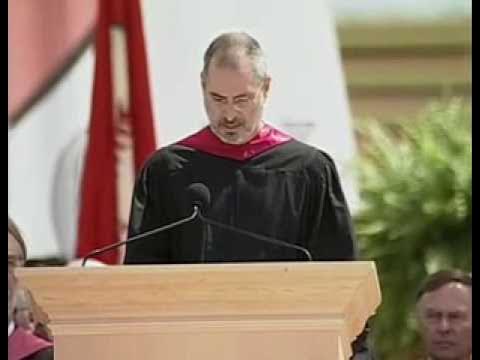
JoshuaG
Embracing the inevitability of death serves as the ultimate tool to strip away external expectations and empower individuals to follow their own intuition.
AI-assisted summary of Steve Jobs Stanford Commencement Speech 2005 — original source. Check the original for full context.
Source published:
Key ideas
- Steve Jobs highlights the unexpected value of auditing a calligraphy class at Reed College, which directly led to the Macintosh becoming the first computer with elegant, proportionally spaced typography. (0:39)
- After being publicly dismissed from Apple at age 30, Jobs founded NeXT and Pixar, demonstrating how the freedom of starting over can drive massive creative and commercial success. (5:22)
- A near-death experience with a rare, treatable pancreatic cancer diagnosis reinforced Jobs's belief that contemplating mortality is the ultimate tool for making authentic life choices. (8:48)
- Jobs urges graduates to reject dogma—defined as living by the results of other people's thinking—and instead prioritize internal intuition and heart. (11:43)
Detailed notes
## Background Published on YouTube by JoshuaG on March 6, 2006, this video documents Steve Jobs delivering his 2005 commencement address to graduates at Stanford University. The accompanying description notes that Jobs reflects on pivotal milestones, including his 1985 firing from Apple, as well as broader themes of life and death.
## TL;DR Delivering his 2005 Stanford commencement address, Steve Jobs presents three foundational personal stories centered on connecting the dots, love and loss, and mortality. He explains how dropping out of Reed College allowed him to audit calligraphy classes that later inspired the Mac's elegant typography, and how his public ousting from Apple enabled the creative renewal that produced NeXT and Pixar. Drawing on his diagnosis with a rare form of pancreatic cancer, Jobs presents death as life's indispensable change agent that clarifies what truly matters. He concludes by urging the graduating class to reject dogma, trust their intuition, and embrace the iconic maxim from The Whole Earth Catalog: “Stay hungry, stay foolish.”
## Atmosphere & style The address has a remarkably intimate, unassuming, and reflective tone, disarming the ceremonial grandeur of Stanford's commencement with dry wit and genuine humility. Jobs speaks with steady, quiet candor, guiding the audience through an emotional arc that moves from early bohemian struggles and public professional heartbreak to confronting the reality of terminal illness. The resulting atmosphere feels both sobering and deeply galvanizing, leaving listeners with an urgent, philosophical invitation to live honestly and without fear.
## Bulletin - [00:39](https://www.youtube.com/watch?v=D1R-jKKp3NA&t=39s) Steve Jobs highlights the unexpected value of auditing a calligraphy class at Reed College, which directly led to the Macintosh becoming the first computer with elegant, proportionally spaced typography. - [05:22](https://www.youtube.com/watch?v=D1R-jKKp3NA&t=322s) After being publicly dismissed from Apple at age 30, Jobs founded NeXT and Pixar, demonstrating how the freedom of starting over can drive massive creative and commercial success. - [08:48](https://www.youtube.com/watch?v=D1R-jKKp3NA&t=528s) A near-death experience with a rare, treatable pancreatic cancer diagnosis reinforced Jobs's belief that contemplating mortality is the ultimate tool for making authentic life choices. - [11:43](https://www.youtube.com/watch?v=D1R-jKKp3NA&t=703s) Jobs urges graduates to reject dogma—defined as living by the results of other people's thinking—and instead prioritize internal intuition and heart.
## Key takeaways - [00:00](https://www.youtube.com/watch?v=D1R-jKKp3NA&t=0s) Jobs opens by admitting he never graduated from college, framing his address around three simple personal stories. - [00:39](https://www.youtube.com/watch?v=D1R-jKKp3NA&t=39s) His biological mother initially refused to sign adoption papers because his adoptive parents lacked college degrees, relenting only when they promised he would attend college. - [00:39](https://www.youtube.com/watch?v=D1R-jKKp3NA&t=39s) Jobs dropped out of Reed College after six months to avoid wasting his working-class parents' life savings on an education whose value he did not see. - [00:39](https://www.youtube.com/watch?v=D1R-jKKp3NA&t=39s) Dropping out allowed Jobs to audit creative courses, including a calligraphy class that later inspired the typography of the first Macintosh computer. - [00:39](https://www.youtube.com/watch?v=D1R-jKKp3NA&t=39s) Jobs emphasizes that life's 'dots' cannot be connected looking forward, but only looking backward, requiring trust in one's future path. - [05:22](https://www.youtube.com/watch?v=D1R-jKKp3NA&t=322s) At age 30, Jobs was publicly fired from Apple, the $2 billion company he co-founded in his parents' garage at age 20. - [05:22](https://www.youtube.com/watch?v=D1R-jKKp3NA&t=322s) Being fired from Apple freed Jobs from the burden of success, allowing him to enter a highly creative period where he founded NeXT and Pixar. - [05:22](https://www.youtube.com/watch?v=D1R-jKKp3NA&t=322s) Jobs advises that the only way to be truly satisfied in life is to do great work, which is only possible by loving what you do and refusing to settle. - [08:48](https://www.youtube.com/watch?v=D1R-jKKp3NA&t=528s) A daily mirror ritual since age 17—asking if he would want to do his scheduled tasks if it were his last day—guided Jobs's major life decisions. - [08:48](https://www.youtube.com/watch?v=D1R-jKKp3NA&t=528s) Remembering personal mortality serves as the ultimate tool to strip away vanity, fear of failure, and external expectations. - [08:48](https://www.youtube.com/watch?v=D1R-jKKp3NA&t=528s) A diagnosis of a rare, surgically treatable pancreatic cancer gave Jobs a firsthand encounter with mortality, transforming death from an abstract concept into a tangible reality. - [11:43](https://www.youtube.com/watch?v=D1R-jKKp3NA&t=703s) Jobs frames death as life's single best invention and primary change agent, clearing out the old generation to make room for the new. - [11:43](https://www.youtube.com/watch?v=D1R-jKKp3NA&t=703s) He defines dogma as living with the results of other people's thinking, urging graduates to prioritize their own heart and intuition over external opinions. - [12:52](https://www.youtube.com/watch?v=D1R-jKKp3NA&t=772s) The Whole Earth Catalog, created by Stewart Brand in the late 1960s, served as an analog, paperback precursor to Google for Jobs's generation. - [12:52](https://www.youtube.com/watch?v=D1R-jKKp3NA&t=772s) Jobs concludes by passing on the catalog's final farewell message, 'Stay Hungry. Stay Foolish,' as a guiding principle for the graduating class.
## Detailed walkthrough ### [00:00](https://www.youtube.com/watch?v=D1R-jKKp3NA&t=0s) Introduction: Three Stories, No Big Deal
Steve Jobs begins his address by expressing his honor at attending the commencement ceremony at Stanford University, which he describes as “one of the finest universities in the world.” He immediately disarms the audience with an honest confession about his own academic credentials, pointing out that he never actually graduated from college and that this ceremony is the closest he has ever come to a real college graduation. Establishing an unpretentious tone, he announces that he has not prepared a grand lecture: “Today I want to tell you three stories from my life that's it no big deal just three stories.”
[00:39](https://www.youtube.com/watch?v=D1R-jKKp3NA&t=39s) Story 1: Connecting the Dots
Jobs’s first story begins before his birth. His biological mother was a young, unwed graduate student who decided to place him for adoption under the strict condition that his adoptive parents must be college graduates. An arrangement was made for an attorney and his wife to adopt him at birth. However, when Jobs was born, the prospective parents abruptly decided at the last minute that they actually wanted a baby girl. His adoptive parents, who were next on the waiting list, received a late-night phone call asking whether they wanted an unexpected baby boy, to which they immediately agreed.
Trouble arose when his biological mother discovered that his new mother had never graduated from college and his father had never finished high school. She refused to sign the final adoption papers, relenting only months later when his adoptive parents made a solemn promise that he would one day attend college. Seventeen years later, Jobs did go to college, but he chose Reed College—an institution whose tuition rivaled Stanford's. Watching his working-class parents spend their life savings on his education without knowing what he wanted to do or how college would help him find out, Jobs dropped out after the first six months.
```mermaid flowchart TD accTitle: The Reed College Journey accDescr: Diagram illustrating Steve Jobs's path from dropping out of Reed College to auditing calligraphy and designing the Mac fonts.
subgraph College["College Years"] A["Drops out of required classes<br/>(First 6 months)"] --> B["Drops in on creative courses<br/>(Next 18 months)"] B --> C["Takes calligraphy class<br/>(Serif, sans-serif, spacing)"] end
subgraph DormLife["Campus Reality"] D["Sleeps on dorm floors"] E["Returns 5¢ Coke bottles for food"] F["7-mile walk to Hare Krishna temple"] end
subgraph DecadeLater["10 Years Later"] C --> G["Designs first Macintosh computer"] G --> H["Proportionally spaced typography<br/>copied by Windows to PC"] end ```
Dropping out meant he could cease attending uninteresting required classes and instead drop in on lectures that intrigued him. The lifestyle was far from glamorous: lacking a dorm room, he slept on friends’ floors, financed his meals by returning Coca-Cola bottles for five-cent deposits, and walked seven miles across town every Sunday night to get a hot meal at the local Hare Krishna temple.
Reed College had what Jobs considered perhaps the finest calligraphy program in the country, evident across every hand-calligraphed label and poster on campus. Free from core curriculum obligations, Jobs enrolled in calligraphy classes, immersing himself in serif and sans-serif typefaces, variable kerning, and the artistic intricacies of typography. Although it lacked any practical application at the time, this knowledge became vital ten years later when he and his team designed the original Macintosh computer—the first personal computer with proportionally spaced fonts and elegant typography. Looking back, he notes that Windows simply copied the Mac, meaning personal computers might never have had modern typography had he not audited that single course.
- Biological mother: Unwed graduate student who insisted on adoptive parents holding college degrees. - Adoptive parents: Father had not completed high school; mother had not completed college. - Cost: Reed College tuition was nearly as expensive as Stanford University. - Subsistence: Slept on friends' floors, returned bottles for 5¢ deposits, walked 7 miles every Sunday to the Hare Krishna temple. - Retrospective insight: “You can't connect the dots looking forward you can only connect them looking backwards so you have to trust that the dots will somehow now connect in your future.”
[05:22](https://www.youtube.com/watch?v=D1R-jKKp3NA&t=322s) Story 2: Love and Loss
Jobs’s second story focuses on love and loss. He considers himself fortunate to have discovered his passion early, founding Apple in his parents' garage alongside Steve Wozniak at age 20. Over the following decade, Apple expanded from two people in a garage into a public company worth $2 billion with over 4,000 employees. Just after turning 30, right after releasing their flagship innovation—the Macintosh—Jobs was fired from the company he created.
The rupture occurred after the board of directors sided with a talented executive Jobs had recruited to help run the company, following a divergence in their visions for the future. The dismissal was devastating and public. Jobs felt he had failed the valley's prior generation of innovators, even arranging meetings with David Packard and Bob Noyce to apologize for dropping the baton. He briefly considered leaving Silicon Valley altogether, but realized he still loved what he did.
Being pushed out proved liberating. The burden of maintaining corporate success was replaced by the lightness of becoming an unburdened beginner again. Over the next five years, Jobs founded NeXT, acquired and built Pixar—which produced the first computer-animated feature film, *Toy Story*—and met his future wife, Laurene. When Apple later acquired NeXT, Jobs returned to the company, incorporating NeXT’s technology into Apple's historic resurgence.
- Age milestones: Founded Apple at age 20; ousted from Apple at age 30. - Scale of Apple: Grew in 10 years from 2 people in a garage to $2 billion and 4,000+ employees. - New ventures launched during exile: NeXT (whose software drove Apple's renaissance) and Pixar (creator of *Toy Story*). - Personal advice on perseverance: “Your work is going to fill a large part of your life and the only way to be truly satisfied is to do what you believe is great work and the only way to do great work is to love what you do.” - Warning against settling: “If you haven't found it yet keep looking and don't settle.”
[08:48](https://www.youtube.com/watch?v=D1R-jKKp3NA&t=528s) Story 3: Death and Perspective
Jobs introduces his third story with a quote he read at age 17: “If you live each day as if it was your last someday you'll most certainly be right.” That line sparked a daily morning ritual spanning 33 years, where he looked into the mirror and evaluated whether he would want to do his scheduled tasks if it were the final day of his life. Whenever the answer remained “no” for several consecutive days, he knew a life change was required.
Jobs describes the contemplation of death as the ultimate decision-making tool, stripping away vanity, social expectations, and fear of failure, leaving only what is vital. He tells the graduates that they are already stripped bare, leaving no justification for ignoring their inner convictions: “Remembering that you are going to die is the best way I know to avoid the trap of thinking you have something to lose.”
He shares his experience from about a year prior, when a 7:30 a.m. scan revealed a pancreatic tumor. Jobs had not previously known what a pancreas was, and doctors warned him that the tumor was virtually certain to be an incurable form of pancreatic cancer with an expected life expectancy of three to six months. His physician instructed him to go home and get his affairs in order—which Jobs characterizes as medical code to prepare for death, spend precious final months saying goodbyes, and cram ten years of guidance for his children into a few weeks.
That evening, doctors conducted a biopsy, guiding an endoscope down his throat, through the stomach into the intestines, and inserting a needle directly into the pancreas to extract tumor cells. Jobs was sedated, but his wife recounted that when the medical team examined the sample under the microscope, the doctors began weeping with relief: it was an exceptionally rare form of pancreatic cancer treatable via surgery. Jobs underwent the procedure and was restored to health, giving him a tangible, firsthand encounter with mortality rather than viewing death as an abstract intellectual concept.
[11:43](https://www.youtube.com/watch?v=D1R-jKKp3NA&t=703s) Death as Life's Change Agent and Following Your Heart
Steve Jobs reflects on the universal reality of mortality, observing the paradox that even people who wish to reach heaven do not want to die to get there. Yet, death remains the single destination shared by every human being, and Jobs argues that this is precisely how it should be. He frames death not as a tragedy, but as an essential evolutionary force: “No one has ever escaped it and that is as it should be, because death is very likely the single best invention of life.” Death acts as life's primary change agent, sweeping out the old to make room for the new. Addressing the graduates directly, Jobs points out that while they are currently the new, the day will arrive before long when they gradually become the old and are cleared away themselves, jokingly apologizing for sounding overly dramatic while insisting it is simply the truth.
Because time is inherently finite, Jobs urges the audience not to squander it by conforming to expectations or living someone else's life. He cautions them against being trapped by dogma—which he defines as living according to the results of other people's thinking—and warns against letting the clamor of external opinions overpower personal conviction. Above all, he stresses the necessity of listening to one’s deepest impulses: “And most important, have the courage to follow your heart and intuition; they somehow already know what you truly want to become.” In his view, everything else beyond that core truth is entirely secondary.
- **Death as Life's Mechanism:** Serves as the ultimate change agent by clearing out the old generation to make space for the new. - **The Definition of Dogma:** Living with the conclusions, rules, and expectations generated by other people's thoughts. - **The Primacy of Intuition:** Jobs emphasizes that internal intuition already understands a person's authentic path, rendering all other external pressures secondary.
---
[12:52](https://www.youtube.com/watch?v=D1R-jKKp3NA&t=772s) The Whole Earth Catalog and "Stay Hungry, Stay Foolish"
Jobs turns to an influential touchstone from his youth: an extraordinary publication known as *The Whole Earth Catalog*, created by Stewart Brand not far away in Menlo Park. Describing it as one of the definitive “Bibles” of his generation, Jobs explains that Brand brought the publication to life with a distinct poetic touch during the late 1960s. Because this was prior to the advent of personal computers and desktop publishing tools, the entire catalog had to be handcrafted using manual tools like typewriters, scissors, and Polaroid cameras. Jobs characterizes the catalog as essentially an analog precursor to modern information retrieval: “It was sort of like Google in paperback form, 35 years before Google came along.” The publication was fundamentally idealistic, brimming with clever tools, practical guides, and expansive notions.
```mermaid flowchart TD accTitle: The Legacy of The Whole Earth Catalog accDescr: Diagram showing how Stewart Brand created the publication in the late 1960s leading to its final mid-1970s message to Steve Jobs and the graduates.
subgraph Creation["Late 1960s: Menlo Park"] A["Stewart Brand"] --> B["The Whole Earth Catalog"] B --> C["Typewriters, scissors & Polaroid cameras"] end
subgraph Impact["Mid-1970s: Final Issue"] C --> D["Paperback precursor to Google"] D --> E["Back cover: Early morning country road"] E --> F["Farewell message: 'Stay Hungry. Stay Foolish.'"] end
subgraph Legacy["Commencement 2005"] F --> G["Lifelong personal guide for Steve Jobs"] G --> H["Graduation blessing for Stanford class"] end ```
Stewart Brand and his team produced several issues of the catalog until it eventually ran its natural course in the mid-1970s, right around the time Jobs was the same age as the graduating students in the audience. On the back cover of their final issue, the creators printed a photograph of an early morning country road—the kind of quiet backroad a traveler might find themselves hitchhiking along on an adventure. Beneath the photograph sat their parting message: “Stay Hungry. Stay Foolish.” Jobs shares that this phrase served as his own enduring touchstone throughout his life, and he passes it along to the graduating class as they set out on their next chapter: “And now, as you graduate to begin anew, I wish that for you: Stay hungry, stay foolish.”
- **Publication Origins:** Created in Menlo Park by Stewart Brand in the late 1960s using typewriters, scissors, and Polaroid cameras. - **Cultural Significance:** Described as "Google in paperback form 35 years before Google came along," defined by idealism and practical tools. - **The Final Send-off:** Concluded publication in the mid-1970s with a back-cover photograph of an early morning country road and the parting words: “Stay Hungry. Stay Foolish.”
## Notable quotes > [08:48](https://www.youtube.com/watch?v=D1R-jKKp3NA&t=528s) Remembering that you are going to die is the best way I know to avoid the trap of thinking you have something to lose. — Steve Jobs
> [05:22](https://www.youtube.com/watch?v=D1R-jKKp3NA&t=322s) Your work is going to fill a large part of your life and the only way to be truly satisfied is to do what you believe is great work and the only way to do great work is to love what you do. — Steve Jobs
> [11:43](https://www.youtube.com/watch?v=D1R-jKKp3NA&t=703s) have the courage to follow your heart and intuition; they somehow already know what you truly want to become. — Steve Jobs
## Mentioned Steve Jobs, Steve Wozniak, David Packard, Bob Noyce, Laurene Powell Jobs, Stewart Brand, Stanford University, Reed College, Hare Krishna temple, Apple, NeXT, Pixar, Toy Story, Macintosh, Windows, Google, The Whole Earth Catalog
## Video description Here we see Steve Jobs delivering his commencement speech to the graduates of Stanford University in 2005. In it he talks about getting fired from Apple in 1985, life & death
[Source](https://www.youtube.com/watch?v=D1R-jKKp3NA)