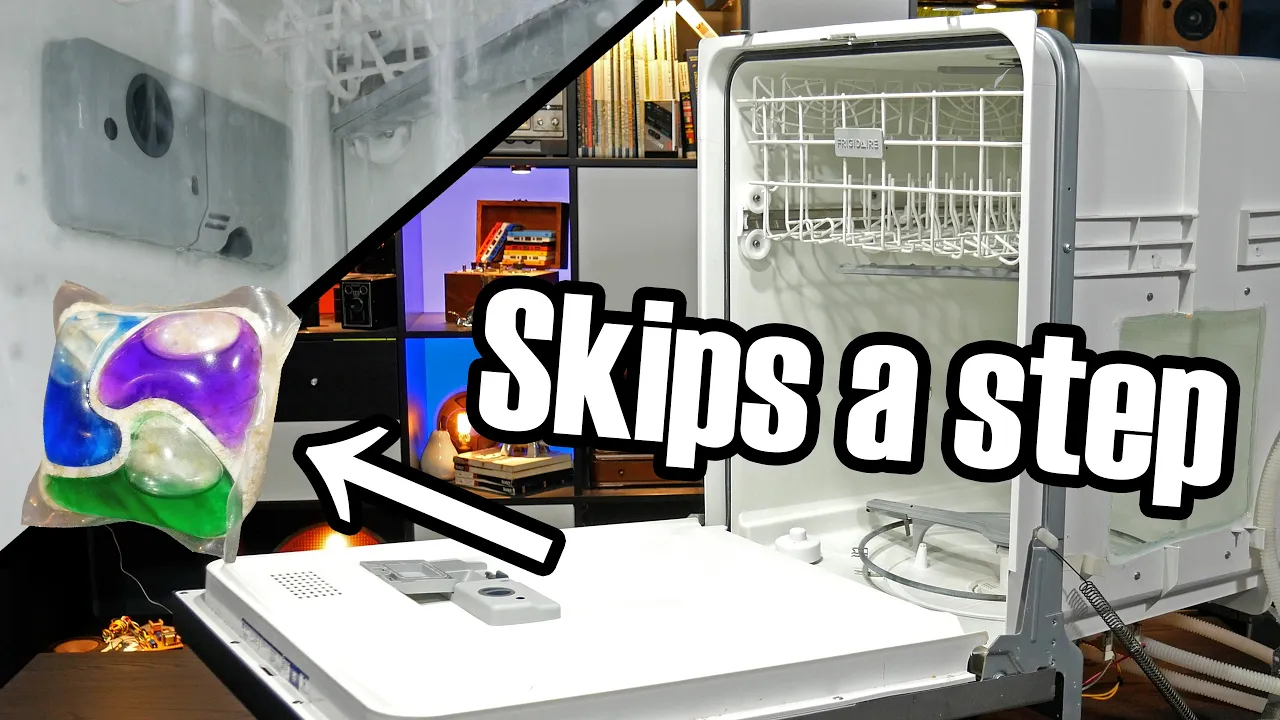
Single-dose packs starve appliances of cleaning chemistry during the crucial initial pre-wash fill, causing grease and proteins to linger into the main wash.
Pre-measured detergent packs actively handicap dishwashers because standard cycles require detergent in both the preliminary pre-wash fill and the sealed main wash. (0:00)
In North America, running the kitchen tap until hot water arrives before starting a dishwasher prevents the unheated initial pre-wash fill from running in cold pipe water. (1:09)
Empirical testing showed that adding detergent to the 15-minute pre-wash completely dissolved stubborn butter fats and loosened baked-on residue, keeping oil sludge out of the main wash cycle. (20:26)
Modern dishwashers wash over eight place settings using only 4.2 gallons (16 liters) of water and 1.2 kWh of electricity, relying on chemical emulsifiers and dispersants to keep soil suspended in recirculated water. (24:32)
Detailed notes
## Background
Published on YouTube by Technology Connections on December 20, 2020, this video explores the internal mechanics of household dishwashers to diagnose why users are often disappointed by their appliance's cleaning performance. The channel description promises to explain how these machines actually operate and provide straightforward, practical solutions to common dishwashing frustrations.
## TL;DR
The video breaks down the mechanical and chemical operations of modern dishwashers, revealing that most cycles rely on a dual-stage process: a brief pre-wash designed to liquefy and flush heavy soils, followed by a longer main wash. Single-dose detergent packs directly conflict with this engineering because locking all detergent inside the dispenser leaves the initial fill running with plain water. Through empirical testing with stubborn dried foods, the host demonstrates that adding cheap powder or liquid detergent into the pre-wash cup dramatically outperforms pods alone by emulsifying fats and breaking down proteins early. Viewers are also urged to run the kitchen sink to clear cold standing water from North American hot-water supply lines before starting a cycle.
## Atmosphere & style
The presentation is dryly witty, inquisitive, and passionately pedantic, turning an everyday kitchen appliance into an engaging engineering deep dive. The host balances approachable deadpan humor with rigorous mechanical teardowns, punctuated by audible grunts as he wrestles appliances onto camera and candid admissions of his own grumpiness. Watching it feels like a friendly, eye-opening technical lecture from an enthusiast who is genuinely delighted by hydraulic loops and utterly exasperated by misguided consumer marketing.
## Bulletin
- [00:00](https://www.youtube.com/watch?v=_rBO8neWw04&t=0s) Pre-measured detergent packs actively handicap dishwashers because standard cycles require detergent in both the preliminary pre-wash fill and the sealed main wash.
- [01:09](https://www.youtube.com/watch?v=_rBO8neWw04&t=69s) In North America, running the kitchen tap until hot water arrives before starting a dishwasher prevents the unheated initial pre-wash fill from running in cold pipe water.
- [20:26](https://www.youtube.com/watch?v=_rBO8neWw04&t=1226s) Empirical testing showed that adding detergent to the 15-minute pre-wash completely dissolved stubborn butter fats and loosened baked-on residue, keeping oil sludge out of the main wash cycle.
- [24:32](https://www.youtube.com/watch?v=_rBO8neWw04&t=1472s) Modern dishwashers wash over eight place settings using only 4.2 gallons (16 liters) of water and 1.2 kWh of electricity, relying on chemical emulsifiers and dispersants to keep soil suspended in recirculated water.
## Key takeaways
- [00:00](https://www.youtube.com/watch?v=_rBO8neWw04&t=0s) Single-dose detergent packs present a mechanical mismatch for dishwashers by forcing the machine's initial pre-wash cycle to run with plain water.
- [01:09](https://www.youtube.com/watch?v=_rBO8neWw04&t=69s) Standard North American dishwashers are plumbed to the domestic hot water supply and do not heat the water during the initial fill, requiring users to clear cold water from the line beforehand.
- [02:28](https://www.youtube.com/watch?v=_rBO8neWw04&t=148s) Dishwashers eliminate the need for physical scrubbing by recirculating a small volume of water through pressurized, hydraulically driven rotating spray arms.
- [08:31](https://www.youtube.com/watch?v=_rBO8neWw04&t=511s) The appliance's baseline cycle consumes scarcely one gallon per fill and alternates pump direction between the upper and lower arms to conserve water pressure.
- [10:01](https://www.youtube.com/watch?v=_rBO8neWw04&t=601s) The 15-minute pre-wash cycle is designed to pulverize and flush the bulk of food debris down the drain before the spring-loaded dispenser door releases the main wash detergent.
- [12:04](https://www.youtube.com/watch?v=_rBO8neWw04&t=724s) Dishwasher dispensers traditionally provide two detergent compartments—an open basin for the pre-wash and a sealed compartment for the main wash—to optimize grease breakdown.
- [14:38](https://www.youtube.com/watch?v=_rBO8neWw04&t=878s) Detergents combine non-foaming surfactants, enzymes to break down proteins, emulsifiers to dissolve fats into micelles, and dispersants to prevent soil from redepositing.
- [22:36](https://www.youtube.com/watch?v=_rBO8neWw04&t=1356s) Tossing detergent packs directly onto the floor of the dishwasher wastes the soap, as it dissolves immediately during the pre-wash and is pumped out within fifteen minutes.
- [20:26](https://www.youtube.com/watch?v=_rBO8neWw04&t=1226s) A side-by-side test proved that pre-wash detergent prevents butter from forming sludge around the pump and breaks down difficult egg proteins early in the cycle.
- [24:32](https://www.youtube.com/watch?v=_rBO8neWw04&t=1472s) The phase-out of phosphates was not the cause of poor cleaning performance; phosphates acted primarily as water softeners, a role effectively replaced by commercial rinse aid.
- [26:05](https://www.youtube.com/watch?v=_rBO8neWw04&t=1565s) Inexpensive, store-brand powder or liquid gel distributed between both dispenser cups consistently outperforms costly single-pack pods without requiring manual pre-rinsing.
- [28:32](https://www.youtube.com/watch?v=_rBO8neWw04&t=1712s) While standard normal cycles require pre-wash soap, express cycles trigger the dispenser door immediately, making secondary pre-wash detergent unnecessary in those modes.
## Detailed walkthrough
### [00:00](https://www.youtube.com/watch?v=_rBO8neWw04&t=0s) The Problem with Detergent Packs
The dishwasher detergent pack has surged in popularity, offering a pre-dosed, mess-free convenience that consumers are happy to pay a premium for—provided people do not eat them, an unfortunate disclaimer that oddly became necessary in recent years. Yet despite their mass appeal and inclusion as sample packs with brand-new machines, these packets irritate the host because they actively contradict how modern dishwashers are engineered to run. While laundry detergent pods like Tide Pods perform just fine in their respective appliances, dishwasher packs present a unique mechanical conflict.
As the host wrestles a heavy, standalone machine into the studio frame amid audible grunts and shuffling, he makes it clear that the packet’s design flaw is not trivial. By relying strictly on these all-in-one pouches, consumers end up hampering the core cleaning power of their machines. As the host argues: “See, if you use them exclusively, you may be significantly limiting your dishwasher’s ability to clean.”
- Detergent packs are heavily marketed, pre-measured, and convenient, but their physical format poses a design mismatch for dishwashers.
- Unlike laundry pods, which operate in a fundamentally different cycle environment, dishwasher packs interfere specifically with the staged wash phases of automated dishwashers.
---
[01:09](https://www.youtube.com/watch?v=_rBO8neWw04&t=69s) North American Plumbing Quirks: The Hot Water Prerequisite
Before tearing into the machine's inner workings, there is a distinct plumbing idiosyncrasy specific to the North American market that must be addressed. Unlike European models, which typically take in cold water and heat it internally across all cycles, standard household dishwashers in the United States and Canada are plumbed directly into the domestic hot water supply line under the sink. Because the machine assumes hot water is entering on demand, it does not engage its heating element for the initial rinse fill.
This creates a serious performance bottleneck: if the hot water hasn’t been drawn to the kitchen tap yet, the dishwasher’s first cycle fills with lukewarm or stone-cold pipe water. The host notes that while hooking appliances to hot water might be questionable and running the tap wastes a small amount of water, it is an unavoidable necessity under current American plumbing designs. As the host insists: “If you aren’t already in the habit of doing so, you should run your kitchen faucet until you get hot water before you start the dishwasher.”
- North American units rely on the household water heater and do not expect to heat water during the first rinse cycle.
- Failing to clear the standing cold water out of the sink's hot water line can lead to the machine washing the first cycle in cold water, cratering cleaning efficacy.
- European units generally differ by taking in cold water and heating it on board as needed throughout the wash.
---
[02:28](https://www.youtube.com/watch?v=_rBO8neWw04&t=148s) The Fundamentals of Dishwashing and Mechanical Force
Stripping away the outer shell reveals an appliance that is surprisingly rudimentary, constructed largely of molded plastic and wrapped in a thick blanket that serves as acoustic sound-deadening rather than thermal insulation. Although contemporary units feature modern microprocessors, the underlying engineering has barely evolved since Josephine Cochrane patented the first practical mechanical dishwasher in 1886. The physics of cleaning dinnerware remain identical whether performed by hand in a sink or inside an automated cabinet.
Manual washing relies on hot water, soap, and mechanical abrasion from a sponge or brush to dissolve grease and dislodge grime. Commercial three-compartment sinks institutionalize this as the rigid mantra: wash, rinse, sanitize. However, physical scrubbing is not mandatory if sufficient kinetic energy can be imparted by water alone. Just as a garden hose can blast mud from work boots or a rushing river can carve rock, a concentrated jet of water possesses substantial mass and velocity. As the host explains: “But here’s the thing - you don’t actually need something to scrub with to wash dishes.”
- Josephine Cochrane patented the foundational modern automatic dishwasher design in 1886.
- Dishwashers are predominantly sold as built-in under-counter units, though portable wheeled models and countertop versions also exist.
- Mechanical scrubbing is entirely replaced in an automatic dishwasher by the kinetic force of pressurized water jets combined with chemical surfactants and heat.
---
[04:50](https://www.youtube.com/watch?v=_rBO8neWw04&t=290s) Internal Mechanics: Pumps, Recirculation, and Sprayer Arms
Running continuous fresh water straight from the municipal pipes through spray nozzles would squander dozens of gallons of treated water. To maximize efficiency, dishwashers fill with a finite charge of water, trap it in the bottom basin, and run an electric pump to pressurize and continuously recirculate that exact same volume through spinning sprayer arms. Recirculating the water keeps the detergent actively working against the dinnerware over long durations rather than washing it down the drain.
```mermaid
flowchart TD
accTitle: Dishwasher Hydraulic Recirculation Loop
accDescr: Water is drawn from the sump through filters by the circulation pump, then driven into spray arms whose reactive jets clean dishes and rotate the arms.
The rotating sprayer arms are strategically perforated with directional nozzles that restrict pump discharge, building pressure to shoot targeted streams at dirty plates, bowls, and cutlery. These nozzles are engineered at specific opposing angles so the reactive thrust of escaping water spins the arms without requiring dedicated drive motors. The host highlights the recirculation loop as a crucial mechanical factor: how and when detergent enters this recirculating bath dictates the machine's entire cleaning success.
- A main circulation pump draws water from the sump, routes it into spray manifolds, and recirculates it continuously.
- Spray arms rotate purely through hydraulic recoil generated by angled discharge nozzles.
- A secondary, smaller pump is dedicated solely to evacuating dirty water out through the drain hose at designated cycle transitions.
---
[06:18](https://www.youtube.com/watch?v=_rBO8neWw04&t=378s) Anatomy of a Modern Dishwasher: Components and Sensors
The dishwasher's mechanical footprint beneath the tub is remarkably sparse. It consists of merely four primary actuators: a solenoid inlet valve to admit domestic water, a high-volume wash pump motor, a dedicated drain pump motor, and a resistive electric heating element that loops through the floor of the tub. The tub itself is simply an upright plastic or stainless steel enclosure resting on a sump well that collects recirculating liquid and houses the fine debris filter screens.
```mermaid
flowchart LR
accTitle: Dishwasher Electrical and Mechanical System
accDescr: Diagram of the microcontroller taking sensor inputs and driving actuators in the tub and door.
subgraph Inputs ["Sensors & Controls"]
Float["Float Switch (Backup)"]
Level["Main Water Level Sensor"]
Temp["Temperature Sensor"]
DoorSw["Door Switch"]
Panel["User Interface"]
end
subgraph Controller ["Electronics"]
MCU["Logic Board / Microprocessor"]
end
subgraph Actuators ["Sub-Tub & Door Actuators"]
Inlet["Solenoid Water Valve"]
WashMtr["Main Wash Pump Motor"]
DrainMtr["Drain Pump Motor"]
Heater["Resistive Heating Element"]
Dispenser["Detergent Dispenser Door"]
DryVent["Drying Air Vent"]
end
Inputs --> MCU
MCU --> Actuators
```
Management of these parts falls to a microcontroller mounted inside the front door. The board tracks a door safety switch, a thermistor for water temperature control, a primary water-level sensor, and an upright mechanical float switch. This float switch serves primarily as an emergency overflow safeguard against stuck solenoid valves rather than a primary fill gauge. The door also houses the drying cycle exhaust vent and a spring-loaded detergent dispenser door designed to trip open mid-cycle. As the host underscores: “It wouldn’t bother with one if it didn’t want control over when it’s introduced to the wash water.”
- The primary water loop utilizes filter screens located inside the sump to protect pump impellers from large food particles.
- The machine uses a two-tiered fill safety setup: a precise concealed level sensor backed up by a mechanical float switch to prevent flood damage.
- Water heating occurs via a bare tubular resistive element seated just above the floor of the tub.
---
[08:31](https://www.youtube.com/watch?v=_rBO8neWw04&t=511s) The Cycle Begins: Pre-Wash Sequence and Alternating Sprayers
When a wash cycle is commanded, the appliance starts by running its drain pump to purge any pooled water remaining from prior cycles or humid condensation. Once drained, the inlet solenoid opens to let in clean domestic water. This fill is surprisingly tiny—scarcely a single gallon (around 4 liters). Because this initial charge is unheated by the machine's onboard element, its thermal energy is entirely dependent on whether the homeowner ran the sink faucet beforehand.
With so little water present in the sump, the wash pump lacks sufficient hydraulic volume to pressurize the lower spray arm and the upper spray arms simultaneously. To maintain adequate jet pressure throughout the interior, the machine alternates water delivery between the bottom rack and the upper rack manifolds. By simply reversing the rotation of the wash motor, the pump diverts flow between the lower sprayer and the external conduit feeding the top arms. While this hydraulic trade-off lengthens the total duration of the cycle, it slashes total water consumption down to historic lows.
- Every cycle initiates with a preliminary drain cycle to expel standing stagnant water before introducing fresh water.
- A standard fill requires only approximately 1 gallon (~4 liters) of water.
- Pump motor direction is alternated to toggle water between the bottom and top spray arms, conserving water at the expense of longer cycle runtimes.
[10:01](https://www.youtube.com/watch?v=_rBO8neWw04&t=601s) The Pre-Wash Cycle, Pulverizers, and Water Purging
Dishwashers handle solid food waste in fundamentally different ways depending on their internal mechanics. Some machines, notably those manufactured by Bosch, rely on fine mesh filter screens that trap physical particles and require periodic manual cleaning by the user. Other dishwashers, including the unit demonstrated, employ a pulverizing system where the main pump's impeller functions essentially like a mini garbage disposal, shredding food debris into a fine slurry so it passes safely through domestic plumbing without risk of clogs. The demonstrated unit incorporates a clever design touch: the lower spray arm directs water jets across the floor of the sump basin, actively pushing dislodged solids directly into the intake of the main pump to be thoroughly pulverized.
The first fill of water handles the absolute brunt of the workload because the dishes enter the machine at peak grime. Consequently, this initial charge turns filthy very quickly, prompting the dishwasher to run it for only about fifteen minutes before pumping it out. Knowing that this drainage will leave behind a residue of concentrated grime in the bottom of the sump, the machine immediately executes a quick rinse-and-purge routine. It introduces a tiny splash of fresh water, pulses the circulation pump in rapid bursts to dilute the lingering muck and protect the pump from clogging, and drains that dirty remnant immediately.
Throughout this entire opening sequence, the detergent dispenser remains locked shut. Dumping cleaning chemicals into this initial phase would be completely counterproductive, as any soap released right away would simply be flushed down the drain with the initial wave of grime after just fifteen minutes. As the host points out, protecting the soap for the right moment is the entire justification for the appliance's mechanical dispenser door: “It has to get the nasty stuff out first, and if it had released the detergent, well the detergent would have left with all the nasty stuff in the first 15 minutes of the cycle.”
[12:04](https://www.youtube.com/watch?v=_rBO8neWw04&t=724s) The Two Dispensers and the Main Wash Cycle
Leaving the first fill completely bare of cleaning agents misses an enormous opportunity to cut through heavy grease early. For that reason, many dishwashers—including virtually every model the host has encountered—are built with two distinct places to deposit detergent. One compartment serves the pre-wash: it is unsealed and vented directly to the tub interior, allowing detergent to mix with the water immediately upon entry. The second compartment serves the main wash: it is sealed by a spring-loaded door that remains shut until the appliance reaches the proper point in its programmed wash cycle.
```mermaid
flowchart TD
accTitle: Dishwasher Water and Detergent Cycle Flow
accDescr: Step-by-step cycle of fills, pre-wash, main wash, purges, and final rinse in a standard dishwasher.
subgraph PreWashStage["Pre-Wash Stage (15 min)"]
A["Fill 1: Fresh Water + Pre-Wash Detergent"] --> B["Spray & Pulverize Heavy Solids"]
B --> C["Drain Filthy Water"]
C --> D["Mini-Fill & Pump Burst Purge"]
D --> E["Drain Purge Water"]
end
subgraph MainWashStage["Main Wash Stage (~60 min)"]
E --> F["Fill 2: Fresh Water"]
F --> G["Open Main Detergent Dispenser"]
G --> H["Circulate & Heat Wash Water"]
end
subgraph RinseStage["Rinse & Sanitize (~30 min)"]
H --> I["Dilution Drain + Purge Cycle"]
I --> J["Final Fill: Heat to 150°F+ (Sanitize)"]
J --> K["Drain Rinse Water & Heated Dry"]
end
```
After draining the filthy pre-wash water and finishing its purge routine, the appliance refills completely with fresh, clean water. Shortly into this new phase, the dispenser door snaps open to release the main detergent payload into clean water, spending nearly an hour circulating this soapy bath over the remaining stubborn residue. It is during this extended main wash that the machine kicks on its electric heating element to raise the water temperature as needed. The host highlights how counterproductive standard plumbing can be here: because fifteen minutes have elapsed since the machine was first hooked up to the hot water line, the water sitting in the household supply pipe has likely gone cold, forcing the appliance's internal heating element to do heavy lifting anyway.
- Dishwasher manufacturers design machines expecting a small detergent dose in the first fill and an additional dose during the main wash.
- The pre-wash compartment releases its contents immediately through built-in vent slits.
- The main wash circulates for almost an hour, giving detergents and hot water adequate time to dissolve baked-on residue.
- “Your water heater ends up heating a bit of water that gets cold again by the time the dishwasher actually needs it.”
[13:41](https://www.youtube.com/watch?v=_rBO8neWw04&t=821s) Draining, Rinsing, and Sanitization
To ensure that dishes are stripped of all residual detergent while consuming minimal water, the dishwasher executes an elaborate draining sequence at the conclusion of the main wash. Rather than simply draining the tub dry, the machine injects fresh water while the drain pump is actively running, diluting the concentrated soap scum right at the sump intake. It then repeats the small fill-and-purge routine seen after the pre-wash, pulsing water through the pump to dilute any remaining wash water. To be thoroughly certain no detergent lingers on the dishware, the machine introduces a second stream of fresh water simultaneously while pumping out that purge water.
Once the soap residue has been flushed, the machine completes a final full water fill for the rinse cycle, circulating and heating the water for roughly half an hour. For dishwashers equipped with a dedicated sanitize setting, this is the exact phase where that operation takes place. Under NSF specifications for residential dishwashers in the United States, this sanitize rinse must elevate the water temperature to at least 150°F. Once the high-temperature rinse is drained away, the internal heating element can be engaged to bake off residual moisture and dry the load.
[14:38](https://www.youtube.com/watch?v=_rBO8neWw04&t=878s) What Detergent Actually Does: Enzymes, Emulsifiers, and Dispersants
Dishwasher detergents are chemically aggressive mixtures formulated with surfactants and enzymes tailored to tackle three distinct cleaning challenges: degrading food proteins, emulsifying oils, and dispersing suspended particulate matter. Crucially, these detergents are engineered to be entirely non-foaming. Standard liquid dish soap produces enormous volumes of suds when pumped under pressure, which will quickly foam out of the tub seams and flood a kitchen floor. Because automatic detergents are substantially more caustic than gentle hand-washing soaps, they are often the direct reason delicate finishes and non-dishwasher-safe kitchenware degrade in the wash.
Because culinary fats and water naturally separate, detergents rely on emulsifiers to bridge the gap. Soap molecules organize themselves into microscopic spherical clusters known as micelles, encapsulating tiny droplets of grease and oil within their hydrophobic cores and allowing them to remain suspended in water. The host notes that this is the same fundamental chemical principle seen in the culinary world with egg yolks, which serve as emulsifiers in baked goods to prevent butter or oil from separating out of water and flour batters.
Alongside emulsification, detergents incorporate dispersing agents to keep dislodged food residue from dropping out of the wash stream. Quoting an entry from Wikipedia to highlight how commonplace the chemistry is, the host notes: “Dispersants are widely used to stabilize various industrial and artisanal products, such as paints, ferrofluids, and salad dressings.” Inside a dishwasher, dispersants hold soil particles suspended throughout the water volume so that they cannot settle into stagnant sludge in corners of the tub or redeposit onto previously cleaned dishes before the drain pump fires.
[17:03](https://www.youtube.com/watch?v=_rBO8neWw04&t=1023s) Why Detergent Packs Break the System
Given the critical chemistry that detergents provide—emulsifying oils, dissolving protein structures, and keeping dislodged matter floating in the wash liquor—withholding detergent from the initial fill handicaps the machine's primary cleaning mechanism. The pre-wash cycle is specifically tasked with pulverizing and eliminating the bulk of food grime in just fifteen minutes. Supplying a dash of detergent during this opening phase vastly improves its cleaning power, ensuring that fats and food soils are suspended and flushed away before the main wash even begins.
Single-dose detergent packs directly undermine this dual-phase cleaning design because they can only be placed inside the locked main detergent dispenser. As a result, consumers who switch entirely to packs unwittingly force their machines to run the pre-wash cycle with nothing more than plain water, leaving the appliance hobbled during the stage meant to perform heavy lifting. The instructions on legacy products reflect this design reality; standard boxes of Cascade detergent powder state plainly: “For best results, fill both the pre-wash and the main wash cups completely.” The host vents his frustration at this modern product disconnect, pointing out that packs make it structurally impossible to follow the manufacturer's own directions: “How am I supposed to do that with one of these, Cascade‽”
- Modern consumer habits rely heavily on detergent packs, starving the pre-wash of necessary chemistry.
- Pre-rinsing dishes by hand in the sink is largely a workaround necessitated by running the initial pre-wash fill without detergent.
- Running detergent in both cycles allows the appliance to scrub away heavy food soils without human intervention.
- “Dishwashers can clean much more effectively if they have detergent in both the initial fill and the main wash.”
[18:30](https://www.youtube.com/watch?v=_rBO8neWw04&t=1110s) The Pre-Wash Experiment: Testing Water Alone vs. Adding Detergent
To determine just how much work occurs during the initial fifteen minutes of a cycle—and whether pre-wash detergent makes a tangible difference—the host devises an empirical test using identically soiled plates left to dry for three full days. The test items feature stubborn, set-in messes: baked-on pasta sauce, a bowl coated in thick dried pancake mix, a plate with dried scrambled egg residue, and a mixture of two tablespoons of butter melted together with a quarter cup of shredded cheese.
| Test Dish | Mess Type | Dry Time |
|:--- |:--- |:--- |
| Dinner Plate | Baked-on pasta sauce | 3 days |
| Mixing Bowl | Dried remnants of pancake mix | 3 days |
| Breakfast Plate | Cooked scrambled egg residue | 3 days |
| Melter Dish | 2 tbsp butter + 1/4 cup shredded cheese | 3 days |
The dishwasher is run on its normal cycle using maximum tap-hot water, but aborted immediately after the 15-minute pre-wash drains to inspect the results. The first run uses plain water without any detergent. The second run adds standard Great Value lemon-scented liquid gel to the vented pre-wash basin.
The results show surprising nuance. While plain water demonstrates an unexpected ability to lift away significant portions of the baked-on pasta sauce, the run with added pre-wash detergent actually struggles more against the dried pancake batter than water alone. However, the host stresses that evaluating overall cleaning efficacy requires looking far deeper into the physical details and chemical residue left behind on the items: “I’ll admit that I was surprised just how much water alone was able to accomplish, particularly with the pasta sauce. And, believe it or not, the run with pre-wash detergent actually did worse with the pancake mix. But the devil is in the details, and there are some important and significant differences.”
[20:26](https://www.youtube.com/watch?v=_rBO8neWw04&t=1226s) The 15-Minute Pre-Wash Test Results
Examining the plates just fifteen minutes into the cycle reveals a distinct difference between running a plain water rinse and including a small amount of pre-wash detergent. While the pasta sauce plate looks only slightly different at first glance, the wash with detergent removed significantly more sauce overall, especially where it had baked and burned onto the surface; without detergent, numerous stubborn flecks remained stuck behind. The difference on the buttery cheese plate was even more dramatic: without detergent, a thick smear of butter clung to the plate, whereas with detergent, the emulsifying action completely dissolved the butter into the wash water. Even though cheese residue remained on both, failing to flush the butter out during the first fill forces that glob of fat to linger into the main wash, consuming a massive portion of the main wash detergent's emulsification capacity before it can tackle anything else.
The egg-coated plate provided the most striking evidence. Eggs are famously difficult for dishwashers to break down, and while neither plate emerged spotless after a mere quarter of an hour, a close look shows that the cycle with detergent stripped away vastly more surface residue than water alone. This is largely credited to the enzymes in the detergent actively breaking down egg proteins. Furthermore, inspecting the bottom of the tub without detergent revealed a disgusting accumulation of sludge around the sprayer arm base and pump intake—primarily un-emulsified butter that failed to mix with water. A dash of pre-wash detergent kept that soil suspended, leaving the basin substantially cleaner and saving the main wash from dealing with heavy grease. As the host underscores: “Again, I know I’m repeating myself here, but there are two places to put detergent for a reason!”
```mermaid
flowchart TD
accTitle: Pre-wash Detergent Impact Flow
accDescr: Diagram illustrating how pre-wash detergent improves wash performance versus plain water.
subgraph WaterOnly["Pre-Wash Without Detergent"]
A1["Butter & oils remain on dishes"] --> B1["Sludge coats pump & sprayer"]
B1 --> C1["Main wash detergent wasted on pre-wash grease"]
end
subgraph WithDetergent["Pre-Wash With Detergent"]
A2["Enzymes & emulsifiers attack soils"] --> B2["Fats dissolved & flushed at drain"]
B2 --> C2["Main wash detergent attacks fresh, softened soils"]
end
```
- **Burned-on sauce**: Significantly fewer stubborn flecks remained when detergent assisted the initial wetting and agitation.
- **Fat emulsification**: Plain water leaves butter intact on dishware and tub surfaces, whereas a small dose of detergent dissolves it so it drains away before the main wash begins.
- **Enzymatic breakdown**: Detergent enzymes began breaking down resilient egg proteins within the first fifteen minutes.
---
[22:36](https://www.youtube.com/watch?v=_rBO8neWw04&t=1356s) Dishwasher Design and the Detergent Pack Dilemma
Despite the proven physical utility of an initial detergent charge, machine design has increasingly bent to market trends. Bosch appears to have largely surrendered to the popularity of all-in-one detergent packs by omitting dedicated pre-wash cups altogether on many modern units. Curiously, their machines still retain a mechanical dispenser door that remains latched shut until the second fill. As the host explains: “It seems Bosch in particular has just given up and conceded that everyone buys detergent packs these days.” While their engineers have likely adjusted wash cycle profiles around a single detergent dose, bypassing an initial soaping stage deprives the machine of a crucial performance edge.
Other brands acknowledge the mechanical benefit while attempting to accommodate pods. A newer KitchenAid model featuring a third rack for mugs, glasses, and flatware, as well as an optical turbidity sensor to gauge water clarity, still incorporates a small divot on the exterior of its sliding dispenser door specifically so extra detergent can fall straight into the tub. Yet using single-dose packs renders these features awkward unless one chooses to waste two expensive pods per wash. Worse still, manufacturers like LG have actively advised users to skip the dispenser entirely and toss pods straight into the tub basin. Doing so is catastrophic for cycle performance: because most packs are simply dry powder or gel wrapped in a water-soluble polyvinyl film, tossing a pack on the tub floor causes all the soap to dissolve instantly in the pre-wash fill and flush down the drain minutes later, leaving the entire main wash with plain water.
---
[24:32](https://www.youtube.com/watch?v=_rBO8neWw04&t=1472s) Efficiency, Water Usage, and the Phosphate Myth
Modern automatic dishwashers achieve remarkable environmental and resource efficiency, which makes their chemical cycles all the more critical. In a standard normal cycle capable of washing over eight full place settings, the test dishwasher required only 4.2 gallons (approximately 16 liters) of water and consumed just 1.2 kilowatt-hours of electricity. This minimal water footprint is possible solely because detergent keeps loosened soils suspended in the fluid, permitting a modest pool of water to recirculate and scrub dishes continuously for almost an hour. Withholding detergent during the initial fill severely impairs that mechanism and accounts for widespread consumer complaints that modern energy-efficient machines do not clean as effectively as vintage appliances.
A common consumer grievance attributes poor cleaning to the nationwide ban on dishwasher detergent phosphates, which were phased out to protect natural waterways from toxic algae blooms. The host rejects the notion that phosphate-free detergents are inherently inferior: “Personally? I don’t buy that.” Phosphates functioned primarily as water-softening agents to sequester minerals and suppress limescale deposits from hard water rather than acting as primary cleaning agents. For those experiencing hazing or chalky deposits in the post-phosphate era, standard commercial rinse aid reliably remedies the problem without needing harsh chemicals in the detergent formulation.
- **Total water consumption**: 4.2 gallons (approx. 16 liters) for an entire standard load.
- **Energy consumption**: Only 1.2 kWh per complete cycle.
- **Capacity handled**: Over 8 full place settings simultaneously.
- **Role of phosphates**: Intended primarily to prevent mineral scaling from hard water rather than clean organic food matter.
---
[26:05](https://www.youtube.com/watch?v=_rBO8neWw04&t=1565s) Everyday Cooking and Cheap Store-Brand Detergents
Counter to the prevailing belief that modern dishwashers must be babied with extensive manual pre-rinsing and premium pods, basic store-brand powder or gel yields pristine results when loaded properly into both basins. The host points to a dried-out pan coated with caked-on cheese and oil from a homemade cheese and bean dip that had sat unwashed for days, alongside a massive skillet coated in sticky, gelatinous sauce from beef and broccoli. Neither pan receives any pre-rinsing or scrubbing before being loaded into the racks; the preliminary fill with a modest dusting of cheap detergent liquefies the grease and rinses it away automatically.
The test machine itself—an older model with a slightly erratic control board that occasionally crashed mid-cycle (and failed twice during video production)—handled heavily soiled cookware effortlessly with bargain detergent. Its noisy operation and minor electronic glitches made it the ideal sacrificial test unit to receive a cut-out acrylic viewing window. Routine dishwasher maintenance should start with cleaning out the interior filters and running a specialized citric-acid or descaling machine cleaner if performance slips. Nonetheless, the most transformative and immediate upgrade is simply buying inexpensive powder or gel and distributing it between the main cup and pre-wash basin. As the host notes of the machine's architecture: “The pre-wash basin would not exist if the manufacturer didn’t think it might be helpful.”
---
[28:32](https://www.youtube.com/watch?v=_rBO8neWw04&t=1712s) Cycle Caveats, Practical Advice, and Final Verdict
Dishwasher programs do feature operational exceptions depending on the cycle selected. Certain settings, such as an "Express Wash" or short cycle, dispense with the multi-stage fill routine entirely:
```mermaid
flowchart LR
accTitle: Normal vs Express Wash Cycle Operation
accDescr: Comparison of how detergent is dispensed in standard cycles versus express cycles.
subgraph NormalCycle["Normal Cycle"]
N1["Fill 1: Pre-Wash Cup Dissolves"] --> N2["Drain"]
N2 --> N3["Fill 2: Dispenser Opens (Main Wash)"]
end
subgraph ExpressCycle["Express Cycle"]
E1["Fill 1: Dispenser Door Opens Immediately"] --> E2["Single Extended Wash & Rinse"]
end
```
On an express setting, the dispenser door pops open immediately during the first fill, transforming fill one into the main wash; in that specific scenario, adding secondary pre-wash soap is unnecessary. However, standard normal cycles always run a preliminary soak-and-drain stage, making an upfront dose of soap invaluable for lifting grime.
The host expresses bewilderment at the popularity of individually foil-wrapped tablets (such as traditional Finish tabs), arguing that peeling open individual plastic sleeves is substantially more tedious than squirting liquid gel or shaking powder into two open compartments. “The main point of this video was for me to tell you about the existence of the pre-wash detergent basin and show you that, if you actually use it, your dishwasher will work a lot better.” For viewers who rely on unit-dose pods for physical accessibility or personal convenience, the most effective compromise is to purchase inexpensive packs and use two per load: snap one inside the dispenser door and toss the other freely onto the floor of the tub, provided the machine's normal cycle incorporates a preliminary drain-and-fill sequence. Finally, viewers are playfully cautioned never to cut a viewing hole into their own home dishwashers.
[30:59](https://www.youtube.com/watch?v=_rBO8neWw04&t=1859s) Behind the Scenes: Building the Dishwasher Window
The host explains the harrowing engineering difficulties behind filming inside the machine. To capture internal footage of the wash cycle, a viewing window had to be installed, but sealing it proved remarkably stubborn. Despite applying heavy amounts of silicone sealant and allowing it to cure for a full three days, the initial seal gave out. As the host dryly recalls the terrifying mess, “Nothing quite like fighting a water leak near live electrical connections.”
A second sealing attempt succeeded, but only after applying silicone to both the interior and exterior seams. Even that fix proved imperfect under operation; the inner seal eventually failed as well, trapping water visibly between the panes of glass. Reflecting on the sheer mechanical violence occurring within the tub, the host quips: “It’s almost like dishwashers are designed to clean things using high-speed jets of water or something. Whodathunk.”
[31:29](https://www.youtube.com/watch?v=_rBO8neWw04&t=1889s) Outtakes, Bloopers, and Final Takes
The video concludes with a montage of bloopers and flubbed lines set against "phosphate-free smooth jazz." While attempting to explain portable dishwashers on wheels, the host cuts himself off mid-sentence over phrasing choices. Later takes fall apart over mispronunciations like “stubborn bibts,” bizarre vocal warm-up noises, vocal delivery dissatisfaction, and mock computer-crash stuttering. While attempting to explain built-in macerators, he accidentally coins an absurd moniker: “...acts like a garbage disposo. It shreds… disposal. I… Disposo the Clown’s coming back! Remember him?”
Looking ahead to viewer reactions, the host anticipates that the comment section will inevitably turn into a battleground of personal appliance habits and rituals. Acknowledging that the video itself was essentially a passionate monologue about dishwashing technique, the host embraces the format: “I imagine the comments are going to be filled with everyone's dishwasher takes. And I mean, that's fair, that's basically what this entire video is. One giant dishwasher hot take.” He signs off with a self-aware jab at his own passionate ranting: “Yes I am grumpy and insufferable, why do you ask?”
## Notable quotes
> [17:03](https://www.youtube.com/watch?v=_rBO8neWw04&t=1023s) Dishwashers can clean much more effectively if they have detergent in both the initial fill and the main wash. — Technology Connections
> [01:09](https://www.youtube.com/watch?v=_rBO8neWw04&t=69s) If you aren’t already in the habit of doing so, you should run your kitchen faucet until you get hot water before you start the dishwasher. — Technology Connections
> [26:05](https://www.youtube.com/watch?v=_rBO8neWw04&t=1565s) The pre-wash basin would not exist if the manufacturer didn’t think it might be helpful. — Technology Connections
> [02:28](https://www.youtube.com/watch?v=_rBO8neWw04&t=148s) But here’s the thing - you don’t actually need something to scrub with to wash dishes. — Technology Connections
## Mentioned
Technology Connections, Josephine Cochrane, Tide Pods, Cascade, Bosch, KitchenAid, LG, Finish, Great Value, NSF International, Wikipedia
## Video description
Ever wonder how dishwashers work? Are you ever bummed by the performance of yours? Well, this video can answer your question and possibly provide you with a solution!
There's a PART 2:
https://youtu.be/Ll6-eGDpimU
Technology Connextras (the second channel that stuff goes on sometimes):
https://www.youtube.com/channel/UClRwC5Vc8HrB6vGx6Ti-lhA
This channel is supported through viewer contribution on Patreon. Thanks to the generous support of people like you, Technology Connections has remained independent and possible. It's how I can yell at Cascade with aplomb! If you'd like to join the amazing people who've pledged their support, check out the link below. Thank you for your consideration!
https://www.patreon.com/technologyconnections
And thank you to the following patrons!
Sebastien De Groof, Robert T Kirton, Alex Ferriroli, Juha Kuikka, Maggie Danger, Jay 'Unionize Everything Except Cops' Logan, Conduit of Queerness, Mage of Life, Matthew Lowe, An Ho, Steven Byrum-Bratsen, Sean Callinan, Scott Schreiber, Mitch Buchan, Sarah Collie, Maxime André, Chaos215bar2 , Michael Grados, Daniel Nefzger, Matias Mariani, Christopher Barback, yetanothername , Synoiz , Chip , Ulises Vargas, Jennifer Rae Fuchek, Adrian Bridgett, John Gjonola, Yannick , Chad Gertz, Zhongchao Qian, Sean Murphy, Erica Eagles, Robey Pointer, Hayden Taylor, Aimee Kidrick, Alexander folk, Matt Gibbons, Omnizen, Zach Bean, mstar27, Jack Knight, Peter Bergström, Peter Amling, David Ziemlak, GGreathouse , Stephen A. Wilson, Sam Becraft, Chris Benejam, Veronica Cary, Vincent Sandstoe, Robert Mikhayelyan, Corey Ogburn, Harlan , Mike Stunes, William Leonard, Cory King, Matt Braun, Eugene Arutchev, Steven Fazzio, Harrison Co, Michael Cafarelli, Gabriel, Justin Patriquin, Olof , Vincent Venezia, Doug Wallace, Brad Quinn, Jim Puls, Zachary W Collins, Alex, Ross James, Jonfidential, Lillian Fleming, Jason Durbin, Kevin McClaning, Keith Ditchman, ventusignis, Jeremy Iamurri, Michael, Skoddie , Alix Odendhal, bd_, Benjamin Gouveia, Ryan Doucet, Billy, Sean Crocker, Phillip M, Robert Cole, iain , Ross Carter, Jakub Strzyżewski (jeikobu__), Robert Fares, Neptunium Fluoride, Fangzahn Aviation Studios, Aaron Binns, Matthew Yu, Johannes Wüller, Adam Golden, Rustmane Skytrekker, John J Yang, Matthew Hilder, leastbad, Joe Pannullo, Alex Conner, Colin Williams, Alex Lindeman, Jim Gilsinan, Kohana Coyote, Michael Goode, Julian Freeman, Ed Torres, Jon-Håkon Røli, Matt Wright, Gunplumber , Bane Williams, Villodre , vinny rapisarda, Manuel Garcia, Matthew Lucas, Doomerdinger , Udo Strass, Jonathan Polley, SomeonesGonnaPayForThis , Thomas Rowan, Robert Valdimarsson, Atsumari, Alex Groom, Blythe Rathi, Brian Beck, Billiam , LazySpoon, Greg Lindsey, Robert Haynes, David Nelson, Eli Youngs, Paul Hackett, Alex H., John Curley, Benjamin Dykstra, Dan Cortes, Vy-let Cybra, Joseph Fickus, Raymond Ernesto Colón, Mike Berman, Kay Ohtie, Cysioland, Pathite , Mr.Bright, Frode Hauge, Stu Kabakoff, Carmichael Keane See, Chris Jordan, Steven V, Brian & Laura, Brian Holder, Mindy B., Patrick Köhl, NoFriendsThatSlav , Jeremy Whaling, Sunshine Heart, VMRosetta, Nathan Walters, Michael Yeo, Massimo Fierro, Grant Blayney, Jake Sanders, William McKinnerney, Elizabeth, Amy Cable, Rafael De Los Santos, heyitsleo , Paul Sutton, Timothy Dunn, Duncan Sanford, Jack Alderson, Eric Kalenak, Lukas Svec, Mike Nichols, Roman, Ari Kestenbaum, Sean Harding, Bryan Helmig, Luis Calvo Mayo, Felix Huang, Blake Palacio, Jonathan Cotton, Isaac , Spencer Golde, William Willing, Pedro Soto, Vincent McBeigh, Ramon Perez, Xtr3m3 , Steve Fallon, Punkey , Sascha Strauß, Scott Kuker, V. Legrand, Igor Cananea, Shane Chambers, Jacob Oost, Donald Garwood, Aeryn Light, Brian B., CyborgHobbit , Dan Basterfield, Casey Keeney, James FitzGibbon, MegaZone , Brian Ingalls, Aaron Carson, Erik T, Gregg Medley, Zackary Wojtan, Cody Bittle, Patrick, Andrew Hoddinott, Benjamin Rister, Shay Sandik, Daniel Marcinkowski, Jayde Coler, Fauxfreshness , Patrick Kennedy, Jesse S, Oswyn Brent, A tall shade of the color red, Colin Gagich, Mike McCaffrey, Michael Olpin, Charles Hayward, Andrew Krew, Devedander, Bryan Countryman, David McGrath, Richie Gaiser, Matt Christensen, Ben, Truls Zhong Konstali, Cuervo , Mauve Co, Martin Rempel, Eric Graves, Philip Cheek, Alexander Schlickenmaier, Jesse Weaver, Thomas Kula, Ed McCloskey, Harold Godwinson, Johann Thomsen, Jordan DeLong, Keith Hemenway, Aaron Greenberg, Matt Brown, Benjamin Douel, mooncow , Oliver White, Andrew Eslick, Brent Medling, Joel V, Philip Rehorst, John Harris, Mike and Zack, DCBuffalo, Emilio Mendoza, Patricia , Cody, Henry Dwyer, Colin Coyle, Cuddlefisch , nate grover, Martin Smith, Darryl !, bagel mode
Technology Connections argues that all-in-one detergent packs actively undermine modern dishwasher engineering by depriving the initial pre-wash cycle of cleaning agents, leading to impaired performance and unnecessary manual pre-rinsing.
Hydraulic Recirculation and Multi-Stage Wash Cycles (4:50)
Modern automatic dishwashers do not run continuous municipal water; instead, they recirculate a single small charge of approximately 1 gallon (4 liters) using a wash pump and hydraulically propelled spray arms. To maintain sufficient jet velocity with such minimal volume, the machine alternates water delivery between the upper and lower wash arms by reversing pump motor rotation. Solid food debris is either caught in manual filter screens or pulverized by the pump impeller into a fine slurry that passes safely down the drain.
A normal wash cycle splits this operation into distinct stages. The appliance first executes a preliminary drain, fills with fresh water for a 15-minute pre-wash to strip the heaviest grime, evacuates that dirty water, and runs a quick burst purge. It then refills for an extended main wash of approximately 60 minutes where the internal heating element engages, followed by a final rinse that heats water to at least 150°F on sanitize settings before drying.
Detergent Chemistry and Empirical Pre-Wash Results (14:38)
Automatic dishwasher detergents rely on non-foaming formulations containing enzymes to degrade food proteins, emulsifiers to trap fats inside water-soluble micelles, and dispersants to keep particulate soils suspended so they cannot redeposit. In an empirical test comparing a plain water pre-wash against one with added liquid detergent on three-day dried dishes, detergent proved essential for high-fat and protein residues.
While plain water dislodged loosely bound tomato sauce, detergent eliminated baked-on sauce flecks and began enzymatically breaking down dried egg. On a dish coated in melted butter and cheese, the pre-wash detergent fully emulsified the butter and flushed it away. Running water alone left a thick grease layer on the plate and a heavy coat of oily sludge around the sump pump intake, forcing the subsequent main wash cycle to waste its cleaning capacity clearing grease that should have been evacuated during the first fill.
The Structural Flaw of Detergent Packs (17:03)
Legacy powder detergents, such as Cascade, explicitly instruct users to fill both the open pre-wash cup and the closed main wash dispenser. Single-dose detergent packs make this dual-stage application structurally impossible because their bulky, pre-measured format fits only inside the spring-loaded dispenser door. As a result, consumers who rely exclusively on pods inadvertently force their appliances to run the demanding pre-wash phase with plain water.
Appliance manufacturers have reacted inconsistently to consumer pod habits. While Bosch has largely omitted dedicated pre-wash basins on newer units, KitchenAid provides an exterior door notch to catch excess detergent. Conversely, manufacturer advice such as LG's recommendation to toss pods directly onto the tub floor is counterproductive: the water-soluble pod dissolves immediately in the initial fill, causing the entire detergent dose to be flushed down the drain during the 15-minute pre-wash evacuation and leaving the hour-long main wash without soap.
Plumbing Constraints and Cost-Effective Dispensing Strategies (1:09)
Cleaning issues are further compounded by North American plumbing quirks. Standard domestic units hook into the under-sink hot water line and do not heat water internally during the first fill; if homeowners do not clear standing cold pipe water by running the kitchen tap beforehand, the pre-wash runs cold. The host disputes claims that the elimination of phosphates explains poor modern cleaning, emphasizing that phosphates served primarily to soften hard water minerals—a function effectively handled by commercial rinse aid—rather than clean organic soils.
Modern dishwashers remain exceptionally efficient, requiring only 4.2 gallons (16 liters) of water and 1.2 kWh of electricity for eight-plus place settings. To maximize this efficiency, the host advises abandoning expensive pods in favor of budget store-brand powder or gel split between both the main dispenser and pre-wash cup. For consumers committed to pods, viable workarounds include running single-fill express cycles where the dispenser opens immediately, or placing an extra budget pod directly into the tub basin alongside one in the door.
Technology Connections concludes that using inexpensive powder or gel across both detergent compartments restores the dual-stage cleaning power dishwashers were engineered to deliver. The primary limitation to this practice lies in cycle selection, as express programs bypass the pre-wash entirely and dispense their full payload immediately.
## Background
该视频由 YouTube 频道 Technology Connections 于 2020 年 12 月 20 日发布。视频简介指出,本期内容深入探讨了家用洗碗机的工作原理,并针对许多用户对洗碗机洗涤效果不满的问题给出了切实可行的解决方案。
## TL;DR
视频深入剖析了现代洗碗机的工作流程,指出洗碗凝珠的单次投放机制与洗碗机“预洗+主洗”的双阶段底层设计存在严重冲突。由于洗碗机在最初的 15 分钟预洗阶段就会排掉第一桶脏水,仅放入主洗舱的凝珠让预洗全程失去化学药剂协助,进而大幅增加了主洗的去污负荷。主持人通过实测对比证明,在预洗阶段加入少量洗涤剂能显著改善意面酱、黄油与顽固蛋白质的清洁效果,并防止油脂在水泵处沉积。最终他建议用户无需迷信昂贵的高端凝珠,使用廉价的粉末、凝胶或在预洗与主洗各放一颗基础洗涤块,配合启动前放掉水管冷水与定期清洁滤网,就能让餐具在不经人工预冲的情况下洗得光洁如新。
## Atmosphere & style
整期视频洋溢着 Technology Connections 标志性的幽默讽刺与极客硬核风格,主持人 Alec Watson 语调轻松睿智,时常夹杂着对家电行业营销噱头的犀利吐槽与自嘲。通过破拆改装带透明视窗洗碗机的物理演示,观众能直观感受到高速水流机械力的冲击,叙事节奏紧凑而充满实操说服力。片尾伴随着自嘲的“无磷平滑爵士乐”与惊险漏水花絮,更让整场科普在严谨硬核的工程剖析之外增添了诙谐接地气的平民实验趣味。
## Bulletin
- [00:00](https://www.youtube.com/watch?v=_rBO8neWw04&t=0s) 洗碗凝珠的单次投放机制违背了洗碗机分段洗涤的底层设计,剥夺了首轮预洗获得化学去污的能力,是导致餐具洗不干净的主因。
- [01:08](https://www.youtube.com/watch?v=_rBO8neWw04&t=68s) 北美家用洗碗机多接入热水管道且首轮预洗不主动加热,启动前需先放开厨房龙头排尽冷水,以确保初次进水即为热水。
- [20:26](https://www.youtube.com/watch?v=_rBO8neWw04&t=1226s) 对照实验表明,在预洗阶段仅加入微量廉价洗涤剂即可大幅乳化油脂并分解蛋白质,避免顽固油垢污染主洗水质或在机底积聚油泥。
- [22:36](https://www.youtube.com/watch?v=_rBO8neWw04&t=1356s) 洗碗机能耗与用水量极低,标准洗涤仅消耗约 4.2 加仑水与 1.2 kWh 电,无需人工预冲洗餐具,只要两段注水均投放洗涤剂即可获得卓越清洁效果。
## Key takeaways
- [00:00](https://www.youtube.com/watch?v=_rBO8neWw04&t=0s) 洗碗凝珠的不可分割性导致洗涤剂只能在主洗阶段释放,完全破坏了洗碗机双舱分段投放的设计逻辑。
- [01:08](https://www.youtube.com/watch?v=_rBO8neWw04&t=68s) 北美洗碗机依赖进水自带水温,开机前先排尽厨房水槽管道中的冷水能显著改善首轮洗涤效果。
- [02:27](https://www.youtube.com/watch?v=_rBO8neWw04&t=147s) 洗碗机自 1886 年由约瑟芬·科克伦发明以来基本原理未变,依靠水泵循环加压与高速喷射水流提供剥离污渍的机械力。
- [09:00](https://www.youtube.com/watch?v=_rBO8neWw04&t=540s) 洗碗机单次循环注水量仅约 4 升,依靠主泵交替为上下喷淋臂供水以在极低水耗下维持有效冲刷。
- [10:01](https://www.youtube.com/watch?v=_rBO8neWw04&t=601s) 初次注水的预洗循环约为 15 分钟,主要负责粉碎大块残渣并排走最脏的污水,随后进行短脉冲清洗净化。
- [11:19](https://www.youtube.com/watch?v=_rBO8neWw04&t=679s) 洗碗机设置带锁闭机构的主洗舱与敞开的预洗舱,核心目的就是防止洗涤剂在首轮预洗排污时被提前浪费。
- [13:41](https://www.youtube.com/watch?v=_rBO8neWw04&t=821s) 洗涤剂具备分解蛋白质、乳化油脂形成胶束以及悬浮分散微粒三大关键化学功能,且必须严格具备低泡特性。
- [16:10](https://www.youtube.com/watch?v=_rBO8neWw04&t=970s) 分散剂能让冲刷脱落的污垢颗粒持续悬浮于循环水中,防止餐具在长达一小时的洗涤过程中发生二次污染。
- [20:26](https://www.youtube.com/watch?v=_rBO8neWw04&t=1226s) 实测显示,预洗阶段加入洗涤剂能彻底乳化黄油并有效软化干涸蛋白质,避免油脂在喷臂基座和水泵口形成恶心油泥。
- [22:36](https://www.youtube.com/watch?v=_rBO8neWw04&t=1356s) 部分家电厂商为迎合洗涤块消费习惯取消了预洗槽,甚至建议直接将洗涤块扔在桶底,这会导致主洗全程缺少洗涤剂。
- [25:16](https://www.youtube.com/watch?v=_rBO8neWw04&t=1516s) 禁用磷酸盐并非现代洗碗机洗不干净的借口,磷酸盐主要用于软化水质,水垢问题可通过合理使用漂洗剂彻底解决。
- [25:16](https://www.youtube.com/watch?v=_rBO8neWw04&t=1516s) 彻底风干的厚重奶酪与重油锅具无需人工预先刷洗,只要两段注水都包含洗涤剂,即便廉价开架洗洁剂也能清洗干净。
- [27:58](https://www.youtube.com/watch?v=_rBO8neWw04&t=1678s) 若坚持使用洗涤块,推荐购买最廉价的基础款并一次使用两颗:一颗锁入分配盒用于主洗,另一颗直接投入内胆用于预洗。
## Detailed walkthrough
### [00:00](https://www.youtube.com/watch?v=_rBO8neWw04&t=0s) 洗碗凝珠的流行与核心矛盾
主持人拿出一颗洗碗机专用的洗涤剂凝珠(detergent pack),这是他购买新洗碗机时随机附送的两颗样品之一。他承认这类凝珠近年来极其风靡,并完全理解其吸引力所在:它们不脏手、出厂预先定量、使用极其方便,用户确实愿意为此支付溢价。主持人还半开玩笑地提醒大家“千万别吃它们”,并感叹这种事居然还需要专门提醒。
然而,这类凝珠的存在方式引发了严重问题。主持人直言:“Trouble is, these fly in the face of the way most dishwashers are designed to operate.”(麻烦在于,这些东西与大多数洗碗机的运作设计原理完全背道而驰。)包括随机附送这颗凝珠的新洗碗机自身也是如此设计的。他认为,洗碗凝珠正是导致如今许多人对洗碗机洗涤效果不满的罪魁祸首;如果日常完全只用凝珠,洗碗机的清洗能力就会受到大幅限制。洗衣用的 Tide pods 并不存在此类结构性问题,这是洗碗机工作机制独有的矛盾。
### [01:08](https://www.youtube.com/watch?v=_rBO8neWw04&t=68s) 北美洗碗机的特殊管路与水温技巧
为了解析背后的原因,主持人费力地拖出了一台典型的北美家用基础款洗碗机。在深入探讨之前,他首先指出北美与欧洲洗碗机在设计和习惯上存在巨大差异,他本人的经验主要立足于北美市场。他幽默地欢迎欧洲观众在评论区讨论两地差异以增加视频互动。
紧接着,主持人针对北美用户给出了一个关键使用建议:北美的洗碗机按惯例是直接接入热水管道的。由于这一设定,洗碗机默认进水就是热水,因此在初次预洗(first rinse)阶段根本不会主动加热水流。然而,多数家庭厨房水槽的热水并不会瞬间流出。如果直接启动洗碗机,它吸入的第一桶水很可能是冰凉的冷水,这会直接摧毁清洗效果。
- 主持人明确建议:在启动洗碗机之前,务必先打开厨房水槽的热水龙头,直到流出真正的热水为止。
- 这样能确保洗碗机在初次进水时直接使用热水,即便会白白放掉少许水,但能彻底解决机器“洗不干净”的抱怨。
### [02:27](https://www.youtube.com/watch?v=_rBO8neWw04&t=147s) 洗碗机的百年演进与水流机械力原理
主持人接着检视了洗碗机的外部与构造。作为基础款机型,这台机器主要由塑料构成,外层包裹着一层隔音(或保温)垫。虽然市面上偶见带轮子的可移动款或台式款,但绝大多数都内嵌于橱柜下方,因此只有正门做了美化处理。主持人指出,洗碗机实际上是非常简单的家用电器,自发明以来基本没有发生根本性变化。早在 1886 年由约瑟芬·科克伦(Josephine Cochrane)取得专利的现代自动洗碗机雏形,其运作原理与今天眼前的这台机器如出一辙。
洗碗的本质从来没有变过:需要热水、洗涤剂,以及施加机械力。人工洗碗是通过海绵或抹布的擦拭动作,配合洗剂与热水剥离油污,最后冲洗干净(商用厨房还会经过第三槽的化学消毒或超高温水消毒)。然而,机械擦拭并非必须,纯水流本身就能提供巨大的机械力。水具有质量,当以极高速度喷射时,其冲击力足以冲掉污渍,正如用花园水管强力冲洗沾满泥浆的靴子一样。
```mermaid
flowchart TD
accTitle: 洗碗机水流循环与机械力生成流程
accDescr: 展示洗碗机如何通过水泵加压和喷淋臂自转产生水流冲击力,并循环利用水资源
subgraph PumpStage["底部水槽与主泵"]
A["腔底水槽 (Sump) 蓄水"] --> B["大功率主水泵加压"]
end
subgraph SprayStage["喷淋臂与喷嘴"]
B --> C["受限喷嘴形成高速水箭"]
C --> D["水流反作用力驱动喷臂旋转"]
end
subgraph CleaningAction["餐具表面清洁"]
D --> E["全方位水流冲击餐具 (剥离残渣)"]
E --> F["洗涤液回流过滤网循环利用"]
F --> A
end
```
- 洗碗机没有直接采用市政自来水管的水压来冲洗餐具,因为那样会耗费巨量的水。
- 现代洗碗机采用内部蓄水加压方案:注入少量水,通过电机驱动主水泵建立自身的高水压。
- 这部分水会在机腔内长时间循环喷淋,使洗涤剂持续留在水中发挥效用,而不会立刻被排入下水道。
### [05:40](https://www.youtube.com/watch?v=_rBO8neWw04&t=340s) 机械结构与机门分配舱的作用
主泵将水送入各喷淋臂,通过截流增压形成喷射水流。喷嘴朝向各不相同,且喷出的反作用力会驱动喷淋臂自行旋转,实现对餐具的全方位覆盖。主持人逐步拆解机器内部与底部的物理构件:
- **清洗内胆(Tub)**:容纳餐具的主体塑料箱体(部分高端机型为不锈钢)。
- **集水坑(Sump)**:位于内胆底部的凹坑,容纳滤网、水泵组件并储存循环水。
- **管路系统**:主泵吸入经过滤网的水,一路直接送至下喷臂,另一路沿箱体背部外侧管道向上输送,供给上碗篮下方及箱体最顶部的微型喷淋臂。
洗碗机底部的运动控制部件其实极少,仅有四个主要控制对象:一个控制干净自来水进入的进水电磁阀(solenoid valve)、两台电机(大电机负责加压循环洗涤,小电机负责向外排空污水),以及一根穿透内胆底部的电加热阻丝。此外,系统配备了微处理器逻辑板,配合机械浮球开关(防溢水备用保护)、隐藏式主进水传感器、水温传感器以及检测门开闭状态的门开关。
随后,主持人将焦点转向机门内部:“Built into the door at the top is a vent that opens when drying, and about midway up the door on the inside is the star of the show: the detergent dispenser.”(门板上方内置了一个在烘干时打开的排气孔,而大约在内门中间位置的,就是全场的主角:洗涤剂分配舱。)洗碗机必须在洗涤程序的特定时间节点释放洗涤剂,这也是机器专门设计机械分配舱的唯一理由;如果不需要精准控制投放时机,厂家根本无需多此一举。主持人断言,正是洗碗凝珠的出现,彻底破坏了这种机制。
### [09:00](https://www.youtube.com/watch?v=_rBO8neWw04&t=540s) 标准运行序列与分阶段喷淋
为揭示凝珠造成的破坏,主持人梳理了洗碗机的初始工作循环。启动清洗程序后,机器首先会启动微型排水泵运转片刻,排净内胆中残留的死水。随后进水电磁阀打开注水。注满后,主泵启动,正式开始第一阶段的清洗。在这一阶段,洗碗机自身并不会主动开启电热丝加热水温,若用户未预先放掉管道冷水,机器只能用冰凉的水进行洗涤。
此外,为了节省用水,洗碗机单次注入的水量极少,通常不足一加仑(约 4 升左右)。由于水量过少,机器内部的水压和流量不足以同时支持上下喷淋臂全功率运转。因此,主泵会通过改变电机转向(利用水流动力切换管道,无需额外机械阀门)在上下喷臂之间交替供水。虽然交替喷淋延长了整个循环的时间,但极大地降低了单次洗涤的耗水量。这种精细控制的水循环流程,正是后续洗涤剂投放时机产生严重冲突的根源。
### [10:01](https://www.youtube.com/watch?v=_rBO8neWw04&t=601s) 预洗阶段:粉碎残渣与第一次排污
洗碗机的主泵叶轮类似于一台厨余粉碎机,它能将食物残渣绞得粉碎,以便排入下水道而不会堵塞管道。不过这种设计并非绝对标准,比如博世(Bosch)制造的机型通常采用过滤网来拦截食物颗粒,这就需要用户定期取出清洗。而本台测试机属于“粉碎型”,其底部喷淋臂带有一个巧妙的设计:喷淋臂会向机底集水凹槽(sump)喷出水流,将固体残渣直接推向主泵吸入口,由叶轮粉碎成泥状。
当洗碗机刚启动时,餐具处于最脏的状态,因此这第一桶进水需要处理大量的顽固污垢。水质在极短时间内就会变得奇脏无比,机器并不会在这桶脏水里停留太久,大约洗涤 15 分钟后就会将其排出。由于机器预见到这桶水会恶臭浑浊,排空之后会立刻注入少量的清水,并以极短的脉冲方式运转水泵进行“清洗净化”(purge)。这样可以稀释集水槽残留的脏水,避免主泵发生堵塞,随后再将这批少量的冲洗水排走。
```mermaid
flowchart TD
accTitle: 洗碗机预洗与净化排水流程
accDescr: 展示洗碗机在启动后的首轮预洗、排污与主泵净化稀释过程。
subgraph S1["预洗阶段 (约15分钟)"]
A["首次进水"] --> B["底部喷臂冲刷沉渣至泵口"]
B --> C["主泵叶轮粉碎食物残渣"]
C --> D["排出极度污浊的脏水"]
end
subgraph S2["净化稀释阶段"]
D --> E["注入微量清水"]
E --> F["水泵短脉冲运转稀释残垢"]
F --> G["排空净化水"]
end
```
### [11:19](https://www.youtube.com/watch?v=_rBO8neWw04&t=679s) 洗涤剂投放器的双舱结构与“洗碗凝珠”的弊端
在整个预洗过程中,洗碗机门上的洗涤剂投放舱始终保持紧闭。因为第一桶水最脏且洗涤时间最短,如果过早释放洗涤剂,它就会随着这桶脏水在 15 分钟内被直接排掉,完全起不到应有的作用。然而,若能在第一次进水时就有一部分洗涤剂来瓦解油垢,清洁效果显然会大幅提升。正因如此,绝大多数洗碗机——事实上包括主播亲身接触过的所有机型——都设计了两个洗涤剂投放区:一个是常开或带百叶通气孔的“预洗舱”(pre-wash compartment),能在第一次进水时立刻释放洗涤剂;另一个则是密封舱(main wash),由程序控制在主洗阶段才弹开。
这种设计恰好揭示了洗碗凝珠(detergent packs)的硬伤:洗碗机原本的设计逻辑是“预洗放一点洗涤剂,主洗再放更多洗涤剂”。当脏水与净化水排净后,机器会完全注满一桶新鲜清水,正式开启耗时近一小时的“主洗阶段”。此时投放舱才会弹开,在相对干净的水中配合加热元件加温,深入清洗顽固污垢。这也引发了一个思考:美式洗碗机接入热水管道可能弊大于利,因为前一轮 15 分钟的预洗排走后,热水管内的水早已冷却,导致机器在真正需要高温的主洗时,热水器提供的反而是一段放凉的冷水。
- 洗涤剂主投放舱的机械锁闭机制,核心作用就是防止洗涤剂在首轮 15 分钟预洗排污中被白白浪费。
- 许多洗碗机说明书和洗涤剂包装(例如 Cascade 洗洁粉)明确标注:“为了达到最佳效果,请将预洗槽和主洗槽完全倒满。”(“For best results, fill both the pre-wash and the main wash cups completely.”)
- 凝珠作为一个不可分割的独立包装,只能放入主洗舱,彻底剥夺了洗碗机在预洗阶段获得任何化学助洗能力的可能性。
### [13:41](https://www.youtube.com/watch?v=_rBO8neWw04&t=821s) 漂洗循环与洗涤剂的化学原理
主洗彻底清洁后,必须将餐具上的残留洗涤剂漂洗干净。为了最大程度节约用水,机器在主洗排水的同时会注入少许清水进行稀释,随后再次进行类似于预洗结束时的微量注水与脉冲净化,并在排出净化水的同时再次补水冲刷残留。随后机器完全注满清水,进入长达半小时的加热漂洗阶段;若开启了“消毒”(sanitize)功能,根据美国国家卫生基金会(NSF)对家用洗碗机的标准规范,漂洗水温会被加热至至少 150°F(约 65.6°C)。最后排出漂洗水,启动电加热元件烘干餐具。
洗碗机专用洗涤剂由各类化学表面活性剂和酶配制而成,具有三大关键属性:分解蛋白质、乳化(emulsifier)以及分散(dispersant)。此外,它们绝对不能产生泡沫,因为在机械高速泵水循环中,如果误用普通洗洁精,泡沫会瞬间溢满甚至溢出整个机器。油水原本不互溶,而洗涤剂作为乳化剂,能够将微小油滴包裹在被称为“胶束”(micelles)的结构中并悬浮在水里;如同烘焙中蛋黄作为乳化剂能防止黄油与面粉水分离一样,洗涤剂让水能够洗净油脂。
```mermaid
flowchart LR
accTitle: 主洗与漂洗阶段工作流程
accDescr: 展示主洗舱弹开后的主洗加热,到多次稀释排污,再到150°F高温漂洗与烘干的流程。
subgraph M1["主洗循环"]
H["重新注入新鲜水"] --> I["主洗舱弹开释放洗涤剂"]
I --> J["长达约1小时的加热洗涤"]
end
subgraph M2["多重稀释与最终漂洗"]
J --> K["边排脏水边补水稀释"]
K --> L["脉冲净化与二次稀释"]
L --> M["满水加热漂洗 (≥150°F 消毒)"]
M --> N["排空并开启加热烘干"]
end
```
### [16:10](https://www.youtube.com/watch?v=_rBO8neWw04&t=970s) 分散剂的作用与预洗加入洗涤剂的对比实测
分散剂的作用是让脱落的污垢颗粒持续保持悬浮状态,防止油滴和残渣从水中沉降析出并在机壁或餐具表面重新沉积。主播援引维基百科对分散剂的定义:“分散剂被广泛用于稳定各种工业和手工制品,例如油漆、铁磁流体和沙拉酱。”既然预洗的目的是粉碎并清除最顽固恶心的残渣,如果能在一开始就让水具备乳化油脂、分解蛋白并悬浮颗粒的能力,餐具就能洗得更加干净。然而,流行开来的洗碗凝珠却迫使消费者放弃了预洗加料的可能,导致洗碗机整体性能打折。
为了直观验证预洗洗涤剂的作用,主播准备了放置 3 天完全干涸的污损餐具配对样本进行对照实验:
- 烘烤干透的意面酱盘子;
- 附着煎饼面糊残迹的碗;
- 吃过炒鸡蛋的脏盘子;
- 用 2 汤匙黄油与约 1/4 杯碎芝士经微波炉融化混合而成的油腻重灾区。
主播将进水水温调至龙头所能达到的最高温,分别测试“不添加预洗洗涤剂(仅靠纯水)”与“在预洗槽加入廉价的 Great Value 柠檬味洗涤啫喱”两种情况,并在机器完成前 15 分钟预洗排污后立即暂停开箱对比。
结果显示,纯水冲刷 15 分钟的威力超乎预期,意面酱的大部分被成功冲掉,排出的水极度浑浊;而在加入预洗洗涤剂的轮次中,虽然面对黏稠的煎饼面糊时反而表现略逊,但在处理油脂和顽固黏附物上却展现出明显的实质差异。正如主播所指出:“洗碗机如果在初始注水和主洗阶段都有洗涤剂,清洁效率会高得多。你本来根本不需要预洗餐具,因为第一次注水就是干这个的;但要是里面没有洗涤剂,它的效果就会大打折扣。”(“Dishwashers can clean much more effectively if they have detergent in both the initial fill and the main wash. You really shouldn’t need to pre-rinse the stuff you put in a dishwasher because that’s what the first fill does! Without detergent in it, though, it can’t do nearly as good a job.”)
### [20:26](https://www.youtube.com/watch?v=_rBO8neWw04&t=1226s) 预洗对比实验结果:意面酱、黄油与顽固鸡蛋
通过对透明洗碗机内部测试盘的近距离观察,预洗阶段加入洗涤剂与仅使用清水之间的洗涤差距一览无余。第一项对比是意面酱盘:虽然乍看之下差距不大,但在水中有洗涤剂的情况下,被清除的意面酱数量更多且更彻底,尤其是在酱汁被烤焦附着在盘面的区域;反观只用清水清洗的盘子,表面留下了大量未脱落的碎斑。紧接着是涂有奶酪与黄油的盘子,单用水洗后,盘面上仍残留着相当一部分凝固的黄油;而一旦在水中加入洗涤剂,借助表面活性剂的乳化作用,所有黄油都在初次注水阶段被彻底溶解到了水流中。尽管奶酪在这一阶段的去污差异并不算大,但必须注意,第一轮注水没能冲走的油脂必然会滞留到主洗阶段。
这团残留的黄油不仅恶心,还会大量消耗主洗阶段洗涤剂本应用于乳化新油脂的能力,导致主洗药效被提前稀释和削弱;若在预洗阶段加了洗涤剂,黄油早已被抽走排净。最后也是最顽固的挑战来自鸡蛋残渣。鸡蛋在洗碗机去污测试中向来以难以攻克著称,从表面上看,第一轮冲刷似乎两边都没能彻底洗掉鸡蛋。然而仔细观察便能发现,加了洗涤剂的那一组冲刷掉了更多的表层残留物,这主要是洗涤剂中的酶类成分开始分解鸡蛋中的蛋白质所致。主持人 Alec Watson 强调指出:“It doesn't look like it at a glance, but to me this is the most compelling evidence of the benefits of pre-wash detergent.”(虽然乍看之下并不显眼,但对我来说,这是证明预洗洗涤剂益处的最有力证据。)
尤为关键的是,这些对比照片仅仅记录了运行 15 分钟后的最初状态,正常的完整程序后续还会换上全新干净的水,并从皂盒释放主洗洗涤剂。仅在初次注水时加入少许洗涤剂,就能在前几分钟内成倍提升食物残渣的剥离量。不仅如此,测试还揭露了一个卫生层面的严重隐患:在没有洗涤剂的情况下,底部的喷水臂基座和水泵吸入口周围积聚了极度恶心的一层油腻污垢(Sludge),其主体便是无法与冷水融和的黄油;而稍微加一点洗涤剂,这种沉积污垢便大幅减少,主洗阶段也就无需在污浊的油泥水循环中苦苦挣扎。
```mermaid
flowchart TD
accTitle: 预洗阶段洗涤剂对主洗负荷的影响
accDescr: 流程图展示了预洗阶段加入洗涤剂与仅用清水在去污、污垢沉积及对主洗水质造成的影响对比。
subgraph Detergent["加入预洗洗涤剂 (Pre-wash Detergent)"]
A1["初次注水加少许洗涤剂"] --> B1["酶分解蛋白 / 乳化油脂"]
B1 --> C1["烤焦酱汁与黄油完全溶入水中"]
C1 --> D1["泵口无油垢堆积,首轮排水彻底排走"]
end
subgraph WaterOnly["仅用清水预洗 (Water Alone)"]
A2["初次注水仅用清水冲刷"] --> B2["油脂无法乳化 / 蛋白质未被分解"]
B2 --> C2["顽固残渣留存,大量黄油附着"]
C2 --> D2["泵口及喷臂基座积聚厚重油泥"]
end
D1 --> E1["主洗阶段:全新清水 + 满格药力"]
D2 --> E2["主洗阶段:药力被迫用于对付上一轮残留油垢"]
```
---
### [22:36](https://www.youtube.com/watch?v=_rBO8neWw04&t=1356s) 厂商的妥协:洗涤块的流行与消失的预洗槽
洗碗机上设计两个放洗涤剂的位置绝非多此一举,然而市面上的洗涤凝珠和洗涤块(Detergent packs)却让这一结构变得极其尴尬。无论一颗洗涤块宣称的技术多么高级,缺乏预洗辅助,它在主洗中都不得不超负荷运转。更令人费解的是,一些家电制造厂商已经开始主动向洗涤块的消费习惯妥协。以博世(Bosch)为例,他们似乎直接缴械投降,默认当今所有人都在买洗涤块,因此在其新款洗碗机上彻底取消了预洗槽。但怪异之处在于,博世机器内部依然保留了自动分配盒,并且依然会严格锁定该盒直至第二次注水才弹开。厂商原本应该追求洗涤性能的极致,且首轮注水显然需要洗涤剂,但他们却不再引导消费者这样做;Alec 推测这纯粹是洗涤块大行其道引发的倒退,博世很可能为了迎合洗涤块只投掷一次的特性,强行将洗涤程序进行了妥协性重写。
相比之下,Alec 家中新买的 KitchenAid 洗碗机虽然配备了放置刀叉杯具的第三层碗篮(Third rack)以及用于检测洗涤水浑浊程度的浊度传感器(Turbidity sensor),但依然鼓励用户添加额外的预洗洗涤剂。该机在滑动的皂盒盖外侧专门设计了一个小凹槽(Divot),倒在此处的洗涤剂会直接滑落到底板内胆中。购买洗涤块的用户根本无法利用这个凹槽,除非每一次洗碗都浪费地扔进两颗。更有甚者,LG 等厂商在说明书中给出了荒唐的指导:建议使用洗涤块的用户完全绕过皂盒,直接将洗涤块丢在洗碗机底板的桶身里。这完全是极度糟糕的建议——因为绝大多数洗涤块本质上不过是包裹在水溶膜里的普通粉状洗涤剂,外加一点花哨的色块,直接扔进桶底意味着它在第一次注水循环完成后就会被彻底抽干排走,导致真正需要去污的主洗阶段全程在没有肥皂的情况下裸奔。
- **用水与能耗数据**:以测试机型为例,在一次可处理超过 8 组餐具设置(Place settings)的标准洗涤程序中,全程仅消耗约 4.2 加仑(约合 16 升)水,耗电仅为 1.2 千瓦时(kWh)。
- **洗涤剂的悬浮作用**:洗碗机能用如此少的水连续冲洗近一小时且保持餐具清洁,核心原理正是依靠洗涤剂将剥离下来的食物微粒稳定悬浮(Suspended)在水中,防止残渣重新附着。
- **洗涤块的原罪**:洗碗机性能大幅缩水的罪魁祸首,恰恰在于洗涤块强行将整个洗涤周期的用药时机限制为唯一的一次。
---
### [25:16](https://www.youtube.com/watch?v=_rBO8neWw04&t=1516s) 无磷洗涤剂与现代洗碗机表现平平的迷思
许多消费者经常抱怨现代洗碗机洗不干净,并将其归咎于环保法规对磷酸盐(Phosphates)的禁用。由于磷酸盐排入水体后会引发水体富营养化和环境破坏,洗涤剂行业全面转向了无磷配方,这让不少老一辈人坚信无磷洗涤剂就是不如含磷的老产品好用。Alec 对这种流行观点嗤之以鼻,坦言自己从未在这个问题上被困扰过:“Personally? I don't buy that. I... I just don't have issues with my dishwasher not cleaning well with really any detergent I've used.”(就我个人而言?我根本不信那一套。我用过的任何洗涤剂,洗碗机从来没出现过洗不干净的问题。)他进一步解释道,磷酸盐当年的主要功能是软化水质、减少硬水引起的水垢沉积(Limescale),而非直接的表面去污活性;现代无磷体系下,只要按规范配合使用漂洗剂(Rinse aid / 光洁剂),水垢附着问题就能迎刃而解。
为了印证洗碗机的实际去污实力,Alec 拿出了自己日常烹饪奶酪豆泥蘸酱(Cheese and bean dip)的平底锅作为证据。这口锅已经放置变干,上面结满了风干发硬的厚奶酪壳与油脂,看起来极为恶心邋遢。但他从不提前手洗预冲,甚至哪怕将锅具在水槽里干放好几天,直接丢进洗碗机也总能被洗得光洁如新。他平时使用的甚至只是最便宜的超市自有品牌洗涤剂,唯一的秘诀就是在主洗盒和预洗槽内各加一份。哪怕是这台用来做解剖测试的老旧洗碗机——虽然其电脑主板(Control board)已经开始老化抽风、偶尔会意外死机退出程序(在视频制作期间就罢工了两次),且运转噪音极大——在被开膛破洞之前,同样能轻而易举地把重油重垢洗得一尘不染。无论是粘着浓稠酱汁的西兰花炒牛肉锅,还是风干残渣,只需把脏餐具直接摆进碗篮即可,根本不需要进行任何所谓的人工“预冲洗”(Pre-rinsing)。
- **滤网与机器维护**:如果洗碗机洗涤效果不佳,首要动作是购买专用机体清洁剂(Dishwasher cleaner)空转除垢,并检查机器底部的可拆卸滤网(Filter)是否堵塞。
- **预洗水流的分工**:洗碗机的第一轮进水配合一点点基础洗涤剂,本身就是在代替人工完成预冲洗工作;让人先在水槽冲干净再放进机器,完全违背了自动化电器的初衷。
- **极小概率的残留物**:日常绝大多数污渍都能完美去除,罕见洗不净的通常只有极个别死角,例如紧紧黏在叉子齿缝上的风干西芹残渣。
---
### [27:58](https://www.youtube.com/watch?v=_rBO8neWw04&t=1678s) 廉价基础洗涤剂的胜利与对消费者的诚恳建议
市场上洗涤块的极度泛滥让普通消费者甚至很难买到最朴素的瓶装粉末或凝胶洗涤剂,这引发了 Alec 的强烈吐槽。他之所以对此感到愤怒,是因为单颗洗涤块的设计与大部分洗碗机的底层物理运行逻辑背道而驰:“The pre-wash basin would not exist if the manufacturer didn’t think it might be helpful.”(如果制造商不认为预洗槽有用,它根本就不会存在。)哪怕机器本身没有独立的预洗槽,直接在首轮进水时往机底内胆里甩一小撮粉末或挤一滴洗胶,其带来的整体清洁提升也将是立竿见影的。当然,这里存在一个例外情况:很多洗碗机设有快速洗涤(Express wash)模式,在这一程序下,洗涤盒从第一轮注水开始就会立即弹开,此时首轮进水直接作为主洗水使用,额外添加预洗剂便毫无意义;但凡是常规标准洗涤程序(Normal cycle),都必定包含至少一次预先注水冲洗的过程。
对于那些嫌弃液体和粉剂麻烦、更青睐洗涤凝珠便携性的用户,Alec 也表达了理解,尤其是对于那些单颗独立塑料包装、每次使用还得手动撕开的 Finish 块,他直言那比随手挤一下凝胶还要麻烦得多。但他给洗涤块拥护者提供了一个极具实操性的妥协方案:不要去迷信那些价格昂贵、宣称集合了十几种功效的顶级洗涤块,转而购买市面上最便宜的基础款洗涤块,然后在每次洗碗时使用两颗——一颗按正常方式锁入洗涤剂分配盒,另一颗直接扔在机器底部的内胆里充当预洗。
在日常使用中,用户通常能清晰听到分配盒“啪”的一声弹开的声音。如果在盒盖弹开之前,机器已经完成了一次进水并伴随着排水声,那么毫无疑问,采用“基础洗涤剂 + 投药两次”的方法绝对能带来质的飞跃。Alec 总结道,绝大多数人以为洗碗机必须像婴儿一样被小心翼翼地伺候、餐具必须冲干净才能进机,纯粹是因为洗涤方式不当;只要让机器从一开始注水就拥有洗涤剂的协助,即便是最廉价的开架产品也能发挥出惊人的清洁效率。最后他也不忘幽默提醒观众:虽然自己为了展示原理切开了机器侧壁,但千万不要在自家的洗碗机上模仿开洞。
### [30:59](https://www.youtube.com/watch?v=_rBO8neWw04&t=1859s) 改造透明洗碗机视窗的漏水惨剧与制作花絮
Technology Connections 的主持人讲述了为了向观众展示洗碗机内部工作原理,在改造洗碗机门板视窗时所经历的曲折与危险。尽管使用了大量的硅胶密封胶并耐心等待其固化整整三天,初次尝试的密封结构依然彻底失效了。面对水流渗漏直接威胁到带电电气接口的惊险场面,他讽刺而幽默地自嘲道:“Nothing quite like fighting a water leak near live electrical connections.”(没有什么比在带电的电气连接旁边处理漏水更刺激的了。)
第二次尝试虽然成功阻挡了外部漏水,但也仅仅是因为他在内外两侧同时打了密封胶。即便如此,由于内层密封失效,依然能清晰看到水被困在两层玻璃之间。他不由得调侃起机器本身强大的冲刷力:“It’s almost like dishwashers are designed to clean things using high-speed jets of water or something. Whodathunk.”(就好像洗碗机本来就是被设计成用高速喷射的水流来清洗东西似的,谁能想到呢。)
在播放“无磷酸盐平滑爵士乐”(phosphate-free smooth jazz)的伴奏下,视频展示了一系列搞笑的幕后口误与录制花絮:
- 尝试解释“便携式洗碗机”(portable models)时口误,因台词不顺而懊恼打断自己。
- 试图解释残留顽固污垢(stubborn bits)时咬字不清,发出奇怪的怪叫并吐槽“听起来真恶心”。
- 介绍这款洗碗机带有食物残渣粉碎功能(pulverizing variety)时,因嫌弃自己的语气表达而重录。
- 试图提到食物垃圾处理器(garbage disposal)时,不小心念成了“garbage disposo”,随即大开脑洞调侃“小丑迪斯波索(Disposo the Clown)要重出江湖了”。
最后,面对这期信息量巨大且充满个人主见的视频,主持人十分豁达地承认评论区必然会引发大量讨论:“I imagine the comments are going to be filled with everyone's dishwasher takes. And I mean, that's fair, that's basically what this entire video is. One giant dishwasher hot take.”(我猜评论区肯定会被大家关于洗碗机的各种看法塞满。不过说实话,这也很公平,因为我这整期视频本质上就是一个关于洗碗机的超级暴论。)他在片尾还不忘自嘲一句:没错,我就是这么脾气暴躁又难以忍受,你问这个干嘛?
## Notable quotes
> [16:10](https://www.youtube.com/watch?v=_rBO8neWw04&t=970s) 洗碗机如果在初始注水和主洗阶段都有洗涤剂,清洁效率会高得多。你本来根本不需要预洗餐具,因为第一次注水就是干这个的;但要是里面没有洗涤剂,它的效果就会大打折扣。 — Alec Watson
> [27:58](https://www.youtube.com/watch?v=_rBO8neWw04&t=1678s) The pre-wash basin would not exist if the manufacturer didn’t think it might be helpful. — Alec Watson
## Mentioned
Cascade, Bosch, KitchenAid, LG, Finish, Great Value, Josephine Cochrane, Alec Watson, Technology Connections, NSF, Tide
## Video description
Ever wonder how dishwashers work? Are you ever bummed by the performance of yours? Well, this video can answer your question and possibly provide you with a solution!
There's a PART 2:
https://youtu.be/Ll6-eGDpimU
Technology Connextras (the second channel that stuff goes on sometimes):
https://www.youtube.com/channel/UClRwC5Vc8HrB6vGx6Ti-lhA
This channel is supported through viewer contribution on Patreon. Thanks to the generous support of people like you, Technology Connections has remained independent and possible. It's how I can yell at Cascade with aplomb! If you'd like to join the amazing people who've pledged their support, check out the link below. Thank you for your consideration!
https://www.patreon.com/technologyconnections
And thank you to the following patrons!
Sebastien De Groof, Robert T Kirton, Alex Ferriroli, Juha Kuikka, Maggie Danger, Jay 'Unionize Everything Except Cops' Logan, Conduit of Queerness, Mage of Life, Matthew Lowe, An Ho, Steven Byrum-Bratsen, Sean Callinan, Scott Schreiber, Mitch Buchan, Sarah Collie, Maxime André, Chaos215bar2 , Michael Grados, Daniel Nefzger, Matias Mariani, Christopher Barback, yetanothername , Synoiz , Chip , Ulises Vargas, Jennifer Rae Fuchek, Adrian Bridgett, John Gjonola, Yannick , Chad Gertz, Zhongchao Qian, Sean Murphy, Erica Eagles, Robey Pointer, Hayden Taylor, Aimee Kidrick, Alexander folk, Matt Gibbons, Omnizen, Zach Bean, mstar27, Jack Knight, Peter Bergström, Peter Amling, David Ziemlak, GGreathouse , Stephen A. Wilson, Sam Becraft, Chris Benejam, Veronica Cary, Vincent Sandstoe, Robert Mikhayelyan, Corey Ogburn, Harlan , Mike Stunes, William Leonard, Cory King, Matt Braun, Eugene Arutchev, Steven Fazzio, Harrison Co, Michael Cafarelli, Gabriel, Justin Patriquin, Olof , Vincent Venezia, Doug Wallace, Brad Quinn, Jim Puls, Zachary W Collins, Alex, Ross James, Jonfidential, Lillian Fleming, Jason Durbin, Kevin McClaning, Keith Ditchman, ventusignis, Jeremy Iamurri, Michael, Skoddie , Alix Odendhal, bd_, Benjamin Gouveia, Ryan Doucet, Billy, Sean Crocker, Phillip M, Robert Cole, iain , Ross Carter, Jakub Strzyżewski (jeikobu__), Robert Fares, Neptunium Fluoride, Fangzahn Aviation Studios, Aaron Binns, Matthew Yu, Johannes Wüller, Adam Golden, Rustmane Skytrekker, John J Yang, Matthew Hilder, leastbad, Joe Pannullo, Alex Conner, Colin Williams, Alex Lindeman, Jim Gilsinan, Kohana Coyote, Michael Goode, Julian Freeman, Ed Torres, Jon-Håkon Røli, Matt Wright, Gunplumber , Bane Williams, Villodre , vinny rapisarda, Manuel Garcia, Matthew Lucas, Doomerdinger , Udo Strass, Jonathan Polley, SomeonesGonnaPayForThis , Thomas Rowan, Robert Valdimarsson, Atsumari, Alex Groom, Blythe Rathi, Brian Beck, Billiam , LazySpoon, Greg Lindsey, Robert Haynes, David Nelson, Eli Youngs, Paul Hackett, Alex H., John Curley, Benjamin Dykstra, Dan Cortes, Vy-let Cybra, Joseph Fickus, Raymond Ernesto Colón, Mike Berman, Kay Ohtie, Cysioland, Pathite , Mr.Bright, Frode Hauge, Stu Kabakoff, Carmichael Keane See, Chris Jordan, Steven V, Brian & Laura, Brian Holder, Mindy B., Patrick Köhl, NoFriendsThatSlav , Jeremy Whaling, Sunshine Heart, VMRosetta, Nathan Walters, Michael Yeo, Massimo Fierro, Grant Blayney, Jake Sanders, William McKinnerney, Elizabeth, Amy Cable, Rafael De Los Santos, heyitsleo , Paul Sutton, Timothy Dunn, Duncan Sanford, Jack Alderson, Eric Kalenak, Lukas Svec, Mike Nichols, Roman, Ari Kestenbaum, Sean Harding, Bryan Helmig, Luis Calvo Mayo, Felix Huang, Blake Palacio, Jonathan Cotton, Isaac , Spencer Golde, William Willing, Pedro Soto, Vincent McBeigh, Ramon Perez, Xtr3m3 , Steve Fallon, Punkey , Sascha Strauß, Scott Kuker, V. Legrand, Igor Cananea, Shane Chambers, Jacob Oost, Donald Garwood, Aeryn Light, Brian B., CyborgHobbit , Dan Basterfield, Casey Keeney, James FitzGibbon, MegaZone , Brian Ingalls, Aaron Carson, Erik T, Gregg Medley, Zackary Wojtan, Cody Bittle, Patrick, Andrew Hoddinott, Benjamin Rister, Shay Sandik, Daniel Marcinkowski, Jayde Coler, Fauxfreshness , Patrick Kennedy, Jesse S, Oswyn Brent, A tall shade of the color red, Colin Gagich, Mike McCaffrey, Michael Olpin, Charles Hayward, Andrew Krew, Devedander, Bryan Countryman, David McGrath, Richie Gaiser, Matt Christensen, Ben, Truls Zhong Konstali, Cuervo , Mauve Co, Martin Rempel, Eric Graves, Philip Cheek, Alexander Schlickenmaier, Jesse Weaver, Thomas Kula, Ed McCloskey, Harold Godwinson, Johann Thomsen, Jordan DeLong, Keith Hemenway, Aaron Greenberg, Matt Brown, Benjamin Douel, mooncow , Oliver White, Andrew Eslick, Brent Medling, Joel V, Philip Rehorst, John Harris, Mike and Zack, DCBuffalo, Emilio Mendoza, Patricia , Cody, Henry Dwyer, Colin Coyle, Cuddlefisch , nate grover, Martin Smith, Darryl !, bagel mode
[Source](https://www.youtube.com/watch?v=_rBO8neWw04)
Source quotes
[16:10] Alec Watson: 洗碗机如果在初始注水和主洗阶段都有洗涤剂,清洁效率会高得多。你本来根本不需要预洗餐具,因为第一次注水就是干这个的;但要是里面没有洗涤剂,它的效果就会大打折扣。
[27:58] Alec Watson: The pre-wash basin would not exist if the manufacturer didn’t think it might be helpful.
Source quotes
[17:03] Technology Connections: Dishwashers can clean much more effectively if they have detergent in both the initial fill and the main wash.
[1:09] Technology Connections: If you aren’t already in the habit of doing so, you should run your kitchen faucet until you get hot water before you start the dishwasher.
[26:05] Technology Connections: The pre-wash basin would not exist if the manufacturer didn’t think it might be helpful.
[2:28] Technology Connections: But here’s the thing - you don’t actually need something to scrub with to wash dishes.
Original transcript
[0:00] These things…
[0:01] annoy me.
[0:03] This is a dishwasher detergent pack,
[0:05] actually one of two that came with my new dishwasher.
[0:09] Detergent packs have become wildly popular
lately, and ya know what?
[0:12] That’s cool.
[0:13] I get it.
[0:14] No mess, pre-dosed, convenient.
[0:16] Those qualities are worth a premium!
[0:18] Just don’t eat them.
[0:21] I can’t believe that ever needed to be said…
[0:23] Trouble is, these fly in the face of the way
most dishwashers are designed to operate.
[0:28] Including the one this came with!
[0:30] I have a feeling these guys are responsible
for a lot of dishwasher dissatisfaction these days.
[0:36] See, if you use them exclusively,
[0:38] you may be significantly limiting your dishwasher’s ability to clean.
[0:42] Now, have no fear, your Tide pods are fine.
[0:46] This problem affects dishwashers specifically.
[0:49] To understand why, let’s take a look at
a dishwasher so we can learn how it works.
[0:53] Luckily, I have one!
[0:57] Riiiighhht here.
[0:59] [various shuffling and struggling]
[1:02] [struggling intensifies]
[1:08] Hi.
[1:09] This is a fairly typical and basic household
dishwasher built for the US market.
[1:14] Cue the comments about how European models
are different.
[1:17] Actually, yes, before we go too far -
[1:21] my experience is with the North American market and there seem to be vast differences between the continents.
[1:26] I suspect the main point of my video here
will apply to many of you over there,
[1:31] but I could be wrong and in any case
[1:33] I’m sure there are lots of particulars that will seem odd or different.
[1:37] Please do comment about them, it boosts engagement!
[1:40] On that note - before we get into the main
point,
[1:42] there’s a bit of advice I want to give to North American viewers specifically.
[1:46] Our dishwashers...
[audio fades]
[1:47] [voiceover]
OK I spent way too much time on this.
[1:49] Basically, because it’s always been this way,
[1:51] North American dishwashers are hooked up to hot water.
[1:54] Now, because of this, they don’t expect
to heat the water for the first rinse.
[1:57] But, since you probably don’t get hot water
right away at your kitchen sink,
[2:01] it might start washing with cold water and that alone
will really affect performance.
[2:05] If you aren’t already in the habit of doing so,
[2:07] you should run your kitchen faucet until you get hot water
[2:10] before you start the dishwasher.
[2:12] Since the dishwasher’s almost always hooked
into the kitchen sink,
[2:14] this ensures it starts washing with hot water.
[2:17] Yes, this wastes a bit of water,
[2:18] and the entire practice of hooking it into hot water is questionable in the first place,
[2:22] but that’s just the way it is
[2:23] and if you think your dishwasher sucks
[2:25] you should really try this if nothing else.
[2:27] Anyway...
[2:29] Being a more basic model, this dishwasher
is constructed mostly out of plastic.
[2:33] Normally it’s installed under the countertop
[2:36] which is why they only bother to give it good looks on the one side,
[2:39] though so-called portable models
[2:41] (which really just means they’re on wheels and don’t require permanent installation)
[2:44] as well as countertop models are available if uncommon.
[2:48] Also, comes with this nice blanket to keep it warm!
[2:54] Or maybe it’s for sound-deadening.
[2:57] Probably that.
[2:58] Dishwashers are actually very simple appliances
and they haven’t fundamentally changed since,
[3:04] well, since they were invented, actually.
[3:07] That’s right, Josephine Cochrane’s dishwasher design
[she later changed the spelling of her name, pedants]
[3:09] patented all the way back in 1886
[3:12] and considered to be the first modern automatic
dishwasher,
[3:15] worked more or less exactly how this one does.
[3:20] And really, that shouldn’t be too surprising
[3:22] because it’s not like the physics of washing dishes have changed from then to now.
[3:27] Speaking of, how does one wash dishes?
[3:29] Great question! First, you get some dishes.
[3:33] Then, you use them to help you prepare and
consume a meal.
[3:36] After that’s done, now ya got dirty dishes!
[3:39] To clean them, all you’ll need is some hot
water, some soap,
[3:41] and something to scrub with.
[3:43] Fill your sink up with some hot water, add
some soap,
[3:46] and go all scrubby scrubby.
[3:48] The mechanical action of your scrubbing
[3:49] combines with the cleaning actions of the soap and the heat of the water
[3:53] to break food residue apart and release it from the dinnerware.
[3:56] Now just give it a good rinse and you have
a clean plate or whatever.
[4:00] And if you work in a commercial kitchen, don’t
forget to fill the third compartment
[4:03] of your three compartment sink with an approved chemical
sanitizer solution
[4:07] or extremely hot water.
[4:09] Remember:
Wash. Rinse. Sanitize!
[4:12] But here’s the thing -
[4:13] you don’t actually need something to scrub with to wash dishes.
[4:17] Scrubbing with a towel, sponge, what have
you imparts mechanical force
[4:21] on food grime releasing it from plates, silverware, et cetera.
[4:25] Water by itself can accomplish the same thing,
though.
[4:28] Ask any canyon and it’ll tell you just how
abrasive water can be.
[4:32] Well, OK we’re not talking about erosion here
[4:35] but water is heavy stuff.
[4:37] A jet of water can impart a fair bit of force
[4:39] simply because it’s moving at high speed and has a substantial mass.
[4:43] You’ve sprayed dirty boots with a garden
hose before.
[4:46] Or something like that anyway, so you’ve
seen this first hand.
[4:49] Dishwashers use this same principle.
[4:52] Combine it with a bit of soap and time, and
you’ve got automatic dishwashing.
[4:57] Now, you could simply use the water in your
home’s pipes,
[5:00] send it through nozzles to create jet streams from the pressure,
[5:03] and spray the dishes but that would be very wasteful.
[5:06] So instead, dishwashers fill themselves with
some quantity of water
[5:10] and use an electric motor to drive a pump which creates its own pressure.
[5:15] The same water will be recirculated through
the dishwasher for long periods of time,
[5:19] which also means that any detergent that’s added
stays in the water
[5:23] and doesn’t get flushed away immediately.
[5:25] How and when detergent gets added to the water
is important.
[5:30] Foreshadowing.
[5:32] When necessary, a second, smaller
pump is used to drain the water,
[5:37] although the mechanical particulars there vary from
model to model.
[5:40] Inside the dishwasher are a series of sprayer
arms which, you guessed it,
[5:45] are armed with sprayers.
[5:47] The main pump sends the water it moves into
these arms which,
[5:51] by restricting the flow from the pump and causing a build-up in pressure,
[5:54] create a series of waterjets to be directed at the items to be cleaned.
[5:58] The jets are pointed in all sorts of different
directions,
[6:01] a definitely deliberate design decision,
[6:03] distributing a deluge of detritus decongestant
[6:06] directly at dirty dishes.
[6:08] Importantly, the spray nozzles are arranged
[6:10] so that the reactive force produced by the water exiting the nozzles
[6:14] causes the arms to rotate for more complete cleaning coverage.
[6:18] Let’s now take a look at the various components
of this dishwasher.
[6:21] The large plastic box which forms the bulk
of its structure is called the tub.
[6:25] It’s not always plastic, and for a name
like tub it seems to be on its side,
[6:30] but it is the tub nonetheless.
[6:33] A small cavity at its bottom known as the
sump houses
[6:35] the pump assembly and provides much of the space for the water that it will
fill itself with.
[6:40] When cleaning, the pump takes in water through
these filter screens
[6:43] and forces it through a pair of pipes which lead to the sprayer arms.
[6:47] One pipe leads directly to the bottom sprayer,
[6:50] and in this case there’s a suspended sprayer arm below the top rack
[6:53] as well as an adowable wittle one at the very top;
[6:56] those two are fed by a pipe traveling up the rear of the
tub’s exterior.
[7:01] All of the mechanical bits of the dishwasher
hang from the bottom of the tub,
[7:05] and you might be surprised at how few there are.
[7:08] Only four things need to be controlled here.
[7:10] First there’s a solenoid valve which allows
clean water into the tub.
[7:14] Second there are the two electric motors that
drive the pumps -
[7:17] the large one provides the pressure for cleaning and discharges through the sprayer arms,
[7:21] and the smaller one discharges to this hose for draining.
[7:24] And finally there is the resistive heating
element,
[7:27] with its terminals protruding through the tub here.
[7:30] And that’s it.
[7:31] Since this is a modern dishwasher
[7:33] there is a microprocessor at the helm,
[7:35] and it monitors a few sensors.
[7:36] This one here is a mechanical float switch
which signals that the tub is full.
[7:41] However, this is a backup input.
[7:43] It doesn’t actually fill the tub anywhere
near this full -
[7:46] instead, there is a second, hidden sensor here.
[7:50] I suspect the float switch is there mainly
to guard against overfilling
[7:53] in case the main sensor fails or the solenoid valve gets stuck
open.
[7:57] Or some other thing.
[7:59] Lastly, there is a temperature sensor which
helps it know when it needs to heat the water.
[8:03] Oh, and of course there is also a door switch
[8:06] so it can tell if the door is open or not.
[8:09] Speaking of the door,
[8:10] now let’s talk about the door!
[8:12] This is where the brains of the operation
are,
[8:14] including the logic board and user input panel,
[8:16] as well two more things the dishwasher
has control over.
[8:20] Built into the door at the top is a vent that
opens when drying,
[8:24] and about midway up the door on the inside is the star of the
show:
[8:28] the detergent dispenser.
[8:30] See, because of how dishwashers work,
[8:32] it would be best for it to be able to release detergent into the tub
[8:36] at a specific point in the cleaning cycle.
[8:39] That is after all the entire point of having a detergent
dispenser.
[8:43] It wouldn’t bother with one if it didn’t
want control over when it’s introduced to the wash water.
[8:49] And this is where, in my opinion,
[8:50] dishwasher detergent packs are making things worse for all of us.
[8:55] Well, those of us with dishwashers, anyway.
[8:58] To explain what I mean, we need to observe
the dishwasher in action
[9:01] and uncover its sequence of operations.
[9:04] When a cycle is started, after running the
drain pump for a while
[9:07] to get any stray water that might be in the tub for whatever reason
out of it,
[9:11] the water inlet valve is opened and water is let in.
[9:14] Once it’s full, it runs the main pump and
starts cleaning in earnest.
[9:19] Remember that this water isn’t being heated
by the dishwasher,
[9:21] so unless you ran your kitchen tap this may be stone cold.
[9:26] Because the dishwasher has filled itself with
so little water,
[9:29] hardly even a gallon (or 4-ish liters)
[9:32] it can’t run the bottom and top sprayers at the same time.
[9:35] So, it periodically switches which ones are
cleaning.
[9:38] I believe it accomplishes this simply by reversing
the direction of the pump motor,
[9:42] as I don’t see any sort of valve anywhere.
[9:45] When it’s not cleaning the bottom rack,
water is redirected out the rear supply pipe
[9:49] and sent into the top sprayers.
[9:51] This does have the unfortunate side-effect
of making the wash cycle much longer,
[9:56] but comes with the benefit of reduced water usage.
[9:59] In many dishwashers, including this one,
[10:01] the impeller of the main pump acts something like a garbage disposal.
[10:05] It shreds food particles apart so that they
can easily be drained and won’t harm your plumbing.
[10:10] This isn’t universal, though - some dishwashers,
notably models made by Bosch,
[10:14] instead use filter screens to trap particles, and these
require periodic cleaning.
[10:20] Sounds gross, but whatever.
[10:22] This dishwasher is of the pulverizing variety,
[10:25] and it’s actually got a really clever design feature.
[10:28] The bottom sprayer arm shoots jets of water
along the bottom of the sump
[10:32] to push solids into the main pump intake where they will
be shredded into gloop.
[10:37] Neat!
[10:38] This first fill of water is responsible for…
[10:41] well, a lot.
[10:43] The dishes are as dirty as they’ll ever
be when you first start the dishwasher,
[10:46] and there’s a lot of grime to take care of.
[10:49] That means this fill of water gets filthy…
[10:52] fast.
[10:53] So it doesn’t spend much time with this
water.
[10:56] Only about fifteen minutes.
[10:57] It then drains it away.
[10:59] And it fully expects this water to be friggin’
nasty.
[11:02] The next step in its program is to fill with
just a bit of water,
[11:05] and run the pump in a few short bursts.
[11:08] This dilutes whatever’s left of the nastiness
[11:10] (after all there will always be at least some water left in the sump from the last fill)
[11:14] and probably helps ensure the pump doesn’t clog.
[11:17] It then drains this small quantity of water.
[11:19] Now, notice that this entire time
[11:22] the detergent dispenser has remained closed.
[11:25] Because the first fill is the nastiest and
also the shortest,
[11:29] it doesn’t make sense to release the detergent right away.
[11:32] Again, that is the entire reason the dishwasher
has a mechanism to hold and release detergent.
[11:38] It has to get the nasty stuff out first,
[11:40] and if it had released the detergent,
[11:42] well the detergent would have left with all the nasty
stuff in the first 15 minutes of the cycle.
[11:47] That’s no good.
[11:49] But wait, you say.
[11:51] Isn’t detergent, like, there to help it clean?
[11:55] Wouldn’t it be good to have some in the
first fill
[11:58] to help it get more gunk off faster?
[12:01] Why yes!
[12:03] It would!
[12:04] And this is why many dishwashers, and in fact
every single model I’ve encountered personally,
[12:09] have not one...
[12:11] but TWO places for you to put detergent.
[12:14] One of which, the pre-wash compartment,
[12:17] is open to the tub to release detergent immediately for the first fill
[12:20] (in this case through these little vents)
[12:23] and the other, the main wash,
[12:24] is sealed until the dishwasher’s program calls for it.
[12:28] Are you starting to see why I don’t like
detergent packs?
[12:30] Quick note, for those of you with dishwashers
that don’t have a pre-wash basin,
[12:34] hold your commenting fingers because we’ll get to
you.
[12:37] So, this dishwasher like many, many others out there
is designed with the expectation
[12:43] that some detergent will be in that first fill,
[12:46] and that *more* detergent will be available to it when it wants it.
[12:50] And sure enough, after it drains the real
nasty water out of itself and does that little purge routine,
[12:55] it fills up with fresh water,
this time completely,
[12:58] so it can start cleaning again.
[13:00] Shortly after it begins, it opens the detergent
dispenser.
[13:03] It spends a long time with this water:
nearly an hour.
[13:07] With most of the real nastiness long gone,
[13:10] it can really work to clean the stubborn bits with very soapy and mostly clean water.
[13:15] This is also where it turns on the heating
element to heat the wash water further,
[13:19] if needed.
[13:20] Which, since 15 minutes has passed since the
last fill, is almost a given.
[13:25] Again, we might want to rethink this whole
[13:28] “dishwashers are hooked up to hot water” business
[13:30] because I think it might be more
harmful than helpful.
[13:33] Your water heater ends up heating a bit of
water that gets cold again
[13:37] by the time the dishwasher actually needs it.
[13:39] It’s not great.
[13:41] Now, after it’s done cleaning, it needs
to rinse your dishes to make sure there’s no detergent left on them.
[13:47] To do this using as little water as possible,
this dishwasher takes special care
[13:51] in the draining of the main wash.
[13:53] It adds a bit of water while the drain pump is
still running
[13:56] to dilute what’s left in the sump.
[13:59] Then it does the same small fill and purge
routine it did after draining the first fill.
[14:04] This further dilutes what’s left.
[14:06] And to be extra extra sure the detergent’s
gone,
[14:09] it again lets water in at the same time it drains the purge water.
[14:14] Finally, it fills completely and pumps the
rinse water around
[14:17] for about a half hour while also heating it.
[14:20] If you have a sanitize option, this is when
that happens.
[14:23] In the US, the rinse water will be heated
to at least 150°F
[14:27] per the NSF specification on residential dishwashers.
[14:31] After the final rinse, it drains this water
away and runs the heating element
[14:35] to dry the dishes, if desired.
[14:38] Let’s step back a moment.
[14:39] What do we need detergent for in the first place?
[14:42] What does it actually do?
[14:44] Well, a number of things.
[14:45] Dishwasher detergents are concoctions of various
chemical surfactants and enzymes
[14:49] with three particularly useful properties for washing
dishes automatically:
[14:53] it helps break down proteins in food,
[14:56] and it acts as an emulsifier and a dispersant.
[14:59] They also don’t produce suds,
[15:00] an absolute necessity when pumping water around in a machine.
[15:04] This is why you can’t use plain dish soap
in a dishwasher - otherwise,
[15:10] this happens.
[15:11] Fun.
[15:12] Except, not at all.
[15:14] Oh, and dishwasher detergent is the main reason
some things aren’t dishwasher safe.
[15:19] It’s more aggressive than just plain soap,
and so can harm certain items or finishes.
[15:24] Anyway, you know that oil and water don’t
mix, right?
[15:27] This presents problems when cleaning dishes
[15:30] because we often have various oily substances in our food which in turn end up on the dishes.
[15:35] Emulsifiers can ease the tensions between
oil and water.
[15:38] Dishwasher detergent, and in fact soap more
broadly,
[15:41] is an emulsifier.
[15:43] It allows oil and water to mix by encapsulating
tiny oil droplets in structures called micelles
[15:48] which then become suspended in the water.
[15:50] The emulsifying action of the detergent thus
allows you to clean oily things using water.
[15:55] Fun fact!
[15:57] Egg yolks are an emulsifier,
[15:58] which is why eggs are often called for in recipes for baked goods
[16:02] where oil or butter is to be mixed with flour and water.
[16:05] You need them to keep the oil or butter from
separating out of the batter, dough, etc.
[16:10] Which leads us to the dispersant properties
of detergent.
[16:13] Dispersants, also known as dispersing agents,
[16:15] are used to keep you in suspen -
[16:17] I mean keep things in suspension.
[16:20] I will now read this amazing sentence from
Wikipedia:
[16:23] “Dispersants are widely used to stabilize various industrial and artisanal products,
[16:28] such as paints, ferrofluids,
[16:30] and salad dressings.”
[16:33] The main benefit of having a dispersing agent
in the dishwasher detergent
[16:37] is that it helps keep oil droplets, food particles, what have
you
[16:40] in suspension so they don’t settle out of the water
[16:43] and form a nice buildup of residue.
[16:45] ‘Cause that’d be gross.
[16:46] Plus, it keeps them from redepositing on the
dishes,
[16:49] as that would be counterproductive.
[16:51] So basically, detergent helps break down food
things
[16:54] and helps them mix with the water which makes the water more effective
[16:57] at getting food things off plates and stuff.
[16:59] That’s a really simple way to put it but
it’s more or less correct.
[17:03] And so I ask you,
[17:04] would it not be beneficial to have some detergent from the beginning?
[17:08] After all, if the point of the first fill
is to remove and pulverize the biggest,
[17:12] nastiest, grossest food bits and get them out of the
wash water quickly,
[17:18] would we not want it to be able to emulsify oils
[17:21] and break down proteins,
[17:22] remove more food particles as a result,
[17:24] and keep those particles in suspension until it
can drain them away
[17:28] by adding a little bit of detergent to the water from the start?
[17:31] Personally?
[17:33] Yes. I want that.
[17:35] And these little buggers have taken this
away from me and you and everyone you love.
[17:41] Well, OK, that’s not strictly true,
[17:42] but their popularity has caused most consumers to bypass the very helpful
[17:46] and in my opinion necessary addition of detergent
[17:50] in the first pre-wash fill.
[17:52] Dishwashers can clean much more effectively
if they have detergent in both the initial fill and the main wash.
[17:59] You really shouldn’t need to pre-rinse the
stuff you put in a dishwasher because
[18:03] that’s what the first fill does!
[18:05] Without detergent in it, though, it can’t
do nearly as good a job.
[18:09] And now that detergent packs are the de facto
form of detergent,
[18:14] your dishwasher simply doesn’t work as well as it should.
[18:17] I mean, look, this box of Cascade powder
even says
[18:21] “For best results, fill both the pre-wash and the main wash cups completely.”
[18:27] How am I supposed to do that with one of these,
Cascade‽
[18:30] Let’s do some experiments, shall we?
[18:32] I’ve prepared a few pairs of dirty plates
soiled with various grossness.
[18:37] Here we have baked-on pasta sauce.
[18:39] This bowl is filled with remnants of pancake
mix.
[18:42] We have a plate on which scrambled eggs were
eaten.
[18:45] And finally, there’s 2 tablespoons of butter
[18:47] and about a quarter cup of shredded cheese microwaved to make this mess.
[18:51] And, these have been sitting undisturbed for
about 3 days.
[18:55] Yummy!
[18:57] I’ll be running them through a normal cycle
on this dishwasher,
[19:00] but I’ll be stopping it after it drains the first fill so we can
see how much gets done in that first 15 minutes.
[19:06] The water entering the dishwasher will be
as hot as the tap allows.
[19:10] For one run no detergent will be added to
the pre-wash basin,
[19:13] and for the next run there will be.
[19:16] And it’s nothing special, just this Great
Value lemon scented gel.
[19:20] Let’s see how it goes.
[19:22] Here’s the first attempt.
[19:24] Remember, there’s no detergent in here at
all;
[19:26] it’s cleaning with water only.
[19:28] It’s doing surprisingly well at getting
the pasta sauce off.
[19:32] That water’s looking pretty gross… and
here it comes.
[19:36] Look at that deliciousness.
[19:37] Mm-mm good!
[19:40] Now, let’s do this again but this time with
some detergent.
[19:43] It’s been placed in the pre-wash area and
you can see it oozing out.
[19:46] Actually, it doesn’t need to be here at
all,
[19:48] in fact I think it would be better just to squirt some into the tub,
[19:52] but I’ve done it because it’s prim and proper
[19:54] (plus it’s the amount the dishwasher manufacturer recommends because, well, it is a measuring cup after all).
[20:01] Alright, and washing… washing… done!
[20:05] Or, well, no… 15 minutes of a two hour cycle but now let’s
compare!
[20:10] I’ll admit that I was surprised just how
much water alone was able to accomplish,
[20:15] particularly with the pasta sauce.
[20:17] And, believe it or not, the run with pre-wash
detergent actually did worse with the pancake mix.
[20:22] But the devil is in the details, and there
are some important and significant differences.
[20:26] While the difference looks slight at first
glance,
[20:29] more pasta sauce was removed and more completely when there was detergent,
[20:33] particularly in the areas it had been burned onto the plate.
[20:36] There are many more flecks that stuck behind
when there wasn’t detergent in the water.
[20:41] Next, notice that a fair bit of butter remained
on the buttery cheese plate.
[20:45] With detergent in the water, all the butter
had been dissolved into the wash water.
[20:50] Thanks to the emulsifying action of the detergent,
of course.
[20:53] There doesn’t seem to be much of a difference
when it comes to the cheese,
[20:56] but remember that what doesn’t leave in the first fill
will stick around for the main wash.
[21:01] This glob of butter will take up a lot of
the detergent’s ability to emulsify oils in the main wash,
[21:07] which will make it less effective,
[21:09] whereas when there was pre-wash detergent it was all gone.
[21:14] Last but certainly not least, the eggs.
[21:16] Eggs are notoriously difficult for dishwashers
to tackle,
[21:19] and sure enough it doesn’t look like much has been accomplished here.
[21:22] But look closer.
[21:24] The run with detergent removed much more of
the surface residue than water alone.
[21:29] This is probably thanks to the enzymes in
the detergent beginning to break down the proteins in the eggs.
[21:35] It doesn't look like it at a glance, but to
me this is the most compelling evidence
[21:40] of the benefits of pre-wash detergent.
[21:42] Remember that these results are after only
15 minutes into the cycle,
[21:47] and more detergent (and clean water) would be on the way
[21:50] were the cycle to continue.
[21:52] The simple addition of detergent to the first
fill,
[21:55] and honestly not all that much,
[21:57] increased the amount of food it removed in just the
first few minutes of washing.
[22:02] If it can get more out in the first rinse,
[22:04] it will obviously do better in the main wash.
[22:07] Not only that, but without detergent,
[22:10] a disgusting amount of sludge built up at the base of the sprayer arm and pump intake.
[22:16] Most of that was the butter, I’m sure, because
it doesn’t mix well with water alone.
[22:20] A little detergent, though, greatly reduced
that sludge buildup.
[22:24] And, of course, that means the main wash would
have less to deal with.
[22:29] Again, I know I’m repeating myself here,
[22:31] but there are two places to put detergent for a reason!
[22:36] I hope through this you can see why.
[22:38] No matter how fancy your detergent pack may
claim to be,
[22:42] it will be working harder than it needs to without a little help in the pre-wash.
[22:46] Except, of course, for the dishwashers that
don’t have a pre-wash basin.
[22:51] It seems Bosch in particular has just given
up and conceded that everyone buys detergent packs these days.
[22:57] They no longer include a spot for pre-wash
detergent,
[23:00] which is particularly odd because they still have a dispenser
[23:04] and still hold it shut until the second fill.
[23:07] You would imagine that they would want their
dishwashers to perform at their peak,
[23:11] and I can all but guarantee they could do with
a bit of detergent in the first fill,
[23:15] nevertheless they don’t bother to encourage it anymore.
[23:18] I suspect this is a reaction to the proliferation
of detergent packs,
[23:22] and not because the pre-wash detergent doesn’t help.
[23:25] We’ve just seen that it does significantly.
[23:28] My guess is that Bosch has optimized their
wash programs for only one introduction of detergent,
[23:33] and I’d bet thanks to detergent
packs.
[23:37] However, my new KitchenAid dishwasher,
[23:39] with such fancy features as a third rack for flatware, mugs, and glasses
[23:43] and a turbidity sensor which can determine how dirty the wash water is,
[23:47] still encourages you to add a little extra
detergent.
[23:50] In this case there’s a divot on the sliding
dispenser door,
[23:53] and detergent placed here will just fall into the tub.
[23:57] But you can’t do that if you buy detergent
packs.
[24:00] I mean, sure, I guess you could just use two
with each load but that would be a little silly.
[24:06] And still, some dishwasher manufacturers like
LG
[24:10] say that if you are to use a detergent pack,
[24:12] you should bypass the dispenser altogether
and instead place it directly into the tub.
[24:17] But that’s horrible advice, particularly
since many packs
[24:21] are nothing more than plain powder detergent in a dissolvable membrane,
[24:25] with maybe a little extra flair.
[24:27] It will all be gone after the first drain
if you just throw it in the tub.
[24:32] Really, dishwasher detergent packs just...
don’t make sense to me.
[24:38] One of the great benefits of using an automatic
dishwasher
[24:41] is that it greatly reduces the amount of water needed to wash dishes
[24:45] compared to washing by hand.
[24:47] This is all the water this model uses in a
normal wash cycle,
[24:51] which can tackle more than 8 place settings!
[24:54] It only takes 4.2 gallons, or about 16 liters,
[24:57] precisely because the detergent keeps food particles suspended in the wash water,
[25:02] allowing the same water to provide cleaning action for almost an hour.
[25:06] Oh, and it only used 1.2 kilowatt hours of
energy!
[25:11] But you hinder your dishwasher greatly when
you only introduce detergent once.
[25:16] I suspect that a lot of complaints surrounding
modern dishwashers not cleaning as well as old ones
[25:21] have detergent packs to blame, at
least in part.
[25:25] Oh, phosphates you say?
[25:27] Yeah, quick note, there are a lot of folks
out there who are convinced that phosphate-free detergents,
[25:32] which were introduced to combat the environmental damage caused by phosphates being introduced into the waterways,
[25:38] just doesn’t work as well as old fashioned phosphate-full detergent.
[25:42] Personally? I don’t buy that.
[25:45] I... I just don’t have issues with my dishwasher
not cleaning well with really any detergent I've used.
[25:52] Plus, phosphates were added to reduce limescale
deposits from hard water,
[25:56] not exactly a function of cleaning.
[25:59] Using a rinse aid product will help, so if
you aren’t doing that,
[26:03] well start doing that.
[26:05] Here’s an anecdote for you.
[26:07] This pan was used to make a cheese and bean
dip I make every once in a while.
[26:11] I’ve let it dry out, there’s caked on
cheese and oil and in general it’s, uh, well it's kinda nasty,
[26:17] but I know it will be cleaned just fine by my dishwasher.
[26:21] It's done it many times before.
[26:23] Even if I’ve let it sit for days before
I clean it.
[26:26] And for the most part I buy cheap, store-brand detergent!
[26:30] All I do is put it in both places my dishwasher asks me to
[26:34] and it cleans excellently.
[26:36] Even this old one did a great job -
[26:38] I only replaced it because its control board is starting to get a little loopy,
[26:41] and sometimes it crashes and doesn’t finish a cycle.
[26:44] It only happened twice during the making of this video!
[26:47] It might have been an easy fix, but it’s also
kinda loud, and so was the perfect candidate
[26:52] for cutting a hole into.
[26:54] I never pre-rinse my plates, cookware, even
stuff like this skillet.
[26:59] The first fill, with a bit of detergent, does
that for you.
[27:03] That’s the point!
[27:05] Granted, I’m no chef, but I just put whatever
is dirty in the dishwasher without thinking,
[27:10] and rarely do I ever find something that wasn’t
cleaned perfectly.
[27:14] Usually it’s just something like a random
fork with a stuck on piece of celery or junk like that.
[27:19] Even this giant skillet, after making something
like beef with broccoli with its gross and sticky sauce,
[27:25] it comes out perfectly clean without
any pretreatment.
[27:28] And with cheap detergent.
[27:30] If you’re constantly underwhelmed by your
dishwasher,
[27:33] well first you should probably buy a dishwasher cleaning product
[27:36] and run that through it according to its instructions,
[27:39] also check to see if there are any filters
to clean,
[27:41] but seriously, go buy some basic powder or gel detergent,
[27:46] and put it in the dispenser
AND the pre-wash area (wherever that is)
[27:50] and see how it goes.
[27:52] You might find it did a better job than it
ever did with the fanciest of packs.
[27:58] And also, now I get to be grumpy, it’s getting
hard to buy plain detergent these days!
[28:03] Everybody wants packs, and I would be OK with
that
[28:06] were it not for the fact that using a single detergent pack is antithetical to the proper function of most dishwashers.
[28:12] The pre-wash basin would not exist if the
manufacturer didn’t think it might be helpful.
[28:18] And truthfully, I think that adding in a bit
of detergent to the tub
[28:21] even on models that don’t have a specific pre-wash area
[28:25] would provide a dramatic improvement to cleaning performance.
[28:28] You might want to give it a try yourself,
it really won’t hurt anything.
[28:32] Now, here’s a caveat.
[28:33] Pretty much every dishwasher has different programs
to choose from.
[28:38] You may have an express wash option or similar
which does indeed open the detergent door
[28:43] right away.
[28:44] For these wash programs, if you use them,
[28:47] it simply makes the first fill the main wash, and so adding pre-wash detergent
[28:51] wouldn’t make a difference there.
[28:53] But most “normal” cycles will behave like
we’ve seen here -
[28:56] there’s at least one pre-wash fill before it opens the detergent
dispenser to get all the nastiness out quick.
[29:02] And in that case, you’ll get better cleaning
with a little detergent in there from the get go.
[29:07] I said "get go," not gecko.
[29:09] Anyway, you’re right.
[29:11] The main point of this video was for me to
tell you about the existence
[29:14] of the pre-wash detergent basin and show you that,
[29:17] if you actually use it, your dishwasher will work a lot better.
[29:21] I want you to experience the full potential
of your dishwasher.
[29:24] So many people seem to think that dishwashers
need to be babied,
[29:28] that you need to rinse anything remotely dirty off
[29:31] before you load it up, and that’s just never been the case for me.
[29:35] Either I’m the luckiest person alive, or
pre-wash detergent makes a huge difference.
[29:41] I think it’s the latter - when it has soap
from the start, it can work so much better.
[29:46] Thanks for watching, I’d really love for
you to give old fashioned detergents a try.
[29:50] They’ve never let me down, despite being
the value option.
[29:54] And truthfully that’s not my motivation,
I just don’t get how a detergent pack
[29:59] is gonna be a better option because…
[30:01] that’s not how dishwashers work!
[30:04] And the popularity of, like, those Finish
tabs that are individually wrapped?
[30:09] Don’t get that at all.
[30:10] That’s way more annoying than just squirting
some gel into a couple of cups.
[30:14] If you like the convenience or accessibility
of packs,
[30:18] which I can absolutely appreciate,
[30:20] my advice would be to try the cheapest ones
and use two with each load.
[30:25] Put one in the dispenser and throw another
one in at the start.
[30:28] That is, of course, if your dishwasher behaves
like this one.
[30:31] Which, on a normal cycle, it probably does.
[30:35] Now, you can usually hear the detergent dispenser
open,
[30:38] and if it does a fill and drain before that happens,
[30:41] I really think you’ll have
better results with basic detergent but twice.
[30:46] It’s worth a try, anyway, and please -
[30:48] feel free to come back here and tell me if I was wrong.
[30:51] My experience may simply be outliery.
[30:54] And also, I would very much recommend against
doing this to your dishwasher.
[30:59] Despite using gobs of silicone and letting
it cure for three days, the seal failed.
[31:05] Yeah, that was fun.
[31:06] Nothing quite like fighting a water leak near
live electrical connections.
[31:10] My second attempt worked, but only because
I sealed both the inside and outside.
[31:15] And I can tell that the inner seal has failed,
as water’s trapped behind the glass.
[31:20] It’s almost like dishwashers are designed
to clean things using high-speed jets of water or something.
[31:26] Whodathunk.
[31:29] ♫ phosphate-free smooth jazz ♫
[31:32] Though, so-called portable models,
[31:34] which really just means they’re on wheels and so don’t require… bo! Not "and so".
[31:39] No!
[31:40] With most of the real nastiness long gone,
it can easily work to clean the stubborn bibts…
[31:45] mmm!
[31:46] It, well I think they all do, you may ha
[31:49] [extremely weird noises]
[31:50] Sounds gross! But whatever.
[31:52] This dishwasher is of the pulverizing variety,
[31:55] and it’s actually got a reaaally cleugh I don’t like how this line’s being delivered!
[32:00] Exactly how this one does, and really that
shouldn’t be all to surpri -
[32:04] [just crashes like a computer or something]
[32:07] ...acts like a garbage disposo. It shreds… disposal.
[32:13] I… Disposo the Clown’s coming back!
[32:15] Remember him?
[32:19] I imagine the comments are going to be filled with everyone's dishwasher takes.
[32:22] And I mean, that's fair, that's basically what this entire video is.
[32:26] One giant dishwasher hot take.
[32:30] Yes I am grumpy and insufferable, why do you ask?