Dark Energy Drives Universe to Absolute Freeze as Stars Die
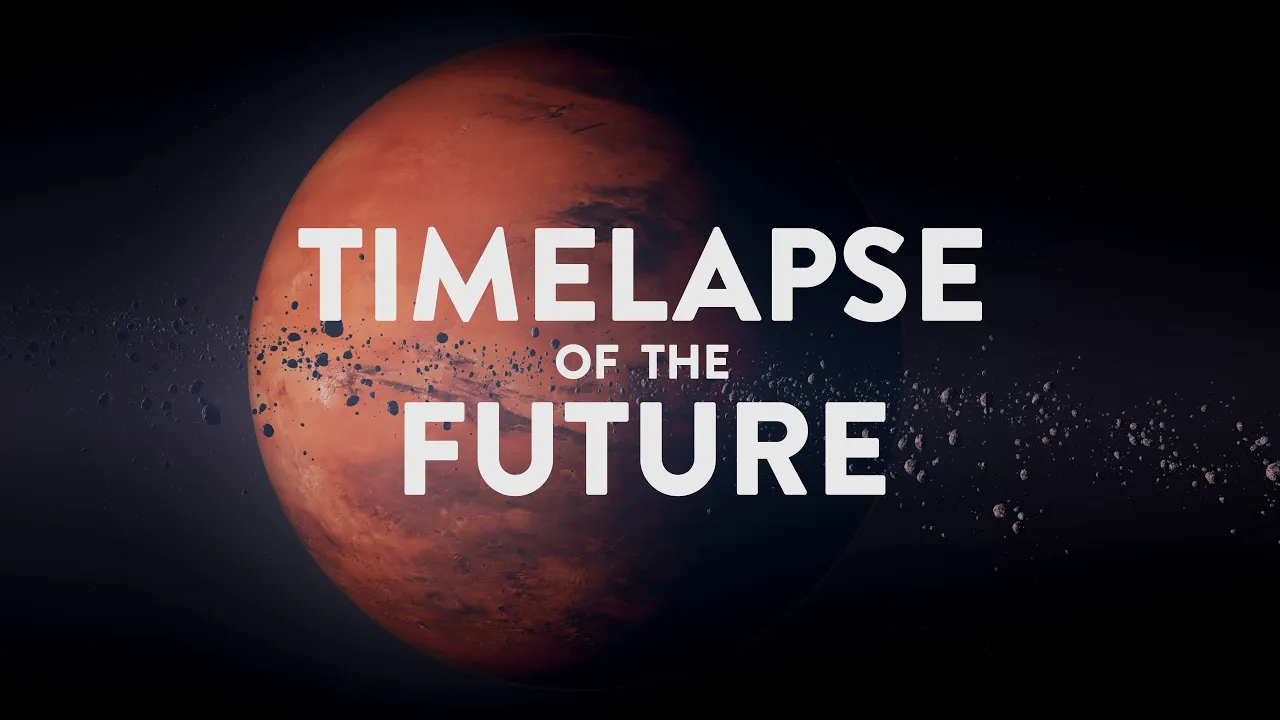
melodysheep
The universe will ultimately dissolve into a permanent, static state of maximum entropy once the final black holes evaporate, rendering time itself meaningless.
AI-assisted summary of TIMELAPSE OF THE FUTURE: A Journey to the End of Time (4K) — original source. Check the original for full context.
Source published:
Key ideas
- The timeline of the cosmos progresses exponentially into the deep future, demonstrating that starlight will cease permanently once stellar nurseries exhaust their hydrogen reserves and the final red dwarf stars expire. (2:57)
- The window of time during which life can exist represents a minuscule fraction—roughly 10⁻⁸⁴ percent—of the universe's total lifespan from the Big Bang to the evaporation of the final black hole. (12:06)
- Dark energy accounts for roughly 70 percent of cosmic energy density and does not dilute as space expands, driving an accelerating runaway expansion toward an icy, desolate finish. (20:00)
- Hawking radiation guarantees that even supermassive black holes will eventually evaporate and detonate, culminating in maximum entropy where time itself ceases to have physical meaning. (17:22)
Detailed notes
## Background Published on YouTube by melodysheep on March 20, 2019, "TIMELAPSE OF THE FUTURE: A Journey to the End of Time" takes viewers on an exponential voyage from 2019 trillions of years into the deep future. According to the video description, the project paints a portrait of cosmic evolution based on modern science, exploring the death of the Sun, the end of all stars, proton decay, exploding black holes, and the ultimate fate of the universe.
## TL;DR Accelerating exponentially through cosmic deep time, the narrative charts the irreversible physical progression of the universe across incomprehensible spans of time. It begins with planetary transformations and the vaporization of Earth as the Sun expands into a red giant, moving through the Degenerate Era where atomic matter decays and rogue stars collide. The journey enters the Black Hole Era, where colossal black hole mergers ring through spacetime before slowly evaporating through Hawking radiation under the relentless expansion of dark energy. Ultimately, the cosmos succumbs to heat death—a permanent, frozen state of maximum entropy where all macroscopic events cease and the passage of time becomes meaningless.
## Atmosphere & style The presentation evokes an overwhelming sense of melancholic awe and existential humility, framing the end of reality not with fiery chaos but with a slow, quiet descent into darkness. Choral scientific commentary from voices like Brian Cox, Janna Levin, and Stephen Hawking lends a poetic, philosophical weight to the cold equations of astrophysics. Watching the timeline unfold feels both mesmerizing and haunting, contrasting the fleeting, precious brilliance of life's brief window against trillions of years of silent, freezing void.
## Bulletin - [02:57](https://www.youtube.com/watch?v=uD4izuDMUQA&t=177s) The timeline of the cosmos progresses exponentially into the deep future, demonstrating that starlight will cease permanently once stellar nurseries exhaust their hydrogen reserves and the final red dwarf stars expire. - [12:06](https://www.youtube.com/watch?v=uD4izuDMUQA&t=726s) The window of time during which life can exist represents a minuscule fraction—roughly 10⁻⁸⁴ percent—of the universe's total lifespan from the Big Bang to the evaporation of the final black hole. - [20:00](https://www.youtube.com/watch?v=uD4izuDMUQA&t=1200s) Dark energy accounts for roughly 70 percent of cosmic energy density and does not dilute as space expands, driving an accelerating runaway expansion toward an icy, desolate finish. - [17:22](https://www.youtube.com/watch?v=uD4izuDMUQA&t=1042s) Hawking radiation guarantees that even supermassive black holes will eventually evaporate and detonate, culminating in maximum entropy where time itself ceases to have physical meaning.
## Key takeaways - [00:00](https://www.youtube.com/watch?v=uD4izuDMUQA&t=0s) Human civilization currently exists in a pivotal geological epoch as the Holocene gives way to the Anthropocene, where immediate human choices determine conditions for millennia ahead. - [00:00](https://www.youtube.com/watch?v=uD4izuDMUQA&t=0s) Geological and planetary processes ensure Earth remains dynamic and unstable, eventually erasing human monuments, shifting continents into supercontinents, and boiling away oceans as the Sun expands into a red giant. - [02:57](https://www.youtube.com/watch?v=uD4izuDMUQA&t=177s) Around five billion years in the future, the Sun will exhaust its core hydrogen, expand to engulf the inner planets, and shed its outer layers to leave behind a cooling white dwarf. - [02:57](https://www.youtube.com/watch?v=uD4izuDMUQA&t=177s) The Age of Starlight ends when star formation ceases and the longest-lived low-mass red dwarfs burn through their fuel, leaving the cosmos without natural stellar furnaces. - [04:29](https://www.youtube.com/watch?v=uD4izuDMUQA&t=269s) During the Degenerate Era, the universe becomes a graveyard of dead stellar remnants, with any surviving life forced to huddle around the dwindling residual heat of white dwarfs. - [07:05](https://www.youtube.com/watch?v=uD4izuDMUQA&t=425s) White dwarfs eventually cool over trillions of years into frozen, ultra-dense black dwarfs—objects that do not yet exist anywhere in the cosmos due to the universe's young age. - [07:05](https://www.youtube.com/watch?v=uD4izuDMUQA&t=425s) Surviving or synthetic civilizations in energy-starved epochs could potentially harvest the rotational energy of spinning black holes, operating at vastly slower metabolic rates. - [09:56](https://www.youtube.com/watch?v=uD4izuDMUQA&t=596s) Grand unified theories predict proton decay, which would dissolve all remaining atomic structures and black dwarfs into leptons and radiation, leaving no solid matter intact. - [12:06](https://www.youtube.com/watch?v=uD4izuDMUQA&t=726s) The Black Hole Era represents a vast phase where supermassive black holes are the primary macroscopic structures left, forming 'zombie galaxies' that merge over eons. - [14:38](https://www.youtube.com/watch?v=uD4izuDMUQA&t=878s) Colliding black holes distort space-time into intense gravitational waves, releasing violent acoustic vibrations that radiate outward across the cosmos. - [17:22](https://www.youtube.com/watch?v=uD4izuDMUQA&t=1042s) Through Hawking radiation, virtual particle pairs generated at event horizons cause black holes to slowly lose mass, accelerating into final violent detonations. - [20:00](https://www.youtube.com/watch?v=uD4izuDMUQA&t=1200s) Dark energy exerts a constant repulsive force in empty space, dictating an accelerating runaway expansion that separates matter beyond reach. - [23:12](https://www.youtube.com/watch?v=uD4izuDMUQA&t=1392s) Theoretical physics suggests advanced civilizations facing cosmic heat death might escape by concentrating immense energy to engineer gateways into new 'baby universes'. - [25:59](https://www.youtube.com/watch?v=uD4izuDMUQA&t=1559s) The cosmos ultimately reaches heat death (the Big Freeze), where maximum entropy is achieved, temperature becomes uniform, and the absence of physical change renders time meaningless.
## Detailed walkthrough ### [00:00](https://www.youtube.com/watch?v=uD4izuDMUQA&t=0s) The Anthropocene and the Shifting Earth
The voyage to the end of time begins with words from Helen Keller: “Everything has its wonders, even darkness and silence...” Modern science can now sketch how the cosmos will evolve and eventually die, though our understanding will inevitably shift as new evidence is uncovered. The journey departs from the present day, progressing exponentially into the future by doubling temporal speed every five seconds. For now, the universe is only in its infancy, but human civilization stands at a pivotal crossroads as the geological stability of the Holocene gives way to the Anthropocene. Reflecting on the profound ecological turning point facing our species, naturalist David Attenborough cautions: “What we do now, and in the next few years, will profoundly affect the next few thousand years.” The planetary conditions that have sustained human society are altering with unprecedented velocity.
As the timeline accelerates past our immediate era, the dynamic instability of planet Earth takes center stage. Author Craig Childs reflects on the relentless nature of geological time, observing: “The Earth is going into one of these jumps and you don't know what is going to be on the other side of those jumps.” He emphasizes that humanity must disabuse itself of any illusion of permanence: “Things move on this planet — things are not still!” Centuries and millennia flash by, marked by terrestrial transformations and celestial events:
- Earth’s magnetic field undergoes complete polarity reversals. - Comet Hale-Bopp makes its periodic returns to the inner Solar System. - Sea levels rise drastically, submerging coastal geography. - A 30-meter asteroid impacts Earth. - Massive red supergiants begin to detonate, starting with Antares going supernova. - Shifting orbital cycles turn the Sahara Desert into a lush, tropical landscape. - Constellations begin to distort and drift apart across the night sky. - The Voyager 1 probe sweeps past nearby stars on its interstellar trek. - The prevailing interglacial period concludes, followed by catastrophic supervolcano eruptions. - New volcanic island chains emerge, including a brand-new Hawaiian island. - The footprints left by Apollo astronauts on the lunar regolith slowly erode away. - Betelgeuse explodes in a brilliant supernova. - Ancient human stone monuments erode to dust. - A nearby gamma-ray burst blasts the Solar System. - Mars’s moon Phobos breaks apart under tidal forces, forming a planetary ring. - The iconic rings of Saturn disappear as their icy material drains into the planet. - The Antarctic ice sheets melt entirely, preceded and followed by major asteroid impacts. - Tectonic drift pushes the continents together into a new unified supercontinent.
[02:57](https://www.youtube.com/watch?v=uD4izuDMUQA&t=177s) The Death of the Sun and the End of Starlight
Roughly five billion years in the future, the Sun begins to exhaust the hydrogen fuel in its core, initiating an irreversible chain of planetary destruction. Rather than merely fading away, the Sun’s core collapses under gravity, driving internal temperatures up and forcing its outer envelope to swell dramatically outward. On Earth, scorching solar luminosity shuts down photosynthesis, destroying all plant life and triggering a total ecological collapse. The oceans boil away into space, extinguishing every remaining organism. The Sun expands into a luminous red giant, engulfing and vaporizing Mercury, Venus, and the scorched crust of Earth itself. Once its outer gaseous layers are cast off into interstellar space, only the exposed, ultra-dense core remains: a white dwarf, radiating faint residual heat into the freezing vacuum of space.
```mermaid flowchart TD accTitle: Solar Evolution to Black Dwarf accDescr: The lifecycle of the Sun progressing from hydrogen depletion through its red giant phase, white dwarf cooling, and ultimate black dwarf state.
subgraph StellarStages["Solar Lifespan"] A["Main Sequence Sun"] -->|"Depletes core hydrogen"| B["Red Giant Expansion"] B -->|"Core collapse & envelope ejection"| C["White Dwarf"] C -->|"Trillions of years cooling"| D["Black Dwarf"] end
subgraph PlanetaryImpact["Earth Consequences"] B -.->|"Luminosity surge"| E["Oceans Evaporate & Life Ends"] B -.->|"Engulfment"| F["Earth Vaporized"] end ```
The fate that claims the Sun awaits every star in the cosmos. Over incomprehensible spans of time, the interstellar gas reservoirs required for star formation deplete entirely, meaning no new stars will ever be born. Star by star, the celestial vault will extinguish until only the cold, low-mass red dwarfs remain to burn their fuel over trillions of years. When even the last red dwarf dies, the cosmos loses its last natural furnace. As physicist Brian Cox reflects: “With the death of the last sun, the age of starlight comes to an end.” The cosmos will meet its conclusion not in a violent conflagration, but in a gradual, freezing descent: not with a bang, but with a whimper; not in fire, but in ice.
[04:29](https://www.youtube.com/watch?v=uD4izuDMUQA&t=269s) The Degenerate Era and White Dwarf Refuges
With the extinction of stellar burning, the cosmos transitions into the Degenerate Era, transforming into an expansive boneyard littered with the detritus of dead stars and black holes. The white dwarf that was once our Sun shrinks to the volume of Earth while retaining the mass of a star, generating no new nuclear fusion. From the historical vantage point of Earth's orbit, its faint luminescence would match only the soft glow of a full moon on a cloudless night. Astrophysicist Michelle Thaller captures the eerie stillness of this new epoch, remarking: “In some ways it's kind of a ghost universe — it's the corpses, the zombie stars, that will take us into the future.”
Over time, gravitational interactions within dying galaxies disrupt orbital equilibria, ejecting countless stellar corpses and rogue planets into the intergalactic void. On rare occasions, cosmic accidents briefly illuminate the gloom: drifting brown dwarfs collide to reignite stellar fusion as accidental newborn stars, while colliding neutron stars trigger ultra-bright supernovae that tear through the dark. Any theoretical life forms persisting into this frozen era would cluster closely around the faint heat of aging white dwarfs, utilizing their dwindling thermal energy as a final refuge before those stars, too, cool to absolute zero.
[07:05](https://www.youtube.com/watch?v=uD4izuDMUQA&t=425s) Black Dwarfs and Civilizations around Spinning Black Holes
As white dwarfs spend trillions of years radiating their remaining energy, they eventually cool down to absolute background temperatures and freeze into black dwarfs. These hypothetical stellar remnants are composed of hyper-crushed degenerate matter, reaching densities roughly one million times greater than our present Sun, emitting virtually no light or warmth. Because the time required for a white dwarf to cool completely into a black dwarf exceeds the current age of the universe by orders of magnitude, not a single black dwarf exists anywhere in the cosmos today.
Meanwhile, any matter unable to escape the gravitational pull of its parent galaxy drifts inexorably inward, where dormant supermassive black holes ingest rogue stars in violent flares of radiation. In this epoch, the rotational energy of spinning black holes becomes the ultimate powerhouse for any surviving or synthetic civilizations. Cosmologist Sean Carroll reflects on how intelligent systems might adapt to this energy-starved era by operating at an entirely different metabolic rate: “You could have a living system where if, it had a thought every 10 trillion years, that would seem normal.” He further considers the long-term prospects for consciousness: “Even if our life dies out, one could imagine at some time arbitrarily far in the future, a fluctuation occurs which allows intelligent life to exist again, for a little while.” Intelligence could thus manifest as fleeting islands scattered across vast abysses of time.
[09:56](https://www.youtube.com/watch?v=uD4izuDMUQA&t=596s) Accelerated Expansion and Proton Decay
As dark energy accelerates the expansion of spacetime, matter is separated across cosmological event horizons faster than the speed of light. Distant galaxies and remnant star systems recede so rapidly that their light can never reach an observer, locking away the observational history and secrets of the cosmos forever. The universe enters a stage of extreme isolation where galaxies become solitary islands separated by boundless horizons of empty space.
```mermaid flowchart LR accTitle: Far-Future Matter Dissolution accDescr: The progression of cosmic decay from spacetime expansion to proton decay and black dwarf evaporation.
subgraph Dissolution["Decay of Matter"] direction TB G["Accelerating Expansion"] --> H["Galaxies Isolated"] H --> I["Proton Decay Begins"] I --> J["Black Dwarfs Evaporate"] J --> K["Pure Radiation & Black Holes"] end ```
Beyond physical dispersion, modern particle physics suggests an even more profound dismantling: proton decay. If current grand unified theories prove correct, protons—the fundamental subatomic anchors of all atomic matter—are inherently unstable. Michelle Thaller explains the stark reality of this process: “A proton, one of the fundamental building blocks of atomic matter, what makes us up, can just spontaneously fall apart.” Any stray matter that manages to avoid being swallowed by a black hole gradually dissolves as its constituent subatomic particles disintegrate into leptons and photons. Even the dense cores of black dwarfs eventually evaporate away into radiation, leaving behind zero atomic matter. Although proton decay remains experimentally unverified, its realization would completely eradicate physical structures, leaving only black holes and drifting photons.
[12:06](https://www.youtube.com/watch?v=uD4izuDMUQA&t=726s) The Black Hole Era and the Brief Flash of Life
With the final decay of black dwarfs and the disappearance of all atomic elements, the cosmos enters the Black Hole Era. Across this vast wilderness, there are no planets, no stars, and no solid surfaces of any kind. Yet, on the overall timeline of the cosmos, time itself has barely begun: compared to the ultimate duration of the universe, our contemporary era occupies only the briefest instant, comparable to the universe just emerging from the womb. Brian Cox contemplates the tragic rarity of our current habitable cosmos: “The arrow of time creates a bright window in the universe's adolescence during which life is possible. But it's a window that doesn't stay open for long.”
When measured against the entire lifespan of the universe—from the Big Bang to the evaporation of the final black hole—the interval during which life can exist represents only a fraction of a percent:
$$\frac{1}{1000} \text{ of a billion billion billion billion billion billion billion billion billionth of a percent } (10^{-84}\%)$$
During this era, black holes function as the fundamental building blocks of the universe. Astrobiologist and physicist Janna Levin explains the nature of these zombie galaxies: “A galaxy will basically be a supermassive black hole in the center, with smaller black holes orbiting it.” These black holes continue to orbit, collide, and merge with one another over trillions of years, growing progressively larger as black hole mergers become the primary physical events in a dark, dynamic cosmos.
[14:38](https://www.youtube.com/watch?v=uD4izuDMUQA&t=878s) The Songs of Colliding Black Holes
As the cosmos stretches into the deep future, black holes grow to staggering dimensions—some reaching trillions of times the mass of our sun. When these giants orbit and merge, they shake the very fabric of reality, launching powerful gravitational waves across the cosmos. Physicist Janna Levin describes how black holes behave like mallets banging on the drum of space-time, each event carrying a distinct acoustic signature. When two black holes that have spent eons together reach the end of their lives, they whip around one another, crossing thousands of kilometers in mere fractions of a second and leaving behind a dramatic ringing wave in their wake.
```mermaid flowchart TD accTitle: Black Hole Merger and Gravitational Wave Emission accDescr: Diagram illustrating two orbiting black holes generating gravitational waves until they coalesce into a single spinning black hole.
subgraph Orbiting["Inspiral Phase"] A["Two Co-orbiting Black Holes"] --> B["Crossing thousands of km in fractions of a second"] end
subgraph Ringing["Distortion of Space-Time"] B --> C["Space squeezes and stretches"] C --> D["Gravitational waves radiate at the speed of light"] end
subgraph Coalescence["Final State"] D --> E["Single, spinning, quiet black hole"] end ```
Space compresses and dilates as these titanic masses collide. Gravitational waves are literally the audible ring of space itself, racing outward at the speed of light until the system settles into a single, quiet, spinning black hole. Janna Levin notes the visceral reality of this phenomenon: “If you were standing near enough, your ear would resonate with the squeezing and stretching of space, you would literally hear the sound.” In the case of a lighter black hole spiraling into a supermassive companion, each close pass produces a sharp knock on space; as the smaller body plunges toward the horizon, the tempo quickens and the sound turns into a deafening crescendo.
[17:22](https://www.youtube.com/watch?v=uD4izuDMUQA&t=1042s) Hawking Radiation and the Death of Black Holes
For decades, black holes were presumed to be immortal sinks of matter and energy, but modern quantum theory reveals that they, too, are doomed to perish. On unimaginably vast timescales measured in quadrillions of years and beyond, black holes slowly evaporate. As Stephen Hawking explains, quantum mechanics dictates that empty space is not truly barren; it seethes with pairs of virtual particles and antiparticles continually popping into existence, separating, re-colliding, and annihilating each other.
```mermaid flowchart LR accTitle: Hawking Radiation Mechanism accDescr: Virtual particle pair created near an event horizon where one falls in and the other escapes as radiation.
A["Vacuum Fluctuations near Event Horizon"] --> B["Virtual Particle-Antiparticle Pair"] B --> C["One particle falls into the Black Hole"] B --> D["Forsaken partner escapes into space"] D --> E["Observed as Hawking Radiation"] C --> F["Black hole slowly loses mass"] ```
When this pair production takes place right at the event horizon, the dynamic changes fundamentally: one particle is pulled across the threshold into the abyss, leaving its partner stranded outside with nothing to annihilate against. As Hawking puts it: “The forsaken particle appears to be radiation emitted by the black hole.” Through this mechanism, quantum mechanics provides an escape hatch from what was once thought to be the ultimate prison. Black holes do not endure forever; their evaporation rate accelerates as their mass shrinks, culminating in a colossal final detonation. As each black hole dies, it briefly illuminates the dark, erasing the last macroscopic structures left in the cosmos.
[20:00](https://www.youtube.com/watch?v=uD4izuDMUQA&t=1200s) Dark Energy and the Runaway Universe
While black holes gradually dissolve, the universe itself expands at an ever-accelerating rate, propelled by dark energy. Cosmologists and astrophysicists including Michio Kaku, Sean Carroll, and Lawrence Krauss confront the ancient poetic dilemma of whether the world ends in fire or ice. The observational data is unambiguous: the universe's expansion is not braking, but speeding out of control, heading toward an icy, desolate finish trillions of years in the future.
Empty space possesses its own inherent baseline energy. In every cubic centimeter of the void—completely independent of whether matter or radiation is present—energy remains, exerting a repulsive push across space. Carroll and Krauss emphasize the mystery of this substance:
- Dark energy constitutes approximately 70% to three-quarters of the entire matter-energy budget of the universe. - Unlike matter or radiation, dark energy does not dilute as the volume of space expands; its density stays constant. - If dark energy remains dominant and repulsive, it produces an accelerating, runaway universe that grows progressively colder, darker, and more vacant. - As Lawrence Krauss explains: “70% of the energy of the universe resides in empty space and we don't understand why.” - Scientists emphasize that until the fundamental nature of dark energy is resolved, neither our ultimate cosmic future nor our true cosmic origins can be fully understood.
Depending on how dark energy behaves over deep time, differing fates are possible: - **Big Crunch**: If dark energy decays or reverses, gravitational attraction could eventually cause the universe to re-collapse. - **Big Rip**: If dark energy strengthens, it could tear apart galaxies, stars, planets, and finally atoms themselves. - **Eternal Freezing Expansion**: If it remains constant, space will expand infinitely into absolute cold and darkness.
[23:12](https://www.youtube.com/watch?v=uD4izuDMUQA&t=1392s) Multiverses, Baby Universes, and Cosmic Evolution
Faced with a cosmos destined for frozen emptiness, physicists look toward the multiverse and the possibility that an ending might spawn a fresh beginning. Theoretical physics increasingly considers whether our universe is merely one bubble among many, each governed by distinct physical constants—some suitable for biology, others doomed to rapid collapse or tearing.
```mermaid flowchart TD accTitle: Multiverse Evolution and Cosmic Lifeboats accDescr: Theoretical pathway for civilizations to escape a dying universe by creating baby universes.
A["Dying Parent Universe (Cooling & Expanding)"] --> B["Advanced Civilizations with High-Energy Physics"] B --> C["Constricting extreme energy at a single point"] C --> D["Gateway opens: 'Baby Universe' Lifeboat"] D --> E["Proliferation of Child Universes"] E --> F["Cosmic Natural Selection / Evolution"] ```
Advanced civilizations staring down total thermal extinction might find ways to survive beyond their home cosmos. Michio Kaku outlines the speculative physics of creating artificial refuges: “We've worked out the mathematics, the equations, they seem to say that if you have an atom smasher, that can constrict tremendous amounts of energy at a single point, you can perhaps open up a gateway—a 'baby universe'.” This scenario presents a cosmic analogue to Darwinian natural selection: - Sterile universes lacking intelligent life never engineer gateways, leaving no offspring. - Universes with temperate climates and long-lived stars produce technological civilizations that build "lifeboats," proliferating child universes throughout the wider multiverse.
[25:59](https://www.youtube.com/watch?v=uD4izuDMUQA&t=1559s) The Final Evaporation and Heat Death
If no escape is possible, entropy completes its work. Over unfathomable eons, even the largest supermassive black holes bleed away their mass through Hawking radiation. In their dying moments, these final black holes explode in flashes of energy, briefly lighting up the empty void one last time before extinguishing forever.
Following the evaporation of the last black hole, the universe is reduced to an ultra-dilute sea of photons and inert subatomic remnants. These particles slowly cool toward absolute zero as the relentless expansion of space stretches their wavelengths. Brian Cox explains the solemn finality of this ultimate state:
> “Once the very last remnants of the very last stars have finally decayed away to nothing, and everything reaches the same temperature, the story of the universe finally comes to an end.”
At this threshold, known as the heat death or Big Freeze, thermodynamic entropy achieves its theoretical maximum and ceases to increase, because no further disorder can be generated. The universe becomes completely static, permanent, and frozen: “Nothing happens, and it keeps not happening, forever.” With no change, no energy gradients, and no events left to mark its passage, time itself becomes meaningless.
[29:00](https://www.youtube.com/watch?v=uD4izuDMUQA&t=1740s) Closing Credits and Dedication
As the epic journey across cosmic deep time draws to a close, the film concludes with its rolling credits, acknowledging the scientific minds, writers, and narrators whose voices and insights shaped the narrative. The roster of featured thinkers spans across astrophysics, cosmology, natural history, and science communication, bringing together diverse perspectives on the universe's ultimate destiny.
The production acknowledges the support of Juan Benet and the community of Patreon patrons who helped make the project possible at patreon.com/melodysheep. Directed and created by melodysheep (John D. Boswell) with links to melodysheep.com and @musicalscience, the presentation ends on a quiet, personal note with a simple final tribute: "For Ash."
- **Featured Voices:** David Attenborough, Craig Childs, Brian Cox, Neil deGrasse Tyson, Michelle Thaller, Lawrence Krauss, Michio Kaku, Mike Rowe, Phil Plait, Janna Levin, Stephen Hawking, Sean Carroll, Alex Filippenko, and Martin Rees - **Special Thanks:** Juan Benet and Patreon supporters - **Dedication:** "For Ash"
## Notable quotes > [12:06](https://www.youtube.com/watch?v=uD4izuDMUQA&t=726s) The arrow of time creates a bright window in the universe's adolescence during which life is possible. But it's a window that doesn't stay open for long. — Brian Cox
> [00:00](https://www.youtube.com/watch?v=uD4izuDMUQA&t=0s) What we do now, and in the next few years, will profoundly affect the next few thousand years. — David Attenborough
> [25:59](https://www.youtube.com/watch?v=uD4izuDMUQA&t=1559s) Once the very last remnants of the very last stars have finally decayed away to nothing, and everything reaches the same temperature, the story of the universe finally comes to an end. — Brian Cox
> [04:29](https://www.youtube.com/watch?v=uD4izuDMUQA&t=269s) In some ways it's kind of a ghost universe — it's the corpses, the zombie stars, that will take us into the future. — Michelle Thaller
> [02:57](https://www.youtube.com/watch?v=uD4izuDMUQA&t=177s) With the death of the last sun, the age of starlight comes to an end. — Brian Cox
## Mentioned David Attenborough, Craig Childs, Brian Cox, Michelle Thaller, Sean Carroll, Janna Levin, Stephen Hawking, Michio Kaku, Lawrence Krauss, Neil deGrasse Tyson, Mike Rowe, Phil Plait, Alex Filippenko, Martin Rees, Helen Keller, melodysheep, Juan Benet, Protocol Labs, NASA Goddard, SpaceX, Voyager 1
## Video description Support my work on Patreon: https://www.patreon.com/melodysheep | Get the soundtrack: https://bit.ly/2HKl9fi | How's it all gonna end? This experience takes us on a journey to the end of time, trillions of years into the future, to discover what the fate of our planet and our universe may ultimately be.
We start in 2019 and travel exponentially through time, witnessing the future of Earth, the death of the sun, the end of all stars, proton decay, zombie galaxies, possible future civilizations, exploding black holes, the effects of dark energy, alternate universes, the final fate of the cosmos - to name a few.
This is a picture of the future as painted by modern science - a picture that will surely evolve over time as we dig for more clues to how our story will unfold. Much of the science is very recent - and new puzzle pieces are still waiting to be found.
To me, this overhead view of time gives a profound perspective - that we are living inside the hot flash of the Big Bang, the perfect moment to soak in the sights and sounds of a universe in its glory days, before it all fades away. Although the end will eventually come, we have a practical infinity of time to play with if we play our cards right. The future may look bleak, but we have enormous potential as a species.
Featuring the voices of David Attenborough, Craig Childs, Brian Cox, Neil deGrasse Tyson, Michelle Thaller, Lawrence Krauss, Michio Kaku, Mike Rowe, Phil Plait, Janna Levin, Stephen Hawking, Sean Carroll, Alex Filippenko, and Martin Rees.
Big thanks to Protocol Labs for their support of this creation: https://protocol.ai/
And to my Patreon supporters: Juan Benet, Kalexan, Laine Boswell, Holly, Dave & Debbie Boswell, Abraxas, Alina Sigaeva, Aksel Tjønn, Daniel Saltzman, Crystal, Eico Neumann, geekiskhan, Giulia Carrozzino, Hannah Murphy, Jeremy Kerwin, JousterL, Lars Støttrup Nielsen, Leonard van Vliet, Mitchel Mattera, Nathan Paskett, Patrick Cullen, Randall Bollig, Roman Shishkin, Silas Rech, Stefan Stettner, The Cleaner, Timothy E Plum, Virtual_271, Westin Johnson, Yannic, and Anna & Tyson.
Soundtrack now available: https://bit.ly/2HKl9fi and coming soon to iTunes/Spotify/Etc
Peace and love,
melodysheep @musicalscience melodysheep.com
Concept, music, writing, edit, and visual effects by melodysheep, with additional visual material sourced from:
NASA Goddard Google SpaceX 2012 Geostorm Into the Universe with Stephen Hawking BMW X1 Journey to the Edge of the Universe Noah How the Universe Works Deep Impact Wonders of the Universe Moon raker vfx reel Voyage of Time
if you found the text hard to read, check out the large text version: https://www.youtube.com/watch?v=iQpfueZkJ-4
Voice sample sources:
Attenborough Davos Speech https://www.youtube.com/watch?v=xuudPum21nE Craig Childs - Long Now Talk http://longnow.org/seminars/02013/jul/29/apocalyptic-planet-field-guide-everending-earth/ Brian Cox - Wonders of the Universe Episode 1 Neil deGrasse Tyson interview with Bill Moyers https://vimeo.com/84075447 How the Universe Works - Season 3 Episode 2 Will The Universe Ever End with Lawrence Krauss https://www.closertotruth.com/series/will-the-universe-ever-end#video-2549 Janna Levin TED Talk https://www.youtube.com/watch?v=eLz9TvxGoKs A Brief History of Time (1991) https://www.youtube.com/watch?v=UAfxKExKjVQ What Happens in the Far Far Future https://www.closertotruth.com/series/what-happens-the-far-far-future Sean Carroll TEDxCaltech https://www.youtube.com/watch?v=WMaTyg8wR4Y Alex Filippenko - TEDxSF https://www.youtube.com/watch?v=-gAtPyEu0G4 To Infinity and Beyond: The Accelerating Universe https://www.youtube.com/watch?v=pcKdA2-W0X0 Martin Rees interview http://www.closertotruth.com/series/what-happens-the-far-far-future#video-3625
Help us caption & translate this video!
https://amara.org/v/oIuX/
[Source](https://www.youtube.com/watch?v=uD4izuDMUQA)