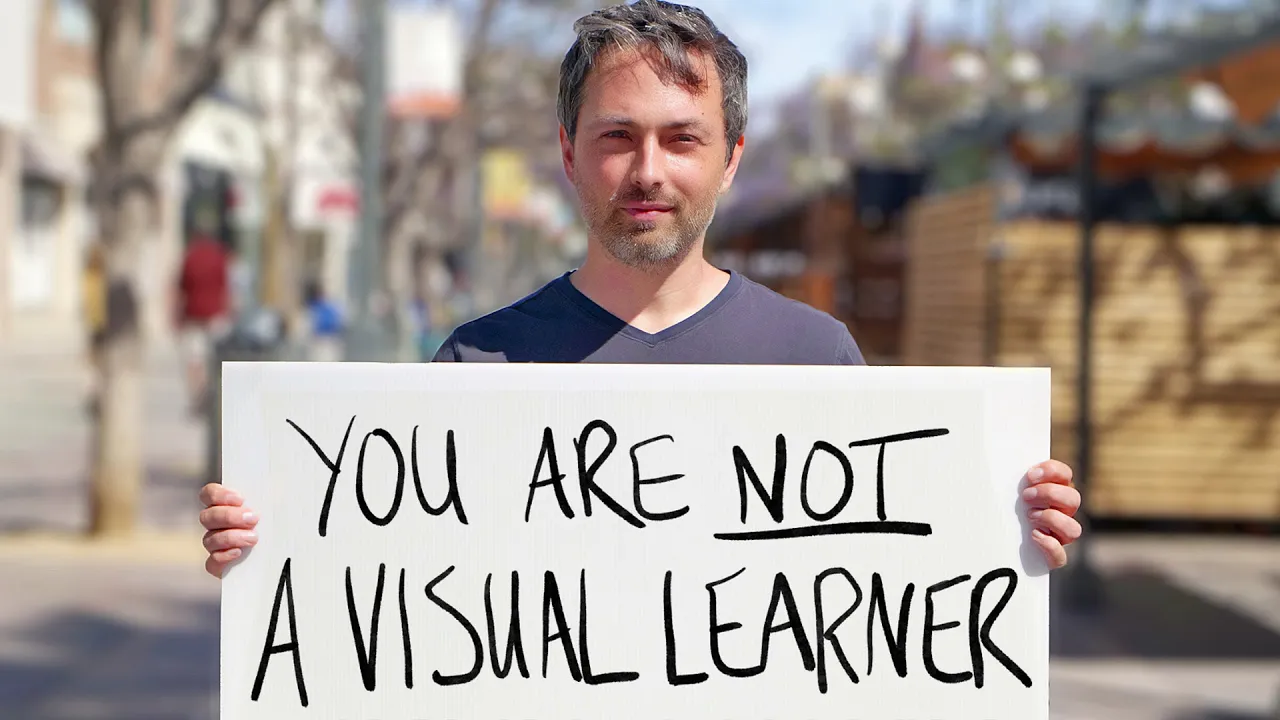
Learning Styles Fail to Improve Student Grades in Controlled Trials
Veritasium
While tailoring lessons to individual visual or auditory preferences fails to improve academic performance, combining words with visuals enhances comprehension for all students.
Over 90% of surveyed teachers in the UK and Netherlands believe students learn better when taught according to their preferred learning style, despite decades of empirical research failing to find support for the concept. (0:00)
Rigorous randomized controlled trials demonstrate that matching instructional delivery to self-reported learning styles (visual vs. auditory) produces no measurable improvement in comprehension or memory retention. (3:35)
A landmark 2008 review led by Harold Pashler concluded that the stark contrast between the enormous educational popularity of learning styles and the lack of credible evidence for their utility is both striking and disturbing. (9:20)
Instead of isolated sensory matching, research consistently supports the multimedia effect: pairing complementary verbal explanations with visual representations boosts recall by roughly 50% across all learners. (10:57)
Detailed notes
## Background
Published by Derek Muller on the YouTube channel Veritasium on July 9, 2021, this video tackles the widespread belief in learning styles. The video's description asserts that "you are not a visual learner" and frames learning styles as a stubborn educational myth, supported by interviews with cognitive psychologist Prof. Daniel Willingham and scientific literature reviews.
## TL;DR
Despite the ubiquitous belief in models like VARK—which categorize individuals as visual, auditory, reading/writing, or kinesthetic learners—empirical research consistently shows that tailoring instruction to an individual's self-reported style yields no measurable learning advantage. Instead, human memory primarily extracts conceptual meaning rather than sensory surface features, meaning domain-appropriate presentation and the "multimedia effect" (pairing words with visuals) benefit all learners equally. The video explains that confirmation bias and the intuitive appeal of human uniqueness keep the myth alive, ultimately arguing that effective learning relies on active mental processing rather than sensory categorization.
## Atmosphere & style
The video carries an inquisitive, engaging, and briskly paced journalistic energy, blending informal street experiments with serious cognitive psychology. Derek Muller's conversational, approachable hosting makes complex experimental methodologies accessible, while insightful commentary from Prof. Daniel Willingham grounds the debunking in scientific authority. Watching the piece feels like an eye-opening intellectual reality check, moving from relatable personal assumptions to satisfying, evidence-driven clarity.
## Bulletin
- [00:00](https://www.youtube.com/watch?v=rhgwIhB58PA&t=0s) Over 90% of surveyed teachers in the UK and Netherlands believe students learn better when taught according to their preferred learning style, despite decades of empirical research failing to find support for the concept.
- [03:35](https://www.youtube.com/watch?v=rhgwIhB58PA&t=215s) Rigorous randomized controlled trials demonstrate that matching instructional delivery to self-reported learning styles (visual vs. auditory) produces no measurable improvement in comprehension or memory retention.
- [09:20](https://www.youtube.com/watch?v=rhgwIhB58PA&t=560s) A landmark 2008 review led by Harold Pashler concluded that the stark contrast between the enormous educational popularity of learning styles and the lack of credible evidence for their utility is both striking and disturbing.
- [10:57](https://www.youtube.com/watch?v=rhgwIhB58PA&t=657s) Instead of isolated sensory matching, research consistently supports the multimedia effect: pairing complementary verbal explanations with visual representations boosts recall by roughly 50% across all learners.
## Key takeaways
- [00:00](https://www.youtube.com/watch?v=rhgwIhB58PA&t=0s) The VARK model categorizes learners into visual, auditory, reading/writing, and kinesthetic types, creating the widespread belief that instruction should be tailored to each student's sensory preference.
- [00:00](https://www.youtube.com/watch?v=rhgwIhB58PA&t=0s) Belief in learning styles aligns strongly with Western individualistic values celebrating human uniqueness, causing widespread pedagogical adoption despite a lack of empirical validation.
- [03:35](https://www.youtube.com/watch?v=rhgwIhB58PA&t=215s) In memory tests, high performance is driven by cognitive strategies like narrative linking and serial rehearsal, not by matching presentation format to a self-diagnosed learning style.
- [03:35](https://www.youtube.com/watch?v=rhgwIhB58PA&t=215s) Controlled lab trials by Massa and Mayer revealed that visualizers and verbalizers given matched multimedia lessons performed no better than those placed in mismatched conditions.
- [03:35](https://www.youtube.com/watch?v=rhgwIhB58PA&t=215s) Undergraduate research by Husmann and O'Loughlin revealed that most students do not align their study habits with their reported VARK profile, and those who do fail to achieve higher course grades.
- [07:48](https://www.youtube.com/watch?v=rhgwIhB58PA&t=468s) The VARK framework originated from intuitive observations by school inspector Neil Fleming rather than rigorous cognitive neuroscience or factor-analytic clustering.
- [07:48](https://www.youtube.com/watch?v=rhgwIhB58PA&t=468s) Learning conceptual material targets the underlying meaning of information rather than superficial sensory attributes like visual hues or acoustic pitch.
- [09:20](https://www.youtube.com/watch?v=rhgwIhB58PA&t=560s) Sensory presentation must be dictated by domain content rather than learner preference; for example, geography naturally requires visual maps and music requires auditory processing.
- [09:20](https://www.youtube.com/watch?v=rhgwIhB58PA&t=560s) Confirmation bias perpetuates the learning style myth: individuals credit their supposed visual style when a well-designed graphic helps them, overlooking that clear diagrams benefit everyone.
- [10:57](https://www.youtube.com/watch?v=rhgwIhB58PA&t=657s) The multimedia effect demonstrates that presenting complementary words and visuals simultaneously significantly improves retention for all learners compared to single-medium delivery.
- [10:57](https://www.youtube.com/watch?v=rhgwIhB58PA&t=657s) Effective learning depends fundamentally on internal cognitive processing—active problem-solving, testing hypotheses, and challenging misconceptions—rather than sensory presentation mode.
- [10:57](https://www.youtube.com/watch?v=rhgwIhB58PA&t=657s) Propagating learning style myths harms education by imposing needless burdens on teachers, wasting resources, and creating self-limiting beliefs among students.
- [13:07](https://www.youtube.com/watch?v=rhgwIhB58PA&t=787s) Online query bias reinforces popular misconceptions when searchers only look for confirming phrases instead of comparative terms like 'debunked' or 'criticism'.
## Detailed walkthrough
### [00:00](https://www.youtube.com/watch?v=rhgwIhB58PA&t=0s) The Intuitive Appeal of Learning Styles
When pedestrians on the street are asked what kind of learners they are, almost everyone immediately self-identifies with a specific label: some claim they are visual learners who have to see things or look at models, others say they remember formulas auditorily, and several describe themselves as "hands-on" kinesthetic learners who need to touch materials and do things themselves. This matches a deeply entrenched idea in education: each student possesses a preferred learning style, and if instructional material is tailored to that style, they will learn significantly better.
```mermaid
flowchart TD
accTitle: The VARK Learning Styles Taxonomy
accDescr: Diagram showing the four primary learning modalities of the VARK model and their respective preferred presentation methods.
subgraph VARK["VARK Model Modalities"]
V["Visual (V)<br/>Images, diagrams, demonstrations"]
A["Auditory (A)<br/>Spoken lectures, listening to explanations"]
R["Reading/Writing (R)<br/>Textbooks, written notes, essays"]
K["Kinesthetic (K)<br/>Physical interaction, hands-on tasks"]
end
```
The most ubiquitous of these frameworks is the VARK model, which divides learners into four core modalities:
- **Visual (V):** Individuals who believe they learn best through images, pictures, demonstrations, or seeing concepts acted out and drawn.
- **Auditory (A):** Individuals who report retaining information primarily by listening to explanations and lectures.
- **Reading/Writing (R):** Individuals who excel by reading textbooks and processing written words.
- **Kinesthetic (K):** Individuals who treat learning as a physical "contact sport," requiring hands-on interaction and direct manipulation.
The framework feels intuitively right because human differences are real and undeniable. People naturally vary in spatial reasoning, listening comprehension, reading fluency, and manual dexterity. As cognitive psychologist Daniel Willingham points out, this aligns cleanly with individualistic Western ideals: “It's sort of very much fits with a broad strain of thought in the recent Western tradition is, we're all unique, we're all different. And so you don't want to say, like, everybody learns the same way. That sort of conflicts with our feelings about what it means to be human.” Consequently, educators have widely embraced the concept. A survey of nearly 400 teachers across the United Kingdom and the Netherlands revealed that over 90% believed students learn better when taught in their preferred learning style. Under this doctrine, a teacher's job is twofold: first diagnose each student's profile, and then tailor instruction to match it.
---
[03:35](https://www.youtube.com/watch?v=rhgwIhB58PA&t=215s) Testing the Hypothesis: Street Trials and Lab Experiments
To determine whether learning styles actually exist and improve retention, researchers rely on randomized controlled trials. In an ideal setup, learners of differing self-reported styles (such as visual versus auditory) are randomly assigned to either matched or mismatched educational formats, followed by an identical assessment. If the learning style hypothesis holds, matched students should significantly outperform mismatched students.
```mermaid
flowchart LR
accTitle: Randomized Controlled Trial of Learning Styles
accDescr: Flowchart showing the experimental design used to test the learning styles matching hypothesis.
subgraph Identification["1. Assess Style"]
L["Learner Pool"] --> V_Learners["Visual Learners"]
L --> A_Learners["Auditory Learners"]
end
subgraph Assessment["3. Evaluation"]
Pres_V1 --> Test["Identical Comprehension Test"]
Pres_A1 --> Test
Pres_V2 --> Test
Pres_A2 --> Test
end
```
Derek Muller conducted an informal version of this experiment on the street by giving visual learners a memory test of 10 items (such as a bell, penguin, sun, candle, knife, duck, heart, apple, bike, guitar, and spoon). Some participants were shown pictures (matched condition), while others were read the list aloud (mismatched condition). Most participants recalled roughly five or six items regardless of presentation format. While a few remembered eight or nine items, the advantage was not due to modality matching; instead, high performers actively applied deliberate memory strategies:
- **Subvocal serial rehearsal:** Repeating an ordered mental list continuously as new items appeared.
- **Narrative linking:** Weaving the disparate objects together into a single coherent story, taking advantage of the brain's natural ability to recall narratives better than isolated items.
Controlled laboratory studies confirm this pattern on a larger scale:
- **Visualizers vs. Verbalizers (Massa & Mayer, 2006):** College students were categorized as visualizers or verbalizers using questionnaires (such as asking if they prefer reading text or viewing a diagram of an atom) and behavioral choices during difficult tasks (choosing between a short animation or written text for help). They were then randomly assigned to a computer-based lesson on electronics where clicking key terms provided either text definitions or annotated diagrams. Those whose instructional format matched their cognitive style performed no better on subsequent tests than those in mismatched conditions. A replication with 61 non-college-educated adults produced the exact same null result.
- **Behavioral Disconnect in Study Habits (Husmann & O'Loughlin, 2019):** At an Indiana university, over 400 students took the VARK assessment at the start of the semester. At term's end, a survey of their actual study habits revealed that an overwhelming majority did not even use study strategies aligned with their reported VARK profile. Furthermore, the minority who did stick to their style earned no higher marks in the course than their peers.
---
[07:48](https://www.youtube.com/watch?v=rhgwIhB58PA&t=468s) The Origins of VARK and the Meaning of Modality
The widely cited VARK taxonomy did not originate from rigorous cognitive science or factor-analytic clustering studies showing that humans naturally divide into distinct categories. It was devised by Neil Fleming, a school inspector in New Zealand trying to understand why some teachers succeeded or failed with specific students. Fleming explained his thinking: “I was puzzled when I observed excellent teachers who did not reach some learners and poor teachers who did. I decided to try to solve this puzzle. There are, of course, many reasons for what I observed. But one topic that seemed to hold some magic, some explanatory power, was preferred modes of learning, modal preferences. And thus, VARK was born.”
This raises a fundamental question: if humans clearly vary in visual, auditory, and kinesthetic aptitudes, why does matching modality fail to produce measurable learning benefits? The explanation lies in what human learning actually targets:
- **Information vs. Meaning:** When learning academic or conceptual material, the goal is not to memorize sensory surface features—such as the exact hue or shape of an image, or the acoustic pitch and cadence of a voice. The goal is to extract and store the underlying **meaning** of the information.
- **Task-Dependent Modality:** Certain subjects intrinsically require specific sensory modalities. Music inevitably requires auditory input; geography requires visual inspection of maps.
- **Aptitude vs. Learning Style:** Specific aptitudes help with specific domains (for instance, someone with absolute pitch will parse musical notes faster, and someone with strong visual-spatial skills will learn map locations more readily). However, this task-dependent aptitude does not mean these individuals process general conceptual information better when filtered through their preferred sensory channel.
[09:20](https://www.youtube.com/watch?v=rhgwIhB58PA&t=560s) The Absence of Evidence and the Power of Confirmation Bias
A core assumption of learning style theories is that an individual's sensory preferences remain consistent across completely different domains of knowledge. As Derek Muller points out, even someone gifted with absolute pitch will not learn every subject better through sound; when studying geography, nearly everyone benefits far more from examining a visual map than listening to spoken descriptions. Academic reviews examining the literature have repeatedly arrived at the same conclusion: there is no credible scientific evidence supporting the existence or practical value of learning styles. Derek quotes the stark assessment of a landmark 2008/2009 comprehensive review: “The contrast between the enormous popularity of the learning styles approach within education and the lack of credible evidence for its utility is, in our opinion, striking and disturbing.” The researchers concluded that “if classification of students' learning styles has practical utility, it remains to be demonstrated.”
Interviewee Professor Daniel Willingham explains why the experimental evidence fails to validate the hypothesis. For the theory to hold water, matching instruction to a student's designated modality should yield measurably higher achievement than delivering mismatched instruction. As Willingham puts it: “What we're expecting is, if your style was honored you're going to perform better than if you had some experience that conflicted with your style. And this is where we don't see any support for the learning styles theory.”
Despite this lack of empirical support, belief in learning styles remains overwhelmingly popular because of confirmation bias. When people identify as visual learners and subsequently experience a breakthrough while looking at a clear diagram—such as a schematic of a bicycle pump—they credit their supposed learning style rather than recognizing that the graphic was simply a well-designed explanation that would help anyone. Willingham describes this psychological trap: “You already believe that learning styles is right. When you have an experience the first thing you think is, is that in some way consistent with learning styles? And if it is, you don't think further.” When minds are already made up, incoming experiences are selectively interpreted to fit preexisting beliefs, regardless of reality.
- The 2008/2009 review led by Harold Pashler found no evidence justifying the widespread categorizing of learners in pedagogical practice.
- Domain-specific presentation matters far more than learner style: geographical information inherently demands spatial maps rather than auditory descriptions.
- Confirmation bias leads learners to attribute general clarity in diagrams or demonstrations to personal sensory traits rather than instructional quality.
```mermaid
flowchart TD
accTitle: Learning Styles Hypothesis vs. Reality
accDescr: Diagram illustrating the failure of the learning styles meshing hypothesis compared to the evidence-based reality of universal multimodal learning.
subgraph Hypothesis["Flawed Meshing Hypothesis"]
direction TB
H1["Classify Student (Visual vs. Auditory)"] --> H2["Tailor Single Modality Instruction"]
H2 --> H3["Expected: Higher Performance (Unsupported)"]
end
subgraph Reality["Evidence-Based Reality"]
direction TB
R1["Domain & Content Requirements"] --> R2["Multimodal Instruction (Words + Visuals)"]
R2 --> R3["Result: Deeper Processing for All Learners"]
end
```
[10:57](https://www.youtube.com/watch?v=rhgwIhB58PA&t=657s) The Multimedia Effect and Active Mental Processing
If tailoring instruction to individual sensory types does not improve educational outcomes, research indicates clearly what does: multimodal instruction. A large body of empirical literature demonstrates that nearly all learners comprehend and retain information better when verbal and visual representations are combined, rather than presented in isolation. Known in cognitive psychology as the multimedia effect, this phenomenon explains why educational videos can be remarkably effective whenever narration and complementary visuals reinforce one another. Demonstrating this directly on the street, Derek tests subjects with paired words and pictures (such as “duck” and “heart”), yielding an immediate 50% jump in recall over single-modality trials, with participants agreeing that having both words and pictures made the task vastly easier.
Derek connects this to his own doctoral research, which revealed that explicitly addressing student misconceptions within multimedia presentations was vital for teaching introductory physics. Presentation format alone, however, is not the magic bullet. What truly determines success is cognitive effort. As Derek observes: “Ultimately, the most important thing for learning is not the way the information is presented but what is happening inside the learner's head.” Deeper learning occurs when students actively solve problems, evaluate how systems respond to changing variables, and critically process ideas.
Continuing to propagate learning style myths is actively harmful. It burdens educators with unnecessary instructional hurdles, discourages students from engaging with subjects outside their self-diagnosed comfort zones, and diverts substantial public funding and professional development away from proven pedagogical methods. Derek summarizes the reality directly: “You are not a visual learner nor an auditory learner nor a kinesthetic learner, or more accurately, you are all these kinds of learner in one.”
- **The Multimedia Effect**: Combining spoken words and corresponding visual depictions consistently outperforms single-medium delivery.
- **Cognitive Engagement**: True retention depends on active mental manipulation—problem-solving, testing hypotheses, and wrestling with misconceptions—as detailed in Derek's earlier video, *The Science of Thinking*.
- **The Costs of the Myth**: Sinks teacher time, wastes educational budgets, and creates self-limiting beliefs among students who feel ill-equipped for specific instructional modes.
[13:07](https://www.youtube.com/watch?v=rhgwIhB58PA&t=787s) Searching for Truth and Breaking Confirmation Bias
Addressing the broader issue of how misconceptions survive in the modern information ecosystem, Derek transitions into a segment sponsored by Google Search to discuss critical thinking and search literacy. The learning styles debate highlights a classic divide: while the general public widely accepts learning styles as proven fact, the educational research community finds no credible evidence for them. If a user queries the phrase "learning styles," search algorithms inevitably return hundreds of quizzes, commercial assessment tools, and practical resources that take the concept for granted. Conversely, querying "learning styles debunked" yields scientific literature dismantling the hypothesis.
The fundamental trap in online research is query bias—searching exclusively for content that validates preexisting assumptions. As Derek explains: “A common mistake is putting the answer you're looking for right in the search query.” To counter this, deliberate searchers should run comparative queries, appending terms like "debunked," "criticism," or "false" to uncover dissenting evidence and counterarguments. Furthermore, search tools provide quick ways to inspect a source's credibility before clicking, such as tapping the three dots menu next to a Google result to evaluate the publishing organization and determine whether the source is trustworthy. Formulating queries thoughtfully and cross-examining results allows learners to bypass their own biases and pursue genuine truth.
- Searching solely for confirming terms reinforces confirmation bias by surfacing echo chambers and commercial resources.
- Adding skepticism-oriented terms (e.g., "debunked", "false") helps surface empirical critiques and peer-reviewed consensus.
- Evaluating publisher metadata and source context via search result inspection tools is a necessary step before accepting claims as factual.
## Notable quotes
> [10:57](https://www.youtube.com/watch?v=rhgwIhB58PA&t=657s) You are not a visual learner nor an auditory learner nor a kinesthetic learner, or more accurately, you are all these kinds of learner in one. — Derek Muller
> [10:57](https://www.youtube.com/watch?v=rhgwIhB58PA&t=657s) Ultimately, the most important thing for learning is not the way the information is presented but what is happening inside the learner's head. — Derek Muller
> [09:20](https://www.youtube.com/watch?v=rhgwIhB58PA&t=560s) The contrast between the enormous popularity of the learning styles approach within education and the lack of credible evidence for its utility is, in our opinion, striking and disturbing. — Harold Pashler et al.
> [09:20](https://www.youtube.com/watch?v=rhgwIhB58PA&t=560s) You already believe that learning styles is right. When you have an experience the first thing you think is, is that in some way consistent with learning styles? And if it is, you don't think further. — Daniel Willingham
> [13:07](https://www.youtube.com/watch?v=rhgwIhB58PA&t=787s) A common mistake is putting the answer you're looking for right in the search query. — Derek Muller
## Mentioned
Derek Muller, Daniel Willingham, Neil Fleming, Harold Pashler, Helen Georigou, Jennifer Borgioli Binis, VARK model, Google Search, MinutePhysics, The Science of Thinking, Massa & Mayer (2006), Husmann & O'Loughlin (2019)
## Video description
You are not a visual learner — learning styles are a stubborn myth. Part of this video is sponsored by Google Search.
Special thanks to Prof. Daniel Willingham for the interview and being part of this video.
Special thanks to Dr Helen Georigou for reviewing the script and helping with the scientific literature.
Special thanks to Jennifer Borgioli Binis for consulting on the script.
MinutePhysics video on a better way to picture atoms -- https://ve42.co/Atom
▀▀▀▀▀▀▀▀▀▀▀▀▀▀▀▀▀▀▀▀▀▀▀▀▀▀
References:
Pashler, H., McDaniel, M., Rohrer, D., & Bjork, R. (2008). Learning styles: Concepts and evidence. Psychological science in the public interest, 9(3), 105-119. — https://ve42.co/Pashler2008
Willingham, D. T., Hughes, E. M., & Dobolyi, D. G. (2015). The scientific status of learning styles theories. Teaching of Psychology, 42(3), 266-271. — https://ve42.co/Willingham
Massa, L. J., & Mayer, R. E. (2006). Testing the ATI hypothesis: Should multimedia instruction accommodate verbalizer-visualizer cognitive style?. Learning and Individual Differences, 16(4), 321-335. — https://ve42.co/Massa2006
Riener, C., & Willingham, D. (2010). The myth of learning styles. Change: The magazine of higher learning, 42(5), 32-35.— https://ve42.co/Riener2010
Husmann, P. R., & O'Loughlin, V. D. (2019). Another nail in the coffin for learning styles? Disparities among undergraduate anatomy students’ study strategies, class performance, and reported VARK learning styles. Anatomical sciences education, 12(1), 6-19. — https://ve42.co/Husmann2019
Snider, V. E., & Roehl, R. (2007). Teachers’ beliefs about pedagogy and related issues. Psychology in the Schools, 44, 873–886. doi:10.1002/pits.20272 — https://ve42.co/Snider2007
Fleming, N., & Baume, D. (2006). Learning Styles Again: VARKing up the right tree!. Educational developments, 7(4), 4. — https://ve42.co/Fleming2006
Rogowsky, B. A., Calhoun, B. M., & Tallal, P. (2015). Matching learning style to instructional method: Effects on comprehension. Journal of educational psychology, 107(1), 64. — https://ve42.co/Rogowskyetal
Furey, W. (2020). THE STUBBORN MYTH OF LEARNING STYLES. Education Next, 20(3), 8-13. — https://ve42.co/Furey2020
Dunn, R., Beaudry, J. S., & Klavas, A. (2002). Survey of research on learning styles. California Journal of Science Education II (2). — https://ve42.co/Dunn2002
▀▀▀▀▀▀▀▀▀▀▀▀▀▀▀▀▀▀▀▀▀▀▀▀▀▀
Special thanks to Patreon supporters: Mike Tung, Evgeny Skvortsov, Meekay, Ismail Öncü Usta, Paul Peijzel, Crated Comments, Anna, Mac Malkawi, Michael Schneider, Oleksii Leonov, Jim Osmun, Tyson McDowell, Ludovic Robillard, Jim buckmaster, fanime96, Juan Benet, Ruslan Khroma, Robert Blum, Richard Sundvall, Lee Redden, Vincent, Marinus Kuivenhoven, Alfred Wallace, Arjun Chakroborty, Joar Wandborg, Clayton Greenwell, Pindex, Michael Krugman, Cy 'kkm' K'Nelson, Sam Lutfi, Ron Neal
▀▀▀▀▀▀▀▀▀▀▀▀▀▀▀▀▀▀▀▀▀▀▀▀▀▀
Research and Writing by Derek Muller and Petr Lebedev
Animation by Ivy Tello
Filmed by Emily Zhang and Trenton Oliver
Edited by Trenton Oliver
Music by Epidemic Sound https://epidemicsound.com
Additional video supplied by Getty Images
▀▀▀▀▀▀▀▀▀▀▀▀▀▀▀▀▀▀▀▀▀▀▀▀▀▀
Despite widespread belief among students and educators that tailoring instruction to individual sensory modalities like visual, auditory, or kinesthetic improves outcomes, extensive cognitive research shows this hypothesis lacks empirical support. As Veritasium highlights, meaningful learning depends instead on task requirements, active mental processing, and universal multimodal instruction.
The Pervasive Intuition of Learning Styles (0:00)
The concept of learning styles—most notably Neil Fleming's VARK framework dividing learners into visual, auditory, reading/writing, and kinesthetic profiles—is deeply embedded in popular culture and educational practice. A survey of nearly 400 teachers in the United Kingdom and the Netherlands found that over 90% believed students achieve better outcomes when taught in their preferred modality. Cognitive psychologist Daniel Willingham attributes this widespread acceptance to individualistic Western cultural norms, which celebrate personal uniqueness and resist the notion that people learn in the same way.
Empirical Testing and the Null Results (3:35)
Controlled experiments consistently fail to validate the 'meshing hypothesis,' which predicts that matching instructional format to a student's self-reported style yields superior retention. In laboratory studies by Massa and Mayer (2006), college students and non-college-educated adults classified as visualizers or verbalizers showed no performance advantage when given electronic lessons matched to their preferred medium over mismatched lessons. Similarly, a 2019 study by Husmann and O'Loughlin following over 400 university students found that most did not employ study habits matching their VARK assessments, and the minority who did realized no academic benefit.
Why Sensory Modality Matching Fails (7:48)
Fleming originally conceived the VARK taxonomy from personal observations as a school inspector rather than controlled cognitive science. The hypothesis falters because conceptual learning focuses on extracting and storing the underlying meaning of information, not memorizing surface-level sensory attributes like visual shapes or acoustic pitch. Furthermore, optimal presentation formats are dictated by the subject matter rather than the individual learner; for example, geographic spatial relationships require visual maps regardless of whether a student considers themselves an auditory learner.
Confirmation Bias and the Realities of Effective Learning (9:20)
A landmark 2008/2009 comprehensive review led by Harold Pashler concluded that there is a striking lack of credible evidence justifying the practical utility of learning styles. The myth persists primarily through confirmation bias, where learners credit an effective diagram's clarity to their supposed visual preference rather than recognizing that clear visual design helps everyone. Cognitive research demonstrates that retention is enhanced across the board through multimodal delivery—the multimedia effect of pairing words with pictures—and active mental processing, such as problem-solving, testing hypotheses, and correcting misconceptions.
Perpetuating the learning styles myth diverts limited educational funding, places unnecessary burdens on teachers, and instills self-limiting beliefs in students. Derek Muller concludes that learners are not confined to a single sensory category, but rather possess and benefit from all of them combined when engaging actively with meaningful material.
## Background
本内容由科普频道 Veritasium 于 2021 年 7 月 9 日发布在 YouTube 平台。视频简介指出,所谓“视觉型学习者”纯属伪科学,学习风格理论是一个根深蒂固的教育神话,节目特邀认知心理学家 Daniel Willingham 教授共同参与探讨。
## TL;DR
视频深入探讨了教育界广为流传的“学习风格”(如 VARK 模型)概念,并通过街头对比测试与心理学严格的随机对照实验指出,将教学内容与学习者自称的“风格偏好”相匹配并不能提升学习成绩。学术界早已证实该理论缺乏实证支持,其起源仅仅是教育督学的主观猜想,而人们深信不疑主要源于确认偏误。视频强调,学习的核心在于大脑对“意义”的认知加工而非感官呈现形式,结合图文的多模态教学法对所有学生都普遍更为有效。
## Atmosphere & style
全片节奏明快且极具求真探索气质,德雷克·穆勒以平易近人的街头采访切入,迅速营造出贴近日常认知的代入感。随着严谨学术实验与权威心理学家访谈的层层推进,叙事逐渐转向理性而犀利的科学辨析,将一个被广泛信奉的直觉常识彻底解构。整体风格兼具思辨锋芒与教育关怀,给观众带来一种击碎固有偏见、重塑科学认知维度的豁然开朗之感。
## Bulletin
- [00:00](https://www.youtube.com/watch?v=rhgwIhB58PA&t=0s) 尽管超过90%的受访教师坚信按照“学习风格”因材施教能提升学习效果,但严谨的心理学双盲与随机对照试验证明,将教学呈现模态与学生自述的风格匹配并不能带来成绩提升。
- [05:55](https://www.youtube.com/watch?v=rhgwIhB58PA&t=355s) 广为流传的VARK模型并非建立在人类认知存在四类聚类的实证研究之上,而是源于新西兰教育督学尼尔·弗莱明基于主观经验的直觉性猜测。
- [09:20](https://www.youtube.com/watch?v=rhgwIhB58PA&t=560s) 大众对学习风格理论的笃信主要归因于“确认偏误”:当学生因设计精良的图表而理解知识时,往往会误将其归功于自身是“视觉型学习者”。
- [10:57](https://www.youtube.com/watch?v=rhgwIhB58PA&t=657s) 认知科学研究表明,几乎所有学习者都能从图文结合的“多模态教学”(多媒体效应)中显著受益,决定学习效果的核心在于大脑内部的主动认知加工而非外部感官通道。
## Key takeaways
- [00:00](https://www.youtube.com/watch?v=rhgwIhB58PA&t=0s) 公众与教育界普遍存在将学习者划分为视觉型、听觉型、读写型或动觉型的认知倾向(如 VARK 模型),并认为契合偏好能大幅改善学习。
- [00:00](https://www.youtube.com/watch?v=rhgwIhB58PA&t=0s) 学习风格理论契合了西方文化中对个体独特性与差异化的情感认同,使其在直觉上极具说服力并被广泛采纳。
- [02:27](https://www.youtube.com/watch?v=rhgwIhB58PA&t=147s) 检验学习风格的核心在于随机对照试验:若假设成立,教学模态与学习偏好匹配组的考核表现应显著优于不匹配组。
- [02:27](https://www.youtube.com/watch?v=rhgwIhB58PA&t=147s) 街头测验证明,个体的瞬时记忆表现差异取决于是否主动使用了认知策略(如故事串联法),而非视觉或听觉的输入形式。
- [05:55](https://www.youtube.com/watch?v=rhgwIhB58PA&t=355s) Laura Massa 与 Richard Mayer(2006)的对照实验显示,图文匹配教学并未提高视觉型或言语型学习者的电子学测验成绩。
- [05:55](https://www.youtube.com/watch?v=rhgwIhB58PA&t=355s) 大学生追踪研究表明,大多数学生在实际复习中并不会坚守自测的 VARK 风格,即使坚持使用的少数学生成绩也未获得提高。
- [05:55](https://www.youtube.com/watch?v=rhgwIhB58PA&t=355s) VARK 模型的创立源自新西兰督学尼尔·弗莱明对教学现象的主观猜想与“带有魔力”的直觉,缺乏科学实验基础。
- [08:29](https://www.youtube.com/watch?v=rhgwIhB58PA&t=509s) 教学信息的感官模态是由学科和任务本身的性质决定的(如学地理需要地图,学音乐需要听觉),而非学生个体的通用学习风格。
- [08:29](https://www.youtube.com/watch?v=rhgwIhB58PA&t=509s) 教育的核心目标是使大脑理解并提取抽象的“意义”(语义网络),而非精确复现感官输入的物理刺激细节。
- [09:20](https://www.youtube.com/watch?v=rhgwIhB58PA&t=560s) 跨学科的通用学习偏好缺乏实证支持,权威综述论文指出教育界的狂热应用与实证证据的极度匮乏形成了鲜明且令人不安的对比。
- [09:20](https://www.youtube.com/watch?v=rhgwIhB58PA&t=560s) 确认偏误是学习风格神话持续不倒的心理根源:学生习惯将高质量通用材料带来的领悟错误归因于自身特定风格的胜利。
- [10:57](https://www.youtube.com/watch?v=rhgwIhB58PA&t=657s) 多模态教学(结合文字与视觉图像的多媒体效应)对所有人均具备普遍优势,能有效将记忆表现提升达50%。
- [10:57](https://www.youtube.com/watch?v=rhgwIhB58PA&t=657s) 决定学习质量的根本因素是学习者大脑内部的深度认知加工与误区纠正,而非外界信息被打包成了何种感官通道。
- [10:57](https://www.youtube.com/watch?v=rhgwIhB58PA&t=657s) 执着于虚假的学习风格标签不仅会给教师造成不必要的备课负担,还会让学生在面对特定任务时产生自我设限与畏难情绪。
- [13:03](https://www.youtube.com/watch?v=rhgwIhB58PA&t=783s) 在网络检索存在争议或流行伪科学的议题时,主动加入反向验证词并查验信源背景是克服确认偏误的必要批判性思维手段。
## Detailed walkthrough
### [00:00](https://www.youtube.com/watch?v=rhgwIhB58PA&t=0s) 学习风格的直觉信念与 VARK 模型
在日常教育和公众认知中,存在一个根深蒂固的概念:每个人都有自己偏好的学习方式,即所谓的“学习风格”(learning style)。如果教学信息能以匹配该风格的方式呈现给学习者,他们的学习效果就会显著提升。在对普通人的街头随机采访中,人们几乎不假思索地给自己贴上标签:“我是个视觉型的人,所以我必须亲眼看到东西”、“我记得公式是靠听觉记忆的”、“我喜欢亲自动手学,非常注重实操”。这种观念在社会文化中获得了压倒性的认同。
目前市面上存在数十种不同的学习风格理论,其中流传最广的是 VARK 模型。该模型将学习风格划分为四大类:视觉型(Visual,擅长看图表、演示和图片)、听觉型(Auditory,擅长倾听口头讲解)、读写型(Reading-Writing,擅长通过阅读课本和书写笔记吸收知识)以及动觉型(Kinesthetic,擅长在动手操作与外部世界的物理互动中掌握内容)。
这种划分方式在直觉上极具吸引力。每个人在认知能力上确实存在差异——有人空间推理能力强,有人听力理解优秀,有人擅长阅读,有人动手能力出众。认知心理学家 Daniel Willingham 教授指出,这与西方当代文化中强调个体独特性的思潮高度契合:
> “这非常符合当代西方传统中的一种普遍思潮:我们每个人都是独一无二的,彼此各不相同;因此你不会想说所有人的学习方式都一模一样,那会与我们对‘人之为人’的情感认知产生冲突。”
- 视觉型学习者往往觉得单纯听别人讲很难吸收,必须看到演示或文字才有效。
- 听觉型学习者往往表示在学校里只要专心听讲座就足以通过考试。
- 动觉型学习者形容学习就像“对抗性运动”(contact sport),必须亲手触摸和反复摆弄具体物品。
- 一项针对英国和荷兰近 400 名教师的问卷调查显示,超过 90% 的教师相信“当个体以其偏好的学习风格接收信息时,学习效果会更好”。
---
### [02:27](https://www.youtube.com/watch?v=rhgwIhB58PA&t=147s) 街头测试与检验学习风格假设的实验设计
教育体系为了顺应学习风格理论,往往要求教师完成两项艰巨任务:第一是准确辨识出每位学生的学习风格;第二是针对不同的学习风格因材施教。VARK 官方网站甚至声称,一旦了解 VARK,“其解释事物的力量将如醍醐灌顶般令人茅塞顿开”。然而,在盲目接受网络上的学习风格测验之前,一个根本性的科学问题必须得到检验:学习风格真的存在吗?如果按照偏好的风格授课,学生的成绩真的会变好吗?
要以科学方式验证这一点,必须采用随机对照试验(RCT)。研究人员需要先筛选出具有不同风格倾向的学习者(例如视觉型与听觉型),然后将他们随机分配到视觉呈现或听觉呈现的教学内容中。这样,一半学生的呈现方式与学习风格相匹配,另一半则不匹配。最后让所有学生接受相同的考核。如果学习风格假设成立,匹配组的测试成绩应该显著高于不匹配组。
```mermaid
flowchart TD
accTitle: 学习风格随机对照试验设计
accDescr: 展示将视觉型与听觉型学习者随机分配到匹配与不匹配教学组的实验流程。
subgraph Participants ["受试者分类"]
A["识别学习风格倾向"]
V["视觉型学习者 (Visual)"]
Au["听觉型学习者 (Auditory)"]
A --> V
A --> Au
end
subgraph Intervention ["教学呈现随机分配"]
V -->|"随机分配"| V_Match["视觉呈现 (匹配)"]
V -->|"随机分配"| V_Mismatch["听觉呈现 (不匹配)"]
Au -->|"随机分配"| Au_Mismatch["视觉呈现 (不匹配)"]
Au -->|"随机分配"| Au_Match["听觉呈现 (匹配)"]
end
subgraph Assessment ["统一结果评估"]
V_Match --> Test["统一知识测试"]
V_Mismatch --> Test
Au_Mismatch --> Test
Au_Match --> Test
end
```
德雷克·穆勒在街头进行了一场粗略的实验:他向一部分自称是视觉型的人展示 10 张物品图片(匹配风格),而向另一部分视觉型学习者仅口头念出这 10 个词汇(不匹配风格)。绝大多数人最终只能记住 5 到 6 个词,但有少数受试者能记住 8 到 9 个。然而调查发现,成绩优异者的核心优势根本不是风格匹配,而是他们主动使用了记忆策略。一位拿到 9 分的受试者解释道:
> “所以我大概是尝试在脑海中编造一个故事,因为比起零散的单个物体,故事更容易被记住,所以我试着把它们全串进同一个故事里。”
- 街头测试中测试的词汇包括:蜡烛、企鹅、太阳、剪刀、鸭子、心脏、蝴蝶、苹果、自行车、吉他、蜘蛛等;受试者最常遗忘的是“蜡烛”。
- 得分平庸与得分优秀者的差异,在于后者采用了“脑海中排序并实时默背”或“故事串联法”等认知加工策略,而非刺激呈现的媒介形式。
---
### [05:55](https://www.youtube.com/watch?v=rhgwIhB58PA&t=355s) 严格学术研究的证据与 VARK 的诞生真相
街头测试虽属个案轶事,但心理学界早已进行过严谨的受控实验室研究。例如,Laura Massa 与 Richard Mayer(2006)针对“图像化学习者(visualizers)”与“言语化学习者(verbalizers)”展开了一项基于电脑的严谨实验。研究人员首先通过问卷以及让学生在遭遇难懂概念时自主选择“查看动画支持”或“查看文字支持”的行为数据,将受试者严格划分为两组。随后,两组学生被随机分配学习以纯文本为主或以标注图解为主的电子学课程。
测试结果显示,匹配了偏好风格的学生,在最终的电子学掌握度测验中,成绩完全没有优于不匹配组。研究团队随后在 61 名非大学学历的普通成年人中重复了该实验,得出了完全一致的结果:匹配风格对理解与记忆没有产生任何实质促进作用。
不仅如此,学习者对自己偏好的坚持程度也极其脆弱。2018 年印第安纳大学的一项追踪研究中,400 多名本科生在学期初完成了 VARK 问卷并确定了自己的类型。在学期末,调查他们整整一学期的真实复习方法时发现:
- 绝大多数学生在实际学习中所使用的复习策略,与他们被测出的 VARK 风格完全不符。
- 少数确实坚持使用自身“匹配风格”策略复习的学生,在期末课程考核中的成绩也没有任何显著提升。
那么声名赫赫的 VARK 理论究竟从何而来?该模型由新西兰学校督学尼尔·弗莱明(Neil Fleming)提出。关于 VARK 的创立初衷,弗莱明曾公开描述过自己的思考过程:
> “当看到优秀教师无法打动某些学生,而平庸教师反而能触动他们时,我感到十分困惑。我决定尝试解开这个谜团。当然,导致这种现象的原因有很多,但有一个似乎带点魔力、具有解释力的切入点,那就是人们偏好的学习模式——模态偏好。”
事实证明,VARK 从未建立在科学实验证明“人类自然聚类为四种学习群体”的基础之上,它仅仅源于一位教育督学对教学现象的主观猜测与“带有某种魔力”的直觉假设。
---
### [08:29](https://www.youtube.com/watch?v=rhgwIhB58PA&t=509s) 形式与意义:为何教学呈现方式无法左右理解
既然人们在感知和记忆特定感官刺激(如视觉画面或声音旋律)上的先天能力确实有所差异,为什么改变知识的呈现模态却无法改变学习效果?认知科学给出的答案非常明确:教育的核心目的从来不是要求大脑精确复现外在刺激的物理细节,而是理解并提取信息背后的“意义”(meaning)。
在真实的学习情境中,任务本身的性质决定了它所必须采用的媒介形式,而非学生的偏好:
- 学习音乐必然需要听觉参与,拥有绝对音高的人在识别音调上具备更高的先天才能(aptitude)。
- 学习地理必然需要观察地图,空间推理能力强的人在记忆国家地理位置时自然更有优势。
但这属于特定领域的能力(aptitude)与任务本身的模态需求,根本不是“学习风格理论”所宣称的跨学科通用偏好。无论是视觉型还是听觉型学习者,当需要掌握一个概念时,大脑加工的核心都是语义网络,而不是视网膜接收到的光子或耳膜震动的频率。
### [09:20](https://www.youtube.com/watch?v=rhgwIhB58PA&t=560s) 学习风格缺乏科学证据与确认偏误
学习风格理论的一个核心假设是:学习者的偏好在面对不同的学科领域时应当保持一致。按照这种逻辑,一个具有绝对音高的人,理应在学习任何知识时通过听觉渠道学得最好,然而现实显然并非如此——绝大多数人在学习地理时,通过地图视觉呈现的效果都会好得多。文献综述类研究一再得出结论:没有任何可信的证据表明学习风格在教学实践中有其实际价值。在一篇 2008 年发表(注:视频提及 2009 年)的权威综述论文中,研究人员直言:“The contrast between the enormous popularity of the learning styles approach within education and the lack of credible evidence for its utility is, in our opinion, striking and disturbing.”
弗吉尼亚大学心理学教授丹尼尔·威林厄姆(Prof. Daniel Willingham)在访谈中指出,按照该理论的推论,当学习环境契合了学生特定的风格偏好时,学生的学习表现应该显著优于与之冲突的环境,但大量的实证数据根本无法支持这一点:“What we're expecting is, if your style was honored you're going to perform better than if you had some experience that conflicted with your style. And this is where we don't see any support for the learning styles theory.”
之所以大众对学习风格深信不疑,很大程度上源于强烈的确认偏误(Confirmation Bias)。如果某个人预先认定自己是“视觉型学习者”,当老师向他展示一张自行车打气筒的工作示意图并让他顿悟时,他就会把这次顿悟直接归结为自身视觉风格的胜利。威林厄姆教授对此解释道:“You already believe that learning styles is right. When you have an experience the first thing you think is, is that in some way consistent with learning styles? And if it is, you don't think further.” 实际上,那张图表本身设计极为出色,换作任何人看都能高效理解。人们往往习惯于将新的经历强行解释为对自身固有认知的印证,无论二者是否存在真实因果。
```mermaid
flowchart TD
accTitle: 学习风格的确认偏误循环
accDescr: 展示学生如何由于先入为主的观念,将优秀的通用教学材料误判为个人学习风格的证据。
subgraph Belief ["固有信念"]
A["预设自身为某种类型<br/>(例如:视觉型学习者)"]
end
subgraph Experience ["教学经历"]
B["接触高质量通用材料<br/>(如设计精良的图表/教具)"]
C["概念豁然开朗,理解达成"]
end
subgraph Bias ["心理归因与强化"]
D["主观归因:<br/>'因为我是视觉型,所以学懂了'"]
E["强化错误认知,不再深入质疑"]
end
A --> B
B --> C
C --> D
D --> E
E -.->|"循环固化"| A
```
---
### [10:57](https://www.youtube.com/watch?v=rhgwIhB58PA&t=657s) 多模态教学效应与真正的认知规律
如果按照学习风格因材施教无法提高成绩,那么究竟什么方法才真正有效?大量认知科学研究证实,几乎所有人都能在“多模态教学”(Multimodal Approach)下获得更好的学习效果——即将文字与图像结合呈现,其效果远远胜过单纯提供文字或单纯提供图片。这在认知心理学中被称为“多媒体效应”(Multimedia Effect),它从机制上解释了为什么精心制作的视频能成为极具威力的学习工具,只要其中的旁白解说能与动态视觉呈现形成有机互补。在现场实测实验中,当受试者同时获得词汇和图像呈现时,记忆表现比单纯靠单一渠道直接提升了 50%,受试者也毫不犹豫地表示这种结合方式“容易了百分之百”。德里克·穆勒(Derek Muller)也提到,他自己在攻读博士学位期间关于基础物理教学的研究发现,多媒体教学要想真正发挥威力,至关重要的一环是在教学中明确讨论并纠正学生的既有思维误区(Misconceptions)。
最终,决定学习效果的关键并不在于外界将信息打包成何种感官形式呈现,而在于学习者的大脑内部究竟在进行怎样的认知加工:“Ultimately, the most important thing for learning is not the way the information is presented but what is happening inside the learner's head.” 只有当学生主动深入思考教学材料、动手解决实际问题、或者在大脑中设想并推演不同变量改变时的连锁反应时,学习才会真正发生。
认知科学界拥有大量经过实证检验的高效教学法,但“学习风格理论”绝非其中之一。鉴于这一误区的泛滥程度,它很可能不仅无益,反而在实质性地损害教学:
- 它给教师增加了大量毫无必要备课负担和心理包袱。
- 它为学生打上虚假标签,导致部分学生在面对特定类型的教学指令时产生抵触和畏难情绪。
- 消耗了大量原本可以投入到真正有效干预手段上的宝贵教学经费与培训时间。
- 人们并非单一的视觉、听觉或动觉学习者,更准确地讲,每个人都是这些感官能力的集大成者;最优秀的学习体验必然包含从多种不同维度去理解同一事物,且这种多模态策略对所有人都普遍有效。
---
### [13:03](https://www.youtube.com/watch?v=rhgwIhB58PA&t=783s) 批判性思维与信息检索策略(赞助内容)
在面对类似“学习风格”这类在公众舆论与学术界存在巨大认知鸿沟的议题时,网络检索的方式至关重要。若在搜索引擎中直接输入“learning styles”,往往会得到铺天盖地的测试问卷和商业化资源;然而,一旦在检索词中加入“debunked”(已证伪)或“false”(假的),就会呈现出大量学术界指出其缺乏实证依据的严谨分析文章。
普通人在信息获取中最常陷入的陷阱,就是只去搜索能够证实自己既有观点的内容,甚至把预设的答案直接塞进搜索框中。为了避免落入确认偏误的窠臼,穆勒建议公众主动在搜索词后加上反向验证词进行交叉比对,同时利用 Google 搜索结果旁的三点菜单图标查看信息来源的背景与资质,从而自主评估内容的权威性与客观性。搜索引擎的作用是提供与查询词最相关的信息,但如何构建检索词、主动跳出舒适圈审视多方信息源,依然取决于用户自身的批判性思维能力。
## Notable quotes
> [10:57](https://www.youtube.com/watch?v=rhgwIhB58PA&t=657s) Ultimately, the most important thing for learning is not the way the information is presented but what is happening inside the learner's head. — Derek Muller
> [09:20](https://www.youtube.com/watch?v=rhgwIhB58PA&t=560s) The contrast between the enormous popularity of the learning styles approach within education and the lack of credible evidence for its utility is, in our opinion, striking and disturbing. — Pashler et al.
> [09:20](https://www.youtube.com/watch?v=rhgwIhB58PA&t=560s) What we're expecting is, if your style was honored you're going to perform better than if you had some experience that conflicted with your style. And this is where we don't see any support for the learning styles theory. — Daniel Willingham
> [09:20](https://www.youtube.com/watch?v=rhgwIhB58PA&t=560s) You already believe that learning styles is right. When you have an experience the first thing you think is, is that in some way consistent with learning styles? And if it is, you don't think further. — Daniel Willingham
> [00:00](https://www.youtube.com/watch?v=rhgwIhB58PA&t=0s) 我们每个人都是独一无二的,彼此各不相同;因此你不会想说所有人的学习方式都一模一样,那会与我们对‘人之为人’的情感认知产生冲突。 — Daniel Willingham
## Mentioned
Derek Muller, Daniel Willingham, Neil Fleming, Laura Massa, Richard Mayer, VARK 模型, Google, 印第安纳大学, 弗吉尼亚大学, MinutePhysics
## Video description
You are not a visual learner — learning styles are a stubborn myth. Part of this video is sponsored by Google Search.
Special thanks to Prof. Daniel Willingham for the interview and being part of this video.
Special thanks to Dr Helen Georigou for reviewing the script and helping with the scientific literature.
Special thanks to Jennifer Borgioli Binis for consulting on the script.
MinutePhysics video on a better way to picture atoms -- https://ve42.co/Atom
▀▀▀▀▀▀▀▀▀▀▀▀▀▀▀▀▀▀▀▀▀▀▀▀▀▀
References:
Pashler, H., McDaniel, M., Rohrer, D., & Bjork, R. (2008). Learning styles: Concepts and evidence. Psychological science in the public interest, 9(3), 105-119. — https://ve42.co/Pashler2008
Willingham, D. T., Hughes, E. M., & Dobolyi, D. G. (2015). The scientific status of learning styles theories. Teaching of Psychology, 42(3), 266-271. — https://ve42.co/Willingham
Massa, L. J., & Mayer, R. E. (2006). Testing the ATI hypothesis: Should multimedia instruction accommodate verbalizer-visualizer cognitive style?. Learning and Individual Differences, 16(4), 321-335. — https://ve42.co/Massa2006
Riener, C., & Willingham, D. (2010). The myth of learning styles. Change: The magazine of higher learning, 42(5), 32-35.— https://ve42.co/Riener2010
Husmann, P. R., & O'Loughlin, V. D. (2019). Another nail in the coffin for learning styles? Disparities among undergraduate anatomy students’ study strategies, class performance, and reported VARK learning styles. Anatomical sciences education, 12(1), 6-19. — https://ve42.co/Husmann2019
Snider, V. E., & Roehl, R. (2007). Teachers’ beliefs about pedagogy and related issues. Psychology in the Schools, 44, 873–886. doi:10.1002/pits.20272 — https://ve42.co/Snider2007
Fleming, N., & Baume, D. (2006). Learning Styles Again: VARKing up the right tree!. Educational developments, 7(4), 4. — https://ve42.co/Fleming2006
Rogowsky, B. A., Calhoun, B. M., & Tallal, P. (2015). Matching learning style to instructional method: Effects on comprehension. Journal of educational psychology, 107(1), 64. — https://ve42.co/Rogowskyetal
Coffield, Frank; Moseley, David; Hall, Elaine; Ecclestone, Kathryn (2004). — https://ve42.co/Coffield2004
Furey, W. (2020). THE STUBBORN MYTH OF LEARNING STYLES. Education Next, 20(3), 8-13. — https://ve42.co/Furey2020
Dunn, R., Beaudry, J. S., & Klavas, A. (2002). Survey of research on learning styles. California Journal of Science Education II (2). — https://ve42.co/Dunn2002
▀▀▀▀▀▀▀▀▀▀▀▀▀▀▀▀▀▀▀▀▀▀▀▀▀▀
Special thanks to Patreon supporters: Mike Tung, Evgeny Skvortsov, Meekay, Ismail Öncü Usta, Paul Peijzel, Crated Comments, Anna, Mac Malkawi, Michael Schneider, Oleksii Leonov, Jim Osmun, Tyson McDowell, Ludovic Robillard, Jim buckmaster, fanime96, Juan Benet, Ruslan Khroma, Robert Blum, Richard Sundvall, Lee Redden, Vincent, Marinus Kuivenhoven, Alfred Wallace, Arjun Chakroborty, Joar Wandborg, Clayton Greenwell, Pindex, Michael Krugman, Cy 'kkm' K'Nelson, Sam Lutfi, Ron Neal
▀▀▀▀▀▀▀▀▀▀▀▀▀▀▀▀▀▀▀▀▀▀▀▀▀▀
Research and Writing by Derek Muller and Petr Lebedev
Animation by Ivy Tello
Filmed by Emily Zhang and Trenton Oliver
Edited by Trenton Oliver
Music by Epidemic Sound https://epidemicsound.com
Additional video supplied by Getty Images
▀▀▀▀▀▀▀▀▀▀▀▀▀▀▀▀▀▀▀▀▀▀▀▀▀▀
[Source](https://www.youtube.com/watch?v=rhgwIhB58PA)
Source quotes
[10:57] Derek Muller: Ultimately, the most important thing for learning is not the way the information is presented but what is happening inside the learner's head.
[9:20] Pashler et al.: The contrast between the enormous popularity of the learning styles approach within education and the lack of credible evidence for its utility is, in our opinion, striking and disturbing.
[9:20] Daniel Willingham: What we're expecting is, if your style was honored you're going to perform better than if you had some experience that conflicted with your style. And this is where we don't see any support for the learning styles theory.
[9:20] Daniel Willingham: You already believe that learning styles is right. When you have an experience the first thing you think is, is that in some way consistent with learning styles? And if it is, you don't think further.
[0:00] Daniel Willingham: 我们每个人都是独一无二的,彼此各不相同;因此你不会想说所有人的学习方式都一模一样,那会与我们对‘人之为人’的情感认知产生冲突。
Source quotes
[10:57] Derek Muller: You are not a visual learner nor an auditory learner nor a kinesthetic learner, or more accurately, you are all these kinds of learner in one.
[10:57] Derek Muller: Ultimately, the most important thing for learning is not the way the information is presented but what is happening inside the learner's head.
[9:20] Harold Pashler et al.: The contrast between the enormous popularity of the learning styles approach within education and the lack of credible evidence for its utility is, in our opinion, striking and disturbing.
[9:20] Daniel Willingham: You already believe that learning styles is right. When you have an experience the first thing you think is, is that in some way consistent with learning styles? And if it is, you don't think further.
[13:07] Derek Muller: A common mistake is putting the answer you're looking for right in the search query.
Original transcript
[0:00] - This video is about learning styles.
[0:01] What kind of learner are you?
[0:03] - Oh yeah, I'm a visual person
[0:05] so I have to see things, yeah.
- Oh yeah, same.
[0:05] - I think visual learner.
[0:07] - Visual.
[0:08] - I mean, like, I remember
formulas like auditory.
[0:11] - I need to be like,
interacting with the material.
[0:13] - I like to learn by doing it myself.
[0:15] - Very hands-on.
[0:15] - Hands-on learner.
[0:16] - Hands-on?
[0:17] - So like, if I have a model,
I'd like to look at that
[0:19] and look it over.
[0:20] - Part of this video was
sponsored by Google Search.
[0:25] There is this idea in
education that everyone
[0:27] has their own preferred way of learning,
[0:29] their so-called learning style.
[0:31] If information is presented in accordance
[0:32] with the learning style, well,
then they'll learn better.
[0:36] Now, there are dozens of
different learning style theories,
[0:38] but the most common one identifies
[0:40] four main learning
styles, visual, auditory,
[0:43] reading-writing, and
kinesthetic or VARK for short.
[0:47] Visual learners learn best from images,
[0:49] demonstrations, and pictures.
[0:51] - People may say things, but
I can't really take it in.
[0:54] I just gotta see 'em act it
out or write it or something.
[0:57] - [Derek] Auditory learners learn best
[0:59] from listening to an explanation.
[1:01] - Like in school, I was
always engaged in the lecture
[1:04] and that was usually good
enough to pass a test.
[1:07] - [Derek] Reading-writing
learners learn best
[1:08] from reading and writing.
[1:10] - Like I can get pretty much anything
[1:11] out of reading a textbook or something.
[1:13] - [Derek] And kinesthetic
learners learn best by doing.
[1:16] Physically interacting with the world.
[1:17] - Hands-on.
[1:18] You have to touch things,
you have to play with things,
[1:20] you know, it's a contact sport.
[1:23] You have to do it yourself.
[1:24] - I want to try something
with you, a little experiment.
[1:27] I want to show you 10 pictures of things
[1:29] and I don't want you to say anything
[1:30] while you're looking at them,
and at the end of the 10
[1:32] you tell me how many you can remember.
[1:34] - Okay.
[1:35] - Okay?
- Okay.
[1:36] - Okay.
[1:38] - Now, learning styles
make intuitive sense
[1:40] because we know everyone is different.
[1:43] Some people have better spacial reasoning.
[1:45] Others have better
listening comprehension.
[1:48] We know some people are better readers
[1:50] while others are good with their hands.
[1:52] - It's sort of very much
fits with a broad strain
[1:56] of thought in the recent
Western tradition is,
[2:00] we're all unique, we're all different.
[2:01] And so you don't want to say, like,
[2:02] everybody learns the same way.
[2:04] That sort of conflicts with our feelings
[2:07] about what it means to be human.
[2:09] - So doesn't it make sense
that people should learn better
[2:12] in their own preferred learning style?
[2:14] Well, teachers certainly seem to think so.
[2:16] A survey of nearly 400
teachers from the UK
[2:19] and the Netherlands found
that over 90% believed
[2:22] that individuals learn better
when they receive information
[2:25] in their preferred learning style.
[2:27] - [Instructor] Just like every professor
[2:28] has a different style of teaching,
[2:30] you have a different style of learning.
[2:31] - [Instructor] But when his
teacher starts using visuals,
[2:34] Johnathan finds it easier to focus
[2:35] and understand the material
[2:36] so he might be a visual learner.
[2:39] - [Derek] Can you tell me
what that means to you?
[2:41] Like, what does it mean
to be a visual learner?
[2:43] - To me it means that
for me to learn something
[2:45] sometimes you need to draw
it or I need to write it down
[2:48] or I need to see a picture or a movie.
[2:51] - For example, science
classes, I get bored easily
[2:54] just listening and I think
it's more interesting for me
[2:57] to actually be able to do it.
[2:59] - [Derek] How do you know
that you're a visual learner?
[3:00] - I don't, I just assumed.
[3:03] - To take advantage of learning styles
[3:05] then teachers need to do two things.
[3:07] First, identify the learning style
[3:09] of each of their students.
[3:11] And second, teach each student
[3:13] in accordance with their learning style.
[3:15] On the VARK website it says,
once you know about VARK,
[3:19] its power to explain things
will be a revelation.
[3:22] But before you take an
online learning styles quiz,
[3:25] it's a good idea to ask, do
learning styles even exist?
[3:29] I mean, do you have one?
[3:30] And if you're taught
in accordance with it,
[3:32] would you learn better?
(warm instrumental music)
[3:35] Well, you could test this
[3:36] by running a randomized control trial
[3:38] where first you would identify learners
[3:40] with at least two
different learning styles,
[3:42] say visual and auditory and
then randomly assign learners
[3:46] to one of two educational presentations,
[3:48] one visual, one auditory.
[3:50] So for half of the students
[3:52] the experience will match
their learning style
[3:54] and for the other half it won't.
[3:57] And then you give everyone the same test.
[3:59] If the learning style
hypothesis is correct,
[4:02] the results should show better performance
[4:04] when the presentation
matches the learning style
[4:07] than when they're mismatched.
[4:09] I tried a very unscientific version
[4:12] of this experiment on the street.
[4:14] For some people, I matched
their learning style
[4:16] so I showed visual learners
pictures of 10 items,
[4:21] but for other visual learners
I read out the items instead.
[4:25] Bell, penguin, sun.
[4:29] - Okay, I'm maxed out.
[4:30] - [Derek] How many can you remember?
[4:32] - I don't know.
[4:32] - Hair, knife, duck, heart, butterfly.
[4:38] - Apple, bicycle, guitar.
[4:42] - There was a spider.
[4:44] Did I say eye already?
[4:45] - Trumpet, pear.
- Pear.
[4:47] - Butterfly.
- Duck.
[4:48] - Knife.
- Boat.
[4:49] - Heart.
- Knife.
[4:50] - Heart.
[4:51] - I couldn't tell you the
rest, that's all I got.
[4:53] - [Derek] Most people could remember
[4:54] only about five or six things.
[4:56] - Yeah, yeah.
- Six, six is not bad.
[4:58] - All right.
[4:59] - Six.
- Six out of 10
[5:00] which is not bad, right?
- Oh, all right, yeah.
[5:02] - That's a passing score.
[5:03] Candle.
- Oh.
[5:04] - Candle.
- Everyone forgets the candle.
[5:05] But a few could remember
substantially more,
[5:08] say, eight or nine items.
[5:10] - Bug, I don't know if I said bug.
[5:12] Guitar, bike, eye,
bell, spoon, sun, chair.
[5:17] I'm forgetting the last two.
[5:18] - That's pretty good.
- Eight is really good.
[5:20] - Oh, cool.
[5:21] - Nine?
- Nine out of 10.
[5:22] - Nine, very impressive.
[5:24] But the reason didn't seem to
be because the presentation
[5:27] matched their preferred learning style
[5:29] but because they employed
a memory strategy.
[5:33] - So as you were showing I was
making an order in my head.
[5:36] So as I saw more I would
just add it to the list
[5:39] and I was repeating the list
as I was looking at them
[5:41] so I could just say it out loud.
[5:42] - Did you try a strategy
while you were looking
[5:44] at those pictures?
- Yeah, yeah.
[5:46] So I guess I tried creating a story
[5:49] 'cause it's easier to remember a story
[5:50] than just individual objects.
[5:52] So I tried to tie it all into one story.
[5:55] - This is all obviously
anecdotal evidence,
[5:57] but rigorous studies
like the one I outlined
[5:59] have been conducted.
[6:01] For example, one looked at
visualizers versus verbalizers
[6:04] instead of visual versus
auditory learners.
[6:06] The study was computer-based,
[6:09] so first students' learning
styles were assessed
[6:11] using questions like, would
you rather read a paragraph
[6:15] or see a diagram describing an atom?
[6:17] The researchers also provided
some challenging explanations
[6:20] with two buttons, visual
help or verbal help.
[6:24] The visual one played a short animation
[6:26] whereas the verbal help
gave a written explanation.
[6:29] From these measures combined,
the researchers categorized
[6:32] the students as either
visualizers or verbalizers
[6:35] and then the students
were randomly assigned
[6:37] to go through a text-based
[6:39] or picture-based lesson on electronics.
[6:42] When a student hovered
their mouse over key words
[6:44] in the lesson in the text-based group,
[6:46] a definition and clarification came up.
[6:48] But in the picture group,
[6:50] an annotated diagram was shown instead.
[6:52] And after the lesson,
the students did a test
[6:55] to assess their learning.
[6:56] The students whose
preferred learning style
[6:58] matched their instruction
performed no better on the tests
[7:02] than those whose
instruction was mismatched.
[7:05] The researchers ran the test again
[7:06] with 61 non-college-educated adults
[7:09] and found exactly the same result.
[7:11] But learning styles are a preference
[7:13] so how strongly do learners
stick to their preference?
[7:17] Well, in a 2018 study during
the first week of semester,
[7:20] over 400 students at a
university in Indiana
[7:23] completed the VARK questionnaire
and they were classified
[7:26] according to their learning style.
[7:28] Then at the end of the semester
[7:29] the same students completed a
study strategy questionnaire.
[7:32] So how did they actually
study during the term?
[7:35] Well, an overwhelming majority of students
[7:37] used study strategies which
were supposedly incompatible
[7:40] with their learning style,
[7:42] and the minority of students who did
[7:44] did not perform significantly differently
[7:46] on the assessments in the course.
[7:48] The visual auditory
reading-writing, kinesthetic
[7:51] or VARK model came
about from Neil Fleming,
[7:53] a school inspector in New Zealand.
[7:56] Describing the origins of VARK he says,
[7:58] I was puzzled when I
observed excellent teachers
[8:00] who did not reach some learners
and poor teachers who did.
[8:04] I decided to try to solve this puzzle.
[8:06] There are, of course, many
reasons for what I observed.
[8:09] But one topic that seemed
to hold some magic,
[8:12] some explanatory power,
[8:14] was preferred modes of
learning, modal preferences.
[8:17] And thus, VARK was born.
[8:20] There was no study that revealed
[8:22] students naturally cluster
into four distinct groups.
[8:24] Just some magic that might explain
[8:26] why some teachers can reach
students while others can't.
[8:29] But how can this be?
[8:31] If we accept that some
people are more skilled
[8:33] at interpreting and remembering
certain kinds of stimuli
[8:35] than others like visual or auditory,
[8:38] then why don't we see
differences in learning
[8:41] or recall with different presentations?
[8:43] Well, it's because what we
actually want people to recall
[8:46] is not the precise nature of the images
[8:48] or the pitch or quality of the sound.
[8:51] It's the meaning behind the presentations.
[8:53] There are some tasks that
obviously require the use
[8:55] of a particular modality.
[8:57] Learning about music, for example,
[8:59] should have an auditory component.
[9:01] Similarly, learning about geography
[9:02] will involve looking at maps.
[9:05] And some people will have greater aptitude
[9:07] to learn one task over another.
[9:09] Someone with perfect pitch, for example,
[9:11] will be better able to recall
certain tones in music.
[9:13] Someone with excellent
visual-spatial reasoning
[9:15] will be better at learning the locations
[9:17] of countries on a map.
[9:18] But the claim of learning style theories
[9:20] is that these preferences
[9:21] will be consistent
across learning domains.
[9:24] The person with perfect pitch
[9:26] should learn everything better auditorily
[9:29] but that is clearly not the case.
[9:31] Most people will learn
geography better with a map.
[9:35] Review articles of learning
styles consistently conclude
[9:38] there is no credible evidence
that learning styles exist.
[9:43] In a 2009 review, the
researchers note, the contrast
[9:46] between the enormous popularity
[9:48] of the learning styles
approach within education
[9:50] and the lack of credible
evidence for its utility is,
[9:54] in our opinion, striking and disturbing.
[9:57] If classification of
students' learning styles
[9:59] has practical utility, it
remains to be demonstrated.
[10:02] - What we're expecting is,
if your style was honored
[10:06] you're going to perform better than if
[10:08] you had some experience that
conflicted with your style.
[10:10] And this is where we don't see any support
[10:13] for the learning styles theory.
[10:15] - One of the reasons many
people find learning styles
[10:17] so convincing is because they
already believe it to be true.
[10:21] For example, they might already think
[10:23] that they're a visual learner,
and then when a teacher
[10:26] shows them a diagram of, say, a bike pump
[10:29] and suddenly the concept clicks,
[10:30] well, they interpret this as evidence
[10:32] for their visual learning style.
[10:34] - You already believe that
learning styles is right.
[10:36] When you have an experience
the first think you think is,
[10:39] is that in some way consistent
with learning styles?
[10:42] And if it is, you don't think further.
[10:43] - When in reality that diagram
might just be a great diagram
[10:47] that would have helped anyone learn.
[10:49] When we already believe the
world to be a certain way,
[10:52] then we interpret new experiences
to fit with those beliefs
[10:55] whether they actually do or not.
[10:57] So if learning styles
[10:59] don't improve learning, then what does?
[11:02] Well, there's a large body of literature
[11:03] that supports the claim
that everyone learns better
[11:05] with multimodal approaches
[11:07] where words and pictures
are presented together
[11:09] rather than either
words or pictures alone.
[11:12] Now there's gonna be words
as well as the picture.
[11:15] We're gonna see if this is any better.
[11:17] This is known as the multimedia effect,
[11:19] and it explains in part, at least,
[11:21] why videos can be such
powerful tools for learning
[11:24] when the narration
complements the visuals.
[11:26] Duck.
- Duck.
[11:30] - Heart.
- Heart.
[11:31] - [Derek] In my PhD research,
I found explicit discussion
[11:34] of misconceptions was essential
[11:36] in multimedia teaching
for introductory physics.
[11:38] - How many is that?
- Six.
[11:40] - Six, okay, that's good.
[11:41] - That is a whole 50% better.
[11:43] Do you think that was easier?
[11:44] - Yeah, yeah, 100%, 100%.
- Yeah, with the words, yeah.
[11:47] - Ultimately, the most
important thing for learning
[11:50] is not the way the
information is presented
[11:52] but what is happening
inside the learner's head.
[11:55] People learn best when
they're actively thinking
[11:58] about the material, solving problems
[12:00] or imagining what happens if
different variables change.
[12:04] I talked about how and why we learn best
[12:06] in my video, "The Science of
Thinking" so check that out.
[12:09] Now, the truth is, there
are many evidence-based
[12:11] teaching methods that improve learning.
[12:14] Learning styles is just not one of them.
[12:17] And it is likely, given the prevalence
[12:20] of the learning styles misconception
[12:21] that it actually makes learning worse.
[12:24] I mean, learning styles give
teachers unnecessary things
[12:27] to worry about, and they
make some students reluctant
[12:29] to engage with certain
types of instruction.
[12:32] And all the time and money
spent on learning styles
[12:35] and related training could be
better spent on interventions
[12:37] that actually improve learning.
[12:40] You are not a visual learner
nor an auditory learner
[12:44] nor a kinesthetic learner,
or more accurately,
[12:47] you are all these kinds of learner in one.
[12:50] The best learning experiences are those
[12:52] that involve multiple different ways
[12:54] of understanding the same thing.
[12:56] And best of all, this strategy works
[12:58] not just for one subset of
people but for everyone.
[13:03] (radio tuner chirping)
[13:07] This part of the video was
sponsored by Google Search.
[13:10] Now, there are lots of topics out there
[13:11] that are controversial like
learning styles, for example.
[13:14] Most people believe
learning styles are a thing
[13:17] whereas educational researchers
[13:19] find no robust evidence for them.
[13:21] And if you search for learning styles,
[13:23] you'll get lots of sites
with resources and quizzes.
[13:26] But if you search for
learning styles debunked,
[13:29] well, then you'll find articles
[13:30] about how there is very little evidence
[13:32] for the learning styles hypothesis.
[13:34] I think one of the most
common traps people fall into
[13:37] is only searching for information
[13:39] that confirms what they already believe.
[13:41] A common mistake is putting
the answer you're looking for
[13:44] right in the search query.
[13:46] A better idea is to try another search,
[13:48] adding debunked or false at
the end and see what comes up.
[13:51] And Google makes it
easy to get more detail
[13:53] about the source of the information.
[13:55] Just click the three dots
next to any search result
[13:58] and then you can judge for yourself
[13:59] whether the information is trustworthy
[14:01] and if you want to visit the site.
[14:02] A Google Search is meant to surface
[14:04] the most relevant
information for your query.
[14:07] But it's up to you to
formulate that query,
[14:10] try a few different searches,
[14:11] and assess whether the
information is reliable.
[14:14] And the whole point of Veritasium
is to get to the truth.
[14:17] So I'm excited to encourage everyone
[14:18] to think more critically
about how we get information.
[14:22] I want to thank Google for
sponsoring this part of the video
[14:24] and I want to thank you for watching.