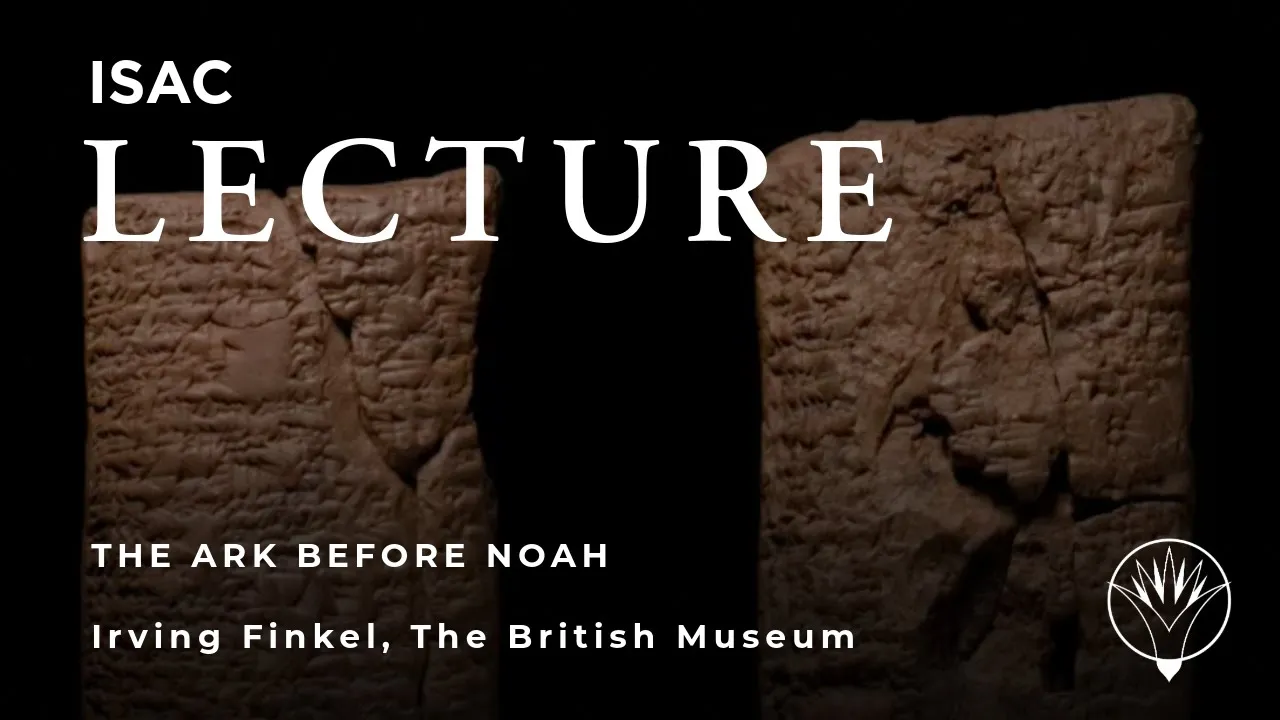
An Old Babylonian cuneiform tablet from circa 1800 BC reveals that the Mesopotamian ark was conceived not as an ocean ship or cube, but as a colossal circular coracle (quffa) constructed from coiled palm rope, wooden ribs, and bitumen. (8:48)
The tablet's divine building instructions specify 14,430 sūtu of palm-fiber rope, matching modern independent mathematical calculations (14,624 sūtu, or roughly 527 kilometers) with negligible error and proving ancient scribes recorded genuine craft data. (15:03)
An experimental archaeology project in Kerala, India successfully built and launched a scaled-down working reconstruction, proving that the circular design was naturally buoyant and structurally sound despite lacking a keel or prow. (24:01)
The Babylonian Imago Mundi world map (c. 600 BC) shares a unique idiom ('thick as a parsiktu') with the Ark tablet to describe grounded vessel timbers on a peak beyond Urartu, identifying the direct Mesopotamian source for the biblical 'mountains of Ararat.' (50:08)
Detailed notes
## Background
Published on YouTube by The Institute for the Study of Ancient Cultures on July 20, 2016, this lecture features Irving Finkel, Assistant Keeper of Middle East cuneiform at the British Museum. The presentation describes the unexpected discoveries sparked by a 4,000-year-old cuneiform tablet brought to the museum, prompting a complete reassessment of the story of Noah's Ark that culminated in a book and documentary film.
## TL;DR
Irving Finkel recounts how an Old Babylonian cuneiform tablet brought in by a member of the public revealed that the original Mesopotamian Ark was actually a massive, round coracle made of coiled rope, timber, and bitumen. Using ethnographic studies of Iraqi boatbuilding from 1920, Finkel demonstrated that the tablet's detailed mathematical specifications represented genuine engineering data rather than mere myth. He describes the ambitious project to construct a scaled working replica in Kerala, India, and its subsequent water trials. Finally, Finkel connects the tablet's distinctive phrasing to the Babylonian Map of the World (Imago Mundi), explaining how Mesopotamian cosmology directly influenced the biblical account of the Ark grounding in the mountains of Ararat.
## Atmosphere & style
The presentation is warm, immensely witty, and theatrical, delivered in Irving Finkel's trademark eccentric British academic style complete with wry self-deprecation and dry comedic timing. It feels less like a dry scholarly seminar and more like a captivating yarn told by a master storyteller who delights in poking fun at museum bureaucracy, television producers, and uncooperative livestock. The mood shifts effortlessly between high-stakes philological detective work, farcical behind-the-scenes filmmaking disasters, and genuine intellectual awe at rediscovering forgotten ancient realities.
## Bulletin
- [08:48](https://www.youtube.com/watch?v=s_fkpZSnz2I&t=528s) An Old Babylonian cuneiform tablet from circa 1800 BC reveals that the Mesopotamian ark was conceived not as an ocean ship or cube, but as a colossal circular coracle (quffa) constructed from coiled palm rope, wooden ribs, and bitumen.
- [15:03](https://www.youtube.com/watch?v=s_fkpZSnz2I&t=903s) The tablet's divine building instructions specify 14,430 sūtu of palm-fiber rope, matching modern independent mathematical calculations (14,624 sūtu, or roughly 527 kilometers) with negligible error and proving ancient scribes recorded genuine craft data.
- [24:01](https://www.youtube.com/watch?v=s_fkpZSnz2I&t=1441s) An experimental archaeology project in Kerala, India successfully built and launched a scaled-down working reconstruction, proving that the circular design was naturally buoyant and structurally sound despite lacking a keel or prow.
- [50:08](https://www.youtube.com/watch?v=s_fkpZSnz2I&t=3008s) The Babylonian Imago Mundi world map (c. 600 BC) shares a unique idiom ('thick as a parsiktu') with the Ark tablet to describe grounded vessel timbers on a peak beyond Urartu, identifying the direct Mesopotamian source for the biblical 'mountains of Ararat.'
## Key takeaways
- [01:51](https://www.youtube.com/watch?v=s_fkpZSnz2I&t=111s) Douglas Simmons brought an Old Babylonian cuneiform tablet to the British Museum in 1985 containing the opening lines of the Atra-hasis flood epic, which then vanished into private hands for nearly a decade before returning for study.
- [04:03](https://www.youtube.com/watch?v=s_fkpZSnz2I&t=243s) George Smith's 1872 decipherment of the 7th-century BC flood tablet from Nineveh first demonstrated that the Genesis flood account had a direct Mesopotamian precursor, causing an immense theological and cultural sensation.
- [06:51](https://www.youtube.com/watch?v=s_fkpZSnz2I&t=411s) Nineteenth-century clerical debates over the Ark's form pitted the biblical rectangular chest against Ashurbanipal's cubic vessel, while popular culture settled on a nursery-toy boat topped with a house.
- [08:48](https://www.youtube.com/watch?v=s_fkpZSnz2I&t=528s) The Simmons tablet uses the Akkadian word kippatu ('circular'), establishing that the flood hero Atra-hasis was commanded to build a giant coracle, the traditional round craft of Mesopotamian riverways.
- [11:42](https://www.youtube.com/watch?v=s_fkpZSnz2I&t=702s) The cuneiform text functions like an assembly manual, providing precise material quantities for a 3,600-square-meter craft made of coiled palm-pith rope, timber ribs, and bitumen waterproofing.
- [15:03](https://www.youtube.com/watch?v=s_fkpZSnz2I&t=903s) By cross-referencing the tablet with James Hornell's 1920 ethnographic study of Iraqi coracle making, Finkel verified that the ancient mathematical specifications matched modern boatbuilding realities.
- [20:29](https://www.youtube.com/watch?v=s_fkpZSnz2I&t=1229s) The inscription contains the earliest known cuneiform appearance of animals boarding the vessel 'two by two,' written almost entirely in dramatic dialogue without third-person framing.
- [26:20](https://www.youtube.com/watch?v=s_fkpZSnz2I&t=1580s) Physical reconstruction in Kerala required constructing the rope hull on an elevated wooden cradle because the massive, unglued structure could not withstand being dragged across land.
- [28:51](https://www.youtube.com/watch?v=s_fkpZSnz2I&t=1731s) The vessel's interior architecture comprised a two-tiered system: a lower level with partitioned stanchions for regional animals, and an upper deck bearing a traditional tied Mesopotamian reed house for Atra-hasis and his family.
- [32:15](https://www.youtube.com/watch?v=s_fkpZSnz2I&t=1935s) When Iraqi authorities blocked the export of native Iraqi bitumen, the reconstruction team used inferior Indian bitumen, resulting in hull leaks during the maiden voyage.
- [42:45](https://www.youtube.com/watch?v=s_fkpZSnz2I&t=2565s) During trial voyages, the round coracle moved across the water without forming a cutwater wake, producing an uncanny gliding sensation likened to walking without casting a shadow.
- [48:19](https://www.youtube.com/watch?v=s_fkpZSnz2I&t=2899s) The enduring nursery-toy image of Noah's Ark with curved sides may preserve a long-lived visual echo of the cross-sectional profile of an ancient circular coracle.
- [50:08](https://www.youtube.com/watch?v=s_fkpZSnz2I&t=3008s) The British Museum's Babylonian Map of the World and the Ark tablet uniquely share the colloquial phrase 'thick as a parsiktu,' linking the mythical mountain on the map to the grounded remains of Atra-hasis's craft.
- [54:13](https://www.youtube.com/watch?v=s_fkpZSnz2I&t=3253s) The biblical phrase 'mountains of Ararat' directly adapted the Babylonian map's placement of the Ark on an otherworldly peak situated immediately behind the northern territory of Urartu.
## Detailed walkthrough
### [00:08](https://www.youtube.com/watch?v=s_fkpZSnz2I&t=8s) The Curator's Routine and a Bag of Antiquities
Opening his talk with warm humor, Irving Finkel remarks on how glad he is to return to the institute for the first time since 1979, joking that in England it is a miracle when anything is still standing after that many years. He describes how the discovery of the "Ark before Noah" dramatically transformed his curatorial existence from what is normally a quiet, dusty, and unexciting museum routine into an adventure with unforeseen hazards. At the British Museum, a routine duty of a curator is examining objects brought in by members of the public, who operate under the flattering illusion that the staff are all-knowing experts. While visitors often feign intense scholarly interest when told an object is Middle Bronze Age or Late Iron Age, their primary concern is invariably financial: they want to know how much it is worth. Museum trustees strictly forbid staff from providing monetary appraisals, forcing curators to navigate all manner of awkward public interactions.
Around 1985, a man named Douglas Simmons arrived at the British Museum with a miscellaneous bag of small antiquities. When Simmons emptied the bag onto the desk before Finkel, the duty officer, a jumble of artifacts spilled out: some ancient coins, a pair of oil lamps, a few pieces of Chinese material, a couple of Egyptian shabtis, and a single cuneiform clay tablet. As a dedicated Assyriologist, Finkel immediately reached for the clay tablet ahead of everything else.
- **Douglas Simmons's bag of antiquities (c. 1985):** ancient coins, oil lamps, Chinese objects, Egyptian shabtis, and one cuneiform tablet.
- **Museum policy:** British Museum curators are strictly forbidden by the museum trustees from giving financial valuations to the public.
---
[01:51](https://www.youtube.com/watch?v=s_fkpZSnz2I&t=111s) Reading Atra-hasis: The Vanishing Tablet
Judging by the tablet's size, shape, dimensions, and grammar, Finkel initially assumed it was an ordinary Old Babylonian administrative letter. However, upon reading the opening signs, he was astonished by what he saw: “Wall, wall, reed wall, reed wall. Atra-hasis, pay heed to my advice that you may live forever. Destroy your house, build a boat, spurn property, and save life.” As Finkel dryly observes, “Well, not many letters begin that way.” Thanks to rigorous training under a demanding professor—whom he jokingly credits with thrashing students with barbed wire until they memorized their cuneiform signs—Finkel recognized the text on sight as the opening lines of the Flood Story from the Babylonian epic tradition.
Possessing an unpublished, previously unknown fragment of the Old Babylonian Flood Story was an extraordinary rarity—what Finkel terms “a piece of gold in the world.” Yet before he could negotiate a loan or study it further, Simmons casually scooped up the tablet, set down an oil lamp, asked, “And what about this?”, and left with his collection. The tablet vanished from sight for the better part of a decade. Finkel quips that this occurred before the British Museum trustees had issued instructions on how to tackle visitors to the floor to seize their property, leaving him no choice but to let Simmons leave. Nevertheless, Finkel remained confident the artifact would eventually return to Bloomsbury, noting with characteristic wit that all great antiquities ultimately find their way to the British Museum—even if some are temporarily held in the Louvre first.
```mermaid
flowchart TD
accTitle: The Tablet's Re-discovery Journey
accDescr: Flowchart tracing the path of the flood tablet from Douglas Simmons's desk encounter to Finkel's final decipherment.
subgraph S1["1985 Encounter"]
A["Douglas Simmons brings bag of antiquities"] --> B["Finkel identifies Old Babylonian Flood opening"]
B --> C["Simmons packs up tablet and leaves"]
end
subgraph S2["Hiatus & Return"]
C --> D["Tablet circulates privately for nearly a decade"]
D --> E["Tablet returns to British Museum for full study"]
end
subgraph S3["Decipherment"]
E --> F["60-line text deciphered in private study"]
end
```
---
[04:03](https://www.youtube.com/watch?v=s_fkpZSnz2I&t=243s) George Smith and the 1872 Revelation
When the tablet finally returned to Finkel's custody years later, he had the uninterrupted opportunity to examine its sixty lines under proper lighting. While its opening echoed sporadic existing parallels, the remainder of the inscription revealed unprecedented details. To provide historical context, Finkel recounts how knowledge of the Mesopotamian flood account first exploded into modern consciousness in 1872 through George Smith. Smith, working as an assistant at the British Museum, deciphered a fragmentary clay tablet resembling a piece of dog biscuit and realized he was reading an ancient cuneiform counterpart to the Genesis narrative.
According to British Museum departmental lore, Smith became so overwhelmed upon reading the inscription that he flung the tablet onto his desk, rushed around the room clutching his head, uttered strange squeaking noises, and began stripping off his clothes. Finkel points out that while this breakdown has often been mocked as an eccentric Victorian spectacle, Smith almost certainly suffered an epileptic seizure brought on by the immense psychological shock of discovering a pre-biblical duplicate of Scripture. Showing a portrait of Smith, Finkel affectionately points out his broad brow, leadership profile, lucid gaze, and impressive beard, joking that trustees have always favored those exact physical attributes in their Assyriological staff. Smith's 1872 publication sparked a sensation across Victorian society, detailing precise narrative parallels to Genesis, including the release of three birds after the tempest subsided to test whether dry land had emerged.
- **George Smith's discovery (1872):** First modern decipherment of the Babylonian flood story from the 7th-century BC Library of Ashurbanipal.
- **Narrative parallel:** Release of three successive birds to see if floodwaters had abated and dry land had appeared.
---
[06:51](https://www.youtube.com/watch?v=s_fkpZSnz2I&t=411s) Cubes, Coffins, and the Battle over the Ark's Shape
Smith's 1872 tablet, originating from the 7th-century BC royal Library of Ashurbanipal at Nineveh, preserved the standardized version of the epic featuring the hero Utnapishtim. In Smith's translation, Utnapishtim's vessel was described as an enormous cube whose height, length, and width were perfectly equal. This geometric detail provided an immediate target for anxious 19th-century clergymen who feared cuneiform discoveries would dismantle biblical authority. Clerics quickly dismissed the Babylonian account as an absurd, unseaworthy myth, arguing, “Well, this is rubbish, this is nothing like the Ark in the Bible. I mean, it's a cube. I mean, whoever had a boat that was a cube, which is mad anyway.” By attacking the vessel's cubic dimensions, critics sought to discredit the entire Mesopotamian tradition.
The public debate settled into a standoff between competing visions of the vessel. Churchmen championed the biblical ark—a rectangular, coffin-shaped chest—while Assyriologists pointed to Ashurbanipal's cube. At the same time, popular culture embraced the familiar folk image of a flat-bottomed boat topped by a small house with a giraffe protruding from the window. Finkel playfully illustrates this popular conception with an image found via what he calls advanced British Museum research—namely, Google. Prior to the examination of Finkel's new tablet, ark enthusiasts were effectively divided between three distinct vessel shapes:
| Concept | Source / Tradition | Dimensions / Distinctive Shape | Public / Clerical Reception |
|:--- |:--- |:--- |:--- |
| **The Assyrian Cube** | Library of Ashurbanipal (c. 7th c. BC) | Equal height, length, and breadth | Mocked by Victorian clergy as an unseaworthy absurdity |
| **The Biblical Chest** | Book of Genesis | Elongated rectangular vessel / "coffin" | Defended by 19th-century churchmen as the true form |
| **The Folk / Nursery Ark** | Popular culture and toys | Boat-hull topped by a house, giraffe at window | Universal childhood mental image of Noah's vessel |
---
[08:48](https://www.youtube.com/watch?v=s_fkpZSnz2I&t=528s) An Ikea Manual from Enki: The Ark as a Coracle
When Finkel finally analyzed the technical specifications inscribed on the Simmons tablet, he discovered something entirely unexpected. In this narrative, the god Enki resolves to save humanity from impending annihilation and selects the human hero Atra-hasis—a name meaning "exceedingly intelligent"—to build a rescue craft. Yet despite the hero's name, Enki clearly harbored no faith in Atra-hasis's nautical engineering skills. The deity provides exhaustive, step-by-step instructions specifying materials, dimensions, and construction techniques, prompting Finkel to compare the tablet to an Ikea flat-pack furniture manual containing all the assembly information printed directly on the box.
The most startling revelation in the inscription was the shape of the craft: the tablet specified that the vessel was to be completely round. Finkel checked his translation of the Akkadian term *kippatu* carefully, noting that having worked on the "K" volume of the *Chicago Assyrian Dictionary*, he was confident in his understanding of the vocabulary, yet double-checked because circular ships are entirely foreign to modern nautical expectations. He realized that the author was describing a coracle—known in Arabic as a *quffa*—the traditional skin-and-reed circular boat utilized on the rivers and marshes of Mesopotamia for millennia.
Dating to roughly 1800 BC, this Old Babylonian tablet predates Ashurbanipal's 7th-century BC library edition by a thousand years. Its author naturally envisioned the world-saving ark not as a European ocean ship, but as a colossal version of the familiar, unsinkable coracles built along the banks of the Tigris and Euphrates. Drawing on his own status as the president of the British Coracle Association—a title he proudly defends while joking that his promised ceremonial gold chain has yet to arrive—Finkel explains that coracles possess extraordinary buoyancy. The vessel had no need to navigate ocean lanes from Portsmouth to New York; it had only to float peacefully with its cargo of living creatures. Because a coracle has neither prow nor stern, it simply drifts securely on the surface, making it the perfect design for a Babylonian survival craft.
- **Date of the Simmons Tablet:** c. 1800 BC (Old Babylonian period), roughly 1,000 years older than Ashurbanipal's version.
- **Key Akkadian term:** *kippatu*, meaning "circular" or "round."
- **Boat type:** Coracle (Arabic *quffa*), a traditional Mesopotamian circular river craft framed with plant matter and made watertight.
[11:42](https://www.youtube.com/watch?v=s_fkpZSnz2I&t=702s) The Ark as a Giant Coracle and the Mesopotamian "IKEA" Manual
Whoever recorded the Babylonian flood narrative visualized the vessel in an entirely realistic, functional manner: the Ark was conceived not as a standard ship, but as a colossal coracle. The floor plan specified in the inscription gives a surface area of 3,600 square meters—vastly larger than a lecture hall. In what resembles a comprehensive IKEA assembly instruction manual, the text enumerates the exact building supplies required: enormous quantities of rope coiled continuously to create the vessel's body, wooden ribs to brace the hull, and bitumen applied inside and out to ensure watertightness. Crucially, the tablet does not just list these materials in abstract terms; it specifies the precise quantities needed to finish the vessel.
```mermaid
flowchart TD
accTitle: Babylonian Coracle Construction Sequence
accDescr: Step-by-step process of constructing a coracle based on ancient Babylonian specifications and modern ethnographic parallels.
subgraph Materials ["1. Raw Materials"]
A["Date Palm Pith"] -->|"twist into thick rope"| B["Rope Coils"]
C["Timber Ribs"]
D["Bitumen Pitch"]
end
subgraph Hull ["2. Basketry Construction"]
B --> E["Draw large circle on ground"]
E --> F["Coil rope upward layer by layer"]
F --> G["Stitch coils north-to-south"]
G --> H["Great floppy circular basket"]
end
subgraph Reinforcement ["3. Framing & Waterproofing"]
H --> I["Lace wooden ribs to the hull frame"]
C --> I
I --> J["Coat interior & exterior with bitumen"]
D --> J
J --> K["Finished Waterproof Coracle"]
end
```
Coracles of this type were once commonplace on Iraqi waterways, documented from ancient Assyrian relief sculptures through to nineteenth- and twentieth-century photography, before disappearing from modern use. Finkel shares historical photographs, including one of the last known Iraqi coracles (*quffa*), an archival image of a crowd of men crammed into a vessel attempting a record (disqualified from the Guinness Book of World Records because one occupant was a boy), and a lantern slide depicting two visibly terrified British women on the Grand Tour persuaded into sampling river life in one of these craft. Another series of lantern slides from around 1920 illustrates the construction technique step-by-step on an Iraqi riverbank: rope is produced by tightly twisting the pith of the date palm tree until it achieves exceptional tensile strength. The builders lay out the diameter in a circle on the earth, stitching layer upon layer north-to-south as the coil rises, forming an immense flexible basket that is then reinforced with wooden ribs and waterproofed with hot bitumen.
[15:03](https://www.youtube.com/watch?v=s_fkpZSnz2I&t=903s) Cracking the Babylonian Mathematics with James Hornell
Decoding the middle section of the tablet presented a steep challenge, as the inscription is densely technical and dominated by numerical calculations. Acknowledging that he is innumerate and had never built a boat, Finkel sought assistance while scouring the library of the British Museum's Ethnographical Institute. There he discovered a 1920 study by James Hornell, an ethnographic researcher from Scotland who documented the exact methods used to make Iraqi coracles:
> “And the Babylonian, which is more or less preserved, is very terse and difficult to understand in different areas. So I had this unique situation, that I use Hornell's description from 1920 A.D. to understand the narrative written in the 18th century B.C. about how to build these boats. And at the same time use the Babylonian to understand what he meant in English.”
Once the technical vocabulary aligned, the mathematics could be tested. The god Enki instructs the flood hero Atra-hasis to obtain exactly 14,430 *sūtu* measures of palm-fiber rope. To analyze this figure, Finkel enlisted a mathematician to calculate how much rope would actually be needed to manufacture a round boat spanning 3,600 square meters with walls seven meters high, using traditional rope roughly the thickness of a stout human finger. Applying standard geometric and physical theorems, the mathematician independently calculated a total requirement of 14,624 *sūtu*—a length of approximately 527 kilometers.
- Specified Babylonian measure (divine instructions): 14,430 *sūtu*
- Calculated modern requirement: 14,624 *sūtu* (527 kilometers)
- Geographic equivalent: The distance from London to Edinburgh (or Chicago to Minnesota)
- Margin of difference: Less than the distance from London to Watford (roughly 32 *sūtu*)
Such an insignificant margin of error proves that the numbers embedded in this poetic text were neither arbitrary nor magical inventions; they represent real-world craft data preserved from working shipwrights. The core design of the Mesopotamian coracle was functionally optimal from its origin around 1800 BC through to the mid-twentieth century AD, requiring no fundamental alteration over nearly four millennia.
[20:29](https://www.youtube.com/watch?v=s_fkpZSnz2I&t=1229s) Going Public: The Guardian Leak and Documentary Madness
The tablet contained other startling elements: it is written almost entirely in dialogue without third-person narrative framing, and it explicitly describes animals boarding the vessel "two by two"—a phrase familiar from the Book of Genesis that had never previously surfaced in any cuneiform flood text. Roughly three weeks before Christmas, a journalist from *The Guardian* stopped by the museum and casually asked whether there was anything new in the "tabs" (cuneiform tablets) department. Finkel mentioned having found the actual Babylonian blueprint for Noah's Ark, prompting an interview and a high-profile holiday article that triggered an international media frenzy.
Telephone inquiries poured in from television producers, especially from the United States, eager to turn the discovery into a film. British Museum curators are traditionally taught by their institutional culture to handle documentary producers with caution—to "sup with a very long spoon"—because film crews frequently distort scholarly nuance or edit out negative qualifiers like "not," leaving researchers appearing to endorse claims they completely reject. Eventually, an English producer proposed building a full-scale replica coracle directly from the tablet's instructions:
> “So I said, 'I'm happy to do this. Only, I'd like this to be one of those documentaries, unusual documentary, where we tell the truth about everything. We tell the truth.'”
Although Finkel harbored ambitions of directing the project, selecting the camera angles, and composing the musical score and lyrics, the producers maintained strict control over the production. Because modern geopolitical circumstances made it impossible to construct the vessel in Iraq, the team scouted alternative locations and settled on the state of Kerala in southwest India. The site offered a working shipyard on a lake, an abundant supply of palm fiber for rope, skilled craft labor, and a landscape that visually evoked ancient Mesopotamia.
[24:01](https://www.youtube.com/watch?v=s_fkpZSnz2I&t=1441s) The Grand Indian Reconstruction and Documentary Strategy
When Irving Finkel realized his translation was no longer just an academic exercise, the stakes escalated drastically. He had worked on the tablet with the quiet humility typical of an Assyriologist working in a study where “nobody's head is on the block,” only to wake up one morning and discover that a multi-million-dollar production had been launched on the other side of the world in India, where an entire team of boat builders and laborers treated his deciphered text as literal gospel. The pressure was intense enough to give him sleepless nights; he would wake in a sweat, terrified that he had misread the cuneiform and inadvertently translated specifications for a double-decker bus. When the translation and its staggering dimensions were first sent over to India, the director in charge of the build was so overwhelmed by the sheer scale of the vessel that he literally had to be hospitalized.
A full-scale reconstruction proved physically impossible under modern engineering constraints, prompting a flurry of worried communications. The production team ran computer simulations showing that timber could not bear the structural load at the original dimensions, and they cautiously emailed Finkel to ask if they could build a scaled-down version that preserved the exact proportions. Rather than eagerly conceding, Finkel chose a calculated tactical silence, waiting four or five days before replying with an offhand, begrudging concession: “Okay, if you must.” As Finkel advised the audience: “Remember this if you're ever in the process of making a documentary film with other people, that's the way to do it, go out of your way to be a bastard.” A compromise was thus sealed: the boat would be constructed as large as humanly possible while strictly honoring the tablet’s geometric ratios.
- The build took place in India over a period of four to five months.
- The construction crew was directed by a specialist team of three ancient boat builders overseeing local craftsmen.
- The impossibility of building the vessel at full scale in antiquity is addressed further in the lecture as being entirely logical in its own right.
[26:20](https://www.youtube.com/watch?v=s_fkpZSnz2I&t=1580s) Coiling Ropes on Cradles and the Departmental Elephant
The physical build commenced with the creation of the hull from exceptionally thick, snake-like coiled rope. The craftsmen laid the coils from the center outward, winding them round and round to fashion a massive, bowl-shaped floor. Because the finished structure would be extraordinarily heavy, the builders realized immediately that dragging it across land into the water like a common lifeboat would tear it apart. To prevent structural failure, the entire vessel was erected from day one atop a raised wooden cradle, designed to transport the completed ark bodily into the water at the time of launch. Every component was fastened purely through lacing, tension, and binding with rope—entirely without the use of nails or glue.
The heavy lifting on site was aided by an elephant, which prompted Finkel to recall a mischievous encounter from his early days as a young curator at the British Museum. Emerging from his department into the gallery, he was stopped by two middle-aged American tourists who marvelled at the immense height of the departmental double doors and asked why they were built so tall. On an impulsive whim, Finkel told them that the doors dated back to the British Raj, when departmental keepers routinely rode to work on elephants. When the visitor earnestly replied, “Oh, that’s really interesting,” Finkel felt an immediate wave of guilt and had to run after them down the gallery shouting: “No, it’s not true at all.”
- The ark's hull was constructed out of massive coils of continuous rope bound tightly together without mechanical fasteners.
- Construction had to occur on an elevated cradle because the immense weight of the finished craft precluded dragging it across the ground.
- The timber and rope were bound together under heavy manual tension, relying entirely on friction and cordage.
[28:51](https://www.youtube.com/watch?v=s_fkpZSnz2I&t=1731s) Interior Architecture: Ribs, Decks, and the Dung Problem
As the structure rose, its internal timber framework took shape. Massive curved wooden ribs extended down from the upper rim to meet across the bottom, creating a sturdy floor while supporting the thick rope walls lashed to their exterior. From these ribs, cross-struts extended inward to hold large circular timbers mounted with vertical stanchions. These uprights supported an entire upper deck, exactly matching the tablet’s instructions for a two-tiered craft: the lower deck was designated for the animals, while Atra-Hasis and his family resided on the deck above. The living quarters atop the deck were not built of timber boards; the tablet uses a specific verb meaning “to tie,” indicating a reed house constructed in the style of traditional Mesopotamian reed dwellings.
Finkel noted that speaking publicly about the Ark at literary festivals invariably invites two passionate lines of questioning. The most persistent practical question from audiences is what the inhabitants did with all the animal dung, to which Finkel candidly admits that the tablet provides no answer whatsoever. The second debate revolves around weight and seaworthiness, with skeptics on the internet arguing that an ark could never carry the planet's animal biomass. Finkel points out the flaw in applying modern global biodiversity to an ancient text: when ancient Babylonians spoke of “all the animals,” they meant exclusively the domestic and wild creatures native to their known world, not every species on Earth. Conceived as a practical recipe built up like a tiered wedding cake, the craft’s interior stanchions could easily have accommodated dividing screens to keep species partitioned.
```mermaid
flowchart TD
accTitle: Ark Two-Tier Structural Layout
accDescr: Cross-section diagram showing the upper deck for humans and the lower deck for animals inside the rope hull.
- The tablet describes the exact number and lengths of the stanchions required to carry the upper deck.
- The human living quarters were modeled on ancient Iraqi marsh reed houses (*mudhif* style), matching the tablet's description of a tied construction.
- The Babylonian faunal inventory comprised familiar regional domestic and wild beasts rather than global wildlife, making the physical cargo far more modest than modern literalists imagine.
[32:15](https://www.youtube.com/watch?v=s_fkpZSnz2I&t=1935s) The Bitumen Crisis and Preparing for the Launch
Waterproofing the vessel presented an unexpected international crisis. In ancient Babylonia, boatbuilders had access to unlimited quantities of natural Iraqi bitumen, which bubbles out of springs and cures into a permanent, rock-hard, impermeable barrier that can last indefinitely with minor maintenance. The documentary team arranged to import a tanker full of genuine Iraqi bitumen to India, but Iraqi cultural heritage authorities intervened. Enforcing strict protective regulations that classified naturally occurring petroleum byproducts as protected cultural property, they refused to export a single drop. Forced to source an alternative at the eleventh hour, the team turned to the Indian black market, with disastrous consequences: the inferior Indian bitumen lacked quality control and persistently peeled off the hull, forcing the laborers to spend exhausting, sweltering days repeatedly scraping, patching, and reapplying hot tar.
The architectural reconstruction was directed by maritime archaeologist Tom Vosmer, whom Finkel described as the “grand old man of archaeological boat reconstruction,” accompanied by his two top students, Eric Staples and Alessandro Ghidoni. Alessandro lived directly on site for four months alongside the Indian laborers, supervising the day-to-day work. Although Finkel had harbored ambitions of directing the entire production from the outset, the documentary filmmakers kept him away until just two days before the launch. When invited out to lunch with the film crew, Finkel tried to exert creative influence, insisting that an Ark film without live animals lacked credibility and pitching an Alfred Hitchcock-style cameo for himself:
> “Once in a while, you see, they took me for lunch. So I thought, ‘Oh, this is my chance to influence this documentary for good. I've got these terrific ideas, so why not.’ One idea was this, that you cannot really have a documentary about the Ark without animals in it.”
- High-grade Iraqi bitumen cures into an impermeable waterproofing layer, but export was completely blocked by Iraqi authorities.
- The replacement Indian bitumen failed to adhere reliably, requiring constant reapplication in severe heat.
- The replica reed house on the deck was deliberately constructed with half its floor left open to allow documentary cameras to film the interior.
- Maritime archaeologist Tom Vosmer led the design team, with Alessandro Ghidoni running daily site operations for four months.
[35:45](https://www.youtube.com/watch?v=s_fkpZSnz2I&t=2145s) Animal Proposals and the First Glimpse of the Coracle
Before traveling to the construction site in India, Irving Finkel had high hopes for his personal role in boarding the animals. His initial proposal to the film crew was theatrical: he wanted to dress in a sheet, put on sandals, let his hair down, and give a rhinoceros a firm thwack on the buttock to urge it up the gangplank. When the producers flatly refused, he proposed a second scheme based on Indian folk traditions, suggesting they commission artisans who make realistic ritual figures from papier-mâché: “And we could, we can get them to make two of each, and they could go on the boat. But if the boat sinks, well, that's what things usually do in the ritual, so no one would mind about it, and if it didn't sink, it would be a miracle. So what's wrong with that?” The producers rejected that plan as well, leaving him empty-handed as he flew out to India for the final two days before the launch.
The build site had been enveloped in dense vegetation and leaves so that curious onlookers could not spy on the proceedings. The director devised an exacting shot for Finkel’s arrival: he was instructed to walk through the jungle into the clearing with a nonchalant, intellectually stimulating gait, and then express spontaneous wonder and delight upon seeing the craft for the first time. The staging was nerve-racking, as an enormous camera rig retreated backwards through the mud just two inches from Finkel’s face to capture his unrepeatable first impression.
Yet when Finkel finally turned the corner and laid eyes on the vessel, no acting was required. The craft stood before him not like a freshly built movie prop, but as a somber, pitch-black antiquity—a true ship that had materialized entirely from an ancient inscription:
> “Because this thing was a beautiful boat, a ship, a she, a definite she. It was black and somber and it looked like an antiquity, it didn't look like it just been built. And it was all there from this stupid bit of clay in the British Museum the other side of the world, come into existence. So it was impossible to simulate reaction, it was all I could do not to burst into tears.”
---
[39:19](https://www.youtube.com/watch?v=s_fkpZSnz2I&t=2359s) The Goats' Revenge and Rolling the Ark to the Water
The launch was slated to take place on a shallow, placid lake in India that had no tides, no significant depth, and very little hazard of drowning. While nervous onlookers debated whether the massive vessel would float, Finkel reasoned that because the construction materials themselves were naturally buoyant, the chances of it sinking were slim. The ark sat poised on a stand facing an expanse of mud resembling a drenched rugby pitch, with a cameraman waiting on a tripod. Just before the launch sequence began, two elderly local men emerged through the foliage holding ropes tethered to goats, staking the animals out directly in front of the lens.
```mermaid
flowchart LR
accTitle: The Coracle Rollers
accDescr: Diagram illustrating the traditional roller system used to move the giant coracle into the water.
subgraph Staging["Onshore Staging"]
A["Giant Coracle on Stand"]
B["Deflated Rubber Tubes"]
end
subgraph Launch["Launch Procedure"]
C["Tubes Inflated into Sausages"]
D["Parallel Rolling Wheels"]
E["Vessel Slides into Lake"]
end
A --> B
B --> C
C --> D
D --> E
```
Finkel instantly saw through the director’s strategy: by framing a single pair of male and female goats in the foreground, the television production hoped viewers at home on their sofas would mentally project the rest of the animal kingdom behind them. The plan disintegrated immediately when the goats ignored the cameras, began violently head-butting each other in the ankle-deep mud, and promptly attempted to mate. The crew had to halt production and pay the handlers substantial sums to untangle and drag the heaving animals away, an outcome Finkel regarded as sweet poetic justice.
To shift the gargantuan structure off its stand and down the muddy slope, the team employed local coracle movers who utilized a traditional pneumatic rolling method:
- Heavy-duty rubber tubes were laid out beneath the frame in parallel, like sausages on a grill.
- The tubes were pumped full of air until completely round, serving as rolling wheels beneath the timber framework.
- Local workers completely unconcerned with modern health and safety regulations pushed and guided the assembly.
- Heavily insured crew members rode inside while everyone else watched from the shore as the world's largest coracle smoothly entered the water.
---
[42:45](https://www.youtube.com/watch?v=s_fkpZSnz2I&t=2565s) Floating the Vessel: Ant Invasions, Bitumen Leaks, and Wake-less Motion
Once on the water, the craft's immense proportions became starkly evident. A normal working coracle used on Iraqi rivers is a modest, circular craft, whereas this reconstruction was a massive floating arena. Before the crew climbed aboard to lean over the railings and inspect the craft, the camp cook packed sandwiches into the deckhouse in case the voyage ran into disaster. When they opened the rations later, the bread was crawling with thousands of insects, proving to Finkel that Noah never had to bother rounding up ants.
The maiden voyage was not completely watertight. Because the team had been forced to use local Indian bitumen rather than traditional Mesopotamian bitumen from Iraq, seams in the hull began leaking at an alarming rate, forcing workers to deploy bilge pumps. Several journalists made mocking remarks about the vessel taking on water, but Finkel defended the craft, noting that anyone who has ever stepped into a wooden rowboat expects some water at the bottom: “If it had had Iraqi bitumen, we could have gone all around the world.”
Riding aboard the round vessel produced an uncanny sensory experience. Because a coracle lacks a cutwater prow or pointed hull, it travels without producing a triangular wake across the water's surface. Finkel observed that gliding through the water without a wake felt eerie and unnatural, likening it to a person walking under full sunlight without casting a shadow.
---
[45:28](https://www.youtube.com/watch?v=s_fkpZSnz2I&t=2728s) The Ominous Storm, Secret Builders, and Gin-Soaked Tourists
The ark had been constructed under strict secrecy by an integrated workforce of Hindu and Muslim craftsmen who had worked together on regional projects for years and successfully kept the venture quiet to prevent tourists from crowding the site. On the day of the launch, deep, threatening storm clouds gathered across the sky. The craftsmen became convinced that Finkel had summoned the weather himself. Once the boat was moored, forty to fifty workmen lined up to take individual photographs with him, adjusting their heights beside his towering frame.
On the flight home, Finkel remarked to a crew member how touched he had been by the workers' warmth:
> “And when we were going home on the plane, I said to one of the film crew, ‘You know that I was very touched by that display at the end of the, of the whole operation. They'd been working for so many months, and they were so friendly to me, and so warm.’ And I said, ‘You know, I'm used to being a tremendous social success wherever I go, but I did think that was a bit surprising.’ And this guy said, ‘Well, there's nothing about that at all surprising. They all thought you were a descendant of Noah.’”
The operation concluded at dusk as the crew towed the coracle through a canal network to its final berth. The trial crew had spent the stifling day trapped inside head-to-groin, inflatable orange anti-drowning suits that felt like pure torture in the heat. As they passed long lines of excursion boats filled with holidaymakers sipping gin on the decks, the drunken tourists peered through the twilight and began pointing and shouting across the water:
- Scores of tourists instantly cried out, "Look, there's Noah's Ark!"
- Finkel was exasperated that a circular craft based on Babylonian engineering was immediately mistaken for the biblical vessel: “Could anything be more annoying? That we spend half a million dollars to build something which is totally unlike Noah's Ark in any way whatsoever! By a load of drunks is immediately recognizable.”
- While an aerial perspective reveals an unmistakable circular coracle with zero resemblance to traditional depictions of the Ark, the low waterline perspective made it instantly recognizable to the casual public.
[48:19](https://www.youtube.com/watch?v=s_fkpZSnz2I&t=2899s) Nursery Arks, Leaving the Vessel, and Tabloid Revelations
Reflecting on the visual legacy of the Ark, Irving Finkel observes a peculiar disconnect between traditional artistic representations and biblical text. While Renaissance and classical masters faithfully rendered the Tower of Babel according to the specifications in Genesis, virtually no artist painted Noah’s Ark matching the dimensions or box-like architecture recorded in the Bible. Instead, illustrations and traditional wooden nursery toys universally portray a distinct boat with high prow and stern. Finkel suggests this iconic silhouette may not be a conventional vessel at all, but rather the cross-sectional side profile of a massive round coracle, indicating that an echo of the original Mesopotamian round boat tradition survived long after the cuneiform tablets were buried.
Following the construction of the reconstructed coracle for the television documentary, the project reached an emotional conclusion. The team was forced to moor the enormous vessel in a secluded canal away from the public eye. Finkel recalls leaving the craft with deep reluctance: “In good Nelson tradition, I was the last man off. It was a hell of a wrench to leave that boat there.” Shortly after the documentary aired, sensationalist tabloid newspapers rushed to print their own astonishing claims about the Ark, prompting amusement from Finkel, who was confident that the true archaeological trail led elsewhere.
- Artists historically adhered closely to biblical texts for subjects like the Tower of Babel, yet consistently departed from biblical descriptions when depicting Noah's Ark.
- Finkel hypothesizes that the ubiquitous curved toy-boat shape preserved in children's nurseries reflects the profile of an ancient circular coracle.
- The experimental full-scale boat was left moored in a quiet canal, marking an emotional parting for the research and build crew.
---
[50:08](https://www.youtube.com/watch?v=s_fkpZSnz2I&t=3008s) The Babylonian Map of the World and the Parsiktu Riddle
The archaeological proof that refutes sensational claims resides within the British Museum in the form of the famous Babylonian *Imago Mundi* (BM 92687), a clay tablet incised around 600 BC and acquired around 1878. The tablet features a circular map portraying the Mesopotamian heartland encircled by a ring of "bitter water" (a cosmic ocean or river). Babylon sits in the center straddling the Euphrates, with neighboring cities, territories, and the Persian Gulf marked within the disk. Modern commentators often dismiss the artifact as geographically inaccurate for navigation, but Finkel stresses that its true purpose lies in its cosmological depiction of eight triangular projections radiating outward from the bitter river, representing mythical islands or mountains on the outer rim of the world.
```mermaid
flowchart TD
accTitle: The Babylonian Imago Mundi and the Ark Tablet Connection
accDescr: Diagram showing the cosmological layout of the Babylonian Map of the World and how the Ark tablet links the outer mountain to Urartu and Ararat.
subgraph WorldDisk ["The Known Mesopotamian World"]
A["Mesopotamian Heartland<br>(Babylon, Euphrates, Iraqi towns)"]
B["Ring of Bitter Water<br>(Cosmic Ocean River)"]
A --> B
end
subgraph RimIslands ["Outer Islands / Mountains"]
C["Triangular Rim Islands<br>(Mythical beasts, jewel trees)"]
D["Northern Mountain Island<br>(Behind territory labeled Urartu)"]
B --> C
B --> D
end
subgraph CuneiformClue ["The Linguistic Link"]
E["Ark Tablet:<br>Ribs cut 'thick as a parsiktu'"]
F["Map Tablet Text:<br>Mountain holds timbers 'thick as a parsiktu'"]
E -.->|Unique parallel idiom| F
D -->|Site of the grounded boat| F
D -->|Direct geographic predecessor| G["Biblical Narrative:<br>'Mountains of Ararat'"]
end
```
On the reverse of the tablet, fragmentary cuneiform text describes the bizarre, legendary marvels awaiting travelers on these outer islands—such as jewel-bearing trees and flightless birds. In the section detailing one specific distant mountain beyond the bitter river, the text instructs that a traveler ascending the peak will encounter remnants of a massive wooden structure whose timbers are "as thick as a *parsiktu*." This specific phrase provided an immediate revelation: in the Atra-Hasis Ark Tablet, when Atra-Hasis reports completing his vessel's frame, he states that he made the ribs "thick as a *parsiktu*." Because a *parsiktu* is a standard Babylonian unit of capacity or volume rather than linear measurement, Finkel argues it functioned as a colorful colloquial idiom akin to saying "as thick as two short planks." This rare idiom occurs in the entire cuneiform corpus exclusively on the Ark Tablet and on this world map.
- The *Imago Mundi* was inscribed around 600 BC in Babylon and has been held by the British Museum since roughly 1878.
- The map depicts the Euphrates River running through Babylon into the Persian Gulf, surrounded by an encircling cosmic river labeled "bitter water."
- Triangles projecting beyond the outer perimeter represent eight outer regions or mountains populated by extraordinary creatures and wonders.
- “There is a rule in Assyriology that the more interesting a document, the more damaged it is.”
- The phrase "thick as a *parsiktu*" appears only twice in known cuneiform literature: once in the Atra-Hasis Ark Tablet describing the boat's ribs, and once on the Babylonian world map describing the giant wooden ruins atop an outer mountain.
---
[54:13](https://www.youtube.com/watch?v=s_fkpZSnz2I&t=3253s) The Road to Urartu and the Mountains of Ararat
The identification of this wooden wreckage on the Babylonian map directly illuminates the origin of the biblical landing site. Cuneiform tradition consistently placed the grounding of the flood survivor’s boat atop a distant peak, as seen in George Smith’s discovery of the flood tablet from Nineveh. The Babylonian map, however, provides a specific geographic bearing: the triangular mountain bearing the *parsiktu*-sized vessel timbers lies immediately beyond the northern district marked on the map as Urartu (ancient Armenia).
Finkel points out that the Hebrew Bible does not claim the Ark rested upon an isolated peak named "Mount Ararat," but specifies that it landed among the "mountains of Ararat"—that is, within the mountainous regional district of Urartu. When Judean scribes during the Babylonian Exile absorbed the ancient flood narrative, they inherited the Babylonian geographical conception. Unable to comprehend the esoteric cosmological idea of crossing a cosmic ocean to the edge of the world, they simply localized the Ark’s resting place to the adjacent, known northern border region of Urartu. As Finkel summarizes: “And they certainly didn't tweak the idea that the Babylonian conception was that you go beyond the river, beyond the edge of the world, to a district where no man ever goes and comes home again. But this word, in the same geographical location as this mountain, is surely the origin of the expression in the Hebrew Bible.”
- The region of Urartu (also known in texts as Urashtu) represented Armenia, an area frequently in conflict with the Assyrians.
- The Hebrew phrasing in Genesis designates the landing place as the "mountains of Ararat" (plural district), not a single peak named Mount Ararat.
- Judean writers adapted the Babylonian geographical tradition, mapping the otherworldly mountain behind Urartu directly onto the regional mountains of Urartu itself.
---
[56:11](https://www.youtube.com/watch?v=s_fkpZSnz2I&t=3371s) An Easter Sunday Omen
Finkel concludes the lecture by recounting a personal anecdote from the Easter before last, which he humorously frames as a cosmic reprimand for his inquiries. While on an Easter Sunday drive with his family, they spotted a road sign for a "Very old church" and decided to visit. Approaching through the lychgate, Finkel found the massive church doors closed. Reluctant to interrupt a service in progress, he leaned close and crouched by the doorway to listen through the crack.
As he stood crouching by the entrance, a direct "plop" landed squarely on the back of his head. Looking upward toward the rafters, he discovered a solitary, pure white dove perched overhead. Inspecting the ground beneath with detective-like scrutiny, he confirmed that the pavement was entirely clean, proving the spot was not a habitual roost. Looking back at the unexpected avian intervention, Finkel brings down the house with his closing remark: “So I can only conclude that that bird came to get me. And all I can say is I have a pretty good idea who might have sent it.”
- The incident occurred at an ancient English church visited by Finkel and his family on Easter Sunday.
- A single white dove perched high on the church roof dropped a direct hit onto the back of Finkel's head as he listened at the church door.
- Finkel verified that the stone floor beneath was spotless and showed no prior use, treating the occurrence with dry comedic gravity as deliberate divine commentary on his Ark research.
## Notable quotes
> [50:08](https://www.youtube.com/watch?v=s_fkpZSnz2I&t=3008s) There is a rule in Assyriology that the more interesting a document, the more damaged it is. — Irving Finkel
## Mentioned
Irving Finkel, British Museum, Douglas Simmons, Atra-hasis, George Smith, Library of Ashurbanipal, Nineveh, Genesis, Utnapishtim, Enki, Chicago Assyrian Dictionary, British Coracle Association, James Hornell, The Guardian, Kerala, Tom Vosmer, Eric Staples, Alessandro Ghidoni, Imago Mundi, Urartu, Mount Ararat, Tower of Babel
## Video description
Irving Finkel, Assistant Keeper I with responsibility for cuneiform in the Department of the Middle East, British Museum.
This talk, illustrated by a PowerPoint, will describe what befell the speaker after one quite remarkable cuneiform tablet was brought for examination to the British Museum in London. The inscription on this four-thousand-year-old tablet led to a series of altogether unexpected discoveries, demanding a whole new look at Noah and his Ark, and culminating in a book and a documentary film.
Institute for the Study of Ancient Cultures lectures are free and available to the public thanks to the generous support of our members. To become a member, please visit: http://bit.ly/2AWGgF7
欧文·芬克尔|诺亚之前的方舟:一场伟大的冒险
欧文·芬克尔(Irving Finkel)讲述了一块由民间人士带来的古巴比伦楔形文字泥板如何揭示出:美索不达米亚最初的方舟实际上是一艘由盘绕绳索、木材和沥青制成的巨型圆形皮筏。芬克尔结合1920年代伊拉克造船的民族志研究,证明了泥板上详尽的数学规范代表的是真实的工程数据,而非虚构神话。他还介绍了在印度喀拉拉邦建造按比例缩小的可运行复制品及其后续水上试航的宏大项目。最后,芬克尔将泥板中的独特措辞与《巴比伦世界地图》(Imago Mundi)联系起来,阐释了美索不达米亚宇宙观如何直接影响了《圣经》中方舟搁浅于亚拉拉特山脉的记载。
一块约公元前1800年的古巴比伦楔形文字泥板揭示,美索不达米亚方舟最初并未被构想为远洋船只或立方体,而是一艘由盘绕棕榈绳、木质肋骨和沥青建造的巨型圆形皮筏(quffa)。 (8:48)
泥板上的神圣建造指令指定了14,430苏图(sūtu)的棕榈纤维绳,与现代独立数学计算得出的数值(14,624苏图,约合527公里)误差极小,证明古代抄写员记录的是真实的工艺工程数据。 (15:03)
在印度喀拉拉邦开展的一项实验考古项目成功建造并下水了一艘按比例缩小的可运行复原船,证明该圆形设计尽管没有龙骨或船首,依然具有天然浮力且结构稳固。 (24:01)
约公元前600年的《巴比伦世界地图》(Imago Mundi)与方舟泥板共享了一个独特的习惯用语(“厚如帕西克图”/thick as a parsiktu),用来描述搁浅在乌拉尔图(Urartu)以外山巅上的船体木料,明确指出了《圣经》中“亚拉拉特诸山”的直接美索不达米亚出处。 (50:08)
Reading summary
British Museum curator Irving Finkel demonstrates that an Old Babylonian cuneiform tablet dating to circa 1800 BC records technical blueprints for a colossal circular coracle, revealing that the Mesopotamian flood vessel—and its biblical successor—drew on functional regional boatbuilding traditions rather than conventional ocean ships.
Deciphering the Circular Ark Blueprint (8:48)
Around 1985, member of the public Douglas Simmons presented a miscellaneous bag of antiquities to the British Museum, including an Old Babylonian cuneiform tablet that Finkel identified as an unpublished fragment of the Atra-hasis Flood Story. Unlike the 7th-century BC version discovered by George Smith in 1872—which depicted the hero Utnapishtim's vessel as a giant cube—this older inscription, dating to roughly 1800 BC, contained exhaustive divine instructions from the god Enki specifying that the rescue craft was to be completely round (*kippatu*). Finkel recognized the design as an immense coracle (known in Arabic as a *quffa*), the traditional skin-and-reed circular craft utilized across Mesopotamian river systems for millennia.
Mathematical Precision and Vernacular Engineering (15:03)
The text functions like a technical assembly manual, detailing a vessel with a floor area of 3,600 square meters, seven-meter-high walls, a lower deck partitioned for regional animals, and an upper tied-reed deckhouse for Atra-hasis and his family. To decipher the dense numerical inscriptions, Finkel cross-referenced the text with James Hornell's 1920 ethnographic survey of Iraqi coracle construction. When a modern mathematician calculated the rope required to build a vessel of those dimensions using palm-fiber cordage of finger thickness, the theoretical requirement totaled 14,624 *sūtu* (approximately 527 kilometers). This figure closely matched the divine instruction of 14,430 *sūtu* on the tablet. Finkel emphasizes that this negligible margin of error confirms the literary text preserved authentic, empirical data from working Mesopotamian shipwrights.
Experimental Reconstruction and Seaworthiness Trials (24:01)
To test the tablet's engineering, an international documentary team directed by maritime archaeologist Tom Vosmer undertook a scaled reconstruction in Kerala, India. Because modern computer modeling indicated that timber ribs could not bear the structural load at full scale, builders scaled down the size while strictly preserving the ancient proportions. The craft was assembled on a raised cradle entirely by lacing coiled rope under tension without nails or glue. After Iraqi cultural heritage authorities prohibited exporting natural Iraqi bitumen, builders used inferior local bitumen that peeled and leaked, requiring pumps during the launch. Nevertheless, the rolled-out vessel floated stably on an Indian lake and glided without producing a bow wake, confirming the inherent buoyancy of the circular Mesopotamian design.
Linguistic Proof and the Road to Ararat (50:08)
Finkel links the tablet's boat directly to the biblical landing narrative through the British Museum's Babylonian *Imago Mundi* (BM 92687), a world map incised around 600 BC. The map's reverse text describes an outer mountain lying beyond the northern region of Urartu that preserved giant wooden wreckage with timbers "thick as a *parsiktu*"—a capacity-unit idiom that appears nowhere else in cuneiform literature except on the Atra-hasis Ark Tablet, where it describes the boat's ribs. Finkel argues that Judean scribes during the Babylonian Exile assimilated this tradition, adapting the cosmological peak beyond Urartu into the familiar Hebrew phrasing of Genesis: the vessel grounded not on a lone peak, but within the regional "mountains of Ararat."
Finkel concludes that the biblical flood narrative is an adapted inheritance of ancient Babylonian coracle lore preserved across millennia of oral and scribal tradition. While experimental reconstruction proved that the tablet's structural principles are seaworthy at a scaled size, building and waterproofing a 3,600-square-meter rope vessel at full scale remains an unverified logistical feat of ancient literature.
[50:08] Irving Finkel: There is a rule in Assyriology that the more interesting a document, the more damaged it is.
Original transcript
[0:08] Well, thank you, Gil. It's customary
for people in this miserable position to
[0:13] say how glad I am to be here. And in my
case, it's literally true, because I
[0:18] haven't been here since 1979, and I'm
extremely glad to be here. It's wonderful
[0:23] to discover that this thing, which has
lived in my mind as a kind of lingering
[0:27] fantasy, is still, in fact, standing.
Because, when you go to England, it's more
[0:32] miraculous if things are still
standing. But that's neither here nor
[0:34] there. So I'm going to talk to you about
this topic, the Ark before Noah, which has
[0:40] been a big adventure, which is converting
my life from the dull, tedious, dusty, and
[0:44] un-exciting life of a normal curator
into just the opposite, with hard,
[0:49] endangering consequences. So, one of the
things that happens if you are a curator
[0:54] in the British Museum is, because the
public have the mistaken idea that we
[0:58] are experts, is to identify things which
people bring in. And they always make a
[1:04] lot of fuss about how interested they
are when you tell them it's Middle
[1:08] Bronze Age, or Late Iron Age, or something
of this sort of technical side. But,
[1:12] what they really want to know is how
much they are worth. And, we are forbidden by
[1:19] the trustees from ever referring to this
matter, so we are experienced in dealing
[1:23] with all sorts of drama. And it happened
to me once when I was on duty that a
[1:27] person called Douglas Simmons came in, in about 1985, with a bag full of
[1:31] antiquities, small antiquities, which he
poured onto the desk, and I was the duty
[1:36] officer. And it contained some coins, a
couple of lamps, a bit of Chinese stuff, a
[1:42] couple of shabtis, and a cuneiform
tablet. Well, it might not surprise you to
[1:47] know that I picked up the cuneiform
tablet first.
[1:51] And, I picked it up, and at first sight I
assumed it was going to be an old
[1:56] Babylonian letter, I'm sure you would
have the same conclusion. In terms of
[2:01] size--size, shape, dimension,
grammatical form, semantic parallels, and
[2:06] so forth. But, I lifted it up and started
to read it. And this is what came out. I'm not
[2:14] going to read the whole of this book out. I
should tell you if you want to read it
[2:17] yourself, this is easily arranged,
it's very easily arranged--afterwards.
[2:23] "Wall, wall, read wall, read wall. Atra-hasis, pay heed to my advice that you may
[2:31] live forever. Destroy your house, build a
boat, spurn property, and save life." Well,
[2:39] not many letters begin that way. And,
in point of fact, I was able to read it
[2:44] at sight, because I had a very demanding
teacher who used to hit people and
[2:49] thrash them with barbed wire until they
learnt their signs, and so recognizing
[2:54] the beginning of the Flood Story in the
Babylonian epic was a doddle for someone
[2:59] who graduated from that classroom. So I
realized I had in my hands a piece of
[3:04] the Old Babylonian version of the Flood
Story, which is a piece of gold in the
[3:09] world, because everyone is interested in
the Flood Story, and nobody ever gets
[3:13] their hands on an unpublished piece
which has never been seen by any other
[3:16] Assyriologist. So I was rather excited
about it, and what happened was, he took
[3:21] it away, picked up the lamp, and said, "And
what about this?" And, when I had gone
[3:26] through the rest of the material,
trembling with excitement, and thinking,
[3:29] "Can I borrow this for a while and read
it?" He went, and I didn't see him for the
[3:33] best part of a decade. So I knew that
this thing was in circulation and this
[3:38] was before the trustees of the British
Museum had produced this handbook about how
[3:43] to knock people to the floor and take
over their property for the trustees, so
[3:49] I just let him escape. But I knew that
sooner or later it would come back to
[3:53] the British Museum, because all important
things do. Some of them, for example, are
[3:57] temporarily in the Louvre, but sooner or
later they come to us.
[4:03] So, the thing is, when I finally got this
thing into my control, I had the--let--the
[4:10] luxury, to say, of reading it properly, in
privacy, with a good light, and, and so
[4:15] forth, to get the guts of it out. And it
became apparent that the thing was of
[4:20] sixty lines in length, and although the
beginning was exactly the same as is
[4:24] attested in the other sporadic examples,
the rest of it was very startling. Now,
[4:30] knowledge of the Flood, itself, on
cuneiform tablets, has been in the public
[4:34] domain since 1872, when George Smith, the character on the left, for the first time.
[4:41] was a modern human being who read a
piece of this dog biscuit kind of
[4:47] material from his barbaric background
and discovered that he was reading Holy
[4:52] Writ, virtually, in this peculiar format.
And the story goes, in our department
[4:59] record, I'm sure it's true, that he
dropped the tablet on the table, and in
[5:03] his anxiety, and started to run around
the room, holding his head and making
[5:07] funny, squeaking noises, and, eventually,
attempting to remove his clothing. And
[5:12] this has gone down in history as a
laughable matter, but it's almost certain
[5:17] that what actually happened was he had
an epileptic fit, because the impact of
[5:22] discovering for the first time that the
text of Genesis, which everybody in 19th
[5:26] century London knew by heart, existed in
this peculiar rival form. So, George
[5:33] Smith, then, in 1872 discovered this for
the first time, there was a huge furor
[5:39] about it, all sorts of discussion by all
sorts of people. I'd just like to draw your
[5:44] attention to the image of Smith on your
left. He has the broad, intelligent
[5:49] forehead, leadership kind of profile, fine
beard, lucid, intelligent eyes, and so
[5:55] forth. It's always been this range of
characteristics that the trustees have
[5:58] looked for in their Assyriological employees. [Laughter]
[6:05] So, the thing is, that when Smith published this, he wrote very lucidly about
[6:11] it and its implications for the biblical
story, because it contained not only the
[6:15] approximate parallel, but a much more
specific one. For example, the fact that
[6:20] when the Flood was abated, and then
things were quiet, a series of three
[6:25] birds was released, and the only the
third one came back. I mean, didn't come
[6:30] back, so he knew that something had
appeared above dry land, which is, of
[6:34] course, what Noah did in the more popular
version of the story, as they wrote it in
[6:38] Hollywood, and the really good one, which
you have to read in the original in
[6:42] Babylonian. So, um, one of the interesting
things about the version which he
[6:51] discovered, that 1872 tablet, it came from
the Library of Assurbanipal in the
[6:56] seventh century B.C. It was one of the king's own personal copies of his standard
[7:00] literature. And although they didn't know
that, securely at the time. And when Smith
[7:05] made his very quick and very accurate
translation, it included a description of
[7:11] what the Ark that this, Utnapishtim,
the equivalent of Noah in his version of
[7:16] the story, had built. And the description
comes out as a cube. That's to say, an
[7:21] object which is the same height,
width, and length in all dimensions. So
[7:29] the clergymen, who were extremely worried
about the way that the Bible had been
[7:33] undermined and what this might mean for
the end of civilization, came
[7:38] back in full, saying, "Well, this is rubbish,
this is nothing like the Ark in the
[7:41] Bible. I mean, it's a cube. I mean, whoever had a boat that was a
[7:44] cube, which is mad anyway." They had to take notice of this, and so they were
[7:49] compelled and felt encouraged to dismiss
evidence which was unwelcome to them. Of
[7:55] course, they were operating on the
assumption that the real Noah's Ark, so
[7:58] to speak, looked like this. I was rather
fortunate to find this contemporary
[8:01] photograph, which, it's what we call research in the British
[8:06] Museum, it's called Google, generally. And, here it is, exactly as it was,
[8:11] reconstructed in this image according to
the text of the Bible. So, the situation
[8:18] was that in 1872 and a half, there were
people who believed in the Assyrian
[8:24] version, there were people who stuck fast
to the Bible, so you had a cube or a
[8:28] coffin. But, of course, at the same time
everybody really knew what Noah's Ark looked
[8:34] like. It's one of these things, there's
usually a giraffe looking out the window,
[8:39] just to complete it. So, in fact, Ark fanciers, so to speak, had
[8:44] these three alternatives at their
disposal. So it made it even more
[8:48] astonishing when I had the letter to
read this tablet, when it turned out the
[8:54] following thing. Because the god, Enki, who had discovered that the world was going to
[8:59] be destroyed, he decided it wasn't a good
matter, and that he picked on some human
[9:03] being to build this lifeboat to rescue
all life-forms against the waters that
[9:09] would come. And it's always been a
mystery, actually, why he picked on this
[9:14] Atra-hasis whose name means "extremely
intelligent," because however intelligent
[9:20] he might have been, it is clear that Anki
didn't trust his knowledge of boat
[9:25] building at all. Because in this tablet,
he tells him all the information you
[9:31] need to know in order to build this boat.
In other words, it's one of those like
[9:37] one of those boxes from Ikea, which has
all the information on a mimeograph
[9:43] panel on the side, so when you take it
home, you can build it on your own. So the
[9:49] first piece of information that came out
of reading this tablet was that the boat
[9:53] was round. And I'm fairly secure about
most words beginning with "K," because I
[9:59] worked on the "K" volume, so I felt that
the word [kipartu] was under my belt, but I
[10:04] thought I'd make absolutely sure that I
hadn't misremembered it, because round
[10:09] boats are not something you tend to encounter in your
[10:11] normal life. You remember, of course, that
River Rhine communities all over the
[10:15] world have used round boats, which we
called "coracles," and which in Arabic are
[10:20] called "kuffar," and that in ancient
Mesopotamia they certainly had boats
[10:24] like this, and it suddenly became a rather
intelligible picture that for an old
[10:28] Babylonian poet, who lived when he wrote
that tablet in about 1800 B.C., so it's a
[10:34] thousand years older than the Assyrian
version, in writing about the story,
[10:39] conceived of the ark question, the
boat to save lives, as a round coracle
[10:44] boat, as people built on the sides of the
river. And this makes a lot of sense,
[10:50] because the thing about a coracle, if
you've never been in one, you have to
[10:54] take my word for it. I've been in one
once. The reason is I'm the president of
[11:00] the British Coracle Association. It's not a funny thing at all, I don't see why you are
[11:05] sniggering, this is a major, major tribute
to me as a person. I am, I haven't got a
[11:11] gold chain, it's a bit annoying, but they
promised me one. And I had to go in one,
[11:15] so I've been in one, so I can talk about this
with a great deal of familiarity. And
[11:18] the thing about these boats, I know from
many years of experience, is that they
[11:22] don't sink. And if you've got the job of
collecting up all these male and females
[11:28] and putting them in a boat, it doesn't
have to go from Portsmouth to New York.
[11:32] All it has to do is float. And the
coracle doesn't have a front or a back,
[11:37] it just floats. And they float
beautifully. So that is why the poet who
[11:42] wrote this story, trying to visualize the
thing in a realistic way, decided it was
[11:47] going to be a giant coracle. It
certainly was going to be a giant
[11:51] coracle. The surface area of the plan is
given. It's 3,600 square meters. So, bigger
[11:59] than this room. And in this IKEA list
of instructions, he tells him of the
[12:05] materials he will need. That's to say, the
the rope, which is wrapped around to
[12:13] build the body of the boat, the ribs made
of wood, and the bitumen to coat the
[12:18] inside and out to make it waterproof.
He not only tells him he will need these
[12:22] materials but, he actually tells him how
much of them he will need in order to
[12:26] complete the job. So this is where it
becomes something very remarkable. So,
[12:34] this is what, of course, Iraqi coracles look like, or used to look
[12:40] like. The one at the top, on your left, is
a fairly modern one, one of the last ones
[12:44] ever made, probably. And the one below
that is the runner-up to the Guinness
[12:50] Book of Records award for the most males
ever stuffed in a single coracle
[12:56] with success. And in fact they were
disqualified, because one of them was a
[12:59] boy and they thought that with cheating.
So that's them, and then in the middle is
[13:05] a horn from a lantern slide, which was
given to us in the museum by an old lady
[13:10] from her father's collection. And we had
it blown up, and you can't see very
[13:15] clearly on this screen but you've got
two women who are doing the Grand Tour
[13:19] and have clearly been persuaded by some
slick organizer of holiday
[13:24] activities to go in one of these boats
and sample life in real, and they all
[13:30] look terrified. So the thing is that the
coracle in Iraq is known in ancient
[13:37] times. It's on the sculptures, for example.
But, also, from many anecdotal and
[13:43] photographic pieces of evidence from the
19th and 20th century, as well, even
[13:49] though I think it's now disappeared. So
the other photograph, which I will now
[13:53] show you, is... This, which is from a pair of
lantern slide pictures and part of a
[14:02] sequence of someone who photographed the construction of a coracle on the banks
[14:07] of the river in Iraq in about 1920. And
here you can see in principle how this
[14:14] boat is built. And what you do, is you
have to have all this great quantity of
[14:20] rope and you have a pith, the pith which
comes from the trunk of a palm tree
[14:25] which is twisted and twisted and twisted,
until it becomes a thick rope and it is
[14:30] exceptionally strong. And the basic way
in which the coracle is to be made is
[14:35] you draw it out on the ground, in a great
circle, and as it comes back to the
[14:39] beginning, the next bit is laid on top of
the previous one and it is stitched
[14:44] north to south, and go round and stitch
north to south, and then the third on top
[14:48] of the second and you end up with a
great floppy basket. And when you've done
[14:51] that, you have to have ribs which fit
round the frame, which is laced to the
[14:56] hole, and then the bitumen is applied. So,
something very interesting happened to
[15:03] me, probably unique situation. The central
portion of this tablet is full of
[15:10] numbers and very technical, and I'm
frantically enumerate. So I got a bit of
[15:16] help with dealing with the numbers, and I
never built any boats at all in London,
[15:20] so I wasn't really on top of it, but I
discovered in the library of the
[15:23] Ethnographical Institute in our museum
that a man called Hornell wrote in 1920
[15:29] an account of how these coracles are
built, for which this is an illustration
[15:34] by somebody else. So this Hornell was
a very worthy person, a great folk
[15:40] historian, and he was from Scotland, and
he was a man of very small number of
[15:45] words. His sentences are extremely terse
and very difficult to understand. And the
[15:52] Babylonian, which is more or less
preserved, is very terse and difficult to
[15:56] understand in different areas. So I had
this unique situation, that I use Hornell's
[16:02] description from 1920 A.D. to
understand the narrative written in the
[16:08] 18th century B.C. about how to build these
boats. And at the same time use the
[16:14] Babylonian to understand what he meant
in English.
[16:18] And eventually, both things became mutually intelligible, and the whole sequence
[16:23] emerged. So I'm not going to go through
all this in laborious detail, it was
[16:29] tempting to do this and then perhaps
suggest over wine there might be a short
[16:33] paper of test questions for you all to
fill out, but there is one thing I want
[16:37] you to retain from this experience, drab
though it may be, for many years to come.
[16:43] The measurements of the materials are,
of course, given in Babylonian
[16:49] measurements, it's not in English, they
weren't that advanced. So when it came to
[16:54] the rope, needed to wind round to make
this boat, this god, Enki, explained Atra-
[17:00] Hassis that he would need fourteen
thousand four hundred and thirty su-
[17:05] tu measures of rope in order to build
this boat. I thought this supposed to be
[17:15] the Oriental Institute. Someone's
supposed to go [whistle] or something like that.
[17:22] I'm rather disappointed. Okay, let me tell
you another amazing fact. I decided I
[17:29] couldn't cope with the maths on this
tablet, so I did what people in my
[17:33] position normally do, which is look in
the Yellow Pages for a cheap Nobel
[17:36] Prize-winner in mathematics. And I got
this fellow to come over, and I explained
[17:42] that we had these measurements, that the
rope length was given at fourteen
[17:48] thousand four hundred thirty sutu. And we
knew that the area of the boat was three
[17:52] thousand six hundred square meters, and that the walls were seven meters high. And we
[17:56] also knew that traditionally, to build
these boats, the rope is about a finger
[17:59] thick, powerful finger thick. So we have,
in other words, all the dimensions
[18:03] available for a mathematical genius to
work out, if we were going to build this
[18:08] boat of this size using this material,
how much we would really need. Are you
[18:13] with me? Superb. I'll just refresh your memory. The
[18:19] divine instructions specify fourteen
thousand four hundred and thirty sutu.
[18:25] And this mathematician--thanks. Extra
wine afterwards.
[18:31] So, this mathematician--and he did it
several times, I used to do it several
[18:36] times and get it wrong each time, but
this guy got it right each time, it's
[18:39] rather interesting. When he calculated
what we would actually need using a
[18:43] whole bunch of mathematical theorems,
which are incredibly bewildering to me,
[18:47] it came out that fourteen thousand six
hundred and twenty-four sutu. In other
[18:55] words, five hundred and twenty seven
kilometers. So if this were England, I
[19:02] would say this rope goes exactly from
London to Edinburgh.
[19:06] And the difference between the specified
measure from heaven and the calculated
[19:13] measure worked out by a mathematician is
less than the distance from London to
[19:18] Watford. Or to put it in American terms,
Chicago to Minnesota, and Chicago to
[19:28] Minnesota minus about 32 sutu. You can
work that out for yourselves. But the
[19:34] point about it is that the difference is A,
minimal, given the length, and secondly,
[19:39] cannot be coincidence. So one is fought
demure--forced to accept that, embedded in this
[19:47] poetic narrative, the data, which was
given, as it were, from heaven, as it were,
[19:53] to man to use was realistic and
predicated on real boat building. This is
[20:01] a very remarkable thing and it's also
remarkable to note that people who made
[20:05] these boats by the side of the river did
the same thing from 1800 B.C. to the
[20:10] middle of the 20th century A.D., meaning
that the coracle is a perfect
[20:16] construction. It never needed improvement,
it never needed adjustment. Once it had
[20:22] come into being, it just went on in the
world. Also interesting. So something
[20:29] funny happened to me. I'm sitting on top
of this stuff, it's full of amazing
[20:35] excitement, it turns out there's no
narrative, it's just speeches one person to
[20:39] another, like--unlike any other
Mesopotamian texts. It turns out that the
[20:43] animals went in two by two, which we knew
from the Bible, not from
[20:47] cuneiform. And a million other really
marvelous things, so I'm having a lot of
[20:51] excitement about this. And a lady comes
in who works for the Guardian newspaper,
[20:55] about three weeks before Christmas, and
says to me, "Anything new in the tabs
[21:02] business?" Which is the way journalists
talk in Britain. "Eh, nothing special, except
[21:06] that time I've got the blueprint for how
the Babylonians built their Ark in the
[21:10] Old Babylonian period. So she asked me all sorts of questions,
[21:13] and just before Christmas, this came out
in the newspaper.
[21:27] Well this had other consequences than
mere laughter, I can tell you. I had a
[21:33] large number of phone calls, mostly from
this country, from television producers,
[21:39] who said, "We got to make a movie!" Like
that. And sometimes they called it a
[21:45] documentary, if they knew the full word,
I'm not sure. Anyway, this Trustees'
[21:50] Manual I explained to you about before
has taught all curators to have nothing to
[21:55] do with documentary makers, because the
documentary makers all tell lies. And
[22:00] it's always been our policy to sup
with a very long spoon when it comes to
[22:05] anything to do with being in a
documentary film, especially if it's
[22:08] something to do with the Bible, because
what happens is they make a recording
[22:12] and they go away and in the editing
process, they miss out certain words. Like
[22:17] "not." And so you find yourself on stage
talking stuff which is diametrically
[22:24] opposed to what you either said or what
you believe. So we're all a bit skeptical
[22:28] about these things. But, turned out in the
end, a rather interesting person
[22:32] approached me and said, "We've got to do a documentary about this." He was an
[22:35] Englishman, which helped. And um, I said,
"I'm prepared to do this, would be an
[22:40] adventure." Because what he wanted to
do was to build this boat on the basis
[22:44] of the doctor, because the doctor made
everybody think, "Well, you could build
[22:47] this boat." So they thought, "Why don't they do it?" They're all clever in that kind of way.
[22:50] So all they had to do was raise a
hundred million dollars, and we would do
[22:53] it. So I said, "I'm happy to do this. Only,
I'd like this to be one of those
[22:58] documentaries, unusual documentary, where we tell the truth about everything. We
[23:03] tell the truth." Kind of long silence. "Hallo,
what, what, I don't think any of my
[23:09] colleagues have ever had that idea before, an interesting conception to work with." And
[23:13] I wanted to be all over this film and to
run it. I wanted to do the score, the
[23:18] lyrics, not to mention the film anglings.
[23:22] Everything about it, I had this
documentary in my head, it would have been a
[23:25] masterpiece. But, actually, when we started, they kept me down in the most depressing
[23:30] way. So they got the money together. And
they decided, we couldn't build it in
[23:35] Iraq for obvious reasons, and after a lot
of time and investigation, they settled
[23:40] on builting it in India, in southwest
India, in the state of Kerala. And they
[23:45] found a lake, and a shipyard they could
hire, and the palm trees that provided
[23:51] the rope were there, and all other sorts
of materials were there, and it was Iraqish
[23:57] in appearance, so to speak, you
know, it had that kind of look about it.
[24:01] So, they got together a very serious
team of the three ancient boat
[24:07] builders, and a team of workmen, and for
four or five months in India, they built
[24:12] this boat. So, what actually happened
was this. That, when I realized that my
[24:20] translation, which was all done in the
humility of being a normal Assyriologist,
[24:23] and nobody's head is on the block
or anything like this, I suddenly wake up
[24:28] one day to discover there's going to be
this multi-multi-million dollar
[24:31] operation the other side of the world
with people following my every word as
[24:35] if it's gospel. So of course I would run
everything a hundred-hundred times.
[24:38] Woke up in the middle of the night
thinking that actually, I got it wrong,
[24:41] it's actually designed for a
double-decker bus, or something terrible
[24:44] like that. And it was a very
nerve-wracking thing, especially when I
[24:47] send the translation with the dimensions
to India, and and the guy in charge of it
[24:52] had to be hospitalized when he read how
big the thing was. And we had a
[24:56] long interlude before it was agreed the
following thing: if they couldn't build
[25:00] it full size, they would build it as big
as they possibly could in accordance
[25:04] with the dimensions given by the
original measurements. And, as you will
[25:08] see, in the second part of this lecture,
sometime after 10 o'clock, that the
[25:15] the impossibility of building it full
size was, in fact, perfectly reasonable. So
[25:21] that was the compromise. It was reached.
And I also said--actually, they sent an
[25:25] email, it was rather, rather smart. This email came, saying, "Would you mind terribly if, y'know,
[25:32] we've done this on the computer, and the
wood, it wouldn't sustain itself. We can't,
[25:36] would you mind if we--Instead of being like a normal person, who
[25:41] wishes to write back and say, "Chaps, you
know, it's marvelous that you're doing
[25:45] this, and whatever you have to do is fine,
you know, you know, how
[25:50] could I ever--" I let the thing go for
four or five days. And then I sort of sent
[25:55] was a little note, "Okay, if you must." Like that, you know, just kind of "Okay."
[25:59] "Just this once, we're building a boat.
Just this once, you want to make it small.
[26:03] Okay, fine." And I discovered afterwards that was a brilliant piece of strategy. Remember
[26:08] this if you're ever in the process of
making a documentary film with other
[26:11] people, that's the way to do it, go out of
your way to be a bastard. So, I've got
[26:20] marvelous, marvelous images which were
taken when this boat was being built.
[26:24] Really fantastic photographs. And I
brought you only a few to give you an
[26:29] idea. But here, you can see the chaps who
are starting to coil the material, which
[26:36] is already in this very thick, snake-like rope. At the very beginning of the
[26:40] process of making the bottom, which they
were then go round and round and round
[26:44] until they've got the whole boat. And
then.
[26:52] This is a view from the very bottom,
underneath, when they first started it.
[26:57] And the thing is, they calculated very
rapidly that the thing, when it was
[27:02] finished, would be exceptionally heavy. And
they could, once it was completed, and the
[27:07] bottom was finished, they could never
drag it along the ground as you would
[27:10] with a lifeboat, because the structure
wouldn't withstand it.
[27:13] So the whole thing had to be built on a
cradle above the ground so that the
[27:19] whole thing could be bodily brought into
the water when it came to the time for
[27:23] the launch. So this gives you an idea,
from the bottom, how it looks. The tight
[27:30] structure, laced together and tied. And
everything was done with, with ropes and
[27:36] things, without any glue or nails or
anything.
[27:38] Everything was tightened and tightened. It
was the most extraordinary construction.
[27:42] And, this was a very important
member of the team. Actually, I
[27:48] wanted to bring this elephant back to
London, because something happened
[27:53] to me once when I was a young curator. I
came out of the doors of my department
[27:58] into the gallery, and there were two
middle-aged American tourists, and one of
[28:03] them said, "Oh, do you work here?" And I said, "Yes." And he said, "My wife and I, we were
[28:07] asking ourselves, how can it be that the,
the doors here are so tall?" Because
[28:14] the doors to my department are about the whole size of this wooden paneling. Double doors.
[28:18] And all the museum doors are built on
the escape. And some devil came into my
[28:24] mind, I don't know what made me say this,
but I just said, "Oh, well, this goes back
[28:28] to the time of the British Raj, because
in those days, the keepers of the
[28:32] departments used to come to work on
elephants."
[28:35] And the guy said, "Oh, that's really
interesting." And I had to run after them,
[28:39] up the gallery, and say, "No, it's not true
at all." So, I thought--
[28:51] So these are the chaps at work, and they
had these primitive tools, so to speak,
[28:56] and they sang when they were working, and
it was a, it was marvelous. And eventually,
[29:01] as the boat took shape, this was a view
of the inside. And it was very beautiful
[29:08] inside, it was extraordinary, it was sort
of handcrafted, and it smelled of wood. And
[29:13] you can see, perhaps, that these are the
the great ribs which come down and meet
[29:18] in the middle to make the floor, and they
go all the way up here to the top. And
[29:23] these are the walls made of the rope,
which is lashed to the ribs on the
[29:27] inside. And then on these struts coming
down, off the ribs, into the middle, they
[29:33] laid these big circular woods, with these
stanchions, which supported the
[29:40] upper deck. Because in the tablet, it's
described. How many there are of
[29:45] something and how long they are. These
stanchions were posed so that the
[29:50] upper deck could be installed, because
the human beings were going to be
[29:54] upstairs and all the animals downstairs.
And they explained in the text that the house
[29:59] is to be built on the upper deck for Atra-Hassis and his immediate family. And it
[30:05] was made by the verb of "tying," so it
wasn't made of wood, it was made out of
[30:10] reeds, as I will show you in a moment. So
this is what the inside of it looked
[30:15] like, and you know, people who find out
about this have the two very interesting
[30:21] questions. The most burning question
that I've ever been asked, because I had
[30:26] to talk about this for periodically at
literary festivals and other rooms full
[30:30] of unknown individuals. And then usually
somebody asked me at the afterwards, "What
[30:35] do they do with the dung?" And it doesn't
say in the tablet what they did with the
[30:41] dung. So if anybody's anxious about it, I'm
[30:44] really sorry, but I don't know either.
But the interesting thing is that
[30:50] the, this is built literally like a
wedding cake from a recipe. And this
[30:56] structure is how the Babylonian tablet
conveyed the idea of it. And
[30:59] theoretically, the stanchions could have
had partitions between them, in which
[31:04] species could have been kept separate, if,
for example, you're going to do that. If
[31:09] you write a book about Noah's Ark--this
is another health warning I should
[31:12] impart to you--you do get into hot
water, because lots of people
[31:19] believe in it, of course. And lots of
people have very serious questions, like,
[31:22] "Wouldn't it sink with all the animals?"
And, it's an interesting thing, this. Lots
[31:31] of discussions of this on the internet,
which are absolutely insane in every
[31:36] other particular, discuss how difficult
it would be to have a boat with all these
[31:40] heavy animals in. But the point is that
when the Babylonian said all the animals,
[31:44] they meant all the animals that they knew.
They didn't mean all the animals they'd
[31:47] seen on television. They meant the animals
that they knew. And it's the same in the Bible,
[31:52] they meant the animals that were
familiar to them. There were wild animals
[31:54] and domestic animals, and in fact, the
list isn't so great. I worked out what
[31:58] the list was, it isn't so huge, and it's
not so mad as if you have all the heavy
[32:03] things, and all the gnats sort of
sticking together, and the one squashing
[32:07] the other, and so forth. Anyway, now. When
they built this boat in Babylonia, if
[32:15] they did really build it, they had the
world's best quality bitumen in
[32:19] abundance, because it bubbles out of the
ground like a spring, and it's been used
[32:23] for waterproofing since the beginning of
time. And when Iraqi bitumen is applied
[32:29] to a boat or a wall or some other
material, when it goes hard, it is
[32:33] impermeable, and if you renew it now and
again, it will last forever. And we were
[32:38] expecting to get a tanker full of Iraqi bitumen brought to
[32:42] India to do this job. And the careful
exercise of discipline about cultural
[32:48] property in Iraq included carcinogenic
petroleum kind of productions, and they would
[32:53] not allow a single drop of Iraqi
bitumen to leave the country. So at the
[32:58] last minute, we had to get Indian bitumen.
This is not something I would recommend.
[33:06] I hate to say this, but it's on
the black market. Which means there's no
[33:13] quality control. And the thing about Indian bitumen is this. That whatever you do,
[33:18] it comes off. So these poor blokes, in an
unbelievably unpleasant environment,
[33:24] extremely hot, were constantly applying
this stuff, and patching it, and applying
[33:29] it, to try and coat it entirely in bitumen. And it was a much more exhausting
[33:35] and unpleasant task than it would ever
have been in antiquity. So, this here is a
[33:41] photograph which shows my dear
colleagues--and I have to get this right--
[33:47] guy in, the chap in the hat is a man called Tom Volsner. And he is the
[33:53] kind of grand old man of
architectural, of archaeological boat
[33:58] reconstruction. And then, if I get this
correct, Eric is the one in the dark blue
[34:04] shirt, who is his best student. And
Alessandro is his other best student. And
[34:09] Alessandro lived on this site for about
four months with the workmen and ran
[34:15] everything. And this is me, obviously, with
them, when it was ready to launch. So I
[34:21] told you I wanted to run this film from
beginning to end, and they wouldn't let
[34:24] me anywhere near it, and they actually
only allowed me to go out for the last
[34:28] two days before the launch. So, the house
which they built in accordance with what
[34:36] I mentioned before about it being tied,
is an imitation of such houses which
[34:42] used to exist in the marshes of Iraq, a
long time ago. And they
[34:48] copied one of those houses to be in the
spirit of the theme, for, to represent
[34:54] that part. So they left half the floor
open, as you can see, so that it could be
[34:58] filmed and everything. And you can see,
also, perhaps, the ribs that come up at
[35:02] the top, that's where they all finish, and
there's a kind of binding round, round,
[35:06] round the top. And it was marvelous. So
one of the things that I said--
[35:11] Once in a while, you see, they
took me for lunch. So I thought, "Oh, this
[35:15] is my chance to influence this
documentary for good. I've got these
[35:19] terrific ideas, so why not." One idea was
this, that you cannot really have a
[35:23] documentary about the Ark without
animals in it. And we have to have
[35:27] animals in it. And I said, animals, you know,
street value, credibility, animals, and
[35:32] things. And I had this idea for myself.
[35:39] You, you know, you know, the Hitchcock
thing, there's a kind of vignette for a moment,
[35:45] when the distinguished profile is
visible on the screen, for those who knew.
[35:50] So my idea was to dress up in a sheet,
and wear sandals, and let my hair down,
[35:55] and thwack one of these rhinos on the
buttock so they would go up the
[36:00] gangplank. This was, I thought, "That will
be enough for me, that will be a
[36:04] heroic moment." And they said, "No." So then I said, "Well, look, I have a better idea. In
[36:11] India, there are many cults and villages
where things are made of packing mache
[36:16] and painted with great realism,
especially tigers and elephants and
[36:20] snakes. They know what they look like.
And we could, we can get them to make two
[36:23] of each, and they could go on the boat.
But if the boat sinks, well, that's what
[36:27] things usually do in the ritual, so no
one would mind about it, and if it didn't
[36:31] sink, it would be a miracle. So what's
wrong with that?"
[36:34] "No," they said. So, I gave up. Now, when I
went to India, as I say, it was for the
[36:40] last couple of days. And, I have to tell
you, two things happened, which it's
[36:47] difficult for me to explain clearly in
English, because it was so overpowering.
[36:53] One of them is this. That when the boat
was ready to--or like, let me show you a
[36:59] picture of it. Hold on.
When I got there, the boat was ready to
[37:06] launch. And the plan was, in this film,
they would do the following thing. It was
[37:13] all leafy and grown over so that no one
could see the site. It was supposed to
[37:17] be so no one could spy on what was
going on. So it was lots of vegetation.
[37:22] And this was the plan that the, the
director said to me. Was that I had to walk
[37:28] through this jungle into the
clearing where the boat was in a casual,
[37:35] interesting, fascinating way. And then
when I saw the boat, I had to register
[37:41] amazement and delight. So, for an actor,
this sort of thing is a doddle, of course.
[37:48] But, you know, you've got to walk right on
television. You can't just walk, you know,
[37:52] left leg right leg stuff. No, there's a
whole way. So, it has to be a kind of
[37:58] nonchalant, studied, intellectually
stimulating sort of walk. So I get there,
[38:05] telling myself, "I've got to be excited
and delighted. What was it, or delighted,
[38:08] and inside. What was it, what was it." Now I'm thinking, "And I can only do it once." And
[38:11] as I was walking along this great metal
construction with a camera lens, was
[38:18] going backwards through the mud, focusing
on me from about two inches away, so that
[38:23] my feelings would be recorded for
posterity, because they could only do it
[38:27] once. So this is very difficult, sort of like this,
through the clearing, turn the corner, and
[38:33] I see this boat. This is not a very
dramatic photograph of it. But when I saw
[38:37] this boat, it was unbelievably exciting
and marvelous. Because this thing was a
[38:43] beautiful boat, a ship, a she, a
definite she. It was black and somber and
[38:50] it looked like an antiquity, it didn't
look like it just been built. And it was
[38:54] all there from this stupid bit of clay
in the British Museum the other side of
[38:58] the world, come into existence. So it was
impossible to simulate reaction, it was
[39:04] all I could do not to burst into tears.
It was unbelievably marvelous for me.
[39:09] And that's one thing that happened. And then
the other thing was this. About these
[39:14] animals. When the boat was ready to go,
this is how it was.
[39:19] They got this lake, a special lake in
India, where there was, of course, no tide,
[39:23] and no depth, and no danger, where they
were going to launch the boat. And there
[39:29] was a lot of talk about whether it would
float or not. Now, as the water was not
[39:36] very deep, and as all the materials from
which the boat was made would themselves
[39:41] float, anyway, I thought that the chances
of it sinking were slim. But. It was
[39:50] poised on the edge of this lake, and in
front of it there was a sea of mud, like
[39:55] a rugby pitch. And they got this
photographer with a cine camera on a
[40:00] tripod. And just before the ritual of
launching the boat, the leaves parted
[40:06] again, and these old men came out. Two of
them. With goats on strings. You know that
[40:13] way the dog walkers work, certainly
in Manhattan, you see them, with seven
[40:19] dogs on one and seven--I don't know what
they do when they defecate, I have no
[40:22] idea. But, anyway, like the dog walkers,
they came out with these goats, and they
[40:26] planted a stake for one of them and
stake for the other. And I suddenly
[40:32] realized what this meant. That the
director had thought of a cheap way of
[40:37] "doing" the animals, right. So what he was
going to do, is he was going to have two
[40:43] goats, one male and one female, in the
lens, so that when it was broadcast and
[40:48] people were on their sofas watching, they
would imagine all the animal kingdom behind them.
[40:54] Okay. It's the really cheap version. So
what happened was this. These two parties
[41:02] of goats, up to their ankles in mud,
decided that head-butting was a lot more
[41:07] interesting than being a movie star, and
after a while they decided that sexual
[41:11] intercourse was even more interesting.
And they had to pay these blokes a lot
[41:16] of money to disentangle this heaving,
massive beast and get rid of them, so
[41:22] that we could launch the boat. I thought
that was a good bit of sweet revenge.
[41:28] That's the goat. Or one of them. So this
is what the, this is what the coracle
[41:35] looked like when it was nearly ready to go.
And you can see that they built it on a
[41:41] kind of stand. And the stand itself, they
had to get that into the water, and they
[41:47] had a very brilliant way of doing it.
They got hold of some local Indian,
[41:53] giant coracle launches, who did this sort
of stuff on a regular basis, and they had
[41:58] these sausages of, of rubber which could be
laid under the structure in parallel,
[42:04] like sausages on a grid, and then
inflated, so they became fully round. And
[42:09] then, like wheels, they would act as rollers.
The thing could gradually be,
[42:15] gradually go into the water. So, this is
what it looked like close up. The really
[42:22] intrepid and heavily insured crew
members were on board, and the rest of us
[42:28] had to stand back. And these are two of
these people who have never heard of
[42:33] the expression "health and safety," it's
marvelous to meet people who've never
[42:37] heard of the word "help and safety." So,
gradually moving the thing into the
[42:40] water, and eventually it went into the
water, and that's what it looked like. So--
[42:45] exactly, what a nice noise. So, look, the
thing is this. A real coracle would be about that big.
[42:55] I mean a normal, a normal, functional coracle in rocky waters. So that gives you an
[43:00] idea, it's slightly bigger than normal.
And, eventually, thing was that one of the
[43:05] cooks had given us all sandwiches in
case we were never seen again.
[43:08] And we put the sandwiches in this little
house while we all got on with
[43:12] walking round and leaning over the
side and making noises. And when we went to
[43:17] have a sandwich, there were millions of
ants on them. So this is the truth about
[43:23] the flood and the Ark. That the one
species you don't have to worry about
[43:27] is ants. So, because of the bitumen, there was a bit of a problem with a
[43:38] bit of a leak. And, in fact, some
journalists made sardonic remarks about
[43:42] leaks, and unfair statements about leaks,
in point of fact. My argument is if
[43:49] you've ever been in a rowing boat,
there's always water in the bottom, so
[43:52] wouldn't you expect it with the world's
largest coracle, I thought that was perfectly
[43:56] reasonable, but actually the water
started coming in rather fast, and they
[43:59] had to get a couple of fellows with
pumps to pump. But it's because of the
[44:04] bitumen. If it had had Iraqi bitumen,
we could have gone all around the world.
[44:08] It's a very odd thing to be in a round
coracle of that size. You probably never
[44:12] will. But it's very remarkable, because
there is no wake. So when the boat goes
[44:18] through the water, the prow of the boat
always leaves that shimmery kind of
[44:22] triangle thing, which, you, you know, must
be there with the boat. So, when you're in a
[44:28] boat when there isn't one, it's very odd,
it's like someone who ought to have a
[44:31] shadow who doesn't have a shadow. It's
most peculiar. Anyway, they did lots of
[44:36] filming of it for the documentary, and
then, in the end, it was necessary to tow
[44:41] this boat out of the lake down one of
the canal networks that comes into it
[44:47] and park it somewhere, or as we say in
coracle circles, berth it. And here
[44:55] you can see the trial fleet crew all
wearing orange, inflatable, body
[45:01] sealing, anti-drowning devices. So we all
walked about like this.
[45:09] And it was hot enough, hardly hot enough
to exist in anyway, and these things
[45:13] insulated you from head to groin. It was
really a kind of torture. So this is the
[45:18] interesting thing that happened. After
all this is done. Actually, there's something I
[45:28] want to tell you, I forgot, hold on a moment.
Yeah, something important. You see, there
[45:34] are clouds in the sky. Now. The fact that
they built this thing in secret was not,
[45:45] was not accident. They had sworn all
the workmen to secrecy because they
[45:50] didn't want tourists coming and getting
hurt. And half the tourists were Hindu
[45:56] and half were Muslim. And they worked
together for many years on many projects,
[45:59] and they faithfully did not tell anybody
about it. So on the day of the launch, the
[46:05] sky had these immensely threatening
storm clouds. And everybody thought this
[46:10] was my doing. And this became clear
because when the work was finished and
[46:19] the workmen all wanted to be
photographed next to me. So they, I didn't,
[46:24] there were 40 or 50 of them and they
were all different sizes and dimensions.
[46:28] So it was the sort of up here and then
it was a down here, and all the
[46:32] variations of it, all next to these chaps
one by one. And when we were going home
[46:38] on the plane, I said to one of the film
crew, "You know that I was very touched by
[46:42] that display at the end of the, of the
whole operation. They'd been working for so
[46:46] many months, and they were so friendly to
me, and so warm." And I said, "You know, I'm
[46:49] used to being a tremendous social
success wherever I go, but I did think
[46:53] that was a bit surprising." And this guy
said, "Well, there's nothing about that at
[46:58] all surprising. They all thought you
were a descendant of Noah."
[47:02] [Laughter]
[47:13] So the thing is this. We are going home at dusk,
and you can see up the sides of this canal
[47:20] these boats for tourists, where people go
for the day or for a few days' excursion,
[47:27] and they sit on deck drinking gin from
dawn to dusk. So by dusk, they're usually
[47:33] fairly lubricated. And as we went past
all these boats, person after person
[47:40] called out, "Look, there's Noah's Ark!" And I thought,
[47:48] "Could anything be more annoying? That we
spend half a million dollars to build
[47:53] something which is totally unlike Noah's
Ark in any way whatsoever! By a load of
[47:59] drunks is immediately recognizable."
I mean, how infuriating is that? So, look.
[48:05] If you fly over it, now you would never
connect that with Noah's Ark, would you?
[48:09] You wouldn't think for a moment of Noah's
Ark. But they all had this low view of it,
[48:13] and they immediately recognized it. So,
that's a kind of weird thing. But then it
[48:19] made me think. Because these boats that
we have in nurseries, that shape. Where
[48:25] does it come from? Because all the
paintings that we have, like of the Tower
[48:31] of Babel, and so forth, all come from the
text of Genesis. That, the, the material of
[48:36] the artists, of all the famous artists,
who did the Tower of Babel faithfully
[48:40] tried to follow what's in the Bible. So,
why did nobody ever paint Noah's Ark
[48:44] like it's described in the Bible? Why is
it always this kind of boat? And it
[48:48] occurred to me, the very possibility, that
in point of fact, that the boats that you
[48:53] see, this shape, are in fact the profile
of a round boat. And maybe some echo of
[48:59] this tradition survived beyond this
tablet. Because otherwise, it's
[49:02] unintelligible. Anyway, in the end, we had
to moor it by this small canal out
[49:12] of the, out of the way of the world. And
in good, Nelson tradition, I was the
[49:16] last man off. It was a hell of a wrench
to leave that boat there. And the
[49:21] plan was to try and find someone to take
it over, but that's an altogether another
[49:25] story. So, the film was made, the film was shown,
[49:28] and, et cetera, et cetera. And in the first flush of
excitement, I was taken aback to find
[49:34] this newspaper.
[49:37] [Laughter]
[49:49] Actually, that there are, these newspapers
have even more startling things than
[49:53] that. But that's pretty good, I think.
Anyway,
[49:57] of course, I knew, I knew they were
wrong. And the reason I knew they were
[50:03] wrong was because we have the proof
in the British Museum. You see, we have
[50:08] this old map of the world, which was
drawn in about 600 B.C., probably in
[50:12] Babylon. And this map of the world has
been in the museum since about 1878. It's
[50:19] a very well known thing, it's published
all over the place. But for those people
[50:24] who are interested in this Ark story,
it's a corker of a thing. So, you will see,
[50:29] with the aid of this modern,
sophisticated computer diagram, which is
[50:34] pretty good going for the British Museum,
that you have a circle with a ring of
[50:39] water around it. And the water is
described as a "bitter water," it's a river.
[50:44] And inside this disc represents the
Mesopotamian heartland. And it is
[50:51] interesting, that conceptually, they
thought it was round. Acting on the
[50:57] assumption that if they didn't think it
was round, they wouldn't have drawn it as
[51:00] round. So here we have the Euphrates
River, and this is the Persian Gulf, and
[51:04] this is Babylon straddling the Euphrates. And there are these various circles
[51:09] with the inscriptions in, which are
mostly towns in Iraq, or sometimes tribal
[51:14] names. And so this is a kind of rough map
of Mesopotamia. There are lots of people
[51:19] who've written about it saying, "It's not
accurate." You know, and, "It's inaccurate."
[51:23] And, "We tried to use it on our motoring
holiday and we got lost." As if the thing
[51:28] was meant to be accurate in the first
place. In fact, it wasn't. Because the
[51:33] interesting thing for these people is
these triangles, which are drawn off the
[51:38] perimeter, the outer perimeter of the
river. And these are considered to be
[51:44] islands or mountains which are on the
rim of the world. And there are in fact
[51:50] eight of them, and this text on the
other side--
[51:57] When it was complete, there is a rule in
Assyriology that the more
[52:01] interesting a document, the more damaged
it is. This is a prime specimen. But there
[52:05] are eight sections here, in which what is
to be found on those remote islands is
[52:10] described. And they are like something
out of Greek, Greek narrative. There's a
[52:17] tree that has jewels on it, there are birds
that don't fly, they're extraordinary
[52:23] travelers' tales type inventions. And on
this one, here, it says, "If you grow across,
[52:32] you go across the river, and you climb
the mountain, you go the distance across
[52:35] the river, you go up the mountain, you'll see
something whose wooden blocks are as
[52:38] thick as a parsiktu." Now, the thing is
this. In this Atra-Hassis tablet, when
[52:44] Enki is telling Atra-hassis to build the
Ark, each time he has done one of the
[52:53] tasks, he says to Enki, "I have done what
you asked me." And when he cut the ribs, he
[52:59] said, "I have cut the ribs as thick as a
parskitu." Now, a parsiktu is a volume
[53:09] measurement and not a length measurement.
So this means, as far as I can see, that to say,
[53:16] "Something is thick as a parsiktu" is
a kind of expression in Babylonian, like
[53:21] you might say, "As thick as two short
planks" or "As thick as a barrel." Because two
[53:28] short planks can be of any thickness, it
doesn't really matter. It's a kind of
[53:31] image. And the thing is that this
expression, "thick as a parsiktu," occurs
[53:37] only on this map and on the Ark tablet.
So it is my contention that what this
[53:44] refers to is the ribs of the boat
outlined against the sky, and if you
[53:49] climb this remote mountain, you will see
the remains of Atra-Hassis's Ark landing on
[53:55] the mountain. But this in itself is not
surprising because Noah's Ark lands
[54:01] on a mountain. And so in George Smith's tablet,
[54:03] a thousand years after my one, so to speak,
also landed on a mountain. So that's
[54:08] what tended to happen to arks, in general.
Here, however, we have a map which tells
[54:13] us which one it was. Now, the really cute
thing is that we can identify now it's
[54:20] this one here. Now, this is where it gets
really whistle-y. Because, you will see here,
[54:30] that the part of the known world, which
is in the same direction as this
[54:35] mountain, is labeled as "Urartu." It's Armenia,
it's the name of Armenia, where there
[54:42] were people who were very troublesome to
the Assyrians, the Armenians, and they
[54:45] called their area, area Urartu or Urashtu.
And so this map tells you that if you
[54:53] cross this river, you see this mountain,
here you see the ribs of the boat. When
[54:57] you come back, the first place you land
in is Urartu. Well, in my opinion, this is
[55:04] the explanation for the narrative in
Bible, where Noah's Ark is supposed to
[55:10] land on Mount Ararat. Not on Mount Ararat,
in fact. It is landing among the
[55:18] mountains of Ararat. It is not--the
Hebrew is unambiguous that Noah's Ark
[55:25] landed among the mountains of Ararat. So,
in other words, a district. And I believe
[55:32] that, as I try to explain in detail in
this book, that the traditional idea, that
[55:38] the story in Genesis derives from the
Babylonian forerunner, also adopted with
[55:43] it the tradition about where this thing
landed. But for the Judeans, they no
[55:49] more knew where Urartu was than anywhere else. And they certainly didn't tweak the
[55:53] idea that the Babylonian conception was
that you go beyond the river, beyond the
[55:58] edge of the world, to a district where no
man ever goes and comes home again. But
[56:02] this word, in the same geographical
location as this mountain, is surely
[56:07] the origin of the expression in the
Hebrew Bible. So I thought that was kind
[56:11] of neat. And then, life intervened to teach
me a lesson.
[56:16] The Easter before last, I and my
family went off on the Sunday for a day
[56:23] trip. We passed this sign which said,
"Very old church." We all liked going
[56:29] to old churches, so we went and drove up
and went in. And there was a lychgate,
[56:34] and then the very ancient church behind
it. And as it was Easter Sunday, it wasn't
[56:39] clear whether there was a service going
on. So I stood at the door, the big door
[56:46] you can see here, to try and listen
through the gap, so we wouldn't burst in
[56:52] and disturb everybody. And as I was
crouching there, listening, there was a
[56:56] kind of "plop" on the back of my head. And I
looked up, and there on the roof. Up there.
[57:07] Where is he? Oh he's up there. Sorry.
There was a bird. Now the thing is this.
[57:15] There was no bird shit on the ground at
all. This was not a bird toilet. And the
[57:25] bird there was a pure white dove. So I
had--oh there he is, he's up there. There! It's a
[57:35] pure white dove. And the floor beneath
was spotless. I mean any detective would
[57:39] immediately examine the terrain to see
whether there was prior use. There was
[57:43] none.
So I can only conclude that that bird
[57:46] came to get me. And all I can say is I
have a pretty good idea who might have sent it.
[57:54] Thank you.