Hetzner Runs Consumer AMD Ryzen Chips in Custom German Data Center
der8auer EN
In-house hardware customization and natural convection cooling allow the German hosting provider to run consumer-grade desktop processors in 24/7 enterprise environments while minimizing energy and electronic waste.
AI-assisted summary of Over 200,000 Servers in One Place! Visiting Hetzner in Falkenstein (Germany) — original source. Check the original for full context.
Source published:
Key ideas
- Hetzner operates around 250,000 active machines at its Falkenstein campus, utilizing 100% green energy and relying almost entirely on direct free cooling and natural building convection rather than energy-intensive active air conditioning. (1:20)
- To minimize hardware waste and maximize efficiency, the facility deploys non-standard, custom-built sheet metal server chassis and proprietary racks rather than off-the-shelf 19-inch standards. (6:16)
- Production server lines heavily integrate consumer desktop CPUs like AMD Ryzen on custom motherboards (such as the ASUS Pro WS565-ACE) alongside enterprise AMD EPYC platforms. (9:58)
- Every server relies on single-fan directed cooling, supported by rigorous in-house validation including 40 °C continuous fan endurance testing and dynamic PSU load testing using an overclocked, water-cooled Threadripper rig. (16:04)
Detailed notes
## Background Published on YouTube by der8auer EN on October 13, 2021, this video documents Roman Hartung's comprehensive tour of Hetzner's massive data center campus in Falkenstein, Germany. The video's description provides supplementary links detailing Hetzner's operations alongside gear lists and channel affiliate promotions.
## TL;DR Roman Hartung tours Hetzner's Falkenstein facility to explore how the host operates approximately 250,000 servers using direct free convection cooling, 100% green energy, and custom in-house hardware engineering. The visit showcases historical data halls housing 14,000 legacy desktop midi-towers preserved to minimize e-waste, modern high-density aisles deploying custom-built AMD EPYC and consumer AMD Ryzen blades, and an automated drive diagnostic section. Hartung also investigates the site's assembly line and hardware validation labs, reviewing single-fan directional cooling shrouds, custom ASUS motherboards, lead-acid backup battery banks, and a liquid-cooled Threadripper test bench used for PSU stress testing.
## Atmosphere & style The presentation combines the technical enthusiasm of high-end PC enthusiast culture with industrial engineering scale, carried by Hartung's accessible, conversational delivery and self-deprecating humor regarding his reputation for breaking hardware. Navigating catwalks that Hartung likens to an action movie set and stepping between icy cold aisles and intense walls of exhaust heat, the video conveys an authentic, transparent look inside a tightly secured enterprise environment. The tone remains informative and appreciative throughout, highlighting the ingenuity of practical, minimalist hardware designs over sterile corporate conventions.
## Bulletin - [01:20](https://www.youtube.com/watch?v=5eo8nz_niiM&t=80s) Hetzner operates around 250,000 active machines at its Falkenstein campus, utilizing 100% green energy and relying almost entirely on direct free cooling and natural building convection rather than energy-intensive active air conditioning. - [06:16](https://www.youtube.com/watch?v=5eo8nz_niiM&t=376s) To minimize hardware waste and maximize efficiency, the facility deploys non-standard, custom-built sheet metal server chassis and proprietary racks rather than off-the-shelf 19-inch standards. - [09:58](https://www.youtube.com/watch?v=5eo8nz_niiM&t=598s) Production server lines heavily integrate consumer desktop CPUs like AMD Ryzen on custom motherboards (such as the ASUS Pro WS565-ACE) alongside enterprise AMD EPYC platforms. - [16:04](https://www.youtube.com/watch?v=5eo8nz_niiM&t=964s) Every server relies on single-fan directed cooling, supported by rigorous in-house validation including 40 °C continuous fan endurance testing and dynamic PSU load testing using an overclocked, water-cooled Threadripper rig.
## Key takeaways - [00:00](https://www.youtube.com/watch?v=5eo8nz_niiM&t=0s) Hetzner's Falkenstein data center campus operates on a massive scale with roughly 250,000 active machines and ongoing construction of a ninth facility. - [01:20](https://www.youtube.com/watch?v=5eo8nz_niiM&t=80s) The provider powers operations using 100% green energy across its locations, including dedicated wind power generation in Finland. - [02:11](https://www.youtube.com/watch?v=5eo8nz_niiM&t=131s) Building 1 preserves legacy operations with approximately 14,000 midi-tower desktop units running older hardware like Nehalem and Ivy Bridge processors to curb electronic waste. - [04:19](https://www.youtube.com/watch?v=5eo8nz_niiM&t=259s) Direct free cooling combined with angled roof architecture utilizes natural thermal convection, limiting active chiller air conditioning to only a few extreme summer days per year. - [06:16](https://www.youtube.com/watch?v=5eo8nz_niiM&t=376s) Modern server halls pack high density, housing approximately 1,400 servers per individual row with sealed acrylic cold aisle containment. - [06:16](https://www.youtube.com/watch?v=5eo8nz_niiM&t=376s) Hetzner departs from standard 19-inch racks, manufacturing its own chassis, racks, and cooling ducts completely in-house out of laser-cut sheet metal. - [08:31](https://www.youtube.com/watch?v=5eo8nz_niiM&t=511s) Decommissioned mechanical hard drives undergo physical destruction and specialized recycling to guarantee residual data security. - [09:58](https://www.youtube.com/watch?v=5eo8nz_niiM&t=598s) Custom ASUS Pro WS565-ACE motherboards running the AMD Pro 565 chipset intentionally restrict overclocking to ensure multi-year silicon reliability and thermal stability. - [09:58](https://www.youtube.com/watch?v=5eo8nz_niiM&t=598s) Proprietary chassis design channels intake airflow across memory, VRMs, and the CPU heatsink using just a single high-static-pressure rear fan. - [12:08](https://www.youtube.com/watch?v=5eo8nz_niiM&t=728s) An automated testing workstation monitors returning hard drives using multi-state diagnostic LED sequences to distinguish functional drives from defective ones. - [13:32](https://www.youtube.com/watch?v=5eo8nz_niiM&t=812s) Facility backup power relies on 120-cell 240 V DC lead-acid battery banks providing roughly 15 minutes of bridge power before emergency diesel generators spin up. - [16:04](https://www.youtube.com/watch?v=5eo8nz_niiM&t=964s) Chassis cooling fans undergo continuous 24/7 accelerated endurance testing in a specialized 40 °C chamber to detect bearing and motor failure before deployment. - [16:04](https://www.youtube.com/watch?v=5eo8nz_niiM&t=964s) Hardware lab validation includes thermal imaging of VRMs, 45 °C environmental chamber testing, and specialized boards with 90-degree rotated CPU sockets to optimize horizontal airflow. - [19:28](https://www.youtube.com/watch?v=5eo8nz_niiM&t=1168s) Engineers independently verify fan throughput specs and stress-test power supplies using an overclocked liquid-cooled AMD Threadripper rig capable of sustained 600W to 700W loads.
## Detailed walkthrough ### [00:00](https://www.youtube.com/watch?v=5eo8nz_niiM&t=0s) Arrival at Falkenstein and the Scale of the Facility
Roman Hartung (der8auer) opens the tour standing outside in Falkenstein, an area in eastern Germany that he describes as feeling like “the middle of nowhere.” For gamers from Germany who grew up in what he fondly calls the “good old TeamSpeak days,” Falkenstein was a familiar name frequently seen in game server region lists. The trip brings him to Hetzner, a major German data center provider and channel partner. The goal of the visit is to examine the inner workings of an industrial-scale server facility: how servers are manufactured, how massive energy demands are managed amid modern environmental and climate concerns, and how Hetzner deploys consumer-grade hardware like AMD Ryzen desktop processors in long-term enterprise 24/7 workloads.
Surveying the vast complex from the outside, Hartung points out rapid facility expansions, noting that construction is underway on an enormous ninth building on the campus. Power delivery and thermal control at this scale present staggering logistical hurdles when handling hundreds of thousands of active nodes. Despite these demands, Hetzner has built a reputation for strictly tracking resource efficiency and maximizing green energy utilization across its infrastructure.
- **Location:** Falkenstein (Vogtland, Saxony, Germany). - **Facility expansion:** Ongoing construction of the site's ninth large data center building. - **Hardware focus:** Investigating the longevity of consumer CPUs (AMD Ryzen) deployed in enterprise server environments.
---
[01:20](https://www.youtube.com/watch?v=5eo8nz_niiM&t=80s) Perimeter Security and Green Energy Infrastructure
Approaching the secure boundary of the complex, Hartung jokes that the massive reinforced access doors and perimeter topped with barbed wire give the entrance “a slight touch of entering a prison.” Beyond the primary data center park in Falkenstein, Hetzner operates a second German facility in Nuremberg, as well as an international campus in Helsinki, Finland.
Hartner underscores Hetzner's commitment to ecological sustainability, noting that the provider powers its operations with 100% green energy. In the Finnish location, operations are sustained entirely through local wind generation. As he walks up to Building 1—the earliest structure established on the Falkenstein grounds around 2008—he prepares to step onto the floor housing a fraction of the park's roughly 250,000 active machines.
> “And what I find really good about Hetzner is that they're paying attention to use 100% green energy, and especially in Finland, they managed to only use wind energy.” — Roman Hartung
---
[02:11](https://www.youtube.com/watch?v=5eo8nz_niiM&t=131s) Building 1: The Legacy Era of 14,000 Midi-Towers
Entering Building 1 reveals an unexpected sight: long corridors filled entirely with standard consumer midi-tower PC cases stacked on open racks. Hartung explains that Hetzner adheres to a strict hardware retention policy aimed at minimizing electronic waste. Instead of scrapping operational units on arbitrary refresh cycles, systems remain active and rented out at lower tiers as long as customer demand persists and the parts function reliably.
A glance at the inventory labels on the rear I/O shields confirms the consumer pedigree of these legacy machines. One system runs an Intel Core i7-3770 with four 8 GB memory modules on a standard ASUS consumer motherboard; the machine directly adjacent houses a first-generation Nehalem Core i7-920. Hartung finds humor in the internal culture: a Hetzner technician apologized in advance for what they considered “messy” cable management, prompting Roman to remark that it looked meticulously organized compared to the chaotic cabling in his own workshop at home.
```mermaid flowchart TD accTitle: Building 1 Natural Convection Cooling Loop accDescr: Cold outdoor and return air mix at 20 degrees Celsius under the raised floor, flow through server faces, and exhaust out the angled roof.
subgraph Intake["Air Intake & Mixing"] A["Outside Air (~15-16°C)"] --> C["Air Mixing Chamber (~20°C)"] B["Internal Recirculated Warm Air"] --> C end
subgraph ServerFloor["Data Center Floor"] C --> D["Subfloor Channels (~1m Below)"] D --> E["Cold Aisle Floor Grates"] E --> F["Midi-Tower Front Intakes"] F --> G["Server Rear Exhaust (~30°C)"] end
subgraph Exhaust["Natural Draft Exhaust"] G --> H["Angled High Ceiling Roof"] H --> I["Roof Vents (Convection Ejection)"] end ```
> “Their policy is to make sure that they're using energy and resources as well as possible, and in this regard, if the hardware is still working, why would you just throw it away, right?” — Roman Hartung
- **Building 1 launch:** Established circa 2008. - **Form factor:** Approximately 14,000 midi-tower desktop cases. - **Hardware identified:** Intel Core i7-3770 (Ivy Bridge, 4x 8 GB RAM, ASUS consumer motherboard) and Intel Core i7-920 (Nehalem). - **Rack layout:** Opposing rows face one another inward toward a dedicated cold aisle supplied from raised floor channels roughly one meter below.
---
[04:19](https://www.youtube.com/watch?v=5eo8nz_niiM&t=259s) Direct Free Cooling and Natural Convection
Viewing the 14,000 midi towers from an elevated walkway above the rack canopy exposes Hetzner's cooling architecture. Dispelling the common assumption that massive server farms rely constantly on power-hungry active air conditioning, Hartung explains that Hetzner utilizes direct free cooling for almost the entire year. Active AC chillers are reserved exclusively for the rare summer days when ambient outdoor temperatures exceed 30°C.
To maintain the intake aisle at a steady target of 20°C, the facility blends cool outdoor air (around 15°C to 16°C on the day of filming) with warm ambient air recirculated from inside the building. The physical geometry of the building acts as a passive pump: the facility utilizes a steeply angled roof to harness natural thermal convection. Hot air discharged from the backs of the systems rises naturally toward the ceiling peaks, reaching roughly 30°C where Hartung is standing, before venting directly through roof dampers. Standing in the upper crawl spaces peering through the structural framework, he jokes that the high-security catwalks make him feel like Tom Cruise navigating a set in *Mission: Impossible*.
> “That's maybe a misconception that I had: I always thought that data centers with this size, they always have to rely on active AC cooling, but that's not the case; they only use the AC on few days per year.” — Roman Hartung
---
[06:16](https://www.youtube.com/watch?v=5eo8nz_niiM&t=376s) The 2019 Facility: Custom Racks and High-Density Cloud Compute
Moving into a newer data hall completed around 2019 reveals a generational transformation in design. The midi-towers are completely gone, replaced by dense, purpose-built server rows. Entering the hot-aisle exhaust corridor, Hartung is immediately hit by an intense wall of heat discharging from the backs of the machines.
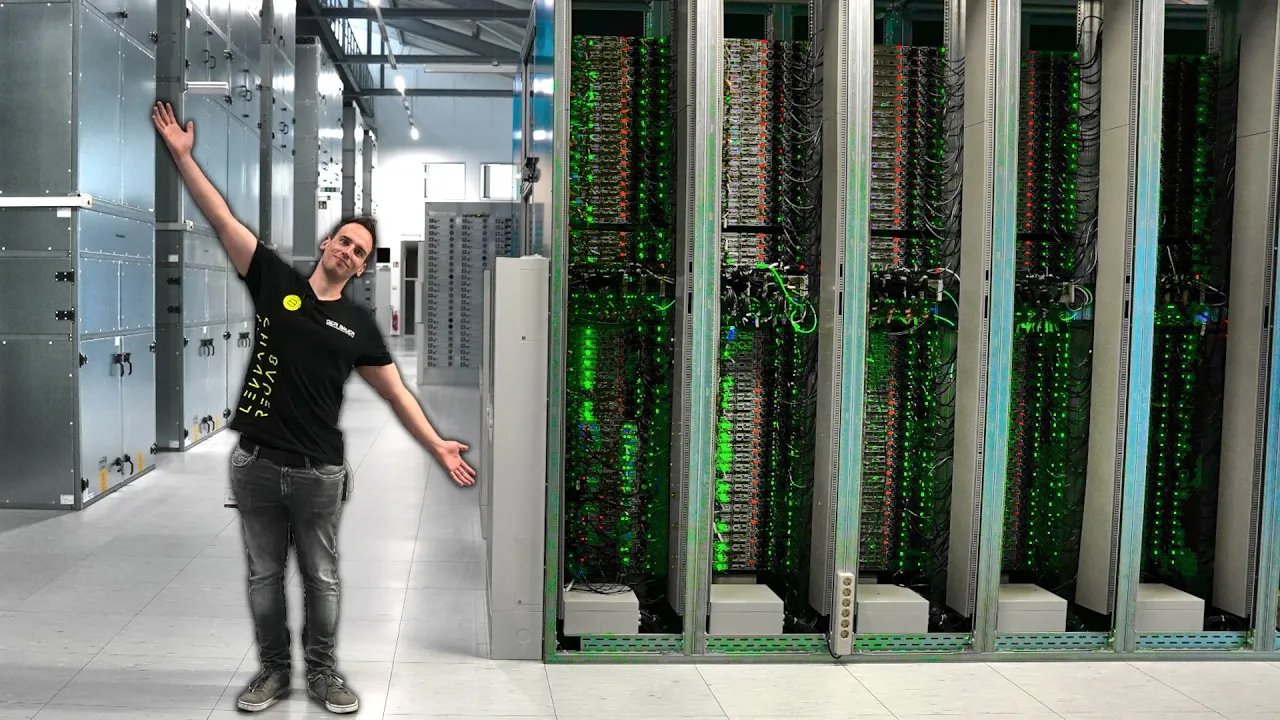
Ascending to the viewing level, the hall initially appears sparser than the crowded legacy room, but Hartung points out that each modern row packs roughly 1,400 servers. Clear acrylic panels seal off the top of the rows to isolate cold intake air supplied through sub-floor floor grates. The servers do not rely solely on building drafts; they use integrated push, pull, or push-pull internal fan shrouds. A significant portion of this floor hosts AMD EPYC enterprise processors with TDP ratings reaching 280 W per socket. An area marked by hundreds of pulsating green LEDs denotes the cloud server deployment—a zone characterized by exceptionally high power density, requiring massive dedicated Uninterruptible Power Supply (UPS) backup infrastructure. Crucially, none of these machines adhere to conventional 19-inch rack standards; Hetzner designs and fabricates its server chassis, racks, and cooling ducts completely in-house to maximize space utilization and operational flexibility.
> “Everything which you can see down there is also not the normal 19-inch rack standard, because they are building their own servers, they're building their own racks, their own cases, their own cooling concept; everything is completely built in-house and developed in-house.” — Roman Hartung
- **Modern row density:** Approximately 1,400 rackmount servers per individual row. - **Enterprise compute:** AMD EPYC platforms dissipating up to 280 W TDP per CPU. - **Aisle containment:** Top-ducted acrylic cold aisle isolation with underfloor intake mesh. - **Infrastructure:** In-house proprietary rack and chassis sheet-metal design rather than commercial off-the-shelf 19-inch standards.
---
[08:31](https://www.youtube.com/watch?v=5eo8nz_niiM&t=511s) Drive Disposal and the Server Assembly Line
Maintaining over a quarter-million servers generates a continuous stream of failed hardware. Hartung stops by a storage area containing pallets of decommissioned mechanical hard drives. Because of strict data privacy requirements, these failed drives cannot merely be discarded or wiped via software; they are collected for mechanical destruction and specialized industrial recycling to guarantee that residual customer data is unrecoverable.
Hartung then transitions into Hetzner's server production and staging facility, where new systems are assembled. Metal shelves and rolling carts are lined with component trays filled with desktop CPUs: Intel Core i9-9900K and Core i7-8700 processors alongside trays of 12-core AMD Ryzen 9 3900 processors destined for Hetzner's AX61 server line. Surrounding the workstation benches are stacks of dense copper server heatsinks, thermal paste, and custom injection-molded or folded plastic air ducts. These ducts, such as models labeled for PX62 line systems running ASUS WS C246 workstations, channel air directly over socket components via high-static-pressure rear pull-fans.
> “I would like to touch things, but I tend to break things, that's why I'm not going to do it.” — Roman Hartung
- **Hardware recycling:** Physical destruction of failed mechanical hard drives before material reclamation. - **CPUs in production:** Trays of Intel Core i7-8700, Core i9-9900K, and AMD Ryzen 9 3900 (used in the Hetzner AX61 server line). - **Cooling methodology:** Passive copper server heatsinks enclosed in dedicated custom fan shrouds (e.g., PX62 shroud for ASUS WS C246 motherboards) operating primarily in a negative-pressure pull configuration.
[09:58](https://www.youtube.com/watch?v=5eo8nz_niiM&t=598s) Custom Motherboards, Minimalist Server Builds, and Single-Fan Cooling
Hetzner deploys custom mainboards built specifically for them by ASUS. Looking at the exact SKU, der8auer spots the Pro WS565-ACE, noting that he had never previously heard of this board or the underlying Pro 565 chipset. The chipset effectively blocks overclocking altogether. As an extreme overclocker, der8auer appreciates the logic behind this restriction in an enterprise environment: Hetzner designs its infrastructure around strict heat dissipation tolerances and cooling profiles. Running a 16-core AMD Ryzen 9 5950X with altered voltages or power levels would dramatically degrade the lifespan of the CPU silicon and VRMs. Hetzner’s priority is ensuring hardware runs reliably over multi-year lifecycles.
Moving to the assembly bench, the server build process mirrors the minimalist hardware philosophy: technicians install only what is strictly necessary. The chassis itself consists of just a few laser-cut, bent sheets of sheet metal manufactured 100% in Germany. The power supply unit is also custom-made with shortened, tailored cable lengths to reduce wasted materials and eliminate unnecessary cable clutter. Aside from these stripped-down elements, assembling the unit resembles putting together a standard consumer desktop PC.
```mermaid flowchart LR accTitle: Server Airflow Architecture accDescr: Directed airflow across server components driven by a single rear exhaust fan.
subgraph Intake ["Chassis Front"] AirIn["Cool Ambient Air Intake"] end
subgraph CoolingPath ["Directed Cooling Channel"] RAM["Memory Sticks"] VRM["VRM Heatsinks"] CPU["CPU Heatsink"] end
subgraph Exhaust ["Rear / Right Side"] Fan["Single High-Static Exhaust Fan"] AirOut["Hot Air Exhaust"] end
AirIn --> RAM AirIn --> VRM AirIn --> CPU RAM --> Fan VRM --> Fan CPU --> Fan Fan --> AirOut ```
The completed server assembly is engineered purely around thermal performance. Unlike a standard consumer tower, the server features a dedicated airflow channel running across the board with an exhaust fan positioned on the rear right. A single exhaust fan draws air through the central CPU heatsink while simultaneously dragging airflow across the side-mounted memory sticks and voltage regulator modules. This directional ducting ensures every heat-critical component stays within thermal limits without requiring multiple fans.
- **Motherboard SKU:** ASUS Pro WS565-ACE, powered by the enterprise AMD Pro 565 chipset. - **CPU Platform:** Configured here with an AMD Ryzen 9 5950X (16 cores, 32 threads). - **Chassis Construction:** 100% made in Germany from basic sheet metal plates. - **PSU Customization:** Shortened, application-specific cable harnesses to simplify management and minimize waste.
---
[12:08](https://www.youtube.com/watch?v=5eo8nz_niiM&t=728s) The Massive Hard Drive Testing Area
Handling tens of thousands of mechanical drives requires an infrastructure to triage customer tickets and hardware anomalies. Hetzner maintains a dedicated HDD testing area to evaluate whether hard drives pulled from service are genuinely defective or still fully functional after a client reports errors. der8auer inspects long test racks containing an immense sea of operational drives undergoing automated diagnostic sweeps.
Above each test bay, status LEDs numbered 1 through 7 communicate drive status via blinking sequences. A slow blink indicates an active diagnostic test is underway; a solid, permanent LED confirms the disk has completed and passed validation; and a rapid, frantic blinking pattern flags a confirmed damaged drive destined for RMA or disposal. Despite the massive scale, der8auer observes that Hetzner’s engineers are constantly attempting to refine the setup. Although the workstation appears meticulously organized to visitors, the staff consider it still somewhat messy, prompting them to 3D-print custom drive brackets that integrate status LEDs directly into the holders for cleaner cable and bay management.
---
[13:32](https://www.youtube.com/watch?v=5eo8nz_niiM&t=812s) The Cold Aisle, Server Racks, and Backup Power Infrastructure
Entering the raised-floor cold aisle viewed earlier from the mezzanine catwalk, der8auer finds himself bordered by roughly 700 servers on the left and 700 on the right. Chilled air is forced up through metallic floor grates, keeping the cold aisle at an ambient temperature of approximately 20 °C. The air passes directly through the server chassis and vents outward into the facility at roughly 28 °C. der8auer reflects on the trust required to film there:
> “And at that point I also want to highlight that's actually a huge honor and I just want to thank Hetzner that we can be here, that they have the trust to put me in here because I'm well known for breaking things and I could just rip apart I don't know things here and damage parts which I obviously don't want to do so yeah, absolutely amazing that they were so open and show everything to us and gave us the opportunity to show everything also to you guys out there.”
Examining the live rack rows reveals several generations of hardware: - **AX101:** The newly assembled workstation-class server built around desktop-grade Ryzen hardware, fitted with side-mounted dual SSDs. - **AX161:** A dedicated enterprise server powered by a single-socket AMD EPYC 7502 processor. - **AX41-NVMe:** The popular entry tier featuring an AMD Ryzen 5 3600 and fast NVMe storage, representing the recent progression from Hetzner’s historic consumer midi-tower deployments toward modular rack blades.
To safeguard against sudden utility grid blackouts, Hetzner relies on dedicated battery rooms filled with individual 2-volt lead-acid cells chained in series. Chaining 120 cells yields 240 V DC, which can be inverted to 230 V AC to match the servers' power supplies. This battery bank holds enough capacity to bridge an entire data center sector for roughly 15 minutes. However, the batteries rarely need to run that long: facility-grade emergency diesel generators spin up within seconds of a detected power interruption, guaranteeing uninterrupted uptime.
---
[16:04](https://www.youtube.com/watch?v=5eo8nz_niiM&t=964s) In-House Fan Endurance and the Hardware Validation Lab
Because each server's thermal survival relies on a single chassis fan, Hetzner subjects its cooling hardware to in-house endurance testing. In a specialized room maintained at a continuous 40 °C—well above typical operating conditions inside the servers—racks of fans run 24/7. Monitoring premature bearing wear and catastrophic motor breakdowns at elevated temperatures allows Hetzner to identify defective batches, replace aging fans proactively before they seize in production, and inform future procurement contracts. Massive industrial ventilation fans beneath the data center sub-floors are responsible for forcing the chilled air volume up through the grates.
der8auer next tours Hetzner's hardware test laboratory, where engineering teams validate new CPU families, motherboard revisions, and memory topologies before wide deployment, as well as test bespoke orders when clients request non-standard configurations in 100-node quantities. Testing stations in the lab include: - Dedicated disk test benches isolating hard drive and SSD write limits. - Thermal validation stations where an infrared thermal imaging camera tracks VRM component temperatures under synthetic stress loads like Prime95. - An ASRock Rack server board utilizing the same locked B550 / Pro 565 platform, but engineered with a 90-degree rotated CPU socket. Rotating the AM4 socket aligns the heatsink fins directly with the horizontal intake-exhaust path, allowing the single fan to cool the heatsink, memory slots, and both banks of VRMs without airflow dead zones. - An environmental thermal chamber equipped with integrated internal heating elements capable of soaking entire operational chassis at 45 °C ambient. While servers throttle under such extreme conditions, the lab tests confirm they will not hard crash if data center air conditioning systems ever suffer a partial failure.
[19:28](https://www.youtube.com/watch?v=5eo8nz_niiM&t=1168s) Component Reliability Testing and PSU Stress Testing with Threadripper
Inside Hetzner's reliability testing area, engineers rigorously validate incoming hardware components to confirm they perform according to manufacturer specifications rather than blindly trusting spec sheets. A prime example is fan testing: the team measures the actual airflow to ensure the advertised air volume matches real-world performance, double-checking whether a fan is truly pushing 50 cubic meters per hour or falling short at something like 25 cubic meters per hour.
```mermaid flowchart TD accTitle: Hetzner Hardware Testing Process accDescr: Workflow showing component validation for fans and power supplies in Hetzner's testing lab.
subgraph LAB["Reliability Testing Lab"] FANS["Fan Airflow Verification<br/>(Validates m³/h against spec)"] PSU["PSU Stress Testing"] end
subgraph RIG["Custom Load Rig"] TR["Overclocked AMD Threadripper<br/>(Water-Cooled)"] LOAD["Sustained 600W–700W Load"] end
PSU --> TR TR --> LOAD ```
Although Hetzner does not deploy water-cooled machines into production server racks, der8auer discovers an unusual liquid-cooled build sitting on a workbench in the lab. The bespoke rig serves a very specific purpose: torture-testing power supply units. der8auer explains the reasoning with a grin: “Because I mean what else would you use than an AMD Threadripper overclocked that can consume a ton of power and in case you want to test if your PSU can handle 600 or 700 watt load then you can just use your AMD Threadripper system.” With that extreme load-testing setup highlighted, der8auer concludes the tour of the Falkenstein facility, wrapping up the multi-part series exploring Hetzner's data center infrastructure.
- **Airflow verification:** Testing stations measure real-world fan throughput to prevent deploying underperforming cooling fans into production chassis. - **PSU validation rig:** An overclocked, liquid-cooled AMD Threadripper system serves as an adjustable, high-draw dynamic load capable of pulling 600 to 700 watts to ensure power supply stability under heavy stress.
## Mentioned Roman Hartung, der8auer, Hetzner, Falkenstein, Saxony, Nuremberg, Helsinki, Finland, AMD, AMD Ryzen, AMD Ryzen 5 3600, AMD Ryzen 9 3900, AMD Ryzen 9 5950X, AMD EPYC, AMD EPYC 7502, AMD Threadripper, Intel, Intel Core i7-920, Intel Core i7-3770, Intel Core i7-8700, Intel Core i9-9900K, ASUS, ASUS WS C246, ASUS Pro WS565-ACE, ASRock Rack, Prime95, TeamSpeak
## Video description More Info about Hetzner: https://derbauer.hetzner.com/en/image-211013/
--------------------------------------------------------- Support me on Patreon: https://www.patreon.com/der8auer
--------------------------------------------------------- Save 10% on your iFixit purchase: DER8AUER10 https://eustore.ifixit.com/der8auer Pro Tech Toolkit: http://bit.ly/2JOFD8f
--------------------------------------------------------- Find my products at Caseking: Delid Die Mate 2: https://bit.ly/2Rhv4y7 Delid Die Mate X: https://bit.ly/2EYLwwG Skylake-X Direct Die Frame: https://bit.ly/2GW6yyC 9th Gen OC Frame: https://bit.ly/2UVSubi Debug-LED: https://bit.ly/2QVUEt0 Pretested CPUs: https://bit.ly/2Aqhf6y
---------------------------------------------------------
My Equipment: USB- Microscope*: https://amzn.to/2Vi4dky My Camera*: https://amzn.to/2BN4h2O (*Affiliate Links: If you buy something, I will get a part of the profit)
---------------------------------------------------------
Music / Credits: -
Outro: Dylan Sitts feat. HDBeenDope - For The Record (Dylan Sitts Remix)
--------------------------------------------------------- Paid content in this video: - /
Samples: - /
[Source](https://www.youtube.com/watch?v=5eo8nz_niiM)