Knuth Verifies Rectangle Paving Conjecture as Stromquist Finds Proof
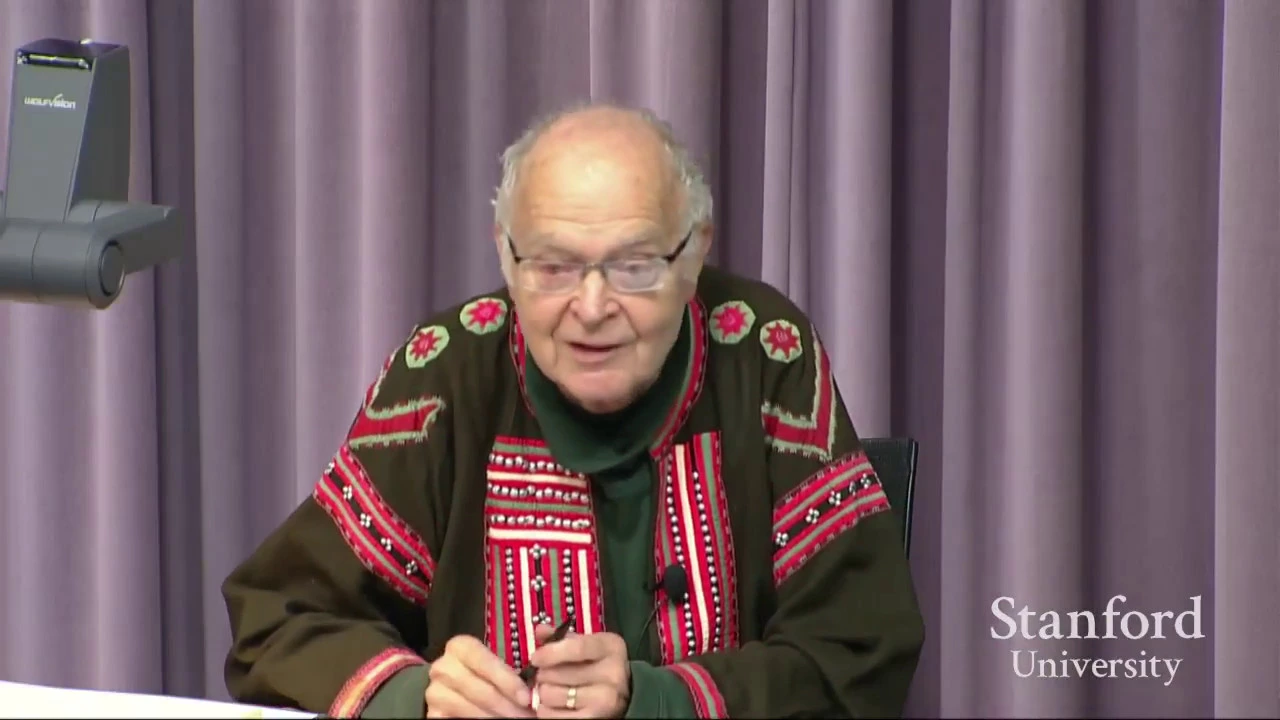
Stanford Online
Empirical calculations on reduced rectangle dissections revealed an asymptotic formula for tight pavings whose surprising algebraic collapse was subsequently confirmed by a rigorous proof from Walter Stromquist.
AI-assisted summary of Stanford Lecture: Don Knuth—"A Conjecture That Had To Be True" (2017) — original source. Check the original for full context.
Source published:
Key ideas
- Donald Knuth investigated 'tight pavings' of rectangles (decompositions into $m + n - 1$ sub-rectangles) and discovered a closed formula for the leading asymptotic growth term: $m^{2m - 3} / ((m - 1)!)^2$. (43:10)
- After Knuth verified the paving conjecture computationally through $m=6$ using six hours of runtime across 4 million types, referee Walter Stromquist developed a complete, rigorous proof. (48:11)
- Knuth cautioned that high-precision numerical alignment does not guarantee truth, citing historical cases where identities agreed up to 11 and 16 decimal places before failing. (51:08)
- In the infinite greedy Queens problem in the first quadrant, coordinates bifurcate into two rays with slopes asymptotically equal to $\phi$ and $1/\phi$, a pattern verified into the hundreds of billions but lacking a formal proof. (55:44)
Detailed notes
## Background Published on YouTube by Stanford Online on December 8, 2017, this video captures Donald Knuth's 23rd Annual Christmas Tree Lecture, titled "A Conjecture That Had To Be True." The lecture description notes that while exploring a combinatorial geometry problem involving rectangular pavings, Knuth uncovered numbers that conformed to an astounding formula—one initially confirmed only in small cases, but carrying an aesthetic inevitability that led to an intriguing mathematical sequel.
## TL;DR In this holiday lecture, Donald Knuth walks through his combinatorial investigation into Mondrian-style rectangular dissections and minimal "tight pavings," where each grid coordinate contains an internal segment. By decomposing configurations into skeletal canonical types and modeling slice extensions via generating functions, he identified an extraordinarily clean formula for the leading coefficient across arbitrary row counts: $m^{2m - 3} / ((m - 1)!)^2$. Knuth details how referee Walter Stromquist subsequently proved this conjecture following massive computational verification, before contrasting it with deceptive high-precision near-misses and other open problems, such as Bill Gosper's gamma-based golden ratio identity and the bifurcating rays of the infinite greedy queens sequence.
## Atmosphere & style The lecture possesses an intimate, joyful holiday charm, blending self-effacing humor with rigorous mathematical storytelling. Knuth speaks with conversational warmth from a seated perch on stage, playfully reflecting on approaching his 80th birthday while guiding the audience through the psychological highs and lows of research. The mood transitions effortlessly between awe at startling algebraic cancellations, cautionary tales of high-precision numerical mirages, and infectious delight in doing pure mathematics solely for love and beauty.
## Bulletin - [43:10](https://www.youtube.com/watch?v=BxQw4CdxLr8&t=2590s) Donald Knuth investigated 'tight pavings' of rectangles (decompositions into $m + n - 1$ sub-rectangles) and discovered a closed formula for the leading asymptotic growth term: $m^{2m - 3} / ((m - 1)!)^2$. - [48:11](https://www.youtube.com/watch?v=BxQw4CdxLr8&t=2891s) After Knuth verified the paving conjecture computationally through $m=6$ using six hours of runtime across 4 million types, referee Walter Stromquist developed a complete, rigorous proof. - [51:08](https://www.youtube.com/watch?v=BxQw4CdxLr8&t=3068s) Knuth cautioned that high-precision numerical alignment does not guarantee truth, citing historical cases where identities agreed up to 11 and 16 decimal places before failing. - [55:44](https://www.youtube.com/watch?v=BxQw4CdxLr8&t=3344s) In the infinite greedy Queens problem in the first quadrant, coordinates bifurcate into two rays with slopes asymptotically equal to $\phi$ and $1/\phi$, a pattern verified into the hundreds of billions but lacking a formal proof.
## Key takeaways - [03:46](https://www.youtube.com/watch?v=BxQw4CdxLr8&t=226s) The research originated in January 2017 while Knuth was developing generalized dancing links algorithms for The Art of Computer Programming and needed a non-trivial combinatorial test problem. - [03:46](https://www.youtube.com/watch?v=BxQw4CdxLr8&t=226s) Elementary combinatorial geometry still contains abundant unexplored problems, challenging the assumption that centuries of research have exhausted simple questions. - [06:06](https://www.youtube.com/watch?v=BxQw4CdxLr8&t=366s) In a reduced decomposition of an $m \times n$ rectangle, the minimum possible number of constituent rectangles is strictly $m + n - 1$, which Knuth terms a 'tight paving'. - [13:59](https://www.youtube.com/watch?v=BxQw4CdxLr8&t=839s) For a $3 \times 5$ rectangle, there are 20,165 total reduced representations, but exactly 1,071 of them satisfy the minimal condition of being tight pavings. - [24:31](https://www.youtube.com/watch?v=BxQw4CdxLr8&t=1471s) Tight pavings enforce strict structural constraints: exactly one horizontal or vertical segment occupies each internal coordinate line, and segments touch without crossing in four-corner intersections. - [29:09](https://www.youtube.com/watch?v=BxQw4CdxLr8&t=1749s) Arbitrary tight pavings can be collapsed into a small number of canonical skeletal types, whose expansions across varying widths can be enumerated using products of generating functions of the form $F_k(z) = z / (1 - kz)$. - [43:10](https://www.youtube.com/watch?v=BxQw4CdxLr8&t=2590s) Summing generating functions across canonical types for heights $m=3, 4, 5, 6$ caused complicated denominators to cancel, revealing the clean leading coefficient $m^{2m - 3} / ((m - 1)!)^2$ for the $m^n$ term. - [48:11](https://www.youtube.com/watch?v=BxQw4CdxLr8&t=2891s) Verifying the $m=6$ case required evaluating over 4 million canonical types in Mathematica over six hours, after which referee Walter Stromquist proved the conjecture rigorously. - [51:08](https://www.youtube.com/watch?v=BxQw4CdxLr8&t=3068s) Numerical precision can produce deceptive near-identities, such as an integration formula matching $e^{-\gamma}$ to 15 decimal places before diverging due to a discontinuous fourth derivative. - [51:08](https://www.youtube.com/watch?v=BxQw4CdxLr8&t=3068s) Analyses of the binary Euclidean algorithm by Brent and Vallée agreed to 11 decimal places before revealing a genuine tiny oscillation caused by complex periodic components. - [55:44](https://www.youtube.com/watch?v=BxQw4CdxLr8&t=3344s) Bill Gosper proposed an unproven closed-form candidate expressing the golden ratio $\phi$ via gamma functions and radicals, matching $\phi$ to at least 1,000 decimal places. - [55:44](https://www.youtube.com/watch?v=BxQw4CdxLr8&t=3344s) The lexicographically first greedy infinite Queens placement splits into two rays with slopes approaching the golden ratio $\phi$ and $1/\phi$, verified numerically up to hundreds of billions of steps. - [01:03:57](https://www.youtube.com/watch?v=BxQw4CdxLr8&t=3837s) Knuth implemented a cache-friendly literate program for greedy Queens placement that achieves linear time $O(n)$ with minimal memory, avoiding standard $O(n^3)$ brute-force overhead.
## Detailed walkthrough ### [00:04](https://www.youtube.com/watch?v=BxQw4CdxLr8&t=4s) Introduction of Donald Knuth
The event begins with host Stephanie introducing Donald Knuth for his 23rd Annual Christmas Tree Lecture, titled "A Conjecture That Had To Be True." She acknowledges how daunting it is to summarize Knuth’s career in a brief introduction: he is a computer scientist, mathematician, and Professor Emeritus at Stanford University, widely celebrated as the author of *The Art of Computer Programming*. Stephanie notes that this multi-volume opus is still regarded as the first and finest comprehensive treatment of algorithmic analysis, cited by *The New York Times* as the profession’s "defining treatise."
Beyond his writing, Stephanie touches on Knuth’s famous tradition of rewarding eagle-eyed readers: “Don is well known for sending a check for two dollars and 56 cents—one hexadecimal dollar—to anyone who can spot an error in his work, so go for it, I say.” She recites his major honors, including the first ACM Grace Murray Hopper Award, the Turing Award, the National Medal of Science, the IEEE John von Neumann Medal, and the Kyoto Prize. Knuth is also an accomplished musician; his personal website notes that he is always open to a jam session if someone drops him a line. As he approaches his 80th birthday, celebrations are slated for a symposium in northern Sweden, where his multimedia pipe organ composition fifty years in the making, *Fantasia Apocalyptica*, will receive its world premiere.
- **Lecture series**: 23rd Annual Christmas Tree Lecture - **Speaker**: Donald Knuth (Professor Emeritus, Stanford University) - **Signature bounty**: $2.56 (one hexadecimal dollar, or 100 hex cents) per bug discovered - **Upcoming milestones**: 80th birthday celebration in northern Sweden and the world premiere of *Fantasia Apocalyptica*
---
[01:49](https://www.youtube.com/watch?v=BxQw4CdxLr8&t=109s) The Thrill of Research and Conjectures
Taking the stage to applause, Knuth thanks Stephanie and warmly greets the audience of old and new friends. With a laugh, he pulls up a chair: “I'm going to sit now; as you said, I'm almost 80 years old after all.” Turning to the topic, he remarks that the subtitle of his talk could just as easily be "Why is it so much fun to do research?" He reflects on the exhilarating cycle familiar to anyone in mathematics or theoretical computer science, where exploration yields unexpected regularity.
He explains the emotional trajectory of mathematical discovery: an investigator observes an unusual pattern, tests further instances, and watches the pattern hold up without exception. Gradually, disbelief turns into conviction, bringing both excitement and dread. As Knuth summarizes the dilemma: “You say, you know, it can't be false; on the other hand, how on earth are we going to prove it?” He notes that the specific instance he will discuss arose during his work in April of that year (2017).
---
[03:46](https://www.youtube.com/watch?v=BxQw4CdxLr8&t=226s) Mondrian, Dancing Links, and Rectangles into Rectangles
Knuth projects an image of a Piet Mondrian composition, pointing out that Mondrian became famous for canvases formed entirely of straight vertical and horizontal lines—rectangles packed neatly within a larger rectangle—without the complication of curves. While people have combined bricks and paving stones into rectangular arrangements for centuries, Knuth came at the subject from algorithm design. In January 2017, while drafting material on the "dancing links" data structure for *The Art of Computer Programming*, he generalized the technique to handle a broader problem domain and needed a compelling, non-trivial test problem.
```mermaid flowchart TD accTitle: Knuth's Path to Rectangle Paving Research accDescr: Flowchart tracing how generalized dancing links led Knuth to study Mondrian-style rectangle dissections. subgraph Algorithm ["Algorithm Development"] A["January 2017: Generalized Dancing Links"] --> B["Search for an interesting test problem"] end subgraph Problem ["Combinatorial Geometry"] B --> C["Dissecting rectangles into smaller rectangles"] C --> D["Mondrian-style layouts without curves"] end subgraph Discovery ["Mathematical Exploration"] D --> E["Discovered numerous unexamined combinatorial questions"] end ```
Knuth addresses the common misconception that after centuries of work by tens of thousands of active mathematicians, all elementary problems must already be exhausted. He insists that this is entirely untrue: “The answer is that those problems aren't rare at all; they keep coming up several times a year, and this is an example where even in this very basic problem of rectangle into rectangles, there were all kinds of sort of stones not yet turned.”
---
[06:06](https://www.youtube.com/watch?v=BxQw4CdxLr8&t=366s) Reduced Decompositions and the Bounds on Rectangles
As a self-described "integer-oriented person," Knuth strips away Mondrian's colors and geometric scale factors to convert the problem into discrete combinatorial form. He explains that any partition of a rectangle into smaller rectangles can be normalized into what he terms a "reduced representation." In this model, every internal vertical line segment is assigned an integer coordinate from $0$ up to $n$, and every horizontal line is assigned an integer from $0$ up to $m$. To qualify as reduced, every intermediate coordinate line ($1, 2, \dots$) must contain at least one actual dividing line segment, ensuring no coordinate is redundant.
``` Coordinate system for a 3 x 5 reduced decomposition: Horizontal lines: y = 0, 1, 2, 3 Vertical lines: x = 0, 1, 2, 3, 4, 5 ```
Knuth sketches an example of a $3 \times 5$ rectangle on the board, briefly sorting through the line segments with assistance from the audience. He then invites the room to guess how many valid reduced representations exist for a $3 \times 5$ rectangle—the subject of Exercise 340 in his draft text. When an audience member guesses one million, Knuth reveals the exact count: 20,165.
He then examines the extreme values for the number of constituent rectangles in an $m \times n$ reduced layout: - **Maximum rectangles**: For a $3 \times 5$ grid, the maximum is trivially $3 \times 5 = 15$ (chopping the entire canvas into individual $1 \times 1$ unit squares). - **Minimum rectangles**: For a reduced $m \times n$ arrangement, the minimum is $m + n - 1$. For $m = 3$ and $n = 5$, this equals $3 + 5 - 1 = 7$.
Knuth emphasizes that reaching the minimum is subtle: “Now this actually turns out to be a tricky question that I'm not going to take the time to prove, but you can think about it, because there are lots of wrong ways to get the answer, and then there's also a very nice short way, and the answer is $m + n - 1$.” If there were fewer than seven rectangles in a $3 \times 5$ layout, at least one coordinate line would have to be omitted, violating the definition of a reduced representation.
---
[11:30](https://www.youtube.com/watch?v=BxQw4CdxLr8&t=690s) Defining "Tight Pavings" and Formulating the Problem
Because $m + n - 1$ represents a strict lower bound, Knuth defines any reduced decomposition that achieves this minimal number of sub-rectangles as a "tight paving":
$$\text{Number of rectangles in a tight } m \times n \text{ paving} = m + n - 1$$
Curious whether the term had already entered the mathematical literature, Knuth turned to an online search. “Everybody knows that the Internet is a wonderful resource for finding out about any subject, so I looked up 'tight paving' with Google, and here's what it showed me,” he jokes as he displays search results filled with commercial asphalt, road rollers, and heavy-duty stone-paving equipment. “In other words, I knew that nobody else had used 'tight paving' for mathematical discussion, but a lot of people who are actually in the paving business have wonderful machines that will do it tight.”
With the terminology established, Knuth introduces the core combinatorial question: among the 20,165 total reduced dissections of a $3 \times 5$ rectangle, exactly how many are tight? His dancing links implementation was capable of generating every configuration rapidly, but to verify that his software was operating correctly, he needed an independent theoretical way to count them. He invites the audience to venture another round of guesses for the tight subset of the $3 \times 5$ solutions.
### [13:59](https://www.youtube.com/watch?v=BxQw4CdxLr8&t=839s) Exploring Tight Paving Counts Knuth discusses the computational results of his study into "tight" pavings—a specific method of dividing rectangles into smaller rectangles where every internal vertical and horizontal line must be used at least once. After generating 20,000 cases, he notes the distribution: "one of those cases had 15, twenty-two of them had 14, 199 had 13 and so on." When focusing on a specific small case—the 3x5 rectangle—he reveals that there are exactly 1,071 possible tight pavings. He emphasizes that rather than drawing every permutation, he intends to explain the underlying logic that leads to a "conjecture that has to be true."
* Definition of "tight paving": A division of an $M \times N$ rectangle into $M + N - 1$ smaller rectangles, ensuring every vertical and horizontal grid line is utilized at least once.
### [14:46](https://www.youtube.com/watch?v=BxQw4CdxLr8&t=886s) Visualizing Smaller Cases To make the concept of "tight" pavings crystal clear, Knuth begins by demonstrating the 2x2 case. Since $M + N - 1$ for a 2x2 is $2 + 2 - 1 = 3$, he illustrates that there are 4 distinct solutions, which correspond to the rotations of a single basic pattern. He then moves to the 3xN case, noting that he possesses a high-quality notepad from a conference in Poland, which he jokes he wants to emulate for his upcoming birthday party—though he plans to provide "triangle paper" instead, suggesting that "all kind of mathematics has never been invented yet because people haven't been given triangle paper."
He proceeds to sketch the 3x2 case, which requires 4 rectangles to satisfy the condition. He walks the audience through the logic of mirror images and combinations, finding there are 11 distinct ways to perform this division. He admits that his manual sketches often miss cases that the computer later finds, but his empirical data for the 3xN series (for N = 1 to 5) shows a clear progression: 1, 11, 64, 282, and 1,071.
### [19:51](https://www.youtube.com/watch?v=BxQw4CdxLr8&t=1191s) The Online Encyclopedia of Integer Sequences Knuth pauses to praise the "Online Encyclopedia of Integer Sequences" (OEIS) as "the nicest thing since sliced bread for mathematics." He describes it as an essential tool that allows mathematicians to "compute your way into the literature," enabling them to quickly verify if a problem has been studied previously. He urges the audience to support the project through donations, grouping it alongside the Wikipedia and the Internet Archive as a crucial public resource.
Upon entering his 3xN sequence into the OEIS in April 2017, he discovered that no one had previously cataloged these numbers. This encouraged him to pursue the problem further, eventually submitting an entry for the general $M \times N$ case. Within a day, the community had curated his submission, which he cites as evidence of how effectively the platform functions. He soon published a formal problem in the *American Mathematical Monthly*, challenging readers to determine $A(3, N)$ and to find the limit of $A(M, N) / M^N$ as $M$ and $N$ grow.
* Knuth's 3xN sequence: 1, 11, 64, 282, 1,071. * The challenge posed: “Determine $A(3, N)$ as a function of $N$ and show that when you've got three or more that the limit of $A(M, N) / M^N$ exists and compute the limit.”
### [24:31](https://www.youtube.com/watch?v=BxQw4CdxLr8&t=1471s) Identifying the "Tight" Structure As Knuth moves toward a more rigorous explanation, he highlights a critical simplification: in any tight paving, there is exactly one line in every row and one line in every column. Crucially, these lines do not cross; they may touch, similar to the arrangement of Japanese tatami mats, but they never overlap at a single point (the "four corners" problem).
He illustrates this with a 5x15 example containing 19 rectangles. By tracking the horizontal lines, he demonstrates that there are always $M - 1$ intermediate lines in an $M \times N$ grid. He uses these "endpoints" to classify solutions into specific "types." He explains that he re-draws these configurations by focusing purely on the connectivity of these lines, abstracting away the unnecessary geometric details to reveal the underlying topological type of the paving.
```mermaid flowchart LR A["Tight Paving"] --> B["Constraint: No crossovers"] B --> C["Constraint: One line per row/col"] C --> D["Classification by 'Type'"] D --> E["Count total permutations"] accTitle: Structural logic of tight pavings accDescr: A flow chart showing how tight pavings are broken down by their internal line constraints to classify them by type. ```
[29:09](https://www.youtube.com/watch?v=BxQw4CdxLr8&t=1749s) Canonical Types and Vertical Slices
Donald Knuth explains how to tame the combinatorial explosion of tight pavings by classifying them into canonical "types." When examining a paving, one ignores all internal vertical line segments that do not touch the endpoint of any horizontal segment. In this way, multiple pavings collapse into a single skeletal structure. Looking at eleven small candidate patterns on his board, Knuth notes that if a pattern lacks any horizontal lines starting or stopping in the interior, its type simplifies to an empty or minimal skeleton. The key insight is that once a base type is fixed, one can systematically generate every full paving of that type by inserting optional vertical cuts into the open slices between existing endpoints.
```mermaid flowchart TD accTitle: Reduction and Expansion of Tight Pavings accDescr: Flowchart showing how arbitrary pavings reduce to canonical types and expand back via insertion of vertical cuts. subgraph Reduction ["Reduction to Canonical Type"] A["Full Tight Paving"] --> B["Strip vertical lines not matching horizontal endpoints"] B --> C["Canonical Skeletal Type"] end subgraph Expansion ["Expansion to All Widths n"] C --> D["Identify vertical slices between endpoints"] D --> E["Count insertion choices per slice: k options"] E --> F["Form generating function factor: F_k(z) = z / (1 - kz)"] F --> G["Multiply factors to count all pavings of width n"] end ```
To demonstrate this concretely, Knuth sketches a large height-5 paving on a coordinate grid from $0$ to $5$ vertically and $0$ to $6$ horizontally. Slicing the diagram into vertical regions between consecutive coordinates, he determines the number of legal ways to insert additional vertical segments into each slice without crossing any horizontal boundaries: - In the first region, there is only $1$ choice of cut, contributing $1^a$ ways for $a \ge 0$ added lines. - In the second region, a cut can be placed either above or below an existing horizontal divider, offering $2$ choices ($2^b$). - In the third region, there are $4$ choices ($4^c$). - In subsequent regions, the geometry yields $3$ choices ($3^d$), $2$ choices ($2^e$), and $3$ choices ($3^f$).
Because any combination of extra cuts produces a valid tight paving of width $n$, the total number of pavings of width $n$ that reduce to this particular skeletal type equals the sum of $1^a 2^b 4^c 3^d 2^e 3^f$ over all non-negative exponents satisfying $a + b + c + d + e + f = n - 6$. Knuth underscores the significance of this structural reduction: “The point is every tight paving has a type, and the number of types is small, and once I know the type, I can count exactly how many for all n how many have that type.”
[35:45](https://www.youtube.com/watch?v=BxQw4CdxLr8&t=2145s) Generating Functions for Tight Pavings
Knuth turns to the smallest non-trivial height, $m = 3$, to demonstrate how these slice-by-slice insertion choices translate into the language of generating functions. For a width-1 type with height 3, there are 3 possible vertical positions for an extra segment at each step. Thus, expanding to width 2 gives 3 pavings, width 3 gives 9 pavings, width 4 gives 27 pavings, and so on. In a type that has two slices with 3 choices in the first and 2 choices in the second, reaching a total width of 5 requires choosing exponents where $a + b = 3$ (since 2 columns are already occupied by the type itself). This yields terms like $3^3 \cdot 2^0 + 3^2 \cdot 2^1 + 3^1 \cdot 2^2 + 3^0 \cdot 2^3$.
Knuth remarks that evaluating sums of this structure is where generating functions shine: “It's beautiful because the method of generating functions is exactly the solution for this.” He defines the fundamental building block: $$F_k(z) = \frac{z}{1 - kz} = z + kz^2 + k^2 z^3 + k^3 z^4 + \cdots$$ When two slices allow $3$ and $2$ choices respectively, multiplying their series $F_3(z) F_2(z) = \frac{z}{1 - 3z} \cdot \frac{z}{1 - 2z}$ produces a power series whose coefficient of $z^n$ directly yields the number of valid pavings of width $n$. Similarly, a type with slices admitting $1, 2, 4, 3, 2, 3$ choices translates directly into the product $F_1(z) F_2(z) F_4(z) F_3(z) F_2(z) F_3(z)$, with the $n$-th coefficient answering the count for width $n$.
For the 3-row problem, Knuth enumerates all 52 possible canonical types: - Two types of width 2 yield the generating function $F_2(z)^2$. - Two types yield $F_1(z) F_3(z)$. - Four types yield $F_2(z) F_3(z)$. - The remaining types of width 3 and beyond follow analogous product forms.
Feeding these 52 rational expressions into a computer algebra system allowed the software to grind out the exact closed-form solution for 3-row tight pavings.
[43:10](https://www.youtube.com/watch?v=BxQw4CdxLr8&t=2590s) The Leading Coefficient and the General Formula
Knuth reminds the audience that the underlying puzzle was originally published in the October issue of *The American Mathematical Monthly*, which poses an ethical dilemma for a public lecture: “Proposed solutions to the problem should be submitted by February 28, 2018, and so I better not tell you the answer, right?” Not wanting to issue a complete spoiler before the submission deadline, he compromises by providing the leading asymptotic term so audience members can check their own calculations. For $a_{3,n}$ (tight pavings of size $3 \times n$), the exact form contains a dominant term $\frac{1}{4} 3^{n+3} = \frac{27}{4} 3^n$, accompanied by lower-order terms such as $-5 \cdot 2^{n+4}$ that grow strictly like $O(2^n)$.
Having automated the algorithm, Knuth could not resist scaling the calculation up to $m = 4$ rows. For 4 rows, the number of canonical types jumps to 1,464. Among these, exactly 576 types contain a factor of $F_4(z)$ and therefore contribute to the leading $4^n$ growth term in $a_{4,n}$. Summing the contributions of these 576 messy rational fractions led to a startling collapse: every complicated denominator canceled out, leaving the clean leading coefficient $\frac{256}{9} 4^n$.
The sudden simplicity of $\frac{27}{4}$ for $m = 3$ and $\frac{256}{9}$ for $m = 4$ kept Knuth awake: “I didn't go to sleep that night.” He pushed the computer algebra system further: - For $m = 3$: leading coefficient is $\frac{27}{4} = \frac{3^3}{2^2}$. - For $m = 4$: leading coefficient is $\frac{256}{9} = \frac{4^5}{6^2}$. - For $m = 5$: the leading constant for $5^n$ computed to $\frac{78125}{256}$ (evaluating to $5^7 / 24^2$). - For $m = 6$: the constant for $6^n$ reduced to $\frac{17496}{25}$ (evaluating to $6^9 / 120^2$).
Examining these fractions, Knuth recognized an unmistakable pattern governing the leading coefficient of $m^n$ for an arbitrary number of rows $m$: $$\frac{m^{2m - 3}}{\bigl((m - 1)!\bigr)^2}$$ The formula matched every single case he had computed, presenting a conjecture that appeared too elegant not to be universally true.
[48:11](https://www.youtube.com/watch?v=BxQw4CdxLr8&t=2891s) The $M=6$ Verification and Walter Stromquist’s Proof
The conjectured formula had already been verified for $M = 3, 4,$ and $5$, but proving or checking it for larger values required massive computation. For the case $M = 6$, there were more than 4 million valid types to sum over. Donald Knuth ran the calculations for roughly six hours to generate the raw data, which he then fed into Mathematica to grind out all the resulting coefficients. Once again, the numbers matched the conjecture exactly, convincing him that a deep mathematical truth was hiding beneath the surface. He promptly submitted the problem to *The American Mathematical Monthly* to "demand explanation."
```mermaid flowchart TD accTitle: Conjecture Confirmation and Solution Flow accDescr: Diagram showing the progression from Knuth's computational verification to Stromquist's rigorous proof.
subgraph Verification ["Empirical Verification"] A["Small Cases: M = 3, 4, 5"] --> B["Compute M = 6: 4 Million Types (6 Hours)"] B --> C["Mathematica Grinds Coefficients: Perfect Match"] end
subgraph Dissemination ["Submission & Community Search"] C --> D["Submit to American Mathematical Monthly"] D --> E["Consult Richard Stanley & Others (Suggest Spanning Trees)"] end
subgraph Resolution ["Proof Found"] D --> F["Referee Walter Stromquist Discovers Rigorous Proof"] F --> G["Solution Slated for Publication"] end ```
The story found a very happy ending through the refereeing process. The editor was so excited by the problem that he broke the customary anonymity, shared the referee’s name with Knuth, and put them directly in correspondence. The referee was Walter Stromquist, who successfully found a complete, rigorous proof that the formula is indeed correct. Knuth had previously shown the problem to Richard Stanley and several other prominent combinatorialists, none of whom had a ready solution, though they suspected an underlying connection to spanning trees.
Knuth reflected on the conviction he felt when looking at the clean formulas, comparing his intuition to the 19th-century mathematician Thomas Paine Kirkman, famous for Kirkman's schoolgirl problem. Kirkman was an English church pastor and part-time mathematician who discovered Steiner triple systems well ahead of Jakob Steiner. In one paper generalizing these systems, Kirkman put forward formulas he claimed were true without providing a formal proof: “When I looked at what his reasoning was why it was true, it was basically that God wouldn't want the formula to be any more complicated than mine.” Knuth noted that while Kirkman believed his formulas simply had to be true because it was impossible to imagine them being false, Stromquist provided an ironclad mathematical proof that would soon appear in print.
- Computation for $M = 6$ involved over 4,000,000 valid types and took approximately six hours of processing time. - The referee who solved the conjecture was Walter Stromquist, with the solution scheduled for publication the following year. - Thomas Paine Kirkman anticipated Steiner triple systems in the 19th century and often relied on the aesthetic conviction that simpler formulas reflected divine order.
---
[51:08](https://www.youtube.com/watch?v=BxQw4CdxLr8&t=3068s) When High-Precision Conjectures Fail
In mathematical research, unexpected patterns often spark conjectures that are subsequently reinforced by small cases, but Knuth warned that empirical agreement—even to many decimal places—does not guarantee that a conjecture is true. He recalled a memorable episode from the 1970s while analyzing the performance of factoring algorithms. He computed the average size of the second- and third-largest prime factors of a random $n$-bit number to 20 decimal places. The resulting constant felt oddly familiar; browsing the literature, he found an article listing the first five digits of a number identified as $e^{-\gamma}$, where $\gamma$ is Euler's constant.
Assuming $e^{-\gamma}$ was the exact theoretical value, Knuth rushed to test the identity at higher precision. Because powerful local computer algebra systems were not yet common, he dialed into MIT over network lines to run MACSYMA, feeling so jittery that he momentarily forgot the login phone number. After looking up the high-precision expansion of Euler's constant to evaluate $e^{-\gamma}$, he realized that the calculation actually disagreed in the 16th decimal place. Confident that nature could not produce such a near-miss by accident, he spent an entire week hunting for bugs in his numerical integration code:
> “Well, finally it turned out that my program was right, but I had used a formula for numerical integration that's only correct if the fourth derivative of the function you're integrating is continuous, and this particular function work has a discontinuous fourth derivative.”
Another striking example arose during the analysis of the binary Euclidean algorithm for greatest common divisors. Richard Brent and a French mathematician (Brigitte Vallée) produced independent analyses whose computed values matched through 11 decimal places before diverging. This time, the discrepancy was genuine rather than a coding artifact: the underlying complex function possessed a tiny oscillation—a small log-periodic fluctuation around a zero mean—that subtly altered the integral. As Knuth observed, high-precision agreement can go both ways, and numerical alignment alone is never absolute proof.
- Factoring analysis required determining factor proportions to 20 decimal places. - The empirical constant matched $e^{-\gamma}$ until the 16th decimal place due to a discontinuous fourth derivative in the integrand. - Competing analyses of the binary Euclidean algorithm matched to 11 decimal places before revealing true fluctuations caused by complex periodic components.
---
[55:44](https://www.youtube.com/watch?v=BxQw4CdxLr8&t=3344s) Bill Gosper's Identity and the Greedy Infinite Queens Problem
Knuth shared a brand-new conjecture sent to him just the previous month by Bill Gosper, which he suspected would soon be proved true. The identity expresses the golden ratio (denoted $\phi$ or $\tau$) using an intricate combination of radicals and the gamma function:
$$\phi = 2^{2/5} \sqrt{5} \cdot \frac{\Gamma\left(\frac{1}{5}\right)^4}{\Gamma\left(\frac{1}{10}\right)^2 \Gamma\left(\frac{3}{10}\right)^2}$$
Evaluating this expression numerically took only a third of a second and matched $\phi = 1.6180339887\dots$ out to 1,000 decimal places. Knuth remarked that while identities of this flavor often resist proof for years, mathematicians eventually find a way to crack them.
To conclude, Knuth presented an open problem that he suspects is universally true, but for which a finite mathematical proof might never be found. It is an infinite variant of the classical $N$-Queens puzzle, situated in the first quadrant of the Cartesian plane. Known as the "greedy Queens" or lexicographically first infinite Queens problem, queens are placed sequentially in the leftmost available position where they do not attack any previously placed queens. Starting from the lower-left corner, queens occupy positions like $(0,0)$, then step into vacant rows and columns, occasionally filling earlier skipped rows (such as row 6 after row 15 has been reached).
```mermaid flowchart LR accTitle: Infinite Greedy Queens Ray Structure accDescr: Visualizing the bifurcation of greedy queen coordinates along two golden ratio slopes.
Q["Greedy Queen Placements (x, y)"] Q -->|"x > y"| L1["Lower Ray: Slope = 1 / phi"] Q -->|"x < y"| L2["Upper Ray: Slope = phi"] ```
Neil Sloane, the creator of the Online Encyclopedia of Integer Sequences (OEIS), added this sequence to the database and uncovered an astonishing phenomenon: the coordinates of the placed queens split into two distinct branches that align almost perfectly along two straight rays emanating from the origin. For the queens where $x < y$, the line has a slope equal to the golden ratio $\phi$; for those where $x > y$, the slope is its reciprocal, $1/\phi$. Knuth was so captivated by the pattern that he wrote a dedicated literate program to generate millions of queens efficiently.
> “I have a feeling that maybe nobody will ever find a proof—there might not even be a finite proof of the result.”
- Bill Gosper's closed-form candidate for the golden ratio matches $\phi$ to at least 1,000 decimal places. - The infinite greedy Queens placement proceeds lexicographically in the first quadrant of the integer lattice. - The plotted coordinates bifurcate into two rays with slopes asymptotically equal to $\phi \approx 1.618$ and $1/\phi \approx 0.618$. - Knuth authored an open literate program implementing the algorithm, which requires an average of roughly nine steps per queen.
[01:01:15](https://www.youtube.com/watch?v=BxQw4CdxLr8&t=3675s) Large-Scale Verification and the Nature of Mathematical Research
Donald Knuth explains how efficiently the sequence can be evaluated, noting that his algorithm requires only a few memory references per value of $n$. This computational speed makes it possible to push calculations up into the hundreds of billions. Inspecting the data around one billion reveals striking regularity: nearly all values cluster tightly around either $1.61803 \times 10^9$ or $0.61803 \times 10^9$ (corresponding to $\phi \times 10^9$ or $10^9 / \phi$, within small deviations of just one to five). Although strange outlier points appear earlier in the sequence, these stray values seem to vanish completely after roughly $n \approx 4{,}000$, yielding extremely tight empirical bounds. Knuth reflects that establishing a formal proof might resemble the situation with Goldbach’s conjecture: “On the other hand it might be like Goldbach's conjecture we might not ever find a proof of it we just know that that it has to be true because it's overwhelmingly probably true so so that's a technique.”
Turning to recapitulate the lecture's journey, Knuth recalls the problem he first encountered back in April that initially hooked him. Spotting an unexpected pattern filled with powers and factorials, he tested the numbers, concluded that the pattern had to be true, and submitted it to *The American Mathematical Monthly*, where another mathematician subsequently discovered a complete proof. He contrasts those resolved questions with the brand-new, completely open problem he has shared today. Knuth highlights the pure, uncorrupted motivation behind such mathematical pursuits, acknowledging that there is no commercial incentive involved: “It's quite intriguing because you know yeah absolutely no economic payoff whatsoever that's completely you do it just purely for love and beauty and so so that so this it this is the way research goes and and when you do find the proof then you're really happy for a couple of days and of course then the next day you find another problem and and again you have to have to solve that one.”
- The numerical tests extend up to several hundred billion values of $n$. - Near $n = 10^9$, values consistently approximate $\phi \cdot 10^9$ or $10^9 / \phi$, with outliers disappearing around 4,000. - Knuth originally submitted his factorial-and-power pattern to *The American Mathematical Monthly* after verifying it numerically.
[01:03:57](https://www.youtube.com/watch?v=BxQw4CdxLr8&t=3837s) Q&A: Gamma Function Identities and the Unsolved Queens Sequence
In the audience question-and-answer period, Knuth addresses an inquiry regarding the conjecture involving the gamma function. He explains that while the mathematical literature contains a rich collection of gamma function identities—such as reflection formulas like $\Gamma(x)\Gamma(1-x)$ and Gauss or Legendre multiplication/triplication formulas—this particular relation appears to adapt those tools in novel ways with additional structural components. Although the author who posted it has not yet solved it completely, Knuth remains optimistic about a resolution because of the vast, well-developed mathematical machinery available for functions of this type.
In sharp contrast, Knuth considers the queens sequence problem far more elusive. Mathematicians do not even know whether every integer eventually appears in the sequence, as there remains a possibility that certain coordinates are permanently ruled out. Neil Sloane believed he had constructed a proof, but the argument collapsed once he tried writing it up. Knuth explains that the behavior feels quasi-random, driven by the heuristic likelihood that an available queen will land on one of the designated diagonal or coordinate lines. He points out that an ordinary brute-force approach would require roughly $O(n^3)$ time, whereas he designed a highly cache-friendly algorithm that operates in strictly linear time with a remarkably tiny constant factor and memory directly proportional to $n$. With no further questions from the floor, Knuth wishes the audience a “Merry Christmas,” concluding his 23rd Annual Christmas Tree Lecture to warm applause.
- Knuth believes the gamma function conjecture will be resolved because analytic machinery for such identities is well established. - Neil Sloane previously believed he had proved that all coordinates appear in the queens problem sequence, but the proof fell apart during write-up. - Knuth's algorithm runs in cache-friendly $O(n)$ time with linear space and very few operations per step, avoiding the $O(n^3)$ cost of a brute-force approach.
## Mentioned Donald Knuth, Stephanie, Piet Mondrian, Walter Stromquist, Richard Stanley, Thomas Paine Kirkman, Euler's constant, Richard Brent, Brigitte Vallée, Bill Gosper, Neil Sloane, Jakob Steiner, The Art of Computer Programming, Fantasia Apocalyptica, TeX, METAFONT, Computer Modern, Online Encyclopedia of Integer Sequences (OEIS), American Mathematical Monthly, MACSYMA, Stanford University, Wikipedia, Internet Archive
## Video description Donald Knuth's 23rd Annual Christmas Tree Lecture: A Conjecture That Had To Be True Speaker: Donald Knuth 2017
A few months ago, the speaker did some extensive calculations relating to a curious problem in combinatorial geometry; and the resulting numbers satisfied an amazing formula. Although this formula was known to be true only in the five or six smallest cases of the problem, it was impossible to imagine a decent world in which the formula would not hold universally. View the lecture and learn about the interesting sequel.
About the Speaker: Donald Ervin Knuth is an American computer scientist, mathematician, and Professor Emeritus at Stanford University.
He is the author of the multi-volume work The Art of Computer Programming and has been called the "father" of the analysis of algorithms. He contributed to the development of the rigorous analysis of the computational complexity of algorithms and systematized formal mathematical techniques for it. In the process he also popularized the asymptotic notation. In addition to fundamental contributions in several branches of theoretical computer science, Knuth is the creator of the TeX computer typesetting system, the related METAFONT font definition language and rendering system, and the Computer Modern family of typefaces.
[Source](https://www.youtube.com/watch?v=BxQw4CdxLr8)