The Roots of Your Profits - Dr Elaine Ingham, Soil Microbiologist, Founder of Soil Foodweb Inc
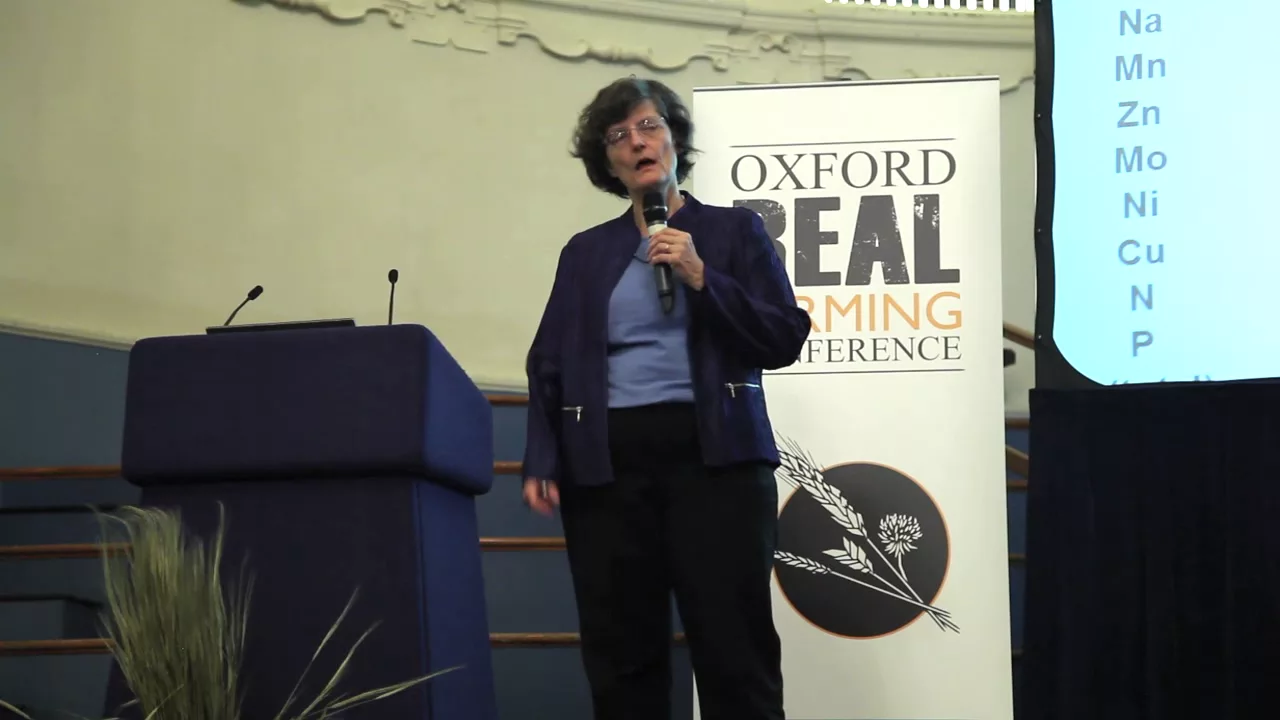
The Roots of Your Profits - Dr Elaine Ingham, Soil Microbiologist, Founder of Soil Foodweb Inc — Oxford Real Farming Conference

Oxford Real Farming Conference

AI-assisted summary of The Roots of Your Profits - Dr Elaine Ingham, Soil Microbiologist, Founder of Soil Foodweb Inc — original source. Check the original for full context.

Source published:

Key ideas

  • True soil requires living organisms, organic matter, and parent minerals; without active biology, substrate degrades into inert 'dirt' where roughly 80% of applied synthetic fertilizer leaches away or volatilizes. (4:00)
  • Global geological and soil analyses indicate that parent mineral pools in sand, silt, clay, and bedrock contain centuries of plant nutrients, disproving the concept of systemic nutrient depletion. (32:33)
  • Active soil biology and balanced fungal-to-bacterial ratios can boost pasture grass protein from 5–6% to 26% and eliminate the necessity of synthetic pesticides, fungicides, and routine crop rotations. (24:23)
  • Mechanical tillage creates hardpan compaction layers that induce anaerobic conditions, cause toxic root rot, and reset ecological succession back to primitive, weed-dominated bacterial states. (78:26)

Detailed notes

## Background Published on YouTube by the Oxford Real Farming Conference on January 25, 2015, this recorded presentation features soil microbiologist and Soil Foodweb Inc. founder Dr. Elaine Ingham detailing the microbiological principles behind farm profitability. The video description provides a direct link for viewers to access Dr. Ingham's accompanying slide presentation.

## TL;DR Dr. Elaine Ingham explains how cultivating a balanced soil food web—comprising bacteria, fungi, protozoa, and beneficial nematodes—transforms inert dirt into self-sustaining, fertile soil. She dismantles conventional agronomic reliance on synthetic N-P-K fertilizers, mechanical tillage, and rigid pH targets, showing that active soil biology naturally solubilizes infinite mineral reserves and protects root zones from disease. By matching fungal-to-bacterial ratios to plant successional stages and monitoring biology with simple on-farm microscopy, growers can eliminate expensive chemical inputs, halt erosion, and restore subsoil drainage. High-quality thermal compost inoculants allow farms to remediate severe compaction layers and produce nutrient-dense crops and pastures with vastly reduced overhead.

## Atmosphere & style Dr. Ingham delivers an assertive, high-energy lecture that balances rigorous biological science with witty, combative critiques of agribusiness dogma and chemical agriculture. Her tone is colloquial, passionate, and pragmatic, employing vivid analogies like micro-scale 'castle walls' and root 'coffins' to render complex ecological dynamics instantly understandable. The presentation feels like an empowering awakening for growers, combining technical microscopy insights with an urgent, inspiring call to restore soil life and slash production costs.

## Bulletin - [04:00](https://www.youtube.com/watch?v=x2H60ritjag&t=240s) True soil requires living organisms, organic matter, and parent minerals; without active biology, substrate degrades into inert 'dirt' where roughly 80% of applied synthetic fertilizer leaches away or volatilizes. - [32:33](https://www.youtube.com/watch?v=x2H60ritjag&t=1953s) Global geological and soil analyses indicate that parent mineral pools in sand, silt, clay, and bedrock contain centuries of plant nutrients, disproving the concept of systemic nutrient depletion. - [24:23](https://www.youtube.com/watch?v=x2H60ritjag&t=1463s) Active soil biology and balanced fungal-to-bacterial ratios can boost pasture grass protein from 5–6% to 26% and eliminate the necessity of synthetic pesticides, fungicides, and routine crop rotations. - [01:18:26](https://www.youtube.com/watch?v=x2H60ritjag&t=4706s) Mechanical tillage creates hardpan compaction layers that induce anaerobic conditions, cause toxic root rot, and reset ecological succession back to primitive, weed-dominated bacterial states.

## Key takeaways - [04:00](https://www.youtube.com/watch?v=x2H60ritjag&t=240s) Living organisms, parent mineral material, and organic matter form the three non-negotiable pillars of functional soil according to soil genesis pioneer Hans Jenny. - [08:42](https://www.youtube.com/watch?v=x2H60ritjag&t=522s) Plants invest over 50% of photosynthetically fixed carbon into exudates to deliberately feed and cultivate targeted bacterial and fungal communities in the rhizosphere. - [12:23](https://www.youtube.com/watch?v=x2H60ritjag&t=743s) Microbial biomass forms a protective biological barrier around roots, shielding plants from pathogens and eliminating the need for chemical pesticides. - [21:12](https://www.youtube.com/watch?v=x2H60ritjag&t=1272s) Nutrient cycling occurs when bacterial and fungal biomass is consumed by predatory protozoa, nematodes, and microarthropods, releasing nutrients in plant-available ionic forms. - [36:35](https://www.youtube.com/watch?v=x2H60ritjag&t=2195s) The belief that soils naturally exhaust their mineral reserves is unfounded; microbes continuously mine an essentially infinite pool of nutrients from bedrock, sand, silt, and clay crystalline lattices. - [40:33](https://www.youtube.com/watch?v=x2H60ritjag&t=2433s) Bulk soil chemistry tests measure only soluble nutrient fractions and miss the total mineral pool, creating an artificial reliance on synthetic fertilizers. - [48:54](https://www.youtube.com/watch?v=x2H60ritjag&t=2934s) Plants do not require a static bulk soil pH of 6.5; living rhizosphere communities dynamically adjust localized pH on a micrometer scale to solubilize specific minerals on demand. - [52:43](https://www.youtube.com/watch?v=x2H60ritjag&t=3163s) Direct on-farm assessment of soil and compost biology can be conducted quickly and affordably using standard compound shadow-caster microscopy. - [01:01:02](https://www.youtube.com/watch?v=x2H60ritjag&t=3662s) Ecological succession is governed by the fungal-to-bacterial biomass ratio, with highly bacterial soils favoring weeds and fungal-dominated soils supporting advanced perennials and forests. - [01:16:22](https://www.youtube.com/watch?v=x2H60ritjag&t=4582s) Inversion tillage and chemical disturbances sever root-microbe communication, destroy fungal hyphae, and reset soils to early bacterial successional stages prone to weed infestations. - [01:18:26](https://www.youtube.com/watch?v=x2H60ritjag&t=4706s) Subsoil compaction creates perched anaerobic zones that produce toxic reduced gases, effectively trapping crop root systems in an inhospitable shallow zone. - [01:24:36](https://www.youtube.com/watch?v=x2H60ritjag&t=5076s) Restoring aerobic biological activity allows plant root systems to penetrate deep into subsoil layers, tapping deep water reserves and overcoming drought stress without supplemental irrigation. - [01:24:36](https://www.youtube.com/watch?v=x2H60ritjag&t=5076s) Heavy clay soils can be structurally transformed into well-drained, porous, loam-like media within weeks through proper biological and organic inoculations. - [01:34:07](https://www.youtube.com/watch?v=x2H60ritjag&t=5647s) Traditional crop rotation becomes biologically unnecessary when diverse, beneficial microbial communities actively defend root surfaces and continuously solubilize nutrients.

## Detailed walkthrough ### [00:02](https://www.youtube.com/watch?v=x2H60ritjag&t=2s) Bridging Academia and Practical Agriculture

Dr. Elaine Ingham opens by expressing how honored she feels to address the Oxford Real Farming Conference, noting that this audience represents the exact bridge needed between the academic ivory tower and real-world agriculture. In academia, researchers often confine themselves to replicated scientific trials that fail to give growers what they actually need on the ground. She stresses that growers must understand how to translate academic principles into direct practices that lower input costs, solve fertility deficiencies, suppress pests and diseases, and keep moisture and nutrients locked on the farm.

Losing nutrients or water downstream not only harms neighboring watersheds, but it also imposes a direct financial penalty on farmers who are forced to purchase synthetic replacements. She emphasizes that her core mission is teaching farmers how the soil food web functions so they can apply these universal principles anywhere on Earth. Reflecting on the impact of her career, Dr. Ingham remarks:

> “And I suspect I will be shocking a number of people as I relate the discoveries that we've made over the last 45 years that I've been working out there in the real world.”

[02:00](https://www.youtube.com/watch?v=x2H60ritjag&t=120s) Academic Roots and the Break with Chemical Agriculture

Dr. Ingham jokes about having the full “academic alphabet soup” after her name—undergraduate, Master’s, PhD, and postdoctoral training. She founded Soil Foodweb Inc. as an independent commercial venture after running directly into institutional resistance at Oregon State University, which she characterizes as having an unyielding allegiance to agrochemical corporate interests. Regarding that conflict, she states:

> “I am currently the president of Soil Foodweb, a company I started after I ran smack into my university’s, Oregon State University's absolute dedication to Monsanto.”

Traces of her Minnesota upbringing and Scandinavian heritage still linger in her accent, though she left the state’s twelve-foot snow drifts behind for graduate school at Texas A&M University, where she studied marine microbiology. She then transitioned into terrestrial soil ecology during her postdoc at Colorado State University. There, her research centered on deciphering why distinct ecosystems across the globe maintain entirely unique communities of bacteria and fungi, and debunking the persistent myth in conventional circles that fungi serve only as disease-causing pathogens.

- **Email Contact:** Dr. Ingham notes she receives roughly 300 emails per day at `soilfoodweb@aol.com`, advising anyone whose message gets buried to send it again. - **Ecological Diversity:** Bacterial and fungal community compositions naturally vary across ecosystems, tailor-made to support native plant systems.

[04:00](https://www.youtube.com/watch?v=x2H60ritjag&t=240s) Defining Soil Versus Dirt

Addressing the functional groups in the rhizosphere, Dr. Ingham explains that organisms like protozoa and nematodes are indispensable to plant nutrition. Growers cannot raise healthy crops without protozoa, and the presence of root-feeding pest nematodes is simply nature's diagnostic indicator that the biological balance has collapsed. When beneficial life is absent, growers are left dealing with what she terms the derogatory "four-letter D-word" of agronomy: dirt. Emphasizing this contrast, Dr. Ingham explains:

> “If you don't have the proper biology you're not dealing with soil, you're dealing with dirt and you can't possibly grow the plants that you want to grow if you're dealing with dirt.”

True soil requires three interconnected pillars: 1. **Parent Mineral Material:** Sand, silt, clay, rocks, and pebbles. 2. **Organic Matter:** Decaying biological residues that provide shelter and substrate. 3. **Living Organisms:** Active communities of bacteria, fungi, protozoa, nematodes, and microarthropods.

Referencing the foundational work of Hans Jenny—the father of modern pedology—Dr. Ingham notes that if any of these biological elements are missing, the material ceases to be functional soil and reverts to inert dirt.

```mermaid flowchart TD accTitle: The Composition of True Soil accDescr: Diagram illustrating the three components that define living soil according to Hans Jenny, contrasted with inert dirt.

subgraph TrueSoil["Living Soil"] A["Parent Material<br>(Sand, Silt, Clay, Rocks)"] B["Organic Matter<br>(Carbon Substrate)"] C["Living Organisms<br>(Bacteria, Fungi, Protozoa, Nematodes)"] A --- B --- C end

subgraph DegradedState["Degraded State"] D["Parent Material Only"] --> E["Inert Dirt<br>(Requires High Inputs)"] end ```

[06:00](https://www.youtube.com/watch?v=x2H60ritjag&t=360s) Chemical Inputs, Tillage, and the Green Revolution

Microorganisms have the same foundational metabolic requirements as human beings: they require constant feeding, protection, and balanced environments. Dr. Ingham humorously encourages the audience to visualize themselves as gigantic rod-shaped bacteria to understand this relationship. Physical disturbance like tillage literally slices and dices fungal hyphae and pulverizes soil aggregates, while synthetic inorganic fertilizers and chemical pesticides inflict widespread biological devastation.

Pesticide applications do not select purely for pests; they wipe out beneficial predators and mutualists alongside pathogens. Because opportunistic pests and disease-causing species reproduce significantly faster than the beneficial organisms that regulate them, chemical sterilization creates an empty niche that guarantees aggressive pest resurgence. Reviewing agricultural history, Dr. Ingham asserts:

> “The only reason the Green Revolution worked is because we had already destroyed this biology in our soil and turned our soil into dirt.”

To permanently restore profitability and ecological function, growers must cease treating living soil like dead dirt and systematically re-inoculate the biology through targeted composts and biological management.

[08:42](https://www.youtube.com/watch?v=x2H60ritjag&t=522s) Exudates: How Plants Bake Cakes and Cookies

Dr. Ingham gives special thanks to John Meadley for his tireless logistical effort in arranging her travel and speaking schedule for the conference. Transitioning to how plants actively interact with the soil food web, she highlights that prior to 1986, mainstream science possessed virtually no comprehension of the mutualistic relationships between plant roots and soil microbiology.

After a brief struggle with a missing laser pointer, Dr. Ingham breaks down the flow of photosynthetic energy below ground. Over 50% of the total energy and carbon fixed by a healthy plant through photosynthesis is translocated straight down into the root system and released directly into the surrounding soil. Plant roots do not leak these compounds by accident; they purposefully release root "exudates" to cultivate specific microorganisms. Demystifying the scientific jargon, she asks:

> “Your plant is putting out exudates into that soil food to feed the organisms—isn't that a wonderful scientific term, exudates, what does that mean?”

She breaks down the chemical composition of an exudate into everyday kitchen terms: - **Sugars:** The primary ingredient (analogous to white sugar, brown sugar, honey, molasses, or syrup). - **Proteins:** A secondary component (analogous to milk, eggs, or cheese). - **Carbohydrates:** The structural binder (analogous to kitchen flour).

When combined, a mixture of high sugars, moderate proteins, and carbohydrates is simply a recipe for cakes and cookies. Plants deliberately pump vast quantities of these sweet treats into the rhizosphere to attract, feed, and cultivate specific guilds of bacteria and fungi right against the root surface.

```mermaid flowchart LR accTitle: Photosynthesis to Microbial Exudate Flow accDescr: Flowchart tracking sunlight captured by plants and converted into root exudates that feed soil bacteria and fungi.

subgraph AboveGround["Above Ground"] Sun["Sunlight"] --> Photosyn["Photosynthesis"] Photosyn --> Sugars["Carbon & Sugars"] end

subgraph BelowGround["Below Ground (Rhizosphere)"] Sugars -->|"Over 50% Translocated"| Roots["Root System"] Roots -->|"Pumped Out"| Exudates["Exudates<br>('Cakes & Cookies')"] Exudates --> FoodFor["Nutrient Source"] FoodFor --> Microbes["Bacteria & Fungi"] end ```

[12:23](https://www.youtube.com/watch?v=x2H60ritjag&t=743s) Root Exudates, Castle Walls, and Compost as Inoculum

Dr. Elaine Ingham explains the symbiotic mechanism unfolding at the plant's roots: root exudates release into the soil specifically to feed bacteria and fungi, creating the highest concentration and species diversity of these microorganisms directly in the rhizosphere. Plants have evolved over millennia to nourish strictly beneficial organisms, because feeding pathogens would result in rapid death without seed production. Ingham paints a vivid metaphor of this protective boundary, asserting: “Most of the bacteria and fungi around those root systems, they're building castle walls to protect your roots against diseases and pests and problem organisms.” These biological barriers hide the roots so effectively that pests and pathogens do not even detect their presence, making expensive chemical pesticides completely obsolete.

```mermaid flowchart TD accTitle: The Rhizosphere Protective Barrier and Nutrient Cycling accDescr: Diagram illustrating how root exudates nourish microbes that form aggregates and release plant-available nutrients upon predation.

subgraph Defense ["Rhizosphere Defense"] A["Plant Roots"] -->|"Release Exudates"| B["Aerobic Bacteria & Fungi"] B -->|"Form 'Castle Walls'"| C["Disease & Pest Suppression"] end

subgraph Structure ["Soil Aggregation"] B -->|"Bacterial Glues"| D["Microaggregates"] B -->|"Fungal Hyphae"| E["Macroaggregates"] D & E --> F["Aerobic Porosity & Deep Water Infiltration"] end

subgraph Cycling ["Nutrient Cycling"] B -->|"Immobilize Nutrients in Biomass"| G["Microbial Biomass"] H["Protozoa & Nematodes"] -->|"Graze on Biomass"| G H -->|"Excrete Plant-Available Ions"| A end ```

To reintroduce this indigenous microbial diversity, growers must make their own thermal compost. Rather than viewing compost as a standard fertilizer and calculating arbitrary quantities of nitrogen, phosphorus, or sulfur, Ingham insists it must be understood purely as a living biological starter culture. Properly managed organic matter can transform in just 21 days into a rich inoculum teeming with beneficial bacteria, fungi, protozoa, and nematodes. When applied correctly, a single compost application is often sufficient to establish self-sustaining populations. Ingham notes that if crop detritus remains lingering on the field surface months after harvest rather than decomposing within thirty days, the soil lacks the basic biology required to cycle organic matter, structure soil, and protect yields.

- **Compost turnaround time:** 21 days for a properly managed thermal compost pile to create the full spectrum inoculum. - **Decomposition benchmark:** Healthy soil biology should fully decompose post-harvest crop residues within one month of hitting the soil surface. - **Key perspective:** Compost is not a bulk fertilizer applied for N-P-K numbers; it is a living biological inoculum that should only need to be introduced once if properly maintained.

---

[16:07](https://www.youtube.com/watch?v=x2H60ritjag&t=967s) Aerobic Soil Structure vs. Anaerobic Degradation and Runoff

Addressing soil conditions, Ingham stresses that healthy soil biology must remain strictly aerobic. Anaerobic conditions cause soil pH to plunge below 5.5 and trigger the proliferation of root-rot diseases. Under anaerobic compaction, essential soluble inorganic nutrients like nitrogen, phosphorus, and sulfur are volatilized into greenhouse gases and lost entirely to the atmosphere. In contrast, aerobic bacteria generate natural organic glues that bind tiny soil particles into microaggregates, creating protected micro-habitats that absorb and retain soluble inorganic ions before they can leach into surface waters.

Ingham points out the environmental and economic absurdity of synthetic fertilizers, stating that roughly 80% of applied inorganic fertilizer washes away downstream because dead, degraded soils lack the biology to bind it. Fungi then bridge the microaggregates together into macroaggregates using long hyphal strands. A grower can physically see these fungal hallways and passageways simply by grabbing a handful of aerated soil and giving it a gentle shake. Unimpeded by compaction zones, this biogenic structure permits water to infiltrate deep into the earth—up to 16 miles down into deep bedrock aquifers in uncompacted geologic profiles—preventing catastrophic surface puddling, runoff, and erosion.

> “Erosion is only a consequence of the damage that we've done to the life in the soil.” — Dr. Elaine Ingham

- **Anaerobic pH threshold:** Anaerobic conditions cause soil pH to drop below 5.5, whereas aerobic environments maintain soil pH above that damaging threshold. - **Nutrient volatilization:** Under anaerobic conditions, soluble plant-available forms of nitrogen, phosphorus, and sulfur convert into gases and leave the soil system. - **Synthetic fertilizer waste:** Approximately 80% of inorganic synthetic fertilizer leaches or washes off downstream due to the absence of soil biological glues. - **Theoretical infiltration depth:** Well-aggregated, undisturbed soil allows water to infiltrate as deep as structural continuity persists—theoretically up to 16 miles.

---

[21:12](https://www.youtube.com/watch?v=x2H60ritjag&t=1272s) Predation, Nutrient Cycling, and Direct Biological Assessment

While bacteria and fungi excel at building structure and sequestering nutrients within their living biomass, they introduce a temporary bottleneck: those nutrients remain immobilized and entirely unavailable to the plant. If soil contains only bacteria and fungi, plants will eventually starve. Mother Nature resolves this through trophic predation. Protozoa graze on bacteria, while fungal-feeding nematodes and microarthropods consume fungi. Because these predators maintain a much lower internal concentration requirement for elements like nitrogen, phosphorus, potassium, calcium, magnesium, and trace minerals than their prey, the excess nutrients are excreted in plant-available ionic forms directly adjacent to the root zone.

Ingham mocks the conventional agronomic habit of trying to calculate synthetic nitrate applications with chemical formulas, calling it “kind of esoteric and alchemic” compared to the elegant, self-regulating biological loop of root exudates, bacterial growth, and protozoan predation. To monitor this biological system directly without relying on slow and expensive commercial chemistry laboratories, Ingham urges farmers to acquire a standard compound microscope equipped with a digital camera for roughly $350. By taking a 24-hour online training course, growers can immediately evaluate their own soil and compost quality on-farm, ensuring the entire food web is actively feeding their crops.

> “When a protozoan eats any bacterial species, it releases nitrogen, phosphorus, sulfur, magnesium, potassium, sodium, iron, zinc, boron—everything you want to talk about in the proper balances for your plant is going to be released.” — Dr. Elaine Ingham

- **On-farm tool cost:** A functional shadow-caster microscope with a digital camera attachment can be obtained for roughly $350. - **Assessment training:** Farmers can master basic microbial assessment of compost, compost teas, and soils via an online course completed within 24 hours. - **Primary predator-prey relationships:** Protozoa prey on bacteria, while fungal-feeding nematodes and fungal-feeding microarthropods consume fungal hyphae to mineralize immobilized nutrients.

[24:23](https://www.youtube.com/watch?v=x2H60ritjag&t=1463s) Nutrient Cycling, Plant Protein, and Food as Medicine

When bacteria and fungi lock nutrients into their biomass right on the root surface, the plant does not have to expend energy searching for fertility. As protozoa, nematodes, and microarthropods consume those microbes, they release plant-available nutrients in perfect balance every second of every day. Dr. Elaine Ingham highlights the dramatic impact this natural cycling has on nutritional density: typical pasture grasses grown in depleted soils hover around only 5% to 6% protein, but restoring proper soil biology boosts that protein content to 25% or 26%. She asks the audience to consider what that does for livestock and dairy production: healthier cattle, higher milk yields, and superior milk quality.

```mermaid flowchart LR accTitle: The Soil Food Web Nutrient Cycling Loop accDescr: Microbes store minerals, micro-predators graze on them and excrete plant-available nutrients right at the root zone. subgraph Storage["Microbial Immobilization"] B["Bacteria & Fungi<br/>(Immobilize nutrients)"] end subgraph Grazing["Predation & Release"] P["Protozoa, Nematodes & Microarthropods<br/>(Graze on microbes)"] end subgraph Delivery["Plant Nutrition"] R["Root Zone<br/>(Instant nutrient uptake)"] end

B -->|"Consumed by"| P P -->|"Release waste nutrients"| R R -->|"Exudates feed"| B ```

This biological nutrition transfers directly up the chain to human health. Dr. Ingham expresses frustration over the modern reliance on synthetic dietary supplements rather than real food, arguing that proper farming directly solves human nutritional deficits.

> “Food is medicine and you need to be getting the nutrients that you require in the food that you eat.”

- Pasture grass protein rises from 5–6% up to 25–26% when healthy soil biology is established. - True nutrient density eliminates the perceived need for manufactured vitamin pills. - Delivering balanced nutrition continuously at the rhizosphere produces higher-quality animal forage, beef, and dairy.

---

[26:07](https://www.youtube.com/watch?v=x2H60ritjag&t=1567s) Trophic Cascades and the Role of Humans as Planetary Gardeners

A balanced system requires predators at every trophic level to prevent runaway populations. If bacterial- and fungal-feeding nematodes or protozoa multiply unchecked, they will overconsume the basal bacteria and fungi. Dr. Ingham explains that nature solves this conundrum through higher-level predation: predatory nematodes and macroarthropods consume the smaller grazers, while earthworms, spiders, birds, voles, shrews, and mice keep the larger arthropods in check.

```mermaid flowchart TD accTitle: Soil Food Web Trophic Hierarchy accDescr: Four trophic tiers showing the balance from apex stewards down to basal decomposers. subgraph Top["Apex Stewards & Vertebrates"] H["Humans (Gardeners)"] V["Birds, Shrews, Voles, Mice, Spiders"] end subgraph Middle["Higher Predators"] M["Macroarthropods & Predatory Nematodes"] end subgraph Grazers["Primary Consumers / Grazers"] G["Protozoa, Nematodes & Microarthropods"] end subgraph Base["Basal Biomass"] B["Bacteria & Fungi"] end

H --- V V --> M M --> G G --> B ```

Sitting atop this entire hierarchy are human beings. Dr. Ingham rejects the view of humanity as purely extractive conquerors, framing our ecological purpose as caretakers responsible for maintaining natural trophic interactions. She warns the audience with dry humor that nature does not require our presence to endure.

> “We are the gardeners of this planet—that is our charge as human beings; it's not to extract, it's not to destroy, it's to maintain natural interactions so that we don't destroy our society.”

> “Remember Mother Nature doesn't need human beings, but we need Mother Nature; it's a one-way street.”

> “I mean, after all, think of dinosaurs—they must have annoyed Mother Nature a lot, and look at what happened.”

- Trophic balance relies on predatory nematodes and macroarthropods eating primary bacterial and fungal grazers. - Vertebrates (birds, rodents) and invertebrates (spiders, earthworms) regulate intermediate predators. - A functional soil food web makes farming effortless and cheap: the farmer only needs to sow seeds in spring and harvest the yield in autumn, free of pest and disease pressure. - Weeds, disease outbreaks, and manual pest-squishing are direct warning signals from nature indicating broken soil biology.

---

[29:12](https://www.youtube.com/watch?v=x2H60ritjag&t=1752s) Clinical Soil Diagnostics, Slopes, and Root Response Time

Restoring the proper biological balance eliminates the need for synthetic pesticides. While Dr. Ingham's Soil Foodweb Inc. operates diagnostic laboratories across the globe to identify specific soil ailments—such as weeds, compaction, surface puddling, or fertility deficits—she urges growers to become self-reliant. A farmer can master basic compound microscopy in a single day to assay their own soil, spot missing functional groups, and take corrective action immediately.

She highlights the immediate engineering benefits of active soil microbiology, particularly in erosion control. On dangerous slopes exceeding 50% grade where topsoil is actively slipping, applying the correct microbial community halts soil movement within 24 hours. The fungi and bacteria aggregate particles and bind the bank long enough for root systems to anchor it permanently.

```mermaid flowchart LR accTitle: Root Exudate Feedback Loop Speed accDescr: The rapid cycle between root exudation and microbial nutrient delivery documented at Duke Phytotron. E["Root releases exudates"] -->|"Stimulates bacteria & fungi"| M["Microbial activity spikes"] M -->|"Predators consume biomass"| N["Nutrients released at root surface"] N -->|"3-second turnaround"| E ```

Dr. Ingham notes that root nutrient delivery is an active, near-instantaneous circuit driven by the plant itself. Research conducted at the Duke Phytotron in the United States demonstrated that once a plant root releases exudates to stimulate bacteria and fungi, protozoan and nematode predation returns plant-available nutrients back to the root surface within approximately three seconds.

> “Work at the Duke Phytotron in the United States shows that it takes about three seconds—immediate response time if you have the biology in your soil.”

Dr. Ingham strongly criticizes conventional management techniques—such as heavy tillage, chemical inputs, and systemic pesticides—that slice, crush, and sterilize these microscopic allies. She suggests that downstream victims of pesticide drift and agricultural runoff should consult lawyers to mount legal challenges against operators who deliberately destroy living soil systems.

- Soil Foodweb Inc. maintains testing laboratories worldwide, but growers can learn microscopic identification in one day. - Biology halts active erosion on slopes greater than 50% within 24 hours. - Duke Phytotron research proves a three-second loop between exudate release and nutrient uptake. - Tillage, slicing, dicing, and agrochemicals sever this root-microbe communication loop, forcing reliance on synthetic fertilizers.

---

[32:33](https://www.youtube.com/watch?v=x2H60ritjag&t=1953s) The Myth of Soil Nutrient Depletion and the Infinite Mineral Pool

A central dogma of conventional agronomy is that harvesting crops or grazing livestock permanently depletes soil nutrients, requiring synthetic replacement. Dr. Ingham dismisses this claim outright, asserting that soils contain an essentially infinite supply of nutrients replenished continuously by geology and microbiology.

> “When you go to any introductory soil science textbook, you go to any geomorphology textbook, you go to any agronomist textbook... what you find is a table that I copied from one of the books—so Sparks in 2003—and they can show you that the average concentration of any nutrients is massively greater than your plant could use in the next hundred years.”

Every second of every day, bedrock, pebbles, sand, silt, and clay are broken down by microbial activity. Until a farm literally runs out of rock mineral substrate, it will never lack the base elements required for growth. Dr. Ingham argues that applying inorganic synthetic fertilizers is entirely unnecessary. While organic matter should be replenished via compost or living plants, raw chemical applications are redundant.

She targets common recommendations like spreading agricultural lime in Britain, noting the irony of buying calcium when British topsoil often rests directly upon massive bedrock chalk deposits. Standard soil chemistry tests fail to measure this abundance: they report only easily extractable, water-soluble forms while ignoring the massive "total pool."

| Measurement Parameter | Soil Chemistry View | Soil Biology / Total Pool Reality | |:--- |:--- |:--- | | **Nitrogen Reserve** | Evaluates only soluble nitrate/ammonium (shows ~3 ppm target) | Measures total pool: over 2,000 ppm (µg/g) sitting in mineral and organic fractions | | **Nutrient Source** | Must be imported via purchased synthetic fertilizer bags | Sourced from sand, silt, clay, pebbles, and bedrock | | **Liming / Calcium** | Prescribes purchased ground limestone | Utilizes underlying native rock (e.g., British chalk) via microbial solubilization | | **Sustainability Horizon** | Depletes with every harvest; requires endless input purchases | Naturally replenished for hundreds of years until the bedrock runs out |

A typical soil chemistry test might flag nitrogen as deficient, yet the total mineral pool holds roughly 2,000 parts per million (micrograms per gram) of nitrogen, whereas an active plant requires only around 3 parts per million at any given moment. The fertility crisis is not a chemical absence; it is a biological bottleneck: without active microorganisms to liberate these elements from sand, silt, and clay, the total pool remains locked away from the plant.

[36:35](https://www.youtube.com/watch?v=x2H60ritjag&t=2195s) The Myth of Soil Nutrient Deficiency and the Microbial Mechanism

Dr. Elaine Ingham challenges the conventional agronomic belief that agricultural soils lack fertility and require heavy chemical inputs. Pointing back to comprehensive soil data, she emphasizes that across all soil types on Earth—from the deserts of Saudi Arabia and Mongolia to the Arctic tundra—there is not a single soil that lacks the raw nutrients necessary to support plant growth for the next ten thousand billion years. Not a single nutrient has a zero concentration in natural soil parent materials. The fundamental crisis of modern agriculture is not an absence of minerals, but the destruction of the biological mechanism responsible for transforming those minerals into plant-available forms.

```mermaid flowchart TD accTitle: The Soil Food Web Nutrient Cycling Pathway accDescr: Diagram illustrating how soil parent minerals are solubilized by bacteria and fungi, then released into plant-available form via predator grazing.

subgraph MineralPool["Total Mineral Reservoir"] Rock["Sand, Silt, Clay, and Rock Minerals"] end

subgraph Decomposers["Biological Immobilization"] Microbes["Bacteria & Fungi<br/>Produce acids & enzymes<br/>Hold nutrients in bodies (no leaching)"] end

subgraph Predators["Biological Grazing & Mineralization"] Grazers["Protozoa, Nematodes, Microarthropods<br/>Earthworms & Spiders"] end

subgraph PlantUptake["Targeted Delivery"] RootZone["Soluble, Plant-Available Nutrients<br/>Released directly in the rhizosphere"] end

Rock -->|"Solubilized by acids & enzymes"| Microbes Microbes -->|"Consumed by"| Grazers Grazers -->|"Excreted as"| RootZone ```

Ingham details how the soil food web operates to solubilize and preserve fertility without chemical runoff. Bacteria and fungi produce specific organic acids and enzymes that strip elemental nutrients from the crystalline lattice of rock, sand, silt, and clay. The microbes sequester those elements inside their own cellular structures, preventing them from leaching away in rainwater. When these decomposers are preyed upon by higher trophic organisms—such as protozoa, nematodes, microarthropods, and earthworms—those immobilized nutrients are excreted right in the root zone in a soluble, plant-available form.

Because the soluble fraction represents less than 1% of the total mineral reserves in any given soil, standard soil chemistry tests only evaluate this tiny fraction. Ingham argues that conventional testing relies on this limited view to create panic, prompting growers to purchase synthetic nitrogen, phosphorus, potassium, sulfur, magnesium, or boron. She insists that this dynamic traps growers in an expensive cycle of artificial dependency.

> “The only reason the Green Revolution works is because the life has already been destroyed.”

- Every soil on Earth possesses enough total nutrients to sustain crops for tens of thousands of years. - The soluble nutrient pool typically makes up less than 1% of the total nutrient pool in soil. - Bacteria and fungi produce organic acids and enzymes that unlock nutrients from mineral lattices. - Nutrients held in microbial biomass cannot leach away until predators consume the microbes and excrete plant-available wastes. - Conventional soil chemistry tests report only this soluble fraction, driving artificial fertilizer purchases.

---

[40:33](https://www.youtube.com/watch?v=x2H60ritjag&t=2433s) Flaws in Soil Chemistry Testing and the Expanding Definition of Essential Nutrients

Ingham turns her critique to the standard soil chemistry report, which measures only soluble nutrients and base saturation—namely calcium, magnesium, potassium, and sodium. She questions the assumption that measuring merely four exchangeable cations provides an accurate picture of a crop's nutritional needs. Recounting her own career and education, she humorously outlines how academic definitions of "essential nutrients" have expanded over the decades:

> “When I was a kid, when I was a munchkin, lo those 60 years ago when I was a little kid, what were the essential nutrients back then? N, P, K—hey, that's all you need to grow a plant, right?”

She traces this historical timeline to illustrate the limits of conventional agronomic assumptions. By the time she reached grade school, textbooks recognized six essential nutrients, having added calcium and iron. In high school, the count grew to 12; in college, it doubled to 24; in graduate school, it expanded to 28; and today, most plant physiologists acknowledge at least 42 essential elements. Ingham argues that science has still not identified the upper limit, using arsenic as an example. While widely feared as a poison, trace amounts of arsenic are biologically indispensable: without it, a plant would collapse into a disorganized pool of liquid, and human nerves would cease to fire. Despite its physiological necessity, arsenic never appears on standard fertilizer recommendations or lists of essential plant nutrients.

Ingham explains that exchangeable nutrients are held by electro-chemical charges on the surfaces of sand, silt, clay, organic matter, and the surfaces of soil organisms themselves. Increasing the biological population and organic matter percentage vastly expands the soil’s cation exchange capacity while instantly flocculating tight clay particles, allowing oxygen and water to move freely.

- Standard base saturation panels only report four exchangeable elements: calcium, magnesium, potassium, and sodium. - The accepted scientific count of essential plant nutrients has climbed historically from 3 (NPK) to 6, 12, 24, 28, and now roughly 42 elements. - Trace amounts of elements often considered toxins, such as arsenic, are physiological necessities for structural integrity in plants and nerve transmission in animals. - Exchangeable nutrients bind to mineral surfaces, humus, and microbial cell walls. - Rebuilding soil biology and organic matter flocculates compacted clays and increases exchange capacity naturally.

---

[43:38](https://www.youtube.com/watch?v=x2H60ritjag&t=2618s) Biological Cycling vs. the Chemical Treadmill and Plant Tissue Testing

Addressing plant nutrition management, Ingham explains why large applications of synthetic fertilizer harm the soil ecosystem. Plants do not require massive amounts of soluble nutrients all at once; they need a continuous, balanced trickle of all 42-plus nutrients delivered every second of every day throughout the growing season. Under synthetic regimes, growers dump an entire season's worth of highly soluble, synthetic salts onto their fields at planting time. Roughly 80% of those applied salts leach past the root zone, contaminating groundwater and poisoning downstream aquatic ecosystems.

Instead of heavy fertilizer applications or tons of raw manure, Ingham suggests that an active soil biology requires only modest additions of quality compost—often just half a ton per acre applied every three to five years—to maintain diverse inoculants of bacteria, fungi, protozoa, and beneficial nematodes.

Ingham points out that the scientific literature demonstrates no consistent correlation between soluble nutrient levels in soil tests and the actual nutrient concentrations found inside plant tissues:

> “There is no relationship at all, period, full stop, no argument—go read the scientific literature.”

To illustrate this disconnect, Ingham points to old-growth forest ecosystems: soluble soil tests in an unmanaged forest typically reveal phosphorus levels as low as 0.1 parts per million, yet testing the foliage of the trees reveals luxury levels of phosphate. The trees thrive because mycorrhizal fungi and rhizosphere bacteria continuously cycle insoluble phosphorus directly into the roots on demand.

Ingham argues that if a grower applies inorganic fertilizer or raw manure and witnesses an immediate growth response, it does not prove the soil lacked nutrients; rather, it proves the soil biology is dead. When soil organisms are absent, plants become entirely dependent on artificial spoon-feeding. This dynamic locks growers onto a financial treadmill where they are forced to buy amendments every few weeks, enriching input suppliers while driving the farm into debt. Rather than relying on soil chemistry charts promoted by input salesmen, growers should monitor plant tissue tests to verify what the crop is actually absorbing.

- Crops require steady, micro-dosed delivery of balanced nutrients across the entire growing season rather than a single large application. - Up to 80% of synthetic inorganic fertilizers leach out of target soils, polluting surrounding watersheds. - A biologically complete compost application of half a ton per acre every 3 to 5 years is often sufficient to establish nutrient cycling. - Forest soils often show dissolved phosphorus levels of only 0.1 ppm, yet forest trees register excess phosphate in their leaf tissue. - A positive yield response to chemical fertilizers serves as diagnostic proof that the native soil food web has been compromised.

[48:54](https://www.youtube.com/watch?v=x2H60ritjag&t=2934s) The pH Myth and Root-Zone Microclimates

Dr. Elaine Ingham challenges the conventional agronomic wisdom regarding soil pH, criticizing standard charts that claim all nutrients are most available at a pH of 6.5. She mocks the idea that nature operates this way: “The only thing that's actually most available at a pH of 6.5, the preferred pH for all plants to grow—like, what on this planet would lead you to believe that nature behaves that way?” In reality, plants grow across a broad spectrum ranging from pH 5.5 to 11. For instance, the highest-producing alfalfa (lucerne) fields in Nevada grow in soils with a bulk pH of 11, outperforming all competitors in the state. Yet, directly at the root zone, the pH measures 7.0 because the plant actively alters and regulates the rhizosphere environment to suit its physiological needs.

```mermaid flowchart TD accTitle: Plant Root pH Regulation accDescr: Diagram showing how a plant modifies bulk soil pH across its rhizosphere. subgraph BulkSoil["Bulk Soil Environment"] A["Bulk Soil pH (5.5 - 11.0)"] end subgraph Rhizosphere["Rhizosphere Microenvironments"] B["Root Exudates & Microbes Adjust Local pH"] C["Micrometer-by-Micrometer Variation: 5.5, 6.2, 7.0, 7.8, 8.1, 9.2"] end subgraph Plant["Target Conditions"] D["Optimal Nutrient Solubilization & Uptake"] end A --> B B --> C C --> D ```

Dr. Ingham ridicules the typical laboratory soil test where composite field samples are mixed together, diluted in water, and tested with probes to yield a single bulk reading of 6.5. In reality, testing site-by-site along an active root reveals that the pH fluctuates continuously—measuring 11 at one spot, 5.5 nearby, and fluctuating across 6.2, 7.8, 8.1, or 9.2 depending on local exudates and microbial activity. Every micrometer length of the root can exhibit a distinct pH. Therefore, the actual pH of a healthy soil is “everything,” dictated entirely by what the plant requires. Dr. Ingham advises growers to “throw this chart out the window” and re-engage the natural biological partnership between plants and soil organisms.

- Alfalfa / lucerne fields in Nevada achieve peak state yields in bulk alkaline soils of pH 11 while maintaining a root-surface pH of 7.0. - Plants can thrive across an overall pH range of 5.5 to 11 when their rhizosphere biology is intact. - Laboratory bulk soil slurry tests obscure micro-scale pH shifts occurring micrometer by micrometer along root surfaces.

---

[50:52](https://www.youtube.com/watch?v=x2H60ritjag&t=3052s) Soil vs. Dirt: Structure, Water Retention, and Compost

The defining difference between real soil and lifeless "dirt" is the presence of living organisms that construct soil structure. In healthy soil, bacteria and fungi build aggregates and pore networks, allowing rainwater to infiltrate and percolate at a steady, sustainable rate. Bacterial glues and fungal hyphae absorb and hold soluble nutrients from the moving soil solution, preventing leaching. As a result, water draining out of the bottom of living soil is thoroughly filtered, safe, and potable: “You can safely drink any water coming out of the bottom of actual soil; it's clean, it's healthy, you don't have to worry about it.”

In contrast, soils stripped of biological life lack structure and form hard compaction layers. Rainfall cannot infiltrate; it perches above the compaction zone and flows laterally across the surface, carrying away topsoil (sand, silt, and clay) as severe erosion. Any runoff or leachate draining from such degraded dirt lacks microbial retention and carries toxic materials that pollute downstream waterways. To reclaim these functions, Dr. Ingham emphasizes that growers must reintroduce biology via compost. While commercial inoculants can be purchased, producing on-farm compost is far more cost-effective: “It's way less expensive for you to make a ton of compost a year and get that biology back out into your soil.”

---

[52:43](https://www.youtube.com/watch?v=x2H60ritjag&t=3163s) Direct Microscopy: Sample Preparation and Bacterial-Feeding Nematodes

Dr. Elaine Ingham describes the practical method of assessing soil life using a direct microscope assay. A grower takes multiple shallow samples from the top 3 inches (5 cm) of soil, mixes them in a plastic bag, and weighs out 1 gram of the composite soil. This is added to 4 grams of clean water to make a 1:5 dilution. She cautions that municipal tap water is heavily treated and toxic to soil microorganisms; because municipal water can kill the very biology being tested, growers must treat tap water with humic acid beforehand. The humic acid binds and neutralizes toxic chemicals on its surfaces.

```mermaid flowchart LR accTitle: Microscope Soil Dilution Workflow accDescr: Steps to prepare a soil sample for biological direct microscopy. A["1g Soil Sample<br>(Top 3 in / 5 cm)"] --> B["Add 4g Water<br>(Pre-treated with Humic Acid)"] B --> C["Shake 1:5 Dilution"] C --> D["Place 1 Drop on Slide + Coverslip"] D --> E["Microscopic Examination"] ```

After shaking the 1:5 dilution, a single drop is mounted on a glass slide beneath a coverslip. Under magnification, growers can rapidly evaluate microbial functional groups. Dr. Ingham highlights a sample image showing a bacterial-feeding nematode. Identification is straightforward: examining the mouth parts reveals no piercing stylets (spears) or teeth, only a simple cylindrical stoma. She notes that identifying these broad functional groups is easily learned in a day-long training followed by practice. Beneficial bacterial-feeding nematodes cycle nutrients directly in the rhizosphere, improving root vigor and eliminating the need for synthetic chemical inputs.

---

[54:39](https://www.youtube.com/watch?v=x2H60ritjag&t=3279s) Visual Diagnosis: Aggregates, Anaerobic Signs, and Root Damage

Moving to microscopic images of field samples, Dr. Ingham demonstrates how to read subtle biological clues before crops express outward physical symptoms of disease. The field of view shows bacterial diversity, including round cells (*cocci*) and rod-shaped bacilli (*rods*), alongside small microaggregates. These aggregates are bound together by bacterial glues, with the dark brown coloration signifying humic acid and honey tones indicating fulvic acid—remnants of past soil health.

However, closer inspection reveals critical warning signs: 1. **Physical Root Damage:** While healthy roots maintain a consistent, uniform diameter, the pictured root features a large ragged bite taken out of its cellular wall. Dr. Ingham explains that this root rot occurs because the soil has lost structure, become anaerobic, and allowed opportunistic anaerobic pathogens to attack: “Our soil is no longer aerobic; it can't be a place where we've got aerobic conditions if the anaerobic disease-causing fungi are attacking your root system right there.” 2. **Ciliated Protozoa:** The presence of ciliates—protozoa covered in numerous hair-like cilia—is an indicator of oxygen depletion. Ciliates only outcompete beneficial flagellates and amoebae when soil oxygen levels drop below 6 parts per million (ppm).

Dr. Ingham explains that when ciliates appear or roots are degraded, compaction layers must be addressed. By mechanically or biologically injecting the proper aerobic organism inocula directly into the compaction layer, soil structure can be restored rapidly: “How long does it take these organisms to rebuild? Well, if you're treating them right, it takes them about 3 days.” Rapid biological intervention can halt crop failure and allow roots to recover in less than a week.

---

[58:20](https://www.youtube.com/watch?v=x2H60ritjag&t=3500s) Beneficial vs. Pathogenic Fungi and Ecological Succession

Dr. Ingham contrasts fungal morphologies under the microscope. High-quality, beneficial fungi typically have wide hyphae greater than 3 micrometers in diameter, uniform cellular width along their length, and noticeable pigmentation (brownish or dark hues). Conversely, detrimental fungal pathogens like *Pythium*—an oomycete/fungus causing white rot in row crops and vegetables—are characterized by narrow, clear, and colorless hyphae. When beneficial fungi dominate the root zone, they form a protective barrier that physically and biologically prevents *Pythium* from attacking root tissue.

Applying synthetic fungicides often worsens disease outbreaks because *Pythium* strains are widely resistant to chemical controls, whereas the beneficial fungal competitors are destroyed. Dr. Ingham summarizes: “How do you deal with diseases and pests? You put the proper biology in here to deal with that problem.”

Joking about the rapid pace of her presentation and rattling off “bacteria, fungi, protozoa, nematodes, microarthropods, mycorrhizal fungi,” she explains that a soil consultant must know how each organism balances ecological succession. The ratio of fungal to bacterial biomass dictates which plant communities can thrive. Disturbing soil heavily sets it back to an early, degraded state of bare dirt where plant growth cannot function properly, setting up the need to understand how ecological succession drives plant community health.

[01:01:02](https://www.youtube.com/watch?v=x2H60ritjag&t=3662s) Ecological Succession, Weeds, and the Nitrate Trap

Dr. Elaine Ingham explains that when soil biology has been completely decimated, conditions revert to the earliest stage of planetary evolution, when bare rock had no life and everything had to be built from scratch by biological organisms. In this bare state, bacteria arrive first because they travel easily on wind and various carriers. At this primitive baseline, one finds roughly 10 micrograms of bacteria per gram of soil and absolutely zero fungi. Because bacteria convert all soluble inorganic nitrogen into nitrate ($\text{NO}_3^-$), they set an ecological stage where only weeds—which thrive strictly on bacteria, bacterial predators, and nitrate—can grow.

```mermaid flowchart LR accTitle: Ecological Succession and Fungal to Bacterial Ratios accDescr: Progression from bare soil dominated by bacteria and nitrate up to old-growth forests dominated by fungi and ammonium.

subgraph Early["Early Succession (Bacterial / Nitrate)"] A["Bare Soil / Weeds<br/>(F:B 0:1, Pure Nitrate)"] B["Brassicas / Cole / Kale<br/>(F:B 0.1:1, Non-mycorrhizal)"] end

subgraph Mid["Mid Succession (Balanced)"] C["Vegetables / Solanaceae<br/>(F:B 0.5:1 to 0.8:1)"] D["Productive Pastures / Row Crops<br/>(F:B 1:1, Nitrate = Ammonium)"] end

subgraph Late["Late Succession (Fungal / Ammonium)"] E["Vines / Shrubs / Deciduous<br/>(F:B 2:1 to 5:1)"] F["Old-Growth Forest<br/>(F:B 100:1 to 1000:1, Ammonium)"] end

A --> B --> C --> D --> E --> F ```

Ingham gives the audience a straightforward diagnostic test: if you leave your property untouched for an entire year and nothing but a massive flush of weeds appears, your soil food web is stuck at this primitive bacterial stage. Weeds produce minute quantities of fungal foods, meaning natural ecological succession would eventually shift the ground, but over centuries: “Mother Nature says like stop being in such a hurry there's plenty of time you know I so what it takes a hundred years a thousand years we'll get there stop being so pushy.” To accelerate this process, growers must introduce compost loaded with beneficial fungi to alter the fungal-to-bacterial (F:B) ratio. Shifting the ratio slightly allows early successional crops—such as brassicas, cole crops, kale, riparian plants, and asparagus—to flourish; notably, these species are strictly non-mycorrhizal and are actively harmed if colonized by mycorrhizal fungi.

- Earliest soil stage: ~10 µg bacteria per gram of soil, 0 µg fungi. - Bacterial metabolism converts soluble inorganic nitrogen into nitrate ($\text{NO}_3^-$), selecting for weedy species. - Brassicas, cole crops, kale, and asparagus require modest fungal biomass but reject mycorrhizal colonization.

[01:04:17](https://www.youtube.com/watch?v=x2H60ritjag&t=3857s) Balancing Ratios for Vegetables, Pastures, and Old-Growth Forests

As more complex plant residues enter the system, fungal biomass rises. Cultivating solanaceous crops (such as potatoes and tomatoes), carrots, or celery demands an intermediate F:B ratio with active bacterial and fungal nutrient cycling, while remaining somewhat bacterial-dominated. Further fungal accumulation yields a balanced 1:1 ratio, which supports high-yielding pasture grasses. Ingham shares that livestock managers are often alarmed when their animals suddenly consume only a quarter of their previous forage volume. However, the animals eat far less because biologically grown forage contains up to five times more protein and complete mineral nutrition per bite: “When we are organic from the heart not through substitution you're doing a real proper biological job you eat less because you're getting all the nutrition your body is satisfied your body's not saying I'm hungry feed me.”

```mermaid flowchart TD accTitle: The Nitrogen Form and Soil Health Cycle accDescr: How adding nitrate to late-successional systems triggers diseases and locks farmers into chemical inputs.

A["Target Crop: Orchards, Trees, or Perennials"] --> B{"Soil Biology Setup"} B -->|"Fungal Dominated"| C["Nitrogen Form: Ammonium (NH4+)"] C --> D["Healthy Growth, Suppressed Disease, Mycorrhizae Active"]

B -->|"Nitrate Fertilizers Added"| E["Nitrogen Form: Nitrate (NO3-)"] E --> F["Promotes Weeds & Disease-Causing Fungi"] F --> G["Suppresses Mycorrhizae"] G --> H["Purchasing Pesticides, Herbicides & Fertilizers"] H --> E ```

Pushed past a 1:1 balance, systems become fungal-dominated, transitioning sequentially into vines, shrubs, deciduous woodlands, and old-growth canopies. Ingham cites the temperate rainforests of the Olympic Peninsula in Washington State as the most productive forest ecosystem on Earth, exceeding even tropical rainforests. Soils there contain 70,000 micrograms of fungal biomass per gram of soil, where 80% of total soil weight is living biology. Ingham mocks standard agronomic advice: “Talk to an agronomist and they will tell you oh no biology is never more than 5% of the weight of a gram of soil well it's because your agronomist only works with soils that are right here they're at the weed stage of life.”

- Olympic Peninsula old-growth forest soil holds up to 70,000 µg of fungal biomass per gram. - Up to 80% of soil weight in old-growth systems consists of living organisms, refuting the conventional 5% agronomic limit. - Highly mineralized, biologically grown pasture plants provide up to five times the protein density of conventionally grown forage.

[01:08:15](https://www.youtube.com/watch?v=x2H60ritjag&t=4095s) Plant Placement on the Successional Ladder and the Fertilizer Cycle

Ingham emphasizes that farmers must determine where their target crop originated and where it sits along natural ecological succession. For example, wild strawberries evolved as woodland understory plants; cultivating pest-free, disease-free strawberries without chemical fertilizers, pesticides, or crop rotation requires establishing a fungal-dominated soil profile. Conversely, tomatoes—native to the Andean regions of Ecuador and Peru through the southern Americas—prosper in soils that have intermediate fungal levels but remain bacterial-dominated, because they prefer nitrate over ammonium.

However, late-successional crops such as orchard trees, shrubs, and forest timber rely fundamentally on ammonium ($\text{NH}_4^+$), as proved by French researchers (the CEFE/CNRS group) and Utah State University studies published around 1995. Supplying nitrate fertilizers to perennial or woody crops triggers disease by encouraging fungal pathogens and shutting down beneficial mycorrhizae: “If you have any nitrate at all in these kinds of systems in your orchards in your woodlots if you're trying to grow trees and shrubs if you've got more nitrate than ammonium you are causing disease you are setting the stage to grow the disease causing fungi you're suppressing the mycorrhizal.” Ingham argues that chemical supply companies urge farmers to spread nitrate onto orchards and perennial pastures specifically because the resulting weed infestations and disease outbreaks force growers to purchase companion pesticides, herbicides, and additional synthetic fertilizers. When an audience member asks about rice, Ingham clarifies that wetland paddy rice functions ecologically as a riparian plant.

- CEFE (France) and Utah State University research (John Stark et al., circa 1995) verified that late-successional woody and forest systems depend on ammonium rather than nitrate. - Strawberries originated as forest understory species and require fungal-dominated soils. - Wetland paddy rice behaves biologically as an early-to-mid successional riparian plant.

[01:12:52](https://www.youtube.com/watch?v=x2H60ritjag&t=4372s) Fungal-to-Bacterial Ratios in Wetland Rice, Dryland Rice, and Potatoes

Dr. Elaine Ingham explains the precise biological conditions required across different crops and ecological niches. Looking back at the ecological succession continuum, wetland rice requires a distinct shift during its life cycle: while flooded, it thrives on riparian ecology rich in *Azolla*, nitrogen-fixing blue-green algae, and nitrogen-fixing bacteria in the root zone. However, as growers drain the paddy field ahead of harvest, they must actively guide the soil biology away from a flooded wetland system toward a fungal-dominated typical grass and row-crop system. Conversely, dryland or terrestrial rice must start with fungal-dominated biology from day one, accompanied by a permanent understory of nitrogen-fixing companion plants to continuously supply fertility throughout the growing cycle. Dr. Ingham notes that applying these principles with growers in Thailand and Southeast Asia routinely boosts yields by 150% compared to conventional management. She jokes that her consulting work in North and South Dakota drives the USDA “crazy” because biological growers consistently sweep yield contests and bonus payouts for wheat, soybeans, and corn, leaving agronomists baffled by results that defy conventional chemical assumptions.

Shifting to potatoes, Dr. Ingham pinpoints their ideal ecological zone slightly on the bacterial side of balanced—typically around 500 parts per million of bacteria to 400 parts per million of fungi. When this biological target is hit, growers produce crops without weeds, pests, or diseases while maximizing output. Field trials in Oregon demonstrated yield gains of 100% to 120%, completely eliminating root-knot nematodes and common fungal tuber diseases.

```mermaid flowchart LR accTitle: Ecological Succession and Crop Target Ratios accDescr: Diagram illustrating the biological shift from early flooded riparian conditions to fungal row crop systems.

subgraph Flooded["Wetland Rice (Flooded)"] A["Riparian Ecology"] -->|"High Bacteria"| B["Azolla & N-Fixing Algae"] end

subgraph Drained["Drained / Terrestrial Crops"] C["Drying Paddy / Dryland Rice"] -->|"Increase Fungi"| D["Row-Crop Grass Stage"] E["Potato Target"] -->|"500 ppm Bacteria: 400 ppm Fungi"| F["No Weeds, Pests, or Blight"] end

Flooded -->|"Drain down for harvest"| Drained ```

- Wetland rice requires biological manipulation: abundant nitrogen-fixing algae and bacteria during the flooded vegetative phase, shifting to fungal row-crop soil as water is drained for harvest. - Dryland rice requires a fungal-dominated soil profile from seeding, paired with permanent nitrogen-fixing understory ground covers. - Southeast Asian rice projects saw a 150% yield increase over conventional chemical fields. - Target biomass for potato production sits at roughly 500 ppm bacteria and 400 ppm fungi. - Oregon potato trials achieved 100% to 120% yield gains alongside complete suppression of root-knot nematodes and fungal blights. - Dr. Ingham highlights the cultural resistance among regulatory bodies: “I drive the USDA in North and South Dakota crazy because our growers always come in with the highest yields, they always win all the bonuses for their wheat, for their soybean, and for their corn, and they just can't understand how this could be.”

---

[01:16:22](https://www.youtube.com/watch?v=x2H60ritjag&t=4582s) Ecological Succession, Disturbance, and the Violence of Tillage

Natural ecological succession inherently drives soils toward mature, fungal-dominated old-growth forests, prompting the question of why the entire planet is not covered in ancient timber. Dr. Ingham explains that natural disturbances—floods, wildfires, severe storms, and animal herds—continually knock ecosystems backward to earlier, bacterial-dominated stages. A late-season flood, for instance, triggers rapid bacterial blooms that exhaust dissolved oxygen, plunging the soil into an anaerobic state that resets succession to weed-prone conditions. Ecosystems operate in an ongoing push-and-pull dynamic of rebuilding and setback.

However, mechanical tillage represents an unnatural, catastrophic disturbance that shatters soil ecology far more severely than natural cycles. Steel implements slice, dice, crush, and pulverize delicate fungal hyphae while driving off beneficial protozoa, predatory nematodes, and microarthropods. By destroying the higher trophic levels and fungal networks, tillage throws the soil back to the earliest bacterial stages of succession, creating the ideal biological environment for weeds, opportunistic insect pests, and plant pathogens to flourish.

- Ecological disturbances like unseasonal flooding deplete soil oxygen, resetting biological succession back to bacterial weed habitat. - Mechanical inversion tillage physically shreds fungal hyphae and kills or displaces beneficial predators like testate amoebae, predatory nematodes, and microarthropods. - Resetting soil to an early bacterial state directly causes recurring infestations of annual weeds and soil-borne diseases. - As Dr. Ingham observes regarding ecosystem dynamics: “Mother Nature is driving succession towards that old growth forest, so why isn't everything on this planet an old growth forest? Because disturbance happens: floods, fires, odd weather patterns... disturbance is going to drive us backwards in succession.”

---

[01:18:26](https://www.youtube.com/watch?v=x2H60ritjag&t=4706s) The Compaction Layer: Putting Plant Roots in a Coffin

Tillage equipment creates a severe, invisible mechanical barrier beneath the surface: the plow pan or compaction layer. Operating heavy iron at a uniform depth compresses the earth immediately beneath the tilled zone. Because water cannot freely cross the interface between two distinctly different soil densities—the aerated, fluffed surface layer and the compressed pan below—it perches directly above the hardpan. This stagnant moisture quickly goes anaerobic, releasing foul-smelling reduced compounds and toxic gases that kill downward-growing roots on contact. Confining root systems to the top few inches of tilled dirt severely stunts them, leaving crops vulnerable to both drought and nutrient starvation.

Dr. Ingham notes that this identical failure occurs in urban and suburban landscapes. Showing a photograph of an excavation in a Boston residential backyard where homeowners attempted to dig a barbecue pit, she highlights a dark, anaerobic layer beneath the top three inches of turf. The site reeked like an open cesspit due to total oxygen starvation. While the homeowner insisted their overarching landscape tree was “perfectly healthy” because it was still green, Dr. Ingham points out that the canopy was riddled with scale insects, leaf-eating caterpillars, and massive patches of dead branch wood—all classic symptoms of a root system trapped in a toxic, shallow zone. Resolving such deep compaction requires mechanically injecting or deeply infiltrating living biological inoculants into the hardpan to rebuild aerobic aggregates and porosity.

```mermaid flowchart TD accTitle: The Mechanics of the Plow Pan Compaction Layer accDescr: Flow diagram showing how tillage creates plow pan compaction, perched water, anaerobic decay, and root death.

subgraph TillageZone["Disturbed Surface Soil"] A["Tillage Pass"] --> B["Fluffed, Low-Density Topsoil"] A --> C["Downward Machine Pressure"] end

subgraph PanFormation["Subsurface Plow Pan"] C --> D["High-Density Compaction Layer"] B & D --> E["Density Boundary Barrier"] E --> F["Perched Water Table"] end

subgraph AnaerobicDecay["Root Zone Impact"] F --> G["Dissolved Oxygen Depletion"] G --> H["Anaerobic Black Ooze & Foul Odors"] H --> I["Root Tip Dieback & Shallow 'Coffin' Root Systems"] end ```

- Water cannot travel smoothly across a sharp density boundary between fluffed topsoil and machine-compacted subsoil, causing water to puddle at the plow depth. - Perched water creates a toxic anaerobic zone that suffocates deep root systems. - Compacted subsoils mimic a cesspool environment, generating foul odors and encouraging insect parasites such as scale and caterpillars on stressed aboveground foliage. - Dr. Ingham summarizes the devastating physiological consequence of the plow layer: “Your root system is now confined into that small depth of your soil—you've basically put your root system into a coffin. How well would you grow in a coffin? And so neither do your roots.”

---

[01:21:00](https://www.youtube.com/watch?v=x2H60ritjag&t=4860s) Deep Root Systems and Debunking the Myth of “Bad Soil”

Challenging standard horticultural and agronomic textbooks, Dr. Ingham refutes the claim that crop roots and grasses only reach depths of a few inches or feet. Presenting a dramatic slide from collaborative research with landscape designer Hendricus Schraven (who stands 6'6" tall), she displays a three-month-old perennial ryegrass plant grown from a single seed. Despite being repeatedly mowed—including just three days prior to sampling—the grass developed roots reaching four and a half feet deep into the profile. To extract it intact, the team drove a heavy PVC sleeve deep into the earth, winched it out, split the casing, and gently washed away the soil matrix to reveal an expansive vertical root column.

Where root systems penetrate this deeply into living, well-structured soil, plants gain access to deep reserves of mineral nutrients and subterranean moisture, entirely removing the need for supplemental irrigation even during prolonged summer droughts. Dr. Ingham recounts using these biological techniques to establish productive agriculture in arid environments across Saudi Arabia, Dubai, the broader Middle East, the North American deserts, and the arid plains of Mongolia.

Dr. Ingham condemns the widespread conventional belief that certain soils are inherently too poor or heavy to farm. She routinely invites USDA Extension agents to evaluate degraded properties; seeing dense, tight clays, agents routinely declare that nothing besides low-nutrient Bermuda grass could ever survive there. After securing their written diagnoses, Dr. Ingham proceeds to apply a couple of tons of biologically active, microbe-rich compost across the acreage, rapidly opening up the soil structure and disproving the conventional agronomic verdict.

- A single perennial ryegrass seed developed a 4.5-foot root system within three months, even while being repeatedly mowed. - If pasture or turf grasses only root an eighth to a half-inch deep, the medium lacks active biological life and functioning aggregate structure. - Biologically activated soils eliminate irrigation demands during severe summer droughts by allowing roots unimpeded vertical access to subsoil moisture. - Successful agricultural reclamation projects spanning Saudi Arabia, Dubai, the American West, and Mongolia demonstrate that active biology overrides arid climatic limitations. - Challenging the advice of conventional advisors who write off heavy clay land, Dr. Ingham forcefully rejects their pessimism: “If you've ever been told you've got really bad soil, so poor that you cannot possibly grow crops or good pastures, it's complete and total—excuse the French here—because we can too.”

[01:24:36](https://www.youtube.com/watch?v=x2H60ritjag&t=5076s) Transforming Compacted Clay and Rebuilding Soil Structure

Dr. Elaine Ingham recounts an experiment in pasture restoration where the team introduced proper biology, added organic matter, and reseeded with highly productive native grasses suited to that ecosystem: big bluestem, little bluestem, indiangrass, and eastern and blue grama grasses. In a remarkably short period, a lush, thriving stand of grass emerged. When the local USDA Extension Service agent visited the field, he was stunned by the condition of the ground, declaring it “the most lovely loam soil I've ever seen in my whole life.” Dr. Ingham laughs as she recalls the reaction, pointing out that the only mineral particle present in that soil was 100% clay. Before biological intervention, the clay had been so severely compacted that a stake could not even be driven into the ground; yet within weeks of establishing the proper biological structure and organic matter, it had softened, opened up, and regained complete aggregation.

The contrast between the initial condition and the restored field left observers in disbelief. When the extension agent praised the pasture’s "fantastic loam," Dr. Ingham challenged him to take a sample into a lab and measure the particle fractions himself: “This is clay and nothing but clay, but we've put the organic matter and the organisms back into the system.” Because the biology supplies continuous nutrition and maintains deep root channels, high herds can be sustained on very little pasturage acreage. The shift was so dramatic that skeptics refused to believe it was the same field. Dr. Ingham jokes that she has even been accused of digging up all the native clay, hauling it away, and replacing it with an imported mix of 30% sand, 30% silt, and 30% clay: “Right, I've got that kind of money to be doing that!” Concluding her main lecture, she urges the audience to internalize these biological principles and invites them to attend follow-up workshops on Thursday and Friday for deeper case studies.

- Native grass species re-established: big bluestem, little bluestem, indiangrass, eastern grama, and blue grama. - The soil contained solely clay mineral particles, yet biologically performed and felt like high-grade loam. - Rebuilding soil structure with active biology restored water infiltration and root penetration into compacted ground within weeks.

---

[01:27:29](https://www.youtube.com/watch?v=x2H60ritjag&t=5249s) Troubleshooting Winter Crop Failures and Compaction Layers

The session transitions into an open audience Q&A facilitated by Ben with a roving microphone. The first attendee raises a common seasonal challenge in England: establishing winter crops where seeds planted in late autumn germinate slightly, reach a few weeks of age, and then completely stall out during the cold months. Dr. Ingham outlines an investigative protocol: the first step is to draw soil samples and send them for biological analysis to the Soil Foodweb Institute (SFI) lab located in England at Laverstoke Park.

While battling fatigue in her voice and asking for quiet in the back of the room, Dr. Ingham explains the diagnostic process. She looks at whether weed competition is filling the gap left by stalled crops and emphasizes the use of a simple penetrometer or metal rod pushed into the soil profile to locate the precise depth of the hardpan or compaction layer. Once the depth of the compaction barrier is pinpointed, growers must determine how deep the biology needs to be introduced to aerate the profile. She advises brewing compost with high-quality microbial populations to apply to the soil. In mild maritime climates like the UK where the soil rarely remains deeply frozen, biological amendments can be applied throughout much of the winter, because “the only time you can't get biology out is when the ground's actually frozen.” Restoring this active soil web primes the root zone so that stalled crops and subsequent spring plantings can surge ahead without stalling.

```mermaid flowchart TD accTitle: Winter Crop Failure Diagnostic Flow accDescr: Step-by-step diagnostic and treatment protocol for stalled winter crops

subgraph DIAG["1. Diagnostic Phase"] A["Sample Soil Biology"] -->|"Send to SFI Lab (Laverstoke Park)"| B["Identify Organism Deficits"] C["Probe with Metal Rod"] -->|"Map Resistance"| D["Locate Compaction Layer Depth"] end

subgraph ACTION["2. Remediation Phase"] E["Produce High-Biology Compost"] --> F["Apply to Soil Profile"] F --> G{"Is Ground Frozen?"} G -->|"Yes"| H["Wait for Thaw"] G -->|"No"| I["Microbes Penetrate & Break Hardpan"] end

DIAG --> ACTION ```

---

[01:29:44](https://www.youtube.com/watch?v=x2H60ritjag&t=5384s) The Reality and Limitations of Brix Readings

An audience member asks whether Dr. Ingham considers Brix a reliable indicator of soil function and plant health. She begins by clarifying the mechanics of a Brix measurement: plant sap is expressed from leaves or stems, placed uniformly across the prism plate of an optical refractometer, and held up to a natural light source. She stresses that “you got to use sunlight; no other kind of light works,” which draws laughs given the notoriously overcast British climate. The refractometer reads the angle at which light bends as it passes through the liquid, indicating the percentage of total dissolved solids—primarily sugars, minerals, and amino acids generated through photosynthesis. Because a healthy plant actively photosynthesizes and pumps excess photosynthates into the rhizosphere as exudates, Brix can serve as a rapid gauge of physiological vitality.

However, Dr. Ingham cautions that Brix readings fluctuate wildly based on environmental conditions. Early morning readings at dawn will show minimal sugar levels; cloudy days suppress photosynthetic activity; and cold temperatures reduce sap concentrations. Because of these confounding variables, government bodies like the USDA dismiss Brix entirely: “The United States Department of Agriculture says Brix doesn't mean anything and they poo-poo that as a measure of whether your plant is healthy or not.” She notes that while industries like viticulture use Brix effectively by harvesting under strict, repeatable conditions, grape sugar levels are driven by secondary ripening processes rather than direct photosynthetic output.

She illustrates this complexity by citing ongoing research led by Dan Kittredge, who distributed genetically identical seeds to 100 growers across the United States. Each grower raised the crop using their individual management systems and returned the mature tissue for nutrient-density profiling: - Kittredge plotted tissue nutrient concentrations against sap Brix values across all 100 trials. - The resulting graph showed a complete "scattergram"—identical genetics produced radically different nutrient concentrations that bore no clean correlation to simple Brix readings. - Dr. Ingham concludes: “It's not that I'm going to poo-poo Brix; it's just that we got some more work to do to understand what it's trying to tell us.”

---

[01:34:07](https://www.youtube.com/watch?v=x2H60ritjag&t=5647s) Challenging the Dogma of Crop Rotation

The final question of the session addresses why crop rotations were omitted from the lecture and whether they remain necessary when managing soil through biological methods. Dr. Ingham offers a provocative and direct response: “When you put the proper biology back into the soil, crop rotation is something you don't have to do.” She breaks down the two foundational arguments traditionally used to justify compulsory crop rotation: disease management and nutrient depletion.

First, standard agronomy asserts that planting the same crop in the same location year after year inevitably triggers devastating disease build-ups. Dr. Ingham rejects this premise: if beneficial aerobic bacteria, mycorrhizal fungi, and predatory nematodes continuously colonize the root surfaces and surrounding soil, pathogenic organisms are physically barred, outcompeted, or consumed. With robust biological balances maintained, soil-borne diseases cannot take hold regardless of whether the same crop is grown repeatedly.

Second, growers are told that continuous monoculture strips the soil of specific nutrients. Dr. Ingham counters this by challenging the biological absurdity of the premise: > “Excuse me, is there like one plant that only has nitrogen in it? Only phosphorus? All plants require all of the nutrients in more or less the same concentrations.”

She explains that plants do not run out of nutrients as long as an active microbiome is present to dissolve and extract minerals directly from the sand, silt, clay, rocks, and pebbles that form the soil's parental mineral matrix. A grower will only run out of fertility when every pebble, rock, and mineral grain down to bedrock has completely dissolved: “Not until that day do you have to worry about rotation of your crops; you never run out of nutrients if you've got biology in your soil.” Acknowledging the controversy of her stance as she concludes the session, she quips with a grin, “Oops, the organic world just went ballistic,” before thanking the room and concluding the talk.

## Notable quotes > [16:07](https://www.youtube.com/watch?v=x2H60ritjag&t=967s) Erosion is only a consequence of the damage that we've done to the life in the soil. — Dr. Elaine Ingham

> [04:00](https://www.youtube.com/watch?v=x2H60ritjag&t=240s) If you don't have the proper biology you're not dealing with soil, you're dealing with dirt and you can't possibly grow the plants that you want to grow if you're dealing with dirt. — Dr. Elaine Ingham

> [01:34:07](https://www.youtube.com/watch?v=x2H60ritjag&t=5647s) When you put the proper biology back into the soil, crop rotation is something you don't have to do. — Dr. Ingham

> [06:00](https://www.youtube.com/watch?v=x2H60ritjag&t=360s) The only reason the Green Revolution worked is because we had already destroyed this biology in our soil and turned our soil into dirt. — Dr. Elaine Ingham

> [26:07](https://www.youtube.com/watch?v=x2H60ritjag&t=1567s) We are the gardeners of this planet—that is our charge as human beings; it's not to extract, it's not to destroy, it's to maintain natural interactions so that we don't destroy our society. — Dr. Elaine Ingham

> [50:52](https://www.youtube.com/watch?v=x2H60ritjag&t=3052s) You can safely drink any water coming out of the bottom of actual soil; it's clean, it's healthy, you don't have to worry about it. — Dr Elaine Ingham

> [01:34:07](https://www.youtube.com/watch?v=x2H60ritjag&t=5647s) All plants require all of the nutrients in more or less the same concentrations. — Dr. Ingham

## Mentioned Dr. Elaine Ingham, Soil Foodweb Inc., Oxford Real Farming Conference, Oregon State University, Monsanto, Texas A&M University, Colorado State University, Hans Jenny, John Meadley, Duke Phytotron, Donald L. Sparks, USDA, CEFE/CNRS, Utah State University, John Stark, Olympic Peninsula, Pythium, Azolla, Hendricus Schraven, USDA Extension Service, Soil Foodweb Institute (SFI), Laverstoke Park, Dan Kittredge

## Video description You can see Elaine's slides here: https://docs.google.com/presentation/d/0B6tV3TorfmstbXllUU5yMXB2MWM/edit?usp=sharing&ouid=106879166095338519872&resourcekey=0-cT3XEr53uC4pKbIzi2r2FA&rtpof=true&sd=true

[Source](https://www.youtube.com/watch?v=x2H60ritjag)

中文简报

利润之根——土壤微生物学家、Soil Foodweb Inc 创始人伊莱恩·英厄姆博士 伊莱恩·英厄姆博士阐述了培育由细菌、真菌、原生动物和有益线虫构成的平衡土壤食物网,如何将惰性泥土转变为具有自我维持能力的肥沃土壤。她打破了传统农学对合成氮磷钾肥料、机械耕作以及死板pH值指标的依赖,指出活跃的土壤生物能够自然溶解取之不尽的矿物储量,并保护根际免受病害侵扰。通过使真菌与细菌的比例契合植物演替阶段,并利用简易农场显微镜监测生物活性,种植者可以彻底免去昂贵的化学投入品,遏制土壤侵蚀,并恢复底土排水能力。借助高品质热堆肥接种物,农场能够修复严重的板结压实层,并以大幅降低的日常开支生产出高营养密度的作物和牧草。 真正的土壤需要活体生物、有机质和母质矿物;缺乏活性生物,基质就会退化为惰性“泥土”,导致约80%施用的合成肥料发生淋溶流失或挥发。 (4:00) 全球地质和土壤分析表明,沙粒、粉砂、粘土和基岩中的母质矿物库储存着可供植物使用数百年的养分,有力反驳了系统性养分耗竭的观点。 (32:33) 活跃的土壤生物和平衡的真菌/细菌比例可将牧草蛋白质含量从5–6%提升至26%,并免除使用合成杀虫剂、杀真菌剂以及常规轮作的必要。 (24:23) 机械耕作会产生硬底层板结,导致厌氧环境、引发毒性根腐病,并使生态演替退化回由杂草主导的原始细菌状态。 (78:26)

Reading summary

Dr. Elaine Ingham argues that agricultural profitability and crop resilience depend on restoring the soil food web rather than applying synthetic chemicals. According to Ingham, soils possess an essentially inexhaustible mineral reservoir that only active communities of aerobic microorganisms can cycle to feed plants, suppress disease, and build soil structure. Living Soil Versus Inert Dirt (4:00) Ingham defines functional soil as an interconnected triad of parent minerals (sand, silt, and clay), organic matter, and living organisms, citing the pedological framework of Hans Jenny. Without active biology, this medium degrades into inert dirt that requires heavy, expensive synthetic interventions. She rejects the conventional dogma that soils are inherently deficient in fertility, pointing to geomorphology and soil science literature (such as Sparks, 2003) showing that parent minerals contain thousands of years' worth of essential elements. Modern agriculture’s primary failure is not an absence of minerals, but the eradication of the biological mechanisms needed to extract them. Rhizosphere Exudates and Trophic Nutrient Cycling (8:42) Plants purposefully direct over 50% of their photosynthetic carbon into the root zone as exudates—primarily composed of sugars, proteins, and carbohydrates—to cultivate specific bacteria and fungi. These microbes immobilize nutrients directly against the root surface and construct dense biological barriers ("castle walls") that physically hide and protect roots from soil-borne pathogens like Pythium. Because bacteria and fungi immobilize nutrients within their biomass, plants rely on higher trophic predators—protozoa, bacterial- and fungal-feeding nematodes, and microarthropods—to consume these microbes and excrete excess nutrients in plant-available ionic forms. Ingham highlights research from the Duke Phytotron demonstrating that this exudate-to-predation cycle delivers nutrients within three seconds of exudate release. In pasture systems, establishing this biological cycle reportedly elevates grass protein content from 5%–6% up to 25%–26%, vastly improving livestock nutrition. Aerobic Structure Versus Tillage and Compaction (16:07) Ingham emphasizes that soil organisms must remain aerobic to build soil aggregation. Bacteria secrete organic glues that form microaggregates, while fungal hyphae bind these into macroaggregates. This architecture allows deep water infiltration (up to deep bedrock aquifers), prevents surface puddling, eliminates erosion, and purifies drainage water. In structured living soil, plant roots can reach surprising depths; Ingham presents evidence of three-month-old perennial ryegrass developing 4.5-foot vertical root systems, eliminating the need for supplemental irrigation. In contrast, mechanical inversion tillage and chemical applications crush fungal hyphae and create subsurface compaction pans. Water perches above these pans and turns anaerobic, causing soil pH to plummet below 5.5 and volatilizing essential nitrogen, phosphorus, and sulfur into gases. Anaerobic conditions also foster opportunistic pathogens and ciliates (which outcompete beneficial protozoa when oxygen falls below 6 parts per million). Ingham advocates using on-farm compound microscopy ($350 setup) and quality thermal compost to rapidly diagnose and biologically remediate compacted layers within days. Ecological Succession and Nitrogen Form Preferences (61:02) Plant communities naturally correlate with specific fungal-to-bacterial (F:B) ratios along an evolutionary successional spectrum. Primitive, highly disturbed soils are dominated entirely by bacteria that convert nitrogen into nitrate, creating the ideal habitat for weeds. Brassicas thrive at low fungal ratios (0.1:1), row vegetables and high-yielding pastures balance near 1:1 (equal ammonium and nitrate), while woody perennials, shrubs, and trees require fungal dominance (from 2:1 up to 1000:1 in old-growth forests) where ammonium dominates. Ingham contends that applying nitrate fertilizers to perennial systems triggers disease by suppressing beneficial mycorrhizae and stimulating pathogenic fungi. She argues that conventional input suppliers recommend nitrate applications for orchards because the resulting disease and weed pressures compel farmers to purchase companion fungicides and herbicides. Matching the biological F:B ratio to the crop's ecological origin routinely improves yields by 100% to 150% in field applications from dryland rice to potatoes. Challenging Soil Chemistry and Mandatory Rotation (94:07) Ingham disputes standard agronomic testing and cultural practices. She criticizes bulk soil pH testing that targets an arbitrary 6.5, noting that healthy plant roots actively alter their rhizosphere microenvironments micrometer by micrometer, varying across pH 5.5 to 11.0 to optimize nutrient uptake. Similarly, she cautions that optical Brix sap measurements, while useful indicators of photosynthetic vitality, fluctuate heavily based on sunlight, cloud cover, and ambient temperature. Finally, Ingham challenges compulsory crop rotation. Standard agronomy prescribes rotation to prevent pathogen build-up and avoid nutrient depletion. However, Ingham asserts that if active aerobic biology is present, beneficial organisms continuously block disease colonization, and the continuous microbial solubilization of parent rock prevents nutrient exhaustion, making continuous cropping of a single cultivar biologically feasible. Ingham concludes that agricultural profitability requires shifting from expensive chemical inputs to on-farm biological stewardship using thermal compost and direct microscopy. While she asserts that this biological management renders synthetic fertilizers, pesticides, and crop rotations entirely redundant, her framework places the logistical burden on growers to cultivate precise microbial ratios, maintain strictly aerobic conditions, and independently verify biological diversity.

精炼阅读摘要

土壤微生物学家 Elaine Ingham 博士提出,现代农业将具有自净与养分循环功能的“活土”退化为依赖化学投入的“死土”;通过重建由细菌、真菌、原生动物和线虫构成的土壤食物网,农田能够自主释放近乎无限的母岩矿物养分,建立自给自足的肥力循环并抵御病虫害,从根本上降低种植成本并恢复高产。 活土与死土及机械耕作危害 (4:00) 依据土壤学先驱 Hans Jenny 的定义,健康土壤由母岩矿物材料(沙粒、粉砂、黏土、石块)、有机质以及活性生物群落(细菌、真菌、原生动物、线虫及微型节肢动物)三大支柱构成。缺少活性生物的介质只是死土。Ingham 博士指出,绿色革命之所以依赖化肥,是因为耕作已经将土壤生物破坏殆尽。机械翻耕不仅切碎真菌菌丝并粉碎团聚体,还在作业层下方碾压出高密度的犁底层。这层屏障阻碍水分下渗,形成滞水厌氧层并释放有毒气体,直接杀死下扎的根系。 广谱杀虫剂与合成化肥具有非选择性杀灭效应,在消灭病原体的同时抹杀了有益捕食者与共生菌群。由于机会性害虫与病菌繁殖速度远快于有益天敌,化学处理造成的生态真空反使病虫害频繁卷土重来。在缺乏生物结构的死土中,约 80% 的合成化肥随雨水流失并污染下游水系;而在健康的需氧土壤中,细菌胶质与真菌菌丝将颗粒粘结为微团聚体与宏观团聚体,既能牢固固持可溶性养分,又允许水分深透基岩含水层,彻底杜绝水土流失。 根系分泌物与生物营养循环 (8:42) Ingham 博士否定了作物生长必然耗尽土壤矿物质的传统观点。地质学与土壤学研究证实,自然土壤母岩所蕴含的养分总量足以支持植物生长成千上万年。常规土壤化验仅测定稀少的水溶性有效养分(例如硝态氮仅反映约 3 ppm 的表象),完全忽略了土壤母岩与有机质中高达 2000 ppm 以上的总矿物库。植物生理学目前已确认至少 42 种必需元素,而化肥体系仅关注少数元素,无法提供均衡营养。 植物会将光合作用产物的 50% 以上作为由糖类、蛋白质和碳水化合物构成的根系分泌物泵入根际,定向喂养需氧细菌与真菌。这些微生物通过有机酸和酶分解母岩颗粒,将养分锁闭在生物体内,并在根系外围建立抵御病虫害的生物屏障。当原生动物、食真菌线虫及微型节肢动物捕食这些微生物时,因自身养分需求浓度较低,便将过剩的氮、磷、钾、钙、硫及微量元素以速效离子形态排泄在根际。美国杜克大学人工气候室研究证实,从根系释放分泌物到养分返还根表,整个生物反馈循环仅耗时约 3 秒。 真菌细菌比与演替调控实践 (61:02) 自然生态演替决定了不同作物的生物偏好。在重度扰动的极早期演替阶段,土壤完全被细菌主导,它们将无机氮转化为硝态氮,这正是杂草丛生的生境。随着演替推进,真菌与细菌的生物量比例(F:B 比)逐渐提升:十字花科作物适应微偏细菌的土壤(F:B 约 0.1:1);马铃薯与番茄等偏好中等比例(约 0.5:1 至 0.8:1);高产牧草与大田作物需要 1:1 的均衡比例;而果树与森林等晚期演替物种则要求真菌绝对主导(2:1 至 1000:1),并完全依赖铵态氮生存。 若在果园或多年生系统中施加硝态氮化肥,会直接诱发真菌性病害并抑制菌根真菌定殖,迫使农户持续购买农药。相反,依作物演替生态位调配土壤生物可实现无药高产。例如俄勒冈州马铃薯试验中,将土壤调整至 500 ppm 细菌对 400 ppm 真菌的平衡状态后,根结线虫与块茎病害彻底消失,产量提升 100% 至 120%。在恢复生物活性的牧场中,牧草粗蛋白含量从 5%–6% 跃升至 25%–26%,使牲畜在摄入更少牧草的同时产出更优品质的乳肉。 显微镜自主诊断与打破传统教条 (52:43) 为了摆脱对商业试剂与化验室的依赖,Ingham 博士主张农户购置附带摄像头的复式显微镜(成本约 350 美元),通过短期培训掌握土壤食物网功能群的直接镜检法。通过检测 1:5 稀释的表土样本,农户可直接辨识微生物多样性。若在镜下观察到大量覆盖纤毛的纤毛虫,表明土壤氧气水平已降至 6 ppm 以下,意味着土壤已处于厌氧板结状态,需在数日内注入活性需氧菌剂以恢复通气结构。 基于生物修复实践,Ingham 博士反驳了两项常规农学教条:一是“黏土无法耕作”的定论。在完全由黏土构成的板结草场中,仅引入活性堆肥并补播原生草种,原本坚硬的黏土在数周内便转化为疏松的团聚结构,多年生黑麦草单株根系深达 4.5 英尺,能在干旱条件下汲取深层水源;二是“作物必须轮作”的主张。她认为轮作的本质是应对连作病害与单一养分耗竭,但当根系被有益菌群包围保护,且微生物持续从无限母岩矿物中溶解全谱养分时,病原体无法侵染,养分亦不会枯竭,轮作便不再是强制手段。 Ingham 博士强调,人类应承担地球“园丁”的角色以维系物种间相互作用,通过自制高质量热堆肥重新接种本土微生物,农场可以恢复深根系生长并解决水土流失。不过,该体系全面摒弃化肥农药、放弃作物轮作以及仅凭镜检定性指导生产的主张,在规模化现代农业和多变气候环境中的推广,仍面临传统农学界关于可重复性与操作门槛的广泛检验。

Detailed notes — zh

## Background 该视频由牛津真正农业大会(Oxford Real Farming Conference)于 2015 年 1 月 25 日发布在 YouTube 平台上。内容为土壤微生物学家、Soil Foodweb Inc. 创始人伊莱恩·英厄姆博士(Dr. Elaine Ingham)的主题演讲《The Roots of Your Profits》,简介中附带了讲座配套幻灯片的查看链接。 ## TL;DR 英厄姆博士深入剖析了土壤食物网(Soil Food Web)的运作机制,指出健康土壤是由矿物颗粒、有机质与活跃生物群落构成的生命体,而非毫无生机的“泥土”。植物通过将过半光合产物转化为根系分泌物,专门犒劳并招引细菌与真菌,再由原生动物和线虫捕食后原位释放植物所需的均衡养分。她痛斥化学农业与过度机械翻耕对土壤生态的毁灭性破坏,并结合实证揭示地球矿物母质蕴藏着取之不尽的养分库。通过自制优质堆肥接种、借助显微镜自主监测,农户不仅能消除病虫害与水土流失,甚至能够打破必须轮作的传统教条,实现零化肥的高产永续耕作。 ## Atmosphere & style 现场演讲氛围激昂且极具颠覆性,英厄姆博士语调辛辣幽默、直言不讳,对农化巨头和死板学术教条的抨击毫不留情。她善用厨房烘焙、城堡防御墙和“根系棺材”等生动比喻,将复杂的微观生态机理讲得通俗透彻,台下不时爆发笑声与掌声。尽管讲到最后嗓音已接近沙哑,她依然充满学术自信与布道者的热情,让整场听众在经历传统农艺观念被层层颠覆的震撼之余,感受到重塑土地生机的强烈鼓舞。 ## Bulletin - [04:48](https://www.youtube.com/watch?v=x2H60ritjag&t=288s) 土壤与无生机“泥土”的本质区别在于活体微生物群落;缺乏有益生物会导致化肥养分高达80%淋溶流失,并诱发致病菌与寄生线虫暴发。 - [08:42](https://www.youtube.com/watch?v=x2H60ritjag&t=522s) 植物将超过50%的光合产物以“根系分泌物”形式释放至土壤,在杜克大学人工气候室测试中,分泌物诱导微生物并在根际释放可吸收养分的过程仅需约3秒。 - [36:35](https://www.youtube.com/watch?v=x2H60ritjag&t=2195s) 地球土壤中的矿物全量库储备足以供养植物生长百亿年,常规化肥检测仅测定不足1%的可溶速效养分,掩盖了微生物风化母质释放养分的自然能力。 - [01:01:02](https://www.youtube.com/watch?v=x2H60ritjag&t=3662s) 土壤生态演替决定适生作物:细菌主导且富含硝态氮的土壤最易滋生杂草,而当真菌与细菌比例逐步提升时,可依次支持十字花科、高营养牧草乃至高产林果。 - [01:34:00](https://www.youtube.com/watch?v=x2H60ritjag&t=5640s) 在生物多样性健全的土壤中,有益菌群可全面压制土传病害并持续开采矿物养分,从而从根本上颠覆了传统农业对强制轮作的依赖。 ## Key takeaways - [04:48](https://www.youtube.com/watch?v=x2H60ritjag&t=288s) 真正土壤由矿物母质、有机质和活体生物共同构成;化肥盐害与机械耕作破坏了真菌菌丝及微团聚体,使土壤退化为病原滋生的死寂“泥土”。 - [12:23](https://www.youtube.com/watch?v=x2H60ritjag&t=743s) 植物将超半数光合能量转化为糖、蛋白质与碳水化合物等根系分泌物,专门招引并喂养有益微生物以构筑抵御病害的“城堡之墙”。 - [16:17](https://www.youtube.com/watch?v=x2H60ritjag&t=977s) 好氧环境是土壤健康的红线:一旦环境转入厌氧,pH值会跌破5.5,氮、磷、硫以气体形式挥发,且绝大多数致病菌趁机暴发。 - [22:01](https://www.youtube.com/watch?v=x2H60ritjag&t=1321s) 细菌与真菌负责将游离矿质固持在生物量中,必须依赖原生动物、线虫及微型节肢动物的捕食排泄,才能在根际释放水溶性有效态养分。 - [24:23](https://www.youtube.com/watch?v=x2H60ritjag&t=1463s) 土壤生物学健全可使牧草粗蛋白含量由常规的5%~6%飙升至25%~26%,大幅减少牲畜采食需求并改善终端食品营养。 - [43:04](https://www.youtube.com/watch?v=x2H60ritjag&t=2584s) 植物组织检测才能客观反映作物营养吸收状态;科学文献证实土壤水溶性化学指标与植物组织养分含量之间并无必然相关性。 - [48:54](https://www.youtube.com/watch?v=x2H60ritjag&t=2934s) “全田最佳pH为6.5”是传统农业的误区;植物能根据代谢需求自主调节根际酸碱度,即使在pH 11的土壤中也能维持根表pH 7.0。 - [52:43](https://www.youtube.com/watch?v=x2H60ritjag&t=3163s) 显微镜简易镜检可作为农田自测工具:无齿无针的线虫为有益食菌线虫,而纤毛虫爆发则表明土壤溶解氧已跌破6 ppm并走向严重厌氧。 - [58:20](https://www.youtube.com/watch?v=x2H60ritjag&t=3500s) 化学杀真菌剂无法解决耐药性根腐病原(如腐霉菌),必须依赖粗径(>3 µm)带色素的有益好氧真菌形成空间占位与生物拮抗。 - [01:02:55](https://www.youtube.com/watch?v=x2H60ritjag&t=3775s) 早期演替阶段以纯细菌和硝态氮为主导,是杂草生长的温床;向土壤引入真菌堆肥提升真菌/细菌比,是自然抑制杂草的核心手段。 - [01:10:14](https://www.youtube.com/watch?v=x2H60ritjag&t=4214s) 真菌占主导的林地和果园生态必须以铵态氮为主;在此类系统中盲目施用易溶性硝态氮肥会诱发严重病害并压制有益菌根真菌。 - [01:18:26](https://www.youtube.com/watch?v=x2H60ritjag&t=4706s) 机械耕作形成的犁底层致密带会阻隔水分垂直渗透,导致深层积水厌氧并形成杀死根系的“棺材效应”,使作物根系丧失抗旱能力。 - [01:21:00](https://www.youtube.com/watch?v=x2H60ritjag&t=4860s) 在生物学管理下,健康作物的根系能扎入数英尺深处自行获取深层水分,彻底打破“重黏土无法耕种优质牧草”的传统成见。 - [01:34:00](https://www.youtube.com/watch?v=x2H60ritjag&t=5640s) 只要土壤微生物群落持续风化母质岩石释放全谱养分并消除土传病原菌,农户即可在同一地块年复一年连续种植同一种经济作物而无需轮作。 ## Detailed walkthrough ### [00:02](https://www.youtube.com/watch?v=x2H60ritjag&t=2s) 跨越象牙塔与现实农田的鸿沟 伊莱恩·英厄姆博士(Dr. Elaine Ingham)在开场时表达了受邀演讲的荣幸,并直言这类农业集会正是她最渴望发声的场合。她指出,当前必须架起学术界与现实应用世界之间的桥梁。在学术象牙塔中,研究人员往往沉溺于做重复性的科学对照试验,但那些繁杂的论文数据未必是种植者真正所需。学者真正应该做的,是将学术原理转化成现实生产中切实可行的操作方案,帮助农户解决实际生存问题。 这种转化关乎农场的根本经济效益与生态存续:如何运用生态原理降低生产成本、修复土壤肥力、根除病虫害,以及如何将水分和养分牢牢锁在土壤之中。英厄姆博士强调,农场绝不能让任何养分随水土流失冲刷到下游,不能对下游社区造成危害;更重要的是,肥水流失意味着农户必须自掏腰包购买投入品进行补充。她表示,这堂讲座的核心任务就是阐释土壤食物网(Soil Food Web)的基本法则,并穿插实用操作手法。这些法则是全球通用的底层逻辑,无论身处地球何方都适用。英厄姆博士自信地提到,她在过去 45 年的实地研究中积累了大量发现,而这些事实很可能会让许多听众大吃一惊。 > “We need to take the principles that we might be looking at and trying to understand in the world of Academia and translate them into practical real world applications.” —— 伊莱恩·英厄姆博士 - 核心目标:降低生产成本、提升肥力、消除病虫害、阻止养分与水分流失。 - 农田生态底线:截留全部水肥,避免下游水体污染,免除重复购肥的经济负担。 - 经验跨度:英厄姆博士在真实世界中从事土壤生态研究已超过 45 年。 --- ### [02:03](https://www.youtube.com/watch?v=x2H60ritjag&t=123s) 离开学术象牙塔:真菌与原生动物的真相 英厄姆博士调侃自己名字后面跟着一长串“学术字母汤”(学士、硕士、博士及博士后)。她创办 Soil Foodweb 公司的一个直接导火索,是因为她在俄勒冈州立大学(Oregon State University)任教时,正面撞上了校方对孟山都(Monsanto)公司的“绝对效忠”。她直言孟山都绝不是她喜欢的对象。在展示联络方式(soilfoodweb@aol.com)时,她半开玩笑地提醒听众,自己每天平均收到大约 300 封邮件,虽然有助手协助处理,但若没有及时收到回复,建议大家重新发送一遍,免得被邮件海淹没。 回顾学术生涯,英厄姆博士自称是带着斯堪的纳维亚口音的明尼苏达女孩。在圣奥拉夫学院(St. Olaf College)完成本科学业后,她前往德克萨斯农工大学(Texas A&M University),在那里她震惊地发现“原来世界上不是每个地方冬天都要应付 12 英尺厚的暴雪”,从此再也没有回北方定居。她在德克萨斯农工大学从事海洋微生物学研究,首次发现水生系统的微生物法则,随后在科罗拉多州立大学(Colorado State University)攻读博士后期间正式转向土壤研究。正是在那里,她的团队解开了土壤细菌多样性之谜:全球不同生态系统的土壤细菌与真菌物种截然不同。 英厄姆博士痛斥了那种认为“所有真菌都是有害病原体”的浅薄认知。她犀利地指出,持有这种观点的人显然缺乏基本阅读能力。同样,许多人根本不知道土壤原生动物(Protozoa)有何作用,甚至怀疑其必要性。而事实是:没有原生动物,植物根本无法正常生长。 > “I am currently the president of Soil Foodweb, a company I started after I ran smack into my universities Oregon State University's absolute dedication to Monsanto.” —— 伊莱恩·英厄姆博士 - 求学轨迹:圣奥拉夫学院(本科,明尼苏达)→ 德克萨斯农工大学(硕士,海洋微生物学)→ 科罗拉多州立大学(博士后,土壤微生物学)。 - 离职创办 Soil Foodweb 诱因:大学体制对农化巨头孟山都利益的全面妥协。 - 邮件咨询量:平均每天接收约 300 封来信。 - 微生物多样性结论:不同生态系统中,发挥关键生态位功能的细菌与真菌菌群组合完全不同。 --- ### [04:48](https://www.youtube.com/watch?v=x2H60ritjag&t=288s) 土壤与“泥土”的本质区别:化学农业如何毒害生命 谈到线虫(Nematodes),英厄姆博士指出健康土壤中应该全是有益线虫。如果土壤中充斥着以植物根系为食的寄生线虫,这是大自然发出的明确警告:你脚下的根本不是土壤,而是土壤学中最令人不齿的四字母脏话——“泥土”(Dirt)。英厄姆博士特别强调,说这个词时必须带上十足的鄙视语气。没有适当的生物群落,就只能称之为泥土,而在泥土里无论如何也不可能种出健康高产的作物。 那么“土壤”(Soil)与“泥土”(Dirt)的根本区别何在?土壤必须包含活着的生命有机体:细菌、真菌、原生动物、线虫、微型节肢动物以及菌根真菌等各类在地下蠕动爬行的小生物。英厄姆博士引用了现代土壤科学之父汉斯·珍妮(Hans Jenny)的经典定义:真正的土壤是由母质矿物颗粒(沙粒、粉砂、黏土、石块、卵石)、有机质以及活体微生物共同组成的复合体。缺乏其中任何一项,它充其量就是毫无生机的泥土。 英厄姆博士用形象的类比解释微生物的需求:人活着每天必须吃三顿饭,微生物也是生命,本质上人类不过是一个巨大化的杆状细菌。如果人受不了被切碎翻搅,就绝不应该用机械翻耕去撕裂土壤,破坏脆弱的真菌菌丝。无机化肥会杀死这些微型生物;每一种化学农药杀死的有益生物都远远多于目标病原体。农药如同对土壤进行“核打击”,善恶通杀,而灾后率先反弹复活的永远是繁殖极快的有害菌与害虫,结果反而为病虫害暴发铺平了道路。英厄姆博士一针见血地指出,“绿色革命”(Green Revolution)之所以一度显现效果,是因为农田生态早已被破坏成了缺乏生命的“泥土”,化肥才不得不充当呼吸机;如今必须彻底扭转这一依赖杀戮来种地的恶性循环。 > “If you don't have the proper biology, you're not dealing with soil, you're dealing with dirt, and you can't possibly grow the plants that you want to grow if you're dealing with dirt.” —— 伊莱恩·英厄姆博士 ```mermaid flowchart TD accTitle: 土壤与泥土的演变分支 accDescr: 展示矿物母质在有无生物群落介入下分别形成肥沃土壤或贫瘠泥土,以及化学干预导致的恶性循环。 subgraph Origin["地质母质原料"] M["矿物成分<br/>(沙粒 / 粉砂 / 黏土 / 砾石)"] end subgraph HealthySoil["健康土壤生态系统 (Soil)"] OM["有机质 (Organic Matter)"] Bio["多样化生物群落<br/>(细菌/真菌/原生动物/有益线虫)"] Productive["作物稳产高产 / 自主保水保肥"] end subgraph DegradedDirt["退化泥土系统 (Dirt)"] Nuke["化肥盐害 + 机械翻耕 + 农药核打击"] Dead["生物灭绝 / 根结线虫与病原菌暴发"] Cost["高昂外部投入 / 水肥流失下游"] end M -->|结合有机质与活体生物| HealthySoil HealthySoil --- Bio & OM --> Productive Productive -.->|错误化学管理| Nuke Nuke --> DegradedDirt DegradedDirt --- Dead --> Cost ``` - 土壤科学定义:母质(沙、粉砂、黏土、岩石砾石)+ 有机质 + 活体微生物(遵循 Hans Jenny 定义)。 - 寄生线虫信号:根食性线虫泛滥代表生态位失衡,土壤已退化为死寂的“泥土”。 - 机械翻耕后果:粉碎真菌菌丝网络,破坏微生态微孔隙结构。 - 农药反扑效应:杀灭广谱有益菌,生长周期短的致病菌与劣性生物最先抢占空白生态位。 --- ### [08:42](https://www.youtube.com/watch?v=x2H60ritjag&t=522s) 阳光、光合作用与“蛋糕饼干”:植物根系分泌物的本质 在感谢会议组织者约翰·米德利(John Meadley)克服重重日程困难协助其成行后,英厄姆博士指出,听众可以下载公开课件幻灯片同步学习。她感慨道,直到 1986 年之前,主流科学界几乎完全不知道土壤生物群落的存在及其维持植物健康的核心机制。随后,她从讲台上拿起了激光笔(打趣道“要是条蛇早咬我一口了”),开始拆解地下生态系统的能量起源。 整个系统的能量引擎来自阳光与植物的光合作用。植物利用光能合成糖分,但出人意料的是,植物所合成能量的 50% 以上并不会留在地上部分,而是直接向下输送到根系,甚至直接排入周围土壤。植物为什么要白白浪费一半以上的能量?答案在于植物向土壤中释放的“分泌物”(Exudates)。英厄姆博士揶揄学术界专门造出这类晦涩术语,以此筑起专业壁垒,好让农户不得不花钱请专家来解读。 英厄姆博士揭开了“根系分泌物”的神秘面纱:它绝非高深莫测之物,在化学构成上无非是“绝大部分糖分、少许蛋白质和少许碳水化合物”。她用厨房烹饪做了极为通俗的类比:如果去厨房拿糖(白糖、红糖、蜂蜜、糖蜜、糖浆)、加上蛋白质(牛奶、鸡蛋、奶酪),再掺入碳水化合物(面粉),混在一起烤出来的就是“蛋糕与饼干”(cakes and cookies)。换言之,植物每天拼命进行光合作用,实际上是在把美味的蛋糕和饼干倾倒进根际土壤中,专门犒劳并招引其所需的土壤微生物群落。 > “Your plant is dumping cakes and cookies out into the soil in order to feed these microorganisms.” —— 伊莱恩·英厄姆博士 - 历史认知节点:1986 年前,主流科学界基本忽视了土壤生物网络对作物健康的决定性支撑。 - 光合产物分配:植物将超过 50% 的光合能量定向输送到根系及根际土壤。 - 根系分泌物(Exudates)本质配方:高比例糖分 + 适量蛋白质 + 适量碳水化合物。 - 厨房类比:糖(白糖/蜂蜜/糖蜜)+ 蛋白质(牛奶/鸡蛋)+ 碳水化合物(面粉)= 供给地下细菌和真菌的“蛋糕与饼干”。 ### [12:23](https://www.youtube.com/watch?v=x2H60ritjag&t=743s) 根系分泌物与有益微生物构筑的“城堡防御墙” 植物从根系释放分泌物(exudates)进入土壤,其唯一目的就是喂养细菌和真菌。正因如此,植物根系周围的土壤中聚集了浓度最高、物种多样性最为丰富的菌群。Dr. Elaine Ingham 提出了一个进化层面的核心问题:植物会不会主动分泌物质去喂养致病菌、害虫或有害生物?答案是绝不可能——“如果你的植物分泌食物去喂养那些坏家伙,它会有什么下场?它就死定了,完蛋了,进化史到此为止,连种子都结不出来。”(“well if your plant put out foods that fed the bad guys what's going to happen to your plant it's dead it's it's gone end of evolutionary story no seeds made so these exudates are strictly things that are going to grow the beneficial bacteria and fungi in that soil and so most of the bacteria and fungi around those root systems they're building castle walls to protect your roots against diseases and pests and problem organisms most of the time your bad guy organisms won't even know your roots are there”) 根系周围的这层微生物如同构筑了一道固若金汤的“城堡之墙”,将病原体与害虫完全隔绝在外,甚至让害虫和致病菌根本察觉不到根系的存在。但实现这一保护的前提是,土壤中必须预先存在这些多样化的本土细菌和真菌物种。一旦根系穿过土壤并释放分泌物,它们就能迅速被唤醒、增殖并守护植株。Dr. Elaine Ingham 进而指出,当根系不再遭受病虫害侵袭,种植者便不再需要杀虫剂与杀菌剂,从而省去巨额农药开支。 ```mermaid flowchart LR accTitle: 根系防御系统运作机制 accDescr: 展示根系分泌物如何刺激有益微生物增殖并构筑物理屏障以阻挡病原体侵袭。 subgraph DefenseMechanism["根系防御机制"] R["植物根系"] -->|"释放特定分泌物"| M["有益细菌与真菌"] M -->|"构筑生物保护墙"| W["城堡防御屏障"] P["土传病原菌与害虫"] -.->|"无法接触 / 察觉不到"| W end ``` --- ### [14:06](https://www.youtube.com/watch?v=x2H60ritjag&t=846s) 堆肥的本质:生物接种剂而非化学肥料 获取能够保护植物根系的本土微生物多样性,最直接的方法就是自己制作堆肥(compost)。堆肥堆中添加的有机质天然携带了当地所有微生物物种;只要操作得当,仅仅需要 21 天,就能产出富含最优质细菌、真菌、原生动物和线虫的接种源,用以将其重新引入农田土壤。整个过程成本极低,也无需大量撒施。 Dr. Elaine Ingham 强调,许多人至今仍对堆肥抱有根本性的误解,他们总是拿着计算器去测算堆肥里含多少氮、磷、硫,试图把它当作替代化肥的“肥料”来算账。事实上,堆肥是生物接种剂(inoculum)。如果土壤生物管理得当,通常只需要施用一次堆肥即可;随后,只要在采收后让这些生物正常生长、分解残茬,就能自我维系。 健康的土壤生命力拥有惊人的残茬分解速度:作物收获后残留在地表的有机质,应当在落入土壤表面后 1 个月内被彻底降解。Dr. Elaine Ingham 提醒在场听众自查:“你收割已经多久了?地表上是否还残留着枯枝败叶和残茬垃圾?大自然正在向你发出警报:你的土壤里根本没有足够的生物活性。”缺少了生物,不仅容易引发病虫害和营养紊乱,土壤团粒结构也将荡然无存,作物必然处于亚健康状态。 --- ### [16:17](https://www.youtube.com/watch?v=x2H60ritjag&t=977s) 好氧与厌氧之别:酸碱失衡、气体流失与化肥的恶性循环 根系分泌物喂养的大量细菌和真菌,其功能远不止抵御疾病。在健康的土壤中,好氧细菌分泌黏液(glues),将微小土壤颗粒黏结成微团聚体(microaggregates)。Dr. Elaine Ingham 着重强调了“绝对好氧”的重要性:“如果我们要种植健康的植物,环境必须保持好氧状态,因为一旦转入厌氧,极其糟糕的事情就会接踵而至。”(“So here's a critical principle if we're going to grow healthy plants it has to be aerobic because there's really nasty things happen as soon as we go anerobic we're growing diseases we're dropping the pH low you're losing most of your nitrogen you're phosphorus and your sulfur as gases”) 土壤一旦走向厌氧状态,会引发三大致命后果: 1. **致病菌爆发**:绝大多数引发严重病害的微生物都是厌氧微生物。 2. **pH 值骤降**:只要土壤维持好氧环境,pH 值绝不可能跌破 5.5;而厌氧菌活动会迅速将 pH 压低至 5.5 以下,直接灼伤植物根系。 3. **养分气化流失**:只有在厌氧条件下,水溶性无机形态的氮、磷、硫才会被转化为气体逸散到大气中。植物能吸收利用的水溶性无机养分全挥发殆尽后,作物产量便彻底崩溃。 此外,由于无机化肥会持续破坏土壤微生态,施入土壤的化肥中有多达 80% 无法被截留,直接随着径流流失,污染下游水体,迫使农民逐年加大化肥用量以维持产量。这种恶性循环完全归咎于土壤中缺乏能固定并锁定养分的细菌生物量。 --- ### [19:32](https://www.youtube.com/watch?v=x2H60ritjag&t=1172s) 真菌走廊、深层水分入渗与自测工具 细菌通过黏液建立微团聚体后,真菌扮演了下一阶段的关键角色。真菌生长为长长的菌丝(strands),如同缆绳一样将细菌制造的微小颗粒编织串联成肉眼可见的大团聚体(macroaggregates)。种植者抓起一把健康的土壤轻轻摇晃,用肉眼就能清晰看到真菌利用微团聚体构筑出的空隙、回廊和通道。 这种团聚结构决定了水分的渗透深度: - **健康土壤的入渗深度**:在微生物功能完整、结构良好的土壤中,水分入渗深度理论上可以深入到极限——Dr. Elaine Ingham 半开玩笑又极其认真地指出,只要结构不断裂,水分可以渗透到地下 16 英里深处。 - **压实层的危害与水土流失**:一旦土壤因管理不当产生压实层(compaction zone),水分渗透便会在交界面受阻积聚;积水沿斜坡横向流动,便会带走表层土壤。因此,水土流失(erosion)本质上是对土壤生命造成破坏的直接恶果。 为了让种植者摆脱对化学实验室的依赖,Dr. Elaine Ingham 建议农户自行购置设备:“如果你想提前预知土壤是否具备这种结构,去买一台小显微镜,只需 350 美元,到我的网站下单,附带摄像头;花 24 小时上完在线显微镜课程,你就能学会如何操作,开始自己评估土壤和堆肥。”(“If you want a little advanced notice of whether you're going to have this structure built get a little microscope cost you $350 go to my website order one it comes with a camera take the online microscope course and you learn how to use that microscope in 24 hours now you can start assessing your own soil your own compost it's not difficult it's not hard and you don't have to be sending those samples into the soil chemistry lab anymore you look at your own biology”) --- ### [22:01](https://www.youtube.com/watch?v=x2H60ritjag&t=1321s) 捕食驱动的养分循环:原生动物与线虫的释放机制 建立大量细菌与真菌虽然能锁住养分、构建结构,但会带来另一个严峻矛盾:细菌和真菌将土壤中的氮、磷、硫、镁、钙、钠、钾、铁、锌等微量元素全部牢牢固定(immobilize)在自身的生物量中。如果土壤中只有细菌和真菌,植物最终会因为得不到释放的有效态养分而饿死。 大自然解决这一矛盾的方案是引入捕食者: - **原生动物(Protozoa)捕食细菌**:原生动物自身的生物量结构对氮、磷、钾等矿物浓度的需求远低于细菌。因此,当原生动物吞食细菌后,无法吸收的多余矿物质就会被排泄释放出来,且养分比例完全符合植物需求。由于绝大多数细菌都聚集在植物根系周围,原生动物捕食释放养分的地点恰好就在根系吸收区。 - **线虫(Nematodes)与微型节肢动物(Microarthropods)捕食真菌**:同样,食真菌线虫和食真菌微型节肢动物啃食真菌菌丝后,也会在根际原位释放出高生物利用度的养分。 植物通过根系分泌物“花钱”雇佣并喂饱细菌与真菌,诱引捕食者前来猎食,最终将矿质养分精准投喂在自己的根毛口中。Dr. Elaine Ingham 讽刺道,与其听化肥销售人员用那些高深莫测、类似中世纪炼金术般的复杂公式去计算作物需要吸收多少硝态氮,不如回归大自然早已建立好的高效养分循环。 ```mermaid flowchart TD accTitle: 土壤食物网养分释放循环 accDescr: 展示根系通过分泌物滋养微生物,微生物吸收矿物质后被捕食者摄食并释放水溶性养分回馈植物的过程。 subgraph UndergroundEconomy["地下养分循环网络"] Plant["植物根系"] -->|"释放光合碳分泌物"| BacFun["细菌 & 真菌 (固定养分于体内)"] SoilSol["土壤溶液矿质元素"] -->|"被吸收固定"| BacFun BacFun -->|"被摄食"| Predators["原生动物 / 食真菌线虫 / 微型节肢动物"] Predators -->|"排泄过剩养分 (正确平衡比例)"| RootZone["根际土壤 (水溶性有效态养分)"] RootZone -->|"根系直接吸收利用"| Plant end ``` ### [24:23](https://www.youtube.com/watch?v=x2H60ritjag&t=1463s) 营养循环与植物品质:从牧草蛋白到人类健康 Dr. Elaine Ingham 指出,当根系表面的生物网络恢复正常时,植物根本不需要费力去寻找养分——它所需要的一切养分都已唾手可得。微生物群落的作用机制十分精妙:细菌和真菌首先将土壤中的所有营养元素固定并保存在体内;当时机成熟,原生动物(protozoa)、线虫(nematodes)以及微型节肢动物(microarthropods)便会捕食这些细菌和真菌,将其体内的养分释放出来。这一循环持续不断,在植物生长的每一天、每一秒,都能为其提供完全均衡所需的养分。 这种养分供应效率直接体现在植物的营养品质上。Dr. Ingham 举例说,常规牧场中牧草的粗蛋白含量通常仅有 5% 至 6%;而一旦将正确的土壤生物学引入土壤,牧草的蛋白质含量可以一路飙升至 25% 到 26%。这种营养跃升带来的连锁反应极其显著:奶牛能产出更多、更高品质的牛奶;而当人类食用这种食物时,也能获取身体真正所需的均衡养分。 对此,Dr. Ingham 严厉批评了当下依赖膳食补充剂的健康风气:“What is wrong with people that they think that supplements are the way to get healthy again?” 她强调,“Food is medicine and you need to be getting the nutrients that you require in the food that you eat.” 要想确保食物中富含这些营养,根源就在于必须让土壤中拥有健康的微生物群落。 - 常规牧草蛋白含量:5% - 6% - 引入健康土壤生物后的牧草蛋白含量:25% - 26% - 养分循环核心链条:细菌/真菌固定养分 $\rightarrow$ 原生动物/线虫/微型节肢动物捕食 $\rightarrow$ 释放为植物可用态养分 --- ### [26:07](https://www.youtube.com/watch?v=x2H60ritjag&t=1567s) 食物网的多营养级平衡与人类的角色 在明确了细菌、真菌、原生动物和线虫的价值后,Dr. Ingham 提出了一个关键问题:捕食者会不会过度繁殖,以至于把土壤里的细菌和真菌吃光?答案是肯定的。如果捕食者数量失控,整个系统就会崩溃。然而,大自然早就设计好了解决方案——引入更高营养级的捕食者来维持生态动态平衡。 捕食性线虫(predatory nematodes)和大型节肢动物(macroarthropods)会捕食低阶的捕食者;而这些大型节肢动物又会被鸟类、蚯蚓、蜘蛛、田鼠(voles)、鼩鼱(shrews)和小鼠等所捕食。在这个金字塔式的食物网中,处于最顶端的正是人类。Dr. Ingham 动情地阐述了人类在地球上的真正使命:“We are the gardeners of this planet, that is our charge as human beings; it's not to extract, it's not to destroy, it's to maintain natural interactions so that we don't destroy our society.” 她警示全场,人类为了自身存续,必须停止对自然的破坏,别无选择。如果把土壤生物学调整正确,这套系统完全是自给自足、可持续的。农民除了春季播种、秋季收获之外,根本不需要承担额外高昂的农资投入。病虫害、杂草和土壤肥力匮乏等问题之所以频繁发生,正是大自然在向人类发出警报信号;与其每天辛辛苦苦下地锄草、在叶片上捏碎害虫,不如把工作交还给土壤和地表的这些“自愿工作的有机劳力”。Dr. Ingham 幽默地提醒观众,大自然从来不需要人类,但人类必须依赖大自然:“Remember Mother Nature doesn't need human beings, but we need Mother Nature; it's a one-way street.” 她调侃道,恐龙当年肯定也把大自然惹毛了,结果落得灭绝的下场。 ```mermaid flowchart TD accTitle: 阶梯式土壤食物网营养级结构 accDescr: 展示从根系分泌物激发细菌真菌,到各级捕食者直至人类的完整生态流动链条 subgraph Producers["初级生产与养分固定"] Roots["植物根系分泌物"] --> Microbes["细菌与真菌 (固定养分)"] end subgraph LowerPredators["初级捕食者"] Microbes --> Grazers["原生动物 / 食菌线虫 / 微型节肢动物 (释放养分)"] end subgraph HigherPredators["中高阶捕食者"] Grazers --> MesoPred["捕食性线虫 / 大型节肢动物"] MesoPred --> MacroPred["鸟类 / 蚯蚓 / 蜘蛛 / 小型哺乳动物 (田鼠/鼩鼱)"] end subgraph TopLevel["顶级管理者"] MacroPred --> Humans["人类:地球的园丁 (维系生态互动)"] end ``` --- ### [29:12](https://www.youtube.com/watch?v=x2H60ritjag&t=1752s) 生物修复实践:显微镜检测、抗侵蚀与 3 秒响应 Dr. Ingham 总结了让土壤重获健康生物学特性的多重红利:第一是抑制病害。当有益细菌和真菌达到正确平衡时,种植者无需依赖化学农药。当 Soil Foodweb 与农户进行一对一指导时,会针对具体难题(如杂草、板结、积水、缺肥或病虫害)提出精准的生物改良方案。尽管 Soil Foodweb 在全球设有专业检测实验室,但 Dr. Ingham 极力倡导农户亲自学会使用显微镜:“I would much prefer for you to learn how to assay your own soil; it takes one day for you to learn how to use that microscope and identify these organisms so you know what's going on and you can immediately work to fix things.” 第二项惊人效益是防止养分流失和水土流失。在超过 50% 坡度的陡坡上,当山体泥土已经开始下滑失稳时,注入正确的微生物群落可以在 24 小时之内完全稳固坡面,彻底遏制侵蚀。 在养分供应速率方面,Dr. Ingham 强调决定养分释放速度的权力始终掌握在植物手中。植物根据自身营养需求向根际释放特定配比的外泌物(exudates),促生相应的细菌和真菌,再由捕食者将其捕食并释放出养分。关于从根系释放分泌物到植物吸收养分的反应时间,美国杜克大学人工气候室(Duke Phytotron)的研究给出了确凿的数据:这一过程仅需大约 3 秒钟。 然而,如果农民长期采用过度耕作(slicing, dicing and crushing)、滥用有毒化学药剂,把这些微观生物屠戮殆尽,整个快速响应系统就会瓦解,迫使农户不得不依赖化肥和杀虫剂,并对下游生态造成严重污染。Dr. Ingham 甚至直言,应该聘请律师对那些在土地上施用有毒化学品、破坏土壤生物学进而祸及下游的人提起法律诉讼。 - 显微镜自主检测土壤学习周期:仅需 1 天 - 生物法控制坡度 >50% 的山坡侵蚀:24 小时内见效 - 根系分泌物释放到养分吸收的系统响应时间:约 3 秒(杜克大学人工气候室研究证实) --- ### [32:36](https://www.youtube.com/watch?v=x2H60ritjag&t=1956s) 揭秘“土壤养分枯竭”假说:取之不尽的矿物全量库 在谈到养分保持时,Dr. Ingham 驳斥了农学界长久以来的一个传统教条。过去几十年来,人们普遍认为收获农作物或放牧牛群时,土壤中的养分被连带移走(如卖掉一个西红柿就带走了土壤的一部分矿质),因此必须向土壤中补充化肥。Dr. Ingham 直截了当地指出:“Is that actually true? No, it's not, because you have an infinity supply of nutrients that every second of every day is replenishing nutrients in your soil.” 她指出,任何一本入门级的土壤学、地貌学或农学教材——通常在前十页的绪论部分——都会印有一张矿物养分背景表(例如 Sparks 在 2003 年出版的经典著作中所引用的数据)。这些地质学数据表明,土壤中各类营养元素的平均浓度,远远超过植物未来上百年所能消耗的总量。养分本身从来都不匮乏,它们大量存在于沙粒、粉砂、粘粒、砾石以及下层的基岩之中;微生物每一分每一秒都在风化分解岩石,将其转化为细小颗粒并释放养分。 因此,只要地球上的石头没有耗尽,就完全没有必要施用无机化肥,甚至也不需要直接在田里施入未经腐熟的生粪(应将其堆肥化为有机质使用)。Dr. Ingham 拿英国本土的情况开玩笑说,许多英国农民被农艺顾问告知土壤缺钙、必须撒石灰(lime),但整个英国地表下层全都是厚厚的白垩层(chalk/碳酸钙),地下明明蕴藏着巨量的钙,为何还要花钱买石灰? 问题就在于常规土壤化学测试的误导性。商业化验室出具的化肥测试只检测当前可溶、植物可直接吸收的“有效态”极小部分,却对土壤中庞大的“养分全量库”(total pool)只字不提。例如,土壤全氮含量往往高达 2000 ppm(微克/克),而植物生长实际瞬时需要的氮浓度仅在 3 ppm 左右。土壤中储备着可供作物生长数百年的丰富养分,现代农业唯一的真正挑战,是如何利用微生物将这些锁在沙粒、粉尘和粘土中的不可利用态养分,转化为植物可吸收的利用态。 - 经典文献依据:Sparks (2003) 土壤化学教材数据 - 土壤全氮储量与植物需求对比:全量通常达 2000 ppm($\mu\text{g}/\text{g}$),而植物生长的直接需求仅约 3 ppm - 矿物源泉:沙粒(sand)、粉砂(silt)、粘粒(clay)、岩石基岩(bedrock)每时每刻都在微生物作用下风化并释放养分,构成“无限供应源” ### [36:35](https://www.youtube.com/watch?v=x2H60ritjag&t=2195s) 地球土壤养分储量与微生物养分循环机制 Dr. Elaine Ingham 开门见山地指出,根据科学测算,这颗星球上的土壤储备了足够植物再生长“100,000 亿年(10,000 billion years)”的养分。既然如此,为何现代农业还要大量倾倒无机化肥?根本原因在于人类破坏了将土壤矿物养分转化为植物可用形态的自然机制,而真正承担这项转运工作的核心正是土壤微生物。她调出全球土壤平均养分图表指出,无论测定哪种微量或大量元素,其绝对浓度从未归零过。Dr. Elaine Ingham 坚定地表示:“I don't care where you go, this includes the desert soils in Saudi Arabia, this includes deserts in Mongolia and the United States and any place else you want to go... nothing lacks the nutrients to grow plants.”(不管你走到哪里,无论是沙特阿拉伯的沙漠、蒙古戈壁、美国荒漠,还是极地苔原,没有任何土壤缺乏支撑植物生长的养分)。 土壤真正缺乏的是健康的生物群落。自从人类采取破坏土壤生命特性的耕作方式以来,养分循环链条便告断裂。细菌和真菌能够分泌有机酸和特定酶类,从岩石、沙粒、粉砂与黏粒的晶体结构中溶解矿物养分,并将其牢固地锁定在微生物菌体内,完全避免随水淋溶流失。当原生动物、线虫、微型节肢动物、蚯蚓和蜘蛛捕食这些真菌与细菌时,过剩的养分就会以植物可直接吸收的离子形态释放到根际土壤中。 ```mermaid flowchart TD accTitle: 土壤自然养分循环机制 accDescr: 展示从矿物晶体结构到植物吸收的生物驱动养分循环全过程 subgraph MineralPool["矿物养分库(全量养分)"] A["岩石 / 沙粒 / 粉砂 / 黏粒晶体结构"] end subgraph Decomposers["初级富集阶段(锁存养分,不淋溶)"] B["细菌与真菌"] B1["分泌有机酸与特定酶类"] end subgraph Predators["捕食释放阶段(根际微生态)"] C["捕食性微生物与中小型动物<br/>(原生动物 / 线虫 / 微型节肢动物 / 蚯蚓)"] end subgraph PlantUptake["植物吸收"] D["植物可用态速效养分(根际即时释放)"] end A --> B1 B1 --> B B -->|"被捕食"| C C -->|"代谢排泄"| D ``` --- ### [38:42](https://www.youtube.com/watch?v=x2H60ritjag&t=2322s) 商业化肥骗局与“绿色革命”的本质 常规土壤化学检测所关注的水溶性速效养分库,实际上占土壤真实全量养分库的比例不足 1%。Dr. Elaine Ingham 强调,如果农民仅被灌输可溶性养分指标,就极易被商业机构牵着鼻子走。一旦化验单显示氮、磷、钾、硫、硼、镁等速效养分指标低迷,农资销售人员就会趁机制造恐慌,宣称不立刻购买无机复合肥施入土壤,作物就会减产甚至绝收,最终导致农场破产。 这种被 Dr. Elaine Ingham 斥为“彻头彻尾的谎言”的推销手段,其立足基础在于传统农业对土壤生物体系的系统性破坏。她一针见血地揭露:“The only reason the Green Revolution works is because the life has already been destroyed.”(‘绿色革命’模式之所以能起效,唯一的缘由就是土壤中的生命早就被赶尽杀绝了)。在生物活性丧失的情况下,所谓的农业生产根本不是在活土上耕种,而是在没有生命机能的“尘垢(dirt)”上进行无机养分投喂。生态农业的目标正是要把失去活性的尘垢重新转化为生机盎然的真正土壤。 - 可溶性速效养分占土壤总养分的比例小于 1%,无法反映真实的土壤地力储备。 - 农化体系通过遮蔽全量养分数据,用局部匮乏假象诱导农民购买昂贵的不必要化肥。 - 缺乏活体生物支持的基质只能被称为“尘垢”,恢复土壤食物网是摆脱化学投入品绑架的唯一出路。 --- ### [40:33](https://www.youtube.com/watch?v=x2H60ritjag&t=2433s) 化验报告的局限与“必需养分”认知演变 常规土壤化学分析不仅完全隐瞒了全量养分图谱,即便是对“交换性养分库(exchangeable pool)”,也仅仅通过“盐基饱和度”报告钙、镁、钾、钠这四种阳离子,仿佛作物的全部生存需求仅靠这四种元素即可满足。Dr. Elaine Ingham 风趣地回顾了学术界在过去数十年间对植物“必需营养元素”认知的剧烈变迁。六十年前她还是个孩子时,教科书上宣称植物只需要三种元素,即经典的 N-P-K(氮、磷、钾);到了她上小学时,标准增加到 6 种(补充了钙、铁等);读高中时翻倍至 12 种;大学本科升至 24 种;读研究生时增补到 28 种;而如今大多数植物生理学家至少能列出 42 种必需元素。 人类目前的认知远未触及上限。以公众普遍视为剧毒的“砷(Arsenic)”为例,Dr. Elaine Ingham 提醒听众思考:植物需要砷吗?答案是肯定的。若环境中完全没有砷元素,植物根本无法形成坚挺的细胞与机械组织,只能瘫软成地表的一团黏液。对于人体也是如此,过量的砷固然致命,但若完全缺乏微量砷,人类的神经冲动传递便会受阻瘫痪。尽管如此,砷从未被列入化肥工业的营养元素清单中,这恰恰证明了现代化学农业对微量元素平衡的无知。 - 盐基饱和度分析仅展示四种阳离子(Ca²⁺、Mg²⁺、K⁺、Na⁺),遗漏了绝大部分交换性微量矿物。 - 植物必需营养元素数量认知史:3 种(NPK) $\rightarrow$ 6 种 $\rightarrow$ 12 种 $\rightarrow$ 24 种 $\rightarrow$ 28 种 $\rightarrow$ 如今的 42 种以上。 - 极微量的“毒性”元素(如砷)同样具有不可替代的生理支撑功能,土壤矿物本身已蕴藏了生命所需的一切元素。 --- ### [43:04](https://www.youtube.com/watch?v=x2H60ritjag&t=2584s) 持续微量释放与植物组织检测的真实价值 交换性养分吸附在沙粒、粉砂、黏粒、有机质以及微生物体表。只要增加土壤中的有益生物群落并提升有机质含量,土壤持留交换性养分的能力就会显著提高,甚至能瞬间改善黏土的团粒结构(flocculation)。植物真正需要的是全生育期内、全天候每一分每一秒均能稳定供应的平衡速效养分,而非在播种前一次性大量倾倒全季化肥。大剂量施用化肥不仅破坏土壤渗透平衡,其中高达 80% 的速效成分还会随降雨和灌溉淋溶流失,严重污染下游水系。 与其施用大量生粪或化肥,每隔 3 到 5 年仅需使用半吨高质量堆肥建立微生态群落,即可满足系统运转。Dr. Elaine Ingham 强调,评估植物营养状况的唯一科学标准是“植物组织检测(plant tissue test)”,而非土壤化学速效成分测试。大量发表在主流学术期刊上的对照研究证明,土壤水溶性养分浓度与植物组织内的实际养分含量之间“根本没有任何相关性”。Dr. Elaine Ingham 严正表示:“There is no relationship at all, period, full stop, no argument; go read the scientific literature.”(二者之间毫无关联,绝无例外,没有任何争论空间,去翻翻科学文献就一清二楚了)。 在天然森林生态系统中,土壤有效磷浓度往往仅有区区 0.1 ppm,但树木组织内部的磷酸盐却始终富集过剩。这证明只要存在健康的生物养分循环,植物便能随时自取所需。只有在土壤生命被彻底摧毁的病态农田里,施入化肥才会表现出短暂的增产反应;而这种反应本应是警报,提醒农民土壤生物系统已经崩溃。农化推销商与传统农艺师极力推崇的土壤养分-pH关联图表,不过是诱使农民反复陷入“购买化肥-土壤恶化-再购买更多化肥”恶性财务循环的商业套路。 - 传统大化肥施用模式中,超过 80% 的养分被水体淋失,既浪费资金又破坏环境。 - 成熟健康的森林土壤有效磷仅 0.1 ppm,却能维持极度繁茂的生物量,植物体内养分富足。 - 植物组织测试才能真实反映吸收效率,化肥见效反向证实了田块微生态的严重残缺。 ### [48:54](https://www.youtube.com/watch?v=x2H60ritjag&t=2934s) 破除“6.5 黄金 pH”迷思:植物才是根际微环境的真正主宰 Dr. Elaine Ingham 指出,农业界长期流传着一张“土壤 pH 与养分有效性对应表”,声称各种养分在 pH 6.5 时有效性最高,因此断定“pH 6.5 是所有植物生长的理想酸碱度”。她犀利地反驳道,地球上没有任何证据能证明大自然会以这种死板的方式运转。植物实际适宜生长的 pH 范围非常宽广,介于 5.5 到 11 之间。以美国内华达州的苜蓿(alfalfa/lucerne)种植为例,当地全州产量最高的苜蓿地块土壤 pH 高达 11,然而一旦检测其根系周围,会发现根际酸碱度恰恰稳定在 pH 7.0。这是因为健康的植物完全有能力根据自身代谢需求,自主调节并掌控根系表面的酸碱环境。 传统农艺操作往往是将整块田地的土样混合在一起,加水搅拌后插入 pH 电极,最终测得一个所谓平均值“6.5”。然而,在微观尺度下对植物根系进行原位检测,就会发现根表不同区段的数值大相径庭:这里的微区可能是 11,旁边是 5.5,再移过去一点是 6.2、7.8、8.1 乃至 9.2。植物根系的每 1 微米(micrometer)长度上,pH 都可能发生剧烈变动。Dr. Elaine Ingham 明确告诫全场: > “Put your plant back to work, let it do what it's supposed to be doing, throw this chart out the window.” - 苜蓿在内华达州全州最高产的田块土壤大环境 pH 为 11,但其根际局部环境被精准维持在 pH 7.0。 - 根系表面微环境是高度异质化的,植物会按需分泌有机酸或碱性物质,主动诱发局部 pH 波动。 - 盲目依赖单一的大田混合土壤 pH 测定表,忽视了作物自身的自适应与自我调控潜能。 --- ### [50:52](https://www.youtube.com/watch?v=x2H60ritjag&t=3052s) 活土 vs 死土:水流动力学、水质净化与堆肥接种 土壤(soil)与死土(dirt)的本质分水岭在于是否存在能够构建团粒结构的土壤生物群落。当活的土壤生物建立起稳固的孔隙架构时,降雨便能以合理的速度垂直下渗。下渗过程中,土壤溶液中所有可溶性养分都会被细菌与真菌迅速吸收固持,不仅不会随水流失,而且水质会得到极为彻底的层层净化。穿透真正健康活土流出的底部滤液极其纯净安全,达到可直接饮用的标准。 反之,在缺乏生物群落的死土中,没有生物分泌物来胶结团粒,降雨下渗到一定深度必然会在板结层(compaction layer)受阻阻滞。下不去的雨水只能转为地表或层间横向径流顺坡冲刷,将田里的沙粒、粉砂、黏土乃至有机质全部卷走,造成严重水土流失;一旦底层有水渗出,也由于缺乏生物截留与转化而富含毒性,对整个下游水生生态造成严重破坏。想要扭转这种被动局面,最根本且经济的手段是自制优质堆肥,将完整的生物群系重新接种回农田;自制一吨堆肥的成本远低于每年外购商品菌剂。 ```mermaid flowchart TD accTitle: 健康活土与退化死土的水流及养分命运对比 accDescr: 对比降雨落在具有生物结构的土壤与缺乏生物的死土时的不同路径及生态后果。 subgraph HealthySoil["健康活土(具备微生物结构)"] R1["降雨入渗"] --> S1["团粒结构通畅,雨水稳定下渗"] S1 --> N1["细菌与真菌主动吸收并截留可溶性养分"] N1 --> W1["底层渗出洁净、可安全饮用的健康水"] end subgraph DegradedDirt["退化死土(缺乏生物结构)"] R2["降雨入渗"] --> C1["无团粒结构,水流在板结层受阻"] C1 --> RO["横向地表径流冲刷:带走沙/粉砂/黏土,诱发水土流失"] C1 --> TW["底部流出有毒径流,毒害下游生态系统"] end ``` - 真正的健康土壤是天然的高级净水过滤器,其流出的深层下渗水安全无害。 - 缺乏微生态构建的土壤遇到暴雨,无法垂直渗蓄,横向径流会彻底剥蚀地表表土。 - 每年农场自制约一吨优质堆肥回田,是比依赖昂贵商业接种剂更具性价比的生态恢复路径。 --- ### [52:43](https://www.youtube.com/watch?v=x2H60ritjag&t=3163s) 显微镜实操:稀释制样、水质安全与食菌线虫辨识 Dr. Elaine Ingham 展示了一系列显微照片,以此证明种植者完全可以在一天之内学会显微镜镜检与生物分类。检测的操作规程非常简便:在田间表层 3 英寸(约 5 cm)深处采集多个小土样,在塑料自封袋中充分混匀;称取 1 克混匀土样,加入 4 克水进行 1:5 稀释(震荡摇匀后取一滴置于载玻片上,盖上盖玻片即可观察)。在此过程中,所用水的水质至关重要:现代城市自来水往往含有杀毒剂,对脆弱的土壤微生物具有极高毒性。在稀释前,必须先滴加腐殖酸(humic acid)对自来水进行预处理,借助腐殖酸巨大的表面吸附位点将重金属与有害化学物固持钝化,避免在制样时直接杀死土样中的微生物。 将载玻片置于显微镜下后,最典型的生物之一是线虫(nematode)。判断其生态功能的关键在于观察其口器结构:如果口部构造光滑平整,既无用于穿刺植物根系的管针(spears),也没有用于捕食其他动物的锐利牙齿(teeth),那它就是典型的食菌线虫(bacterial-feeding nematode)。Dr. Elaine Ingham 指出,食菌线虫是农田微生态系统中的“绝对正派角色”(good guys),它们通过大量捕食细菌排泄养分,不仅强化了根系周围的养分周转,还让农户彻底摆脱对有害农药和合成化肥的依赖。 - 取样规范:取表层 0~5 cm 土壤混匀,按 1 g 土兑 4 g 水配制 1:5 的待测悬浊液。 - 自来水毒性:自来水对土壤微生物及人体肠道菌群均具破坏性,实验调配必须用腐殖酸先行脱毒中和。 - 线虫分类速判:口器无针无齿即为食菌线虫,是驱动根际营养循环的关键有益生物。 --- ### [54:39](https://www.youtube.com/watch?v=x2H60ritjag&t=3279s) 微观诊断病兆:团粒结构、缺氧标志(纤毛虫)与根系坏死 在另一组显微视野中,展示了一段植物根系及周围的微团聚体(microaggregates)。在健康状态下,球菌(cocci,Dr. Elaine Ingham 打趣道大家没料到在此还要上一堂拉丁语课,cocci 即圆形)与杆状细菌通过分泌胞外聚合物,将沙粒、粉砂、黏土和有机物紧密粘接在一起;视野中深褐色物质代表高品质的腐殖酸(humic acid),蜂蜜色物质则为富里酸(fulvic acid),表明该土壤原本具备深厚的有机质底子。然而,图像中隐藏着严重的问题隐患:正常根系的直径应当通体均匀一致,但该样品中的根系边缘却出现了巨大的缺口与腐烂坏死病灶。 这种根系破损是厌氧致病真菌侵染的直接证据。土壤一旦失衡退化进入厌氧状态,原本处于休眠的致病菌便会发起攻击。视野中的另一个明确缺氧警报是出现了纤毛虫(ciliates)。原生动物中的纤毛虫周身布满纤毛(cilia,Dr. Elaine Ingham 幽默地形容它们是“pretty silly”的纤毛构造,数量远多于两条鞭毛)。纤毛虫只有在土壤氧气浓度跌破 6 ppm(百万分之一)的临界点时,才能在竞争中击败有益原生动物并大量繁殖。纤毛虫的存在是土壤走向严重板结和厌氧的明确信号。解决办法是针对板结层直接注射并接种好氧微生物,只要养护得当,微生物重建好氧团粒结构通常仅需 3 天左右,能迅速遏止作物死亡并扭转长势。 - 细菌形态识别:cocci 为球形细菌,微团聚体内部往往包裹着大量负责胶结土壤矿物的杆菌。 - 腐殖质判读:显微镜下呈现深褐色代表腐殖酸,清澈的蜜黄色代表富里酸。 - 缺氧指标生物:当土体溶解氧低于 6 ppm 时纤毛虫爆发,提示系统恶化,需打破板结层以恢复好氧微生态。 - 修复周期:在科学管理介入下,微生物仅需约 3 天即可重构好氧孔隙通道,实现作物快速脱险。 --- ### [58:20](https://www.youtube.com/watch?v=x2H60ritjag&t=3500s) 好菌与恶菌对决:真菌菌丝判读、腐霉菌抗药性与演替开篇 在显微镜下鉴别真菌菌丝(fungal hyphae)时,优良真菌与致病真菌在外貌上有清晰的判别标准。通常而言,直径粗大(横截面宽度大于 3 微米)且带有明显深色色素(brown or colored)的菌丝,几乎都是有益真菌(good guys);相反,绝大多数恶性致病真菌的菌丝往往极其纤细狭窄,且呈现通体透明无色(clear and colorless)的状态。 Dr. Elaine Ingham 在视野边缘指出了一条处于离焦状态的纤细无色菌丝——这便是典型的腐霉菌(*Pythium*)。腐霉菌是一种引发根腐病(白腐病)的凶险病原菌,几乎所有大田行栽作物和蔬菜作物的根系都会遭受其毁灭性侵袭。她特别告诫,面对腐霉菌绝不能迷信化学杀真菌剂(fungicide): > “Apply a fungicide to this soil and you are going to have disease, because the pythium is already resistant to the fungicides that we have.” 喷施化学药剂只会把脆弱的有益真菌彻底杀绝,而早已产生抗药性的腐霉菌则会在缺乏天敌竞争的环境下大面积爆发。唯一持久有效的生态防治机制,是在土壤中建立起强大的有益真菌壁垒,通过空间占位与生物拮抗将腐霉菌压制在发病阈值以下。演讲临近尾声,Dr. Elaine Ingham 调侃大家要成为一名真正的土壤顾问,必须能一口气顺畅报出“细菌、真菌、原生动物、线虫、微型节肢动物、菌根真菌”这一长串生态链成员。最后,她正式将话题引向整个土壤恢复的核心理论根基——生态演替(succession):当严重的毒害性外界干扰发生后,土壤将倒退至无生命的裸地(bare soil),甚至需要耗费数年时间才能重启复苏之路由草本向木本迈进。 - 菌丝形态学诊断: - 宽径(>3 µm)、带深色色素:高品质好氧有益真菌。 - 细径、通体无色透明:常为厌氧或条件致病真菌(如腐霉菌 *Pythium*)。 - 腐霉菌的药物抗性:化学杀真菌剂会团灭拮抗性有益真菌,残留的耐药腐霉菌反而会形成反弹暴发。 - 核心理论引出:生态演替(succession)规律决定了不同植物群落所需的“细菌/真菌/原生动物/线虫”特定生物配比。 ### [01:01:02](https://www.youtube.com/watch?v=x2H60ritjag&t=3662s) 生态演替的起点:细菌与杂草的温床 当土壤中的生物被彻底消灭时,整个生态系统就会被重置到演替的最早阶段。埃莱恩·英厄姆(Elaine Ingham)博士指出,在地球生命诞生之初,陆地上没有任何生命,一切都是由生物学一步步构建起来的。在土壤遭到严重破坏的初期,最先进入系统的是细菌,因为它们极易通过风等媒介传播。在这个阶段,每克土壤中大约只有 10 微克的细菌,而真菌的数量则为零。 这种高度偏向细菌的环境决定了氮素的存在形态。细菌的代谢活动会将所有可溶性无机氮转化为硝态氮($NO_3^-$)。这种高硝态氮、纯细菌的环境正是杂草的最爱,因为杂草只需要细菌和细菌的捕食者。英厄姆博士向听众提出了一个简单直观的测试方法:“如果任由土地荒芜,最后长出来的是铺天盖地、种类繁多的杂草,那么这就是你目前的土壤食物网现状;如果你想健康地种植其他任何作物,你就必须去修复它。” ### [01:02:55](https://www.youtube.com/watch?v=x2H60ritjag&t=3775s) 引入真菌:从十字花科到高产牧草的过渡 大自然从不着急,在它的时间维度里,花上几百年甚至上千年去完成演替都是正常的。但从人类的角度来看,我们迫切地想要除掉杂草。要加速这一过程,关键在于向土壤中引入含有大量有益真菌的优质堆肥,从而改变真菌与细菌的比例。当真菌开始出现时,土壤就做好了种植早期演替植物的准备,例如芸苔属植物(如羽衣甘蓝、卷心菜等十字花科作物)和芦笋。值得注意的是,这些植物属于非菌根植物,让菌根真菌定殖反而会对它们造成伤害。 随着植物向土壤中输入更多的真菌食物,土壤开始向蔬菜种植阶段过渡。马铃薯、番茄(茄科植物)、胡萝卜和芹菜等蔬菜需要更多的真菌,同时也需要更活跃的细菌来推动养分循环。当真菌与细菌的生物量达到 1:1 的平衡比例时,土壤就能支持极高产的牧草生长。英厄姆博士分享了一个让牧场主感到惊讶的现象:在生物学健康的牧场上,牲畜的采食量往往只有平时的四分之一,但它们却极其健康。这是因为当土壤生态平衡时,牧草的营养价值极高,每一口草的蛋白质含量是普通牧草的五倍。她解释道,这同样适用于人类:“当你的每一口食物都含有五倍以上的蛋白质时,你只需要吃四分之一的量就足够了。” ```mermaid flowchart TD accTitle: 土壤生物演替与植物群落关系图 accDescr: 展示从细菌主导到真菌主导的土壤演替过程中,植物类型、真菌与细菌比例以及主要氮素形态的变化。 subgraph Stage1 ["早期演替(细菌主导)"] A["退化土壤 / 裸地<br>(仅含细菌, 无真菌)"] -->|"硝态氮 (NO3-)"| B["杂草阶段<br>(仅需细菌及捕食者)"] end subgraph Stage2 ["中期演替(过渡阶段)"] B -->|"引入真菌堆肥"| C["早期演替作物<br>(十字花科、芦笋等非菌根植物)"] C -->|"真菌生物量增加"| D["蔬菜作物<br>(茄科、胡萝卜、芹菜)"] D -->|"真菌与细菌比例接近 1:1"| E["高产牧草<br>(营养极高,牲畜采食量减少)"] end subgraph Stage3 ["晚期演替(真菌主导)"] E -->|"真菌占绝对优势"| F["灌木、藤本与落叶林"] F -->|"铵态氮 (NH4+)"| G["古老森林<br>(如奥林匹克半岛,80%重量为生物)"] end ``` ### [01:06:12](https://www.youtube.com/watch?v=x2H60ritjag&t=3972s) 真菌主导的森林生态与农艺学家的误区 随着真菌食物源源不断地进入土壤,真菌生物量持续增加,生态系统跨越临界点,进入真菌主导的阶段。此时,植被会从大田作物和牧草转变为藤本植物、灌木,接着是落叶林,最终演替为古老森林(Old-growth forest)。英厄姆博士以美国西部的奥林匹克半岛(Olympic Peninsula)为例,那里拥有地球上生产力最高的森林系统,甚至超越了热带雨林。在这片森林中,每克土壤的真菌生物量高达 70,000 微克。如果称量一克这里的森林土壤,你会发现其重量的 80% 实际上都是活着的生物。 这与传统农艺学家的认知大相径庭。英厄姆博士幽默地调侃道,如果你去问一个普通的农艺学家,他们会坚称:“不,一克土壤中生物的重量绝对不可能超过 5%。”她指出,这是因为这些农艺学家一生都在与退化到“杂草阶段”的农田土壤打交道。如果他们愿意抬起头来看看那些处于演替后期的自然系统,他们的态度就会完全不同。然而,由于他们长期面对的是缺乏生物多样性、无法留存养分和水分、病害频发的退化土壤,他们只能不断地用化学手段去维持生产。 ### [01:08:08](https://www.youtube.com/watch?v=x2H60ritjag&t=4088s) 因地制宜:草莓、番茄与氮素形态的秘密 掌握了土壤演替与真菌/细菌比例的关系后,农场主就可以根据想要种植的作物来精准调节土壤。以草莓为例,草莓在自然界中属于森林林下植物。因此,如果你想种植健康、无病虫害、不需要农药和无机化肥、也不需要轮作的草莓,你就必须将土壤调节为真菌主导型,因为这正是大自然为草莓选择的生长环境。 再以番茄为例,许多人种植番茄却不知道它们起源于何处。番茄源自新大陆,分布于厄瓜多尔、秘鲁以及美国南部地区。在自然演替中,番茄处于蔬菜阶段,其土壤仍然略微偏向细菌主导。这是因为番茄在生长过程中,对硝态氮的需求量仍然高于铵态氮。通过了解作物在自然界中的生态位,我们就能准确地知道它所需要的土壤食物网结构。 ### [01:10:14](https://www.youtube.com/watch?v=x2H60ritjag&t=4214s) 铵态氮与硝态氮的博弈:化肥商人的阴谋 随着演替向后期发展,土壤中的主要氮素形态会发生根本性转变。在真菌主导的系统(如森林、果园、林地)中,铵态氮($NH_4^+$)才是最主要的氮素形态。法国的研究机构以及美国犹他州立大学的约翰·斯塔克(John Stark,听录音为 John Stout)在 1995 年发表的论文中都明确指出,森林系统必须以铵态氮为主。如果在果园或林地中出现大量的硝态氮,就会诱发病害,滋生致病真菌,并抑制有益菌根真菌的生长。 然而,化肥推销员却总是劝说果农、大田农户或牧场主去施用易溶性的硝态氮肥。英厄姆博士一针见血地揭露了这背后的商业逻辑:“如果你在演替的其他阶段施用硝态氮肥,你就是在制造问题,这意味着你不得不回头去购买杀虫剂,不得不回头去购买更多无机化肥,还要购买除草剂……”这让农民陷入了对化学农资无法自拔的依赖循环中。因此,必须将真正的土壤科学传播给全世界,让大家理解土壤生态的运作规律。在演讲的最后,有听众询问水稻在演替中的位置,英厄姆博士指出,水稻(特指水田水稻)属于湿地和滨水植物,其土壤生态有着独特的规律。 ### [01:12:52](https://www.youtube.com/watch?v=x2H60ritjag&t=4372s) 水稻与马铃薯的真菌/细菌比例与增产奇迹 Elaine Ingham 博士利用演替比例图详细解析了不同作物的生物量调控。对于水田水稻(Wetland rice),在土壤灌水淹没阶段,农户需要大量的满江红(*Azolla*)、固氮藻类以及根际固氮菌;但当临近收获、田间开始排水时,土壤环境必须从河岸湿地系统转向典型的中生禾本科行播系统,让真菌生物量迅速恢复。对于旱稻(Dryland rice),从一开始就必须确立真菌占主导的真菌/细菌比例,并建立永久性的林下地被植物(understory plants)来持续固氮,确保水稻生长的每一分每一秒都维持在最健康、最高产的状态。在泰国及东南亚各地的实地合作中,这种生物学管理方法让水稻产量惊人地提升了 150%。 类似的管理策略在其他农作物上也屡创奇迹。Ingham 博士提到,北达科他州和南达科他州的 USDA(美国农业部)官员经常被她们的成果逼得“抓狂”,因为采用土壤食物网模式的农户在小麦、大豆和玉米项目上总是斩获最高产量、赢走所有奖金,而官方专家完全无法理解这背后的原理。谈到马铃薯种植时,其最佳环境位于细菌略占优势的区间——细菌生物量约为 500 ppm,真菌生物量提升到约 400 ppm。在俄勒冈州的实践证明,该比例让马铃薯增产 100% 至 120%,并且彻底根除了杂草、病害、根结线虫和真菌病害。 > “When we've worked with people in Thailand, when we've worked in Southeast Asia with folks, we increase yields in the rice fields by 150%.” —— Dr. Elaine Ingham - 水田水稻:淹水期依靠满江红与固氮微藻/细菌,排水收获期迅速转为真菌主导的禾本科生态。 - 旱稻:从始至终维持真菌优势比例,配合永久固氮下层植被,全天候供应养分。 - 达科他州实战案例:生物学农户在小麦、大豆和玉米等作物上包揽全美最高产量与质量奖金。 - 马铃薯参数:细菌约 500 ppm、真菌约 400 ppm,达到 100%–120% 增产且无根结线虫与真菌病害。 --- ### [01:16:22](https://www.youtube.com/watch?v=x2H60ritjag&t=4582s) 自然演替的阴阳博弈:耕作如何粉碎土壤网络 大自然本能地驱使生态系统向顶级原生林演替,但现实中全球并没有被森林完全覆盖,其原因在于自然界充斥着洪水、火灾和异常气候等“干扰”(Disturbance)。例如在生长季晚期发生的一场大洪水,会因细菌和真菌迅速繁殖耗尽氧气而导致土壤厌氧,从而将土壤彻底打回演替的最早期阶段。随后,牛群踩踏造成板结、野火燎原等破坏接踵而至,构成了生态系统内部永无休止的“阴与阳”(ying and yang)。每一次干扰倒退,实际上都是在为杂草的蔓延搭建温床。 然而,人为的翻耕(tillage)所带来的机械破坏远甚于自然灾害。机械翻耕就像在土壤中“切片、切块并粉碎”(slice and dice and crush),首当其冲遭到毁灭性打击的就是有益真菌,伴随原生动物、食线虫的有益线虫以及微型节肢动物的大量死伤或逃逸。土壤生命一旦丧失,土地就会瞬间退化为早期演替阶段的死土,接踵而来的便是无休止的杂草、病虫害蔓延。 > “When you till soil, you're going to slice and dice and crush mostly your fungi, a lot of your protozoa, all your good guy nematodes, your microarthropods—you disturb that soil and they're all running away.” —— Dr. Elaine Ingham ```mermaid flowchart TD accTitle: 翻耕对土壤食物网演替阶段的退化影响 accDescr: 展示常规翻耕机械切碎有益微生物,导致土壤退化至杂草与病虫害泛滥的早期演替状态。 subgraph Disturbance["翻耕干扰破坏"] A["机械翻耕与犁底层挤压"] --> B["切碎粉碎真菌菌丝"] A --> C["驱赶/杀死原生动物与有益线虫"] end subgraph SuccessionDegradation["演替退化与后果"] B & C --> D["土壤结构崩溃 & 走向厌氧"] D --> E["演替倒退至极端早期阶段"] E --> F["杂草爆发、病虫害滋生、作物减产"] end ``` --- ### [01:18:26](https://www.youtube.com/watch?v=x2H60ritjag&t=4706s) 犁底层板结与土壤“棺材”现象 Ingham 博士展示了一张农田剖面图,清晰地指出了位于犁铧下探深度的致密板结层(compaction layer)。犁具重压在土壤上形成了致命的犁底层(plow pan)。由于上方经翻耕弄得松散的土壤与下方极度致密的土壤密度差异极大,水流下渗到交界面时无法继续向下渗透,只能积聚在此并逐渐走向厌氧。当小麦、大麦或燕麦的根系向下延伸一旦接触到这个缺氧带,根尖就会被活活毒死。 这种阻隔将作物的整个根系牢牢禁锢在表层浅薄的几英寸土壤中,Ingham 博士形象地将其比喻为把作物的根关进了“棺材”(coffin)。同样的悲剧在城市和郊区园艺中屡见不鲜:波士顿一户人家在后院挖掘烧烤坑时暴露了土壤截面,草坪、灌木和树木的根系被死死困在表层三英尺内。板结带渗出散发着恶臭的黑色厌氧泥浆,闻起来就像化粪池。地面上的树木表面看起来依然顶着绿叶,但实际上介壳虫爆发、毛虫成灾、大枝枯死。拯救这种窒息土壤的唯一办法,是通过机械注射或深层接种,把有益微生物送入板结层深处,重建团粒结构与透气性。 > “You've basically put your root system into a coffin. How well would you grow in a coffin? And so neither do your roots.” —— Dr. Elaine Ingham - 犁底层形成机理:犁铧机械压力压实下层土壤,不同密度界面的毛细阻隔使水分停滞并转为厌氧。 - 根系棺材效应:根系触碰厌氧层即坏死,活动范围被锁死在表层,抗旱抗病能力彻底丧失。 - 波士顿庭院案例:后院 3 英尺深处出现化粪池般的黑色厌氧恶臭层,导致树木暴发虫害且局部枯死。 - 治理手段:必须将活性微生物直接注射或导入板结层,借由生物活动重塑团粒通道。 --- ### [01:21:00](https://www.youtube.com/watch?v=x2H60ritjag&t=4860s) 根系深度的真相与盐碱黏土神话的破灭 主流农艺学常宣称蔬菜根系只有几英寸、果树和藤本植物只有三英尺深,Ingham 博士对此驳斥道:“他们显然完全不知道植物是怎么生长的。”现场展示的照片中,身高 6.5 英尺(约 1.98 米)的合作者 Hendricus Schraven 手中握着一株仅有三个月大的黑麦草(Ryegrass),其根系向下延伸达到了惊人的 4.5 英尺(约 1.37 米)。这株草在三个月内被正常修剪了数次,取样前 3 天还刚修剪过;他们用绞盘拔出打入地下的 PVC 管后轻柔冲去泥土,才露出了单颗草籽生出的壮丽须根。如果农场牧草的根系只有八分之一或半英寸深,那意味着地表下的介质根本不能算作“土壤”,而是缺乏生命的死矿物。 当作物根系能够扎入数英尺深时,植物便能自行解决水分和矿物营养问题,即便利经极端干旱的盛夏也无需任何人工灌溉。无论是在沙特阿拉伯、迪拜的中东沙漠,还是北美干旱区及蒙古戈壁,团队通过引入正确的土壤生物群落均实现了高产。面对农业推广专家“土壤太差、全是重黏土,除了营养贫瘠的百慕大草(Bermuda grass)之外什么都种不活”的断言,Ingham 博士直言这是“彻头彻尾的胡说八道”(complete and total bullshit)。她曾特意让 USDA 推广专家写下“此地纯黏土绝不可能长出优质牧草”的书面鉴定报告,随后直接在田间施入数吨富含有益生物的优质堆肥,用事实打破了传统土壤学对所谓“不良土质”的狭隘认知。 > “If you've ever been told you've got really bad soil, so poor that you cannot possibly grow crops or good pastures, it's complete and total—excuse the French here—bullshit, because we can too.” —— Dr. Elaine Ingham - 黑麦草深度实证:3 个月生黑麦草经多次修剪,其健康根系依然能垂直深入地下 4.5 英尺。 - 牧区警示指标:牧草根系若仅有 1/8 到 1/2 英寸,证明该地块缺乏生命,非真正意义上的土壤。 - 抗旱机制:深根系构筑强大的微生态与水分调控网,即使在严重旱季也完全无需额外灌溉。 - 极端环境与重黏土修复:沙特、迪拜与蒙古荒漠成功复绿;在官方断言只能种百慕大草的黏土地块,依靠活性堆肥成功激活多元生态。 ### [01:24:36](https://www.youtube.com/watch?v=x2H60ritjag&t=5076s) 黏土重构奇迹与“偷换土壤”的荒诞指控 Dr. Elaine Ingham 继续讲述利用土壤生物群落改造退化土地的真实案例。在引入恰当的生物学群落后,他们种植了当地高产的本土草种,包括大须芒草(Big Bluestem)、小须芒草(Little Bluestem)、印第安草(Indiangrass)、东部垂穗草(Eastern Gamagrass)以及侧燕麦草(Blue Grama)。草场很快长出了极其茂盛优美的高产牧草。随后,他们邀请美国农业部推广服务局(USDA Extension Service)的专家重返现场进行考察。那位专家弯腰抓起一把土壤,惊叹道:“这是我这辈子见过的最完美的壤土(Loam)!” ```mermaid flowchart TD accTitle: 黏土生物重构流程 accDescr: 展示从高度压实的纯黏土到结构化团粒壤土的生物转化过程。 subgraph S1["初始退化阶段"] A["纯黏土颗粒"] --> B["极度板结,连木桩都钉不进去"] end subgraph S2["生物干预阶段"] B --> C["接种完整土壤食物网微生物"] C --> D["补充有机质并补播高产原生草种"] end subgraph S3["结构重塑与产出"] D --> E["数周内构建土壤团粒结构"] E --> F["牧草繁茂,少量草场支撑大群牲畜"] F --> G["外观及理化质感完全转变为优质壤土"] end ``` Dr. Elaine Ingham 当场忍不住笑出声来,因为这片土壤中唯一的矿物颗粒百分之百是黏土。在干预之前,这片土地被彻底压实,“连一根木桩都钉不进土壤里”。然而,仅仅用了短短几周时间,通过向有机质中引入恰当的微生物群落,土壤团粒结构被迅速重建,重新补播的原生牧草蓬勃生长。那位推广人员完全不敢置信,反复追问究竟施加了什么魔法。Dr. Elaine Ingham 明确告诉他去取样化验矿物成分,结果证明它依然是纯黏土,但因为微生物与有机质彻底激活了系统功能,农场不仅草料充沛,而且仅靠极小面积的牧场就维持了整个畜群的生存。 这种不可思议的转变常常让传统农业人员陷入怀疑甚至荒唐的指责中。有人甚至公开指控 Dr. Elaine Ingham 是在半夜叫来挖掘机,把农场所有重黏土全部挖走运去别处,再自费拉来由“30%砂粒、30%粉砂和30%黏土”配制的人造壤土回填。Dr. Elaine Ingham 戏谑地回应道:“对啊,我哪来那么多闲钱干这种事?”她借此强调,只要掌握并践行这些核心生物学原则,任何农户都能让板结的死土重现生机。在掌声中,她结束了正式演讲,并预告周四和周五将分享更多详细案例。 - 种植草种:大须芒草(Big Bluestem)、小须芒草(Little Bluestem)、印第安草(Indiangrass)、东部垂穗草(Eastern Gamagrass)、蓝格兰马草(Blue Grama)。 - 改善周期:仅用数周时间便打破严重物理压实,重建通气透水团粒。 - 荒诞指控:“把所有黏土挖走并换成30%砂粒、30%粉砂、30%黏土的人造壤土”。 --- ### [01:27:29](https://www.youtube.com/watch?v=x2H60ritjag&t=5249s) 问答环节:越冬作物停长与土壤板结的破解对策 在主持人 Ben 递送麦克风后,问答环节正式开启。现场一位英国农户提出了关于冬季作物停滞的困惑:在当地秋冬季播种数周后,幼苗原本应该正常出苗生长,现实中却毫无动静,陷入完全停滞状态。 Dr. Elaine Ingham 给出了系统的应对流程:首先应在田间取样,送至位于英国 Laverstoke Park 的 Soil Foodweb Inc.(SFI)认证实验室,对土壤中的生物群落活性进行全面评估。针对现场后排听众的嘈杂声,Dr. Elaine Ingham 提醒大家保持安静,直言自己的嗓子因长时间高强度讲授已接近失声极限。 她进一步指导提问者排查具体表象:田里长出的究竟是杂草还是作物?她建议农户手持一根细金属探针(Metal rod)插入土壤,精准探查地下是否存在坚硬的机械板结层(Compaction layer),从而明确必须将微生物群落输送到地下多深的位置。最后,她建议农户在冬季抓紧利用几周时间制作富含活性有益菌群的高品质堆肥(Thermal compost)。她指出英国冬季气候相对温和,土地极少彻底封冻,“唯一无法施用土壤生物的时机,就是地面完全冻结的时候”。只要地面未结冰,就应尽快施入活性生物;待来年开春回暖,原先停滞的种子便能顺利萌发生长。 --- ### [01:29:44](https://www.youtube.com/watch?v=x2H60ritjag&t=5384s) 糖度(Brix)测量在农业实践中的价值与局限 第二位听众提问:“您认为 Brix(白利糖度/折射率)是反映土壤运作状态的良好指标吗?”为了让所有人理解该概念,Dr. Elaine Ingham 首先解释了其原理:采集植物叶片或茎秆,挤出汁液滴在手持折光仪(Refractometer)的棱镜上铺平,然后对着直射阳光观察光线折射刻度以判定植物汁液中的总溶解性固形物(Total soluble solids)。她特别幽默地调侃道,折光仪必须依靠直射太阳光才能读取,“如果遇到阴天,你们在这个多阴雨的英国地区可就麻烦了”。 ```mermaid flowchart LR accTitle: Brix 测量的影响因素与局限性 accDescr: 展示外界环境如何导致植物汁液 Brix 产生剧烈波动。 subgraph S1["生理驱动机制"] A["光合作用强度"] --> B["韧皮部糖分浓度与根系分泌物"] end subgraph S2["外部干扰变量"] C["早晨黎明时刻"] -->|"读数偏低"| D["Brix 瞬时读数"] E["阴天缺乏直射光"] -->|"读数偏低"| D F["低温寒冷环境"] -->|"读数偏低"| D end subgraph S3["测量评价"] D --> G["USDA: 变数过大,予以否定"] D --> H["葡萄酒行业: 控制变量下极具价值"] D --> I["全美百场实验: 与营养密度无直接关联"] end ``` Dr. Elaine Ingham 剖析了 Brix 的生物学机制与测量陷阱:虽然较高的 Brix 往往对应着更强的光合作用以及更多输送给根际土壤食物网的植物渗出物(Exudates),但该读数在一天之内具有高度波动性。黎明破晓时植物体内缺乏糖分积累,读数必定极低;遇上阴天或低温天气,读数同样骤降。正因变数太多,“美国农业部干脆认定 Brix 毫无意义,对用它来衡量植物健康嗤之以鼻”。 不过她指出,只要严格控制温度、日照和阴晴等环境常量,Brix 依然具有实用参考价值。例如酿酒葡萄行业长期依赖 Brix 监控成熟期糖度,但葡萄成熟很大程度上取决于果实自身的生化反应,而非直接与即时光合作用挂钩。随后她列举了 Dan Kittredge 正在美国开展的大规模实验:Dan 向全美 100 位采用不同农法的种植者分发了相同基因的种子,收回农产品后化验营养浓度并绘制图表。结果呈现出“完全离散的散点图(Total scattergram)”——相同基因在不同管理下营养成分差异巨大,而且营养密度与 Brix 读数之间几乎没有任何规律性的相关性。Dr. Elaine Ingham 总结道,科学界对于 Brix 在不同作物中的真正指示意义仍需大量基础研究,目前既不能盲信,也不必全盘否定。 --- ### [01:34:00](https://www.youtube.com/watch?v=x2H60ritjag&t=5640s) 破除轮作神话:健康土壤食物网下的永续耕作 在全场最后一个提问机会中,前排一位听众提问:“您刚才完全没有提到轮作(Crop rotation),当我们把恰当的生物放回土壤后,轮作到底有多重要?” Dr. Elaine Ingham 给出了一个震惊全场的颠覆性断言:“轮作是一件你根本不需要做的事情。”她逐一拆解了传统农艺学要求轮作的两大核心支柱: 1. **病害累积假说**:传统观念认为连作必然导致土壤土传病原菌疯狂滋生爆发。“如果土壤中的生物群落处于健康平衡状态,就根本不会爆发病害,你自然不需要轮作。” 2. **养分枯竭假说**:传统理论声称连作同一种作物会抽干特定养分。Dr. Elaine Ingham 反问道:“难道世界上存在某种只吸收氮、或者只吸收磷的植物吗?所有植物对全部必需营养元素的需求比例大致相同。” ```mermaid flowchart TD accTitle: 连作与土壤矿物养分释放机理 accDescr: 展示生物群落如何持续分解母质,打破传统连作养分枯竭假说。 A["传统教条: 连作导致特定养分耗尽"] --"反驳"--> B["所有植物均需全谱营养,需求比例接近"] subgraph Minerals["无尽矿物母质库"] C["砂粒 (Sand)"] D["粉砂 (Silt)"] E["黏土 (Clay)"] F["岩石碎屑与砾石 (Rocks & Pebbles)"] end Minerals -->|"有益微生物分泌酸与酶类"| G["持续矿化并释放植物有效态离子"] G --> H["植物永不缺素,连作无需轮换"] ``` Dr. Elaine Ingham 铿锵有力地指出:只要维持健康的土壤生物区系,微生物就会源源不断地从砂粒、粉砂、黏土、岩石和砾石中开采风化养分,将其转化为植物可吸收的形态。“除非有朝一日你农田里的所有岩石、卵石和砾石全消耗光了,所有母质都彻底消失了——但这种事什么时候可能发生?只有等到那一天,你才需要去操心轮作的事情!” 她总结道,只要土壤食物网功能健全,农田就永远不会耗尽养分,农户完全可以在同一块土地上年复一年种植同一种经济价值最高的作物。意识到这一观点对传统农法认知的剧烈冲击,她幽默地调侃了一句:“哎呀,有机农业界这下要彻底炸锅了(The organic world just went ballistic)!”随后在全场的热烈掌声与笑声中向观众道谢告别。 - 传统轮作破除点一:生物防治网络彻底压制土传病原菌,打破“重茬必生病”铁律。 - 传统轮作破除点二:所有作物对大中微量元素的需求比例高度一致,并不存在“单一元素耗尽”。 - 矿物风化永续性:土壤微生物从母质(砂粒、粉砂、黏土、岩石颗粒)中无休止地开采养分,提供源源不断的肥力补给。 ## Notable quotes > [04:48](https://www.youtube.com/watch?v=x2H60ritjag&t=288s) If you don't have the proper biology, you're not dealing with soil, you're dealing with dirt, and you can't possibly grow the plants that you want to grow if you're dealing with dirt. — 伊莱恩·英厄姆博士 > [38:42](https://www.youtube.com/watch?v=x2H60ritjag&t=2322s) The only reason the Green Revolution works is because the life has already been destroyed. — Dr. Elaine Ingham > [01:16:22](https://www.youtube.com/watch?v=x2H60ritjag&t=4582s) When you till soil, you're going to slice and dice and crush mostly your fungi, a lot of your protozoa, all your good guy nematodes, your microarthropods—you disturb that soil and they're all running away. — Dr. Elaine Ingham > [00:02](https://www.youtube.com/watch?v=x2H60ritjag&t=2s) We need to take the principles that we might be looking at and trying to understand in the world of Academia and translate them into practical real world applications. — 伊莱恩·英厄姆博士 ## Mentioned Dr. Elaine Ingham, Soil Foodweb Inc, Oxford Real Farming Conference, Monsanto, Oregon State University, St. Olaf College, Texas A&M University, Colorado State University, Hans Jenny, John Meadley, Duke Phytotron, Donald L. Sparks, John Stark, Hendricus Schraven, USDA, Dan Kittredge, Laverstoke Park ## Video description You can see Elaine's slides here: https://docs.google.com/presentation/d/0B6tV3TorfmstbXllUU5yMXB2MWM/edit?usp=sharing&ouid=106879166095338519872&resourcekey=0-cT3XEr53uC4pKbIzi2r2FA&rtpof=true&sd=true [Source](https://www.youtube.com/watch?v=x2H60ritjag)

Source quotes

[4:48] 伊莱恩·英厄姆博士: If you don't have the proper biology, you're not dealing with soil, you're dealing with dirt, and you can't possibly grow the plants that you want to grow if you're dealing with dirt. [38:42] Dr. Elaine Ingham: The only reason the Green Revolution works is because the life has already been destroyed. [76:22] Dr. Elaine Ingham: When you till soil, you're going to slice and dice and crush mostly your fungi, a lot of your protozoa, all your good guy nematodes, your microarthropods—you disturb that soil and they're all running away. [0:02] 伊莱恩·英厄姆博士: We need to take the principles that we might be looking at and trying to understand in the world of Academia and translate them into practical real world applications.

Source quotes

[16:07] Dr. Elaine Ingham: Erosion is only a consequence of the damage that we've done to the life in the soil. [4:00] Dr. Elaine Ingham: If you don't have the proper biology you're not dealing with soil, you're dealing with dirt and you can't possibly grow the plants that you want to grow if you're dealing with dirt. [94:07] Dr. Ingham: When you put the proper biology back into the soil, crop rotation is something you don't have to do. [6:00] Dr. Elaine Ingham: The only reason the Green Revolution worked is because we had already destroyed this biology in our soil and turned our soil into dirt. [26:07] Dr. Elaine Ingham: We are the gardeners of this planet—that is our charge as human beings; it's not to extract, it's not to destroy, it's to maintain natural interactions so that we don't destroy our society. [50:52] Dr Elaine Ingham: You can safely drink any water coming out of the bottom of actual soil; it's clean, it's healthy, you don't have to worry about it. [94:07] Dr. Ingham: All plants require all of the nutrients in more or less the same concentrations.

Original transcript

[0:02] thank you very much I feel very honored [0:03] to be here I'm honored that I was [0:05] invited to come and speak here um this [0:08] is exactly the kind of gathering I like [0:10] to address because really we've got to [0:13] bridge this gap between Academia and the [0:16] Practical world you know in the academic [0:19] world we get off in our little um Ivory [0:21] Tower and we have to do replicated [0:24] scientific trials which are not [0:26] necessarily what Growers need we need to [0:30] take the principles that we might be [0:32] looking at and trying to understand in [0:34] the world of Academia and translate them [0:37] into practical real world applications [0:41] how do you take the [0:43] principles and actually use them to [0:46] reduce your cost to reduce all the [0:48] problems and the difficulties the lack [0:50] of fertility how do you use that [0:53] information to get rid of the pests and [0:55] the [0:56] diseases how do you keep water in your [0:59] soil how do you keep nutrients in your [1:01] soil so we don't lose any of those [1:03] materials Downstream we harm nobody [1:07] Downstream from your farm we should hold [1:11] all those nutrients all that water on [1:14] Farm because if you lose them then [1:16] you're going to have to replace them so [1:20] how do we take the principles of what [1:22] we've been finding out about with the [1:24] soil food web and apply them to the [1:27] Practical world so this morning's talk [1:29] is was really to introduce you into the [1:31] principles with a few bits and pieces of [1:34] practical applications sneaking in there [1:38] but you have to understand the [1:39] principles first what makes soil [1:43] productive and principles that work no [1:46] matter where you are on this planet and [1:50] I suspect I will be shocking a number of [1:53] people as I relate the discoveries that [1:55] we've made over the last 45 years that [1:59] I've been working [2:00] out there in the real world so bridging [2:03] that Gap yes I do have the academic [2:06] alphabet soup after my name woohoo so [2:09] undergraduate Master's PhD I've post [2:13] doed I am currently the president of [2:15] soil food web a company I started after [2:18] I uh ran smack into my universities [2:21] Oregon State University's absolute [2:24] dedication to [2:26] Monsanto [2:28] so um not my favorite people [2:31] Monsanto um there was supposed to be a [2:34] pointer up here [2:36] someplace I don't see it so anyway if [2:39] you need to get hold of me there it is [2:40] so foodweb [2:42] aol.com I can't promise you that I'm [2:44] going to answer immediately I get on [2:47] average about 300 emails a [2:50] day and I have help answering all those [2:53] emails so we will hopefully get back to [2:55] you if we don't respond send the email [2:58] again cuz it's probably been buried so a [3:01] little bit of my background I think you [3:02] can probably read this as better than I [3:05] can read it myself so my under graduate [3:08] degree I am a Minesota girl and every [3:11] once in a while you can hear the accent [3:13] in my voice when I talk good [3:16] Scandinavians in that part of the world [3:18] and so very that um Scandinavian Lil to [3:22] that accent uh went from St Olaf College [3:26] to Texas A&M so suddenly discovered that [3:29] not everybody had to deal with 12et of [3:32] snow in the winter time and I've never [3:35] gone back as a [3:37] result winter in Minnesota oh no no no [3:41] so from Colorado State uh from uh Texas [3:43] A&M where I worked in Marine [3:46] microbiology uh where I started [3:48] discovering some of the principles [3:50] applied to Aquatic systems and then [3:52] moved into soil at Colorado State [3:54] University postto there where we really [3:57] figured out why why do we have all these [4:01] species of bacteria in the soil and [4:03] they're different every place you go on [4:05] the planet if the ecos system is [4:08] different we have a whole set of [4:10] different species of bacteria and fungi [4:14] fungi are not just bad guys I've always [4:16] been amazed that people say well fungi [4:18] uh just caused disease really is that [4:22] true apparently those people who say [4:25] that can't [4:27] read because they could not Poss [4:29] possibly ask that question if they had [4:33] come and listened to a talk like this [4:35] for example what do protozoa do in your [4:37] soil do you need them are they important [4:41] what do they do well you're not growing [4:43] plants without [4:44] protozoa O So you need them okay what's [4:47] the function how does that work and I [4:49] want to briefly go over these facts [4:52] nematodes there should be only [4:54] beneficial nematodes in your soil if [4:57] you've got root feeders Mother Nature is [4:58] trying to send you a message you don't [5:01] have soil you've got the fourl D World [5:06] dword in the world of soil science dirt [5:10] you have dirt see you have to say it [5:12] with just that kind of disdain dirt if [5:16] you don't have the proper biology you're [5:18] not dealing with soil you're dealing [5:20] with dirt and you can't possibly grow [5:22] the plants that you want to grow if [5:24] you're dealing with dirt what's the [5:27] difference between soil and dirt [5:30] soil requires the presence of the living [5:34] organisms in your soil you must have [5:37] bacteria fungi protozoa nematodes [5:40] microarthropods micro isal fungi all [5:43] those cute little creepy crawlies in the [5:45] soil otherwise you're not going to be [5:48] able to grow those plants as you want [5:51] where you are going to get the maximum [5:54] benefit [5:56] so understanding the role and function [5:58] of all of those organ organisms well [6:01] what do organisms need in order to stay [6:04] alive think of yourself what do we have [6:07] to to supply to you three times a day [6:10] basically every day that you're alive [6:12] and living on this planet you need [6:16] food microorganisms in the so they're [6:19] just like you think of yourself as being [6:21] a rod-shaped bacterium on a much larger [6:24] scale that's all we are we're just like [6:27] bacteria if you wouldn't do tillage to [6:31] yourself don't till your soil and kill [6:34] your microorganisms don't slice and dice [6:37] your fungi don't destroy this biology [6:39] that's present in your soil every single [6:42] inorganic [6:43] fertilizer is going to be killing these [6:46] organisms in your soil every single [6:48] pesticide kills way more of the [6:51] beneficial organisms than you do of the [6:53] disease causers if you go out and you [6:56] nuke your soil with a pesticide [7:00] you're going to knock down all of the [7:01] organisms the bad guys as well as the [7:03] good guys but who comes back [7:06] faster the bad guys so what have you set [7:09] the stage for in your soil once you use [7:12] a pesticide who's [7:14] growing and good luck having a good [7:18] crop so we have to reverse that Trend [7:21] the only reason the Green Revolution [7:24] worked is because we had already [7:26] destroyed this biology in our soil soil [7:29] and turned our soil into [7:32] dirt so how do we reverse that Trend so [7:36] those are some of the things I'm going [7:37] to be talking about [7:38] today briefly to get a little bit more [7:41] in depth all day Thursday I will be [7:44] talking about more practical approaches [7:46] to how do we put this biology back into [7:48] your so where do you get the organisms [7:50] from how are you going to manage that [7:53] because probably through no fault of [7:54] your own you've perhaps listened to [7:57] people that told you the only way to [7:58] grow plants is to kill [8:01] things and so now you're going to have [8:03] to put this biology back into the soil [8:06] how do you nurture it how do you keep it [8:08] present and of course when we think [8:10] about that definition of [8:12] soil we've got to have organisms we've [8:15] got to have organic matter to grow those [8:17] organisms and we have to have the sand [8:20] the silt the clay the Rocks the Pebbles [8:23] the parent material that's the true [8:25] definition of soil as defined by the [8:28] father of soil science Hans [8:31] Yenni and unless you have all of those [8:34] components it's not soil it's [8:39] dirt so understanding those principles [8:42] let's go through a nice little framework [8:46] I think you I think John has put um [8:48] these slides on the um internet so you [8:52] can go and download them so I think uh [8:54] that's available if you haven't [8:56] discovered where they are talk to John [8:58] and I have to [9:00] uh um as to say that without John mer um [9:04] medley's um time and effort getting me [9:07] here I wouldn't be here today because [9:09] it's been a little bit of a challenge to [9:11] deal with um all of the work to get the [9:15] schedule set up right so taking a look [9:18] at the soil food web and pleas please [9:21] realize that before 1986 most scientists [9:24] had no idea that all of these organisms [9:28] were important and that they had a role [9:30] in making sure your plant stayed [9:34] healthy so when we're looking at just I [9:37] wish the [9:40] pointer oh I I got to [9:44] do I can't see that [9:49] oops [9:52] pointer it suddenly appeared it was a [9:55] snake it would have Bit Me Oh My can you [9:57] see the little red can you you see the [9:59] Red Dot oh cuz I can't uh so sunlight [10:05] photosynthesis plants make sugar most of [10:09] the sugars from photosynthesis are [10:11] translated down into the root system so [10:14] over 50% of the energy of any plant we [10:18] care about is going to be translocated [10:21] down into the root system and stays in [10:24] the root system or the soil your plant [10:27] is putting out exudates in into that [10:29] soil food to feed the organisms isn't [10:32] that a wonderful scientific term [10:34] exudates what does that mean what's an [10:37] exudate see this you know scientists we [10:40] like to invent language so that uh only [10:43] SC other scientists in my specialty area [10:45] of expertise know what I'm talking about [10:48] so that you have to come and hire me to [10:51] explain what's going [10:53] on ah you know money drives the world [10:56] isn't it wonderful so what's the next du [10:58] date so an exate is basically made of [11:03] mostly sugar a little bit of protein and [11:06] a little bit of carbohydrate oo great [11:09] that didn't help much did it if I asked [11:11] you to go into your kitchen and make a [11:13] recipe of mostly sugar a little bit of [11:17] protein and a little bit of [11:19] carbohydrate how many different kinds of [11:22] foods am I asking you to make okay so [11:24] what's sugar in your kitchen white sugar [11:28] brown sugar honey [11:29] molasses syrup so anyone or all or [11:33] what's the mixture and percentages of [11:35] those different kinds of sugars so take [11:37] your bowl and start putting that mix in [11:39] there what's protein in your kitchen [11:42] well milk eggs maybe a little cheese so [11:46] think of the combinations all the [11:49] different kinds of mixes of sugars and [11:52] proteins and then of course what's [11:54] carbohydrate in your [11:57] kitchen flour [11:59] so we're going to put a little lot of [12:01] sugar a little bit of um protein eggs [12:04] milk and a little bit of flour what is [12:07] that a recipe [12:09] for cakes and cookies your plant is [12:12] dumping cakes and cookies out into the [12:14] soil in order to feed these [12:16] microorganisms so where do we find most [12:19] of the bacteria and most of the fungi [12:21] and if you follow the little [12:23] arrows here those exudates coming out [12:26] into the soil are going to feed bacteria [12:29] and they're going to feed fungi so the [12:32] highest concentration the most species [12:34] diversity of bacteria and fungi exist in [12:37] the soil around the roots of your [12:40] plants now are those plants going to be [12:43] putting out exudates that feed the bad [12:46] guys that feed the diseases and the pest [12:49] and the problem organisms well if your [12:51] plant put out foods that fed the bad [12:54] guys what's going to happen to your [12:56] plant it's dead it's it's gone end of [13:00] evolutionary story no seeds made so [13:04] these exudates are strictly things that [13:08] are going to grow the beneficial [13:09] bacteria and fungi in that soil and so [13:12] most of the bacteria and fungi around [13:15] those root systems they're building [13:16] castle walls to protect your roots [13:20] against diseases and pests and problem [13:24] organisms most of the time your bad guy [13:26] organisms won't even know your roots are [13:28] there [13:29] uh but you have to have all of those [13:31] bacterial species and fungal species [13:33] present in your soil so when the root [13:36] grows through putting out the exudates [13:40] contacting those organisms they will [13:42] start to multiply and grow and [13:45] completely protect your plant from any [13:48] disease and [13:49] pest if you no longer have any diseases [13:53] or pests attacking the root systems of [13:55] your plants do you need [13:57] pesticides is this going to say save you [14:00] money exactly let's get these beneficial [14:03] organisms mixed back into our soil where [14:06] are you going to find this massive [14:08] diversity of the [14:10] indigenous bacteria fungi that your [14:12] plants require to protect their Roots [14:15] their root systems where are you going [14:17] to find them you're going to grow your [14:20] own [14:21] compost because that organic matter that [14:24] you put into your compost pile contains [14:27] all of the species of local or organisms [14:30] you put that organic matter into that [14:32] pile and you compost [14:34] correctly and you're going to end up in [14:37] 21 days if you do it right 21 days you [14:41] now have an inoculum of all the best [14:44] bacteria and fungi and protozoa and [14:47] nematodes for you to go back and put all [14:50] these organisms back into your [14:52] soil so it's not a difficult process [14:55] this is not going to cost you a massive [14:57] amount of money you don't have to be [14:59] putting on massive amounts of compost [15:02] people always make the mistake where [15:05] they try to calculate what's the [15:07] nitrogen what's the phosphorus what's [15:09] the sulfur present in the compost as if [15:11] the compost is a fertilizer it's not [15:15] it's an inoculum of the organisms you [15:18] need to put back into your soil so if [15:21] you're doing it right you should only [15:22] have to apply compost once and then you [15:25] maintain those organisms in your soil [15:27] growing around the roots systems of your [15:29] plants decomposing the dead plant [15:32] material at Harvest so that dead plant [15:35] material decomposes within one month of [15:39] that organic matter hitting the surface [15:40] of your [15:42] soil so how long ago did you harvest and [15:46] do you still have detrus do you still [15:48] have that organic matter sitting on the [15:50] surface of your soil Mother Nature is [15:52] trying to send you a message you do not [15:55] have the biology in your soil you're [15:57] going to have diseases you're going to [15:58] have pests you're going to have [15:59] nutritional problems you're not building [16:02] structure your root systems are unhappy [16:05] your plants are [16:07] unhealthy we need to look at these [16:10] simple ways to tell whether you have the [16:12] life you need or not and if you don't [16:16] grow some [16:17] compost so exudates coming out of those [16:20] roots feeding the bacteria feeding the [16:22] fungi and only the beneficials will be [16:25] fed so now we have a massive amount of [16:28] bacteria fungi around the root system of [16:30] that plant now these bacteria and fungi [16:33] are going to do something more than just [16:35] protect your roots from disease bacteria [16:39] make a lot of glues if we're talking [16:41] about aerobic bacteria and of course [16:44] they have to be aerobic they better not [16:46] be anerobic the anerobic organisms are [16:49] the disease causers they are the bad [16:53] guys the Anor robic organisms are going [16:55] to drop the pH of your soil down below [16:59] 5.5 and that is going to harm your plant [17:03] there is no way to get a soil PH below [17:07] 5.5 as long as you maintain aerobic [17:10] conditions so here's a critical [17:13] principle if we're going to grow healthy [17:15] plants it has to be [17:18] aerobic because there's really nasty [17:21] things happen as soon as we go Anor [17:23] robic we're growing diseases we're [17:25] dropping the pH low you're losing most [17:27] of your nitrogen you're phosphorus and [17:29] your sulfur as [17:31] gases only under anerobic conditions do [17:35] we convert our soluble inorganic forms [17:38] of nitrogen phosphorus or sulfur into [17:42] gases and they leave your soil how many [17:45] of you can grow good plants if all your [17:48] nitrogen your soluble inorganic nitrogen [17:51] which is the only kind your plant takes [17:54] up what if it's all gone it's left the [17:57] system as a gas how many plants you [18:00] going to grow what is the yield going to [18:03] be like if you've allowed your soil to [18:06] become compacted so we have to have the [18:09] bacteria with the glues that they make [18:12] build microaggregates in your soil they [18:16] pull those small siiz particles together [18:19] and start to build a safe protected [18:21] place for them to live where as that [18:24] soil solution comes by those bacteria [18:27] are going to be grabbing the soluble [18:29] inorganic everything out of that soil [18:32] solution and they hold and keep the [18:34] nutrients in your soil we should never [18:38] have nutrients leaving our soil and [18:40] ending up in our surface waters you put [18:43] an inorganic fertilizer out on your soil [18:45] what happens to [18:46] 80% of that inorganic fertilizer once [18:49] it's applied goodbye it's leaving the [18:53] system it does not stay in your soil why [18:56] do we have to keep putting on higher and [18:58] higher more and more amounts of [19:01] inorganic fertilizer as time passes [19:04] because we've destroyed more and more of [19:05] the biology there is no way for you to [19:09] hold those nutrients in your soil you [19:11] are damaging everything [19:14] Downstream when you're using inorganic [19:17] fertilizers oh but that's the only way [19:19] to grow plants oh really got to really [19:22] question that particular point of view [19:26] and we're going to go through those [19:27] arguments here in just a few minutes [19:28] minutes after we finish this so bacteria [19:32] building microaggregates building [19:34] structure in your soil we then have to [19:36] have the fungi fungi grow as these long [19:40] strands the fungi are going to take the [19:42] microaggregates the little particles [19:45] made by the bacteria and pull them all [19:47] together into macroaggregates that you [19:49] can see with your [19:51] eyeballs when you take your hand put it [19:54] in your soil pick up that soil and give [19:56] it a shake you should be able to see the [19:58] hallways and the passageways built by [20:01] the [20:02] fungi using the microaggregates that the [20:05] bacteria [20:06] made and then water will move and [20:09] infiltrate into your soil as deep as [20:12] that structure has been built in a [20:15] normal [20:16] soil where we have normal sets of [20:19] microorganisms how far down into the [20:22] soil does water infiltrate if you've got [20:25] good healthy soil as deep as you [20:28] possibly can go what's the [20:30] depth 16 [20:34] miles if an compaction Zone has happened [20:38] anywhere along the way the water moving [20:40] through is going to hang up at that [20:42] interface water will not continue to [20:45] move and that water puddling at that [20:47] depth is going to go downhill and take [20:50] all your soil with [20:52] it so erosion is only a consequence of [20:56] the damage that we've done to the life [20:59] in the soil get that biology back into [21:02] your soil and you won't have those [21:05] problems anymore hold and keep your [21:07] nutrients where they belong where they [21:09] will become available to your plants in [21:11] the [21:12] future so we want to be growing those [21:14] bacteria and those fungi building [21:17] structure that you can see with your own [21:20] eyes if you want a little advanced [21:23] notice of whether you're going to have [21:25] this structure built get a little [21:27] microscope cost you [21:29] $350 go to my website order one it comes [21:33] with a camera take the online microscope [21:36] course and you learn how to use that [21:39] microscope in 24 hours now you can start [21:43] assessing your own soil your own compost [21:45] it's not difficult it's not hard and you [21:47] don't have to be sending those samples [21:49] into the soil chemistry lab [21:51] anymore you look at your own biology so [21:54] great structure holding and building so [21:58] soil retaining our nutrients but you [22:01] know what there's a problem here because [22:04] that n that set of nutrients tied up in [22:07] the bacterian fungi is not available to [22:10] your plant if you've got really good [22:13] bacterial and fungal growth and that's [22:14] all you've got in your soil you're going [22:16] to kill your plants because they are [22:19] going to take up your nitrogen [22:20] phosphorous sulfur magnesium calcium [22:22] sodium potassium iron zinc all the [22:24] different nutrients your plant requires [22:26] it's going to be held and retained in [22:28] their [22:29] biomass so how did Mother Nature fix [22:31] this problem what did she do to put [22:35] together normal nutrient cycling that [22:38] happens in every ecosystem on this [22:42] planet well it's the next s [22:45] Critter protozoa e bacteria and because [22:49] the requirement for nitrogen [22:51] concentration phosphor sulfur magnesium [22:53] calcium sodium potassium the holess is [22:56] way lower in protozoa biomass [22:59] when a protozoan eats any bacterial [23:01] species it releases [23:04] nitrogen phosphorus sulfur magnesium P [23:07] potassium sodium iron zinc Boron [23:10] everything you want to talk about in the [23:11] proper balances for your plant is going [23:15] to be released where do most of the [23:17] bacteria and soil [23:19] grow right around your root zones so [23:22] when those bacteria are eaten by their [23:25] predators most of the nutrients are [23:28] going to be released right in the root [23:29] Zone and your plant says thank you that [23:32] was very kind of you Mr protozoa to eat [23:35] those bacteria that I grew with the [23:38] exudates coming out of my root system [23:40] isn't this amazing that mother nature [23:43] figured this out and that's how she [23:46] Cycles [23:47] nutrients it's so simple why do we have [23:51] to make it so complex let me calculate [23:54] for you exactly how much nitrate your [23:56] plant is going to take up [23:59] yeah that's kind of esoteric and [24:01] alchemic isn't it listening to a [24:03] fertilizer guy trying to explain that to [24:05] you [24:06] woo when we're talking about fungi [24:09] immobilizing nutrients fungi are eaten [24:12] by fungal feeding nematodes and by [24:14] fungal feeding microarthropods whenever [24:17] one of these guys eats one of those guys [24:20] nutrients are released right at the [24:23] surface of the root system your plant [24:25] doesn't have to work at all it's got all [24:27] the nutrients it needs [24:30] so let's make certain we get these [24:31] organisms back into your soil if we're [24:34] holding and retaining every nutrient you [24:36] require in the bacteria and fungi and [24:39] then when the time is right the protozoa [24:41] the namot microarthropods eat the [24:44] bacteria and the fungi and Rel release [24:46] the nutrients so that every second of [24:49] every day that your plant is growing [24:53] it's going to get the balance of all the [24:55] nutrients it requires talk about High [24:58] nutrition plant material we typically [25:01] see [25:02] increases from you know typical pasture [25:05] grasses maybe only 5 to 6% protein in [25:09] pasture grass and by getting this proper [25:12] biology into the soil we see increases [25:14] up to 25 to 26% protein think that's [25:19] going to grow a few better cows think [25:22] you're going to be making a little more [25:24] milk of higher [25:25] quality human beings eating that food [25:29] we're getting the nutrition that we [25:31] require you don't need to be taking [25:34] vitamins supplements I what is wrong [25:37] with [25:37] people that they think that supplements [25:40] are the way to get healthy again food is [25:44] medicine and you need to be getting the [25:46] nutrients that you require in the food [25:48] that you eat how do you make certain [25:50] that that those nutrients are going to [25:52] be in your food you must have the [25:54] organisms in your soil [25:58] so hopefully now you've got a really [25:59] good idea why you need bacterium fungi [26:02] why you need protozoa nematodes the [26:04] fungal and the bacterial feers why you [26:06] need [26:07] microarthropods would it be possible [26:10] that you can get too many of these [26:13] organisms and they overeat your bacteria [26:16] and fungi absolutely you get too many [26:20] predators now how you going to fix this [26:22] well how did Mother Nature fix it go [26:24] look and see how nature figured out this [26:27] conundrum well yeah it's the next set of [26:29] predators in the system how do you keep [26:32] these guys in Balance you got to have [26:34] somebody else that eats them and keeps [26:37] them in the proper balance so the [26:39] nutrient cycling can go so we've got to [26:42] have predatory nematodes we have to have [26:45] macroarthropods the bigger guys that eat [26:49] this trophic level well and then how do [26:51] you keep these guys in Balance then you [26:53] got to have Birds you've got to have [26:54] earthworms you've got to have spiders [26:57] you have to have Vols and shoes and mice [26:59] and you know who is the top of this food [27:03] web we are we are the Gardeners of this [27:07] planet that is our charge as human [27:11] beings it's not to extract it's not to [27:15] destroy it's to maintain natural [27:20] interactions so that we don't [27:22] destroy our [27:25] society we have to go back to this we [27:27] have no choice if human beings are going [27:31] to remain on this planet we have to stop [27:33] destroying it so if we want to stick [27:37] around we better pay attention and shift [27:39] to this it is completely sustainable it [27:43] doesn't cost the grower anything more [27:47] than planting seeds in the springtime [27:49] and then going out at Harvest and [27:52] harvesting the yield pests diseases lack [27:56] of fertility [27:59] doesn't exist if you get the biology [28:01] correct in your soil you don't have to [28:04] work that much so put back into your [28:07] soil you're willing organic workers so [28:10] you don't have to work so hard if you're [28:13] out there working really hard and having [28:15] to work and get rid of the weeds and ho [28:17] and pulling and you know squishing um [28:21] pest bodies on the sleeves of your [28:24] plants take a note Mother Nature is [28:27] trying to to send you a message please [28:30] learn how to read this so that you don't [28:33] have to be doing that work anymore put [28:35] these guys back to work for you both in [28:37] the root system and above ground top [28:40] part of your plant is really not that [28:41] different from the root system of your [28:43] plant so get the biology back into the [28:47] system because remember mother nature [28:50] doesn't need human [28:52] beings but we need Mother Nature it's a [28:57] one-way Street [28:59] she can do perfectly fine without human [29:01] beings on this planet I mean after all [29:03] think of [29:04] dinosaurs they must have annoyed Mother [29:06] Nature a [29:08] lot and look at what happened so a [29:12] summary of all these benefits that are [29:15] obtainable by getting the proper biology [29:17] back into the soil so suppressing [29:19] disease the right bacteria and fungi and [29:21] the proper balances and we'll talk about [29:24] those balances in a minute so you don't [29:26] have to use pesticides [29:29] when we're going to work with you one on [29:30] one to figure out what are your problem [29:33] organisms what are the difficulties you [29:36] have is it pests is it diseases is it [29:39] weeds is it a lack of fertility is it [29:41] puddling on the surface of your soil is [29:43] it [29:44] compaction we're going to come up with [29:46] specific recommendations exactly what [29:49] you need to do to shift your soil in the [29:52] right direction there are Laboratories [29:55] so a food web has Laboratories around [29:58] the world where you can send samples but [30:00] I would much prefer for you to learn how [30:03] to assay your own soil it takes one day [30:07] for you learn how to use that microscope [30:09] and identify these organisms so you know [30:12] what's going on and you can immediately [30:14] work to fix things we retain nutrients [30:19] so we're not going to have runoff we're [30:20] not going to have leeching we're not [30:22] going to have erosion we deal with [30:24] slopes that are more than 50% slopes [30:28] and that slope may already be shifting [30:31] starting to go down the hill we come in [30:33] with the right biology and we shut it [30:35] down within 24 [30:39] hours erosion is something you should [30:41] not have to deal with how you going to [30:43] prevent that slope from failing you must [30:46] have life and ultimately you've got to [30:49] get the plants back into the system so [30:52] retaining nutrients uh making nutrients [30:55] available at the rate your plant [30:57] requires who in control of the rate at [31:00] which those nutrients are released in a [31:02] plant available form right there at the [31:04] surface of the root system of the plant [31:07] hopefully you can answer that it's your [31:10] plant how much nutrient does your plant [31:13] require it's going to put out enough [31:14] exate to grow the bacterium fungi so [31:17] they can be eaten by the protozoa [31:19] nematodes microarthropods to release the [31:21] nutrients that your plant requires how [31:24] fast between that exate being released [31:26] from the root system and the plant gets [31:28] back the nutrient that it requires work [31:30] at the Duke [31:32] photron in the United States shows that [31:35] it takes [31:36] about three [31:39] seconds immediate response time if you [31:44] have the biology in your soil what if [31:47] you've been killing your biology what if [31:49] you've been telling too much what if [31:51] you've been slicing and dicing and [31:53] crushing and destroying these organisms [31:55] what have you been putting out toxic [31:56] chemicals that kill those things [31:58] okay you're going to have problems you [32:00] have to use pesticides you have to use [32:03] inorganic fertilizers and you're harming [32:05] everything Downstream why don't we use [32:10] that to stop people using those toxic [32:12] chemicals on their property because if [32:14] you're Downstream from them you're [32:17] suffering and you're going to have to [32:19] work let's get a lawyer that will start [32:22] putting together some court cases so [32:25] that we can go after people who are [32:27] destroying the B biology in your [32:29] soil we will decompose toxins we build [32:32] soil [32:33] structure now let's talk a little bit [32:36] more about that nutrient retention this [32:39] is something that's been discovered in [32:41] just the last couple of [32:44] years we always have considered that [32:47] when we Harvest plants from your [32:49] agricultural field when your cows come [32:52] out and graze that pasture we're [32:55] removing nutrients from the soil in that [32:58] plant material so when you go sell a [33:00] tomato you've removed some of the [33:02] nutrients from your soil so you have to [33:05] come back in with nutrients of some kind [33:08] and replenish those nutrients in your [33:11] soil is that actually true no it's [33:16] not because you have an Infinity supply [33:19] of [33:20] nutrients that every second of every day [33:23] is replenishing nutrients in your soil [33:26] think about it where's that coming [33:29] from when you go [33:31] to any introductory soil science [33:35] textbook you go to any [33:37] geomorphology textbook you go to any [33:40] agronomist textbook I this is the [33:43] introduction it's usually in the first [33:44] 10 pages of these books what you find is [33:48] a table that I copied from one of the [33:52] books so Sparks in 2003 and they can [33:55] show you that the average concentration [33:58] of any nutrients is massively [34:03] greater than your plant could use in the [34:06] next hundred [34:07] years those nutrients are already [34:10] present in your soil they're in your [34:11] rocks they're in your Sands your in your [34:13] silts your Clays your Pebbles the [34:15] Bedrock of every second of every day is [34:18] being broken down by microorganisms into [34:20] sand Sil and Clay this is replenished [34:23] until the day you run out of rocks there [34:27] is absolutely no reason to put an [34:29] inorganic fertilizer out there is no [34:32] reason to put manure in your [34:35] field now organic matter yeah take that [34:38] manure and turn it into compost and use [34:41] that organic matter or grow [34:43] plants so that that organic matter is [34:46] being replenished all the time but the [34:49] data are there that says there is no [34:51] nutrient lacking in your soil and this [34:53] is replenished every second of every day [34:57] why are we putting out more fertilizers [35:00] how many of you get told that you have [35:01] to put lime in your soil whoa I mean [35:04] that's like what's underlying your soil [35:08] in [35:09] Britain yeah all that wonderful chalk [35:12] think there's a little calcium in there [35:15] how do we make that calcium available oh [35:17] there's the [35:19] problem these nutrients are not in a [35:22] plant available form they're in the [35:25] total pool [35:28] when you send a sample into a soil [35:30] chemistry lab how much do they tell you [35:33] about this total pool of nutrients that [35:35] are actually present in your soil there [35:38] is not one bit of [35:41] information in a soil chemistry test [35:44] telling you that you've got massive [35:47] amounts of nitrogen take a look find [35:50] nitrogen you have [35:52] 2,000 parts per million micrograms per [35:57] gram of your soil how much does a plant [36:00] require of nitrogen has like three parts [36:04] per [36:06] million so think of how many years worth [36:08] of uh plant growth you've got sitting [36:10] there [36:11] waiting ah but how do you get these [36:14] nutrients that are present in every [36:17] grain of sand every bit of silt every [36:21] clay [36:22] particle how do you get those nutrients [36:25] from these plant not of available forms [36:28] into a plant available form but I do [36:32] want to emphasize to you there is no [36:35] soil on this planet that lacks the [36:39] nutrients to grow plants for the next [36:42] 10,000 billion [36:44] years why are we putting out in organic [36:47] fertilizers because we've destroyed the [36:51] mechanism to take the nutrients that are [36:54] present in your soil and convert them [36:56] into the plant of available form and [36:59] guess what I think you could probably [37:01] answer this who is it that does this [37:04] work for you it's [37:06] microorganisms so there's that total [37:08] pool I just showed you the chart of [37:11] those values for each of those different [37:13] nutrients let me go back to that [37:15] previous chart this is the average when [37:19] we go over all soils everywhere on the [37:21] planet this is the average there is your [37:24] range there is nothing that is present [37:27] in zero concentration I don't care where [37:30] you go this includes the desert soils in [37:35] Saudi Arabia this includes deserts in [37:39] Mongolia and the United States and any [37:42] place else you want to go this is um uh [37:46] Tundra this includes every single soil [37:49] on the planet nothing La the nutrients [37:51] to grow plants what we lack ever since [37:55] we started doing agricult culture that [37:58] damages the life in the [38:00] soil that's what's caused the problem [38:03] get the organisms back and you don't [38:06] have this problem anymore there's the [38:08] total pool and because the bacteria and [38:11] fungi make the acids they make the [38:14] enzymes to solubilize those nutrients [38:17] from the crystalline structure of the [38:19] rock the sand the silt the [38:23] clay they pull those nutrients and hold [38:26] them in their bodies they don't Leach [38:28] they will not be [38:29] lost and then when they are eaten by [38:32] protozoa nematodes micro arthopods [38:34] earthworms spiders those sorts of things [38:37] then they release those nutrients in a [38:39] plant available [38:42] form when you think about the fact that [38:44] that soluble pool is less than 1% of the [38:48] total nutrients that are actually [38:49] present in your [38:52] soil you can see where you could be led [38:56] astray [38:58] if the only thing you're told about are [39:00] the soluble nutrients present in your [39:03] soil when you send that sample of soil [39:06] into the soil chemistry lab what are [39:08] they going to tell you about only the [39:11] soluble pool can they scare you can they [39:15] make you feel like oh my God I better [39:17] run out there and I better buy tons [39:20] worth of this or that or you know [39:21] phosphorus or nitrogen or sulfur or [39:24] magnesium or Boron or you know whatever [39:26] it is that this soluble test indicates [39:29] is lacking you better go out and buy an [39:32] organic fertilizers and pour that on [39:33] your soil because otherwise you're not [39:35] going to be able to grow the plant and [39:36] you're going to fail you're not going to [39:37] have the money you're going to lose your [39:38] farm you're going to yeah terror strikes [39:41] your heart doesn't it when they do that [39:43] to [39:45] you and when you realize just how [39:47] ridiculous that is those people are [39:50] trying to get you to buy something from [39:54] them that you don't [39:56] need complete and total [39:59] lied and as long as you understand that [40:02] the reason we've been put into that [40:03] chemical [40:04] trap is because we destroyed the biology [40:08] in the soil the only reason the Green [40:11] Revolution [40:12] works is because the life has already [40:16] been destroyed they're not growing on [40:18] soil they're growing on [40:20] dirt let's turn that that dirt back into [40:24] soil so let's go through this a little [40:27] bit well let's hammer it a little bit [40:29] more so I'm really absolutely sure that [40:31] you understand [40:33] this total nutrients what's actually [40:36] present that chart that I showed you [40:39] total nutrients are not reported on your [40:41] so chemistry report you learn nothing [40:45] about this when you do a salt [40:48] chemistry the exchangeable pool and when [40:52] you go to a Sal chemistry report the [40:54] only thing that is reporting [40:55] exchangeable nutrients [40:57] is base [41:00] saturation so calcium magnesium [41:03] pottassium sodium as if four nutrients [41:06] is all you need to know about in your [41:10] soil how many nutrients does your plant [41:13] require when I was a kid when I was a [41:16] munchkin L those 60 years ago when I was [41:20] a little kid what were the essential [41:23] nutrients back then n p hey that's all [41:28] you need to grow a plant [41:30] right great so it wasn't too many years [41:33] after that by the time I got into grade [41:35] school how many essential nutrients well [41:38] then we had six they discovered [41:41] apparently that we needed a few more [41:42] things like calcium like Iron by the [41:46] time I was in high school it was up to [41:48] 12 essential [41:50] nutrients by the time I was in college [41:52] it was [41:53] 24 essential nutrients [41:57] by the time I got to graduate school and [42:00] then it was 28 essential nutrients [42:03] today most plant physiologists would [42:07] probably cough up [42:09] 42 essential nutrients really is that [42:12] the limit uh how important is arsenic in [42:16] the diet of your plant does your plant [42:18] require arsenic in order to be alive yes [42:22] it does because if you don't have any [42:24] arsenic your plant is just going to be a [42:27] blob [42:28] of liquidy stuff on the surface of the [42:32] soil how about you do you need [42:33] irenic most people think o arsenic it's [42:36] a poison it'll kill me well too much [42:38] arsenic will kill you but if you don't [42:41] have enough [42:42] arsenic yeah you can't move your nerves [42:45] don't [42:46] function so is arsic an essential [42:49] nutrient I sort of to think it probably [42:52] is but you will never find it anywhere [42:55] in anybody's list of essential Nutri so [42:57] do we have more to [42:59] learn we have not yet reached [43:02] maximum [43:04] so exchangeable nutrients they only tell [43:07] you about four of them exchangeable [43:10] means those nutrients that are tied up [43:12] on the surface of the Sands the silts [43:15] the clay the organic matter and the [43:17] organisms get more organisms in your [43:20] soil and you will hold more exchangeable [43:23] nutrients in your soil increase the [43:26] amount of organic matter you will hold [43:28] more exchangeable nutrients in your soil [43:31] you will flul your Clays [43:34] instantly okay but when we're looking at [43:38] Plant Nutrition what we need to know [43:40] about is soluble nutrients but we don't [43:43] want a lot of this we want just the [43:46] right amount for your plant to take up [43:48] every second of every day all during the [43:50] time it's growing it needs to be taking [43:53] up all of the nutrients not just [43:57] nitrogen or phosphorus or sulfur or [43:58] Boron or zinc or whatever it's got to [44:00] take all of them up in a balanced [44:03] fashion how did Mother Nature figure [44:06] that one out is by having bacteria and [44:09] fungi being eaten by protozoa nematodes [44:11] and micro arthopods we need to make [44:14] certain that the proper balance of these [44:16] organisms are present in our soil and [44:18] then forget about the inorganic [44:21] fertilizers forget about pouring um [44:25] manure on your soil a little bit of [44:29] compost half a ton of [44:32] compost every couple three to five years [44:36] that's maybe if you need it that's what [44:39] you should be thinking about will that [44:41] reduce your workload just a [44:44] little so those soluble nutrients we [44:49] need them in small [44:51] concentrations instead of putting the [44:53] whole growing Seasons Wham set of [44:57] nutrients on the soil the beginning of [44:58] the growing season and of course 80% of [45:01] those leech they're gone they damage [45:04] everything [45:05] Downstream so really when you think [45:07] about this sending a sample of soil into [45:10] a soil chemistry lab makes no sense [45:13] that's not the important information the [45:16] important information is uh what's your [45:18] biology do you have the organisms to tie [45:22] up your nutrients do you have the [45:23] organisms that will then release those [45:25] nutrients right in the root Zone and not [45:29] away from the root where your plant [45:31] doesn't need [45:32] it if you really want to monitor [45:35] nutrients what you need to be monitoring [45:37] is your plant [45:39] tissue so a plant tissue test we'll tell [45:44] you what your plant is actually [45:47] getting so you can go into the [45:49] scientific literature you can look at [45:51] the studies that have been done in the [45:53] scientific literature comparing soluble [45:57] nutrients present in the soil with [46:00] what's actually in your plant at any [46:03] point in time what's the relation [46:05] between the plant tissue nutrient [46:08] concentrations and the soluble nutrient [46:11] concentration in your [46:13] soil there is no relationship at all [46:19] period full stop no argument go read the [46:23] scientific literature somebody wants to [46:25] say oh no no you've got to have all this [46:27] soluble nitrogen because you're going to [46:29] grow a better plant so you put inorganic [46:31] fertilizers out there and if you have [46:33] the proper biology in the soil it makes [46:35] no difference [46:38] whatsoever what if you don't have good [46:40] nitrogen what if you don't have good [46:42] biology in your soil okay then you put [46:44] an inorganic fertilizer out there and [46:46] yes there is a plant response so see if [46:49] you use an inorganic fertilizer you got [46:51] put manure on your soil and you see a [46:54] plant response your message that your [46:57] brain ought to receive is you don't have [46:59] biology in your soil and you better fix [47:02] that or you're going to have to keep [47:04] putting on all these amendments you've [47:09] got to you know this week you're going [47:10] to have to go and buy some of this and [47:12] put on this set of inorganic fertilizers [47:15] and then next week you're going to have [47:16] to go and buy some more and put that on [47:19] you know next couple weeks uh yeah [47:21] you're going to have to go buy some more [47:22] and put that out and can you see what's [47:25] what's going on in the world of [47:26] convention egg who's making money [47:28] because all the time you're going out [47:29] and you're buying more and you're [47:31] putting it on and then you got to go buy [47:32] some more and then you got to put more [47:34] on and and and isn't that a [47:38] definition of a [47:42] farmer use that one on your fertilizer [47:47] salesman because you don't need it and [47:50] the way you can prove it is what's in [47:52] your plant tissue I can take you to any [47:56] Forest Sy system and I can show you that [47:59] the phosphorus concentration in that [48:01] Forest is [48:03] 0. one parts per [48:06] million but you look in the plant tissue [48:09] and there is excess phosphate present in [48:13] the plant tissue of the [48:14] plant this is [48:17] meaningless what we need to know it does [48:20] your has your plant taken up the [48:22] nutrition that it requires and your [48:25] plant is doing that every second of [48:27] every day all we have to do is make sure [48:30] that nutrient cycling process is [48:33] occurring how many of you seen this [48:36] chart fertilizer salesmen love this [48:39] agronomists love this because they use [48:41] this as the excuse for why you got to go [48:44] buy more of something you don't need [48:47] throw all of this out the window because [48:49] this is based strictly on um [48:54] pH and when you start looking at when [48:57] these different nutrients are most [48:59] available it it's all over the [49:01] board the only thing that's actually [49:04] most available at a pH of 6.5 the [49:06] preferred pH for all plants to grow like [49:09] what on this planet would lead you to [49:12] believe that nature behaves that way all [49:15] plants grow best at a pH of [49:18] 6.5 what what's the PH range that all [49:22] plants can grow over between 5.5 and 11 [49:27] the highest [49:29] producing alafa fields or what do you [49:32] call it lucern fields in the state of [49:35] Nevada in the United States grow in [49:38] soils that have a pH of [49:40] 11 beats everybody else in the state but [49:44] when you look at the root systems of the [49:46] plants the pH [49:47] is [49:49] 7.0 because right around the root system [49:52] the plant is controlling the pH to what [49:54] the plant requires and so plant's going [49:57] to be doing these changes I love it when [49:59] we take you know a whole bunch of [50:00] samples from your field mix them all [50:03] together throw that into water and stick [50:05] a couple of pH probes in there and we [50:07] come up with the fact that your soil has [50:10] a pH of [50:11] 6.5 really go to your root system and do [50:15] a little sight testing over here in your [50:17] root system the pH is 11 but over here [50:20] it's 5.5 and here it's 6.2 and there [50:23] it's 7.8 and over here it's 8.1 and over [50:26] here 9.2 [50:28] and every [50:31] micrometer length of your root system [50:33] the pH changes so what's the actual [50:36] pH in your [50:39] soil [50:40] everything it depends on what your plant [50:43] requires put your plant back to work let [50:46] it do what it's supposed to be doing [50:48] throw this chart out the [50:52] window so when we look at soil versus [50:55] dirt it's all only soil if we have the [50:57] organisms to build the structure and [51:00] that means rainfall as it moves into [51:03] that soil is going to move through that [51:06] soil at a reasonable [51:08] rate all of the nutrients are going to [51:10] be held by the bacterium feses as that [51:13] soil solution Goes On by those [51:15] microorganisms are sucking up all of [51:18] that um soluble nutrient so the [51:21] nutrients are going to be held as water [51:24] moves through that soil it is completely [51:26] cleaned up you can safely drink any [51:31] water coming out of the bottom of actual [51:34] soil it's clean it's healthy you don't [51:38] have to worry about it but what if we [51:40] don't have the organisms that water [51:42] moving through that soil well typically [51:45] it's going to hang up somewhere at a [51:46] compaction layer because there's nothing [51:48] building [51:50] structure until that water hangs up and [51:52] then it's going to go sideways down the [51:54] hill taking all of your dirt with it [51:58] your sand your silts your Clays if any [52:01] water comes out of the bottom it's going [52:03] to be [52:04] toxic nothing to take up those nutrients [52:07] nothing to retain it's going to cause [52:10] damage to everything [52:12] Downstream so the simple answer for all [52:15] of [52:16] you is if you don't have all of the [52:20] benefits we've been talking about get [52:22] some compost and get this biology back [52:25] into your soil if you don't like to Grow [52:28] Compost then uh you can buy an inoculum [52:31] of these organisms but it's way less [52:33] expensive for do you for you to make a [52:36] ton of compost a year and get that [52:38] biology back out into your [52:40] soil now I [52:43] have pictures of some of the organisms [52:46] just to let you see how easy it is to do [52:50] identifications all of these pictures [52:52] are basically going to be where we've [52:54] gone out into the soil and we've taken [52:55] lots of little samples from the top 3 in [53:00] the top 5 cm of the [53:02] soil mix them together in a in a plastic [53:06] bag we've measured out one [53:09] gram mixed four gam of water please make [53:13] sure that it's not toxic water and [53:15] typically the water coming out of your [53:16] Taps is extremely toxic to [53:19] organisms and you're drinking [53:21] that and you need microorganisms in your [53:25] digestive system okay different [53:29] topic whole several lectures [53:32] there but we want to make certain that [53:35] we treat that water with humic acid [53:37] before we use it so we tie up all those [53:40] toxic materials that are in your water [53:43] suck them up put them onto the surfaces [53:45] of that humic acid so it won't kill your [53:47] organisms shake that one to five [53:50] dilution take a drop of that out put it [53:52] on your microscope slide stick a cover [53:54] slip on it and start looking looking [53:56] through your microscope and when you see [53:58] Critters that look like this that's a [54:01] nematode and now we got to look at their [54:03] mouth and say look at that no Spears no [54:07] teeth just a nice simple mouth it's a [54:10] bacterial Feer it's not that difficult [54:13] you can learn to do these [54:15] identifications in the course of a day [54:17] typically well and then you need to [54:19] practice Yeah get comfortable doing this [54:22] but our bacterial feeding nomod are they [54:25] good guys or are they bad bad guys [54:27] they're good guys they allow you to stop [54:30] having to put chemical toxic chemicals [54:33] on your soil they help your root systems [54:36] a lot when we look at another sample [54:39] like this it's like are there any bad [54:41] guys in this picture oh yeah there's [54:44] some pretty nasty guys in [54:46] here but how do you identify them so you [54:49] got to learn that so you know here's a [54:51] root for example we got lots of little [54:54] bacteria some of them are a little out [54:55] of focus you can see where they're round [54:57] they're [54:58] coxy you didn't know you were here for a [55:00] lesson in Latin did [55:02] you coxy just means they're round so [55:05] we've got these round bacteria some of [55:07] them are pretty big some of them are [55:09] much smaller we've got rod-shaped [55:11] bacteria here's a [55:14] microaggregate these bacteria are gluing [55:16] the Sands the silts the Clays the [55:18] organic matter together so we have a [55:22] massive number of bacteria mostly Rod [55:24] shaped bacteria in this aggregate [55:27] and you can see the nice dark brown [55:28] color that's humic [55:30] acid the honey color that's fulvic acid [55:35] so do we have some good organic [55:37] materials yeah in the past this has been [55:41] a really good soil but um there's some [55:44] things in this picture that tell me we [55:46] got problems now Something's Happened [55:49] and our plants are dying or they are [55:52] very s Sure certain they are going to be [55:55] showing symptoms s very soon advanced [55:58] warning when you start looking at the [56:00] biology in your soil so we've got some [56:03] good organic matter lots of Aggregates [56:05] we got macroaggregates uh [56:07] microaggregates but when you look at [56:10] that root you can see all the cells [56:12] inside that [56:14] root and Roots should be uniform [56:16] diameter pretty much all the way along [56:19] but you'll notice as you're going along [56:21] that route all of a sudden we got this [56:22] great big bite taken out of that root [56:25] system right right there your heart [56:27] should start sinking oh no we've got [56:30] disease-causing organisms GR in here our [56:33] soil is no longer aerobic it can't be a [56:37] place where we've got aerobic conditions [56:40] if the Anor robic disease causing fungi [56:42] are attacking your root system right [56:44] there you can see we got a problem what [56:46] do you have to do to fix this problem [56:49] rebuild [56:50] structure so the disease causing [56:52] organism can no longer grow and attack [56:55] and destroy your plant plant here's [56:57] another indicator of anerobic conditions [57:00] this is a protozoan it's the bad guy [57:05] protozoa it's a [57:07] pyate how do you tell a pyate from [57:09] anything else pyats have [57:11] cyia they're pretty silly all these nice [57:16] little [57:17] hairs more than two we're looking at a [57:21] ciliate it only wins in competition with [57:24] the good guy [57:26] protozoa when oxygen concentration in [57:29] your soil drops lower than six parts per [57:31] million you are going anerobic you start [57:34] seeing [57:35] ciliates again the message to you is [57:39] that you don't have the proper life [57:42] you're going to have to fix this problem [57:44] you've got to get oxygen back into your [57:46] soil you've got a compaction layer go [57:49] fix it inject the organisms to that [57:53] compaction layer let them rebuild it how [57:55] long long does it take these organisms [57:57] to [57:58] rebuild well if you're treating them [58:00] right it takes them about 3 [58:03] days so we can go from a place where [58:06] you're about to lose your crop and 3 [58:08] Days Later your PL plants are recovering [58:11] their regaining health and you can [58:14] continue on to a place where you don't [58:16] have the damage so learning what these [58:20] organisms look like what's present what [58:22] do you have to fix these are fungi so so [58:26] when we're looking at fungal hyy again [58:28] uniform diameter all the way along the [58:31] better fungi are wider diameter so [58:35] anything bigger than three [58:37] micrometers so nice thick wide fungal Hy [58:42] Good Guys colored fungi are pretty much [58:45] always [58:47] better the bad guy fungi can you find [58:50] the disease causing funi in this [58:53] picture well what are it characteristics [58:56] clear colorless and very narrow diameter [59:00] the disease causi and fungus here [59:01] happens to be um a little bit out of [59:04] focus because I was taking a picture of [59:06] that guy the good guy but you can see [59:09] that disease causing fungus right there [59:11] that is [59:12] pythium it attacks root systems it's a [59:15] white rot fungus and almost any of our [59:18] vegetables any of our roow crops will [59:20] suffer damage if pythium gets growing in [59:23] their root system how do you prevent [59:25] that iium from causing a problem you [59:27] have to have the good guy [59:30] funi when we take this soil and we plant [59:33] anything in it we never see any disease [59:36] problems in the root system because the [59:38] beneficial fungi prevent that from [59:41] happening apply a fungicide to this soil [59:44] and you are going to have disease [59:46] because the pythium is already resistant [59:49] to the fungicides that we [59:51] have so how do you deal with diseases [59:54] and pasts you put the proper proper [59:56] biology in here to deal with that [59:59] problem the last thing I want to talk [60:01] about oh good and I have plenty of time [60:03] to do it so I I hope I haven't spoken [60:07] too rapidly for any of you I know I I [60:10] can get going I can start throw on [60:12] bacteria funi Proto NEOS micro arthopods [60:14] micro fungi and woohoo yeah and so you [60:17] can't become a soil consultant until you [60:20] can say all of those organisms that [60:23] fast so try trying to [60:28] understand how we set the stage in our [60:31] soils what is the balance of bacteria [60:34] fungi protozoa nematodes that we need to [60:37] have in our soils for different kinds of [60:40] plants to grow and here's where we've [60:42] got to go back to the concept of [60:47] succession I'm sure most of you realize [60:50] that with enough disturbance we're going [60:52] to be back to Bare soil where nothing's [60:55] growing [60:57] and if that disturbance is toxic enough [60:59] if it's horrible enough it may be years [61:02] before anything starts to [61:04] grow because we have so decimated the [61:07] organisms in that soil so at that stage [61:10] of succession the earliest well it's [61:13] what everything on this planet used to [61:15] be once upon a time there was no life on [61:18] this planet everything had to be built [61:23] by [61:24] biology so in that condition the first [61:28] thing that comes into that system is [61:30] going to be [61:31] bacteria they're easily spread they're [61:34] carried by lots of other things by the [61:36] wind and so very early in succession [61:38] we're looking at 10 micrograms of [61:40] bacteria absolutely no fungi to be [61:44] found so Evolution works this way as [61:48] does [61:49] succession over time because we're [61:52] starting to grow weeds so we have set [61:54] the stage for the weedy species that [61:58] only require bacteria and bacterial [62:02] Predators nitrate is the predominant [62:04] form of nitrogen here because it is the [62:07] bacterial way of life to convert all of [62:11] our soluble inorganic nitrogen into [62:16] nitrate and so weeds if you think about [62:19] your property and if you do absolutely [62:23] nothing between now and a year from now [62:26] you did absolutely nothing on any of [62:28] your property what would [62:31] grow and if your answer is weeds you [62:35] already know what your food web is there [62:36] you are if what comes up if you leave [62:40] your property alone if what comes up are [62:42] a massive number of different kinds of [62:44] weeds this is your food web and you need [62:47] to fix it if you want to have healthy [62:50] production of any other kind of plant so [62:55] through natural natural [62:57] succession because we do have Wheats [62:59] growing here there's a little bit of [63:02] fungal food being made by those plants [63:04] not a lot it's almost all bacterial food [63:07] so you see where we're not going to be [63:09] moving really fast from the weed stage [63:12] of succession but eventually give it [63:15] enough time you know Mother Nature says [63:17] like stop being in such a hurry there's [63:21] plenty of time you know I so what it [63:23] takes a hundred years a thousand years [63:26] we'll get there stop being so [63:29] pushy now from a human point of view [63:32] we're like get the weeds out of here so [63:35] how do you do that get in a compost that [63:38] has lots of good fungi in it and start [63:40] shifting that ratio to where now we have [63:43] at least a little bit of funi and we're [63:46] going to set the stage to grow our early [63:49] successional plant species like the [63:51] brasas the coal and the kale crops the [63:55] rip Ian plants [63:57] asparagus they need that ratio funa [64:00] bacteria here these are not micro risal [64:03] plants it harms them to be colonized by [64:07] micro isop [64:08] fungi so great if that's what you're [64:11] trying to grow now you need now you know [64:13] what that ratio is that you need to get [64:15] into your [64:17] soil but now Mother Nature you know more [64:20] food more fungal Foods coming into the [64:22] soil so as we move into the vegetable [64:26] now when now we're growing potatoes and [64:28] tomatoes the soloni we're growing [64:31] carrots we're growing celery or some of [64:34] those vegetables they require more fungi [64:39] yeah more bacteria too nutrient cycling [64:42] has to get up and get going here but [64:45] that ratio of fungi of bacteria we're [64:47] setting the stage for all of our [64:49] vegetable [64:51] crops more fungal Foods coming into the [64:54] soil we're going to keep enhancing or [64:56] nature keeps enhancing that fungal [64:59] biomass in the soil and pretty soon [65:01] balanced ratio of fungi and bacteria [65:04] you're going to be growing highly [65:06] productive pasture [65:08] species this is where those plants that [65:11] are most productive that maintain the [65:14] health of your animals that have all the [65:17] nutrients for your animals and what you [65:19] discover it's always scary for pasture [65:22] people when they come out and they look [65:24] and they go the have only eaten a [65:26] quarter of the food they ought to be [65:28] eating oh no they're going to be [65:30] unhealthy and and they're going to be [65:31] sick no no no it only takes a quarter of [65:35] the food when every mouthful that you're [65:37] taking has five times more protein in it [65:41] think about yourself if everything that [65:44] you ate contained maximum nutrition [65:48] would you eat less [65:50] absolutely so when we are organic from [65:53] the heart not through substitute stition [65:57] you're doing a real proper biological [66:00] job you eat [66:02] less because you're getting all the [66:04] nutrition your body is satisfied your [66:06] body's not saying I'm hungry feed [66:09] me so it applies to humans as well as [66:12] animals as we move through this [66:15] successional process everything gets [66:17] healthier and healthier we are shifting [66:19] from these species to those now keep [66:22] going all that good fungal food go going [66:25] into the soil we're going to keep [66:27] increasing fungal biomass and now we've [66:30] gone over the edge into a fungal [66:31] dominated system and we're going to [66:33] shift from our road crops from our good [66:36] grasses into Vines shrubs eventually [66:41] then into deciduous forest and [66:43] eventually into Old [66:45] growth when we're looking at that fungal [66:48] to bacterial biomass ratio in a true old [66:50] growth forest when we go to the Olympic [66:53] Peninsula in the United States the most [66:55] productive Ive Forest system on the [66:59] planet it beats even tropical [67:03] rainforests that fungal biomass is [67:06] 70,000 micrograms of fungal biomass per [67:09] gram of soil if you look at a gram of [67:12] forest soil from that part of the world [67:15] 80% of the weight of that soil is [67:20] biology talk to an agronomist and they [67:23] will tell you oh no biology is never [67:25] more than 5% of the weight of a gramam [67:27] of [67:28] soil well it's because your agronomist [67:31] only works with soils that are right [67:34] here they're at the weat stage of life [67:38] if they would look at a later [67:40] successional systems they would have a [67:42] very different [67:44] attitude but of course what are the [67:46] systems that they're working with all [67:48] the time yeah it's this stage where we [67:51] are setting the conditions in the soil [67:54] to grow [67:56] weeds maintain the diseases maintain the [68:00] problem organisms don't retain your [68:03] nutrients or your [68:05] water so as we're going through [68:08] succession we get an idea of what's the [68:12] proper balance of fungi to bacteria so [68:15] can we take this information and kind of [68:17] look at it from a different point of [68:20] view what is the fungal to bacterial [68:23] biomass ratio that you need to have in [68:25] your soil to set the stage to grow [68:28] whatever plant you want to grow let's [68:31] say you want to grow [68:35] strawberries where does strawberry occur [68:37] on this successional [68:39] sequence where do you find strawberries [68:42] in the natural [68:45] world they're understory plants in [68:48] forests so if you're trying to grow [68:50] strawberries that are healthy that don't [68:52] need pesticides don't need inorganic [68:54] fertilizers we weeds are not going to be [68:56] growing no pests no problems no need to [69:00] do [69:01] rotation what is that ratio of fungi to [69:03] bacteria Bingo right here it needs to be [69:07] fungal dominated because that's how [69:10] Nature has selected for that plant you [69:14] set the stage to grow strawberries okay [69:17] so what's another plant that you'd like [69:18] to grow you want to grow [69:20] tomatoes what's the fungal to bacterial [69:23] biomass ratio so that you can grow [69:25] Tomatoes where weeds are not going to be [69:27] a problem diseases pests all of that [69:31] where do tomatoes occur in the real [69:33] world well where did Tomatoes come [69:37] from see most people don't know this [69:39] which is kind of like amazing to me [69:42] you've been growing this for where did [69:44] Tomatoes come from they're from the new [69:46] world right they're from like Ecuador [69:50] Peru up into the um lower parts of the [69:53] United States so they are plants that [69:57] grow right in this stage so there's that [70:01] fungal the bacterial biomass ratio that [70:03] you need to grow good [70:05] tomatoes still bacterial dominated [70:08] because tomatoes need more nitrate than [70:12] ammonium but as we get up in this end [70:14] and we go fungal dominated nitrate is [70:18] not the predominant form of nitrogen [70:20] anymore work done by the cedic in France [70:24] and work done at Utah State University [70:26] by John St John Stout back in [70:31] 1995 published papers that showed Forest [70:35] systems [70:36] must have mostly [70:41] ammonium if you have any nitrate at all [70:44] in these kinds of systems in your [70:47] orchards in your woodlots if you're [70:50] trying to [70:52] grow trees and shrubs if you've got more [70:56] nitrate than ammonium you are causing [70:59] disease you are setting the stage to [71:02] grow the disease causing fungi you're [71:05] suppressing the micro [71:07] risol so we have to get that soil fungal [71:10] dominated so ammonium is the predominant [71:13] form of [71:15] nitrogen early in succession yes [71:17] bacterial and nitrate if what you want [71:19] to grow are [71:22] dandelion great get all kinds of nitr in [71:25] that [71:26] soil so why would fertilizer salesman be [71:30] telling you that you've got to put [71:32] nitrate out into your orchard system or [71:35] out into your row crops or out into your [71:37] pasture oh you better get more soluble [71:39] nitrogen out there you need more [71:41] nitrate because they want you to buy [71:43] something else from them if you use the [71:46] nitrate out there on any system other [71:49] than Wheats if you're putting nitrate [71:52] fertilizers out anywhere else in [71:54] succession you're causing a problem and [71:57] that means you're going to have to come [71:58] back and buy pesticides and you're going [72:00] to have to come back and buy more [72:01] inorganic fertilizers and you're going [72:03] to have to buy herbicides and you're [72:05] going to have to buy and well we're [72:07] right back to the farmer aren't [72:09] we so we've got to get this information [72:12] out to everybody on the planet we need [72:17] to get this understanding of what soil [72:20] is really [72:22] about where is the plant that you want [72:26] to grow on that successional [72:28] process anybody have a plant in mind [72:31] that I could uh kind of help you out on [72:33] that rice rice so where does rice belong [72:37] rice is a riparian plant so rice when [72:41] it's in the well I'm talking about [72:43] Wetland rice now okay not dry land so [72:47] I'm making an assumption if we're [72:49] talking about Wetland um rice you [72:52] probably need to be growing at that [72:53] ratio right there let's go back to that [72:56] previous picture that's maybe a little [72:58] easier to understand Wetland rice would [73:01] be here especially when you're during [73:03] the wet part where the soil is flooded [73:06] you want a lot of aola you want a lot of [73:09] nitrogen fixing algae and nitrogen [73:11] fixing bacteria in the root systems but [73:13] as you allow that soil to drain down [73:17] when you're going to harvest your rice [73:19] you better make sure that that Rice is [73:21] now moved from the riparian [73:24] system [73:25] into row crop into our typical grass [73:31] system so one of the important things [73:33] with rice is that you allow that biology [73:38] to come back much more fungal as the [73:40] soil dries now if we're in Dryland rice [73:44] terrestrial rice right from the very [73:46] beginning you better start there and you [73:49] better make certain that you have some [73:50] understory plants in that rice [73:53] field that's going to fix nitrogen [73:56] and you want a permanent under story set [73:59] of plants that are constantly going to [74:01] be fixing nitrogen so when you plant [74:04] your rice in there at this ratio of [74:06] fungi to bacteria every second of every [74:10] day while that rice is [74:11] growing we're going to be making certain [74:15] it's as healthy and as productive as it [74:17] possibly can when we've worked with [74:20] people in Thailand when we've worked in [74:21] Southeast Asia with folks we increase [74:24] yields in the right Fields by [74:29] 150% how many of you would like to [74:31] increase your [74:32] yields as compared to the conventional [74:35] system we I drive uh the USDA in north [74:38] and south of Dakota crazy because our [74:42] Growers always come in with the highest [74:45] yields they always win all the bonuses [74:47] for their wheat for their soybean and [74:50] for their corn and they just can't [74:53] understand how this could be [74:56] well I can tell them and I routinely [74:58] tell them but it's there's a disconnect [75:00] there's a mental barrier they cannot [75:05] understand well oh well you just kind of [75:07] have to not worry about them because [75:10] we're shifting most of the Growers over [75:12] to a biological point of view how about [75:14] another potatoes potatoes so typically [75:18] the potatoes are going to be right in [75:21] here so slightly on the bacterial side [75:24] let me go back so our potatoes um right [75:29] in between these two [75:31] so I'm sorry um um maybe I can so does [75:37] that work better okay so um potatoes [75:41] ought to be like right in here so our [75:43] bacteria may be 500 parts per million [75:47] and then our fungi ought to be up around [75:49] 400 and so that's really going to set [75:51] the stage to grow your potatoes no weeds [75:55] no pests no diseases maximum yields uh [75:59] we've done some work in Oregon with that [76:01] and we always increase yields about um [76:04] 100 to 120% increases in yields we have [76:08] no roofi nemoses we have no um fungal [76:11] diseases on the potatoes so um take a [76:14] look on the soft food web [76:16] website um and a lot of the data for [76:19] this kind of information is on that site [76:22] so if you think about this you know you [76:24] know Mother Nature is driving [76:28] succession towards that old growth [76:30] forest so why isn't everything on this [76:33] planet an old growth [76:35] forest because disturbance happens [76:38] floods [76:40] fires odd weather patterns have you had [76:43] some of those here in Britain [76:46] recently so disturbance is going to [76:49] drive us backwards in [76:51] succession so think about a flood that [76:54] happens [76:56] late in the growing season where the [76:58] bacteria and fungi are growing very very [77:00] rapidly and so we they those organisms [77:05] start using up all the oxygen in that [77:07] soil you're going to be driving your [77:09] soil back to really early stages of [77:12] succession and then Mother Nature starts [77:14] to rebuild and then Along Comes A you [77:17] know herd of cattle and they start [77:18] compacting and then Mother Nature starts [77:21] to rebuild and then a fire happens and [77:23] then she rebuilds and then T da D it's [77:26] like the ying and yang of [77:29] ecosystems how many times has your soil [77:32] been back in a place where really what [77:34] you're setting the stage to grow is [77:36] weeds how much have you [77:39] built and then when's the disturbance [77:42] think about the damage the tillage [77:45] does when you till soil you're going to [77:47] slice and dice and [77:49] Crush mostly your fungi a lot of your [77:53] protozoa all your good guys D nematodes [77:56] your [77:57] microarthropods you disturb that soil [77:59] and they're all running [78:01] away and so once they've left you're [78:04] back here at the early stages of [78:06] succession and you're suffering diseases [78:08] and pths and weeds so you want it as [78:11] rapidly as possible get it back to where [78:14] that [78:15] uh you've ameliorated the effect of [78:19] those [78:21] disturbances so I'm going the wrong [78:23] direction [78:26] compaction can you see the compaction [78:28] layer in that soil I think it's kind of [78:29] hard in here but notice in this [78:31] agricultural field we're talking about [78:33] wheat or barley or oats um the [78:36] compaction layer is at the depth that [78:38] the tillage equipment is going down to [78:41] the pressure from the plow itself [78:44] pressing on the soil is causing [78:47] compaction as water moves through that [78:50] soil it's going to puddle at that [78:52] compaction layer water will not move [78:56] from soil of one density we fluffed it [78:59] with the [79:00] plow into soil of a different density [79:03] the water hangs up it goes anerobic [79:05] here you're starting the plow [79:08] pan because as your roots thing grow [79:11] down and they hit that anerobic zone the [79:13] Anor robic conditions will kill [79:16] them so your root system is now confined [79:21] into that small depth of your soil [79:23] you've basically put your root system [79:25] into a [79:26] coffin how well would you grow in a [79:30] coffin and so neither do your roots so [79:33] agricultural fields and then think about [79:36] when we're dealing with Urban Suburban [79:38] landscape kinds of things exactly the [79:41] same thing has happened so here's from [79:43] somebody's backyard in Boston they [79:45] wanted to put in a barbecue pit and so [79:48] they dug down into the soil can you tell [79:51] me where the compaction layer is in this [79:53] soil [79:57] the root systems of all these plants are [79:58] confined in the top three in feet of the [80:01] soil they hid that compaction Zone can [80:03] you see that black oo and the smell [80:06] coming out of here was like whoa who's [80:08] got the cess pit in their [80:11] backyard um Anor robic is all get out [80:15] it's killing all the roots and so most [80:17] of the Roots the Roots from this tree [80:19] are fighting with the roots from that [80:21] shrub and with the grass nothing is [80:23] doing well oh no the tree is perfectly [80:26] healthy it's green it's growing yeah [80:28] that explains the scale that explains [80:30] the caterpillars that explains the fact [80:33] that whole massive parts of that tree [80:35] are dead no leaves growing at all right [80:40] healthy tree how do you fix this problem [80:44] get your organisms down to that [80:46] compaction layer you may have to inject [80:49] them have to get them deposited down [80:52] into that area so it rebuilds so well [80:54] structured so the root systems of your [80:56] tree can go down as deep as they ought [81:00] to go how far down can root systems of [81:03] plants [81:04] go what's the maximum depth you've been [81:08] told root systems of your veggies only [81:10] go a couple inches your trees only go 3 [81:13] feet your Vines only go 3 feet excuse me [81:16] they apparently have no idea how plants [81:19] grow this is a grass plant this is Ry [81:24] grass from most people's lawn this is [81:27] work I did with uh hrica shravan this is [81:30] hendricus he's 6 and2 fet tall and he is [81:33] holding the grass plant that is only 3 [81:36] months old and that root system on that [81:39] grass goes 4 and a half feet into the [81:41] soil at three [81:43] months we were mowing that grass so we [81:47] mowed the grass several times 3 days [81:50] before we dug this plant out of the soil [81:52] so we had a PVC pipe that we pounded [81:55] into the soil and then we pulled it up [81:57] using you know a big winch cut the PVC [82:01] pipe off wash that soil that that column [82:05] gently and you can see the roots from [82:07] that Single Seed of grass after 3 months [82:12] how far down does the grass in your [82:14] Longo it ought to be like this in 3 [82:16] months go and take a look at your [82:19] pasture if the root system of your [82:21] pasture grasses are only going down [82:23] eighth of an inch in quarter of an inch [82:25] half of an inch what's your take- home [82:28] message it's not [82:30] soil you don't have [82:32] life fix it because if your root system [82:37] is going down this deep do you have to [82:39] worry one ioda about the nutrition that [82:41] your plant's getting about the water [82:45] that your plant's getting you don't have [82:47] to water anything at all even through [82:51] the driest [82:52] summer we've worked in Saudi Arabia in [82:55] Dubai in many places throughout the um s [82:59] um Mid East and the desert systems in [83:01] North America and uh Mongolia and we are [83:05] showing that if we get the proper [83:07] biology in the soil we can bring life we [83:11] can uh grow plants at maximum [83:14] productivity [83:16] anywhere okay maybe not the North [83:20] Pole but anywhere where we've got um the [83:24] climate to allow plants to grow we can [83:27] fix these problems if you've ever been [83:30] told you've got really bad soil so po [83:32] your soil so po poor that you cannot [83:36] possibly grow grow crops or good [83:40] pastures it's complete and total excuse [83:43] the French here [83:45] because we can too I have quite [83:49] often taken USDA Extension Service [83:51] agents out to a farm that I've started [83:54] started to work on and asked them to [83:56] tell me what is the soil what is the [83:59] sandel clay fractions in this soil [84:02] they'll look at it oh this is pure clay [84:05] you can't grow anything best you could [84:07] grow here would be Bermuda grass good [84:09] luck keeping your animals alive on [84:11] Bermuda grass because no nutrients it's [84:15] an early successional grass species so I [84:18] just thank them I've got the [84:20] documentation they have written a report [84:23] that says the the only grass that's [84:25] going to be able to grow here is Bermuda [84:27] grass cuz all you've got is [84:29] Clay so we proceed out there and put on [84:33] a couple tons of good compost with the [84:35] proper [84:36] biology plant our big and little blue [84:39] strim the highly productive grasses in [84:41] that part of the world the Indian uh [84:44] grass the Eastern grandma and the blue [84:47] Grandma grasses get a gorgeous crop of [84:52] uh grass growing invite the [84:54] USDA extension service guide back out to [84:57] the field and he looks at that soil and [85:01] says oh this is the most lovely LOM soil [85:05] I've ever seen in my whole life and I [85:08] laugh because the only mineral particle [85:11] that's in that soil is [85:14] clay and within just a couple weeks [85:17] we've converted it from clay that is [85:19] completely and totally compacted you [85:21] cannot drive a steak into that soil [85:25] because of the compaction of the clay [85:27] and within just a few short weeks [85:30] rebuilt the structure with the proper [85:32] biology in that organic matter and [85:36] brought the growth of receded and [85:38] brought the growth of those grasses [85:40] right back up to where you want to be to [85:42] the point that after that growing season [85:46] the extension service guy comes in and [85:48] says fantastic [85:51] LOM what did you do no take a sample [85:54] this soil tell me what the mineral [85:55] particles are in this soil this is clay [85:59] and nothing but [86:00] clay but we've put the organic matter [86:03] and the organisms back into the system [86:06] and we're keeping our herd alive on very [86:09] little pasturage CU you don't need it if [86:13] you've got the biology back in the [86:15] soil and they're always amazed they're [86:18] always like oh it can't be this is not [86:20] the same soil that you sold showed me [86:23] you know 6 months ago [86:25] and I've been accused of going out and [86:28] digging up all of the [86:30] clay and taking it [86:34] somewhere and replacing it with sand Sil [86:37] and Clay 30% sand 30% Sil 30 30% clay [86:43] and I just was like right I've got that [86:46] kind of money to be doing that so [86:49] hopefully getting the principles across [86:51] to you that will allow you to start [86:55] thinking of ways to get this biology [86:58] back into the [86:59] soil and I've got lots of examples but [87:02] I'm going to have to reserve those [87:03] examples for Thursday and Friday I hope [87:06] that you will come join us on Thursday [87:09] and Friday to hear more information [87:11] thank you very much for your kind [87:14] attention [87:29] uh we have a few minutes if anyone would [87:31] like to ask questions Ben will have [87:35] Ben get a microphone [87:38] there so questions they'll come [87:42] out I talked [87:45] fast hi there can I ask a question about [87:48] our Winters please it's about our [87:51] Winters um establishing a crop over over [87:54] winter so a a crop's few weeks old and [87:58] then nothing happens thank you okay so [88:02] in the instance where you've seeded in [88:04] in the fall or early winter period and [88:07] normally those seeds would be able to [88:09] germinate and grow in the fall but [88:11] nothing's coming up the approach to take [88:14] would be to uh go out and take soil [88:17] samples and send those soil samples into [88:20] lavero Park which is where the SFI lab [88:22] here in England is at [88:24] and ask them to do an assessment of the [88:27] biology in that [88:29] soil can I ask that people in the back [88:33] I'm I'm running out of voice because I I [88:35] have [88:39] to no I haven't finished the last [88:41] question because I I'm having [88:49] problems so I would usually want to talk [88:52] with you about what's the response do [88:55] you have weeds coming up instead of your [88:58] crop let's go with a metal rod and try [89:01] and find where you've got the compaction [89:03] layer in that soil so we know where to [89:06] get the biology down to um I would [89:09] probably want you to start making [89:11] compost with really good biology in it [89:14] and in just a few short weeks we can [89:15] make that compost and start getting it [89:18] out on your soils especially here where [89:20] you don't have freezing weather the only [89:23] time you can't biology out is when the [89:25] ground's actually [89:26] Frozen so get this proper biology back [89:29] into your soil and come next spring we [89:33] should be able to get all of those seeds [89:34] germinated and [89:37] growing your your face doesn't look real [89:41] happy okay so a [89:44] question oh thank you is it on yeah do [89:48] you consider the bricks as a good [89:50] indicator of how your soil is working [89:54] is bricks a good indicator of how your [89:56] soil's working so what is bricks first [89:59] of all answer that question so [90:02] everybody's on the same page um bricks [90:05] is where we take Leaf material from your [90:07] plant or stem material something that's [90:09] got plant sap in it and we're going to [90:13] squeeze that plant sap out and put a [90:15] drop or two on a [90:18] refractometer and so you've got to get a [90:20] uniform layer of your plant sap on the [90:23] refractometer you hold the refractometer [90:26] up to [90:27] sunlight no other kind of light works [90:30] I'm sorry you got to use Sun sunlight so [90:32] if it's a cloudy day out do you have [90:35] problems with not having enough sunshine [90:36] in this part of the [90:39] world so remember that you're going to [90:41] hold it up and the way that liquid [90:44] refracts the light can tell you how much [90:47] total solid is present in that [90:51] sample the more photosynthesis is [90:54] occurring the more um exudates are being [90:56] released out into the root Zone and so [90:59] if you're assessing the health of your [91:02] plant based on bricks you get an idea of [91:05] whether your plant is really working [91:07] well or whether it's not working that [91:10] well as you go through a daily cycle you [91:13] do have to remember that your [91:16] plant is not going to uh have a lot of [91:20] solids sugars mostly in the plant app [91:24] early in the morning so right at dawn [91:26] you don't want to be taking bricks if [91:28] it's a cloudy day the bricks reading is [91:30] going to be lower if it's a cold day the [91:33] bricks reading is going to be lower [91:34] you've got to pay attention to those [91:37] kinds of variabilities and for that [91:39] reason the United States Department of [91:42] Agriculture says bricks doesn't mean [91:44] anything and they poo poo that as a [91:48] measure of whether your plant is healthy [91:52] or not if if you hold those factors [91:56] temperature [91:58] sunlight cloudiness if you hold those [92:01] constant then the bricks can come can [92:04] become something very useful wine grapes [92:07] for example they use bricks a lot [92:09] because they're going to wait until [92:11] they're at a certain condition with the [92:14] wine grapes and now they're going to [92:15] look at the amount of total solid in [92:18] that the juice of the grapes and so [92:20] they're controlling the variability that [92:23] way grapes themselves aren't that [92:26] closely connected to photosynthesis in [92:28] the plant it's more the other processes [92:30] that are going on in the ripening of the [92:32] grape so there is an exception to that [92:35] rule so a lot of people have tried to [92:38] come up with values that different kinds [92:41] of plants should have we have a really [92:44] interesting experiment going on in the [92:46] United States with Dan [92:49] krid where he sent out exactly the same [92:52] kinds of seeds to 100 Growers throughout [92:55] the United States and ask that everybody [92:58] grow these seeds and whatever system [93:01] they're using to grow the plants and [93:04] then send that plant material back to [93:06] him so he can [93:09] assess what uh the nutrient [93:11] concentration in that plant material is [93:14] and then he's plotting that all of that [93:16] information on a graph so you know same [93:19] seed type looking at the nutritional [93:22] concentration and basically the uh [93:25] picture that he's getting is total [93:27] scatter [93:29] gram it's the same genetics but grown in [93:33] all kinds of different conditions and [93:35] the nutrient concentration is all over [93:37] the board and it Bears no relationship [93:40] to the [93:42] bricks so we got a lot more work to do [93:46] to really understand the usefulness of [93:48] bricks for all different kinds of plants [93:51] it's not that I'm going to poo poo [93:53] bricks [93:54] it's just so we got some more work to do [93:56] to understand what it's trying to tell [93:58] us [94:00] okay sure do I want to pick who's got a [94:04] question how about right here last [94:07] question I'm picking the guys in front [94:10] because it's easier to get to [94:11] them you you didn't discuss crop [94:14] rotations how important are they when [94:17] you put the proper biology back into the [94:19] soil crop rotation is something you [94:20] don't have to do why do we wrot why why [94:23] are we told that we have to root rotate [94:27] crops because if you keep planting the [94:30] same place and the same over time year [94:33] after year after year you're going to [94:35] get massive amounts of diseases right [94:39] wrong if the biology is good in your [94:42] soil if you maintain biology no [94:45] disease don't have to rotate crops the [94:48] other reason we're told we have to [94:50] rotate crops is because over time [94:54] removing all the nutrients from that [94:57] soil excuse me is there like one plant [95:01] that uh only has nitrogen in it only [95:05] phosphorus all plants require all of the [95:08] nutrients in more or less the same [95:12] concentrations and if we maintain the [95:14] biology in your soil we're pulling those [95:17] nutrients out of the sand out of the [95:19] silt out of the clay out of your rocks [95:22] out of your Pebbles [95:24] until the day you've lost all your rocks [95:28] all your Pebbles all your gravel only [95:31] after all of your um parent material is [95:34] gone like when's that going to [95:37] happen not until that day do you have to [95:40] worry about rotation of of your crops [95:43] you never run out of nutrients if you've [95:46] got biology in your soil so why would [95:51] you have to rotate your crops not now [95:53] necessary oops the organic world just [95:56] went [95:58] ballistic we got to get you together got [96:00] to go thank you