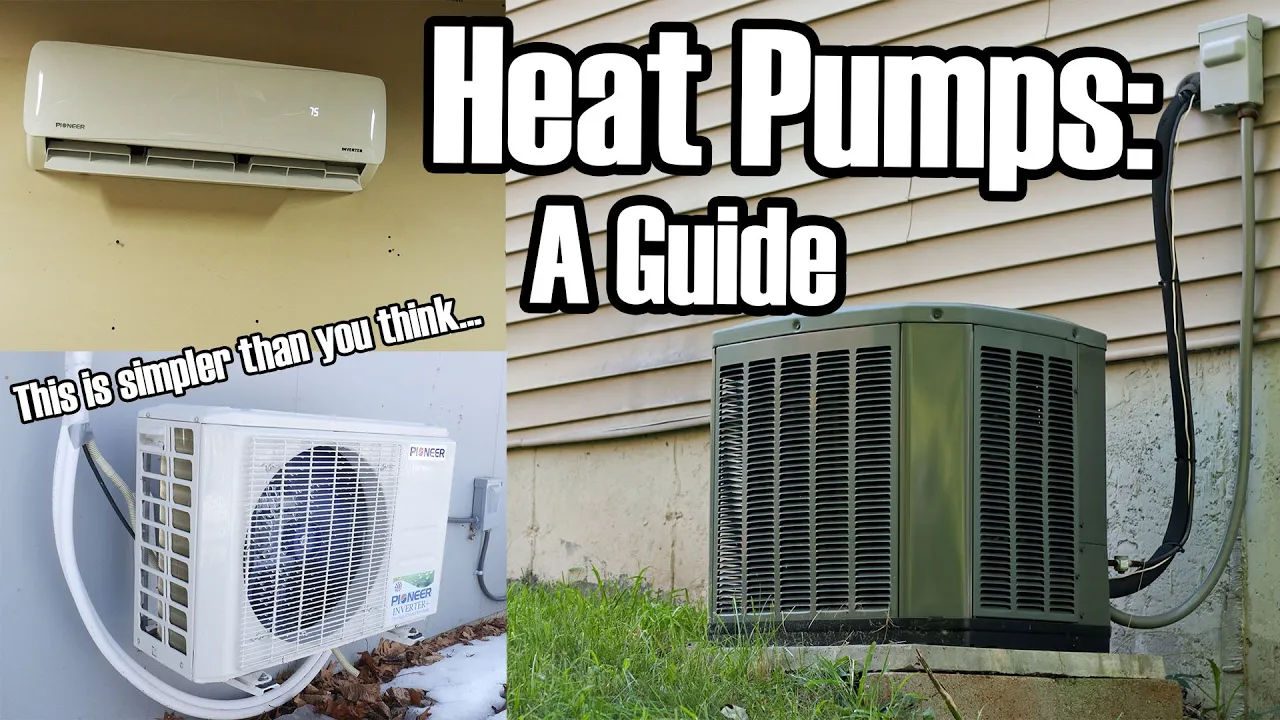
Even at low temperatures of −13 °C (5 °F), modern cold-climate heat pumps deliver a coefficient of performance (COP) of at least 2.5, making them the most efficient space-heating method across most energy sources. (0:00)
The United States possesses turnkey physical infrastructure for heat pumps—including pre-installed ductwork, outdoor high-voltage disconnects, and line sets in millions of homes with central AC—yet domestic equipment availability and adoption have lagged far behind international standards. (18:15)
Historically cheap natural gas in cold US regions meant an electric heat pump required an unattainable seasonal COP of roughly 4.0 just to break even on operating costs, disincentivizing legacy domestic manufacturers from developing cold-climate inverter systems. (24:42)
Pricing opacity and contractor unfamiliarity have generated severe price gouging, with installers submitting quotes exceeding $12,000 to $16,000 for standard residential heat pump systems with wholesale hardware costs under $3,000 to $6,500. (27:56)
Detailed notes
## Background
This video was published on YouTube by the channel Technology Connections on April 13, 2022. According to the description, it serves as the concluding installment of an extensive series on heat pumps, aiming to leave viewers with a practical understanding that transitioning to a heat-pump-driven future is well within reach.
## TL;DR
Host Alec breaks down the practical realities of transitioning buildings to heat pumps, starting with the imperative that structures must first be properly insulated. He explains the mechanics and flexibility of ductless mini-splits, multi-split configurations, and hydronic air-to-water systems, while noting that existing North American central ducted air conditioning infrastructure is already uniquely primed for conversion. Alec critiques the legacy American HVAC market for historically neglecting efficient cold-climate equipment due to cheap natural gas, and exposes modern contractor price gouging and pricing obfuscation that undermine green subsidies. Ultimately, he demonstrates that common concerns regarding ductwork sizing, cold-weather capacity, and ambient noise are largely overstated edge cases that modern inverter technology easily overcomes.
## Atmosphere & style
The presentation carries Alec's trademark blend of nerdy enthusiasm, pragmatic engineering analysis, and exasperated consumer advocacy. It feels conversational and deeply grounded, moving smoothly from casual backyard demonstrations beside running condensers to sharp, indignant dissections of predatory HVAC contractor quotes. While analytical and data-driven when evaluating heat pump specs, the narrative is punctuated by dry wit, passionate calls to action against nimbyism, and self-effacing humor capped off by a jazzy blooper reel.
## Bulletin
- [00:00](https://www.youtube.com/watch?v=43XKfuptnik&t=0s) Even at low temperatures of −13 °C (5 °F), modern cold-climate heat pumps deliver a coefficient of performance (COP) of at least 2.5, making them the most efficient space-heating method across most energy sources.
- [18:15](https://www.youtube.com/watch?v=43XKfuptnik&t=1095s) The United States possesses turnkey physical infrastructure for heat pumps—including pre-installed ductwork, outdoor high-voltage disconnects, and line sets in millions of homes with central AC—yet domestic equipment availability and adoption have lagged far behind international standards.
- [24:42](https://www.youtube.com/watch?v=43XKfuptnik&t=1482s) Historically cheap natural gas in cold US regions meant an electric heat pump required an unattainable seasonal COP of roughly 4.0 just to break even on operating costs, disincentivizing legacy domestic manufacturers from developing cold-climate inverter systems.
- [27:56](https://www.youtube.com/watch?v=43XKfuptnik&t=1676s) Pricing opacity and contractor unfamiliarity have generated severe price gouging, with installers submitting quotes exceeding $12,000 to $16,000 for standard residential heat pump systems with wholesale hardware costs under $3,000 to $6,500.
## Key takeaways
- [00:00](https://www.youtube.com/watch?v=43XKfuptnik&t=0s) A heat pump moves thermal energy rather than generating it through combustion, operating on the exact same thermodynamic principles as a household refrigerator.
- [02:20](https://www.youtube.com/watch?v=43XKfuptnik&t=140s) Improving a building's thermal envelope through insulation and air sealing is the single most critical preliminary step, directly reducing the required capacity and extreme-weather strain on heating equipment.
- [02:20](https://www.youtube.com/watch?v=43XKfuptnik&t=140s) Public policy interventions such as direct grants are necessary to overcome split incentives between tenants and landlords as well as long payback horizons in older multi-family housing.
- [08:16](https://www.youtube.com/watch?v=43XKfuptnik&t=496s) A standard split heat pump comprises an exterior outdoor unit, indoor air handlers or heads, and a refrigerant lineset with communication wiring.
- [12:02](https://www.youtube.com/watch?v=43XKfuptnik&t=722s) Modular multi-split systems operate like Lego blocks, running up to five or more independent indoor zones off a single outdoor compressor that supplies both refrigerant and line-voltage electrical power.
- [15:15](https://www.youtube.com/watch?v=43XKfuptnik&t=915s) Air-to-water heat pumps can replace fossil-fuel boilers in hydronically heated homes, though their lower operating water temperatures may require expanded radiator surface area.
- [18:15](https://www.youtube.com/watch?v=43XKfuptnik&t=1095s) Because central air conditioning units are structurally identical to heat pumps minus a four-way reversing valve, the US housing stock and HVAC trade already possess the baseline physical infrastructure and tooling needed for mass adoption.
- [19:40](https://www.youtube.com/watch?v=43XKfuptnik&t=1180s) Top performers in cold-climate efficiency databases, including commercial Variable Refrigerant Flow (VRF) systems capable of sharing heat dynamically across zones, achieve COPs as high as 3.54 at 5 °F (-15 °C).
- [22:26](https://www.youtube.com/watch?v=43XKfuptnik&t=1346s) North American ducted equipment is finally beginning to adopt modern inverter compressors and controls within familiar domestic barrel-style outdoor enclosures.
- [24:42](https://www.youtube.com/watch?v=43XKfuptnik&t=1482s) The legacy North American market was long stunted because gas utility rates made heating four times cheaper per unit of energy than electricity, relegating heat pumps to mild southern climates.
- [32:43](https://www.youtube.com/watch?v=43XKfuptnik&t=1963s) Trade resistance and arbitrary contractor markups threaten clean heating subsidies, as installers can simply absorb government rebates through inflated baseline quotes.
- [33:53](https://www.youtube.com/watch?v=43XKfuptnik&t=2033s) Existing heating systems are routinely oversized, meaning concerns that legacy ductwork cannot accommodate the lower supply air temperatures of a heat pump are often exaggerated by worst-case planning.
- [37:33](https://www.youtube.com/watch?v=43XKfuptnik&t=2253s) Inverter-driven compressors modulate their speeds continuously, making modern heat pumps substantially quieter and less disruptive than traditional single-stage cycling air conditioners.
- [40:29](https://www.youtube.com/watch?v=43XKfuptnik&t=2429s) Self-contained packaged units like PTACs create severe thermal bridges through exterior walls, making multi-split or VRF retrofits a superior long-term design choice for hotels and apartments.
## Detailed walkthrough
### [00:00](https://www.youtube.com/watch?v=43XKfuptnik&t=0s) The Heat Pump Opportunity and Fundamentals
The arc of heat pump discussions concludes with a practical examination of what equipment is out there, how the systems fit together, and what it actually takes to convert a building from "no pumping to yes pumping." The transition involves physical infrastructure, real building challenges, and artificial, inflated barriers to adoption that vary dramatically around the world. Because new technologies invite misunderstandings, the host emphasizes that heat pumps are not new technology at all, but rather the refinement of long-established equipment used a bit differently: “Your refrigerator is a heat pump.”
At its core, a heat pump moves heat rather than creating it through combustion or electric resistance. Unless the environment reaches absolute zero, ambient air contains harvestable heat energy. Modern units operate with high efficiency across wide temperature ranges:
- Even down to −13 °C (5 °F), modern systems move at least 2.5 times as much energy as they consume.
- This high coefficient of performance makes heat pumps the most efficient way to heat buildings using any energy source in the vast majority of cases.
- Electrification and decarbonization become substantially easier over both the short and long term because society can do more heating work with less total energy input.
- While commercial systems operate on different scales and designs, residential and light commercial equipment provide an immediately accessible path toward moving away from fossil fuels.
Before installing any heating equipment, the single most critical intervention for any structure has nothing to do with heat pumps themselves: “The wisest thing we can do in the short term can be expressed in these three simple words: insulate, insulate, and insulate.” Heat loss through poor walls, old windows, and drafts dictates how large a heating system must be. Newer homes built in the past twenty or thirty years generally have adequate thermal envelopes, but older buildings leak massive amounts of energy. While demolishing inefficient structures is sometimes proposed, upgrading existing housing through weatherization, air sealing, and improved glazing remains essential.
The core dilemma is economic and structural. Insulation delivers guaranteed long-term returns, but individual homeowners are deterred by 5-to-10-year payback periods if they are uncertain they will live in the property that long. Split incentives make the problem worse in rentals: when tenants pay utility bills directly, landlords have no incentive to invest in capital improvements. To break this impasse, the host argues for public policy solutions, including direct grants rather than complex loan programs:
“The only way to equitably solve this problem is with public policy, and while I’m not here to tell you what exactly that should look like, I’m certain something needs to happen.”
```mermaid
flowchart TD
accTitle: Thermal Envelope and Heat Pump Sizing Dynamics
accDescr: Shows how building insulation quality directly affects heat loss, required equipment capacity, and cold-weather performance.
subgraph Envelope["Building Thermal Envelope"]
I1["High Insulation & Tight Air Sealing"]
I2["Poor Insulation & Drafty Windows"]
end
subgraph ThermalImpact["Thermal Impact"]
T1["Low Rate of Heat Loss"]
T2["Rapid Heat Loss to Outdoors"]
end
subgraph SystemReq["Equipment Requirements"]
S1["Smaller Heat Pump Capacity Needed\nCold-snap drops are easily tolerated"]
S2["Oversized Heating Plant Needed\nStruggles during extreme ambient lows"]
end
I1 --> T1
I2 --> T2
T1 --> S1
T2 --> S2
```
Shared billing arrangements in multi-family housing can also stall necessary weatherization. In an older apartment where the host previously lived, all tenants split a single gas bill evenly each month. Because individual gas consumption was only about 2% of the total building meter, replacing individual leaking windows yielded no measurable personal savings. Had the entire building updated its windows collectively, the gas bill would have dropped sharply and the investment would have paid for itself quickly.
Ultimately, reducing the building's thermal demand directly improves heat pump feasibility: lower heat loss means smaller equipment can maintain indoor comfort even when outdoor temperatures drop and heat pump output decreases.
---
[08:16](https://www.youtube.com/watch?v=43XKfuptnik&t=496s) Anatomy of a Heat Pump System
A heat pump installation breaks down into three primary hardware components:
1. **Outdoor Unit:** Gathers thermal energy from the ambient air outside via an evaporator coil and compressor.
2. **Indoor Unit(s):** Distributes that harvested warmth into the living space.
3. **Refrigerant Lineset:** Insulated copper tubing that circulates refrigerant to transport heat between the outdoor and indoor units, typically accompanied by power and communication cabling.
While some configurations package all of these elements into a single exterior cabinet, split systems are far more common in residential installations.
---
[09:02](https://www.youtube.com/watch?v=43XKfuptnik&t=542s) Ductless Mini-Split Systems
The single-head ductless mini-split is the simplest type of split system. Although existing ducted infrastructure in countries like the United States makes ducted conversions appealing, ductless mini-splits offer tremendous utility for buildings lacking existing ductwork.
The installation process is straightforward:
- Mount the indoor head on an interior wall and place the outdoor condensing unit outside.
- Run a dedicated electrical circuit to an outdoor disconnect switch.
- Drill a small, three-inch hole through the exterior wall to pass the insulated copper lineset, condensate drain, and power/communication wiring.
- Flare the copper tubing ends, secure the mechanical flare connections, and wire the terminals.
- Evacuate moisture and air from the lineset using a manifold gauge set and vacuum pump prior to releasing the factory refrigerant charge.
The host installed their own ductless mini-split unit over the course of a single day using basic hand tools, an electric drill, wrenches, and a vacuum pump. However, this is not an endorsement of unregulated do-it-yourself installations: “In many places it’s not even legal to work on refrigeration equipment yourself because if you mess up you can let the refrigerant out and we generally don’t want that.”
[11:14](https://www.youtube.com/watch?v=43XKfuptnik&t=674s) DIY Feasibility and the Technician Shortage Concern
Addressing the anxiety that heat pump installation is too complex for the average tradesperson, Alec emphasizes that while licensing exists for good reason, the core mechanical concepts are far from baffling. A pervasive worry—particularly in climates where air conditioning has historically been uncommon—is that there are not enough qualified technicians available to handle the transition. While a labor bottleneck is a genuine concern, Alec points to his own installation as proof that training workers is not an insurmountable hurdle: “I barely know what I’m doing but simply by following the instructions I managed to get this up and running, and after three winter seasons it’s still working just fine so I think I can say I didn’t screw it up!”
The physical configuration is equally adaptable. An indoor unit does not need to sit back-to-back on the exact opposite side of an exterior wall from the condenser. Line lengths of up to 30 meters (approximately 100 feet) can typically be run between the indoor and outdoor hardware. Extending lines over longer distances may necessitate adjusting the refrigerant charge, which is precisely where trained, certified professionals earn their keep.
---
[12:02](https://www.youtube.com/watch?v=43XKfuptnik&t=722s) Modular Multi-Split Systems: Like Building with Legos
The versatility of mini-splits expands dramatically when scaling up to whole-home heating and cooling via multi-split setups. For years, Asian manufacturers have engineered these systems with modularity in mind, making them function almost like modular Lego sets. By utilizing electronic expansion valves alongside real-time, on-the-fly load calculation, a single heavy-duty outdoor unit can host five or more independent linesets running to separate indoor heat exchangers throughout different rooms. This architecture grants room-by-room zone control while keeping installation logistics relatively streamlined.
```mermaid
flowchart TD
accTitle: Multi-Split Heat Pump Architecture
accDescr: Diagram illustrating a single outdoor unit supplying power and refrigerant to multiple diverse indoor heads.
subgraph Outdoor["Outdoor Equipment"]
ODU["Outdoor Condenser / Heat Pump<br>(Main Power Connection)"]
end
subgraph Indoor["Indoor Living Spaces"]
H1["Wall-Mounted Head<br>(Bedroom 1)"]
H2["Ceiling Cassette<br>(Living Room)"]
H3["Floor Console / Radiator<br>(Office)"]
H4["Ducted Air Handler<br>(Upper Level)"]
end
ODU -->|"Refrigerant Lines + Power Cable"| H1
ODU -->|"Refrigerant Lines + Power Cable"| H2
ODU -->|"Refrigerant Lines + Power Cable"| H3
ODU -->|"Refrigerant Lines + Power Cable"| H4
```
A major revelation for Alec—originally learned from a video by fellow YouTuber *Aging Wheels*—was the electrical setup: the indoor heads do not require their own dedicated high-voltage electrical circuits. The outdoor condenser receives the primary electrical service and feeds electricity directly to each indoor head through multi-conductor cabling bundled inside the lineset. While running multiple linesets through a home can create a chaotic "spaghetti" of copper tubing, installers can conceal lines in wall cavities, attic spaces, or exterior line-hide chases. Furthermore, indoor options extend well beyond standard rectangular high-wall heads:
- Ceiling-concealed ducted units
- Floor-mounted consoles resembling modern slim radiators
- Surface-mounted ceiling cassettes that resemble starship hardware
- Compact central air handlers tied to short duct runs
---
[14:27](https://www.youtube.com/watch?v=43XKfuptnik&t=867s) Dealing with Condensate Drainage
Because heat pumps provide air conditioning out of the box, cooling mode inevitably produces liquid water. As humid room air passes across the chilly indoor evaporator coil, water vapor condenses out of the air and pools into an internal catch pan at the base of the head. Managing this moisture is a basic requirement of the installation.
The most straightforward method is mounting the indoor unit on an exterior-facing wall and pitching a small drain tube through the wall penetration alongside the refrigerant piping, allowing the condensate to passively drain outside by gravity. If an indoor head is mounted on an interior partition or routed through an attic where downward pitch cannot be maintained, small motorized condensate pumps can be added to lift and route the drain water to an appropriate plumbing stack or exterior exit.
---
[15:15](https://www.youtube.com/watch?v=43XKfuptnik&t=915s) Air-to-Water Heat Pumps and the Radiator Question
For residences with existing hydronic heating networks—where a centralized boiler pumps hot water through baseboards or cast-iron radiators—air-to-water heat pumps serve as a drop-in boiler alternative that can also generate domestic hot water. Even so, Alec suggests homeowners keep an open mind toward ductless forced-air mini-splits before immediately committing to hydronic replacements, even if the feel of moving air takes getting used to: “I know it takes some adjustment getting used to warm air being pushed around, but these heads are very very quiet and it’s really not that bad.”
```mermaid
flowchart LR
accTitle: Air-to-Water Hydronic Heat Pump Flow
accDescr: Flow diagram showing how an outdoor heat collector transfers heat through refrigerant to an indoor heat exchanger and distribution loop.
subgraph Exterior["Outside"]
ODU["Outdoor Unit<br>(Extracts ambient heat)"]
end
subgraph Interior["Inside"]
HEX["Refrigerant-to-Water<br>Heat Exchanger<br>(Replaces traditional boiler)"]
RAD["Existing Distribution<br>(Radiators / In-floor loops)"]
DHW["Domestic Hot Water<br>Storage Tank"]
end
ODU -->|"Refrigerant lineset"| HEX
HEX -->|"Heated water loop"| RAD
HEX -->|"Supplemental loop"| DHW
```
Ductless heads are admittedly not ideal everywhere; bathrooms, for instance, rarely justify a dedicated lineset and wall head, even though they usually have small hydronic radiators already piped in. For homeowners dedicated to keeping their hydronic setup, an air-to-water unit links an exterior condenser to an indoor refrigerant-to-water heat exchanger that feeds the radiator loops. However, conventional air-to-water heat pumps produce lower water temperatures than fossil-fuel boilers:
- Lower supply water temperatures can require upgrading or upsizing existing radiators to provide adequate surface area for heat exchange.
- Specialized high-temperature air-to-water units exist to match historic boiler water temperatures, but they incur an efficiency penalty, especially during harsh freezing conditions.
- Hydronic replacements offer the distinct advantage of utilizing existing plumbing loops while only requiring a single outdoor-to-indoor lineset run.
---
[18:15](https://www.youtube.com/watch?v=43XKfuptnik&t=1095s) The American Advantage: Turnkey Infrastructure for Heat Pumps
In the United States, the physical layout of single-family homes is uniquely primed for a rapid transition to heat pumps. Millions of suburban houses already possess the complete physical infrastructure required for a split-system heat pump because they already feature central ducted air conditioning.
Alec points out that the fundamental pieces are already installed and paid for:
- An exterior concrete pad or mounting location hosting a high-voltage electrical disconnect and power feed.
- An indoor cooling coil (evaporator) mated to an existing furnace or air handler.
- A pre-drilled, pre-routed copper lineset connecting the indoor and outdoor hardware.
- A network of supply and return ductwork distributing conditioned air to every room.
Because air conditioners operate on identical refrigeration cycles, they literally are heat pumps that lack a four-way reversing valve to flip the flow of refrigerant. The widespread presence of residential air conditioning also means the American labor force already possesses the requisite certifications, gauges, vacuum pumps, and brazing skills to service heat pumps. Yet despite this massive structural head start, Alec laments that the equipment domestically manufactured to drop into this infrastructure has lagged far behind international standards.
---
[19:40](https://www.youtube.com/watch?v=43XKfuptnik&t=1180s) NEEP Data, Performance Gaps, and VRF Systems
To illustrate the technical gap in equipment, Alec highlights the comprehensive Cold Climate Air Source Heat Pump database maintained by NEEP (Northeast Energy Efficiency Partnerships). When sorting NEEP's database by Coefficient of Performance (COP) at 5°F (-15°C), the upper tiers are almost entirely dominated by ductless mini-split and multi-split equipment designed by foreign manufacturers rather than traditional American central ducted split systems.
A voiceover interjection clarifies that several stellar performers atop the NEEP database utilize Variable Refrigerant Flow (VRF) technology. Primarily geared toward commercial installations and multi-family apartment buildings, VRF heat-recovery systems can dynamically transfer thermal energy between rooms:
- When sun-drenched rooms require cooling while shaded rooms need heat, VRF routes refrigerant to absorb energy from the warm rooms and reject it straight into the cold rooms, rather than venting that heat outdoors.
- A referenced commercial-grade Fujitsu VRF unit can manage up to 15 indoor heads simultaneously.
- At an outdoor ambient temperature of 5°F (-15°C), this Fujitsu system maintains an extraordinary COP of 3.54 while preserving nearly 100% of its rated heating capacity.
Under such operating parameters, even a home in a climate as demanding as Chicago would virtually never need to engage supplemental resistance strips or a fossil-fuel backup, provided the structure features adequate insulation. When filtering the database strictly for the single-zone centrally ducted units that match standard American ductwork, however, the options drop off a cliff. Alec notes with undisguised irritation that legacy US HVAC manufacturers have long neglected high-performance cold-climate engineering, leaving consumers with few viable domestic options.
[22:26](https://www.youtube.com/watch?v=43XKfuptnik&t=1346s) Signs of Progress in American-Style Heat Pumps
While outdated 13 SEER air conditioners—an abysmal efficiency standard for 2022—are still being manufactured in the United States while Asian companies innovate, the North American landscape is finally beginning to show signs of progress. Equipment catalogs now list brands like Allied, Ducane, Comfort-Aire, Concord, and Century that achieve solid performance. These units boast a very respectable coefficient of performance (COP) even at 5°F (-15°C) and retain roughly two-thirds of their heating capacity in those frigid conditions. That performance is more than enough to prevent supplementary backup heat from engaging unless the weather turns downright arctic.
Crucially, these machines maintain the familiar, cylindrical "barrel-style" American outdoor condensers paired with traditional evaporator coils—the exact mechanical profile installers in the United States have fitted for decades. Fundamentally, these units share the identical internal components and mechanical operating principles of mini-splits, simply wrapped in a legacy American form factor. The core technologies underpinning commodity mini-splits—primarily variable-speed inverter compressors and sophisticated control logic—are finally migrating into mainstream, ducted domestic units.
A perplexing discrepancy remains regarding their listed Heating Seasonal Performance Factor (HSPF). Although these units demonstrate impressive real-world efficiency on testing lists from the Northeast Energy Efficiency Partnerships (NEEP) with strong COPs at 5°F, their official HSPF ratings appear mediocre. For example, an HSPF of 9 technically implies a modest seasonal average COP of only 2.63, which clashes directly with the fact that these units surpass that performance figure even in deep 5°F freezes.
- **Brands adopting modern tech**: Allied, Ducane, Comfort-Aire, Concord, Century.
- **Low-temperature capability**: High COP at 5°F while retaining approximately two-thirds of rated capacity.
- **Form factor**: Standard cylindrical/barrel-style outdoor condensing units that fit legacy ducted infrastructure.
- **Unresolved discrepancy**: HSPF ratings near 9 imply an average seasonal COP of 2.63, yet cold-weather bench tests beat that efficiency at extreme low temperatures.
---
[24:42](https://www.youtube.com/watch?v=43XKfuptnik&t=1482s) Why the American Market Ignored Cold-Climate Heat Pumps
The historical absence of capable cold-climate heat pumps across North America comes down to economic realities and manufacturer complacency. “I think a number of factors have combined to make the American manufacturers largely... just not really care,” the host notes. Chief among these causes is the long-term affordability of fossil gas. In dense, cold regions supplied by the gas grid, switching to an electric heat pump historically made little financial sense for consumers. Because energy can be compared like-for-like by converting therms of natural gas into kilowatt-hours, local economics revealed a steep hurdle: in places like the Chicago area, natural gas historically delivered equivalent heating energy for roughly one-quarter the price of electricity. Under those utility rates, an electric system required a sustained seasonal COP of 4.0 just to achieve financial parity with a standard gas furnace—a benchmark nearly impossible to hit with legacy equipment.
Consequently, consumers living in freezing climates merely wanted cooling in the summer and stuck with their inexpensive gas-fired furnaces for winter. HVAC manufacturers catered to this by producing the cheapest equipment possible: basic, single-speed, on/off air conditioning units bolted directly onto gas furnaces built by those very same manufacturers, leaving little incentive to engineer products that might cannibalize furnace lines.
Reversible air conditioners have existed for decades, but the domestic industry largely restricted them to simple, single-stage units retrofitted with a reversing valve and rudimentary defrost timers. (This historical design is why standard American thermostats include an "O" terminal specifically to signal the condenser to switch flow into heating mode.) These basic units sufficed for the American South and milder regions where natural gas grids are sparse and homes are all-electric by default. Because southern markets required only modest heating output, manufacturers faced zero market pressure to engineer advanced low-ambient heating technology, leaving northern cold-climate heat pump options severely constrained.
```mermaid
flowchart TD
accTitle: Historical Economic Feedback Loop of US HVAC Market
accDescr: Diagram illustrating how cheap gas and mild regional demand kept US manufacturers from building cold-climate heat pumps.
subgraph Economics["Economic & Regional Drivers"]
Gas["Cheap Natural Gas Grid in Cold Regions"]
ElectricCost["Electricity ~4x Cost of Gas per Unit Energy"]
MildRegions["Mild Climates Built with All-Electric Infrastructure"]
end
subgraph Market["Consumer Behavior"]
NoROI["COP 4.0 Needed to Break Even (Historically Unattainable)"]
ACDemand["Northern Customers Only Buy Cheap Summer Cooling"]
end
subgraph Manufacturing["Manufacturer Response"]
SingleSpeed["Mass Produce Basic Single-Speed A/C & Furnaces"]
RudimentaryHP["Add Reversing Valve (O Terminal) for Southern Markets Only"]
NoIncentive["Zero Urgency to Build Inverter Cold-Climate Heat Pumps"]
end
[27:18](https://www.youtube.com/watch?v=43XKfuptnik&t=1638s) Supply Bottlenecks and Price Gouging
The sudden surge in heat pump interest colliding with a supply chain starved of cold-climate equipment has created an environment rife with price gouging and inflated quotes. The host illustrates this disconnect through two personal experiences:
#### The Propane Replacement (Illinois)
A friend whose air conditioner failed relied on propane for home heating—a fuel far more expensive than pipeline gas. Upgrading to a Mitsubishi Hyper-Heating cold-climate heat pump was an ideal fit. When seeking quotes from an authorized contractor:
- **Baseline replacement**: Quoted at **$3,000** to install a commodity Carrier AC unit, replace the evaporator coil above the furnace, and run a new line set.
- **Three-head ductless split**: Quoted at **over $12,000** for a multi-zone Mitsubishi system.
“And if we dig a little into it, we find what can only be described as greed,” the host argues. Wholesalers sell comparable three-head Mitsubishi hardware for roughly $5,500 shipped, representing roughly $6,500 in materials with line sets and sundries. That left a $6,000 labor premium on the heat pump install. Ironically, retrofitting the standard AC evaporator coil took an entire day of complex work—brazing copper piping with torches in tight utility quarters and fitting parts into cramped ductwork—whereas installing a ductless system utilizing flare fittings and exterior-mounted lines would have been faster and cleaner for an experienced tech. By tacking on what appears to be an arbitrary percentage markup rather than pricing the job reasonably at around $9,000, the contractor priced themselves entirely out of the sale.
#### The Mild-Climate System (San Diego, California)
An even more egregious markup occurred when the host's brother looked into replacing an aging central air conditioner in San Diego. Despite southern California's mild climate, the house was equipped with a gas furnace that had run for just four days that entire winter. When an HVAC company arrived for a consultation:
- The contractor insisted on an expensive hybrid dual-fuel system so he could retain gas backup—an absurd recommendation for a region that barely drops below freezing.
- The company’s "entry-level" estimate for a standard Lennox heat pump paired with an air handler came in at **over $16,000**.
For a small household needing only a modest 2 to 2.5-ton system (where wholesale hardware retail cost sits under $3,000), a $16,000 quote reflects a predatory markup targeting homeowners seduced by heat pump hype. “I cannot see the quote he got as anything but a dishonest company taking advantage of someone looking to install a ‘trendy’ heat pump, and just hoping they don’t know what that is.”
---
[32:43](https://www.youtube.com/watch?v=43XKfuptnik&t=1963s) Pricing Obfuscation and the Problem with Subsidies
The intentional opacity surrounding equipment costs across the residential HVAC industry creates severe friction for the clean energy transition. Because the general public cannot readily distinguish equipment overhead from labor charges, unscrupulous contractors routinely exploit that confusion.
This pricing obfuscation poses a serious structural problem for green policy initiatives. Energy-efficiency rebates and government electrification incentives are easily undermined: when an installer recognizes that a customer qualifies for a multi-thousand-dollar incentive, they can simply inflate the baseline quote by an identical sum, pocketing public funds while offering zero net savings to the consumer.
While enabling consumers to purchase hardware directly online at wholesale rates and hiring qualified technicians purely for installation labor would curb these practices, modern rebate frameworks frequently require full turnkey purchasing from registered contractors. Furthermore, average homeowners rarely possess the engineering knowledge needed to size equipment and specify correct components. Demystifying the technology is the most effective weapon against exploitation:
> “The best thing I can do is remind everybody that heat pumps are just air conditioners and are not actually special. Hopefully the more people that know this, the less gouging will occur.”
[33:53](https://www.youtube.com/watch?v=43XKfuptnik&t=2033s) Subpar Ductwork and the "Sometimes" Problem
A major hurdle facing heat pump adoption in existing homes is the limitation of legacy ductwork. Refrigerant can only get so hot due to physical system pressure limits, meaning a heat pump must push a significantly larger volume of air across its heat exchanger coil to deliver the equivalent amount of heat that a combustion furnace would provide. Combustion furnaces burn fuel to produce intensely hot supply air, allowing historical ductwork to be sized for relatively low airflow volumes. In contrast, shoving a small indoor coil into tight legacy ducts forces systems to move high volumes of air through restricted passages; while upgrading to a stronger blower can push more air, it quickly introduces noise and blower power limitations.
```mermaid
flowchart LR
accTitle: Heating System Airflow Comparison
accDescr: Flowchart contrasting combustion furnace airflow with heat pump requirements.
subgraph Furnace["Combustion Furnace"]
A["Fuel Combustion"] --> B["Intensely Hot Air"]
B --> C["Lower Airflow Volume Needed"]
C --> D["Smaller Duct Sizing"]
end
subgraph HeatPump["Heat Pump System"]
E["Refrigerant Cycle Limits"] --> F["Moderately Warm Air"]
F --> G["Higher Airflow Volume Needed"]
G --> H["Larger Ducts or Mini-Splits"]
end
```
This dynamic leads contractors to dismiss heat pumps based on worst-case scenarios. A homeowner on Twitter reported being told they needed a 5-ton system (60,000 BTU/hr or 17.5 kW) to match their heating needs, but because their existing ductwork was only sized for a 3-ton air conditioner (36,000 BTU/hr), they were told the conversion would require prohibitive, expensive duct renovations. Alec argues that existing heating systems are routinely oversized by a factor of roughly two, meaning a 3-ton unit would comfortably handle the vast majority of winter days. Pointing to his own home as proof, Alec shares that his 70,000 BTU furnace only runs about half the time on sub-zero winter days, which means a 3-ton heat pump would easily cover the baseline demand. He insists that installers and homeowners stop letting edge cases derail progress:
> “But I say - don’t let ‘but sometimes’ thinking stop you!”
- Ductless mini-splits avoid airflow restrictions because their indoor heads feature massive heat exchangers paired specifically with their integrated fans.
- The same physics creates headaches for hydronic systems with undersized radiators in countries without ducted heating.
- HVAC trade resistance remains stubborn: an exorbitant contractor quote for a friend’s three-head mini-split revealed how the industry remains “allergic to mini-splits,” despite ductless systems being the cleanest fix for poor ductwork.
---
[37:33](https://www.youtube.com/watch?v=43XKfuptnik&t=2253s) Outdoor Noise and Inverter Compressors
Concerns about heat pumps creating disruptive neighborhood noise are widespread, but Alec points out that communities already tolerate humming outdoor air conditioners all summer long. More importantly, modern inverter-driven heat pumps are substantially quieter than the jarring single-stage compressors of the past. Traditional units draw immediate attention when they kick on with a violent shudder and rattle, whereas inverter units ramp their compressor speeds up smoothly and slowly without hard starts.
Demonstrating next to an active outdoor unit, Alec speaks in an ordinary conversational tone while the unit is running hard, and then shows how it drops to an almost imperceptible idle hum once indoor set points are satisfied. Because inverter compressors continuously modulate capacity—running steadily at 25% output instead of cycling on for 10 minutes and shutting off for 30—they eliminate the stop-and-start clatter, only interrupting their quiet baseline during winter defrost cycles. Responding to a Seattle homeowner who was told local sound ordinances barred them from adding a heat pump, Alec argues that outdated neighborhood regulations must yield to climate priorities:
> “If NIMBYs get in the way of installing heat pumps, may god have mercy on our souls…”
---
[40:29](https://www.youtube.com/watch?v=43XKfuptnik&t=2429s) Packaged Units: PTACs, MagicPacks, and Window Units
Packaged heating and cooling designs face strict thermal compromises. The ubiquitous Packaged Terminal Air Conditioner (PTAC)—the familiar beige box humming underneath windows in low-to-mid-tier US hotels and some apartments—has evolved into the PTHP (Packaged Terminal Heat Pump). However, Northeast Energy Efficiency Partnerships (NEEP) data reveals underwhelming performance metrics. PTAC sleeves are essentially giant structural holes cut through exterior walls, effectively leaving a window-unit chassis and resistive electric strip heaters as the only thermal barrier between the room and the outdoors. While hotels favor them because a failed unit can be swapped in minutes from a maintenance closet, Alec notes that buildings relying on them would be far better off transitioning:
> “It's likely the case that buildings which currently use PTACs would be better off to de-PTAC.”
Hotels could consolidate 10 to 15 guest rooms onto roof-mounted Variable Refrigerant Flow (VRF) loops, while apartment buildings could adopt multi-split units. In Alec's former two-bedroom apartment, a three-head mini-split (two small heads for the bedrooms and one larger head for the combined living, dining, and kitchen area) would easily handle the space since the bathrooms sat on interior walls.
Similar compromises affect the MagicPak, a single-chassis packaged furnace and air conditioner slide-in module vented through exterior louvers on multi-family developments. Because they lock owners into proprietary replacements and suffer restrictive airflow, mini-splits remain the superior architectural alternative. Turning to standard window units, Alec notes that while reversible cold-climate window heat pumps can be built, leaky window sashes ruin their efficiency unless they are permanently framed through the wall and sealed with spray foam.
Looking ahead to broader innovations, Alec points to Japan's deployment of supercritical carbon dioxide ($CO_2$) systems—marketed under the name EcoCute—as proof of heat pump flexibility. The technology to abandon fossil heating is already mature and waiting to be deployed:
> “And however we do it, it will take time and a lot of effort to get us where we need to go.”
[45:15](https://www.youtube.com/watch?v=43XKfuptnik&t=2715s) Jazzy Bloopers and Duck Puns
Alec closes the video with a montage of outtakes and bloopers set to upbeat background jazz, pulling back the curtain on the repetitive frustrations of recording the episode. After having a smooth run of filming, he gets bogged down repeatedly on a single script section, venting to the camera: “Well, we went a while without needing retakes and now we’re at this line which is taking forEVER.” He trips over sentences addressing DIY refrigeration work and scolds himself for going off-script, muttering, “You can’t change the wording on the fly, you know that.” Even when he nails a usable version, his perfectionism takes over: “That was a decent take. But I still wanna do another one.” The outtake reel includes groans, vocal warmups, whooping noises, snorts, and pronunciation slip-ups—most notably when he repeatedly says that line sets can be “rung” through attics rather than “run,” immediately catching his grammatical error and barking at himself, “Rung…. is on a ladder!”
Following another aborted take where he over-enunciates the word "first" and ponders whether it sounded too strange to keep, Alec addresses the audience about a subtle visual gag slipped into the edit: “Did you like how I put stock footage of ducks over the part where I was talking about ductwork?” Confirming the joke was 100% intentional, he adds, “If you didn't think that was deliberate you were sorely mistaken.” He reveals that he briefly entertained an ambitious running gag where every single cutaway piece of stock footage would serve as a literal visual pun for whatever technical concept was being explained, though he ultimately abandoned the idea because finding that much pun-based B-roll was simply too much work. Reflecting on the sheer scale and effort required to put together the in-depth heat pump series, Alec admits, “This video really was a slog at times.” He wraps up the outtakes with a joyful declaration of relief about his future content schedule: “Next, something that isn't heat pumps!”
- **Script slip-ups:** Alec gets tripped up on lines detailing DIY refrigeration repairs, packaged terminal heat pumps ("uni..."), and routing refrigerant lines through walls and attics.
- **The duck joke:** The waterfowl B-roll shown during the ductwork discussion was an explicit, planned pun.
- **Abandoned pun concept:** Alec considered making every stock footage shot in the video a pun on HVAC concepts, but scrapped the idea to avoid excessive extra effort.
- **Moving on:** Having thoroughly covered heat pumps across an extensive multi-video series, Alec announces that his subsequent video will tackle a completely different topic.
## Notable quotes
> [02:20](https://www.youtube.com/watch?v=43XKfuptnik&t=140s) The wisest thing we can do in the short term can be expressed in these three simple words: insulate, insulate, and insulate. — Alec
> [32:43](https://www.youtube.com/watch?v=43XKfuptnik&t=1963s) The best thing I can do is remind everybody that heat pumps are just air conditioners and are not actually special. Hopefully the more people that know this, the less gouging will occur. — Alec
## Video description
Is this the last video on heat pumps? Well, for a while anyway. This isn't a complete picture by any means, but I hope that you leave this video with the knowledge that this future is well within our grasp.
Hey! There's now a PLAYLIST with all the heat pump videos. You can find it with this clicky thing:
https://www.youtube.com/playlist?list=PLv0jwu7G_DFVIot1ubOZdR-KC-LFdOVqi
Technology Connextras (the second channel that stuff goes on sometimes):
https://www.youtube.com/channel/UClRwC5Vc8HrB6vGx6Ti-lhA
And check out these cool people!
Smith8154 , Kenneth Siewers Møller, jacob kamphaus, Slysdexia , HurleyPotter, Tommy McCarthy, Andrew Bobulsky, On Ice Perspectives, TheGreatCO , Petteri Hjort, Polaris, Nathan Obuchowski, Shaun Puzon, Vlycop, Devon Hodgson, Zimpan , Filmmaker IQ, Jan Houben, Bren Ehnebuske, T.J. Zientek, Vernon , Ton Brands, Scott Wright, Kory Howard, rezonant , Thanasis Dimas, Adam Quartarolo, Marc Grondin, HexTheDragon, Craig Kollai, Daniel Barrera, Erkin Alp Güney, Mark Stradling, Peter Sodke, Dee Dub, joseph , Kristian Scheibe, BigMcLargehuge510, Nick , The Orangewalled, Chris Cody, Jason Portwood, Chad Fertig, Joseph Houghtaling, Ben Tucci, Josh Braun, Ellie Dugger, Christopher Lowell, Oleg Korsunskiy, Michael Sacchi, Ali Elam, Dan Allen, Zhenbang Xiao, Markus Towara, Barky doggo, Ectra , Reid Fishler, Daniel Meagher, Joel , Clemens , Bill Bates, Dennis Walsh, Alex Warren, Paul Robins, Michael Gernoth, Les , Keenan Finucan, Ian Clanton-Thuon, Ryan Pratt, Paul Newton, Greg Golds, Gopher on the Road, aceat64, Ben Ratner, WildMartin, Paul Sharp, Craig Brickey, Zidy , Brandon , Karl Kornel, Danila Fediashchin, Adam , Ryan Kamphuis, WB , AmbientCyan , Sam Calandra, Miezensortierer, Will Preston, Christopher Olson, Kor Nielsen, Adrian Hunziker, Jacob Ford, Stephen Amar, GmCity , Andy24x, David Jeroslow, Charles MacDonald, Tim Jones, Crisco762 , Phil E, Jack Mudge, Ian Spence, Mike A, Leslie Deana, hipp1eguy , shacklesburst, Justin Derleth, NEON725, Emily Eisenberg, Tinker, Bard , Megan Lovett, LGR, kn0tsin , David Wulff, FirstWizardZorander, Paul Kavanagh, Isaac Clarke, Sean Hearrell, selectric, Keithius , Seb Bacanu, Mauricio , Hunter Thornsberry, Austin C Borger, Gabe Cook, Anapan, Hodgkin LeBlanc, Michael Snow, Sonic Ether, mike quick, Calisto, Adam , Lucas , Daniel Kraut, John de Largentaye, Peter Hillier, PeterH , William Holt, Ethan Hamel, Grant Campau, Michael Dunn, Kenny, Ugi Kutluoglu, Richard Hicks, Atlas Pup, Mike Roach, Matthew Schwartz, gs , ashka , Mr. Yan, Matthias Feist, adan c, Thomas Fuchs, Markus Wüst, Alan Holland, Dan Boulden, Phiroze Dalal, Devin Rosenthal, electronicMe, G Cowell
00:00 Intro
01:02 Recap on why heat pumps are important
02:20 Insulate, Insulate, Insulate
08:16 What getting a heat pump is like
09:02 Ductless mini- and multi-split systems
15:15 Air-to-water heat pumps
18:15 The US is largely all set for heat pumps
19:40 Except... the equipment we can get isn't great
20:49 VRF systems and an outstanding performer
22:38 Things are starting to get better in the US...
24:42 But why have they been so bad for so long?
27:18 Getting a cold-climate heat pump is difficult
27:56 Price gouging
32:43 Pricing obfuscation and where to go from here
33:53 Ductwork challenges
37:33 Ambient noise concerns
40:29 A look at some packaged units
45:05 Jazzy bloopers
Technology Connections argues that heat pumps provide a mature, highly efficient path toward building decarbonization, but widespread deployment is impeded by poor thermal envelopes, legacy manufacturing complacency, and predatory contractor pricing rather than technical unviability.
Thermal Envelopes and Efficiency Fundamentals (2:20)
Heat pumps move ambient heat rather than creating it through combustion or electric resistance, achieving a coefficient of performance (COP) above 2.5 even at −13 °C (5 °F). Despite these thermodynamics, the host stresses that building weatherization must precede equipment installation. High heat loss through drafty walls and aging windows forces structures to rely on oversized heating systems that struggle during extreme low temperatures. Upgrading insulation and air sealing reduces required equipment capacity, keeping baseline heating demands within the capability of smaller, more affordable systems.
Economic misalignments frequently stall necessary envelope retrofits. Homeowners are deterred by five-to-ten-year payback horizons on insulation, while rental properties suffer from split incentives where landlords do not pay tenant utility bills. In shared-meter multi-family buildings, individual window or air-sealing retrofits fail to yield noticeable personal savings. The host argues that resolving these structural deadlocks requires direct public policy grants rather than debt-financing schemes.
System Configurations Across Ductless and Hydronic Layouts (12:02)
Residential heat pump hardware breaks down into an outdoor condensing unit, indoor air handlers, and a connecting refrigerant lineset. Single-head ductless mini-splits represent an accessible solution for buildings without ductwork, requiring only a small wall penetration for linesets, communication cabling, and gravity condensate drainage. For whole-home coverage, multi-split systems operate modularly: a single outdoor unit distributes refrigerant dynamically via electronic expansion valves to five or more independent heads—including wall units, ceiling cassettes, and floor consoles—with indoor heads powered directly through the lineset cabling rather than dedicated circuits.
For residences with existing hydronic networks, air-to-water heat pumps can replace combustion boilers while supplying domestic hot water. However, conventional air-to-water units deliver lower supply water temperatures than legacy fossil-fuel boilers. Homeowners must often upsize existing radiator surface areas or install specialized high-temperature heat pumps, which face efficiency penalties during sub-freezing outdoor conditions.
US Infrastructure Advantages and Domestic Manufacturing Lag (18:15)
The United States possesses extensive turnkey infrastructure for heat pumps because millions of single-family homes already feature ducted central air conditioning. These structures already have outdoor electrical disconnects, indoor air handlers, line routings, and duct networks. Because central air conditioners share an identical refrigeration cycle with heat pumps—lacking only a four-way reversing valve—the American technician workforce already possesses the foundational skills and tools needed to install them.
Despite this infrastructural advantage, domestic manufacturers long neglected cold-climate heat pump engineering. In northern regions, historically cheap natural gas delivered energy at roughly one-quarter the cost of electricity per unit, requiring an elusive seasonal COP of 4.0 to achieve operational cost parity. Consequently, domestic manufacturers mass-produced basic single-stage cooling units paired with gas furnaces, while relegating rudimentary heat pumps to mild southern climates. Data from the Northeast Energy Efficiency Partnerships (NEEP) shows high-efficiency low-ambient performance has been dominated by foreign Variable Refrigerant Flow (VRF) and mini-split systems, though select US brands have recently begun adopting inverter compressors within traditional cylindrical form factors.
Contractor Markup, Sizing Hesitancy, and Subsidy Capture (27:18)
Residential adoption faces friction from contractor risk aversion and distorted quotes. Heat pump indoor coils produce cooler air than combustion furnaces, requiring higher airflow volumes through ductwork. Installers frequently reject heat pumps by citing undersized legacy ducts based on worst-case capacity needs. The host contends this reliance on edge-case scenarios overlooks the fact that existing fossil furnaces are routinely oversized by a factor of two, meaning moderate-tonnage heat pumps can satisfy real-world winter heating loads in properly insulated homes.
Compounding installation hesitancy is contractor price gouging and opaque labor costs. The host illustrates this through quotes where a three-head mini-split was priced over $12,000 despite equipment wholesale costs of roughly $5,500, and a mild-climate San Diego home received an entry estimate exceeding $16,000 for a basic system. Because consumers struggle to distinguish equipment costs from labor, contractors routinely inflate baselines to absorb public electrification rebates, blunting the impact of decarbonization policies.
The program concludes that treating heat pumps as conventional air conditioners equipped with reversing valves is the most effective consumer defense against contractor exploitation and industry inertia. Accelerating adoption requires public policy to prioritize building envelope grants, update outdated local noise ordinances that penalize quiet inverter units, and standardize testing metrics to reflect real-world cold-temperature performance.
## Background
本视频由 YouTube 频道 Technology Connections 于 2022 年 4 月 13 日发布。视频简介指出,这是该频道关于热泵主题的阶段性收官之作,旨在向观众证明,迈向热泵普及的未来完全在我们的掌控之中,并附带了该系列视频的完整播放列表。
## TL;DR
本视频全面系统地介绍了热泵的各种类型、安装流程以及在现实中普及所面临的障碍。主讲人强调,良好的建筑绝热是采用热泵的前提,并详细拆解了无管道单联及多联分体式热泵、空气-水热泵的工作原理与便捷的安装方式。同时,视频尖锐地指出了美国暖通市场存在的设备性能落后、安装商漫天要价、定价机制不透明以及政府补贴被套利等深层行业痛点,并解答了关于风道限制和室外噪音的常见误区。
## Atmosphere & style
视频整体呈现出幽默风趣、充满激情且极具说服力的科普风格。主讲人 Alec 凭借亲手 DIY 安装的真实经历,将复杂的暖通技术讲解得通俗易懂,同时对美国暖通行业的暴利和保守思维进行了辛辣而尖锐的讽刺。整部视频既有严谨的技术实测与数据对比,又穿插了诸如“鸭子与风道”谐音梗等视觉冷笑话,片尾的幕后花絮更是展现了主讲人真实、接地气且追求完美的个性,让观众在轻松愉快的氛围中收获硬核知识。
## Bulletin
- [01:02](https://www.youtube.com/watch?v=43XKfuptnik&t=62s) 热泵能效极其卓越,除非在 -13°C 以下的极寒工况,否则运行转移的热能通常至少是自身耗电量的 2.5 倍(COP ≥ 2.5),但任何改造的前提都是优先做好建筑绝热。
- [18:15](https://www.youtube.com/watch?v=43XKfuptnik&t=1095s) 美国大多数独栋住宅虽已具备完备的风管和动力电基础设施,但市场上单分区中央风管耐寒机型极度匮乏,高端极寒高能效榜单长期被亚洲品牌的无风管多联机和 VRF 系统主导。
- [24:42](https://www.youtube.com/watch?v=43XKfuptnik&t=1482s) 长期廉价的市政天然气导致热泵需达到 4.0 以上的 COP 才能在芝加哥等寒冷地区打平运行成本,这使得本土厂商长期缺乏研发高效耐寒热泵的动力。
- [27:42](https://www.youtube.com/watch?v=43XKfuptnik&t=1662s) 暖通承包商信息封锁与加价乱象严重,不仅将普通热泵报价虚高至逾万美元,还存在借机吃掉政府和公用事业机构脱碳补贴(rebates)的套利风险。
## Key takeaways
- [00:00](https://www.youtube.com/watch?v=43XKfuptnik&t=0s) 热泵的物理本质是利用制冷剂循环转移热量而非凭空创造热能,其基本运行原理与家用冰箱完全相同。
- [02:20](https://www.youtube.com/watch?v=43XKfuptnik&t=140s) 建筑绝热是供暖决策的核心基石;优良的保温性能可直接缩小所需热泵容量,大幅削弱极寒低温下的制热衰减影响。
- [05:38](https://www.youtube.com/watch?v=43XKfuptnik&t=338s) 绝热改造面临投资回报周期长(5-10 年)与房东-租客激励错配的问题,亟需更具力度的公共补贴与强制能效审计政策介入。
- [08:16](https://www.youtube.com/watch?v=43XKfuptnik&t=496s) 无管道单联分体机(Mini-split)部署极为简便,仅需外墙打孔走冷媒管与信号线,内外机最长可支持 30 米管路跨度。
- [12:14](https://www.youtube.com/watch?v=43XKfuptnik&t=734s) 多联机系统具备极高模块化弹性,仅需室外机单点接入主电源即可驱动多台不同形态的室内机,大幅降低布线难度。
- [15:15](https://www.youtube.com/watch?v=43XKfuptnik&t=915s) 空气-水热泵可替换传统锅炉,但普通机型出水温度较低,若不改用高温型热泵或加大暖气片尺寸,可能面临散热不足与能效衰减。
- [18:15](https://www.youtube.com/watch?v=43XKfuptnik&t=1095s) 美国普及度极高的中央空调物理上就是热泵,仅因行业传统与省去四通换向阀而无法在冬季制热供暖。
- [20:39](https://www.youtube.com/watch?v=43XKfuptnik&t=1239s) VRF(变制冷剂流量)系统具备热回收能力,在 5°F 极寒工况下 COP 可达 3.54 且制热量无明显衰减,极大契合多户住宅需求。
- [22:26](https://www.youtube.com/watch?v=43XKfuptnik&t=1346s) 美式传统“桶状”室外机正逐步整合变频压缩机与智能控制逻辑,但在官方 HSPF 理论标称与实测极低温能效之间仍存在脱节现象。
- [24:42](https://www.youtube.com/watch?v=43XKfuptnik&t=1482s) 由于芝加哥等地天然气等热值单价仅约为电力的四分之一,热泵长期缺乏经济优势,导致设备商主推“燃气炉+单冷空调”组合。
- [27:42](https://www.youtube.com/watch?v=43XKfuptnik&t=1662s) 缺乏公开透明的硬件进货价格,导致暖通承包商任意加价,甚至将动火施工更少的多联机开出数千美元的人工安装天价。
- [32:43](https://www.youtube.com/watch?v=43XKfuptnik&t=1963s) 政府的绿色热泵补贴面临被安装商截留套利的困局,破除暴利的关键在于消除认知神秘感并公开真实软硬件成本。
- [33:53](https://www.youtube.com/watch?v=43XKfuptnik&t=2033s) 热泵出风温度低于燃气炉,虽依赖更大风量,但行业普遍存在将采暖负荷“过度放大两倍”的倾向,不应让极端峰值思维阻碍热泵落地。
- [37:33](https://www.youtube.com/watch?v=43XKfuptnik&t=2253s) 现代变频热泵以平缓低速巡航运转,噪音表现远优于传统定频空调,部分地区过时的噪声管制条例亟需修订。
- [40:29](https://www.youtube.com/watch?v=43XKfuptnik&t=2429s) 酒店常用的 PTAC/PTHP 一体机因贯穿墙体的巨大结构开孔而气密性差、能效低下,未来更适合向集中式 VRF 或多联机方案转型。
## Detailed walkthrough
### [00:00](https://www.youtube.com/watch?v=43XKfuptnik&t=0s) 热泵引言与工作原理回顾
在开启热泵话题的最终篇章时,主讲人希望全面梳理热泵的各种常见类型、组成部件的物理安装位置,以及推动一栋建筑从“无热泵”过渡到“全热泵化”到底需要经历什么。这不仅关乎物理基础设施、具体设备型号以及老旧建筑所面临的改造挑战,更绕不开阻碍热泵普及的各种现实障碍——其中有些是实打实的技术制约,而有些则完全是被夸大的认知偏见。主讲人风趣地指出,新技术总会引发误解,但热泵最有趣的地方在于它根本算不上什么“新科技”,而是对早已成熟且经过长期验证的技术进行了一些巧妙改进。他压低声音神秘地调侃道:“你的冰箱其实就是一台热泵。”
对于未曾看过前几期视频的观众,其核心工作逻辑十分直接:热泵并非通过燃烧或电热丝来“创造”热量,而是作为搬运工来“转移”热量。只要外界环境没有跌至绝对零度,空气中就始终蕴含着可供抽取的低品位热能。现代热泵的性能极其卓越,除非遇到极其严酷的极寒条件(例如气温骤降至 -13°C / 5°F 以下),否则它们在运行中所转移的热能至少是其自身耗电量的 2.5 倍(即 COP ≥ 2.5)。在绝大多数气候与应用场景下,这使得热泵成为利用各种能源为建筑物供暖的最具能效比的方式。从短期来看,这显著降低了人类对化石燃料的依赖;从长远来看,它则大幅平滑了全面电气化与去碳化的转型路径。本次讨论的核心将严格聚焦于住宅与轻型商业建筑,暂不涉及规模庞大、技术路线截然不同的大型商用暖通系统。
主讲人在此强调:
> “Heat pumps move heat rather than create it.”(热泵是转移热量,而不是创造热量。)
---
### [02:20](https://www.youtube.com/watch?v=43XKfuptnik&t=140s) 绝热、绝热、再绝热:建筑节能的核心前提
在正式探讨任何热泵设备之前,必须先厘清一个与热泵本身毫无关系、却决定了其成败的前提条件。主讲人以极其坚定的口吻指出,短期内人类最明智的行动可以用三个词概括:“绝热、绝热、再绝热”(insulate, insulate, and insulate)。无论房屋最终采用何种设备供热,建筑围护结构通过墙体、屋顶和窗户散失热量的速度越快,为了维持室内温度所需补充的热量就越多。最近二三十年内建造的新型房屋通常保温达标,但在大量老旧存量建筑中,严重的热量泄漏已成为普遍痼疾。
对既有建筑追加外墙保温、更新高性能窗户以及进行气密性耐候改造(weatherizing),不仅施工复杂,在建筑学与经济学上也常常极具争议。不同建筑的结构与材料差异巨大,适用于木结构住宅的方法未必能照搬到砖石结构上,有时在经济核算上彻底拆除高能耗老屋重建甚至更划算。然而拆除重建涉及沉重的社会与环境成本,因此改善既有建筑仍是不容回避的必经之路。绝热改造的致命痛点在于投资回报周期过长,通常需要 5 到 10 年才能从节约的能源账单中收回成本。普通住户如果无法确定自己几年后是否还会住在原地,往往很难下决心掏钱;而对于那些将能源账单全额转嫁给租客的房东来说,他们更是缺乏任何主动投资保温的财务动力。主讲人由衷赞赏那些强制对出租房进行能效审计并公开评级的国家,认为只有让潜在租客在签合同前看清能效、让房东感受到市场压力,整个行业才能健康前行。为了打破这一僵局,政府应当出台更有力度的补贴政策(他幽默地造词为“insulentives”),甚至应该直接由公共资金出资为老旧建筑做保温改造。
主讲人强调绝热是所有采暖决策的基石:
> “The wisest thing we can do in the short term can be expressed in these three simple words: insulate, insulate, and insulate.”(在短期内,我们能做的最明智的事情可以用这三个简单的词来表达:绝热,绝热,还是绝热。)
---
### [05:38](https://www.youtube.com/watch?v=43XKfuptnik&t=338s) 激励机制错配与绝热改造的现实障碍
绝热改造面临的最深层阻碍之一在于社会公平与经济激励机制的严重错配。当前最急需进行保温升级的老旧房屋,往往居住着低收入家庭。他们本应是每月节省 50 到 100 美元能源开支的最大受益者,但由于掏不出高昂的前期改造成本,或者仅仅因为是租客而无权擅自改造,只能被困在高能耗、高账单的恶性循环中。
主讲人分享了自己过去的真实租房经历:他曾住在一栋稍有年头的公寓楼内,整栋建筑共用一个统一的天然气表,每户住户按预算固定的月度金额分摊采暖气费。当时那栋楼的墙体保温尚可,但窗户老化漏风严重,急需整体更换。然而,这种均摊机制从根本上扼杀了住户个体的节能意愿——主讲人自家四扇窗户即便全部自费换成顶级节能窗、哪怕他把自家的供暖消耗彻底降为零,他也只能影响整栋楼气费账单的约 2%,剩下的 98% 依然要雷打不动地每月分摊。相反,如果整栋楼能够达成共识统一步调更换全部窗户,燃气开支便会立竿见影地大幅跳水,工程成本也能迅速回本。但协调所有业主的利益往往难如登天。这种制度性困局迫使人们被动停留在高浪费模式中。主讲人总结道,无论通过何种路径实现,房屋的保温性能越好,所需的热泵制热容量就越小;而热泵在遭遇极端严寒时所面临的制热能力衰减问题,在保温优良的房屋中便不再致命。
主讲人谈及公共政策与民生现状时直言:
> “The trouble has always been it’s a big upfront cost which many simply cannot afford.”(问题始终在于,这是一笔巨大的前期开支,而许多人根本承担不起。)
---
### [08:16](https://www.youtube.com/watch?v=43XKfuptnik&t=496s) 热泵的基本构成与无管道单联分体机(Mini-Split)
当一座房屋具备了良好的保温基础后,业主便可以着手考虑用热泵替代原有采暖设备。从宏观物理架构来看,一台热泵主要由三大基础构件组成:负责从室外环境空气中抽取吸收热量的**室外机**(outdoor unit)、负责将热量释放到指定生活空间的**室内机**(indoor unit,常被称为室内机头 head),以及负责在两端之间循环流动、携带热量与制冷剂流体的**冷媒管路**(refrigerant lineset)。虽然市面上也存在将所有部件集成为一体的整体机(packaged unit),但绝大多数民用热泵都采用分体式架构(split systems)。
主讲人着重展示了最纯粹的系统形态——无管道单联小型分体式热泵(Single-head ductless mini-split heat pump)。尽管其全名冗长绕口,但它是结构最精简、灵活性最高的分体系统。它的冷媒管线包中不仅包含输送冷媒的保温铜管,还捆绑了连接内外机的高压供电线路与低压通讯信号线。为了证明这种系统部署的便捷程度,主讲人以自己亲手安装的经历举例:整个施工仅仅包括确定内外机挂载位置、从配电箱引出一条经过外置隔离开关(disconnect switch)的独立供电回路、在建筑外墙上钻一个贯穿孔以便冷媒铜管和线缆穿出、将室内挂机与室外压缩机各就各位固定牢靠,最后用扩口螺母接头(flare fittings)旋紧铜管并接好电气端子即可。整个安装过程主讲人仅花了一天便独立搞定,除了必须使用双级旋片真空泵和歧管压力表(manifold gauges)排除铜管内的空气与水分外,其余步骤只需电钻、扳手等常规家用工具即可胜任。不过主讲人随即明确提醒观众,切勿盲目效仿他的自行 DIY 行为;在许多国家和地区,非持证人员操作冷媒承压管路属于违法行为,一旦误操作导致制冷剂排入大气,将对温室效应造成不可逆的破坏。
```mermaid
flowchart LR
accTitle: 无管道单联分体式热泵基础工作流程
accDescr: 展示室外机吸收室外空气热量后,通过制冷剂管路在压缩机驱动下将热量送至室内机挂机并释放到室内的过程。
subgraph Outdoor["室外环境"]
ODU["室外机 (Outdoor Unit)<br/>- 蒸发器/冷凝器盘管<br/>- 变频压缩机<br/>- 轴流风扇"]
end
subgraph Barrier["建筑围护结构"]
WallHole["外墙穿孔通道<br/>(冷媒管路/电源线/通讯线)"]
end
subgraph Indoor["室内生活空间"]
IDU["室内壁挂机头 (Indoor Head)<br/>- 室内换热盘管<br/>- 贯流风轮<br/>- 温控传感器"]
end
ODU -->|"绝热铜管输送高温冷媒"| WallHole
WallHole -->|"释放热量至室内空间"| IDU
IDU -.->"冷媒回流至室外侧吸热"| WallHole
WallHole -.-> ODU
```
- **单联分体机施工关键工序**:
- 室内挂机与室外机底座的物理固定与调平。
- 敷设带隔热套管的进出冷媒双铜管及四芯/多芯控制电源线。
- 铜管两端制作精准喇叭口,使用扭矩扳手配合锁紧 flare fittings。
- 外接真空泵将系统内部绝对压力抽至 500 微米汞柱(Microns)以下,保压测漏后打开室外机截止阀释放预充制冷剂。
主讲人就系统的安装便利性直言:
> “Now, the reason I think this style of heat pump has a lot of potential is that it’s frankly ridiculously easy to deploy!”(我认为这种风格的热泵之所以潜力巨大,坦白讲是因为它的部署实在容易得可笑!)
### [11:14](https://www.youtube.com/watch?v=43XKfuptnik&t=674s) DIY安装与技工门槛:热泵并没有那么难
在很多很少安装空调的地区,人们常常担忧当地根本没有足够具备资质的暖通技术人员来安装热泵设备。作者对此表示,技术人员匮乏确实是个现实问题,但这套系统的安装绝没有想象中那么高深复杂。作者用自己的亲身经历证明了这一点:即便自己算不上什么行家,仅仅严格对照说明书操作,就顺利完成了整套系统的安装;这台设备在历经了三个严冬的考验后,依然运行平稳。
对于具体的安装场景,室内机并不一定要死板地挂在室外机背后的同一堵墙上。在实际工程中,室内外机之间允许铺设长达 30 米(约 100 英尺)的冷媒管路。虽然过长的管线可能需要专业持证技工重新核算并调整制冷剂充注量,但这一灵活性足以满足绝大多数家庭的空间布局需求。
> “I barely know what I’m doing but simply by following the instructions I managed to get this up and running, and after three winter seasons it’s still working just fine so I think I can say I didn’t screw it up!” —— Technology Connections
- **冷媒管路最大跨度**:室内机与室外机之间最长可走约 30 米(100 英尺)管线。
- **冷媒充注**:长距离管道需要专业人员微调冷媒充注量(Refrigerant Charge),这正是持证安装人员的核心价值所在。
---
### [12:14](https://www.youtube.com/watch?v=43XKfuptnik&t=734s) 像乐高积木一样的多联机系统
如果家里需要安装多个室内机,迷你分体(Mini-split)热泵的优势便真正展现出来。亚洲制造商多年来一直将这类产品打造成像“乐高积木”一样高度模块化的系统。室外机拥有多种功率规格,依靠精密的电子膨胀阀(EEV)以及动态负荷计算技术,单台强悍的室外机可以同时引出 5 组甚至更多的冷媒管路,分别连接不同房间的换热室内机。这种架构不仅实现了每个房间的独立温控,更大幅简化了电气布线。
过去很多人(包括作者本人)存在一个误区,以为每个挂在墙上的室内机都需要单独拉一路高压电源供电,光是想想复杂的穿墙布线就让人望而却步。但实际上,整套系统只需要把主电源接入室外机,室外机便会通过与冷媒管并行的通信控制电缆为所有室内机统一供电和调度。作者特意向 YouTube 创作者 Aging Wheels 致敬,正是看了对方的安装视频,才意识到室外机总控一切的灵活性,这项设计也让热泵成了作者家中实施难度最低的方案。
多联机管路虽然会在汇聚处形成繁杂的“管线意面”,但走线极具弹性,既可以穿过阁楼、墙体空腔,也可以顺着外墙装入装饰套槽。内机形式同样不仅限于白色壁挂盒,还可以选择天花板暗装风管机、类似暖气片的落地踢脚内机,或是极具科幻感的吸顶式嵌入机。此外,这类设备出厂自带制冷功能。制冷时空气中的水蒸气会在冷凝盘上凝结,标准室内机底部都配有接水盘和排水软管,最简单的安装方式是顺着外墙冷媒孔穿出,让冷凝水自然排出室外;如果安装在没有重力坡度的内墙,则可以额外加配小巧的冷凝水泵来解决排水。
```mermaid
flowchart TD
accTitle: Multi-split System Architecture
accDescr: Outdoor unit provides unified power and refrigerant distribution to multiple diverse indoor units.
subgraph Outdoor ["室外部分"]
PWR["单路主电源接入"] --> ODU["多联机室外机<br/>(内置电子膨胀阀与总控)"]
end
subgraph Indoor ["室内多元末端 (单线缆+冷媒管直连)"]
ODU -->|"冷媒管 + 供电/控制线"| IDU1["客餐厅:壁挂式内机"]
ODU -->|"冷媒管 + 供电/控制线"| IDU2["主卧:天花板暗装风管机"]
ODU -->|"冷媒管 + 供电/控制线"| IDU3["书房:落地散热器式内机"]
end
```
> “You only need electrical power run to one outdoor unit, and it will send power to all the indoor units through cables run with the linesets.” —— Technology Connections
---
### [15:15](https://www.youtube.com/watch?v=43XKfuptnik&t=915s) 空气-水热泵:取代传统锅炉与暖气片
对于原本依靠燃气或燃油锅炉循环热水、通过暖气片供暖的家庭,市面上也有对应的解决方案:空气-水热泵(Air-to-water heat pump),部分机型还能兼顾生活热水(DHW)。不过作者由衷建议,除非对水暖系统有极深的执念,否则应该认真权衡无风管风冷热泵。虽然传统水暖用户需要适应室内有微风吹拂的热风感,但现代内机风扇极其安静;无风管系统的最大红利在于自带制冷,这在夏日气温不断走高的大趋势下尤为宝贵。
当然,无风管系统也有短板,例如在紧凑的卫生间里单独拉一组冷媒管挂一台室内机往往不切实际,而原本外墙下的老暖气片就能很好地保暖,且壁挂内机的美观度也因人而异。如果用户坚守水暖阵营,空气-水热泵可以无缝替换掉传统锅炉:室外机吸收热量后,通过一组冷媒管连接室内的“氟-水板式换热器”,直接对接既有的地暖或暖气片水路。
这种替换方案的主要挑战在于出水温度。传统锅炉循环的水温极高,而标准空气-水热泵提供的水温相对较低。如果原有的暖气片散热面积不够,用户可能需要更换更大尺寸的高效散热片,增加改装成本。虽然市面上也有能烧出高温热水的高温型空气-水热泵,但这类机型在极寒天气下的运行效率(COP)衰减明显,属于典型的性能与成本权衡。
> “Before I get into it, though, I do just want to say that unless you’re firmly committed to the idea of hydronic heating - which in fairness I know many people are - I really really think you ought to consider a ductless system.” —— Technology Connections
- **水暖改造的核心难点**:普通空气-水热泵出水水温低于传统化石燃料锅炉,若不加大暖气片尺寸,房间升温可能不足。
- **高温空气-水热泵的妥协**:虽能直接匹配老旧小尺寸暖气片,但在低温工况下系统能效衰减更快。
- **管路施工优势**:空气-水热泵进出房屋通常只需单一一组冷媒管连接换热器,施工侵入性远小于全屋多联机。
---
### [18:15](https://www.youtube.com/watch?v=43XKfuptnik&t=1095s) 美国的荒谬现状:基础设施完备,设备却令人失望
将视线转回美国,热泵普及的受阻呈现出一种极其荒唐的矛盾。绝大多数美国独栋住宅以及大量多户住宅,早已具备了安装热泵的完美物理基础设施。在普遍配备中央空调(Central A/C)的家庭中,室外已经铺设了高规格的大电流动力电源,室内安装了现成的蒸发器盘管,墙体内穿好了成套的冷媒管线,地下室或阁楼里还有现成的空气处理器(Air handler)和纵横全屋的送风管道。
从物理本质上讲,空调本身完完全全就是一台热泵。美国绝大多数空调之所以无法在冬天供暖,仅仅是因为制造商在出厂时省掉了一个价值微不足道的“四通换向阀”,而背后的根源在于行业内根深蒂固的“万一极寒天不够用怎么办”的教条思维。正因为全美空调普及率极高,美国实际上拥有全球规模最庞大、早已熟悉制冷剂与盘管安装的暖通技工队伍。
然而令人沮丧的是,那些能够完美对接既有全屋中央风管的基础设施设备,在能效表现上却极其差劲。在行业组织 NEEP(东北能效合作伙伴组织,Northeast Energy Efficiency Partnerships)维护的空气源热泵官方数据库中,只要将设备按 5°F(约 -15°C)极寒条件下的性能系数(COP)进行排序,排在性能榜单前列的几乎被非风管(无风道)迷你分体机彻底统治,或是风管与壁挂混接的多分区系统,传统中央风管机型难觅踪影。
> “The immensely frustrating thing about the way heat pumps have been deployed here is that the vast majority of single-family homes already have excellent infrastructure in place for a heat pump.” —— Technology Connections
---
### [20:39](https://www.youtube.com/watch?v=43XKfuptnik&t=1239s) VRF系统与美国本土厂商的落后
作者在录制过程中插播了一段“幕后音”,对榜单顶端的设备技术进行纠偏和细化:在 NEEP 极寒高能效榜单顶端的并不只是简单的多联机,很多是技术更先进的 VRF(变制冷剂流量,Variable Refrigerant Flow)系统。VRF 技术的精妙之处在于能够在建筑物内部进行热量转移——当向阳面或设备机房需要制冷、而背阴面房间需要取暖时,系统可以直接把多热房间的热量“泵”到寒冷房间,实现内部热平衡。
这种技术虽然较少用于独栋住宅,但在公寓楼等大型多户住宅中展现出惊人的能效表现。以榜单上一台顶级的富士通(Fujitsu)VRF 设备为例,单台室外机最多可驱动 15 台室内机独立制热或制冷,其在 5°F(-15°C / -13°C)严寒工况下的 COP 居然高达惊人的 3.54,并且在极低温下几乎不损失额定制热量。这种性能表现意味着,即使在气候极其严寒的芝加哥冬季,只要房屋保温达标,完全无需任何化石燃料辅助热源。
反观美国主流家用暖通市场,一旦在数据库中勾选美国独栋住宅最渴望的“单分区中央风管(Single-zone centrally ducted)”进行筛选,榜单上能看的机器瞬间寥寥无几,几乎仅有开利(Carrier)的一条产品线勉强撑住场面。作者对此直言不讳地痛批:面对如此庞大且准备充分的既有市场,美国本土暖通制造巨头多年来不思进取,持续向市场倾销平庸落后的老旧设备,其不作为的姿态令人感到羞耻。
> “The performance of this machine is so good that even here in Chicago, so long as you had decent insulation there would almost never be a need for an alternate heat source which is fantastic.” —— Technology Connections
- **VRF 核心运行机制**:支持热回收模式,能够在不同房间之间直接转移热能(一侧制冷的同时为另一侧供暖)。
- **富士通顶级机型表现**:支持最多拖挂 15 台内机,在 5°F(约 -15°C)下的能效比(COP)达到 3.54,且低温制热容量几乎无衰减。
- **美国本土风管设备断档**:在最契合美国既有风道系统的单分区风管热泵品类中,除开利个别系列外,美国工业巨头的高性能低温产品大面积缺位。
### [22:26](https://www.youtube.com/watch?v=43XKfuptnik&t=1346s) 美式传统热泵设备的悄然升级与能效参数疑云
在 2022 年,美国市场上依然在大量制造能效仅有可怜的 13 SEER 的老旧空调,而亚洲各家厂商早已在技术创新上高歌猛进。不过,美国本土的情况终于出现了一丝转机。在查询东北能效合作伙伴组织(NEEP)的产品清单时,可以看到一些采用传统美式“桶状”(barrel-style)室外机与蒸发器盘管形式的品牌,包括 Allied、Ducane、Comfort-Aire、Concord 以及 Century。
这些设备在 5°F(约 -15°C)的严寒环境下依然展现出极佳的性能系数(COP),并保留了大约三分之二的额定供热能力。尽管这一制热保留率仍有提升空间,但对于绝大多数严寒天气而言,已经足够在极低气温到来前避免频繁启动辅助加热系统。在底层结构上,这类传统外形的分体机与分体壁挂式空调(mini-split)并无二致,二者核心零部件与运行机制完全相同,仅是形态外壳有所区别。以往在普及型 mini-split 上早已成为标配的变频压缩机(variable-speed compressor)以及更先进的智能控制逻辑,终于被逐步引入到传统美式中央空调设备中。
```mermaid
flowchart TD
accTitle: American Style Barrel Units Feature Upgrade
accDescr: 传统美式热泵正将变频压缩机与智能控制逻辑引入传统桶状室外机中。
subgraph Tech["核心技术构成"]
direction TB
VSC["变频压缩机<br/>Variable-Speed Compressor"]
ICL["智能控制逻辑<br/>Intelligent Control Logic"]
end
subgraph Hardware["美式传统形态"]
direction TB
Barrel["桶状室外冷凝机组<br/>Barrel-style Condenser"]
Coil["传统蒸发器盘管<br/>A-Coil / Air Handler"]
end
Tech -->|"逐步下放整合"| Hardware
Hardware --> Perf["5°F 下保留约 2/3 供热能力<br/>维持较高实际 COP 表现"]
```
然而,这些设备在参数标注上存在一个令人费解的矛盾:它们的供暖季节性能因数(HSPF)评分相当平庸。按理论换算,9 的 HSPF 评级对应的整个采暖季平均 COP 仅为 2.63;可根据 NEEP 的实际测试数据,即便在 5°F 的极寒工况下,这些设备的实测 COP 都能超越 2.63。对于 HSPF 标称偏低而极端低温实测反而占优的脱节现象,目前尚无明确的技术解释。
- 传统美式桶状外机在 5°F 气温下可维持约三分之二的制热量,减少电辅热切入频率。
- 本土品牌 Allied、Ducane、Comfort-Aire、Concord、Century 开始引入变频技术。
- HSPF 理论换算公式与 NEEP 实测极端工况数据存在明显倒挂(9 HSPF 理论对应平均 COP 2.63,但实测 5°F 表现更佳)。
---
### [24:42](https://www.youtube.com/watch?v=43XKfuptnik&t=1482s) 廉价天然气与美国家用供暖市场的长期停滞
长期以来,美国暖通制造企业对于研发高性能耐寒热泵一直表现得漠不关心。这种现象的根源并非单纯的技术短板,而是长期以来的能源价格结构造成的市场需求匮乏。如果消费者家里已经接入了市政天然气管网,面对极其廉价的天然气,改用热泵在经济账上就完全失去了立足点。
```mermaid
flowchart LR
accTitle: Natural Gas Cost Disadvantage for Heat Pumps
accDescr: 廉价天然气导致热泵需要达到高达 4 的 COP 才能在成本上持平。
subgraph EnergyGrid["芝加哥地区能源计费"]
Therm["天然气 (以 Therm 计费)"]
KWh["电力 (以 kWh 计费)"]
end
subgraph Economy["运行成本对比"]
GasCheap["天然气等热值单价<br/>仅为电力的 1/4"]
HeatPumpReq["热泵必须实现 COP ≥ 4.0<br/>才能达到经济持平点"]
end
Therm & KWh --> GasCheap
GasCheap --> HeatPumpReq
```
将天然气账单单位(Therm)与电能单位(kWh)折算成等量热值后进行横向对比,以芝加哥周边地区为例,长期以来天然气提供相同热量的成本仅为电力的四分之一左右。这意味着热泵的 COP 必须常年稳定在 4.0 以上,运行费用才能勉强与燃气炉打平;但在寒冷气候下,即便是当今最顶尖的热泵也很难在整个冬季始终维持 4.0 的 COP,在二十年前更是天方夜谭。
因此,当地家庭的普遍选择是配备一套燃气炉解决采暖,到了夏季再依靠结构最简陋的单级单速(single-stage, single-speed)定频中央空调来制冷。甚至空调与燃气炉本就出自同一家设备厂商,厂商缺乏研发高效热泵的主观动力,以免蚕食自家高利润燃气炉的销售市场。虽然许多厂商多年来也在生产带四通换向阀(reversing valve)的简易热泵,并在温控器接线板上预留用于切换制热方向的“O”端子,但这些产品主要是为美国南部气候温和、缺少天然气管网的全电气化住宅设计的,根本无法抵御中西部和北方的严寒。
> “Here in Chicagoland, at least until recently gas has cost about a quarter what electricity does for the same amount of delivered energy.”(在芝加哥地区,至少直到最近,天然气提供相同能量的成本都只有电力的四分之一左右。)
---
### [27:42](https://www.youtube.com/watch?v=43XKfuptnik&t=1662s) 寒冷气候热泵的供应短缺与安装商漫天要价
历史遗留的市场结构导致如今美国在耐寒热泵供应上面临结构性困境:普通定频空调满街都是,但真正具备抗严寒技术(如喷气增焓、变频控制)的合格机型却少之又少。面对突然爆发的热泵改造需求,有限的合格设备供给催生了严重的市场溢价与安装商乱报价现象。
Technology Connections 分享了身边发生的真实案例。一位朋友家中的中央空调在夏天损坏,该房屋平时依赖丙烷采暖。尽管丙烷费用低于纯电阻用电,但仍显著高于市政天然气。为了摆脱昂贵的丙烷取暖,该朋友联系了三菱(Mitsubishi)授权的本地暖通承包商,评估换装一套三菱 Hyper-Heating(H2i)三合一无管道多联机系统:
| 方案选项 | 报价金额 | 硬件与施工特征 |
|:--- |:--- |:--- |
| **常规空调更换** | 约 $3,000 美元 | 仅更换室外冷凝机、铜管管路与安装在狭窄燃气炉上方的室内蒸发器盘管;继续依赖丙烷燃气炉供暖。需现场动火气焊(brazing)。 |
| **三菱 1 拖 3 变频多联机** | 超过 $12,000 美元 | 彻底替换老旧系统,采用三台分体室内机独立分区供暖制冷,完全替代丙烷采暖。 |
这笔高达 $9,000 美元的差价背后存在极大的利润水分。通过在线批发网站查询,整套类似规格的三菱多联机设备总价包邮仅需约 $5,500 美元,加上铜管与安装辅材,总硬件成本约为 $6,500 美元。这意味着安装团队为打孔挂机开出了高达 $6,000 美元的人工费用。
更具讽刺意味的是,常规单冷空调的更换施工反而更加繁重:技术人员不仅要在狭小局促的燃气炉上方硬塞入新的蒸发器盘管,还要在逼仄空间内使用焊枪动用明火气焊(brazing)铜管,并在建筑管道井内穿线,整整耗费了一整天工时;而多联机系统只需沿外墙走管,接头采用预制喇叭口(flare fittings)机械紧固即可。如果暖通公司给出 $9,000 美元这样兼顾投资回报周期的合理总价,本来可以稳稳拿下订单,但由于贪婪地按设备价格固定百分比加价,最终导致客户因预算劝退而放弃了节能热泵。
另一个案例更为夸张。讲者的哥哥住在冬季极其温和的圣迭戈(San Diego),一整个冬天总共只需要开四天暖气。当他计划把家中老旧的中央空调升级为热泵时,上门的第一家暖通公司不仅恐吓称加州冬天也需要昂贵的双燃料(hybrid fuel)燃气备用系统,还就一套普通 Lennox 热泵加空气处理机组开出了超过 $16,000 美元的“基础起步”天价。事实上,圣迭戈当地只需一台普通的 2 吨到 2.5 吨 16 SEER 基础可逆热泵,整套硬件在网上的采购成本甚至不足 $3,000 美元。
> “I cannot see the quote he got as anything but a dishonest company taking advantage of someone looking to install a ‘trendy’ heat pump, and just hoping they don’t know what that is.”(在我看来,他拿到的这份报价无非就是一家不诚实的公司在利用某些人想跟风安装“时髦”热泵的心理,并指望客户根本不懂这到底是个什么东西。)
---
### [32:43](https://www.youtube.com/watch?v=43XKfuptnik&t=1963s) 定价黑箱与政府能效补贴面临的套利危机
暖通安装行业长期对设备真实进货成本进行信息封锁与刻意模糊,这正在成为推行热泵普及的最大障碍之一。由于消费者极难查验实际设备底价,承包商习惯于在硬件上加注任意比例的暴利,或者将整个工程打包为一个密不透风的总包价格。
这种黑箱定价机制带来了一个严重的次生隐患:各地政府与公用事业公司为了推进脱碳减排而设立的昂贵热泵安装退税与补贴(rebates),正面临被安装商直接套利的巨大风险。许多安装团队在知晓客户能够申领数千美元政策补贴后,会心照不宣地在初始报价中把等额费用直接加码上去,使得原本用于减轻普通居民绿色改造负担的公共资金,全数蒸发演变为了暖通承包商的额外利润。
```mermaid
flowchart TD
accTitle: Heat Pump Rebate Exploitation Risk
accDescr: 政府补贴在安装商虚高标价的操作下无法真正惠及消费端。
Subsidies["政府/公用事业机构<br/>热泵安装退税补贴 (Rebates)"]
Contractor["不透明报价的安装承包商<br/>Arbitrary Markup"]
Consumer["终端家庭消费者"]
Subsidies -.->|"原本意图: 降低装机门槛"| Consumer
Contractor -->|"掌握信息差,直接上调报价基准"| Consumer
Subsidies -->|"补贴被虚高标价吸干"| Contractor
```
虽然理论上最健康的模式是允许房主自行选购平价正品热泵硬件,仅按工时向技工支付纯人工安装服务费,但现实中绝大多数官方补贴项目都设置了严苛的认证资质门槛,强制要求绑定特定授权承包商进行全包施工;加之普通民众缺乏精准计算房屋热负荷(Manual J)及选型的专业能力,使得这种绕过中间商的模式极难推行。破除暴利的关键在于打破认知神秘感:热泵本质上只是一台加装了换向阀的空调,并没有任何高不可攀的魔法。唯有公众充分了解其底层制冷机本质与真实成本构成,行业中借机敲竹杠的乱象才有可能真正收敛。
> “Whatever savings the rebate might bring can simply evaporate if the installer builds it into the quote, and when they’re inventing their own markups on equipment cost, anything goes.”(只要安装商把补贴金额悄悄算进报价里,退税能带来的任何省钱效果都会直接蒸发;而当他们可以随意捏造设备加价幅度时,就完全没有任何底线可言了。)
### [33:53](https://www.youtube.com/watch?v=43XKfuptnik&t=2033s) 风道过窄的制约与打破“过度设计”思维
在现有房屋中安装热泵时,一个经常遇到的技术波折是原有风管系统(ductwork)规格不足。制冷循环受到物理特性的限制:制冷剂能够达到的温度上限由系统运行压力决定,因此热泵吹出的风温无法像燃烧天然气的燃气炉(furnace)那样滚烫。燃气炉吹出的空气极热,较低的风量就能输送足够的总热量;而热泵的热交换器若要向室内释放相同的热量,就必须依赖更大的循环风量。无风管分体系统(ductless mini-splits)不受此限制,因为其室内挂机的换热器相对于出风量来说尺寸很大;但对于塞在风道中央的传统小型盘管而言,必须有充沛的风量支撑。
很多老房子的风道在最初设计时并未预留这种大风量通道,在非风管供暖的国家里,那些为传统高温锅炉设计的偏小暖气片(radiators)也面临完全相同的窘境。虽然理论上可以通过换装强力鼓风机硬压空气通过管道,但这会带来显著的噪音与风阻限制。然而,主讲人强调这只是个“因地制宜的具体问题”(situational problem)。
```mermaid
flowchart TD
accTitle: 燃气炉与热泵风量需求对比
accDescr: 对比传统高温燃气炉在小风量下的输热方式与热泵依赖大风量换热的运作差异
subgraph Furnace["传统燃气炉供暖"]
F1["高温燃烧火焰"] --> F2["极高出风温度"]
F2 --> F3["较小风量即可满足负荷"]
F3 --> F4["适配较小尺寸老旧风道"]
end
subgraph HeatPump["空气源热泵系统"]
H1["制冷剂压力上限"] --> H2["适中/较低出风温度"]
H2 --> H3["需要更大循环风量换热"]
H3 --> H4{"老旧风道截面是否受限?"}
H4 -- 强推大风量 --> H5["风阻过大、噪音剧增"]
H4 -- 适度降规格 --> H6["3吨热泵覆盖绝大多数冬天"]
end
```
主讲人提到推特上一位用户的遭遇:承包商声称其房屋需要一台 5 吨(60,000 BTU/hr,约 17.5 kW)的热泵才能匹配原燃气系统的输出,但现有管道尺寸只能承受 3 吨空调的风量,因而要求业主先花巨资改造整个管道系统。主讲人对这种思路提出了强烈反驳:“But I say - don’t let ‘but sometimes’ thinking stop you!” 他解释道,现实中极少需要加热系统的峰值全力运转,本地的供暖设备普遍被过度放大了约两倍。以主讲人自己的房子为例,其 70,000 BTU 的燃气炉即便在室外气温远低于零下时,运行占空比也仅有 50% 左右;这意味着一台 3 吨(36,000 BTU)的热泵就已经足以应对绝大多数冬季严寒天。
- 行业内充斥着陈旧的保守思想,部分技术人员对多联机分体系统(mini-split)甚至抱有莫名的排斥与高昂溢价。
- 面对风管受限的老旧住宅,无风管分体机本是理想的绕行方案,却常因报价离谱而被阻碍。
---
### [37:33](https://www.youtube.com/watch?v=43XKfuptnik&t=2253s) 变频压缩机对环境噪音的革新与法规滞后
关于室外环境噪音的担忧,是许多人抗拒安装热泵的另一大顾虑。但主讲人明确指出,现代热泵与以往美式传统定频空调的噪音表现完全不可同日而语。老式空调最吵闹、最引人注目的时刻是压缩机硬启动的一瞬间,伴随着机械震颤与轰鸣;一旦平稳运行,人耳往往会自动过滤这种白噪音。
现代热泵普遍采用变频驱动压缩机(inverter-driven compressor),开机时转速平缓爬升,几乎让人无法察觉。更重要的是,变频系统能根据热负荷动态无级调节输出,绝大多数时间都在极低且安静的转速下“怠速巡航”。主讲人走到正在运转的室外机旁进行实测:即使在负荷偏高的工况下,他以正常音量说话依然清晰可辨;当室内达到设定温度、压缩机降至 25% 额定功率输出时,室外机几乎完全静音。它彻底告别了“开 10 分钟、停 30 分钟”的骤起骤停模式,冬季唯一的声响间歇仅发生在定期化霜(defrost)循环切换的片刻。
- 针对西雅图等地因严格的噪音管制条例(noise ordinances)导致居民无法合规安装热泵的现象,主讲人呼吁必须修改这些陈旧法规。
- 现代高品质分体机极难真正突破合理的声音分贝标准,若是微弱的室外环境音增幅能换来巨幅的碳减排与能源独立,这一代价完全值得。
- 谈及阻碍技术推广的社会阻力,主讲人辛辣地讽刺道:“If NIMBYs get in the way of installing heat pumps, may god have mercy on our souls…”
---
### [40:29](https://www.youtube.com/watch?v=43XKfuptnik&t=2429s) 一体机(PTAC/PTHP)、窗机与未来技术方向
最后,主讲人梳理了整体式包装机组(packaged units)的现状与局限。在美国中低档汽车旅馆或连锁酒店窗下常见的米黄色“大块头”被称为 PTAC(整体终端空调,packaged terminal air conditioner),其热泵衍生版本为 PTHP(整体终端热泵,packaged terminal heat pump)。NEEP 数据库中此类产品的数据极少且性能普遍不佳,原因在于 PTAC 本质上是为了“标准化快速更换”而非“高能效”妥协设计的产物。酒店青睐它是因为几分钟就能换上一台备用机,避免客房因空调故障而空置。
PTAC/PTHP 的结构存在严重的物理妥协:拆出机芯后,外墙套筒本质上就是一个贯穿室内外的巨大空洞,全靠机身隔绝气流,极易漏热且阻隔性能极差。以往此类设备供暖多依赖低效的电阻丝(strip heaters),如今虽逐步加入可逆制冷循环,但风道与机身体积限制了其上限。类似的问题也出现在某些公寓常用的 MagicPack(将燃气炉与空调集成于一体的壁式机组)上。主讲人建议:
1. 酒店应考虑淘汰 PTAC,换装由屋顶集中式 VRF 系统带多台室内机的方案。
2. 采用类似结构的公寓更适合改成无风管分体系统(例如典型的两居室,仅需内墙布置一台大功率挂机带客厅餐厨、两台小功率挂机带卧室)。
3. 普通窗机(window unit)制冷剂循环逆转成热泵并不难,但最大痛点始终是窗框周边的气密性极差;若采用穿墙并用发泡胶严密填缝的方式安装,本质上又回到了 PTAC 的老路。
主讲人还提到了市场上新出现的低矮型(low-profile)窗式热泵,只要能确保窗缝密封良好,也是极具潜力的形态。在结尾,主讲人总结道热泵绝非未经检验的神秘黑科技,人类早已掌握并使用了几十年。放眼全球,还有像日本以超临界二氧化碳(Supercritical CO2)为制冷剂的 EcoCute 这种优秀先例。尽管技术普及与工程落地仍面临观念、价格与施工的重重阻碍,但这无疑是不可逆转的升级方向。
### [45:15](https://www.youtube.com/watch?v=43XKfuptnik&t=2715s) 幕后花絮与双关彩蛋
在正片结束后的爵士风格片尾花絮中,主讲人 Alec 展示了录制过程中经历的各种卡壳、口误与自嘲。在经历了较长一段顺畅的免重拍阶段后,他被卡在了一句极其难念的台词上,忍不住感叹道:“Well, we went a while without needing retakes and now we’re at this line which is taking forEVER.”(好吧,我们好一阵子都没重拍了,现在却卡在这句怎么录也录不完的台词上)。当他试图说出“自己动手维修制冷设备”(Working on refrigeration equipment yourself)时,舌头瞬间打结,发出了怪声并自言自语告诫自己:“You can’t change the wording on the fly, you know that.”(你不能临时随便改词,你自己知道的)。随后他在录完一条后纠结是否要重录,一会儿觉得刚才录得还不错,一会儿又发出各种沮丧的叹气、怪叫与嗤笑。
口误接二连三地出现:在解释管线安装时,他本应说管线可以“穿行”(run),却不小心说成了过去分词“rung”,随即立刻抓狂地纠错:“Rung…. is on a ladder!”(梯子上的横木才叫 rung!)。接着在念“几点注意事项,首先……”(A couple of caveats. First…)时,他又用力过猛发出了怪异的“FURST!”发音,随后无奈地嘀咕其实观众大概也听不出毛病来。
除了语言上的失误,Alec 还得意地揭秘了视频剪辑里藏着的视觉冷笑话。在正片讨论风管(ductwork)的段落中,他故意插入了一群真鸭子(ducks)的库存视频素材,他笑着对观众强调:“If you didn't think that was deliberate you were sorely mistaken.”(如果你觉得那不是我故意的,那你可大错特错了)。他坦言自己当时甚至差点想把全片所有的库存素材都做成与台词谐音的双关梗,但最后实在懒得折腾而作罢。最后,他长舒一口气,坦白承认这期视频的制作过程极其磨人:“This video really was a slog at times.”(这个视频有时做起来真的是种折磨),并在结尾下定决心宣布下一期视频一定要做些“和热泵完全无关的内容”。
- **自制双关谐音梗**:在讲解管道系统“ductwork”时特意配上鸭子“ducks”的画面,原本打算在全片所有库存素材中都埋入谐音梗,后因精力有限放弃。
- **制冷词汇口误**:因临时临场改词导致卡壳,并在动词 run(铺设)与名词 rung(梯级)的发音上出现多次口误。
- **制作感言**:长篇热泵系列制作耗费了巨大心力,Alec 明确表示接下来的主题将彻底告别热泵。
## Notable quotes
> [00:00](https://www.youtube.com/watch?v=43XKfuptnik&t=0s) Heat pumps move heat rather than create it. — Technology Connections
> [32:43](https://www.youtube.com/watch?v=43XKfuptnik&t=1963s) Whatever savings the rebate might bring can simply evaporate if the installer builds it into the quote, and when they’re inventing their own markups on equipment cost, anything goes. — Technology Connections
> [02:20](https://www.youtube.com/watch?v=43XKfuptnik&t=140s) The wisest thing we can do in the short term can be expressed in these three simple words: insulate, insulate, and insulate. — Technology Connections
## Mentioned
Technology Connections, Alec, Aging Wheels, NEEP (Northeast Energy Efficiency Partnerships), Fujitsu, Carrier, Mitsubishi, Mitsubishi Hyper-Heating (H2i), Lennox, Allied, Ducane, Comfort-Aire, Concord, Century, EcoCute, PTAC, PTHP, MagicPack, VRF
## Video description
Is this the last video on heat pumps? Well, for a while anyway. This isn't a complete picture by any means, but I hope that you leave this video with the knowledge that this future is well within our grasp.
Hey! There's now a PLAYLIST with all the heat pump videos. You can find it with this clicky thing:
https://www.youtube.com/playlist?list=PLv0jwu7G_DFVIot1ubOZdR-KC-LFdOVqi
Technology Connextras (the second channel that stuff goes on sometimes):
https://www.youtube.com/channel/UClRwC5Vc8HrB6vGx6Ti-lhA
And check out these cool people!
Smith8154 , Kenneth Siewers Møller, jacob kamphaus, Slysdexia , HurleyPotter, Tommy McCarthy, Andrew Bobulsky, On Ice Perspectives, TheGreatCO , Petteri Hjort, Polaris, Nathan Obuchowski, Shaun Puzon, Vlycop, Devon Hodgson, Zimpan , Filmmaker IQ, Jan Houben, Bren Ehnebuske, T.J. Zientek, Vernon , Ton Brands, Scott Wright, Kory Howard, rezonant , Thanasis Dimas, Adam Quartarolo, Marc Grondin, HexTheDragon, Craig Kollai, Daniel Barrera, Erkin Alp Güney, Mark Stradling, Peter Sodke, Dee Dub, joseph , Kristian Scheibe, BigMcLargehuge510, Nick , The Orangewalled, Chris Cody, Jason Portwood, Chad Fertig, Joseph Houghtaling, Ben Tucci, Josh Braun, Ellie Dugger, Christopher Lowell, Oleg Korsunskiy, Michael Sacchi, Ali Elam, Dan Allen, Zhenbang Xiao, Markus Towara, Barky doggo, Ectra , Reid Fishler, Daniel Meagher, Joel , Clemens , Bill Bates, Dennis Walsh, Alex Warren, Paul Robins, Michael Gernoth, Les , Keenan Finucan, Ian Clanton-Thuon, Ryan Pratt, Paul Newton, Greg Golds, Gopher on the Road, aceat64, Ben Ratner, WildMartin, Paul Sharp, Craig Brickey, Zidy , Brandon , Karl Kornel, Danila Fediashchin, Adam , Ryan Kamphuis, WB , AmbientCyan , Sam Calandra, Miezensortierer, Will Preston, Christopher Olson, Kor Nielsen, Adrian Hunziker, Jacob Ford, Stephen Amar, GmCity , Andy24x, David Jeroslow, Charles MacDonald, Tim Jones, Crisco762 , Phil E, Jack Mudge, Ian Spence, Mike A, Leslie Deana, hipp1eguy , shacklesburst, Justin Derleth, NEON725, Emily Eisenberg, Tinker, Bard , Megan Lovett, LGR, kn0tsin , David Wulff, FirstWizardZorander, Paul Kavanagh, Isaac Clarke, Sean Hearrell, selectric, Keithius , Seb Bacanu, Mauricio , Hunter Thornsberry, Austin C Borger, Gabe Cook, Anapan, Hodgkin LeBlanc, Michael Snow, Sonic Ether, mike quick, Calisto, Adam , Lucas , Daniel Kraut, John de Largentaye, Peter Hillier, PeterH , William Holt, Ethan Hamel, Grant Campau, Michael Dunn, Kenny, Ugi Kutluoglu, Richard Hicks, Atlas Pup, Mike Roach, Matthew Schwartz, gs , ashka , Mr. Yan, Matthias Feist, adan c, Thomas Fuchs, Markus Wüst, Alan Holland, Dan Boulden, Phiroze Dalal, Devin Rosenthal, electronicMe, G Cowell
00:00 Intro
01:02 Recap on why heat pumps are important
02:20 Insulate, Insulate, Insulate
08:16 What getting a heat pump is like
09:02 Ductless mini- and multi-split systems
15:15 Air-to-water heat pumps
18:15 The US is largely all set for heat pumps
19:40 Except... the equipment we can get isn't great
20:49 VRF systems and an outstanding performer
22:38 Things are starting to get better in the US...
24:42 But why have they been so bad for so long?
27:18 Getting a cold-climate heat pump is difficult
27:56 Price gouging
32:43 Pricing obfuscation and where to go from here
33:53 Ductwork challenges
37:33 Ambient noise concerns
40:29 A look at some packaged units
45:05 Jazzy bloopers
[Source](https://www.youtube.com/watch?v=43XKfuptnik)
Source quotes
[0:00] Technology Connections: Heat pumps move heat rather than create it.
[32:43] Technology Connections: Whatever savings the rebate might bring can simply evaporate if the installer builds it into the quote, and when they’re inventing their own markups on equipment cost, anything goes.
[2:20] Technology Connections: The wisest thing we can do in the short term can be expressed in these three simple words: insulate, insulate, and insulate.
Source quotes
[2:20] Alec: The wisest thing we can do in the short term can be expressed in these three simple words: insulate, insulate, and insulate.
[32:43] Alec: The best thing I can do is remind everybody that heat pumps are just air conditioners and are not actually special. Hopefully the more people that know this, the less gouging will occur.
Original transcript
[0:00] Now that we (hopefully) agree that
it’s time for more pumping more now,
[0:04] I’d like to finish off this arc of heat pumps with
a discussion on some of the many varieties there are out there,
[0:10] what the parts that make up those machines are and where they go,
[0:14] and what’s involved in getting a building
from no pumping to yes pumping.
[0:18] That includes not only the physical infrastructure, equipment
and the challenges certain buildings will face,
[0:24] but also a discussion on some of the
barriers there are to heat pump adoption.
[0:29] Some real, and some, let’s just say... inflated.
[0:33] That particular wrinkle varies a LOT depending on where you are on the planet.
[0:38] New technologies leave lots of room for misunderstandings -
[0:42] and this one is particularly fun because heat pumps
are not new tech at all!
[0:48] They’re a refinement of long-established tech used a little differently.
[0:53] *whispers*
Your refrigerator is a heat pump.
[0:56] In case you’re here without seeing the video this
is following, well first
[1:00] - ding -
[1:01] that’ll take you there, but the cliffsnotes version is this;
[1:04] Heat pumps move heat rather than create it.
[1:07] Although it may be colder outside than inside, unless we’re
at absolute zero there is heat energy to be collected out there.
[1:14] And except in really cold ambient conditions,
[1:17] as in below -13° Celsius or 5° Fahrenheit,
[1:21] modern heat pumps are able to move at least 2.5 times as much energy as they consume in the process,
[1:27] making them the most efficient
way to use any source of energy for the purpose of heating a building
[1:33] in the vast majority of cases.
[1:35] That means they lessen the need for fossil fuels in the short term, which is good for many reasons,
[1:41] and in the long-term they make electrification and decarbonization easier because…
[1:47] well we can do more with less. Pretty straightforward.
[1:50] A small note before we continue:
[1:52] I’m focusing today on residential and light commercial stuff.
[1:56] When you get into really big commercial systems, well, things are pretty different.
[2:01] Also, this is by no means a complete picture.
[2:05] My goal with this video is to give you a
basic overview of common system designs,
[2:10] talk about some pros and cons of each particularly
when it comes to retrofitting existing buildings,
[2:15] and then I’ll talk about whatever other stuff comes up as we go along.
[2:18] Strap in!
[2:20] The first thing we need to talk about actually
has nothing to do with heat pumps whatsoever.
[2:25] And fair warning, this section might get some folks a little…
[2:29] heated.
[2:31] The wisest thing we can do in the short
term can be expressed in these three simple words:
[2:36] insulate, insulate, and insulate.
[2:39] No matter what technology is used to heat a building,
[2:43] the faster heat makes it out of the building through walls
and windows,
[2:47] the more heat you need to produce to keep the building warm.
[2:50] If you live in a home that was built in the last 20 or 30 years, odds are you’re probably in a decent place already,
[2:56] depending on where you are of course.
[2:58] But in older buildings?
[3:00] Well, heat loss is often a major problem.
[3:03] Adding insulation to existing buildings (which also, by the way, includes things like new windows and general weatherizing)
[3:11] is a complicated and often spicy topic.
[3:14] Some of this is because buildings are different and techniques suitable for one type of construction
[3:19] aren’t necessarily suitable for others.
[3:21] And sometimes it makes more sense to demolish energy-intensive buildings and simply start over -
[3:28] but that course of action has lots of baggage attached to it so for now let’s just…
[3:33] ignore it and talk about improving existing buildings.
[3:36] In general, it’s not easy.
[3:39] But it’s definitely worth doing.
[3:41] Indisputably.
[3:43] A problem, though.
[3:44] It generally takes a long time to see a return on insulation investments.
[3:49] And when you’re an individual simply being asked nicely to do it, well that puts you off.
[3:55] After all, if you won’t see savings for 5 or 10 years and you aren’t even sure you’ll stay living where you do by that time,
[4:02] it’s a hard sell.
[4:03] Worse, if you’re a landlord who is putting the cost of
energy on your tenants,
[4:07] you just don’t care!
[4:09] Which I, for the record, think is real bad.
[4:12] Shoutout to countries that do energy audits on rental units
and publish efficiency scores
[4:17] so that potential tenants can see what they’re getting into before signing a lease
[4:20] and so that the landlords have a reason to do actually better.
[4:25] I like that a lot.
[4:26] Uh, anyway, incentives to insulate
- or as I like to call them,
[4:30] insulentives - are probably something we
should be doing, like, a lot more and faster.
[4:38] In fact, I’ll go beyond just insulentives - we should,
[4:43] dare I say it?
[4:45] Just start paying folks to insulate older buildings.
[4:49] Maybe create some sort of energy-de-intensification agency?
[4:53] I know. What is this, Energy Policy Connections?
[4:56] Well, right now it is.
[4:58] The only way to equitably solve this problem is with public policy,
[5:03] and while I’m not here to tell you what exactly that should look
like,
[5:06] I’m certain something needs to happen.
[5:09] And, if I were in charge, I would make sure this
isn’t some financialized scheme
[5:14] where people get, like, loans tacked onto property tax bills.
[5:18] But you can have fun arguing about that down below.
[5:21] The key problem is that right now, many of the
buildings which are most in need of insulation upgrades
[5:27] house families who would greatly
benefit from them but who cannot afford the investment -
[5:33] or may simply have no say in it at all.
[5:36] We should fix this.
[5:38] The fact is, unless something’s gone horribly wrong,
[5:41] every insulation upgrade will pay for itself in time.
[5:45] And I’m just talking about the money part,
[5:47] include the externalities like energy supply stability and reduced carbon emissions
[5:51] and you’re getting even more bang for that buck.
[5:54] Plus!
[5:55] If you can save someone $50 or $100 a month on their energy bills,
[5:59] you’ve greatly enhanced their financial security.
[6:02] Which is also good for society!
[6:04] The trouble has always been it’s a big upfront cost which many
simply cannot afford.
[6:11] Rather than engage in the national pastime of “well, sucks to be you!”
[6:15] I would rather we help those folks.
[6:18] Radical, I know.
[6:20] And by the way, this problem goes beyond just those who cannot afford it.
[6:24] Sometimes, sorely-needed upgrades get deferred
because incentives to do them just don’t line up in any sensible way.
[6:32] For instance, I used to live in an older apartment building where all occupants shared a single gas bill
[6:39] and paid for it collectively in a fixed, budgeted monthly cost.
[6:43] The building was new enough to be pretty-well
insulated, but the windows were awful!
[6:48] They badly needed replacing.
[6:51] But our energy cost-sharing scheme meant that there wasn’t a reason for me to bother replacing my four windows.
[6:59] My gas use represented maybe 2% of the bill,
[7:03] so even if I somehow never needed heat
again, 98% of my heating costs would remain.
[7:10] However, if we had gone in together as a
building to replace all of the windows,
[7:14] we would almost certainly have seen our gas bill
drop dramatically
[7:18] and suddenly the windows would actually pay for themselves,
and pretty quickly I’d imagine.
[7:24] Getting everyone to agree to it is, of course, the hard part.
[7:28] It’s really frustrating when stuff like this incentivizes us to remain in less-sustainable scenarios.
[7:34] And the less fortunate among us often have no choice but to take the worse
[7:39] - or even worst - option.
[7:42] Anyway, I’ll get off my soap box.
[7:44] Regardless of how we get there, the better a building can retain heat
[7:48] the less heating capacity is needed,
[7:51] and this also means the performance challenges
heat pumps currently encounter at very cold temperatures
[7:56] just become less of an issue - which of course means
well-insulated homes
[8:00] are better prepared for a heat pump.
[8:02] So, insulate, insulate, insulate.
[8:06] Heat pumps are great, but nothing’s better than helping a building
hold in heat in the winter
[8:11] and keep it out in the summer.
[8:14] OK, so let’s move on.
[8:15] Finally.
[8:16] You’ve got a nicely insulated home and are looking at replacing your whatever with a heat pump.
[8:22] What does that look like?
[8:23] The equipment in a heat pump consists broadly of three parts:
[8:27] the outside unit which absorbs heat from the outside air,
[8:31] the inside unit or units which then put that
heat where we want it,
[8:35] and the refrigerant lineset or sets that connect them together and actually carry the refrigerant and thus its heat energy
[8:43] from place to place.
[8:44] Sometimes this is all packaged into a single device,
and we’ll look at some of those later on,
[8:49] but more often than not they’re split systems.
[8:52] Part of why I’m so excited about heat pumps
is that they’re incredibly flexible
[8:57] and also quite straightforward - which a lot
of people don’t seem to be aware of.
[9:02] I showed you this heat pump in the original videos.
[9:05] This is a single-head ductless mini-split heat pump,
and is the simplest possible split system,
[9:12] despite that mouthful of a name.
[9:14] Now, I’m doing a fairly deep dive on this style
of system first because, well for one thing
[9:20] I have experience with it, but also because in my
opinion it has a lot of advantages.
[9:26] I don’t expect it to become that popular here in the US outside
of certain cases
[9:31] since so many homes are already set up for ducted heat distribution.
[9:36] As you’ll see later, that’s a fantastic opportunity for us.
[9:40] But in places which aren’t, this option presents a lot of opportunities.
[9:45] This style of system employs simple versions
of those three basic heat pump components;
[9:50] the outside unit,
[9:51] the inside unit - here it’s called the head and is mounted on the wall -
[9:55] and the refrigerant lineset.
[9:57] In this case that includes not only the insulated copper tubing
which carries the refrigerant,
[10:02] but also a power and communications cable.
[10:05] Now, the reason I think this style
of heat pump has a lot of potential
[10:09] is that it’s frankly ridiculously easy to deploy!
[10:12] And I don’t think that’s hyperbole.
Let me explain why;
[10:16] All it took to get this unit functional was
determining where to mount the components,
[10:21] running a new electrical circuit to the outside
unit through a disconnect switch
[10:25] (which I recognize isn’t nothing),
[10:27] drilling a hole in the wall to run the lineset and com wire through,
[10:31] actually mounting the indoor and outdoor units,
[10:34] and then connecting them together with flare fittings on the refrigerant lines
[10:38] and terminated wiring on the electrical side.
[10:41] This was so simple I did it myself over a day -
[10:46] the most complicated part was evacuating the lineset using a vacuum pump and manifold gauges.
[10:51] Otherwise,
[10:52] no special tools were required.
[10:55] Just a drill and some wrenches, basically.
[10:58] Real quick, I’m not suggesting that you follow my
example and go all DIY here.
[11:03] In many places it’s not even legal to work on refrigeration equipment yourself
[11:08] because if you mess up you can let the refrigerant out
and we generally don’t want that.
[11:14] That’s why people get licensed for this.
[11:16] I’m telling you that I did this myself to point out
this ain’t complicated or particularly difficult.
[11:23] One concern many people have especially in
locations where air conditioning is rare
[11:28] is that there aren’t enough technicians qualified
to install this equipment.
[11:33] That is a problem, yes, but I hope you can see through this example
[11:37] that it’s not actually that difficult to get
folks up to speed.
[11:41] I barely know what I’m doing but simply by following the instructions
[11:45] I managed to get this up and running,
and after three winter seasons it’s still working just fine
[11:49] so I think I can say I didn’t screw it up!
[11:51] Aside from who installs it and how hard it is,
[11:54] let’s look at other options.
[11:56] If you want or need the indoor unit somewhere other than literally on the other side of the wall,
[12:01] that’s definitely doable.
[12:02] Generally you can run up to 30 meters or
100 feet of line between the units,
[12:07] though you may need to adjust the refrigerant charge in that case.
[12:11] Which again is what actual professionals are for.
[12:14] And what if you need more than one indoor unit
(which you probably do)?
[12:19] Well, here’s where mini-split heat pumps get really interesting.
[12:23] The Asian manufacturers have for quite a while now been building these sorta like Lego sets.
[12:29] They are very modular - outdoor units are available in many different capacities and with connections to multiple indoor units,
[12:37] and thanks to clever stuff like electronic expansion valves and on-the-fly load calculation,
[12:42] one of these bad boys might have 5 or more linesets connected to it, all going to different heat exchangers in different rooms.
[12:51] That not only gives you individual
room control which is pretty neat,
[12:55] but greatly simplifies the installation process.
[12:58] You only need electrical power run to one outdoor unit,
[13:02] and it will send power to all the indoor
units through cables run with the linesets.
[13:07] That’s actually something I want to focus on for a beat.
[13:10] I was unaware of this and was expecting that the indoor head would need its own power source.
[13:15] As a matter of fact I didn’t even consider a unit like this because of that false assumption.
[13:20] It seemed like far too much of a pain.
[13:23] But once I knew that the outside unit is in control
of everything,
[13:27] shoutout to Aging Wheels for his video on how he installed these,
[13:30] I realized this was way more flexible than I assumed.
[13:33] And as a matter of fact, it became far and away
the easiest option in my specific scenario.
[13:40] Now, when you have a more complicated system
with multiple heads in multiple rooms,
[13:45] this does add the difficulty of dealing with the
spaghetti that is a ton of refrigerant lines.
[13:50] But they can be run in various ways.
[13:53] They can go through attics or wall cavities,
[13:55] they can be run alongside or up exterior walls in
concealing chases,
[14:00] it’s really up to you!
[14:02] And, it should be noted, the indoor units don’t have to be
these wall-mounted things.
[14:07] There are options which get concealed in ceilings,
[14:09] they can be floor-mounted devices akin to radiators,
[14:13] and there are more options, too like air handlers or surface-mounted ceiling thingies which look like something out of a starship.
[14:20] The really cool😎thing about refrigeration technology
[14:24] is that it’s quite flexible so the sky’s the limit.
[14:27] And perhaps the biggest advantage of systems like this
[14:30] is that they are cooling-capable out of the box.
[14:34] One thing you always have to deal
with when cooling the air is water.
[14:39] Water vapor in the air condenses on cold surfaces,
[14:42] and so when cooling the air this condensate collects and needs to be dealt with.
[14:47] A standard ductless head like
this has a water pan at the bottom
[14:52] and a little drain hose directs water that collects in it…
[14:55] elsewhere.
[14:57] The simplest setup is to mount the head on an exterior wall
and drill a small hole for the drain hose,
[15:02] or just run it out with the refrigerant lines if they came in from outside,
[15:06] thus letting it just sorta pee out as it collects.
[15:10] But if that’s not an option there are other solutions, too,
like condensate pumps.
[15:15] But what if you currently heat your home
with a boiler that circulates hot water
[15:19] through some pipes and releases heat in radiators?
[15:23] Well, there is a heat pump for you - and it can often also produce domestic hot water if you use such a combined system.
[15:30] Before I get into it, though, I do just want to say that unless you’re
firmly committed to the idea of hydronic heating
[15:37] - which in fairness I know many people are -
[15:40] I really really think you ought to consider a ductless system.
[15:43] I know it takes some adjustment getting used to warm air being pushed around, but these heads are very very quiet and it’s really not that bad.
[15:53] I recognize that in many cases ductless systems
are not a perfect fit.
[15:58] Like, for instance, in bathrooms.
[16:00] There's no sense running a lineset to a head in such a small space,
[16:04] but if it’s on an outside wall there’s probably already a radiator in there
because it needs heat.
[16:10] Also, let’s face it,
[16:12] these aren’t the prettiest things.
[16:14] So I get it, I’m just saying - don’t rule these out right away,
[16:18] particularly since they offer cooling which
might be increasingly necessary as time goes on.
[16:24] If you’re on team radiator, though,
[16:26] (and/or on team in-floor heating I suppose)
[16:29] air-to-water heat pumps are pretty common.
[16:32] These will effectively replace a boiler by running a refrigerant lineset from an outside heat-collecting unit much like this one
[16:39] into a refrigerant-to-water heat exchanger which replaces your boiler.
[16:43] This can be a more turn-key solution,
[16:46] however these units generally don’t produce
water as hot as a conventional boiler does.
[16:53] Depending on the radiators you currently have,
this could be an issue.
[16:57] The solution is pretty simple in that case - just replacing radiators as necessary -
[17:02] but if it comes up, well then that’s more work and more cost.
[17:07] Also an option are high-temperature air-to-water heat pumps that eliminate that potential hiccup,
[17:12] but those tend to be less efficient particularly in cold climates so there is definitely a trade-off.
[17:19] As is the case with pretty much everything…
[17:22] But anyway, one thing that I want to stress is
that all a heat pump does
[17:26] is collect heat from outside and move it,
one might say "pump" it, indoors.
[17:31] The equipment which accomplishes this
might seem a little strange if you’re not used to it,
[17:36] and it definitely feels weird to be getting heat from colder air.
[17:41] But the end goal is the same as it always has been -
[17:44] release heat where we want it so our homes stay warm.
[17:48] Air-to-water heat pumps allow you to use pretty much the same heat-distribution system you already have which has value,
[17:55] especially since there’s typically only one lineset to run in that case so the installation is less intensive.
[18:02] Plus of course there is value in familiarity, too.
[18:06] I would suggest, however, that you make a deep assessment before committing to one or the other,
[18:11] assuming you have the choice.
[18:13] Now I’d like to focus on the challenges to heat
pump adoption,
[18:17] with a particular emphasis on the situation here in United States.
[18:21] As I said in an earlier video, the immensely frustrating thing about the way heat pumps have been deployed here
[18:29] is that the vast majority of single-family homes already have excellent
infrastructure in place for a heat pump.
[18:37] Many other housing types are well-prepared, too,
[18:40] but homes with central air conditioning are basically already set.
[18:44] There is already an outside unit with
a decent electrical supply run to it.
[18:49] There is already an inside unit in the form of
an evaporator coil.
[18:54] Someone has already planned a path for a lineset to go - and even went so
far as to put it there!
[19:00] And there is already an air handler and ductwork to work with it all.
[19:05] And of course that means a lot of boxes - in fact, pretty much all of them! - are already checked for many people over here.
[19:13] Because, once again, air conditioners ARE heat pumps!
[19:19] We just tend to not bother with the reversing valves because “but sometimes!” thinking is rampant.
[19:25] The good news of widespread use of air conditioning is that we already have trained technicians
[19:30] who know how to install and service heat pumps.
[19:34] They’re doing it all the time even if we haven’t realized it.
[19:37] And that is an advantage compared to other parts of the world.
[19:41] The less good news for us is that, so far anyway,
[19:45] systems which could best take advantage of all that
existing infrastructure...
[19:49] just aren’t very good.
[19:52] I’m not just saying that, by the way, I can back this up with data.
[19:55] A fantastic resource I was pointed to by Ian on Twitter is the list of air source heat pumps maintained by NEEP,
[20:02] the Northeast Energy Efficiency Partnerships.
[20:05] They track, among other things, the COP at 5 degrees,
[20:09] and we can simply sort by that figure and see who’s making the best stuff.
[20:14] Right now, I want you to look at the ducting configuration column.
[20:18] The best performers are overwhelmingly non-ducted configurations.
[20:23] These are mini-split systems.
[20:25] When you see multizone mix of non-ducted and ducted,
[20:29] those are the lego-like systems I was talking about earlier.
[20:32] Those can connect to both a ductless head
and a ducted air handler at the same time.
[20:38] Which is pretty neat.
[20:39] Hello! Voiceover me is here to tell you that,
[20:42] well, this section of the video has become a bit of a disaster.
[20:48] I’ll explain, but first, these excellent systems at the very top of the list aren’t just mini-splits,
[20:54] some are what are known as VRF systems,
and that stands for variable refrigerant flow.
[20:59] This tech is really neat because, when some rooms are too warm but others are too cold,
[21:05] it allows the system to move heat within the building.
[21:09] It does this by pumping the refrigerant between rooms,
taking energy out of one room to cool it,
[21:14] and dumping it in another to warm it up.
[21:17] That tech is pretty unlikely to see use in the home,
[21:21] although apartment buildings are likely to deploy it.
[21:24] This excellent Fujitsu machine, for example, can actually have 15 heads connected to it,
[21:29] and since any head can heat while the others are cooling or vice versa,
[21:33] it’s ideal for multifamily setups.
[21:36] Best of all its performance is amazing.
[21:39] Its COP is a stellar 3.54 even at 5 Fahrenheit / -13 celsius,
[21:45] and it retains nearly all of its capacity at that temperature.
[21:49] The performance of this machine is so good that
even here in Chicago,
[21:53] so long as you had decent insulation there would almost never be a need for an alternate heat source which is fantastic.
[22:00] Anyway, I was about to say “to see the machines
that American homes can best take advantage of,
[22:05] we need to filter for single-zone, centrally
ducted systems”
[22:09] and then I would have shown you how there’s basically only one decent product line from Carrier,
[22:14] and nothing else.
[22:16] This is still kinda close to the case,
[22:18] and the American giants of the industry should absolutely be ashamed of themselves for continuing to pump out the same mediocre equipment -
[22:26] ancient 13 SEER air conditioners,
[22:28] which is a horrible efficiency in 2022,
[22:31] are still getting made unfortunately -
[22:34] while various companies in Asia are actually innovating.
[22:38] However, I can happily report that the situation is at least a bit better than that.
[22:43] For whatever reason, when I first wrote this section I couldn’t see any of these units;
[22:48] those with the brands Allied, Ducane, Comfort-Aire, Concord and Century.
[22:53] Maybe these just got added to the list, maybe something was wonky when I looked it up, I don’t know,
[22:58] but these have a very good COP at 5 Fahrenheit,
[23:01] and retain a decent chunk of their capacity in that cold.
[23:05] It could be better, yes, but roughly ⅔ is still pretty good.
[23:09] That’ll keep your backup system from kicking on unless it gets frightfully cold.
[23:14] And these are your typical, what I call “barrel-style” American outdoor units and evaporator coils.
[23:20] This is the exact sort of equipment that gets installed here all the time.
[23:25] The fact is there’s really nothing fundamentally
different between one of these and a mini split.
[23:30] They’re the same parts, in fact the same machines, just in different form factors.
[23:36] It seems that the tech which gets put into commodity
mini-splits as a matter of course -
[23:41] basically variable-speed compressors and more intelligent
control logic -
[23:45] is finally making its way into at least a few American-style machines.
[23:50] Now, the other thing I want to talk about here is the HSPF,
or heating seasonal performance factor.
[23:56] This is a metric which attempts to give an overall average efficiency throughout a heating season.
[24:02] These units all have pretty mediocre HSPF ratings.
[24:06] Which is very weird because an HSPF of 9
should indicate an average COP of only 2.63,
[24:14] but here on the NEEP list it bests
that even at 5 degrees Fahrenheit.
[24:19] I do not know the reason for this discrepancy,
and if you do by all means please share.
[24:24] Now, although the situation is improving for us,
[24:27] it’s still pretty bad and there are some other
complications which I’ll get to in a bit.
[24:31] But now, to set the stage for the next section,
[24:34] pretend that you didn’t know about the units we just saw
[24:37] and that there was only one decent product line available in the US.
[24:40] You’d probably want to ask;
[24:42] Why is this?
[24:44] Well, I’d be happy to speculate.
[24:46] I think a number of factors have combined to make the American manufacturers largely...
[24:52] just not really care.
[24:54] First, the historically cheap cost of natural gas means that there’s been little reason from the consumer’s point of view
[25:00] to go with a heat pump if they have access to the gas grid.
[25:04] And since most really cold places have gas grids,
[25:08] at least where there’s the density to make it
work, it’s rational from a consumer’s perspective
[25:13] to not bother with a heat pump.
[25:15] Because energy is energy, you can convert the units your natural gas is billed in (here that’s the therm)
[25:22] to the kilowatt hour and and make an apples-to-apples cost comparison.
[25:26] Here in Chicagoland, at least until recently gas has cost about a quarter what electricity does for the same amount of delivered energy.
[25:34] That has meant that heat pumps basically never
made any sense here.
[25:39] Locally we need a consistent COP of 4 just to break even with the cost of gas,
and attaining that is, frankly, hard.
[25:49] Even now.
[25:50] But especially 20+ years ago.
[25:53] Around here, people just wanted air conditioning
in the summer and already had some sort of cheap heat
[26:00] which a heat pump couldn’t touch on cost.
[26:02] And so the typical air conditioning system in my climate is super basic.
[26:08] In most cases it’s a single-capacity, single-speed
system that is either on or off.
[26:15] And, of course, it’s tacked on to the gas-fired
heating system made by the same manufacturer.
[26:20] Makes you wonder if they don’t want to
cannibalize their furnace sales, doesn't it?
[26:24] Now, most all of these manufacturers do make reversible air conditioners
[26:28] and have for many years.
[26:30] But in general, they’re the same basic, one-speed, one-capacity
condensing units that we install here,
[26:37] but equipped with a reversing valve and some sort of defrost timers.
[26:41] As a matter of fact, if you’ve ever wondered why a
thermostat terminal board has so many connections,
[26:47] well the O terminal tells the condenser to reverse flow for heating.
[26:52] Now, those heat pumps, although they’re mediocre,
[26:55] work well-enough in the regions
of the US with milder climates,
[26:59] and those regions typically don’t have widespread gas infrastructure
so many homes are all-electric from the start.
[27:07] These factors have combined to create little
reason for American HVAC manufacturers
[27:12] to develop their air conditioners into competent,
cold-climate heat pumps.
[27:18] And the lasting effect of all this is that we are
currently in a place
[27:22] where getting a cold-climate heat pump is just… not easy here.
[27:27] Even though we are pumping out heat pumps right and left.
[27:31] We make loads of air conditioners,
[27:33] but relatively few are made reversible and fewer still are equipped with the tech to make them heat
[27:39] when it gets Chicago-levels of cold.
[27:42] This limited supply,
combined with the sudden interest in heat pumps,
[27:47] has led to many suppliers and installers charging
rather absurd premiums for these systems -
[27:52] if you can even get them to give you a quote.
[27:56] Let me tell you a story.
[27:57] A friend of mine had their AC unit die last summer.
[28:01] Their heat source is propane which, while cheaper than electricity,
isn’t that much cheaper.
[28:07] I suggested that they should look into
getting a Mitsubishi hyper heat unit,
[28:11] and I helped arrange quotes from the local HVAC company who is one of Mitsubishi’s authorized contractors.
[28:17] A basic replacement of the air conditioner,
[28:19] including a new evaporator coil and lineset,
[28:22] was quoted at $3,000.
[28:24] This option would continue to use the existing furnace as the air handler - and thus propane for heat.
[28:30] A three-head ductless system from Mitsubishi—
[28:33] a perfect solution for their small home in a number of ways!
[28:37] —would cost…
[28:38] more than $12,000.
[28:41] That’s a gigantic price difference!
[28:44] And if we dig a little into it, we find what can only be described as greed.
[28:49] Yes, the equipment from Mitsubishi is expensive compared to
the commodity grade Carrier equipment in the other quote.
[28:56] But it’s not $9000 more expensive.
[28:59] This online wholesaler would sell me similar equipment for about $5,500 shipped.
[29:05] Let’s say that with the linesets and a few other ancillary things
the equipment cost is $6500.
[29:11] Now I know that mounting wall units and drilling holes for them is more and different work than what is required to replace a condenser and lineset,
[29:19] but I can’t see it being $6000 worth of work.
[29:23] Especially when I did it myself that one time in a day,
learning as I went.
[29:27] Actually, when you consider that the technician
who ended up replacing the air conditioner
[29:32] needed torches for brazing,
[29:34] had to run copper lines through utility spaces rather than the exterior of the building as they would have for the ductless install,
[29:41] and needed to fit a new evaporator coil into a cramped space above the furnace which ended up taking pretty much an entire work day to complete,
[29:50] I can honestly say that I feel like installing the three head system would have been easier for an experienced technician.
[29:57] And, by the way, there was already sufficient electrical power at the location for the outside unit.
[30:04] I will admit I’m not in the HVAC business,
[30:08] but my gut tells me the company could have made
more money on that job in the end if they quoted it at $9000
[30:14] - a much easier-to-swallow price that
made the payback period reasonable -
[30:19] but trying to get another $3000 out of it lost them the sale.
[30:23] If I were to guess,
that company puts a fixed percentage markup on all the equipment they sell
[30:29] which I would not call savvy, but that’s just me.
[30:33] Now if you think that’s bad, here’s a real head scratcher.
[30:37] My brother lives in San Diego.
[30:39] If you don’t know, San Diego… really doesn’t get cold.
[30:43] And for some silly reason, his home has central AC with a gas furnace -
pretty much the same system you’d find here in Illinois.
[30:51] Electricity is very expensive there, yes, but
there’s just hardly a need for heating.
[30:57] He tells me he and his partner used the furnace for just
four days this winter.
[31:02] He wanted to get quotes to replace his aging AC with a heat pump, and the first company that came out?
[31:08] First, they said he’d probably want an expensive hybrid fuel system
so he could keep using gas for backup which…
[31:15] no.
[31:16] No.
[31:17] And second, the quote they gave him for a Lennox heat pump and air handler?
[31:22] It came in at over $16,000.
[31:25] And that was the cheap option from this company.
[31:28] I know that’s California, maybe there are some
weird permitting costs, but c’mon.
[31:33] My brother would be perfectly served with a reversible 2-ton
system, maybe three at most.
[31:39] He does not need a hybrid system,
and he certainly doesn’t need a true cold-climate heat pump.
[31:45] And thanks to the Internet, we know that the equipment cost
for a 16 SEER 2.5 ton system
[31:51] is probably less than $3000 - I mean, these people are making their money, too.
[31:56] Plus the lineset and whatever other miscellaneous stuff.
[31:59] I cannot see the quote he got as anything
but a dishonest company
[32:04] taking advantage of someone looking to install a “trendy” heat pump,
and just hoping they don’t know what that is.
[32:11] This is probably happening all across the country,
and indeed the world, and it sucks.
[32:18] Heat pumps are not miracle machines, they’re not even new tech!
[32:22] And installing one is either much the same
process as the air conditioners we’ve been installing for many decades
[32:28] or potentially easier as is the case for mini-splits.
[32:32] I mean, I would not go out and buy a torch, some gas bottles,
and learn how to braze copper piping on my own,
[32:38] but I was pretty confident I could tackle
a few pre-formed flare fittings.
[32:42] And I did!
[32:43] Hi, it’s me again.
[32:45] I gotta cover a few more things in voiceover before the end.
[32:48] First, to make the last few minutes more explicit,
[32:51] the obfuscation of equipment pricing by installers is a serious problem and one that, well,
[32:58] I couldn’t tell you how to solve.
[33:00] Businesses are gonna business, but a real danger here that’s worth a hard look into
[33:05] is that many of the incentives we currently use to push people towards better equipment such as rebates for installing it
[33:12] are ripe for abuse by these installers.
[33:16] Whatever savings the rebate might bring can simply evaporate if the installer builds it into the quote,
[33:22] and when they’re inventing their own markups on equipment cost, anything goes.
[33:26] It would be great if everyone
could simply purchase their own equipment directly
[33:31] and then hire installers for their labor only,
[33:33] but a lot of rebate programs make this impossible and of course few people have the expertise to determine the equipment they need.
[33:41] The best thing I can do is remind everybody that
heat pumps are just air conditioners and are not actually special.
[33:49] Hopefully the more people
that know this, the less gouging will occur.
[33:53] Alright, and the other thing I need to talk about
is the wrinkle that is subpar ductwork.
[33:58] Thanks to the operational limits of heat pumps, airflow may
become a challenge in existing homes
[34:04] thanks to ductwork restrictions.
[34:06] As amazing as refrigeration is, the refrigerant can only get so hot -
it’s a function of the system pressure.
[34:13] And that means you need a greater volume of air moving over the heat exchanger to get all that heat out.
[34:19] Ductless systems don’t pose a challenge here because the heads are designed to attain a certain heat output
[34:25] and the heat exchanger is huge compared to the air it needs to move.
[34:29] But when you’re dealing with a relatively small coil shoved into some ductwork, you need as much airflow as you can get -
[34:36] and regrettably often, the ductwork wasn’t designed with that in mind.
[34:40] A furnace which heats with fire can make the air leaving it extremely hot,
[34:45] so the ducts didn’t need to be designed for the
same volume of air as is ideal with a heat pump.
[34:51] It's the same problem with undersized radiators in countries that don't use ducting.
[34:56] But, to be clear, this is a situational problem.
[35:00] Your ductwork could be just fine for a heat pump without any reconfiguration.
[35:04] One possibility is to simply force more air through them with a stronger blower,
[35:09] but that has limitations and can get noisy.
[35:12] But even if it is a problem in your case,
[35:15] the good news is that a situational problem can be dealt with situationally.
[35:20] It might be that to match the output of your current heating system, you’d need to have a much larger heat pump than your existing air conditioner.
[35:28] I saw someone on Twitter bring up
that they were told they’d need a 5 ton heat pump
[35:33] (which is 60,000 BTU/hr or 17.5 kW by the way)
[35:38] but their ducts were sized only for a 3 ton air conditioner.
[35:42] So, they were told the only path
to a heat pump was expensive ducting upgrades.
[35:48] But I say - don’t let “but sometimes” thinking stop you!
[35:52] The fact is you rarely need the full output of a heating system anyway.
[35:57] Around here they all seem to be oversized by a factor of about 2.
[36:01] So it could be that even if you’ll only be able to have a 3 ton heat pump,
[36:06] that's gonna be all you need for the majority of the winter anyway.
[36:09] I can tell you that this is exactly the boat that I’m.
[36:12] My 70 thousand BTU furnace only runs about half the time even when it’s well below zero outside, so, a three ton heat pump
[36:21] - which is 36,000 BTU - would actually be more than enough almost all the time.
[36:27] And by the way, this problem might very well be temporary.
[36:30] With new refrigerants and technologies
on the horizon, who knows what’s possible.
[36:35] From what I can tell, there’s regrettably a lot of
old-school thinking permeating the trade.
[36:41] Some of it is understandable - it’s hard to explain
to customers all the nuances involved here,
[36:46] and they just want an HVAC system that works.
[36:49] But some of it is also... just weird!
[36:52] My friend’s quote for a three-head mini split
seems absolutely bonkers to me,
[36:57] but it’s become clear from conversations I’ve
had that lots of HVAC companies are charging similar amounts.
[37:04] They’re seemingly allergic to mini-splits for some reason,
[37:07] which is a real shame since they’re a great option
when you have limitations like poor ductwork.
[37:13] We’re entering a strange new phase of indoor
comfort - much of it is the same, but refined.
[37:20] And yet there are also entirely new opportunities to be found.
[37:24] We just need equipment to get a little bit better, easier to obtain,
[37:28] and for companies to sell it to you and to do the work for a fair price.
[37:33] OK, I’m starting to run out of hot air.
[37:36] So I want to talk about a couple more things before the jazz hits.
[37:40] First, ambient noise.
[37:43] Heat pumps, unfortunately, make noise and this has some people worried.
[37:48] Now, for the record, and I know this
doesn’t make it right or anything,
[37:51] we’re surrounded by pretty loud heat pumps in the summer and we’re…
[37:57] mostly alright.
[37:58] However, modern heat pumps are so much quieter
than the air conditioners we’re used to now.
[38:04] Some of that is simply because they don’t do the whole
[38:06] [imitates A/C starting]
[38:09] thing old-fashioned AC units do when they startup.
[38:12] That’s when you notice an air conditioner the most - once it’s running, you tend to just filter it out.
[38:18] Inverter-driven compressors have a slow ramp-up in speed,
[38:22] and you basically don’t even notice it.
[38:24] Plus, aside from the whole hard start thing,
[38:27] they’re just much quieter in general.
[38:29] Mostly because unless it’s so cold or so hot that it needs to give it all it’s got,
[38:34] it’s running at a slow, barely-audible speed.
[38:37] Like this. This is me talking to you in my
normal speaking voice right next to a heat pump.
[38:43] And this one is actually working pretty hard right now.
[38:47] Let’s wait ‘til it gets to temperature and see
how much quieter it gets.
[38:50] OK, so now the indoor temperature is at the set point and the heat pump has slowed down to basically an idle speed.
[38:58] The great thing about the inverter compressor
technology that you find
[39:02] even in pretty cheap heat pumps like this is that they will
operate at whatever capacity
[39:07] they need to for the given load.
[39:10] Rather than run for 10 minutes and stay off for 30,
[39:13] this can actually run at 25% output.
[39:16] That means it’s less disruptive because
you don’t hear it starting and stopping.
[39:20] But it also just means it’s quieter from the start.
[39:23] This is the ambient noise level that this heat pump operates at for the vast majority of the time.
[39:29] The only thing you notice in the winter is when it defrosts you hear it stop, start, stop, and start again.
[39:35] So, while I
[clunk as compressor stops]...
[39:38] Oh it just stopped [laughs].
[39:40] So while I understand that people are concerned about the outdoor ambient environment and the additional noise,
[39:47] it’s honestly not as bad as you might think.
[39:50] I saw a Tweet about someone looking to install a
heat pump in Seattle
[39:53] but they were told it would be illegal thanks to strict noise ordinances.
[39:58] Uh, guys, ya gotta update those.
[40:01] I mean, for one, I kinda doubt a good mini-split
would actually violate that ordinance, but if it does -
[40:07] well, looks like there’s an ordinance we gotta toss out!
[40:10] Not only are they just not that loud anymore,
but if slightly louder outdoor environments
[40:15] are the price we have to pay to help reduce carbon emissions
and increase energy independence,
[40:20] I think it’s worth it, don’t you?
[40:23] If NIMBYs get in the way of installing
heat pumps, may god have mercy on our souls…
[40:29] Lastly, let’s talk about packaged heat pumps.
[40:32] They exist, but right now seem to have some performance challenges which,
well I’m not surprised by.
[40:39] One very common packaged heating and cooling thingy is the PTAC,
which stands for packaged terminal air conditioner.
[40:46] If you’ve ever stayed in a low-to-medium tier hotel in the US,
[40:51] you’re probably familiar with the beige lump of cooling sitting below the window - that’s a PTAC.
[40:57] They’re also kinda common in certain residential settings, too.
[41:00] Luckily, the PTAC has been developed into the PTHP,
or packaged terminal heat pump.
[41:06] Right now, NEEP barely has any data on these and
what they do have isn’t… great…
[41:13] the PTAC is a design optimized more for ease-of-installation by way of standardization than objective performance.
[41:21] Hotels love them because they can be swapped
out in minutes
[41:24] and just by keeping a few spares on-hand, out-of-order rooms due to heating and cooling issues can be largely avoided.
[41:31] Until recently these provided heat via resistive heating elements,
[41:35] but lately the refrigeration circuits are becoming reversible.
[41:38] I suspect these are going to have some upper performance boundaries because,
[41:42] well, their design is quite a compromise.
[41:45] If you actually were to remove the PTAC from its sleeve,
[41:48] you’d discover that the PTAC is the only thing separating the inside from the outside -
[41:55] that vent you see from the outside of a building that utilizes PTACs
[41:59] is literally a large hole in the wall.
[42:02] PTACs are really more like…
[42:04] the guts of a window unit made to slide into
a standard sleeve, with strip heaters, too.
[42:11] It's likely the case that buildings which currently
use PTACs would be better off to de-PTAC.
[42:17] Hotels might consider replacing banks of 10 or
15 rooms with a large roof-mounted VRF system,
[42:24] and apartments might want to convert to ductless mini-splits.
[42:28] Actually, my old apartment building would be much better served
by ductless heat pumps.
[42:35] With the bathrooms on interior walls,
I would only have needed a three-head system for my two-bedroom apartment.
[42:39] Two small heads for the bedrooms,
[42:41] and a large one for the living room, kitchen, and dining area.
[42:44] Speaking of my old apartment…
[42:46] Another less-common packaged system is the…
[42:50] well actually I don’t know what its non-trade-name is but the MagicPack.
[42:54] This thing is a packaged furnace and AC system.
[42:59] Kind of a clever idea, but anyone who has to replace one of these - you have my sympathies.
[43:04] They’re not made by many manufacturers and you’re pretty much stuck with a single option.
[43:10] But apartment buildings in my area are still getting built to use them -
[43:14] it’s obvious from the outside because they have a very particular vent arrangement.
[43:18] I imagine these will have the same airflow issues as PTHPs,
[43:23] so again, buildings which use these
might be best served by mini-splits.
[43:28] And then of course, there’s the venerable window
unit.
[43:32] These… actually could probably be turned into pretty decent heat pumps.
[43:36] The bigger issue there is that window units, as a rule,
[43:41] aren’t making a good seal between inside and outside.
[43:45] So while a window unit-esque cold-climate heat pump can certainly be built,
[43:50] it would probably be better if it were put through a wall
and sealed up with expanding foam.
[43:56] And I suppose at that point you’re just re-inventing the PTAC,
but with perhaps better outside airflow.
[44:02] This is why mini-splits are pretty cool.
[44:05] Oh, and yes I’ve seen that neat-looking low-profile heat pump thingy.
[44:09] I’ll be interested in its performance numbers, because assuming they’re good and you can seal it and the window up well-enough,
[44:15] that could be a very powerful idea for certain places.
[44:18] But for now, I think we can leave it here.
[44:21] Remember, heat pumps aren’t some miracle tech we’ve never played with before.
[44:26] We’ve been using the technology for ages, and there are many directions we can take it from here.
[44:32] One fun one that so far hasn’t been seen much outside of Japan is the use of supercritical carbon dioxide as
a refrigerant.
[44:40] Over there it’s called EcoCute,
[44:42] and I’m not kidding.
[44:44] Even now, though, we’ve got incredibly powerful and relatively easy-to-deploy
options sitting at our feet.
[44:52] We may disagree on how best to move forward.
[44:55] And however we do it,
it will take time and a lot of effort to get us where we need to go.
[45:02] But when has that ever stopped us?
[45:04] Thanks for watching.
[45:06] ♫ egregiously smooth jazz ♫
[45:10] I’m certain something needs to…
[45:12] why’d I emphasize “should” like that?
[45:15] Well, we went a while without needing retakes and
now we’re at this line which is taking forEVER.
[45:21] Working on refrigeration equipment
yourself… ooooowhat?
[45:26] You can’t change the wording on the fly, you know that.
[45:29] But you can argue about…. Ugh.
[45:34] Yeah.
[45:35] That was a decent take. But I still wanna do another one.
[45:38] Finally.
[45:39] Ugghhhhh
[45:42] don’t do that. Don’t do that.
[45:45] [a series of really strange noises]
[45:48] [whoop… whoop …. whoop]
[45:50] [snorts]
[45:51] As a matter of fact, I didn’t even consider a uni…
[45:56] They can go through attics or wall cavities, they can be rung al....
[46:01] I just… did it a gain. Run! Not rung.
[46:04] Rung…. is on a ladder!
[46:07] A couple of caveats. First, I have…
[46:11] FURST!
[46:12] Is that, was that weird?
Probably would’ve been OK.
[46:17] Did you like how I put stock footage of ducks over the part where I was talking about ductwork?
[46:21] If you didn't think that was deliberate you were sorely mistaken.
[46:23] In fact, I almost decided to try and make every piece of stock footage some kinda pun on whatever I was talking about, but I couldn't be bothered.
[46:28] This video really was a slog at times.
[46:31] Next, something that isn't heat pumps!