Parker Backs Dream Minecraft Ban as Odds Exceed Human History Limits
Stand-up Maths
The 1-in-20-sextillion drop rate across Dream's speedruns is so mathematically impossible that it proves the game code was modified, voiding the world record regardless of personal intent.
AI-assisted summary of How lucky is too lucky?: The Minecraft Speedrunning Dream Controversy Explained — original source. Check the original for full context.
Source published:
Key ideas
- Minecraft speedrunner Dream faced cheating allegations after achieving statistically abnormal Ender Pearl barter rates (42 of 262) and Blaze Rod drops (211 of 305) across six live streams in October 2020. (4:43)
- Both the Speedrun.com moderation team and Dream's hired astrophysicist agreed on the unadjusted raw probability of these combined drops occurring in vanilla Minecraft: roughly 1 in 20 sextillion (1 in 2 × 10²²). (18:19)
- Matt Parker demonstrates that Dream's drop rates surpass the entire theoretical output of a '10 billion human-second century' (3 × 10¹⁹ human-seconds), meaning the streak could not plausibly occur even if the entire global population speedran the game non-stop for 100 years. (28:49)
- Parker concludes that while statistical analysis cannot assign personal guilt or deliberate intent, Dream's run definitively cannot be recognized as a world record because the game client's code did not behave as vanilla Minecraft. (32:52)
Detailed notes
## Background This video was published on YouTube by Matt Parker on his channel Stand-up Maths on February 4, 2021. According to the page description and show notes, it investigates the Minecraft speedrunning cheating controversy surrounding creator Dream, breaking down the statistical accusations, Dream's mathematical rebuttal, and probability benchmarks.
## TL;DR Matt Parker presents a statistical analysis of Minecraft creator Dream's controversial 1.16 speedrun drop rates across six livestreams. Both the speedrun moderation team and Dream's hired astrostatistician agreed on the raw, unadjusted odds of Dream's Ender Pearl and Blaze Rod drop rates: approximately 1 in 20 sextillion (1 in 2 × 10²²). Parker critiques the flaws and statistical chaff in Dream's defense paper and contextualizes the astronomical odds against real-world records, including the craps world record and roulette streaks. Establishing an absolute human limit termed the '10 billion human-second century' (roughly 3 × 10¹⁹ trials), Parker concludes that Dream's drops are a thousand times beyond what civilization could plausibly witness by chance, proving the runs were not played on standard, unmodified code.
## Atmosphere & style The presentation is engaging, humorous, and methodically pedagogical, blending Parker's signature stand-up comedic pacing with rigorous, accessible mathematics. It carries the air of a warm lecture punctuated by visual gags—such as Parker's beard visibly sprouting across hours of filming physical probability stunts. While remaining strictly impartial and refusing to assign personal malice, Parker displays sharp intellectual skepticism toward mathematical obfuscation, transforming an online gaming drama into an empowering masterclass in statistical critical thinking.
## Bulletin - [04:43](https://www.youtube.com/watch?v=8Ko3TdPy0TU&t=283s) Minecraft speedrunner Dream faced cheating allegations after achieving statistically abnormal Ender Pearl barter rates (42 of 262) and Blaze Rod drops (211 of 305) across six live streams in October 2020. - [18:19](https://www.youtube.com/watch?v=8Ko3TdPy0TU&t=1099s) Both the Speedrun.com moderation team and Dream's hired astrophysicist agreed on the unadjusted raw probability of these combined drops occurring in vanilla Minecraft: roughly 1 in 20 sextillion (1 in 2 × 10²²). - [28:49](https://www.youtube.com/watch?v=8Ko3TdPy0TU&t=1729s) Matt Parker demonstrates that Dream's drop rates surpass the entire theoretical output of a '10 billion human-second century' (3 × 10¹⁹ human-seconds), meaning the streak could not plausibly occur even if the entire global population speedran the game non-stop for 100 years. - [32:52](https://www.youtube.com/watch?v=8Ko3TdPy0TU&t=1972s) Parker concludes that while statistical analysis cannot assign personal guilt or deliberate intent, Dream's run definitively cannot be recognized as a world record because the game client's code did not behave as vanilla Minecraft.
## Key takeaways - [02:12](https://www.youtube.com/watch?v=8Ko3TdPy0TU&t=132s) Minecraft 1.16 speedrunning introduces substantial random number generation (RNG) into competition, relying critically on Piglin barter trades and Blaze Rod drops. - [04:43](https://www.youtube.com/watch?v=8Ko3TdPy0TU&t=283s) In vanilla Minecraft Java Edition 1.16, Ender Pearls have a barter weighting of 20 out of 420 (roughly 4.73%), while Blaze Rods have an unweighted 50% drop rate. - [04:43](https://www.youtube.com/watch?v=8Ko3TdPy0TU&t=283s) Across six streams, Dream achieved 42 pearl barters out of 262 attempts (odds of ~1 in 180 billion) and 211 blaze rods out of 305 kills (odds of ~1 in 110 billion). - [07:30](https://www.youtube.com/watch?v=8Ko3TdPy0TU&t=450s) Evaluating cumulative binomial distributions for both independent drop events yields a combined unadjusted probability of roughly 1 in 2 × 10²². - [12:49](https://www.youtube.com/watch?v=8Ko3TdPy0TU&t=769s) Addressing cherry-picking and sampling bias requires evaluating the probability of an extreme sub-run occurring across all possible consecutive intervals rather than isolating the anomalous streak in a vacuum. - [12:49](https://www.youtube.com/watch?v=8Ko3TdPy0TU&t=769s) Even after applying an ultra-generous upper bound across all 11 of Dream's eligible streams, the adjusted probability for his pearl trades remains vanishingly low at 8 × 10⁻¹⁰ (roughly 1 in 1.25 billion). - [18:19](https://www.youtube.com/watch?v=8Ko3TdPy0TU&t=1099s) The counter-paper commissioned by Dream suffered from 'maths chaff', containing elementary typographical errors and an arithmetic mistake where the author divided by 2 instead of multiplying by 2 in a coin-flip simulation. - [23:29](https://www.youtube.com/watch?v=8Ko3TdPy0TU&t=1409s) The longest continuous craps streak in casino history—Patricia Demauro's 154 rolls without a seven in 2009—holds a probability of 1 in 1.5 × 10¹², which is still substantially more probable than Dream's pearl drop luck alone. - [25:03](https://www.youtube.com/watch?v=8Ko3TdPy0TU&t=1503s) Global casino records across craps and roulette consistently cap out around 1 in 10⁹ to 10¹² against billions of recorded games played over decades. - [28:49](https://www.youtube.com/watch?v=8Ko3TdPy0TU&t=1729s) A '10 billion human-second century' caps total potential pre-specified human attempts at roughly 3 × 10¹⁹, a threshold that Dream's 1 in 2 × 10²² event exceeds by a factor of 1,000. - [32:52](https://www.youtube.com/watch?v=8Ko3TdPy0TU&t=1972s) Statistical probability models assess the likelihood of data matching a vanilla game state rather than proving subjective human motives or catching external software modifications. - [32:52](https://www.youtube.com/watch?v=8Ko3TdPy0TU&t=1972s) Because the probability of the run occurring under standard game code is statistically impossible, the speedrun cannot be certified as a valid world record.
## Detailed walkthrough ### [00:00](https://www.youtube.com/watch?v=8Ko3TdPy0TU&t=0s) The Minecraft Speedrunning Controversy and Dream
A game built on randomness raises an immediate mathematical question: can a single player experience such extraordinary fortune that probability proves they are officially too lucky? This question became the most requested topic Matt Parker had ever received. A month prior, massive drama erupted within the *Minecraft* community surrounding Dream, a creator boasting over 15 million YouTube subscribers (as well as a presence on Twitch). Dream faced allegations of cheating during his *Minecraft* speedruns due to sustained, unprecedented in-game luck. Because the entire case rested strictly upon probability and statistics, viewers flooded Parker with requests to inspect the numbers.
```mermaid flowchart TD accTitle: The Speedrun Accusation Dynamic accDescr: Flowchart illustrating how high-profile speedruns led to statistical scrutiny and community backlash. subgraph Gameplay["Gameplay & Submissions"] A["Dream's 1.16 Speedrun Streams"] -->|"Exceptional drop rates"| B["Submitted 4th-Place Run"] end subgraph Community["Investigation & Dispute"] B -->|"Triggers verification checks"| C["Speedrun.com Mod Review"] C -->|"Binomial statistical analysis"| D["Cheating Allegation Issued"] D -->|"Reaches massive audience"| E["Public Debate & Mathematical Scrutiny"] end ```
Parker notes that throughout filming this breakdown, he found himself pulling off seemingly absurd luck of his own, visibly growing a full beard over the course of his footage. Taking an analytical stance, he defines his vantage point: “I know a lot has already been said about the Dream speedrun controversy, but I think I'm actually quite well placed to make a video about it because I am a disinterested party.” He clarifies the linguistic distinction: he is not *uninterested*—he cares deeply about deriving the correct mathematical truth—but he is *disinterested*, holding no personal or financial stake in either side of the dispute. Addressing his audience, he welcomes both *Minecraft* fans arriving for the drama and his regular viewers arriving for pure mathematics, promising to walk methodically through the game mechanics and the underlying equations alike.
- Dream possessed over 15 million subscribers on YouTube at the time the controversy escalated. - The cheating allegations hinged exclusively on mathematical models and statistical probability rather than caught game modifications or software injections.
[02:12](https://www.youtube.com/watch?v=8Ko3TdPy0TU&t=132s) Speedrunning Minecraft 1.16 and the Nether Route
*Minecraft* caters to completely different playstyles: while many play simply to explore, mine resources, and craft, others aim to reach the game's objective and "complete" it. In *Minecraft Java Edition 1.16*, completing the game requires reaching the End dimension and killing the Ender Dragon. Naturally, the capacity to finish the game led players to speedrun it—competing to beat the clock in front of vast audiences on Twitch and YouTube.
```mermaid flowchart LR accTitle: Minecraft 1.16 Speedrun Progression accDescr: Step-by-step route required to finish Minecraft Java Edition 1.16. subgraph Overworld["Phase 1: Overworld"] A["Loot Villages"] --> B["Gather Water & Lava"] B --> C["Build & Light Nether Portal"] end subgraph Nether["Phase 2: The Nether"] C --> D["Barter Gold with Piglins"] D -->|"4.73% base chance"| E["Collect Ender Pearls"] C --> F["Locate Nether Fortress"] F -->|"50% drop rate"| G["Kill Blazes for Rods"] end subgraph End["Phase 3: The End"] E & G --> H["Craft Eyes of Ender & Open Portal"] H --> I["Defeat Ender Dragon & Roll Credits"] end ```
Speedrunning *Minecraft 1.16* follows a demanding, specific route: - **Overworld Gathering:** Runners typically seek out an Overworld village to rapidly collect essential resources, followed by bucketed water from a river and lava from a lava lake to construct and ignite a Nether portal. - **Piglin Bartering:** Entering the Nether dimension, players locate Piglins and barter mined gold ingots. Piglins sequentially inspect gold and toss back random items, with runners hoping specifically for Ender Pearls. As a strategic optimization, runners often drop Piglins into holes to prevent them from wandering, running multiple barters in parallel across several Piglins. - **Fortress Raiding:** Runners track down a Nether fortress to kill Blazes, which have a chance of dropping Blaze Rods upon death. - **The End Dimension:** Combining Ender Pearls with Blaze Powder (crafted from Blaze Rods) produces Eyes of Ender. These locate and activate the End Portal, taking the runner to the Ender Dragon fight. Slating the dragon opens the exit portal, rolling the credits.
Classic speedrun staples such as *Super Mario Bros.* or *Mike Tyson's Punch-Out!!* lean almost purely on deterministic player dexterity and muscle memory. *Minecraft*, while mechanically demanding, introduces massive layers of procedural generation and random number generation (RNG).
[04:43](https://www.youtube.com/watch?v=8Ko3TdPy0TU&t=283s) The Exact Odds: Piglins, Blazes, and the Binomial Distribution
The bartering mechanism is governed by hardcoded weightings in the game files. A Piglin can barter 17 distinct items. The code assigns Ender Pearls an item weight of 20 out of a total weight pool of 420:
$$\frac{20}{420} \approx 4.728\%$$
Blaze Rod drops operate on a simpler coin-toss logic: killing a Blaze gives an unweighted 50% chance of dropping a rod.
Across six live streams conducted by Dream in October 2020, moderators tracked every instance of both events:
| Objective / Drop | Total Attempts | Expected Successes (Mean) | Dream's Actual Successes | |:--- |:--- |:--- |:--- | | **Ender Pearl Barters** | 262 barters | $\approx 12$ trades | 42 trades (over $3\times$ the expected average) | | **Blaze Rod Drops** | 305 Blaze kills | 152 to 153 rods | 211 rods |
To quantify how anomalous this run was, Parker highlights the binomial formula:
$$P(X = k) = \binom{n}{k} p^k (1-p)^{n-k}$$
In this formula, $p$ represents the probability of a single success raised to the number of successes desired ($k$), multiplied by the probability of failure ($1-p$) raised to the power of non-successful events ($n-k$). The choose function $\binom{n}{k}$ scales the result by every permutation in which those successes could occur, since the chronological order of the drops is irrelevant.
```mermaid flowchart TD accTitle: Binomial Probability Calculations accDescr: Flowchart showing how individual drop rates yield the combined probability. subgraph Pearls["Ender Pearl Calculation"] P1["262 Barters, p = 4.73%"] --> P2["P(X >= 42)"] P2 --> P3["Odds: 1 in 1.8 x 10^11"] end subgraph Blazes["Blaze Rod Calculation"] B1["305 Kills, p = 50%"] --> B2["P(X >= 211)"] B2 --> B3["Odds: 1 in 1.1 x 10^11"] end subgraph Combined["Combined Independence"] P3 & B3 --> C1["Multiply Individual Probabilities"] C1 --> C2["Final Odds: 1 in 2.0 x 10^22"] end ```
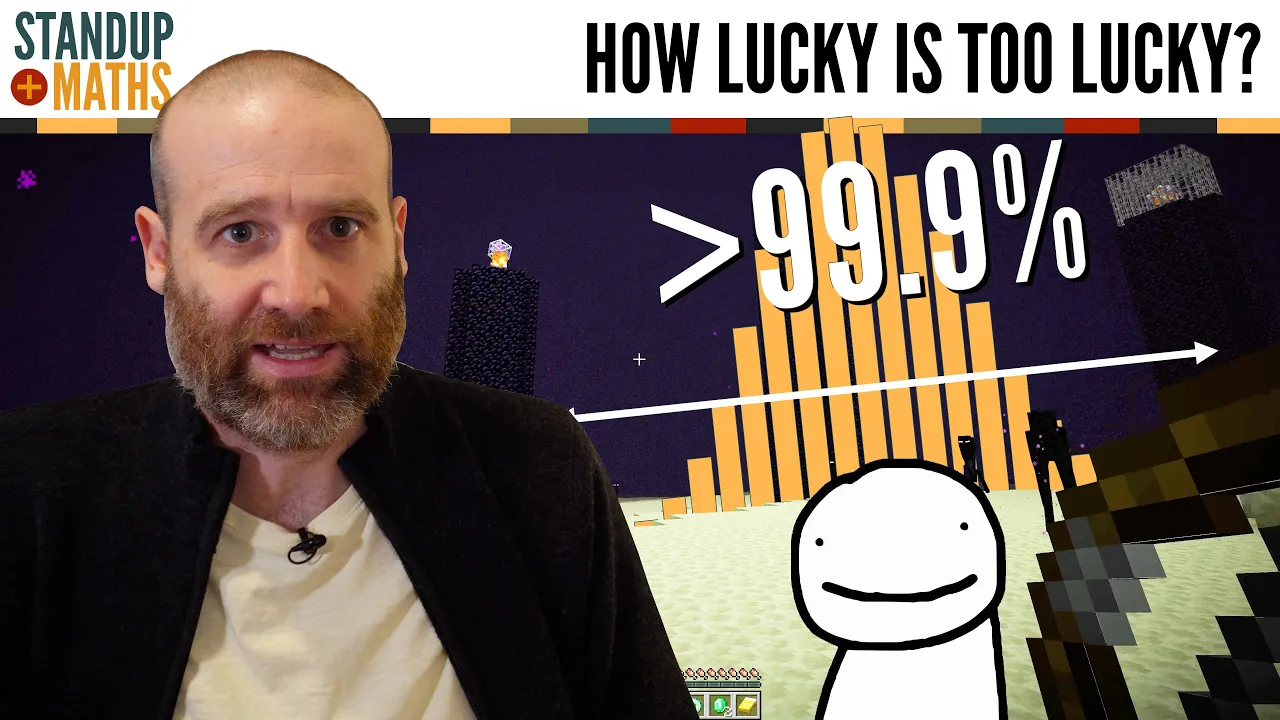
Plotting this distribution for 262 Piglin barters yields a bell curve where 12 successes is the mode (occurring at an 11.6% chance). The central mass between 1 and 24 successful trades accounts for 99.9% of all possible outcomes. Dream's 42 successful barters sits out on the extreme right tail. Because selecting an isolated point far out on a continuous tail is statistically misleading, statisticians evaluate the cumulative probability of achieving *that result or better* ($P(X \ge 42)$):
$$P(\text{Pearls} \ge 42) \approx 5.6 \times 10^{-12} \quad \left(\approx 1 \text{ in } 1.8 \times 10^{11}, \text{ or } 1 \text{ in } 180 \text{ billion}\right)$$
Applying the identical calculation to the Blaze Rod kills ($n = 305$, $p = 0.5$, $k \ge 211$):
$$P(\text{Rods} \ge 211) \approx 8.8 \times 10^{-12} \quad \left(\approx 1 \text{ in } 1.1 \times 10^{11}, \text{ or } 1 \text{ in } 110 \text{ billion}\right)$$
Assuming the drop mechanics function as independent variables, multiplying the probabilities generates the combined likelihood:
$$5.6 \times 10^{-12} \times 8.8 \times 10^{-12} \approx 5.0 \times 10^{-23}$$
This evaluates to an overall odds profile of roughly 1 in $2 \times 10^{22}$ (a 2 followed by 22 zeros). Parker remarks that while getting a result that good or better appears virtually impossible on paper, raw odds alone do not provide the full picture when outside variables and cherry-picking are factored in.
[10:17](https://www.youtube.com/watch?v=8Ko3TdPy0TU&t=617s) Part 1: The Attack and Sampling Bias
The official dispute began when Dream submitted a speedrun to Speedrun.com that placed as the fourth-fastest completion in the world for that category. The site's moderation team rejected the run, suspecting that Dream was running an altered, modded installation of the game rather than a vanilla client. The moderators subsequently published a summary video detailing their mathematical case alongside a 29-page technical research paper.
Parker notes: “The starting point was some observations from other speedrunners that Dream had had very good luck with the Ender Pearls and Blaze Rods across six consecutive live streams in October 2020.” The moderators conducted the exact same binomial calculations, reaching the identical $10^{-23}$ unadjusted threshold. However, the bulk of their 29-page dossier focused on testing whether their analysis suffered from confirmation bias or statistical unfairness.
The paper systematically accounted for four distinct systemic biases that could tilt the investigation unfairly against Dream. Parker focuses specifically on the most prominent concern: *sampling bias in stream selection* (or cherry-picking). If a runner broadcasts dozens or hundreds of streams, an investigator could maliciously isolate a specific window of six consecutive high-luck streams to artificially manufacture guilt. To unpack how probability models correct for cherry-picked sampling windows, Parker references an experiment from his secondary YouTube channel where he filmed himself flipping a two-toned coin (yellow for heads, blue for tails) 100 consecutive times, setting up a demonstration of what happens when a malicious observer snips out an unrepresentative run of 12 flips.
[12:49](https://www.youtube.com/watch?v=8Ko3TdPy0TU&t=769s) The Cherry-Picking Problem: Testing Runs in 100 Coin Flips
To illustrate how cherry-picking distorts probability, Matt sets up a scenario: imagine a malicious actor extracts a slice of 12 flips from the middle of his 100-coin-toss footage where he got 10 tails. Using a binomial distribution, getting 10 tails out of 12 flips has only a 1.6% chance of occurring, and getting 10 or more has just a 1.9% chance. An accuser could seize on that tiny probability and claim the coin must be rigged. However, an investigator trying to be fair would realize that Matt originally flipped the coin 100 times. Even without the raw unedited footage, one must account for the fact that the malicious actor could have picked any consecutive run with the smallest p-value out of all possible sub-runs: 100 individual flips, 99 pairs, 98 sets of three, and so on, yielding 5,050 possible consecutive sequences.
To give Matt every conceivable benefit of the doubt, an investigator calculates the probability that a fair coin flipped 100 times produces at least one run of any length that is 1.9% likely or worse. While finding the exact probability is mathematically intricate due to overlapping, dependent sequences, one can establish an upper bound by treating the sequences as independent. Raising the probability of the event *not* occurring ($1 - 0.019 = 0.981$) to the power of 5,050 and subtracting that from 1 gives an upper bound of 100%, completely exonerating Matt. By comparison, the exact probability calculated properly is 88.3%. When the speedrun moderators applied this exact same generous upper-bound methodology to Dream's Ender Pearl trades—expanding the window from the 6 sampled streams to all 11 eligible streams—the probability rose only to an upper bound of $8 \times 10^{-10}$, a figure that remains vanishingly unlikely. Matt pauses to promote the US paperback release of his book *Humble Pi* and an upcoming talk at Harvard Book Store before critiquing the moderation team's report. He praises their rigor but notes that the PDF is so overwhelmingly dense and jargon-heavy that it borders on being deliberately obtuse, over-engineered by moderators terrified of having their math picked apart.
As Matt Parker sums up the dilemma of interpreting isolated data: “Now at this point, to be honest, you've got the general idea: if you're looking at some results, you've got to bear in mind that there were probably more results which someone could have picked from, and you've got to somehow factor that in.”
```mermaid flowchart TD accTitle: Cherry-Picking vs Benefit of Doubt accDescr: Process showing how isolated unlikely runs are adjusted by considering all potential consecutive sub-runs. subgraph Selection["Observed Run"] A["100 Total Flips"] --> B["Cherry-picked run: 10 tails in 12 flips"] B --> C["Naive p-value: 1.9%"] end subgraph Compensation["Upper Bound Correction"] D["5,050 total consecutive runs possible"] --> E["Upper bound: 1 - 0.981^5050 ≈ 100%"] E --> F["Exact calculated probability: 88.3%"] end subgraph DreamApplication["Application to Dream"] G["6 streams analyzed"] --> H["Expanded to all 11 streams"] H --> I["Upper bound probability: 8 × 10^-10"] end ```
- **Possible consecutive runs in 100 flips:** 5,050 runs (calculated as the 100th triangular number, $\frac{100 \times 101}{2}$). - **Single-run probability:** 1.6% chance of exactly 10 tails in 12 flips; 1.9% chance of 10 or more tails in 12 flips. - **Upper bound vs. true probability for the coin run:** The independent upper bound yields ~100%, whereas the exact calculation yields 88.3%. - **Dream's 11-stream upper bound:** $8 \times 10^{-10}$ (roughly 1 in 1.25 billion).
[18:19](https://www.youtube.com/watch?v=8Ko3TdPy0TU&t=1099s) Dream's Response and "Maths Chaff"
Dream responded to the allegations by publishing a video on his second channel and releasing a 19-page mathematical rebuttal. This counter-report was commissioned from an anonymous astrophysicist specializing in astrostatistics, hired via an online scientific consulting firm. Matt emphasizes a crucial baseline: both the speedrun moderation team and Dream's paid consultant agree completely on the headline, unadjusted calculation—the raw probability of getting that specific run of Ender Pearl barters and Blaze Rod drops from a vanilla game is 1 in $2 \times 10^{22}$. The disagreement stems entirely from how to adjust that statistic to compensate for external factors, such as the total volume of speedruns, the number of active players, and how many in-game drop mechanics an investigator could have chosen to scrutinize.
Matt pulls no punches in evaluating the astrophysicist's paper, characterizing it as "maths chaff"—legitimate technical jargon and real calculations strung together simply to generate enough surface-level mathematical fog to plant reasonable doubt. He highlights several glaring blunders in the document. First, the paper includes unnecessary algebraic restatements using the binomial approximation that belong in scratch calculations rather than conceptual proofs, and the expression even omits a closing bracket—an elementary typographical error. Far more damning is a severe arithmetic mistake within the consultant's own hypothetical scenario. Examining the odds of flipping 20 heads in a row out of 100 tosses, the paper claims the odds are roughly 1 in 6,300. Matt ran his own simulations to reverse-engineer the error and discovered the author simulated runs of both heads and tails, and then, attempting to isolate heads, divided by 2 instead of multiplying by 2. This resulted in an error off by a factor of 4, completely flipping which side of their own proposed approximation the answer fell on. Furthermore, Matt critiques the paper's comparison to the lottery: Dream's paper adjusted the odds down to 1 in 10 million and treated it like a regular lottery win, ignoring that the 1 in 10 million figure *already* factored in the massive player base and run volume.
As Matt Parker bluntly concludes regarding the two conflicting documents: “I know I started as a disinterested party, but I can say of the two papers, this one is by a long shot the least convincing.”
- **Agreed headline figure:** Both sides agree that the raw, unadjusted probability of the combined drops is 1 in $2 \times 10^{22}$ (1 in 20 sextillion). - **Consultant's headline adjusted odds:** Reduced Dream's adjusted probability to approximately 1 in 10 million ($1 \times 10^{-7}$). - **Coin flip calculation error:** Claimed odds of 1 in 6,300 for 20 heads in 100 flips; the consultant accidentally divided by 2 instead of multiplying by 2, ending up off by a factor of 4. - **Editorial quality:** Contained fundamental formatting errors, including missing closing parentheses in key formulas.
[23:29](https://www.youtube.com/watch?v=8Ko3TdPy0TU&t=1409s) Analog Probability: Craps and the 154-Roll World Record
Frustrated by the endless squabbling over subjective statistical compensation models, Matt decides to cut through the noise entirely: he discards both parties' adjustment methods and focuses strictly on the universally agreed raw figure of 1 in $2 \times 10^{22}$. To put a number of that magnitude into perspective, Matt takes a detour into the analog history of probability: rolling standard six-sided dice. With two dice, there are 36 distinct outcomes. The outcomes are not equally likely: snake eyes (a total of 2) has only 1 combination out of 36 ($\frac{1}{36}$), whereas a total of 7 is the single most common result, occurring in 6 out of the 36 combinations ($\frac{6}{36}$ or $\frac{1}{6}$).
This distribution is the foundation of casino craps, an analog game where the shooter attempts to roll while avoiding a 7. Matt looks at the world record for the longest consecutive craps roll without rolling a seven, set in 2009 by Patricia Demauro at the Borgata in Atlantic City. Demauro rolled the dice 154 consecutive times without a single seven ending her turn. Because the chance of avoiding a 7 on any individual roll is $\frac{30}{36}$ (or $\frac{5}{6}$), the probability of surviving 154 rolls in a row is $(\frac{30}{36})^{154}$, which equals approximately $6.4 \times 10^{-13}$, or roughly 1 in $1.5 \times 10^{12}$ (1 in 1.5 trillion). Remarkably, Demauro's legendary lucky streak—celebrated worldwide as one of the most improbable analog gambling runs ever recorded—was still vastly more probable than the raw odds of Dream's Ender Pearl barters.
As Matt Parker observes when setting up the comparison between analog dice and digital RNG: “It is less likely than the run of ender pearl trades that Dream got, and I actually looked this up when I was trying to find another improbable achievement in a game.”
- **Two-dice probabilities:** Snake eyes (2) occurs $\frac{1}{36}$ of the time (~2.78%); a total of 7 occurs $\frac{6}{36}$ ($\frac{1}{6}$, or ~16.67%) of the time. - **Craps survival rate per roll:** $\frac{30}{36} = \frac{5}{6} \approx 83.33\%$ chance of avoiding a 7. - **Patricia Demauro's 2009 world record:** 154 consecutive rolls without rolling a 7. - **Demauro streak probability:** $(\frac{5}{6})^{154} \approx 6.4 \times 10^{-13}$, or approximately 1 in 1.56 trillion ($1.5 \times 10^{12}$).
[25:03](https://www.youtube.com/watch?v=8Ko3TdPy0TU&t=1503s) Casino World Records: Patricia Demauro and the Odds of Craps and Roulette
To test whether the odds in Dream's Minecraft speedruns could ever happen by chance, Matt Parker searches for the most improbable recorded events in human gaming history. The benchmark for real-world luck is Patricia Demauro, who set the world record for craps by rolling 154 times consecutively without rolling a seven. To contextualize this run, Matt compares it to the previous craps world record set 20 years earlier, which was 118 rolls without a seven. That earlier record carries a probability of $4.5 \times 10^{-10}$, or roughly 1 in $2.2 \times 10^9$. Matt finds that figure entirely plausible through a back-of-the-envelope calculation: around 2011, there were roughly 3,500 casinos worldwide. Assuming an average of five craps tables per casino, roughly six games played per hour, and an average operating day of 12 hours over a 10-year period, casinos host approximately $4.7 \times 10^9$ games of craps every decade. Because that number of attempts is roughly double the 1 in $2.2 \times 10^9$ odds, a 118-roll streak is a sensible once-a-decade occurrence.
Patricia Demauro's 154-roll streak, however, is a thousand times less likely, landing near 1 in $10^{12}$—making it a 1-in-10 chance per century, sitting right on the absolute frontier of plausibility. To avoid cherry-picking craps after the fact, Matt examines roulette records: the record for the most consecutive spins landing on the same color is 32 spins (a 1 in $1.1 \times 10^{10}$ event), and the record for the most consecutive hits on the exact same number is the number 19 coming up seven times in a row (a 1 in $3 \times 10^9$ event). Across global casinos, unlikely real-world streaks consistently top out in the $10^9$ to $10^{10}$ ballpark. Patricia's craps run stands out as the ultimate "meta lucky" outlier at $10^{12}$.
By contrast, Dream’s ender pearl drop luck alone sat around 1 in $10^{11}$, matching casino-record territory on its own. The fatal problem is that Dream did not just have one isolated lucky streak; he simultaneously had blaze rod drops with odds around 1 in $10^{11}$. Combining those independent events makes Dream's streak wildly more improbable than any human gambling record. As Matt points out: “In fact the odds of Patricia doing both of those at the same time is more likely than what happened to Dream.”
- Previous craps world record (118 rolls): 1 in $2.2 \times 10^9$ ($4.5 \times 10^{-10}$). - Global casino craps games per decade: estimated at $\approx 4.7 \times 10^9$ across 3,547 casinos. - Patricia Demauro's craps world record (154 rolls): roughly 1 in $10^{12}$. - Roulette consecutive color record (32 spins): 1 in $1.1 \times 10^{10}$. - Roulette consecutive single-number record (number 19 seven times): 1 in $3 \times 10^9$.
```mermaid flowchart TD accTitle: Unlikely Event Odds Comparison accDescr: A visual comparison of probabilities from normal casino play up to Dream's combined speedrun odds.
subgraph Casino["Recorded Casino Feats"] A["Prior Craps Record: 118 rolls<br/>(1 in 2.2 × 10⁹)"] B["Roulette: 32 Same Color<br/>(1 in 1.1 × 10¹⁰)"] C["Patricia Demauro Craps: 154 rolls<br/>(1 in 10¹²)"] end
subgraph Minecraft["Dream's Minecraft Streams"] D["Ender Pearl Trades Alone<br/>(~1 in 10¹¹)"] E["Blaze Rod Drops Alone<br/>(~1 in 10¹¹)"] F["Dream Combined Total<br/>(1 in 2 × 10²²)"] end
A --> C B --> C C -->|"10 orders of magnitude jump"| F D --> F E --> F ```
---
[28:49](https://www.youtube.com/watch?v=8Ko3TdPy0TU&t=1729s) The "10 Billion Human-Second Century"
To demonstrate why Dream's results cannot be defended by appealing to large sample sizes, Matt invents a new statistical benchmark: the **10 billion human-second century**. This metric establishes an extreme mathematical upper bound on the maximum probability space that human civilization could plausibly exhaust. A century consists of roughly $\pi$ billion seconds ($3.15 \times 10^9$ seconds, accurate to within half a percent). Multiplying those seconds by an upper-bound global population of 10 billion people yields approximately $3 \times 10^{19}$ total trials.
``` 1 century ≈ 3.15 × 10⁹ seconds 10,000,000,000 humans × 3.15 × 10⁹ seconds ≈ 3 × 10¹⁹ total human-seconds ```
If every person alive performed an action every single second around the clock for 100 years without interruption, that action would be attempted roughly $3 \times 10^{19}$ times. Therefore, any event requiring human action with odds significantly longer than 1 in $3 \times 10^{19}$ cannot plausibly occur in human history. Matt stresses that this upper bound applies to pre-specified, desired outcomes rather than arbitrary outcomes: rolling a 20-sided die 20 times produces a specific string of digits rarer than $10^{19}$, but that specific sequence has no meaning beforehand. He compares this to “throwing a dart out of an airplane and it perfectly landing like miles down on the ground bam right in the bull's-eye of a target versus just throwing a dart out of a plane letting it land you land find the dart and then paint the target around it.” In speedrunning, the target is defined in advance: players want ender pearls and blaze rods as quickly as possible. Dream's combined odds across his streams sat around 1 in $2 \times 10^{22}$—a number a thousand times larger than the entire 10 billion human-second century. As Matt flatly concludes: “When someone does something with odds of 2 times 10 to the 22 way beyond like just a thousand times bigger than the 10 billion human second century you don't have to worry about anything else that is never gonna happen.”
- 1 century in seconds: $\approx 3.15 \times 10^9$ seconds (approximately $\pi \times 10^9$). - Benchmark capacity: $10^{10} \text{ humans} \times 3.15 \times 10^9 \text{ seconds} \approx 3 \times 10^{19}$ human-seconds. - Combined odds of Dream's drops: approximately 1 in $2 \times 10^{22}$.
---
[32:52](https://www.youtube.com/watch?v=8Ko3TdPy0TU&t=1972s) The Final Verdict on Dream's Speedruns
Matt cuts through the debates in the competing moderator and response papers over p-hacking, selection bias, and stopping rules, noting that while those subtleties matter in ordinary statistical analysis, they are irrelevant when dealing with an outcome of 1 in $2 \times 10^{22}$. Even if every human on Earth spent a century doing nothing but Minecraft speedruns every single second, there would still be only a 1-in-1,000 chance of seeing a run as lucky as Dream’s. Furthermore, comparing Dream’s run to the luckiest verified casino record in history (the 1 in $10^{12}$ craps streak) reveals a gap of 10 orders of magnitude: Dream's streams were 10 billion times less likely than the craps record.
Matt emphasizes the critical statistical distinction between cheating and game-state modification: the probability does not calculate the chance that Dream personally cheated; it strictly calculates the chance of obtaining those outcomes if the game is running standard, unmodified Minecraft code. While some suggested potential random number generator (RNG) glitches or linked drop tables, a systematic code glitch would have appeared across other players' runs rather than isolated exclusively to Dream's sessions. Without accusing Dream of deliberate malice, Matt gives his final verdict: “Whatever the case I'm not assigning guilt I'm just saying that definitively as a disinterested party I can confirm these speed runs done by Dream should not be included in the list of world records because the version of Minecraft they were played on does not match what we think it should be.”
---
[36:16](https://www.youtube.com/watch?v=8Ko3TdPy0TU&t=2176s) Humble Pi US Paperback and Signed Proof Sheets
Closing the video, Matt shifts to channel announcements, celebrating the release of the US paperback edition of his book, *Humble Pi*. He explains that this version acts as an "expansion pack" because it includes extra stories at the back detailing errors and mathematical mishaps that occurred after the original manuscript had already gone to print.
Because travel restrictions prevented him from flying to the United States to sign books in person, Matt came up with an alternative collectible: he pulled out the original printed typesetting proof sheets of the book—some featuring his handwritten editorial corrections and notes, others completely clean—and signed every single individual page. Partnering with the Harvard Book Store, he announces that these original signed proof sheets will be included for free with the first 314 orders (a nod to $\pi$), with extras sent out as long as supplies last, even if shipping logistics require sending the sheet separately from the book itself.
[37:26](https://www.youtube.com/watch?v=8Ko3TdPy0TU&t=2246s) Supporting Independent Bookstores and the Harvard Book Store Event
Wrapping up his book promotion for *Humble Pi*, Matt Parker encourages viewers to order quickly from Harvard Book Store to secure one of the limited copies bundled with an authentic, signed page from the publisher's original correction proofs. He points out that choosing Harvard Book Store supports an independent bookshop, even though massive online retailers also stock the paperback. To sweeten the deal, Matt announces an upcoming free virtual event hosted with Harvard Book Store on the evening of February 4th, 2021.
Unlike the book's limited bonus pages, the online talk is open to everyone without an attendee cap. Attendees can drop in to hang out, ask questions in real time, and talk about mathematics. Matt urges viewers to check the description link and act fast if they want to snag one of the signed proof sheets before they are gone.
- **Upcoming Event:** Free virtual talk hosted by Harvard Book Store on February 4, 2021. - **Bonus Item:** Original signed publisher correction sheets included with qualifying early book orders.
---
[38:00](https://www.youtube.com/watch?v=8Ko3TdPy0TU&t=2280s) The Grind Behind the Magic, Patreon Thanks, and the Final Verdict
Addressing the framing device of the video—where Matt spent ages on camera trying to achieve an improbable, lucky physical outcome—he confirms that he did not fake the footage. Every single failed attempt was preserved and recorded. Matt promises to upload the complete, multi-hour uncut ordeal as bonus footage exclusively for his Patreon community, whose funding makes these labor-intensive projects possible in the first place.
When the Dream speedrunning debate initially blew up, Matt felt a clear responsibility to weigh in because the drama had unexpectedly sparked widespread interest in probability among a massive audience. Matt explains his duty as a science communicator: “In fact when the whole Minecraft controversy first kicked off I thought, you know what, given people support me to make math videos and there's suddenly a whole flood of young people who want to learn about statistics because of Minecraft, I'm obliged to do a video.” Producing the deep dive required a collaborative effort: Oliver Dunk served as the Minecraft consultant, Alex Genn-Bash handled editing, and Ben Sparks built animations for the binomial and normal distributions.
Matt emphasizes that whether viewers contribute via Patreon or simply like, share, and support the videos through the YouTube algorithm, their engagement is deeply appreciated. His ultimate hope is that the video demystifies statistical analysis for newcomers, giving them the tools to examine probability claims with a critical eye in the future. As Matt summarizes, “And hopefully this video has reached a new audience of people who've now realized that they can go through stats themselves critically and occasionally they just bear in mind that when they see something which seems too lucky to be true, occasionally it is.” The video wraps up on a humorous post-credits gag: as Matt wraps up production and thanks his off-camera helper, the helper suddenly notices Matt is sporting a full, bushy beard, asking in shock how long he has actually been sitting there filming.
- **Behind the Scenes:** Uncut footage spanning multiple hours of failed filming attempts provided to Patreon supporters. - **Production Credits:** - Minecraft consultancy: Oliver Dunk - Video editing: Alex Genn-Bash - Mathematical graphics (binomial/normal distributions): Ben Sparks - **Core Takeaway:** Equipping viewers to scrutinize extraordinary statistical claims independently instead of taking improbable streaks at face value.
## Notable quotes > [32:52](https://www.youtube.com/watch?v=8Ko3TdPy0TU&t=1972s) I can confirm these speed runs done by Dream should not be included in the list of world records because the version of Minecraft they were played on does not match what we think it should be. — Matt Parker
> [12:49](https://www.youtube.com/watch?v=8Ko3TdPy0TU&t=769s) If you're looking at some results, you've got to bear in mind that there were probably more results which someone could have picked from, and you've got to somehow factor that in. — Matt Parker
## Mentioned Matt Parker, Dream, Minecraft, Minecraft Java Edition 1.16, Super Mario Bros., Mike Tyson's Punch-Out!!, Speedrun.com, Patricia Demauro, Borgata, Humble Pi, Harvard Book Store, Patreon, Jane Street, Oliver Dunk, Alex Genn-Bash, Ben Sparks, Howard Carter, Simon Wright, Adam Robinson
## Video description Buy my book Humble Pi now! https://mathsgear.co.uk/collections/books/products/humble-pi-signed-paperback
My talk on 4 February 2021 at Harvard Book Store: https://www.harvard.com/event/virtual_event_matt_parker/
Here is the original accusation against Dream. Video: https://www.youtube.com/watch?v=-MYw9LcLCb4&ab_channel=Geosquare Paper: https://mcspeedrun.com/dream.pdf
And here is Dream's reply. Video: https://www.youtube.com/watch?v=1iqpSrNVjYQ&ab_channel=DreamXD Paper: https://drive.google.com/file/d/1yfLURFdDhMfrvI2cFMdYM8f_M_IRoAlM/view
"Matt flips a coin 100 times." https://youtu.be/T2Xtit17snE
"Holy Craps! How a Gambling Grandma Broke the Record" http://content.time.com/time/nation/article/0,8599,1901663,00.html
Number of casinos in the world in 2011: 3,547 https://www.statista.com/statistics/221031/total-worldwide-casinos-by-region/
Roulette records. https://www.roulette17.com/stories/record-reds-blacks-in-a-row/
CORRECTIONS - At 09:08 I say “1 in 110 trillion” when I meant to say “1 in 110 billion”. The number on the screen is correct, it was just a verbal slip-up. - At 25:27 I showed the 118 craps record as “1 in 1.2 × 10^9” when it should be “1 in 2.2 × 10^9”. The voiceover says the correct number. - I slip and “more likely” instead of “less likely” at 33:47 (I think I may have even been going for “more unlikely”). But everything in the screen is correct. - Let me know if you spot any more mistakes!
Thanks to my Patreon supporters who mean I can spend [[REDACTED]] hours filming myself trying to achieve improbably things. If you support me, you can get access to all [[REDACTED]] hours of bonus footage from this episode.
https://www.patreon.com/standupmaths
As always: thanks to Jane Street who support my channel. They're amazing. And I believe they have no opinion on Dream. https://www.janestreet.com/
Endless filming by Matt Parker Editing by Alex Genn-Bash Some graphics by Ben Sparks Minecraft consultancy by Oliver Dunk Music by Howard Carter Design by Simon Wright and Adam Robinson
MATT PARKER: Stand-up Mathematician Website: http://standupmaths.com/ US book: https://www.penguinrandomhouse.com/books/610964/humble-pi-by-matt-parker/ UK book: https://mathsgear.co.uk/collections/books/products/humble-pi-signed-paperback
[Source](https://www.youtube.com/watch?v=8Ko3TdPy0TU)