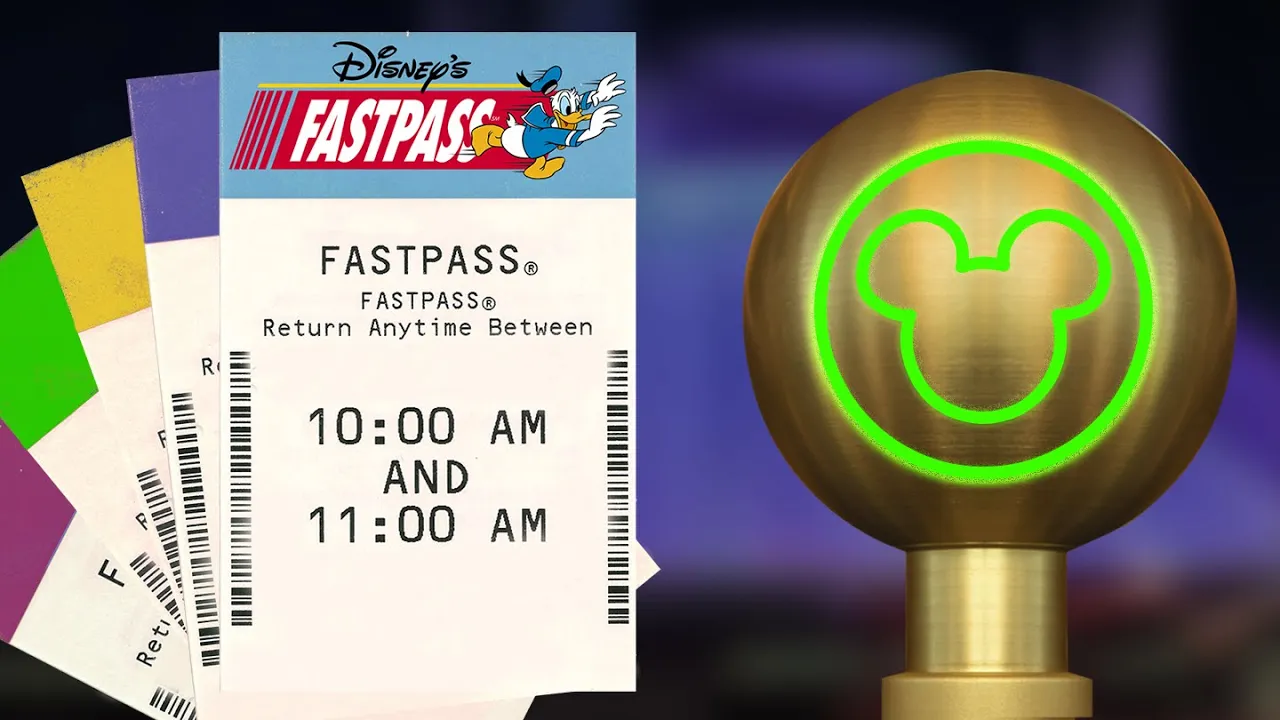
Bruce Laval introduced the dual-queue FastPass system in 1999 to cut wait times and distribute crowds, but its underlying capacity limits were exposed as Disney expanded the service across dozens of attractions. (10:09)
Disney invested roughly $1 billion in the MyMagic+ infrastructure and FastPass+, which replaced paper slips with advance digital reservations booked up to 60 days before arrival. (35:41)
Computer agent simulations created for the documentary demonstrated that FastPass+ dramatically inflated standby lines park-wide and created an extreme bimodal distribution between hyper-planners and casual visitors. (57:31)
Following COVID-19 park closures, Disney retired FastPass entirely in August 2021 and introduced the paid Disney Genie+ and Individual Lightning Lane models, bringing park access full circle to per-ride pricing 50 years after the opening of Walt Disney World. (94:05)
Detailed notes
## Background
This documentary was created by Kevin Perjurer and published under his channel Defunctland on YouTube on November 21, 2021. According to the page description, it is a feature-length deep dive exploring the history, operations, and eventual retirement of Disney's expedited queue services, FastPass and FastPass+.
## TL;DR
The documentary traces the fifty-year evolution of queue management across Disney theme parks, starting from the original A-through-E coupon books and Bruce Laval's operational breakthroughs to the late-1990s introduction of free paper FastPass. It details the massive billion-dollar gamble on MyMagic+ and FastPass+, demonstrating through custom agent-based computer simulations ('Shapeland') how digital pre-booking inadvertently cannibalized park capacity, inflated standby lines, and created an inequitable class system among visitors. Finally, it examines how the operational collapse and pandemic closures culminated in the permanent retirement of FastPass in favor of the paid Disney Genie+ and Lightning Lane systems, returning park admissions to a per-ride fee structure exactly half a century after Magic Kingdom opened.
## Atmosphere & style
The presentation blends the meticulous, dry analytical rigor of industrial engineering with Defunctland's signature deadpan humor, sharp corporate critique, and cinematic pacing. Watching it feels like attending a masterclass in queue psychology and simulation modeling that gradually morphs into an existential, slightly dystopian meditation on modern consumer escapism. The emotional arc transitions from fond historical nostalgia and technical fascination into escalating frustration over bureaucratic short-sightedness, concluding on a reflective note about societal inequality penetrating the gates of themed entertainment.
## Bulletin
- [10:09](https://www.youtube.com/watch?v=9yjZpBq1XBE&t=609s) Bruce Laval introduced the dual-queue FastPass system in 1999 to cut wait times and distribute crowds, but its underlying capacity limits were exposed as Disney expanded the service across dozens of attractions.
- [35:41](https://www.youtube.com/watch?v=9yjZpBq1XBE&t=2141s) Disney invested roughly $1 billion in the MyMagic+ infrastructure and FastPass+, which replaced paper slips with advance digital reservations booked up to 60 days before arrival.
- [57:31](https://www.youtube.com/watch?v=9yjZpBq1XBE&t=3451s) Computer agent simulations created for the documentary demonstrated that FastPass+ dramatically inflated standby lines park-wide and created an extreme bimodal distribution between hyper-planners and casual visitors.
- [01:34:05](https://www.youtube.com/watch?v=9yjZpBq1XBE&t=5645s) Following COVID-19 park closures, Disney retired FastPass entirely in August 2021 and introduced the paid Disney Genie+ and Individual Lightning Lane models, bringing park access full circle to per-ride pricing 50 years after the opening of Walt Disney World.
## Key takeaways
- [00:00](https://www.youtube.com/watch?v=9yjZpBq1XBE&t=0s) Theme park wait times are fundamentally governed by queuing theory: the interaction between guest arrival rate (demand) and hourly ride capacity (service rate).
- [04:43](https://www.youtube.com/watch?v=9yjZpBq1XBE&t=283s) Disney eliminated A-through-E coupon books in 1982 after industrial engineer Bruce Laval proved that charging more for top tickets distorted guest behavior and artificially worsened long lines.
- [10:09](https://www.youtube.com/watch?v=9yjZpBq1XBE&t=609s) Inspired by ski resort single-rider lines, Bruce Laval developed the original 1999 FastPass as a dual-queue system balancing a virtual reservation stream with a standby buffer to maximize hourly throughput.
- [19:12](https://www.youtube.com/watch?v=9yjZpBq1XBE&t=1152s) Paper FastPass reduced active wait times by pushing waiting guests out of long queues and into underutilized secondary attractions, dining, and retail shops.
- [24:11](https://www.youtube.com/watch?v=9yjZpBq1XBE&t=1451s) Aggressive expansion of FastPass under Chairman Paul Pressler proved that deploying virtual queues onto high-capacity attractions or narrow park layouts causes severe bottlenecking and pedestrian gridlock.
- [35:41](https://www.youtube.com/watch?v=9yjZpBq1XBE&t=2141s) Disney authorized a $1 billion investment into MyMagic+ and MagicBands in 2011 to eliminate vacation unpredictability through guaranteed advance reservations.
- [47:51](https://www.youtube.com/watch?v=9yjZpBq1XBE&t=2871s) Advance reservations pre-booked up to 60 days out made FastPass+ brittle, causing mechanical ride breakdowns to trigger severe cascading surges across operating attractions.
- [49:07](https://www.youtube.com/watch?v=9yjZpBq1XBE&t=2947s) When priority lines backed up, Cast Members escalated merge point ratios up to 100:1, freezing physical standby queues and worsening guest psychology through zero forward movement.
- [01:01:36](https://www.youtube.com/watch?v=9yjZpBq1XBE&t=3696s) Agent-based simulations in Shapeland demonstrated that while FastPass reduced wait times on paper via negative wait time on empty rides, FastPass+ pushed average standby waits from 41 to 67 minutes.
- [01:08:47](https://www.youtube.com/watch?v=9yjZpBq1XBE&t=4127s) FastPass+ warped daily attraction experiences into an extreme bimodal distribution: informed resort guests achieved dozens of rides while casual or infrequent visitors experienced fewer than under pure standby.
- [01:21:16](https://www.youtube.com/watch?v=9yjZpBq1XBE&t=4876s) The structural difference between the systems stemmed from origins: original paper FastPass was an operational tool managed day-of, whereas FastPass+ was an advance marketing mechanism.
- [01:34:05](https://www.youtube.com/watch?v=9yjZpBq1XBE&t=5645s) The 2020–2021 pandemic shutdowns provided Disney executive cover to retire the free FastPass framework and launch the multi-tiered paid Disney Genie+ and Lightning Lane services.
- [01:38:37](https://www.youtube.com/watch?v=9yjZpBq1XBE&t=5917s) Exactly 50 years after opening Magic Kingdom with A-through-E ticket books, Disney returned to a per-ride fee model with Individual Lightning Lane purchases.
- [01:39:34](https://www.youtube.com/watch?v=9yjZpBq1XBE&t=5974s) Complex advance booking systems undermined theme park escapism by importing external societal inequalities based on wealth and planning knowledge into the park environment.
## Detailed walkthrough
### [00:00](https://www.youtube.com/watch?v=9yjZpBq1XBE&t=0s) The Mechanics of a Line
A line, or queue, is simply an organized group of people (or visual representations like dots) waiting their turn to experience something. The duration required to progress from the entrance of the queue to its exit is the wait time. In basic queuing theory, wait time is governed by two interacting variables: the service rate and the arrival rate. The service rate represents the velocity at which guests are pulled from the front of the line to experience the attraction, while the arrival rate is the speed at which prospective guests join the back of the line. Speeding up the service rate causes wait times to drop; increasing the arrival rate causes wait times to climb.
```mermaid
flowchart LR
accTitle: Basic Queue Mechanics
accDescr: Flow diagram showing how arrival rate and service rate govern queue length and wait time.
subgraph Input["Queue Dynamics"]
AR["Arrival Rate<br/>(Demand)"] --> Q["The Queue<br/>(Wait Time)"]
Q --> SR["Service Rate<br/>(Attraction Capacity)"]
end
```
While straightforward in the abstract, real-world queuing rapidly becomes intricate, and no environment illustrates this complexity more vividly than the Disney Parks. Renowned globally not only for their massive wait times but also for the ambitious operational interventions designed to mitigate them, Disney parks require an examination of both queue psychology and industrial engineering. As Kevin notes:
> “To truly understand this topic, it is not enough to simply learn the history. We must deep dive into the technicalities and psychology of queuing and fully examine the many ways that Disney has tried to tackle the issue of lines, and unfortunately, there is no FastPass for this explanation.”
[01:57](https://www.youtube.com/watch?v=9yjZpBq1XBE&t=117s) Opening Magic Kingdom, Ride Capacities, and Balking
When Walt Disney World opened on October 1, 1971, with two resort hotels and the Magic Kingdom, it inherited the long attraction waits that had plagued Disneyland in California for years. Curiously, two of the most punishing lines during the park's first year were for 20,000 Leagues Under the Sea: Submarine Voyage and the Country Bear Jamboree. The submarine voyage sat consistently at a one-hour wait, while the Country Bear Jamboree regularly pushed past an hour on peak days—a startling contrast to modern park conditions where 20,000 Leagues has long been demolished and the Country Bear Jamboree rarely fills its auditorium.
The disparity in wait times stems from the contrast between arrival rate and attraction capacity (service rate). The Haunted Mansion, operating on a continuously moving Omnimover ride system, could process roughly 2,800 guests per hour. In contrast, 20,000 Leagues Under the Sea seated only 40 guests per submarine and could run a maximum of nine vessels simultaneously, yielding an hourly throughput of only about 1,200 guests. Over a standard 12-hour park day, the Haunted Mansion could cycle through over 33,000 riders, while 20,000 Leagues capped out around 14,000. If 1,000 guests entered both queues simultaneously, the Haunted Mansion wait would stand at 35 minutes, whereas the 20,000 Leagues line would balloon to 1 hour and 20 minutes.
While capacity is constrained by engineering and ride architecture, the arrival rate reflects guest demand, shaped by attraction quality, visibility, and marketing. Operating hours in the park are limited, transforming time into a currency that guests must spend. If a guest assesses the Jungle Cruise at a 30-minute wait, they may hop in line; if that wait reaches an hour, they may decide against it. In queueing theory, this refusal to join a queue because of its visible length is termed *balking*, a natural behavior that helps moderate line growth by self-selecting out guests who lack strong dedication to an attraction.
[04:43](https://www.youtube.com/watch?v=9yjZpBq1XBE&t=283s) Ticket Books and False Demand: The Bruce Laval Discovery
The relationship between arrival and service rates grew far more complex when visitors had to spend actual money alongside their time. Opening-day Walt Disney World utilized Disneyland's A-through-E ticket book system, requiring individual coupons to board attractions. While A-tickets covered minor diversions, E-tickets were reserved for premier thrills, birthing the enduring pop-culture idiom "E-ticket" to describe anything exciting. Charging higher rates for flagship rides was meant to suppress demand; however, at the newly opened Magic Kingdom, it generated unintended consequences.
Visitors unfamiliar with the new park's lineup relied on Disney's own coupon designations to infer quality. The Country Bear Jamboree, featuring unknown animatronic characters, was classified as an E-ticket, while the Mickey Mouse Revue, starring beloved Disney icons, was categorized merely as a D-ticket. Guests presumed the Country Bear Jamboree must be the superior show simply because Disney charged an E-ticket for it, triggering artificial demand and bloated lines.
This distortion caught the attention of Bruce Laval, an industrial engineer with an MBA specializing in operations research from the University of Florida who joined Disney upon the resort's 1971 debut. Laval was an early pioneer in using computer simulation models to evaluate operational systems. He argued that the A–E ticketing system was directly distorting guest behavior and recommended ending it. Although conservative senior executives killed the proposal right before its initial Magic Kingdom trial, the company ultimately abandoned coupon books across both Disneyland and Walt Disney World when EPCOT Center opened in 1982 with all-inclusive admission. Once ticket books were eliminated, Laval's findings held true: E-ticket line lengths dropped, and traffic spread more evenly into overlooked attractions.
- **Bruce Laval's background:** Graduated from the University of Florida with an MBA focused on operations research; hired in 1971 as a Disney industrial engineer.
- **Ticketing impact:** Discontinuing A-through-E tickets lowered E-ticket congestion and diverted foot traffic to underutilized offerings.
[07:09](https://www.youtube.com/watch?v=9yjZpBq1XBE&t=429s) The Evolution of the Switchback and Disney's Three-Tiered Queue Strategy
Eliminating ticket books did not resolve crowd management, and long waits remained the primary complaint across all Disney parks. Cultural expectations also altered queue reception. When Tokyo Disneyland debuted in 1983, American management marveled at the patience of Japanese visitors waiting in massive queues, contrasting sharply with American and French audiences, who exhibited much lower tolerance for delay.
Disney also grappled with shifting attitudes toward queue layout. For the 1964 New York World's Fair, Disney Imagineers developed the condensed, zigzagging switchback queue to control sprawling crowds. Walt Disney appreciated the switchback for its social dynamic, believing that weaving guests back and forth allowed strangers to face and interact with one another. However, by the mid-1980s, guests had grown cynical toward switchbacks; the endless zigzags felt claustrophobic and tedious rather than efficient.
In response, Disney developed a three-tiered design framework for queue management:
1. **Limit waits:** Cap queue times at a maximum of 15 minutes whenever feasible.
2. **Provide entertainment:** If waits exceed 15 minutes, furnish guests with engaging distractions, including themed queue environments and pre-show videos.
3. **Obscure the line:** Segment queues into isolated visual pockets so guests cannot perceive the true magnitude of the crowd until they are already committed.
This psychological approach rested on a single thesis:
> “If you remove the guests’ ability to visualize the wait, the wait itself will feel shorter.”
[09:09](https://www.youtube.com/watch?v=9yjZpBq1XBE&t=549s) The Opening of Disney-MGM Studios and Laval's Promotion
In 1987, Bruce Laval was appointed Director of the Studio Tour for the upcoming Disney-MGM Studios park. Conceived primarily as an operational film and television production studio with an accompanying tram tour, the park opened in 1989 with very few attractions and minimal active production work. Throngs of guests swarmed the gates only to encounter crippling crowds and few things to do.
The bottleneck generated widespread negative press. When questioned by journalists regarding the crippling wait times, Laval gave a candid assessment:
> “You could have the greatest show in the world, but if you have a three-hour wait out there people are going to leave the park dissatisfied.”
The published remark caught the eye of Disney CEO Michael Eisner, who promptly phoned the *Orlando Sentinel* to reassure parkgoers and staff that expansions were imminent, stating:
> “We do not want the lines to be that long. We are trying to rectify that as soon as we can.”
Laval's operational expertise and candid assessments cemented his trajectory within the corporate hierarchy, culminating in his promotion in 1995 to Executive Vice President of Operations.
[10:09](https://www.youtube.com/watch?v=9yjZpBq1XBE&t=609s) From Failed Reservations to the Ski Lift Epiphany
In the mid-1990s, mounting congestion and ballooning wait times across the Disney parks prompted Bruce Laval, who oversaw park and resort operations and held a background in industrial engineering, to seek a structural fix. Laval and his team initially toyed with converting certain high-demand attractions into reservation-only experiences. Under this early concept, guests would receive an assigned reservation time, similar to booking a table at a restaurant, walk up to the entrance, and be seated immediately without standing in a conventional line.
While that concept held the promise of completely wiping out wait times at headline rides, practical operational hurdles quickly surfaced. For one, park guests proved notoriously unreliable at showing up on time because they were easily distracted by other offerings across the park. Whenever a party missed their reservation slot, ride vehicles were dispatched with empty seats, directly cannibalizing the attraction’s overall hourly capacity. Furthermore, if a ride suffered mechanical downtime, the system collapsed: visitors holding passes during the outage could not easily be accommodated later in the day because subsequent slots were already fully booked. If operators did let them squeeze in later, a massive, unmanageable line backed up for the rest of the operational day, completely defeating the original purpose of eliminating lines. Faced with these fatal flaws, Disney temporarily abandoned the concept as a dead end.
The breakthrough arrived outside the workplace during a 1997 skiing vacation in Colorado. Watching skiers load onto four-passenger chairlifts, Laval noticed how the queue was split into two channels: a standard line and a single-rider line designed to plug empty seats whenever odd-numbered parties boarded. Laval realized this configuration provided the exact buffer needed to salvage his park concept. Instead of regular and single-rider lines, an attraction could operate with a reservation-based line alongside a traditional standby line. If guests missed their assigned reservation window, operators would immediately pull from the standby queue to fill the empty seats, ensuring ride capacity never suffered from unpredictable guest behavior. If downtime struck, ride operators could simply adjust the merge ratio between reservation holders and standby guests to favor those delayed by the outage.
What Laval ultimately designed was functionally a virtual queue rather than a strict reservation system. Much like taking a numbered paper ticket at a quick-service deli or bakery counter, visitors still encountered a first-come, first-served mechanism, but the physical waiting process was displaced. By removing the need to stand in a visible queue, the perceived quality of the wait improved dramatically.
```mermaid
flowchart TD
accTitle: Bruce Laval Dual-Queue Operational Model
accDescr: Diagram showing how guests enter either standby or FastPass, balancing throughput at the boarding area.
subgraph Arrivals ["Park Guests"]
G["Guest Arrival"]
end
subgraph Queues ["Dual Queuing Paths"]
FP["FastPass Kiosk\n(Virtual Queue Return Time)"]
SB["Standby Line\n(Physical Queue)"]
W["Explore Park / Shops / Dining"]
end
G -->|"Choose Immediate Wait"| SB
G -->|"Choose Virtual Queue"| FP
FP -->|"Hold Return Window"| W
W -->|"Return on Time"| M
SB -->|"Buffer Flow"| M
M -->|"Absorbs Downtime / Late Arrivals"| R
```
[12:48](https://www.youtube.com/watch?v=9yjZpBq1XBE&t=768s) The Animal Kingdom Trials and Space Mountain Testing
When Laval returned from Colorado and pitched his virtual queue concept to fellow Disney executives, he was greeted with widespread skepticism. Determined to validate the theory, Laval organized a controlled trial at Disney’s Animal Kingdom, which had opened recently and offered a limited attraction lineup that made tracking guest movement manageable. Test subjects carried physical paper diaries to record every detail of their day, down to the exact minutes spent in queues. Guests were divided into two cohorts: a control group operating under normal park conditions and an experimental group introduced to the virtual queue.
Members of the experimental group were instructed to visit ride entrances, where cast members handed them paper tickets stamped with return times calibrated to mirror whatever physical standby wait existed at that moment. The subjects were turned loose to explore the park until their designated window, at which point they returned to bypass the standby line. The trial proved to be an overwhelming operational triumph:
- Experimental virtual queue participants experienced 25% more attractions than the control group.
- Their active wait times were slashed by 50%.
- Surveyed guests in the test group reported substantially higher satisfaction ratings and stated they were far more likely to revisit the resort.
Crucially for executive buy-in, the Animal Kingdom experiment revealed that guests liberated from physical lines spent significantly more time browsing gift shops and lingering in restaurants, generating an immediate bump in guest spending compared to the control group.
With revenue implications validated, corporate management greenlit expanded testing through early 1999 across Disneyland and Walt Disney World. By the summer of 1999, field testing shifted to the Magic Kingdom’s perennial bottleneck, Space Mountain. In these rough early trials, cast members stood at attraction entrances manually scrawling return times onto paper slips by hand while clicking handheld tally counters to track how many passes were distributed and how many visitors returned. Though the process was visibly chaotic and cobbled together, it proved that the system could operate smoothly at scale while driving guest satisfaction and retail revenue.
Internally, an ideological debate arose regarding access. Laval and several colleagues argued adamantly that the service should remain completely free and open to every park ticket holder rather than sold as a premium upsell. They insisted that establishing tiered classes of guests would violate core corporate heritage, citing the company's founder: “Many within the company, including Laval, felt that the system should be free and available to all visitors so as not to create different classes of park guests, citing Walt Disney himself, who was known to wait in the park’s lines with his guests.” Persuaded by the data and internal advocacy, executive leadership approved the permanent system under the brand name FastPass.
[14:56](https://www.youtube.com/watch?v=9yjZpBq1XBE&t=896s) The Mechanics and Rollout of FastPass
Promotional materials greeted guests visiting Walt Disney World in late 1999 with the upbeat promise: “Hey, did you know that you don’t have to wait in line to ride some of your favorite attractions? Just look for the signs at selected attractions and insert your park ticket. You’ll get a complimentary Fastpass with a return ride time stamped right on it.” On the surface, the consumer experience was straightforward. Guests walked up to an attraction marquee, checked the posted standby wait time, and decided whether to step into the regular line or pull a pass. If the wait was long, they walked over to dedicated kiosks stationed outside the attraction, fed their admission ticket into a reader, and received a printed paper FastPass voucher bearing a designated one-hour return window. Once the window opened, they presented the slip to a greeting cast member and strolled through a dedicated queue straight to the boarding area. To keep the park flowing smoothly, visitors could hold only one FastPass voucher at a time, locked out from pulling another until their existing return window became active.
Beneath that accessible front end sat a complex distributed technology network:
- Every participating ride housed an on-site local computer that monitored distribution rates, calculated printed return windows, and updated external standby wait displays.
- Individual ride computers linked to a central parkwide server that monitored cross-park queue trends and cross-referenced admission ticket IDs to prevent visitors from hoarding concurrent passes across different lands.
- Ride operators could flag attraction breakdowns directly into the terminal, prompting external kiosks to throttle or halt ticket dispensing until normal operation resumed.
In practice, the downtime integration was often glitchy or uninstalled on certain ride systems. When equipment failed, cast members were forced into improvised manual overrides, standing at the outdoor kiosks and rhythmically printing out thick stacks of paper FastPasses only to immediately hurl them into nearby trash bins so the internal clock would advance return windows further down the line.
When the initiative went public in the summer of 1999, Laval laid out a conservative deployment philosophy, stating: “We are going to use it on the three, four or five attractions that historically have the longest lines at each park.” By year’s end, thirteen attractions across Walt Disney World offered the service: five at the Magic Kingdom, two at Epcot, five at Disney-MGM Studios, and three at Disney’s Animal Kingdom. In early 2000, FastPass expanded to Disneyland in California, launching initially on Space Mountain, Splash Mountain, and Roger Rabbit’s Car Toon Spin, accompanied by aggressive marketing videos where cheerful hosts swaggered up to the ticket dispensers: “One way to keep it moving is called Disney’s FastPass. Mi un favorito. Check this out. We roll up to the FastPass kiosk. Boom. Boom! Kicks back a ride time. Then you just come back to the ride at that time and giddyup. Pretty sweet little invention. Let’s hit it.”
[17:30](https://www.youtube.com/watch?v=9yjZpBq1XBE&t=1050s) Guest Frustration, Line-Cutting Perception, and Physical Queues
Despite promotional blitzes, FastPass triggered a steep learning curve for the general public. During its infancy, the program was widely referred to by theme park regulars as "Disney’s best-kept secret," because many guests remained unaware it existed or could not decipher how it worked. This communication gap triggered palpable hostility inside the parks. Standby riders routinely grew furious watching late-arriving FastPass holders bypass them and walk straight onto rides, openly accusing them of cutting in line.
In a mathematical sense, those complaints were justified. While many guests assumed FastPass was simply a digital place-holder holding a spot in the primary queue, the operational reality was different. The kiosk distributed return windows on a first-come, first-served basis, but once that return slip was handed to an attendant, the guest entered an entirely separate priority lane. At the merge point, ride operators prioritized the expedited queue, which directly diluted the throughput of the standby line and slowed its movement to a crawl.
The rare exceptions were dual-capacity attractions like the Magic Kingdom's Space Mountain, which features two independent tracks running side by side. On those rides, operators could dedicate one entire track strictly to standby traffic and the other exclusively to FastPass guests. In that specific operational setup, FastPass guests were not skipping ahead of anyone in the standby line, because each track maintained its own independent service rate and the standby line moved unimpeded.
Beyond navigating guest pushback and software quirks, Disney had to re-engineer the physical footprint of its queues to accommodate two distinct lines within existing facilities. Luckily, many legacy attractions had already been built with dual entry paths, historically leaving guests to choose between a left or right line upon entering the show building. For decades, guidebooks and vacation planners routinely advised visitors to always steer toward the left queue, capitalizing on the documented quirk of human queueing psychology where a right-handed majority instinctively veers to the right. FastPass repurposed that extra physical space, permanently dividing Disney's classic entryways into two distinct streams.
[19:12](https://www.youtube.com/watch?v=9yjZpBq1XBE&t=1152s) The Operational Anatomy and Immediate Triumph of FastPass
Retrofitting FastPass into existing park architecture required creative queue management. At Walt Disney World’s Space Mountain, the queue originally featured a wide single hallway that funneled into an inclined ramp leading to the main show building. To facilitate Cast Member movement, Disney had previously installed a railing to keep all guests to the right while workers walked along the left side. Converting this to FastPass proved straightforward: workers simply extended that dividing railing all the way to the queue entrance and constructed an entrance staircase so that the left and right sides remained completely separated throughout the entire wait.
```mermaid
flowchart TD
accTitle: FastPass Queue Split at Space Mountain
accDescr: Flow diagram showing how Space Mountain modified its queue structure to separate FastPass and standby guests.
subgraph Entrance["Queue Entrance"]
A["Entrance Staircase"]
end
subgraph ShowBuilding["Main Show Building"]
D["Boarding Platform"]
end
A --> B
A --> C
B --> D
C --> D
```
Guest reception was overwhelmingly enthusiastic: visitors using the service experienced an average 75% reduction in wait times throughout the day. When skeptics raised concerns that removing guests from regular lines would inflate standby wait times across the park, Bruce Laval countered that guest behavior naturally balanced the park:
> “It’s only a problem if they don’t self-select. The only challenge has been getting people to understand FastPass.”
Laval explained that wait time savings directly boosted overall throughput:
> “People go on to what you might consider the secondary attractions in that area of the ride they have the Fastpass for. We found that these were typically attractions that they didn’t go on before because they were spending too much time in line. This does increase rides per capita by backfilling less-attended attractions.”
FastPass also flattened arrival patterns; by staggering return windows, it spread attendance evenly throughout operating hours and softened the dreaded midday rush. While enthusiastic fans clamored for FastPass at every ride, Dale Stafford, Vice President of Operations Planning and Development for Walt Disney World, warned against overexpansion:
> “If you did it everywhere, you wouldn't have enough space in the park. Where would everyone go?”
By 2000, the system was recognized as an industry triumph. Michael Eisner hailed the commercial benefits:
> “They now have more time to spend money and to do other things. They’re also a lot happier not having to wait in line.”
FastPass earned the 2000 Governor’s New Product Award from the Florida Engineering Society, prompting Laval to reflect on the eve of his retirement after 30 years at Disney:
> “FastPass continues to exceed our guest expectations. It’s a free service and it’s making their time in the parks more fun and productive.”
Beyond logistics, "FastPass" entered the cultural lexicon as generic shorthand for skipping lines anywhere, spawning theme park copycats and pop culture parodies set to Beyoncé's "Single Ladies":
> “’cause if you like it then you shoulda got a Fastpass. If you like it then you shoulda gotta Fastpass. Don’t you hate on me because you came in last. If you like it then you shoulda gotta Fastpass.”
---
[21:58](https://www.youtube.com/watch?v=9yjZpBq1XBE&t=1318s) System Quirks, Guest Exploits, and the Hundred Millionth Milestone
Parkgoers and touring experts quickly mapped out the operational nuances of the paper ticket system:
- **Early Arrival Advantage:** Rope-drop guests received return windows just an hour away, whereas midday arrivals faced return slots four to five hours out.
- **Midday Sellouts:** Popular headliners routinely ran out of FastPass inventory by 1:00 PM or 2:00 PM on busy days.
- **The Two-Hour Rule:** Guests initially could not draw a second pass until their first return window arrived. When long waits left guests locked out for hours, Disney introduced a rule allowing visitors to draw an additional FastPass two hours after obtaining their prior ticket.
- **Reuse and Ticket Redesigns:** Some visitors kept paper tickets from previous visits to reuse indefinitely; Disney revised ticket designs to display dates more prominently, though it did not stop the practice entirely.
- **"Rogue" Machines:** Disconnected machines at isolated rides failed to communicate with the central park database, letting guests pull bonus passes without triggering the cooldown lockout.
- **Kiosk Promotions:** Select kiosks dispensed special bonuses—such as tickets to designated contestant seats at *Who Wants to be a Millionaire – Play It!*, or surprise companion passes (like *The Many Adventures of Winnie the Pooh* dispensing bonus vouchers for *Mickey’s PhilharMagic*).
A milestone occurred on February 17, 2003, when the 100-millionth FastPass was awarded to the Dillon family of Atlanta. Disney presented them with a Golden FastPass granting universal expedited access across the entire resort. Family patriarch Mike Dillon remarked:
> “Things like this don’t happen to the Dillons.”
The narrator launches into a mock-dramatic, Victorian-style sea saga about Jebediah Dillon stowing away in 1871 on the cargo ship *Queen Marge* through stormy Atlantic waters, before abruptly catching himself: “Whoa, think I lost my thread there. Sorry about that. Where was I?”
---
[24:11](https://www.youtube.com/watch?v=9yjZpBq1XBE&t=1451s) The Pressler Era Over-Expansion and the Jay Rasulo Rollback
By 2003, FastPass had expanded to 26 attractions across Walt Disney World:
- Magic Kingdom: 10
- Disney-MGM Studios: 6
- Epcot: 5
- Disney’s Animal Kingdom: 5
Disneyland Resort featured 16 FastPass attractions across Disneyland (9) and Disney California Adventure (7). This rapid proliferation was driven less by queue logistics and more by the retail-driven philosophy of Paul Pressler, Chairman of Walt Disney Parks and Resorts. Known for aggressive cost-cutting and multiplying merchandise carts, Pressler viewed FastPass as a way to get park guests out of queues and into stores, while packaging it as an exciting new amenity during periods devoid of major ride additions.
Disney also leveraged FastPass through travel promotions, offering "Enhanced FastPass" through AAA vacation packages. This perk waived the standard two-hour holding rule, permitting guests to stockpile passes across the resort simultaneously—the only restriction being that a guest could not hold two passes for the same ride at once. An ambitious guest could dash into Disneyland, grab passes for every eligible ride, cross over to Disney California Adventure, collect passes for all its attractions, and hold 16 passes at once, "with the only downside being that they now have to experience seven attractions at a mid-2000s California Adventure."
```mermaid
flowchart LR
accTitle: Enhanced FastPass AAA Perk Exploit
accDescr: Flow diagram showing how guests could collect passes across both Disneyland and California Adventure with Enhanced FastPass.
subgraph DL["Disneyland Park"]
A["Collect 9 FastPasses\n(No 2-Hour Cooldown)"]
end
subgraph DCA["Disney California Adventure"]
B["Collect 7 FastPasses\n(No 2-Hour Cooldown)"]
end
subgraph Result["Touring Reality"]
C["Hold 16 Passes Simultaneously\nEndure Congested Walkways"]
end
A --> B
B --> C
```
This saturation triggered the exact issues Dale Stafford had predicted. Walkways choked with idling crowds waiting out their return windows, an effect magnified by Disneyland's tighter, historic layout. At the same time, traditional people-eaters like *Pirates of the Caribbean* and the *Haunted Mansion* saw their regular standby waits skyrocket.
In 2002, Pressler stepped down—leaving, as the narrator jokes, "to model for the Gap, where he would also serve as CEO." He was succeeded by Disneyland Paris chairman Jay Rasulo, who promptly trimmed the system back. FastPass machines were pulled from:
- **Disneyland:** *Pirates of the Caribbean*, *The Many Adventures of Winnie the Pooh*, *Star Tours*, and *Haunted Mansion* (retained only for *Haunted Mansion Holiday*)
- **Disney California Adventure:** *It’s Tough to Be a Bug!* and *Muppet*Vision 3D*
- **Magic Kingdom:** *Haunted Mansion*
---
[27:12](https://www.youtube.com/watch?v=9yjZpBq1XBE&t=1632s) Secret Blue-Sky Plans and the Mobile Reservation Patent
By September 2007, Bob Iger had spent two years leading Disney as CEO following Michael Eisner's departure, FastPass reached its eighth anniversary, and Jay Rasulo remained at the helm of Parks and Resorts. Disney attracted public attention when it filed a patent for a centralized mobile FastPass management system. In an era dominated by early smartphones and basic flip phones, the design relied primarily on automated text messaging.
The patent application hinted at commercial stratification, proposing that “spending per guest at hotels” could be used to establish access tiers for booking FastPass reservations. Disney publicly downplayed the patent as speculative research, claiming they were simply monitoring technological trends with no immediate operational shifts planned.
Behind closed doors, Disney leadership was plotting a massive transformation. In 2007, Rasulo formed an elite five-person exploratory committee of senior parks executives to study how emerging digital technology could reinvent the park experience. Much like Walt Disney in the 1960s and Bruce Laval in the 1990s, the committee focused on crowd management and wait times—until one member proposed an epiphany that would radically reshape the parks.
[28:32](https://www.youtube.com/watch?v=9yjZpBq1XBE&t=1712s) The In-Flight Spark and the Genesis of the xBand
The seed for Disney’s modern technological revolution was planted in an unlikely place: an airline cabin. John Padgett, Vice President of Business Development, was flipping through an in-flight issue of *SkyMall* when he spotted a magnetic wristband claiming to enhance physical balance and alleviate joint pain. Recognizing the product itself was an outright gimmick, Padgett nevertheless saw an opportunity in the form factor. As narrator Kevin Perjurer explains, the executive wondered, “What if Disney Parks guests had their own wristband that contained technology that they could use around the park.” Dubbed the "Experience Band" or "xBand," the concept envisioned an all-in-one digital conduit. To flesh out the prototype, the development team set up a clandestine workshop inside the shuttered Body Wars attraction within Epcot’s Wonders of Life Pavilion.
When Disney CEO Bob Iger visited the pavilion for a demonstration, the team walked him through the concept: a wristband containing a built-in RFID tag that communicated with touch points across the resort. The band would eliminate physical clutter by functioning interchangeably as an admission ticket, a hotel room key, and an active payment method. Thoroughly captivated by the operational and guest-facing possibilities, Iger greenlit a dedicated budget. By 2008, development officially commenced on the "Disney NextGen Experience," an expansive, multi-pronged effort aimed at modernizing operations. NextGen set out to rethink everything from counter-service food ordering to interactive queue environments designed to alleviate the tedium of waiting. Above all, Kevin underscores the initiative's centerpiece: “Perhaps the most ambitious part of NextGen was MyMagic Plus, a complete overhaul of Walt Disney World’s technological infrastructure and the introduction of a new website and mobile application.”
- **Inspiration:** A pseudo-scientific magnetic wristband advertised in *SkyMall* magazine.
- **R&D Location:** The abandoned Body Wars queue and simulation space in Epcot's Wonders of Life Pavilion.
- **Core Technology:** Radio-frequency identification (RFID) embedded within a wearable strap to centralize ticketing, room access, and point-of-sale transactions.
- **Corporate Initiative:** The Disney NextGen Experience, formally launched into development in 2008.
---
[29:56](https://www.youtube.com/watch?v=9yjZpBq1XBE&t=1796s) Mobile Magic and the Art of Wait-Time Manipulation
Before MyMagic+ arrived, Disney dipped its toes into the mobile space with a clunky precursor that demonstrated both the promise and the pitfalls of digital park planning. In 2009, Disney collaborated with Verizon to release "Mobile Magic," an early smartphone application that allowed users to consult maps, check entertainment schedules, and play park trivia. However, accessing it was an uphill battle: it required sending an SMS text message to download, cost $9.99 for every 180 days of access, and was locked exclusively to Verizon wireless subscribers. Despite these limitations, it gave visitors their first live look at estimated standby waits and FastPass distribution windows pulled straight from Disney's centralized park computers.
While the app could not actually reserve passes, it fundamentally altered guest psychology by enabling visitors to evaluate queue lengths on the opposite side of a theme park without having to walk there. Park management immediately recognized that real-time digital visibility dictated foot traffic. As Kevin observes, “Understanding the power the app had over guest decisions, Disney began to inflate posted wait times to point guests in certain directions.” If congestion in Tomorrowland reached unsustainable levels, operations might intentionally post a 90-minute wait for Space Mountain even though the physical line was only 60 minutes, deterring approaching crowds and diverting them elsewhere. This deliberate distortion also offered unexpected operational benefits: visitors emerged pleasantly surprised when lines moved faster than advertised, and ride operators gained a built-in buffer whenever an attraction suffered technical downtime. This artificial steering tactic proved so effective that it became a foundational crowd-control strategy for the forthcoming MyMagic+ roll-out.
- **Mobile Magic Launch:** 2009, exclusively for Verizon customers via text-to-download at $9.99 per 180 days.
- **Operational Milestone:** The first platform to relay live, server-side theme park wait times and FastPass return windows directly to handheld devices.
- **Wait-Time Padding:** Standby times were artificially raised on overburdened attractions to redistribute guest density away from congested lands.
- **Secondary Benefits:** Created a safety cushion for maintenance delays and increased guest satisfaction when actual waits undercut posted estimates.
---
[31:33](https://www.youtube.com/watch?v=9yjZpBq1XBE&t=1893s) The Executive Shuffle and the "Guaranteed Experience"
In November 2009, two years into the NextGen initiative, Bob Iger orchestrated a sudden swap of top corporate leadership. Disney Parks Chairman Jay Rasulo was shifted to Chief Financial Officer of The Walt Disney Company, while Chief Financial Officer Tom Staggs took over Rasulo’s post as Chairman of Walt Disney Parks and Resorts. Kevin notes the internal corporate stakes driving this maneuver: “This was a way to help Iger determine his successor, as he planned to retire from the company in 2015.” Thrust into the parks division, Staggs inherited the sprawling, high-stakes NextGen portfolio and faced immense pressure to bring its ever-expanding blueprint to life.
Under Staggs, the technological vision for NextGen grew far more radical, aiming to completely replace paper FastPass with a centralized digital booking ecosystem known internally as "XPass." XPass was designed to anchor the resort’s "Guaranteed Experience" strategy, which sought to remove unpredictability from family vacations. As Kevin explains, “The philosophy behind Guaranteed Experiences was to increase customer satisfaction and guest retention at the resort by removing unwanted variability in vacations.” Instead of scrambling from kiosk to kiosk on the day of their visit, guests would lock in dining reservations and major attractions months in advance, then enter through expedited queues simply by tapping their xBands. When word of XPass leaked in late 2011, public alarm centered on rumors that expedited access would become an expensive paid add-on. While Disney kept the core service free, priority booking windows were assigned to guests staying on-site at Disney resort hotels. The system planned to let visitors book between two and four pre-arrival reservations depending on anticipated park attendance—for instance, three to four passes at the ride-heavy Magic Kingdom, but only two to three at Epcot, with an automated algorithm arranging itineraries to smooth walking routes throughout the day.
- **Executive Job Swap:** November 2009 switch between Tom Staggs (CFO to Parks Chairman) and Jay Rasulo (Parks Chairman to CFO).
- **Succession Politics:** Structured by Bob Iger as a real-time audition to select Disney's next Chief Executive Officer ahead of his planned 2015 retirement.
- **The Guaranteed Experience:** A customer-retention philosophy designed to eliminate vacation anxiety by locking in must-do attractions before leaving home.
- **Advance Booking Allotments:** Scaled by park inventory (Magic Kingdom: 3–4 reservations; Epcot: 2–3 reservations), optimized via algorithmic scheduling.
---
[33:48](https://www.youtube.com/watch?v=9yjZpBq1XBE&t=2028s) The FastPass Capacity Math Problem
Behind the elegant promise of pre-booked vacations lay an enormous mathematical dilemma. The entire architecture of XPass relied on granting millions of incoming visitors several pre-scheduled passes before they ever set foot in Florida. Yet, the physical infrastructure of the resort simply could not supply that volume of passes. Under the legacy paper system, top-tier E-ticket headliners regularly depleted their daily allotment by midday or earlier—even with a rule restricting guests to one ticket every two hours. Because expedited lines already absorbed the vast majority of an attraction's theoretical throughput and ride vehicles were running at full capacity, Disney could not simply print more reservations out of thin air.
When operations research specialists began testing system feasibility, the projections broke down. Kevin points out the immediate obstacle: “When the industrial engineers ran models for XPass, it became apparent that there was not enough FastPass availability at the parks to make the system work.” To prevent pass inventory from vanishing instantly, planners made the drastic decision to wire nearly every mechanical ride at the resort into the system, ballooning the total number of FastPass attractions from 28 to 50. Yet even after adding 22 secondary attractions, the simulations still triggered catastrophic inventory shortages on peak attendance dates. To artificially manufacture more supply, management expanded FastPass to non-traditional offerings like character meet-and-greets. When that still failed to meet the deficit, they took the unprecedented step of creating FastPass reservations for open-air spectacles that never had queues in the first place—carving out roped-off viewing areas for parades and evening fireworks displays. Through this aggressive inflation of pass inventory, Disney finally balanced the mathematical models needed to greenlight the project.
```mermaid
flowchart TD
accTitle: FastPass Capacity Expansion Strategy
accDescr: Flowchart illustrating how Disney solved the mathematical deficit in advance FastPass inventory by adding attractions, meet-and-greets, and shows.
subgraph Deficit["The Advance Booking Crisis"]
A["XPass Booking Goal<br/>(2-4 Pre-Arrival Passes per Guest)"] --> B["Capacity Deficit<br/>(Top rides depleted by midday)"]
end
subgraph Expansion["Manufactured Inventory Strategy"]
B --> C["Phase 1: Wire Lower-Tier Rides<br/>(Increases inventory from 28 to 50 attractions)"]
C -->|Simulation Still Fails| D["Phase 2: Character Meet-and-Greets<br/>(Expands capacity into non-ride offerings)"]
D -->|Peak Days Still Fail| E["Phase 3: Parades & Fireworks<br/>(Reserved viewing zones for events without queues)"]
end
subgraph Resolution["Implementation"]
E --> F["Algorithmic Supply Target Met<br/>(Advance booking rollout becomes viable)"]
end
```
- **Core Supply Issue:** Legacy paper FastPass already claimed the majority of ride capacity, exhausting major attractions by noon.
- **Attraction Expansion:** The pool of FastPass-equipped attractions was raised from 28 to 50 across the resort.
- **Non-Ride Inventory Inflation:** FastPass queues were added to character greeting locations, while exclusive viewing zones were established for fireworks and parades to generate artificial capacity.
---
[35:41](https://www.youtube.com/watch?v=9yjZpBq1XBE&t=2141s) The Billion-Dollar Bet on Good Faith
In February 2011, the Walt Disney Company Board of Directors officially approved the budget for MyMagic+, authorizing an extraordinary expenditure of roughly $1 billion. With the purse strings opened, the personal stakes for division leadership reached a boiling point; Kevin recounts that “Iger reportedly sternly told Staggs, ‘This better work.’ Which became a mantra for the entire team.” The monumental price tag placed Staggs in an uniquely vulnerable position, as he had to implement a massive technological transformation that lacked a conventional, immediate revenue model.
Remarkably, internal discussions across the executive suite and engineering departments were driven by an earnest belief in the software's indirect benefits rather than immediate monetization. The project was championed as a generational upgrade to simplify vacation planning, optimize crowd flow, give front-line Cast Members relief from administrative friction, and lay an enterprise-wide IT backbone for future decades. While Disney certainly intended to assert itself as a major tech pioneer, tangible revenue projections remained almost entirely theoretical. Outside of PhotoPass digital downloads, the financial justification rested on a cascade of optimistic assumptions: that frictionless tapping would encourage impulsive dining and merchandise purchases, that exclusive booking perks would boost Disney resort hotel occupancy, that guest behavior data could be leveraged to extract value, and that labor automation might trim operational overhead. Above all, the billion-dollar gamble rested on an idealistic core thesis: if the technology elevated guest satisfaction, families would return more frequently and evangelize the parks to others. Kevin summarizes the corporate calculation: “Sure, the end goal was to increase revenue, but Disney’s focus was on improving the guest experience, and hoping that the money would come as a result.”
- **Board Approval:** Authorized in February 2011 with a development budget of roughly $1 billion.
- **Executive Mandate:** Bob Iger’s blunt directive to Tom Staggs—“This better work”—became the operational watchword of the initiative.
- **Altruistic Engineering Focus:** Internal project advocacy centered on vacation simplicity, queue reduction, Cast Member empowerment, and modernized resort infrastructure.
- **Theoretical Financial Returns:** Profitability was banked on secondary behavioral impacts: touch-to-pay frictionless spending, increased on-site hotel room sales, automated labor reductions, and long-term brand loyalty.
[37:59](https://www.youtube.com/watch?v=9yjZpBq1XBE&t=2279s) Internal Infighting and Imagineering Pushback
Disney's optimistic, almost quaint pitch for MyMagic+ stood in sharp contrast to its astronomical $1 billion price tag. While top brass—including CEO Bob Iger, Parks Chairman Tom Staggs, and CFO Jay Rasulo—remained firm believers in the initiative, other divisions across the company grew deeply skeptical, sparking internal conflict. To manufacture and deliver the underlying tech, Disney relied on external contractors. Within the tech sector, it became an open secret that Disney had retained subpar firms that treated the massive project as a lucrative cash cow, routinely overcharging while underdelivering. These outside vendors frequently clashed with the theme parks' internal IT teams, especially as severe flaws surfaced during early implementation.
```mermaid
flowchart TD
accTitle: Internal Disney Conflicts over MyMagic+
accDescr: Diagram illustrating executive backing, contractor failures, and creative pushback during MyMagic+ development.
subgraph Execs["Corporate Leadership"]
A["Executive Backing<br/>(Iger, Staggs, Rasulo)"]
end
subgraph DevTension["Development Friction"]
B["External Tech Contractors<br/>(Overcharged, Underdelivered)"]
C["Parks Internal IT Team"]
end
subgraph Creative["Creative Division"]
D["Walt Disney Imagineering<br/>(Joe Rohde & Designers)"]
end
A -->|"Funded $1B initiative"| B
B <-->|"Implementation clashes"| C
A -.->|"Expected feature adoption"| D
D -->|"Resisted wristband tech & theme-breaking kiosks"| C
```
Walt Disney Imagineering was similarly unenthusiastic about the new ecosystem. While park executives anticipated that designers would harness the MagicBand (internally called the xBand) to weave bespoke, high-tech interactions into rides and attractions, Imagineers largely wrote the wristbands off as a risky gimmick. Crucially, installing xBand touchpoint readers across richly detailed environments severely clashed with the themed illusion. Imagineer Joe Rohde gave voice to this fundamental conflict of aesthetics:
> “If I’m supposed to be living with fairies, fairies don’t have iPhones or MagicBands.”
As a result, Imagineering largely avoided baking the xBand tech into fresh attraction designs, leaving EPCOT's redesigned Test Track as one of the few true beneficiaries of the system.
[39:09](https://www.youtube.com/watch?v=9yjZpBq1XBE&t=2349s) The Launch of MyMagic+ and FastPass+
In January 2013, Disney officially took the wraps off MyMagic+, alongside its flagship components: the revamped MagicBand wristbands and the long-rumored XPass, now branded as FastPass+. Rather than using dynamic capacity models, this new system locked guests into booking an initial allotment of three advance FastPasses per day across all four theme parks. As long speculated, Disney instituted a major perk for on-property lodging: Walt Disney World resort hotel guests enjoyed a 60-day advance booking window, whereas off-property visitors could only book 30 days ahead.
Booking required guests to select three available attractions—no more, no fewer. If a user failed to select three, the algorithm automatically filled the empty slots at random before generating multiple recommended itineraries. Once booked, users could tweak their itineraries by adjusting times or swapping attractions within the same general schedule. Guests redeemed their entitlements via MagicBands or park admission cards at touchpoints, though legacy paper kiosks remained in place as an initial fallback.
- **Resort Hotel Booking Window**: 60 days before park entry.
- **Off-Property Booking Window**: 30 days before park entry.
- **Initial Daily Entitlement**: Exactly 3 attractions; incomplete bookings were filled randomly.
[40:36](https://www.youtube.com/watch?v=9yjZpBq1XBE&t=2436s) A Flawed Rollout and an Operational "Wash"
Phased in across 2013 and early 2014, the rollout of MyMagic+ quickly turned into an operational disaster. Theme park infrastructure buckled under spotty Wi-Fi, touchpoint readers routinely failed, websites crashed, and the mobile application frequently froze. Rollout teams and IT personnel reportedly pleaded with corporate leaders to halt the deployment because the fragile tech was worsening daily operations, only to be met with executive resignation:
> “We know, but we’re in too deep.”
The technical debt was so severe that the team was forced into constant triage just keeping the base systems online. Consequently, the most ambitious personalization goals were scrapped—such as leveraging guest data to surface real-time attraction suggestions or alerting Cast Members via wristbands when it was a visitor's birthday. Cast Members largely despised the platform, which failed to automate operational labor, exacerbated front-line friction, and forced Disney to triple the size of its customer service department just to handle the influx of guest complaints.
```mermaid
flowchart LR
accTitle: The MyMagic+ Operational Triage Cycle
accDescr: Cycle detailing how tech failures prevented the rollout of advanced guest personalization features.
A["Spotty Tech Rollout<br/>(Crashes, Wi-Fi Drops, Reader Errors)"] --> B["IT Devoted Exclusively<br/>to Basic Triage"]
B --> C["Ambitious Features Scrapped<br/>(Real-Time Recommendations, Birthday Alerts)"]
C --> D["Cast Member Frustration &<br/>Tripled Customer Support"]
D --> A
```
Publicly, however, leadership touted the deployment as an unmitigated triumph. Tom Staggs claimed the system's algorithmic crowdsourcing unlocked enough physical space to boost Magic Kingdom's maximum capacity by 5,000 visitors—though critics noted that this coincided with the New Fantasyland expansion. The high-profile gamble initially won Staggs the internal corporate race: Jay Rasulo resigned as Chief Financial Officer in 2015, and Staggs ascended to Chief Operating Officer, while Bob Chapek shifted from Consumer Products to run the theme park division. Staggs abruptly left Disney the following year without public explanation. In retrospect, the entire MyMagic+ effort was an operational wash that barely broke even on utility despite a staggering $1 billion expenditure.
[43:00](https://www.youtube.com/watch?v=9yjZpBq1XBE&t=2580s) FastPass+ Iterations and Disneyland's MaxPass
FastPass+ proved to be a massive learning curve for guests and an operational headache for front-line operations. Because legacy paper FastPass had run on aging late-1990s Windows software, an upgrade was badly needed, but the new system created new problems. During the early rollout, visitors without smartphones flooded the in-park FastPass+ kiosks, forming massive queues just to secure passes meant for bypassing queues.
The rules changed rapidly between 2013 and 2016 to fix operational bottlenecks:
- **November 2013**: EPCOT and Disney's Hollywood Studios instituted tiered FastPass+ categories, grouping high-demand headliners together and limiting guests to one top-tier ride reservation at a time.
- **February 2014**: All legacy paper FastPass dispensing kiosks were dismantled, forcing universal guest adoption.
- **April 2014**: Rolling single-pass selections were introduced; once a guest redeemed their initial three bookings, they could obtain a fourth pass at a kiosk, and repeat the process one attraction at a time until park close.
- **Mid-2016**: The mandatory initial three-pass itinerary system was retired. Guests gained the flexibility to book one, two, or three attractions independently, choose exact time slots, and secure rolling subsequent passes directly in the My Disney Experience app instead of visiting physical kiosks.
Disneyland took an entirely different path. Although Anaheim had initially been slated to receive the full MyMagic+ suite, Florida's costly technical struggles convinced management to scrap those plans. In 2017, Disneyland launched MaxPass as an optional $10 per day paid add-on. Rather than booking weeks beforehand, MaxPass users could only book return windows on their smartphones once physically inside the gate. It retained the original paper system's single-pass rule, requiring guests to wait until their return window opened or 90 minutes elapsed before booking another attraction. After initial hesitation, Disneyland regulars widely embraced MaxPass, often praising its flexibility over the rigid pre-planning demanded by Walt Disney World's FastPass+.
[45:40](https://www.youtube.com/watch?v=9yjZpBq1XBE&t=2740s) The Pros and Cons of FastPass+
The adoption of FastPass+ polarized parkgoers, sparking fierce debate over whether pre-planning enhanced or ruined a theme park vacation.
On the positive side, the system offered tangible benefits:
- **More Guaranteed Walk-ons**: It guaranteed guests could skip the standby line for at least three booked rides per day.
- **Improved Foot Traffic**: By moving selections to smartphones, it eliminated the backtracking of paper FastPass, where visitors had to cross the park just to retrieve a slip of paper and then return hours later.
- **Crowd Spreading and Less Rope-Dropping**: Knowing three ride times in advance reduced the rush to rope drop the front gates at dawn, which spread foot traffic more evenly and encouraged late-arriving guests to sleep in for a less grueling trip.
However, these benefits were offset by significant structural drawbacks:
- **Irrelevant FastPasses**: In an effort to inflate capacity numbers across the system, FastPass+ was retrofitted onto high-capacity theater shows like *Monsters, Inc. Laugh Floor* and *Muppet*★*Vision 3D*. Guests holding these passes discovered that skipping the queue merely routed them into the very same crowded pre-show holding pens as standby visitors, saving virtually no time.
- **Longer FastPass Lines**: Bottlenecks at touchpoint scanners and high return-window density led to swollen queues within the FastPass return lanes themselves.
[47:51](https://www.youtube.com/watch?v=9yjZpBq1XBE&t=2871s) Downtime Cascades and the Merge Point Dilemma
Guests utilizing FastPass+ quickly noticed that they were waiting longer inside the expedited queue than they ever had under the original paper system. While the baseline philosophy of FastPass had always been that a visitor would wait no more than 15 minutes to board, guests under FastPass+ frequently found themselves standing in the priority line for over half an hour.
This slowdown was largely structural. FastPass+ required the reservation system to effectively guarantee that an attraction would be operational up to 60 days in advance. Under the legacy paper setup, unexpected downtime could be mitigated dynamically on the ground: an operator could halt the ticket machines or literally toss a stack of unissued return passes into the trash to give operations room to breathe.
```mermaid
flowchart TD
accTitle: FastPass+ Ride Breakdown Cascade
accDescr: How an attraction downtime under FastPass+ causes cascading line backups across the theme park.
subgraph Breakdown["Attraction Failure"]
A["Ride Experiences Extended Downtime"] --> B["Full Day of FP+ Already Booked"]
end
subgraph Compensation["Automated Recovery"]
B --> C["System Issues Any-Use FastPasses"]
C --> D["Guests Redeem Passes at Other Rides"]
end
subgraph ParkImpact["Park-Wide Congestion"]
D --> E["Downstream FP+ Queues Back Up"]
E --> F["Merge Point Ratios Forced to Extreme 20:1 or 100:1"]
end
```
FastPass+ offered no such flexibility because an entire operating day’s worth of passes was often distributed weeks prior. When an attraction suffered significant mechanical failure, the system issued affected guests a digital "any-use" FastPass, allowing them to drop into virtually any other ride in the park. This instantly created a cascading crisis:
- Large groups flooded alternative rides, causing sudden, unforeseen backups in other FastPass queues.
- If a ride experienced an extended delay rather than an outright closure, its own FastPass queue swelled far beyond normal capacity.
- Cast Members were forced to alter the entry ratio between the FastPass and standby queues to burn down the priority line, grinding regular visitors to a halt.
- Disney eventually had to place strict limitations on any-use passes because the automated system was disbursing them too freely.
[49:07](https://www.youtube.com/watch?v=9yjZpBq1XBE&t=2947s) Con #3: The Merge Point and the Escalation Phases
The fundamental mechanic of the expedited line is priority at the merge point, but the degree to which FastPass was favored over the regular queue varied widely. As Bruce Laval noted, the Cast Member stationed at the merge point occupied the single most difficult position to train in the entire operation, because they had to maintain operational flow while absorbing the frustrations of two completely different groups of park guests.
The original patent established an 80/20 baseline ratio—letting through four FastPass guests for every one standby guest. While that 4:1 baseline was maintained under FastPass+, the chronic queue surges forced operators to adopt an escalating three-phase intervention system:
| Phase | FastPass to Standby Ratio | Operational Condition | Guest Impact |
|:--- |:--- |:--- |:--- |
| **Phase 1** | 4:1 | Standard operating procedure | Normal line progression; minimal friction. |
| **Phase 2** | 20:1 | FastPass queue experiencing moderate backup | Standby line drastically slows down. |
| **Phase 3** | 100:1 | Severe FastPass queue overflow | Standby queue completely freezes in place. |
This dynamic triggered severe psychological consequences for waiting guests. Disney's strategy leaned heavily on selective memory: “Disney was banking on the idea that guests would not remember the three or four times they were cut in line, they would just remember the one time they got to cut the line.”
However, this ran directly into an established principle of queue psychology: people vastly prefer walking continuously for 20 minutes to standing motionless for the same duration. In the pre-FastPass era, standby queues might stretch past the attraction entrance, but they moved three to five times faster. With FastPass holding the standby line hostage to clear out the priority lane, guests found themselves waiting in physically shorter queues that moved at an infuriatingly glacial pace.
[51:37](https://www.youtube.com/watch?v=9yjZpBq1XBE&t=3097s) Con #4: Vanishing Availability and Day-Of Drops
Once visitors adapted to FastPass+, reservation inventory began evaporating well before the day of operation. Across Walt Disney World, popular attractions routinely ran out of reservations entirely:
- **Magic Kingdom:** 5 headliner attractions completely booked
- **EPCOT:** 3 top-tier attractions completely booked
- **Disney's Hollywood Studios:** 3 major rides completely booked
- **Disney's Animal Kingdom:** 2 headliner attractions completely booked
- **Resort-wide:** 4 high-demand character meet-and-greets completely booked
With nearly 17 daily park experiences completely exhausted before general visitors even stepped through the turnstiles, Disney began holding back small allocations of passes to release via unannounced digital "drops" during the day. This retained some operational flexibility—Disney could withhold a scheduled drop if an attraction was plagued by technical downtime. Yet for the everyday guest, relying on an unannounced drop or hunting for a cancellation was a precarious gamble.
[52:37](https://www.youtube.com/watch?v=9yjZpBq1XBE&t=3157s) Pro #4 & Con #5: The Hyper-Optimization of Planning
The mandatory integration of MyMagic+ and FastPass+ split the theme park audience in half. Planning ahead had always had its devotees, but FastPass+ transformed early scheduling from an optional convenience into an absolute requirement. As the narrator observes: “FastPass Plus was supposed to give guests the option to plan their trip in advance, but in practice, the system forced guests to plan their trip in advance or risk not getting to experience the most popular attractions without an extreme standby wait time.”
Guests staying at Disney Resort hotels were granted a 60-day booking window starting from their check-in date. Because this window applied to the entire length of stay, a guest on a ten-day booking could reserve rides as far as 70 days ahead. As a result, mega-headliners like Slinky Dog Dash and Avatar Flight of Passage were completely gone before guests without on-site hotel packages—or even short-stay on-site guests—ever reached their booking window.
Acquiring these reservations turned into an aggressive sport, giving rise to an online subculture of strategy guides, vloggers, and travel planners dispensing high-stress tactical advice:
- Setting alarms to log in at 6:55 AM EST to hit the 7:00 AM reservation drop.
- Booking reservations in reverse order, starting with the final day of the trip where inventory was highest.
- Lining up three FastPasses back-to-back immediately following the first hour of park opening to free up the ability to pull secondary rolling passes.
- Continually clicking through time slots on the My Disney Experience app—an obsessive practice known by veterans as "pounding the app" to catch last-second cancellations.
- Purchasing off-hour tickets (such as "after 5 PM" tickets) under dummy names simply to generate three additional FastPass reservations that could be rolled over indefinitely.
While hyper-organized visitors relished the extra layer of anticipation and control, many others felt trapped by an unforgiving schedule that destroyed spontaneous vacationing. Meanwhile, casual tourists who arrived without reading message boards or strategy guides were effectively shut out of headliner attractions.
[56:14](https://www.youtube.com/watch?v=9yjZpBq1XBE&t=3374s) Con #6: The Unresolved Standby Mystery
The primary grievance against FastPass+ was the pervasive conviction that it artificially inflated wait times across the resort. When the system launched, high-capacity omnimover attractions like Haunted Mansion and Pirates of the Caribbean—rides that had previously run smoothly without paper FastPass—experienced visibly larger regular queues. Conversely, legacy thrill rides such as Space Mountain and Expedition Everest saw their standby posted waits drop slightly.
For years, the Disney fan community engaged in intractable debates over whether the system systematically bloated standby queues, damaged overall park capacity, or restricted the number of attractions a guest could realistically experience in a single day.
Answering this definitively using public metrics is impossible: Disney has never published internal queue data, and historical records from the pre-FastPass era were inconsistently gathered and cannot be directly compared against modern attendance levels. Moreover, the mathematics of human flow in a virtual queuing environment are far too intricate to be modeled on a simple spreadsheet. As the narrator concludes, untangling whether FastPass truly ruined theme park lines requires constructing a dedicated, ground-up computer simulation—an ambitious engineering feat echoing the very simulations Bruce Laval built decades earlier.
[57:31](https://www.youtube.com/watch?v=9yjZpBq1XBE&t=3451s) Building Shapeland: The Agent-Based Theme Park Simulation
To cut through decades of subjective debate and determine how virtual queuing alters the guest experience, Kevin Perjurer takes a radical step. Rather than relying on guesswork, he notes that resolving such a niche question requires building a full computer simulation populated by autonomous agents with distinct preferences visiting attractions of varying capacities. He promptly unveils his creation: “Hey everybody I made a theme park in the computer.” Dubbed Shapeland, the simulation reduces the theme park experience to its bare mathematical essentials: all the guests are represented as dots, and all the attractions are represented as geometric shapes.
```mermaid
flowchart TD
accTitle: Shapeland Guest Attraction Decision Logic
accDescr: Flowchart showing how a simulated guest decides whether to join standby, take a FastPass, or balk.
subgraph HubReturn ["Park Re-circulation"]
CheckBalk -->|"No"| ReturnHubBalk["Return to Hub <br/> (Balk)"]
PullFP --> ReturnHubFP["Return to Hub <br/> (Do Activity / Other Ride)"]
end
```
The park’s operating schedule models real-world gate arrivals, pushing the majority of guests into the park during the opening hours while tapering off significantly by late afternoon and evening. Once inside, every guest operates as an independent agent governed by one of seven behavioral archetypes designed to capture genuine visitor variability: Ride Enthusiast, Ride Fan, Average Tourist, Activity Fan, Annual Passholder, Entitled Annual Passholder, and Vlogger.
Each archetype controls three core behavioral parameters:
- **Stay Time Preference:** Dictates park duration (e.g., Ride Enthusiasts stay for 9 hours, whereas Average Tourists stay for roughly 7 hours).
- **Balking Point:** The maximum standby wait an agent will tolerate before refusing to queue (4 hours for a Ride Enthusiast, 2 hours for an Average Tourist, 30 minutes for an Annual Passholder, and a meager 15 minutes for a Vlogger).
- **Attraction Preference:** The ratio balancing rides against non-ride diversions like sit-down meals or gift shop browsing.
[59:37](https://www.youtube.com/watch?v=9yjZpBq1XBE&t=3577s) The Anatomy of a Decision: Simulating Guest Logic
Guest decision-making inside Shapeland is modeled through weighted coin flips and dice rolls that reflect each archetype's specific biases. Kevin illustrates this mechanics through an agent named Bernadot, an Average Tourist programmed to stay for seven hours, tolerate waits up to two hours, and split interest evenly between attractions and leisure activities. Entering the central hub, Bernadot flips a weighted coin to choose an attraction over an activity, followed by a weighted die roll based on ride popularity tiers to pick a specific destination—in this instance, Shapeland’s headlining attraction, the Triangle.
Upon arriving at the Triangle under the rules of original paper FastPass, Bernadot checks the posted standby wait. If the queue is under 30 minutes, Bernadot steps directly into the standby line. Because it exceeds 30 minutes, Bernadot checks FastPass availability. Had passes run out or been unavailable, Bernadot would have compared the standby wait against their two-hour balking threshold, either entering the line or walking away if the wait was too long. Because FastPass tickets remain available, Bernadot draws one, receiving a return window generated by the exact algorithm used in Disney's physical kiosks. With a virtual reservation in hand, Bernadot heads back to the hub to cycle through the decision logic again—dining, shopping, or riding less congested secondary attractions—while keeping an internal clock running to make the Triangle return window.
Virtually every parameter in Shapeland is fully dynamic: attraction capacities, cycle durations, popularity scores, FastPass eligibility, arrival curves, and overall virtual queue participation rates. To uncover the true systemic impact of virtual queuing, Kevin executes three distinct twelve-hour simulation runs while holding all underlying park capacity variables steady:
1. A baseline run with standby lines only (No FastPass).
2. A run operating the original 1999 paper FastPass system on top rides.
3. A run emulating the advance-booking architecture of FastPass+.
[01:01:36](https://www.youtube.com/watch?v=9yjZpBq1XBE&t=3696s) The Standby Paradox: How Virtual Queues Inflate Standby Lines
The simulation evaluates park performance across three primary industry metrics: Standby Wait Times, Overall Wait Times, and Average Number of Attractions Ridden. Examining Shapeland’s ten attractions across a standard 12-hour day with no FastPass system active reveals an organic standby distribution: the ultra-popular Triangle commands a queue of more than three hours, secondary anchors like the Square and Circle hover around an hour, and lower-tier rides like the Hexagon and Octagon operate as virtual walk-ons. The park-wide average standby wait sits at 41 minutes.
When original paper FastPass is activated at the three highest-tier attractions, standby lines spike across the entire board. Standby at the Triangle climbs by an additional 15 minutes, the Hexagon loses its walk-on status, and the park-wide average standby wait increases to 48 minutes. The effect becomes far more dramatic under the FastPass+ model. Aside from the Triangle—where standby wait actually drops by 20 minutes compared to paper FastPass and 5 minutes compared to the non-FastPass baseline—queues across the rest of the park skyrocket. The Octagon goes from a complete walk-on to a 15-minute wait; the Oval leaps from a 5-minute wait to 35 minutes; and the Hexagon swells from a walk-on into a 60-minute slog.
Kevin explains that FastPass+ flattens line lengths by artificially redistributing crowds out of the headliner's standby queue and forcing them into the queues of secondary and tertiary attractions. System-wide, average standby wait times surge from 41 minutes with no FastPass to 67 minutes under FastPass+. As Kevin summarizes the data: “If FastPass was completely removed from the Walt Disney World parks, wait times would almost certainly decrease.”
- **Baseline (No FastPass):** Average park standby wait is 41 minutes; Hexagon and Octagon are walk-ons; Triangle exceeds 3 hours.
- **Original Paper FastPass:** Average park standby wait climbs to 48 minutes; Triangle standby increases by 15 minutes; Octagon remains a walk-on.
- **FastPass+ Simulation:** Average park standby wait surges to 67 minutes; Oval jumps from 5 to 35 minutes; Hexagon reaches a 60-minute wait; Triangle standby decreases slightly due to strict reservation rationing.
[01:04:26](https://www.youtube.com/watch?v=9yjZpBq1XBE&t=3866s) Overall Wait Times and the Concept of "Negative Wait Time"
While standby lines unequivocally lengthen under FastPass, Kevin emphasizes that standby times alone present an incomplete picture because they ignore the guests bypassing the regular lines entirely. To measure the true impact, the simulation calculates the overall wait time, combining both physical standby waits and the nominal 5- to 15-minute delays experienced inside the FastPass merge queues. Virtual waiting time spent roaming the park is deliberately excluded from this metric; counting the hours between pulling a ticket and riding would distort the data by allowing multitasking guests to theoretically log more queue hours than exist in a day, not to mention the absurdity of FastPass+ booking: “Did this guy wait 60 days to ride Seven Dwarfs, I guess technically but that might throw things off a bit.”
In a park without FastPass, guest preference concentrates heavily on top-tier attractions rather than an even distribution, meaning that while the unweighted posted average wait is 41 minutes, the actual average wait experienced by an entering guest across their day is 58 minutes per ride. Under paper FastPass, however, that experienced average overall wait plummets to just 40 minutes per attraction—an 18-minute net reduction in physical queueing per ride compared to having no FastPass at all.
Kevin addresses the mechanical paradox of how total physical wait times can drop without physical ride capacity expanding: “You can’t safely put more ride cars on Space Mountain or make it go faster, it wasn’t designed for that.” Top-tier rides like the Triangle and Square already process guests at their absolute operational maximums, seeing virtually no net increase in rider volume under FastPass. The system efficiency instead hinges on an industrial engineering reality first harnessed by Bruce Laval: eliminating empty capacity on unpopular rides, introducing the queuing theory concept of "negative wait time." If an attraction boasts an hourly capacity of 1,000 guests but only attracts 500 riders, those 500 unused seats are permanently lost, representing unrecovered throughput that virtual queuing can reclaim by redirecting waiting crowds into underutilized queues.
[01:07:03](https://www.youtube.com/watch?v=9yjZpBq1XBE&t=4023s) Underutilized Capacity and the Mathematics of Wait Times
An attraction with excess capacity can conceptually operate at a wait time of "negative 30 minutes." In practice, this means 30 minutes' worth of guests—roughly 500 people—could enter the queue continuously throughout an hour without the posted wait exceeding zero minutes. These additional visitors simply fill otherwise vacant vehicle seats.
```mermaid
flowchart TD
accTitle: Capacity Utilization and Queue Behavior
accDescr: Flowchart contrasting how underutilized capacity absorbs guest crowds versus how high-demand queues break down under reservation loads.
subgraph Underutilized ["Underutilized Rides (e.g., The Octagon)"]
direction TB
U1["Latent Excess Seats"] --> U2["Empty Seat Inflow"]
U2 --> U3["Zero-Wait Maintained"]
U3 --> U4["Lowers Park-Wide Average Wait"]
end
subgraph HighDemand ["High-Demand Rides (e.g., The Triangle)"]
direction TB
H1["Surplus Standby Demand"] --> H2["FastPass Priority Inflow"]
H2 --> H3["Standby Crawl / Wait Spikes"]
H3 --> H4["Crowds Pushed Out or Stuck"]
end
```
This mathematical dynamic resolves one of the central dilemmas identified during the mid-1990s development of reservation-based queue systems: missed appointments leading directly to lost operational capacity when seats went unfilled. Standard paper FastPass bypassed this hazard by channeling crowds toward under-trafficked rides. At the simulated ride known as the Octagon:
- Without FastPass: 1,900 guests rode.
- With paper FastPass: 4,800 guests rode (an increase of over 150%), while the posted wait time never climbed above zero.
Paper FastPass lowered overall park wait times precisely because it actively redistributed guests into walk-on attractions, soaking up surplus capacity.
With FastPass+, this zero-wait buffer collapsed. The Octagon's average wait time shifted from a walk-on to an average of 15 minutes. Across the simulated park of Shapeland under FastPass+, the average standby wait climbed to 67 minutes, while the overall average wait per attraction sat at 42 minutes. Because standby lines surged so dramatically, FastPass+ produced an average wait per attraction that was actually 2 minutes longer than paper FastPass. As Kevin notes:
> “FastPass does reduce average overall wait times by encouraging guests to go to underutilized attractions, so long as those exist.”
---
[01:08:47](https://www.youtube.com/watch?v=9yjZpBq1XBE&t=4127s) The Distortion of the Attraction Distribution Curve
Evaluating the average count of attractions experienced per guest per day reveals how FastPass+ drastically reorganized the guest experience. In a park operating purely on standby (no FastPass), guests complete an average of 3.31 attractions per day:
- 13% experience only 1 ride.
- 22% experience 2 rides.
- 21% experience 3 rides.
- 16% experience 4 rides (with percentages steadily declining beyond this point).
- 3% experience 0 rides (primarily visitors prioritizing non-ride activities or dealing with very limited time).
Introducing paper FastPass lifts the average attractions experienced from 3.31 to 3.77. Under FastPass+, that metric rises again to 4.23 rides per guest per day. On paper, it appears that nearly every guest gains roughly one extra attraction.
```mermaid
flowchart LR
accTitle: Distribution Shift Across Queue Eras
accDescr: Comparison of daily attraction count distributions across standby, paper FastPass, and FastPass Plus.
subgraph NoFP ["No FastPass (Pure Standby)"]
N1["Average: 3.31 rides"]
N2["Symmetrical Bell-Style Curve"]
N3["Bulk of Guests: 2-4 rides"]
end
subgraph PaperFP ["Paper FastPass"]
P1["Average: 3.77 rides"]
P2["Knowledge-Tier Split"]
P3["Bulk of Guests: 3-5 rides"]
end
However, examining the distribution curve under FastPass+ shows that it abandons the traditional bell curve. Rather than lifting the majority of guests into a comfortable middle band of 3 to 7 rides, the distribution polarizes:
| System State | Average Rides Ridden | Characteristics of the Curve |
|:--- |:--- |:--- |
| **No FastPass** | 3.31 | Clustered tightly around 2–4 attractions; predictable progression. |
| **Paper FastPass** | 3.77 | Lift across the middle tiers, widening the gap between novices and power users. |
| **FastPass+** | 4.23 | Severe bimodal split: swelling populations at 0–2 rides and 8+ rides; hollowed-out middle. |
Power users who booked top-tier attractions like the Triangle well in advance looped short-wait rides like the Octagon repeatedly, with some guests reaching 8, 9, 10, 11, or in one extreme simulation scenario, 39 rides in a single day.
Conversely, the population of guests riding only 0, 1, or 2 attractions increased relative to the standby-only baseline. Midday visitors confronted standby queues of over an hour at headliners like the Triangle, Square, and Circle. Unable to secure leftover FastPasses or stomach the wait times, many abandoned ride queues entirely to dine, shop, and exit early.
> “Even if you benefited and loved FastPass, the truth is that it only worked well for these people, because it worked so poorly for these people, otherwise most everyone would be here in the middle.”
---
[01:12:59](https://www.youtube.com/watch?v=9yjZpBq1XBE&t=4379s) Disney's Knowledge and Wealth Class System Unveiled
The growing disparity sparked interpersonal tension inside the parks: casual visitors waiting in sprawling standby lines resented guests streaming past them via FastPass, while experienced planners attributed that frustration to personal carelessness or a failure to research available booking systems.
Historically, following the retirement of A through E ticket coupon books, admission bought equal access. The in-park currency was time, and advantages were driven purely by park literacy—knowing to head straight for Space Mountain at park opening, taking the left queue fork, or riding high-demand attractions during evening fireworks.
Each successive iteration of the line management system deepened the operational separation between guest tiers:
```mermaid
flowchart TD
accTitle: Time Required to Ride Top 6 Attractions by System
accDescr: Bar-style flowchart representing hours required to complete six headliner attractions under varying park policies.
The time investment required to complete Shapeland's top six attractions reveals the emerging divide:
- **Standby Only:** A relatively uniform average of 6.5 hours across all visitors.
- **Paper FastPass:**
- Experts knowing the system in and out: Under 4 hours.
- Basic users: 6 hours.
- Non-users: 8 hours.
- **FastPass+:**
- On-property resort guests booking at 60 days: Under 4 hours.
- Off-property guests booking at 30 days: 6 hours.
- Non-users: 10 hours (excluding transit, meals, or restroom breaks).
FastPass+ reintroduced monetary disparity by tying the 60-day window to on-site hotel bookings. The simulation behind "Shapeland" was not hypothetical modeling; it was a calibrated recreation of Disney's Animal Kingdom on Saturday, March 23, 2019, a representative day with medium-high crowd levels.
- The Triangle was **Avatar Flight of Passage**.
- The Square was **Expedition Everest**.
- The Circle was **Na'vi River Journey**.
- The remaining simulated headliners mapped to **Kilimanjaro Safaris**, **DINOSAUR**, and **Kali River Rapids**.
Simulations replicated at Magic Kingdom yielded identical structural outcomes: while Magic Kingdom's broader ride portfolio buffered certain queue spikes, the underlying division between privileged planners and standby visitors remained unchanged. As Kevin summarizes:
> “Within the Disney Parks, there has become a class system, just like in the real world, except for this one is silly, mostly inconsequential, and you aren’t forced to live in it like a nightmare you can’t wake up from.”
[01:16:37](https://www.youtube.com/watch?v=9yjZpBq1XBE&t=4597s) The Myth of Preference and the Shoe Analogy
Parks host vastly different visitor demographics: once-in-a-lifetime vacationers who have saved for years, semi-regular guests visiting every year or two, and local annual passholders arriving multiple times a month. It is natural to argue that an equitable queuing system should prioritize rare, once-in-a-lifetime travelers over frequent visitors. A graph showing preferential distribution to once-in-a-lifetime guests looks intuitively fair, whereas equal distribution across all groups can seem naive. However, this moral logic ignores basic queuing realities regarding capacity, demand, and human behavior.
```mermaid
flowchart TD
accTitle: Intended vs Actual FastPass+ Tier Distribution
accDescr: Diagram contrasting Disney's intended tier distribution with the actual real-world hierarchy under FastPass+.
subgraph Intended["Intended Priority Distribution"]
direction TB
I1["Top Priority: Once-in-a-Lifetime Guests"]
I2["Secondary Access: Semi-Regular Vacationers"]
I3["Remaining / No Access: Frequent Annual Passholders"]
I1 --> I2 --> I3
end
subgraph Reality["Actual FastPass+ Hierarchy"]
direction TB
R1["60-Day Advance Booking: System-Savvy Semi-Regulars (Resort Guests)"]
R2["30-Day Window: Savvy Regulars & Local Annual Passholders"]
R3["Shut Out / Long Standby: Once-in-a-Lifetime Visitors"]
R1 --> R2 --> R3
end
```
To illustrate why artificial preference breaks down, Kevin uses an analogy involving a shoe manufacturer and two potential buyers. Customer 1 desperately wants the shoes, while Customer 2 feels indifferent. If the company sets a flat $30 price, Customer 1 eagerly buys them, and Customer 2 buys them simply because $30 is too good a bargain to pass up. At a flat $100 price, Customer 1 still buys them, but Customer 2 declines. If the store practices price discrimination by charging Customer 1 $200 and Customer 2 $30, both will purchase. While corporations deploy price discrimination to maximize revenue on surplus inventory, theme parks have the opposite operational objective: minimizing wait times rather than maximizing queue occupancy.
Enforcing true preference in an open theme park environment proves functionally impossible, and FastPass+ inverted its own intended mission. As Kevin explains:
> “Instead of priority access going to once in a lifetime vacationers, with secondary access going to those making semi-regular trips and with remaining or no access given to those making regular visits, the actual categories often looked like this, with semi-regular visitors that understood the system booking 60 days in advance, regular visitors and annual passholders without reservations booking within the 30 day window, and once in a lifetime vacationers often finding themselves out of luck, not realizing that they needed a bachelor's degree from MyMagic+ University with a major in FastPass+.”
[01:19:01](https://www.youtube.com/watch?v=9yjZpBq1XBE&t=4741s) Natural Self-Selection vs. the My Disney Experience Slot Machine
Without any reservations or expedited lanes, park guests naturally self-regulate based on individual value and trip context. A once-in-a-lifetime guest will gladly spend six hours knocking out the park's six top attractions because experiencing them is paramount. Conversely, a local annual passholder or frequent visitor will actively decline to wait 90 minutes for Kilimanjaro Safaris, opting to ride only if the standby line drops to 15 minutes.
Under FastPass+, those dynamics became distorted. The passholder with institutional knowledge books or snipes the 15-minute return time on Kilimanjaro Safaris via the app simply because they can, consuming finite capacity. Meanwhile, the once-every-three-years family—facing immense psychological pressure because they calculated the steep dollar amount it cost to get their children through the gate that morning—finds themselves locked out of reservation tiers and forced to wait in bloated standby lines.
Kevin argues that getting rid of artificial interventions allows organic self-selection:
> “Some rides will have long waits, some rides will have short waits, but at least everyone will be making a personal decision based on the context of their visit and not how good they are at playing the My Disney Experience app as if it were a slot machine.”
While acknowledging that lucky individuals had great vacations using FastPass+, Kevin points out that simulation data and park history demonstrate that FastPass+ was fundamentally less fair than running no system at all.
[01:21:16](https://www.youtube.com/watch?v=9yjZpBq1XBE&t=4876s) Operations vs. Marketing: Why Paper FastPass and MaxPass Worked Better
The most effective compromise between total standby and FastPass+ remains the original, capacity-restricted 1999 paper FastPass system. Paper FastPass preserved the park distribution benefits of a virtual queue while preserving guests' natural self-selection behaviors. Its single greatest advantage was structural: it reset at park opening every morning.
Under FastPass+, an uneducated guest arriving at the park was already doomed; the top ride allocations had been claimed months earlier from home. Under paper FastPass, a novice family might blunder through Day 1, figure out the mechanical ticket dispensers by afternoon, and use the system like seasoned pros on Day 2. Disneyland’s paid digital MaxPass succeeded with guests for the exact same operational reason: it maintained the day-of booking loop of paper FastPass rather than locking up inventory two months prior, though charging a surcharge proved contentious.
Kevin draws a foundational distinction between the design origins of the two systems:
> “The original paper FastPass was an idea that was birthed from within operations, while FastPass Plus, by all indications, was a system birthed from marketing.”
Paper FastPass targeted smooth internal park mechanics, whereas FastPass+ was rolled out as a corporate guest-experience initiative to steer planning and spending. Yet despite clear evidence that park guests and park operators would function better without FastPass+, Disney had sunk $1 billion into MyMagic+ infrastructure and could not simply scrap it.
[01:22:52](https://www.youtube.com/watch?v=9yjZpBq1XBE&t=4972s) The Monster, Induced Demand, and Soaring Attendance
Kevin depicts FastPass+ as a literal billion-dollar monster roaming the park and consuming guests. The park cannot kill it because executives spent a fortune building it and devoted fans have embraced it. The park cannot make the monster friends with everyone, because a virtual queue inherently requires someone to wait in standby. To give the monster more "friends" without crushing standby times, the park must increase ride capacity.
Expanding capacity, however, presents severe economic and physical roadblocks:
- **Induced Demand & Attraction Appeal:** In urban planning, widening a highway by adding a lane lowers the perceived cost (congestion) and induces higher demand, leaving traffic just as jammed. In theme parks, building a brand-new marquee ride creates an even stronger effect: unlike a nondescript highway lane, an exciting new ride generates massive independent tourist appeal, drawing in fresh crowds that instantly swamp the added capacity.
- **Physical Ride Expansion Limits:** Coaster and dark ride capacities are rigidly locked by engineering, block zones, and dispatch intervals; you cannot simply drop more cars onto Space Mountain or run the track faster.
- **Costly Duplications:** To quietly inject raw operational throughput, Disney resorted to brute-force duplications: erecting a twin Dumbo the Flying Elephant carousel in Magic Kingdom's Storybook Circus, and adding a third projection theater to Soarin' Around the World at Epcot.
Even with capacity additions, a massive external pressure overwhelmed the system: soaring attendance. FastPass+ was engineered to dynamically adjust to guest volume, but park attendance grew at an unsustainable pace:
| Milestone / Year | Walt Disney World Annual Attendance |
|:--- |:--- |
| **1999** (Paper FastPass Introduced) | 42.6 million |
| **2008** (XPass Developed) | 47.1 million |
| **2013** (FastPass+ Full Rollout) | 50.1 million |
| **2014** | 51.5 million |
| **2015** | 54.0 million |
| **2019** | Over 58.0 million |
Between the debut of FastPass+ in 2013 and 2019, Walt Disney World's annual attendance jumped by over 16 percent. While attraction-dense parks like Magic Kingdom could absorb crowds because visitors dispersed across dozens of options, top-heavy parks suffered immensely. When Animal Kingdom debuted Pandora: The World of Avatar in 2017, the crush of incoming crowds funneled straight into a park lacking the sheer ride volume to diffuse the demand.
[01:26:26](https://www.youtube.com/watch?v=9yjZpBq1XBE&t=5186s) Inelastic Demand and the Rise of the FastPass Monster
Between 2016 and 2018, Disney's Animal Kingdom experienced explosive growth entirely due to the opening of Pandora – The World of Avatar. Because the land featured only two attractions, the vast majority of new visitors arrived specifically determined to experience Avatar Flight of Passage. This created classic inelastic demand: a scenario where exorbitant wait times do nothing to diminish guest desire. Standby waits ballooned past four and five hours, eventually hitting a staggering posted wait of six hours and forty minutes for an attraction lasting roughly four and a half minutes.
```mermaid
flowchart TD
accTitle: The Feedback Loop of FastPass Demand
accDescr: Diagram illustrating how rising crowds and departmental demands created an expanding monster of wait times.
subgraph Expansion ["Pandora Opening"]
A["Inelastic Demand for Flight of Passage"] --> B["Astronomical Standby Waits (up to 6h 40m)"]
end
subgraph Pressure ["Internal Allocations"]
B --> C["Departments Demand More Passes"]
C --> D["Club Level $50 Tiered Perks (90-Day Window)"]
end
subgraph Spiral ["System Feedback"]
D --> E["Standby Lines Crawl"]
E --> A
end
```
As the park buckled, internal departments began fighting over FastPass inventory. Guest Services demanded more passes to appease angry visitors, while Disney Resorts pushed for additional 60-day inventory to maintain on-site perks. By 2018, Disney introduced an exclusive upcharge tier: Club Level resort guests paying an additional $50 per person per day could secure six advance FastPasses (three at 90 days out and three at 60 days). The system was transforming into a self-reinforcing monster: the more passes Disney allocated, the worse the standby queues became, driving guests to clamor for even more reservations.
- Animal Kingdom gained 1.7 million visitors from 2016 to 2017, and another 1.2 million from 2017 to 2018.
- Flight of Passage saw wait times escalate from 1 to 5+ hours, peaking at a posted 6 hours and 40 minutes for a 4.5-minute ride.
- The 2018 Club Level upgrade provided six total advance bookings (split between 90-day and 60-day windows) for $50 per person daily.
---
[01:28:01](https://www.youtube.com/watch?v=9yjZpBq1XBE&t=5281s) Ten-Hour Lines, Virtual Queues, and the DMV Model
In the summer of 2019, Universal Orlando opened Hagrid's Magical Creatures Motorbike Adventure at Islands of Adventure. Beset by severe technical unreliability, its lines climbed to nearly 10 hours. Shortly after, when Star Wars: Galaxy's Edge opened to softer initial crowds than anticipated, Chairman of Disney Parks, Experiences and Products Bob Chapek publicly criticized Universal's operational mess:
> “The deep secret is that we don’t intend to have lines... If you build in enough capacity, the rides don’t go down and it operates at 99% efficiency, you shouldn’t have 10-hour lines. So, 10-hour lines are not a sign of success. It should be seen as a sign of, frankly, failure.”
When Disney prepared to open its flagship E-ticket, Star Wars: Rise of the Resistance, in December 2019, it faced the exact same reliability hurdles. Desperate to avoid the very 10-hour lines Chapek had labeled a failure, Disney bypassed traditional standby and FastPass entirely in favor of a virtual queue boarding group system. Reportedly inspired by DMV phone systems that issue callbacks instead of keeping callers on hold, the system hid the physical queue. While it prevented sprawling lines, boarding groups vanished within seconds at park opening, leaving thousands shut out before sunrise. Concurrently, at the 2019 D23 Expo in Anaheim, Chapek unveiled a preview of Disney Genie, promising an app that would auto-generate itineraries to cut down on guest research and planning.
- Universal's Hagrid's Magical Creatures Motorbike Adventure suffered prolonged downtimes and posted waits reaching 10 hours in summer 2019.
- Rise of the Resistance introduced virtual boarding groups in December 2019 to eliminate physical lines.
- Boarding group allotments regularly depleted instantaneously at the morning drop, often before the sun rose.
- Bob Chapek announced the concept of Disney Genie at the August 2019 D23 Expo.
---
[01:31:15](https://www.youtube.com/watch?v=9yjZpBq1XBE&t=5475s) Satirical Interlude: Breaking Everything for Profit
A satirical sketch illustrates the internal corporate mindset behind Disney's queue mismanagement. In an executive dialogue between a boss and an employee named Dotson, the failure of the billion-dollar FastPass+ investment is reframed as a massive monetization opportunity. When the boss asks why the metaphorical monster is devouring regular park guests while leaving resort visitors alone, Dotson explains that hotel perks shielded them—but that giving that advantage away for free makes no financial sense.
Instead of fixing the broken queues, the company realizes it can monetize the misery. If standby waits are so bloated that a guest spends 10 hours trying to complete six attractions in a 12-hour operating day, that guest cannot finish the park without buying a multi-day ticket or paying extra to bypass the problem:
> “Everything is broken, which means we can charge people money to bypass the mess we created.”
Dotson notes that charging loyal guests for what used to be a free perk would normally trigger an unbearable public relations backlash. The boss acknowledges that pulling off such a move would require a global cataclysmic event to shutter operations and reset expectations under the cover of safety changes. As they discuss the impossibility of such cover, lightning cracks, and real-world news broadcasts cut in announcing that Walt Disney World and Universal Orlando are shutting down over the COVID-19 pandemic.
---
[01:34:05](https://www.youtube.com/watch?v=9yjZpBq1XBE&t=5645s) The Pandemic Opportunity and the Arrival of Disney Genie
Walt Disney World closed for four months, reopening in July 2020, while Disneyland remained shuttered until April 2021. To accommodate safety requirements, Disney suspended both FastPass+ and MaxPass, alongside debuting a mandatory park reservation system. Meanwhile, Bob Iger had abruptly stepped down as CEO just two weeks before the world shut down, placing Bob Chapek in charge. Speaking on the operational upheaval, Chapek made it explicit that the pandemic offered the company unprecedented cover to make changes that would have otherwise sparked outrage:
> “Obviously, nobody wants to have the parks closed for up to a year. But at the same time, we realized that was a unique opportunity maybe to advance some things that would have been difficult, if not impossible, for us to go change in an operating environment. And so we’ve made some moves already, but we’re going to make further moves.”
```mermaid
flowchart TD
accTitle: The Four Access Methods of Disney Genie
accDescr: Flowchart detailing the four distinct queueing methods available under the Disney Genie system.
subgraph FreeAccess ["Standard / Included Access"]
SQ["1. Standby Queue<br>(Free physical wait)"]
VQ["2. Virtual Queue<br>(Drops at 7:00 AM & 1:00 PM)"]
end
subgraph PaidAccess ["Paid Access (Lightning Lane)"]
GP["3. Disney Genie+ ($15/day)<br>(Rolling bookings every 2 hrs)"]
ILL["4. Individual Lightning Lane<br>(A la carte paid single rides)"]
end
```
In August 2021, Disney permanently retired FastPass, FastPass+, and MaxPass, replacing them with a complex, four-tiered operational architecture powered by the Disney Genie app:
- **Standby Queue:** Standard physical waiting line, available on rides not utilizing a virtual queue.
- **Virtual Queue:** Retained for select top attractions; requires guests to attempt boarding group reservations on their phones at 7:00 AM from anywhere, with a secondary drop at 1:00 PM inside the park.
- **Genie+ Lightning Lane:** A $15 per person per day upcharge resembling Disneyland's MaxPass. Guests reserve one return window at a time (first drop at 7:00 AM, with subsequent selections every two hours or after redemption).
- **Individual Lightning Lane:** Premium, top-tier attractions excluded from the $15 Genie+ bundle, sold as separate à la carte purchases with dynamically surging prices based on season and demand.
[01:35:55](https://www.youtube.com/watch?v=9yjZpBq1XBE&t=5755s) The Arrival of Genie+ and Individual Lightning Lanes
The rollout of Disney Genie+ and individual Lightning Lanes introduces a complicated, layered pricing structure to ride reservations. For top-tier attractions like *Star Wars: Rise of the Resistance*, which transitioned to a seasonal standby queue, access to the Lightning Lane is priced at $15 per person. Guests are faced with an absurdly intricate set of choices: pay the $15 per person surcharge to bypass the line, wait in the regular standby queue if one is being offered that day, wake up at 7:00 AM sharp to try securing a slot in a virtual queue if standby is unavailable, or simply surrender and pay the $15 fee. Kevin dryly remarks on the confusing gauntlet: “See, simple, and hugely popular. Or is it? Who’s to say?”
Paid FastPass programs were rumored across the resort circuit long before the pandemic. Other international parks had already paved the way: Disneyland Resort in California, Hong Kong Disneyland, Disneyland Paris, and Shanghai Disneyland all experimented with or fully implemented variations of monetized line-skipping. With the introduction of Disney Genie+, Tokyo Disneyland stands alone as the sole remaining Disney park on the planet utilizing a free FastPass service, maintaining a hybrid blend of paper tickets and digital reservations.
```mermaid
flowchart TD
accTitle: Disney Genie+ and Lightning Lane Perspectives
accDescr: Flowchart contrasting the optimistic and pessimistic interpretations of Disney's paid queue system.
subgraph Optimistic ["Optimistic Perspective"]
O1["Day-of booking limits (MaxPass model)"] --> O2["Lower FastPass adoption rate"]
O2 --> O3["Standby wait times decrease"]
O3 --> O4["Itinerary tools balance park traffic"]
end
subgraph Pessimistic ["Pessimistic Perspective"]
P1["$15 price point encourages mass adoption"] --> P2["Inflated posted wait times to drive sales"]
P2 --> P3["Lightning Lane prioritized over standby"]
P3 --> P4["Increased burden on merge-point Cast Members"]
end
```
[01:36:32](https://www.youtube.com/watch?v=9yjZpBq1XBE&t=5792s) Optimism vs. Pessimism: The Two Lenses of Genie+
Interpreting Disney’s shift toward a paid tier comes down to two opposing perspectives: the optimistic view and the pessimistic view. Under the optimistic framework, Disney is genuinely striving to fix park-wide guest flow by curbing the overwhelming volume of visitors using expedited queues. If fewer guests opt into the paid tier, standby queues will move faster, while once-in-a-lifetime vacationers still retain the option to pay extra to maximize their single visit. By adopting the day-of booking window from Disneyland’s MaxPass rather than the 60-day advance booking window that plagued FastPass+, the company appears to be curbing the worst distortions of FastPass+. When paired with rising ticket prices, park reservation caps, and the algorithmic itinerary recommendations inside the Disney Genie app, management holds unprecedented control over crowd distribution, potentially lifting the average number of attractions a guest experiences in a single day.
The pessimistic perspective interprets every single operational change as pure corporate extraction. Under this cynical lens, ticket prices are raised not to manage capacity or thin out crowds, but simply because Disney has the pricing power to do so. Kevin states this bluntly: “They’re not charging for FastPass to get less people to use the system, they’re charging for it because they can.” At an entry price of just $15, Genie+ is priced low enough that the vast majority of vacationers will buy it anyway. Travel agents and guidebook authors will inevitably advise every client to pay the extra fee, reasoning that an extra $15 a day is drastically cheaper than booking an additional hotel night and ticket day to finish all the major rides. Furthermore, selling line access directly provides park management with a perverse financial incentive to artificially inflate posted standby wait times and skew merge ratios toward Lightning Lane, making the front-line Cast Member's role at the merge point more stressful than ever.
The practical reality sits squarely in the middle: Disney understood that FastPass+ was fundamentally broken due to overutilization, and instead of simply scrapping expedited queues altogether, they chose the operational fix that generates hundreds of millions in high-margin revenue. Early data suggests the pool of Lightning Lane inventory is kept somewhat constrained—popular attractions run out of slots early in the morning—though whether Disney will hold that line or dilute the product over time remains an open question that will take years to fully evaluate.
[01:38:37](https://www.youtube.com/watch?v=9yjZpBq1XBE&t=5917s) The 50-Year Circle: From A-E Tickets to In-App Purchases
The ongoing struggle against queues reveals that Disney has ultimately arrived back where it started five decades earlier. Magic Kingdom opened in October 1971 with physical coupon books where guests paid per ride using A through E-Tickets. Exactly fifty years later, in October 2021, guests are once again paying out-of-pocket on a per-ride basis to access top attractions, or at least to bypass the punishing lines.
Kevin reflects on this cyclical irony and the nature of the system:
- “So the FastPass Beast has finally been killed, or maybe it’s just been put inside a cage, behind stronger paywalls.”
- “In 1971, Magic Kingdom opened with a ticket book system in which guests had to pay to ride each ride, and exactly 50 years later in 2021, guests are once again paying to ride rides, or at least skip the line.”
- While theme park historians and fans routinely celebrate Walt Disney Imagineering for designing breathtaking physical worlds, the saga of FastPass highlights an unsung discipline: park operations.
[01:39:34](https://www.youtube.com/watch?v=9yjZpBq1XBE&t=5974s) Operations, Escapism, and the Reality of the Line
The intricate history of FastPass illustrates that theme park escapism is not built solely on scenery, animatronics, and architecture; it relies equally on industrial engineering and operational logistics. While Imagineers construct narrative physical spaces, operations managers, industrial engineers, and frontline Cast Members maintain those spaces and dictate how human beings physically move through them. Kevin emphasizes how deeply operational mechanics influence the emotional impact of a visit: “When operations finds strategies and tests systems that have the potential to take the guest experience to the next level, they are not merely increasing guest satisfaction, but they are supporting the environments and stories of the parks by offering a higher level of escapism.”
Standing in an unmoving queue is a grating reminder of the outside world—a mundane reality filled with waiting in lines at banks, restaurants, and the Department of Motor Vehicles. By attempting to eliminate or minimize the physical act of standing in line, early FastPass aimed to construct an operational reality superior to the outside world, elevating the magic and immersion of the parks.
Yet the evolution of expedited queuing revealed the dark inverse of that design ambition. Rather than shielding visitors from the harshness of real life, the sophisticated iterations of FastPass and its paid successors imported the world's deep-seated inequalities straight past the turnstiles. Guests found themselves stratified by how much specialized planning knowledge they had studied beforehand, or by their personal financial wealth and ability to buy their way past the crowds. Kevin warns of this creeping compromise: “Whether guests were separated by knowledge specific to the park or their personal financial situation, utilizing a system that allows for these disparities can take away from the intention, uniqueness, and beauty of the theme park experience.”
Queue design will keep mutating as new technologies emerge, but the underlying psychological tension remains timeless. Kevin brings the sprawling documentary to a thoughtful close with a parting reminder of the human condition: “As we know, queueing is always evolving, and no one knows for sure what the next step will be, but what does seem certain, is that as long as there is something worth waiting for, there will probably be a wait for it.” With that final truth established, he leaves the audience with the question that opened the entire project: “So, I’ll ask you again, how much do you know about lines?”
## Notable quotes
> [01:01:36](https://www.youtube.com/watch?v=9yjZpBq1XBE&t=3696s) If FastPass was completely removed from the Walt Disney World parks, wait times would almost certainly decrease. — Kevin Perjurer
> [09:09](https://www.youtube.com/watch?v=9yjZpBq1XBE&t=549s) You could have the greatest show in the world, but if you have a three-hour wait out there people are going to leave the park dissatisfied. — Bruce Laval
> [01:21:16](https://www.youtube.com/watch?v=9yjZpBq1XBE&t=4876s) The original paper FastPass was an idea that was birthed from within operations, while FastPass Plus, by all indications, was a system birthed from marketing. — Kevin Perjurer
> [01:36:32](https://www.youtube.com/watch?v=9yjZpBq1XBE&t=5792s) They’re not charging for FastPass to get less people to use the system, they’re charging for it because they can. — Kevin
> [01:39:34](https://www.youtube.com/watch?v=9yjZpBq1XBE&t=5974s) Whether guests were separated by knowledge specific to the park or their personal financial situation, utilizing a system that allows for these disparities can take away from the intention, uniqueness, and beauty of the theme park experience. — Kevin
> [01:28:01](https://www.youtube.com/watch?v=9yjZpBq1XBE&t=5281s) 10-hour lines are not a sign of success. It should be seen as a sign of, frankly, failure. — Bob Chapek
> [01:07:03](https://www.youtube.com/watch?v=9yjZpBq1XBE&t=4023s) FastPass does reduce average overall wait times by encouraging guests to go to underutilized attractions, so long as those exist. — Kevin Perjurer
## Mentioned
Defunctland, Kevin Perjurer, Walt Disney, Bruce Laval, Michael Eisner, Dale Stafford, Paul Pressler, Jay Rasulo, Mike Dillon, Bob Iger, John Padgett, Tom Staggs, Joe Rohde, Bob Chapek, Walt Disney World, Disneyland, Magic Kingdom, EPCOT Center, Disney-MGM Studios, Disney's Animal Kingdom, Disney California Adventure, Tokyo Disneyland, Disneyland Paris, Hong Kong Disneyland, Shanghai Disneyland, Universal Orlando, Islands of Adventure, FastPass, FastPass+, MaxPass, XPass, Disney Genie, Disney Genie+, Lightning Lane, Individual Lightning Lane, MyMagic+, MagicBand, Mobile Magic, My Disney Experience, Shapeland, Haunted Mansion, 20,000 Leagues Under the Sea: Submarine Voyage, Country Bear Jamboree, Mickey Mouse Revue, Jungle Cruise, Space Mountain, Splash Mountain, Pirates of the Caribbean, Roger Rabbit's Car Toon Spin, The Many Adventures of Winnie the Pooh, Mickey's PhilharMagic, Who Wants to be a Millionaire – Play It!, Star Tours, It's Tough to Be a Bug!, Muppet*Vision 3D, Monsters, Inc. Laugh Floor, Test Track, Body Wars, Slinky Dog Dash, Avatar Flight of Passage, Seven Dwarfs Mine Train, Expedition Everest, Na'vi River Journey, Kilimanjaro Safaris, DINOSAUR, Kali River Rapids, Dumbo the Flying Elephant, Soarin' Around the World, Star Wars: Rise of the Resistance, Hagrid's Magical Creatures Motorbike Adventure, Pandora – The World of Avatar, Walt Disney Imagineering, Verizon, SkyMall, AAA, Gap, Florida Engineering Society, University of Florida
## Video description
Kevin deep dives into Disney's now defunct expedited queue service, FastPass and FastPass Plus.
Listen to the soundtrack: https://open.spotify.com/album/2xtaO3beDUQ5NZ7l6ihizF?si=B2jPHYNpS4GwkWoiNxBEDw
Donate on Patreon:
https://patreon.com/defunctland
FastPass Tip Montage:
TheKingsJourney “Disney World FastPass Plus Tips You Need to Know” - https://youtu.be/g2MDCReK6YY
Destination DeRo “Disney FastPass Plus Explained | Tips & Planning | Walt Disney World” - https://youtu.be/1uKJxwEQdBU
BRB Going to Disney “Walt Disney World FastPass Tips | FastPass+ Guide | FastPass Secret Strategy & Hacks” - https://youtu.be/d4ftXB7qGdY
Showcase theWorld “How to Walk on Slinky Dog (and other popular attractions without a wait) - Showcase the World Travel” - https://youtu.be/ji3BAn6fRXI
The Magical Miranda “FastPass+ 101” - https://youtu.be/kJWvieKSRP8
Wonder Vault “Disney World Fastpass Tutorial: How to Book Disney World Fast Passes (Pro Tips for beginners 2019)” - https://youtu.be/xdSqfCYsnlA
Disney Dad “2021 Disney World Fast Pass Plus 101 & TIPS !! Help SKIP The Lines On Your Next Disney Trip!” - https://youtu.be/eZ5GaF877qg
Hannah Ricketts “WALT DISNEY WORLD- How To Plan Fast Passes 2020! Tips & Tricks” - https://youtu.be/oVf-ET5Fe5I
WDW Magazine “PRO TIPS: FASTPASS+ AND ADR PLANNING” - https://youtu.be/lSrxwmjcWiY
Orlando Essence “How to Get a Slinky Dog Fast Pass” - https://youtu.be/LyuDivcoZkE
Jamie Thomas “Fastpass Plus DisneyWorld Guide, Tips, and Strategies to Get on Rides Faster 2018” - https://youtu.be/CeI6N16u9sY
DFBGuide (Disney Food Blog) “Disney World FastPass Tips The PROS Use; and You Should, Too!!” - https://youtu.be/xAe0SPlh-FU
Disney Planning Insights Podcast “Fast Pass+ at Walt Disney World - Disney Planning Insights” - https://youtu.be/lr-vR5h1--k
Chasing Experiences - Travel Vlog “Best Hacks to Skipping Long Lines at Disney World (FastPass Strategies with Extra Tickets)” - https://youtu.be/IXojTUKo2g8
Defunctland argues that Disney's queue interventions transformed from an operational tool designed to improve park flow into an over-engineered digital framework that cannibalized regular standby lines, divided visitors by access tiers, and ultimately monetized the line-skipping experience.
The Operations-Driven Origin of Paper FastPass (14:56)
In the mid-1990s, Disney executive and industrial engineer Bruce Laval devised the virtual queue concept to mitigate crippling waits across high-demand attractions. Initial trials at Disney's Animal Kingdom confirmed that virtual queuing cut participants' active wait times by 50% and allowed them to experience 25% more attractions. Rolled out in late 1999, the original paper FastPass allowed guests to insert physical admission media into on-site kiosks to receive a printed voucher with a designated one-hour return window, locking out subsequent selections until that window opened.
Because paper FastPass was conceived from an operations perspective, its primary mechanism was self-balancing. The system's inventory reset entirely at park opening every morning, allowing novice visitors to learn and adapt without pre-trip penalties. Furthermore, by pulling guests out of congested queues, the system directed foot traffic toward underutilized secondary attractions and retail areas without permanently sacrificing physical ride capacity.
The Billion-Dollar Shift to FastPass+ (39:09)
By the late 2000s, corporate leadership under CEO Bob Iger and Parks Chairman Tom Staggs shifted focus from daily operational flow to advance trip planning. Disney invested roughly $1 billion to develop MyMagic+, an ecosystem integrating RFID-enabled MagicBands with FastPass+, a centralized digital reservation program launched in 2013. The program replaced paper vouchers with advance digital bookings, granting Disney Resort hotel guests access to reservation windows 60 days before arrival, while off-property visitors were restricted to a 30-day window.
FastPass+ reflected a marketing-led strategy aimed at eliminating vacation uncertainty, but it introduced severe operational friction. Technical instability crippled frontline park infrastructure, and initial rules required guests to pre-book exactly three attractions per day. Rather than offering spontaneous park flexibility, FastPass+ forced visitors to schedule their vacations months ahead or face depleted inventory for marquee headliners.
Merge Point Priority and Park-Wide Disparity (49:07)
The physical consequence of expedited queuing occurred at ride merge points, where operators balanced FastPass holders against the standby line. While Disney's baseline standard called for a 4:1 ratio of FastPass to standby guests, severe return-queue surges triggered escalation phases that reached 20:1 or even 100:1. Under Phase 3 interventions, regular standby lines froze completely in place, compounding wait times on attractions that previously operated smoothly.
To resolve historical debates over whether virtual queues ruined standby, Defunctland constructed "Shapeland," an agent-based computer simulation. The simulation revealed that while paper FastPass reduced the average experienced queue time from 58 to 40 minutes per attraction, FastPass+ polarized the park into an unequal bimodal distribution. System-literate resort guests holding 60-day advance bookings could clear six major attractions in under four hours, whereas casual visitors and same-day planners spent up to eight hours navigating swollen standby queues.
The Fifty-Year Cycle Back to Paid Access (94:05)
Adding new attraction capacity failed to resolve park congestion due to induced demand: marquee additions, such as Pandora – The World of Avatar, generated intense, inelastic interest that produced standby waits exceeding six hours. With internal departments clashing over limited reservation inventory, the FastPass+ ecosystem reached an operational breaking point.
Disney leveraged the prolonged park closures of the 2020 pandemic to retire the complimentary FastPass program entirely. Under CEO Bob Chapek, the company introduced Disney Genie+ ($15 per day) and Individual Lightning Lane paid access. Kevin Perjurer observes that this shift brought Disney full circle: having debuted in October 1971 with paid, per-ride A-through-E coupon books, the resort arrived 50 years later in October 2021 at an in-app system that once again charged visitors out-of-pocket to bypass punishing queues.
Defunctland concludes that while theme park design relies heavily on Imagineering's artistic immersion, daily guest satisfaction is ultimately governed by industrial engineering and operational logistics. By replacing equal temporal waits with stratified digital access and upcharge bypasses, Disney's modern queue systems imported the socioeconomic divides of the outside world directly into the park experience.
## Background
该视频由频道 Defunctland(创作者 Kevin Perjurer)于 2021 年 11 月 21 日发布在 YouTube 上。视频页面简介指出,这是一期针对迪士尼现已停用的快速排队服务——FastPass 及 FastPass+ 系统的深度历史复盘与剖析。
## TL;DR
本片系统梳理了迪士尼乐园排队管理机制五十年来的演进历程,从早期的 A 至 E 券体系、折返蛇形排队,一直讲到布鲁斯·拉瓦尔基于工业工程思维首创的纸质 FastPass。随着耗资十亿美元的 MyMagic+ 与数字化 FastPass+ 上线,远期预订与特权阶层化引发了系统承载危机与严重的游客体验两极分化。创作者通过自研计算机模拟程序 Shapeland 揭示了虚拟排队拉长全园常规等待时间的数学真相,并最终复盘了系统在疫情后走向全线付费化 Disney Genie 体系的宿命轮回。
## Atmosphere & style
全片呈现出一种严密扎实、极具运筹学美感的学术调查风格,同时穿插着 Defunctland 标志性的冷静讽刺与黑色幽默。讲述者 Kevin Perjurer 语调沉稳克制,以类似纪录片悬疑叙事的手法层层剥开乐园管理层的商业决策与数据黑洞。观众在观看过程中会经历从对工程巧思的叹服、对预订系统技术崩溃的荒诞共鸣,再到对商业逻辑吞噬纯粹造梦乌托邦的失落与深沉反思。
## Bulletin
- [01:42:55](https://www.youtube.com/watch?v=9yjZpBq1XBE&t=6175s) 迪士尼排队系统历经50年演变,从1971年的A-E券分级制发展至2021年的Disney Genie付费闪电通道,完成了从现场撕票到单项付费插队的完整闭环。
- [01:02:07](https://www.youtube.com/watch?v=9yjZpBq1XBE&t=3727s) 耗资十亿美元打造的MyMagic+与FastPass+体系严重拉长常规队伍等待时间,Shapeland模拟显示全园常规排队均值从无系统时的41分钟飙升至67分钟。
- [01:08:47](https://www.youtube.com/watch?v=9yjZpBq1XBE&t=4127s) FastPass+加剧了游客体验的两极分化,掌握技术技巧且入住官方酒店的高阶常客单日可玩8至11项以上,而普通散客单日体验往往被压缩至2项以下。
- [01:22:52](https://www.youtube.com/watch?v=9yjZpBq1XBE&t=4972s) 乐园扩建新设施会引发类似于拓宽公路的“诱导需求”,激增的客流迅速抵消新增承载力,使得排队危机与系统瘫痪在物理层面无法单靠扩容解决。
## Key takeaways
- [01:57](https://www.youtube.com/watch?v=9yjZpBq1XBE&t=117s) 1971年神奇王国通过A-E券产生假性需求导致热门项目拥堵,工业工程师布鲁斯·拉瓦尔主张废除票券分级,成功拉平各项目客流。
- [10:09](https://www.youtube.com/watch?v=9yjZpBq1XBE&t=609s) 1997年拉瓦尔从滑雪缆车单人通道汲取灵感,构想出将虚拟预约队列与常规排队(Standby)相结合的FastPass系统,以常规队伍吸收故障与爽约波动。
- [12:48](https://www.youtube.com/watch?v=9yjZpBq1XBE&t=768s) 纸质FastPass于1999年底推出并坚持完全免费,早期测试证明其使游客排队时间缩短75%,并将释放的空闲时间有效转化为园区二次消费。
- [24:11](https://www.youtube.com/watch?v=9yjZpBq1XBE&t=1451s) 在纸质FastPass扩张期,由于盲目推行至大运力设施,导致乐园主路严重拥堵,迫使管理层后续撤除了加勒比海盗等项目的快速通行通道。
- [29:56](https://www.youtube.com/watch?v=9yjZpBq1XBE&t=1796s) 迪士尼利用Mobile Magic等手机应用掌握了游客分流机制,并开始通过人为调高公布排队时间(Posted Wait Times)来引导客流和管理心理预期。
- [33:49](https://www.youtube.com/watch?v=9yjZpBq1XBE&t=2029s) 为支撑耗资十亿美元的MyMagic+及其“确定性度假体验”构想,工程师被迫将快速通行名额强行扩充至冷门项目、角色合影与演出表演中。
- [51:37](https://www.youtube.com/watch?v=9yjZpBq1XBE&t=3097s) FastPass+允许官方酒店住客提前60天锁票,使大热设施名额在普通游客入园前即告售罄,将轻松的度假异化为高强度的提前抢票博弈。
- [49:07](https://www.youtube.com/watch?v=9yjZpBq1XBE&t=2947s) 当快速通道积压时,现场汇流点放行比例最高可达100:1,导致常规排队队伍陷入完全停滞,违背了游客的位移感知心理学规律。
- [01:07:06](https://www.youtube.com/watch?v=9yjZpBq1XBE&t=4026s) 计算机模拟乐园“Shapeland”证明,纸质FastPass本质上是通过将客流倒灌填补冷门项目的空余物理运力(负等待时间)来提升整体效率。
- [01:12:59](https://www.youtube.com/watch?v=9yjZpBq1XBE&t=4379s) 纸质FastPass的特权基于当日可掌握的攻略信息差,而FastPass+则将金钱(入住高价官方酒店获得优先预订权)重新引入了排队阶层划分。
- [01:21:16](https://www.youtube.com/watch?v=9yjZpBq1XBE&t=4876s) 纸质FastPass由一线运营部门主导以解决物理动线瓶颈,而FastPass+源于市场营销部门以实现对游客消费与行程的强制管控。
- [01:25:08](https://www.youtube.com/watch?v=9yjZpBq1XBE&t=5108s) 华特迪士尼世界客流量在二十年间几何级暴增,新开项目引发强大的诱导需求,彻底击溃了动物王国等项目数量较少乐园的承载上限。
- [01:31:15](https://www.youtube.com/watch?v=9yjZpBq1XBE&t=5475s) 常规队伍被系统拖慢至不可承受后,客观上逼迫游客延长游玩天数或购买付费特权,形成了从系统瘫痪到商业变现的盈利逻辑闭环。
- [01:33:45](https://www.youtube.com/watch?v=9yjZpBq1XBE&t=5625s) 2021年推出的Disney Genie体系正式宣告免费快速排队时代终结,分裂为常规排队、虚拟排队、基础Genie+以及单项付费闪电通道四大模式。
- [01:40:37](https://www.youtube.com/watch?v=9yjZpBq1XBE&t=6037s) 排队系统的本质不仅是运筹学与工业工程学挑战,更是乐园如何平衡商业利益与维护“逃离现实”沉浸感之间的核心拉锯战。
## Detailed walkthrough
### [00:00](https://www.youtube.com/watch?v=9yjZpBq1XBE&t=0s) 排队机制的本质与迪士尼的复杂现实
排队(Queue)在本质上不过是一群人——或者说是屏幕上移动的小圆点——为了体验某样事物而井然有序地等待各自的回合。一段队列从起点到终点所耗费的时间,即为等待时间(Wait Time)。在最基础的数学模型中,排队时间完全取决于两项核心变量:服务率(Service Rate,即游客被接纳并开始体验的速率)与到达率(Arrival Rate,即游客加入队列的速率)。加快服务速度,等待时间随之下降;增加到达速度,等待时间则必然上升。
```mermaid
flowchart LR
accTitle: Queue Dynamics
accDescr: Simple diagram showing how arrival rate increases queue wait time while service rate decreases it.
subgraph Flow["排队基础模型"]
A["游客到达 (到达率)"] --> B["排队队列 (等待时间)"]
B --> C["设施体验 (服务率)"]
end
```
然而,在任何现实场景下,排队都绝非纯粹的数学题那般简单。迪士尼乐园正是排队复杂性的极致缩影。迪士尼不仅以漫长的排队闻名于世,更以其为压缩等待时间而采取的种种大胆创新策略著称。要真正读懂这项体系,仅了解表面历史是远远不够的,还必须深入排队的技术机制与心理学原理,全面拆解迪士尼应对排队梦魇的演进历程。
### [01:57](https://www.youtube.com/watch?v=9yjZpBq1XBE&t=117s) 神奇王国开园危机:低运力与假性需求的碰撞
1971年10月1日,华特迪士尼世界(Walt Disney World)正式开园,旗下拥有两座度假酒店和一座主题公园——神奇王国(Magic Kingdom)。开园第一年内,加州阿纳海姆迪士尼乐园长期遭遇的排队梦魇便在佛罗里达重现。其中等待最令人抓狂的项目,是“海底两万里”(20,000 Leagues Under the Sea)与“乡村大熊音乐会”(Country Bear Jamboree)。在当时,“海底两万里”的排队时间常年稳定在1小时,而“乡村大熊音乐会”在客流高峰期排队更可超过1小时。
这种现象是由项目的服务率与到达率决定的。主题乐园的服务率通常以“每小时承载量”(Hourly Capacity)计算。“海底两万里”属于典型的低运力设施,每小时仅能容纳约1200名游客;作为对比,“幽灵公馆”(Haunted Mansion)采用连续运转的 Omnimover 系统,每小时运力高达约2800人。“海底两万里”每艘潜艇仅容纳40人,同时最多只能运转9艘。在一个长达12小时的营运日内,“幽灵公馆”可运送超3.3万名游客,而“海底两万里”仅能承接约1.4万人。如果两处各有一千名游客排队,“幽灵公馆”仅需等候35分钟,而“海底两万里”则长达1小时20分钟。
| 设施名称 | 游乐系统特征 | 每小时最大承载量 | 12小时营运承载客流 | 1000人排队等待时间 |
|:--- |:--- |:--- |:--- |:--- |
| **海底两万里** | 间断发车,单艇限乘40人,最多9艘潜艇 | 约 1,200 人/小时 | 约 14,000 人 | 1 小时 20 分钟 |
| **幽灵公馆** | 连续运行 Omnimover 漫步移动系统 | 约 2,800 人/小时 | 约 33,000 人 | 35 分钟 |
相比之下,“乡村大熊音乐会”的症结主要在于到达率。项目的运力由工程设计决定,而到达率则直接挂钩游客需求。游客在入园后时间变成了有限的“预算筹码”。当等待时间超出心理承受阈值(例如从30分钟飙升到1小时),部分人便会选择放弃排队,这种在排队理论中被称为“望而却步”(Balking)的行为本身会遏制队尾继续拉长。
然而,华特迪士尼世界开园时沿用了加州迪士尼乐园的 A至E 券(A-E ticket book)系统。在加州,给刺激热门的大项目定为“E券”加收费用本是为了抑制需求;但在佛州,对新项目尚不熟悉的游客反而将这种内部定价当作权威的品质背书。原本使用不知名原创机械人偶的“乡村大熊音乐会”被定为 E 券,而使用家喻户晓米老鼠明星人偶的“米奇音乐回顾”(Mickey Mouse Revue)却被定为 D 券。游客理所当然地认为评级更高的项目更精彩,人为造就了巨大的人流与假性需求(False Demand)。
1971年,刚从佛罗里达大学取得运筹学 MBA 学位的工业工程师布鲁斯·拉瓦尔(Bruce Laval)加入迪士尼。作为当时极少数利用计算机模拟系统来优化流程的先锋,拉瓦尔一眼看穿了票券分级导致的假性需求,极力主张废除 A至E 券体系。虽然这一提议曾一度被抗拒变革的迪士尼高层否决,但伴随第三座乐园 EPCOT Center 规划放弃票券系统,迪士尼最终在所有乐园全面取消了票券制。事实证明了拉瓦尔的判断:取消分级后,E 券设施的冗长排队显著下降,未被充分利用的项目客流则得到了回升。
### [07:09](https://www.youtube.com/watch?v=9yjZpBq1XBE&t=429s) 蛇形排队、心理把戏与米高梅影城排队危机
取消票券分级并未彻底终结长队,排队依然是迪士尼三座乐园中最受游客诟病的问题。排队承受力在不同文化背景下差异巨大,1983年东京迪士尼乐园开园时,日本游客表现出的极高耐性令管理层惊叹,而美国人与法国人则位列最缺乏排队耐心的群体。为了应对排队焦躁,排队形式经历了深刻演变。
迪士尼乐园最典型的折返蛇形排队(Switchback Queue)由幻想工程师于1964年纽约世博会上研发,用于控制失控的长队。据称华特·迪士尼本人看重其心理效益:折返走动不仅能带来前移的动感,还能让游客与迎面而来的陌生人打照面产生互动。但到了1980年代中叶,游客逐渐对无休止的“Z”字形穿梭感到厌烦,压缩队伍空间的把戏不再奏效。迪士尼为此确立了改善排队体验的三级策略:
- **第一级:硬性压减**:尽可能将等待时间控制在15分钟以内。
- **第二级:沉浸娱乐**:一旦等待必须超过15分钟,便提供沉浸式主题布景排队区与预演短片(Pre-show videos)等娱乐手段转移注意力。
- **第三级:视觉遮蔽**:将队列分隔遮蔽,避免游客在入队前看清整个队伍的漫长全貌。
这一套心理策略的核心逻辑在于:如果剥夺了游客直观目测队伍长度的能力,等待本身在感官上就会变得相对短暂。
1987年,布鲁斯·拉瓦尔被任命为即将开园的迪士尼-米高梅影城(Disney-MGM Studios)摄影棚游览项目总监。1989年该乐园开放时主打影视拍摄设施参观,但开园初期不仅缺少影视摄制运作,游乐设施也严重匮乏,唯独不缺汹涌而来的客流。长达数小时的长队让游客怨声载道,媒体对此进行了广泛批评。面对媒体采访,布鲁斯·拉瓦尔直言不讳地指出:“You could have the greatest show in the world, but if you have a three-hour wait out there people are going to leave the park dissatisfied.”
这篇报纸刊登后,时任迪士尼首席执行官迈克尔·艾斯纳(Michael Eisner)亲自致电《奥兰多哨兵报》(Orlando Sentinel),向公众以及在报道中公开发声的迪士尼员工做出保证,承诺扩建乐园并增加项目。迈克尔·艾斯纳在声明中强调:“We do not want the lines to be that long. We are trying to rectify that as soon as we can.”
凭借出色的流程优化与管理才能,拉瓦尔在1995年被正式提拔为迪士尼运营执行副总裁,开始统管全系统的运作机制,并为下一代彻底颠覆排队规则的变革埋下了伏笔。
### [10:09](https://www.youtube.com/watch?v=9yjZpBq1XBE&t=609s) 纯预约制的构想与滑雪缆车的顿悟
在负责迪士尼乐园及度假区整体运营期间,布鲁斯·拉瓦尔(Bruce Laval)虽然担任过公司内部的多个不同职位,但他始终保持着工业工程专业背景的思考方式。面对园区日益严重的排队等待问题,拉瓦尔及其团队着手研发一项重大创新。20世纪90年代中期,他们开始尝试将部分热门游乐设施转变为“纯预约制”(reservation-only system)。这一设想与餐厅订位类似:系统分配给游客一个固定的游玩时间点,游客到场后即可立即入座,无需忍受漫长的排队。
然而,纯预约制在实际操作中暴露了致命缺陷。首先,园区很难保证游客能按时抵达,因为游客常常在乐园其他区域闲逛或参与其他活动;一旦有人爽约,游乐设施就会出现空座,直接削减设施的整体载客容量(capacity)。其次,如果设施因突发故障停机,持有该时段预约的游客就无法游玩,因为当天后续时段早已被约满;若勉强让这些游客延后游玩,设施门前又会排起长龙,彻底破坏了免排队的初衷。因此,该方案被放弃,预约制似乎成了一条死胡同。
转折发生在1997年拉瓦尔前往科罗拉多州的一次滑雪度假中。拉瓦尔在雪道旁观察滑雪缆车(ski lift)的排队情况:每张缆车椅可坐四人,队伍被分成普通队列和单人通道(single rider line)。每当普通组无法坐满整张椅子时,工作人员就会引导单人游客补足空位。拉瓦尔灵光一现,意识到这种平衡机制正是预约制的解药:他可以将“预约制”与“常规排队通道(standby line)”结合。当持有预约的游客迟到或未到时,操作员可以直接从常规通道放人,保证设施载客率不受游客行为波动的影响;若设施发生故障,只需动态调高预约游客与常规游客的放行比例即可。拉瓦尔构想的本质并非简单的预约,而是一个虚拟排队系统(virtual queue)——保留了先到先得的排队逻辑,却免去了游客在物理空间中枯站的痛苦。
```mermaid
flowchart TD
accTitle: 混合排队系统运作逻辑
accDescr: 展示滑雪缆车单人通道启发下的预约与常规通道混合架构
subgraph S1["入场来源"]
A["预约/虚拟排队游客 (FastPass)"]
B["常规排队通道游客 (Standby)"]
end
subgraph S2["调度与载客控制"]
C{"是否有预约游客到场/空位?"}
D["优先放行预约游客"]
E["从常规通道补足空位 (确保满载)"]
F["游乐设施载客运行"]
end
A --> C
C -- "按时抵达" --> D --> F
C -- "迟到/爽约/出现空缺" --> E
B --> E --> F
```
---
### [12:48](https://www.youtube.com/watch?v=9yjZpBq1XBE&t=768s) 动物王国实验与早期的“手工”测试
拉瓦尔度假归来后向迪士尼高管汇报了这个构想,但最初遭遇了普遍的怀疑。为了证明其可行性,拉瓦尔提出通过实地测试来验证效果。测试选在当时刚开业不久、游乐设施数量相对较少的迪士尼动物王国(Disney's Animal Kingdom)。研究团队挑选了一批游客作为受试者,给他们发放纸质日记本,用于记录一整天的行程以及各项设施的排队时长。测试对象被随机分为两组:
1. **对照组**:仅在日记中如实记录全天的游园轨迹。
2. **虚拟排队组**:被要求前往设施入口处找演职人员(Cast Members)领取一张写有“返回时间”的纸质小票。小票上的返回时间精准对应当前常规排队所需耗费的时长。游客领票后可自由探索园区,并在指定时间返回设施走免排队通道。
测试结果取得了巨大的成功。虚拟排队组的游乐设施体验数量比对照组增加了25%,平均排队时间减少了50%。更重要的是,虚拟排队组的游客离园满意度显著提高,重游意愿也远高于对照组。而真正打动管理层的是商业消费数据:使用虚拟排队的游客将省下来的时间花在了礼品店和餐饮点,带来了显著高于对照组的人均二次消费。
基于令人振奋的测试数据,高层批准在1999年初于加州迪士尼乐园与奥兰多华特迪士尼世界开展更大规模的测试。1999年夏天,测试重点转向了经常排起全园最长队伍的神奇王国(Magic Kingdom)“飞跃太空山”(Space Mountain)。当时的测试方式极其简陋甚至混乱:演职人员手工在卡片上手写返回时间分发给游客,同时拿着机械计数器(clicker counters)手动统计发出了多少张票以及有多少游客按时返回。尽管过程手忙脚乱,但测试充分证明了该系统既能运转,又能让游客开心并掏出更多钱包。包括拉瓦尔在内的许多迪士尼内部人士坚决主张该系统必须完全免费并面向所有游客开放,以避免造成乐园游客的阶级分化;他们援引华特·迪士尼(Walt Disney)本人的理念——华特当年就以喜欢与普通游客一同在乐园排队而闻名。
- 动物王国测试核心数据:游玩设施数量增加25%,等待时间缩短50%。
- 商业价值:空闲时间直接转化为更高的餐饮与周边零售消费。
- 早期测试工具:手工手写卡片结合手持机械点击计数器。
- 经营原则:秉承华特·迪士尼平权理念,坚持对全体游客免费开放。
---
### [14:56](https://www.youtube.com/watch?v=9yjZpBq1XBE&t=896s) FastPass 的诞生与技术架构
随着测试大获成功,管理层正式批准将这套虚拟队列系统永久部署,官方定名为“FastPass”(快速通行证)。1999年底,走进华特迪士尼世界假期的游客迎来了一套全新的游玩机制。宣传片里欢快地向游客介绍:
> “嘿,你知道不用排队就能玩到你最喜欢的项目吗?只需在指定项目找到标识并插入你的门票,就能获得一张印有游玩返回时间的免费 FastPass。”
FastPass 的表面操作十分直观:游客走到游乐设施前查看常规排队时间(standby wait time)。如果时间较短,可直接走常规通道排队;如果等待时间过长,可以在设施外的 FastPass 自助取票机(kiosks)插入门票,吐出一张印有一小时有效返回时间窗口的纸质票。游客随后可去游玩其他项目,在返回窗口期内将票交给入口处的演职人员,走 FastPass 专属通道几乎无需等待直接登车。为了防止系统被滥用,机制规定每位游客同一时间内只能持有一张 FastPass,直到当前通行证的返回窗口开始后才能领取下一张。
然而在幕后,这套系统的运行极其复杂。每个设施的 FastPass 数据都由部署在设施内部的本地计算机控制,负责更新常规排队时间显示屏、统计已发放的 FastPass 总数,并动态推算和打印小票上的返回时间。所有本地计算机通过网络与中央服务器互联,使得全园能够统一监控各设施的排队状况,并确保游客在已持有一张票的情况下无法去其他机器领票。此外,操作员可以在设施故障时向电脑发出指令,取票机会自动放慢出票速度甚至直接停发。不过,部分演职人员反映该故障联动功能有时并不好用或未完全实装;当设施宕机时,操作员不得不跑到机器前手动疯狂刷出一叠废票,人为将返回时间往后推迟,然后把刷出来的纸票直接扔进垃圾桶。
1999年夏天 FastPass 消息曝光时,拉瓦尔在接受采访时阐述了部署战略,他表示:“我们将在每个园区历史上排队最长的三到五处设施上使用它。”(“We are going to use it on the three, four or five attractions that historically have the longest lines at each park.”)到1999年底,华特迪士尼世界已有13个项目启用 FastPass(神奇王国5个、Epcot 2个、迪士尼-米高梅影城5个、动物王国3个)。2000年初,加州迪士尼乐园也在飞跃太空山、飞溅山(Splash Mountain)和罗杰兔旋转计程车(Roger Rabbit's Car Toon Spin)三处设施试水并计划进一步铺开。
```mermaid
flowchart LR
accTitle: FastPass 本地与中央系统架构
accDescr: FastPass 自助取票机与本地设施计算机及中央服务器的数据交互流程
subgraph Station["游乐设施本地端"]
K["自助取票机 (Kiosks)"]
LC["本地控制计算机"]
DS["等待时间告示牌"]
end
CS["园区中央服务器 (Central Server)"]
K -->|"插入门票/校验"| LC
LC -->|"同步持有状态/防重复"| CS
LC -->|"打印返回时间小票"| K
LC -->|"更新排队预估时间"| DS
LC -.->|"设施故障调控出票"| K
```
---
### [17:30](https://www.youtube.com/watch?v=9yjZpBq1XBE&t=1050s) 认知摩擦与物理队列改造
尽管迪士尼进行了大规模的市场宣传,FastPass 推出初期仍面临着游客极高的学习门槛。许多游客完全不知道该项目,弄懂其规则的人更是少之又少,当时甚至被称为“迪士尼最不为人知的秘密”。在常规队伍中苦苦排队的游客,看到持 FastPass 的人径直走过并优先放行,常常表现出肉眼可见的愤怒和公开抱怨,认为这些人是在明目张胆地“插队”——而从某种角度来说,他们确实被插队了。
一些游客误以为 FastPass 只是帮他们在常规队伍里占了一个位置,但事实并非如此。取票系统是一个虚拟队列,先到先得的机制仅仅决定了分配到的返回时间窗口;一旦游客在指定时间返回并核销卡券,虚拟队列便宣告结束,他们随即进入了一条全新的“优先队列”(preferred queue)。由于优先队列与常规队列共享设施的固定服务承载率(service rate),大量 FastPass 游客的进场必然会拖慢常规队伍的行进速度。唯一的例外是神奇王国的飞跃太空山等极少数双轨(two-track)设施:乐园可以将其中一条轨道完全划给常规队伍,另一条轨道完全划给 FastPass,这样两者拥有独立的服务速率,FastPass 游客的涌入就不会对常规队伍产生分流和挤压影响。
除了游客认知方面的阻力,FastPass 实施面临的物理挑战是完善自助取票机的硬件技术,并在每个设施的入口及通道处辟出两条并行的队伍空间。所幸的是,许多老设施原本就设计了双通道排队区,游客进门时可以选择走左边或走右边。此前度假攻略里常常有一条广为人知的秘诀:“永远走左边”,因为大部分人习惯用右手,潜意识里倾向于走右侧通道——这种非理性的行为习惯早就在非迪士尼的各类公共场所中被排队理论专家长期研究并证实。这些原本对称的双通道结构,恰好为 FastPass 通道与常规通道的硬性物理分割提供了现成的改造基础。
### [19:12](https://www.youtube.com/watch?v=9yjZpBq1XBE&t=1152s) 早期落地效果与各方反馈
在系统全面推行时,一些游乐设施原本就在排队区的后半段设有分流点。例如,华特迪士尼世界的“飞越太空山”(Space Mountain)通往主建筑斜坡的走道原本是一条宽阔的单排通道。园方在此处加装了栏杆,要求所有游客靠右侧排队,腾出左侧供演职人员通行。这让改装 FastPass 变得相对简单——迪士尼只需把栏杆一直延伸到排队区起点,并在入口处搭建一个楼梯,就能让左右两侧自始至终保持完全隔离。
使用过 FastPass 的游客给出的评价几乎是一边倒的好评。平均而言,使用该系统的游客一整天下来的排队等待时间减少了 75%。不过,当时也有一部分持怀疑态度的人,认为这套系统会大幅延长全园各项目的常规(Standby)排队时间。对于这种担忧,主导研发的布鲁斯·拉瓦尔(Bruce Laval)回应道:“只要游客懂得自主分流,这就根本不是问题。我们面临的唯一挑战,就是让大家理解 FastPass 的玩法。”他进一步解释道:“游客在拿到某个大项目的 FastPass 之后,往往会顺道去体验该区域所谓的次要项目。我们发现,这些项目通常是游客过去根本不会去玩的,因为他们以前把太多时间耗在排长队上了。通过填补冷门项目的空缺,这实际上提升了人均体验项目的数量。”此外,FastPass 在某些情况下还能压低常规排队的等待时长:通过给游客发放指定的返还时间窗口,它改变了热门项目的到达率分布,把全天的人流拉平,从而削平了中午的高峰人流,有效减轻了拥堵。
体验过甜头的游客甚至呼吁乐园将这套系统普及到园内的每一个游乐项目。但华特迪士尼世界运营规划与开发副总裁戴尔·斯塔福德(Dale Stafford)认为这在现实中根本行不通,他指出:“如果你在所有地方都推行这个,乐园里的公共空间根本就不够用。到时候大家都站在路中间,人要往哪里走?”
推出一年后,游客和迪士尼管理层都充满信心地宣布该计划取得了巨大成功。时任 CEO 迈克尔·艾斯纳(Michael Eisner)对其商业收益赞不绝口:“他们现在有更多的时间去花钱、去做别的事情。不用排队,他们也开心得多。”2000 年 8 月,FastPass 获得了佛罗里达工程学会的认可,并被授予“2000 年度州长新产品奖”(Governor's New Product Award)。拉瓦尔表示:“FastPass 不断超越我们游客的期望。这是一项免费服务,它让游客在乐园里的时光变得更有趣、效率更高。”在迪士尼工作了 30 年后,拉瓦尔于 2000 年正式退休,FastPass 成为了他职业生涯的收官之作。
这项创新最成功的地方莫过于它的名字——“FastPass”朗朗上口且极其精炼,迅速成为了家喻户晓的代名词,甚至被大众直接用作任何快速通行队伍的俗称。它不仅促使其他主题乐园纷纷开发自己的快速排队系统,还在流行文化中激发出了一首恶搞碧昂丝名曲的洗脑神曲:“如果你喜欢它,你就该早点领一张 FastPass;别因为自己排在最后就心生怨恨,如果你真想要,你就该早点去抽 FastPass……”
---
### [21:58](https://www.youtube.com/watch?v=9yjZpBq1XBE&t=1318s) 游玩攻略、系统漏洞与运营花样
随着系统普及,主题乐园旅游攻略达人们很快摸透了 FastPass 的最佳实践。例如,早起入园依旧是关键:如果游客在开园时就冲进乐园,拿到的 FastPass 返还时间通常只在短短一个小时之后;但到了中午,许多热门项目的返还窗口往往已经排到了四五个小时之后;若赶上客流高峰期,各大热门项目的通行证在下午一点或两点前就会被哄抢一空。
尽管系统运转良好,运营中仍暴露出了几个令人头疼的问题:
```mermaid
flowchart TD
accTitle: FastPass 规则优化与漏洞对抗
accDescr: 展示 FastPass 从早期限制到规则放宽,以及游客钻空子与官方防作弊的互动流程。
subgraph RuleChange["规则演进"]
A["初始限制:必须等到返还窗口生效才能领下一张"] -->|"游客反弹严重"| B["2小时冷却机制:即使窗口很远,2小时后即可领下一张"]
end
subgraph Exploits["漏洞与防范"]
C["游客留存往日废票重复使用"] -->|"票面改版"| D["放大印制当天日期(未能完全杜绝)"]
E["离线项目机具通信中断"] -->|"系统盲区"| F["利用不联网设备无限刷取额外通行证"]
end
```
针对“返还窗口太远导致无法再领新票”的痛点,迪士尼随后推出了折中方案:规定在领取首张通行证两小时后,无论返还时间是否到达,游客均可直接领取下一张通行证。与此同时,一些爱耍小聪明的游客发现,只要把前几天甚至以往行程用过的 FastPass 存下来,就可以在入口处蒙混过关多次使用。为此,迪士尼重新设计了票面版式,更加清晰醒目地标注日期,但这并没能完全杜绝偷工减料的浑水摸鱼行为。更有甚者发现了技术后门——园内某些景点的取票机并未与全园计算机网络联网,游客只要从这些掉线的“流氓机具”里取票,系统就根本不知道他们手里已有有效通行证,从而可以无视冷却时间继续取票。
园方也开始灵活运用这些出票终端:
- 在《谁想成为百万富翁 - 现场版!》(Who Wants to Be a Millionaire – Play It!)的取票机上,幸运游客可能会额外抽到一张特制票券,直接受邀坐进现场特别参赛者席位。
- 乐园用取票机为其他客流偏低的项目引流打广告,比如在体验“小熊维尼历险记”取票时,机器有时会吐出一张赠送的“米奇幻想曲”(Mickey's PhilharMagic)额外通行证。
2003 年 2 月 17 日,迪士尼迎来了第 1 亿张 FastPass 的诞生。来自亚特兰大的狄伦(Dillon)一家成为了幸运儿,他们获赠了一张可以在整个度假区所有项目畅通无阻的“黄金 FastPass”。男主人迈克·狄伦(Mike Dillon)在接受采访时感慨道:“这种好事从没在我们狄伦家的人头上发生过。”(旁白在此突然一本正经地跑偏:“那是在 1871 年一个狂风暴雨的夜晚,杰贝迪亚·狄伦偷偷潜入了一艘名为玛吉皇后号的货轮,即将横渡波涛汹涌的大西洋,驶向……等等,我好像扯远了,不好意思,刚才说到哪了?”)
---
### [24:11](https://www.youtube.com/watch?v=9yjZpBq1XBE&t=1451s) 盲目扩张、路面瘫痪与“全面提速”的代价
到 2003 年,华特迪士尼世界支持 FastPass 的项目数量已显著扩张到了 26 个(动物王国 5 个、迪士尼-米高梅影城 6 个、Epcot 5 个、神奇王国 10 个)。加州迪士尼乐园度假区则共有 16 个项目上线,其中迪士尼乐园占 9 个,迪士尼加州冒险乐园占 7 个。
| 区域 / 度假区 | 上线项目数 | 具体分布 |
|:--- |:--- |:--- |
| **华特迪士尼世界** | **26 个** | 神奇王国 10 个、迪士尼-米高梅影城 6 个、Epcot 5 个、动物王国 5 个 |
| **加州迪士尼乐园度假区** | **16 个** | 迪士尼乐园 9 个、加州冒险乐园 7 个 |
这种全面开花式的猛烈铺开,很大程度上并非出于运营逻辑,而是看中了其带来的真金白银。在 1990 年代末至 2000 年代初,华特迪士尼乐园和度假区主席保罗·普雷斯勒(Paul Pressler)推行了极其激进的削减成本措施,大肆砍缩全线预算以粉饰利润;零售业出身的普雷斯勒还在园区各处成倍增加了零售店和小商品推车。FastPass 成了他眼里完美的创收催化剂:不仅能把游客从队伍里解放出来赶进商店消费,在当时缺乏全新重量级游乐设施的真空期,乐园甚至能将 FastPass 本身当成一项全新“游乐项目”大肆宣传。
在 2000 年代中期,FastPass 甚至被打包成了旅游度假套餐的专属特权。通过美国汽车协会(AAA)订票的游客可享受所谓的“增强版 FastPass”(Enhanced FastPass)——该版本直接解除了两小时冷却限制,只要还有余票,游客想拿多少就拿多少,唯一的限制是同一项目的通行证必须在第一张过期后才能再取。凭借这一机制,高端游客一大早冲进迪士尼乐园拿遍所有项目的通行证,接着径直走到对面的加州冒险乐园,把那里的项目也刷个遍,手里揣着足足 16 张通行证,度过了梦幻般的一天——“唯一的瑕疵大概是,你不得不硬着头皮去体验七个 2000 年代中期的加州冒险乐园项目。”
然而,滥用 FastPass 最终验证了戴尔·斯塔福德当年的预言:乐园的人行步道出现了前所未有的严重拥堵。这一情况在占地面积远小于神奇王国的加州迪士尼乐园尤为明显。乐园的设计本就是让大量游客容纳在排队走道内部,如今几乎每个项目都挂上了 FastPass,成千上万原本该在队伍里的人无处可去,全挤在狭窄的园区主路上,茫然等待着返还时间的到来。更严重的是,“加勒比海盗”和“幽灵公馆”这类原本吞吐量极大、常规排队极快的王牌项目,引入 FastPass 后常规等待时间竟肉眼可见地暴涨。
2002 年,保罗·普雷斯勒辞职前去服装品牌 Gap 担任 CEO(旁白调侃他是去当内衣模特),巴黎迪士尼乐园主席杰·拉苏洛(Jay Rasulo)接任。拉苏洛及其管理团队接盘后重新审视了加州的系统,断定最直接的解药就是为项目“松绑摘帽”,拆除一部分设施的 FastPass:
- 迪士尼乐园撤除了加勒比海盗、小熊维尼历险记和星际旅行(Star Tours)的 FastPass 机具;幽灵公馆仅在万圣圣诞特别版(Haunted Mansion Holiday)期间保留该功能。
- 加州冒险乐园移除了“虫虫危机”(It's Tough to Be a Bug)和“木偶秀 3D”(Muppet*Vision 3D)的快捷排队通道。
- 随后,神奇王国的幽灵公馆也同样拆除了 FastPass 设备。
事实证明,尽管 FastPass 在部分项目上极大地提升了游客满意度,但面世头几年的盲目滥用清晰地证明了一条铁律:将快捷排队推向所有项目绝对是一个糟糕透顶的决定。
---
### [27:12](https://www.youtube.com/watch?v=9yjZpBq1XBE&t=1632s) 2007:秘密委员会与新时代的专利构想
时间转眼来到了 2007 年 9 月。在饱受争议的迈克尔·艾斯纳辞职后,鲍勃·艾格(Bob Iger)出任迪士尼 CEO 已满两年;FastPass 系统迎来了它的八周岁生日,而杰·拉苏洛依然统领着乐园及度假区部门。
当时乐园刚公开披露了一项全新专利:迪士尼计划利用一个中心化的计算机网络系统,统管华特迪士尼世界与迪士尼乐园的所有通行证,允许游客直接用随身移动设备获取 FastPass。在 iPhone 刚刚问世的 2007 年,主流手机还是实体按键的翻盖机或黑莓,因此专利的大部分方案仍然建立在给游客发送“手机短信”的基础之上。值得玩味的是,专利申请书中甚至白纸黑字地注明:新系统可以允许将“游客在度假区酒店的人均消费金额”作为划分 FastPass 使用特权等级的评判标准。
在公开场合,迪士尼表现得云淡风轻,坚称目前并无改版 FastPass 的既定时间表,只是在持续跟踪前沿技术发展。然而在公司关起门来的核心深处,高层们正在完全保密的情况下筹划一个代号极其庞大的秘密项目。2007 年,拉苏洛与另外四位迪士尼乐园核心高管正式组建了一个绝密的“探索委员会”,其核心命题是研究正在席卷全球的科技革命究竟该如何重塑游客的度假体验。就像 1960 年代的华特·迪士尼与幻想工程师,又如同 1990 年代的布鲁斯·拉瓦尔一样,这群迪士尼顶层决策者的目光,再次无可避免地聚焦在了那个萦绕乐园半个世纪的永恒课题上:人流控制与排队等待。
正当该小组在各种设想之间反复推演摸索时,其中的一位成员突然迎来了一场颠覆性的灵光一现。
### [28:32](https://www.youtube.com/watch?v=9yjZpBq1XBE&t=1712s) xBand 的诞生与 NextGen Experience 的立项
在一次飞行途中,迪士尼业务拓展副总裁约翰·帕吉特(John Padgett)正翻阅着机上杂志《SkyMall》,偶然看到了一款声称能改善人体平衡并缓解关节疼痛的磁性手环。尽管这显然是个忽悠人的骗局,但它却激发了帕吉特的灵感:如果迪士尼乐园的游客也能拥有一款内置科技芯片的手环,并在园区各处使用,会是怎样的光景?这听起来就像是一只充满魔力的手腕带,于是团队顺理成章地将其命名为“体验手环”(Experience Band),简称 **xBand**。
```mermaid
flowchart TD
accTitle: xBand与NextGen Experience研发路径
accDescr: 展示从机上手环灵感最终发展为十亿美元级NextGen Experience与MyMagic+项目的过程
subgraph Ideation["概念孵化"]
A["SkyMall 磁性手环灵感"] --> B["xBand 概念确立"]
B --> C["Epcot 废弃 Body Wars 场馆秘密测试"]
end
subgraph Approval["高层立项"]
C --> D["向 Bob Iger 演示 RFID 整合愿景"]
D --> E["2008年 NextGen Experience 正式启动"]
end
subgraph Expansion["核心战略"]
E --> F["餐饮点单革新与排队体验实验"]
E --> G["MyMagic+:底层IT技术与移动端全面重构"]
end
```
该团队在 Epcot 乐园 Wonders of Life 展馆内废弃的 Body Wars 游乐设施场地中搭建了一个秘密测试空间。经过初期的创意构思,团队带领迪士尼首席执行官鲍勃·艾格(Bob Iger)参观了测试区,并向他展示了 xBand 的构想。团队提出的方案是在手环中植入 RFID 标签,使游客能够与分布在整个园区的感应点进行交互。xBand 不仅可以充当入园门票,还能兼作迪士尼度假区酒店的房门钥匙,甚至可以直接用于刷卡消费。艾格对这项技术留下了深刻印象,并当场决定为该项目拨出正式预算。
2008年,**“迪士尼新一代体验”**(Disney NextGen Experience)正式启动开发。这项极具雄心的规划旨在让游客的游园体验跨入现代化时代,其涵盖范围十分广泛:从彻底改造游客在乐园内的点餐方式,到测试各种新型队列模式以提升排队时的游乐趣味,包罗万象。而在 NextGen 体系中最庞大的板块当属 **MyMagic+**——它致力于全面翻新华特迪士尼世界现有的底层技术基础设施,并推出一套全新的官方网站及移动应用程序。
### [29:56](https://www.youtube.com/watch?v=9yjZpBq1XBE&t=1796s) 被遗忘的先驱:Mobile Magic 与“虚高排队时间”的诞生
在 NextGen 真正落地之前,迪士尼曾试水过早期的移动端应用,其中最典型也最令人哭笑不得的先驱当属 2009 年迪士尼与威瑞森(Verizon)合作推出的 **Mobile Magic** 应用。“Introducing Mobile Magic. A magical app that will turn your Verizon mobile phone...”——这段略显过时的宣传片唤起了一段尴尬的历史。该软件不仅专属于威瑞森手机用户,而且资费相当昂贵,每 180 天就要收取 9.99 美元的费用,更离奇的是,用户甚至需要通过发送短信来获取下载链接。
尽管使用门槛繁琐,Mobile Magic 依然搭载了一项在当时看来极具前瞻性的功能:它能够接入乐园后台的计算机系统,实时为用户展示各个项目的当前排队时间以及 FastPass 的返还时间窗口(虽然当时还无法直接在手机上预订或查看自己的 FastPass)。这项功能直接赋予了游客一种前所未有的能力——他们可以在乐园的另一端看着某个项目的排队时间望而却步,进而放弃横跨园区去排队。
意识到手机应用对游客游览决策具有强大的分流作用后,迪士尼开始主动**人为虚报并调高公布的排队时间**(Posted Wait Times),以此来操控游客走向:
- **区域人流疏导**:例如当明日世界(Tomorrowland)的人流过于拥挤时,哪怕飞越太空山(Space Mountain)的实际排队时间只有 60 分钟,系统也会刻意将其显示为 90 分钟,以劝退更多游客涌入这片区域。
- **管理心理预期**:实际排队时间几乎永远比公布时间更短,游客在提前排到项目后会产生“赚到了”的满足感,从而大幅提升满意度。
- **运营故障缓冲**:更长的时间预估给现场运营人员提供了灵活的缓冲空间,以便应对可能出现的临时故障或机械停机。
这项策略虽然确切启用时间未知,但在后续 MyMagic+ 的人流管控功能中扮演了核心角色。
### [31:33](https://www.youtube.com/watch?v=9yjZpBq1XBE&t=1893s) 高层换帅与 XPass:打造“确定性度假体验”
2009 年 11 月,在 NextGen 项目研发两年之际,迪士尼迎来了一场重磅的高管对调:时任乐园业务主管的杰伊·拉苏洛(Jay Rasulo)调任华特迪士尼公司首席财务官(CFO),而原 CFO 汤姆·斯塔格斯(Tom Staggs)则接管迪士尼乐园业务。这一互换由艾格一手策划,目的是观察这两位高管在全新领域的适应能力,以此考核并选拔出他计划在 2015 年退休时的接班人。
接手这副重担的斯塔格斯肩负着巨大的压力,他必须兑现 NextGen 团队那日益膨胀的野心。此时团队的目标不仅是重新定义门票和酒店钥匙,更意图彻底颠覆传统的 FastPass 纸质体系。他们研发的全新预订系统代号为 **XPass**,是 NextGen 战略中“确定性体验”(Guaranteed Experience)倡议的关键支柱。
该理念的核心在于消除度假行程中不可预测的变量,以此提升满意度与游客留存率。它旨在确保游客在度假前就能确定自己一定能吃上心仪的餐厅、坐上梦寐以求的招牌游乐项目。在 XPass 的设计框架下:
- 游客在抵达乐园之前,就可以预订多个项目的 FastPass。
- 入园后无需再去物理取票机领取纸质票,只需在快捷通道入口处刷一刷佩戴的 xBand 手环即可通行。
2011 年底,关于 XPass 的消息被媒体曝出,当时最大的轰动点是一则宣称“FastPass 将开始收费”的谣言。大众对此反应极其激烈。尽管舆论一片哗然,但事实证明这一传言并不属实——至少不完全属实。FastPass 本身依旧免费向所有人开放,但系统会向入住华特迪士尼世界度假区自营酒店的住客提供**优先预订权**。
按照最初的规划,游客在到访前可预订 2 到 4 张 FastPass。具体配额根据乐园和当日预测客流动态调整:
- **神奇王国(Magic Kingdom)**:由于项目体量庞大,绝大多数日子里游客可以预订 4 张,客流极高的高峰期则缩减为 3 张。
- **未来世界(Epcot)**:由于大型骑乘项目数量相对较少,普通日子开放预订 3 张,繁忙日则仅允许预订 2 张。
- **智能行程规划**:预订时间窗口依据游客意向智能生成。游客输入想体验的项目清单,后台系统会自动编排出一套最优的 FastPass 游览路线,借此优化整座乐园的人流分布。
### [33:49](https://www.youtube.com/watch?v=9yjZpBq1XBE&t=2029s) 严峻的算力与容量危机:系统注水与额度膨胀
理论看似完美,但现实中却横亘着一个致命的硬伤:**全乐园根本没有足够的 FastPass 容量来支撑人人在入园前就拿到多张预约**。
在最初的纸质 FastPass 时代,每人每两小时只能领一张票,即便如此,热门项目的配额往往在中午甚至上午就会被抢购一空。由于 FastPass 的放量已经占据了游乐设施运载力的大头,而华特迪士尼世界的大部分项目本就已经处于满负荷运转状态,根本不可能凭空增加热门项目的发券量。
当工业工程师为 XPass 搭建运筹模型时,系统直接拉响了警报——乐园现存的 FastPass 供给量无论如何也无法维系这套机制的运转。工程师们很快意识到,要想让大量游客在出行前预约多张通行证,唯一的办法就是**把 FastPass 强行铺设到乐园内几乎每一个游乐项目上**。华特迪士尼世界的 FastPass 项目总数因此从原本的 28 个激增至 50 个。
```mermaid
flowchart LR
accTitle: FastPass 配额扩充逻辑演进
accDescr: 展现工程师如何通过把几乎所有设施、合影以及无排队表演纳入系统来强行撑大预订总量的过程
subgraph Problem["初始危机"]
P1["到访前全员预订需求"] --> P2["热门设施运力见顶 预约量严重不足"]
end
subgraph Expansion["供给注水"]
P2 --> S1["扩充普通骑乘设施\n从28个扩充至50个"]
S1 -->|"依然面临预约枯竭"| S2["将非骑乘项目纳入系统\n角色合影与互动"]
S2 -->|"容量依然不够"| S3["将无排队大型演出纳入系统\n烟花秀与游行特设观赏区"]
end
subgraph Result["达成平衡"]
S3 --> R["强行撑大总池子\n支持到访前多张预约"]
end
```
然而,即便强行拉扯进了额外的 22 个项目,数学模型测算的结果依然是崩溃的:在一年当中的诸多繁忙时段,大部分游客还没来得及选满额度,系统里的 FastPass 就已被提前抢光。为了解决这一僵局,团队不得不继续扩大外延:
1. **纳入非传统骑乘项目**:将角色合影互动(Meet and Greets)全面改造为 FastPass 项目。
2. **纳入本不需要排队的大型演出**:将烟花秀和花车巡游也纳入 FastPass 系统。游客预订此类“FastPass”并不是为了跳过排队,而是在城堡前或街道边换取进入特定预留观赏区(Viewing Areas)的资格。
通过这种人为“注水”和稀释,迪士尼终于在账面上把 FastPass 的整体发放额度吹大到了能够支撑起 XPass 预订蓝图的体量。
### [35:41](https://www.youtube.com/watch?v=9yjZpBq1XBE&t=2141s) 十亿美元的豪赌:“这最好能奏效”
攻克了基本架构问题后,NextGen 与 MyMagic+ 的推进全面提速。2011 年 2 月,华特迪士尼公司董事会正式批准了 MyMagic+ 项目,批准预算高达惊人的 **10 亿美元**左右。
这项投资伴随着极大的政治风险。据报道,CEO 鲍勃·艾格当时神情严肃地对汤姆·斯塔格斯撂下了一句重话:
> “This better work.”
这句话随后成为了整个项目团队在重压下日夜回响的警示与座右铭。对于斯塔格斯而言,他面临着前所未有的压力去交付一个根本不能直接为乐园带来立竿见影收入的系统。
在当时的一段演示对话中,有人打趣问道:
> “Now when I put this in, does money immediately begin flowing out of my checking account?”
对方则幽默地回应道:
> “If it’s working correctly, yes. Yes.”
然而极具讽刺意味的是,在迪士尼内部围绕 NextGen 和 MyMagic+ 展开的大多数讨论,核心驱动力并非追求直接的利润增长。负责开发该技术的团队乃至大部分高管层,反而真诚地相信这项计划具有某种“利他性”的价值:
- 为度假家庭锁定确定性的体验,降低行程的焦虑感。
- 极大地简化游园流程,解决园区的人流动线与拥堵调度。
- 搭建一套能够延用数十年的底层 IT 数字基础设施。
- 减轻一线演职人员(Cast Members)的事务性负担,让他们能把精力投入到更有温度的宾客互动中。
当然,这并不意味着背后毫无商业野心。迪士尼急切希望借此向外界证明自身的顶尖科技实力,确立自己在高科技领域的行业地位。但在财务报表上,除了伴随该工程推出的数码影像服务(PhotoPass)能带来直观的变现收益之外,MyMagic+ 耗资十亿美元所能带来的收入预期几乎全都是**理论上的假设**:
- **降低支付摩擦**:或许游客在使用便捷的 xBand 手环刷卡时对金钱不再敏感,从而促进更多二次消费?
- **拉动酒店入住**:或许 xBand 的新奇感与优先预订特权,能吸引更多游客放弃外宿、转而入住价格更高的迪士尼度假区自营酒店?
- **用户行为数据变现**:或许通过手环和 App 收集的海量用户画像与行动轨迹,未来能以某种未知的方式变现?
- **削减人力成本**:或许部分一线岗位能够通过自动化终端予以精简?
- **物理吞吐量提升**:或许乐园的人流动线改善极其显著,以至于原本拥挤的园区能够容纳更多的在园游客?
- **最终的终极假设**:或许 MyMagic+ 能够为宾客打造前所未有的梦幻体验,进而极大提高游客的重游率以及向身边亲友自发安利的概率?
迪士尼的最终商业诉求固然是实现长期增收,但在立项之初,他们将全部赌注都压在了一个逻辑链条上:不惜代价改善游客的游园体验,并深信利润自会水到渠成。
### [37:59](https://www.youtube.com/watch?v=9yjZpBq1XBE&t=2279s) 内部纷争与幻想工程的抵触:十亿美元项目的阴影
迪士尼高层对这一宏大构想抱有几乎有些天真的乐观态度,但这与该项目高达 10 亿美元的天价预算形成了鲜明反差。时任首席执行官鲍勃·艾格(Bob Iger)、托马斯·斯塔格斯(Tom Staggs)以及杰伊·拉苏洛(Jay Rasulo)等核心高管对该计划深信不疑并强力推进,然而迪士尼内部其他部门却持有完全不同的看法,内部派系斗争迅速爆发。为了制造和交付 MyMagic+ 所需的绝大部分底层技术,迪士尼雇用了多家外部技术承包商。然而,在科技行业内部这成了一个公开的秘密:迪士尼选中的是一批二流技术公司,这些外包团队将该项目视作可以随意宰割的“摇钱树”,不仅收费奇高,交付的成果还大打折扣。这些外包团队与乐园本土的 IT 运维团队矛盾重重,尤其是在系统落地暴露出重大结构性缺陷时,双方摩擦不断升级。
与此同时,华特迪士尼幻想工程(Walt Disney Imagineering)对 MyMagic+ 技术同样缺乏热情。乐园运营方原本寄希望于幻想工程师们能利用 MagicBand 的无线射频(RFID)技术,在游乐设施内打造颠覆性的个性化互动体验。然而,幻想工程师团队普遍认为这种被称为“xBand”的手环纯粹是哗众取宠的噱头,甚至存在巨大的体验风险。更糟糕的是,为了让游客能够感应核销通行证,乐园必须在各个主题园区各处安装手环感应立柱,这直接破坏了园区精心营造的沉浸式沉浸感。正如传奇幻想工程师乔·罗德(Joe Rohde)直言不讳的批评:“如果我的设定是生活在仙子中间,仙子可不会带什么 iPhone 或是 MagicBand。”(“If I’m supposed to be living with fairies, fairies don’t have iPhones or MagicBands.”)最终,幻想工程师们几乎没有在新设施中深度整合手环技术,EPCOT 的“测试轨道”(Test Track)成为了极少数真正融入该技术的受益者。
### [39:29](https://www.youtube.com/watch?v=9yjZpBq1XBE&t=2369s) MyMagic+ 与 FastPass+ 的正式推出及运作机制
2013 年 1 月,迪士尼官方正式宣布推出 MyMagic+ 体系,并同步推出了全新命名的高科技手环——MagicBand。原本代号为“XPass”的预约产品也正式定名为“FastPass+”(快速通行证+)。相较于早先构想中复杂的动态算法系统,新方案进行了简化微调:所有游客被统一允许提前预约 3 项设施的快速通行体验,这一固定配额无差别适用于华特迪士尼世界旗下的全部四座主题公园。
正如早先业界流传的传闻一样,入住华特迪士尼世界官方度假区酒店的宾客获得了优先预约特权:酒店住客可以提前整整 60 天锁定心仪的设施,而普通游客只能提前 30 天进行预约。在具体操作流程中,系统不仅彻底重构了排队逻辑,更试图接管游客的全天行程:
```mermaid
flowchart TD
accTitle: FastPass+ 预约流程逻辑
accDescr: 展示游客如何在系统中选择三个设施并由算法智能生成推荐行程的过程
subgraph Selection ["设施选择阶段"]
A["进入系统浏览可用设施列表"] --> B["选择且必须选择 3 项设施"]
B -->|"若未选满 3 项"| C["系统随机自动补齐至 3 项"]
end
subgraph Itinerary ["行程规划与调整"]
B --> D["计算机算法智能生成备选行程方案"]
C --> D
D --> E["游客挑选一套最满意的行程组合"]
E --> F["后续自由微调时间或更换同窗口设施"]
end
```
在系统上线初期,虽然游客主要依靠 MagicBand 手环或实体门票卡片在感应柱上触碰核销通行资格,但为了平稳过渡,迪士尼在园区内仍然暂时保留了传统的纸质 FastPass 取票机。
### [40:41](https://www.youtube.com/watch?v=9yjZpBq1XBE&t=2441s) 灾难性的系统崩溃与高层权力交接
MyMagic+ 在 2013 年至 2014 年初期间采取分批分阶段推广,但伴随而来的系统故障几乎是即刻爆发的,其严重程度令人窒息。网络覆盖不均、MagicBand 感应立柱频繁失灵、官方网站反复宕机、移动应用程序在关键时刻卡死崩溃等一系列技术事故接踵而至,将整个度假区推向了混乱边缘。据内部消息透露,一线落地团队和乐园 IT 部门甚至直接向公司核心高管请愿,恳求彻底叫停该项目,因为这套技术不但没有提升效率,反而把乐园运营搞得一团糟。然而高管们面对求助,给出的答复近乎于绝望的妥协:“我们心知肚明,但我们已经泥足深陷了。”(“We know, but we’re in too deep.”)
这套耗资巨资的技术系统最大的败笔在于,由于底层架构破烂不堪,它不仅未能让游客体验产生质的飞跃,反而连最基础的运转都难以维系。技术团队整日疲于奔命修复系统崩溃,原本设想中的许多宏大蓝图——例如利用大数据为游客提供实时路线推荐、通过手环感应让演职人员主动获知游客生日并送上惊喜祝贺等高级功能——全数化为泡影。更致命的是,一线演职人员(Cast Members)对这套系统深恶痛绝,系统故障把基层岗位变成了折磨人的火药桶,不仅没有实现任何人力岗位的自动化精简,反而迫使迪士尼将客户服务部门的规模直接扩充了整整三倍来平息客怨。
尽管内部乱象丛生,迪士尼在面对公众时依然坚称 MyMagic+ 是一场巨大的胜利。负责乐园业务的斯塔格斯对外宣称,由于系统能够将客流更均匀地引导至全园各处,神奇王国(Magic Kingdom)的最大承载容量被成功提升了 5,000 人(尽管外界无法证实这一增长究竟是系统的功劳,还是同期开放的“新幻想世界”扩建工程所带来的自然增益)。在这场由艾格默许的内部接班人角逐中,斯塔格斯一度被视作最终赢家:2015 年,拉苏洛辞去首席财务官一职,斯塔格斯晋升为迪士尼首席运营官(COO),原消费品部门总裁鲍勃·察佩克(Bob Chapek)则接管乐园及度假区业务。但耐人寻味的是,斯塔格斯在升职仅一年后就突然从迪士尼离职,官方未给出任何确切原因。最终,MyMagic+ 与手环虽然在某些方面简化了入园流程,但引发的麻烦同样沉重,成为了一场耗资十亿美元的“无功而返之举”(A $1 billion wash)。
### [42:55](https://www.youtube.com/watch?v=9yjZpBq1XBE&t=2575s) FastPass+ 的阵痛迭代与加州迪士尼的 MaxPass
到了 2014 年底,服役超过 15 年的初代纸质 FastPass 依然跑在 90 年代末期的老旧 Windows 软件架构之上。尽管 FastPass+ 浑身是漏洞,但完成底层软硬件更迭在技术逻辑上依然势在必行。然而,FastPass+ 不仅仅是更换了几个射频感应终端,它是一场颠覆性的排队革命,给普通游客带来了极高的学习成本。游客获取通行证的渠道被严格限制在三个入口:迪士尼官方网站、My Disney Experience 移动应用程序,或是位于园区各处由演职人员协助操作的 FastPass+ 实体自助亭。在推行初期,大量未提前规划的游客涌向乐园内的自助亭,直接催生了极其荒诞的一幕:游客为了排队领取那张“免排队通行证”,必须先在自助亭外排上一条望不到头的大长队。
在游客痛苦适应新流程的同时,迪士尼运营团队也不得不对规则展开连环补丁式修正:
- **2013年11月(分级预约制度上线)**:EPCOT 和好莱坞影城正式推行“阶梯分级系统”(Tiered FastPass+)。乐园将热门王牌项目划入第一梯队,其他项目归入第二梯队,严格限制游客在同一时间段内只能预订一项最火爆的核心设施,以防头部项目配额在几秒钟内被扫荡一空。
- **2014年2月(彻底淘汰纸质票)**:乐园全境拆除所有老旧的纸质 FastPass 取票亭。据传如此急促地彻底切断后路,是为了强行迫使游客接纳新技术,以此证明新系统的可用性。
- **2014年4月(追加通行证机制开放)**:为了解决游客刷完三张票后无事可做的尴尬局面,系统解禁了后续预约限制。游客核销完当天的第三张快速通行证后,即可前往自助亭追加挑选第 4 张;一旦第 4 张核销完毕,便可继续抽取下一张,以此循环直至闭园。
- **2016年中(行程绑定解绑与移动端开放)**:迪士尼终于废除了备受诟病的自动捆绑行程逻辑。系统允许游客根据自身节奏单独调整每一个项目的体验时间,并且彻底取消了必须强制预订三张的门槛(允许只预订一张或两张)。同时,后续追加快速通行证的操作终于被整合进了手机 App,游客再也无需在烈日下奔向实体自助亭。
加州迪士尼乐园原本计划全面引入 MyMagic+、MagicBand 以及 FastPass+ 整套体系,但佛罗里达暴露出的灾难性故障最终导致该扩张计划被紧急叫停。加州乐园反而在 2017 年推出了一套截然不同的系统——“MaxPass”。游客只需每天支付 10 美元,即可通过手机预订快速通行证,但系统强制要求游客只有人在乐园内部时才能操作。在规则上,MaxPass 完美继承了初代纸质 FastPass 的精髓:每次仅限持有一张通行证,必须在第一张通行证的时间窗口生效后、或者距离上次抢票过去 90 分钟后,方可预订下一张。这套系统在发布时虽引发了针对额外收费的质疑,但在正式落地后却凭借简洁高效赢得了广泛好评,许多资深玩家甚至认为它远比奥兰多复杂的 FastPass+ 更为优越。
### [45:40](https://www.youtube.com/watch?v=9yjZpBq1XBE&t=2740s) 剖析 FastPass+:利弊交锋与设计失误
FastPass+ 从面世之日起就是一项充满争议的极端分化策略,在迪士尼粉丝群体中引发了前所未有的激烈辩论。在剔除 VIP 私人导游通道以及“残障人士关照服务”(Guest Assistance Program)这类特殊维度的前提下,该系统本身展现出了截然对立的利弊两面。
支持者所认同的核心优势集中在效率提升与空间分流层面:
- **优点一:获得了更多的跳队机会**。直观层面,预先确定的权益让更多游客享受到了快速通行的快感。
- **优点二:显著改善乐园内部步行交通流向**。初代纸质系统的核心硬伤在于严重的“折返跑”现象:游客必须先大老远赶到设施门口取票,几个小时后再重新徒步穿过半个园区返回游玩,造成了严重的无效人流拥堵;FastPass+ 允许游客在手机上跨区域锁定名额,彻底消除了园区内部漫无目的的折返对冲。
- **优点三:缩短游客全天滞留时长并缓解早高峰**。在纸质票时代,随着总客流逐年走高,核心设施的快速通行证往往在开园后迅速售罄,逼得所有游客只能在破晓时分涌向乐园门口参与所谓的“开门冲刺”(rope drop),导致乐园从早到晚处于极度高压状态;而 FastPass+ 让游客在出发前就提前锁定了三张底牌,下午持有预约的游客自然会推迟入园时间,有效削峰填谷,平抑了早高峰与正午的拥挤人流,让全家出行的度假体验变得更加松弛惬意。
然而,在硬币的反面,系统的弊端也迅速暴露,其中首当其冲的便是“无意义通行证”(Irrelevant FastPasses)的泛滥。为了凑足配额并营造出大量项目可供选择的假象,运营部门在慌乱之中不假思索地将许多根本不需要排队控制的设施塞进了快速通行系统。以《怪兽电力公司笑声工坊》(Monsters, Inc. Laugh Floor)和《布偶秀3D》(Muppet*Vision 3D)为例,这类剧场类表演本身就依托大型前厅容纳游客等待下一场演出开始。手持快速通行证的游客到场后才沮丧地发现,所谓的 FastPass+ 根本无法为他们节省哪怕一秒钟的时间——通行证无非是让他们通过另一扇毫无意义的门,最后依然被关进同一个硕大无朋的等候大厅,和普通常规通道的游客一起站在原地发呆。更为致命的是,随着系统强行向大量设施导入虚拟人流,所谓的快速通道本身,开始不可避免地排起了漫长而迟缓的长队。
### [47:51](https://www.youtube.com/watch?v=9yjZpBq1XBE&t=2871s) FastPass+ 带来的故障连锁反应与延误
许多使用 FastPass+ 的游客反映,在核销通行证后等待的时间,反而比原版纸质 FastPass 时代还要长。最初 FastPass 的设计目标是让持票游客在登车前的排队时间不超过 15 分钟;然而在 FastPass+ 体系下,特定时段的等待时间甚至超过了半小时。这一困境很大程度上是因为 FastPass+ 在系统逻辑上提前 60 天就默认该游乐设施届时必定正常运行。过去纸质 FastPass 拥有内置的容错机制,遇上设备故障,运行人员至少可以直接将一批尚未发出的纸质票扔进垃圾桶,给现场运营留出喘息与缓冲的空间。
在 FastPass+ 时代,这种灵活调度几乎化为泡影。一旦某个热门设施突发停运,系统往往早已把全天所有的预约名额悉数派发完毕。若故障时间较长,迪士尼会向持有该时段通行证的游客发放“全场通用通行证”(any-use FastPass),允许他们任意挑选园内其他项目体验。这一补偿措施直接引发了连锁反应,大量受阻游客涌向其他原本运力平稳的项目,导致全园各处的 FastPass 通道瞬间被挤爆。而当设施仅仅是延误而非彻底关闭时,该设施自身的快速通道也会产生严重积压。为了控制通道长度,现场工作人员不得不频繁修改 FastPass 与常规队伍(Standby)的放行比例;由于“全场通用通行证”的发放频率远高于纸质票时代,迪士尼后续不得不对其使用范围做出严格限制。
```mermaid
flowchart TD
accTitle: Attraction Downtime Spillover Under FastPass Plus
accDescr: Diagram showing how attraction downtimes trigger either line backups or any-use passes that overwhelm other park queues.
subgraph Failure["设施突发故障与延误"]
A["设施停运 / 延误"] --> B{"故障严重程度"}
end
subgraph Consequences["排队拥堵与补偿机制"]
B -->|"轻度延误 / 未彻底闭门"| C["本设施 FastPass 通道严重积压"]
B -->|"严重故障 / 长期停机"| D["发放全场通用通行证 (Any-Use FP)"]
D --> E["游客涌入其他热门设施"]
E --> F["全园各项目 FastPass 通道大排长龙"]
end
subgraph Operations["现场运营被迫干预"]
C --> G["修改放行比例 (进入第 2、3 阶段)"]
F --> G
G --> H["Standby 常规队伍几乎完全停滞"]
end
```
---
### [49:07](https://www.youtube.com/watch?v=9yjZpBq1XBE&t=2947s) 汇流点的放行比例与排队心理学的赌博
FastPass 系统一直以来的核心逻辑,就是让快速通道优先于常规排队队伍,但究竟倾斜到了什么程度,关键取决于站在“汇流点”(merge point)的操作演职人员(Cast Member)。根据主导设计该系统的布鲁斯·拉瓦尔(Bruce Laval)回忆,汇流点是全园最难培训的岗位,却也是纸质 FastPass 成功的基石——该员工不仅要严格维持放行比例,还要直面两支待遇悬殊、情绪完全不同的队伍,安抚常规通道游客眼见他人插队的沮丧。根据原版 FastPass 专利的记载,标准放行比例为 80/20(即每放进 4 名 FastPass 游客,才放进 1 名 Standby 游客),这与当年的现场记忆高度吻合。
进入 FastPass+ 时代后,由于队伍积压愈加频繁,汇流点员工不得不频繁启动危机干预的三阶段处置方案。正如解说所指出的常规比例与阶段切换:
> “Phase 1 was standard operating procedure with a 4:1 ratio.”(第一阶段是标准操作程序,比例为 4 比 1。)
- **第一阶段(Phase 1)**:标准常规运营,FastPass 与 Standby 放行比例为 4:1。
- **第二阶段(Phase 2)**:快速通道出现轻中度积压时启动,放行比例大幅拉大至 20:1。
- **第三阶段(Phase 3)**:通道严重拥堵时的紧急清理模式,放行比例激化至 100:1(每通过 100 名 FastPass 游客,才放行 1 名常规游客)。
一旦进入第二和第三阶段,常规队伍的行进几乎彻底停滞,引得现场游客怒火中烧。迪士尼在这套系统上押下了一场精密的排队心理学赌博:他们断定游客记不住自己被别人插队了三四次的不快,只会牢牢记住自己成功插队一次时的爽快感。然而,这一策略严重违背了排队心理学中“位移感知”的规律。在排队体验中,人们宁愿以平稳的步速走动 20 分钟,也不愿在原地干站 20 分钟不动。在 FastPass 问世前,队伍虽然常常甩出等待区之外,但移动速度是现在的三到五倍;如今常规队伍中的人数看似比以前少了,游客实际站立等待的时间却变得更长、更难熬。
---
### [51:37](https://www.youtube.com/watch?v=9yjZpBq1XBE&t=3097s) 名额枯竭与超前规划的军备竞赛
随着游客逐渐摸清 FastPass+ 的运作逻辑,热门项目的预约名额开始以极其恐怖的速度被秒杀。几乎在一年的每一天,热门项目的 FastPass 都会在运营当天到来之前被彻底抢空。这其中包括了神奇王国(Magic Kingdom)的 5 个项目、EPCOT 的 3 个项目、好莱坞影城(Hollywood Studios)的 3 个项目、动物王国(Animal Kingdom)的 2 个项目,以及全度假区内的 4 处角色合影(Meet and Greets)。换言之,**在游客踏入乐园大门之前,全园已经有接近 17 项体验的快速通行名额彻底宣告售罄**。
为了应对这一局面,迪士尼开始在后台扣留少量名额留作当天使用,并在一天中的不同时段随机向系统投放(drop)。此举不仅能让部分游客碰碰运气,也方便乐园在设施故障时直接取消追加名额。然而对绝大多数人来说,如果不去提前规划,就几乎不可能抢到大热项目的快速通行证。这就引出了系统最大的争议点:行前规划(Planning)。对于狂热的迪士尼粉丝而言,规划是度假前最令人兴奋的预热;但 MyMagic+ 与 FastPass+ 将这种规划推向了极致,把原本由游客自选的“提前规划”,异化成了“不提前规划就必须承受极端漫长排队”的强制规则。
---
### [53:08](https://www.youtube.com/watch?v=9yjZpBq1XBE&t=3188s) 抢票技巧大乱斗:60 天倒计时、刷票与系统漏洞
对于入住迪士尼官方度假酒店的游客,系统允许其在入住首日提前 60 天预订整个行程期间的所有 FastPass。如果预订了多日连住,部分游客甚至能提前多达 70 天锁死通行证。这导致好莱坞影城的“弹簧狗滑行车”(Slinky Dog Dash)和动物王国的“阿凡达飞行通道”(Avatar Flight of Passage)等顶流项目,甚至在常规 60 天倒计时还未开启前就已宣告断货。抢夺这些通行证演变成了一项全民竞技运动,各路攻略博主与游客纷纷祭出绝招:
- **倒序锁票法**:由于越靠后的行程抢票竞争越小,攻略博主极力建议:“Start with the last day of your vacation first.”(先从你假期的最后一天开始订起。)如果度假天数足够长,抢到顶流项目的概率就越高。
- **清晨卡点冲锋**:在预订开放当日美东时间早晨 7 点(中部时间早晨 6 点)系统开放前 5 分钟就必须提前登录 My Disney Experience 客户端,争分夺秒排布行程。
- **晨间错峰与密集释放**:将清晨入园的第一小时留给无需等待的小项目,随后把当天的 3 张 FastPass 密集预约在紧随其后的时段,以便迅速用完后在当天下午刷取其他公园的名额。
- **狂刷客户端(Pounding the App)**:对于没抢到票的人,迪士尼老手们发明了名为“pounding the app”的操作——在应用内按小时来回切换筛选,迫使页面不断重载,死磕别人取消或系统临时释放的“捡漏”名额。
- **幽灵票卡漏洞**:部分攻略甚至传授利用下午 5 点后特价票(after 5pm tickets)钻空子,使用假名(dummy name)购票绑定以额外套取 3 张 FastPass,次日由于人未入园还能继续套用该技巧。
然而,一旦 30 天面向非官方酒店住客的预订窗口开启,“阿凡达飞行通道”、“弹簧狗滑行车”和“七个小矮人矿山车”(Seven Dwarfs Mine Train)几乎早已全数显示为“已售罄”(Gone)。掌握技巧并热衷于规划的人如鱼得水,将此视作锁定度假快乐的保证;部分懂技巧的人却感到被迫按部就班、失去了假期的随性;而绝大多数不懂这些“骚操作”的普通游客则被直接关在门外,想要体验热门项目就只剩下一条路——去常规队伍里硬熬。
---
### [56:14](https://www.youtube.com/watch?v=9yjZpBq1XBE&t=3374s) 待解的迷思:FastPass 是否彻底拖慢了整个乐园?
围绕 FastPass+,争论最激烈、也是外界怨气最大的焦点在于:这套系统是否从根本上大幅增加了全乐园的常规排队时间?刚推出时,原本在纸质时代不设快速通道的“幽灵公馆”(Haunted Mansion)和“加勒比海盗”(Pirates of the Caribbean),其常规等待时间在接入系统后呈现出肉眼可见的持续攀升;与之相对的是,“飞越太空山”(Space Mountain)和“珠穆朗玛峰历险”(Expedition Everest)等老牌项目的常规等待时间却略有下降。
多年以来,主题乐园爱好者们一直围绕着几个核心问题反复争吵:FastPass 到底是增加了还是减少了常规排队时间?它到底推高还是降低了游客的整体排队耗时?它究竟是让游客在一天内体验到了更多还是更少的项目?
遗憾的是,单凭肉眼观察或直觉根本无法得出定论。正如解说在剖析现实数据层面的困局时所总结的:
> “Unfortunately, it is nearly impossible to answer these questions.”(遗憾的是,要回答这些问题几乎是不可能的。)
迪士尼官方从未对外公布过这套系统底层详尽的运营数据,而在 FastPass 诞生之前,全园的排队耗时也从未进行过标准化的系统记录。即便是想要自行构建数学模型,虚拟排队系统对整座主题乐园人流动态分布所产生的非线性扰动,也复杂到了任何普通电子表格都无法计算的地步。要想真正弄清 FastPass 对乐园造成的改变,唯有像当年布鲁斯·拉瓦尔在迪士尼内部所做的那样,从底层搭建起一套庞大的计算机模拟仿真系统。
### [57:31](https://www.youtube.com/watch?v=9yjZpBq1XBE&t=3451s) 计算机模拟系统“Shapeland”的诞生与设定
要彻底弄清虚拟排队系统(Virtual Queue)对等待时间、游玩项目数等指标的真实影响,唯一的办法就是“需要有人出钱雇一位工业工程师,建立一套极其复杂的主题公园计算机模拟程序:里面充满具有独立偏好的一批批代理人(Agent),他们在各具不同运载容量与运行时间的项目间穿梭,借此对比有无虚拟排队系统的各项数据差异,只为了搞清楚这个极其小众的好奇心。”
Kevin Perjurer 并没有真去雇人,而是选择自己在电脑里写出了一座虚拟主题公园——“Shapeland”(几何乐园)。在 Shapeland 里,所有的游客都是小圆点(Dots),所有的游乐设施都是几何图形(Shapes)。
```mermaid
flowchart TD
accTitle: 游客代理人在 Shapeland 的决策逻辑流
accDescr: 展示代理人 Bernadot 从入园到选择项目、判断排队与离开乐园的完整决策逻辑
subgraph SG1 ["入园与活动选择"]
A["入园生成代理人 (如 Bernadot)"] --> B{"加权抛硬币决策"}
B -->|"选择体验项目"| C["加权掷骰子选择设施 (偏好高热度项目)"]
B -->|"选择园区休闲"| D["就餐 / 逛纪念品商店"]
end
subgraph SG2 ["排队与 FastPass 决策"]
C --> E{"现场 Standby 等待时间"}
E -->|"< 30 分钟"| F["直接加入常规 Standby 队伍"]
E -->|"> 30 分钟"| G{"检查是否有 FastPass 可领"}
G -->|"有可用 FastPass"| H["领取纸质 FastPass (获得返还时间)"]
G -->|"无 FastPass 或已发完"| I{"当前等待时间 < 心理弃选点?"}
I -->|"是"| F
I -->|"否 (超时弃选)"| J["返回中心枢纽 (重新决策)"]
H --> J
end
subgraph SG3 ["游玩与离园"]
J --> K{"入园总时长到达上限?"}
K -->|"未满预期时长"| B
K -->|"已满 7 小时"| L["离开乐园,结束一天游玩"]
end
```
这座模拟主题公园具备一套严密的底层运作逻辑:
- **入园时间分布**:模拟真实主题公园的入园曲线,绝大多数游客在开园前几个小时集中涌入,而在最后几小时入园者寥寥无几。
- **游客行为原型(7 种 Archetypes)**:为了确保个体差异,系统预设了 7 类游客群体:
1. 游乐设施发烧友(Ride Enthusiast)
2. 游乐设施粉丝(Ride Fan)
3. 普通游客(Average Tourist)
4. 休闲活动爱好者(Activity Fan)
5. 年票持有者(Annual Passholder)
6. 自以为享有特权的年卡用户(Entitled Annual Passholder)
7. 视频博主(Vlogger)
- **决定行为的三大参数**:
1. *留园时间偏好(Stay Time Preference)*:发烧友希望在园内泡满 9 个小时,而普通游客大约在 7 个小时后就会离开。
2. *心理弃选点(Balking Point)*:发烧友能容忍长达 4 小时的等待,超过 4 小时才会放弃;普通游客的上限是 2 小时;年卡用户超过 30 分钟就不排了;而视频博主只要排队超过 15 分钟便扭头就走。
3. *体验偏好(Attraction Preference)*:决定游客是更想去排队坐项目,还是做其他活动(如进餐厅吃饭或逛街购物)。发烧友极度偏好骑乘设施,普通游客则对各项活动的接受度更为均衡。
为了说明具体的运行流程,Kevin 举了一个名为 Bernadot 的“普通游客”为例:Bernadot 愿意在园内待 7 小时,可接受的最长等待时间是 2 小时。入园后,Bernadot 像抛一枚带有权重偏差的硬币一样决定体验项目还是进行休闲活动。一旦决定坐项目,他会通过“加权掷骰子”挑选设施——项目的热度越高,被摇中的概率就越大。假定他选了园内最火的设施“三角形”(The Triangle):
- 在原始 FastPass 系统下,Bernadot 走到设施前看公布的常规排队(Standby)时间。
- 如果排队时间低于 30 分钟,他直接排常规队伍;
- 如果超过 30 分钟,他会检查 FastPass 是否可用。若没有或已发完,只要 Standby 时间低于其 2 小时的心理弃选点,他就硬着头皮排;如果超过 2 小时,他就放弃并回到中心枢纽(Hub)重新挑别的项目;
- 如果还有 FastPass,他会领取一张并拿到返还时间(Return Time)。返还时间的计算公式完全复刻了现实中初代 FastPass 机器的算法逻辑。
- 手握 FastPass 的 Bernadot 返回中心枢纽继续下一轮循环决策,但他会计算剩余时间,确保在返还时间窗口准时返回该设施。7 小时一到,Bernadot 便离园打道回府。
系统内的大部分变量均可实时动态调整,包括游乐设施数量、容量上限、运行周期、热度排名、是否配有 FastPass、客流分布以及使用 FastPass 的游客比例。
---
### [01:02:07](https://www.youtube.com/watch?v=9yjZpBq1XBE&t=3727s) Standby 排队时间的变化:谁推高了常规队伍?
Kevin 将 Shapeland 跑了三组对照实验:**完全没有 FastPass(无虚拟排队)**、**引入最初的纸质 FastPass**,以及**尽最大可能还原的 FastPass+ 体系**。在评估虚拟排队系统时,舆论通常聚焦于三个核心数据:常规队伍等待时间(Standby Wait Times)、整体平均等待时间(Overall Wait Times)以及人均游玩项目数量(Average Number of Attractions Ridden)。
首先被拉出来检视的是各项目的常规排队时间(以 10 个项目、全天 12 小时营运为基准):
| 设施名称 | 无 FastPass 模式下的 Standby 时间 | 启用初代纸质 FastPass 后的表现 | 升级至 FastPass+ 后的表现 |
|:--- |:--- |:--- |:--- |
| **三角形 (The Triangle)**<br>*(全园最热门顶级设施)* | 超过 3 小时(全员疯抢) | Standby 平均等待时间增加了 15 分钟 | 比初代 FastPass 缩短 20 分钟;比**完全无 FastPass** 还快 5 分钟 |
| **正方形 / 圆形 (Square / Circle)**<br>*(次热门设施)* | 约 1 小时 | 等待时间均不同程度上升 | 等待时间被进一步抬高 |
| **六边形 (Hexagon)**<br>*(中低热度设施)* | 基本无须排队(Walk-on) | 失去 Walk-on 优势,出现排队 | 排队时间暴涨至整整 1 小时 |
| **八边形 (Octagon)**<br>*(冷门设施)* | 基本无须排队(Walk-on) | 依然保持免排队直接上(Walk-on) | 产生 15 分钟等待时间 |
| **椭圆形 (Oval)** | 仅需等候 5 分钟 | 排队时间微升 | 等待时间直接跳升至 35 分钟 |
数据清晰地揭示了虚拟排队机制如何系统性地拉长 Standby 队伍:
- 在纸质 FastPass 下,为了给插队的 FastPass 持有者腾出吞吐量,所有开设 FastPass 的项目以及受客流溢出波及的项目,其常规排队时间全线上扬。
- 在 FastPass+ 下,现象变得更加极端:由于游客被系统强制要求预订 3 个项目(通常只能抢到一个顶流大项目,其余名额不得不分给二三线甚至原本冷门的小项目),原本冷清的设施被强制注入了海量预约客流。六边形直接从不用排队变成了等 1 小时,椭圆形从 5 分钟飙到 35 分钟。唯一排队缩短的反而是最火爆的“三角形”——因为它的一部分常规游客被系统性地驱赶分流到了其他冷门项目上。
全园整体的平均 Standby 等待时间,在没有 FastPass 时为 41 分钟;而一旦启用 FastPass+,全园平均常规等待猛增至 67 分钟。Kevin 坦率地指出:
> “If FastPass was completely removed from the Walt Disney World parks, wait times would almost certainly decrease.”(如果从华特迪士尼世界的主题公园中彻底移除 FastPass,排队等待时间几乎肯定会减少。)
---
### [01:04:26](https://www.youtube.com/watch?v=9yjZpBq1XBE&t=3866s) 整体平均等待与“负等待时间”的数学悖论
然而,单看 Standby 队伍并不能还原真相,因为手握预约券的游客实际上绕过了常规长队,他们只需要在快速通道排 5 到 15 分钟。因此,必须考量计入快速通道后的“整体实际等待时间”(Overall Wait Time)。
在此次统计中,Kevin 并没有把“游客领到 FastPass 之后、正式去刷项目之前的这段间隔时间”算作等待时间。他解释道,在纸质 FastPass 时期,游客在此期间完全是自由活动(可多线程同时吃喝玩乐),若将其算作排队,甚至会出现单人日累计“等待时间”超出一天物理总时长的荒谬数字;更何况在 FastPass+ 体系下,许多人提前 60 天就锁定名额,“总不能说这人为了坐一次七个小矮人矿山车(Seven Dwarfs Mine Train)整整排了 60 天的队吧”。
通过全口径综合计算,模拟数据给出了一个看似矛盾的反直觉结论:
- **无 FastPass 模式**:虽然项目的全园账面平均时间是 41 分钟,但真实游客绝不会在每个项目平均分配时间,大部分人扎堆去排大热门,导致普通游客在无预约系统时的实际**人均每项等待高达 58 分钟**。
- **纸质 FastPass 模式**:全园公布的 Standby 均值虽上升至 48 分钟,但将免去大队的 FastPass 人群与 Standby 人群综合加权后,游客每玩一个项目的**整体实际平均等待仅为 40 分钟**——整整比没有 FastPass 的乐园快了 18 分钟。
针对这一物理极限上的不可思议之处,Kevin 剖析了吞吐量背后的物理现实:
“正如我们之前讨论过的,服务效率或容量主要取决于设施本身的设计和操作,而且在项目建成之后,几乎不可能增加其最大容量。你不能为了安全违规给飞越太空山(Space Mountain)硬塞更多的飞车,也不能让它开得更快,它在设计之初就没预留这种空间。”
由于顶级项目(如三角形、正方形)无论有没有 FastPass 都在全负荷运转,它们能消纳的总人数早已封顶。而综合等待时间之所以被压缩,完全印证了前迪士尼副总裁 Bruce Laval 当年的核心主张:**FastPass 成功地将空闲运力倒灌(Backfilling)进了那些平时坐不满的项目中**。
这也引出了排队论(Queuing Theory)中一个至关重要的概念——**“负等待时间”(Negative Wait Time)**。Kevin 打趣说,负等待时间并不是说时间可以倒流,“比如,我永远也无法把你们看这个视频所浪费的时间还给你们”。所谓的负等待时间,指的是游乐设施因为客流不满而白白损失掉的物理容量:如果一个项目的额定运力是每小时 1000 人,但每小时只有 500 名游客前来乘坐,那它闲置的 500 个席位便随着时间永远蒸发了。虚拟排队系统正是通过改变全园人流的分布逻辑,从这些被浪费的空座位里“挤”出了前所未有的运载效率。
### [01:07:03](https://www.youtube.com/watch?v=9yjZpBq1XBE&t=4023s) 负等待时间与空位填充:FastPass 如何提升游乐设施容量
在排队理论和乐园运营中,某些游乐设施可以被视为具有“负30分钟”的等待时间。这意味着,即使在一个小时内有相当于30分钟排队量的人群(在此案例中为500人)前来排队,该设施的排队时间依然会保持在0分钟。这是因为这些额外的游客仅仅是填补了游乐设施上的空余座位。这让人回想起20世纪90年代中期,迪士尼最初提出基于预约的排队系统方案时所面临的致命缺陷:如果游客错过了预约,就会留下空座位,从而导致设施运力的浪费。
然而,FastPass 不仅完美避开了这一问题,甚至还帮助了乐园内的其他游乐设施。在模拟的“形状王国”(Shapeland)中,在没有 FastPass 的情况下,只有1900名游客游玩了“八边形”(Octagon)这一设施;而在引入纸质 FastPass 后,游玩“八边形”的游客暴增至4800人,增幅超过150%。令人惊叹的是,该设施的公示排队时间却从未突破0分钟,因为这些游客只是填补了原本会空置的座位,从而提高了设施的实际吞吐量。
这也解释了为什么在引入 FastPass 后,尽管大多数热门设施的常规排队(Standby)时间有所上升,但游客的平均整体等待时间反而减少了。因为系统在不着痕迹地将游客推向那些等待时间为零的冷门设施,从而拉低了每个设施的平均整体等待时间。然而,在 FastPass+ 系统下,这种“零等待”的平衡在大多数情况下被打破了。以“八边形”为例,它从之前的随到随骑(Walk-on),变成了平均需要等待15分钟。在 FastPass+ 模式下,“形状王国”的平均常规排队时间飙升至67分钟,而每个设施的整体平均等待时间为42分钟。有趣的是,尽管有更多的人比以前更频繁地使用快速通道,但全园常规排队时间的涨幅是如此之大,以至于整体平均等待时间并没有实质性的改善。事实上,纸质 FastPass 时代的每个设施平均整体等待时间,甚至比 FastPass+ 时代还要少2分钟。只要乐园里还存在未被充分利用的设施,FastPass 确实能通过引导游客分流来减少整体平均等待时间。
### [01:08:47](https://www.youtube.com/watch?v=9yjZpBq1XBE&t=4127s) 游玩数量的“贫富差距”:FastPass+ 的不均衡分配
接下来看看游客每天平均游玩的设施数量。在没有 FastPass 的乐园里,游客平均每天游玩3.31个项目。其分布情况呈现出一条相对集中的曲线:22%的游客玩了2个项目,21%的游客玩了3个,16%的游客玩了4个,随后的比例逐渐递减。同时,有大约13%的游客只玩了1个项目,3%的游客一个都没玩——这些人大多更偏爱乐园内的其他活动,或者在乐园停留的时间非常有限。
当引入原始的纸质 FastPass 系统后,游客平均游玩的设施数量从3.31个上升到了3.77个。而到了 FastPass+ 时代,这一数字再次跃升,达到了人均每天4.23个项目。这意味着,在新系统下,几乎每个游客平均都能多玩一个项目。这无疑是一个显著的进步,也证明了 FastPass+ 作为游客分流工具的价值。但硬币的另一面却鲜为人知。
如果 FastPass+ 的分配是绝对公平和均匀的,那么整体分布曲线应该整体向右平移。然而,现实中的 FastPass+ 并非如此。在 FastPass+ 的实际分布图景中,两极分化极其严重:玩极少项目的人变多了,玩极多项目的人也变多了,而处于中间地带(即一天内游玩3到7个项目的合理区间)的游客比例却大幅缩水。在 FastPass+ 系统下,有更多游客能够体验8个、9个、10个、甚至11个项目,甚至有人研究出了在一天内狂刷39个项目的终极攻略。这些“高阶玩家”利用快速通道搞定了像“三角形”(Triangle)这样排队极长的热门项目,然后把剩下的大部分时间用来一遍又一遍地刷像“八边形”这样排队极短的项目。
与此同时,一天只玩了2个、1个甚至0个项目的游客比例,不仅高于无 FastPass 时代,更是远远超出了理想状态下的 FastPass+ 分布。这是因为像“三角形”、“正方形”(Square)和“圆形”(Circle)这样的热门项目排队时间太长了,如果一个普通游客选择去常规排队,他们根本没有时间去玩别的。还有一些游客虽然想玩项目,但又不想排一个多小时的队,于是当他们在正午时分入园,看到全园各处都高高挂起的排队时间时,索性选择去吃顿饭、逛逛礼品店,然后直接离开乐园。因此,FastPass 和 FastPass+ 确实提高了人均每日游玩设施的数量,它成功地把人群推向全园的空余座位。作为分流工具,它是行之有效的;但在实际体验中,这个系统极大地偏向了那些懂得如何高效利用它的“高玩”,而那些不会用或不想用的人,处境则比系统诞生前要糟糕得多。
### [01:11:36](https://www.youtube.com/watch?v=9yjZpBq1XBE&t=4296s) 游客之间的阶级对立与“排队理论”
在2010年代中后期,如果你去过奥兰多迪士尼世界(Walt Disney World),你大概能在这张分布图上找到自己的位置,而这也能直接决定你对这个系统的态度。如果你是那种提前60天就守在电脑前抢预约,最后一天能刷8个以上项目的游客,你大概率会非常喜欢 FastPass+;但如果你根本没用这个系统,面对动辄数小时的常规排队,一天下来只玩了不到2个项目,你显然会对 FastPass+ 恨之入骨。
这两拨游客之间存在着微妙而尖锐的对立。对于不使用系统的普通游客来说,他们只能在漫长的常规队伍中煎熬,眼睁睁地看着一波又一波的 FastPass 游客从身旁呼啸而过,仅仅是因为那些人研究了攻略、或者有钱预订了迪士尼官方度假区酒店。而那些充分享受了 FastPass+ 红利的游客则认为,这完全是那些不作功课的人自己的错,毕竟系统对所有人都是“免费开放”的。但他们忽视了,想要玩转这个系统,需要付出大量的时间、精力、技术素养、英语阅读能力,以及入住官方酒店的资金支持。
旁白(Kevin Perjurer)对此总结道:
> “即使你从中受益并热爱 FastPass,事实也是,它之所以能对这些人起作用,正是因为它对那些人起作用的效果太差了,否则几乎所有人都会集中在中间。”
由于这种不平衡,两派游客之间产生了一种显而易见的鄙视链。在排队理论中,这种现象被称为……
### [01:12:59](https://www.youtube.com/watch?v=9yjZpBq1XBE&t=4379s) 迪士尼乐园的“特权阶级”演变:从知识到金钱
在迪士尼乐园内部,已经悄然形成了一个阶级系统。旁白(Kevin Perjurer)调侃道:
> “在迪士尼乐园内部,已经形成了一个阶级系统,就像现实世界中一样,只不过这个系统很愚蠢,基本上无关紧要,而且你不会像置身于一个无法醒来的噩梦中那样被迫生活在其中。”
长期以来,迪士尼乐园的阶级系统并不直接与金钱挂钩。在废除了早期的 A 到 E 级票券系统后,只要付得起门票钱,所有游客在园内都是平等的。正如前文所讨论的,乐园内的真正货币是“时间”,而唯一的优势来源于“知识”。那些阅读过旅行指南、熟悉乐园地形并精心规划行程的游客,自然比普通游客更有优势。但除了花钱请私人导游外,普通游客能获得的优势无非是早上开园时冲向太空山(Space Mountain)、在排队分流时选择左侧通道、或者在花车巡游和烟花秀期间去排那些最热门的项目。
在没有 FastPass 的“形状王国”中,游客平均需要花费6.5个小时才能体验完前六大热门设施。如果有人起得早,他们确实能占得先机,但总体而言,游客之间并没有不可逾越的鸿沟。纸质 FastPass 引入后,虽然打破了这种绝对平等,但它依然是一个免费系统,“知识”仍是唯一的决定性因素。
然而,在纸质 FastPass 时代,不同的“知识阶级”开始显现:
* **高阶玩家(精通系统)**:可以在不到4小时内刷完前六大设施。
* **普通玩家(了解基础)**:需要花费6小时。
* **小白玩家(未使用系统)**:则需要花费8小时才能完成同样的六个项目。
而 FastPass+ 的到来,正式将“金钱”重新引入了方程式。入住迪士尼官方酒店的游客可以享受提前60天预订快速通道的特权。如果利用好这一特权,他们可以在不到4小时内体验完“形状王国”的六大设施。相比之下,那些同样懂系统、但因为住非官方酒店而只能提前30天预订的普通游客,则需要花费6小时。而那些完全不使用 FastPass+ 的游客,平均需要耗费整整10个小时才能玩完这六个项目——这甚至还没把步行、用餐、上厕所或其他非游乐活动的时间计算在内。这种准入机制带来的巨大差距令人震惊,它赤裸裸地展示了 FastPass+ 是如何向那些拥有优先准入权的特权阶层倾斜的。
### [01:15:17](https://www.youtube.com/watch?v=9yjZpBq1XBE&t=4517s) 揭开“形状王国”的真面目:真实的动物王国模拟
你可能会觉得,这些不过是虚构出来的数字,“形状王国”又不是一个真实的乐园。但事实并非如此。
因为“形状王国”在现实中的原型,正是迪士尼动物王国(Disney's Animal Kingdom)。
在这个模拟中:
* “三角形”(Triangle)代表的是**阿凡达通道**(Avatar Flight of Passage)。
* “正方形”(Square)代表的是**珠峰探险**(Expedition Everest)。
* “圆形”(Circle)代表的是**纳美河之旅**(Na'vi River Journey)。
不仅如此,整个计算机模拟的数据完全是基于动物王国一个真实营业日的真实数据——**2019年3月23日,星期六**。那是一个游客量中等偏高的日子。制作团队调整了系统中的各项动态参数,以尽可能真实地还原那一天的实际运行情况,然后通过程序“关闭”了 FastPass 系统,来对比前后的数据差异。
因此,所有的模拟结果和图表,都是基于动物王国的真实情况得出的。其对应的前六大设施分别是:阿凡达通道(Flight of Passage)、乞力马扎罗向导猎车(Kilimanjaro Safaris)、珠峰探险(Expedition Everest)、纳美河之旅(Na'vi River Journey)、恐龙(Dinosaur)以及卡利河激流勇进(Kali River Rapids)。
为了确保结论的普适性,制作团队还对神奇王国(Magic Kingdom)进行了同样的模拟,并观察到了完全一致的结果。尽管神奇王国拥有更多样化的设施组合,在一定程度上缓解了系统带来的极端负面效应,但其呈现的基本规律与动物王国如出一辙。这种由于排队系统设计而导致的游客体验差距是真实存在的,它在乐园游客中划分出了难以逾越的特权等级。虽然这个系统对每个人并不公平,但我们也必须承认,来到迪士尼世界的游客本身也并非千人一面。
```mermaid
flowchart TD
accTitle: 迪士尼乐园不同排队系统下的游客阶级与游玩时间对比
accDescr: 展示了在无FastPass、纸质FastPass和FastPass+系统下,不同知识或金钱等级的游客体验前六大项目所需的时间。
subgraph NoFP ["无 FastPass 系统"]
A1["所有游客 (均等机会)"] -->|平均耗时| B1["6.5 小时"]
end
subgraph PaperFP ["纸质 FastPass 系统 (知识决定优势)"]
A2["高阶玩家 (精通系统)"] -->|平均耗时| B2["少于 4 小时"]
C2["普通玩家 (了解基础)"] -->|平均耗时| D2["6 小时"]
E2["小白玩家 (未使用系统)"] -->|平均耗时| F2["8 小时"]
end
subgraph FPPlus ["FastPass+ 系统 (金钱与特权介入)"]
A3["住店旅客 (提前60天预订)"] -->|平均耗时| B3["少于 4 小时"]
C3["普通游客 (提前30天预订)"] -->|平均耗时| D3["6 小时"]
E3["未预约游客 (未使用系统)"] -->|平均耗时| F3["10 小时"]
end
```
- **模拟实验基础**:基于2019年3月23日(星期六)迪士尼动物王国的真实客流量与排队数据。
- **前六大设施对应关系**:
- 飞行通道(Flight of Passage)
- 乞力马扎罗向导猎车(Kilimanjaro Safaris)
- 珠峰探险(Expedition Everest)
- 纳美河之旅(Na'vi River Journey)
- 恐龙(Dinosaur)
- 卡利河激流勇进(Kali River Rapids)
### [01:16:37](https://www.youtube.com/watch?v=9yjZpBq1XBE&t=4597s) 游客类型划分、价格歧视类比与排队模拟
游客群体通常可以分为三大类:省吃俭用来园体验“一生一次”度假的家庭、每隔一两年去一次的常客,以及一个月内可能光顾好几次的年卡持有者(Annual Passholders)。许多人有充分理由认为,一个对“一生一次”的游客予以优待的系统是绝对必要的。从直觉上看,将资源倾斜给这类游客的分布模型似乎是完美解法,而将所有人完全一视同仁的平均分布反而显得“过于平等”。然而,这种直觉忽视了排队理论中关于容量与需求的核心法则。
```mermaid
flowchart TD
accTitle: 游客群体与理论优待 vs 实际结果
accDescr: 对比针对不同游客群体的理论分配目标与实际系统产生的结果。
subgraph TheoreticalGoal["理论上的优待目标"]
T1["一生一次的家庭:优先分配"]
T2["一到两年一次的常客:次级分配"]
T3["高频年卡持有者:剩余或不分配"]
T1 --> T2 --> T3
end
subgraph ActualOutcome["FastPass+ 实际运作结果"]
A1["懂得钻研系统的常客:提前60天抢订"]
A2["年卡及无酒店预订者:30天窗口期预订"]
A3["一生一次的游客:毫无准备,热门项目被抢光"]
A1 --> A2 --> A3
end
```
为了解释这一现象,Kevin 提出了一个卖鞋的商业类比。假定鞋厂面对两位潜在顾客:顾客 1 非常想要这双鞋,顾客 2 则对鞋子可有可无。如果鞋子标价 30 美元,顾客 1 会因为热爱而购买,顾客 2 也会觉得划算而顺手买下;如果鞋子定价 100 美元,顾客 1 依然会买,但顾客 2 就会直接放弃。此时,如果店家通过价格歧视,向不怎么在乎的顾客 2 开价 30 美元,却向强烈渴望该鞋的顾客 1 索价 200 美元,两位顾客都会掏钱达成交易。在供应过剩时,企业往往利用价格歧视来实现利润最大化,但排队问题的本质截然相反——排队管理的目标是最小化等待时间,而不是最大化利润。
尽管优待稀客、抑制常客在设想中很美好,但在现实中几乎不可能强制执行。正如 Kevin 所言:“While it sounds like a good idea to give preference to once in a lifetime vacationers, while those that visit frequently are favored less, it is extremely difficult if not impossible to enforce this.” FastPass+ 的实际落地结果与初衷完全背道而驰:本应最占优势的一生一次游客往往一无所获,因为他们根本不知道来迪士尼前还得先在“拥有 FastPass+ 专业的 MyMagic+ 大学拿下学士学位”。
- 理论上渴望的优先顺序:一生一次度假者 > 周期性常客 > 月度年卡常客。
- FastPass+ 下的实际预订梯队:掌握攻略且住度假区酒店的常客提前 60 天锁死名额;其余常客和年卡持有者在 30 天窗口期捞取余票;不知情的一生一次散客到场后面对完全被掏空的系统。
---
### [01:19:01](https://www.youtube.com/watch?v=9yjZpBq1XBE&t=4741s) 自然自选机制与无通行证状态的公正性
动态分配系统理论上极为理想,实践中却处处碰壁。相反,一个完全没有 FastPass 干预的“原始排队”状态,表面上看着不够先进,却能产生更好的整体体验,因为游客会依靠自身的偏好和背景进行“自然自选”(Self-selecting)。一生一次的游客在无优待排队下,依然可能在 6 个多小时内体验完前 6 大热门项目;而常客因为经常来,完全不会强求在一整天内把大项目刷个遍。
现实中,来园越频繁的游客,越懂得利用系统规则钻空子:一个月来一次的年卡游客绝不会为乞力马扎罗野生动物巡游(Kilimanjaro Safaris)排 90 分钟,但如果他们通过熟悉系统刷出 15 分钟的等候,就会去排队;而每三年才来一次的家庭无论队伍排多长都非坐不可,但因为不熟悉系统,反而不得不忍受漫长的常规等候。对于年卡游客而言,单次游玩的成本是抽象的年费分摊,早已回本;但三年一至的家庭对每一分门票花费心知肚明,渴望值回票价的巨大心理压力进一步推高了他们甘愿排队的时长耐受阈值。由于游乐设施由物理结构和运营流程决定的供应量是恒定的,这种不公平便不断上演。如果把游乐容量比作有限的鞋子,合理的做法是停止以 30 美元的白菜价塞给不想要的人,而是干脆取消特权系统,让大家凭自己的真实需求去自选。
Kevin 明确指出了基于模拟数据和现实运营得出的结论:“Your experiences are not incorrect, FastPass+ allowed guests that were not frequent visitors to have incredible vacations, but based on the evidence both in the simulation and in real life, the truth is that, in practice, FastPass+ was not a more fair system than no system, and it often was the opposite.”
- 自然自选逻辑:年卡游客放弃排长队,把有限容量留给意愿更强的低频游客。
- 门票心理账户:年卡游客单次入园边际成本趋近于零,单次购票家庭的沉没成本极高,导致低频游客被迫承受更长等待。
- 软件投机问题:游玩迪士尼逐渐异化为看谁更擅长把 My Disney Experience 应用程序当老虎机来反复刷新。
---
### [01:21:16](https://www.youtube.com/watch?v=9yjZpBq1XBE&t=4876s) 纸质 FastPass 与 MaxPass:每日重置的妥协方案
在 FastPass+ 和完全没有排队系统之间,最佳折中方案正是最初低容量运行的纸质版 FastPass。它不仅保留了分流游客到其他园区的红利,同时维持了游客根据现场实际情况进行自然自选的过程。最关键的分水岭在于:纸质 FastPass 每天都会重置。
在 FastPass+ 体系下,当不了解规则的游客踏入度假区大门时,任何现场宣讲和科普都为时已晚,最热门项目的名额早在数月前就已被瓜分完毕。而在纸质 FastPass 时代,即便游客在假期的第一天对系统一无所知,他们只要在园里看上一眼、向演职人员问上一句,第二天就能立刻掌握要领并完全平等地参与其中。这也是加州迪士尼乐园推出的 MaxPass 备受许多游客好评的原因:它本质上是纸质 FastPass 的数字化翻版,保留了当天预订和每日重置的规则,唯一的争议点仅在于它需要额外付费。
两套系统在基因上的差异决定了它们的命运走向:“The original paper FastPass was an idea that was birthed from within operations, while FastPass Plus, by all indications, was a system birthed from marketing.” 纸质 FastPass 来自基层运营一线,旨在平滑园区日常运转;FastPass+ 则是营销部门宏大叙事下的产物,目标是服务于庞大的游客体验管控项目。从数据和模拟来看,没有 FastPass+,园区和游客反倒过得更好;然而,迪士尼为此砸下了整整十亿美元的真金白银,绝不可能直接将它扫地出门。
- 纸质 FastPass 的核心优势:规则每日重置,学习门槛平易近人,第一天踩坑第二天即可熟练操作。
- MaxPass 的定位:数字化的纸质 FastPass 机制,但因收费属性引发争议。
- 部门源起之别:运营导向(纸质版)解决现场动线瓶颈;市场营销导向(Plus 版)主导游客行程控制。
---
### [01:22:52](https://www.youtube.com/watch?v=9yjZpBq1XBE&t=4972s) 十亿美元巨兽与诱导需求困境
耗资十亿美元打造的 FastPass+ 此时已异化成了一只在乐园里大肆吞噬普通游客排队时间的“巨兽”。杀掉这只巨兽不可行,因为公司砸了巨资,而且部分深谙其道的游客确实十分喜爱它;让巨兽与所有人当朋友也不可能,因为只要它活着,就必然要吃掉一部分游客的时间配额来换取另一部分人的免排队。如果想要让更多游客使用 FastPass,唯一的物理前提就是扩大游乐设施的总容量。
```mermaid
flowchart LR
accTitle: 主题乐园诱导需求机制
accDescr: 解释为何在主题乐园增加项目容量会引发客流增加,抵消扩容效果。
A["新建热门游乐设施"] --> B["提升物理总承载量"]
B --> C["新项目的强烈吸引力"]
C --> D["吸引海量全新客流"]
D --> E["新增容量被客流完全稀释抵消"]
```
扩容可以通过新建游乐设施来实现,但许多人指出这会引发“诱导需求”(Induced Demand)——即供给的增加反过来刺激了更大的需求。最经典的例子是公路拓宽:多加一条车道非但没能缓解拥堵,反而引来更多车辆造成更大塞车。公路拓宽导致的堵车,是因为供给增加压低了拥堵成本,进而刺激出原本不上路的潜在驾驶需求;而主题乐园的机制比公路还要极端,新车道本身并不具备观赏吸引力,但优质的新游乐项目自带强大的吸引力,往往会带来海量全新的入园游客,直接将新增的物理容量全额抵消。此外,造新项目的资金昂贵、工期漫长,根本算不上权宜之计。
至于在现有设施上直接扩容,设施的设计与运营规范早已将容量定死,不可能凭空给飞越太空山(Space Mountain)增加车厢或强行提速。迪士尼唯一能做到的极端特例,就是直接在小飞象(Dumbo the Flying Elephant)旁边又盖了一台一模一样的小飞象,或者为飞越地平线(Soarin' Around the World)加盖第三座放映厅。
- 诱导需求差异:公路增流源于通行成本下降对需求的释放;乐园增流源于新项目本身的吸引力凭空创造了新客流。
- 扩容难度:物理结构定型后无法提速或强塞载具,双生设施(小飞象、飞越地平线)属于极少数无法普遍复制的特例。
---
### [01:25:08](https://www.youtube.com/watch?v=9yjZpBq1XBE&t=5108s) 难以招架的客流爆炸
即便迪士尼使出浑身解数扩大容量来试图遏制这只巨兽,一个此前未被充分讨论的决定性因素彻底打破了平衡——客流量的几何级暴增。
1999 年纸质 FastPass 首次亮相时,华特迪士尼世界(Walt Disney World)全年的入园人次为 4260 万;到了 2008 年研发 XPass 时,年客流量增长到了 4710 万;2013 年 FastPass+ 正式铺开之际,这一数字冲上了 5010 万;紧接着 2014 年达到 5150 万,2015 年达到 5400 万;而到了 2019 年,整个度假区的年客流量已突破 5800 万人次。相比 FastPass+ 推出之初,客流量在短短几年内疯狂增长了 16%。FastPass+ 系统虽然号称具备动态调控能力,但在这种难以预测的客流猛增面前完全不堪重负,直接导致巨兽愈发失控膨胀。
不同园区的抗压表现大相径庭。神奇王国(Magic Kingdom)由于设施种类繁多、受众客群广泛,客流压力能够被较为均匀地稀释,年新增的 10 万名游客并不会全部涌向飞越太空山;相比之下,迪士尼动物王国(Disney's Animal Kingdom)本身设施总量相对较少,当它在 2017 年推出备受瞩目、大力宣传的“潘多拉:阿凡达世界”(Pandora: The World of Avatar)时,承压结构便走向了完全不同的极端。
- 华特迪士尼世界历年入园人次变迁:
- 1999 年(纸质 FastPass 上线):4260 万人次
- 2008 年(XPass 研发):4710 万人次
- 2013 年(FastPass+ 推出):5010 万人次
- 2014 年:5150 万人次
- 2015 年:5400 万人次
- 2019 年:超过 5800 万人次(较 2013 年增幅超 16%)
- 园区结构抗风险对比:神奇王国依托庞大而多元的游乐项目矩阵有效分摊人流;设施较少的动物王国在面对阿凡达等重磅扩建时则面临严苛的人流承载瓶颈。
### [01:26:26](https://www.youtube.com/watch?v=9yjZpBq1XBE&t=5186s) 刚性需求失控与 FastPass “怪兽”的持续膨胀
2017 年阿凡达潘多拉世界的开放,引发了迪士尼动物王国(Animal Kingdom)客流量的历史性激增:2016 至 2017 年间入园人数暴增 170 万人,2017 至 2018 年又进一步增加了 120 万人。由于这股客流完全由一个仅有两项游乐设施的新园区带动,绝大多数游客的目标极其明确——他们不仅想坐、而且是誓死都要坐上“阿凡达飞行通道”(Avatar Flight of Passage),这甚至是许多人造访动物王国的唯一目的。经济学上将此现象定义为“刚性需求”(Inelastic Demand),即无论排队时间飙升到多么离谱的程度,游客的数量都丝毫不会减少。很快,该项目的排队时间便从 1 小时一路跳涨至 2 小时、3 小时、4 小时、5 小时,甚至创下过为体验 4 分半钟的骑乘而挂出 6 小时 40 分钟预估等待时间的荒谬纪录。
随着游客量飙升、常规通道陷入瘫痪,各大部门没有去反思分流逻辑的崩溃,反而开始激烈争抢更多的 FastPass 资源以自保。客户服务部门(Guest Services)要求掌握更多 FastPass 配额来安抚愤怒投诉的游客;度假村酒店部门则坚决要求在 60 天预订窗口锁定更多热门席位,以兑现高昂房费所承诺的住客特权。到了 2018 年,迪士尼针对部分度假村行政酒廊(Club Level)住客推出了更高阶的 FastPass+ 服务:每人每天加收 50 美元,即可提前预订 6 次 FastPass(提前 90 天预订 3 次,提前 60 天再预订 3 次)。发放的特权通行证越多,这个名为 FastPass 的怪兽就被喂养得越庞大、越失控。
- **动物王国客流激增**:2016–2017 年增加 170 万游客,2017–2018 年追加 120 万游客。
- **极端排队纪录**:时长仅 4 分半钟的“阿凡达飞行通道”,公开挂牌排队时间曾达到 6 小时 40 分钟。
- **高阶付费特权(2018)**:行政酒廊住客可支付每人每天 50 美元,享受提前 90 天及 60 天分批预订共计 6 张 FastPass 的特权。
---
### [01:28:01](https://www.youtube.com/watch?v=9yjZpBq1XBE&t=5281s) 环球影城的崩盘、查佩克的嘲讽与虚拟排队的诞生
2019 年夏天,奥兰多环球影城(Universal Orlando)在冒险岛乐园推出了万众瞩目的“哈利波特的魔法世界:海格的神奇动物摩托车冒险”(Hagrid's Magical Creatures Motorbike Adventure)。新项目瞬间引发排队狂潮,但致命弱点在于设备极其不稳定、故障频发,导致开业前数周经常长时间停运;在庞大需求的积压下,现场排队时间一度被推高至 10 个小时。几乎在同一时期,迪士尼也准备在暑期推出重磅园区“星球大战:银河边缘”(Star Wars: Galaxy’s Edge)。由于新园区初期客流不及预期,时任迪士尼乐园、体验与产品主席鲍勃·查佩克(Bob Chapek)借机在媒体上公开发难,狠狠嘲弄了环球影城一番:
> “最深层的秘密在于,我们并不打算让排队发生……如果你预留了足够的承载力,游乐设施不发生故障,并且能维持 99% 的运行效率,你就不应该出现 10 个小时的队伍。因此,10 小时的长队并不是成功的标志。坦白说,这应该被视为失败的标志。” —— 鲍勃·查佩克(Bob Chapek)
尴尬的是,迪士尼即将在银河边缘开放的旗舰王牌项目“星球大战:抵抗组织的崛起”(Star Wars: Rise of the Resistance)同样面临着系统极其复杂、故障率居高不下的严峻挑战。如果把它直接扔给现有的 FastPass 系统,怪兽必将反噬,排队时长很可能会同样逼近 10 小时。为了避免查佩克“十小时长队是失败”的预言在自家脸上应验,迪士尼在 2019 年 12 月该项目开放时,破天荒地彻底取消了常规排队(Standby line),转而推行全新的“虚拟排队”(Virtual Queue)系统。据传这一灵感并非来自游乐园同行,而是借鉴了车管所(DMV)的电话回拨系统——用户不再在线等待,而是排入虚拟轮候组(Boarding Groups)。这一设计确实消除了肉眼可见的十小时人龙,却将焦虑转移到了线上:每天清晨甚至在太阳还没升起之前,全天的名额就会在 App 内被瞬间抢光,把无数满怀期待却空手而归的游客拒之门外。
同在 2019 年的阿纳海姆 D23 展会上,鲍勃·查佩克进一步揭晓了名为“Disney Genie”的新产品。查佩克向台下欢呼的观众宣布:“它被称为 Disney Genie。它会将根据您的兴趣量身定制的行程置于您的指尖,从而减少计划和调研的需求。”此时,旧系统的弊端还在蔓延,新的虚拟排队在打补丁,未来的 Genie 又在孵化,系统怪兽已经彻底失控,能够从中真正获利的人越来越少,而那些依赖它的硬核游客则因“不依靠它就无法游玩”而愈发深陷其中。
---
### [01:31:15](https://www.youtube.com/watch?v=9yjZpBq1XBE&t=5475s) 讽刺小剧场:把系统搞垮,然后收钱帮人解围
在这段辛辣的讽刺对话中,两名虚构的迪士尼高管(Dotson 与他的老板)复盘了 FastPass 造成的恶果,并发现了绝妙的商业转机:
> “好吧老板,有个好消息。我们把所有东西都搞砸了。” —— Dotson
> “什么?你这是什么意思?” —— 老板
> “就是那个我们花了一亿美元、却不能直接帮我们赚钱的玩意儿?” —— Dotson
> “对啊……” —— 老板
> “它彻底坏掉了,但往好处想,它同时也把其他所有东西都搞坏了。” —— Dotson
老板看着屏幕上被“排队怪兽”吞噬的普通散客大惑不解,Dotson 解释道,那些没被怪兽吃掉的人是“怪兽的朋友”(住酒店或精通攻略的特权阶层)。而这一切之所以是天大的“好消息”,是因为系统全面瘫痪正好创造了收费的理由:“既然一切都烂透了,这就意味着我们可以收客人的钱,让他们绕过我们亲手制造的这个烂摊子。”
```mermaid
flowchart TD
accTitle: Disney monetization loop after breaking the queue
accDescr: Diagram showing how operational breakdown was converted into upselling opportunities.
subgraph Problem["系统崩溃与常规游客困境"]
A["排队系统与常规通道瘫痪"] --> B["散客玩 6 个项目需要 10 小时"]
B --> C["园区仅开门 12 小时<br/>(无法在单日内玩完)"]
end
subgraph Solution["变现与收割逻辑"]
C --> D["方案 A:购买额外门票进行多日游览"]
C --> E["方案 B:付费购买特权跳过拥堵"]
D --> F["迪士尼利润大幅增加"]
E --> F
end
```
以往迪士尼通过向酒店住客免费赠送特权来绑定客房销售,但内部数据表明,即使取消这项赠礼,酒店入住率也不会受到太大冲击;因此,不如直接向所有人明码标价售卖特权。更绝妙的是那些没有特权的普通游客:他们为了玩 6 个项目就必须在队伍中耗费 10 个小时,刨除步行、用餐和上厕所的时间,在仅营业 12 小时的乐园里根本无法一天玩完。他们唯一的出路,要么是花钱买特权插队,要么就是多买几天的门票来进行多日游。面对这番算计,老板连连赞叹:“ Dotson,在生活中,你有时会赢,有时会输,而有时你却能做到两者同时发生。”唯一剩下的阻碍,就是取消免费福利并开启收费必然会招致老玩家的抗议,除非发生某种全球性的浩劫,让乐园长时间停业并借机重构运营规则。
---
### [01:33:45](https://www.youtube.com/watch?v=9yjZpBq1XBE&t=5625s) 疫情冲击与付费时代来临:Disney Genie 与 Lightning Lane 登场
随着突如其来的雷声与新闻播报,全球性灾难真的降临了。因 COVID-19 疫情爆发,华特迪士尼世界与环球影城于 2020 年 3 月宣布关闭旗下主题乐园。就在乐园彻底停摆前仅仅两周,鲍勃·艾格(Bob Iger)突然从首席执行官位置退休,鲍勃·查佩克随即接任。在经历了长达 4 个月的停业后,华特迪士尼世界于 2020 年 7 月重新开园(加州迪士尼乐园则一直关闭至 2021 年 4 月)。复园初期,为配合防疫社交距离,原有的 FastPass+ 和 MaxPass 被全线叫停,同时启用了乐园预约入园系统。针对停业期间的运作,新任 CEO 查佩克直言不讳地指出:
> “显然,没人希望公园关闭长达一年之久。但与此同时,我们意识到这是一个独特的机会,也许可以借机推进一些在我们正常运营环境中很难、甚至不可能做出改变的事情。所以我们已经采取了一些举措,但我们还将采取更进一步的行动。” —— 鲍勃·查佩克(Bob Chapek)
2021 年 8 月,迪士尼正式宣告免费时代的终结:FastPass+ 与加州的有偿服务 MaxPass 彻底被废止,取而代之的是筹备已久的 Disney Genie 体系。官方宣称该平台能结合乐园内部运营数据与游客个人偏好,智能排定游玩路线以最大化效率。然而,其表面宣称的“简化”实际上分裂成了极其繁复的四大排队路径:
| 游览方式 | 运作机制与限制 | 费用 / 门槛 |
|:--- |:--- |:--- |
| **常规排队 (Standby Queue)** | 传统排队通道,随到随排;但部分实行虚拟排队的热门大项不设该通道。 | 包含在门票内(免费) |
| **虚拟排队 (Virtual Queue)** | 仅限特定顶尖项目。游客必须在入园当天早晨 7:00 准时通过手机 App 争抢排队组(Boarding Group);若失败,可于下午 1:00 在园区内进行第二次尝试。 | 包含在门票内(名额极度稀缺) |
| **Genie+ (Lightning Lane)** | 类似旧版 MaxPass。可在当天早晨 7:00 起在任意地点预约首个项目,之后每两小时或核销前一个项目后可预约下一项,走闪电通道(Lightning Lane)。 | 基础加价:每人每天 15 美元 |
| **单项付费闪电通道 (Individual Lightning Lane)** | 最热门的少数王牌项目不包含在基础 Genie+ 中,游客必须针对单个项目单独付费购买一次性快速通行权。 | 额外单独收费(价格随淡旺季波动) |
### [01:35:55](https://www.youtube.com/watch?v=9yjZpBq1XBE&t=5755s) 付费时代的降临:从免费 FastPass 到 Genie+ 与 Individual Lightning Lane
迪士尼正式告别了免费时代,取而代之的是全新的付费快速通道体系。例如热门项目“抵抗组织崛起”(Rise of the Resistance)转为了季节性常规等候通道(standby queue),其单次 Lightning Lane 的价格为每人 15 美元。游客面临的选择看似简单实则微妙:要么每人支付 15 美元购买 Lightning Lane,要么在开放时排常规等候通道;如果常规通道不可用,就必须在早上 7 点醒来抢虚拟排队(virtual queue),否则就只能乖乖掏出这 15 美元。这种机制虽然被官方宣传为方便快捷,但早已引发广泛争议。
事实上,早在疫情暴发前,迪士尼乐园推行付费 FastPass 的传言就已甚嚣尘上。加州迪士尼乐园(Disneyland)、香港迪士尼乐园(Hong Kong Disneyland)、巴黎迪士尼乐园(Disneyland Paris)以及上海迪士尼乐园(Shanghai Disneyland)此前都已在某种形式上启用了付费快速通行体系。随着 Disney Genie+ 的正式上线,东京迪士尼乐园(Tokyo Disneyland)成为了全球唯一一家依然保留免费 FastPass 的乐园(依然采用纸质票与电子票结合的模式)。
对于迪士尼这一彻底转向付费的举措,外界存在两种截然不同的解读视角:
```mermaid
flowchart TD
accTitle: Disney Genie+ Two Perspectives
accDescr: 解释对待迪士尼推行Genie+付费系统的两种不同视角(乐观与悲观)
subgraph OPT["乐观视角 (Optimistic View)"]
O1["通过收费门槛减少使用人数"] --> O2["缩短常规等候通道(Standby)时间"]
O3["采用MaxPass当日预约机制"] --> O4["降低FastPass+造成的远期锁死效应"]
O5["Genie算法分流至冷门区域"] --> O6["提升单日体验项目数与运营控制力"]
end
subgraph PESS["悲观视角 (Pessimistic View)"]
P1["单纯追求利润最大化"] --> P2["定价15美元旨在吸引多数人购买"]
P3["高渗透率导致常规排队恶化"] --> P4["合并点(Merge Point)矛盾加剧"]
P5["产生人为夸大等候时间的经济动机"]
end
```
乐观的视角认为,迪士尼此举是为了通过减少使用快速通道的人数,来改善所有游客在乐园内的整体体验。如果使用人数下降,常规等候时间就会缩短,同时为那些“一生只来一次”的度假家庭提供花钱体验更多项目的机会。此外,该系统借鉴了此前加州 MaxPass 仅允许当天预约的模式,旨在消除 FastPass+ 提前几个月锁死名额所带来的负面效应;再配合持续上涨的门票价格抑制过度需求、园区预约制(park reservation)限定每日入园人数,迪士尼对客流的把控力达到了前所未有的高度。Genie App 的路线推荐与行程规划功能还能继承 FastPass+ 疏导人流的优点,引导游客前往未充分利用的冷门区域。
然而,悲观的视角则直指核心:“The pessimistic version is that Disney wants money.”(悲观的版本是,迪士尼就是想要钱。) 这一派观点认为,迪士尼涨门票并不是为了抑制需求以减少拥挤,而是“因为他们有能力这么做”(because they can);他们对 FastPass 收费也不是为了削减使用量,同样只是“因为他们能收”。Genie+ 仅仅 15 美元的基础定价表明,迪士尼期望大多数游客都会掏钱购买;如果其使用率接近曾经的 FastPass+,各路旅行社和攻略博主都会极力推荐游客加购——毕竟多花 15 美元就能一天刷完所有项目,比多买一天门票便宜得多。更致命的是,付费模式会让迪士尼产生人为夸大常规等候时间以推销快速通道的强烈动机,并让合流点(merge point)对常规通道更加偏袒,使得一线演职人员(Cast Member)的工作面临前所未有的压力。
事实或许介于两者之间:迪士尼清楚必须遏制 FastPass+ 的滥用,但与其彻底放弃,他们选择了一条既能调控人流又能大赚一笔的折中之路。
- “抵抗组织崛起”(Rise of the Resistance)的单项 Lightning Lane 定价为每人 15 美元。
- 引入 Genie+ 后,东京迪士尼乐园成为全球唯一维持免费 FastPass(纸质与电子混合)的迪士尼度假区。
- Genie+ 沿用了 MaxPass 仅限入园当天预约的机制,废除了原 FastPass+ 提前 30 至 60 天预约的规则。
---
### [01:38:37](https://www.youtube.com/watch?v=9yjZpBq1XBE&t=5917s) 五十年轮回:排队历史的本质与运营部门的隐形贡献
FastPass 这头巨兽终于被消灭了,抑或它只是被关进了更高壁垒的付费铁笼之中。它未来是否会再次失控,还是会被牢牢控制?回顾历史,这一切宛如一个完整的宿命轮回:1971 年神奇王国(Magic Kingdom)开园时,游客使用的是分级票册(ticket book),坐每一个项目都必须单独付费撕票;整整 50 年后的 2021 年,游客再次进入了必须为坐项目——或者至少为跳过排队——而单独付费的时代。
尽管兜兜转转回到了原点,但半个世纪以来迪士尼排队系统的演进之路绝非按部就班。这段漫长曲折的历程揭示了主题乐园行业一个长期被忽视的切面。一直以来,人们都在不厌其烦地赞美幻想工程师(Imagineers)和乐园设计师如何构建让人脱离现实的沉浸式世界,然而:
> “We have examined ad nauseum the ways in which Imagineers and theme park designers create immersive worlds that transport guests out of their reality and into a new one, but the story of FastPass is one of the rare tales that belongs not to the Imagineers, but to operations.”(我们无数次剖析过幻想工程师和乐园设计师如何打造让人脱离现实、步入新世界的沉浸式环境,但 FastPass 的故事是极少数不属于幻想工程师,而是属于乐园运营部门的传奇之一。)
幻想工程师的使命是设计和建造让人沉醉的环境,而运营经理、演职人员和工业工程师(industrial engineers)的职责则是维系这些环境的运转。运营部门对乐园“逃避现实”(escapism)氛围的贡献远比外界想象的深远:当运营部门摸索并测试出能够提升游客体验的新系统时,他们不仅是在提高游客满意度,更是在通过提供更高维度的沉浸感来支撑乐园的环境与故事。
---
### [01:40:04](https://www.youtube.com/watch?v=9yjZpBq1XBE&t=6004s) 现实与乌托邦的拉锯:排队作为永恒的课题
漫长的队伍从来都是迪士尼乐园中最具破坏性的力量,它严重破坏游客的游园体验,甚至瓦解了园区设计所倾注的主题氛围。毕竟,现实世界充斥着排队——在银行、在餐厅、在车管所(DMV)。消除排队,或者至少为游客提供摆脱排队的手段,原本能够创造出一种凌驾于现实之上的完美体验,从而守护乐园的沉浸感。
然而,随着 FastPass 的不断演变,人们看到了硬币的另一面:运营系统非但没能构建出一个比现实更美好的乌托邦,反而让现实世界的阶级分化与不平等悄然渗透进乐园之中。无论是根据游客对乐园规则掌握的信息差进行区隔,还是根据个人的经济支付能力划分三六九等,这种放任不平等的排队系统,终究侵蚀了主题乐园最原本的初衷、纯粹性与美感。
这并不意味着过去的各种排队策略不值得尝试,未来也必然会出现更多新机制。排队的形态永远在演变,没有人能断言下一步会走向何方;但唯一可以确定的是:
> “As we know, queueing is always evolving, and no one knows for sure what the next step will be, but what does seem certain, is that as long as there is something worth waiting for, there will probably be a wait for it.”(正如我们所知,排队始终在演化,没有人确切知道下一步会是什么;但可以肯定的是,只要某样东西依然值得等待,那里就很可能会有人在排队。)
在整部纪录片的最后,旁白留下了那句耐人寻味的收尾提问:“那么,我再问你一次,关于排队,你究竟了解多少?”(So, I’ll ask you again, how much do you know about lines?)
- 现实世界的繁琐排队是破坏主题乐园沉浸感的主要因素。
- 复杂的预约与付费机制导致乐园内出现了“基于信息知识”和“基于财富阶层”的双重不平等。
- 排队系统不仅是运筹学难题,更是连接主题乐园逃避现实主义与现实社会差距的核心场域。
## Notable quotes
> [01:02:07](https://www.youtube.com/watch?v=9yjZpBq1XBE&t=3727s) If FastPass was completely removed from the Walt Disney World parks, wait times would almost certainly decrease. — Kevin Perjurer
> [01:21:16](https://www.youtube.com/watch?v=9yjZpBq1XBE&t=4876s) The original paper FastPass was an idea that was birthed from within operations, while FastPass Plus, by all indications, was a system birthed from marketing. — Kevin Perjurer
> [07:09](https://www.youtube.com/watch?v=9yjZpBq1XBE&t=429s) You could have the greatest show in the world, but if you have a three-hour wait out there people are going to leave the park dissatisfied. — Bruce Laval
> [37:59](https://www.youtube.com/watch?v=9yjZpBq1XBE&t=2279s) If I’m supposed to be living with fairies, fairies don’t have iPhones or MagicBands. — Joe Rohde
> [01:40:04](https://www.youtube.com/watch?v=9yjZpBq1XBE&t=6004s) As we know, queueing is always evolving, and no one knows for sure what the next step will be, but what does seem certain, is that as long as there is something worth waiting for, there will probably be a wait for it. — Kevin Perjurer
## Mentioned
Walt Disney World, Magic Kingdom, EPCOT, Disney's Animal Kingdom, Disney-MGM Studios, Disneyland, Disney California Adventure, Disneyland Paris, Tokyo Disneyland, Hong Kong Disneyland, Shanghai Disneyland, Universal Orlando, Islands of Adventure, Defunctland, Bruce Laval, Michael Eisner, Bob Iger, Bob Chapek, Tom Staggs, Jay Rasulo, Paul Pressler, Joe Rohde, John Padgett, Dale Stafford, Kevin Perjurer, FastPass, FastPass+, MaxPass, MyMagic+, MagicBand, Disney Genie, Disney Genie+, Lightning Lane, Individual Lightning Lane, Virtual Queue, Boarding Groups, My Disney Experience, Mobile Magic, Shapeland, Space Mountain, Haunted Mansion, Pirates of the Caribbean, Avatar Flight of Passage, Star Wars: Rise of the Resistance, Seven Dwarfs Mine Train, Slinky Dog Dash, Hagrid's Magical Creatures Motorbike Adventure, Expedition Everest, Na'vi River Journey, Kilimanjaro Safaris, Dinosaur, Kali River Rapids, Soarin' Around the World, Test Track, 20,000 Leagues Under the Sea, Country Bear Jamboree, Omnimover, Mickey Mouse Revue
## Video description
Kevin deep dives into Disney's now defunct expedited queue service, FastPass and FastPass Plus.
Listen to the soundtrack: https://open.spotify.com/album/2xtaO3beDUQ5NZ7l6ihizF?si=B2jPHYNpS4GwkWoiNxBEDw
Buy Defunctland T-Shirts:
https://defunctland.com/store
Donate on Patreon:
https://patreon.com/defunctland
FastPass Tip Montage:
TheKingsJourney “Disney World FastPass Plus Tips You Need to Know” - https://youtu.be/g2MDCReK6YY
Destination DeRo “Disney FastPass Plus Explained | Tips & Planning | Walt Disney World” - https://youtu.be/1uKJxwEQdBU
BRB Going to Disney “Walt Disney World FastPass Tips | FastPass+ Guide | FastPass Secret Strategy & Hacks” - https://youtu.be/d4ftXB7qGdY
Showcase theWorld “How to Walk on Slinky Dog (and other popular attractions without a wait) - Showcase the World Travel” - https://youtu.be/ji3BAn6fRXI
The Magical Miranda “FastPass+ 101” - https://youtu.be/kJWvieKSRP8
Wonder Vault “Disney World Fastpass Tutorial: How to Book Disney World Fast Passes (Pro Tips for beginners 2019)” - https://youtu.be/xdSqfCYsnlA
Disney Dad “2021 Disney World Fast Pass Plus 101 & TIPS !! Help SKIP The Lines On Your Next Disney Trip!” - https://youtu.be/eZ5GaF877qg
Hannah Ricketts “WALT DISNEY WORLD- How To Plan Fast Passes 2020! Tips & Tricks” - https://youtu.be/oVf-ET5Fe5I
WDW Magazine “PRO TIPS: FASTPASS+ AND ADR PLANNING” - https://youtu.be/lSrxwmjcWiY
Orlando Essence “How to Get a Slinky Dog Fast Pass” - https://youtu.be/LyuDivcoZkE
Jamie Thomas “Fastpass Plus DisneyWorld Guide, Tips, and Strategies to Get on Rides Faster 2018” - https://youtu.be/CeI6N16u9sY
DFBGuide (Disney Food Blog) “Disney World FastPass Tips The PROS Use; and You Should, Too!!” - https://youtu.be/xAe0SPlh-FU
Disney Planning Insights Podcast “Fast Pass+ at Walt Disney World - Disney Planning Insights” - https://youtu.be/lr-vR5h1--k
Chasing Experiences - Travel Vlog “Best Hacks to Skipping Long Lines at Disney World (FastPass Strategies with Extra Tickets)” - https://youtu.be/IXojTUKo2g8
Facebook Group:
https://www.facebook.com/Defunctland-1142494142561537/
Defunctland Twitter:
https://twitter.com/defunctland
Kevin's Twitter:
https://twitter.com/kevinperjurer
Defunctland Subreddit:
https://reddit.com/r/defunctland
For more great content, visit defunctland.com
[Source](https://www.youtube.com/watch?v=9yjZpBq1XBE)
Source quotes
[62:07] Kevin Perjurer: If FastPass was completely removed from the Walt Disney World parks, wait times would almost certainly decrease.
[81:16] Kevin Perjurer: The original paper FastPass was an idea that was birthed from within operations, while FastPass Plus, by all indications, was a system birthed from marketing.
[7:09] Bruce Laval: You could have the greatest show in the world, but if you have a three-hour wait out there people are going to leave the park dissatisfied.
[37:59] Joe Rohde: If I’m supposed to be living with fairies, fairies don’t have iPhones or MagicBands.
[100:04] Kevin Perjurer: As we know, queueing is always evolving, and no one knows for sure what the next step will be, but what does seem certain, is that as long as there is something worth waiting for, there will probably be a wait for it.
Source quotes
[61:36] Kevin Perjurer: If FastPass was completely removed from the Walt Disney World parks, wait times would almost certainly decrease.
[9:09] Bruce Laval: You could have the greatest show in the world, but if you have a three-hour wait out there people are going to leave the park dissatisfied.
[81:16] Kevin Perjurer: The original paper FastPass was an idea that was birthed from within operations, while FastPass Plus, by all indications, was a system birthed from marketing.
[96:32] Kevin: They’re not charging for FastPass to get less people to use the system, they’re charging for it because they can.
[99:34] Kevin: Whether guests were separated by knowledge specific to the park or their personal financial situation, utilizing a system that allows for these disparities can take away from the intention, uniqueness, and beauty of the theme park experience.
[88:01] Bob Chapek: 10-hour lines are not a sign of success. It should be seen as a sign of, frankly, failure.
[67:03] Kevin Perjurer: FastPass does reduce average overall wait times by encouraging guests to go to underutilized attractions, so long as those exist.
Original transcript
[0:00] How much do you know about lines?
[0:13] A line, or a queue, is an organized group
of people or, in this case dots, waiting their
[0:19] turn for some... thing.
[0:21] The amount of time it takes to get from the
start of the queue to the end of the queue
[0:24] is the wait time.
[0:26] In its simplest form, the wait time is affected
by two factors, the service rate, and the
[0:31] arrival rate.
[0:32] The service rate is the rate at which people
get pulled from the queue to do the thing.
[0:37] The arrival rate is the rate at which people
arrive to the queue.
[0:40] Speed up the service, and the wait time decreases.
[0:44] Increase the arrival rate, and the wait time
increases.
[0:47] At its core, this is all a line is.
[0:50] How fast do people get in line, and how fast
do they get out, but in any real-world scenario,
[0:55] queues become anything but simple.
[0:57] And there’s no better showcase of this complexity
than the Disney Parks.
[1:01] Disney is world-famous not only for their
wait times, but for the bold strategies that
[1:04] they have implemented to cut them down.
[1:06] To truly understand this topic, it is not
enough to simply learn the history.
[1:10] We must deep dive into the technicalities
and psychology of queuing and fully examine
[1:15] the many ways that Disney has tried to tackle
the issue of lines, and unfortunately, there
[1:20] is no FastPass for this explanation.
[1:22] So without further wait, let’s take an excruciatingly
deep dive into everybody’s least favorite
[1:27] aspect of theme parks.
[1:57] On October 1, 1971, Walt Disney World opened
to the public with two resort hotels, and
[2:02] one theme park, the Magic Kingdom.
[2:04] Within the first year of opening, Walt Disney
World began to experience the problem that
[2:08] had long plagued Disneyland Park in Anaheim.
[2:10] Long waits for attractions.
[2:12] Two of the most dreaded waits were for the
20,000 Leagues Under the Sea ride and the
[2:16] Country Bear Jamboree show.
[2:17] The wait for 20,000 Leagues consistently sat
at one hour, and the wait for the Country
[2:21] Bear Jamboree could go over an hour on busier
days.
[2:25] This might be surprising to you if you’ve
visited the parks recently.
[2:28] Today, the Country Bear Jamboree almost never
fills its theater, and 20,000 Leagues no longer
[2:33] exists.
[2:34] However, when Magic Kingdom opened, these
two attractions had some of the longest waits
[2:37] in the park.
[2:38] This can be explained by looking at the arrival
rate and service rate of these attractions.
[2:46] The service rate for theme park attractions
is generally measured in hourly capacity,
[2:50] or how many guests can board an attraction
within one hour.
[2:53] 20,000 Leagues was a low-capacity attraction,
only able to accommodate around 1200 guests
[2:58] per hour.
[2:59] Compare this to the Haunted Mansion, which
can accommodate around 2800 guests per hour.
[3:03] This difference was due to their ride systems.
[3:05] The Haunted Mansion is a continuously operating
omnimover system, while 20,000 Leagues could
[3:10] only seat 40 guests in each submarine, and
could only operate up to 9 submarines at a
[3:14] time.
[3:15] So in a 12 hour day at the park, over 33,000
guests could ride the Haunted Mansion, while
[3:20] only around 14,000 guests could ride 20,000
Leagues Under the Sea.
[3:24] Looking at this difference another way, if
1000 guests were in line for both attractions,
[3:28] the wait time for the Haunted Mansion would
be 35 minutes while the wait time for 20,000
[3:32] Leagues would be 1 hr and 20 minutes.
[3:36] The Country Bear Jamboree had an even lower
capacity than 20k leagues, but its issue was
[3:40] less in its service rate, but more its arrival
rate.
[3:43] While the capacity of a ride is determined
by design and operation, the arrival rate
[3:47] is mainly determined by guest demand.
[3:50] This demand can be influenced by such factors
as the quality of the ride and the marketing
[3:54] done for the attraction.
[3:55] The demand and capacity relationship is somewhat
similar to the relationship between the supply
[4:00] and demand of a product, except rather than
determining price and quantity, demand and
[4:05] capacity determine the wait times and number
of riders.
[4:09] Today, once a guest has entered a Disney theme
park, they are able to ride any attraction
[4:13] they choose, but there are only so many operating
hours each day, so time becomes a currency
[4:17] that they must spend.
[4:19] For instance, a guest might want to ride the
Jungle Cruise if the wait were 30 minutes
[4:23] but that same guest might not want to ride
the attraction if the wait was one hour.
[4:27] In queuing, this is called balking, when someone
decides not to wait in a queue due to its
[4:31] length.
[4:32] This can reduce wait times by turning people
away that were not determined to experience
[4:36] the attraction.
[4:37] The situation becomes even more complicated
when guests are spending both their time and
[4:41] money to ride rides.
[4:43] When it opened, Walt Disney World utilized
a ticket book system in which guests needed
[4:48] to purchase tickets both to enter the park
and to ride the majority of the park’s attractions,
[4:53] with each attraction distinguished with a
letter A through E, with E being the most
[4:57] thrilling and popular attractions.
[4:59] This was the same system used at Disneyland,
and it became so well-known that the term
[5:03] E-ticket became a common phrase to refer to
something as premium or exciting.
[5:07] By charging guests more to ride the popular
attractions, Disneyland was able to curb demand
[5:12] for these rides.
[5:13] However, at Walt Disney World, this system
often had the opposite effect.
[5:17] When the resort opened, guests knew little
about the park’s unique attractions, but
[5:21] they already understood the A through E ticket
system.
[5:24] So when visitors made their decisions, they
often looked at how Disney ranked and priced
[5:28] their own attractions.
[5:29] The Country Bear Jamboree, a musical show
with animatronic characters unknown to guests,
[5:34] was listed as an E-ticket, while the Mickey
Mouse Revue, a musical show with animatronic
[5:38] characters well known to guests, was listed
as a D-ticket.
[5:41] This led many guests to assume that The Country
Bear Jamboree was the better show, resulting
[5:46] in a false demand, leading to longer lines.
[5:49] This false demand was recognized by a Disney
employee named Bruce Laval.
[5:52] Laval graduated from the University of Florida
with an MBA, specializing in operations research,
[5:58] and he joined Walt Disney World right as the
resort opened in 1971 as an industrial engineer.
[6:03] Industrial engineers are specialized in studying
and optimizing complex systems and processes,
[6:08] finding ways to make systems more efficient,
a field that Disney was increasingly relying
[6:12] on as their theme parks became more complex
and brought in more people.
[6:16] Laval was among the first industrial engineers
to utilize computer simulations to optimize
[6:21] systems, impressive considering at the time
computers looked like this.
[6:26] Within the first few years he worked for the
company, Laval noticed the false demand being
[6:30] created by the A through E ticket system and
argued for its removal.
[6:33] The idea made it almost to the testing phase
for Magic Kingdom when top Disney executives,
[6:38] resistant to change, learned of the plan and
shut it down.
[6:41] However, it was soon decided that Disney’s
third theme park, EPCOT Center, would not
[6:45] use the A through E ticket system, so the
decision was made to discontinue the system
[6:49] at both Disneyland and Walt Disney World as
well.
[6:52] After the switch, Laval’s theory was proven.
[6:55] Wait times at E-tickets went down, and more
guests visited the underutilized attractions.
[7:09] Long lines were by no means eliminated from
the guest experience after the A through E
[7:13] ticket system was discontinued.
[7:15] In fact, lines were the number one guest complaint
at all three Disney parks.
[7:19] This is why when Disney opened its first international
park Tokyo Disneyland in 1983, many within
[7:24] the company were surprised at the patience
and endurance of Japanese tourists to withstand
[7:29] long lines, especially when compared to Americans.
[7:32] This is because different cultures have different
reactions to queuing, with Americans tending
[7:36] to be some of the most impatient, right up
there with the French, which Disney would
[7:40] learn soon enough.
[7:41] Also, people’s reactions to queues change
significantly over time, and the Disney Parks
[7:45] have played a major role in this evolution.
[7:48] The most common type of queue at Disney is
called the switchback queue, in which guests
[7:51] snake back and forth in a zigzag motion.
[7:54] This was pioneered by Disney’s Imagineers
at the 1964 New York World’s Fair.
[7:59] The lines for Disney’s attractions at the
fair were long and out of control, so Disney
[8:02] developed the switchback concept which organized
and condensed the line.
[8:06] Reportedly, Walt Disney himself also felt
the concept had a psychological benefit.
[8:11] Because guests were moving back and forth,
they were face to face with other guests,
[8:15] allowing them to interact with strangers back
when people were into that sort of thing.
[8:18] Switchback queues were soon implemented throughout
Disneyland, then at Walt Disney World, EPCOT
[8:23] Center, and eventually everywhere, but since
queueing is always evolving, by the mid 1980s,
[8:29] distaste for the switchback queue had grown.
[8:31] People were no longer tricked by its condensed
nature, and the endless zig zagging soon became
[8:36] grating.
[8:37] To combat this, Disney went back to the drawing
board, coming up with a simple three-tiered
[8:40] strategy to improve guests' time in line.
[8:43] Number 1: Keep waits to a maximum of 15 minutes.
[8:46] Number 2: If a guest must wait more than 15
minutes, give them entertainment, such as
[8:51] immersive queues and pre-show videos.
[8:53] Number 3: Hide the queue from view, sectioning
off different parts of the queue so that guests
[8:57] can’t see how long the line really is until
they’ve already waited in it.
[9:01] This strategy really came down to one basic
principle.
[9:04] If you remove the guests’ ability to visualize
the wait, the wait itself will feel shorter.
[9:09] In 1987, Bruce Laval was named director of
the Studio Tour for the soon-to-open Disney
[9:14] MGM-Studios.
[9:15] The new theme park was designed to focus primarily
on the tour of the new film and television
[9:19] production facilities being constructed alongside
the park, so when Disney-MGM opened in 1989,
[9:25] it had few attractions, and worse, few productions.
[9:27] What it did have was an excess of people.
[9:30] Crowds flocked to Disney-MGM to find long
lines and little to do.
[9:34] The issue was widely reported on, and when
asked about the crowds, Laval said “You
[9:38] could have the greatest show in the world,
but if you have a three-hour wait out there
[9:42] people are going to leave the park dissatisfied.”
[9:44] Immediately after this article was published,
the Orlando Sentinel received a call from
[9:48] a man, named Michael Eisner, who was the CEO
of Disney at the time.
[9:51] Eisner assured the public, as well as the
Disney employees quoted in Sunday’s paper,
[9:56] that the park would be expanded with more
attractions, stating “We do not want the
[9:59] lines to be that long.
[10:01] We are trying to rectify that as soon as we
can.”
[10:04] In 1995, Laval was promoted to Executive Vice
President of Operations, now assuming responsibility
[10:09] for all park and resort operations at the
Disney Parks.
[10:12] Laval had held many different positions at
the company, but his industrial engineering
[10:16] background had stayed with him, and the mounting
issues with wait times led Laval and his team
[10:20] to develop something big.
[10:25] In the mid 1990s, Laval and his team began
experimenting with the idea of transitioning
[10:29] certain attractions at the Disney Parks to
a reservation-only system.
[10:33] The idea was to give guests a reservation
time for an attraction so that they would
[10:37] not have to wait in line.
[10:38] Similar to a restaurant, guests would simply
arrive at the attraction for their reservation
[10:42] and would be seated immediately.
[10:44] While the idea would eliminate waits for guests
at the park's most popular attractions, there
[10:48] were obvious issues with the concept.
[10:50] First, it was nearly impossible to ensure
that park guests arrived for their reservations
[10:54] on time.
[10:55] Often they would be doing something else around
the park.
[10:57] When a guest would miss their reservation
time, this would leave empty seats on the
[11:01] ride, therefore reducing the total capacity
of the attraction.
[11:04] Second, if the attraction experienced downtime
for any reason, then the guests holding reservations
[11:09] during this downtime would no longer be able
to ride, as reservations for the rest of the
[11:13] day would already be filled, or if they were
allowed on, the ride would now have a line
[11:18] of people for the rest of the day, defeating
the point of the system.
[11:21] The idea was abandoned for these reasons,
and it seemed that reservation-based attractions
[11:25] was a dead concept.
[11:27] This was until Laval had an epiphany, not
while at work, but while on vacation.
[11:32] In 1997, Laval went on a skiing vacation in
Colorado.
[11:35] While on the slopes, he observed the queue
to get on the ski lift.
[11:39] Each lift chair held four people, and the
queue was split into two lines, a regular
[11:43] line and a single rider line.
[11:45] Laval viewed how the single riders were squeezed
in the empty seats on the ski lift when a
[11:49] party did not fill an entire chair.
[11:51] He realized that this was the compromise to
the reservation-based system.
[11:55] Rather than a regular line and a single rider
line, Laval could have a reservation-based
[11:59] system and a standby line.
[12:00] Whenever a guest would be late for their reservation,
operators could take someone from the standby
[12:04] line so that the attraction would never lose
capacity because of the ebbs and flows in
[12:08] guest behavior.
[12:09] Plus, if the attraction did experience downtime,
then the ratio of reservation based guests
[12:14] to standby riders could simply be adjusted
to favor those that had reservations during
[12:18] the downtime.
[12:19] Despite the idea coming from the initial reservation-based
concept, what Laval was proposing was closer
[12:24] to a virtual queue.
[12:25] A virtual queue functions similarly to a normal
queue just without the physical line.
[12:30] A common example of a virtual queue can be
found in many quick service restaurants, in
[12:34] which guests take a number and wait for their
number to be called.
[12:37] Unlike reservations, this still retains the
first come first serve nature of a physical
[12:41] line but it removes the ability to visualize
the wait, therefore, increasing the quality
[12:47] of it.
[12:48] After returning from vacation, Laval pitched
the concept to other executives, but he was
[12:51] met with skepticism.
[12:53] Believing in the idea, Laval proposed that
he test the idea to prove that it could work.
[12:57] Using the newly opened Animal Kingdom due
to its limited amount of attractions, testing
[13:01] began with a select group of guests who were
given paper diaries to keep track of their
[13:05] day, including how long they waited in line.
[13:07] The test subjects were split into two groups,
a control group and a group that would use
[13:12] the virtual queue system.
[13:13] The control group simply logged their day
at the park, while the other group were told
[13:16] to approach cast members at attractions entrances,
who would hand them a ticket with a return
[13:21] time on it.
[13:22] This return time was equal to the time that
it would have taken guests to wait in the
[13:25] line for the ride.
[13:26] The test subjects were then encouraged to
explore the park, and return at the time listed
[13:30] on the ticket, where they would then be allowed
to skip the line.
[13:33] The test was a huge success.
[13:35] The virtual queue subjects were able to experience
25% more rides than the control group, and
[13:39] their wait times were reduced by 50%.
[13:42] The virtual queue subjects left the park much
more satisfied and far more likely to return
[13:46] than the control group.
[13:48] If this was not convincing enough for executives,
the tests also showed that those using the
[13:52] virtual queue system spent more of their time
at gift shops and dining locations, resulting
[13:56] in more spending when compared to the control
group.
[13:59] Executives approved the concept for further
testing, which continued throughout early
[14:03] 1999, both at Disneyland and Walt Disney World.
[14:06] That summer, testing focused on Space Mountain
at the Magic Kingdom, which often had the
[14:10] park’s longest wait.
[14:11] In these early tests, Cast Members were physically
writing return times on cards and giving them
[14:16] to guests, while using handheld clicker counters
to keep track of how many were handed out
[14:20] and how many guests returned.
[14:22] The tests were often haphazard and chaotic,
but they were successful enough to prove that
[14:26] not only the system could work, but it would
make guests happier and more likely to spend
[14:30] money.
[14:31] Many within the company, including Laval,
felt that the system should be free and available
[14:35] to all visitors so as not to create different
classes of park guests, citing Walt Disney
[14:39] himself, who was known to wait in the park’s
lines with his guests.
[14:43] With the tests labeled a success, executives
approved the permanent installation of the
[14:47] new virtual queue system, officially titled...
[14:56] “Hey, did you know that you don’t have
to wait in line to ride some of your favorite
[15:02] attractions?
[15:03] Just look for the signs at selected attractions
and insert your park ticket.
[15:06] You’ll get a complimentary Fastpass with
a return ride time stamped right on it.”
[15:12] Guests who entered a Walt Disney World park
in late 1999 were met with a brand new system,
[15:17] FastPass.
[15:18] On the surface, the system was simple.
[15:20] Guests would approach an attraction where
they would be able to view the posted standby
[15:23] wait time.
[15:24] If this was manageable, they could join the
standby queue right away.
[15:27] However, if the wait was long, they could
instead choose to receive a FastPass at the
[15:32] kiosks placed outside of the attractions.
[15:34] Guests inserted their park admission ticket
into the kiosk to receive their FastPass with
[15:38] a one-hour return window listed on it.
[15:40] They could then enjoy the rest of the park,
and once their return window arrived, they
[15:44] would hand their ticket to an attendant and
enter the FastPass queue, boarding the attraction
[15:48] with a minimal wait.
[15:49] Each guest could only hold one FastPass at
a time, and they could not receive another
[15:52] until their return window arrived.
[15:54] Behind the scenes, the system was far more
complex.
[15:57] Each attraction’s FastPass data would be
stored on a local computer housed in each
[16:01] attraction, controlling the standby wait time
display, keeping track of how many Fastpasses
[16:05] have been handed out, and determining the
return times being printed on each FastPass.
[16:09] The computer was connected to a server so
all wait times could be monitored throughout
[16:13] the park, and so that the system would know
when a guest had already been given a FastPass
[16:17] to prevent them from obtaining another.
[16:19] The system also allowed ride operators to
tell the computer when an attraction was experiencing
[16:23] downtime, and in response, the kiosks would
slow down or cease disbursing FastPasses until
[16:29] the attraction was operating again.
[16:31] Some Cast Members reported this feature not
working properly or not implemented on some
[16:35] rides, resulting in ride operators having
to go to the FastPass kiosk, manually disburse
[16:39] a stack of paper Fastpasses so that return
times were pushedd back, and then immediately
[16:44] throwing those FastPasses in the trash.
[16:46] When news broke on FastPass in the summer
of 1999, Laval said quote, “We are going
[16:50] to use it on the three, four or five attractions
that historically have the longest lines at
[16:54] each park.”
[16:55] By the end of the year, thirteen attractions
at Walt Disney World utilized FastPass.
[17:00] Five at Magic Kingdom, two at Epcot, five
at Disney-MGM, and 3 at Animal Kingdom.
[17:05] In early 2000, FastPass was implemented in
Disneyland on three attractions, Space Mountain,
[17:10] Splash Mountain and Roger Rabbit's Car Toon
Spin with plans to expand the program.
[17:15] “One way to keep it moving is called Disney’s
FastPass.
[17:18] Mi un favorito.
[17:19] Check this out.
[17:21] We roll up to the FastPass kiosk.
[17:22] Boom.
[17:23] Boom!
[17:24] Kicks back a ride time.
[17:25] Then you just come back to the ride at that
time and giddyup.
[17:28] Pretty sweet little invention.
[17:29] Let’s hit it.”
[17:30] FastPass was a huge learning curve for guests.
[17:33] Despite heavy marketing, many guests did not
know about the program and even fewer understood
[17:37] it.
[17:38] In the early days, it was referred to as Disney’s
best kept secret, and many guests waiting
[17:42] in standby lines were visibly and vocally
frustrated to see priority being given to
[17:46] those that had FastPasses.
[17:49] Believing that they were being skipped or
cut in line, which in a way, they were.
[17:53] Some people believed that FastPass was simply
holding their place in the attracion’s line,
[17:57] which is not the case.
[17:58] The FastPass kiosk and ticket system was a
virtual queue, so there was a first come first
[18:03] serve system built into the program, but that
just determined guests return windows.
[18:08] Once guests redeemed their pass, that queue
was over, and they were admitted to a new
[18:12] preferred queue that shared the service rate
of the attraction with the standby line.
[18:16] The arrival of FastPass guests did affect
the rate at which guests moved through the
[18:20] standby queue.
[18:21] There were a few exceptions to this, such
as with Space Mountain at the Magic Kingdom,
[18:25] which has two separate tracks.
[18:27] So if operated as such, one track could be
standby only, and the other could be FastPass
[18:32] only.
[18:33] If this is the case, then FastPass guests
are not skipping or cutting the standby line,
[18:37] they essentially just have their own attraction,
as there are two separate service rates, and
[18:41] the arrival of FastPass guests have no impact
on the standby line.
[18:45] The main issues with implementing FastPass
beyond the learning curve for guests was perfecting
[18:49] the technology for the kiosks and finding
space in each attraction for two lines.
[18:53] Luckily, many attractions already had two
lines, and guests were given the choice of
[18:57] either the left line or the right line when
they entered.
[19:00] A common advice from vacation planners was
to always go left, because the majority of
[19:04] people are right handed and thus tended to
go right, a phenomenon found outside of Disney’s
[19:09] parks and studied by queuing experts for some
time.
[19:12] Some attractions already had a split point,
but not until later on in their queue.
[19:15] For instance, Space Mountain at Walt Disney
World had a wide single line hallway up to
[19:19] the ramp leading to the main show building.
[19:21] Here, a railing was added and all guests had
to go to the right side, so that Cast Members
[19:25] could walk on the left.
[19:27] This made installing FastPass fairly simple
because Disney only needed to extend the railing
[19:31] to the beginning of the queue and build a
staircase to the entrance so the left side
[19:35] and the right side remained split the entire
time.
[19:38] Reviews from those guests that used FastPass
were overwhelmingly positive.
[19:41] On average, guests that utilized the system
waited 75% less throughout the day.
[19:46] A few skeptics believed that the system would
increase standby waits significantly throughout
[19:50] the park.
[19:51] Laval responded to this concern saying quote,
“It’s only a problem if they don’t self-select.
[19:55] The only challenge has been getting people
to understand FastPass.”
[19:58] He added that quote, “People go on to what
you might consider the secondary attractions
[20:02] in that area of the ride they have the Fastpass
for.
[20:05] We found that these were typically attractions
that they didn’t go on before because they
[20:08] were spending too much time in line.
[20:10] This does increase rides per capita by backfilling
less-attended attractions.”
[20:15] FastPass also had the potential in certain
situations to reduce standby wait times because
[20:20] it altered the arrival rate of popular attractions.
[20:22] By giving guests return windows, it spread
out arrivals more evenly throughout the day,
[20:27] flattening the mid-day rush and reducing standby
waits during this peak period.
[20:31] Those that loved FastPass argued that the
system should be added to all of the rides
[20:35] in the park.
[20:36] Dale Stafford, VP of Operations Planning and
Development for Walt Disney World believed
[20:40] that this was not practical, saying quote,
“If you did it everywhere, you wouldn't
[20:43] have enough space in the park.
[20:45] Where would everyone go?”
[20:47] One year after FastPass was introduced, both
guests and Disney officials were confident
[20:51] in labeling the program a massive success.
[20:53] Eisner said quote, “They now have more time
to spend money and to do other things.
[20:57] They’re also a lot happier not having to
wait in line.”
[21:00] In August of 2000, FastPass was recognized
by the Florida Engineering Society and was
[21:04] awarded a 2000 Governor’s New Product Award.
[21:07] Laval said quote, “FastPass continues to
exceed our guest expectations.
[21:11] It’s a free service and it’s making their
time in the parks more fun and productive.”
[21:15] Laval retired in 2000 after 30 years with
the company, with FastPass being his last
[21:20] major project.
[21:21] Perhaps the greatest success of FastPass was
the name.
[21:24] It was catchy and concise, so much so that
it immediately became a household name and
[21:29] a colloquialism for any sort of expedited
line.
[21:32] It also pushed other parks to develop their
own expedited queue systems and it even inspired
[21:37] a hit song.
[21:39] “‘cause if you like it then you shoulda
got a Fastpass.
[21:51] If you like it then you shoulda gotta Fastpass.
[21:53] Don’t you hate on me because you came in
last.
[21:54] If you like it then you shoulda gotta Fastpass.
[21:55] Oh oh oh.
[21:56] Oh oh oh oh oh.
[21:57] Oh oh oh oh.”
[21:58] It was not long until touring experts started
to learn best practices for the FastPass system.
[21:59] For instance, guests still needed to arrive
earlier in the day to receive FastPasses with
[22:02] optimal return times.
[22:04] If a guest arrived at the park’s opening
they could receive a FastPass with a return
[22:07] window only an hour away.
[22:09] However, by mid-day, many FastPasses return
times could be four to five hours in the future,
[22:14] and on busier days, FastPasses for popular
attractions would run out by 1 or 2 o’clock
[22:18] in the afternoon.
[22:19] While the system itself worked well, there
were a few issues.
[22:23] One was the decision to not allow guests to
receive another FastPass until their return
[22:26] window arrived.
[22:28] This left many guests upset when they went
to get a FastPass for an attraction only to
[22:31] realize that the return window was hours away
and they could not get another FastPass until
[22:36] then.
[22:37] The solution to this was allowing guests to
receive an additional FastPass 2 hours after
[22:41] receiving their initial one.
[22:43] Some less than honest guests found that they
could simply keep their FastPasses from previous
[22:47] days or trips and reuse them over and over
again.
[22:50] To combat this, Disney changed the design
of FastPass tickets to more clearly show the
[22:55] date, although this did not entirely curb
the practice.
[22:58] Others found ways to best the system to get
as many FastPasses as possible.
[23:02] Guests found that some attractions did not
communicate with the rest of the park’s
[23:06] computers, so if they were to get a FastPass
from one of these rogue attractions, they
[23:09] would not communicate that the guest already
held a FastPass and they could therefore obtain
[23:13] another.
[23:14] FastPass kiosks were also used in creative
ways.
[23:16] For instance, guests obtaining a FastPass
for Who Wants to be a Millionaire Play It!
[23:20] might have received a special ticket inviting
them to sit in one of the special contestant
[23:24] seats at the attraction.
[23:26] Sometimes the kiosks were used to direct people
to other attractions by giving them a bonus
[23:30] FastPass, such as The Many Adventures of Winnie
the Pooh which sometimes dispensed bonus FastPasses
[23:34] for Mickey’s Philharmagic.
[23:36] On February 17th, 2003, the 100th Million
FastPass was distributed to the Dillon family
[23:42] of Atlanta, who were given a special Golden
FastPass that allowed them FastPass access
[23:46] to all attractions at the resort.
[23:48] Mike Dillon said quote, “Things like this
don’t happen to the Dillons.”
[23:54] On a particularly stormy night in the year
1871, Jebediah Dillon stowed away on a cargo
[24:00] ship named the Queen Marge, which would soon
navigate the tumultuous waters of the Atlantic
[24:04] Ocean, bound for the… whoa, think I lost
my thread there.
[24:09] Sorry about that.
[24:10] Where was I?
[24:11] By 2003, FastPass had grown significantly
to 263 attractions at Walt Disney World.
[24:16] Five at Animal Kingdom, Six at Disney-MGM,
Five at Epcot, and Ten at Magic Kingdom.
[24:21] Disneyland Resort now had a total of 16 FastPass
attractions, 9 at Disneyland and 7 at California
[24:27] Adventure.
[24:28] The significant increase in FastPass attractions
was due less to logistics and more to the
[24:32] monetary benefits of the system.
[24:34] During the late 90s and early 2000s, Paul
Pressler, the chairman of Walt Disney Parks
[24:38] and Resorts, had instituted drastic cost cutting
measures, slashing budgets across the board
[24:43] to increase profits.
[24:44] At the same time, Pressler, whose background
was in retail, dramatically increased the
[24:49] amount of shopping and merchandise carts throughout
the parks.
[24:52] FastPass was a quick fix in many ways.
[24:54] Not only did the system promise to get guests
out of line and into gift shops, but FastPass
[24:59] itself could be marketed far and wide as if
it were a new attraction, during a time when
[25:03] Disney didn’t have anything else to promote.
[25:05] For a period of time in the mid-2000s, FastPass
was used as a perk for vacation packages,
[25:10] namely once booked through Triple A, which
allowed guests access to what was referred
[25:14] to as Enhanced FastPass, which removed the
2 hour limit on guests tickets, allowing them
[25:19] to obtain as many FastPasses as available,
with the only restriction being that they
[25:23] could not receive multiple passes for the
same attraction until the first pass for that
[25:27] attraction had expired.
[25:29] With this, guests could enter Disneyland Park
in the morning, obtain a FastPass for every
[25:34] FastPass attraction in the park, exit Disneyland
Park, walk over to California Adventure, obtain
[25:39] a FastPass for every FastPast attraction at
that park, and now holding, 16 FastPasses,
[25:44] have the best day ever, with the only downside
being that they now have to experience seven
[25:49] attractions at a mid-2000s California Adventure.
[25:52] The over-implementation of FastPass did exactly
what Stafford had predicted, and walkways
[25:56] at the park were more congested than ever.
[25:58] This was especially noticeable at Disneyland
which is a much smaller park in comparison
[26:02] to the Magic Kingdom.
[26:03] The park was designed to have people waiting
in line, but now, with most attractions using
[26:08] FastPass, guests found themselves wading through
a sea of people, all waiting for their return
[26:12] time to arrive.
[26:14] Also, standby waits for high-capacity attractions,
such as Pirates of the Caribbean and Haunted
[26:18] Mansion, were noticeably increased with FastPass,
[26:22] In 2002, Paul Pressler resigned to model for
the Gap, where he would also serve as CEO.
[26:26] He was replaced by the Chairman of Disneyland
Paris, Jay Rasulo.
[26:30] When Rasulo and other management took over,
they reevaluated Disneyland’s FastPass system,
[26:35] determining that the best solution was to
begin removing FastPasses from certain attractions.
[26:40] At Disneyland, Pirates of the Caribbean, Winnie
the Pooh, and Star Tours had its FastPass
[26:44] kiosks removed, and Haunted Mansion’s FastPass
would only be utilized for Haunted Mansion
[26:48] Holiday.
[26:49] In California Adventure, It’s Tough to be
a Bug and MuppetVision had their FastPasses
[26:53] removed as well.
[26:54] Eventually, the Haunted Mansion at the Magic
Kingdom would have its FastPass removed as
[26:58] well.
[26:59] While FastPass worked well on some rides and
did increase customer satisfaction significantly,
[27:03] the over implementation within the first few
years of its debut seemed to be clear proof
[27:07] that it was a bad idea to put FastPass everywhere.
[27:12] It is now September of 2007.
[27:18] It has been two years since Bob Iger became
the CEO of Disney after an embattled Michael
[27:22] Eisner resigned, FastPass has just turned
eight years old, and Jay Rasulo is still heading
[27:26] the parks division.
[27:27] It has also been recently announced that Disney
was patenting a technology that would utilize
[27:31] a centralized computer system to manage FastPass
tickets throughout Walt Disney World and Disneyland,
[27:37] allowing guests to obtain FastPasses from
their mobile devices, which at the time looked
[27:41] like this, so most of the plans relied on
sending text messages to guests.
[27:46] The patent application also stated that the
new system could allow quote “spending per
[27:50] guest at hotels” to determine hierarchies
of access to Fastpass.
[27:55] Disney stated publicly they had no plans to
change FastPass at the moment, merely that
[27:59] they were monitoring how to take advantage
of technological developments.
[28:02] However, within the company, executives were
formulating plans for a massive project in
[28:07] complete secrecy.
[28:08] In 2007, Jay Rasulo and four other senior
Disney Parks officials formed an exploratory
[28:14] committee to determine how the ongoing technological
revolution could reinvent the guest experience.
[28:20] Like Walt Disney and Imagineers in the 1960s
and like Bruce Laval in the 1990s, discussions
[28:25] once again centered on how to improve crowd
control and wait times.
[28:29] The group was exploring multiple concepts
when one member had an epiphany.
[28:32] While on a flight, VP of Business Development
John Padgett was browsing through the in-flight
[28:37] magazine, SkyMall, when he came across a magnetic
wristband that promised to improve balance
[28:42] and reduce joint pain.
[28:43] This was of course a scam, but it gave Padgett
an idea.
[28:46] What if Disney Parks guests had their own
wristband that contained technology that they
[28:50] could use around the park.
[28:52] It would be like a magic wristband, so naturally,
they called it the experience Band, or xBand
[28:58] for short.
[28:59] The team opened a testing space for the xBand
in the abandoned Body Wars attraction in the
[29:03] Wonders of Life Pavilion at Epcot.
[29:05] After an ideation phase, Disney CEO Bob Iger
was given a tour where the team explained
[29:10] their idea for the xBand.
[29:11] The proposal was to house an RFID tag inside
the band that would allow guests to interact
[29:16] with touch points throughout the park.
[29:18] The xBand could act as guest’s park tickets
or their hotel room keys.
[29:21] They could even use it as a credit card.
[29:23] When Iger was shown the technology, he was
impressed enough to give the project a proper
[29:28] budget.
[29:29] In 2008, development officially began on Disney
NextGen Experience, an initiative that promised
[29:33] to bring the guest experience into the modern
age.
[29:36] This encompassed multiple strategies, ranging
from reinventing the way guests order food
[29:40] at the parks to experimenting with different
queue-types to increase guest enjoyment while
[29:45] in line.
[29:46] Perhaps the most ambitious part of NextGen
was MyMagic Plus, a complete overhaul of Walt
[29:50] Disney World’s technological infrastructure
and the introduction of a new website and
[29:55] mobile application.
[29:56] “Ever wish you could have the magic of the
parks right at your fingertips”
[29:59] Wait, what is this?
[30:01] “Thanks to Disney Parks...
[30:02] This is not MyMagic Plus I don’t know what
this is.
[30:04] “Introducing Mobile Magic.
[30:06] A magical app that will turn your Verizon
mobile phone ”
[30:09] Ugh.
[30:10] Exclusive to Verizon?
[30:11] “...super easy to use.
[30:12] Just touch characters.
[30:13] Look, Mickey…
[30:14] Ahh.
[30:15] Oh gosh, I forgot about this.
[30:17] Ok, so real quick, in 2009, Disney and Verizon
partnered on a new mobile app named Mobile
[30:23] Magic, that allowed guests to see a map of
the park, view showtimes, and play trivia
[30:27] for $9.99 every 180 days, geez.
[30:32] And you had to send a text message to download
the app?
[30:35] Ugh.
[30:36] Most impressive, the app allowed users to
view wait times and FastPass return times
[30:40] from their phone, with real time information
from the park’s computer system.
[30:44] They could not book or view their FastPasses
from the app, but this was still a powerful
[30:48] tool for the time, and it had a valuable feature.
[30:50] Guests could now balk at an attraction’s
wait time from the other side of the park.
[30:55] Understanding the power the app had over guest
decisions, Disney began to inflate posted
[30:59] wait times to point guests in certain directions.
[31:02] For instance, if there were too many people
in Tomorrowland, Space Mountain’s posted
[31:06] wait time might be adjusted to 90 minutes
despite the actual wait only being 60, in
[31:11] order to dissuade guests from visiting the
crowded area of the park.
[31:14] This also served the additional function of
improving guest satisfaction, as actual waits
[31:19] were almost always shorter than posted waits,
and giving ride operators a buffer in the
[31:23] event of delays or downtime.
[31:25] It is unclear when this strategy began, but
it would become an integral part of MyMagic+’s
[31:30] crowd control features when the new app launched.
[31:33] In November of 2009, two years into the development
of Next Gen Experience, it was announced that
[31:38] Jay Rasulo would become the CFO of the Walt
Disney Company, switching places with then
[31:43] CFO Tom Staggs, who would be taking Rasulo’s
position as the head of the Disney Parks.
[31:48] The switch was Iger’s decision, and it was
done to see which executive adjusted better
[31:52] to their new role.
[31:53] This was a way to help Iger determine his
successor, as he planned to retire from the
[31:57] company in 2015.
[31:59] Staggs was inheriting the NextGen program
and MyMagic+, and the pressure was immediately
[32:04] on for him to deliver on the team’s plans,
which had only become more ambitious.
[32:08] Not only did the NextGen team want to reinvent
park tickets and hotel keys, they wanted to
[32:13] completely overhaul FastPass as well.
[32:15] The new system would be titled XPass, and
it was the key feature of NextGen’s Guaranteed
[32:21] Experience initiative.
[32:22] The philosophy behind Guaranteed Experiences
was to increase customer satisfaction and
[32:26] guest retention at the resort by removing
unwanted variability in vacations.
[32:31] The program sought to ensure that guests would
be able to eat at their favorite restaurant
[32:35] and ride their favorite rides during their
vacation.
[32:37] This is where XPass came in.
[32:39] Guests would now be able to book multiple
FastPasses before they arrived at the park,
[32:43] and rather than using paper tickets, they
would use their xBands to enter the expedited
[32:47] queue.
[32:48] In late 2011, news broke on XPass, mainly
focusing on a rumor that FastPass would cost
[32:54] money.
[32:55] People took that great, but despite the uproar,
the rumor turned out to not be true, at least
[32:59] not entirely.
[33:01] FastPass would still be available to everyone,
but priority access would be given to those
[33:05] staying at a Walt Disney World resort hotel.
[33:07] The plan was for guests to be able to book
between 2 and 4 FastPasses before they arrived.
[33:12] The specific number would be different for
each park and would vary based on attendance.
[33:16] On the busiest days at Magic Kingdom, guests
would only be allowed to book 3 Fastpasses,
[33:21] but on most days, they would be able to book
4.
[33:23] However, at Epcot, which had significantly
less attractions, guests would only get to
[33:28] book 2 FastPasses on busy days, while most
days they would get to book 3.
[33:32] The times for the reservations would be determined
by guest preferences.
[33:36] Guests would input which attractions they
wanted to ride, and an itinerary would be
[33:39] created with FastPasses to optimize guest
flow throughout the park.
[33:43] When paired with the rest of the NextGen technology,
this had the potential to radically redesign
[33:47] crowd control.
[33:49] There was just one problem.
[33:51] Actually there were a thousand problems, but
this was one of them.
[33:54] XPass sought to offer multiple FastPasses
to the majority of guests before their arrival.
[34:00] The problem was there were not enough FastPasses
available at the resort’s FastPass attractions
[34:05] to do this.
[34:06] In the original FastPass system, popular attractions
would run out of FastPasses for the day by
[34:10] noon or even before, and that was when people
could only obtain one FastPass every two hours.
[34:16] Since FastPass already took up the majority
of a ride’s capacity, and most rides at
[34:20] Walt Disney World were already operating at
maximum capacity, it was not feasible to simply
[34:25] give out more FastPasses for these rides.
[34:27] When the industrial engineers ran models for
XPass, it became apparent that there was not
[34:31] enough FastPass availability at the parks
to make the system work.
[34:35] The engineers quickly realized that in order
to offer multiple FastPasses to guests before
[34:39] they arrived, they would need to add FastPass
to nearly every attraction at the resort.
[34:44] The total number of FastPass attractions at
Walt Disney World would increase from 28 to
[34:49] 50.
[34:50] When the industrial engineers put the increased
FastPass availability into the model, it still
[34:54] didn’t work.
[34:55] Even with an additional 22 attractions, there
were still numerous days throughout the year
[34:59] where FastPass availability would be gone
before a significant amount of guests could
[35:03] book all of their passes.
[35:05] To solve this, it was suggested that FastPass
be added not just to every attraction, but
[35:09] also to things that were not typically considered
attractions, such as meet and greets with
[35:13] characters.
[35:14] Apparently, this still wasn’t enough, so
it was suggested that guests could obtain
[35:18] FastPasses to things that don’t even have
lines, such as firework shows or parades.
[35:23] Rather than skipping the line, special viewing
areas would be created for these experiences
[35:27] and guests could book a FastPass to gain access
to them.
[35:30] Finally, this increased, or more accurately
inflated, the amount of FastPasses that could
[35:35] be offered, which helped support the idea
to offer multiple FastPasses to guests before
[35:40] they arrived.
[35:41] With the basic framework figured out, plans
moved forward on XPass as NextGen and MyMagic+
[35:46] continued to develop.
[35:47] In February of 2011, the Walt Disney Company’s
Board of Directors approved MyMagic+ with
[35:53] a budget of around $1 billion.
[35:55] Iger reportedly sternly told Staggs, “This
better work.”
[36:00] Which became a mantra for the entire team.
[36:03] Staggs was under enormous pressure to deliver
on a project that didn’t really make the
[36:07] parks or Disney money.
[36:09] “Now when I put this in, does money immediately
begin flowing out of my checking account?”
[36:14] “If it’s working correctly, yes.
[36:17] Yes.”
[36:18] “Yeah.”
[36:19] In a shocking twist, most of the rhetoric
surrounding NextGen and MyMagic+ internally
[36:23] was not about the potential profit from the
system.
[36:26] Those developing the new technology and even
much of the executive team, believed in the
[36:30] more altruistic benefits of the program.
[36:32] The ability to guarantee experiences for vacationers,
to simplify the experience of visiting the
[36:37] resort, to improve traffic flow and crowd
control at the parks, to create an IT infrastructure
[36:42] that could be built on over the coming decades,
even to make Cast Members jobs easier so they
[36:47] could focus more on providing great interactions
with guests.
[36:50] These were the key components of the pitch.
[36:52] This is not to say that there were not some
ulterior motives.
[36:55] Disney definitely wanted to impress with the
program to establish themselves as a major
[36:59] player in the tech space, but this did not
create a clear path to generate income.
[37:04] Apart from the new digital PhotoPass system,
which had direct monetary benefits, the revenue
[37:08] that the billion dollar MyMagic+ overhaul
would generate was almost entirely theoretical.
[37:14] Maybe guests would think less about their
purchases when using their xBands which would
[37:17] then lead to more spending.
[37:19] Maybe the novelty of the xBand would encourage
more people to stay at Walt Disney World resorts
[37:23] which would increase revenue.
[37:25] Maybe the data collected from everyone’s
xBands and account profiles could be leveraged
[37:29] in ways to increase spending.
[37:31] Maybe a few Cast Member positions could be
automated with the system which would save
[37:34] money.
[37:35] Maybe the traffic flow improvements would
be so great that more guests could fit into
[37:38] the park?
[37:39] And the biggest maybe that the entire project
was predicated on, maybe MyMagic+ would create
[37:44] such a wonderful experience for our guests
that they would be more likely to return and
[37:49] more likely to recommend that others visit.
[37:51] Sure, the end goal was to increase revenue,
but Disney’s focus was on improving the
[37:55] guest experience, and hoping that the money
would come as a result.
[37:59] This optimistic and almost quaint approach
seemed to be at odds with the $1 billion dollar
[38:03] price tag, but Iger, Staggs, Rasulo and other
executives believed in the program enough
[38:08] to keep it going.
[38:09] Others throughout Disney had a much different
opinion, which quickly led to infighting.
[38:13] Disney hired multiple tech contractors to
manufacture and deliver much of the MyMagic+
[38:18] technology, and it was an open secret in the
tech industry that they hired subpar firms
[38:22] that saw the project as a cash cow, over charging
and under delivering.
[38:27] These firms also did not get along with the
park’s IT team, especially when major issues
[38:31] were found with implementation.
[38:32] Walt Disney Imagineering was not all in on
the MyMagic+ technology either.
[38:36] The parks hoped that the Imagineers would
take advantage of the Magic Band technology
[38:40] to deliver unique experiences in attractions,
but Imagineering viewed the xBand’s as a
[38:45] gimmick, and a risky one at that.
[38:47] Plus, placing xBand readers throughout the
park’s lands so that guests could redeem
[38:51] FastPasses clashed with the theming.
[38:53] Imagineer Joe Rohde said, “If I’m supposed
to be living with fairies, fairies don’t
[38:57] have iPhones or MagicBands.”
[38:59] The Imagineers ended up barely integrating
the xBands into new attractions, with EPCOT’s
[39:04] Test Track being one of the only real benefactors.
[39:09] “What’s FastPass+ you ask?
[39:12] Come on, I’ll Show you.
[39:13] It makes your stay a treat.
[39:16] Reserve that meet and greet.
[39:19] Come on, get it now.
[39:20] Make your trip go wow.
[39:22] It’s sweet.”
[39:23] That is technically my second favorite FastPass
parody song, but it’s really not even a
[39:27] competition.
[39:29] In January of 2013, Disney officially announced
the creation of MyMagic+, along with the introduction
[39:34] of new high tech wristbands, now renamed to
Magic Bands.
[39:38] XPass was also announced, renamed to FastPass
Plus.
[39:41] The system had been altered slightly, and
it would allow guests to book three FastPasses
[39:45] in advance.
[39:46] This static number applied to all four parks
rather than XPass’s proposed dynamic system.
[39:51] As rumored, guests staying at Walt Disney
World resort hotels would get early access
[39:55] to FastPasses.
[39:56] Hotel guests would be able to book their Fastpasses
60 days in advance while everyone else could
[40:00] book 30 days in advance.
[40:02] When guests went to book their FastPasses,
they were given a list of attractions that
[40:06] had FastPass available.
[40:07] They then selected three of them, no more,
no less.
[40:10] If the guests didn’t select three, the system
picked two at random.
[40:14] After the selections were made, the computer
would intelligently create multiple itineraries
[40:18] that guests could choose from.
[40:19] After this, guests could still edit the selections,
either by changing the time of the FastPass
[40:23] reservation or by selecting another attraction
within the initial attraction’s time frame.
[40:29] FastPasses were now redeemed with MagicBands
or guests park tickets, but during the initial
[40:33] rollout, paper FastPass kiosks would still
be available.
[40:36] MyMagic+ was introduced in phases throughout
2013 and early 2014 and issues with the system
[40:42] were immediate, apparent, and overwhelming.
[40:45] Reportedly, those on the rollout team and
IT pleaded to executives to pull the plug,
[40:49] as the tech was making operations much worse,
to which executives essentially responded,
[40:54] “We know, but we’re in too deep.”
[40:56] Spotty Wifi, malfunctioning MagicBand readers,
website crashes, an at times unusable mobile
[41:02] app, and many more issues plagued the system
and thus the resort.
[41:05] There are too many issues with MyMagic+ to
discuss, but if you’re curious here are
[41:10] a few.
[41:16] The biggest disappointment with the system
was that the tech was so broken that it was
[41:23] never able to take the guest experience to
the next level.
[41:26] At best, it worked, but it never impressed
in the ways that the team had hoped, and many
[41:31] of the more ambitious plans for the technology,
such as leveraging data to give guests recommendations
[41:36] or even being able to communicate to Cast
Members via MagicBands that it was a guests
[41:40] birthday, could never be implemented, because
IT was too busy keeping the entire system
[41:45] afloat to ever have time to take it to the
next step.
[41:48] Most damning, by and large, Cast Members hated
it, and it made many positions much more frustrating
[41:53] to work at.
[41:54] It automated few if any jobs, and because
of the issues, Disney had to triple the size
[41:58] of its customer support department.
[42:01] Despite all of the issues, Disney publicly
labeled MyMagic+ a success, and Staggs even
[42:06] said that thanks to the system’s ability
to distribute guests more evenly throughout
[42:10] the parks, Magic Kingdom’s maximum capacity
was increased by 5000 people, although it
[42:15] is unclear whether this has anything to do
with the New Fantasyland expansion that also
[42:19] debuted around this time.
[42:21] Staggs was determined to be the winner of
Iger’s competition, and Rasulo stepped down
[42:25] from CFO in 2015 while Staggs was promoted
to Chief Operating Officer, with Bob Chapek,
[42:31] the president of Disney’s consumer products
division, was promoted to head the parks.
[42:35] Stags would leave the company the following
year, with no confirmed reason for his departure.
[42:40] Overall, My Magic+ and MagicBands streamlined
the guest experience as much as it stalled
[42:46] it.
[42:47] Some guests loved it, some guests hated it,
and others simply didn’t care.
[42:50] In many ways, the introduction of the technology
was a wash.
[42:53] A $1 billion wash.
[42:55] But what about the new program’s headlining
feature, FastPass Plus?
[43:00] By the end of its life in 2014, the original
paper FastPass system was still operating
[43:04] off of a Windows software from the late 90s,
so the update in technology, as buggy as it
[43:10] could be, was definitely a welcome one, but
FastPass Plus was much more than its touch
[43:14] points.
[43:15] It was an entirely new system, and like the
original FastPass, it was a huge learning
[43:19] curve for guests.
[43:20] The new system could only be accessed on the
website, on the My Disney Experience app,
[43:24] or with a Cast Member at one of the FastPass
kiosks set up throughout the park.
[43:29] During the initial roll out, this led to huge
lines for the FastPass+ kiosks, or to put
[43:33] it another way, there was a line to get the
pass to skip the lines.
[43:38] While guests adjusted to the new system, the
system itself was undergoing constant adjustment.
[43:43] In November of 2013, Epcot and Hollywood Studios
transitioned to a tiered FastPass+ system,
[43:48] in which the park’s most popular attractions
were separated from the rest and only one
[43:52] popular attraction could be held at a time.
[43:55] In February of 2014, the transition to FastPass+
was complete and all paper FastPass kiosks
[44:01] were removed from the park.
[44:02] Rumoredly, the speed of the transition was
part of an effort to force guest adoption
[44:07] of the new technology to prove its efficacy.
[44:09] Two months later, the system was altered once
again to allow guests to receive additional
[44:14] FastPasses after they redeemed their first
three.
[44:17] Once guests redeemed their third FastPass
for the day, they could go to a FastPass Plus
[44:20] kiosk and choose one additional pass.
[44:23] After they redeemed this additional one, they
could select another, and repeat the process
[44:27] until the end of the day.
[44:28] The next major change would not come until
mid-2016, when the itinerary system was dropped,
[44:33] and now guests had to choose each of their
FastPass times themselves.
[44:36] This also removed the three initial FastPass
rule, allowing guests to select only one or
[44:40] two FastPasses without forcing them to start
with three.
[44:44] Finally, guests could now choose their additional
FastPasses from the My Disney Experience app
[44:48] rather than only at the kiosks.
[44:50] It would not be until 2017 that Disneyland
would update their FastPass system.
[44:55] Rumordely, Disneyland was set to receive MyMagic+,
MagicBands, FastPass Plus, and all, but the
[45:00] major issues with the system resulted in the
expansion being cancelled.
[45:04] Instead, Disneyland would receive an entirely
different system called MaxPass.
[45:09] For $10 a day, visitors could book FastPasses
from their phone, except they could only do
[45:13] so when inside the park.
[45:15] Like paper FastPass, users could only receive
one FastPass at a time, unable to receive
[45:20] additional passes until the first return window
had arrived or 90 minutes after the initial
[45:24] pass was booked.
[45:26] The system received mixed reviews upon announcement,
but after installation, many warmed up to
[45:30] it, believing that MaxPass was superior to
FastPass Plus, which by this point, was the
[45:35] subject of a heated debate.
[45:40] FastPass Plus was a divisive program, and
many had strong opinions on it.
[45:43] There are pros and cons to the system, so
I’d like to take this moment to examine
[45:47] the biggest ones.
[45:49] Before we get into this, I want to mention
that we will not be discussing or factoring
[45:52] in other ways guests are able to cut the line,
such as with tour guides or the Guest Assistance
[45:57] Program.
[45:58] These systems have their own complex histories
during this period that, while interesting
[46:02] and important, are not factored into this
list or this discussion on FastPass in general.
[46:08] That said, here are some of the pros and cons
to FastPass Plus.
[46:12] Pro #1
You get to skip the line more.
[46:15] Obviously.
[46:16] Pro #2
Improved traffic flow throughout the park.
[46:19] One of the biggest downsides to the original
FastPass was that guests had to travel to
[46:23] an attraction’s entrance to obtain a paper
FastPass just to return to the same location
[46:28] when it was time to ride.
[46:30] This backtracking was causing major traffic
flow issues, so allowing guests to make reservations
[46:35] from their phone eliminated this unnecessary
foot traffic.
[46:38] Plus, it was more convenient for guests.
[46:40] Pro #3
Reduction in length of stay.
[46:43] As park attendance climbed through the early
2000s, FastPasses for major attractions ran
[46:48] out earlier in the day, so in turn, guests
arrived earlier in the day, resulting in more
[46:53] people arriving in the morning and staying
for longer, which increased the amount of
[46:57] people in each park.
[46:58] With FastPass Plus, guests would know three
of their FastPass reservations before arriving,
[47:03] which would encourage guests that had FastPasses
for later in the day, not to arrive until
[47:07] later, thus relieving morning and mid-day
crowds.
[47:11] Plus, guests no longer had to wake up early
to rope drop FastPasses, allowing for a more
[47:15] relaxing vacation.
[47:17] Con #1
[47:18] Irrelevant FastPasses.
[47:19] In the mad dash to add as many attractions
to the FastPass system, the implementation
[47:24] of certain attractions were less thought out
than others.
[47:27] For instance, FastPasses for Monsters Inc
Laugh Floor and MuppetVision 3D rarely saved
[47:32] guests any time, as these attractions were
theater shows that held guests in large waiting
[47:36] areas before the next showing.
[47:38] Guests who had FastPasses for these types
of attractions soon learned that all their
[47:42] FastPass did was give them a different entrance
to the same giant room where they had to wait
[47:47] with other guests.
[47:48] Con #2
[47:49] Long FastPass Lines.
[47:51] Many using FastPass Plus reported waiting
longer after redeeming their FastPass than
[47:55] they did with the original FastPass system.
[47:58] The original intention of FastPass was for
guests to wait no more than fifteen minutes
[48:01] before boarding, but with FastPass+, guests
were now having to wait over half an hour
[48:06] at certain points.
[48:07] This was in part due to the fact that FastPass
plus was basically guaranteeing that an attraction
[48:12] would be operating sixty days in advance.
[48:14] As previously explained, paper FastPass had
a built-in response to downtimes, or at the
[48:19] very least a ride operator could throw a bunch
of FastPasses in the trash to give operations
[48:23] some wiggle room.
[48:24] This was much more difficult with FastPass+,
when an attraction went down, it might have
[48:29] already had an entire day's worth of FastPasses
distributed.
[48:32] If the downtime was significant, anyone with
FastPasses during the downtime were given
[48:36] an any-use FastPass with which they could
use on any ride they chose, which backed up
[48:41] FastPass lines at other attractions throughout
the park.
[48:44] If the ride was delayed but did not completely
shut down, this caused a backup in the FastPass
[48:48] line for that ride.
[48:50] When there was a backup, the FastPass to Standby
ratio had to be altered to get the FastPass
[48:54] line under control.
[48:56] This was the same compensation plan as paper
FastPass, but the new system seemed to be
[49:00] disbursing any use FastPasses much more frequently,
leading to Disney to eventually put limits
[49:05] on these passes.
[49:07] Con #3.
[49:08] The FastPass to Standby Ratio.
[49:09] We have yet to discuss the FastPass to Standby
ratio in detail.
[49:13] It is no secret that of the two lines, the
FastPass line was given priority over the
[49:17] standby line.
[49:18] In fact, that’s the whole point.
[49:20] The question is how much was FastPass favored
over standby.
[49:23] There is no definitive answer to this, because
it was different for every attraction and
[49:27] ultimately up to the Cast Member stationed
at the merge point.
[49:30] Bruce Laval recounted that this was the most
difficult position to train, and it was the
[49:34] key position to getting the original FastPass
system to work.
[49:37] This Cast Member not only had to keep the
attraction’s ratio steady, but they had
[49:41] to manage the expectations and frustrations
of two very different lines of people experiencing
[49:46] two very different waits.
[49:48] The FastPass to standby ratio cited on the
original FastPass patent was 80/20, or in
[49:53] other words, for every four FastPass guests,
1 standby guest was let through.
[49:57] This is consistent with Cast Member and guest
recollections of the system at the time.
[50:02] The 4 to 1 ratio remained standard after the
transition to FastPass Plus, but with backups
[50:06] occurring much more frequently, Cast Members
at merge points had to modify the FastPass
[50:11] to Standby disparity more often.
[50:13] There were three phases Cast Members had to
go through.
[50:15] Phase 1 was standard operating procedure with
a 4:1 ratio.
[50:19] If there was a backup in the FastPass line,
Cast Members would go to Phase 2, which was
[50:23] a 20:1 ratio, and if the backup was significant
enough, Phase 3 would be initiated, which
[50:29] was for every 1 standby guest, 100 FastPass
guests were let through.
[50:33] Once the FastPass line was under control,
Cast Members would return to Phase 1, but
[50:37] the disparity of Phase 2 and 3 was infuriating
to guests waiting in the standby queue, which
[50:42] during these phases would almost completely
stop.
[50:45] There was also a psychological gamble to FastPass.
[50:48] Disney was banking on the idea that guests
would not remember the three or four times
[50:52] they were cut in line, they would just remember
the one time they got to cut the line.
[50:57] This seemed to pay off, but they were also
working against another issue with the psychology
[51:01] of queueing.
[51:02] Now that FastPass was slowing down the standby
line, the pace at which guests moved through
[51:06] the queue was much slower.
[51:08] In most cases, people prefer to spend 20 minutes
walking at a steady pace rather than spend
[51:13] 20 minutes standing still, but the latter
was now happening frequently on FastPass attractions.
[51:18] In the pre-FastPass days, lines often stretched
out of an attraction’s dedicated queue,
[51:23] but it is important to remember that back
then, these lines were moving three, four
[51:27] or five times as fast.
[51:29] With FastPass, guests found that the amount
of people waiting in the standby line was
[51:33] less than before, despite the wait being the
same or longer.
[51:37] Con #4 FastPass Availability
[51:39] After guests became accustomed to the FastPass+
system, it didn’t take long for them to
[51:43] figure out the best ways to use it.
[51:45] In turn, FastPass availability was running
out extremely fast for popular rides.
[51:50] Practically every day of the year, popular
attractions would run out of FastPass availability
[51:54] completely before the day of operation.
[51:57] This was the case for 5 attractions at the
Magic Kingdom, 3 at EPCOT, 3 at Hollywood
[52:01] Studios, 2 at Animal Kingdom, and 4 meet and
greets throughout the resort.
[52:05] This meant that nearly 17 experiences were
out of FastPasses before guests even arrived
[52:10] to the park.
[52:11] This prompted Disney to hold back a small
amount of FastPasses until the day-of, where
[52:15] they would then drop these held-back passes
at different points throughout the day.
[52:19] This also gave them the option to not drop
these additional passes at all if the attraction
[52:23] was experiencing downtime.
[52:24] Still, unless a guest got lucky and snagged
a FastPass during one of these random drops
[52:29] or after another guest modified or cancelled
theirs, if they wanted a FastPass for a popular
[52:34] ride, they had to plan in advance.
[52:37] Which leads me to Pro #4 and Con #5, Planning.
[52:42] Many people love planning their Disney trips,
and do a lot of research and groundwork beforehand.
[52:46] MyMagic Plus and FastPass Plus significantly
increased the amount of planning necessary
[52:51] to have a consistently good experience at
Walt Disney World.
[52:54] FastPass Plus was supposed to give guests
the option to plan their trip in advance,
[52:58] but in practice, the system forced guests
to plan their trip in advance or risk not
[53:03] getting to experience the most popular attractions
without an extreme standby wait time.
[53:08] Hotel guests could book an entire trip's worth
of FastPasses 60 days out from their check-in
[53:12] date.
[53:13] This allowed some guests to book as many as
70 days in advance, resulting in certain attractions
[53:18] like Slinky Dog Dash at Hollywood Studios
and Flight of Passage at Animal Kingdom running
[53:22] out of FastPasses even before the 60-day mark.
[53:25] Securing these FastPasses practically became
a sport, and everyone had tips and tricks
[53:30] to snag those passes.
[53:31] “Alright, so we’re going to start with
prep you need to do beforehand.
[53:34] So you get three FastPass+ reservations per
day.”
[53:37] “So once you hit the 60 day mark from your
first night at your hotel, you can actually
[53:40] go on and book FastPasses for the whole length
of your stay.”
[53:43] “Start with the last day of your vacation
first.”
[53:47] “So the further out you can make it, the
more likely you are able to get it.
[53:51] Also, if you take a longer trip, you are more
likely to get it too, so if you need an excuse
[53:55] to take a longer trip, there you have it.”
[53:58] “So, on my 60 mark day, I log on to My Disney
Experience and I can start making FastPass
[54:03] selections at 7am eastern standard time.
[54:07] Or 6am central standard time, which is where
I live.”
[54:10] “Because you want to make sure that you
are logged in about 5 minutes before your
[54:15] FastPass window opens.”
[54:16] “If at all possible, book them early in
the day, that way you can get different FastPasses
[54:21] for different parks later in the day.”
[54:22] “You save that first hour of the day to
ride some of the smaller rides, but then you
[54:27] try to set up your three FastPasses as soon
as possible after that hour as close as possible
[54:32] together.”
[54:33] “I have filled in a vague idea of what I
want to do.”
[54:36] ”I make a FastPass+ list with all of
the days, times and rides I’m hoping to
[54:42] reserve.”
[54:43] “All it takes is some luck.
[54:45] That is a huge part of it.
[54:47] Please do not be thinking that this is like
a super guarantee.”
[54:50] “So I guarantee you, by the time your 30
day window comes up for off property guests...”
[54:56] “Flight of Passage...”
[54:57] “Flight of Passage…”
[54:58] “Gone.”
[54:58] “Slinky Dog.”
[54:59] “Gone.”
[54:59] “Seven Dwarfs.”
[55:00] “Gone.”
[55:01] “Keep checking the app.
[55:02] Seriously, keep refreshing, refreshing, refreshing.
[55:05] Last minute FastPasses pop up all the time.”
[55:08] “You’ll be able to click hour by hour
and if you just keep clicking hour by hour
[55:13] it will reload and reload and reload and reload.
[55:16] That’s called ‘pounding the app’ by
seasoned veterans of Walt Disney World.”
[55:21] “And there are also tickets that are available
like after 5pm tickets.
[55:27] What you can do is buy these tickets and essentially,
what that gains you is three extra FastPasses.
[55:32] And I would put this under a dummy name and
then what you can do is use it again the next
[55:38] day because you never enter the park with
it.”
[55:45] Some savvy guests that knew how to use the
system loved the new FastPass, and the extra
[55:49] planning was a welcome activity, adding even
more anticipation to their upcoming trip while
[55:53] also guaranteeing certain experiences during
it.
[55:56] Others knew how to use the system, but did
so begrudgingly, disliking the overplanning
[56:01] and longing for the days of flexibility.
[56:03] Many more guests did not know the tips and
tricks of the system, and thus missed out
[56:07] on the most valuable FastPasses, leaving them
with only one option if they wanted to experience
[56:12] these popular rides.
[56:14] Con #6 Standby
[56:16] By far the biggest complaint with FastPass
Plus is the belief that the new system drastically
[56:21] increased wait times throughout the parks.
[56:22] When the system was first introduced, Haunted
Mansion and Pirates of the Caribbean, two
[56:26] attractions that did not previously offer
paper Fastpass, reported consistently higher
[56:31] wait times.
[56:32] On the other end of the spectrum, Space Mountain
and Expedition Everest saw their standby waits
[56:37] decreased slightly.
[56:38] As the system was fully implemented, standby
waits appeared to be longer, and for years,
[56:43] fans have argued back and forth whether or
not FastPass increases or decreases standby
[56:48] waits, increases or decreases overall waits,
or increases or decreases the amount of attractions
[56:53] a guest can experience in a day.
[56:56] Unfortunately, it is nearly impossible to
answer these questions.
[56:59] Statistics like these have not been reported
by Disney, and wait times before FastPass
[57:03] were not consistently recorded, and even if
they were, it would be unfair for numerous
[57:08] reasons to compare these numbers.
[57:10] Even doing the math ourselves would be almost
impossible.
[57:13] The equations necessary to determine what
a virtual queue system such as FastPass does
[57:17] to a theme park is much too complicated for
a spreadsheet.
[57:20] In order to answer these questions, we would
actually need to create a computer simulation,
[57:25] like one of the one’s Bruce Laval created
during his time at the company.
[57:29] Even then, this is no small task.
[57:31] Someone would need to pay an industrial engineer
to create a complex computer simulation of
[57:35] a theme park populated with agents, all with
unique preferences, riding attractions of
[57:40] varying capacities and run times in order
to compare and contrast wait times, number
[57:45] of rides ridden, and other factors with and
without a virtual queue system just to get
[57:50] to the bottom of this ridiculously niche curiosity.
[58:01] Hey everybody I made a theme park in the computer.
[58:08] Welcome to Shapeland, where all the guests
are dots, and all the rides are shapes.
[58:12] Here’s how it works.
[58:14] I decide how many people are going to visit
the park each day.
[58:17] They then arrive based on an arrival schedule
that is similar to that of a real theme park,
[58:22] with most of the guests arriving in the first
few hours of the day, and few guests arriving
[58:26] in the last few hours of the day.
[58:28] From there, each guest independently makes
decisions on what they are going to do.
[58:32] To ensure variability, there are seven different
archetypes of guests: Ride Enthusiast, Ride
[58:38] Fan, Average Tourist, Activity Fan, Annual
Passholder, Entitled Annual Passholder, and
[58:47] Vlogger.
[58:48] Each of these archetypes determines three
factors.
[58:50] The first is stay time preference.
[58:52] This dictates how long the guest wants to
stay at the park.
[58:55] For instance, the ride enthusiast archetype
wants to stay at the park for 9 hours, while
[59:00] the average tourist archetype only wants to
stay around 7 hours.
[59:03] The second factor is balking point.
[59:05] The ride enthusiast has a balking point of
four hours, meaning that they refuse to ride
[59:10] a ride that has over a four hour wait.
[59:13] On the other hand, the average tourist refuses
to wait more than two hours for a ride.
[59:17] The annual pass holder won’t wait more than
thirty minutes, and the vlogger won’t wait
[59:20] more than fifteen.
[59:21] The third factor is attraction preference.
[59:25] This determines whether a guest wants to ride
an attraction or do an activity such as eat
[59:28] at a restaurant or go gift shopping.
[59:31] Obviously, the ride enthusiast much prefers
attractions, but the average tourist is more
[59:35] open to doing activities.
[59:37] After a guest enters the park, they will begin
flipping coins and rolling dice, weighted
[59:41] based on their own preferences.
[59:42] For instance, this guest’s name is Bernadot.
[59:45] Bernadot is the average tourist.
[59:47] They are open to both attractions and activities,
they will only wait around two hours for a
[59:51] ride, and they will stay for seven hours.
[59:54] Once in the park, Bernadot decides whether
they want to do an attraction or an activity
[59:58] based on a weighted coin flip.
[59:59] Let’s say they choose to do an attraction.
[60:01] They then decide which attraction to do.
[60:04] Bernadot’s decision is now based on a weighted
die roll.
[60:07] Each attraction in the park has a different
popularity ranking, and the more popular the
[60:10] attraction, the more likely it is that Bernadot
wants to ride it.
[60:14] Let’s say Bernadot decides to ride Shapeland’s
most popular attraction, the Triangle.
[60:19] Since Shapeland is currently operating off
of the original FastPass system, Bernadot
[60:23] first looks at the posted standby wait time.
[60:25] If the wait time is under 30 minutes, they
join the standby line.
[60:29] If it is over 30 minutes, Bernadot will check
if the attraction has FastPass.
[60:33] If it doesn’t, whether it be because the
attraction doesn’t offer it or because there
[60:37] are no more available for the day, Bernadot
will make sure that the current standby wait
[60:41] is less than their balking point.
[60:43] If it is, they will join the standby line.
[60:45] If it isn’t, they will go back to the hub
and decide to do a different attraction.
[60:49] In the case that the attraction does offer
FastPass and still has some available, Bernadot
[60:54] will grab one and be assigned a return time.
[60:57] The equation that determines Bernadot’s
return time is the same one used at the original
[61:01] FastPass kiosks.
[61:02] With their spot in the virtual queue secured,
Bernadot can now go back to the hub, and repeat
[61:06] their logic over again, deciding whether to
do an attraction or an activity, deciding
[61:11] which attraction or activity to do, but this
time, Bernadot ensures that they will still
[61:15] have time to make it back for their FastPass.
[61:18] Bernadot’s stay time preference is 7 hours,
so after they have been at the park for seven
[61:22] hours, they will choose to leave and their
day at Shapeland will be finished.
[61:25] This same logical and preference based progression
is repeated for every single guest in the
[61:30] park over the course of the operating day.
[61:32] At the end of each run, the simulation gives
me a plethora of data to comb through.
[61:36] Almost everything in my simulation is dynamic.
[61:38] I can change the number of attractions, attraction
capacity, runtime, popularity, and whether
[61:44] each individual attraction has FastPass or
not.
[61:47] I can change the behavior archetypes, the
park’s arrival schedule, and even how many
[61:51] guests are able to utilize the FastPass system.
[61:53] The simulation is by no means perfect and
there are many factors that it does not take
[61:57] into account, such as these…
[62:07] I ran the simulation three times.
[62:09] One with no FastPass, one with original paper
FastPass, and one with a system that simulates
[62:15] FastPass+ to the best of the simulation’s
ability.
[62:18] More info on that here.
[62:19] So after obtaining and organizing the results,
some fascinating patterns emerged.
[62:23] First, let’s discuss what results we will
be looking at.
[62:27] Whenever discussing the pros and cons of Fastpass,
three factors always seem to emerge: Standby
[62:32] Wait Times, Overall Wait Times, and Average
Number of Attractions Ridden.
[62:36] Thanks to Shapeland, we finally have answers
as to how virtual queue systems affect these
[62:40] results when all other factors remain constant.
[62:43] Let’s first examine Standby Wait Times.
[62:46] These are the average standby waits for Shapeland’s
10 attractions throughout a 12 hour operating
[62:50] day, when there is no FastPass implemented
throughout the park.
[62:54] As you can see, we still get huge waits.
[62:56] The triangle has a wait of over three hours,
because everyone wants to ride the triangle.
[63:01] There are two rides, the square and the circle
that have one hour waits.
[63:05] While the Hexagon and Octagon have no waits
and are typically walk ons.
[63:09] Let’s see what happens when we add FastPass
to the three most popular attractions and
[63:13] operate the park with the original paper FastPass
system.
[63:17] Wait times increase for every single attraction.
[63:19] The Triangle’s average standby wait increases
by 15 minutes, the Hexagon is no longer a
[63:24] walk-on, but the Octagon still is.
[63:27] Now let’s simulate FastPass+.
[63:29] Again, every wait time increases, except for
one.
[63:32] The standby wait for the most popular ride,
the Triangle, is 20 minutes less than with
[63:37] the original FastPass system, and 5 minutes
less than with no FastPass.
[63:41] The reason for this is clear when you look
at the wait times throughout the rest of the
[63:45] park.
[63:46] The Octagon, which was a walk-on with both
no FastPass and the original FastPass system,
[63:50] now has a fifteen minute wait.
[63:52] The oval has jumped from a 5 minute wait with
no FastPass to a 35 minute wait under FastPass
[63:57] Plus.
[63:58] Hexagon, which was a walk-on with no FastPass,
now has an hour wait with FastPass Plus.
[64:03] This pattern can be seen throughout the park
when Fastpass+ is added.
[64:06] It is safe to say that overall that both FastPass
and especially FastPass+ increases standby
[64:12] wait times throughout a park.
[64:14] The average standby wait with no FastPass
was 41 minutes.
[64:17] With FastPass+, it is now 67 minutes.
[64:20] If FastPass was completely removed from the
Walt Disney World parks, wait times would
[64:24] almost certainly decrease.
[64:26] But this is not the full story, because many
guests aren’t waiting in the standby line.
[64:30] They are skipping them.
[64:32] Let’s now examine the average overall wait.
[64:35] This takes into account both the guests waiting
in standby and the guests waiting between
[64:39] 5 and 15 minutes in the FastPass line.
[64:42] For our purposes, we’re not considering
the time in between guests obtaining their
[64:45] FastPass and redeeming it as part of their
wait.
[64:48] While in the original FastPass system, guests
are technically waiting during this period,
[64:52] their ability to multitask would throw off
these calculations, resulting in some guests
[64:56] being able to wait more hours than there are
in the day, and it would make FastPass look
[65:00] like it increased waits for everybody, which
is not fair to the system.
[65:04] Also, with FastPass Plus, how would you even
do this?
[65:07] Did this guy wait 60 days to ride Seven Dwarfs,
I guess technically but that might throw things
[65:12] off a bit.
[65:13] Anyways,
[65:14] The average posted wait in Shapeland with
no FastPass is 41 minutes, so if a guest did
[65:19] every attraction in the park in a single day,
their average wait per ride would be 41 minutes.
[65:25] However, few guests actually do this, and
most gravitate toward the popular attractions,
[65:29] so Shapeland guests actually find themselves
waiting on average, 58 minutes per attraction.
[65:34] With the original paper FastPass, the average
posted standby wait was 48 minutes.
[65:39] but the overall average wait when factoring
in both guests' standby line decisions and
[65:43] those skipping the line entirely with FastPass,
was only 40 minutes.
[65:48] 18 minutes less than without Fastpass.
[65:50] But how is this possible?
[65:52] As we’ve discussed, service rate or capacity
is determined mainly by design and operation,
[65:57] and it’s nearly impossible to increase an
attraction’s maximum capacity after it’s
[66:01] been constructed.
[66:02] You can’t safely put more ride cars on Space
Mountain or make it go faster, it wasn’t
[66:07] designed for that.
[66:08] So when we add paper FastPass to Shapeland,
Shapeland’s top rides such as the triangle
[66:12] and the square see little to no increase in
the number of riders, because they are already
[66:17] serving their maximum number of guests.
[66:19] However, other rides at Shapeland are not
operating at maximum capacity.
[66:24] The reason for the increase in the average
amount of rides ridden goes back to what Bruce
[66:28] Laval claimed about FastPass backfilling less
attended attractions, and it brings up a new
[66:32] concept within queuing.
[66:34] We know about how capacity and arrival rate
can affect a wait time in different ways,
[66:38] but we have not discussed is the concept of
a negative wait time.
[66:42] Now a wait time cannot be negative in the
sense that you can get time back.
[66:46] For instance, I can’t ever give you back
the time you’ve wasted watching this video.
[66:50] What I mean by negative wait time is that
when attraction is not filling it’s capacity,
[66:55] it is losing capacity.
[66:56] Look at this way.
[66:57] Let’s say a ride has a capacity of 1000
guests per hour, but only 500 people per hour
[67:02] ride it.
[67:03] It could be considered that this attraction
has a wait time of negative 30 minutes, meaning
[67:07] that 30 minutes worth of people, in this case
500, could show up throughout the hour, and
[67:12] the attraction’s wait would still be 0 minutes,
because these additional guests are merely
[67:17] filling empty seats on the ride.
[67:19] You might recall that this was one of the
problems with the original reservation-based
[67:22] system pitch in the mid-90s.
[67:24] If a guest missed their reservation, they
leave an empty seat, and thus the attraction
[67:28] lost capacity.
[67:29] FastPass not only avoids this problem, but
it actually helps other attractions at the
[67:34] park.
[67:35] Without FastPass, 1900 guests rode the Octagon,
with paper FastPass, 4800 guests rode the
[67:40] Octagon, an increase of over 150%, but the
average posted wait time never breaks 0, because
[67:47] these people are filling empty seats, and
increasing the capacity of the ride.
[67:52] This explains why with FastPass, despite most
attractions' standby waits rising, guests
[67:57] on average waited less, because unlike with
no FastPass, guests were actively being pushed
[68:01] to attractions with zero waits, which dropped
the average overall wait per attraction.
[68:06] However, with FastPass Plus, this 0 wait threshold
is broken in most cases, as with the Octagon,
[68:12] which previously went from a walk-on to an
average of a 15 minute wait.
[68:16] The average standby wait in Shapeland with
FastPass Plus is 67 minutes, but the overall
[68:21] average wait per attraction was 42 minutes.
[68:24] This is interesting, because while more people
are skipping the line more often than with
[68:28] the original FastPass, the rise in standby
waits throughout the park are so significant
[68:32] that there is no change to the overall wait.
[68:34] In fact, the average overall wait per attraction
with paper FastPass was 2 minutes less than
[68:39] FastPass Plus.
[68:41] FastPass does reduce average overall wait
times by encouraging guests to go to underutilized
[68:46] attractions, so long as those exist.
[68:47] Finally, let’s look at the average number
of attractions ridden, and if you’ve been
[68:51] paying attention, you should already know
the answer to this.
[68:54] In the park with no FastPass, guests ride
an average of 3.31 rides, but really the distribution
[69:00] looks like this.
[69:01] 22% of guests ride 2 rides, 21% ride 3, 16%
ride 4, and the percentage declines from there.
[69:09] You can also see that around 13% of guests
only ride 1 ride and 3% ride none.
[69:14] These are mostly people that favor activities
and have a limited amount of time in the park.
[69:18] When the original Fastpass system is added,
the amount of attraction ridden increases,
[69:23] going from 3.31 to 3.77.
[69:26] With FastPass+, we again see an increase,
jumping to an average of 4.23 rides per guest
[69:32] per day.
[69:33] On average almost every single guest gets
to ride one additional ride with the new system.
[69:39] This is significant and proves FastPass+ merit
as a tool for guest distribution, but it’s
[69:44] not the full story.
[69:45] This is the distribution graph we viewed early
for when Shapeland has no FastPass implemented.
[69:51] This is what it looks like with FastPass+,
when the average amount of attractions ridden
[69:55] increases from 3.31 to 4.23, assuming that
the distribution is even and the system is
[70:01] fair to all guests.
[70:02] However, that is not FastPass+.
[70:05] This is the actual distribution graph for
Shapeland under FastPass+.
[70:09] As you can see, more people experience less
attractions, and more people experience a
[70:14] lot more attractions, while less people are
able to do what could be considered a reasonable
[70:19] amount of attractions, in this case 3 to 7
in a single day.
[70:23] With FastPass+, more guests are able to experience
8, 9, 10, 11 and someone found out how to
[70:30] do 39 rides in a day.
[70:32] These are people that got FastPasses for long
waits like the Triangle and spent most of
[70:36] their time riding shorter waits like the Octagon,
over and over again.
[70:40] Meanwhile, the amount of people riding only
2, 1, or even 0 attractions is up from no
[70:46] FastPass and is far more than in the ideal
FastPass+ distribution.
[70:51] This is because the waits for rides like the
Triangle, Square and Circle are so long that
[70:55] if a guest chose to wait in it, they don’t
have time to do anything else.
[70:59] Other guests want to ride rides, but they
don’t want to wait over an hour, so if they
[71:03] enter during mid-day, they instead choose
to eat a meal, gift shop, and then leave because
[71:08] the waits are so high throughout the park.
[71:10] So yes, FastPass and FastPass+ increases the
average amount of attractions ridden per guest
[71:16] per day.
[71:17] It’s a system that pushes people to go fill
empty seats around the park, and as a guest
[71:21] distribution tool, FastPass and FastPass+
works.
[71:25] But in practice, from a guest perspective,
the system benefits those that use the system
[71:29] and know how to use it well, while those that
don’t use it or don’t know how to use
[71:33] it well, have it much worse than they did
before.
[71:36] So at this point, your mid to late 2010s trip
to Walt Disney World might have some additional
[71:41] context.
[71:42] Perhaps you even know where you land on this
distribution graph, and I can probably predict
[71:46] your opinion on the entire subject based on
that.
[71:48] If you were here, booking 60 days in advance,
and then riding 8 or more attractions per
[71:53] day, I imagine hat you enjoyed FastPass+.
[71:55] If you were here, not using the systeem, facing
astronomical standby wait times and thus only
[72:01] experiencing between 0 and 2 attractions per
day, you probably didn’t like FastPass Plus.
[72:06] Now these two sides might have some opinions
on the other.
[72:09] If you didn’t use the system to its full
effect you might have been waiting in long
[72:13] standby lines, watching hoards of guests in
the FastPass line cut you just because they
[72:17] researched the tips and tricks, and were able
to pay for an on-property hotel.
[72:22] Those using FastPass Plus to their advantage
believed it was those people’s fault for
[72:26] not doing their research and using the system
that was available to everyone, despite that
[72:30] system requiring a certain amount of time,
energy, technological literacy, English-proficiency,
[72:35] and money for on-site hotels.
[72:37] Even if you benefited and loved FastPass,
the truth is that it only worked well for
[72:42] these people, because it worked so poorly
for these people, otherwise most everyone
[72:46] would be here in the middle.
[72:48] But since that is not the case, a palpable
disdain exists between boths camps of guests.
[72:53] In queuing theory, this is called…
[72:59] Within the Disney Parks, there has become
a class system, just like in the real world,
[73:04] except for this one is silly, mostly inconsequential,
and you aren’t forced to live in it like
[73:08] a nightmare you can’t wake up from.
[73:10] The class system at the Disney Parks, for
a long time, wasn’t based on money.
[73:14] After the discontinuing of the A through E
ticket systems, all guests had equal access
[73:18] as long as they could pay for the price of
admission.
[73:21] As we discussed earlier, the in-park currency
is time and any advantage came from knowledge.
[73:26] Those that read the guidebooks, knew the parks,
and planned their trips had a leg up on other
[73:31] guests, but apart from paying for a tour guests
knew to rush for Space Mountain in the morning,
[73:35] go into the left lane when available, experience
the rides with the longest waits during a
[73:40] parade or fireworks, and so on and so on.
[73:43] In Shapeland, under no FastPass, it takes
guests an average of 6 and a half hours to
[73:47] experience the top six attractions.
[73:49] If people showed up earlier in the day, they
would have a jump on other guests, but for
[73:53] the most part, there are no hard lines separating
visitors.
[73:57] This was introduced with the original paper
Fastpass, but this was still a system that
[74:00] was free, with knowledge still being the dividing
factor.
[74:04] This is how long it takes on average for a
guest to do the top six attractions at Shapeland,
[74:08] but this time with paper FastPass.
[74:10] Here we see the different knowledge classes
emerge.
[74:13] This is split between those that know the
system in and out, those that know how to
[74:16] use the system on a basic level, and those
that did not use the system at all.
[74:20] Those that knew the system best could do the
six attractions in less than four hours.
[74:24] Those that knew the basics of the system could
do the six attractions in six hours.
[74:28] And those that didn’t use the system would
have to spend eight hours in order to experience
[74:32] the six attractions.
[74:34] Money was reintroduced into the equation with
FastPass+.
[74:37] Guests that stayed on-property would get to
book 60 days in advance as a perk of their
[74:41] stay, and if they utilized this perk, they
could experience Shapeland’s six attractions
[74:45] in less than four hours.
[74:47] Those that understood the system but had to
book within the thirty day window as opposed
[74:50] to the sixty day window would have to spend
six hours to do Shapeland’s six attractions.
[74:55] And those that did not use FastPass Plus at
all would have to spend 10 hours on average
[75:00] to do these attractions.
[75:01] And this is not accounting for walking, meals,
bathroom breaks, or any other non-attraction
[75:07] activity.
[75:08] The disparity between these three systems
and their categories of access is staggering,
[75:12] and it showed just how much FastPass+ favored
those that got premier access to the system.
[75:17] But you might be thinking, this doesn’t
mean anything.
[75:20] Shapeland isn’t a real park, these are just
fake numbers you made up.
[75:24] But that’s not actually true.
[75:26] Because Shapeland is actually Animal Kingdom.
[75:31] The Triangle is Flight of Paasage, the Square
is Expedition Everest, the Circle is Navi
[75:37] River Journey and so on.
[75:39] More than that, the entire simulation is based
off of a specific day at Animal Kingdom, Saturday
[75:44] March 23, 2019, a day with medium high crowds.
[75:48] We adjusted the dynamic factors of the system
to replicate this day as closely as possible,
[75:53] and then simply turned off FastPass and examined
the differences.
[75:57] So all of these results, including this graph,
is based off of Animal Kingdom with the top
[76:02] six attractions being Flight of Passage, Kiliminjaro
Safaris, Expedition Everest, Navi River Journey,
[76:08] Dinosaur, and Kali River Rapids.
[76:10] For good measure, we also simulated Magic
Kingdom and observed the same results, and
[76:15] while the park’s more diverse set of attractions
helped to mitigate the effects of the system
[76:19] in some areas, all of the basic patterns we
observed were the same as with Animal Kingdom.
[76:25] So this disparity is real, and it has created
rigid categories of preference among park
[76:30] guests.
[76:31] While the system does not treat everyone the
same, it should be noted that not all of Walt
[76:35] Disney World’s guests are the same.
[76:37] For instance, you have families that save
up for a once in a lifetime trip to the resort,
[76:41] you have regular vacationers that come every
year or two, and then you have annual passholders
[76:45] that might go multiple times a month.
[76:47] Many argue, with good reason, that a system
that gives preference to these once in a lifetime
[76:52] vacationers is necessary, and a system with
a distribution like this might seem like the
[76:57] solution, while a distribution graph like
this might seem like it’s treating everyone
[77:01] almost too equally.
[77:02] However, this conclusion ignores many factors
we’ve learned about queuing, such as capacity
[77:08] and demand.
[77:09] Let’s use an analogy.
[77:10] So there is a company that makes shoes, and
you have two potential customers.
[77:14] Customer 1 really wants the shoes.
[77:17] Customer 2 does not feel strongly about the
shoes.
[77:19] If the shoe company offered the shoes for
$30, Customer 1 would buy them, because they
[77:24] really want the shoes, and since $30 is a
great deal for a pair of shoes, Customer 2
[77:29] would buy them as well.
[77:30] However, if the shoes cost $100, Customer
1 would still buy them, because they really
[77:36] want the shoes, but since Customer 2 doesn’t
feel strongly about them, they would pass
[77:40] on the offer.
[77:41] Now let’s say the shoe store offered Customer
2 the shoes for $30, while offering Customer
[77:46] 1 the shoes for $200.
[77:48] Customer 2 would take their offer, despite
not caring for the shoes, and Customer 1 would
[77:52] also take their offer, because they really
want the shoes.
[77:55] Rather than using simply supply and demand
to find a fixed price to maximize profits,
[78:00] many companies will find ways to maximize
profits via price discrimination, especially
[78:05] when there is an exess of supply.
[78:07] But as it applies to queuing, we’re not
trying to maximize wait times, we’re trying
[78:11] to minimize them.
[78:12] While it sounds like a good idea to give preference
to once in a lifetime vacationers, while those
[78:17] that visit frequently are favored less, it
is extremely difficult if not impossible to
[78:22] enforce this.
[78:23] And with the way FastPass+ was set up, it
often produced the exact opposite results.
[78:28] Instead of priority access going to once in
a lifetime vacationers, with secondary access
[78:33] going to those making semi-regular trips and
with remaining or no access given to those
[78:37] making regular visits, the actual categories
often looked like this, with semi-regular
[78:42] visitors that understood the system booking
60 days in advance, regular visitors and annual
[78:48] passholders without reservations booking within
the 30 day window, and once in a lifetime
[78:52] vacationers often finding themselves out of
luck, not realizing that they needed a bachelor's
[78:57] degree from MyMagic+ University with a major
in FastPass+.
[79:01] So dynamic system, great in theory, not so
much in practice, and while this distribution
[79:06] might not look good at first glance, it often
produces better results, because while there
[79:11] is no system in place separating guests, guests
are still self-separating.
[79:16] The person that comes once in a lifetime gets
to ride the top six rides in a little over
[79:20] six hours while the annual passholder or semi
regular visitor likely will choose to not
[79:25] ride the top six rides in a single day because
they go so often.
[79:29] The guest that comes once a month will probably
not ride Kilimanjaro Safaris if it has a 90
[79:34] minute wait, but they would if it had a fifteen
minute wait, and because they come so often,
[79:39] they know the system, which means they can
get a fifteen minute wait.
[79:42] And this family who comes once every three
years is determined to ride Kilimanjaro Safaris
[79:47] no matter the wait, but because they come
so infrequently, they don’t know the system,
[79:51] so they have to wait longer, which they do
because they don’t visit that often.
[79:55] And to raise the stakes, for the regular vistor
with an annual pass, the cost of their visit
[80:00] is abstract, as they paid a fixed annual price
and likely already got their money’s worth,
[80:05] while this family, knows exactly how much
it cost for them and their children to be
[80:09] inside of the park that day, increasing the
pressure to get their money’s worth, thus
[80:14] increasing the amount of time they are willing
to wait.
[80:16] And because capacity of rides are determined
by design and operation, the supply is finite,
[80:22] so this exact scenario plays out over and
over again, to the point where someone might
[80:26] just wonder, hey if you have a limited amount
of shoes to sell, stop giving them to people
[80:32] that don’t want them for $30.
[80:34] Instead, just get rid of the system, and let
people self-select.
[80:38] Some rides will have long waits, some rides
will have short waits, but at least everyone
[80:42] will be making a personal decision based on
the context of their visit and not how good
[80:47] they are at playing the My Disney Experience
app as if it were a slot machine.
[80:50] I know that some might disagree with this
conclusion, there you are, and I understand
[80:55] there is a level of subjectivity to this.
[80:57] Your experiences are not incorrect, FastPass+
allowed guests that were not frequent visitors
[81:02] to have incredible vacations, but based on
the evidence both in the simulation and in
[81:07] real life, the truth is that, in practice,
FastPass+ was not a more fair system than
[81:13] no system, and it often was the opposite.
[81:16] Perhaps the best compromise between FastPass+
and a no FastPass park, is unsurprisingly,
[81:22] the original paper FastPass system, in its
initial limited capacity.
[81:26] This retains the guest distribution benefits
of the system, while also maintaining the
[81:30] natural self-selection process that guests
go through when making decisions.
[81:35] Most importantly, while knowledge remains
a dividing factor among guests, the original
[81:40] FastPass system reset every single day.
[81:42] With FastPass+, when guests arrived at the
resort, it was too late to educate them on
[81:47] the system.
[81:48] FastPasses for the most popular rides had
already been gone for months.
[81:52] With paper FastPass, guests might find themselves
unaware of the system on Day 1 of their vacation,
[81:57] but they could quickly learn it and be properly
utilizing it by Day 2.
[82:00] This is why Disneyland’s MaxPass system
was more favorable to many guests.
[82:04] It was essentially the original FastPass system,
except for digital rather than physical, the
[82:09] only caveat being that it cost money to utilize,
which was its most divisive aspect.
[82:14] The original paper FastPass was an idea that
was birthed from within operations, while
[82:19] FastPass Plus, by all indications, was a system
birthed from marketing.
[82:24] Its intention was not to make operations more
smooth within the park, its purpose was to
[82:28] be a key part of a larger guest experience
initiative.
[82:31] So it should not be shocking to suggest, based
on all of the evidence we have viewed, that
[82:36] guests and operations would fare better without
FastPass+.
[82:42] But what am I talking about, they spent a
billion dollars on this, they’re not getting
[82:47] rid of anything.
[82:52] So….
[82:57] (Ominous Music)
[83:07] (ROAR)
[83:11] So what started as a neat little idea has
turned into a billion-dollar monster that
[83:15] is now actively eating guests at the park,
what do you do?
[83:19] You could kill the monster, but you don’t
want to because you spent a billion-dollars
[83:23] making it and some guests have befriended
the monster and have really come to like it
[83:27] so that would be sad for them.
[83:29] Ok so we’re not killing it.
[83:30] What if the monsters was friends with everybody.
[83:32] Can’t do that, as long as the monster is
still alive, it has to eat a certain amount
[83:36] of people.
[83:37] What if the monster had more friends than
it does now?
[83:40] In order for the monster to be able to have
more friends, i.e.
[83:43] FastPass users, there would need to be more
ride capacity.
[83:46] This could be done by adding new attractions,
however, many argue that this will trigger
[83:50] induced demand, which is when increasing the
supply of something also increases its demand.
[83:55] The most common example being a highway adding
another lane, and rather than reducing traffic,
[84:00] it actually increases congestion.
[84:02] This is not perfectly comparable to theme
parks.
[84:04] The reason traffic increases when you add
a lane to a highway is because the increased
[84:08] supply reduces the price, or in this case,
congestion, enough for the demand to increase
[84:13] in response.
[84:14] New drivers are not generated simply by the
allure or appeal of the lane itself, however,
[84:19] in theme parks this is the case.
[84:21] New rides, especially good ones, almost always
draw in new guests, often offsetting any capacity
[84:27] gained by the addition.
[84:28] Also, building new rides is expensive and
takes time and is by no means a quick fix.
[84:34] What if you could increase the capacity of
an already existing ride.
[84:37] As we’ve discussed ride capacity is finite,
and is determined by design and operation.
[84:42] You can’t just put more ride cars on Space
Mountain or make it go faster.
[84:46] What if it wasn’t finite?
[84:48] Well unfortunately it is, unless you were
to just build a second dumbo right next to
[84:52] the first one, so they did that.
[84:53] But that’s an easy one, you can’t do that
with most rides, like can you just build another
[84:57] theater for Soarin’, you can actually and
they did.
[85:00] But that was to support the new Soarin Around
the World ride film, would they really do
[85:04] that with a ride just to quietly increase
capacity.
[85:08] But despite all of these strategies to increase
capacity and thus slow down the monster, the
[85:14] monster continued to grow for a factor we
have not even discussed yet.
[85:17] Attendance.
[85:18] When paper FastPass was introduced in 1999,
42.6 million people visited Walt Disney World
[85:24] annually.
[85:25] When XPass was developed in 2008, 47.1 million
people visited annually.
[85:29] By the time FastPass+ rolled out in 2013,
50.1 million people visited annually.
[85:35] In 2014, 51.5 million people visited.
[85:38] In 2015, 54 million.
[85:41] By 2019, over 58 million people were visiting
the resort annually, a sixteen percent increase
[85:47] since when FastPass+ was introduced.
[85:49] The FastPass system was designed to be dynamic
but the rate at which attendance increased
[85:53] was unpredictable, and FastPass+ did not operate
well under it, so the monster only grew bigger.
[85:59] Some parks fared better than others.
[86:01] For instance, Magic Kingdom has a wide array
of attractions and appeals to many different
[86:05] demographics.
[86:06] When attendance increases, not all of those
additional visitors want to go to one specific
[86:10] ride.
[86:11] If the park has an annual increase of 100,000
visitors, not all 100,000 visitors want to
[86:15] ride Space Mountain.
[86:17] Compare this to a park like Animal Kingdom,
that in 2017, added Pandora: The World of
[86:21] Avatar a heavily promoted and well-received
addition to a park that doesn’t have that
[86:26] many attractions to offer.
[86:27] From 2016 to 2017, Animal Kingdom saw an increase
of 1.7 million guests.
[86:33] From 2017 to 2018, it saw an increase of an
additional 1.2 million guests.
[86:38] Because this was sparked by a single land
that only had two attractions, it is safe
[86:42] to assume that the majority of these visitors
not only wanted to ride Flight of Passage,
[86:47] but that they were determined to.
[86:48] Not only were they determined to, but it was
the only reason they chose to visit Animal
[86:52] Kingdom in the first place.
[86:54] This is known as inelastic demand, when the
wait time of a ride has little to no effect
[86:58] on the amount of people to ride it.
[87:01] This was the case of Flight of Passage, as
it seemed that no wait time would turn guests
[87:05] away.
[87:06] As a result, wait times increased to 1 hour,
2 hours, 3 hours, 4 hours, 5 hours, and one
[87:14] day, there was a posted 6 hour and forty minute
wait for the 4 and a half minute attraction.
[87:20] So with attendance increasing, and with additional
capacity, on its way, guests were starting
[87:25] to notice the issues.
[87:26] In response, departments throughout Walt Disney
World argued that they should be given additional
[87:31] FastPasses.
[87:32] Guest services wanted more Fastpasses for
compensation purposes, while the resorts argued
[87:36] they needed more Fastpasses at the 60 day
mark so that hotel guests could receive their
[87:41] perks.
[87:42] In 2018, club level guests at select resorts
were allowed access to a new tier of FastPass+,
[87:47] allowing them to book six fastpasses in advance,
3 at the 90 day mark and 3 more at the 60
[87:52] day mark for an up charge of $50 per person
per day.
[87:56] The more FastPasses that were handed out the
more the monster grew and grew and grew.
[88:01] Then, in the summer of 2019, Universal Orlando
debuted a new ride at their Islands of Adventure
[88:06] theme park, The Wizarding World of Harry Potter’s
Hagrid's Magical Creatures Motorbike AdventureTM.
[88:13] The new ride was heavily anticipated and drew
large crowds.
[88:16] There was only one issue, it did not work,
at least not consistently.
[88:21] This led to frequent downtimes throughout
the first few weeks of operation, and when
[88:24] paired with the massive demand, waits climbed
to up to 10 hours.
[88:28] Why is this relevant?
[88:29] Because, also in the summer of 2019, Disney
was opening its heavily anticipated Star Wars:
[88:34] Galaxy’s Edge.
[88:35] After reports that crowds for the new land
were far less than expected, the chairman
[88:39] of Disney Parks, Experiences and Products
Bob Chapek took a jab at Universal saying
[88:44] quote, “The deep secret is that we don’t
intend to have lines ... If you build in enough
[88:48] capacity, the rides don’t go down and it
operates at 99% efficiency, you shouldn’t
[88:52] have 10-hour lines.
[88:53] So, 10-hour lines are not a sign of success.
[88:56] It should be seen as a sign of, frankly, failure.”
[88:59] Coincidentally, Disney was about to debut
another ride for Galaxy’s Edge, Star Wars
[89:03] Rise of the Resistance, the land’s signature
attraction, which, like Hagrid’s, did not
[89:07] work consistently, and the ride was primed
for the FastPass monster to swallow guests,
[89:13] resulting in huge wait times.
[89:15] Under pressure to open the ride anyways, Disney
took extreme measures to ensure that wait
[89:19] times remained under control, to keep guests
comfortable and satisfied and not at all because
[89:24] the chairman of the parks publicly deemed
a ten-hour line a failure in the press months
[89:28] earlier.
[89:29] When Rise of the Resistance opened at Walt
Disney World in December of 2019, it utilized
[89:33] a new virtual queue system that completely
eliminated the standby line in favor of assigning
[89:37] guests boarding groups that would be called
throughout the day.
[89:40] The idea reportedly came from, of all places,
the DMV, that had implemented a customer service
[89:46] system in which guests calling the help line
were given a call back rather than being put
[89:50] on hold.
[89:51] So that’s where we are everybody.
[89:53] The virtual queue nearly eliminated lines
for Rise of the Resistance, but it left many
[89:57] guests frustrated when boarding groups ran
out almost immediately in the morning, with
[90:02] the app informing guests that the ride was
booked for the rest of the day before the
[90:05] sun had even come up, but hey, there were
no ten hour lines so it did its job.
[90:09] Speaking of new systems, also in 2019, at
the D23 Expo in Anaheim, Bob Chapek announced,
[90:16] whatever this is.
[90:17] “It’s called Disney Genie” (Applause
and laughter) “It will put customized itineraries
[90:22] geared towards your interests at your fingertips,
cutting down on the need to plan and research.”
[90:32] So with the old system raging on, a new one
just beginning, and a future one in development,
[90:37] the beast was growing faster than ever.
[90:39] Every attempt to fix the problem was at best
a stall, but most often, the attempts only
[90:43] made the monster’s damage worse.
[90:45] The amount of guests that the system benefited
declined, while those that did benefit were
[90:49] more loyal to it than ever, because it was
more necessary than ever to have a good time
[90:53] at the parks.
[90:54] The more FastPasses that were added to the
system, the more the monster grew, the more
[90:58] people that came to the parks, the more the
monster grew, The monster grew and grew, until
[91:03] Walt Disney World had succumbed to the beast.
[91:15] “Well, boss, good news.
[91:17] We broke everything.”
[91:19] “Huh?
[91:20] What do you mean?”
[91:21] “You know that thing that doesn’t directly
make us money that we spent a billion dollars
[91:24] on?”
[91:25] “Yeah…”
[91:26] “Well it’s broken, but on the bright side,
it also broke everything.
[91:31] Look.”
[91:32] “Those people are just trying to go to the
attractions, why is it…”
[91:37] “Eating them?
[91:38] I don’t know.”
[91:39] “Why isn’t it eating those people?”
[91:41] “Oh, those people are friends with it.”
[91:44] “Oh my gosh, how is this good news?”
[91:47] “Everything is broken.”
[91:49] “Yeah but how is that good?”
[91:51] “Come on boss don’t you see?
[91:54] Everything is broken, which means we can charge
people money to bypass the mess we created.”
[91:59] “Huh.”
[92:00] “Right now, most of the people that have
befriended the monster are buying rooms at
[92:04] our hotels, and as a perk, the monster won’t
eat them, as much.
[92:09] But our research shows that getting rid of
this perk won’t really hurt our hotel business
[92:14] all that much, so instead, let’s just start
charging people to be friends with the monster.
[92:20] Look at this graph, this kind of advantage
shouldn’t be a hotel perk, it should be
[92:24] an additional charge.”
[92:26] “Dotson, you’re a genius.”
[92:27] “Boss, that’s not even the best part.
[92:30] Look at these people, they’re where the
real money is.”
[92:33] “We’re going to charge people to have
a worse day?”
[92:36] “No of course not, but we’re going to
make money from them.
[92:40] See, it takes these people 10 hours to do
six rides, that’s not even accounting for
[92:45] walking, bathroom breaks, or meals.
[92:48] The park is only open for 12 hours.
[92:50] There’s no way they’re going to do those
six rides in a single day, which means...”
[92:55] “They’ll have to come another day, which
means they'll have to buy more tickets.”
[93:02] “They’ll have to buy more tickets!”
[93:03] “Exactly, either they buy into the system
to do everything they want to do in one day,
[93:08] or they have to do multiple days, which means
more money for us.”
[93:12] “This really is genius.”
[93:14] “And all it took was a billion dollars and
a lot of mistakes.”
[93:18] “Well Dotson, in life, you win some, you
lose some, and sometimes you manage to do
[93:23] both at the same time.”
[93:25] “There’s just one problem, the friends
of the monster are not going to be happy with
[93:28] us when we charge for this.”
[93:31] “You’re right.
[93:32] That would a PR nightmare.
[93:33] It would take some sort of global cataclysmic
event that would shut down our business long
[93:39] enough for us to make drastic changes to our
operating procedure~ while also giving us
[93:43] a shield from criticism of those changes.”
[93:45] (Thunder crack)
“Oh, did you not hear-”
[93:47] “Breaking just in to our news room.
[93:50] A historic move amid the Coronavirus.
[93:53] Walt Disney World and Universal Orlando, both
announcing they are closing their theme parks.”
[93:58] “And your reaction?”
[93:59] “Sad.
[94:00] Heh heh.”
[94:01] “Do you understand why?”
[94:03] “Yeah.”
[94:04] “Yes”
[94:05] After being closed for four months for the
Covid-19 Pandemic, Walt Disney World reopened
[94:09] in July of 2020, while Disneyland would not
reopen until April of 2021.
[94:14] When they did, both Fastpass Plus and Maxpass
had been suspended for social distancing purposes,
[94:19] and a new park reservation system was implemented
to limit crowds.
[94:23] Bob Chapek was now the CEO of Disney, after
Bob Iger suddenly and coincidentally retired
[94:28] 2 weeks before the world shut down.
[94:30] Chapek commented on the changes coming to
the parks as they reopened, saying quote “Obviously,
[94:35] nobody wants to have the parks closed for
up to a year.
[94:38] But at the same time, we realized that was
a unique opportunity maybe to advance some
[94:42] things that would have been difficult, if
not impossible, for us to go change in an
[94:46] operating environment.
[94:47] And so we’ve made some moves already, but
we’re going to make further moves.”
[94:50] These moves were revealed in August of 2021,
when Disneyland announced that both FastPass+
[94:55] and MaxPass would be officially discontinued.
[94:58] Replacing the programs would be the long-anticipated
Genie app.
[95:01] The Genie app would use all of Disney’s
internal data as well as guest preferences
[95:05] to intelligently plan itineraries in order
to maximize efficiency throughout the parks.
[95:10] Unlike FastPass+, Genie is simple.
[95:12] There are now four ways to visit attractions,
the standby queue, the virtual queue, Lightning
[95:16] Lane through Genie Plus or Lightning Lane
through additional purchases.
[95:19] For any ride, guests can still choose to wait
in the standby line, except for the rides
[95:22] in which they can’t, which are the ones
using virtual queue.
[95:24] If an attraction is using virtual queue, guests
must wake up at 7 am on the day of and attempt
[95:28] to join the virtual queue from their phones.
[95:29] If they don’t get a boarding group then
they will have another chance once they are
[95:32] inside the park at 1 pm.
[95:33] If guests don’t want to wait in the standby
line or use a virtual queue, for $15 per person
[95:37] per day, they can upgrade to Genie+, which
is similar to Disneyland’s MaxPass, allowing
[95:41] them to obtain one Lightning Lane Pass every
two hours or after the first one is redeemed,
[95:44] except rather than being inside the park they
can make their first reservation from anywhere
[95:47] at 7 am on the day of.
[95:49] However, not all Lightning Lane attractions
are included in Genie+, some are available
[95:52] for additional purchase with varying prices
depending on the season.
[95:55] For instance, the Lightning Lane for Rise
of the Resistance, which moved to a seasonal
[95:57] standby queue, will cost $15 per person.
[96:00] So guests either pay $15 per person to enter
the Lightning Lane or enter the standby queue,
[96:03] if it is available, if not they need to wake
up at 7 am to enter the virtual queue, or
[96:06] just pay the $15 per person to enter the lightning
lane.
[96:08] See, simple, and hugely popular.
[96:11] Or is it?
[96:12] Who’s to say?
[96:13] There were rumors of paid FastPass long before
the pandemic, since Disneyland, Hong Kong
[96:17] Disneyland, Disneyland Paris, and Shanghai
Disneyland all utilized some form of a paid
[96:22] FastPass system, and with the introduction
Genie Plus, Tokyo Disneyland is now the only
[96:27] remaining park to utilize free FastPass, still
using a combination of paper and digital passes.
[96:32] There’s two ways to look at this change,
the optimistic version and the pessimistic
[96:36] version.
[96:37] The optimistic version is that Disney is once
again trying to improve everyone’s enjoyment
[96:41] of the parks, this time by reducing the amount
of people using the FastPass system.
[96:45] If this occurs, it will reduce standby wait
times while giving once in a lifetime vacationers
[96:50] the option to experience more.
[96:52] The fact that they are using the MaxPass model
of only allowing guests to book passes day
[96:56] of, seems to be a deliberate attempt to reduce
the negative side effects caused by FastPass+.
[97:02] Combining this with rising ticket prices,
which reduce demand, and a park reservation
[97:06] system to place a cap on guests and predict
how many guests will visit, Disney now has
[97:10] more control over crowds than ever.
[97:12] Plus, the Genie app’s suggestion and itinerary
tools will be able to reproduce some of the
[97:17] positive distribution features of FastPass+,
by directing guests to underutilized areas
[97:22] of the park, and it could even increase the
average number of attractions per day.
[97:26] The pessimistic version is that Disney wants
money.
[97:28] They increase ticket prices not to reduce
demand and lower crowds, but because they
[97:32] can.
[97:33] They’re not charging for FastPass to get
less people to use the system, they’re charging
[97:37] for it because they can.
[97:39] The $15 price for Genie Plus seems to be a
good indication that Disney expects a majority
[97:43] of vacationers to buy into the system, and
if utilization remains anywhere close to FastPass
[97:48] Plus, every travel agent and vacation guide
will suggest that their travelers buy into
[97:53] the system, because $15 to experience all
of the rides in one day is a lot cheaper than
[97:58] spreading out a park visit over two or more
days.
[98:01] The paid FastPass system also gives Disney
more motivation than ever to inflate wait
[98:05] times, and favor Lightning Lane over standby
, with the job of the Cast Member at the merge
[98:10] point becoming even more difficult.
[98:12] The truth might be somewhere in the middle
of these two outlooks.
[98:14] Disney understands they need to reduce usage
of FastPass Plus, and rather than getting
[98:19] rid of it, they choose the option that also
makes them money.
[98:22] So far, the amount of passes offered seems
somewhat limited.
[98:25] With Lightning Lane on popular attractions
running out quickly in the morning, but who
[98:28] knows if this will remain the case.
[98:30] As with FastPass and FastPass Plus the true
effects of the new system likely will not
[98:34] be seen for quite some time.
[98:37] So the FastPass Beast has finally been killed,
or maybe it’s just been put inside a cage,
[98:42] behind stronger paywalls.
[98:43] Maybe it will get out one day, or maybe it
will remain under control, but what a monster
[98:48] it has become.
[98:49] In a way, we’ve truly come full circle.
[98:52] In 1971, Magic Kingdom opened with a ticket
book system in which guests had to pay to
[98:56] ride each ride, and exactly 50 years later
in 2021, guests are once again paying to ride
[99:02] rides, or at least skip the line.
[99:05] Despite a similar destination, the path that
queueing at the Disney Parks has taken over
[99:09] the past five decades was anything but predictable,
and this long, winding narrative shines a
[99:14] light on an oft-overlooked aspect of the theme
park industry.
[99:17] We have examined ad nauseum the ways in which
Imagineers and theme park designers create
[99:22] immersive worlds that transport guests out
of their reality and into a new one, but the
[99:27] story of FastPass is one of the rare tales
that belongs not to the Imagineers, but to
[99:33] operations.
[99:34] If the Imagineers job is to design and construct
environments that entertain and immerse guests,
[99:38] it is the job of operations managers, Cast
Members, and industrial engineers to operate
[99:43] and maintain these environments, and their
job is more involved in a park’s escapism
[99:47] than one might initially think.
[99:49] When operations finds strategies and tests
systems that have the potential to take the
[99:53] guest experience to the next level, they are
not merely increasing guest satisfaction,
[99:58] but they are supporting the environments and
stories of the parks by offering a higher
[100:02] level of escapism.
[100:04] There is no better example of this than FastPass.
[100:07] Long lines have always been a disruptive force
in the Disney Parks, detracting from the guest
[100:11] experience and often the design intentions
of the park’s theming.
[100:15] After all, the real world has lines, at the
bank, at restaurants, at the DMV.
[100:21] Attempting to remove them, or at least giving
guests the ability to avoid them, has the
[100:25] potential to create an experience better than
reality, thus assisting in the escapism and
[100:30] immersion of the parks.
[100:32] However, with the evolution of FastPass, we
also saw the opposite side of this coin.
[100:37] Instead of operations creating a reality better
than ours, the disparities and inequalities
[100:42] of the real world were allowed to creep in.
[100:44] Whether guests were separated by knowledge
specific to the park or their personal financial
[100:49] situation, utilizing a system that allows
for these disparities can take away from the
[100:54] intention, uniqueness, and beauty of the theme
park experience.
[100:58] This is not to say that these strategies weren’t
worth experimenting with, and I’m sure we’ll
[101:02] see many more in the future.
[101:03] As we know, queueing is always evolving, and
no one knows for sure what the next step will
[101:08] be, but what does seem certain, is that as
long as there is something worth waiting for,
[101:13] there will probably be a wait for it.
[101:17] So, I’ll ask you again, how much do you
know about lines?