AWS Deploys In-House Silicon to Break Proprietary Hardware Lock-In
Amazon Web Services
Replacing legacy vendor equipment with proprietary ASICs and custom switch software allows cloud operators to slash latency and outscale traditional enterprise data centers.
AI-assisted summary of AWS re:Invent 2016: Tuesday Night Live with James Hamilton — original source. Check the original for full context.
Source published:
Key ideas
- AWS adds the equivalent compute capacity of an entire Fortune 500 enterprise IT organization every single day to keep pace with demand. (0:01)
- AWS caps new physical data center facilities between 25 and 32 megawatts (roughly 80,000 servers) to balance flattening cost efficiencies against the blast radius of state-healing network storms. (20:41)
- Every server deployed across AWS infrastructure contains at least one proprietary multi-billion-transistor ASIC designed in-house to offload network packet processing and hypervisor tasks. (30:23)
- AWS contracted 970 MW of utility-scale solar and wind generation, delivering 2.6 million MWh annually to push its global renewable mix to 45% in 2016. (91:10)
Detailed notes
## Background Published on YouTube by Amazon Web Services on November 30, 2016, this keynote captures the Tuesday Night Live session from AWS re:Invent 2016. The presentation features AWS VP & Distinguished Engineer James Hamilton detailing AWS innovation and physical infrastructure at scale, accompanied by Tom Soderstrom discussing how NASA JPL leverages the cloud for space exploration.
## TL;DR James Hamilton details the massive physical, electrical, and architectural scale powering AWS, highlighting custom silicon offloading, modified switchgear firmware, transpacific subsea cables, and custom aerodynamic server rack design. The presentation also addresses legacy infrastructure modernization, with Infosys demonstrating automated mainframe migration pipelines to AWS. Tom Soderstrom of NASA JPL reveals how cloud elasticity supports deep space communications, Mars rover autonomous planning, and exoplanet calculations. Finally, Dr. Matt Wood and Hamilton explore the explosion of deep learning workloads powered by P2 GPU instances and Apache MXNet, concluding with AWS's long-term commitments to utility-scale renewable energy projects.
## Atmosphere & style Hamilton delivers an unpretentious, deeply technical, and energetic presentation that feels more like an engineering masterclass from a hands-on mechanic than a polished corporate keynote. The mood blends pragmatic operational grit—exemplified by rewriting switchgear firmware to bypass utility faults and toasting the demise of IBM mainframes with an onstage beer—with genuine wonder at planetary exploration and continental-scale data fabrics. Seamlessly transitioning from low-level transceiver optics to interplanetary rover telemetry and gigawatt-scale wind farms, the session conveys an infectious excitement for solving hard, physical problems at global scale.
## Bulletin - [00:01](https://www.youtube.com/watch?v=AyOAjFNPAbA&t=1s) AWS adds the equivalent compute capacity of an entire Fortune 500 enterprise IT organization every single day to keep pace with demand. - [20:41](https://www.youtube.com/watch?v=AyOAjFNPAbA&t=1241s) AWS caps new physical data center facilities between 25 and 32 megawatts (roughly 80,000 servers) to balance flattening cost efficiencies against the blast radius of state-healing network storms. - [30:23](https://www.youtube.com/watch?v=AyOAjFNPAbA&t=1823s) Every server deployed across AWS infrastructure contains at least one proprietary multi-billion-transistor ASIC designed in-house to offload network packet processing and hypervisor tasks. - [01:31:10](https://www.youtube.com/watch?v=AyOAjFNPAbA&t=5470s) AWS contracted 970 MW of utility-scale solar and wind generation, delivering 2.6 million MWh annually to push its global renewable mix to 45% in 2016.
## Key takeaways - [00:01](https://www.youtube.com/watch?v=AyOAjFNPAbA&t=1s) AWS deployment loops require adding the equivalent server infrastructure of a Fortune 500 company on a daily basis. - [03:48](https://www.youtube.com/watch?v=AyOAjFNPAbA&t=228s) Handling Prime Day demand spikes via the cloud saves enterprises from permanently purchasing hundreds of millions in idle physical data center capacity. - [07:21](https://www.youtube.com/watch?v=AyOAjFNPAbA&t=441s) AWS Availability Zones are strictly separated physical facilities with isolated power, flood plains, and independent failure domains rather than simple room partitions. - [08:29](https://www.youtube.com/watch?v=AyOAjFNPAbA&t=509s) All inter-region AWS network traffic traverses a 100% Amazon-controlled private 100 GbE global backbone to bypass public carrier disputes and transit throttling. - [11:14](https://www.youtube.com/watch?v=AyOAjFNPAbA&t=674s) Transpacific subsea cables like Hawaiki use dual +/-10,000 V DC conductors that can dynamically use seawater as a return wire without sacrificing transmission bandwidth during faults. - [15:06](https://www.youtube.com/watch?v=AyOAjFNPAbA&t=906s) Regional metro networks prioritize ultra-high-density fiber cables with 3,456 strands per conduit over multi-wavelength multiplexing due to lower short-distance optics costs. - [20:41](https://www.youtube.com/watch?v=AyOAjFNPAbA&t=1241s) Data center building sizes are capped at 25-32 MW because capital cost reductions flatten logarithmically while blast radius risks scale linearly. - [22:58](https://www.youtube.com/watch?v=AyOAjFNPAbA&t=1378s) AWS eliminated legacy vendor networking lock-in by designing custom switch hardware specs, running merchant silicon, and maintaining proprietary protocol stacks. - [30:23](https://www.youtube.com/watch?v=AyOAjFNPAbA&t=1823s) Custom semiconductor offload engines execute hypervisor and networking virtualization on dedicated NIC hardware at one-tenth the latency, power, and cost of host CPUs. - [34:45](https://www.youtube.com/watch?v=AyOAjFNPAbA&t=2085s) AWS rewrote commercial switchgear firmware to force backup diesel generators online during utility faults, choosing hardware risk over dropping data center loads. - [41:02](https://www.youtube.com/watch?v=AyOAjFNPAbA&t=2462s) Custom storage rack engineering packs 1,110 disk drives into a single 42U rack, scaling up to 11 petabytes per rack. - [44:32](https://www.youtube.com/watch?v=AyOAjFNPAbA&t=2672s) ECL-based IBM mainframes are declared obsolete, prompting automated migration platforms like Infosys Mana to deconstruct tens of millions of legacy COBOL lines to AWS. - [57:53](https://www.youtube.com/watch?v=AyOAjFNPAbA&t=3473s) NASA JPL utilizes AWS spot instances and elastic compute to process terabytes of satellite radar telemetry and run autonomous rover simulation loops. - [01:11:15](https://www.youtube.com/watch?v=AyOAjFNPAbA&t=4275s) Machine learning represents the next dominant global compute workload, accelerating through deep learning algorithms, pervasive data, and utility GPU instances. - [01:20:25](https://www.youtube.com/watch?v=AyOAjFNPAbA&t=4825s) Apache MXNet combines symbolic graph construction with imperative execution while maintaining 88% scaling efficiency across 256 GPUs on AWS P2 clusters. - [01:28:00](https://www.youtube.com/watch?v=AyOAjFNPAbA&t=5280s) AWS is driving toward 100% renewable energy by signing long-term power purchase agreements totaling 970 MW across solar and wind farms.
## Detailed walkthrough ### [00:01](https://www.youtube.com/watch?v=AyOAjFNPAbA&t=1s) Welcome to re:Invent and the Rapid Growth of the Cloud
James Hamilton, Vice President and Distinguished Engineer at Amazon Web Services, opens Tuesday Night Live at re:Invent 2016 by reflecting on the explosive expansion of the cloud community. Recalling his first re:Invent conference when only 6,000 people attended, he remembers being blown away by what early customers were already building. Looking out at the current audience, he marvels at the sheer scale of the 32,000 attendees packing the hall, jokingly asking the crowd, “Do you think this Cloud thing is going to happen? It looks pretty big.” He expresses deep gratitude to the audience for stepping away from busy work and personal lives to spend the week with AWS, setting the team's objective: providing actionable technical depth so attendees can drive success at their companies and return next year.
Hamilton outlines the roadmap for his presentation. First, he plans an exhaustive deep dive into AWS infrastructure—his personal domain and the foundation behind the platform's architectural advantages. Later in the evening, guest speakers will join the stage to offer additional operational perspectives, and the session will conclude with a comprehensive look at AWS's large-scale initiatives in sustainability and renewable energy.
[02:06](https://www.youtube.com/watch?v=AyOAjFNPAbA&t=126s) The Scale of Daily Server Deployment
Moving to his favorite slide, Hamilton illustrates the continuous physical effort required to expand AWS infrastructure worldwide. The slide outlines the daily operational loop that powers the AWS hardware footprint, an operational cadence so immense that Hamilton admits it seemed almost unfathomable when he joined the company. Pulling off this rate of delivery demands seamless coordination: component manufacturers deliver parts to server assemblers, who build boards, integrate servers, test them, and hand them off to logistics channels. Delivery trucks continually arrive at data centers with racks, where physical floor space, high-voltage power, and dense networking must already be prepared, allowing technicians to install and bring the hardware online.
Reflecting on the sheer volume, Hamilton compares AWS's daily hardware additions to enterprise IT capacity. Even under the conservative assumption that the platform expands at the rate of an average enterprise IT footprint rather than a massively larger figure, Hamilton highlights that AWS is effectively assimilating the compute footprint of an entire Fortune 500 enterprise every single day:
> “If you work with me and say let's say is it likely is it likely that Amazon uses around the same number of server resources as a Fortune 500 company? My take is proba they probably use a lot more but let's just be conservative and say it's about the same that means we're taking on a Fortune 500 company every day.”
```mermaid flowchart LR accTitle: AWS Daily Hardware Deployment Pipeline accDescr: End-to-end supply chain sequence from parts sourcing to data center activation. subgraph SupplyChain["Supply Chain & Manufacturing"] A["Component Suppliers"] --> B["Server Assembly & Testing"] B --> C["Logistics & Trucking"] end subgraph DataCenter["Facility Integration"] C --> D["Data Center Racks"] D --> E["Power & Network Provisioning"] E --> F["Technician Bring-up"] end F --> G["Repeat Daily at Fortune 500 Scale"] ```
[03:48](https://www.youtube.com/watch?v=AyOAjFNPAbA&t=228s) Real-World Elasticity: Prime Day and Enterprise Agility
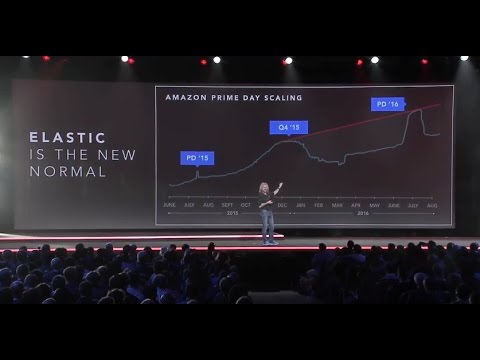
Sharing an internal metric slide originally compiled by Amazon Distinguished Engineer Brad Porter, Hamilton presents external audiences with their first look at Amazon's internal resource usage over time, covering major shopping peaks including Prime Day 2015, the fourth-quarter holiday rush, and Prime Day 2016. While AWS leadership barred him from displaying exact absolute values on the y-axis, Hamilton reveals that Prime Day 2016 demanded an elastic spike numbering in the tens of thousands of virtual servers. These instances were brought online immediately before the traffic surge, served real customer traffic flawlessly, and were terminated the instant demand subsided.
Hamilton puts this surge into perspective by noting that tens of thousands of servers equate to a midsize data center—a physical facility representing an estimated capital cost between $150 million and $250 million. Under traditional on-premises models, enterprises must provision hardware for their absolute peak demand. Because physical procurement and testing cycles take months, IT organizations cannot chase real-time demand curves and are forced to over-provision years in advance, leaving a $200 million physical asset sitting idle outside of brief seasonal spikes. Hamilton emphasizes that while top-line agility and innovation drive customers to the cloud, elasticity of this magnitude offers massive additional value:
> “This gain is not why this room's full this is the gain that's this is the gain that is that is available if you start to exploit the unique capabilities of the cloud that's why I'm excited by this slide.”
- **Prime Day 2016 Spike:** Tens of thousands of virtual servers spun up just in time and decommissioned as soon as peak traffic cleared. - **Physical Equivalency:** The compute power of a full midsize data center ($150M to $250M in physical investment) spun up for several weeks and dissolved back into the pool. - **Business Driver:** While elasticity saves millions, Hamilton notes the core reason re:Invent sells out is top-line business agility—letting teams deploy immediately and double down on working ideas without procurement lag.
[07:21](https://www.youtube.com/watch?v=AyOAjFNPAbA&t=441s) Global Footprint and Authentic Availability Zones
Hamilton reviews the global scope of the AWS footprint, which at the time spans 14 worldwide regions with four more planned for the coming year, alongside 68 Points of Presence (PoPs). He draws a sharp technical line between genuine cloud regions and competitors' superficial marketing claims. He critiques competitors who define an availability zone as merely two separate racks stationed on opposite sides of a single physical room with a drywall in between.
In contrast, Hamilton explains that AWS Availability Zones are engineered as discrete, physically isolated data center buildings separated by meaningful distances. They feature redundant utility feeds, separate flood plains, and independent failure domains designed to survive localized power disruptions, structural fires, or municipal incidents without dragging down the neighboring zone.
- **Regions:** 14 active production regions across the globe, with 4 additional regions slated for deployment to reach 18. - **Edge Presence:** 68 Points of Presence distributed globally for edge caching and ingress. - **Physical Isolation:** AWS Availability Zones consist of entirely distinct physical facilities with independent power, cooling, and network infrastructure, rather than partitioned rooms within a shared warehouse.
[08:29](https://www.youtube.com/watch?v=AyOAjFNPAbA&t=509s) The AWS Custom 100 GbE Global Private Backbone
Displaying a map of AWS’s global inter-region connectivity, Hamilton unveils details about the proprietary AWS private network infrastructure. Addressing rumors and past inquiries regarding whether Amazon relies on public transit links between regions, Hamilton confirms that all inter-region AWS traffic travels over 100% Amazon-controlled private network resources. Keeping data within a single administrative domain prevents traffic from bouncing across uncontrolled transit networks and carrier peering facilities, where commercial disputes or congestion can throttle throughput.
Hamilton notes that single-carrier operational control is critical for uptime, arguing that “if you've got a packet the more people that touch it the less likely it is to get delivered.” He explains that third-party network disputes often lead to intentional resource throttling during contract renegotiations, a vulnerability AWS eliminates by maintaining total operational control over its links. Furthermore, Hamilton details that this private backbone is built around 100 GbE connections across every link, with multiple parallel 100 GbE lines provisioned along high-density routes to ensure immediate failover capacity without performance degradation.
> “There's no way we a single link will ever will ever have any impact on anyone in this room because we have the capacity to survive a link failure and we engineer it that way simple it's it's we be crazy not to.”
[10:21](https://www.youtube.com/watch?v=AyOAjFNPAbA&t=621s) Pragmatic Infrastructure: Leases, Dark Fiber, and Subsea Cables
James Hamilton reflects on the early days of building out AWS’s global private networking backbone, admitting that he was initially very hesitant about the sheer financial exposure. The networking team, however, was completely sold on the vision, recognizing that owning and controlling private infrastructure was essential to deliver strict quality of service. Rather than committing dogmatically to a single procurement model, the team pursues an opportunistic, value-driven strategy across the board:
> “everything's available we'll do anything that whatever is most cost effective to get the resources that we need to be able to serve is what we do and because we're not religious about there's one true way and we have to it it's we get good value”
Depending on economics and local geography, AWS utilizes a diverse portfolio of networking assets: - Short-term and long-term commercial fiber leases - Dark fiber lit directly by AWS under Indefeasible Rights of Use (IRUs) - Proprietary consortium builds where AWS lays its own undersea subsea cables
[11:14](https://www.youtube.com/watch?v=AyOAjFNPAbA&t=674s) Engineering Under the Sea: The Hawaiki Transpacific Cable
To showcase the scale and engineering complexity of their private network, Hamilton highlights the Hawaiki transpacific cable project, which held its official groundbreaking in New Zealand just the prior week. Traversing 14,000 kilometers across the Pacific Ocean, the cable reaches depths of 6,000 meters—approximately three miles beneath the surface. Hamilton remarks on the harsh technical realities encountered when undertaking such infrastructure:
> “every time you get involved with technology you learn it's always harder than it looks”
While stringing fiber between Australia, New Zealand, and the United States might sound straightforward in concept, physics dictates that optical signal-to-noise ratios degrade over distance, requiring inline repeaters every 60 to 80 kilometers. These repeaters must function unserviced on the ocean floor for a design life of 20 years, under intense pressure three miles deep, and require constant electrical power. Because running massive copper power cables along a 14,000-kilometer route is physically impractical and cost-prohibitive, the cable relies on a copper sheath wrapped around insulated fiber bundles carrying direct current at exceptionally high voltages: positive 10,000 volts (+10,000 V DC) on one conductor and negative 10,000 volts (-10,000 V DC) on the other.
This dual-conductor setup incorporates an ingenious failsafe mechanism for fault tolerance. If an errant ship anchor or deep-sea fishing trawler snags the cable and faults one conductor to the surrounding ocean, that conductor short-circuits to sea ground and floats to zero volts. Rather than taking the cable offline, operators instantly elevate the surviving conductor to 20,000 volts DC (+20,000 V DC), utilizing seawater as an emergency ground return wire. The potential difference across every optical repeater remains precisely 20,000 volts, maintaining full transmission capacity until a repair ship can physically retrieve and splice the cable.
```mermaid flowchart LR accTitle: Hawaiki Subsea Cable Power Redundancy accDescr: Diagram illustrating normal dual-conductor power delivery versus single-fault sea-ground return mode. subgraph Normal["Normal Operation: 20 kV Differential"] P1["Conductor 1: +10 kV DC"] --> R1["Optical Repeater (20 kV ΔV)"] N1["Conductor 2: -10 kV DC"] --> R1 end subgraph Fault["Fault Mode: Conductor 2 Shunted to Sea"] P2["Conductor 1: Boosted to +20 kV DC"] --> R2["Optical Repeater (20 kV ΔV)"] S2["Seawater Ground Return: 0 V"] --> R2 end ```
- **Cable length**: 14,000 km across the Pacific Ocean - **Maximum depth**: 6,000 m (~3 miles) - **Repeater spacing**: Every 60 to 80 km - **Design lifespan**: 20 years without maintenance at the ocean floor - **Powering scheme**: ±10,000 V DC under normal conditions; shifts to 20,000 V DC single-conductor return via seawater upon cable damage
[15:06](https://www.youtube.com/watch?v=AyOAjFNPAbA&t=906s) Inside an AWS Region: Transit Centers and Redundant Spans
Shifting from intercontinental subsea transit to regional topology, Hamilton pulls up an architectural diagram of a fully developed, real AWS region to show the richness and redundancy built into the physical plant. At the time, AWS operated 14 regions worldwide, with four more announced to bring the total to 18. Every AWS region consists of at least two Availability Zones (AZs), most established regions feature three, and all newly planned regions are standardized on three AZs. The specific mature region illustrated on stage features five AZs.
Crucially, every region contains exactly two Transit Centers. Transit Centers serve as the dual gateways connecting the entire regional fabric to the outside world—terminating the Amazon Global Backbone, AWS Direct Connect links, public internet peering exchanges, and transit provider connectivity.
To prevent physical outages caused by errant backhoes or trenching accidents, the region’s optical fabric is heavily over-provisioned. The networking team runs dedicated, unshared fiber paths interconnecting each individual AZ internally, cross-connecting every AZ with every other AZ in a full mesh, and linking both Transit Centers to every single AZ. Hamilton underscores the unseen value of this engineering philosophy:
> “redundant is is a wonderful thing in the networking world because it means when things go wrong when someone decides to dig a hole in the wrong spot things keep running”
- **Global footprint (2016)**: 14 live regions, expanding to 18 - **Region layout featured**: 5 Availability Zones and 2 Transit Centers - **Routing diversity**: 126 physically unique fiber spans - **Strand count**: 242,472 individual fiber strands deployed across the region's 126 spans
[17:50](https://www.youtube.com/watch?v=AyOAjFNPAbA&t=1070s) High-Density Fiber Innovations and the Economics of Metro Optics
Running hundreds of thousands of fiber strands between dispersed facilities creates an intense civil engineering challenge. Standard underground fiber conduit infrastructure is built using 2-inch diameter pipes. Digging up municipal roadways and trenches to lay additional conduit runs is prohibitively expensive and slow, prompting AWS to maximize strand counts inside existing 2-inch pipe envelopes. Doing so requires extreme material engineering: the cable must contain an internal core strong enough to endure pulling tension without snapping fragile glass fibers, while carrying exterior armor rugged enough to withstand underground moisture, crushing loads, and harsh environments.
AWS partnered with an innovative fiber manufacturer to pioneer an ultra-high-density cable design. The manufacturer bundles optical ribbons, folds them into structural V-grooves within quadrants, and stacks them tightly together. Through this technique, the partner pack 3,456 individual optical fibers inside a single standard 2-inch conduit cable—a technology deployment where AWS was the first company in the industry to roll it out into production.
Hamilton addresses why AWS pulls massive strand counts of single fiber pairs across metro regions instead of deploying Dense Wavelength Division Multiplexing (DWDM) or Coarse Wavelength Division Multiplexing (CWDM). On subsea routes like Hawaiki, each fiber pair carries 100 wavelengths of 100 Gbps (yielding 30 Tbps across six fibers) because laying transoceanic glass is astronomically expensive compared to optical transceivers. Within a metro region, however, the economic calculus flips:
> “bottom line is it's it's more cost effective for short distances to run independent fibers for long distances it always wins to run uh to run multiple waves on the same fiber”
While Hamilton predicts that future developments in silicon photonics will eventually drive down optical transceiver costs enough to make multi-wave multiplexing standard within metro plants, current economics dictate utilizing dense raw glass. Moving deeper into the infrastructure hierarchy, Hamilton introduces the architectural definition of an Availability Zone: an AZ is composed of one or more discrete, physical data centers, and no single data center building is ever shared across multiple AZs.
[20:41](https://www.youtube.com/watch?v=AyOAjFNPAbA&t=1241s) Availability Zone Scale and the Math of Data Center Sizing
AWS builds regions where Availability Zones (AZs) are isolated failure domains connected by redundant, fully separated network paths. James Hamilton highlights an internal metric that caught even him off guard: across the 14 global regions, AWS operates several individual Availability Zones that house over 300,000 servers each. While those counts continue to balloon, individual data center physical footprints have intentionally stabilized. Where older facilities were sized around 25 to 30 megawatts, new builds sit uniformly between 25 and 32 megawatts (roughly 80,000 servers). Although AWS could easily engineer 250-megawatt buildings—and Hamilton notes he has routinely toured 60-megawatt sites without operational issue—the decision to cap facility scale comes down strictly to failure domain economics.
The trade-off between building larger data centers and capping their size is governed by the difference between logarithmic cost efficiencies and linear blast radiuses:
```mermaid flowchart TD accTitle: Data Center Sizing Trade-Off accDescr: Shows logarithmic cost gains flattening out while outage blast radius scales linearly.
subgraph CostCurve["Capital & Operating Cost Curve"] A["Small Data Center Facility"] -->|"Scale up"| B["32 MW Facility: ~80k Servers"] B -->|"Diminishing marginal gains"| C["Huge Facility: 250 MW / 500k+ Servers"] end
subgraph BlastRadius["Outage Blast Radius Risk"] D["Linear impact on recovery"] B -.->|"Manageable re-routing"| D C -.->|"Massive healing traffic spike"| D end ```
Hamilton explains that initial scaling provides rapid, massive cost advantages, but the cost curve eventually flattens out logarithmically. Meanwhile, the blast radius of an outage increases linearly. If an 80,000-server data center fails, the broader AWS infrastructure absorbs and reroutes the traffic without customers noticing. If a 160,000-server, 320,000-server, or 500,000-server site drops offline, the network bandwidth required to recover and heal customer state creates catastrophic blast radius problems. As Hamilton explains the calculation:
> “Our take right now is this is about the right size facility it cost us a little tiny bit more to head down this path but we think it's the right thing for customers”
- Individual Availability Zones in AWS scale up to over 300,000 servers. - New AWS data centers target a 25 to 32 MW ceiling rather than expanding to 60 or 250 MW. - An 80,000-server facility failure is easily masked by AWS region redundancy, avoiding large-scale control and data plane storms.
---
[22:58](https://www.youtube.com/watch?v=AyOAjFNPAbA&t=1378s) Breaking the Proprietary Networking Monopoly
Hamilton transitions to what he calls his regular “rant on old-school networking,” comparing the historical networking vendor ecosystem to the monolithic mainframe era of computing two to three decades prior. For years, networking giants forced customers into vertically integrated appliances where proprietary ASICs, proprietary board design, and proprietary network protocol stacks were sold as an inseparable unit. This artificial bundling inflated costs and starved servers of adequate network bandwidth. To resolve this bottleneck, AWS broke the stack apart, sourcing commodity merchant silicon, writing its own internal protocol software, and building custom top-of-rack and spine switches to its exact design specs.
```mermaid flowchart LR accTitle: De-Verticalization of Network Infrastructure accDescr: Contrast between proprietary bundled networking stacks and disaggregated open ecosystems.
subgraph LegacyMonolith["Legacy Bundled Networking"] L1["Proprietary Network OS / Protocols"] L2["Proprietary Switch Hardware"] L3["Proprietary ASIC Silicon"] L1 --- L2 --- L3 end
subgraph AWSDisaggregated["AWS Disaggregated Model"] A1["In-House AWS Protocol Stack"] A2["Custom ODM Switch Specs"] A3["Merchant ASICs: Broadcom, Innovium, etc."] A1 --> A2 --> A3 end ```
While avoiding vendor price gouging was the original catalyst, AWS discovered that reliability gains far outstripped cost savings. Commercial networking vendors cater to thousands of enterprise feature requests, bloating firmware with untested code paths that inevitably crash in production. Because AWS engineers write their own routing software to satisfy only their internal requirements, they deliberately keep the codebase lean and simple. Operational ownership reinforces this discipline: because AWS developers carry the pagers when a switch faults, they avoid bloat. Furthermore, troubleshooting custom switches eliminates months-long vendor escalation delays, as no third-party networking vendor owns a staging environment capable of reproducing the failure modes of a hyperscale AWS cluster.
As Hamilton emphasizes regarding the failure cycle of traditional vendors:
> “It takes 6 months the most committed best quality most most serious company it takes 6 months it's just it's a terrible place to be so we love where we are right now”
- Disaggregating switch hardware from network operating systems mirrors the historical transition from mainframes to x86 servers. - Eliminating feature bloat produced immediate gains in uptime, contrary to Hamilton's initial expectation that custom software would take months to stabilize. - In-house switch ownership gives AWS direct code access to resolve networking bugs immediately rather than waiting up to half a year for vendor firmware patches.
---
[26:42](https://www.youtube.com/watch?v=AyOAjFNPAbA&t=1602s) The Optics Economics of 25 GbE and Merchant Silicon
Addressing optical transceivers, Hamilton defends AWS’s early, contrarian bet on 25 Gigabit Ethernet (25 GbE) over standard 10 GbE and 40 GbE architectures. When AWS committed to 25 GbE, the specification was brand new and suffering an industry-wide optical transceiver shortage, leading many peers to settle on 40 GbE. However, Hamilton explains that optics costs correlate directly with wavelength count rather than raw bandwidth:
| Ethernet Standard | Optical Wavelengths | Relative Optics Cost Structure | |:--- |:--- |:--- | | **10 GbE** | 1 Wave | Baseline cost | | **40 GbE** | 4 Waves (4x 10G) | ~4x baseline optical cost | | **25 GbE** | 1 Wave | Marginally higher than 10 GbE baseline | | **50 GbE** | 2 Waves (2x 25G) | Substantially cheaper than 40 GbE; higher throughput |
By migrating to a 25G single-wavelength physical layer, AWS could deploy 50 GbE links using just two waves, securing 25% higher bandwidth than 40 GbE at a fraction of the component bill.
```mermaid flowchart TD accTitle: Evolution of Merchant Switching Silicon accDescr: Merchant silicon generations showing throughput growth from 3.2 Tbps to 13 Tbps on Moore's Law trajectories.
A["Broadcom Tomahawk ASIC<br>3.2 Tbps Throughput<br>128 x 25 GbE Ports Non-Blocking"] B["Next-Gen Silicon Ecosystem<br>Cavium, Mellanox, Marvell, Barefoot, Innovium"] C["Future Scaling Targets<br>6.4 Tbps & 13 Tbps Parts<br>Integrated Silicon Photonics"]
A --> B --> C ```
Switch hardware is dominated by two primary costs: the central processing ASIC and the transceivers. By deploying commercial merchant silicon such as the Broadcom Tomahawk—which Hamilton describes as the highest-transistor-count ASIC on earth at its release—AWS leverages a 3.2 Terabit-per-second packet engine providing 128 ports of non-blocking 25 GbE. Because a vigorous ecosystem of suppliers (including Cavium, Mellanox, Marvell, Barefoot Networks, and Innovium) competes to produce 6.4 Tbps and 13 Tbps parts, switching silicon now advances along a classic Moore's Law price-performance curve. Hamilton projects that optical components will follow the same trajectory as multi-chip silicon photonics mature.
Reflecting on the logic of pioneering 25 GbE despite the early optical component shortages, Hamilton notes:
> “Whenever you've got the right answer when when when it looks that good it'll happen and it has happened we are deploying these by The Unbelievable numbers”
- 40 GbE relies on four separate 10 Gbps lanes, multiplying laser and optic component overhead by roughly four times. - A single-lane 25 GbE optic matches 10 GbE cost models while delivering 2.5x the data rate. - The 3.2 Tbps Tomahawk silicon drives 128 lanes of wire-speed, non-blocking 25 GbE across AWS fabric tiers. - A multi-vendor merchant ASIC market enables continuous throughput doubling to 6.4 Tbps and 13 Tbps without proprietary lock-in.
---
[30:23](https://www.youtube.com/watch?v=AyOAjFNPAbA&t=1823s) Software-Defined Networking and Hardware Offloading
Hamilton touches on Software-Defined Networking (SDN), pointing out that while the industry treats SDN as a modern buzzword, AWS was forced to run SDN primitives since the launch of EC2 in 2006 to ensure virtual multi-tenant isolation and security. By 2011, AWS observed that as line rates climbed, dedicating general-purpose host CPU cores to repetitive packet processing, encapsulation, and traffic shaping was an inefficient use of compute. This realization led AWS to begin migrating software-defined network routines out of software hypervisors and directly into dedicated custom hardware offload engines.
Highlighting the logic that drove AWS toward specialized hardware acceleration, Hamilton observes:
> “Whenever you've got workload that's very repetitive and happening all the time as almost any network packet processing is you're really better off into taking some of that down into hardware”
[31:01](https://www.youtube.com/watch?v=AyOAjFNPAbA&t=1861s) Hardware Offload and Custom Silicon
James Hamilton details the major advantages of offloading network virtualization code from host server CPUs directly down onto custom Network Interface Cards (NICs). The most immediate benefit is unlocking host server resources, freeing up CPU cores that would otherwise be tied down running virtualization software. It also eliminates subtle, hard-to-diagnose server disturbances such as TLB (translation lookaside buffer) flushes. Security is substantially improved: because the NIC runs a dedicated real-time operating system executing Amazon's proprietary software, compromising the host hypervisor does not grant an attacker access to the underlying network.
```mermaid flowchart TD accTitle: Server CPU Offload Architecture to Custom Silicon NIC accDescr: Host CPU virtualization duties are moved onto a custom NIC running an isolated RTOS, improving performance, latency, and isolation. subgraph Host["Host Server"] CPU["Host CPU Cores<br>(Freed for customer compute)"] Hyp["Host Hypervisor"] end subgraph CustomNIC["Custom NIC (Annapurna Labs)"] ASIC["Proprietary Silicon<br>(Billions of transistors)"] RTOS["Isolated Real-Time OS<br>(AWS network virtualization)"] end Hyp -.->|"TLB flushes eliminated"| CPU RTOS --- ASIC CustomNIC -->|"10x lower latency<br>10x lower power<br>10x lower cost"| Net["Data Center Fabric"] Hyp -.->|"Security boundary<br>(Hypervisor compromise isolated)"| RTOS ```
Hamilton frames hardware offloading as a fundamental architectural rule across all computing tiers: running in dedicated hardware yields roughly one-tenth the latency, one-tenth the power, and one-tenth the cost. Addressing the common belief that custom networking gear is built purely to achieve massive bandwidth, Hamilton counters that raw bandwidth is simple to solve—it merely requires running more parallel links, which can be accomplished with off-the-shelf equipment if one has the money to pay for it. Latency, however, is bounded by physics and fiber propagation delays. Offloading logic to silicon moves operational time scales from milliseconds down to nanoseconds and microseconds. Announcing that AWS is formally in the semiconductor design business, Hamilton reveals custom ASICs containing billions of transistors deployed on every AWS server, made possible by integrating digital chip designers, hardware engineers, and software developers under a single infrastructure roof.
- Hardware offloading delivers roughly a 10x reduction in latency, power consumption, and cost. - Bandwidth scaling is straightforward with parallel links, whereas latency is bounded strictly by physics and the speed of light in optical fiber. - Software typically measures in milliseconds, whereas hardware offload executes in microseconds and nanoseconds. - “Do you believe we're in the semiconductor business? Isn't that great? We're in the semiconductor business that Amazon Web Services is.” — James Hamilton - Every server AWS deploys contains at least one proprietary multi-billion-transistor chip, with some servers housing significantly more.
---
[35:05](https://www.youtube.com/watch?v=AyOAjFNPAbA&t=2105s) Switchgear Lockouts and Rewriting Utility Firmware
Examining infrastructure reliability at scale, Hamilton highlights how exceedingly rare failure modes inevitably manifest across massive operations. He cites an incident where an airline CFO reported losing $100 million in revenue—representing roughly 2% of monthly earnings—due to an unexpected switchgear failure that locked out backup generators. The standard utility-to-generator transfer mechanism is designed to wait a few seconds after a utility dip to avoid spinning up generators for transient flickers. When utility power genuinely drops, diesel generators must spin from a dead stop to 1,800 RPM in 7 to 8 seconds and take full electrical load within 15 to 20 seconds.
```mermaid flowchart TD accTitle: Data Center Power Transfer Sequence and Switchgear Firmware Override accDescr: Flow showing standard utility feed, generator start, and AWS firmware override forcing generators to take load despite faults. Util["Utility Feed"] --> SW["Switchgear"] SW --> UPS["Uninterruptible Power Supply (UPS)"] UPS --> DC["Data Center Load"] Util -.->|"Utility fault / spike"| SW SW -->|"Start signal"| Gen["Diesel Backup Generator<br>(0 to 1,800 RPM in 7-8s)"] Gen -->|"Takes full load in 15-20s"| SW SW -->|"AWS Custom Firmware Override<br>(Ignore false ground faults; power through)"| DC ```
The critical vulnerability in commercial switchgear design occurs when an electrical disturbance resembles an internal short circuit to ground. In those circumstances, vendor safety logic locks the switchgear, refusing to connect the generators to protect them from potential physical damage. Hamilton recounts witnessing this firsthand in an AWS Virginia facility when a vehicle struck an aluminum utility pole outside the data center—an accident that occurred twice at the same location—causing the falling pole to bridge two power phases and send an extreme spike into the facility. Commercial switchgear locked out the running generators, dropping data center load while the generator sat spinning idle.
When the switchgear manufacturer arrived six hours later and adamantly insisted that dropping the load was the only safe behavior, AWS investigated competing manufacturers and discovered that all commercial vendors implemented the exact same conservative logic. Consequently, AWS modified the switchgear control firmware directly. Under AWS's custom firmware, switchgear is forced to bring generators online during an ambiguous fault rather than abandoning the load. If a true short exists, downstream branch circuits trip safely while redundant, concurrently maintainable power feeds sustain server operation. Hamilton points out that risking a $750,000 generator to keep the data center online is a necessary trade-off, contrasting AWS's resilience with high-profile commercial outages such as the 34-minute blackout during the 2013 Super Bowl caused by this exact switchgear lockout failure mode.
- An airline lost $100 million in revenue (2% of monthly revenue) due to commercial switchgear locking out backup generators. - Data center backup diesel generators reach 1,800 RPM within 7 to 8 seconds and pick up full facility load in 15 to 20 seconds. - AWS rewrote the control firmware across its commercial switchgear to override manufacturer lockout settings and force generators online during utility disturbances. - “We're very frugal, we do not want $3/4 million damage, but on the other hand we certainly don't want to drop the load, and so we'll take that risk.” — James Hamilton - All AWS data center infrastructure is designed to be fully redundant and concurrently maintainable, surviving isolated hardware failures without dropping customer workloads. - The 2013 Super Bowl suffered a 34-minute power outage due to the exact same switchgear ground-fault lockout mechanism.
[41:02](https://www.youtube.com/watch?v=AyOAjFNPAbA&t=2462s) Storage Rack Density and Power-Efficient Server Architecture
James Hamilton marvels at the rapid advancement of AWS’s custom storage and compute hardware. While AWS had previously achieved an impressive milestone of packing 880 disks into a single rack unit, the hardware team has since shattered that record with a standard, non-extended 42U rack that holds 1,110 disks. Hamilton points out that although he is showing an older revision rather than the unreleased bleeding edge, the rack held 8.8 petabytes when originally deployed and would scale to 11 petabytes using current hard drives. The sheer physical density is staggering: the disks alone weigh 2,778 pounds, making the floor's power-to-weight loading an increasingly critical engineering constraint.
Turning from raw density to deliberate restraint, Hamilton shows a slide of an AWS compute server that at first glance appears bafflingly sparse. “This is a compute server,” Hamilton says. “You look at it and the first thing you look at is: dude, what happened? I mean, you could have put a second server in there—I mean, it's empty.” However, he explains that this layout is ruthlessly optimized for power and thermal airflow efficiency. While commercial OEMs sell systems packed at three to five times higher density—charging a steep premium for configurations that run hotter and burn significantly more electricity—AWS designed this open chassis to minimize cooling and distribution losses.
Both the server's onboard power supply and its voltage regulators exceed 90% efficiency. Hamilton contextualizes these choices through Power Usage Effectiveness (PUE), which compares total facility power against the power delivered directly to servers. In well-engineered AWS facilities operating with a PUE between 1.12 and 1.15, overhead losses from fans, transformers, and facility systems account for only 12% to 15%. Given that AWS spends hundreds of millions of dollars on electricity, Hamilton argues that hyper-optimizing components pays enormous dividends: “If this power supply is 1% better, 1% times hundreds of millions is getting to be a pretty interesting number—like, you could have fun with that.” He adds with a grin that a major competing cloud provider recently published a blog post showing off a server design that looks remarkably similar to this retired AWS model.
- **High-Density Storage Rack**: 1,110 drives packed inside a standard 42U rack, scaling from 8.8 PB at original deployment to 11 PB with modern drives, weighing 2,778 lbs in disks alone. - **Compute Server Efficiency**: Spaced interior layout optimized for aerodynamics and thermal heat dissipation rather than artificial OEM density. - **Power Components**: Custom power supplies and voltage regulators both operate above 90% efficiency. - **Facility PUE**: AWS data centers run at a PUE between 1.12 and 1.15, ensuring the high 80s percentage of all grid power enters the compute hardware directly.
---
[44:32](https://www.youtube.com/watch?v=AyOAjFNPAbA&t=2672s) Eulogy for the IBM Mainframe and a Stage Toast
Hamilton shifts gears to legacy enterprise computing, displaying an image of an IBM mainframe and sharing stories from the dawn of his career at IBM. He recalls working hands-on with legacy workhorses like the IBM 3083, the 3081, and ultimately the massive IBM 3090 Model 600J. The 600J was the size of a midsize truck and stood as the technological peak—and dead end—of emitter-coupled logic (ECL) before the industry shifted to CMOS. Because ECL was notoriously power-hungry and generated extreme heat, the machine required direct water cooling via spring-loaded thermal conduction modules (TCMs) pressed tightly against the CPU packages.
Acknowledging that these machines were true engineering marvels three decades ago, Hamilton delivers a blunt verdict on their modern relevance: “These are beasts, they're technological wonders, but it was 30 years ago—it's dead, Jim.” Acknowledging that many enterprise customers still quietly run critical business workloads on legacy iron, he promises that AWS wants to help migrate them off. To celebrate the transition, Hamilton calls for a drink on stage. Handed a cold beer, he raises his bottle to the audience in a toast: “Let's start off with a toast to the death of the mainframe.” He then introduces Navin Budhiraja, Senior Vice President and Head of Architecture and Technology at Infosys, to outline how enterprises can make the jump to the cloud.
```mermaid flowchart TD accTitle: Evolution from Legacy Mainframe to Modern Cloud accDescr: Diagram contrasting IBM 3090 ECL hardware with AWS cloud-native architecture.
subgraph Legacy["Legacy Era (30+ Years Ago)"] direction TB M1["IBM 3090 Model 600J<br/>(Midsize truck footprint)"] M2["Emitter-Coupled Logic (ECL)<br/>Extremely power-inefficient"] M3["Spring-loaded TCMs<br/>Direct water cooling"] M1 --- M2 --- M3 end
subgraph Modern["AWS Modern Cloud Platform"] direction TB A1["Hyperscale Compute Fleet"] A2[">90% Efficient Power Supplies"] A3["PUE 1.12 - 1.15 Facility Efficiency"] A1 --- A2 --- A3 end
Legacy -->|"Migration Path"| Modern ```
---
[46:42](https://www.youtube.com/watch?v=AyOAjFNPAbA&t=2802s) The Infosys Mainframe Migration Practice on AWS
Taking the stage to applause, Navin Budhiraja jokes about the scale of the venue, remarking that the massive room could easily seat most of Infosys and that the warmth of the audience is a welcome relief after freezing backstage. Budhiraja formally announces the launch of the Infosys Mainframe Migration Practice on AWS. He acknowledges that while mainframes have reliably executed core corporate workflows for over 30 years, enterprises face mounting pressures that make staying on them unsustainable. Across the global enterprise landscape, roughly 30 million MIPS remain in active operation, driving an estimated annual spend of over $100 billion. These costs continue to escalate as modern digital channels force batch-oriented mainframes into real-time, online transaction processing.
Compounding the financial burden are severe agility bottlenecks and an acute demographic crisis. Budhiraja points out that the business world requires rapid feature iteration, whereas rigid legacy systems cannot keep up. Furthermore, the specialized workforce capable of maintaining these systems is retiring without replacements: “These mainframe programmers are not getting any younger, we're not producing more of them—it's like my daughter, when I asked her what does she think COBOL is, she thought it was some exotic stone because it sounds like cobalt.”
To tackle these challenges, Budhiraja details a three-tier migration framework alongside an automated platform called Infosys Mana:
1. **Rehosting / Emulation**: Moving existing COBOL programs and Job Control Language (JCL) directly into an AWS-hosted emulation layer. Mainframe databases like IBM IMS or DB2 are migrated to relational engines like Amazon RDS, with updated security and backup tooling, yielding immediate cost savings of 30% to 35%. 2. **Partial Refactoring / Hybrid Coexistence**: Carving out high-velocity business logic that needs rapid evolution, rewriting those specific components as cloud-native microservices on AWS, and integrating them back to the mainframe core via AWS API Gateway. 3. **Complete Cloud-Native Rewrite**: Deconstructing and re-architecting the entire legacy codebase into modern cloud-native architectures for maximum long-term elasticity.
Addressing why enterprises have historically avoided mainframe migrations, Budhiraja notes that many systems span 10 to 30 million lines of undocumented, tangled code. To solve this, Infosys leverages its AI-powered Mana platform to act as an "Iron Man suit" for engineers. Mana ingests the codebase, maps structural code dependencies, extracts business rules, and flags dead code. This automated assessment gives enterprises the empirical predictability they need regarding complexity, timelines, and execution strategy before beginning their migration.
```mermaid flowchart LR accTitle: Infosys Mainframe Migration Paths on AWS accDescr: Three architectural routes for moving legacy mainframe workloads to AWS.
subgraph Inputs["Legacy Mainframe Codebase"] direction TB SRC["COBOL & JCL (10M-30M LOC)<br/>Undocumented Dependencies"] AI["Infosys Mana AI Engine<br/>Assessment & Dependency Mapping"] SRC --> AI end
subgraph Strategies["Migration Strategies"] direction TB P1["1. Rehost / Emulate<br/>Run in AWS emulator; DB to Amazon RDS<br/>(30-35% cost reduction)"] P2["2. Hybrid Refactor<br/>Extract key modules to cloud-native code<br/>Connect via AWS API Gateway"] P3["3. Full Rewrite<br/>End-to-end cloud-native redevelopment"] end
AI --> P1 AI --> P2 AI --> P3 ```
- **Global Mainframe Footprint**: Approximately 30 million active MIPS globally, generating conservative ongoing operating expenditures of over $100 billion per year. - **Immediate Rehosting Savings**: Emulating COBOL and JCL on AWS while swapping mainframe storage for Amazon RDS cuts operational costs by 30% to 35%. - **Scale of Code Complexity**: Core legacy deployments frequently exceed 10 million to 30 million lines of code with little to no surviving architectural documentation. - **Infosys Mana Platform**: An AI-driven discovery engine that parses legacy code to identify business rules, extract dependency graphs, and prune dead code to de-risk migration planning.
[52:37](https://www.youtube.com/watch?v=AyOAjFNPAbA&t=3157s) James Hamilton Introduces Tom Soderstrom of NASA JPL
The presentation transitions as an enterprise partner wraps up their remarks on organizational migration practices, thanking the audience and urging everyone to examine their own cloud journey because the industry transformation is actively happening. James Hamilton returns to the stage and reflects back to the beginnings of his career. While his earliest memories involved mainframe computing, an even stronger formative influence was the NASA crewed spaceflight program. For Hamilton, watching NASA tackle monumental problems with audacity sparked his own curiosity and determination:
> “Many of—much of my curiosity and willingness to take on tough challenges was learned from NASA taking on, ‘We're going to put a man on the moon,’ when they have no idea how to do it.”
Hamilton explains that he remains thoroughly inspired by what NASA achieves and invites Tom Soderstrom, Chief Technology and Innovation Officer at NASA’s Jet Propulsion Laboratory (JPL), onto the stage to explain how space exploration is entering a new era powered by modern infrastructure.
[54:19](https://www.youtube.com/watch?v=AyOAjFNPAbA&t=3259s) The Curiosity Landing and a Changing Audience for Space Exploration
Tom Soderstrom opens by addressing the vast re:Invent audience, explaining that NASA and JPL are dedicated to answering fundamental cosmic questions that affect humanity, but they are approaching those questions using fresh methods, new partnerships, and an evolving workforce. He immediately grounds the discussion in a major milestone from four years prior: the August 2012 landing of the Mars Curiosity rover.
```mermaid flowchart LR accTitle: Mars Curiosity Entry Descent and Landing accDescr: High-speed interplanetary transit decelerating through Mars atmosphere to safe touchdown. subgraph Space ["Interplanetary Space"] A["Cruise Stage<br/>(150M Miles Travel)"] -->|"Entry Interface"| B["Atmospheric Entry<br/>(Thousands km/s)"] end subgraph EDL ["7 Terrifying Minutes"] B --> C["Pressurize Thrusters &<br/>Aero-maneuver"] C --> D["Sky Crane Descent"] D --> E["Touchdown Confirmed<br/>(2,000 lb Rover Safe)"] end ```
The mission demanded an extraordinary engineering feat: delivering a 2,000-pound rover across 150 million miles of space and decelerating it from thousands of kilometers per second to a dead stop within “seven terrifying minutes,” entirely autonomously. During that event, NASA tried an unprecedented tactic by relying on AWS to broadcast images directly to the public simultaneously with mission control. A video clip of the control room erupts across the screen, reliving the tense telemetry announcements—confirming atmospheric entry, thruster pressurization, and finally touchdown—which triggered wild cheers and embraces from engineers whose multi-year careers had hinged on that exact moment.
Soderstrom contrasts past generations with the emerging one. During the Apollo era, people sat transfixed before black-and-white television screens, passively observing astronauts walk on the moon. Today, younger generations arrive with far deeper digital literacy and pocket-sized supercomputers running NASA and JPL applications. They do not merely hope missions succeed; they assume success and demand active involvement:
> “It's no longer about a space race between countries; it's a race for Humanity into space.”
The modern public expects to participate directly via augmented reality, mobile apps, and open data, turning exploration into a shared global journey centered on three existential challenges: 1. Protecting Mother Earth. 2. Determining whether life exists elsewhere in our universe. 3. Establishing whether life ever existed on Mars.
[57:53](https://www.youtube.com/watch?v=AyOAjFNPAbA&t=3473s) Earth Science at Scale: Deep Space Network and Next-Gen Radar Missions
Turning to infrastructure, Soderstrom compares JPL’s operational footprint to James Hamilton's terrestrial cloud network. JPL operates the Deep Space Network (DSN), a constellation of massive, strategically positioned ground antenna complexes around the globe that keep uninterrupted line-of-sight communication with roughly 30 spacecraft and deep-space instruments as the Earth rotates. Anyone with a smartphone can now view live telemetry showing which spacecraft are talking to which DSN antennas at any given moment.
Answering deeper planetary questions requires massive leaps in data processing. Satellites like SMAP (Soil Moisture Active Passive) and OCO-2 (Orbiting Carbon Observatory-2) track water, atmospheric carbon dioxide, and polar ice sheets by generating approximately one terabyte of data per day. However, two upcoming joint missions—SWOT (Surface Water and Ocean Topography) and NISAR (NASA-ISRO Synthetic Aperture Radar)—will shatter those bandwidth demands. Both missions bounce synthetic-aperture radar signals off the planet to measure water tables across oceans, rivers, ice sheets, and municipal reservoirs down to the centimeter level.
- SWOT and NISAR will generate 100 terabytes of data per day, producing continuous ingestion streams of 100 gigabits per second. - The sheer data volume proved far too large for NASA’s existing on-premises data centers, forcing a shift to commercial cloud computing. - While processing Orbiting Carbon Observatory data, JPL engineers embraced the Amazon EC2 Spot Market, allowing them to spin up vast compute fleets at pennies on the dollar and completely reinventing their day-to-day operational model. - The resulting hydrological models will provide immediate predictive utility for agricultural monitoring, flood forecasting, drought mitigation, and municipal urban planning.
[01:00:27](https://www.youtube.com/watch?v=AyOAjFNPAbA&t=3627s) Planetary Defense: The Asteroid Redirect Mission and Solar Electric Propulsion
Beyond environmental tracking, Soderstrom addresses how humanity can protect Earth from planetary hazards. Astronomers have recently identified roughly 1,600 near-Earth asteroids. To discover how humanity might divert an object on an impact trajectory, NASA formulated the Asteroid Redirect Mission (ARM).
```mermaid flowchart TD accTitle: Asteroid Redirect Mission Architecture accDescr: Sequence showing asteroid rendezvous, multi-ton boulder retrieval, lunar transit, and astronaut exploration. subgraph Target ["Asteroid Rendezvous"] A["400m Asteroid Target"] --> B["Capture Multi-ton Boulder<br/>(Low-gravity operation)"] end subgraph Transit ["Solar Electric Propulsion"] B --> C["Xenon Ion Thruster Arrays<br/>(50 kW modules to 300 kW)"] C --> D["Lunar Orbit Insertion"] end subgraph Exploration ["Human Operations"] D --> E["Astronaut Mining &<br/>Gravity Tractor Tests"] E --> F["Scaling Up Tech for<br/>Human Mars Missions"] end ```
The mission plan is straightforward in concept yet daunting in practice: rendezvous with a 400-meter asteroid, pluck a multi-ton boulder from its surface despite microgravity and surface adhesion, tow the mass back into lunar orbit, and leave it there for astronauts to inspect, mine, and experiment with gravity-tractor redirection techniques.
Overcoming the extreme propulsion requirements led JPL engineers to champion Solar Electric Propulsion (SEP). SEP ionizes xenon gas and accelerates it using electricity harvested from solar arrays: - SEP consumes only 1/10th the propellant mass of traditional chemical rockets while delivering three times the power and double the overall operational efficiency. - Modular thrusters producing 50 kilowatts can be clustered up to 300 kilowatts—power levels sufficient to transport crewed habitats to Mars and back. - NASA initiated the Asteroid Redirect Mission directly inside the cloud, allowing engineers to iterate rapidly like a startup and coordinate with commercial aerospace contractors.
[01:02:33](https://www.youtube.com/watch?v=AyOAjFNPAbA&t=3753s) Ocean Worlds: Searching for Habitability on Europa
Soderstrom turns to the second big question: where else in our solar system might life exist? He displays an image of Europa, an icy moon of Jupiter roughly 400 million miles away. Life as we know it demands two foundational ingredients: liquid water and energy. Europa provides both in abundance, harboring more than twice the liquid water found in all of Earth's oceans combined.
Europa's surface is free of major impact craters because it is an active, floating ice sheet roughly 10 miles thick that shears and heals much like Earth’s Arctic Ocean. Embedded within and beneath this shell are massive sub-surface lakes and a global ocean warmed by tidal energy from Jupiter’s gravitational pull. NASA is preparing an orbiter mission to Europa to image the surface, map the ice fractures, and identify safe landing zones. Safely touching down amid jagged ice formations hundreds of millions of miles away requires entirely automated, real-time computer vision and landing calculations. Soderstrom emphasizes that processing the necessary simulation runs and raw telemetry at such distances would be unthinkable without the scale of cloud computing.
[01:03:51](https://www.youtube.com/watch?v=AyOAjFNPAbA&t=3831s) Searching for Exoplanets and Earth 2.0
Tom Soderstrom outlines the rapid five- to ten-year timeline for major space exploration initiatives, asking whether humanity would have somewhere to go if it ever needed to evacuate Earth. The search for "Earth 2.0" centers on extrasolar planets—exoplanets orbiting distant stars just as Earth circles the Sun. To detect them, astronomers look through an optical pinhole at the identical coordinate in space over long durations, measuring minute fluctuations in received energy caused by a planet transiting its host star or gravitational wobbles in the stellar orbit. Using this technique, scientists have identified 3,000 confirmed exoplanets and roughly 2,400 unconfirmed candidates in just a few years.
```mermaid flowchart TD accTitle: Exoplanet Detection and Processing Pipeline accDescr: Pipeline showing pinhole transit observations feeding into massive cloud compute for exoplanet validation. subgraph Observation ["Telescope Observation"] A["Deep Space Transit Monitoring"] --> B["Detect Energy Dips & Orbital Wobbles"] end subgraph CloudAnalysis ["Cloud Processing Scale"] B --> C["Massive Simulation & Math Models"] C --> D["Hundreds of Thousands of On-Demand Cloud Servers"] end subgraph Discovery ["Planet Classification"] D --> E["3,000+ Confirmed Exoplanets"] D --> F["21 Potentially Habitable Earth-like Worlds"] end ```
Out of all those discoveries, 21 planets appear potentially habitable and earth-like. However, interstellar distances pose an immense challenge: the closest candidate sits four light-years away, requiring roughly a millennium to reach using contemporary rocket propulsion. Soderstrom suggests that sending nanosatellites propelled by advanced systems could potentially reduce that transit time to just 20 years. While that might sound far-fetched, he reminds the audience that landing a 2,000-pound rover on Mars seemed like pure science fiction only years prior. Moving beyond pinhole observation, the James Webb Space Telescope will introduce vastly larger apertures, producing mathematical simulation and scientific data requirements that will demand hundreds of thousands of concurrent compute instances. Soderstrom underscores that eliminating the need to physically own that hardware is transformational: “Innovation is moving much faster the James Webb telescope is going to go from pinhole to much larger aperture the science the simulation the math is going to require hundreds of thousands of servers to do this and but we don't have to own them anymore so cloud computing is a really really big deal for us.”
- Confirmed exoplanets discovered: ~3,000 (with ~2,400 unconfirmed candidates). - Potentially habitable, earth-like candidates identified: 21. - Travel time to the nearest candidate (4 light-years away): 1,000 years with current propulsion vs. 20 years with proposed nanosatellite concepts.
[01:05:54](https://www.youtube.com/watch?v=AyOAjFNPAbA&t=3954s) Curiosity's Discoveries and the Mars 2020 Mission
Turning the focus to Mars, Soderstrom quips that only one human has visited the red planet so far—Matt Damon in *The Martian*—and fortunately, he made it back. Four years earlier, the Curiosity rover touched down on Mars and immediately extended its robotic arm to take a self-portrait to verify hardware health. Images returned from the surface, such as those of the Namid Dune, bear an uncanny resemblance to California's Death Valley. Both landscapes were sculpted over epochs by flowing water, indicating that four billion years ago, Mars possessed environmental conditions suitable for life. While evidence of ancient water is confirmed, scientists have not yet discovered a biological "smoking gun."
To hunt directly for signs of past life and lay groundwork for human exploration, NASA and JPL are preparing the Mars 2020 mission. Operating a rover 150 million miles from Earth imposes brutal operational constraints: mission teams previously had a mere 20-minute planning window each day to compute and transmit command sequences for the following sol. If processing stalled, the rover sat idle for an entire Martian day, squandering critical mission uptime. By migrating simulation and path-planning workflows to the AWS Cloud and augmenting them with machine learning, JPL aims to shrink that turnaround from 20 minutes down to just 5 minutes, ensuring the rover never loses a sol.
Hardware innovations for Mars 2020 include: - **Redesigned Wheels:** Narrower and stronger with deeper tread grooves to scale steep inclines without tearing. - **Acoustic Sensors:** An onboard microphone to capture the auditory landscape and wind sounds of Mars. - **Sample Caching System:** A specialized coring drill designed to extract, seal, and store rock cores on the Martian surface for recovery by future crewed or robotic sample-return flights. - **In-Situ Oxygen Production:** An experimental payload designed to generate oxygen from atmospheric carbon dioxide to prepare life support and propellant systems for future astronaut arrivals. - **Aerial Scouting Drone:** A dual counter-rotating coaxial helicopter designed to navigate atmospheric densities equivalent to 100,000 feet on Earth, scouting terrain ahead of the rover's path.
[01:09:03](https://www.youtube.com/watch?v=AyOAjFNPAbA&t=4143s) Desktop 3D Printing, ROV-E, and Alexa Mars Skills
Soderstrom explains that rapid prototyping at JPL increasingly borrows from consumer electronics and open-source hobbyist ecosystems. In one experimental trial, engineers 3D-printed a miniature rover chassis directly on a desktop printer for just three dollars. After testing revealed its specialized gecko-like treads could climb vertical glass sheets, the team loaded it onto NASA’s parabolic "Vomit Comet" aircraft to test vertical surface climbing under zero-gravity conditions. The prototype performed flawlessly, transitioning from a three-dollar desktop toy to a flight-qualified space station concept in mere months.
Building on that philosophy, JPL created "ROV-E," a miniature outreach rover patterned after the Mars Exploration Rovers. Built around Arduino microcontrollers, Raspberry Pi boards, open-source software, AWS IoT, and AWS Lambda, ROV-E is designed to demystify robotics for students and the general public. While previous iterations relied on standard joystick controllers, Soderstrom highlights that modern users can issue drive commands and ask planetary science queries directly using Amazon Alexa. To broaden access beyond those with physical hardware, JPL is releasing the ROV-E designs as open-source blueprints for schools, universities, and museums, while launching a public Mars trivia and informational skill across the Amazon Echo and Echo Dot product line. Soderstrom concludes by praising the preceding night’s serverless AWS hackathon and rallying the audience to participate in space exploration: “That's what you're all going to help do and your children are the ones that will one day walk on Mars whether it is virtually through augmented reality or physically as astronauts.”
[01:12:03](https://www.youtube.com/watch?v=AyOAjFNPAbA&t=4323s) James Hamilton and Dr. Matt Wood on the AI Trinity
James Hamilton returns to the stage, marveling at the JPL demonstrations and joking that he intends to attend the AWS IoT State of the Union session himself. Hamilton addresses the broader tech landscape, zeroing in on Tom’s mention of machine learning. While the technology industry frequently generates waves of unearned hype, Hamilton emphasizes that machine learning represents a genuine paradigm shift that will outstrip past infrastructure expansions. He argues that machine learning is destined to become the dominant compute workload worldwide, opening radical new ways to extract value from data. Because algorithmic data demands invariably outpace system memory and compute limits, massive scalable infrastructure is the single most critical dependency for ML success.
```mermaid flowchart LR accTitle: The AI Trinity accDescr: Three pillars driving modern artificial intelligence momentum according to Dr. Matt Wood. subgraph Trinity ["The AI Trinity"] direction TB A["Advanced Algorithms<br/>(Neural Nets, Deep Learning)"] B["Abundant Diverse Data<br/>(Cloud Storage & No Walls)"] C["Utility Computing<br/>(On-Demand Cloud GPUs via API)"] end A --- D["Explosive AI / ML Momentum"] B --- D C --- D ```
To break down AWS's strategic investments in the field, Hamilton introduces Dr. Matt Wood, General Manager of Artificial Intelligence at AWS. Wood explains that the immense acceleration in machine learning over the preceding five to six years is propelled by a convergence he calls the "Trinity":
1. **Algorithms:** Many core algorithms trace back decades—Wood earned his PhD in machine learning twenty years earlier—but neural network architectures have matured dramatically into highly sophisticated deep learning models. 2. **Diverse Big Data:** Legacy on-premises data centers artificially constrained the volume and variety of data enterprises could store and inspect. Cloud environments like AWS dissolve physical data center walls, allowing teams to pool massive, diverse datasets that unlock algorithmic breakthroughs. 3. **Utility Cloud Computing:** High-performance hardware, specifically clusters of GPUs available programmatically at the end of an API call, allows engineers to train complex models across massive datasets without upfront capital expenditure.
Hamilton puts the sheer magnitude of the transition into perspective: “This one is extremely real this time machine learning is going to be absolutely the dominant workload I believe it's going to cause the growth that I've shown you so far to look like just getting started small stuff.”
[01:14:40](https://www.youtube.com/watch?v=AyOAjFNPAbA&t=4480s) Deep Learning Challenges and the P2 GPU Instances
The explosive growth of artificial intelligence is fueled by processing larger sets of data with higher sophistication at massive scale. At the forefront of this wave is deep learning—statistical machine learning techniques that perform feature detection across hierarchical layers trained using artificial neural networks. Deep learning has found a distinct niche tackling some of computer science’s most demanding problems: analyzing imagery (determining whether an image contains a cat, a dog, or specifically a beagle), voice analysis, natural language processing, personalization, recommendations, and autonomous robotics.
```mermaid flowchart TD accTitle: The Three Pillars of Deep Learning Frameworks accDescr: The diagram highlights Programmability, Portability, and Performance as key pillars, supported by AWS P2 instances. subgraph Pillars ["Core Requirements"] P1["1. Programmability<br/>Defining thousands of layers"] P2["2. Portability<br/>Memory-efficient cross-device deployment"] P3["3. Performance<br/>High-speed training and inference"] end subgraph Infrastructure ["AWS Enablement"] P2Inst["Amazon EC2 P2 Instances<br/>Up to 40,000 CUDA cores"] AMI["Deep Learning AMI<br/>Pre-installed frameworks"] CFT["CloudFormation Template<br/>Autoscaling GPU clusters"] end P1 --> Infrastructure P2 --> Infrastructure P3 --> Infrastructure ```
In the real world, these neural architectures become extraordinarily complex, often featuring thousands of interconnected layers. This complexity presents hurdles across three distinct pillars: 1. **Programmability:** Defining architectures with thousands of distinct layers can be “frankly a bit of a pain.” 2. **Portability:** Networks must run memory-efficiently across diverse environments—training in the cloud, performing inference on CPUs, or deploying onto mobile devices and vehicles. 3. **Performance:** High throughput is critical for both training phases and low-latency inference workloads.
To eliminate the friction of low-level GPU programming, AWS released the Amazon EC2 P2 instance family alongside a curated Deep Learning AMI (Amazon Machine Image). These tools relieve developers from the manual chore of configuring CUDA cores, allowing them to focus directly on their model architectures. - The P2 instances provide access to as many as 40,000 CUDA cores. - The Deep Learning AMI packages popular open-source engines including Apache MXNet, TensorFlow, Caffe, Theano, Torch, and Microsoft Cognitive Toolkit (CNTK). - AWS provides an AWS CloudFormation template that deploys elastic, autoscaling clusters of Deep Learning AMIs with a single click.
[01:17:58](https://www.youtube.com/watch?v=AyOAjFNPAbA&t=4678s) Real-World AI Applications: Healthcare, Knowledge Engines, and Autonomous Driving
Developers quickly applied P2 instances and deep learning frameworks to solve critical real-world problems. At Stanford University, researchers deployed deep learning to detect diabetic retinopathy, which accounts for 12% of all new cases of blindness in the United States. Diabetic retinopathy manifests as tiny aneurysms on the retina at the back of the fundus. If identified early and matched with diabetes treatment, blindness can be prevented in 90% of cases. By training neural models on retinal fundus imagery, the Stanford team automated the detection of these minute microaneurysms.
Other companies are leveraging these tools across broad domains: - **Wolfram Alpha:** Uses deep learning across its computational knowledge engine, layering structured concepts onto vast webs of unstructured information (for instance, correctly identifying The Beach Boys when asked who produced the album *Pet Sounds*). - **TuSimple:** An autonomous driving startup applying deep learning and computer vision to vehicle systems. Their models execute day and night lane detection, semantic segmentation (pixel-by-pixel road surface mapping tested in heavy Chinese traffic jams), and 3D positioning that achieves centimeter accuracy via stereo camera vision.
[01:20:25](https://www.youtube.com/watch?v=AyOAjFNPAbA&t=4825s) MXNet: Programmability, Portability, and Performance
While multiple frameworks deliver value, Apache MXNet distinguishes itself across the primary data science pillars. For programmability, MXNet supports an extensive list of languages: Python, Scala, Julia, JavaScript, MATLAB, and Go. Because MXNet separates its front-end API from its unified execution back end, code written in any supported language compiles down into optimized execution paths.
```mermaid flowchart LR accTitle: MXNet Architectural Flow accDescr: Front-end programming models compilation to backend execution engine. subgraph FrontEnd ["Front-End Flexibility"] IMP["Imperative Code<br/>(Loops, Dynamic Control)"] DEC["Declarative Code<br/>(Symbolic Computation Graphs)"] end subgraph Engine ["MXNet Core"] OPT["Optimization & Memory Manager"] end subgraph Deployment ["Deploy Targets"] Cloud["P2 GPU Clusters"] Edge["Mobile, Drones & Browsers"] end IMP --> OPT DEC --> OPT OPT --> Cloud OPT --> Edge ```
MXNet bridges the historic divide between imperative and declarative programming paradigms: - **Imperative languages (e.g., Python, Ruby):** Highly flexible, native loop and control flow constructs, but historically difficult to optimize for massive parallel execution. - **Declarative languages (e.g., SQL, symbolic graphs in TensorFlow/Caffe):** Highly optimizable across hardware back ends, but rigid and less natural to script. - **The MXNet approach:** The name itself reflects a “mix of networks.” It blends symbolic declarative graph construction with imperative iteration loops and dynamic parameter updates: “In fact that's where the name comes from mxnet is a mix of networks and this means that you can manipulate the graph of layers in the way that you might want to with declarative uh in this case symbolic executors and you're also able to mix that with some of the features of imperative programming languages such as iteration loops and parameter updates or feature extraction.”
MXNet is uniquely memory-efficient: a 1,000-layer neural network requires less than 4 GB of memory. This compact footprint allows models to run not only in massive cloud clusters but directly on resource-constrained embedded systems, drones, mobile hardware, and even within web browsers using JavaScript. This high performance unlocks larger training corpora and deeper architectures, minimizing the painful low-level overhead typically associated with distributed parallel computing.
[01:23:46](https://www.youtube.com/watch?v=AyOAjFNPAbA&t=5026s) Deep Learning at Scale and Apache MXNet Performance
```mermaid flowchart TD accTitle: MXNet Scaling on AWS P2 Instances accDescr: Diagram illustrating single-node multi-GPU scaling versus multi-node 16-instance scaling with MXNet.
subgraph SingleNode["Single P2 Instance (16 GPUs)"] GPU1["1 to 16 NVIDIA GPUs"] Eff1["91% Linear Efficiency"] GPU1 --> Eff1 end
subgraph MultiNode["Distributed Cluster (16 P2 Instances)"] Cluster["16 Instances × 16 GPUs (256 GPUs)"] Eff2["88% Efficiency (Only 3% Drop)"] Cluster --> Eff2 end
SingleNode -->|"Scale Across Cluster"| MultiNode ```
Dr. Matt Wood explores the severe computational bottlenecks that arise when training complex neural networks across tens of thousands of CUDA cores. When running forward and backward propagation passes, scaling scales on the order of the number of layers ($O(\text{layers})$), spanning hundreds or thousands of distinct tensor operations. As models grow larger, their scaling characteristics deteriorate sharply unless supported by an engine capable of handling the load. Apache MXNet resolves this by analyzing data dependencies in serial code, automatically parallelizing execution paths, and distributing data across CUDA cores using a coordinated key-value store. This coordination empowers models to scale seamlessly across multiple cores on a single GPU and across multiple GPUs in a single machine.
Benchmarks demonstrate near-ideal linear scaling for image analysis models running on AWS P2 instances. Moving from a single GPU to multiple GPUs on a single instance achieves 91% computational efficiency relative to theoretical linear scaling. Furthermore, scaling beyond the single largest P2 instance (which contains 16 GPUs) into a distributed cluster of 16 separate P2 instances—a 16× increase in hardware capability—maintains an 88% efficiency rate. That represents only a 3% efficiency loss when leaping from a single machine to a multi-node cluster.
To let developers verify these scaling numbers rather than relying on internal vendor tests, AWS released a deep learning benchmark suite available via AWS CloudFormation templates. Users can deploy the cluster, SSH into the master node, and execute identical benchmarks on their own code.
- Serial code is automatically parallelized through dependency parsing and coordinated key-value data distribution across cores and GPUs. - Single-instance multi-GPU scaling achieves 91% of ideal scaling efficiency. - Multi-node scaling across 16 P2 instances (256 GPUs total) retains 88% efficiency, dropping only 3% from single-box performance. - Deep learning CloudFormation benchmark templates were released simultaneously to allow public verification on custom codebases.
[01:26:47](https://www.youtube.com/watch?v=AyOAjFNPAbA&t=5207s) MXNet as AWS's Framework of Choice and Engine for Future AI
Matt Wood announces that AWS has officially chosen Apache MXNet as its primary deep learning framework. This selection comes with committed engineering contributions to the open-source codebase, focused enhancements for programmability, documentation, sample tutorials, and tailored developer tooling. Crucially, MXNet will also serve as the fundamental backbone powering future AWS AI managed services.
Even with this deep investment in MXNet, Wood emphasizes that AWS will maintain an open platform supporting all major frameworks, drawing a direct parallel to Amazon RDS:
> “This is the exact same strategy that we have for our databases where you can run MySQL and Postgres or MariaDB or Oracle or SQL Server right there on RDS we want to provide the same flexibility so while we love MXNet we welcome all of your deep learning workloads on this very very high performance set of GPUs and with that I'll hand it back to James thanks a lot.”
- MXNet is designated as AWS's core deep learning framework of choice. - AWS commits direct engineering resources to MXNet open-source tooling, SDKs, and developer experience. - Proprietary high-level AWS AI services will be engineered directly on top of MXNet. - Full architectural flexibility is preserved for rival machine learning frameworks, mirroring Amazon RDS's multi-engine support.
[01:28:00](https://www.youtube.com/watch?v=AyOAjFNPAbA&t=5280s) AWS Renewable Energy Commitments: Targeting 50% Green Power
James Hamilton returns to the stage, congratulating Matt Wood and reiterating that multi-server scaling represents the true "golden" milestone in machine learning systems. Hamilton turns to the challenge of operational sustainability, revisiting AWS's long-term pledge to achieve 100% renewable energy across its entire data center footprint. He admits the pledge took extensive internal deliberation because the company refuses to sign up for goals without a viable engineering roadmap:
> “We made a commitment a little bit some actually well more than a year back to be 100% renewable in AWS that took a long long amount of thought to get to that point because for us to make that commitment we have to at least see a path to get there we're not afraid of big challenges we will sign up for difficult tasks but we have to see a path where we actually can can reasonably get there and we're there.”
Hamilton notes that AWS could artificially achieve 100% renewable status immediately if all customers hosted their workloads in the Oregon region, which runs entirely on clean power. However, customer requirements demand low-latency data placement and localized processing close to end users, frequently in geographies where local grids rely on dirtier generation sources. Rather than restricting customer choice, the energy team—led by Nat Sahlstrom—must build net-new green capacity faster than AWS's fleet growth. Despite AWS nearly doubling its total infrastructure capacity year-over-year, the renewable energy share climbed from 25% the prior year to 45% by the end of 2016, exceeding their 40% target. Looking forward, Hamilton announces a new target of reaching 50% renewable energy usage across AWS globally by the end of 2017.
- AWS reached 25% renewable energy usage globally in 2015. - Surpassed the 2016 goal of 40% renewable energy by tracking to finish the year at 45%, despite near 2× compute capacity growth. - Officially announced a global AWS renewable energy target of 50% by the end of 2017. - Oregon operates as a 100% renewable AWS region, driving rapid customer adoption.
[01:31:10](https://www.youtube.com/watch?v=AyOAjFNPAbA&t=5470s) Utility-Scale Wind and Solar Installations: Delivering 2.6M MWh Annually
```mermaid flowchart LR accTitle: AWS Utility-Scale Renewable Projects accDescr: Sum of contracted utility-scale solar and wind projects adding up to 970 MW and 2.6 million MWh.
subgraph Projects["Utility-Scale Contracts"] P1["150 MW"] P2["80 MW"] P3["208 MW"] P4["100 MW"] P5["189 MW"] P6["180 MW"] end
subgraph Totals["Total Clean Energy Output"] Capacity["970 MW Peak Capacity<br/>(Comparable to 1,300 MW Bonneville Dam)"] Annual["2.6 Million MWh<br/>Annual Delivered Power"] end
Projects --> Capacity Capacity --> Annual ```
Hamilton details the physical renewable generation assets AWS has contracted to supply clean power to the grid. Across several major solar and wind energy projects, the team has contracted incremental capacities of 150 MW, 80 MW, 208 MW, 100 MW, 189 MW, and 180 MW, bringing 970 MW of new renewable generation online.
To convey the scale of nearly 1,000 megawatts of power generation, Hamilton shares an anecdote from a boat journey with his wife Jennifer along the Columbia River: > “Jennifer and I took our boat through the Columbia River up the Columbia River a couple years ago one of the one of the interesting parts of that trip as we went through the Bonneville Dam Bonneville Dam is a unbelievable piece of engineering it is astounding how big a a piece of engineering it is and its capacity I believe is 1,300 megawatt so we're in that ballpark it's it's very close to the Bonneville Dam phenomenal.”
Addressing intermittency issues—the reality that wind does not always blow and the sun does not always shine—Hamilton calculates that after factoring in capacity factors and environmental constraints, these installations will feed 2.6 million megawatt-hours (MWh) of renewable power annually into electrical grids. Hamilton concludes Tuesday Night Live by thanking the crowd for their attention, wishing them a productive re:Invent week, and leaving the stage to warm applause.
- AWS utility-scale installations contract 970 MW of total renewable capacity (comprising project increments of 150 MW, 80 MW, 208 MW, 100 MW, 189 MW, and 180 MW). - 970 MW approaches the scale of major hydro assets such as the 1,300 MW Bonneville Dam on the Columbia River. - Adjusting for real-world capacity factors, the contracted wind and solar sites yield 2.6 million MWh of delivered renewable energy every year.
## Notable quotes > [54:19](https://www.youtube.com/watch?v=AyOAjFNPAbA&t=3259s) It's no longer about a space race between countries; it's a race for Humanity into space. — Tom Soderstrom
> [41:02](https://www.youtube.com/watch?v=AyOAjFNPAbA&t=2462s) If this power supply is 1% better, 1% times hundreds of millions is getting to be a pretty interesting number—like, you could have fun with that. — James Hamilton
> [30:23](https://www.youtube.com/watch?v=AyOAjFNPAbA&t=1823s) Whenever you've got workload that's very repetitive and happening all the time as almost any network packet processing is you're really better off into taking some of that down into hardware — James Hamilton
> [46:42](https://www.youtube.com/watch?v=AyOAjFNPAbA&t=2802s) These mainframe programmers are not getting any younger, we're not producing more of them—it's like my daughter, when I asked her what does she think COBOL is, she thought it was some exotic stone because it sounds like cobalt. — Navin Budhiraja
## Mentioned Amazon Web Services, James Hamilton, Brad Porter, Prime Day, Amazon EC2, Hawaiki transpacific cable, Broadcom Tomahawk, Cavium, Mellanox, Marvell, Barefoot Networks, Innovium, Annapurna Labs, NASA JPL, Tom Soderstrom, IBM, IBM 3083, IBM 3081, IBM 3090 Model 600J, Navin Budhiraja, Infosys, Infosys Mana, COBOL, JCL, IBM IMS, DB2, Amazon RDS, AWS API Gateway, NASA, Curiosity rover, Deep Space Network (DSN), SMAP, OCO-2, SWOT, NISAR, Asteroid Redirect Mission (ARM), Europa, James Webb Space Telescope, Mars 2020 mission, ROV-E, Arduino, Raspberry Pi, AWS IoT, AWS Lambda, Amazon Alexa, Amazon Echo, Amazon Echo Dot, Matt Damon, The Martian, Dr. Matt Wood, Nat Sahlstrom, Jennifer Hamilton, Amazon EC2 P2 instances, Deep Learning AMI, AWS CloudFormation, Apache MXNet, TensorFlow, Caffe, Theano, Torch, Microsoft Cognitive Toolkit (CNTK), NVIDIA, CUDA, Stanford University, Wolfram Alpha, TuSimple, Bonneville Dam, The Beach Boys, Pet Sounds
## Video description Learn more about AWS at: http://amzn.to/2g4uGgn Watch AWS VP & Distinguished Engineer James Hamilton kick off re:Invent 2016 discussing AWS innovation at scale. Also hear Tom Soderstrom talk about how NASA JPL is answering cosmic questions in new ways using AWS.
[Source](https://www.youtube.com/watch?v=AyOAjFNPAbA)