Trees Pull Water Past 10-Meter Limit Using Negative Liquid Pressure
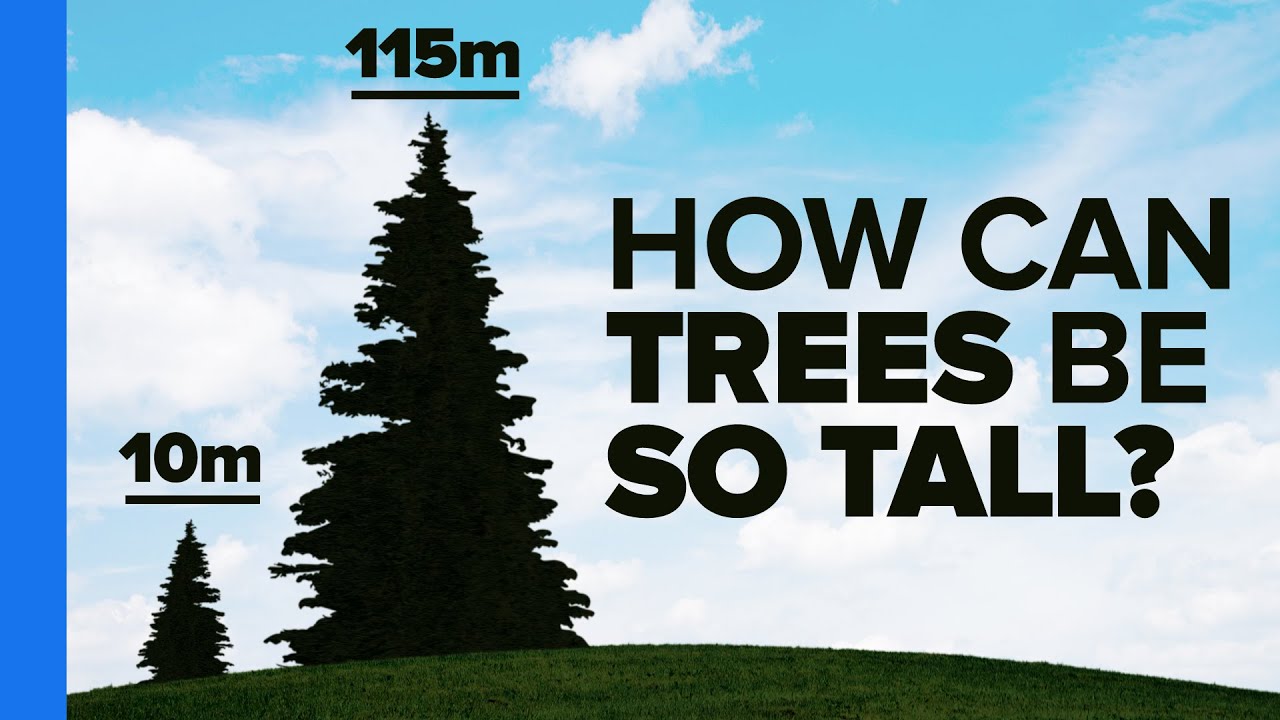
How Trees Bend the Laws of Physics — Veritasium

Veritasium

Nanoscale pores in leaf cell walls generate negative pressures reaching minus 15 atmospheres, pulling unbroken columns of metastable water up to 100 meters without boiling.

AI-assisted summary of How Trees Bend the Laws of Physics — original source. Check the original for full context.

Source published:

Key ideas

  • Atmospheric pressure limits standard suction-lifted water columns to 10 meters, requiring trees that reach 100 meters to create a continuous pressure difference of at least 10 atmospheres. (0:01)
  • Unlike gases, liquids can sustain negative absolute pressures down to -15 atmospheres due to intermolecular cohesive forces that maintain mechanical tension. (2:22)
  • Nanoscale pores in leaf cell walls measuring 2 to 5 nanometers rely on water's high surface tension to prevent air from entering the xylem column under immense tension. (2:22)
  • Despite existing under negative pressures that should cause spontaneous boiling, xylem water remains in a metastable liquid state due to the complete absence of air bubble nucleation sites. (2:22)
  • Roughly 95% of water transported by a tree simply evaporates through the stomata, expending hundreds of water molecules for every molecule of carbon dioxide absorbed. (4:14)

Detailed notes

## Background Published by Derek Muller on the YouTube channel Veritasium on October 30, 2012, this video explores how trees lift water hundreds of feet into the air. According to the description, the video explains how trees create immense negative pressures of tens of atmospheres through nanoscale pores, pulling water up to 100 meters in a state that avoids boiling due to air-free xylem tubes, largely to replace water evaporated while absorbing carbon dioxide.

## TL;DR While standard physics dictates that suction cannot lift water higher than 10 meters before a vacuum forms and causes boiling, tall trees routinely pull water over 100 meters into their canopies. Hypotheses such as internal valves, living muscular pumps, osmosis, and capillary action all fail to explain this transport. Instead, trees exploit intermolecular cohesion in liquids to generate genuine negative pressures reaching −15 atmospheres as water evaporates from 2-to-5-nanometer pores in leaf cell walls. Because xylem tubes are completely devoid of air bubbles to serve as nucleation sites, the water remains in a metastable liquid state without boiling, with roughly 95% of this transported water evaporating simply to capture carbon dioxide for photosynthesis.

## Atmosphere & style The video carries an infectious, curious energy that blends playful scientific inquiry with genuine intellectual revelation. Derek Muller frames the physical puzzle through lively discussions and discarded hypotheses with fellow science communicators, creating an accessible, collaborative back-and-forth before unveiling the counterintuitive physics. The mood shifts from amused bewilderment at the apparent impossibility of tall trees to deep awe at the elegant mechanics of the natural world, capped by candid, self-deprecating behind-the-scenes moments.

## Bulletin - [00:01](https://www.youtube.com/watch?v=BickMFHAZR0&t=1s) Atmospheric pressure limits standard suction-lifted water columns to 10 meters, requiring trees that reach 100 meters to create a continuous pressure difference of at least 10 atmospheres. - [02:22](https://www.youtube.com/watch?v=BickMFHAZR0&t=142s) Unlike gases, liquids can sustain negative absolute pressures down to -15 atmospheres due to intermolecular cohesive forces that maintain mechanical tension. - [02:22](https://www.youtube.com/watch?v=BickMFHAZR0&t=142s) Nanoscale pores in leaf cell walls measuring 2 to 5 nanometers rely on water's high surface tension to prevent air from entering the xylem column under immense tension. - [02:22](https://www.youtube.com/watch?v=BickMFHAZR0&t=142s) Despite existing under negative pressures that should cause spontaneous boiling, xylem water remains in a metastable liquid state due to the complete absence of air bubble nucleation sites. - [04:14](https://www.youtube.com/watch?v=BickMFHAZR0&t=254s) Roughly 95% of water transported by a tree simply evaporates through the stomata, expending hundreds of water molecules for every molecule of carbon dioxide absorbed.

## Key takeaways - [00:01](https://www.youtube.com/watch?v=BickMFHAZR0&t=1s) Conventional suction cannot lift water higher than 10 meters because the water column's weight balances atmospheric pressure, creating a vacuum that triggers boiling at room temperature. - [00:01](https://www.youtube.com/watch?v=BickMFHAZR0&t=1s) Transpiration cannot explain tall tree water transport through conventional suction alone, as absolute vacuum represents the theoretical limit of gas-based suction. - [01:09](https://www.youtube.com/watch?v=BickMFHAZR0&t=69s) Hypotheses suggesting water is stepped up in segmented compartments fail because xylem vessels form continuous, unbroken liquid columns from roots to leaves. - [01:09](https://www.youtube.com/watch?v=BickMFHAZR0&t=69s) Active peristaltic pumping ('tree muscles') is impossible because mature xylem conduit cells are completely dead and cannot expend metabolic energy. - [01:09](https://www.youtube.com/watch?v=BickMFHAZR0&t=69s) Osmotic pressure from root solute concentrations cannot universally drive water upward, as shown by mangroves that must pull water inward against saltier seawater. - [01:09](https://www.youtube.com/watch?v=BickMFHAZR0&t=69s) Capillary action in xylem vessels (20 to 200 micrometers in diameter) can only lift water less than one meter against gravity. - [02:22](https://www.youtube.com/watch?v=BickMFHAZR0&t=142s) Absolute zero pressure applies only to gases; cohesive intermolecular forces allow liquids to endure mechanical tension and reach true negative pressures. - [02:22](https://www.youtube.com/watch?v=BickMFHAZR0&t=142s) Leaf cell wall pores measuring 2 to 5 nanometers generate curved menisci strong enough to hold 1 atmosphere of outside air against -15 atmospheres of internal tension. - [02:22](https://www.youtube.com/watch?v=BickMFHAZR0&t=142s) Water in xylem conduits is 'supersucked' into a metastable liquid state, unable to boil at negative pressure because the conduits are fully flooded and lack nucleation bubbles. - [04:14](https://www.youtube.com/watch?v=BickMFHAZR0&t=254s) Less than 1% of the water lifted by a tree is consumed in photosynthesis, while structural growth uses only about 5%. - [04:14](https://www.youtube.com/watch?v=BickMFHAZR0&t=254s) The vast majority (around 95%) of transported water evaporates out of open stomata as a trade-off for capturing atmospheric carbon dioxide. - [04:14](https://www.youtube.com/watch?v=BickMFHAZR0&t=254s) The entire complex vascular adaptation evolved to continuously replace the enormous volumes of water lost during carbon dioxide collection.

## Detailed walkthrough ### [00:01](https://www.youtube.com/watch?v=BickMFHAZR0&t=1s) The 10-Meter Limit and Tree Height Conundrum

Derek Muller opens by observing that the simplest questions often yield the most astonishing answers. While people take for granted that trees are tall—some stretching beyond 100 meters into the sky—few stop to consider why there should even be a physical height limit. To survive, trees must lift water from deep within the soil all the way up into their topmost canopy branches. In everyday physics, water suction faces a hard ceiling governed by atmospheric pressure: if you attempt to suck water up a long, perfectly vertical straw, it will rise no higher than 10 meters. At that height, the weight of the water column balances atmospheric pressure, creating a pure vacuum at the top of the straw that causes the water to boil spontaneously at room temperature.

To haul water 100 meters into the air, a tree would somehow need to generate an immense pressure difference of at least 10 atmospheres. When people are asked how trees manage this feat, the most common answer offered is transpiration—the evaporation of water through the leaves pulling up neighboring water molecules behind it. While transpiration clearly provides a pulling force, it still appears to run straight into the fundamental barrier of barometric suction. As Hank Green points out when considering the upper limits of suction: “The lowest the pressure can go is a pure vacuum, which I imagine is not happening inside of tree leaves, right?”

- Maximum height of a suction-lifted water column: 10 meters. - Pressure difference required to lift water 100 meters: 10 atmospheres. - Physical consequence at the 10-meter limit: formation of a vacuum and spontaneous boiling of liquid water.

---

[01:09](https://www.youtube.com/watch?v=BickMFHAZR0&t=69s) Debunking Competing Hypotheses: Valves, Pumping, Osmosis, and Capillarity

Faced with the physical impossibility of exceeding the 10-meter suction barrier, guest thinkers offer alternative biological mechanisms. Hank Green and Henry Reich speculate that trees might avoid continuous, straw-like conduits altogether by compartmentalizing the water. One suggestion posits that trees use internal valves or broken cellular compartments so they never have to support a single unbroken column of water. However, botanists and tree physiologists have established that the xylem tubes responsible for transporting water do, in fact, form unbroken, continuous liquid columns from the roots to the leaves. Another playful hypothesis imagines active mechanical pumping, described as: “Squeezing like a cow udder all the way up. They have little tree muscles in there.” Derek refutes this immediately, pointing out that beyond requiring an unsustainable expenditure of metabolic energy, “all of the cells that make up the xylem tubes are all dead.”

Other classical physical explanations fail under scrutiny as well. Osmotic pressure—where a higher concentration of solutes in the roots draws moisture inward from the surrounding soil—can push water upward under certain conditions, but it cannot explain tall trees broadly. In coastal mangrove ecosystems, the surrounding seawater is far saltier than the interior of the tree; osmotic gradients actually pull water backward out of the roots, meaning the tree must exert additional suction just to draw moisture in. Capillary action is similarly insufficient: while narrower tubes allow liquid to climb higher against gravity, the xylem conduits in trees measure between 20 and 200 micrometers in diameter. At that width, capillary forces can lift water less than a single meter.

| Proposed Mechanism | Hypothesized Action | Why It Fails for Tall Trees | |:--- |:--- |:--- | | **Cellular Valves / Discontinuous Tubes** | Water is stepped up in small, isolated compartments. | Anatomical studies prove xylem vessels form continuous, uninterrupted water columns. | | **Active Peristaltic Pumping ("Tree Muscles")** | Living cells squeeze the tubes to pump water upward. | Enormous energy cost; furthermore, mature xylem conduit cells are completely dead. | | **Osmotic Root Pressure** | High root solute concentration pushes water from below. | Fails in saline habitats like mangroves, where external salinity draws water outward. | | **Capillary Action** | Surface tension and adhesion pull water up narrow channels. | Xylem conduits (20–200 µm diameter) are far too wide; water climbs under 1 meter. |

---

[02:22](https://www.youtube.com/watch?v=BickMFHAZR0&t=142s) Negative Pressure, Nanoscale Menisci, and Supersucked Water

The apparent impossibility dissolves because one fundamental assumption about physics is flawed: the belief that pressure can never drop below zero. While this rule is true for gases—where removing all particles leaves zero molecules and thus a pure vacuum at zero absolute pressure—liquids behave differently due to cohesive intermolecular forces. Liquid molecules can pull on one another and on their physical container, sustaining mechanical tension that registers as real, negative pressure. In a typical tree, water evaporating from microscopic pores in the cell walls of leaves creates massive negative pressures reaching −15 atmospheres.

```mermaid flowchart TD accTitle: Transpirational Negative Pressure Mechanism accDescr: Diagram showing how nanoscale leaf pores establish negative pressure to pull metastable liquid water up xylem vessels without boiling.

subgraph Leaf ["Leaf Cell Wall Interface"] A["Nanoscale Pores\n(2–5 nm diameter)"] -->|"High Surface Tension"| B["Curved Meniscus Holds\n1 atm outside vs -15 atm inside"] end

subgraph Conduit ["Continuous Xylem Column"] B -->|"Transpirational Pull (Tension)"| C["Negative Pressure State\n(-15 atm at canopy)"] C -->|"Absence of Seed Nuclei"| D["Metastable Liquid State\n('Supersucked' Water)"] end

subgraph Base ["Root System"] D -->|"Hydraulic Gradient"| E["Roots at Atmospheric Pressure\n(0 to +1 atm)"] end ```

At the leaf's air-water boundary, one atmosphere of external air presses inward while negative 15 atmospheres of tension pull inward from behind. The meniscus does not collapse or pull air into the conduit because the cell wall pores are minuscule, spanning only 2 to 5 nanometers across. As Derek explains: “At this scale, water's high surface tension ensures the air-water boundary can withstand huge pressures without caving.” This creates a steep pressure gradient running from atmospheric pressure at the wet roots to intense negative pressure in the canopy.

Under negative 15 atmospheres, thermodynamics dictates that water should boil instantly into vapor. It remains liquid because boiling requires activation energy to form a phase boundary, typically supplied by a nucleation site such as an air bubble. Because xylem vessels are flooded with water from their very inception, they remain entirely devoid of air pockets. The water therefore persists in a metastable liquid state—analogous to supercooled water remaining liquid below freezing—earning the label of being "supersucked."

- Cell wall pore diameter: 2 to 5 nanometers. - Tension generated in an average tree canopy: −15 atmospheres. - Xylem vessel internal diameter: 20 to 200 micrometers. - Phase state of xylem water: Metastable liquid under negative pressure, prevented from boiling due to lack of nucleation sites.

---

[04:14](https://www.youtube.com/watch?v=BickMFHAZR0&t=254s) Where Does All the Water Go?

When asked why trees expend such dramatic physical effort to haul thousands of liters of water hundreds of feet into the sky, most people instinctively assume it fuels chemical synthesis. However, photosynthetic reactions consume less than 1% of the water transported through the vascular network. Structural growth accounts for only another 5%, which is used to expand and generate new plant cells.

The remaining 94% to 95% of the water does nothing more than evaporate straight out into the atmosphere through transpiration. Trees must open their stomata to capture carbon dioxide from the air, but exposed wet membranes in dry ambient air suffer rapid evaporative loss. As Derek highlights: “For each molecule of carbon dioxide a tree takes in, it loses hundreds of water molecules of water.” The entire vascular architecture—spanning negative pressures of tens of atmospheres, nanoscale menisci, continuous xylem conduits, and metastable boiling-suppressed water—functions primarily to replace the massive volume of water squandered just to collect a few carbon molecules. Derek marvels at the elegance of the adaptation, concluding: “I will never look at a tree the same way again.”

- Photosynthetic utilization: < 1% of total transported water. - Cellular growth and tissue formation: ~5% of transported water. - Evaporative loss through stomata: ~95% of transported water. - Gas exchange ratio: Hundreds of water molecules sacrificed per individual molecule of CO₂ captured.

---

[05:19](https://www.youtube.com/watch?v=BickMFHAZR0&t=319s) Collaborators, Reflections, and Behind the Scenes

Derek acknowledges the fellow creators and scientists who contributed hypotheses and technical guidance to the production, including Hank Green, Henry Reich, and Professor Martyn Poliakoff. Formulating testable hypotheses that turn out to be incorrect is a foundational step in scientific discovery, underscored by Albert Einstein’s observation that “a person who has never made a mistake has never tried anything new.” Derek also credits Professor John Sperry of the University of Utah, who untangled the biophysics of liquid tension during an hour-long Skype consultation. Sperry clarified the core conceptual misunderstanding of the problem: “This is liquid pressure not gas pressure. So it's a common misconception that oh, you can't have you know negative pressures because there's no molecules left.”

Derek extends special thanks to CGP Grey, who helped shape the script in London after hearing Derek’s initial pitch. When first presented with the concept, Grey remarked that his mind was blown, but cautioned that the counterintuitive physics would prove exceptionally difficult to communicate clearly. Closing the episode, Derek laughs about his own delays, confessing that months earlier he had promised subscribers he would release the solution the very next week, jokingly admitting, “Oh, the lies.” The video finishes with playful outtake footage of Derek attempting a resonance experiment in Paris, cheering as his apparatus hits the right frequency: “Yes!! Success is frightening.”

## Mentioned Derek Muller, Veritasium, Hank Green, Henry Reich, CGP Grey, Prof Martyn Poliakoff, Prof John Sperry, Albert Einstein, University of Utah, Palais de la Découverte, Stanley Park

## Video description Hope this was worth the wait! So many people helped with this video: Prof John Sperry, Hank Green, Henry Reich, CGP Grey, Prof Poliakoff, my mum filmed for me in beautiful Stanley Park and Jen S helped with the fourth version of the script.

Prof John Sperry http://biologylabs.utah.edu/sperry/john.html Hank Green (SciShow) http://www.youtube.com/user/scishow Henry Reich (minutephysics) http://www.youtube.com/user/minutephysics CGP Grey http://www.youtube.com/user/cgpgrey Prof Poliakoff (Periodic Videos) http://www.youtube.com/user/periodicvideos

Also thanks to the Palais de la Decouverte - they helped me with the whole vacuum pump setup in Paris. No, I could not actually suck water up 10m - I did about 4m, but the vacuum pump was easily able to do it and I saw spontaneous boiling on all of our various trials. Footage from this may end up on 2Veritasium.

Trees create immense negative pressures of 10's of atmospheres by evaporating water from nanoscale pores, sucking water up 100m in a state where it should be boiling but can't because the perfect xylem tubes contain no air bubbles, just so that most of it can evaporate in the process of absorbing a couple molecules of carbon dioxide. Now I didn't mention the cohesion of water (that it sticks to itself well) but this is implicit in the description of negative pressure, strong surface tension etc.

[Source](https://www.youtube.com/watch?v=BickMFHAZR0)

中文简报

树木利用液体负压将水提升突破10米极限 叶片细胞壁中的纳米级孔隙产生低至负15个大气压的负压,将亚稳态水柱在不发生沸腾的情况下连续拉升至高达100米。 尽管经典物理学表明,在形成真空并导致沸腾之前,抽吸力无法将水提升超过10米,但高大的树木却经常将水输送至100米以上的树冠。内部单向阀、活体肌肉泵、渗透作用和毛细现象等假说均无法完全解释这一输送过程。实际上,树木利用了液体中的分子间内聚力,在水分从叶片细胞壁2至5纳米的孔隙中蒸发时,产生达到-15个大气压的真正负压。由于木质部导管完全没有可作为成核位点的气泡,水得以保持在亚稳态的液体状态而不发生沸腾;而这些输送的水分中,约有95%仅是通过蒸发来换取光合作用所需的二氧化碳。 大气压将标准抽吸提升的水柱限制在10米,这使得高达100米的树木必须产生至少10个大气压的持续压差。 (0:01) 与气体不同,由于维持机械张力的分子间内聚力,液体能够承受低至-15个大气压的绝对负压。 (2:22) 叶细胞壁中尺寸为2至5纳米的纳米孔隙依靠水的高表面张力,防止空气在巨大张力下进入木质部水柱。 (2:22) 尽管处于理应引起自发沸腾的负压之下,但由于完全缺乏气泡成核位点,木质部的水仍保持在亚稳态液体状态。 (2:22) 树木输送的水分中约有95%仅通过气孔蒸发,每吸收一个二氧化碳分子就要消耗数百个水分子。 (4:14)

Reading summary

Derek Muller explains that tall trees bypass the standard 10-meter physical limit on suction by exploiting the cohesive properties of liquid water to generate extreme negative pressure. This vascular mechanism sustains continuous, metastable water columns reaching over 100 meters without boiling. The 10-Meter Suction Limit and Inadequate Hypotheses (0:01) In classical barometric physics, suction cannot pull a vertical column of water higher than 10 meters. At that height, the weight of the water balances atmospheric pressure, creating a vacuum at the top that causes room-temperature water to boil spontaneously. To transport water to canopies exceeding 100 meters, trees require a pressure gradient of at least 10 atmospheres. Intuitive biological explanations fail to account for this feat. Proposed mechanisms involving internal valves or segmented compartments contradict anatomical evidence that xylem vessels form continuous, unbroken liquid columns. Hypotheses relying on active peristaltic pumping ('tree muscles') are unviable because mature xylem conduit cells are dead and lack metabolic energy to pump fluid. Other standard physical explanations also prove insufficient. Capillary action is severely constrained by tube diameter: because tree xylem conduits measure between 20 and 200 micrometers across, capillary forces can lift water less than a single meter. Osmotic root pressure—where higher solute concentrations draw soil moisture inward—cannot serve as a universal mechanism either. In coastal mangrove ecosystems, high surrounding salinity reverses the osmotic gradient by pulling moisture outward, forcing the tree to exert even greater internal pulling force to extract fresh water. Liquid Cohesion, Nanoscale Pores, and Negative Pressure (2:22) The apparent physical impossibility rests on the misconception that pressure cannot fall below zero. While true for gases, where zero pressure corresponds to a complete vacuum devoid of particles, liquids possess strong intermolecular cohesive forces. These forces allow liquid molecules to pull on one another and on vessel walls, sustaining mechanical tension that registers as absolute negative pressure. Evaporation within leaf cell walls generates tension reaching −15 atmospheres. This extreme pull does not suck air back into the conduit because the leaf pores are tiny, spanning only 2 to 5 nanometers in diameter. At this nanoscale, water's surface tension forms menisci rigid enough to withstand a 16-atmosphere differential between the outside air and the internal conduit without collapsing. Under −15 atmospheres of tension, thermodynamics indicates that liquid water should instantly boil into vapor. The water column survives because phase changes require an activation energy barrier, typically initiated by a seed air bubble or nucleation site. Because xylem conduits remain completely filled with water from their initial formation, they lack nucleation sites. Water consequently persists in a metastable liquid state—termed 'supersucked' water—retaining its integrity from the root zone to the canopy. The Severe Evaporative Cost of Carbon Capture (4:14) Despite the extraordinary physical adaptations required to elevate water hundreds of feet, trees consume very little of it for metabolic or structural synthesis. Photosynthetic chemical reactions account for less than 1% of the total water drawn through the xylem, while cellular expansion and the creation of new plant tissue utilize only around 5%. The remaining 94% to 95% of transported water is lost directly to the atmosphere through transpiration. Whenever a tree opens its leaf stomata to absorb ambient carbon dioxide, internal moisture rapidly evaporates into the dry air. For every single molecule of carbon dioxide captured, the plant loses hundreds of water molecules. The entire vascular framework of negative pressure, nanoscale menisci, and metastable water columns operates primarily to replace the vast quantities of water sacrificed during gas exchange. As biophysicist John Sperry and Derek Muller emphasize, resolving the tree height paradox requires distinguishing liquid tension from gas pressure limits. The intricate hydraulic network of continuous xylem vessels and nanoscale menisci serves as an evolutionary solution to the steep water costs of terrestrial carbon capture.

精炼阅读摘要

Derek Muller指出,高大树木能够突破标准气压抽吸水柱10米的物理屏障将水运送至百米树冠,并非通过传统的毛细、渗透或主动泵送,而是依赖导管内连续水柱在负15个大气压的液体张力下维持亚稳态流动。 十米吸水极限与四种生物假设的破产 (0:01) 在经典物理学中,依靠抽吸力提升水柱存在明确的物理上限。当垂直管内的负压达到纯真空时,水柱重力与一个标准大气压相平衡,这使得抽吸水柱的最高极限仅为10米,超过该高度水会在室温下自发沸腾。若要将水分提升至超过100米的高空,树木必须在顶部与根部之间建立至少10个大气压的压差。常见的直觉推测认为树木可能采用内部阀门或细胞隔断分段储水,但植物生理学已经证实,植物体内负责输送水分的木质部导管自根部至叶片完全连通,形成一条不间断的液体水柱。另一种主动机械泵送(如活体细胞像挤奶一样蠕动挤压)的设想同样无法成立,因为构成成熟木质部导管的所有细胞全部为死细胞,既不具备收缩肌肉,也无法承担如此巨大的代谢能耗。 其他基于经典物理现象的解释在面对严苛自然条件时也均被证伪。根部渗透压虽能在特定条件下向上推水,但在红树林等沿海盐生生态系统中,外部海水的盐度远高于树木内部,渗透梯度不仅无法推水,反而会从根部倒吸水分,迫使植物施加额外的吸力来摄取水分。毛细作用同样不足以支撑大树的高度:尽管细管能够借助表面张力提升液面,但树木木质部导管的内径通常在20至200微米之间,在此尺度下,毛细现象所能提供的提升高度甚至不足1米。 液体分子内聚力与纳米微孔负压机制 (2:22) 树木能够超越抽吸极限的核心在于推翻了“压力绝对不能低于零”的常识性认知。气体在抽空所有粒子后形成绝对压力为零的纯真空,因而无法产生负压;然而液体分子之间存在强大的分子间内聚力,水分子相互拉拽并附着于容器内壁,从而能够在机械张力下承受真实的负压。在树冠顶部,水分从叶肉细胞壁的微小孔隙中不断蒸发,产生了高达负15个大气压的巨大张力。犹他大学的John Sperry教授指出,许多人因混淆气体压力与液体压力而误认为负压不可存在,但液体张力恰恰是树木水分运输的物理现实。 为维系这股巨大的负压而不导致空气被吸入导管,叶片细胞壁演化出了极度微小的纳米级孔隙,其直径仅有2至5纳米。在此尺度下,水的高表面张力形成了极其弯曲的微小弯月面,即使外界承受1个大气压的正向推力,而导管内部处于负15个大气压的剧烈拉力,水与空气的界面依然能够保持稳定而不致破裂或凹陷塌陷。这在湿润的根部(约0至1个大气压)与叶冠之间构筑了一条陡峭的水力负压梯度。 无气泡成核位点下的亚稳态超吸水 (2:22) 热力学规律表明,在负15个大气压的极端张力下,液态水理应瞬间沸腾气化。树木木质部内的水分之所以能够持续保持液态,是因为液体沸腾发生相变需要克服激活能屏障,且通常依赖空气气泡等杂质作为成核位点。树木体内的木质部导管在发育之初便完全充满水分,整个管腔系统内没有任何残留的空气微泡或相变核心。由于缺乏成核条件,水柱得以维持在一种类似于过冷水未结冰的“亚稳态”液相中,这种被处于极端张力下拉伸的液体也被形象地称为“超吸”(supersucked)状态。 巨量水分运输与碳吸收的严苛代价 (4:14) 尽管树木每天耗费极高的水力张力将成千上万升水提升至高空,但这些水分几乎完全不用于合成有机物。在通过维管系统运输的全部水分中,直接参与光合作用化学反应的比例不足1%,用于新细胞生成与组织生长的结构性水分也仅占约5%。其余94%至95%的水分最终全部通过叶片气孔蒸腾进入大气。树木为了从空气中捕获二氧化碳必须张开气孔,而在干燥流动的空气中,湿润细胞膜表面的水分会剧烈蒸发。在这一气体交换过程中,树木每吸收一个二氧化碳分子,就必须牺牲并蒸发散失数百个水分子。整套包含纳米级弯月面、连续木质部导管和亚稳态负压流体的庞大物理架构,主要功能便是源源不断地补充因碳摄入而浪费掉的惊人水量。 Derek Muller总结认为,树木并未违背物理规律,而是利用了液体分子内聚力、纳米尺度孔隙表面张力以及无成核位点的亚稳态物理特性,构建出超越常规气压限制的负压输水机制。这种精密的工程结构最终解答了长达百米的水柱如何在避免自发沸腾的情况下向高空持续供应水分。

Detailed notes — zh

## Background 该视频由科普频道的德里克·穆勒(Derek Muller)于2012年10月30日发布在YouTube平台的Veritasium频道。视频简介指出,树木通过纳米级孔隙蒸发水分产生数十个大气压的巨大负压,在木质部导管无气泡的条件下维持亚稳态,从而打破常规物理直觉将水抽升百米,而这一切庞大的能量消耗主要是为了在吸收二氧化碳时承受水分蒸发损耗。 ## TL;DR 视频探讨了百米巨树如何突破10米抽水极限将水分运送至树顶的物理谜题。在排除了蒸腾作用真空极限、细胞肌肉挤压、渗透压和毛细作用等传统假说后,视频揭示了关键机制在于液态水能够承受拉力并产生高达 -15 个大气压的真实负压。纳米级孔隙强大的表面张力维持了弯月面完整,同时木质部因缺乏气泡晶核而让水处于不会沸腾的亚稳态“过吸”状态。最终令人惊讶的是,树木费尽周折抽调的水分中,超过95%仅仅是为了在气孔吸收微量二氧化碳时作为蒸发代价散失掉。 ## Atmosphere & style 全片洋溢着好奇心驱动的硬核求知氛围与真诚的科学探究精神,基调严谨而又富有启发性。德里克邀请多位知名科学博主共同碰撞假说,展示了科学探索中不断试错与修正认知的真实过程。从对日常植物习以为常的漠视,到层层推导颠覆常识的负压与亚稳态物理学,整段叙事带有一种令人豁然开朗的震撼感与敬畏感。 ## Bulletin - [00:01](https://www.youtube.com/watch?v=BickMFHAZR0&t=1s) 常规物理常识中吸水极限为10米,因纯真空会导致水自发沸腾,但参天巨树必须打破该常模产生超过10个大气压的压力差才能将水分运送至树顶。 - [01:08](https://www.youtube.com/watch?v=BickMFHAZR0&t=68s) 树木内部并非依靠细胞肌肉蠕动、毛细作用或渗透压吸水,而是利用木质部导管内连续的水柱与真实的液体负压状态驱动输送。 - [02:24](https://www.youtube.com/watch?v=BickMFHAZR0&t=144s) 叶肉细胞壁仅2至5纳米的超微孔隙凭借极高表面张力维持住低至-15个大气压的负压,使纯净无气泡的水以防沸腾的亚稳态被强行提升至百米高空。 - [04:14](https://www.youtube.com/watch?v=BickMFHAZR0&t=254s) 树木承担巨大的水利工程负荷中,超过95%的水分仅是作为张开气孔捕获微量二氧化碳时的蒸发代价流失,光合作用消耗不足1%。 ## Key takeaways - [00:01](https://www.youtube.com/watch?v=BickMFHAZR0&t=1s) 传统抽水极限受限于1标准大气压,在吸管顶端达到纯真空时水柱最高只能达到约10米,并伴随液态水自发沸腾。 - [00:01](https://www.youtube.com/watch?v=BickMFHAZR0&t=1s) 百米巨树若要将根部水分运送至最顶端,在物理上必须建立起至少10个大气压的巨大压力差。 - [01:08](https://www.youtube.com/watch?v=BickMFHAZR0&t=68s) 木质部导管内部为完全贯通且连续的水柱,并非通过阀门分段阻断来逐步提升高度。 - [01:08](https://www.youtube.com/watch?v=BickMFHAZR0&t=68s) 木质部导管在成熟期全由死细胞构成,不存在类似肌肉自主收缩蠕动挤压水分的生理机制。 - [01:08](https://www.youtube.com/watch?v=BickMFHAZR0&t=68s) 渗透压无法作为统一的提水动力,例如红树林等高盐环境的外界渗透压反而会向外抽取树体水分。 - [01:08](https://www.youtube.com/watch?v=BickMFHAZR0&t=68s) 树木木质部导管直径在20至200微米之间,单靠毛细作用所能提升的水柱高度尚不足1米。 - [02:24](https://www.youtube.com/watch?v=BickMFHAZR0&t=144s) 气体压力受限于分子抽空的绝对零压,但液体由于分子间内聚力和管壁拉应力,压强可以降为负值。 - [02:24](https://www.youtube.com/watch?v=BickMFHAZR0&t=144s) 叶片细胞壁孔隙直径仅2至5纳米,极高表面张力使弯月面能承受外侧1个大气压与内侧-15个大气压的巨大压差而不破裂。 - [02:24](https://www.youtube.com/watch?v=BickMFHAZR0&t=144s) 树木内部的负压水柱处于热力学上应当沸腾的亚稳态,但由于导管完全纯净无气泡作为成核位点,水分子处于防沸腾的“过吸”状态。 - [04:14](https://www.youtube.com/watch?v=BickMFHAZR0&t=254s) 树木吸收的水分中只有不到1%真正参与光合作用,约5%用于细胞生长,超过95%均作为蒸腾作用损耗挥发至空气中。 - [04:14](https://www.youtube.com/watch?v=BickMFHAZR0&t=254s) 树木在叶片气孔捕获稀薄二氧化碳的过程中,每吸收1个分子CO2就伴随着数百个水分子不可避免的蒸发流失。 - [05:19](https://www.youtube.com/watch?v=BickMFHAZR0&t=319s) 植物水分动力学中对负压的常见误解源于将气体压强的零界限混同于液体内聚力拉伸所产生的负张力。 ## Detailed walkthrough ### [00:01](https://www.youtube.com/watch?v=BickMFHAZR0&t=1s) 树木高度之谜与十米水柱极限 最简单的问题往往蕴含着最惊人的答案。比如:树木为什么能够长得如此高大?对于很多人来说,这似乎是一个根本不需要追问的问题,树木天生就很高,有些甚至超过了 100 米。然而,从物理学的角度来看,树木生长必然存在一个致命的限制高度——树木为了生存,必须将水分从根部运送到最顶端的枝叶,而这绝非一件轻而易举的小事。 在物理常识中,通过管道抽吸水柱存在一个严格的理论极限:10 米。如果你对着一根超长的垂直吸管用力抽吸,无论吸力有多强,水柱上升的高度绝不会超过 10 米。当水柱达到 10 米高度时,吸管顶部会形成绝对真空,水会随之自发沸腾。因此,一棵高达 100 米的巨树若想将水运送至树顶,必须建立起高达 10 个大气压的压力差。树木究竟凭借什么机制才能做到这一点? - 理论抽水极限:由于标准大气压的限制,通过负压抽水的水柱最高只能达到约 10 米。 - 达到极限时的物理现象:吸管顶端出现纯粹真空,内部液态水开始自发汽化沸腾。 - 参天巨树的物理挑战:若要将水分抬升至 100 米高空,植物体内必须产生至少 10 个大气压的压力差。 ### [01:08](https://www.youtube.com/watch?v=BickMFHAZR0&t=68s) 各种常见猜想及其破灭 面对这一难题,许多人首先想到的解释是蒸腾作用(transpiration)——水分从叶片蒸发时,会拉拽后面的水分子向上移动。蒸腾作用固然是树木产生吸力的一种机制,但它依旧无法打破 10 米的高度局限。汉克·格林(Hank Green)对此提出质疑:“气压最低只能达到纯粹的真空状态,而我猜树叶内部不可能出现真空,对吧?”如果最低压力不过是绝对真空,单纯的表面抽吸依然受制于标准气压。 随后,一系列常见的生物学与物理学假说被逐一提出并被实验推翻: 有人猜测树木内部不是连贯的水柱,而是具备类似阀门的阻断结构或细胞分段;但植物学家的研究明确证实,树木体内负责输送水分的导管(木质部导管,xylem tubes)包含着完全连续、贯通的水柱。 还有人半开玩笑地猜测树干是否像挤牛奶一样段段向上蠕动挤压:“像挤牛乳头那样一路往上挤,树里面长着小小的树木肌肉。”然而,这不仅极度耗费能量,而且构成木质部导管的所有成熟细胞全部都是死细胞,根本不可能自主收缩。 另外两种物理机制也无法成立: 1. 渗透压(Osmotic pressure):如果根部的溶质浓度高于周围土壤,水分确实会被推入树干。然而许多树木生活在红树林等高盐度环境中,外界盐水的高渗透压反而会往外抽水,导致树木必须产生额外的负压来将水分强行吸入体内。 2. 毛细作用(Capillary action):管道越细,水柱攀爬越高。但树木导管的内径通常在 20 至 200 微米之间,这个口径太宽了,毛细作用仅仅能让水柱上升不到 1 米。 ```mermaid flowchart TD accTitle: 树木水分提升假说排查 accDescr: 排除蒸腾作用真空极限、细胞肌肉挤压、渗透压和毛细作用等传统假说 Q["如何将水提升100米?"] --> H1["假说1: 吸力/真空抽吸"] Q --> H2["假说2: 管道泵压/细胞肌肉挤压"] Q --> H3["假说3: 根部渗透压推动"] Q --> H4["假说4: 导管毛细作用"] H1 --> F1["受限于10米水柱极限与沸腾"] H2 --> F2["木质部导管细胞均为死细胞,无肌肉"] H3 --> F3["红树林等高盐环境下渗透压反向"] H4 --> F4["导管直径20-200微米,爬升不足1米"] ``` ### [02:24](https://www.youtube.com/watch?v=BickMFHAZR0&t=144s) 负压的奥秘与“过吸”的亚稳态水 破解谜题的关键,在于打破我们原有的思维定式:“气压最低只能达到纯真空”。对于气体而言确实如此,当抽离全部气体分子后,压强归零即为纯真空。但在液体中,压强完全可以跌破 0 压强并进入真正的“负压”(negative pressure)状态。在固体中,这种分子间相互拉扯的力量被称为拉应力或张力(tension);而在液态水中,水分子之间以及水分子与管壁之间的相互拉扯便形成了负压。 当水分从叶肉细胞壁极其微小的孔隙中蒸发时,会在普通树木体内形成低至 -15 个大气压的巨大负压。在孔隙的气液界面处,外侧是 1 个大气压向内压,而内侧则是高达 -15 个大气压的巨大拉力。之所以气液界面的弯月面不会破裂崩溃,是因为这些孔隙极度微小,直径仅有 2 到 5 纳米。在这个纳米尺度下,水的高表面张力足以抵抗巨大的压力差而不凹陷破裂。顺着树身向下,压力逐渐回升,在根部恢复到大气压,因此整棵树顶底之间形成了极大的压力梯级。 但此时出现了一个尖锐的问题:在顶部负 15 个大气压的严苛环境下,水难道不应该剧烈沸腾吗?答案是肯定的,在热力学上它确实应当沸腾。然而,由液相转变为气相需要克服活化能,这通常需要微小气泡作为成核位点(nucleation site)。树木的木质部导管极其纯净,并且从生长之初就始终被水充满,完全不存在空气气泡。没有气泡充当晶核,水分子便被“锁”在了一种本该沸腾却未能沸腾的亚稳态(metastable state)液体中。这恰似过冷水(supercooled water)在低于冰点时仍保持液态一样,树木中的水也处于一种处于极端负压下却依然保持液态的“过吸”(supersucked)状态。 - 纳米孔径:细胞壁孔隙直径仅为 2 至 5 纳米,极高的表面张力维持了弯液面的完整性。 - 极端负压:蒸发在树冠产生约 -15 个大气压的拉力,形成从树顶到树根的水分压力梯度。 - 亚稳态防沸腾:由于缺乏气核,木质部连续水柱在深度负压下无法汽化,维持亚稳态液相。 ### [04:14](https://www.youtube.com/watch?v=BickMFHAZR0&t=254s) 95% 的水分消耗与惊人的生理代价 树木耗费如此巨大的力气将成吨的水分抽升至百米高空,究竟是为了什么?许多人直觉上会认为是光合作用,但事实并非如此——参与光合作用反应的水分连吸收总量的 1% 都不到。另有人猜测是为了植物生长制造新细胞,但这也仅占水分消耗的 5% 左右。 其余超过 95% 的绝大部分水分,最终的命运仅仅是直接蒸发流失到了空气中。树木在张开叶片气孔吸收空气中稀薄的二氧化碳时,必须承受水分急速散失的代价。巨树每吸收一个分子的二氧化碳,就会随之流失数百个水分子。 整个自然过程展现出不可思议的物理奇观:树木利用纳米孔隙的水分蒸发,创造出数十个大气压的超强负压,将原本应该自发沸腾的水以亚稳态形式硬生生抽上 100 米高空,而这一切庞大的水利工程,绝大部分只是为了在捕获几颗二氧化碳分子时作为蒸发损耗付之一炬。德里克·穆勒(Derek Muller)面对这一事实感慨道:“我再也不会用以前的眼光去看待一棵树了。” - 水分流向分布: - 光合作用反应:< 1% - 细胞生长与组织构建:约 5% - 蒸发损耗(蒸腾泄露):> 95% - 生理置换代价:气孔每吸收 1 个 $CO_2$ 分子,伴随着数百个 $H_2O$ 分子的挥发损失。 ### [05:19](https://www.youtube.com/watch?v=BickMFHAZR0&t=319s) 科学探索幕后:同行协助与错误假说 德里克在视频中特别向汉克·格林、亨利·赖克(Henry Reich)以及马丁·波利亚科夫教授(Martyn Poliakoff)表达了诚挚感谢,感谢他们公开在镜头前提出各种假说。德里克指出,即便提出的假说最终被证明是错误的,这依然是科学探索过程中不可或缺的核心部分,正如爱因斯坦所言:“一个从未犯错的人,从未尝试过任何新事物。” 犹他大学的约翰·斯佩里教授(Professor John Sperry)在长达一小时的视频通话中为德里克厘清了背后的机制。斯佩里教授特别纠正了关于负压的常见误区:“我们这里讨论的是低于大气压的压力,这是液体压力,而不是气体压力。普遍的误解认为因为没有分子了所以不可能存在负压,但纯真空零分子的定义只适用于气体。”液体分子之间的内聚力使得液体在承受拉力时能够拥有真实的负压状态。 此外,CGP Grey 在伦敦听闻这个选题时曾大为震撼,形容自己当时的感觉是“整个人脑洞大开(mind just blown)”,并告诫德里克这个主题极其难以向公众解释清楚。德里克在片尾幽默地回顾了视频的难产过程:他在几个月前曾发视频夸下海口让观众“订阅频道,下周就公布答案”,结果为了把负压和水动力学彻底搞明白,耗费了数月时间,成为了一场不折不扣的科学探索之旅。 ## Notable quotes > [05:19](https://www.youtube.com/watch?v=BickMFHAZR0&t=319s) 普遍的误解认为因为没有分子了所以不可能存在负压,但纯真空零分子的定义只适用于气体。 — 约翰·斯佩里 ## Mentioned Veritasium, 德里克·穆勒, 约翰·斯佩里, 汉克·格林, 亨利·赖克, CGP Grey, 马丁·波利亚科夫, 阿尔伯特·爱因斯坦, 犹他大学, 发现宫, 斯坦利公园, SciShow, minutephysics, Periodic Videos ## Video description Hope this was worth the wait! So many people helped with this video: Prof John Sperry, Hank Green, Henry Reich, CGP Grey, Prof Poliakoff, my mum filmed for me in beautiful Stanley Park and Jen S helped with the fourth version of the script. Prof John Sperry http://biologylabs.utah.edu/sperry/john.html Hank Green (SciShow) http://www.youtube.com/user/scishow Henry Reich (minutephysics) http://www.youtube.com/user/minutephysics CGP Grey http://www.youtube.com/user/cgpgrey Prof Poliakoff (Periodic Videos) http://www.youtube.com/user/periodicvideos Also thanks to the Palais de la Decouverte - they helped me with the whole vacuum pump setup in Paris. No, I could not actually suck water up 10m - I did about 4m, but the vacuum pump was easily able to do it and I saw spontaneous boiling on all of our various trials. Footage from this may end up on 2Veritasium. Trees create immense negative pressures of 10's of atmospheres by evaporating water from nanoscale pores, sucking water up 100m in a state where it should be boiling but can't because the perfect xylem tubes contain no air bubbles, just so that most of it can evaporate in the process of absorbing a couple molecules of carbon dioxide. Now I didn't mention the cohesion of water (that it sticks to itself well) but this is implicit in the description of negative pressure, strong surface tension etc. [Source](https://www.youtube.com/watch?v=BickMFHAZR0)

Source quotes

[5:19] 约翰·斯佩里: 普遍的误解认为因为没有分子了所以不可能存在负压,但纯真空零分子的定义只适用于气体。

Original transcript

[0:01] Sometimes the simplest questions have the most amazing answers. [0:05] Like how can trees be so tall? It's a question that doesn't even seem [0:10] like it needs an answer. [0:11] Trees just are tall. Some of them are over 100 meters. [0:15] Why should there be a height limit? [0:17] I'll tell you why. Tress need to transport water from their roots up into their topmost [0:21] branches in order to survive. And that is no trivial task. [0:25] There is a limit to the height that water can be sucked up a tube - it's 10 meters. [0:30] If you suck on a long vertical straw, the water will go no higher than 10 meters. At [0:35] this point there will be a perfect vacuum at the top of the straw and the water will [0:38] start to boil spontaneously. For a tree to raise water 100 meters, it would have to create [0:43] a pressure difference of 10 atmospheres. [0:46] How would trees do that? [0:48] When I posed this conundrum, a lot of people said the answer is transpiration. And that's [0:53] when water evaporates from the leaf, pulling up the water molecules behind it. Now that's [0:57] clearly a mechanism a tree can use to create suction, but it doesn't help us overcome this [1:02] 10 meter limit. The lowest the pressure can go is a pure vacuum, [1:05] which I imagine is not happening inside of tree leaves, right? [1:09] Right, Hank. So you might suspect that a tree does not contain continuous straw-like tubes [1:15] The tree effectively has valves in it. So you don't have a column of water [1:20] This big tube that you're saying needs to be full of water is actually made up of cells. [1:25] Although these are good speculations, they don't turn out to be correct. [1:29] Scientists who study trees find that the xylem tubes that transport water do contain a continuous [1:34] water column. So how else could the tree transport water from the roots to the leaves? [1:38] They don't suck, they don't use a vacuum. [1:40] OK, so how do they do it? [1:42] Squeezing like a cow udder all the way up. They have little tree muscles in there. [1:47] Yeah. Besides being a giant waste of energy, all [1:50] of the cells that make up the xylem tubes are all dead. [1:53] What about osmotic pressure? If there is more solute in the roots than in the surrounding [1:57] soil, water would be pushed up the tree. But some trees live in mangroves, where the water [2:02] is so salty that osmotic pressure actually acts in the other direction so the tree needs [2:06] additional pressure to suck water into the tree. [2:09] Then it must be capillary action. The thinner the tube, the higher the water can climb. [2:15] But the tubes in a tree are too wide - at 20-200 micrometers in diameter, water should [2:20] rise less than a meter. [2:22] So how do trees do it? [2:24] Well one of the assumptions we made is wrong: The lowest the pressure can go is a pure vacuum [2:29] pure vacuum pure vacuum [2:30] In a gas, this is true. When you eliminate all of the gas molecules, the pressure is [2:34] zero and you have a perfect vacuum. [2:37] But in a liquid, you can go lower than 0 pressure and actually get negative pressures. In a [2:43] solid, we would think of this as tension. This means that the molecules are pulling [2:47] on each other and their surroundings. [2:50] As the water evaporates from the pores of the cell wall, they create immense negative [2:55] pressures of -15 atmospheres in an average tree. Think about the air-water interface [3:01] at the pore. There is one atmosphere of pressure pushing in and negative 15 atmospheres of [3:06] suction on the other side. So why doesn't the meniscus break? Because the pores are [3:11] tiny, only 2-5 nanometres in diameter. At this scale, water's high surface tension ensures [3:18] the air-water boundary can withstand huge pressures without caving. [3:23] As you move down the tree, the pressure increases, up to atmospheric at the roots. So you can [3:28] have a large pressure difference between the top and bottom of the tree because the pressure [3:32] at the top is so negative. [3:34] But hang on, if the pressure near the top is negative 15 atmospheres, shouldn't the [3:38] water be boiling? [3:40] Yes. Yes it should. [3:42] But changing phase from liquid to gas requires activation energy. And that can come in the [3:48] form of a nucleation site like a tiny air bubble. That's why it's so important that [3:52] the xylem tubes contain no air bubbles, and they can do this because unlike a straw, they [3:57] have been water-filled from the start. This way, water remains in the metastable liquid [4:01] state when it really should be boiling. [4:04] It's just like supercooled water remains liquid when it really should be ice. So you could [4:08] say that the water in a tree is supersucked because it remains liquid at such negative [4:13] pressures. [4:14] And why are trees moving all this water up the tree? I want you to make a guess, say [4:19] it out loud. For photosynthesis? [4:21] Actually, no. Less than 1% of the water is used in photosynthetic reactions. Any other [4:27] ideas? Ok what about growth? Well 5% of the water [4:30] is used to make new cells. Well, so then what happens to the other 95% [4:34] of the water? It just evaporates. [4:38] For each molecule of carbon dioxide a tree takes in, it loses hundreds of water molecules [4:43] of water. [4:43] Woah. [4:44] Can you believe how amazing this is? Trees create huge negative pressures of 10's of [4:49] atmospheres, by evaporating water through nanoscale pores, sucking water up 100m, in [4:54] a state where it should be boiling but can't because of the perfect xylem tubes contain [4:58] no air bubbles, just so that most of it can evaporate in the process of absorbing a couple [5:03] molecules of carbon dioxide. [5:06] I will never look at a tree the same way again. [5:19] I'd like to say a huge thank you to Hank, Henry and Professor Poliakoff for making on [5:24] camera hypotheses. This is an essential part of the scientific process even if your hypothesis [5:29] turns out to be wrong. As Einstein said, "a person who has never [5:32] made a mistake has never tried anything new." I've always wondered what it would be like [5:36] to be on this side of a Veritasium video. [5:41] Now I'd be surprised if you weren't already subscribed to these guys, but if you're not, [5:44] go click on these annotations and check out their channels. You may just learn something. [5:48] I'd also like to thank Professor John Sperry from the University of Utah. He walked me [5:52] through all of this in an hour-long Skype conversation so I'm going to put a link to [5:56] his website in the description. We're looking at pressures here below atmospheric, [5:59] is that right? That's right. Below atmospheric. This is liquid [6:03] pressure not gas pressure. So it's a common misconception that oh, you can't have you [6:09] know negative pressures because there's no molecules left. You know, the definition of [6:14] pure vacuum is zero molecules. That's for a gas, ok. So just to be clear... [6:20] I think this was one of my big problems in understanding this. [6:23] This video would have been impossible without CGP Grey. When I told him in London about [6:27] this idea in London... And I felt like 'pssshhh mind just blown with [6:32] this whole thing' He said it was going to be really hard to [6:34] explain and when he says it's hard to explain you know things are going to be tough. So [6:38] thank you for all your input to this script. [6:41] And thank you for watching. Making this video has been a real odyssey for me so thank you [6:45] for joining me on this journey. I really appreciate all of your comments and if you haven't subscribed [6:50] to the channel already you can click the annotation or click the link above and join me on my [6:54] next scientific adventure. [6:56] I made a video promising to make a video about the answer to this. I proposed the problem [7:04] like a couple months ago, and I was like "subscribe to the channel and I'll give you the answer [7:07] next week." Hahaha Oh, the lies. [7:14] Drive it at the right frequency. Oh [7:17] Yes!! Success is frightening.