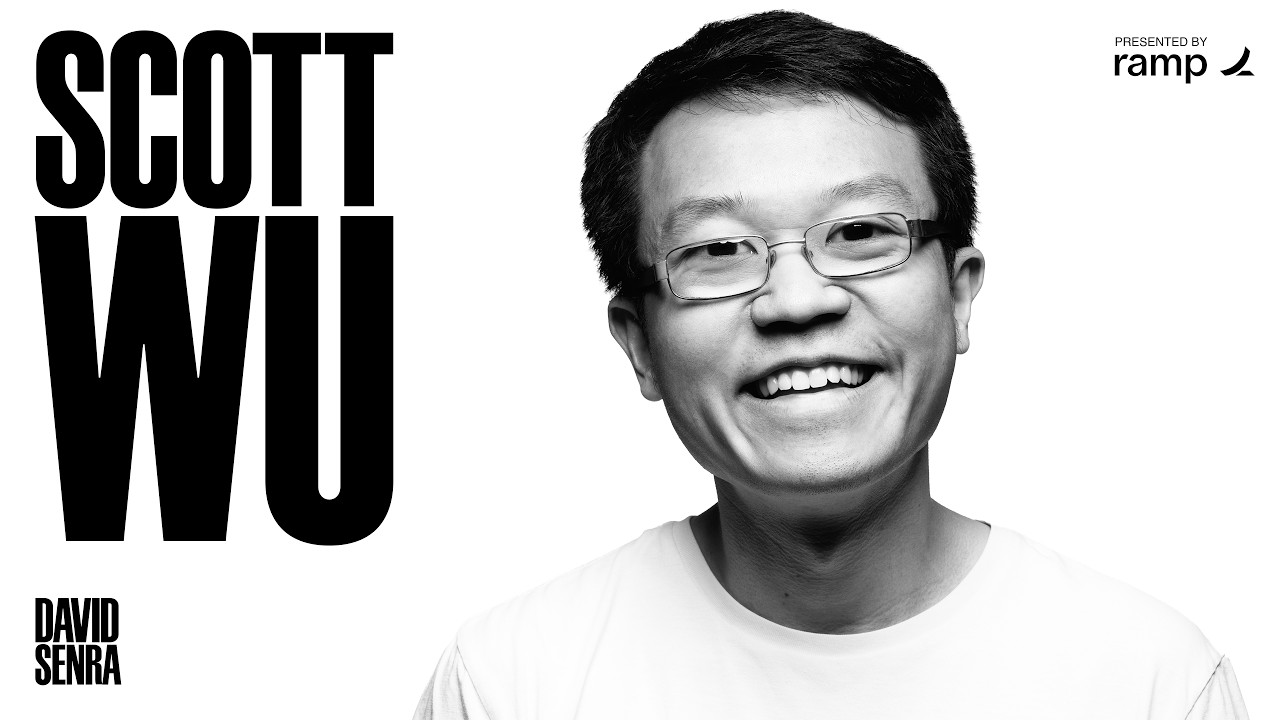
Cognition Targets Enterprise Code Legacy as Devin Revenue Hits $73 Million
David Senra
The startup plans to remain a model-neutral independent business by focusing entirely on autonomous engineering tasks rather than generalized chat agents.
## Background
Published on June 28, 2026, by David Senra on YouTube, this episode features an interview with Scott Wu, the co-founder and CEO of Cognition. The page description outlines Wu's deeply competitive background from childhood math competitions to founding the company behind Devin, the world's first AI software engineer, which recently raised funding at a $26 billion valuation.
## TL;DR
The conversation explores the hyper-competitive mindset driving Scott Wu and the rapid enterprise adoption of Cognition's AI software engineer, Devin, which is delivering 10x output increases for major companies like Goldman Sachs and Mercedes-Benz. Wu discusses shifting software development from manual coding into a 'creative mode' where users deploy fleets of autonomous agents on long-term missions using a model-neutral, compound system. Despite intense skepticism from tech giants and early deployment hurdles in Brazil, Cognition is maintaining its independence to build a generational business. Ultimately, Wu emphasizes that his motivation stems from a first-principles passion for technological potential rather than financial acquisition.
## Atmosphere & style
The dialogue feels intensely focused, intellectually rigorous, and driven by an underlying current of fierce, unyielding competitiveness masked by an approachable, 'friendly UI.' It balances the casual camaraderie of two self-proclaimed 'nerds' sharing inside jokes about sushi, elevators, and chicken fingers with a grand, high-stakes narrative about the future of human labor. Listeners experience a palpable sense of rational optimism and relentless momentum as the conversation shifts from chaotic, sleepless startup struggles to the philosophical pursuit of unlocking humanity's ultimate creative potential.
## Key takeaways
- [04:24](https://www.youtube.com/watch?v=PYobZzjW_ic&t=264s) Scott Wu possesses an intensely competitive nature shaped by early childhood math contests and an environment that prioritized achievement over standard family decorations.
- [00:02](https://www.youtube.com/watch?v=PYobZzjW_ic&t=2s) Wu operates Cognition and his life strategy through an algorithmic 'tree search' lens, mapping out consecutive actions to ensure victory.
- [07:30](https://www.youtube.com/watch?v=PYobZzjW_ic&t=450s) Cognition’s ultimate vision for Devin is to serve as a human-computer interface that transitions humanity from 'survival mode' into a 'creative mode' where code is abstracted entirely.
- [07:30](https://www.youtube.com/watch?v=PYobZzjW_ic&t=450s) Devin provides significant engineering efficiency gains, allowing enterprise teams to build and ship production code up to ten times faster.
- [07:30](https://www.youtube.com/watch?v=PYobZzjW_ic&t=450s) AI models unlock the economic feasibility of single-use or hyper-specific software tasks that previously could not justify human engineering costs.
- [07:30](https://www.youtube.com/watch?v=PYobZzjW_ic&t=450s) Human biology struggles to naturally comprehend exponential technological curves, which causes widespread misjudgments regarding AI scaling and company revenue trajectories.
- [07:30](https://www.youtube.com/watch?v=PYobZzjW_ic&t=450s) Evaluating AI progress from first principles suggests autonomous agent capabilities will inevitably expand from executing short tasks to operating unassisted for months or years.
- [30:18](https://www.youtube.com/watch?v=PYobZzjW_ic&t=1818s) Cognition’s early 2024 launch of Devin faced immense skepticism and backlash, but planting an early flag based on autonomous co-working allowed them to scale rapidly from zero to roughly $500 million in 20 months.
- [34:16](https://www.youtube.com/watch?v=PYobZzjW_ic&t=2056s) Early deployments on complex corporate codebases routinely failed, forcing a product pivot toward automating highly repetitive and tightly scoped engineering tasks.
- [34:16](https://www.youtube.com/watch?v=PYobZzjW_ic&t=2056s) Approximately 75% to 80% of Cognition’s revenue is driven by its enterprise segment, which spans major global entities like Goldman Sachs, Mercedes, and Walmart.
- [34:16](https://www.youtube.com/watch?v=PYobZzjW_ic&t=2056s) To bypass sluggish 12-to-18-month standard vendor sales cycles, Cognition compresses enterprise deployments to under 3 months via private cloud installations and strict airwalls.
- [34:16](https://www.youtube.com/watch?v=PYobZzjW_ic&t=2056s) Enterprise engineering evaluations should focus on actual output and ROI rather than superficial metrics like token consumption budgets.
- [34:16](https://www.youtube.com/watch?v=PYobZzjW_ic&t=2056s) Devin operates as a model-neutral 'Switzerland,' utilizing a compound model system that dynamically matches specific subtasks to the most cost-effective or highest-performing LLM.
- [34:16](https://www.youtube.com/watch?v=PYobZzjW_ic&t=2056s) Startups can successfully defeat multi-trillion-dollar tech titans by maintaining an uncompromising, hyper-focused obsession with a single, messy domain.
- [34:16](https://www.youtube.com/watch?v=PYobZzjW_ic&t=2056s) Cognition remains strictly dedicated to building an independent, generational business, rejecting industry pressure and numerous multi-billion-dollar acquisition offers.
- [34:16](https://www.youtube.com/watch?v=PYobZzjW_ic&t=2056s) Wu views money as secondary to the pure pursuit of potential, driven by a philosophy that fears the regret of holding back far more than the pain of failure.
## Detailed walkthrough
### [00:02](https://www.youtube.com/watch?v=PYobZzjW_ic&t=2s) The Anatomy of Being "Salty" and a "Tree Search" Life
The speaker describes a lifelong, inherent competitive nature, tracing it back to their very first memory of competition in the second grade. At just seven or eight years old, they participated in a seventh-grade middle school math competition held at a local university. After finishing the test, they sat waiting for their name to be called during the third and second-place announcements; when it became clear they hadn't won anything, they recall being intensely "pissed about that." This early experience sets the baseline for a personality type that cannot tolerate losing.
When asked how much of their brain is dedicated to competition, the speaker admits, "it's all I do honestly." They view life and company building through the lens of a strategy game. Every decision is approached as a calculated move where you analyze a choice, predict the subsequent events, and plan your counter-moves. They compare this mental model directly to a "tree search," a computer science concept where an algorithm explores different branches of a decision tree to find the exact sequence that leads to a victorious outcome.
- **First Competitive Memory:** Second grade (age 7 or 8) competing against middle schoolers at a university math competition.
- **Older Sibling Dynamic:** Grew up as a little brother to a sibling four or five years older, which fueled a "salty" environment while playing video games.
- **Cognitive Framework:** Views entrepreneurial strategy as an algorithmic "tree search" to map out pathways to success.
---
[01:35](https://www.youtube.com/watch?v=PYobZzjW_ic&t=95s) Shared Drives, Childhood Networks, and a Visa Secured by Go
The interviewer notes striking similarities between the speaker and Demis Hassabis from DeepMind. Both are highly intelligent, articulate, and possess what they call a "friendly UI" (user interface), yet mask a ruthlessly competitive drive underneath. While Demis attributes much of his competitive focus to a childhood spent playing chess, the speaker channeled their early energy into math and programming competitions with the singular childhood goal of becoming the "world champion of competitive programming." This relentless pursuit created a unique social ladder, moving from school-level contests to city, regional, state, national, and ultimately international tournaments.
These elite brackets allowed the speaker to find their true peers. They note that the online math and coding competitors they met internationally felt more like genuine "childhood friends" than the local kids around them in Baton Rouge, Louisiana. Beyond coding, the speaker actively dove into high-level gaming—frequenting tournaments for *Super Smash Brothers Melee*, playing Tetris, competing in poker, and learning some chess. This affinity for gaming was ancestral; the speaker's father was a highly competitive, 7-dan Go player (a rank roughly equivalent to a 2,300 or 2,400 chess rating). In a fascinating twist of historical coincidence, the father's mastery of Go is the exact reason the family immigrated to the United States. While in graduate school in China, the father frequently played Go on weekends with a professor who deeply favored him despite usually losing to him. When that professor moved to the U.S. to teach during the early days of Chinese-American immigration, he wrote back to offer personal sponsorship, helping the speaker's father navigate college applications and visa paperwork.
- **Childhood Location:** Baton Rouge, Louisiana.
- **Gaming Background:** Competed in *Super Smash Brothers Melee* tournaments, Tetris, poker, chess, and Go.
- **Father's Go Rank:** 7-dan, compared by the speaker to a 2,300–2,400 ELO chess rating.
- **Immigration Catalyst:** A university professor in China sponsored the father's U.S. visa as a direct result of their weekend Go matches.
---
[04:24](https://www.youtube.com/watch?v=PYobZzjW_ic&t=264s) House of Trophies: Family Dynamics and the Archetype of Belief
While the speaker's father found fulfillment in Go, their mother is described as the absolute most competitive and "salty" person in the family. Explaining the term, the speaker defines being salty as simply taking "offense to the idea of losing." Though she played on her school's ping-pong team and studied math, her competitiveness was less about a single discipline and more of an all-encompassing personality trait. The interviewer frames this dynamic against classic entrepreneurial biographies, contrasting the harsh, adversarial parental archetypes of Elon Musk or Larry Ellison against the deeply encouraging "Estee Lauder" archetype, where parents instill an early, unshakeable conviction of superiority.
The speaker confirms their mother fits this empowering archetype perfectly, noting that she constantly told them they were "the best" long before there was any physical evidence to prove it. This intense belief manifested physically in their childhood home. The family did not display standard decorations or family photographs on the walls; instead, the mantelpiece and walls were completely lined with the math and programming trophies accumulated by the speaker and their brother. The mother was highly intentional about this layout, visually signaling exactly what the household valued: educational excellence and winning.
- **Mother's Background:** Played on her school's competitive ping-pong team and studied mathematics.
- **Home Environment:** Zero family photographs on the walls; the home decor consisted entirely of academic and tournament trophies.
- **Parental Style:** Focused heavily on instilling early self-confidence and emphasizing that "being the best" was a core family expectation.
---
[07:30](https://www.youtube.com/watch?v=PYobZzjW_ic&t=450s) Cost Controls and Moving Humanity from Survival to Creative Mode
The podcast pivots briefly to a segment highlighting its sponsor, Ramp, drawing a parallel to SpaceX's business model. SpaceX became one of the world's most valuable private entities by rigorously questioning and attacking internal costs. Data shows that the median company utilizing Ramp cuts expenses by 5% and accelerates revenue growth by 16%, proving that strict financial control directly unlocks the capital required to chase massive, compounding revenue opportunities.
Returning to the dialogue, the host asks whether the speaker is motivated more by the thrill of winning or the fear of losing. Referencing quotes from Larry Ellison and Michael Dell about fearing defeat more than loving victory, the speaker agrees with the sentiment: "losing feels way worse than winning feels good." However, they clarify that the pain isn't paralyzing; to achieve anything of note, an entrepreneur has to put themselves out there and absorb an immense amount of losses along the way.
This mindset anchors the execution of their current company, Devon. Built by a highly competitive, nine-person founding team where almost every member had already founded their own independent company, Devon is intentionally designed to be a "generational business" and a "hyperscaler." Rather than viewing Devon as a standard "coding agent," the speaker imagines it as the definitive human-computer interface. The ultimate goal is to abstract away the raw code entirely, providing a tool where any human can seamlessly dictate what they want a computer to build. The speaker borrows a metaphor from *Minecraft* popularized by their co-founder, stating that humanity has spent its entire history operating in "survival mode"—farming food and hiding from monsters. With Devon, they aim to transition the species into "creative mode," where resources are infinite, survival is guaranteed, and the only remaining question for a human to answer is simply deciding what they want to create.
- **Founding Team Metrics:** A large core team of 9 people, the majority of whom are experienced, repeat founders.
- **Company Ambition:** Designed from day one to be a "generational business" and a technical "hyperscaler."
- **The Minecraft Metaphor:** Defines the future of AI as a shift from human "survival mode" (managing basic needs and safety) to "creative mode" (boundless, tool-assisted creation).
- **Product Definition:** Today, Devon functions as an AI software engineer, but its long-term trajectory is to serve as the baseline interface between human intent and computer execution.
### Scaling Software with Devin
Cognition works with many of the world's largest companies, including Goldman Sachs, Mercedes, and multiple branches of the US government, partnering with their software teams to amplify their output. While the famous adage "software is eating the world" has held true for the past 20 to 30 years, it still has several orders of magnitude left to go. Today, engineering teams are utilizing Devin to ship code and execute tasks ten times faster and at ten times the scale of traditional methods.
* **Notable Partners:** Goldman Sachs, Mercedes, and various sectors of the US government.
* **Performance Metrics:** Engineering teams are achieving a 10x increase in speed and output capacity by using Devin.
### The Evolution of Programming Abstractions
The historical trajectory of computer programming reveals a steady climb up the ladder of abstraction. In the earliest days of computing—dating back to machines like the ENIAC—programming required physical interaction with vacuum tubes to perform basic arithmetic, which later evolved into punch cards, assembly language, and BASIC. At its core, programming is simply a mechanism for telling a computer what to do. Whether it is Instagram, TikTok, or YouTube, large teams of engineers have traditionally spent thousands of hours deciding every single microscopic detail of look, feel, architecture, and functionality.
AI is accelerating this abstraction to a point where knowing specific languages like Python or Java is no longer a prerequisite to building software. Instead, a user can simply describe a desired website or request specific feature additions to an existing product, and an AI agent will handle the technical implementation.
### Single-Use Software and the Economics of Engineering
A massive shift is occurring in the economic viability of software creation. Historically, the math only worked out to build a piece of software if it was going to be utilized tens of thousands or millions of times, because engineering teams are incredibly expensive to employ. A platform like YouTube passes this threshold easily because the astronomical number of hours users spend consuming content far outweighs the hours spent building it. However, a vast amount of white-collar work consists of hyper-specific tasks that only need to be executed a few times, or even just once—such as scanning fifteen LinkedIn profiles for specific criteria, filling out localized forms, or compiling bespoke data analysis into Excel.
While it never made sense to hire an engineering team to write code for a single-use task, AI agents fundamentally change this dynamic. In the near future, a user will simply talk to an agent in the morning to define a objective, and the agent will independently figure out the backend execution, writing custom scripts and automation workflows entirely out of sight. The speaker estimates that the industry will solve the majority of these challenges over the next five years, noting that "in AI terms 5 years is is like a century".
### Exponential Progress and the Human Brain
Humans are fundamentally miswired to perceive or understand exponential curves intuitively. This cognitive gap is visible in how people struggle to conceptualize AI progress, scaling laws, and the revenue curves of leading AI companies. Human evolutionary biology and ancestral survival mechanisms—like the fight-or-flight response—are calibrated for linear outcomes, where a successful foraging trip or hunt yields just a few days' worth of food. In the context of exponential technology, a breakthrough equivalent to a "good hunt" can suddenly yield the equivalent of a thousand years' worth of food, providing no native intuitive signal in the human brain to process such rapid acceleration.
This jarring rate of change is mirrored in generational transitions. The speaker shares a personal anecdote about their parents growing up in poverty in 1960s communist China before moving to the United States. Arriving in a society where household appliances and personal cars were ubiquitous was an incredibly stark adjustment for them. Though humans adapt to new technological baselines remarkably fast, the speaker notes that five years from now, the capabilities we possess will seem insane compared to today, and ten years from now, "we're going to have forgotten that we ever lived without them."
### First Principles vs. Pattern Matching
Most individuals, even those within the tech industry, attempt to predict the future by pattern matching against historical data, operating under the assumption that if something has behaved a certain way for a century, it will continue to do so. While this heuristic works 99% of the time, it fails during rare 1% historical inflection points where the paradigm genuinely shifts. Anticipating the future of AI requires looking at the technology from first principles rather than past trends.
* **The Baseline Transition:** A few years ago, benchmarks like the MIT Executive Review (MER) report indicated that an AI could only perform 10 to 20 seconds of continuous human-level work before making a mistake or requiring intervention.
* **The Present State:** That capability has doubled every few months, evolving to the point where an AI can reliably independently execute tasks that would take a human hours to complete.
* **The Horizon:** Approaching the problem from first principles raises the question of why this window cannot expand to days, weeks, or months of unassisted work, completely upending how human society operates.
### Moving from Commands to Year-Long Missions
When pressed on what a user would actually do if an agent like Devin could run unassisted for an entire year, the conversation shifts from mundane tasks to grand institutional objectives. While short temporal horizons (seconds or hours) are suited for direct commands or self-contained tasks like formatting a troublesome bulk email editor, a year-long horizon shifts the paradigm entirely from executing tasks to assigning broad missions.
The host invokes the historical example of Edwin Land, the legendary founder of Polaroid and a personal hero of Steve Jobs. Land, who viewed himself strictly as a scientist rather than an entrepreneur, held the third-most patents in US history behind Thomas Edison and another inventor. When Land sought to transition instant photography from black-and-white to color, he hired a researcher who spent two solid years simply thinking about and attacking that singular problem before ultimately solving it. Having an AI agent capable of working unassisted for a year means individuals can delegate massive, deeply complex conceptual problems to the background while focusing their own creative energy on deciding exactly what they want to bring into existence.
[26:16](https://www.youtube.com/watch?v=PYobZzjW_ic&t=1576s) Sending AI Agents on Unique Passions and Missions
The discussion centers around the incredible diversity of potential missions humans can assign to AI agents. These aren't just limited to standard corporate tasks; they can target large-scale societal issues or highly personal, creative interests. One might task an agent with spreading awareness and coordinating solutions for a deeply meaningful societal problem, while another might set an agent on a "sillier" but deeply passionate mission—like combining the best elements of two favorite video games to "make the coolest thing ever."
The horizon for scientific discovery is equally vast. Instead of following decades-old traditional methods for creating materials, a researcher can now instruct an agent to pursue a completely novel "avenue of attack" and let it study, explore, and run independent experiments for months or even years. This shift introduces a fascinating hierarchy: humans will even deploy "manager AI" agents whose sole responsibility is to decide which missions to delegate to *other* underlying agents.
---
> "The single most powerful pattern I have noticed is that successful people find value in unexpected places. And they do this by thinking about business from first principles instead of formulas." — *Zero to One*
---
* **The Future of Work:** Modern concepts of work—like sitting in a room, pushing buttons, and calling it a "meeting"—would look absurd to ancestors who farmed and made clothes by hand. Similarly, future generations will view our current definition of work as archaic.
* **Curiosity-Driven Labor:** Work will shift toward humans acting as conductors of their own curiosities, passions, and artistic ideas, sending out fleets of AI agents to execute them.
[30:18](https://www.youtube.com/watch?v=PYobZzjW_ic&t=1818s) The Hot Take of 2023 and the Chaotic Launch of Devon
When Cognition was founded, the team kept its focus tethered to two pillars: code/software (driven by their self-proclaimed nature as "programming nerds") and building systems capable of executing complex, multi-step iterative processes. Choosing to pursue multi-step loops was a massive "hot take" back in 2023. The ambition was staggering—essentially building an automated software engineer and targeting the massive global labor market. This bold direction allowed Cognition to scale spectacularly from zero revenue to roughly $500 million in a span of just 20 months.
When the team finally released their prototype demo video for Devon, it ignited a wild firestorm across the full spectrum of public opinion. The reaction was highly polarized. On one end, enthusiasts thought it was the coolest thing ever; on the other, critics labeled it a dangerous threat to human employment or a total "scam" that could never actually work.
* **Releasing an Early Prototype:** The team clarifies that the initial release wasn't even a fully formed product yet—it was a prototype built to show what was possible after a few months of internal testing.
* **The First Breakthrough:** The founder recalls losing sleep the first night Devon successfully resolved a real task: independently setting up MongoDB.
* **The Troubleshooting Loop:** Devon successfully mimicked the classic human engineering workflow: hitting an error, searching Google or Stack Overflow, asking an LLM for advice, running commands, hitting a new error, and repeating until resolved.
* **The Real Demos:** Despite the intense public backlash and skepticism, every demo featured in the launch announcement was a real, unvarnished run that the team had encountered and executed themselves.
[34:16](https://www.youtube.com/watch?v=PYobZzjW_ic&t=2056s) Planting the Flag and Navigating Early Failures
The competitive landscape of early 2024 was daunting. Cognition was, by their own admission, "late by a lot." Powerhouses like OpenAI, Google DeepMind, and Anthropic had a massive head start, and GitHub Copilot had already spent years dominating the autocomplete and developer Q&A ecosystem. As a tiny startup with no brand awareness, no capital, and "no right to win," Cognition realized their only path to survival was to plant their flag in the ground and race like hell toward a specific vision: treating AI as an autonomous co-worker rather than a passive chatbot.
```
Initial SW工E Benchmarks (Early 2024)
────────────────────────────────────────────────────────────
Best Competitors: █░░░░░░░░░░░░░░░ 3-4%
Devon (Launch): ████░░░░░░░░░░░░ 13%
────────────────────────────────────────────────────────────
*Note: A 13% success rate meant Devon still failed 87% of the time.
```
Following the viral March 2024 launch, a flood of eager users begged for access. The team had to scramble to stitch together early pilots and Proof of Concept (POC) agreements, intentionally warning users that the tech was highly experimental. Unsurprisingly, when deployed on massive, complex corporate codebases, the agents routinely failed. Running on primitive underpinnings like GPT-4, these early agents could handle simple toy projects but buckled under dense, real-world context.
* **The Media Approach:** Unlike typical founders who heavily manage their media presence and speak strictly off-the-record, Cognition's leadership operated as an "open book," sharing their unfiltered thoughts freely.
* **The Pivot to Product-Market Fit (PMF):** Watching early users fail helped the team map out a spectrum of tasks. They realized agents shouldn't tackle complex system architecture right away. Instead, the sweet spot for immediate value was highly repetitive, tedious, and scoped engineering tasks—jobs too dynamic for a static automated script, but tightly structured enough for an agent to successfully diagnose and fix.
From Repetitive Migrations to Major Enterprise Deals
The initial use cases for Devon naturally gravitated toward repetitive enterprise tasks, such as large-scale code migrations and version upgrades (e.g., upgrading a massive codebase from Java 7 to Java 8). In an enterprise with a codebase spanning 50,000 files, engineers might have to make the same eight thoughtful but highly repetitive changes across every single file. The company's very first major success came from a migration usecase for Nubank, the largest bank in Brazil by market cap at the time, utilizing a version of Devon that was heavily optimized for that specific task.
As the product matured, the business expanded into both self-serve and enterprise segments, though the company always stayed focused on real-world engineering rather than "cute" demos or hobbyist projects. In 2026, the world’s biggest companies—including retail giants like Walmart, healthcare companies like CVS, financial institutions like JP Morgan, and automakers like Mercedes—are fundamentally software companies with massive engineering teams and extensive maintenance needs. Today, approximately 75% to 80% of the company's revenue is driven by its enterprise business.
- **Enterprise Revenue Share:** Approximately 75–80% of total revenue today.
- **Initial Major Customer:** Nubank, the largest bank in Brazil by market cap at the time.
- **Target Audience:** Real engineering teams building production software; no focus on individual hobbyists.
The Self-Serve Ecosystem and the Elevator Encounter
The self-serve business has also seen significant recent growth, driven heavily by fast-moving startups. Highly active examples of teams utilizing the self-serve platform include Exa and OpenRouter.
The widespread recognition of the tool has even seeped into everyday life. The speaker shares a humorous anecdote about running into someone in their apartment building's elevator who recognized them, saying, "Oh, you're the Devon guy." The speaker notes they have even been asked, "Hey, are you Devon?" prompting a playful joke from the interviewer: "Why don't we call it Scott?" Despite the mix-up, the core user base across both self-serve and enterprise models remains strictly professional engineering teams delivering real product output.
Landing Enterprise Customers and Navigating the Security Airwall
When an enterprise reaches out, the engagement begins with user education. Amid the intense industry buzz surrounding AI and agents over the last six months, companies are eager to understand what actual deployment looks like. The team guides these clients toward feasible use cases, helping them maximize their return on investment (ROI). While typical enterprise software adoption cycles at massive banks drag out over 12 to 18 months due to messy internal processes and strict security reviews, this company moves aggressively to shrink that timeline down to under three months.
To achieve this rapid deployment safely, the company accommodates the rigorous security demands of large organizations. They offer flexible deployment options, including installing Devon directly within the client's private cloud. They also utilize incredibly strict data agreements and "tight airwalls" to guarantee absolute data isolation and security.
- **Typical Enterprise Sales Cycle:** Usually 12 to 18 months for standard vendors.
- **Company Deployment Timeline:** Compressed down to under 3 months.
- **Security Protocols:** Private cloud deployment capability, rigid data agreements, and tight airwalls.
"Deploying the Whole Company" to Brazil
Reflecting on the early days with Nubank, the speaker reveals that they did not just send a specialized field team to South America—they practically deployed their entire startup. "Let's be real here okay, agents did not work generally," the speaker admits, laughing. Because AI agents were not yet generalized or robust, making the software succeed required deep, hyper-specific optimization.
The entire team flew to Brazil, sat side-by-side with Nubank's engineers, and manually studied their exact workflows to understand what to do in every edge case. They spent their time debugging specific code issues and figuring out exactly what information Devon needed to read and process. By manually attempting the tasks themselves, they learned how to build the right orchestration into Devon's product loop. While onboarding is far more self-started and automated today, building the initial product was a chaotic, fun experience of essentially engineering the platform around the needs of a single cornerstone customer.
ROI Alignment and Debunking Token Metrics
The modern enterprise motion is heavily focused on remaining incentive-aligned with customers, ensuring they see a clear, quantifiable ROI. The speaker notes that over the last few months, organizations have "gone crazy on their token budgets," occasionally resulting in bizarre corporate behavior. The speaker chuckles at the fact that some companies have even tried to rank their human engineers by the volume of AI tokens they spend. Arguing that this approach is misguided, the speaker suggests that organizations should instead rank teams by actual engineering output and the quality of work produced.
While GPUs are undeniably expensive, the math easily justifies the spend if engineers can ship code three times faster. The company proves this value by tying Devon's performance to specific tickets and large-scale initiatives. For example, a legacy project scoped to take 18 months, require an outsourced contractor, and cost $15 million can instead be brought entirely internal, costing only $1 million and wrapping up in 3 months using Devon.
- **Hypothetical Cost/Time Reduction Example:** Shifting a project from an outsourced $15M, 18-month timeline to an internal $1M, 3-month timeline.
Being the "Switzerland" of AI with Compound Models
A core strategy for maintaining enterprise trust is staying entirely neutral with respect to underlying AI models and labs. The speaker proudly embraces the label of "Switzerland," explaining that they are just as incentivized as their customers to make token spend highly efficient. To do this, Devon is built as a "compound model system" rather than being hardcoded or pegged to a single provider like OpenAI's GPT or Anthropic.
To illustrate how a compound model system operates, the speaker breaks down Devon’s workflow when handed a Jira bug ticket. First, Devon investigates the report to understand the problem. Second, acting like a real engineer, it spins up the product locally to actively reproduce the bug, clicking around to mimic the user's steps. It then analyzes the logs, pinpoints the broken files, traces the command flow, writes and tests a fix, and submits it for review. Because different models excel at different subtasks, Devon dynamically chooses the best tool for the job. It utilizes a vast arsenal of models from Anthropic, OpenAI, Google, open-source variations, and their own proprietary models—deploying heavy, "max thinking" models for deep reasoning, and cheaper, faster models for boilerplate or repetitive tasks.
Why Startups Win Through Extreme Focus
When asked how they navigate being both a customer and a competitor to the major AI labs, the speaker describes it as a "positive-sum" relationship. The company's ultimate competitive edge is its singular, uncompromising focus: software engineering is the only domain they care about.
The speaker highlights this focus as the fundamental reason why startups can win against tech titans. In a broad ecosystem, if a startup tries to do everything, it will inevitably lose to a conglomerate like Microsoft or Google, companies that possess trillions of dollars in resources, hundreds of thousands of employees, and infinite brand recognition. Lasting businesses are built by making a highly concentrated bet on one specific problem and executing it better than anyone else.
Caring More About the Details Than the Tech Giants
The conversation centers on the intense execution required to build software for the real world. Drawing a parallel to the music streaming industry, the speaker references Daniel Ek of Spotify, who famously brushed off competition from giants like YouTube and Apple Music by stating that Spotify simply cares way more about music than they do. In the same vein, the speaker explains that Cognition wins because they care intensely about the unglamorous, messy reality of end-to-end software development at major enterprises like Goldman Sachs or Mercedes-Benz.
Instead of treating software like a clean, sandbox algorithms problem that can be resolved in a 30-line program, they focus on the hairy, real-world complexities. This means engineering AI agents that can deeply understand an existing legacy codebase, collaborate smoothly with human teams, integrate into proprietary ticketing systems, and run and test code completely locally. Furthermore, by acting as a neutral party—reminiscent of Switzerland—they gain customer trust. Because they are not incentivized to maximize a customer's spend on underlying compute or models, they can focus purely on optimizing price performance and delivering tangible value.
- Daniel Ek quote: "the truth is we're just going to care way more about music than they are."
- Enterprise examples cited: Goldman Sachs, Mercedes-Benz.
The Innovator's Liability and the Inevitability of Startups
The host shares an anecdote about his friend Jimmy Iovine, a music industry legend with 40 years of experience who sold Beats to Apple for $3 billion. When Spotify only had 3 million paid subscribers, Iovine assumed Apple's massive scale would easily crush them. However, Apple's unparalleled size became a massive liability rather than an asset; the tech giant simply did not care about gaining a few million more subscribers because they had already invented the most successful consumer product of all time. Iovine felt his wings were clipped by corporate indifference, whereas Daniel Ek was operating with a "die if he was not successful" intensity.
The speaker connects this back to the early days of Cognition. Two years prior, investors repeatedly pushed back, asking why anyone would use their product when Microsoft already owned GitHub Copilot, VS Code, and a deep partnership with OpenAI. Despite Microsoft being a great partner today, the speaker notes that this kind of skeptical pushback is a classic, somewhat uncreative trope. A decade ago, people asked the exact same questions about why Datadog, Snowflake, or Databricks should exist when massive cloud providers already cared about observability and data.
- Spotify had only 3 million paid subscribers when Jimmy Iovine went head-to-head with them.
- Apple acquired Beats from Jimmy Iovine for $3 billion.
- Historic software examples of surviving cloud competition: Datadog, Snowflake, Databricks.
Chasing the Independent Generation
The conversation turns to the recent wave of high-profile tech acquisitions, noting that Cognition has increasingly become known as a champion for independence in the AI space. The host jokes about asking how many acquisition offers Cognition has received, prompting the speaker to laughingly decline to answer, though he admits "dozens is a lot" when pressed. The host recounts a funny three-way phone call from the previous summer where he asked Scott how he felt about an acquisition with a massive company, and Scott instantly cracked up laughing, assuming the host meant Cognition was going to *buy* the giant company instead.
While the speaker acknowledges that acquisitions are a reasonable exit strategy for many, he emphasizes that the team at Cognition is entirely focused on building a generational, independent business. They reject the current wave of "nihilism" from onlookers who claim it is too late to build a standalone enterprise because the major AI labs will inevitably capture everything. The host firmly dismisses these cynics, stating, "those people aren't founders. Founders are rationally optimistic." They believe they will succeed even when there is no prior evidence that they should.
- Host's perspective on founders: "They believe even there's no evidence that they should succeed, that they will succeed."
The Future of Software and Infinite Opportunity
The speaker argues that anyone who thinks the current workflow of AI coding—entering instructions into a web app like Devin, receiving a pull request, and reviewing it—is the final state of technology is severely mistaken. He anticipates at least ten more generations of evolving product experiences. The host ties this into his own decade-long study of entrepreneurial biographies for his podcast, *Founders*, noting that every single new industry creation is preceded by people declaring that it is too late and that opportunity is over.
To counter this historical myopia, the host cites Richard Branson's definition of business: "an idea that makes somebody else's life better." Because there are infinite ways to improve human lives, there will always be infinite business opportunities, completely debunking the notion that we have reached the "end of history." When the host presses the speaker on whether a truly astronomical dollar amount could ever force him to sell, the speaker responds that money is not his North Star. He famously does not own a car and chooses to rent an apartment, jokingly noting that his only real luxury is eating sushi, which can easily be afforded on a standard engineer's salary.
- Product insight: Anticipating 10 more generations of AI product experiences beyond Devin.
- Richard Branson quote: "all business is an idea that makes somebody else's life better."
- Speaker's lifestyle details: Does not own a car, rents an apartment, loves eating sushi.
The Pure Pursuit of Potential
The host compares the speaker to Mark Zuckerberg, who famously turned down a $1 billion acquisition offer for Facebook at age 22 because he realized he would just use the money to start another social network anyway. The host observes that Cognition is a beautifully weird company composed entirely of "nerds," functioning as a physical manifestation of the founder's own social circle. He evokes the memory of Steve Jobs, noting that if you offered Jobs $2 trillion on the condition that he could never work at Apple again, he would have flatly refused because the work itself was the reward.
In a lighthearted moment, the host points out that the speaker is currently the second wealthiest entrepreneur from Baton Rouge, Louisiana. The top spot belongs to Todd Graves, the founder of Raising Cane's Chicken Fingers, who has famously turned down massive acquisition offers because he simply loves his chicken finger empire. The speaker, a customer of Cane's himself, agrees with the sentiment. Closing out the interview, the speaker shares his ultimate philosophy: he could live with failing after giving it his absolute all, but he could never live with the regret of not pushing harder to see what they were truly meant to build. The host concludes the episode on that high note, encouraging listeners to subscribe and check out his companion podcast, *Founders*.
- Mark Zuckerberg turned down a $1 billion offer for Facebook at age 22 while owning 25% of the company.
- Baton Rouge entrepreneurs discussed: Todd Graves (founder of Raising Cane's Chicken Fingers).
- Host's podcast credentials: Has read over 400 biographies of history's greatest entrepreneurs for *Founders* over nearly a decade.
## Notable quotes
> [02:02](https://www.youtube.com/watch?v=PYobZzjW_ic&t=122s) it's all I do honestly. — Scott Wu
> [07:30](https://www.youtube.com/watch?v=PYobZzjW_ic&t=450s) losing feels way worse than winning feels good. — Scott Wu
> in AI terms 5 years is is like a century — Scott Wu
> we're going to have forgotten that we ever lived without them. — Scott Wu
> The single most powerful pattern I have noticed is that successful people find value in unexpected places. And they do this by thinking about business from first principles instead of formulas.
> the truth is we're just going to care way more about music than they are. — Daniel Ek
> Why don't we call it Scott? — David Senra
> Let's be real here okay, agents did not work generally, — Scott Wu
> [57:14](https://www.youtube.com/watch?v=PYobZzjW_ic&t=3434s) those people aren't founders. Founders are rationally optimistic. — David Senra
> [57:14](https://www.youtube.com/watch?v=PYobZzjW_ic&t=3434s) They believe even there's no evidence that they should succeed, that they will succeed. — David Senra
> all business is an idea that makes somebody else's life better. — Richard Branson
## Mentioned
Scott Wu, Cognition, Devin, Devon, David Senra, Demis Hassabis, DeepMind, Baton Rouge, Louisiana, Super Smash Brothers Melee, Tetris, Elon Musk, Larry Ellison, Estee Lauder, Ramp, SpaceX, Michael Dell, Goldman Sachs, Mercedes, Goldman Sachs, Mercedes-Benz, US government, ENIAC, Instagram, TikTok, YouTube, Python, Java, Excel, LinkedIn, MIT Executive Review, Edwin Land, Polaroid, Steve Jobs, Thomas Edison, Minecraft, Zero to One, MongoDB, Google, Stack Overflow, OpenAI, Anthropic, GitHub Copilot, GPT-4, Nubank, Brazil, Walmart, CVS, JP Morgan, Exa, OpenRouter, Jira, Microsoft, Daniel Ek, Spotify, Apple Music, Jimmy Iovine, Beats, Apple, VS Code, Datadog, Snowflake, Databricks, Richard Branson, Mark Zuckerberg, Facebook, Todd Graves, Raising Cane's Chicken Fingers, Founders
Cognition co-founder Scott Wu argues that autonomous AI software engineers like Devin represent a paradigm shift in human-computer interaction, moving beyond coding assistants to long-horizon, autonomous systems that abstract programming entirely. Drawing on an intensely competitive, algorithmic worldview, Wu asserts that focused startups can outmaneuver tech giants by solving the messy, complex operational realities of enterprise software.
Algorithmic Strategy Grounded in Extreme Competitiveness (0:02)
Wu frames company building as an algorithmic "tree search," a mental model rooted in an intense, lifelong aversion to losing. His upbringing centered on competitive math, programming contests, and high-level gaming such as Super Smash Bros. Melee and Tetris. This competitive environment was family-wide: his father was a 7-dan Go player whose matches with a university professor directly led to U.S. visa sponsorship from China, while his mother lined their home with academic trophies instead of family photos to reinforce an expectation of excellence.
Cognition’s nine-person founding team, largely composed of repeat founders, applies this calculated mindset to company strategy. Accepting that significant losses and public setbacks are inevitable milestones when attempting breakthroughs, Wu views their trajectory through systematic counter-moves rather than emotional reactions.
Elevating Software from Syntax to Autonomous Missions (7:30)
Wu describes computing history as a continuous ascent up the ladder of abstraction, evolving from manual vacuum tubes and punch cards to assembly, high-level languages, and now natural language. In this framework, Devin is not designed as a mere code-completion tool, but as a primary interface that converts human intent into computer execution. Using a Minecraft analogy, Wu suggests this evolution shifts humanity from "survival mode"—spending baseline effort managing mundane tasks—into "creative mode," where resources are abundant and the core human responsibility is deciding what to create.
This abstraction transforms the economics of engineering by enabling single-use software. Historically, writing custom software was only viable if reused millions of times due to expensive labor costs. With AI agents capable of operating over hours, days, or year-long missions, Wu predicts individuals and organizations will delegate complex, bespoke research and multi-step tasks to autonomous agents on demand.
Navigating Early Failure to Secure Enterprise Traction (30:18)
Devon’s launch in early 2024 sparked intense polarization, with critics calling it a scam and enthusiasts hailing it as revolutionary. At launch, the prototype resolved only 13% of tasks on the SWE-bench benchmark, meaning it failed 87% of the time and broke down on dense corporate codebases. Rather than attempting open-ended system design immediately, Cognition targeted structured, highly repetitive engineering problems such as massive version migrations across tens of thousands of legacy files.
To establish product-market fit, the entire founding team relocated temporarily to Brazil to work side-by-side with engineers at Nubank, manually debugging edge cases to refine Devin’s execution loops. This hands-on enterprise focus enabled Cognition to grow from zero to roughly $500 million in revenue within 20 months. Approximately 75% to 80% of current revenue originates from enterprise clients—including Goldman Sachs, Mercedes, and the U.S. government—by compressing typical 12-to-18-month sales cycles to under three months through private cloud deployments and strict airwalls.
The Switzerland Model and Start-Up Focus
To preserve enterprise trust and maintain efficiency, Cognition positions itself as a model-neutral "Switzerland" in AI. Rather than hardcoding its agent to a specific provider, Devin operates as a compound system that dynamically orchestrates models across Anthropic, OpenAI, Google, open-source alternatives, and internal weights. High-reasoning models tackle initial problem diagnosis and ticket reproduction, while faster, cheaper models handle repetitive boilerplate code.
Wu dismisses the assumption that hyperscalers will inevitably eliminate independent AI applications, comparing Cognition to Spotify navigating competition from Apple Music, as well as standalone infrastructure leaders like Datadog and Snowflake. He contends that massive tech conglomerates suffer from corporate inertia, whereas specialized startups win by caring far more about the unglamorous nuances of software engineering—such as ticket integrations, local testing, and legacy codebase maintenance.
Cognition rejects acquisition interest from tech incumbents in pursuit of building a generational, independent enterprise. Wu forecasts at least ten subsequent product generations beyond the current pull-request workflow, arguing that as long as human lives can be improved through software, the opportunity space for autonomous engineering remains practically infinite.
[2:02] Scott Wu: it's all I do honestly.
[7:30] Scott Wu: losing feels way worse than winning feels good.
Scott Wu: in AI terms 5 years is is like a century
Scott Wu: we're going to have forgotten that we ever lived without them.
The single most powerful pattern I have noticed is that successful people find value in unexpected places. And they do this by thinking about business from first principles instead of formulas.
Daniel Ek: the truth is we're just going to care way more about music than they are.
David Senra: Why don't we call it Scott?
Scott Wu: Let's be real here okay, agents did not work generally,
[57:14] David Senra: those people aren't founders. Founders are rationally optimistic.
[57:14] David Senra: They believe even there's no evidence that they should succeed, that they will succeed.
Richard Branson: all business is an idea that makes somebody else's life better.
Original transcript
[0:02] I want to know why you describe yourself
[0:04] as salty. What does that mean? I've just
[0:06] always been this way. As a kid, I I just
[0:09] hated losing. Like my first competitive
[0:12] memory ever is like when I was in second
[0:14] grade. I went to this seventh grade math
[0:16] competition. It was like a middle school
[0:18] competition that was held at the like
[0:20] local university or whatever for middle
[0:21] schoolers. But you were seven.
[0:23] >> Yeah. Yeah. I was like seven or eight
[0:24] years old. I was competing in the like
[0:26] middle school math and like I did the
[0:27] like math test and whatever and then
[0:30] they were calling out the names of the
[0:31] like here's who got third place here's
[0:33] got second and I was kind of like
[0:35] waiting for my name to get called and
[0:36] then I was none of them and I just
[0:38] remember being so pissed about that.
[0:40] >> Yeah. I can't really give you a rational
[0:42] explanation for for why it is. I
[0:45] >> It doesn't have to be rational but like
[0:47] how much of your brain is dedicated to
[0:48] competition?
[0:49] >> I mean it's all I do honestly. I don't
[0:52] know. I think the like
[0:54] >> Oh, what do you mean it's all you do?
[0:55] >> Well, I think strategy game I I don't
[0:57] know. It's the the way even building a
[0:58] company it feels the same. It's just
[1:00] like you're calculating the moves.
[1:01] You're thinking about okay, if you do
[1:02] this and then this happens and then you
[1:04] do that and here are the different moves
[1:06] and you're like calculating out what
[1:08] comes out to success. You know, it's
[1:10] like a it's like a tree search, you
[1:11] know, where you're exploring the
[1:12] different options in the decision tree
[1:14] and you're trying to figure out how to
[1:15] lead to victory. Like that's like the
[1:16] only thing I do in my life. And
[1:17] >> so this is basically just you don't have
[1:19] memories when you weren't like this
[1:20] basically.
[1:21] >> I think that's right. Yeah. Yeah. I was
[1:23] uh I was a little brother growing up and
[1:25] so my older brother was four or five
[1:26] years older than me and naturally we'd
[1:28] play video games and similarly I would
[1:30] just always be super salty there as
[1:31] well. I don't know. It's just like yeah
[1:33] it's just always like that. So like I
[1:35] spent some time with Demis from Dind and
[1:38] what was interesting is I I I draw a lot
[1:40] of um like similarities between you two
[1:42] cuz I also spent some time with you
[1:44] >> and I was like well they're both really
[1:46] smart, they're both articulate, they
[1:47] have like a friendly UI, right? But then
[1:51] underneath that is like this like
[1:52] ruthlessly competitive drive and Demis I
[1:55] think he said this publicly but I think
[1:57] he said like half his brain is dedicated
[2:00] to competition and a lot of that comes
[2:02] from his early days in chess.
[2:04] >> Yeah.
[2:04] >> What were you competing in when you were
[2:05] younger besides math competitions?
[2:06] >> Yeah. Well basically everything. So
[2:08] obviously the main thing was math and
[2:09] programming competitions and so ever
[2:10] since I was really young that was like
[2:12] that was like my like life you know my
[2:14] whole goal was to become like world
[2:16] champion of competitive programming. I
[2:17] would do that all the time as a kid. I
[2:19] would do, you know, the the really great
[2:21] thing about these competitions, too, is
[2:23] is,
[2:24] you know, you you compete in your school
[2:26] competition and if you do well enough in
[2:28] that, then you make it qualify for the
[2:29] the local or like the city um
[2:32] competition and then if you do well in
[2:34] that, then you get to like the regional
[2:35] competition and the state competition
[2:36] and then you get to go to the national
[2:37] thing, the international thing, right?
[2:39] And so it's it's like a very nice setup
[2:42] where sooner or later you get to kind of
[2:45] meet people who are like you. Basically,
[2:47] when I was a kid, doing these
[2:48] competitions, going for that, it was
[2:50] like all I really cared about. Those
[2:52] people that I met through these national
[2:54] international competitions were honestly
[2:56] more like they were my childhood friends
[2:58] more than like the people around me in
[3:00] Baton Rouge, Louisiana were. And it was
[3:01] like we would hang out online, we would
[3:03] talk about math, we talk about problems,
[3:04] but all the other things too. I mean, I
[3:06] played basically all the different
[3:07] competitive games. So, like I I played a
[3:09] lot of Super Smash Brothers. I used to
[3:10] go to tournaments for Super Smash
[3:12] Brothers. It was a lot of fun. Played
[3:13] Melee. And then I played like Tetris. I
[3:16] played a lot of poker. I played some
[3:17] chess. I was okay at chess. I was not
[3:19] good. I played some Go. My dad was a
[3:21] competitive Go player. My parents came
[3:23] to the US in some sense because of Go,
[3:26] which was kind of a funny coincidence
[3:28] because my dad um was in grad school in
[3:31] China and he had a professor who like
[3:33] really liked him. The reason he liked
[3:34] him is cuz my dad was like a really good
[3:36] Go player. Like he was like a seven dawn
[3:38] at Go, which if you were to call it in
[3:40] chess would be like I don't know 2,300
[3:42] or 2,400 rating equivalent or something
[3:44] like that. he would play with this
[3:45] professor, you know, on the weekends and
[3:47] stuff and they like, you know, my dad
[3:48] would generally win and they would like
[3:50] talk about the games and stuff. And then
[3:51] that professor ended up moving to the US
[3:54] to come and teach. Um, and at the time,
[3:57] uh, you know, this was super early on
[3:59] in, you know, immigration from China to
[4:01] the US. And so it was not a very like it
[4:03] wasn't really a path that people knew
[4:04] that you could take. The professor wrote
[4:06] my dad and said, "Hey, like I came. It's
[4:08] great. Like there's so much more
[4:09] opportunity. It's so much better. Like
[4:10] you should obviously come as well. like
[4:12] I'll help you with your like visa
[4:14] application. I'll help you like apply to
[4:15] colleges here and everything. And so my
[4:17] dad applied to grad school uh in the US
[4:19] and that's kind of how we ended up here
[4:21] in the first place. Uh I was I was born
[4:22] after we moved to the US obviously.
[4:24] >> So your dad was competitive in go. What
[4:25] was your mom competitive in though? Cuz
[4:27] I think I read that you said that she
[4:28] might have been the most competitive
[4:29] person in your family.
[4:30] >> Yeah. No, she was always uh she she was
[4:33] definitely the most salty I would say
[4:34] for sure. I mean she would um
[4:36] >> What does salty mean?
[4:39] Salty just means that you take offense
[4:41] to the idea of losing.
[4:43] >> Okay, I love that.
[4:44] >> Yeah, she would always be, "Oh, no, no,
[4:46] I'm better at this or I'm, you know, I
[4:49] can beat you at this, you know, and and
[4:50] I don't think she I mean, she played
[4:51] ping pong a bunch growing up. Actually,
[4:53] she played on her like school ping- pong
[4:55] team. Obviously, she studied some amount
[4:56] of math and so on. Um, but but it was
[4:59] just it was more her personality than
[5:01] than any one thing that she really put
[5:03] all of her competitive energy into. I
[5:05] spent a lot of time obviously reading
[5:06] the biographies of history's greatest
[5:08] entrepreneurs.
[5:08] >> Yeah.
[5:09] >> Always fascinated by like there's
[5:10] usually two different kind of archetypes
[5:12] for the parents. One you have like the
[5:14] Larry Ellison and Elon Musk uh their
[5:16] dads would literally tell them you know
[5:17] you're worthless. There's stories in
[5:19] Elon's biographies where his dad just
[5:20] gets in his [ __ ] face and yells at
[5:22] him for hours. Larry's adopted uh father
[5:24] would just tell him you're never going
[5:25] to amount to anything. And so that they
[5:27] had this like inner fire to to to
[5:30] disprove uh you know saying that
[5:32] basically no [ __ ] you dad you're wrong
[5:34] about this right
[5:35] >> and then you have like the SA lers who
[5:37] you know their uncle or even their
[5:38] father is just like you're really
[5:40] special you have a lot of talents if you
[5:42] put a lot of effort into this you can do
[5:44] whatever you want your mom falls it more
[5:46] into like the Estee Lauder like category
[5:48] where she would tell you that like hey
[5:49] these people are doing amazing things
[5:50] you could do even better than them
[5:52] correct
[5:53] >> I think they would have been happy
[5:54] enough if I just got like a more
[5:56] traditional cushy job and did all of
[5:58] that. Like I don't know that they
[5:59] specifically steered me towards
[6:01] entrepreneurship and being a founder.
[6:03] But um but no, they were always
[6:05] >> but your mom gave you self-conidence.
[6:06] >> Yeah, I think she she always told me
[6:10] that I was the best
[6:12] and she was always extremely proud of
[6:14] that, you know, it's it's the I had
[6:16] these like when we would go to these
[6:18] math competition.
[6:18] >> Hold on. She so you said she always told
[6:21] you that you're the best. Did she say
[6:22] that before there was evidence?
[6:25] >> Yeah, I think so. I think that's right.
[6:26] I I think even when I was like tiny, she
[6:30] would tell me that I was extremely
[6:31] talented, extreme, you know, she was
[6:33] always a huge source of support me and
[6:35] she always obviously believed in
[6:36] whatever I wanted to do, you know, cuz
[6:37] you would compete in math competition,
[6:38] you would get these trophies and stuff
[6:40] and like we didn't have like, you know,
[6:43] growing up like we didn't have like
[6:44] pictures of our parents like on the
[6:46] walls, you know, we just had old math
[6:47] competition trophies. It was like like
[6:50] my mom was very intentional about like
[6:51] no no the thing that we value in this
[6:53] household
[6:54] >> other people's trophies are the ones you
[6:56] want.
[6:56] >> Ours ones that me and my brother want of
[6:58] course
[6:59] >> we're going to put up pictures of other
[7:00] people's trophies and you better damn
[7:01] sure replace them with your own.
[7:04] you know, so like you know when when I
[7:06] was pretty and my brother as well, you
[7:08] know, we both really like these
[7:09] competitions and so like you know like
[7:12] accumulate these trophies and she would
[7:14] always like every time we got one she
[7:15] would hang it up and we're like put it
[7:17] up on the on the on like the mantel
[7:18] piece and everything and and no it's
[7:20] like it was always um I think what she
[7:22] really valued. I think I think education
[7:24] was really important to her and I think
[7:26] being the best was was very important to
[7:28] her as well.
[7:30] >> I want to tell you about the presenting
[7:31] sponsor of this podcast, RAMP. I have
[7:33] been reading a lot about SpaceX lately.
[7:35] SpaceX is one of the most valuable
[7:36] private businesses in the world. And one
[7:38] of the main themes in the history of
[7:39] SpaceX is constantly attacking and
[7:42] questioning your cost. Ramp helps many
[7:44] of the most innovative businesses in the
[7:46] world do exactly that. The median
[7:48] company running on RAMP cuts their
[7:50] expenses by 5%. And one thing SpaceX has
[7:53] demonstrated is that a religious
[7:54] dedication to controlling costs can help
[7:57] actually increase revenue because you
[7:59] can pursue opportunities you couldn't
[8:01] otherwise. And we see that in the ramp
[8:03] data too. The median company running on
[8:05] ramp also grows their revenue by 16%. So
[8:09] when you're running your business on
[8:10] ramp and your competitors are not, you
[8:12] have a massive competitive advantage
[8:14] that compounds over time. Ramp is the
[8:17] only platform designed to make your
[8:18] finance team faster and happier. Many of
[8:21] the top founders and CEOs I know run
[8:23] their business on RAMP. I run my
[8:24] business on RAMP and you should too. Go
[8:26] to ramp.com to learn how they can help
[8:28] your business save time, save money, and
[8:31] grow revenue. That is ramp.com.
[8:35] What matters to you more? Like what is
[8:38] uh is it the the pain of losing is like
[8:41] losing is worse than the love like the
[8:43] thrill of winning
[8:45] >> cuz that's how you started it. You're
[8:47] just like I could not stand losing. Let
[8:49] me back up. I was reading another Larry
[8:51] Ellison biography. He says this. He's
[8:52] just like, "Listen, I'm addicted to
[8:54] winning, but I fear losing more than I
[8:56] love winning." And I actually talked to
[8:58] Michael Dell about it. And he's like,
[8:59] "Yeah, it's it's just the fear of losing
[9:01] is the the pain of losing is way worse
[9:02] than the the the good feeling of
[9:04] winning."
[9:05] >> So, I think that's definitely true in
[9:06] terms of how it feels in order to get
[9:08] anywhere. You got to lose a lot. If
[9:10] anything, almost like a lot of the, you
[9:12] know, I mean, a lot of the guys you're
[9:13] talking about, if anything, like the way
[9:15] they got to where they are is by by
[9:17] losing a lot and having their share of
[9:19] wins along with that, but like you just
[9:20] have to put yourself out there and do a
[9:21] lot. So, it's kind of an interesting
[9:22] thing to your point of like I definitely
[9:24] feel the same way that yeah, like losing
[9:26] feels way worse than winning feels good,
[9:28] but not by enough that it makes me want
[9:31] to stop trying if that makes sense.
[9:33] >> Yeah. No, I I think it's impossible. I I
[9:35] know your personality type like there's
[9:36] it's just impossible for you not to do
[9:38] this. What is like let's get into Devon.
[9:40] >> What is like winning with Devon look
[9:42] like to you?
[9:43] >> So, again, you know, we're hyper
[9:44] competitive, but also, you know, the
[9:45] other thing about us is like we all had
[9:46] kind of started our own companies before
[9:48] this. So our founding team is was a
[9:49] pretty big founding team is nine people
[9:51] and most of us had already founded our
[9:53] own companies before we had done
[9:54] different things. It was true for a lot
[9:55] of the early team and we've always
[9:57] thought about this as like this is the
[9:59] big one and so like we want to go for
[10:00] all you know we want to be a
[10:02] generational business like we want to
[10:04] build a hyperscaler and we want to go
[10:05] and do that and like maybe we'll succeed
[10:08] maybe we won't I don't know but like
[10:09] that's what we're going after and and I
[10:11] think to me what that means in our field
[10:14] um in building software is like you know
[10:16] people sometimes use the term like a
[10:18] coding agent or like you know like AI
[10:21] programming or something I I always like
[10:23] you know I always hear that I think a
[10:25] little bit about like well we're not
[10:26] always I mean we're not going to be
[10:27] interacting with code for that much
[10:28] longer you know our programs might not
[10:30] be the right like level of abstraction
[10:31] but I think what is always true probably
[10:34] is that it will be the human computer
[10:38] interface and so what I mean by that is
[10:39] like like the way that we think about
[10:41] Devon if we're successful is Devon is
[10:44] the way that humans can tell their
[10:46] computers what to do cuz that was the
[10:48] whole point of software engineering
[10:49] anyway right is just to be able to work
[10:51] with your computer computer and tell it
[10:52] what you want it to do I mean I doing
[10:54] that for the world is like a massive
[10:56] opportunity and and and and that's what
[10:57] we're really excited to go after.
[10:59] >> Why is that interesting to you? You just
[11:01] said we all did different things. We
[11:02] came together and we're like, "No, this
[11:03] is the big one."
[11:04] >> Yeah. I mean, the simple answer is, you
[11:06] know, we're a bunch of nerds who we're
[11:08] all programmers and built software and
[11:10] so on before and now this is the idea of
[11:12] teaching AI how to go do that.
[11:13] >> Wait, say say more about that what you
[11:15] just said. We're all nerds. This is a
[11:16] big one because we can actually teach AI
[11:18] how to do. We're all nerds who've spent
[11:20] the last, you know, I don't know, 20
[11:21] years of our lives just coding and
[11:23] making little things for the world. And
[11:24] the idea that you could teach AI how to
[11:26] go make things uh and and have everybody
[11:30] have an AI that can help them make
[11:31] things and feel the wonder of that. I
[11:33] mean, it's pretty sick.
[11:34] >> Is that the idea the single idea in the
[11:35] world that animates you the most that
[11:36] gets you the most excited?
[11:37] >> I think it is incredible. Yeah. I mean
[11:40] the Well, I I would go further too and
[11:42] just say like at a zoomed out level,
[11:43] it's I honestly think that
[11:48] Because you know everyone talks about
[11:50] AGI everyone talks about well what is
[11:51] the future going to be like what what
[11:52] are human lives going to be you know
[11:55] once AI can do everything and I mean to
[11:58] some extent I think the thing that is
[12:00] most human obviously is
[12:02] self-expression creativity like having
[12:05] things that you want to make happen in
[12:07] the world and being able to go do those
[12:08] things right and so I mean a lot of how
[12:10] I think about this is basically
[12:12] we want to build the tool that gives
[12:14] everybody the power to go and make
[12:16] things that they want to make in the
[12:18] world. My co-founder has a slime which
[12:19] I've always loved. Uh which is, you
[12:21] know, we've been spending all this time
[12:24] living in survival mode as a species,
[12:26] you know, and now we're going to be
[12:27] living in creative mode. And I think
[12:29] that's right. Like I I think um you
[12:31] know, Minecraft survival mode is is
[12:33] where you're like um you know, you're
[12:35] you're growing food, you're like making
[12:37] sure you're safe from the monsters at
[12:39] night and whatever. Um and like creative
[12:41] mode is just like everything's up to
[12:43] you. You know, you have all the
[12:44] resources at your disposal. If you want
[12:46] something to happen, it'll happen. And
[12:47] the only question for you is like what
[12:49] you want to make happen. I think it's
[12:51] going to be amazing. And I mean, I think
[12:52] that is like the the world that we're
[12:53] going towards and and like we want to be
[12:54] the ones building that.
[12:55] >> Okay. So, talk about what Devon does
[12:57] today. Yeah.
[12:58] >> And then I I want you to flesh out that
[13:00] idea of like where you see in the
[13:02] future. It's just the the interface
[13:03] between humans and computers.
[13:04] >> Sure. Yeah. So, Devon is uh today, you
[13:07] know, what
[13:09] what what what folks know as as an AI
[13:11] software engineer. And basically what
[13:13] that means is that Devon is a tool that
[13:16] that anyone can use uh that will work
[13:18] with them end to end on building out
[13:20] software. Um and so we work with a lot
[13:22] of the big biggest companies across the
[13:24] world, you know, we work with Goldman
[13:25] Sachs, we work with Mercedes, we work
[13:27] with, you know, a lot of areas of the US
[13:29] government at this point and so on. And
[13:30] we work with their software teams to
[13:32] just help them build more and do much
[13:33] more. And you know, the thing about it
[13:35] is in the last 20 30 years obviously I
[13:38] mean software is eating the world is the
[13:39] is the famous line. I think it's very
[13:40] much true. It's still like it's still
[13:42] got a couple order of magnitudes to go
[13:44] and in practice what it looks like is
[13:46] that teams use Devon to ship 10 times
[13:48] faster and to do 10 times more.
[13:51] >> Okay. So that's where it's at today.
[13:52] >> Yeah.
[13:52] >> How do you get to where you're saying
[13:54] you might there is no like you're just
[13:56] the interface between humans and
[13:57] computers.
[13:57] >> So now we're going to get into a
[13:58] philosophical discussion of what it
[14:00] means to be a programmer or a software
[14:01] engineer, right? And I I think like you
[14:03] know if you go all the way back it's you
[14:05] know there there was a time where
[14:06] programming was like using the vacuum
[14:08] tubes like plugging all those in and
[14:10] having it do the machine do the
[14:11] arithmetic right like the eniac was um
[14:14] you know when the first in some sense
[14:15] that the first computer out there
[14:17] although it was obviously very different
[14:18] or it would have been like you know
[14:20] filling out the punch cards and like
[14:21] setting up the or writing you know the
[14:23] like putting down assembly you know or
[14:25] writing in basic or something right so
[14:27] so we've gone through a lot of
[14:28] generations already is my point and what
[14:30] does it look like you know going forward
[14:32] when you talk about programming all it
[14:34] really comes down to is like how do you
[14:35] tell your computer what to do and like
[14:38] every single piece of software that you
[14:39] use if you're using you know Instagram
[14:41] or Tik Tok or YouTube or whatever like
[14:44] that's a piece of software that somebody
[14:46] or like some you know in these cases
[14:48] some pretty big teams of engineers came
[14:50] together and thought through all these
[14:52] details of okay here's what I want it to
[14:53] do here's how I want it to look here's
[14:55] what I want this button to do here's how
[14:57] I want to architect it every single
[14:59] little decision obviously was made by
[15:01] somebody but the the computer itself is
[15:04] then executing it accordingly to to what
[15:06] the wishes of its creators was right and
[15:09] I think what we'll start to see is that
[15:12] abstraction will continue to climb right
[15:14] and like you know we kind of see this
[15:15] already like at this point you don't
[15:17] need to know what programming languages
[15:18] like you don't need you don't need to
[15:19] know Python or Java or something like
[15:21] that in order to build your own software
[15:23] right and you can just say hey here's
[15:25] what I want I want to make a cool
[15:26] website that does this this and that or
[15:28] for example you know in my existing
[15:30] product you know, here's here's what we
[15:32] have today and I want to change this
[15:34] thing or add this new plan or add this
[15:36] new feature and just have the agent go
[15:38] and do that for you, right? I think
[15:40] we're going to continue to go further
[15:41] down that axis. One important kind of
[15:43] like distinction I'd make, which is, you
[15:45] know, I think what we'll see a lot more
[15:47] of in the near future, is software
[15:49] today,
[15:51] the the math only really works out to
[15:53] create software if it's going to be used
[15:55] at least like a million times or
[15:57] something, you know, and I'm giving a
[15:58] maybe it's 10,000 times or whatever. And
[16:00] my point is like if you want to go build
[16:02] a product today, you need a whole team
[16:03] of engineers. Engineers are expensive.
[16:05] You got to pay salaries. You got to go
[16:07] build all this out and you got to go and
[16:08] do that, right? You need that software
[16:10] to be used enough times or to be to to
[16:12] create enough value for that to be worth
[16:14] it, right? And you know, something like
[16:15] YouTube passes that test because
[16:18] obviously so many so many hours have
[16:20] been spent on building YouTube, but way
[16:22] more hours have been spent on using
[16:23] YouTube and and that's that's what's
[16:25] made that that work out and made it
[16:27] feasible, right? But there's so many
[16:29] things out there which only, you know,
[16:31] very specific things that that only need
[16:32] to be used a few times or even like only
[16:34] need to be used once, right? And so like
[16:36] all the white collar work that we talk
[16:37] about today even is very um all right,
[16:41] you know, wake up in the morning. All
[16:43] right, I'm going to go look through
[16:44] these like 15 LinkedIn profiles. I'm
[16:46] going to look for this and that or
[16:47] whatever. Or I'm going to go fill out
[16:49] these forms or I'm going to do this data
[16:52] analysis and put this Excel sheet
[16:54] together with this research that I
[16:55] found. Right? All of these things are
[16:58] things that could be done with software.
[17:00] It's just it obviously doesn't make
[17:02] sense to to hire a whole team of people
[17:04] to go make you that piece of software
[17:06] which you're going to use one time and
[17:07] never again versus just having the human
[17:08] go and do that themselves. Right? I
[17:10] think what we're going to get to is
[17:12] we're going to get to a point where you
[17:13] are just giving your instructions to
[17:14] that agent and the agent on the back
[17:16] end, you know, you don't even have to
[17:18] look at this, but but on the back end
[17:19] the agent is going to figure out, okay,
[17:20] here's I'm going to write this code
[17:21] that's going to go do this. I'm going to
[17:23] put a a script that automates this part.
[17:25] I'm going to do this. I'm going to do
[17:26] this. Um, and that's what's going to
[17:28] allow it to actually go and do all these
[17:30] things. But but but what you start to
[17:32] get to, you know, as we're kind of
[17:33] saying, it's like this is really just
[17:35] how you control your computer and how
[17:36] how you do what you want to go do,
[17:38] right? And you wake up in the morning
[17:39] and it's like here here's what I want to
[17:40] go do. You talk to your agent about it.
[17:42] You figure out the task together once it
[17:44] has it. It can do the part of of the
[17:47] literal like, all right, put the put the
[17:49] pen to the paper on writing code, but
[17:50] that task is like, you know, you're
[17:52] you're the one that's deciding what to
[17:54] do. So this ideal future that's in your
[17:56] mind, right? How far away do you think
[17:59] we are to that?
[18:01] >> Yeah. Um I mean we've made a lot of
[18:02] steps toward it. I would say we still
[18:04] got a ways to go. You can use Devon
[18:06] today. You can use all the different
[18:08] kind of coding tools today. Um and you
[18:10] can do a lot more than you could have
[18:11] done, you know, 10 years ago. Um but
[18:14] certainly um or even one year ago or 6
[18:16] months ago. Um but but but certainly you
[18:18] know it's it's it's not at the level
[18:20] that we're talking about of you are
[18:21] neural linked into the AI and you can
[18:23] tell it exactly what you want it to do
[18:25] and what you want to see in the world
[18:26] and just have the AI go and do that.
[18:28] When do we get there? Um it's it's hard
[18:31] to say but I honestly I mean I think
[18:32] we'll have solved most of that over the
[18:34] next 5 years or so. In AI terms 5 years
[18:36] is is like a century you know in in in
[18:39] the rest of the world terms. Obviously
[18:40] it's like it's kind of crazy to imagine
[18:42] that things can change that much in 5
[18:43] years but but I really think it will. So
[18:45] this is kind of related to something I
[18:46] heard you say where you're saying that
[18:47] humans just have a really hard time
[18:49] understanding exponential curves.
[18:50] >> So true. I mean you see this in in in
[18:53] the progress itself. You see this in the
[18:55] scaling laws with the data. You see this
[18:57] in the revenue curves of the companies
[18:58] that are building an AI
[19:00] >> including your own. And um and it's it's
[19:04] a very, you know, it's like humans
[19:05] aren't really wired for this, right?
[19:07] Like all of our like in inherent like
[19:09] fight orflight response are our kind of
[19:11] like our ability to kind of like measure
[19:13] things to vastly oversimplify if if
[19:15] you're just, you know, fighting out
[19:17] there, you know, foraging for food or
[19:19] whatever it is like, you know, a good
[19:21] hunt will bring you, you know, a couple
[19:23] days worth of food or something. But but
[19:25] but but but obviously with the kind of
[19:27] exponential curves that we deal with,
[19:29] you know, the equivalent of a good hunt
[19:30] here could be a thousand years worth of
[19:32] food and and we don't have that
[19:34] intuitive signal in our brains to really
[19:35] understand that, right, at a really deep
[19:38] like native level. People often
[19:39] underestimate, I think, how fast things
[19:41] can change and how fast the world can
[19:42] change. I mean, my parents even like
[19:44] drilled this into me because they grew
[19:45] up in, you know, in communist China. Um,
[19:47] and they came to the US and you know,
[19:50] even that like we're talking about what
[19:52] are what were ultimately even like much
[19:54] slower scales of progress in some sense
[19:57] relative to I think what we're seeing
[19:58] today. But even that was like, as you
[20:01] can imagine, it was incredibly jarring
[20:04] to them. you know, the idea that uh like
[20:07] you come to the US and everybody has a
[20:09] car and all of these different, you
[20:10] know, it's like all every everyone has
[20:12] all these household appliances and has
[20:14] all, you know, it was a very different
[20:16] life when they grew up um in in like,
[20:19] you know, the '60s in China and they
[20:20] were much much poorer and it was very
[20:22] very different, right? And and it's like
[20:24] I mean, funnily enough, people got used
[20:25] to all these things pretty quickly and
[20:27] now we can't live without them. But but
[20:28] I think we'll kind of undergo the same
[20:30] period with AI where 5 years from now
[20:32] it's going to be insane to think about
[20:34] all these things that we're going to
[20:34] have. 10 years from now we're going to
[20:36] have forgotten that we ever lived
[20:37] without them. Honestly,
[20:39] >> what do you think you understand about
[20:40] AI that other people don't?
[20:42] >> Um
[20:43] >> the reason I asked the question is cuz
[20:44] we have some mutual friends. I would
[20:45] describe our mutual friends as some of
[20:46] the most AGI pill that I know.
[20:49] >> Yeah. And I feel every time I have a
[20:51] conversation with them, I'm like, "Oh,
[20:53] even though I pay attention to this
[20:54] stuff, I feel like a toddler compared to
[20:56] like somebody like you." And so I'm very
[20:58] curious like what do you understand
[20:59] about a that that most people don't and
[21:01] even people within the tech industry.
[21:03] >> No, I you're way too generous. I don't
[21:04] know that there's
[21:06] >> I don't know that I have that anything
[21:07] that interesting or that deep of an
[21:09] insight. I mean, I think it's it's
[21:10] >> you you say that because you're used to
[21:12] it. Here's what I'd say
[21:15] is the way that folks typically kind of
[21:18] predict the future or think about what
[21:20] happens next is they pattern match based
[21:22] on what they've seen historically and
[21:24] they say, "Okay, well for 100 years it's
[21:26] always been like this and it's probably
[21:28] safe to assume that it will be." And 99%
[21:31] of the time that works great, right? Um
[21:32] and in these particular periods where
[21:35] things that actually move and and
[21:36] they're real things that are different,
[21:38] those are the the 1% of times where it
[21:40] truly is different. Now you just kind of
[21:42] you know rather than any kind of pattern
[21:43] matching like what what really matters
[21:45] is just thinking about things from first
[21:46] principles like AI you know there's
[21:49] there's the famous like MER report which
[21:51] was saying you know a couple years ago
[21:52] AI would would would do about 10 to 20
[21:55] seconds worth of human work without
[21:58] interruption and then you'd have to you
[21:59] know guide it or direct it or it would
[22:02] make a mistake or something like that
[22:03] right 10 seconds 20 seconds and that's
[22:05] just doubled every you know every couple
[22:07] months basically and now we're talking
[22:09] about like hours of work So, so
[22:11] basically an AI can just take a task
[22:14] that would have taken humans hours of
[22:15] work to go do. If you go and describe
[22:17] that task well enough to the AI, it will
[22:19] just go and do the whole thing and come
[22:20] back to you with the result and then you
[22:21] give it the next thing the next thing,
[22:23] right? And if you just ask from a first
[22:25] principal's question, well, why can't
[22:28] that be days or why can't that be weeks
[22:30] or months of work? And then what does
[22:32] the world look like if everybody has an
[22:34] agent that can just do months of work
[22:36] for them at a time? then you get to a
[22:38] pretty different conclusion from from
[22:40] what we've all seen and what we've all
[22:41] lived for the last several years. And I
[22:43] think that that
[22:45] kind of first principles thinking is
[22:49] as different as it sounds and as crazy
[22:50] as it sounds. You know, this is one of
[22:52] those times where it's actually more
[22:54] correct than the the the the simple
[22:56] pattern match if that
[22:57] >> you I think you've even taken this
[22:58] further where you're like, what happens
[23:00] when they can work for a year
[23:01] unassisted?
[23:02] >> Yeah. Yeah. Um and I think I think
[23:04] that's true and I think we will get
[23:05] there. If Devon could work for a year
[23:07] without any human assistance.
[23:09] >> Yeah.
[23:10] >> What would you have it do right now?
[23:13] >> Destroy your competitor.
[23:15] >> All sorts of things. I mean, no. I mean,
[23:17] I I I still wake up and think about this
[23:19] in every different like, you know, every
[23:21] little thing that I run, you know. Dumb
[23:23] example. Yesterday, I was sending out
[23:24] like a bulk email
[23:26] and I was like trying to get the like
[23:28] email formatter to work and it's like
[23:30] kind of painful. you know, some of these
[23:31] things are still like kind of hard to
[23:33] use or it doesn't support a certain like
[23:35] styling of the email that you wanted to
[23:37] go do. I think the thing I like had
[23:40] pasted something with indents and then
[23:42] it was like just couldn't like unindent
[23:44] them because the editor like I don't
[23:46] know there was some weird things where
[23:47] the editor like would not allow you to
[23:49] unindent one part but not the other or
[23:51] whatever. And I was just thinking like
[23:54] it's really crazy that like that I'm
[23:56] still doing this basically, right? like
[23:58] in as much simplicity or honestly more
[24:01] as it would take you to explain this to
[24:02] another person like hey here's what I
[24:04] want to do I just like I'm just trying
[24:05] to make it look like this and then this
[24:06] and then that like the rest of that
[24:09] execution should just be done for you
[24:10] you know and then you get to the point
[24:12] where you actually really just to get to
[24:13] spend all your time thinking about well
[24:14] what do you want to do you know what do
[24:16] you want to build what do you want to
[24:17] create like what are the things that you
[24:19] want to see in the world that aren't
[24:20] there already
[24:20] >> but I think what makes it interesting
[24:22] about what you were saying earlier is
[24:23] like the the more you increase the time
[24:26] the more interesting it gets to me so
[24:27] like there's this guy named named uh
[24:28] Edwin Land who I won't shut up about and
[24:30] he was the founder of Polaroid.
[24:31] >> Yeah.
[24:32] >> Steve Jobs hero. A lot of Steve what we
[24:33] think of as Steve Jobs ideas literally
[24:35] just came from Edund Land down to like
[24:37] the chairs and the table he would use
[24:38] for his presentations. It's like the
[24:39] same thing that Hoodland used in like
[24:41] the 70s and Polaroid
[24:42] >> and he thought of himself as a scientist
[24:45] not as an entrepreneur. Edward Land he
[24:47] died with I think the third most
[24:48] patents. He's like Thomas Edison some
[24:50] other dude and then Edwin Land. And what
[24:52] he did is he couldn't figure out he
[24:54] invented the the the industry of instant
[24:56] photography. Yeah.
[24:58] >> Uh before you took a picture and you're
[24:59] like, "Hey, how's it look?" Like, "We'll
[25:00] find out two weeks from now when we get
[25:02] back in Kodak." Like, I had no idea. And
[25:03] he now we he took a picture of a
[25:05] Polaroid. He's like, "We'll find out in
[25:06] 60 seconds when it dries."
[25:07] >> But that was black and white forever.
[25:09] When I read that part where you're like,
[25:10] "Well, we're going to have agents that
[25:12] can work on a sister for a year." I
[25:14] didn't think of what I would do, which
[25:16] is a question I just asked. I thought of
[25:17] Edin Land hiring this guy. He's like, "I
[25:19] want you to think about how we turn this
[25:20] from black and white into color."
[25:22] >> And before he could begin, the guy
[25:24] worked there and just thought for two
[25:25] years.
[25:26] >> Sure. I'm like, that would be very
[25:27] convenient if I can have an agent attack
[25:29] this problem and while I'm working in
[25:31] the background cuz I can't figure it
[25:32] out. They're just thinking about how to
[25:33] attack a single problem for two. In his
[25:34] case, this guy that [ __ ] solved
[25:36] instant color photography. It just took
[25:38] him two years of thinking to do it. So,
[25:39] this is like I'm going to push you on
[25:41] this a little bit more because it's like
[25:42] >> I don't want your year-long agent to
[25:44] send bulk email.
[25:45] >> Oh, I agree. I just to be clear. So, so
[25:47] I I and I I think at some point it's
[25:49] it's kind of, you know, you see this,
[25:51] right, where it's like um you know, when
[25:53] you're talking about seconds, you're
[25:54] literally talking about just like a
[25:55] specific command, right? When you're
[25:57] talking about hours, you're talking
[25:58] about giving it a task and having it do
[25:59] the task, right? And I agree with you.
[26:00] Obviously, bulk email is not, you know,
[26:02] for for years, what you're talking about
[26:03] is like you're giving the agent a
[26:06] mission basically, you know, and it's
[26:08] it's like this
[26:09] >> that sounds way more fun.
[26:10] >> Yeah. Exactly. And this this is like
[26:12] what do I care about? And and you know,
[26:14] the answer might be look, I I want to
[26:16] I'll give you a million different
[26:17] examples. You know, the answer might be
[26:18] like there there's this like one, you
[26:20] know, societal problem which is really
[26:22] important to me and I think there's like
[26:24] I think it's a solvable problem. I think
[26:26] we can all be happy, but like um you
[26:28] know, we really need to to to to to
[26:30] spread awareness about it. We really
[26:32] need to get folks to understand the
[26:33] points of it and we we you know, we we
[26:34] need to figure out how how everybody
[26:36] should you know, work together and
[26:38] coordinate on. That's your point. That's
[26:39] a problem that an agent can can think
[26:41] about, right? or or even you know some
[26:42] some of the kind of like sillier things
[26:43] too like yeah you know there's this
[26:45] video game that I really like but I wish
[26:48] you know if I were making the game
[26:50] here's exactly how I would think about
[26:52] all these things and I feel like there's
[26:53] like this really cool idea if you know
[26:55] you could combine elements from this one
[26:57] game that I really like but then
[26:58] incorporate some of the elements from
[26:59] this other game and set the agent off on
[27:01] that mission of like look we're going to
[27:02] go and like make the coolest thing ever
[27:06] and the coolest game ever and like we're
[27:07] going to incorporate those elements
[27:08] we're going to think about how those
[27:09] like um you know nicely intertwine and
[27:11] work together, right? Or if it's like
[27:13] here's this this like piece of just like
[27:16] novel science which I'm just like really
[27:18] passionate about. You know, materials
[27:19] have been created this way for for for
[27:21] years and years, but like like here's
[27:24] this like avenue of attack which I've
[27:26] been wondering about and thinking about
[27:27] of um maybe there's there's a different
[27:30] like novel construction of materials
[27:31] this way. Send your agent to go work on
[27:33] that for for years, you know, or months,
[27:35] right? and and like have it study that
[27:37] and explore all these things and run its
[27:39] own experiments and try all these. I
[27:41] think all of these are are I think soon
[27:43] going to be very possible. And to your
[27:45] point, it's very different.
[27:45] >> Yeah. I like the the framing of we're
[27:47] sending the them on missions.
[27:48] >> Yeah.
[27:49] >> I would have one that would pick the
[27:50] missions that I need to send other
[27:52] agents on.
[27:52] >> Yeah. Yeah. Yeah. Then you'll have the
[27:53] AI which is like the the manager AI of
[27:55] the the missions. Yeah. And and I think
[27:57] it's like I I I think we will continue,
[27:59] you know, it's um my example of this is
[28:02] like I always joke about how, you know,
[28:04] if you think about our ancestors from,
[28:05] you know, hundreds of years ago or
[28:07] thousands of years ago, imagine them
[28:08] looking at us and what we do and it's
[28:10] like, you know, you're just pushing
[28:11] buttons, you know, and you're like
[28:13] sitting in a room and talking with other
[28:15] people and you call that a meeting and
[28:17] that's like that those things that's
[28:18] work for you guys, you know, and it's
[28:20] like what do you mean that's work? You
[28:22] know, like I'm in the fields like I'm
[28:23] doing this every day, you know? I'm
[28:25] going in farming. I'm making sure you
[28:27] know making all of our our our like you
[28:29] know clothes by hand or taking all all
[28:31] taking care of all these things and
[28:33] that's like work you know but like how
[28:34] how can you guys call you know and my
[28:37] point is just I think what we will have
[28:40] going forward is going to look that
[28:42] different from what we have today. We
[28:45] will look at people who as we say just
[28:46] like have these really interesting
[28:48] curiosities that they want to pursue.
[28:49] They have like causes that they're
[28:51] passionate about. they have like fun
[28:53] ideas or or or like art that they want
[28:56] to create and like they're they're
[28:57] sending off their agents in pursuit of
[28:59] those missions and they will think of
[29:01] that as work and we will look at them
[29:02] and be like wow it's kind of crazy that
[29:04] that's what you get up and think about
[29:05] all day. I found one of my all-time
[29:08] favorite quotes when I was reading the
[29:09] book 0ero to1. The quote says, "The
[29:11] single most powerful pattern I have
[29:13] noticed is that successful people find
[29:15] value in unexpected places. And they do
[29:18] this by thinking about business from
[29:20] first principles instead of formulas."
[29:22] That is exactly what Apploven has done
[29:24] with their advertising platform.
[29:26] Apploving connects you with over a
[29:28] billion potential new customers inside
[29:30] mobile games. Apploven allows you to
[29:32] capture undivided attention. Apploven
[29:35] ads are full screen video ads that are
[29:37] watched for an average of 35 seconds.
[29:39] That is retention that blows other ad
[29:42] platforms out of the water. And you can
[29:44] launch on Apploven in minutes. You set
[29:47] the goal and AppLovven achieves it.
[29:49] There's no complex setup, no expertise
[29:52] needed, and Apploven scales quickly.
[29:54] They can put your ads in front of over a
[29:57] billion potential customers. Other
[30:00] businesses have seen immediate results,
[30:02] have scaled to hundreds of thousands of
[30:04] dollars of spend per day, and increased
[30:06] their revenue by millions. So, you want
[30:08] to get started quickly before all of
[30:10] your competitors are on Apploven. And
[30:12] you can do that by going to
[30:13] apploven.com. That's apploven.com.
[30:18] When you started Cognition,
[30:21] did you know that you were going to try
[30:22] to make an automated software engineer?
[30:24] Was that your first idea?
[30:25] >> I'll say it it was always two things.
[30:26] One, it was always related to code and
[30:29] software, which again probably has
[30:30] something to do with us all being
[30:32] programming nerds. Um and then two is it
[30:35] was always around the idea that these
[30:37] would be like real multi-step iterative
[30:40] processes. Um which was uh I would say
[30:43] was was a real hot take at the time like
[30:45] this was 2023.
[30:48] >> So this is when I met you guys
[30:49] >> and uh I was on a walk with a mutual
[30:51] friend of ours and I remember first here
[30:53] this is you guys scaled from what like a
[30:55] million in revenue to like 500 million
[30:57] or something like that in what like 20
[30:58] months or something.
[30:59] >> Yeah. Yeah.
[31:00] I remember before you had no revenue and
[31:01] I heard the idea and it was pitched as
[31:03] like essentially like an automated
[31:05] software engineer and I was like holy
[31:06] [ __ ]
[31:07] >> this like a huge you're going after
[31:08] labor this is a huge market and then you
[31:12] released
[31:12] >> Yeah.
[31:13] >> I remember the demo video.
[31:14] >> Yeah.
[31:15] >> And then you got a lot of [ __ ]
[31:17] >> Yeah. Yeah. Yeah.
[31:19] >> Mix of I think it was the the full polar
[31:21] ends of the spectrum, right? So there
[31:22] were some people who were like this is
[31:25] the coolest thing ever
[31:27] and like you know all these and then
[31:30] there were some people who were like you
[31:31] know this is like the worst you know
[31:32] thing that you could but similarly like
[31:34] in terms of the capabilities there were
[31:36] some people who are like oh my god
[31:38] everybody's going to lose all their jobs
[31:39] tomorrow which is not what we've ever
[31:41] really believed uh or thought of this as
[31:44] um two also like dude there's no way
[31:47] this is ever going to work and like this
[31:49] is totally a scam you know. So what was
[31:51] the criticism? Did you did you release
[31:53] the product earlier than you wanted to?
[31:55] >> Well, look, it it's it's it wasn't even
[31:57] a product at the time to be honest. I
[31:59] mean, it was more just like a prototype
[32:00] or like a demo of what was possible and
[32:02] and you know, we had been working with
[32:04] it and playing with it for a few months
[32:05] at that point. And the kind of just
[32:08] wanted to show people some of the
[32:09] examples of what it was capable of
[32:11] because it was a real like like it was
[32:13] pretty it was pretty insane for us to
[32:15] see as well. Like I remember the first
[32:16] time that it did like a real task like I
[32:18] could not sleep that night. Uh a and so
[32:21] it's just like showing that um
[32:23] >> say more about that.
[32:24] >> The first task that Devon did was it
[32:26] like set up MongoDB for us and it's like
[32:28] you know it's a it's a standard thing.
[32:30] It's issues that a lot of people run
[32:32] into all the time when they're going and
[32:33] getting their kind of like initial um
[32:35] you know DB setup or whatever. U but we
[32:37] would just like run into errors. you you
[32:39] have this whole flow where you like um
[32:43] you find an error, you Google error,
[32:46] find some message on Stack Overflow or
[32:47] whatever or you ask Chat GB and it tells
[32:49] you, okay, here's here's one you should
[32:51] try. You try that thing, you run into a
[32:53] different error, you like paste that in
[32:55] and then you know and and like for this
[32:57] one, we kind of like at some point we're
[32:58] just like, "Okay, De just just try to go
[33:01] fix it. Just go run the commands like do
[33:02] whatever you need to go do it." And then
[33:03] it worked
[33:04] >> and you couldn't sleep. It was truly
[33:06] like because again it's you know it's
[33:08] it's like just seeing the exponential
[33:10] curve ahead because this was a very you
[33:12] know very specific case. It was the one
[33:14] success that we had. It was very much
[33:16] like a you know like like definitely a
[33:20] way better than average run. But no
[33:22] there was this feeling of like why
[33:24] shouldn't all software and all products
[33:27] be built this way now? Like you can just
[33:29] tell it what you want it to do and have
[33:30] it go do it. I mean it's kind of funny
[33:32] because yeah to your point like we did
[33:33] get hate in the beginning. We did not
[33:35] feel motivated at all from the hate to
[33:38] be like, "Oh yeah, I know. Maybe you
[33:39] guys are right. Like maybe we should go
[33:41] and like, you know, focus on the more
[33:42] kind of like chatbot Q&A style product
[33:46] experiences." Like maybe more than we
[33:48] should have. Maybe maybe we should have
[33:49] done something in the middle, you know?
[33:50] I I don't know. But but like I I think
[33:52] for us like when we had seen that and
[33:54] when we had done these different things
[33:55] like all of those like demos that we
[33:57] showed you know in in in our launch
[33:59] announcement were like actual runs of
[34:01] dev that we had done ourselves and like
[34:03] run into and been like holy [ __ ] this is
[34:04] insane for us. It was always kind of
[34:06] like look you can you know we can debate
[34:08] when or or or or like what level of
[34:10] effectiveness or whatever but like it's
[34:13] just it's going to happen and that's how
[34:15] we always felt about it.
[34:16] >> So explain the process of iteration to
[34:18] go from that product you're getting a
[34:20] lot of hate. Well, uh, actually, you
[34:21] know what? I called Jeremy Stern, who
[34:23] wrote this excellent profile of you in
[34:26] Colossus, which there's a lot of parts I
[34:28] would just laugh my ass off, by the way.
[34:30] >> And I was asking, I was like, "Tell me
[34:31] the stuff that didn't make uh the
[34:33] profile."
[34:33] >> Yeah.
[34:34] >> And he said there wasn't that much
[34:35] because you're kind of like an open book
[34:36] and a lot of people like um managed
[34:38] their media and you know, you could have
[34:40] to talk about certain stuff off the
[34:41] record or whatever and you were just
[34:42] like saying everything.
[34:44] >> But he did say something about like you
[34:45] made the point where like when you
[34:46] released the first product, what was the
[34:48] benchmark?
[34:49] >> Sweet Bench. Yeah. It was like 13%.
[34:51] >> That was Devon.
[34:53] >> And your point was that that's already
[34:54] better than
[34:55] >> Yeah. At the time the best known was
[34:57] like 3 or 4% or something like that, but
[34:59] obviously Yeah. 13%. It still means you
[35:01] fail, you know, 87% of the time.
[35:03] >> Was there a pronounced benefit from
[35:04] releasing early like that?
[35:06] >> For sure. Yeah. I mean, so so, so for
[35:08] us, by the way, you know, if you kind of
[35:10] think about this overall AI ecosystem, I
[35:12] mean, a simple way to put it, it's like,
[35:13] dude, we were late by a lot. You know,
[35:15] it's like OpenAI started.
[35:17] >> Why though?
[35:17] >> Google Deep Mind or Google Brain. I mean
[35:19] these are obviously you know more more
[35:21] than a decade old already. OpenAI
[35:22] started like end of 2015 or even you
[35:24] know like the anthropic or or you know
[35:26] other that that folks talk about in the
[35:28] world like had been around already for
[35:29] years like we were getting started in
[35:31] early 2024 there's like a year plus out
[35:34] from the chat GBT launch a lot of the
[35:36] existing players were already there you
[35:37] know the same was true in code
[35:39] specifically I mean there was you know
[35:41] GitHub copilot um which had people had
[35:43] already you know engineers had already
[35:44] used for years and that was very much
[35:46] the like Q&A like the autocomplete style
[35:49] experience of of you are working with
[35:52] AI. You know, when you start a company,
[35:54] you kind of have nothing. Like you you
[35:56] have no right to exist is maybe one way
[35:58] to put it. It's like an interesting
[36:00] truth about the world which is obviously
[36:02] startups succeed. You know, startups
[36:04] succeed all the time and startup versus
[36:06] big company has been played out for, you
[36:08] know, for for forever. Um, but like
[36:11] there's no reason, you know, in terms of
[36:13] resources, in terms of people, in terms
[36:15] of brand awareness, like you have none
[36:17] of the things that, you know, the big
[36:20] guys have. And and so from that
[36:22] perspective, you have no right to win,
[36:24] you know, over over over what they're
[36:27] doing, you know. And then the reason
[36:28] that you're sometimes able to anyway
[36:31] is
[36:33] if you really like um you know, plant
[36:36] your flag in the ground and and and put
[36:38] a stake into like what you think the
[36:39] future is and you run like hell towards
[36:41] that and and if you like turn out to be
[36:43] right on some of the core things and
[36:44] like I think we were we were wrong on a
[36:46] lot of things. uh to be clear a lot of
[36:49] things we you know so definitely we were
[36:51] early which is a very fair criticism I
[36:53] think a lot of the details and the
[36:54] nuances like we learned and adjusted
[36:56] over time but the idea that like you
[36:58] would work with AI as a co-worker you
[37:00] know rather than as like a tool or a
[37:02] chatbot I think was I mean over the last
[37:04] couple years has obviously like really
[37:06] grown and I think it was like very
[37:07] important for us for our brand for
[37:10] recruiting for you know customer work
[37:12] everything for us to be you know the
[37:14] first ones that actually planted that
[37:15] flag in the ground and said So when did
[37:17] you have this idea where you guys are
[37:19] going to take a run at very I would say
[37:22] ferociously to like these giant like
[37:24] Fortune 500 companies or even the like
[37:26] the US Army uses you like where did that
[37:28] strategy come from? So, funnily enough,
[37:31] so that launch was in March of 2024 and
[37:33] to your point, it went very viral, but
[37:35] again, we didn't have any customers. We
[37:36] didn't have any revenue. We didn't
[37:37] really have like we had
[37:38] >> I thought your first iteration of the
[37:39] business model was like $500 a month or
[37:41] something, wasn't it? Am I miserable?
[37:43] >> So, we had that that was actually later
[37:45] on actually. That was that was end of
[37:46] 2024.
[37:47] >> Okay.
[37:47] >> But, you know, initially what we started
[37:49] was just like, you know, a bunch of
[37:50] people came asked us for the product. We
[37:52] were like, "Guys, I I don't know if this
[37:54] is a product that's ready for prime
[37:56] time, but if you really, you know, you
[37:57] can try it and like just let us know."
[37:59] And so, like, people ran, you know, we
[38:02] had to go and scramble to build a system
[38:03] of like a okay, let's do like a pilot or
[38:05] like a PSC, you know, and like we tried
[38:08] our best to like not overpromise and be
[38:09] like, "Guys, like really, it's like very
[38:11] early, but if you want to try it, you
[38:12] know, you can try." And we did all these
[38:14] and perhaps unsurprisingly, I mean, they
[38:16] were all just like failing
[38:18] um which is kind of natural. like it's
[38:20] like you could do some pretty cool
[38:21] things with it. You could you could do
[38:23] some pretty interesting like toy demos
[38:24] or projects or whatever, but it was
[38:26] certainly not ready to work on like
[38:29] actual companies like real codebase and
[38:30] so on, right? And so from that point,
[38:33] this would have been like April and May
[38:35] of 2024. We were make making agents work
[38:37] with like GP4, you know, this is like a
[38:40] very different era. So they they were
[38:41] much more primitive agents. We kind of
[38:43] talked about this and got to this
[38:46] question of like okay well what do we
[38:47] think it actually does look like when
[38:48] the agents start to get good enough for
[38:49] adoption and I think what we kind of
[38:51] came to was well
[38:54] different tasks are different right and
[38:55] so so like there are some tasks out
[38:57] there that are just really mundane and
[38:58] really repetitive and you're just doing
[39:00] the same tedious thing over and over and
[39:01] over again and there are some tasks on
[39:03] the other end of the spectrum that are
[39:04] like really tough like architecture
[39:06] problems or like deep like you know deep
[39:08] issues that you have to like really
[39:10] understand all the context and have all
[39:12] the knowhow how to to know how to fix
[39:14] and like people were trying to use Devon
[39:17] for all of those and we're failing at it
[39:20] understandably and so then the question
[39:22] was like okay what are the the the
[39:24] natural tasks that are like if there's
[39:26] like a first task that is going to have
[39:28] PMF you know and real value from these
[39:30] kind of agent experiences where it can
[39:32] do the whole thing end to end what is
[39:33] that going to be we kind of said okay
[39:35] well it should be some of these like
[39:36] really repetitive tedious ones it's not
[39:38] so cut and dry that you can just like
[39:40] have an automated script that does the
[39:41] exact thing every time. So it does take
[39:43] obviously some intelligence and some
[39:45] amount of meandering, but it is like
[39:47] repetitive enough and scoped enough and
[39:49] like on a tight enough feedback loop
[39:51] that you can have an agent do it and it
[39:54] would be able to kind of go and diagnose
[39:55] and like fix that problem, right? And so
[39:57] that's kind of what brought us to some
[39:59] of these like naturally to to some of
[40:01] these like you know initial use cases
[40:03] which were things like migrations or
[40:04] version upgrades or you know helping
[40:06] people upgrade from like Java 7 to Java
[40:08] 8 or something like that which were kind
[40:10] of like you know as you can imagine
[40:11] enterprise had enterprises had these
[40:13] massive code bases where they would go
[40:15] and do all that you know and it's like a
[40:16] 50,000 file codebase where you have to
[40:18] go you know it's like the same eight
[40:19] things that you need to change in each
[40:20] one you have to be a little bit
[40:21] thoughtful about how you make the
[40:23] trade-offs but like it's a very
[40:24] repetitive task right Our first success
[40:28] ended up being with a company called New
[40:30] Bank, uh, biggest bank in Brazil, you
[40:32] know, by market cap at the time. And the
[40:34] use case was like one of these big
[40:35] migrations. And we had, uh, kind of a
[40:38] custom Devon that was like extremely
[40:40] extremely optimized um, for doing that.
[40:43] And as we grew from there, you know,
[40:45] later on we had kind of as things got a
[40:48] little bit more mature, you know, we had
[40:49] both self-s served business and
[40:51] enterprise business and so on. But I
[40:52] think from the beginning we had always
[40:54] seen this value that building software
[40:56] in the real world and managing massive
[40:58] massive products that like millions of
[41:00] people use every day was pretty
[41:02] substantially different from you know
[41:04] just building a cute website or a cute
[41:06] demo from scratch right and I think we
[41:07] really really leaned into that and
[41:09] naturally it's you know all the Fortune
[41:11] 500 or all the biggest companies in the
[41:13] world are software companies in 2026 you
[41:16] know even the ones that that folks don't
[41:17] necessarily think of that way right and
[41:19] like Walmart or CVS or JP Morgan or um
[41:22] or or Mercedes or what, you know,
[41:24] they're they're all software companies,
[41:25] right? They have massive massive teams
[41:27] of software engineers. They have tons of
[41:28] things that they're building and
[41:29] shipping and um and maintaining. And
[41:31] that kind of became like a natural thing
[41:32] for us to work on because like I think
[41:34] we had had learned very early on that we
[41:36] want to work on real problems and we
[41:38] want to work on things that that that
[41:39] matter and that people actually care
[41:40] about.
[41:40] >> So wait, what percentage of your revenue
[41:42] is coming from enterprise then?
[41:44] >> Today
[41:45] around 75 80%.
[41:47] >> What are people using on the self-s
[41:48] serve? Like what are examples of
[41:50] >> Yeah. So we have a lot of teams who use
[41:52] it in self-s serve. I mean that's grown
[41:53] actually you know that's grown quite a
[41:54] bit as well lately. Um but um you know
[41:57] we have startups who who you know we
[41:58] have exa um who uses it a ton or open
[42:01] router or built you know I I I ran into
[42:04] someone in in my apartment in the
[42:06] elevator the other day like oh you're
[42:08] the dev guy like we use de uh the
[42:11] >> are you Devon?
[42:13] >> I' I've gotten that as well. Hey are you
[42:14] Devon? And I was like you know I'm
[42:16] actually not but that's that's that's
[42:18] okay. Uh
[42:18] >> why don't we call it Scott?
[42:21] um you know there there's kind of both
[42:22] self- serve and enterprise. With that
[42:24] said, it is entirely in both sides. It
[42:26] is still like actual engineering teams
[42:28] building real output. And so so we don't
[42:30] focus at all on like you know individual
[42:32] hobbyists who are just like trying to
[42:34] make a cool thing or something like
[42:35] that. We focus on like real teams who
[42:37] are building real products that they
[42:38] want people to use and um and getting
[42:40] output out of that.
[42:41] >> Okay. Can you walk us through I'm very
[42:43] curious like I'm a big enterprise. Yeah.
[42:45] >> I contact you. Yeah.
[42:46] >> Walk us through what happens to being a
[42:48] customer. you know, it starts with
[42:49] education. Um, and everyone's gone crazy
[42:51] over AI and agents and so on. And those
[42:54] are the buzzwords of the last six
[42:55] months, obviously. So, they want to know
[42:57] more about this, but there's still a lot
[42:58] of detail and like what does it actually
[42:59] look like to deploy them? What? So, so,
[43:01] you know, we'll we'll show them what
[43:02] this looks like. We'll talk them through
[43:03] like how we work with with teams and how
[43:06] we partner, you know, how we direct them
[43:08] to the right use cases, how we give them
[43:09] guidance on like how, you know, to
[43:11] maximize their ROI or like what projects
[43:13] are or are not feasible with agents. And
[43:16] then from there, you know, enterprises
[43:18] typically obviously have some very messy
[43:20] processes. And so, you know, for most
[43:22] software or most, you know, just
[43:24] generally like vendors that they'd want
[43:25] to work with, it's often, I mean, for,
[43:28] as you can imagine, for a massive bank,
[43:29] you know, adopting software, giving it
[43:31] access to all of their, you know, um,
[43:33] the repos getting through security or
[43:35] whatever, that's like a usually um, uh,
[43:38] for for typical companies is like a 12
[43:40] to 18 month cycle. The thing that we do
[43:42] naturally is is is we just work with
[43:44] them to figure out how we go and do that
[43:45] as fast as as humanly possible.
[43:47] >> Did you send employees down to South
[43:48] America for New Bank?
[43:49] >> Well, so New Bank I mean the first one
[43:51] honestly our entire team was the foreign
[43:52] deployed team. like we all flew to
[43:54] Brazil like I mean it was this like the
[43:56] first case you know it's like it's like
[43:58] let's be real here okay Asians did not
[44:00] work generally okay and so there was it
[44:02] was a lot of like how do you make it
[44:04] work very specific like we all flew to
[44:06] Brazil I was there the whole team was
[44:08] there we were sitting there with their
[44:10] engineers understanding okay so this is
[44:11] what you do in that case this is what
[44:12] you do in that case and this is what
[44:14] Devon needs to know and Devon needs to
[44:15] be able to read these things and like
[44:17] going and debugging their like exact
[44:19] problems now obviously it's not like
[44:21] that at all because you Hold on. We'll
[44:23] get to where it is now. But the idea of
[44:25] like No, we didn't deploy a a team. We
[44:27] deployed the whole company.
[44:29] >> Oh, yeah. Yeah. It was I mean it was
[44:31] getting the first customer obviously was
[44:33] like a real, you know, it's like uh I
[44:35] mean I wonder what they thought of that.
[44:37] >> But but but like yeah, it was like a
[44:39] literally like okay, let's go through
[44:40] all these different things that you guys
[44:41] think could make sense. Let's go through
[44:43] each one. Let's try some of it manually
[44:45] ourselves to understand what the task
[44:46] looks like. let's see if we can teach
[44:48] Devon to do this correctly and build in
[44:49] the right kind of like um you know the
[44:51] the the right orchestration for Devon to
[44:53] be able to do this and like let's just
[44:55] like basically building the product was
[44:57] like almost like building for for one
[44:59] company and yeah it was fun.
[45:01] >> So what do you do today? So today it's
[45:03] it's obviously much more um uh it's it's
[45:06] it's it's much more self-start and you
[45:08] know agents are are so much more capable
[45:10] obviously and we've we've figured out a
[45:12] lot more things with the onboarding
[45:13] experience but but a lot of it is you
[45:15] know we're saying these cycles typically
[45:16] take 12 to 18 months. We try to get
[45:18] deployed with folks you know than like 3
[45:19] months and a lot of that requires folks
[45:22] to obviously first of all it requires
[45:24] them to really appreciate that it's a
[45:25] priority. Um, I mean, if you have 25,000
[45:28] software engineers that you're, you
[45:29] know, in an org that's that's that's
[45:32] running that that that that that
[45:34] costs, you know, 10 billion a year or
[45:36] something that you think can move three
[45:38] times faster. You know, usually it is a
[45:40] priority, but then it's like figuring
[45:42] out how we get through the security
[45:43] reviews. You know, we we have all the,
[45:45] you know, we can deploy in their private
[45:47] cloud. We have very strict data
[45:49] agreements. We have like tight airwalls
[45:51] on on on on all these things. Obviously,
[45:54] um you know,
[45:55] >> do employees physically have to go? Are
[45:57] they are they working with like are
[45:59] these deals so big that the that they're
[46:01] working with a specific company and only
[46:03] that company for a period of time or no?
[46:05] >> Typically, no. Um we have uh you know,
[46:07] we have a full like foreign deployed
[46:10] motion, but a lot of what that looks
[46:11] like as we're saying is is a little bit
[46:13] more like user education and guidance.
[46:14] And so we will fly, you know, we we
[46:17] still do this where we'll fly out and
[46:18] kind of like go and see customers and
[46:20] work with them, point them to the right
[46:22] use cases, teach them how to make get
[46:24] success, help them with their like setup
[46:26] and their playbooks, like all these
[46:28] things for how to use Devon. But it's
[46:30] much more a kind of like look, we're
[46:32] here to assist you guys. We're we're
[46:33] giving you a lot of this kind of like
[46:34] direction and so on, but like you are
[46:36] yourself, you know, and your team is the
[46:39] one that's using Devon and running all
[46:40] that, right? So that's a lot of what
[46:42] that looks like. We're set up to be as
[46:44] incentive aligned with our customers as
[46:46] possible. And so a lot of it is like is
[46:48] not just like oh here's this tool like
[46:49] hand it over to your engineers and like
[46:51] find out what they say about it. It's
[46:52] like okay well let's figure out like
[46:54] what are the initiatives that you guys
[46:55] really care about and like we will point
[46:57] you to for those initiatives. Here are
[46:59] each of the projects that we think Devon
[47:00] right now can make you 10 times faster
[47:02] on and we'll tell you for the ones that
[47:03] that it's not and here's here's what
[47:05] workflows you should use instead or
[47:07] here's how you should get to value
[47:08] instead. Um but it looks more like that
[47:09] than like a um than than like a literal
[47:12] like you know we are using Devon on your
[47:15] on your on your behalf or something.
[47:18] >> Deal is how the best founders turn the
[47:20] world into their talent pool. I've been
[47:22] studying how history's greatest founders
[47:23] operate for a decade. And one thing they
[47:25] all have in common is they understand
[47:27] that recruiting and hiring the very best
[47:29] talent is your most important priority.
[47:31] A players recognize other A players,
[47:33] which is why top companies like Ramp,
[47:35] Shopify, 11 Labs, Uber, and Door Dash
[47:38] all use deal. Many of the top founders I
[47:40] know have personally invested in Deal
[47:42] after using their product. And what they
[47:44] discovered is that Deal is the best
[47:45] company in the world at building
[47:46] infrastructure for global hiring. Deal
[47:48] will help your business hire, pay, and
[47:50] manage any worker anywhere in the world
[47:52] so you can retain the best talent
[47:54] anywhere and spend the rest of your time
[47:56] focusing on what you do best, delivering
[47:58] value to your customers. The founder of
[48:00] 11 Labs has a great description of the
[48:02] value deal can give your company. He
[48:04] said, "We built 11 Labs to break down
[48:06] language and communication barriers.
[48:08] With deal enabling us to hire and
[48:10] support exceptional talent anywhere, we
[48:13] can accelerate our innovation and bring
[48:15] more voices, stories, and ideas to every
[48:17] corner of the world. Deal is trusted by
[48:20] over 40,000 businesses. Learn how they
[48:22] can help your business today by going to
[48:24] deal.com/enra."
[48:26] that is deal.comra.
[48:30] >> Wait, so tell more about how you align
[48:31] the incentives between your company and
[48:33] then your customers.
[48:34] >> Yeah, so a couple things here uh which I
[48:36] think are really important one obviously
[48:38] is is just like really working with them
[48:41] on the the just very clearly defining
[48:44] the ROI. Um, which I think is a very
[48:46] important I mean it's like everyone's
[48:48] talking about this right over the last
[48:49] few months like people are going crazy
[48:50] on their token budgets and you know one
[48:51] engineer can spend so much and you know
[48:54] you want to know that that's actually
[48:55] doing real value for you and you want to
[48:56] be able to identify where you are.
[48:58] >> You think all this stuff is a little
[48:59] crazy.
[49:00] >> I think it is directionally correct but
[49:01] I think there's some you know the there
[49:04] are definitely some places where people
[49:05] have gotten carried away you know people
[49:06] talk about oh like yeah like we rank our
[49:08] engineers by how many tokens they're
[49:09] spending. Well, let's let's try and rank
[49:11] people by how much output they're
[49:13] actually producing or how much good
[49:14] work, you know, is actually getting
[49:15] done, you know, but but obviously I
[49:16] think that like the math works out in
[49:18] terms of like, you know, the GPUs are
[49:20] expensive, but like if your engineers
[49:22] are actually able to ship three times
[49:23] more, you know, then it's very clearly
[49:25] worth it. You just want to make sure
[49:26] you're doing it the right way, right?
[49:27] Obviously, a lot there on just like
[49:29] tying to specific outcomes, tying to
[49:31] okay, what are the actual tickets that
[49:33] are getting done? what are the what are
[49:34] what what what are the projects and the
[49:35] initiatives and like this project which
[49:37] was scoped out for 18 months and was
[49:39] going to be handed off to you know an
[49:41] outsourced contractor um and and was
[49:43] going to cost you 15 million like let's
[49:45] just talk about how that you do this all
[49:46] internally with your own team and you do
[49:48] it for 1 million and you get it all done
[49:51] in 3 months you know uh stuff like that
[49:53] uh which I think is super important the
[49:55] second thing which I'll call out
[49:56] especially is just being neutral a lot
[49:59] of discussion obviously what do you mean
[50:00] by that being being neutral with respect
[50:02] to all the labs, the models themselves.
[50:05] >> I think you said you like being
[50:06] Switzerland.
[50:06] >> Yeah, we like being Switzerland.
[50:07] Exactly. And so I think it's like an
[50:09] important thing of of you know, we are
[50:12] just as incentivized as they are to
[50:14] figure out how to make their token spend
[50:16] efficient, right? And so so Devon is
[50:18] purposefully meant to be uh you know, a
[50:20] compound model system. And so all of
[50:23] these different things, you know, for
[50:24] the right task or even the right subtask
[50:27] of a task or something like that.
[50:28] >> Describe what a compound model system
[50:30] is.
[50:30] >> Yeah. Yeah. So, so for each different
[50:32] part of your use case, I mean, imagine,
[50:34] so let's say you tell Devon, hey, um,
[50:36] customer just reported this bug. Uh, you
[50:38] know, there's a jer ticket. Can you take
[50:40] a look at the ticket and like go and
[50:42] solve the whole thing, right? What does
[50:43] Devon actually go do, right? First of
[50:45] all, Devon's probably going and like
[50:46] investigating, understanding like what
[50:48] does the report say? What's going on?
[50:50] Second of all, probably, you know, as
[50:51] any engineer should, like it's going to
[50:53] go and try to reproduce the bug itself,
[50:54] right? So, it it'll say, "Okay, let me
[50:55] spin up the product locally. we click
[50:57] around, try to follow the same steps
[50:59] that they followed and see if I can make
[51:01] the bug happen as well. Right? And if
[51:03] you did that, then like, okay, now
[51:04] you're looking at the logs. You're
[51:05] trying to figure out what went wrong.
[51:06] You're pinpointing what what are the the
[51:08] particular files or what was the flow
[51:10] of, you know, what was the command flow
[51:11] that led to this. Then you do the
[51:13] debugging. Then you go and test it
[51:14] again, make sure, you know, all these
[51:16] steps, right? Then you put it up for
[51:17] review. And it turns out that there are
[51:19] different models that are good for
[51:20] different parts of these tasks, right?
[51:21] And even for across different tasks
[51:23] obviously also it's like some tasks are
[51:26] these really crazy hard ones where you
[51:28] want to actually use max thinking and
[51:30] you want to use the the the very best
[51:32] models you can get your hands on in the
[51:33] world, right? And then many other tasks
[51:36] are, you know, boilerplate enough or
[51:38] repetitive enough that what you care
[51:39] about is just getting it done really
[51:41] fast, getting an an immediate answer,
[51:44] having the ability to verify that it was
[51:46] correct, but then beyond that making
[51:48] sure that it was like as cheap and fast
[51:49] and efficient as possible, right? And so
[51:51] Devon rather than being pegged to one
[51:53] model and saying, "Oh, we're only going
[51:55] to serve you GPT for this or we're only
[51:56] going to serve you for this." Devon can
[51:58] use any of the different models it has
[52:00] in its arsenal, which include all of
[52:01] these models from anthropic, OpenAI,
[52:03] Google, etc. Um, but but also our own
[52:05] models, right? Or open source models out
[52:07] there, and it will, you know,
[52:09] dynamically go and choose these models
[52:11] for these tasks.
[52:12] >> How do you think about this? Like you're
[52:13] a customer of them, but also competitor
[52:17] with.
[52:18] >> Yeah. No, I mean look I I think in in
[52:20] practice there's a lot of positive some
[52:22] work for us to do together. Um and so
[52:24] like you know the way that we think
[52:26] about ourselves a couple things. One
[52:27] software is the only thing that we care
[52:29] about obviously. Um and there's a lot of
[52:31] value in focus and in building products
[52:33] and building our whole home whole
[52:35] motions specifically around that.
[52:37] >> Say more about how you think about focus
[52:38] and the and the value in it.
[52:39] >> You know back to what we were saying
[52:41] about startups, right? Like why do
[52:42] startups ever win at all? And if you do
[52:45] everything, you will lose to Microsoft
[52:46] or Google who does everything but also
[52:48] has like trillions of dollars more
[52:49] resources and 100,000 more people than
[52:51] you, right? And and infinitely more
[52:52] brand name, right? Um and and like the
[52:55] way that you build, you know, like a
[52:56] real kind of like um you you know a real
[52:59] like lasting business or lasting product
[53:02] is by
[53:05] really really focusing and narrowing on
[53:07] one specific thing, making a very
[53:09] concentrated bet, and then obviously,
[53:11] you know, your bet has to end up being
[53:12] right. But but but like you know from
[53:14] there it's like a lot of just like
[53:15] really tight execution. Um and so in
[53:17] software you know I love um you and I
[53:19] have talked about this. I love the quote
[53:21] from from Daniel in Spotify, right?
[53:23] People are saying so like you know
[53:25] there's there's like like YouTube's
[53:26] trying to go and do this and Apple has
[53:28] Apple Music and like why why should
[53:29] there be like a he was like you know I
[53:31] can give you all the other reasons but
[53:32] the truth is we're just going to care
[53:33] way more about music than they are. And
[53:35] I think for us it's true. It's like we
[53:37] we are just going to care so much more
[53:38] about like what does it look like to
[53:40] build software end to end at Goldman
[53:43] Sachs or at like Mercedes-Benz or
[53:46] something like that, you know? And and
[53:47] there's a lot of nuance in that and
[53:48] there's like a lot of messiness in that,
[53:50] right? It's it's not as simple as like,
[53:52] oh, here's a sandbox algorithms problem.
[53:54] Go and code me the correct, you know, 30
[53:56] line program that solves this problem or
[53:58] something. It's like how do you work
[54:00] with all the messiness of the real
[54:01] world? How do you understand the
[54:02] codebase as it exists today? How do you
[54:03] like collaborate with all the humans on
[54:05] it? How do you plug into their ticketing
[54:06] system? How do you give the agent the
[54:08] ability to test its own code and run
[54:10] everything locally? Right? Like all of
[54:11] these are are obviously just super
[54:13] hairy, messy problems. Uh and that's
[54:15] that's that's what we care a lot about,
[54:16] right? And so from that perspective,
[54:18] it's it's a very kind of nice like, you
[54:20] know, the labs have their own products.
[54:21] I'm sure they'll continue to do more,
[54:22] but but in practice, like there are a
[54:24] lot of nice ways for us to cooperate.
[54:25] Obviously like on top of that like being
[54:27] the Switzerland means that um you know
[54:30] folks can work with us and kind of like
[54:31] trust in us that that that we will kind
[54:34] of route them to the right models that
[54:35] we will optimize the price performance
[54:37] for them that we will kind of like
[54:38] direct them to the right use cases and
[54:40] so on because you know we're not
[54:42] incentivized for them to spend more on
[54:44] the models either you know we're
[54:45] incentivized for them to get value and
[54:47] to get output out of it. I love that you
[54:49] use the example of the war between
[54:51] Spotify and the rest of the like Apple
[54:53] Music. For example, Jimmy I who also
[54:55] came on the show and now is actually a
[54:56] friend of mine. He actually called me
[54:57] yesterday about this cuz anything
[54:59] anytime anything happens with AI music
[55:01] and Spotify, he calls me. But we talked
[55:03] about this because he's like, "You don't
[55:04] understand." Like he had like 40 years
[55:05] of experience in the music industry, had
[55:07] all the relationships. He's like, "Apple
[55:08] bought me for $3 billion. Spotify at the
[55:11] time." He's like, "We're gonna go
[55:12] headtohead with them." Spotify only had
[55:13] three million paid subscribers at the
[55:16] time. Jimmy's gonna fight the war. And
[55:17] he's like, I have the one of the biggest
[55:19] companies in the world. And then he
[55:20] talked about, he's like, that wind up
[55:21] being a huge, he thought it was an
[55:23] asset. It was a huge liability. Yeah.
[55:24] >> Because they're like, we don't give a
[55:25] [ __ ] about getting a couple million
[55:27] more, tens of millions or more of
[55:28] subscribers. We invented the most
[55:31] successful consumer product of all time.
[55:33] And he said something like they just
[55:34] clipped his wings
[55:35] >> like he tried to do something like, "Oh,
[55:37] this isn't important to us." Where
[55:38] Daniel was going to die if he was not
[55:40] successful. He just cared about a lot
[55:42] more. Dude, even in the two years that
[55:44] we've been around, you know, I've heard
[55:46] so many different versions of the same
[55:48] argument because when we started, as you
[55:49] can imagine, this was true for us. It
[55:51] was true for everybody in the space
[55:52] building the space. The the the number
[55:54] one push back that you would always hear
[55:55] from investors, from other people,
[55:57] people. It was like, but like Microsoft
[55:59] already has GitHub Copilot. Like, isn't
[56:02] that everybody's just going to use that,
[56:03] right? And it's like it was a very
[56:04] reasonable thing to say in some sense
[56:06] because you know they did have all you
[56:08] know they did own all of GitHub and they
[56:09] did have the partnership with OpenAI and
[56:11] they did have like VS code and so on. I
[56:13] think in practice the reality is there's
[56:15] so much more innovation and so much more
[56:16] to build that there was a lot of like
[56:18] positive you know Microsoft's like a
[56:19] great partner of ours and we do a lot of
[56:21] things together and we build even more
[56:22] together right and and I think the
[56:23] reality is like people have said this
[56:25] forever of like oh like yeah like
[56:26] startups versus you know like why should
[56:28] you can give all the rational
[56:30] >> 10 years ago it was like Google do this
[56:32] or Facebook it's like oh why should data
[56:34] dog exist or why should snowflake or
[56:36] data bricks exist or whatever you know
[56:37] the clouds the clouds have all you know
[56:39] the clouds care about observability too
[56:40] the clouds care and the reality it's
[56:42] Like it it's it's in some sense a bit of
[56:45] an uncreative way to think about things.
[56:47] I think like if if there was like one
[56:49] thing that okay here's what we all know
[56:51] is going to be the endstate future and
[56:53] everybody's just working toward it and
[56:54] whoever has the most resources toward it
[56:56] wins. Of course, yeah, you know, it's
[56:57] like we know who has the most resources
[56:59] today, right? But if there are millions
[57:01] of problems out there to solve, there's
[57:02] lots of different things. The world is
[57:04] dynamic. Things change all the time.
[57:06] There's lots of new, you know, ideas or
[57:08] opportunities or or or ways to to to
[57:10] build new products. Um, then the reality
[57:12] is like, of course, there's there's
[57:15] there's lots of different niches to own.
[57:17] There's different things to really bet
[57:18] on. There's different focuses to to to
[57:20] spend your time on. And I think that
[57:22] will continue. Yeah. I mean, I I think
[57:23] it's like a for better or for worse
[57:25] after the last couple months of news.
[57:26] You know, Cognition, I think, has been a
[57:28] bit more of the like we've become a bit
[57:30] more known as as the, you know, the
[57:32] folks betting on independence in some
[57:33] sense because obviously there have been
[57:35] some high-profile acquisitions. It's
[57:36] funny that you said that because I was I
[57:38] want I wanted one of the questions I'm
[57:40] going to ask you which you probably
[57:41] won't answer is like how many different
[57:42] acquisition offers have you had?
[57:44] >> I will not answer that question.
[57:46] >> Dozens more?
[57:47] >> Dozens is a lot, dude. I don't know
[57:49] about dozens but okay.
[57:50] >> The time it's probably only a handful
[57:52] that could actually have afford to buy
[57:54] you if you would sell. But the amount of
[57:56] times they keep coming back.
[57:57] >> Oh, I see. Well, yeah. Anyway,
[58:01] >> no, this this independence part is
[58:02] really interesting to me. We were on the
[58:04] phone, me, you, and a mutual friend on
[58:06] three-way like I don't know, I think it
[58:07] was actually last summer. And um we're
[58:10] not going to say the company, uh but I
[58:14] was like, "Scott, what do you what do
[58:15] you what do you think about uh you know,
[58:18] an acquisition with X, not X, the
[58:21] platform, X the blank company." You're
[58:23] like,
[58:24] >> "I don't know how we'd be able to afford
[58:25] them." You just assumed I meant you
[58:27] buying them. And I just [ __ ] cracked
[58:29] up laughing. I was like, "It's
[58:30] hilarious."
[58:31] >> No. So, so I I I think like um Yeah.
[58:36] Yeah. And it's it's like folks like
[58:38] there there folks taking acquisitions
[58:39] and doing things. There's some big
[58:40] high-profile ones. I think those are
[58:41] great to be clear and I think it's a
[58:43] very reasonable path for exit. As
[58:45] mentioned for us, it's like we we've
[58:47] we've all come into this like we want to
[58:48] build a generational business. That's
[58:49] something we're really excited about.
[58:50] And and I think people I think today
[58:52] sometimes I I've I've seen some more of
[58:54] this nihilism where they say, "Oh, like
[58:56] yeah, maybe it's just maybe it's too
[58:57] late and maybe it's not possible
[58:58] anymore." And like
[59:00] >> what does that mean? What's not
[59:01] possible? like maybe it's not possible
[59:02] to build a new independent business
[59:03] because everything else, you know, it's
[59:05] like
[59:05] >> the labs are going to do everything.
[59:06] >> All the opportunity is take it, you
[59:07] know, and it's like guys,
[59:09] >> those people aren't founders. Founders
[59:11] are rationally optimistic.
[59:12] >> Yeah.
[59:12] >> They're just not founders.
[59:14] >> Yeah.
[59:14] >> They they believe even there's no
[59:16] evidence that they should succeed, that
[59:18] they will succeed.
[59:19] >> So people like that just need to get a
[59:21] job. Dude, I'd say this even with Devon,
[59:22] like if if you think that going onto the
[59:25] Devon web app and like giving the or any
[59:27] other coding product out there today,
[59:29] you know, and and like giving the
[59:30] instructions the way that you do right
[59:31] now and then you get the pull request
[59:32] out and then that's how you review it
[59:34] and that's how you build software. If
[59:35] you think that that's going to be the
[59:36] way that software is built forever, then
[59:38] yeah, then then nothing will change. But
[59:39] like I think we have 10 more generations
[59:42] of these different product experiences
[59:43] to come, right? And like building those
[59:45] and doing those is like that is what
[59:47] innovation is. Like that's that's that
[59:49] that's what's going to happen. The
[59:50] advantage I have of reading, you know,
[59:51] for the last decade of all like all
[59:53] these biographies of entrepreneurs, like
[59:54] you're studying somebody's life, but in
[59:56] many cases if they you were so
[59:57] successful, uh, they wrote a book about
[59:59] your life, you usually it's almost like
[60:00] you get a minor in like new industry
[60:02] creation. Every single time it's just
[60:04] like we're too late, it's over. There's
[60:05] no more opportunity. And the way I
[60:07] thought about this was like the the best
[60:08] definition of a business I ever heard
[60:09] actually came from Richard Branson where
[60:11] he says all business is an idea that
[60:12] makes somebody else's life better. And
[60:14] if that's true, which I believe it is,
[60:15] then that means there's infinite
[60:16] opportunity in the future now and in the
[60:18] future because there's infinite ways to
[60:19] make somebody else's life better and
[60:20] that's all business is. So this idea
[60:22] that's like we got to the end of history
[60:24] is just [ __ ]
[60:25] >> Yeah.
[60:25] >> Uh there and you know I don't mean to
[60:28] push you on this like I am cur
[60:30] personally curious though because like I
[60:31] know you're already rich. Uh, I don't
[60:33] think money is your north star based on
[60:36] the conversations we've had in the past,
[60:37] but like there's got to be some crazy
[60:39] number somebody can throw at you where
[60:41] you're just like, "Fuck, I have to take
[60:43] this."
[60:45] Not really on. I mean, it's like the,
[60:49] you know, people have asked me sometimes
[60:51] before, they've asked me like, um, okay,
[60:53] but like really that would you guys like
[60:55] >> this is what I'm doing right now.
[60:58] And the way that I say it sometimes um
[61:00] is like we would sell if we thought it
[61:02] was the most ambitious thing to do. It's
[61:03] kind of an oxymoron because obviously
[61:05] but but but you know it's like my
[61:07] genuine answer in the sense that like
[61:08] that's like what we care we care about
[61:10] you know it's it's like the I mean it's
[61:14] funny you talk about money like I mean I
[61:16] I don't even dude I don't have like I
[61:18] don't have a car.
[61:20] >> You live in an apartment. I just I just
[61:21] realized
[61:22] >> I have rent apartments. Yeah. It's like
[61:23] I don't know. I think I like eating
[61:25] sushi. That's fun. As soon as she
[61:27] doesn't cost that much, you can do that
[61:29] off of an engineer salary as well.
[61:31] >> Just so you know, if this is true, like
[61:33] then you are the the type of
[61:35] entrepreneur that I find the most
[61:36] fascinating in the world cuz like when
[61:39] startup founders talk come talk to me,
[61:41] it's just like I don't give a [ __ ] about
[61:42] your startup. I like I asked the same
[61:44] question. It's like is this your last
[61:45] business?
[61:45] >> Yeah.
[61:46] >> Right. I asked Kareem from ramp like
[61:47] that's before we did this like deep
[61:48] partnership
[61:49] >> and it's just like
[61:50] >> it's like okay you could sell it like
[61:53] the Zuck example where they're like why
[61:54] didn't you take a billion dollars I
[61:56] think you own 25% of the company you
[61:57] would have made 250 million you're like
[61:58] 22 he's like well what would I do with
[62:00] the money I would just start another
[62:02] social network I kind of like the one I
[62:03] have like I just want to build [ __ ]
[62:05] anyways so like what do I do and then
[62:07] the other element of this which I think
[62:09] is almost tied into you where it's like
[62:11] I feel like you're just having a lot of
[62:12] fun like even being around here it's
[62:15] just like There's your company's weirder
[62:18] in the composition of the people because
[62:20] it's literally just all nerds
[62:22] >> like and I think you like Yeah. Know
[62:24] what I mean? But like you know like
[62:25] there's a usually a mixture of obviously
[62:27] the nerds and some other people and like
[62:28] you kind of built this like almost like
[62:30] your social network is like
[62:32] >> I'm not here if you're not a nerd. Yeah.
[62:33] >> Yeah. It's like a physical manifestation
[62:34] of your social network but like the way
[62:35] I way I would describe this is like
[62:37] >> Okay. Cool. Cool. No. So my friends are
[62:38] all also
[62:41] enduring way.
[62:42] >> I love that. Yeah. But what what what
[62:43] the the people I'm most interested in it
[62:45] is just like there's no price, right?
[62:48] Like the example I use is go ask Steve
[62:51] Jobs. I'll give you $2 trillion, but you
[62:54] can't work on Apple.
[62:55] >> Yeah.
[62:55] >> What the [ __ ] do you think he would have
[62:56] said?
[62:57] >> Yeah, I agree. No,
[62:58] >> no, he's like, well, I want to work on
[62:59] Apple. That's what I want to do. There's
[63:01] a funny thing that I wanted to tie
[63:03] together which I didn't find the
[63:04] opportunity till now
[63:05] >> is you were currently the second
[63:08] wealthiest entrepreneur from Baton
[63:11] Rouge, Louisiana.
[63:12] >> I don't know if you remember we've
[63:13] talked about this.
[63:14] >> We talked about this. Yeah. Yeah.
[63:15] >> Yeah.
[63:16] >> The first one
[63:16] >> Chicken Figure is great business, but
[63:18] I'm a customer of that that business as
[63:19] well.
[63:20] >> The first one is Todd Graves. Yeah.
[63:21] >> Owns Raisin Canes.
[63:23] >> Yeah.
[63:23] >> I I talked to him. He was on the show.
[63:25] Yeah.
[63:26] >> You tell him you'll give a hundred
[63:28] billion dollars for your chicken finger
[63:29] empire.
[63:30] >> Yeah. He No, he there's no He's turned
[63:32] down and I know this for facts. I've
[63:33] talked about it. He's turned down crazy
[63:35] acquisitions offers. He's like, I don't
[63:36] care about it's not the money.
[63:38] >> Yeah. No, I mean for us it's very like
[63:41] >> like again I this not rational but but
[63:44] like the way that I would describe it is
[63:46] like
[63:48] I feel and I think all of us do like
[63:52] that
[63:55] it'd be one thing if we tried and we
[63:57] gave it our all and we just weren't good
[63:58] enough that'd be fine. Like, okay, it
[64:00] wouldn't be that, dude. I'd be I'd be
[64:02] salty as hell, you know? It wouldn't be
[64:04] fine. But, but like, but like it would
[64:06] be like it would be an outcome. It would
[64:08] be like an outcome that I could live
[64:09] with, you know? But if we felt like,
[64:12] >> you know, we we could have gone for it
[64:14] all. We could have pushed harder and we
[64:16] did it. Like that I think is like I just
[64:19] I I I don't think we would like live
[64:20] with ourselves in that outcome. And
[64:22] that's like the if you have me explain
[64:24] it's it's kind of circular. I don't
[64:26] know. But but it's like why why are we
[64:29] so excited to do this? Why do we do, you
[64:30] know, spend all it's like we want to
[64:32] achieve our potential and and build what
[64:34] we were meant to build, you know, and
[64:36] and and maybe that's something, maybe
[64:37] that's nothing, but like you'd rather
[64:38] find out and see. Yeah.
[64:40] >> I think this idea of you have one life,
[64:43] go.
[64:43] >> Yeah.
[64:44] >> Is a perfect place to end. Thanks for
[64:45] the time, Scott.
[64:46] >> Yeah. Thanks for having me.
[64:47] >> I hope you enjoyed this episode. Please
[64:49] remember to subscribe wherever you're
[64:50] listening and leave a review. And make
[64:52] sure you listen to my other podcast,
[64:53] Founders. For almost a decade, I've
[64:55] obsessively read over 400 biographies of
[64:58] history's greatest entrepreneurs,
[64:59] searching for ideas that you can use in
[65:01] your work. Most of the guests you hear
[65:03] on this show first found me through
[65:05] Founders.