SpaceX Bets on Full-Flow Methane Engine to Slash Reusable Launch Costs
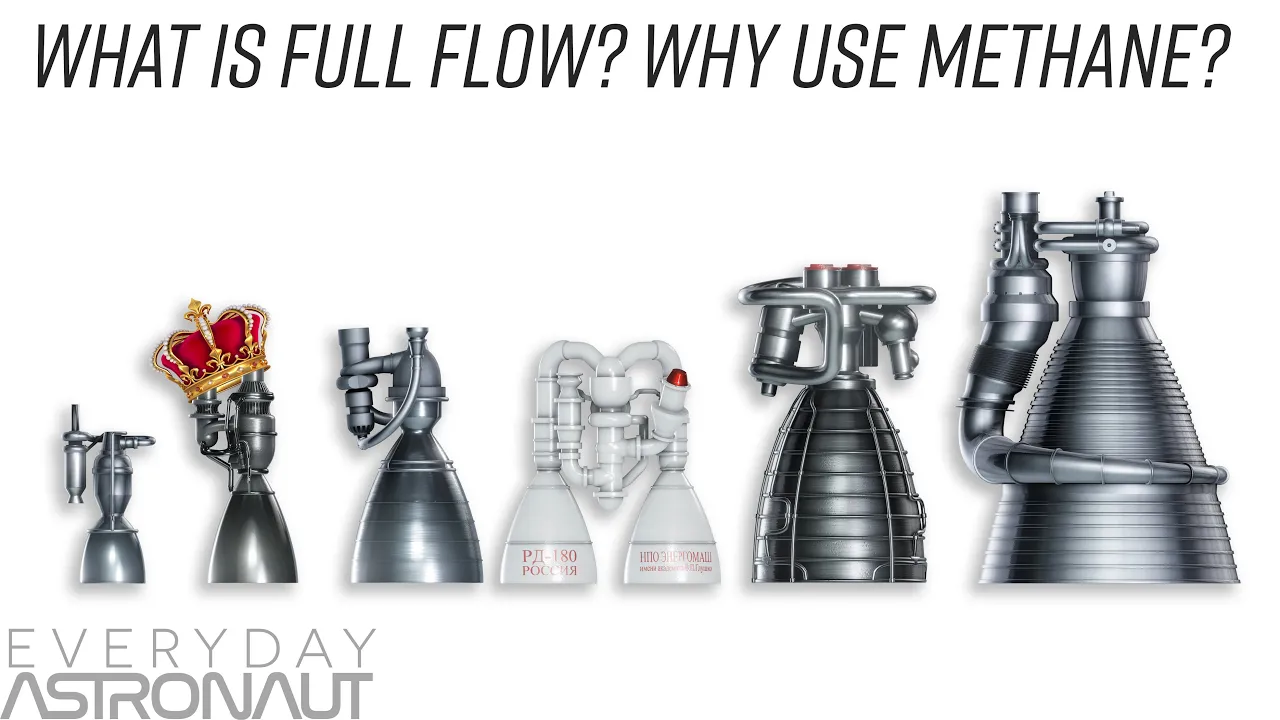
Everyday Astronaut
SpaceX chose a full-flow staged combustion cycle using liquid methane not for peak efficiency, but to balance high chamber pressure, Mars fuel synthesis, and rapid turnaround that could lower flight costs to $20 per kilonewton.
AI-assisted summary of Is SpaceX's Raptor engine the king of rocket engines? — original source. Check the original for full context.
Source published:
Key ideas
- SpaceX's Raptor engine uses a full-flow staged combustion cycle with liquid methane and liquid oxygen, a configuration that has never flown on an operational orbital rocket. (0:00)
- During development testing, Raptor broke the chamber pressure record previously held by the Russian RD-180 (~265 bar) by reaching 270 bar, with an ultimate target of 300 bar. (18:59)
- Methane offers a strategic balance for deep space exploration: it is significantly denser than liquid hydrogen, clean-burning to avoid coking, and can be produced on Mars via the Sabatier reaction and water electrolysis. (29:04)
- If SpaceX achieves its goal of 50 flights per engine with minimal refurbishment, Raptor's amortized cost could drop to roughly $20 per kilonewton per flight. (40:36)
Detailed notes
## Background Published on YouTube by Tim Dodd on the channel Everyday Astronaut on May 25, 2019, this deep-dive video explores whether SpaceX's methane-fueled Raptor engine represents the pinnacle of rocket propulsion. The description outlines an extensive breakdown of rocket engine physics, engine cycles, liquid methane as a propellant, and detailed comparative benchmarks against historic and modern engines like the Merlin, RS-25, RD-180, BE-4, and F-1.
## TL;DR Tim Dodd evaluates SpaceX's Raptor engine by establishing the physics of rocket propulsion and contrasting open gas generator, staged combustion, and full-flow staged combustion cycles. He details why SpaceX selected liquid methane over RP-1 and liquid hydrogen, citing balanced density, boiling points, low soot formation, and Mars in situ resource utilization via the Sabatier reaction. Dodd benchmarks Raptor against five legendary rocket engines across thrust, chamber pressure, thrust-to-weight, specific impulse, acquisition cost, and amortized cost per flight. Ultimately, he concludes that while Raptor is not an outlier in every isolated metric, its combination of record-breaking chamber pressure, compact packaging, and high reusability potential makes it a 'Goldilocks engine' ideally crowned as king of Starship's operational architecture.
## Atmosphere & style The presentation blends infectiously nerdy enthusiasm with meticulous, accessible technical breakdowns. Dodd strikes a conversational, self-deprecating tone—apologizing for the sheer runtime while using clear analogies and visual diagrams to demystify complex thermodynamics. Filming on location against the raw, dusty frontier of SpaceX's Boca Chica facility gives the technical discourse an immediate, cutting-edge atmosphere, making an intricate five-month engineering study feel like an exciting front-row seat to the future of space exploration.
## Bulletin - [00:00](https://www.youtube.com/watch?v=LbH1ZDImaI8&t=0s) SpaceX's Raptor engine uses a full-flow staged combustion cycle with liquid methane and liquid oxygen, a configuration that has never flown on an operational orbital rocket. - [18:59](https://www.youtube.com/watch?v=LbH1ZDImaI8&t=1139s) During development testing, Raptor broke the chamber pressure record previously held by the Russian RD-180 (~265 bar) by reaching 270 bar, with an ultimate target of 300 bar. - [29:04](https://www.youtube.com/watch?v=LbH1ZDImaI8&t=1744s) Methane offers a strategic balance for deep space exploration: it is significantly denser than liquid hydrogen, clean-burning to avoid coking, and can be produced on Mars via the Sabatier reaction and water electrolysis. - [40:36](https://www.youtube.com/watch?v=LbH1ZDImaI8&t=2436s) If SpaceX achieves its goal of 50 flights per engine with minimal refurbishment, Raptor's amortized cost could drop to roughly $20 per kilonewton per flight.
## Key takeaways - [01:43](https://www.youtube.com/watch?v=LbH1ZDImaI8&t=103s) Rocket performance fundamentally depends on ejecting mass as fast as possible, which turbopump architectures achieve far more efficiently than heavy pressure-fed systems. - [06:12](https://www.youtube.com/watch?v=LbH1ZDImaI8&t=372s) Open gas generator cycles like the Merlin and F-1 dump preburner exhaust overboard, sacrificing efficiency to keep machinery relatively simple. - [09:20](https://www.youtube.com/watch?v=LbH1ZDImaI8&t=560s) Staged combustion captures preburner exhaust back into the combustion chamber, but burning RP-1 fuel-rich causes severe coking that clogs turbines and injectors. - [10:27](https://www.youtube.com/watch?v=LbH1ZDImaI8&t=627s) Soviet engineers bypassed coking by running oxygen-rich staged combustion, inventing specialized metallurgy capable of surviving hot, high-pressure gaseous oxygen. - [12:42](https://www.youtube.com/watch?v=LbH1ZDImaI8&t=762s) The United States developed fuel-rich staged combustion using liquid hydrogen for the Space Shuttle's RS-25, which required complex helium-purged dynamic seals between shafts. - [15:45](https://www.youtube.com/watch?v=LbH1ZDImaI8&t=945s) Full-flow staged combustion operates twin preburners—one oxygen-rich and one fuel-rich—eliminating interpropellant seal hazards and enabling gas-gas combustion in the chamber. - [15:45](https://www.youtube.com/watch?v=LbH1ZDImaI8&t=945s) Because 100% of propellant mass flows through both preburners, full-flow engines can run further off-stoichiometric ratios, lowering turbine temperatures and improving hardware lifespan for reuse. - [20:00](https://www.youtube.com/watch?v=LbH1ZDImaI8&t=1200s) Accounting for operational oxidizer-to-fuel ratios, a methylox fuel tank is only about 40% larger than an RP-1 tank, but roughly 3.7 times smaller than a liquid hydrogen tank. - [24:37](https://www.youtube.com/watch?v=LbH1ZDImaI8&t=1477s) Liquid methane boils at 111 K, close to liquid oxygen's 90 K boiling point, enabling shared common bulkheads without the catastrophic boil-off or freezing risks seen in hydrogen-LOX pairings. - [32:58](https://www.youtube.com/watch?v=LbH1ZDImaI8&t=1978s) The Merlin 1D holds an unrivaled thrust-to-weight ratio of 198:1, while Raptor reaches approximately 107:1 and the RS-25 sits at 73:1. - [32:58](https://www.youtube.com/watch?v=LbH1ZDImaI8&t=1978s) Specific impulse remains highest in hydrogen engines like the RS-25 (up to 452 s in vacuum), whereas Raptor targets roughly 330 to 350 seconds. - [35:27](https://www.youtube.com/watch?v=LbH1ZDImaI8&t=2127s) Higher combustion chamber pressure directly enables higher thrust within a more compact engine footprint, vital for clustering dozens of engines on Starship and Super Heavy. - [40:36](https://www.youtube.com/watch?v=LbH1ZDImaI8&t=2436s) Amortizing engine production costs across dozens of flights fundamentally changes launch economics compared to expendable powerplants like the RD-180 and F-1. - [45:50](https://www.youtube.com/watch?v=LbH1ZDImaI8&t=2750s) Raptor is not the outright winner in any single isolated metric like raw thrust, efficiency, or thrust-to-weight, but serves as an optimal 'Goldilocks' engine tailored for Starship's Mars architecture.
## Detailed walkthrough ### [00:00](https://www.youtube.com/watch?v=LbH1ZDImaI8&t=0s) The Holy Grail of Rocket Engines
Tim Dodd, the Everyday Astronaut, reports on location from SpaceX's new launch facility in Boca Chica, Texas, to examine what is widely considered the holy grail of rocket propulsion: the upcoming Raptor engine. The Raptor is a methane-fueled, full-flow staged combustion cycle engine, a design so technologically demanding that no engine utilizing this cycle has ever actually flown on an operational rocket.
```mermaid flowchart TD accTitle: Engine Comparison Scope accDescr: The Raptor engine compared against heritage and contemporary propulsion systems across cycles and propellants. Raptor["SpaceX Raptor<br/>(Full-Flow Staged Combustion | CH4 / LOX)"]
subgraph Comparisons["Engines Evaluated"] Merlin["SpaceX Merlin<br/>(Gas Generator | RP-1 / LOX)"] RS25["Aerojet Rocketdyne RS-25<br/>(Fuel-Rich Staged Combustion | LH2 / LOX)"] RD180["NPO Energomash RD-180<br/>(Oxygen-Rich Staged Combustion | RP-1 / LOX)"] BE4["Blue Origin BE-4<br/>(Oxygen-Rich Staged Combustion | CH4 / LOX)"] F1["Rocketdyne F-1<br/>(Gas Generator | RP-1 / LOX)"] end
Raptor --- Comparisons ```
To put its immense complexity into context, Dodd sets up a head-to-head comparison between the Raptor and iconic engines spanning past and present: - **Merlin**: SpaceX's current workhorse engine (gas generator cycle, RP-1/LOX). - **RS-25**: The Space Shuttle Main Engine (fuel-rich staged combustion cycle, LH2/LOX). - **F-1**: The giant that powered the Saturn V first stage (gas generator cycle, RP-1/LOX). - **RD-180**: The Russian dual-chamber heavy lifter (oxygen-rich staged combustion cycle, RP-1/LOX). - **BE-4**: Blue Origin's next-generation methane-fueled engine (oxygen-rich staged combustion cycle, CH4/LOX).
Compounding the difficulty of the cycle itself, SpaceX chose liquid methane as propellant—a fuel choice that has never powered an orbital-class vehicle. Dodd notes that when evaluated on isolated metrics, the Raptor is not necessarily the ultimate outlier: “Now this engine isn't really the best at anything. It's not the most powerful. It's not the highest thrust to weight ratio of any engine. It's not even the most efficient but it does a lot of things really really well.” The objective is to understand why this engine is special, why liquid methane was selected, and whether the Raptor truly earns the title of king of rocket engines.
---
[01:43](https://www.youtube.com/watch?v=LbH1ZDImaI8&t=103s) Decoding Rocket Physics and Pressure-Fed Systems
Acknowledging that the video is an extensive deep dive, Dodd jokes, “In case you didn't notice when you clicked on this video, this is a very, very long video. Sorry, not sorry, but if you're anything like me you keep hearing a lot of hype about the Raptor engine and you want to appreciate it but you don't even know where to start.” Recognizing that standard engineering schematics can make viewers feel like their heads are about to explode, he breaks down the fundamental physics using simplified diagrams.
Fundamentally, a rocket is just propellant contained by a structural skin, equipped with a mechanism at the rear designed to eject that mass rearward as fast as possible. In an absolute oversimplification, the faster propellant is thrown, the better the performance.
The simplest architecture to achieve this is a pressure-fed engine. Propellants are stored inside high-pressure tanks; opening a valve allows fluid to rush through an accelerating nozzle to produce thrust. - **Pressure-fed engine types**: Cold gas systems, monopropellant engines, and bipropellant pressure-fed systems. - **Common applications**: Reaction control systems (RCS), valued for simplicity, reliability, and fast response times. - **Fundamental limitation**: Fluids inherently flow from high pressure to low pressure, meaning chamber pressure can never exceed tank pressure. - **Mass penalty**: Containing extreme storage pressures forces tank walls to be thicker and heavier. Even composite overwrapped pressure vessels (COPVs), capable of storing gases up to nearly 10,000 PSI (700 bar), face strict volume and pressure limits that scale poorly when lifting heavy orbital payloads.
---
[04:17](https://www.youtube.com/watch?v=LbH1ZDImaI8&t=257s) Enthalpy and the Invention of the Turbopump
To keep rockets as lightweight as possible, propulsion engineers turned to a core thermodynamic principle: increasing enthalpy. “Enthalpy is basically the relationship between volume pressure and temperature,” Dodd explains, joking that it would make a great metal band name.
Inside a combustion chamber: - Higher pressure and temperature produce higher operational efficiency. - Shoving more propellant mass through the throat per second yields higher thrust.
```mermaid flowchart LR accTitle: Pressure Fed vs Turbopump Fed Tradeoff accDescr: Contrast between thick heavy tanks in pressure-fed systems and thin tanks with powered pumps. subgraph PressureFed["Pressure-Fed Architecture"] T1["High-Pressure Tanks<br/>(Very Thick, Heavy)"] -->|"Pressure Drops"| C1["Chamber Pressure<br/>(Lower than Tank)"] end
subgraph PumpFed["Turbopump-Fed Architecture"] T2["Low-Pressure Tanks<br/>(Thin, Lightweight)"] --> TP["Turbopump Assembly<br/>(Mini-Engine Powers Turbine)"] TP -->|"High Pressure Flow"| C2["Chamber Pressure<br/>(Significantly Higher)"] end ```
Rather than building immense, heavy pressure tanks, engineers feed the combustion chamber using high-powered pumps. However, pumping hundreds of liters of propellant per second demands vast mechanical energy. The breakthrough solution was the turbopump: routing a small amount of propellant into a miniature rocket combustor (a preburner or gas generator) directed straight at a turbine wheel. This exchanges chemical energy for kinetic shaft power to spin the propellant impellers.
While this unlocks higher pressures, designers must juggle unforgiving physical constraints: fluids always seek lower pressures, and extreme combustion heat threatens to melt structural metals. Dodd narrows the vast landscape of liquid cycles down to the three that matter most for evaluating Raptor: 1. Gas generator cycle (open cycle) 2. Partial-flow staged combustion cycle (closed cycle) 3. Full-flow staged combustion cycle (closed cycle)
---
[06:12](https://www.youtube.com/watch?v=LbH1ZDImaI8&t=372s) The Open Gas Generator Cycle and Preburner Tradeoffs
The gas generator cycle (open cycle) is one of the most common powerplants for orbital rockets. While substantially more intricate than pressure-fed plumbing, it is comparatively straightforward compared to closed-cycle engines. Dodd notes that real flight engines contain an intricate web of hardware: dozens of valves, wire harnesses, tiny plumbing lines, tank pressurization systems (like helium), regenerative cooling channels around the nozzle and chamber, and dedicated igniters.
```mermaid flowchart TD accTitle: Gas Generator Open Cycle accDescr: Fuel and oxidizer flow through pumps into both the preburner and main chamber, with turbine exhaust discarded overboard. subgraph Tanks["Propellant Supply"] FuelTank["Fuel Tank"] OxyTank["LOX Tank"] end
subgraph PowerPack["Turbopump / Power Pack"] FPump["Fuel Pump"] OPump["LOX Pump"] Turbine["Turbine Wheel"] Preburner["Gas Generator / Preburner"] Shaft["Drive Shaft"]
FPump --- Shaft --- OPump Shaft --- Turbine end
subgraph ThrustChamber["Thrust Generation"] MainChamber["Main Combustion Chamber"] Nozzle["Engine Nozzle"] ExhaustDump["Preburner Exhaust<br/>(Dumped Overboard)"] end
FuelTank --> FPump OxyTank --> OPump
FPump -->|"Fuel (Major Flow)"| MainChamber OPump -->|"LOX (Major Flow)"| MainChamber
FPump -->|"Fuel (Minor Flow)"| Preburner OPump -->|"LOX (Minor Flow)"| Preburner
Preburner -->|"Hot Gas"| Turbine Turbine --> ExhaustDump MainChamber --> Nozzle ```
The cycle operates via a turbopump assembly, often called the "power pack." A preburner burns a fraction of the propellant to drive the turbine, which spins the shafts powering the fuel and oxidizer pumps. In this open cycle, the turbine exhaust gas is simply dumped overboard through a separate exhaust pipe, contributing negligible usable thrust. “This makes it less efficient since the fuel and oxidizer used to spin the pumps is basically wasted.”
Turbopumps also present an inherent startup dilemma: “Now the funny thing about a turbo pump is that it kind of has a chicken and egg syndrome situation that makes it pretty difficult to start up since the preburner that powers the turbo pump needs high pressure fuel and oxidizer to operate.” The preburner cannot reach operating pressure without the pumps spinning, but the pumps cannot spin without the preburner firing.
Because pressure flows strictly from high to low: - The pump discharge inlets leading into the preburner represent the single highest-pressure point in the entire engine. - Every downstream component—including the preburner itself and the main combustion chamber—operates at lower pressures.
Finally, Dodd points out the distinct, dark sooty exhaust venting from the preburner exhaust pipe on SpaceX's kerosene-fueled Merlin engine compared to its clear main chamber plume. Stoichiometric combustion (the perfect oxidizer-to-fuel ratio) releases maximum energy but generates temperatures reaching thousands of degrees Celsius, which would instantly melt the turbine blades. To preserve the metal machinery, preburners are intentionally run off-ratio at significantly lower temperatures, typically biased heavily fuel-rich.
[09:20](https://www.youtube.com/watch?v=LbH1ZDImaI8&t=560s) The Closed Cycle: Avoiding Waste and Facing the Coking Problem
In an open-cycle engine, running fuel-rich produces unburned fuel visible as dark clouds of soot. When running RP-1 (kerosene), pressurized unburned carbon molecules bond into polymers through a destructive process called coking. This sticky soot coats surfaces, clogs delicate injector ports, and can rapidly chew up turbine blades. The obvious question arises: why discard that hot, highly pressurized gas when it could simply be diverted back into the main combustion chamber to generate thrust?
This approach defines the staged combustion, or closed, cycle. By rerouting what would otherwise be dumped overboard directly into the combustion chamber, an engine achieves higher chamber pressures and far superior efficiency. However, simply redirecting the sooty exhaust of an RP-1 engine like SpaceX's Merlin directly into the main chamber spells immediate disaster: the injectors clog instantly with soot, and as the host jokes, “You do not go to space today my friend.”
[10:27](https://www.youtube.com/watch?v=LbH1ZDImaI8&t=627s) The Soviet Solution: Oxygen-Rich Staged Combustion
The Soviets tackled this coking barrier on RP-1 closed-cycle engines by flipping the equation: running the preburner oxygen-rich instead of fuel-rich. Their operational development began with the NK-15 for the ill-fated N-1 lunar rocket, which was later refined into the NK-33. The lineage eventually led to the RD-180, the powerhouse engine still relied upon to launch the Atlas V.
```mermaid flowchart LR accTitle: Oxygen-Rich Staged Combustion Cycle accDescr: Flow diagram showing liquid oxygen and RP-1 entering an oxygen-rich preburner, which drives a turbopump before exhausting into the main chamber.
subgraph Propellant["Propellant Inflow"] LOX["Liquid Oxygen (All)"] RP1["RP-1 Fuel (Partial)"] MainRP1["RP-1 Fuel (Direct)"] end
subgraph Powerhead["Powerhead Stage"] Preburner["Oxygen-Rich Preburner"] Turbine["Turbopump Turbine"] end
subgraph Thrust["Combustion"] Chamber["Combustion Chamber"] end
LOX --> Preburner RP1 --> Preburner Preburner -->|"Hot Oxygen-Rich Gas"| Turbine Turbine -->|"Gaseous Oxygen Exhaust"| Chamber MainRP1 --> Chamber ```
Running oxygen-rich was viewed across the Iron Curtain as an impossible engineering dead end. Blasting superheated, high-pressure gaseous oxygen across delicate, low-tolerance turbine blades typically turns metal into molten soup. The United States gave up on the concept entirely, convinced that metallurgy could not survive such hostile environments. When US engineers finally examined and fired these engines in person after the collapse of the Soviet Union, they were stunned to discover the Soviets had formulated bespoke superalloys capable of handling that corrosive inferno.
- **Total mass flow:** In an oxygen-rich closed cycle, 100% of the oxidizer flows through the preburner alongside only a tiny, metered fraction of the fuel to spin the turbine. - **Thermodynamic limit:** Chamber pressure can never exceed pump output pressure, leaving the turbopump assembly to bear massive physical stress. - **Exhaust routing:** The resulting hot gaseous oxygen is dumped straight into the main chamber to meet the remaining liquid fuel, eliminating fuel waste and maximizing specific impulse.
[12:42](https://www.youtube.com/watch?v=LbH1ZDImaI8&t=762s) The American Approach: Fuel-Rich Hydrogen and the RS-25
The United States did not surrender the closed-cycle race; instead, Rocketdyne pursued a fuel-rich staged combustion architecture. To bypass the coking issues of hydrocarbon fuels, they turned to liquid hydrogen to develop the RS-25 (the Space Shuttle Main Engine, or SSME). Hydrogen produces clean exhaust free of carbon soot, avoiding turbine fouling, but its exceptionally low density introduced an entirely new mechanical nightmare.
Because hydrogen is so diffuse compared to liquid oxygen and RP-1, it requires an immense, ultra-complex turbopump to shove sufficient volume into the combustion chamber. While RP-1 and LOX have comparable densities and can spin on a single shared shaft driven by one preburner, the RS-25 demanded two distinct shafts and two fuel-rich preburners: one dedicated to liquid hydrogen, and one to liquid oxygen.
```mermaid flowchart TD accTitle: Dual Preburner Fuel-Rich RS-25 Architecture accDescr: Simplified schematic showing the Space Shuttle Main Engine twin-preburner setup powering separate LOX and LH2 turbopumps.
subgraph Feed["Propellant Supplies"] LH2["Liquid Hydrogen"] LOX["Liquid Oxygen"] end
subgraph LH2_Loop["Hydrogen Turbopump Loop"] H_Pre["Fuel-Rich Preburner (H2 Side)"] H_Pump["LH2 Turbopump"] end
subgraph LOX_Loop["Oxygen Turbopump Loop"] O_Pre["Fuel-Rich Preburner (LOX Side)"] O_Pump["LOX Turbopump"] Purge["Helium Purge Seal"] end
subgraph MainStage["Main Burn"] MChamber["Combustion Chamber"] end
LH2 --> H_Pump --> H_Pre LOX --> O_Pump --> O_Pre LOX --> H_Pre LH2 --> O_Pre
H_Pre -->|"H2-Rich Gas"| MChamber O_Pre -->|"H2-Rich Gas"| MChamber Purge -.->|"Barrier Pressure"| O_Pump ```
Placing a high-temperature, fuel-rich hydrogen turbine directly on the same shaft next to cryogenic liquid oxygen introduced extreme catastrophe risk: any hydrogen leakage past the shaft seals into the LOX pump would cause a catastrophic fire. Because hydrogen slips through microscopic tolerances, Rocketdyne developed an intricate helium-pressurized purge seal. The seal remains the highest pressure point in the assembly, ensuring that if anything leaks, it is only inert helium. Despite this staggering complexity, the RS-25 emerged as a masterwork of aerospace design:
> “The RS-25 is still considered to be about the best engine ever made with a fairly high thrust to weight ratio and unmatched efficiency.”
[15:45](https://www.youtube.com/watch?v=LbH1ZDImaI8&t=945s) Full-Flow Staged Combustion: Merging the Cycles and the Raptor Engine
The full-flow staged combustion cycle (FFSCC) combines both philosophies into a single engine: an oxygen-rich preburner spins the liquid oxygen pump, while a fuel-rich preburner powers the fuel pump. This eliminates the hazardous dynamic shaft seals of the RS-25; if fuel leaks along the fuel shaft, it only meets more fuel, and the same safety holds true for the oxygen assembly.
```mermaid flowchart LR accTitle: Full-Flow Staged Combustion Flowchart accDescr: Flow architecture of an FFSCC engine like SpaceX Raptor using separate fuel-rich and oxygen-rich loops feeding hot gas to the main chamber.
subgraph LOX_System["Oxidizer Loop"] LPump["LOX Pump"] O_Pre["Oxygen-Rich Preburner"] end
subgraph Fuel_System["Fuel Loop"] FPump["Fuel Pump"] F_Pre["Fuel-Rich Preburner"] end
subgraph Combustion["Main Chamber"] Chamber["Combustion Chamber (Gas-Gas Mix)"] end
LPump --> O_Pre FPump --> F_Pre FPump -.->|"Partial Fuel"| O_Pre LPump -.->|"Partial LOX"| F_Pre
O_Pre -->|"100% Gaseous LOX"| Chamber F_Pre -->|"100% Gaseous Fuel"| Chamber ```
To build a full-flow engine, engineers must conquer the oxygen-rich environment that baffled American designers decades ago. SpaceX solved this by formulating their proprietary metal superalloy, SX500, which Elon Musk stated can withstand over 800 bar of hot, oxygen-rich gas. Full-flow does not suit RP-1 due to fuel-rich coking, making methane or hydrogen ideal alternatives.
Full-flow offers transformative operational advantages over traditional engines: - **Gas-gas combustion:** Both the oxidizer and fuel enter the combustion chamber as hot gases rather than atomized liquids, unlocking faster, cleaner mixing and higher combustion efficiency. - **Lower turbine operating temperatures:** Because 100% of the engine's propellants pass through the preburners (high mass flow), the preburner fuel-to-oxidizer ratios are pushed to extremes—wildly fuel-rich and wildly oxygen-rich. These off-stoichiometric mixtures keep turbine temperatures cooler and pressures manageable, drastically extending turbopump operational life and making rapid reuse without refurbishment viable. - **Rarity in rocket history:** Prior to the Raptor, only two full-flow staged combustion systems were ever attempted: the Soviet RD-270 in the 1960s, and the joint Aerojet/Rocketdyne Integrated Powerhead Demonstrator in the early 2000s. Neither ever flew, leaving SpaceX's Raptor as the third attempt in human history, and the very first to leave the test stand.
[18:59](https://www.youtube.com/watch?v=LbH1ZDImaI8&t=1139s) The Engineering Challenge of Full-Flow Staged Combustion
The Raptor engine represents a radical leap in propulsion technology because it aims to be the first full-flow staged combustion cycle engine ever to reach orbit. In fact, Tim Dodd emphasizes that “just about anything this engine does will be a first.” Pursuing this cycle forced SpaceX engineers to confront extraordinary technical hurdles. Beyond the severe metallurgy challenges that plague oxidizer-rich systems—requiring specialized, highly resilient metal alloys capable of surviving hot, high-pressure pure oxygen gas—they had to master the simultaneous control of two independent preburners and two distinct cycles. Managing this delicate balance allowed them to push combustion chamber pressure beyond anything previously achieved.
SpaceX recently shattered the long-standing record held by the Russian RD-180, which operates around 265 bar. Raptor officially eclipsed that benchmark by reaching 270 bar during testing, and the engineering team is still pushing higher, targeting an astounding 300 bar inside the main combustion chamber. Before transitioning to fuel chemistry, a visual recap of all primary engine cycles illustrates how propellant flows across open and closed architectures, underscoring the sheer complexity of coordinating twin preburners in a full-flow configuration.
- **Chamber Pressure Record**: RD-180 achieved ~265 bar; Raptor surpassed it at 270 bar, with an ultimate design target of 300 bar. - **Control Complexity**: Requires managing separate fuel-rich and oxidizer-rich preburners simultaneously without inducing catastrophic flow instabilities.
[20:00](https://www.youtube.com/watch?v=LbH1ZDImaI8&t=1200s) Choosing Liquid Methane: Density and Tankage
Because RP-1 cannot operate in a fuel-rich preburner without choking the turbine with soot, the standard historical alternative for high-performance closed cycles was liquid hydrogen. Instead, SpaceX bypassed both RP-1 and hydrogen to build the Raptor around liquid methane (methylox)—a propellant combination that has never flown an orbital mission. To understand this choice, Dodd compares liquid methane against RP-1 and hydrogen across several core physical metrics, placing methane squarely in the middle.
```mermaid flowchart TD accTitle: Density and Tank Volume Tradeoffs accDescr: Comparison of fuel density and required tank volume relative to RP-1 and hydrogen.
subgraph Density["Propellant Density (g/L)"] D_H2["Liquid H2: 70 g/L"] D_CH4["Liquid CH4: 422 g/L"] D_RP1["RP-1: 813 g/L"] end
subgraph Volume["Relative Fuel Tank Volume"] V_RP1["RP-1 Baseline (1.0x)"] V_CH4["Methane Tank (~1.4x RP-1)"] V_H2["Hydrogen Tank (~5.0x RP-1)"] end
D_RP1 -.-> V_RP1 D_CH4 -.-> V_CH4 D_H2 -.-> V_H2 ```
The first decisive metric is propellant density, measured in grams per liter. Higher density allows for smaller, structurally lighter tanks to hold a given propellant mass: “A smaller tank equals a lighter rocket.” RP-1 weighs approximately 813 grams per liter (though SpaceX chills it on Falcon 9 and Falcon Heavy to gain a 2% to 4% density boost). Liquid hydrogen, famously used to fill zeppelins and airships like the ill-fated *Hindenburg* because it is lighter than atmospheric air, sits at a meager 70 grams per liter, making RP-1 eleven times denser. Liquid methane sits right in between at 422 grams per liter.
However, tank volume is governed not just by raw fuel density, but by the operational oxidizer-to-fuel (O/F) mass ratio. Engines do not run at stoichiometric perfection; engineers tune ratios to balance specific impulse, thrust, and vehicle mass: - **RP-1 / LOX**: Runs at approximately 2.7:1 (2.7 grams of oxygen per 1 gram of fuel). With LOX density at 1,141 grams per liter, a stage burns a little over half a liter of RP-1 for every liter of LOX. - **Hydrogen / LOX**: Runs at an O/F ratio around 6:1. Even though hydrogen is 11 times less dense than kerosene, this heavy oxygen bias means the stage needs 2.7 liters of liquid hydrogen per liter of LOX. The resulting hydrogen tank only needs to be roughly five times larger than an RP-1 tank rather than eleven times larger. This disparity explains why the Delta IV has a massive hydrogen tank perched over a small LOX tank, whereas a Falcon 9 features a much smaller fuel tank relative to its LOX tank. - **Methane / LOX**: Runs at an O/F ratio of 3.7:1. Because LOX is 2.7 times denser than methane, the engine consumes 0.73 liters of liquid methane for every liter of LOX. Consequently, a methylox fuel tank only needs to be about 40% larger than an RP-1 tank (1.4×), while remaining roughly 3.7 times smaller than a hydrogen tank.
As Dodd explains: “So the fuel to oxidizer ratio helps make a methane fuel tank a lot closer to an RP-1 tank than it is to a hydrogen tank.”
[24:37](https://www.youtube.com/watch?v=LbH1ZDImaI8&t=1477s) Efficiency, Combustion Temperatures, and Thermal Properties
The comparison shifts next to engine efficiency, measured as specific impulse ($I_{sp}$). Dodd compares this to automobile fuel economy, defining it through a vivid operational scenario: “The best way to think of specific impulse is to imagine you had one kilogram of propellant, for how many seconds can the engine push with 9.8 newtons of force.” A higher $I_{sp}$ means the engine sips fuel longer while exerting the same thrust, completing more work per unit mass. Because of molecular exhaust weight and combustion energy release, each fuel possesses different theoretical maximums in an ideal expansion: - **Theoretical $I_{sp}$ Limits**: RP-1 reaches ~370 seconds, methane achieves ~459 seconds, and hydrogen achieves ~532 seconds. - **Real-World Vacuum $I_{sp}$**: Kerosene engines like the Merlin 1D Vacuum achieve ~350 seconds; methane engines like the planned Raptor Vacuum target ~380 seconds; and top-tier hydrogen upper-stage engines like the RL-10B-2 reach ~465 seconds.
| Metric | RP-1 (Kerosene) | Liquid Methane ($\text{CH}_4$) | Liquid Hydrogen ($\text{H}_2$) | |:--- |:--- |:--- |:--- | | **Density** | ~813 g/L (chilled: +2–4%) | 422 g/L | 70 g/L | | **Engine O/F Mass Ratio** | 2.7: 1 | 3.7: 1 | 6.0: 1 | | **Fuel Vol. per 1L LOX** | ~0.53 L | 0.73 L | 2.7 L | | **Theoretical Max $I_{sp}$** | ~370 s | ~459 s | ~532 s | | **Real Vacuum Engine $I_{sp}$**| ~350 s (Merlin 1D Vac) | ~380 s (Raptor Vac target) | ~465 s (RL-10B-2) | | **Combustion Temperature** | ~3,670 K | ~3,550 K | ~3,070 K | | **Boiling Point** | ~490 K ($217^\circ\text{C}$) | ~111 K ($-162^\circ\text{C}$) | ~20 K ($-253^\circ\text{C}$) |
Combustion temperature dictates thermal stress and engine longevity. Cooler burning fuels cause less thermal fatigue, aiding rapid reusability. RP-1 burns the hottest at up to 3,670 Kelvin, hydrogen burns the coolest at 3,070 Kelvin, and methane once again splits the difference at 3,550 Kelvin.
When examining boiling points, liquid storage dynamics highlight another major methane advantage. Fuels must stay liquid to maintain high density, and higher boiling points drastically reduce insulation requirements, saving dry structural mass: - **RP-1**: Boils at 490 Kelvin—well above water—requiring no cryogenic insulation. - **Hydrogen**: Boils at a deep cryogenic 20 Kelvin, hovering just above absolute zero. Keeping hydrogen liquid demands extreme insulation and complex handling. - **Methane**: Boils at 111 Kelvin. While still cryogenic, this is extraordinarily close to liquid oxygen’s boiling point (90 Kelvin). This compatibility allows methane and LOX tanks to share an uninsulated common bulkhead or common dome without significant heat transfer issues. Conversely, pairing LOX and hydrogen is fraught with extreme temperature differences: “LOX will boil off hydrogen and the hydrogen will freeze LOX solid.”
[27:39](https://www.youtube.com/watch?v=LbH1ZDImaI8&t=1659s) Exhaust Byproducts and Propellant Economics
Evaluating combustion exhaust reveals significant environmental differences. RP-1 is the only fuel among the three that heavily pollutes the atmosphere with unburned free carbon (soot) in addition to water vapor. Hydrogen burns cleanly, producing only water vapor, while methane yields carbon dioxide and water vapor. Dodd notes as an aside that water vapor injected directly into the upper atmosphere acts as a potent greenhouse gas, teasing a dedicated future video exploring aerospace emissions, marine impact, and space debris.
Turning to economics, exact market prices fluctuate widely, but general supply chains highlight clear trends. RP-1 is essentially highly refined jet fuel, which itself is highly refined kerosene derived from refined diesel, making it noticeably more expensive than ordinary petroleum fuels. Hydrogen is theoretically abundant throughout the universe, yet industrially processing, chilling, transporting, and storing it near absolute zero makes it quite expensive. Methane, by contrast, is the primary component of common natural gas. Because rockets consume hundreds or thousands of metric tons per launch, utilizing cheap, commercially ubiquitous natural gas delivers meaningful logistical and operational cost benefits.
[29:04](https://www.youtube.com/watch?v=LbH1ZDImaI8&t=1744s) In Situ Resource Utilization (ISRU) and Why SpaceX Chose Methane
Manufacturing fuel locally represents one of the most vital strategic arguments for choosing liquid methane over traditional alternatives. SpaceX's long-term objective is building a transportation architecture capable of ferrying humans to Mars and returning them repeatedly. Carrying the propellant required for the return trip all the way from Earth would severely limit payload capacity and balloon vehicle size. The Martian atmosphere, however, is heavily carbon-dioxide rich. By mining surface and subsurface water ice on Mars and performing water electrolysis alongside the Sabatier reaction, that CO2-rich atmosphere can be converted directly into methane fuel. This concept is formally known as in situ resource utilization, or ISRU.
```mermaid flowchart LR accTitle: Martian In Situ Resource Utilization accDescr: Flow diagram showing how water and Martian CO2 produce methane via electrolysis and the Sabatier process.
subgraph Inputs["Martian Resources"] Atm["Martian Atmosphere\n(CO2)"] H2O["Subsurface Ice\n(H2O)"] end
subgraph Chem["Chemical Processing"] Elec["Electrolysis"] Sab["Sabatier Reactor"] end
subgraph Outputs["Propellant Production"] CH4["Liquid Methane\n(CH4)"] O2["Liquid Oxygen\n(O2)"] end
H2O --> Elec Elec -->|"H2"| Sab Elec -->|"O2"| O2 Atm --> Sab Sab --> CH4 ```
While one might ask why a mission could not simply produce hydrogen from that mined water and burn it directly, hydrogen presents steep operational penalties for deep-space transit. “Remember, it takes serious considerations to maintain hydrogen in a liquid state and that's necessary to be useful as a fuel so for SpaceX methane makes a lot of sense.” Methane avoids the extreme boil-off vulnerabilities of liquid hydrogen, offers respectable propellant density to keep vehicle stages reasonably sized, burns clean with minimal sooting to ensure high engine reusability, runs at relatively cool combustion temperatures to preserve hardware, and can be produced directly on the Martian surface at low cost.
[30:43](https://www.youtube.com/watch?v=LbH1ZDImaI8&t=1843s) Setting Up the Engine Comparison Lineup
With engine cycles and propellant trade-offs established, six premier rocket engines can be lined up side by side to compare performance across architectures, propellants, and cycles. The lineup spans open gas-generator cycles, fuel-rich and oxygen-rich closed staged-combustion cycles, and full-flow staged combustion across three fuels: RP-1 kerosene, liquid methane, and liquid hydrogen.
```mermaid flowchart TD accTitle: Rocket Engine Comparison Matrix accDescr: Six engines categorized by fuel type and combustion cycle architecture.
subgraph RP1["RP-1 Kerosene Engines"] Merlin["Merlin 1D\n(Gas Generator / Open Cycle)"] RD180["RD-180\n(Oxygen-Rich Staged / Closed)"] F1["F-1\n(Gas Generator / Open Cycle)"] end
subgraph CH4["Methane Engines"] Raptor["Raptor\n(Full-Flow Staged Combustion)"] BE4["BE-4\n(Oxygen-Rich Staged / Closed)"] end
subgraph LH2["Hydrogen Engines"] RS25["RS-25 (SSME)\n(Fuel-Rich Staged / Closed)"] end ```
Because both Raptor and BE-4 were actively under development at the time, their figures reflect current test milestones (which change rapidly for Raptor) or stated target design goals (for BE-4). The Russian RD-180 presents a unique design quirk: while it features two combustion chambers, it is strictly a single engine powered by a single turbopump assembly feeding both chambers. Soviet engineers conquered the metallurgic challenge of hot, oxygen-rich gas cycles, yet they struggled with combustion instability across very large individual chambers, prompting them to divide the flow across multiple smaller chambers rather than building one massive chamber.
[32:58](https://www.youtube.com/watch?v=LbH1ZDImaI8&t=1978s) Thrust, Thrust-to-Weight, and Specific Impulse
Comparing engines strictly by sea-level thrust reveals a massive spread, ranging from lean commercial workhorses to Apollo-era monsters:
- **Merlin 1D:** 0.84 MN - **RS-25:** 1.86 MN - **Raptor:** 2.0 MN (current operational test level) - **BE-4:** 2.4 MN (target goal) - **RD-180:** 3.83 MN - **F-1:** 6.77 MN
While the Soviet RD-170 generated even higher thrust than the Saturn V's F-1, it saw very few flights, making the F-1 the historic benchmark for high-thrust operational engines.
Raw thrust, however, is counterbalanced by the engine's thrust-to-weight ratio (TWR), which determines how much parasitic dry mass the launch vehicle must lift into orbit. The hydrogen-fueled RS-25 sits at the bottom of the spectrum at 73:1, followed by the RD-180 at 78:1, the BE-4 around 80:1 (an early estimate), the F-1 at 94:1, and the Raptor at approximately 107:1. Dominating the field completely is SpaceX's open-cycle Merlin 1D, achieving a staggering 198:1 ratio that makes it an unrivaled structural powerhouse.
Efficiency, quantified through specific impulse ($I_{sp}$) in seconds, shifts the rankings entirely. The open-cycle kerosene F-1 places lowest at 263 to 304 seconds, followed closely by the Merlin at 282 to 311 seconds. The oxygen-rich closed-cycle RD-180 reaches 311 to 338 seconds, matching the ballpark targets of the methane-powered BE-4 at 310 to 340 seconds. SpaceX's full-flow Raptor steps up performance to roughly 330 to 350 seconds. The undisputed efficiency leader is Aerojet Rocketdyne's RS-25, which exploits the energy density of liquid hydrogen to post an exceptional 366 to 452 seconds.
[35:27](https://www.youtube.com/watch?v=LbH1ZDImaI8&t=2127s) Chamber Pressure and Operational Costs
Chamber pressure serves as a primary lever governing both power density and efficiency: running higher pressures allows an engine of a given thrust rating to shrink physically, significantly boosting thrust-to-weight. Even the lowest chamber pressure in the group—the F-1 at 70 bar—exerts seventy times Earth's atmospheric pressure, equivalent to the crushing conditions 700 meters underwater. From there, operating pressures escalate dramatically:
- **F-1:** 70 bar - **Merlin 1D:** 97 bar - **BE-4:** ~135 bar - **RS-25:** 206 bar - **RD-180:** ~257 bar (the long-standing champion of operational flights) - **Raptor:** 270 bar (aiming for 300 bar)
Reaching 300 bar subjects the combustion chamber to pressures equivalent to being three kilometers deep under the sea.
| Engine | Fuel | Cycle Type | Sea-Level Thrust | Thrust-to-Weight | Chamber Pressure | Approx. Unit Cost (Inflation Adjusted) | |:--- |:--- |:--- |:--- |:--- |:--- |:--- | | **Merlin 1D** | RP-1 | Gas Generator | 0.84 MN | 198:1 | 97 bar | < $1M | | **RS-25** | LH2 | Fuel-Rich Staged | 1.86 MN | 73:1 | 206 bar | > $50M | | **Raptor** | CH4 | Full-Flow Staged | 2.0 MN | ~107:1 | 270 bar | ~$2M (target) | | **BE-4** | CH4 | Oxygen-Rich Staged | 2.4 MN | ~80:1 | ~135 bar | ~$8M | | **RD-180** | RP-1 | Oxygen-Rich Staged | 3.83 MN | 78:1 | 257 bar | ~$25M | | **F-1** | RP-1 | Gas Generator | 6.77 MN | 94:1 | 70 bar | ~$30M |
Unit production costs vary wildly. The RS-25 leads the expense chart at over $50 million per copy, followed by the Saturn V's F-1 at roughly $30 million, the RD-180 at $25 million, and Blue Origin's BE-4 around $8 million. Elon Musk has projected that simplified serial production could bring Raptor's manufacturing cost down near or below that of Merlin, making roughly $2 million a reasonable projection, while Merlin itself costs under $1 million.
[37:42](https://www.youtube.com/watch?v=LbH1ZDImaI8&t=2262s) Engine Reusability Lifecycles and SpaceX Test Logistics
Engine economics depend critically on survivability and reflight cadence. While the F-1 and RD-180 were fully expendable in flight operations, the other engines were designed around reusability. The RS-25 accumulated up to 19 missions on a single powerhead during the Space Shuttle program, though it required months of costly teardown and refurbishment between flights. Modern commercial ventures aim for rapid turnaround: Blue Origin targets 25 reuses for the BE-4, SpaceX is pursuing 50 flights for the Raptor, and the Merlin 1D aims for 10 flights without major overhaul.
The Merlin undergoes an extensive gauntlet of hot-fire burns before it ever lifts a paying customer into space. SpaceX's rigorous acceptance and stage-integration testing workflow cycles each Merlin engine between facilities multiple times:
```mermaid flowchart TD accTitle: Merlin Engine Pre-Flight Testing Sequence accDescr: Step-by-step movement of a Merlin engine from manufacturing through testing to launch.
Fab["Manufactured at Hawthorne, California"] Test1["McGregor, Texas\n(Full-Duration Single-Engine Burn)"] Integ["Hawthorne, California\n(Integrated into Falcon 9 Octaweb)"] Test2["McGregor, Texas\n(Full-Duration Stage Static Fire)"] Pad["Launch Pad\n(Short Pre-Launch Static Fire)"] Flight["Orbital Mission Flight"]
Fab --> Test1 Test1 --> Integ Integ --> Test2 Test2 --> Pad Pad --> Flight ```
“So it's already done like three missions in duration of firing by the time it flies for the first time so I'm not entirely sure what the most times a single engine has done a full duration burn.” Some Falcon 9 test cores remained anchored to the McGregor test stands and were fired repeatedly for extreme endurance runs, proving the engine family's operational durability long before serial orbital recovery became routine.
[39:18](https://www.youtube.com/watch?v=LbH1ZDImaI8&t=2358s) Engine Cost Metrics: Dollars per Kilonewton
Evaluating engine economics requires shifting away from raw sticker prices toward cost relative to performance. Tim Dodd notes that SpaceX has already performed nearly 10 full-duration flight burns on a single engine, earning credibility through real-world experience reusing rocket engines without major refurbishments. Citing an idea Elon Musk tweeted in February 2019 about improving Raptor's thrust-to-dollar ratio, Dodd asks: “Who cares how much an engine costs if one big engine is cheaper than two smaller ones for the same thrust or vice versa.”
Comparing the raw acquisition cost per unit of thrust reveals extreme disparities across engine designs:
| Engine | Cost per Kilonewton ($/kN) | |:--- |:--- | | **Aerojet Rocketdyne RS-25** | $26,881 | | **NPO Energomash RD-180** | $6,527 | | **Rocketdyne F-1** | $4,431 | | **Blue Origin BE-4** | $3,333 | | **SpaceX Merlin 1D** | $1,170 | | **SpaceX Raptor** | ~$1,000 |
[40:36](https://www.youtube.com/watch?v=LbH1ZDImaI8&t=2436s) Factoring in Reusability: Cost per Flight
Raw build cost tells only half the story because engines have radically different reusability profiles. The RD-180 and the Saturn V's F-1 are entirely expendable, meaning their cost per kilonewton per flight remains fixed at their build cost. For reusable engines, however, amortizing manufacturing costs across multiple missions transforms the financial equation. The Space Shuttle’s RS-25 closes the gap significantly when factoring in flights, dropping its potential amortized cost down to $1,414 per kilonewton per flight.
The newer methane and kerosene engines present an even more radical drop: - **Blue Origin BE-4:** Amortized over an anticipated 25 flights, it lands at roughly $133 per kilonewton per flight. - **SpaceX Merlin 1D:** Sits at an exceptionally low operating baseline of approximately $117 per kilonewton per flight. - **SpaceX Raptor:** If Raptor achieves its ambitious design goals for flight frequency and low maintenance, Dodd highlights that “it could bring this number all the way down to $20 dollars per kilonewton per flight,” calling that potential outcome “absolutely game changing.”
[41:41](https://www.youtube.com/watch?v=LbH1ZDImaI8&t=2501s) Operational Flight Heritage and Reliability
While reusability and low cost dominate modern spaceflight development, flight heritage and demonstrated reliability remain crucial benchmarks. At the time of recording, neither the BE-4 nor the Raptor has logged an operational orbital flight, though Raptor has begun moving off test stands onto early flight testbeds like Starhopper. Among operational engines, flight counts vary widely: - **Rocketdyne F-1:** 17 flights (Saturn V Apollo and Skylab missions). - **SpaceX Merlin:** 71 flights, climbing rapidly. - **NPO Energomash RD-180:** 79 flights on the Atlas III and Atlas V. - **Aerojet Rocketdyne RS-25:** 135 flights across 30 years of the Space Shuttle program.
Assessing reliability percentages involves nuance, as early engine shutdowns do not always cause total mission failure. The RS-25 achieved over 99.5% reliability throughout Shuttle operations. The Merlin family boasts a 99.9% reliability rate, helped by flying 10 engines on every standard Falcon 9 mission with only a single early shutdown in its operational history—a mission that still delivered its primary payload to orbit.
The F-1 and RD-180 are both technically cited at 100% mission success, though the F-1 stands out because it never experienced a premature shutdown during flight. The RD-180’s record involves a brush with disaster: on an Atlas V launch in 2016 (OA-6), a faulty valve caused the RD-180 to shut down six seconds early. Dodd underscores that “technically the RD-180 is only kind of 100% reliable because it got really lucky once,” noting that the Centaur upper stage burned through its spare delta-V reserves to salvage the orbit, but “had that valve failed even a second earlier that mission would have failed.”
[44:08](https://www.youtube.com/watch?v=LbH1ZDImaI8&t=2648s) The Engineering Compromises Behind Raptor
Rocket design represents a web of tightly coupled compromises where changing one variable creates ripple effects across the entire vehicle. To understand why SpaceX chose a methane-fueled full-flow staged combustion cycle (FFSC) engine, one must examine the ambitious operational parameters of the Starship architecture.
```mermaid flowchart TD accTitle: Starship Requirements to Raptor Architecture accDescr: Flowchart linking mission requirements such as rapid reuse, clustered engines, and Mars operations to the design choices of the Raptor engine.
subgraph Requirements["Starship Mission Goals"] A["Rapid & complete reusability"] B["High thrust in compact envelope"] C["Mars ISRU & long space coasting"] end
subgraph Solutions["Engine Architecture Choices"] D["Low preburner temps & simpler dynamic seals"] E["High chamber pressure (300+ bar)"] F["Liquid methane & liquid oxygen (CH4 / LOX)"] end
subgraph Result["Final Implementation"] G["Full-Flow Staged Combustion (FFSC) Methane Engine"] end
A --> D B --> E C --> F D --> G E --> G F --> G ```
SpaceX requires a vehicle capable of sending humans to the Moon and Mars routinely and affordably: - **Clean burning and minimal refurbishment:** Rapid turnaround demands eliminating soot and reducing turbine stress. Full-flow staged combustion lowers preburner temperatures and eliminates the need for complex, failure-prone dynamic interpropellant shaft seals. - **Compact size with massive thrust:** Packing dozens of booster engines requires shrinking engine footprint while maximizing power, which dictates an extraordinarily high combustion chamber pressure. - **Interplanetary durability and fuel synthesis:** Methane has a manageable boiling point that minimizes boil-off on multi-month voyages to Mars. Crucially, it can be manufactured directly on the Martian surface using in-situ resource utilization (ISRU) via the Sabatier process. - **Favorable propellant density:** Liquid methane avoids the extreme structural bulk and insulation weight penalties associated with liquid hydrogen, keeping ship dry mass under control.
[45:50](https://www.youtube.com/watch?v=LbH1ZDImaI8&t=2750s) Verdict: Is Raptor the King of Rocket Engines?
Dodd addresses the central question: is Raptor truly the king of rocket engines? In absolute terms, it does not dominate every standalone category. It is not the most efficient engine (the hydrogen-fueled RS-25 has higher specific impulse), nor the most powerful single engine (the giant F-1 produced far more raw thrust), nor the outright cheapest to manufacture.
Yet Dodd concludes that Raptor is “truly a Goldilocks engine doing everything it needs to do very very well.” It blends efficiency, high thrust density, manageable propellant logistics, and unmatched potential for cheap reusability. Given that SpaceX evolved and improved the Merlin engine across more than a decade of active flight, Raptor is still in its infancy and poised for significant performance growth. For SpaceX's Starship mission architecture, Dodd concludes: “All in all the Raptor engine is the king of this application.” Whether it suits other vehicle designs remains a decision for aerospace engineers balancing different trade-offs.
[47:15](https://www.youtube.com/watch?v=LbH1ZDImaI8&t=2835s) Outro, Patreon Thanks, and Merch
Dodd wraps up the video by thanking his Patreon community, noting that producing the deep-dive research, data modeling, and scripting took five intense months of work with their ongoing review and feedback. He invites viewers to join the Everyday Astronaut Patreon community to access exclusive livestreams, the private Discord server, and dedicated subreddit discussions. He highlights merchandise available at everydayastronaut.com/shop, including F-1 engine T-shirts, grid fin "not-a-coasters," hats, mugs, and art prints, and points viewers toward his original music tracks featured throughout the video, available on Apple Music, iTunes, Spotify, Google Play, and as YouTube music videos. He signs off with his signature farewell: “I’m Tim Dodd, the Everyday Astronaut bringing space down to earth for everyday people.”
## Notable quotes > [12:42](https://www.youtube.com/watch?v=LbH1ZDImaI8&t=762s) The RS-25 is still considered to be about the best engine ever made with a fairly high thrust to weight ratio and unmatched efficiency. — Tim Dodd
> [24:37](https://www.youtube.com/watch?v=LbH1ZDImaI8&t=1477s) LOX will boil off hydrogen and the hydrogen will freeze LOX solid. — Tim Dodd
> [39:18](https://www.youtube.com/watch?v=LbH1ZDImaI8&t=2358s) Who cares how much an engine costs if one big engine is cheaper than two smaller ones for the same thrust or vice versa. — Tim Dodd
> [20:00](https://www.youtube.com/watch?v=LbH1ZDImaI8&t=1200s) So the fuel to oxidizer ratio helps make a methane fuel tank a lot closer to an RP-1 tank than it is to a hydrogen tank. — Tim Dodd
## Mentioned Tim Dodd, SpaceX, Elon Musk, Aerojet Rocketdyne, NPO Energomash, Blue Origin, Raptor, Merlin 1D, Merlin 1D Vacuum, RS-25, RD-180, RD-170, RD-270, NK-15, NK-33, BE-4, F-1, RL-10B-2, Starship, Starhopper, Falcon 9, Falcon Heavy, Saturn V, Space Shuttle, Atlas III, Atlas V, Delta IV, Centaur, Integrated Powerhead Demonstrator, SX500
## Video description 00:00 - Intro 02:55 - Basic physics of rocket engines 06:10 - Rocket engine cycles 20:30 - Rocket fuel comparison 30:40 - Raptor vs other rocket engines 44:05 - Summary
Article version - https://everydayastronaut.com/?p=9823&preview=true
SpaceX's new raptor engine is a methane fueled full flow staged combustion cycle engine and its so hard to develop, no engine like this has ever flown before!
Now this topic can be really intimidating so in order to bring the Raptor engine into context, we’re going to do an overview of a few common types of rocket engine cycles then compare the Raptor to a few other common rocket engines, like SpaceX’s current work horse, the Merlin, The Space Shuttle’s RS-25, the RD-180, Blue Origin’s BE-4 and the F-1 engine.
And if that’s not enough, not only is SpaceX using a crazy engine cycle, they’re also going to be using Liquid Methane as their fuel, again something that no orbital rocket has ever used! So we’ll also go over the unique characteristics of liquid methane as a rocket fuel and see if we can figure out why SpaceX went with Methane for the Raptor engine.
We'll also break down and explain all the different engine cycle types so you know what the full flow staged combustion cycle is, how it works, and how it compares to the other cycles.
So by the end of this video hopefully we’ll have the context to know why the raptor engine is special, how it compares to other rocket engines, why it’s using methane and hopefully find out if the Raptor engine will be the new king of rocket engines…
-----------------------------------------------
Rocket engine renders by @MartianDays https://twitter.com/MartianDays
F-1 Turbopump photo provided by Mike Jetzer/heroicrelics.org
HUGE thanks to my Moon Walker Patreon supporters! Blake Jacobs, Eli Burton, Jethro, Mac Malkawi, Neurostream, Ole Mathias Heggem
Want to support what I do? Consider becoming a Patreon supporter for access to exclusive livestreams, our discord channel and subreddit! - http://patreon.com/everydayastronaut
The best place for all your space merch needs! https://everydayastronaut.com/shop/
All music is original! Check out my album "Maximum Aerodynamic Pressure" anywhere you listen to music (Spotify, iTunes, Google Play, Amazon, etc) or click here for easy links - http://everydayastronaut.com/music
I'm the cohost of an awesome podcast where we talk all about current technologies and how they shape our future! http://ourludicrousfuture.com or here on YouTube https://www.youtube.com/ourludicrousfuture
[Source](https://www.youtube.com/watch?v=LbH1ZDImaI8)