Dominic Walliman Maps Math to Trace Pure Theory to Real-World Tech
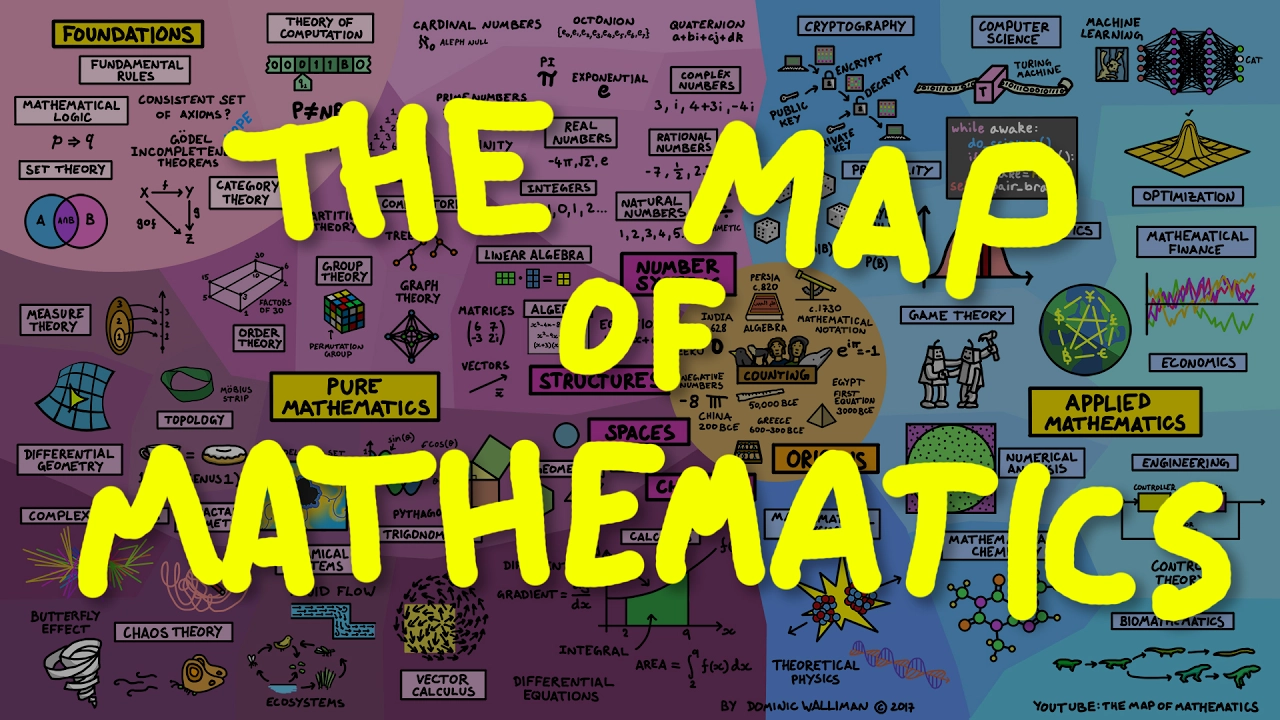
The Map of Mathematics — Domain of Science

Domain of Science

Abstract mathematical systems pursued solely for curiosity consistently emerge decades later as the essential foundations for physics, engineering, and modern computing.

AI-assisted summary of The Map of Mathematics — original source. Check the original for full context.

Source published:

Key ideas

  • Mathematics historically evolved across global cultures—from prehistoric tally marks to Egyptian equations, Chinese negative numbers, Indian zero, and Islamic Golden Age algebra—before splitting into pure and applied branches. (0:00)
  • Pure mathematics explores numbers, structures, spatial relationships, and changes purely for intellectual and aesthetic satisfaction, yet its abstract discoveries regularly become indispensable tools in science decades or centuries later. (1:25)
  • Applied mathematics underpins modern physics, engineering, computer science, machine learning, and economics through disciplines like calculus, control theory, optimization, and numerical analysis. (5:52)
  • Foundational investigations like Gödel's Incompleteness Theorems and computational complexity theory reveal inherent limits in axiomatic systems and the practical feasibility of algorithmic problem-solving. (8:53)

Detailed notes

## Background Published on YouTube by Dominic Walliman under the channel Domain of Science on February 1, 2017, this video presents an overarching visual summary of the field of mathematics. As outlined in the description, it illustrates how pure and applied mathematics interconnect, mapping out the wide array of sub-disciplines that comprise the entire subject.

## TL;DR Tracing the evolution of mathematics from prehistoric tally bones and early ancient breakthroughs to modern abstract theory, the video systematically outlines the landscape of the discipline across its major branches. It navigates through pure mathematics—categorized into numbers, structures, shapes, and change—before charting how applied mathematics underpins physics, engineering, computer science, and social sciences. Finally, it addresses the foundational meta-questions of mathematical logic, Gödel’s Incompleteness Theorems, and the psychological thrill of conceptual clarity.

## Atmosphere & style The presentation carries an energetic, accessible, and intellectually enthusiastic tone, blending clear pedagogy with conversational warmth. Walliman guides the viewer with infectious curiosity, making daunting abstractions—from multi-dimensional linear algebra to topology—feel approachable and visually intuitive. The pacing builds steadily from historical counting tools toward profound philosophical reflections, leaving the audience with an exhilarating sense of having zoomed out to witness the grand architecture of human thought.

## Bulletin - [00:00](https://www.youtube.com/watch?v=OmJ-4B-mS-Y&t=0s) Mathematics historically evolved across global cultures—from prehistoric tally marks to Egyptian equations, Chinese negative numbers, Indian zero, and Islamic Golden Age algebra—before splitting into pure and applied branches. - [01:25](https://www.youtube.com/watch?v=OmJ-4B-mS-Y&t=85s) Pure mathematics explores numbers, structures, spatial relationships, and changes purely for intellectual and aesthetic satisfaction, yet its abstract discoveries regularly become indispensable tools in science decades or centuries later. - [05:52](https://www.youtube.com/watch?v=OmJ-4B-mS-Y&t=352s) Applied mathematics underpins modern physics, engineering, computer science, machine learning, and economics through disciplines like calculus, control theory, optimization, and numerical analysis. - [08:53](https://www.youtube.com/watch?v=OmJ-4B-mS-Y&t=533s) Foundational investigations like Gödel's Incompleteness Theorems and computational complexity theory reveal inherent limits in axiomatic systems and the practical feasibility of algorithmic problem-solving.

## Key takeaways - [00:00](https://www.youtube.com/watch?v=OmJ-4B-mS-Y&t=0s) Mathematics began with basic animal counting and prehistoric tally marks on bones before formalizing through Egyptian, Greek, Chinese, Indian, and Islamic scholarship. - [01:12](https://www.youtube.com/watch?v=OmJ-4B-mS-Y&t=72s) Modern mathematics is divided into pure mathematics, pursued for its own sake, and applied mathematics, developed to solve real-world problems. - [01:25](https://www.youtube.com/watch?v=OmJ-4B-mS-Y&t=85s) Pure mathematical concepts developed solely for intellectual beauty frequently become the exact analytical frameworks needed by later scientific breakthroughs. - [02:19](https://www.youtube.com/watch?v=OmJ-4B-mS-Y&t=139s) The study of numbers expands from natural numbers and integers to rationals, reals, and complex numbers, revealing that some infinities are strictly larger than others. - [03:20](https://www.youtube.com/watch?v=OmJ-4B-mS-Y&t=200s) Structures in pure mathematics encompass algebra, linear algebra, number theory, combinatorics, and group theory, which models symmetries such as Rubik's cube states. - [04:15](https://www.youtube.com/watch?v=OmJ-4B-mS-Y&t=255s) The study of shapes and spaces progresses from classical Euclidean geometry and trigonometry into scale-invariant fractals, differential geometry, and topology. - [04:44](https://www.youtube.com/watch?v=OmJ-4B-mS-Y&t=284s) Topology evaluates continuous deformation without tearing or gluing, considering shapes like a coffee mug and a torus to be mathematically equivalent. - [05:15](https://www.youtube.com/watch?v=OmJ-4B-mS-Y&t=315s) The mathematics of change centers on calculus, extending into vector calculus, dynamical systems, chaos theory, and complex analysis. - [05:52](https://www.youtube.com/watch?v=OmJ-4B-mS-Y&t=352s) Physics is the natural science most deeply intertwined with mathematics, while chemistry and biology rely heavily on mathematical modeling and population dynamics. - [07:15](https://www.youtube.com/watch?v=OmJ-4B-mS-Y&t=435s) Numerical analysis provides approximations and iterative computer algorithms to solve complex mathematical problems when analytical solutions are impossible. - [07:38](https://www.youtube.com/watch?v=OmJ-4B-mS-Y&t=458s) Game theory, probability, statistics, and optimization model rational decision-making, chance occurrences, and resource maximization across economics and finance. - [08:10](https://www.youtube.com/watch?v=OmJ-4B-mS-Y&t=490s) Theoretical computer science was derived from pure mathematics decades before physical computers existed, and modern cryptography relies directly on abstract number theory. - [08:53](https://www.youtube.com/watch?v=OmJ-4B-mS-Y&t=533s) Foundational fields like set theory, category theory, and mathematical logic formally probe whether mathematics has a completely consistent, self-contained axiomatic base. - [09:18](https://www.youtube.com/watch?v=OmJ-4B-mS-Y&t=558s) Gödel's Incompleteness Theorems established that no consistent mathematical axiomatic system can prove all truths within its own framework. - [09:57](https://www.youtube.com/watch?v=OmJ-4B-mS-Y&t=597s) Complexity theory systematically classifies algorithms by their time and memory scaling, proving that exact solutions to many problems demand enormous computational resources. - [10:22](https://www.youtube.com/watch?v=OmJ-4B-mS-Y&t=622s) The deep reward of doing mathematics is the sudden transition from confusion to lucidity, providing an intuitive glimpse into the fundamental architecture of the universe.

## Detailed walkthrough ### [00:00](https://www.youtube.com/watch?v=OmJ-4B-mS-Y&t=0s) Origins and the Divide Between Pure and Applied Mathematics

School mathematics rarely does justice to the broader field, offering only a glimpse into a single corner of what is an expansive, wonderfully diverse subject. Mathematics originated in basic counting, a capability shared by other animals and evidenced in human prehistory through tally marks carved into bones. Over centuries, civilizations contributed key breakthroughs: the Egyptians created the first equation, the ancient Greeks expanded geometry and numerology, negative numbers emerged in China, and zero as an independent number was introduced in India. During the Golden Age of Islam, Persian scholars advanced the discipline further and authored the first treatise on algebra, followed by a surge of mathematical innovation alongside the physical sciences during the European Renaissance.

Modern mathematics is broadly divided into two major spheres: pure mathematics, pursued entirely for its own sake, and applied mathematics, developed to resolve tangible real-world problems. Despite this operational divide, historical development shows deep reciprocal crossover. Mathematical pioneers frequently ventured into theoretical territory guided purely by aesthetic appreciation and intellectual curiosity, inventing systems that initially seemed to have no practical function. A century later, scientists tackling cutting-edge problems in physics or computer science often find that very abstract theory already waiting as the exact analytical key required. Beyond utilitarian applications, pure mathematics remains inherently valuable as an art-like endeavor defined by internal beauty and structural elegance. As Dominic Walliman observes when reflecting on this recurring historical pattern:

> “It is interesting how often something so abstract ends up being really useful.”

```mermaid flowchart LR accTitle: Evolution and Core Division of Mathematics accDescr: Historical progression from prehistoric counting to modern pure and applied branches with recurring cross-pollination. subgraph History["Historical Foundations"] A["Prehistoric Bone Tallying"] --> B["Egyptian & Greek Geometry"] B --> C["Chinese Negatives & Indian Zero"] C --> D["Islamic Golden Age Algebra"] D --> E["Renaissance Mathematical Boom"] end subgraph Modern["Modern Mathematics"] E --> F["Pure Mathematics\n(Aesthetic & Curiosity Driven)"] E --> G["Applied Mathematics\n(Real-World Problem Solving)"] F <-->|"Cross-pollination\nover centuries"| G end ```

- Prehistoric bone notches represent humanity's earliest surviving counting records. - Negative numbers were developed in China, while zero was first treated as an active mathematical number in India. - Persian mathematicians in the Islamic Golden Age produced the first dedicated text on algebra.

---

[02:19](https://www.youtube.com/watch?v=OmJ-4B-mS-Y&t=139s) Pure Mathematics: Numbers, Structures, Shapes, and Change

Pure mathematics organizes itself into several distinct pillars, beginning with the study of numbers. This progression starts with natural numbers under basic arithmetic operations and broadens into integers (incorporating negative values), rational numbers (fractions), real numbers (including non-terminating decimals such as $\pi$), and complex numbers. Within these systems lie unique constants like Euler’s number ($e$) and prime numbers. Crucially, infinity itself is not monolithic; while both integers and real numbers form infinite collections, the set of real numbers is strictly larger, proving that some infinities surpass others in size.

```mermaid flowchart TD accTitle: Structural Breakdown of Pure Mathematics accDescr: Hierarchy of pure mathematics spanning Numbers, Structures, Shapes, and Changes. Pure["Pure Mathematics"] --> Num["Numbers & Arithmetic"] Pure --> Str["Structures"] Pure --> Spc["Shapes & Spaces"] Pure --> Chg["Changes"]

Num --> N1["Natural, Integers, Rationals, Reals, Complex"] Str --> S1["Algebra & Linear Algebra"] Str --> S2["Number Theory & Combinatorics"] Str --> S3["Group & Order Theory"] Spc --> G1["Geometry & Fractals"] Spc --> G2["Topology & Differential Geometry"] Chg --> C1["Calculus & Vector Calculus"] Chg --> C2["Dynamical Systems & Chaos Theory"] ```

Moving from numbers to structures, variables are introduced into equations. Algebra provides the foundational rules for manipulating those relationships, while linear algebra captures multidimensional arrays through vectors and matrices. Number theory investigates the intrinsic characteristics of numbers (such as prime distributions). Combinatorics examines discrete, countable formations like trees and networks. Group theory governs symmetry and permutations—exemplified by the mechanical states of a Rubik’s cube—while order theory formalizes hierarchies and comparative relationships across sets.

The spatial domain investigates shapes and spatial transformations. Classical geometry and school trigonometry lead directly into scale-invariant fractal geometries, where patterns repeat ad infinitum upon magnification. Topology discards rigid metric distances to study properties preserved through continuous deformation without tearing or gluing; under topological equivalence, a coffee mug and a torus (donut) are mathematically identical, while a Möbius strip maintains the unique property of having only one continuous side and a single edge. Measure theory assigns rigorous values to sets and spaces, and differential geometry analyzes geometric properties on curved surfaces, showing how triangle angle sums deviate from flat Euclidean space.

Finally, the study of change centers on calculus—using integrals to determine bounded functional areas and derivatives to evaluate local slopes—extended multidimensionally via vector calculus. Related domains include dynamical systems, which model the time evolution of stateful environments like fluid dynamics or ecosystem feedback loops; chaos theory, focusing on systems demonstrating extreme sensitivity to initial conditions; and complex analysis, analyzing functions built with imaginary and complex values.

---

[05:52](https://www.youtube.com/watch?v=OmJ-4B-mS-Y&t=352s) Applied Mathematics and Real-World Domains

Applied mathematics bridges abstract theory with the empirical universe, although the true layout functions more like an interconnected web than a neat two-dimensional drawing. Physics remains the most deeply tied natural science, drawing heavily on pure geometric, analytical, and structural mathematics. Beyond physics, mathematical chemistry and biomathematics model molecular structures, population dynamics, and evolutionary mechanisms. Engineering has relied on quantitative formulation since Egyptian and Babylonian infrastructure projects; modern electrical and aerospace engineering uses control theory—a branch of dynamical systems—to govern complex electrical grids and aircraft flight software.

When analytical solutions become impossible, numerical analysis deploys approximations and iterative algorithms executed on high-performance computers. A basic illustration involves calculating $\pi$ by scattering random points over an inscribed circle inside a square and evaluating the ratio of internal hits.

```mermaid flowchart TD accTitle: Applications of Mathematics Across Disciplines accDescr: Flowchart showing applied mathematics feeding into natural sciences, computation, engineering, and economics. Applied["Applied Mathematics"] Applied --> Sci["Natural Sciences & Engineering"] Applied --> Comp["Computation & Data"] Applied --> Soc["Decisions & Economics"]

Sci --> P["Theoretical Physics & Chemistry"] Sci --> B["Biomathematics & Evolution"] Sci --> E["Engineering & Control Theory"]

Comp --> N["Numerical Analysis"] Comp --> CS["Computer Science & Cryptography"] Comp --> ML["Machine Learning"]

Soc --> GT["Game Theory"] Soc --> PS["Probability & Statistics"] Soc --> Fin["Finance & Optimisation"] ```

Social, economic, and computational systems rely on discrete mathematical disciplines:

- **Game Theory:** Assesses optimal decision-making when rational participants operate under explicit constraints, informing economics, experimental psychology, and evolutionary biology. - **Probability and Statistics:** Formulates the mechanics of individual chance occurrences (such as coin tosses or rolling dice) and evaluates patterns across vast sets of empirical data, providing the foundational engine for quantitative financial modeling. - **Optimisation:** Evaluates mathematical extrema to locate maximal or minimal functional thresholds, directly reflecting human behavioral instincts to maximize utility, financial return, or personal happiness under constraint. - **Computer Science and Cryptography:** The theoretical tenets of computation were discovered through pure mathematical exploration decades before physical computers existed. Cryptography relies directly on abstract number theory and combinatorics, while machine learning synthesizes linear algebra, optimization, probability, and dynamic systems.

---

[08:53](https://www.youtube.com/watch?v=OmJ-4B-mS-Y&t=533s) Foundations, Computational Theory, and the Experience of Insight

The exploration of mathematics inevitably circles back to its own meta-foundational roots: what justifies the validity of mathematical rules, is there an exhaustive collection of axioms from which all mathematics derives, and can mathematics be proven completely self-consistent? These questions form the bedrock of category theory, set theory, and formal mathematical logic.

A central milestone within logic is Gödel’s Incompleteness Theorems. Walliman highlights the existential puzzle this result presents to scientists and philosophers:

> “Which is weird seeing as mathematics explains so much stuff in the Universe so well. Why would a thing made up by humans be able to do that? That is a deep mystery right there.”

Complementing foundational logic, the theory of computation uses mathematical models to determine what problems can theoretically be solved by an algorithm. Complexity theory systematically categorizes algorithms by their memory requirements and time scaling, revealing that calculating exact solutions for the world's most interesting analytical problems demands an immense expenditure of computational resources.

On an individual level, the appeal of exploring mathematics lies in the psychological transition from absolute confusion to total conceptual lucidity. Reaching the moment where a difficult concept abruptly clicks provides an epiphany akin to “seeing through the Matrix.” Grappling with these abstract frameworks yields intellectual breakthroughs that offer a direct glimpse into the fundamental, symmetrical architecture of the physical cosmos.

- Category theory, set theory, and mathematical logic formally investigate the axiomatic underpinnings of mathematical validity. - Gödel’s Incompleteness Theorems proved that no consistent axiomatic framework can validate every mathematical truth from within itself. - Complexity theory identifies the strict computational time and memory boundaries that restrict real-world problem solving.

[10:56](https://www.youtube.com/watch?v=OmJ-4B-mS-Y&t=656s) Concluding Remarks and Sign-off

Dominic Walliman wraps up the video by thanking viewers and pointing toward future content, letting his audience know that they can expect further explorations of science and mathematics on the channel shortly. While gesturing toward the screen to prompt viewers toward the channel's standard outro links, subscriptions, and social pages, he concludes with an upbeat and warm sign-off: “So there will be more videos coming from me soon, here’s all the regular things and it was my pleasure se you next time.”

## Notable quotes > [00:00](https://www.youtube.com/watch?v=OmJ-4B-mS-Y&t=0s) It is interesting how often something so abstract ends up being really useful. — Dominic Walliman

## Mentioned Dominic Walliman, Domain of Science, Kurt Gödel, Leonhard Euler, The Matrix, Rubik's Cube, August Ferdinand Möbius, YouTube, Patreon, Instagram, Wikipedia, Quora, Live Science

## Video description The entire field of mathematics summarised in a single map! This shows how pure mathematics and applied mathematics relate to each other and all of the sub-topics they are made from.

Get the maps! https://www.dosmaps.com Here's my Instagram: https://www.instagram.com/dcwalliman Patreon: https://www.patreon.com/ScienceMaps

To err is to human, and I human a lot. I always try my best to be as correct as possible, but unfortunately I make mistakes. This is the errata where I correct my silly mistakes. My goal is to one day do a video with no errors!

1. The number one is not a prime number. The definition of a prime number is a number can be divided evenly only by 1, or itself. And it must be a whole number GREATER than 1. (This last bit is the bit I forgot).

2. In the trigonometry section I drew cos(theta) = opposite / adjacent. This is the kind of thing you learn in high school and guess what. I got it wrong! Dummy. It should be cos(theta) = adjacent / hypotenuse.

3. My drawing of dice is slightly wrong. Most dice have their opposite sides adding up to 7, so when I drew 3 and 4 next to each other that is incorrect.

4. I said that the Gödel Incompleteness Theorems implied that mathematics is made up by humans, but that is wrong, just ignore that statement. I have learned more about it now, here is a good video explaining it: https://youtu.be/O4ndIDcDSGc

5. In the animation about imaginary numbers I drew the real axis as vertical and the imaginary axis as horizontal which is opposite to the conventional way it is done.

Thanks so much to my supporters on Patreon. I hope to make money from my videos one day, but I’m not there yet! If you enjoy my videos and would like to help me make more this is the best way and I appreciate it very much. https://www.patreon.com/domainofscience

Here are links to some of the sources I used in this video.

Links: Summary of mathematics: https://en.wikipedia.org/wiki/Mathematics Earliest human counting: http://mathtimeline.weebly.com/early-human-counting-tools.html First use of zero: https://en.wikipedia.org/wiki/0#History http://www.livescience.com/27853-who-invented-zero.html First use of negative numbers: https://www.quora.com/Who-is-the-inventor-of-negative-numbers Renaissance science: https://en.wikipedia.org/wiki/History_of_science_in_the_Renaissance History of complex numbers: http://rossroessler.tripod.com/ https://en.wikipedia.org/wiki/Mathematics Proof that pi is irrational: https://www.quora.com/How-do-you-prove-that-pi-is-an-irrational-number and https://en.wikipedia.org/wiki/Proof_that_%CF%80_is_irrational#Laczkovich.27s_proof

[Source](https://www.youtube.com/watch?v=OmJ-4B-mS-Y)

中文简报

多米尼克·沃利曼绘制数学全景图,追溯纯理论到现实技术的演进 纯粹出于好奇心探索的抽象数学体系,往往在数十年后成为物理学、工程学和现代计算不可或缺的基石。 视频追溯了数学从史前记数刻骨、早期古代突破到现代抽象理论的演进历程,系统勾勒出该学科各大分支的全貌。内容梳理了纯粹数学(细分为数、结构、空间形态与变化),进而展现应用数学如何为物理学、工程学、计算机科学及社会科学提供支撑。最后,视频还探讨了数理逻辑的根本性元问题、哥德尔不完备定理,以及概念认知清晰所带来的心智震撼。 数学在历史上经历了跨越全球多种文化的演进——从史前刻痕记数到埃及方程、中国的负数、印度的零,再到伊斯兰黄金时期的代数——随后分化为纯粹数学与应用数学两大分支。 (0:00) 纯粹数学纯粹为了求知与审美满足而探索数、结构、空间关系和变化,但其抽象发现往往在数十年或数百年后演变为科学中不可或缺的工具。 (1:25) 应用数学通过微积分、控制论、最优化和数值分析等学科,为现代物理学、工程学、计算机科学、机器学习和经济学奠定了基础。 (5:52) 哥德尔不完备定理和计算复杂性理论等基础研究,揭示了公理系统固有的局限性以及算法求解问题的现实可行性边界。 (8:53)

Reading summary

In Domain of Science, Dominic Walliman outlines mathematics as an interconnected landscape spanning historical inquiry, pure abstraction, applied physical and social modeling, and foundational logic. While modern mathematics is functionally split into pure and applied pursuits, abstract systems pursued solely for curiosity frequently become essential tools for understanding the physical universe. Historical Emergence and Pure-Applied Dynamics (0:00) Mathematics evolved from prehistoric bone tally marks through progressive contributions across civilizations, including Egyptian equations, Greek geometry, Chinese negative numbers, Indian zero, and Islamic Golden Age treatises on algebra. In the modern era, the field is broadly divided into pure mathematics, practiced for internal structural beauty and aesthetic interest, and applied mathematics, directed at solving concrete real-world challenges. The Core Pillars of Pure Mathematics (2:19) Pure mathematics develops across four primary domains: numbers, structures, shapes, and change. The study of numbers advances from natural numbers and integers to rationals, reals, and complex values, including demonstrations that the infinite set of real numbers is strictly larger than the infinite set of integers. Structural fields introduce variables through algebra, multidimensional systems via linear algebra, and discrete patterns in combinatorics and group theory, which models symmetries such as Rubik's cube states. Spatial Transformations, Calculus, and Dynamic Systems (2:19) Spatial analysis extends classical Euclidean geometry into scale-invariant fractals and topology, which studies spatial invariants under continuous deformation without tearing or gluing—rendering a coffee mug and a torus equivalent. Differential geometry tracks how geometric rules shift across curved surfaces. The study of change relies on calculus and vector calculus to measure bounded areas and slopes, which expand into dynamical systems and chaos theory to model environments displaying extreme sensitivity to initial conditions. Applied Intersections Across Sciences and Computation (5:52) Applied mathematics bridges pure theory into empirical disciplines, functioning as an interconnected web rather than an isolated domain. Physical and chemical sciences rely heavily on analysis and geometry, while control theory—an offshoot of dynamical systems—regulates engineering systems such as power grids and aircraft flight software. Social, economic, and computational problems are handled by distinct frameworks: game theory evaluates constrained rational choices, probability and statistics drive risk and quantitative finance, and numerical analysis uses algorithmic approximations to solve intractable equations. Foundational Limits, Complexity, and Intellectual Epiphany (8:53) The conceptual limits of mathematical validity are addressed by set theory, category theory, and formal logic. A key milestone is Gödel’s Incompleteness Theorems, which proved that no consistent axiomatic system can demonstrate every mathematical truth from within itself. Parallel to this, theoretical computer science and complexity theory map the ultimate computational time and memory boundaries constraining algorithmic problem solving. On a personal level, Walliman emphasizes that working through these abstract systems provides sudden moments of conceptual clarity that illuminate the underlying structural symmetry of the universe. Walliman frames mathematics as an enduring philosophical puzzle: it remains a deep mystery why an abstract conceptual framework developed by human minds possesses such extraordinary power to describe and predict the physical universe, even as its own axiomatic systems are proven inherently incomplete.

精炼阅读摘要

Dominic Walliman 在《数学地图》(The Map of Mathematics)中指出,数学不仅是学校教学展现的狭窄技巧,更是一门从史前计数演变而来的庞大知识网络。现代数学在纯数学与应用数学之间形成了深刻的双向交融,既支撑了自然与计算科学的现实技术,又在其自身的公理基础中留下了关于宇宙契合性的深层逻辑谜题。 历史演进与纯粹与应用的交融 (0:00) 数学起源于基本的计数行为,人类史前骨骼上的刻痕是现存最早的计数记录。随后各文明做出了关键性突破:古埃及人开创了首个方程,古希腊人拓展了几何学与数论,中国引入了负数概念,印度首次将零视为独立的数学数字,伊斯兰黄金时代的波斯学者撰写了首部代数学专著,并在欧洲文艺复兴时期与物理科学同步爆发。在现代体系中,数学主要划分为出于纯粹审美与好奇心驱动的纯数学,以及致力于解决现实物理难题的应用数学。 历史经验表明,纯数学与应用数学之间存在长期的双向渗透。数学先驱往往仅凭形式美感和智力探索开创高度抽象的理论体系,这些在当时被认为缺乏实际用途的构想,往往在一两个世纪后成为前沿物理学或计算机科学的关键解析工具。正如 Walliman 所观察到的,抽象概念最终转化为实用工具的现象在历史上屡见不鲜,这证明了纯数学除了实用功能之外,本身就具备类似于艺术创作的内在结构美与独立价值。 纯数学架构:数、结构、空间与变化 (2:19) 纯数学的研究版图可系统拆解为四大核心支柱。在“数”的领域中,研究从基础算术的自然数拓展至整数、有理数、包含非循环小数(如圆周率 π 和欧拉数 e)的实数以及复数;值得注意的是,实数集规模严格大于整数集,证明了无穷本身存在大小差异。“结构”研究通过代数确立变量运算规则,利用线性代数的向量与矩阵刻画多维系统,并延伸至数论(研究素数分布等内生性质)、组合数学(网络与树形结构)、群论(对称性与置换操作,如魔方状态)及序理论。 在“空间”与“变化”维度,几何学延伸出具有尺度自相似性的分形几何;拓扑学则摒弃刚性距离度量,专注于连续形变下保持不变的性质,例如咖啡杯与环面在拓扑上等价,莫比乌斯带则具有独特的单侧单边缘属性;测度论与微分几何则深入分析了弯曲空间上的几何特征。而针对“变化”的研究以微积分为基石,发展出向量微积分、模拟流体与生态系统时间演化的动力系统、对初始条件高度敏感的混沌理论,以及基于虚数体系的复分析。 现实映射:工程计算与社会系统 (5:52) 应用数学构成了抽象理论与经验世界之间的纽带,呈现为高度交叉的网状结构。除了与理论物理、化学和生物数学(如种群动态与演化建模)的深度结合外,工程学自古埃及与巴比伦时期起便依赖定量公式,如今现代电气与航天工程通过控制理论来调度复杂电网及飞行系统。当解析解无法获得时,数值分析则利用高性能计算运行近似与迭代算法,例如利用向正方形内接圆随机投点并评估命中比例的方法来估算 π 值。 在计算与社会决策领域,数学同样提供了关键模型。博弈论评估理性参与者在约束条件下的最优决策,广泛应用于经济学和演化生物学;概率论与统计学量化不确定性事件并挖掘宏观数据规律,成为量化金融的核心基石;最优化理论则通过寻找极值来模拟人类对效用、回报或幸福感的最优追求。在计算科学中,理论计算框架在物理计算机诞生数十年前便已确立,现代密码学直接依赖抽象数论与组合学,而机器学习则是线性代数、最优化、概率论与动力系统的综合体现。 逻辑根基与认知顿悟的本质 (8:53) 对数学广度的考察最终指向其元理论根基,即数学规则的有效性来源及其内在自洽性,这构成了范畴论、集合论及数理逻辑的核心关切。逻辑学的一大里程碑是哥德尔不完备性定理,该定理严格证明了任何自洽的形式公理系统都无法在其内部证明所有数学真理。Walliman 将这一结论视为深层的哲学谜题:一门由人类构建的符号体系为何能如此精确地解释宇宙规律,其底层机理至今仍是科学与哲学界悬而未决的奥秘。 与公理基础互补的是计算理论与复杂度理论,后者通过算法对时间与内存资源的需求进行系统分级,揭示了精确求解世界上许多关键分析难题在计算物理资源上的严格限制。对个人探索者而言,学习数学的魅力在于从彻底困惑到豁然开朗的心理转变;突破抽象屏障的顿悟体验不仅带来穿透迷雾的清晰感,也使人得以直接窥见物理宇宙内在的对称与秩序之美。 Walliman 的梳理表明,数学既是理解物质宇宙的实用工具,也是追求形式美感的自洽智力探险。尽管数学在自然科学和计算工程中展现出极强的解释力,但哥德尔不完备性定理揭示了其内在公理系统的逻辑局限;而人类发明的抽象符号为何能够如此精确地映射宇宙规律,仍是该学科最具深度的未解之谜。

Detailed notes — zh

## Background 该视频由科普频主 Dominic Walliman 于 2017 年 2 月 1 日在 YouTube 平台上的 Domain of Science 频道发布。视频简介指出,本期内容旨在通过单张系统化的全景地图,梳理整个数学领域的发展脉络,完整展现纯数学与应用数学的相互关联及其包含的所有细分学科分支。 ## TL;DR 视频从史前人类的计数与各大古文明的数学突破切入,系统构建了一幅宏大的数学知识全景图。全片将现代数学划分为纯数学与应用数学两大核心领域,前者深入剖析数系家族、代数结构、空间几何、拓扑学与微积分等纯粹理论,后者则展示物理建模、数值分析、博弈论、概率统计乃至计算机与机器学习的实际应用。在底座部分,作者进一步探讨了集合论、数理逻辑与哥德尔不完备性定理等数学基础命题,揭示了看似抽象的理论与真实物理世界之间令人惊叹的共鸣。 ## Atmosphere & style 整期视频洋溢着理性、优雅且充满激情的智性探索氛围。主讲人 Dominic Walliman 娓娓道来,语言清晰明快且极富感染力,将枯燥抽象的公式定理转化为生动形象的知识图谱。随着讲解从基础的数数一路攀升至宇宙本质与哥德尔不完备性的哲学追问,观众能真切体验到一种“代码豁然开朗、看穿宇宙对称之美”的顿悟与震撼。 ## Bulletin - [00:00](https://www.youtube.com/watch?v=OmJ-4B-mS-Y&t=0s) 数学起源于跨越动物界与史前人类的计数本能,并经由古埃及、古希腊、中国、印度及伊斯兰黄金时代等多元文明的共同贡献,最终在文艺复兴时期与实验科学结合迎来爆发。 - [01:05](https://www.youtube.com/watch?v=OmJ-4B-mS-Y&t=65s) 现代数学主要划分为以审美与逻辑驱动的纯数学和以解决实际难题为导向的应用数学,二者常呈现出抽象理论在数十年甚至数百年后精准赋能尖端现实科技的交织关系。 - [02:19](https://www.youtube.com/watch?v=OmJ-4B-mS-Y&t=139s) 纯数学建立了从数系层级、代数结构、空间几何到变化微积分的完整理论体系,涵盖了实数无穷大于整数无穷的奇妙集合事实及分形、拓扑等空间性质。 - [05:52](https://www.youtube.com/watch?v=OmJ-4B-mS-Y&t=352s) 应用数学全面渗透至物理、工程、计算机科学与金融领域,借助数值分析、博弈论、概率统计与密码学等工具为解析不可解的复杂系统提供关键支撑。 - [08:53](https://www.youtube.com/watch?v=OmJ-4B-mS-Y&t=533s) 数学基础板块通过数理逻辑与哥德尔不完备性定理审视自身公理化极限,引发了关于人类符号体系何以精准描摹宇宙法则的深刻哲学追问。 ## Key takeaways - [00:00](https://www.youtube.com/watch?v=OmJ-4B-mS-Y&t=0s) 学校的基础数学教育往往无法展现数学领域的宏伟全貌,其完整图景涵盖极为广阔且高度互联的子学科体系。 - [00:00](https://www.youtube.com/watch?v=OmJ-4B-mS-Y&t=0s) 数学的演进凝聚了多元古代文明的智慧,包括古埃及的早期方程、古希腊的几何学、中国的负数、印度的数字“0”以及波斯学者奠定的代数学。 - [01:05](https://www.youtube.com/watch?v=OmJ-4B-mS-Y&t=65s) 纯数学纯粹出于对逻辑美与内在严谨性的追求,而其看似无用的前沿理论往往在数十年或百年后成为解决物理与工程瓶颈的核心工具。 - [02:19](https://www.youtube.com/watch?v=OmJ-4B-mS-Y&t=139s) 从自然数、整数、有理数到实数与复数,数系的扩展揭示出无穷具有不同层次,其中实数的无穷大在基数上严格大于整数的无穷大。 - [02:19](https://www.youtube.com/watch?v=OmJ-4B-mS-Y&t=139s) 代数与结构研究将数字抽象为变量与高维对象,催生出研究变换规则的线性代数、对称性分析的群论以及探寻离散关系的组合数学。 - [04:11](https://www.youtube.com/watch?v=OmJ-4B-mS-Y&t=251s) 空间研究涵盖了具有尺度自相似性的分形几何,以及关注物体在拉伸形变下保持连续不变特性的拓扑学。 - [04:11](https://www.youtube.com/watch?v=OmJ-4B-mS-Y&t=251s) 以微分与积分为核心的微积分构成了研究动态变化的基石,并延伸出探索初值极端敏感性的混沌理论与高阶动力系统。 - [05:52](https://www.youtube.com/watch?v=OmJ-4B-mS-Y&t=352s) 当复杂现实工程与物理问题无法求得解析解时,数值分析借助超级计算机与蒙特卡洛等近似算法提供可行的计算结果。 - [07:19](https://www.youtube.com/watch?v=OmJ-4B-mS-Y&t=439s) 博弈论、概率论与统计学为社会科学、演化生物学及金融市场中的非确定性风险建模与理性决策提供了严谨框架。 - [07:19](https://www.youtube.com/watch?v=OmJ-4B-mS-Y&t=439s) 人类日常决策中对性价比与幸福感的权衡本质上都是最优化问题,在数学上对应于多约束条件下的极值求解。 - [07:19](https://www.youtube.com/watch?v=OmJ-4B-mS-Y&t=439s) 计算机科学与人工智能的理论框架先于硬件诞生,现代机器学习与密码学高度依赖线性代数、最优化及数论。 - [08:53](https://www.youtube.com/watch?v=OmJ-4B-mS-Y&t=533s) 数学基础领域致力于检验公理系统的严谨性与自洽性,哥德尔不完备性定理证明了任何足够复杂的公理体系都无法自我证明其完备。 - [08:53](https://www.youtube.com/watch?v=OmJ-4B-mS-Y&t=533s) 尽管数学工具由人类心智与符号系统构想而成,它却能不可思议地精准刻画宇宙物理定律,展现出深刻的对称性与智性顿悟之美。 ## Detailed walkthrough ### [00:00](https://www.youtube.com/watch?v=OmJ-4B-mS-Y&t=0s) 数学的起源与演进简史 学校课堂上所传授的数学,往往无法展现整个数学领域的真正魅力与全貌;学生通常只能窥见冰山一角,而数学整体上是一门庞大且极为多元的宏伟学科。回溯到最初的源头,数学诞生于人类最基本的“计数”需求。事实上,计数并非人类独有的特征,自然界中的其他动物也具备一定的计数能力。人类进行计数的考古证据甚至可以追溯到史前时代,当时的人们通过在骨头上刻画划痕来记录数量。 随着漫长岁月的演进,世界各地的文明都为数学做出了开创性的突破。古埃及人写下了人类历史上的最早方程;古希腊人在几何学以及数秘学等诸多领域取得了跨越式的发展;负数最早由中国发明;而零作为独立数字的使用则最早出现在印度。随后在伊斯兰黄金时代,波斯数学家更进一步推动了数学的边界,并撰写了人类第一本代数学著作。到了文艺复兴时期,数学与自然科学相互激荡、共同迎来大爆发。正如主讲人 Dominic Walliman 强调的开篇初衷:“The mathematics we learn in school doesn’t quite do the field of mathematics justice.”(我们在学校学到的数学并不能真正展现数学领域的魅力。) - **计数的起源**:史前骨器划痕记录;动物界同样存在原始计数能力。 - **古埃及**:诞生了最早记录的数学方程。 - **古希腊**:在几何学(Geometry)等领域奠定了理性论证的基础。 - **中国**:最早发明并应用负数。 - **印度**:最早确立了数字“0”(Zero)的概念与运算。 - **伊斯兰黄金时代**:波斯学者系统性发展了代数学(Algebra),并诞生了首部代数专著。 - **文艺复兴时期**:数学与实验科学协同爆发,开启了近代科学的大门。 --- ### [01:05](https://www.youtube.com/watch?v=OmJ-4B-mS-Y&t=65s) 纯数学与应用数学的奇妙交织 现代数学广义上可划分为两大领域:“纯数学”(Pure Mathematics)与“应用数学”(Applied Mathematics)。纯数学是纯粹为了数学本身的严谨、逻辑与内在美而进行的研究;应用数学则是为了解决现实世界中的具体问题而开发数学工具。然而,两者之间绝非界限分明,而是存在着大量令人惊叹的交叉与融合。 在科学史上,屡见不鲜的情景是:一位纯数学家仅仅出于纯粹的好奇心,在审美直觉的引导下一步步走向荒僻未知的“数学荒原”。他们创造出一整套全新、精妙却看似毫无实用价值的纯数学理论;然而,时隔百年之后,当后世的物理学家或计算机科学家在尖端科研中遭遇瓶颈时,却赫然发现,解决这一现实难题所必需的精妙工具,早已在百年前由那位纯数学家构想出来了。Dominic Walliman 对这种穿越时空的巧合赞叹道:“It is interesting how often something so abstract ends up being really useful.”(如此抽象的事物竟然能够频繁地在日后发挥出巨大的实际功用,这着实耐人寻味。)即便脱离实际应用,纯数学本身也拥有如同艺术品一般自洽、优雅而令人神往的独立价值。 ```mermaid flowchart LR accTitle: Pure and Applied Mathematics Interconnection accDescr: 纯数学由好奇心驱动,经过历史演化与应用科学在实际问题中交织并解决现实世界难题。 subgraph Pure["纯数学 Pure Maths"] A["好奇心与审美审美驱动"] --> B["抽象理论与结构创新"] end subgraph Applied["应用数学 Applied Maths"] C["物理与现实世界难题"] --> D["实际工程与计算落地"] end B -.->|"数十年乃至数百年后验证"| C ``` --- ### [02:19](https://www.youtube.com/watch?v=OmJ-4B-mS-Y&t=139s) 纯数学的核心支柱:数系统与代数结构 纯数学的第一个大板块是关于“数”(Numbers)的探究。它的起点是人类最熟悉的自然数以及基本的算术运算;随后延伸至包含负数的整数、表现为分数的有理数、包含像圆周率 $\pi$ 这类无限不循环小数的实数,以及引入虚数单位的复数等更为丰富的数系统。这些数不仅各具奇特性质(例如素数、$\pi$、自然常数 $e$),更展现出深奥的集合属性——虽然整数与实数都有无限多个,但实数的无穷大在基数上却严格大于整数的无穷大,这揭示出“某些无穷比其他无穷更加庞大”的奇妙事实。 进入“结构”(Structures)领域后,数学家开始将数字转化为代数方程中的变量。代数学确立了如何操纵这些方程的基本法则;而当数字扩展到高维空间时,向量与矩阵便应运而生,研究它们相互关系的法则构成了线性代数。数论(Number Theory)深入探讨数的内在特征(如素数的神秘分布);组合数学(Combinatorics)研究树、图等离散可数对象的性质;群论(Group Theory)探寻对称性与物体在集合内的变换法则(例如魔方还原的置换群);序理论(Order Theory)则探索如何依据特定规则排列对象(如大小关系的严格定义)。 - **数系家族**:自然数 $\rightarrow$ 整数 $\rightarrow$ 有理数 $\rightarrow$ 实数(涵盖超越数) $\rightarrow$ 复数。 - **无穷的层级**:康托尔式的集合论洞察——实数的无穷大于整数的无穷。 - **线性代数**:向量、矩阵与高维变换的规则网络。 - **离散与对称结构**:包括组合数学中的图论与树状图、群论中以魔方为代表的置换变换,以及为偏序/全序关系奠基的序理论。 --- ### [04:11](https://www.youtube.com/watch?v=OmJ-4B-mS-Y&t=251s) 纯数学的形态与动变:空间几何、拓扑与微积分 纯数学不仅关注静止的符号,更深入探索“空间中的形态”(Shapes in Space)与“变化”(Changes)。几何学源于勾股定理与学校教授的三角学,现代则延展出分形几何(Fractal Geometry)这类具有尺度不变性的精美自相似结构——无论将它们放大多少倍,其局部的形态复杂度都与整体惊人一致。拓扑学(Topology)研究的是物体在连续拉伸、扭曲等形变下保持不变的内在几何性质(前提是不允许撕扯或粘合),在拓扑学家眼中,仅有一个表面和一个边界的莫比乌斯环颠覆了常识,而咖啡杯与甜甜圈在拓扑学意义上没有任何本质区别。测度论(Measure Theory)则架起了空间与数字之间的桥梁,赋予空间和集合可量化的度量标准;微分几何则研究弯曲表面上的几何行为(例如曲面上三角形内角和不再等于 180 度),自然过渡到了变化的数学。 变化的研究以微积分(Calculus)为基石:微分探索函数的变化率与切线斜率,积分求解函数所围成的连续累积面积,向量微积分则将这些运算拓展到多维向量场。在更广阔的研究中,动力系统(Dynamical Systems)刻画系统随时间的演化路径(如流体流动或生态系统中的反馈调节),混沌理论(Chaos Theory)则聚焦于那些对初始条件极度敏感的动力系统(即所谓的蝴蝶效应);复分析(Complex Analysis)则深入研究复数域上函数的导数与积分特性。 --- ### [05:52](https://www.youtube.com/watch?v=OmJ-4B-mS-Y&t=352s) 应用数学的现实力量:从物理规律到数值计算 应用数学将纯数学工具延伸至现实世界的每一个角落。主讲人指出,尽管在平面地图上必须有所取舍,但现实中的数学是一张高度交织的复杂网络。物理学站在应用数学的最前沿,理论物理与数学物理几乎吸纳了所有纯数学成果;化学中的分子建模以及生物数学中的演化生物学模型,也离不开严谨的数学推演。而在工程学领域,从古埃及与巴比伦时期的大型建造开始,数学就是不可或缺的基石;现代复杂的电力网或航空系统,广泛依托于动力系统分支中的控制理论(Control Theory)。 当现实世界的问题过于错综复杂,以至于在解析层面根本无法求得精确解时,数值分析(Numerical Analysis)便成为了至关重要的实用武器。它通过大量简单的近似算法层层迭代,拼接出令人信服的数值近似解。主讲人给出了一个通俗易懂的直观范例:如果在一个正方形内画一个内切圆并随机投掷飞镖,通过统计落在圆内与落在正方形内的飞镖数量比例,就能近似估算出圆周率 $\pi$ 的数值。在现实科研与工业实践中,这种庞大的数值分析往往交由超级计算机全速运转完成。 ```mermaid flowchart TD accTitle: Numerical Analysis Monte Carlo Example accDescr: 蒙特卡洛投镖算法近似计算圆周率的过程展示。 subgraph Approximations["数值分析近似方法 (以蒙特卡洛法求圆周率为例)"] S["正方形边界与内切圆"] --> D["大规模随机投掷飞镖"] D --> C["统计落在圆内与整个区域的镖数比"] C --> P["近似收敛出 π 的数值"] end P --> COMP["现实中由超级计算机完成复杂科学运算"] ``` --- ### [07:19](https://www.youtube.com/watch?v=OmJ-4B-mS-Y&t=439s) 决策、不确定性与计算机科学的理论根基 在社会科学与复杂系统的应用中,博弈论(Game Theory)研究在一套既定规则与理性博弈者互动下如何做出最优决策,广泛渗透在现代经济学、心理学与演化生物学中;概率论(Probability)定量刻画掷骰子、抛硬币乃至人类行为等随机事件的不确定性,统计学(Statistics)则致力于海量随机过程与经验数据的整理、建模与分析——它们直接支撑了金融数学,帮助人们在充满波动性的金融市场中寻找套利优势。最优化(Optimization)则指引我们在重重限制条件中找寻最高效的平衡点,在数学上往往表现为寻找函数的最值点。Dominic Walliman 形象地评论道:“Optimisation problems are second nature to us humans, we do them all the time: trying to get the best value for money, or trying to maximise our happiness in some way.”(最优化问题对人类而言几乎是与生俱来的本能,我们无时无刻不在进行最优化:试图买到性价比最高的东西,或者以某种方式最大化我们自己的幸福。) 计算机科学同样深深扎根于纯数学的土壤之中。早在现代可编程电子计算机问世之前几十年,计算的核心逻辑与理论架构就已经在纯数学领域被严格推导出来了。当今大放异彩的机器学习(Machine Learning)全面汲取了线性代数、最优化理论、动力系统与概率论的养分;作为信息安全基石的现代密码学(Cryptography),更是高度依赖于数论与组合数学的深奥构造。 - **博弈论**:理性参与者在规则约束下的博弈与平衡(应用于经济、生物对抗策略)。 - **概率与统计**:随机现象建模、数据分析及金融数学的基础。 - **最优化**:在多约束边界下寻找极值点,对应现实生活中的效率最大化决策。 - **理论计算机与人工智能**:从图灵时代纯数学推演,发展到依靠线性代数与最优化算力驱动的机器学习。 - **密码学**:以离散数学和质数理论为基础筑牢现代信息安全。 --- ### [08:53](https://www.youtube.com/watch?v=OmJ-4B-mS-Y&t=533s) 数学的基础命题与智性顿悟之美 在整个数学地图的底座上,坐落着“数学基础”(Foundations of Mathematics)。这个领域反躬自省,追问数学这门学科自身的合法性根基:人类是否能够找出一套完整自洽的基本规则系统(公理系统 Axioms),从而推导出全部的数学真理?我们能否在逻辑上严格证明数学是完全自洽且不会产生矛盾的?数理逻辑、集合论与范畴论(Category Theory)正是为了解答这一终极问题而诞生。著名的哥德尔不完备性定理打破了建立绝对完备公理体系的幻想。这随之带来了一个哲学层面的深层困惑:既然数学在形式逻辑层面上存在无法自我证明的不完备性,人类创造的符号系统为何却能如此不可思议、丝丝入扣地精准描摹浩瀚宇宙的物理法则?正如主讲人感叹道:“Why would a thing made up by humans be able to do that? That is a deep mystery right there.”(为什么一件由人类所构想出来的事物竟能拥有如此神力?这本身就是一个极其深刻的宇宙之谜。) 计算理论(Theory of Computation)与计算复杂性理论(Complexity Theory)则界定了什么是可计算的、什么在计算上是不可逾越的,以及计算特定问题所必需耗费的极其庞大的时间与内存上限。在视频的尾声,主讲人分享了他对数学最深沉的热爱:那是一种原本晦涩困惑的概念在某一瞬间突然融会贯通、在脑海中豁然开朗的顿悟时刻,宛如亲眼看穿了《黑客帝国》的代码矩阵。Dominic Walliman 动情地总结道:“In fact some of my most satisfying intellectual moments have been understanding some part of mathematics and then feeling like I had a glimpse at the fundamental nature of the Universe in all of its symmetrical wonder.”(事实上,我人生中最感到心智满足的时刻,往往就是在理解了数学的某个精妙部分之后,仿佛亲眼瞥见了整个宇宙在那对称奇迹中所蕴含的最根本本质。)这种纯粹的美好体验,正是他绘制这张庞大数学地图并向大众传播其全貌的最大动力。 ### [10:56](https://www.youtube.com/watch?v=OmJ-4B-mS-Y&t=656s) 结语与未来视频预告 在梳理完庞大而繁复的数学地图之后,多米尼克·沃利曼(Dominic Walliman)在视频结尾向观众道别,并预告了频道未来的更新计划。他表示后续很快会推出更多科学与知识地图相关的视频内容,同时引导观众关注频道常规的互动方式(如订阅、点赞及支持渠道),以轻松愉快的语调完成了整期节目的收尾。 正如他在片尾向观众真诚致意时所说:“So there will be more videos coming from me soon, here’s all the regular things and it was my pleasure see you next time.”(所以很快会有更多视频带给大家,这里是所有常规的互动与链接,非常荣幸能为大家讲解,我们下次再见。) ## Notable quotes > [00:00](https://www.youtube.com/watch?v=OmJ-4B-mS-Y&t=0s) The mathematics we learn in school doesn’t quite do the field of mathematics justice. — Dominic Walliman > [07:19](https://www.youtube.com/watch?v=OmJ-4B-mS-Y&t=439s) Optimisation problems are second nature to us humans, we do them all the time: trying to get the best value for money, or trying to maximise our happiness in some way. — Dominic Walliman > [08:53](https://www.youtube.com/watch?v=OmJ-4B-mS-Y&t=533s) In fact some of my most satisfying intellectual moments have been understanding some part of mathematics and then feeling like I had a glimpse at the fundamental nature of the Universe in all of its symmetrical wonder. — Dominic Walliman ## Mentioned Dominic Walliman, Domain of Science, Patreon, Instagram, YouTube, 黑客帝国 ## Video description The entire field of mathematics summarised in a single map! This shows how pure mathematics and applied mathematics relate to each other and all of the sub-topics they are made from. Get the maps! https://www.dosmaps.com Here's my Instagram: https://www.instagram.com/dcwalliman Patreon: https://www.patreon.com/ScienceMaps To err is to human, and I human a lot. I always try my best to be as correct as possible, but unfortunately I make mistakes. This is the errata where I correct my silly mistakes. My goal is to one day do a video with no errors! 1. The number one is not a prime number. The definition of a prime number is a number can be divided evenly only by 1, or itself. And it must be a whole number GREATER than 1. (This last bit is the bit I forgot). 2. In the trigonometry section I drew cos(theta) = opposite / adjacent. This is the kind of thing you learn in high school and guess what. I got it wrong! Dummy. It should be cos(theta) = adjacent / hypotenuse. 3. My drawing of dice is slightly wrong. Most dice have their opposite sides adding up to 7, so when I drew 3 and 4 next to each other that is incorrect. 4. I said that the Gödel Incompleteness Theorems implied that mathematics is made up by humans, but that is wrong, just ignore that statement. I have learned more about it now, here is a good video explaining it: https://youtu.be/O4ndIDcDSGc 5. In the animation about imaginary numbers I drew the real axis as vertical and the imaginary axis as horizontal which is opposite to the conventional way it is done. Thanks so much to my supporters on Patreon. I hope to make money from my videos one day, but I’m not there yet! If you enjoy my videos and would like to help me make more this is the best way and I appreciate it very much. https://www.patreon.com/domainofscience Here are links to some of the sources I used in this video. Links: Summary of mathematics: https://en.wikipedia.org/wiki/Mathematics Earliest human counting: http://mathtimeline.weebly.com/early-human-counting-tools.html First use of zero: https://en.wikipedia.org/wiki/0#History http://www.livescience.com/27853-who-invented-zero.html First use of negative numbers: https://www.quora.com/Who-is-the-inventor-of-negative-numbers Renaissance science: https://en.wikipedia.org/wiki/History_of_science_in_the_Renaissance History of complex numbers: http://rossroessler.tripod.com/ https://en.wikipedia.org/wiki/Mathematics Proof that pi is irrational: https://www.quora.com/How-do-you-prove-that-pi-is-an-irrational-number and https://en.wikipedia.org/wiki/Proof_that_%CF%80_is_irrational#Laczkovich.27s_proof [Source](https://www.youtube.com/watch?v=OmJ-4B-mS-Y)

Source quotes

[0:00] Dominic Walliman: The mathematics we learn in school doesn’t quite do the field of mathematics justice. [7:19] Dominic Walliman: Optimisation problems are second nature to us humans, we do them all the time: trying to get the best value for money, or trying to maximise our happiness in some way. [8:53] Dominic Walliman: In fact some of my most satisfying intellectual moments have been understanding some part of mathematics and then feeling like I had a glimpse at the fundamental nature of the Universe in all of its symmetrical wonder.

Source quotes

[0:00] Dominic Walliman: It is interesting how often something so abstract ends up being really useful.

Original transcript

[0:00] The mathematics we learn in school doesn’t quite do the field of mathematics justice. [0:05] We only get a glimpse at one corner of it, but the mathematics as a whole is a huge and [0:09] wonderfully diverse subject. [0:11] My aim with this video is to show you all that amazing stuff. [0:15] We’ll start back at the very beginning. [0:18] The origin of mathematics lies in counting. [0:20] In fact counting is not just a human trait, other animals are able to count as well and [0:25] e vidence for human counting goes back to prehistoric times with check marks made in [0:29] bones. [0:31] There were several innovations over the years with the Egyptians having the first equation, [0:35] the ancient Greeks made strides in many areas like geometry and numerology, and negative [0:40] numbers were invented in China. [0:42] And zero as a number was first used in India. [0:46] Then in the Golden Age of Islam Persian mathematicians made further strides and the first book on [0:51] algebra was written. [0:53] Then mathematics boomed in the renaissance along with the sciences. [0:56] Now there is a lot more to the history of mathematics then what I have just said, but [1:00] I’m gonna jump to the modern age and mathematics as we know it now. [1:05] Modern mathematics can be broadly be broken down into two areas, pure maths: the study [1:10] of mathematics for its own sake, and applied maths: when you develop mathematics to help [1:14] solve some real world problem. [1:16] But there is a lot of crossover. [1:18] In fact, many times in history someone’s gone off into the mathematical wilderness [1:22] motivated purely by curiosity and kind of guided by a sense of aesthetics. [1:28] And then they have created a whole bunch of new mathematics which was nice and interesting [1:32] but doesn’t really do anything useful. [1:35] But then, say a hundred hears later, someone will be working on some problem at the cutting [1:40] edge of physics or computer science and they’ll discover that this old theory in pure maths [1:45] is exactly what they need to solve their real world problems! [1:49] Which is amazing, I think! [1:51] And this kind of thing has happened so many times over the last few centuries. [1:54] It is interesting how often something so abstract ends up being really useful. [1:59] But I should also mention, pure mathematics on its own is still a very valuable thing [2:04] to do because it can be fascinating and on its own can have a real beauty and elegance [2:11] that almost becomes like art. [2:14] Okay enough of this highfalutin, lets get into it. [2:19] Pure maths is made of several sections. [2:22] The study of numbers starts with the natural numbers and what you can do with them with [2:26] arithmetic operations. [2:27] And then it looks at other kinds of numbers like integers, which contain negative numbers, [2:33] rational numbers like fractions, real numbers which include numbers like pi which go off [2:38] to infinite decimal points, and then complex numbers and a whole bunch of others. [2:45] Some numbers have interesting properties like Prime Numbers, or pi or the exponential. [2:50] There are also properties of these number systems, for example, even though there is [2:55] an infinite amount of both integers and real numbers, there are more real numbers than [3:00] integers. [3:02] So some infinities are bigger than others. [3:07] The study of structures is where you start taking numbers and putting them into equations [3:11] in the form of variables. [3:13] Algebra contains the rules of how you then manipulate these equations. [3:16] Here you will also find vectors and matrices which are multi-dimensional numbers, and the [3:21] rules of how they relate to each other are captured in linear algebra. [3:28] Number theory studies the features of everything in the last section on numbers like the properties [3:33] of prime numbers. [3:36] Combinatorics looks at the properties of certain structures like trees, graphs, and other things [3:40] that are made of discreet chunks that you can count. [3:43] Group theory looks at objects that are related to each other in, well, groups. [3:48] A familiar example is a Rubik’s cube which is an example of a permutation group. [3:53] And order theory investigates how to arrange objects following certain rules like, how [3:59] something is a larger quantity than something else. [4:02] The natural numbers are an example of an ordered set of objects, but anything with any two [4:06] way relationship can be ordered. [4:11] Another part of pure mathematics looks at shapes and how they behave in spaces. [4:15] The origin is in geometry which includes Pythagoras, and is close to trigonometry, which we are [4:20] all familiar with form school. [4:23] Also there are fun things like fractal geometry which are mathematical patterns which are [4:28] scale invariant, which means you can zoom into them forever and the always look kind [4:32] of the same. [4:33] Topology looks at different properties of spaces where you are allowed to continuously [4:38] deform them but not tear or glue them. [4:41] For example a Möbius strip has only one surface and one edge whatever you do to it. [4:46] And coffee cups and donuts are the same thing - topologically speaking. [4:52] Measure theory is a way to assign values to spaces or sets tying together numbers and [4:57] spaces. [4:58] And finally, differential geometry looks the properties of shapes on curved surfaces, for [5:03] example triangles have got different angles on a curved surface, and brings us to the [5:09] next section, which is changes. [5:12] The study of changes contains calculus which involves integrals and differentials which [5:17] looks at area spanned out by functions or the behaviour of gradients of functions. [5:22] And vector calculus looks at the same things for vectors. [5:28] Here we also find a bunch of other areas like dynamical systems which looks at systems that [5:33] evolve in time from one state to another, like fluid flows or things with feedback loops [5:38] like ecosystems. [5:41] And chaos theory which studies dynamical systems that are very sensitive to initial conditions. [5:46] Finally complex analysis looks at the properties of functions with complex numbers. [5:52] This brings us to applied mathematics. [5:54] At this point it is worth mentioning that everything here is a lot more interrelated [5:58] than I have drawn. [5:59] In reality this map should look like more of a web tying together all the different [6:03] subjects but you can only do so much on a two dimensional plane so I have laid them [6:07] out as best I can. [6:09] Okay we’ll start with physics, which uses just about everything on the left hand side [6:13] to some degree. [6:15] Mathematical and theoretical physics has a very close relationship with pure maths. [6:21] Mathematics is also used in the other natural sciences with mathematical chemistry and biomathematics [6:26] which look at loads of stuff from modelling molecules to evolutionary biology. [6:31] Mathematics is also used extensively in engineering, building things has taken a lot of maths since [6:37] Egyptian and Babylonian times. [6:40] Very complex electrical systems like aeroplanes or the power grid use methods in dynamical [6:45] systems called control theory. [6:50] Numerical analysis is a mathematical tool commonly used in places where the mathematics [6:55] becomes too complex to solve completely. [6:58] So instead you use lots of simple approximations and combine them all together to get good [7:02] approximate answers. [7:05] For example if you put a circle inside a square, throw darts at it, and then compare the number [7:10] of darts in the circle and square portions, you can approximate the value of pi. [7:14] But in the real world numerical analysis is done on huge computers. [7:19] Game theory looks at what the best choices are given a set of rules and rational players [7:24] and it’s used in economics when the players can be intelligent, but not always, and other [7:30] areas like psychology, and biology. [7:33] Probability is the study of random events like coin tosses or dice or humans, and statistics [7:39] is the study of large collections of random processes or the organisation and analysis [7:44] of data. [7:45] This is obviously related to mathematical finance, where you want model financial systems [7:50] and get an edge to win all those fat stacks. [7:56] Related to this is optimisation, where you are trying to calculate the best choice amongst [8:00] a set of many different options or constraints, which you can normally visualise as trying [8:05] to find the highest or lowest point of a function. [8:08] Optimisation problems are second nature to us humans, we do them all the time: trying [8:12] to get the best value for money, or trying to maximise our happiness in some way. [8:16] Another area that is very deeply related to pure mathematics is computer science, and [8:21] the rules of computer science were actually derived in pure maths and is another example [8:26] of something that was worked out way before programmable computers were built. [8:31] Machine learning: the creation of intelligent computer systems uses many areas in mathematics [8:36] like linear algebra, optimisation, dynamical systems and probability. [8:40] And finally the theory of cryptography is very important to computation and uses a lot [8:45] of pure maths like combinatorics and number theory. [8:49] So that covers the main sections of pure and applied mathematics, but I can’t end without [8:53] looking at the foundations of mathematics. [8:56] This area tries to work out at the properties of mathematics itself, and asks what the basis [9:01] of all the rules of mathematics is. [9:04] Is there a complete set of fundamental rules, called axioms, which all of mathematics comes [9:10] from? [9:11] And can we prove that it is all consistent with itself? [9:14] Mathematical logic, set theory and category theory try to answer this and a famous result [9:19] in mathematical logic are Gödel’s incompleteness theorems which, for most people, means that [9:24] Mathematics does not have a complete and consistent set of axioms, which mean that it is all kinda [9:31] made up by us humans. [9:33] Which is weird seeing as mathematics explains so much stuff in the Universe so well. [9:38] Why would a thing made up by humans be able to do that? [9:42] That is a deep mystery right there. [9:46] Also we have the theory of computation which looks at different models of computing and [9:50] how efficiently they can solve problems and contains complexity theory which looks at [9:55] what is and isn’t computable and how much memory and time you would need, which, for [10:00] most interesting problems, is an insane amount. [10:03] Ending So that is the map of mathematics. [10:06] Now the thing I have loved most about learning maths is that feeling you get where something [10:11] that seemed so confusing finally clicks in your brain and everything makes sense: like [10:16] an epiphany moment, kind of like seeing through the matrix. [10:20] In fact some of my most satisfying intellectual moments have been understanding some part [10:24] of mathematics and then feeling like I had a glimpse at the fundamental nature of the [10:30] Universe in all of its symmetrical wonder. [10:33] It’s great, I love it. [10:38] Ending Making a map of mathematics was the most popular [10:41] request I got, which I was really happy about because I love maths and its great to see [10:45] so much interest in it. [10:46] So I hope you enjoyed it. [10:48] Obviously there is only so much I can get into this timeframe, but hopefully I have [10:52] done the subject justice and you found it useful. [10:56] So there will be more videos coming from me soon, here’s all the regular things and [11:02] it was my pleasure se you next time.