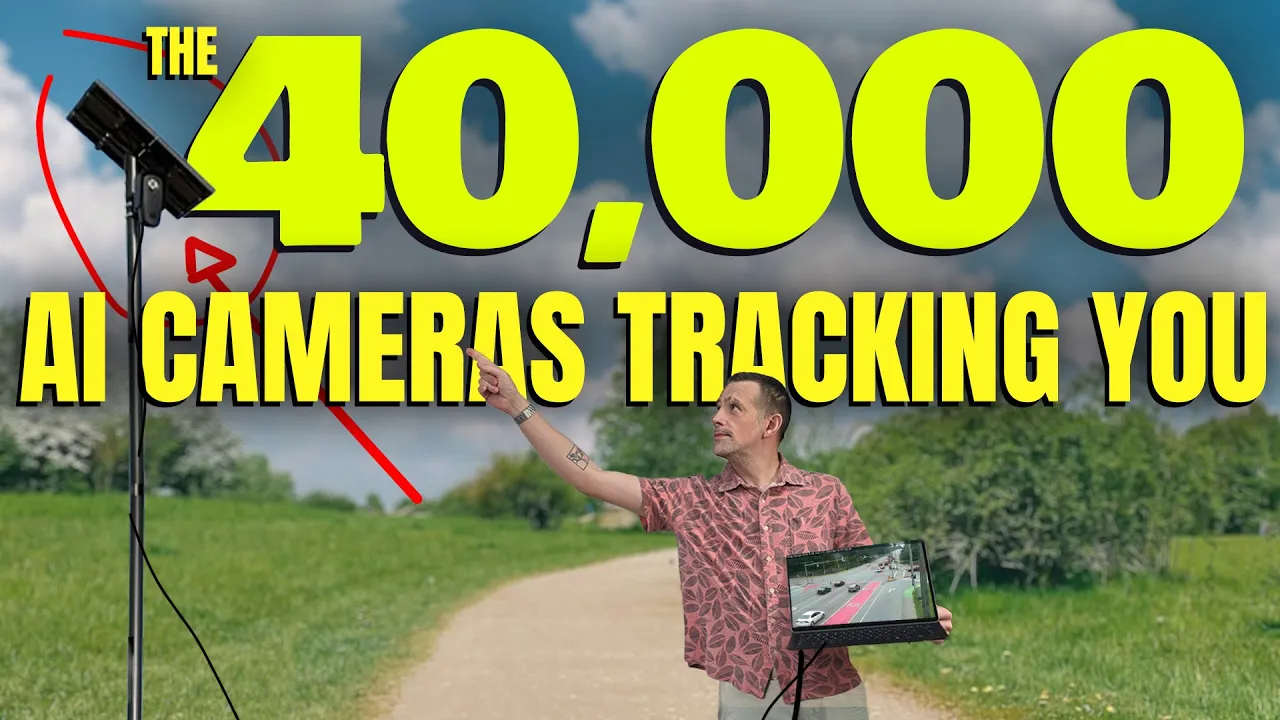
Benn Jordan Blinds Flock AI Plate Readers With Adversarial Noise
Benn Jordan
Flock Safety circumvents Fourth Amendment warrant rules to sell mass vehicle tracking data, making decentralized adversarial AI the only effective defense against algorithmic surveillance.
Private Automated License Plate Reader (ALPR) startup Flock Safety has achieved an $8 billion valuation by leasing machine-vision tracking networks to police and private entities while monetizing aggregated vehicle movement data behind subscription paywalls. (6:13)
Commercial surveillance networks remain deeply vulnerable, from WPA2 handshake cracking on Flock cameras and unauthenticated municipal RTSP feeds to compromised firmware in Hikvision and Verkada hardware. (13:22)
Targeted adversarial noise overlays can exploit mathematical blind spots in computer vision segmentation and OCR pipelines (such as YOLOv8 and Rekor), defeating automated plate recognition without obscuring text to the human eye. (21:20)
Unlike the EU's GDPR framework, US law lacks comprehensive federal protections against aggregating retail, health, and vehicle movement data, circumventing Fourth Amendment warrant precedents established in Carpenter v. United States. (29:21)
Detailed notes
## Background
Published on YouTube by Benn Jordan on August 26, 2025, this video examines how private third-party startups routinely log and broker vehicle location data across the United States without citizen consent. According to the video's description, the piece investigates how AI can be utilized to defend against warrantless tracking by police and commercial automated license plate readers.
## TL;DR
Jordan details how venture-backed data brokers like Flock Safety aggregate vehicle movements, retail profiles, and public records into massive, warrantless tracking databases plagued by frequent recognition glitches and cybersecurity vulnerabilities. After dissecting authentic police ALPR hardware and finding widespread network exploits across municipal and enterprise cameras, he constructs an independent, edge-based license plate scanner using a Raspberry Pi 5 and YOLO vision models. He then develops synthetic adversarial noise patterns capable of breaking computer vision segmentation and OCR pipelines while remaining readable to human observers. Ultimately, Jordan argues for a decentralized, open-source collective resistance to mass surveillance and presents an open proposal for transparent, publicly owned forensic tools for frontline law enforcement.
## Atmosphere & style
The presentation carries a blend of biting satirical outrage, investigative urgency, and calm, methodical maker-space craftsmanship. Jordan navigates effortlessly between indignant critiques of corporate surveillance capitalism and an approachable, hands-on engineering walkthrough filled with wry gallows humor. The viewer experiences a compelling shift from chilling revelations about constitutional erosion and data broker abuses into an empowering, grassroots laboratory demonstration of technical defiance.
## Bulletin
- [06:13](https://www.youtube.com/watch?v=Pp9MwZkHiMQ&t=373s) Private Automated License Plate Reader (ALPR) startup Flock Safety has achieved an $8 billion valuation by leasing machine-vision tracking networks to police and private entities while monetizing aggregated vehicle movement data behind subscription paywalls.
- [13:22](https://www.youtube.com/watch?v=Pp9MwZkHiMQ&t=802s) Commercial surveillance networks remain deeply vulnerable, from WPA2 handshake cracking on Flock cameras and unauthenticated municipal RTSP feeds to compromised firmware in Hikvision and Verkada hardware.
- [21:20](https://www.youtube.com/watch?v=Pp9MwZkHiMQ&t=1280s) Targeted adversarial noise overlays can exploit mathematical blind spots in computer vision segmentation and OCR pipelines (such as YOLOv8 and Rekor), defeating automated plate recognition without obscuring text to the human eye.
- [29:21](https://www.youtube.com/watch?v=Pp9MwZkHiMQ&t=1761s) Unlike the EU's GDPR framework, US law lacks comprehensive federal protections against aggregating retail, health, and vehicle movement data, circumventing Fourth Amendment warrant precedents established in Carpenter v. United States.
## Key takeaways
- [00:00](https://www.youtube.com/watch?v=Pp9MwZkHiMQ&t=0s) Automated license plate readers across the United States are largely manufactured, leased, and operated by private venture-backed startups rather than public municipal agencies.
- [01:08](https://www.youtube.com/watch?v=Pp9MwZkHiMQ&t=68s) Computer vision and OCR errors frequently trigger dangerous police stops of innocent citizens, leading to multi-million-dollar municipal settlements paid by taxpayers rather than camera vendors.
- [01:51](https://www.youtube.com/watch?v=Pp9MwZkHiMQ&t=111s) Flock Safety functions primarily as an aggressive data broker, packaging vehicle trajectories, classifications, and retail parking movements into cross-client searchable databases without requiring judicial warrants.
- [06:13](https://www.youtube.com/watch?v=Pp9MwZkHiMQ&t=373s) Backed heavily by venture capital firms like Andreessen Horowitz, surveillance firms have invested over $92 million into lobbying to protect commercial surveillance operations from legislative interference.
- [08:08](https://www.youtube.com/watch?v=Pp9MwZkHiMQ&t=488s) Platforms like Flock Nova merge dispatch logs, background records, and private video surveillance with third-party data broker feeds that have included hacked, dark-web datasets.
- [09:09](https://www.youtube.com/watch?v=Pp9MwZkHiMQ&t=549s) Major retail privacy policies permit extensive harvesting of customer identities, biometric indicators, and location data that are routinely cross-referenced and shared with law enforcement and immigration authorities.
- [13:22](https://www.youtube.com/watch?v=Pp9MwZkHiMQ&t=802s) Flock cameras and municipal surveillance systems frequently exhibit severe security vulnerabilities, including crackable WPA2 access points, unencrypted RTSP video streams, and unencrypted onboard storage.
- [17:52](https://www.youtube.com/watch?v=Pp9MwZkHiMQ&t=1072s) A custom edge ALPR rig built with a Raspberry Pi 5, Hailo AI acceleration board, and YOLOv11 can match or exceed commercial recognition accuracy for roughly $250 without relying on proprietary cloud infrastructures.
- [21:20](https://www.youtube.com/watch?v=Pp9MwZkHiMQ&t=1280s) Adversarial noise perturbations exploit the black-box nature of deep vision models, causing image segmentation models to fail bounding-box detection or scramble optical character extraction.
- [23:46](https://www.youtube.com/watch?v=Pp9MwZkHiMQ&t=1426s) Synthetic testing using automated pipelines demonstrates that specific geometric noise patterns induce complete detection dropouts on vanity test plates while remaining legible to human observers.
- [27:33](https://www.youtube.com/watch?v=Pp9MwZkHiMQ&t=1653s) Defending against widespread algorithmic tracking requires an open-source, decentralized 'Hydra' approach to rapidly generate new adversarial patterns as proprietary computer vision models evolve.
- [29:21](https://www.youtube.com/watch?v=Pp9MwZkHiMQ&t=1761s) Supreme Court precedent in Carpenter v. United States strictly limits warrantless continuous location tracking, but courts have yet to apply these Fourth Amendment protections to third-party commercial AI networks.
- [31:02](https://www.youtube.com/watch?v=Pp9MwZkHiMQ&t=1862s) Commercial privacy removal tools often fail in the United States because brokers can legally continue trading data on the backend, contrasting sharply with structural opt-in safeguards mandated under GDPR.
- [33:27](https://www.youtube.com/watch?v=Pp9MwZkHiMQ&t=2007s) Legitimate police forensic technology should rely on modular, open, transparent frameworks owned by the justice system rather than proprietary systems controlled by venture capital firms.
## Detailed walkthrough
### [00:00](https://www.youtube.com/watch?v=Pp9MwZkHiMQ&t=0s) The Ubiquitous Surveillance Machine
Across the United States, small, unobtrusive devices have become so ubiquitous that drivers pass them every single day without a second thought. Blending seamlessly into the scenery like utility poles or trees, they are casually dismissed as simple traffic cameras. In reality, they are sophisticated automated license plate reader (ALPR) systems running AI computer vision models. These systems are not owned or operated directly by local municipal governments or police departments. Instead, they are manufactured and leased out by private third-party startups acting as massive commercial data brokers that track and log vehicle movements nationwide.
This surveillance network extends far beyond public streets. Major corporate retail chains have deployed these same camera systems across their parking lots, systematically linking customer vehicle coordinates with credit card records, shopping habits, and in-store movement patterns. In many instances, private businesses share this tracking data directly with law enforcement agencies. Benn Jordan points out that this sprawling ecosystem operates quietly in the background—and suggests there may be a technical approach to disrupt it.
[01:08](https://www.youtube.com/watch?v=Pp9MwZkHiMQ&t=68s) The Human Cost of Algorithmic "Superpowers"
News anchors and PR outlets routinely frame these automated camera networks as modern technological miracles that foil car thieves and rescue lost citizens. Benn mocks these glowing news narratives with biting sarcasm, reading typical breathless headlines before puncturing each one:
```
"This Colorado family was being driven to a shopping center in a stolen vehicle, and they would have gotten away with it without cutting edge technology alerting police of their crime."
>> "Nah, that was actually an OCR error."
"Well, this New Mexico woman and her 12-year-old sister were driving to the park with a stolen license plate when AI enhanced technology allowed police to—"
>> "That one was another computer vision error."
"Well, yet another car thieving woman of color caught red-handed."
>> "Nope, just a glitch."
```
Benn emphasizes that this pattern keeps repeating across the nation, driven by a perverse cycle of public spending: “Your tax dollars pay startups to rent AI superpowers to law enforcement, and then the following year, your tax dollars pay the lawsuit settlements when it doesn't work.”
One glaring incident occurred in Aurora, Colorado, where an optical character recognition (OCR) glitch flagged a family's vehicle as stolen. Police officers ordered an innocent mother and her young children out of the car, forcing them to lie face down on the hot asphalt at gunpoint. That single computer vision failure resulted in a $1.9 million civil settlement paid out by Aurora taxpayers—an outcome conspicuously absent from company promotional decks.
[01:51](https://www.youtube.com/watch?v=Pp9MwZkHiMQ&t=111s) How Flock Safety Operates and Monetizes Movement
Founded in 2017, Flock Safety specializes in leasing out network-connected security and ALPR cameras enhanced by machine vision models. When any vehicle drives past a Flock camera, the hardware captures high-resolution imagery and passes it through an image segmentation pipeline. This model searches the frame for specific bounding geometries—such as rear license plate brackets, tail light configurations, or rear windshields. Once an area of interest meets an internal confidence threshold, the cropped sub-image is handed off to an optical character recognition (OCR) model (the same core technology used for digital check deposits on smartphone banking apps).
```mermaid
flowchart TD
accTitle: Flock Safety Data Capture Flow
accDescr: Diagram illustrating how vehicle images are captured by Flock cameras, processed via machine vision models, and aggregated into a searchable law enforcement database.
subgraph Hardware ["On-Street Capture"]
A["Flock Security Camera"] -->|"Image / Video Capture"| B["Edge Frame Processing"]
end
subgraph VisionPipeline ["AI Processing Pipeline"]
B --> C["Image Segmentation Model"]
C -->|"Isolate Vehicle & Plate Box"| D["Confidence Check"]
D -->|"Threshold > 90%"| E["OCR Model & Metadata Tagging"]
end
subgraph Aggregation ["Broker Data Engine"]
E --> F["Enriched Database Record"]
F --> G["Law Enforcement Hot List"]
F --> H["Cross-Client Query Paywall"]
end
```
If the OCR system is sufficiently confident (typically 90% or higher), the character string is recorded alongside precise GPS coordinates, a timestamp, and vehicle classifications (including make, model, color, aftermarket alterations, bumper stickers, and body damage). Because thousands of these cameras blanket cities, querying a single license plate yields a comprehensive historical breadcrumb trail. Functionally, “it pretty much has the same effect as secretly sticking a GPS device on your car.”
Private customers—such as businesses and homeowners associations (HOAs)—also lease these cameras and routinely grant local police departments administrative access to their private feeds. Police can upload specific plates to a real-time “hot list,” automatically alerting officers the second a tracked car crosses any sensor. This continuous surveillance occurs completely outside the traditional legal framework: Benn notes it functions like “having a police tail all day, every day, but without the pesky annoyances of requiring a judicial warrant to target and track a citizen who may not even be suspected of any sort of crime.”
Abuse is already documented. In multiple verified instances, rogue officers have misused the database to obsessively stalk ex-partners and their new companions. Elsewhere, agencies explore leveraging cross-state tracking networks to monitor individuals traveling across state lines to seek abortions. Flock's aggressive rollout is typified by moves like installing nearly 100 unauthorized ALPR units along public rights-of-way near Orlando, Florida, without notifying county officials.
- **Lease Costs:** Police departments and municipalities typically pay an annual subscription fee ranging between $2,000 and $3,000 per camera per year on top of installation expenses.
- **Contract Protections:** Flock’s contracts include strict liability waivers protecting the vendor if faulty data derails an investigation, along with an explicit clause telling police departments to dial 911 rather than rely on Flock during emergencies.
- **Hardware Lockout:** Agreements ban customers from disassembling, decompiling, or modifying any hardware; Benn reveals that although he owns ALPR hardware, his legal counsel warned that showcasing physical Flock equipment on camera would trigger immediate legal suppression.
[06:13](https://www.youtube.com/watch?v=Pp9MwZkHiMQ&t=373s) The Venture Capital Data Empire
Benn explains that Flock Safety is not fundamentally a public-safety company; license plate readers have existed for decades. Flock is an aggressive data broker. By retaining contractual rights to aggregate and cross-license footage across jurisdictions, HOAs, retail hubs, and police units, Flock sells back access to this unified web behind a subscription paywall.
The scale of venture capital backing demonstrates that Silicon Valley evaluates Flock as an information broker rather than a physical security provider:
- **Major Backing:** Venture firm Andreessen Horowitz (a16z)—known for backing data giants like Databricks, Scale AI, and Golden—has poured hundreds of millions into Flock, including a $275 million funding round.
- **Market Valuation:** While legacy home-security titan ADT (founded in 1874, public since 1969) carries a market capitalization of $6.8 billion, Flock Safety’s Series F valuation surged to nearly $8 billion.
- **Lobbying Power:** Together, Flock Safety and Andreessen Horowitz have spent a staggering $92,680,000 on political lobbying efforts, with the vast majority concentrated over the preceding twelve months.
Benn dismisses defenders who argue that widespread surveillance is simply the price of public safety: “And those small little glitches that result in young children being held at gunpoint face first on the hot asphalt in a parking lot are just some cracked eggs in the overall omelet that society is trying to make. And if you agree with that and that's your perspective, fair enough. I strongly disagree with you.”
[08:08](https://www.youtube.com/watch?v=Pp9MwZkHiMQ&t=488s) Flock Nova and Illicit Data Pipelines
The surveillance ecosystem is expanding even further through a product called Flock Nova. Promoted in company launch videos as an automated investigative platform that delivers “one click to one case solved,” Nova consolidates multiple disparate intelligence streams into a single dashboard:
| Integrated Intelligence Streams |
|:--- |
| Computer-Aided Dispatch (CAD) logs |
| Criminal background records & mugshots |
| Live and recorded public & private video surveillance |
| Flock ALPR location histories |
| Third-party acquired data broker feeds |
When independent investigative outlet *404 Media* pressed the company on what those third-party databases actually contained, they revealed that Flock Nova had ingested stolen information originating from major corporate data hacks and illegal breaches sold across the dark web. While Flock quickly issued a public relations disclaimer claiming it would no longer utilize illegally leaked personal data, the incident underscored how far the company is willing to go to build a universal surveillance ledger.
[09:09](https://www.youtube.com/watch?v=Pp9MwZkHiMQ&t=549s) The Data Honeypot: From BetterHelp to Walmart and ICE Raids
Many people shrug off data farming, assuming that activity on an anonymized platform like Pinterest does not really matter. However, the true danger emerges when disparate data sets are cross-referenced and combined, entirely stripping away that anonymity. Benn Jordan details the chain reaction: personal health questionnaires filled out on BetterHelp get sold to Facebook; this connects to photos you posted at bars ten years ago; a third-party data broker then bundles that with telematics sold by your vehicle manufacturer tracking your driving habits. This aggregated profile explains why your auto insurance might suddenly cost twice as much as your peers', why you are denied favorable loan rates, or even, in 2025, how decades-old social media activity could lead to arrest or deportation. While certain states pass privacy regulations, companies treat the occasional fine or legal settlement as a mere cost of doing business compared to the massive profits generated from commercializing third-party data.
```mermaid
flowchart TD
accTitle: Third-Party Data Aggregation Pipeline
accDescr: How disparate data sources are combined by brokers and weaponized against consumers and immigrants.
subgraph Sources["Disparate Data Collection"]
A["BetterHelp Health Surveys"]
B["Social Media / Facebook Posts"]
C["Connected Vehicle Telematics"]
D["Walmart In-Store Tracking"]
end
subgraph Aggregation["Broker Integration"]
E["Third-Party Data Brokers"]
Sources --> E
end
subgraph Impacts["Real-World Repercussions"]
F["Doubled Insurance Rates & Bad Loans"]
G["Police & ICE Hotlist Alerts"]
H["Apprehension & Deportation"]
E --> F
E --> G
G --> H
end
```
The invasion escalates dramatically the moment a consumer steps into retail stores. Even if chains avoid Flock Safety, they deploy alternative automated license plate readers (ALPRs) in their parking lots and deep surveillance inside their buildings. Examining Walmart’s corporate privacy policy reveals an astonishing inventory of tracked attributes:
- **Personal Identifiers:** Names, physical addresses, phone numbers, email addresses, driver's license numbers, and physical signatures.
- **Hardware Identifiers:** Device signatures, including smartphone and smartwatch MAC addresses.
- **Demographic & Socioeconomic Data:** Age, gender, citizenship status, race, marital status, household income, education level, unemployment records, and number of children.
- **Sensitive Records:** Family medical health, payment information, credit card numbers, background checks, and criminal conviction histories.
- **Surveillance Media:** Geolocation tracking histories, photographs, audio recordings, and video feeds.
- **Behavioral Inferences:** Inferred intelligence, psychological aptitude, and granular consumer preferences derived from purchase patterns.
Retailers explicitly reserve the right to share all of this data with third parties. Police departments have already been documented querying Flock Safety databases and sharing the records with Immigration and Customs Enforcement (ICE). Major home-improvement retailers like The Home Depot and Lowe's utilize Flock Safety and routinely feed camera data to law enforcement. Jordan notes that immigration raids conducted at these retail locations are directly tied to this shared data ecosystem: an undocumented day laborer stops by to purchase construction supplies before work, the store's ALPR system flags their vehicle to an active hotlist, and federal agents arrive to arrest and deport someone with no criminal record to an El Salvador prison camp. As Benn Jordan bluntly puts it: “My point is, data privacy never really seems like a big deal until it is.”
---
[11:56](https://www.youtube.com/watch?v=Pp9MwZkHiMQ&t=716s) The Broken Illusion of Data Security
The modern surveillance landscape forces society into a state of structural paranoia. AI cameras track every vehicle's physical movement for police, corporate retailers, and private gated communities, while retail giants build comprehensive psychological dossiers that are brokered to law enforcement. Jordan highlights a sobering structural reality: even if every single corporate actor and law enforcement agency operated ethically and followed the letter of the law, personal data remains fundamentally unsafe. It is always vulnerable to whichever partner maintains the weakest cybersecurity posture or the single employee who clicks on a targeted phishing link.
In 2024 alone, publicly reported data breaches exceeded 10,000 distinct incidents, compromising more than 4.2 billion individual records. Against this backdrop, Jordan mocks legislative posturing that ignores corporate data harvesting while attempting to fix the problem by banning TikTok:
> “Debating the safeguarding of personal data in 2025 is like standing on the burnt remains of a home and debating what kind of fire extinguisher you're going to put in the kitchen.”
Rather than debating big-data ethics or corporate overreach, Jordan pivots back to the tax-funded surveillance apparatus, setting out to investigate the hardware vulnerabilities in police and municipal tracking networks to discover how citizens can defend themselves.
---
[13:22](https://www.youtube.com/watch?v=Pp9MwZkHiMQ&t=802s) Exploiting ALPR Hardware: From WPA2 and RTSP to Hikvision and Verkada
Dissecting the hardware of Automated License Plate Recognition systems exposes an alarming lack of basic security. Flock Safety cameras feature Bluetooth radios, which primarily broadcast diagnostic telemetry and hardware status. More crucially, the units deploy an internal Wi-Fi radio running as a WPA2-encrypted access point. Because WPA2 is a two-decade-old protocol relying on a pre-shared key handshake, it lacks the lockout safeguards found on iPhones or web portals, where users are blocked after a half-dozen failed attempts. An attacker can capture the WPA2 handshake over the air, offload the hash to a local GPU, and brute-force an 8-character key in under three hours—or within 60 seconds if the password matches a standard dictionary entry.
Beyond Wi-Fi vulnerabilities, many municipal traffic systems leave their RTSP (Real-Time Streaming Protocol) video streams wide open to the public internet without authentication. Using specialized search engines, Jordan gained direct access to live video feeds from more than two dozen municipal traffic cameras in just a few hours. In multiple small towns, failing to secure a single camera meant the entire local network was exposed, allowing anyone to monitor the movements of every vehicle in the municipality without writing a single line of code.
```mermaid
flowchart LR
accTitle: Surveillance Camera Vulnerabilities
accDescr: Common security flaws across commercial and police ALPR systems.
subgraph Flock["Flock Safety"]
F1["Exposed Handshake"] --> F2["Local GPU Brute-Force"]
end
subgraph Municipal["Municipal Traffic Feeds"]
M1["Unencrypted RTSP"] --> M2["Total Town Surveillance"]
end
subgraph Hikvision["Hikvision Cameras"]
H1["Firmware Flaws"] --> H2["Remote Code Execution"]
end
Major international and commercial surveillance vendors show similar vulnerabilities:
- **Hikvision:** The world's largest IP camera manufacturer sells ALPR cameras widely adopted by police. In 2022, a firmware vulnerability exposed over 80,000 cameras to remote code execution. In 2024, the Russian military hijacked Hikvision cameras across Ukraine to gather battlefield intelligence, circumvent air defense systems, and coordinate missile strikes on Kyiv. Exploits remain actively available on GitHub to hijack feeds, grab snapshots, and extract credentials.
- **Verkada:** Known for locking clients into predatory enterprise contracts where cloud access expires if expensive hardware bolted to the ceiling is not continuously relicensed. When an administrator password was exposed online, attackers compromised all 150,000+ internal and customer cameras, obtaining root access to client local networks, private live feeds, and historical footage archives across hospitals, jails, and police departments.
---
[16:32](https://www.youtube.com/watch?v=Pp9MwZkHiMQ&t=992s) Dissecting Police Hardware: Inside a Motorola Vigilant ALPR
The surveillance industry treats technical scrutiny with intense hostility, issuing cease-and-desist letters against teardowns and forcing customers into restrictive non-disclosure agreements under the guise of security. Jordan argues that security through obscurity is counterproductive: true physical and civic security demands complete open transparency, and public security research forces manufacturers to patch critical vulnerabilities before malicious actors exploit them.
Jordan acquired an authentic police-cruiser ALPR unit manufactured by Vigilant Solutions, a law-enforcement-facing subsidiary of Motorola. Examining the hardware revealed that the engineering prioritized obfuscating the design and creating proprietary lock-in rather than engineering a reliable security device. In a glaring oversight, the unit stored its data unencrypted on a standard, internal microSD card. The physical unit relies on a dual-camera sensor setup to capture vehicles, setting the stage for Jordan's technical deep dive into defeating license plate tracking.
[17:52](https://www.youtube.com/watch?v=Pp9MwZkHiMQ&t=1072s) Deconstructing Police ALPR Hardware and Building a DIY Scanner
Police Automated License Plate Readers (ALPRs) rely on a dual-camera setup consisting of two specialized optical sensors: one dedicated to daytime imaging and one for nighttime capture, surrounded by an array of infrared (IR) light emitters. When a police cruiser trails a vehicle at night, the system emits an invisible infrared flash timed with an ultra-high-speed exposure. This deliberate underexposure leaves the ambient environment pitch black while picking up only the intense infrared reflection off the retroreflective sheeting of the license plate itself. Because human vision cannot detect infrared wavelengths, neither the vehicle's driver nor the officer typically realizes a flash has fired. A demonstration of camera exposures illustrates this: a long exposure without flash captures ambient lighting, a long exposure with infrared flash washes out the plate, and a high-speed flash exposure isolates the plate cleanly against complete darkness.
```mermaid
flowchart TD
accTitle: DIY ALPR Architecture
accDescr: Hardware layout showing camera feeding Raspberry Pi 5 with Hailo AI board running local YOLO inference to touchscreen.
subgraph Capture["Image Capture"]
CAM["Dual-Channel Camera\n(No USB Overhead)"]
end
subgraph Processing["Edge Compute"]
PI["Raspberry Pi 5"]
HAILO["Hailo AI Board\n(26 TOPS NPU)"]
YOLO["YOLOv11 Vision Model\n(Segmentation & OCR)"]
end
CAM --> PI
PI <--> HAILO
HAILO --> YOLO
YOLO --> SCREEN
YOLO -.-> NET
```
Although Benn Jordan acquired an authentic police-grade ALPR unit, the channel’s attorney advised against powering up and operating the original commercial equipment on camera due to the complex legalities surrounding its acquisition. Jordan dismantled the device down to its board components to analyze the sensor and processor architecture. Instead of relying on proprietary law-enforcement hardware that offloads video to remote cloud servers, he designed a sleek, self-contained edge system mounted in his own truck for roughly $250.
Building the rig presented distinct software and hardware hurdles:
- **Image Segmentation vs. Plate Reading:** Extracting plate text via Optical Character Recognition (OCR) proved simple, but teaching the system to detect the plate itself was grueling because rectangular geometries are ubiquitous in automotive environments.
- **Upgraded Compute and Models:** Jordan abandoned older open-source engines like OpenALPR in favor of YOLO (You Only Look Once), which delivered substantially higher accuracy than commercial public safety data broker systems. Because YOLOv11 is computationally demanding, Jordan integrated a Hailo AI acceleration board providing 26 TOPS of neural processing power onto a Raspberry Pi 5 mounted behind a 7-inch touchscreen.
- **Direct Dual-Channel Sensor:** He replaced an initial USB camera module with a dual-channel camera interfacing directly with the Raspberry Pi to bypass the operational overhead and latency of a USB controller.
- **Network Spoofing Vulnerabilities:** Jordan interfaced the device with Rekor Scout (a network akin to Flock Safety that allows private and residential camera owners to share automated vehicle logs with law enforcement). He pointed out a glaring flaw in consumer-facing police camera ecosystems: because systems accept remote video streams, an attacker could hypothetically commit a crime and feed a simulated RTSP stream to the network logging their vehicle 400 miles away at the exact same moment.
[21:20](https://www.youtube.com/watch?v=Pp9MwZkHiMQ&t=1280s) Adversarial Noise, Poison Pills, and the Black Box Dilemma
To address surveillance creep, Jordan turned to adversarial noise—a technique designed to introduce targeted, near-invisible pixel perturbations that exploit the fundamental mathematical blind spots of computer vision models. Drawing a parallel to his previous work developing audio noise that prevents AI music platforms from scraping and cloning independent musicians' albums by confusing genre and instrument classifiers, Jordan argues that direct technical countermeasures are a necessity. As Benn Jordan stated: “The reason I develop things like this is because the people that we've elected to protect our intellectual property and our privacy rights aren't doing their jobs.”
```mermaid
flowchart LR
accTitle: Data Sorting Pipeline for Adversarial Noise Training
accDescr: 1,000 synthetic test images run through dual vision models and sorted into Class A, Class B, and Class C bins.
IMG["Synthetic Traffic Images\n(Noisy Plate Overlays)"] --> EVAL{"Dual-Model Inference\n(Segmentation + OCR)"}
EVAL -->|"Plate Not Found\n(Segmentation Fail)"| CLA["Class A\n(Segmentation Defeated)"]
EVAL -->|"Plate Found,\nCharacters Misread"| CLB["Class B\n(OCR Misread)"]
EVAL -->|"Correct Detection\n& Read"| CLC["Class C\n(Control Group)"]
```
These adversarial attacks strike at the industry's reliance on pre-trained, black-box networks. When vision systems fail, developers cannot simply patch the logic because the models do not process faces, shapes, or letters with conscious human-like reasoning. Jordan referenced Nightshade—a project used by digital illustrators to poison-pill artwork against generative AI scraping. While generative AI platforms mitigated Nightshade by blurring images and subsequently running sharpening models to filter out high-frequency noise, that workaround causes severe problems for ALPR systems. In license plate reading, the explicit objective is precise optical character extraction rather than image generation; introducing blur-and-sharpen processing pipelines increases latency, bloats compute costs, and degrades edge-level text readability.
[23:46](https://www.youtube.com/watch?v=Pp9MwZkHiMQ&t=1426s) Synthetic Datasets and the Proving Ground Pipeline
To train an AI model capable of generating invisible anti-tracking overlays, Jordan established an automated dataset generation pipeline:
- **Synthetic Batch Processing:** A Processing-based application takes 1,000 identical traffic scenes and superimposes license plates with algorithmic noise variations, some barely noticeable and others slightly more textured.
- **Tri-Tier Classification:**
- **Class A:** Neither model detects the presence of a plate or rectangle at all (complete failure of image segmentation).
- **Class B:** Both models detect the rectangular plate bounding box, but the OCR reads the characters incorrectly.
- **Class C (Control Group):** Either model successfully locates the plate and transcribes the characters accurately.
- **Python Proving Ground:** Jordan built a custom desktop GPU benchmarking utility. The script ingests a directory of perturbed images, runs dual-model inference, exports visual bounding boxes with confidence scores, and dumps the analytics into a CSV spreadsheet for side-by-side evaluation.
Testing the perturbed variations of his custom test plate—bearing the vanity text `POO 5000`—revealed radical misclassifications. Models transcribed the noisy plate as `PU 5000`, `MOO 5000`, `PDQ 50954`, `DO 5000`, and `PO 5D`. Most critically, specific noise profiles caused complete segmentation dropouts where the models could no longer recognize the plate outline as a rectangle. Jordan noted that if the geometry breaking the segmentation model can be isolated, drivers could achieve surveillance immunity using a passive license plate frame that never even covers or obscures the characters.
[25:56](https://www.youtube.com/watch?v=Pp9MwZkHiMQ&t=1556s) Real-World Road and Parking Lot Testing
Transitioning from synthetic benchmarks to real-world deployment, Jordan printed the high-performing adversarial noise patterns onto transparent adhesive sheets and applied them over his physical `POO 5000` plate. He warned that driving with such overlays on public streets could lead straight to citations or arrest for plate tampering, joking: “This is just an easy way to test the patterns and definitely not something you would actually want to put on your car and drive on public roadways unless you miss your friends in prison.”
Jordan initiated low-speed drive-by tests at 12 mph—and further throttled down to typical congested parking lot speeds—to give the ALPR cameras an easy baseline. At close proximity and low speeds, the text was visually indistinguishable from a standard, clear plate to human eyes, setting up a direct confrontation with the four test engines: Rekor, YOLOv11, Plate Recognizer, and openALPR.
[26:36](https://www.youtube.com/watch?v=Pp9MwZkHiMQ&t=1596s) Real-Time Testing and Adversarial Noise Results
Testing the defensive adversarial patterns against live video feeds yields clear differences between unmodified plates and manipulated layers. With no adversarial noise applied, the detection system reads a raw license plate as "PO 5000" without hesitation. However, once adversarial noise layer A is introduced, the model becomes completely confused, failing to achieve the confidence threshold necessary to register a plate at all. Benn also tests an older plate style featuring red lettering that hasn't been in circulation for thirty or forty years—vastly different from the initial black noise attack vectors—which likewise succeeds in heavily disrupting recognition.
```mermaid
flowchart TD
accTitle: License Plate OCR Detection Flow Under Adversarial Attack
accDescr: Flow showing how raw plates pass detection while adversarial noise and vintage patterns cause detection models like YOLOv8 to fail confidence thresholds.
When piped directly into YOLOv8, several iterations completely fool the detector. While Benn anticipated that not every single experimental layer would pass the test, a significant portion succeeded. As Benn puts it, “And I'm reasonably confident that if I just screen printed some of these on a plate and slapped it on my vehicle, I'd be a traffic camera ninja.” However, he cautions that these visible printed patterns are likely not street legal and merely serve as intermediate training steps toward an ideal final model—one designed to be entirely invisible to the human eye without obstructing physical plate readability.
[27:33](https://www.youtube.com/watch?v=Pp9MwZkHiMQ&t=1653s) Open Source Philosophy and the Hydra Defense
Following past releases like Harmony Cloak and the music-protection algorithm Poisonify, Benn received an influx of requests for turnkey consumer apps, alongside buyout offers and venture capital solicitations demanding exclusive ownership. Rejecting commercial monetization, he maintains this project under his nonprofit research ethos, where work is shared freely and publicly. He compares systemic privacy resistance to the mythical Lernaean Hydra, noting that whenever one of the beast's venomous heads was chopped off, two sprouted in its place.
Defeating mass algorithmic surveillance demands an open, decentralized collective of contributors who build, share, and iterate defensive patterns. If proprietary AI developers update their computer vision models to overcome one evasion technique, open collaboration ensures multiple new counter-methods emerge immediately. Benn clarifies that his goal is never to evade lawful human observation:
> “And it's worth pointing out that I have absolutely no problem with my license plate being identifiable or readable by law enforcement officers or even the person driving behind me.”
- Benn views driving a two-ton vehicle at speeds over 100 mph as a serious privilege and public safety responsibility that justifies visible plate identification.
- The objective of his research is to break warrantless, centralized mass AI surveillance, not to hide vehicles from frontline human officers or legitimate dashboard-mounted cruiser cameras.
[29:21](https://www.youtube.com/watch?v=Pp9MwZkHiMQ&t=1761s) Fourth Amendment Precedent and Corporate Surveillance Monopolies
Under longstanding legal standards across the United States, law enforcement must obtain a warrant signed by a judge to continuously monitor an individual's phone location or ping their device past a single cell tower. This Fourth Amendment principle was formally established by the Supreme Court of the United States in the 2018 landmark decision *Carpenter v. United States*. The Court explicitly recognized that pervasive location tracking uncovers an intimate mosaic of a citizen's personal, religious, political, and medical life:
> “Timestamp data provides an intimate window into a person's life, revealing not only his particular movements, but through them his familial, political, professional, religious, and sexual associations. These location records, quote, hold for many Americans the privacies of life.”
Despite this clear legal benchmark, courts have yet to rule directly on warrantless automated location tracking powered by third-party private AI networks. Benn points out that an adverse constitutional ruling would decimate venture-backed startups: “And if they agree that it's a constitutional violation, they'll be leading the Flock Safety unicorn out of its $8 billion stable and shooting it right in the head.” With Flock Safety and its primary venture backers pouring a combined $92 million into lobbying efforts, legislative clarity remains stalled. Because the state-by-state legality of using adversarial noise on license plates remains entirely untested, Benn explicitly advises viewers to treat his research strictly as an academic foundation rather than applying physical stickers to their personal cars, warning: “I would not advise or ask that you immediately screen print or place a matte sticker on your license plate because you very well could be the one that they make an example out of.”
[31:02](https://www.youtube.com/watch?v=Pp9MwZkHiMQ&t=1862s) The Mirage of Privacy Services and Transatlantic Data Laws
Benn criticizes popular commercial data removal services like Incogni or DeleteMe, calling out their promotional campaigns for pitching an illusion of privacy while charging hundreds of dollars per year. In the United States, data brokers are only bound to stop displaying personal information upon request; nothing prevents them from immediately licensing or reselling backend data right back into circulation. Pointing out the irony, Incogni is owned by Nord Security (NordVPN), whose affiliates regularly market their products as "hackproof" despite Nord suffering a major security breach that went undisclosed to users for eighteen months—a topic thoroughly covered in an essay by *Reject Convenience*.
```mermaid
flowchart LR
accTitle: International Privacy Models Comparison
accDescr: Diagram contrasting US lack of data regulation with EU GDPR and international opt-in protections.
subgraph UnitedStates ["United States Framework"]
US_LAW["No Comprehensive Federal Framework"]
BROKERS["Data Brokers Harvest & Sell Freely"]
LEGAL_GAP["ALPR Data Bundled with Retail & Sentiment AI"]
US_LAW --> BROKERS --> LEGAL_GAP
end
In stark contrast, the European Union's General Data Protection Regulation (GDPR) treats privacy as an inalienable human right, mandating explicit opt-in consent before any data logging occurs. These strict, extraterritorial legal frameworks have inspired corresponding safeguards across the UK, Japan, Brazil, Argentina, Switzerland, South Korea, Canada, India, and China, forcing multinational tech giants like Google and Meta to comply to retain market access.
- In nations governed by GDPR-style statutes, disrupting ALPR systems is unnecessary because car movements cannot legally be combined with health records, online behavior, or retail camera sentiment analysis to be leased back to police agencies.
- Decades of congressional inaction following the 1990s internet boom, alongside the weaponization of voter data in the 2016 election, leave ordinary American citizens with no systemic protections: “So yeah, I guess we'll just fucking DIY it.”
[33:27](https://www.youtube.com/watch?v=Pp9MwZkHiMQ&t=2007s) An Open Proposal to Law Enforcement and Closing
In an editing room direct address, Benn speaks directly to frontline police officers and agency personnel. He clarifies that his anger is directed not at street-level officers—whom he views as hard-working, chronically underpaid, and undertrained—but at corporate tech executives who commodify policing for venture returns. In particular, promotional materials featuring Flock's CEO boasting that "Flock Nova" offers a magical "one click to one case solved" minimize the complex realities of investigative field work.
> “While it may not seem like it, I am actually aligned with your ability to safely reduce crime. It's just that I want the most effective forensic technology to be owned by the justice system, not venture capital firms.”
To foster real solutions, Benn announces an open proposal detailing how law enforcement agencies can build modular, fully upgradable, open-framework tracking systems that preserve transparency and strictly conform to trial evidence admissibility rules. He opens his email to officers with technical inquiries, thanks his Patreon supporters for financing an expensive video budget consisting of government surplus hardware, optical components, and software licenses, and invites viewers to join his community for music, stems, and scientific experiments.
## Notable quotes
> [01:08](https://www.youtube.com/watch?v=Pp9MwZkHiMQ&t=68s) Your tax dollars pay startups to rent AI superpowers to law enforcement, and then the following year, your tax dollars pay the lawsuit settlements when it doesn't work. — Benn Jordan
> [11:56](https://www.youtube.com/watch?v=Pp9MwZkHiMQ&t=716s) Debating the safeguarding of personal data in 2025 is like standing on the burnt remains of a home and debating what kind of fire extinguisher you're going to put in the kitchen. — Benn Jordan
## Mentioned
Benn Jordan, Flock Safety, Flock Nova, Andreessen Horowitz, ADT, 404 Media, BetterHelp, Facebook, Walmart, The Home Depot, Lowe's, U.S. Immigration and Customs Enforcement (ICE), TikTok, Hikvision, Verkada, Motorola, Vigilant Solutions, OpenALPR, YOLO, YOLOv8, YOLOv11, Hailo, Raspberry Pi 5, Rekor Scout, Plate Recognizer, Nightshade, Harmony Cloak, Poisonify, Supreme Court of the United States, Carpenter v. United States, Incogni, DeleteMe, Nord Security, Reject Convenience, General Data Protection Regulation (GDPR), Google, Meta
## Video description
If you live in the United States, it's very likely that a private startup has been logging and sharing your vehicle's location without your consent. In this video we explore how AI can defend against being tracked by 3rd party police and retail AI tracking cameras.
💗 Support this channel and join an amazing community: http://www.patreon.com/bennjordan
👀 Stalk me on social media for more frequent updates (Github link here): https://linktr.ee/BennJordan
🔴 Subscribe To My Streaming Channel. I stream weekly! https://www.youtube.com/watch?v=geaIEWGhgsI
Video links:
Reject Convenience video: https://www.youtube.com/watch?v=iX3JT6q3AxA
⚡Those lovely custom acoustic panels in the background: https://psyacoustics.com
Benn Jordan利用对抗性噪点干扰Flock AI车牌识别系统
Flock Safety绕过第四修正案搜查令规则出售大规模车辆追踪数据,使得去中心化的对抗性AI成为抵御算法监控的唯一有效手段。
Jordan详细揭露了像Flock Safety这样由风投资助的数据经纪商如何将车辆移动轨迹、零售画像和公共记录汇总成庞大且无需搜查令的追踪数据库,而这些系统频受识别故障和网络安全漏洞的困扰。在剖析了真实的警方自动车牌识别(ALPR)硬件并发现市政和企业摄像头中普遍存在网络漏洞后,他使用Raspberry Pi 5和YOLO视觉模型构建了一个独立的边缘端车牌扫描仪。随后,他开发了合成对抗性噪点图案,能在保持人眼可读的同时,有效破坏计算机视觉的分割和OCR处理流程。最终,Jordan呼吁通过去中心化的开源集体力量来抵制大规模监控,并提出了一项公开提案,主张为一线执法部门提供透明、公有的法医调查工具。
私营自动车牌识别(ALPR)初创公司Flock Safety通过向警方和私营实体出租机器视觉追踪网络,并在订阅付费墙后将汇总的车辆行驶数据变现,获得了80亿美元的估值。 (6:13)
商业监控网络依然存在严重漏洞,涉及Flock摄像头的WPA2握手破解、未经身份验证的市政RTSP视频流,以及海康威视(Hikvision)和Verkada硬件中受损的固件。 (13:22)
定向对抗性噪点叠加层可利用计算机视觉分割和OCR处理流程(例如YOLOv8和Rekor)中的数学盲区,在不影响人眼阅读文本的情况下挫败自动车牌识别。 (21:20)
与欧盟的通用数据保护条例(GDPR)框架不同,美国法律缺乏针对汇总零售、健康和车辆行驶数据的全面联邦保护,从而绕过了卡朋特诉美国案(Carpenter v. United States)所确立的第四修正案搜查令判例。 (29:21)
Reading summary
Benn Jordan argues that the widespread deployment of automated license plate readers by private data brokers creates an unconstitutional, error-prone surveillance web funded by taxpayers. In response to corporate data consolidation and legislative inaction, Jordan explores decentralized, open-source adversarial noise techniques to disrupt computer vision models.
The Rise of Venture-Funded Surveillance Brokers (1:51)
Automated license plate readers (ALPRs) deployed along public roadways and commercial parking lots are predominantly leased by venture-backed startups rather than operated directly by municipalities. Vendors such as Flock Safety—valued at roughly $8 billion following major investments from firms like Andreessen Horowitz—aggregate vehicle timestamps, GPS coordinates, vehicle attributes, and bumper stickers into searchable databases. These unified networks allow police departments, private businesses, and homeowners associations to query historical travel patterns and real-time alerts without judicial warrants.
Algorithmic Failure, Civil Liability, and Breaches (1:08)
Despite marketing campaigns promoting automated policing tools, computer vision and optical character recognition (OCR) glitches routinely misidentify vehicles. In Aurora, Colorado, an OCR error mistook a family car for a stolen vehicle, leading police to hold a mother and her children at gunpoint on asphalt, resulting in a $1.9 million civil settlement paid by local taxpayers. Meanwhile, platform contracts routinely shield vendors with strict liability waivers and advise police to dial 911 rather than rely on the software during active emergencies.
Surveillance infrastructure also faces severe technical vulnerabilities. Jordan highlights how platforms like Flock Nova have incorporated data sourced from illicit breaches and corporate hacks, while consumer data from retailers like Walmart, telematics firms, and health apps are bundled by brokers and queried by agencies including ICE. At the hardware layer, cameras from major vendors frequently use unencrypted RTSP streams, vulnerable WPA2 handshakes, or unencrypted local storage cards, exposing mass tracking feeds to external interception.
Adversarial Noise and Technical Countermeasures (21:20)
To counter automated surveillance, Jordan reverse-engineered standard ALPR optical pipelines—which use synchronized infrared flashes with high-speed exposures—and assembled an edge-based test platform using a Raspberry Pi 5, a Hailo AI neural accelerator, and YOLO vision models for roughly $250. Because machine vision models operate as black boxes, they are susceptible to adversarial noise: minor, deliberate pixel perturbations that defeat automated classification without obscuring readability to the human eye.
Testing synthetic perturbed plate designs against models like YOLO and Rekor demonstrated that specific noise patterns either cause OCR misreads or completely disrupt rectangular segmentation. Live road tests using prototype overlays on a test plate succeeded in dropping detector confidence below tracking thresholds. Jordan cautions that applying visible stickers or overlays to personal vehicles risks plate-tampering citations, positioning the research as an academic foundation for open, decentralized countermeasures.
Constitutional Precedent and Legislative Disparity (29:21)
While the U.S. Supreme Court ruled in the 2018 Carpenter v. United States decision that pervasive digital location tracking requires a Fourth Amendment warrant, courts have not yet ruled on automated mass location indexing run by third-party private contractors. Jordan observes that startups and venture backers have invested over $92 million in lobbying to maintain this regulatory grey zone, while commercial privacy removal services fail to prevent backend data brokers from immediately reselling personal profiles.
This landscape contrasts sharply with the European Union's GDPR and comparable global statutes, which mandate explicit opt-in consent and bar commercial brokers from combining retail and traffic data for police resale. In the absence of comprehensive federal protections in the United States, Jordan advocates for decentralized community research alongside an open framework where law enforcement agencies manage transparent, forensic-grade tracking tools internally rather than outsourcing intelligence to private venture-capital monopolies.
Jordan maintains that vehicle identification should remain readable to human officers to ensure public safety, but insists that pervasive, warrantless mass tracking must be halted. Whether technical resistance like adversarial overlays can outpace closed-source AI updates—or whether legal challenges under the Fourth Amendment will dismantle third-party tracking networks first—remains unresolved.
## Background
该视频由音乐人兼技术博主 Benn Jordan 于 2025 年 8 月 26 日发布在 YouTube 平台上。视频简介指出,如果你生活在美国,很可能已经有一家私营初创公司在未经许可的情况下记录并共享你的车辆行踪,本期视频旨在探讨如何利用 AI 技术来防御来自第三方警方和零售 AI 追踪摄像头的全方位监控。
## TL;DR
视频深入揭露了以 Flock Safety 为代表的商业监控初创公司如何通过自动车牌识别(ALPR)构建全域追踪网络,将其打包为高额订阅服务租借给警方,并充当倒卖敏感公民行踪的数据掮客。Benn Jordan 拆解了警用硬件并指出其在 WPA2 协议与未加密存储上的低级网络安全漏洞,随后自制了一套低成本本地 ALPR 边缘设备。针对当前黑盒视觉模型的缺陷,他研发了透明的对抗性噪声图层以扰乱图像分割与 OCR 流程,致盲监控算法。最后,他抨击了美国在数据隐私立法上的严重缺位与风投利益集团的游说操弄,呼吁将法证技术的控制权从私营资本手中夺回,交还给受公共与司法监督的法律体系。
## Atmosphere & style
整部影片呈现出一种极客式的硬核反叛与冷峻严肃相交织的气氛。Benn Jordan 的叙事风格既有拆解硬件、训练对抗模型时的严谨技术极客范,又充满了对监控资本主义和立法机构怠惰的辛辣讽刺与愤怒控诉。观众在观看时既能直观感受到隐私被全方位剥夺的不安与压迫感,又能在看到自制算法成功致盲商业 AI 监控时体会到黑客防御技术带来的解气与快感;结尾处他直接向执法人员喊话,情绪由激烈的批判转向务实、建设性的司法呼吁,显得沉稳而充满力量感。
## Bulletin
- [04:57](https://www.youtube.com/watch?v=Pp9MwZkHiMQ&t=297s) 第三方 AI 监控初创公司 Flock Safety 估值已达近 80 亿美元,累计投入逾 9200 万美元用于游说;其商业模式本质为数据掮客,将纳税人出资部署的车牌与行为追踪数据向执法机构及商业伙伴倒卖。
- [08:09](https://www.youtube.com/watch?v=Pp9MwZkHiMQ&t=489s) 商业监控系统存在严峻的安全与隐私漏洞:从 WPA2 弱加密、未授权 RTSP 视频流,到 Flock Nova 系统被曝直接接入黑客泄露数据库,公民个人画像正在无搜查令的情况下被全天候拼接并滥用。
- [23:46](https://www.youtube.com/watch?v=Pp9MwZkHiMQ&t=1426s) 针对车牌识别系统的黑盒视觉模型,Benn Jordan 利用自动化管线生成人类肉眼无法察觉但能破坏图像分割与 OCR 的对抗性噪声图层,并在物理路测与实时推流中成功致盲 ALPR 算法。
- [26:36](https://www.youtube.com/watch?v=Pp9MwZkHiMQ&t=1596s) 作者倡导“勒拿九头蛇”式的开源防御机制,坚决拒绝商业化独占收购,并呼吁执法机构摆脱风投驱动的黑盒商业系统,建立透明且符合法庭证据采信标准的公共司法技术主权。
## Key takeaways
- [00:00](https://www.youtube.com/watch?v=Pp9MwZkHiMQ&t=0s) 遍布全美的 ALPR 监控探头大多属于第三方初创公司而非公共部门,本质是由商业数据掮客掌控的无许可 GPS 追踪网络。
- [01:08](https://www.youtube.com/watch?v=Pp9MwZkHiMQ&t=68s) 纳税人正承担双重财务代价:先是出资租赁初创公司的 AI 监控系统,随后还要为算法误判导致的民权侵权诉讼与和解金买单。
- [01:51](https://www.youtube.com/watch?v=Pp9MwZkHiMQ&t=111s) Flock Safety 平台的“关注名单(Hot List)”机制绕过了宪法第四修正案所需的司法搜查令,已被曝光多起针对堕胎妇女或警察前女友的滥用案例。
- [04:57](https://www.youtube.com/watch?v=Pp9MwZkHiMQ&t=297s) Flock Safety 的服务协议包含免责条款,严禁客户进行逆向工程,并在紧急情况下明确要求警局拨打 911 而非依赖其设备。
- [08:09](https://www.youtube.com/watch?v=Pp9MwZkHiMQ&t=489s) Flock 推出的“一键破案”工具 Flock Nova 曾接入并整合源自非法网络入侵与黑客数据外泄的个人敏感数据。
- [09:09](https://www.youtube.com/watch?v=Pp9MwZkHiMQ&t=549s) 大型零售商(如沃尔玛)通过车载扫描和店内设备探测抓取顾客全方位隐私画像,甚至向 ICE 等联邦执法机构开放数据共享。
- [13:22](https://www.youtube.com/watch?v=Pp9MwZkHiMQ&t=802s) 街头 ALPR 硬件与基础设施网络安全性薄弱,存在 WPA2 握手包暴力破解、RTSP 视频流裸奔以及未加密存储等致命隐患。
- [16:32](https://www.youtube.com/watch?v=Pp9MwZkHiMQ&t=992s) 安防厂商通过严苛的保密协议和法律威胁封锁硬件安全审计,实质掩盖了其底层安全防护能力的落后。
- [17:52](https://www.youtube.com/watch?v=Pp9MwZkHiMQ&t=1072s) 仅需约 250 美元的树莓派 5、Hailo AI 加速板及 YOLO 模型,即可在边缘侧自制出性能媲美甚至超越现役警用级别的本地 ALPR 设备。
- [20:29](https://www.youtube.com/watch?v=Pp9MwZkHiMQ&t=1229s) 现有商用云端监控平台对输入数据缺乏充分校验,攻击者可通过伪造 RTSP 视频流轻松虚构案发时的不在场证明。
- [21:20](https://www.youtube.com/watch?v=Pp9MwZkHiMQ&t=1280s) 基于对抗性噪声的“毒丸策略”可有效打击 AI 视觉黑盒:破坏模型前端的图像分割阶段,便可在不遮挡字符的前提下使其彻底失明。
- [23:46](https://www.youtube.com/watch?v=Pp9MwZkHiMQ&t=1426s) 在真实道路低速极近距离测试中,透明背胶对抗噪声贴纸成功诱导 YOLOv8 等主流模型产生严重误判或置信度归零。
- [26:36](https://www.youtube.com/watch?v=Pp9MwZkHiMQ&t=1596s) 借鉴“勒拿九头蛇”神话,防御性对抗算法必须坚持全开源与去中心化迭代,以防止被科技巨头或风投资本垄断扼杀。
- [28:56](https://www.youtube.com/watch?v=Pp9MwZkHiMQ&t=1736s) 最高法院在 2018 年 Carpenter 案中已确立长周期位置追踪需搜查令,但面对 80 亿美元商业监控游说,全域追踪的合宪性边界仍迟迟未获司法明确。
- [31:02](https://www.youtube.com/watch?v=Pp9MwZkHiMQ&t=1862s) 市面上的商业数据删除服务大多是无效安慰剂,而美国联邦立法的长期缺位迫使普通公民不得不依靠 DIY 技术手段自我防卫。
- [33:27](https://www.youtube.com/watch?v=Pp9MwZkHiMQ&t=2007s) 法证技术主权应归属于公共司法系统本身,黑盒商业算法污染了刑事证据链,执法侦查绝不能沦为风投资本追逐利润的牺牲品。
## Detailed walkthrough
### [00:00](https://www.youtube.com/watch?v=Pp9MwZkHiMQ&t=0s) 遍布街头的监控探头与无孔不入的第三方追踪
如果你生活在美国,大概率已经在各处街道上见过许多这种新型监控探头。在很多地方,它们多到让人习以为常,宛如行道树或路灯一样彻底融入了街景。普通人可能会想当然地以为它们只是用来监测交通流量,但事实上,这些设备不仅在全天候记录、抓拍并存储车牌信息,还在后台运行着 AI 图像识别技术。更令人不安的是,这些摄像头既不属于当地警察局,也不属于政府公共部门,而是由一家第三方初创公司出租给执法机构的;换言之,普通公民车辆的所有行踪动态,全都被一家第三方数据掮客掌握在手中。
与此同时,大型连锁零售企业也纷纷接入这套系统。商家将你的车辆行踪与个人身份信息、消费习惯,甚至是店内行为轨迹进行全方位绑定,其中一部分企业还会直接把这些数据拱手送给执法部门。Benn Jordan 指出,这种监控网络看似无孔不入,但他可能已经找到了一种从技术底层“搞瘫”这套监控体系的方法。
### [01:08](https://www.youtube.com/watch?v=Pp9MwZkHiMQ&t=68s) 算法误报的代价与纳税人的双重买单
在宣传口径中,这套系统往往被包装成无懈可击的神器。Benn Jordan 戏谑地模仿起警方公关与媒体的煽情叙事:科罗拉多州一家人开着“被盗车辆”前往购物中心,若不是尖端技术及时报警,罪犯就要逍遥法外了;或者新墨西哥州一名女子带着 12 岁的妹妹开车去公园,挂着“被盗车牌”被 AI 系统当场锁定。然而现实却是冰冷的翻车现场——这些所谓的“战果”统统只是 OCR(光学字符识别)识别错误或计算机视觉算法故障导致的乌龙。
这种 AI 算法的低级故障在全美各地不断上演,被无辜扣押的大多是毫不知情的普通人,甚至是少数族裔家庭。最终的荒谬现实是:纳税人的钱先是用来向初创公司租用这些所谓的“AI 执法超能力”,第二年,当系统出错导致无辜群众被警方持枪逼停在滚烫的沥青路面上时,纳税人还得再次自掏腰包,为政府的诉讼和解金买单。
```mermaid
flowchart TD
accTitle: AI 监控采购与误报闭环
accDescr: 展示纳税人资金如何流向初创公司租赁摄像头,以及在算法出错后再次承担和解金的恶性循环。
subgraph FundFlow["纳税人资金流向"]
Tax["纳税人税款"] -->|"1. 支付租赁年费"| Startup["第三方监控初创公司"]
Tax -->|"2. 支付侵权和解金"| Settlement["受害无辜公民"]
end
subgraph Operation["技术运作与系统缺陷"]
Startup -->|"部署 AI 监控设备"| Police["执法机构 / 警方"]
Police -->|"使用 OCR / 图像识别"| Error["算法误报 / 视觉识别故障"]
Error -->|"无辜平民被持枪拦截"| Lawsuit["民权侵权诉讼"]
Lawsuit --> Settlement
end
```
### [01:51](https://www.youtube.com/watch?v=Pp9MwZkHiMQ&t=111s) Flock Safety 的运作机制与滥用隐患
Flock Safety 成立于 2017 年,是一家专门研发并出租具备车牌识别(ALPR)和车辆特征识别功能的 AI 安防摄像头的初创公司。这些探头抓取的数据会汇总至中央数据库,不仅执法部门和私营企业可以调取,甚至普通公民也能访问利用。凡是在美国拥车的人,其行踪基本都已经被毫无保留地记录在册。其技术流程大致为:车辆驶过摄像头时被抓拍,图像分割模型先定位车牌区域(或结合尾灯、后窗等特征判断),随后将图片切片送往 OCR 模型。一旦置信度超过设定阈值(例如 90%),系统便将车牌号与精准的时间戳、地理位置关联入库;此外,算法还能自动分类车辆的品牌、型号,甚至标记车贴、加装件或车身划痕等外观损伤。
```mermaid
flowchart LR
accTitle: Flock Safety 车辆识别与数据流向
accDescr: 展现车辆经过摄像头后,系统如何利用分割、OCR 识别并将数据存储供多方调取。
subgraph Detection["边缘检测与识别"]
Car["行驶车辆"] --> Cam["Flock 摄像头"]
Cam --> Seg["图像分割模型\n(定位车牌/尾灯)"]
Seg --> OCR["OCR 识别模型\n(置信度验证 >90%)"]
end
subgraph DataBase["数据聚合与画像"]
OCR --> CentralDB[("Flock 集中数据库")]
Cam -->|"记录车型/车贴/车损"| CentralDB
end
subgraph Access["数据访问与利用"]
CentralDB --> PoliceAccess["执法部门检索\n(等同隐形 GPS 追踪)"]
CentralDB --> Hotlist["关注名单 (Hot List)\n实时触发警报"]
CentralDB --> Private["商业客户 / HOA 业主委员会"]
end
```
在密集部署该系统的城市,其监视效果等同于悄悄在每辆车上安装了 GPS 追踪器。系统还设有“关注名单”(Hot List),一旦被列入,目标车辆每次被探头拍到,警方都会收到实时警报,这彻底绕开了申请法庭搜查令的法定程序。这种失控的权力已经催生了严重的滥用事件:例如得克萨斯州执法人员利用其跨州追踪疑似前往外州接受合法堕胎手术的女性;更有警察出于嫉妒和控制欲,利用该系统全天候监视前女友及其新伴侣。
- 在佛罗里达州奥兰多附近,Flock Safety 在未通知当地县政府的情况下,擅自公然在公共道路上安装了近 100 台摄像头,行事风格极度激进。
- 在销售宣传中,厂商对系统错误导致的灾难性后果闭口不提,例如科罗拉多州奥罗拉市警方因车牌识别错误,拔枪将一名母亲和她年幼的孩子扣押在地,最终迫使当地纳税人承担了 1.9 百万美元的巨额和解金。
- Benn Jordan 在评价这种失控的追踪机制时指出:“So, it's kind of like having a police tail all day, every day, but without the pesky annoyances of requiring a judicial warrant to target and track a citizen who may not even be suspected of any sort of crime.”(这就好比全天候 24 小时都有警察在后面盯梢,却完全省去了针对一个甚至毫无犯罪嫌疑的公民进行定向追踪时所必需的司法搜查令这一‘麻烦’手续。)
### [04:57](https://www.youtube.com/watch?v=Pp9MwZkHiMQ&t=297s) 严苛霸王条款、数据掮客本质与近80亿美元估值
仔细研读相关服务协议可以发现,警局和地方政府并不拥有这些摄像头的所有权,而是在支付了安装费后,每年还要为每台设备支付 2,000 至 3,000 美元的订阅租赁费,且近期费率再次上涨,进一步挤压了公共财政预算。协议中的免责条款极其苛刻,彻底免除了 Flock 在设备故障或数据错误误导侦查时的几乎一切法律责任。其中最荒唐的一条条款明确写道:在发生紧急情况时,请警局直接拨打 911,绝不能依赖 Flock Safety 的服务。同时,客户严禁反编译、拆解、逆向工程、改装、破坏甚至自行维修任何硬件和知识产权。Benn Jordan 提到,为了避免视频被法务诉讼直接搞下架,他遵照律师建议,在后续拆解其他 ALPR 摄像头时,绝对不会展示手边现有的任何一台 Flock 原厂硬件。
从商业模式来看,Flock Safety 绝非纯粹的公共安全服务商,而是本质上的“数据掮客”(Data Broker)。各机构自掏腰包租用摄像头,而 Flock 则将这些数据汇入其付费墙后的庞大资源库,转手卖给其他客户。正因如此,知名风投机构 Andreessen Horowitz(a16z)对其青睐有加——该机构曾投资 Databricks、Fiverr、Scale AI 等众多大数据与数据交易平台,在向 Flock 累计注资近 5 亿美元后,又追加了 2.75 亿美元。这直接将其 F 轮估值推高至近 80 亿美元,超越了 1969 年上市的老牌安防巨头 ADT(市值约 6.8 亿美元)。与此同时,Flock Safety 与 a16z 累计豪掷了 92,680,000 美元用于政治游说,且绝大部分支出集中在最近一年。
- 尽管有人认为牺牲无辜平民的隐私和尊严去换取未经证实的犯罪率下降是值得的,但 Benn Jordan 直言这种论调根本站不住脚,整个局面对除少数从纳税人手中榨取财富的亿万富翁之外的每个人来说,都将变得更加恶劣。
- Benn Jordan 强调其商业模式的本质:“Flock Safety and their competitors are data brokers.”(Flock Safety 及其竞争对手本质上就是数据掮客。)
### [08:09](https://www.youtube.com/watch?v=Pp9MwZkHiMQ&t=489s) Flock Nova 问世与违规黑产数据的缝合
在最近的产品发布会上,Flock 团队情绪激动地推出了名为“Flock Nova”的全新公测产品,声称要彻底改变刑事侦查的格局,帮助警官从过去繁重的跨系统数据比对中解脱出来,实现所谓的“一键破案”(one click to one case solved)。
然而深入探究其数据来源就会发现惊人内幕:Flock Nova 整合了计算机辅助调度系统(CAD)、犯罪前科记录、监控录像、自动车牌识别(ALPR)数据,以及系统最核心的底牌——Flock 采购的所谓“第三方数据”。当独立媒体 404 Media 对这些模糊不清的数据来源进行调查时,曝光了一个惊天丑闻:Flock Nova 接入的数据中,居然包含了从黑客大规模攻击泄密和非法安全入侵事件中流出并转卖的敏感个人数据。尽管在丑闻曝光后,Flock 紧急发布公告声称不再使用非法盗取的个人数据,但这一事件已经彻底暴露了监控资本主义在扩张过程中毫无底线的野蛮行径。
### [09:09](https://www.youtube.com/watch?v=Pp9MwZkHiMQ&t=549s) 数据拼接的连锁反应与零售巨头的隐私刺探
许多人往往对个人数据被采集表现得无所谓,觉得在 Pinterest 上用半匿名的账号浏览、数据被存储分析并倒卖算不上什么大事。然而,当这些碎片化数据被整合在一起时,匿名性便荡然无存。你在心理咨询平台 BetterHelp 上填写的健康问卷可能被倒卖给 Facebook;十年前在 Facebook 发的酒吧派对照片,又被数据经纪人(data brokers)与汽车制造商偷偷收集并出售的不良驾驶习惯数据打包在一起。这一切足以解释为何你的车险保费是同龄人的两倍,或者为何你无法获得合理的贷款利率。甚至在 2025 年的当下,十年前的一条社交动态就可能导致某人被捕甚至被驱逐出境。数据隐私向来都是“不出事就无所谓,一旦出事就是灭顶之灾”。尽管部分州出台了相关法规,但根本无人真正重视,因为企业即便被抓,所面临的罚款或和解金也仅仅是它们倒卖第三方数据所获暴利的一个零头。
大型零售商和快餐连锁店如果没用 Flock Safety 的系统,也大概率在使用其他类型的自动车牌识别(ALPR)摄像头。而一旦顾客踏入店内,数据抓取更是变本加厉。以沃尔玛(Walmart)的企业隐私政策为例,他们不仅记录个人身份识别信息(姓名、电话、地址、邮箱、驾照号、签名),还会扫描手机或智能手表的 MAC 地址等设备标识,挖掘顾客的年龄、性别、国籍、种族、婚姻状况、家庭收入、受教育程度、失业情况、家庭健康状况、子女数量、信用卡等支付信息、地理定位历史、照片、音频和视频录像,甚至包括背景调查与犯罪记录。最令人不寒而栗的是,他们还会根据购物习惯推断顾客的个人行为偏好、智力及认知能力(aptitude),并明文保留将所有这些数据与第三方(包括执法部门)共享的权利。
有报道指出,警方一直在查询 Flock Safety 的数据库,并将其数据共享给美国移民和海关执法局(ICE)。像家得宝(Home Depot)和劳氏(Lowe's)的部分门店也是 Flock Safety 的客户,同样向执法部门开放数据。一些发生在这些建材超市门前的移民抓捕行动,很可能就来源于这个巨大的数据蜜罐。一个没有犯罪记录的委内瑞拉日工在上班前去超市买些建筑工具,店内摄像头抓取其车牌与车辆特征并传回 Flock Safety,系统随即触发通缉名单(hot list)警报,紧接着蒙面人员赶到现场将他逮捕,一路遣送至萨尔瓦多的监狱营地。Benn Jordan 对此愤怒地吐槽:“你们这帮人就不能踏踏实实卖你们的工具吗?”
- **BetterHelp 医疗数据外泄案例**:心理咨询信息被转卖至广告平台,与社媒历史、车载传感器记录的驾驶行为数据交叉比对。
- **沃尔玛隐私政策涵盖范畴**:涵盖人口统计学特征、电子设备物理地址(MAC 地址)、音视频素材,乃至由消费行为反推的“智力与能力倾向”。
- **连锁零售商协同执法机制**:Home Depot / Lowe's 车牌扫描系统接入执法热线,直接为联邦机构(如 ICE)提供布控线索。
> Benn Jordan:“My point is, data privacy never really seems like a big deal until it is.”(我的观点是,数据隐私在真正酿成大祸之前,永远看起来无伤大雅。)
---
### [11:56](https://www.youtube.com/watch?v=Pp9MwZkHiMQ&t=716s) 数据泄露的现实与“亡羊补牢”式的监管
当前社会充斥着令人毛骨悚然的 AI 摄像头,记录着车辆的一举一动,将数据分发给警察、零售商甚至封闭式社区,这让那些曾被视为偏执精神分裂的担忧全然成真。零售商建立起详尽的个人心理与行为档案,转手倒卖给数据经纪人,与网购、浏览记录和社交媒体动态全面绑定,而执法部门再将这些数据全盘买回。
这里存在一个残酷的现实:即便这个庞大数据交易市场里的每一个机构都遵纪守法、遵循最高道德标准,用户的数据安全上限也仅仅取决于那个安全策略最脆弱的数据库,或是某一个误点钓鱼邮件的普通员工。仅在 2024 年,公开通报的数据泄露事件就超过 10,000 起,涉及多达 42 亿条受损记录。而立法者给出的对策却是封禁 TikTok 这种隔靴搔痒的举措。在 2025 年讨论如何保护个人数据,荒谬得就像站在已经被烧成废墟的房屋残骸上,一本正经地商量该在厨房里放哪种灭火器一样。
```mermaid
flowchart TD
accTitle: Data Aggregation and Breach Pipeline
accDescr: Diagram illustrating how consumer tracking feeds into retail profiling, data brokers, and eventual mass breaches.
subgraph Collection ["前端多源采集"]
A["街头 / 车载 ALPR 摄像头"]
B["零售卖场传感器与 MAC 探测"]
C["线上应用 / 医疗问卷 / 车载日志"]
end
subgraph Aggregation ["画像整合与倒卖"]
D["企业端消费者深度心理画像"]
E["商业数据经纪人 (Data Brokers)"]
end
subgraph Consumption ["终端使用与风险暴露"]
F["执法部门与政府机构 (ICE / 警方)"]
G["黑客攻击 / 钓鱼邮件 / 数据库泄露"]
end
A --> D
B --> D
C --> E
D --> E
E --> F
E --> G
```
> Benn Jordan:“Debating the safeguarding of personal data in 2025 is like standing on the burnt remains of a home and debating what kind of fire extinguisher you're going to put in the kitchen.”(在 2025 年讨论如何保护个人数据,就像站在已经烧成灰烬的房子废墟上,讨论该在厨房放哪种灭火器一样可笑。)
---
### [13:22](https://www.youtube.com/watch?v=Pp9MwZkHiMQ&t=802s) 监控摄像头的硬件缺陷与网络安全漏洞
纳税人出资采购的政府监控网络,其底层安全性其实不堪一击。深入分析 ALPR 摄像头的硬件架构会发现诸多致命缺陷。以 Flock Safety 摄像头为例,设备可通过蓝牙访问。虽然蓝牙主要用于回传摄像头硬件状态和传输系统信息,但其本身并不是以高安全性见长的协议。此外,其系统内建 Wi-Fi 射频模块,作为路由器运行时仍采用 WPA2 加密协议。这项拥有 20 年历史的老旧技术存在致命漏洞——握手验证缺陷。不同于智能手机或 Gmail 等现代登录界面在尝试密码失败数次后会实施锁定冷却,WPA2 Wi-Fi 的预共享密钥验证机制允许攻击者在本地抓取握手包(handshake packet),然后转移到自己的设备上用 GPU 进行暴力破解。一台现代游戏级显卡在不到 3 小时内即可暴力破解一个 8 位的 Wi-Fi 密码;如果密码是常见字典词汇,破解仅需大约 60 秒。
更荒谬的是,许多厂商和公共基础设施甚至不需要暴力破解,因为它们根本没有对 RTSP(实时流传输协议)视频流做任何访问控制认证。Benn Jordan 利用专门的网络空间搜索引擎,在短短几小时内就直接访问到了二十多个交通摄像头的未加密实时直播画面。在一些小城镇的实测中,只要有一台摄像机缺乏保护,整座城镇的全部监控节点通常都毫无防备,任何人无需编写一行代码,即可永久性追踪全镇所有进出车辆。
全球最大的 IP 摄像头厂商海康威视(Hikvision)同样漏洞百出。该公司制造的各类摄像头中很多搭载 ALPR 技术并向警务部门推销。2022 年,黑客不仅截获了其视频流,更利用固件漏洞直接远程控制了超过 80,000 台摄像头执行恶意代码。在俄乌冲突中,俄军曾攻破乌克兰境内的海康威视摄像头收集军事情报,用于规划对基辅的空袭并规避乌军防空系统。至今,GitHub 上依然公开托管着海康威视设备的现成漏洞利用脚本,可随意调取画面、提取快照并导出用户凭据。另一家大型安防监控企业 Verkada 则采用掠夺性的软硬件绑定订阅模式,其董事长甚至公开炫耀这种将硬件用螺栓焊死在客户天花板上的商业套路。后来 Verkada 遭遇灾难性攻击,因为一个企业级管理员账号的明文用户名密码直接暴露在公网,导致黑客直接控制了超过 150,000 台摄像头,不仅能调取医院、监狱、警局的实时监控与历史存档录像,还能以此为跳板渗透其接入的内部网络。
- **WPA2 握手包破解耗时**:8 位纯随机密钥在消费级游戏 GPU 上破解时间低于 3 小时;字典弱密码仅需 60 秒。
- **海康威视(Hikvision)历史攻击**:2022 年超 8 万台设备被远程执行代码(RCE);乌克兰战争中民用探头被用于导弹制导修正。
- **Verkada 凭据泄露事件**:单一管理员账户外泄引发全平台穿透,超 15 万台专用监控探头、云端历史录像库及内部局域网遭全面攻陷。
> Verkada 高管(引述原话):“Now, the license, you might have bought a one-year license, but you like literally bolted the hardware to your ceiling. So, like you're not taking it down.”(许可证嘛,你可能只买了一年,但那硬件可是实打实钉死在你家天花板上的,你根本拆不下来。)
---
### [16:32](https://www.youtube.com/watch?v=Pp9MwZkHiMQ&t=992s) 安防行业的信息封锁与警用车载 ALPR 硬件逆向
如果想让一个极客对技术细节彻底着迷,最好的办法就是对他说“严禁探究”。很少有行业能像安防监控产业那样对技术审计与渗透测试抱有如此深重的敌意。他们通常以“保障公众安全、防止核心防护逻辑泄露”为幌子,强迫客户签署极其苛刻的保密协议,甚至向所有在网络上发布硬件拆解视频的极客寄送“停止侵权警告函”(Cease and Desist)。然而,任何选购家庭、企业或市政安防设备的人,理应追求极高透明度与开放性的方案。科技类 YouTube 频道公开发布安全漏洞分析,恰恰是对黑客最有效的打击,因为这能倒逼制造商以最快速度修补漏洞,否则就得承受客户流失的经济代价。
为了进行实际测试,Benn Jordan 搞到了一台广泛安装在巡逻警车上的警用级车牌识别摄像头。该设备由 Vigilant Solutions 制造——这正是摩托罗拉(Motorola)在面向执法部门推销监控产品时使用的一个“听起来很强硬”的马甲品牌。在拆解研究过程中,最让人无语的发现是:摩托罗拉似乎把绝大部分精力都花在了混淆其技术运作流程、将其做成极度封闭的私有系统上,反而把车牌识别的核心本职抛在脑后。更具讽刺意味的是,这台高规格警用设备内部居然插着一张包含未加密数据的 Micro SD 卡,关键行车与读取信息直接以明文裸奔的形式存储其中。
- **封闭供应链策略**:通过法律威胁与专利壁垒封锁第三方硬件审计,实质掩盖了产品底层安全防御的滞后。
- **Vigilant Solutions 警用设备现状**:作为摩托罗拉旗下核心 ALPR 供应商,其车载扫描仪内部使用毫无数据防护的 Micro SD 卡直接明文记录抓拍信息。
> Benn Jordan:“It truly did feel like more of Motorola's efforts went into obfuscating its functionality and making it absurdly proprietary than the part that, you know, reads license plates.”(真的能明显感觉到,摩托罗拉把更多的心思花在了怎么掩盖它的运作原理、怎么把它做成荒谬的封闭专有系统上,而不是放在那个用来识别车牌的核心功能上。)
### [17:52](https://www.youtube.com/watch?v=Pp9MwZkHiMQ&t=1072s) 警用双目摄像头的逆向工程与自制 ALPR 设备
警用自动车牌识别(ALPR)摄像头内部配备了专门的双传感器系统:一个用于日间拍摄,另一个专用于夜间,并搭配一整套红外(IR)发射器阵列。在夜间跟随目标车辆行驶时,系统会发射肉眼完全无法察觉的高速红外闪光,以极高的帧率抓拍。由于曝光极短,整张画面中除车牌自身的红外反光层外全部处于严重欠曝状态,形成高对比度的纯车牌图像,连车主甚至警官自己都不会意识到闪光灯已经触发。
针对频道律师对直接通电展示原装警用摄像头可能带来的法律风险提出的警告,Benn Jordan 选择将其拆解,逐一分析板载芯片架构,并使用消费级硬件完全复刻其日间视觉读取能力。为了避免依赖外部云端服务器,他将整套系统打造成了一体化便携设备:背面装配树莓派 5(Raspberry Pi 5)与 7 英寸触摸屏,前期采用与警用同规格的 USB 摄像头模块。
测试表明,传统车牌识别中字符的光学字符识别(OCR)相对简单,最棘手的是前端的图像分割(Image Segmentation)——即从纷乱的画面背景中定位出车牌那个矩形,因为日常环境中到处都是矩形。为追求超越传统警用系统的精度,他引入了现代计算机视觉模型:
- 淘汰了部分公共安全数据中间商使用的经典 OpenALPR,转而采用 YOLO(You Only Look Once)模型。
- 为解决 YOLO 高功耗对树莓派算力的挤压,加装了一块算力达 26 TOPS 的 Hailo AI 加速板。
- 摄像头从 USB 接口更换为走双通道直接与树莓派通信的专用模组,彻底消除了 USB 控制器的系统开销。
- 整套足以媲美甚至超越现役警用级别的高精度本地视觉识别设备,硬件物料成本仅在 250 美元左右。
```mermaid
flowchart LR
accTitle: 自制 ALPR 边缘计算硬件架构
accDescr: 展示从摄像头双通道输入到树莓派、Hailo加速卡及触摸屏显示的完整数据流
subgraph IN["图像采集"]
CAM["双通道直接通信相机模组"]
end
subgraph PROC["边缘推理核心"]
PI["Raspberry Pi 5 主控"]
HAILO["Hailo AI 加速板 (26 TOPS)"]
YOLO["YOLO 视觉检测模型"]
PI <--> HAILO
HAILO --- YOLO
end
subgraph OUT["显示与平台推送"]
LCD["7 英寸触摸显示屏"]
CLOUD["Rekor Scout 数据平台"]
end
CAM -->|"硬件直连绕过 USB 开销"| PI
PI --> LCD
PI -.->|"RTSP 视频推流"| CLOUD
```
---
### [20:29](https://www.youtube.com/watch?v=Pp9MwZkHiMQ&t=1229s) 云端数据共享平台漏洞与测试基准构建
自制设备搭建完成后,Benn Jordan 将视频流接入了商业车牌数据平台 Rekor Scout。该平台运作模式与知名的 Flock Safety 极其相似,向住宅及商业用户提供车牌识别服务,同时允许用户将抓拍数据无缝共享给警方数据库。这种网络虽然号称“极度安全的共享生态”,但在架构上暴露出严重的防御漏洞。正如 Benn 所指出的那样:“Come to think of it, now that I'm saying this out loud, this also presents a pretty big security vulnerability as I could just rob a bank and then supply input data with an RTSP stream tagging me driving my vehicle 400 miles away from the bank.” 攻击者完全能够伪造 RTSP 视频流,将自己在案发时投射到数百英里之外,从而凭空制造虚假的不在场证明。
为了全面测试各类 AI 系统的防御短板,他搭建了一个对比测试基准,涵盖四种代表性的模型架构:
- 商业级平台 Rekor
- 先进目标检测模型 YOLO11
- 商业引擎 Plate Recognizer
- 行业老牌基准 Classic OpenALPR
为了承载后续的物理扰动实验,他还专门定制了一块作为测试基准的车牌,并开玩笑说上面的代号也是自己未来的 DJ 艺名。
---
### [21:20](https://www.youtube.com/watch?v=Pp9MwZkHiMQ&t=1280s) 对抗性噪声防御:黑盒 AI 与毒丸策略的博弈
车牌防御的核心在于“对抗性噪声”(Adversarial Noise)。这一思路源于 Benn Jordan 早期保护个人音乐版权的防御项目——他在音频中注入人类耳朵听不见、但能彻底扰乱 AI 分类器的噪声,使抓取音乐以训练商用音乐生成器的爬虫系统只能听到完全不可理解的胡言乱语。他认为,在制度缺位、监管者未能保护知识产权和公民隐私的前提下,普通人只能靠技术自卫:“And the reason I develop things like this is because the people that we've elected to protect our intellectual property and our privacy rights aren't doing their jobs. So if we want any sort of defense from this, we need to roll up our sleeves and use technology to defend ourselves.”
对抗性噪声对于当下的 AI 产业构成了巨大的破坏性风险。行业普遍沉迷于追逐功能亮点,在“只要能跑通就行”的现有基础模型上叠床架屋,而黑盒特性导致其内在机理无人能解:
- 模型缺乏人类的大脑、双眼以及基于意识的理解力,开发者根本无法询问它具体是如何识别人脸或车牌的。
- 面对破坏模型判断的外部攻击,无法像修补传统软件那样打开代码精准微调。
- 过去艺术家利用 Nightshade 对图像投毒以反制生成式 AI,虽然开发商尝试用“先高斯模糊再用 AI 锐化”的流程过滤噪声,但这仅是治标不治本的创可贴方案,大幅拉高了数据处理与训练的时间和算力成本。
- 这种模糊滤镜手段无法平移到车牌识别场景,因为 OCR 的核心目标是从原始图像中精准提取文本符号,而非生成抽象的车牌图像。
---
### [23:46](https://www.youtube.com/watch?v=Pp9MwZkHiMQ&t=1426s) 自动化对抗扰动生成与真实路测实验
为突破车牌识别系统,Benn Jordan 设计了一套对抗训练与验证管线。他建立了一个基础车牌图像库,在合成的交通场景下生成 1,000 张将测试车牌叠加到车辆上的完全相同的合成图像,并按照双模型的识别反馈严格分流归类:
- **A 类(Class A)**:两个模型均发生分割失误,完全未能定位到车牌矩形轮廓。
- **B 类(Class B)**:两模型成功框选车牌矩形,但在字符光学识别(OCR)上发生错误。
- **C 类(Class C,对照组)**:任一模型能准确完成框选与车牌文本的正确读取。
利用该闭环数据训练出的新模型能够自动生成人类肉眼无法察觉、却能让 ALPR 识别系统彻底瘫痪的抽象透明扰动层。整套图像处理程序已在 GitHub 上开源,配合配套的 Python GPU 评测环境,程序能够批量载入测试目录,自动输出可视化框选图、识别推断字符串、置信度分数及汇总 CSV 数据。
在对原始字符为 `PU 5000` 的基准车牌加载对抗扰动后,算法产生了戏剧性的致盲效果:
- 部分图片被错误识别为 `MOO 5000`、`PDQ50954`、`do 5000` 或 `PO 5D`。
- 最关键的突破在于:某些特殊扰动模式直接瓦解了前端的图像分割阶段,模型根本检测不到车牌矩形的存在。这意味着理论上只需设计特定的车牌框涂层,无需遮挡字符本身,就能阻断 AI 的识别定位。
为了进行物理世界的真实检验,他将算法生成的扰动图案打印在透明背胶贴纸上,附着在测试车牌上(他戏称这是“不想坐牢就绝不能贴上路”的实验品),并驾车以 12 英里/小时的低速以及拥堵停车场般的极近距离开过摄像头。在这种犹如把字符直接贴在镜头前的极端清晰工况下,肉眼看似完全正常的车牌,却在后台引发了各路算法的误判与失效。
### [26:36](https://www.youtube.com/watch?v=Pp9MwZkHiMQ&t=1596s) 对抗性噪声实时测试与开源防线构想
Benn Jordan 在实时视频流中接入并测试了他的对抗性噪声图层。在没有任何对抗性干扰、仅使用原始车牌时,AI 系统准确地识别出了字符“PO 5000”。随后他启用了“对抗性噪声图层 A”,系统立刻陷入严重混乱,置信度直接跌破门槛,甚至根本无法识别出这是一块车牌。接着他又测试了一块 30 到 40 年前的复古车牌风格,带有红色字体,与最初用黑色对抗噪声训练的模型有很大差异,然而这层噪声依然对其造成了强烈的混淆。最后在针对 YOLOv8 模型的攻击测试中,系统成功致盲。虽然并非所有样本都能完全免疫,但成功率相当可观,这让 Benn 开玩笑称,如果直接把这些图案丝网印刷并贴在车牌上,自己简直就是“交通摄像头忍者”。但他随即强调,这些图案目前可能并不符合道路交通法规,它们的作用是作为中间训练数据,以期最终研发出一种完全肉眼不可见、不会以任何形式遮挡车牌的对抗性隐形涂层。
```mermaid
flowchart TD
accTitle: 对抗性噪声防御验证与开源演进逻辑
accDescr: 展示从原始车牌被识别,到施加对抗噪声致盲 AI,再到面对商业与法律阻力时采取开源多头蛇防御策略的完整流程。
subgraph TestPhase ["实时视觉测试环节"]
A["原始无干扰车牌"] -->|"高置信度检出"| B["AI 输出: PO 5000"]
C["叠加对抗噪声图层 A"] -->|"置信度骤降"| D["无法识别为车牌"]
E["YOLOv8 模型测试"] -->|"多特征干扰"| F["目标检测失灵 / 致盲"]
end
subgraph StrategicResponse ["生态策略与开源理念"]
G["商业诉求: 风险投资与独家垄断"] -.->|拒绝商业化| H["保持非营利独立研究"]
H --> I["勒拿九头蛇策略"]
I -->|"开源对抗技术"| J["全网开发者协同迭代"]
J -->|"AI 绕过旧算法"| K["长出两个新防御算法"]
end
```
这种技术探索让 Benn 回忆起之前制作 Harmony Cloak 以及发布 AI 音乐防御算法 Poisonify 时的经历。当时他的邮箱被大量希望开发傻瓜式应用或网站的用户塞爆,风投机构(VC)纷至沓来寻求投资,大公司也争相想要买断独家所有权。虽然外界的热情令人深受鼓舞,但 Benn 明确表示自己的频道是一个非营利组织,其核心宗旨是进行完全独立的自由研究并将所有成果免费公之于众。针对监控资本主义,他引用了希腊神话中勒拿九头蛇(Lernaean Hydra)的典故——每当有人砍掉它的一颗头,就会瞬间长出两颗新的头,而无论是大力神赫拉克勒斯还是约翰·威克(John Wick)都曾面对过这种恐惧。他认为,想要真正推动技术抗衡或催生出保护隐私的立法,不能靠商业垄断,而是需要无数人共同参与、开放共享解决方案。
- 原始车牌在无干扰状态下被测试系统秒级检出为“PO 5000”。
- 叠加“图层 A”后,AI 无法达到识别车牌的最低置信度阈值。
- 该技术还成功干扰了使用 30 至 40 年前老式红色字符样式的车牌识别。
- Benn 明确拒绝将技术独占化出售给 VC 或大型商业公司,坚持全开源路线。
- “And that way, if AI companies figure out a way around a defensive technology, two more will pop up in its place.”(Benn Jordan 解释为什么必须开源技术,以九头蛇机制对抗 AI 巨头)
---
### [28:56](https://www.youtube.com/watch?v=Pp9MwZkHiMQ&t=1736s) 第四修正案困局与 9200 万美元游说阴影
Benn 澄清自己绝非反对一切执法。作为一名在公共道路上驾驶两吨重、时速可轻松破百英里车辆的公民,他完全理解驾驶是一项重大的社会责任与特权;他完全不介意车牌被身后的司机或巡逻警官用肉眼看清,甚至不排斥警察巡逻车上安装的车牌识别器。问题的关键在于大规模、全天候的自动化跨区域追踪。在美国任何地方,如果执法部门想通过手机基站对公民进行长期位置跟踪,或者跨越单一基站连续追踪,都必须向民选法官证明合理理由并依法取得搜查令(Warrant)。这是美国联邦最高法院在 2018 年具有里程碑意义的“卡朋特诉美国案”(*Carpenter v. United States*)中所确立的宪法底线。在该案的判词中,大法官明确指出时间戳数据揭示了一个人亲密的生活视窗,反映出其家庭、政治、职业、宗教以及性取向等全方位隐私。
然而,由第三方 AI 商业监控网络(如 Flock Safety)在无搜查令的情况下进行全天候全域追踪,是否直接违反了宪法第四修正案?司法层面至今仍未给出最终裁决。Benn 一针见血地指出,一旦法院认定此举违宪,就等于把估值高达 80 亿美元的独角兽企业 Flock Safety 拉出马厩直接一枪毙命。而在 Flock Safety 及其主要风投机构合力砸下的 9200 万美元巨额游说资金面前,宪法权利长期得不到厘清也就不足为奇了。正因法律界限极其模糊,Benn 严肃告诫所有观众,千万不要立刻把磨砂贴纸或对抗性丝网印刷贴到自家车牌上去上路兜风,否则在相关法案明确之前,极有可能被司法系统抓作典型、杀一儆百。
- 依据 2018 年最高法院 *Carpenter v. United States* 判例,执法机关跨基站追踪公民手机位置必须持有搜查令。
- 最高法院在该判例中写道,位置记录“为许多美国人守护了生活的隐秘(hold for many Americans the privacies of life)”。
- Flock Safety 目前估值已达 80 亿美元。
- Flock Safety 及其主要投资机构累计投入了至少 9200 万美元用于政治游说。
- “And if they agree that it's a constitutional violation, they'll be leading the Flock Safety unicorn out of its $8 billion stable and shooting it right in the head.”(Benn Jordan 剖析法院迟迟未判定此类商业追踪违宪背后的资本重压)
---
### [31:02](https://www.youtube.com/watch?v=Pp9MwZkHiMQ&t=1862s) 数据删除骗局与欧美数据隐私监管鸿沟
Benn 将话题转到了频道赞助与个人数据贩卖的黑产上,特别感谢了 Patreon 支持者让他有底气拒绝海量劣质赞助。他透露自己的收件箱就像一条“不间断的污水管道”,充斥着 DeleteMe 或 Incogni 等数据保护清理服务的推广邮件,这些服务向用户收取上百美元的年费,声称能从数据经纪人(Data Brokers)手中抹掉个人信息。然而这完全是一个伪命题:首先,现实中根本不存在完整的数据经纪商清单,清理服务无从全面覆盖;更荒谬的是,根据美国法律,数据经纪商收到请求后只需停止在自己的服务器前端展示该数据即可,一旦他们把数据转售或授权给下家,用户的数据立刻就会在别处死灰复燃。Benn 还揭露,Incogni 的母公司正是 Nord Security(NordVPN),其营销人员曾反复要求 Benn 在推广中宣称其产品“绝对防黑(hackproof)”,尽管 NordVPN 自己就曾遭遇过严重数据泄露,且在事发整整一年半之后才向用户公开披露。
对比之下,大洋彼岸的欧盟在《通用数据保护条例》(GDPR)下将数据隐私视为基本人权,确立了严格的主动知情同意(opt-in)机制,这套框架也深刻影响了英国、日本、瑞士、加拿大乃至中国等世界多国的立法。这些法律大多具备域外管辖效力(extraterritorial),迫使谷歌、Meta 等美国巨头必须全面合规。在这些严格管制的地区,公众根本不需要费心去干扰车牌识别器,因为法律严禁零售商将在沃尔玛排队时的面部微表情、情绪分析与医疗数据、社交媒体记录打包,然后反向租赁给警务部门。自 1990 年代互联网兴起以来,社会学家与科学家不断呼吁立法,甚至在 2016 年被盗数据操纵民主选举的惨剧发生后,美国联邦政府依然无所作为,长达十年颗粒无收,逼得普通人不得不走上“DIY 防御”的道路。
- 数据删除服务(如 DeleteMe、Incogni)每年收取上百美元,但在美国法律环境下无法阻止数据被转售或再次展示。
- Incogni 的母公司 Nord Security 曾隐瞒数据泄露事故达 18 个月之久,却在商业广告方案中要求宣传“hackproof”。
- 欧盟 GDPR 将数据隐私确立为不可剥夺的基本人权,要求收集前必须“明确主动同意(explicitly opt in)”。
- 国际数据隐私法具有域外效力,强制约束涉足当地市场的美国科技巨头。
- 自 2016 年政治数据滥用丑闻以来的近十年间,美国联邦层面依然没有出台具有实质约束力的全域个人数据保护法。
- “So yeah, I guess we'll just fucking DIY it.”(Benn Jordan 面对联邦立法彻底缺位、公民被迫自制反制技术时的愤怒总结)
---
### [33:27](https://www.youtube.com/watch?v=Pp9MwZkHiMQ&t=2007s) 致执法人员公开信:让法证主权回归司法本身
在影片的最后,剪辑台前的 Benn 直接向可能正在观看本视频的执法人员、警务代理机构从业者喊话。他坦承自己的措辞相当辛辣直白,但他绝非为了宣泄对立情绪,而是希望提出真正建设性的解决方案。促使他制作这期视频的核心诱因之一,是看到社交媒体上 Flock 首席执行官大肆吹嘘他们的“Flock Nova”系统能够实现所谓“一键侦破一起案件(one click to one case solved)”。Benn 动情地表示,自己在现实生活中接触过的每一位基层警务人员,全都是极度敬业、拼命工作却长期处于培训不足、薪资偏低的普通人。作为在其他行业工作过的人,看到一个科技公司的 CEO 为了自身股价与商业暴利,把基层执法人员艰苦卓绝的专业侦查工作贬低为轻描淡写的“点一下鼠标”,令他感到无比愤怒。
```mermaid
flowchart LR
accTitle: 司法法证技术归属对比
accDescr: 对比商业风投驱动的私有黑盒监控模式与由司法系统自主掌控的合规开源框架模式。
subgraph VCModel ["商业风投模式 (如 Flock Safety)"]
A1["私有算法黑盒"] --> B1["无搜查令全域追踪"]
B1 --> C1["数据合规存疑 / 证据链易被推翻"]
C1 --> D1["利益流向华尔街资本"]
end
subgraph JusticeModel ["司法主权模式 (Benn 倡议)"]
A2["开源可审计框架"] --> B2["定制化、高安全性架构"]
B2 --> C2["严格适配法庭证据采信标准"]
C2 --> D2["工具主权归于司法与公众"]
end
```
Benn 表示理解执法部门渴望借助技术让社区变得更安全的初衷,但他宣布自己正在撰写一份公开建议书,旨在为警务机构提供一套兼具模块化定制、可平滑升级、安全性更高且最关键的是“符合法庭采信标准(admissible trial evidence)”的技术框架方案。他指出,商业公司未经检验的黑盒算法正在污染刑事司法证据链,随时可能导致案件在法庭审判时因取证瑕疵而溃败。Benn 欢迎警务人员通过电子邮件与他深入探讨技术细节,并申明自己的终极立场:他完全支持利用科技手段安全有效地遏制犯罪,但他坚决主张最精密的法证技术必须由公共司法系统完全掌控,绝不能沦为风投机构(Venture Capital)攫取利润的私有玩具。
- Benn 强烈谴责 Flock 科技高管在宣传中将复杂的警务侦查矮化为“Flock Nova 点一下解决一桩案子”。
- Benn 正式起草一份面向执法部门的技术提案,主张建立开源、可升级且完全符合法庭法定证据标准的自主技术体系。
- 视频制作成本高昂,涵盖政府拍卖的退役警用硬件、各种电子元器件以及商业 ALPR 软件授权费用,全额由 Patreon 赞助人支撑。
- Benn 为赞助者提供了超声波鸟类录音、异常田野录音、未发行音频资产、Discord 交流社区及每月作曲挑战等专属内容。
- “It's just that I want the most effective forensic technology to be owned by the justice system, not venture capital firms.”(Benn Jordan 阐述他针对警用监控技术归属权的核心政治与伦理立场)
## Notable quotes
> [11:56](https://www.youtube.com/watch?v=Pp9MwZkHiMQ&t=716s) Debating the safeguarding of personal data in 2025 is like standing on the burnt remains of a home and debating what kind of fire extinguisher you're going to put in the kitchen. — Benn Jordan
> [33:27](https://www.youtube.com/watch?v=Pp9MwZkHiMQ&t=2007s) It's just that I want the most effective forensic technology to be owned by the justice system, not venture capital firms. — Benn Jordan
> [09:09](https://www.youtube.com/watch?v=Pp9MwZkHiMQ&t=549s) My point is, data privacy never really seems like a big deal until it is. — Benn Jordan
## Mentioned
Benn Jordan, Flock Safety, Flock Nova, Andreessen Horowitz, 404 Media, BetterHelp, Facebook, Walmart, Home Depot, Lowe's, 美国移民和海关执法局, TikTok, 海康威视, Verkada, Vigilant Solutions, Motorola, Raspberry Pi 5, Hailo, YOLO, YOLOv8, YOLO11, OpenALPR, Rekor Scout, Nightshade, Harmony Cloak, Poisonify, Carpenter v. United States, DeleteMe, Incogni, Nord Security, GDPR, Patreon
## Video description
If you live in the United States, it's very likely that a private startup has been logging and sharing your vehicle's location without your consent. In this video we explore how AI can defend against being tracked by 3rd party police and retail AI tracking cameras.
💗 Support this channel and join an amazing community: http://www.patreon.com/bennjordan
👀 Stalk me on social media for more frequent updates (Github link here): https://linktr.ee/BennJordan
🔴 Subscribe To My Streaming Channel. I stream weekly! https://www.youtube.com/watch?v=geaIEWGhgsI
Video links:
Reject Convenience video: https://www.youtube.com/watch?v=iX3JT6q3AxA
⚡Those lovely custom acoustic panels in the background: https://psyacoustics.com
[Source](https://www.youtube.com/watch?v=Pp9MwZkHiMQ)
Source quotes
[11:56] Benn Jordan: Debating the safeguarding of personal data in 2025 is like standing on the burnt remains of a home and debating what kind of fire extinguisher you're going to put in the kitchen.
[33:27] Benn Jordan: It's just that I want the most effective forensic technology to be owned by the justice system, not venture capital firms.
[9:09] Benn Jordan: My point is, data privacy never really seems like a big deal until it is.
Source quotes
[1:08] Benn Jordan: Your tax dollars pay startups to rent AI superpowers to law enforcement, and then the following year, your tax dollars pay the lawsuit settlements when it doesn't work.
[11:56] Benn Jordan: Debating the safeguarding of personal data in 2025 is like standing on the burnt remains of a home and debating what kind of fire extinguisher you're going to put in the kitchen.
Original transcript
[0:00] If you're an American, you've been
[0:01] probably seeing a whole bunch of these
[0:03] things. And in some places, they're so
[0:04] common that you don't even notice them.
[0:06] They just blend into the background,
[0:07] like their trees or street lights. And
[0:09] you've probably correctly assumed that
[0:11] they're recording traffic. They're also
[0:13] recording and logging license plates and
[0:15] using AI image recognition. But what if
[0:17] I told you that they are in fact not
[0:19] owned by your local police department or
[0:21] your local government, but are licensed
[0:23] to them by a third-party startup, and
[0:25] all of your vehicles whereabouts are
[0:27] being tracked by a third party data
[0:28] broker. What if I also told you that
[0:30] major retail chains are also using them
[0:32] and they're combining your vehicle's
[0:34] whereabouts with your personal
[0:35] information, your shopping habits, and
[0:37] even your instore behavior. And some of
[0:39] them are giving that information to law
[0:41] enforcement. And what if I told you that
[0:42] I just possibly may have come up with a
[0:44] way to break it?
[0:49] [Music]
[1:08] This Colorado family was being driven to
[1:10] a shopping center in a stolen vehicle,
[1:13] and they would have gotten away with it
[1:14] without cutting edge technology alerting
[1:16] police of their crime.
[1:18] >> Nah, that was actually an OCR error.
[1:20] Well, this New Mexico woman and her
[1:23] 12-year-old sister were driving to the
[1:24] park with a stolen license plate when AI
[1:27] enhanced technology allowed police to
[1:30] >> That one was another computer vision
[1:31] error.
[1:32] >> Well, yet another car thieving woman of
[1:34] color caught red-handed.
[1:35] >> Nope, just a glitch. This situation
[1:37] keeps happening all over the country.
[1:39] Your tax dollars pay startups to rent AI
[1:42] superpowers to law enforcement, and then
[1:44] the following year, your tax dollars pay
[1:46] the lawsuit settlements when it doesn't
[1:48] work.
[1:51] Flock Safety is a startup that was
[1:52] founded in 2017 that specializes in
[1:55] developing and leasing security cameras
[1:58] that have AI capabilities such as
[2:00] license plate recognition and vehicle
[2:02] identification. And these security
[2:03] cameras feed into databases that law
[2:06] enforcement, private companies, and even
[2:08] private citizens can access and utilize.
[2:10] And if you own a car in the United
[2:12] States, you have unquestionably been
[2:14] logged within one of these databases. It
[2:16] works like this. So, you drive past a
[2:18] flock safety camera and it records an
[2:20] image or video. An image segmentation
[2:22] model or something similar looks for the
[2:24] license plate itself or a rectangle with
[2:26] some key identifiers like tail lights or
[2:28] a rear window. Once it is confident
[2:30] enough that it found a license plate, it
[2:32] sends a portion of the image to an OCR
[2:34] model or optical character recognition,
[2:36] which is probably the most widely used
[2:38] type of AI for consumers. For example,
[2:40] it's used in PDFs or any type of
[2:42] automatic data entry, like scanning and
[2:44] cashing checks on your phone with your
[2:46] bank's app. AI like this typically uses
[2:48] a confidence level threshold. So, if the
[2:50] OCR model is above, say, 90% sure that
[2:54] your license plate was read accurately,
[2:56] then the information is saved with a
[2:57] location and time stamp on it. It can
[2:59] also classify the make and model of your
[3:01] vehicle and note if there are any bumper
[3:03] stickers or add-ons or cosmetic damage
[3:05] on the vehicle. And this information as
[3:07] well gets stored to that database. A law
[3:09] enforcement officer can then run your
[3:11] license plate and see every single time
[3:12] that your vehicle has been tagged in the
[3:14] database. So, if you're in a city that
[3:16] has a lot of these cameras, it pretty
[3:18] much has the same effect as secretly
[3:20] sticking a GPS device on your car. Flock
[3:22] Safety is also happy to provide service
[3:24] to businesses and homeowners
[3:26] associations, and those private clients
[3:28] often allow law enforcement to access
[3:29] the data from their cameras. Then
[3:31] there's the hot list. If law enforcement
[3:33] puts you on the hot list, they are
[3:34] notified every single time that flock
[3:36] detects you. So, it's kind of like
[3:38] having a police tail all day, every day,
[3:41] but without the pesky annoyances of
[3:42] requiring a judicial warrant to target
[3:45] and track a citizen who may not even be
[3:47] suspected of any sort of crime. So, now
[3:49] you might be asking, what is there to
[3:51] stop, I don't know, Texas law
[3:52] enforcement tracking women out of state
[3:55] who are suspected of getting illegal
[3:57] abortions? Or how would you prevent a
[3:58] jealous, abusive person who also happens
[4:01] to be a law enforcement officer from
[4:03] using the system to constantly track his
[4:04] ex-girlfriend and her new partner? Well,
[4:06] unfortunately, you wouldn't prevent it
[4:08] because these are just two of the many
[4:11] examples of things that have actually
[4:12] already happened. Flock Safety has
[4:14] exhibited the usual hyperaggressive
[4:17] startup behavior that we've all grown
[4:19] accustomed to near Orlando, Florida, for
[4:21] example. They installed nearly 100
[4:23] cameras on public roadways without even
[4:25] notifying the county. And this entire
[4:27] industry sales pitches police
[4:29] departments with their cherrypicked
[4:30] success stories. If we didn't live in a
[4:33] surveillance state, this old lady with
[4:34] dementia would have never been found. or
[4:36] if it weren't for all these cameras,
[4:37] this homicide suspect would have never
[4:39] been taken off the streets and would
[4:41] still be murdering people right now. Had
[4:43] this license plate reader error not led
[4:45] to a mother and her young children being
[4:46] held at gunpoint, that family would have
[4:48] never received a $1.9 million settlement
[4:51] from Aurora, Colorado taxpayers.
[4:53] Weirdly, I couldn't find that example in
[4:55] any of their sales decks. From every
[4:57] single agreement that I've looked up and
[4:59] seen, the police department or local
[5:01] government do not own the camera, but
[5:03] pays for their installation. then rents
[5:05] them for an annual subscription fee. And
[5:08] usually this is between $2,000 and
[5:10] $3,000 per camera per year. But
[5:12] apparently there's been a recent price
[5:13] hike that has strained the budgets of
[5:15] some police departments. In all these
[5:16] agreements, Flock Safety's liability
[5:18] policy is extremely tight and protects
[5:21] them against virtually all claims should
[5:23] something go wrong or an equipment or
[5:24] data error mislead an investigation. And
[5:27] one of the most amusing parts of this
[5:28] agreement is this section that is
[5:30] telling the police department to call
[5:32] 911 and not rely on flock safety
[5:34] services in the event of an emergency.
[5:36] Yikes. Civil communities, police
[5:38] departments, private businesses, and
[5:40] individuals are not allowed to sell,
[5:42] lease, lend, give away, auction, or
[5:44] otherwise transfer ownership of any of
[5:47] Flock's IP or hardware. At no given time
[5:50] are you allowed to decompile,
[5:52] disassemble, reverse engineer, modify,
[5:54] alter, tamper with, or even repair any
[5:57] of it. Later in this video, I'll be
[5:58] disassembling and somewhat reverse
[6:00] engineering some ALPR cameras, but not
[6:03] Flock. If I did have access to some of
[6:05] Flock's hardware sitting in a box right
[6:07] over there, my attorney advises me that
[6:10] showing you any of it would jeopardize
[6:12] the existence of this video as a whole.
[6:13] A big reason for this aggressive scaling
[6:15] is because the business model of
[6:17] companies like this is actually quite
[6:18] brilliant. They market themselves as
[6:20] public safety services licensing cutting
[6:22] edge technology, but license plate
[6:24] readers and security cameras have
[6:26] existed for decades. Block Safety and
[6:28] their competitors are data brokers. A
[6:31] city, police department, business, or
[6:33] homeowners association pays to borrow
[6:35] their cameras and then they retain the
[6:38] right to make some of that data
[6:39] accessible behind the same licensing
[6:41] paywall scheme for other clients or
[6:42] customers. Andre Horowitz, who is the VC
[6:45] of choice for data brokers and big data
[6:47] startups like Data Bricks, Fiverr, Scale
[6:49] AI, and Golden just to name a few.
[6:51] They've invested nearly half a billion
[6:53] dollars into Flock Safety, adding
[6:55] another $275 million just a few months
[6:58] ago. These are data broker numbers. For
[7:00] example, ADT, the largest and most
[7:02] recognizable home security company and
[7:05] brand in the world, went public in 1969
[7:08] and has a market cap of $6.8 billion.
[7:11] And that market cap is eclipsed by Flock
[7:13] Safety's recent F-series valuation of
[7:16] nearly $8 billion. And it needs to be
[7:18] pointed out that Flock Safety and Andre
[7:20] Horowits have spent a combined
[7:21] $92,680,000
[7:24] in lobbying and the vast majority of
[7:26] that lobbying was in the last year.
[7:28] Maybe you are a law enforcement officer
[7:30] and Flock Safety has helped you solve
[7:31] cases. Or maybe you think that a poorly
[7:33] substantiated claim about a drop in
[7:36] crime is worth the constant monitoring
[7:38] and tracking of hundreds of millions of
[7:41] taxpaying citizens who are not
[7:43] criminals. And those small little
[7:44] glitches that result in young children
[7:47] being held at gunpoint face first on the
[7:49] hot asphalt in a parking lot are just
[7:51] some cracked eggs in the overall omelet
[7:54] that society is trying to make. And if
[7:56] you agree with that and that's your
[7:57] perspective, fair enough. I strongly
[7:59] disagree with you. But this is a
[8:00] conversation that's not even worth
[8:01] having because all of this is about to
[8:03] get a whole lot worse for everyone
[8:05] except for the billionaires extracting
[8:07] wealth from taxpayers, of course. Hey
[8:09] guys, I'm still in the studio. We just
[8:10] finished our Q1 product launch. Fingers
[8:12] are still a little bit shaky. Flock Nova
[8:15] is going to change the game for criminal
[8:17] investigations. I've heard from so many
[8:19] chiefs that they have this system and
[8:20] that system and that system. They know
[8:22] they have the data, but it's taking
[8:24] their analysts hours and hours to build
[8:25] a case. And now with Flock Nova, it's
[8:28] one click to one case solved.
[8:33] Flock Nova is a brand new product that
[8:36] is in beta at the time of me recording
[8:38] this. And it combines computer AED
[8:40] dispatch, criminal records, video
[8:42] surveillance, automated license plate
[8:43] reader data, and here's the kicker,
[8:45] third-party data acquired by Flock
[8:48] Safety. What third-party data, you ask?
[8:50] They haven't exactly been transparent,
[8:52] but 404 media asked the same question
[8:54] and found out that Flock Nova was using
[8:56] data leaked and sold from large-scale
[8:59] hacks and security breaches. And since
[9:01] that story broke, Flock made an
[9:02] announcement claiming to no longer be
[9:04] using illegally stolen personal data.
[9:07] Most of us at face value don't really
[9:09] seem to mind or at least don't think
[9:11] it's a big deal that our data is being
[9:13] farmed from us. Like, is it really that
[9:15] big of a deal that your activity on
[9:17] Pinterest under a mostly anonymized
[9:19] account is being stored and analyzed and
[9:22] sold? Well, it becomes a very big deal
[9:24] when it's combined with other data and
[9:25] stops being so anonymous. And when your
[9:27] health questionnaire information on
[9:29] Better Help was sold to Facebook, where
[9:31] you posted a bunch of photos from bars
[9:33] 10 years ago, and then all of that gets
[9:34] bundled by a data broker with your
[9:36] tracked and logged bad driving habits
[9:38] that your vehicle manufacturer sold.
[9:40] Yeah, that's a thing, too. Guess what?
[9:42] All of this may explain the reason your
[9:44] car insurance costs twice as much as
[9:46] anybody else in your age demographic. Or
[9:48] it may explain why you can't seem to get
[9:50] a good interest rate on a loan. And now,
[9:52] especially in 2025, where something you
[9:54] may have posted a decade ago will get
[9:56] you arrested and deported. My point is,
[9:59] data privacy never really seems like a
[10:01] big deal until it is. Some states have
[10:04] various laws regarding this, but nobody
[10:06] really seems to give a [ __ ] because in
[10:08] the few cases where they do get caught,
[10:10] the fine or settlement is a mere
[10:12] fraction of the income generated from
[10:14] buying and selling your third party
[10:16] data. If a large retailer or fast food
[10:18] chain is not using flock safety, then
[10:20] they're probably using some other type
[10:22] of automated license plate reader. But
[10:24] once you walk in those doors, oh my god,
[10:26] let's just use Walmart's corporate
[10:28] privacy policy as an example. They're
[10:30] logging your personal identifiers, your
[10:32] name, your phone number, your address,
[10:33] your email, your driver's license
[10:35] number, your signature, device
[10:36] identifiers such as your phone or
[10:38] smartwatch's MAC address. They're susing
[10:40] out your age, gender, citizenship, race,
[10:43] marital status, household income,
[10:45] education, unemployment information,
[10:47] family health, number of children,
[10:48] credit card numbers, and other payment
[10:50] information, geoloccation history,
[10:51] photographs, audio recordings, video
[10:53] recordings, and if known, background
[10:56] checks, and criminal convictions. Oh,
[10:57] hang on. And I haven't even gotten to
[10:58] the creepy part yet. Inferences, aka
[11:01] your behavior and preferences from your
[11:03] shopping patterns, intelligence, and
[11:05] aptitude. And they reserve the right to
[11:07] share any and all of this with third
[11:09] parties, including but not limited to,
[11:12] you guessed it. It's been reported that
[11:13] police departments have been running
[11:15] queries and sharing Flock Safety's data
[11:17] with ICE. Some Home Depot and Lowe's
[11:20] locations are also Flock Safety
[11:22] customers, and they have also been known
[11:24] to share Flock Safety's data with law
[11:26] enforcement. It might be safe to assume
[11:28] that some of the immigration rates
[11:30] happening at Home Depot and Lowe's
[11:31] locations may be connected to this
[11:34] honeypot of data. So when an immigrant
[11:35] picks up some construction supplies
[11:37] before work, the store will then send
[11:39] the license plate and vehicle
[11:40] identification data to flock safety.
[11:42] That would trigger an alert on the hot
[11:44] list and just like that, masked men
[11:46] arrive and pick up the Venezuelan day
[11:48] laborer with no criminal record and ship
[11:51] them off to a prison camp in El
[11:52] Salvador. Like why can't y'all just
[11:55] [ __ ] sell tools?
[11:56] >> So we have these creepy AI cameras
[11:59] everywhere proving every paranoid
[12:01] schizophrenic person right by logging
[12:03] our vehicles every move for police
[12:05] retailers and even gated communities.
[12:07] Then we have retailers building advanced
[12:10] personal and psychological profiles
[12:12] about us which are then being traded to
[12:14] data brokers and combined with our
[12:15] internet shopping, browsing and social
[12:17] media activity. And now law enforcement
[12:20] data brokers are buying it all up.
[12:21] Here's a hard truth that we all need to
[12:23] know and consider. If every single actor
[12:26] in this database brokerage theater were
[12:29] playing by the rules and following every
[12:31] single law and acting ethically, your
[12:33] data is still only as safe as the
[12:35] database with the weakest security
[12:37] policies or that one employee that falls
[12:40] for the fishing email. In 2024 alone, if
[12:42] we are only counting data breaches that
[12:44] were formally reported, that number
[12:46] exceeds over 10,000 incidents affecting
[12:49] 4.2 two billion compromised records. But
[12:52] fear not, our legislators are coming to
[12:53] our rescue by banning Tik Tok. Did I
[12:56] hear that right? And it kind of doesn't
[12:57] even matter at this point. Debating the
[12:59] safeguarding of personal data in 2025 is
[13:01] like standing on the burnt remains of a
[13:03] home and debating what kind of fire
[13:05] extinguisher you're going to put in the
[13:06] kitchen. This next section isn't about
[13:08] big data or retailers. We're going to
[13:09] circle back to the data mining that your
[13:12] tax dollars pay for, and we're going to
[13:13] see just how insecure it is, and we're
[13:16] going to try to come up with some ways
[13:17] to defend ourselves from it.
[13:22] In this chapter, we'll be technically
[13:24] going over how ALPR cameras work and
[13:26] examining a few hardware
[13:28] vulnerabilities, but we kind of don't
[13:30] have to. From what I gathered, Flock
[13:31] safety cameras can be reached by
[13:33] Bluetooth. And without breaking off into
[13:35] a completely separate tangent, security
[13:37] is not Bluetooth strength. To Flock
[13:39] Security's credit, from what I could
[13:41] tell, all the Bluetooth seems to be
[13:42] doing is relaying hardware and status
[13:44] information about the camera and
[13:46] transmission system. The camera system
[13:47] also has a Wi-Fi radio that acts as a
[13:50] router with WPA2 encryption, which a lot
[13:53] of consumer products still use despite
[13:54] it being a 20-year-old technology with a
[13:57] lot of flaws. One of those biggest
[13:58] vulnerabilities is in the handshake. If
[14:00] you were to try to guess the passcode on
[14:02] an iPhone, you have about six tries
[14:04] before the device times out and makes
[14:06] you wait before you can try again. And
[14:08] this is the same or very similar for any
[14:10] smartphone or Gmail or any modern login
[14:12] page. with WPA2 Wi-Fi, there's a
[14:15] pre-shared password key and an attacker
[14:18] can capture the handshake on their own
[14:19] device so they can stick their GPU on
[14:21] it. And if everything's updated and
[14:23] working properly, and there are no other
[14:24] security vulnerabilities at all on the
[14:26] router, a modern gaming GPU can crack an
[14:29] 8digit key in under 3 hours. If your
[14:32] Wi-Fi password is a known word that
[14:33] would be in a password dictionary, I'd
[14:35] give it about 60 seconds. With some
[14:37] other vendors and services, you don't
[14:39] actually have to crack anything because
[14:41] they failed to secure their RTSP video
[14:43] feeds properly. And in just a few hours,
[14:45] with some specialized search engines, I
[14:47] managed to browse my way into accessing
[14:49] live feeds from over two dozen traffic
[14:52] cameras. And what's even more troubling
[14:53] is that in a couple small towns that I
[14:55] audited, if one camera wasn't secured,
[14:57] none of them were, allowing anyone the
[14:59] capability of tracking every single
[15:01] vehicle in the town indefinitely without
[15:03] ever having to see or write a line of
[15:06] code. Another troubling example,
[15:07] Hickvision, the largest IP camera
[15:09] company in the world. They make all
[15:11] types of cameras, many of which have
[15:12] ALPR technology and are marketed towards
[15:15] police departments. In 2022, hackers
[15:17] were able to not only view the feed, but
[15:19] exploit the firmware used in over 80,000
[15:22] cameras, allowing them to execute code
[15:24] remotely. And then just last year, the
[15:26] Russian military compromised Hickvision
[15:28] cameras in Ukraine to obtain
[15:30] intelligence to plan air strikes on Kiev
[15:32] and subvert Ukraine's air defense
[15:33] systems. In fact, right now, at the time
[15:36] of me recording this video, you can
[15:37] download an exploit for Hickvision
[15:39] cameras on GitHub that allows you to
[15:41] view the feed, retrieve snapshots, and
[15:42] extract user credentials. Then you have
[15:44] Verata, a massive security camera
[15:46] company whose chairman has bragged about
[15:49] locking clients into a predatory
[15:50] subscription model.
[15:51] >> There is a hardware component and a
[15:53] licensing component. Now, the license,
[15:56] you might have bought a one-year
[15:56] license, but you like literally bolted
[15:58] the hardware to your ceiling. So, like
[16:00] you're not taking it down. many of their
[16:02] clients in health care, prisons, police
[16:05] departments, and so on couldn't afford
[16:07] to leave for a more secure ecosystem.
[16:09] So, when every single one of their
[16:11] 150,000 plus cameras were hacked due to
[16:14] a corporate administrator account having
[16:16] their username and password publicly
[16:18] exposed on the internet, hackers not
[16:20] only had access to the private video
[16:22] feeds, but the networks that they were
[16:24] connected to. And they were also able to
[16:26] access the archives uh of those cameras
[16:29] as well, the clips that had been saved
[16:31] by those customers.
[16:32] >> If there's one way to get me completely
[16:34] obsessed about something technical, it's
[16:36] to tell me that I'm not allowed to learn
[16:38] about it. And few industries are cagier
[16:41] about technical analysis or pen testing
[16:43] than the security camera industry. One
[16:44] would assume that it's because they do
[16:46] not want the general public figuring out
[16:48] the technical function of a device that
[16:50] people depend on for security. And by
[16:52] forcing customers into tight agreements
[16:54] or cease and assisting anybody who posts
[16:55] a disassembly video, they're making you
[16:58] safer. If you're buying or if you're in
[16:59] the market of buying any type of home,
[17:02] business, or civic security device or
[17:04] solution, you should be looking for a
[17:06] solution with a high level of openness
[17:08] and transparency. Probably about the
[17:10] worst thing that a nerdy YouTube channel
[17:12] can do to malicious hackers is make
[17:14] content publicly reporting on security
[17:16] vulnerabilities because it forces the
[17:18] manufacturers to swiftly correct those
[17:20] vulnerabilities or face losing customers
[17:22] to competitors. I started my journey
[17:23] here by obtaining one of the most
[17:25] popular license plate recognition
[17:26] cameras that are mounted on police cars
[17:28] made by Vigilant Solutions, which is a
[17:31] tough sounding name that Motorola uses
[17:32] when trying to market to law enforcement
[17:34] agencies. It truly did feel like more of
[17:36] Motorola's efforts went into obiscating
[17:39] its functionality and making it absurdly
[17:41] proprietary than the part that, you
[17:43] know, reads license plates. And
[17:45] ironically, it had a micro SD card in it
[17:48] with unencrypted data. Yeah, not great.
[17:50] Most of them have two different camera
[17:52] sensors, one for the daytime and one for
[17:53] the nighttime, and then a bunch of
[17:54] infrared light emitters. So, for
[17:56] example, if a police officer is driving
[17:57] behind a vehicle at night, it'll send
[17:59] out an infrared flash and then take a
[18:01] photo at a very high frame rate. So,
[18:03] it's underexposed everywhere but the
[18:05] infrared reflection from the license
[18:06] plate itself. And keep in mind that our
[18:08] human eyeballs are not able to see
[18:10] infrared light. So, you or the police
[18:12] officer probably doesn't even realize
[18:14] that a flash is taking place. I'll
[18:15] demonstrate this really quick. Here is a
[18:17] longer exposure with no infrared flash.
[18:19] Here is a longer exposure with an
[18:21] infrared flash. Here's a very fast
[18:23] exposure with the infrared flash.
[18:25] Anyway, this channel's attorney has
[18:27] expressed some concern over the
[18:30] complicated legalities of powering the
[18:32] camera on and using it in this video,
[18:34] considering how I obtained it. And no, I
[18:37] did not steal it off of a police car.
[18:38] So, instead, I took it apart and
[18:40] analyzed just about every chip on it and
[18:42] then rebuilt something similar to the
[18:43] functionality of the daytime camera to
[18:45] see if I can get a nice license plate
[18:47] reader on my truck, just like the police
[18:49] have. And then rather than sending all
[18:51] the data to an external computer server,
[18:53] I figured I might as well try to do
[18:56] everything in a sleek device that I put
[18:58] together. I put a Raspberry Pi 5 behind
[19:00] a 7in touchscreen display, then used a
[19:03] USB camera module with the exact same
[19:05] specs as the daytime camera. As
[19:07] mentioned earlier, the first order of
[19:09] business is image segmentation or
[19:11] finding the license plate itself. And
[19:13] this was the most challenging part that
[19:14] required the most tweaking because uh
[19:17] rectangles are everywhere. The OCR or
[19:19] the plate reading part of this project
[19:21] worked just fine. But if this were my
[19:23] police department and I was the chief,
[19:25] I'd demand better. And ultimately,
[19:27] what's the point of doing all of this if
[19:28] we're not going to create a future proof
[19:30] method of using technology to allow
[19:32] citizens to opt out from being logged by
[19:34] these types of devices? So, we need some
[19:36] more modern AI. There are quite a few
[19:37] license plate reader models available in
[19:39] a virtually endless supply of shape
[19:41] recognition models. YOLO or you only
[19:43] look once seemed to perform the most
[19:45] accurate out of the bunch and it was
[19:46] working much better than the open
[19:48] ALPRbased models that some popular
[19:51] public safety data broker companies use.
[19:53] But YOLO is also pretty power hungry. So
[19:55] I had to add a Halo AI board with 26
[19:58] tops to my little police computer here.
[20:00] And then I decided to switch to a camera
[20:01] that communicated directly with the Pi
[20:03] board with dual channels. And that way I
[20:05] wouldn't have to deal with the overhead
[20:07] of a USB controller. I know this is so
[20:08] dorky, but look, we have an incredibly
[20:11] powerful computer vision system that's
[20:12] much more accurate than anything on the
[20:15] market for law enforcement. And it
[20:16] probably cost me around $250 if you
[20:19] don't count the trial and error. And
[20:20] what's better is I could probably use an
[20:22] accurate computer vision system for
[20:24] future projects. Or maybe it'll just
[20:26] simply let me know when one of my
[20:27] chickens escapes. But in the meantime,
[20:29] we're going to pump it through Recourse
[20:30] Scout, a company similar to Flock Safety
[20:32] that also allows the option of sharing
[20:34] my data to the police. This extremely
[20:36] secure sharing network allows agencies
[20:38] to access data and records from any
[20:40] other participating partner across the
[20:42] Recor ecosystem, including residential
[20:44] members of our Recor Scout home package.
[20:47] Come to think of it, now that I'm saying
[20:48] this out loud, this also presents a
[20:50] pretty big security vulnerability as I
[20:52] could just rob a bank and then supply
[20:54] input data with an RTSP stream tagging
[20:57] me driving my vehicle 400 miles away
[21:00] from the bank. But anyway, all right.
[21:01] So, welcome to Ben's top models, AI
[21:04] models. We have Recor, YOLO V11, plate
[21:07] recognizer, and classic open ALPR for
[21:09] our four license plate and vehicle
[21:11] tracking test subjects. And I even made
[21:13] a custom license plate for this project,
[21:15] which is also what I will make my DJ
[21:17] name.
[21:20] >> Ben Jordan is taking a more direct
[21:22] approach. He wants to confuse the AIS
[21:25] using something called adversarial
[21:27] noise.
[21:27] >> Confusing AI models and preventing them
[21:30] from replicating the track. If you've
[21:31] been here before, you may have seen my
[21:33] ongoing project that encodes music files
[21:35] with noise that AI hears, but humans
[21:37] cannot. It effectively makes instrument
[21:39] and genre classifiers completely
[21:41] confused, and that makes the AI hear
[21:43] complete and utter nonsense.
[21:47] The whole point of that project was to
[21:49] develop something that would prevent AI
[21:51] companies from scraping my and others
[21:53] albums and reselling the data as an AI
[21:55] music service. And so far, the algorithm
[21:58] is working very well and improving. And
[21:59] the reason I develop things like this is
[22:01] because the people that we've elected to
[22:03] protect our intellectual property and
[22:05] our privacy rights aren't doing their
[22:07] jobs. So if we want any sort of defense
[22:09] from this, we need to roll up our
[22:11] sleeves and use technology to defend
[22:13] ourselves. Sometimes videos like this
[22:15] are controversial because adversarial
[22:17] noise attacks have the potential of
[22:19] becoming a pretty big expensive problem
[22:21] for the AI industry, especially since
[22:23] the vast majority of that industry is
[22:25] just rapidly feature hunting while
[22:27] building on top of pre-existing AI
[22:29] models that just work. For example, you
[22:31] can't ask an AI model how exactly it
[22:34] recognizes a face because it doesn't
[22:36] have a human brain or eyes, nor is it
[22:39] equipped with a consciousness-based
[22:41] intelligence capable of actually
[22:42] recognizing a person. This blackbox
[22:45] problem isn't really a problem when an
[22:47] AI model manages to generate an image or
[22:49] a song or recognize a license plate. It
[22:52] just works. But when somebody introduces
[22:53] an attack that prevents the model from
[22:55] working, you can't just open it up and
[22:58] fix a few things. A few years ago with
[22:59] something called Nightshade, some
[23:00] tech-savvy artists attempted to poison
[23:02] pill their artwork by introducing
[23:04] invisible noise to the image that
[23:06] confused models trained for image
[23:08] generators. And it worked incredibly
[23:10] well at first. Luckily for generative AI
[23:13] companies, they figured out that by
[23:14] adding some blur to the images, then
[23:16] using another AI algorithm to sharpen
[23:18] those images, they could remove most of
[23:20] the confusing noise. That's not exactly
[23:22] a great solution or a cure for the
[23:24] problem. It's more like a bandage
[23:26] because now training image models takes
[23:29] longer and costs more due to these
[23:30] additions to the data processing
[23:32] workflow. And that particular bandage
[23:34] isn't going to be great for optical
[23:36] character recognition used by license
[23:38] plate readers because the whole point of
[23:39] the technology is accurately outputting
[23:42] text from an image, not generating
[23:44] abstract license plate photos. So, with
[23:46] that being said, here's what we're going
[23:47] to be doing here. I have a license plate
[23:49] database and I make 1,000 identical
[23:51] traffic images with a plate superimposed
[23:53] on a car. If a license plate isn't even
[23:55] detected at all by both models, meaning
[23:57] that it doesn't even see the plate or
[23:59] rectangle itself, that gets moved to
[24:01] class A. If the license plate was
[24:03] detected with both models, but it got
[24:05] the plate information wrong, that moves
[24:07] to class B. Then, if either model
[24:09] detects and reads it correctly, it goes
[24:11] to class C, which is a control group.
[24:13] Then I do this a whole lot of times with
[24:15] a whole lot of different license plates
[24:16] and create a robust data set to train a
[24:18] new model whose job is to generate
[24:20] abstract invisible license plate overlay
[24:23] patterns that cannot be detected by
[24:25] humans but make license plate
[24:27] recognition systems utterly [ __ ] the
[24:29] bed. So I put the processing application
[24:31] up here on GitHub and once you install
[24:33] processing it's pretty easy to use and
[24:34] everything is kind of explained in the
[24:36] code itself. Once you configure
[24:38] everything correctly, you'll have a
[24:39] bunch of images like this where you will
[24:41] have tiny bits of noise on your plate.
[24:45] Some will be more or less conspicuous
[24:48] than others. Now, we need to test those
[24:50] images. And I created a Python proving
[24:52] ground to do that. So, once the
[24:53] libraries utilizing your GPU are
[24:55] installed and you run the script, it
[24:58] will open up a little dialogue where you
[24:59] will select a folder. It will go through
[25:01] every single image in the folder. Then
[25:03] it will create a new folder and fill it
[25:05] up with images which will tell you where
[25:07] it detected the license plate and what
[25:09] it thinks it read and a confidence value
[25:11] of that. We have PU 5000 with the
[25:13] original. We have MOO 5000 with one of
[25:15] the perturbed. We have PDQ50954
[25:21] do 5000 PO 5D. And then what I'm really
[25:24] interested in on some of these it didn't
[25:26] detect a plate at all. Somehow the noise
[25:29] pattern actually perturbed the image
[25:31] segmentation model detecting a rectangle
[25:34] on a vehicle. And if we could figure out
[25:35] what pattern is breaking the image
[25:37] segmentation, like detecting the license
[25:39] plate itself, then it's possible that
[25:40] you could just have a license plate
[25:42] holder that doesn't offiscate the plate
[25:44] at all. That could make it much less
[25:46] likely to be read by the AI in the
[25:48] license plate readers. Oh, and my little
[25:50] Python app here also outputs all the
[25:52] data into a CSV file just so you could
[25:54] analyze all the data in front of you at
[25:56] once. It was time to test this in the
[25:58] real world against these prototypes. I
[26:00] thought it would be fun to print out the
[26:01] noise on transparent adhesive sheets for
[26:03] my Pooh 5000 license plate. This is just
[26:06] an easy way to test the patterns and
[26:07] definitely not something you would
[26:09] actually want to put on your car and
[26:10] drive on public roadways unless you miss
[26:12] your friends in prison.
[26:12] >> Hey officer, it's just a little mud from
[26:14] all my off-roading.
[26:16] >> 12 mph. I'm definitely throwing these
[26:19] cameras a softball.
[26:22] Let's do one at congested parking lot
[26:25] speeds. I mean, that's like essentially
[26:27] holding text right up to the camera.
[26:29] That looks like a normal license plate.
[26:30] Some of these ALPR models are not as
[26:32] visually interesting as others. So,
[26:34] rather than just showing a bash terminal
[26:36] scrolling text, we'll stick with footage
[26:38] of the ones where I could pump live
[26:39] video in and get real-time results. So,
[26:42] with no adversarial noise, just the raw
[26:44] license plate, it detected PO 5000. This
[26:46] is adversarial noise layer A, and it's
[26:49] definitely pretty confused, and it
[26:51] doesn't seem to pass the confidence
[26:52] threshold to even register a plate at
[26:54] all. I tried the band one plate because
[26:56] it's a style that hasn't been used in
[26:57] like 30 or 40 years and it has red text
[27:00] and it's just very different than the
[27:02] one that we were trying to attack
[27:03] initially with the black noise and it
[27:06] definitely does confuse it quite a bit.
[27:08] All right, this is YOLO V8.
[27:11] Booyah. Not all of them passed the test,
[27:13] which was completely expected, but a lot
[27:16] of them did. And I'm reasonably
[27:17] confident that if I just screen printed
[27:19] some of these on a plate and slapped it
[27:21] on my vehicle, I'd be a traffic camera
[27:23] ninja. And again, these are probably not
[27:24] street legal anyway and are just
[27:26] training data for the final model, which
[27:28] will ideally be completely invisible to
[27:30] the human eye and not obstruct the
[27:31] license plate in any perceivable way.
[27:33] When I made the video about Harmony
[27:34] Cloak and when I introduced Poisonify,
[27:36] my AI music defense algorithm, I got
[27:39] inundated by people asking for a
[27:41] user-friendly app or website where they
[27:43] could use it on their own music. I got
[27:45] VCs wanting to invest in it and
[27:47] companies wanting to exclusively own it.
[27:49] And I'm flattered, if not surprised, by
[27:51] that level of enthusiasm. and it's
[27:53] actually really inspiring. But this
[27:55] channel is a nonprofit organization that
[27:58] allows me to do independent research on
[28:00] whatever it is that I feel like
[28:02] researching and then share those ideas
[28:05] for free publicly. And it's my dream
[28:07] job. And that same set of principles
[28:09] applies to this project. In Greek
[28:11] mythology, there's this venomous
[28:12] multi-headed serpent that lives in the
[28:14] swamps. And it goes by the name of the
[28:16] LNA hydra. And anytime that somebody
[28:18] tried to slay this monster by cutting
[28:20] off one of its heads, they would see two
[28:22] heads grow back in its place instantly.
[28:24] And this monster caused many generations
[28:26] to live in fear until one very powerful
[28:28] and brave man was tasked with destroying
[28:31] it. Donald J. Trump or Hercules or John
[28:34] Wick, I'm not really sure. If projects
[28:36] like this have any hope of putting a
[28:38] dent in things technologically or
[28:40] inspiring legislation to further protect
[28:42] people's IP or privacy, then you're
[28:44] going to need a whole lot of people
[28:46] working creatively on solutions and
[28:48] sharing that information with one
[28:49] another. And that way, if AI companies
[28:51] figure out a way around a defensive
[28:53] technology, two more will pop up in its
[28:55] place. And it's worth pointing out that
[28:57] I have absolutely no problem with my
[29:00] license plate being identifiable or
[29:02] readable by law enforcement officers or
[29:04] even the person driving behind me. I
[29:06] don't even have a problem with police
[29:08] using license plate readers mounted on
[29:10] their vehicles. Driving a two-tonon
[29:12] vehicle that is capable of going well
[29:14] over 100 mph on a public roadway or a
[29:17] parking lot is a pretty big
[29:19] responsibility and privilege. Anywhere
[29:21] in the United States, if law enforcement
[29:23] wants to track your location via phone
[29:25] for a prolonged period or even ping you
[29:27] beyond a single cell phone tower, they
[29:29] are required to have a good reason for
[29:31] it. And an elected judge needs to agree
[29:33] that it's a good enough reason by
[29:35] granting them a warrant. This was
[29:36] argued, debated, and decided by the
[29:39] Supreme Court in a landmark ruling from
[29:41] the 2018 case Carpenter vers United
[29:43] States. Timestamp data provides an
[29:46] intimate window into a person's life,
[29:49] revealing not only his particular
[29:51] movements, but through them his
[29:53] familial, political, professional,
[29:56] religious, and sexual associations.
[29:58] These location records, quote, hold for
[30:01] many Americans the privacies of life.
[30:04] >> So, it would be reasonable to assume
[30:05] that tracking someone's location with AI
[30:07] without a warrant would be a violation
[30:09] of their Fourth Amendment right, right?
[30:12] Well, that has not been ruled on yet.
[30:14] And if they agree that it's a
[30:15] constitutional violation, they'll be
[30:17] leading the Flock Safety unicorn out of
[30:19] its $8 billion stable and shooting it
[30:21] right in the head. And considering the
[30:23] combined $92 million lobbying effort of
[30:26] Flock Safety and their primary investor,
[30:28] maybe it's not so confusing why nobody
[30:30] will straighten this whole
[30:31] constitutional rights thing out. My
[30:33] point that's taking forever to get to is
[30:36] I have no idea if using adversarial
[30:38] noise to confuse AI tracking system is
[30:40] legal or not in your state. For this
[30:42] reason, if you were inspired by this
[30:43] video or this information, I would
[30:45] advise and ask that you use that
[30:47] inspiration to research this type of
[30:49] technology, and I would not advise or
[30:51] ask that you immediately screen print or
[30:53] place a matte sticker on your license
[30:55] plate because you very well could be the
[30:57] one that they make an example out of.
[31:02] I want to talk today about my love
[31:04] affair with this video sponsor, my
[31:06] Patreon members, because without them, I
[31:08] would not be able to tell you that this
[31:10] video would have been a perfect fit for
[31:12] the non-stop sewage pipe stream of
[31:14] emails I get trying to get me to talk
[31:16] about services like delete me or
[31:18] incognish
[31:21] dollars per year to remove your
[31:22] information from a few data brokers. The
[31:25] problem with these data protection
[31:26] services is that there is no complete
[31:28] data protection service because there is
[31:30] no complete list of data brokers for
[31:31] them to contact. And that doesn't even
[31:33] matter because in the US a data broker
[31:35] is only required to stop displaying data
[31:37] on their servers. So when they sell or
[31:39] license that data elsewhere, which is
[31:41] kind of the point of being a broker of
[31:44] data, your data will just be able to be
[31:46] displayed again. In fact, Incogn is
[31:48] owned by Nord Security or NordVPN, whose
[31:50] marketing affiliates have repeatedly
[31:52] sent me sponsorship offers with key
[31:54] points to describe them as hackproof
[31:56] despite having been hacked in a data
[31:57] breach that they didn't disclose to
[31:59] their users for a year and a half after
[32:00] it was discovered. By the way, Reject
[32:02] Convenience made an excellent video
[32:04] essay on this that I recommend and I'll
[32:05] link below. Everywhere in the European
[32:07] Union, your data privacy is treated and
[32:10] recognized as a fundamental human right.
[32:12] Their general data protection regulation
[32:15] requires you to explicitly opt in before
[32:18] your personal data can be logged or
[32:20] collected. And this provides the
[32:21] framework for similar protections in the
[32:23] UK, Japan, Brazil, Argentina,
[32:26] Switzerland, South Korea, Canada, India,
[32:28] even China, and so on. And in the
[32:30] majority of these countries, these
[32:32] protections are extr territorial,
[32:34] meaning that even though Google or
[32:36] Facebook are American companies or
[32:38] services, they'll need to become and
[32:39] remain compliant to those rules if they
[32:41] want to continue doing business in those
[32:43] countries. There is no reasonable need
[32:45] to try and disrupt license plate readers
[32:47] in these places because your health
[32:49] information, your social media activity,
[32:51] your facial expressions and sentiment
[32:53] while standing in line at Walmart aren't
[32:56] being bundled with them and then leased
[32:57] to law enforcement. Since the boom of
[32:59] the internet in the 1990s, the dangers
[33:02] of personal data brokerage became very
[33:04] apparent to just about all of us. And
[33:06] everyone from sociologists to data
[33:08] scientists to concerned taxpayers begged
[33:12] legislators to protect them. And even
[33:14] after stolen data was used to manipulate
[33:16] and subvert democracy in 2016, another
[33:20] decade passed without any meaningful
[33:22] protection from the federal government.
[33:23] So yeah, I guess we'll just [ __ ] DIY
[33:26] it.
[33:27] Hey, video editing Ben here. If you're a
[33:30] law enforcement officer or if you work
[33:32] for a law enforcement agency or if
[33:34] you're associated or aligned with them
[33:36] and if you've lasted up to this point in
[33:38] this video, thank you. I have been
[33:40] rather blunt about my feelings, but I
[33:43] also do not want to make a video that
[33:44] isn't solutionoriented. A big thing that
[33:46] inspired or I guess frustrated me into
[33:49] making this video was coming across the
[33:51] social media video of the Flock CEO
[33:54] talking about Flock Nova being one click
[33:57] to one case solved. Because every single
[34:00] person who has worked in law enforcement
[34:02] that I have met in my personal life has
[34:04] been an incredibly dedicated hard worker
[34:07] who I feel has been undertrained and
[34:09] underpaid. And from my perspective in
[34:11] the industries that I've worked in,
[34:13] hearing a tech CEO make your work look
[34:15] easy for their own personal and
[34:17] financial gain pisses me off. I
[34:20] understand that you're interested in
[34:21] this technology because you want your
[34:23] community to be safer. And I think that
[34:25] that's a noble reason. I'm going to
[34:26] write a brief open letter SLP proposal
[34:29] about how your law enforcement agency
[34:31] could use technology like this in a way
[34:33] that is customizable, upgradable, more
[34:36] secure, and most importantly built on a
[34:39] framework that is scaled for
[34:40] compatibility with admissible trial
[34:42] evidence. And furthermore, if you do
[34:44] have any technical questions about
[34:45] things that you saw in this video, reach
[34:47] out via email and I'm happy to try and
[34:49] answer them or point you in the
[34:50] direction of someone who can. While it
[34:52] may not seem like it, I am actually
[34:54] aligned with your ability to safely
[34:56] reduce crime. It's just that I want the
[34:58] most effective forensic technology to be
[35:00] owned by the justice system, not venture
[35:03] capital firms. This video took quite a
[35:05] few turns and hopefully some of you
[35:07] learned something or found it
[35:08] meaningful. It was also pretty expensive
[35:10] between hardware from government
[35:11] auctions to components to ALPR licenses.
[35:14] But I'll tell you what, this video would
[35:16] have been impossible to make without my
[35:18] Patreon supporters. So, thank you very
[35:20] much to them. And if you want to see
[35:22] more content like this, as well as have
[35:24] access to ultrasonic bird recordings and
[35:27] tons of other sciency and weird field
[35:28] recordings and audio assets and
[35:30] unreleased music, or our Discord server
[35:32] full of music and science dorks, or our
[35:35] monthly songwriting challenge, then
[35:37] please join us. It's as little as $1.
[35:40] Thanks for watching. Keep creating. Bye.