Bay 12 Pushes Dwarf Fortress to Steam to Survive US Healthcare Costs
/noclip
Rising prescription expenses and a cancer scare forced Bay 12 Games to end 16 years of free development and launch a commercial Steam edition to survive the American healthcare system.
AI-assisted summary of Dwarf Fortress Creator Explains its Complexity & Origins | Noclip Interview — original source. Check the original for full context.
Source published:
Key ideas
- Bay 12 Games pursued a paid Steam release with pixel graphics and sound primarily to build a financial safety net against catastrophic American healthcare costs following a cancer scare and ongoing prescription expenses. (20:10)
- By relying on low-fidelity ASCII text over expensive 3D asset pipelines, Dwarf Fortress enables rapid modular implementation of systemic rules and emergent narrative mechanics that have expanded continuously for over 16 years. (3:16)
- To solve complex espionage and intrigue without exploding memory overhead, the engine tracks plots subjectively inside individual character minds rather than relying on a global ledger, naturally simulating partial information and deceit. (12:42)
- Bay 12 Games maintains full development parity between versions, ensuring the traditional ASCII release remains entirely free alongside the commercial Steam launch. (20:10)
Detailed notes
## Background Published on YouTube by Noclip on June 9, 2020, this documentary interview is hosted and edited by Danny O'Dwyer. According to the video description, the feature chats with Bay 12 Games co-founder Tarn Adams about the origins, inner workings, and complexity of their legendary ASCII simulation Dwarf Fortress, as well as their plans for a commercial Steam release with footage courtesy of community animator Kruggsmash.
## TL;DR Tarn Adams recounts the decades-long evolution of Dwarf Fortress alongside his brother Zach, explaining how dispensing with high-fidelity graphics enabled an intricate web of modular, emergent simulation systems. Through hilarious technical mishaps like alcohol-poisoned tavern cats and lifelong euphoric dwarves, Adams illustrates how independent mechanics collide to create rich procedural storytelling and precarious psychological 'tantrum spirals.' The discussion explores the divide between the hands-on players who act like quality assurance testers and the vast audience who enjoys community chronicles, such as Kruggsmash's battle with an undead hydra. Finally, Adams addresses the real-world healthcare costs and medical scares that prompted the upcoming commercial Steam release, while reaffirming that his fascination with encoding global history and human psychology remains inexhaustible.
## Atmosphere & style The interview has an intellectually curious, warm, and candid atmosphere that oscillates effortlessly between nerdy technical comedy and sobering real-world vulnerability. Danny O'Dwyer's relaxed, conversational rapport allows Adams to delight in the comedic absurdity of cascading systemic bugs—such as engineering feline eyelids and fluid dynamics—before gently transitioning into the financial anxieties of American health insurance. Complemented by Kruggsmash's evocative storytelling footage, the piece feels like an affectionate, reverent portrait of an obsessive lifelong craft driven by pure curiosity.
## Bulletin - [20:10](https://www.youtube.com/watch?v=VAhHkJQ3KgY&t=1210s) Bay 12 Games pursued a paid Steam release with pixel graphics and sound primarily to build a financial safety net against catastrophic American healthcare costs following a cancer scare and ongoing prescription expenses. - [03:16](https://www.youtube.com/watch?v=VAhHkJQ3KgY&t=196s) By relying on low-fidelity ASCII text over expensive 3D asset pipelines, Dwarf Fortress enables rapid modular implementation of systemic rules and emergent narrative mechanics that have expanded continuously for over 16 years. - [12:42](https://www.youtube.com/watch?v=VAhHkJQ3KgY&t=762s) To solve complex espionage and intrigue without exploding memory overhead, the engine tracks plots subjectively inside individual character minds rather than relying on a global ledger, naturally simulating partial information and deceit. - [20:10](https://www.youtube.com/watch?v=VAhHkJQ3KgY&t=1210s) Bay 12 Games maintains full development parity between versions, ensuring the traditional ASCII release remains entirely free alongside the commercial Steam launch.
## Key takeaways - [00:00](https://www.youtube.com/watch?v=VAhHkJQ3KgY&t=0s) Modular systems frequently collide in unexpected ways, illustrated by a bug where eyelid anatomy, fluid physics, and ingested poisons combined to cause cats to die of alcohol poisoning from grooming spilled beer. - [03:16](https://www.youtube.com/watch?v=VAhHkJQ3KgY&t=196s) ASCII presentation removes visual production bottlenecks, allowing two developers to integrate complex systemic concepts that high-fidelity studios cannot afford to model. - [04:48](https://www.youtube.com/watch?v=VAhHkJQ3KgY&t=288s) Dwarf Fortress grew out of earlier ambitious projects like Slaves to Armok and Mutant Miner, shifting from an unwieldy 3D engine to a fast-iterating ASCII roguelike management loop. - [09:44](https://www.youtube.com/watch?v=VAhHkJQ3KgY&t=584s) World generation simulates hundreds of years of procedural history before gameplay begins, retaining characters, physical battle damage, and site history across persistent fortresses and Adventure mode. - [09:44](https://www.youtube.com/watch?v=VAhHkJQ3KgY&t=584s) Emergent narrative relies on human cognition acting as a story-building engine, assembling meaningful drama from interconnected, unscripted simulation data points. - [11:15](https://www.youtube.com/watch?v=VAhHkJQ3KgY&t=675s) Combat granularity eliminates traditional biological vulnerabilities—such as pain, exhaustion, and bleeding—when engaging reanimated undead creatures like hydras. - [12:42](https://www.youtube.com/watch?v=VAhHkJQ3KgY&t=762s) Systemic interconnectedness resembles a house of cards bound by string: modular and resilient, yet prone to unexpected administrative ripples when introducing new features like human-sized clothing. - [12:42](https://www.youtube.com/watch?v=VAhHkJQ3KgY&t=762s) Deception and espionage are handled via subjective 'intrigue perspectives' within individual agent memory, avoiding the memory bottlenecks of tracking absolute truth globally. - [15:29](https://www.youtube.com/watch?v=VAhHkJQ3KgY&t=929s) A substantial portion of the game's community and financial backers functions purely as spectators, turning active players into an informal QA department that surfaces emergent stories. - [16:51](https://www.youtube.com/watch?v=VAhHkJQ3KgY&t=1011s) Social contagion in the form of 'tantrum spirals' presents a greater existential threat to forts than external military sieges, cascading individual grief into fortress-wide collapse. - [16:51](https://www.youtube.com/watch?v=VAhHkJQ3KgY&t=1011s) Short- and long-term memory systems permanently modify dwarven personalities based on annual trauma, though logic errors have historically triggered infinite euphoria or rumination loops. - [20:10](https://www.youtube.com/watch?v=VAhHkJQ3KgY&t=1210s) The decision to launch on Steam was prompted by Zach Adams' cancer scare and the harsh financial realities of private health insurance policies. - [21:58](https://www.youtube.com/watch?v=VAhHkJQ3KgY&t=1318s) Tarn Adams avoids burnout across three decades of game development by treating the open-ended simulation as a direct outlet for researching personal interests, from historical legal codes to magic treatises.
## Detailed walkthrough ### [00:00](https://www.youtube.com/watch?v=VAhHkJQ3KgY&t=0s) The Anatomy of a Bug: Drunken Cats and Eyelids
Tarn Adams illustrates the nature of *Dwarf Fortress* development by walking through a notorious player bug report: dead cats were mysteriously piling up inside tavern locations. Adams had players send in their save files to investigate. What he uncovered was an absurd cascade of independently developed, modular simulations colliding with one another. He had recently introduced bar service to taverns, where a tavern keeper fills a mug from a barrel, brings it to a table, and hands it to a patron dwarf. However, dwarves are routinely pulled away by job assignments, and lacking any programmed sense of cleanliness, they simply pitch their mugs onto the floor. This covered the tavern floorboards in puddles of spilled alcohol.
```mermaid flowchart TD accTitle: The Dwarf Fortress Cat Alcohol Poisoning Bug accDescr: A sequence showing how independent game systems cascaded to cause cats to die of alcohol poisoning.
subgraph BarSimulation["Tavern Dynamics"] A["Tavern keeper serves alcohol"] --> B["Dwarf drops mug on floor"] B --> C["Spilled alcohol covers floor"] end
subgraph FluidAndGrooming["Physical & Behavioral Systems"] C --> D["Cat walks through spilled alcohol"] D --> E["Fluid sticks to paws (Lava/fluid tech)"] E --> F["Cat grooms paws with tongue (Grooming tech)"] end
subgraph IngestionBug["Numeric Oversight"] F --> G["Ingested poison system triggers"] G --> H["Scale error: Cat drinks full mug per lick"] H --> I["BAC spikes: Respiratory failure & death"] end ```
The issue escalated through systems originally designed for completely different mechanics. Years earlier, while refining fluid dynamics to make lava behave realistically, Adams made it so substances on the ground stick to creature surfaces, meaning the spilled floor alcohol soaked right into the cats' paws. Later, to resolve a visual and logical absurdity where characters were cleaning splattered combat blood off their open eyes with soap, Adams created distinct eyelid body parts across the game's creature catalog. Because of the game's modular code architecture, Adams decided it would be charming to give cats an autonomous grooming mechanic where they lick their paws. Compounding this, the engine had just gained support for ingested poisons. When the cats licked their alcohol-soaked feet, the game processed it as an ingested substance.
The true bug was entirely a numeric scaling error: Adams had not anticipated paw-cleaning interacting with drinks, so every single paw lick made the cat ingest an entire dwarf-sized mug of alcohol. Their blood alcohol content skyrocketed according to seven or eight real-world symptoms of alcohol poisoning Adams had pulled straight from Wikipedia. The cats progressed directly to respiratory failure and dropped dead across tavern floors. Danny O'Dwyer laughs at the sheer absurdity of the outcome: “Like the punchline of the story is all these cats were getting drunk. But like on the way there, you made a system for cats to have fucking eyelids.” Adams confirms that every eyelid-bearing creature among their 500 cataloged species had to be accounted for in the data.
[03:16](https://www.youtube.com/watch?v=VAhHkJQ3KgY&t=196s) The Power of ASCII and Low-Fidelity Systems
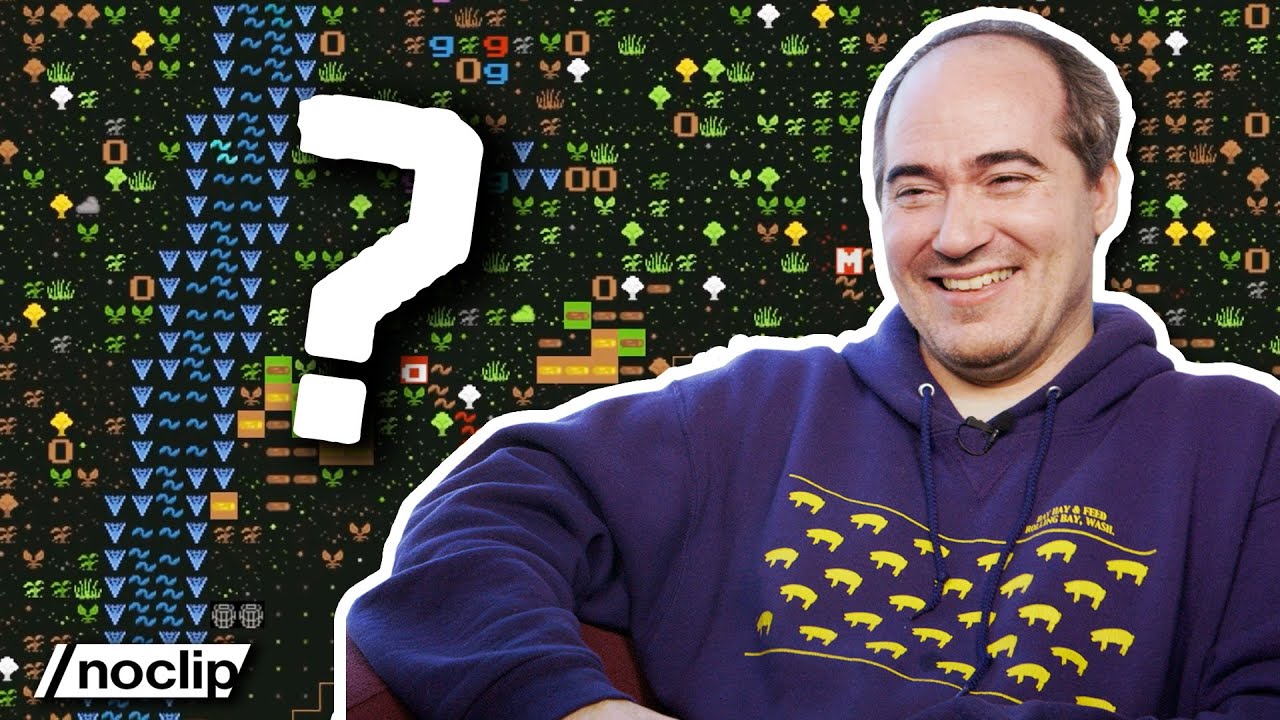
Danny introduces the broader documentary by addressing why Noclip held back the interview for so long: traditional video game B-roll cannot easily convey what is happening on screen to an uninitiated audience. Visually, *Dwarf Fortress* presents as a dizzying sea of raw ASCII text and punctuation characters that resembles the tumbling code from *The Matrix*. Danny confesses that even after logging multiple hours of playtime and watching dozens of community tutorials, he can still only decipher about half of what is happening.
Yet, the raw text presentation is precisely what gives *Dwarf Fortress* its unmatched depth. Modern high-fidelity titles are constrained by the sheer cost of audiovisual assets. If an annual franchise like *Madden NFL* wanted to introduce something like dogs playing football, the production team would have to model, rig, texture, animate, program complex behavior routines, and record vocalizations for the animals. In *Dwarf Fortress*, features are modular data points. Tarn Adams and his brother Zach can implement a mechanic simply by coding the underlying logic and determining how it branches into the rest of the game's existing simulation rules. By working this way for roughly seventeen years, the brothers created an interconnected web of emergent narrative systems. To help illustrate the game visually, the documentary incorporates gameplay storytelling footage from community animator Kruggsmash.
[04:48](https://www.youtube.com/watch?v=VAhHkJQ3KgY&t=288s) The Origins: From *Drag Slay* to *Slaves to Armok*
Tarn Adams details the foundational history of Bay 12 Games, which he runs alongside his brother Zach Adams. The studio website had been online for eighteen and a half years at the time of recording, with sixteen of those spent building *Dwarf Fortress* (two years of part-time experimentation followed by fourteen years of continuous, full-time development). Their ambition to create an all-encompassing fantasy role-playing world began in their childhood:
- In elementary school, the brothers developed an early project titled *Drag Slay*. - They loved the map generation of *Civilization* and the procedural generation of traditional roguelikes, but felt unsatisfied by the scope of both genres: “There was the roguelike games, which of course we were heavily into where they make their own dungeons and so forth. But we were, we just wanted to make the whole world. Why not make the whole world?” - Around the turn of the millennium, they launched the Bay 12 website to give away their projects for free, focusing on the fifth iteration of their fantasy concept: *Slaves to Armok: God of Blood*. - *Slaves to Armok* was an unwieldy, highly ambitious 3D game designed completely from the bottom up. Characters had stance variables permitting them to walk on one hand or a single foot, accompanied by rudimentary animations. - The game simulated anatomical tissues, featuring gruesome experimental magic that could strip a target's skin off or magically displace their nose.
Because *Slaves to Armok* was an exhausting technical slog, Tarn turned to short, three-day game jams to refresh his creativity. These brief sprint projects produced titles like *WW1 Medic* and the ASCII-based tactical simulation *Liberal Crime Squad*.
[06:53](https://www.youtube.com/watch?v=VAhHkJQ3KgY&t=413s) The Birth of *Dwarf Fortress* and the Core Loop
*Dwarf Fortress* originally began as another minor side diversion inspired by the 1990s cross-section mining title *VGA Miner*, in which players take an elevator underground, dig out minerals, handle flooding, and use dynamite around outhouses to recover lost rings. Adams conceptualized an arcade spin-off called *Mutant Miner*, where players would dig subterranean tunnels, stumble across Teenage Mutant Ninja Turtles-style mutagen canisters, and mutate additional arms to dig even faster. Realizing real-time gameplay was necessary to manage multiple workers, the concept shifted toward fantasy dwarves who dig too deep, trigger catastrophes, and leave abandoned ruins behind.
The planned design was a self-contained, two-month arcade loop: players would run a dwarven settlement until its collapse, leaving behind generated diaries and workshops; they would then send a solo adventurer into those same ruins to recover artifacts and investigate the fortress's fate. The dwarf management phase determined the maximum potential high score, and the dungeon-crawling adventurer phase determined how much of that score was realized. However, because it was a fantasy framework rendered entirely in ASCII, it bypassed the slow graphical bottlenecks of *Slaves to Armok*: “Because it's ASCII graphics, so it's so much faster to put stuff in there than I suppose like this 3D thing we were working on and yeah, so just every, every little idea that we had for the other game that we hadn't gotten to in five years, just slot it right into Dwarf Fortress.”
The project quickly swallowed their primary development efforts, growing into the colony management game it is today. In play, the user acts as an overseer rather than controlling individual dwarves directly, directing tasks like excavating the mountain, farming underground mushrooms, crafting trade goods like golden goblets, maintaining alcohol supplies, and weathering catastrophes—all set inside an entirely generated, persistent world.
[09:44](https://www.youtube.com/watch?v=VAhHkJQ3KgY&t=584s) Emergent Narrative and Persistent Worlds
When a player launches *Dwarf Fortress*, the game does not simply generate a static map; it runs a historical simulation that calculates hundreds of years of procedural events across the world map before play even begins. Once that history is established, a player can build multiple fortresses over time within the exact same world, allowing earlier settlements to directly influence future ones. Dwarves from an abandoned or fallen outpost can migrate to a brand-new settlement, retaining their specific identities, personal histories, and physical states—down to whether a pinky finger was lost in an earlier battle. Players can also enter the world in a single-player RPG Adventure mode, wandering through their retired fortresses to talk with former subjects who recount what they have been doing. Adams notes that while there is no scriptwriter penning bespoke dialogue, the immense layering of data makes the world feel profoundly alive.
At the very core of this architecture is the concept of emergent narrative. Rather than delivering a pre-scripted storyline, the game presents interconnected systemic threads that allow dramatic stories to coalesce organically in the player's imagination. Adams explains that game design can intentionally cultivate this phenomenon by providing rich circumstantial data for the player's brain to assemble. As Tarn Adams explains: “It's the idea that you can be playing a game without a story, but a story will still arise as you follow the different threads and pieces of information that are presented to you.” This dynamic turns the game into a mutual storytelling canvas between the simulation and the community, which has spawned countless legendary internet chronicles.
- World generation computes centuries of procedural history, establishing lineages, wars, and regional legends before the player unpauses. - Historical continuity persists across runs: past fortresses can be visited in Adventure mode, and previous citizens can migrate to new forts with their physical conditions intact. - Adams views human cognition as a natural "story-building engine" that collaborates with systemic data to produce emergent narrative.
[11:15](https://www.youtube.com/watch?v=VAhHkJQ3KgY&t=675s) Kruggsmash and the Undead Hydra of Scorchfountain
Illustrating the wild emergent scenarios generated by these intertwined systems, footage from creator Kruggsmash showcases the perilous everyday existence of his fortress, Odlestifon (known as Scorchfountain). The settlement faces an unexpected terror: an undead seven-headed hydra named Kenam Sport Torches. The colossal, dragon-like abomination ambles across the hillside outside the fortress gates, momentarily distracted by chasing local capybaras. While this buys the settlement time, it forces an immediate lockdown, preventing any dwarves from stepping outside.
The strategic nightmare of facing an undead monster highlights the terrifying granularity of the combat engine. A standard, living hydra is already a fortress-ending threat, but players can exploit biological vulnerabilities—inflicting sufficient pain to trigger exhaustion, causing the beast to collapse, or severing veins until it bleeds out. Undead status completely strips away these bodily weaknesses: the monster does not tire, feels no pain, and has no blood to lose. Decapitation, the standard shortcut for slaying monstrosities, is rendered absurdly difficult by the fact that the creature possesses seven distinct biting heads. As Kruggsmash explains when evaluating his grim tactical options: “On the best of days, the hydra is a powerful foe, but this one's undead, which makes it a lot more dangerous.” Unable to lure the monster into an easy confrontation, the fort is left watching the undead beast prowl the surrounding hills.
- Kenam Sport Torches: an undead, seven-headed dragon-like hydra threatening the fortress of Scorchfountain (Odlestifon). - Living combat mechanics (exhaustion, pain collapse, bleeding out) cease to function against reanimated foes, eliminating standard defensive tactics. - Severing the head of a foe is the most reliable lethal strike, a tactic heavily complicated by a hydra's multiple heads.
[12:42](https://www.youtube.com/watch?v=VAhHkJQ3KgY&t=762s) The House of Cards: Systems, Intrigue, and Subjective Truth
Danny O'Dwyer observes that the immense volume of data feels like an emergent "house of cards," a comparison Adams initially balks at because it implies the entire structure is constantly on the verge of collapsing. Adams admits, however, that the analogy is not far off given the persistent bug reports, though he prefers picturing a house of cards bound together by intricate webs of string. The strings grant the structure surprising resilience, yet pulling on a single rogue thread can unravel the entire apparatus. Adams points to the introduction of human residency petitions: when humans were permitted to settle in dwarven fortresses, an immediate logistical failure occurred because all manufactured dwarven clothing was far too small for them. Players suddenly had to micromanage dedicated human-sized apparel lines, introducing fiddly administrative friction into a game already burdened by complex interfaces.
```mermaid flowchart TD accTitle: Subjective Intrigue Perspective Model accDescr: Diagram contrasting an objective global ledger with Dwarf Fortress's subjective mental model for intrigue and plots.
subgraph Objective["Global Ledger Approach (Rejected)"] GL["Global Objective State"] -->|"tracks all truth"| A1["Agent Knows Everything"] GL -->|"prohibitive memory cost"| A2["Memory Overhead Explodes"] end
subgraph Subjective["Intrigue Perspective (Implemented)"] V["Villain Mind"] --> IP["Intrigue Perspective"] IP --> P["Active Plot Scheme"] IP --> M["Subjective Roster of Actors"] IP --> D["Partial Info & Deceptions"] end ```
Adams highlights how the team implements modular architecture to resolve deep simulation challenges without exploding memory limits. When designing villain plots and espionage, instead of building a monolithic global tracking object that knows everything objectively, they implemented an "intrigue perspective" directly inside individual characters' minds. This mental framework tracks the plots, conspirators, and actions known specifically to that person. This subjective design natively allows for partial information, deception, and contradictory beliefs between characters while maintaining performance. As Tarn Adams notes regarding systemic psychology: “Lies are traditionally very hard to do in simulations because you have to track so much extra data about like, who knows what and who believes what, but if it's something like a plot, there's not that many plotters, right?”
When asked whether playing standard modern video games bores him given his obsession with microscopic simulation, Adams laughs off the idea. He points out that he regularly enjoys PlayStation 4 titles like hunting mechanical beasts in *Horizon Zero Dawn* without needing to worry about whether the machine's surface paint is chipping realistically.
- The interconnected systems function like cards tethered by strings: robust until a single system tension cascades into unintended consequences. - Human residents petitioning for dwarven citizenship triggered a clothing mismatch crisis, requiring dedicated human-tailored garments. - The "intrigue perspective" isolates plots and known conspirators within an individual agent's memory, sidestepping memory-heavy global ledgers. - Adams maintains a varied appetite for commercial console games, valuing them for escapist entertainment rather than deep systemic modeling.
[15:29](https://www.youtube.com/watch?v=VAhHkJQ3KgY&t=929s) Fortress Architecture and the Player-Spectator Divide
Returning to Scorchfountain, Kruggsmash outlines the spatial design of his thriving stronghold. The entrance utilizes an engineered defensive chokepoint featuring a trade depot flanked by raiseable drawbridges capable of sealing off the subterranean world. Below the fortified surface gate, a grand central meeting hall is carved into the living rock. Off to the side, residential quarters span two separate tiers, comprising 20 uniform bedrooms furnished with a personal bed, cabinet, coffer, and statue. Flanking the living areas are crafting and agricultural facilities: looms, farmer workshops, plant stockpiles, brewing stills, and kitchens, with dedicated farming plots and seed stores excavated high above in an upper clay soil stratum to support a growing population of 13 dwarves.
Watching the widespread enthusiasm for projects like Kruggsmash's led Adams to reconsider what constitutes the *Dwarf Fortress* player base. A substantial portion of the community—including many of Bay 12 Games' Patreon supporters—does not actively play the software at all. Instead, they interact exclusively by reading write-ups, watching narrative-focused YouTube chronicles, and enjoying the bizarre tales generated by other players. Adams humorously reframes the social ecosystem: the active player base, constantly wrangling clunky interfaces, performance bottlenecks, and game-breaking bugs, functions less like an ordinary audience and more like an unpaid quality assurance crew feeding stories to the spectators. As Tarn Adams quips: “I joke sometimes that the people that watch videos and listen to people's stories and so forth are the players and the people who are actually playing are more like the QA department, right?”
- Scorchfountain layout: fortified perimeter with raised bridges, 20 fully-furnished bedrooms across two levels, subterranean food production, and surface-layer clay farming. - A significant demographic of the game's financial supporters and fans never touches the executable, consuming the game entirely through serialized content. - Adams jokingly characterizes active players as a collective QA department who endure brutal mechanics so audiences can enjoy emergent storytelling.
[16:51](https://www.youtube.com/watch?v=VAhHkJQ3KgY&t=1011s) Tantrum Spirals, Floods, and the Eternal Drink Euphoria Bug
When discussing the many ways a fortress meets its end, Adams points to classic catastrophes that catch overseers off-guard. Accidental subterranean flooding is an omnipresent hazard requiring miners to immediately wall off breached tunnels. Trapped dwarves are frequently abandoned to drown, leaving the overseer to carve memorial slabs to prevent their vengeful ghosts from haunting the halls. External sieges by goblin armies, surface dragons, underground forgotten beasts, magma breaches, and starvation can all quickly raze a colony. Yet Adams notes that experienced players typically have tactical counter-measures for brute-force threats; the truly insidious collapse is the social "tantrum spiral." If a dwarf suffers a tragedy, their grief disturbs their kin and circle of friends. If the settlement lacks lavish dining halls or favorite foodstuffs to offset the sorrow, mounting misery spills into violent tantrums, triggering fights that traumatize bystanders and unleash an escalating chain reaction of societal ruin.
```mermaid flowchart TD accTitle: The Tantrum Spiral Feedback Loop accDescr: Diagram illustrating how isolated dwarven misery cascades into the complete collapse of a fortress.
T["Initial Tragedy / Loss"] --> U["Dwarf Becomes Unhappy"] U -->|"insufficient luxury amenities"| G["Rage / Tantrum Triggered"] G --> V["Violence & Property Destruction"] V --> F["Friends / Relatives Traumatized"] F -->|"distress spreads"| U V -->|"social collapse"| D["Fortress Falls"] ```
Balancing this psychological engine has produced some of the game's most memorable technical blunders. Adams recalls implementing an emotional overhaul featuring approximately 120 granular emotional states, which included the mild sensation of contentment felt after drinking alcohol. A faulty logic flag caused the post-drinking state to stick permanently, rendering every dwarf blissful for the remainder of their natural life after their very first swig of booze. As Tarn Adams remembers with amusement: “And we had a flag that was wrong on that. So after your first drink, you would be euphoric for the rest of your life.”
The bug eliminated all unhappiness throughout the game until Adams discovered the mistake and restored the community's usual baseline of misery. To create richer character development, the developers also implemented short- and long-term memory architectures designed to generate distinct character arcs: significant events experienced over the course of a year transfer into long-term memory and fundamentally shift the dwarf's personality traits. However, this system introduced new behavioral quirks, as idle dwarves began obsessively ruminating on their traumatic memories in cyclical loops whenever they ran out of chores.
- Flooding accidents require sealing off sections of the fort and carving memorial slabs to lay the spirits of drowned dwarves to rest. - Tantrum spirals function as cascading social contagion: personal grief spreads through familial and friendship networks, causing violent outbreaks that topple the fortress. - A logic bug in an update featuring 120 distinct emotional states caused the post-drinking euphoria flag to become permanent, making the entire dwarven world perpetually happy until patched. - Short- and long-term memory systems track emotional traumas over annual cycles to permanently alter dwarf personalities, occasionally causing idle dwarves to dwell in cyclical rumination loops.
[19:35](https://www.youtube.com/watch?v=VAhHkJQ3KgY&t=1175s) Emotional Trauma and Dwarven Psychology
The simulation of emotional health inside *Dwarf Fortress* operates on cascading psychological arcs where past traumas never completely vanish. As Tarn Adams explains, negative memories periodically resurface in a dwarf's mind. When a dwarf has endured a grueling or miserable life, those recollections can quickly become overwhelming as the memories trigger more and more frequently, driving them down destructive mental spirals. Tarn remarks that the virtual inhabitants ultimately lack the fortitude of real human beings, noting dryly: “I mean, these dwarves are not as resilient as they should be.”
```mermaid flowchart TD accTitle: Dwarven Psychological Trauma Loop accDescr: Diagram illustrating how negative life events lead to memory resurfacing, emotional overwhelm, and psychological decline in Dwarf Fortress.
subgraph TraumaLoop["Mental Breakdown Cycle"] A["Adverse Life Events / Hardships"] --> B["Memories Pop into Dwarf's Mind"] B --> C{"Resilience Threshold"} C -->|"Overwhelmed"| D["Memory Triggers Accelerate"] D --> E["Psychological Downward Spiral"] E --> B end ```
[20:10](https://www.youtube.com/watch?v=VAhHkJQ3KgY&t=1210s) The Steam Version and Healthcare Realities
Tarn and his brother Zach Adams spent nearly two decades creating *Dwarf Fortress* for a dedicated community entirely free of charge. Originally, the brothers resisted monetization until players repeatedly badgered them to add a donation button to their website. That grassroots backing later expanded into a healthy Patreon following. However, the announcement of a commercial Steam release featuring integrated sprite graphics and sound was driven by serious personal circumstances rather than a desire for quick profit.
Zach had already been reliant on an expensive daily prescription for over a decade—what Tarn characterizes as a classic American healthcare dilemma. The tipping point arrived with a recent cancer scare that generated substantial medical bills. Reviewing his own health insurance policy, Tarn realized that if he had experienced the medical emergency instead of Zach, his differing coverage terms and out-of-pocket percentages would have financially wiped him out. Confronted with the harsh arithmetic of American healthcare, the brothers decided they needed a financial safety net. Tarn summarized the shift in priorities: “So we were just like, okay, it's time to, you know, enter our forties a little more responsibly.”
Even while moving into commercial distribution, Bay 12 Games remains committed to keeping the classic game completely accessible. The traditional ASCII version will continue to be free, and its feature set will be maintained in lockstep with the Steam edition. Tarn notes that the development timeline remains flexible, joking that while they hope to assemble the Steam version within a matter of months, game development reality means those months could easily stretch past a year.
- **Monetization history**: Shifted from purely free software to adding a website donation button after player pressure, followed by Patreon support, and eventually the commercial Steam release. - **Steam vs. Classic parity**: The paid Steam release provides graphical tilesets and audio, but the core engine, gameplay features, and updates will remain identical and completely free in the classic build. - **Healthcare catalyst**: Zach's ongoing expensive medications and a severe cancer scare forced a review of their private insurance policies, exposing catastrophic financial risk.
[21:58](https://www.youtube.com/watch?v=VAhHkJQ3KgY&t=1318s) Thirty Years of Development and Endless Curiosity
When asked if he ever burns out or grows tired of working on the exact same project for decades, Tarn rejects the idea outright. Having written predecessor games like *dragslay* when he was ten years old, game development has been his central craft for thirty years, to the point where he cannot envision doing anything else. The open-ended, expansive nature of *Dwarf Fortress* ensures that work never feels repetitive, because whatever subjects capture his personal curiosity can simply be researched and converted into game systems.
Tarn shares that he has recently been immersed in 1,500-year-old Chinese legal codes to prepare for an upcoming justice and law update scheduled four or five years in the future, just as he reads treatises on occult magic systems to design the future magic release. Because any topic can be codified into mechanics, he explains that developing the simulation remains inexhaustible: “You can always find a way to put anything you're interested into a video game just by making it into a video game when you read about it or whatever. So it's, it's like if, I would have to be bored of everything.”
## Notable quotes > [15:29](https://www.youtube.com/watch?v=VAhHkJQ3KgY&t=929s) I joke sometimes that the people that watch videos and listen to people's stories and so forth are the players and the people who are actually playing are more like the QA department, right? — Tarn Adams
> [09:44](https://www.youtube.com/watch?v=VAhHkJQ3KgY&t=584s) It's the idea that you can be playing a game without a story, but a story will still arise as you follow the different threads and pieces of information that are presented to you. — Tarn Adams
> [12:42](https://www.youtube.com/watch?v=VAhHkJQ3KgY&t=762s) Lies are traditionally very hard to do in simulations because you have to track so much extra data about like, who knows what and who believes what, but if it's something like a plot, there's not that many plotters, right? — Tarn Adams
## Mentioned Dwarf Fortress, Bay 12 Games, Tarn Adams, Zach Adams, Danny O'Dwyer, Kruggsmash, Noclip, Civilization, Slaves to Armok: God of Blood, Drag Slay, WW1 Medic, Liberal Crime Squad, VGA Miner, Mutant Miner, Horizon Zero Dawn, PlayStation 4, Steam, Patreon, Wikipedia, Madden NFL, Scorchfountain (Odlestifon), Kenam Sport Torches
## Video description SUBSCRIBE for More Free Game Docs ► http://bit.ly/noclipsubscribe Become a PATRON to unlock more videos ► https://www.patreon.com/noclip
We chat to Bay 12 Games co-founder Tarn Adams about their remarkable ASCII simulation Dwarf Fortress - the game's origins, how it works, and their plans for steam. Thank you to Kruggsmash for allowing us to use his footage. Subscribe to his wonderful channel here: https://www.youtube.com/kruggsmash/
Noclip's work is 100% crowdfunded. Patreon: https://www.patreon.com/noclip Website: https://www.noclip.video Store: https://store.noclip.video Instagram: https://www.instagram.com/noclipvideo/ Twitter: https://twitter.com/noclipvideo Twitch: https://twitch.tv/noclip Podcast: https://noclippodcast.libsyn.com/ Podcast Channel: http://youtube.com/noclippodcast
Hosted & Edited by Danny O'Dwyer Filmed & Colored by Jeremy Jayne Filmed by Esteban Martinez Closed Captions: Megan Carnes
Timestamps: 0:00 - Cold Open 03:11 - Danny's Intro 04:48 - The Origins of Dwarf Fortress 08:54 - The Design of Dwarf Fortress 20:00 - Steam Version
[Source](https://www.youtube.com/watch?v=VAhHkJQ3KgY)