Truck Front-End Height Drives Pedestrian Deaths, Study Finds
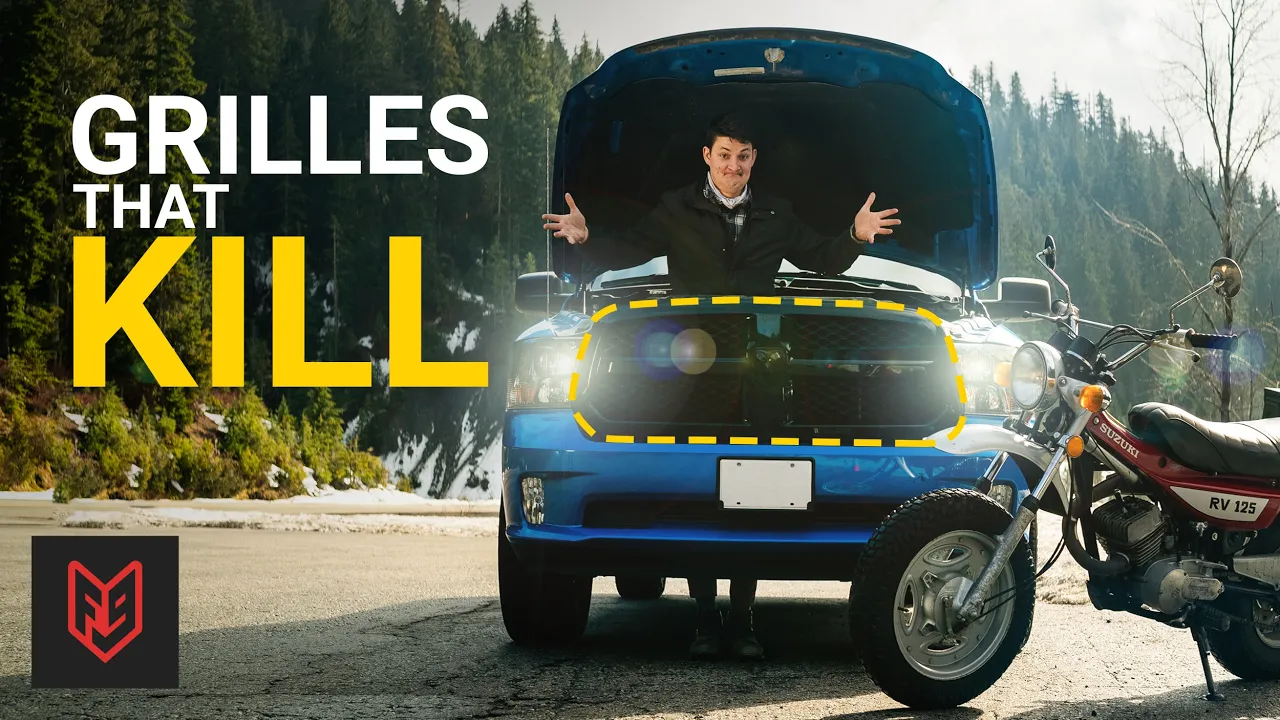
FortNine
Pedestrian crash fatalities stem from blunt, vertical hood geometry rather than vehicle curb weight, and capping front-end heights at 125 centimeters would save 509 American lives each year.
AI-assisted summary of The Grille Trend that Kills 509 People per Year — original source. Check the original for full context.
Source published:
Key ideas
- The common belief that vehicle curb weight is the primary cause of rising pedestrian deaths is refuted by physics; a 1,000 kg reduction in truck mass alters a struck pedestrian's rebound speed by a negligible 2 km/h. (1:57)
- Front-end height is the single most decisive variable in pedestrian crash outcomes; lowering a vehicle's front profile by just 10 cm reduces the probability of a fatal strike by 22% to 28%, and by 81% for children. (3:30)
- Enforcing a 125 cm maximum front-end height cap on vehicles would save an estimated 509 lives annually in the United States alone without requiring smaller or lighter vehicles. (5:28)
- Modern towering grilles are largely non-functional aesthetic choices, featuring up to 80% fake venting while drastically expanding front blind spots to the length of twelve toddlers. (5:28)
Detailed notes
## Background Published on YouTube by FortNine on March 2, 2024, this video investigates why modern pickup trucks and SUVs are increasingly deadly to pedestrians, cyclists, and motorcyclists. Setting aside emotional and political arguments, the presentation analyzes empirical data and crash physics to identify the specific design choices driving the surge in vulnerable road user fatalities.
## TL;DR While popular belief blames vehicle mass for rising pedestrian deaths, basic physics demonstrates that curb weight differences are negligible when striking a human body. Instead, empirical research by Justin Tyndall reveals that towering, vertical front-end height is the decisive fatal factor, striking victims directly at their center of mass rather than scooping them onto a sloped hood. Modern truck grilles have expanded primarily for aggressive aesthetic posturing rather than mechanical necessity, creating massive blind spots and lethal collision profiles. Regulating front-end vehicle heights to a 125 cm ceiling would preserve vehicle utility while saving an estimated 509 lives each year in the United States alone.
## Atmosphere & style The presentation carries FortNine's signature blend of cerebral technical analysis, deadpan humor, and kinetic visual demonstrations, moving effortlessly from mathematical physics models to DIY crash-dummy tests. It strikes an objective, no-nonsense tone that cuts through cultural culture-war tropes about vehicle size before pivoting into biting, sardonic satire targeting aggressive automotive marketing. The viewing experience feels both intellectually rigorous and darkly entertaining, concluding with an absurd mock commercial that sharpens the video's underlying moral urgency.
## Bulletin - [01:57](https://www.youtube.com/watch?v=YpuX-5E7xoU&t=117s) The common belief that vehicle curb weight is the primary cause of rising pedestrian deaths is refuted by physics; a 1,000 kg reduction in truck mass alters a struck pedestrian's rebound speed by a negligible 2 km/h. - [03:30](https://www.youtube.com/watch?v=YpuX-5E7xoU&t=210s) Front-end height is the single most decisive variable in pedestrian crash outcomes; lowering a vehicle's front profile by just 10 cm reduces the probability of a fatal strike by 22% to 28%, and by 81% for children. - [05:28](https://www.youtube.com/watch?v=YpuX-5E7xoU&t=328s) Enforcing a 125 cm maximum front-end height cap on vehicles would save an estimated 509 lives annually in the United States alone without requiring smaller or lighter vehicles. - [05:28](https://www.youtube.com/watch?v=YpuX-5E7xoU&t=328s) Modern towering grilles are largely non-functional aesthetic choices, featuring up to 80% fake venting while drastically expanding front blind spots to the length of twelve toddlers.
## Key takeaways - [00:00](https://www.youtube.com/watch?v=YpuX-5E7xoU&t=0s) Road fatalities among pedestrians, cyclists, and motorcyclists continue to soar in the United States despite widespread driver-assist and collision safety technologies. - [00:00](https://www.youtube.com/watch?v=YpuX-5E7xoU&t=0s) The trend toward massive SUVs and light trucks is expanding globally, driving 80% of Canadian auto sales in 2020 and filling streets in cities like Melbourne. - [00:00](https://www.youtube.com/watch?v=YpuX-5E7xoU&t=0s) Larger vehicles genuinely protect their internal occupants, reinforcing consumer demand for bigger vehicles while shifting collision risks to vulnerable road users. - [01:57](https://www.youtube.com/watch?v=YpuX-5E7xoU&t=117s) Differences in vehicle curb weight are physically negligible in pedestrian survival because motor vehicles are already overwhelmingly massive compared to the human body. - [01:57](https://www.youtube.com/watch?v=YpuX-5E7xoU&t=117s) Crash mechanics differ radically between vehicle geometries: a low, angled hood hits below the center of mass to scoop the body, whereas a vertical front strikes the torso directly with a maximum-energy impulse. - [03:30](https://www.youtube.com/watch?v=YpuX-5E7xoU&t=210s) Justin Tyndall's empirical study in Economics of Transportation isolated crash dimensions, identifying front-end height as the primary determinant of pedestrian fatality rates. - [03:30](https://www.youtube.com/watch?v=YpuX-5E7xoU&t=210s) A reduction of only 10 cm in front-end height decreases pedestrian fatality probability by 22% to 28%, and slashes fatality likelihood for children by 81%. - [03:30](https://www.youtube.com/watch?v=YpuX-5E7xoU&t=210s) Reducing pedestrian deaths does not require downsizing vehicle weight or occupant capacity, but rather slanting hood profiles downward. - [05:28](https://www.youtube.com/watch?v=YpuX-5E7xoU&t=328s) Towering vertical hoods create extreme forward blind spots large enough to obscure a line of twelve toddlers. - [05:28](https://www.youtube.com/watch?v=YpuX-5E7xoU&t=328s) Oversized truck grilles serve minimal mechanical purpose, with up to 80% of their surface consisting of non-functional fake venting designed purely for aggressive styling. - [05:28](https://www.youtube.com/watch?v=YpuX-5E7xoU&t=328s) Capping vehicle front-end height at 125 cm would save approximately 509 lives per year in the US, equivalent to preventing an annual Airbus A380 crash.
## Detailed walkthrough ### [00:00](https://www.youtube.com/watch?v=YpuX-5E7xoU&t=0s) The Arms Race of Large Vehicles
For three decades, road deaths have steadily declined across developed nations, but the United States stands out as a stark exception. Popular consensus blames this on a fear-driven automotive arms race: consumers purchase increasingly large SUVs to protect themselves from other large SUVs, turning the roads into an arena where vulnerable road users are essentially playing pinball against wrecking balls. Yet the boom in light trucks is no longer an exclusively American phenomenon. In Canada, SUVs accounted for 80% of auto sales in 2020, and oversized pickup trucks are increasingly flooding roadways in places like Melbourne, prompting calls to ban SUVs in European cities.
```mermaid flowchart LR accTitle: Vehicle Size vs Vulnerable Road User Risk accDescr: Diagram illustrating how vehicle size protects occupants while shifting the lethal burden to external road users.
subgraph Internal ["Occupant Experience"] A["Larger Vehicle"] --> B["Increased Occupant Safety"] B --> C["Fear-Driven Arms Race"] end
subgraph External ["External Impact"] A --> D["Vulnerable Road Users"] D --> E["Pedestrians"] D --> F["Cyclists"] D --> G["Motorcyclists"] end ```
The conventional outrage directed purely at vehicle size misses the mark. Heavier, larger vehicles genuinely do keep their own occupants safer in collisions, validating the consumer impulse to buy more protection. However, that security comes at the expense of everyone outside the cabin. Despite modern vehicles functioning like panic rooms equipped with forward collision sensors and automatic emergency braking, road fatalities among pedestrians, cyclists, and motorcyclists continue to soar.
As the host observes regarding the reality of occupant safety: > “The larger the vehicle, the safer for its occupants; that might wilt your hard-on for Scandinavian lifestyle, but it doesn't make it any less true.”
[01:57](https://www.youtube.com/watch?v=YpuX-5E7xoU&t=117s) Physics of the Impact: Mass vs. Hood Profile
The common assumption that the sheer weight of modern trucks is the primary culprit in external fatalities fails basic physics. A simplified collision model shows why: if a 2,500 kg truck hits a 90 kg person at 50 km/h, the conservation of momentum and kinetic energy accelerates that body almost instantly to 96.2 km/h. Subtracting an entire 1,000 kg from the truck's mass alters that rebound speed by a negligible 2 km/h. Because motor vehicles are overwhelmingly massive compared to the human body, differences in vehicle curb weight are not what decide whether a struck pedestrian survives.
```mermaid flowchart TD accTitle: Impact Mechanics by Hood Profile accDescr: Flowchart comparing collision mechanics between a low-sloped hood and a high-vertical hood.
Impact["Vehicle Strikes Pedestrian"]
subgraph Wedge ["Low, Sloped Hood (Wedge)"] W1["Impacts Below Center of Mass"] W2["Deflects Body Upward onto Hood"] W3["Lower Transferred Impulse"] end
subgraph Wall ["High, Vertical Front (Wall)"] H1["Direct Blow to Center of Mass"] H2["Shunts Body Directly Forward"] H3["Catastrophic, Perfectly Delivered Impulse"] end
Impact --> Wedge Impact --> Wall ```
The lethal factor is vehicle geometry. Using a shop-built crash dummy, FortNine demonstrates the mechanical difference between hood profiles: - A low, angled hood hits below a person's center of mass, scooping the body up onto the hood and absorbing energy over time. - A tall, flat front strikes the torso directly at the center of mass, delivering an abrupt, maximum-energy impulse that throws the body violently forward.
Summarizing the core physical mechanism that decides pedestrian survival, the host notes: > “This perfectly delivered impulse is what kills people, and the cause is aesthetic.”
[03:30](https://www.youtube.com/watch?v=YpuX-5E7xoU&t=210s) Frontal Height and the Tindall Study
Vehicle front ends have morphed from low, aerodynamic inclines into massive, vertical billboards. In many modern trucks, the hood line rises straight up from the window sill purely to create an imposing facade. Rigorous data now links this exact styling trend directly to fatality rates. Justin Tyndall published an empirical study in *Economics of Transportation* titled "The partial effect of front-end vehicle height on pedestrian fatalities," presenting the first detailed regression analysis isolating crash vehicle dimensions.
While past research established that SUVs and pickups kill more pedestrians than sedans, Tyndall’s binary logistic regression isolated individual measurements: - Front-end height proved to be the single most decisive variable, verified with a 95% to 99% confidence interval. - A reduction of only 10 cm in front-end height decreases the probability of a fatal pedestrian strike by 22% to 28%. - For children, that same 10 cm drop slashes the likelihood of death by 81%. - Supporting data from the Insurance Institute for Highway Safety (IIHS) confirms that striking a human body with an angled wedge causes significantly less trauma than hitting them with a vertical wall.
Crucially, fixing this problem does not require abandoning large, heavy vehicles. As the host points out: > “It means we can have our big vehicles—3,000 kilos, seven hockey boys, it's no problem; we just have to slant the hoods down more, and we'll save lives.”
[05:28](https://www.youtube.com/watch?v=YpuX-5E7xoU&t=328s) The Cost of Pure Aesthetics and the 125 cm Solution
Beyond pedestrian safety, towering vertical hoods present severe ergonomic and visibility drawbacks. Drivers face enormous forward blind spots large enough to hide a line of twelve toddlers, dipsticks can barely be reached without a step stool, and grilles have become oversized plastic ornaments. Radiators do not require massive frontal surface areas; modern grilles are up to 80% non-functional fake venting. One truck designer even openly reflected on their aggressive intent: > “I remember wanting it to feel very locomotive, like a massive fist moving through the air.”
Following a brief spotlight on motorcycle-rental platform Riders Share—highlighting how peer-to-peer rentals generate income under the "n+1" rule of bike ownership—the discussion returns to how straightforward regulatory reform could be. Imposing a maximum front-end height of 125 cm requires no exotic technology; it is simply the design architecture pickup trucks used to employ and commercial vans still use today.
According to Tyndall’s calculations, capping front-end height at 125 cm would save approximately 509 lives each year in the United States alone. To put that in perspective: > “That's an Airbus A380; imagine if terrorists crashed an A380 every year, and we could stop them just by recognizing that we have enough space for a less ridiculous grille design.”
The video closes with a satirical commercial for a fictional "JB Peterson Award," mocking ultra-aggressive truck styling that elevates front ends specifically to "headshot any child under 4'6\"."
## Notable quotes > [00:00](https://www.youtube.com/watch?v=YpuX-5E7xoU&t=0s) The larger the vehicle, the safer for its occupants; that might wilt your hard-on for Scandinavian lifestyle, but it doesn't make it any less true. — FortNine host
> [03:30](https://www.youtube.com/watch?v=YpuX-5E7xoU&t=210s) we can have our big vehicles—3,000 kilos, seven hockey boys, it's no problem; we just have to slant the hoods down more, and we'll save lives. — FortNine host
## Mentioned FortNine, Justin Tyndall, Insurance Institute for Highway Safety, Riders Share, Economics of Transportation, Airbus A380
## Video description Like Airbnb...but for motorcycles. Rent a motorcycle affordably on your travels or make passive income renting yours out through Riders Share : https://www.riders-share.com/welcome/fortnine
-- Why are newer pickup trucks killing so many pedestrians, cyclists and motorcyclists? We set aside politics and emotional attachment to look at the data underpinning the issue.
Support the channel by buying cool stuff - Buy the FortNine Premium Leather Keywrap here: https://frt9.co/lipteu Neck Gaiters, if you're fast: https://frt9.co/5bngoe Any Motorcycle Gear You Need: https://frt9.co/aeu0mn Anything From Amazon That You Don't Really Need : https://frt9.co/30l4bi
Connect with us: http://facebook.com/fortnine http://instagram.com/fortnine http://twitter.com/fortninecanada
Directed and Edited by Aneesh Shivanekar
[Source](https://www.youtube.com/watch?v=YpuX-5E7xoU)