Cline Traces Bronze Age Collapse to Cascading System Failure
National Capital Area Skeptics (NCAS)
Interconnected trade networks amplified concurrent shocks from drought, earthquakes, and famine to trigger systemic collapse across Mediterranean kingdoms rather than ruin by Sea Peoples alone.
AI-assisted summary of 1177 BC: The Year Civilization Collapsed (Eric Cline, PhD) — original source. Check the original for full context.
Source published:
Key ideas
- Dr. Eric Cline presents an archaeological investigation into the collapse of the Late Bronze Age civilization around 1177 BC across the Aegean and Eastern Mediterranean. (0:16)
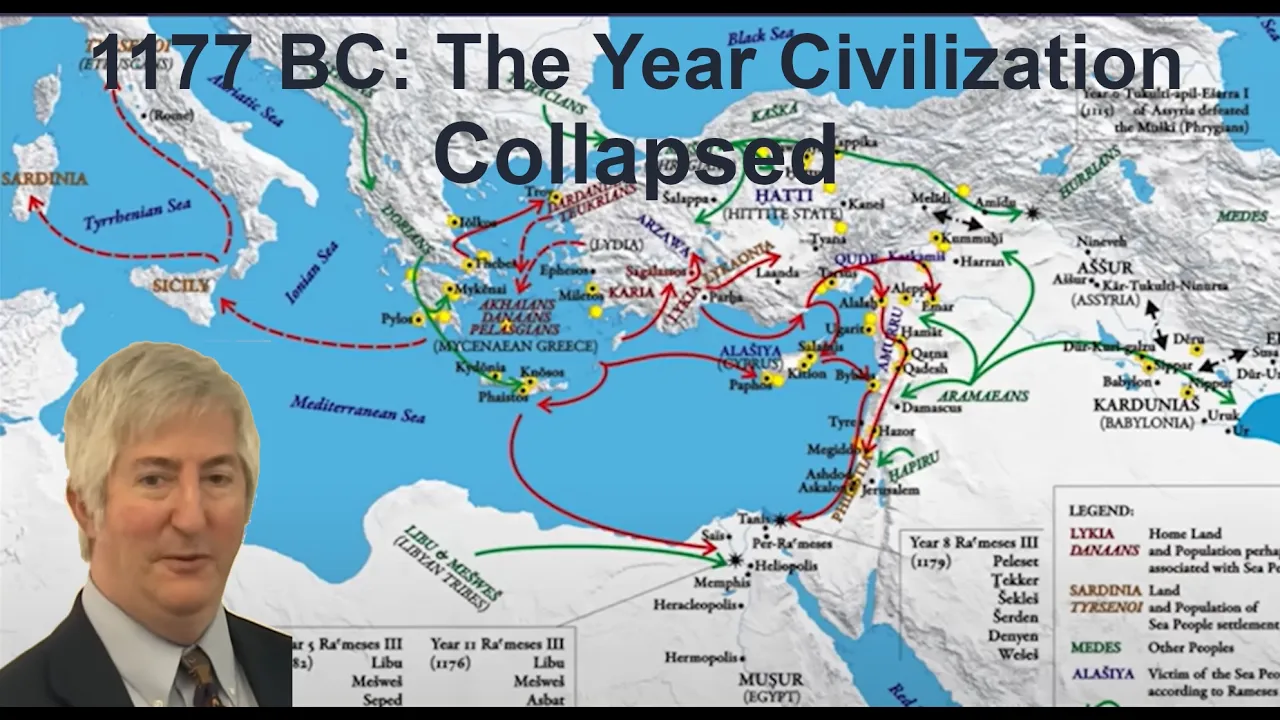
- The traditional mono-causal explanation attributing the collapse entirely to the Sea Peoples is critically re-evaluated as overly simplistic. (5:25)
- A systems collapse model driven by multiple interconnected stressors—including climate change, drought, earthquakes, internal rebellions, and trade disruptions—better explains the widespread societal failure. (51:11)
Detailed notes
## Background Published by the National Capital Area Skeptics (NCAS) on YouTube on October 11, 2016, this lecture features archaeologist and historian Dr. Eric H. Cline discussing the themes of his book, '1177 BC: The Year Civilization Collapsed.' According to the description, Cline examines how the interconnected, cosmopolitan Mediterranean world of the Late Bronze Age experienced a sudden systemic collapse around 1200 BC, ushering in centuries of dark ages, and considers what cautionary lessons this history holds for modern society.
## TL;DR Dr. Eric Cline takes the audience on a historical investigation into the sudden disintegration of thriving Late Bronze Age civilizations around 1177 BC. Moving beyond the overly simplistic historical trope of attributing the fall solely to the enigmatic Sea Peoples, Cline presents archaeological, textual, and environmental evidence to demonstrate that the Mediterranean was an intricately linked, globalized trade network. By examining drought, famine, earthquakes, internal rebellions, and disrupted supply chains, he demonstrates how a perfect storm of compounding stressors triggered a catastrophic systems collapse.
## Atmosphere & style The presentation balances rigorous academic depth with a relaxed, accessible, and humorous delivery, opening with a lighthearted quip offering to whisk listeners away from a dreary day in Bethesda to the sunny ancient Mediterranean. Dr. Cline's genuine passion for the Late Bronze Age is palpable throughout, turning an intricate post-mortem of societal failure into an engaging detective story. Watching the talk feels intellectually stimulating yet intimately conversational, as complex archaeological data and ancient letters are woven into an absorbing, reflective narrative on civilizational vulnerability.
## Bulletin - [00:16](https://www.youtube.com/watch?v=bRcu-ysocX4&t=16s) Dr. Eric Cline presents an archaeological investigation into the collapse of the Late Bronze Age civilization around 1177 BC across the Aegean and Eastern Mediterranean. - [05:25](https://www.youtube.com/watch?v=bRcu-ysocX4&t=325s) The traditional mono-causal explanation attributing the collapse entirely to the Sea Peoples is critically re-evaluated as overly simplistic. - [51:11](https://www.youtube.com/watch?v=bRcu-ysocX4&t=3071s) A systems collapse model driven by multiple interconnected stressors—including climate change, drought, earthquakes, internal rebellions, and trade disruptions—better explains the widespread societal failure.
## Key takeaways - [00:32](https://www.youtube.com/watch?v=bRcu-ysocX4&t=32s) The Late Bronze Age was a highly interconnected, globalized cosmopolitan era spanning roughly from 1700 BC to 1200 BC across Greece, Egypt, the Levant, and Mesopotamia. - [04:26](https://www.youtube.com/watch?v=bRcu-ysocX4&t=266s) Around 1200 to 1177 BC, major regional powers including the Mycenaeans, Minoans, Hittites, and Canaanite city-states suffered rapid, catastrophic collapse. - [05:25](https://www.youtube.com/watch?v=bRcu-ysocX4&t=325s) Early scholarship historically placed sole blame on the mysterious 'Sea Peoples' depicted in inscriptions by Egyptian pharaoh Ramses III at Medinet Habu. - [08:34](https://www.youtube.com/watch?v=bRcu-ysocX4&t=514s) Inscriptions and reliefs at Medinet Habu record Ramses III fighting off invading coalitions of Sea Peoples during his eighth regnal year, conventionally dated to 1177 BC. - [14:14](https://www.youtube.com/watch?v=bRcu-ysocX4&t=854s) The portrayal of Sea Peoples with ox-carts carrying women and children suggests a mass migration rather than a simple military invasion force. - [15:34](https://www.youtube.com/watch?v=bRcu-ysocX4&t=934s) Attributing the collapse solely to the Sea Peoples is fundamentally inadequate because it ignores the deep economic and material interdependence of the Bronze Age world. - [16:28](https://www.youtube.com/watch?v=bRcu-ysocX4&t=988s) The manufacture of bronze required combining copper (typically from Cyprus) and tin (imported over vast trade networks from modern Afghanistan), making societies vulnerable to supply chain disruption. - [18:54](https://www.youtube.com/watch?v=bRcu-ysocX4&t=1134s) Diplomatic and commercial archives, such as the Mari Letters, demonstrate complex international gift-giving and trade networks operating across the Near East and Aegean. - [24:06](https://www.youtube.com/watch?v=bRcu-ysocX4&t=1446s) Scientific data from pollen analysis, speleothems, and lake sediments (e.g., Tell Tweini, Hala Sultan Tekke) confirm a severe, multi-century megadrought beginning around 1200 BC. - [35:54](https://www.youtube.com/watch?v=bRcu-ysocX4&t=2154s) Physical evidence of earthquake storms along the North Anatolian and Dead Sea fault lines indicates destructive seismic clusters struck key cities during this period. - [51:11](https://www.youtube.com/watch?v=bRcu-ysocX4&t=3071s) Late Bronze Age palace economies were fragile, hyper-centralized systems unable to withstand simultaneous compounding crises, culminating in systemic civilizational collapse.
## Detailed walkthrough ### [00:16](https://www.youtube.com/watch?v=bRcu-ysocX4&t=16s) Introduction to 1177 BC and the Late Bronze Age
Dr. Eric Cline welcomes the audience and introduces the focus of his talk: the pivotal year of 1177 BC and the world that surrounded it. Looking out at the audience, he offers to whisk everyone away from the dreary, rainy weather of Bethesda and transport them more than three millennia into the past—to an ancient Mediterranean world where, as he quips, conditions are hopefully much warmer and sunnier.
He frames this journey around the Late Bronze Age, a transformative historical epoch that holds an exceptionally special significance for him as a scholar and field archaeologist. As Dr. Cline emphasizes to his audience: “This is the period that is, I would say, nearest and dearest to my heart.”
- **Geographic Departure Point:** Bethesda, Maryland, on an overcast, rainy day. - **Historical Destination:** The Late Bronze Age, taking place over 3,000 years ago in the ancient Mediterranean. - **Key Theme:** Exploring the civilization and catastrophic collapse surrounding 1177 BC.
## Mentioned Eric H. Cline, 1177 BC: The Year Civilization Collapsed, National Capital Area Skeptics (NCAS), The George Washington University, Capitol Archaeological Institute, National Geographic, Fulbright Program, National Endowment for the Humanities, Dartmouth College, Yale University, University of Pennsylvania, Muhlenberg College, Bethesda, Maryland
## Video description From about 1500 BC to 1200 BC, the Mediterranean region played host to a complex cosmopolitan and globalized world-system. It may have been this very internationalism that contributed to the apocalyptic disaster that ended the Bronze Age. When the end came, the civilized and international world of the Mediterranean regions came to a dramatic halt in a vast area stretching from Greece and Italy in the west to Egypt, Canaan, and Mesopotamia in the east. Large empires and small kingdoms collapsed rapidly. With their end came the world’s first recorded Dark Ages. It was not until centuries later that a new cultural renaissance emerged in Greece and the other affected areas, setting the stage for the evolution of Western society as we know it today. Professor Eric H. Cline of The George Washington University will explore why the Bronze Age came to an end and whether the collapse of those ancient civilizations might hold some warnings for our current society.
Considered for a Pulitzer Prize for his book 1177 BC, Dr. Eric H. Cline is Professor of Classics and Anthropology and the current Director of the Capitol Archaeological Institute at The George Washington University. He is a National Geographic Explorer, a Fulbright scholar, an NEH Public Scholar, and an award-winning teacher and author. He has degrees in archaeology and ancient history from Dartmouth, Yale, and the University of Pennsylvania; in May 2015, he was awarded an honorary doctoral degree (honoris causa) from Muhlenberg College. Dr. Cline is an active field archaeologist with 30 seasons of excavation and survey experience.
The views expressed in this video are those of the speaker and do not necessarily reflect the views of the National Capital Area Skeptics (NCAS).
#1177BC #BronzeAgeCollapse #AncientHistory #EricCline #MediterraneanHistory #CivilizationCollapse #AncientCivilizations #BronzeAge #DarkAges #Archaeology #AncientWorld #HistoryDocumentary #HistoricalEvents #AncientEgypt #AncientGreece #AncientNearEast #Mycenae #Hittites #Egypt #Mesopotamia #GeorgeWashingtonUniversity #CapitolArchaeologicalInstitute #NationalGeographicExplorer #FulbrightScholar #NEHPublicScholar #PulitzerPrize #ArchaeologicalInstitute #AncientCultures #AncientEmpires #AncientKingdoms #WesternSociety #HistoricalAnalysis #ArchaeologicalDiscoveries #AncientMediterranean #LateBronzeAgeCollapse #AncientWarfare #AncientTechnology #AncientTrade #AncientReligion #AncientMyths #AncientArt #AncientLiterature #AncientPhilosophy #AncientScience #AncientSociety #AncientEconomy #AncientPolitics #AncientDecline #AncientFall #NCAS #skepticism #SeaPeoples, #archaeology
0:00 Introduction 0:32 Late Bronze Age: 1700-1200 BC 4:26 Collapse...ca. 1200 BC 5:25 Original Hypothesis: Sea Peoples 7:48 Wall Relief at Medinet Habu 8:34 Ramses III's Sea Peoples Inscription 13:39 Head of Philistine from Medinet Habu 14:14 Movement of Peoples? 15:34 Too Simple 16:28 Bronze = Tin + Copper 18:54 Mari Letters 24:06 Tell Tweini, Syria 24:43 Hala Sultan Tekke, Cyprus 25:13 Drake 2012 26:32 Langgut, Finkelstein, and Litt 2013 27:30 ARCHAEOLOGY 30:03 Letter from the king of Ugarit to the king of Cyprus (Southern Archive, Court V, Palace) 32:06 Private letter, one of the last from Ugarit 33:07 Canaanite Hazor 33:16 Hazor LBA Palace 35:54 Fault Lines 41:23 Colossi of Memnon 41:35 Statue Base Lists of Amenhotep III 42:06 Amenhotep III's "Aegean List" at Kom el-Hetan 43:21 Amenhotep III Faience Plaque Fragments at Mycenae 43:55 Sites on Amenhotep IIl's "Aegean List": Possible Route 44:38 Sinaranu Text ca. 1260 BC 49:03 Summing Up 50:18 Conclusions 51:11 General Features of Systems Collapse
[Source](https://www.youtube.com/watch?v=bRcu-ysocX4)