North American Zoning Outlaws Corner Retail, Fueling Car Congestion
Not Just Bikes
Strict Euclidean zoning separates commerce from residential areas, converting daily errands into compulsory driving trips that enrich big-box chains while worsening gridlock.
AI-assisted summary of The Lively & Liveable Neighbourhoods that are Illegal in Most of North America — original source. Check the original for full context.
Source published:
Key ideas
- Unlike the widespread practice in Europe and Asia of integrating small shops and cafes within quiet residential streets, modern North American Euclidean zoning strictly outlaws commercial pockets in almost all residential areas across the U.S. and Canada. (0:06)
- Although zoning originated during the Industrial Revolution to separate lethal industrial polluters from homes, North American planners took this framework to an extreme by completely segregating every form of land use, including basic neighborhood amenities. (1:14)
- Mandatory single-use zoning forces residents to drive even for trivial errands like picking up a bag of milk, multiplying regional traffic congestion and funneling consumer spending into auto-oriented big-box stores rather than local entrepreneurs. (4:02)
- North American attempts at mixed-use development remain predominantly restricted to rapid transit hubs and high-speed arterial roads, leaving vast expanses—such as Toronto's 'Yellow Belt'—legally locked under exclusionary single-family restrictions. (5:23)
Detailed notes
## Background Published on YouTube on June 29, 2020, by urban planning channel Not Just Bikes, this video examines the vibrant mixed-use residential pockets common in the Netherlands and parts of Asia. The video description highlights how dotting shops and restaurants throughout residential neighborhoods fosters liveliness and alleviates traffic, while underscoring that this type of human-scale urban design has been outlawed across most of the United States and Canada for nearly a century.
## TL;DR The video examines how European and Asian cities integrate quiet retail and cafe pockets directly into residential streets, contrasting this with North American Euclidean zoning that strictly criminalizes mixed land use. While zoning originally emerged to safeguard public health by separating toxic industrial factories from homes, North American planners took this to an extreme by banning even corner grocers and modest housing types in vast residential zones. This strict segregation mandates car ownership for every trivial errand, worsening traffic congestion and funneling money away from local businesses into sprawling automobile power centers. Ultimately, the piece demonstrates that grandfathered mixed-use neighborhoods remain the most desirable real estate in North America, highlighting the urgent need to repeal restrictive zoning like Toronto's 'Yellow Belt.'
## Atmosphere & style The presentation is dryly witty, pragmatic, and incisively critical, anchored by the narrator's deadpan delivery and personal exasperation with North American suburban design. Comparing peaceful European streetscapes and bustling Taipei alleys with sterile London, Ontario subdivisions and parking seas makes the planning critique visually striking and intuitively obvious. It feels like an engaging, eye-opening urbanist wake-up call, balancing quiet disbelief at archaic zoning codes with genuine appreciation for walkable, human-scaled living.
## Bulletin - [00:06](https://www.youtube.com/watch?v=bnKIVX968PQ&t=6s) Unlike the widespread practice in Europe and Asia of integrating small shops and cafes within quiet residential streets, modern North American Euclidean zoning strictly outlaws commercial pockets in almost all residential areas across the U.S. and Canada. - [01:14](https://www.youtube.com/watch?v=bnKIVX968PQ&t=74s) Although zoning originated during the Industrial Revolution to separate lethal industrial polluters from homes, North American planners took this framework to an extreme by completely segregating every form of land use, including basic neighborhood amenities. - [04:02](https://www.youtube.com/watch?v=bnKIVX968PQ&t=242s) Mandatory single-use zoning forces residents to drive even for trivial errands like picking up a bag of milk, multiplying regional traffic congestion and funneling consumer spending into auto-oriented big-box stores rather than local entrepreneurs. - [05:23](https://www.youtube.com/watch?v=bnKIVX968PQ&t=323s) North American attempts at mixed-use development remain predominantly restricted to rapid transit hubs and high-speed arterial roads, leaving vast expanses—such as Toronto's 'Yellow Belt'—legally locked under exclusionary single-family restrictions.
## Key takeaways - [00:06](https://www.youtube.com/watch?v=bnKIVX968PQ&t=6s) Residential retail pockets in cities like Amsterdam and Taipei bring tranquility, liveliness, and everyday utility directly into neighborhoods without the noise of major arterial roads. - [01:04](https://www.youtube.com/watch?v=bnKIVX968PQ&t=64s) Integrating corner shops and cafes throughout residential streets is completely illegal to build across almost all modern North American suburbs. - [01:14](https://www.youtube.com/watch?v=bnKIVX968PQ&t=74s) Land use zoning originally saved millions of lives by separating heavy industrial hazards and steel mills from family residences during the Industrial Revolution. - [01:53](https://www.youtube.com/watch?v=bnKIVX968PQ&t=113s) North American Euclidean zoning pushed public health protections to an extreme by treating benign commercial spaces as incompatible with residential living. - [02:34](https://www.youtube.com/watch?v=bnKIVX968PQ&t=154s) Single-family R1 zoning districts outlaw not only corner grocers and cafes, but also missing-middle housing such as duplexes, townhomes, and modest apartment buildings. - [02:58](https://www.youtube.com/watch?v=bnKIVX968PQ&t=178s) Historic North American neighborhoods with grandfathered corner retail remain among the most desirable and expensive real estate, proving high market demand for walkable mixed-use living. - [04:02](https://www.youtube.com/watch?v=bnKIVX968PQ&t=242s) Carrying out daily errands by walking or biking is rendered impossible when residential areas are completely isolated from commercial activities. - [04:17](https://www.youtube.com/watch?v=bnKIVX968PQ&t=257s) Mandatory driving for minor tasks, like buying a bag of milk, compounds automobile traffic and road congestion across the entire city network. - [04:41](https://www.youtube.com/watch?v=bnKIVX968PQ&t=281s) Car-dependent suburban design channels revenue toward corporate big-box power centers surrounded by parking lots while starving local, independent business owners. - [05:05](https://www.youtube.com/watch?v=bnKIVX968PQ&t=305s) Walkable mixed-use neighborhoods free up land from surface parking lots, allowing space to be used for patios, pocket parks, and housing. - [05:23](https://www.youtube.com/watch?v=bnKIVX968PQ&t=323s) In North America, mixed-use development is treated as an exceptional planning buzzword usually confined to transit hubs, whereas globally it is simply the standard way cities are built. - [05:52](https://www.youtube.com/watch?v=bnKIVX968PQ&t=352s) Toronto's 'Yellow Belt' illustrates how exclusionary low-density single-family zoning legally freezes vast areas of land surrounding a booming urban core.
## Detailed walkthrough ### [00:06](https://www.youtube.com/watch?v=bnKIVX968PQ&t=6s) Retail Pockets and Residential Liveliness: Amsterdam to Taipei
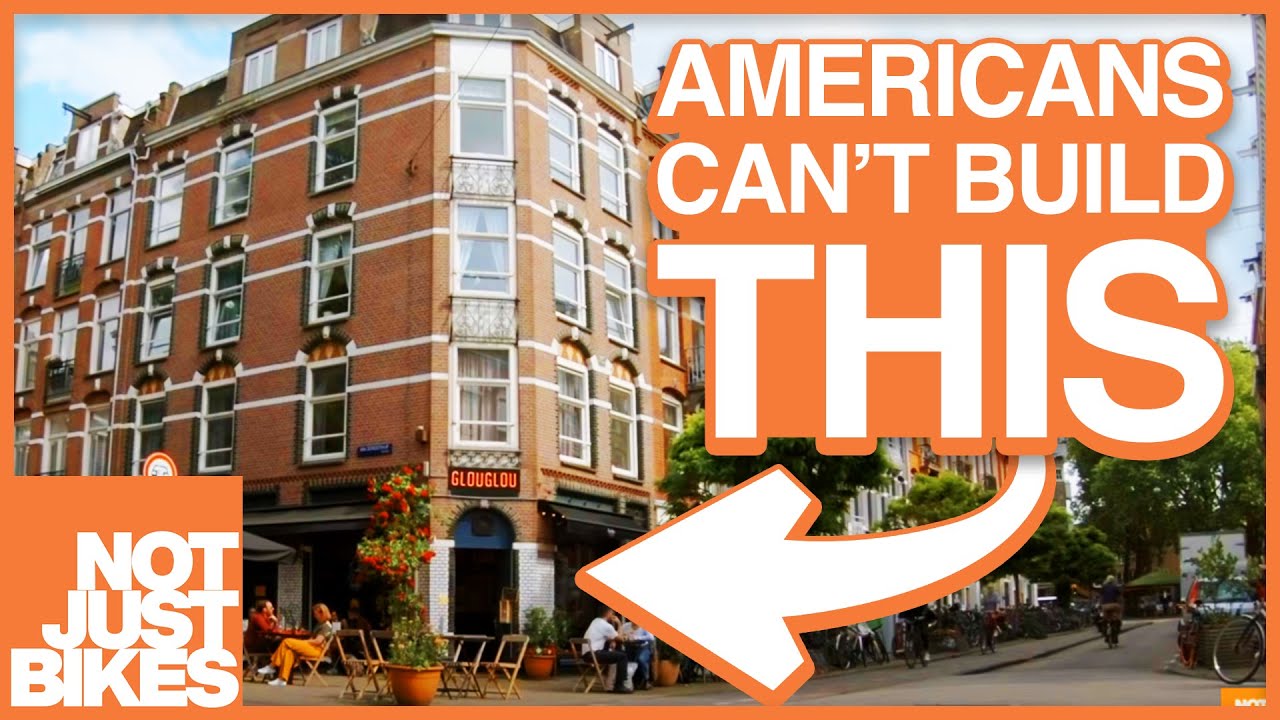
A defining feature of everyday life in Amsterdam is how shops, cafes, and small restaurants are seamlessly sprinkled throughout quiet residential streets rather than confined solely to commercial strips. Unlike a traditional high street or main street where businesses are concentrated along one major, noisy thoroughfare, these neighborhood retail pockets create charming, tranquil destinations within a short walk or bike ride of people's front doors. Sitting on a patio or picking up groceries within a peaceful residential setting provides a far more relaxed, pleasant ambiance than enduring the roar and congestion of an arterial road.
This dynamic is not exclusive to the Netherlands. The cozy commercial nooks of Amsterdam strongly evoke the lively alleyways of Taipei, where vibrant small businesses transform what could otherwise be dim, utilitarian passages into inviting, active community destinations. Yet while these mixed-use pockets enrich daily city life across Europe and Asia, they remain nearly non-existent across modern North American suburbia. As the narrator observes: “So these pockets of shops and restaurants are in no way unique to the Netherlands. But what is interesting is that they are illegal to build in almost all of the U.S. and Canada.”
[01:14](https://www.youtube.com/watch?v=bnKIVX968PQ&t=74s) The Rise and Extremism of North American Euclidean Zoning
The root of this absence lies in a planning framework known as Euclidean zoning—a system familiar to anyone who has ever played city-builder video games like *SimCity* or *Cities: Skylines*. The concept originated during the Industrial Revolution out of an urgent need to protect public health. At the time, unconstrained development meant heavy polluters like steel mills could open directly beside family homes, enveloping residents in toxic smog and squalor. Urban planners stepped in to separate incompatible land uses, an intervention that was arguably the profession's greatest gift to public health, saving millions of lives and prompting nearly every country on Earth to adopt basic zoning codes.
```mermaid flowchart TD accTitle: Evolution of Euclidean Zoning accDescr: Diagram tracing the historical origin of zoning to separate heavy industry from homes to extreme modern separation.
subgraph Origin["Industrial Revolution Origin"] A["Industrial Pollution & Steel Mills"] -->|"Threatens Public Health"| B["Land Use Separation"] B -->|"Saves Millions of Lives"| C["Global Zoning Adoption"] end
subgraph NorthAmerica["North American Divergence"] C -->|"Overextended Logic"| D["Euclidean Zoning"] D --> E["Complete Separation of All Uses"] E --> F["R1 Single-Family Exclusivity"] end ```
However, North American planners pushed this logic to a rigid, harmful extreme. Rather than merely buffering neighborhoods against heavy manufacturing, municipalities mandated that every single category of human activity be strictly walled off from every other category. On a zoning map of London, Ontario—the narrator's hometown—broad swaths of land are designated strictly residential, shaded in yellow, meaning it is flat-out illegal to open a cafe, pub, or corner grocery anywhere within them. While mixed-use living can occasionally bring challenges like late-night noise, refuse, or crowds that require practical balance, modern American and Canadian codes dismiss compromise entirely. Single-family "R1" districts take this extremism even further by outlawing not just shops, but duplexes, townhouses, and modest apartment buildings as well.
Ironically, older North American neighborhoods built before the advent of rigid zoning laws demonstrate the enduring popularity of mixed land uses. In the narrator's former Toronto neighborhood, built around a century ago, small corner retail spaces were woven into the original fabric and grandfathered into modern codes. Today, those areas rank among the most sought-after and expensive real estate in the city, proving strong public demand. Yet under current zoning laws, building a neighborhood in that same classic style is completely prohibited.
- Modern North American planning operates under the absolutist premise that commercial amenities provide zero intrinsic value inside a residential neighborhood. - Under R1 residential zoning, not even missing-middle housing forms like townhomes or small apartments are permitted. - Historic walkable neighborhoods with grandfathered commercial units consistently fetch premium property values due to their rare livability.
> “Modern North American planning takes a very extreme view, that there is no value to having shops and restaurants within a residential neighborhood.” — Not Just Bikes
[04:02](https://www.youtube.com/watch?v=bnKIVX968PQ&t=242s) Walkability, Car Dependence, and the Bag of Milk Dilemma
Beyond sheer neighborhood charm, strict single-use zoning wreaks havoc on transport networks by destroying walkability. When a grocer, pub, or café is embedded down the street, residents can easily walk or bike to meet daily needs. But when residential subdivisions are isolated from everything else, every single human errand requires a private automobile. Whether embarking on a trip across the city or simply running out to grab a bag of milk—a classic Canadian staple—getting behind the wheel becomes mandatory for every resident, multiplying regional traffic congestion exponentially.
```mermaid flowchart LR accTitle: Walkable Mixed-Use vs Automobile Suburbia accDescr: Flowchart contrasting how mixed-use neighborhoods enable local walking versus how Euclidean zoning enforces driving to power centers.
subgraph Walkable["Walkable Mixed-Use Model"] W1["Local Residential Pocket"] -->|"Walk or Bike"| W2["Corner Grocers & Cafes"] W2 -->|"Keeps Wealth Local"| W3["Local Entrepreneurs"] W2 -->|"No Surface Parking Needed"| W4["Patios & Parkettes"] end
subgraph Euclidean["Single-Use Euclidean Model"] E1["Isolated Residential Suburb"] -->|"Compulsory Driving"| E2["High Traffic Volume"] E2 -->|"Trip Chaining in Car"| E3["Big Box Power Centers"] E3 -->|"Massive Surface Parking"| E4["Pavement & Economic Leakage"] end ```
Once a person is forced to retrieve their car keys, back out of the garage, and navigate arterial traffic, the incentive structure collapses. Drivers rarely stop at multiple independent corner shops; instead, they drive straight to massive automobile-oriented power centers and strip malls surrounded by seas of asphalt parking. This structure starves independent neighborhood businesses and enriches giant big-box chains whose revenues bleed out of the local economy. In contrast, genuine walkable neighborhoods provide enough residential density within walking distance to support independent entrepreneurs without demanding massive parking lagoons, preserving precious urban real estate for street-side patios, pocket parks, and additional homes.
- Forcing residents to drive for trivial errands generates excessive, avoidable automobile traffic across city road networks. - Automobile-dependent errands heavily bias consumer behavior toward big-box retailers over neighborhood-scale entrepreneurs. - Compact walkable neighborhoods eliminate the spatial demand for surface parking, leaving room for parkettes, patios, and community spaces.
> “That results in a lot of car traffic, because it doesn't matter if you're driving across town or just need to buy a bag of milk, you have to get in your car.” — Not Just Bikes
[05:23](https://www.youtube.com/watch?v=bnKIVX968PQ&t=323s) Mixed-Use Reality, the "Yellow Belt", and Sane Zoning Laws
While urban planners across the United States and Canada have begun embracing the buzzword "mixed-use development," the narrator emphasizes that this is simply “what the rest of the world calls: 'the way you build things.'” Even when implemented in North America, mixed-use projects remain narrowly confined to rapid transit hubs or packed directly along high-speed arterial corridors. Planners and councils almost never consider retrofitting gentle, low-impact commercial functions—such as independent bakeries, coffee shops, and neighborhood bodegas—into established residential tracts.
Consequently, vast tracts of North American metropolitan land remain locked down under exclusionary zoning. In Toronto, this phenomenon is widely referred to as the "Yellow Belt," coined by urban planners to describe the massive ocean of yellow single-family residential zoning that completely encircles the high-density downtown core. Having left North American suburban sprawl behind, the narrator expresses gratitude for living in an environment with sensible zoning laws that foster community, reduce vehicle miles traveled, and stimulate local enterprise. Wrapping up with a playful nod to his Canadian roots, he heads out on foot to buy milk—no longer packaged in bags, but happily retrieved without a car.
- North American "mixed-use" is often restricted to transit stations and high-traffic arterial roads rather than being integrated throughout quiet side streets. - Toronto's "Yellow Belt" keeps massive swathes of land adjacent to a booming urban core legally restricted to low-density single-family houses. - Human-scale planning laws naturally reduce vehicle traffic, stimulate independent local business, and encourage active walking.
> “Because honestly, I have absolutely no interest in going back to live in a place like this.” — Not Just Bikes
## Notable quotes > [01:14](https://www.youtube.com/watch?v=bnKIVX968PQ&t=74s) Modern North American planning takes a very extreme view, that there is no value to having shops and restaurants within a residential neighborhood. — Not Just Bikes
## Mentioned Not Just Bikes, Amsterdam, Taipei, London, Ontario, Toronto, Gil Meslin, SimCity, Cities: Skylines
## Video description Watch this video ad-free on Nebula: https://nebula.tv/videos/not-just-bikes-the-lively-liveable-neighbourhoods-that-are-illegal-in-most-of-north-america
The pockets of retail & restaurants dotted throughout residential neighbourhoods in the Netherlands bring a liveliness and utility to the neighbourhood - and even help solve traffic congestion. Learn how this kind of urban design has been illegal in most of the US and Canada for a century, and why it should be brought back.
Want to support Not Just Bikes? Check out my Patreon.
Sign up to Nebula and watch ad-free and sponsor-free: https://go.nebula.tv/notjustbikes
Patreon: https://patreon.com/notjustbikes Twitter: https://twitter.com/notjustbikes Reddit: https://reddit.com/r/notjustbikes One-time donations: https://notjustbikes.com/donate
NJB Live (my bicycle livestream channel): https://www.youtube.com/channel/UC9v57F4xz46KaDsvWfCv8yw
--- Image & Video Credits:
Video of walking Taipei courtesy of Taiwan4K: https://www.youtube.com/watch?v=GkfBrSh2-Nc
City Beautiful - An Introduction to Zoning: https://www.youtube.com/watch?v=9kVWDWMcLT4
Photograph of Widnes in the late 19th century showing the effects of industrial pollution (public domain): https://commons.wikimedia.org/wiki/File:Widnes_Smoke.jp
Zoning map of London, Ontario © 2003-2020 City Of London: https://london.maps.arcgis.com/apps/webappviewer/index.html?id=20327d3bcfb34bb488a7c3f74c05d2d3
City Beautiful - The Case Against Single-Family Zoning: https://www.youtube.com/watch?v=ajSEIdjkU8E
Canadian Shows Milk in Bags by DeadVoidStudios (YouTube) (Creative Commons Attribution licence (reuse allowed)): https://www.youtube.com/watch?v=f90_WksXi60
That one little pocket of commercial within a residential neighbourhood on the London, Ontario zoing map is this conveniece store and haircutters: https://www.google.com/maps/@43.0092242,-81.3111312,3a,75y,300.41h,73.9t/data=!3m6!1e1!3m4!1saHEY1TlETYpmGmZ-WO2wHA!2e0!7i13312!8i6656
Map of the "Yellow Belt" in Toronto, MapTO: http://www.mapto.ca/maps/2017/3/4/the-yellow-belt
The "Yellow Belt" concept comes originally from urban planner Gil Meslin: https://twitter.com/g_meslin
#urbanplanning #mixedusedevelopment #liveablecities
[Source](https://www.youtube.com/watch?v=bnKIVX968PQ)