HP 5061A Cesium Clock Locks Frequency, Exposing Drifting Bench GPSDO
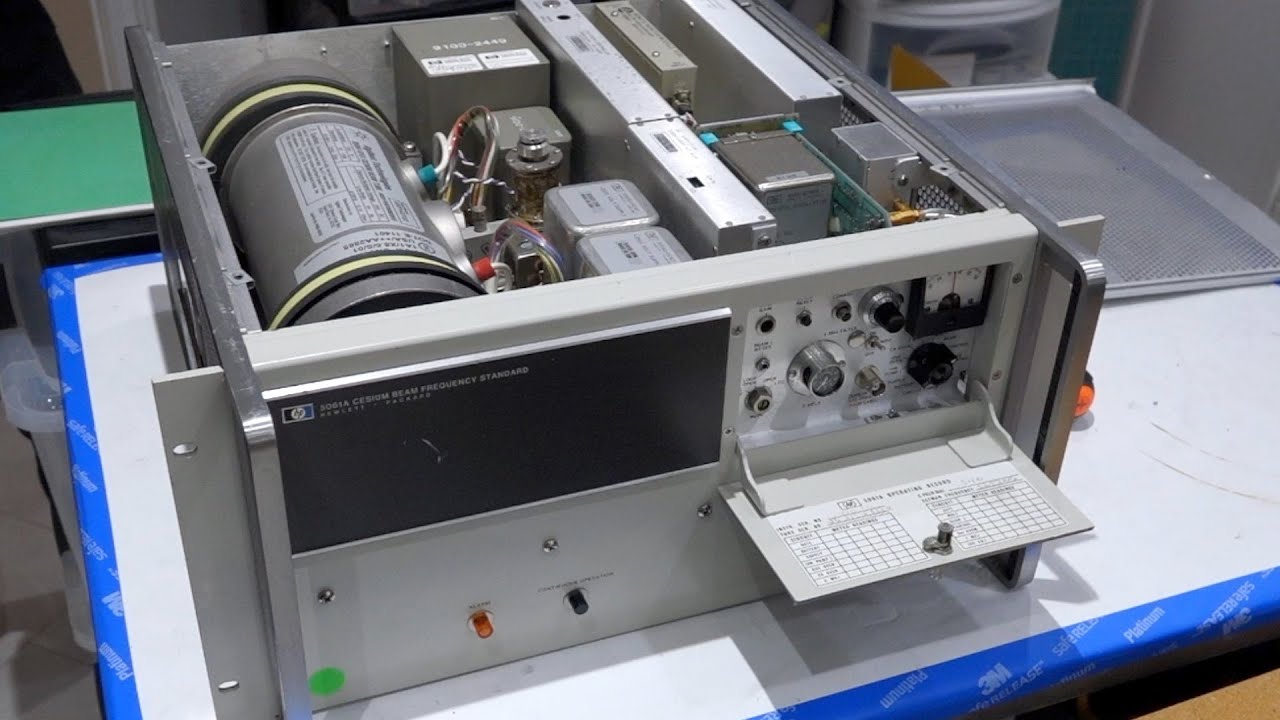
How an Atomic Clock Really Works: Inside the HP 5061A Cesium Clock — CuriousMarc

CuriousMarc

Bench testing confirms the HP 5061A locks its quartz oscillator to the 9.192-GHz cesium hyperfine transition via a 137-Hz servo loop, exposing measurable frequency drift in modern budget GPS-disciplined references.

AI-assisted summary of How an Atomic Clock Really Works: Inside the HP 5061A Cesium Clock — original source. Check the original for full context.

Source published:

Key ideas

  • Hewlett-Packard miniaturized room-sized laboratory primary frequency standards into the portable 44-watt HP 5061A, which enabled the historic 1971 Hafele–Keating experiment verifying Einstein's relativistic time dilation using commercial airliners. (0:10)
  • The SI second is fundamentally defined by exactly 9,192,631,770 cycles of the microwave transition between the two hyperfine ground states of neutral cesium-133. (4:30)
  • The HP 5061A locks an ovenized 5 MHz quartz crystal oscillator to the central Ramsey fringe of the cesium transition using a 137 Hz frequency modulation loop that doubles to 274 Hz at resonance peak. (14:36)
  • Benchtop Lissajous pattern comparisons between the locked cesium standard and a budget GPS-disciplined oscillator revealed the GPSDO was drifting several tenths of a Hertz off frequency despite indicating a lock. (21:20)

Detailed notes

## Background Published on YouTube by CuriousMarc on March 20, 2020, this video documents the arrival and examination of an HP 5061A Cesium Beam Frequency Standard. According to the video description, Marc delves deeply into both the quantum physics principles and the Hewlett-Packard engineering implementation that make the historic atomic clock operate before powering it up in the workshop.

## TL;DR Marcel brings an HP 5061A cesium clock into the lab, prompting an overview of its historical role in synchronizing worldwide timescales and validating relativistic time dilation in the Hafele–Keating experiment. Marc explains the underlying quantum physics of cesium-133 hyperfine transitions defining the SI second, alongside the tube's mechanics involving Stern–Gerlach state selection, Ramsey microwave cavities, and a 137 Hz servo loop steering a 5 MHz crystal reference. After verifying the tube's internal Varian ion pump vacuum, Marc warms up the ovenized oscillator, manually tunes the microwave synthesis across the Ramsey fringes, and achieves atomic lock. Subsequent Lissajous scope comparisons validate the instrument's precise output while exposing noticeable frequency drift in a budget GPS-disciplined oscillator.

## Atmosphere & style The presentation blends playful, geeky benchtop camaraderie with intense technical reverence, beginning with Marc and Marcel joking about disarming an atomic bomb as they pop the cover off the pristine chassis. Marc's delivery is lucid and enthusiastically didactic, transitioning seamlessly from whiteboard-style quantum mechanics lectures to hands-on RF microwave alignment. The workshop atmosphere builds quiet suspense during the warm-up and manual peak-hunting phase, culminating in shared triumph when the green lock light engages and humbles their modern budget test gear.

## Bulletin - [00:10](https://www.youtube.com/watch?v=eOti3kKWX-c&t=10s) Hewlett-Packard miniaturized room-sized laboratory primary frequency standards into the portable 44-watt HP 5061A, which enabled the historic 1971 Hafele–Keating experiment verifying Einstein's relativistic time dilation using commercial airliners. - [04:30](https://www.youtube.com/watch?v=eOti3kKWX-c&t=270s) The SI second is fundamentally defined by exactly 9,192,631,770 cycles of the microwave transition between the two hyperfine ground states of neutral cesium-133. - [14:36](https://www.youtube.com/watch?v=eOti3kKWX-c&t=876s) The HP 5061A locks an ovenized 5 MHz quartz crystal oscillator to the central Ramsey fringe of the cesium transition using a 137 Hz frequency modulation loop that doubles to 274 Hz at resonance peak. - [21:20](https://www.youtube.com/watch?v=eOti3kKWX-c&t=1280s) Benchtop Lissajous pattern comparisons between the locked cesium standard and a budget GPS-disciplined oscillator revealed the GPSDO was drifting several tenths of a Hertz off frequency despite indicating a lock.

## Key takeaways - [00:10](https://www.youtube.com/watch?v=eOti3kKWX-c&t=10s) The HP 5061A Cesium Beam Frequency Standard played a pivotal historical role in the 1971 Hafele–Keating experiment, confirming both kinematic and gravitational time dilation within a few percent of theoretical predictions. - [00:10](https://www.youtube.com/watch?v=eOti3kKWX-c&t=10s) HP compressed a technology that previously required an entire room at NBS/NIST into a portable, catalog-orderable instrument consuming just 44 watts. - [04:30](https://www.youtube.com/watch?v=eOti3kKWX-c&t=270s) Cesium-133 is an alkali metal with a single valence electron whose low melting point and intense chemical reactivity require housing inside a sealed high-vacuum tube. - [04:30](https://www.youtube.com/watch?v=eOti3kKWX-c&t=270s) Atomic spectral fine structure originates from electron spin-orbit coupling, whereas hyperfine splitting is caused by the magnetic interaction between the valence electron's spin and the nuclear magnetic dipole moment. - [04:30](https://www.youtube.com/watch?v=eOti3kKWX-c&t=270s) The SI definition of the second is based entirely on the cesium-133 ground-state hyperfine transition frequency of 9,192,631,770 Hz. - [10:09](https://www.youtube.com/watch?v=eOti3kKWX-c&t=609s) Cesium clocks utilize Stern–Gerlach magnetic deflection (the A-magnet) to filter out unwanted atomic states and select the low-energy ground state (F=3) for microwave interrogation. - [10:09](https://www.youtube.com/watch?v=eOti3kKWX-c&t=609s) Because the internal reservoir contains only 6 to 7 grams of cesium that slowly boils away during operation, depleted tubes require costly replacement. - [12:20](https://www.youtube.com/watch?v=eOti3kKWX-c&t=740s) The HP beam tube employs dual separated microwave interaction cavities based on the Ramsey effect to sharpen transition lineshapes against velocity dispersion. - [12:20](https://www.youtube.com/watch?v=eOti3kKWX-c&t=740s) State-selected cesium atoms are detected by passing through a hot-wire ionizer, an electrostatic mass spectrometer filter, and an electron multiplier to generate an electrical error current. - [14:36](https://www.youtube.com/watch?v=eOti3kKWX-c&t=876s) Frequency synthesis multiplies a 5 MHz quartz oscillator up to 9.180 GHz using a step-recovery diode and mixes in an auxiliary 12.631770 MHz PLL signal to generate the target 9.192631770 GHz RF. - [14:36](https://www.youtube.com/watch?v=eOti3kKWX-c&t=876s) Active feedback modulation at 137 Hz cancels its fundamental frequency and doubles to 274 Hz precisely when the quartz oscillator aligns with the central Ramsey resonance peak. - [17:15](https://www.youtube.com/watch?v=eOti3kKWX-c&t=1035s) Miniature titanium getter-ion pumps licensed from Varian Associates maintain ultra-high vacuum within the tube without external pumping stations. - [19:00](https://www.youtube.com/watch?v=eOti3kKWX-c&t=1140s) Startup procedures require manual resonance peak hunting to prevent the closed-loop integrator from accidentally locking onto an adjacent Ramsey side-lobe. - [21:20](https://www.youtube.com/watch?v=eOti3kKWX-c&t=1280s) Comparative oscilloscope Lissajous figure analysis demonstrated that a primary cesium standard can expose calibration flaws and drift in low-cost GPSDO reference clocks.

## Detailed walkthrough ### [00:10](https://www.youtube.com/watch?v=eOti3kKWX-c&t=10s) Arrival of the HP 5061A and the Hafele–Keating Heritage

Marc welcomes Marcel into the workshop as Marcel arrives carrying an exceptionally heavy piece of test equipment. Marc immediately recognizes the visitor from the 1960s: an HP 5061A Cesium Beam Frequency Standard. Marc excitedly recalls its historical significance, identifying it as the clock model used to verify Einstein's theory of relativity using commercial airliners flying in opposite directions around the globe. Marcel and Marc discuss how the experimenters predicted offsets of a few hundred nanoseconds due to special and general relativity, and the measured deviations came within a few percent of theoretical calculations.

```mermaid flowchart LR accTitle: Relativistic Effects on Flying Clocks accDescr: Diagram illustrating the two relativistic effects verified by flying atomic clocks: kinematic time dilation and gravitational time dilation. subgraph Kinematics["Special Relativity (Speed)"] A["Higher Velocity"] --> B["Time Slows Down"] end subgraph Gravitation["General Relativity (Gravity)"] C["Higher Altitude / Weaker Gravity"] --> D["Time Speeds Up"] end ```

Marc reflects on the engineering triumph represented by the instrument. In an era when national laboratory time standards like the NBS-3 cesium clock at NIST in Boulder, Colorado filled an entire room, condensing a primary cesium beam standard into a portable instrument that drew only 44 watts and could be ordered straight from a Hewlett-Packard catalog was nothing short of miraculous. Its small footprint allowed it to be mounted on a pallet alongside an uninterruptible power supply (UPS) and a digital frequency divider clock module, enabling the historic "flying clock" experiments. Between 1964 and 1966, HP engineers transported prototype cesium standards across international borders to synchronize global laboratory timescales for the very first time. The pinnacle test occurred in 1971, when physicists Joseph C. Hafele and Richard E. Keating took commercial airline flights around the world to directly measure relativistic time dilation: - Velocity-dependent time dilation (special relativity): moving at high speed causes clocks to tick slower relative to ground observers. - Gravitational time dilation (general relativity): operating at higher altitudes with reduced gravitational potential causes clocks to tick faster compared to surface clocks. - Both experimental flight legs (eastward and westward) confirmed Einstein's theoretical equations to within a few percent.

[02:33](https://www.youtube.com/watch?v=eOti3kKWX-c&t=153s) Unboxing and Inspecting the HP 5061A Chassis

Marc pulls out a vintage 1960s HP catalog to review the official entry for the 5061A, remarking on the steep price tag printed at the bottom of the specifications sheet. Marcel and Marc prepare to inspect the interior of the heavy instrument, cautioning that while the cesium charge itself weighs virtually nothing, the surrounding magnetic shielding, vacuum plumbing, and chassis hardware make the unit extremely heavy.

```mermaid flowchart TD accTitle: HP 5061A Internal Architecture Overview accDescr: Block layout of the primary subsystems visible when opening the HP 5061A chassis. subgraph Chassis["HP 5061A Top View"] direction TB A["Cesium Beam Tube\n(Sealed High-Vacuum Assembly)"] B["Microwave Guide Feed"] C["Oven-Controlled Crystal Oscillator (OCXO)\n5 MHz Quartz Reference"] D["Frequency Synthesis & Phase-Lock Loop (PLL)"] E["Special High-Voltage / Multi-Pin Power Connector"] end C --> D D --> B B --> A ```

Removing the top cover exposes the pristine internal hardware. The guys joke about the internal architecture, pointing at the long metal cylinder: “so the atomic bomb's on the left and the detonator is on the right and we clip the red wire”. Marc identifies the central component as the sealed cesium beam tube alongside the microwave plumbing, the ovenized crystal reference, and the phase-locked loop (PLL) synthesizer circuitry. Marc explains that a cesium beam tube works by vaporizing elemental cesium, collimating it into an atomic beam, passing it through magnetic state-selection filters and an RF interrogation cavity to induce hyperfine resonance, and measuring the resulting state transitions. However, because the cesium supply is finite and continuously boils off during operation, old tubes eventually exhaust their reservoir, making functional surviving units exceptionally rare. Marc marvels: “this thing is literally a whole quantum physics lab in a box”.

[04:30](https://www.youtube.com/watch?v=eOti3kKWX-c&t=270s) The Quantum Physics of Cesium: From Flame Spectra to Hyperfine Splits

Marc begins an in-depth breakdown of the physics underlying the cesium clock, warning viewers that the theory is intensely heady. Elemental cesium is an alkali metal in the first column of the periodic table, sitting at the bottom of the group as the heaviest stable alkali element. It has a striking golden luster and an extremely low melting point of just 28 °C (82 °F), meaning it would liquefy in the palm of a hand. However, it is the most reactive of the alkali metals; it spontaneously combusts in air and reacts explosively with water. While Cody's Lab demonstrates the violent reaction of a tiny droplet, the clock tube contains roughly six to seven grams of cesium—enough to produce a dangerous blast if exposed to the atmosphere.

Because cesium resides in Column 1, it possesses a single valence electron orbiting outside closed internal shells. In the 19th century, spectroscopy revealed that vaporized elements burn with distinct, discrete emission lines rather than continuous rainbows. Cesium was initially discovered via two bright blue spectral lines (its name deriving from the Latin *caesius*, meaning sky-blue). Quantum mechanics later explained that these lines arise when the single valence electron absorbs energy, jumps to an excited quantized orbital level, and falls back down, emitting a photon whose color (wavelength) corresponds directly to the energy gap.

```mermaid flowchart TD accTitle: Hierarchy of Atomic Spectral Structure accDescr: Step-by-step breakdown from gross electronic orbitals down to the hyperfine microwave split. A["Gross Structure\nOrbital angular momentum transitions (Visible & IR photons)"] --> B["Fine Structure Splitting\nElectron spin-orbit coupling (D1 and D2 lines)"] --> C["Hyperfine Structure Splitting\nInteraction between electron spin and nuclear spin (I = 7/2)"] --> D["Clock Transition: 9,192,631,770 Hz\n(Microwave region, exactly defines the SI second)"] ```

Closer examination of alkali spectral lines revealed they appear in closely spaced pairs, known as fine structure (such as the famous sodium D-line doublet). This splitting stems from electron spin: as the electron orbits the nucleus, it also possesses an intrinsic quantized angular momentum (spin) that can take only two orientations, creating two distinct total energy states within the same orbital shell. In cesium, the transition of interest occurs in the near-infrared spectrum at 852 nanometers (the D2 line). Looking even closer at the D2 line reveals that it splits again into hyperfine structure. This minute splitting is caused by the magnetic interaction between the intrinsic spin of the valence electron and the magnetic dipole moment of the cesium nucleus: - The energy differences in the hyperfine splitting are extremely small, shifting the emitted or absorbed photons out of the optical spectrum entirely and down into the microwave domain. - The transition between the two hyperfine ground states of cesium-133 occurs at exactly 9,192,631,770 Hz. - Under the International System of Units (SI), the second is defined by this exact number of cycles: “You don't measure the atom with your instrument, the atom measures your instrument.”

[10:09](https://www.youtube.com/watch?v=eOti3kKWX-c&t=609s) Inside the Cesium Beam Tube: Stern–Gerlach State Selection

Marc moves from pure quantum theory to the mechanical implementation within the HP beam tube. Because the SI second is formally defined by the unperturbed ground-state hyperfine transition of a neutral cesium-133 atom at rest, the tube must physically generate, isolate, interrogate, and detect those specific atomic states.

```mermaid flowchart LR accTitle: Cesium Beam Tube State-Selection Path accDescr: Physical progression of cesium atoms through the collimator, first state selector magnet, and microwave interrogation cavity. A["Cesium Oven\n(~100 °C Vaporization)"] --> B["Collimation Nozzle\n(Directional Neutral Beam)"] B --> C["A-Magnet\n(Stern-Gerlach Inhomogeneous Field)"] C -->|"State F=4 Deflected Away"| D["Beam Dump / Getter"] C -->|"State F=3 Selected"| E["Ramsey Microwave Cavity\n(Fed with ~9.192 GHz RF)"] ```

The process begins inside an oven heated to roughly 100 °C, where metallic cesium slowly vaporizes. The escaping atoms pass through collimation holes to produce a straight, directed beam of neutral atoms flying through a high vacuum. With only about six grams of cesium inside the reservoir, once the supply boils off entirely, the entire tube must be replaced—an operation costing around $40,000, which explains why so many surplus atomic clocks found online have depleted tubes.

The collimated beam enters a state-selection stage modeled directly on the classic Stern–Gerlach experiment: - An inhomogeneous magnetic field (the A-magnet) exerts a net spatial force on each atom depending on its outer electron spin orientation. - In accordance with quantum mechanics, there are no intermediate orientations; the atom's magnetic dipole is forced to align either parallel or antiparallel to the field gradient, deflecting the trajectory either upward or downward. - One spin state is discarded, while the desired low-energy hyperfine ground state ($F = 3$) is directed down the axis into the microwave interrogation cavity. - Inside the microwave cavity, the atoms encounter an alternating electromagnetic field tuned close to 9.192631770 GHz. If the microwave frequency matches the exact energy separation between the two hyperfine levels, the atoms absorb or emit a microwave photon, flipping their spin state into the opposite quantum level ($F = 4$) before exiting the cavity.

[12:20](https://www.youtube.com/watch?v=eOti3kKWX-c&t=740s) The Physics Inside the HP Cesium Beam Tube

When the microwave field hits the atomic stream at the exact resonant frequency, it flips 100% of the cesium atoms. To sharpen that response, the instrument relies on two separate interaction regions. This dual-cavity technique eliminates the precision loss normally caused by the velocity dispersion of the thermal cesium atoms moving through the vacuum. Separating the two interaction cavities enhances resonance precision via the Ramsey effect; while large national laboratory standards achieve supreme stability by employing very long beam tubes, Hewlett-Packard’s team engineered a remarkably compact tube while sacrificing only about an order of magnitude in precision, slipping from $10^{-12}$ to roughly $10^{-11}$.

```mermaid flowchart LR accTitle: Cesium Beam Tube Architecture accDescr: Step-by-step path of cesium atoms through the internal components of the HP cesium beam tube to generate an output current.

subgraph PREP["Atom Preparation"] A["Cesium Oven"] --> B["First Stern-Gerlach Magnet"] B --> C["Ramsey Dual Cavities"] end

subgraph DETECTION["State Selection & Detection"] C --> D["Second Stern-Gerlach Magnet"] D --> E["Hot Wire Ionizer"] E --> F["Mass Spectrometer Slit"] F --> G["Electron Multiplier"] end ```

After transiting the microwave interaction zones (with a static C-field providing the bias), a second Stern-Gerlach magnet sorts the atoms based on whether their magnetic dipole states flipped. From there, the HP beam tube executes a multi-stage detection sequence:

- The selected beam strikes a hot-wire ionizer, stripping off the loose valence electron from each neutral cesium atom. - The resulting positive ions enter an electrostatic and electromagnetic deflection section acting as a mass spectrometer. - A physical slit blocks stray, non-cesium ions while passing pure $^{133}\text{Cs}^+$ ions through. - The filtered ions slam into a conversion dynode to eject secondary electrons, which feed an internal electron multiplier to produce a usable nanoampere-scale output current. - Inspecting the tube markings in the chassis, Marc notes it was a revised Agilent/HP replacement unit: “It still works because you got a recent one. They would replace the two tubes prior... revised in ’86 is my guess, so this is 1968 revised in ’86, which is why it works.”

---

[14:36](https://www.youtube.com/watch?v=eOti3kKWX-c&t=876s) Microwave Synthesis and the 137 Hz Servo Loop

The current extracted from the tube fluctuates depending on the proximity of the injected microwave excitation to the cesium hyperfine transition frequency. Plotting beam current against frequency reveals multiple peaks—characteristic Ramsey fringes produced by the twin-cavity interference pattern. The operational goal is to lock a voltage-controlled quartz crystal oscillator (VCXO) directly onto the crest of that central peak.

```mermaid flowchart TD accTitle: HP 5061A Frequency Synthesis and Servo Loop accDescr: Synthesis chain multiplying 5 MHz up to 9.192 GHz with a 137 Hz modulation loop controlling the quartz oscillator.

subgraph SYNTH["RF Synthesis Chain"] OSC["5 MHz Oven VCXO"] --> MULT["Frequency Multipliers (Doubler & 2x Triplers)"] MULT -->|"19 MHz"| SRD["Step Recovery Diode & Cavity (102nd Harmonic)"] PLL["Digital PLL Synthesizer"] -->|"12.631770 MHz"| SRD SRD -->|"9.192631770 GHz"| TUBE["Cesium Beam Tube"] end

subgraph SERVO["Feedback Loop"] MOD["137 Hz Oscillator"] -->|"Modulation Wobble"| SRD TUBE -->|"Current Output"| AMP["Lock-in Amplifier / Detector"] MOD -->|"Phase Reference"| AMP AMP -->|"Error Voltage (274 Hz at Peak)"| OSC end ```

A 5 MHz oven-stabilized quartz crystal oscillator serves as the clock's base reference. It undergoes frequency multiplication—being doubled and twice tripled—to produce a 19 MHz carrier. This 19 MHz signal enters a microwave harmonic generator, utilizing a step-recovery diode mounted within a tuned cavity. The diode generates high-order harmonics, and the cavity selects the 102nd harmonic at 9.180 GHz. Simultaneously, a digital PLL synthesizer generates an auxiliary 12.631770 MHz signal that mixes inside the nonlinear step-recovery diode assembly. The combined sum yields the exact hyperfine transition frequency of:

$$9.192631770\text{ GHz}$$

To establish active tracking, an internal low-frequency oscillator superimposes a slight 137 Hz modulation wobble onto the RF signal: - As the signal sweeps back and forth across the resonance slope, it induces an AC error current whose phase indicates which side of the peak the quartz oscillator has wandered toward. - When the oscillator sits centered on top of the resonance peak, the fundamental 137 Hz modulation cancels out, and the detected error signal doubles to 274 Hz. - As Marc summarizes: “Right at the peak, the error signal doubles the frequency to 274 Hz. If that happens, you’re golden—you have successfully locked to the hyperfine cesium transition, and a magic green light finally illuminates on the front panel.”

---

[17:15](https://www.youtube.com/watch?v=eOti3kKWX-c&t=1035s) Power-Up and the Varian Ion Pump

Powering up the HP 5061A requires a structured sequence governed by how long the instrument has sat dormant. For an instrument that was recently powered, the operator places the modulation switch into open-loop mode to observe free-running characteristics before closing the lock loop. Meter selection is set to monitor the ion pump current.

Keeping the tube operational without an external vacuum station requires a built-in getter-ion pump, connected via high-voltage leads: - Cesium beam tubes require an ultra-high vacuum environment to prevent residual atmospheric gases from scattering the atomic beam. - The ion pump continuously sputters titanium getter material to capture outgassing molecules. - HP licensed this critical miniaturization hardware from Varian Associates, located nearby in Palo Alto. - Pumping progress is monitored directly through pump leakage current: because owner Marcel had already run the pump the preceding day, the current meter reads near zero, confirming vacuum integrity.

---

[19:00](https://www.youtube.com/watch?v=eOti3kKWX-c&t=1140s) Warming Up and Manual Peak Hunting

While the clock warms up, the front-panel red alarm light stays illuminated. The unsteered 5 MHz quartz oven oscillator runs open-loop until it reaches steady thermal equilibrium, a process taking 20 to 45 minutes. Marc hooks the output to an external frequency counter referenced against a GPS-disciplined oscillator (GPSDO):

``` HP 5061A (5 MHz Output) ---> Universal Frequency Counter <--- GPSDO Reference Standard (10 MHz) ```

Once the crystal oven settles near 5 MHz, the operator manually tunes the microwave frequency across the resonance structure: - If the operator engages closed-loop mode indiscriminately, the circuit can latch onto an adjacent Ramsey side-lobe, pulling the quartz standard to the wrong frequency. - Watching the beam current meter while rotating the coarse frequency adjust knob reveals the resonance profile. - As the adjustment passes through the central maximum, beam current rises, the alarm light clears, and the internal tracking circuitry catches the slope. - Flipping the loop control to "Operate" engages the integrator: the circuit locks, and the front-panel green indicator lights up. Marc cheers: “I sort of missed it, but the green light came on, and we are locked to atomic time!”

---

[21:20](https://www.youtube.com/watch?v=eOti3kKWX-c&t=1280s) Lissajous Comparisons and the Faulty GPSDO

With the atomic standard locked, Marc connects both the HP 5061A's 5 MHz output and a GPSDO’s 10 MHz reference to an oscilloscope in X-Y mode to observe a Lissajous figure:

``` [HP 5061A: 5 MHz] ---> Scope Channel X [GPSDO: 10 MHz] ---> Scope Channel Y | v [Lissajous Figure (Figure-8)] ```

If both references maintain matching phase stability, the resulting figure-8 Lissajous pattern should remain frozen on the CRT screen. Instead, the pattern drifts and spins steadily: - The drift proves a measurable frequency offset exists between the two independent frequency sources. - Suspecting the bench setup, Marc checks the counter’s internal reference and switches the timebase between the ovenized counter clock, the GPS unit, and the cesium output. - Further tracking exposes the cause of the discrepancy: the inexpensive eBay GPS-disciplined oscillator was not maintaining true reference accuracy.

Marc notes the failure of the budget gear: “So that was a pretty good lesson: the eBay GPSDO was at least a few tenths of a Hertz off, even though it showed the green locked light. It progressively calmed down after an hour, but now I don't trust it so much anymore.” Once the GPSDO stabilizes and the counter locks to the HP 5061A, the display settles cleanly on 5.00000000 MHz. With their primary atomic standard verified, Marc and the team prepare to calibrate the rest of their workshop gear against the cesium clock.

## Notable quotes > [04:30](https://www.youtube.com/watch?v=eOti3kKWX-c&t=270s) You don't measure the atom with your instrument, the atom measures your instrument. — Marc

## Mentioned HP 5061A Cesium Beam Frequency Standard, Hewlett-Packard, Albert Einstein, Joseph C. Hafele, Richard E. Keating, Hafele–Keating experiment, National Institute of Standards and Technology (NIST), NBS-3, Varian Associates, Agilent, Cody's Lab, Marcel, CuriousMarc, eBay

## Video description I finally get my hands on what I consider a holy instrument: the HP 5061A Cesium clock. We'll turn it on and play with it, of course, but I'll also explain how it works in more details than most videos, both the quantum physics principle and the HP implementation. What makes it tick is just mind blowing. See continuation in part 2 here: https://youtu.be/xTy1kY_wtsY

Atomic clock playlist: https://youtube.com/playlist?list=PL-_93BVApb59F6V90OdcqVofqVWceR6Dk

Cody's Lab Cesium video: https://youtu.be/rSJGwnERIVU

Our sponsor for PCBs: https://www.pcbway.com Support the team on Patreon: https://www.patreon.com/curiousmarc Buy shirts on Teespring: https://teespring.com/stores/curiousmarcs-store Learn more on companion site: https://www.curiousmarc.com Contact info: https://www.youtube.com/curiousmarc/about

Music Credits: Crinoline Dreams by Kevin MacLeod (www.incompetech.com) Scott Joplin's Nonpareil Rag by Scott Kirby (http://scottkirby.net/)

[Source](https://www.youtube.com/watch?v=eOti3kKWX-c)

中文简报

HP 5061A铯钟成功锁定频率,揭示台式GPSDO漂移问题 台架测试证实HP 5061A通过137 Hz伺服环路将其石英振荡器锁定至9.192 GHz铯超精细跃迁,揭示了现代廉价GPS驯服参考源中可测量的频率漂移。 Marcel将一台HP 5061A铯原子钟带入实验室,借此回顾了其在同步全球时间尺度以及通过哈费勒-基廷实验(Hafele–Keating experiment)验证相对论时间膨胀的历史作用。Marc解释了定义国际单位制(SI)秒的铯-133超精细跃迁背后的量子物理原理,以及包括施特恩-格拉赫态选择、拉姆齐微波腔和控制5 MHz晶体参考源的137 Hz伺服环路在内的铯束管机械构造。在验证了该管内部瓦里安(Varian)离子泵的真空度后,Marc对恒温晶振进行预热,手动微调微波合成跨越拉姆齐条纹,并成功实现原子锁定。随后的李萨如图形示波器比对证实了该仪器的精确输出,同时也揭示了一款廉价GPS驯服振荡器明显的频率漂移。 惠普将原本房间大小的实验室一级频率标准小型化为便携式44瓦的HP 5061A,从而促成了1971年利用商用客机验证爱因斯坦相对论时间膨胀的历史性哈费勒-基廷实验。 (0:10) 国际单位制(SI)秒在基本定义上等于中性铯-133基态的两个超精细能级之间跃迁所对应辐射的恰好9,192,631,770个周期。 (4:30) HP 5061A利用137 Hz调频环路将恒温5 MHz石英晶体振荡器锁定在铯跃迁的中央拉姆齐条纹上,该环路在谐振峰值处会倍频至274 Hz。 (14:36) 锁定的铯标准与廉价GPS驯服振荡器(GPSDO)之间的台式李萨如图形比对显示,尽管该GPSDO指示已锁定,其频率实际上仍漂移了零点几赫兹。 (21:20)

Reading summary

CuriousMarc demonstrates how the HP 5061A condensed room-sized atomic physics into a commercial instrument that establishes primary time standards by locking a quartz oscillator to the fundamental hyperfine transition of cesium-133. Historical Significance and Miniaturization (0:10) Before the introduction of the HP 5061A, primary cesium frequency standards like the NBS-3 at NIST occupied entire rooms. Hewlett-Packard engineered the standard into a portable unit consuming only 44 watts, allowing it to be deployed outside dedicated laboratory settings. Between 1964 and 1966, HP transported prototype standards internationally to coordinate global timescales. Hyperfine Transition Physics of Cesium-133 (4:30) The HP 5061A operates using the quantum properties of elemental cesium, an alkali metal with a single valence electron. Beyond optical gross and fine spectral structures, the magnetic interaction between the valence electron's spin and the cesium nucleus creates an extremely subtle hyperfine split in the microwave spectrum. The unperturbed transition between the two hyperfine ground states occurs at exactly 9,192,631,770 Hz. Under the International System of Units (SI), the second is formally defined by this exact frequency count, transforming the atom itself into an absolute reference rather than an object being calibrated. Beam Separation and Detection Architecture (10:09) Inside the beam tube, an oven heated to roughly 100 °C vaporizes metallic cesium into a high vacuum. A collimated beam passes through an initial inhomogeneous Stern–Gerlach magnetic field (the A-magnet), which deflects away unwanted states and steers atoms in the low-energy ground state (F=3) into a Ramsey dual-cavity microwave interrogation zone. If an injected RF field matches 9.192631770 GHz, the atoms transition to the higher state (F=4). A second Stern–Gerlach magnet sorts out the flipped atoms, directing them onto a hot-wire ionizer. The resulting positive ions pass through an electrostatic and magnetic deflection stage that filters out non-cesium contaminants. Filtered ions hit a conversion dynode and an internal electron multiplier, generating a usable nanoampere-scale current proportional to the transition rate. RF Synthesis and Servo Peak Tracking (14:36) To derive standard outputs, the instrument steers a 5 MHz oven-controlled crystal oscillator (VCXO). The 5 MHz reference is multiplied to 19 MHz, and a step-recovery diode selects its 102nd harmonic at 9.180 GHz while mixing with a 12.631770 MHz signal from a digital synthesizer to reach the 9.192631770 GHz target. A 137 Hz modulation is introduced to sweep back and forth across the Ramsey resonance curve. When the quartz reference is off-center, an AC error current indicates the direction of drift. Centering precisely on top of the central peak cancels the 137 Hz modulation and doubles the error signal to 274 Hz, prompting the servo loop to lock the quartz oscillator and illuminate the front-panel indicator. Operational Tuning and Reference Benchmarking (17:15) Operating the clock requires an integrated titanium getter-ion pump licensed from Varian Associates to continuously capture outgassing and maintain an ultra-high vacuum. During warm-up, the unsteered quartz oscillator settles for 20 to 45 minutes before manual tuning centers the beam current on the primary peak to prevent the circuit from mistakenly locking onto adjacent Ramsey side-lobes. Once locked, the 5 MHz output was benchmarked against a commercial GPS-disciplined oscillator (GPSDO) via an oscilloscope in X-Y mode. The resulting Lissajous figure initially drifted, exposing that the budget GPSDO was off by a few tenths of a hertz and required an hour to stabilize before the counter cleanly measured the expected 5.00000000 MHz output. While the HP 5061A achieves a precision of roughly 10⁻¹¹ in a portable chassis, maintaining surviving units remains difficult because the finite six-to-seven-gram cesium charge eventually depletes, requiring expensive replacement tubes that limit their long-term operational lifespan.

精炼阅读摘要

CuriousMarc 与嘉宾 Marcel 深入展示并拆解了经典的 HP 5061A 铯束频率标准,解析了该仪器如何将整套量子物理实验室浓缩进可搬运机箱,并通过精确锁定铯-133超精细跃迁频率实现对国际单位制“秒”的原级复现与校准。 相对论验证与便携式时间标准的工程突破 (0:10) HP 5061A 不仅是一台商用频率标准,更在精密计量历史上占据核心地位。在 1960 年代之前,诸如美国国家标准局(NBS)的实验室级铯钟体积庞大,通常占据整间实验室;而惠普成功将主要铯束标准浓缩为一台功耗仅 44 瓦、可装载于托盘上的商用仪器。1964 至 1966 年间,HP 工程师利用该便携设备跨国运输以实现全球实验室时标的首次同步。1971 年著名的 Hafele–Keating 实验中,物理学家携带该型号原子钟搭乘商用客机完成环球飞行,测得的时钟偏差在几个百分点的误差范围内验证了爱因斯坦狭义相对论(速度导致时间膨胀)与广义相对论(重力势降低使时钟变快)的理论预测。 从碱金属光谱到超精细微波基准 (4:30) 该时钟的物理核心建立在金属铯(铯-133)独特的原子结构之上。作为熔点仅约 28 °C、化学性质极其活泼的碱金属,铯原子仅拥有一个最外层价电子。其光谱结构不仅展现由电子轨道能级跃迁产生的光谱粗结构,以及源自电子自旋-轨道耦合形成的精细结构(如 852 纳米的 D2 线),更包含了电子自旋与原子核磁偶极矩相互作用所致的超精细分裂。该超精细基态之间的跃迁能量极小,对应处于微波波段的 9,192,631,770 Hz。在国际单位制(SI)下,1 秒被严格定义为该跃迁辐射周期的 9,192,631,770 倍,使得该设备无需被外界标准测量,而是原子本身在为测量系统提供基准。 铯束管内部机制与拉姆齐双共振检测 (10:09) 为从物理上隔离并检测该量子跃迁,HP 铯束管设计了精密的真空飞行路径。内置加热炉将约 6 至 7 克的液态铯加热至约 100 °C 蒸发,经准直孔喷射形成中性原子束。随后利用类似于斯特恩-盖拉赫实验的不均匀磁场(A 磁铁)实施态选择,将 F=4 态偏转至收集区,仅允许 F=3 低能态原子进入微波共振腔。在微波腔内,HP 采用了拉姆齐(Ramsey)双腔分离共振技术,有效消除了热原子速度弥散引起的精度损失,使紧凑型管体仍能保持约 10⁻¹¹ 量级的频率稳定度。完成微波跃迁(翻转至 F=4 态)的原子随后穿过第二组磁铁,经由热丝电离器电离,通过质谱筛选狭缝去除杂质离子,最终由电子倍增管输出纳安级的探测电流。 137 Hz 调制伺服环路与微波合成锁定 (14:36) 控制系统的目标是将内部 5 MHz 温控压控晶体振荡器(OCXO)锁定在拉姆齐干涉条纹的中心共振峰上。系统将 5 MHz 基准经倍频与三倍频放大至 19 MHz,送入阶跃恢复二极管腔体提取第 102 次谐波(9.180 GHz),同时与数字锁相环合成器产生的 12.631770 MHz 信号进行混频,从而合成出精确的 9.192631770 GHz 激发信号。为了实现动态闭环跟踪,系统引入了 137 Hz 的低频调制摆动:当微波频率偏离峰顶时,束流输出会产生 137 Hz 的误差交流信号,其相位指明了频偏方向;而当完全坐落于共振峰顶时,基波相互抵消并倍频为 274 Hz,伺服环路据此锁定晶振,面板绿灯亮起指示原子锁定成功。 开机调试、离子泵真空维护与基准比对 (17:15) HP 5061A 的长久运行高度依赖于内部微型钛溅射离子泵(技术源自 Varian 授权),该泵需高压持续工作以吸附漏气,维持极高真空度以防背景气体散射原子束。在实际通电调试中,石英炉需 20 至 45 分钟达到热平衡,操作员必须先在开环模式下手动微调频率旋钮以寻找中央共振峰,避免闭环电路误锁到相邻的拉姆齐旁瓣上。当成功锁定到 5.00000000 MHz 输出后,Marc 将其与低成本 GPS 驯服晶振(GPSDO)通过示波器李萨如图形进行比对,发现图形持续旋转漂移,最终证实廉价 GPSDO 在锁定指示灯亮起时仍存在零点几赫兹的实际频偏,证明了原级铯标准在实验室校验中的基准价值。 本期节目通过实机拆解与开机测试,展现了冷战时期精密工程将庞大量子实验装置微型化的工艺巅峰。尽管管内仅含几克易耗尽的金属铯且更换成本高达数万美元,这台历经半个多世纪的 HP 5061A 依然依靠内部精巧的物理系统和伺服环路,完美复现了物理学中绝对时间的定义。

Detailed notes — zh

## Background 该视频由知名复古科技博主 CuriousMarc 于 2020 年 3 月 20 日发布在 YouTube 平台上。视频记录了主持团队获得并通电测试一台被其视为“圣物”的经典 HP 5061A 铯原子钟,并详细拆解了其背后的量子物理原理与惠普的硬件工程实现。 ## TL;DR 视频深入剖析了曾在 1971 年哈斐勒-基廷实验中直接验证爱因斯坦相对论的传奇仪器——HP 5061A 铯原子钟。CuriousMarc 从铯原子的超精细能级跃迁(9,192,631,770 Hz)讲起,逐步解析了铯束管内斯特恩-盖拉赫磁分离、兰姆西共振腔、热丝离子化以及高灵敏度闭环伺服微波锁定的完整工作链条。团队随后对这台内置翻新管的经典设备进行通电预热与手动寻峰,不仅成功点亮了绿色的原子共振锁定指示灯,还在后续的李萨如图形比对测试中反向揭露了一台廉价 GPSDO 时钟基准的失步缺陷。 ## Atmosphere & style 全片洋溢着极客面对历史级精密机械时的纯粹狂喜与敬畏,既有拆解“把整套量子物理实验室塞进铁盒”时的硬核求知欲,又穿插着调侃“剪红线拆弹”与冷战名梗的轻松幽默。现场操作充满仪式感,从紧盯高压离子泵真空表沉底、等待恒温槽升温,到小心翼翼旋转粗调电位器捕捉兰姆西干涉主峰,过程扣人心弦。当锁定绿灯稳稳亮起、随后示波器上的李萨如图形将廉价参考源无情“打假”时,整个实验过程既严谨扎实,又充满了老派工程师探索未知的成就感。 ## Bulletin - [00:10](https://www.youtube.com/watch?v=eOti3kKWX-c&t=10s) HP 5061A 将大型实验室级别的复杂量子物理装置紧凑集成至标准机架箱体内,整机功耗仅 44 W,并曾直接参与验证爱因斯坦相对论的哈斐勒-基廷实验。 - [04:49](https://www.youtube.com/watch?v=eOti3kKWX-c&t=289s) 原子钟基于铯原子基态超精细分裂跃迁频率进行计时,该物理跃迁值被精准定义为 9,192,631,770 Hz,构成了国际单位制中‘秒’的基准。 - [13:56](https://www.youtube.com/watch?v=eOti3kKWX-c&t=836s) 仪器通过将 5 MHz 石英振荡器倍频至 90 MHz,利用阶跃恢复二极管混频生成 9.192631770 GHz 微波,并借助 137 Hz 扰动调制检测兰姆西共振干涉峰值实现闭环锁定。 - [21:21](https://www.youtube.com/watch?v=eOti3kKWX-c&t=1281s) 在利用李萨如图形比对原子钟与外部参考源时,测试揭示廉价 eBay GPS 纪律振荡器(GPSDO)即使指示灯显示锁定,实际频率也存在明显漂移,反衬出老旧物理铯钟的极高稳定性。 ## Key takeaways - [00:10](https://www.youtube.com/watch?v=eOti3kKWX-c&t=10s) HP 5061A 铯原子钟是 1960 年代工程学的奇迹,哈斐勒-基廷实验曾搭载它在环球民航飞机上直接验证了狭义与广义相对论预言的时间膨胀效应。 - [02:33](https://www.youtube.com/watch?v=eOti3kKWX-c&t=153s) 不同于普通电子仪器,HP 5061A 是将整套量子物理实验室浓缩进铁盒,内部储有 6 至 7 克高活性金属铯工质。 - [02:33](https://www.youtube.com/watch?v=eOti3kKWX-c&t=153s) 机内的铯束管属于消耗性部件,金属铯蒸发殆尽后整机便会失效,导致二手市场上绝大部分老钟都带有损坏或寿命耗尽的死管。 - [04:49](https://www.youtube.com/watch?v=eOti3kKWX-c&t=289s) 国际单位制中‘1秒’的绝对基准严格定义自铯原子基态超精细分裂的跃迁频率,即分毫不差的 9,192,631,770 Hz。 - [10:11](https://www.youtube.com/watch?v=eOti3kKWX-c&t=611s) 铯束管复刻了著名的斯特恩-盖拉赫实验,利用非均匀磁场根据外层单电子自旋取向将原子束物理分流,筛选出特定能态原子。 - [12:20](https://www.youtube.com/watch?v=eOti3kKWX-c&t=740s) 管内应用兰姆西效应设置了两个微波作用区,通过干涉效应大幅提高共振谱线的锐度,使紧凑型束管保持高达 10⁻¹¹ 量级的精度。 - [12:20](https://www.youtube.com/watch?v=eOti3kKWX-c&t=740s) 束管出口集成了一套微型质谱检测架构,经过热丝离子化与磁场偏转狭缝严格剔除杂质,再由电子倍增管输出放大电流。 - [13:56](https://www.youtube.com/watch?v=eOti3kKWX-c&t=836s) 微波合成链路由 5 MHz 恒温槽石英振荡器驱动,利用阶跃恢复二极管(SRD)的非线性效应提取第 102 次谐波并与 PLL 合成频率混频,生成 9.192631770 GHz 探测微波。 - [13:56](https://www.youtube.com/watch?v=eOti3kKWX-c&t=836s) 伺服控制系统引入 137 Hz 扰动调制,通过相位检波实时获取误差电压微调 VCXO,当信号倍频至 274 Hz 时即精准锁定共振主峰。 - [16:48](https://www.youtube.com/watch?v=eOti3kKWX-c&t=1008s) 为维持原子束飞行所必需的超高真空,机内集成了获得瓦里安专利授权的内置钛离子泵,高压泄漏电流直接反映管内真空度。 - [18:43](https://www.youtube.com/watch?v=eOti3kKWX-c&t=1123s) 开机寻峰需经历约 45 分钟预热,且操作员必须手动微调多圈电位器避开兰姆西干涉副峰,防止系统错误锁定在侧峰上。 - [21:21](https://www.youtube.com/watch?v=eOti3kKWX-c&t=1281s) 测试证明廉价网络渠道购得的 GPSDO 存在零点几赫兹的不可靠频偏,而经过原厂安捷伦翻新的 HP 5061A 展现了极高的时间基准本色。 ## Detailed walkthrough ### [00:10](https://www.youtube.com/watch?v=eOti3kKWX-c&t=10s) 圣物降临:HP 5061A 铯原子钟与相对论实验传奇 Marcel 抱来了一件极其沉重的老物件,CuriousMarc 惊喜地认出这是他期待已久的 1960 年代神级仪器——惠普(HP)生产的 HP 5061A 铯原子钟。这台仪器在物理学史上拥有极其显赫的地位:当年著名的哈斐勒-基廷实验(Hafele-Keating experiment)正是利用搭载在环球商业航班上的铯原子钟,直接验证了爱因斯坦的相对论。 在当时,美国国家标准局(NIST,位于科罗拉多州)的大型实验室铯原子钟(如 NBS-3)体型庞大、占据整间实验室。而惠普竟然能将如此复杂的量子装置缩小到可以装进标准机架、直接印在产品目录中销售,这在当时“简直是工程学上的奇迹”。该设备功耗仅有 44 瓦,可以与底部的轻便不间断电源(UPS)、顶部的电子时钟及分频器组合固定在一个托盘上,轻松抬上普通飞机。 在 1964 年至 1966 年间,惠普就曾带着原型钟开展“飞钟实验”(Flying clock experiments),飞往世界各地的顶级实验室同步时间,人类历史上首次实现了全球范围内的高精度时间同步。而 1971 年由约瑟夫·哈斐勒(Joseph Hafele)与理查德·基廷(Richard Keating)主导的实验更是名垂青史:他们借由这台钟验证了广义与狭义相对论预言的两种时间膨胀效应: 1. **狭义相对论效应(速度)**:物体的相对运动速度越快,时间流逝越慢。科学家们通过让携带原子钟的飞机沿东、西两个相反方向绕地球飞行来测定。 2. **广义相对论效应(引力)**:引力越强的地方,时间流逝越慢。科学家们通过让飞机在高空长时间盘旋,比对高空弱引力场与地表强引力场下的时差。 实验测得的时差约为几百纳秒,与爱因斯坦理论预测的偏差仅在百分之几的极小范围内。正如讨论中总结的那样:“Yes folks, this is the famous clock that was used to check Einstein's relativity theory.” --- ### [02:33](https://www.youtube.com/watch?v=eOti3kKWX-c&t=153s) 开箱探秘:机箱内的物理实验室与“价值连城”的铯束管 翻看 1960 年代的惠普仪器目录,5061A 的技术参数详实,价格也极为昂贵。拆开机器顶盖,两人仔细观察内部结构。这种设备配有非常特殊且少见的电源接口,要是缺少专用线缆会极其让人头疼。机箱内部做工精密优美,甚至被他们幽默地打趣为“左边是原子弹,右边是雷管,我们得剪断红线”。 实际上,左侧核心的大型圆柱体正是核心的心脏——铯束管(Cesium beam tube)。右侧部分包含压控晶体振荡器(VCXO)、锁相环(PLL)及微波倍频电路。这台时钟的工作原理是在管内加热汽化金属铯形成原子束,利用磁场分离超精细能级并发生微波共振。然而,这类经典时钟的寿命是有限的:机芯内置的金属铯一旦蒸发殆尽,这台钟就彻底失效了,而换一根全新的替换铯管在当时要花费上万美元,因此如今在 eBay 等二手市场上淘到的老钟绝大部分都带着损坏或耗尽的“死管”。 正如 CuriousMarc 所感叹:“This thing is literally a whole quantum physics lab in a box.” 这根本不是一块普通电路板,而是将一整套近代量子物理实验室塞进了一个便携铁盒中。 - **功耗**:整机仅消耗 44 W。 - **机内工质**:内部储存约 6 至 7 克高纯度金属铯。 - **二手行情风险**:由于金属铯持续消耗,多数老旧设备的铯束管都已报废。 --- ### [04:49](https://www.youtube.com/watch?v=eOti3kKWX-c&t=289s) 量子物理筑基:从碱金属铯到光谱精细结构 为了讲透原子钟为什么能精准计时,CuriousMarc 展开了一段深入浅出的量子物理学溯源。作为工质的铯(Cesium)位于元素周期表的第一主族(碱金属)最底层,具有极低熔点(约 28℃),在手心就会融化;但它也是所有碱金属中最活泼的元素之一,遇空气自燃,遇水瞬间剧烈爆炸。机内仅存的 6~7 克金属铯一旦完全接触水足以引起可怕的爆炸。作为碱金属,铯原子最外层只有一个价电子,原子钟的奥秘正是建立在这个单电子的行为之上。 ```mermaid flowchart TD accTitle: 铯原子光谱精细与超精细能级分裂过程 accDescr: 从主量子跃迁到自旋轨道耦合再到核自旋电磁耦合的谱线分裂结构图 subgraph Macro ["主能级与轨道跃迁"] A["外层单价电子主量子跃迁"] -->|"释放/吸收光子 (红外 852 nm)"| B["粗结构谱线"] end subgraph Fine ["精细结构 (Fine Structure)"] B -->|"电子自旋轨道耦合 (自旋向上/向下)"| C["双重线分裂: D1 与 D2 线"] end subgraph Hyperfine ["超精细结构 (Hyperfine Structure)"] C -->|"电子自旋与原子核自旋电磁相互作用"| D["基态能级微分裂"] D -->|"对应微波共振频率"| E["精确基准: 9,192,631,770 Hz"] end ``` 19 世纪光谱学家发现,任何元素燃烧时通过分光棱镜都能看到分立的亮线(光谱线),天文学家借此分析恒星成分,而铯正是因其两根特征性的天蓝色谱线而得名(拉丁语 *caesius* 意为天蓝色)。到了 20 世纪量子力学确立,人们认识到这些谱线源于核外电子在分立能级间跃迁并发射光子。更深层的研究揭示了更多细节: 1. **精细结构(Fine structure)**:光谱线在放大后往往成双成对出现(例如钠黄光双线)。这是因为电子不仅绕核运动具有轨道角动量,还拥有内在的“电子自旋”(Spin)。自旋具有量子化的两种取值,导致同一轨道能级分裂为两个极度微小的不同能态,铯原子近红外波段著名的 D 线便分裂为 D1 与 D2 线(波长约 852 nm)。 2. **超精细结构(Hyperfine structure)**:将 D2 线进一步放大,会发现基态能级还存在更微细的分裂。这种分裂源自电子自旋与铯原子核自身自旋之间的电磁相互作用。 这种超精细分裂的能级差极小,不再对应可见光波段,而落在了微波波段。这个基态超精细跃迁频率被定义为: **9,192,631,770 Hz**(9.192631770 GHz)。 CuriousMarc 借用冷战时期的幽默格言生动地强调了这一现代时间定义的绝对性:“In Soviet Russia, you don't measure the atom with your instrument; the atom measures your instrument!”(在苏联,不是你用仪器去测原子,而是原子在度量你的仪器!)这个数字就是国际单位制中“1秒”的绝对基准定义,绝不多一赫兹,也绝不少一赫兹。 --- ### [10:11](https://www.youtube.com/watch?v=eOti3kKWX-c&t=611s) 铯束管内部机制:斯特恩-盖拉赫实验与微波共振腔 确定了基准跃迁频率后,HP 5061A 的核心任务就是构建一套机械与微波物理结构来精确感知并锁定这一频率。这套结构就是铯束管。 ```mermaid flowchart LR accTitle: 铯束管内部粒子束走向与状态选择原理 accDescr: 铯炉蒸发、第一态选择磁铁、微波共振腔跃迁到第二态选择磁铁的物理通道 subgraph Generation ["束流产生"] Oven["约 100°C 铯炉<br/>加热蒸发铯金属"] --> Coll["准直微孔<br/>形成中性原子束"] end subgraph StateSelect1 ["第一态选择区"] Coll --> MagA["A 磁铁 (非均匀磁场)<br/>斯特恩-盖拉赫效应"] MagA -->|"偏折淘汰"| Discard1["其他能态原子"] MagA -->|"选定能态束流"| Cavity["微波谐振腔<br/>注入 ~9.192 GHz 微波"] end subgraph Resonance ["共振翻转区"] Cavity -->|"吸收微波发生跃迁<br/>自旋状态翻转"| Transformed["自旋翻转原子束"] end ``` 铯束管内部的工作流程高度还原了近代物理学的一系列里程碑设计: - **原子束生成**:铯炉被加热到约 100℃,固态铯缓慢蒸发成蒸汽,经由细小的准直孔道喷出,形成一条笔直定向行进的中性铯原子束。 - **A 偏转磁铁(态选择器)**:该结构直接复刻了 1922 年验证量子自旋的著名“斯特恩-盖拉赫实验”(Stern-Gerlach experiment)。利用一对产生非均匀磁极的磁铁,原子束在穿过发散磁场时,依据外层电子自旋方向的不同而发生向上或向下的物理偏折。量子力学规定自旋没有中间过渡态,只能非上即下,因此原子束被明确劈裂为两股。其中一个特定自旋态的原子束被选出并导入后方腔体,其余则被阻挡或偏转过滤。 - **进入微波腔**:纯化为单一自旋态的铯原子随后穿入微波谐振腔中。腔体内被注入了频率极其接近 9.192631770 GHz 的探测微波。依据量子跃迁的逆过程原理:电子跃迁下落会发射光子,反之,当受到与超精细能级间隙能量严格匹配的电磁辐射照射时,原子便会吸收微波能量并发生量子跃迁,从而强制改变其外层电子的自旋取向(自旋翻转)。如果输入的微波频率分毫不差,发生自旋翻转的原子比例就会达到峰值。 ### [12:20](https://www.youtube.com/watch?v=eOti3kKWX-c&t=740s) 兰姆西共振干涉与光束检测架构 在微波激发阶段,当频率达到完美匹配时,穿过微波腔的铯原子会产生 100% 的态反转。为了克服铯原子速度发散(dispersion of velocity)带来的精度损耗,HP 5061A 采用了一种被称为“兰姆西效应”(Ramsey effect)的巧妙技术:管内设置了两个相互分离的微波作用区。两个作用区之间的距离越大,共振谱线就越尖锐细致。这也是大型实验室级别铯原子钟拥有极长束管的原因。然而,惠普(HP)的工程师通过精密设计将束管大幅缩短,虽然体积缩小,精度却仅下降了一个数量级——从实验室级别的约 $10^{-12}$ 微降至约 $10^{-11}$,“在那个时代,这绝对称得上是惊人的工程壮举”。束管内部还施加了一个用于消除外磁场简并的 C 磁场(C-field),但其复杂性足以单独做一期视频。 ```mermaid flowchart LR accTitle: HP 5061A Cesium Beam Tube Detection Architecture accDescr: Diagram showing the path of cesium atoms through the Ramsey cavity, state selection magnet, hot wire ionizer, mass spectrometer, and electron multiplier to produce the output current. subgraph Ramsey["兰姆西微波区"] direction TB R1["第一微波作用区"] --> R2["第二微波作用区"] end subgraph Selection["态选择与离子化"] direction TB SG["斯特恩-盖拉赫磁铁<br/>(选择反转态原子)"] --> HW["热丝离子化器<br/>(剥除外层单电子)"] end subgraph Detection["质谱与信号倍增"] direction TB MS["电磁偏转质谱仪<br/>(狭缝滤除非铯杂质)"] --> EM["电子倍增管<br/>(打板释放电子放大)"] end Ramsey --> Selection Selection --> Detection EM --> OUT["检出电流输出"] ``` 在穿过兰姆西双微波区后,原子束遇到第二组斯特恩-盖拉赫(Stern-Gerlach)磁铁,精确分选出完成自旋反转的原子。惠普在束管出口端采用了极为严密的工程设计: - 出口处的反转态铯原子束射向一根热丝离子化器(hot-wire ionizer),剥去其最外层电子,使中性铯原子转变成带正电荷的铯离子。 - 电离后的铯离子进入电磁铁偏转区,利用经典力学原理构建起一台小型质谱仪(mass spectrometer)。 - 质谱仪配备有一道精确狭缝,只允许符合铯元素质量数的离子通过,彻底滤除管内的其余杂散离子。 - 选出的铯离子最终轰击收集极板并打出次级电子,电子流入电子倍增管(electron multiplier)级联放大,最终输出供控制电路使用的微弱光电流。 ### [13:56](https://www.youtube.com/watch?v=eOti3kKWX-c&t=836s) 安捷伦翻新束管与超精细共振伺服环路 Marc 仔细查看这台机器内部的铯束管,发现其铭牌标识为 Agilent(安捷伦),显然是在后期进行过原厂维护:“这台机器之所以现在还能正常工作,是因为你换过一支比较新的管子。”根据管体上标注的 1981 年检定参数(81 Hz 调制响应与 129 摄氏度工作温度)以及相关的检修日期,推断这台产自 1968 年前后的老机器在 1986 年左右由官方升级并重新抽了真空。 ```mermaid flowchart TD accTitle: HP 5061A Microwave Generation and Servo Loop accDescr: Block diagram showing the 5 MHz quartz oscillator generating 9.192631770 GHz via harmonic multiplication and mixing, wobbled by 137 Hz to lock the loop to the cesium resonance peak. subgraph SignalGen["微波合成链路"] direction TB OSC["5 MHz 恒温槽石英振荡器<br/>(VCXO)"] -->|"倍频与双三倍频"| NINE["90 MHz 驱动信号"] PLL["数字 PLL 合成器"] -->|"生成"| SYNTH["12.631770 MHz"] NINE --> SRD["阶跃恢复二极管 (SRD)<br/>微波谐振腔 (非线性混频)"] SYNTH --> SRD SRD -->|"第 102 次谐波混频"| MW["9.192631770 GHz<br/>超精细跃迁微波"] end subgraph TubeServo["铯束管与伺服锁定"] direction TB MW --> TUBE["铯束管 (Cesium Tube)"] WOB["137 Hz 扰动调制器"] -->|"引入抖动"| MW TUBE --> DET["电流输出检波"] DET --> PHASE["相位检波误差放大器"] PHASE -->|"误差电压闭环反馈"| OSC end ``` 从铯管输出的电流强度直接取决于外加微波频率与超精细能级跃迁共振峰的吻合程度。由于双微波区干涉效应,测量曲线呈现出带有多个干涉副峰的兰姆西条纹图样。整台原子钟的核心逻辑,就是利用这组条纹将一个压控恒温石英振荡器(VCXO)的频率死死锁定在最高主峰的正中央: - 机内的恒温槽石英振荡器稳定输出 5 MHz 基准信号,经由一组倍频器与两次三倍频器提升至 90 MHz。 - 90 MHz 信号被送入置于微波调谐腔中的阶跃恢复二极管(step recovery diode, SRD)。该二极管具备极强的非线性特性,能激发出极高阶谐波;调谐腔专门拾取其第 102 次谐波,产生 9.180 GHz 信号。 - 与此同时,一组数字锁相环(PLL)频率合成器产生 12.631770 MHz 信号并注入该二极管腔体。利用二极管的非线性混频特性,9.180 GHz 与 12.631770 MHz 相加,精准合成出铯原子超精细跃迁所需的 9.192631770 GHz 激发微波。 - 为了锁定峰值,系统额外引入了一个 137 Hz 的微小摆动调制(wobble)。微波频率扫过共振峰两侧时,检出信号会因相位同相或反相而生成误差电压,借此闭环控制 5 MHz 石英振荡器微调。 - 当频率精准坐落在主峰正中央时,基频误差分量抵消,输出信号倍频为 274 Hz;一旦系统检测到该状态,“你就大功告成了,系统成功锁定在铯的超精细跃迁上,前面板上那盏神奇的绿色锁定指示灯便会随之点亮”。 ### [16:48](https://www.youtube.com/watch?v=eOti3kKWX-c&t=1008s) 内部硬件布局与离子泵维持真空 在正式加电前,Marc 与搭档 Marcel 逐一指认机身内部密布的模块:频率合成器组件、微型机械拨轮钟面(metronome)、恒温槽控温电路、高增益检波放大器、多路高压直流电源(包括多组 5 kV 模块),以及带有手动微调机构的微波谐振腔体。Marcel 指出,由于机器此前搁置了一段时间,需要依据手册执行严格的冷启动或暖启动流程,先把调制回路(Modulation)拨至开环(Open Loop)位置,让振荡器在不受原子束牵引的自由运行状态下加电,并将检测仪表切换至离子泵(Ion Pump)档位观察真空状态。 这台仪器之所以能在保证超高精度的同时做到便携与紧凑,关键在于它集成了一台内置式超高真空钛离子泵: - 离子泵引出端连接着红绿两根高压绝缘引线。如果束管不保持全天候持续抽气,金属壁与管内残余构件便会缓慢放气(outgas),破坏维持原子束飞行所必需的极高真空。 - 该离子泵的核心技术获得了距 HP 不远的邻居公司瓦里安(Varian)的专利授权。其工作机制是在真空腔内部持续轰击溅射出洁净的活性钛金属吸收膜(getter),借此连续吸附气体分子。 - 离子泵的抽气负载可以直接通过流经高压电极的泄漏电流大小在前面板电流表上读出。由于 Marcel 在开机录制前已经给这台时钟连续通电了一整天,面板表针几乎已经沉底归零,证明管内真空度极佳。 ### [18:43](https://www.youtube.com/watch?v=eOti3kKWX-c&t=1123s) 开机预热、自由振荡与寻峰锁定 刚加电时,前面板的黄色报警灯亮起,机器进入石英晶体恒温槽的加热升温周期。在束管加热的 30 至 45 分钟等待期间,Marc 找来一台高精度数字频率计数器,准备比对处于自由振荡状态下的输出信号。此时计数器正以外部 GPS 纪律振荡器(GPSDO)作为时基,屏幕稳定显示 10 MHz 标称值。Marc 感慨现代技术带来的便利:“现如今人们当然可以直接利用在轨运行的卫星铯原子钟,随便花 100 美元买个 GPS 纪律振荡器就能得到相近的基准精度。” 几十分钟后,恒温槽达到热平衡,石英振荡器输出稳定的 5 MHz 信号,但此时尚未与铯物理腔挂钩。Marcel 开始执行手动粗调寻峰操作: - 操作员需手动旋转多圈粗调电位器,小心地让微波频率横切穿过兰姆西共振干涉图谱。 - 调谐时必须盯紧面板表头的原子束电流指示,仔细寻找最高共振峰。Marc 警示道:“如果你不小心的话,可能会误锁在某个侧峰上,从而导致输出错误的频率。” - 当粗调旋钮转动、微波频率逐步掠过中央峰值时,面板表头剧烈摆动,机内蜂鸣报警器短暂熄灭。Marcel 细心微调将频率对准峰顶,随后将回路切换为闭环伺服模式。 - 刹那间,前面板绿色的原子钟锁定灯(OPERATE 绿灯)稳稳亮起,整套系统成功将 5 MHz 石英基准锁死在微观原子的物理常数上。 ### [21:21](https://www.youtube.com/watch?v=eOti3kKWX-c&t=1281s) 李萨如图形比对与廉价 GPSDO 的失步真相 在成功锁定铯钟后,Marc 决定使用示波器的 X-Y 模式,通过李萨如图形(Lissajous pattern)检验原子钟与外部时钟源之间的相位稳定性。他将来自 GPS 纪律振荡器的 10 MHz 基准输入示波器的一个通道,将 HP 5061A 铯钟输出的 5 MHz 信号输入另一个通道: - 示波器屏幕上呈现出经典的“8”字形李萨如图形。如果两个频率源的相对漂移为零,该图形在相位上应当纹丝不动。 - 屏幕上的图形却呈现出极其缓慢、肉眼可辨的滚动旋转。这意味着两台独立基准之间存在微小的相对频偏。起初他们以为这只是两个独立参考源在极低水平上的微量相位漂移,甚至开玩笑说可以先去吃个晚饭再回来看漂了多少。 - 随后,Marc 引入一台内置高精度恒温石英槽的 HP 5334B 频率计数器,并使用 GPS 信号将其校准。然而在更严密的交叉测试中,那个原本看似稳定的李萨如图形转动速度开始变得不正常。 - 最终事实证明,问题并非出在 HP 5061A 铯原子钟上,而是那台低成本的 eBay GPS 纪律振荡器出现了明显的频率偏差:“那真是一个很好的教训:那台来自 eBay 的 GPSDO 即使绿色的锁定指示灯亮着,实际频率也至少偏离了零点几赫兹。”在运行一小时后,该振荡器虽有变慢收敛的趋势,但其实际表现令人大失所望,直接打破了对廉价数字时钟源的信任。 在排除外部参考源的干扰后,HP 5061A 铯钟展现出了无与伦比的极高稳定性。这台经历数十年风雨、更换过真空管的经典仪器,再次展现了其纯粹而可靠的物理基准本色。至此,全套时间基准设备校验完毕,他们终于可以带着这台工作正常的铯钟,去测试修复另一台彻底坏掉的原子钟。 ## Notable quotes > [21:21](https://www.youtube.com/watch?v=eOti3kKWX-c&t=1281s) 那真是一个很好的教训:那台来自 eBay 的 GPSDO 即使绿色的锁定指示灯亮着,实际频率也至少偏离了零点几赫兹。 — CuriousMarc > [18:43](https://www.youtube.com/watch?v=eOti3kKWX-c&t=1123s) 如果你不小心的话,可能会误锁在某个侧峰上,从而导致输出错误的频率。 — CuriousMarc ## Mentioned HP 5061A, CuriousMarc, Marcel, 惠普 (HP), 爱因斯坦 (Albert Einstein), 哈斐勒-基廷实验 (Hafele-Keating experiment), 约瑟夫·哈斐勒 (Joseph Hafele), 理查德·基廷 (Richard Keating), 美国国家标准局 (NIST), NBS-3, 斯特恩-盖拉赫实验 (Stern-Gerlach experiment), 兰姆西效应 (Ramsey effect), 安捷伦 (Agilent), 瓦里安 (Varian), HP 5334B, eBay ## Video description I finally get my hands on what I consider a holy instrument: the HP 5061A Cesium clock. We'll turn it on and play with it, of course, but I'll also explain how it works in more details than most videos, both the quantum physics principle and the HP implementation. What makes it tick is just mind blowing. See continuation in part 2 here: https://youtu.be/xTy1kY_wtsY Atomic clock playlist: https://youtube.com/playlist?list=PL-_93BVApb59F6V90OdcqVofqVWceR6Dk Cody's Lab Cesium video: https://youtu.be/rSJGwnERIVU Our sponsor for PCBs: https://www.pcbway.com Support the team on Patreon: https://www.patreon.com/curiousmarc Buy shirts on Teespring: https://teespring.com/stores/curiousmarcs-store Learn more on companion site: https://www.curiousmarc.com Contact info: https://www.youtube.com/curiousmarc/about Music Credits: Crinoline Dreams by Kevin MacLeod (www.incompetech.com) Scott Joplin's Nonpareil Rag by Scott Kirby (http://scottkirby.net/) [Source](https://www.youtube.com/watch?v=eOti3kKWX-c)

Source quotes

[21:21] CuriousMarc: 那真是一个很好的教训:那台来自 eBay 的 GPSDO 即使绿色的锁定指示灯亮着,实际频率也至少偏离了零点几赫兹。 [18:43] CuriousMarc: 如果你不小心的话,可能会误锁在某个侧峰上,从而导致输出错误的频率。

Source quotes

[4:30] Marc: You don't measure the atom with your instrument, the atom measures your instrument.

Original transcript

[0:10] so the day keeps getting better [0:12] what did you bring Marcel some more [0:15] heavy things and we have here haha I was [0:18] waiting for that one visitor from the [0:22] 60s Oh [0:24] lelou young a cesium clock from HP the [0:29] one where they tried to measure [0:30] relativity on it by having two planes [0:33] going in different directions basically [0:35] the second models of 50 60 20 twice the [0:47] standard and special relativity numbers [0:51] would be and they were few hundred [0:54] nanoseconds they were within some [0:58] relatively small percentage of that yes [1:00] folks this is the famous clock that was [1:02] used to check on Stein's relativity [1:04] theory at the time where the NPS three [1:08] cesium clock at NIST in Colorado was [1:10] looking something like this [1:12] making one this small and that could be [1:14] bought out of a catalogue was nothing [1:16] short of a miracle of Engineering since [1:20] it was small enough to be transported [1:22] and consumed only 44 watts [1:24] it could be couple on a pallet with an [1:26] uninterruptible power supply at the [1:28] bottom here and an electronic clock and [1:31] frequency divider at the top and loaded [1:34] into a plane there were many flying [1:36] clock experiments beginning by some [1:39] between 1964 and 1966 conducted by HP [1:43] with prototype clocks that were used to [1:45] synchronize time between various [1:47] laboratory clocks over the world and [1:49] achieved their worldwide synchronization [1:51] for the first time but none are as [1:54] famous as the 1970s experiments [1:56] conducted by heavily and Keating the [1:59] scientists reasoned that the clock [2:01] should be precise enough to directly [2:03] measure the relativistic effects of time [2:05] as predicted by Einstein's theory there [2:09] are two main effects one related to [2:11] speed that states that time slows down [2:13] the faster you go and one related to [2:16] gravity that states that time slows down [2:19] under more gravity [2:21] so the flu clocks around the world to [2:23] check the speed effect and flew them in [2:25] circles at high altitude to check the [2:27] gravity effects both results were within [2:31] a few percent of Einstein's prediction [2:33] so here's the sixty catalog data 506 1a [2:39] alright and at the end that's the one [2:43] and at the end you tell you the price oh [2:51] wow [2:53] you do that all by yourself haha how [2:56] much is the way the cesium doesn't weigh [2:58] very much ah yes all that stuff can you [3:02] can you turn it this way yeah there's [3:06] some goodies under here it's very [3:09] beautiful inside alright so cover up [3:13] take a look inside [3:15] really interesting power cable that you [3:17] need for these things well it's very [3:19] annoying if you don't have it you can't [3:27] invent this so the atomic bombs on the [3:32] left and the detonator is on the right [3:34] and we clip the red wire the crypto [3:37] thing is over a day yes so that's the [3:41] cesium tube yeah so that I recognized an [3:45] overdose later I just I just got raided [3:48] mine in my period meter so that's that's [3:52] one side does vco2 enough PLL whatever [3:57] principle cesium clock in this vaporize [4:01] there's a cesium beam that's created [4:03] actually this this clump only works for [4:04] a while because when I got up cesium [4:06] you're out of luck right so it's rare to [4:09] have one that actually works and then [4:11] what do they do with the cesium D there [4:14] must be a magnetic field and they must [4:16] split some hyperfine level so and [4:19] there's a resonance somewhere actually I [4:23] remembered well and wasn't too far off [4:24] this thing is literally a hole quantum [4:27] physics lab in a box which brings us to [4:30] the grand explanation of how the cesium [4:33] clock works warning [4:35] it's pretty heady and even the elevator [4:37] music might not be able to soothe your [4:39] brain enough you'll be forgiven if you [4:42] skip to the 17 minute point where we'll [4:44] turn it on but then you'll have missed [4:47] on the incredible physics miracle that [4:49] happens inside let's start with caesium [4:52] it's a metal quite heavy that looks like [4:55] gold and has a very low melting point at [4:57] 28 C just above room temperature if you [5:01] could hold it it would melt in your [5:03] hands but you can't hold it it is the [5:06] most reactive of all alkali metals which [5:09] are all pretty nasty it will burn in air [5:12] and explode in contact with water here's [5:15] a video from Curry's lab showing what [5:16] happens with a tiny drop our clock has 7 [5:19] grams in it which would be enough to [5:21] make quite an explosion an alkali metal [5:24] is one that comes from the first column [5:26] of the periodic table of elements like [5:29] lithium or potassium cesium is the [5:32] heaviest so it's all the way at the [5:33] bottom column one means it has only one [5:36] valence electron on its outer electron [5:38] shell and that's the very one we are [5:41] going to tackle in our atomic clock but [5:45] before we get there we need to take a [5:46] detour through spectroscopy and quantum [5:49] mechanics scientists in the nineteenth [5:52] century discovered that if you look at [5:54] the flame of a burning element through a [5:56] spectrophotometer like this one which [5:59] spreads the light in a rainbow like a [6:01] prism would do you get sharp lines in a [6:04] spectrum which are different for each [6:06] element [6:07] astronomers routinely use this to find [6:09] out what distant stars are made of and [6:12] that's how caesium was first discovered [6:14] it had two very characteristic blue [6:17] lines which color in Latin gave the [6:19] element its name it took the better part [6:22] of a century to unravel the mystery of [6:24] the spectral lines which eventually led [6:27] to the discovery of quantum mechanics it [6:30] turns out that our mysterious lines are [6:32] due to our hot outer electron jumping [6:35] through energy states that are not [6:36] continuous but confined to quantified [6:39] levels when the jump occurs the electron [6:43] gives off a photon which color depends [6:45] on the size of the energy step the [6:47] higher the step the [6:49] the light as the groundwork of quantum [6:51] theory was being laid down people were [6:54] soon able to explain the core structure [6:56] of the line with good approximation but [6:59] they were still puzzled by the finer [7:01] details if you look closer you can [7:05] observe that many of these lines come in [7:07] pairs particularly visible in disodium [7:10] lines this is called the fine structure [7:13] this riddle was solved by the discovery [7:16] of the electron spin as the electron [7:19] rotates around the nucleus it has [7:21] quantized orbital momentum given the [7:24] broad structure but it also spins on [7:28] itself like a planet and has its own [7:31] spin momentum it turns out the electron [7:34] spin is also quantized and even more [7:36] really only two values are allowed these [7:40] two values create two slightly different [7:42] total energy levels within a single [7:44] orbital quantum step hence the line [7:46] splitting now let's go back to our [7:49] cesium spectra now that you have learned [7:51] about a century of physics in five [7:53] minutes you can clearly recognize the [7:56] split blue pair but the Dom that we are [7:58] interested in is at the other end of the [8:00] spectrum actually in the near infrared [8:02] it's called a D line split into d1 and [8:06] d2 by the electron spin but if your head [8:10] is not hurting yet is going to pretty [8:12] soon because it does not stop here if [8:15] you were to magnify this you would see [8:17] that each of the doublet lines is split [8:20] even further this is behind fine and it [8:23] is called the hyperfine structure here [8:28] is the d2 line hyperfine structure in [8:30] all of its glory this time in the form [8:33] of an energy diagram as we have seen the [8:37] d2 line transition the big energy jump [8:39] shown on the left is at 852 nanometer in [8:43] the infrared we are finally getting [8:46] there our super stable second is hidden [8:49] in the splitting of the ground state at [8:51] the bottom this split is now caused by a [8:55] quantized electromagnetic interaction [8:57] between the spin of the electron and the [9:00] spin of the nucleus [9:02] note that this part of the picture is [9:04] not to scale the splits are now [9:06] miniscule so small in fact that they are [9:09] not in the visible spectrum anymore but [9:12] in the microwave spectrum do you see [9:15] your second yet see is where it says [9:17] nine point one nine two six three one [9:21] seven seven zero gigahertz exact yes my [9:25] friend this is what it is by definition [9:28] not a fraction less or more over Hertz [9:31] you don't measure the automa with your [9:33] instrument the atom measures your [9:36] instrument is just like what they say of [9:39] our Soyuz clock in Russia you don't [9:42] measure at home at all measures you I [9:50] see my Croatian microwave guide right [9:53] here okay now that we know that our [9:56] second comes from measuring the [9:58] frequency of the hyperfine transition of [10:00] the d2 line ground state of a neutral [10:03] cesium atom at rest all we need to do is [10:07] to build a contraption to measure it [10:09] piece of cake [10:11] the cesium tube is the heart of the [10:14] instrument so let's first look at what's [10:17] inside so this is pretty much a generic [10:19] view of what a classic cesium beam tube [10:21] looks like first you have to generate a [10:24] beam of neutral cesium atoms [10:26] fortunately cesium melts at a very low [10:29] temperature so at about 100 see it [10:32] slowly boils off and I believe it is [10:34] simply formed into a beam by collimation [10:36] holes our tube has only six gram of [10:40] cesium so after the cesium s all boiled [10:42] off you need to change the tube at 40 K [10:46] tube this is not for a faint hearted and [10:48] also why most of the clocks you see on [10:51] eBay [10:51] have dead tubes then comes apart lifted [10:54] out one of the most famous experiments [10:56] in quantum physics that confirm the [10:59] existence of spin the stern-gerlach [11:01] experiment [11:03] it consists of a magnet creating an [11:05] inhomogeneous field depending on the [11:08] outer electron spin the entire atom will [11:10] be either pulled up or down but here the [11:13] weirdness of the quantum world is in [11:15] full display in quantum mechanics there [11:18] is no middle or intermediate position [11:20] not even sideways if you measure spin [11:24] along the direction the electron has to [11:26] decide from a choice of just to either [11:29] up or down and always aligned with the [11:32] direction of measurement so the magnet [11:34] splits are beaming to each of the beams [11:36] as only atoms with the same outer [11:38] electron spin state one of the beams now [11:43] with all its electrons in the same spin [11:45] enters a microwave cavity this is fed by [11:50] a microwave frequency close to the nine [11:52] point one nine two gigahertz hyperfine [11:54] transition we saw before that if an [11:57] electron jumps from a quantum level to [11:59] another [11:59] it emits radiation of a precise [12:02] frequency this also works in Reverse [12:05] if the electron absorbs a radiation of a [12:08] frequency close to the quantum level [12:09] change it will change its quantum level [12:12] in this case we are attuned to the [12:14] hyperfine transition so we will change [12:17] its spin moreover if you hit it right on [12:20] the head at the perfect frequency you [12:22] will flip a hundred percent of the atoms [12:24] note that there is an additional trick [12:27] used where there are actually two zones [12:29] of interaction this takes care of the [12:32] loss of precision caused by the [12:33] dispersion of velocity of the cesium [12:36] atoms the further apart the two zones to [12:39] finer the resonance this is called the [12:42] ramsey effect and is why the lab cesium [12:44] clocks have such long tubes but the HP [12:47] engineers managed to make a very small [12:49] tube yet only lose about an order of [12:52] magnitude of precision down from 10 to [12:55] minus 12 to about 10 to minus 11 which [12:57] was remarkable at the time there is one [13:00] more wrinkle to this the C field but [13:03] this is getting so complicated that this [13:05] will probably be for another video [13:08] finally you use another stern-gerlach [13:10] magnet to select the flipped atoms and a [13:13] detector to see how many you get [13:15] and the HP tube uses yet even more [13:18] wizardry the exit beam is directed [13:20] toward a hot water ionizer finally [13:23] getting rid of our precious outer [13:25] electron now that our cesium is charged [13:28] we can deflect it with an electromagnet [13:30] using good ol classic mechanics this [13:33] time to form a mass spectrometer a slit [13:36] selects the atoms that have the weight [13:38] corresponding just to cesium filtering [13:41] out other stray ions then our ionized [13:44] cesium atom finally hits a plate kicks [13:47] off electrons that get multiplied in an [13:49] electron multiplier and we get our [13:52] current output phew oh this one is what [13:56] Agilent that's why it works [13:57] it still works because you got a recent [13:59] one they would replace the two tubes [14:01] prior replaced once or twice or line was [14:06] reading an 81 Hertz temperature 129 so [14:14] this one has been no upgraded [14:20] in 86 is my guess so this is 1968 [14:24] revised nature sit which is why it works [14:26] and then you can see where they where [14:28] they did the vacuum so what you get out [14:36] of all of this you get an electrical [14:38] current that varies depending on how [14:40] close your microwave excitation is to [14:42] the hyperfine resonance here is a plot [14:45] of the signal you get out of the tube [14:47] versus the excitation frequency the [14:49] several Peaks are interference fringes [14:51] due to the Ramsey dual cavity [14:53] arrangement the whole idea of the clock [14:56] is to servo a voltage control quartz [14:58] oscillator to the center of the highest [15:01] peak here is the complete block diagram [15:03] of the clock an oven stabilized quartz [15:07] oscillator generates 5 megahertz it is [15:10] doubled and twice tripled to generate 19 [15:13] megahertz the 19 megahertz is then fed [15:16] into a harmonic generator this is a [15:19] stepped recovery diode placed into a [15:21] tuned microwave cavity filter the device [15:24] is extremely nonlinear and creates very [15:27] high harmonics the resonant cavity [15:29] selects the 100 second harmonic which [15:32] produces a signal at nine point one [15:34] eight zero gigahertz in the meantime a [15:38] digital PLL synthesizer generates a 12 [15:42] point six three one seven seven zero [15:44] megahertz signal it is also fed into the [15:47] harmonic generator which because it is [15:49] nonlinear is also a mixer and we finally [15:52] get our cherished nine point one nine [15:54] two six three one seven seven zero [15:57] gigahertz hyperfine frequency [15:59] approximation but it's not finished yet [16:03] another circuit has a slight 107 Hertz [16:06] modulation wobble to the whole thing so [16:09] we can probe and lock to the peak of the [16:11] caesium transition as shown here the [16:14] interaction of the 137 wobble and the [16:17] peak will generate an error signal in [16:19] phase or out of phase depending on the [16:21] side of the peak this is used to feed [16:24] back to the five megahertz oscillator [16:25] and bring it right on top of the peak [16:28] right at the peak the error signal [16:30] doubles the frequency to 274 [16:33] Hertz if that happens you're golden [16:36] you have successfully locked to the [16:38] hyperfine cesium transition and a magic [16:42] green lights finally illuminates on the [16:44] front panel so what do we have [16:48] synthesizer remote metronome woven [16:52] controller amplifier sheriff has first [16:56] movable [16:58] my PA supplies remind us to more 5k [17:01] supplies here I see you microwave cavity [17:03] with an adjustment okay let's turn it on [17:08] [Music] [17:15] okay so there's different power [17:17] procedures depending on how long it's [17:18] been sitting around in this case we [17:20] started it relatively recently so they [17:21] can do the winter so we have the mod [17:26] switch really that sets up on mode [17:31] modulation we're gonna set it to open [17:35] loop to start with okay so that's where [17:39] the ghost layer just open new products [17:42] just you over nineteen my other [17:43] instrument we're gonna set the meter [17:47] selection on pub one there so we're [17:51] watch the city okay [17:54] aha yet another wonderful thing to talk [17:57] about the iron pump this is a big reason [18:00] why this instrument is so small and [18:02] portable it has an integrated ultra-high [18:05] vacuum iron pump it is connected to the [18:08] green and red leads here if the tube is [18:11] not constantly pumped various impurities [18:13] out gas and the vacuum is not good [18:15] enough the iron pump has a key [18:18] technology license from variant a [18:20] company down the road from HP it's worth [18:23] an entire video also but let's just [18:25] simplify in describing it as a clever [18:28] way to continuously sputter an iron [18:30] getter inside the tube you can read how [18:33] much it is pumping by measuring the [18:35] current going through it here Marcel had [18:38] been running it for a day so the meter [18:40] is already close to zero so the first [18:43] thing we got here is the alarm lights on [18:45] wall it's heating up [18:48] this is showing very little activity [18:50] here right now maybe because we just ran [18:52] it recently so supposed to let it sit [18:56] for about a half hour 45 minutes what we [19:00] should do is hook this up to our counter [19:04] freerunning signal okay I can can do [19:07] that so this one is smack at ten [19:09] thousand thousand so it's it's um this [19:12] is GPS my GPS clock moving from the [19:14] outside because nowadays you of course [19:17] should take advantage of the cesium [19:19] clocks in orbit around the Earth and a [19:21] simple $100 GPS discipline oscillator [19:24] should give you a similar precision [19:26] actually we better check as there are no [19:29] specs on these eBay things but that may [19:32] also be for another video so I'm going [19:35] to put the output of the clock which is [19:36] only five makers in out of ten to the [19:41] counter and we go so freerunning in the [19:45] oven you're low it's so warming up don't [19:51] wait a bit [19:55] right but it's not locked yet right so [19:58] it's justice Ovilus later and it's [20:00] probably not at temperature yet it takes [20:03] twenty minutes or something so we let it [20:06] sit for a while when we came back the [20:08] next maneuver was to tune it manually [20:10] over to Ramsey peek and see if we can [20:13] bring it close to the highest one if you [20:16] are not careful you can lock on one of [20:17] the sight peaks and get the wrong [20:19] frequency [20:22] so right now we have some some beam [20:25] current here huh huh and we're adjusting [20:27] this course control and watching our [20:30] meter and we're trying to find the piece [20:32] oh and you an arm went off while you [20:34] were passing through pretty happy and it [20:37] got to five meters down here there looks [20:40] pretty good actually [20:42] we'll take those are and and look at [20:45] look at the frequency it's put it almost [20:47] at operate inside megahertz if we're [20:51] lucky [20:51] just slicing you out and this light [20:53] should go on oh yeah [21:01] went off going on yeah I sort of missed [21:10] it but the green light came on and we [21:12] are locked to atomic time and we have [21:21] this slightly disagree well I think no [21:24] I'm not on GPS anymore I'm driven by the [21:26] oven so let's let's clock this one with [21:29] GPS there you go [21:34] now we agree so we can do a little [21:39] accession curve they should show phase [21:45] one right face stability okay here we go [21:52] drift we're going to make cool he says [21:54] shoot patterns and see if that works so [21:57] I have two ten megahertz from the GPS [22:00] over here and I have the five megahertz [22:05] from the cesium clock over there and [22:09] they should be in phase and not moving [22:12] ah later oh yeah and then you should be [22:17] able to see it on the researcher pattern [22:19] and that notice here [22:20] Wiesenthal time mode XY it's [22:25] slightly slightly slightly drifting the [22:30] I think the the the the last time it was [22:33] centered yes see if it well he could go [22:44] to dinner and see if it has moved any in [22:47] face so they are totally independent [22:49] clocks right and there at ten megahertz [22:54] which is not perfectly slow well ten and [22:57] five and they're all right now that we [23:02] have Marcel cesium clock running in like [23:05] a running real well and we can do a [23:07] little bit finer calibration so here is [23:10] the HP five three three four be with the [23:14] oval quartz and it's showing five [23:17] megahertz with all the zeros however [23:20] when I do is Lisa shoe curve which is [23:22] basically the clock on one axis coming [23:26] from this and the clock on the other [23:29] axis coming from that it's spinning a [23:32] little bit so they are not I just met [23:40] here maybe wait a second [23:52] Oh interesting yes right now yes [23:58] [Music] [24:09] so that was a pretty good lesson the [24:11] eBay GPS do was at least a few tons of [24:14] hers off even though it showed the green [24:17] locked light it progressively countdown [24:20] after an error but now I don't trust it [24:22] so much anymore yes [24:28] [Music] [24:38] there we go oh yeah we'll see for a [24:46] fraction of a second I can have caesium [24:48] cut precision with my counter all right [24:53] so okay so all of our standards mostly [24:56] agreed and we can test the the poor [25:01] clock here which is completely odd shall [25:06] we