USS Toledo Burns Chemical Candles Under Arctic Ice After Generator Fails
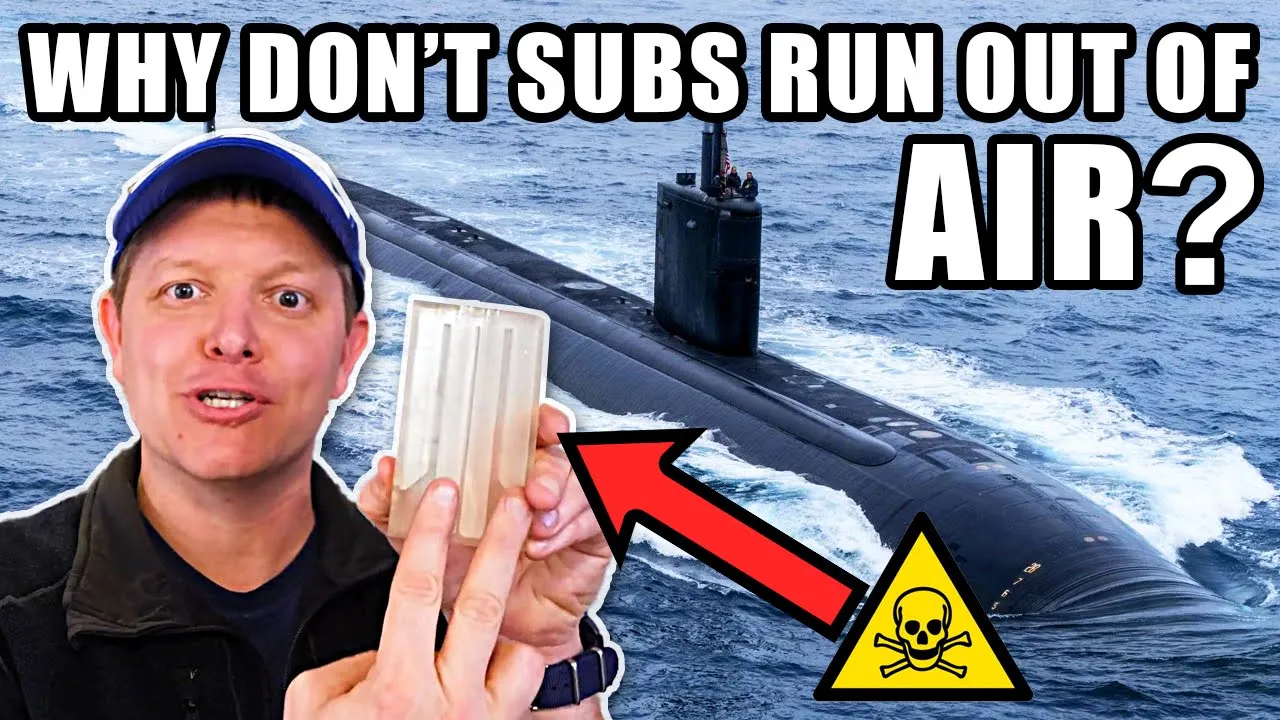
How Do Nuclear Submarines Make Oxygen?- Smarter Every Day 251 — SmarterEveryDay

SmarterEveryDay

Submarine life support relies on multi-tiered chemical redundancy, deploying self-oxidizing chlorate candles and passive lithium hydroxide to sustain crew respiration when powered systems fail.

AI-assisted summary of How Do Nuclear Submarines Make Oxygen?- Smarter Every Day 251 — original source. Check the original for full context.

Source published:

Key ideas

  • Nuclear submarines generate primary oxygen through water electrolysis, but raw seawater cannot be used directly because its sodium chloride content would generate lethal chlorine gas rather than pure oxygen. (6:43)
  • When the primary electrolysis plant is offline or during power failures, submarines deploy solid sodium chlorate 'candles' that thermally decompose to liberate breathable oxygen without external electricity. (10:28)
  • Carbon dioxide removal is continuously handled by regenerative monoethanolamine (MEA) scrubbers that cycle between absorbing CO2 and boiling it off for overboard discharge, eliminating the need for consumable scrubbing chemicals during normal operations. (19:47)
  • In unpowered or silent emergency scenarios, the crew can passively scrub atmospheric carbon dioxide by opening lithium hydroxide canisters and spreading the powder onto bunk bedding. (24:42)

Detailed notes

## Background Published by Destin Sandlin on the YouTube channel SmarterEveryDay on February 21, 2021, this video is part of an ongoing documentary series filmed aboard the nuclear submarine USS Toledo. The page description provides reference links regarding amine gas treating, chlorate oxygen candles, reverse osmosis desalination, and lithium hydroxide scrubbing.

## TL;DR Aboard the fast-attack submarine USS Toledo operating trapped beneath Arctic ice, maintaining a breathable atmosphere requires continuously manufacturing oxygen and removing carbon dioxide. Destin tours the vessel with auxiliary machinists ('A-gangers') to examine the Central Atmosphere Monitoring System (CAMS) and the primary life-support systems. Oxygen is produced primarily via water electrolysis using purified reverse-osmosis water (preventing deadly chlorine gas generation) and backed up by solid chemical chlorate candles, which Destin helps light. For carbon dioxide removal, the crew relies on regenerative liquid monoethanolamine (MEA) scrubbers that boil off captured gas to vent it overboard, supplemented by passive lithium hydroxide beds in electrical failure emergencies.

## Atmosphere & style The video carries an earnest, curious, and tense energy, set against the cramped, utilitarian backdrop of an operational submarine where every system is a matter of life or death. Destin brings his trademark boyish enthusiasm and accessible engineering analogies, contrasting playfully yet respectfully with the stoic, matter-of-fact competence of the submarine mechanics. The mood shifts from claustrophobic vigilance when discussing toxic gas leaks and Class Delta fires to genuine awe when Destin strikes a chlorate candle and feels freshly manufactured oxygen rushing past his hands.

## Bulletin - [06:43](https://www.youtube.com/watch?v=g3Ud6mHdhlQ&t=403s) Nuclear submarines generate primary oxygen through water electrolysis, but raw seawater cannot be used directly because its sodium chloride content would generate lethal chlorine gas rather than pure oxygen. - [10:28](https://www.youtube.com/watch?v=g3Ud6mHdhlQ&t=628s) When the primary electrolysis plant is offline or during power failures, submarines deploy solid sodium chlorate 'candles' that thermally decompose to liberate breathable oxygen without external electricity. - [19:47](https://www.youtube.com/watch?v=g3Ud6mHdhlQ&t=1187s) Carbon dioxide removal is continuously handled by regenerative monoethanolamine (MEA) scrubbers that cycle between absorbing CO2 and boiling it off for overboard discharge, eliminating the need for consumable scrubbing chemicals during normal operations. - [24:42](https://www.youtube.com/watch?v=g3Ud6mHdhlQ&t=1482s) In unpowered or silent emergency scenarios, the crew can passively scrub atmospheric carbon dioxide by opening lithium hydroxide canisters and spreading the powder onto bunk bedding.

## Key takeaways - [00:00](https://www.youtube.com/watch?v=g3Ud6mHdhlQ&t=0s) Operating submerged under ice sheets requires closed-circuit life support to simultaneously generate breathable oxygen and remove accumulating carbon dioxide. - [01:55](https://www.youtube.com/watch?v=g3Ud6mHdhlQ&t=115s) The Central Atmosphere Monitoring System (CAMS) tracks gases across individual compartments, monitoring oxygen, carbon dioxide, carbon monoxide, hydrogen, nitrogen, water vapor, and refrigerants. - [04:31](https://www.youtube.com/watch?v=g3Ud6mHdhlQ&t=271s) Auxiliary machinists use handheld electronic sniffers, Dräger chemical reaction tubes, and multi-gas meters to pinpoint the exact locations of piping leaks and toxic gases. - [06:43](https://www.youtube.com/watch?v=g3Ud6mHdhlQ&t=403s) Raw seawater must undergo filtration and reverse osmosis before electrolysis; potassium hydroxide is added as an electrolyte to facilitate clean oxygen generation. - [06:43](https://www.youtube.com/watch?v=g3Ud6mHdhlQ&t=403s) Electrolysis generates hydrogen as a volatile byproduct, which must be safely pumped overboard into the sea to prevent explosive accumulation inside the hull. - [10:28](https://www.youtube.com/watch?v=g3Ud6mHdhlQ&t=628s) Chlorate candles function as a completely unpowered, self-oxidizing backup oxygen source, classified operationally as a Class Delta fire hazard that must remain sealed during burning. - [12:41](https://www.youtube.com/watch?v=g3Ud6mHdhlQ&t=761s) A chlorate candle is ignited by mechanical friction using a red-phosphorus-tipped striker, producing approximately 9,500 BTUs of thermal energy and leaving behind a hot residue known as a clinker. - [17:01](https://www.youtube.com/watch?v=g3Ud6mHdhlQ&t=1021s) The candle's internal chemistry relies on burning iron powder to produce heat, which thermally decomposes sodium chlorate into table salt and net-positive elemental oxygen gas. - [17:01](https://www.youtube.com/watch?v=g3Ud6mHdhlQ&t=1021s) Submarines alternate burning candles between the forward spaces and the aft engine room to maintain equilibrium oxygen levels as monitored on CAMS in Torr partial pressure. - [19:47](https://www.youtube.com/watch?v=g3Ud6mHdhlQ&t=1187s) Mark IV Bravo scrubbers blow compartment air through liquid monoethanolamine (MEA) to bind carbon dioxide molecules in an absorber tower. - [22:06](https://www.youtube.com/watch?v=g3Ud6mHdhlQ&t=1326s) Saturated 'rich' MEA is restored to 'lean' MEA by boiling it in a pressurized stripper, which releases gaseous CO2 while recycling the chemical without consuming onboard inventory. - [22:06](https://www.youtube.com/watch?v=g3Ud6mHdhlQ&t=1326s) Liberated carbon dioxide is compressed to exceed external hydrostatic ocean pressure and ejected outside the hull as fine, acoustically quiet bubbles. - [24:42](https://www.youtube.com/watch?v=g3Ud6mHdhlQ&t=1482s) Lithium hydroxide canisters provide a failsafe, non-mechanical carbon dioxide scrubbing method that relies on passive atmospheric diffusion across living spaces during major casualties.

## Detailed walkthrough ### [00:00](https://www.youtube.com/watch?v=g3Ud6mHdhlQ&t=0s) Trapped Under Ice: The Atmosphere Challenge

Operating deep below the Arctic ice sheet, the Los Angeles-class fast-attack submarine USS *Toledo* faces a fundamental environmental reality: surfacing for fresh air is physically impossible. Onboard a sealed vessel carrying well over one hundred sailors, human respiration steadily depletes the air supply. Every crew member continuously consumes oxygen ($O_2$) and exhales carbon dioxide ($CO_2$), which will rapidly sour the enclosed atmosphere if left unmanaged. Maintaining life inside the submarine requires two distinct engineering feats: continuously manufacturing breathable oxygen from scratch and constantly scrubbing out the toxic build-up of carbon dioxide.

Because crew members move throughout the vessel and compartments can be closed off for operational or emergency reasons, atmospheric conditions are never uniform across the hull. Berthing compartments, where dozens of sailors sleep in high density, experience far higher rates of carbon dioxide generation than relatively unoccupied engineering spaces. To prevent localized pockets of asphyxiating or toxic air from forming, the boat relies on balanced, forced ventilation paired with continuous air monitoring through a system known as CAMS (Central Atmosphere Monitoring System).

As Destin frames the core survival challenge: > “Because if you think about it, if you're onboard with a lot of your crew mates and we're taking in oxygen and we're breathing out carbon dioxide, eventually the atmosphere on the inside of the submarine is going to become soured.”

[01:55](https://www.youtube.com/watch?v=g3Ud6mHdhlQ&t=115s) Central Atmospheric Monitoring System (CAMS)

To investigate the boat's life support systems, Destin meets with Machinist's Mate, Auxiliary (an "A-ganger") named Dow, hailing from Fort Jefferson, Ohio. A-gangers serve as the mechanics responsible for roughly 90% of the mechanical equipment throughout the ship. Located in the middle level of the submarine, the CAMS monitoring station serves as the central hub where watchstanders keep constant track of the boat's breathing environment.

The main display unit tracks both life-sustaining gases and dangerous contaminants across every compartment. The instrument reads levels of oxygen ($O_2$), carbon monoxide ($CO$), carbon dioxide ($CO_2$), hydrogen ($H_2$), nitrogen ($N_2$), and water vapor, alongside toxic industrial refrigerants such as Freon R-114 and total atmospheric pressures per compartment. A physical Sampling Panel Index allows the operator to turn a rotary dial to sample different zones, such as the fan rooms, the Chief Petty Officer's (CPO) quarters, or the crew's mess. Because physical air samples must be drawn through sampling lines across the boat to the analyzer, updating a reading takes several seconds while a progress bar sweeps across the screen. If oxygen drops below acceptable margins or harmful gases cross hazardous thresholds, audible alarms sound across the station.

Dow summarizes the system's vital mandate straightforwardly: > “Basically we're monitoring the good gas and the bad gasses basically.”

- **Gases Monitored by CAMS:** Oxygen ($O_2$), Carbon Dioxide ($CO_2$), Carbon Monoxide ($CO$), Hydrogen ($H_2$), Nitrogen ($N_2$), Water vapor ($H_2O$), and Refrigerants (including R-114). - **Compartment Air Sampling:** Switched manually or sequentially via the Sampling Panel Index to poll individual spaces across the ship.

[04:31](https://www.youtube.com/watch?v=g3Ud6mHdhlQ&t=271s) Sniffers, Dräger Kits, and Hunting Leaks

While CAMS can isolate an atmospheric anomaly down to a specific zone or compartment, it cannot locate the exact failure point on a pipe or valve. When a leak occurs, auxiliary mechanics rely on handheld detection gear to locate the source. Dow demonstrates a universal refrigerant sniffer used to hunt down R-134a leaks. The sniffer emits an audible chirp that increases rapidly in frequency as the probe nears escaping refrigerant, functioning very much like a Geiger counter. Mechanics sweep the wand slowly across joints and seams across the piping network, switching between small, medium, and large sensitivity settings. Destin remarks that tracking down leaks in this manner looks like coloring in kindergarten.

Beyond electronic refrigerant sniffers, the crew maintains specialized field-testing equipment for other hazardous conditions. A manual Dräger tube kit requires sailors to snap the tips of chemical detector tubes and manually pump air samples through them, watching for color-changing chemical reactions that identify specific contaminant gases. For combustible gas threats like hydrogen accumulation, the crew relies on portable multi-gas detectors like the PhD6, which gauge the lower explosive limit (LEL) of the air. During the demonstration, a loud mechanical thrum interrupts the conversation as a large compressor kicks on; Dow clarifies that this compressor powers the refrigeration plant for the ship’s chill and freeze boxes, keeping food cold for the crew on prolonged deployments.

Destin underscores how serious this routine detection work is: > “This is how you keep yourself alive on a sub.”

Dow explains the function of the manual detection gear: > “It samples the air they look like little tubes. You have to break and you have to pump air through it. And it'll indicate if there's a type of gas in the air.”

[06:43](https://www.youtube.com/watch?v=g3Ud6mHdhlQ&t=403s) Method 1: Electrolysis and the Peril of Raw Seawater

To create oxygen underwater, the primary method used on modern submarines is electrolysis: applying an electrical current across electrodes in water to break liquid $H_2O$ molecules into hydrogen and oxygen. While it seems intuitive that a nuclear-powered submarine sitting in an ocean of water could simply run electrical current directly through raw seawater, doing so would create a lethal disaster. Ocean water is filled with dissolved salts, primarily sodium chloride ($NaCl$). Subjecting raw saltwater to direct electrolysis does not yield pure oxygen; instead, it liberates highly toxic chlorine gas ($Cl_2$) alongside hydrogen, rapidly poisoning the crew and corroding equipment.

To prevent this, seawater must undergo intensive purification before entering the oxygen plant. The water is desalinated and polished using filtration and reverse osmosis (RO). Destin demonstrates the difference with a 3D-printed bench experiment: electrolyzing saltwater yields green, corrosive chlorine gas that damages the test apparatus, whereas electrolyzing pure water yields clean, breathable oxygen. Pure water alone conducts electricity poorly, so an electrolyte catalyst—potassium hydroxide ($KOH$)—is added. In the ship's Automated Electrolytic Oxygen Generator (AEOG), the pure water and potassium hydroxide solution is charged with electricity. The generated oxygen gas is discharged directly into the submarine's interior atmosphere, while the volatile hydrogen byproduct is pumped overboard into the sea.

```mermaid flowchart TD accTitle: Submarine Electrolytic Oxygen Generation vs Raw Seawater Electrolysis accDescr: Flow diagram showing how raw seawater must be purified via reverse osmosis before electrolysis to avoid dangerous chlorine gas generation.

subgraph Hazard["Dangerous Naïve Approach"] SW["Raw Seawater (H2O + NaCl)"] --> DirectElec["Direct Electrolysis"] DirectElec --> Cl["Chlorine Gas (Cl2 - Poisonous)"] DirectElec --> H1["Hydrogen Gas (H2)"] end

subgraph LifeSupport["Submarine AEOG Process"] Ocean["Raw Seawater"] --> RO["Filtration & Reverse Osmosis"] RO --> PureWater["Purified Water (H2O)"] PureWater --> AEOG["AEOG Cell (+ KOH Electrolyte)"] AEOG --> Oxygen["Oxygen (O2) Released to Crew"] AEOG --> WasteH2["Hydrogen (H2) Pumped Overboard"] end ```

Destin acknowledges how disastrous an untrained approach would have been: > “Except I would have killed everybody on the boat.”

Explaining the operational mechanism of the AEOG plant, Dow explains: > “We essentially shock the water, which creates Oxygen, and Hydrogen.”

- **Chemical Hazard of Saltwater:** Electrolysis of $NaCl$ brine liberates chlorine gas ($Cl_2$), which is deadly in an enclosed atmosphere. - **Electrolyte Used:** Potassium hydroxide ($KOH$) is dissolved into reverse-osmosis purified water to facilitate the electrolytic reaction. - **AEOG Byproduct Handling:** $O_2$ enters the boat's ventilation; flammable $H_2$ is safely ejected overboard.

[09:46](https://www.youtube.com/watch?v=g3Ud6mHdhlQ&t=586s) Method 2 Teaser: Burning Candles to Make Oxygen

While electrolysis serves as the standard, continuous method for oxygen production, submarines also carry a secondary, completely independent backup system that sounds entirely counterintuitive: lighting candles. Under normal circumstances, lighting a match or burning a candle is an oxidation reaction that consumes oxygen from the surrounding air. Thus, the idea of lighting a candle to replenish dwindling oxygen supplies on an air-depleted submarine seems like a total paradox.

Yet, stored in canisters nearby are chemical "chlorate candles." When ignited, these specialized blocks undergo an exothermic chemical decomposition that releases substantial volumes of breathable elemental oxygen gas rather than consuming it. Dow directs Destin to the metal storage cans positioned directly behind them, preparing to demonstrate how setting fire to a chlorate candle creates oxygen for the crew.

Destin expresses his initial bewilderment at the concept: > “So when I heard someone on the boat say, Hey, we're low on oxygen. We need to go light a candle that was counter intuitive to me.”

[10:28](https://www.youtube.com/watch?v=g3Ud6mHdhlQ&t=628s) The Chlorate Candle: Backup Oxygen and Class Delta Fires

A sailor demonstrates the backup method for generating breathable air on the submarine: the chlorate oxygen candle. The candle is stored inside a heavy container, placed inside a metal basket, and secured into a specialized housing. Ignition is mechanical; a top-mounted striker tipped with red phosphorus is pushed down and twisted to strike the top of the candle. As the sailor explains, once the candle takes, it ignites in a manner similar to a cigarette, but the operation must remain completely sealed behind a closed lid. When Destin asks why the lid cannot stay open, the crewman notes the extreme danger: “Cause that's a class Delta fire and we can't really put those out.”

Each candle burns for roughly 45 minutes to an hour, and two are burned simultaneously in the apparatus to yield 90 minutes to two hours of continuous oxygen production. Destin asks if burning candles is standard operational routine or an urgent necessity. The sailor reveals that the submarine's primary oxygen generator—the Automated Oxygen Generator (AOG), which relies on water electrolysis—is currently out of service. As a result, the crew must rely on these solid-chemical candles to maintain the ship's atmosphere. Oxygen concentrations are continuously tracked by the watchstander monitoring the Central Atmospheric Monitoring System (CAMS); whenever readings dip, the watchstander formally recommends a candle burn to the Chief of the Watch, who must approve the procedure before anyone strikes a candle.

- Each oxygen candle burns for 45 to 60 minutes; two loaded together burn for 90 to 120 minutes. - The candle burning apparatus serves as a critical fail-safe when the primary electrolysis system (the AOG) is offline. - Submarine fires involving self-oxidizing burning metals and chemicals are categorized as Class Delta fires, which cannot be quenched by depriving them of ambient oxygen.

---

[12:41](https://www.youtube.com/watch?v=g3Ud6mHdhlQ&t=761s) Loading, Striking, and Igniting the Candle

The spent residue of an oxygen candle is known aboard the ship as a "clinker"—a slang term the sailors use daily despite admitting they have no idea where the name originated. Preparing a fresh candle requires peeling away a protective cloth wrap designed to guard the chemical cylinder from shock and abrasion during handling inside its canister. Underneath lies the core of sodium chlorate and iron. The ignition striker itself is essentially a heavy nine-inch nail coated on the tip with red phosphorus. The candle will only light via the specific chemical reaction generated when the phosphorus tip strikes and rubs against the chlorate material on top of the cylinder.

The rarity and hazard of lighting a fire aboard an undersea vessel draws a small crowd of crew members. One passing sailor remarks, “I've been on board 4 1/2 years and I've never seen this done.” The sailor leading the evolution cautions Destin to step back before opening the canister to remove the spent candle, donning heavy heat-protective gloves. The burning reaction releases an immense amount of thermal energy—roughly 9,500 BTUs—meaning spent clinkers remain dangerously hot long after oxygen generation ceases. Once the spent candle is cleared and the two fresh candles are seated, the crewman places the igniter through the lid. To Destin’s shock and nervous amusement, the sailor hands him the striker:

> “So you're about to ignite it.” > “No. YOU are.” > “....I am?” > “You are.”

Under close instruction, Destin presses the striker down firmly into the center piece, twists it rapidly, and pulls upward. A wisp of smoke escapes, followed by an immediate rush of pressurized gas escaping through the vent port. Feeling the warm exhaust, the sailor confirms that oxygen is actively pouring into the compartment, playfully congratulating Destin: “YOU ARE a creator of oxygen.”

- Spent candle residues are referred to aboard the submarine as "clinkers." - Ignition requires physical friction between a red-phosphorus-tipped striker (resembling a 9-inch nail) and the chlorate core. - The reaction produces approximately 9,500 BTUs of heat, requiring thick thermal gloves for handling. - Proper ignition is confirmed tactilely by feeling pressurized oxygen venting out of the top discharge port.

---

[17:01](https://www.youtube.com/watch?v=g3Ud6mHdhlQ&t=1021s) Chemistry of the Candle and Spaceflight Redundancy

Reflecting after leaving the boat, Destin breaks down the fundamental chemistry powering the chlorate candle. The two primary constituents packed inside the solid matrix are iron powder and sodium chlorate ($NaClO_3$). When ignited, the iron oxidizes (burns), generating intense internal heat. Rather than simply consuming oxygen, this thermal energy decomposes the surrounding sodium chlorate, causing it to liberate far more elemental oxygen ($O_2$) gas than was consumed by the initial iron burn, leaving behind iron oxide and harmless sodium chloride (table salt).

Destin emphasizes the crucial engineering advantage of this technology: while a nuclear reactor driving electrolysis cells provides a virtually limitless oxygen supply under normal steaming conditions, it depends entirely on active electrical distribution. If the submarine suffers a catastrophic casualty, a total reactor scram, or an electrical blackout, the crew can simply strike a solid candle. Destin summarizes the survival value of this self-contained design: “As long as you have a solid candle and a way to contain the fire, without it damaging anything on the boat, you can start that fire and create oxygen with no external power source whatsoever.”

Because a compact solid chemical yields an enormous volume of gas, chlorate candles are also standard emergency gear on human spacecraft. Both American and Russian space missions have relied on them for decades (with one infamous mishap occurring aboard the Russian space station *Mir* when an oxygen candle caught fire in 1997). When operating entirely on candles, the submarine crew lights two candles every two hours, alternating between the forward compartment and the engine room to keep gas distribution uniform. On the CAMS display, partial oxygen pressure (measured in Torr) does not spike dramatically; instead, it inches up by three or four Torr over an hour, neatly offsetting the continuous metabolic consumption of the crew. As the monitoring sailor explains, “No we're not trying to really rise with these are mostly trying to maintain a suitable atmosphere so that we can breathe still.”

- **Chemical Reaction**: Iron oxidation supplies heat ($Fe + O_2 \rightarrow Fe_2O_3$), which thermally decomposes sodium chlorate ($2NaClO_3 \rightarrow 2NaCl + 3O_2$). - **Power Independence**: Functions without electrical power, hydraulic pumps, or electronic controllers. - **Operational Cadence**: Two candles burned every two hours, alternating between the forward compartment and the aft engine room. - **Atmospheric Metric**: Tracked via oxygen partial pressure ($O_2$ Torr) on CAMS to maintain equilibrium rather than spiking concentration.

---

[19:47](https://www.youtube.com/watch?v=g3Ud6mHdhlQ&t=1187s) Scrubbing Carbon Dioxide with Monoethanolamine (MEA)

Generating oxygen solves only half of the life-support equation; the carbon dioxide exhaled by the crew must be continuously removed before it reaches toxic concentrations. The submarine accomplishes this continuous removal using two Mark IV Bravo (Mark 4B) liquid chemical $CO_2$ scrubbers. The watchstander explains: “So what these machines are designed to do they take carbon dioxide out of the air.” Air is pulled from the ship’s fan rooms through blowers at an approximate rate of 370 cubic feet per minute (CFM) and directed into the scrubber's absorber tower.

Inside the absorption tower, the incoming air is showered with a liquid chemical called monoethanolamine, commonly abbreviated as MEA or simply "amine." As the gas flows through the liquid spray, the amine chemically binds with the carbon dioxide molecules. The cleaned, $CO_2$-stripped air is routed through an air purifier and discharged back into the ship's circulation system as fresh breathing air. Meanwhile, the amine solution—now designated "rich amine" because it is saturated with captured $CO_2$—is drawn from the bottom of the tower and routed by an amine pump into a regenerative heating loop.

The rich amine passes through a heat exchanger to preheat it before entering a pressurized boiler/stripper. Because boiling under pressure alters the chemical equilibrium, heating the amine reverses the absorption bond, causing the solution to boil and release the trapped carbon dioxide as a gas while restoring the liquid to "lean amine" ready for reuse. The freed $CO_2$ gas is routed to a specialized compressor that pressurizes the gas to match the hydrostatic pressure of the surrounding ocean at whatever depth the submarine is operating, allowing the submarine to discharge the carbon dioxide directly overboard into the sea.

```mermaid flowchart TD accTitle: Submarine Monoethanolamine CO2 Scrubber Cycle accDescr: Diagram showing the cyclic process of scrubbing CO2 from sub air using MEA, regenerating the amine via boiling, and discharging the compressed gas overboard.

subgraph Absorption ["Air Absorption Cycle"] AirIn["Submarine Cabin Air (CO2 Rich)"] -->|"~370 CFM via Blower"| AbsTower["Absorber Tower"] AbsTower -->|"Purified Air Output"| FreshAir["Circulated Breathable Air"] end

subgraph AmineLoop ["Amine Regeneration Loop"] AbsTower -->|"Rich Amine (with CO2)"| Pump["Amine Pump"] Pump --> HEX["Heat Exchanger"] HEX --> Stripper["Pressurized Boiler / Stripper"] Stripper -->|"Boiled / CO2 Released"| LeanAmine["Lean Amine (Regenerated)"] LeanAmine -->|"Cooled via Heat Exchanger"| AbsTower end

subgraph Discharge ["Gas Disposal"] Stripper -->|"Gaseous CO2"| Compressor["CO2 Compressor"] Compressor -->|"Overboard Discharge"| Ocean["Seawater at Ambient Depth"] end ```

- Two Mark IV Bravo $CO_2$ scrubbers process ambient air pulled from the ship's fan room at approximately 370 CFM. - Monoethanolamine (MEA) chemically absorbs $CO_2$ at lower temperatures in the absorber tower. - Rich amine is regenerated in a pressurized boiler/stripper, boiling off the bound $CO_2$ and recycling lean amine back to the tower. - Gaseous $CO_2$ is compressed to match ambient external seawater pressure and pumped directly overboard into the ocean.

[22:06](https://www.youtube.com/watch?v=g3Ud6mHdhlQ&t=1326s) Monoethanolamine and the CO2 Absorption Loop

Destin breaks down the chemical process described by Machinist's Mate Dow for removing carbon dioxide from the submarine's atmosphere using monoethanolamine, commonly referred to as MEA or simply amine. The distinct amine odor is notorious among submarine crews, often lingering in their uniforms long after returning home to their spouses. Mechanically, the chemical acts as a rechargeable sponge for carbon dioxide. Destin compares "rich" amine to a freshly opened fizzy soda that is saturated with dissolved carbon dioxide, while "lean" amine behaves like flat soda—completely stripped of gas and eager to absorb more.

```mermaid flowchart TD accTitle: Submarine Amine CO2 Scrubbing Cycle accDescr: Air flows into an absorber tower where lean amine absorbs CO2, turns into rich amine, boils off the gas in a stripper, and gets recycled.

subgraph Absorber["Absorber Stage"] A["Cabin Air + CO2"] --> B["Absorber Tower"] LA1["Lean Amine Spray"] --> B B --> C["Clean Air Back to Cabin"] B --> D["Rich Amine Pool (CO2 Saturated)"] end

subgraph Stripper["Stripping & Overboard Stage"] D --> E["Preheater & Boiler Stripper"] E --> F["CO2 Gas Boiled Off"] F --> G["High-Pressure Compressor"] G --> H["Overboard Seawater Discharge"] E --> LA2["Regenerated Lean Amine"] end

LA2 --> LA1 ```

The system operates using two primary vessels: an absorber tower and a boiler stripper. Cabin air laden with carbon dioxide is blown into the bottom of the absorber tower while lean MEA is sprayed downward from the top. Spraying the liquid dramatically maximizes the contact surface area between the gas and the chemical, allowing the flat amine to strip the carbon dioxide directly out of the air. The saturated liquid collects at the bottom of the tower as rich amine. After passing through a preheater, it enters the boiler stripper where high heat drives the carbon dioxide out of solution. The liberated carbon dioxide is compressed to whatever ambient sea pressure is necessary to overcome ocean depth and ejected out the side of the hull as microscopic bubbles to avoid acoustic detection. The stripped amine, now lean once again, returns to the absorber tower to repeat the cycle continuously without consuming any onboard chemicals.

- Monoethanolamine (MEA) cycles continuously between "lean" (unsaturated) and "rich" (carbon-dioxide-saturated) states. - The spray nozzles maximize surface area contact between cabin air and liquid MEA to accelerate chemical absorption. - High-pressure compressors push the separated carbon dioxide overboard regardless of operating depth, dispersing it into fine, acoustically quiet bubbles. - As Destin emphasizes: “The fact that you can take that lean amine and then make it rich and then make it lean again is fantastic, because that means you don't have any consumables on board and you can continuously scrub CO2 from the air indefinitely.”

---

[24:42](https://www.youtube.com/watch?v=g3Ud6mHdhlQ&t=1482s) Passive Scrubbing with Lithium Hydroxide and Atmospheric Summary

When electrical power is lost and the mechanized MEA scrubbers cannot operate, the submarine relies on lithium hydroxide (LiOH) as a passive emergency backup. This chemical mesh famously saved the crew of Apollo 13 when astronauts jerry-rigged square command module canisters to fit the round lunar module sockets. Lithium hydroxide is also standard issue in Navy SEAL rebreathers and astronaut extravehicular activity (EVA) suits. In a catastrophic submarine casualty where fans cannot blow air through canisters, sailors can simply slice open the containers and scatter lithium hydroxide powder directly across their bunk bedding. Ambient air currents passively react with the exposed chemical, continuing to strip carbon dioxide and keeping the crew alive while completely silent and unpowered.

Destin summarizes the full life-support architecture required to sustain human respiration beneath the sea. Oxygen generation relies primarily on high-pressure water electrolysis, backed up by chemical oxygen candles (chlorate candles). Carbon dioxide removal relies on the regenerative monoethanolamine liquid loop for standard operations, backed up by disposable lithium hydroxide canisters for emergencies and unpowered conditions. Balancing these complementary systems allows a crew to stay submerged for months at a time.

- Lithium hydroxide operates via passive chemical exposure, functioning even without electrical power or active ventilation blowers. - In extreme emergency scenarios, sailors can scatter lithium hydroxide granules onto bunk mattresses to utilize room-scale passive diffusion. - Closed-circuit life support balances oxygen generation (electrolysis machines and chlorate candles) with carbon dioxide removal (regenerative amine scrubbers and lithium hydroxide beds).

---

[26:18](https://www.youtube.com/watch?v=g3Ud6mHdhlQ&t=1578s) Sponsor: Raycon Wireless Audio

Destin highlights the sponsor, Raycon, sharing how he relies on their wireless earbuds during long-distance running workouts to listen to audiobooks and music. He praises the physical tap controls located directly on the earbud housing, which let him immediately pause playback whenever someone interrupts his run—such as an encounter with an eccentric pet owner introducing a dog named "Princess Booper Snoot."

He details the design features of the Performer E55 model alongside the Everyday E25. The Performer edition offers both USB-C and wireless charging options directly through its carrying case, provides sound fidelity comparable to premium audio competitors at roughly half the retail price, and includes customizable gel tips designed to adapt to individual ear anatomy.

---

[27:56](https://www.youtube.com/watch?v=g3Ud6mHdhlQ&t=1676s) Submarine Series Status and Outro

Destin outlines the trajectory of the *Smarter Every Day* submarine series, looking back at episodes covering daily operational topics like galley food management and oxygen production, while looking ahead to surfacing the boat through polar ice. He invites viewers to subscribe or support the channel on Patreon before signing off with his traditional closing remarks.

---

[28:38](https://www.youtube.com/watch?v=g3Ud6mHdhlQ&t=1718s) The Backbone of the Boat: Meeting the Auxiliary Mechanics

Following the end card, Destin chats with the auxiliary machinists running the life-support machinery compartment. He meets Petty Officer Watson and Sailor Parmer, observing firsthand how warm the air feels right where pure oxygen vents into the ship. Destin refers to their engineering rating as the true backbone of the vessel, noting the sheer technical expertise required to manage high-pressure chemical plants underwater.

When Destin asks how they acquired such deep technical competence, the sailors explain that practical foundations often begin at home with family mechanical work, but the Navy submarine qualification process pushes that knowledge to another level. Operating submerged under hundreds of feet of ocean leaves zero margin for error, forcing every sailor to master every valve and circuit in their compartment. Emphasizing the isolation and personal accountability that defines submarine service, Machinist's Mate Dow explains: “You have to learn a lot because your life depends on it, and if something goes down we're the ones who have to fix it. There's no one else to call out here to help us, except for us.”

## Notable quotes > [28:38](https://www.youtube.com/watch?v=g3Ud6mHdhlQ&t=1718s) You have to learn a lot because your life depends on it, and if something goes down we're the ones who have to fix it. There's no one else to call out here to help us, except for us. — Machinist's Mate Dow

> [17:01](https://www.youtube.com/watch?v=g3Ud6mHdhlQ&t=1021s) As long as you have a solid candle and a way to contain the fire, without it damaging anything on the boat, you can start that fire and create oxygen with no external power source whatsoever. — Destin

## Mentioned USS Toledo, Los Angeles-class submarine, Central Atmosphere Monitoring System (CAMS), Machinist's Mate Dow, Dräger, PhD6, Automated Electrolytic Oxygen Generator (AEOG), Automated Oxygen Generator (AOG), Mark IV Bravo, Apollo 13, Mir, Petty Officer Watson, Sailor Parmer, Destin Sandlin, Raycon

## Video description Email list to be notified when I make a new video: https://www.smartereveryday.com/email-list Go to https://buyraycon.com/smarter for 15% off your order. Brought to you by Raycon. Click here if you're interested in subscribing: http://bit.ly/Subscribe2SED The absolute best way to help the channel is by supporting Smarter Every Day on Patreon: http://www.patreon.com/smartereveryday

⇊ Click below for more links! ⇊ ~~~~~~~~~~~~~~~~~~~~~~~~~~~~ GET SMARTER SECTION

Amine gas treating https://en.wikipedia.org/wiki/Amine_gas_treating

Chlorate Candle Technical Sheet: https://oclugo2.wpengine.com/wp-content/uploads/2019/06/Chlorate-Candle-Technical-Data-Sheet-Revision-3.pdf

Reverse Osmosis: https://en.wikipedia.org/wiki/Reverse_osmosis#Desalination

Lithium Hydroxide: https://en.wikipedia.org/wiki/Lithium_hydroxide ~~~~~~~~~~~~~~~~~~~~~~~~~~~~ Tweet Ideas to me at: http://twitter.com/smartereveryday

Smarter Every Day on Patreon http://www.patreon.com/smartereveryday

Smarter Every Day On Instagram http://www.instagram.com/smartereveryday

Smarter Every Day SubReddit http://www.reddit.com/r/smartereveryday

Ambiance, audio and musicy things by: Gordon McGladdery https://www.ashellinthepit.com/ http://ashellinthepit.bandcamp.com/

If you feel like this video was worth your time and added value to your life, please SHARE THE VIDEO!

If you REALLY liked it, feel free to pitch in and support Smarter Every Day by becoming a Patron: http://www.patreon.com/smartereveryday

Warm Regards,

Destin

[Source](https://www.youtube.com/watch?v=g3Ud6mHdhlQ)

中文简报

发电机故障后,“托莱多”号潜艇在北极冰层下点燃化学氧烛 潜艇生命维持系统依赖多层级化学冗余,在电力系统失效时部署自氧化氯酸盐氧烛与被动式氢氧化锂以维持艇员呼吸。 在北极冰层下作业的“托莱多”号快速攻击核潜艇上,维持可呼吸的大气环境需要不断制造氧气并清除二氧化碳。Destin与辅助机械工(“A-gangers”)一同参观了该艇,视察中央大气监测系统(CAMS)及主要生命维持系统。氧气主要通过纯化反渗透水电解产生(以防止生成致命的氯气),并由固体化学氯酸盐氧烛作为后备,Destin还协助点燃了氧烛。在清除二氧化碳方面,艇员依赖可再生的液态单乙醇胺(MEA)洗涤器,通过沸腾释放捕获的气体并排出艇外;在断电紧急情况下,则辅以被动式氢氧化锂吸收床。 核潜艇主要通过电解水产生氧气,但不能直接使用未经处理的海水,因为其中的氯化钠会产生致命的氯气而非纯氧。 (6:43) 当主电解装置停运或发生电力故障时,潜艇会使用固体氯酸钠“氧烛”,通过热分解释放可呼吸的氧气,无需外部电力。 (10:28) 二氧化碳的清除由可再生单乙醇胺(MEA)洗涤器持续进行,该系统在吸收二氧化碳与将其煮沸排出艇外之间循环,在正常作业期间无需消耗性洗涤化学品。 (19:47) 在无动力或静音紧急情况下,艇员可通过打开氢氧化锂罐并将粉末撒在床铺寝具上,来被动洗涤空气中的二氧化碳。 (24:42)

Reading summary

Operating sealed beneath Arctic ice, nuclear submarines rely on a dual-layered atmospheric life-support architecture that continuously manufactures breathable oxygen and scrubs toxic carbon dioxide. To maintain equilibrium without surfacing, the vessel pairs active mechanical loops with unpowered chemical redundancies that sustain the crew during power casualties. Centralized Monitoring and Localized Leak Detection (1:55) Because human respiration steadily converts oxygen into carbon dioxide, the enclosed atmosphere aboard the USS Toledo will quickly sour without active regulation. Compartmental air quality is continuously polled by the Central Atmosphere Monitoring System (CAMS), managed by auxiliary machinists ("A-gangers"). Using a physical sampling panel that draws air through lines across the ship, CAMS monitors oxygen, carbon dioxide, carbon monoxide, hydrogen, nitrogen, water vapor, compartment pressures, and industrial refrigerants like Freon R-114, triggering audible alarms if thresholds are breached. While CAMS pinpoints atmospheric shifts to general zones such as fan rooms or berthing compartments, locating specific pipe and valve failures requires localized gear. Mechanics trace refrigerant leaks (such as R-134a from refrigeration compressors) using electronic wand sniffers that chirp with increasing frequency near breaches. For hazardous contaminants and combustible accumulations like hydrogen, sailors manually draw air through color-changing Dräger chemical tubes and deploy multi-gas detectors to measure the lower explosive limit. Electrolysis and the Chlorate Candle Redundancy (6:43) The submarine's primary method for manufacturing oxygen is the Automated Electrolytic Oxygen Generator (AEOG). Although the vessel operates submerged in water, subjecting raw seawater to direct electrolysis would split sodium chloride brine into deadly chlorine gas and hydrogen. The ship must first desalinate ocean water via filtration and reverse osmosis. Potassium hydroxide is then added as an electrolyte to facilitate electrical conduction, allowing the system to separate pure water into oxygen—which is discharged into the ventilation—and volatile hydrogen, which is pumped overboard. When the primary electrolysis plant is offline or during electrical power failures, the crew relies on self-contained chlorate candles. Each solid block contains iron powder and sodium chlorate. When struck with a red-phosphorus-tipped striker, the iron burns and provides the thermal energy (roughly 9,500 BTUs) needed to thermally decompose the sodium chlorate into salt and vast volumes of elemental oxygen. Because the burning candle constitutes a self-oxidizing Class Delta fire that cannot be quenched by smothering, it operates inside a sealed metal housing. When running entirely on backup candles, the crew burns pairs every two hours, alternating between compartments to steadily offset crew metabolic consumption without requiring external electrical power. Closed-Loop Carbon Dioxide Scrubbing with Monoethanolamine (19:47) Oxygen replenishment only addresses half of the life-support equation; exhaled carbon dioxide must also be continuously removed. The submarine operates two Mark IV Bravo scrubbers that draw cabin air through blowers at roughly 370 cubic feet per minute into an absorber tower. Inside, incoming air is sprayed with liquid monoethanolamine (MEA, or "amine"), which chemically binds with carbon dioxide molecules before the purified air is returned to circulation. The saturated "rich" amine solution is continuously pumped into a preheater and boiler stripper. Heating the pressurized amine alters its chemical equilibrium, boiling off the captured carbon dioxide and restoring the liquid to "lean" amine for infinite reuse without depleting onboard chemical reserves. The freed carbon dioxide gas is then fed into a high-pressure compressor that matches external ambient hydrostatic pressure, ejecting the gas into the ocean as microscopic bubbles to prevent acoustic detection. Passive Emergency Scrubbing and Crew Self-Reliance (24:42) If electrical failure disables the MEA scrubbers and active ventilation fans, life support shifts to passive lithium hydroxide (LiOH) canisters. In catastrophic emergencies, sailors can open these canisters and scatter lithium hydroxide powder directly across bunk mattresses. Ambient air currents passively react with the exposed chemical, continuing to strip carbon dioxide from the compartments in total silence without power. Managing these intertwined, high-pressure chemical plants underwater requires extreme technical self-reliance from auxiliary mechanics. Because the vessel operates isolated under hundreds of feet of ocean and ice, there is no external margin for error or outside assistance. Every valve, chemical cycle, and emergency procedure must be maintained and repaired entirely by the ship's crew. The submarine's life-support strategy pairs continuous, electrically driven cycles—water electrolysis and regenerative amine scrubbing—with power-independent chemical fallbacks like chlorate candles and lithium hydroxide. This closed-loop architecture enables months of underwater endurance, constrained only by onboard consumable reserves and the crew's ability to maintain the machinery.

精炼阅读摘要

根据《Smarter Every Day》节目介绍,在极地冰层等极端封闭环境下潜航的核潜艇必须依赖高度冗余的双重生命支持架构,在持续利用海水电解制造氧气的同时,依靠可再生的化学循环系统彻底清除艇员代谢产生的二氧化碳。 密闭环境监测与气体泄漏探测 (1:55) 核潜艇(如洛杉矶级“托莱多”号)在北极冰层下长期潜航时,百余名艇员的呼吸活动会持续消耗氧气并排出二氧化碳。由于人员在艇内分布不均且部分隔舱可能随时关闭,高密度的水兵住舱与工程舱室的气体成分差异显著。为防止局部区域出现窒息或有毒气体聚集,潜艇依靠中央大气监测系统(CAMS)进行连续监控。该系统连接分布在各舱室的物理采样管路,由操作员切换采样盘,实时分析氧气、二氧化碳、一氧化碳、氢气、氮气、水蒸气以及氟利昂(如R-114)等工业制冷剂浓度和环境总压。一旦氧气偏低或有害气体超标,系统将立即发出声响警报。 然而,CAMS只能确定异常发生的大致舱室区域,无法精确定位管道或阀门的破损点。当发生微小泄漏时,被称为“A-ganger”的辅助机械工必须携带便携设备深入现场排查。技术人员使用对R-134a制冷剂敏感的手持探头,通过类似盖革计数器的蜂鸣频率逐寸扫描管路接缝;使用多气体检测仪监控氢气等易燃气体的爆炸下限;在必要时还会折断化学德尔格检测管(Dräger tube),通过手动泵气观察管内药剂的变色反应来判定特定污染物的存在。 电解水制氧与有毒副产物规避 (6:43) 核潜艇在水下生产氧气的主力途径是全自动电解氧气发生器(AEOG)。尽管潜艇身处海洋,但绝对不能直接对海水进行电解。海水含有大量氯化钠(NaCl),直接通电电解不仅无法获得纯净氧气,反而会释放出极具腐蚀性与剧毒的氯气(Cl₂),在封闭舱室中会迅速危及全体艇员生命。为此,海水进入电解系统前必须经过严格的多重过滤和反渗透(RO)淡化处理,制备出高纯度的淡水。 由于纯水的导电性能极差,系统会在处理后的纯水中加入氢氧化钾(KOH)作为电解质催化剂。在电解室内施加电流后,水分子被电解分解为氧气和氢气。生成的氧气被直接注入潜艇的强制通风系统供全艇呼吸;而极易燃烧和爆炸的副产物氢气则被高压泵安全排出艇外,直接释放进大海中消散。 化学氧气蜡烛与无动力制氧保障 (10:28) 当潜艇电解制氧设备发生故障或反应堆停堆导致全艇断电时,艇员会启用一种看似反常的备用方案:点燃“氯酸盐氧气蜡烛”。普通的燃烧会消耗氧气,但这种固态蜡烛由氯酸钠(NaClO₃)和铁粉(Fe)压制而成。引燃时,水兵使用涂有红磷的专用撞针机械按压并旋转,通过摩擦激发化学反应。铁粉的氧化燃烧释放出约9500英热单位(BTU)的高温,该热量继而促使周围的氯酸钠发生热分解反应,释放出大量纯氧,最终残留下氧化铁和普通的食盐固体废渣(艇员俗称“熔渣”)。 氧气蜡烛的核心价值在于其反应不依赖潜艇的电力、泵机或电子控制系统,即使遭遇灾难性断电也能稳定产氧。但由于该反应属于可自供氧的“D类火灾”,无法通过隔绝空气扑灭,因此操作必须在完全封闭的耐压炉体中进行,且点火前必须获得值更官(Chief of the Watch)的正式批准。通常两根蜡烛装入炉内同时燃烧,可持续产氧90至120分钟。为保证气体分布均匀,艇员会在艇首和艇尾轮流点燃,CAMS显示每次燃烧能使全艇氧分压平稳回升3至4托(Torr),以此平衡代谢消耗。 二氧化碳清除与双层吸收冗余 (19:47) 除了补充氧气,潜艇还必须持续清除人体代谢呼出的二氧化碳。正常巡航时,潜艇依靠两台Mark IV Bravo型液体化学洗涤器。风机以约370立方英尺/分钟的速率抽取空气送入吸收塔,由喷头向下喷淋单乙醇胺(MEA)液体。雾状喷淋极大增加了气液接触面积,使“贫胺”状态的液体迅速化学结合空气中的二氧化碳,净化后的空气送回舱室循环。 吸收饱和后的“富胺”液体随后被泵送至预热器和加压脱吸塔。在加压沸腾条件下,胺与二氧化碳的化学键被破坏,二氧化碳以气体形式释放,恢复为“贫胺”后重新送回吸收塔循环利用,实现车间吸收剂的零净消耗。脱附出的二氧化碳气体由高压压缩机压缩至匹配当前潜深的水压,被粉碎为微小的静音气泡泵出艇外。若机械洗涤系统遭遇动力丧失,潜艇备有固态氢氧化锂(LiOH)作为应急被动手段。水兵可直接切开药罐,将氢氧化锂颗粒撒在铺位床垫上,利用舱内微弱的自然空气对流被动吸收二氧化碳,确保艇员在无动力、完全静音状态下维持生存。 潜艇的大气维持系统体现了严密的深海工程设计逻辑:平时依靠电解纯水和可再生单乙醇胺循环,实现近乎无限期的自给自足;战时或动力失效时,则无缝切换至无需电力的氯酸盐蜡烛与氢氧化锂被动吸收床,确保极端险情下的生存底线。

Detailed notes — zh

## Background 该视频由科普频道的 Destin 于 2021 年 2 月 21 日在 YouTube 平台的 SmarterEveryDay 频道发布。视频简介提供了关于胺液气体处理、氯酸盐氧气蜡烛技术规范、反渗透脱盐技术以及氢氧化锂等核心化学原理的参考链接,旨在向观众深度揭秘核潜艇在完全与外界隔绝的水下环境中如何实现大气的持续循环与自给自足。 ## TL;DR 本期视频深入美国海军“托莱多”号(USS Toledo)核潜艇内部,全面剖析了艇内密闭环境下的生命支持与大气平衡体系。全艇通过中央大气监测系统(CAMS)及便携检漏仪实时追踪各种气体组分,并在制氧端构建了以海水反渗透纯化后电解(AOG)为主、氯酸盐氧气蜡烛燃烧分解为备用的双重供氧方案。而在清除有害二氧化碳方面,潜艇日常依靠单乙醇胺(MEA)洗涤塔实现吸收、煮沸脱附及舷外高压排放的无限闭环循环,并辅以氢氧化锂(LiOH)作为断电应急手段。通过这一整套精密互补的化学工程与机械系统,艇员们在无法浮出水面的极地冰层下构建起了坚固的生命防线。 ## Atmosphere & style 全片洋溢着沉浸式的工业硬核质感与强烈的好奇探索欲。狭窄逼仄且管路密布的潜艇舱室内,轰鸣的压缩机底噪、仪器的警报蜂鸣与扑面而来的灼热气流交织在一起,给观众带来身临其境的密闭压迫感。Destin 与被称为“A-gangers”的基层水兵之间的对话兼具风趣幽默与严谨求实,既有亲手点燃高温氧气蜡烛时的紧张刺激,也有水兵们平静道出“深海中除了彼此无人可求援”时的从容与厚重,展现出极具感染力的纪实力量。 ## Bulletin - [00:00](https://www.youtube.com/watch?v=g3Ud6mHdhlQ&t=0s) 核潜艇在冰下长期闭合巡航时,生命维持系统依靠“双轨制”运行:主系统通过电解超纯水产氧并由单乙醇胺(MEA)循环洗脱二氧化碳,备用系统则依靠零电力的氯酸盐氧气蜡烛与氢氧化锂(LiOH)应急兜底。 - [06:43](https://www.youtube.com/watch?v=g3Ud6mHdhlQ&t=403s) 潜艇严禁直接电解海水制氧,因为盐水中的氯化钠会导致阳极产生剧毒的氯气(Cl2),必须先经反渗透(RO)淡化脱盐后加入氢氧化钾(KOH)方可安全电解。 - [12:14](https://www.youtube.com/watch?v=g3Ud6mHdhlQ&t=734s) 备用氯酸盐氧气蜡烛利用铁粉氧化燃烧释放的 9,500 BTU 高热促使氯酸钠分解放氧,属于自氧化不可扑灭的 Delta 级火灾,完全不依赖全艇供电即可持续供氧。 - [19:47](https://www.youtube.com/watch?v=g3Ud6mHdhlQ&t=1187s) 艇内单乙醇胺(MEA)洗涤系统通过贫胺喷雾吸附 CO2,并在沸腾汽提塔中加热使富胺再生,释放的二氧化碳经高压压缩机加压至外界海压后微泡排出艇外,溶剂可无限期循环使用。 ## Key takeaways - [00:00](https://www.youtube.com/watch?v=g3Ud6mHdhlQ&t=0s) 核潜艇在极地厚冰层下巡航时无法浮出水面换气,必须构筑包含主备两套制氧与两套二氧化碳清除方案的生命维持系统。 - [01:07](https://www.youtube.com/watch?v=g3Ud6mHdhlQ&t=67s) 中央大气监测系统(CAMS)通过管道轮流抽取全艇各舱室空气,实时监控氧气、二氧化碳、一氧化碳、氢气及冷媒等多类气体浓度与舱内总压。 - [04:10](https://www.youtube.com/watch?v=g3Ud6mHdhlQ&t=250s) 当 CAMS 发出异常报警时,机械师(A-ganger)需携带便携式检漏仪与德尔格指示管对密闭管路焊缝进行地毯式细微排查。 - [06:43](https://www.youtube.com/watch?v=g3Ud6mHdhlQ&t=403s) 电解海水会析出剧毒氯气致全艇人员死亡,因此自动电解氧发生器(AOG)必须使用反渗透彻底提纯的海水,并加入氢氧化钾催化制氧。 - [06:43](https://www.youtube.com/watch?v=g3Ud6mHdhlQ&t=403s) 电解水副产物易燃易爆的氢气不会在艇内积聚,而是被高压泵安全直接排入艇外大海。 - [09:45](https://www.youtube.com/watch?v=g3Ud6mHdhlQ&t=585s) 主电解制氧机故障或全艇失电时,艇员启用反直觉的“燃烧制氧”法,点燃氯酸盐氧气蜡烛作为关键备用手段。 - [12:14](https://www.youtube.com/watch?v=g3Ud6mHdhlQ&t=734s) 氧气蜡烛的燃烧属于自带氧化剂的 Delta 级火灾,常规灭火手段无法扑灭,操作时必须严格密封燃烧室防范火险。 - [17:01](https://www.youtube.com/watch?v=g3Ud6mHdhlQ&t=1021s) 氧气蜡烛通过红磷撞针摩擦引燃铁粉,放热促使氯酸钠(NaClO3)热分解释放游离氧气,单支可燃烧 45 至 60 分钟并释放约 9,500 BTU 热量。 - [18:32](https://www.youtube.com/watch?v=g3Ud6mHdhlQ&t=1112s) 点燃氧气蜡烛并不会让舱内氧分压大幅飙升,其平缓释放的速率旨在与全艇百余人持续呼吸的消耗保持动态平衡。 - [19:47](https://www.youtube.com/watch?v=g3Ud6mHdhlQ&t=1187s) 二氧化碳主清除设备使用单乙醇胺(MEA)作为吸收剂,以约 370 CFM 的流量逆流喷淋吸收空气中的二氧化碳。 - [22:06](https://www.youtube.com/watch?v=g3Ud6mHdhlQ&t=1326s) 吸收饱和的富胺在受压汽提塔中高温煮沸释放二氧化碳并还原为贫胺,该闭环设计无需持续消耗化学储备即可实现无限期循环。 - [22:06](https://www.youtube.com/watch?v=g3Ud6mHdhlQ&t=1326s) 汽提塔剥离的气态二氧化碳被增压至当前水深对应的海水静水压,化作细微气泡排入海中溶解,以避免产生声学噪音暴露行踪。 - [24:42](https://www.youtube.com/watch?v=g3Ud6mHdhlQ&t=1482s) 氢氧化锂(LiOH)作为应急被动吸收二氧化碳手段,在断电瘫痪等极端事故下可直接平铺在床铺上自发吸附二氧化碳。 - [28:38](https://www.youtube.com/watch?v=g3Ud6mHdhlQ&t=1718s) 在孤悬大洋深处的核潜艇中,艇员必须精通机械与化学控制,因为设备发生故障时完全无法向外界求援,只能依靠自救。 ## Detailed walkthrough ### [00:00](https://www.youtube.com/watch?v=g3Ud6mHdhlQ&t=0s) 冰下潜航:核潜艇的大气维持难题 Destin 站在核潜艇的镜头前,开启了《Smarter Every Day》关于核潜艇深度探索的新篇章。潜艇的设计目标是在水下尽可能长时间地隐蔽巡航,而在极端环境下,它们甚至完全无法浮出水面——例如此时的“托莱多”号核潜艇(USS Toledo)正深潜于北极坚冰之下,头顶厚重的冰层彻底断绝了浮上海面换气的可能。在如此密闭的空间里,大量艇员日夜呼吸,不断消耗有限的氧气并呼出二氧化碳;如果不进行任何干预,艇内的大气环境很快就会“变质”腐化,危及所有人的生命。 为了揭示潜水艇如何在深海自给自足,Destin 确立了本期视频的核心任务:深入探索艇上制造氧气以及清除二氧化碳的技术机制。整个生命维持体系构筑了两套制氧方法与两套二氧化碳清除方案,确保潜艇拥有坚实的冗余保障。 ### [01:07](https://www.youtube.com/watch?v=g3Ud6mHdhlQ&t=67s) CAMS:潜艇中央大气监测系统 要维持全艇人员的生命,通风与监测是绝对的核心。艇内不同舱室在不同时间会出于战备或安全原因相互隔离;例如在艇员集中睡觉的铺位区,人群密集呼出的二氧化碳浓度会远高于其他区域。为了全面掌握全艇各处的大气状态,必须对每个位置的空气成分进行精确的实时监控。这项关键任务由布置在中层的“中央大气监测系统”(CAMS, Central Atmospheric Monitoring System)承担。 Destin 穿过逼仄的通道走访了 CAMS。负责该系统的是辅助机械工(Machinist's Mate, Auxiliary,艇上通常昵称为“A-ganger”)Dow。Dow 来自俄亥俄州杰斐逊堡(Fort Jefferson),他幽默地向 Destin 自我介绍并解释自己的工作性质:“基本上就是全艇的机械师,或者说负责这艘艇近 90% 设备的机械师(Basically a mechanic for the whole boat, or practically 90% of the boat)。” ```mermaid flowchart TD accTitle: CAMS 采样与监测流程 accDescr: CAMS 从风机房、士官舱、水兵餐厅等采样点抽气,经仪表分析主要气体及冷媒,异常时触发警报。 subgraph Sources["采样来源"] direction LR S1["风机房 (Fan Rooms)"] S2["高级士官舱 (CPO Quarters)"] S3["水兵餐厅 (Crew's Mess)"] end subgraph CAMS_Unit["CAMS 中央大气监测站"] SW["采样面板旋钮<br/>(Sampling Panel Index)"] Sensors["传感器阵列分析<br/>O2 / CO / CO2 / H2 / N2 / H2O / R-114"] Disp["分舱压力与气体浓度显示"] end Alert["声光报警器<br/>(超标/过低警报)"] Sources --> SW SW --> Sensors Sensors --> Disp Sensors --> Alert ``` - **全艇巡检与监控目标**:CAMS 通过管路从全艇各采样点抽取空气样本。Dow 展示了采样选择旋钮(Sampling Panel Index),操作员可以随时切换监控特定区域(如风机房、高级士官舱 CPO Quarters、水兵餐厅 Crew's Mess 等)。由于管路抽气需要时间,数据刷新条横穿屏幕更新略显缓慢。 - **监测气体种类**:监控面板覆盖“有益气体”与“有害气体”,包括氧气($O_2$)、一氧化碳($CO$)、冷媒(如 R-114)、二氧化碳($CO_2$)、氢气($H_2$)、氮气($N_2$)以及水分含量,同时显示各舱室的整体总压。 - **阈值警报**:一旦氧气偏低,或者氧气过高(存在严重火灾隐患),亦或检测到微量冷媒泄露,系统会立刻发出尖锐的蜂鸣警报。 ### [04:10](https://www.youtube.com/watch?v=g3Ud6mHdhlQ&t=250s) 定位“坏气体”:气体检漏仪与便携检测设备 当 CAMS 检测到有毒有害气体浓度异常(例如制冷系统冷媒泄漏)时,监控面板只能将泄漏源锁定在特定舱段或采样区域。为了在密密麻麻的管道中抓出肉眼不可见的针眼级漏点,A-ganger 必须使用便携式“嗅探仪”(Sniffer)进行物理巡检。 Dow 现场为 Destin 拿出了通用冷媒检漏仪(Universal Refrigerant Leak Detector),演示了针对 R-134a 管道的排查过程。仪器贴近漏点时会发出如同盖革计数器般越来越密集的哔哔声。检漏仪设有轻微、中度、严重三档灵敏度调节;搜寻微小泄漏时,必须慢条斯理地沿着焊缝和管壁一寸寸滑过,Destin 笑着打趣这精细的动作“就像幼儿园小孩涂色一样(So it's like coloring in kindergarten?)”,Dow 赞同道:“基本上就是这样(Basically. Yes)。” 除冷媒检漏仪外,艇员还依赖多种专用工具排查险情: - **德尔格气体检测套件(Dräger Kit)**:使用玻璃采样指示管,折断两端后用手动泵抽取空气,管内试剂变色指示特定有害气体的存在与浓度。 - **PhD6 多气体检测仪**:专门监控可燃气体爆炸下限(LEL, Lower Explosive Limit),在氢气($H_2$)等易燃易爆气体可能积聚时提供即时预警。 - **噪音插曲**:采访中途压缩机突然轰鸣启动,Destin 误以为是空调,Dow 解释这是艇上专为冷冻与保鲜库(Chill and Freeze Box)提供冷源的制冷动力装置。 ### [06:43](https://www.youtube.com/watch?v=g3Ud6mHdhlQ&t=403s) 电解水制氧:海水提纯与 AOG 装置 掌握了大气监测后,Destin 转向了核心命题——制氧。初到潜艇时,Destin 曾有一个看似合理的直觉想法:潜艇泡在取之不尽的海水里,又有取之不尽的核动力,直接用电极插进海水里电解,岂不就能为所有人提供源源不断的氧气?然而他心有余悸地坦白:“如果我这么做,我就会把全艇的人都杀死(Except I would have killed everybody on the boat)。” 直接电解含有大量氯化钠($NaCl$)的海水,阳极析出的不是氧气,而是极具毒性的氯气($Cl_2$),这在密闭潜艇中是致命的化学灾难。因此,在电解之前,海水必须经过精密的过滤系统以及反渗透(Reverse Osmosis)装置彻底淡化脱盐,去除所有杂质离子。 ```mermaid flowchart LR accTitle: 潜艇海水制氧全流程 accDescr: 海水经反渗透提纯为超纯水,加入氢氧化钾催化剂送入自动电解氧发生器,电解出氧气供艇员呼吸,氢气安全排至艇外。 subgraph WaterPrep["海水淡化与准备"] SeaWater["舷外海水<br/>(含 NaCl)"] RO["反渗透与过滤系统<br/>(Reverse Osmosis)"] PureWater["超纯水 (H2O)"] SeaWater --> RO --> PureWater end subgraph AOG["自动电解氧发生器 (AOG)"] KOH["氢氧化钾 (KOH)<br/>电解质/催化剂"] Electrolysis["电解槽反应<br/>2H2O -> 2H2 + O2"] PureWater & KOH --> Electrolysis end subgraph Outputs["产物处理"] Oxygen["氧气 (O2)<br/>注入全艇供呼吸"] Hydrogen["氢气 (H2)<br/>压缩安全排入大海"] Electrolysis --> Oxygen Electrolysis --> Hydrogen end ``` Destin 现场展示了两个对比实验装置: - **海水直接电解**:在盐水中通电,迅速产生刺激性的氯气与氢气,释放的氯气甚至直接腐蚀破坏了塑料容器。 - **纯水加电解质电解**:在反渗透级超纯水中加入氢氧化钾($KOH$)作为电解质(催化剂),通电后顺利分解出纯净的氢气与氧气,完全适宜呼吸。 在核潜艇实际运行中,这套流程由位于动力舱附近的“自动电解氧发生器”(Automated Electrolytic Oxygen Generator,简称 AOG)全自动完成。Dow 总结了这一关键反应的核心逻辑:“我们基本上就是给水施加电击,从而产生氧气和氢气(We essentially shock the water, which creates Oxygen, and Hydrogen)。”分解得到的纯净氧气被送入通风系统滋养全艇,而极易燃爆的副产物氢气则被高压泵安全地直接排放到艇外大海中。 ### [09:45](https://www.youtube.com/watch?v=g3Ud6mHdhlQ&t=585s) 反直觉的备用制氧方案:氯酸盐氧气蜡烛 如果主电解氧系统因故障停机或潜艇动力受限,艇员必须启动第二种制氧手段。这个方案在 Destin 看来极其反常识——点燃“蜡烛”。 在日常认知和高中化学常识中,燃烧属于氧化反应,火焰燃烧必然消耗空气中的氧气。因此,当 Destin 第一次在艇上听说“我们氧气不足了,得去点支蜡烛”时,他感到匪夷所思。然而潜艇备用的并非普通石蜡蜡烛,而是特制的“氯酸盐蜡烛”(Chlorate Candles)。面对准备点燃金属罐装氯酸盐蜡烛的艇员,Destin 满脸震惊与困惑地反问:“你们要烧掉这个东西?(You're going to burn this?)”这种利用化学自持反应分解释放氧气的方法,构成了核潜艇在极端紧急状态下的生命底线。 ### [10:28](https://www.youtube.com/watch?v=g3Ud6mHdhlQ&t=628s) 氧气蜡烛与点火装置 在潜艇的密闭舱室中,水兵向 Destin 展示了氧气蜡烛(Chlorate Candle)的操作结构。蜡烛本身存放在专用的金属容器内,使用时需要将其装入特制金属提篮中,再放入燃烧舱内锁好。燃烧室顶部装有一个点火撞针(striker),其顶端涂有红磷(red phosphorus)。点火时,水兵需要将撞针插入,向下用力按压并旋转,从而点燃蜡烛。水兵坦言自己其实从未亲眼见过蜡烛燃烧的样子:“根据我听到的说法,它点燃时有点像香烟。我从来没真正见过它被点燃,因为点燃时我们绝不能开着舱盖。那是 Delta 级火灾,我们根本灭不掉。”(“Cause that's a class Delta fire and we can't really put those out.”) 每支氧气蜡烛大约能燃烧 45 分钟到 1 小时,由于每次通常同时点燃两支,整套燃烧过程会持续 90 分钟到 2 小时。这次点燃蜡烛并不是例行演练,而是真实需求——舰上主要依靠的制氧机(AOG,Automated Oxygen Generator)当时出现了故障处于停机状态,因此必须启用氧气蜡烛作为备用制氧手段。水兵通过 CAMS(中央大气监测系统)密切监控舱内氧气浓度,一旦读数偏低,负责监控大气的岗位就会向值更长(Chief of the Watch)提出建议,获批后便着手点燃蜡烛以恢复舱内氧气水平。 - 单支蜡烛燃烧时间:45 至 60 分钟。 - 双烛同时燃烧周期:90 至 120 分钟。 - 主氧气发生设备:AOG(电解制氧机,当时发生故障)。 - 氧气监测系统:CAMS(Central Atmospheric Monitoring System)。 --- ### [12:14](https://www.youtube.com/watch?v=g3Ud6mHdhlQ&t=734s) 危险的点火准备与 Delta 级火灾 水兵解释了自己的职责分配,监测潜艇内部的大气成分是其值更任务之一。在准备燃烧前,他从设备中清理出上一次燃烧遗留的残渣副产物,潜艇兵们俗称其为“熟料”(clinkers)。随后,另一名艇员打开密封金属罐取出全新的氧气蜡烛。蜡烛底部包裹着一层保护布,用于防止在罐内运输颠簸时受损。褪去布套后,顶部的击发中心孔显露出来。 当撞针穿过燃烧室顶盖时,其红磷尖端会用力压在蜡烛顶部的中心部位。水兵强调,这种蜡烛必须通过红磷与蜡烛内部的氯酸盐(chlorate)发生剧烈化学反应才能点燃。Destin 意识到在潜艇这种极限密闭环境中点火极其危险,现场水兵证实了这一点,并指出这是潜艇上所有人最害怕遇到的火灾类型:Delta 级火灾(Class Delta Fire)。因为氧气蜡烛内部自带氧化剂,属于自氧化反应(self-oxidizing fire),其燃烧不需要外界空气,反而自身不断生成氧气,常规灭火手段根本无法扑灭。围观的艇员中有人感叹道:“我在艇上待了四年半,还从没见过做这个。”(“I've been on board 4 1/2 years and I've never seen this done.”) - 蜡烛点火机制:9 英寸钉状撞针前端的红磷与氯酸盐接触摩擦发生化学反应。 - 点火安全类别:Delta 级火灾(含金属/自氧化火灾,不可扑灭)。 - 燃烧副产物:废弃的固态残渣被称为“clinkers”。 --- ### [14:53](https://www.youtube.com/watch?v=g3Ud6mHdhlQ&t=893s) 点燃蜡烛:极高热量与亲手击发 点火前需要先取出上一轮燃烧完毕的旧蜡烛。水兵提醒 Destin 后退几步,并换上厚实的隔热手套,因为刚烧完的蜡烛残骸处于极度滚烫的状态。水兵将残骸移入冷却格,并让 Destin 把手悬空靠近感受扑面而来的高温,同时严肃警告千万不要用手直接触碰。水兵指出,这些蜡烛在反应燃烧时会释放出高达 9,500 BTU 的热量,温度极高。 随后,水兵将涂有红磷的长钉撞针穿过舱盖对准新装入的蜡烛,用手稳稳按住以防提前意外走火。当 Destin 走上前以为要观看点火时,水兵却把操作权交给了他,宣布将由 Destin 亲自击发。Destin 既兴奋又紧张地握住撞针柄,在水兵的指令下手部发力向下按压并迅速旋转:“用力按下去,然后直接转动它……转快点!”(“Press down, and just twist it... Twist it fast, yeah!”)。随着撞针摩擦,Destin 抽回撞针,舱口立即冒出一缕青烟。水兵引导 Destin 将手放在排气口附近,立刻能感受到一股明显的气流压力,这表明蜡烛已成功引燃,纯氧正源源不断地释放到潜艇空气中。水兵打趣地夸赞 Destin 已经成了一名“氧气创造者”。 - 反应释放热量:约 9,500 BTU。 - 点火动作要领:向下垂直下压后迅速转动,随即拉起撞针。 - 点火成功判据:排气孔出现持续向外喷射的气流压力与微量初始烟雾。 --- ### [17:01](https://www.youtube.com/watch?v=g3Ud6mHdhlQ&t=1021s) 氯酸钠与铁的化学反应及被动安全性 Destin 在事后详细剖析了氧气蜡烛背后的化学原理。固态氧气蜡烛的核心成分主要由铁粉(iron)与氯酸钠(sodium chlorate, $\text{NaClO}_3$)压制而成。当点火引发反应后,铁粉开始氧化燃烧生成氧化铁(iron oxide),该燃烧过程属于强烈的放热反应;释放出的巨大热量随即促使周围的氯酸钠发生热分解反应,从而释放出大量的游离氧气($\text{O}_2$)。 Destin 深入分析了该设计对核潜艇乃至航天器的极端重要性。在正常情况下,核反应堆提供充沛的电能,潜艇可以通过电解水制造无尽的氧气。然而,一旦潜艇遭遇突发断电或全舰动力丧失,电解系统就会瘫痪,而氧气蜡烛完全不需要任何外部电源,只要有固态蜡烛和耐高温的燃烧容器,就能在零电力的情况下持续提供氧气。此外,固态氧气蜡烛体积小、密度大,却能释放出巨大体积的气体,因此在航天飞机与空间站中也被广泛应用。美俄航天员多年来一直使用氧气蜡烛制氧,历史上仅在和平号(Mir)空间站上发生过一次失控燃烧事故。 ```mermaid flowchart TD accTitle: 氧气蜡烛制氧化学流程图 accDescr: 展示红磷引燃铁粉放热并促使氯酸钠分解生成氧气的化学与物理步骤 subgraph Ignition["点火触发阶段"] A["红磷撞针 (Striker)"] -->|"按压与旋转摩擦"| B["顶端药剂受热"] end subgraph Reaction["化学链式反应"] B -->|"引燃"| C["铁粉氧化燃烧 (Fe + O2)"] C -->|"释放 9,500 BTU 极高热量"| D["加热氯酸钠 (NaClO3)"] D -->|"高温热分解"| E["释放出大量游离氧气 (O2)"] D -->|"固态残留物"| F["氯化钠等熟料 (Clinkers)"] end subgraph Output["气体输出"] E -->|"压力差排出"| G["排入潜艇循环风道维持生命"] end ``` --- ### [18:32](https://www.youtube.com/watch?v=g3Ud6mHdhlQ&t=1112s) 大气监测(CAMS)与维持动态平衡 在实际运行中,烧蜡烛并非随意为之。当潜艇完全依赖蜡烛制氧时,通常的轮转规律是每两小时点燃两支蜡烛,并且在舰艏区域(forward compartment)与动力舱/机舱(engine room)之间轮流交替进行。负责大气监测的水兵必须死死盯住 CAMS(中央大气监测系统)上的氧分压读数($\text{O}_2\text{ Torr}$)。 Destin 询问点燃蜡烛后是否能立即看到仪表盘上的氧气浓度飙升,水兵解释说这绝不是瞬间完成的过程。因为蜡烛是平缓释放氧气的,燃烧一个小时左右,氧分压读数可能只会上升 3 到 4 个 Torr。更关键的是,在蜡烛产氧的同时,全艇百余名官兵也在一刻不停地呼吸消耗氧气。因此,监测大气的过程并非追求氧气浓度的急剧拉升,而像是在不断解一道动态平衡方程:“我们并不是真的试图通过这些蜡烛让氧气大幅飙升,主要是为了维持一个适合人类继续呼吸的稳定大气环境。”(“No we're not trying to really rise with these are mostly trying to maintain a suitable atmosphere so that we can breathe still.”) - 蜡烛点火轮换周期:每两小时点燃 2 支,在舰艏舱与机舱之间交替进行。 - 压力与浓度监测指标:$\text{O}_2\text{ Torr}$(氧分压)与全舱总压。 - 读数变化幅度:单次烧烛 1 小时内氧分压通常仅平稳微升 3 至 4 Torr。 --- ### [19:47](https://www.youtube.com/watch?v=g3Ud6mHdhlQ&t=1187s) 二氧化碳清除:胺液洗涤塔(MEA)工作原理 解决供氧只是维持密闭生命支持系统的一半,人体呼出的二氧化碳如果积聚同样致命,因此必须进行“CO2 清洗”(scrubbing)。潜艇上配备了两台 Mark D Bravo 二氧化碳洗涤器(CO2 Scrubber)。这两台庞大的机器负责从潜艇空气中滤除二氧化碳,空气以约每分钟 370 立方英尺($\text{CFM}$)的速率流经洗涤系统。其核心清洗介质是一种被称为单乙醇胺(Monoethanolamine, 简称 MEA 或 Amine)的液体化学药剂。 来自风机房的潜艇浑浊空气首先被风机吸入并送入洗涤塔底部,MEA 液体则从塔顶向下喷淋。空气与胺液逆流充分接触,由于化学吸附作用,MEA 会将空气中的二氧化碳彻底吸收,过滤净化后的新鲜空气重新排回潜艇风道供官兵呼吸。而吸收了二氧化碳的胺液被称为“富胺”(Rich Amine)。 富胺液体由胺泵抽出,送入热交换器进行预热,随后进入处于受压状态的煮沸脱附塔(boiler stripper)。在高压加热环境下,MEA 溶液被煮沸,吸收的二氧化碳气体受热被强行释放出来,从而实现胺液的再生与循环使用。被剥离出来的气态二氧化碳进入高压压缩机,压缩机将其增压至与潜艇当前所处海水深度完全一致的外界水压,最终顶着巨大的海水压力将二氧化碳气体直接排出艇外、溶于大海之中。 ```mermaid flowchart TD accTitle: 二氧化碳洗涤与排出循环架构 accDescr: 展示潜艇空气进入洗涤塔通过MEA吸附CO2、富胺加热释放CO2并最终压缩排出艇外的全过程 subgraph Absorption["空气吸收净化阶段"] A["风机房含 CO2 空气 (370 CFM)"] -->|"鼓入"| B["洗涤塔 (Blower Tower)"] C["贫胺液 (Lean Amine 喷淋)"] -->|"低温吸附 CO2"| B B -->|"洁净新鲜空气"| D["送回空气净化系统循环"] end subgraph Stripping["胺液再生与解吸阶段"] B -->|"吸收 CO2 的富胺 (Rich Amine)"| E["胺泵与热交换器 (预热)"] E -->|"进入受压容器"| F["煮沸脱附塔 (Boiler Stripper)"] F -->|"高温沸腾释放"| G["气态 CO2"] F -.->|"再生贫胺液降温循环"| C end subgraph Discharge["高压舷外排放"] G -->|"增压"| H["高压压缩机"] H -->|"匹配潜艇下潜深度背压"| I["排出艇外注入海水"] end ``` - 洗涤机型号:两台 Mark D Bravo CO2 洗涤器。 - 空气流通速率:约 370 立方英尺/分钟($\text{CFM}$)。 - 吸收剂化学名称:单乙醇胺(Monoethanolamine, MEA / Amine)。 - 排放机制:气体二氧化碳经高压压缩机加压至当前海水深度对应的静水压力后直接排出潜艇舷外。 ### [22:06](https://www.youtube.com/watch?v=g3Ud6mHdhlQ&t=1326s) 单乙醇胺(MEA)循环洗涤与二氧化碳排出原理 在核潜艇中清除空气中呼出的二氧化碳,最主要的技术是利用单乙醇胺(Monoethanolamine,简称 MEA 或 Amine)。潜艇水兵的配偶们经常抱怨水兵出海巡逻归来后,衣服上总残留着一股浓重的胺类气味。Dow 在解释这种化学物质时用到了两个修饰词:“富胺”(Rich Amine)和“贫胺”(Lean Amine)。Destin 用碳酸饮料生动地打比方:富胺就像刚开封冒泡的气泡饮料,液体中溶解并饱和了二氧化碳;而贫胺就像放置跑气、不再冒泡的可乐,本身没有二氧化碳,却具备强烈吸收二氧化碳的能力。 整个洗涤系统由两个核心部件组成:吸收塔(Absorber Tower)与沸腾汽提塔(Boiler Stripper)。含二氧化碳的艇内空气被吹入吸收塔,贫 MEA 会被喷雾喷入空气中。之所以采用喷雾形式,是为了成倍扩大空气中二氧化碳与贫胺的接触面积,从而最大化吸收效率。处于“跑气”状态的贫胺极度渴望吸收二氧化碳,吸收后便汇集落入塔底,转化为饱含二氧化碳的富胺状态。富胺经过预热后送入沸腾汽提塔,在高温加热下二氧化碳被煮沸逸出,富胺重新变回贫胺。逸出的二氧化碳气体被压缩机增压,潜艇潜得越深,排向艇外所需克服的海水压力就越大。压缩气体在排出艇外侧时被粉碎成极细微的气泡,无声无息地溶入海水以避免产生噪音暴露行踪。而恢复“跑气”状态的贫胺则重新泵回吸收塔循环喷淋。 ```mermaid flowchart TD accTitle: MEA循环洗涤二氧化碳流程 accDescr: 展示核潜艇内利用单乙醇胺MEA循环吸收并排出二氧化碳的闭环流程 subgraph Absorption["吸收塔 (Absorber Tower)"] A["艇内空气 (含CO2)"] --> B["喷淋贫胺 (Lean MEA)"] B -->|"吸收CO2变成"| C["富胺 (Rich MEA)"] end subgraph Regeneration["沸腾汽提塔 (Boiler Stripper)"] C -->|"预热送入"| D["高温加热煮沸"] D -->|"CO2逸出,还原为"| E["贫胺 (Lean MEA)"] end subgraph Discharge["艇外排放系统"] D -->|"释放出CO2"| F["高压压缩机"] F -->|"形成极细微气泡"| G["排入深海海水"] end E -->|"循环复用"| B ``` - 该系统的核心优势在于整个化学溶剂循环往复、自成闭环,不需要持续消耗艇内化学储备,因此“能够无限期地持续洗涤空气中的二氧化碳”。 - 只要潜艇动力系统正常运转,潜艇就能长期在水下潜航而不必因为消耗品耗尽而上浮。 --- ### [24:42](https://www.youtube.com/watch?v=g3Ud6mHdhlQ&t=1482s) 氢氧化锂(LiOH)应急吸收与潜艇呼吸总结 除了单乙醇胺系统,潜艇上还有另一种备用清除二氧化碳的手段——氢氧化锂(Lithium Hydroxide, LiOH)。这在航天史上极为著名,阿波罗 13 号事故期间,宇航员们不得不临机应变,把指令舱的方形氢氧化锂滤罐改装接到登月舱的圆形接口上。无论是海豹突击队的闭路水下呼吸器(Rebreathers),还是宇航员出舱太空行走(EVA)的航天服,都在利用氢氧化锂滤网或膜片吸附呼出的二氧化碳。 在潜艇上,氢氧化锂主要用于失去电力等极端紧急情况。与氧气烛(Chlorate Candle)类似,它是完全被动的备用防线。若全艇断电导致单乙醇胺系统停摆,水兵们甚至可以直接打开氢氧化锂罐,直接洒在自己睡觉的铺位上;只要接触到空气,它就会自发吸收环境中的二氧化碳,保证艇员被动存活。Destin 对潜艇维持水下呼吸的整体机制做出了精辟概括:必须制造氧气并洗涤二氧化碳;氧气的主要来源是电解水和备用的氧气烛,二氧化碳的洗涤主要依赖单乙醇胺系统和备用的氢氧化锂。把这些化学反应精确配比,人类便能在深海中自由呼吸。 --- ### [26:18](https://www.youtube.com/watch?v=g3Ud6mHdhlQ&t=1578s) 赞助商 Raycon 耳机介绍与水下航程回顾 Destin 在片中插入了长期赞助商 Raycon 耳机的推广。他提到自己最近跑步里程很多,一直佩戴 Raycon 听音乐和有声书。他最赞赏的功能是耳机侧面的实体小按键,跑步时遇到路人带着宠物狗(比如名叫“Princess Booper Snoot”的小狗)上前打招呼,轻按一下即可暂停播放,方便人机交互。他推荐了两款型号:Everyday E25 和支持无线充/Type-C 充电的 Performer E55,并强调它们价格仅为同类高端品牌的一半,同时随附多种尺寸的适配塞,能完美贴合不同的耳廓。 回归主题,Destin 回顾了《Smarter Every Day》潜艇深度探秘系列的进展:从水下饮食保障到呼吸制氧,再到大气洗涤系统。接下来,整个系列即将迎来核潜艇破冰上浮的高潮时刻。他由衷感谢观众的支持,并邀请有兴趣的朋友订阅频道或在 Patreon 上提供赞助。 --- ### [28:38](https://www.youtube.com/watch?v=g3Ud6mHdhlQ&t=1718s) 与潜艇兵面对面:依靠彼此的无名基石 在设备舱现场,Destin 与保障潜艇生命线运转的水兵们进行了亲切交谈。除了此前讲解系统的 Dow,同部门的还有三等军士长沃森(Petty Officer Watson)以及二等水手帕默(I2S2 Parmer)。Destin 称赞他们是“让整艘军舰运转起来的人,可以说是核潜艇的脊梁骨”,沃森欣然回应:“我也愿意这么认为。” 站在滚烫的制氧设备出口旁,Destin 惊叹于这群年轻人在机械与化学控制上的专业度,询问他们是如何掌握如此渊博的硬核知识的。他们表示,虽然参军前从祖父或父亲那里学过一些基础机械知识,但绝大部分技能都是加入海军、特别是潜艇部队后高强度学到的。Dow 道出了潜艇服役中最硬核也是最残酷的现实,解释了他们为什么必须对系统了如指掌: > “潜艇部队教了你很多。你必须学很多,因为你的命就悬在上面。如果有什么东西坏了,除了我们自己,没人能把它修好。在这茫茫大洋深处,没有任何人可以打电话求援,除了依靠我们自己。” ## Notable quotes > [28:38](https://www.youtube.com/watch?v=g3Ud6mHdhlQ&t=1718s) 如果有什么东西坏了,除了我们自己,没人能把它修好。在这茫茫大洋深处,没有任何人可以打电话求援,除了依靠我们自己。 — Dow ## Mentioned Destin, Dow, 沃森 (Petty Officer Watson), 帕默 (I2S2 Parmer), 托莱多号核潜艇 (USS Toledo), 中央大气监测系统 (CAMS), 自动电解氧发生器 (AOG), Mark D Bravo 二氧化碳洗涤器, 通用冷媒检漏仪 (Universal Refrigerant Leak Detector), 德尔格气体检测套件 (Dräger Kit), PhD6 多气体检测仪, 氯酸盐氧气蜡烛 (Chlorate Candle), 单乙醇胺 (Monoethanolamine / MEA), 氢氧化锂 (Lithium Hydroxide / LiOH), 氢氧化钾 (KOH), 氯化钠 (NaCl), 阿波罗 13 号, 和平号空间站 (Mir), Raycon, Smarter Every Day ## Video description Email list to be notified when I make a new video: https://www.smartereveryday.com/email-list Go to https://buyraycon.com/smarter for 15% off your order. Brought to you by Raycon. Click here if you're interested in subscribing: http://bit.ly/Subscribe2SED The absolute best way to help the channel is by supporting Smarter Every Day on Patreon: http://www.patreon.com/smartereveryday ⇊ Click below for more links! ⇊ ~~~~~~~~~~~~~~~~~~~~~~~~~~~~ GET SMARTER SECTION Amine gas treating https://en.wikipedia.org/wiki/Amine_gas_treating Chlorate Candle Technical Sheet: https://oclugo2.wpengine.com/wp-content/uploads/2019/06/Chlorate-Candle-Technical-Data-Sheet-Revision-3.pdf Reverse Osmosis: https://en.wikipedia.org/wiki/Reverse_osmosis#Desalination Lithium Hydroxide: https://en.wikipedia.org/wiki/Lithium_hydroxide ~~~~~~~~~~~~~~~~~~~~~~~~~~~~ Tweet Ideas to me at: http://twitter.com/smartereveryday Smarter Every Day on Patreon http://www.patreon.com/smartereveryday Smarter Every Day On Instagram http://www.instagram.com/smartereveryday Smarter Every Day SubReddit http://www.reddit.com/r/smartereveryday Ambiance, audio and musicy things by: Gordon McGladdery https://www.ashellinthepit.com/ http://ashellinthepit.bandcamp.com/ If you feel like this video was worth your time and added value to your life, please SHARE THE VIDEO! If you REALLY liked it, feel free to pitch in and support Smarter Every Day by becoming a Patron: http://www.patreon.com/smartereveryday Warm Regards, Destin [Source](https://www.youtube.com/watch?v=g3Ud6mHdhlQ)

Source quotes

[28:38] Dow: 如果有什么东西坏了,除了我们自己,没人能把它修好。在这茫茫大洋深处,没有任何人可以打电话求援,除了依靠我们自己。

Source quotes

[28:38] Machinist's Mate Dow: You have to learn a lot because your life depends on it, and if something goes down we're the ones who have to fix it. There's no one else to call out here to help us, except for us. [17:01] Destin: As long as you have a solid candle and a way to contain the fire, without it damaging anything on the boat, you can start that fire and create oxygen with no external power source whatsoever.

Original transcript

[0:00] Hey, it's me to Destin. Welcome back to Smarter Every Day. [0:02] This is a lunar Lander. That's a different series [0:05] we're starting on Smarter Every Day.This is a nuclear submarine. [0:06] We are now really far into the nuclear submarine. [0:11] Deep dive here on Smarter Every Day. [0:12] And today we're going to answer a question that I've always wanted to know. [0:15] Submarines are designed to stay underwater as long as possible. [0:19] And sometimes they can't even go to the surface if they want to. Like right now, [0:22] the USS Toledo is currently under the ice, [0:25] which makes it impossible to surface to get fresh air. [0:27] How do you create oxygen onboard a submarine? Because if you think about it, [0:32] if you're onboard with a lot of your crew mates and we're taking in oxygen and [0:36] we're breathing out carbon dioxide, [0:37] eventually the atmosphere on the inside of the submarine is going to become [0:41] soured. So today on Smarter Every Day, [0:42] we're going to investigate how to create oxygen onboard a submarine [0:47] and how to remove carbon dioxide from the atmosphere. [0:50] And we're going to have two ways to do both. [0:52] Let's get onboard the Toledo and let's understand how to create breathable air [0:57] on a submarine. Let's go get Smarter Every Day. [1:03] [Intro music] [1:05] [Sonar Ping] [1:07] Okay, so in order to keep people alive on the boat, [1:10] we have to have an atmosphere at each location where each body is [1:15] that can keep that one body alive. Right? So ventilation is key. [1:19] If you have different compartments that can be closed at different times on [1:22] boats, for different reasons. [1:24] For example, a huge pile up of people in the place where everybody sleeps, [1:27] you're going to be creating a lot more carbon dioxide in that location than [1:30] other places on the boat, [1:32] but we have to keep the entire atmosphere livable throughout the boat. [1:35] So in order to do this, [1:36] they monitor the atmosphere of every position in the boat. [1:39] That's important with a system called CAMS, [1:41] the central atmospheric monitoring system. [1:44] So the first thing we're to do is go figure out how to measure the atmosphere at [1:48] any place in the boat. [1:49] And then we'll address how we deal with it with carbon dioxide or oxygen or whatever. [1:52] Anyway, let's go check out CAMS. [1:55] I'm Destin - I'm DOW, How's it going? [1:56] Dow? How do you spell that? [1:59] D, O, W, Like Dow Jones [1:59] Dow, awesome, man. Where are you from? I'm from Ohio. [2:03] -Oh, [2:04] Fort Jefferson Ohio. -Cool, man. Nice to meet you. [2:05] So what, what do you do up here? [2:09] So, um... Machine Room... I'm a Machinist's Mate, Auxillary, or "A-ganger". [2:14] Basically a mechanic for the whole boat, or practically 90% of the boat. [2:17] So where are you monitoring the oxygen levels? So to monitor the oxygen levels, [2:21] It's up in the middle level, it's called CAMS, [2:25] Central Atmospheric Monitoring Station. And, uh, [2:27] we have a couple of watch standers that monitors, oxygen levels on there. [2:30] Can you show me that? Yes. Yep. Let me, let me get around you. [2:36] We're going to see where the oxygen gets. Oh, monitor. Yeah. [2:50] -Right Here So this is in the middle of the boat. -Yes. [2:52] And it has different stations. We can monitor, it takes samples of the air to monitor our atmospheres. [2:59] So right now. [3:01] If you're looking at how much O2 is on the boat. -Yes. [3:04] Carbon monoxide.I'm really glad that there's not any there. [3:07] R-114. So that's refrigerant. -Yes [3:10] Yeah. So you're monitoring that as well. [3:13] Basically we're monitoring the good gas and the bad gasses basically -Gotcha. [3:16] And so you got CO2, hydrogen, nitrogen water. That's cool. [3:21] And so this is the total pressure on the boat. -Yes, it is. -That's cool. [3:25] Well, in each department it is. Like I was saying we different. Can you show me? Yeah. [3:31] Like we take different,.... sampling...(see) Sampling Panel Index. [3:35] We can turn the dial to different stations. [3:36] So right now you're looking at the fan rooms. - Yes - [3:39] So if you wanted to go... what's okay to look at? [3:42] Let's go to Chief's Petty Officer's Quarters, and Crew's Mess - Crew's Mess? - Yep [3:48] And so this is updated. So it takes a second. [3:50] So this bar has to go there all the way across for update. Yeah. Kind of slow. [3:54] So clearly you have some type of.... [3:59] you have some type of alarm that has to Oh yeah. Yeah. [4:03] If Oxygen gets too high or refrigerant gets too high or something gets too low. [4:07] It'll alarm. It'll make a beeping sound. [4:10] So in the event that we have a bad gas that, you know, [4:13] we have a leak of refrigerant, for example, [4:15] do you have a way of finding the leak? [4:17] Oh! I guess you could go to the panel and then you could select different sources [4:22] and you can see where it's high. Yes. [4:24] And so that isolates it to that section of the boat, right? Yes. [4:27] But then how do you find the actual leak? Like if it comes down to a pipe, [4:30] how do you find the leak on the pipe? [4:32] So for like, R-134, we have a call them sniffers and uh, they detect, [4:38] we're on 34 is coming out of the piping or the plant and it'll alarm when [4:43] it detects it. So is it like a, [4:46] it sounds like a Geiger counter when you get closer to it or something? -Yeah it does. [4:50] can I see one here? This is how the sausage gets made right here. [4:55] This is how you keep yourself alive on a sub. Okay. [4:59] They're like, "I guess we'll just show him the oxygen stuff" and then I'm really excited about this. [5:09] The what? Sniffer! Can we look at sniffers? Sure. Okay. [5:14] Sniff Away! [5:23] This is it? Yep. So this is a universal refrigerant leak detector. [5:28] So can you show me how to use it? Yeah. [5:30] So this is what it looks like when we find a leak. [5:32] (chirp) [5:33] (chirp) [5:35] (chirp) [5:35] (ALL THE CHIRPS) [5:38] So that's how, that's how you find the leak. Yes. [5:40] Then we can also switch to small, medium, large leaks. [5:44] So looking for a small leak, let's put the small, cause we won't detect it. [5:48] If it's large, you got to have a large setting. [5:50] So we'll go through... here's our R-134 right here. [5:55] You'll go through. And you'll just drag. You'll drag it through the piping. [5:59] Very slowly. -So it's like coloring in kindergarten? - Basically. Yes. [6:03] You have something like this for each bad gas? [6:06] We have a Dräger kit, it monitors, it tests like.... [6:10] It samples the air they look like little tubes. [6:12] You have to break and you have to pump air through it. [6:15] And it'll indicate if there's a type of gas in the air. [6:17] We also have the.... uh... it's called the Phd6 [6:21] and that tells us the lower level explosive limit. [6:26] So like for hydrogen, for example. Yeah. So you have a sniffer that does that, [6:30] [COMPRESSOR KICKS ON] [6:31] is this the air conditioning? -Nope. [6:32] This is for the chill and freeze box it's how we keep the food cold. Oh really? Yes. Is it, [6:37] Is that on the other side of the wall or something? It's up in the middle level. [6:39] So you got a chiller running up. Yeah. This is our refrigeration plant. Yeah. [6:43] So the cam system taught us that not only is it important to monitor oxygen and [6:46] carbon dioxide, [6:47] but any kind of gases that might leak out into the atmosphere and harm people. [6:51] So the next thing I told you, there were two ways to create oxygen on the boat. [6:55] Right? So for the first way, I got a little excited. [6:58] I made a little 3d printed thing. We're gonna do a little experiment. [7:02] We're going to use electrolysis to create oxygen, [7:05] very excited about this. Here's how this works. [7:08] You did this in like sixth grade science or something like that, [7:10] but you get two electrodes and you put them up in the water and you put [7:15] electricity on one electrode and you complete the circuit. And of course, [7:18] H2O breaks into hydrogen and oxygen. Right? [7:22] So this was my thinking when I got on the boat, well, I'm on a submarine. [7:26] There's seawater all around the submarine. [7:29] I can just take in as much seawater as I want. I have a nuclear reactor. [7:33] I can just put electrodes, [7:35] hook them up to the nuclear reactor and then just put those in the seawater and [7:39] I can provide oxygen for everybody on the boat. I'm a hero, right? [7:42] Except I would have killed everybody on the boat. [7:45] And that I do not want to do that. [7:47] This is why if you run just straight up electrolysis on seawater with [7:51] salt in it Na-Cl, [7:54] you will liberate chlorine gas and hydrogen, not oxygen and hydrogen. [7:58] And that's a really bad thing. And that kills people. [8:00] So we don't want to do that! Before you run electrolysis on seawater, [8:04] you must first purify it. [8:05] And the way you do that is through a filtration system and also something called [8:09] reverse osmosis. [8:11] Now reverse osmosis is complicated and I don't want to go into the, [8:15] the great depths of that right now, [8:17] but there's a lot of stuff on screen right now. And that's kind of what happens. [8:20] Wonderful. Okay. Let's come back here. So electrolysis, [8:23] the way we're going to do that is we have this super pure reverse osmosi-fied [8:28] water in our little contraption here. [8:31] But what we're going to do is we're going to add potassium hydroxide. [8:34] And when we add that, [8:36] and then we hook everything up to the nuclear reactor that potassium hydroxide [8:40] acts like a catalyst and it more freely liberates the oxygen and the hydrogen [8:44] for water. And guess what? You can breathe oxygen. Instead of the chlorine, [8:47] Destin was going to try to pump into the sub. That's how that works. [8:50] Look at how big the difference is here on the left. [8:52] We did electrolysis on saltwater. [8:54] You can see we up with hydrogen and chlorine gas, [8:57] which actually damaged the container on the right. [9:00] We did it with purified water, using potassium, hydroxide as an electrolyte. [9:04] And that broke it down into hydrogen and oxygen, [9:07] which is fine for the crew to breathe. [9:09] You make oxygen by electrolysis up near the Nuke.... is that... what is that? [9:13] uh, AOG automated, electroly..... automated,.....(searching for the acronym) [9:19] automated electrolytic oxygen generator. - Uh huh - [9:23] we use a water and a chemical called KOH, or Potasium Hydroxide [9:28] Got it. We essentially shock the water, which creates Oxygen, and Hydrogen [9:34] So it takes H2O and splits it into Hydrogen and Oxygen [9:39] And we use the oxygen to breathe, obviously. Right? [9:43] And then we send the hydrogen overboard. [9:45] Okay. So I told you there were two methods to create oxygen on a submarine, [9:50] right? The first method is electrolysis, [9:51] which I knew about the second method was a little bit counterintuitive to me. [9:55] This is a match burning. And as you know, [9:57] from high school chemistry burning means oxidation meaning [10:01] it is taking oxygen out of the atmosphere and creating a chemical [10:06] reaction. So right now this candle is now burning, [10:10] meaning it's oxidizing. So when I heard someone on the boat say, Hey, [10:13] we're low on oxygen. [10:15] We need to go light a candle that was counter intuitive to me. [10:19] And what's about to go down. Oh, we're about to burn the Chlorate candles. [10:22] So make oxygen from the cans right over there behind you. [10:26] (Clearly confused) You're going to burn this? [10:28] Yeah, so the way this works is the candle itself is actually inside this container. [10:33] And then we'll put them in a basket like this one right here. -Yeah. [10:37] And the basket will go inside here. We'll open this up. [10:45] We have a little striker up here [10:49] And on the tip of it is red phosphorous. [10:53] So what we'll do is we'll have it go through here. And once the candles are in, [10:56] we'll take this, push it down and twist it and that'll light the candles. -Okay. [11:00] And the lights kind of like a cigarette from what I've heard, [11:03] I've never actually seen one lit, um, [11:06] cause we can't really leave the lid open when we liked them. [11:08] Cause that's a class Delta fire and we can't really put those out. Okay. [11:14] But yeah, that's really about it. [11:17] That's it? Yeah. Okay. [11:19] And so, and it makes oxygen as you do it. How long does it burn? Um, [11:23] so each candle burned for about 45 minutes to an hour. So both candles together, [11:27] they can burn somewhere between 90 minutes to two hours. Really? Yes. Okay. [11:32] So you're going to burn two at one time. Yes. [11:34] And so is this something that you NEED to do or something you're just doing? [11:39] Um, we mostly need to do it right now because our normal way of making oxygen with [11:42] the AOG, um, that's currently down. [11:45] So this is sort of our backup method of creating oxygen. [11:48] Got it and so you're monitoring the oxygen level back here. [11:53] Yeah on CAMS. [11:54] You're monitoring the oxygen level here and if it's low, [11:58] then you burn the candle. Yep. [12:00] And that'll help bring the Oxygen levels back up to where we need to be. [12:04] Okay. Rock and roll, [12:07] Learnin'. [12:08] Science XO! (Executive Officer) Science! (Laughter) [12:14] So is this your job? [12:16] Uh, yeah, this is one of the extra things to do for our watch. So, [12:20] [Can Rattles as he pulls it out, sounds like a trash can] [12:24] Um, because one of my jobs is to actually monitor the atmospheres themselves. [12:28] So whenever I noticed that oxygen is getting low enough, [12:32] I would have to make the recommendations to burn the candles. [12:36] And then if the chief of the watch agrees, then we'll burn the candles. [12:41] And this right here is a by-product doctor. We turn them. Okay. Uh, [12:45] we called these "clinkers" honestly, I have no idea why we call them "clinkers". [12:52] And so you're opening the can back there, sir? -Yes sir- [12:55] Can you show it to me? [12:57] Absolutely [13:00] So this is the bottom of the candle you take off this protective cloth -Uh Huh- [13:06] pretty much helps keep the candle from being damaged while it's in the can. [13:09] (To person offscreen) Do you have a flashlight? [13:14] (No, I don't have one on me)...Perfect. Thank you. [13:20] That's the top of the candle. [13:21] So as he was explaining it to you about the striker that ignites it.... [13:23] When the striker goes through the lid. It presses down on this center piece here. [13:28] It presses down on that? Yes and the striker has a phosphorus tip. [13:31] These candles can only be ignited due to a chemical reaction between the phosphorus [13:35] and the chorate of the candle. -The chlorate? - Yes. [13:38] Okay. Got it. And so that'll get it going? -Yes, sir. [13:43] Okay. Let me get out of your way here. [13:46] So this is a pretty hazardous activity then because it involves fire... [13:46] ...on a submarine. -Yes, yes sir. [13:56] Okay. [13:57] (This is) One class of fire no one on the submarine ever wants to deal with. [14:00] A class Delta Fire.... [14:02] because it's a self-oxidizing fire, so it makes its own oxygen. [14:06] (Guy in back) -I've been on board 4 1/2 years and I've never seen this done. [14:07] You've never seen this happen? [14:11] [Empty can makes hollow noise as it hits ground] [14:16] [Guys talking in background, they're clearly interested in watching too] [14:21] So you're just slowly getting down to the Chlorate. -Yes, sir. [14:33] Okay. So two candles. [14:39] We burn two candles at a time. [14:43] To pretty much maximize the Oxygen output of the candle burnings. [14:53] So this, when you touch the end with red, [14:55] phosphorus starts burning slowly burns becomes this. [15:00] Yes. This is the striker we actually use, just a nine inch nail. [15:05] And this is the red phosphorus we were talking about. Gotcha. [15:10] Uh, sir, for this part here, [15:11] I am gonna need you to step back a little bit because all the old candles out [15:14] those are extremely hot. -Yes, sir. [15:17] Which is why we got these heat protective gloves. [15:23] [Hinge creaks] [15:30] So you're putting it in there and let it cool off. [15:32] Here I'll set it close to you and you can just feel how hot it is. [15:35] It's like put your hand right by it. (offscreen) - Don't actually touch it [15:39] Yeah, definitely. Don't touch that. -Don't actually touch it! Haha!- [15:40] [Laughs like a man who has accidentally touched hot things in the past] [15:44] Yeah. When these actually burn, they ended up burning with, [15:48] I believe it was 9500 BTUs. Yeah? [15:51] So they get EXTREMELY hot [15:52] Ok, take the ignitor, press it through the lid. [15:56] Hold it. So you don't have a premature ignition. [16:01] Can I come over here? [16:04] So you're about to ignite it. [16:08] No. YOU are. - [16:09] ....I am? (nervous laughter) You are [16:15] Now if you'll just grab, I can hold the light. [16:18] Grab the ignitor. Now press down and twist. [16:21] Ok, will you hold the light right on it? [16:24] So, push it down... [16:25] Press down, and just twist it. [16:26] Like that? -Twist it fast, yeah! Twist it [16:34] And then pull up on it. -I can see the smoke. [16:42] If you feel right here you go, you can feel the pressure from this point. Yeah. [16:48] And that is where that's where the oxygen is coming out. [16:51] So that's what tells us that the candle was ignited properly. Really? Yes sir. [16:55] So you're making oxygen now. Making oxygen right now. [16:58] (Trying to make me feel good) YOU ARE a creator of oxygen. [17:01] Okay. It wasn't until I got off the sub, [17:03] when I totally understood what was going on here. [17:04] But the two main chemicals in this candle were iron and sodium Chlorate. [17:10] When you burn iron, [17:12] that's adding oxygen to the iron and you're creating iron oxide. [17:17] You're actually creating heat. That's the burning of the candle. [17:20] But when you do that, there's also sodium chlorate in the candle. [17:25] And that heat from the iron oxide is liberating oxygen from the sodium chlorate. [17:29] and in doing so you actually get more oxygen from the chemical reaction. [17:35] Now this is why this is important. If you think about it, [17:38] if you're on the submarine and we had the nuclear reactor hooked up to the [17:42] electrodes, right. Or whatever, that's great. [17:45] And you can just create as much oxygen as you want through electrolysis. [17:49] However, [17:49] if you ever lose power, for whatever reason, you can just light a candle. [17:53] And that requires no electricity whatsoever. [17:57] As long as you have a solid candle and a way to contain the fire, [18:00] without it damaging anything on the boat, [18:03] you can start that fire and create oxygen with no external power source [18:07] whatsoever. [18:07] The beauty of this oxygen candle oxygen generation technique is that the solid [18:12] oxygen candle, is in a a very small volume, [18:15] but it can create a tremendous amount of gas. [18:18] This is very important for things like spacecraft, [18:20] Americans and Russians have used oxygen candles in space for years and only one [18:24] time did they get out of control on the space station, Mir, [18:27] oxygen candles are amazing. They're an effective, [18:29] efficient way to create oxygen on board of submarine. [18:32] How often do you burn these things? Typically when we have to burn candles, [18:36] we light two candles, every two hours. [18:38] Once in the forward department, and once in the engine room [18:42] We alternate every two hours. [18:44] And you're constantly monitoring how much oxygen, [18:46] That's his job to monitor CAMS. Central Atmospheric Monitoring System [18:51] to verify oxygen levels throughout the ship. Okay. [18:53] And so can you literally watch the, uh, [18:56] the oxygen level rise here? [18:59] Uh, no it won't rise up instantaneously like that. [19:01] Because it burns over time. -Yeah- So with that, [19:04] what we'll see is the O2 Torr right here might go up by three or four [19:10] by the end of an hour or so. [19:13] and then what we'll do is we'll take the pressure right here and the O2 Torr [19:17] because the O2 Torr is.... -That's partial pressure? [19:19] Yeah that's partial pressure. So we can figure out the Oxygen percentage of that. [19:23] So it usually doesn't change too much when we burn the candles because as [19:27] they're burning, people are breathing still. So it might go up by a little bit, [19:31] but it won't be like a huge drastic, but it's, it's like a, [19:34] it's like continuously solving equation. You're just trying to like maintain. [19:37] You're you're not trying to rise. -Yeah- [19:39] No we're not trying to really rise with these are mostly trying to maintain a [19:43] suitable atmosphere so that we can breathe still. -That's awesome.- [19:47] All right, great. [19:48] So we know how to get oxygen in the submarine in our environment now. [19:51] We've got candles and electrolysis, [19:53] but we still have the carbon dioxide problem. As we breathe out, [19:56] we're creating carbon oxide and we have to do what's called scrubbing the CO2 [20:01] from the atmosphere. So to do that, there's two processes. [20:04] We'll talk about the first one involves a liquid chemical. [20:07] We have a two Mark D Bravo's CO2 scrubbers, right here and right here. [20:12] Uh, so this is, what's letting us breathe. -It is, yes.- [20:14] So what these machines are designed to do they take carbon dioxide out of the air. [20:20] It's around 370, cubic feet per minute, that air goes through. [20:25] We use this chemical called Monoethanolamine [20:27] Say it slower, [20:29] Mono. Ethanol. Amine [20:31] -Okay?- [20:32] Or for short, MEA, or Amine. [20:34] -Where does it go in?- So air will come in to here. [20:39] It comes out from the fan room. [20:42] So the cycle goes..Air will go in [20:44] through the blower. [20:47] It'll pull air in and put it into the blower tower. [20:51] And the Amine sprayed over top of the air and it absorbs all the CO2, out of the air. [20:55] And then the air and the air goes back to the air purifier and then it gets sent back out [20:59] out. So this is, this is fresh air coming out. Yes. [21:03] And then from there, uh, from the lower tower, [21:07] The Rich Amine because it has CO2 in it. [21:12] Gets pumped from that Amine pump Into the heat exchanger right here, [21:17] which basically predates the amine for the, [21:20] before it gets to the boiler stipper, [21:21] and the boiler stipper, [21:22] it's under pressure, um, [21:24] which causes higher pressure causes things that have higher, [21:27] boiling temperature. -Yeah.- [21:29] So we boil the Amine - And that removes the CO2?- [21:33] It releases it, yes. -So where does the CO2 go?- [21:37] So after there, [21:38] uh, [21:39] it gets sent to the compressor and gets compressed to sea water depth. [21:43] So how deep we are, and then it sent overboard, [21:45] what do you mean compressed to sea water depth? [21:47] So it goes out as liquid CO2? It goes out as a gas CO2, [21:51] but like different depths, the pressure water pressure is higher. [21:57] So it gets sent off that way. It compresses it, to however deep we are, [22:01] and then pushes out. So it creates enough pressure to push it out. -Oh, I got it.- [22:06] The water doesn't come back yet. I see. [22:08] Okay. Let's break this down. [22:10] Dow referred to the chemical being used as Monothanolamine, [22:14] or MEA also known as Amine, [22:17] a lot of submariners spouses complain about the Amine smell in their clothes. [22:21] Once they get back from being on tour. Anyway, [22:24] this is a really interesting substance. [22:26] He referred to two adjectives to describe Amine. He said, RICH Amine [22:30] and he said, LEAN, Amine, [22:32] if you think about rich amine it's like a fizzy drink, [22:36] CO2 or carbon dioxide is in saturation in the liquid [22:40] Lean Amine is like a flat coke. [22:42] It has the ability to absorb CO2, but it's flat. [22:45] It doesn't possess any of the CO2 in it at that time. Right? [22:48] So it's this ability to absorb CO2 that makes monoethanolamine [22:53] So fantastic. I'm a visual learner. [22:55] So let's take a look at this Dow said there are two main components to the [22:59] system. First, there's the absorber tower. [23:01] And then there's the boiler stripper first air that has CO2 in it is blown into [23:06] the absorber tower where lean MEA is sprayed through that air. [23:11] The reason it's sprayed is because that increases the surface area between the [23:14] carbon dioxide in the air and the lean Amine and that maximizing of the contact [23:19] area promotes the absorption of CO2 into the lean MEA. Because the [23:24] lean Amine is flat and it wants to be fizzy [23:26] it starts to absorb that carbon dioxide out of the air. [23:29] And then it falls down to the bottom of the absorber tower where pools together [23:33] in a rich state, meaning it has that CO2 in solution. [23:37] I don't really understand this part, but Dow said, [23:39] there's a preheating function that happens before it moves over to the boiler [23:42] stripper. But once it's in the boiler, [23:44] the temperature of the rich amine is increased and the CO2 boils off [23:49] turning rich Amine back into lean Amine. That CO2, [23:52] that then boiled off is compressed. Like he said, [23:55] to whatever pressure it takes to push it overboard. [23:58] The deeper you are in the ocean, [23:59] the higher the pressure has to be in order to push it out. [24:02] The side of the submarine. Once the CO2 is compressed and pushed overboard, [24:05] somehow in that process, it's turned into very fine bubbles. [24:08] So it dissipates out into the seawater without causing too much noise. [24:12] That Lean Amine can then be used again to be sprayed back over into the absorber tower. [24:17] And the whole process starts over again. [24:19] And this is the magic of the whole thing. [24:21] The fact that you can take that LEAN a mean and then make it RICH and then make [24:24] it lean again is fantastic, [24:26] because that means you don't have any consumables on board and you can [24:29] continuously scrub CO2 from the air indefinitely. [24:32] That's a really big deal when you're trying to be underwater for an extended [24:36] period of time. [24:37] So this Amine system is CRITICAL for staying submerged in a [24:41] submarine. [24:42] So MEA is one way to get the carbon dioxide out of the atmosphere in the [24:46] submarine. The other way you've probably heard of before, [24:47] and that's lithium hydroxide during the Apollo 13 incident famously, [24:52] the astronauts had to adapt the square lithium hydroxide canisters from the [24:56] command module to the circular interface of the lunar module. [25:00] And the reason is they had different lithium hydroxide canisters, [25:03] which is basically just a way of passing air through this lithium hydroxide [25:08] membrane or mesh, or whatever you want to call it. Basically just the chemical. [25:12] Once it's exposed, it'll take the CO2 out of the air. [25:15] So lithium hydroxide is used in a ton of different places, [25:18] rebreathers for Navy seals. They take the CO2 out of the air. [25:23] When an astronaut does an EVA, [25:24] they use lithium hydroxide in the space suit to get the CO2 out of their spacesuit. [25:28] The beauty of using lithium hydroxide, [25:31] disrupts CO2 from the atmosphere is just like the oxygen candle. [25:34] If the power goes out and you don't have a way of running your MEA system, [25:38] you can just open these canisters even, [25:40] and just sprinkle lithium hydroxide out on the bunk in the sailors, [25:44] like where they sleep. And as long as it's exposed to the air, [25:47] it will scrub the CO2 from the atmosphere. [25:50] It's a fantastic passive means of getting CO2 out of the [25:55] atmosphere so you can survive on board the submarine. So in summary, [25:58] How to breathe on a submarine, [26:00] you've got to make oxygen and you've got to scrub CO2 the primary ways to do [26:04] this for oxygen electrolysis and oxygen candles, to scrub CO2. [26:08] It's going to be Monoethanolamine, and lithium hydroxide. You do all this, [26:13] just write it just the right amounts. [26:15] And you can breathe underwater on a submarine. [26:18] This episode of Smarter Every Day is sponsored by Raycon. [26:21] Raycon is a company that makes fantastic earbuds. [26:24] I've been running a lot lately. I have been putting many, [26:27] many miles on the road using Raycons to listen to music, audio books. [26:31] I love these things. My favorite thing though, [26:33] is there's a little bitty button on the side of the earbud itself. [26:36] And if you are running and you tap the button, [26:39] it'll pause everything you're listening to. [26:40] I know that sounds like a little deal, [26:42] but it's a deal when you're running and a lady comes up to you and she's got a [26:46] little dog and we'll say hi to the dog or whatever. BOOM, pause. [26:49] I can engage with a human. I can keep running. They're great. [26:52] "This is my dog Princess Booper Snoot. I just wanted you to see her. She's cute. [26:57] Isn't she great? -She's great- [26:59] I love my Raycons. If you want to check these out, [27:01] you can get it by going to BuyRaycon.com/smarter. That gets you 15% off. [27:06] Any order you want. There's two different models that I recommend. [27:09] There's the everyday E25 and the Performer E55. [27:13] This is the performer E55. [27:14] The cool thing about the performer is that you have wireless charging as an [27:17] option. You also have a USBC charging option, [27:20] but the way it works is you basically put the earbuds in the case here in the [27:24] case itself charges the earbuds. They're fantastic. [27:28] They are like half the price of other premium audio brands, [27:30] but they sound just as good. If you go to buyraycn.com/smarter, [27:34] pick out any color you want. When you get Raycons, [27:37] they come with all these little adapters. [27:39] So you can tune the Raycon earbud to your specific ear hole size. [27:44] It's like an adapter for ...whatever. You know what I'm trying to say. [27:47] They're great. You'll find the perfect ear hole fit for you. Yeah. [27:51] Buyraycon.com/smarter 15% off your order. I highly recommend them. [27:56] There you go. So here's where we're at in the [27:59] Smarter Every Day deep dive series into submarines. We've learned about all this stuff. [28:03] There's a ton of things. We've, we've talked about food. [28:06] We've talked about oxygen. Now we've talked about all this stuff. [28:10] We are coming up on surfacing the submarine, which is fantastic. [28:14] So if you're interested in subscribing to Smarter Every Day, that'd be amazing. [28:18] I would greatly appreciate it. If not, no big deal. [28:21] I'm just grateful that you're along for the ride, literally. [28:24] So thank you so much for watching Smarter Every Day. I'm grateful. [28:28] Feel free to consider supporting on Patrion. If that's your sort of thing. [28:31] If not also no big deal anyway, that's it. I'm Destin. [28:35] Hope you getting Smarter Every Day. Have a good one. Bye. [28:38] So you and Dow work together? Yes. Me and Dow are the same division. [28:42] I figured out pretty quick. You, you you're, [28:44] you're the guys that keep things going on the ship. I like to believe So. [28:47] The backbone of the submarine if you will. -What was your name, sir? [28:51] Petty Officer Watson [28:52] Pleasure to meet you Mr. Watson. And you, sir? [28:54] I'm I2S2 Parmer. [28:56] Pleasure to meet you. Thanks. Appreciate it. [28:59] So here's where the Oxygen's coming out. Ooh, it's getting hotter too. Yeah, [29:02] I guess. Wait, thank you. You're really smart. -Thanks- [29:07] Where did you learn all this? Just joined the Navy. Yeah. I mean, [29:11] I learned like you mechanical stuff from my grandpa and stuff and my dad [29:14] And you just, you just came into the Navy and you learned all kinds of stuff. Yeah. [29:17] Especially the submarine force. They teach you a lot. [29:19] You have to learn a lot because your life depends on it. [29:21] And if something goes down we're the ones who have to fix it. [29:23] There's no one else to call out here to help us. Except for us. [29:27] that's pretty legit. Thank you very much. Where's your name again? Dow, [29:31] Dow. Thank you.