Pinker Says Veiled Speech Shields Social Bonds From Mutual Knowledge
RSA ANIMATE: Language as a Window into Human Nature — Royal Society of Arts

Royal Society of Arts

Speakers rely on indirect innuendo because explicit statements trigger recursive mutual knowledge that permanently alters social hierarchies, whereas ambiguity preserves the deniable fiction needed to sustain existing relationships.

AI-assisted summary of RSA ANIMATE: Language as a Window into Human Nature — original source. Check the original for full context.

Source published:

Key ideas

  • Steven Pinker explains that human language performs two tasks at once: conveying substantive content and negotiating relationship types, which drives widespread reliance on indirect speech acts. (2:25)
  • Human social life relies on three distinct relationship models identified by anthropologist Alan Fiske—dominance, communality, and reciprocity—and awkwardness emerges when parties apply mismatched models. (3:31)
  • Direct speech generates recursive mutual knowledge rather than mere shared individual knowledge, explaining why transparent innuendo is still preferred to keep relational fictions intact. (6:26)
  • Because explicit statements create inescapable common knowledge that cannot be taken back, indirect language serves as a crucial social buffer across seduction, bribery, requests, and threats. (10:26)

Detailed notes

## Background Published on YouTube by the Royal Society of Arts on February 10, 2011, this RSA Animate video features renowned experimental psychologist Steven Pinker, based on an address from the RSA's free public events programme. According to the page description, Pinker examines how the human mind turns the finite building blocks of language into infinite meanings, illustrated via hand-drawn animations by Cognitive Media.

## TL;DR Steven Pinker explores the psychological puzzle of indirect speech acts—such as veiled bribes, sexual euphemisms, and polite dinner requests—investigating why people couch their true intentions in innuendo when both parties know what is meant. Drawing on anthropologist Alan Fiske's three relationship models (dominance, communality, and reciprocity), Pinker explains that language must negotiate relationships while simultaneously transmitting content, avoiding the friction and awkwardness of conflicting relational rules. Ultimately, game-theoretic distinctions between individual knowledge and mutual knowledge explain why innuendo protects social ties: direct speech creates irrevocable common knowledge that eliminates plausible deniability, permanently altering relationships once words are spoken out loud.

## Atmosphere & style The presentation is intellectually sharp, witty, and accessible, driven by Pinker's crisp, measured academic delivery and punctuated by dynamic, kinetic whiteboard illustrations. Pop culture references—spanning Fargo, James Thurber cartoons, and When Harry Met Sally—ground abstract game theory and linguistic models in everyday human experience. The overall tone feels analytical yet playfully perceptive, shedding an illuminating light on the hidden social calculations, delicate diplomacies, and painful awkwardness that govern everyday conversation.

## Bulletin - [02:25](https://www.youtube.com/watch?v=3-son3EJTrU&t=145s) Steven Pinker explains that human language performs two tasks at once: conveying substantive content and negotiating relationship types, which drives widespread reliance on indirect speech acts. - [03:31](https://www.youtube.com/watch?v=3-son3EJTrU&t=211s) Human social life relies on three distinct relationship models identified by anthropologist Alan Fiske—dominance, communality, and reciprocity—and awkwardness emerges when parties apply mismatched models. - [06:26](https://www.youtube.com/watch?v=3-son3EJTrU&t=386s) Direct speech generates recursive mutual knowledge rather than mere shared individual knowledge, explaining why transparent innuendo is still preferred to keep relational fictions intact. - [10:26](https://www.youtube.com/watch?v=3-son3EJTrU&t=626s) Because explicit statements create inescapable common knowledge that cannot be taken back, indirect language serves as a crucial social buffer across seduction, bribery, requests, and threats.

## Key takeaways - [00:15](https://www.youtube.com/watch?v=3-son3EJTrU&t=15s) Indirect speech acts occur when speakers veil their true intentions in innuendo rather than stating propositions directly, requiring listeners to read between the lines. - [00:15](https://www.youtube.com/watch?v=3-son3EJTrU&t=15s) Everyday communication regularly uses veiled phrasing for bribes, requests, seductions, fundraising solicitations, and mobster threats. - [02:25](https://www.youtube.com/watch?v=3-son3EJTrU&t=145s) Language must balance two competing functions simultaneously: transmitting information and managing the relational dynamic between interlocutors. - [02:25](https://www.youtube.com/watch?v=3-son3EJTrU&t=145s) Polite requests frame directives as hypothetical scenarios to achieve practical outcomes without asserting unwarranted dominance or demanding subservience. - [03:31](https://www.youtube.com/watch?v=3-son3EJTrU&t=211s) Alan Fiske identified three universal cross-cultural relationship types: dominance hierarchies, communality, and reciprocity. - [03:31](https://www.youtube.com/watch?v=3-son3EJTrU&t=211s) Social awkwardness arises when participants mismatch relationship types or cross boundaries between incompatible social models, such as mixing market reciprocity with communality. - [06:26](https://www.youtube.com/watch?v=3-son3EJTrU&t=386s) Individual knowledge exists when two people know the same fact independently, whereas mutual knowledge requires recursive awareness that each person knows the other knows. - [06:26](https://www.youtube.com/watch?v=3-son3EJTrU&t=386s) Mass gatherings in public squares generate mutual knowledge of shared dissent, enabling collective political action against authoritarian regimes. - [06:26](https://www.youtube.com/watch?v=3-son3EJTrU&t=386s) In the fable of The Emperor's New Clothes, the child's public declaration provides no new visual data but creates mutual knowledge that allows the crowd to laugh openly. - [06:26](https://www.youtube.com/watch?v=3-son3EJTrU&t=386s) Even transparent innuendo prevents the creation of mutual knowledge, preserving a plausible fiction that allows preexisting relationships to survive rejection. - [10:26](https://www.youtube.com/watch?v=3-son3EJTrU&t=626s) Direct language permanently alters relationships because once an explicit proposition is spoken aloud, it is 'out there' and cannot be retracted.

## Detailed walkthrough ### [00:15](https://www.youtube.com/watch?v=3-son3EJTrU&t=15s) The Mystery of Veiled Speech and Indirect Speech Acts

Steven Pinker opens by proposing that language serves as a direct window into human social relations, introducing this idea through a memorable scene from the movie *Fargo*. In the film, a kidnapper driving with a bound hostage in the back seat is inconveniently pulled over by a police officer in Brainerd, Minnesota, because the car is missing its license plates. When asked for his driver's license, the driver hands over his wallet with the license displayed and a fifty-dollar bill protruding ever so slightly, telling the officer: "I was thinking that maybe the best thing would be to take care of it here in Brainerd." Both the audience and the police officer immediately understand this utterance as a veiled bribe. Linguists term this an "indirect speech act"—a widespread phenomenon in which people deliberately avoid stating their intentions in plain words, choosing instead to veil their true motives in innuendo so the listener is forced to read between the lines.

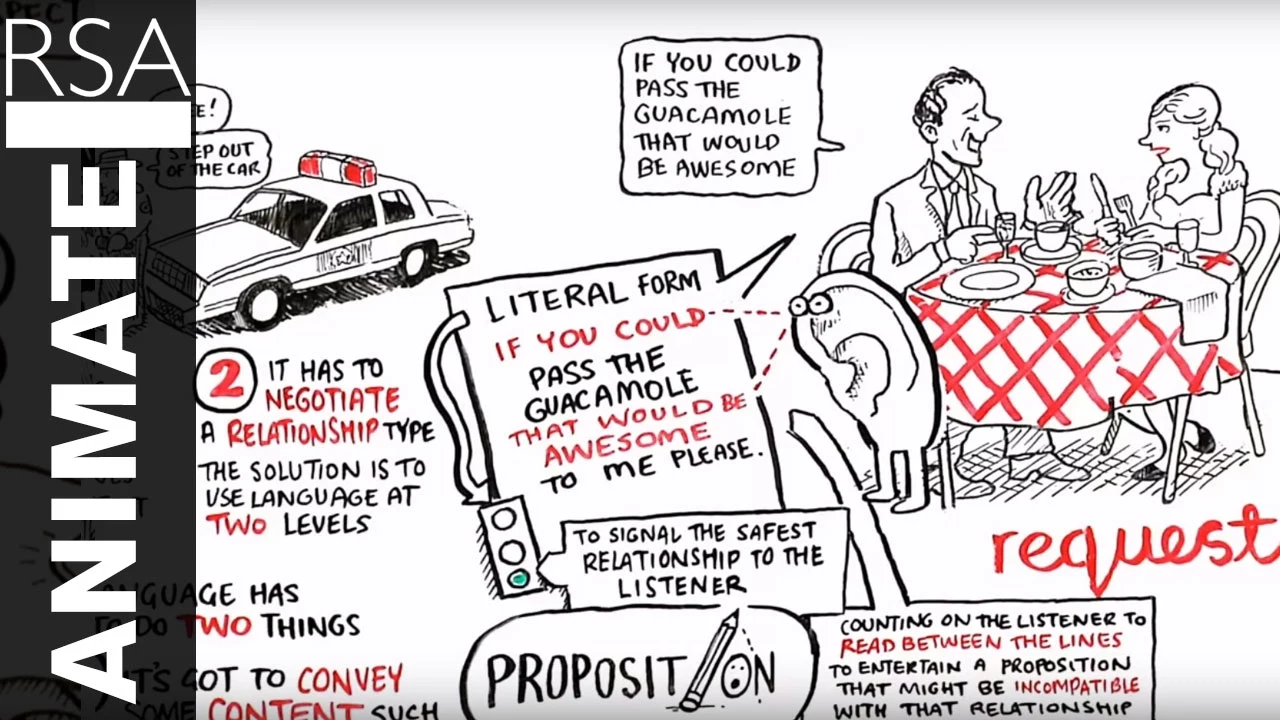
This habit of veiling intent permeates everyday social interaction. For instance, at dinner someone might say, "If you could pass the guacamole, that would be awesome"—a phrasing that makes little sense if analyzed literally, yet is effortlessly understood as a polite request. Similar evasions appear across public and private life. Guests at fundraising galas are accustomed to euphemistic appeals such as, "We're counting on you to show leadership in our campaign for the future," which translates straightforwardly into "give us money." The invitation "Would you like to come up and see my etchings?" has functioned as an obvious sexual come-on for so long that James Thurber published a *New Yorker* cartoon in the 1930s showing a man telling his date: "You wait here and I'll bring the etchings down." Mobsters in *The Sopranos* employ the classic veiled threat: "Nice store you got there, would be a real shame if something happened to it." Pinker frames this recurring pattern as a profound psychological conundrum: “So the puzzle is, why are bribes, requests, seductions, solicitations, and threats so often veiled when both parties presumably know exactly what they mean?”

- **The Brainerd Traffic Stop (*Fargo*)**: A kidnapper offers a license with a protruding $50 bill, suggesting they settle the missing-plate infraction on the spot. - **The Guacamole Request**: An everyday polite locution that pairs an exaggerated outcome ("awesome") with a hypothetical condition. - **The Capital Campaign**: High-minded euphemisms about "leadership" masking blunt appeals for cash. - **The Thurber Cartoon (1930s)**: Satirizes the antiquity of the "etchings" pickup line by having the host fetch the art downstairs to the lobby. - **The Mobster Shakedown (*The Sopranos*)**: Framing property extortion as genuine concern over an unfortunate mishap.

---

[02:25](https://www.youtube.com/watch?v=3-son3EJTrU&t=145s) The Dual Function of Language: Content vs. Relationship

To resolve why human beings perpetually rely on indirect speech, Pinker argues that language must simultaneously perform two distinct tasks: it must transmit substantive content (such as a proposition, bribe, demand, or request), and it must negotiate and preserve a relationship type. When a speaker blurts out raw content, that content may directly clash with the social dynamic between the two parties. The human solution to this friction is to use language on two operational levels at once. As Pinker summarizes: “The speaker uses the literal form to signal the safest relationship to the listener while counting on the listener to read between the lines to entertain a proposition that might be incompatible with that relationship.”

Everyday politeness illustrates this dynamic clearly. In the case of asking for guacamole with "If you could pass the guacamole, that would be awesome," the utterance is an obvious overstatement, and there is no practical reason to invite someone to ponder counterfactual universes in the middle of dinner. Nevertheless, the listener reasons that unless the speaker has lost his mind, describing an outcome as good implies a request to bring it about. The communicative goal is accomplished: the underlying imperative gets through, but without the presumption of dominance that accompanies a naked command such as "Pass the guacamole." By softening the directive into a hypothetical, the speaker avoids asserting social superiority or demanding subservience.

---

[03:31](https://www.youtube.com/watch?v=3-son3EJTrU&t=211s) Alan Fiske’s Three Relationship Types and the Roots of Awkwardness

To ground the social side of language, Pinker turns to the work of anthropologist Alan Fiske, who argues that across all human cultures, social life is organized around three primary relationship models. Each model possesses a distinct evolutionary origin, prescribes its own rules for resource distribution, and naturally governs specific social ties, though each can be extended to others via communicative negotiation. Pinker notes that human language serves as the primary tool used to negotiate which model currently applies.

```mermaid flowchart TD accTitle: Alan Fiske's Three Relationship Types accDescr: Diagram illustrating the three relational models, their evolutionary roots, and core logic. subgraph Types["Fiske's Three Relationship Models"] D["Dominance<br/>'Don't mess with me'"] C["Communality<br/>'Share and share alike'"] R["Reciprocity<br/>'Tit-for-tat / Back-scratching'"] end

subgraph Roots["Evolutionary Basis"] D --- D_Root["Primate dominance hierarchies"] C --- C_Root["Kin selection & mutualism"] R --- R_Root["Reciprocal altruism"] end

subgraph Contexts["Default Spheres"] D --- D_App["Rank, superiors, authority"] C --- C_App["Kin, spouses, close friends"] R --- R_App["Market exchange, business, trade"] end ```

The friction between these three relational models explains why certain actions trigger immediate social distress. Behavior entirely natural in one model becomes outrageous or offensive in another. At a cocktail party, for example, taking a prawn off your spouse’s plate is unremarkable under the communal ethos of "share and share alike," but snatching a prawn off your boss’s plate violates the rules of dominance. Similarly, offering to pay a host in cash at the conclusion of a home-cooked dinner party feels crass rather than fair, because it imposes the transactional logic of market reciprocity onto a communal gathering among friends.

When parties hold mismatched understandings of their relationship, the divergence produces the distinct and painful emotion known as awkwardness. Employees often struggle with whether to use a supervisor's first name or invite them out for an after-work beer, caught between the vertical axis of dominance and the horizontal axis of peer friendship. The tension between dominance and sexuality defines the battleground of workplace sexual harassment, just as navigating friendship versus romantic interest generates the chronic anxieties of dating. Even long-standing friends stumble when crossing these boundaries, as Pinker notes: “The very act of negotiating a price can put a strain on the friendship because what's appropriate in a reciprocity relationship is not appropriate in a communality relationship.”

---

[06:26](https://www.youtube.com/watch?v=3-son3EJTrU&t=386s) Mutual Knowledge, Public Squares, and the Fiction of Friendship

This framework brings Pinker to a deeper paradox: why do people continue using indirect speech even when there is zero genuine uncertainty and everyone understands exactly what is going on? Innuendo about examining etchings does not deceive any sensible adult, yet direct sexual propositions still feel far more uncomfortable and socially risky than transparent euphemisms. To explain why an overt overture feels so dangerously exposed, Pinker cites a dialogue from the romantic comedy *When Harry Met Sally*. Early in the film, Harry makes a suggestive remark, prompting Sally to accuse him: "You're coming on to me." Harry tries to defuse the moment by saying, "I take it back, okay? I take it back." Sally insists, "You can't take it back," and when Harry asks why, she delivers the crucial psychological insight: "Because it's already out there." Harry responds in exasperation: "Oh geez, what are we supposed to do, call the cops? It's already out there!"

The underlying mechanism of being "out there" rests on the distinction that logicians and game theorists draw between individual knowledge and mutual knowledge. In a state of individual knowledge, Person A knows a fact and Person B knows that same fact. In mutual knowledge, however, Person A knows the fact, Person B knows the fact, A knows that B knows it, B knows that A knows it, and so on ad infinitum. This recursive loop has profound real-world consequences. Freedom of assembly is protected in democracies and public protests trigger revolutions precisely because public gatherings create mutual knowledge. When citizens sit at home under a dictatorship, each individual may loathe the tyrant, but no one knows that everyone else shares that feeling. Once thousands gather visibly in a city square, everyone sees that everyone else shares the sentiment, creating the collective power required to challenge an autocrat who would otherwise arrest isolated dissidents one by one. Hans Christian Andersen's fable *The Emperor's New Clothes* functions on the exact same logic: when the young boy shouts that the emperor is naked, he conveys no new sensory information, but he instantly transforms shared private observation into universal mutual knowledge, allowing the crowd to laugh collectively.

Pinker applies this distinction directly to social interaction, offering a central hypothesis about how people preserve relationships: “Innuendos, even obvious ones, merely provide individual knowledge, whereas direct speech provides mutual knowledge, and relationships are maintained or nullified by a mutual knowledge of the relationship type.” If Harry asks Sally, "Would you like to come up and see my etchings?" and she declines, both individuals privately know that an overture was made and rejected. However, neither can verify that the other knows they know; Sally can assume Harry might think she is naive, while Harry can wonder if Sally thinks he is merely dense. Because mutual knowledge has been avoided, both participants can comfortably maintain the public fiction of platonic friendship. By contrast, if Harry asks, "Would you like to come up and have sex?" and Sally refuses, mutual knowledge is established irrevocably. Once the overture is on the record, the fiction of uncomplicated friendship cannot survive.

- **Individual Knowledge**: Player A knows fact $X$, and Player B knows fact $X$, but neither can confirm the other's awareness. - **Mutual Knowledge**: Player A and Player B both know $X$, know that the other knows $X$, and know that the other knows they know $X$, recursively. - **Revolutionary Crowds**: Public squares transform private political dissent into mutual knowledge, enabling coordinated mass rebellion against authoritarian regimes. - **The Emperor's New Clothes**: The child's shout does not reveal new visual facts; it creates mutual knowledge, permitting collective defiance of authority through ridicule. - **The Etchings Gambit vs. The Blunt Proposition**: Innuendo leaves plausible room to avoid recursive common knowledge, safeguarding existing friendships from total relational redefinition.

[10:26](https://www.youtube.com/watch?v=3-son3EJTrU&t=626s) The Irrevocable Nature of Spoken Language

Steven Pinker brings his discussion to a close by emphasizing the definitive, permanent consequence of speaking explicitly. Once an idea is openly articulated into words, it enters the shared social space and alters the relationship between the speaker and listener irrevocably. Unlike veiled suggestions or ambiguous overtures that preserve plausible deniability, direct speech commits both parties to inescapable common knowledge.

Because of this permanence, explicit utterances carry unique weight and vulnerability in human interaction. As Pinker starkly summarizes the dilemma of laying thoughts bare: “language you can't take it back it's out there”.

## Notable quotes > [06:26](https://www.youtube.com/watch?v=3-son3EJTrU&t=386s) Innuendos, even obvious ones, merely provide individual knowledge, whereas direct speech provides mutual knowledge, and relationships are maintained or nullified by a mutual knowledge of the relationship type. — Steven Pinker

> [02:25](https://www.youtube.com/watch?v=3-son3EJTrU&t=145s) The speaker uses the literal form to signal the safest relationship to the listener while counting on the listener to read between the lines to entertain a proposition that might be incompatible with that relationship. — Steven Pinker

> [03:31](https://www.youtube.com/watch?v=3-son3EJTrU&t=211s) The very act of negotiating a price can put a strain on the friendship because what's appropriate in a reciprocity relationship is not appropriate in a communality relationship. — Steven Pinker

## Mentioned Steven Pinker, Alan Fiske, James Thurber, Hans Christian Andersen, Fargo, The Sopranos, When Harry Met Sally, The New Yorker, The Emperor's New Clothes, Brainerd, Minnesota, Cognitive Media, Royal Society of Arts

## Video description In this new RSA Animate, renowned experimental psychologist Steven Pinker shows us how the mind turns the finite building blocks of language into infinite meanings. Taken from the RSA's free public events programme www.thersa.org/events.

Follow the RSA on Twitter: https://twitter.com/RSAEvents Like the RSA on Facebook: https://www.facebook.com/rsaeventsofficial/ Listen to RSA podcasts: https://soundcloud.com/the_rsa See RSA Events behind the scenes: https://instagram.com/rsa_events/

------ This audio has been edited from the original event by Becca Pyne. Series produced by Abi Stephenson, RSA. Animation by Cognitive Media.

[Source](https://www.youtube.com/watch?v=3-son3EJTrU)

中文简报

平克认为含蓄言辞可保护人际纽带免受共同知识冲击 说话者之所以依赖间接影射,是因为直白的表述会引发递归式的共同知识,从而永久性改变社会层级;而模棱两可则保留了维持现有关系所需的可否认假象。 史蒂芬·平克探讨了间接言语行为的心理学谜题——例如委婉的贿赂、性暗示和餐桌上的客气请求——探究为什么在双方都心知肚明的情况下,人们仍要将真实意图包裹在影射之中。平克借鉴人类学家艾伦·菲斯克的三种关系模型(支配、共有与对等),解释了语言必须在传递内容的同时协调人际关系,以避免冲突关系规则带来的摩擦与尴尬。博弈论中个体知识与共同知识的区别最终解释了影射保护人际纽带的原因:直截了当的话语会产生不可逆转的共同知识,消除合理的推诿借口,而话一旦公开说出口,关系就会发生永久性改变。 史蒂芬·平克解释称,人类语言同时承担着两项任务:传达实质内容和协商关系类型,这导致人们普遍依赖间接言语行为。 (2:25) 人类社会生活依赖于人类学家艾伦·菲斯克提出的三种不同关系模型——支配、共有与对等——当当事双方应用的模型不匹配时,尴尬便随之产生。 (3:31) 直白的话语产生的是递归式的共同知识,而不仅仅是共享的个体知识,这解释了为何人们即便心知肚明仍倾向于使用影射,以维持关系中的假象。 (6:26) 由于明确的表述会创造出无法收回且不可回避的共同知识,间接语言在诱惑、贿赂、请求和威胁中起到了至关重要的社交缓冲作用。 (10:26)

Reading summary

Cognitive scientist Steven Pinker argues that indirect speech acts allow speakers to convey sensitive propositions while preserving fragile social relationships by preventing the creation of mutual knowledge. The Paradox of Indirect Speech (0:15) Human interaction regularly relies on innuendo, euphemisms, and veiled directives, ranging from the polite dinner table request ("If you could pass the guacamole, that would be awesome") to high-stakes encounters like traffic stop bribery in the film Fargo, capital campaign fundraising, sexual propositions, and mob extortion in The Sopranos. Pinker poses this behavior as a psychological puzzle: speakers routinely veil their true intentions behind indirect phrasing even when both parties understand the real message perfectly. Balancing Information Transmission and Relationship Management (2:25) Pinker resolves this conundrum by proposing that language operates on two distinct levels simultaneously: transmitting raw propositional content and negotiating social relationships. Blurting out raw demands can directly conflict with the existing relational dynamic between two people. By framing commands as hypothetical scenarios, speakers convey their underlying goal while using the literal form to signal the safest relationship, successfully sidestepping the presumption of dominance inherent in a blunt directive. Relational Models and Social Awkwardness (3:31) Drawing on anthropologist Alan Fiske, Pinker explains that human cultures structure interaction around three primary models, each rooted in distinct evolutionary origins: dominance (primate hierarchies), communality (kin selection and mutualism), and reciprocity (reciprocal altruism). Relational rules dictate acceptable behavior, such that sharing food is appropriate among spouses but offensive when directed at an employer, while paying cash for a home-cooked dinner violates communal hospitality with transactional reciprocity. Social awkwardness emerges when parties hold conflicting views of which relationship model applies. These misalignments frequently surface in workplace hierarchies, dating dynamics, and commercial negotiations between friends, where the transactional logic of reciprocity can directly strain a communal bond. The Mechanism of Mutual Knowledge (6:26) Indirect speech persists even when both parties comprehend the underlying intent because of the distinction between individual knowledge and mutual knowledge. In individual knowledge, both parties know a fact in isolation; in mutual knowledge, each party knows the other knows it, ad infinitum. This recursive awareness powers political protests in public squares against authoritarian regimes and explains Hans Christian Andersen's fable The Emperor's New Clothes, where an overt declaration creates the collective common knowledge required to openly mock authority. Pinker contends that relationships are sustained or dismantled through mutual knowledge of the applicable relationship type. A transparent euphemism—such as inviting someone to examine "etchings"—merely generates individual knowledge, allowing both individuals to preserve plausible deniability and sustain the public fiction of platonic friendship if the overture is declined. A blunt proposition, by contrast, forces mutual knowledge into existence, rendering the previous relationship dynamic impossible to maintain. Pinker concludes that spoken language carries unique weight because explicit speech cannot be retracted once placed into the shared social space. Veiled speech acts serve as an essential social buffer, protecting human relationships from the permanent, destabilizing impact of mutual knowledge.

精炼阅读摘要

语言学家 Steven Pinker 指出,间接言语并非低效的沟通冗余,而是人类用来同时传递命题内容与协商维护社会关系的核心工具。 委婉表达的日常谜题与语言的双重功能 (0:15) 在日常交往中,人们频繁使用委婉言辞与间接言语行为,刻意回避直白表述。例如电影《冰血暴》(Fargo)中,被明尼苏达州布雷纳德交警拦下的绑匪在交出驾照时夹带一张五十美元钞票并声称“在这里处理”,双方心照不宣这是行贿;餐桌上借用假定句“如果你能把鳄梨酱递过来就太棒了”来表达请求;筹款宴会上用“展示领导力”隐喻索捐;以及黑帮在《黑道家族》(The Sopranos)中将敲诈勒索包装为对店铺遭遇意外的关切。Pinker 指出,当交际双方均清楚真实意图时,人们依然诉诸隐喻与含蓄表述,这构成了深刻的心理学谜题。 为解开这一谜题,Pinker 提出语言必须同时承担双重任务:一是传递实质性内容(如提议、贿赂、要求或索取),二是协商并维持双方的关系模式。当直接表达的纯粹内容与既有社会关系发生冲突时,人类的解决策略是分两层运作语言:说话者使用最安全的字面形式来维系当前关系,同时依赖听者领会字里行间的真实提议。通过将祈使指令软化为虚拟假设,说话者既达成了沟通目的,又避免了直接下达命令所伴随的支配姿态与从属要求。 三类关系模型与社交尴尬的根源 (3:31) Pinker 引入人类学家 Alan Fiske 的理论指出,人类跨文化社交生活围绕三种基本关系模型组织展开:基于灵长类等级结构的支配关系(Dominance)、源自亲属选择与互助的共享关系(Communality),以及基于互惠利他主义的互惠关系(Reciprocity)。语言则是人类协商当前情境适用何种关系模型的主要机制。特定行为在一种模式下完全自然,置于另一种模式下则会引发冒犯或冲突。例如在鸡尾酒会上从配偶盘中取走大虾符合共享逻辑,但取走上司盘中的大虾则违反支配规则;在朋友家宴后提出支付现金则粗暴地将市场交易互惠强加于共享关系之上。 当互动双方对彼此关系模型的理解出现错位时,便会产生“尴尬”这一强烈的负面情绪。职场中员工在对主管直呼其名或邀请其下班后饮酒时的犹豫,反映出支配等级与同伴友谊之间的张力;职场性骚扰本质上是支配与性关系的冲突,约会交往也充满友谊与浪漫意图的博弈。Pinker 强调,即便是长期好友,在商业讨价还价时也可能面临关系紧张,因为互惠模式中的计较逻辑与共享模式的伦理互不兼容。 共有知识逻辑与维系社交虚构的机制 (6:26) Pinker 进一步探讨了在双方都心知肚明的情况下,直白表达为何仍具高度风险。他援引逻辑学与博弈论中“个体知识”(Individual Knowledge)与“共有知识”(Mutual Knowledge)的本质区别:个体知识仅指双方各自知晓某一事实,而共有知识则是双方知晓该事实、且相互知晓对方知晓,形成无限递归闭环。安徒生童话《皇帝的新装》中孩童的呼喊并未提供新的视觉信息,却将私下观察转化为公共的共有知识,从而打破了威权沉默;政治集会也是通过广场空间将孤立的反抗情绪转变为共有知识,赋予民众集体行动的能力。 这一机制直接决定了人际交往的边界。电影《当哈利遇到莎莉》(When Harry Met Sally)中关于言论“已经摆在台面上”(out there)且无法收回的争论,揭示了直白陈述的破坏力。Pinker 认为,委婉暗示即便透明,也仅维持在个体知识层面,双方可保留合理推诿的空间,从而共同维系纯洁友谊的公开虚构;一旦使用毫不掩饰的直白求欢语言,共有知识即刻确立,原本融洽的普通朋友关系便无法再维系原状。 Pinker 总结认为,口头语言具有不可逆性,一旦思想被直接公开言说,就会永久进入共享社交空间并不可撤销地重塑人际关系。含蓄与委婉正是人类为了在严酷的共有知识确立机制下规避社交破裂、维系脆弱人际平衡而演化出的必要缓冲。

Detailed notes — zh

## Background 该视频由英国皇家文艺学会(Royal Society of Arts)于 2011 年 2 月 10 日发布在 YouTube 频道上。根据页面简介,知名实验心理学家史蒂芬·平克(Steven Pinker)在本次 RSA Animate 精选动画讲座中,深入探讨了人类大脑如何将有限的语言构件转化为无限的深层意涵。 ## TL;DR 史蒂芬·平克探讨了人类为何在贿赂、求爱、威胁等社交互动中频繁使用“间接言语行为”,而非开门见山地直抒胸臆。他指出语言兼具传递实质内容与协商社会关系(支配、共有与互惠)的双重任务,当不同关系模式发生重叠冲突时便会催生“尴尬”。通过引入逻辑学与博弈论中的“共有知识”(Mutual Knowledge)与“个体知识”的区别,平克揭示了含蓄暗示能保留体面的合理推脱与社交幻象,而直白言语则会不可逆地确立共有知识并将事实推向台面,从而彻底改变人际关系的本质。 ## Atmosphere & style 整部动画短片节奏明快且风趣幽默,配以 Cognitive Media 标志性的白板手绘涂鸦,将晦涩的语言学与演化心理学概念化作生动的视觉场景。史蒂芬·平克的演讲语调沉稳、引人入胜,从电影《冰血暴》《当哈利遇到莎莉》与《皇帝的新装》等通俗文化切入,游刃有余地层层剖析严肃的博弈论机制。观看体验既像是一场兼具智性启发与讽刺幽默的思维体操,又敏锐地捕捉到了日常社交中人人皆有却难以言说的微妙尴尬感。 ## Bulletin - [02:26](https://www.youtube.com/watch?v=3-son3EJTrU&t=146s) 语言兼具传递实质信息与协商社会关系两项任务,人类通过间接言语在字面上维持安全的人际关系,同时在潜台词中传达可能冲突的真实意图。 - [02:26](https://www.youtube.com/watch?v=3-son3EJTrU&t=146s) 人类社会关系遵循支配、共有与互惠三种相互排斥的模型,不同模型间的规则冲撞是不确定性与社交尴尬的核心根源。 - [07:28](https://www.youtube.com/watch?v=3-son3EJTrU&t=448s) 暗示仅产生各自知晓的个体知识,而直白言语会建立无限递归确证的共有知识,剥夺合理推脱空间并不可逆地重塑人际关系。 - [10:26](https://www.youtube.com/watch?v=3-son3EJTrU&t=626s) 言语一旦明确公开便覆水难收,人们采用委婉暗示的深层目的正是为了规避共有知识建立后的关系破裂与社会风险。 ## Key takeaways - [00:12](https://www.youtube.com/watch?v=3-son3EJTrU&t=12s) 间接言语行为是人类语言的普遍谜团,说话人往往将行贿、求爱、威胁或募捐等真实意图包装在字里行间的潜台词中。 - [01:12](https://www.youtube.com/watch?v=3-son3EJTrU&t=72s) 即使双方心知肚明彼此的真正动机,人们依然倾向于选择隐晦委婉的表达方式而非直接挑明。 - [02:26](https://www.youtube.com/watch?v=3-son3EJTrU&t=146s) 语言必须同时承担双重任务:一方面传递客观的实质命题,另一方面对人际关系的类型进行协商与界定。 - [02:26](https://www.youtube.com/watch?v=3-son3EJTrU&t=146s) 人类通过双层语言机制解决沟通冲突:表层字面形式维持安全的人际关系,深层潜台词传递潜在冲突的命题。 - [02:26](https://www.youtube.com/watch?v=3-son3EJTrU&t=146s) 人类学家艾伦·菲斯克指出跨文化人类社会关系主要由支配、共有与互惠三种基本模式构成。 - [04:00](https://www.youtube.com/watch?v=3-son3EJTrU&t=240s) 三种社会关系模式彼此排斥,在一种关系中合理的行为(如拿取食物或金钱交易)置于另一种关系中会引发严重反常与冒犯。 - [05:16](https://www.youtube.com/watch?v=3-son3EJTrU&t=316s) 社交中的“尴尬”情绪本质上来源于双方未能就当前应当适用的关系规范达成一致,造成认知偏差与界限混淆。 - [07:28](https://www.youtube.com/watch?v=3-son3EJTrU&t=448s) 个体知识指多方各自掌握某项信息,而共有知识指双方互相知道对方知晓并形成无限递归的认知嵌套。 - [07:28](https://www.youtube.com/watch?v=3-son3EJTrU&t=448s) 共有知识具有强大的政治与社会破坏力,集会自由的威慑力与《皇帝的新装》中的揭穿效应均建立在此机制之上。 - [07:28](https://www.youtube.com/watch?v=3-son3EJTrU&t=448s) 间接暗示即使再显而易见也仅停留于个体知识层面,允许双方保留合理推脱空间并维系既有的社交幻象。 - [09:00](https://www.youtube.com/watch?v=3-son3EJTrU&t=540s) 直白言语是确立共有知识的终极工具,一旦挑明就会撕碎虚构面具,使人际关系的状态彻底失去退路。 - [10:26](https://www.youtube.com/watch?v=3-son3EJTrU&t=626s) 口头表述具有不可撤回性,明确说出口的言语会从私密认知转化为公开事实,促使人类借由含蓄暗示规避社会风险。 ## Detailed walkthrough ### [00:12](https://www.youtube.com/watch?v=3-son3EJTrU&t=12s) 间接言语行为与潜台词的谜团 语言是窥探人类社会关系的一扇明亮窗口。史蒂芬·平克(Steven Pinker)以电影《冰血暴》(*Fargo*)开头的一幕引出语言中的一个谜团:一名绑匪把人质捆绑在汽车后座上,却不巧因为车子没挂牌照而被警察拦下。当警官要求查看驾照时,绑匪递上了自己的皮夹,里面露出了驾照,同时还特意探出了一张 50 美元的钞票,并对警官说道:“我琢磨着,也许最好的解决办法就是在布雷纳德(Brainerd)这里直接处理了。”无论是影院观众还是车外的警察,都能立刻心领神会——这是一次心照不宣的含蓄贿赂。在语言学中,这种现象被称为“间接言语行为”(indirect speech act),即说话人并不直接把真实意图宣之于口,而是将真正目的包装在影射与暗示之中,指望听者能读懂“字里行间”的潜台词并推断出真实意图。 日常生活充满了这种甚至让人习以为常的间接表达。比如在餐桌上说“如果你能把鳄梨酱递过来,那就太棒了”,从纯逻辑角度看这近乎无厘头,大家却毫无阻碍地将其当成一句礼貌请求;在筹款晚宴上听到“我们指望您在未来的行动中展现领导力”,任何经历过这种场合的人都知道这种委婉措辞完全可以直白翻译为“快掏钱”;而“你想上楼来看看我的版画吗?”(Would you like to come up and see my etchings?)作为性暗示的历史更是悠久,早在 1930 年代,詹姆斯·瑟伯(James Thurber)就为《纽约客》(*The New Yorker*)画过一幅讽刺漫画,画中的男人对约会对象直白说道:“你在这儿等一下,我把版画拿下来给你看”;又如黑帮剧《黑道家族》(*The Sopranos*)中经典的“你这间店真不错,要是出点什么事就太可惜了”,人人都听得懂这是赤裸裸的威胁。这就引出了核心谜团:既然行贿者与警察、求爱者与对象、敲诈者与店主彼此都心知肚明,为什么贿赂、请求、诱惑、募捐和威胁仍然要绕弯子,而非开门见山? - 间接言语行为的核心机制:说话人不直白陈述,而是通过隐蔽方式传递意图,依靠受众根据语境推断真实意图。 - 常见日常范式:餐桌请求(夸张假设句)、筹资劝募(领导力隐喻)、两性试探(版画借口)与黑帮恐吓(人身财产“关心”)。 ```mermaid flowchart LR accTitle: 间接言语行为的工作机制 accDescr: 展示说话人如何通过表面安全的形式包裹深层的真实意图,由听者解码。 subgraph Speaker["说话人表达"] A["表层字面形式<br/>(安全的社会关系)"] B["深层潜在命题<br/>(贿赂 / 索要 / 性试探)"] end subgraph Listener["听者解码"] C["读懂字里行间<br/>(推断真实意图)"] D["维系关系平衡<br/>(提供合理推脱空间)"] end A --> C B --> C C --> D ``` ### [02:26](https://www.youtube.com/watch?v=3-son3EJTrU&t=146s) 语言的双重任务与人类社会关系的三种模式 人类语言必须同时承担两项截然不同的任务:一是传递实质内容(例如行贿金、要求或命题),二是对人际关系类型进行协商。面对这两项任务的潜在冲突,人类找到了极其精妙的解决机制:在两个层面上同时运用语言。Steven Pinker 指出:“说话人用字面形式向听者传达最安全的关系信号,同时指望听者读懂字里行间的含义,去领会一个可能与该关系不相容的命题。”(“The speaker uses the literal form to signal the safest relationship to the listener while counting on the listener to read between the lines to entertain a proposition that might be incompatible with that relationship.”)以递鳄梨酱为例,把递调味酱说成“太棒了”显然言过其实,在餐桌上突然陷入反事实世界的假设也有些荒唐;但听者心想:只要对方没疯,他说某个结果很好,就是在请求实施该行为。其最终效果是:听者接收到了祈使句的实质内容,却完全规避了直接祈使句必然附带的“支配与顺从”预设——即一人命令另一人服从的权力感。 根据人类学家艾伦·菲斯克(Alan Fiske)的研究,跨越全球各种文化,人类的社会关系本质上只有三种主要模式。每种模式都规定了独特的资源分配方式,拥有不同的演化渊源,并默认适用于特定的人群: 1. **支配关系(Dominance)**:其核心逻辑是“别惹我”,继承自灵长类动物中普遍存在的等级秩序。 2. **共有关系(Communality)**:其精神实质是“人人共享、不分彼此”(share and share alike),演化路径源于亲属选择与互利共生,默认适用于血亲、配偶以及密友之间。 3. **互惠关系(Reciprocity)**:原则是“你敬我一尺,我敬你一丈”(You scratch my back, I'll scratch yours),属于讲求对等、一报还一报(tit-for-tat)的商品与劳务交换,对应演化生物学中的互惠利他主义。 这三种关系规则相互排斥,在一种关系中天经地义的行为,换到另一种关系中就会变得极度反常。例如在鸡尾酒派对上,你可以自然而然地从伴侣盘子里拿一只大虾吃,但绝不能直接伸手从老板盘里拿虾,因为共有关系中被允许的举动在支配关系中绝不被容忍。同样,在朋友家吃完晚餐后,如果你掏出钱包按菜单给主人结账,主人绝不会觉得你客观公正,反而会觉得你粗俗不堪甚至被严重冒犯——这正是餐馆里的“互惠交易规则”粗暴冲撞了朋友间的“共有分配规则”所致。 ### [05:16](https://www.youtube.com/watch?v=3-son3EJTrU&t=316s) 关系冲突、尴尬情绪与“无法收回”的言辞 当社交双方清楚各自处于哪种关系时,互动井然有序;然而一旦双方并不确定是否处于同一频道,认知上的偏差就会催生一种极为不适的人类情绪——“尴尬”(awkwardness)。在职场环境中,员工或学生经常陷入窘境,拿不准该不该直呼导师或主管的名字,下班后该不该邀请对方去喝杯啤酒,这种尴尬正是源于双方关系究竟受支配还是友谊支配的不确定性。商业生活中的古老格言也反复告诫大家:挚友之间切莫进行重大商业交易(例如买卖彼此的二手车),因为为了车价来回讨价还价的瞬间,就会对友谊造成巨大的撕裂——属于互惠关系的斤斤计较,与共有关系的包容大度根本无法共存。同样,主管向下属提出性要求,是支配关系对共有关系(两性情感)的强行入侵,这构成了性骚扰的温床;而在友谊与性这两种不同维度的共有关系之间来回游移试探,则直接构成了约会过程中无处不在的焦虑感。 这就带来了更深层次的谜团:如果对方根本不傻,双方都清楚真实动机,为什么人类仍要诉诸委婉暗示?没有任何一个成年女性会真的天真到以为对方请她上楼纯粹是为了欣赏蚀刻版画,但借版画发出试探,比起直接索求性关系,双方感受上的舒适度却有着天壤之别。这种“不可否认性”(deniability)在心知肚明的情况下其实根本站不住脚,为什么间接暗示依然远比白纸黑字的“挑明”更让人觉得体面?Steven Pinker 援引了经典爱情喜剧电影《当哈利遇到莎莉》(*When Harry Met Sally...*)中的经典对白。影片一开始,哈利说了一句带有性暗示的话,莎莉立刻指责他在搭讪挑逗。哈利情急之下说道:“那你想让我怎么办?我收回行了吧?我收回!”莎莉斩钉截铁地回答:“你收不回去了。”哈利追问为什么,莎莉说:“因为这话已经放到台面上了(it's already out there)。”哈利只得无奈吐槽:“天呐,那我们该怎么办,报警吗?就因为话已经放到台面上了?” - 关系界限混淆的典型场景: - 支配 vs 共有(友谊):下班后与上司喝啤酒、称呼第一声名字的纠结。 - 共有(友谊) vs 互惠:好朋友之间买卖二手车,讨价还价对交情的损害。 - 支配 vs 共有(两性):上司向下属索要性利益(性骚扰的本质)。 - 尴尬的核心诱因:不同交往模型重叠冲突,双方未就关系规范达成一致。 - 语言的社会学属性:一旦言语被直接说出并形成“公开发言”(on the record),就会彻底重塑彼此的互动基础,无法单方面假装撤回。 ### [07:28](https://www.youtube.com/watch?v=3-son3EJTrU&t=448s) 共有知识(Mutual Knowledge)与社交幻象的维系 要解开“为何把话说在台面上会让人如此尴尬”这一悖论,关键在于经济学家与逻辑学家提出的一个核心概念:“共有知识”(Mutual Knowledge),它与单纯的“个体知识”(Individual Knowledge)存在本质差别。在个体知识状态下,A 知道 X,B 也知道 X;而在共有知识状态下,其认知链条是无限循环嵌套的:A 知道 X,B 知道 X,A 知道 B 知道 X,B 知道 A 知道 X,A 知道 B 知道 A 知道 X……依此类推以至无穷。这种看似理论化的区分,在现实中却具备摧枯拉朽的社会与政治力量。例如,为什么集会自由在民主政体中被奉为神圣不可侵犯的基本权利?为什么政治革命往往爆发于成千上万的人聚集在公共广场、直面宫殿里的独裁者之时?原因正在于:当人们独自待在家中时,每个人都心知肚明自己厌恶独裁者,但这只是个体知识,没人确信其他人是否知道自己知道;而一旦聚集在彼此肉眼可见的公共广场上,所有人瞬间明了“大家彼此都知道所有人都痛恨独裁者”,正是这种共有知识赋予了群体向独裁暴政抗争的集体力量,剥夺了独裁者逐个击破异见人士的机会。《皇帝的新装》也是阐述共有知识的绝佳范例:当小男孩高喊“皇帝没穿衣服”时,他并没有告诉大家任何肉眼看不到的新信息,但他彻底改变了整座城市的认知状态——那一刻,所有人不仅看到了赤裸的皇帝,更确知“所有人都知道其他人也看到了”,原本维系统治权威的集体沉默在笑声中瞬间瓦解。 明确、直白的语言,正是人类在社交中构建“共有知识”的终极工具。Steven Pinker 据此提出了核心假说:“暗示(即便是显而易见的暗示)仅仅提供个体知识,而直白言语则提供了共有知识;而人际关系正是依靠对关系类型的共有知识得以维持或瓦解的。”(“Innuendos, even obvious ones, merely provide individual knowledge, whereas direct speech provides mutual knowledge, and relationships are maintained or nullified by a mutual knowledge of the relationship type.”)如果哈利对莎莉说“你想上楼来看看我的版画吗?”,而莎莉拒绝了,那么莎莉知道自己拒绝了一次性试探,哈利也知道自己的企图被回绝了,但这并未形成共有知识——莎莉可能会想“也许哈利觉得我心思单纯,没听懂弦外之音”,哈利也可能在想“也许莎莉只是觉得我有点木讷,没往那方面想”。由于缺乏递归确证的共有知识,双方依然能够体面地维系“我们只是纯洁朋友”的社交幻象。相反,如果哈利毫无掩饰地直接说“你想上楼跟我发生关系吗?”,一旦遭到拒绝,哈利就知道莎莉知道哈利知道莎莉拒绝了他。那一瞬间,共有知识无可逆转地诞生了,朋友关系的虚构面具被当场撕碎,他们再也无法退回从前若无其事的安全地带。 | 知识类型 | 认知层级结构 | 社交与政治后果 | 典型场景 | |:--- |:--- |:--- |:--- | | **个体知识 (Individual Knowledge)** | A 知道 X;B 知道 X(但彼此未公开确证对方知晓) | 为双方保留解释空间与合理推脱(plausible deniability),允许社交幻象存续 | 间接言语(“来看我的版画”)、私下对独裁者的厌恶 | | **共有知识 (Mutual Knowledge)** | A 知道 X;B 知道 X;双方互相知道对方知晓,且无限递归确证 | 剥夺退路,迫使关系重新定性;带来协同行动力或引发巨大的人际尴尬 | 直接言语(“上楼发生关系”)、广场集会、小男孩揭穿皇帝新装 | ### [10:26](https://www.youtube.com/watch?v=3-son3EJTrU&t=626s) 语言的不可逆性与公开性 史蒂芬·平克(Steven Pinker)在论述中指出了语言一旦被明确说出口所具备的不可逆属性。语言不仅仅是传递信息的符号工具,当某些意图或事实被直截了当地付诸口头表述时,它们便脱离了个人的私密心理范畴,转化为彼此之间无法否认的公开事实。这种言语行为彻底打破了原有的隐性默契或模糊地带,使得人际互动的关系状态发生实质性且不可逆的改变。 正如史蒂芬·平克所言:“Language you can't take it back it's out there.” 这一观点道出了语言沟通的核心机制:正因为明确表达出来的话语具有“覆水难收”的不可撤回性,人类在处理贿赂、威胁、求爱等敏感社交情境时,才会如此频繁且精妙地使用含蓄委婉的间接言语,以规避直白表述所带来的确定性后果与社会风险。 ## Notable quotes > [07:28](https://www.youtube.com/watch?v=3-son3EJTrU&t=448s) 暗示(即便是显而易见的暗示)仅仅提供个体知识,而直白言语则提供了共有知识;而人际关系正是依靠对关系类型的共有知识得以维持或瓦解的。 — Steven Pinker > [02:26](https://www.youtube.com/watch?v=3-son3EJTrU&t=146s) 说话人用字面形式向听者传达最安全的关系信号,同时指望听者读懂字里行间的含义,去领会一个可能与该关系不相容的命题。 — Steven Pinker ## Mentioned 史蒂芬·平克 (Steven Pinker), 艾伦·菲斯克 (Alan Fiske), 詹姆斯·瑟伯 (James Thurber), 《冰血暴》 (Fargo), 《黑道家族》 (The Sopranos), 《当哈利遇到莎莉》 (When Harry Met Sally...), 《纽约客》 (The New Yorker), 《皇帝的新装》, Royal Society of Arts (RSA), Cognitive Media ## Video description In this new RSA Animate, renowned experimental psychologist Steven Pinker shows us how the mind turns the finite building blocks of language into infinite meanings. Taken from the RSA's free public events programme www.thersa.org/events. Follow the RSA on Twitter: https://twitter.com/RSAEvents Like the RSA on Facebook: https://www.facebook.com/rsaeventsofficial/ Listen to RSA podcasts: https://soundcloud.com/the_rsa See RSA Events behind the scenes: https://instagram.com/rsa_events/ ------ This audio has been edited from the original event by Becca Pyne. Series produced by Abi Stephenson, RSA. Animation by Cognitive Media. [Source](https://www.youtube.com/watch?v=3-son3EJTrU)

Source quotes

[7:28] Steven Pinker: 暗示(即便是显而易见的暗示)仅仅提供个体知识,而直白言语则提供了共有知识;而人际关系正是依靠对关系类型的共有知识得以维持或瓦解的。 [2:26] Steven Pinker: 说话人用字面形式向听者传达最安全的关系信号,同时指望听者读懂字里行间的含义,去领会一个可能与该关系不相容的命题。

Source quotes

[6:26] Steven Pinker: Innuendos, even obvious ones, merely provide individual knowledge, whereas direct speech provides mutual knowledge, and relationships are maintained or nullified by a mutual knowledge of the relationship type. [2:25] Steven Pinker: The speaker uses the literal form to signal the safest relationship to the listener while counting on the listener to read between the lines to entertain a proposition that might be incompatible with that relationship. [3:31] Steven Pinker: The very act of negotiating a price can put a strain on the friendship because what's appropriate in a reciprocity relationship is not appropriate in a communality relationship.

Original transcript

[0:12] [Music] [0:15] language is a window into social [0:16] relations I'll begin with a a puzzle in [0:19] uh language this one is taken from the [0:22] movie Fargo from a scene early in the [0:24] movie in which a kidnapper has a hostage [0:27] in tied up in the back seat of the car [0:29] and inconveniently is pulled over by a [0:33] uh by the police because he's missing [0:34] his plates the police officer asks him [0:37] to show his driver's license he propers [0:40] his wallet with a license showing and a [0:42] $50 bill extending ever so slightly and [0:46] he says to the officer I was thinking [0:47] that maybe the best thing would be to [0:49] take care of it here in Brainard which [0:51] the audience and presumably the officer [0:54] recognize as a veiled bribe uh now this [0:57] is an example of what linguists call an [0:59] indirect direct speech act a case in [1:01] which we don't blurt out what we mean in [1:04] so many words but we Veil our intentions [1:07] in inuendo hoping for our listener to [1:09] read between the lines and uh infer our [1:12] real intent and this is something that [1:14] we do all the time often without [1:16] realizing it for example uh if you could [1:19] pass the guacamole that would be awesome [1:21] uh now when you think about it that [1:22] doesn't make a whole lot of [1:24] sense uh but we effortlessly recognize [1:27] it as a polite request [1:30] uh we're counting on you to show [1:32] leadership in our campaign for the [1:34] future anyone who has sat through a [1:35] fundraising dinner is familiar with [1:38] euphemistic snoring uh like that which [1:40] can be translated as give us [1:43] money would you like to come up and see [1:46] my [1:47] etchings that has been recognized as a [1:49] sexual come on for so long that in the [1:51] 1930s James Thurber drew a New Yorker [1:54] cartoon in which a man says to his date [1:56] you wait here and I'll bring the [1:57] etchings [1:58] down [2:01] [Applause] [2:06] then there's um nice story you got there [2:09] would be a real shame if something [2:10] happened to it which uh any uh viewer of [2:13] The Sopranos can recognize As A Veiled [2:15] Threat so the puzzle is why are bribes [2:17] requests seductions solicitations and [2:19] threats so often veiled when both [2:22] parties presumably know exactly what [2:24] they mean language has to do two things [2:26] it's got to convey some content such as [2:28] a bribe a demand or a proposition at the [2:31] same time it's got to negotiate a [2:33] relationship type the solution is to use [2:35] language at two levels the speaker uses [2:37] the literal form to Signal the safest [2:40] relationship to the listener while [2:42] counting on The Listener to read between [2:43] the lines to entertain a proposition [2:46] that might be incompatible with that [2:47] relationship and politeness is a simple [2:50] example what's going on with if you [2:53] could pass the guacamole that would be [2:55] awesome uh I think everyone would agree [2:57] that it's a bit of an overstatement uh [3:00] and also it's not clear why you should [3:01] be pondering counterfactual worlds uh [3:04] right there and then at the dinner table [3:07] now The Listener thinks assuming that [3:09] the speaker has not lost his mind uh the [3:12] speaker says an outcome is good [3:13] therefore he must be requesting it the [3:15] overall effect is that the intended [3:17] content gets through namely the [3:19] imperative but without the presumption [3:21] of dominance that would ordinarily [3:23] accompany an imperative namely an [3:25] expectation that you can be commanding [3:28] some other person to do what you want [3:31] well according to the Anthropologist [3:32] Alan Fisk there are only three major [3:36] human relationship types across the [3:37] world's cultures each prescribes a [3:40] distinct way of Distributing resources [3:42] each has a distinct evolutionary basis [3:45] and each applies most naturally to [3:47] certain people but can be extended [3:49] through negotiation to others and that's [3:50] where language comes in so there's [3:53] dominance as I've mentioned whose logic [3:55] is don't mess with me and which [3:57] presumably We inherited from the [3:59] dominant hierarchies that are ubiquitous [4:01] among [4:02] primates uh very different from that is [4:04] communality the ethos share and share [4:07] alike which uh evolved by a different [4:10] route namely kin selection and mutualism [4:13] and therefore is extended by default to [4:15] Kin uh to spouses and among close [4:19] friends finally there's reciprocity you [4:21] scratch my back I'll scratch yours uh [4:24] which pertains to the businesslike tit [4:27] fortat exchanges of goods and services [4:29] that characterizes reciprocal [4:32] altruism now Behavior that's acceptable [4:34] in one relationship type can be [4:36] anomalous in another for example at a [4:38] drinks party you might go over to your [4:41] husband or wife or boyfriend or [4:43] girlfriend and help yourself to a prawn [4:45] off their plate but you wouldn't go up [4:47] to your boss and help yourself to a [4:48] prawn office plate because what you can [4:50] get away with in a communality [4:52] relationship you can't get away with in [4:54] a dominance relationship likewise uh at [4:57] the end of a dinner party if you pulled [4:59] out your wallet and offered to pay the [5:01] host for the dinner that would not be [5:03] perceived as fair that would be [5:05] perceived as crass because of the clash [5:07] between reciprocity which would is what [5:09] would be appropriate say at a restaurant [5:11] and communality which is what we deem [5:13] appropriate at a among friends now those [5:16] are cases where everyone knows what's [5:17] appropriate but in cases where the two [5:20] sides aren't sure that they're in the [5:21] same wavelength uh a Divergent [5:24] understanding can lead to an unpleasant [5:26] emotion uh the one that we call [5:28] awkwardness for example there can be [5:30] awkward moments in a workplace when a an [5:33] employee doesn't know or a student [5:35] doesn't know whether to address a [5:37] supervisor by their first name or to [5:39] invite them out after work for a beer [5:41] because of the ambiguity as to whether [5:43] their relationship is governed by [5:45] dominance or friendship it's well [5:47] wellknown bit of uh of wisdom that good [5:50] friends should not engage in a major [5:52] business transaction like one of them [5:54] selling his car to the other the very [5:56] Act of negotiating a price can put a [5:59] straight on the Friendship because [6:00] what's appropriate in a reciprocity [6:02] relationship is not appropriate in a [6:04] communality [6:06] relationship the contrast between um [6:08] dominance and uh sex uh as when a [6:12] supervisor solicits sex from an employee [6:14] defines the battleground of sexual [6:16] harassment and even the two kinds of [6:19] communal relationship of friendship and [6:21] sex uh give rise to the anxieties of [6:24] dating well one remaining problem which [6:27] is why we resort to indirect Ness even [6:30] when there is no real uncertainty uh for [6:32] example when The Listener knows the [6:34] speaker's intent uh people aren't naive [6:37] and it's hard to believe that any grown [6:38] woman could be fooled by the line about [6:40] the etchings nonetheless there is [6:42] something that is more comfortable about [6:44] asking uh to see etchings than asking [6:47] for sex so what is going on there the [6:50] deniability is not really plausible why [6:53] should a obvious inuendo still feel more [6:55] comfortable than a direct Overture that [6:57] is in some sense on the record [6:59] to illustrate the problem with a a scene [7:02] from the romantic comedy When Harry Met [7:04] Sally where in an early scene of the [7:06] movie uh Harry makes a remark that Sally [7:09] interprets as sexual and she accuses him [7:11] of uh you're coming on to me so he says [7:14] well what do you want me to do about it [7:15] I take it back okay I take it back she [7:18] says you can't take it back why not [7:21] because it's already out there he says [7:23] oh geez what are we supposed to do call [7:24] the cops it's already out there well [7:28] what is the psycholog iCal status of an [7:30] overture that we feel to be out there or [7:32] on the record that makes it feel so much [7:35] more Awkward than a veiled Overture [7:37] that's conveyed indirectly and I think a [7:39] key to this uh Paradox is a concept that [7:42] economists and logicians call Mutual [7:45] knowledge which they distinguish from [7:47] Individual knowledge in individual [7:50] knowledge a Knows X and B Knows X in [7:53] mutual knowledge a Knows X B Knows X a [7:56] knows that b Knows X B knows that a [7:58] Knows X x a knows that b knows that a [8:01] Knows X uh add infin itm and this is a [8:05] difference that has profound [8:07] consequences for example why is freedom [8:10] of assembly enshrined as a fundamental [8:12] right in a democracy and why are [8:14] political revolutions often triggered [8:16] when a crowd gathers in a Public Square [8:19] to challenge the uh the president in his [8:21] Palace well it's because when people [8:23] were at home um everyone knew that they [8:27] loathed the uh dictator but no one knew [8:30] that other people knew that they knew uh [8:33] once you assemble in a place where [8:35] everyone can see everyone else uh [8:37] everyone knows that everyone else knows [8:39] that everyone else knows that the [8:41] dictator is loathed and that gives them [8:44] the collective power to challenge the [8:46] authority of the dictator who otherwise [8:48] could pick off to centers one at a [8:50] time another example is that The [8:53] Emperor's New Clothes is a story about [8:55] Mutual knowledge when the little boy [8:58] said the emperor is uh is naked he [9:01] wasn't telling anyone anything that they [9:02] didn't already know anything that they [9:04] couldn't see with their own eyeballs he [9:07] was nonetheless changing the state of [9:09] their knowledge because at that moment [9:11] everyone now knew that everyone else [9:13] knew that everyone else knew once again [9:15] that gave them the collective power to [9:17] challenge the dominance of the emperor [9:20] uh through their their uh laughter the [9:22] moral of the story is that explicit [9:24] language is an excellent way of creating [9:27] Mutual knowledge and so here's [9:29] hypothesis inuendos even obvious ones [9:32] merely provide individual knowledge [9:34] whereas direct speech provides Mutual [9:36] knowledge and relationships are [9:38] maintained or nullified by a mutual [9:40] knowledge of the relationship type so if [9:43] Harry were to say would you like to come [9:45] up and see my etchings and Sally says no [9:48] Then Sally knows that she's turned down [9:50] an overture and Harry knows that she's [9:52] turned down a sexual Overture but does [9:54] Sally know that Harry knows she could be [9:57] uh thinking maybe Harry thinks I'm I'm [9:59] naive and does Harry know that Sally [10:01] knows that he knows he could be [10:03] wondering maybe Sally thinks I'm dense [10:06] there's no Mutual knowledge and they can [10:08] maintain the fiction of friendship [10:10] whereas if Harry were to say would you [10:12] like to come up and have sex and Sally [10:14] turns him down now Harry knows that [10:16] Sally knows that Harry knows that Sally [10:18] knows they cannot maintain the fiction [10:20] of a friendship and I think this is the [10:23] basis for our intuition that with overt [10:26] language you can't take it back it's out [10:28] there