NTSC Cuts US TV to 29.97 FPS to Stop Color Signal Interference
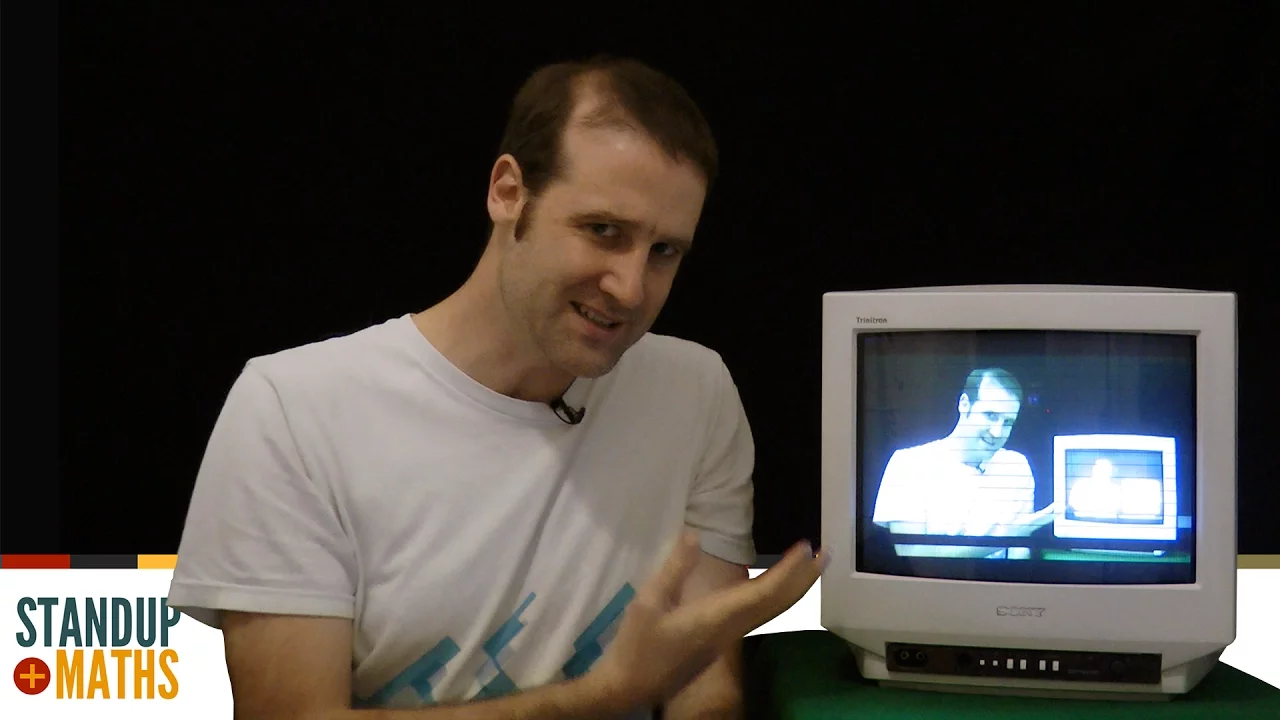
Stand-up Maths
Broadcasters slowed North American television from 30 to 29.97 frames per second to cancel color carrier interference while preserving backwards compatibility with existing black-and-white sets.
AI-assisted summary of Why is TV 29.97 frames per second? — original source. Check the original for full context.
Source published:
Key ideas
- North American television originally adopted 30 fps because 60 Hz domestic AC power naturally synced with two interlaced fields of 262.5 lines per frame on CRT sets. (0:00)
- Introducing color in 1953 forced engineers to avoid visual cross-talk by ensuring the 4.5 MHz active payload window divided into an exact integer multiple of the horizontal line rate. (2:57)
- Dividing 4,500,000 Hz by the original 15,750 Hz line rate yielded approximately 285.714, forcing engineers to round up to 286 and lower the frame rate by 0.1% to 29.97 fps (30 / 1.001). (5:15)
- European PAL avoided fractional frame rates by using 50 Hz power grids, 625 lines, and a 6.0 MHz bandwidth window, cleanly yielding an exact integer quotient of 384 at 25 fps. (7:51)
- NTSC engineers prioritized backward compatibility for existing monochrome sets, as CRT circuitry could tolerate a 0.1% frame rate drop but would have broken under line count changes. (9:13)
Detailed notes
## Background Published on YouTube by Matt Parker on his channel Stand-up Maths on October 3, 2016, this video investigates the historical and technical quirks that led to North American television running at 29.97 frames per second. The video description notes that while North America settled on this odd fractional frame rate, Europe uses a comfortable 25 frames per second, and includes links to Parker's Patreon and a spherical video project that originally prompted his research.
## TL;DR The video explains how North American television ended up with the bizarre frame rate of 29.97 frames per second, tracing its origins back to cathode ray tube (CRT) mechanics and the 60 Hz electrical grid. When color television was introduced in 1953, engineers had to squeeze a color subcarrier into the existing 4.5 MHz bandwidth without causing visual interference on black-and-white sets. To satisfy the mathematical requirements of phase reversal and avoid interference, they adjusted the horizontal line frequency slightly, which slowed the frame rate down by 0.1% to 29.97 fps. In contrast, Europe's PAL system benefited from a wider bandwidth and a 50 Hz grid, allowing for a clean 25 frames per second.
## Atmosphere & style The video has an enthusiastic, lighthearted, and deeply nerdy atmosphere, driven by Matt Parker's energetic and comedic presentation style. He explains complex mathematical and engineering concepts with playful exasperation, using self-deprecating jokes—such as redefining NTSC as 'Not The Smartest Choice'—to keep the technical history engaging. Watching feels like attending a fun, accessible lecture where historical engineering compromises are treated as amusing puzzles, ending with a warm, personal chat directly addressing his most dedicated viewers.
## Bulletin - [00:00](https://www.youtube.com/watch?v=3GJUM6pCpew&t=0s) North American television originally adopted 30 fps because 60 Hz domestic AC power naturally synced with two interlaced fields of 262.5 lines per frame on CRT sets. - [02:57](https://www.youtube.com/watch?v=3GJUM6pCpew&t=177s) Introducing color in 1953 forced engineers to avoid visual cross-talk by ensuring the 4.5 MHz active payload window divided into an exact integer multiple of the horizontal line rate. - [05:15](https://www.youtube.com/watch?v=3GJUM6pCpew&t=315s) Dividing 4,500,000 Hz by the original 15,750 Hz line rate yielded approximately 285.714, forcing engineers to round up to 286 and lower the frame rate by 0.1% to 29.97 fps (30 / 1.001). - [07:51](https://www.youtube.com/watch?v=3GJUM6pCpew&t=471s) European PAL avoided fractional frame rates by using 50 Hz power grids, 625 lines, and a 6.0 MHz bandwidth window, cleanly yielding an exact integer quotient of 384 at 25 fps. - [09:13](https://www.youtube.com/watch?v=3GJUM6pCpew&t=553s) NTSC engineers prioritized backward compatibility for existing monochrome sets, as CRT circuitry could tolerate a 0.1% frame rate drop but would have broken under line count changes.
## Key takeaways - [00:00](https://www.youtube.com/watch?v=3GJUM6pCpew&t=0s) Early CRT televisions relied on interlacing to conserve bandwidth and prevent noticeable display flicker. - [00:00](https://www.youtube.com/watch?v=3GJUM6pCpew&t=0s) Monochrome NTSC settled on 525 horizontal lines and 30 frames per second directly locked to North America's 60 Hz electrical grid. - [02:57](https://www.youtube.com/watch?v=3GJUM6pCpew&t=177s) Analog 6 MHz broadcast channels left an active transmission window of exactly 4.5 MHz between the video carrier and sound carrier. - [02:57](https://www.youtube.com/watch?v=3GJUM6pCpew&t=177s) Adding a color subcarrier within the existing 4.5 MHz window caused severe cross-talk and visual patterning with luminance and sound signals. - [02:57](https://www.youtube.com/watch?v=3GJUM6pCpew&t=177s) Line-by-line phase reversal eliminated visual interference by requiring internal carrier frequency separations to equal odd integer multiples of half the line rate. - [05:15](https://www.youtube.com/watch?v=3GJUM6pCpew&t=315s) Summing the two phase reversal requirements dictated that the entire 4.5 MHz active window had to equal an exact integer multiple of the horizontal line frequency. - [05:15](https://www.youtube.com/watch?v=3GJUM6pCpew&t=315s) The original monochrome horizontal line rate of 15,750 Hz resulted in a non-integer quotient of 285.714 when divided into 4.5 MHz. - [05:15](https://www.youtube.com/watch?v=3GJUM6pCpew&t=315s) Adjusting the quotient to the nearest whole integer of 286 reduced the horizontal frequency to approximately 15,734.27 Hz. - [05:15](https://www.youtube.com/watch?v=3GJUM6pCpew&t=315s) Dividing 15,734.27 Hz by 525 lines produced the standard 29.97 fps color broadcast frame rate, effectively 30 divided by 1.001. - [07:51](https://www.youtube.com/watch?v=3GJUM6pCpew&t=471s) Europe's PAL system was engineered from scratch with a 6.0 MHz active bandwidth and 625 lines at 25 fps, yielding a clean integer multiple of 384. - [09:13](https://www.youtube.com/watch?v=3GJUM6pCpew&t=553s) NTSC could theoretically have kept 30 fps by shifting to 625 horizontal lines, yielding an exact integer quotient of 240. - [09:13](https://www.youtube.com/watch?v=3GJUM6pCpew&t=553s) Increasing the line count was rejected because it would have rendered millions of existing monochrome televisions instantly obsolete. - [09:13](https://www.youtube.com/watch?v=3GJUM6pCpew&t=553s) Technological standards possess enormous inertia, meaning short-term engineering workarounds often persist as permanent technical debt. - [12:22](https://www.youtube.com/watch?v=3GJUM6pCpew&t=742s) Matt Parker soft-launches his Patreon page for dedicated viewers, offering behind-the-scenes footage to test reward tiers before a formal rollout.
## Detailed walkthrough ### [00:00](https://www.youtube.com/watch?v=3GJUM6pCpew&t=0s) The CRT Legacy and the Origins of 30 Frames per Second
Matt Parker introduces the bizarre North American television frame rate of 29.97 frames per second, a number he ran into while trying to manually reassemble extracted video frames for a project. Unable to locate a concise, clear explanation online, he dug into the technical history. The odd frame rate traces directly back to the physical mechanics of cathode ray tube (CRT) television sets. Inside a CRT, a cathode ray fires a beam of electrons toward the back of the phosphor screen, causing it to illuminate at the point of impact while electromagnets steer the beam across the display. When this tiny glowing dot is swept across the display quickly enough while its brightness is modulated, human persistence of vision blends the raster lines into a coherent moving picture.
Rather than drawing the entire picture in a single pass from top to bottom, early television systems utilized interlacing to conserve bandwidth and prevent visible flicker. The electron beam would first scan the odd-numbered horizontal rows, return to the top, and then perform a second pass to fill in the even-numbered rows. North American analog television settled on 525 horizontal rows, an odd number chosen so that each alternating field scanned exactly 262.5 rows. The half-line offset allowed the beam's geometric flyback to take identical time for both passes, preserving vertical alignment. While matching standard cinema projection of 24 frames per second might have seemed intuitive, televisions were plugged directly into the standard North American domestic electrical grid, which supplied alternating current at 60 Hz. By locking the scan passes directly to the line frequency to avoid electrical hum and distortion, two passes per frame resulted in a clean 30 frames per second. As Matt Parker puts it: “What a perfectly logical, and sensible frame rate!”
- **Interlaced fields:** 2 passes per full image frame (odd field followed by even field). - **Line count:** 525 total horizontal lines per frame, split into two fields of 262.5 lines each. - **Power synchronization:** 60 Hz AC household power dictated 60 fields per second, creating 30 complete frames per second for black-and-white broadcasts.
```mermaid flowchart TD accTitle: CRT Interlaced Scanning Process accDescr: Diagram showing how a 60 Hz alternating current creates 30 interlaced frames per second on a 525-line CRT screen.
subgraph PowerGrid["Mains Power"] A["60 Hz AC Electrical Supply"] end
subgraph Fields["Interlaced Fields (60 fields/sec)"] B["Field 1: Odd Lines (262.5 lines)"] C["Field 2: Even Lines (262.5 lines)"] end
subgraph Output["Frame Output (30 fps)"] D["1 Full 525-Line Video Frame"] end
A --> B A --> C B --> D C --> D ```
---
[02:57](https://www.youtube.com/watch?v=3GJUM6pCpew&t=177s) The Color Crisis: Squeezing Color into an Analog Spectrum
The stable 30 frames per second standard ruled North American broadcasting until color television was introduced in 1953, disrupting the established transmission architecture. Analog television channels were allocated a 6 MHz slot of electromagnetic spectrum, but broadcasters could not utilize the entire width. The initial 0.25 MHz was reserved as a guard band buffer against adjacent channels, followed by roughly 1 MHz of signal ramp-up. The active picture information was transmitted across the central block, ending 4.5 MHz later where the audio carrier resided, capped by another 0.25 MHz guard band at the top edge. This left an active window of exactly 4.5 MHz (4,500,000 Hz) to carry all visual and audio information without bleeding into neighboring stations.
```mermaid flowchart LR accTitle: 6 MHz NTSC Channel Allocation accDescr: Visual breakdown of an analog 6 MHz NTSC channel spectrum showing guard bands and active 4.5 MHz payload.
subgraph Spectrum["6 MHz Broadcast Channel"] direction LR G1["0.25 MHz<br/>Guard Band"] RU["1.0 MHz<br/>Ramp-Up"] Active["4.5 MHz Active Payload Window<br/>(Picture Luminance, Color Subcarrier, and Sound Carrier)"] G2["0.25 MHz<br/>Guard Band"] end
G1 --- RU RU --- Active Active --- G2 ```
When the National Television System Committee (NTSC) designed the color standard, they had to place a new chrominance (color) subcarrier inside this existing 4.5 MHz window while maintaining compatibility with millions of existing black-and-white sets. Initial color tests created severe interference artifacts: the color subcarrier clashed with the existing monochrome luminance and sound frequencies, causing intolerable geometric patterning and distortion across the image.
To hide these visual artifacts from the viewer, broadcast engineers turned to a technique known as line-by-line phase reversal. Matt Parker explains that while the intricate physics can seem opaque, the mathematical constraint required to make it function is straightforward: the frequency separation between the luminance signal and the color subcarrier, as well as the separation between the color subcarrier and the sound signal, both had to equal an odd integer multiple of half the horizontal line frequency.
- **Total channel bandwidth:** 6.0 MHz allocated per television station. - **Active signal window:** 4.5 MHz (4,500,000 Hz) spanning from video carrier to audio carrier. - **Phase reversal condition:** Both frequency gaps must be an odd multiple of $(f_H / 2)$, where $f_H$ is the horizontal line scanning frequency.
---
[05:15](https://www.youtube.com/watch?v=3GJUM6pCpew&t=315s) The 285.714 Problem: Deriving 29.97 fps
The algebraic requirement of phase reversal leads directly to an arithmetic clash with 30 frames per second. If both internal frequency intervals are odd integer multiples of half the horizontal frequency, adding them together means summing two odd integers multiplied by half the horizontal frequency. Since the sum of two odd integers is always an even integer, multiplying that sum by one half yields a plain whole integer. Consequently, the total 4.5 MHz active transmission interval had to equal an exact integer multiple of the horizontal line frequency:
$$\text{Integer} \times f_H = 4{,}500{,}000\text{ Hz}$$
In the existing black-and-white system, each frame had 525 lines and ran at 30 frames per second, producing a horizontal line rate of:
$$525 \times 30 = 15{,}750\text{ lines per second (Hz)}$$
Dividing the 4,500,000 Hz active window by 15,750 Hz does not yield an integer; instead, it results in:
$$\frac{4{,}500{,}000}{15{,}750} \approx 285.714\dots$$
Matt Parker imagines the exasperation of the 1950s broadcast engineers: “And the poor engineers must be like ‘oh that's close, imagine.. imagine if that was 286 that would solve all of our problems!’ but it's not.”
To force the quotient to the nearest whole integer of 286, the required horizontal frequency had to be adjusted downward:
$$\frac{4{,}500{,}000}{286} \approx 15{,}734.2657\text{ Hz}$$
Dividing this new line frequency by the fixed 525 lines per frame yielded a frame rate of approximately 29.97003 frames per second (calculated as $30 / 1.001$). By slowing down the frame rate by a mere 0.1%, the color subcarrier sat precisely where phase reversal cancelled out visible beat frequencies. The NTSC committee locked this standard in 1953, prompting Matt to joke that NTSC really stands for “Not The Smartest Choice.”
- **Monochrome horizontal line rate:** $525 \times 30 = 15{,}750\text{ Hz}$. - **Quotient for 30 fps:** $4{,}500{,}000 / 15{,}750 \approx 285.714$ (non-integer; causes visible cross-talk). - **Target integer:** 286. - **Adjusted color horizontal line rate:** $4{,}500{,}000 / 286 \approx 15{,}734.25\text{ Hz}$. - **Resulting color frame rate:** $15{,}734.2657 / 525 \approx 29.97\text{ fps}$ (or $\frac{30}{1.001}\text{ fps}$).
---
[07:51](https://www.youtube.com/watch?v=3GJUM6pCpew&t=471s) How Europe Got It Right with PAL
In contrast to the awkward NTSC fraction, Europe adopted the Phase Alternating Line (PAL) standard, benefiting from later implementation and different infrastructure. European power grids run on 50 Hz alternating current, which, with two interlaced fields per frame, yielded a clean 25 frames per second. Furthermore, PAL utilized 625 horizontal lines—an extra 100 lines compared to NTSC, providing noticeably sharper image resolution.
European regulators also allocated a wider transmission space, providing a full 6.0 MHz active payload window for the signal data. When PAL engineers performed the identical calculation to eliminate color interference artifacts, dividing their 6,000,000 Hz window by their horizontal frequency ($625 \text{ lines} \times 25 \text{ fps} = 15{,}625\text{ Hz}$), the arithmetic worked out neatly:
$$\frac{6{,}000{,}000}{15{,}625} = 384$$
The division yielded exactly 384 with zero remainder. Matt Parker points out that this was not sheer luck, but deliberate engineering foresight: “PAL came into place because of color television. Europe had a look at North America went what a mess, let's just do a new system from the ground up and make it work.”
| Specification Parameter | North American NTSC | European PAL | |:--- |:--- |:--- | | **Grid Power Frequency** | 60 Hz | 50 Hz | | **Frame Rate** | 29.97 fps (originally 30 fps) | 25 fps | | **Horizontal Lines per Frame** | 525 lines | 625 lines | | **Horizontal Line Frequency** | 15,734.27 Hz | 15,625 Hz | | **Active Signal Bandwidth** | 4.5 MHz | 6.0 MHz | | **Harmonic Factor** | 286 | 384 (exact integer) |
---
[09:13](https://www.youtube.com/watch?v=3GJUM6pCpew&t=553s) Missed Alternatives and the Tenacity of Standards
Could the NTSC engineers have resolved the conflict without introducing a fractional frame rate? The 4.5 MHz carrier separation was legally locked by frequency allocations, ruling out expanding the active window. However, Matt argues that they could have altered the line count instead. If they had retained the original 30 frames per second rate and searched for the next odd line count greater than 525 lines to prevent resolution loss, 625 horizontal lines would have solved the problem:
$$625 \text{ lines} \times 30\text{ fps} = 18{,}750\text{ Hz}$$ $$\frac{4{,}500{,}000}{18{,}750} = 240$$
Under this alternative, the active window would divide into an exact integer of 240, and North America would have shared an identical line standard with Europe. Yet engineers chose backwards compatibility over mathematical elegance. Existing monochrome television sets had circuitry that could tolerate a 0.1% drop in frame rate without losing vertical sync, whereas changing the line count to 625 would have rendered every black-and-white receiver in America instantly obsolete. Reflecting on their philosophy, Matt notes: “Their theory was if they do their job correctly no-one would be sure they had done anything at all.”
Matt observes that technological standards possess extraordinary inertia because human societies resist disruptive shifts. He urges engineers and computer scientists in the audience to choose conventions wisely when designing foundational protocols, warning that future generations could be living with their workarounds decades later. He concludes by mentioning that this entire investigation stemmed from his own frustrations with 29.97 fps when building a spherical video project with Henry Segerman, where every frame had to be extracted, manipulated via custom Python scripts, and manually stitched back together.
[12:02](https://www.youtube.com/watch?v=3GJUM6pCpew&t=722s) Bodging Conventions and Future Consequences
Matt Parker reflects on the engineering philosophy that led to such an unusual frame rate in television standards. He points out that practical engineering often favors pragmatic compromises over theoretical perfection, as adopting a working system quickly is far more important than holding out for an ideal one. As Matt puts it: “A convention that exists is better than something that doesn't, so if you can bodge it together and it works, go for it.” He jokingly brushes aside any long-term technical debt created by these kinds of quick fixes, cheerfully assuring the audience that future generations will simply have to figure out their own ways to deal with the fallout.
[12:22](https://www.youtube.com/watch?v=3GJUM6pCpew&t=742s) A Special Announcement: The Patreon Soft Launch
Matt transitions to speaking directly to the remaining audience, citing his YouTube analytics to point out that only about thirty percent of viewers stick around to the very end of a video. He notes that the majority watch the interesting core topic and tune out once he starts rambling at the finish. Declaring the dedicated viewers who stay through to the end as his true people, he shares a special announcement just for them. For a long time, supporters have asked when he would create a Patreon page, and he reveals that he has finally set one up as a soft launch. While he intends to do a formal launch later with an introductory video explaining his plans and adhering to platform best practices, he wanted to debut it quietly here first.
Explaining the concept for those unfamiliar with the platform, Matt describes Patreon as functioning similarly to an ongoing Kickstarter. Supporters who have the means can contribute money on an ongoing basis to help him improve the production quality of his videos, and in return, he will provide a variety of rewards. He intends to have fun creating bonus material, starting with a behind-the-scenes look at the absurd technical setup surrounding him that was required to film this exact video. Since he has no patrons yet at launch, that behind-the-scenes clip will be freely viewable by anyone visiting the page. He encourages viewers to follow the link at the very top of the video description, test the waters, and provide feedback on the reward tiers so he can adjust what is offered before the official rollout.
- According to YouTube retention analytics, only about thirty percent of the total audience watches past the main content to the closing remarks. - The Patreon launch is intentionally soft-launched without fanfare to gather early feedback on rewards and features from core viewers. - A public behind-the-scenes video detailing the complex and ridiculous technical setup behind making this episode will be posted for everyone to view on Patreon.
## Notable quotes > [12:02](https://www.youtube.com/watch?v=3GJUM6pCpew&t=722s) A convention that exists is better than something that doesn't, so if you can bodge it together and it works, go for it. — Matt Parker
## Mentioned Matt Parker, Henry Segerman, Howard Carter, Simon Wright, NTSC, PAL, CRT, Patreon, Kickstarter, YouTube, Python
## Video description I look at the historical quirks which gave us TV at 29.97 frames per second. In North America at least. It's a comfortable 25 fps in Europe.
More on that thing I mentioned at the end of the video here: https://www.patreon.com/standupmaths
Here is the spherical video I was making with Henry Segerman which made me research NTSC frame rates in the first place: https://www.youtube.com/watch?v=Yp12c3-IL-I
Yes, technically, if you divide 4,500,000 by 286 you get a horizontal frequency of 15,734.26573 lines per second. That matches a frame rate of 29.97002997002997… and so old TVs used 30/1.001 = 29.97002997002997…
CORRECTIONS: - A lot of people pointing out that increasing the number of horizontal lines without increasing the bandwidth would be a loss of resolution. Which is a good point.
Music by Howard Carter Design by Simon Wright
MATT PARKER: Stand-up Mathematician Website: http://standupmaths.com/ Patreon: https://www.patreon.com/standupmaths Nerdy maths toys: http://mathsgear.co.uk/
[Source](https://www.youtube.com/watch?v=3GJUM6pCpew)