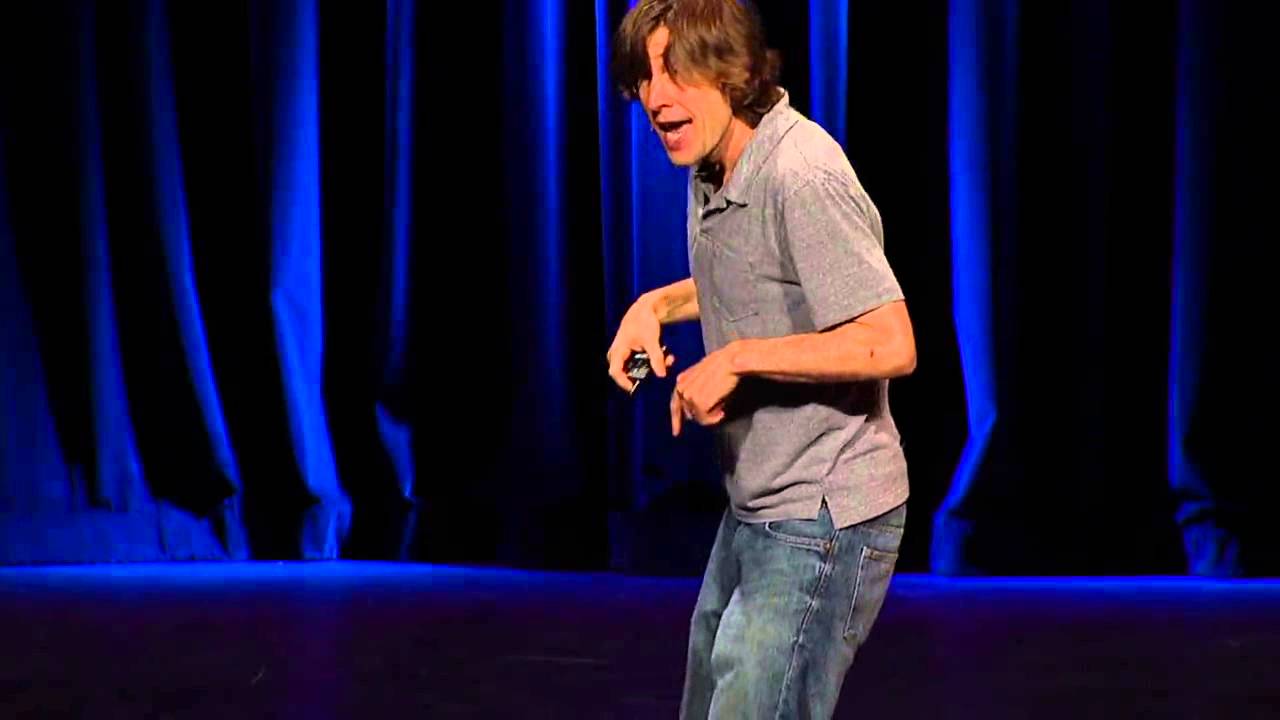
Rodney Mullen Rejects Trophies to Drive Open-Source Skate Innovation
TED
Sustained competitive dominance stifles creative freedom, meaning true innovation occurs when individuals create for its own sake and share their breakthroughs to elevate a collaborative community.
Rodney Mullen describes the sudden collapse of freestyle skateboarding in the late 1980s as a creative liberation rather than a defeat, freeing him from an eleven-year cycle of defending titles to pioneer modern street skating. (2:58)
Mullen equates street skateboarding culture to open-source software and hacker communities, where practitioners master existing architectures only to subvert their intended uses and contribute breakthroughs back to the collective. (11:54)
Citing Richard Feynman's view of the Nobel Prize as a tombstone on great work, Mullen warns against the defensive, joyless posture that comes from protecting competitive accolades instead of pursuing genuine creation. (15:21)
Refusing to stagnate in retirement, Mullen revealed he had undertaken a total, closed-door physical overhaul of his foundational technique to develop a completely new approach to the board. (17:12)
Detailed notes
## Background
Published on YouTube by TED on February 2, 2015, this talk captures street skateboarding pioneer Rodney Mullen speaking at TEDxUSC. According to the description, Mullen shares his love for the open skateboarding community and explains how unique environments spark prolific ingenuity and new tricks purely for passion's sake rather than competitive victories.
## TL;DR
Rodney Mullen chronicles his evolution from an isolated childhood outsider and dominant freestyle champion to a street-skating innovator freed by the sudden collapse of his competitive discipline. By repurposing his foundational flatground techniques into urban architecture, he developed iconic maneuvers like the Darkslide and Primo slide, relying on motor intuition over rigid cognitive control. Mullen draws direct parallels between skateboarders and open-source computer hackers, illustrating how both subcultures manipulate established systems and feed breakthroughs back into the collective commons. He concludes that true fulfillment does not come from trophies or fame, but from the peer respect earned through personal expression and contributing ideas for future generations to advance.
## Atmosphere & style
Mullen’s presentation is kinetic, disarmingly humble, and deeply philosophical, pairing self-deprecating humor with raw intellectual curiosity. Watching him feels like listening to an authentic savant who is simultaneously astonished by his own success and completely grounded by the physical reality of falling. The emotional arc moves from the suffocating pressure of defending competitive titles to an infectious, joyful embrace of community, open-source creation, and continuous reinvention.
## Bulletin
- [02:58](https://www.youtube.com/watch?v=3GVO-MfIl1Q&t=178s) Rodney Mullen describes the sudden collapse of freestyle skateboarding in the late 1980s as a creative liberation rather than a defeat, freeing him from an eleven-year cycle of defending titles to pioneer modern street skating.
- [11:54](https://www.youtube.com/watch?v=3GVO-MfIl1Q&t=714s) Mullen equates street skateboarding culture to open-source software and hacker communities, where practitioners master existing architectures only to subvert their intended uses and contribute breakthroughs back to the collective.
- [15:21](https://www.youtube.com/watch?v=3GVO-MfIl1Q&t=921s) Citing Richard Feynman's view of the Nobel Prize as a tombstone on great work, Mullen warns against the defensive, joyless posture that comes from protecting competitive accolades instead of pursuing genuine creation.
- [17:12](https://www.youtube.com/watch?v=3GVO-MfIl1Q&t=1032s) Refusing to stagnate in retirement, Mullen revealed he had undertaken a total, closed-door physical overhaul of his foundational technique to develop a completely new approach to the board.
## Key takeaways
- [00:00](https://www.youtube.com/watch?v=3GVO-MfIl1Q&t=0s) Skateboarding attracted Mullen because it offered self-expression and complete autonomy free from coaches, referees, or head-to-head opposition.
- [00:45](https://www.youtube.com/watch?v=3GVO-MfIl1Q&t=45s) After winning his first world championship at age 14, Mullen dominated competitive freestyle by pioneering foundational flatground maneuvers like the flatground ollie and the Casper slide.
- [02:58](https://www.youtube.com/watch?v=3GVO-MfIl1Q&t=178s) When street skateboarding displaced freestyle and Mullen's pro model board was cancelled, the loss of his livelihood paradoxically restored his creative freedom.
- [04:51](https://www.youtube.com/watch?v=3GVO-MfIl1Q&t=291s) Reinventing his career required transferring deep muscular infrastructure and trick mechanics from flatground onto street obstacles, yielding inventions like the Darkslide.
- [05:55](https://www.youtube.com/watch?v=3GVO-MfIl1Q&t=355s) Mullen invented the Primo slide the night before knee surgery, landing on a board sliding sideways on its wheels despite severe joint instability.
- [07:26](https://www.youtube.com/watch?v=3GVO-MfIl1Q&t=446s) Street skating is a dialogue with physical context, where architectural obstacles dictate trick choice by imposing torque and angular forces directly onto motor submovements.
- [08:50](https://www.youtube.com/watch?v=3GVO-MfIl1Q&t=530s) High-level athletic execution requires stepping back the cognitive mind to let intuition match external terrain with ingrained executive submovements.
- [10:48](https://www.youtube.com/watch?v=3GVO-MfIl1Q&t=648s) Skateboarding lacks an objective hierarchy of greatness, measuring mastery instead by how fully an athlete uses the board to individuate their personal identity.
- [11:54](https://www.youtube.com/watch?v=3GVO-MfIl1Q&t=714s) In outsider communities, personal connection paradoxically deepens in direct proportion to how boldly members express their individuality.
- [12:37](https://www.youtube.com/watch?v=3GVO-MfIl1Q&t=757s) Hacking and street skating share the exact same ethos: mastering a system so thoroughly that one can steer it to do things it was never designed to do.
- [13:15](https://www.youtube.com/watch?v=3GVO-MfIl1Q&t=795s) The open-source model mirrors skateboarding culture, where individuals improve upon shared communal building blocks and give them back so the entire collective rises.
- [13:52](https://www.youtube.com/watch?v=3GVO-MfIl1Q&t=832s) Niche celebrity and mainstream popularity offer little genuine sustenance compared to peer respect within a dedicated craft.
- [15:21](https://www.youtube.com/watch?v=3GVO-MfIl1Q&t=921s) Defending championships forces competitors into a protective turtle posture that stifles original invention and joy.
- [16:18](https://www.youtube.com/watch?v=3GVO-MfIl1Q&t=978s) True permanence is not achieved through trophies or fame, but through gifting original work to a community where younger talent can elevate it beyond the creator's imagination.
- [17:12](https://www.youtube.com/watch?v=3GVO-MfIl1Q&t=1032s) Overcoming creative plateau requires radical infrastructural reinvention rather than merely polishing existing variations.
## Detailed walkthrough
### [00:00](https://www.youtube.com/watch?v=3GVO-MfIl1Q&t=0s) Finding Skateboarding as an Outsider and the Freestyle Championship Era
Rodney Mullen begins his talk after a video montage of his skating, opening with self-deprecating humor: “So, that's what I've done with my life.” Growing up on a farm in Florida, Mullen did what normal kids did—playing baseball and other sports—yet he persistently felt like an outsider. That feeling shifted when he saw magazine photographs of skateboarders. The appeal was immediate and distinct: unlike conventional sports, skateboarding featured neither an opposing player staring you down nor a coach hovering directly over your shoulder. The skaters were simply expressing who they were, and he felt deeply drawn to that autonomy.
Mullen began skating at the age of ten in 1977 and developed proficiency rapidly. By 1979, he won his first amateur championship, and in 1981, at only 14 years old, he claimed his first world championship title—an achievement he describes as his first genuine victory. Mullen cues archival footage from around 1984, highlighting classic flatground maneuvers he pioneered, including an upside-down board maneuver called the Casper slide and the flatground ollie. He acknowledges the moniker often attached to him, noting, “So, as she mentioned, that is overstated for sure, but that's why they called me the godfather of modern street skating.”
- Began skating: 1977 (at age 10)
- First amateur championship: 1979
- First world championship: 1981 (at age 14)
- Formative flatground tricks: the flatground ollie and the Casper slide
---
[02:58](https://www.youtube.com/watch?v=3GVO-MfIl1Q&t=178s) The Death of Freestyle and the Liberation of Starting Over
By the mid-1980s, Mullen was midway through his professional career, dominating flatground freestyle. Simultaneously, skateboarding began a dramatic shift. Skaters were taking the flatground ollie into the streets, launching themselves upward onto bleachers, handrails, and down stairwells. Street skateboarding took roughly five years to completely eclipse freestyle. At that point, Mullen had reigned as champion for eleven consecutive years, but the discipline vanished almost overnight. His sponsor removed his pro model board from the shelves, which was essentially a public death sentence for a professional skater, cutting off his income stream of signature decks, wheels, shoes, and apparel.
Yet, this sudden erasure produced an unexpected sense of liberation. Mullen no longer had to shoulder the burden of defending a competitive title, remarking, “What drew me to skateboarding, the freedom, was now restored, where I could just create things, because that's where the joy was for me, always, was creating new stuff.” He possessed an extensive mental library and muscular infrastructure of flatground tricks that other skaters did not have. Transitioning to street skating was nevertheless intensely humbling and frustrating; people recognized him as the famous champion, yet on street obstacles he initially struggled so much that onlookers would openly ask, “Oh, what happened to Mullen?”
```mermaid
flowchart LR
accTitle: Transition from Freestyle to Street Skateboarding
accDescr: Diagram showing how Mullen leveraged his freestyle foundation to reinvent his career in street skating after freestyle declined.
subgraph Freestyle["Freestyle Era (1977–1980s)"]
A["Flatground Mastery<br/>(Ollies, Caspers)"] --> B["11 Years as<br/>Freestyle Champion"]
end
subgraph Shift["The Shift"]
B --> C["Freestyle Dies Out;<br/>Pro Model Pulled"]
end
subgraph Street["Street Reinvention"]
C --> D["Liberation from Defending Titles"]
D --> E["Cross-Application of Submovements<br/>(Darkslides, Primo Slides)"]
end
```
---
[04:51](https://www.youtube.com/watch?v=3GVO-MfIl1Q&t=291s) Reinventing the Repertoire: Darkslides and Primo Slides
Starting over, Mullen channeled his deep freestyle foundation into the architecture of street terrain. Reviewing video clips of his street career, he points out a Darkslide—a trick where the skateboard slides along an obstacle upside down on its grip tape. While he had seen skaters slide on the upside-down deck before, nobody had figured out how to flip into it onto an obstacle. Drawing from his knowledge of Caspers, he realized it was just a matter of foot placement and board rotation: “I had an infrastructure. I had this deep layer, where it was like, oh my gosh, it's just your foot. It's just the way you throw your board over. Just let the ledge do that, and it's easy, and the next thing you know, there's 20 more tricks based out of the variations.”
He also breaks down the Primo slide, in which the skateboard slides on its side along the ground like a skimboard. He describes it as the most entertaining trick imaginable because falls are completely unpredictable: ordinary skate wipeouts slip forward or backward predictably, but a Primo fall sends the board unpredictably in any direction like a cartoon. Mullen recalls originating the trick right before undergoing knee surgery. Unable to skate for weeks because his knee repeatedly gave out, he hung out at a friend's warehouse craving a fresh trick. The night before his hospital admission, he ran, threw down a Caveman, flipped the board onto its edge, and landed light-footed, rationalizing that if the knee buckled, the surgeons would simply have more work to fix the next morning. On the operating gurney, as the anesthesia mask came down, his final conscious thought was that the Primo slide would be the very first trick he filmed once recovered—a promise he fulfilled.
---
[07:26](https://www.youtube.com/watch?v=3GVO-MfIl1Q&t=446s) How Context Shapes Content and the Submovements of Intuition
Mullen shifts from discussing individual tricks as content to examining how physical context dictates street skateboarding. Skaters carry a mental library of techniques and drive through ordinary city streets searching for architectural features that fit or reshape those tricks. He pauses to share an aside about speaking at TEDxUSC, joking that being on the University of Southern California campus is a unique honor given how many times security guards had escorted him off the grounds for street skating.
He illustrates the dialogue between environment and trick execution by examining video of a mellow bank wall in a rough neighborhood where skaters first have to consider personal safety and security guard patterns before testing the spot. Skating this bank, he noticed that carving up the bank abruptly forced his shoulder around. Rather than fighting that physical feedback, his motor memory registered that the forced torque matched the exact wind-up required for a 360 flip (where the board simultaneously flips along its longitudinal axis and rotates 360 degrees). Mullen emphasizes that high-level skating relies on breaking maneuvers down into executive motor submovements:
> “And so, as I'm going up, these things are floating around, and you have to sort of let the cognitive mind rest back, pull it back a little bit, and let your intuition go as you feel these things. And these submovements are kind of floating around, and as the wall hits you, they connect themselves to an extent, and that's when the cognitive mind: 'Oh, 360 flip, I'm going to make that.'”
---
[10:48](https://www.youtube.com/watch?v=3GVO-MfIl1Q&t=648s) Individuation and Giving Back to the Skateboarding Community
Mullen transitions to displaying a group photograph of his peers, paying tribute to the elite fraternity of professional skaters who surround him. In skateboarding, there is no single objective metric of who is "the best." Some of the greatest skaters in the world do not even look classically comfortable on their boards; what distinguishes them is how completely they use the board to express their individual identity. Skaters like Chris Haslam or Eric Koston possess silhouettes so distinctive that a viewer can recognize them instantly from their posture and movement alone: “What makes them great is the degree to which they use their skateboarding to individuate themselves.”
Mullen characterizes skateboarders as outsiders seeking a genuine sense of belonging, but strictly on their own self-determined terms. In this subculture, respect is not earned through trophies, but through creative dialogue: skaters take standard communal building blocks—such as a 360 flip—filter them through their personal style, and contribute innovative interpretations back to the culture to elevate the entire collective.
[11:54](https://www.youtube.com/watch?v=3GVO-MfIl1Q&t=714s) The Symmetry of Community and the Hacker Ethos
Rodney Mullen reflects on the deep relationship between personal identity and belonging, noting that many who take up skateboarding start out feeling like rejects. Yet through that culture, expressing individuality paradoxically bonds people together into something greater than any one person could create alone. As Mullen explains: “There's some sort of beautiful symmetry that the degree to which we connect to a community is in proportion to our individuality, which we are expressing by what we do.”
```mermaid
flowchart TD
accTitle: Open Source and Skateboarding Innovation Loop
accDescr: Diagram showing how individual innovation enters a shared community and elevates the collective whole.
subgraph Individual ["Individual Creativity"]
A["Individual Expression / Experimentation"]
B["Connect Disparate Information"]
end
subgraph Commons ["Shared Community Ethos"]
C["Open Source / Street Culture Commons"]
D["Iterate, Improve, and Give Back"]
end
subgraph Evolution ["Collective Growth"]
E["Next Generation Pushes Trick to New Heights"]
end
A --> B
B --> C
C --> D
D --> E
E --> A
```
Mullen draws a direct parallel between skateboarders and computer hackers, pointing out photos on his slides that even come from police mugshots. To hack, he argues, is fundamentally about “knowing a technology so well that you can manipulate it and steer it to do things it was never intended to do.” Whether one is a Linux kernel hacker bolstering security, an iOS hacker jailbreaking an iPhone to run unauthorized features, or a security boundary-pusher, the creative methodology mirrors skateboarding: hackers take disparate pieces of information and combine them in ways security analysts never anticipated. This mirrors the open-source software ethos—taking what others have built, making it better, and feeding it back so that everyone rises together.
- Mullen’s father had once warned him about who he was hanging out with, but Mullen remarks with a smile, “These are my peers.”
- Among these unconventional peers, one was recognized as Ernst & Young’s Entrepreneur of the Year for San Diego County.
---
[13:52](https://www.youtube.com/watch?v=3GVO-MfIl1Q&t=832s) Fame, Humility, and Peer Respect
Moving from technical subcultures to commercial achievement, Mullen admits that he has experienced an immense amount of success that he often feels unworthy of. He secured patents, co-founded a company that grew to become the biggest in the industry, watched it decline, rebuilt it back to number one—which he found far harder than building it the first time—and subsequently sold it twice. When one has accumulated that level of achievement, injuries, and wear, Mullen questions what actually provides the internal drive to keep pushing forward when so many talented individuals simply “die on the vine.”
For Mullen, the answer does not lie in popularity. He describes the unique privilege of having a niche type of fame where you can simply “take it off.” While traveling globally, he would be met by a thousand screaming kids chanting his name in an experience that felt surreal, disorienting, and visceral. Yet ten minutes later, after driving away in a car, he would step out into a normal environment where nobody cared who he was. That stark contrast offered invaluable perspective, reminding him that popularity carries very little real substance. Instead, the ultimate fuel for skateboarders is mutual regard: “It's peer respect that drives us.” That respect keeps them breaking bones and taking concussions—to the point where teammates tease a friend who has endured eight to ten concussions as pure comedy.
---
[15:21](https://www.youtube.com/watch?v=3GVO-MfIl1Q&t=921s) The Tombstone of the Nobel Prize and True Permanence
Mullen traces an ideological turning point back to reading a biography of physicist Richard Feynman while out on tour. A particular passage struck him deeply: Feynman had remarked that receiving the Nobel Prize felt like a tombstone on all great work. That insight resonated with Mullen's own competitive career, during which he won 35 out of 36 contests over an eleven-year span. Rather than bringing fulfillment, sustained dominance became an agonizing burden: “In fact, winning isn't the word, I won it once. The rest of the time, you're just defending, and you get into this, turtle posture, you know?” The obligation to protect a title usurped his love for skateboarding, replacing free-form invention with defensive caution. When that competitive circuit finally collapsed out from under him, he felt immense liberation because he was freed to create purely for the joy of it.
Acknowledging that he might sound close to preachy, Mullen emphasizes that his audience is full of current and future leaders, and he wants to share the only truths from skateboarding that carry permanence. Genuine meaning cannot be derived from trophies, accolades, or fame: “What it is, is that there's an intrinsic value in creating something for the sake of creating it, and better than that, because I'm 46 years old, or I'll be 46, and how pathetic is that I'm still skateboarding, but there is -- there is this beauty in dropping it into a community of your own making, and seeing it dispersed, and seeing younger, more talented, just different talent, take it to levels you can never imagine, because that lives on.”
---
[17:12](https://www.youtube.com/watch?v=3GVO-MfIl1Q&t=1032s) Q&A with Kristina Holly: What Comes Next
TEDxUSC organizer Kristina Holly joins Mullen on stage to ask about his future, recalling how he successfully reinvented himself from a champion freestyle skater into a street skating pioneer, and noting that he had officially retired roughly four years prior. She presses him on whether retirement is truly the final chapter or if another evolution is brewing.
Mullen admits that simply repeating the same tricks over and over feels hollow: “Every time you think you've chased something down, it's funny, no matter how good you are, and I know guys like this, it feels like you're polishing a turd, you know?” To break through that stagnation, he realized he could not just learn another minor variation; he had to alter something infrastructural about the way he skates. Out of sheer desperation, he has embarked on a fundamental, physical overhaul behind closed doors. Rather than making promises or talking about what might happen, Mullen tells Holly that if he pulls it off, she will be the first to know—promising to send her a text—before thanking the audience to warm applause.
## Notable quotes
> [11:54](https://www.youtube.com/watch?v=3GVO-MfIl1Q&t=714s) There's some sort of beautiful symmetry that the degree to which we connect to a community is in proportion to our individuality, which we are expressing by what we do. — Rodney Mullen
## Mentioned
Rodney Mullen, Kristina Holly, Chris Haslam, Eric Koston, Richard Feynman, TEDxUSC, University of Southern California, Ernst & Young, Linux, iOS, iPhone, Nobel Prize
## Video description
The last thing Rodney Mullen, the godfather of street skating, wanted were competitive victories. In this exuberant talk he shares his love of the open skateboarding community and how the unique environments it plays in drive the creation of new tricks — fostering prolific ingenuity purely for passion's sake. (Filmed at TEDxUSC.)
TEDTalks is a daily video podcast of the best talks and performances from the TED Conference, where the world's leading thinkers and doers give the talk of their lives in 18 minutes (or less). Look for talks on Technology, Entertainment and Design -- plus science, business, global issues, the arts and much more.
Find closed captions and translated subtitles in many languages at http://www.ted.com/talks/rodney_mullen_pop_an_ollie_and_innovate
Follow TED news on Twitter: http://www.twitter.com/tednews
Like TED on Facebook: https://www.facebook.com/TED
Subscribe to our channel: http://www.youtube.com/user/TEDtalksDirector
## Background
该视频由 TED 官方频道于 2015 年 2 月 2 日发布在 YouTube 平台上,记录了街式滑板教父 Rodney Mullen 在 TEDxUSC 上的精彩演讲。视频简介指出,Mullen 最不渴望的反而是竞技场上的胜利;在这场充满热情的演讲中,他分享了自己对开放滑板社群的热爱,以及独特的街头环境如何激发全新动作的诞生,从而在纯粹热爱的驱动下孕育出源源不断的创造力。
## TL;DR
传奇滑手 Rodney Mullen 回顾了自己从佛罗里达农场的孤僻少年成长为世界冠军,再到自由式滑板衰落后转战街头的涅槃历程。他深入拆解了街头物理环境与身体本能如何碰撞出全新的动作技巧,并将滑板文化与黑客精神、开源社区进行了深刻类比。Mullen 指出,竞技排名的胜负心会扼杀创造力,而真正的价值在于借由自我表达融入群体,并将底层创新无私回馈给社群共同进化。最后在问答中,他分享了从底层机制彻底重塑自我的决心,强调行动远重于空谈。
## Atmosphere & style
整场演讲洋溢着一种兼具赤子之心与哲思深度的感染力,Mullen 的表达谦逊、真挚甚至略带神经质般的狂热与害羞。他以自我调侃的幽默消解了身上的神级光环,将严重的伤病、被保安驱逐的狼狈与重获创造自由时的狂喜娓娓道来。观众仿佛在聆听一位痴迷技术的哲学家剖白心声,情绪随着他从竞技胜负的窒息、到街头重生的豁达、再到对社群传承的崇敬而跌宕起伏,充满直击心灵的精神力量。
## Bulletin
- [02:58](https://www.youtube.com/watch?v=3GVO-MfIl1Q&t=178s) 现代街式滑板教父 Rodney Mullen 回顾了从自由式到街式滑板的转型历程,指出在 11 年内赢得 35 场比赛的卫冕压力险些扼杀对滑板的爱,比赛体系消亡反而让他重获创新的纯粹自由。
- [07:26](https://www.youtube.com/watch?v=3GVO-MfIl1Q&t=446s) 街头滑板的动作创新本质在于“技巧框架”与“城市语境”的实时对话,滑手需要压制显性思考、依赖运动本能重组微动作单元以适应街头障碍。
- [11:54](https://www.youtube.com/watch?v=3GVO-MfIl1Q&t=714s) Mullen 将滑板文化深度类比为黑客社区与开源精神:滑手与黑客皆以意想不到的方式重构既有系统,汲取前人成果并在注入独特风格后回馈社群,推动群体共同升华。
- [16:09](https://www.youtube.com/watch?v=3GVO-MfIl1Q&t=969s) 在经历严重膝伤与商海沉浮后,Mullen 认为支撑人持续突破极限的核心唯有同行的纯粹尊重,真正的价值在于打破底层机制从头再来、将成果交给下一代推向新高度。
## Key takeaways
- [00:00](https://www.youtube.com/watch?v=3GVO-MfIl1Q&t=0s) Rodney Mullen 少年时期因追求没有教练和对手的纯粹自由而接触滑板,并在 14 岁夺得个人首个世界滑板锦标赛冠军。
- [00:00](https://www.youtube.com/watch?v=3GVO-MfIl1Q&t=0s) 平地豚跳(ollie)与 Casper slide 等核心动作的发明,重塑了现代滑板的动作基础,为滑板从二维平地走向三维街头铺平了道路。
- [02:58](https://www.youtube.com/watch?v=3GVO-MfIl1Q&t=178s) 1980 年代中期自由式滑板彻底消亡,Mullen 失去签名专属板与职业赞助,但他将这种商业归零视为重新获得创造自由的解脱。
- [02:58](https://www.youtube.com/watch?v=3GVO-MfIl1Q&t=178s) Mullen 将自由式的平地翻板底层逻辑与街头障碍物结合,创造了 Darkslide 与 Primo slide 等一系列全新街式动作。
- [06:23](https://www.youtube.com/watch?v=3GVO-MfIl1Q&t=383s) 在面临严重膝关节手术的前夕,Mullen 仍在尝试新动作,术前唯一的念头是在醒来康复后第一时间将其记录拍摄。
- [07:26](https://www.youtube.com/watch?v=3GVO-MfIl1Q&t=446s) 街式滑板的创新源自“技巧内容”与“物理环境”的对话,滑手通过借力城市建筑边缘激活原本不相关的微运动单元。
- [07:26](https://www.youtube.com/watch?v=3GVO-MfIl1Q&t=446s) 高难度动作依赖潜意识本能与直觉的瞬时拼装,滑手必须刻意压制理性认知大脑以达成身体与环境的合力。
- [10:48](https://www.youtube.com/watch?v=3GVO-MfIl1Q&t=648s) 滑板社群的核心不是争夺单一的“第一”,而是通过极具辨识度的个人风格完成自我个性的确立与彰显。
- [11:54](https://www.youtube.com/watch?v=3GVO-MfIl1Q&t=714s) 个体对社区的归属感与其通过实践展现的个性成正比,边缘个体的表达总和构成了社区发展的巨大能量。
- [11:54](https://www.youtube.com/watch?v=3GVO-MfIl1Q&t=714s) 滑板精神与开源黑客高度相通:两者皆是解构既有规则、操纵技术实现未被设计的功能,并无私回馈社区促成整体进化。
- [13:52](https://www.youtube.com/watch?v=3GVO-MfIl1Q&t=832s) 名利与世界巡演的光环极易褪去且容易让人迷失,支撑极限运动者承受多次伤痛折磨的唯有同行间纯粹的尊重。
- [13:52](https://www.youtube.com/watch?v=3GVO-MfIl1Q&t=832s) 连续夺冠会让人陷入保守防御的“乌龟姿态”,正如费曼所言“诺贝尔奖是伟大工作的墓碑”,竞技胜负会篡夺纯粹的创造乐趣。
- [16:09](https://www.youtube.com/watch?v=3GVO-MfIl1Q&t=969s) 创新的终极价值在于将创造的种子投放在共同构建的社区中,看着更年轻的下一代将其推向无法想象的新高度。
- [16:09](https://www.youtube.com/watch?v=3GVO-MfIl1Q&t=969s) 面对瓶颈期,小修小补无法带来突破,唯一的进化途径是从基础设施层面彻底改变底层机制并付诸实际行动。
## Detailed walkthrough
### [00:00](https://www.youtube.com/watch?v=3GVO-MfIl1Q&t=0s) 缘起与自由:从佛罗里达农场走出的世界冠军
Rodney Mullen 回顾了自己在滑板运动中的早年生涯。他在佛罗里达州的一个农场长大,儿时也像其他孩子一样打棒球、做些平常的户外活动,但他内心始终觉得自己是个局外人(outsider)。直到他在杂志上看到其他人滑板的照片,瞬间被击中了——这项运动没有教练在身后指手画脚,没有站在正对面的对手,每个人都在做真实的自己。这种极致的纯粹与自由深深吸引了他。
1977 年,年仅 10 岁的 Mullen 开始接触滑板,并迅速展现出惊人的天赋。1979 年,他赢得了人生中第一个业余组冠军;到了 1981 年,年仅 14 岁的他便斩获了首个世界冠军头衔。他在演讲现场展示了 1984 年前后的比赛录像,并向观众拆解了标志性动作,如板底朝天滑行的 Casper slide,以及平地豚跳(ollie)。也正是这些基础动作的发明与奠基,让他获得了“现代街式滑板教父”的称号。
- 1977 年:10 岁开始练习滑板。
- 1979 年:斩获首个业余滑板锦标赛冠军。
- 1981 年:14 岁夺得个人首个世界滑板锦标赛冠军。
- 发明了 Casper slide、平地 ollie 等彻底重塑现代滑板风貌的核心动作。
---
### [02:58](https://www.youtube.com/watch?v=3GVO-MfIl1Q&t=178s) 自由式的衰落与从零重生的街式探索
到了 1980 年代中期,Mullen 的职业生涯已行至半途。当时以平地动作为主的“自由式滑板”(freestyle)逐渐走向黄昏,耗时大约五年彻底消亡;取而代之的是街式滑板(street skating)的兴起。滑手们利用平地 ollie 技术跳上露天看台、栏杆与楼梯,将滑板从二维平地推向了三维街头空间。作为连续 11 年的自由式冠军,这项运动的消亡对他而言是毁灭性的打击——赞助商将他的签名专属板架撤下,这在职业圈等同于宣告你“公开社会性死亡”,意味着赖以生存的鞋服和板面收入一夜归零。
然而,在巨大的落差中,Mullen 感受到的却是前所未有的解脱。“What drew me to skateboarding, the freedom, was now restored, where I could just create things, because that's where the joy was for me, always, was creating new stuff.” Rodney Mullen 直言,不必再去捍卫那个听起来很傻的“冠军”头衔后,他重新找回了最初吸引他的创造自由。带着自由式积累的深厚平地动作底子,他以极度谦卑的心态重新踏入街头。即便刚开始在全新地形上笨拙不堪、频频引来围观者“Mullen 怎么变成这样了”的嘲笑,他也毫不气馁,迅速将自由式的底层逻辑注入街头障碍中。
```mermaid
flowchart TD
accTitle: 自由式向街式滑板的技术迁移过程
accDescr: 展示 Mullen 如何将自由式底层技术迁移并演变为街式滑板经典动作的路径。
subgraph FS["自由式滑板底蕴 (Freestyle)"]
F1["平地动作库 (Flat Ground)"]
F2["Casper 翻板与翻转技巧"]
F3["立板与侧边平衡 (Primo)"]
end
subgraph Trans["技术迁移与融合"]
T1["利用 Ollie 跨越街头障碍"]
T2["脚部动作控制与边缘借力"]
end
subgraph SS["现代街式创新 (Street)"]
S1["Darkslide (反面滑行)"]
S2["Primo slide (侧立滑行)"]
S3["衍生出 20 余种变体动作"]
end
FS --> Trans
Trans --> SS
```
- 在连续夺得 11 年自由式世界冠军后,该项目彻底消亡,他的职业专属签名板(pro model)被全部下架。
- 创立 Darkslide:结合 Casper 翻板脚法与街头障碍物边缘,实现滑板背面砂纸接触障碍滑行,并以此为基础衍生出 20 多种新动作。
- 创立 Primo slide:让滑板侧立、以轮子和板边着地横向滑行,因极易不受控滑飞而带来卡通般夸张的摔跤体验。
---
### [06:23](https://www.youtube.com/watch?v=3GVO-MfIl1Q&t=383s) 膝关节手术与 Primo slide 的诞生
在研发 Primo slide 期间,Mullen 遭遇了严重的膝伤,需要接受手术。在术前数周无法滑板的日子里,他在朋友们练习的仓库里旁观,内心却涌动着创新的渴望。在手术前一天晚上,膝盖随时可能彻底罢工的危机下,他跑到板上尝试 Caveman 动作并将板翻下侧立滑行。落地时他格外轻巧,心里打趣想着:“如果膝盖今晚彻底废了,明早医生也只是多做点缝补工作罢了。”
躺在推往手术室的平车上、看着天花板在眼前向后飞移时,以及在麻醉面罩扣上面庞陷入沉睡的前一秒,他脑海中唯一盘旋的念头就是:“Man, when I wake up and I get better, the first thing I'm going to do is film that trick.”(哥们,等我醒来康复之后,我要做的第一件事就是把这个动作录下来。)康复后,他成功完成了拍摄,这成为了他涅槃重生的标志。
---
### [07:26](https://www.youtube.com/watch?v=3GVO-MfIl1Q&t=446s) 街头语境重塑动作内容:直觉与执行动作的碰撞
街式滑板的核心本质在于“内容”(动作技巧)与“语境”(城市环境)之间的持续对话。滑手们带着脑海中已有的动作概念,在熟悉不过的城市街道中不断巡游,搜寻能够激活新动作的建筑细节。Mullen 幽默地提到,自己今天能在南加州大学(USC)的讲台上发言倍感荣幸,因为在过去的岁月里,他曾无数次被校园安保人员强制护送驱逐出校。
他以洛杉矶一处治安混乱街区的倾斜斜墙为例,生动拆解了动作的涌现机制:滑手首先需要观察保安巡逻的节奏,面对斜墙时由于重心冲撞,身体会自然前倾并甩动肩膀,而这种身体借力的生理姿势,恰好构成了 360 flip(360度翻板)的前置蓄力机制。Mullen 深刻地指出,高难动作是由众多极其微小的底层执行运动功能(executive motor functions)拼凑而成的;在滑行瞬间,滑手必须让理性认知大脑退居后线,任由直觉感知环境力量,让悬浮在大脑中的各个子动作与墙面产生自发连接,从而瞬间达成合力。
- 街头滑板创作公式:固定技巧框架(Content)+ 物理环境边缘(Context)= 动作创新。
- 360 flip 动力学:利用斜墙反冲力带动肩膀转向蓄力,完成滑板沿两个轴线同时自转与翻滚的复合动作。
- 认知控制模型:刻意压制显性思考(cognitive mind),唤醒运动潜意识与肌肉本能完成多动作微单元(submovements)的瞬时拼装。
---
### [10:48](https://www.youtube.com/watch?v=3GVO-MfIl1Q&t=648s) 滑板社群的内核:以独特个性确立自我归属
谈及身边的顶尖滑手朋友时,Mullen 表达了极高的敬意与温情。滑板最美妙的地方在于,这项运动不存在所谓“唯一的天下第一”。甚至有几个世界顶级滑手在板上的姿态在外人看来都略显别扭与不协调,但他们之所以伟大,是因为他们彻底通过滑板完成了自我个性的确立与彰显(individuate themselves)。任何一个顶尖滑手,哪怕只露出一个动作剪影,大家也能立刻认出那是谁(如 Haslam、Koston 等)。
Mullen 深刻剖析了滑板文化的精神骨髓:“And skaters, I think they tend to be outsiders who seek a sense of belonging, but belonging on their own terms.”(我认为滑手们往往是一群寻找归属感的局外人,但这种归属必须建立在他们自己的准则之上。)滑板圈内真正的崇高敬意,从来不是看你赢了多少计分比赛,而是看你如何吸收别人创造的基础动作(例如 360 flip),融入自己的骨血将其转化为独特的个人风格,最后再回馈给整个社群,推动群体共同升华。你做出的贡献越大,这个文化就越丰满。
### [11:54](https://www.youtube.com/watch?v=3GVO-MfIl1Q&t=714s) 滑板社区与黑客精神:个体表达与开源创新的美妙共振
Rodney Mullen 阐述了个体与群体之间奇妙的辩证关系。对于许多一开始就自视为“被社会排斥者”(rejects)的人来说,表达并塑造自己的独特性至关重要。然而正是这种个体表达的总和,汇聚成了单凭个人永远无法达成的巨大能量。他感叹道:“There's some sort of beautiful symmetry that the degree to which we connect to a community is in proportion to our individuality, which we are expressing by what we do.”(我们在多大程度上与一个社区相连,恰好与我们通过所做之事展现出的个性成正比,这其中存在着某种优美的对称性。)
随后,Mullen 切换幻灯片,将滑板文化与黑客(Hacker)社区进行了深度类比——屏幕上甚至展示了几张警方拍摄的嫌疑人照片,引来全场笑声。他指出,黑客的本质就是将一项技术摸得透熟,以至于能够操纵并引导它去完成设计之初从未设想过的事情。这种黑客行为并不都是恶意的:你可以是一个 Linux 内核黑客,去提升系统的稳定性与安全性;也可以是一个 iOS 黑客,让 iPhone 实现未被官方授权但并不违法的酷炫功能。
```mermaid
flowchart TD
accTitle: 街头滑板与开源黑客的创新逻辑对照
accDescr: 展示滑板与黑客文化如何在基础层、创新机制和最终价值上完全共通。
subgraph Mindset["基础认知与环境"]
A["街头滑板:解构城市建筑"]
B["黑客文化:解构既有系统/代码"]
end
subgraph Process["核心创新行为"]
C["重组无关信息,突破固有预期"]
D["操纵技术/物理环境,实现未被设计的功能"]
end
subgraph Ethos["社区精神与反哺"]
E["开源精神:借鉴他人工艺 -> 迭代升级 -> 回馈社区"]
F["推动整个群体共同向上进化"]
end
Mindset --> Process
Process --> Ethos
```
Mullen 强调,无论是白帽还是行走在边缘的黑客,他们的创作过程与滑板运动如出一辙:将原本不相干的信息拼接在一起,以安全分析师完全意料之外的方式将其融合。这构成了工程创新的灵魂,也是开源(Open Source)社区的核心底色——汲取前人的成果,使其变得更好,然后无私地回馈出去,让所有人共同进步。滑板人同样有离经叛道的一面,但同行之间充满敬意。Mullen 笑着提到,父亲当年警告他小心交往的人如今正是他的同道好友,其中甚至有人拿下了安永会计师事务所(Ernst & Young)圣迭戈县年度企业家大奖(Entrepreneur of the Year for San Diego County),人不可貌相。
---
### [13:52](https://www.youtube.com/watch?v=3GVO-MfIl1Q&t=832s) 剥除虚名:同行的尊重与摆脱胜负的桎梏
谈到名利与商业成就,Mullen 坦言自己曾获得过很多常人艳羡的成功,但他总产生一种奇怪的“配不上这些成就”的心虚感。他曾拥有专利,创立了滑板公司;公司做到了行业最大,随后陷入低谷,接着又奇迹般再次登顶(他直言第二次登顶比第一次艰难得多),之后公司被收购,后来又被转手出售。经历过商海沉浮与严重的膝盖伤痛,他一直在反思:在拥有了一切之后,究竟是什么力量在驱使人不断突破极限、避免才华在枝头枯萎?
他认为滑板圈所赋予的是“最棒的一种名声,因为你可以随手把它脱下来”。在世界巡演时,台下会有上千名孩子疯狂高喊你的名字,那种震撼让人感到眩晕和抽离;然而只要坐上汽车开出十分钟,下车后根本没有任何人会在意你是谁。这种落差赋予了他无比清醒的视角:“我不过就是我,所谓的知名度又算得了什么?其实根本没多大意义。”真正支撑滑板人忍受十几次骨折、八到十次脑震荡等肉体折磨的,唯有同行之间纯粹的尊重(peer respect)。
在谈到竞技体育对创造力的扼杀时,Mullen 回忆起巡演途中阅读理查德·费曼(Richard Feynman)传记(那本红皮或蓝皮的书)的经历。书中有一句话深深击中了他:“It was that the Nobel Prize was the tombstone on all great work, and it resonated because I had won 35 out of 36 contests that I'd entered over 11 years, and it made me bananas.”(诺贝尔奖是所有伟大工作的墓碑。这让我产生强烈共鸣,因为在整整11年里我参加了36场比赛,赢了其中的35场,这快把我逼疯了。)
- **胜负心对快乐的剥夺**:Mullen 解释道,严格来说自己只赢过“一次”,其余时间全都在诚惶诚恐地“卫冕”。他被迫陷入一种保守蜷缩的“乌龟姿态”(turtle posture),不再为了纯粹的创造和乐趣而滑,夺冠的压力彻底篡夺了他对滑板的爱。
- **自由的降临**:当传统的自由式(Freestyle)滑板比赛体系最终没落消亡时,他反而感受到了前所未有的解脱,因为他终于可以重新放手去创造了。
---
### [16:09](https://www.youtube.com/watch?v=3GVO-MfIl1Q&t=969s) 创新的终极价值与问答环节:从头再来的底层变革
在演讲的尾声,Mullen 自嘲快要变成说教风格了。面对现场汇聚的精英与未来领袖,他诚恳地分享了自己从滑板中悟出的最具永恒意义的真理:真正的价值绝非名利,而是为了创造本身而创造的内在冲动。即将步入46岁的他笑称自己这个年纪还在玩滑板显得有些可悲,但将自己创造的动作“投放到一个由大家共同构建的社区中,看着它生根散播,看着更年轻、更有天赋的下一代将其推向自己难以想象的新高度”,才是让生命得以延续的终极之美。
在掌声落幕后,主持人 Kristina Holly(KG)上台提问。她指出 Mullen 过去曾成功从自由式滑板彻底转型为街头滑板,而四年前他官方宣布退役,“这就结束了吗?接下来要做什么?”Mullen 笑着分享了他的执念:当你以为自己终于攻克了某件事物时,往往会发现继续小修小补不过是在“给粪便抛光”(polishing a turd)。如果想继续打破瓶颈,唯一的途径就是从“基础设施层面”(infrastructural)去彻底改变某些底层机制。
> “And so that's what I proceeded to do, through a long story, one of desperation, so if I do it, rather than talk about it, if I do it, you'll be the first to know.”
> —— Rodney Mullen 坚定地表示,他宁愿去行动而不是夸夸其谈,这是一段在绝望中摸索漫长转变的故事,一旦真正做成,大家一定会第一时间收到短信通知。
## Notable quotes
> [11:54](https://www.youtube.com/watch?v=3GVO-MfIl1Q&t=714s) There's some sort of beautiful symmetry that the degree to which we connect to a community is in proportion to our individuality, which we are expressing by what we do. — Rodney Mullen
> [10:48](https://www.youtube.com/watch?v=3GVO-MfIl1Q&t=648s) And skaters, I think they tend to be outsiders who seek a sense of belonging, but belonging on their own terms. — Rodney Mullen
## Mentioned
Rodney Mullen, Kristina Holly, Richard Feynman, Chris Haslam, Eric Koston, 南加州大学 (USC), 安永会计师事务所 (Ernst & Young), Linux, iOS, iPhone
## Video description
The last thing Rodney Mullen, the godfather of street skating, wanted were competitive victories. In this exuberant talk he shares his love of the open skateboarding community and how the unique environments it plays in drive the creation of new tricks — fostering prolific ingenuity purely for passion's sake. (Filmed at TEDxUSC.)
TEDTalks is a daily video podcast of the best talks and performances from the TED Conference, where the world's leading thinkers and doers give the talk of their lives in 18 minutes (or less). Look for talks on Technology, Entertainment and Design -- plus science, business, global issues, the arts and much more.
Find closed captions and translated subtitles in many languages at http://www.ted.com/talks/rodney_mullen_pop_an_ollie_and_innovate
Follow TED news on Twitter: http://www.twitter.com/tednews
Like TED on Facebook: https://www.facebook.com/TED
Subscribe to our channel: http://www.youtube.com/user/TEDtalksDirector
[Source](https://www.youtube.com/watch?v=3GVO-MfIl1Q)
Source quotes
[11:54] Rodney Mullen: There's some sort of beautiful symmetry that the degree to which we connect to a community is in proportion to our individuality, which we are expressing by what we do.
[10:48] Rodney Mullen: And skaters, I think they tend to be outsiders who seek a sense of belonging, but belonging on their own terms.
Source quotes
[11:54] Rodney Mullen: There's some sort of beautiful symmetry that the degree to which we connect to a community is in proportion to our individuality, which we are expressing by what we do.
[13:52] Rodney Mullen: It's peer respect that drives us.
Original transcript
[0:00] Translator: Joseph Geni
Reviewer: Morton Bast
[0:12] (Music)
[0:32] (Music)
[1:11] (Music ends)
[1:18] (Applause)
[1:24] So, that's what I've done with my life.
[1:26] (Laughter)
[1:28] (Applause)
[1:30] Thank you.
[1:31] (Applause)
[1:37] As a kid, I grew up on a farm in Florida,
[1:39] and I did what most little kids do.
[1:41] I played a little baseball,
did a few other things like that,
[1:45] but I always had the sense
of being an outsider,
[1:47] and it wasn't until I saw
pictures in the magazines
[1:50] that a couple other guys skate, I thought,
[1:52] "Wow, that's for me," you know?
[1:54] Because there was no coach
standing directly over you,
[1:57] and these guys,
they were just being themselves.
[1:59] There was no opponent
directly across from you.
[2:01] And I loved that sense,
so I started skating
[2:04] when I was about 10 years old, in 1977,
[2:08] and when I did,
I picked it up pretty quickly.
[2:11] In fact, here's some footage
from about 1984.
[2:14] It wasn't until 79
I won my first amateur championship,
[2:20] and then, by 81, I was 14,
and I won my first world championship,
[2:26] which was amazing to me,
[2:28] and in a very real sense,
that was the first real victory I had.
[2:31] Oh, watch this.
[2:32] This is a Casper slide,
where the board's upside down.
[2:35] Mental note on that one.
[2:36] (Laughter)
[2:38] And this one here?
[2:39] An ollie.
[2:42] So, as she mentioned,
that is overstated for sure,
[2:46] but that's why they called me
the godfather of modern street skating.
[2:51] Here's some images of that.
[2:58] Now, I was about halfway
through my pro career
[3:01] in, I would say, the mid-'80s.
[3:04] Freestyle itself -- we developed
all these flat ground tricks, as you saw,
[3:08] but there was evolving
a new kind of skateboarding,
[3:11] where guys were taking it to the streets,
and they were using that ollie,
[3:16] like I showed you.
[3:17] They were using it to get up
onto stuff like bleachers and handrails
[3:21] and over stairwells
and all kinds of cool stuff.
[3:23] So it was evolving upwards.
[3:26] In fact, when someone tells you
they're a skater today,
[3:28] they pretty much mean a street skater,
[3:30] because freestyle, it took about
five years for it to die,
[3:34] and at that stage, I'd been a "champion"
champion for 11 years, which --
[3:40] Phew!
[3:41] And suddenly, it was over for me,
that's it -- it was gone.
[3:45] They took my pro model off the shelf,
[3:47] which was essentially
pronouncing you dead, publicly.
[3:50] That's how you make your money, you know?
[3:52] You have a signature board
and wheels and shoes and clothes.
[3:55] I had all that stuff, and it's gone.
[3:59] The crazy thing was, there was
a really liberating sense about it,
[4:02] because I no longer had to protect
my record as a champion.
[4:07] "Champion," again.
[4:08] Champion sounds so goofy,
but it's what it was, right?
[4:10] What drew me to
skateboarding, the freedom,
[4:14] was now restored,
where I could just create things,
[4:17] because that's where the joy
was for me, always,
[4:19] was creating new stuff.
[4:22] The other thing that I had
was a deep well of tricks to draw from
[4:25] that were rooted
in these flat ground tricks.
[4:27] Stuff the normal guys were doing
was very much different.
[4:30] So, as humbling and rotten as it was —
[4:32] And believe me, it was rotten.
[4:34] I would go to skate spots,
and I was already "famous guy," right?
[4:38] And everyone thought I was good,
[4:40] but in this new terrain, I was horrible.
[4:43] So people would go,
"Oh, what happened to Mullen?"
[4:47] (Laughter)
[4:49] So, humbling as it was, I began again.
[4:51] Here are some tricks that I started
to bring to that new terrain.
[4:56] And again, there's this undergirding
layer of influence of freestyle --
[5:01] Oh, that one?
[5:02] That's, like, the hardest
thing I've ever done.
[5:06] OK, look at that, it's a Darkslide.
[5:08] See how it's sliding on the backside?
[5:11] Those are super fun,
and, actually, not that hard.
[5:14] You know, at the very root
of that, see, Caspers,
[5:16] see how you throw it?
[5:19] Simple as that, right? No biggie.
[5:22] And your front foot,
the way it grabs it --
[5:26] I'd seen someone slide
on the back of the board like that,
[5:29] and I was like, "How can I get it over?"
[5:31] Because that had not yet been done.
[5:33] And then it dawned on me,
and here's part of what I'm saying.
[5:36] I had an infrastructure.
I had this deep layer,
[5:38] where it was like, oh my gosh,
it's just your foot.
[5:40] It's just the way
you throw your board over.
[5:42] Just let the ledge do that, and it's easy,
[5:45] and the next thing you know,
there's 20 more tricks
[5:47] based out of the variations.
[5:49] So that's the kind of thing --
here, check this out,
[5:51] here's another way,
and I won't overdo this.
[5:53] A little indulgent, I understand.
[5:55] There's something called a Primo slide.
[5:59] It is the funnest trick ever to do.
[6:05] It's like skimboarding.
[6:08] And this one, look how it slides
sideways, every which way?
[6:10] OK, so when you're skating,
and you take a fall,
[6:13] the board slips that way or that way;
it's kind of predictable.
[6:16] This? It goes every which way --
it's like a cartoon, the falls,
[6:20] and that's what I love the most about it.
[6:22] It's so much fun to do.
[6:23] In fact, when I started doing them,
I remember, because I got hurt.
[6:27] I had to get a knee surgery, right?
[6:28] So there were a couple of weeks
where I couldn't skate at all.
[6:33] It would give out on me,
and I would watch the guys,
[6:36] I'd go to this warehouse
where a lot of the guys were skating,
[6:38] my friends, and I was like,
[6:40] "I've got to do something new,
I want to do something new.
[6:43] I want to start fresh."
[6:44] And so the night before my surgery,
I'd watched, and I was like,
[6:47] "How am I going to do this?"
[6:48] So I ran up, and I jumped on my board,
[6:50] and I Cavemanned, and I flipped it down,
[6:52] and I remember thinking,
I landed so light-footed, thinking,
[6:55] if my knee gives, they'll just have
more work to do in the morning.
[6:58] (Laughter)
[6:59] And so, when it was the crazy thing.
[7:01] I don't know how many
of you guys have had surgery, but --
[7:04] (Laughter)
[7:06] you are so helpless, right?
[7:07] You're on this gurney
and you're watching the ceiling go by,
[7:10] every time, it's always that,
[7:11] and right when they're putting
the mask on you before you go to sleep,
[7:15] all I was thinking is,
"Man, when I wake up and I get better,
[7:18] the first thing I'm going to do
is film that trick."
[7:21] And indeed I did, it was the very first
thing I filmed, which was awesome.
[7:26] I told you a little bit
about the evolution of the tricks.
[7:30] Consider that content, in a sense.
[7:32] What we do as street skaters is,
you have these tricks --
[7:36] Say I'm working on Darkslides, or a Primo,
[7:38] that you guys know this stuff now.
[7:40] (Laughter)
[7:41] What you do is, you cruise
around the same streets
[7:44] that you've seen a hundred times,
[7:46] but suddenly, because
you already have something
[7:48] in this fixed domain of this target,
it's like, what will match this trick?
[7:54] How can I expand, how can the context,
[7:57] how can the environment change
the very nature of what I do?
[8:00] So you drive and drive and drive,
and, actually I've got to admit,
[8:04] just because I was struggling
with this because I'm here,
[8:06] but I'll just say it,
is, I cannot tell you,
[8:09] not only to be here in front of you,
[8:11] but what a privilege it is
to be at US campus,
[8:13] because I have been escorted off
of this campus so many times.
[8:17] (Laughter)
[8:20] (Applause)
[8:22] So let me give you another example
of how context shapes content.
[8:28] This is a place not that far from here,
It's a rotten neighborhood.
[8:31] Your first consideration is,
am I going to get beat up?
[8:34] You go out and -- See this wall?
[8:36] It's fairly mellow, and it's beckoning
to do bank tricks, right?
[8:42] But there's this other aspect
of it for wheelies,
[8:45] so check this out.
[8:47] There's a few tricks, again,
[8:48] how environment changes
the nature of your tricks.
[8:51] Freestyle oriented,
manual down -- wheelie down.
[8:54] Watch, this one? Oh, I love this,
it's like surfing, this one,
[8:57] the way you catch it.
[8:59] This one, a little sketchy
going backwards,
[9:02] and watch the back foot.
[9:05] Oops --
[9:06] (Laughter)
[9:07] Mental note right there.
[9:09] Again, we'll get back to that.
[9:10] (Laughter)
[9:12] Here, back foot, back foot.
[9:14] OK, up there?
[9:15] That was called a 360 flip.
[9:16] Notice how the board flipped
and spun this way, both axes.
[9:21] And another example
of how the context changed,
[9:26] and the creative process
for me and for most skaters,
[9:30] is, you go, you get out of the car,
you check for security,
[9:33] you check for stuff.
[9:34] (Laughter)
[9:35] It's funny, you get to know
their rhythms, you know,
[9:38] the guys that cruise around --
[9:39] (Laughter)
[9:41] Skateboarding is such
a humbling thing, man.
[9:43] No matter how good you are,
you've still got to deal with --
[9:46] So you hit this wall, and when I hit it,
[9:48] the first thing you do
is you fall forward,
[9:50] and I'm like, all right, all right.
[9:52] As you adjust ...
[9:55] you punch it up,
and then when I would do that,
[9:57] it was throwing my shoulder this way ...
[10:00] which as I was doing it, I was like,
"Oh wow, that's begging for a 360 flip,"
[10:04] because that's how
you load up for a 360 flip.
[10:07] And so this is what I want
to emphasize that, as you can imagine,
[10:11] all of these tricks are made
of submovements,
[10:15] executive motor functions,
[10:16] more granular to the degree
to which I can't quite tell you,
[10:19] but one thing I do know is,
[10:21] every trick is made of combining two
or three or four or five movements.
[10:25] And so, as I'm going up,
these things are floating around,
[10:28] and you have to sort of
let the cognitive mind rest back,
[10:31] pull it back a little bit,
[10:32] and let your intuition go
as you feel these things.
[10:34] And these submovements
are kind of floating around,
[10:37] and as the wall hits you,
they connect themselves to an extent,
[10:40] and that's when the cognitive mind:
"Oh, 360 flip, I'm going to make that."
[10:43] So that's how that works
to me, the creative process,
[10:46] the process itself, of street skating.
[10:48] So, next -- Oh, mind you ...
[10:49] (Laughter)
[10:50] Those are the community.
[10:52] These are some of the best
skaters in the world.
[10:54] These are my friends --
oh my gosh, they're such good people.
[10:58] And the beauty of skateboarding is that,
[11:00] no one guy is the best.
[11:02] In fact, I know this is rotten to say,
they're my friends,
[11:06] but a couple of them actually don't look
that comfortable on their board.
[11:09] What makes them great is the degree
to which they use their skateboarding
[11:14] to individuate themselves.
[11:16] Every single one of these guys,
you look at them,
[11:18] you can see a silhouette
of them, and you realize,
[11:20] "Oh, that's him,
that's Haslam, that's Koston,
[11:23] there's these guys, these are the guys."
[11:26] And skaters, I think
they tend to be outsiders
[11:30] who seek a sense of belonging,
[11:33] but belonging on their own terms.
[11:36] And real respect is given
by how much we take what other guys do,
[11:41] these basic tricks, 360 flips,
we take that, we make it our own,
[11:46] and then we contribute
back to the community
[11:48] the inner way that edifies
the community itself.
[11:51] The greater the contribution,
[11:54] the more we express
and form our individuality,
[11:58] which is so important to a lot of us
who feel like rejects to begin with.
[12:02] The summation of that
[12:05] gives us something we could never
achieve as an individual.
[12:09] I should say this.
[12:10] There's some sort of beautiful symmetry
[12:12] that the degree to which
we connect to a community
[12:15] is in proportion to our individuality,
[12:18] which we are expressing by what we do.
[12:21] Next,
[12:22] these guys, very similar community
that's extremely conducive to innovation.
[12:26] (Laughter)
[12:28] Notice a couple of these shots
from the police department.
[12:31] But it is quite similar,
I mean, what is it to hack, right?
[12:34] It's knowing a technology so well
that you can manipulate it
[12:37] and steer it to do things
it was never intended to do, right?
[12:42] And they're not all bad.
[12:43] You can be a Linux kernel hacker,
make it more stable, right?
[12:47] More safe, more secure.
[12:48] You can be an iOS hacker,
[12:50] make your iPhone do stuff
it wasn't supposed to.
[12:54] Not authorized, but not illegal.
[12:56] And then, you've got
some of these guys, right?
[12:58] What they do is very similar
to our creative process.
[13:01] They connect disparate information,
[13:04] and they bring it together in a way
that a security analyst doesn't expect.
[13:10] It doesn't make them good people,
[13:12] but it's at the heart of engineering,
[13:15] at the heart of a creative community,
an innovative community,
[13:19] and the open source community,
the basic ethos of it
[13:22] is, take what other people do,
make it better,
[13:26] give it back so we all rise further.
[13:28] Very similar communities, very similar.
[13:30] We have our edgier sides, too.
[13:32] (Laughter)
[13:33] It's funny, my dad was right.
[13:35] These are my peers.
[13:37] But I respect what they do,
and they respect what I do,
[13:40] because they can do things,
it's amazing what they can do.
[13:43] In fact, one of them,
[13:44] he was Ernst & Young's Entrepreneur
of the Year for San Diego County,
[13:49] so they're not -- you never know
who you're dealing with.
[13:52] We've all had some degree of fame.
[13:55] In fact, I've had so much success
that I strangely always feel unworthy of.
[14:00] I've had a patent, and that was cool,
and we started a company,
[14:03] and it grew, and it became the biggest,
[14:05] and then it went down,
and then it became the biggest again,
[14:08] which is harder than the first time,
and then we sold it,
[14:11] and then we sold it again.
[14:13] So I've had some success.
[14:15] And in the end, when you've had
all of these things,
[14:17] what is it that continues to drive you?
[14:19] As I mentioned, the knee stuff
and these things,
[14:21] what is it that will punch you?
[14:23] Because it's not just the mind.
[14:25] What is it that will punch you
and make you do something
[14:28] and bring it to another level,
and when you've had it all,
[14:31] sometimes, guys, they die on the vine
with all of that talent,
[14:35] and one of the things
we've had, all of us, is fame --
[14:38] I think the best kind of fame,
because you can take it off.
[14:41] I've been all around the world,
[14:43] and there will be a thousand kids
crying out your name,
[14:45] and it's such a weird,
visceral experience.
[14:47] It's like, it's disorienting.
[14:49] And you get in a car, and you drive away,
[14:51] and 10-minute drive, and you get out,
[14:54] and no one gives a rat's who you are.
[14:56] (Laughter)
[14:57] And it gives you that clarity
of perspective of, man, I'm just me,
[15:00] and popularity, what does that
really mean again?
[15:03] Not much.
[15:05] It's peer respect that drives us.
[15:07] That's the one thing
that makes us do what we do.
[15:09] I've had over a dozen bones,
this guy, over, eight, 10 concussions,
[15:13] to the point where it's comedy, right?
[15:16] It is actually comedy, they mess with him.
[15:19] (Laughter)
[15:20] Next,
[15:21] and this is something deeper.
[15:26] I think I was on tour when I was reading
one of the Feynman biographies.
[15:29] It was the red one or the blue one.
[15:31] And he made this statement
that was so profound to me.
[15:39] It was that the Nobel Prize
was the tombstone on all great work,
[15:44] and it resonated because
I had won 35 out of 36 contests
[15:47] that I'd entered over 11 years,
and it made me bananas.
[15:51] In fact, winning
isn't the word, I won it once.
[15:53] The rest of the time,
you're just defending,
[15:55] and you get into this,
turtle posture, you know?
[15:58] Where you're not doing --
it usurped the joy of what I loved to do
[16:01] because I was no longer doing it
to create and have fun,
[16:04] and when it died out from under me,
[16:06] that was one of the most
liberating things,
[16:08] because I could create.
[16:09] And look, I understand that
I am on the very edge of preachy, here.
[16:14] I'm not here to do that.
[16:15] It's just that I'm in front
of a very privileged audience.
[16:18] If you guys aren't already
leaders in your community,
[16:21] you probably will be,
and if there's anything I can give you
[16:24] that will transcend what I've gotten
from skateboarding,
[16:27] the only things of meaning,
I think, and of permanence,
[16:30] it's not fame, it's not all these things.
[16:32] What it is, is that there's
an intrinsic value in creating something
[16:36] for the sake of creating it,
[16:38] and better than that,
because I'm 46 years old, or I'll be 46,
[16:42] and how pathetic is that
I'm still skateboarding, but there is --
[16:46] there is this beauty in dropping it
into a community of your own making,
[16:52] and seeing it dispersed,
and seeing younger, more talented,
[16:56] just different talent, take it to levels
you can never imagine,
[16:59] because that lives on.
[17:00] So thank you for your time.
[17:02] (Applause)
[17:12] Kristina Holly: I have a question for you.
[17:14] (Applause)
[17:18] So you've really reinvented yourself
in the past, from freestyle to street,
[17:22] and, I think it was about four years ago
you officially retired.
[17:25] Is that it? What's next?
[17:29] Rodney Mullen: That's a good question.
KG: Something tells me it's not the end.
[17:32] RM: Yeah. Every time you think
you've chased something down,
[17:36] it's funny, no matter how good you are,
and I know guys like this,
[17:39] it feels like you're polishing
a turd, you know?
[17:42] (Laughter)
[17:45] And I thought, the only way
I can extend this
[17:48] is to change something infrastructural.
[17:50] And so that's what I proceeded to do,
through a long story,
[17:54] one of desperation, so if I do it,
rather than talk about it,
[17:58] if I do it, you'll be the first to know.
[18:00] KG: All right, we won't ask you any more.
RM: You'll get a text.
[18:03] KG: Right, thank you, good job.
RM: Thank you. Thank you.
[18:06] (Applause)