Shechtman Shatters Crystallography Dogma With Quasicrystal Proof
Veritasium
Aperiodic crystals can assemble indefinitely in nature because strict vertex constraints prevent fatal atomic growth traps, overturning centuries of classical geometric dogma.
AI-assisted summary of The Infinite Pattern That Never Repeats — original source. Check the original for full context.
Source published:
Key ideas
- Classical Euclidean geometry long dictated that periodic planar tilings can only possess 2-, 3-, 4-, or 6-fold rotational symmetry, excluding 5-fold symmetry because regular pentagons leave gaps. (3:39)
- Roger Penrose showed that aperiodic tilings—patterns that never repeat periodically across an infinite plane—can be constructed using just two prototiles, such as kites and darts or thick and thin rhombuses. (7:07)
- In an infinite kite-and-dart Penrose tiling, the ratio of kites to darts converges precisely to the golden ratio (phi ≈ 1.618), mathematically proving the impossibility of a repeating periodic unit cell. (10:04)
- Despite skepticism and opposition from scientists like Linus Pauling, Dan Shechtman and Paul Steinhardt proved that 5-fold and 10-fold symmetric 'quasicrystals' exist in physical materials, earning Shechtman the 2011 Nobel Prize in Chemistry. (16:46)
Detailed notes
## Background Published on YouTube by Veritasium on September 30, 2020, this video explores how classical rules of geometry asserted that five-fold rotational symmetry and non-periodic crystals were impossible, only to be proven wrong. Featuring an interview with theoretical physicist Prof. Paul Steinhardt, the presentation details the mathematics of Penrose tilings and the unexpected physical discovery of quasicrystals.
## TL;DR The video traces the evolution of symmetry from Johannes Kepler's geometric speculations and the classical crystallographic restriction—which mathematically forbade five-fold periodic patterns—to the discovery of aperiodic tilings that never repeat. Roger Penrose famously distilled this concept into two simple shapes governed by the golden ratio and Fibonacci spacing, which were initially dismissed as abstract mathematical novelties incapable of growing physically. However, parallel breakthroughs in the 1980s by Paul Steinhardt in computational modeling and Dan Shechtman in laboratory metallurgy demonstrated that real physical materials, named quasicrystals, actually embody these impossible symmetries. Despite fierce institutional ridicule from scientific icons like Linus Pauling, the discovery revolutionized crystallography and earned Shechtman the 2011 Nobel Prize in Chemistry.
## Atmosphere & style The presentation combines contemplative intellectual history with the palpable excitement of hands-on discovery, opening with reflective location footage in Prague before diving into tactile demonstrations with laser-cut acrylic tiles and optical Moiré patterns. The host's delivery is accessible, curious, and quietly awestruck as abstract mathematical proofs reveal unexpected real-world geometries. That sense of aesthetic wonder transitions seamlessly into dramatic scientific vindication, evoking the satisfying thrill of an underdog story that directly challenges scientific dogma.
## Bulletin - [03:39](https://www.youtube.com/watch?v=48sCx-wBs34&t=219s) Classical Euclidean geometry long dictated that periodic planar tilings can only possess 2-, 3-, 4-, or 6-fold rotational symmetry, excluding 5-fold symmetry because regular pentagons leave gaps. - [07:07](https://www.youtube.com/watch?v=48sCx-wBs34&t=427s) Roger Penrose showed that aperiodic tilings—patterns that never repeat periodically across an infinite plane—can be constructed using just two prototiles, such as kites and darts or thick and thin rhombuses. - [10:04](https://www.youtube.com/watch?v=48sCx-wBs34&t=604s) In an infinite kite-and-dart Penrose tiling, the ratio of kites to darts converges precisely to the golden ratio (phi ≈ 1.618), mathematically proving the impossibility of a repeating periodic unit cell. - [16:46](https://www.youtube.com/watch?v=48sCx-wBs34&t=1006s) Despite skepticism and opposition from scientists like Linus Pauling, Dan Shechtman and Paul Steinhardt proved that 5-fold and 10-fold symmetric 'quasicrystals' exist in physical materials, earning Shechtman the 2011 Nobel Prize in Chemistry.
## Key takeaways - [00:00](https://www.youtube.com/watch?v=48sCx-wBs34&t=0s) Johannes Kepler's early geometric investigations into planetary orbits, cannonball packing, and hexagonal snowflakes anticipated modern atomic theory and lattice packing limits. - [03:39](https://www.youtube.com/watch?v=48sCx-wBs34&t=219s) The crystallographic restriction theorem limits periodic tilings to 2-, 3-, 4-, and 6-fold rotational symmetries, mathematically barring 5-fold periodic grids. - [03:39](https://www.youtube.com/watch?v=48sCx-wBs34&t=219s) In 1966, Robert Berger disproved Hao Wang's conjecture by creating the first aperiodic tile set with 20,426 tiles, showing that non-periodic tiling can be structurally forced. - [03:39](https://www.youtube.com/watch?v=48sCx-wBs34&t=219s) Aperiodic tile sets were systematically reduced over time from Berger's 20,426 tiles to Donald Knuth's 92, Raphael Robinson's 6, and eventually Roger Penrose's 2 tiles. - [07:07](https://www.youtube.com/watch?v=48sCx-wBs34&t=427s) Roger Penrose's iterative subdivision of pentagons produced a two-dimensional aperiodic pattern that aligned directly with Kepler's 1619 sketch in Harmonices Mundi. - [07:07](https://www.youtube.com/watch?v=48sCx-wBs34&t=427s) Overlaying two Penrose tilings onto transparencies generates Moiré interference patterns, demonstrating that no translational shift can bring the infinite patterns into perfect register. - [10:04](https://www.youtube.com/watch?v=48sCx-wBs34&t=604s) Penrose tilings contain an uncountably infinite number of unique configurations, yet any finite patch of tiles in one pattern appears infinitely many times in all others. - [12:54](https://www.youtube.com/watch?v=48sCx-wBs34&t=774s) Because the golden ratio (phi) is an irrational number, the convergence of the kite-to-dart ratio to phi provides a rigorous proof that Penrose tilings cannot repeat periodically. - [12:54](https://www.youtube.com/watch?v=48sCx-wBs34&t=774s) Straight Ammann lines across Penrose tilings run in five directions, with the intervals between parallel lines alternating in long and short widths according to Fibonacci ratios. - [15:05](https://www.youtube.com/watch?v=48sCx-wBs34&t=905s) Scientists initially believed physical crystals could not form aperiodically because local atomic bonding lacked the non-local coordination seemingly required to avoid dead-end growth errors. - [16:46](https://www.youtube.com/watch?v=48sCx-wBs34&t=1006s) Paul Steinhardt's computer simulations demonstrated that icosahedral atomic clusters could expand into three-dimensional quasicrystals with 10-point diffraction rings. - [16:46](https://www.youtube.com/watch?v=48sCx-wBs34&t=1006s) Dan Shechtman independently discovered physical quasicrystals in rapidly solidified aluminum-manganese alloys, observing the predicted 10-fold electron diffraction symmetry. - [16:46](https://www.youtube.com/watch?v=48sCx-wBs34&t=1006s) Steinhardt resolved the assembly paradox by showing that vertex-matching rules, rather than simple edge-matching rules, allow atoms to grow an aperiodic lattice without fatal errors. - [18:42](https://www.youtube.com/watch?v=48sCx-wBs34&t=1122s) Initial scientific skepticism, exemplified by Linus Pauling's dismissal, was overturned as quasicrystals were validated in laboratory synthesis, meteorites, and commercial applications, earning the 2011 Nobel Prize.
## Detailed walkthrough ### [00:00](https://www.youtube.com/watch?v=48sCx-wBs34&t=0s) Kepler’s Geometrical Obsessions in Prague
In Prague, Czech Republic—one of the host’s favorite European cities—the story begins over 400 years ago with Johannes Kepler, one of the most prominent scientists who lived and worked in the city. Kepler is celebrated primarily for establishing that planetary orbits trace out ellipses. Before reaching that milestone, however, he spent years pursuing a deeply held intuition about cosmic geometry. Kepler devised an elaborate model of the solar system in which the planets orbited on nested celestial spheres separated by the five Platonic solids: the tetrahedron, cube, octahedron, dodecahedron (with its 12 pentagonal faces), and icosahedron (with 20 triangular faces). Because Platonic solids are regular polyhedra where every face and vertex is identical, they possess high rotational symmetry. In Kepler’s era, astronomers recognized only six planets, meaning exactly five gaps existed between their spheres. Kepler arranged the Platonic solids in a specific sequence to serve as geometric spacers whose dimensions would correspond as closely as possible to observed planetary distances. As the host summarizes, “He had this deep abiding belief that there was some geometric regularity in the universe and of course there is. Just not this.”
Kepler’s interest in geometry also addressed practical physical problems. In 1611, he tackled how to pack identical cannonballs on a ship’s deck to occupy the minimum possible volume. He asserted that both hexagonal close packing and face-centered cubic packing provide the optimal packing efficiency, filling approximately 74% of the total space. While standard practice—identical to the way grocers stack oranges—Kepler stated this without a mathematical proof, creating Kepler’s conjecture. The conjecture went unproven for four centuries until a formal proof was published in the journal *Forum of Mathematics* in 2017.
Kepler published this packing conjecture in a short treatise titled *Strena Seu de Nive Sexangula* (*On the Six-Cornered Snowflake*). In it, he pondered the morphological constancy of frozen precipitation, observing: “There must be a definite cause why, whenever snow begins to fall its initial formations invariably display the shape of a six cornered starlet for if it happens by chance why do they not fall just as well with five corners, or with seven Why always with six?” Lacking a modern atomic or molecular theory of chemical bonding and crystallization, Kepler nevertheless anticipated structural chemistry, speculating that liquids like water consist of tiny, identical discrete units—essentially water molecules—that pack together mechanically like close-packed cannonballs to force macroscopic hexagonal symmetry.
- Johannes Kepler worked extensively in Prague, where the Kepler Museum commemorates his contributions. - Platonic solids: tetrahedron (4 faces), cube (6 faces), octahedron (8 faces), dodecahedron (12 pentagonal faces), icosahedron (20 triangular faces). - Optimal sphere-packing density: approximately 74% volume occupancy via hexagonal close-packed or face-centered cubic lattices; verified formally in 2017. - *De Nive Sexangula* represents an early mechanical hypothesis for crystalline morphology emerging from microscopic unit packing.
---
[03:39](https://www.youtube.com/watch?v=48sCx-wBs34&t=219s) The Crystallographic Restriction and the Hunt for Aperiodicity
Kepler understood that regular hexagons tile a two-dimensional Euclidean plane completely without overlapping or leaving gaps. In geometry, this constitutes periodic tiling: a finite section of the pattern can be shifted purely by translation—without rotations or reflections—to replicate the rest of the plane indefinitely. Periodic plane tilings are strictly limited in the rotational symmetries they can support. An arrangement of rhombuses exhibits two-fold rotational symmetry (180° rotation); equilateral triangles exhibit three-fold symmetry (120°); squares possess four-fold symmetry (90°); and hexagons feature six-fold symmetry (60°). By the laws of classical Euclidean geometry, these—two-, three-, four-, and six-fold—are the only allowed rotational symmetries for periodic tilings. Five-fold rotational symmetry is geometrically forbidden because regular pentagons cannot tile the plane without leaving gaps.
Kepler attempted to break this barrier in his 1619 work *Harmonices Mundi* (*The Harmony of the World*), illustrating an intricate pentagonal arrangement that exhibited approximate five-fold symmetry, though it was incomplete and left gaps. While an infinite variety of shapes can tile the plane periodically (like hexagons) or both periodically and non-periodically (such as pairs of isosceles triangles or sphinx tiles, which can be rearranged into non-repeating layouts), a theoretical question remained: could a set of tiles be designed that forces *only* non-periodic tilings?
In 1961, mathematician Hao Wang analyzed square tiles with colored edges (Wang tiles), stipulating that adjacent edges must match colors and tiles could not be rotated or reflected. Wang conjectured that any set of tiles capable of covering the plane could always be configured to do so periodically. In 1966, Wang’s student Robert Berger proved the conjecture false by constructing a set of 20,426 tiles that could tile the plane only non-periodically. Such sets are known as aperiodic tilings: finite tile sets that tile infinitely without ever repeating a translationally invariant unit cell. Mathematicians quickly set out to minimize the number of required tiles: Berger reduced his set to 104, Donald Knuth lowered it to 92, and in 1969 Raphael Robinson designed an aperiodic set of just 6 tiles.
```mermaid flowchart TD accTitle: Reduction in Aperiodic Tile Sets accDescr: Chronological reduction of the minimum number of tiles required to force an aperiodic tiling of the plane, from Hao Wang's 1961 conjecture to Roger Penrose's 2-tile solution.
subgraph Early["Early Proofs"] W["1961: Hao Wang Conjecture<br>Periodic tiling assumed mandatory"] B1["1966: Robert Berger<br>20,426 tiles (Conjecture disproved)"] end
subgraph Reduction["Simplifying Tile Sets"] B2["Robert Berger: 104 tiles"] K["Donald Knuth: 92 tiles"] R["1969: Raphael Robinson: 6 tiles"] end
subgraph Penrose["The Minimal Sets"] P1["Roger Penrose (P1)<br>Pentagons, stars, boats, diamonds"] P2["Roger Penrose (P2 & P3)<br>2 tiles (Kites & Darts / Rhombuses)"] end
W --> B1 B1 --> B2 B2 --> K K --> R R --> P1 P1 --> P2 ```
- Rotational symmetries allowed in periodic planar tiling: 2-fold, 3-fold, 4-fold, and 6-fold; 5-fold is mathematically excluded from periodic lattices. - Aperiodic tiling definition: A set of prototiles that can cover the infinite plane, but cannot do so with any translational period. - Evolution of minimal aperiodic tile sets: Berger (20,426) → Berger (104) → Knuth (92) → Robinson (6) → Penrose (2).
---
[07:07](https://www.youtube.com/watch?v=48sCx-wBs34&t=427s) Penrose Tilings, Kepler’s Match, and Moiré Patterns
Mathematician and physicist Roger Penrose reduced the required tile count to just two. Penrose began by clustering regular pentagons edge-to-edge. Surrounding a central pentagon with five identical pentagons leaves diamond-shaped gaps, but the overall cluster inscribes into a larger pentagon. Penrose realized he could iteratively subdivide larger pentagons into smaller ones. As subdivisions proceed, intermediate gaps resolve into rhombuses, stars, and portions of stars dubbed "jester caps." Indefinite subdivision generates an aperiodic tiling displaying near-five-fold rotational symmetry using only these basic shapes. This pattern matched the historical record: when Kepler’s pentagonal drawing from *Harmonices Mundi* is laid over Penrose’s pentagonal subdivision pattern, the two geometries align identically.
Penrose subsequently distilled the geometry down to two simplified tile sets. One consists of a thick rhombus and a thin rhombus; the other consists of two quadrilaterals named "kites" and "darts." Matching rules—enforced physically via interlocking bumps and notches or visually with colored border markings—prevent periodic configurations. When adhering to these rules, the two tiles tile out to infinity without ever forming a repeating periodic grid.
The host illustrates the lack of translational repetition by printing two identical Penrose rhombus patterns—one on paper and one on a transparent sheet—and placing them atop each other to form an optical Moiré pattern. As the top transparency rotates and translates, light patches appear where tiles coincide, surrounded by dark regions of misaligned edges. Enlarging a bright region brings a cluster of tiles into perfect alignment across several symmetric sectors, yet dark bands persist along radial lines. As the host observes: “So what this shows us is that you can't ever match any section perfectly to one beneath it: There will always be some difference.”
- Kepler’s 1619 pentagon sketch in *Harmonices Mundi* directly anticipated the hierarchical pentagon decomposition discovered by Penrose. - Penrose's simplified prototile pairs: - Rhombus set: Thick rhombus (angles of 72° and 108°) and thin rhombus (angles of 36° and 144°). - Kite and dart set: Derived from splitting a rhombus along vertices matching the golden ratio. - Moiré interference visually proves non-periodicity: no translation or rotation can bring two identical infinite Penrose tilings into complete global register.
---
[10:04](https://www.youtube.com/watch?v=48sCx-wBs34&t=604s) Kites, Darts, Infinite Universes, and the Golden Ratio
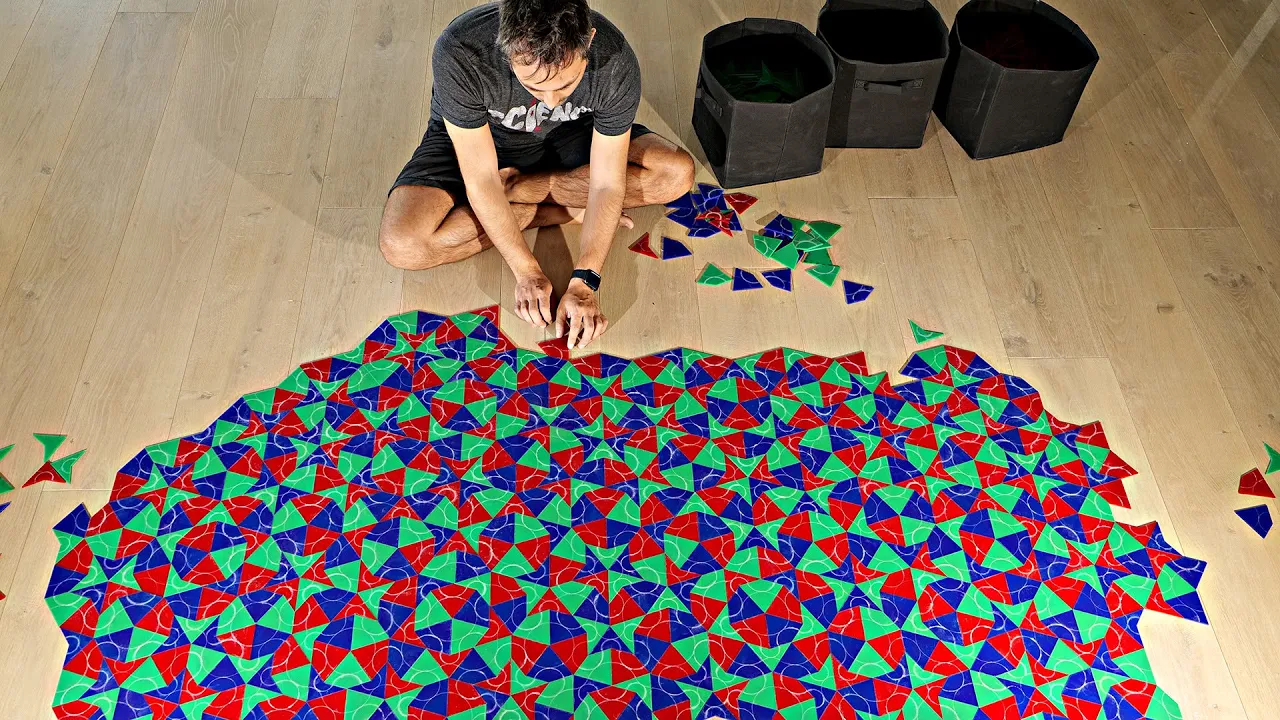
The host’s preferred Penrose tiling utilizes kites and darts. Each tile face is drawn with specific circular arc segments. When assembling the pieces, matching rules require adjacent tiles to align so that these arc segments form continuous, unbroken curves across edges. To demonstrate the assembly hands-on, the host laser-cut thousands of acrylic kites and darts. While assembling the pieces reveals local motifs like five-pointed "stars" and ten-fold "suns," these local arrangements never recur in a strictly predictable periodic lattice.
This structure raises a fundamental mathematical question: does this assembly generate a single, unique infinite tiling, with every local patch merely showing a piece of that universal canvas? The answer is no. There are an uncountably infinite number of distinct valid Penrose tilings of the infinite plane using kites and darts. Furthermore, local observations cannot distinguish them: any finite cluster of tiles that appears in one Penrose tiling appears infinitely many times within every other valid Penrose tiling. An observer exploring any finite region, no matter how vast, cannot deduce which of the uncountably infinite tilings they inhabit. As the host explains: “There's this kind of paradox to Penrose tilings where there's an uncountable infinity of different versions, but just by looking at them, you could never tell them apart.”
Analyzing the relative abundance of the shapes uncovers an underlying mathematical constant. Counting the laser-cut pieces assembled on the table yields 440 kites and 272 darts:
$$\frac{440}{272} \approx 1.6176\dots \approx \phi$$
Dividing the number of kites by the number of darts yields an approximation of 1.618—the golden ratio ($\phi = \frac{1 + \sqrt{5}}{2}$). In an infinite Penrose tiling, the ratio of kites to darts converges precisely to this irrational value.
- Matching rule for kites and darts: Arc lines inscribed across tile faces must link across borders into continuous curves. - Local structures: Stars, suns, and bowties form locally, but their arrangements never tile periodically. - Indistinguishability theorem: An uncountably infinite number of distinct full-plane Penrose tilings exist, yet every finite patch of radius $r$ found in one tiling exists infinitely many times across every other tiling. - Frequency ratio: In an infinite kite-and-dart Penrose tiling, the limit of the ratio of kites to darts is the golden ratio $\phi = \frac{1 + \sqrt{5}}{2} \approx 1.6180339887\dots$.
[12:54](https://www.youtube.com/watch?v=48sCx-wBs34&t=774s) The Golden Ratio, Fibonacci Spacings, and Five-Fold Symmetry
Penrose tilings inherently embody a kind of five-fold symmetry, and among all irrational constants, the golden ratio ($\phi$) is fundamentally linked to the number five. Algebraically, the golden ratio can be expressed as $0.5 + 5^{0.5} \times 0.5$ (or $\frac{1 + \sqrt{5}}{2}$), and geometrically, it governs regular pentagons, where the ratio of a diagonal to an edge is exactly the golden ratio. Because the kite, dart, and rhombus tiles of Penrose tilings are derived directly from sections of pentagons, the golden ratio is built straight into their geometry. As a tiling expands across the plane, the numerical ratio of kites to darts asymptotically approaches this irrational value. This mathematical property provides rigorous proof that the pattern cannot be periodic: “If the pattern were periodic, then the ratio of kites to darts could be expressed as a ratio of two whole numbers: The number of kites to darts in each periodic segment.”
```mermaid flowchart TD accTitle: Golden Ratio and Aperiodicity in Penrose Tilings accDescr: Diagram tracing pentagon geometry through tile ratios and Fibonacci spacings to aperiodic structures.
subgraph Geometry["Pentagonal Origins"] P["Regular Pentagon<br/>(Diagonal / Edge = φ)"] T["Derived Tiles<br/>(Kites, Darts, Rhombuses)"] P --> T end
subgraph Tilings["Global Properties"] R["Kite-to-Dart Ratio<br/>approaches φ (irrational)"] L["5 Sets of Parallel Lines<br/>(Ammann Lines)"] T --> R T --> L end
subgraph Proof["Evidence of Non-Periodicity"] AP["Cannot be expressed as<br/>ratio of two integers"] F["Gaps follow Fibonacci sequence<br/>(e.g., 13 shorts, 21 longs)"] R --> AP L --> F F --> AP end ```
The mathematical elegance deepens when specific straight lines (Ammann lines) are drawn across the tiles instead of curves. When assembled according to the matching rules, these line segments join seamlessly into continuous straight lines spanning the entire plane in five distinct sets of parallel directions, visually demonstrating the underlying five-fold symmetry. However, the spacing between consecutive parallel lines is never uniform or periodic. Instead, intervals alternate between two distinct widths—long and short. Examining a sequence of intervals reveals an irregular progression such as long-short-long-short-long-long, breaking any standard periodic repetition. When the intervals in any extended segment are counted, their frequencies match adjacent terms in the Fibonacci sequence (such as 13 short intervals and 21 long intervals), whose successive ratios also converge directly to the golden ratio.
- The golden ratio is expressed arithmetically as $0.5 + (5^{0.5} \times 0.5)$ and geometrically as the diagonal-to-side ratio of a regular pentagon. - The irrational kite-to-dart ratio rules out any repeating unit cell, as periodic tilings require a rational ratio of constituent pieces. - Parallel grid lines across the tiles form five distinct orientations, with spacing intervals between lines governed by Fibonacci numbers (1, 1, 2, 3, 5, 8, 13, 21, 34,...).
---
[15:05](https://www.youtube.com/watch?v=48sCx-wBs34&t=905s) The Physical Paradox of Crystal Growth and Local Assembly
Following Penrose’s mathematical discovery, scientists questioned whether these non-repeating geometries could manifest physically in the natural world, particularly within crystal structures. Penrose himself viewed this prospect with deep skepticism because the classical scientific definition of a crystal required an orderly, repeating lattice of identical unit cells. Crystallographers had long before proven that only 14 distinct three-dimensional Bravais lattices could exist, and every known crystal strictly conformed to one of these 14 periodic configurations.
Beyond classical lattice theory, an even more fundamental physical barrier seemed to rule out non-periodic atomic structures: crystals grow through local atomic interactions, whereas Penrose tilings appear to demand non-local, long-range coordination. In a physical crystal, atoms attach sequentially, influenced only by nearby forces. Yet on a Penrose grid, an observer can place a dart on one side and a kite on the opposite side, and each choice can independently be extended outward to infinity without conflict. However, when both choices are made at the same time, the tiling inevitably traps itself into a dead end as it grows together. A tile might fit the local edge-matching rules perfectly, only to force an impossible defect—such as an awkward gap where another dart must go, but with conflicting orientation lines. Because atoms lack foresight and rely purely on local bonding, scientists could not see how nature could avoid such fatal growth traps.
- Classical crystallography recognized exactly 14 Bravais unit cell lattices, none of which permit five-fold rotational symmetry. - Penrose tilings presented a fundamental assembly dilemma: tiles that satisfy local matching rules independently can eventually clash when expanding fronts collide.
---
[16:46](https://www.youtube.com/watch?v=48sCx-wBs34&t=1006s) The Discovery of Quasicrystals: Steinhardt and Shechtman
In the early 1980s, Paul Steinhardt and his students at the University of Pennsylvania utilized computer simulations to investigate how atoms assemble into condensed matter at microscopic scales. Their models revealed that atoms locally preferred clustering into icosahedrons—a geometry rich in five-fold symmetries that classical crystallography considered strictly forbidden in macroscopic solids. Initially wondering whether these icosahedral clusters were limited to tiny clusters of 10 or 100 atoms, Steinhardt’s group drew inspiration from Penrose's two-dimensional tilings to design an entirely new theoretical three-dimensional structure dubbed a "quasicrystal." When they simulated the diffraction pattern of X-rays passing through this hypothetical lattice, the model generated sharp concentric rings of 10 diffraction peaks, confirming true five-fold rotational symmetry in three dimensions.
```mermaid flowchart LR accTitle: Parallel Discovery of Quasicrystals accDescr: Flowchart illustrating how Steinhardt's theoretical simulations and Shechtman's physical alloy synthesis converged on identical 10-point diffraction patterns.
subgraph Theory["Steinhardt & Students (UPenn)"] T1["Computer modeling of<br/>icosahedral atomic clusters"] T2["3D analog of Penrose tiling<br/>(Quasicrystal concept)"] T3["Simulated X-ray diffraction:<br/>Rings of 10 points"] T1 --> T2 --> T3 end
subgraph Experiment["Dan Shechtman (NBS)"] E1["Rapid cooling of<br/>Aluminum-Manganese alloy"] E2["Flaky synthesized material"] E3["Electron diffraction pattern:<br/>10-fold symmetry"] E1 --> E2 --> E3 end
Theory -.->|"Independently matches"| Experiment ```
Simultaneously and completely unaware of Steinhardt's theoretical modeling, materials scientist Dan Shechtman, working with rapidly solidified aluminum-manganese alloys, synthesized a flaky metal whose electron diffraction patterns displayed that very same ten-fold symmetry. Shechtman's laboratory results matched Steinhardt’s computational predictions with remarkable precision. One of the landmark papers formalizing the breakthrough was titled *De Nive Quinquangula: On the Pentagonal Snowflake*, nodding to Johannes Kepler's historic treatise on hexagonal snowflakes.
When addressing the long-range coordination paradox—how atoms can form quasicrystals without making fatal assembly errors—Steinhardt explained that looking solely at edge-matching rules is insufficient. While edge-matching rules allow conflicting placements that ruin the pattern, incorporating rules based on vertices (governing how tile corners interconnect) provides sufficiently stringent local constraints. With vertex rules, local atomic additions can proceed without errors, allowing the aperiodic crystal to grow outward indefinitely.
- Steinhardt's computational diffraction models generated rings of 10 points, the signature reciprocal-space hallmark of five-fold symmetry. - Shechtman produced the physical material by rapidly quenching an aluminum-manganese alloy, observing electron diffraction rings that matched Steinhardt’s theoretical model. - Steinhardt resolved the growth paradox by demonstrating that vertex-matching rules, rather than simple edge-matching rules, prevent local assembly errors from propagating into macroscopic flaws.
---
[18:42](https://www.youtube.com/watch?v=48sCx-wBs34&t=1122s) Ridicule, Vindication, and Real-World Applications
The announcement of quasicrystals encountered severe pushback from the scientific establishment, as it seemed to contradict long-held laws of nature. Prominent figures rejected the discovery outright, most notably double Nobel laureate Linus Pauling, who disparaged the findings with the cutting quip: “There are no quasi crystals, only quasi scientists.” Despite years of professional ostracism, Shechtman and the proponents of quasicrystals were fully vindicated. Dan Shechtman was awarded the 2011 Nobel Prize in Chemistry for the discovery of quasicrystals.
Since their initial identification in laboratory alloys, quasicrystals have been synthesized into large, faceted dodecahedral crystals and discovered in natural meteorites. Because their atomic arrangements lack periodic slip planes, quasicrystals exhibit unique physical characteristics, including low surface friction, high hardness, and unusual thermal and electrical conductivity. These qualities have spurred commercial applications ranging from non-stick coatings in cookware and electrical insulation to advanced ultra-durable steel alloys. The overarching philosophical takeaway of the breakthrough challenges how scientific orthodoxy can blind researchers to reality: “And the thing about this whole story that fascinates me the most is, What exists that we just can't perceive because it's considered impossible? I mean the symmetries of regular geometric shapes seemed so obvious and certain that no one thought to look beyond them, that is until Penrose.”
- Linus Pauling dismissed the discovery with his famous critique: “There are no quasi crystals, only quasi scientists.” - Dan Shechtman received the 2011 Nobel Prize in Chemistry for discovering quasicrystals. - Practical applications for quasicrystalline materials include non-stick cookware, electrical insulation, and wear-resistant steel alloys.
---
[19:53](https://www.youtube.com/watch?v=48sCx-wBs34&t=1193s) Sponsor Message: Password Management with LastPass
The video concludes with a promotional segment for the password manager LastPass, a recurring sponsor of the channel. The presenter notes that their repeated support indicates two things: many viewers have already simplified their digital lives and prevented account lockouts, while others have yet to sign up and need a push to secure their credentials and unclutter their minds.
LastPass is highlighted for providing unlimited password storage, free synchronization across multiple devices, secure password sharing options, and automatic form filling across iOS and Android apps as well as desktop web browsers. The presenter urges viewers to stop reusing identical passwords across vital accounts or relying on memory to recall complex, random strings of characters. Pointing out the cumulative time wasted resetting forgotten passwords, the host emphasizes that adopting a reliable password manager is a small, immediate step that permanently improves everyday life.
- LastPass features include unlimited password storage, free cross-device synchronization, credential sharing, and autofill on mobile and desktop platforms. - Viewers are encouraged to stop reusing passwords across critical accounts and to eliminate time spent resetting forgotten credentials by using the link in the video description.
## Notable quotes > [10:04](https://www.youtube.com/watch?v=48sCx-wBs34&t=604s) There's this kind of paradox to Penrose tilings where there's an uncountable infinity of different versions, but just by looking at them, you could never tell them apart. — Host
## Mentioned Johannes Kepler, Platonic solids, Forum of Mathematics, Strena Seu de Nive Sexangula, Harmonices Mundi, Hao Wang, Wang tiles, Robert Berger, Donald Knuth, Raphael Robinson, Roger Penrose, Penrose tilings, Ammann lines, Fibonacci sequence, Bravais lattices, Paul Steinhardt, University of Pennsylvania, Dan Shechtman, De Nive Quinquangula: On the Pentagonal Snowflake, Linus Pauling, LastPass, Gene Nagata, Ivy Tello, Jonny Hyman, Martin Gardner, Raquel Nuno
## Video description Simple rules of geometry meant that 5-fold symmetry was impossible as were crystals without a periodic structure. This turns out to be wrong. Thanks to LastPass for sponsoring a portion of this video. Click here to start using LastPass: https://ve42.co/LPs
Huge thanks to Prof. Paul Steinhardt for the interview on this topic. Check out his book ‘The Second Kind of Impossible’
If you'd like to learn more about Penrose tilings, go check out "Penrose Tiles to Trapdoor Ciphers" by Martin Gardener, which helped my research for this video.
Filmed by Gene Nagata (Potato Jet on YouTube) Animations by Ivy Tello and Jonny Hyman Editing, Coloring, Music & Audio mastering by Jonny Hyman
Prague scenes filmed in 2012. Special thanks to Raquel Nuno for helping with the tilings!
Additional Music from Epidemic Sound
[Source](https://www.youtube.com/watch?v=48sCx-wBs34)