EV Road Trips Suck Now (Except in a Tesla)
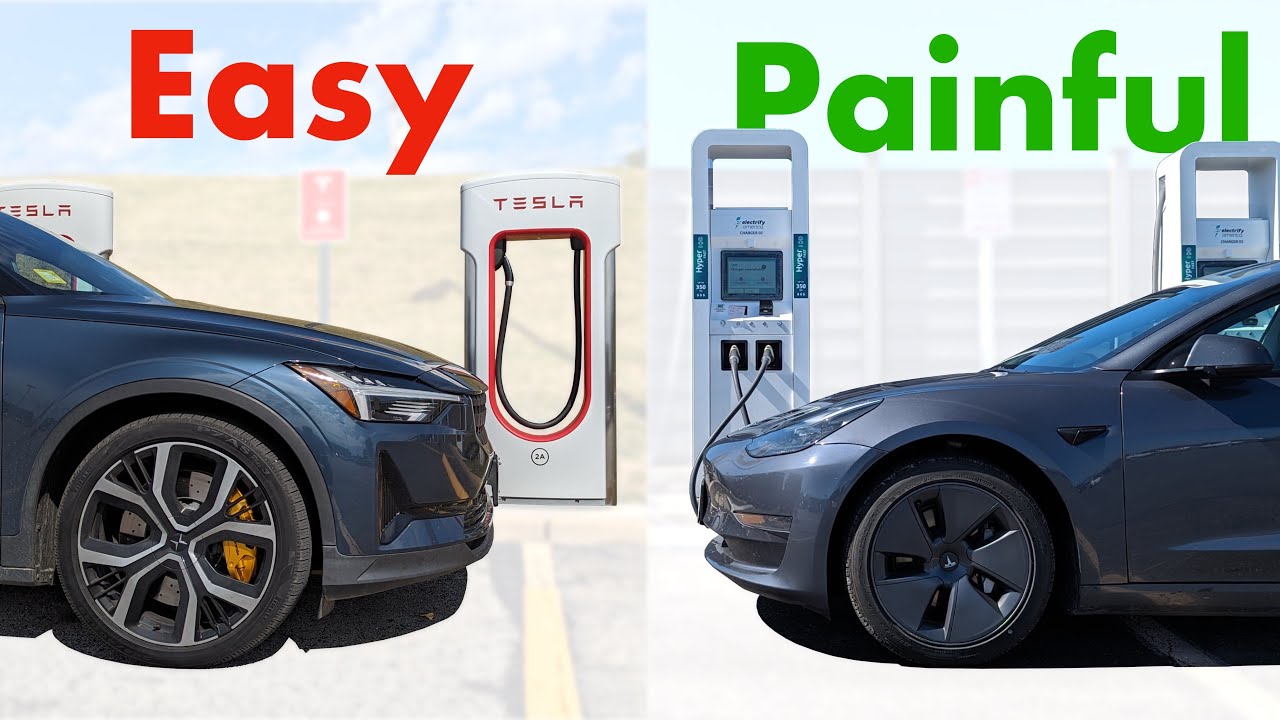
EV Road Trips Suck Now (Except in a Tesla) — Aging Wheels

Aging Wheels

AI-assisted summary of EV Road Trips Suck Now (Except in a Tesla) — original source. Check the original for full context.

Source published:

Key ideas

  • Major automakers including Ford, GM, and Rivian are transitioning to Tesla's North American Charging Standard (NACS), gaining Supercharger access via adapters in 2024 and adopting native ports in 2025. (0:13)
  • A 400-mile comparative road trip between a Polestar 2 (CCS) and a rented Tesla Model 3 revealed severe CCS reliability issues, including a 20% success rate for full-power charging across tested Electrify America stations. (25:25)
  • Many non-Tesla fast chargers advertised as 120–150 kW are bottlenecked by 200-amp cables, capping standard 400V electric vehicles at approximately 80 kW regardless of dispenser ratings. (2:15)
  • Tesla's V3 Superchargers deliver seamless, consistent power up to 170 kW but face physical constraints for third-party EVs, including short cables designed for rear-left ports and a 500V limit that throttles 800V vehicles like the Lucid Air to ~50 kW. (34:17)

Detailed notes

## Background Published on October 15, 2023, by the YouTube channel Aging Wheels (hosted by Robert), this video examines the state of North American electric vehicle fast charging. The video description features sponsorship information for Rocket Money alongside links to the creator's Patreon and merchandise store.

## TL;DR To evaluate the significance of automakers adopting Tesla's North American Charging Standard (NACS), Robert drives a 400-mile road trip from St. Louis to Chattanooga twice: first in a CCS-dependent Polestar 2, and again in a rented Tesla Model 3 using Superchargers. The Polestar trip devolves into an ordeal of broken credit card readers, unlabeled cables, 200-amp hardware bottlenecks, and derated charging speeds across multiple networks, hitting full power at only one of five Electrify America dispensers. In contrast, the Tesla Model 3 encounters near-flawless plug-and-play reliability, consistently reaching its 170 kW peak at Version 3 Superchargers. While highlighting technical hurdles like short cables and 500-volt Supercharger limits for 800-volt vehicles, the journey demonstrates why access to Tesla's charging network is essential for mainstream EV road-tripping.

## Atmosphere & style The presentation carries a weary, darkly humorous, and relatable tone as Robert navigates the slow-motion collapse of CCS public infrastructure. Filmed against gloomy rain, cramped hotel parking garages, and highway traffic, his deadpan delivery and wry disbelief make the endless dispenser shuffles and sluggish 2 kW charging trickle feel agonizingly real. That frustration makes the effortless, zero-friction experience at spacious Tesla Superchargers feel like an almost surreal relief, giving the comparison a sharp, experiential weight.

## Bulletin - [00:13](https://www.youtube.com/watch?v=92w5doU68D8&t=13s) Major automakers including Ford, GM, and Rivian are transitioning to Tesla's North American Charging Standard (NACS), gaining Supercharger access via adapters in 2024 and adopting native ports in 2025. - [25:25](https://www.youtube.com/watch?v=92w5doU68D8&t=1525s) A 400-mile comparative road trip between a Polestar 2 (CCS) and a rented Tesla Model 3 revealed severe CCS reliability issues, including a 20% success rate for full-power charging across tested Electrify America stations. - [02:15](https://www.youtube.com/watch?v=92w5doU68D8&t=135s) Many non-Tesla fast chargers advertised as 120–150 kW are bottlenecked by 200-amp cables, capping standard 400V electric vehicles at approximately 80 kW regardless of dispenser ratings. - [34:17](https://www.youtube.com/watch?v=92w5doU68D8&t=2057s) Tesla's V3 Superchargers deliver seamless, consistent power up to 170 kW but face physical constraints for third-party EVs, including short cables designed for rear-left ports and a 500V limit that throttles 800V vehicles like the Lucid Air to ~50 kW.

## Key takeaways - [00:13](https://www.youtube.com/watch?v=92w5doU68D8&t=13s) The North American EV market is consolidating around Tesla's NACS standard, phasing out CCS and CHAdeMO across major manufacturers. - [02:15](https://www.youtube.com/watch?v=92w5doU68D8&t=135s) Discrepancies between advertised dispenser wattage and cable amperage frequently limit 400V EVs to around 80 kW on 200-amp hardware. - [05:34](https://www.youtube.com/watch?v=92w5doU68D8&t=334s) Tesla's plug-and-charge ecosystem operates without external apps, screens, or payment kiosks, providing a dramatically superior user experience compared to fragmented CCS networks. - [10:30](https://www.youtube.com/watch?v=92w5doU68D8&t=630s) Non-Tesla public charging suffers from persistent broken hardware, unlabeled cables, failed payment terminals, and extreme derating down to single-digit kilowatts. - [12:07](https://www.youtube.com/watch?v=92w5doU68D8&t=727s) Electrify America stations along major travel corridors frequently suffer from out-of-order stalls and unexpected power throttling across active dispensers. - [16:26](https://www.youtube.com/watch?v=92w5doU68D8&t=986s) Tesla Version 2 Superchargers (150 kW) share power between paired stalls and will remain exclusive to Teslas, as upcoming NACS adapter interoperability requires Version 3 or newer hardware. - [21:42](https://www.youtube.com/watch?v=92w5doU68D8&t=1302s) Station density disparities are severe: while CCS users in Nashville faced broken chargers and full queues, neighboring Supercharger sites offered 24 stalls with abundant availability. - [30:08](https://www.youtube.com/watch?v=92w5doU68D8&t=1808s) Electrify America's flagship charging hub at Volkswagen's Chattanooga assembly plant underperformed significantly, failing to deliver full charging speeds to a preconditioned Polestar 2. - [25:25](https://www.youtube.com/watch?v=92w5doU68D8&t=1525s) Highway fast-charging reliability has visibly deteriorated compared to previous years, turning road trips in non-Tesla vehicles into frustrating ordeals. - [34:17](https://www.youtube.com/watch?v=92w5doU68D8&t=2057s) V3 Superchargers present growing pains for third-party EVs due to short cable reaches and a 500V architecture cap that throttles 800V vehicles via onboard boosters. - [34:17](https://www.youtube.com/watch?v=92w5doU68D8&t=2057s) Tesla's upcoming V4 Superchargers resolve existing hardware bottlenecks by introducing longer cables and a 1,000-volt architecture.

## Detailed walkthrough ### [00:13](https://www.youtube.com/watch?v=92w5doU68D8&t=13s) The EV Charging Shift and the Experiment Setup

Automakers including Ford, General Motors, Rivian, and others announced earlier in the year that starting in the first half of 2024, their electric vehicles would gain access to Tesla's Supercharger network. Initially, access requires physical adapters, but starting in 2025, new vehicles will come equipped directly with Tesla's charging port—now designated the North American Charging Standard (NACS)—instead of the Combined Charging System (CCS) connector they currently use. In North America, three DC fast-charging standards have coexisted: Tesla's NACS, CCS (used by almost every other manufacturer), and the older CHAdeMO connector, which is actively being phased out. The mass pivot toward NACS effectively cements Tesla's proprietary design as the standard for the continent.

```mermaid flowchart TD accTitle: North American EV Charging Transition accDescr: Diagram showing legacy DC fast charging standards consolidating into the NACS standard. subgraph Legacy["Existing Fast Charge Standards"] CCS["CCS (Combined Charging System)"] CH["CHAdeMO (Phasing out)"] NACS["Tesla NACS"] end subgraph Future["Industry Transition"] ADAPT["2024: Adapter Access to Superchargers"] NATIVE["2025+: Native NACS Ports on New EVs"] end CCS --> ADAPT ADAPT --> NATIVE NACS --> NATIVE ```

To demonstrate why opening Tesla's charging infrastructure to competitors is such a monumental development, Aging Wheels sets up a direct comparison experiment. He embarks on a 400-mile road trip from St. Louis, Missouri, down to Chattanooga, Tennessee. The journey will be driven twice: first in his own Polestar 2 relying solely on CCS rapid chargers, and then repeated in a standard-range Tesla Model 3 rented from Hertz using only Tesla Superchargers. To showcase as many charging stations along the route as possible, both trips intentionally incorporate far more charging stops than strictly required.

- The Polestar 2 has a maximum DC fast-charging rate of 150 kW. - The standard-range Tesla Model 3 has a peak charging rate of 170 kW. - Both test runs utilize on-route battery preconditioning and aim for a low 10% arrival state of charge (SoC) to maximize peak charge speeds at every stop. - As a contextual note, Aging Wheels reminds viewers that the vast majority of EV charging occurs at home, making these challenges primarily relevant to road trips. - Summarizing the impact of the transition, Aging Wheels remarks: “The automakers that have announced the switch will be switching their cars from the CCS port to the next port on their upcoming Vehicles effectively making it the new North American charging standard which is the epitome of manifesting these automakers working with Tesla so their cars like my Pulstar will be able to access Tesla Supercharger network is a big deal.”

---

[02:15](https://www.youtube.com/watch?v=92w5doU68D8&t=135s) Stop 1 (Polestar 2): Francis Energy in Perryville, MO

The first charging stop in the Polestar 2 is 66 miles south of St. Louis on Interstate 55 in Perryville, Missouri. PlugShare lists two 150 kW DC rapid chargers operated by Francis Energy. Geographically, it fills a critical corridor between Cape Girardeau and the St. Louis metropolitan area. The Tesla trip later bypasses this town entirely because there are no Superchargers in Perryville, meaning this CCS location is the only DC fast-charging stop for dozens of miles.

Upon arrival, the Polestar 2 pulls in with a 16% state of charge—slightly higher than the 10% target due to an interruption from the car's navigation voice guidance, but still plenty low enough to hit peak charging curve speeds. The location immediately earns criticism for being in a hotel parking lot rather than at the gas station across the street, leaving drivers with little to do for half an hour.

The activation and technical design present immediate hurdles. The Francis Energy station lacks a functional credit card reader; while a tap-to-pay icon is present, it does not take standard credit cards. Drivers must install and use the proprietary Francis Energy app, which does not interoperate with roaming networks or support digital wallets like Google Pay, forcing the manual entry of payment details.

```mermaid flowchart LR accTitle: Charging Power Bottleneck accDescr: Flowchart showing how cable amperage limitation caps Polestar 2 charging power below rated dispenser capacity. A["Dispenser Rating: 150 kW"] --> B["Hardware Bottleneck: 200 A Cable"] B --> C["Polestar 2 Battery: ~400 V"] C --> D["Theoretical Max: 80 kW (400V x 200A)"] D --> E["Observed Stall 1: 50 kW"] D --> F["Observed Stall 2: 79 kW"] ```

The hardware setup reveals a deceptive specification. While advertised as 120–150 kW units, the dispensers are fitted with 200-amp cables. Power in watts equals volts multiplied by amperes ($P = V \times I$). Because the Polestar 2 operates on a ~400-volt battery architecture, a 200 A cable mathematically caps charging power at roughly 80 kW ($400\text{ V} \times 200\text{ A} = 80{,}000\text{ W}$): - To actually pull 150 kW through a 200 A cable, an EV would need a battery pack operating at 750 volts or higher. - Plugging into the first dispenser yields only 50 kW instead of the expected 80 kW, indicating either an internal hardware fault or software misconfiguration. - Moving the car to the neighboring dispenser requires manually re-entering credit card details from scratch. - The second dispenser successfully maxes out the cable hardware, pegging at 200 amps and pulling 79 kW—just over half the advertised 150 kW dispenser rating. - Frustrated by the poor user experience at the dispenser, Aging Wheels complains: “God forbid you put a credit card reader on these things and make it easy.”

---

[05:34](https://www.youtube.com/watch?v=92w5doU68D8&t=334s) Stop 1 (Tesla Model 3): V3 Supercharger in Cape Girardeau, MO

Driving the rented Tesla Model 3 in heavy rain, Aging Wheels arrives at his first charging stop in Cape Girardeau, Missouri. The location is an eight-stall Version 3 (V3) Supercharger site situated in a gas station parking lot, which provides easy access to food, restrooms, and shelter.

V3 Supercharger dispensers are rated for up to 250 kW. While the dispenser markings list an official rating of 350 amps, Tesla uses real-time thermal monitoring across the charging cable and connector rather than a rigid hardware amperage ceiling, allowing the system to deliver close to 700 amps on compatible vehicles.

Arriving with a 9% state of charge, the Model 3 is plugged into stall 1D. The vehicle initiates the session instantly without external apps, screens, or payment steps; the handshake occurs automatically, and billing is handled natively through the Tesla account tied to the car. The charge rate ramps quickly from 80 kW and 90 kW up to the Model 3’s maximum theoretical intake of 170 kW right away.

Aging Wheels observes that once non-Tesla vehicles gain Supercharger access in 2024, the process may lose some of its seamlessness, likely requiring users to authenticate through the Tesla mobile app unless plug-and-charge interoperability or dedicated kiosk hardware is deployed. Looking ahead to the next stop just north of Cape Girardeau, the in-car navigation projects an arrival at 12% SoC with a 20-minute drive. - Highlighting the seamless plug-and-play experience of the network, Aging Wheels points out: “Payment for Tesla superchargers is done through the car with your Tesla account next year when all these non- Teslas are able to use superchargers I don't expect the payment process to be this easy if I'm honest.”

---

[08:01](https://www.youtube.com/watch?v=92w5doU68D8&t=481s) Stop 2 (Polestar 2): EV Connect in Cape Girardeau

Arriving back in Cape Girardeau with the Polestar 2, the next charging stop sits directly across the parking lot from the Tesla Supercharger site. To Aging Wheels' amusement, the charging unit displays the name "super space charger."

Like the Francis Energy unit in Perryville, this EV Connect dispenser is throttled by a 200-amp cable and has no integrated credit card reader. The session must be started through the EV Connect app. On the positive side, the app offers a guest checkout option with support for Google Pay and PayPal, avoiding manual card entry.

Operational confusion begins immediately at the charger: - The app asks the user to choose between "Connector 1" and "Connector 2," but the physical holsters and cables on the unit are completely unlabeled. - After an initial failed initiation, switching to the opposite heavy cable gets the session started. - Despite being labeled as a 120 kW unit, the charger fails to reach the 80 kW ceiling of its 200 A cable, sitting stagnant at just 60 kW.

Giving up on the 60 kW output, Aging Wheels moves down the road to an identical EV Connect unit located at another branch of the same gas station chain. Here, the cable retractor mechanism is broken, and the cables remain completely unlabeled. He initiates the charge through the app, enduring an extraordinarily long digital handshake. When current finally flows, the unit delivers a dismal 30 kW—one-fourth of its advertised rating and half the speed of the dispenser he just abandoned. - Confronted by the abysmal power output, Aging Wheels expresses his bewilderment: “That's not 60 Kow this one's pulling 30 what is what the hell all right so do I go up the road back to the last one that was doing 60 Kow cuz that's twice as fast as this one I'll be stuck here.”

[10:30](https://www.youtube.com/watch?v=92w5doU68D8&t=630s) Cape Girardeau Charging Troubles and Broken Hardware

Departing from the initial Cape Girardeau stop highlights the massive real-world gulf between theoretical charging curves and the reality of compromised DC fast chargers. In the Tesla Model 3, a brief 15-minute Supercharger stop takes the battery from 9% to 60%, still pulling a brisk 100 kW right up until unplugging. In contrast, the Polestar 2 is stuck dealing with throttled hardware. A session at a 60 kW charger nets a sluggish jump from 12% to only 41% across 22 long minutes. Under ideal conditions on high-powered hardware, the Polestar can handle a 10% to 80% charge in roughly 30 minutes, making the sluggish delivery an agonizing waste of road trip time.

Before clearing town, a detour to another local ChargePoint installation exposes even worse infrastructure failures. These units feature 200-amp cabling, lack integrated credit card readers, and theoretically should deliver up to 80 kW. Upon plugging in, the charger output flatlines at a comedic 2 kW, which would require an entire hour just to gain a single percentage point of battery charge. Giving up on Cape Girardeau's broken plugs, the drive moves eastward across the historic, narrow, 1913-built Mississippi River bridge in gloomy rain toward Kentucky.

> “I was here at 60 kW for 22 minutes and I went from 12% to 41%—that's pathetic.” — Aging Wheels

- **Tesla Model 3 session:** 9% to 60% state of charge in 15 minutes, maintaining 100 kW output. - **Polestar session:** 12% to 41% state of charge in 22 minutes at 60 kW. - **Broken ChargePoint site:** 200-amp cables, rated for 80 kW, outputting only 2 kW.

---

[12:07](https://www.youtube.com/watch?v=92w5doU68D8&t=727s) Paducah, Kentucky: The Shambles of Electrify America

Crossing into Paducah, Kentucky brings the Polestar to its first Electrify America station of the trip, located on the fringe of a Walmart parking lot. On paper, Electrify America represents the premier tier of non-Tesla DC fast charging, generally deploying stations with four stalls split between 150 kW and 350 kW units equipped with properly specced cables and standalone credit card terminals. However, checking the mobile app upon arrival with a 12% state of charge reveals immediate red flags: stall 1 is occupied by a Volvo, stall 2 is marked unavailable, stall 3 shows as degraded to 50 kW, and stall 4 claims to offer its full 150 kW rating.

Plugging into stall 4 quickly disproves the app's optimism. An initial handshake error forces a restart, and once power begins flowing, output stalls out at 78 kW due to an unexpected 200-amp hardware limitation. Moving over to stall 3—the unit labeled derated in the app—proves unexpectedly faster, delivering 92 kW at 230 amps while operating in free "complimentary mode." Glancing over at the neighboring Volvo XC40 Recharge reveals it is pulling merely 84 kW at over 50% state of charge after more than 20 minutes plugged in. Because both vehicles share the same CMA platform battery pack and charging profile, every single active stall at the site is severely throttled or completely dead.

```mermaid flowchart TD accTitle: Paducah Electrify America Stall Status accDescr: Operational condition of all four charging stalls at the Paducah Electrify America station.

subgraph Paducah["Paducah EA Station (Walmart)"] S1["Stall 1 (150 kW)<br/>Occupied by Volvo: Derated to 84 kW"] S2["Stall 2 (150/350 kW)<br/>Completely Broken / Dead Screen"] S3["Stall 3 (150 kW)<br/>App says 50 kW: Delivers 92 kW (Free Mode)"] S4["Stall 4 (150 kW)<br/>App says 150 kW: Throttled to 78 kW (200A)"] end ```

Derated charging speeds penalize different EV models unevenly. The Polestar holds its 150 kW peak until approximately 30% before tapering linearly, so capping input at 90 kW adds roughly 10 minutes to an 80% charge. For a vehicle with an exceptionally flat charging curve, like an Audi e-tron that maintains 150 kW all the way to 80%, a 90 kW derating nearly doubles the total dwell time. Between physical screen failures, unresponsive payment terminals, and widespread power drops, the station is an operational mess.

> “I'm happy to be leaving that station; it's in complete shambles, nothing works properly.” — Aging Wheels

---

[16:26](https://www.youtube.com/watch?v=92w5doU68D8&t=986s) Kuttawa, Kentucky: Tesla Version 2 Supercharging

While the Polestar wrestles with broken hardware in Paducah, the Tesla Model 3 bypasses the town entirely. Paducah lacks Supercharger access, and using the local Electrify America would require a CCS adapter that is outside the parameters of the comparison. Instead, the route continues roughly 32 miles further down the road to Kuttawa, Kentucky, where a Tesla Version 2 Supercharger installation sits tucked behind a hotel.

Unlike newer Version 3 sites, Version 2 Superchargers max out at 150 kW and are easily identified by their silver collars and notably thicker, heavier charging cables. These V2 cabinets share power pairings between stalls (such as pairing A and B), requiring drivers to space out their vehicles to avoid splitting the available power. Furthermore, these older V2 stalls will remain exclusive to Tesla vehicles, as upcoming NACS access for non-Tesla manufacturers is engineered strictly around Version 3 and newer hardware. After deliberately picking an unshared stall away from an already parked car, the Model 3 initiates a seamless handshake and ramps cleanly up to 147 kW.

> “It's worth noting that the NACS-compatible cars will not be able to charge at this Supercharger; the NACS compatibility is for Version 3 and up, so this is and will remain for only Teslas.” — Aging Wheels

- **Hardware specification:** Tesla Supercharger Version 2 (150 kW max capacity). - **Physical indicators:** Silver collar around the handle holster and thick, uncooled liquid cabling. - **Power distribution:** Cabinets pair stalls to share capacity; spacing out is mandatory for peak rates. - **Observed performance:** Reached 147 kW upon handshake lock.

---

[17:48](https://www.youtube.com/watch?v=92w5doU68D8&t=1068s) Clarksville, Tennessee: The Electrify America Charger Shuffle

Reaching the next Electrify America station at another Walmart in Clarksville, Tennessee, brings yet another encounter with charging station etiquette and hardware roulette. Upon arrival, two stalls are actively in use, including a Chevrolet Bolt occupying the sole high-output 350 kW dispenser despite the Bolt's hardware limitation of around 55 kW. Forced into an available 150 kW dispenser, the Polestar hits another wall: although the session runs in complimentary mode without requiring payment, the station throttles output to 86 kW.

When the Bolt driver unplugs and leaves, the opportunity arises to execute the classic "Electrify America charger shuffle." Relocating the car to the 350 kW stall pays immediate dividends. The charger handshake completes and instantly ramps up to 150 kW, delivering the exact charging curve the Polestar was engineered to achieve. Because the car draws full power, the battery is topped off and ready to roll after just 8 minutes. Meanwhile, the Tesla Model 3 cruises straight through the Clarksville region without stopping, as there are no Superchargers located within roughly 50 miles in either direction along that corridor.

> “Second attempt at the second Electrify America, I finally find a full-power charging station.” — Aging Wheels

- **Clarksville stall 4 (150 kW):** Operating in complimentary mode, derated to an 86 kW ceiling. - **Clarksville 350 kW unit:** Delivered full vehicle maximum of 150 kW. - **Total stop duration:** 8 minutes once moved to the functional 350 kW charger. - **Tesla route constraint:** Clarksville represents a 50-mile Supercharger dead zone along the interstate.

---

[19:42](https://www.youtube.com/watch?v=92w5doU68D8&t=1182s) Nashville: EVgo Frustrations and Hotel Parking Garages

Entering North Nashville requires the Polestar to detour approximately three miles off the interstate to visit an EVgo installation. The station layout features one 350 kW unit and two 100 kW units, with each cabinet supporting dual cables capable of charging two vehicles simultaneously. Pulling in beside another Polestar and parking next to a Ford Mustang Mach-E at the 350 kW stall, the intent is to avoid smartphone apps and pay directly using a contactless credit card. The card reader rejects five consecutive attempts with an authorization failure before going completely blank, forcing the session to be initiated through the ChargePoint mobile app. Compounding the frustratingly slow handshake times characteristic of EVgo hardware, sharing the dual-cable cabinet with the neighboring Mach-E caps current delivery at 200 amps.

```mermaid flowchart LR accTitle: EVgo Nashville Power Sharing Bottleneck accDescr: One 350 kW EVgo cabinet splitting output between a Ford Mustang Mach-E and a Polestar 2.

Cabinet["EVgo 350 kW Cabinet"] MachE["Port A: Ford Mustang Mach-E"] Polestar["Port B: Polestar 2"]

Cabinet -->|"Shared Power"| MachE Cabinet -->|"Capped at 200 Amps"| Polestar ```

Across town in the Tesla Model 3, navigation contends with evening rush hour traffic, heavy rain, and an unfamiliar Supercharger routing. The vehicle directs the driver away from the primary travel corridor to a Version 3 Supercharger featuring 12 stalls. The site turns out to be tucked inside a cramped parking garage located behind a hotel—reigniting frustrations regarding the impractical placement of rapid highway charging infrastructure in tight urban hospitality structures. Arriving at the stalls reveals a Mercedes-Benz EQS parked among the banks of chargers.

> “Stop putting rapid chargers in hotels!” — Aging Wheels

- **EVgo hardware configuration:** One 350 kW cabinet and two 100 kW cabinets, each supporting simultaneous dual-cable charging. - **Payment failure:** Five consecutive direct credit card attempts failed before resorting to the ChargePoint app. - **Power split limitation:** Simultaneous session on the 350 kW unit throttled current to a 200-amp ceiling. - **Nashville Supercharger site:** 12-stall Version 3 location positioned inside a hotel parking structure.

[21:42](https://www.youtube.com/watch?v=92w5doU68D8&t=1302s) Nashville Gridlock and the Tale of Two Stations

After briefly topping up at an EVgo for just a couple of minutes to secure enough range, Robert begins an agonizing crawl through Nashville rush hour traffic. It takes thirty minutes to cover a mere eleven miles to reach the Electrify America station, which he finds tucked away in a distant corner of a commercial parking lot. Robert observes that Nashville feels tragically underserved by EV infrastructure. Pulling up to the eight-stall Electrify America site, the app confirms the worst: the station is completely full, with stalls 2, 3, and 8 completely out of order. Had those three broken dispensers been operational, there would have been plenty of room for waiting drivers.

While waiting for a spot to open up, the contrast with the other side of the parking lot becomes glaring. Directly opposite sits an expansive Tesla Supercharger station boasting twenty-four stalls, the vast majority of which sit completely empty. Robert notes that stall 2C is marked out of order—the first broken Supercharger stall seen on the trip—yet it barely matters because drivers still have twenty-three other working stalls to pick from. When a Chevrolet Bolt unplugs at the Electrify America station, Robert has to scramble into the stall before an incoming Volkswagen ID.4 can take it.

Plugging the Polestar into the open Electrify America stall yields immediate disappointment. Although the dispenser is running in complimentary session mode, charging speed crawls at a derated 83 kW at 209 amps, well below the car's 150 kW capability. Because every single operational stall is occupied, jumping to another dispenser is impossible. Meanwhile, on the Tesla side, the car effortlessly pulls its maximum 170 kW. Robert leaves the Electrify America station as soon as the battery reaches 45%, enough to limp down interstate highway corridors to the next scheduled stop.

- **Nashville Electrify America status:** 8 total stalls, 3 broken (stalls 2, 3, and 8), remaining 5 fully occupied. - **Nashville Tesla Supercharger status:** 24 total stalls, 1 broken stall (2C), leaving 23 available working stalls. - **Polestar charging performance:** Stuck at 83 kW and 209 amps instead of the car’s 150 kW rating. - **Tesla charging performance:** Immediate ramp to 170 kW without delay.

[25:25](https://www.youtube.com/watch?v=92w5doU68D8&t=1525s) Infrastructure Recaps and Vanishing Reliability

Sitting in snarled Nashville highway traffic, Robert tallies up the grim statistics of the road trip so far. Across three separate Electrify America locations, he has plugged into five distinct dispensers and received a full-power charge exactly once. This 20% success rate marks a dramatic decline compared to past electric vehicle journeys. Robert recalls a road trip he took early the previous year from Chicago to Orlando with Alec from *Technology Connections* in an Hyundai Ioniq 5. That earlier journey went smoothly without drama, encountering only a single derated dispenser the entire way, a consistency matched by his earlier Polestar road trips.

Robert reflects on how radically different the charging landscapes now feel between networks. Looking at the route between Nashville and Chattanooga, Electrify America provides only a single location along the corridor, whereas Tesla drivers have access to four Superchargers in towns like Smyrna and Manchester, followed by three additional Supercharger sites clustered around Chattanooga. Despite this being Robert's first ever road trip in a Tesla, the stark disparity leaves an indelible impression on him.

> “By the way, this is my first ever Tesla road trip, never done this before, and already I trust the Superchargers completely.” — Robert

[26:29](https://www.youtube.com/watch?v=92w5doU68D8&t=1589s) Smyrna and Manchester: The Dispenser Shuffle

The contrast between charging networks intensifies as Robert travels south through Tennessee. At Smyrna, the Tesla Supercharger sits a mile off the interstate at a gas station with a Dunkin', offering twelve Version 3 stalls with only two cars charging. Plugging in immediately delivers the expected 170 kW with zero fuss. However, the subsequent Electrify America stop in Manchester, Tennessee, proves to be the most frustrating stop of the entire route. Hidden nearly two miles off the highway behind a Dollar General, Robert jokes that the network planners must have simply sneezed at a map when picking the location.

The Manchester Electrify America consists of four dispensers, with dispenser 1 reported broken. The mobile app claims dispensers 2, 3, and 4 are 350 kW units, which Robert discovers is completely incorrect—one of them is actually a 150 kW unit. The real ordeal begins when trying to draw power:

```mermaid flowchart TD accTitle: Manchester EA Charging Attempts accDescr: Three consecutive charging attempts at Manchester Electrify America showing derated speeds.

subgraph EA_Manchester["Manchester Electrify America (4 Stalls, 1 Broken)"] A["Dispenser 4 (350 kW)"] -->|"Ramps slowly"| B["Peak: 58 kW (Severely Derated)"] B -->|"Unplug and swap"| C["Dispenser 2"] C -->|"Stuck at 172 Amps"| D["Peak: 69 kW (Severely Derated)"] D -->|"Wait for EV6 to leave"| E["Dispenser 3"] E -->|"Acceptable compromise"| F["Peak: 120 kW (Settled for 50% SoC)"] end ```

After burning time cycling through three separate pedestals, Robert gives up and accepts 120 kW on dispenser 3 just to reach 50% state of charge and escape to Chattanooga. Over on the Tesla side in Manchester, the Supercharger is located pleasantly behind a Dunkin' Donuts and features ten Version 2 stalls. Because Version 2 stalls lack the communication protocols for upcoming NACS adapters, they will remain Tesla-only. Upon plugging in, Robert encounters his first speed limitation on the Tesla network: the car caps at 136 kW, and moving to a cabinet connected to another stall only yields 132 kW. While technically derated, the speed remains far above the abysmal numbers seen at the neighboring Electrify America.

- **Manchester EA Dispenser 4 (labeled 350 kW):** Ramped up to just 28 kW before stalling out at 58 kW. - **Manchester EA Dispenser 2:** Capped out at 68–69 kW at 172 amps. - **Manchester EA Dispenser 3:** Delivered 120 kW at 24% state of charge. - **Manchester Tesla Supercharger:** 10-stall V2 setup, pulled 132–136 kW across two tested stalls.

[30:08](https://www.youtube.com/watch?v=92w5doU68D8&t=1808s) The Mountaintop Runs and the Chattanooga Factory Letdown

South of Manchester, the Tesla Supercharger experience remains largely uneventful and seamless. At Monteagle, Tennessee, high up on the mountain, Robert stops at a 12-stall Version 3 site where all stalls are pull-through, immediately securing 170 kW. In Kimball, another 12-stall V3 installation between a Cracker Barrel and a Taco Bell provides an identical 170 kW. Arriving in Chattanooga, Robert tests a random 12-stall V3 station at a local shopping mall and effortlessly hits 170 kW once again.

| Supercharger Location | Hardware Version | Stall Count & Configuration | Charging Power | |:--- |:--- |:--- |:--- | | **Monteagle, TN** | Version 3 | 12 stalls (all pull-through) | 170 kW | | **Kimball, TN** | Version 3 | 12 stalls (commercial lot) | 170 kW | | **Chattanooga Mall, TN** | Version 3 | 12 stalls (standard lot) | 170 kW |

The final destination of the trip is the premier Electrify America station situated at the Volkswagen Chattanooga Assembly Plant, where Volkswagen manufactures the ID.4. Electrify America was originally established as part of Volkswagen's consent decree penalties following the Dieselgate emissions scandal. Robert anticipates that this flagship station—featuring six brand-new 350 kW dispensers covered by expansive solar canopies—will serve as the triumphant showcase where Electrify America finally demonstrates peak performance.

Reality fails to meet expectations. Upon plugging the Polestar in, charging power reaches only 107 kW. Robert switches cords and tests three different dispensers at the Volkswagen factory, but power refuses to rise beyond 113 kW. The chronic underperformance leaves him wondering if the fault lies with the car rather than the dispensers.

To conduct a sanity check once back home, Robert visits a 350 kW EVgo charger without preconditioning the battery pack. Plugging in at a low 9% state of charge, the car immediately pulls 155 kW and maintains that speed cleanly all the way to 30%, confirming that the Polestar was functioning properly and that the brand-new dispensers at Electrify America's showcase site were malfunctioning.

> “I thought for sure we would get a full power charge session here, but look at this: we're getting 107 kW at the Volkswagen factory.” — Robert

[33:07](https://www.youtube.com/watch?v=92w5doU68D8&t=1987s) The Broken Non-Tesla Highway Experience and the Promise of Superchargers

Reflecting on the grueling journey, Robert explains that the day's test route was originally inspired by an earlier trip he took down to Florida. That previous excursion started on the exact same corridor, and he was astonished by how terribly it went. During that Florida journey, he did not secure a single decent charging session until driving ten miles out of his way to the Electrify America station at the Volkswagen assembly plant—where he had previously achieved the full 150 kW rate, though his performance on the current test was mysterious. While charging conditions eventually improved as he drove through Georgia and Florida, with several stops turning out downright flawless, those later successes failed to erase the misery of an entire first day fraught with broken hardware and slow speeds. As Robert bluntly confesses, “If I was a normal person and not an EV nerd, I would have sold my Polestar after that trip.”

Even though the overwhelming majority of day-to-day EV charging happens comfortably at home and certain owners may never touch a fast charger, seamless long-distance road-tripping remains an essential pillar of a complete car ownership experience. This reality underscores why opening the Tesla Supercharger network to third-party manufacturers is such a transformative development. Currently, Electrify America stands as the sole non-Tesla network designed around comprehensive highway route planning, yet it remains plagued by unreliability. Nearly every other competing fast-charging option is poorly arranged, confusing to navigate, unreliable, or simply delivers an unpleasant user experience.

- **Routine vs. Road-Trip Realities**: Most EV owners recharge at home and rarely need public DC fast charging, but highway infrastructure dictates whether an electric vehicle can serve as a dependable, all-around primary vehicle. - **Network Monopolies**: Electrify America is the only non-Tesla charging brand with true interstate corridor coverage, leaving drivers stranded or delayed when their stations underperform.

[34:17](https://www.youtube.com/watch?v=92w5doU68D8&t=2057s) Supercharger Growing Pains, V4 Upgrades, and NACS Adoption

Welcoming non-Tesla vehicles onto the Supercharger network will not be completely seamless right out of the gate, as two notable technical hurdles exist. First, Superchargers were engineered specifically for Tesla vehicles, which feature their charge port on the rear-left corner. When an EV with a different charge port placement parks at a Supercharger stall, the factory cable proves too short to reach without parking across stall lines or occupying the wrong space. Second, existing V3 Superchargers operate at a 500-volt ceiling. Modern 800-volt vehicles must rely on their onboard DC-to-DC boosters to step up the voltage, severely hamstringing peak power delivery. For instance, a Lucid Air charging at a standard Supercharger is throttled to approximately 50 kW via its onboard booster.

```mermaid flowchart TD accTitle: Supercharger Generation Compatibility accDescr: Diagram illustrating technical bottlenecks of V3 Superchargers with non-Tesla EVs versus V4 solutions.

subgraph V3["V3 Superchargers (Current Standard)"] V3Port["Short Cable Length<br/>(Designed for rear-left Tesla port)"] --> V3PortIssue["Parking alignment issues for non-Teslas"] V3Volt["500V Output Limit"] --> V3VoltIssue["800V EVs capped via onboard booster<br/>(e.g., Lucid Air limited to ~50 kW)"] end

subgraph V4["V4 Superchargers (Rolling Out)"] V4Cable["Longer Reach Cables"] --> V4CableSol["Accommodates varied port locations"] V4Volt["1,000V Architecture"] --> V4VoltSol["Native high-speed charging for 800V EVs"] end ```

Both bottlenecks are engineered out of Tesla's Version 4 (V4) Superchargers, which introduce longer cables and 1,000-volt hardware, though those dispensers are only beginning to appear in limited numbers. Even with these initial growing pains, widespread access to Superchargers represents a massive breakthrough for frequent road-trippers. Looking ahead, Robert contemplates repeating this exact journey in his Polestar 2 once V3 Supercharger access opens up to the brand. Concurrently, the North American EV market's broader pivot toward the North American Charging Standard (NACS)—adopting a connector that is noticeably lighter and less cumbersome than CCS—is a positive step forward, though managing a wholesale connector standard transition this deep into EV adoption will inevitably generate substantial consumer confusion for years. Finally, Robert brushes aside the predictable pushback from combustion-engine advocates who brag about five-minute gas station visits or 500-mile tank ranges, pointing out that anyone who prefers combustion is free to keep driving those cars.

- **V3 Supercharger Voltage Cap**: 500 volts maximum, forcing 800-volt vehicles (such as the Lucid Air) to step up voltage internally and suffer reduced charging rates of around 50 kW. - **V4 Supercharger Solutions**: Upgraded 1,000-volt capability and extended cable reach to accommodate varied charge-port locations across various automaker designs. - **Connector Standardization**: The industry-wide migration to the NACS plug replaces the bulky CCS handle with a far more ergonomic design, despite short-term transition confusion.

## Notable quotes > [19:42](https://www.youtube.com/watch?v=92w5doU68D8&t=1182s) Stop putting rapid chargers in hotels! — Aging Wheels

> [25:25](https://www.youtube.com/watch?v=92w5doU68D8&t=1525s) By the way, this is my first ever Tesla road trip, never done this before, and already I trust the Superchargers completely. — Robert

## Mentioned Aging Wheels, Robert, Tesla, Tesla Model 3, Polestar, Polestar 2, Ford, General Motors, Rivian, Volvo, Volvo XC40 Recharge, Chevrolet Bolt, Ford Mustang Mach-E, Volkswagen, Volkswagen ID.4, Audi e-tron, Lucid Air, Hyundai Ioniq 5, Electrify America, EVgo, ChargePoint, Francis Energy, EV Connect, PlugShare, NACS, CCS, CHAdeMO, Alec, Technology Connections, Walmart, Volkswagen Chattanooga Assembly Plant, Rocket Money, Hertz

## Video description Start saving with Rocket Money! Managing your finances starts here http://rocketmoney.com/agingwheels

Patreon: https://www.patreon.com/agingwheels Merchandise: https://crowdmade.com/collections/agingwheels

#rocketmoney #personalfinance

[Source](https://www.youtube.com/watch?v=92w5doU68D8)

中文简报

除特斯拉外,现在的电动汽车公路旅行体验极差 为了评估各大车企采用特斯拉北美充电标准(NACS)的意义,Robert两次驱车进行了从圣路易斯到查塔努加的400英里公路旅行:第一次驾驶依赖CCS充电标准的极星2(Polestar 2),第二次则驾驶租来的特斯拉Model 3并使用超级充电站。驾驶极星的旅程演变成了一场折磨,在多个充电网络中遭遇了信用卡刷卡机故障、线缆无标识、200安培硬件瓶颈以及充电速度受限等问题,在测试的五台Electrify America充电桩中仅有一台达到了全功率。相比之下,特斯拉Model 3提供了近乎无可挑剔的即插即用可靠性,在V3超级充电桩上始终能达到170 kW的峰值功率。尽管旅程也凸显了线缆过短以及超级充电桩500伏限制对800伏车型的影响等技术障碍,但它充分证明了为何接入特斯拉充电网络对于主流电动汽车的公路旅行至关重要。 包括福特、通用和Rivian在内的主要车企正在转向特斯拉的北美充电标准(NACS),将于2024年通过适配器接入超级充电站,并于2025年采用原生接口。 (0:13) 在极星2(CCS)与租来的特斯拉Model 3之间进行的400英里对比公路旅行中,暴露出CCS严重的可靠性问题,包括在所测试的Electrify America充电桩中,全功率充电的成功率仅有20%。 (25:25) 许多标称120至150 kW的非特斯拉快速充电桩受到200安培线缆的瓶颈限制,导致标准400V电动汽车的充电功率被限制在约80 kW,与充电桩的额定功率无关。 (2:15) 特斯拉V3超级充电桩可提供无缝且稳定的高达170 kW的功率,但对第三方电动汽车存在物理限制,包括专为左后充电口设计的短线缆,以及将Lucid Air等800V车型的充电功率限制在约50 kW的500V上限。 (34:17)

Reading summary

A 400-mile comparison test conducted by Aging Wheels demonstrates that non-Tesla highway charging remains plagued by broken dispensers, throttled cables, and poor software, whereas Tesla's Supercharger network delivers consistent, full-speed charging. CCS Cable Bottlenecks and Software Failures (2:15) Across smaller non-Tesla regional stations such as Francis Energy, EV Connect, and ChargePoint, charging dispensers routinely fail to achieve their marketed output due to restrictive hardware configurations. Multiple dispensers advertised at 120 kW to 150 kW were fitted with 200-amp cables. Because the test Polestar 2 operates on a ~400-volt architecture, power equals volts multiplied by amperes, which mathematically caps the intake at roughly 80 kW regardless of the dispenser's total capacity rating. In practice, power delivery proved even worse, stalling between 30 kW and 79 kW on operational stalls, while one local ChargePoint unit flatlined at a broken 2 kW. User interfaces compound these physical bottlenecks. Many independent CCS chargers lacked functional credit card readers or NFC tap-to-pay terminals, forcing manual data entry into proprietary mobile apps that lacked digital wallet integration. Users also faced operational confusion such as unlabelled dispenser cables and broken retractor mechanisms, dragging simple charging stops out into extended troubleshooting sessions. Corridor Monopolies and Derated Stalls (12:07) Electrify America operates as the primary high-speed charging backbone along long-distance highway corridors, but its real-world performance throughout the test proved deeply degraded. Out of five Electrify America dispensers tested across Paducah, Clarksville, and Nashville, only a single dispenser delivered full vehicle speed, yielding an 80% failure or derating rate. In Paducah, Kentucky, every stall was compromised by hardware locks, offline screens, or throttled 200-amp ceilings. In Nashville, three out of eight stalls were completely offline, triggering vehicle queues, while the active stalls ran derated at roughly 83 kW. Even Electrify America's flagship showcase station—a six-stall, solar-canopied installation at the Volkswagen Chattanooga Assembly Plant—failed to perform as expected. Despite deploying brand-new 350 kW hardware, three separate dispensers plateaued between 107 kW and 113 kW. A subsequent home baseline test at an EVgo unit confirmed the vehicle was functioning properly by reaching 155 kW at a low state of charge, confirming that the station hardware was derated. Tesla Supercharger Reliability and Density (5:34) Running the identical 400-mile corridor in a rented Tesla Model 3 using Superchargers revealed a stark contrast in hardware uptime, stall count, and authentication. Unlike the CCS network's app and payment failures, the Tesla initiated charging sessions immediately via vehicle-to-charger native handshakes. Across Version 3 Supercharger stops in Cape Girardeau, Monteagle, Kimball, and Chattanooga, the car reliably ramped directly to its 170 kW ceiling. At a 15-minute stop in Cape Girardeau, the Tesla jumped from 9% to 60% state of charge while maintaining 100 kW, compared to the Polestar taking 22 minutes to go from 12% to 41% on throttled CCS equipment. Station scale also insulated Tesla drivers from delays. While the eight-stall Nashville Electrify America station had three broken stalls and full lines, the twenty-four-stall Supercharger across the same lot had twenty-three functional dispensers and ample vacancies. Speed restrictions on the Tesla network were isolated to older Version 2 sites, such as a 150 kW installation in Manchester, Tennessee, which capped output at 132–136 kW due to cabinet power sharing. NACS Migration and Near-Term Constraints (34:17) With major automakers including Ford, GM, and Rivian transitioning to the North American Charging Standard (NACS) in 2024 via adapters and 2025 via native ports, third-party EV drivers gain access to Tesla's extensive charging footprint. However, Aging Wheels notes that integrating non-Tesla models introduces distinct growing pains. Non-Tesla vehicles will remain excluded from older Version 2 Superchargers, as communication protocols and physical interoperability are restricted to Version 3 hardware and newer. Furthermore, existing Version 3 stalls pose physical and electrical bottlenecks. Because Supercharger cables were engineered short for Tesla's rear-left port placement, vehicles with alternative port locations often block neighboring spaces. Additionally, Version 3 Superchargers are constrained by a 500-volt output limit, forcing 800-volt vehicles such as the Lucid Air to rely on onboard DC-to-DC boosters that cap charging speeds to roughly 50 kW. Tesla's newer Version 4 dispensers resolve these issues with 1,000-volt architecture and longer cables, but their deployment remains limited. While the vast majority of EV charging occurs reliably at home, reliable fast-charging corridors remain essential for road trips. The automotive industry's shift to NACS and Tesla's network addresses the chronic hardware derating and payment failures endemic to non-Tesla public charging, though consumer confusion and technical mismatches will persist during the transition.

精炼阅读摘要

汽车评测频道 Aging Wheels 的主持人在对比测试极星 2(Polestar 2)与特斯拉 Model 3 的400英里跨城公路旅行后指出,当前北美非特斯拉公共快充网络因硬件虚标、设备故障频发和支付体验破碎,已严重影响长途出行;随着福特、通用等传统车企全面倒向特斯拉北美充电标准(NACS),开放超充网络将成为挽救非特斯拉电动车长途自驾体验的关键转折点。 CCS 硬件虚标与电流瓶颈限制实测功率 (2:15) 测试表明,许多非特斯拉直流快充桩存在严重的规格误导。在密苏里州佩里维尔的 Francis Energy 以及吉拉多角的 EV Connect 站点,充电桩标称输出达到 120 至 150 kW,但实际仅配备了 200 安培(A)的充电线缆。根据功率公式(P = V × I),对于采用约 400 伏特(V)电池架构的极星 2,200 A 的物理线缆将其充电功率理论上限锁死在 80 kW 左右;标称的 150 kW 功率仅能在 750 V 以上的高压车型上实现。 在实际测试中,受制于硬件配置或通信故障,设备表现甚至远低于线缆理论上限:Francis Energy 两个相邻桩位实测功率分别为 50 kW 和 79 kW;EV Connect 两个同型号充电桩实测分别仅为 60 kW 与 30 kW;吉拉多角的一处 ChargePoint 桩位输出甚至直接骤降至毫无实用价值的 2 kW。与之相对,特斯拉 V3 超充桩虽然标称 350 A,但通过线缆与连接器的实时温度监控机制,能为匹配车辆提供接近 700 A 的实际电流,使 Model 3 能够稳定跑满 170 kW 的理论峰值功率。 支付交互繁杂与 EA 充电网络的严重失修 (12:07) 非特斯拉公共补能生态同时受困于破碎的软件交互。实测中遭遇了极为普遍的信用卡刷卡终端故障:Francis Energy 虽设有刷卡标识却无法使用实体卡,强迫用户下载专属手机应用并手动填写支付信息;EVgo 站点的刷卡终端连续尝试 5 次均告失败黑屏;EV Connect 的配套应用要求选择“接口 1”或“接口 2”,但现场物理枪线完全缺乏对应编号标识。 作为全美核心的高速走廊补能网络,Electrify America(EA)展现出系统性的可靠性滑坡。在整趟测试中,测试者在 3 个 EA 站点的 5 个不同桩位插枪,仅有 1 次获取到满额功率,满功率成功率低至 20%。帕迪尤卡站点的 4 个桩位中 1 个损坏、1 个限速、1 个握手报错且限流 200 A;纳什维尔站点 8 个桩位有 3 个彻底损坏,导致车主排队争抢,且可用桩位功率被限至 83 kW;曼彻斯特站点桩位则在 58 kW、69 kW 和 120 kW 之间剧烈波动;甚至在大众查塔努加组装厂配备太阳能雨棚的全新 350 kW 旗舰示范站,实测输出也仅停滞在 107 至 113 kW(事后在本地第三方充电桩无需电池预热即跑出 155 kW,证实故障完全出在 EA 设备端)。 特斯拉超充在站点规模与即插即用上的体验优势 (5:34) 在相同路线上进行的特斯拉 Model 3 对比测试中,超级充电网络展现出显著的稳定性与可用度。Model 3 接入 V3 超充桩时免去了手机应用操作、屏幕确认与现场刷卡步骤,车辆与桩端自动完成通信握手与账户结算。在吉拉多角,Model 3 耗时 15 分钟即把电量从 9% 充至 60%,全程保持高速输出;在斯迈纳、金博尔、查塔努加商场以及蒙特伊格尔(全贯通式车位)的 V3 超充站,车辆均顺利达到 170 kW 峰值。 此外,特斯拉在冗余度与网络选址密度上具有明显优势。纳什维尔的 EA 站点 8 桩中坏了 3 桩,而同停车场对面的特斯拉超充站拥有 24 个桩位,仅有 1 个报修,剩余 23 个桩位全部正常运转。在纳什维尔至查塔努加的高速走廊上,EA 仅布局了 1 个站点,特斯拉则设有 4 个沿途站点及查塔努加周边的 3 个站点。即便是在采用功率配对共享机制的老旧 V2 超充站(如库塔瓦与曼彻斯特),其实测输出仍能维持在 132 至 147 kW,表现远高于非特斯拉网络的降速桩。 开放超充的过渡期挑战与 V4 硬件升级前景 (34:17) 汽车制造商宣布从 2024 年通过转接头、2025 年通过原生 NACS 充电口全面接入超充网络,但测试者指出这一融合过程仍伴随物理与电气层面的过渡期短板。首先,现役超充桩线缆较短,仅针对特斯拉车型左后方的充电口设计;其他品牌车型的充电口位置各异,接入时极易因线缆长度不足而被迫跨车位停放或占用相邻车位。其次,现役主力 V3 超充桩的电压上限为 500 V,Lucid Air 等采用 800 V 高压架构的车型必须依赖车载 DC-DC 升压模块,导致其实际充电功率被严重压缩在约 50 kW 左右。 这两大技术瓶颈寄望于配备更长线缆并支持 1000 V 高压架构的 V4 超充桩解决,但 V4 目前仍处于早期部署阶段。此外,老旧的 V2 超充桩在通信协议上无法兼容第三方适配器,将继续保持特斯拉专享。测试者认为,尽管 NACS 接口在物理人体工学上远胜笨重的 CCS 接口,但在未来数年的标准切换期内,跨协议充电与接口繁杂仍将给普通消费者带来认知困扰。 测试者总结认为,尽管电动汽车绝大多数日常充电都发生在家中,但长途公路旅行的补能可靠性直接决定了车辆能否被普通消费者视为主力代步工具。当前北美非特斯拉直流快充网络混乱的维护状况与断崖式滑坡的可靠性足以劝退普通用户,车企向特斯拉超充生态及 NACS 标准靠拢虽然伴随过渡阵痛,但却是解决跨城公路旅行痛点的必然出路。

Detailed notes — zh

## Background 该视频由 YouTube 频道 Aging Wheels 于 2023 年 10 月 15 日发布。视频简介主要包含了个人理财工具 Rocket Money 的赞助推荐,以及作者的 Patreon 赞助和周边商品购买链接。 ## TL;DR 为了探究为何北美主流车企集体放弃 CCS 转投特斯拉 NACS 标准,UP 主分别驾驶极星 2(依赖第三方 CCS 快充)和租赁的特斯拉 Model 3 进行了一场从圣路易斯到查塔努加的 400 英里长途自驾实测对比。测试暴露出第三方 CCS 网络的严重乱象:Francis Energy、EV Connect 和 Electrify America 等站点频繁遭遇接口降额限流、硬件完全损坏、支付授权失败以及线缆规格虚标等致命问题,就连大众自家工厂旁的旗舰 EA 站点也无法跑满功率。相比之下,特斯拉超级充电网络凭借即插即充的无缝体验、充沛的桩位冗余和极高的功率稳定性形成了降维打击。博主总结指出,尽管目前现有 V3 超充桩仍面临非特车型线缆过短与 800V 架构兼容性受限的问题,但倒向特斯拉网络与 NACS 统一标准已成为拯救非特纯电长途出行体验的必然选择。 ## Atmosphere & style 视频整体充斥着荒诞喜剧般的挫败感与强烈的戏剧性对比。UP 主以硬核技术宅的严谨视角剖析电流与电压限制,却不得不在现实中面对一个又一个黑屏、报错和断崖式降速的充电桩,其语气从最初的耐心探究逐渐滑向无奈冷笑与咬牙切齿的辛辣吐槽。而画面在狼狈不堪的“移车倒桩大乐透”与特斯拉超充站丝滑顺畅、无聊到打哈欠的满速补能之间反复切换,让观众隔着屏幕都能深刻体会到非特斯拉纯电车主长途自驾时的极度焦虑与心力交瘁。 ## Bulletin - [00:13](https://www.youtube.com/watch?v=92w5doU68D8&t=13s) 北美主流车企集体宣布自2024年起接入特斯拉超充网络并在2025年转向NACS接口,实质上通过行业共识解决了长期分裂的直流快充标准体系。 - [25:05](https://www.youtube.com/watch?v=92w5doU68D8&t=1505s) 实测对比显示第三方CCS快充网络硬件降级与故障率极高:博主在3个Electrify America站点的5次插枪尝试中仅有1次跑满额定功率,其余均被严重限流或彻底报废。 - [21:42](https://www.youtube.com/watch?v=92w5doU68D8&t=1302s) 特斯拉超充网络的冗余度和即插即用可靠性展现出绝对优势,在纳什维尔站点Electrify America仅有5个可用桩且大排长龙时,旁边的特斯拉超充站拥有23个空闲桩位且能稳定吃满功率。 - [34:16](https://www.youtube.com/watch?v=92w5doU68D8&t=2056s) 虽然NACS转型是长远利好,但现有特斯拉V3超充桩电缆过短且最高仅支持500V,导致Lucid Air等800V高压架构车型的充电功率会被限制在约50 kW,需等待V4桩全面普及才能彻底解决。 ## Key takeaways - [00:13](https://www.youtube.com/watch?v=92w5doU68D8&t=13s) 北美电动车市场此前由NACS、CCS与CHAdeMO三分天下,福特、通用等传统车企集体转向NACS标志着特斯拉事实标准成为北美通用标准。 - [02:15](https://www.youtube.com/watch?v=92w5doU68D8&t=135s) 非特斯拉第三方快充桩的软件体验支离破碎,多个网络缺乏感应刷卡终端,强制下载各家独立App且存在手动输入卡号等反人类交互。 - [02:15](https://www.youtube.com/watch?v=92w5doU68D8&t=135s) 第三方充电站虚标功率现象严重,标称150 kW但物理线缆受限于200 A电流上限,导致400V架构车型理论极限仅能达到80 kW。 - [05:34](https://www.youtube.com/watch?v=92w5doU68D8&t=334s) 特斯拉V3超充桩通过动态监测线缆与插头温控突破保守的350 A标称硬限制,可在实测中爆发近700 A电流并即插即充迅速打满车辆功率峰值。 - [08:01](https://www.youtube.com/watch?v=92w5doU68D8&t=481s) 第三方网络存在严重的接口标识不清与硬件功率降级问题,开普吉拉多的EV Connect和ChargePoint站点实测功率甚至骤降至30 kW乃至无法实用的2 kW。 - [13:23](https://www.youtube.com/watch?v=92w5doU68D8&t=803s) Electrify America站点频繁遭遇系统故障,多数桩位因后台通讯或硬件故障直接被迫进入免费供电(Complimentary mode),商业模式面临质疑。 - [19:42](https://www.youtube.com/watch?v=92w5doU68D8&t=1182s) 快充站的非合理选址成为跨城自驾痛点,大量快充桩被设置在偏僻酒店后院或复杂停车楼深处,缺乏加油站所具备的基础便利配套。 - [21:42](https://www.youtube.com/watch?v=92w5doU68D8&t=1302s) 在纳什维尔晚高峰实测中,Electrify America出现8桩3坏的拥堵抢桩惨状,而同场地的24桩特斯拉超充站几乎全空且即插即充,暴露出双方抗拥堵冗余能力的巨大鸿沟。 - [30:08](https://www.youtube.com/watch?v=92w5doU68D8&t=1808s) 即使在大众汽车查塔努加工厂这一象征标杆的旗舰EA站点,6根全新350 kW带遮阳棚的充电桩在实测中依然无法跑满150 kW,最高仅测得113 kW。 - [30:08](https://www.youtube.com/watch?v=92w5doU68D8&t=1808s) 返程对照实验中车辆无预热接入EVgo 350 kW桩轻松跑满155 kW,铁证证明沿途充电瓶颈完全出自充电桩基础设施故障而非车辆电池衰减。 - [33:07](https://www.youtube.com/watch?v=92w5doU68D8&t=1987s) 长途旅行中频繁的充电挫败感极大消耗消费者信任,博主直言若不是纯电极客而是普通用户,经历这种烂桩自驾后早已怒而卖车。 - [34:16](https://www.youtube.com/watch?v=92w5doU68D8&t=2056s) 现有特斯拉V3超充桩向非特车型开放面临两大致命短板:线缆长度不足导致异侧接口车型跨车位停靠,以及500V上限导致800V车型升压功率腰斩,未来需依托V4超充桩逐步化解。 ## Detailed walkthrough ### [00:13](https://www.youtube.com/watch?v=92w5doU68D8&t=13s) 行业剧变:北美充电标准的洗牌与实测对比构想 2023年早些时候,福特、通用、Rivian 以及多家主流汽车制造商接连投下震撼弹:宣布自2024年上半年起,旗下电动车将能接入特斯拉的超级充电网络(Supercharger network)。在过渡初期,车主将通过转接头充电;而到了2025年,各车企将在新车出厂时直接搭载特斯拉的充电接口(现命名为 NACS,即北美充电标准),彻底告别传统的 CCS 接口。北美直流快充市场原本三足鼎立——特斯拉的 NACS、全行业通用的 CCS 以及正被逐步淘汰的 CHAdeMO。如今各大汽车品牌集体“倒戈”拥抱 NACS,实质上是自我实现了“北美充电标准”的真正统一。 ```mermaid flowchart TD accTitle: 汽车行业切换特斯拉充电标准的时间线 accDescr: 展示北美主流车企从CCS向NACS标准过渡的演进过程 subgraph Phase1["现状(2023年及以前)"] A["三大直流快充标准共存<br/>(CCS / NACS / CHAdeMO淘汰中)"] B["非特斯拉车型仅支持 CCS 接口"] end subgraph Phase2["过渡期(2024上半年起)"] C["福特、通用、Rivian 等支持接入超充"] D["通过物理适配器 (Adapter) 充电"] end subgraph Phase3["整合完成(2025年起)"] E["新车原生集成 NACS 接口"] F["无需适配器,NACS 确立为真正行业通用标准"] end A --> B B --> C C --> D D --> E E --> F ``` 对于开惯特斯拉或者从没开过电动车长途自驾的人来说,可能很难理解为什么传统车企接入特斯拉超充网络会被视为一件颠覆性的大事。为了直观证明这一点,UP主决定用实际行动说话:规划一场从密苏里州圣路易斯(St. Louis, Missouri)出发,南下至田纳西州查塔努加(Chattanooga, Tennessee)、单程约400英里的公路自驾对比测试。 测试方案分为两趟: - **第一趟**:驾驶日常代步的极星2(Polestar 2),沿途仅在第三方 CCS 快充桩补能(因为这是它目前唯一能用的快充方式); - **第二趟**:从赫兹(Hertz)租借一台标准续航版特斯拉 Model 3(Tesla Model 3 Standard Range),在暴雨天气下沿相同路线行驶,且仅在特斯拉超充站停留。 为了尽可能多地检验充电桩的实际状态,UP主故意设置了远超实际需要的停站次数。极星2的理论峰值快充功率为 150 kW,而标续版 Model 3 的峰值功率为 170 kW。为了在每一次进站时都能榨出最高充电速率,UP主在行驶途中全程开启电池预热(battery preconditioning),并精准控制电量,争取每次进站时的剩余电量(SoC)都压在 10% 左右。UP主同时提醒观众:“绝大多数电动车日常充电都在家里完成,这只是长途旅行的极端测试场景。” --- ### [02:15](https://www.youtube.com/watch?v=92w5doU68D8&t=135s) 第一站对比:密苏里州佩里维尔的 Francis Energy 乱象 极星2的第一站选在圣路易斯以南 66 英里、位于 55 号州际公路旁的佩里维尔(Perryville, Missouri)。根据 PlugShare 软件显示,这里设有两根标称 150 kW 的 Francis Energy 快速充电桩。在地理区位上,它恰好处在开普吉拉多(Cape Girardeau)与圣路易斯都会区南部的两大人群聚集地之间,是数十英里内唯一的快速补能点;而特斯拉在佩里维尔并没有设立超充站,往南还需要再开 30 英里才能到达最近的超充点。 当极星2以 16% 的电量抵达佩里维尔时,槽点接踵而至。这两台充电桩竟然安装在一家酒店的停车场里。UP主对此强烈吐槽:30分钟的快充时间,一个不住店的过路车主在酒店里能干什么?马路正对面明明就有一家配套设施完善的大型加油站,选址却彻底避开了最佳位置。 更折磨人的在于桩体本身的硬件限制和糟糕的操作体验: - **支付障碍**:机器上虽印有“感应支付”(Tap to pay)图标,但根本不支持实体信用卡,也没有配备刷卡槽。用户必须强制下载并注册 Francis Energy 的独立 App,且该 App 不兼容任何其他充电漫游网络。 - **虚标功率**:App 和外壳醒目地标注着“150 kW”,但仔细看物理线缆,额定电流仅为 200 A(安培)。UP主在此普及了电学基础公式: $$\text{功率 (W)} = \text{电压 (V)} \times \text{电流 (A)}$$ 极星2的动力电池组标称电压约为 400 V。受制于线缆的 200 A 物理硬上限,车辆理论上最高只能跑出 $200\,\text{A} \times 400\,\text{V} = 80\,\text{kW}$ 的功率。若想在 200 A 的电流限制下跑满宣称的 150 kW,车辆电池包的电压至少必须达到 750 V(即800V高压平台架构)。 - **流程繁琐**:App 内不仅不支持 Google Pay 等快捷支付,还强制用户在手机端手动一笔一笔输入繁琐的信用卡卡号。 - **第一次尝试失败**:插上枪启动后,功率卡死在 50 kW,连线缆极限的 80 kW 都没达到。 - **换桩二次尝试**:无奈拔枪换到旁边相邻的第二根桩,再次手动输入一遍信用卡信息重新鉴权。这次电流终于顶满了 200 A,功率稳定在 79 kW——这仅仅略高于官方宣称 150 kW 的一半。UP主无奈感叹,虽然线缆配错了规格,但至少能充上电继续赶路。 --- ### [05:34](https://www.youtube.com/watch?v=92w5doU68D8&t=334s) 特斯拉开普吉拉多超充站的降维打击 与此同时,驾驶租来的标续版特斯拉 Model 3 冒雨行驶的测试也来到了第一站——位于密苏里州开普吉拉多的 V3 超级充电站。该超充站配备了 8 个充电桩,直接坐落在一家大型加油站内,生活配套和休息设施极其方便。 关于特斯拉的硬件输出,UP主指出了一个鲜为人知的工程细节: - V3 超充桩理论输出上限为 250 kW。虽然充电桩机身上白纸黑字写着“最大电流限制 350 A”,但特斯拉在实际软件控制中完全无视了这个标称数字。 - 在匹配的车型上,V3 桩能够瞬间爆发接近 700 A 的超大电流。特斯拉并不依赖保守的硬件电流硬限制,而是依靠对整套充电线缆、插头和电池端温度的严密主动温控监测来动态调整电流。 特斯拉车主无需考虑网络覆盖或下载第三方 App,支付全部绑定在车辆底层的特斯拉账户中。UP主以 9% 的电量泊入 1D 桩位,录制了全程真实的插枪体验:随手取下轻巧的充电枪插入充电口,充电接口指示灯闪烁数下转为呼吸绿灯,握手瞬间完成并直接开始计费充电。功率在数秒内迅速爬升:70 kW、80 kW、90 kW,瞬间打满标续车型的峰值功率 170 kW。 对比非特斯拉阵营,UP主客观分析道:当2024年各大品牌开始支持特斯拉超充时,大概率做不到这种行云流水的“即插即充”(Plug & Charge)体验;届时第三方车主大概率需要先打开手机里的特斯拉 App 手动选桩、激活并启动支付,除非特斯拉愿意在超充站全面加装物理交互触摸屏或刷卡终端,但从成本控制来看这几乎不可能发生。 --- ### [08:01](https://www.youtube.com/watch?v=92w5doU68D8&t=481s) 灾难般的第三方 CCS 充电站体验(开普吉拉多) 视线转回开普吉拉多。极星2根据导航来到了当地的第三方快充站,该站点居然就位于那座特斯拉超充站同一片停车场的另一头,而桩体上甚至大言不惭地标着“超级充电桩”(Super Charger),令人哭笑不得。 这里的充电设施由 EV Connect 运营商提供。虽然同样是限制在 200 A 的低规格粗电缆,且缺乏实体信用卡刷卡器,但所幸 EV Connect 的 App 允许使用“访客模式”(Guest mode)并支持快捷扫描二维码。更令人宽慰的是,支付选项里终于有了 Google Pay 和 PayPal,车主无需在手机上机械地手打信用卡卡号。 然而,软件体验上的微小改善很快被硬件和系统层面的极度混乱所掩盖: 1. **标识缺失与盲猜接头**:App 界面显示该桩为 120 kW(根据 200 A 电缆与 400 V 架构计算,最多只能拿到 80 kW),且要求车主选择“1号接口”或“2号接口”。然而桩体上的两根充电枪没有任何数字标牌或视觉编号,车主只能像买彩票一样盲猜,误选后无法启动,必须换另一根粗重无比的电缆重新连接。 2. **严重的硬件降速**:在经历漫长卡顿的握手流程终于开始通电后,中控屏显示的充电功率竟然只有区区 60 kW。这根本不是由于 200 A 线缆引发的电流瓶颈,更像是充电桩内部配置错误或功率模块损坏。 3. **更离谱的连环故障**:极星2放弃当前充电桩,转战仅仅几个街区外、同一连锁加油站旗下的另一处完全相同的 EV Connect 充电桩。这里的电缆理线悬吊系统已经损坏,充电枪接口依然没有标注数字。在耐着性子等待了漫长到难以置信的握手通讯过程后,车内仪表盘亮起的数据让 UP 主彻底傻眼:功率居然跌落到了惨不忍睹的 30 kW。 “天哪,那连 60 kW 都不到,这台桩只能跑 30 kW!这搞什么鬼?”UP主坐在车内愤怒又绝望地质问。面对这种荒谬的基建表现,车主陷入了两难抉择:是该掉头开回上一座至少还能提供 60 kW 的慢桩,还是留在当前这个以 30 kW 龟速充电的桩位苦等数小时。第三方 CCS 充电网络的碎片化、维护滞后和糟糕的即时体验,在这一刻暴露无遗。 ### [10:30](https://www.youtube.com/watch?v=92w5doU68D8&t=630s) 开普吉拉多的充电困境与故障桩 在开普吉拉多(Cape Girardeau)的特斯拉超级充电站,车主仅充了约15分钟,电量就从9%迅速恢复到60%,拔枪离开时充电功率仍维持在100 kW。然而,开普吉拉多的非特斯拉第三方充电体验却截然相反。回到另一处仅能输出60 kW的充电桩,车主无奈表示这种速度很糟糕,但至少比之前碰到的30 kW稍好。他解释了自己对充电速度极度执着的原因:在一台正常的高功率充电桩上,这辆极星(Polstar 2)本应在约30分钟内完成10%到80%的充电,尽管这在同级竞品中已经不算快;但现实是在这处60 kW桩上苦等了22分钟,电量仅仅从12%艰难爬升到41%,“That's pathetic(太惨淡了)”。 随后,车主特意前往开普吉拉多另一处 ChargePoint 站点展示更糟糕的基础设施状况。这组充电桩没有配备信用卡读卡器,线缆电流被死死限制在200安培,原本标称应当能输出80 kW的功率。插枪实测后,仪表显示的实际输出居然只有2 kW。面对这一荒谬的数据,车主哭笑不得地吐槽: > “These are broken. It would take me an hour to get 1% state of charge out of these units.”(这些桩坏了。用这玩意儿充,我得花上整整一个小时才能充进1%的电。) - **充电对比**:超充桩15分钟充入约51%(9%至60%);开普吉拉多第三方桩22分钟仅充入29%(12%至41%)。 - **严重故障**:ChargePoint 标称80 kW桩实测仅有2 kW输出,基本完全丧失补能实用性。 - **沿途景观**:驶离密苏里州时,车主穿越了开普吉拉多壮观但狭窄的桥梁,调侃虽然桥很美,但赶上下雨天和烂充电桩,再美的风景也少了几分威严。 --- ### [12:07](https://www.youtube.com/watch?v=92w5doU68D8&t=727s) 初抵帕迪尤卡:看似美好的 Electrify America 离开密苏里后,旅程进入肯塔基州帕迪尤卡(Paducah),迎来了全程第一个 Electrify America(EA)站点。相比此前一路遭遇的各种“垃圾微型桩”,EA 站点的硬件配置在纸面上堪称天堂。标准 EA 场站一般配置4根桩:两台150 kW和两台350 kW超快充,线缆规格齐全且配备信用卡刷卡器,理论上能让具备高压快充能力的车辆跑满功率。 开特斯拉 Model 3 的行程则完全避开了帕迪尤卡,因为当地市区并没有超级充电站;如果不带 CCS 转接头,特斯拉只能继续往前开。车主选择直奔32英里外库塔瓦(Kuttawa)的特斯拉V2超级充电站。值得注意的是,由于该超充桩为V2版本(150 kW),未来兼容 NACS 的非特斯拉车型并无法在此补能,V2站点仍将只为特斯拉独享。 ```mermaid flowchart TD accTitle: Paducah charging options flow accDescr: Comparison of charging paths between Polestar using Electrify America and Tesla using Supercharger subgraph PaducahRoute["帕迪尤卡路线抉择"] CarP["极星 (Polestar 2)"] --> EAPaducah["帕迪尤卡 Electrify America<br/>(4桩配置:2×150kW + 2×350kW)"] CarT["特斯拉 (Model 3)"] --> NoSC["帕迪尤卡无特斯拉超充"] NoSC --> KuttawaSC["前往库塔瓦 (Kuttawa)<br/>V2 150kW 超级充电站"] end ``` --- ### [13:23](https://www.youtube.com/watch?v=92w5doU68D8&t=803s) 帕迪尤卡全员降级的“全军覆没”现场 极星到达帕迪尤卡沃尔玛停车场边缘的 EA 站点时电量仅剩12%。车主打开 EA App 查验状态:1号桩有一辆沃尔沃正在充电;2号桩不可用;3号桩显示可用但仅有50 kW(意味着被系统软限速降级/derated);4号桩显示为满功率150 kW。车主尝试通过 App 启动4号桩,初次启动即报错,重试后终于开始握手升压。然而标称150 kW的充电桩实际最高只能拉到78 kW,线缆同样被锁死在200安培。 无奈之下,车主换到 App 中标注为50 kW降级的3号桩,该桩正处于“免费服务模式”(Complimentary mode)。令人讽刺的是,标注降级的桩反而跑出了92 kW(230安培),比标称满功率的4号桩还要快。车主解释了降级对不同车辆的毁灭性影响:极星的150 kW峰值功率只能维持到30%左右,随后线性下降,90 kW的起步功率会让充到80%的时间延长约10分钟;但如果是奥迪 e-tron 这种能在5%到80%全段吃满150 kW的车型,被卡在90 kW会导致其充电时间直接翻倍。随后车主扫视了旁边的沃尔沃(与极星共享同款电池包与充电曲线),对方充到50%多电量时同样被卡在84 kW,且已经滞留了20多分钟。 > “Which means of the four chargers here: that one's broken, that one's derated, that one's derated, and that one's derated. None of them work properly.”(这意味着这里的四个充电桩:那个坏了,那个降级了,那个降级了,还有那个也是降级的。没有一个能正常工作。) - **硬件实况**:一台屏幕完全黑屏报废,一台 App 标称满血实测限流78 kW,一台降级桩跑出92 kW,一台被占用的桩同样降级至84 kW。 - **运营漏洞**:多台设备因系统故障直接进入免费送电的 Complimentary 模式,信用卡读卡器在黑屏和免费状态下沦为摆设。 --- ### [16:32](https://www.youtube.com/watch?v=92w5doU68D8&t=992s) 库塔瓦的特斯拉V2超充体验 与极星在帕迪尤卡的窘迫形成鲜明对比,特斯拉 Model 3 顺利抵达库塔瓦的一家酒店后方。车主指出,特斯拉也喜欢把充电桩塞在酒店后面,位置谈不上多理想,但胜在运行稳定。由于这是老款V2超级充电站(具有银色套环和较粗的充电线缆),其充电桩之间存在功率共享机制(Pairing)。 车主特意避开了停有其他车辆的相连车位,插枪后车机屏幕功率一路飙升:113 kW、124 kW,最终稳稳落在147 kW,几乎吃满了该代桩体150 kW的理论上限,整个过程插枪即充,没有任何握手波折与降速烦恼。 --- ### [17:48](https://www.youtube.com/watch?v=92w5doU68D8&t=1068s) 克拉克斯维尔的“充电桩大挪移” 极星继续赶往田纳西州克拉克斯维尔(Clarksville)的第二个 EA 站点,该站同样位于沃尔玛停车场边缘。App 显示2号和3号桩均在使用中,其中唯一的350 kW桩被一辆雪佛兰 Bolt(最高充电功率仅约55 kW)霸占着,车主只能接入150 kW的4号桩。此桩同样处于免费模式,实测峰值再次被死死锁在86 kW。 恰在此时,雪佛兰 Bolt 拔枪离开,车主立刻拔枪上演非特斯拉车主极为熟悉的戏码——“Electrify America 移车倒桩大乐透”(Charger Shuffle)。他把车挪到刚刚空出来的350 kW桩位上,该桩同样处于免费模式。这次终于迎来了全天少有的高光时刻:充电功率瞬间拉升至150 kW满功率。车主仅仅花了8分钟便完成补电重新上路。 > “Second attempt at the second Electrify America, I finally find a full power charging station. I don't have to be here very long.”(在第二个 Electrify America 站点的第二次尝试,我终于找到了一台满功率的充电桩。我不需要在这里呆太久了。) - **网络盲区**:在克拉克斯维尔往前往后各50英里的范围内,完全没有任何特斯拉超级充电站,该 EA 站点是方圆百里唯一的超快充生命线。 - **免费怪象**:当天行程中遇到的所有 EA 充电站全部由于后台或通讯故障处于免费模式(Complimentary mode),让车主不禁疑惑 EA 到底靠什么盈利。 --- ### [19:42](https://www.youtube.com/watch?v=92w5doU68D8&t=1182s) 纳什维尔的 EVgo 支付灾难与超充迷宫 极星抵达纳什维尔(Nashville)北部偏离主干道3英里的一处 EVgo 站点。该站点配置了一台350 kW和两台100 kW充电桩,均具备双枪同充(同桩双车分流)功能。车主停在一辆福特 Mustang Mach-E 旁边,使用350 kW桩的另一把枪。车主试图做个守规矩的普通用户,坚持使用实体信用卡支付,但连续刷了五次均告失败,机器反复报错“Authorization failed”(授权失败),换卡后屏幕甚至毫无反应,最终只能被迫打开 ChargePoint App 扫码启动。 启动后由于与邻车共享单桩功率,电流再次被封顶在200安培,加上 EVgo 极其冗长的车辆握手通讯时间,体验令人烦躁。与此同时,开着特斯拉 Model 3 的车主也遭遇了纳什维尔晚高峰的暴雨大堵车。为了测试不同的网络节点,特斯拉避开了最顺路的主干道超充,绕道前往一处位于酒店停车楼深处的V3超级充电站(12个桩位)。面对复杂的停车楼动线以及占着超充位的奔驰 EQS,车主忍不住再次吐槽运营商们把大功率快充桩塞进酒店和地库的糟糕选址策略。 - **EVgo 痛点**:信用卡物理支付彻底瘫痪,必须依赖第三方互联 App;握手耗时极长;双枪分流导致电流锁死在200安培。 - **选址槽点**:无论是第三方桩还是特斯拉超充,频繁出现将快充设在偏僻酒店后院或停车楼深处的现象,对跨城旅行极不友好。 ### [21:42](https://www.youtube.com/watch?v=92w5doU68D8&t=1302s) 纳什维尔的拥堵与荒唐的充电站对比 在离开 EVgo 充电站后(博主只在那里充了大约两分钟以补足续航),前往仅 11 英里外的 Electrify America 充电站却花了整整 30 分钟,因为正值纳什维尔的晚高峰。博主感叹纳什维尔的电动汽车基础设施极度匮乏,好不容易开到目的地,却发现这个 Electrify America 站点被“塞在停车场极其偏僻的角落里”。虽然现场共有 8 个桩位,但手机 App 显示全站爆满,其中 2 号、3 号和 8 号桩全部损坏。现场不仅排队,能用的桩也全被占满。 与此同时,博主望向停车场另一侧的特斯拉 Supercharger 超级充电站。那里的景象截然不同:整整一长排充电桩绝大部分空闲,桩位多达 24 个。博主戏称碰到了本次行程中第一个报废的特斯拉充电桩(2C 号桩无法使用),但他随即调侃道:“太好了,我还有另外 23 个桩位可以选。”博主看着空旷的超充站感慨:“这几乎就像是特斯拉提前预料到了他们所面临的需求一样。”而在 Electrify America 这边,一位驾驶雪佛兰 Bolt 的女车主终于拔枪离开,博主与一辆大众 ID.4 展开了抢位竞赛,最终博主抢先停进空位并插枪充电。 ```mermaid flowchart TD accTitle: Nashville Charging Station Comparison accDescr: Comparison between Electrify America and Tesla Supercharger setups at the Nashville parking lot. subgraph EA["Electrify America 站点"] EA_Total["共 8 个桩位"] EA_Broken["3 个桩故障损坏 (2, 3, 8号)"] EA_Used["5 个桩全满 / 需排队抢位"] EA_Speed["实测功率仅 83 kW (降额)"] EA_Total --> EA_Broken EA_Total --> EA_Used EA_Used --> EA_Speed end subgraph Tesla["特斯拉超级充电站"] TS_Total["共 24 个桩位"] TS_Broken["仅 1 个故障桩 (2C)"] TS_Avail["23 个可用桩位 (空旷随选)"] TS_Speed["实测跑满 170 kW"] TS_Total --> TS_Broken TS_Total --> TS_Avail TS_Avail --> TS_Speed end ``` - Electrify America 现场处于免费补偿充电模式(complimentary session mode),但博主插枪后充电功率仅为 83 kW(电流为 209 安培,并未卡在常见的 200 安培上限,但远低于正常的 150 kW),导致原本计划的充电时间直接翻倍。 - 特斯拉端插枪即跑出 170 kW 满速,博主感叹:“看看那个,170 kW,就好像特斯拉超级充电站很可靠一样。” - 特斯拉充到 45% 即可启程前往下一站,博主直接给出了评价:“这个站点烂透了。” --- ### [25:05](https://www.youtube.com/watch?v=92w5doU68D8&t=1505s) 可靠性落差与晚高峰中的回顾反思 看着停车场两端天壤之别的场景,博主不由得畅想未来:等到明年他的 Polestar 以及所有采用 NACS 标准的车型都能使用特斯拉这边的 24 桩大站时,纯电出行的体验才会真正变好。查阅地图后,博主发现从纳什维尔到查塔努加之间,Electrify America 沿途只有 1 个站点,而特斯拉超级充电站却足足有 4 个(分布在士麦那、曼彻斯特等城镇,查塔努加市内还有 3 个)。 被困在纳什维尔晚高峰车流中时,博主盘点了这趟行程的战绩:他先后去了 3 个 Electrify America 充电站,累计插过 5 个充电桩,而在整整 5 次尝试中,仅有 1 次获得了全功率充电。博主回忆道,情况并非一直如此糟糕。去年年初他和 Technology Connections 频道的 Alec 开着现代 Ioniq 5 从芝加哥自驾到奥兰多,整趟行程顺利得甚至让人觉得无聊,全程只碰到过一次降额充电桩;他开自己的 Polestar 进行的长途旅行也大多十分顺畅。但眼下这趟行程完全打破了他的预期。关于开特斯拉的体验,博主直接坦言:“顺便提一句,这是我有生以来第一次进行特斯拉公路旅行,以前从没试过,但我已经对超级充电站产生了百分之百的信任。” --- ### [26:29](https://www.youtube.com/watch?v=92w5doU68D8&t=1589s) 士麦那与曼彻斯特:不断跳票的非特桩 vs 稳定的超充 抵达田纳西州士麦那(Smyrna)后,特斯拉超充站位于距离州际公路 1 英里处的一家加油站兼 Dunkin' 旁。这里配备了 12 个 V3 超充桩,现场只有 2 辆车在充。博主插枪立刻飙升至 170 kW 满功率,他调侃道:“这已经开始变得无聊了……我猜这趟行程里我开特斯拉大概碰不到任何降额充电的情况了。” 然而当博主开着另一辆车来到曼彻斯特(Manchester)的 Electrify America 时,情况急转直下。该站点位于离州际公路近 2 英里远的一家廉价杂货店(Dollar General)后方,博主讽刺选址团队是“对着地图打了个喷嚏选出来的地址”。更离谱的是 App 数据与现实严重不符:App 标称 2、3、4 号桩为 350 kW,但实际上其中有一根只是 150 kW 桩。博主在现场连续踩雷: 1. **4 号桩(实际 350 kW 桩)**:初始功率爬坡极慢,最终卡在可怜的 58 kW。 2. **2 号桩**:换桩后依然严重降额,锁死在 68-69 kW(电流 172 安培)。 3. **3 号桩**:等旁边一辆充满至 100% 的起亚 EV6 离开后,博主换到 3 号桩,功率也仅达到 120 kW。此时博主电池电量仅为 24%,车辆本该轻松吃满额定功率,但他无奈妥协:“这是我在这座站点试过的第三个充电桩了,所以我只能认了,120 kW 凑合用吧。” 在同一座城镇曼彻斯特,特斯拉超充站设在一处 Dunkin' Donuts 后面,拥有 10 个 V2 充电桩(V2 桩未来无法通过适配器向其他品牌 NACS 车辆开放,将保持特斯拉独享)。在这里,博主插枪后实测功率为 136 kW,换到另一个属于不同充电机柜的桩位测试后依然为 132 kW 左右。博主戏剧性地宣布自己终于抓到了行程中“第一个降额的特斯拉超充桩”,将其称之为“里程碑事件”。 --- ### [30:08](https://www.youtube.com/watch?v=92w5doU68D8&t=1808s) 查塔努加与大众总厂的终极讽刺 越过曼彻斯特后,特斯拉超充的体验重回枯燥而丝滑的日常。在蒙蒂格尔(Monteagle)山顶的一家拥有 12 桩 V3 站,所有车位均为直通贯穿式(pull-through),插枪即跑满 170 kW;在金博尔(Kimball)紧邻 Cracker Barrel 和塔可钟的 12 桩 V3 站,同样跑出 170 kW;甚至在查塔努加市内一座充满 2005 年复古商场风的 12 桩 V3 站,也是稳稳的 170 kW。 ```mermaid flowchart LR accTitle: Chattanooga VW Factory EA Charging Failure accDescr: The process showing how EA failed at the flagship VW Factory location despite ideal conditions. A["大众查塔努加工厂旗舰 EA 站<br>(6座全新350kW桩带太阳能棚)"] --> B["1号机实测: 仅 107 kW"] B --> C["换第2、第3台桩测试"] C --> D["最高仅测得 113 kW<br>(应为150 kW)"] D --> E["博主回家后用 EVgo 进行对照验证"] E --> F["无预热 9% 电量起充<br>稳定跑出 155 kW"] F --> G["结论: 确系 EA 充电设施自身故障"] ``` 行程的高潮出现在田纳西州查塔努加的大众汽车工厂园区。博主专程将终点选在这里的 Electrify America 站点,这里配备了 6 根带太阳能遮阳棚、全新的 350 kW 充电桩,外观极具科技感。博主解释道,Electrify America 本就是大众在“柴油门”排放造假丑闻后作为惩罚措施出资成立的,查塔努加工厂正是生产 ID.4 等车型的核心重镇。他原本的剧本是把这里作为完美的收尾:“在这个绝美的大众工厂充电站一插即满,然后得意地说‘看吧,这里的充电桩当然好用’”,结果现实却极其尴尬: - 插入第一根桩后,最高功率仅有 107 kW。 - 博主甚至不敢相信眼前的事实,接连换了另外两根桩测试,总共试了 3 根桩,看到的最高功率仅为 113 kW。 - 面对这处本应是行业标杆的站点,博主失望地表示:“我只能拿到 113 kW,我本应该拿到 150 kW 的,这可是最顶级的 Electrify America 啊,为什么?” 为了确认究竟是充电桩的问题还是自己的车出现故障,博主在行程结束后特意做了一次严谨的对照实验(sanity check)。在没有对电池进行在途预热(preconditioning)的情况下,他将电量开到 9% 并接入附近一台 EVgo 的 350 kW 充电桩,结果车辆毫无悬念地以 155 kW 的全速一路充到了 30%。这无可辩驳地证明了车辆电池毫无问题,故障与瓶颈完全出自 Electrify America 基础设施本身。博主最终感慨,哪怕最后一站真如预想般完美,也根本无法弥补整趟旅程中被接二连三的烂桩破坏的糟糕体验。 ### [33:07](https://www.youtube.com/watch?v=92w5doU68D8&t=1987s) 糟糕的非特斯拉公路旅行体验与普通车主的真实心态 针对本次行程中频繁出现的充电故障与降速,Aging Wheels 坦言,有人可能会辩称这只是单一地区、单一天气或偶然情况下的遭遇,但他坚决反驳道:“I'd argue that they shouldn't be like this anywhere.”(但我认为,无论在任何地方充电都不应该是这个样子。)他解释说,本次测试路线的灵感源于他前不久开车去佛罗里达的一次长途旅行。当时那趟旅程的第一段正是今天展示的路线,其糟糕程度令他大为震惊——沿途几乎没有遇到一次顺利的快充,直到他特意多绕行了 10 英里前往大众工厂旁边的 Electrify America 充电站才好转。尽管他之前在大众工厂站曾跑满过 150 kW 的全速,但这次测试中却再次莫名受限。虽然随着行程向佐治亚州和佛罗里达州延伸,充电体验逐渐好转,甚至有几次堪称完美,但这根本无法弥补第一天连续遭遇充不上电所带来的挫败感。 Aging Wheels 强调,绝大多数电动车车主的大部分充电行为都是在家里完成的,有些人甚至从不使用公共直流快充,但轻松自如地跑长途依然是衡量一辆车综合体验不可或缺的重要一环。他十分直白地表达了一个普通消费者的心理落差:“If I was a normal person and not an EV nerd, I would have sold my Polestar after that trip.”(如果我是一个普通人而不是一个电动车极客,在那趟旅行之后我早就把这辆极星卖掉了。) - 佛罗里达之旅的第一天沿途快充体验全线崩溃,直到绕路 10 英里去大众工厂的 EA 站点才勉强打破僵局。 - 尽管后续在佐治亚州和佛罗里达州的快充桩表现完美,依然无法挽回前期带来的极度焦虑。 - 目前除了特斯拉之外,Electrify America 是唯一具备全国高速公路沿线网络规划的第三方充电运营商,但其可靠性极差;其他大部分充电网络更是布局混乱、故障频发且体验极其糟糕。 --- ### [34:16](https://www.youtube.com/watch?v=92w5doU68D8&t=2056s) 特斯拉超级充电站的局限性与 NACS 标准转型的未来 正因为第三方充电网络的稀烂,非特斯拉阵营接入特斯拉 Supercharger 网络才成为整个行业的头等大事。然而,Aging Wheels 指出开放超充站给其他品牌使用并非毫无阻碍,目前存在两大明显痛点: ```mermaid flowchart TD accTitle: 非特斯拉车型使用特斯拉超级充电桩的现状与问题 accDescr: 展示现有非特斯拉车辆在V3超充桩上的两大瓶颈,以及V4超充桩如何解决这些痛点。 subgraph Limitations["现有 V3 超充桩的痛点"] A["电缆长度过短<br/>(原设计仅适配左后充电口)"] --> C["非特斯拉车辆充电口位置不同<br/>导致停放困难/占两个车位"] B["仅支持最高 500V 输出"] --> D["800V 架构车型需使用车载升压器<br/>(如 Lucid Air 充电功率被腰斩至约 50 kW)"] end subgraph Solution["V4 超充桩与未来标准"] E["升级配备更长充电线缆"] F["提升至 1000V 高压平台架构"] G["采用轻便好用的 NACS 接口标准"] end Limitations -.->|"V4 硬件迭代全面解决"| Solution ``` 这两大问题在目前的 V3 桩上体现得尤为明显: 1. **线缆长度与接口位置冲突**:特斯拉超级充电桩是专为特斯拉车型设计的,所有特斯拉的充电接口都在车身左后方。而其他品牌的充电口分布在车头、车身右侧或左前方,导致原有超充桩的线缆太短、充电机位置尴尬,车辆停放时往往需要跨车位停靠。 2. **电压架构不兼容导致严重降速**:现存的 V3 超充桩最高输出电压仅为 500V。像保时捷、现代或 Lucid 这样采用 800V 高压架构的车型,必须依赖车内自带的升压器将直流电压升至所需水平,这极大地限制了充电功率。“As an example, a Lucid Air can only onboard about 50 kW from one of these superchargers using its onboard booster.”(举个例子,Lucid Air 在这些超级充电桩上通过车载升压器充电时,功率只能达到 50 kW 左右。) Aging Wheels 指出,特斯拉推出的 V4 超充桩已经通过加长线缆和支持 1000V 高压彻底解决了这两大技术缺陷,但目前 V4 桩才刚刚开始铺设。尽管如此,接入超充网络对于像他这样经常开电动车长途旅行的人来说依然具有划时代的意义。此外,整个北美电动汽车行业正在全面倒向更轻便、更易用的 NACS 接口标准。虽然在发展的这个阶段进行如此大规模的接口切换注定会让许多消费者困惑很长一段时间,但从长远来看无疑是一件好事。最后,对于那些在评论区叫嚣“我的油车 5 分钟就能加满油”或“一箱油能跑 500 英里”的传统燃油车拥趸,他报以淡然的调侃:只要适合自己,继续开油车就好,没有任何人拦着你们。 ## Notable quotes > [25:05](https://www.youtube.com/watch?v=92w5doU68D8&t=1505s) 这是我有生以来第一次进行特斯拉公路旅行,以前从没试过,但我已经对超级充电站产生了百分之百的信任。 — Aging Wheels > [00:13](https://www.youtube.com/watch?v=92w5doU68D8&t=13s) 绝大多数电动车日常充电都在家里完成,这只是长途旅行的极端测试场景。 — Aging Wheels ## Mentioned 特斯拉 (Tesla), 极星 (Polestar), Polestar 2, Tesla Model 3, Electrify America, Francis Energy, EV Connect, ChargePoint, EVgo, 大众 (Volkswagen), 福特 (Ford), 通用汽车 (GM), Rivian, 雪佛兰 Bolt (Chevrolet Bolt), 大众 ID.4 (Volkswagen ID.4), 起亚 EV6 (Kia EV6), Lucid Air, 现代 Ioniq 5 (Hyundai Ioniq 5), 赫兹 (Hertz), NACS, CCS, PlugShare, Rocket Money, Technology Connections, Alec, Aging Wheels ## Video description Start saving with Rocket Money! Managing your finances starts here http://rocketmoney.com/agingwheels Patreon: https://www.patreon.com/agingwheels Merchandise: https://crowdmade.com/collections/agingwheels #rocketmoney #personalfinance [Source](https://www.youtube.com/watch?v=92w5doU68D8)

Source quotes

[25:05] Aging Wheels: 这是我有生以来第一次进行特斯拉公路旅行,以前从没试过,但我已经对超级充电站产生了百分之百的信任。 [0:13] Aging Wheels: 绝大多数电动车日常充电都在家里完成,这只是长途旅行的极端测试场景。

Source quotes

[19:42] Aging Wheels: Stop putting rapid chargers in hotels! [25:25] Robert: By the way, this is my first ever Tesla road trip, never done this before, and already I trust the Superchargers completely.

Original transcript

[0:13] you may have heard earlier this year [0:15] that Ford then GM rivan and a whole host [0:18] of other automakers announced that [0:19] beginning in the first half of 2024 [0:22] their vehicles will be able to charge on [0:23] tesas supercharger network access will [0:26] first be provided by adapters then at [0:28] some point in 2025 the adapters will be [0:30] needed anymore because these car makers [0:32] are going to start building their cars [0:33] with Tesla's charging port now called [0:36] NCS rather than the CCS Port they have [0:39] now as a refresher in North America [0:40] there are three DC fast charge standards [0:43] there's Tesla's connector now called Max [0:45] for North American charging standard [0:47] there's CCS currently used by everyone [0:49] else and there's also Chad but that's [0:51] being phased out in the future the [0:53] automakers that have announced the [0:55] switch will be switching their cars from [0:57] the CCS port to the next port on their [1:00] upcoming Vehicles effectively making it [1:02] the new North American charging standard [1:05] which is the epitome of manifesting [1:06] these automakers working with Tesla so [1:08] their cars like my Pulstar will be able [1:10] to access Tesla Supercharger network is [1:12] a big deal if you've never taken a road [1:14] trip in an EV or you have but it was in [1:16] a Tesla you might think why does this [1:18] matter well I could tell you but instead [1:21] I'm going to show you I'm going to take [1:22] a road trip some 400 miles from here in [1:25] St Louis Missouri down to Chattanooga [1:27] Tennessee I'll do the trip once in my [1:29] poll R2 stopping only at CCS Chargers [1:32] cuz that's all I can use then I'll do [1:34] that same trip again in this standard [1:36] range Tesla Model 3 I've rented from [1:38] Herz stopping only at Tesla [1:39] superchargers with both cars I'm going [1:41] to stop to charge far more times than [1:43] necessary because the goal of this is to [1:44] show you as many Chargers as possible my [1:47] Pulstar 2 can charge at a peak rate of [1:49] 150 KW and this standard Range model 3 [1:52] can charge at a peak of 170 KW with both [1:55] cars I'll use on- route battery [1:57] preconditioning and Target an a Ral [1:59] state of charge charge of 10% so I can [2:01] maximize the charging speed at every [2:03] stop oh and before any of you get the [2:05] wrong idea about what I'm about to show [2:06] you let me reiterate that the vast [2:08] majority of EV charging is done at home [2:11] this is just for trips anyway let's [2:15] begin and I'm on my way to my first stop [2:18] 66 mil to the south on I55 in Perryville [2:22] Missouri according to plugshare these [2:24] two rapid Chargers are 150 KW and [2:27] they're nestled between two population [2:28] centers between Cape Gerardo in the [2:30] southern part of the St Louis metro area [2:33] so it's in a good place in the Tesla [2:35] it's raining quite a lot and I'll be [2:38] driving right by Perryville cuz there's [2:40] no supercharger there for me and I've [2:41] got another 30 mil to go to get to my [2:44] first supercharger and the one to the [2:46] north is even further away so the rapid [2:48] charger in perville is the only rapid [2:50] charger for tens of Miles all right I [2:53] didn't quite make it here down to 10% I [2:56] only made it down to 16% Jefferson [2:58] Street you interrupted me but it [3:00] shouldn't matter that's still low enough [3:01] to get Peak speed and it's at a hotel [3:05] first to Merit that's a terrible place [3:07] to put a rapid charger your destination [3:10] will be on the right you interrupted me [3:11] again what are you going to do at a [3:12] hotel for 30 minutes aside from that [3:14] thing there's a perfectly good gas [3:16] station across the street you could have [3:17] put the Chargers [3:18] there all right first stop seems like a [3:20] good one these are two 150 Kow chargers [3:23] right off the interstate and they're [3:25] from Francis energy which you probably [3:27] haven't heard of unless you're from [3:28] Oklahoma if being at a hotel wasn't bad [3:31] enough these are also really hard to [3:32] activate there's no credit card reader [3:34] on them first of all there is a symbol [3:36] for the tap to pay but it doesn't accept [3:38] credit cards so I don't really know what [3:40] that is you have to have the Francis [3:42] energy app to activate these Chargers [3:45] and the app does not work on any other [3:46] charging Network I've got it here says [3:49] right in the app 150 Kow I know that's a [3:51] lie because this is a 200 amp cable okay [3:54] I should explain that power in watts is [3:56] just volts time amps 1 kilowatt is just [3:58] 1,000 watt my Pulstar battery has a [4:01] voltage of about 400 volt because of [4:04] that Cable's limitation of 200 amps I [4:06] can only get 200 * 400 80 Kow out of [4:11] that charger in order to actually get [4:12] 150 KW out of that charger with its 200 [4:15] amp limitation my car's battery would [4:17] have to have a voltage of at least 750 [4:20] volts this is hip3 let's hit [4:24] it CCS connect and swipe and payment oh [4:28] boy there's 's no Google pay option in [4:31] the app either second de Merit I have to [4:34] manually enter in my credit card [4:36] information what is this connect the [4:38] cable now [4:42] okay God forbid you put a credit card [4:44] reader on these things and make it easy [4:46] okay 200 amp cable means that I should [4:48] be getting about 80 Kow but I'm [4:52] getting 50 well that's not good it [4:55] doesn't seem to be an amperage [4:56] limitation maybe the Charger's [4:58] configured wrong okay that's nowhere [5:00] near the 150 Kow advertised let's try [5:02] the charger next to it oh I got to enter [5:06] my credit card information again oh I [5:08] hate this all [5:10] right attempt two hopefully I get more [5:12] than 50 Kow that's more like it we're [5:15] pegged at 200 amps and getting 79 KW [5:19] that's just barely over half of the [5:21] advertise speed of 150 Kow but again [5:24] they put the wrong cable on the unit so [5:27] that's as good as I'm going to get here [5:29] at the very least it does work I am [5:31] charging right now I can get to where I [5:32] need to go we have arrived at the first [5:34] stop in the Tesla in Cape Gerardo it's [5:38] an eight stall version 3 supercharger at [5:41] a gas station what a nice location and [5:43] what a novel idea version 3 [5:45] superchargers are capable of 250 KW of [5:48] output technically these are also [5:50] amperage limited it says right on the [5:52] dispenser that the max is 350 amps [5:55] however Tesla just ignores that on the [5:57] appropriate car these dispensers can [5:59] output close to 700 amps rather than [6:02] relying on a hard amp limit Tesla just [6:04] monitors the temperature of everything [6:06] well they all work so let's pick one I'm [6:08] going to go in the middle 1D wish I [6:11] hadn't rented this on a day it's going [6:12] to be pouring rain all day I'm at 9% all [6:17] right you shall join me in real [6:21] time [6:24] dup look again blue blue blue blue blue [6:31] we are charging payment for Tesla [6:33] superchargers is done through the car [6:35] with your Tesla account next year when [6:37] all these non- Teslas are able to use [6:39] superchargers I don't expect the payment [6:41] process to be this easy if I'm honest [6:43] we'll probably have to use the Tesla app [6:45] and activate them before plugging in [6:47] it'd be really nice if Tesla added [6:49] payment kiosk at their superchargers but [6:51] I don't see that happening will I be [6:53] able to get to the full 170 KW ramping [6:57] we [6:58] 80 90 and there we have it we're [7:01] charging at 170 KW right off the bat how [7:05] nice all right the next stop is just [7:07] North of cape tardo and it says I'm [7:09] going to arrive with 12% state of charge [7:11] only 20 minutes away this video is [7:13] sponsored by rocket money rocket money [7:16] is a Personal Finance Management [7:17] platform it connects to your bank [7:19] account and gives you power over your [7:20] personal finances rocket money can look [7:22] at all your monthly subscriptions show [7:24] them to you and even cancel them from [7:26] within the app need a bill lowered [7:27] rocket money can do that too just take a [7:29] picture of your phone internet utility [7:32] or whatever Bill upload it to the app [7:34] and Rocket money can negotiate and lower [7:36] your bill for you you can also use [7:38] rocket money to set up budgets monitor [7:40] your credit score get helpful tips on [7:41] how to improve your credit score and [7:43] more with rocket money you too could [7:45] throw fake money in the [7:47] air that doesn't make sense it'll help [7:49] you with your finances though to try [7:51] rocket money for yourself go to Rocket [7:52] money.com aing wheels or visit the link [7:54] in the description below this video and [7:56] thanks again to Rocket money for [7:57] sponsoring this video [8:01] it's hard to see here's the next stop [8:04] it's on the other side of the parking [8:05] lot from the supercharger adding insult [8:07] to injury it calls itself super space [8:11] charger and just like the last stop [8:13] these cables are limited to 200 amps and [8:16] there's no credit card reader on it so [8:17] you have to activate it with an app this [8:19] charger is on the EV connect Network so [8:21] I've downloaded the EV Connect app and [8:23] thankfully there is a use as guest mode [8:25] so I'm going to hit that there's a QR [8:27] code yeah scan that scanned rather [8:31] quickly it says it's 120 KW which we [8:33] both know is a lie I'll get 80 Kow out [8:36] of this if I'm [8:37] lucky connector 1 and [8:40] two these are not labeled I guess I'll [8:43] guess uh connector 1 begin [8:46] charge how do I pay for this I could [8:49] enter a credit card but thankfully this [8:51] one has a Google pay and a PayPal option [8:53] so I don't have to manually enter in a [8:54] credit card [8:57] number all right right I heard a kachunk [9:00] in the charger let's go ahead and plug [9:04] in is it going to [9:07] work it says to plug in okay did I hit [9:11] the wrong connector okay let's try the [9:12] other one maybe this one is connector [9:14] one oh that is this is a thick cable [9:17] holy [9:20] crap well the app went back to the [9:22] previous [9:25] screen is it doing anything it's [9:27] charging well that was paying are we at [9:29] least getting the full 200 no no we're [9:33] not it's at 60 KW is this charger [9:37] configured wrong as well cuz that [9:39] doesn't seem like an amperage limitation [9:40] it's just sitting at 60 [9:43] KW whatever there's another charger just [9:45] down the road we'll unplug and try that [9:47] one just down the street is an identical [9:49] unit at the same chain of gas stations [9:51] at least it's at a gas station and just [9:53] down the road the cable management on [9:55] this one appears to be broken but that's [9:57] okay still unlabeled I don't don't know [9:59] which one is connector one but learning [10:00] from the last one I'm going to assume [10:02] this is connector 1 we're going to go [10:03] ahead and activate it and see if we get [10:04] more than 60 Kow out of it this [10:06] handshake process is unbelievably [10:08] long there we go it's charging okay it's [10:13] going oh my God that's not 60 Kow this [10:18] one's pulling [10:19] 30 what is what the hell all right so do [10:24] I go up the road back to the last one [10:26] that was doing 60 Kow cuz that's twice [10:29] as fast as this one I'll be stuck here [10:30] forever at 30 okay I've been here about [10:33] 15 minutes it says I'll arrive to the [10:35] next supercharger with 9% so I'm going [10:36] to go ahead and [10:38] unplug in about 15 minutes we made it [10:41] from 9% to 60% it was still pulling 100 [10:45] Kow by the time I [10:49] unplugged okay we're charging back at 60 [10:52] Kow which sucks but it's better than 30 [10:54] time to go if you're wondering why I'm [10:56] so obsessed with charging speed this is [10:58] a pretty good example cuz at a properly [11:00] High powerered charger this car should [11:02] be able to do 10 to 80% in about 30 [11:05] minutes which is actually a lot slower [11:07] than some of its competition I was here [11:10] at 60 Kow for 22 minutes and I went from [11:14] 12% to [11:16] 41% that's pathetic anyway while I'm [11:18] still in capur AO I'm going to take you [11:20] to a broken charger so we can see even [11:23] more charger Badness here it is now [11:26] these are charge Point units just like [11:28] the last one there's no credit card [11:30] reader the cables are limited to 200 [11:32] amps but these will actually do 80 KW [11:37] normally we're charging like I said 200 [11:40] amp limit I should get 80 Kow out of [11:42] this what am I actually getting [11:45] two two kilowatts these are broken it [11:48] would take me an hour to get 1% state of [11:52] charge out of these units anyway let's [11:54] unplug and go on to the next stop Cape [11:56] dado has a lovely Bridge terrible char [11:58] Chargers but a lovely [12:00] Bridge you know this bridge while still [12:02] pretty is much less Majestic on a rainy [12:07] day the next stop is in Paduka Kentucky [12:10] at the first Electrify America station [12:13] of the trip compared to the Sea of [12:15] poultry garbage that we've been [12:16] experiencing Electrify America's [12:18] practically Paradise the typical setup [12:21] at an EA station is four Chargers you [12:24] have two 150 KW and two 350 Kow Chargers [12:27] that's how the one in Paduka is set up [12:30] and they have properly speced cables on [12:32] these chargers they can actually output [12:34] those advertised numbers to the cars [12:36] that can accept that much power in [12:38] addition to that they have credit card [12:40] readers on them what a novel concept I [12:42] typically activate them with the app but [12:44] you do have the option to pay for them [12:46] like a normal thing in the Tesla I'll be [12:48] driving straight through Paduka there's [12:50] no superchargers there for me I could [12:51] stop at the Electrify America if I had a [12:53] CCS adapter but I don't and that's not [12:55] the point of this trip instead I'll be [12:57] stopping at nearby Cawa [12:59] or [13:00] katawa CA Washington whatever there's a [13:03] supercharger there it's a version two [13:05] which means 150 KW and it says I'll [13:07] arrive with 12% estimated how's this for [13:10] an intimidating bridge to be fair it was [13:12] built in [13:14] 1913 it's [13:16] just it's really narrow can confirm the [13:19] bridge is just as narrow in the Tesla [13:22] although it's a bit more wet we made it [13:23] to Paduka Chargers over there I only [13:25] arrived with 12% I can't get this 10% [13:28] Target thing down anyway I wanted to [13:29] stop and look at the app and according [13:31] to the app charger 1 is in use which yes [13:34] there's a Volvo charging there Charger 2 [13:36] is not available charger 3 is available [13:39] but the app says it's at 50 Kow which is [13:41] code for it's derated and number four [13:44] says it's at 150 KW so we're going to [13:48] plug in number four like I said these [13:49] have credit card readers on them but I [13:52] get free charging so I'm going to [13:53] activate it here and then get out and [13:54] plug in and I'll report to back to you [13:56] report it back to you what chargeing [14:00] so if I was paying attention I would [14:01] have noticed that errored [14:02] immediately so let's try that [14:07] again still says initi oh it's going [14:10] good let's watch it ramp up I should get [14:13] I'm at 12% I should get 150 Kow from [14:16] this 150 Kow charger I have low hopes [14:19] guess [14:20] what 78 KW this charger is limited to [14:24] 200 amps as well great well that one [14:27] works so I'm going to plug into that in [14:28] the app it said 50 Kow is what this [14:31] charger puts out it's in free mode so [14:34] already the one that was listed as [14:35] derated in the app is faster than the [14:38] one that was listed as full power it's [14:40] only 92 KW 230 amps which is not at all [14:46] what I should be getting but it's free [14:50] different cars will be affected by a [14:51] d-rated session like this in different [14:53] ways for example my Pulstar can hold its [14:56] 150 KW Peak till about 30% and then it [14:59] relatively linearly tapers off after [15:01] that so starting out at 90 Kow assuming [15:04] I'm going to 80% will extend my charging [15:06] session Time by about 10 minutes another [15:09] example is an Audi rron it also has a [15:11] peak charging speed of about 150 KW but [15:13] it holds 15 all the way to 80% so if an [15:17] Ron pulled up to this charger and got 90 [15:19] Kow its charging time would almost be [15:21] doubled okay uh I just checked on the [15:24] Volvo's charger screen and he's only [15:26] getting 84 Kow at 50 something per. it [15:30] says he's been here for 20 something [15:32] minutes these two cars have the same [15:34] battery pack and the same charging curve [15:36] so that charger is derated too which [15:38] means of the four Chargers here that [15:41] one's broken that one's derated that [15:43] one's derated and that one's derated [15:45] none of them work properly as far as [15:47] location goes this one's on the [15:49] outskirts of a Walmart parking lot [15:52] which could be worse I guess this looks [15:55] a little worse for [15:57] wear but I I think this one might work [16:00] the one over here definitely doesn't the [16:02] screen is completely [16:04] dead so I don't know if these credit [16:06] card readers even work not that it [16:08] matters because this one and this one [16:09] are in complimentary mode I'm happy to [16:11] be leaving that station it's in complete [16:13] shambles nothing works properly the next [16:16] stop is also in Electrify America in [16:18] Clarksville Tennessee got the nav set it [16:20] says I'll arrive with 7% I'm going to go [16:24] get food first cuz I'm hungry well I [16:26] said CWA was nearby but I'm in Uka now [16:29] and I I've still got 32 Mi to go before [16:30] I reach the Supercharger so it's not [16:32] super close we are in Cawa this is a [16:35] version 2 150 KW supercharger it's worth [16:38] noting that the KNX compatible cars will [16:42] not be able to charge at this [16:44] supercharger the next compatibility is [16:46] for version three and up so this is and [16:49] will remain for only Teslas hey you know [16:52] that uh Francis energy station I was [16:55] complaining about that they put it next [16:56] to a hotel well here's a TS a [16:59] supercharger at the back of a hotel not [17:02] the best place the thing you need to [17:04] know about version two superchargers is [17:07] that they share power so I just need to [17:09] not park next to that guy and I should [17:11] get the full 150 KW unplug you can tell [17:14] it's a version two because of the silver [17:15] collar and the thicker cable [17:19] here could have parched [17:23] closer [17:27] and come on [17:33] come on car [17:36] locked green I should get 150 KW will I [17:42] there 113 124 147 that's close enough to [17:46] 150 KW we've made it to Clarksville [17:49] Tennessee and it looks like the second [17:51] Electrify America is also at the edge of [17:54] a Walmart parking lot again I guess it [17:56] could be worse okay according to to the [17:58] Electrify America app Chargers number [18:00] two and three are in use and of course [18:03] the bolt is taking the good [18:07] 350 kilowatt charger cuz they don't know [18:10] any better so I guess I'll take number [18:11] four at 150 Kow oh this one's in [18:14] complimentary mode turns out every [18:16] Electrify America I stopped it on that [18:18] day was in complimentary session mode [18:20] the only one that was listed as derated [18:22] in the app is that one right there this [18:24] one is in complimentary mode but it's a [18:27] should be able to give me the one full [18:29] 150 kilowatts I almost guarantee it [18:32] won't okay well it looks [18:35] like 86 KW is where it's going to stop [18:38] the bolts gone I can take the 350 let's [18:40] unplug from here welcome to the [18:42] Electrify America charger Shuffle [18:45] remember this one is the 350 KW unit it [18:47] is not listed in the app as derated this [18:50] one is also in complimentary [18:53] mode yay for me I was Electrify America [18:56] making money a miracle this happened [18:59] that's what I'm talking about that's the [19:01] kind of performance that I should get at [19:03] every one of them 150 KW see I wasn't [19:07] lying so second attempt at the second [19:10] Electrify America I finally find a full [19:12] power charging [19:14] station I don't have to be here very [19:16] long next stop Nashville all right just [19:19] 8 minutes of charging later and we're [19:20] ready to go that station is also in [19:23] shambles but at least I got full power [19:25] from one of the sites so that's good I [19:28] am now driving past Clarksville [19:29] Tennessee I'm not stopping here cuz [19:31] there's no supercharger in fact there's [19:33] no supercharger for 50 mi in either [19:35] direction that Electrify America is the [19:37] only high power charging station for [19:40] about 50 mi in either direction I'm in [19:42] North Nashville now quite far off the [19:45] beaten path I think I'm like 3 miles off [19:47] of the interstate that I was traveling [19:49] on and I'm going to an EVO this site [19:52] from memory has a 350 and two 100 KW [19:56] units and all three of those have two [19:57] cords that can charge cars [20:00] simultaneously oh there poar it's poar [20:04] friend hello oh good I can pull up next [20:07] to the mai and charge on the 350 KW [20:10] charger this will be shared power so I [20:13] don't expect to get the full 150 KW but [20:16] I I don't know we'll see what I get I'm [20:18] going to use the credit card this time [20:19] I'm not going to activate it with a [20:20] stinking [20:23] app I think I tried five different times [20:26] to get my credit card to work and it [20:27] just wouldn't it said authorization [20:30] failed and then the next card I tried it [20:32] just didn't show anything I activated it [20:34] with the charge Point app so I'm glad I [20:36] have that now generally I like eeve go [20:39] but their handshake times are insanely [20:42] long ah all right looks like since I'm [20:46] sharing power with the car next to me [20:47] it's going to stop at 200 amps how [20:50] familiar is that I'm going to charge up [20:52] a little bit here and then we're going [20:53] to go to the Electrify America in [20:55] Nashville update from the model 3 in [20:57] Nashville [20:59] it is raining during rush hour I'm stuck [21:03] in traffic and I'm bored but at least [21:04] there's some aluminum next to me in [21:06] Nashville there are a few superchargers [21:08] to choose from I didn't want to just [21:10] stop at one so this one is deviation [21:12] from my path about a couple miles off of [21:15] it it is right off the interstate but [21:17] not the interstate that we were driving [21:19] on you're rude this one is a version [21:22] three with 12 stalls to choose from and [21:25] it's in a parking garage [21:29] whatever oh it's in the back of a hotel [21:33] stop putting rapid Chargers in hotels ah [21:35] there they [21:36] are why what you Mercedes eqs you are [21:42] just parked there blocking a [21:44] supercharger I'm going to park next to [21:46] this jerk [21:52] eqs this is one C of 12 to choose [21:57] from [22:06] charging guess what [22:09] 170 Kow we are now leaving the EV go I [22:13] needed to charge there for like 2 [22:15] minutes to get to the Electrify America [22:17] which is only 11 miles away but it's [22:19] going to take me 30 minutes to get there [22:21] because I arrived during rush hour in [22:23] Nashville so yay Nashville seems a [22:26] little tragically underserved in terms [22:29] of EV Chargers cuz this one's out in the [22:31] out here in the middle of nowhere and uh [22:34] it's kind of full so and the station is [22:37] oh there in the corner of the parking [22:40] lot well they really shoved it out of [22:42] view didn't they oh it oh no it looks [22:45] full okay there are eight stalls back [22:47] there it does not look completely full [22:49] so let's see what the app says [22:52] full [22:54] okay all Chargers in use it says that at [22:59] 8 2 and three are all broken so if those [23:03] worked there would be three three [23:05] Chargers available you know what while [23:07] we're waiting let's go look at the Tesla [23:08] Supercharger which is on the other side [23:09] of the parking lot well first thing I [23:11] see is that those Tesla Chargers are [23:16] empty and there's far more than eight [23:18] there how many are there like 20 of them [23:21] good God it just keeps going I have an [23:23] exciting development we've encountered [23:25] the first supercharger of the trip with [23:27] an out of order stall number 2C doesn't [23:31] work good thing I have 23 other stalls [23:34] to choose from again if these three [23:36] broken Chargers worked this station [23:38] wouldn't be full should I be this weirdo [23:41] over here in the corner should I pull [23:43] through one of these spots maybe one [23:45] over here so many options it's almost [23:47] like Tesla anticipated the demand that [23:50] they would have we have an update I was [23:51] just researching whether or not I could [23:53] make it to the other Electrify America [23:54] and the lady in the bolt is unplugging [23:56] right now well will I get there first or [23:58] will it be the id4 we shall see it's a [24:01] race let's do one of these nope nope [24:04] these are where the uh introverts Park [24:06] let's go there's just too many options [24:07] frankly I've spoiled for Choice okay [24:10] they're not going for it I'm going for [24:13] it that one over there is completely off [24:15] I plugged in it's in complimentary [24:17] session mode uh just wait for it to [24:20] start charging guess what we're only [24:23] getting 83 KW I don't know what the [24:27] limit is on this one cuz it's not stuck [24:28] at 200 amps it's at 209 so while I can't [24:32] try a different charger they're all [24:34] being used thank you Electrify America I [24:37] should be getting 150 Kow but instead [24:39] I'm going to be stuck here twice as long [24:42] and three of the Chargers don't work [24:43] look at that 170 KW it's almost like [24:47] Tesla [24:48] superchargers are reliable all right I [24:52] have 45% which is enough to make it to [24:54] the next stop let's go this station [24:59] sucks the next stop is also in Electrify [25:01] America so we'll see what sort of grab [25:03] bag we get there to think at the [25:05] Electrify America across the parking lot [25:08] I waited for like 15 minutes to finally [25:11] get a stall and it was derated and [25:13] there's only eight of them compared to [25:14] 24 on this side of the parking [25:17] lot next year when my pole star and all [25:20] the other nexx cars can use this side of [25:22] the parking lot it will be a good time [25:25] just having a look here and the [25:26] superchargers become a lot more frequent [25:29] after this point between here and [25:30] Chattanooga there was one Electrify [25:32] America but there's four [25:34] superchargers smyna Manchester two other [25:38] towns and then like three in [25:40] Chattanooga I got a lot of stops to go [25:43] while I'm stuck here in evening Rush [25:44] Hour Nashville traffic let's recap I've [25:46] been to three Electrify America stations [25:50] I've charged on five of their Chargers [25:52] and of those five I've had one full [25:55] power charging session one out of five [25:59] it hasn't always been like this early [26:01] last year I went on a road trip from [26:02] Chicago to Orlando with Alec from [26:04] technology Connections in his ionic 5 [26:07] and that trip went so well it was boring [26:09] we only encountered one derated charger [26:11] on that entire trip and I've taken many [26:13] similarly trouble-free road trips in my [26:15] Pulstar by the way we're stuck in [26:17] Nashville traffic again by the way this [26:19] is my first ever Tesla Road Trip never [26:22] done this before and already I trust the [26:25] superchargers completely Mna Tennessee [26:29] or smna however you say it this one was [26:30] a mile off the interstate which is [26:32] annoying but it's at a gas station with [26:34] a Duncan so that makes up for everything [26:37] version three 12 stalls only two cars [26:41] charging [26:42] here this is getting boring gee I wonder [26:45] if we'll get full [26:47] power it's already charging hey would [26:50] you look at that 170 Kow gee I'm [26:54] surprised I don't think I'm going to [26:56] find a d-rated session on this entire [26:58] trip in this Tesla all right I've made [26:59] it to Manchester Tennessee and this has [27:01] got to be the worst location yet first [27:04] of all it's almost 2 miles off the [27:05] interstate and it's behind a Dollar [27:09] General terrible location I think they [27:10] must have sneezed at a map to pick this [27:12] one all right let's look at the app two [27:15] of four available there's only one car [27:17] charging over there so yeah number one [27:19] is [27:22] unavailable it says 2 three and four are [27:25] 350 kilow that is not [27:29] correct now I knew beforehand that the [27:31] app is not reliable and it doesn't [27:34] always display correct information but [27:35] that's a new one it says one of these is [27:38] a 350 Kow when in reality it's a 150 KW [27:43] but anyway uh three and four it says are [27:45] available and at full power so let's uh [27:47] plug in all right let's pull up to [27:49] number four which is actually a 350 KW [27:52] that older couple there in the ev6 is [27:54] charging to 100% And I'm happy to report [27:57] that I'm being optimistic it hasn't even [27:59] started yet I bet you know what I'm [28:01] feeling good about this I think I'm [28:03] going to get full power out of this [28:04] session this is not ramping [28:07] fast we're at 28 Kow so far I'm getting [28:10] 58 Kow this [28:12] time this sucks well screw this charger [28:16] we're trying the next one over there [28:18] let's try this [28:21] one well we're not getting full power [28:23] out of this one either we're stuck at 68 [28:25] no 69 Kow [28:28] 172 amps who knows what the problem with [28:31] this charger is the couple in the ev6 is [28:33] leaving so I'm going to try charger [28:36] number three at this location this is so [28:39] terrible let's plug it in and hope for [28:42] the best not quite full power we're at [28:46] 120 Kow but you know what this is the [28:49] third dispenser I've tried at this [28:52] station so I'm just going to live with [28:54] it 120 Kow is good enough still not what [28:57] I should be getting especially at 24% [28:59] state of charge [29:01] but and we are out of here I charged up [29:04] only to 50% cuz that's all I need to [29:06] make it to my next and final destination [29:08] of the trip the Electrify America in [29:11] Chattanooga Tennessee in Manchester [29:14] Tennessee the Tesla Supercharger is not [29:16] behind a Dollar General it's behind a [29:18] Dunkin Donuts I like this one it is a 10 [29:23] stall version [29:25] two again KNX cars will be able to [29:27] charge it version two so this one will [29:30] remain Tesla only I just need to pick [29:32] which one I want there's so many [29:37] options [29:39] oh oh we're not getting full speed this [29:42] time we're getting 136 [29:45] Kow I'm going to unplug and see if a [29:48] different one will get a different [29:49] result Yep looks like 132 is all this [29:53] station wants to give me I'm at a [29:55] different stall number which means a [29:58] different charger cabinet so I guess [30:00] we're just getting 132 Kow out of this [30:02] one guys I found my first derated Tesla [30:05] Supercharger this is this is Monumental [30:08] from this point on the superchargers [30:09] became frequent and uneventful monteal [30:12] Tennessee this is a 12 stall [30:15] supercharger version [30:17] three they're all pull through that's [30:20] interesting this is kind of at the top [30:21] of the mountain look at that 170 KW [30:26] Kimball Tennessee see 12 stall version [30:29] three [30:30] supercharger kind of on the edge of a [30:32] parking lot next to a Cracker Barrel and [30:34] a Taco Bell 170 KW last stop in the [30:39] Tesla I just picked a random [30:41] supercharger in Chattanooga this one is [30:43] a version three with 12 stalls and it's [30:46] at a mall like it's 2005 that's 2 Kow [30:51] off nope never mind that's that's that's [30:52] 170 we've arrived at our destination one [30:56] of the Electrify America stations in [30:58] Chattanooga Tennessee this one is [31:00] beautiful there are six Chargers all of [31:03] them are brand new all of them have [31:05] solar canopies and all of them are 350 [31:08] KW yeah this isn't quite the slam dunk I [31:11] thought it was going to be if you're not [31:12] familiar and this is an [31:13] oversimplification Electrify America was [31:15] founded by Volkswagen essentially as a [31:18] punishment for their dieselgate Scandal [31:20] it is an independent company but [31:21] Volkswagen provides a large amount of [31:24] their funding that perfect Electrify [31:26] America is at the Volkwagen Factory in [31:28] Chattanooga Tennessee where they built [31:30] among other things the id4 the idea was [31:32] to end the trip at this beautiful [31:34] perfect Electrify America get a perfect [31:37] charging session right away and say of [31:39] course I get full power here of course [31:43] this Electrify America works [31:45] perfectly but that's not what happened [31:47] oh dear this is embarrassing I thought [31:50] for sure we would get a full power [31:53] charge session here but uh look at this [31:57] we're getting 107 Kow at the Volkswagen [32:01] factory I can't believe I'm saying this [32:03] I'm going to try a different [32:05] charger it didn't make a difference I [32:07] tried two other chargers three in total [32:10] and the highest I saw was [32:12] 113 Kow I'm only getting 113 Kow I [32:16] should be getting 150 and I'm not the [32:19] best Electrify America why I was so sure [32:23] that I would get full power at this [32:25] perfect Electrify America that I started [32:27] doubting the car at this point as a [32:29] sanity check after I got back I went to [32:30] a nearby 350 Kow EVO to see if my car [32:34] could still accept 150 KW and I went [32:37] there without using on Route battery [32:39] preconditioning and when I got there the [32:42] parking lot was under construction and I [32:44] couldn't get to them so I went to a [32:45] different one I plugged in at 9% with no [32:49] preconditioning and got 15 155 KW all [32:53] the way to 30% so yeah it does look like [32:55] it was the fault of the Char Chargers [32:57] there not that it matters really one [32:59] good charge at the end wouldn't make up [33:00] for this series of bad charging [33:02] experience I had for the entire rest of [33:04] the trip is this what the Chargers are [33:06] like everywhere no probably not this is [33:07] one region on one day however I'd argue [33:10] that they shouldn't be like this [33:11] anywhere the route for this trip was [33:13] inspired by a recent trip I took down to [33:15] Florida the first leg of that trip was [33:16] the route that I just showed you and I [33:18] was shocked at how poorly it went I [33:21] didn't get a single good charging [33:23] session until I went 10 miles out of my [33:26] way to go to the Electrify America at [33:28] the Volkswagen plant and yes when I was [33:30] there before I did get the full 150 Kow [33:32] I don't know what happened this time the [33:34] charging stops on that trip did get [33:35] better as I made my way down through [33:37] Georgia and Florida and some of them [33:39] were even downright perfect but that did [33:40] not make up for the entire first day of [33:43] bad charging experiences if I was a [33:46] normal person and not an eeve nerd I [33:48] would have sold my poar after that trip [33:49] again the vast majority of EV charging [33:51] is done at home and some people never [33:53] even use Rapid Chargers but the ability [33:56] to go on trips easily is still a very [33:58] important part of the whole well-rounded [34:00] car experience anyway that's why access [34:02] to superchargers is such a big deal [34:05] currently Electrify America is the only [34:07] other charging Network out there with [34:09] Highway planning and they're unreliable [34:11] and most everything else is poorly set [34:13] up confusing unreliable or just not a [34:16] good experience now that's not to say [34:18] the supercharger experience will be [34:20] perfect with all these non- Teslas using [34:22] them there's two big issues of note they [34:24] were designed with Teslas in mind which [34:25] all have a charge point in the rear left [34:28] so with the charge point in any other [34:29] place on the car the cable's too short [34:31] and the Charger's in the wrong place and [34:32] I think more importantly superchargers [34:34] can only output 500 volts so 800 volt [34:37] cars to charge at these superchargers [34:39] have to use an onboard booster to boost [34:41] that DC voltage to something they can [34:43] use which dramatically limits the power [34:46] as an example a lucid air can only [34:47] onboard about 50 Kow from one of these [34:50] superchargers using its onboard booster [34:52] both of these issues are solved by [34:53] version four superchargers which have [34:55] longer cables and th000 volt capability [34:58] but those are only just starting to roll [35:00] out regardless access to superchargers [35:02] is still a huge deal especially to [35:04] someone like me who travels in their EV [35:06] a lot if you want to see me do this same [35:08] trip in my postar next year when I have [35:10] access to V3 superchargers let me know [35:12] in the comments Below in addition to [35:14] supercharger access the North American [35:16] EV industry is moving to a much easier [35:18] to use less bulky connector which is a [35:20] good thing even though a big transition [35:23] like that this late in the game is going [35:25] to be really confusing to aot of people [35:27] for a long time and to the inevitable I [35:29] could fill up my gas car in 5 minutes or [35:31] I could drive 500 Miles without [35:33] refilling in my blah blah blah good for [35:35] you just keep on doing that nothing [35:37] stopping you and thanks for watching