Bicycle Lockout Tests Prove Riders Must Counter-Steer to Stay Upright
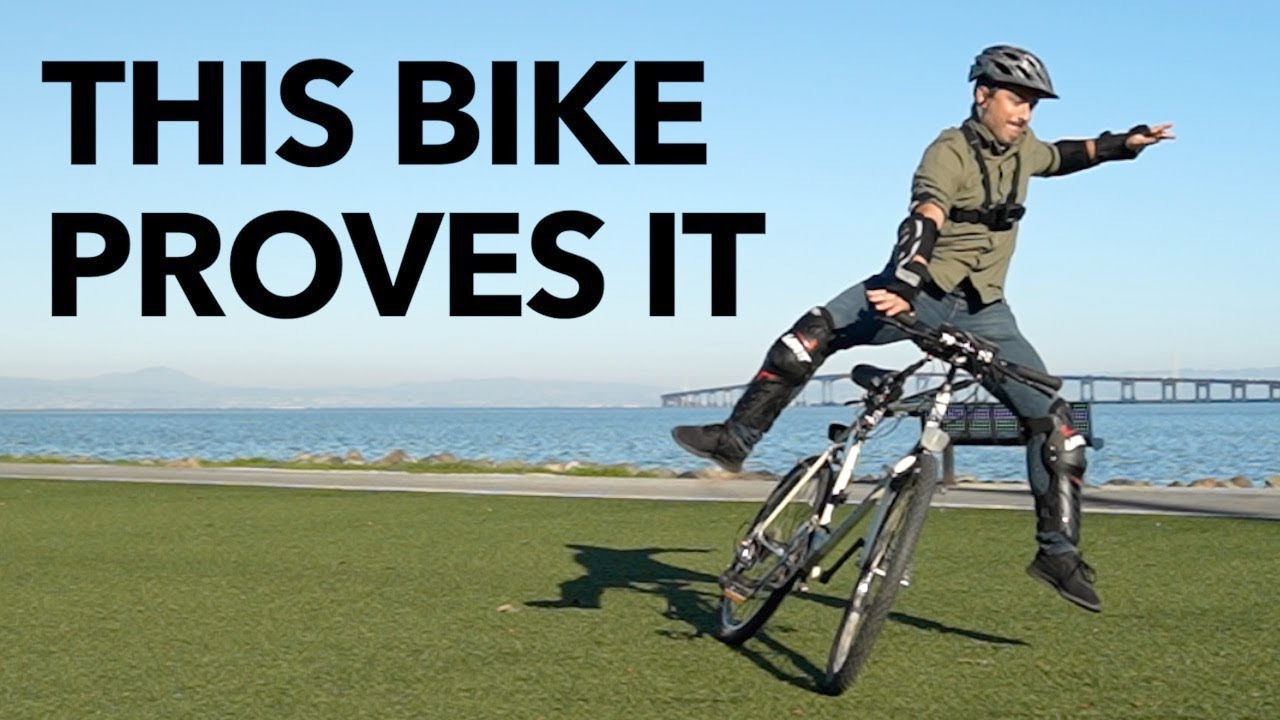
Most People Don't Know How Bikes Work — Veritasium

Veritasium

Two-wheeled vehicles stay balanced not through gyroscopic forces, but because steering geometry continuously drives the tire contact patch back underneath a falling center of mass.

AI-assisted summary of Most People Don't Know How Bikes Work — original source. Check the original for full context.

Source published:

Key ideas

  • Initiating a turn on a bicycle requires counter-steering in the opposite direction first; without it, the contact patch sweeps out from under the rider and causes a fall. (1:58)
  • Bicycle balancing functions like an inverted pendulum, meaning steering primarily exists to position the tire contact patch under the center of mass rather than simply directing travel. (1:58)
  • The common belief that gyroscopic angular momentum directly keeps bicycles upright is incorrect; riders cannot maintain balance even at speed if the handlebars are locked straight. (5:37)
  • Bicycle self-stability arises from automatic steering into a lean via caster trail, forward mass distribution, and gyroscopic precession, though experimental designs prove trail and gyroscopic effects are not strictly required. (5:37)

Detailed notes

## Background Published on the Veritasium YouTube channel by Derek Muller on November 28, 2021, this video explores the hidden mechanics of bicycle balance and steering. The page description highlights that the common belief in gyroscopic effects causing stability is incorrect, referencing foundational research on riderless bicycle dynamics conducted at Delft University and Cornell.

## TL;DR Through practical experiments with a custom bicycle that remotely locks steering in selected directions, Derek Muller demonstrates that turning requires counter-steering—momentarily steering the opposite direction to initiate a lean. Steering functions fundamentally as a balance mechanism akin to an inverted pendulum, moving the tires' contact patch beneath the rider's center of mass. When handlebars are locked dead straight, riders immediately fall regardless of wheel speed, proving that bicycle stability depends on automatic self-correcting steering rather than gyroscopic inertia alone.

## Atmosphere & style The presentation is energetic, hands-on, and intellectually curious, opening with humorous footage of experienced cyclists baffled by an unpredictable remote-controlled test bike. Derek Muller's dynamic rapport with engineer Rick Cavallaro creates an inviting, exploratory atmosphere that moves from playful trial-and-error to rigorous mechanical breakdown. Clear visual models and thought experiments sustain a steady sense of revelatory discovery, transforming a routine everyday activity into a fascinating physical puzzle.

## Bulletin - [01:58](https://www.youtube.com/watch?v=9cNmUNHSBac&t=118s) Initiating a turn on a bicycle requires counter-steering in the opposite direction first; without it, the contact patch sweeps out from under the rider and causes a fall. - [01:58](https://www.youtube.com/watch?v=9cNmUNHSBac&t=118s) Bicycle balancing functions like an inverted pendulum, meaning steering primarily exists to position the tire contact patch under the center of mass rather than simply directing travel. - [05:37](https://www.youtube.com/watch?v=9cNmUNHSBac&t=337s) The common belief that gyroscopic angular momentum directly keeps bicycles upright is incorrect; riders cannot maintain balance even at speed if the handlebars are locked straight. - [05:37](https://www.youtube.com/watch?v=9cNmUNHSBac&t=337s) Bicycle self-stability arises from automatic steering into a lean via caster trail, forward mass distribution, and gyroscopic precession, though experimental designs prove trail and gyroscopic effects are not strictly required.

## Key takeaways - [00:00](https://www.youtube.com/watch?v=9cNmUNHSBac&t=0s) To turn a bicycle in a given direction, the rider must first counter-steer in the opposite direction to initiate a lean. - [00:00](https://www.youtube.com/watch?v=9cNmUNHSBac&t=0s) Riders with one steering direction locked cannot execute a turn in the free direction unless counter-steering happens by coincidence prior to lock engagement. - [01:58](https://www.youtube.com/watch?v=9cNmUNHSBac&t=118s) Steering the front wheel directly toward an intended turn immediately pushes the contact patch out from under the rider's center of mass, inducing a fall to the opposite side. - [01:58](https://www.youtube.com/watch?v=9cNmUNHSBac&t=118s) Bicycle balancing operates on the physical principle of an inverted pendulum, requiring the base to move in the opposite direction of the desired lean. - [01:58](https://www.youtube.com/watch?v=9cNmUNHSBac&t=118s) Unicyclists use pedal acceleration to control longitudinal inverted pendulum balance and micro-steering adjustments for lateral balance. - [01:58](https://www.youtube.com/watch?v=9cNmUNHSBac&t=118s) Steering on a two-wheeled vehicle serves primarily as a balancing mechanism rather than merely a path-pointing control. - [05:37](https://www.youtube.com/watch?v=9cNmUNHSBac&t=337s) A bicycle with handlebars locked dead straight cannot be balanced at speed by riders of any skill level, disproving the idea that spinning wheels keep a bike upright on their own. - [05:37](https://www.youtube.com/watch?v=9cNmUNHSBac&t=337s) Riderless self-stability depends on the front assembly automatically steering into the direction of a lean to restore the contact patch under the center of mass. - [05:37](https://www.youtube.com/watch?v=9cNmUNHSBac&t=337s) Caster trail allows ground reaction forces to pivot the front wheel in the direction the bicycle tilts. - [05:37](https://www.youtube.com/watch?v=9cNmUNHSBac&t=337s) The mass distribution of the front assembly causes gravitational force to pull the handlebars downward into the direction of the lean. - [05:37](https://www.youtube.com/watch?v=9cNmUNHSBac&t=337s) Gyroscopic precession converts the tilting torque of a rolling front wheel into a yawing torque that steers the handlebars toward the lean. - [05:37](https://www.youtube.com/watch?v=9cNmUNHSBac&t=337s) Cornell and TU Delft research proved that self-stable bicycles can function without gyroscopic forces or positive caster trail, relying purely on mass distribution.

## Detailed walkthrough ### [00:00](https://www.youtube.com/watch?v=9cNmUNHSBac&t=0s) The Modified Bicycle Experiment

Most people assume that turning a bicycle to the left is as simple as rotating the handlebars in that direction. To put this intuition to the test, Derek Muller collaborates with Rick Cavallaro (known for building the *Blackbird* downwind cart), who modified a bicycle equipped with a radio-controlled steering lockout mechanism. Rick uses a remote control to pull a pin and arm the system. Once triggered, the steering mechanism locks out movement in one direction while leaving the other direction completely free. An indicator LED on the handlebars lights up to alert the rider which turn direction remains open.

```mermaid flowchart TD accTitle: Steering Lockout Mechanism accDescr: Flowchart illustrating how Rick Cavallaro's radio lockout system restricts steering on the modified bike. subgraph RemoteControl["Radio Controller Action"] A["Rick sends radio signal"] --> B["Pin pulls out & mechanism arms"] end subgraph BikeResponse["Handlebar Lockout"] B --> C["Lock engages on one side"] C --> D["Handlebar LED lights up"] end subgraph RiderAttempt["Rider Experience"] D --> E["Rider attempts assigned turn"] E --> F["Turn immediately fails unless counter-steer occurred"] end ```

Derek attempts to ride the bike without knowing beforehand which direction Rick will lock out. When the LED illuminates for a right-hand turn, Derek tries to make the turn directly, but the bike immediately falls off balance, causing him to dab his foot to the ground in frustration. Repeated trials produce the exact same failure: despite the handlebars being completely free to steer in the commanded direction, executing the turn cleanly proves virtually impossible. Derek observes the core issue: “If you could ride this bicycle, you would find it's impossible to turn left without first steering right and it's impossible to turn right without first steering left.”

- The steering mechanism uses a radio-controlled pin that selectively locks either left or right handlebar rotation. - An onboard LED signals the rider which steering direction is still unlocked. - Attempting to steer directly in the allowed direction without prior preparation consistently causes the rider to lose balance and abort the turn.

---

[01:58](https://www.youtube.com/watch?v=9cNmUNHSBac&t=118s) Counter-Steering and the Inverted Pendulum

While drivers simply point a car's front wheels where they want to go, bicycles operate on completely different physical principles. On a two-wheeled vehicle, steering directly dictates lateral balance. If a rider attempts a right turn by immediately steering the front wheel to the right, the wheels roll out from under the rider's center of mass. This leaves the rider tipping toward the left, where ground reaction forces will cause a fall unless the front wheel is steered leftward. Consequently, initiating a true right turn requires the rider to first counter-steer to the left, which initiates a lean to the right; only once leaning into the turn can the rider steer into it.

Rick Cavallaro explains that balancing a bicycle behaves just like an inverted pendulum—akin to balancing an upright broomstick on an open hand. To move the broomstick forward, you cannot simply shove the base forward, or the top will immediately tip backward and fall away; you must first pull your hand backward so the broomstick tilts forward into the desired direction of travel. Similarly, unicyclists must briefly pedal backward to induce a forward lean before they can accelerate ahead. A unicycle handles longitudinal balance through pedal adjustments and lateral balance through tiny counter-steers, maintaining the contact patch directly beneath the rider's shifting mass.

During Derek's lockout trials, successful turns happened only by pure chance: “Essentially by sheer luck, we had counter-steered before that side of the handlebars locked out.” If Derek's subconscious micro-adjustments happened to steer left just before the right-lock engaged, the lean was established, allowing him to ride through the turn. As Derek summarizes the critical insight: “I mean, the wild takeaway is that steering is not just for turning the bike; steering is for balancing.” Rick Cavallaro confirms: “That's exactly right.”

- Counter-steering is an intuitive skill that riders perform automatically without explicit conscious knowledge. - The inverted pendulum dynamic dictates that the contact patch of the base must move opposite to the desired travel direction to trigger a lean. - On a stationary bicycle, balancing fails not because wheels lack gyroscopic force, but because the rider cannot roll the contact patch back underneath their center of mass.

---

[05:37](https://www.youtube.com/watch?v=9cNmUNHSBac&t=337s) Self-Stability and Why Locked Bikes Crash

A riderless bicycle traveling with sufficient speed can coast stably on its own, absorbing bumps and surface irregularities without toppling over. While popular belief attributes this self-stability to the gyroscopic effect of the spinning wheels, an experiment with fully locked handlebars disproves this claim. When the bicycle's steering is locked dead straight, leaving the wheels free to spin at speed, riders of all skill levels try coasting, riding fast, and employing extreme body-weight balancing techniques. Despite the spinning wheels' angular momentum, every single rider loses balance within seconds. Derek notes: “It is just as hard to balance on a bike with locked steering as it is to balance on a stationary bike.”

```mermaid flowchart LR accTitle: Sources of Riderless Bicycle Self-Stability accDescr: Diagram illustrating the three mechanical factors enabling a riderless bike to steer itself into a fall. subgraph SelfSteering["Automatic Steering Mechanisms"] direction TB M1["1. Caster Effect / Trail<br>(Ground force turns leaning tire)"] M2["2. Mass Distribution<br>(Weight ahead of steering axis falls into lean)"] M3["3. Gyroscopic Precession<br>(Torque on leaning wheel turns handlebars)"] end subgraph Result["Outcome"] SelfSteering --> S["Corrective Steering<br>(Puts contact patch back under bike)"] end ```

A riderless bicycle stays upright because its geometry enables it to automatically steer into a fall, driving the contact patch back under its center of mass. This corrective steering stems from three distinct mechanisms:

1. **Caster Effect (Trail):** The front fork angle places the steering axis's intersection with the ground ahead of the tire's actual contact patch, acting just like a shopping cart or stroller caster wheel. When the bicycle begins tipping to one side, ground reaction forces push the tire back in line, steering into the direction of the fall. 2. **Mass Distribution:** The center of mass of the front fork and handlebars sits slightly forward of the steering axis. When the frame tilts, gravitational force pulls the front assembly down and toward the fall, turning the wheel toward the lean. 3. **Gyroscopic Precession:** When the spinning front wheel tilts, the torque applied by gravity causes it to precess 90 degrees out of phase, turning the handlebars into the direction of the lean rather than holding the bike vertically upright on its own.

Bicycle stability does not strictly require all three mechanisms at once. Researchers at Cornell and Delft built an experimental two-mass-skate bicycle featuring counter-rotating wheels (canceling all gyroscopic forces) and a contact patch positioned ahead of the steering axis (eliminating positive caster trail). The experimental bike remained entirely self-stable purely through its mass distribution, which mechanically steered into any lean. Modern research utilizes specialized stability software to calculate velocity ranges where bike geometries are stable, inspiring innovations like smart motor-assisted handlebars that keep bicycles upright even at very low speeds. Derek reflects on the ongoing study of two-wheeled balance: “I guess it's fitting that we are still learning new things about bicycles since most of us are able to ride one without any knowledge of how we're actually doing it.”

[10:19](https://www.youtube.com/watch?v=9cNmUNHSBac&t=619s) KiwiCo Sponsorship and Hands-On Learning

With the holiday season fast approaching, Derek Muller presents a KiwiCo subscription as an ideal gift for young learners. KiwiCo currently offers nine different subscription product lines tailored to various age groups and subject interests, and they ship internationally to over 40 countries. Derek highlights the enduring appeal of the monthly model, noting how exciting it is to receive a package that reliably provides hours of hands-on entertainment and STEM learning. He shares a personal perspective on building the kits with his own family: “My kids love building KiwiCo projects with me.” He explains that doing these builds has become a special shared routine, made seamless because every box arrives complete with all required parts—plus spare pieces in case small components get misplaced along the way.

Fitting the overarching theme of wheels and rotating mechanics explored in the episode, Derek showcases a waterwheel fountain project he put together. He praises the engineering and instructional clarity behind the builds, emphasizing that every crate is carefully designed by experts and thoroughly tested by children before release. Alongside the physical construction materials, each kit includes an educational magazine packed with extra activities and reading material related to that month's scientific topic. He concludes by pointing viewers to a special promotion—50% off the first month of any crate via `kiwico.com/veritasium50`—before thanking both KiwiCo for sponsoring the video and the audience for tuning in.

- **Product range**: Nine distinct subscription lines accommodating different age brackets and subjects. - **Global reach**: International delivery available to more than 40 countries. - **Convenience**: All tools, hardware, and backup pieces are packed into the box, allowing immediate assembly without extra supplies. - **Featured project**: A working waterwheel fountain project matching the episode's wheel physics focus. - **Promotional offer**: 50% discount on the first month for Veritasium viewers at `kiwico.com/veritasium50`.

## Notable quotes > [05:37](https://www.youtube.com/watch?v=9cNmUNHSBac&t=337s) It is just as hard to balance on a bike with locked steering as it is to balance on a stationary bike. — Derek Muller

> [00:00](https://www.youtube.com/watch?v=9cNmUNHSBac&t=0s) it's impossible to turn left without first steering right and it's impossible to turn right without first steering left. — Derek Muller

> [01:58](https://www.youtube.com/watch?v=9cNmUNHSBac&t=118s) steering is not just for turning the bike; steering is for balancing. — Derek Muller

> [05:37](https://www.youtube.com/watch?v=9cNmUNHSBac&t=337s) I guess it's fitting that we are still learning new things about bicycles since most of us are able to ride one without any knowledge of how we're actually doing it. — Derek Muller

## Mentioned Derek Muller, Rick Cavallaro, Blackbird, Delft University of Technology, Cornell University, Jim Papadopoulos, Arend Schwab, Andy Ruina, MinutePhysics, Today I Found Out, KiwiCo, Veritasium

## Video description Why are bicycles stable? The most common answer is gyroscopic effects, but this is not right. This video was sponsored by Kiwico. Get 50% off your first month of any crate at https://kiwico.com/veritasium50

Huge thanks to Rick Cavallaro for creating this bike on short notice. Thanks to all the friends who participated in the filming. Rick was also responsible for the Blackbird Faster Than The Wind Downwind Cart. https://youtu.be/jyQwgBAaBag

Much of the information presented here on the stability of a riderless bicycle stems from original research at Delft http://bicycle.tudelft.nl/schwab/Bicycle/ and Cornell http://ruina.tam.cornell.edu/research/topics/bicycle_mechanics/overview.html

This line of bicycle-balance research was initiated by Jim Papadopoulos: https://www.nature.com/articles/535338a

Great videos on bikes and counter-steering:

MinutePhysics: How Do Bikes Stay Up? https://youtu.be/oZAc5t2lkvo

MinutePhysics: The Counterintuitive Physics of Turning a Bike: https://youtu.be/llRkf1fnNDM

Why Bicycles Do Not Fall - Arend Schwab TED talk: https://youtu.be/2Y4mbT3ozcA

Today I Found Out: We Still Don't Know How Bicycles Work https://youtu.be/YWsK6rmsKSI

TU Delft - Smart motor in handlebars prevents bicycles from falling over: https://youtu.be/rBOQp2uY_lk

Andy Ruina Explains How Bicycles Balance Themselves: https://youtu.be/NcZCzr9ExKk

▀▀▀ More References:

TU Delft Bicycle Site: http://bicycle.tudelft.nl/schwab/Bicycle/

Bicycle stability program: http://ruina.tam.cornell.edu/research/topics/bicycle_mechanics/JBike6_web_folder/index.htm

▀▀▀ Special thanks to Patreon supporters: Luis Felipe, Anton Ragin, Paul Peijzel, S S, Benedikt Heinen, Diffbot, Micah Mangione, Juan Benet, Ruslan Khroma, Richard Sundvall, Lee Redden, Sam Lutfi, MJP, Gnare, Nick DiCandilo, Dave Kircher, Edward Larsen, Burt Humburg, Blake Byers, Dumky, Mike Tung, Evgeny Skvortsov, Meekay, Ismail Öncü Usta, Crated Comments, Anna, Mac Malkawi, Michael Schneider, Oleksii Leonov, Jim Osmun, Tyson McDowell, Ludovic Robillard, Jim buckmaster, fanime96, Ruslan Khroma, Robert Blum, Vincent, Marinus Kuivenhoven, Alfred Wallace, Arjun Chakroborty, Joar Wandborg, Clayton Greenwell, Michael Krugman, Cy 'kkm' K'Nelson,Ron Neal

▀▀▀ Written by Derek Muller Filmed by Trenton Oliver, Raquel Nuno and Derek Muller Edited by Derek Muller Music from Epidemic Sound and Jonny Hyman Produced by Derek Muller, Petr Lebedev and Emily Zhang

[Source](https://www.youtube.com/watch?v=9cNmUNHSBac)

中文简报

自行车转向锁死测试证明:骑手必须依靠反向转向保持直立 两轮车保持平衡并非依靠陀螺力,而是因为转向几何结构会不断将轮胎接地点推回到下落的重心下方。 Derek Muller通过一台可远程锁定特定转向方向的定制自行车进行实际实验,证明转弯需要进行反向转向——即先瞬间向相反方向打方向以引发倾斜。转向在本质上是一种类似于倒立摆的平衡机制,其作用是将轮胎接地点移动到骑手的重心下方。当车把被锁死笔直向前时,无论轮速有多快,骑手都会立刻倒地,这证明自行车的稳定性取决于自动自我纠正的转向,而非仅仅依赖陀螺惯性。 在骑车启动转弯时,必须先向相反方向反向转向;否则接地点会从骑手下方移开并导致摔倒。 (1:58) 自行车平衡机制类似于倒立摆,这意味着转向的存在主要是为了将轮胎接地点置于重心下方,而不仅是指引行驶方向。 (1:58) 普遍认为陀螺角动量直接维持自行车直立的观点是不正确的;如果车把被正向锁死,骑手即使在高速行驶时也无法保持平衡。 (5:37) 自行车的自稳定性源于通过前轮拖曳距、前向质量分布和陀螺进动自动转向倾斜方向,但实验设计证明拖曳距和陀螺效应并非绝对必要。 (5:37)

Reading summary

Derek Muller and Rick Cavallaro demonstrate that bicycle steering functions primarily to maintain dynamic balance rather than simply point the vehicle, requiring riders to counter-steer to induce an inverted-pendulum lean before turning. While popular belief attributes bicycle balance to gyroscopic momentum, experimental evidence reveals that stability relies on steering geometries that automatically steer into a fall. Counter-Steering and Inverted Pendulum Dynamics (0:00) To evaluate how bicycles turn, Derek Muller collaborated with Rick Cavallaro on a bicycle equipped with a radio-controlled mechanism that selectively locked handlebar rotation in one direction. When signaled by an onboard LED to turn toward the unlocked side, Muller consistently failed to execute the maneuver, immediately tipping over unless subconscious steering had already initiated a lean in the correct direction. Cavallaro explained that balancing a bicycle behaves like an inverted pendulum, analogous to balancing an upright broomstick on an open hand: to move the broomstick forward, the hand must first be pulled backward to pitch the stick in the intended direction of travel. Similarly, unicyclists pedal backward briefly to induce a forward lean before accelerating. Steering a bicycle directly in the commanded direction rolls the contact patch out from beneath the rider's center of mass, pitching the frame in the opposite direction. Consequently, executing a clean right turn physically requires counter-steering left to establish a rightward lean before turning into the curve. Muller concluded that steering is not merely for changing heading, but is the fundamental mechanism used to manage lateral balance. Disproving Gyroscopic Self-Stability Through Steering Lockout (5:37) A persistent assumption is that a moving bicycle stays upright due to the gyroscopic forces generated by its spinning wheels. However, experiments in which the bicycle's handlebars were locked dead straight disproved this hypothesis. When riding at speed with locked steering, cyclists of all skill levels lost balance within seconds, even when attempting rapid coasting and aggressive body-weight shifts. Muller observed that balancing on a bicycle with rigid steering is just as difficult as balancing on a stationary bicycle, establishing that wheel angular momentum alone cannot keep a two-wheeled vehicle upright without lateral steering adjustments. The Three Mechanisms of Autonomous Stability (5:37) A riderless bicycle coasts stably at speed because its front geometry automatically steers into any lean, continuously driving the tire contact patch back underneath its center of mass. This corrective steering is typically governed by three mechanical factors: the caster effect (trail), where the ground contact patch trails behind the steering axis intersection to push the wheel into the turn; mass distribution, where the front fork and handlebar mass sits forward of the steering axis and falls toward the lean; and gyroscopic precession, which translates gravitational roll torque into a steering deflection rather than holding the bike vertically rigid. Autonomous stability does not strictly require all three mechanisms to operate simultaneously. Researchers at Cornell University and Delft University of Technology demonstrated this by engineering an experimental two-mass-skate bicycle equipped with counter-rotating wheels to eliminate gyroscopic precession and a contact patch placed ahead of the steering axis to negate caster trail. The experimental bicycle remained entirely self-stable using only its forward front-assembly mass distribution to steer into falls. Modern researchers continue to use dynamic stability models to design geometries and develop smart motor-assisted handlebars that stabilize bicycles even at low speeds. Muller concludes that bicycle dynamics remain an active field of study, noting the paradox that riders routinely master the complex physics of two-wheeled balance without consciously understanding the counter-steering and self-correcting mechanisms that keep them upright.

精炼阅读摘要

Derek Muller在与工程师Rick Cavallaro的合作实验中指出,两轮自行车的转向本质上是维持横向平衡的工具,而非简单地改变前进方向。骑行者必须依赖潜意识中的“反向转向”来诱导车身倾斜,而无人自行车的自平衡特性则由车体几何结构与质量分布主导,并非普遍误传的车轮陀螺效应。 反向转向机制与倒立摆动力学模型 (0:00) 大多数骑行者直觉上认为向左转弯只需向左转动车把,但Derek Muller与Rick Cavallaro通过一辆装有无线电锁死机构的改装自行车打破了这一常识。该机构可通过遥控拔出销钉,随机锁定左侧或右侧的车把转向,并通过LED指示灯向骑手标示未锁定的方向。测试中,当系统提示右转且车把允许向右转动时,Derek直接向右转动车把,自行车却瞬间失去平衡向左倾倒并导致转向失败。多次试验表明,在未提前向相反方向转向的情况下,骑手根本无法直接顺着开放方向完成转弯。Derek指出,要想向右转,必须先向左打方向;要想向左转,必须先向右打方向。 Cavallaro将自行车的平衡机理比作倒立摆系统,类似于在手掌上竖立平衡一把扫帚。若想让扫帚前移,不能直接向前推手掌,否则扫帚顶部会向后倾倒,骑手必须先将手掌后移以诱导扫帚向前倾斜,随后再前移手掌托住重心。独轮车在加速前同样必须先短暂后蹬以诱导前倾。自行车的轮胎接地点必须先向目标方向的相反侧移动,使骑行者和车架的质心向弯道内侧倾斜,一旦建立起倾角,前轮才能转入弯道。这表明自行车的转向机制首要功能并非单纯导向,而是动态调整接地支撑点以维持横向平衡。 车把锁死实验破除陀螺效应假说 (5:37) 长期以来,公众普遍将高速滑行自行车的自稳定性归功于旋转车轮产生的陀螺效应。为了检验这一说法,实验团队将自行车的车把完全锁死在正中位置,在车轮仍可高速旋转的情况下开展滑行测试。无论是经验丰富的骑手还是普通受试者,在高速滑行状态下尝试利用身体重心调整平衡,均在数秒内失去平衡倒地。Derek观察并指出,在车把被锁死的高速两轮车上保持平衡,其难度与在完全静止的自行车上保持平衡别无二致。 该实验直接证实,单纯依靠车轮旋转产生的角动量与陀螺刚性,根本不足以维持两轮车辆的直立状态。自行车能够保持直立的核心机制在于骑手或车体能够动态操纵接地点,将轮胎轮廓持续送回发生侧倾的重心下方。一旦车把锁死破坏了转向自由度,即使车轮具备再大的角动量,车辆也会迅速倾覆,证明陀螺效应并非两轮平衡的决定性机制。 几何结构驱动的无人车自平衡机制 (5:37) 一辆具备初速度且无人骑乘的自行车能够自行吸收颠簸并平稳滑行,其根本原因在于车体几何构型能够在发生侧倾时自动将车轮转入倾斜方向,驱动接地点回到重心下方。这一自动纠偏过程源于三种物理机制:其一是后倾拖曳距(Caster Effect/Trail),前叉倾角使转向轴线与地面的交点落在轮胎接地点的正前方,如同手推车的脚轮,地面反作用力会在侧倾时迫使前轮向倾斜侧偏转;其二是质量分布,前叉与车把组件的质心位于转向轴线前方,侧倾时重力会拉动前轮自然向倒下的一侧下落偏转;其三是陀螺进动,旋转的前轮在重力倾覆力矩作用下产生90度相位差的进动,辅助车把切入倾斜方向。 康奈尔大学与代尔夫特理工大学的研究证明,上述三种机制并非完全缺一不可。研究人员制造了一辆配有反向旋转车轮(完全抵消陀螺力矩)且接地点置于转向轴前方(消除了正向拖曳距)的双滑块实验自行车,该车仅凭前部特定的质量分布,依然能完全实现无人自稳定滑行。现代动力学研究利用专用软件精确计算车辆自稳定的速度区间,并据此开发出辅助电机转向车把,使自行车在极低速度下也能保持直立。正如Derek所言,骑行虽是人类的本能习惯,但两轮平衡背后的动力学规律至今仍在被科学界持续解构。 Derek Muller总结认为,骑自行车是人类掌握高度娴熟却普遍对其物理机制缺乏认知的典型范例。骑手在日常出行中无意识地依赖反向转向与微动调整,而无人车辆的自平衡则由精妙的转向几何结构驱动接地点实现动态追随。从倒立摆动力学到康奈尔大学的反直觉无陀螺模型,两轮平衡的本质揭示了转向机构的核心使命在于姿态修正与重力对抗,而非单纯的路径导航。

Detailed notes — zh

## Background 该视频由知名科普频道 Veritasium(Derek Muller)于 2021 年 11 月 28 日发布在 YouTube 平台上。视频简介指出,大多数人并不知道自行车如何保持稳定,并反驳了常见的陀螺仪效应解释,同时致谢了协助制作特制自行车的 Rick Cavallaro 以及代尔夫特理工大学和康奈尔大学的前沿力学研究。 ## TL;DR 视频通过改装一辆车把随时会被单向锁死的特制自行车展开实测,揭示了人们直觉中的转向误区:要想顺利向右转弯,骑手必须先无意识地微幅向左“反向转向”使身体倾斜,证明转向的首要功能是维持平衡而非单纯变道。随后,测试者锁死车把验证了旋转车轮的陀螺仪效应完全无法单独抵抗倾倒,指出无人自行车能够动态自平衡依靠的是后倾拖曳距、前叉质心分布与陀螺进动共同驱动的“自主转向”机制。最后,视频介绍了彻底消除陀螺效应与脚轮效应仍能平稳滑行的前沿实验车,展现了自行车动力学深邃且仍在发展的物理魅力。 ## Atmosphere & style 全片节奏轻快、充满颠覆认知的科学探索张力。开篇测试中接二连三的狼狈摔车带来了强烈的戏剧性与幽默感,将观众由“骑车如此简单”的日常经验瞬间拽入“常识失效”的困惑之中。随着慢动作回放与严密力学解析的层层递进,节目氛围转为严谨而充满启迪的思辨,带给观众一种由直觉破碎到豁然开朗的智性震撼。 ## Bulletin - [00:00](https://www.youtube.com/watch?v=9cNmUNHSBac&t=0s) 特制自行车测试证实,一旦车把单向转动被机械锁死,骑手甚至无法向未锁死的另一侧正常转弯,打破了“想向哪拐就直接打把”的日常直觉。 - [01:39](https://www.youtube.com/watch?v=9cNmUNHSBac&t=99s) 自行车转弯的核心依赖“反向转向”(Counter-steering):想向右转必须先轻微向左打把引发车身右倾,转向的本质功能是动态维持倒立摆平衡而非单纯变向。 - [05:00](https://www.youtube.com/watch?v=9cNmUNHSBac&t=300s) 车把完全锁死的测试显示高速旋转车轮无法单靠陀螺效应防倒,无人自行车的自平衡主要依赖后倾拖曳距(Caster Effect)、前叉质心分布与陀螺进动的自发协同转向。 - [09:05](https://www.youtube.com/watch?v=9cNmUNHSBac&t=545s) 康奈尔与代尔夫特理工大学实验表明,在完全抵消陀螺效应与消除脚轮效应的情况下,仅靠特定质心质量分布仍可实现无人自行车的高速自平衡滑行。 ## Key takeaways - [00:00](https://www.youtube.com/watch?v=9cNmUNHSBac&t=0s) Rick Cavallaro 为 Derek Muller 改造了一辆带有遥控锁销机制的自行车,可在骑行中随机锁死车把向左或向右的转向角度。 - [00:54](https://www.youtube.com/watch?v=9cNmUNHSBac&t=54s) 当车把被机械限制只能朝单一方向转动时,骑手在完全无法预知锁死方向的情况下,根本无法完成朝向允许方向的转弯动作。 - [01:39](https://www.youtube.com/watch?v=9cNmUNHSBac&t=99s) 自行车转向与汽车不同:若直接向目标方向打把,地面接触点会从重心下方移开,导致骑手朝反方向倾倒并被迫反打车把救平衡。 - [02:15](https://www.youtube.com/watch?v=9cNmUNHSBac&t=135s) 骑手在转弯前必须本能地执行反向转向(Counter-steering),即先反向微调车把使重心朝目标方向倾斜,再顺势切入弯道。 - [03:24](https://www.youtube.com/watch?v=9cNmUNHSBac&t=204s) 自行车的侧向动力学本质上是倒立摆(Inverted Pendulum),车把转向的首要物理功能是不断移动支撑点来维持平衡,变向只是其副产物。 - [04:02](https://www.youtube.com/watch?v=9cNmUNHSBac&t=242s) 独轮车骑手向前起步时需先反向蹬车使重心前倾,侧向同样完全依赖微幅的反向打轮调整接地点,与自行车物理机制一致。 - [05:00](https://www.youtube.com/watch?v=9cNmUNHSBac&t=300s) 完全锁死车把朝正前方的极端测试表明,即使以高速冲刺,旋转车轮产生的陀螺效应也完全无法阻止整车在几秒内倾倒摔覆。 - [06:35](https://www.youtube.com/watch?v=9cNmUNHSBac&t=395s) 后倾拖曳距效应(Caster Effect)使前轮接触点落在转向轴线之后,当车身倾斜时,地面阻力会自动将前轮偏转入倾斜侧以托住重心。 - [07:24](https://www.youtube.com/watch?v=9cNmUNHSBac&t=444s) 前轮及车把总成的质心分布在转向轴线前方,重力会在车身发生倾斜时直接产生扭矩,自动将前轮拉向倾倒方向。 - [07:52](https://www.youtube.com/watch?v=9cNmUNHSBac&t=472s) 前轮旋转的陀螺效应并非直接提供抗倾倒支撑,而是通过陀螺进动将侧向倾倒力矩转化为驱动前轮偏航转向的横向力矩。 - [09:05](https://www.youtube.com/watch?v=9cNmUNHSBac&t=545s) 康奈尔与代尔夫特理工制造的反向转轮无拖曳距实验车,证明自平衡既非陀螺效应独有,也非脚轮效应必需,单纯靠质量分布也可成立。 - [09:46](https://www.youtube.com/watch?v=9cNmUNHSBac&t=586s) 基于 JBike6 等动力学仿真算法,代尔夫特理工等机构正在研发内置车把电机的智能辅助自行车,可在低速下主动维持车辆直立平衡。 ## Detailed walkthrough ### [00:00](https://www.youtube.com/watch?v=9cNmUNHSBac&t=0s) 特制自行车的反直觉转向测试 大多数人其实并不真正了解自行车的运作原理。为了验证这一点,Derek Muller 联手好友 Rick Cavallaro(曾制造著名的逆风超风速行驶车 Blackbird)对一辆普通自行车进行了改造。Rick 在车上安装了一个无线遥控锁定装置,可以随时锁死车把朝某一侧的转动空间。在骑行过程中,Rick 远程触发锁销,随后车把上的指示灯亮起,提示 Derek 只能朝被允许的单一方向转弯。测试的悬念在于:如果车把被锁死而只能向左转,骑手能否顺利完成一个左转动作? 实际测试完全击碎了直觉。Derek 骑上自行车,紧盯着指示灯等待指令。当系统锁死向右转向、提示向左转时,他试图直接向左打方向,整个人却瞬间失去平衡、狼狈摔下;换到右转时同样屡试屡败。Derek 懊恼地大喊:“That was meant to be a turn to the right but there was no chance in hell.”(那本来是要向右转的,但根本连一丝希望都没有。)只要车把的一侧被机械锁死,骑手甚至连被允许的那一侧转向都根本无法启动。 - **装置原理**:Rick 拔出锁销后车把虽进入待命状态,但只有在转过中立位时机械卡槽才会锁死某一侧,同时车载 LED 灯亮起指示允许转弯的方向。 - **实验表现**:骑手无法预先得知锁定的方向,必须根据亮起的 LED 做出即时反应,但面对向左或向右的转弯指令,均无法直接完成转弯。 --- ### [01:39](https://www.youtube.com/watch?v=9cNmUNHSBac&t=99s) 反向转向机制与倒立摆平衡哲学 通过慢动作回放,转弯失败的物理根源浮出水面。汽车转向时,前轮指向哪里车身就直接驶向哪里;但自行车截然不同,转动车把不仅改变前进轨迹,更直接决定了车辆的平衡状态。如果骑手想要右转而直接将车把向右打,前轮着地点会立刻向右偏移,相当于把车身从骑手身下“抽”走了。这导致骑手身体向左倾倒,地面给车轮施加向左的反作用力,为了不摔倒,骑手必须把车把回打到左边,最终反而变成了一个左转动作。 因此,要想完成一次真正的右转,骑手必须先做极其细微的“反向转向”(Counter-steering)——即先向左打车把,让整车向右倾斜,随后顺着倾斜姿势向右转入弯道。正如 Derek 所总结的:“This is something anyone who rides a bike knows intuitively but not explicitly.”(这是每个骑自行车的人在直觉上都知道、但在表述上却一无所知的事情。)无论是让路人骑车并突然发出转弯口令,还是观察日常骑行,人们都在无意识中执行反向转向。 ```mermaid flowchart TD accTitle: 想要右转时的反向转向物理机制 accDescr: 展示想右转时如果不做反向转向与正确执行反向转向的因果链条对比 subgraph DirectSteer["错误直觉:直接向右打把"] A["车把直接右打"] --> B["车轮着地点右移<br>(车从人身下抽走)"] B --> C["身体向左倾倒"] C --> D["被迫向左打把救平衡<br>(变成向左转)"] end subgraph CounterSteer["正确物理过程:反向转向"] E["车把先轻微左打(反向转向)"] --> F["整车与重心向右侧倾斜"] F --> G["顺应倾斜向右打车把进入弯道"] G --> H["成功完成右转"] end ``` 这种平衡机制本质上就是一个“倒立摆”(Inverted Pendulum),正如在手掌上垂直平衡一根扫帚: - **倒立摆操控规律**:如果想让手中的扫帚向前移动,手掌(支点)必须先往后撤,让扫帚重心前倾,随后手掌才能跟随重心前移。 - **独轮车类比**:独轮车骑手想向前骑,必须先反向踩脚踏使车体前倾,再向前追赶重心;其纵向平衡靠脚踏控制接触点,侧向平衡则与自行车完全相同,全靠微小的反向转向移动触地点。 - **实验中的偶尔成功**:在测试中有几次 Derek 侥幸成功转弯,原因在于锁死发生的瞬间,他恰好因随机颠簸已经完成了朝反方向的预倾斜。 - **核心结论**:Derek 惊叹道:“I mean, the wild takeaway is that steering is not just for turning the bike; steering is for balancing.”(这其中最颠覆的结论在于,转向不仅仅是为了让车拐弯,转向本质上是为了维持平衡。) --- ### [05:00](https://www.youtube.com/watch?v=9cNmUNHSBac&t=300s) 自行车的无人自平衡机制与三大物理原理 骑静止的自行车极其困难,人们常误以为这是因为车轮不转动而失去了“陀螺仪效应”。但真相在于:静止时车把无法通过前进把轮子送回身体重心下方。即便在笔直前进时,骑手也在无休止地进行微小的转向修正,不断移动前轮接触面来支撑身体。那么,为什么没有骑手的无人自行车在拥有足够初速度时,可以在凹凸不平的地面上长时间自主滑行而不倒? 为了测试车轮转动的陀螺仪效应能否单独维持平衡,团队将自行车车把彻底锁死,只能朝正前方直线行驶。多位测试者尝试以极高速度冲刺,或采用极端的身体倾斜平衡技巧,但无一例外在几秒钟内摔倒。正如现场参与者所感叹:“This is not safe for a second.”(这哪怕维持一秒钟都不安全。)事实证明,一旦无法转动车把将接触点送到重心下方,高速旋转的车轮本身根本不足以对抗重力倾倒。无人自行车之所以能保持稳定,是因为精妙的机械设计赋予了它“自主转向”(Self-steering)的能力: | 机制名称 | 结构特征 | 作用原理 | |:--- |:--- |:--- | | **后倾拖曳距效应(Caster Effect)** | 前叉存在倾斜角,前轮转向轴线与地面的交点位于车轮接地接触点的前方。 | 犹如超市推车或婴儿车的万向脚轮,当车身向某一侧倾斜时,地面摩擦阻力会自动迫使车轮偏转入倾斜的一侧,把车轮回正到车身下方。 | | **重心质心分布(Mass Distribution)** | 车把和前轮总成的质心位于转向轴线的前方。 | 当整车向一侧倾斜时,重力直接作用于前叉质心,将前轮往车身倾倒的方向拉动,实现自动转向回正。 | | **陀螺进动辅助(Gyroscopic Precession)** | 旋转的前轮产生角动量,但并不直接阻止倒伏,而是参与转向。 | 当陀螺仪受到侧向倾倒力矩时,响应会发生90度相位延迟:车身向左倾倒的力矩直接转化为驱动前轮向左偏航转动的力矩。 | 这三大机制协同工作,只要车子开始倒向某一侧,前轮就会立刻自动转向该侧,重新将支点移到重心之下,从而实现动态稳定。 --- ### [09:05](https://www.youtube.com/watch?v=9cNmUNHSBac&t=545s) 无陀螺仪自行车实验与智能平衡车未来 更为惊人的是,自行车甚至不需要同时具备这三项机制就能实现自平衡。康奈尔大学和代尔夫特理工大学的研究团队曾专门设计制造了一款造型奇特的双轮验证车: - **消除陀螺效应**:在地表接触轮上方反向安装了一套反向旋转的同规格车轮,完全抵消了旋转角动量。 - **消除脚轮效应**:前轮接地接触点被刻意设计在转向轴线的前方,彻底消除了后倾拖曳距的自动寻迹特性。 - **质量分布致胜**:该车仅依靠前叉和转向机构特殊的质心质量分布,在整车发生倾斜时,纯粹借助重力力矩便能将前轮导向倾斜方向,成功实现了无人驾驶状态下的自主平衡滑行。 自行车动力学至今仍是前沿工程力学中极具活力的研究课题。学者们开发了专门的动力学计算程序(如 JBike6),输入任意自行车几何参数即可推算出该车在何种速度区间内具有自稳定性。这些基础力学研究正在催生下一代自行车技术,例如代尔夫特理工大学研发的原型车在车把中嵌入了智能电机,能够主动辅助转向,即便在极慢速度下也能确保车辆屹立不倒。Derek 总结道,我们大多数人一辈子都在骑自行车,却完全不知道自己究竟是如何维持平衡的,而科学界至今仍在探索其精细物理规律,这本身就是自行车最迷人的地方。 ### [10:19](https://www.youtube.com/watch?v=9cNmUNHSBac&t=619s) 赞助商 KiwiCo 与动手科学探索 德里克·穆勒(Derek Muller)在视频末尾转向了本期节目的赞助商 KiwiCo。他提到随着假期临近,为身边的年轻人挑选有意义的礼物成为了许多人的需求,而 KiwiCo 的科学动手订阅盒正是一个极佳的选择。每个月都会有一套精心准备的材料盒直接寄送上门,为孩子们提供数小时兼具娱乐与学习价值的动手体验。德里克分享了自己作为父亲的温馨家庭日常,他表示自己的孩子们非常喜欢和他一起动手组装 KiwiCo 的项目,这已经成为他们增进亲子感情的特殊互动时光。 为了契合本期视频探讨自行车轮与机械物理的主题,德里克当天特意组装了一座水轮喷泉(waterwheel fountain)。他赞赏这些项目套件的设计极为周到,每个盒子不仅备齐了组装所需的全部零部件,甚至还会贴心地附带少量备用零件,以防孩子在制作时不慎遗失。所有套件均由各领域专家精心设计,并在推向市场前经过了儿童的实际测试与验证,确保说明书清晰易懂、组装流程顺畅。此外,盒子里还附赠一本内容丰富的教育科普杂志,围绕当期主题提供延伸阅读与深入的科学原理解读。 德里克·穆勒在推荐时评价道:“And with the holidays fast approaching, a KiwiCo subscription is the perfect gift for any of the young people in your life.”(随着节日的临近,KiwiCo 订阅对于你身边的年轻人来说都是完美的礼物。)在视频最后,他向长期支持 Veritasium 的 KiwiCo 表达了感谢,也诚挚致谢了所有收看本期视频的观众。 - **产品线与覆盖范围**:KiwiCo 目前拥有针对不同年龄段和学科主题的 9 条订阅产品线,且服务覆盖全球超过 40 个国家。 - **套件特色**:内含项目全部所需原材料及备用零配件,配套附赠扩展知识面的主题科普杂志。 - **专属观众福利**:观众通过专属链接 `kiwico.com/veritasium50` 订阅,即可享受首月任意科学盒 5 折(50% off)优惠。 ## Notable quotes > [01:39](https://www.youtube.com/watch?v=9cNmUNHSBac&t=99s) the wild takeaway is that steering is not just for turning the bike; steering is for balancing. — Derek Muller ## Mentioned Derek Muller, Rick Cavallaro, Blackbird, KiwiCo, Cornell University, Delft University of Technology, Jim Papadopoulos, JBike6 ## Video description Why are bicycles stable? The most common answer is gyroscopic effects, but this is not right. This video was sponsored by Kiwico. Get 50% off your first month of any crate at https://kiwico.com/veritasium50 Huge thanks to Rick Cavallaro for creating this bike on short notice. Thanks to all the friends who participated in the filming. Rick was also responsible for the Blackbird Faster Than The Wind Downwind Cart. https://youtu.be/jyQwgBAaBag Much of the information presented here on the stability of a riderless bicycle stems from original research at Delft http://bicycle.tudelft.nl/schwab/Bicycle/ and Cornell http://ruina.tam.cornell.edu/research/topics/bicycle_mechanics/overview.html This line of bicycle-balance research was initiated by Jim Papadopoulos: https://www.nature.com/articles/535338a Great videos on bikes and counter-steering: MinutePhysics: How Do Bikes Stay Up? https://youtu.be/oZAc5t2lkvo MinutePhysics: The Counterintuitive Physics of Turning a Bike: https://youtu.be/llRkf1fnNDM Why Bicycles Do Not Fall - Arend Schwab TED talk: https://youtu.be/2Y4mbT3ozcA Today I Found Out: We Still Don't Know How Bicycles Work https://youtu.be/YWsK6rmsKSI TU Delft - Smart motor in handlebars prevents bicycles from falling over: https://youtu.be/rBOQp2uY_lk Andy Ruina Explains How Bicycles Balance Themselves: https://youtu.be/NcZCzr9ExKk ▀▀▀ More References: TU Delft Bicycle Site: http://bicycle.tudelft.nl/schwab/Bicycle/ Bicycle stability program: http://ruina.tam.cornell.edu/research/topics/bicycle_mechanics/JBike6_web_folder/index.htm ▀▀▀ Special thanks to Patreon supporters: Luis Felipe, Anton Ragin, Paul Peijzel, S S, Benedikt Heinen, Diffbot, Micah Mangione, Juan Benet, Ruslan Khroma, Richard Sundvall, Lee Redden, Sam Lutfi, MJP, Gnare, Nick DiCandilo, Dave Kircher, Edward Larsen, Burt Humburg, Blake Byers, Dumky, Mike Tung, Evgeny Skvortsov, Meekay, Ismail Öncü Usta, Crated Comments, Anna, Mac Malkawi, Michael Schneider, Oleksii Leonov, Jim Osmun, Tyson McDowell, Ludovic Robillard, Jim buckmaster, fanime96, Ruslan Khroma, Robert Blum, Vincent, Marinus Kuivenhoven, Alfred Wallace, Arjun Chakroborty, Joar Wandborg, Clayton Greenwell, Michael Krugman, Cy 'kkm' K'Nelson,Ron Neal ▀▀▀ Written by Derek Muller Filmed by Trenton Oliver, Raquel Nuno and Derek Muller Edited by Derek Muller Music from Epidemic Sound and Jonny Hyman Produced by Derek Muller, Petr Lebedev and Emily Zhang [Source](https://www.youtube.com/watch?v=9cNmUNHSBac)

Source quotes

[1:39] Derek Muller: the wild takeaway is that steering is not just for turning the bike; steering is for balancing.

Source quotes

[5:37] Derek Muller: It is just as hard to balance on a bike with locked steering as it is to balance on a stationary bike. [0:00] Derek Muller: it's impossible to turn left without first steering right and it's impossible to turn right without first steering left. [1:58] Derek Muller: steering is not just for turning the bike; steering is for balancing. [5:37] Derek Muller: I guess it's fitting that we are still learning new things about bicycles since most of us are able to ride one without any knowledge of how we're actually doing it.

Original transcript

[0:00] Most people don't know how bicycles actually work. [0:03] - [Off screen] Let's try it again. [0:04] So we modified this bike to prove it. [0:11] This video was sponsored by KiwiCo. [0:14] More about them at the end of the show. [0:17] - When you're riding a bike and you want to turn left, [0:20] I think most people just imagine [0:21] you turn the handlebars to the left. [0:23] This is a bike to test whether that is true. [0:26] And it's made by my friend Rick here. [0:29] and he's got a radio controller that allows him [0:31] to lock out the steering to one side. [0:35] So, what he's gonna do is as I'm biking, [0:36] he's gonna pick whether I can turn [0:38] either to the left or to the right. [0:40] So, go for it. [0:42] - [Rick] I'm giving it a left turn. [0:43] It pulls the pin out, [0:45] but you can see that you can still fully steer [0:48] after I've pulled the pin out. [0:49] I've armed it. [0:51] There's where it locks. - OK [0:52] Now, that that's when your LED comes on [0:55] and that just says turn that way. [0:56] - Turn left. - Yeah [0:57] And if I try to turn right, I can't. [1:00] And if I try to turn left- [1:01] - You can. [1:02] - I can. [1:02] So the question is [1:03] can I successfully execute this left-hand turn? [1:07] Should we give it a shot? [1:08] I mean, he's not gonna tell me whether it's left or right, [1:09] so I have to look at the LED to know [1:11] which way I can still turn. [1:13] - [Rick] You let me know when you're ready. [1:16] - Okay. [1:19] (exclaims) [1:20] No! [1:22] That was meant to be a turn to the right [1:23] but there was no chance in hell. [1:25] Left. [1:26] (exclaims) [1:27] Right. [1:32] All right. [1:33] (exclaims) [1:35] Right, right, right! [1:37] God! [1:39] - If you look closely, you can see the problem. [1:41] Here, I'm trying to turn right [1:44] but steering that way puts me off balance. [1:47] If you could ride this bicycle, [1:49] you would find it's impossible to turn left [1:51] without first steering right [1:53] and it's impossible to turn right [1:55] without first steering left. [1:58] This seems wrong. [2:00] I think most people believe you turn a bike [2:02] simply by pointing the handlebars [2:03] in the direction you want to go. [2:05] After all, this is how you drive a car. [2:08] Point the front wheels any direction you like [2:10] and the car just goes that way. [2:13] But the difference with a bicycle [2:14] is steering doesn't just affect the direction you're headed; [2:18] it also affects your balance. [2:21] Imagine you want to make a right turn [2:24] so you steer the handlebars to the right. [2:26] What you've done is effectively [2:28] steered the bike out from under you. [2:31] So now you're leaning to the left [2:33] and the ground puts a force on the bike to the left [2:36] so the only way not to fall [2:38] is to steer the bike to the left. [2:40] You have made a left turn. [2:42] If you really wanted to turn right, [2:44] you first have to counter-steer to the left [2:47] so you can lean right into the turn. [2:50] This is something anyone who rides a bike knows intuitively [2:54] but not explicitly. [2:55] - Turn left! [2:57] - Film someone riding a bike towards you [2:59] and tell them which direction to turn [3:01] and you will find that they counter-steer [3:03] without even thinking about it. [3:04] - Hard left! [3:08] When you're riding a bike, [3:10] it's exactly the same as what we call an inverted pendulum [3:13] or balancing a broomstick on your hand. [3:16] If I'm balancing it and I just start walking toward you, [3:18] it will always fall away from you. [3:21] If I want to walk towards you, it's easy enough to do [3:23] and people inherently know how to do it. [3:24] If I pull it backward, I can now start walking that way. [3:28] I have to initiate the lean to turn into it. [3:32] - If you want to move the pendulum somewhere, [3:34] you first move the base in the opposite direction. [3:37] And now the pendulum is leaning [3:39] in the direction you want to go [3:41] so you can move with it. [3:44] And it's the same with a unicycle. [3:47] In order to go forward, [3:48] first, you have to peddle back. [3:50] So, you're leaning forward [3:52] and then you can go forward with it. [3:54] - Everything you're doing on a unicycle [3:56] is all about keeping that contact patch [3:59] right where it needs to be relative to you. [4:01] You're balancing the broomstick. [4:03] It's just that on a unicycle, [4:04] you do the longitudinal balance with the pedals [4:08] and you do the lateral balance, the side to side, [4:10] the same as you do with a bike. [4:11] You essentially- sorta, small counter-steer to get that weight, [4:14] to get the contact patch out, [4:16] and then you can pedal and bring it under you. [4:19] - Now I should point out [4:20] that sometimes when the steering locked, [4:22] we just happened to be leaning in the right direction [4:25] to execute the turn. [4:26] - Right, right, right, right, right! [4:27] Right, right, right, right. [4:29] - [Off Screen] Oh, managed it! [4:30] - Essentially by sheer luck, [4:31] we had counter-steered [4:33] before that side of the handlebars locked out. [4:36] Now, I can keep going. [4:37] - [Rick] Yeah, but don't turn left [4:38] or you're gonna be screwed. [4:39] - I can't turn left. [4:42] What's interesting about this is it shows [4:43] that you can still ride the bike perfectly well, right? [4:45] It's just you can't turn left. [4:48] The funny thing is that you couldn't initiate the turn. [4:52] I mean, the wild takeaway is that [4:54] steering is not just for turning the bike; [4:57] steering is for balancing. [4:58] - That's exactly right. [5:00] - Why is it hard to balance on a stationary bike? [5:03] I think most people believe [5:04] it's because the wheels aren't spinning [5:06] so there's no gyroscopic effect, [5:09] but that's not it. [5:10] The truth is you use steering [5:12] to keep the bike underneath you [5:14] but steering doesn't work when you're stationary. [5:17] Your balance comes not so much [5:19] from how you position your body over the bike, [5:21] but by how you steer the bike to keep it underneath you. [5:25] Even when going straight, [5:26] you're constantly making small steering adjustments [5:29] to maintain balance. [5:31] - You're moving the contact patch [5:32] of the front wheel under you. [5:33] You're doing exactly what you do [5:34] when you balance a broomstick on your hand. [5:37] - So, if the rider is responsible [5:39] for steering the bike to keep it balanced, [5:41] how do bikes without riders stay upright? [5:45] As long as a bike is moving with sufficient speed, [5:47] it can keep coasting indefinitely. [5:50] I first became aware of this phenomenon [5:52] through the great videos by MinutePhysics, [5:54] which inspired me to make this video. [5:56] You should definitely check them out. [5:58] But it turned out the ground [6:00] where we went to test this effect was really bumpy, [6:03] but the bike still manages to absorb all these perturbations [6:06] and remain stable. [6:08] So, how does it do this? [6:10] I think most people believe it's the wheels spinning [6:13] that creates some sort of gyroscopic effect [6:15] that resists falling over [6:17] just like in this demonstration of gyroscopic precession. [6:21] Yhe wheel stays upright [6:22] even though gravity is pulling it down. [6:25] But this is not why bikes are stable. [6:28] Just watch what happens [6:29] when we lock the handlebars completely [6:31] so you can only go straight ahead. [6:33] - Locked out, locked out. [6:34] Whoa! [6:37] - All that is happening is the steering is locked. [6:40] You just got to ride it. [6:41] You don't have to turn. [6:41] You just ride. [6:43] Letting go. [6:44] - Some people tried going really fast. [6:48] (group laughs) [6:52] Others experimented with extreme balancing techniques. [6:55] - He's leaning. Don't go too fast! [6:58] (group laughs) [7:02] - But even with the gyroscopic [7:04] effect of the wheels, [7:05] no one was able to keep the bike upright [7:07] for more than a few seconds. [7:09] (crowd exclaims) [7:11] - This is not safe for a second. [7:13] - It is just as hard to balance [7:15] on a bike with locked steering [7:16] as it is to balance on a stationary bike. [7:19] - No, this one is impossible. [7:21] - Because you can't steer the bike [7:23] back under you. [7:24] The real reason bicycles are stable without riders [7:27] is because they're cleverly designed to steer themselves. [7:31] If they start falling to one side, [7:33] the handlebars turn in that direction [7:35] to steer the wheels back underneath them. [7:38] At least three mechanisms [7:40] are responsible for a bike's corrective steering. [7:43] The first is that due to the angle of the front fork, [7:45] the steering axis intersects the ground [7:48] in front of where the wheel touches the ground. [7:52] So, if the bike starts leaning to the left, [7:54] the force from the ground on the tire [7:55] turns the wheel to the left. [7:58] If the bike starts leaning right, [7:59] the force from the ground pushes the wheel to the right. [8:02] The front wheel of a bicycle is essentially a caster wheel, [8:06] like those you find on strollers or shopping carts. [8:09] Whichever way you drive them, [8:10] the wheel falls in line and rolls in the same direction. [8:14] The second reason for a bike's corrective steering [8:17] is that the center of mass [8:18] of the handlebars and front wheel [8:20] are located slightly in front of the steering axis. [8:23] So, when the bike leans left, [8:25] their weight pushes the front wheel to the left. [8:28] If the bike leans right, their weight steers to the right. [8:32] And the third mechanism is a gyroscopic effect [8:35] but it doesn't keep the bike upright directly; [8:38] it just helps steer. [8:40] If you have a gyroscope [8:41] and you push down on the left-hand side, [8:43] the gyro will turn left. [8:45] If you push down on the right side, it will turn right. [8:49] This is known as gyroscopic precession. [8:52] It seems as though the force you apply [8:54] takes effect 90 degrees from where you applied it. [8:57] So, bikes are stable primarily because of steering. [9:01] They have built-in mechanisms for steering themselves. [9:05] In fact, you don't need all three mechanisms [9:07] to create a stable bike. [9:09] Researchers created this weird-looking bicycle [9:12] to prove a point. [9:13] It has no gyroscopic effect [9:15] thanks to counter-rotating wheels [9:17] above the wheels that touch the floor. [9:19] Plus, there is no caster effect [9:22] because the front wheel touches the floor [9:23] in front of the steering axis. [9:26] But this bike is made stable by its mass distribution, [9:30] the force of gravity on which [9:31] steers it in the direction of any lean. [9:35] Understanding how bicycles work [9:37] is still an active area of research. [9:40] There is a program you can use to input [9:42] all the different bicycle parameters [9:43] and see the range of speeds over which it is self-stable. [9:47] And this research is leading to better bikes. [9:50] This prototype has a smart motor in the handlebars [9:53] to actively help steer, [9:55] keeping the bike upright even at low speeds. [9:58] I guess it's fitting that we are still [10:00] learning new things about bicycles [10:02] since most of us are able to ride one [10:04] without any knowledge of how we're actually doing it. [10:08] (futuristic sound effects play) [10:12] - Hey, this video is sponsored by KiwiCo, [10:14] creator of awesome hands-on projects and toys [10:17] designed to expose kids to STEAM concepts. [10:19] And with the holidays fast approaching, [10:21] a KiwiCo subscription is the perfect gift [10:23] for any of the young people in your life. [10:25] KiwiCo now has nine different subscription lines [10:28] for different age groups and topics. [10:30] Plus, they ship to more than 40 countries. [10:32] I think it's such a great gift [10:34] because each month a box turns up at your door [10:36] and provides hours of entertainment and learning. [10:39] My kids love building KiwiCo projects with me. [10:42] It's a special thing we do together [10:44] and you can jump right in [10:45] because each box comes with all the supplies you need, [10:48] even a few extra in case you lose something. [10:50] You know, today I built this waterwheel fountain [10:53] in fitting with the wheel theme. [10:55] The design and instructions are so well thought out [10:57] because each project is designed by experts [11:00] and tested with kids. [11:01] There's also an educational magazine [11:03] with lots of additional content around the crate's theme. [11:06] For viewers of this channel, [11:07] KiwiCo are offering 50% off your first month of any crate. [11:10] Just go to kiwico.com/veritasium50. [11:14] I will put that link down in the description. [11:16] So, I want to thank KiwiCo for supporting Veritasium [11:18] and I want to thank you for watching.