Hamming, Intro to The Art of Doing Science and Engineering: Learning to Learn (March 28, 1995)
securitylectures
AI-assisted summary of Hamming, Intro to The Art of Doing Science and Engineering: Learning to Learn (March 28, 1995) — original source. Check the original for full context.
Source published:
Key ideas
- Scientific and technical knowledge doubles roughly every 17 years, meaning half of what is taught in engineering curricula will be obsolete within 15 years. (9:31)
- Back-of-the-envelope modeling shows that exponential doubling every 17 years mathematically aligns with the claim that approximately 90% of all scientists who have ever lived are active today across a 55-year career span. (11:39)
- Extrapolating current doubling trends 340 years forward yields an impossible 10 billion distinct scientific specialties, illustrating that historical exponential trajectories inevitably encounter hard physical bounds. (14:46)
- Human bandwidth caps at roughly 50 to 60 bits per second with signals traveling at 100 meters per second, compared to computers operating at the speed of light with arbitrary precision, driving permanent automation in complex control systems. (37:47)
Detailed notes
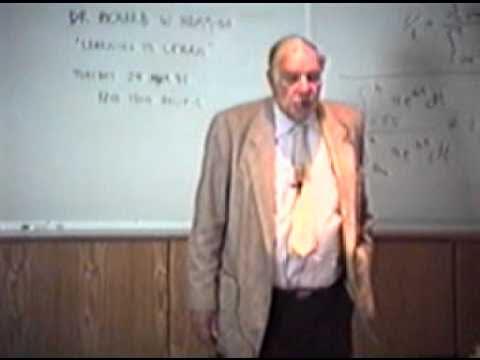
## Background Published on YouTube by the channel securitylectures on August 26, 2012, this video presents the opening lecture of the capstone graduate course "The Art of Doing Science and Engineering: Learning to Learn," delivered on March 28, 1995, by Dr. Richard W. Hamming at the Naval Postgraduate School in Monterey, California. The course description emphasizes that rather than teaching standard technical material, the class aims to instill a productive "style of thinking" and prepare graduate students to continuously re-educate themselves throughout their future technical careers.
## TL;DR Dr. Richard Hamming introduces his course by defining style—rather than sheer effort or isolated facts—as the decisive factor separating impactful scientists from mediocre ones. Using back-of-the-envelope calculations, he demonstrates that scientific knowledge doubles roughly every 17 years, meaning half of what students learn will quickly obsolete and requiring them to master the meta-skill of learning how to learn. Hamming contrasts the biological limitations of humans, such as narrow bandwidth and vulnerability to boredom, with the exponential rise and precision of digital computing machines. Ultimately, he urges his students to reject aimless drift like a drunken sailor, arguing that living an examined, ambitious life dedicated to the struggle for excellence is the true foundation of personal fulfillment.
## Atmosphere & style The lecture carries the urgent, no-nonsense weight of a seasoned athletic coach challenging his trainees to abandon false modesty and strive for genuine greatness. Hamming balances sharp wit, blunt critiques of academic silos, and personal stories of career triumphs and blunders with profound philosophical sincerity. Listening to him feels like sitting in on an intimate, candid masterclass where the boundary between hard engineering and existential purpose dissolves into a compelling call for deliberate self-mastery.
## Bulletin - [09:31](https://www.youtube.com/watch?v=AD4b-52jtos&t=571s) Scientific and technical knowledge doubles roughly every 17 years, meaning half of what is taught in engineering curricula will be obsolete within 15 years. - [11:39](https://www.youtube.com/watch?v=AD4b-52jtos&t=699s) Back-of-the-envelope modeling shows that exponential doubling every 17 years mathematically aligns with the claim that approximately 90% of all scientists who have ever lived are active today across a 55-year career span. - [14:46](https://www.youtube.com/watch?v=AD4b-52jtos&t=886s) Extrapolating current doubling trends 340 years forward yields an impossible 10 billion distinct scientific specialties, illustrating that historical exponential trajectories inevitably encounter hard physical bounds. - [37:47](https://www.youtube.com/watch?v=AD4b-52jtos&t=2267s) Human bandwidth caps at roughly 50 to 60 bits per second with signals traveling at 100 meters per second, compared to computers operating at the speed of light with arbitrary precision, driving permanent automation in complex control systems.
## Key takeaways - [00:02](https://www.youtube.com/watch?v=AD4b-52jtos&t=2s) The course EC 4000 focuses entirely on instilling a style of thinking rather than conveying new technical content, aiming to prepare students for their technical futures. - [02:39](https://www.youtube.com/watch?v=AD4b-52jtos&t=159s) Style cannot be cleanly defined through abstract lectures and must be acquired experientially, analogous to ancient mystery traditions or athletic coaching. - [04:49](https://www.youtube.com/watch?v=AD4b-52jtos&t=289s) Apprentices cannot succeed merely by imitating their masters; past methods solved past problems and will not fit the conditions of the future. - [07:03](https://www.youtube.com/watch?v=AD4b-52jtos&t=423s) Leaders often succumb to the trap of enforcing the tools that made them famous, as when Hendrik Bode opposed Hamming's use of digital computing in favor of complex variable theory. - [09:31](https://www.youtube.com/watch?v=AD4b-52jtos&t=571s) Training teaches how to execute a specific procedure, whereas education teaches what, when, and why to pursue a direction; isolated training risks applying high effort to the wrong problem. - [11:39](https://www.youtube.com/watch?v=AD4b-52jtos&t=699s) A quick back-of-the-envelope calculation reveals that a 17-year doubling rate over a 55-year active scientific lifespan yields exactly the 90% proportion of living scientists often cited as folklore. - [14:46](https://www.youtube.com/watch?v=AD4b-52jtos&t=886s) Performing back-of-the-envelope estimations provides intellectual self-defense against sensationalized, poorly defined assertions encountered in public media. - [16:51](https://www.youtube.com/watch?v=AD4b-52jtos&t=1011s) Compounding knowledge means students reaching senior leadership positions in 39 to 44 years will manage roughly five times as much technical knowledge as exists today. - [19:13](https://www.youtube.com/watch?v=AD4b-52jtos&t=1153s) Science requires exploring what you do not know, whereas engineering dictates that you should not undertake a task unless you know what you are doing, yet modern practitioners must navigate both modes. - [22:41](https://www.youtube.com/watch?v=AD4b-52jtos&t=1361s) The buffer period allowing scientific discoveries to slowly mature before engineering deployment has evaporated, demanding immediate transition from discovery to field application. - [24:08](https://www.youtube.com/watch?v=AD4b-52jtos&t=1448s) Short-term forecasts err toward optimism while long-term forecasts err toward pessimism because the human mind struggles to internalize compounding geometric growth. - [26:02](https://www.youtube.com/watch?v=AD4b-52jtos&t=1562s) Historical records and human memories are fundamentally subjective and unreliable, while modern computing marks a discontinuous break from past historical precedents. - [29:27](https://www.youtube.com/watch?v=AD4b-52jtos&t=1767s) Future technological adoption is constrained far more by legal, regulatory, and social friction than by pure physical or engineering capability. - [29:27](https://www.youtube.com/watch?v=AD4b-52jtos&t=1767s) A career without an overarching vision behaves like a drunken sailor covering a distance proportional to sqrt(n), whereas a defined goal biases movement toward progress proportional to n. - [33:23](https://www.youtube.com/watch?v=AD4b-52jtos&t=2003s) Academic department silos fail to reflect nature, which treats knowledge as homogeneous and interconnected during real-world problem solving. - [37:47](https://www.youtube.com/watch?v=AD4b-52jtos&t=2267s) Machines hold decisive operational advantages over humans, including freedom from boredom, immunity to personnel friction, rapid reprogrammability, and operation in extreme environments. - [44:32](https://www.youtube.com/watch?v=AD4b-52jtos&t=2672s) Genuine fulfillment is an indirect byproduct of persistent struggle toward excellence rather than an arithmetic sum of momentary, superficial pleasures. - [46:11](https://www.youtube.com/watch?v=AD4b-52jtos&t=2771s) Socrates's principle that 'the unexamined life is not worth living' requires individuals to actively manage their own character and trajectory rather than drifting aimlessly.
## Detailed walkthrough ### [00:02](https://www.youtube.com/watch?v=AD4b-52jtos&t=2s) Course Logistics and the Focus on Style Over Content
Dr. Richard W. Hamming opens the first meeting of EC 4000 by establishing course logistics and scheduling. The class meets on Tuesdays, Thursdays, and Fridays at 3:00 PM, though there has already been some confusion over the Friday timing. Hamming notes that on campus he can be found in Spanagel Hall, Room 518 (phone extension 2655), typically in the mornings because he teaches only half-time and spends his afternoons working at home. He mentions that printed lecture notes are available for attending students, but he cannot distribute them by mail to absentees because the manuscript is currently being published as a book and the publisher holds the right to profit from it once it appears within the year.
Turning to the course orientation, Hamming makes it clear that his goal is not to deliver standard technical material. While he will refer to technical topics that students should already know—such as digital filters—the course itself has no technical curriculum. Instead, its core focus is preparing students for their technical futures by instilling "style." Having observed great scientists ever since his time at Los Alamos during World War II, Hamming noticed that many people worked just as hard as their most accomplished peers but ended up with very little to show for it. The defining difference between those who achieve significant things and those who do not is style. The Naval Postgraduate School’s mission is pragmatic: the U.S. Navy is spending a substantial amount of money to educate these officers and researchers, and it expects a return on its investment through their future performance. Because courses generally teach narrow subjects in isolation, a great deal of critical understanding falls through the cracks; this class is designed to pick up all the essential things that instructors never told their students.
- **Course Schedule:** Tuesdays, Thursdays, and Fridays at 3:00 PM. - **Hamming's NPS Office:** Spanagel Hall, Room 518 (extension 2655), present during morning hours. - **Core Premise:** “The purpose of this course is to prepare you for your technical future.” - **Driving Question:** What separates the scientists who do significant work from those who work equally hard but achieve little?
---
[02:39](https://www.youtube.com/watch?v=AD4b-52jtos&t=159s) The Ineffability of Style, Ancient Traditions, and Talking About Oneself
Hamming acknowledges an immediate paradox: style cannot be neatly captured in a lecture or reduced to precise definitions. Modern thinkers inherit the classical Greek assumption—pioneered by Socrates, Plato, and Aristotle—that anything can be analyzed and talked about, whether it is truth, beauty, justice, the gods, or love. Yet running parallel to that tradition were the ancient mystery cults, which maintained that fundamental truths cannot be put into words and must instead be directly experienced. Hamming points out that this conviction runs through medieval Christian mystics, who asserted that one cannot simply talk about God but must experience Him, as well as Islamic tradition, which forbids visual depictions of Allah because the divine must be sensed rather than portrayed.
Style in science and engineering belongs to this experiential realm. Hamming cannot simply define it; he can only circle around it through specific examples, hoping students will infer the underlying reality. To make the ideas penetrate rather than sound like empty, pious platitudes, he is forced to talk extensively about himself and his own career. He admits that this risks making the course sound like pure bragging, but he balances the personal stories by promising to share his own spectacular blunders—real "lulus"—so students can avoid repeating them. Crucially, he demands that the students shed their modesty and resolve to become great scientists and leaders in their own right.
> “I really cannot say what I mean. I can only give you these examples and struggle hoping that you will get the idea.”
---
[04:49](https://www.youtube.com/watch?v=AD4b-52jtos&t=289s) Coaching, the Four-Minute Mile, and the Limits of Master-Apprentice Imitation
Hamming views his role not as a conventional lecturer dispensing facts, but as an athletic coach. A running coach cannot step onto the track and break the four-minute mile on an athlete's behalf; the coach can only observe, critique the runner's form, and offer guidance. In the same way, mere words cannot transform a student into a great scientist—the students themselves must do the exhausting work of thinking, discussing ideas with colleagues, and determining what they can adapt to their own strengths. There is no single universal style that guarantees success. Just as great painters employ drastically different techniques and palettes, individual thinkers must forge a personal style that suits their particular temperament.
```mermaid flowchart TD accTitle: The Evolution of Style from Master to Successor accDescr: Diagram illustrating the progression from foundational training and master study to personal adaptation for future challenges.
subgraph Foundations ["Foundational Apprenticeship"] A["Master Fundamental Skills<br>(Color Mixing, Form, Sketching)"] B["Study Under an Acknowledged Master<br>(Temporarily Accept Their Authority)"] end
subgraph Transition ["The Creative Divergence"] C{"Attempt Direct Copying?"} D["Failure:<br>Imitating the Master<br>Yields Mediocrity"] E["Extract Adaptable Fragments<br>& Synthesize Personal Style"] end
subgraph FutureContext ["Generational Shift"] F["Confront Future Conditions:<br>Past Master's Tools Fit Past Era"] G["Achieve Significant Original Work<br>in an Evolving World"] end
A --> B B --> C C -->|Yes: Exact Copy| D C -->|No: Personal Synthesis| E E --> F F --> G ```
Using painting as an extended analogy, Hamming explains that once an art student masters fundamentals like color mixing, form, and sketching, they study under an established master whose authority they temporarily accept. But strict imitation is a dead end: copying the master's style guarantees you will never be a great painter, and adopting the master's historical mannerisms means working in a style whose time has already passed. The future inevitably demands something new. Therefore, while Hamming can recount the methods that served him in the twentieth century, students cannot simply duplicate them. The strategies that worked in the past will not be sufficient for the problems of the future.
> “Thus, I can tell you about the style I used in the past, but that won't be the style you'll have to have to cope with the future.”
---
[07:03](https://www.youtube.com/watch?v=AD4b-52jtos&t=423s) The Young Turks at Bell Labs and the Trap of Past Success
When Hamming arrived at Bell Telephone Laboratories in 1946, he observed that earlier scientific pioneers had largely picked off the comparatively easy problems. His own generation had to tackle harder questions, leaving still more complex problems for those who followed—a cumulative reality that makes each successive generation’s task increasingly difficult, even as they stand on the shoulders of giants. Around the time he joined Bell Labs, four researchers of roughly the same age arrived together and privately dubbed themselves the "Young Turks." Decades later, Hamming discovered that executive management had used the exact same label for them—because they were seen as disruptive troublemakers who refused to respect established orthodoxies.
Hamming’s own supervisor, Hendrik Bode, was an internationally renowned pioneer in network theory who had built his reputation solving problems using complex variable theory. In Bode's eyes, that analytical mathematical framework was the proper way to conduct research. When Hamming arrived and persistently attacked problems with digital computing machines, Bode viewed it as the wrong approach entirely. Yet computing was precisely what the evolving discipline required. Hamming stresses this episode as an urgent warning for students as they rise into leadership: the specific tools and habits that propel someone to the top often become obsolete, and senior leaders frequently fall into the trap of forcing the next generation to repeat the methods that made the older generation famous.
> “Supposing I am successful and you do rise to the top, will you please remember that what made you great is not appropriate for the next generation.”
- **The Bell Labs Cohort:** Four roughly same-age recruits in 1946 dubbed the "Young Turks" by both themselves and senior management. - **The Conflict with Hendrik Bode:** Bode insisted on complex variable theory for network analysis; Hamming championed electronic digital computing. - **The Generational Trap:** Leaders assume the methods that brought them fame remain the only valid path, failing to realize the world and its problem spaces have shifted.
---
[09:31](https://www.youtube.com/watch?v=AD4b-52jtos&t=571s) Education Versus Training and the Exponential Doubling of Knowledge
Hamming makes a sharp distinction between two concepts that universities routinely conflate: education and training. Training teaches *how* to perform a specific procedure, whereas education teaches *what*, *when*, and *why* to do something. Most university curricula are dominated by training, but this course is explicitly designed as education—and even "meta-education," training students to continually re-educate themselves throughout careers that will span decades of relentless change. Either component without the other leads to failure: technically skilled people who lack broad education expend immense effort solving the wrong problem, requiring their work to be scrapped, while theorists devoid of practical execution skills are equally ineffective. True competence requires both theoretical insight to guide direction and practical technique to execute.
To illustrate why continuous self-education is unavoidable, Hamming traces the quantitative explosion of scientific knowledge since the dawn of the modern scientific era. Modern science and engineering began roughly around 1700 with Sir Isaac Newton—who was born on Christmas Day in 1642, the year Galileo Galilei died, and lived to approximately age 85. From Newton’s era to the present day, scientific knowledge has consistently doubled roughly every 17 years. Hamming observed this exponential pace firsthand: when he joined Bell Laboratories in 1946, the organization was trying to downsize from its wartime peak to 5,500 personnel. Over the next thirty years, despite hiring freezes and repeated administrative efforts to curb growth, the laboratory's intellectual and institutional footprint doubled every 17 years with only minor fluctuations.
| Concept | Core Focus | Failure Mode When Isolated | |:--- |:--- |:--- | | **Training** | *How* to do things (skills, tools, technical mechanisms) | Applying high-level technical skill to the wrong problem, requiring all the work to be undone. | | **Education** | *What*, *when*, and *why* to do things (judgement, problem selection, context) | Possessing abstract theory without the practical ability or execution skills to build anything real. |
> “Education is what, when, and why to do things. Training is how to do it.”
[11:39](https://www.youtube.com/watch?v=AD4b-52jtos&t=699s) Back-of-the-Envelope Modeling: Proving the Exponential Growth of Scientists
Richard Hamming digresses from institutional hiring and expanding literature to address a popular truism in the research community: the claim that 90% of all scientists who have ever lived are alive right now. To test whether this claim makes mathematical sense alongside the standard rule of thumb that scientific knowledge doubles roughly every 17 years, Hamming demonstrates the power of a quick back-of-the-envelope calculation—a habit he picked up while eating lunch with figures like Enrico Fermi and William Shockley. He sets up a basic exponential growth model driven by a differential equation where the rate of change is proportional to the quantity present. Assuming the rate of knowledge generated is directly proportional to the number of practicing scientists, integrating over all past time (setting the lower bound to minus infinity because early values are negligibly small) confirms that doubling every 17 years yields a consistent rate constant.
```mermaid flowchart TD accTitle: Growth Modeling Comparison accDescr: Diagram showing how exponential growth links doubling every 17 years to the claim that 90 percent of all scientists are currently alive. subgraph Core["Core Assumptions"] A["Differential Equation:<br/>Growth proportional to total"] B["Knowledge Doubling:<br/>Doubles every 17 years"] end subgraph Calc["Back-of-the-Envelope Model"] C["Active Career Window:<br/>Estimated at 55 years"] D["Integral across time:<br/>Ratio of living to total"] end subgraph Outcome["Validation"] E["Result = 0.90<br/>(90% alive today)"] end Core --> Calc Calc --> Outcome ```
To cross-check the second assertion—that 90% are alive today—Hamming defines what actually constitutes a scientist's lifespan. An individual is not counted as a scientist at age two; rather, a career begins in early adulthood and lasts until mental or physical decline in one's eighties, yielding an active professional lifetime of approximately 55 years. Integrating the exponential curve over that 55-year window and dividing it by the integral over all history produces approximately 0.9. The exercise demonstrates how rough mathematical modeling forces one to clarify implicit definitions and reveals that both folklore statements are completely mathematically compatible. As Hamming reflects on the clarity gained through the exercise: “I got a clearer idea of what I was talking about and I had to answer the question which I hadn't thought about.”
- Scientific knowledge is estimated to double roughly every 17 years. - A working scientist's active lifetime is modeled at 55 years (from career entry until decline in the eighties). - The ratio of living scientists across that 55-year window over the entire historical integral evaluates cleanly to 0.9 (90%).
---
[14:46](https://www.youtube.com/watch?v=AD4b-52jtos&t=886s) The Limits of Growth and the Habit of Quick Estimation
Hamming turns from past validation to future extrapolation to show why simple trends cannot continue forever. In Isaac Newton’s era, the entire discipline existed under a single banner: natural philosophy. Today, scientific enterprise has splintered into somewhere around 10,000 distinct specialties—certainly more than 1,000 and almost certainly fewer than 100,000. If one projects a 17-year doubling period forward for the next 340 years, that spans 20 doubling cycles ($2^{20}$), representing a millionfold increase. Applying that factor to current subdisciplines would yield 10 billion separate scientific specialties, an outcome Hamming dismisses as physically impossible because the entire human population would have to be researchers. As Hamming warns his students: “So, you know that the past is not too good a guide to the future.”
He emphasizes that rough calculations are not meant to produce pinpoint precision; whether the doubling cycle is precisely 17 years is irrelevant. The true value lies in mental discipline, improved memory retention, and personal self-defense against dubious claims in public media. Running a quick mental calculation when hearing assertions on television, radio, or in newspapers immediately exposes whether the numbers are physically viable. In many cases, listeners will discover that the presenter never provided adequate definitions in the first place, offering only sensationalized figures designed to impress.
- Isaac Newton's era recognized only one broad discipline: natural philosophy. - Modern science encompasses approximately 10,000 specialties (bounded between 1,000 and 100,000). - Extrapolating forward 340 years equals 20 doubling periods ($2^{20} \approx 10^6$), which would require an impossible 10 billion specialties.
---
[16:51](https://www.youtube.com/watch?v=AD4b-52jtos&t=1011s) The Compounding Burden on Future Careers and Generations
Displaying a reference table of compounding doubling periods, Hamming spells out the visceral reality of living through exponential growth: knowledge doubles in 17 years, quadruples in 34 years, and expands roughly eight- to tenfold in 51 to 56 years. He instructs his students to measure this scale against their personal career horizons. A graduate student anticipating a senior command role, such as Chief of Naval Operations or Chief of Staff in roughly 39 to 44 years, will face five times as much technical knowledge required to run the Navy as exists today. Because each doubling period contains half of all cumulative events that have ever taken place, saturation strikes suddenly and aggressively at the very end of the cycle.
Hamming illustrates this generational disorientation through family life. If a parent has a child at age 34, by the time that child reaches college 18 years later, the world possesses vastly more accumulated material—not merely esoteric mathematical formulas, but recordings of Beethoven's Ninth Symphony, ski destinations, and television channels. Parents should not be surprised when their children appear bewildered by the sheer volume of choices and information, because the students themselves were overwhelmed when they entered college under far smaller volumes of knowledge.
| Years Out | Knowledge Multiplier | Practical Impact Example | |:--- |:--- |:--- | | **17 years** | $2\times$ | Half of course material taught today becomes obsolete | | **34 years** | $4\times$ | Knowledge facing a child entering college | | **39–44 years** | $\approx 5\times$ | Technical knowledge needed to run the Navy at flag rank | | **51–56 years** | $8\times - 10\times$ | Cumulative expansion over a full lifetime/career |
---
[19:13](https://www.youtube.com/watch?v=AD4b-52jtos&t=1153s) Obsolescence, Cross-Disciplinary Self-Education, and Science vs. Engineering
Confronted by this exponential flood, Hamming states that the only viable response is learning how to learn. Technical subject matter decays rapidly: approximately half of the material taught in engineering classrooms will be obsolete within 15 years, either discarded entirely or superseded by new technology. Hamming grounds this in his personal career history at Bell Labs and Los Alamos:
```mermaid flowchart LR accTitle: Evolution of Hamming's Computing and Electronics Experience accDescr: Sequence showing transition from vacuum tubes and relay calculators to solid-state chips and instantaneous calculations. subgraph Period1["Mid-1940s: Post-War Era"] A["Vacuum Tubes &<br/>Waveguide Theory"] B["Los Alamos Relay Calculators:<br/>1 op/sec, 1 month run"] end subgraph Period2["Solid State Revolution"] C["Early Transistors:<br/>Can with 3 legs"] D["Modern VLSI Chips:<br/>Millions per chip"] end Period1 --> Period2 ```
When he arrived at Bell Labs in 1946, vacuum tubes and waveguide engineering were essential, requiring him to master them despite having a pure mathematics background. Within a few years, he began eating lunch with the physicists who invented the transistor, spending extensive time calculating engineering specifications for solid-state devices and rendering his hard-won vacuum tube knowledge obsolete. Similarly, during the Manhattan Project at Los Alamos, atomic bomb calculations were performed on mechanical relay calculators operating at roughly one calculation per second or second-and-a-half, grinding 24 hours a day, six and a half days a week, for an entire month to produce a single solution—a calculation modern computers complete in an instant.
Because he was trained as a pure mathematician who had never taken courses in numerical analysis or computing, Hamming was forced to spend his career acquiring broad functional literacy in physics, chemistry, biology, and the social sciences so he could understand the physical problems underlying his numerical work and penetrate specialized jargon. While engineers often advise clinging to "fundamentals," Hamming notes that fundamentals themselves shift; the vacuum tube fundamentals of amplification became irrelevant, even though core principles like Harry Nyquist's formulas and negative feedback remained sound.
Hamming concludes by drawing a sharp boundary between the core mentalities of research and applied practice: > “If you know what you're doing, you shouldn't be doing it not in science because science is supposed to be exploration of what you don't know.”
By contrast, in engineering, one should not undertake a task unless one actually knows what they are doing. Yet because real-world science leans heavily on engineering tools and engineering must routinely integrate unproven discoveries, successful practitioners must move comfortably between both modes.
[22:41](https://www.youtube.com/watch?v=AD4b-52jtos&t=1361s) The Convergence of Science and Engineering
The boundary between science and engineering is rapidly dissolving, a shift that Richard Hamming warns will only become more intense and painful for practitioners. Historically, when a scientific discovery was made in a physics lab, organizations like the telephone company—operating as a comfortable monopoly—felt no urgent pressure to rush it into the field. They had the luxury of time to let ideas mature before figuring out how to apply them. Today, that leisure is gone. Society is no longer willing to wait; the moment a scientific principle is discovered, there is an immediate demand to see it deployed in the market tomorrow.
To illustrate the dangers of technological conservatism, Hamming shares a historical anecdote about a US President (William McKinley) who was shot at a World's Fair (the 1901 Pan-American Exposition). The bullet remained lodged in his back, and the attending doctors refused to operate because they could not locate it. Ironically, right there at the exposition, the newly discovered technology of X-rays was being actively demonstrated. Had the doctors been willing to adopt this cutting-edge technique, they could have wheeled the President in, taken a picture, and located the bullet. Instead, their conservative hesitation prevailed. Hamming warns that modern engineering no longer tolerates this kind of delay, pushing engineers relentlessly to transition from raw idea to finished product at breakneck speed.
> “The leisure which we used long ago and which we are still using some extent, develop the ideas first and then apply it is going to be less and less acceptable.”
---
[24:08](https://www.youtube.com/watch?v=AD4b-52jtos&t=1448s) The Perils of Predicting the Future
Predicting the future is an incredibly difficult business, yet it is one that technical leaders must constantly engage in. Hamming notes that there are dozens of methods for forecasting. The simplest is persistence—predicting that tomorrow will be exactly like today—which is surprisingly effective for short-term weather. A slightly more sophisticated method is linear extrapolation, but this quickly falls apart depending on which variable you assume is linear; projecting a linear coefficient yields a vastly different result than projecting a linear exponent.
Hamming humbles himself by sharing his own failures in forecasting computing capacity at Bell Labs. Needing to know how much computer capacity they would require, he regularly made predictions that turned out to be far too low. Frustrated by his constant underestimation, he decided to use formal formulas to project a number that seemed outrageously high. A few years later, he found that paper on his desk and realized that even his "outrageously high" estimate was still too low. The growth of computing has been simply unbelievable. Conversely, fields like Artificial Intelligence have suffered from the opposite problem, where the grand predictions made by experts 10, 20, or 30 years ago have still not been realized.
> “The long-term ones are pessimistic as nobody can believe a geometric progression.”
- **Short-term vs. Long-term Predictions:** Short-term predictions tend to be overly optimistic because we overestimate what can be done quickly, while long-term predictions are pessimistic because human minds struggle to comprehend the compounding power of a geometric progression. - **The Transistor Example:** When the transistor was first developed, no one in their right mind would have predicted that we would eventually fit a million transistors onto a single tiny chip.
---
[26:02](https://www.youtube.com/watch?v=AD4b-52jtos&t=1562s) History, Memory, and Henry Ford's "Bunk"
While predicting the future is difficult, understanding history is vital because what we now view as the past was once someone else's future, and the future we are currently looking toward will eventually become the past. Hamming reminds the students that if they live long enough and accomplish enough, some of them will inevitably end up in the history books themselves. However, studying history comes with major caveats, famously summarized by Henry Ford's remark that "history is bunk."
Hamming agrees with Ford's skepticism for two primary reasons, the first being that history is rarely reported correctly. He points to the history of the Manhattan Project at Los Alamos during World War II. Despite numerous written accounts of what happened there, no two books agree, and none of them match Hamming's own memories of his time there. He recalls reading a memoir by the famous mathematician Stanislaw Ulam. When Hamming mentioned to a colleague at Los Alamos that Ulam's book didn't match his own memory of events, the colleague replied that it didn't match his memory either. Hamming realized that human memory is fundamentally unreliable; just like multiple witnesses to a car accident, different people experience and remember the exact same event in completely incompatible ways.
> “There is no reliable report of what happened in the past.”
---
[27:49](https://www.youtube.com/watch?v=AD4b-52jtos&t=1669s) Disconnection from the Past and the Role of Individuals
The second reason Henry Ford was right to call history "bunk" is that the past is becoming rapidly disconnected from the future. The invention of the computer represents a fundamental, discontinuous break in human history. Engineering today is no longer about the physical mechanics of the past; it is largely about writing a program for a computer and wrapping some terminal equipment around it to interact with the physical world. Because of this digital revolution, old historical precedents offer less and less guidance for where we are headed.
This disconnect raises deep questions about historical determinism. Historians often write with hindsight bias, making events like the fall of Rome seem completely inevitable, while simultaneously treating the future as highly open-ended and full of possibilities. Hamming argues that this is a logical contradiction. If the future is open, the past must have been open too. To prove that individual agency and chance matter, he asks the students to consider what the world would look like if figures like Alexander the Great, Napoleon, or Hitler had died in childhood. On the intellectual side, how different would our scientific landscape be if Pythagoras, Aristotle, Newton, Maxwell, or Einstein had died in their youth?
> “I suggest that the past was less determined than the historians like to make and the future is less open-ended than you would like to believe.”
---
[29:27](https://www.youtube.com/watch?v=AD4b-52jtos&t=1767s) Social Restraints and the Drunken Sailor
While unforeseen technological breakthroughs—like the transistor completely wiping out the development of vacuum tubes—can disrupt any prediction, Hamming emphasizes that social inventions and human constraints are often the true deciding factors of the future. Because technical students are trained almost exclusively in the physical sciences, they tend to be blind to the social and legal frameworks that govern society. Hamming asserts that the future of technology will be shaped far more by social, legal, and regulatory restraints than by what we are technically capable of building. For example, computer-controlled highway traffic is technically feasible today, but it remains stalled because of a simple social question: "Who do I sue when there is an accident?"
To close, Hamming shares his famous analogy of the "drunken sailor" to illustrate the power of having a personal vision. A sailor who staggers randomly left and right with no destination will, in $n$ steps, cover a net distance of only $\sqrt{n}$. If he takes 10,000 steps, he will only end up about 100 steps away from where he started, essentially drifting in place. However, if there is a pretty girl down the street, even if he still staggers back and forth, his steps will have a bias. Because of that clear goal, his progress becomes proportional to $n$.
```mermaid flowchart TD accTitle: Random Walk vs Goal-Directed Progress accDescr: A flowchart comparing the mathematical outcomes of a random walk (drunken sailor) versus a goal-directed walk. subgraph RW["Random Walk (No Goal)"] A["Start"] --> B["Stagger randomly (n steps)"] B --> C["Distance covered: proportional to sqrt(n)"] C --> D["Result: Drifting, isolated events"] end subgraph GD["Goal-Directed Walk (With Vision)"] E["Start"] --> F["Walk with bias toward goal (n steps)"] F --> G["Distance covered: proportional to n"] G --> H["Result: Progress, cumulative achievements"] end ```
Hamming's ultimate goal for the course is to force his students to stop drifting and to set concrete, ambitious goals for their lives. It does not matter if they occasionally change direction or if their goals seem unconventional—even if someone simply wants to be a great guitar player—what matters is the struggle toward a vision. Without a vision, a career is just a series of isolated, meaningless events that never add up to anything.
> “If you have a goal, you'll get somewhere near. If you don't have a goal, you're a drunken sailor.”
[33:23](https://www.youtube.com/watch?v=AD4b-52jtos&t=2003s) Departmental Divisions and the Essential Unity of Knowledge
Dr. Hamming critiques the conventional structure of higher education, observing that universities parcel out learning into isolated departments and narrow course topics like calculus and linear programming. Because of this artificial fragmentation, an immense amount of crucial material falls right through the cracks. In engineering education, students take individual, compartmentalized courses, but “The optimizing of the components individual courses is not optimizing a total education as I will come to in system engineering.” Hamming explains that his course serves as an explicit attempt to bridge these vast gaps and plug the holes left between standard classes.
Beyond repairing curriculum blind spots, Hamming stresses that real-world problem-solving requires recognizing the fundamental unity and homogeneity of all knowledge. When an engineer or scientist encounters a truly difficult, novel problem, nature does not care how academia organizes its departments. As Hamming puts it: “When you face a difficult problem of unknown type, it doesn't matter whether it comes from chemistry, physics, or anything else.” At that stage, knowledge ceases to be broken into departmental silos; the practitioner must simply uncover the answer regardless of disciplinary origin. Reflecting on his own career at Bell Labs, Hamming notes that although he resided formally in the mathematics department nearly the entire time, his daily work fluidly crossed boundaries into statistics, computing, physics, and chemistry. While administrative structures demand labels, students must keep firmly in mind that specialized fields are merely convenient names on a single interconnected body of human knowledge.
```mermaid flowchart TD accTitle: Departmental Specialization versus Real-World Problem Solving accDescr: Diagram illustrating how isolated academic disciplines fall short, requiring a unified systems approach for real-world problems.
subgraph Academic["Academic Departmental Model"] direction LR D1["Calculus"] D2["Linear Programming"] D3["Physics & Chemistry"] end
subgraph Failure["The Educational Gap"] G1["Vast Holes Between Courses<br/>(Sub-optimized Education)"] end
subgraph Unified["Real-World Problem Solving"] U1["Essential Unity of Knowledge<br/>(Homogeneous & Interconnected)"] U2["Complex Unknown Problems Solved"] end
D1 --> G1 D2 --> G1 D3 --> G1 G1 -.->|"Course Objective: Plug Holes"| U1 U1 --> U2 ```
[35:04](https://www.youtube.com/watch?v=AD4b-52jtos&t=2104s) The Rise of Computing: Speed, Precision, and Control
Hamming declares that the course centers heavily on computing not out of personal bias or affection for the discipline, but because computers will unequivocally dominate science and engineering. This dominance is driven by overwhelming physical and economic realities. Financially, computing hardware becomes radically cheaper every year, while human labor grows steadily more expensive. Mechanically, the speed differential is insurmountable: if an object drops on a human toe, the nervous system transmits pain signals up to the brain at roughly 100 meters per second, whereas electronic signals travel at the speed of light—300,000 kilometers per second. Humans cannot even begin to compete in that league.
``` +--------------------------+---------------------------------+-----------------------------------+ | Metric / Capability | Human Operator | Computing Machine | +--------------------------+---------------------------------+-----------------------------------+ | Signal Speed | ~100 m/s (nervous system) | ~300,000 km/s (speed of light) | | Arithmetic Accuracy | Error-prone in double precision | Exact, arbitrary precision | | Operational Reliability | Prone to trips, slips, errors | Absolute consistency | | Reaction Frequency | Millisecond-scale lag | Real-time millisecond correction | +--------------------------+---------------------------------+-----------------------------------+ ```
In addition to raw velocity, computers possess unmatched precision and reliability. While a human might laboriously grind through double-precision arithmetic, a machine performs multi-digit calculations effortlessly and without error. Hamming points out that humans were never engineered by nature to act as reliable, repeatable mechanisms; a person walks for decades yet still trips over their own feet. It is precisely that biological variability and lack of rigid mechanization that gave human beings the flexibility to climb to the top of the evolutionary heap. However, when an activity demands absolute repeatability—such as rolling a bowling ball down an alley in the exact same trajectory every single frame—even the finest human experts rarely bowl a perfect game.
This stark divergence in reliability and speed explains modern engineering design. Hamming notes that aeronautical engineers now build inherently aerodynamically unstable airplanes because they yield far superior performance: - An onboard computer corrects the aircraft's instability every millisecond. - If that computer fails, the human pilot is finished, because human reflexes cannot operate on a millisecond timescale. - The pilot's role is necessarily elevated to broad, large-scale tactical planning, leaving the split-second mechanical stabilization entirely to the machine.
[37:47](https://www.youtube.com/watch?v=AD4b-52jtos&t=2267s) Human Limits: Boredom, Bandwidth, and Environment
Hamming turns to human cognitive and biological constraints, highlighting freedom from boredom as a deceptively profound mechanical advantage. He argues that you cannot assign a human being to monitor a nuclear reactor dial or watch for a rare anomaly over a span of three or four years and expect them to react promptly when the event finally occurs. In reality, the human stops paying attention after eighteen months; by contrast, a computer watches indefinitely without drifting, indifferent to monotony. As Hamming bluntly emphasizes: “You can't get humans to be freed from boredom. Machines don't know what the word is.”
A second severe bottleneck is information input and output bandwidth. Under high-stress, rapidly unfolding conditions, the human sensory apparatus and central nervous system can process only an estimated 50 to 60 bits per second—nowhere near the tens of thousands of bits per second that modern digital machinery handles effortlessly. Because human bandwidth is too narrow, militaries no longer use human crews to track and aim anti-aircraft guns; automated, self-contained fire-direction systems are required.
Furthermore, machines possess massive operational advantages over humans: - **Ease of Retraining:** Upgrading human skills requires unlearning deeply ingrained habits through endless, repetitive drills. With a computer, Hamming notes, “Bing, you just put in a new program and the machine behaves a new way.” - **Extreme Environments:** Machines operate seamlessly in hostile environments—including outer space, deep water, chemical manufacturing hazards, battlefields, and intense radiation zones. While sustaining a human requires elaborate life-support ecosystems, radiation shielding, and oxygen, machines require none of this. Hamming remarks on the deep uncertainty of sending humans to Mars through solar radiation fields, questioning whether we might decide to forgo sending human bodies altogether. - **Freedom from Personnel Friction:** Human management is plagued by egos, domestic tragedies, deaths of relatives, union disputes, demands for recreation, personal leave, and petty interpersonal squabbles—such as two workers refusing to occupy the same office. Machines require no pensions, suffer no emotional crises, and can simply be powered down when not in use.
[41:49](https://www.youtube.com/watch?v=AD4b-52jtos&t=2509s) Automation and the Moral Purpose of Education
Anticipating that his audience will immediately scramble to defend the unique intellectual and intuitive virtues of humans, Hamming concedes that humans have strengths, but insists that the objective economic and functional merits of computers will inevitably lead to machines running larger and larger shares of society's organizations. He illustrates this self-reinforcing trajectory from his own experience serving on the board of directors of a computer manufacturer. At one juncture, the company diverted more than half of the computers rolling off its own assembly lines back into the facility to mechanize and automate the factory floor, selling less than half to customers because automating production made manufacturing radically cheaper. A friend in the industry corroborated this trend, describing how custom computer orders placed overnight were automatically compiled, assembled by machines without human hands, and sitting on the loading dock ready for delivery the next morning.
Hamming closes by revealing the deeper, non-technical purpose of the entire course, calling it “in a certain sense a religious course” aimed at emotional conviction rather than mere technical training. He delivers an impassioned philosophical challenge: “I am preaching a message that with one life to lead you ought to do more than just get by.” Popular belief holds that happiness comes from checking off finished achievements, but Hamming counters that both study and life experience reveal that the true joy of living is not the prize at the end, but the struggle itself. It is the persistent, rigorous struggle toward a worthy objective that shapes a person's character. In old age, Hamming warns, one cannot easily remodel oneself; you are permanently stuck living with the individual you constructed over a lifetime. He urges the graduate students to decide what kind of person they wish to face in their twilight years and start forging that identity immediately.
[44:32](https://www.youtube.com/watch?v=AD4b-52jtos&t=2672s) The Pursuit of Excellence and the Nature of Happiness
Richard Hamming clarifies that striving for great things is ultimately a philosophical stance rather than a proven scientific fact. He concedes that it is simply an opinion, though one widely held: “It's an opinion that most people believe that the struggle to do achieve excellence is worth the struggle.” To illustrate how human satisfaction operates, he recounts a memory from his youth when he went to the cinema on a Saturday with a friend. Although movies were still commonly called nickelodeons back then, admission cost a dime. Throughout the screening, the pair sat laughing uncontrollably at a sequence of ridiculous, slapstick situations. Yet the moment they stepped outside into the daylight, his friend turned to him and observed, “You know, that wasn't a very funny movie.” Reflecting on it, Hamming realized his friend was completely correct: an unbroken string of cheap laughs had not added up to a genuinely good or funny film.
He argues that human existence works by the exact same calculus. A meaningful, rewarding life cannot be measured as a simple arithmetic sum of pleasant, momentary sensations, because true fulfillment adds up very differently. You cannot simply wake up in the morning, announce, “I shall be happy today,” and expect that command to succeed. Genuine happiness cannot be tackled head-on; rather, as Hamming puts it, “The good life has to be snuck up upon.” It emerges as an indirect byproduct of meaningful engagement and disciplined purpose.
```mermaid flowchart TD accTitle: Managing Life vs Idle Drifting accDescr: Hamming's model of intentional living contrasted with chasing moment-to-moment pleasure. subgraph Passive["Passive Drifting"] A["Momentary Pleasures"] --> B["Superficial Laughter"] B --> C["Idle Drifting like a Drunken Sailor"] end subgraph Intentional["Intentional Living"] D["Self-Examination"] --> E["Self-Management & Purpose"] E --> F["The Good Life Snuck Up Upon"] end ```
- In Hamming's youth, nickelodeons had already risen in price to a dime per ticket. - Immediate, momentary pleasure does not aggregate into genuine, long-term satisfaction. - Happiness cannot be willed into existence through positive affirmations upon waking up.
---
[46:11](https://www.youtube.com/watch?v=AD4b-52jtos&t=2771s) The Unexamined Life and Directing One's Course
Hamming asserts that living well requires deliberate agency. Drawing from his own convictions and the counsel of literature, he urges students to take firm command of their conduct and actively manage themselves into the individuals they aspire to become, setting clear ambitions rather than drifting along aimlessly “like a drunken sailor.” This commitment to self-conscious direction is far from novel; it dates straight back to classical antiquity. Invoking Socrates, Hamming cites the enduring principle: “The unexamined life is not worth living.”
To demonstrate how deeply ingrained this aphorism remains in academia, Hamming recalls an occasion when he visited Yale University as a consultant advising the university president on a comprehensive committee assignment. As he walked across the campus, he found himself trailing a professor who was earnestly counseling a student. Within the span of crossing a single campus quadrangle, the professor repeated Socrates's famous line three separate times. Hamming then echoes the dictum a third time to his own class to underscore its importance, before concluding the introductory lecture, pointing the students toward the course notes at the front of the room, and adjourning until Thursday.
- Hamming's core prescription is active self-management toward defined goals rather than passive, articulate drift. - The philosophical foundation rests on Socrates's declaration: “The unexamined life is not worth living.” - Hamming witnessed a Yale professor repeat this exact phrase three times while crossing a single quadrangle. - The session concludes with logistics regarding distributed course notes and a reminder for the upcoming Thursday meeting.
## Notable quotes > [09:31](https://www.youtube.com/watch?v=AD4b-52jtos&t=571s) Education is what, when, and why to do things. Training is how to do it. — Richard W. Hamming
> [29:27](https://www.youtube.com/watch?v=AD4b-52jtos&t=1767s) If you have a goal, you'll get somewhere near. If you don't have a goal, you're a drunken sailor. — Richard W. Hamming
> [41:49](https://www.youtube.com/watch?v=AD4b-52jtos&t=2509s) I am preaching a message that with one life to lead you ought to do more than just get by. — Richard W. Hamming
> [27:49](https://www.youtube.com/watch?v=AD4b-52jtos&t=1669s) I suggest that the past was less determined than the historians like to make and the future is less open-ended than you would like to believe. — Richard W. Hamming
> [07:03](https://www.youtube.com/watch?v=AD4b-52jtos&t=423s) Supposing I am successful and you do rise to the top, will you please remember that what made you great is not appropriate for the next generation. — Richard W. Hamming
> [37:47](https://www.youtube.com/watch?v=AD4b-52jtos&t=2267s) You can't get humans to be freed from boredom. Machines don't know what the word is. — Richard W. Hamming
> [33:23](https://www.youtube.com/watch?v=AD4b-52jtos&t=2003s) When you face a difficult problem of unknown type, it doesn't matter whether it comes from chemistry, physics, or anything else. — Richard W. Hamming
## Mentioned Richard W. Hamming, Naval Postgraduate School, Los Alamos National Laboratory, Bell Telephone Laboratories, Hendrik Bode, Enrico Fermi, William Shockley, Isaac Newton, Galileo Galilei, Harry Nyquist, William McKinley, Stanislaw Ulam, Henry Ford, Socrates, Plato, Aristotle, Alexander the Great, Napoleon Bonaparte, Adolf Hitler, James Clerk Maxwell, Albert Einstein, Pythagoras, Ludwig van Beethoven, Yale University
## Video description Intro: The purpose of this course is to prepare you for your technical future. There is really no technical content in the course, though I will, of course, refer to a great deal of it, and hopefully it will be a good review of the fundamentals that you have learned. Do not think the technical content is the course - it is only illustrative material. Style of thinking is the center of the course. I am concerned with educating and not training you.
The Art of Doing Science and Engineering: Learning to Learn" was the capstone course by Dr. Richard W. Hamming (1915-1998) for graduate students at the Naval Postgraduate School (NPS) in Monterey California.
This course is intended to instill a "style of thinking" that will enhance one's ability to function as a problem solver of complex technical issues. With respect, students sometimes called the course "Hamming on Hamming" because he relates many research collaborations, discoveries, inventions and achievements of his own. This collection of stories and carefully distilled insights relates how those discoveries came about. Most importantly, these presentations provide objective analysis about the thought processes and reasoning that took place as Dr. Hamming, his associates and other major thinkers, in computer science and electronics, progressed through the grand challenges of science and engineering in the twentieth century.
[Source](https://www.youtube.com/watch?v=AD4b-52jtos)