Saudi Arabia Cuts Neom's The Line by 98% as Cash Reserves Drop
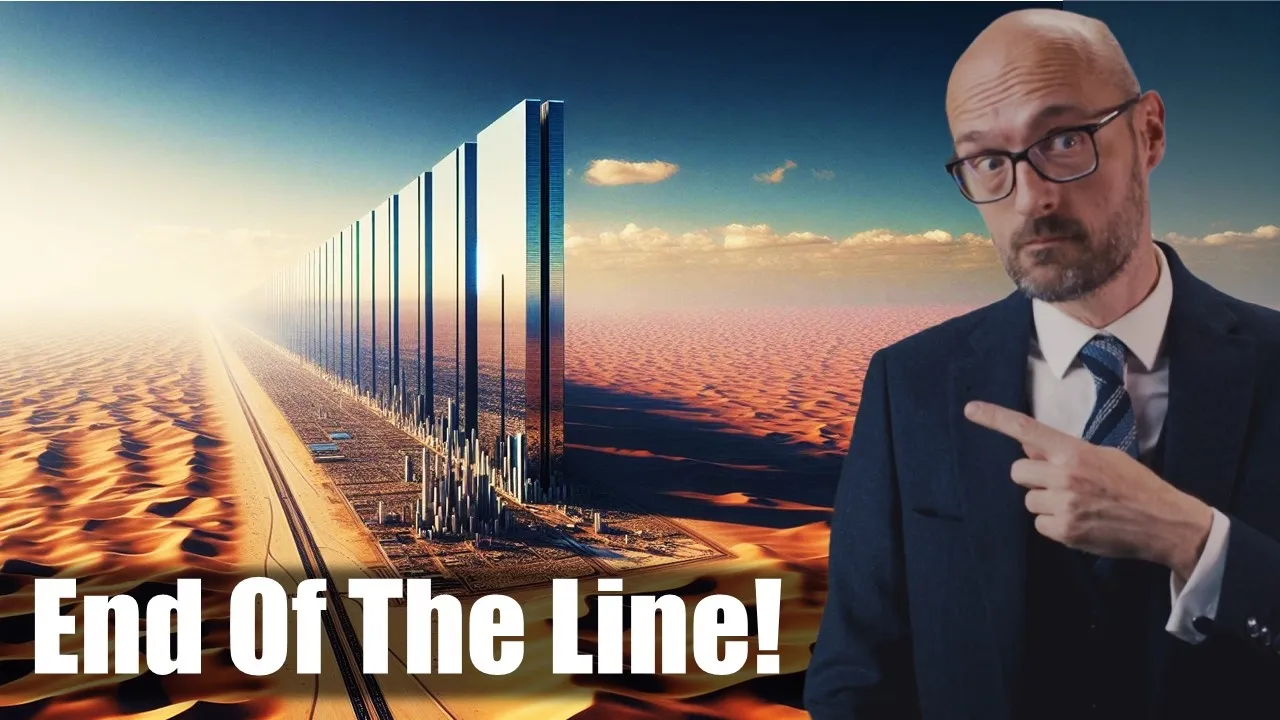
Patrick Boyle
Unrealistic transit physics, multi-trillion-dollar construction costs, and dwindling wealth fund reserves forced Saudi Arabia to reduce The Line to a fraction of its planned scale.
AI-assisted summary of Neom - The Line - The Rise and Fall of Saudi Arabia's Linear City. — original source. Check the original for full context.
Source published:
Key ideas
- Saudi Arabia has drastically scaled back medium-term plans for its linear megacity, The Line, reducing the projected 2030 length from 170 km to just 2.4 km—a 98.6% contraction—while cutting the expected population from 9 million to fewer than 300,000. (3:26)
- Financial strains have mounted as the Public Investment Fund's cash reserves fell to $5 billion as of September, prompting debt issuance, further stake sales in Saudi Aramco, and an unapproved 2024 budget for Neom. (3:26)
- Independent cost analyses reveal massive funding disparities; constructing the exterior mirrored facade alone would require the equivalent of 4,540 Taipei 101 skyscrapers, costing roughly $9.1 trillion against an official budget of only $200 billion to $500 billion. (23:21)
- Environmental researchers from SKEMA Business School warn that constructing The Line will release approximately 1.8 gigatons of CO2, easily negating any long-term operational efficiencies promised by smart-city technology. (29:28)
Detailed notes
## Background This video was published on YouTube by financial commentator Patrick Boyle on April 16, 2024. According to the page description, it covers Saudi Arabia's dramatic scaling back of its ambitious megaproject, "The Line"—a planned 170-kilometer-long mirrored desert city intended for 9 million people that has been curtailed to just 2.4 kilometers and fewer than 300,000 residents amid unapproved 2024 budgets reported by Bloomberg.
## TL;DR Patrick Boyle examines the architectural, physical, and financial absurdities of Saudi Arabia's flagship Vision 2030 megaproject, Neom and The Line. He breaks down how the original 170-kilometer, 500-meter-tall linear city relied on unfeasible engineering concepts—including impossible Mach 3 transit systems and trillions of dollars in exterior wall construction—alongside outlandish consultant proposals like glowing sand and robot dinosaurs. Boyle contrasts the state's utopian green marketing with the harsh realities of strained sovereign wealth reserves, a 98.6% project downscaling, forced tribal evictions, massive upfront carbon emissions, and the Kingdom's historical track record of half-empty master-planned desert cities.
## Atmosphere & style The presentation is marked by Boyle's signature dry, deadpan sarcasm and razor-sharp financial wit. He balances heavy geopolitical and humanitarian reporting with comedic self-preservation jokes, mock-enthusiastically praising autocratic vanity projects while playfully warning himself away from Saudi embassy receptions. Listening to the video feels like an entertaining, unsparing reality check, peeling away glossy promotional CGI to reveal basic mathematical impossibilities and fiscal recklessness.
## Bulletin - [03:26](https://www.youtube.com/watch?v=Ak4on5uTaTg&t=206s) Saudi Arabia has drastically scaled back medium-term plans for its linear megacity, The Line, reducing the projected 2030 length from 170 km to just 2.4 km—a 98.6% contraction—while cutting the expected population from 9 million to fewer than 300,000. - [03:26](https://www.youtube.com/watch?v=Ak4on5uTaTg&t=206s) Financial strains have mounted as the Public Investment Fund's cash reserves fell to $5 billion as of September, prompting debt issuance, further stake sales in Saudi Aramco, and an unapproved 2024 budget for Neom. - [23:21](https://www.youtube.com/watch?v=Ak4on5uTaTg&t=1401s) Independent cost analyses reveal massive funding disparities; constructing the exterior mirrored facade alone would require the equivalent of 4,540 Taipei 101 skyscrapers, costing roughly $9.1 trillion against an official budget of only $200 billion to $500 billion. - [29:28](https://www.youtube.com/watch?v=Ak4on5uTaTg&t=1768s) Environmental researchers from SKEMA Business School warn that constructing The Line will release approximately 1.8 gigatons of CO2, easily negating any long-term operational efficiencies promised by smart-city technology.
## Key takeaways - [00:00](https://www.youtube.com/watch?v=Ak4on5uTaTg&t=0s) Crown Prince Mohammed bin Salman launched The Line as the centerpiece of Vision 2030, proposing a 170-km-long, 500-meter-tall mirrored desert skyscraper designed to house 9 million people. - [03:26](https://www.youtube.com/watch?v=Ak4on5uTaTg&t=206s) Bloomberg revealed a 98.6% reduction in The Line's 2030 targets, scaling back its expected footprint to 2.4 km and population to under 300,000 amid sovereign wealth fund cash crunches. - [06:37](https://www.youtube.com/watch?v=Ak4on5uTaTg&t=397s) Urban planning research shows organic cities expand as fractals to optimize resource interface, making a narrow 170-km linear layout mathematically inefficient and transit-hostile. - [11:49](https://www.youtube.com/watch?v=Ak4on5uTaTg&t=709s) The advertised 20-minute transit time across 170 km is physically impossible with conventional stations; stopping at realistic intervals would require Mach 3 travel speeds and dangerous acceleration rates. - [17:13](https://www.youtube.com/watch?v=Ak4on5uTaTg&t=1033s) Global consulting firms drafted thousands of pages filled with unproven concepts for the project, including robot dinosaurs, glowing sand, cloud seeding, and human genome editing. - [20:28](https://www.youtube.com/watch?v=Ak4on5uTaTg&t=1228s) The project faces severe human rights backlash over the forced eviction of the indigenous Huwaitat tribe, resulting in one death, three death sentences, and lengthy prison terms for dissenting locals. - [23:21](https://www.youtube.com/watch?v=Ak4on5uTaTg&t=1401s) At a height of 500 meters, building both walls of The Line is structurally equivalent to building 4,540 Taipei 101 skyscrapers, which would cost at least $9.1 trillion for the facades alone. - [23:21](https://www.youtube.com/watch?v=Ak4on5uTaTg&t=1401s) Providing adequate electricity for 9 million residents in an arid climate would demand 5,000+ MW, likely requiring four to five commercial nuclear reactors costing upwards of $30 billion to $40 billion. - [27:28](https://www.youtube.com/watch?v=Ak4on5uTaTg&t=1648s) Saudi Arabia's rentier economy remains heavily dependent on hydrocarbons, with oil and gas generating 84% of exports and public sector payrolls supporting two-thirds of employed citizens. - [29:28](https://www.youtube.com/watch?v=Ak4on5uTaTg&t=1768s) Despite bold sustainability claims, IEA figures indicate Saudi renewable energy penetration stands at only 0.1%, while construction emissions for The Line will release 1.8 gigatons of CO2. - [31:46](https://www.youtube.com/watch?v=Ak4on5uTaTg&t=1906s) Saudi Arabia has a history of underperforming desert megacities, such as King Abdullah Economic City, which houses around 10,000 people compared to its original 2-million-resident projection.
## Detailed walkthrough ### [00:00](https://www.youtube.com/watch?v=Ak4on5uTaTg&t=0s) The Grand Vision of Neom and "The Line"
Saudi Arabia's high-profile megaproject, "The Line," was announced as a 170-kilometer-long city cutting across the desert, originally projected to cost $200 billion and house 9 million people. The proposed structure is colossal: 200 meters wide and 500 meters tall—making it taller than most of the world's skyscrapers—situated in an allegedly vacant stretch of arid land. Pitch decks and promotional materials framed it as an ultra-futuristic smart city packed with extreme, science-fiction amenities: an artificial moon, robot dinosaurs, flying cars, human gene editing, and sand engineered to glow in the dark. A report from *The Wall Street Journal* noted that the chosen corner of northwestern Saudi Arabia is so barren that an external consulting team could identify only two abundant natural resources: sunlight and unlimited access to saltwater.
Patrick Boyle wryly notes that while real estate adages claim "location, location, location" are the key variables, location is supposedly only one factor, leaving room for at least two other considerations. Adopting a nervous tone about critiquing the project, Boyle jokes about self-preservation, pointing to the fate of earlier critics who questioned the prudence of pouring half a trillion dollars into an unproven, autocratic desert megaproject. Playing a clip of a commentator warning that “it could bankrupt the country, but no one's allowed to criticize it,” Boyle quips that he might need to keep a low profile, avoid accepting invitations to Saudi embassy receptions—no matter how many Ferrero Rocher chocolates are on offer—and disclaim past videos where he ridiculed the sovereign wealth fund’s lavish spending habits. He jokes that past clips mocking Neom as a city designed to keep residents at the maximum possible distance from their destinations must have been generated by AI, since his channel is strictly devoted to being the premier "crypto nerd gangster rap channel on YouTube."
[03:26](https://www.youtube.com/watch?v=Ak4on5uTaTg&t=206s) The Bloomberg Bombshell: A 98.6% Retraction
Despite the grand rhetoric, the financial and physical realities of the megaproject have caught up with the Kingdom. Bloomberg reported that Saudi Arabia has dramatically scaled back its medium-term ambitions for The Line. The Kingdom’s sovereign wealth fund (the Public Investment Fund, or PIF) had not yet approved Neom’s 2024 budget, as the multi-trillion-dollar scale of Crown Prince Mohammed bin Salman’s Vision 2030 initiative—intended to diversify the Saudi economy away from fossil fuels—began stoking deep concern at the highest levels of government.
According to Bloomberg, the sovereign wealth fund's cash reserves dwindled to $5 billion as of September, marking their lowest reserves since 2020. Consequently, projections for The Line were drastically slashed: rather than extending 170 kilometers and accommodating millions of residents by 2030, the city is now expected to measure just 2.4 kilometers long and house fewer than 300,000 residents by the end of the decade. As Patrick Boyle puts it: “This is a 98.6% reduction from the initial plans so it's still going ahead it'll just be a little bit smaller than had been hoped for.”
- **Original planned length:** 170 kilometers (105.6 miles) - **Revised 2030 length:** 2.4 kilometers (a 98.6% reduction) - **Original population goal:** 9,000,000 residents - **Revised 2030 population target:** Under 300,000 residents - **Initial headline budget:** ~$200 billion (later estimated at $500B to over $1 trillion) - **PIF cash reserves (Sept):** $5 billion (lowest level since 2020)
[05:00](https://www.youtube.com/watch?v=Ak4on5uTaTg&t=300s) Sponsor: DeleteMe
Boyle transitions to a sponsor message for DeleteMe, an online privacy subscription service designed to remove personal information from the open web. He explains that data brokers harvest immense quantities of personally identifiable information—including Social Security numbers, dates of birth, current and prior addresses, and details about family members—to bundle into searchable profiles sold to the public, scammers, and identity thieves. While individuals technically have the legal right to request data removal from these brokers, doing so manually across hundreds of separate registries is deliberately complicated and time-consuming. Boyle highlights that DeleteMe handles the removal requests and follow-ups on the subscriber's behalf, continually monitoring data broker directories so personal records are not quietly relisted.
[06:37](https://www.youtube.com/watch?v=Ak4on5uTaTg&t=397s) Royal Succession, "Figurative" Foundations, and the Shape of Cities
The political engine behind Neom began in 2017, when King Salman reshuffled the Saudi line of succession, bypassing his nephew to appoint his son, Prince Mohammed bin Salman (often abbreviated as MBS, which Boyle jokes usually stands for "mortgage-backed securities"). Just four months after ascending to crown prince, MBS introduced Neom—a name portmanteauing the ancient Greek *neo* (new) and the Arabic *mustaqbal* (future). MBS personally chairs the sovereign wealth fund bankrolling the development.
Promotional materials released on Neom’s official YouTube channel continued to claim rapid progress, boasting the world's largest round-the-clock earthworks operation moving millions of cubic meters of earth and water each week. In the video, a project representative declared, “We've done a lot of the foundation work literally and figuratively we are ready to go.” Official statements had previously maintained that hotels, an airport, and residential facilities would be open to accommodate tourists and residents by early 2024.
Boyle points out the absurdity of the architecture itself: a structure 500 meters high but only 200 meters wide. While skyscrapers throughout human history were constructed on expensive, dense urban plots where high land prices necessitated building vertical density to amortize land costs, Neom sits in an empty desert where land is practically free. Citing academic research on urban geometry by Brinkley and Raj, Boyle notes that organic cities grow as fractals:
```mermaid flowchart TD accTitle: Organic Fractal Urban Growth vs The Line accDescr: Diagram contrasting how natural cities expand as fractals to absorb resources versus Neom's linear structure.
subgraph Fractal["Organic City Growth (Brinkley & Raj)"] A["Core Settlement"] --> B["Resource Interface"] B --> C["Radial Branches / Fractals"] C --> D["Maximizes Access to Water, Arable Land & Trade"] end
subgraph Linear["The Line Megaproject"] E["First Desert Block"] -->|"Questionable location"| F["Next Block Built Further Away"] F --> G["170 km Linear Wall"] G --> H["Maximizes Internal Transit Distance"] end ```
Brinkley and Raj argue that cities behave like biological cells suspended in a growth medium of arable land, branching outward to maximize perfusion, transport efficiency, and resource uptake. By contrast, building a hyper-dense, tall ribbon in an inhospitable desert defies all natural urban mechanics. Boyle jokes that the form makes sense only if you assume the starting location was so undesirable that each subsequent building had to be constructed further away from the last, until the city “would then naturally form a line as it tries to get away from itself.”
[11:49](https://www.youtube.com/watch?v=Ak4on5uTaTg&t=709s) The High-Speed Transit Paradox
The most glaring engineering fantasy of The Line is its internal transit system. Because a 170-kilometer straight line guarantees that residents are located as far as mathematically possible from one another, planners pledged that high-speed rail running through the spine would transport passengers end-to-end in 20 minutes with zero car usage. Boyle analyzes the elementary physics of this claim:
1. **Direct Non-Stop Travel:** Traversing 170 kilometers in 20 minutes without intermediate stops demands a constant velocity of 510 km/h (roughly 317 mph)—faster than the operating speed of any commercial train service on Earth. 2. **Standard Station Spacing:** Urban transit systems like the London Underground or the New York City Subway place stations roughly every quarter of a mile. Spanning The Line’s 105.6 miles at that frequency would require 412 distinct stations. 3. **The Dwell Time Problem:** Even standard subway trains hold their doors open for roughly 30 seconds per stop to let passengers board and alight. Across 412 stations, that dwell time alone totals 206 minutes of stationary waiting time—ten times longer than the promised 20-minute total journey. 4. **The Impossible Scenario:** If dwell times were artificially compressed to an absurd 2 seconds per station, the train would still sit stationary for 14 minutes across the line. That leaves only 6 minutes of travel time to clear the 170-kilometer distance, requiring an operating transit speed of 1,700 km/h (over 1,000 mph)—well past the sound barrier inside a populated residential superstructure.
[13:46](https://www.youtube.com/watch?v=Ak4on5uTaTg&t=826s) The Physics of the Hyperloop and Mach 3 Commuting
Patrick Boyle breaks down the sheer physical absurdity of traveling the entire length of The Line in 20 minutes, noting that achieving such a transit time across multiple stops would require extreme rates of acceleration and deceleration. The top speed would have to exceed 1,000 miles per hour, giving passengers roughly two seconds to board or exit before the train hurtles forward at up to three times the speed of sound, only to slam on the brakes for the next station. As Boyle dryly notes, the loss of blood pressure to the brain during such violent acceleration could trigger G-induced loss of consciousness (G-LOC): “I won't lie to you, it sounds a little bit stressful to me; you'd have to get your seat belt on rather quickly.”
Naturally, the only proposed technology capable of such speeds was Elon Musk's Hyperloop. Neom officially partnered with Hyperloop One in 2020 to bring this vision to life. However, Hyperloop One abruptly shut down just a few months prior, leading Boyle to joke that this minor operational snag is probably what is holding things up at Neom. Even so, he muses that it cannot be that hard to replace, since it is basically “like a tube with an air hockey table.” For his part, Boyle quips that none of this really matters to him, as he intends to get around in one of the autonomous flying cars prominently featured in the promotional materials, advising: “The rest of you should probably just walk.”
Official marketing boasts that residents will have access to all daily necessities within a five-minute walk, which Boyle suspects will be the preferred option anyway to avoid getting stuck in the doors of a supersonic transit tube. When questioned about the plausibility of the project in the *Financial Times*, Neom project advisor Ali Shahabi defended the concept: > “Look, I think you have to go beyond the glitz and the futuristic videos and the hyperbolic language that comes from Western consultants, and I think what Neom has failed to explain properly is that there is substance below this.”
When asked whether he would personally want to live in The Line, Shahabi admitted: > “I'm too old to live in The Line; I think The Line is going to attract Saudis in their 20s and 30s.”
Boyle concurs, joking that enduring Mach 3 acceleration and decelerating to a full stop over 400 times in a single 20-minute journey is very much “a young man's game.”
- **Planned transit specs**: Traveling the full 170-kilometer route in 20 minutes with intermediate stops requires speeds over 1,000 mph (Mach 3). - **Extreme density**: The planned 9 million inhabitants would occupy a land footprint of just 34 square kilometers (13 square miles). - **Density comparison**: Manila holds the current world record for city population density at 119,600 people per square mile; The Line would pack in 686,000 people per square mile—nearly six times that of Manila.
---
[17:13](https://www.youtube.com/watch?v=Ak4on5uTaTg&t=1033s) The Consultant Wishlist: Flying Cabs, Robot Maids, and Glowing Sand
Turning to the internal planning of the city, Boyle references a 2019 report by *The Wall Street Journal*, which reviewed 2,300 pages of strategy documents drafted by major Western consultancies including Boston Consulting Group (BCG), McKinsey & Company, and Oliver Wyman. Under the direction of Crown Prince Mohammed bin Salman (MBS) to turn his grand ideas into reality, these firms assembled proposals packed with speculative or non-existent technologies. These included flying taxis, cloud seeding to generate desert rain, robotic maids, a robotic dinosaur park, and scientists tasked with human gene editing to make residents physically stronger.
```mermaid flowchart TD accTitle: Neom Consultant Speculative Concept Ecosystem accDescr: High-level overview of the technologies and civic proposals included in Neom consultancy documents.
subgraph Tech["Futuristic & Speculative Tech"] A["Autonomous Flying Cars & Cabs"] B["Cloud Seeding for Rainfall"] C["Robotic Dinosaurs & Robot Cage Fighting"] D["Human Genome Editing"] end
subgraph Cityscape["Civic & Urban Features"] E["Glow-in-the-Dark Sand Beach"] F["Giant Artificial Live-Streaming Moon"] G["Holographic School Teachers"] end
subgraph Surveillance["Surveillance & Governance"] H["24/7 Facial Recognition Drones & Cameras"] I["Fully AI-Automated Legal System"] J["Metaverse, Crypto & NFT Marketplace"] end
Tech --> Cityscape Cityscape --> Surveillance ```
The proposals also detailed night-time entertainment featuring robot cage fighting, a giant artificial moon that would illuminate the desert while live-streaming images from outer space, and a beach with glowing sand like the luminescent dial of a wristwatch. Boyle jokes that perhaps the radiation from the glowing sand is intended to handle the gene editing, effectively killing two birds with one stone. Pervasive surveillance via drones, cameras, and facial recognition software would monitor every citizen around the clock to keep everyone safe—a system Boyle ironically notes would eliminate the need for him to record videos, as he could simply live-stream his entire life constantly.
Addressing *The Wall Street Journal's* assertion that relying on foreign consultants highlighted Saudi Arabia's historical lack of urban planning, engineering, and management expertise, Boyle observes mockingly: > “I'll tell you, there's no sign of a lack of those skills in this project plan to me; the rest of the world appears to be lagging behind.”
The planning documents also promised an urban paradise free of work-related stress diseases, with every resident employed at a startup, alongside holographic teachers leading classrooms and open-air farmers markets operating in the middle of the desert.
---
[20:28](https://www.youtube.com/watch?v=Ak4on5uTaTg&t=1228s) Floating Cities, Displacement, and Tourism in an Authoritarian State
Beyond The Line itself, Neom's promotional releases outline an eight-sided floating city on the Red Sea (Oxagon) operating an AI-run judiciary system, alongside an exclusive metaverse platform designed for immersive digital retail, NFT trading, and virtual transport to Mars. The city claims it will run on 100% renewable energy with complete water desalination and natural ventilation microclimates—vital requirements given that Saudi Arabia lacks any permanent lakes or rivers and receives negligible rainfall.
Boyle contrasts these utopian technological fantasies with the grim humanitarian cost documented by international observers. While consultants were designing glowing beaches and metaverse malls, plans were executed to forcibly displace the region's indigenous Huwaitat tribe. Citing reports from *The Guardian*, Boyle highlights that local tribespeople have been violently evicted without fair compensation: - A tribesman was shot dead in 2020 after refusing to surrender his ancestral land for the project. - Three tribesmen who resisted eviction are currently facing execution. - Another three tribal residents received prison sentences ranging from 27 to 50 years.
While the Saudi tourism board presents the region as untouched virgin territory destined to attract international vacationers, Boyle sarcastically questions the appeal of such a destination for typical tourists: > “I know that when I think of a good place to go on holiday, I always search for the most authoritarian theocratic dictatorship in the world, especially when they've built a new city with cameras, drones, and facial recognition technology to allow intelligent services to track everyone at all times to keep them safe, and I'm sure that you feel the same.”
---
[23:21](https://www.youtube.com/watch?v=Ak4on5uTaTg&t=1401s) The Astounding Cost: Comparing The Line to Taipei 101
Boyle turns to the financial engineering behind The Line, ironically praising MBS for negotiating what appears to be an impossible bargain compared to historical infrastructure construction costs. Standing 500 meters high, The Line matches the height of Taiwan's Taipei 101—once the tallest skyscraper in the world, which cost roughly $2 billion to build two decades ago. Because Taipei 101 has a width of 75 meters, it would take 13.3 equivalent towers laid edge-to-edge to construct just one single kilometer of The Line.
Building both parallel walls across the planned 170-kilometer span requires an astonishing volume of structural construction: - **Wall requirements**: 2,270 Taipei 101 equivalents per side, totaling 4,540 full skyscraper equivalents just to form the exterior mirrored facade. - **Estimated wall cost**: At $2 billion per tower, the exterior walls alone would cost roughly $9.1 trillion—assuming building costs have not risen over the past 20 years. - **Excluded interior infrastructure**: This $9.1 trillion estimate completely excludes the internal architecture, transit tubes, floating gardens, desalination plants, sewage treatment works, flying pod networks, and the artificial moon.
| Metric / Structure | Taipei 101 Baseline | The Line Equivalent (170 km) | |:--- |:--- |:--- | | **Height** | ~500 meters | 500 meters | | **Width / Length** | 75 meters wide | 170 km (170,000 meters) | | **Units Needed (Per Wall)** | 1 tower | 2,270 towers | | **Total Towers (Both Walls)**| — | 4,540 towers | | **Cost Estimate (@ $2B/unit)**| $2 billion | $9.1 trillion (facade walls only) |
Providing adequate utilities represents another monumental financial barrier. Boyle estimates that a city of 9 million residents would require at least 5,000 megawatts of electricity per day—likely far higher given the heavy demands of water desalination and constant air conditioning in a desert climate. Using New York City as a point of comparison (which consumes massive power and draws one-third of its supply from four nuclear plants), Boyle suggests that even an hyper-efficient Line would require four to five commercial nuclear reactors. At Synapse Energy's cost estimates of $6 billion to $9 billion per plant, establishing the power grid alone would swallow $30 billion to $40 billion.
```mermaid flowchart LR accTitle: The Line Construction Budget vs Wall Cost Reality accDescr: Bar-style flow comparing the official Saudi budget to the estimated cost of the exterior facade alone.
subgraph OfficialBudget["Official Saudi Estimates"] direction TB B1["Original Budget: $200B"] B2["Revised Estimate: $500B"] end
subgraph RealWorldCost["Exterior Walls Only (4,540 Taipei 101s)"] direction TB W1["Baseline: $9.1 Trillion"] W2["Plus: $30B–$40B Power Plants"] W3["Plus: Desalination, Transit & Interiors"] end
OfficialBudget -.->|"Underfunded by > 95%"| RealWorldCost ```
MBS originally claimed the entire megacity could be completed for $200 billion—less than 2% of Boyle's estimate for just the two outer walls. Although the official budget estimate was later adjusted upward to $500 billion, Boyle points out that popular science creator thunderf00t calculated a realistic total price tag closer to $100 trillion, which would consume the entire gross domestic product of Saudi Arabia for a century. Boyle playfully dismisses such pessimism, concluding that critics fail to account for the economic explosion that will occur once Saudi Arabia pivots from oil to startup incubators and begins exporting carbon-neutral autonomous flying cars.
[27:28](https://www.youtube.com/watch?v=Ak4on5uTaTg&t=1648s) Architectural Skepticism and the "Rentier State" Economy
The ambitious promotional material for Neom promises everything from hologram teachers and NFT trading to video tourism that anticipates drawing more visitors annually than Paris by 2030. British architect Peter Cook, who has worked on the project, offered a much more grounded perspective when questioned about the reality of the construction. He candidly predicted that the development team would merely manage to complete "a bit of it," dismissing the proposed 500-meter height as fundamentally impractical and noting that engineers readily identify the structural foolishness of such verticality. Patrick Boyle contrasts these professional assessments with deadpan irony, observing that an extreme 500-meter height seems just as crucial to a modern development as sand that glows like a watch face or cage-fighting robots.
Beneath these extravagant proposals lies the reality of Saudi Arabia's underlying economic framework. The country functions primarily on fossil fuel exports, with oil and gas driving 84% of exports and representing 42% of gross domestic product. Domestic citizens rarely perform manual labor or work low-tier service jobs, relying instead on millions of imported foreign workers. As a classic neopatrimonial rentier state, the kingdom recycles its resource revenues into public-sector payrolls. Two-thirds of employed Saudi nationals work directly for the government, where men typically earn double the salary of their private-sector counterparts, despite a former civil service minister publicly acknowledging in 2016 that many public employees perform roughly an hour of real work each day.
- Architectural consultant Peter Cook described the proposed 500-meter elevation as “a bit stupid,” noting that “all of our engineer friends will tell you this.” - Saudi Arabia’s national output remains tied to hydrocarbons: oil and gas account for 84% of export value and 42% of GDP. - Public payrolls support 66% of employed Saudi citizens, where male government salaries average double the market rates found in the private sector. - In 2016, Saudi Arabia's Civil Service Minister admitted that many state sector workers average only about one hour of productive work per day.
---
[29:28](https://www.youtube.com/watch?v=Ak4on5uTaTg&t=1768s) Vision 2030, Soaring Debts, and Greenwashing Criticisms
Crown Prince Mohammed bin Salman conceived Vision 2030 to steer the domestic economy away from petroleum dependence and reposition the kingdom as a global center of technological innovation. Beyond spectacle megaprojects like The Line, the strategic initiative promotes increased female workforce participation, broader foreign direct investment, expanded cultural tourism, and educational upgrades designed to foster a knowledge economy. However, the capital expenditures required for these initiatives have severely strained the national treasury. Reports indicate that conventional oil revenues can no longer cover the surging price tags, forcing the state to issue debt and divest tranches of the state oil company, Saudi Aramco, to keep construction capitalized. Domestic consumers have felt the pinch as well: in 2020, authorities raised the value-added tax (VAT) from 5% to 15%, a surcharge locals colloquially dubbed the "Neom tax."
Environmental analysts and academic researchers have labeled Neom's sustainability claims as blatant greenwashing. While the state announced an aggressive target to generate 50% of the country's electricity from renewable energy by 2030, International Energy Agency (IEA) metrics show renewable output stalled at just 0.1% with only six years left to run. Academic analysis from SKEMA Business School determined that constructing The Line will emit roughly 1.8 gigatons of carbon dioxide. The researchers determined that the colossal upfront carbon footprint of raw materials, logistics, and ongoing maintenance completely wipes out any long-term energy efficiencies smart-city technology could ever provide. Further compounding the absurdity of its ecological posturing, Neom was chosen to host the 2029 Asian Winter Games, an endeavor that requires building and chilling an artificial outdoor ski resort directly inside the arid desert.
```mermaid flowchart TD accTitle: The Carbon Balance Paradox of The Line accDescr: Diagram illustrating how construction emissions outweigh future smart city carbon savings.
subgraph Upfront ["High-Impact Phase"] A["Raw Materials Extraction & Transport"] --> C["Massive Construction Footprint"] B["Site Infrastructure & Excavation"] --> C C --> D["1.8 Gigatons CO2 Generated"] end
subgraph Operation ["Theoretical Smart City"] E["Zero-Carbon Operational Tech"] --> F["Speculative Future Savings"] end
D -->|"Heavily Outweighs"| F ```
- Vision 2030 encompasses broader structural reforms, including integrating women into the labor market, courting foreign capital, and expanding secular tourism. - Financial pressure forced the kingdom into borrowing and divesting shares of state oil giant Aramco, alongside hiking the domestic VAT rate threefold from 5% to 15%. - Against an official target of reaching 50% grid power from renewable resources by 2030, IEA records indicate renewable penetration stands at a negligible 0.1%. - SKEMA Business School researchers calculated that building The Line would unleash approximately 1.8 gigatons of CO2, arguing that “while smart cities promise zero carbon thanks to new technologies, their construction, operation, and supply requirements are so environmentally costly that it outweighs any carbon reduction that might be attained in the future.”
---
[31:46](https://www.youtube.com/watch?v=Ak4on5uTaTg&t=1906s) Past Desert Megacities and Track Record Failures
The kingdom has repeatedly attempted to build master-planned urban environments from scratch in an effort to diversify away from energy exports. In 2005, the government unveiled a $30 billion program to construct six brand-new economic cities across the desert. Official forecasts claimed the network would attract international corporate investment, generate over one million private-sector jobs, and deliver an additional $150 billion to gross domestic product.
Of the six planned metropolises, only King Abdullah Economic City (KAEC) reached completion. Rather than housing the 2 million residents promised by state planners, KAEC remains virtually empty with a population lingering around 10,000 people. Skeptics suggest the project only avoided total abandonment because its survival was protected by carrying the moniker of the reigning monarch. Patrick Boyle concludes the overview with dry sarcasm, reassuring the audience that any pessimism regarding Neom originates with outside critics rather than his own evaluation of the speculative linear venture.
- In 2005, Saudi Arabia pledged $30 billion to erect six new desert cities to capture $150 billion in GDP growth and add one million jobs. - Only one site was finished: King Abdullah Economic City, which holds approximately 10,000 residents against an original target of 2 million. - Cynics argue that KAEC only saw completion because it was named in honor of the reigning monarch at the time.
## Notable quotes > [29:28](https://www.youtube.com/watch?v=Ak4on5uTaTg&t=1768s) while smart cities promise zero carbon thanks to new technologies, their construction, operation, and supply requirements are so environmentally costly that it outweighs any carbon reduction that might be attained in the future. — SKEMA Business School researchers
> [13:46](https://www.youtube.com/watch?v=Ak4on5uTaTg&t=826s) I think you have to go beyond the glitz and the futuristic videos and the hyperbolic language that comes from Western consultants, and I think what Neom has failed to explain properly is that there is substance below this. — Ali Shahabi
## Mentioned Neom, The Line, Mohammed bin Salman, Public Investment Fund, Bloomberg, The Wall Street Journal, Financial Times, The Guardian, DeleteMe, Brinkley, Raj, Hyperloop One, Elon Musk, Ali Shahabi, Boston Consulting Group, McKinsey & Company, Oliver Wyman, Oxagon, Huwaitat tribe, Taipei 101, Synapse Energy, thunderf00t, Peter Cook, Saudi Aramco, International Energy Agency, SKEMA Business School, Asian Winter Games, King Abdullah Economic City
## Video description Get 20% off DeleteMe US consumer plans when you go to https://joindeleteme.com/BOYLE and use promo code BOYLE at checkout. For DeleteMe international Plans go to https://international.joindeleteme.com
Saudi Arabia’s plan to build a 170km long, 500m tall, mirrored city in the desert as one of their megaprojects filled with 9 million people has now been curtailed to 2.4km long.
According to Bloomberg, Saudi Arabia’s government has “scaled back its medium-term ambitions” for Neom, of which The Line is the most significant sub-project.
The Saudi government had hoped to have 9 million residents living in "The Line" by 2030, but this has been scaled back to fewer than 300,000, according to the new report.
This curtailment of plans comes as Saudi Arabia has not yet approved the 2024 budget for Neom, according to Bloomberg sources.
Patrick's Books: Statistics For The Trading Floor: https://amzn.to/3eerLA0 Derivatives For The Trading Floor: https://amzn.to/3cjsyPF Corporate Finance: https://amzn.to/3fn3rvC
Ways To Support The Channel Patreon: https://www.patreon.com/PatrickBoyleOnFinance Buy Me a Coffee: https://www.buymeacoffee.com/patrickboyle
Visit our website: https://www.onfinance.org Follow Patrick on Twitter Here: https://twitter.com/PatrickEBoyle
Patrick Boyle On Finance Podcast: Spotify: https://open.spotify.com/show/7uhrWlDvxzy9hLoW0EYf0b Apple: https://podcasts.apple.com/us/podcast/patrick-boyle-on-finance/id1547740313 Google Podcasts: https://tinyurl.com/62862nve
Join this channel to support making this content: https://www.youtube.com/channel/UCASM0cgfkJxQ1ICmRilfHLw/join
[Source](https://www.youtube.com/watch?v=Ak4on5uTaTg)