How Myst Almost Couldn't Run on CD-ROM | War Stories | Ars Technica
Ars Technica
AI-assisted summary of How Myst Almost Couldn't Run on CD-ROM | War Stories | Ars Technica — original source. Check the original for full context.
Source published:
Key ideas
- Cyan developed Myst on HyperCard under severe technical constraints, targeting baseline single-speed (1x) CD-ROM drives capped at 150 KB/s transfer rates and crippling drive-head seek latencies. (7:58)
- To prevent audio buffering dropouts and interface lag, assets were compressed down to 8-bit color (roughly 50 KB per image) and arranged along physical disc spiral tracks by geographic proximity rather than alphabetically. (11:41)
- Despite running over budget and past deadlines on a $250,000 investment, Myst shattered Cyan's optimistic 100,000-unit lifetime goal within months, moving millions of copies and dominating retail charts. (15:21)
- Cyan completed a full circle back to independent development by using Kickstarter crowdfunding for Obduction and Firmament, bypassing traditional publisher gatekeepers and physical retail manufacturing. (21:34)
Detailed notes
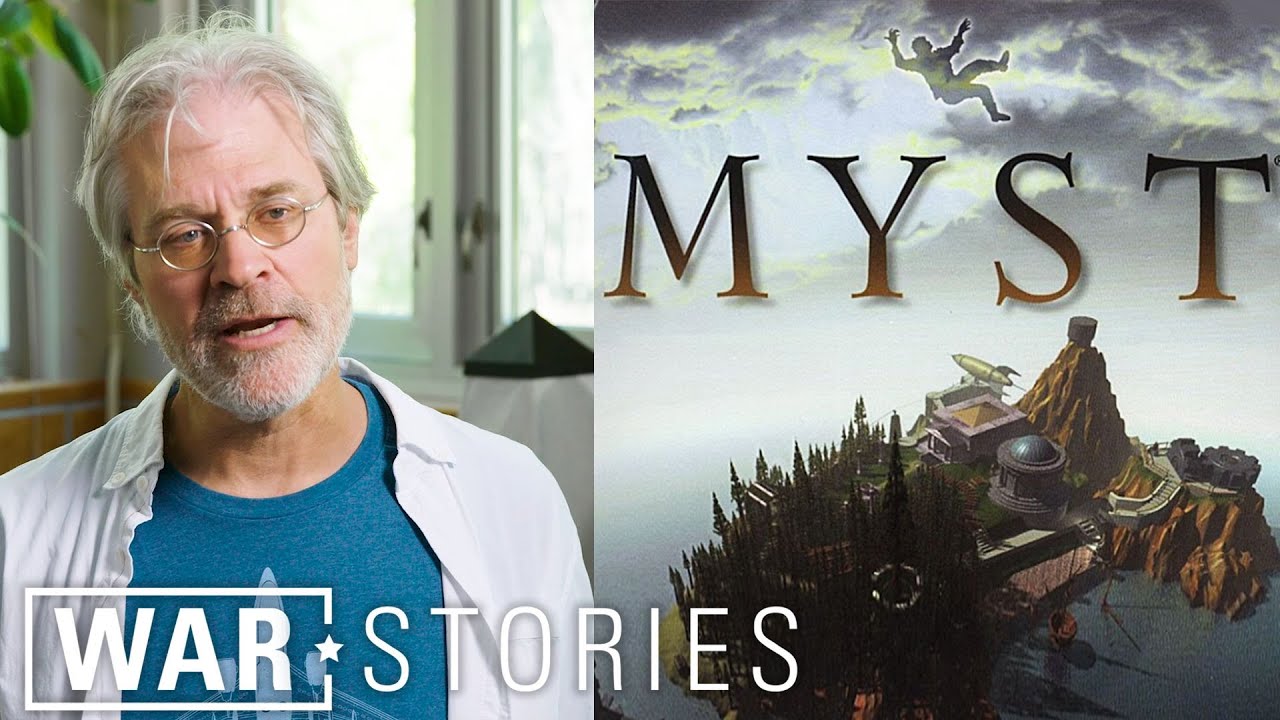
## Background Published by Ars Technica on YouTube on January 28, 2020, as part of their War Stories series, this video features Cyan Worlds co-founder Rand Miller reflecting on the turbulent creation of the landmark adventure game Myst. The feature explores how the HyperCard-developed project nearly foundered under the severe technical restrictions of early optical media, forcing Rand and his brother Robyn to aggressively compress audio and visuals to run on baseline 1x CD-ROM drives.
## TL;DR Rand Miller traces Cyan's evolution from experimental HyperCard children's software like The Manhole and Cosmic Osmo to pitching an ambitious, story-driven adult adventure game backed by Japanese investors. Developing Myst demanded grueling technical workarounds, from hacking black-and-white Mac hardware to output color, to running an ad hoc distributed Mac render queue, to meticulously interleaving 50 KB compressed images and streaming audio along the physical spiral tracks of slow 1x CD-ROM drives. Against the creators' modest expectations, the game became a multi-million-selling cultural phenomenon that eliminated arbitrary puzzle tropes. Miller connects that groundbreaking era to the present day, noting how digital distribution and crowdfunding have allowed Cyan to return to its scrappy indie roots with Obduction and Firmament.
## Atmosphere & style The retrospective has a warm, intimate, and warmly nostalgic tone, framed by Rand Miller's self-deprecating candor and chuckles over the brother duo's youthful naivety. It feels like sitting down with an approachable pioneer who treats seemingly insurmountable technical hurdles as fascinating mechanical puzzles rather than dry engineering chores. The narrative captures the charming grit of garage-era computer development, blending the cozy romance of early Macintosh tinkering with the palpable, high-stakes anxiety of shipping an unproven technological gamble.
## Bulletin - [07:58](https://www.youtube.com/watch?v=EWX5B6cD4_4&t=478s) Cyan developed Myst on HyperCard under severe technical constraints, targeting baseline single-speed (1x) CD-ROM drives capped at 150 KB/s transfer rates and crippling drive-head seek latencies. - [11:41](https://www.youtube.com/watch?v=EWX5B6cD4_4&t=701s) To prevent audio buffering dropouts and interface lag, assets were compressed down to 8-bit color (roughly 50 KB per image) and arranged along physical disc spiral tracks by geographic proximity rather than alphabetically. - [15:21](https://www.youtube.com/watch?v=EWX5B6cD4_4&t=921s) Despite running over budget and past deadlines on a $250,000 investment, Myst shattered Cyan's optimistic 100,000-unit lifetime goal within months, moving millions of copies and dominating retail charts. - [21:34](https://www.youtube.com/watch?v=EWX5B6cD4_4&t=1294s) Cyan completed a full circle back to independent development by using Kickstarter crowdfunding for Obduction and Firmament, bypassing traditional publisher gatekeepers and physical retail manufacturing.
## Key takeaways - [00:00](https://www.youtube.com/watch?v=EWX5B6cD4_4&t=0s) Rand Miller's lifelong fascination with interactive computing began in junior high after encountering a text-based lunar lander simulation on a green CRT screen at the University of New Mexico. - [01:42](https://www.youtube.com/watch?v=EWX5B6cD4_4&t=102s) Cyan was formed by brothers Rand and Robyn Miller, combining Robyn's artistic and musical talent with Rand's software engineering background. - [01:42](https://www.youtube.com/watch?v=EWX5B6cD4_4&t=102s) The studio pivoted from linear digital children's books to world-building with The Manhole, which became one of the earliest interactive entertainment titles released on CD-ROM. - [03:06](https://www.youtube.com/watch?v=EWX5B6cD4_4&t=186s) Apple's HyperCard engine powered Cyan's early output by linking hand-drawn scenes through transparent interactive buttons, pushed to its technical limits in Cosmic Osmo. - [04:29](https://www.youtube.com/watch?v=EWX5B6cD4_4&t=269s) A Japanese investor backed Myst with an approximate $250,000 budget after Cyan submitted a rudimentary seven-page proposal consisting of top-down island maps and handwritten notes. - [04:29](https://www.youtube.com/watch?v=EWX5B6cD4_4&t=269s) Myst deliberately eliminated conventional video game tropes like scores, lives, and death, choosing instead to ground player motivation entirely in environmental narrative and logical world-building. - [06:46](https://www.youtube.com/watch?v=EWX5B6cD4_4&t=406s) To author scenes in full color on an original black-and-white Macintosh SE, the brothers clipped an aftermarket adapter board directly to the processor pins to output to an external color display. - [07:58](https://www.youtube.com/watch?v=EWX5B6cD4_4&t=478s) Cyan enforced a strict two-second interface response rule derived from Rand's banking background, ensuring players never questioned whether the system had frozen. - [10:32](https://www.youtube.com/watch?v=EWX5B6cD4_4&t=632s) Because hardware was slow and rendering locked up active workstations, Cyan created an ad hoc distributed render farm by repurposing older Macs alongside primary workstations during lunch and coffee breaks. - [11:41](https://www.youtube.com/watch?v=EWX5B6cD4_4&t=701s) Optical media seek times required Cyan to physically interleave scene graphics, ambient audio streams, and interactive sound effects close together along the disc's spiral tracks. - [15:21](https://www.youtube.com/watch?v=EWX5B6cD4_4&t=921s) Cyan lacked access to an in-house CD-ROM burner during development, relying on blind faith until publisher Brøderbund pressed and returned the first gold master test disc. - [15:21](https://www.youtube.com/watch?v=EWX5B6cD4_4&t=921s) Myst became a runaway commercial sensation, staying atop sales charts for years despite Rand's estimate that roughly 50% of players never solved the puzzles needed to leave the initial island. - [19:01](https://www.youtube.com/watch?v=EWX5B6cD4_4&t=1141s) In designing Riven, Cyan sought to eliminate disconnected mini-games and arbitrary puzzles, demanding that every challenge emerge organically from the fictional world's culture and machinery. - [21:34](https://www.youtube.com/watch?v=EWX5B6cD4_4&t=1294s) Digital storefronts and crowdfunding platforms revitalized the video game industry by removing physical manufacturing and retail distribution friction, enabling small teams to thrive again.
## Detailed walkthrough ### [00:00](https://www.youtube.com/watch?v=EWX5B6cD4_4&t=0s) Over Budget, Over Time, and Hooked on Computing
Rand Miller, co-creator of *Myst*, looks back on the game's production with astonishment at the sheer stakes they faced. “You'd think that normal people would feel an immense amount of pressure over this,” he laughs, recalling how far behind schedule and past their financial limits the project drifted: “We were way over budget, way over time. I should not have been sleeping at night. There was so much on the line.” The team set out to construct a believable, immersive world, only to slam directly into the technical constraints of early CD-ROM hardware.
Miller’s love for computers originated back in junior high school. A college friend brought him to the University of New Mexico computer center, introducing him to a text-based lunar lander simulation on a green CRT screen. Stripped of visuals, the game merely printed numbers indicating altitude above the lunar surface, velocity, and remaining fuel, followed by a prompt where the user typed in fuel burns until either landing or crashing. For Miller, watching that simple text feedback was pure enchantment. His friend told him, “There are other games, and you can make your own games. This, you write programs to do this.” That realization instantly reshaped his life's ambitions.
[01:42](https://www.youtube.com/watch?v=EWX5B6cD4_4&t=102s) The Origins of Cyan and the Accidental Creation of Worlds
In the mid-1980s, Rand founded Cyan with his brother Robyn. They chose the name because they envisioned a wide-open blue sky that would allow them to explore whatever medium they wanted. Rand initially wrote to Robyn suggesting they create an interactive children's book. Robyn had the artistic and musical talent along with enough computer literacy “to be dangerous,” while Rand supplied the technical programming with enough artistic intuition to match.
Their very first production, *The Manhole*, began with a drawing Robyn made of a manhole cover and a nearby fire hydrant. Instead of advancing to an arbitrary next page, both brothers became curious about what existed inside that scene: what lay underneath the manhole cover, or what secrets the fire hydrant held. Robyn then drew subsequent images—the cover pushed aside revealing an ascending vine, followed by a close-up of the fire hydrant showing a miniature door at its base. Linking these pictures together prompted a revelation: they were no longer illustrating a digital book, but creating a traversable world. *The Manhole* went on to become one of the earliest—if not the first—entertainment titles released on CD-ROM.
```mermaid flowchart LR accTitle: Evolution of Cyan World Design accDescr: Progression from the initial interactive book concept to fully realized adventure game worlds.
subgraph Early["Early Concepts"] A["Interactive Book Idea"] --> B["The Manhole<br/>(Still Images + Invisible Links)"] end
subgraph Expansion["HyperCard Mastery"] B --> C["Cosmic Osmo<br/>(Denser interactivity)"] end
subgraph Maturity["Myst Evolution"] C --> D["Seven-Page Proposal"] D --> E["Myst<br/>(Embedded storytelling & 3D renders)"] end ```
[03:06](https://www.youtube.com/watch?v=EWX5B6cD4_4&t=186s) Pushing HyperCard to its Limits in *Cosmic Osmo*
Cyan followed up with *Cosmic Osmo*, which pushed the mechanics of their core development engine, Apple's HyperCard, to its limits. Rand retains immense affection for the software: “It was so, such an elegant, amazing tool that I don't think Apple understood even how to market that product.” Conceptually, HyperCard acted like an interactive stack of cards: - Authors could place transparent, invisible buttons on top of hand-drawn art. - Clicking an invisible hit-target transported the user to a completely different card (such as a detailed close-up of an object). - Branching card links formed the underlying architecture of Cyan's exploratory games.
HyperCard allowed Cyan to make every corner of *Cosmic Osmo* interactive. Rand remarks that he would still be developing in HyperCard today if it were still supported.
[04:29](https://www.youtube.com/watch?v=EWX5B6cD4_4&t=269s) The Pitch: Japanese Backing, $250,000, and *The 7th Guest*
Impressed by *The Manhole*, a Japanese company reached out to Cyan asking if the brothers could develop and pitch an interactive game tailored for an older audience. Rand and Robyn immediately accepted: “Oh, hell yeah. We can do something for an older audience, you bet.” Lacking any formal experience in corporate game pitching, their proposal totaled roughly seven pages, made up of top-down island maps scribbled over with hand-written functional notes.
Cyan asked for a budget of approximately $250,000. During negotiations, the Japanese financiers asked if the project could rival or surpass *The 7th Guest*, an unreleased CD-ROM title that was generating heavy media buzz via technical preview reels. Rand and Robyn gave an enthusiastic guarantee: “Oh yeah, yeah, you bet.”
Building a game for mature players led them to incorporate cohesive narrative threads. In their previous whimsical software, items did not require underlying lore, but realistic exploration demanded logical narrative weight: - “Catherine, my love, I have to leave quickly. Something terrible has happened.” (In-game dramatic message excerpt). - “They kept the world somehow realistic because everything in the real world has a story to it. It's there for a reason.” - Traditional video game crutches were abandoned: players did not lose lives, gain levels, or restart on failure. - Delivering acceptable play value required vast environments built by sheer brute force, which ruled out floppy disks and made CD-ROM adoption mandatory.
[06:46](https://www.youtube.com/watch?v=EWX5B6cD4_4&t=406s) 3D Rendering and Color Hardware Hacks
A pivotal milestone occurred when the team acquired early 3D rendering software. Rand and Robyn experimented by laying out a basic wireframe sphere and a table beneath a simulated light source. Hitting the "Render" button generated photorealistic shadows, reflections, and light bending through glass refraction. This breakthrough meant graphics no longer required hand drawing; they could be rendered directly into full-color scenes.
*Myst* was designed exclusively for color systems, without any black-and-white fallback mode. This presented an immediate hurdle because Robyn’s own machine was an early black-and-white Macintosh SE. To work in color, they had to modify the hardware: - The case back was detached to reveal the processor. - A third-party adapter board clipped directly onto the processor pins. - This hardware hack allowed the black-and-white Mac to output video signals to an external color monitor.
[07:58](https://www.youtube.com/watch?v=EWX5B6cD4_4&t=478s) The CD-ROM Bottleneck: 150 KB/s, Seek Times, and "Working in Mud"
Targeting standard consumer setups posed immense technical risks. The baseline platform was the single-speed (1x) CD-ROM drive: - Streaming throughput peaked at a mere 150 KB per second. - Excessive drive head seek times posed an even larger barrier than raw transfer speed. - Double-speed drives were costly luxuries, and quad-speed hardware had not yet reached the consumer market. - Cyan committed to making the game run on entry-level multimedia machines rather than demanding high-end rigs.
Neither brother knew whether switching scenes would feel fluid or grind to an unplayable halt. Rand applied an interface rule he remembered from his previous career in banking: “Two seconds is how long you want people to wait before they get feedback from clicking something on the screen or from hitting a button on the screen.” Past two seconds, users begin questioning whether the system froze or if they made an error.
Testing was almost impossible during early development because standalone CD-ROM burners cost thousands of dollars. Cyan did not own a burner and had to rely on sporadic access through their publisher, Brøderbund, well after production was underway. The brother's workflow was brute-force: Robyn modeled and rendered full-color images on his Mac at home, passed the files over to Rand, and Rand scripted the navigation links inside HyperCard. Even with high-end Macs packed with maximum RAM and massive hard drives for the era, the system strain was severe: “And we were still working in mud. It was incredibly slow.”
[10:32](https://www.youtube.com/watch?v=EWX5B6cD4_4&t=632s) The Distributed Mac Rendering Queue
Creating the visuals for *Myst* required relentless computer processing, especially on Robyn Miller's side as he modeled and rendered 3D scenes. Whenever Apple released a new computer model that Cyan could scrape together enough money to afford, they eagerly purchased it to bolster their hardware fleet. Robyn could not actively work on 3D modeling while a machine was tied up rendering, so he stacked his rendering jobs into a queue. Whenever a newer Mac was purchased, the older machine was shifted to the side to chew through that queue.
As their setup expanded, any downtime was immediately harnessed for rendering. If Robyn stepped away from his desk to grab a bite of dinner or a cup of coffee, the brothers immediately initiated renders on his primary workstation, combining it with the two secondary computers. By cobbling together whatever Macs were physically available into an ad hoc distributed rendering farm, they kept the queue running around the clock. As Rand Miller reflects on the grueling rendering bottleneck, “Everything had to be rendering all the time in order to try to get this work done.”
- **Hardware recycling:** Older Macintosh computers were repurposed exclusively as dedicated background rendering units whenever new hardware was purchased. - **Workflow optimization:** Scenes were batched and queued during active modeling sessions, then rendered simultaneously across all available desktop computers whenever desks were vacant.
```mermaid flowchart TD accTitle: Myst Distributed Rendering Workflow accDescr: Diagram illustrating how Robyn Miller's modeling queue was distributed across multiple Apple Mac computers during active work and breaks.
subgraph Workstation["Robyn's Workstation"] A["3D Scene Modeling"] --> B["Image Render Queue"] end
subgraph Farm["Distributed Render Queue"] C["Dedicated Mac #1"] D["Dedicated Mac #2"] E["Robyn's Main Mac (During Breaks)"] end
B --> C B --> D B -.->|"when away from desk"| E ```
[11:41](https://www.youtube.com/watch?v=EWX5B6cD4_4&t=701s) CD-ROM Constraints: Disc Spiral Layout and Data Streaming
Navigating harsh technical limitations defined the entire development process. Rather than feeling discouraged by hardware barriers, Rand viewed them as puzzles to crack. As Rand Miller puts it, “Living within constraints is probably, it's like the name of the game for what we did.” He explains that developers must embrace this mindset: “I mean, if you're not a good problem solver, you just go do something else.” The core challenge boiled down to two mechanical realities: locating the necessary assets on the CD-ROM and transferring them off the optical disc as fast as possible. Consumer hardware at the time restricted the game to 8-bit color displays, allowing only 256 colors on screen simultaneously. Cyan used this 256-color palette limitation alongside an image compression algorithm to shrink each image down to roughly 50 kilobytes, enabling fast streaming.
Physical disc geometry dictated the asset structure. Because optical drive read-heads suffered massive latency penalties when seeking across tracks, files could not simply be dumped onto the disc alphabetically. Cyan meticulously mapped assets onto the spiral tracks based on geographic proximity within each Age, placing adjacent scenes near one another on the physical medium. Audio presented an even tighter bottleneck. Ambient music and environmental sounds streamed continuously in the background, but if the read-head had to jump across the disc to fetch the next pre-rendered background image, the audio buffer risked emptying, causing the sound to stutter or drop out completely. Interactive sound effects—such as a button clunking, a door squeaking, or a generator whining up to speed—also had to be positioned close to the visual assets on the physical spiral to fire instantly without stalling playback.
- **Image footprint:** Visual assets were capped at 8-bit color (256 colors) and compressed down to roughly 50 KB each to stream across single-speed (1x) CD-ROM drives. - **Spiral placement:** Assets were clustered physically by Age and spatial proximity rather than named alphabetically, minimizing mechanical seek times. - **Audio buffering:** Continuous background audio tracks and one-shot sound effects had to be interleaved near the scene images so the drive head could fill audio buffers without interrupting playback.
[15:21](https://www.youtube.com/watch?v=EWX5B6cD4_4&t=921s) The Gold Master Test and Runaway Retail Success
After years of fine-tuning based on instinct and technical experience, Cyan copied their project onto a hard drive and shipped it south to Brøderbund to press the very first gold master CD-ROM of *Myst*. When the disc arrived back at the studio, the team popped it into their CD drives, clicked play with crossed fingers, and discovered that the game worked smoothly. In hindsight, Rand believes their sheer inexperience protected them from paralyzing anxiety. As Rand Miller observes, “Normal people should have been medicating themselves over, but we didn't have this really weird naivety that just kept us oblivious to the distractions of the fact that this might not work at all.” During development, the brothers had joked about reaching an unattainable sales target: “Robyn and I had discussions where we said, 'Man, if we sell 100,000 copies, can you imagine if we sold 100,000 copies of this game?'”
Following the game's release, Rand took a five-week vacation to New Mexico. While browsing a media retailer in Albuquerque to see if the game was even in stock, he found *Myst* dominating the back of the store, spread across the entire top shelf of the video game section. The title blew past their 100,000-copy milestone in a matter of months, locked down the number-one spot on sales charts, and remained on best-seller lists for years, moving multiple millions of units. Rand estimates that roughly half of all purchasers never even solved the puzzles required to escape Myst Island, yet the game's atmospheric magic and tantalizing story left an enduring mark on players and their families.
- **Sales milestone:** Cyan hoped the game might reach 100,000 copies total; it cleared that benchmark in mere months and went on to sell multi-millions. - **Completion rate:** Rand estimates that only about 50% of players ever managed to solve the initial puzzles and leave Myst Island.
[19:01](https://www.youtube.com/watch?v=EWX5B6cD4_4&t=1141s) Designing Riven and the Shift Away from Indie Development
Cyan viewed *Myst* as an evolving experiment that laid the technical and narrative groundwork for its sequel, *Riven*. On *Myst*, budget constraints forced compromises, but the team noticed that the strongest moments occurred later in the game, where the narrative emerged naturally through the environment and inhabitants. For *Riven*, Cyan set out to abandon arbitrary puzzle design, such as unrelated chess games or standalone mini-games seen in titles like *The 7th Guest*. Instead, every puzzle had to be an organic extension of the world's culture and machinery. As Rand Miller explains, “And the puzzles needed to feel like they were part of the history of this place.”
This transition marked a turning point in the broader video game industry. Cyan had started out as an intimate two-brother indie team capable of producing world-class projects on their own. However, game development soon shifted toward massive budgets provided by large corporate publishers, making small-scale independent projects increasingly difficult to fund. While Cyan’s massive earnings from *Myst* secured their financial independence and allowed them to build *Riven* on their own terms, Rand watched with mixed emotions as the barrier to entry climbed across the medium.
- **Narrative integration:** *Riven* aimed to integrate puzzles directly into world history and character actions, rejecting standalone, arbitrary puzzles. - **Industry transformation:** The rise of multi-million-dollar production budgets pushed game creation away from bedroom indies and into the hands of corporate publishers.
[21:34](https://www.youtube.com/watch?v=EWX5B6cD4_4&t=1294s) The Rebirth of Indie Development and Cyan's Full Circle
Rand Miller reflects on how the video game industry temporarily lost touch with the raw innovation pioneered by scrappy garage developers during the era when physical retail dominated the market. For years, launching a game required massive capital: companies had to physically press compact discs, manufacture packaging, manage warehouse stock, navigate complex logistics chains, and secure prime placement on brick-and-mortar store shelves. The advent of the internet and digital distribution fundamentally disrupted that barrier to entry. By removing the overhead of physical media and retail distribution, digital platforms allowed tiny two-person setups to flourish once again, echoing the way Rand and Robyn originally started out. As Rand fondly puts it: “And I love that. That's, to me, that whole indie rise again has kind of reinvigorated the industry, and I love what that's done.”
```mermaid flowchart TD accTitle: Evolution of Game Distribution and Independence accDescr: Diagram contrasting traditional retail distribution friction with modern digital crowdfunding and direct distribution models.
subgraph RetailModel ["Traditional Retail Bottlenecks"] A["Garage Creators"] --> B["Publisher Financing"] B --> C["Pressing CDs & Stock"] C --> D["Retail Shelf Distribution"] end
subgraph ModernModel ["Digital & Crowdfunded Independence"] E["Small Indie Teams<br/>(1 Artist + 1 Programmer)"] --> F["Digital Downloads & Direct Delivery"] G["Community / Kickstarter"] --> H["Cyan Worlds: Obduction & Firmament"] end ```
For Cyan Worlds, this modern shift represents a complete full circle, freeing the studio from relying on traditional publishers to greenlight their creative visions. Instead of seeking corporate backing, Cyan turned directly to its audience through crowdfunding platforms to finance their titles *Obduction* and *Firmament*. Rand notes that returning to the Kickstarter well carries intense pressure because fans are pledging their own money on the promise of an original concept, yet it grants the team the creative autonomy to pursue brand-new ideas. Even at age 60, Rand finds himself engaged in the exact same forward-looking technical gamble that defined *Myst*: trying to forecast where technology and player expectations will sit two years down the road. Addressing that creative uncertainty, Rand concludes: “With the same struggle, fighting the same battles, and having to realize in my mind that I'm not, I may not get it right, but again, that's just how it is, and it's okay.”
- The elimination of physical manufacturing (pressing discs, storing inventory, shipping to retail shelves) enabled small teams consisting of just an artist and a programmer to emerge and thrive again. - Cyan leveraged crowdfunding on Kickstarter twice to bypass traditional publishers, first for *Obduction* and subsequently for *Firmament*. - Decades after the launch of *Myst*, the fundamental challenge remains unchanged: attempting to predict technical and creative landscapes years in advance while embracing the inherent risk of the unknown.
## Notable quotes > [07:58](https://www.youtube.com/watch?v=EWX5B6cD4_4&t=478s) Two seconds is how long you want people to wait before they get feedback from clicking something on the screen or from hitting a button on the screen. — Rand Miller
## Mentioned Rand Miller, Robyn Miller, Cyan Worlds, Myst, Riven, The Manhole, Cosmic Osmo, The 7th Guest, Obduction, Firmament, HyperCard, Apple, Macintosh SE, Brøderbund, University of New Mexico, Kickstarter
## Video description Cyan Worlds co-founder Rand Miller goes behind the scenes of the development of one of the best selling PC games of all time, Myst. The HyperCard-developed title ran into some snags when trying to run on the CD-ROM format. "I had a really powerful Mac, with a lot of memory and a lot of hard drive space, and we were still working in mud," said Rand, discussing the game's performance early-on. Rand and his brother, Robyn, compressed the image and audio data as much as they could so the game could run smoothly on 1x CD-ROM drives.
Connect with Ars Technica: Visit ArsTechnica.com: http://arstechnica.com Follow Ars Technica on Facebook: https://www.facebook.com/arstechnica Follow Ars Technica on Google+: https://plus.google.com/+ArsTechnica/videos Follow Ars Technica on Twitter: https://twitter.com/arstechnica
How Myst Almost Couldn't Run on CD-ROM | War Stories | Ars Technica
[Source](https://www.youtube.com/watch?v=EWX5B6cD4_4)