Jobs Defends OpenDoc Scrapping, Puts Customer Experience Over Tech
Mike Cane
A sustainable product turnaround requires starting from the customer experience and working backward to the technology, demanding painful software cuts to build a viable multibillion-dollar business.
AI-assisted summary of Steve Jobs Insult Response — original source. Check the original for full context.
Source published:
Key ideas
- Steve Jobs responded to an attendee's public insult regarding the cancellation of OpenDoc by outlining a product philosophy centered on customer experience over raw technical capability. (0:01)
- Jobs articulated that successful products must start with the customer experience and work backward to the technology, rather than developing tech in isolation and searching for a market. (1:48)
- Reflecting on company revitalization, Jobs noted that key Apple engineers and executives were resisting headhunters offering triple their salaries to stay and rebuild the platform. (3:48)
- Jobs defended painful product cancellations by arguing that decisive leadership and making correctable mistakes is far preferable to organizational paralysis. (3:48)
Detailed notes
## Background Published on YouTube by Mike Cane on June 9, 2011, this video captures Steve Jobs' response to a barbed audience question at Apple's 1997 Worldwide Developers Conference (WWDC). According to the video description, the exchange was published for an educational blog post regarding an insult that originated from an earlier inquiry, with comments ultimately disabled due to contentious user debates.
## TL;DR When an attendee bluntly insults Steve Jobs over the cancellation of OpenDoc and questions his technical competence, Jobs uses the moment to articulate Apple's high-level product strategy. He argues that companies must start with the customer experience and work backwards to the technology, rather than building impressive engineering demos without a viable business model. Drawing on the breakthrough success of the LaserWriter, Jobs accepts responsibility for past mistakes and the painful casualties of corporate restructuring. He concludes by passionately defending Apple's dedicated engineering team—who stayed despite lucrative outside offers—and rallies developers to support the company's turnaround.
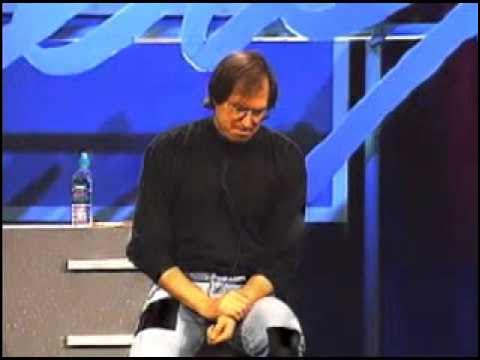
## Atmosphere & style The exchange begins with palpable tension and stunned, nervous laughter across the auditorium as the audience member delivers a direct personal attack. Jobs dramatically slows the room's tempo, taking a deliberate sip of water and maintaining measured composure before responding with disarming self-deprecation. The dynamic steadily shifts from an awkward, hostile confrontation into a masterclass in poise and strategic clarity, culminating in an earnest, rallying appeal that reframes corporate survival around human dedication.
## Bulletin - [00:01](https://www.youtube.com/watch?v=FF-tKLISfPE&t=1s) Steve Jobs responded to an attendee's public insult regarding the cancellation of OpenDoc by outlining a product philosophy centered on customer experience over raw technical capability. - [01:48](https://www.youtube.com/watch?v=FF-tKLISfPE&t=108s) Jobs articulated that successful products must start with the customer experience and work backward to the technology, rather than developing tech in isolation and searching for a market. - [03:48](https://www.youtube.com/watch?v=FF-tKLISfPE&t=228s) Reflecting on company revitalization, Jobs noted that key Apple engineers and executives were resisting headhunters offering triple their salaries to stay and rebuild the platform. - [03:48](https://www.youtube.com/watch?v=FF-tKLISfPE&t=228s) Jobs defended painful product cancellations by arguing that decisive leadership and making correctable mistakes is far preferable to organizational paralysis.
## Key takeaways - [00:01](https://www.youtube.com/watch?v=FF-tKLISfPE&t=1s) An attendee at WWDC 1997 challenged Steve Jobs, asserting he didn't know what he was talking about regarding Java replacing OpenDoc and questioning his past seven years. - [00:01](https://www.youtube.com/watch?v=FF-tKLISfPE&t=1s) Jobs conceded that OpenDoc may have excelled at specific technical tasks, but emphasized that individual features must fit into a cohesive commercial strategy moving billions of dollars in product. - [01:48](https://www.youtube.com/watch?v=FF-tKLISfPE&t=108s) A foundational tenet of Jobs' product management strategy is starting with customer needs and experience, then working backward to assemble the required technology. - [01:48](https://www.youtube.com/watch?v=FF-tKLISfPE&t=108s) Jobs warned against the common engineering trap of building impressive technology first without knowing how or to whom it will be sold. - [01:48](https://www.youtube.com/watch?v=FF-tKLISfPE&t=108s) Admitting his own past mistakes, Jobs cited 'scar tissue' from previous attempts to lead with technology rather than consumer utility. - [01:48](https://www.youtube.com/watch?v=FF-tKLISfPE&t=108s) The development of the LaserWriter demonstrated that customer adoption is driven by visible end-user value—the quality of the printed sheet—rather than the internal hardware complexity. - [03:48](https://www.youtube.com/watch?v=FF-tKLISfPE&t=228s) Jobs openly apologized for the cancellation of OpenDoc and self-deprecatingly acknowledged his own gaps in knowledge to defuse personal attacks. - [03:48](https://www.youtube.com/watch?v=FF-tKLISfPE&t=228s) Apple's survival depended on decisive leadership that cuts underperforming projects, accepting that mistakes will occur as long as they can be caught and corrected. - [03:48](https://www.youtube.com/watch?v=FF-tKLISfPE&t=228s) Key Apple leaders like Avie Tevanian, Jon Rubinstein, Guerrino De Luca, and Fred Anderson were working tirelessly to stabilize and advance the platform. - [03:48](https://www.youtube.com/watch?v=FF-tKLISfPE&t=228s) Despite lucrative external offers offering up to triple compensation, Apple's core engineering staff chose to stay committed to the company's turnaround. - [03:48](https://www.youtube.com/watch?v=FF-tKLISfPE&t=228s) Jobs urged the developer community to support Apple's hardworking team by building outstanding commercial applications for the market.
## Detailed walkthrough ### [00:01](https://www.youtube.com/watch?v=FF-tKLISfPE&t=1s) The OpenDoc Confrontation
At the 1997 Apple Worldwide Developers Conference (WWDC), an audience member steps up to the microphone with a sharply worded attack against Steve Jobs. After an ironic preamble calling Jobs "a bright and influential man," the attendee bluntly asserts: “sad and clear that on several counts you've discussed you don't know what you're talking about.” He challenges Jobs to articulate exactly how Java, in any form, could possibly encompass or address the technical concepts embodied by OpenDoc—a compound-document framework Apple had recently canceled. To drive the personal jab home, the speaker finishes with a biting parting shot: “and when you're finished with that perhaps you could tell us what you personally have been doing for the last seven years.” The direct insult prompts gasps and nervous laughter across the auditorium.
Jobs sits silently on stage for several moments, pausing to collect his thoughts while sipping water. Breaking the tension, he softly quotes an old aphorism: “you know you can please some of the people some of the time.” Rather than retaliating defensively, Jobs acknowledges that when driving transformation, critics often possess valid points on narrow technical grounds. He concedes that OpenDoc likely accomplished specialized tasks better than any existing software, and that engineers could easily build proof-of-concept demos or minor commercial utilities to showcase its strengths. However, Jobs frames the overarching challenge as something far broader: determining how an individual technology fits into a coherent business strategy capable of moving eight to ten billion dollars in product every year.
```mermaid flowchart TD accTitle: Technology-First vs Customer-First Strategy accDescr: A comparison contrasting starting with engineering against starting with customer needs and working backward.
subgraph FlawedApproach ["Flawed Strategy: Technology-First"] A["Sit down with engineers"] --> B["Identify awesome technology"] B --> C["Try to figure out where to sell/market it"] end
subgraph JobsApproach ["Jobs' Strategy: Customer-First"] D["Define customer experience & incredible benefits"] --> E["Work backward to identify required tech"] E --> F["Integrate into $8B-$10B cohesive product vision"] end ```
[01:48](https://www.youtube.com/watch?v=FF-tKLISfPE&t=108s) Working Backward from the Customer Experience
Jobs pivots the confrontation into a foundational philosophy of product management and design: “one of the things I've always found is that you've got to start with the customer experience and work backwards to the technology.” He warns against the inverse trap—sitting down with engineers, admiring impressive technical capabilities, and then scrambling to figure out who will buy it. Admitting his own past hubris, Jobs remarks: “I've made this mistake probably more than anybody else in this room and I've got the scar tissue to prove it and I know that it's the case.”
To illustrate how technology serves the customer experience, Jobs recalls the development of the original LaserWriter: - Apple had assembled top-tier components inside the box, including the first low-cost Canon laser engine in the United States, a custom in-house printer controller, Adobe PostScript software, and built-in AppleTalk networking. - When the very first printed sheet emerged from the device in 1984, the technical complexity inside the chassis became secondary. - Jobs remembers picking up the page and realizing: “we can sell this because you don't have to know anything about what's in that box all we have to do is hold this up and go do you want this?” - The dramatic leap in output quality elicited an immediate "wow" from onlookers, underscoring that the visible end-user benefit is what drives adoption.
[03:48](https://www.youtube.com/watch?v=FF-tKLISfPE&t=228s) Rebuilding Apple and Rallying Behind the Team
Returning to Apple's contemporary crisis, Jobs directly addresses the hard decisions facing the company: “and that's where Apple's got to get back to and you know I'm sorry that OpenDoc is a casualty along the way and I readily admit there are many things in life that I don't have the faintest idea what I'm talking about so I apologize for that too.” He explains that decisive leadership inevitably produces pain points, but standing still is fatal. While certain technologies get cut and missteps will happen, moving forward requires bold execution.
Jobs points to the Apple team—naming executives like Avie Tevanian, Jon Rubinstein, Guerrino De Luca, and Fred Anderson alongside hundreds of engineers working under them—who were burning the midnight oil to revitalize the platform. Even though the Silicon Valley tech market was booming and headhunters offered employees up to three times their salary to jump ship, none of them were walking away. Jobs implores the developer community to rally behind these workers, fix the mistakes as they arise, and build exceptional software: “I think we need to support them and see them through this and write some damn good applications to support Apple out in the market.” Concluding his response, Jobs accepts that feelings will be hurt, but maintains that the current path of decisive action is infinitely better than the stagnation of the past.
- Steve Jobs publicly acknowledges and apologizes for his own gaps in knowledge, using self-deprecation to defuse the insult. - Key Apple leadership cited for their dedication: Avie ("Obi") Tevanian, Jon Rubinstein, Guerrino ("Gino") De Luca, and Fred Anderson. - Apple employees were turning down lucrative external offers paying triple their current compensation to remain and rescue the company. - Jobs emphasizes that making mistakes is acceptable because it proves decisions are actually being made, which can subsequently be detected and corrected.
## Notable quotes > [01:48](https://www.youtube.com/watch?v=FF-tKLISfPE&t=108s) you've got to start with the customer experience and work backwards to the technology. — Steve Jobs
## Mentioned Steve Jobs, OpenDoc, Java, Apple, LaserWriter, Canon, Adobe PostScript, AppleTalk, Avie Tevanian, Jon Rubinstein, Guerrino De Luca, Fred Anderson, WWDC
## Video description Steve Jobs at the 1997 WWDC. This is the question that contains an insult based on a question asked by someone else about 45 minutes earlier. See the first video of this series. Copyright Fair Use provisions invoked as this is for an educational blog posting at http://mikecanex.wordpress.com
I originally allowed Comments. Over time, it became a war zone that was taking too much time to moderate. So, no more Comments. I have better things to do with my time and the people who want to go to war apparently have nothing better to do with *their* time.
[Source](https://www.youtube.com/watch?v=FF-tKLISfPE)