Eratosthenes Calculates 40,000-Km Earth Circumference With Sun Shadows
carlsagandotcom
Comparing midday solstice shadows between Alexandria and Syene proves the Earth's surface curves, allowing basic geometry to determine planetary circumference within a few percent of modern measurements.
AI-assisted summary of Carl Sagan - Cosmos - Eratosthenes — original source. Check the original for full context.
Source published:
Key ideas
- In the 3rd century BC, Eratosthenes used simple observations of solar shadows to prove the Earth's surface is curved and calculate its circumference. (0:08)
- By noting that the sun stood directly overhead at Syene while casting a distinct shadow in Alexandria at the same moment on the summer solstice, Eratosthenes measured an angular disparity of approximately 7°. (1:33)
- Using an overland paced distance of 800 kilometers and an angular difference representing roughly 1/50th of a circle, he calculated Earth's circumference to be 40,000 kilometers with an error of only a few percent. (4:11)
Detailed notes
## Background Published on YouTube by the channel carlsagandotcom on April 24, 2009, this clip features an excerpt from Carl Sagan's television series Cosmos. The upload is simply titled and described as "Carl Sagan - Cosmos - Eratosthenes," highlighting the ancient scholar's historic breakthrough.
## TL;DR Standing near an ancient stone tower west of Alexandria, Carl Sagan recounts how 3rd-century BC scholar Eratosthenes deduced the curvature of the Earth and calculated its circumference. Prompted by an account of sunlight falling directly into deep wells without casting shadows in Syene on the summer solstice, Eratosthenes discovered that vertical sticks in Alexandria did cast measurable shadows at the very same moment. Recognizing that parallel sunlight hitting a curved surface explained this disparity, he measured an angular difference of approximately 7 degrees—roughly 1/50th of a full circle. By pacing out the 800-kilometer distance between the two cities and scaling it up, Eratosthenes arrived at a planetary circumference of 40,000 kilometers, achieving remarkable accuracy using only simple observations and geometric logic.
## Atmosphere & style Carl Sagan delivers the narrative with his signature sense of poetic awe, intellectual warmth, and accessible scientific precision, speaking from an evocative Mediterranean coastal setting. The presentation transforms mundane elements like sticks, shadows, and reflections in wells into a profound testament to human curiosity and empirical deduction. It feels contemplative, educational, and deeply inspiring, celebrating how basic tools paired with a zest for experiment unlocked the scale of our planet over two millennia ago.
## Bulletin - [00:08](https://www.youtube.com/watch?v=G8cbIWMv0rI&t=8s) In the 3rd century BC, Eratosthenes used simple observations of solar shadows to prove the Earth's surface is curved and calculate its circumference. - [01:33](https://www.youtube.com/watch?v=G8cbIWMv0rI&t=93s) By noting that the sun stood directly overhead at Syene while casting a distinct shadow in Alexandria at the same moment on the summer solstice, Eratosthenes measured an angular disparity of approximately 7°. - [04:11](https://www.youtube.com/watch?v=G8cbIWMv0rI&t=251s) Using an overland paced distance of 800 kilometers and an angular difference representing roughly 1/50th of a circle, he calculated Earth's circumference to be 40,000 kilometers with an error of only a few percent.
## Key takeaways - [00:08](https://www.youtube.com/watch?v=G8cbIWMv0rI&t=8s) Carl Sagan introduces Eratosthenes at an ancient stone tower west of Alexandria that served as a navigational beacon or communication post. - [00:08](https://www.youtube.com/watch?v=G8cbIWMv0rI&t=8s) Eratosthenes was the director of the Great Library of Alexandria and a broad polymath in fields including astronomy, geography, and mathematics. - [00:08](https://www.youtube.com/watch?v=G8cbIWMv0rI&t=8s) Jealous contemporaries derided Eratosthenes with the nickname 'Beta', claiming he was second best at everything, though Sagan highlights his top-tier brilliance. - [01:33](https://www.youtube.com/watch?v=G8cbIWMv0rI&t=93s) A papyrus scroll in the Great Library recorded that at noon on June 21st in Syene, vertical sticks cast no shadow and sunbeams illuminated the bottom of deep wells. - [01:33](https://www.youtube.com/watch?v=G8cbIWMv0rI&t=93s) Eratosthenes took the report seriously as scientific evidence rather than dismissing it as a mundane curiosity. - [01:33](https://www.youtube.com/watch?v=G8cbIWMv0rI&t=93s) Testing the phenomenon in Alexandria at noon on the summer solstice, Eratosthenes discovered that vertical sticks did cast a measurable shadow. - [04:11](https://www.youtube.com/watch?v=G8cbIWMv0rI&t=251s) If the Earth were flat, shadows cast at noon on the solstice would be identical in both locations, meaning the disparity proved the planet's surface is curved. - [04:11](https://www.youtube.com/watch?v=G8cbIWMv0rI&t=251s) Because light rays arriving from the distant sun are virtually parallel, differing shadow lengths reveal the curvature of the Earth's surface. - [04:11](https://www.youtube.com/watch?v=G8cbIWMv0rI&t=251s) The measured shadow length in Alexandria revealed an angular difference of about 7°, which is approximately 1/50th of a full 360° circle. - [04:11](https://www.youtube.com/watch?v=G8cbIWMv0rI&t=251s) A surveyor paced out the distance between Alexandria and Syene on foot, establishing a baseline measurement of approximately 800 kilometers. - [04:11](https://www.youtube.com/watch?v=G8cbIWMv0rI&t=251s) Multiplying the 800-kilometer baseline by 50 produced an estimated total planetary circumference of 40,000 kilometers. - [04:11](https://www.youtube.com/watch?v=G8cbIWMv0rI&t=251s) Using only basic tools—sticks, eyes, feet, and brainpower—Eratosthenes arrived at an accurate circumference within a few percent of the true value over 2,200 years ago.
## Detailed walkthrough ### [00:08](https://www.youtube.com/watch?v=G8cbIWMv0rI&t=8s) The Ancient World, Alexandria, and Eratosthenes
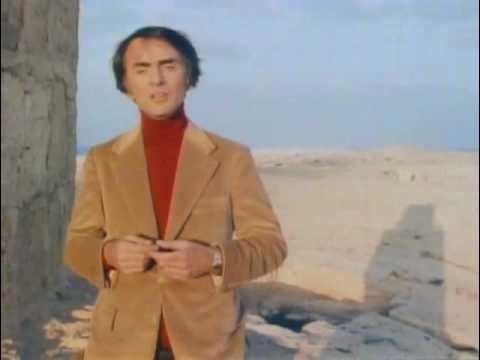
There was once an era when our planet seemed unimaginably immense, representing the only world open to human exploration. Its true physical scale remained unknown until the 3rd century BC in Egypt, when one thinker worked it out using an approach that was both simple and ingenious. Standing near an ancient stone tower situated roughly 50 kilometers west of Alexandria—a coastal structure that may have served as a navigational lighthouse for ships on the Mediterranean Sea or as part of a North African network of communication towers transmitting state messages via bonfires—Carl Sagan introduces the scholar behind this breakthrough: Eratosthenes.
Eratosthenes lived in Alexandria during its golden age as one of the great intellectual capitals of antiquity. Despite his brilliance, jealous peers nicknamed him "Beta," the second letter of the Greek alphabet, mocking him with the claim that he was only the second best in the world at everything. Carl Sagan firmly pushes back against this characterization, remarking: “One of his envious contemporaries called him Beta, the second letter of the Greek alphabet, because he said Eratosthenes was second best in the world in everything. But it seems clear that in many fields Eratosthenes was alpha.” He was a polymath of staggering breadth—an astronomer, historian, geographer, philosopher, poet, theater critic, and mathematician—who also served as the director of the Great Library of Alexandria.
- **Location:** Ancient tower roughly 50 km west of Alexandria on the Mediterranean coast. - **Roles of the tower:** Navigational beacon for sailing vessels or bonfire signaling tower for state messages. - **Eratosthenes' fields of study:** Astronomy, history, geography, philosophy, poetry, theater criticism, and mathematics. - **Position held:** Chief librarian of the Great Library of Alexandria.
---
[01:33](https://www.youtube.com/watch?v=G8cbIWMv0rI&t=93s) The Observation at Syene and the Alexandria Experiment
While examining a papyrus scroll within the Great Library, Eratosthenes came across a curious geographical account concerning Syene, a frontier outpost situated far to the south. The text reported an unusual phenomenon occurring at noon on the longest day of the year, June 21st: the shadows of temple columns and vertical sticks steadily shrank as midday approached. As the sun reached its highest point, its rays slipped straight down into the depths of deep vertical wells—spaces normally cloaked in shadow—illuminating the water at the very bottom. At that precise instant, vertical columns cast no shadow whatsoever because the sun sat directly overhead at the zenith.
While an ordinary reader might have dismissed the note as a trivial curiosity about sticks and reflections, Eratosthenes recognized its profound physical implications. Rather than brushing aside the report or assuming the observer was mistaken, he designed an experiment to test what happened at home in Alexandria at that exact same time on the solstice. Sagan observes of this insight: “Sticks, shadows, reflections in wells, the position of the sun, simple everyday matters. Of what possible importance might they be? But Eratosthenes was a scientist, and his contemplation of these homely matters changed the world, in a way, made the world.” Putting a stick into the ground near Alexandria at midday on June 21st, Eratosthenes discovered that, unlike in Syene, sticks in the north cast a distinct, measurable shadow.
- **Syene phenomenon (June 21st at solar noon):** - Shadows of temple columns and vertical posts disappeared completely. - Sunlight shone directly down deep water wells that were shaded on all other days. - The sun was positioned precisely at zenith (90° directly overhead). - **Alexandria test:** A vertical stick placed near Alexandria at the same moment cast a clear, substantial shadow. - **Scientific intuition:** Recognizing that ordinary individuals would have no motive to invent a mundane fact about shadows and wells, Eratosthenes treated the Syene observation as genuine scientific data.
---
[04:11](https://www.youtube.com/watch?v=G8cbIWMv0rI&t=251s) Curvature, Geometry, and Measuring the Earth
To analyze the disparity, Eratosthenes mapped out the geometry between the two locations. If the Earth were flat, two parallel sticks placed at Alexandria and Syene would either both cast no shadow at noon, or cast shadows of identical lengths. However, having one vertical post cast no shadow at Syene while another 800 kilometers north in Alexandria cast a substantial shadow could mean only one thing: the surface of the Earth is curved. Sagan emphasizes: “The only answer was that the surface of the earth is curved.” Because the sun is unimaginably distant, its incoming light rays arrive essentially parallel; therefore, vertical sticks planted on a curved surface meet those incoming rays at different angles, creating shadows of varying lengths.
```mermaid flowchart TD accTitle: Eratosthenes Earth Circumference Calculation accDescr: Step-by-step deduction from shadow observations to total circumference. subgraph Observations["Observations at Noon on June 21st"] S["Syene: Sun overhead, 0° shadow"] A["Alexandria: Sun tilted, definite shadow"] end subgraph Deduction["Geometric Deduction"] C["Earth surface must be curved"] ANG["Angular difference measured: ~7°"] FRAC["7° is roughly 1/50 of a circle (360°)"] end subgraph Calculation["Circumference Calculation"] DIST["Distance measured: 800 km (paced out)"] RES["800 km × 50 = 40,000 km"] end
S & A --> C C --> ANG ANG --> FRAC FRAC --> RES DIST --> RES ```
By measuring the shadow length in Alexandria, Eratosthenes determined that the angle between the two cities was approximately 7°. Imagining both vertical sticks extending straight down to the center of the Earth, they would intersect at an angle of roughly 7°—which corresponds to approximately 1/50th of a full 360° circle. To find the ground distance between the cities, he hired a surveyor to pace out the entire distance between Alexandria and Syene on foot, arriving at 800 kilometers. Multiplying 800 kilometers by 50 yielded a total planetary circumference of 40,000 kilometers. Sagan reflects on the brilliance of this ancient accomplishment: “Eratosthenes' only tools were sticks, eyes, feet, and brains. Plus a zest for experiment. With those tools, he correctly deduced the circumference of the Earth to high precision. With an error of only a few percent. That's pretty good figuring for 2,200 years ago.”
- **Observed angular difference:** ~7° along the arc of the Earth's surface. - **Ratio to full circle:** 7° out of 360° is roughly 1/50th of the circumference. - **Measured baseline distance:** 800 km between Alexandria and Syene (measured by a professional pacer). - **Final calculation:** $800\text{ km} \times 50 = 40,000\text{ km}$. - **Accuracy:** Within a few percent of the true modern value, achieved over 2,200 years ago.
## Notable quotes > [04:11](https://www.youtube.com/watch?v=G8cbIWMv0rI&t=251s) Eratosthenes' only tools were sticks, eyes, feet, and brains. Plus a zest for experiment. With those tools, he correctly deduced the circumference of the Earth to high precision. — Carl Sagan
> [00:08](https://www.youtube.com/watch?v=G8cbIWMv0rI&t=8s) One of his envious contemporaries called him Beta, the second letter of the Greek alphabet, because he said Eratosthenes was second best in the world in everything. But it seems clear that in many fields Eratosthenes was alpha. — Carl Sagan
## Mentioned Carl Sagan, Eratosthenes, Cosmos, Great Library of Alexandria, Alexandria, Syene, Egypt, Mediterranean Sea
## Video description Carl Sagan - Cosmos - Eratosthenes
[Source](https://www.youtube.com/watch?v=G8cbIWMv0rI)