NASA Readies 1.8-Kg Ingenuity Drone for First Powered Flight on Mars
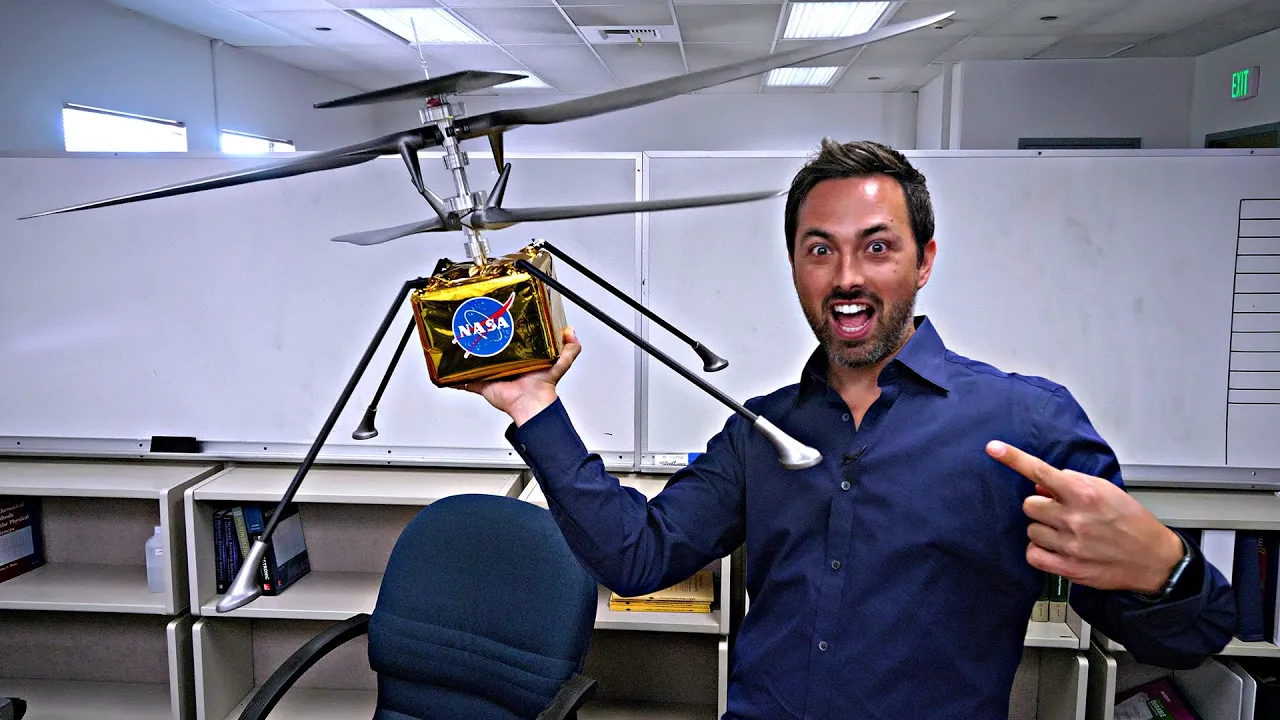
Veritasium
To overcome an atmosphere only 1% as dense as Earth's, the autonomous rotorcraft relies on 2,900-RPM carbon blades and diverts two-thirds of its battery power purely to survive freezing Martian nights.
AI-assisted summary of Mars Helicopter (before it went to Mars) — original source. Check the original for full context.
Source published:
Key ideas
- NASA's Jet Propulsion Laboratory designed the Ingenuity helicopter to achieve the first powered, controlled flight on another planet, operating in an atmospheric density roughly 1% of Earth's. (0:00)
- To produce sufficient lift in ultra-thin air, Ingenuity's coaxial rotors spin at 2,300 to 2,900 RPM with tip speeds capped at Mach 0.7, supported by an ultra-lightweight vehicle mass under 1.8 kilograms. (1:36)
- Surviving Martian nights of -80°C to -100°C requires roughly two-thirds of the drone's 35–40 Wh battery capacity solely for internal heating, leaving only one-third for a maximum 90-second flight. (8:55)
- Due to a 20-minute round-trip communications latency, Ingenuity must navigate entirely autonomously using high-frequency sensor fusion and automated cyclic and collective pitch adjustments. (5:53)
Detailed notes
## Background This video was published on YouTube by Veritasium on August 10, 2019. The show notes explain that host Derek Muller visited NASA's Jet Propulsion Laboratory to inspect the Mars helicopter, Ingenuity, just before it was mounted onto the Mars 2020 rover to attempt the first powered flight on another planet.
## TL;DR Facing an atmosphere with only 1% of Earth's density, JPL engineers designed Ingenuity as an ultra-lightweight 1.8-kilogram drone with counter-rotating coaxial blades spinning up to 2,900 RPM. To survive, two-thirds of its modest battery capacity is dedicated simply to heating internal electronics against brutal Martian nighttime temperatures, utilizing trapped Martian carbon dioxide rather than heavy aerogel for insulation. Because the 20-minute communication lag with Earth makes manual steering impossible, the craft relies on high-frequency autonomous closed-loop sensor processing. Slated to deploy via a pyrotechnic Frangibolt release under the rover's belly, the technology demonstration aims to validate aerial flight dynamics and pave the way for larger planetary aerial scouts.
## Atmosphere & style The presentation carries an infectious sense of awe and nerdy reverence, underscored by the host's genuine disbelief at standing mere feet away from actual extraterrestrial flight hardware. The JPL engineers speak with quiet pride, blending dry technical mastery with humorous acknowledgments of their hyper-strict weight constraints and dreams of mutual rover-helicopter selfies. Visually and aurally, the pacing balances crisp cleanroom close-ups with the roaring whine of testing chambers, evoking both the fragile delicacy of the hardware and the immense mechanical ambition of taking flight on another world.
## Bulletin - [00:00](https://www.youtube.com/watch?v=GhsZUZmJvaM&t=0s) NASA's Jet Propulsion Laboratory designed the Ingenuity helicopter to achieve the first powered, controlled flight on another planet, operating in an atmospheric density roughly 1% of Earth's. - [01:36](https://www.youtube.com/watch?v=GhsZUZmJvaM&t=96s) To produce sufficient lift in ultra-thin air, Ingenuity's coaxial rotors spin at 2,300 to 2,900 RPM with tip speeds capped at Mach 0.7, supported by an ultra-lightweight vehicle mass under 1.8 kilograms. - [08:55](https://www.youtube.com/watch?v=GhsZUZmJvaM&t=535s) Surviving Martian nights of -80°C to -100°C requires roughly two-thirds of the drone's 35–40 Wh battery capacity solely for internal heating, leaving only one-third for a maximum 90-second flight. - [05:53](https://www.youtube.com/watch?v=GhsZUZmJvaM&t=353s) Due to a 20-minute round-trip communications latency, Ingenuity must navigate entirely autonomously using high-frequency sensor fusion and automated cyclic and collective pitch adjustments.
## Key takeaways - [00:00](https://www.youtube.com/watch?v=GhsZUZmJvaM&t=0s) Ingenuity is engineered to achieve the first powered, controlled aerodynamic flight on another planet as part of the Mars 2020 mission. - [00:00](https://www.youtube.com/watch?v=GhsZUZmJvaM&t=0s) Mars's surface atmospheric density is roughly 1% of Earth's, presenting an aerodynamic challenge equivalent to flying an aircraft at 100,000 feet on Earth. - [01:36](https://www.youtube.com/watch?v=GhsZUZmJvaM&t=96s) Ingenuity's counter-rotating blades spin between 2,300 and 2,900 RPM—roughly five times faster than terrestrial helicopters—with tip speeds capped at Mach 0.7 to avoid shockwaves. - [01:36](https://www.youtube.com/watch?v=GhsZUZmJvaM&t=96s) To meet strict weight constraints, the total craft weighs less than 1.8 kg, using carbon fiber and foam blades that weigh only 35 grams each. - [04:06](https://www.youtube.com/watch?v=GhsZUZmJvaM&t=246s) Engineers tested flight performance on Earth by combining the low-pressure 25-Foot Space Simulator with an active fishing-line gravity offload system that simulated Mars's 38% gravity. - [05:53](https://www.youtube.com/watch?v=GhsZUZmJvaM&t=353s) A 20-minute round-trip radio delay and sluggish aerodynamic response make real-time manual piloting impossible, requiring fully autonomous closed-loop flight control executing hundreds of times per second. - [08:55](https://www.youtube.com/watch?v=GhsZUZmJvaM&t=535s) Testing with an array of 960 computer cooling fans demonstrated that the vehicle can maintain stability in crosswinds of up to 11 meters per second. - [08:55](https://www.youtube.com/watch?v=GhsZUZmJvaM&t=535s) The 35–40 Wh battery requires a full sol to recharge via solar panels, providing enough energy for at most one 90-second flight outing per day. - [10:18](https://www.youtube.com/watch?v=GhsZUZmJvaM&t=618s) Roughly 67% of onboard battery power is spent on internal heaters to survive nighttime temperatures of -80°C to -100°C, leaving roughly 33% for flight motors. - [10:18](https://www.youtube.com/watch?v=GhsZUZmJvaM&t=618s) To save mass, the fuselage foregoes solid aerogel insulation and instead traps ambient Martian CO2 gas within internal structural gaps to insulate the electronics. - [11:45](https://www.youtube.com/watch?v=GhsZUZmJvaM&t=705s) The aircraft is stowed sideways underneath the rover, built to endure >80 G vibrational launch loads and 9 G deceleration before release via an expanding Frangibolt. - [13:13](https://www.youtube.com/watch?v=GhsZUZmJvaM&t=793s) The optimal flight window is around 11:00 AM local solar time, balancing morning solar battery recharging against late-afternoon drops in air density and thermal wind gusts. - [14:18](https://www.youtube.com/watch?v=GhsZUZmJvaM&t=858s) Ingenuity is purely a technology demonstration intended to gather engineering flight data to pave the way for future planetary scout drones capable of accessing cliffs, craters, and polar ice caps.
## Detailed walkthrough ### [00:00](https://www.youtube.com/watch?v=GhsZUZmJvaM&t=0s) Meeting the Mars Helicopter at JPL
At the NASA Jet Propulsion Laboratory in Pasadena, the host gets an up-close look at the actual flight hardware built for the Mars 2020 mission: the Mars helicopter, Ingenuity. As the team introduces the vehicle in the cleanroom environment, the host reacts with disbelief that the hardware standing directly in front of him is the exact craft destined to take off and land on Martian soil. One of the JPL engineers remarks with quiet pride, “This will be the first powered flight in another planet.”
While balloon flight occurred earlier—notably in 1985 when the Soviet Union's Vega missions successfully floated two helium balloons for over 46 hours across 54 kilometers of altitude in Venus's dense, 90-atmosphere environment—achieving powered aerodynamic lift on Mars poses the inverse problem. Mars has an extraordinarily tenuous atmosphere, measuring roughly 1% of the density found at Earth's surface. Flying in the Martian air is the aerodynamic equivalent of piloting a rotorcraft on Earth at 100,000 feet, far surpassing Earth's helicopter ceiling of roughly 40,000 feet and even exceeding the highest recorded airplane altitude of 85,000 feet.
- Surface atmospheric density on Mars is equivalent to Earth's air at roughly 100,000 feet. - A cubic meter of air at room temperature on Earth weighs roughly 1 kilogram; the same volume on Mars holds only 15 to 18 grams of gas. - The helicopter is scheduled to accompany the Mars 2020 rover mission.
---
[01:36](https://www.youtube.com/watch?v=GhsZUZmJvaM&t=96s) The Aerodynamics of Thin Air: Blade Speeds and Weight Budgets
Because Mars offers so few air molecules per cubic meter, the rotors must push an enormous volume of air downward to generate enough upward force. The direct engineering answer is raw rotor speed. Ingenuity’s blades spin between 2,300 and 2,900 RPM—roughly five times faster than standard terrestrial helicopters, which spin at around 500 RPM. However, the engineers cannot simply crank the motors indefinitely. If the blade tips breach the speed of sound, shockwaves, transonic flow complications, and unstable aerodynamics quickly follow. Consequently, the team capped blade tip velocity at a conservative Mach 0.7 (70% the speed of sound).
Lower Martian surface gravity—roughly 38% of Earth's—helps offset the atmospheric deficit, but the weight budget was fiercely contested throughout the development program. As one of the lead engineers explains, “Keeping the mass of this vehicle contained during the entire design process has been the major challenge.” The entire vehicle was constrained to under 1.8 kilograms (less than four pounds), roughly the mass of a modern laptop. The individual rotor blades feature a foam core wrapped in a carbon fiber layup, weighing just 35 grams each—equivalent to the weight of six US quarter coins. Two 35-gram blades bear the burden of lifting the entire 1,800-gram chassis while spinning up to 40 times per second, all for a planned flight duration of up to 90 seconds.
```mermaid flowchart TD accTitle: Aerodynamic Challenges and Engineering Solutions for Mars Flight accDescr: Flowchart illustrating how Martian atmospheric constraints dictate rotor blade design, vehicle mass limits, and flight configuration.
subgraph AtmosphericConstraints["Martian Conditions"] A["Low Atmospheric Density<br>(~1% of Earth)"] B["Lower Gravity<br>(~38% of Earth)"] end
subgraph RotorDesign["Rotor Architecture"] C["High Rotor Speeds<br>(2,300–2,900 RPM)"] D["Mach 0.7 Tip Limit<br>(Avoid transonic shockwaves)"] E["Coaxial Counter-Rotating Blades<br>(Stacked compact footprint)"] end
subgraph MassBudget["Strict Mass Budget"] F["Total Craft: <1.8 kg<br>(Laptop weight)"] G["Blades: 35 g each<br>(Foam core + carbon fiber)"] end
A --> C C --> D A --> E B --> F F --> G ```
Rather than a quadcopter arrangement, the team adopted a coaxial, counter-rotating twin-rotor architecture. A quadcopter's wide blade span would make the craft impossible to mount underneath the rover belly. Stacking the rotors vertically also delivers an aerodynamic advantage: the upper rotor pulls and concentrates the flow, feeding a denser, more compact air stream into the lower rotor, allowing the bottom blade to operate more efficiently than if the two rotors were placed side by side.
---
[04:06](https://www.youtube.com/watch?v=GhsZUZmJvaM&t=246s) Simulating Mars on Earth: The 25-Foot Chamber and Gravity Offload
Testing a Mars rotorcraft inside normal Earth ambient conditions is impossible. If the helicopter spun up at standard sea-level pressure, the dense air would act “like trying to swim in a thick soup,” overloading the motors and creating extreme acoustic noise before the rotors could ever reach their Martian flight RPM. To solve the atmospheric side of the equation, the team moved testing into JPL’s 25-Foot Space Simulator, an immense vacuum chamber capable of pumping down to Martian atmospheric pressures.
Replicating Martian gravity posed an entirely separate hurdle. Earth's gravity would pin the 1.8-kilogram craft to the ground, so the engineers built a specialized gravity offload system designed to pull upward continuously, leaving the helicopter feeling only 38% of its terrestrial weight. The offload mechanism used a brushed DC motor, a reaction torque sensor, and a pulley system mounted several stories in the air, connected directly to the top of the craft via actual commercial fishing line. Because the system needed precise feedback without unwanted elasticity, the team tested numerous lines across different suppliers to dial in the ideal spring constant. When spinning inside the low-pressure chamber under offload, the high-speed rotors produced an unexpected, loud, droning sound akin to an aggressive buzz. As one engineer noted after running the system: “When gravity offload systems working and the chamber was pumped down, the helicopter thought it was on Mars. It felt like it was on Mars.”
---
[05:53](https://www.youtube.com/watch?v=GhsZUZmJvaM&t=353s) Steering Mechanics and Autonomous Closed-Loop Control
Ingenuity steers using traditional rotorcraft pitch principles: collective and cyclic control. Collective control adjusts blade pitch uniformly across an entire 360-degree rotation to increase or decrease the overall angle of attack, regulating vertical lift and altitude. Cyclic control varies blade pitch cyclically at specific positions around the rotation arc. Modulating the pitch creates an asymmetric aerodynamic torque across the rotor disk. Factoring in the rotor head stiffness and gyroscopic lag, this torque causes the helicopter to pitch or roll. Once the craft tilts stably, a component of its total thrust vector points horizontally, causing the craft to translate laterally across the Martian terrain.
```mermaid flowchart LR accTitle: Autonomous Flight Control Architecture accDescr: A closed-loop control diagram showing how sensor inputs are processed onboard at high frequency to drive blade cyclic and collective actuators.
subgraph SensorSuite["Onboard Sensors"] S1["Downward-Facing Camera"] S2["Gyroscopes & Accelerometers"] S3["Altimeter & Inclinometer"] end
subgraph OnboardComputing["State Estimation & Algorithm"] SE["State Estimator<br>(Hundreds of Hz)"] CL["Closed-Loop Control Algorithm"] end
subgraph BladeActuation["Aerodynamic Output"] BC["Cyclic Pitch (Roll/Pitch/Translation)"] BP["Collective Pitch (Altitude/Lift)"] end
S1 --> SE S2 --> SE S3 --> SE SE --> CL CL --> BC CL --> BP BC -.->|"Motion & Visual Feedback"| SensorSuite BP -.->|"Motion & Visual Feedback"| SensorSuite ```
Piloting the craft manually via a real-time joystick is an impossibility. Even disregarding communication latencies, test pilots attempting to hand-fly the craft found it unmanageable due to sluggish aerodynamic response times: “If you were sitting right there on Mars and you were trying to joystick it, what is it like? And it's almost unflyable.” Factoring in the 20-minute round-trip radio delay between Earth and Mars, mission controllers cannot provide live steering inputs. Flight commands must be uplinked beforehand as automated sequences.
Once commanded to take off, Ingenuity navigates entirely autonomously: - An onboard sensor suite blends inputs from gyroscopes, accelerometers, a downward-pointing navigation camera, an altimeter, and an inclinometer. - Real-time state estimation updates hundreds of times per second (hundreds of Hertz) against surface terrain. - The closed-loop control system takes state deviations and continuously computes corrective commands to the swashplate actuators. - Although finished test flight footage appears glassy and motionless during hovers, the internal control loops and swashplates are oscillating at high speeds beneath the surface to maintain equilibrium.
---
[08:55](https://www.youtube.com/watch?v=GhsZUZmJvaM&t=535s) Wind Handling, Battery Capacity, and Surviving the Martian Freeze
When dealing with Martian weather, the atmospheric reality differs sharply from science fiction depictions of violent sandstorms. Because the air density is only 1% of Earth's, atmospheric dynamic pressure is extremely low, meaning incoming air carries very little physical force against the vehicle's body. To confirm how the drone would hold up in crosswinds, JPL engineers constructed a dedicated, open-cross-section wind tunnel inside the 25-foot space chamber, built out of an array of 960 computer cooling fans that roared like a miniature jet engine. The fan wall verified that the rotorcraft could handle winds up to 11 meters per second without tumbling.
Ingenuity’s power subsystem is tightly constrained: - Total battery capacity is modest, between 35 and 40 watt-hours—equivalent to roughly three standard smartphone batteries. - Recharging the custom lithium-ion cells via the mast-mounted solar panel takes an entire Martian day (sol). - In theoretical performance terms, the turnaround cycle supports at most one 90-second flight outing per day. - Only roughly one third of the craft’s stored battery capacity goes toward motor power for flight. - The remaining two thirds of stored energy must be diverted to internal heaters to protect delicate electronics and batteries through brutal Martian nights, when temperatures regularly plunge between -80°C and -100°C.
[10:18](https://www.youtube.com/watch?v=GhsZUZmJvaM&t=618s) Thermal Architecture and CO₂ Insulation
Surviving the brutal nighttime temperatures on Mars dictates nearly the entire energy budget of the helicopter. The craft’s battery cells are kept grouped together in the center of the fuselage cube and surrounded by the electronics circuit boards so that the warmth radiates outward and keeps the boards operational. Maintaining survivable temperatures is so demanding that roughly two-thirds of the total stored electrical energy is devoted purely to keeping components warm and conditioning them for operation, leaving only a single third of the battery reserve available for powered flight.
```mermaid flowchart TD accTitle: Ingenuity Power Distribution and Structure accDescr: Diagram illustrating the energy allocation between heating and flight, and the concentric physical layout of the fuselage. subgraph PowerAllocation["Energy Budget"] direction TB P1["2/3 of Battery Energy: Thermal Conditioning & Survival"] P2["1/3 of Battery Energy: 90-Second Powered Flight"] end subgraph FuselageLayout["Fuselage Cross-Section"] direction TB F1["Core: Battery Ring"] F2["Mid-Layer: Electronics Boards"] F3["Insulation Gap: Martian CO2 Gas"] F4["Outer Layer: Fuselage Shell"] F1 --> F2 --> F3 --> F4 end ```
The physical stack of the vehicle features a solar panel and an antenna mounted at the very top, followed by the counter-rotating rotor system, and finally the cubic fuselage slung underneath. Because the helicopter was observed on its final day before being integrated onto the rover, its fuselage shell was briefly off. Inside, a deliberate air gap separates the central battery core from the circuit boards. Once the outer fuselage shell is sealed, it traps ambient Martian carbon dioxide gas inside. Rather than using specialized solid insulators, the vehicle relies directly on this captured CO₂ pocket to insulate the internal electronics from the external freeze. Aerogel was initially evaluated during early planning, but it was abandoned because meeting the mission's strict mass margins ruled out any unnecessary grams. As the engineer quipped when weight was identified as the reason for dropping aerogel:
> “Yep, there you go. Welcome to our team.”
- **Energy breakdown**: Approximately 67% of onboard power is consumed by heating systems; only ~33% is reserved for rotor flight. - **Structural stack**: Solar panel and antenna on top, dual rotor assembly in the middle, and the cubic electronics fuselage below. - **Thermal insulation**: Ambient Martian carbon dioxide ($CO_2$) gas fills the dead space inside the fuselage shell, closing the thermal model without the weight penalty of aerogel.
---
[11:45](https://www.youtube.com/watch?v=GhsZUZmJvaM&t=705s) Launch Loads, Staging, and the Frangibolt Drop
Before confronting the Martian atmosphere, the helicopter must endure the mechanical violence of leaving Earth and entering deep space. The hardware is fundamentally an aircraft packaged as a spacecraft: it has to withstand severe rocket vibrational launch loads that easily exceed 80 Gs, survive seven months of interplanetary cruise exposure to deep-space radiation, and endure 9 Gs of deceleration during entry into the Martian atmosphere.
The craft makes the journey bolted sideways underneath the rover's belly pan. Once on Mars, deploying the helicopter to the surface requires a choreographed sequence of pyrotechnic actuations to swing the craft right-side up, lock its landing gear, and hang it just above the dirt. To release the craft without mechanical latching mechanisms that could jam, the rover utilizes a Frangibolt:
> “Basically it's materials you know undergoes a phase transition which suddenly increases the, the stress in the metal part of the thing and makes the bolt break.”
After the bolt fractures and drops the craft to the ground, the rover rolls forward approximately 100 meters to establish a safe operating perimeter. A two-hour internal countdown timer on the helicopter then elapses, waking the craft up to listen for RF radio signals from the base station antenna mounted on the rover before executing any further commands.
- **Extreme G-forces**: Designed to survive >80 G vibrational launch loads and 9 Gs during atmospheric entry. - **Stowage location**: Tucked sideways under the belly of the Mars 2020 rover. - **Pyrotechnic release**: A Frangibolt uses internal material phase changes to intentionally fracture the retaining bolt on command. - **Wake-up sequence**: A 2-hour autonomous internal timer ticks down on the ground before the helicopter switches on its radio receiver to listen for rover transmissions.
---
[13:13](https://www.youtube.com/watch?v=GhsZUZmJvaM&t=793s) The 11:00 AM Flight Window and the Mutual Selfie
Once communications are established, the rover’s base station can transmit the final “fly now” command. The team established that the sweet spot for flight occurs around 11:00 AM local solar time on Mars. Taking off earlier in the morning is impossible because the heating systems have spent the long night draining the cells, leaving the battery charge too low to spin the rotors without risking a sudden brownout that would crash the aircraft. Mid-morning allows sunlight to hit the solar array, recharge the battery, and naturally warm the airframe, reducing internal heater power requirements.
Conversely, waiting until late afternoon presents distinct aerodynamic hazards: as daytime heating peaks, the already thin Martian air drops even further in density, while surface thermal winds pick up significantly. A mid-morning launch balances battery replenishment with atmospheric stability. As the team joked about the visual objectives of that historic maiden hop, capturing each other with their respective onboard cameras seemed almost mandatory:
> “First flight will probably be a mutual selfie, you would think.. This is after all the selfie age.”
While initial flights are planned conservatively for 11:00 AM, the engineering team intends to push into afternoon flight profiles and more demanding exploration runs once the initial operational envelope is proven.
- **Target flight time**: ~11:00 AM local Martian time. - **Brownout avoidance**: Mid-morning provides enough solar charging to bring battery state of charge above the threshold required for high-draw flight maneuvers. - **Aerodynamic balance**: Avoids the late-afternoon hazards of reduced atmospheric density and high surface wind gusts.
---
[14:18](https://www.youtube.com/watch?v=GhsZUZmJvaM&t=858s) Technological Demonstration and the Future of Planetary Flight
Ingenuity was constructed strictly as a technology demonstration. While equipped with color cameras capable of taking aerial photos and video, its mission does not revolve around gathering direct scientific samples or conducting mineralogy. The overarching objective is to gather real-world flight dynamics and engineering telemetry from another world to guide the development of future generations of extraterrestrial aircraft:
> “The real emphasis here is to try to get back all the engineering data so that it can inform that future design.”
Future iterations could expand into 30-kilogram rotorcraft carrying dedicated 2-kilogram sensor and instrument payloads. Such vehicles could serve as scouts pathfinding navigable terrain ahead of ground rovers, operate as high-speed couriers retrieving cache tubes to bring back to a central lander, or act as standalone explorers. Aerial mobility opens access to dramatic geographic features that are entirely inaccessible to wheeled platforms or human boots, such as vertical cliff faces, steep crater rims, and polar ice caps. By proving controlled aerodynamic lift on Mars, aerial vehicles promise to bridge the operational gap between wide-angle orbital surveillance and slow-moving surface rovers.
- **Primary objective**: Prove powered, controlled atmospheric flight on another planet and harvest engineering data. - **Future vehicle scale**: Conceptual designs envision ~30 kg platforms carrying ~2 kg dedicated science payloads. - **Potential applications**: - Long-range scouting for rover route planning. - Sample-return ferrying between field sites and central ascent landers. - Accessing extreme vertical and polar terrain (cliff faces, polar ice caps). - **Core advantage**: Fills the operational gap by traveling far faster than wheeled rovers while offering vastly higher resolution imagery than orbital spacecraft.
## Mentioned Ingenuity, NASA Jet Propulsion Laboratory, Mars 2020, Vega program, Frangibolt
## Video description The Mars Helicopter, Ingenuity aims to make the first powered flight on another planet when it takes off on Mars. It has now landed and safely checked in with the rover. It should detach and fly within the first 30-60 days of the mission. I learned a lot getting to visit the drone right before it was mounted on the rover at NASA Jet Propulsion Laboratory in Pasadena.
How do you fly in 1% of Earth's atmosphere: Have large rotors (they are 1.2m in diameter) and spin them very fast, around 2500 RPM (5x the speed of a helicopter on Earth).
Plus the aircraft has to be light: The Mars helicopter weighs in at 1.8kg or around the same as a laptop. Every piece had to be stripped down for weight. Instead of using aerogel for insulation, the craft makes use of CO2 gaps between components. Even aerogel was too heavy!
One of the major challenges is surviving the Martian night: Temperatures plunge to -80C to -100C so two thirds of the craft's power is actually used to keep its electronics warm. Only one third is used for flying. The estimated flight time is 90 seconds.
The craft can't be driven remotely, it will have to fly autonomously, using its own sensor suite to determine how to fly. The round trip 20 minute delay with Earth means steering the craft from mission control would be impossible.
Huge Thanks to Patreon Supporters: Philipp Volgger, Chris Vargas, Ron Neal, Alfred Wallace, Colin Bellmore, Michael Krugman, James Knight, Donal Botkin, Sam Lutfi, Mohammed Al Sahaf, Kevin Beavers, Chuck Lauer Vose, Bryan Baker, James Wong, kkm, Manuel Zürcher, Tige Thorman, Jasper Xin, Leah Howard, Daniel Milum, Mathias Göransson, Stan Presolski, Lyvann Ferrusca, Arjun Chakroborty, June Kang, Listen Money Matters, Pindex, Joar Wandborg, DALE HORNE, Parker Linn, Roberto Rezende
Jonny Hyman was a legend in editing, animation, filming, and sound design for this video.
[Source](https://www.youtube.com/watch?v=GhsZUZmJvaM)