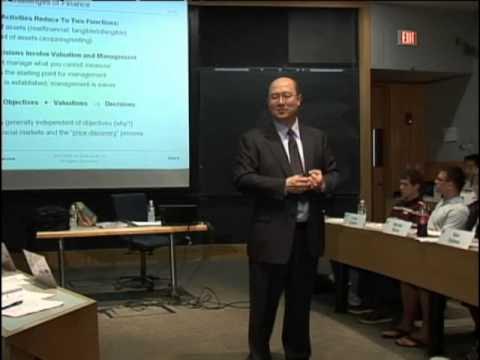
Finance theory fundamentally boils down to just two frictions: time (intertemporal allocation) and risk (uncertainty); absent these dimensions, finance collapses entirely into static microeconomics. (6:34)
A live classroom auction of a wrapped mystery box demonstrated price discovery under incomplete information, clearing at $45 for a $149 retail 4GB iPod Nano—reflecting a steep market discount driven by uncertainty. (29:01)
The course grade rests primarily on exams (25% midterm, 55% final), with Professor Andrew Lo guaranteeing that over 50% of exam points are drawn verbatim from an uncollected, solution-provided problem bank. (60:55)
High-complexity mathematical modeling and simple fundamental accounting can both yield extraordinary returns, as illustrated by quantitative pioneer James Simons ($1.7 billion 2006 compensation) versus value investor Warren Buffett ($62 billion 2008 net worth). (13:23)
Detailed notes
## Background
Published by MIT OpenCourseWare on YouTube on May 10, 2013, this video presents the introductory lecture of MIT's 15.401 Finance Theory I course from the Fall 2008 semester. Taught by Professor Andrew Lo at the MIT Sloan School of Management, the session outlines the foundational framework of modern finance theory and sets expectations for incoming MBA students.
## TL;DR
Professor Andrew Lo opens the course by defining finance as 'mathematics plus money' and explaining that the entire discipline exists because of two universal frictions: time and risk. Using figures like Jim Simons, Warren Buffett, and Jack Welch, he demonstrates how financial principles apply across pure mathematics, fundamental accounting, and corporate operations alike. To illustrate price discovery under incomplete information, Lo conducts a live cash auction for a mystery wrapped box that reveals an iPod Nano. He outlines the 13-week curriculum—splitting it into valuation and management—and stresses that mastering cash flows and financial principles requires active problem-solving rather than passive observation.
## Atmosphere & style
The lecture carries an energetic, welcoming, and intellectually disarming tone as Professor Lo actively eases the anxiety of students lacking prior quantitative or financial backgrounds. Blending sharp academic rigor with warm self-deprecating humor, Lo punctuates heavy theoretical concepts with relatable personal anecdotes about fussy eating, high school physics demonstrations, and grading thought experiments. The interactive mystery box auction injects real-time suspense and classroom camaraderie, creating the impression of a lively, premier business school environment where complex economic logic is made intuitively accessible.
## Bulletin
- [06:34](https://www.youtube.com/watch?v=HdHlfiOAJyE&t=394s) Finance theory fundamentally boils down to just two frictions: time (intertemporal allocation) and risk (uncertainty); absent these dimensions, finance collapses entirely into static microeconomics.
- [29:01](https://www.youtube.com/watch?v=HdHlfiOAJyE&t=1741s) A live classroom auction of a wrapped mystery box demonstrated price discovery under incomplete information, clearing at $45 for a $149 retail 4GB iPod Nano—reflecting a steep market discount driven by uncertainty.
- [01:00:55](https://www.youtube.com/watch?v=HdHlfiOAJyE&t=3655s) The course grade rests primarily on exams (25% midterm, 55% final), with Professor Andrew Lo guaranteeing that over 50% of exam points are drawn verbatim from an uncollected, solution-provided problem bank.
- [13:23](https://www.youtube.com/watch?v=HdHlfiOAJyE&t=803s) High-complexity mathematical modeling and simple fundamental accounting can both yield extraordinary returns, as illustrated by quantitative pioneer James Simons ($1.7 billion 2006 compensation) versus value investor Warren Buffett ($62 billion 2008 net worth).
## Key takeaways
- [00:26](https://www.youtube.com/watch?v=HdHlfiOAJyE&t=26s) Finance is the fundamental lingua franca of modern business management, uniting corporate capital decisions with personal household balance sheets.
- [03:11](https://www.youtube.com/watch?v=HdHlfiOAJyE&t=191s) End-of-semester teaching evaluations occur too early; assessing a course's practical value is best done five years after graduation in real-world leadership roles.
- [06:34](https://www.youtube.com/watch?v=HdHlfiOAJyE&t=394s) Financial analysis revolves entirely around managing the twin frictions of time (intertemporal value) and risk (uncertainty).
- [10:59](https://www.youtube.com/watch?v=HdHlfiOAJyE&t=659s) Finance can be defined operationally as mathematics plus money, spanning from high school arithmetic to advanced differential geometry without requiring prerequisites beyond admission.
- [13:23](https://www.youtube.com/watch?v=HdHlfiOAJyE&t=803s) Quantitative investing at Renaissance Technologies proves that advanced mathematics like Chern-Simons theory can produce market-beating returns, earning James Simons $1.7 billion in 2006.
- [16:16](https://www.youtube.com/watch?v=HdHlfiOAJyE&t=976s) Warren Buffett achieved a $62 billion net worth using high school arithmetic, deep balance-sheet analysis, and fundamental corporate valuation rather than complex algorithms.
- [18:02](https://www.youtube.com/watch?v=HdHlfiOAJyE&t=1082s) Former General Electric CEO Jack Welch demonstrated how financial fluency in cost structures and capital allocation drives massive corporate value creation.
- [21:27](https://www.youtube.com/watch?v=HdHlfiOAJyE&t=1287s) The financial economy maps cleanly into four interacting sectors: Households, Financial Intermediaries, Non-Financial Corporations, and Capital Markets.
- [22:55](https://www.youtube.com/watch?v=HdHlfiOAJyE&t=1375s) All financial analysis and business decision-making reduce to two fundamental challenges: asset valuation and asset management.
- [29:01](https://www.youtube.com/watch?v=HdHlfiOAJyE&t=1741s) Markets impose substantial price discounts when transacting under incomplete information, as shown by the mystery box auction yielding an immediate $104 surplus to the buyer.
- [34:37](https://www.youtube.com/watch?v=HdHlfiOAJyE&t=2077s) The course devotes its first two-thirds to asset valuation mechanics before shifting into corporate and personal management applications.
- [38:18](https://www.youtube.com/watch?v=HdHlfiOAJyE&t=2298s) Financial statements reflect basic physical analogies: the balance sheet captures an accumulated stock of wealth, while the income statement tracks its flow rate.
- [41:57](https://www.youtube.com/watch?v=HdHlfiOAJyE&t=2517s) Every enterprise operates across five distinct cash junctures: raising capital, investing in real assets, generating operational cash, reinvesting, and returning payouts to investors.
- [50:13](https://www.youtube.com/watch?v=HdHlfiOAJyE&t=3013s) The core behavioral axioms of finance assume agents prefer more money to less, money now rather than later, and lower risk to higher risk, ceteris paribus.
- [50:13](https://www.youtube.com/watch?v=HdHlfiOAJyE&t=3013s) There are no systematic free lunches in financial markets; unearned, riskless transfers of wealth cannot persist over time.
- [57:51](https://www.youtube.com/watch?v=HdHlfiOAJyE&t=3471s) Because finance is not a spectator sport, students must engage in active problem-solving; exams are weighted heavily toward the final to reward late-semester mastery.
- [01:00:55](https://www.youtube.com/watch?v=HdHlfiOAJyE&t=3655s) To remove study friction while guaranteeing rigorous preparation, more than 50% of midterm and final exam questions are pulled verbatim from the distributed problem bank.
## Detailed walkthrough
### [00:26](https://www.youtube.com/watch?v=HdHlfiOAJyE&t=26s) Welcome to 15.401 and the Centrality of Finance
Professor Andrew W. Lo opens the semester on behalf of the MIT Sloan School of Management, welcoming students to 15.401 Finance Theory. The course is primarily tailored to first-year MBA students—both those already planning a career in finance and those who are simply curious—with the goal of satisfying that curiosity across the upcoming 13 weeks. To motivate why the field matters, Lo introduces his own background: he has spent the past 20 years on the MIT finance faculty, preceded by four years teaching at the Wharton School of the University of Pennsylvania, a PhD in economics from Harvard University, and undergraduate studies at Yale University, where he graduated in 1980 with a major in economics.
Throughout his academic and real-world career, Lo has found that finance is almost unique among disciplines in the directness with which it applies to practical management dilemmas. Recognizing that students enter the classroom with diverse career ambitions, he sets out an intentionally ambitious objective for the term: to prove that finance sits at the very heart of modern commerce. As Lo puts it: “And I'm not even trying to convince all of you to go into a career in finance, but I am trying to convince all of you that finance is really the lifeblood and the basic lingua franca of all of business.”
- Course scope: 13-week foundational finance course designed primarily for first-year MBA candidates.
- Instructor background: 20 years at MIT Sloan; 4 years on faculty at Wharton; PhD in economics from Harvard; BA in economics from Yale (Class of 1980).
- Core thesis: Finance is not merely a specialized career path, but the operational foundation and universal language of all management decisions.
[03:11](https://www.youtube.com/watch?v=HdHlfiOAJyE&t=191s) First Tastes and the Five-Year Teaching Rating
Surveying the auditorium, Lo asks how many students arrive with no prior background in finance whatsoever. Seeing a substantial show of hands, he expresses excitement rather than concern, describing the opportunity to introduce finance to novices as an authentic privilege. He illustrates the experience by sharing a personal story about his younger son, an eight-year-old who has had allergies since birth and remains an extraordinarily fussy eater. Lo’s wife often jokes that their son is “a vegetarian except he doesn't eat vegetables.” However, when the boy was one year old, he watched his older brother eat an ice cream cone and decided to sample it; within four seconds, his facial expression transformed from disgust to curiosity to pure enthrallment, making ice cream one of his permanent food groups. Lo hopes the introductory course provides a similar awakening, proving that finance is unique in combining intellectual, research-level rigor with immediate, indispensable practical utility.
Turning to academic culture, Lo notes that business schools take student teaching evaluations very seriously, but he argues that traditional end-of-semester surveys evaluate courses at the wrong moment. He has proposed, albeit unsuccessfully so far, that teaching ratings should instead be collected five years after graduation. Only after alumni spend years in real-world jobs and leadership roles do they recognize the true value of the analytical discipline they acquired. Borrowing a slogan from the military, Lo sets high expectations for the rigor ahead: “This will be the most challenging course you will ever love.”
- Classroom composition: A large proportion of the enrolled MBA students possess zero prior finance coursework or experience.
- The ice cream analogy: Conceptualizing the transition from initial skepticism to fascination when encountering finance for the first time.
- Five-year rating proposal: Teaching surveys administered half a decade after graduation would better reflect how deeply financial logic informs long-term career success.
[06:34](https://www.youtube.com/watch?v=HdHlfiOAJyE&t=394s) The Road Ahead: Time, Risk, and the Agenda for the Term
Lo outlines the architecture of the introductory lecture and the semester as a whole. After setting up the core motivation, the course will introduce the *dramatis personae*—the key institutional actors and market participants who populate the financial world. He reveals that financial analysis ultimately boils down to just two fundamental challenges; once those two hurdles are resolved, the analytical apparatus is essentially complete. He establishes an organizing cognitive framework at the outset, designed to help students categorize what they know, identify what they do not know, and see how disparate corporate mechanisms link together over time.
```mermaid
flowchart TD
accTitle: Foundational Structure of Finance Theory
accDescr: A diagram illustrating how time and risk generate the two fundamental challenges of finance, feeding into six principles and real-world crises.
subgraph Drivers["The Core Drivers"]
T["Time\n(Intertemporal trade-offs)"]
R["Risk\n(Uncertainty & volatility)"]
end
subgraph Core["Analytical Foundation"]
C["Two Fundamental Challenges\nof Financial Analysis"]
P["Six Basic Principles\nof Finance"]
end
subgraph Outcomes["Real-World Application"]
M["Practical Management\n& Capital Markets"]
S["Market Crises\n(e.g., Subprime Mortgage Crisis)"]
end
Drivers --> C
C --> P
P --> M
P --> S
```
Crucially, Lo explains that finance as an independent field exists solely because of two universal frictions: time and risk. Without intertemporal movement of capital and the uncertainty of future outcomes, finance as an academic discipline and as an industry would have no open questions. As Lo stresses: “Put in another way, the only reason that there exists a finance department, and finance faculty, and finance journals, and a finance industry, the only reason is because of time and risk.” He promises to ground the semester in six fundamental financial principles that explain not only market design and financial innovation, but also historic market disruptions—specifically the ongoing subprime mortgage collapse of 2008. While students may currently know only that the subprime situation represents a severe crisis, Lo promises that within five lectures, right after covering fixed-income securities, they will fully understand the mechanics behind it. He wraps up the preview by directing students to chapters 1 and 2 of Brealey and Myers to prepare for upcoming discussions on mechanics and analytical tools.
- The two foundational challenges: Financial analysis hinges entirely on modeling intertemporal allocation (time) and uncertainty (risk).
- Diagnostic power of finance theory: The six core principles will directly illuminate both financial engineering and systemic breakdowns, including the subprime mortgage meltdown.
- Immediate preparation: Readings assigned from Brealey and Myers, chapters 1 and 2, spanning the introductory and following lecture.
[10:59](https://www.youtube.com/watch?v=HdHlfiOAJyE&t=659s) Defining Finance: Mathematics Plus Money
Professor Andrew Lo sets out to characterize the discipline of finance by examining the individuals who personify it. Before presenting his examples, however, he introduces what he calls the very first equation of the course: “finance is simply equal to mathematics plus money.” While that formulation might jokingly imply that mathematics is merely finance without money, Lo clarifies his serious point: finance represents the systematic, disciplined study of financial transactions and capital allocation.
He quickly addresses any anxiety students might feel about their quantitative preparation, reassuring them that lacking an advanced mathematics background does not mean they are in the wrong classroom. In Lo's view, mathematics encompasses an enormous spectrum—from partial differential equations and differential geometry on one end, down to high school algebra and basic arithmetic on the other. Because this is an introductory class, Lo assumes no prerequisites beyond the substantial baseline ability required to gain admission to MIT Sloan. Advanced quantitative methods and computing are not requirements for understanding financial principles or forging an exceptionally lucrative career in the industry.
- **The Core Equation**: $\text{Finance} = \text{Mathematics} + \text{Money}$
- **Mathematical Spectrum**: Spans from profound, abstract differential geometry to high school arithmetic and valuation metrics.
- **Course Prerequisites**: None assumed beyond general admission to MIT Sloan; upper-level mathematics and computer programming are not required.
---
[13:23](https://www.youtube.com/watch?v=HdHlfiOAJyE&t=803s) James Simons: High-End Mathematics and Quantitative Investing
To illustrate the high-complexity end of the mathematical spectrum, Lo introduces James Simons, the founder of Renaissance Technologies. Long before launching his hedge fund, Simons was an eminent academic mathematician who served for years as chairman of the mathematics department at Stony Brook University. Together with Shiing-Shen Chern, he co-developed Chern-Simons theory, a sophisticated framework within differential geometry that later found profound applications in string theory and theoretical physics.
Around twenty years prior, Simons pivoted from pure mathematics to establish Renaissance Technologies, creating what Lo describes as the single most successful hedge fund in the history of the industry. Over nearly two decades, Simons compiled a track record that outpaced every other fund manager by an enormous margin, earning Lo’s moniker as “the Michael Phelps of quantitative investment strategies.” Lo underscores this success with a concrete figure: in 2006, *Institutional Investor's Alpha Magazine* reported that Simons took home $1.7 billion in annual compensation. Emphasizing that this sum represented one year's taxable income on a W-2 rather than accumulated net worth, Lo highlights that Simons achieved this by staffing his firm with 75 PhDs across mathematics, physics, and computer science. Despite operating with extreme secrecy, Simons demonstrated that the most abstract forms of mathematics can be converted into monumental financial returns.
> “Over the course of 15 or 20 years, he's put together a track record that has literally beaten every other hedge fund manager's track record by a lot.” — *Andrew W. Lo*
- **Academic Background**: Former chair of mathematics at Stony Brook University; co-creator of Chern-Simons theory.
- **Institutional Distinction**: Built Renaissance Technologies with a staff of roughly 75 PhDs in hard sciences.
- **2006 Compensation**: $1.7 billion in annual take-home pay, ranking him as the highest-earning hedge fund manager that year.
---
[16:16](https://www.youtube.com/watch?v=HdHlfiOAJyE&t=976s) Warren Buffett: Fundamental Accounting and Valuation
At the opposite end of the mathematical spectrum sits Warren Buffett, who in February 2008 was ranked by *Forbes* as the richest man on Earth with a net worth of $62 billion. Lo shares an anecdote that when Simons learned of Buffett's fortune, he reacted with genuine disbelief, wondering how anyone could amass such staggering wealth without advanced mathematical machinery.
Unlike Renaissance Technologies, Buffett’s operation at Berkshire Hathaway in Omaha, Nebraska, runs with a lean staff—virtually just Buffett, his partner Charlie Munger, several secretaries, and a handful of accountants and attorneys—occupying an office smaller than many MIT Sloan conference rooms. Buffett built his fortune not through complex algorithms or differential equations, but by carefully analyzing corporate prospectuses, balance sheets, and income statements using high school arithmetic. Lo emphasizes that while the arithmetic itself is elementary, there is nothing simplistic about Buffett’s profound understanding of accounting and intrinsic corporate valuation.
> “In fact, in a private conversation I was told that when Simons found out he said, really? $62 billion? How did he get that?” — *Andrew W. Lo*
- **Net Worth**: $62 billion as reported in the February 2008 *Forbes* billionaire rankings.
- **Operating Model**: Located in Omaha, Nebraska, with a skeletal staff consisting primarily of Warren Buffett, Charlie Munger, and administrative support.
- **Methodology**: Rigorous fundamental valuation and balance-sheet analysis conducted using high school arithmetic.
---
[18:02](https://www.youtube.com/watch?v=HdHlfiOAJyE&t=1082s) Jack Welch and the Universal Language of Finance
The third person Lo highlights is Jack Welch, the former CEO of General Electric and an occasional guest lecturer at MIT Sloan. Although Welch held a PhD in engineering and lacked formal management school training, he excelled as a corporate leader because he possessed an exceptional command of cost structures, capital budgeting, and financial decision-making.
Welch joined General Electric in 1960 and ascended to the CEO role in 1981, when GE was already a corporate titan generating $26 billion in annual revenue with 400,000 employees. Over his first five years at the helm, Welch eliminated 100,000 positions, earning the moniker "Neutron Jack" for eradicating personnel while leaving corporate buildings standing. Despite reducing headcount to 300,000, Welch dramatically expanded GE's enterprise value. By the conclusion of his 20-year tenure in 2001, GE’s annual revenues had multiplied by a factor of 4.5, rising from $26 billion to $130 billion.
Lo connects Simons, Buffett, and Welch to show that despite having completely divergent backgrounds and styles, they all share an innate fluency in the language of finance. Over the upcoming 13-week semester, the course will cover the fundamental concepts and tools that these leaders rely on every day. Lo remarks that while mastering these foundations does not guarantee comparable wealth, understanding them is an essential prerequisite for any substantive success in business.
> “There's nobody that's been successful in business, truly successful, without having an understanding, at least an innate or instinctive understanding, of the concepts that we're going to cover over the next 13 weeks.” — *Andrew W. Lo*
- **Jack Welch's Background**: PhD in chemical engineering; entered GE in 1960 and served as CEO from 1981 to 2001.
- **Workforce Restructuring**: Reduced GE workforce from 400,000 to 300,000 within his first five years.
- **Revenue Growth**: Scaled GE's top-line revenue from $26 billion in 1981 to $130 billion by 2001.
---
[21:27](https://www.youtube.com/watch?v=HdHlfiOAJyE&t=1287s) The Four Components of the Financial Economy
Lo transitions from individual leaders to the macroeconomic framework of the financial system, noting playfully that being at MIT demands the introduction of a flow diagram. Rather than analyzing labor or product markets, the 13-week course isolates four critical financial sectors: Households, Financial Intermediaries, Non-Financial Corporations, and Capital Markets.
```mermaid
flowchart TD
accTitle: The Four Sectors of the Financial System
accDescr: Diagram showing the four interconnected components of the financial economy covered in the course.
subgraph Core["Financial System Framework"]
direction LR
HH["Households"]
FI["Financial Intermediaries"]
NFC["Non-Financial Corporations"]
CM["Capital Markets"]
end
HH <--> FI
FI <--> NFC
NFC <--> CM
CM <--> HH
HH <--> NFC
FI <--> CM
```
Lo explains that the principles of financial analysis apply identically across each of these four sectors, even though the context and industry jargon change depending on the setting. Whether evaluating an individual household's savings, an intermediary's portfolio balance, a corporation's capital budgeting decisions, or trading activity within capital markets, the underlying economic theories remain unified. The objective of the course is to unpack these universal theoretical foundations so that students can analyze any financial scenario seamlessly.
> “What I'm going to try to teach you in this 13 weeks is the underpinning theories that unify all of the various different kinds of ideas.” — *Andrew W. Lo*
- **Scope of the Course**: Focuses strictly on financial allocations among the four sectors, omitting labor and finished product markets.
- **Interchangeable Principles**: Financial frameworks remain analytically identical across corporate finance, household investment, and institutional intermediation.
[22:55](https://www.youtube.com/watch?v=HdHlfiOAJyE&t=1375s) The Two Fundamental Challenges of Finance
Professor Andrew Lo narrows the entire scope of financial analysis down to two fundamental challenges: the valuation of assets and the management of assets. Asset management, he explains, simply entails comparing two or more alternatives to determine which is more valuable, and then selecting the superior option. The real analytical difficulty lies in the first step: establishing value. Lo asserts that every single business decision a person will ever face boils down to these two components.
```mermaid
flowchart LR
accTitle: The Two Fundamental Challenges of Finance
accDescr: Diagram showing how valuation and objectives feed into asset management to produce business decisions.
subgraph S1["Valuation Challenge"]
A["Asset Valuation"]
B["Identify Objectives"]
end
subgraph S2["Management Challenge"]
C["Asset Management"]
D["Optimal Decision"]
end
A --> C
B --> C
C --> D
```
Valuation is challenging because value itself is a nuanced, non-obvious concept. Lo illustrates this paradox using the classic example of water versus diamonds: carbon-based life cannot survive without water, yet it remains relatively cheap (at least before commercial brands like Poland Spring); meanwhile, humans do not need diamonds to survive, yet they are extraordinarily expensive, and some gems are considered invaluable. Once value is established and coupled with clear objectives, management becomes straightforward: “Objectives plus valuations obviously leads to decisions.”
- **The two core challenges of finance:** Valuation of assets and management of assets.
- **The management rule:** “Managing is going to involve figuring out which of two possibilities is more valuable. And then you know what? You take the more valuable option.”
- **Universal relevance:** “This is why I've argued that finance is the most important subject, because literally any business decision that you will ever engage in, constitutes those two components.”
---
[26:03](https://www.youtube.com/watch?v=HdHlfiOAJyE&t=1563s) The Mystery Box Auction Experiment
To demonstrate how financial markets establish value through the price discovery mechanism, Lo devises a live classroom experiment. Recalling his high school science days where teachers demonstrated Tesla coils, he notes his jealousy of science demonstrations and sets up an economic equivalent. Because he teaches two sections, he insists on complete randomization to avoid favoring either class. He calls up two student volunteers: one writes "heads" on one blank piece of paper and "tails" on another, shuffles them face-down, and places one slip in front of each of two gift-wrapped packages. The second volunteer flips an actual coin, which lands on tails, selecting a small, neatly wrapped mystery package for the auction.
Before bidding begins, Lo establishes that the item's value cannot be negative due to limited liability—the buyer cannot owe money for what is inside—establishing a clear zero lower bound. However, Lo cautions the class that the auction is completely real: he expects to be paid in hard cash at the end of class. When a student jokingly asks who keeps the proceeds, Lo quips that the funds will go to the "foundation to support Andrew Lo" to reimburse his out-of-pocket teaching expenses, clarifying: “I'm the charity. So this is not a charity auction. This is going to go to me.”
- **Experiment design:** Two wrapped boxes of different sizes, randomized via shuffled slips and a live coin toss.
- **Auction rules:** Real cash settlement required at the end of lecture; strictly long-only bids.
- **Humorous aside:** When an audience member asks, “Can I short too?”, Lo immediately shoots it down: “No shorting, sorry. I'm the only auctioneer here.”
---
[29:01](https://www.youtube.com/watch?v=HdHlfiOAJyE&t=1741s) Price Discovery and the True Cost of Uncertainty
The auction opens at $1 and escalates rapidly through bids of $3, $4, $6, $10, $20, $30, $31, $35, $40, and finally $45, where the bidding stalls and the item is knocked down as sold. Lo points out that without touching, shaking, or knowing the contents of the box, the room synthesized a concrete market price out of thin air. Although it appeared bidders had no information, Lo explains that they actually relied on implicit contextual information: the package's physical dimensions, the professor's reputation, and institutional constraints—namely, that a professor would face serious trouble with the dean if he cheated a student with an empty box.
The winning bidder unwraps the package carefully to savor the moment, prompting Lo to joke that his wife unwraps gifts with the same maddening patience, unlike his sons who just tear into them. The box reveals a brand-new 4GB iPod Nano. While an audience member guesses its retail price at $125, Lo clarifies that it retails for $149, handing the winning student an immediate $104 paper gain. Lo concludes by showing that the discount reflects the cost of incomplete information: “I would have loved to have gotten a bid of $149, but would any of you be willing to pay that for a box with no information at all?”
| Metric / Event Stage | Detail / Value |
|:--- |:--- |
| **Opening bid** | $1.00 |
| **Winning final bid** | $45.00 |
| **Product inside box** | 4GB iPod Nano |
| **Audience retail estimate** | $125.00 |
| **Actual retail value** | $149.00 |
| **Buyer's net surplus** | $104.00 |
| **Key conceptual takeaway** | Price discovery operated under incomplete information; the market demanded a heavy discount for uncertainty. |
[34:37](https://www.youtube.com/watch?v=HdHlfiOAJyE&t=2077s) Course Structure: Valuation and Financial Management
Reflecting on the classroom auction of an unknown package, Professor Andrew Lo observes that a lack of transparency and information directly reduces an asset's perceived value. Even so, the box retained real worth because several students were willing to take a chance on an unknown payoff. Deconstructing how the market arrives at such valuations forms the core objective of the first five weeks of the course. Lo acknowledges that teasing apart the psychological and analytical drivers behind why someone bid $45—and refused to go to $50—is a difficult challenge, but promises that the course will establish rigorous, quantitative frameworks to demystify the valuation process.
```mermaid
flowchart TD
accTitle: Structure of the Course
accDescr: The 13-week course divides into valuation for the first two-thirds and management for the final third.
subgraph S1["Weeks 1 to 8: Valuation"]
V1["Mechanisms of Market Valuation"]
V2["Actual vs. Normative Value"]
V3["Financial Market Efficiency"]
end
subgraph S2["Weeks 9 to 13: Management"]
M1["Capital Budgeting"]
M2["Risk Management"]
M3["Personal and Corporate Decision-Making"]
end
S1 --> S2
```
Across the full thirteen-week term, the course is split into two main sections: the first two-thirds are devoted to valuation, while the final one-third examines management applications such as capital budgeting and risk management. Within valuation, the class will investigate how financial assets actually are valued versus how they *should* be valued, whether those two figures diverge, and how efficiently financial markets function. Returning to the classroom auction, Lo notes that while he personally took a loss, the market technically performed its job: if a seller needs to unload an asset sight unseen on the spot, a 66% discount relative to its roughly $135 intrinsic value is standard. Once valuation is settled, students will confront the practical questions of management: how much to save or spend, what and when to buy or sell, and how to finance transactions. As Lo emphasizes, these fundamental challenges unite individual retail investors and industry titans alike:
> “These are problems that apply to Jack Welch, to James Simons, to Warren Buffett, and to you.”
[38:18](https://www.youtube.com/watch?v=HdHlfiOAJyE&t=2298s) Accounting Basics: Stocks, Flows, and the Bathtub Analogy
To conduct rigorous financial analysis, analysts rely on accounting as the foundational lexicon for quantifying economic reality, including revenues, costs, profits, and losses. Lo stresses that students lacking an accounting background must master two central concepts that can initially seem abstract: stocks and flows. In this context, "stock" does not refer to equities or common shares, but rather the total level of accumulated assets at a single frozen moment in time, while "flow" represents the rate of change of those assets across a specific duration.
Recalling his first day of graduate macroeconomics, Lo shares an anecdote about a student asking whether stock versus flow was simply the difference between a variable and its first derivative. When the professor agreed but offered the everyday analogy of a bathtub—where the depth of the water is the stock and the stream from the faucet is the flow—the student remained puzzled, prompting the professor to remark that some people find bathtubs intuitive while others prefer derivatives. In financial statements, this maps directly to two core documents:
* **Balance Sheet (Stock):** Captures a snapshot of the corporation's wealth at a single point in time, outlining total assets alongside the liabilities and claims against them.
* **Income Statement (Flow):** Measures the rate of wealth entering or exiting the firm per unit of time, recording operating revenues, costs, and net gains or losses (typically reported quarterly).
Lo highlights that mastering these concepts provides an exceptional foundation: “And by the way, this is the sum total of the tools that Warren Buffett uses for analyzing his investments.”
[41:57](https://www.youtube.com/watch?v=HdHlfiOAJyE&t=2517s) Corporate Decisions and Cash Flows
Applying this framework to a firm, corporate financial decision-making centers entirely on managing cash at five distinct structural junctures. Cash serves as the indispensable lifeblood of the modern enterprise, and tracking its movement illuminates every substantive operational issue within an organization. Leaders like Jack Welch cannot simply review prepackaged decisions; they must possess the financial fluency to interpret the underlying cash dynamics.
```mermaid
flowchart LR
accTitle: Five Junctures of Corporate Cash Flow
accDescr: The cycle of cash flowing from investors into real assets, producing operating cash, and cycling back to reinvestment or payouts.
subgraph External["Financial Markets"]
Inv["Investors / Lenders"]
end
subgraph Corporate["Corporate Operations"]
C1["1. Raise Cash from Investors"]
C2["2. Invest Cash in Real Assets"]
C3["3. Generate Cash via Operations"]
C4["4. Reinvest Cash"]
C5["5. Return Cash to Investors"]
end
Inv -->|"Capital"| C1
C1 --> C2
C2 --> C3
C3 --> C4
C4 --> C2
C3 --> C5
C5 -->|"Dividends / Buybacks"| Inv
```
Different corporate leadership roles map directly onto these cash junctures:
- **Operating Management:** Focuses on steps two and three by deploying cash into new divisions, manufacturing plants, or novel product lines.
- **Chief Financial Officer (CFO):** Oversees steps one and four to determine how the company funds itself and allocates surplus capital.
- **Board of Directors:** Manages step five to establish payout policy and return capital to shareholders.
- **Risk Managers:** Monitor steps one and five to safeguard solvency and manage the liabilities owed to capital providers.
Across all these seats, the overarching corporate mandate remains maximizing shareholder wealth through disciplined cash allocation.
[44:20](https://www.youtube.com/watch?v=HdHlfiOAJyE&t=2660s) Mapping the Framework to Personal Households
To make these corporate mechanics concrete and immediate, Lo asks the class to map the five-point cash framework onto personal household finances. A household sits in the exact same intermediary position as a firm, balancing real economic activities (such as labor and career investments) against external financial assets and obligations:
- **Cash Raised from Financial Institutions:** Securing student loans, bank borrowings, or mortgages.
- **Cash Invested in Real Assets:** Directing funds into tangible value, where Lo asks the lecture hall to identify their own primary asset today. When an audience member answers education, Lo confirms: “Exactly. Human capital, yourselves.”
- **Cash Generated by Labor Supply:** Earning compensation by selling time and skills in the job market.
- **Cash Consumed and Reinvested:** Spending money on immediate consumption—such as beer and pretzels—versus reinvesting in personal human capital, a home, or children (which Lo jokingly notes can act as real assets, or occasionally real liabilities).
- **Cash Returned to Financial Stakeholders:** Servicing and extinguishing outstanding debts over time.
[46:00](https://www.youtube.com/watch?v=HdHlfiOAJyE&t=2760s) Personal Financial Management and the Challenge of Time and Risk
Professor Andrew Lo urges students to realize that even if they believe they do not yet possess substantial financial assets, they are already invested through vehicles like 401(k) plans, retirement savings, and Social Security. He encourages everyone to view financial theory through the lens of personal management: balancing real investment, consumption, financing, savings, and risk management against their broader life goals. To get the maximum value out of the semester, students need to actively internalize the material rather than treat it as abstract theory. “So what I'm asking you to do is, I want you to take this course personally,” Lo emphasizes, challenging the class to take every single idea presented over the next 13 weeks and ask how it can improve their everyday decision-making. Developing this instinctive approach in their personal lives will directly translate into sharper managerial instincts throughout their careers.
Turning to the theoretical foundation, Lo explains that finance is driven by two fundamental dimensions: time and risk. Without these two complicating factors, financial analysis would be completely resolved, reducing directly to standard undergraduate microeconomic supply-and-demand analysis. The richness and difficulty of finance exist exclusively because cash flows occur across time—which moves in only one direction—and under conditions of uncertainty. Lo teases that in about four lectures, he will present an alternative proof of special relativity based on the empirical fact that nominal interest rates are not negative, demonstrating a deep philosophical connection between physics and finance. Investors like Warren Buffett may not formulate these concepts as mathematical physics, but they possess an ingrained understanding that a dollar today is not the same as a dollar next year, nor is a certain dollar identical to an uncertain one. The curriculum is sequenced to master time first across the opening three to four weeks before layering on the formal machinery of risk around weeks six through eight.
- **Real vs. financial assets**: Personal management requires aligning both real assets (such as education and human capital) and financial assets with long-term life objectives.
- **The reduction of finance**: Stripped of time and risk, finance offers no new analytical problems and collapses entirely into static microeconomics.
- **Pedagogical roadmap**: Weeks 1–4 isolate the time dimension; weeks 6–8 introduce risk; modern finance emerges from their intersection.
[50:13](https://www.youtube.com/watch?v=HdHlfiOAJyE&t=3013s) The Fundamental Principles of Finance
Lo outlines the core conceptual pillars of finance, noting that while students might not fully appreciate them on day one, these principles will serve as the engine for all future financial decision-making. The first idea is the classic maxim that there is no such thing as a free lunch. Technically, Lo refines this to mean that while isolated windfalls may occur through luck or hard work, “There isn't systematic free lunches,” meaning sustained, riskless transfers of wealth without economic justification cannot persist. The second principle applies the standard economic caveat *ceteris paribus* (“other things equal”) to establish three near-universal behavioral traits: people prefer more money to less (non-satiation), they prefer money now rather than later, and they prefer less risk to more risk when risk is properly defined. Lo jokes that if anyone in the room knows individuals who violate these axioms, they should introduce them after class because he would love to do business with them.
```mermaid
flowchart TD
accTitle: Core Pillars and Behavioral Axioms of Finance
accDescr: Diagram illustrating the three foundational behavioral axioms and the primary operational constraint in finance theory.
subgraph Axioms["Behavioral Axioms (Other Things Equal)"]
A["Non-Satiation<br>(More money > Less money)"]
B["Time Preference<br>(Money now > Money later)"]
C["Risk Aversion<br>(Less risk > More risk)"]
end
Axioms --> E["Rational Decision-Making Engine"]
MarketLaw --> E
```
The third principle is that economic agents act in their own self-interest. Addressing the apparent counterexample of altruists, Lo points out with dry humor how economists redefine preferences so expansively that it becomes a tautology: “economists in their own unique and annoying way have been able to redefine preferences to even argue that Mother Teresa is incredibly selfish, because her utility function is the function-- the utility function of other people.” The remaining three foundational principles will be integrated throughout the term, but Lo intentionally defers their explicit critique until the final lecture. For the first 13 weeks, he asks students to willingly suspend disbelief while learning the clean, standardized theoretical baseline. Only in the final class will he pull back the curtain, interrogate the assumptions, highlight where the models break down against market frictions, and show why advanced coursework is necessary.
- **Approximation of reality**: The foundational principles represent clean, powerful approximations of an inherently messy financial landscape.
- **Self-interest and utility**: Utility theory treats altruism as agents maximizing satisfaction derived from the well-being of others.
- **Suspension of disbelief**: Students must first master the frictionless benchmark models before critiquing market imperfections and empirical anomalies in the closing lecture.
[54:53](https://www.youtube.com/watch?v=HdHlfiOAJyE&t=3293s) Course Structure, Readings, and Grading Breakdown
The course is organized into four main sections as detailed in the syllabus. Section A covers the introductory context. Section B spans the next three to four lectures and tackles valuation, net present value mathematics, discounting, and the relative pricing of equities, fixed income, futures, forwards, and options. Section C introduces formal risk analysis into that valuation engine. Section D applies these combined tools to real-world corporate financial policy, echoing the strategic capital-allocation decisions executed by executives like Jack Welch during his tenure at General Electric from 1981 to 2001. Lo clarifies that the final class will synthesize theory with market imperfections, quipping: “this is not the same last lecture as other last lectures. I'm not going to die, but so I don't mean to call it the final lecture. That sounds a little ominous.”
Turning to operational logistics, Lo points out that the course text, *Principles of Corporate Finance* by Brealey, Myers, and Allen, is a massive volume that “if dropped off of a six-story building could actually kill somebody if it hit them.” Because it is impossible to absorb the entire tome in an introductory survey, students are responsible strictly for the assigned chapters listed on the syllabus, starting immediately with Chapters 1 and 2. Class attendance and active, prepared participation represent 10% of the overall course grade, and an individual case write-up constitutes another 10%. The formal examinations account for the remaining 80%, divided into a midterm exam weighted at 25% and a comprehensive final exam weighted at 55%.
| Component | Weight | Focus / Requirements |
|:--- |:--- |:--- |
| **Class Attendance & Participation** | 10% | Coming prepared to debate material and previous lecture topics |
| **Case Study** | 10% | One written case assignment turned in individually |
| **Midterm Examination** | 25% | Covers valuation and introductory risk concepts |
| **Final Examination** | 55% | Comprehensive assessment across all four sections |
[57:51](https://www.youtube.com/watch?v=HdHlfiOAJyE&t=3471s) Active Learning and Course Mechanics
Professor Andrew Lo explains that the operational mechanisms in his two sections are identical to those used by Professor Jiang Wang in his sections. Both professors coordinated closely to establish a unified approach to ensure no student is advantaged or disadvantaged based on their section. A large collection of optional practice problems is included in the reading packet or distributed shortly thereafter. Lo points out that the packet contains far too many problems for anyone to complete in a single semester, but it exists because passive listening during lectures will never suffice. “Because teaching implies that I can force feed knowledge into your brains,” Lo reflects, adding: “It turns out it can't be done.”
Recalling a phrase from his 12th-grade math teacher, Lo reminds students that math—and by extension, finance—is fundamentally not a spectator sport. The true role of the lecture is to provide the underlying motivation and guide students through the most challenging theoretical principles, but students must actively pull knowledge into their own minds by tackling problems repeatedly. To reflect this learning trajectory, the final exam is weighted much more heavily than the midterm. It is cumulative, covering twice the material, but more importantly, net present value calculations and financial analysis are foreign to natural human cognition. In Lo's experience, students typically experience a breakthrough between week 8 and week 13, marked by sudden smiles when the concepts finally click—though in rare, less ideal cases, that epiphany happens in week 14.
- Course structure is strictly aligned between Professor Lo’s and Professor Wang’s sections.
- The optional problem bank contains far more exercises than can be solved in one term.
- Exam weighting leans heavily on the cumulative final exam to reward late-semester mastery.
[01:00:55](https://www.youtube.com/watch?v=HdHlfiOAJyE&t=3655s) The Problem Bank and a Grading Thought Experiment
Recognizing the demanding schedules of MBA students, Lo announces that there will be no required weekly problem sets to turn in or grade. Instead, students receive the problem bank along with full solutions up front. To motivate practice and alleviate anxiety, Lo makes a explicit guarantee: more than 50% of the exam points on both the midterm and the final will be drawn verbatim from this provided problem package. While memorizing the entire set would technically guarantee an "A," doing so would require an enormous investment of time in finance problems, which achieves the exact educational goal anyway. Recitations and occasional class segments will be dedicated to demonstrating how to tackle the most complex problems from the bank.
```mermaid
flowchart TD
accTitle: Exam Question Sourcing Strategy
accDescr: Diagram illustrating how exam questions are split between problem sets and lecture readings.
subgraph Bank["Problem Bank Package (With Solutions)"]
P1["Verbatim Questions"]
end
subgraph Custom["Custom Materials"]
C1["Lectures & Readings"]
end
subgraph Exam["Midterm & Final Exams"]
E1["> 50% Sourced Verbatim"]
E2["< 50% Sourced from Lectures"]
end
P1 --> E1
C1 --> E2
```
Turning to grading policy, Lo confesses his personal dislike for evaluating adult students, recounting a humorous proposal he once pitched to the dean's office. Under his scheme, he would announce to the room that every student receives a flat grade of "B." When he asked who objected, everyone who raised their hand would instantly receive an "A." As Lo jokingly reflects on the scheme: “I get a grade distribution. No work. The only problem is it only works once.” Because the trick cannot be replicated across multiple sections, standard grading procedures must remain in place.
- There are zero mandatory problem sets to submit during the semester.
- Over 50% of midterm and final exam questions will appear verbatim from the provided problem bank.
- Recitation sessions will walk through selected difficult problems from the package.
[01:04:02](https://www.youtube.com/watch?v=HdHlfiOAJyE&t=3842s) Maximizing Course Value and Closing Thoughts
In the final minutes of the opening session, Lo outlines how students can extract the greatest value from the course. Unlike pure theoretical fields—such as algebraic topology, where Lo notes nobody ever works as a "practical algebraic topologist"—finance cannot exist without practice. To supplement the theoretical grounding of the course, he encourages students to attend a newly launched non-credit pro-seminar titled *The Practice of Finance*, starting September 17. The seminar addresses the practical realities and career dynamics of the financial industry, including entry paths for newcomers and starting analyst salaries.
For day-to-day study habits, Lo promises to post lecture slides in advance, asking students to skim them before class rather than trying to decipher everything beforehand. The slides are intentionally incomplete, forcing students to physically take notes during the lecture to boost long-term retention. After class, students should revisit the material to ensure they can apply it, and balance studying in groups with independent work so they are prepared to tackle exams alone. Lo welcomes questions on current market events and everyday financial dilemmas, such as whether to refinance an auto loan, concluding with a plea for personal investment in the subject: “I want you to take this course personally, because that's the only way you're going to really learn the material.”
- Lectures will regularly start at five past the hour and dismiss at five before the half hour.
- *The Practice of Finance* pro-seminar launches on September 17 as an optional, zero-credit industry overview.
- Hand-annotating the intentionally incomplete lecture slides is recommended to aid conceptual absorption.
- Students must practice problems individually in addition to study groups to prepare for solo exams.
## Notable quotes
> [06:34](https://www.youtube.com/watch?v=HdHlfiOAJyE&t=394s) The only reason that there exists a finance department, and finance faculty, and finance journals, and a finance industry, the only reason is because of time and risk. — Andrew W. Lo
> [00:26](https://www.youtube.com/watch?v=HdHlfiOAJyE&t=26s) I'm not even trying to convince all of you to go into a career in finance, but I am trying to convince all of you that finance is really the lifeblood and the basic lingua franca of all of business. — Andrew W. Lo
## Mentioned
MIT Sloan School of Management, Andrew W. Lo, Wharton School of the University of Pennsylvania, Harvard University, Yale University, James Simons, Renaissance Technologies, Shiing-Shen Chern, Stony Brook University, Chern-Simons theory, Warren Buffett, Charlie Munger, Berkshire Hathaway, Jack Welch, General Electric, Jiang Wang, Brealey, Myers, and Allen, Apple iPod Nano, Forbes, Institutional Investor's Alpha Magazine
## Video description
MIT 15.401 Finance Theory I, Fall 2008
View the complete course: http://ocw.mit.edu/15-401F08
Instructor: Andrew Lo
License: Creative Commons BY-NC-SA
More information at http://ocw.mit.edu/terms
More courses at http://ocw.mit.edu
In his introductory lecture for MIT Sloan's 15.401 Finance Theory, Professor Andrew W. Lo argues that finance is the essential operational language of all commerce, arising entirely from the dual frictions of time and risk.
The Mathematical Spectrum and Industry Leadership (10:59)
Lo characterizes finance as the systematic study of transactions, defining it through the formula that finance equals mathematics plus money. However, quantitative demands vary across the field: mathematics ranges from differential geometry and physics down to basic arithmetic. Advanced computation is not an absolute barrier to financial mastery or commercial success.
To illustrate this breadth, Lo contrasts three prominent business leaders. James Simons founded Renaissance Technologies by applying differential geometry and staffing his fund with roughly 75 hard-science PhDs, earning $1.7 billion in compensation in 2006. Conversely, Warren Buffett built a $62 billion fortune at Berkshire Hathaway relying on high school arithmetic and balance sheet analysis. Meanwhile, Jack Welch, possessing an engineering PhD rather than formal business training, scaled General Electric's annual revenues from $26 billion in 1981 to $130 billion by 2001 through capital allocation and cost restructuring.
Two Fundamental Challenges and the Uncertainty Discount (22:55)
According to Lo, all business problems condense into two core challenges: asset valuation and asset management. Asset management consists of comparing options and selecting the one with higher value, making accurate valuation the primary analytical hurdle. Once assets are appraised and objectives are defined, managerial decision-making follows directly.
Lo demonstrates the price discovery mechanism through an in-class auction of a sealed mystery package. The bidding climbed from $1 to a winning bid of $45 for what was subsequently revealed to be a brand-new 4GB iPod Nano retailing at $149. Because buyers lacked verifiable information regarding the contents, the market enforced a heavy discount for uncertainty, allowing the buyer to capture a $104 paper surplus while illustrating how incomplete information diminishes immediate asset prices.
Financial Flows and Corporate Decision Nodes (38:18)
The course models the financial economy across four sectors: households, financial intermediaries, non-financial corporations, and capital markets. To evaluate these entities, analysts rely on accounting to distinguish between stocks (accumulated wealth at a fixed moment, reflected on balance sheets) and flows (the rate of change in wealth over an interval, captured on income statements).
At the corporate level, financial management operates across five distinct cash stages: raising capital from external investors, investing funds in real assets, generating operational cash flow, reinvesting surplus earnings, and returning capital to investors. Lo emphasizes that these operational dynamics apply directly to households, where individuals secure debt, invest in their own human capital through education, generate labor income, consume or reinvest earnings, and service liabilities over time.
Time, Risk, and Pedagogical Roadmap (46:00)
Lo contends that without time and risk, finance would collapse into standard static microeconomic supply-and-demand analysis. The curriculum is constructed around behavioral axioms: people prefer more wealth to less, money now over money later, and less risk to more risk, operating under the rule that persistent, systematic free lunches cannot exist. Students are asked to accept frictionless theoretical baselines for the first 12 weeks before examining market frictions and behavioral breakdowns in the final lecture.
Grading is divided into participation (10%), a written case study (10%), a midterm exam (25%), and a cumulative final examination (55%). Lo does not assign mandatory homework; instead, students receive an extensive problem bank with full solutions, with Lo guaranteeing that over 50% of the exam questions on both tests will be sourced verbatim from these practice problems.
Lo concludes by cautioning that finance is not a spectator sport and requires independent analytical problem-solving. While the course establishes clean theoretical models to explain markets—including the mechanics of the 2008 subprime mortgage crisis—he defers the formal critique of market imperfections and model failures until the term's closing lecture.
精炼阅读摘要
麻省理工学院斯隆管理学院教授 Andrew W. Lo 指出,金融学是商业活动的通用语言与命脉;该学科的核心逻辑建立在“时间”与“风险”两个基本维度之上,本质上是运用数学工具来解决资产估值与资产管理这两大根本挑战。
金融的本质与三大典型范式 (10:59)
Lo 教授将金融学定义为“数学加金钱”(Finance = Mathematics + Money),即系统化、纪律化地研究财务交易与资本配置。他强调,金融所需的数学跨度极广,从微分几何等高等数学到基础算术均有应用,并列举了三位代表人物:文艺复兴科技创始人 James Simons 运用弦理论中相关的 Chern-Simons 理论等尖端数学,带领约 75 名理工科博士构建了极具盈利能力的量化对冲基金(2006 年其个人税前年收入达 17 亿美元);沃伦·巴菲特(Warren Buffett,2008 年 2 月《福布斯》以 620 亿美元净资产列为全球首富)则在伯克希尔·哈撒韦凭借极少的核心员工,仅依赖高中水平的算术严谨分析财报与内在价值;前通用电气首席执行官 Jack Welch 拥有工程学博士学位,但凭借对资本预算与成本结构的深刻理解,在 1981 至 2001 年间将公司年营收从 260 亿美元提升至 1300 亿美元。Lo 认为,尽管背景迥异,商业领袖的成功均建立在对金融语言的熟练掌握之上。整个金融经济体系则可划分为住户、金融中介、非金融企业与资本市场四大相互关联的板块,其底层分析原理完全互通。
金融的两大挑战与盲盒拍卖实验 (22:55)
Lo 阐述,商业世界中的所有决策最终均可归结为两大挑战:资产估值与资产管理。管理的核心在于比较不同选项并选择价值更高者,但难点在于如何确定价值本身(如钻石与水悖论)。为演示市场如何通过价格发现机制确定价值,Lo 在课堂上举办了一场现金盲盒竞拍。在确保标的物价值不为负(有限责任)但完全不透露盒内物品的前提下,学生通过竞价逐步推高价格,最终以 45 美元成交。拆开后显示包装内为一台零售价 149 美元的 4GB iPod Nano,中标学生获得了 104 美元的账面收益。Lo 借助该实验指出,在信息严重不对称和高度不确定的环境下,市场会对未知资产索取大幅度的价值折价(该拍卖折价约 66%),这直接体现了信息不完全对资产定价的影响。
时间、风险与企业及个人现金流框架 (38:18)
金融学之所以能成为独立学科而非普通的静态微观经济学,唯一根源在于“时间”(跨期配置)与“风险”(结果的不确定性)。在现实分析中,财务会计提供了量化经济现实的基础:资产负债表衡量单一时点的存量(Stock),利润表衡量特定时期内的流量(Flow)。Lo 构建了一个由五个关键节点构成的现金流动态流转模型:企业从外部市场筹集资金、投入实体资产、通过运营产生现金、进行内部再投资,以及最终将利润回馈给投资者。这一现金流转逻辑不仅对应了企业内部运营管理层、首席财务官(CFO)、董事会与风控部门的职责划分,同样直接适用于个人家庭财务——个人通过借贷筹资,将资金投资于自身人力资本或不动产等实体资产,通过劳动获取现金,在当下消费与未来积累间分配,并偿还外部债务。
基本原则与 15.401 教学考评架构 (50:13)
Lo 梳理了支撑金融理论的核心公理:在系统层面上不存在免费午餐(无风险套利不可持续);在其他条件相同的情况下,人们偏好更多金钱而非更少(非饱和性)、偏好即期收益而非延期收益(时间偏好),以及偏好更低风险而非更高风险(风险厌恶);同时,经济参与者以自身利益为导向。该门 13 周课程前约三分之二侧重于估值(包括现值计算、贴现以及股票、固定收益、期货和期权定价,并涵盖对 2008 年次贷危机的机制解析),后三分之一进入资本预算等管理应用。考核由课堂出勤与参与(10%)、一份个人案例分析(10%)、期中考试(25%)与期末考试(55%)构成。由于金融需要主动学习而非被动听讲,课程向学生提供包含完整题解的题库,并保证期中和期末考试中将有超过 50% 的分值直接源自该题库原题。
该课程要求学生在学期初期接受无摩擦市场的标准理论假设,并将其代入个人决策中反复演练;直至学期最后一讲,课程才会集中反思上述假设的局限性,探讨市场摩擦与模型失效的现实情况。
Source quotes
[6:34] Andrew W. Lo: The only reason that there exists a finance department, and finance faculty, and finance journals, and a finance industry, the only reason is because of time and risk.
[0:26] Andrew W. Lo: I'm not even trying to convince all of you to go into a career in finance, but I am trying to convince all of you that finance is really the lifeblood and the basic lingua franca of all of business.
Original transcript
[0:00] The following content is
provided under a Creative
[0:02] Commons license.
[0:03] Your support will help
MIT OpenCourseWare
[0:06] continue to offer high quality
educational resources for free.
[0:10] To make a donation or to
view additional materials
[0:12] from hundreds of MIT courses,
visit MIT OpenCourseWare
[0:16] at ocw.mit.edu.
[0:26] ANDREW W. LO: So on
behalf of the Sloan School
[0:29] I want to welcome all of you
to 15.401 Finance Theory.
[0:34] This course is meant for
first year MBA students.
[0:40] And so that's the
focus, and I'm going
[0:42] to assume that that's the
background that all of you
[0:46] will have.
[0:46] We may have a few other
students in the class,
[0:49] but primarily it will
be first year MBAs who
[0:53] are thinking about
a career in finance,
[0:57] as well as those
of you who aren't
[0:58] sure about a career in finance
but are curious about it.
[1:02] Hopefully over the
next 13 weeks we'll
[1:05] be able to satisfy
that curiosity.
[1:08] I want to start by
talking a little bit
[1:12] about what finance is, and
how I got interested in it,
[1:17] because I think it's
often helpful in order
[1:20] to motivate a subject
to get a sense of how
[1:23] somebody else decided to
choose this as a profession.
[1:28] To do that I have to
go back a little bit,
[1:31] and give you some
background about
[1:33] my own educational experiences.
[1:37] So let me start by
mentioning that I've
[1:42] been at MIT for
the past 20 years,
[1:45] and been in the finance
group all that time.
[1:48] Before that I taught at the
Wharton School for four years.
[1:51] And before that, I got
my PhD in economics
[1:53] from Harvard University,
and then graduated in 1980
[1:58] from Yale also
majoring in economics.
[2:02] And during that time I've
learned an enormous amount
[2:06] both about finance
and the real world,
[2:09] but one of the things
that I keep coming back to
[2:11] is the fact that
the finance field
[2:15] is almost unique in how it
applies to practical management
[2:20] problems.
[2:21] And what I want to try to
do over the next 13 weeks
[2:25] is to convince you of
the fact that finance
[2:29] is in fact, the most
important subject
[2:31] that you'll ever encounter.
[2:33] That in fact, finance is
at the core of everything
[2:37] that you will ever do in
business and in management.
[2:41] Now that's a tall
order I recognize,
[2:44] and I suspect that
some of you are
[2:45] quite skeptical about the
role that finance might play
[2:49] in your own career objectives.
[2:50] And I know many of you have very
different career objectives.
[2:53] And I'm not even trying
to convince all of you
[2:55] to go into a career
in finance, but I
[2:58] am trying to convince all of
you that finance is really
[3:01] the lifeblood and
the basic lingua
[3:05] franca of all of business.
[3:07] And that's one of the
reasons why finance
[3:09] is such an important subject.
[3:11] Now before I begin, let
me ask you a question.
[3:14] How many people have had no
finance background whatsoever?
[3:20] Oh, that's great.
[3:22] I look forward to a challenge.
[3:25] But the other
reason it's great is
[3:26] I have to tell you that it's
a real privilege for me to be
[3:30] here in front of you to
tell you about finance
[3:34] for the very first time.
[3:35] And it reminds me a
little bit of my younger
[3:38] son who is an
extraordinarily fussy eater,
[3:41] he's eight years old now.
[3:42] But ever since he was born
he had some allergies,
[3:45] and he just refused to
eat most of everything.
[3:47] In fact, my wife often says that
my younger son is a vegetarian
[3:51] except he doesn't
eat vegetables.
[3:53] So he's an incredibly
fussy eater,
[3:55] and somehow when
he was one year old
[3:57] he saw my older son
eating an ice cream cone,
[4:00] and figured that that's
something he ought to try.
[4:03] How he figured that
out, I don't know.
[4:04] But he tasted it for
the very first time,
[4:08] and you could see his face
change in about four seconds
[4:12] from disgust to curiosity
to absolute, you know,
[4:17] enthrallment with the taste
and feel of ice cream.
[4:20] He just loved it thereafter.
[4:22] That's one of his
major food groups now.
[4:24] It's ice cream.
[4:25] And so I feel privileged to be
able to share that experience
[4:29] here in the sense that once
you get a taste of finance,
[4:32] I think you're going
to be incredibly
[4:33] excited and enthralled
by the subject.
[4:35] Because it's one of
the few subjects,
[4:37] in fact, that's the only
subject that I've encountered
[4:39] that is both rigorous,
it's extraordinarily
[4:43] challenging from a research
and intellectual perspective,
[4:47] and at the end of the day
it's extremely practical.
[4:51] In fact, I would say
it's indispensable
[4:53] for financial management.
[4:55] So I'm going to try to convince
you of that over the next 13
[4:57] weeks, and I'm going to do
that by going over material
[5:01] that you will find
indispensable.
[5:04] As many of you know, at
the end of the course
[5:06] we have a ritual where we
hand out teaching ratings.
[5:09] And among the finance faculty,
among all the faculty,
[5:12] we're very concerned
about good teaching.
[5:15] So these teaching
ratings actually matter.
[5:17] And I've always thought that
having a teaching rating
[5:21] survey at the end
of the semester,
[5:23] is somewhat misguided.
[5:25] What I'd like to do,
and what I've proposed
[5:28] hasn't been adopted
yet, I propose
[5:30] to have teaching
ratings submitted five
[5:32] years after a course is done.
[5:35] Now this may be a problem
for some people who aren't
[5:39] up to speed in the classroom.
[5:40] But the reason I say this
is, because it will only
[5:43] be after you get into your
jobs, into your careers,
[5:47] before you realize
how useful finance is.
[5:51] And five years from now,
I suspect all of you
[5:54] will come back
and say, gee, this
[5:55] is one of the most important
courses you have ever taken.
[5:58] Not because of me, but because
of the substance of what
[6:01] we're going to cover
over the next 13 weeks.
[6:03] It's because of you
and all of the work
[6:05] that you will put
into this course.
[6:08] This will be the most
challenging course
[6:10] you will ever love.
[6:11] So I-- stealing
from the military--
[6:14] I think that you'll
really appreciate
[6:16] how the discipline
of financial logic
[6:20] will help you to think smarter
about all of your management
[6:22] decisions no matter what you
decide to do with your careers.
[6:26] Now that's a very tall order.
[6:27] I've built up expectations.
[6:29] So I'm going to have to
deliver over the next 13 weeks,
[6:31] and we'll see whether
or not we can do that.
[6:34] But let me start now
by talking about what
[6:37] we're going to cover today.
[6:39] I want to start with a
little bit of motivation,
[6:41] and then talk about
the dramatis personae.
[6:44] These are the cast of
characters that we're
[6:46] going to be focusing on
over the next 13 weeks.
[6:50] And then I'm going to lay out
the fundamental challenges
[6:53] of financial analysis.
[6:54] It turns out there are only two.
[6:58] There are only two challenges
in financial analysis,
[7:01] and once you figure both
of those out, you're done.
[7:03] So if by chance you
can figure that out
[7:05] before the end of
the class, you don't
[7:07] need to come back for
the rest of the lectures.
[7:10] Then I'm going to
turn to providing you
[7:13] with a framework for thinking
about these financial
[7:15] challenges.
[7:16] To me it's very important to
have a framework to start with,
[7:19] because I like to
organize my thoughts
[7:21] into things that I know and
things that I don't know.
[7:24] And of the things that I know,
how did it relate to the stuff
[7:26] that I already knew,
or thought I knew.
[7:28] So I want to give you a sense
of that kind of framework
[7:31] to think about financial
analysis upfront.
[7:34] You probably won't fully
appreciate it at this point,
[7:38] but sometime over the next
13 weeks you will get it.
[7:42] And so I want to
give that to you
[7:43] so that you can start thinking
about it subconsciously,
[7:46] unconsciously, and
then eventually you
[7:48] will understand how all
the pieces fit together.
[7:52] I then want to talk
about the importance
[7:55] of two aspects of
financial analysis
[7:58] that make finance different
from every other discipline you
[8:01] will ever encounter here
at MIT and elsewhere.
[8:04] And that is time and risk.
[8:08] Without those two
factors it turns out
[8:10] that finance is actually done.
[8:13] In other words, there's no
real research challenges,
[8:16] no open questions left once
you eliminate time and risk.
[8:21] Put in another way,
the only reason
[8:24] that there exists a finance
department, and finance
[8:27] faculty, and finance journals,
and a finance industry,
[8:30] the only reason is
because of time and risk.
[8:34] So I'm going to
come back to that.
[8:36] Then I'm going to conclude
by giving you the six
[8:40] basic principles of finance.
[8:42] These are principles
that you will encounter
[8:44] in all of your finance courses
for the rest of your stay
[8:47] at MIT and elsewhere.
[8:49] These are the ideas,
the fundamental ideas,
[8:51] that have shaped
financial markets
[8:53] and that are at the root cause
of all of the financial market
[8:56] innovations, as well as all
of the financial market crises
[8:59] that we've seen including
what's been going on
[9:01] over the last several months in
the subprime mortgage market.
[9:04] In fact, we're going to talk
about the subprime mortgage
[9:06] problems after we cover
fixed income securities.
[9:09] Right now I suspect
most of you know
[9:11] that there's something going
on, know that it's bad stuff,
[9:14] but you don't know
why, how, where, when,
[9:16] and what to do about it.
[9:18] Well, in about five
lectures, you will.
[9:21] It's not complicated, but
it's different from anything
[9:25] that you've ever encountered.
[9:26] And in fact, financial
analysis, I suspect,
[9:28] is different from anything most
of you have ever encountered.
[9:32] I'm hoping that by
the end of the course,
[9:34] it will change the way you
think about everything.
[9:38] And again, I recognize
that that's a tall order,
[9:41] but you tell me
13 weeks from now
[9:42] whether or not I've delivered.
[9:45] And then I'll conclude by
talking about the course
[9:47] overview, and then
finally I want
[9:49] to say a few words
about how as a student
[9:51] you can get the most
out of this course.
[9:52] This is a part of the
lecture that I've always
[9:56] felt is critical at the
very start of a course
[9:59] like this, because there
are a number of challenges
[10:02] that you will face
over the next 13
[10:04] weeks regarding this material.
[10:07] And I've always
thought that it would
[10:08] be helpful for the instructor
to let me know where
[10:12] those challenges
might come from,
[10:14] and what I should do
in advance to prepare
[10:16] for those challenges.
[10:17] So I'm going to do that at the
end of this hour and a half.
[10:20] For next time I'd like you
to read Brealey and Myers,
[10:23] chapters one and two.
[10:25] We are going to be covering that
today as well as next Monday.
[10:30] So please keep up
with your readings.
[10:32] And at the end of
this lecture, I
[10:34] will talk a bit about
the course requirements
[10:37] and other aspects of
the course mechanics.
[10:41] Any questions?
[10:44] All right, let me start
with some motivation
[10:47] about why you might
want to study finance
[10:50] and why finance is so important.
[10:52] And I've always found that with
motivation it's really best
[10:56] to do it in a personal way.
[10:59] That is, to try to find
an individual or a group
[11:01] of individuals that personify
a particular discipline
[11:05] or endeavor.
[11:06] And so there are
three people that I'd
[11:08] like to introduce you to.
[11:09] I suspect you'll know at
least two out of the three,
[11:13] but my guess is you
won't know all of them.
[11:17] The first person--
oh, before I do
[11:18] that, I want to introduce a
very simple definition of what
[11:21] finance is.
[11:22] So this is the
very first equation
[11:23] that you'll ever
see in this course,
[11:25] and there'll be many
others of course.
[11:27] But the first expression
of exactly what is finance
[11:31] is this, finance is simply
equal to mathematics plus money.
[11:37] Now that suggests that
mathematics as a discipline
[11:40] is equal to finance
without the money,
[11:42] but really that's not my point.
[11:46] Although it's true by the
way, that's not my point.
[11:49] My point is that
finance is the study,
[11:52] the systematic and disciplined
study of financial transactions
[11:56] of money.
[11:58] Now when you see this you
might think, well, gee,
[12:01] I don't really have a
strong math background.
[12:03] Maybe I'm in the wrong
place or the wrong class.
[12:05] And I want to explain to
you that that's completely
[12:10] inaccurate, and inappropriate.
[12:14] When I say mathematics,
I'm actually
[12:16] talking about a very wide
range of mathematics.
[12:20] Everything from
the extraordinarily
[12:23] complex and profound to
the extremely pedestrian
[12:28] and obvious.
[12:29] So literally the range
from differential geometry
[12:34] and partial
differential equations
[12:35] on one end of the spectrum
to arithmetic and high school
[12:40] algebra at the other
end of the spectrum.
[12:43] Now since this is an
introductory finance class,
[12:46] I assume that you know nothing.
[12:48] What I mean by that
is, I assume that there
[12:51] are no prerequisites that you
have other than what it took
[12:54] for you to get
into here, which is
[12:56] pretty substantial by the way.
[12:58] Congratulations to all
of you for getting in.
[13:01] But we're not
requiring that you have
[13:04] any background in quantitative
analysis, computers,
[13:09] upper level mathematics.
[13:11] So when I say finance is equal
to mathematics plus money,
[13:15] there's a variety of
kinds of mathematics
[13:17] that can be appropriate
for creating
[13:18] an extraordinarily profitable
career in this industry.
[13:23] And now here are
the three examples.
[13:27] Anybody know who
James Simons is?
[13:30] Who is he?
[13:32] AUDIENCE: Well, I know
about Renaissance.
[13:34] ANDREW W. LO: You know about
Renaissance Technologies.
[13:36] Do you know what James
Simons did before he started
[13:39] Renaissance Technologies?
[13:41] Yeah.
[13:41] AUDIENCE: He's a math professor.
[13:43] ANDREW W. LO: He's a math
professor, that's right.
[13:46] James Simons is
a math professor.
[13:49] Well, was a math professor.
[13:51] In fact, he was quite a
well-known math professor.
[13:54] When I first heard
of him, it wasn't
[13:56] because of Renaissance
Technologies,
[13:58] which is a hedge
fund that he started
[14:00] about 15 or 20 years ago.
[14:03] James Simons was a differential
geometer who for many years
[14:08] was the chairman of
the math department
[14:10] at Stony Brook in New York.
[14:14] And he authored with S.S. Chern
a particular field of study
[14:20] in differential geometry called
Chern-Simons theory, which
[14:24] has subsequently proved
to be extraordinarily
[14:26] useful in an area of physics
known as string theory.
[14:30] Extraordinarily abstract.
[14:32] And Simon started a hedge
fund about 20 years ago.
[14:38] And this is probably the single
most successful hedge fund
[14:43] in the history of the industry
in terms of its performance
[14:47] record.
[14:48] Over the course
of 15 or 20 years,
[14:52] he's put together a track
record that has literally
[14:55] beaten every other hedge
fund manager's track
[14:58] record by a lot.
[14:59] So it's not just a little bit.
[15:01] He's just sort of way out there.
[15:02] He's the Michael Phelps
of quantitative investment
[15:06] strategies.
[15:08] By the way, just to give you
a sense of how successful
[15:10] he has been.
[15:13] In 2006, two years
ago, it was reported
[15:16] by Institutional
Investor's Alpha Magazine--
[15:19] this is a trade publication for
the hedge fund industry-- it
[15:21] was reported that James Simons
was the single most highly
[15:26] paid hedge fund
manager that year
[15:29] with a take-home
pay of $1.7 billion.
[15:35] Now, that's not
wealth, that's income.
[15:38] That was on his W-2.
[15:42] That was one year's
compensation.
[15:45] And he did it--
[15:47] he did this by building
a quantitative investment
[15:50] management company with 75
PhDs in mathematics, physics,
[15:54] computer science, and so on.
[15:57] And nobody, nobody knows what
he does or how he does it.
[16:00] It's extraordinarily secret.
[16:03] But there's no doubt that
he's incredibly successful.
[16:07] So that's one end
of the spectrum.
[16:09] That kind of mathematics
can make money,
[16:12] and can be extraordinarily
relevant financial analysis.
[16:16] Now at the other end of the
spectrum, we have this guy.
[16:22] You may have heard of
him, Warren Buffett.
[16:25] He is currently the
richest man on earth.
[16:28] In 2008 Forbes ranked him
number one in terms of wealth.
[16:33] At the time, February of 2008,
he was worth $62 billion.
[16:38] In fact, in a
private conversation
[16:40] I was told that when Simons
found out he said, really?
[16:43] $62 billion?
[16:44] How did he get that?
[16:45] It's amazing.
[16:47] That's an extraordinary amount
of wealth for an individual
[16:50] to put together.
[16:51] And what's extraordinary
about it, is how he did it.
[16:54] As many of you know Warren
Buffett is an investor based
[16:57] in Omaha, Nebraska.
[17:00] His office is probably smaller
than many of the conference
[17:06] rooms here at Sloan.
[17:07] The number of people he has
working for him, I suspect,
[17:10] is fewer than many
of you who have
[17:12] done your startups or plan to.
[17:14] He's got an extraordinarily
small staff.
[17:17] Mainly it's Charlie
Munger and him,
[17:19] and a couple of
secretaries, and maybe
[17:22] a few accountants here and
there, and lawyers of course.
[17:27] But what he does is to read
company prospectuses, income
[17:33] statements, balance sheets.
[17:35] And with literally
high school arithmetic
[17:39] he's built this incredible
investment empire
[17:43] by looking at valuation.
[17:46] Simple accounting.
[17:47] Now I say simple accounting,
but there's nothing simple
[17:50] about what he does.
[17:52] And so clearly he
has certain skills
[17:55] that also involve
mathematics, but not
[17:58] the kind of mathematics
that James Simons uses.
[18:02] And finally, the
third individual
[18:04] that I'd like to introduce you
to is this fellow, Jack Welch.
[18:08] Now again, many of you
know him or know of him.
[18:11] You know that he actually
teaches a course here at Sloan.
[18:14] But you may not know
that his PhD was actually
[18:19] in engineering.
[18:21] And he started out at
General Electric in 1960.
[18:25] Became CEO in 1981, and
at that time the revenues
[18:32] of General Electric was
about $26 billion a year.
[18:35] So it was already a big
and successful company.
[18:39] And Jack Welch took
it over in 1981.
[18:43] At the time there were 400,000
employees for General Electric.
[18:47] Five years later, there
were 300,000 employees
[18:50] at General Electric.
[18:52] He eliminated 100,000 jobs.
[18:53] That's one of the reasons why he
developed the nickname Neutron
[18:56] Jack, because like
a neutron bomb,
[18:59] he eliminated a huge
segment of the population.
[19:03] But five years later
with 300,000 employees,
[19:08] he increased the market
value of General Electric
[19:10] by several fold.
[19:12] And at the end of his tenure
in 2001, 20 years later,
[19:17] General Electric's revenues
was not $26 billion,
[19:21] it was $130 billion.
[19:23] He increased it by a
factor of 4 and 1/2
[19:26] over the course of 20 years.
[19:28] It's an extraordinary
accomplishment
[19:30] for an individual.
[19:32] Now why do I put him up here?
[19:35] It's because one of
the things that Welch
[19:37] did at General Electric,
one of the things
[19:39] that he was extraordinarily
good at, was making
[19:42] good decisions about
investments, making
[19:44] good decisions about costs,
being able to understand
[19:49] the language of finance
despite the fact
[19:52] that he used none of his
PhD skills in his job.
[19:56] He was an engineer by
training, not a manager.
[20:00] He didn't go to
management school,
[20:02] although he did a lot
of executive education
[20:05] after his PhD.
[20:09] The reason that I give you
these three cast of characters
[20:11] is because they are so
different in what they do.
[20:16] They have such
different backgrounds.
[20:18] They're all
extraordinarily successful,
[20:21] but there's one thing in common.
[20:23] The thing in common is that
they all understand innately,
[20:28] deeply, fundamentally,
the language of finance.
[20:32] And what we're going to
cover over the next 13 weeks,
[20:34] are the very basics.
[20:36] Things that they
take for granted.
[20:37] Things that they use on a
daily basis to do their jobs.
[20:43] So it's not to say that if
you do well in this course
[20:45] you'll end up being
one of these guys,
[20:48] but it's certainly a
prerequisite I would say.
[20:51] There's nobody that's been
successful in business,
[20:54] truly successful, without having
an understanding, at least
[20:58] an innate or instinctive
understanding,
[21:00] of the concepts that we're
going to cover over the next 13
[21:03] weeks.
[21:04] So to me, that's exciting.
[21:06] Now again, I'm not trying
to motivate you by greed.
[21:10] I'd rather motivate you by
the intellectual challenge
[21:12] of finance, and there will
be some extraordinarily
[21:15] challenging ideas.
[21:16] Ideas that are not natural
for any of you at this point,
[21:21] but which I hope
will be very natural
[21:24] at the end of this 13 weeks.
[21:27] So let me start with
the cast of characters
[21:30] that we're going to be studying
over the next 13 weeks.
[21:35] There are going to be four
components of the economy
[21:38] that we're going to focus on.
[21:40] Now this is a flow
diagram of the economy.
[21:41] Since we're at MIT we
have to have flow diagrams
[21:44] at some point, right?
[21:46] So here's my version
of a flow diagram.
[21:49] This is a flow model
of the economy,
[21:51] and there are four
components that
[21:54] comprise the financial system.
[21:55] Households, financial
intermediaries,
[21:59] non-financial corporations,
and then capital markets.
[22:04] Now obviously the
economy is comprised
[22:06] of additional components like
labor markets and product
[22:09] markets.
[22:10] We're not going
to focus on that.
[22:11] Although there are certain
financial aspects of those
[22:14] markets.
[22:15] Given that we only
have 13 weeks,
[22:17] our attention will be spent
on those four components,
[22:21] and I'm going to cover each
of those four components,
[22:24] both in parallel and to a
certain degree sequentially,
[22:27] all right?
[22:28] So I want you to be
familiar with these four,
[22:30] because we're
going to be talking
[22:31] about them interchangeably
at various points in time.
[22:35] Financial analysis applies
to all of these components
[22:39] in exactly the same way.
[22:40] But once you apply them
to the specific context,
[22:43] the terminology may change,
the particular applications
[22:46] may look different.
[22:47] What I'm going to try to
teach you in this 13 weeks
[22:49] is the underpinning
theories that
[22:52] unify all of the various
different kinds of ideas.
[22:55] So these are the four
components that we're
[22:57] going to be looking
at from now and then.
[23:01] Now let me talk about the
fundamental challenges
[23:03] of finance.
[23:04] I told you that there
are only two, right?
[23:06] And here they are.
[23:08] There are two aspects
of financial analysis
[23:11] that we're going
to be focused on.
[23:12] The first is the
valuation of assets.
[23:20] And the second is very simply
the management of assets.
[23:26] That's it.
[23:27] That's all there is to it.
[23:29] Valuing and managing.
[23:33] And I can tell you
exactly what the managing
[23:34] part is going to look like.
[23:37] Managing is going to involve
figuring out which of two
[23:40] possibilities is more valuable.
[23:44] And then you know what?
[23:45] You take the more
valuable option.
[23:47] That's it.
[23:48] That's all there is to it.
[23:50] Figuring out the value, that's
going to be challenging.
[23:55] So we're going to take
that first challenge
[23:59] to start with, and try
to understand valuation.
[24:03] I'm going to argue
that all business
[24:04] decisions, any kind
of business decision,
[24:07] involves those two challenges.
[24:10] Valuing something, and
then once you value it,
[24:14] make a decision on what you
want to do with that value.
[24:20] This is why I've
argued that finance
[24:21] is the most important subject,
because literally any business
[24:24] decision that you
will ever engage in,
[24:26] constitutes those
two components.
[24:27] Valuation and management.
[24:31] Now valuation is going to
be a challenge by itself,
[24:36] because it's not at all clear
what value we're talking about.
[24:40] In other words, what is value?
[24:43] Is water valuable?
[24:46] Well, life can't be
sustained without it.
[24:47] At least carbon
based forms of life.
[24:50] So water is pretty valuable.
[24:52] But water is not that expensive.
[24:54] At least before Poland
Springs came along.
[24:58] Now what about diamonds?
[24:59] As far as I know, humans do
not need diamonds to survive,
[25:03] and yet diamonds are
extraordinarily expensive.
[25:06] There are certain gems
that are invaluable.
[25:10] Now how can that be?
[25:11] Clearly we have to
think more carefully
[25:14] about what we mean by value.
[25:17] And of course, once
value is established then
[25:20] management is
relatively easy to do.
[25:24] Objectives plus valuations
obviously leads to decisions.
[25:28] So once you tell me what
you're trying to achieve,
[25:31] and then you value all
the various different
[25:33] possibilities, then I can tell
you what the right decision is.
[25:36] Pick the decision that is the
most valuable for achieving
[25:40] the objectives that you want.
[25:43] Now that doesn't
really help a lot
[25:45] if we can't apply this
to specific contexts,
[25:49] and come up with specific value.
[25:52] So I want to hammer
this home, and to do
[25:54] that I want to talk about how it
is that financial markets helps
[25:58] us establish value through
the price discovery mechanism.
[26:03] And to do that, I am going
to do a simple demonstration.
[26:06] Now when I was growing
up I went to one
[26:09] of these specialized
high schools
[26:11] that focused on science.
[26:12] So we were always getting
these various different kinds
[26:14] of neat demonstrations of
the Tesla kind of coil.
[26:19] I've always been very jealous
of these science teachers,
[26:21] because they have these
cool demonstrations that we
[26:23] in finance don't.
[26:25] So I've developed a little
demonstration of my own.
[26:28] It's a simple one that has to
do with the price discovery
[26:30] mechanism, and because
I teach two sections,
[26:32] I'm going to have to
make it a little bit more
[26:34] involved than normally.
[26:35] So I need two volunteers.
[26:37] The first volunteer-- thank you.
[26:38] I'd like you to take
these two pieces of paper,
[26:40] these are blank pieces of paper.
[26:42] On one of them write heads,
and the other write tails.
[26:45] And then place them face
down, and shuffle them
[26:47] so you don't know
which is which.
[26:50] And I need another volunteer who
has a coin that they can flip,
[26:54] because-- thank you.
[26:55] So as soon as he's
done, I'm going
[26:57] to ask you to flip a coin.
[26:58] Do you have a coin by the way?
[26:59] AUDIENCE: Yeah.
[27:00] ANDREW W. LO: OK.
[27:01] I have two items here.
[27:04] One of which is going to be
auctioned off in this section,
[27:07] and the other is going
to be auctioned off
[27:08] in the later section.
[27:09] And since I don't know
what your preferences are
[27:11] for one or the other, I
want to randomize this
[27:14] so that there's no chance that I
favor one section or the other.
[27:18] So are you done with that?
[27:19] You shuffled them.
[27:20] You don't know which is which.
[27:21] OK, I'd like you to take
these two face down, and put
[27:23] one in front of one
of these packages,
[27:25] and the other in front of
the other face down as well.
[27:29] While you do that, can you
go ahead and flip your coin?
[27:33] And as soon as he
puts that on there,
[27:34] I want you to tell me whether
you flipped heads or tails.
[27:37] And based upon that,
the particular object
[27:40] that is chosen will be auctioned
off in this particular section.
[27:44] OK, go ahead.
[27:45] What have you got?
[27:46] AUDIENCE: Tails.
[27:47] ANDREW W. LO: Tails, OK.
[27:48] So tails.
[27:50] This is heads,
and this is tails.
[27:53] So here is the item that
I'm going to auction off.
[27:56] Before I do that, I'm
going to ask somebody.
[27:58] Anybody know what's in here?
[28:01] Nobody knows what's in that box?
[28:05] Well, what do you
think its value is?
[28:09] Zero?
[28:12] Negative?
[28:15] Can't be negative, right?
[28:16] There's limited liabilities.
[28:17] You can't owe me for
something that's in there.
[28:20] So good.
[28:21] We've established
some information.
[28:22] There's a zero lower bound.
[28:25] Well, I don't know
what the value is.
[28:28] So what we're going to do is
we're going to figure it out.
[28:31] Rather, you're going
to figure it out.
[28:35] I'm going to auction this
off, and now this is for real.
[28:38] So don't bid if you can't
pay me, and by the way,
[28:44] I expect to be paid in cash.
[28:47] All right?
[28:49] So I'm serious.
[28:50] This is a serious game.
[28:51] So if you don't
want to participate,
[28:53] you're not prepared to
pay me in cash at the end
[28:55] of this lecture, do not bid.
[28:57] All right?
[28:58] OK, I'm going to open it up.
[29:01] Anybody want to start
bidding for this item?
[29:04] AUDIENCE: $1.
[29:04] ANDREW W. LO: $1.
[29:06] AUDIENCE: Three.
[29:07] ANDREW W. LO: $3.
[29:08] AUDIENCE: $4.
[29:09] AUDIENCE: Four.
[29:10] AUDIENCE: Six.
[29:11] ANDREW W. LO: Six.
[29:12] AUDIENCE: Five.
[29:12] ANDREW W. LO: All right,
$6 is the high bid.
[29:15] Can't do that.
[29:17] All right, $6 is the high bid.
[29:20] AUDIENCE: Ten.
[29:21] AUDIENCE: Ten.
[29:22] ANDREW W. LO: Ten.
[29:22] OK, we got two tens here.
[29:23] You were the first.
[29:24] So that's your bid.
[29:25] Your bid is the high bid. $10.
[29:27] AUDIENCE: 20.
[29:28] ANDREW W. LO: 20.
[29:29] We have 20.
[29:30] Wow!
[29:31] AUDIENCE: High roller.
[29:31] ANDREW W. LO: $20.
[29:33] You do see that this package is
smaller than this one, right?
[29:36] It's a tiny little thing. $20.
[29:38] AUDIENCE: 30.
[29:39] ANDREW W. LO: $30.
[29:41] $30.
[29:43] High bid.
[29:45] Any more than $30?
[29:46] AUDIENCE: Can I ask
a question, please?
[29:48] ANDREW W. LO: Yes.
[29:49] AUDIENCE: Where does
the money-- who gets it?
[29:51] ANDREW W. LO: I get the money.
[29:52] That's a great question.
[29:53] That's a great question.
[29:55] This is going to go
to the foundation
[29:56] to support Andrew Lo.
[29:59] I'm the charity.
[30:00] So this is not a
charity auction.
[30:02] This is going to go to me.
[30:04] By the way, I paid
for these items.
[30:06] So that's why it's going to go
to reimburse my teaching costs.
[30:10] AUDIENCE: It's going to
ice cream, [INAUDIBLE]
[30:11] ANDREW W. LO: Right.
[30:12] OK, $30 high bid.
[30:15] Any higher bid than that?
[30:18] $30?
[30:20] Nothing higher?
[30:20] AUDIENCE: 31.
[30:21] ANDREW W. LO: 31.
[30:25] AUDIENCE: 35.
[30:26] ANDREW W. LO: 35.
[30:29] OK, do I hear 40?
[30:32] Anybody want to do 40?
[30:35] $40?
[30:37] AUDIENCE: I'll give you 40.
[30:38] ANDREW W. LO: $40.
[30:38] All right, we've got $40.
[30:43] Anybody willing to go 45?
[30:47] $45?
[30:51] All right.
[30:51] AUDIENCE: 45.
[30:52] ANDREW W. LO: $45.
[30:54] Wow!
[30:55] OK.
[30:56] Do we hear 50?
[30:59] $50?
[31:02] 45 is the high bid.
[31:03] Anybody for 50?
[31:05] AUDIENCE: Can I short too?
[31:06] ANDREW W. LO: No
shorting, sorry.
[31:08] I'm the only auctioneer here.
[31:10] $45 is the high bid.
[31:13] Anybody here 50?
[31:14] Going once.
[31:15] Going twice.
[31:18] All right, sold. $45.
[31:20] Now you're going
to pay me, right?
[31:21] AUDIENCE: Yep.
[31:22] ANDREW W. LO: All right.
[31:24] We established the value.
[31:28] It's $45.
[31:31] That's the market at work.
[31:33] None of you knew
what was in here.
[31:35] It could be nothing actually.
[31:40] But I suspect that you
didn't think it was nothing,
[31:45] because you bid for it, right?
[31:47] Moreover, I didn't
let you touch it.
[31:50] I didn't let you feel it.
[31:51] I didn't let you shake it.
[31:52] There was no information
whatsoever other
[31:53] this very pretty packaging.
[31:56] And yet somehow
magically you were
[31:59] able to come up with a value.
[32:01] Now we could argue whether
that value is good or bad.
[32:04] But it's a number,
and it's a number that
[32:06] can now be used for analysis.
[32:10] Now again, I'm not commenting on
how good or bad the number is.
[32:13] In a minute we're
going to find out,
[32:14] because I'm going to open this.
[32:15] Or let this gentleman here open
it, and see what he bought.
[32:19] But before he does that, I want
to comment that knowing nothing
[32:24] without any
information whatsoever,
[32:29] we've established value.
[32:31] That's remarkable.
[32:32] Now it's not true, though,
that there is no information.
[32:36] In fact, there's a
tremendous amount
[32:39] of information in this room.
[32:41] Tremendous amount.
[32:42] Because you know a
number of things.
[32:45] You know about the
size of packages.
[32:47] You know about the fact
that I'm a professor,
[32:49] and if I really cheat you
then I might get in trouble
[32:52] with the dean.
[32:54] There are a number of
constraints that are in place,
[32:58] and with this audience those
constraints affected the value.
[33:03] For the next five weeks that's
what we're going to be doing,
[33:07] is talking about
valuation and trying
[33:09] to understand how what
just happened happened.
[33:15] OK, would you like to open
it up, and let us know
[33:17] what you've got for your $45?
[33:20] And you'll let me
know whether this
[33:21] has been a good deal or a
bad deal for you and for me.
[33:30] Oh, just rip it.
[33:34] My wife does this all the time.
[33:35] It drives me crazy.
[33:37] My sons are just--
[33:39] AUDIENCE: I'm enjoying
my [INAUDIBLE] $45.
[33:42] ANDREW W. LO: Fair point.
[33:43] Fair point.
[33:51] AUDIENCE: Oohhh!
[33:52] [APPLAUSE]
[33:58] ANDREW W. LO: Anybody know what
the retail value of that is?
[34:01] It's an iPod Nano 4 gig version.
[34:05] AUDIENCE: 125.
[34:06] ANDREW W. LO: 149 to be precise.
[34:10] So you had a good deal.
[34:11] AUDIENCE: Yeah, yeah.
[34:12] Thank you.
[34:13] ANDREW W. LO: You're welcome.
[34:14] Thank you, because
what we did was
[34:18] to engage in a price
discovery process
[34:20] with limited information.
[34:21] With limited information.
[34:23] I couldn't get the value out
of that that I wanted to.
[34:27] I would have loved to
have gotten a bid of $149,
[34:31] but would any of you be
willing to pay that for a box
[34:34] with no information at all?
[34:37] Probably not.
[34:38] So the lack of transparency,
the lack of information,
[34:41] actually reduced the
value of that object.
[34:44] But nevertheless,
it did have a value.
[34:46] Because some of you were
willing to take a chance
[34:48] that there might be something
interesting in that package.
[34:52] That is what we're going to try
to understand over the next 13
[34:56] weeks, and for the first
five of those weeks
[34:59] we're going to try
to take it apart.
[35:01] We're going to try to understand
how it is that the market comes
[35:04] up with the value.
[35:08] And it's going to
be a challenge.
[35:09] This is hard to do,
because just like
[35:12] if we decided to spend the rest
of the lecture figuring out
[35:14] how you came up with
a $45 bid, or why you
[35:17] weren't willing to go to 50.
[35:20] It's going to be really
hard for us to tease out
[35:23] all of the thinking that went
into this kind of discussion.
[35:25] So that's why we
have work to do.
[35:28] It will be exciting
work, because at the end
[35:30] we are going to come up with
specific quantitative analysis
[35:35] that will tell us how
valuation is done.
[35:39] So that's where we're
going to focus on
[35:41] for the next few weeks.
[35:45] Clearly once we
figure out valuation,
[35:48] we can then focus on management.
[35:50] And the first
two-thirds of this class
[35:53] will be focused on valuation.
[35:55] The last one third will be
focused on taking those ideas,
[36:00] and applying them to management
contexts like capital budgeting
[36:04] and risk management.
[36:07] For valuation, the
kind of questions
[36:10] that we're going to tackle
are ones that implicitly we
[36:12] did in just a few minutes here.
[36:14] It's going to be how are
financial assets valued
[36:19] versus how should
they be valued,
[36:22] and is that always the same?
[36:25] Is it the case that
financial assets
[36:27] are valued the way
they should be valued,
[36:29] and what do we even mean
by whether or not it should
[36:32] be valued in a way or not.
[36:35] And finally, we're going to
ask the question for valuation,
[36:38] how well do financial
markets really work?
[36:41] Can we always rely
on them to work well?
[36:44] In this case, I
don't know if you
[36:45] would call this
particular auction
[36:48] one that worked out well.
[36:50] Certainly worked
out well for you,
[36:52] but it didn't work
out well for me.
[36:54] So in what sense did
it work out well?
[36:58] Well, it worked out
well in the sense
[37:00] that if I really wanted
to get rid of that box,
[37:02] if I really wanted to unload it,
I actually was able to do that.
[37:06] And I got something for it.
[37:07] Sight unseen, with no
information whatsoever,
[37:10] I actually got $45.
[37:12] Roughly a third of the
value of the asset.
[37:14] That's actually not too bad.
[37:16] If you're trying to sell
an asset sight unseen,
[37:20] and you need to
do it immediately,
[37:23] a 66% discount is
actually pretty fair.
[37:27] Now we're going to see
more examples of that
[37:29] over the next few weeks.
[37:31] Once we determine value, then
the question is management.
[37:35] How much should I save or spend?
[37:36] That's a management
question that all of you
[37:39] have to deal with at some
point or another in your lives.
[37:42] What should I buy?
[37:42] What should I sell?
[37:44] When should I buy and
sell it, and how should I
[37:46] finance the transaction?
[37:47] Those are the problems
of financial analysis
[37:50] plain and simple.
[37:51] These are problems that apply
to Jack Welch, to James Simons,
[37:55] to Warren Buffett, and to you.
[37:56] And it applies to you not just
from the corporate perspective,
[38:01] but from a personal
perspective as well.
[38:02] Every one of you have to
think about these issues
[38:05] on a daily basis.
[38:07] And so finance
really is completely
[38:11] inclusive in the sense that it
applies to virtually everything
[38:14] that you will ever
encounter in life.
[38:18] To do that I have to
go over the framework
[38:20] of financial analysis, and the
starting point is accounting.
[38:25] Accounting is the language,
the lexicon of finance
[38:31] in that it's the
beginning of how
[38:33] to measure economic concepts.
[38:35] Like profit and loss,
revenues and costs, and so on.
[38:41] So while many of you may not
have accounting backgrounds,
[38:44] you will learn a fair bit of
accounting in this course,
[38:48] just because you're going to
have to in order to understand
[38:50] the material in the lectures.
[38:53] So you'll need to get
familiar with the basic terms
[38:56] of accounting, and
in particular you're
[38:57] going to have to focus on two
concepts that are probably
[39:01] alien to you.
[39:02] The notion of a
stock and a flow.
[39:05] Now when I say stock, I don't
mean common stock or equities,
[39:09] I have a different term in mind.
[39:11] By stock in this context,
I mean the stock of assets.
[39:16] The level of assets.
[39:19] And by flow I mean the
rate of change of assets.
[39:24] You know when I
was in grad school,
[39:26] we started discussing this
concept on the first day
[39:28] of macroeconomics, and
then one of the students
[39:30] in the back of the room
said, excuse me, Professor,
[39:32] but isn't that just the
distinction between a variable
[39:36] and its first derivative?
[39:38] And the professor was a little
bit taken aback and said,
[39:42] well, yes, that's right.
[39:43] But let me give you another
way of thinking about it that
[39:45] is somewhat more intuitive.
[39:46] And that is, think
about a bathtub,
[39:48] and think about the
faucet turned on
[39:50] and the water flowing into it.
[39:53] The stock is the
level of the water.
[39:56] The flow is how fast the
water is coming into the tub.
[40:01] And so after that
explanation the student
[40:04] still seemed confused,
and so the professor said,
[40:07] you know what, some people
find bathtubs intuitive,
[40:09] other people find
derivatives intuitive.
[40:11] So to each his own.
[40:14] These two concepts
are extraordinarily
[40:16] critical to financial analysis.
[40:18] And accounting counterparts are
nothing more than the balance
[40:22] sheet and the income statement.
[40:25] The balance sheet measures the
stock of wealth of a company.
[40:29] What your assets are, and what
your claims on those assets
[40:34] or liabilities are.
[40:37] On the other hand, the flow
of wealth into a company
[40:42] or out of a company is measured
by the income statement.
[40:45] This tells you how
much the company
[40:47] is making per unit
time versus its losses.
[40:55] So the framework for
financial analysis
[40:58] that we're going to be
coming back to time and again
[41:00] is this framework
of a corporation.
[41:02] A corporation has a
certain set of assets.
[41:05] It's got claims on those assets,
which are called liabilities.
[41:09] So this picture, this
snapshot, measures
[41:12] the level of the bathtub.
[41:13] But that's not
enough to understand
[41:15] how a company is doing.
[41:18] You also have to look at
the income statement, which
[41:21] tells you the sources of
funds, and the uses of funds
[41:25] over any time period.
[41:26] Typically on a quarterly basis.
[41:30] So we're going to come back to
this concept as the framework
[41:33] for financial analysis.
[41:35] And by the way, this is
the sum total of the tools
[41:39] that Warren Buffett uses for
analyzing his investments.
[41:44] That's it.
[41:46] Believe it or not.
[41:47] Nothing fancier.
[41:49] So it's an incredibly
powerful set of ideas
[41:51] if you know how to read it.
[41:57] That framework when
you think about it
[41:59] from a corporate financial
decision perspective,
[42:02] involves making decisions
at five points in time.
[42:08] Corporate financial
decisions involve
[42:11] thinking about how to deal with
cash raised from investors.
[42:16] How to think about cash
invested in real assets,
[42:20] and how to deal with cash
generated by operations.
[42:24] How much cash to reinvest,
and how much cash you
[42:28] give back to your investors.
[42:31] So from this you
should get the idea
[42:33] that as a corporate
financial officer
[42:36] you are focused on
cash, the flow of cash.
[42:39] In fact, cash you can think of
as the lifeblood of a company.
[42:45] If you follow the cash,
you will eventually
[42:47] hit upon every important aspect
of the modern corporation's
[42:51] operations.
[42:52] And as a financial
officer, you will
[42:54] be responsible for
analyzing that flow.
[42:57] And as a decision maker, as
a leader of a corporation,
[43:00] you're going to have to make
decisions about that cash flow.
[43:03] Jack Welch uses the
information to be
[43:06] able to make those decisions.
[43:07] But he doesn't just get those
decisions prepackaged for him,
[43:10] he has to understand
what those numbers mean.
[43:13] Just like Warren Buffett.
[43:15] Now the corporate financial
decisions involved,
[43:20] obviously, have a variety
of different components
[43:24] from a perspective
of career paths.
[43:29] From the management perspective
real investment decisions
[43:33] involve two and three.
[43:35] So if you're thinking
about investing
[43:37] in a new division or
a new plant or getting
[43:39] involved in a new
product area, you've
[43:41] got to focus on two and three.
[43:43] On the other hand, if you're
the chief financial officer,
[43:45] and you're thinking about how
should the company finance
[43:47] its operations, you're going
to be focused on one and four.
[43:51] If you're the
board of directors,
[43:53] and you're deciding how much
to pay out to the shareholders,
[43:56] you're going to be
thinking about five.
[43:58] And if you're
engaged in managing
[43:59] the risks of the
corporation, you're
[44:01] going to be worried
about one and five.
[44:03] And ultimately your
objective as a shareholder
[44:07] and as a manager
of this corporation
[44:10] is to do well by the owners.
[44:13] So your objective is to
maximize shareholder wealth,
[44:16] and the framework
that I've introduced
[44:18] is going to allow
you to do that.
[44:20] Now again, this may seem
kind of theoretical to you,
[44:23] and I realize that.
[44:24] So I'm going to ask you to
make this more personal.
[44:27] And to do that, I'm going
to ask you to turn this
[44:30] into your own personal
household financial decision
[44:32] making framework.
[44:34] So I'd like you to
take all of these ideas
[44:36] and literally apply
them to yourself.
[44:38] Think about the
cash flows that are
[44:42] flowing through your own life.
[44:45] There may not be that much right
now since you're at school,
[44:48] but believe me, it will grow.
[44:51] So the household,
this is you, sits in
[44:55] between real
economic activities.
[44:57] In other words, your
job, and financial assets
[45:00] and liabilities, which are all
of the financial transactions
[45:04] that you deal with.
[45:06] So this cash flow process that
I outlined for corporations, it
[45:11] works for you too.
[45:13] So there's cash raised from
financial institutions, right?
[45:17] Like student loans or
borrowing or home equity loans.
[45:22] There's cash invested
in real assets.
[45:25] What's the biggest real
asset that you are all
[45:27] investing in right now?
[45:29] AUDIENCE: Education [INAUDIBLE].
[45:30] ANDREW W. LO: Exactly.
[45:31] Human capital, yourselves.
[45:32] Your own education.
[45:35] Cash generated by labor supply.
[45:37] Well, obviously,
when you get a job
[45:38] you're going to be
generating cash.
[45:40] Cash consumed and
reinvested in real assets.
[45:43] So consumed means beer
or pretzels or whatever,
[45:47] and investing in
real assets means
[45:49] you invested either in
yourself or you invest it
[45:53] in a home or your children.
[45:56] Those are real assets.
[45:57] Sometimes they're
also real liabilities,
[45:59] but that's a separate issue.
[46:00] And finally cash invested
in financial assets.
[46:05] Most of you may not have
a lot of financial assets
[46:07] at this point, but you
actually have some.
[46:09] I suspect 401(k) plans,
retirement, Social Security.
[46:13] Those are financial assets that
whether you know it or not,
[46:16] you're invested in.
[46:17] And so when you think
about management,
[46:20] think about personal management.
[46:22] How are you managing yourself?
[46:25] You've got to think
about real investment.
[46:26] Consumption and financing,
savings and investment,
[46:29] risk management, and,
obviously, what is
[46:32] your overall objective in life?
[46:36] And what you ought to be doing
is with that objective in mind,
[46:40] managing your real
and financial assets
[46:43] to maximize the likelihood of
achieving those objectives.
[46:49] So what I'm asking you
to do is, I want you
[46:52] to take this course personally.
[46:54] I want you to take the ideas.
[46:56] Every single idea
that I mention,
[46:58] and whether I tell you to or
not for the next 13 weeks,
[47:01] I want you to take that
idea and ask the question,
[47:04] how does that make
my life better off?
[47:05] How can I use that in my own
personal management activities
[47:11] to improve the kind of
decisions that I'm making?
[47:13] Because if you could
do that, if you
[47:15] learn how to do
that instinctively,
[47:17] you will then take those
ideas and apply them
[47:19] to management contexts
in your career.
[47:21] And it will make
it much more likely
[47:23] that you'll get more
out of this course
[47:25] than you otherwise might.
[47:27] Now there are two other
factors that I describe
[47:29] that make financial
analysis challenging,
[47:33] and those two factors
are time and risk.
[47:40] I've argued before that
without these two elements
[47:43] finance is complete.
[47:45] There is no more
research to be done.
[47:47] There's no more analysis
to be done, and all of you
[47:50] probably will already be able
to intuit a lot of the decisions
[47:55] that you're going to
be forced to make.
[47:58] Because without time-- and
by time I mean decisions
[48:02] at different points in time--
[48:04] without time and without
risk financial decisions
[48:10] actually reduce to basic
micro economic analysis.
[48:14] If you've taken an undergraduate
course in microeconomics
[48:17] supply equal
demand, well, you've
[48:19] learned all there is to learn
about finance without time
[48:22] and risk.
[48:24] The only reason that
finance is interesting,
[48:27] the only challenging
aspects of what we do
[48:31] are because of time and risk.
[48:35] The fact that cash flows
now are not the same as cash
[48:39] flows later, and that time
flows in only one direction.
[48:44] In about four
lectures, I'm going
[48:47] to give you an alternative
proof of the theory
[48:49] of special relativity.
[48:51] And this proof will
have to do with the fact
[48:54] that interest rates
are not negative.
[48:57] It turns out that there's a very
deep philosophical connection
[48:59] between finance and physics
that we're going to get to.
[49:03] But this is something that you
don't need to be a physicist
[49:05] to understand.
[49:06] In fact, I'd argue
that Warren Buffett,
[49:08] although he may not be able to
articulate these principles,
[49:13] these are principles
that are somehow
[49:15] inbred in his worldview.
[49:18] He knows that $1 today is
not the same as $1 next year.
[49:22] And he also knows that
$1 today without risk
[49:24] is not the same as $1 today
with a little bit of risk.
[49:27] Even a tiny little bit
of risk, he knows that.
[49:31] And at the end of this
course, you will too.
[49:35] So risk we have to talk about
in a much more serious way.
[49:38] We're not going to get to
that for probably six weeks,
[49:41] because that's going to take
a whole different set of tools
[49:46] to understand.
[49:47] So what I'd like to do for
the first three or four weeks
[49:50] is to focus on
time and just time,
[49:55] and then I'm going to bring
in risk once we develop
[49:57] a little bit more machinery to
understand how to capture risk.
[50:02] And when we put
these two together,
[50:04] we're going to get
modern finance.
[50:07] So that will happen some time
in week six, seven, and eight.
[50:13] Now finally, I
want to talk about
[50:15] the fundamental
principles of finance,
[50:17] and then I'm going to talk
specifically about this course.
[50:21] There are six fundamental
ideas that finance has come up
[50:27] with that really will change the
way you think about the world,
[50:32] and you won't
appreciate it today.
[50:35] I know that.
[50:36] But I want to put it into
your subconscious today,
[50:40] because sometime over
the next 13 weeks,
[50:44] at least I hope over the next 13
weeks, your face will light up
[50:49] and you're going
to get it one day.
[50:50] You're going to
get it in the sense
[50:52] that you will understand
at that point in time
[50:54] how these six
principles can be used
[50:58] to make any financial
decision that you need to make
[51:02] for the rest of your careers.
[51:04] The first principle
is pretty obvious.
[51:06] There is no such
thing as a free lunch.
[51:09] Actually all of
these principles are
[51:11] approximations to a
much more complex truth.
[51:14] So if you really want
to be strict about it,
[51:17] it should read, there may
be free lunches on occasion,
[51:20] but there's no such thing
as a free lunch program.
[51:24] There isn't systematic
free lunches.
[51:28] You might be able to find
one or two every now and then
[51:30] if you're lucky and
if you work hard,
[51:33] but systematic transfers of
wealth for no reason at all
[51:38] are unlikely.
[51:41] Second principle.
[51:42] Other things equal--
and this is a phrase
[51:44] that you'll hear economists
utter all the time.
[51:47] And of course, other
things are never equal,
[51:49] but let's pretend that they are.
[51:52] Other things equal, individuals
satisfy three characteristics.
[51:58] They prefer more money to less.
[52:01] That's often called
non-satiation.
[52:05] They prefer money
now to money later,
[52:08] and they prefer less
risk to more risk
[52:12] when risk is defined properly.
[52:16] Now I'd argue that
these principles
[52:18] are in fact fairly universal.
[52:21] Not that you can't find
exceptions every now and then
[52:24] for every individual, but by
and large over periods of time
[52:29] and over a large population
this is generally true.
[52:33] And if you don't
believe me or if you
[52:35] know people that don't
satisfy these principles,
[52:39] please introduce them
to me after class.
[52:41] I'd like to get to know them,
and do some business with them.
[52:48] Principle three.
[52:49] All agents act to further
their own self-interest.
[52:54] Now again, this is not
to say that there aren't
[52:57] Mother Teresas out there.
[52:59] That there aren't people that
care about the general welfare
[53:02] of the public.
[53:04] But economists in their
own unique and annoying way
[53:07] have been able to redefine
preferences to even argue
[53:12] that Mother Teresa is incredibly
selfish, because her utility
[53:16] function is the
function-- the utility
[53:19] function of other people.
[53:21] And so by doing all
this good, Mother Teresa
[53:23] was only furthering
her own self-interests.
[53:26] Isn't she so selfish.
[53:28] Now, so in a way when the
economist defines preferences,
[53:33] they almost define
it as a tautology.
[53:36] But finance makes economics
practical in the sense
[53:40] that I'll describe in
a few weeks exactly
[53:44] what kinds of preferences are
actually embodied in decision
[53:48] making, and why this principle
is more often than not,
[53:52] a pretty good approximation to
a much more complex reality.
[53:56] Now the last three
principles I'm not
[54:00] going to talk about in great
detail, because those really
[54:03] embody a much
larger set of issues
[54:06] about economics and finance.
[54:07] We're going to talk about
those three principles,
[54:10] but only in the last
lecture oddly enough.
[54:14] We're going to use them.
[54:15] We're going to use
these principles,
[54:17] but in the last
lecture I'm going
[54:20] to question all of the framework
that I've developed for you,
[54:24] and show you where
the holes are.
[54:26] For the first 13
weeks, I'm going
[54:28] to need you to willingly suspend
your disbelief as we describe
[54:32] the relatively straightforward
and standardized framework
[54:39] for thinking about
financial problems.
[54:41] And in the last
lecture I'm going
[54:43] to describe to you where the
approximations were made,
[54:46] and why you need to take
advanced courses in finance
[54:49] to fill those gaps.
[54:53] So with that said, let me
now turn to course overview,
[54:57] and then I'll take questions
about course mechanics.
[55:00] There are going to be four
sections of the course
[55:02] as outlined in the syllabus.
[55:04] The four sections are the
introductory material,
[55:07] which we've gone over today.
[55:09] Section B, which we will cover
for the next three or four
[55:14] lectures is valuation.
[55:16] Discounting and the mathematics
of net present value.
[55:19] Pricing stocks, bonds,
futures, forwards, and options,
[55:22] and the relative
kinds of issues that
[55:25] come up across those
different asset classes.
[55:30] Section C will focus on
risk, and introduce risk
[55:34] into the framework of section B.
So once we complete Section C,
[55:40] we will then have
focused on time and risk.
[55:44] And finally section
D will be how
[55:47] to apply those principles to
problems in corporate finance.
[55:51] What Jack Welch did
from 1981 to 2001.
[55:57] How do you take these
ideas, and apply them
[55:59] to practical circumstances.
[56:02] And then the last
lecture will be
[56:04] a lecture-- this is not
the same last lecture
[56:07] as other last lectures.
[56:08] I'm not going to die,
but so I don't mean
[56:10] to call it the final lecture.
[56:11] That sounds a little ominous.
[56:14] The idea behind
this last lecture
[56:16] is to put it all
together, and explain
[56:18] how these financial
theories interact
[56:21] with imperfections in the
marketplace, and what is--
[56:24] or is not good approximations.
[56:29] Let me talk about
course requirements now.
[56:32] Obviously the lectures
and the readings,
[56:35] and attendance and participation
will be an important part
[56:39] of the course.
[56:40] We are not going to cover the
entire tome of Brealey, Myers
[56:44] and Allen.
[56:45] This is a book, which if dropped
off of a six-story building
[56:48] could actually kill
somebody if it hit them.
[56:51] So we can't possibly
cover the entire textbook.
[56:53] We'll cover selected chapters,
but this is Finance 401,
[56:58] so it's an introductory course.
[56:59] And so the readings that you
are going to be responsible for
[57:02] are the ones that are
outlined on the reading list,
[57:04] and that I've listed
in every lecture.
[57:07] So for example,
chapters one and two,
[57:09] you are now responsible for.
[57:11] And we will be grading
class participation.
[57:14] So I expect you to come to
class prepared, and ready
[57:17] to discuss material,
and possibly
[57:19] questions that we may have
raised in the previous lecture.
[57:22] And there will be one
case study that you
[57:24] will be responsible for
writing up and handing in,
[57:27] and that will be worth
10% of the grade.
[57:29] And attendance and participation
will be worth another 10%.
[57:32] So that's 20% of your grade.
[57:35] And then finally the
midterm and final exam
[57:39] will be worth 25% and 55%.
[57:43] Let me explain a
little bit about how
[57:44] the midterm and final
exam works, because it's
[57:46] a little different in
this class than in some
[57:48] of the other classes.
[57:48] And by the way,
this grading scheme
[57:51] and the particular
mechanisms are
[57:53] identical in these two
sections that I teach,
[57:55] and in the sections that
Professor Wang teaches.
[57:58] So he and I have coordinated
to have the same approach, so
[58:01] as not to advantage or
disadvantage any one section.
[58:06] In your readings packet will
be a collection of problems
[58:12] that we've put together.
[58:13] And actually I don't know
if it's in there right now
[58:15] or if it's being
photocopied, but we
[58:17] will prepare a list of
problems that you can work on.
[58:22] These are completely optional.
[58:24] And there are far too
many problems for you
[58:27] to be able to do even
in one full semester.
[58:32] The reason we give
them to you is,
[58:34] because the only way to learn
finance is to do finance.
[58:39] If you come into
the class and listen
[58:41] to my lectures you
may be entertained
[58:44] for an hour and a half, you
won't learn the material.
[58:48] In fact, I've now changed the
way I talk about the course,
[58:51] and I don't describe what
I do as teaching anymore.
[58:56] Because teaching implies that
I can force feed knowledge
[59:00] into your brains.
[59:02] It turns out it can't be done.
[59:04] And my two sons have proven
that to me time and again.
[59:08] You have to want to
learn the material,
[59:10] so you have to pull the
knowledge from me into you.
[59:14] In other words, you have to
be an active participant.
[59:17] My 12th grade math teacher
used to say that mathematics
[59:20] is not a spectator sport.
[59:22] That's the same for finance.
[59:23] Finance is not a
spectator sport.
[59:25] You actually have to do it.
[59:27] You have to confront yourself
with problems time and again,
[59:31] and think about how to apply
the principles in our lecture
[59:33] to those problems.
[59:36] The purpose of a lecture is
to give you the motivation,
[59:39] and take you through the
most difficult aspects
[59:43] of the principles and the
theories of financial analysis.
[59:47] But it's your job
to do the analysis.
[59:50] And to that end we're going
to give you some motivation.
[59:53] And the motivation is that the
midterm and the final exams
[59:56] are structured so that
most of the weight
[59:58] is placed on the final.
[59:59] The reason is the
final is cumulative.
[60:01] So it's going to cover twice
the material as the midterm.
[60:04] Therefore it should be
worth roughly double.
[60:08] But the other reason is
that financial analysis
[60:12] is alien to the typical
human cognitive process.
[60:17] None of you are hard wired to
engage in net present value
[60:21] calculations.
[60:22] And so it's going to take
some time before you get it,
[60:25] before it sinks in.
[60:27] And I've taught this
class many times
[60:29] before, and usually somewhere
between week eight and week 13
[60:34] a light goes off in your
head, and you get it.
[60:37] And I see this by
the bright smiles
[60:39] on your face around that time.
[60:41] It could be because
you're getting
[60:41] to the end of the
semester, and you're
[60:42] glad to be done with the class.
[60:44] But I like to think that
it's because at some point
[60:46] you actually get it.
[60:48] In a few rare cases
it happens at week 14,
[60:50] which is not so
good, but hopefully
[60:53] before the final exam.
[60:55] Now in order to provide you with
extra incentive to do problems,
[60:59] and given this is an MBA class,
I realize that all of you
[61:03] have very busy
schedules, and you
[61:04] can schedule your own
activities better than we can.
[61:07] So rather than have weekly
problem sets that are due,
[61:10] and you have to hand them in,
we have to hand them back.
[61:12] It's a hassle for everybody.
[61:14] There are no problem
sets in this class.
[61:16] None.
[61:17] However, we're going to give
you a package of problems
[61:20] and solutions upfront.
[61:22] You'll get that within
the next few days.
[61:25] And I will promise you that
the majority of exam questions
[61:31] will come verbatim from
this package of problems.
[61:36] Majority.
[61:37] Meaning more than
50% of the points
[61:39] will come from the package.
[61:42] So if all you did was to
memorize this entire stack,
[61:47] you could ace the course.
[61:49] But of course,
that would mean you
[61:51] would spend enormous
amounts of time
[61:53] in finance, which is not
such a bad outcome either.
[61:57] So we want to do
this to eliminate
[61:59] a lot of the fear and anxiety
with financial analysis.
[62:03] It is challenging, but
it's a lot of fun too.
[62:05] We want you to have
fun, because that's
[62:06] the only way you're going
to learn this material well.
[62:09] So it's up to you as to
how much you want to do.
[62:13] The recitations will
cover selected problems.
[62:16] So you're not going to
be left on your own.
[62:18] The recitations will go over
problems and how to solve them.
[62:21] I'll do a few in
class, the ones that
[62:23] are particularly
challenging, but then you'll
[62:25] need to do more on your own.
[62:26] And if you do that, you will
be prepared for the final exam
[62:30] better than most.
[62:31] The other material will be
readings and lecture material,
[62:35] and therefore there will
be some customization,
[62:38] because my lecture style
is different from Professor
[62:40] Wang's.
[62:41] But the majority of the
exam will be identical,
[62:43] and it will be drawn
from these problem banks
[62:48] that you're going to get
a copy of in advance.
[62:51] Now frankly, I have to tell
you that I don't really
[62:53] like to give grades at all,
but I'm forced to do so.
[62:56] And so that's why we set up this
process for assigning grades.
[63:01] In fact, a few
years ago, I came up
[63:02] with what I thought was a
brilliant way to assign grades,
[63:06] but I haven't been able to
convince the dean's office
[63:08] to let me do that.
[63:09] And you know what it is?
[63:11] It goes like this.
[63:11] Let me show you.
[63:13] I propose to give everybody
in this class a B. That's it.
[63:21] Everybody gets a B.
Now before I do this,
[63:25] how many people
would object to that?
[63:27] Raise your hand.
[63:29] All right, those of you with
your hands up, you get As.
[63:32] Done.
[63:36] You see how brilliant that is?
[63:39] I get a grade distribution.
[63:40] No work.
[63:43] The only problem is
it only works once.
[63:46] And when you're teaching
two sections, so
[63:47] somehow the second section,
it doesn't work as well.
[63:50] So I'm sorry I have
to give grades.
[63:53] You're all adults.
[63:54] I realize that.
[63:55] But nevertheless, this
is a necessary part
[63:57] of the curriculum.
[63:58] So that's how we're going
to be assigning grades.
[64:02] In the last four
minutes, and I think
[64:05] I'm going to try to keep on
time for the entire semester
[64:07] so we end at five
before the half hour,
[64:11] and we start five
after the hour.
[64:13] In the last four minutes,
I want to tell you
[64:16] a little bit about how to get
the most out of this course.
[64:19] And we can take this up next
time if you've got questions,
[64:22] but I want you to spend
time thinking about this.
[64:25] Most of this course will
be devoted to theory.
[64:28] But finance is not a
theoretical subject
[64:31] unlike algebraic topology.
[64:34] That's a theoretical subject.
[64:35] I've never heard anybody
become a practical or applied
[64:39] algebraic topologist.
[64:41] Finance on the
other hand, there's
[64:43] no finance without practice.
[64:46] So while the course will
be focused on the theory,
[64:49] I need you to think about
the practical elements of it,
[64:52] and I'm going to help you in
a couple of different ways.
[64:55] One is by problems,
but the other
[64:57] is to encourage you to sit
in on a pro-seminar called
[65:00] the Practice of Finance.
[65:02] This is a new pro-seminar
that we're launching.
[65:04] September 17 is
the first meeting.
[65:07] It doesn't carry any units,
so you can come and go
[65:09] as you please.
[65:10] But it'll give you a sense
of the practical aspects
[65:12] of the industry, and in
particular information
[65:15] about the career
aspects of the industry
[65:17] like what are starting salaries
for financial analysts.
[65:20] Or how do I get a job
in finance if I don't
[65:22] have any background in it.
[65:23] It'll go through
those kinds of issues.
[65:25] So I'd encourage you
to keep that in mind.
[65:28] The second thing is with
respect to the course,
[65:31] I will give you lecture
notes ahead of time
[65:34] for all of the lectures.
[65:36] I expect you to take a
look at them in advance.
[65:38] Just skim them.
[65:39] You don't have to
read them, and try
[65:41] to sort out what I'm saying.
[65:42] But I want you to
skim it at least.
[65:44] And then in class I urge
you to take lots of notes,
[65:47] because the lecture notes
are not meant to be complete.
[65:50] In fact, they are
purposefully incomplete
[65:54] so that you have
to use your hand
[65:55] and write down your
impressions of the material
[65:58] as I'm speaking.
[65:59] Because in that method,
you will actually
[66:02] absorb more of the material,
and it'll stay with you longer.
[66:07] I would urge you to review
the lectures afterwards.
[66:09] Review what I said.
[66:10] Because you may have
heard what I said,
[66:12] but you may not have
understood what I said,
[66:14] and you may not be able
to apply what I said.
[66:17] So you need to spend time
afterwards soaking it in.
[66:21] I urge you to work
on the assignments
[66:22] in groups, but also alone.
[66:24] Because when you do the
midterm and final exams,
[66:26] you'll be doing them alone.
[66:28] So do both.
[66:29] Don't just assume that you
can do the same in groups
[66:33] what you will do alone.
[66:35] And finally, I would ask you
to ask plenty of questions.
[66:38] I'm going to manage
the class discussion.
[66:40] So that if we have time, I'd be
happy to talk about issues that
[66:43] are current and on your mind.
[66:46] Even whether or not you should
refinance your auto loan.
[66:50] We're happy to take those
kind of questions assuming
[66:52] that it's apropos, and
that we have the time
[66:55] to be able to cover that.
[66:56] I want you to get engaged.
[66:57] I want you to take
this course personally,
[66:59] because that's the
only way you're going
[67:01] to really learn the material.
[67:03] All right, thank you very much.
[67:04] We're out of time.
[67:05] We'll see you next Monday.