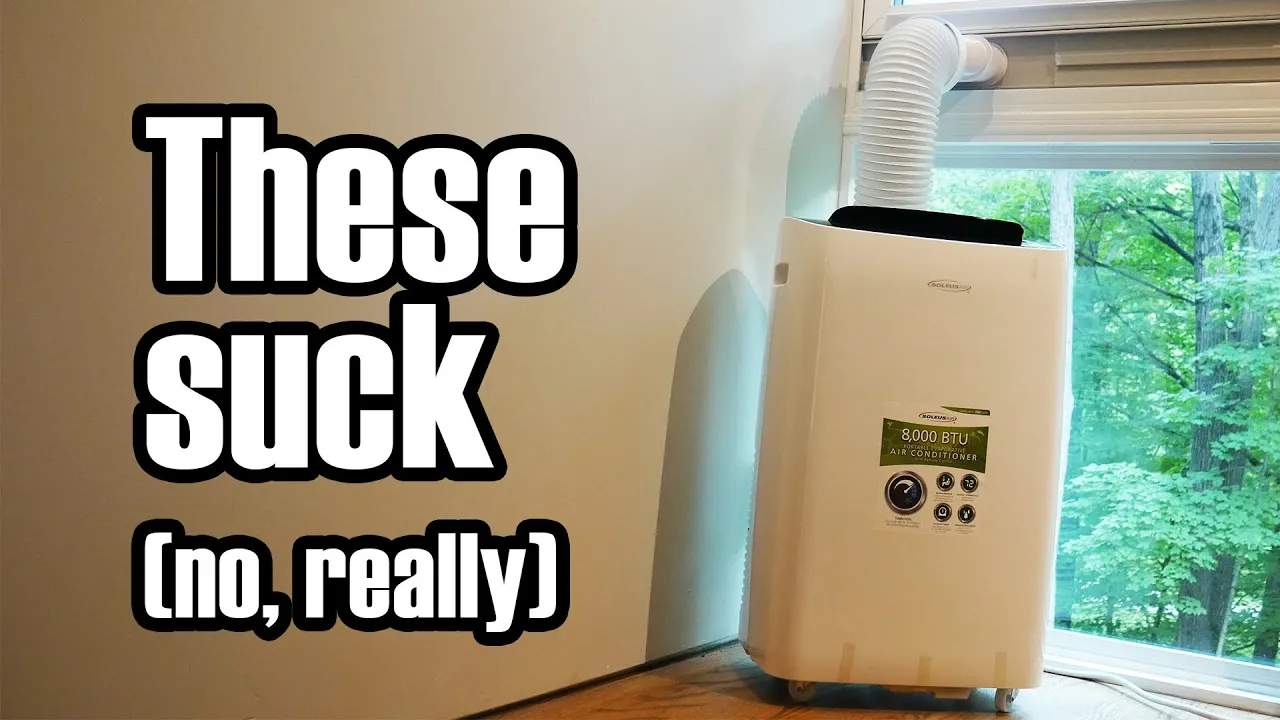
Single-Hose Portable ACs Burn Double the Energy of Window Units
Technology Connections
Single-hose portable air conditioners undermine their own efficiency by exhausting chilled indoor air to vent heat, creating negative pressure that pulls hot outdoor air back through household leaks.
Single-hose portable air conditioners inherently waste energy by blowing indoor, conditioned air over their hot condensers and venting it outside, which creates negative room pressure that continuously draws in warm outdoor air through home leaks. (5:54)
Due to parasitic heat radiation and unconditioned air infiltration, updated testing standards show that an 8,000 BTU-rated portable unit delivers an effective seasonal rating of only about 6,000 BTUs per hour, a 25% drop in net cooling capacity. (7:49)
Energy comparisons demonstrate that while a small 5,000 BTU window unit consumes approximately 455 Watts, a 5,500 BTU single-hose portable unit can draw over 1,000 Watts—more than double the power for roughly the same output. (7:49)
Unlike window units that isolate the compressor and condenser fan outside behind styrofoam acoustic insulation, portable units place both loud mechanical components entirely within the living space, causing abrupt and disruptive noise swings when cooling cycles engage. (9:59)
Detailed notes
## Background
Published on YouTube by Technology Connections on June 15, 2019, this video investigates why freestanding portable air conditioners fail to match the performance of traditional cooling appliances. According to the show notes, the video addresses a modern product that trades efficiency for sheer convenience, urging viewers to recognize the severe thermodynamic shortcomings of single-hose units and opt for window units whenever practically possible.
## TL;DR
Using a breakdown of the vapor-compression refrigeration cycle, the video explains why single-hose portable air conditioners are fundamentally compromised compared to traditional window units. Because portable units house their hot condenser coils inside the living space, they cool the condenser with indoor air and blow it outside, generating negative air pressure that pulls hot outside air back in through cracks and drafts. This self-defeating design leads to massive efficiency drops—often requiring more than double the electrical wattage for comparable cooling—while introducing loud indoor mechanical noise, radiant hose heat, and lost floor space. While portable units remain useful for awkward windows that cannot support a bracketed unit, the host demonstrates that standard window units are superior in efficiency, acoustic comfort, and cooling capability.
## Atmosphere & style
The presentation carries an engaging blend of deadpan humor, technical curiosity, and relatable frustration, epitomized by the host treating an unusable window unit sitting on his floor as a personal 'symbol of shame.' It feels like an intimate, clear-headed deep dive from a knowledgeable friend who uses hands-on hardware demonstrations and side-by-side acoustic tests to demystify everyday engineering flaws. The pacing is lively and conversational, concluding on a lighthearted note with end-credit outtakes capturing the host stumbling over phrasing and critiquing his own delivery.
## Bulletin
- [05:54](https://www.youtube.com/watch?v=_-mBeYC2KGc&t=354s) Single-hose portable air conditioners inherently waste energy by blowing indoor, conditioned air over their hot condensers and venting it outside, which creates negative room pressure that continuously draws in warm outdoor air through home leaks.
- [07:49](https://www.youtube.com/watch?v=_-mBeYC2KGc&t=469s) Due to parasitic heat radiation and unconditioned air infiltration, updated testing standards show that an 8,000 BTU-rated portable unit delivers an effective seasonal rating of only about 6,000 BTUs per hour, a 25% drop in net cooling capacity.
- [07:49](https://www.youtube.com/watch?v=_-mBeYC2KGc&t=469s) Energy comparisons demonstrate that while a small 5,000 BTU window unit consumes approximately 455 Watts, a 5,500 BTU single-hose portable unit can draw over 1,000 Watts—more than double the power for roughly the same output.
- [09:59](https://www.youtube.com/watch?v=_-mBeYC2KGc&t=599s) Unlike window units that isolate the compressor and condenser fan outside behind styrofoam acoustic insulation, portable units place both loud mechanical components entirely within the living space, causing abrupt and disruptive noise swings when cooling cycles engage.
## Key takeaways
- [00:00](https://www.youtube.com/watch?v=_-mBeYC2KGc&t=0s) Traditional window air conditioners should always be chosen over portable air conditioners whenever physically and practically feasible.
- [01:08](https://www.youtube.com/watch?v=_-mBeYC2KGc&t=68s) Air conditioning relies on moving heat rather than destroying it, using a closed vapor-compression cycle with a compressor, condenser, metering restriction, and evaporator.
- [04:51](https://www.youtube.com/watch?v=_-mBeYC2KGc&t=291s) The golden rule of room cooling is absolute separation: keep the cold evaporator indoors and the hot compressor and condenser outdoors.
- [04:51](https://www.youtube.com/watch?v=_-mBeYC2KGc&t=291s) Window units and split systems maintain efficiency by circulating only sealed refrigerant across the home's thermal boundary without exhausting any indoor air outside.
- [05:54](https://www.youtube.com/watch?v=_-mBeYC2KGc&t=354s) Single-hose portable air conditioners suffer from a major design flaw by taking indoor air that has already been cooled and using it to vent condenser heat outdoors.
- [05:54](https://www.youtube.com/watch?v=_-mBeYC2KGc&t=354s) Exhausting indoor air creates a negative pressure vacuum in the room, constantly pulling unconditioned, hot outdoor air back inside through cracks and gaps.
- [05:54](https://www.youtube.com/watch?v=_-mBeYC2KGc&t=354s) Dual-hose portable units recover significant efficiency by using dedicated intake and exhaust ducts for outdoor air, but retailers heavily favor cheaper single-hose models.
- [07:49](https://www.youtube.com/watch?v=_-mBeYC2KGc&t=469s) Under realistic testing standards, portable air conditioner capacity ratings drop significantly compared to legacy ratings due to duct heat radiation and air infiltration.
- [07:49](https://www.youtube.com/watch?v=_-mBeYC2KGc&t=469s) A standard 1,000-Watt window unit delivers 10,000 to 12,000 BTUs of cooling—roughly double the cooling performance of a portable unit with the same power draw.
- [09:59](https://www.youtube.com/watch?v=_-mBeYC2KGc&t=599s) Housing the compressor and condenser blower inside the room causes portable units to be substantially louder than window units, which benefit from exterior mounting and styrofoam sound insulation.
- [09:59](https://www.youtube.com/watch?v=_-mBeYC2KGc&t=599s) The cycling of the portable unit's condenser exhaust fan produces jarring transitions between quiet idle periods and loud active cooling, disrupting sleep.
- [09:59](https://www.youtube.com/watch?v=_-mBeYC2KGc&t=599s) Portable units consume valuable interior floor space because they cannot sit flush against walls, and their thin plastic exhaust hoses radiate heat back into the living space.
- [12:07](https://www.youtube.com/watch?v=_-mBeYC2KGc&t=727s) Portable units remain practical only as a last resort for non-standard window types, casement openings, patio doors, or spaces where exterior mounting is strictly prohibited.
- [14:10](https://www.youtube.com/watch?v=_-mBeYC2KGc&t=850s) Refrigeration appliances are increasingly adopting eco-friendly refrigerants like propane (R290) and difluoromethane (R32), which offer high thermodynamic efficiency despite mild flammability.
## Detailed walkthrough
### [00:00](https://www.youtube.com/watch?v=_-mBeYC2KGc&t=0s) The Rise of Portable Air Conditioners and the Symbol of Shame
Air conditioners are undeniably useful, but an increasingly ubiquitous design has taken over store aisles that figuratively and literally sucks: the portable air conditioner. These freestanding appliances appear to have conquered hardware stores, promising effortless cooling without the awkward installation of a traditional window-mounted box. However, when asked whether these devices have what it takes to unseat traditional window air conditioners, the answer is a flat and unambiguous no.
That does not mean portable units are completely useless; they certainly cool the air, and in specific situations, they become an unavoidable necessity. The host displays a portable unit operating in his own space precisely because the window it vents through cannot securely support a window unit. Having attempted to force a window unit into that opening anyway, he points to a spare window air conditioner resting on the floor as the literal “symbol of my shame.” Rather than returning it, he kept it around to serve as a hands-on visual aid. The central premise of the discussion is simple: whenever physically and practically possible, buyers should always choose a standard window unit over a portable model.
As Technology Connections argues: “Now, in this video I’m going to argue that if you need an air conditioner you should gravitate towards these simple window units and away from those trendy portable units *if you can*.”
[01:08](https://www.youtube.com/watch?v=_-mBeYC2KGc&t=68s) The Fundamentals of Refrigeration: Compressor, Condenser, and Evaporator
Understanding why portable units fall short requires looking inside the fundamental refrigeration cycle that powers almost every mechanical cooling appliance. Air conditioners do not magically destroy heat or generate cold out of nothing; they collect and concentrate ambient heat energy to move it elsewhere. The cold air exiting the machine is merely standard indoor air stripped of its heat. Because that extracted energy cannot simply be bottled up in a container, it must be expelled, almost always into the outside atmosphere.
Every standard refrigeration circuit relies on three core components: a compressor, a condenser, and an evaporator. The process begins inside a black cylindrical compressor, which pressurizes a refrigerant gas into a small volume, sharply raising both its pressure and temperature. This scorching, pressurized vapor flows into the condenser—a finned heat exchanger designed to shed heat as fast as possible. With the help of an outdoor fan forcing air over dense fins, the refrigerant drops to around 130°F or 150°F. Because the refrigerant is under intense pressure, its boiling point is elevated substantially, causing it to condense into a high-pressure liquid and release a massive quantity of latent heat energy in the process.
```mermaid
flowchart TD
accTitle: Vapor-Compression Refrigeration Cycle
accDescr: Refrigerant circulates through compressor, condenser, metering restriction, and evaporator to transfer heat outside.
subgraph HotSide["Hot Side (Outdoor / Heat Rejection)"]
A["Compressor<br/>(Pumps low-pressure gas to high-pressure hot gas)"]
B["Condenser Heat Exchanger<br/>(Releases heat to outside air; gas condenses to liquid)"]
end
subgraph ColdSide["Cold Side (Indoor / Heat Absorption)"]
C["Metering Device / Capillary Tube<br/>(Restricts flow, dropping pressure)"]
D["Evaporator Heat Exchanger<br/>(Absorbs heat from room air; liquid evaporates to gas)"]
end
A -->|"Hot, high-pressure vapor"| B
B -->|"Warm, high-pressure liquid"| C
C -->|"Cold, low-pressure liquid"| D
D -->|"Cool, low-pressure vapor"| A
```
From there, the liquid refrigerant reaches a metering restriction—in this budget window unit, a narrow copper capillary tube. This bottleneck maintains head pressure in the condenser while strictly metering the fluid entering the evaporator. On the other side of this restriction, the intake suction of the compressor creates an environment of dramatically lower pressure. This sudden pressure drop causes the refrigerant's boiling point to plummet well below zero degrees. Finding itself in an environment far hotter than its new boiling point, the liquid spontaneously boils and evaporates. To complete this phase change back into a vapor, it must absorb heat energy from its surroundings. An indoor fan pulls room air across the evaporator’s cold fins, allowing the boiling refrigerant to draw heat directly out of the room before returning to the compressor to repeat the loop.
As Technology Connections summarizes: “After the refrigerant has absorbed as much energy as it can, it reenters the compressor where the cycle starts all over again.”
[04:51](https://www.youtube.com/watch?v=_-mBeYC2KGc&t=291s) Window Units and Split Systems: Keeping the Heat Outside
The golden rule of room cooling is absolute separation: keep the cold side indoors and the hot side outdoors. Looking at an installed window unit illustrates this separation cleanly. When mounted on a sill, the bulk of the machine sits outside the building envelope. Both the noisy compressor and the hot condenser live on the exterior side of the window sash. A thick barrier of molded styrofoam insulation serves as both a physical divider and a thermal break between the outdoor and indoor compartments.
Critically, a window unit does not eject any indoor air to the outdoors. The fan on the indoor side simply circulates room air across the cold evaporator fins, while a completely separate outdoor fan pulls outside air across the condenser coils. The only thing traveling back and forth across the home's thermal boundary is the refrigerant sealed inside closed copper tubing. This closed-loop approach maximizes overall efficiency.
Central air conditioning takes this design logic even further through what is known as a split system:
- **Outdoor condensing unit**: Combines the compressor, the condenser coil, and a large upward-blowing fan in a single cabinet located entirely outside, isolated from living spaces.
- **Indoor evaporator coil**: Housed within a central air handler or attached directly above the furnace inside the home.
- **Refrigerant line set**: Small, insulated copper pipes routed through a tiny hole in the wall, preserving the integrity of the home's building envelope while carrying heat out.
As Technology Connections notes of this design: “These systems are highly efficient, with the entire hot side located outside and away from the living space, and only a tiny hole is required in the home’s thermal barrier to move the refrigerant in and out.”
[05:54](https://www.youtube.com/watch?v=_-mBeYC2KGc&t=354s) The Fatal Flaw of Single-Hose Portable Air Conditioners
Examining a portable air conditioner immediately exposes its primary engineering compromise: the entire machine rests inside the room being cooled. Because both the cold evaporator and the blistering hot condenser share the same interior footprint, the machine must devise a way to dump heat outside through a plastic exhaust hose. To cool its internal condenser, the portable unit draws in ambient room air through rear intake slots, blows that air across the scorching condenser coils, and forces the resulting superheated air through the exhaust duct and out the window.
The absurdity of this mechanism becomes obvious upon closer inspection. The machine takes air from inside the room—air that it just spent electricity to chill—and barfs it straight outside. While dual-hose portable air conditioners exist to draw exterior air in through one duct and expel it through another, they represent an increasingly rare niche in retail stores, where cheap, single-hose units dominate the market.
Beyond ejecting conditioned air, a single-hose machine creates an aggressive negative pressure zone within the room. Because air cannot leave an enclosed room without being replaced, the indoor volume acts like a mild vacuum, pulling replacement air in from outside through unsealed window frames, doorways, wall outlets, and floorboards. Consequently, the machine is constantly sucking in hot outdoor air through house leaks to replace the air it just vented outside, working in direct opposition to itself.
As Technology Connections puts it: “Single-hose portable air conditioners will always be significantly less efficient than a window unit because they’re not just pulling the heat energy out of your room.”
[07:49](https://www.youtube.com/watch?v=_-mBeYC2KGc&t=469s) Efficiency Realities and Noise Comparisons
The real-world penalty of this continuous infiltration is massive. Due to updated testing standards that factor in duct heat radiation and negative-pressure air infiltration, modern portable units now display two different cooling capacity ratings on their boxes. An 8,000 BTU unit rated under older laboratory conditions may deliver an effective seasonal rating of only 6,000 BTUs per hour under realistic testing—a 25% drop in net cooling capacity.
Electrical power consumption highlights an even wider divide:
| Air Conditioner Type | Rated Capacity | Electrical Power Draw | Relative Performance |
|:--- |:--- |:--- |:--- |
| **Small Window Unit** | 5,000 BTU/hr | 455 Watts | Baseline high-efficiency benchmark |
| **LG Portable Unit (Single Hose)** | 5,500 BTU/hr | Over 1,000 Watts (1+ kW) | Uses more than 2x power for only 10% more capacity |
| **Equivalent 1 kW Window Unit** | ~10,000 to 12,000 BTU/hr | ~1,000 Watts | Produces roughly double the cooling capacity of the portable |
The host emphasizes that owning a portable unit does not make someone an idiot—after all, he owns two himself out of sheer necessity. However, portable air conditioners should strictly be viewed as an option of last resort. While detractors point out that window units are visually unattractive, block window views, and look clunky from the street, window units consistently defeat portables on acoustic comfort as well as efficiency.
Air conditioners are fundamentally loud machines driven by vibrating compressors and whirring fans. In a window unit, the buzzy compressor and outdoor condenser fan reside outside the window sill, separated from the living quarters by heavy styrofoam casing that doubles as excellent acoustic insulation. Often, a single shaft drives both the indoor and outdoor fan wheels, meaning the only sound variation inside the room is a subtle hum when the compressor cycles on. In contrast, a portable air conditioner houses its compressor and both blower fans entirely inside the living space, subjecting occupants to constant, uninsulated mechanical droning.
As Technology Connections concludes regarding purchase choices: “If you have the option to use a traditional window unit, take it.”
[09:59](https://www.youtube.com/watch?v=_-mBeYC2KGc&t=599s) Noise, Floor Space, and Hot Exhaust Hoses
The host contrasts traditional window units with portable air conditioners, emphasizing how loud portables become in an indoor living space. With a conventional setup, the loudest mechanical parts reside entirely outside the home. In sharp contrast, a portable unit places both the compressor and the condenser fan directly inside the room where you work or sleep. While running only its circulator fan, the unit remains reasonably tolerable; however, the moment the thermostat calls for cooling, the machine becomes drastically louder. The compressor kicks on indoors, accompanied immediately by a second fan designed to blow heat over the condenser and vent it outside. While it is necessary for this exhaust fan to shut off during idle periods to prevent continuously sucking conditioned air out of the room, that design creates a jarring dynamic swing between silence and deafening operation:
> “And if you’re trying to sleep in the same room as one of these, you’ll have to put up with it going from pretty quiet to loud as hell and back over and over again.”
Demonstrating the sound profile on camera, the host shows off an inexpensive in-house store brand unit—humorously referenced as coming “from that place where you save big money” (Menards)—alongside a slightly more refined model from LG. While the LG transitions between idle and active cooling with slightly more elegance, both machines remain exceptionally loud while cooling. Even as a self-described heavy sleeper, the host admits that attempting to ignore the roar while trying to fall asleep proves difficult.
Beyond the noise penalty, portable air conditioners introduce serious spatial and thermal compromises:
- **Floor Space Encroachment:** Window units hang outdoors and merely obstruct window glass, whereas portable units take up valuable interior floor space. Because the exhaust hose protrudes out the rear, the appliance cannot sit flush against a wall, requiring users to rearrange furniture to accommodate it.
- **Radiated Heat:** The exhaust hose itself becomes very hot. Concentrated heat energy moving through the thin, uninsulated plastic hose radiates right back into the living space before it can escape out the window.
```mermaid
flowchart TD
accTitle: Single-Hose Portable Air Conditioner Room Impact
accDescr: Diagram illustrating how noise, heat, and space issues affect an indoor room with a single-hose portable AC.
subgraph Room ["Indoor Living Space"]
AC["Portable A/C Unit"]
Comp["Compressor & Condenser Fan<br/>(Loud mechanical noise inside room)"]
Hose["Uninsulated Exhaust Hose<br/>(Radiates heat back indoors)"]
Floor["Occupies floor space<br/>(Cannot sit flush to wall)"]
AC --> Comp
AC --> Hose
AC --> Floor
end
Window["Window Vent"]
Hose -->|"Expels hot air outdoors"| Window
```
---
[12:07](https://www.youtube.com/watch?v=_-mBeYC2KGc&t=727s) Practical Advantages vs. Inherent Design Flaws
Despite their drawbacks, the host admits portable air conditioners offer undeniable convenience. They avoid the physically grueling, difficult installation required for traditional window units. Sitting on casters, they roll effortlessly from room to room, and they adapt to unusual window layouts—such as tall sliding vertical windows, casement openings, or patio doors—where standard window units cannot mount. If an owner chooses, they can even vent the unit through a dedicated wall cutout.
Yet, despite their practical appeal, single-hose designs remain fundamentally compromised. The host calls for manufacturers to bring more dual-hose units to market. While dual-hose machines still suffer from the same floor space and noise penalties, they recover a massive amount of efficiency by drawing outdoor air across the condenser rather than constantly exhausting conditioned room air.
Reflecting on alternative designs, the host recounts experimenting the prior summer with a portable mini-split system. That design paired an outdoor compressor and condenser with an indoor evaporator unit, joined together through a thin, flexible refrigerant line. Although blissful, quiet, and highly efficient while operating, the unit developed a refrigerant leak and failed within weeks—a common issue for that style of equipment. Furthermore, mini-splits demand outdoor placement, making them impractical above ground level without a balcony or specialized exterior wall brackets.
Ultimately, the host advises against buying a portable unit if a standard window air conditioner can fit:
> “Contrary to what you might think, portable units are certainly not an upgrade. Other than their portableness. That’s, that’s pretty cool.”
---
[14:10](https://www.youtube.com/watch?v=_-mBeYC2KGc&t=850s) Modern Refrigerants (R290 and R32), Channel Support, and Outtakes
Expanding on thermodynamics, the host marvels at how refrigeration relies on the physical properties of expanding and compressing gases to manipulate heat. Contrary to the assumption that all refrigerants are exotic chemical concoctions, the industry is increasingly turning toward propane, designated as R290. Due to its wide availability, high thermodynamic efficiency, and near-zero environmental harm compared to older fluorinated greenhouse gases, propane is showing up in smaller appliances and air conditioners. Because propane is flammable, it is unsuitable for large commercial systems that require substantial refrigerant charges, and it complicates field servicing. However, for cheap, compact consumer appliances that are typically recycled or disposed of rather than repaired, propane offers an ideal solution. Looking at the specific portable machine on set, the host notes it uses difluoromethane (R32), which is also mildly flammable.
Closing out the segment, the host thanks his Patreon community, highlighting the scrolling credits on screen and announcing that patrons now receive an invite to a dedicated Technology Connections Discord server alongside early access perks and occasional behind-the-scenes material.
The video finishes with a comedic sequence of bloopers and vocal warm-up flubs:
- Tripping over lines describing how air conditioners process normal air.
- Frustrated groaning and self-critiques about pacing: *“I’m—this tone is all wrong. OK… maybe move at like a pace that makes sense.”*
- Repeatedly stumbling over the phrase *“hardware aisle.”*
- Getting caught in an escalating verbal loop attempting to articulate the word *“since”* while explaining the concept that cold is simply the absence of heat (*“and sint he… Augh! Sint. Since heat! SINCE heat! It’s a wo...the Since! Since is the word. Since.”*).
## Notable quotes
> [05:54](https://www.youtube.com/watch?v=_-mBeYC2KGc&t=354s) Single-hose portable air conditioners will always be significantly less efficient than a window unit because they’re not just pulling the heat energy out of your room. — Technology Connections
> [07:49](https://www.youtube.com/watch?v=_-mBeYC2KGc&t=469s) If you have the option to use a traditional window unit, take it. — Technology Connections
## Video description
You can support this channel on Patreon! Link below
Oh no. It’s a new version of a well-established product that trades efficiency for convenience. But this time, it’s more than just being cool. It’s about cooling.
Seriously, either we need to get more awareness of how dumb single-hose portable A/C units are, or we need to just use window units whenever possible. While I know that there are times a portable unit is the only option (remember, I’m in that boat), it seems that only very high capacity, premium machines have the facility to use two hoses. Which is frankly stupid but then again that’s what I’m trying to tell you now.
How about some links? Ya link links? I’ve gathered some for you:
Technology Connections 2 (the channel where I sometimes talk about stuff and generally don’t prepare for anything):
https://www.youtube.com/channel/UClRwC5Vc8HrB6vGx6Ti-lhA
You can support this channel on Patreon! It has been amazing what Patreon has done for this channel, but also for me (your dorky host) personally. Through the support of people just like you, Technology Connections has become my job and I am so excited and thankful for it! If you’d like to join the fine folks in a pledge to help the channel grow, please check out my Patreon page. Thank you for your consideration!
https://www.patreon.com/technologyconnections
And thank you to the following Patrons!
Yaniv, Tab Patterson, Francis Fisher, The War Academy, Conor Killeen, Jason R Scheuren, Dave Anderson, Noah McCann, Eric Hansen, Dane Peterson, Steven First, Audin Malmin, Adam D. Ruppe, Rafał Wiosna, Matthew Giraitis, Kevin Landrigan, Harald E. Westlie, Carl Yazbek, Stephen Bell, Logan Kriete, Hunter Schwisow, Matt Falcon, Kieran Cox, Eric Wood, Paul Williams, Brent LaRowe, Lurker239, Felix Freiberger, James Ryan, Lukas Komischke, Jason Nevins, Jeffrey, BlancoGrande, Stephen Pick, Technicalleigh, John McLusky, Adam Coddington, Lolucoca, Steven Metcalf, Justin Talbot, Christopher Jett, SovietBear, Mike Mason, Techmoan, Kotanu, Christopher Luna, Paul Mills, Colton Aubrey Hooke, Brian G. Shacklett, Eduardo Kaftanski, Steve Stone, Chris Hartl, Gantradies, Andre N, Tony, Matthew Baron, Revenge, Andres Plaza, Charlie Hankin, Casey Kikendall, Sebi Jecklin, Warmo, The8TrackKid, Drew McClain, Michael Snowden, Ed Hall, Julian Rapoport, Christopher Bassett, Ryan Cozzubbo, Marcus Schwartz, Johan Schoeman, Matt Taylor, Patrick Musson, Lars JJ, Richard Lindsey, Kollin O'Dannel, PK, blouerat, Robert Toth, Joseph Hill, Marc Ethier, Giacomo Scaparrotti, Brady Brown, Stein Strindhaug, foophoof, Ernie Smith, Christopher Dickey, Denver Alexander, Jan Stavel, Mitchel J. Mullin II, Matthew Razza, Trix Farrar, Marco Anastasi, Pavlo Pravdiukov, Raymond LaRose, Howard Kraut, Mike Bailey, Yona, neko, Grayson Lang, Thomas Beaver, Jeffery Grajkowski, Eric Merrill, Stefan Berndtsson, Michael Sims, Clint Eisinger, Christopher Leidich, Mike Friedman, André Waage Sørensen, Sam Redfern, mark barratt, Tully, fussel, Corey A Hudson, EpicLPer, Luc Ritchie, Michael Dragone, Eric Romero, Ryan Hardy, Taylor Martin, Nicholas, thefanification, Ewen McNeill, Shane Zamora, John Bailey, Alex Ilyin, Andrew "FastLizard4" Adams, Avi Drissman, Phil Taprogge, Rich Jeanes, Jonathan Skowronek, Tim Grov, Pieter van der Eems, Brian Condron, Reto Jost, Vince Terranova, Andrew Montagne, Alec Jahn, David Scott, Mike Nichols, Brandon Enright, James Fialho, Christian Torelli, toasterking, Jason Brady, ce keen, Jake Shep83, Nick Pollard, David Grossman, Manalope, Andy S, Robert, Johan Greefkes, Jacob Dixon, Rob Kefford, Eric Butterfield, Tim Skloss, Benjamin A., Nathaniel, Colin Cogle, Aaron Rennow, Yota Ninja, Bee Jay, Countzero, Kodapan, Eli Krumholz, Guillaume Tremblay-Beaumont, Sha Nasti, Laria, Stephen B Hinton, thegeoffreak, Karen Scarfone, f. scott b., Elliot Clark, Bob Slovick, Jason Burgett, Jib Systems, Andrew Rosenwinkel, Grazer, Tero Janhunen, Bob B, Mike Noe, Scott Rowland, Phillip Cosgrove, Joshua Doades, Ennex The Fox, Steve Kralik, Your name, Kirill Polstainen, Felix Winkelnkemper, Christopher Lawhead, BoostCookie, 98abaile, Rennix, Charles, Sebastian Sparrer, Matt Mullett, Andreas Kuzma, Paul Moffat, Max, Ryan Benson, Neil Forker, Vincent Beelte, James Pinakis, Johnni Winther, Mark Hesse, Nathan Blubaugh, lululombard, Armando Fox, Nelson, Angelo van der Sijpt, William Evans, Philip, VilleS, Anton Afanasev, Kilrah, Ray, Liam O'Flynn, Oliver Lee, Lennart Sorensen, Mitch Radoll, Will Wren, Viorel, Reaghan Kekeis, lohphat, Vivian Pypher, Brandon Whiting, Scott Herron, Peter Stewart, Patrick Barry, Robin Johnsen, Nomad, Eric, Phia Westfall, Mats Svardal, Jeremey Hastings, Mark Wayt
Technology Connections argues that consumers should avoid portable air conditioners in favor of traditional window units whenever possible, as portable models are inherently louder, less energy-efficient, and thermodynamically compromised.
Refrigeration Principles and the Exterior Boundary (4:51)
Air conditioners do not destroy heat; they extract thermal energy from indoor air and move it elsewhere using a closed vapor-compression cycle comprising a compressor, condenser, metering restriction, and evaporator. In standard window units and central split systems, the heat-rejection components—the noisy compressor and hot condenser coil—are positioned outside the living space. Molded insulation forms a thermal and acoustic barrier, ensuring that only refrigerant moves across the building envelope while indoor and outdoor air streams remain completely separated.
The Inefficiency of Single-Hose Exhaust Systems (5:54)
Single-hose portable air conditioners sit entirely inside the room they are tasked with cooling. To shed heat, they draw air from within the room, pass it across the hot condenser coils, and vent it outdoors through an exhaust duct. This design creates two severe thermodynamic penalties: it discards indoor air that the machine already spent electricity to cool, and it induces negative air pressure that pulls hot, unconditioned outdoor air into the room through cracks, doorframes, and outlets.
Because of this infiltration, modern testing standards reveal steep drops in effective cooling capacity. For example, an 8,000 BTU unit under older ratings may deliver only 6,000 BTUs per hour of net cooling under realistic seasonal conditions. Electrically, an LG single-hose portable rated at 5,500 BTUs draws over 1,000 watts, whereas a typical 5,000 BTU window unit draws only 455 watts. A window unit consuming 1,000 watts would typically deliver between 10,000 and 12,000 BTUs per hour—roughly double the cooling performance of the portable.
Indoor Acoustic and Spatial Compromises (9:59)
Because both the compressor and the condenser fan operate inside the room without the exterior sound isolation of a window sash, portable units generate significant indoor noise. When the thermostat triggers active cooling, the machine transitions abruptly from a gentle circulation fan to a loud mechanical drone, which can disrupt sleep.
Portable units also introduce physical drawbacks inside living spaces. They consume floor area, cannot sit flush against walls due to rear exhaust ducting, and utilize uninsulated plastic hoses that radiate concentrated heat back into the room before the air escapes outside.
Legitimate Use Cases and Technical Alternatives (12:07)
Portable air conditioners remain useful in narrow circumstances where traditional window units cannot be safely mounted, such as in casement windows, vertical sliders, or situations requiring casters to move between rooms. Technology Connections notes that dual-hose portable units mitigate the negative pressure issue by drawing outside air across the condenser, though they are less common in retail stores. Experimental alternatives like portable mini-splits offer quiet, efficient cooling, but they require outdoor compressor placement and are prone to refrigerant leaks.
The industry is also evolving toward lower-impact refrigerants. Smaller consumer appliances are increasingly adopting difluoromethane (R32) and propane (R290), which offer high thermodynamic efficiency and minimal global warming potential, though their flammability limits their use to factory-sealed units.
While portable air conditioners offer an unavoidable workaround for non-standard window frames, their single-hose internal layout forces continuous air infiltration, poor electrical efficiency, and excessive indoor noise, making them an option of last resort.
## Background
该视频由 YouTube 频道 Technology Connections 于 2019 年 6 月 15 日发布。简介指出,单管移动空调是一种为了便利性而牺牲能效的糟糕产品,呼吁大众提高对单管机缺陷的认识,并在条件允许时尽量优先选择窗式空调。
## TL;DR
主讲人首先解释了空调通过压缩机、冷凝器与蒸发器搬运热量的基本热力学机制,指出传统窗机能高效地将放热端隔绝在室外。随后深入剖析了单管移动空调的致命硬伤:整机置于室内导致排热时白白抽取已降温的空气,进而制造室内负压倒吸外界热气,实测能耗比同级别窗机高出一倍以上。此外,这类机器还存在剧烈的噪音波动、占用室内地面以及未保温排气管二次辐射热量等严重缺陷。主讲人最后指出,除非窗户结构绝对无法安装窗机或别无选择,否则绝不推荐购买单管移动空调。
## Atmosphere & style
全片充斥着主讲人标志性的 Geek 极客幽默与严谨较真的工科思维,语调在犀利的辛辣吐槽与热忱的科学科普之间游刃有余。通过直白的实物拆解、功耗对比与夸张的叹息,他把枯燥的热力学原理讲得生动接地气。整期视频既像一场理直气壮的消费“避坑”檄文,又流露出对经典制冷工程美学的纯粹赞赏,片尾逗趣的忘词花絮更添亲切感。
## Bulletin
- [05:54](https://www.youtube.com/watch?v=_-mBeYC2KGc&t=354s) 单管移动空调存在严重热力学缺陷,因其抽取刚降温的室内空气冷却冷凝器并排向室外,制造的室内负压会倒吸外界高温热空气,导致有效制冷量缩水约25%。
- [07:48](https://www.youtube.com/watch?v=_-mBeYC2KGc&t=468s) 实测能耗对比显示,一台5,500 BTU的移动空调功耗超过1,000瓦,而传统5,000 BTU窗机功耗仅约455瓦,移动空调耗电增加超过一倍却几乎没有带来制冷增益。
- [09:59](https://www.youtube.com/watch?v=_-mBeYC2KGc&t=599s) 移动空调将压缩机与高速排热风扇置于室内,造成剧烈的周期性噪音突变,且未保温的塑料排热管在高温下会重新向室内散发热量。
- [12:07](https://www.youtube.com/watch?v=_-mBeYC2KGc&t=727s) 双管移动空调通过独立的室外进排气回路能解决负压问题,但若窗户结构允许安装传统窗机,窗机在能效、噪音和使用成本上均全面胜出。
## Key takeaways
- [01:08](https://www.youtube.com/watch?v=_-mBeYC2KGc&t=68s) 空调的物理本质是热量搬运工,核心由压缩机、冷凝器和蒸发器三大部件组成,依赖制冷剂相变将室内热量排放到室外。
- [04:51](https://www.youtube.com/watch?v=_-mBeYC2KGc&t=291s) 传统窗机将压缩机和冷凝器置于室外并使用厚保丽龙隔热,运转时完全不向外排放室内空气,仅循环制冷剂搬运热量。
- [05:30](https://www.youtube.com/watch?v=_-mBeYC2KGc&t=330s) 分体式空调实现了最彻底的热冷分离,外墙仅需穿过细小铜管,因而具备极高的热力学能效与室内静音表现。
- [05:54](https://www.youtube.com/watch?v=_-mBeYC2KGc&t=354s) 单管移动空调强制抽取室内降温空气为机内冷凝器散热,并直接吹向室外,造成极为荒谬的冷量浪费。
- [06:40](https://www.youtube.com/watch?v=_-mBeYC2KGc&t=400s) 单管排风在室内产生持续负压,促使室外未被处理的高温空气通过门窗缝隙不断渗回室内,大幅抵消制冷效果。
- [07:48](https://www.youtube.com/watch?v=_-mBeYC2KGc&t=468s) 新评级标准将漏风与对流损耗计入后,标称8,000 BTU的移动空调有效制冷量往往仅剩约6,000 BTU左右。
- [09:59](https://www.youtube.com/watch?v=_-mBeYC2KGc&t=599s) 移动空调把所有噪音源留在室内,温控启闭导致噪音在微弱风声与巨大轰鸣间剧烈跳变,严重破坏睡眠质量。
- [11:10](https://www.youtube.com/watch?v=_-mBeYC2KGc&t=670s) 机身占用地板面积且排气软管未做隔热包裹,运转时滚烫的管壁会向生活空间二次辐射热量。
- [12:07](https://www.youtube.com/watch?v=_-mBeYC2KGc&t=727s) 移动空调唯一的优势在于极低的安装门槛与适应性,可适配推拉窗或无法承重的窗框结构。
- [12:30](https://www.youtube.com/watch?v=_-mBeYC2KGc&t=750s) 双管移动空调建立独立的室外空气换热循环,能彻底消除室内负压,但在消费市场上机型十分罕见。
- [12:55](https://www.youtube.com/watch?v=_-mBeYC2KGc&t=775s) 便携分体空调虽然静音高效,但其柔性冷媒管极易漏氟报废,且对外机放置平台要求苛刻。
- [13:30](https://www.youtube.com/watch?v=_-mBeYC2KGc&t=810s) 只要安装环境允许稳固托住传统窗机,消费者就应当坚决避开单管移动空调。
- [14:10](https://www.youtube.com/watch?v=_-mBeYC2KGc&t=850s) R290(丙烷)作为来源丰富且环保的天然制冷剂正被广泛用于小型密闭家电,但其易燃性限制了大型系统的应用。
## Detailed walkthrough
### [00:00](https://www.youtube.com/watch?v=_-mBeYC2KGc&t=0s) 移动空调的崛起与尴尬现实
主讲人以幽默的口吻开场,称空调确实很“酷(cool)”,但市面上有一种越来越流行的款式,不仅在字面意义上“吸气”,在实际表现上也“烂透了(figuratively and literally sucks)”——那就是移动空调(portable air conditioners)。在五金店的空调货架上,这类产品几乎随处可见,大有席卷全球的势头。然而,面对它们能否取代传统窗机(window unit)的疑问,主讲人给出了极其干脆的否定回答:“No. Portable air conditioners are actually kinda… bad.”
这并不代表移动空调完全无法制冷,它们在某些特定场景下确实能派上用场。主讲人以自己手头的机器为例,之所以必须用它,是因为房间的窗户根本无法安全、稳固地托住一台传统的窗式空调。主讲人甚至展示了那台他曾尝试安装、最终失败并留作“耻辱象征”的窗机,不过这也正好留下来充当本期视频绝佳的对比道具。他的核心论点十分明确:只要条件允许,用户在购买空调时应当坚定地选择简单朴素的窗机,避开华而不实的移动空调。
### [01:08](https://www.youtube.com/watch?v=_-mBeYC2KGc&t=68s) 空调工作原理:三大核心部件与热量搬运
为了说清楚移动空调到底差在哪里,必须先了解空调的基本热力学机制。空调本质上是一种机械设备,通过收集和集中热能,将其从一个地方搬运到另一个地方。空调制造出的冷气,其实只是被抽离了热能的普通室内空气;由于无法直接把热能“装进瓶子里封存”,系统必须将这些热量排放到别处——通常是室外空气中。
几乎现存的所有空调和制冷系统,核心结构都可以简化为三大关键部件:压缩机、冷凝器和蒸发器。
```mermaid
flowchart LR
accTitle: Refrigeration Cycle Diagram
accDescr: The standard cooling cycle moving heat from the indoor evaporator to the outdoor condenser via a compressor and metering device.
subgraph ColdSide["室内(吸热侧)"]
EVAP["蒸发器 (Evaporator)<br/>低压环境 · 制冷剂沸腾气化<br/>吸收室内热量"]
end
subgraph HotSide["室外(放热侧)"]
COMP["压缩机 (Compressor)<br/>加压压缩制冷剂气体<br/>升温升压"]
COND["冷凝器 (Condenser)<br/>风扇与翅片强制散热<br/>高压制冷剂液化放热"]
end
VALVE["节流装置 (Capillary Tube)<br/>限制流量 · 维持冷凝器高压"]
COMP -->|"高温高压气体"| COND
COND -->|"高压液体"| VALVE
VALVE -->|"减压流动"| EVAP
EVAP -->|"低温低压气体"| COMP
```
- **压缩机(Compressor)**:通常位于一个黑色圆柱体内,负责将气态制冷剂压缩到狭小空间内,使其体积缩小、压力激增。气体在被压缩的同时会剧烈升温。
- **冷凝器(Condenser)**:这是一个高效换热器,负责尽快冷却来自压缩机的高温高压气体。密集的金属翅片大幅增加了表面积,配合风扇吹风加快散热。由于处于高压状态,制冷剂的沸点显著上升(例如升至 130 到 150 华氏度 / 约 54~66 摄氏度),在管道内冷却时便会冷凝成液体,释放出巨量的热能。
- **节流装置与蒸发器(Metering Device & Evaporator)**:液态制冷剂流出冷凝器后,被节流元件(例如膨胀阀,在基础窗机中通常是一根内径极细的细长铜质毛细管)拦截,从而维持冷凝器侧的高压。当少量液体挤过毛细管进入蒸发器时,那里的内部压力被压缩机吸气端抽得极低。压力骤降导致制冷剂沸点暴跌至零下,由于环境对它来说过于温暖,制冷剂迅速自发沸腾蒸发。相变吸热的过程通过蒸发器翅片从室内空气中夺走热量,使房间变冷。完成吸热的气体再次进入压缩机,开启下一轮循环。
主讲人总结道,人们习惯于认为蒸发器变冷了,但本质上“Coldness is really just less concentrated heat energy, and since heat likes to go towards cold places to spread out, it naturally finds its way (with the help of a fan).”在宏观布局上,空调系统必须具备压缩机、热端(放热)和冷端(吸热),制冷的目的就是把热端置于室外,把冷端留在室内。
### [04:51](https://www.youtube.com/watch?v=_-mBeYC2KGc&t=291s) 窗机与分体空调的高效空间布局
从空间布局来看,窗式空调在安装完成时,绝大部分体积和重量实际上都悬在室外。它的压缩机和冷凝器均处于外侧空间,机身内部大量厚实的保丽龙(聚苯乙烯泡沫)充当了优秀的隔热层。在运转时,窗机完全不需要将室内的空气排到室外,穿过建筑外墙的仅仅是铜管内封闭循环的制冷剂及其携带的热能,这最大限度地保留了室内已有的冷气。
```mermaid
flowchart TD
accTitle: Window Unit vs Portable AC Airflow Comparison
accDescr: Contrasting how window units keep air isolated while single-hose portables pump conditioned air outside.
subgraph WindowUnit["传统窗机 (Window Unit)"]
W_In["室内空气"] --> W_Evap["蒸发器 (机内冷侧)"] --> W_Cool["降温后送回室内"]
W_Out["室外空气"] --> W_Cond["冷凝器 (机身位于室外)"] --> W_HotOut["带走热量排出室外"]
end
subgraph PortableUnit["单管移动空调 (Single-Hose Portable)"]
P_In1["室内空气"] --> P_Evap["蒸发器制冷"] --> P_Cool["吹出冷气"]
P_In2["刚刚制冷的室内空气"] --> P_Cond["冷凝器吸热"] -->|"排气软管"| P_Dump["强行吐向室外"]
P_Leak["室外高温热风"] -.->|"负压渗透进入缝隙"| P_Room["重新渗入房间"]
end
```
这种热冷隔离的设计在分体式中央空调(Split System)上体现得更为彻底。分体空调的压缩机、冷凝器与散热风扇整合在外机中,远离生活区域;室内仅保留安装在风道或暖气炉内部的蒸发器,两者仅靠穿过外墙的细小制冷剂铜管连接。外墙保温屏障破坏极小,热端完全孤立在室外,因而具备极高的能效。
### [05:54](https://www.youtube.com/watch?v=_-mBeYC2KGc&t=354s) 单管移动空调的致命设计缺陷与负压陷阱
然而,观察移动空调就会发现一个荒谬的事实:整台机器完全位于室内,这意味着它的冷端和热端全都挤在房间内部。为了把冷凝器上的热量排出去,移动空调不得不通过机身的格栅抽取房间内的空气吹过冷凝器降温,再通过一根伸向窗外的粗排气软管将热风喷到外面。
针对这一运作逻辑,主讲人直白地痛批:“They pull in air through these vents, air that they just cooled, mind you, and blow it outside. That sounds pretty friggin stupid, just on its face.”
虽然市面上也存在具备两根进出风软管的双管移动空调(一根吸入室外空气为冷凝器散热,另一根排出室外),但这种双管机型在市场上越来越稀少,绝大多数在售产品都是单管机型。而单管机不仅在白白浪费自己刚刚辛辛苦苦吹出来的冷气,更会带来灾难性的物理连锁反应:
- **持续制造室内负压**:由于不停地把室内空气抽入软管排出窗外,房间内部的气压会低于室外。
- **倒吸室外热气弥补亏空**:根据流体力学常识,室内的空气不可能被单向抽空而不产生补充(否则房间就会变成真空舱)。室外那层正在被努力抵御的高温空气,会顺着门窗缝隙、墙体孔洞拼命重新渗透进室内。
- **能效严重折损**:机器在拼命降温的同时,又在以同样的速率把室外热空气抽回屋里,导致其实际制冷能力大幅缩水。
### [07:48](https://www.youtube.com/watch?v=_-mBeYC2KGc&t=468s) 虚标数据、翻倍电耗与噪音困扰
这种先天缺陷使得单管移动空调的能耗表现极其糟糕。主讲人指出,近年来五金店货架上的移动空调往往会标出两个制冷量数值。这是因为更新后的测试标准强制将排气管带来的渗漏和对流损失计算在内。一台名义标称 8,000 BTU/h 的移动空调,扣除其自身抽走冷气并吸入外界热空气的损耗后,有效制冷能力往往只有 6,000 BTU/h 左右,单是这一项就直接蒸发掉了约 25% 的效能。
更为触目惊心的是实际电耗对比:
- 一台基础的 **5,000 BTU 窗式空调**,运行功耗仅为 **455 瓦**。
- 一台来自 LG 的 **5,500 BTU 移动空调**,实测功耗却超过了 **1,000 瓦(1 kW)**。
| 设备类型 | 标称 / 有效制冷量 | 耗电功率 | 效率特征 |
|:--- |:--- |:--- |:--- |
| **基础窗式空调** | 5,000 BTU/h | 约 455 W | 压缩机与冷凝器外置,仅循环室内空气,无负压损失 |
| **LG 移动空调** | 5,500 BTU/h | 超过 1,000 W | 耗电增加超过 100%,制冷能力仅多 10%;单管排气导致严重热渗漏 |
这意味着移动空调消耗了超过两倍的电能,却只能换来多出 10% 的制冷表现;而在窗机上,1,000 瓦的电力足以换取近两倍的制冷容量。
除了耗电惊人,噪音也是移动空调难以忽视的硬伤。空调内部的压缩机运转时带有震颤蜂鸣,两台风扇也在持续呼啸。对于窗机而言,机械振动最大的压缩机和冷凝器外风扇都被推到了窗外,且厚实的隔热材料提供了天然的隔音屏障;当压缩机启闭切换时,室内的声音变化通常非常微弱(许多窗机由同一台电机同时带动室内外两个风扇,只有压缩机会间歇循环)。而移动空调把所有吵闹的机械部件毫无遮挡地留在了生活空间正中央,其声噪体验远逊于窗机,更无法与分体空调同日而语。主讲人强调,尽管窗机确实笨重、遮挡采光且外观并不美观,但“If you have the option to use a traditional window unit, take it. It’s much more energy efficient and it will cost less to run.”移动空调在任何情况下都只应该是走投无路时的妥协之选。
### [09:59](https://www.youtube.com/watch?v=_-mBeYC2KGc&t=599s) 噪音、占地与排气管散热:移动空调在室内的三重困境
传统窗机将最吵闹的部件推到了室外,而移动空调则把所有噪音源直接塞进了你的日常生活空间。当机器仅运行循环风扇时,噪音尚可接受;可一旦温控器发出制冷指令,环境音量瞬间爆发。压缩机在室内轰然启动,冷凝器排热风扇也随之全力运转。为了防止在不制冷时继续抽走室内空气,冷凝风扇会在停机时关闭,但这导致了噪音在“微弱风声”与“震耳欲聋”之间剧烈切换。Technology Connections 直言:“And if you’re trying to sleep in the same room as one of these, you’ll have to put up with it going from pretty quiet to loud as hell and back over and over again.”
这种噪音起伏对睡眠质量构成了毁灭性打击。主播展示了一台来自知名折扣卖场(Menards)的廉价贴牌机,随后又对比了一台 LG 出品、转换过程更为平滑的更高级机型,但结论毫无二致——在制冷状态下它们都吵得令人抓狂。即便是自认睡眠很沉的主播,也很难伴随这种噪音入睡。
除了听觉折磨,移动空调在空间利用和热学表现上也存在明显硬伤。窗机虽然霸占了部分窗户,却完全不占用室内地面;移动空调体型笨重,背后还连着粗大的排气软管,根本无法贴墙放置,逼得用户不得不挪动家具腾出空间。更讽刺的是,那根负责排热的软管表面极度烫手,且没有任何隔热包裹,机器好不容易从空气中抽离出来的热量,有一部分又透过未保温的塑料管壁重新辐射回了房间内部。
- 噪音结构:不仅压缩机在室内工作,用于冷却冷凝器的高速排热风扇也在室内。
- 空间侵占:无法贴墙平放,粗大管道与笨重机身强行占用生活空间与家具动线。
- 管道热损:排热管在机器高负荷制冷时会变得滚烫,未做隔热处理的单层管壁不断向刚被冷却的室内散发热量。
---
### [12:07](https://www.youtube.com/watch?v=_-mBeYC2KGc&t=727s) 便捷性的妥协:双管方案与便携分体式系统的探索
尽管移动空调缺点致命,但它能畅销确实有其无法替代的便利性。它们无需像窗机那样进行复杂甚至令人痛苦的窗框固定安装;底部配有万向轮,可以轻松在不同房间之间推行推拉;最关键的是,它们能适配窗机无法安装的推拉窗(垂直滑窗)甚至推拉露台门,甚至只需在墙上打一个专用小排气孔就能使用。然而,单管设计彻底毁了它的能效表现。
```mermaid
flowchart TD
accTitle: 单管与双管移动空调结构对比
accDescr: 对比单管与双管移动空调在气流循环与能效上的差异
subgraph SingleHose["单管移动空调 (极低效率)"]
A1["室内空气"] -->|"吸入冷凝器"| B1["单根排气管"]
B1 -->|"排向室外"| C1["造成室内负压"]
C1 -->|"外界热空气渗漏倒灌"| A1
end
subgraph DualHose["双管移动空调 (效率回归)"]
A2["室外进气管"] -->|"抽取室外空气"| B2["冷凝器排热"]
B2 -->|"经排气管送回"| C2["排出室外"]
D2["室内独立循环"] -->|"蒸发器制冷"| D2
end
```
主播呼吁市场上应普及双管(Dual-hose)移动空调。虽然双管依然保留了噪音大和占地面积大的毛病,但由于冷凝进气与排气均来自室外,它从根本上避免了室内负压和室外热空气倒灌,挽回了大部分能效。主播还分享了自己前一年的折腾经历:他曾尝试过一种便携式分体空调(Portable Mini-split),该设备将压缩机与冷凝器做成独立的室外机,通过柔性制冷剂软管连接室内的蒸发器。在它正常工作的几周里,体验极其美妙——安静、高效且制冷强劲。然而,这种柔性冷媒管极易泄漏,最终因漏氟彻底报废。此外,分体式要求用户必须有一楼地面或阳台来放置外机,安装限制比窗机还要严苛。
针对选购建议,主播给出了毫不含糊的判断:“Still, if you’re looking for an air conditioner in a situation where a window unit could work--you’re seriously better off going with the window unit.” 移动空调除了能推着走这一点之外,根本不能算作窗机的升级换代产品。
- 双管设计的优势:通过进出两条独立气流隔绝室内外气压差,解决单管设备负压抽吸室外热气的问题。
- 便携分体式方案(Portable Mini-split):虽能彻底隔离噪音并保证能效,但柔性管线极易漏氟,且外机摆放高度受限。
- 选购定论:只要窗户条件允许安装普通窗机,就绝不要选购单管移动空调。
---
### [14:10](https://www.youtube.com/watch?v=_-mBeYC2KGc&t=850s) 制冷背后的物理学魅力、新型环保制冷剂与尾声花絮
在视频后半段,主播表达了对空调工作原理的由衷热爱:人类通过操控特定气体的相变物理性质,便能违抗自然直觉将热量从低温区搬运到高温区,这一机制令人着迷。随后他澄清了一个常见误区——并非所有制冷剂都是极其复杂的合成化学品。例如,丙烷(化学代号 R290)因其极高的天然储量与相对环境无害性,正在越来越多的小型冰箱和空调中普及。
Technology Connections 评价丙烷制冷剂的利弊道:“Propane, also known as R290, is becoming an increasingly common refrigerant thanks to its abundance and relative environmental harmlessness. Unfortunately it’s also flammable which makes servicing these a little tricky, and makes it unsuitable for larger units which need a lot of refrigerant.” 丙烷易燃的特性使得维修维护存在安全隐患,无法应用在冷媒充注量巨大的大型中央系统中;但对于这类一旦损坏基本直接丢弃、极少进行专业维修的廉价小型单体设备而言,丙烷堪称绝佳选择。而主播评测的这台机器使用的则是二氟甲烷(R32 制冷剂),同样属于微可燃但更环保的新一代工质。
在致谢 Patreon 赞助者名单并宣传了专属 Discord 服务器后,视频收录了一段诙谐的录音 NG 花絮(Bloopers)。主播在镜头前对着提词台词频繁卡壳,反复在“hardware aisle”、“Since heat”等发音和语调上打架,在自我吐槽与无奈呻吟中结束了全片。
- 环保制冷剂 R290(丙烷):来源丰富且全球变暖潜能(GWP)极低,受限于易燃特性,最适合无需后期补氟维修的小型封闭家电。
- 机器采用的 R32(二氟甲烷):具有较低的 GWP 表现,属于轻度可燃的新一代替代制冷剂。
- 社群动态:频道开通了面向全体 Patreon 赞助者的专属 Discord 服务器,并继续提供抢先看与幕后花絮等支持者福利。
## Notable quotes
> [07:48](https://www.youtube.com/watch?v=_-mBeYC2KGc&t=468s) If you have the option to use a traditional window unit, take it. It’s much more energy efficient and it will cost less to run. — Technology Connections
> [14:10](https://www.youtube.com/watch?v=_-mBeYC2KGc&t=850s) Propane, also known as R290, is becoming an increasingly common refrigerant thanks to its abundance and relative environmental harmlessness. Unfortunately it’s also flammable which makes servicing these a little tricky, and makes it unsuitable for larger units which need a lot of refrigerant. — Technology Connections
## Mentioned
Technology Connections, LG, Menards, Patreon, Discord, R290 (Propane), R32 (Difluoromethane)
## Video description
You can support this channel on Patreon! Link below
Oh no. It’s a new version of a well-established product that trades efficiency for convenience. But this time, it’s more than just being cool. It’s about cooling.
Seriously, either we need to get more awareness of how dumb single-hose portable A/C units are, or we need to just use window units whenever possible. While I know that there are times a portable unit is the only option (remember, I’m in that boat), it seems that only very high capacity, premium machines have the facility to use two hoses. Which is frankly stupid but then again that’s what I’m trying to tell you now.
How about some links? Ya link links? I’ve gathered some for you:
Technology Connections 2 (the channel where I sometimes talk about stuff and generally don’t prepare for anything):
https://www.youtube.com/channel/UClRwC5Vc8HrB6vGx6Ti-lhA
You can support this channel on Patreon! It has been amazing what Patreon has done for this channel, but also for me (your dorky host) personally. Through the support of people just like you, Technology Connections has become my job and I am so excited and thankful for it! If you’d like to join the fine folks in a pledge to help the channel grow, please check out my Patreon page. Thank you for your consideration!
https://www.patreon.com/technologyconnections
And thank you to the following Patrons!
Yaniv, Tab Patterson, Francis Fisher, The War Academy, Conor Killeen, Jason R Scheuren, Dave Anderson, Noah McCann, Eric Hansen, Dane Peterson, Steven First, Audin Malmin, Adam D. Ruppe, Rafał Wiosna, Matthew Giraitis, Kevin Landrigan, Harald E. Westlie, Carl Yazbek, Stephen Bell, Logan Kriete, Hunter Schwisow, Matt Falcon, Kieran Cox, Eric Wood, Paul Williams, Brent LaRowe, Lurker239, Felix Freiberger, James Ryan, Lukas Komischke, Jason Nevins, Jeffrey, BlancoGrande, Stephen Pick, Technicalleigh, John McLusky, Adam Coddington, Lolucoca, Steven Metcalf, Justin Talbot, Christopher Jett, SovietBear, Mike Mason, Techmoan, Kotanu, Christopher Luna, Paul Mills, Colton Aubrey Hooke, Brian G. Shacklett, Eduardo Kaftanski, Steve Stone, Chris Hartl, Gantradies, Andre N, Tony, Matthew Baron, Revenge, Andres Plaza, Charlie Hankin, Casey Kikendall, Sebi Jecklin, Warmo, The8TrackKid, Drew McClain, Michael Snowden, Ed Hall, Julian Rapoport, Christopher Bassett, Ryan Cozzubbo, Marcus Schwartz, Johan Schoeman, Matt Taylor, Patrick Musson, Lars JJ, Richard Lindsey, Kollin O'Dannel, PK, blouerat, Robert Toth, Joseph Hill, Marc Ethier, Giacomo Scaparrotti, Brady Brown, Stein Strindhaug, foophoof, Ernie Smith, Christopher Dickey, Denver Alexander, Jan Stavel, Mitchel J. Mullin II, Matthew Razza, Trix Farrar, Marco Anastasi, Pavlo Pravdiukov, Raymond LaRose, Howard Kraut, Mike Bailey, Yona, neko, Grayson Lang, Thomas Beaver, Jeffery Grajkowski, Eric Merrill, Stefan Berndtsson, Michael Sims, Clint Eisinger, Christopher Leidich, Mike Friedman, André Waage Sørensen, Sam Redfern, mark barratt, Tully, fussel, Corey A Hudson, EpicLPer, Luc Ritchie, Michael Dragone, Eric Romero, Ryan Hardy, Taylor Martin, Nicholas, thefanification, Ewen McNeill, Shane Zamora, John Bailey, Alex Ilyin, Andrew "FastLizard4" Adams, Avi Drissman, Phil Taprogge, Rich Jeanes, Jonathan Skowronek, Tim Grov, Pieter van der Eems, Brian Condron, Reto Jost, Vince Terranova, Andrew Montagne, Alec Jahn, David Scott, Mike Nichols, Brandon Enright, James Fialho, Christian Torelli, toasterking, Jason Brady, ce keen, Jake Shep83, Nick Pollard, David Grossman, Manalope, Andy S, Robert, Johan Greefkes, Jacob Dixon, Rob Kefford, Eric Butterfield, Tim Skloss, Benjamin A., Nathaniel, Colin Cogle, Aaron Rennow, Yota Ninja, Bee Jay, Countzero, Kodapan, Eli Krumholz, Guillaume Tremblay-Beaumont, Sha Nasti, Laria, Stephen B Hinton, thegeoffreak, Karen Scarfone, f. scott b., Elliot Clark, Bob Slovick, Jason Burgett, Jib Systems, Andrew Rosenwinkel, Grazer, Tero Janhunen, Bob B, Mike Noe, Scott Rowland, Phillip Cosgrove, Joshua Doades, Ennex The Fox, Steve Kralik, Your name, Kirill Polstainen, Felix Winkelnkemper, Christopher Lawhead, BoostCookie, 98abaile, Rennix, Charles, Sebastian Sparrer, Matt Mullett, Andreas Kuzma, Paul Moffat, Max, Ryan Benson, Neil Forker, Vincent Beelte, James Pinakis, Johnni Winther, Mark Hesse, Nathan Blubaugh, lululombard, Armando Fox, Nelson, Angelo van der Sijpt, William Evans, Philip, VilleS, Anton Afanasev, Kilrah, Ray, Liam O'Flynn, Oliver Lee, Lennart Sorensen, Mitch Radoll, Will Wren, Viorel, Reaghan Kekeis, lohphat, Vivian Pypher, Brandon Whiting, Scott Herron, Peter Stewart, Patrick Barry, Robin Johnsen, Nomad, Eric, Phia Westfall, Mats Svardal, Jeremey Hastings, Mark Wayt
[Source](https://www.youtube.com/watch?v=_-mBeYC2KGc)
Source quotes
[7:48] Technology Connections: If you have the option to use a traditional window unit, take it. It’s much more energy efficient and it will cost less to run.
[14:10] Technology Connections: Propane, also known as R290, is becoming an increasingly common refrigerant thanks to its abundance and relative environmental harmlessness. Unfortunately it’s also flammable which makes servicing these a little tricky, and makes it unsuitable for larger units which need a lot of refrigerant.
Source quotes
[5:54] Technology Connections: Single-hose portable air conditioners will always be significantly less efficient than a window unit because they’re not just pulling the heat energy out of your room.
[7:49] Technology Connections: If you have the option to use a traditional window unit, take it.
Original transcript
[0:00] Air conditioners are pretty cool.
[0:02] *awkward pause*
[0:03] But there’s an increasingly
popular variety of them that figuratively
[0:06] and literally sucks.
[0:08] That would be...
[0:09] these bundles of joy.
[0:11] Portable air conditioners seem to be taking
the world by storm, or at least have taken
[0:15] the air conditioner isle of the hardware store
by storm.
[0:18] But are they any good?
[0:20] Do these cold-making machines have what it
takes to usurp the traditional window unit?
[0:24] No.
[0:25] Portable air conditioners are actually kinda…
[0:28] bad.
[0:29] Now it’s not like they don’t work!
[0:30] And some of them aren’t quite as bad as
most.
[0:32] Plus, they can really come in handy.
[0:35] This one here is serving duty precisely because
the window it’s venting through isn’t
[0:39] really suited to holding a window unit in
place with any sense of confidence.
[0:43] And I know because I tried.
[0:44] Yes, this here is the symbol of my shame.
[0:47] The air conditioner that was never meant to
be.
[0:50] But luckily for you I didn’t return it because
it’s gonna be a great visual aid!
[0:54] Now, in this video I’m going to argue that
if you need an air conditioner you should
[0:58] gravitate towards these simple window units
and away from those trendy portable units
[1:03] *if you can*.
[1:04] And to find out why, we need to learn a little
bit about air conditioning.
[1:08] Air conditioners are mechanical devices which
collect and concentrate heat energy in order
[1:12] to move it from one place to another.
[1:15] The cold air they create is in fact ordinary
air that’s had its heat energy sucked right
[1:19] out of it.
[1:20] And of course, we can’t just bottle that
energy up
[1:23] (though that would be super cool if we could figure that out)
[1:25] so instead we
move it somewhere else--usually to outside air.
[1:30] And inside every air conditioner you’ll
find three essential parts that make that happen.
[1:35] This is the basis of nearly every air conditioning
and refrigeration system in service today.
[1:40] The black cylinder contains a compressor which
squeezes a gas called a refrigerant into a
[1:44] small space, decreasing its volume and increasing
the pressure it’s under.
[1:49] The high pressure gas, which has now gotten
quite hot thanks to the fact that it just
[1:52] got compressed, travels through these pipes
into the second key component; the condenser.
[1:58] The condenser is a heat exchanger designed
to cool that hot gas down as quickly as possible.
[2:03] The densely spaced fins increase its surface
area to speed up the heat transfer, and a
[2:08] fan helps to speed it along even more by blowing
air across the fins.
[2:12] Since the refrigerant is now pressurized,
its boiling point has increased.
[2:17] And in fact, its boiling point has increased
so much that once we get it down to something
[2:21] like 130 or 150 degrees, it will condense
into a liquid.
[2:25] So, as the hot gas winds its way through all
these pipes and its heat energy gets transferred
[2:30] to the air, it slowly turns into a liquid,
releasing a ton of heat energy as it does so.
[2:36] Now here’s where the magic happens.
[2:37] That liquid is being held back by a metering
device such as a thermal expansion valve,
[2:42] to keep the pressure high in the condenser
and limit the amount of liquid refrigerant
[2:46] that can pass through.
[2:48] This basic air conditioner uses a capillary
tube, a long copper tube with a very small
[2:52] internal diameter, to restrict the refrigerant
and thus limit its flow.
[2:57] But once it makes it through to the other
side, it finds itself in a second heat exchanger,
[3:01] called the evaporator.
[3:03] This one is functionally identical to the
condenser, except the pressure inside here
[3:07] is much, much lower thanks to the suction
created by the intake side of the compressor.
[3:13] Once inside here, the refrigerant can relax,
and its boiling point suddenly shoots way
[3:18] way down, like into the well-below-zero territory.
[3:22] And that means it’s gonna spontaneously
boil --or evaporate-- because, well, it’s
[3:27] too hot for it to remain a liquid.
[3:30] But to change phases back into a gas, it needs
to get energy from somewhere.
[3:34] And luckily, the fins of the evaporator help
it absorb the energy in the room, and the
[3:38] effect is that the room gets colder.
[3:41] In effect the heat energy inside the room
is being used to warm up the refrigerant as
[3:46] it evaporates.
[3:47] Thinking about this can be kinda weird because
we like to think of the evaporator as getting cold,
[3:52] which it is, but it’s getting cold
because it’s pulling heat energy out of
[3:56] the air and into the refrigerant inside of
it.
[3:59] Coldness is really just less concentrated
heat energy, and since heat likes to go towards
[4:04] cold places to spread out, it naturally finds
its way (with the help of a fan).
[4:09] After the refrigerant has absorbed as much
energy as it can, it reenters the compressor
[4:14] where the cycle starts all over again.
[4:17] Once it’s under high pressure, it will be
able to condense into a liquid again, releasing
[4:21] the energy it just absorbed to the outside
air through the condenser.
[4:25] Now, I don’t want to get too far into the
physics of how this works, nor talk about
[4:28] what makes refrigerants special and why they
have been and continue to be a notoriously
[4:32] tricky set of chemicals to manage, so all
I really need you to know for this video is
[4:37] there’s a compressor, a hot side, and a
cold side.
[4:41] If we’re cooling a room, we want the hot
side outside and the cold side inside.
[4:46] Then we can move the heat energy from inside
the room to the outside air, cooling the room.
[4:51] So, let’s take a look at where these components
are when the window unit is in operation.
[4:56] When resting in a window, the bulk of the
machine is actually outside of the space it’s cooling.
[5:01] The compressor and condenser are both outside,
and thanks to the generous amount of styrofoam
[5:06] insulation, we get a pretty good thermal barrier.
[5:09] When cooling, none of the actual air in the
room is moved outside--only the refrigerant,
[5:14] and thus the heat energy it’s absorbed,
makes it out.
[5:17] This maximises efficiency.
[5:19] If you have a central air conditioning system,
you probably have what’s called a split system.
[5:24] Here, the compressor and condenser (along
with a cooling fan) are contained in a single
[5:28] unit which sits outside, and copper refrigerant
lines are run into the building to a separate
[5:33] evaporator located in an air handler or incorporated
in a furnace.
[5:38] See?
[5:38] It’s a split system, as the evaporator and
condenser are split apart.
[5:43] These systems are highly efficient, with the
entire hot side located outside and away from
[5:48] the living space, and only a tiny hole is
required in the home’s thermal barrier to
[5:52] move the refrigerant in and out.
[5:54] Alright, and now let’s take a look at a
portable air conditioner.
[5:57] You may notice that the entire machine is
inside.
[6:01] That means not only is the cold side inside,
the hot side is inside, too.
[6:06] Well.
[6:07] That’s not great.
[6:08] We want the energy being absorbed by the evaporator
and released into the condenser to make its
[6:12] way outside somehow.
[6:14] So, what to portable air conditioners do?
[6:17] They suck in indoor air through these vents,
blow it across the condenser to cool it off,
[6:22] and then push it outside through that hose.
[6:24] That last sentence is very important.
[6:26] They pull in air through these vents,
[6:28] air that they just cooled, mind you,
[6:31] and blow it outside.
[6:33] That sounds pretty friggin stupid, just on
its face.
[6:35] Now, it’s not like it doesn’t work.
[6:37] If these didn’t work they wouldn’t be
nearly as popular as they are.
[6:40] Also!
[6:41] Two-hose portable air conditioners, which
suck in *outside* air to cool the condenser
[6:45] and then blow it back out in two separate
hoses, are available, but they are an increasingly
[6:50] rare part of the portable air conditioner
universe and the vast majority on sale are
[6:54] single-hose units just like this one.
[6:56] So, if this machine relies on drawing air
in through these vent slots to cool the condenser,
[7:01] and then has to barf the now hot air outside,
that means not only is it sacrificing some
[7:06] of the cool air it just generated, it’s
also creating a low pressure environment in
[7:11] whatever space it’s in.
[7:13] Now the air pressure outside room is greater
than the inside.
[7:16] And that means that outside air is going to
make its way in through the walls to replenish
[7:20] the air that just left.
[7:22] You can’t just expel air from a room without
it getting replaced somehow
[7:26] (otherwise you’re in a vacuum chamber and I advise you leave as soon as possible).
[7:30] And what replaces it is ultimately the hot
outside air that you’re fighting against.
[7:34] Genius!
[7:35] And thus we’re at the core of this issue.
[7:37] Single-hose portable air conditioners will
always be significantly less efficient than
[7:41] a window unit because they’re not just pulling
the heat energy out of your room.
[7:45] They’re also pulling the air out, too.
[7:48] In fact, if you go to a hardware store and
take a look at a fresh assortment of portable units,
[7:52] you’ll often find that they have
two cooling capacities listed these days.
[7:56] Why?
[7:57] Well, because newer testing methods are accounting
for the losses brought about by this hose,
[8:02] so while the unit may technically be able
to move 8,000 BTUs per hour, thanks to the
[8:07] warm air it’s drawing back in (as well as
its own cold air it’s blowing back out)
[8:12] it’s effectively only moving 6,000 BTUs
per hour.
[8:16] So, basically it’s 25% less efficient.
[8:19] But it’s actually much worse than that!
[8:21] This little 5,000 BTU window unit consumes
455 watts.
[8:25] If we take a look at this 5,500 BTU portable
unit from LG, you’ll see that it uses over
[8:31] a kilowatt!
[8:32] That’s more than double the input power
required to generate only 10% more cooling.
[8:37] A window unit that consumes that much power
can produce roughly double the cooling capacity.
[8:43] So yeah.
[8:44] Eek.
[8:45] Now I’m not here to say that these are terrible
devices and you’re a fool if you own one.
[8:49] ‘Cause I’d be calling myself a fool twice
if that were the case.
[8:53] But I will say that in general, these should
be your last resort.
[8:57] If you have the option to use a traditional
window unit, take it.
[9:01] It’s much more energy efficient and it will
cost less to run.
[9:05] And yeah, I get it.
[9:07] They’re ugly.
[9:08] They block your view from the window.
[9:09] They’re not exactly attractive from the
outside either.
[9:12] But it’s not just energy efficiency that
they’re better at.
[9:15] Air conditioners are noisy.
[9:17] They’re noisy because they’re mechanical
devices, with a buzzy compressor and two droning
[9:21] fans moving air around.
[9:23] With a traditional window unit, the compressor
and one of the two fans are outside.
[9:28] Thanks to that thermal insulation, you get
a lot of sound insulation, too.
[9:31] You’ll certainly notice a difference when
the compressor is on versus when it’s not,
[9:36] but it’s often pretty subtle.
[9:37] Especially because, as is the case for many
windows units, the same motor drives the indoor
[9:42] blower fan and the condenser fan, so the only
part that cycles on and off is the compressor.
[9:48] [sound of fan running]
[9:50] [sound level increases slightly as compressor kicks in]
[9:57] And of course, split systems are even quieter
[9:59] because the loud parts are nowhere near the
living space.
[10:03] [compressor and fan switch on]
[10:09] Compare that to this thing.
[10:11] Not only is the compressor now inside the
room you’re trying to work or sleep in,
[10:15] but so is the condenser fan.
[10:17] The result is that it’s not that noisy when
it’s only running the circulator fan.
[10:21] But when its thermostat calls for cooling,
it gets way, way louder!
[10:26] Suddenly, the compressor kicks in (which again,
is inside the room) and a second fan turns
[10:31] on to expel the heat from the condenser.
[10:33] It’s a good thing the condenser fan shuts
off when it’s not actively cooling, as otherwise
[10:38] it would suck even more air out the room.
[10:40] But it means there’s a stark difference
in noise levels between not cooling.
[10:44] [a moderately quiet fan noise]
[10:48] And cooling.
[10:50] [compressor kicks in, and a second, much louder
fan spins up at the same time]
[10:54] [it's really quite dreadful]
[10:56] And if you’re trying to sleep in the same
room as one of these, you’ll have to put
[11:00] up with it going from pretty quiet to loud
as hell and back over and over again.
[11:05] This is a cheap in-house brand unit from that
place where you save big money so I wasn’t
[11:10] expecting it to be whisper quiet, but I’ve
also got a more proper unit from LG that,
[11:15] while a little more elegant in the way it
handles the transition from cooling to not
[11:19] cooling and vice versa, is still much much
louder when it’s cooling.
[11:24] [fan noise]
[11:26] [a second fan spins up]
[11:29] [compressor kicks in]
[11:34] I’m a pretty heavy sleeper, and even for
[11:36] me it can be a challenge to ignore the thing
and fall asleep.
[11:40] And another thing to consider is that while
window units steal a bigger chunk of your
[11:44] windows, they don’t steal your floor space.
[11:46] Portable units aren’t small and they can’t
sit flush against the wall thanks to the hose,
[11:50] so be prepared to re-arrange a little furniture.
[11:54] And by the way.
[11:55] That hose?
[11:56] It gets hot!
[11:57] That heat energy it just concentrated isn’t
gonna go away without a fight, and since this
[12:01] hose isn’t insulated at all, some if it
is coming right back into the room.
[12:05] Fantastic.
[12:07] But, I’ll admit.
[12:07] Portable A/C units are handy.
[12:09] Really handy.
[12:11] They don’t need proper installation like
a window unit does
[12:14] (which is quite a pain, I might add).
[12:16] They can easily be moved from room to room
thanks to the wheels they’re on
[12:20] (that’s why the call them portable).
[12:22] And they fit window types that might otherwise
be unable to accommodate an air conditioner,
[12:26] such as vertical windows or even patio doors.
[12:29] You could even run them through a small dedicated vent, if you choose.
[12:33] But sadly, their single-hose design makes
them, honestly, a terrible device when it
[12:38] comes to efficiency.
[12:40] I’d like to see more double-hose units available
for sale.
[12:43] They’re still gonna have the noise and floorspace
disadvantages, but they at least regain much
[12:48] of their efficiency back.
[12:50] Last year I tried a portable mini-split system,
with a separate outdoor compressor and condenser
[12:55] unit, and an indoor evaporator unit connected
via a flexible refrigerant hose.
[12:59] Sadly, my unit had a refrigerant leak and
stopped working after a few weeks.
[13:04] It looks like that’s a common problem, but
let me tell you it was blissful while it worked.
[13:09] Quiet, efficient, and effective.
[13:12] I’d like to see this product get more development,
but I also understand that it’s got way
[13:16] more limitations than even a window unit.
[13:19] Unless you want to get creative with some
sort of exterior wall bracketing, this is
[13:24] limited to a ground-floor room or a room with
a balcony or something similar.
[13:28] But anyway.
[13:28] If we’re gonna keep using these things,
can we please get more dual-hose units?
[13:32] I get that they’re less flexible, particularly
with vertical or narrow windows, and so are
[13:37] probably less desirable, but hopefully with
more people aware of the energy losses caused
[13:42] by continuously pushing the air out of your
home, we’ll see increased demand.
[13:47] Still, if you’re looking for an air conditioner
in a situation where a window unit could work--you’re
[13:52] seriously better off going with the window
unit.
[13:55] Contrary to what you might think, portable
units are certainly not an upgrade.
[14:00] Other than their portableness.
[14:01] That’s, that’s pretty cool.
[14:04] Thanks for watching, and I hope you found
this video to be as cool as a correctly charged
[14:08] air conditioning system.
[14:10] I do want to explore air conditioning a little
more because I find it fascinating.
[14:14] The way that we exploit the physical properties
of certain gasses to make heat energy move
[14:18] where we want it to go is kinda mind-blowing.
[14:22] Oh, and by the way, not all refrigerants are
crazy complex chemicals.
[14:26] Some small refrigerators and air conditioners
are starting to be charged with propane.
[14:30] Propane, also known as R290, is becoming an
increasingly common refrigerant thanks to
[14:34] its abundance and relative environmental harmlessness.
[14:38] Unfortunately it’s also flammable which
makes servicing these a little tricky, and
[14:42] makes it unsuitable for larger units which
need a lot of refrigerant.
[14:46] But especially for small, cheap units like
these things that are likely to simply be
[14:49] disposed of when they die rather than actually
serviced,
[14:53] it’s a great opportunity to use it.
[14:55] This machine, though, while it is charged
with a flammable refrigerant, uses difluoromethane,
[14:59] or R32.
[15:01] Of course, thanks to everyone who supports
the channel on Patreon, with a special thanks
[15:04] to the fine folks you see scrolling up your
screen.
[15:07] If you’d like to join these people in supporting
the channel, there’s now a new perk!
[15:11] All patrons have access to the patreon-only
Technology Connections Discord server.
[15:16] So, if Discord’s your jam, you can join
these other folks by linking your Discord
[15:20] account to your Patreon account.
[15:22] And as always, early video access, occasional
(very occasional) behind-the-scenes videos,
[15:27] and other patreon-only stuff is available
to you as well.
[15:31] Thanks for your consideration, and I’ll
see you next time!
[15:34] ♫ icy smooth jazz ♫
[15:38] ...the cold air they create is in fact ordinary
air, eh.
[15:41] Eugh, eugh blaugh ugh.
[15:44] I’m--this tone is all wrong.
[15:47] OK…
[15:53] maybe move at like a pace that makes
sense.
[15:56] Yeah, that’s written wrong.
[15:58] Well, that’s fine.
[15:59] And now I will record that line as written!
[16:02] Or at least have taken the hardware isle of
the air condition… the hardware!
[16:07] Arghh… nope.
[16:08] Air conditioners are nois…
[16:10] I should move this again.
[16:12] Coldness is really just less concentrated
heat energy, and sint he…
[16:18] Augh!
[16:19] Sint.
[16:19] Since heat!
[16:20] SINCE heat!
[16:20] It’s a wo...the Since!
[16:21] Since is the word.
[16:22] Since.