Wolfram Launches Symbolic Language Embedding Curated World Data
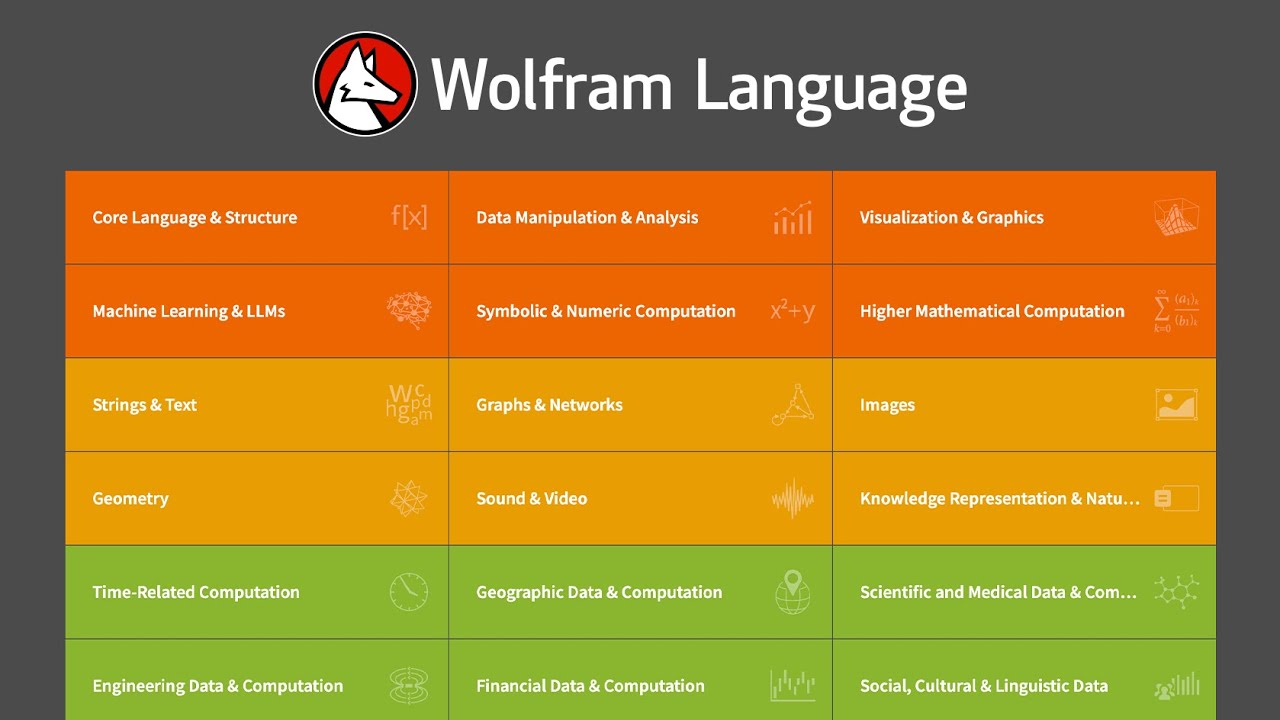
Stephen Wolfram's Introduction to the Wolfram Language — Wolfram

Wolfram

Unifying curated real-world knowledge with a symbolic engine eliminates external libraries and transforms programming into automated computation.

AI-assisted summary of Stephen Wolfram's Introduction to the Wolfram Language — original source. Check the original for full context.

Source published:

Key ideas

  • The Wolfram Language launches as a fully realized, knowledge-based symbolic programming language built upon three decades of development across Mathematica and Wolfram|Alpha. (0:00)
  • Unlike conventional programming environments requiring external libraries, real-world data and advanced algorithmic primitives—such as image processing, machine learning, and geospatial routing—are built natively into the system. (1:03)
  • Every element of the system, including mathematical expressions, 3D graphics, user interfaces, and external data, is modeled as a uniform symbolic structure. (3:59)
  • The language scales from low-power hardware like the Raspberry Pi to high-performance parallel clusters and multimillion-line enterprise platforms like Wolfram|Alpha. (10:28)

Detailed notes

## Background Published on YouTube by the official Wolfram channel on February 24, 2014, this video features Stephen Wolfram introducing the Wolfram Language. According to the accompanying description, the presentation demonstrates how the symbolic programming language facilitates powerful functional programming, large-scale database querying, flexible interactivity, and streamlined deployment.

## TL;DR Stephen Wolfram introduces the Wolfram Language as a unified, knowledge-based programming paradigm developed over three decades and incubated through Mathematica and Wolfram|Alpha. Built on a symbolic foundation where all code, graphics, interfaces, and data share a common structure, the language natively embeds curated real-world knowledge, algorithmic superfunctions, and natural language processing. Wolfram demonstrates practical workflows ranging from real-time webcam processing and network analysis to automated machine learning and instant cloud API generation. The system is designed to scale seamlessly across environments, operating on low-power devices like the Raspberry Pi, distributed parallel computing clusters, and enterprise software stacks.

## Atmosphere & style The presentation carries an authoritative, visionary, and intellectually charged tone, driven by Stephen Wolfram's personal pride in unveiling a thirty-year life's work. The pacing is brisk and demonstrative, functioning like an interactive showcase where theoretical computer science principles are immediately proven with live, single-line code executions. Watching it feels both like a technical deep dive and a philosophical manifesto on computing, balancing ambitious, grand-scale design philosophy with down-to-earth, playful demonstrations like live webcam manipulations and algorithmic flag palette extractions.

## Bulletin - [00:00](https://www.youtube.com/watch?v=_P9HqHVPeik&t=0s) The Wolfram Language launches as a fully realized, knowledge-based symbolic programming language built upon three decades of development across Mathematica and Wolfram|Alpha. - [01:03](https://www.youtube.com/watch?v=_P9HqHVPeik&t=63s) Unlike conventional programming environments requiring external libraries, real-world data and advanced algorithmic primitives—such as image processing, machine learning, and geospatial routing—are built natively into the system. - [03:59](https://www.youtube.com/watch?v=_P9HqHVPeik&t=239s) Every element of the system, including mathematical expressions, 3D graphics, user interfaces, and external data, is modeled as a uniform symbolic structure. - [10:28](https://www.youtube.com/watch?v=_P9HqHVPeik&t=628s) The language scales from low-power hardware like the Raspberry Pi to high-performance parallel clusters and multimillion-line enterprise platforms like Wolfram|Alpha.

## Key takeaways - [00:00](https://www.youtube.com/watch?v=_P9HqHVPeik&t=0s) The Wolfram Language represents the culmination of thirty years of development, integrating capabilities incubated within Mathematica and Wolfram|Alpha. - [00:35](https://www.youtube.com/watch?v=_P9HqHVPeik&t=35s) As a 'knowledge-based language', it natively integrates curated real-world data and advanced algorithmic primitives without requiring third-party libraries. - [01:03](https://www.youtube.com/watch?v=_P9HqHVPeik&t=63s) The language enables real-time interactive computation directly within web browsers, from network graph analysis to live webcam feed manipulation. - [01:55](https://www.youtube.com/watch?v=_P9HqHVPeik&t=115s) Built-in natural language processing translates unstructured human phrasing directly into executable symbolic code. - [03:59](https://www.youtube.com/watch?v=_P9HqHVPeik&t=239s) A purely symbolic foundation allows expressions to remain unevaluated, enabling symbolic mathematics alongside uniform representation of data structures. - [04:30](https://www.youtube.com/watch?v=_P9HqHVPeik&t=270s) Graphics, documents, and interactive UI elements like sliders and buttons share the exact same underlying symbolic structure as mathematical expressions. - [06:58](https://www.youtube.com/watch?v=_P9HqHVPeik&t=418s) Pattern-based programming and transformation rules serve as the fundamental mechanism through which all functions are defined and executed. - [07:33](https://www.youtube.com/watch?v=_P9HqHVPeik&t=453s) System architecture is governed by coherence across all functional domains and maximum automation via high-level 'superfunctions' like Classify. - [09:04](https://www.youtube.com/watch?v=_P9HqHVPeik&t=544s) Code, interfaces, and data can be deployed instantly to the Wolfram Cloud as interactive notebooks, scheduled reports, or public JSON APIs. - [10:28](https://www.youtube.com/watch?v=_P9HqHVPeik&t=628s) Symbolic structures simplify code debugging and maintenance across large codebases because every intermediate sub-expression remains evaluable and meaningful. - [10:45](https://www.youtube.com/watch?v=_P9HqHVPeik&t=645s) Native parallelism manages process spawning, ad hoc cluster distribution, and result aggregation without requiring manual low-level thread configuration. - [11:00](https://www.youtube.com/watch?v=_P9HqHVPeik&t=660s) The language is bundled into Raspberry Pi OS, operating directly on low-power microcomputing hardware. - [11:20](https://www.youtube.com/watch?v=_P9HqHVPeik&t=680s) The Wolfram Data Framework (WDF) standardizes messy external data streams into canonical, computable entities with units, dates, and locations. - [11:35](https://www.youtube.com/watch?v=_P9HqHVPeik&t=695s) The Wolfram Connected Devices project provides standardized, out-of-the-box programmatic control for thousands of external sensors and physical appliances. - [11:43](https://www.youtube.com/watch?v=_P9HqHVPeik&t=703s) Integrated suggestion bars and natural language input reduce entry barriers, making the environment suitable for complete beginners as well as enterprise software engineers.

## Detailed walkthrough ### [00:00](https://www.youtube.com/watch?v=_P9HqHVPeik&t=0s) What Is the Wolfram Language?

Stephen Wolfram introduces the Wolfram Language as the culmination of roughly thirty years of personal work, noting that key elements were incubated over the decades inside Mathematica and Wolfram|Alpha. Only recently did the team assemble everything required to realize the full language and deploy it broadly. Describing the moment, Wolfram reflects: “We’re actually at an incredibly exciting point right now where we’re suddenly able to take computation to a whole new level and in effect, inject sophisticated computation into everything.”

At its core, the Wolfram Language is fundamentally different from traditional programming languages; Wolfram defines it as a “knowledge-based language.” Instead of requiring external libraries or extensive manual setup, vast amounts of algorithmic know-how and real-world knowledge are built directly into the system primitives. Built-in functions handle image processing, network layout, stock market lookups, interface design, and mathematical optimization natively. Because the language shares a unified symbolic foundation, all these distinct capabilities interoperate smoothly.

```mermaid flowchart TD accTitle: Core Components of the Wolfram Language accDescr: Diagram illustrating how real-world data and advanced algorithms feed into the symbolic core of the Wolfram Language. subgraph Data["Built-in Knowledge"] D1["Curated World Data (Wolfram|Alpha)"] D2["External APIs & File Formats"] end subgraph Engine["Symbolic Engine Core"] S1["Uniform Symbolic Representation"] S2["Automated Superfunctions"] end subgraph Algos["Built-in Algorithms"] A1["Image & Signal Processing"] A2["Graph Theory & Optimization"] end Data --> S1 Algos --> S1 S1 --> S2 ```

[01:03](https://www.youtube.com/watch?v=_P9HqHVPeik&t=63s) Interactive Computation, Media, and Real-World Knowledge

Wolfram illustrates the interactive nature of the language, showing that it runs smoothly in real time, even inside a web browser. A user can type an expression and immediately receive an output—whether performing ultra-fast arithmetic, factoring massive integers using built-in algorithms, or instantly visualizing results. He demonstrates pulling a personal Facebook friend network right off the bat, showing how the language automatically lays out the graph and applies graph-theoretic algorithms to answer queries like how friend clusters form or which person maintains the highest number of connections.

The language also interfaces natively with connected hardware and real-time inputs. Wolfram queries his computer's built-in webcam to capture a live portrait of himself, applies dynamic edge detection to the feed, and slices the image into a grid of small squares, blending random colors into each square before reassembling them.

Beyond pure algorithms, the language is infused with computable data about the physical world: - Querying sunset times automatically detects the user's current physical location and returns the exact hour of sunset. - Timespans (such as total daylight from sunrise to sunset) can be calculated symbolically in fractional days and immediately converted into minutes. - Built-in natural language processing, ported from Wolfram|Alpha, parses unstructured human phrases (like `"countries in South America"`) directly into precise Wolfram Language expressions. - Extracted lists of entities can be used in downstream computations: generating national flags, extracting their dominant color palettes, or generating formatted comparative tables in single lines of code. - Solving complex logistical queries, such as computing the optimal traveling salesman tour across Western European capitals, executes out of the box using state-of-the-art algorithms, plotting the resulting route directly onto built-in geographic maps with a thick red line.

[03:59](https://www.youtube.com/watch?v=_P9HqHVPeik&t=239s) The Symbolic Foundation and Functional Programming

Wolfram shifts to explain the architecture that makes this integration possible. He emphasizes: “The first really critical thing to understand about the Wolfram language is that it’s symbolic.” Unlike standard programming environments where variables must resolve to values or types, a symbol like `x` can simply exist as an unevaluated symbolic entity. This allows users to construct mathematical formulas symbolically, calculate symbolic derivatives or integrals, and handle incomplete data structures effortlessly.

Crucially, this symbolic approach is not confined to mathematics—it underlies every entity in the ecosystem: - **Networks and 3D Graphics:** Displayed visuals are merely rendered forms of underlying symbolic expressions. A 3D render can be plucked directly from an output cell and passed into an image-processing algorithm or rotated programmatically across a table. - **User Interface Elements:** Sliders, buttons, and document layouts are all symbolic expressions, allowing full UI grids and dynamic, reactive views to be constructed using the same syntax as data arrays. - **Uniform Underlying Form:** Every construct—from formulas and data sets to cities and documents—evaluates under the hood to a standard full form: nested symbolic heads and arguments.

```mermaid flowchart LR accTitle: Symbolic Data Flow in the Wolfram Language accDescr: Diagram showing how diverse outputs remain symbolic expressions that can be reused across different domains. A["Symbolic Form: Graphics3D[...]"] --> B["Rendered Interactive Visual"] B --> C["Image Processing Function"] C --> D["Dynamic Interface / Slider"] D --> E["Nested UI Expression"] ```

This uniform symbolic structure enables high-level functional programming. Wolfram demonstrates nesting operations to build self-similar visual frames and multi-tiered interfaces. He presents a web crawler that imports raw hyperlinks from his personal website, traverses outbound links several levels deep, and maps the resulting corner of the web as a network graph. Furthermore, symbolic pure functions enable concise data transformations: - Creating an instant spell checker by constructing a nearest-neighbor function from the language's built-in English dictionary. - Filtering palindrome words by applying a short pure function over vocabulary lists. - Running expressive, symbolic pattern-matching queries over large hierarchical data structures and databases. - Implementing pattern-based programming, where transformation rules match structural shapes (e.g., transforming specific nested lists while leaving non-matching inputs unevaluated). As Wolfram explains, this pattern-replacement mechanism is the exact paradigm through which all function definitions in the language operate.

[07:33](https://www.youtube.com/watch?v=_P9HqHVPeik&t=453s) Core Principles: Coherence and Automation

Reflecting on the engineering ethos behind the language, Wolfram explains how a system with thousands of functions avoids descending into chaotic bloat. He highlights two bedrock principles: **coherence** and **maximum automation**. Describing his decades-long design focus, Wolfram remarks: “I must say that I’ve spent a fair fraction of the past 30 years working to make this happen, designing every corner of the language so it’s as consistent and unified and integrated as possible.”

- **Coherence:** Ensures that functions across completely disparate fields—from graph theory to geospatial analytics to image manipulation—share standardized argument structures, conventions, and data formats so outputs from one function flow directly into inputs for another. - **Maximum Automation:** Rather than forcing developers to manually select specific algorithmic implementations, the language provides high-level "superfunctions." For instance, in machine learning, the `Classify` function automatically inspects training data, tests meta-algorithms, and selects the ideal model under the hood as a black box, while still providing low-level access for expert tuning. - **Integrated Curated Data:** These high-level building blocks incorporate built-in knowledge to parse hundreds of file formats, talk to external REST APIs, evaluate system properties, and access the living, continuously updated repository of Wolfram Cloud data that also powers Wolfram|Alpha.

[09:04](https://www.youtube.com/watch?v=_P9HqHVPeik&t=544s) Cloud Deployment, Notebooks, and Instant APIs

Because code, interfaces, and data are all symbolic expressions, the language possesses the unique ability to model, package, and deploy itself across platforms without external deployment pipelines. A developer can author a script inside an interactive desktop notebook and deploy it straight to the web with minimal code.

Wolfram runs through several deployment formats made possible by this design: - **Cloud Objects & Web Interfaces:** Pushing a symbolic expression to the Wolfram Cloud automatically spins up an interactive web interface backed by cloud compute kernels. - **Computable Document Format (CDF):** Dynamic documents and full-featured native notebook interfaces can run natively inside a browser window, bridging the gap between static documents and interactive applications. - **Automated Reporting & Scheduling:** Notebooks can act as live reporting templates that pull fresh data on a schedule, trigger computations on cloud servers at predefined intervals, and automatically email formatted updates. - **Instant Cloud APIs:** Any functional expression can be converted into a public or authenticated web endpoint. Wolfram shows an example API generating JSON output of live weather data based on the caller's geolocation. - **Embedded Engine Integration:** For environments with an embedded Wolfram engine, developers can generate native code snippets in numerous mainstream programming languages to query these local or cloud engines directly, scaling seamlessly from tiny scripts to enterprise-grade backends.

[10:28](https://www.youtube.com/watch?v=_P9HqHVPeik&t=628s) Scalability, Symbolic Debugging, and High-Performance Parallelism

Stephen Wolfram highlights that the Wolfram Language is designed to scale effortlessly from short interactive commands to multimillion-line enterprise software systems like Wolfram|Alpha. The symbolic foundation of the language provides a distinct operational advantage when developing and diagnosing code: because symbolic expressions retain meaningful structure at every stage of execution, inspecting and debugging intermediate components is remarkably straightforward compared to traditional syntax-heavy programming environments. Developers can choose from several integrated development environments (IDEs) tailored to leverage this intrinsic symbolic architecture.

Beyond desktop-scale development, the language natively incorporates parallel computation for high-performance computing (HPC) workflows. Wolfram demonstrates how parallelism is built directly into the core primitives, enabling users to distribute jobs across heterogeneous compute clusters without manually configuring low-level threading or network protocols. The runtime environment automatically provisions multiple worker processes across an ad hoc distributed network, executes parallelized tasks concurrently, and gathers and reassembles the results into the primary interactive session.

- Large-scale viability is demonstrated in production by Wolfram|Alpha, an engine encompassing millions of lines of Wolfram Language code. - Symbolic computation ensures every isolated sub-expression remains evaluable and interpretable throughout development. - Native parallelization manages worker node spawning, communication, and result collation automatically across heterogeneous networks.

As Stephen Wolfram summarizes regarding debugging and tooling: “It’s so much easier to build and debug symbolic programs because at each stage, every piece is meaningful and depending on your style of programming, there are various IDE’s for the Wolfram language that take advantage of the symbolic character of the language.”

---

[11:00](https://www.youtube.com/watch?v=_P9HqHVPeik&t=660s) Embedded Systems, the Wolfram Data Framework, and Connected Devices

The language's reach extends downward into microcomputing and physical hardware, operating seamlessly on modern low-power embedded microprocessors. As a primary example of this footprint, the Wolfram Language is bundled directly into the standard operating system for the Raspberry Pi single-board computer. This embedded availability pairs with the language's native ability to interface with physical devices, sensors, and external equipment.

Wolfram emphasizes that the system holds an unmatched vantage point when bridging software and physical reality because it incorporates a comprehensive, built-in model of the world. At the core of this capability is the Wolfram Data Framework (WDF), which provides mechanisms to ingest raw, messy, and unstructured data streams and systematically convert them into canonical, computable entities with standard dates, physical units, and geolocations. To make physical hardware equally accessible, the Wolfram Connected Devices project curates thousands of external sensors and appliances, standardizing their interfaces so developers can communicate with them straight out of the box.

```mermaid flowchart TD accTitle: Real-World Data and Device Integration in Wolfram Language accDescr: Ingesting raw unstructured data and physical device streams through the Wolfram Data Framework into the Wolfram Language core.

subgraph Inputs ["External Real-World Sources"] DEV["Physical Devices & Sensors<br/>(Connected Devices Project)"] RAW["Unstructured External Data<br/>(Text, Measurements, Timestamps)"] end

subgraph Ingestion ["Standardization Layer"] WDF["Wolfram Data Framework (WDF)<br/>Canonical Entities, Units, & Dates"] end

subgraph Core ["Execution & Environments"] WL["Wolfram Language Core<br/>Built-in Model of the World"] PI["Embedded Hardware<br/>(Raspberry Pi OS)"] end

DEV -->|"curated device protocols"| WL RAW -->|"ingestion & structuring"| WDF WDF -->|"semantic data"| WL WL <-->|"direct interfacing"| PI ```

- Embedded execution is supported natively, including out-of-the-box integration within Raspberry Pi Linux distributions. - The Wolfram Data Framework (WDF) standardizes unstructured strings into structured, computable entities with attached units and dates. - The Wolfram Connected Devices project actively curates diverse hardware devices to expose uniform, direct programmatic control inside the language.

Emphasizing the foundational model powering these integrations, Wolfram notes: “You can use the Wolfram language to interact with devices, in fact, the Wolfram language is in a unique position with the respect to devices and with respect of real world data in general because in a sense it’s a language that has a model of the world built in.”

---

[11:43](https://www.youtube.com/watch?v=_P9HqHVPeik&t=703s) Getting Started, Deployment, and a Thirty-Year Vision

Wolfram turns to how newcomers can enter the ecosystem, noting that the barrier to entry has been intentionally lowered. Beneath every evaluation output, an interactive suggestion bar dynamically recommends the most logical next analytical steps or transformations. In addition, users can draft programs by typing inputs in plain natural language, letting the system interpret the computational intent and generate the corresponding symbolic code. Once a functional prototype is constructed, the environment provides immediate deployment pathways across web services, interactive documents, standalone APIs, and mobile applications.

Reflecting on the system's broader pedagogical and historical arc, Wolfram explains that the language serves exceptionally well as a first programming language: because vast swathes of real-world knowledge and high-level algorithms are built in, students and beginners are instantly exposed to substantive ideas and methods without getting bogged down in boilerplate mechanics. The language represents the culmination of more than thirty years of continuous design and implementation, building atop foundations laid in the late 1980s to yield a vast, unified technological stack.

- Interactive suggestion bars appear beneath outputs to guide exploratory workflows and discover related operations. - Free-form natural language queries can be translated directly into executable, formal Wolfram Language expressions. - The language is designed to serve both complete beginners learning computational concepts and professional teams shipping commercial software.

Looking back on the decades invested in the project, Stephen Wolfram concludes: “We laid strong foundations very early and we’ve just kept on building and actually I keep on being amazed at what’s possible and now we’ve got a vast stack of technology and content that I think just completely changes how we should think about programming.”

## Notable quotes > [03:59](https://www.youtube.com/watch?v=_P9HqHVPeik&t=239s) The first really critical thing to understand about the Wolfram language is that it’s symbolic. — Stephen Wolfram

> [00:00](https://www.youtube.com/watch?v=_P9HqHVPeik&t=0s) We’re actually at an incredibly exciting point right now where we’re suddenly able to take computation to a whole new level and in effect, inject sophisticated computation into everything. — Stephen Wolfram

## Mentioned Stephen Wolfram, Wolfram Language, Mathematica, Wolfram|Alpha, Wolfram Cloud, Computable Document Format (CDF), Raspberry Pi, Wolfram Data Framework, Wolfram Connected Devices project, Facebook

## Video description Stephen Wolfram introduces the Wolfram Language in this video that shows how the symbolic programming language enables powerful functional programming, querying of large databases, flexible interactivity, easy deployment, and much, much more.

To learn more about the Wolfram Language, visit http://www.wolfram.com/language/

For the latest information visit: http://reference.wolfram.com/language http://www.wolfram.com

[Source](https://www.youtube.com/watch?v=_P9HqHVPeik)

中文简报

Wolfram推出内置整理现实世界数据的符号语言 将整理后的现实世界知识与符号引擎相统一,不仅免除对外部库的依赖,还将编程转变为自动化计算。 Stephen Wolfram 推出了 Wolfram Language,这是一种历经三十年研发并依托 Mathematica 和 Wolfram|Alpha 孵化而成的统一知识型编程范式。该语言建立在符号化基础之上,所有代码、图形、界面和数据均共享同一种结构,原生内置了整理后的现实世界知识、算法超级函数以及自然语言处理能力。Wolfram 展示了从网络摄像头实时处理、网络分析到自动化机器学习和即时生成云端 API 等实用工作流程。该系统设计为可在不同环境中无缝扩展,既能在树莓派(Raspberry Pi)等低功耗设备上运行,也能适用于分布式并行计算集群和企业级软件栈。 Wolfram Language 作为一款成熟的知识型符号编程语言正式发布,其建立在 Mathematica 和 Wolfram|Alpha 三十年的开发积淀之上。 (0:00) 与需要依赖外部库的传统编程环境不同,现实世界数据和高级算法原语(如图像处理、机器学习和地理空间路径规划)均原生内置于系统之中。 (1:03) 系统中的每一个元素,包括数学表达式、三维图形、用户界面及外部数据,都被建模为统一的符号结构。 (3:59) 该语言可灵活扩展,既适用于树莓派等低功耗硬件,也可用于高性能并行集群以及包含数百万行代码的企业级平台(如 Wolfram|Alpha)。 (10:28)

Reading summary

Stephen Wolfram introduces the Wolfram Language as a symbolic, knowledge-based programming environment that natively integrates algorithmic computation, curated real-world data, and dynamic interface design into a single coherent system. Unified Symbolic Architecture and Functional Computation (3:59) Unlike traditional programming languages where variables must immediately resolve to fixed values or types, the Wolfram Language treats unevaluated symbols as fundamental computational entities. Wolfram explains that this symbolic paradigm extends uniformly across the entire ecosystem: 3D graphics, user interface controls such as buttons and sliders, and datasets all evaluate to nested symbolic expressions with standardized heads and arguments. This structural consistency allows users to pass rendered visuals directly into image-processing functions, assemble dynamic user interfaces using standard list operations, and build functional programs without type-conversion boilerplate. The system utilizes symbolic pattern-matching transformation rules as the underlying mechanism for all function definitions, data queries, and structural manipulations. This approach supports concise functional tasks—such as generating nearest-neighbor spell checkers from built-in dictionaries or applying pure functions to filter text—while keeping intermediate sub-expressions evaluable. Wolfram asserts that this persistent symbolic structure makes debugging and diagnosing code significantly easier than in conventional languages because every intermediate component remains inspectable and semantically meaningful. Built-in Real-World Knowledge and Automated Superfunctions (0:00) Wolfram characterizes the system as a "knowledge-based language" that builds algorithms and curated data directly into core primitives rather than relying on external libraries. Drawing on data pipelines from Wolfram|Alpha, the language natively processes real-world entities, geographic data, physical units, and natural language phrases. For instance, querying sunset times uses local geolocation data automatically, phrases like "countries in South America" parse into structured computational lists, and traveling salesman routines calculate optimal routes across European capitals while mapping the output directly onto geographic graphics. To manage thousands of built-in functions without organizational chaos, the architecture relies on coherence and maximum automation. Coherence standardizes argument conventions and data structures across disparate domains—such as graph theory, image processing, and geospatial analysis—so outputs from one function cleanly feed into another. Maximum automation is implemented through high-level "superfunctions" like Classify, which examine input data and automatically select, train, and optimize appropriate underlying machine learning algorithms without requiring manual algorithmic configuration. Native Deployment from Notebooks to Cloud APIs (9:04) Because code, documents, and visual interfaces share an identical symbolic structure, the language can model, package, and deploy applications without external deployment pipelines. Developers can draft programs inside interactive desktop notebooks and publish them directly to the web as interactive cloud applications supported by remote computational kernels. Deployment options include Computable Document Format (CDF) files that embed dynamic, interactive documents into web browsers, as well as automated reporting systems that execute cloud computations on a set schedule and email formatted reports. Additionally, arbitrary symbolic expressions can be deployed as authenticated or public web endpoints that return structured formats like JSON, and embedded engine integrations allow native code in mainstream languages to communicate directly with local or cloud-hosted Wolfram runtimes. Hardware Interfacing, Standardization, and Enterprise Scaling (11:00) The language extends downward to embedded hardware and physical computing, operating natively on microprocessors such as the Raspberry Pi single-board computer. Through the Wolfram Connected Devices project, the platform provides curated, uniform communication protocols for thousands of physical sensors and external appliances. To process messy incoming information, the Wolfram Data Framework (WDF) translates raw external streams into canonical, computable representations with standardized units, dates, and locations. At large operational scales, the system includes native parallel processing capabilities that spawn worker processes and balance computational workloads across heterogeneous distributed networks without requiring manual network or thread management. Wolfram points to Wolfram|Alpha—a computational engine consisting of millions of lines of Wolfram Language code—as practical evidence that the architecture scales from interactive one-line calculations to complex, high-throughput enterprise infrastructure. Stephen Wolfram frames the language as the realization of a thirty-year effort to lower entry barriers for beginners while scaling to large enterprise applications; however, the presentation represents an introductory vendor demonstration and does not examine trade-offs such as proprietary platform dependencies, resource overhead, or performance comparisons against lower-level languages.

精炼阅读摘要

Stephen Wolfram 阐述了历经约三十年研发构建的 Wolfram Language,强调该系统并非单纯的编程语言,而是一种将庞大算法库、现实世界可计算知识与统一符号架构深度集成的“基于知识的语言”。 知识内建与现实世界可计算化 (0:00) 传统编程语言通常依赖外部第三方库与手动环境配置,而 Wolfram Language 将大量专业算法与现实世界数据原生植入系统基础基元。系统内建了图像处理、网络拓扑布局、金融行情检索、界面设计与数学优化等能力。通过移植自 Wolfram|Alpha 的自然语言处理技术,用户可直接输入如“南美洲国家”等非结构化日常短语,系统会自动将其解析为精确的符号表达式,进而单行完成国旗调取、主色调提取或对比表格生成。此外,该语言内置了物理世界的计算模型,例如查询日落时间能够自动识别用户的地理位置并返回具体时刻,还能将以天数表示的日照时间跨度直接转算为分钟;针对西欧各首都间旅行商路径等复杂物流规划问题,系统也能调用最新算法运算并将路线绘制在内置地图上。 统一符号架构与函数式编程范式 (3:59) Wolfram 指出,理解该语言的核心关键在于其完全符号化的底层设计。不同于传统环境中变量必须立即解析为具体数值或数据类型的机制,Wolfram Language 中的符号(例如 x)可以作为未求值的符号实体独立存在,从而支持代数推导、符号微积分与不完整数据结构的表达。该设计贯穿系统全貌:三维模型与网络图表在本质上均是可解析的符号表达式,生成的 3D 渲染画面可直接传入图像处理函数;滑块、按钮与排版布局同样遵循统一的嵌套符号语法,使界面组件能够像数据数组一样被动态构建与嵌套操作。基于此结构,模式匹配与替换规则构成了所有函数定义的实现基础,结合纯函数与内置英语词典,用户能极其精简地构建拼写检查器、回文词筛选逻辑、网站多层链接爬虫与分形视觉界面。 连贯性、最大自动化与可伸缩工程体系 (7:33) 面对囊括数千个函数的庞大系统,Wolfram 强调其设计遵循“连贯性”(Coherence)与“最大自动化”(Maximum Automation)两大基本原则。连贯性保证了图形学、地理空间分析与图像处理等不同领域函数采用标准化的参数结构与数据格式,使数据能够在不同模块间无缝流动。最大自动化则体现为高级“超级函数”(Superfunctions)的封装,例如机器学习中的 Classify 函数可自动分析训练样本特征并自主选择理想模型,同时保留底层精细调参接口。在软件工程维度,该架构经受了拥有数百万行代码的 Wolfram|Alpha 系统的生产验证;由于符号表达式在各执行阶段均保持明确语义,代码检查与调试相较传统语言显著简化,同时核心基元内建了并行计算支持,能自动调度异构网络集群完成多进程并发运算与数据汇总。 全端部署能力与软硬件边缘交互 (9:04) 由于代码、交互界面与底层数据均具备相同的符号形式,Wolfram Language 能够自建部署流程而无需复杂的外部工具链。桌面交互式笔记本中的计算逻辑可通过一行代码推送到 Wolfram Cloud 转化为交互网页,或利用可计算文档格式(CDF)在浏览器中提供原生笔记本体验;系统亦支持定时抓取数据生成自动报告,或将任意函数暴露为返回 JSON 格式数据的即时云端 API。在硬件交互层面,该系统已被直接打包进树莓派(Raspberry Pi)操作系统的标准发行版,能够在低功耗嵌入式处理器上原生运行;依托“Wolfram 数据框架”(WDF)对杂乱外部输入、时间戳与物理单位的标准化处理,以及对数千种传感器协议规范化管理的“已连接设备项目”(Wolfram Connected Devices),开发者可直接使用统一的高级指令采集并控制外部物理设备。 Wolfram 认为,该系统通过自动推荐后续操作的建议栏以及自然语言输入支持,大幅拉低了高阶计算的认知门槛,适合作为初学者的入门工具。从 1980 年代后期的底层积累到当下的技术栈,该语言旨在重构传统编程范式;但这一高度集成的知识生态能否在主流软件工程界完全替代依赖细粒度底层控制的传统编程语言,仍取决于开发者对闭源超级函数与高度抽象化架构的长期接受度。

Detailed notes — zh

## Background 该视频由 Wolfram 官方频道于 2014 年 2 月 24 日发布在 YouTube 上。视频由 Stephen Wolfram 亲自主讲,向观众系统介绍全新的 Wolfram Language,展示其如何依托符号编程实现强大的函数式计算、海量数据库查询、灵活交互以及便捷的云端部署。 ## TL;DR Stephen Wolfram 概述了研发历时三十年的“基于知识的语言”——Wolfram Language,其核心特色是将海量算法原语与现实世界百科知识直接内嵌于语言底层。系统建立在彻底的“万物皆为符号”架构之上,不仅支持自然语言直接转译为代码,还融合了函数式与基于模式的编程范式。无论面对高阶图像与图论分析、跨异构网络的高性能并行计算,还是部署在树莓派等嵌入式设备与云端 REST API,该语言都能通过高度一致性和自动化规则无缝运作。此外,结合 Wolfram Data Framework(WDF)与设备连接项目,它为现实实体与硬件交互建立了标准化模型,旨在帮助任何人迅速将灵感转化为可交付的软件系统。 ## Atmosphere & style 整场演讲洋溢着一种深厚而从容的技术自信,Stephen Wolfram 带着开创者特有的远见与热情娓娓道来。讲解过程伴随着行云流水般的交互式编码与即时可视化演示,从数论分解到摄像头实时人像处理,直观展现了强大的系统整合度。观众能清晰感受到三十年深耕沉淀带来的厚重底气,整个展示令人既对无所不包的符号计算能力叹为观止,又对下一代极简编程范式充满向往。 ## Bulletin - [00:00](https://www.youtube.com/watch?v=_P9HqHVPeik&t=0s) Stephen Wolfram 正式发布历经约 30 年研发的 Wolfram Language,定位为直接内嵌海量算法与现实世界知识的“基于知识的语言”(Knowledge-based language)。 - [03:59](https://www.youtube.com/watch?v=_P9HqHVPeik&t=239s) 系统全盘采用彻底的符号化架构(Symbolic Architecture),无论是数学公式、三维几何、网络图谱还是 UI 控件,底层全展开形式皆为统一的符号表达式。 - [07:33](https://www.youtube.com/watch?v=_P9HqHVPeik&t=453s) 依托“超级函数”(如 Classify)与内置元算法,Wolfram 语言实现了高度自动化与一致性,并允许代码自描述并一键发布为云端 Web 界面、REST API 或嵌入式服务。 - [10:28](https://www.youtube.com/watch?v=_P9HqHVPeik&t=628s) 语言生态不仅通过 Wolfram|Alpha 验证了数百万行超大型工程的可行性,还直接预装于树莓派 Linux 系统,并依托 Wolfram Data Framework(WDF)与设备项目构建了完整的现实世界与物联网连接模型。 ## Key takeaways - [00:00](https://www.youtube.com/watch?v=_P9HqHVPeik&t=0s) Wolfram 语言是研发 30 年的集大成之作,将底层计算方法与现实世界庞大知识库原生内嵌于语言最底层,无需第三方库即可直接调用各种领域原语。 - [01:03](https://www.youtube.com/watch?v=_P9HqHVPeik&t=63s) 支持纯交互式与 Web 运行环境,能够毫秒级执行高级数论分解、社交网络图论分析及动态多媒体图像处理。 - [01:03](https://www.youtube.com/watch?v=_P9HqHVPeik&t=63s) 深度整合 Wolfram|Alpha 自然语言理解管道,可自动将日常人类自然语言转换为严谨的可计算符号实体与代码表达式。 - [01:03](https://www.youtube.com/watch?v=_P9HqHVPeik&t=63s) 内建全球高精度地理地图与地理实体数据,支持一键组合领域算法(如旅行商问题)完成现实路径优化与地图可视化。 - [03:59](https://www.youtube.com/watch?v=_P9HqHVPeik&t=239s) 彻底的符号化(Symbolic)设计是系统能够无缝拼接一切的根基,符号无需预赋数值即可独立参与符号代数计算与占位操作。 - [03:59](https://www.youtube.com/watch?v=_P9HqHVPeik&t=239s) 万物皆为符号:网络图、3D 渲染图元、UI 控件乃至文档段落,底层均为形式统一的符号函数表达式(f[...]),天然支持元操作(Meta-operations)。 - [03:59](https://www.youtube.com/watch?v=_P9HqHVPeik&t=239s) 支持多范式编程,深度融合了符号级联的函数式编程、符号纯函数查询,以及决定底层所有函数运行的“基于模式的编程”(Pattern-based programming)。 - [07:33](https://www.youtube.com/watch?v=_P9HqHVPeik&t=453s) 语言设计坚守“高度一致性”与“最大程度自动化”两大核心,使开发者能够无障碍跨学科传递数据,并由超级函数包揽大部分底层算法决策。 - [07:33](https://www.youtube.com/watch?v=_P9HqHVPeik&t=453s) 符号代码具备自描述与自我部署能力,一段代码可一键推送至 Wolfram Cloud 生成交互式 Web 界面、云端 Notebook、定时任务或 REST API。 - [10:28](https://www.youtube.com/watch?v=_P9HqHVPeik&t=628s) 通过 Wolfram|Alpha 数百万行代码的生产实践验证了符号化工程的高扩展性与直观调试优势,并原生支持异构网络的高性能并行调度。 - [10:28](https://www.youtube.com/watch?v=_P9HqHVPeik&t=628s) 作为标准组件直接预装于树莓派(Raspberry Pi)Linux 操作系统,大幅降低在小型嵌入式硬件上运行高阶符号计算的门槛。 - [11:09](https://www.youtube.com/watch?v=_P9HqHVPeik&t=669s) 引入 Wolfram Data Framework(WDF)规范化混乱的现实世界数据,并通过 Connected Devices Project 集中策划物联网设备接口,形成对现实物理世界建模的闭环。 - [11:43](https://www.youtube.com/watch?v=_P9HqHVPeik&t=703s) 提供上下文智能建议栏与自然语言起步机制,使得 Wolfram 语言不仅适合快速原型开发,也极适合作为新手接触前沿现代计算的“第一门编程语言”。 ## Detailed walkthrough ### [00:00](https://www.youtube.com/watch?v=_P9HqHVPeik&t=0s) 知识型语言的诞生与愿景 Stephen Wolfram 介绍了全新的 Wolfram 语言(Wolfram Language)。他回顾指出,为了打造这门语言,他已经努力了大约 30 年。在这段漫长的研发历程中,语言的核心组成部分很早便开始在 Mathematica 和 Wolfram|Alpha 中孕育发酵,但直到最近,各项关键技术与条件才真正完备,使团队得以将完整的 Wolfram 语言构建成型,并建立起广泛部署它的机制。Wolfram 兴奋地表示,计算技术正迎来前所未有的关键节点: > “We’re actually at an incredibly exciting point right now where we’re suddenly able to take computation to a whole new level and in effect, inject sophisticated computation into everything.” 对于这门语言的本质,Wolfram 将其定义为一种前所未见的“基于知识的语言”(Knowledge-based language)。它打破了传统编程语言的定义边界,将关于计算方法以及现实世界的庞大知识库直接内嵌在语言的最底层。开发者无需导入海量第三方库或编写繁琐的接口胶水代码,语言内部就自带了处理图像、布局网络图、查询实时股票价格、构建用户界面、求解数学优化问题等各种各样的原生原语。依托于整套统一的符号化结构体系,所有这些功能模块都能够天衣无缝、高度协调地协同工作。 ### [01:03](https://www.youtube.com/watch?v=_P9HqHVPeik&t=63s) 交互式计算、算法集成与现实世界知识 Wolfram 语言的一大核心优势在于支持纯交互式使用,甚至可以直接在 Web 环境中运行。用户在界面中敲入计算指令,几乎能在瞬间得到精确结果。例如在演示中,输入巨大的数字后,内置的高级数论算法可以立即将其因数分解,并给出直观的数据可视化展示。不仅如此,系统还原生支持社交图谱分析,能够直接抓取用户的 Facebook 好友网络,自动完成图布局,并运用内置的图论算法回答各种结构化问题,例如好友如何划分社群,或者哪个好友拥有的连接数最多。 这种全能性同样延伸至硬件与多媒体交互领域。Wolfram 在现场调用计算机摄像头捕获了自己的实时照片,随后直接对其应用边缘检测(EdgeDetect)滤镜,并将效果转化为动态交互视图。他进一步演示了复杂的矩阵运算与图像处理流程:先将自己的肖像网格化切割成若干小正方形,随后对每个小方块随机混合进不同的颜色,最后将其无缝重组拼合。 ```mermaid flowchart TD accTitle: Wolfram 语言知识与算法处理流 accDescr: 展示从算法计算到现实数据提取,再经自然语言理解转化为可计算代码的过程。 subgraph Algorithms["内置高级算法与计算"] A["交互式输入"] --> B["数论与因子分解"] A --> C["网络图论与社区发现"] A --> D["多媒体与实时图像处理"] end subgraph WorldData["现实世界知识与自然语言"] E["自然语言输入<br/>(如:'countries in South America')"] --> F["Wolfram|Alpha<br/>自然语言解析系统"] F --> G["精确符号代码与实体列表"] G --> H["领域运算与可视化<br/>(如:国旗提取、主色调分析)"] end ``` 除了纯粹的计算算法,Wolfram 语言还对现实物理世界有着深刻的“认知”。Wolfram 演示了向系统询问当天太阳落山的时间,系统立刻识别出他当前的地理位置并返回精准时间;接着他计算了当天日出至日落的时长(以天为单位),并轻松将其单位换算为分钟。在面对浩瀚的现实世界实体时,用户往往更习惯用日常人类语言进行描述,得益于 Wolfram|Alpha 积累的雄厚技术栈,Wolfram 语言内建了强大的自然语言理解系统: > “And thanks to Wolfram alpha, we built a big stack of technology for doing that.” 输入短语“南美洲国家”(countries in South America)后,系统自动解析意图并将其转化为严谨的符号代码,生成对应的国家列表。基于这份结构化列表,用户可以继续进行计算:一键调出所有国家的国旗,提取并分析每个国旗的主色调,甚至写下一行紧凑的代码直接生成一张“国家与其国旗主色调对照表”。更进一步,Wolfram 演示了获取西欧所有国家的首都列表,随后直接调用针对“旅行商问题”(Traveling Salesman Problem)的最佳算法,瞬间算出巡回访问这些首都的最短路径,并依托内置的全球高精度地理地图系统,将巡演路线作为一条醒目的红色粗线直接绘制在地图底图上。 - 内置成千上万个跨越各种学科的尖端算法函数。 - 内嵌涵盖数千个知识领域的大规模结构化现实数据。 - 深度整合 Wolfram|Alpha 自然语言理解管道,自动将日常语言编译为精确的可计算表达式。 - 原生包含全球高精度地图与地理信息系统支持。 ### [03:59](https://www.youtube.com/watch?v=_P9HqHVPeik&t=239s) 彻底的符号化架构与多范式编程 Wolfram 强调,数千个算法和海量领域数据仅仅只是表象,系统之所以能够爆发出将一切自由拼接组合的惊人力量,根基在于其底层的设计原则与核心构造:Wolfram 语言在本质上是彻底“符号化”(Symbolic)的。在传统语言中,变量必须事先赋值或指定内存类型,而在 Wolfram 语言里,符号 $x$ 就是符号本身,无需拥有任何预设数值。用户可以写出一个包含 $x$ 的代数表达式,并直接在该数学公式上进行符号化微积分或代数运算。 这项发现远不止惠及纯数学研究,它开启了通往无数领域的大门。如果数据集中存在缺失或未知项,开发者可以直接用符号来占位处理。在系统内部,一切对象都是符号表达式: - **网络与图模型**:其本质是包含顶点与边关系的符号表达式,系统既能将其渲染为拓扑图,也能允许开发者对其做任意符号代数变换。 - **三维几何图形**:生成符号化 3D 图元后,不仅能渲染出来,还能直接把渲染输出抓取下来,管道式喂入图像处理算法,或者生成多角度旋转切片的对照表。 - **界面与动态元素**:用户界面组件(如 Slider 滑块控件)本身就是一个符号表达式。多个控件可以直接排布进符号网格,组合成复杂的动态交互 UI。 - **文档与元操作**:文档结构乃至单个段落元素皆由符号表示。由于万物皆为符号,做“元操作”(Meta-operations)变得极其自然。只需在一幅静态图表外层套上符号包装,就能顺理成章地将其升格为交互式动态应用。 ```mermaid flowchart LR accTitle: 万物皆为符号的结构抽象 accDescr: 展现底层 FullForm 形式如何统一表示数学公式、数据网络、界面控件及外部文档。 subgraph SymbolicCore["底层统一表达:f[x, y,...]"] direction TB F1["数学公式"] F2["网络图谱 & 3D图形"] F3["UI 控件(滑块/网格)"] F4["文档元素 & 实体知识"] end SymbolicCore --> M1["函数式编程与级联"] SymbolicCore --> M2["模式匹配与重写规则"] SymbolicCore --> M3["动态元操作 (Dynamic/Manipulate)"] ``` 在底层,所有代码、数据结构、现实实体(如城市)乃至文档的全展开形式(FullForm),无一例外都是形如 `f[...]` 的纯符号函数。这也赋予了 Wolfram 语言极其强悍的函数式编程能力:开发者可以符号化地递归嵌套函数(Nest),通过反复添加边框层叠构建出多层嵌套的交互界面;也可以利用网络导入原语编写微型爬虫,沿个人网站的超链接向下深度遍历数层,随后绘制出该网页局域网结构的拓扑关系图。 此外,该语言支持极其简洁的符号纯函数(Pure Functions)。Wolfram 展示了如何调用内置的整套英语词典,构建一个寻找与输入单词距离最近的纯函数,随手拾取该函数就能作为极简的拼写检查纠错器;或是通过单行谓词从词库中筛选出全部回文字词(Palindromes)。更广义上,这种机制演变为极为高效的符号化数据库与复杂分层数据查询工具。在此基础上,Wolfram 语言还融合了独特的“基于模式的编程”(Pattern-based programming): > “In a sense, the Wolfram language is the ultimate fusion language because its symbolic nature lets it encompass pretty much any style of programming, one that’s very powerful and kind of uniquely symbolic is pattern based programming.” 开发者只需给出变换规则,声明某类特定嵌套结构的符号模式映射为特定值;只要输入匹配该模式便会求值,若不匹配则保持原本的符号形式。这种基于模式匹配的变换规则,正是 Wolfram 语言中所有函数定义运作的最底层机制。 ### [07:33](https://www.youtube.com/watch?v=_P9HqHVPeik&t=453s) 语言设计哲学:一致性、自动化与云端部署 面对如此庞大的语言体系,Wolfram 指出其核心建立在两条简洁而坚定的原则之上:**高度一致性(Coherence)** 与 **最大程度自动化(Maximum Automation)**。 关于一致性,Wolfram 直言他在过去 30 年中倾注了大量心血,精雕细琢语言的每一个角落,确保所有概念高度统一、紧密融合。无论是从哪个专业领域提取出的数据或函数对象,用户都可以完全信任其数据形态,随时将其直接喂给另一个完全不同领域的函数处理。 关于最大程度自动化,语言的目标是替开发者包揽尽量多的琐碎决策。以机器学习分类器为例,常规工程开发需要选用复杂的算法族并配置大量超参数,而在 Wolfram 语言中,核心仅由一个名为 `Classify` 的“超级函数”(Super function)统揽全局。该函数内置元算法,能全自动检测数据特征并决定最佳策略。开发者既可以在需要时下潜至底层调节每一个细粒度参数,也可以直接将其视作高层次的黑盒逻辑块。系统不仅内置了数千个此类超级函数,还融合了支持数百种导入导出格式的知识体系、外部 API 通讯协议、物理系统分析工具,以及托管于 Wolfram Cloud、持续动态同步的 Wolfram|Alpha 级可计算现实数据库。 ```mermaid flowchart TD accTitle: 符号化部署流程与架构 accDescr: 展示编写好的符号化 Wolfram 语言代码如何无缝分发部署到本地、云端、API 和原生应用中。 A["Wolfram 语言符号代码 / Notebook"] --> B["本地交互运行"] A --> C["Wolfram Cloud 云端部署"] subgraph CloudDeployment["云端运行环境与交付形式"] C --> D["Cloud Object 自动生成 Web 界面"] C --> E["CDF (可计算文档格式) & 云端原生 Notebook"] C --> F["定时云端调度任务<br/>(如:自动化分析与邮件推送)"] C --> G["即时 REST API 服务<br/>(输出 JSON / 跨语言嵌入)"] end C --> H["移动端原生 App 接入"] ``` 正因为万物皆为符号,代码本身同样是符号对象,这使得 Wolfram 语言能够自主描述与定义自身的部署逻辑: > “Well it turns out that the symbolic nature of the language does something great here too because it lets the language define and describe its own deployment.” 开发者编写了一段逻辑后,既可以在本地 Notebook 中交互式求值,也能一键将这段符号化逻辑推送到 Wolfram Cloud 中。在 Web 浏览器中访问生成的云端对象,系统会自动构建起交互式的 Web 界面,并在远端容器中执行背后的 Wolfram 语言代码。这一整套界面深度集成了运行于云端的 CDF(Computable Document Format,可计算文档格式),甚至支持在浏览器里直接打开功能完备的云端原生 Notebook。 对于生产环境的业务集成,Notebook 可以作为自动化报告的模板系统,通过定时脚本驱动代码更新数据并触发自动邮件分发;开发者更可以给任意函数附加一层包装,瞬间将其发布为全球可访问的云端 REST API(例如接收用户地理坐标并即时输出格式化的 JSON 气象数据)。配合内置的嵌入式引擎,开发者甚至无需经由外部网络请求,就能直接在各种主流编程语言中原生无缝嵌入 Wolfram 语言的高阶运算内核。这一切展现出极为强悍的系统伸缩性,小至单行交互指令,大至企业级云基础设施,皆能使用同一套逻辑完全贯通。 ### [10:28](https://www.youtube.com/watch?v=_P9HqHVPeik&t=628s) 符号化编程、高性能并行与嵌入式设备支持 Stephen Wolfram 强调,开发者既可以编写短小的脚本,也完全可以利用 Wolfram Language 编写数百万行代码的超大型系统,正如 Wolfram|Alpha 本身一样。这种符号式(symbolic)编程范式极大地简化了系统的构建与调试过程:在运行与开发的每一个阶段,程序的每一个组成部分都是有明确意义的(meaningful)。针对不同的编程习惯与风格,系统提供了多种深度利用符号语言特性的 IDE 工具。此外,Wolfram Language 原生内置了高性能计算与并行处理能力,无需繁杂配置即可自动唤起并调度异构网络中的多个不同处理器协同运算,并将分散的结果无缝收集汇总。 除了面向大型网络与计算集群,Wolfram Language 还全面覆盖了新一代微型嵌入式设备。例如,它已经被直接集成并内置在树莓派(Raspberry Pi)Linux 计算机的操作系统中,使得开发者能够以极低门槛在小型硬件上运行强大的符号计算引擎。 ```mermaid flowchart TD accTitle: Wolfram 语言的计算生态 accDescr: 展示 Wolfram 语言从硬件支持、并行计算到真实世界数据建模的完整技术栈。 subgraph Computing["计算与硬件支持"] HPC["高性能并行计算<br/>(异构网络处理器调度)"] Pi["微型嵌入式设备<br/>(Raspberry Pi Linux 系统内置)"] end subgraph WorldModel["真实世界与设备交互"] RawData["非结构化数据"] --> WDF["Wolfram Data Framework (WDF)<br/>单位 / 日期 / 实体规范化"] CuratedDev["Wolfram Connected Devices Project<br/>自动接入设备"] --> WDF end Computing --> WDF ``` - **超大项目验证**:Wolfram|Alpha 作为数百万行代码量级的生产系统,全盘验证了符号编程应对大型工程的可行性。 - **符号特性的优势**:调试直观,每个子表达式即使单独提取也是完整合法的计算结构。 - **集群与硬件调度**:演示了自动跨异构计算网络启动核心、并行分配负载并收集计算输出。 - **树莓派系统集成**:作为标准组件直接预装于 Raspberry Pi Linux 操作系统。 ### [11:09](https://www.youtube.com/watch?v=_P9HqHVPeik&t=669s) 现实世界建模:Wolfram 数据框架(WDF)与设备连接 Wolfram Language 在与现实世界数据及物理外设打交道时具有独特的生态地位。Stephen Wolfram 解释道,这本质上是因为该语言内部直接内置了一个完整的“现实世界模型”。为了封装这一模型,官方推出了 Wolfram Data Framework(WDF,Wolfram 数据框架)。在语言内部,系统提供了丰富的途径,能将各类混乱的非结构化数据清洗、匹配并转换为 WDF 格式,将涉及的度量单位、日期时间、真实世界实体等全面实现规范化与标准化(canonical)。 在硬件设备交互层面,Wolfram 推进了“Wolfram Connected Devices Project”(Wolfram 连接设备项目)。通过对海量智能硬件与传感器设备进行深度整理和元数据策划(curating),系统允许开发者直接在 Wolfram Language 环境中以原生的方式识别并访问这些外设,从而打通从底层硬件传感器到高层数据推理的完整闭环。 Stephen Wolfram 对此高度评价道:“You can use the Wolfram language to interact with devices, in fact, the Wolfram language is in a unique position with the respect to devices and with respect of real world data in general because in a sense it’s a language that has a model of the world built in.” - **WDF 核心目标**:统一现实概念,让单位(Units)、时间日期(Dates)以及现实实体(Entities)在符号语义层面上达到规范一致。 - **Connected Devices Project**:集中管理和策划物联网设备接口,使外部传感器与硬件能以统一步调直接调用。 ### [11:43](https://www.youtube.com/watch?v=_P9HqHVPeik&t=703s) 上手途径、部署愿景与三十年技术积淀 对于新手与开发者的入门路径,Wolfram Language 提供了高度引导式的交互体验。在每次计算输出结果的下方,环境都会自动弹出一个建议栏(Suggestion Bar),智能推测用户接下来可能想执行的操作或探索的方向。甚至,用户可以直接使用自然语言输入指令,以此为起点逐步构建和扩展真正的程序逻辑;一旦得到了满意的程序原型,即可通过多种分发渠道将其一键部署。Stephen Wolfram 表示,他设计这门语言的终极目标,就是把尽可能多的计算与人类知识封装成开箱即用的基石,让任何人都能以极快、极轻松的方式将脑海中的想法转化为实际交付的软件产品。 回望长达 30 年的研发历程,Stephen Wolfram 坦言,团队在极早期就打下了稳固的底层基础,并在此后数十年间持续堆叠建设,构建起庞大的技术栈与知识内容库。令他欣慰的是,Wolfram Language 也被证明极为适合作为人生中的“第一门编程语言”,因为它让初学者能毫无挫败感地接触到极其宽广的现代计算方法与前沿课题。他自己至今每天使用这门语言时依然深感兴奋,并真诚期待所有开发者都能亲自上手体验,进而创造出令人惊叹的成果。 Stephen Wolfram 总结其毕生开发的核心目标时说道:“My goal with the Wolfram language has been to encapsulate as much computation and knowledge as possible so people can go from ideas to deployed products as quickly and easily as possible.” 在回顾这门语言对编程范式的重塑时,他同样感慨道:“We laid strong foundations very early and we’ve just kept on building and actually I keep on being amazed at what’s possible and now we’ve got a vast stack of technology and content that I think just completely changes how we should think about programming.” - **零门槛辅助机制**:动态建议栏(Suggestion Bar)自动提供上下文后续操作;支持全自然语言输入编写逻辑。 - **首选入门语言**:跳过琐碎的基础语法样板,短时间内让新手直接接触前沿算法、可视化与真实知识系统。 - **三十年技术积累**:从早期的底层符号内核出发,横跨 30 年演化,彻底改变了现代计算与软件构建的思维方式。 ## Notable quotes > [11:43](https://www.youtube.com/watch?v=_P9HqHVPeik&t=703s) My goal with the Wolfram language has been to encapsulate as much computation and knowledge as possible so people can go from ideas to deployed products as quickly and easily as possible. — Stephen Wolfram > [03:59](https://www.youtube.com/watch?v=_P9HqHVPeik&t=239s) In a sense, the Wolfram language is the ultimate fusion language because its symbolic nature lets it encompass pretty much any style of programming, one that’s very powerful and kind of uniquely symbolic is pattern based programming. — Stephen Wolfram > [11:43](https://www.youtube.com/watch?v=_P9HqHVPeik&t=703s) We laid strong foundations very early and we’ve just kept on building and actually I keep on being amazed at what’s possible and now we’ve got a vast stack of technology and content that I think just completely changes how we should think about programming. — Stephen Wolfram ## Mentioned Stephen Wolfram, Wolfram Language, Wolfram|Alpha, Mathematica, Wolfram Cloud, Wolfram Data Framework, Wolfram Connected Devices Project, Raspberry Pi, Facebook ## Video description Stephen Wolfram introduces the Wolfram Language in this video that shows how the symbolic programming language enables powerful functional programming, querying of large databases, flexible interactivity, easy deployment, and much, much more. To learn more about the Wolfram Language, visit http://www.wolfram.com/language/ For the latest information visit: http://reference.wolfram.com/language http://www.wolfram.com [Source](https://www.youtube.com/watch?v=_P9HqHVPeik)

Source quotes

[11:43] Stephen Wolfram: My goal with the Wolfram language has been to encapsulate as much computation and knowledge as possible so people can go from ideas to deployed products as quickly and easily as possible. [3:59] Stephen Wolfram: In a sense, the Wolfram language is the ultimate fusion language because its symbolic nature lets it encompass pretty much any style of programming, one that’s very powerful and kind of uniquely symbolic is pattern based programming. [11:43] Stephen Wolfram: We laid strong foundations very early and we’ve just kept on building and actually I keep on being amazed at what’s possible and now we’ve got a vast stack of technology and content that I think just completely changes how we should think about programming.

Source quotes

[3:59] Stephen Wolfram: The first really critical thing to understand about the Wolfram language is that it’s symbolic. [0:00] Stephen Wolfram: We’re actually at an incredibly exciting point right now where we’re suddenly able to take computation to a whole new level and in effect, inject sophisticated computation into everything.

Original transcript

[0:00] Hi I’m Stephen Wolfram and I’d like to show you a bit about our Wolfram language. [0:05] You know, I’ve been working towards what’s now the Wolfram language for about 30 years [0:09] and big parts of it I’ve been able to incubate in Mathematica and Wolfram Alpha, [0:12] but it’s only in recent times that we’ve finally had what we need to create the whole Wolfram language [0:17] and to set up mechanisms to deploy it very widely. [0:20] We’re actually at an incredibly exciting point right now where we’re suddenly able to take computation [0:25] to a whole new level and in effect, inject sophisticated computation into everything. [0:30] So what is the Wolfram language? Well the first thing to say is that it’s a new kind of thing. [0:35] It’s what I call a knowledge based language. [0:38] It’s a language where a vast amount of knowledge about how to do computations and about the world is built right into the language. [0:45] So right within the language there are primitives for processing images [0:48] or laying out networks or looking up stock prices or creating interfaces or solving optimization problems or whatever. [0:55] And through the symbolic structure of the language, they’re all set up to work together in a wonderfully coherent way. [1:01] Let me show you. [1:03] One of the great things about the Wolfram language is if you want to, you can use it completely interactively. [1:08] Even on the web. [1:09] So you can type something in and immediately get a result out, like this, or this. [1:15] And yes, it is fast. [1:17] Of course it knows how to factor that number too. [1:19] It’s got all the fancy algorithms built right in. [1:22] it’s also got immediate visualization. [1:25] It also knows right off the bat like, how to get your friend network from Facebook. [1:30] It lays out the network automatically and it knows all the fancy graph theory algorithms [1:34] so you can immediately ask it all kinds of things about the network, [1:37] like how do your friends break into groups or what’s the most connections any friend has? [1:43] The Wolfram language knows how to do lots of things. [1:46] Like lets’ ask it to get the current image from my computers camera. Ah that’s me. [1:51] Ok let’s edge detect me. I can have it be dynamic too. [1:58] I can do all kinds of computations like there’s me broken into little squares, and there’s me with a random color blended into each square, [2:06] and now reassembled. [2:08] The Wolfram language doesn’t just know about algorithms and computations, [2:12] it also knows about the world. [2:14] Like let’s ask it when the sun will set today. [2:17] There’s the answer for my current location. [2:20] There’s the time from sunrise to sunset in days. We can convert it to minutes. [2:27] You know, the Wolfram language has a precise way of talking about everything, but when we are dealing with the world at large, [2:32] we often just want to use natural language to describe what we’re talking about. [2:36] And thanks to Wolfram alpha, we built a big stack of technology for doing that. [2:40] Like we can just ask for countries in South America and our natural language understand system can figure out [2:46] what that means and generate precise Wolfram language code from it [2:51] so that we get a list of the countries and now we can compute from that. [2:56] Like let’s generate their flags, or let’s find the dominant colors in those flags. [3:01] Or let’s have a whole little program to make a table of countries and their dominant flag colors. [3:07] Ok let’s try something more ambitious. [3:10] Let’s get a list of the capitals of the countries in Western Europe. [3:14] Now let’s find what order we’d have to visit these in to get the shortest tour of all of them. [3:19] Needless to say the Wolfram language has the best known algorithms for solving so called traveling salesmen problem like that. [3:26] Now let’s plot the tour on a map as a thick red line and yes the Wolfram language has detailed maps of everywhere built in. [3:35] Ok well I’ve been doing different kinds of examples, there’s really a huge amount built into the Wolfram language. [3:41] You can get a sense of it here, thousands of algorithmic functions, thousands of domains of data and knowledge, [3:47] but in a sense that’s only the beginning because there’s so much more power for being able to put all these things together [3:53] and what makes that possible is the structure of the Wolfram language and the principles that it’s built on. [3:59] The first really critical thing to understand about the Wolfram language is that it’s symbolic. [4:04] If you have x, you don’t’ have to give it a value, you can just have it be symbolic x. [4:10] you can type in a formula involving x and then you can do a computation on the formula symbolically. [4:17] of course this is great for math but one of the big discoveries of the Wolfram language is that it gives a way to do a zillion other things too. [4:24] Let’s say you’ve got some data with a part you don’t know. You can just treat it symbolically. [4:30] What about something like a network? [4:32] Well on the Wolfram language, it’s a symbolic expression too that displays as a graph [4:37] but you can go ahead and manipulate it symbolically too, [4:40] same with 3D graphics. Go ahead and create a symbolic form, [4:46] render it as 3D graphics, now because everything is symbolic, I can just pick up this output and feed it into an image processing algorithm [4:54] or I can make a table or rotated versions of the image. [4:58] Something else that’s a symbolic expression in the Wolfram language is the user interface element, like a slider. [5:04] I can make a whole grid of them, build up any user interface, all just represented by a symbolic expression. [5:09] Same with documents and document elements too, all just symbolic. [5:13] And once things are symbolic, it’s easy to do meta operations on them, [5:17] like take a plot and effectively just pick it up and make a dynamic version of it. [5:24] You can make a dynamic version of anything, and because everything is a symbolic expression, it all just works. [5:31] You know, any function can be treated symbolically. [5:34] Here’s just f, symbolic f, and actually underneath the full form of everything in the language is like this, [5:43] just a bunch of symbolic functions representing formulas or data sets or documents or cities or whatever. [5:50] So what can you do with these symbolic functions? [5:53] Well one thing is incredibly powerful functional programming. [5:56] Nest a function symbolically or put more and more frames around something. [6:01] Make a kind of nested interface. [6:06] Ok here’s something more ambitious, let’s use functional programming to do some web crawling. [6:11] The Wolfram language already knows how to import lots of things like hyper links form my website, [6:16] it’s a little more code, but let’s needlessly crawl out a couple of levels then make a graph of what that corner of the web looks like. [6:24] You know, you can make symbolic pure functions to do all sorts of things. [6:27] Like this takes the list of English words that are built into the Wolfram language [6:31] and creates a function to find which one is nearest to a given word. [6:36] Now you can pick up this function and apply it to any word and make a simple spell corrector. [6:42] Pure functions and functional programming get in everywhere, here’s selecting palindrome words based on a simple symbolic pure function. [6:49] You can generalize this dramatically and for example get a shockingly powerful symbolic way [6:55] to query databases and large hierarchical collections of data. [6:59] In a sense, the Wolfram language is the ultimate fusion language [7:03] because its symbolic nature lets it encompass pretty much any style of programming, [7:07] one that’s very powerful and kind of uniquely symbolic is pattern based programming. [7:12] The idea is you give a pattern for transforming some class of symbolic expressions. [7:17] Like this says that any time there’s f of some particular nested list structure, here’s the value. [7:22] So now if we give f this kind of structure, it’ll produce a result but if the pattern doesn’t match, it will just stay symbolic. [7:30] And this is basically how all function definitions in the Wolfram language work. [7:33] The Wolfram language is a huge language, by far the largest ever, but it’s built on a small set of powerful principles. [7:40] The first is coherence, the idea that everything in the language must fit together. [7:45] I must say that I’ve spent a fair fraction of the past 30 years working to make this happen, [7:50] designing every corner of the language so it’s as consistent and unified and integrated as possible. [7:54] So it’s easy to understand and so one can take something from over here and be confident that it’ll feed right into something over there. [8:02] I’ve had another principle too, maximum automation, the idea that the language should take care of as much as possible. [8:09] Let’s say that you are doing machine learning and you want to build a data classifier. Well there are all sorts of methods for doing that, [8:16] but in the Wolfram language there’s just one super function, Classify, packed with meta algorithms to automatically figure out what to do. [8:24] Of course if you want you can go in and control every detail but otherwise you can just treat it like a black box, [8:29] one of thousands of super functions in the Wolfram language that effectively give you the highest possible level building blocks for programs. [8:38] And those building blocks don’t just contain algorithms, they’ve got knowledge and data too. [8:42] Knowledge about how to import and export hundreds of formats, [8:45] knowledge, about how to interact with all sorts of external API’s, [8:49] knowledge about how to compute properties of systems in the world, [8:52] and also huge amounts of curated computable data stored in the Wolfram cloud and continuously updated. [8:59] The same data that powers Wolfram Alpha, completely programmatically accessible. [9:04] But ok, so the Wolfram language makes it really easy to create really powerful programs, but what can you do with them. [9:11] Well it turns out that the symbolic nature of the language does something great here too [9:14] because it lets the language define and describe its own deployment. [9:18] Let’s say you set up a function in the Wolfram language, you can run it in your notebook session, [9:23] or you can just take the symbolic code and deploy it to the cloud. [9:27] You can just go to the cloud object from the web, and if you do, you’ll see a web interface [9:32] which automatically runs your Wolfram language code in the cloud. [9:36] And by the way you can set up a mobile app to do the same kind of thing. [9:39] The interface here uses CDF, our computable document format running in the cloud. [9:45] And in fact you can run the whole native notebook interface for the Wolfram language in the cloud, here it is. [9:50] You can use notebooks as templates for reports that get filled in by running Wolfram language code, [9:55] you can schedule Wolfram language code to run on cloud servers at particular time, say, sending you mail. [10:01] You can take any Wolfram language function and set up an instant API for it that you can call from anywhere on the web. [10:08] Like this asks for a JSON output of some weather data for the users geo location. [10:13] If you have an embedded Wolfram engine, you can get code to embed a call to this in lots of languages [10:18] and you can actually call the code without even going to the web. [10:22] One thing about the Wolfram language is that it’s completely scalable, you can write tiny programs that are already very powerful [10:28] or you can write multimillion line programs like Wolfram Alpha. [10:33] It’s so much easier to build and debug symbolic programs because at each stage, every piece is meaningful [10:39] and depending on your style of programming, there are various IDE’s [10:42] for the Wolfram language that take advantage of the symbolic character of the language. [10:46] You can use the Wolfram language for high performance computing too; it’s got parallelism built right into the language. [10:53] So this is automatically starting up and running lots of different processors across my little heterogeneous network [10:58] and collecting the results. [11:00] You can also use the Wolfram language on the upcoming generation of tiny embedded processors, [11:05] and for example it’s included with the OS for the raspberry pi Linux computer. [11:09] You can use the Wolfram language to interact with devices, in fact, the Wolfram language is in a unique position with the respect to devices [11:15] and with respect of real world data in general because in a sense it’s a language that has a model of the world built in. [11:21] and in fact, WDF, the Wolfram Data Framework, encapsulates that model, [11:25] and within the Wolfram language, there are lots of ways of taking unstructured data [11:29] and getting it into WDF with its units and dates and entities and so on make canonical. [11:36] When it comes to devices, the Wolfram connect to devices project is curating them, [11:40] to make them automatically accessible from within the language. [11:43] Ok so I’ve tried to give some indication of what the Wolfram language is about, so how can you get started? [11:50] Like after every output, there’s a suggestion bar that suggests what you might want to do next [11:55] and you can even try just giving input in natural language and staring to construct your programs that way, [12:00] and when you’ve got a program you like, you can deploy it in all sorts of ways. [12:06] My goal with the Wolfram language has been to encapsulate as much computation and knowledge as possible [12:10] so people can go from ideas to deployed products as quickly and easily as possible. [12:15] I’ve also been very pleased that the Wolfram language seems to be uniquely good as a first programming language [12:20] because you can do so much so easily and quickly get exposed to such a broad range of methods and topics. [12:26] I’ve been working towards the Wolfram language for 30 years. [12:29] We laid strong foundations very early and we’ve just kept on building and actually I keep on being amazed at what’s possible [12:36] and now we’ve got a vast stack of technology and content that I think just completely changes how we should think about programming. [12:43] I get a big kick out of using it every day, [12:45] I hope you’ll have a chance to try it and that you’ll end up doing amazing things with the Wolfram language. [12:50] Thanks very much.