Helion Bypasses Steam Turbines to Harvest Electricity From Fusion
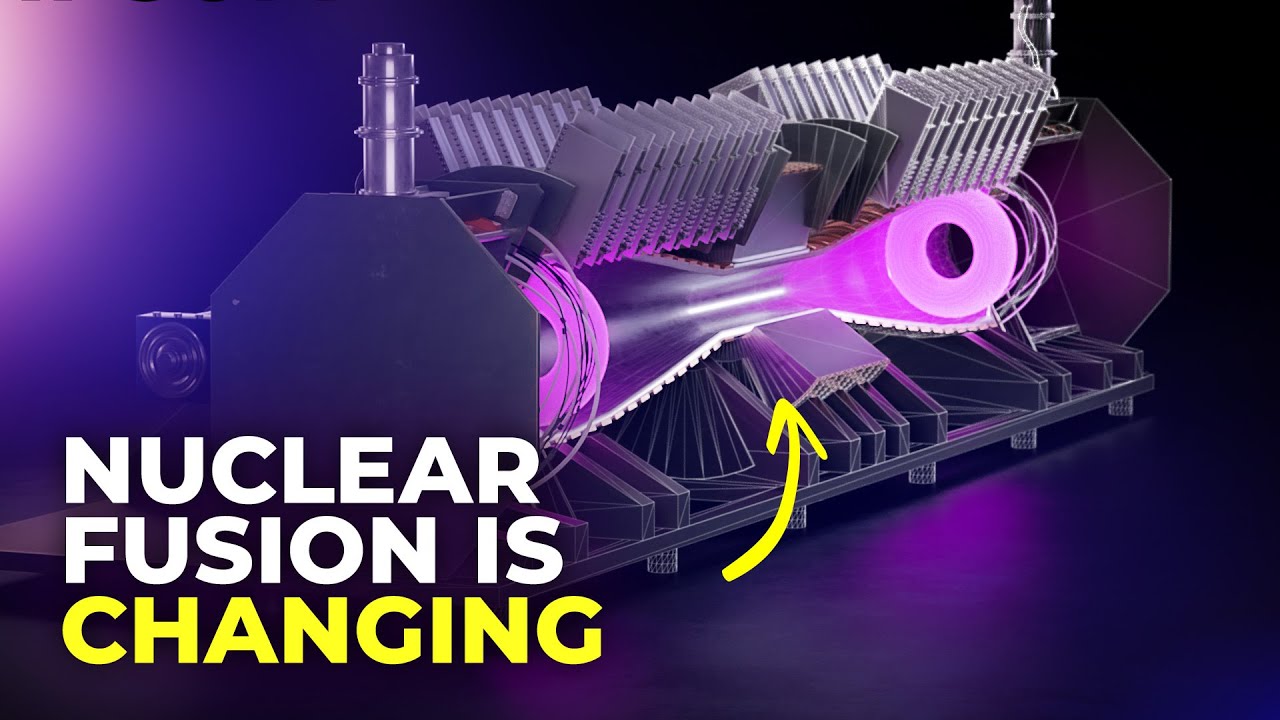
A New Way to Achieve Nuclear Fusion: Helion — Real Engineering

Real Engineering

Direct inductive energy recovery from deuterium-helium-3 reactions bypasses the costly steam cycles and severe tritium shortages that threaten conventional tokamak reactors.

AI-assisted summary of A New Way to Achieve Nuclear Fusion: Helion — original source. Check the original for full context.

Source published:

Key ideas

  • Helion Energy revealed Trenta, a sixth-generation linear fusion reactor utilizing pulsed magnetic fields to accelerate and collide two Field-Reversed Configurations (FRCs) at 300 km/s, heating plasma past 100 million °C. (0:01)
  • Rather than relying on scarce tritium and conventional steam turbines, Helion employs a deuterium–helium-3 fuel cycle that allows direct inductive electricity capture directly back into magnetic coils. (6:07)
  • To solve the global scarcity of helium-3, Helion developed a patented closed-loop process to synthesize helium-3 on-demand from deuterium-deuterium fusion reactions. (11:53)
  • The seventh-generation prototype, Polaris, is designed to demonstrate net electricity output and was scaled up 25% after Trenta revealed wider-than-expected fuel ion gyro orbits at fusion temperatures. (20:38)

Detailed notes

## Background Published on YouTube by Brian McManus on the Real Engineering channel on December 17, 2022, this documentary provides an exclusive, inside look at Helion Energy's nuclear fusion facility. The video explores Helion's unique linear reactor approach, supported by extended cuts and subscriber offerings on the Nebula streaming platform.

## TL;DR The video documents Helion Energy's sixth-generation fusion reactor, Trenta, and investigates how its linear, pulsed-magnetic architecture diverges from traditional tokamak designs. Rather than using scarce tritium and massive steam turbines, Helion uses a fuel mixture of deuterium and helium-3 to generate charged fusion products that push directly against magnetic fields to induce electricity. CEO David Kirtley explains the physics behind merging Field-Reversed Configuration (FRC) plasmoids at over 300 km/s, compressing them to over 100 million °C, and breeding helium-3 fuel on-site. The walkthrough also outlines the engineering hurdles being tackled for their seventh-generation machine, Polaris, including managing microsecond pulsed-power capacitor banks and scaling up repetition rates to deliver net electricity.

## Atmosphere & style The presentation blends the grounded curiosity of an investigative tech documentary with the quiet awe of witnessing a long-guarded laboratory breakthrough. Brian McManus and David Kirtley share a technical, conversational rapport as they navigate cavernous capacitor vaults and inspect heavy hardware bolting, stripping away speculative hype in favor of first-principles physics. The atmosphere moves from early technical skepticism to measured optimism, punctuated by the realization that massive, lightning-fast fusion pulses have become an almost routine, subdued pink flash in the control room.

## Bulletin - [00:01](https://www.youtube.com/watch?v=_bDXXWQxK38&t=1s) Helion Energy revealed Trenta, a sixth-generation linear fusion reactor utilizing pulsed magnetic fields to accelerate and collide two Field-Reversed Configurations (FRCs) at 300 km/s, heating plasma past 100 million °C. - [06:07](https://www.youtube.com/watch?v=_bDXXWQxK38&t=367s) Rather than relying on scarce tritium and conventional steam turbines, Helion employs a deuterium–helium-3 fuel cycle that allows direct inductive electricity capture directly back into magnetic coils. - [11:53](https://www.youtube.com/watch?v=_bDXXWQxK38&t=713s) To solve the global scarcity of helium-3, Helion developed a patented closed-loop process to synthesize helium-3 on-demand from deuterium-deuterium fusion reactions. - [20:38](https://www.youtube.com/watch?v=_bDXXWQxK38&t=1238s) The seventh-generation prototype, Polaris, is designed to demonstrate net electricity output and was scaled up 25% after Trenta revealed wider-than-expected fuel ion gyro orbits at fusion temperatures.

## Key takeaways - [00:01](https://www.youtube.com/watch?v=_bDXXWQxK38&t=1s) Trenta forms two opposing self-confined plasma rings (Field-Reversed Configurations) and accelerates them toward each other using sequenced pulsed magnetic coils. - [01:01](https://www.youtube.com/watch?v=_bDXXWQxK38&t=61s) Symmetric plasma collision converts 300 km/s directed kinetic energy directly into thermal stagnation, heating the core to tens of millions of degrees before high-field compression triggers fusion above 100 million °C. - [02:13](https://www.youtube.com/watch?v=_bDXXWQxK38&t=133s) Field-Reversed Configurations are formed by ionizing deuterium and helium-3 gas with RF and electric fields, then pulsing coils at over 100,000 amperes to invert the magnetic field and trap magnetic flux. - [06:07](https://www.youtube.com/watch?v=_bDXXWQxK38&t=367s) Direct energy conversion works like an electromagnetic piston: charged fusion products expand against the confining magnetic field, inducing electricity straight back into surrounding coils without steam turbines. - [09:47](https://www.youtube.com/watch?v=_bDXXWQxK38&t=587s) Mainstream deuterium-tritium tokamak designs face severe fuel bottlenecks, as global commercial tritium reserves stand at roughly 20 kilograms, sufficient for only two months of full-scale operation. - [10:22](https://www.youtube.com/watch?v=_bDXXWQxK38&t=622s) Tokamaks must breed tritium using lithium and beryllium wall blankets, but beryllium is scarce, expensive, and yields hazardous radioactive waste due to trace uranium impurities. - [11:53](https://www.youtube.com/watch?v=_bDXXWQxK38&t=713s) Helion synthesizes its own helium-3 by fusing abundant deuterium atoms, yielding charged particles for direct energy recovery alongside tritium that beta decays into additional helium-3 over a 12.3-year half-life. - [14:00](https://www.youtube.com/watch?v=_bDXXWQxK38&t=840s) The deuterium–helium-3 reaction generates 18.3 MeV entirely in charged particles, producing more energy than D-T fusion without high-energy neutron lattice displacement. - [14:00](https://www.youtube.com/watch?v=_bDXXWQxK38&t=840s) Helion could decouple neutron-producing deuterium-deuterium fuel breeding facilities from commercial deuterium-helium-3 electricity generators to protect plant components from degradation. - [20:38](https://www.youtube.com/watch?v=_bDXXWQxK38&t=1238s) Polaris was designed 25% larger than originally planned because Trenta demonstrated that fuel ion gyro orbits expand beyond simulation estimates at fusion temperatures, risking wall collisions. - [22:09](https://www.youtube.com/watch?v=_bDXXWQxK38&t=1329s) Trenta's pulsed power system discharges 10 megajoules within 100 microseconds, generating multi-gigawatt peak power bursts through acceleration coils carrying 100,000 amps and compression coils handling 1 million amps. - [22:09](https://www.youtube.com/watch?v=_bDXXWQxK38&t=1329s) Due to a lack of commercial suppliers for specialized pulsed-power hardware, Helion established an in-house capacitor manufacturing line in Everett, Washington. - [24:11](https://www.youtube.com/watch?v=_bDXXWQxK38&t=1451s) The key engineering challenge for commercialization is raising the duty cycle from Trenta's single pulse every 10 minutes to multi-hertz continuous firing while managing thermal loads on magnets and walls. - [25:38](https://www.youtube.com/watch?v=_bDXXWQxK38&t=1538s) Precision firing relies on fiber-optic signaling and solid-state switches with 300-nanosecond offsets between stages to avoid electromagnetic interference and the latency of copper wiring.

## Detailed walkthrough ### [00:01](https://www.youtube.com/watch?v=_bDXXWQxK38&t=1s) A Secret Revealed: Helion's Sixth-Generation Reactor, Trenta

Footage of Helion Energy’s reactor, long kept as a closely guarded secret, represents the public’s first look at an approach that could dramatically redirect the development of energy technology. Brian McManus visits Helion’s facility to document **Trenta**, the company's sixth-generation nuclear fusion generator. Rather than relying on traditional confinement configurations, this machine adapts principles initially developed for ion propulsion in space exploration.

The device operates symmetrically: it forms two opposing rings of plasma at either end of a linear reactor tube. In just a tenth of a thousandth of a second, pulsed magnetic coils fire these rings toward one another, squeezing and accelerating them along the axis until they smash together at the reactor's core. The collision arrests ions hurtling at 300 kilometers per second, converting their massive kinetic energy directly into thermal energy. This heats the plasma to tens of millions of degrees—temperatures sufficient to overcome mutual electromagnetic repulsion and induce nuclear fusion. Inside the control room, removed from the gigawatts of electricity surging through the system's capacitor banks, the realization of human-controlled fusion manifests as a brief, recurring pink flash. The process ran repeatedly and routinely enough that, as McManus describes it:

> “It became mundane pretty quickly to the point that my reaction to the feet became oddly subdued.”

```mermaid flowchart LR accTitle: Helion Trenta Collision Architecture accDescr: Symmetrical plasma rings are formed, accelerated toward the center, collided to induce thermal stagnation, and compressed to fusion conditions.

subgraph Form ["Formation"] direction TB A1["Inject Fuel & Ionize<br/>(D-³He gas)"] A2["Reverse B-Field<br/>(Create FRCs)"] A1 --> A2 end

subgraph Accel ["Acceleration"] direction TB B1["Peristaltic Squeeze<br/>(Sequenced coils)"] B2["Adiabatic Compression<br/>(Reach 300 km/s)"] B1 --> B2 end

subgraph Core ["Fusion Core"] direction TB C1["Stagnation Impact<br/>(Kinetic to Heat)"] C2["High-Field Compression<br/>(100M+ °C Fusion)"] C1 --> C2 end

Form --> Accel --> Core ```

---

[02:13](https://www.youtube.com/watch?v=_bDXXWQxK38&t=133s) Inside Trenta: How Field-Reversed Configurations Work

Standing inside Helion’s Redmond facility with founder David Kirtley, the architecture of the linear machine becomes clear. Unlike standard fusion designs, Trenta injects a distinct plasma target known as a **Field-Reversed Configuration (FRC)**. Achieving the requisite repeatability, symmetry, and high energy inputs required Helion to engineer an FRC merging scheme. Two identical formation sections sit at the outer limits of the machine, preparing the fuel before it ever enters the central chamber. As David Kirtley summarizes the overarching mechanism:

> “The fundamental concept of how these systems work is unlike most fusion and here we inject a fusion Target we call this one a field reverse configuration then using pulsed magnetic fields to very high pressures we compress that fusion plasma up to Fusion conditions.”

At the formation end, neutral fuel gas—a mix of deuterium and helium-3 ($^3\text{He}$)—is puffed into the chamber at room temperature and low pressure from a dedicated fuel manifold over the span of several milliseconds. Radio frequency (RF) and electric fields strip the electrons from the atomic nuclei, producing an ionized plasma at roughly one million degrees. While far too hot to contact the physical reactor walls, this is relatively cool by fusion standards.

To manipulate this plasma without wall contact, the machine uses a specialized magnetic sequence. After establishing an initial guiding magnetic field through the chamber, coils pulse at intensities exceeding 100,000 amperes to suddenly invert the field. This inversion traps magnetic flux and forms a self-confined, self-organized plasma object with a closed magnetic topology. Once this discrete FRC is established, sequenced coil pulses exert magnetic pressure along the chamber in a process Kirtley compares to "squeezing a tube of toothpaste," peristaltically expelling the plasma into the acceleration stage.

- Initial fuel injection: neutral gas mixture of deuterium and helium-3. - Gas ionization: driven by combined RF and electric fields to separate electrons from nuclei. - Initial plasma temperature: approximately 1 million °C. - Coil pulsed currents: over 100,000 amps per coil to trigger field reversal. - Confinement type: self-confined, self-organized closed magnetic topology (FRC).

---

[06:07](https://www.youtube.com/watch?v=_bDXXWQxK38&t=367s) Acceleration, Stagnation, and Direct Magnetic Energy Capture

Once ejected from the formation section, the FRC enters the acceleration section (or plasma injector). Here, sequenced electromagnetic pulses accelerate the plasmoid to speeds exceeding 300 km/s (over one million miles per hour). As the external magnetic field strengthens along the path, the plasma undergoes adiabatic compression in accordance with ideal gas laws, shrinking in radius while escalating in temperature from a few million degrees up to roughly 10 million degrees.

At the center of the machine—distinguished by heavy structural bolting built to resist extreme mechanical loads—the two opposing FRCs collide. Rather than passing through each other, they stagnate: their directed kinetic velocity drops to zero, converting entirely into random thermal motion. The resulting merged plasma heats to between 10 and 20 million degrees. At this point, the primary compression coils fire at the maximum speed modern switching electronics allow, driving the magnetic pressure up and squeezing the core plasma past 100 million degrees to initiate high-rate fusion.

``` Deuterium (²H) + Helium-3 (³He) --> Helium-4 (⁴He) + Proton (p) + Energy ```

Because this reaction primarily yields charged particles ($^4\text{He}$ and energetic protons) trapped within the internal magnetic field rather than uncharged neutrons, the expanding plasma applies pressure straight back onto the external magnetic field. Kirtley points out that the physics mirror an internal combustion engine:

> “That works just like in a piston where in a piston you compress the fusion the you compress the fuel it begins to burn it then gets hotter it pushes back on that piston only we do it all electromagnetically.”

This magnetic pushback bypasses the standard balance-of-plant cycle used in proposed tokamak systems like ITER. In a conventional tokamak, escaping high-energy neutrons heat a lithium blanket, which heats pressurized water, which boils into high-pressure steam, which turns a steam turbine, which finally spins a copper-wire generator. Helion bypasses steps 1 through 4, converting the expansion of the magnetic field directly into electric current in the surrounding coils.

---

[09:47](https://www.youtube.com/watch?v=_bDXXWQxK38&t=587s) The Fuel Dilemma: Deuterium-Helium-3 vs. Deuterium-Tritium

By harvesting electrical energy directly from the electromagnetic work done on the coils, Helion aims to achieve vastly superior plant efficiency while sidestepping the severe fuel-supply bottlenecks that afflict traditional fusion concepts. Most mainstream fusion experiments rely on a mix of deuterium and tritium (D-T). Deuterium is plentiful and easily procured:

> “This is a bottle of heavy water water with two deuterium atoms instead of two regular hydrogen atoms it's cheap and safe I can even drink it.”

Tritium, by contrast, is exceptionally scarce in nature. Global reserves of commercial tritium hover around a mere 20 kilograms, an amount that would barely supply a single commercial-scale tokamak for long-term power generation. This fuel bottleneck makes Helion’s pursuit of a deuterium and helium-3 fuel cycle a fundamental alternative to mainstream D-T reactor roadmaps.

[10:22](https://www.youtube.com/watch?v=_bDXXWQxK38&t=622s) The Problem with Tritium and Tokamak Reactors

Tokamak reactors present severe fuel-supply bottlenecks. A full-scale system is projected to burn through 300 grams of tritium per day, exhausting the entire global supply in roughly two months. To survive, tokamak designs must manufacture tritium directly on-site via a lithium breeding blanket in the reactor wall. When high-energy neutrons produced by the deuterium-tritium (D-T) fusion reaction hit the lithium, the atoms split into tritium and helium. While conceptually elegant, this creates a major energetic penalty: 80% of the energy yielded in a D-T fusion reaction is carried off by those high-energy neutrons, effectively spending all of the reaction’s useful energy output just to restock the fuel supply.

```mermaid flowchart TD accTitle: Deuterium-Tritium Neutron Recycling Dilemma in Tokamaks accDescr: Diagram showing how 80 percent of D-T energy is absorbed by lithium and beryllium blankets to breed tritium, causing degradation and high costs.

subgraph DTReaction["D-T Fusion Reaction"] DT["Deuterium + Tritium"] -->|"Produces"| He["Helium Core (20% Energy)"] DT -->|"Carries 80% Energy"| N1["High-Energy Neutron"] end

subgraph Blanket["Tokamak Wall Blanket"] N1 --> Be["Beryllium Multiplier Layer"] Be -->|"1 Neutron In"| N2["2 Neutrons Out"] N2 --> Li["Lithium Breeding Layer"] Li -->|"Splits into"| T["Tritium (Fuel)"] Li -->|"Produces"| He4["Helium-4"] end

subgraph Drawbacks["Engineering Drawbacks"] Be -.->|"Contains impurities"| Rad["Radioactive Beryllium Waste"] N2 -.->|"Thermal extraction"| Heat["Steam Cycle Heat"] end ```

To break even on neutrons, reactor designs place a beryllium multiplier layer directly in front of the lithium. Beryllium releases two neutrons when struck by one, leaving one neutron available for tritium breeding and another to generate thermal heat. However, beryllium is scarce and exceptionally expensive—the total annual global supply is barely enough to construct a single commercial tokamak. It also contains trace uranium impurities; bombarding these with high-energy neutrons makes the beryllium blanket dangerously radioactive and expensive to decommission. This fundamental reliance mirrors the economic pitfalls of traditional nuclear fission, where high material costs, radioactive waste management, and capital-intensive infrastructure threaten to price tokamaks out of the market. As Brian McManus summarizes:

> “Tokamak reactors are going to face the exact same issues as nuclear fission energy: they will be too expensive and won't be able to compete with cheaper forms of electricity.”

[11:53](https://www.youtube.com/watch?v=_bDXXWQxK38&t=713s) Helion’s Fuel Mixture: Deuterium and Helium-3

To sidestep the tritium trap, Helion relies on a fuel mixture of deuterium and helium-3 ($^3\text{He}$). Deuterium is stable, non-toxic, and ubiquitous, making up roughly one part in 5,000 of all naturally occurring water on Earth. As Helion CEO David Kirtley explains:

> “Deuterium is really common; it's part one part in 5,000 in all water, it's in the coffee you drink, and safe and readily abundant and low cost as well.”

Unlike deuterium, which Helion can purchase in standard purified compressed gas cylinders, helium-3 is exceptionally rare in nature. Early pioneers recognized helium-3 as an ideal candidate for fusion, but its scarcity discouraged experimental deployment. Helion’s sixth-generation prototype, Trenta, was the first system known to demonstrate bulk deuterium-helium-3 fusion for power generation.

```mermaid flowchart LR accTitle: Helion Dual-Fuel Fusion and Fuel Breeding Cycle accDescr: Flowchart illustrating the two D-D fusion pathways generating Helium-3 and Tritium, followed by the primary D-He3 electricity generating reaction.

subgraph DDHarvest["Fuel Breeding: D-D Reactions"] D1["Deuterium"] & D2["Deuterium"] --> DD["D-D Fusion Collision"] DD -->|"50% Branch"| He3["Helium-3 + 0.82 MeV (Charged)"] DD -->|"50% Branch"| n1["Neutron (2.45 MeV)"] DD -->|"50% Branch"| p1["Proton + 3.2 MeV (Charged)"] DD -->|"50% Branch"| T1["Tritium + 1.01 MeV (Radioactive)"] end

subgraph Decay["Storage & Recovery"] T1 -->|"Beta decay: 12.3 years"| He3_decay["Decayed Helium-3"] end

subgraph PowerReaction["Primary Power Generation"] D3["Deuterium"] & He3Core["Helium-3 Fuel"] --> DHe3["D-He3 High-Energy Fusion"] He3 --> He3Core He3_decay --> He3Core DHe3 --> He4["Helium-4 Core"] DHe3 --> p2["High-Energy Proton"] DHe3 -->|"18.3 MeV Total Output"| Grid["Direct Inductive Electricity Capture"] end ```

To resolve the fuel availability dilemma, Helion patented an on-demand fuel-breeding process. By compressing deuterium atoms at high temperatures, the system fuses them together to synthesize its own helium-3. The produced helium-3 is then fused with another deuterium atom to yield helium-4, a charged proton, and substantial electrical output. While the initial deuterium-deuterium step generates a small amount of electricity (roughly one-eighth that of the primary reaction), the deuterium-helium-3 reaction yields far more energy because of the higher mass deficit ($E = mc^2$) converted into particle temperature and kinetic energy.

- Deuterium comprises approximately 1 out of every 5,000 hydrogen atoms in terrestrial water. - Deuterium-deuterium fusion produces roughly $\frac{1}{8}$ the energy of a deuterium-helium-3 fusion reaction. - Helion holds patents on their internal closed-loop method for breeding helium-3 from deuterium gas.

[14:00](https://www.youtube.com/watch?v=_bDXXWQxK38&t=840s) Reaction Pathways, Energy Capture, and Decentralized Production

The physics of Helion's approach diverges sharply from tokamaks because of the nature of its fusion products. Deuterium-deuterium reactions split down two roughly equal probability branches: 1. One branch creates a helium-3 nucleus and a free neutron. The neutron retains most of the kinetic energy, but because it has no electrical charge, it bypasses Helion's magnetic field without pushing against the coils. The resulting helium-3 ion, however, carries 0.82 MeV of usable, electrically capturable kinetic energy. 2. The second branch produces a high-energy proton carrying 3.2 MeV and a tritium nucleus carrying 1.01 MeV.

Because both products in the second reaction are charged, Helion’s direct inductive recovery system can harness their push against the magnetic field. The exhaust gases are evacuated by a turbomolecular pump situated in the diverter. Protons capture electrons to become ordinary hydrogen, while the radioactive tritium is isolated and moved to remote storage. Over a half-life of 12.3 years, the stored tritium beta decays into stable helium-3, which can be reintroduced into the reactor as primary fuel.

When deuterium and helium-3 fuse in the main power stage, they release 18.3 MeV—all in the form of charged particles (an alpha particle and a proton). This yields more energy than the 17.6 MeV produced by deuterium-tritium fusion and over four times the energy per unit mass of a uranium fission reaction.

This fuel cycle creates a unique operational choice: reactors can either breed their own helium-3 on-site, or Helion can isolate the breeding process into specialized facilities. Because the deuterium-deuterium step produces damaging neutrons, separating fuel generation from electricity generation protects commercial reactors. Even though deuterium-deuterium neutrons possess five times less energy than deuterium-tritium neutrons (inflicting far less lattice displacement), they still cause structural degradation over time. As David Kirtley outlines:

> “I think that's a good outstanding business decision that we we don't know, um, one of the things that you have to keep in mind is when you do the deuterium fusion, that's when you make the neutrons, so the neutrons come from the deuterium-deuterium fusing together, um, and so there's some really maybe advantageous things of separating those two machines.”

Building one sacrificial fuel-breeding facility that feeds ten clean energy generators could drastically improve the economics of commercial fusion power.

[18:03](https://www.youtube.com/watch?v=_bDXXWQxK38&t=1083s) Engineering Challenges: Polaris and Beyond

Moving away from tritium eliminates fuel scarcity and neutron damage, but the deuterium-helium-3 reaction requires significantly higher plasma temperatures than deuterium-tritium. To commercialize this, Helion is constructing Polaris, its seventh-generation prototype, scheduled to come online in 2024 with the goal of demonstrating net electricity production for the first time.

Bridging the gap between Polaris and a full-scale Eighth-Generation commercial generator introduces complex balance-of-plant demands. The system must capture inductive pulses, refill capacitor banks, convert that energy into 60-hertz alternating current for the grid, and transition from firing once every few seconds to a continuous repetition rate of multiple pulses per second.

When asked about the single hardest hurdle facing this transition, David Kirtley emphasized the compounding thermal stresses of continuous operations:

> “My personal belief in in building the steady operating systems that we built in the past is it comes into the thermal operation of these systems, whereas things start to heat up, they change the structural mechanics change of these pulse magnets, uh, the way the the fusion plasma actually acts with the wall temperature changes as it changes in temperature.”

Data from the previous Trenta prototype provided both relief and new engineering puzzles. On one hand, the team feared that merging two Field-Reversed Configuration (FRC) plasmoids moving at over one million miles per hour would demand impossible timing precision; experiments revealed that plasma collision and merge behavior is remarkably forgiving, self-stabilizing, and repeatable. On the other hand, as core plasma temperatures climbed past 10 million and reached 100 million degrees Celsius, the fusion yield outperformed models, but the plasma began interacting more intensely with the vacuum chamber walls. Managing this elevated plasma-wall boundary interaction remains the central design priority for future machine iterations.

- **Polaris (Generation 7):** Designed to demonstrate net electrical output, scheduled for 2024. - **Generation 8 Target:** Conversion of inductive bursts into 60 Hz grid-ready AC power at multi-hertz pulse repetition rates. - **Plasma Merge Speed:** Plasmoids collide at relative speeds exceeding 1,000,000 mph (1,600,000 km/h). - **Trenta Operating Temperatures:** Successfully exceeded 100 million °C (8.6 keV), yielding stronger-than-expected fusion output alongside increased wall interactions.

[20:38](https://www.youtube.com/watch?v=_bDXXWQxK38&t=1238s) Iterative Engineering and Gyro Orbits: Why Polaris Is 25% Larger

Helion Energy is taking a fundamentally different development approach compared to massive multinational projects like the ITER tokamak. ITER’s sheer physical scale means that any redesign involves enormous capital expenses, making the learning curve steep and prohibitively expensive. In contrast, Helion’s compact design allows for rapid iteration. Polaris, their seventh-generation machine, was designed to be roughly 25% larger than initially planned due to physical phenomena discovered while running its predecessor, Trenta. As CEO David Kirtley explains:

> “Just a little bit bigger, about 25% bigger than what we had originally planned to account for those things, and so there's some engineering iteration that has to happen as we discover the advanced physics and the engineering of implementing these systems in practice.”

Because fusion at these regimes is uncharted territory with few existing textbooks, Helion is effectively discovering the underlying science as they build. One critical finding from Trenta was that fuel ion gyro orbits—the helical radius at which ions orbit around magnetic field lines—were noticeably wider than their computer simulations had predicted. Gyro orbit size is dictated by ion velocity (temperature) and the strength of the confining magnetic field. At fusion-grade temperatures, these enlarged orbits created a severe risk of ions grazing or impacting the interior walls of the generator chamber. To keep these superheated ions securely off the physical hardware, the team scaled up Polaris’s chamber dimensions by 25%. Polaris will also mark the program's transition to actively extracting and capturing electricity directly from the reacting plasma.

```mermaid flowchart TD accTitle: Impact of Larger Gyro Orbits on Reactor Sizing accDescr: Diagram tracing how high ion velocities cause wider gyro orbits, risking wall impacts and necessitating a larger vessel.

subgraph Plasma_Physics["Plasma Dynamics"] A["High Ion Velocity & Temperature"] --> B["Larger Observed Gyro Orbits"] B --> C{"Exceeds Simulation Estimates?"} end

subgraph Hardware_Design["Engineering Response"] C -->|"Risk of chamber wall impact"| D["Redesign Vessel Geometry"] D --> E["Polaris Chamber Sized 25% Larger"] E --> F["Safe Magnetic Confinement for Direct Recovery"] end ```

[22:09](https://www.youtube.com/watch?v=_bDXXWQxK38&t=1329s) The Pulsed Power Architecture Beneath Trenta

To establish the immense magnetic fields required for field-reversed configuration (FRC) fusion, Trenta relies on an extensive network of capacitor banks stacked directly beneath the machine. Roughly 90% of all electrical input to Trenta is routed straight into generating magnetic fields. The acceleration coils that form and propel the plasma rings operate at currents of 100,000 amperes, while the central compression coils demand an astonishing 1 million amperes. Because local power grids cannot supply instantaneous spikes of that magnitude, energy must be slowly trickled into local storage and then released in a fraction of a second. Standard chemical batteries cannot discharge fast enough, leaving high-energy-density capacitor banks as the only viable solution.

Taking a walk through the storage vaults beneath the test platform, David Kirtley outlined the layered capacitor topology powering the shots:

> “So what you're seeing here, this is actually one capacitor unit, and so if you're used to other electronics, a capacitor box is one unit; each of those boxes is one capacitor that has several kilojoules worth of energy storage in it, and then we have hundreds of those capacitors that all, in parallel in a modular way, make the main bank.”

Alongside these primary banks sit secondary capacitor groups paired with semiconductor switches for higher-efficiency, slower-response duties, as well as legacy pulse-power capacitors over two decades old that handle initial ionization and injection. When asked why decades-old hardware was still in service, Kirtley noted that mainstream commercial manufacturing for niche, high-performance pulsed capacitors largely stalled years ago:

> “Over the years, the way the pulsed power technology and community has evolved, some of these capacitors are actually still the highest performing capacitors, because the industry doesn't manufacture a lot of these for our type of application.”

To break free from these supply constraints, Helion established an in-house capacitor manufacturing line at their facility in Everett, Washington, producing bespoke capacitors optimized specifically for fusion duty cycles.

[24:11](https://www.youtube.com/watch?v=_bDXXWQxK38&t=1451s) Scaling Pulse Repetition Rates and Component Longevity

Transitioning from an experimental test rig to an operational fusion power plant requires an enormous leap in firing frequency. While Trenta fired once every 10 minutes to gather diagnostic research data, a commercial reactor must pulse continuously at repetition rates of once every 10 seconds, once per second, or even up to 10 Hz (10 times per second). At these high repetition rates, average power throughput and internal thermal buildup threaten capacitor dielectric longevity.

Addressing how they plan to bridge this duty-cycle divide, Kirtley pointed out that Helion has already validated long-life, self-healing capacitor technology on smaller, subscale test systems:

> “Trenta has done over 10,000 high-power pulses doing fusion; in some of our subscale systems that we did earlier that weren't doing fusion, but were making these types of plasmas, we've done not tens of thousands, but we've done billions of discharges with capacitors and run them steady for months on end at hundreds of hertz.”

The core challenge for Polaris is unifying these two distinct engineering domains: taking the extreme energy scale demonstrated on Trenta and integrating it with the high-frequency durability proven on the low-energy endurance test rigs.

[25:38](https://www.youtube.com/watch?v=_bDXXWQxK38&t=1538s) The Microsecond Symphony: Triggering and Fiber-Optic Control

Despite occupying cavernous rooms beneath the test facility, the entire Trenta capacitor bank holds a modest total capacity: roughly 10 million joules (10 megajoules). That is equivalent to the metabolic energy found in about 22 bananas, or roughly 2.8 kilowatt-hours—a mere 1/30th the electrical capacity of a standard Tesla automotive battery pack. The magic lies not in total energy stored, but in the release velocity:

- **Total Energy Stored:** 10 MJ (2.8 kWh) - **Discharge Window:** ~100 microseconds ($\mu\text{s}$) - **Instantaneous Peak Output:** Multiple gigawatts (GW) - **Sequential Coil Timing:** 300 nanoseconds (ns) intervals between successive magnetic stages - **Plasma Flight Speed:** Millions of kilometers per hour

Releasing gigawatts in a 100-microsecond window produces instantaneous power rivaling lightning bolts, but with microsecond and nanosecond precision. Within this microscopic window, thousands of coordinated switching events occur across the device. Electromagnets along the acceleration arms must trigger sequentially at exact 300-nanosecond offsets to match the passage of the plasmoids accelerating toward the central chamber at millions of kilometers per hour.

```mermaid flowchart LR accTitle: Chronology of Helion Pulse and Direct Energy Cycle accDescr: Sequence showing energy release from capacitors into compression, fusion reaction, and energy recovery.

subgraph Acceleration["Microsecond Acceleration"] C1["Capacitor Banks (10 MJ Total)"] -->|"Discharge in 100 µs"| SW["Fiber-Optic Solid-State Switches"] SW -->|"300 ns Staged Pulses"| COILS["Linear Magnetic Coils"] COILS -->|"Accelerate to Millions of km/h"| COLL["Symmetric Plasma Collision"] end

subgraph Compression_and_Capture["Fusion and Direct Recovery"] COLL -->|"1 MA Center Coil"| TRAP["Central Magnetic Trap Shrinks"] TRAP --> FUSE["Plasma Overcomes Coulomb Barrier & Fuses"] FUSE --> EXP["Thermonuclear Plasma Expands"] EXP -->|"Inductive Flux Reversal"| REC["Electricity Recaptured to Capacitors & Grid"] end ```

Managing this discharge requires modern microprocessors and dedicated fiber-optic control lines. Legacy copper signaling and vintage analog controllers are far too imprecise, with latency margins wider than the operational window. Furthermore, traditional wiring would suffer electromagnetic induction from the million-ampere surges traveling through the system, creating devastating misfires. System engineers must even account for the speed of light through the fiber-optic lines and the switching delay through internal semiconductor junctions.

In Trenta, this synchronization drives two opposing plasma rings together at blinding velocity, trapping them inside a central magnetic bottle. The field is then dynamically contracted until the compressed ions have no alternative but to overcome Coulomb repulsion and fuse into heavier elements. In Polaris, the team takes the final leap: harnessing the post-fusion expansion of the plasma against the magnetic confinement field to push electricity directly back into the capacitors via electromagnetic induction—creating a bidirectional, tidal flow of high-power energy that can be channeled out to the electrical grid.

[28:33](https://www.youtube.com/watch?v=_bDXXWQxK38&t=1713s) Reflections on Fusion and Production Notes

Documentary host Brian McManus reflected on how touring the facility and seeing Helion's hardware firsthand shifted his perspective on the viability of commercial fusion:

> “I have never been particularly hopeful that nuclear fusion power was ever feasible, but speaking with David and all of the talented staff at Helion, and the recent news from the US Department of Energy about their net energy output from their inertial confinement reactor, it has really made me feel that this technology may not just be possible, but potentially around the corner.”

Because extensive footage could not fit into the standard runtime, two full uncut interviews—including an extended walk-through tour of Trenta and an in-depth technical discussion with David Kirtley—were published directly to the Nebula streaming service. McManus noted that complex field productions of this nature are made possible entirely by viewer subscriptions. For example, their earlier investigative documentary on SpinLaunch required shooting across two states over several days with substantial gear rentals, hotels, camera crews, editors, and animators, ultimately tallying approximately $30,000 in production costs. Additional behind-the-scenes material and historical series like *The Logistics of D-Day* and *The Battle of Britain* continue to be hosted on the platform to support further deep-dive science and engineering journalism.

## Notable quotes > [10:22](https://www.youtube.com/watch?v=_bDXXWQxK38&t=622s) Tokamak reactors are going to face the exact same issues as nuclear fission energy: they will be too expensive and won't be able to compete with cheaper forms of electricity. — Brian McManus

## Mentioned Helion Energy, Trenta, Polaris, Brian McManus, David Kirtley, ITER, Nebula, Real Engineering, SpinLaunch, US Department of Energy, The Logistics of D-Day, The Battle of Britain

## Video description Sign up to Nebula to support Real Engineering: https://go.nebula.tv/realengineering

Watch the extended cuts of this video ad free on Nebula: https://nebula.tv/videos/realengineering-nuclear-fusion-is-changing-helion

Links to everything I do: https://beacons.ai/brianmcmanus

Get your Real Engineering shirts at: https://standard.tv/collections/real-engineering

Credits: Writer/Narrator: Brian McManus Editor: Dylan Hennessy Animator: Mike Ridolfi Animator: Eli Prenten Sound: Graham Haerther Thumbnail: Simon Buckmaster

Select imagery/video supplied by Getty Images Thank you to AP Archive for access to their archival footage.

Music by Epidemic Sound: http://epidemicsound.com/creator

Thank you to my patreon supporters: Adam Flohr, Henning Basma, Hank Green, William Leu, Tristan Edwards, Ian Dundore, John & Becki Johnston. Nevin Spoljaric, Jason Clark, Thomas Barth, Johnny MacDonald, Stephen Foland, Alfred Holzheu, Abdulrahman Abdulaziz Binghaith, Brent Higgins, Dexter Appleberry, Alex Pavek, Marko Hirsch, Mikkel Johansen, Hibiyi Mori. Viktor Józsa, Ron Hochsprung

[Source](https://www.youtube.com/watch?v=_bDXXWQxK38)

中文简报

Helion绕过蒸汽轮机直接从核聚变中获取电能 通过氘-氦-3反应进行直接感应能量回收,绕过了昂贵的蒸汽循环以及威胁传统托卡马克反应堆的严重氚短缺问题。 该视频记录了Helion Energy的第六代聚变反应堆Trenta,并探究了其线性脉冲磁场架构与传统托卡马克设计的不同之处。Helion没有使用稀缺的氚和庞大的蒸汽轮机,而是采用氘和氦-3的混合燃料来产生带电聚变产物,这些产物直接反推磁场以感应产生电能。首席执行官David Kirtley解释了以超过300公里/秒的速度合并场反转构型(FRC)等离子体团、将其压缩至超过1亿摄氏度以及现场培育氦-3燃料背后的物理原理。视频介绍还概述了其第七代装置Polaris正在应对的工程挑战,包括管理微秒级脉冲功率电容器组以及提高重复频率以输出净电能。 Helion Energy展示了第六代线性聚变反应堆Trenta,该反应堆利用脉冲磁场以300公里/秒的速度加速并碰撞两个场反转构型(FRC),将等离子体加热至超过1亿摄氏度。 (0:01) Helion没有依赖稀缺的氚和传统蒸汽轮机,而是采用氘-氦-3燃料循环,使直接感应电能捕获能直接返回到磁体线圈中。 (6:07) 为了解决全球氦-3短缺问题,Helion开发了一项专利闭环工艺,可按需从氘-氘聚变反应中合成氦-3。 (11:53) 第七代原型机Polaris旨在展示净电能输出;在Trenta揭示聚变温度下燃料离子的回旋轨道比预期更宽后,Polaris的尺寸放大了25%。 (20:38)

Reading summary

Helion Energy is developing a pulsed linear fusion generator that collides Field-Reversed Configuration plasmoids and captures electrical energy directly through magnetic induction, aiming to bypass the steam cycles and tritium fuel shortages typical of conventional tokamaks. Symmetrical Linear Collision and Direct Inductive Capture (0:01) Helion's sixth-generation prototype, Trenta, departs from conventional toroidal magnetic confinement by using a symmetrical linear configuration derived from ion propulsion concepts. The system injects a deuterium and helium-3 gas mixture at both ends, ionizes it to roughly one million degrees Celsius, and applies magnetic coil pulses exceeding 100,000 amperes to invert magnetic flux, creating self-confined Field-Reversed Configurations (FRCs). Sequenced magnetic fields then peristaltically accelerate these opposing plasmoids past 300 kilometers per second toward the central chamber, where their collision converts kinetic energy into thermal motion at 10 to 20 million degrees Celsius. Central compression coils delivering one million amperes then squeeze the plasma past 100 million degrees to induce fusion. Direct Electromagnetic Recovery Versus Steam Cycles (6:07) Unlike standard deuterium-tritium (D-T) tokamak designs where 80 percent of reaction energy is carried away by uncharged neutrons and converted into electricity via heat exchangers and steam turbines, Helion's primary deuterium-helium-3 reaction yields charged alpha particles and protons. Because these charged particles remain trapped within the magnetic field, their post-fusion expansion exerts physical pressure back onto the confining external magnetic field, functioning much like a piston in an internal combustion engine. This dynamic induces an electrical current directly back into the surrounding coils, bypassing the balance-of-plant thermal cycle and theoretically allowing much higher energy conversion efficiency. Bypassing Tritium Scarcity Through Helium-3 Breeding (9:47) Traditional fusion roadmaps face severe supply limits because global commercial tritium inventories stand at roughly 20 kilograms, enough to supply a commercial tokamak for only two months. Tokamaks rely on lithium and scarce beryllium breeding blankets, which absorb neutrons, generate radioactive waste, and risk duplicating the high capital costs of nuclear fission. In contrast, Helion relies on abundant deuterium (found as one in every 5,000 hydrogen atoms in water) and breeds helium-3 through internal deuterium-deuterium (D-D) reactions. Half of the D-D reactions generate helium-3 directly, while the other half yield tritium that beta-decays into helium-3 with a half-life of 12.3 years. Because D-D fusion produces lower-energy neutrons, Helion is evaluating whether to co-locate breeding within generators or isolate it inside dedicated sacrificial fuel facilities. Pulsed Power Architecture and Fiber-Optic Timing (22:09) Trenta relies on an extensive network of sub-platform capacitor banks holding approximately 10 megajoules of energy—roughly 2.8 kilowatt-hours. The machine dumps this energy in a 100-microsecond discharge to produce instantaneous power spikes in the multi-gigawatt range. Because standard power grids cannot supply such surges and battery chemistries discharge too slowly, capacitors are the only viable solution; Helion established an in-house manufacturing line in Everett, Washington, after commercial sourcing for fusion-grade pulsed capacitors dwindled. To coordinate the staged acceleration coils within 300-nanosecond intervals and evade electromagnetic interference from million-ampere surges, the reactor uses fiber-optic controllers and solid-state switches calibrated down to semiconductor junction delays and the speed of light. Thermal Management and Scaling to Polaris (18:03) Translating experimental pulses into commercial power requires bridging a substantial duty-cycle gap. While Trenta fired once every 10 minutes to collect diagnostic data across more than 10,000 fusion pulses, commercial systems must operate at multi-hertz frequencies. CEO David Kirtley identified continuous thermal stress as the primary engineering hurdle, as high-temperature operation alters the structural mechanics of pulsed electromagnets and intensifies plasma-wall interactions. Furthermore, experimental results showed fuel ion gyro orbits were larger than computer simulations predicted, raising the risk that superheated ions could strike the vacuum chamber. As a result, Helion redesigned its seventh-generation Polaris prototype to be 25 percent larger to ensure magnetic clearance while testing net electricity output. Helion's commercial timeline centers on its Polaris prototype demonstrating net electrical recovery and establishing whether rapid-pulse FRC physics can withstand continuous multi-hertz thermal stresses. Success remains contingent on mastering high-temperature plasma-wall boundaries and proving out in-house pulsed-power hardware at scale.

精炼阅读摘要

Helion Energy 正在研发一种基于场反转配置(FRC)的线性对称脉冲核聚变方案,通过对撞等离子体环并利用磁压直接感应发电;该公司试图以氦-3闭环燃料循环绕过传统托卡马克装置面临的氚短缺与昂贵热力循环瓶颈。 FRC 对撞压缩与直接感应发电 (0:01) Helion 的第六代原型机 Trenta 摒弃了传统的稳态磁约束架构,采用源自离子推进技术的线性对称设计。系统在反应管两端将氘与氦-3(D-³He)气体电离至约 100 万摄氏度,通过超过 10 万安培的脉冲磁场反转形成具有自约束拓扑结构的场反转配置(FRC)等离子体环。随后,多级线圈以 300 纳秒间隔依次放电,像挤牙膏一样将两个等离子体环对称加速至超过每秒 300 公里并在中心发生滞止对撞,把定向动能完全转化为随机热运动,使等离子体升温至 1000 万到 2000 万摄氏度。中心压缩线圈随后通入 100 万安培电流进行高场绝热压缩,将核心等离子体推升至 1 亿摄氏度以上触发核聚变。 由于主反应产物全部为带电粒子(氦-4与高能质子),反应后膨胀的高温等离子体直接推挤外围约束磁场,产生类似内燃机活塞做功的电磁反作用力。这一机制使系统能够通过线圈感应直接提取电能,彻底规避了托卡马克等主流方案必须依赖的“高能中子加热锂包层—加热高压水—产生蒸汽—驱动汽轮机与发电机”的传统热机回路。 规避氚供应链与托卡马克包层困境 (9:47) 主流托卡马克项目主要依赖氘-氚(D-T)反应,但全球商业氚储量仅约 20 公斤,一台全尺寸商用托卡马克预计每天即消耗 300 克氚,两个月便会耗尽全球存量。为实现燃料自持,托卡马克必须在第一壁使用昂贵且稀缺的铍作为中子倍增剂,并利用锂包层捕获中子增殖氚。这不仅将反应释放的 80% 能量消耗在维持燃料循环上,而且铍材料中残留的微量铀杂质在中子轰击下会产生放射性废物,导致极高的建造成本与退役开销,面临与裂变电站相似的经济竞争劣势。 相比之下,氘天然存在于水中(丰度约为五千分之一),极具成本优势。尽管自然界缺乏氦-3,Helion 采用了自研的专利燃料自持策略:先利用高温高压压缩氘核进行氘-氘(D-D)聚变,产生各占 50% 概率的“氦-3加中子”与“质子加氚”两个分支。其中产生的氚半衰期为 12.3 年,在隔离储存后经贝塔衰变转化为稳定的氦-3;衰变及直接生成的氦-3再注入主反应室与氘聚变释放 18.3 MeV 能量。创始人 David Kirtley 提出,未来甚至可采用“一台牺牲性 D-D 燃料增殖装置供应十台清洁发电装置”的商业模式,从而将中子辐照损伤完全隔离在专用生产设施内。 纳秒级脉冲功率与电容硬件突破 (22:09) Trenta 的核心脉冲系统并不依赖庞大的总体能量,其地下储能电容库总储能量约为 10 兆焦耳(约合 2.8 千瓦时),仅为标准特斯拉电池组容量的约三十分之一。系统的核心技术在于释放速度:10 兆焦耳能量必须在约 100 微秒的超窄窗口内倾泻完毕,瞬时峰值输出高达数吉瓦。这种极高功率要求由现代微处理器配合光纤控制回路进行协同,以完全消除电磁感应干扰与传统铜线的信号延迟,精确控制各级线圈以 300 纳秒间隔步进触发。 为克服商用高性能脉冲电容器长期停滞的供应链难题,Helion 在华盛顿州埃弗里特建立了自有的电容器生产线。虽然 Trenta 此前每 10 分钟放电一次以获取诊断数据(已完成超过 1 万次高功率聚变脉冲),但商业电站必须提升至每秒一次乃至 10 赫兹的连续运行频率。Kirtley 指出,团队此前在低能量子系统上实现了数百赫兹、数十亿次放电的自愈式电容寿命验证,接下来的关键在于将大能量放电与长寿命耐磨损性能合二为一。 原型机迭代与工程放大挑战 (18:03) 相较于 ITER 等巨型国际合作项目由于体量庞大而面临极高的改造成本与缓慢的学习曲线,Helion 坚持采取紧凑型硬件快速迭代模式。在 Trenta 实验中,团队发现超高温燃料离子的拉莫尔回旋轨道(Gyro Orbits)显著大于计算机模拟预期。超大回旋轨道使得过热离子在边界处碰撞反应室器壁的风险激增,导致强烈的等离子体-器壁相互作用。 针对这一物理发现,Helion 将计划于 2024 年投入运行的第七代原型机 Polaris 物理尺寸放大了约 25%,以确保足够磁约束边界。此外,Polaris 的核心目标在于首次实现净电能输出,并验证从等离子体膨胀中直接感应回收电能以回流电容库的技术闭环,为后续第八代商用电站提供直接向电网输出 60 赫兹交流电的工程依据。 Helion 展现了一条无需热机轮机、主打直接磁感应发电与闭环 D-³He 燃料的非主流聚变路径。然而,第七代原型机 Polaris 仍须在真实工况中克服等离子体高温对器壁的烧蚀、高频重频放电下的磁体热应力衰减,以及将双向潮汐式脉冲高压电平稳转化为 60 赫兹电网级电力的诸多工程未解难题。

Detailed notes — zh

## Background 本视频由科普工程频道 Real Engineering(主讲人 Brian McManus)于 2022 年 12 月 17 日在 YouTube 平台发布。视频深入探访了核聚变初创企业 Helion Energy 位于华盛顿州雷德蒙德的秘密研发设施,首次公开展示其第六代核聚变发生器原型机 Trenta,并详细解析了其颠覆传统托卡马克的全新核聚变发电方案。 ## TL;DR Helion Energy 另辟蹊径,摒弃了传统托卡马克依赖的氘-氚燃料循环与‘烧水发电’模式,采用无中子倾向的氘与氦-3(D-He3)聚变路线。该技术利用脉冲磁场在两端产生‘场反转构型’(FRC)等离子体环,以 300 km/s 的超高速对撞并压缩至 1 亿摄氏度以上引发聚变,进而通过聚变产物的热膨胀反推磁场,直接在线圈中感应出高压电能。视频全面剖析了其闭环制氚与制氦机制、纳秒级光纤同步控制系统、吉瓦级脉冲电容器组,以及体积扩大 25% 的第七代工程验证机 Polaris 的研发进展。 ## Atmosphere & style 全片洋溢着严谨、硬核且充满探索张力的科技纪录片质感,主讲人 Brian McManus 的叙事沉稳专业,与 Helion 创始人 David Kirtley 在庞大复杂的机械丛林间展开了深入肌理的技术对谈。控制室中粉色聚变闪光的频频闪烁与底层电容组迸发的百万安培低鸣,为冰冷的工程结构注入了强烈的未来临场感。主讲人从最初对受控核聚变商业前景的审慎怀疑,逐步转变为对这项触手可及的工程奇迹的真切敬畏与振奋,带给观众极具说服力的知识震撼与情绪共鸣。 ## Bulletin - [00:01](https://www.youtube.com/watch?v=_bDXXWQxK38&t=1s) Helion Energy 首次公开其第六代脉冲核聚变装置 Trenta,该系统利用场反转构型(FRC)将两团等离子体以 300 km/s 速度对撞并压缩至逾 1 亿摄氏度,实现了氘与氦-3(D-He3)聚变。 - [06:06](https://www.youtube.com/watch?v=_bDXXWQxK38&t=366s) 与托卡马克依靠中子减速'烧水发电'的工质透平不同,Helion 利用 D-He3 反应产生的带电粒子热膨胀反推磁场,直接在线圈中感应出高压电流实现电-电直接能量转换。 - [11:53](https://www.youtube.com/watch?v=_bDXXWQxK38&t=713s) 为规避全球仅存约 20 公斤的氚资源危机及铍倍增层的放射性难题,Helion 采用自主专利的闭环循环:通过 D-D 聚变原位生产氦-3 与氚,并将副产物氚隔离衰变 12.3 年转化为高价值氦-3 燃料。 - [20:38](https://www.youtube.com/watch?v=_bDXXWQxK38&t=1238s) 第七代原型机 Polaris 计划放大 25% 尺寸以容纳超出计算机模拟预期的燃料离子回旋轨道,并计划于 2024 年验证净电能输出及高频脉冲连续发电能力。 ## Key takeaways - [00:01](https://www.youtube.com/watch?v=_bDXXWQxK38&t=1s) Helion 的 Trenta 发生器采用航天离子推进与场反转构型(FRC),在万分之一秒内向中央对向加速并碰撞两个等离子体环。 - [02:13](https://www.youtube.com/watch?v=_bDXXWQxK38&t=133s) FRC 生成系统向线圈注入超过 100 kA 的电流以反转磁场极性,形成具备自封闭磁拓扑的等离子体环,并通过时序受控的蠕动磁场将其加速送出。 - [06:06](https://www.youtube.com/watch?v=_bDXXWQxK38&t=366s) 等离子体以 300 km/s 在中央发生停滞(stagnation)后,定向动能转化为热能,外加绝热压缩磁场将温度推升至 1 亿摄氏度以上触发聚变点火。 - [06:06](https://www.youtube.com/watch?v=_bDXXWQxK38&t=366s) D-He3 聚变产物均为带电粒子(α 粒子与质子),带电粒子膨胀做功反推约束磁场,通过电磁感应直接回收电能,彻底省去蒸汽轮机发电环节。 - [10:22](https://www.youtube.com/watch?v=_bDXXWQxK38&t=622s) 传统托卡马克(如 ITER)依赖氘-氚(D-T)聚变,但全球商业氚储量仅约 20 kg,仅够单台商业堆运行约两个月,且铍倍增层在中子轰击下易产生危险放射性废料。 - [11:53](https://www.youtube.com/watch?v=_bDXXWQxK38&t=713s) Helion 采用专利的 D-D 原位制备氦-3 循环,将副产物氚储存 12.3 年使其自然 β 衰变为氦-3,最终由 D-He3 聚变释放 18.3 MeV 的全带电粒子能量。 - [16:17](https://www.youtube.com/watch?v=_bDXXWQxK38&t=977s) 在商业化架构上,Helion 评估利用单台专用堆开展 D-D 反应集中繁育氦-3 燃料,以供应多台下游发电终端,避免中子辐照应力损伤纯发电机器。 - [18:03](https://www.youtube.com/watch?v=_bDXXWQxK38&t=1083s) 商业化发电的核心难点在于高频重复运行(从几分钟放电一次提升至每秒多次),这引发了磁体结构力学变化、等离子体器壁热负荷及交流电网调制等严峻挑战。 - [20:38](https://www.youtube.com/watch?v=_bDXXWQxK38&t=1238s) Trenta 实测表明燃料离子的回旋轨道(gyro orbit)大于计算机理论模拟值,直接导致第七代原型机 Polaris 的设计体积增加 25% 以防器壁烧损。 - [22:09](https://www.youtube.com/watch?v=_bDXXWQxK38&t=1329s) Trenta 消耗电能的 90% 用于驱动维持磁场,主压缩线圈峰值电流高达 100 万安培,必须依靠大型模块化脉冲电容器组在 100 微秒内集中倾泻。 - [24:11](https://www.youtube.com/watch?v=_bDXXWQxK38&t=1451s) 电容器库总储能实际仅为 10 MJ(约 2.8 kWh),但因放电窗口极短(100 微秒),瞬间放电功率可飙升至吉瓦(GW)级别。 - [26:13](https://www.youtube.com/watch?v=_bDXXWQxK38&t=1573s) 系统依赖全光纤通信网络和高速半导体开关,以 300 纳秒的极低时差依次触发磁体,并全面补偿了光纤内的光速传输延迟以规避百万安培级强电磁干扰。 ## Detailed walkthrough ### [00:01](https://www.youtube.com/watch?v=_bDXXWQxK38&t=1s) 揭秘 Trenta:秘密研发的第六代核聚变发生器 长期以来作为高度商业机密的画面首次对外公开发布。在获得 Helion Energy 位于华盛顿州雷德蒙德(Redmond)设施的独家探访权限后,公众得以窥见这台旨在改变人类历史进程的机器——Trenta。这是 Helion 的第六代核聚变反应堆。全球核物理学家都在密切关注并尝试反向工程这一完全颠覆常规的技术路径。该方案借鉴了航天领域的离子推进(ion propulsion)经验,在反应器两端分别生成两个对称的等离子体环,并在万分之一秒的时间尺度内将它们向中心对向发射。 ```mermaid flowchart LR accTitle: Helion FRC 对向碰撞与聚变压缩流程 accDescr: 展示等离子体环从两侧生成、加速到中心碰撞停滞并最终压缩至聚变状态的全过程。 subgraph Injectors ["两侧注入阶段"] A1["左侧注入器: 生成 FRC"] A2["右侧注入器: 生成 FRC"] end subgraph Dynamics ["加速与碰撞阶段"] B1["蠕动加速至 300 km/s"] B2["蠕动加速至 300 km/s"] C["中心室碰撞停滞 (Stagnation)<br/>动能转化为热能 (1000万~2000万°C)"] end subgraph Fusion ["最终聚变阶段"] D["强磁场绝热压缩至 1亿°C+<br/>点火聚变并向外推压磁场"] end A1 --> B1 A2 --> B2 B1 --> C B2 --> C C --> D ``` 通过顺序触发强大的脉冲磁场,等离子体环在被推向中央的过程中受到强力挤压与压缩。当两团以 300 km/s(约合每小时超百万英里)高速运动的等离子体在中心迎头相撞时,其蕴含的巨大离子动能瞬间转化为热能,使等离子体温度骤升至数千万摄氏度。这一极高温足以克服离子之间的静电库仑斥力,使原子核相互融合并释放出庞大能量。在 Trenta 的控制室内,虽然电容器组在放电时释放出千兆瓦(GW)级别的狂暴功率,但观察窗口中反复闪烁的亮粉色聚变闪光却让现场人员逐渐习惯成自然,甚至带来了一种奇异的平静感。正如主持人 Brian McManus 所言:“This isn't the world of fairy tale. This is already happening.” - 反应器代号:Trenta(Helion Energy 的第六代核聚变原型机) - 碰撞速度:300 km/s(约 1,000,000 mph) - 初始碰撞温度:数千万摄氏度(足以克服电磁排斥力) - 核心控制室直击:频繁触发粉色闪光聚变反应,设备伴随 GW 级脉冲功率放电 --- ### [02:13](https://www.youtube.com/watch?v=_bDXXWQxK38&t=133s) 场反转构型(FRC):生成、自约束与蠕动加速机制 Helion 创始人 David Kirtley 带领进行了这台机器的全球首次实地导览,详细拆解了 Trenta 的对称工作原理。与大多数传统稳态核聚变装置不同,Helion 采用的是脉冲靶向注入系统。整个系统的首要技术突破在于如何以高能量、高重复频率且完全对称的方式,将聚变燃料送入核心压缩腔室。为此,Helion 开创了“场反转构型”(Field-Reversed Configuration, 简称 FRC)等离子体环合并技术。 机器两端各自布置了对称的形成段(Formation Section)与偏转器(Diverter)。在形成段中,常温、超低压的氘(Deuterium)与氦-3(Helium-3)混合中性气体通过气体管道在数毫秒内注入。随后,系统利用射频(RF)与高压电场撕裂电子,将气体完全电离为由正负电荷组成的等离子体。虽然此时约 100 万摄氏度的等离子体对聚变而言仍属于“相对冷”的状态,但已足以熔化任何接触到的物理器壁。穿透整台机器的导向磁场负责将其托举悬浮,使其脱离管壁。 随后,系统向线圈注入每圈超过 100,000 安培(100 kA)的强电流脉冲,瞬间反转原有的磁场极性。这一强力反转将磁场能量闭合封闭在等离子体内部,形成了具备“自约束、自组织”(self-confined, self-organized)闭合磁拓扑结构的独立等离子体实体。紧接着,形成段后方的磁线圈依次按时序加压触发,产生类似挤牙膏一般的“蠕动加速”(peristaltic acceleration),将脆弱复杂的 FRC 环高速推离电离注入区,送入下一级加速段。 - 燃料组合:氘与氦-3 混合气(室温低压注入,充气耗时数毫秒) - 线圈脉冲电流:单线圈超过 100,000 A,实现磁场极性反转 - 等离子体形态:FRC(具有封闭磁拓扑的自约束等离子体目标) - 加速机制:时序受控的蠕动磁场挤压加速 --- ### [06:06](https://www.youtube.com/watch?v=_bDXXWQxK38&t=366s) 对撞停滞到一亿度点火:磁活塞与直接能量转换 当 FRC 等离子体离开形成段进入加速段(即等离子体注入通道)后,磁场强度阶梯式递增。依据理想气体定律与绝热压缩原理,磁压力的提升使等离子体半径缩小,密度与内能随之剧烈上升,温度从数百万度攀升至约 1000 万度。在完全精确的时序控制下,两束达到 300 km/s 极限速度的 FRC 环准时抵达中央主压缩室并迎头撞击。 两团等离子体在撞击瞬间发生“停滞”(stagnation),其定向宏观动能完全转化为热能,使中心等离子体温度跃升至 1000 万至 2000 万摄氏度。紧接着,主压缩线圈以极快速度将外加磁场加压至物理极限,将等离子体猛烈绝热压缩到 1 亿摄氏度以上,全面触发聚变点火。氘与氦-3 聚合生成氦-4(α 粒子)和一个高能质子(额外的氢原子核)。这些在极高温下新生成的带电粒子具有极高能量,在等离子体内部向外猛烈反冲,直接推挤约束它们的外部磁场。David Kirtley 形象地将其比作内燃机活塞: > “That works just like in a piston where in a piston you compress the fusion the you compress the fuel, it begins to burn, it then gets hotter, it pushes back on that piston only we do it all electromagnetically.” ```mermaid flowchart TD accTitle: 传统托卡马克间接发电与 Helion 直接电磁发电对比 accDescr: 托卡马克需要经过热中子减速、蒸汽发生、汽轮机驱动和发电机旋转四道工序,而 Helion 直接通过磁场推挤线圈发电。 subgraph Tokamak ["传统托卡马克(如 ITER)循环"] T1["聚变释放快中子"] --> T2["中子打击包层减速发热"] T2 --> T3["加热高压水产生蒸汽"] T3 --> T4["蒸汽驱动汽轮机与发电机"] end subgraph Helion ["Helion 电磁直接能量回收"] H1["D-He3 聚变产生带电粒子 (α粒子+质子)"] --> H2["高温等离子体急剧膨胀,反推外层磁场"] H2 --> H3["磁通量变化直接在外部铜线圈中感应出电流"] end ``` 这种直接能量转换彻底颠覆了传统聚变电站的架构。以法国在建的国际热核聚变实验堆(ITER)等大型托卡马克为例,电力的产生依赖于聚变快中子撞击包层材料减速转化为热能,再经由高压水路产生高温蒸汽驱动汽轮机带动发电机,本质依然是“烧水发电”。Helion 直接省去了这些繁琐环节,依靠带电聚变产物反推外围磁场,直接在线圈中感应出高压电流。这种无工质透平的磁活塞设计不仅大幅拉高了能量回收效率,更扫清了采用非传统先进核聚变燃料的阻碍。 - 压缩段点火阈值:等离子体升温突破 1 亿摄氏度(>100,000,000 °C) - 聚变反应方程:$\text{D} + ^3\text{He} \rightarrow ^4\text{He} + \text{p}$(产物均为高温带电粒子,极少产生中子) - 动力学机制:等离子体热膨胀做功 $\rightarrow$ 反推外层磁场 $\rightarrow$ 磁通量变化直接在外部铜绕组中感生电流 - 系统颠覆性:跳过“热量吸附、热交换、蒸汽膨胀、机械旋转”四级转换工序,直接实现电-电闭环 --- ### [09:43](https://www.youtube.com/watch?v=_bDXXWQxK38&t=583s) 燃料抉择:托卡马克的氚危机与无中子聚变优势 传统托卡马克受限于磁场构型与点火截面,通常将氘-氚(D-T)聚变作为首选。氘在自然界中储量极大,广泛存在于海水之中;主持人手持一瓶重水(含有两个氘原子的水分子)表示其廉价且安全,甚至可以直接饮用。然而,氚(Tritium)在地球上极度匮乏,目前全球民用储备总量仅约 20 公斤左右,勉强仅够支持一座商业规模的托卡马克运行。由于氚的放射性半衰期短且开采提取困难,燃料供应链成为了传统托卡马克商业化落地的致命瓶颈。与之相对,Helion 选用的氘与氦-3 路线虽然需要更高的点火温度,却能彻底摆脱对极度稀缺的放射性氚的依赖。 - 传统托卡马克标准配方:氘-氚(D-T 聚变,严重受制于全球氚储量) - 氘(D)来源:重水(广泛存在于自然界水体中,稳定无毒且易于工业分离提取) - 氚(T)危机:全球总储量仅约 20 kg,成本极高且具放射性衰变特性 - Helion 路线优势:以高压缩度直攻氘与氦-3(D-He3)反应,产物为带电荷的氦-4 与质子,极大地减少了中子辐射破坏,契合直接电磁能量提取需求 ### [10:22](https://www.youtube.com/watch?v=_bDXXWQxK38&t=622s) 托卡马克的“氚危机”与铍倍增层的困境 传统托卡马克(Tokamak)聚变堆计划使用氘-氚(D-T)混合燃料,但这面临着致命的燃料供应瓶颈。一台大型聚变堆预计每天就要消耗掉 300 克氚,按目前全球全部的商业氚储量来算,仅仅只够维持反应堆运行大约两个月。为了自给自足,托卡马克必须在堆芯周围布置一层锂增殖包层(Lithium breeding blanket),利用聚变产生的高能中子轰击锂原子,使其分裂生成氚和氦。然而,氘-氚聚变释放的能量中,足足有 80% 都由高能中子携带,将这部分中子全部拿去轰击锂生产氚,相当于为了回到起点而浪费了大部分能量输出。 为了破解这一能量与燃料的死循环,托卡马克的第一层内壁需要铺设金属铍(Beryllium)作为中子倍增剂:当一个高能中子撞击铍时会释放出两个中子,从而实现“一个中子造氚、一个中子放热”的理想平衡。然而,铍的全球年产量极低,一整年的全球供应量加起来才勉强够造一台托卡马克反应堆。更严重的是,天然铍中伴生着微量铀杂质,在高能中子的持续轰击下会产生放射性核素,导致铍包层随着运行时间推移具有极高且危险的放射性,后续的拆卸和退役处置成本将呈天文数字上升。托卡马克正不可避免地面临与传统核裂变电站完全相同的经济困局:“This all points to one massive problem: Tokamak reactors are going to face the exact same issues as nuclear fission energy. They will be too expensive and won't be able to compete with cheaper forms of electricity.” - 商业托卡马克预计日均消耗约 300 克氚,全球现有库存仅够支撑 2 个月运行。 - 氘-氚聚变反应释放的能量中,80% 被不带电的高能中子带走。 - 铍作为中子倍增剂,其全球年产量仅足以建造一座托卡马克反应堆。 - 铍包层中的铀杂质在中子轰击下转变为危险放射性废料,造成巨大的处置负担与退役成本。 --- ### [11:53](https://www.youtube.com/watch?v=_bDXXWQxK38&t=713s) Helion 的替代路线:氘与氦-3 的无中子聚变蓝图 正因氘-氚路线的经济陷阱,Helion Energy 彻底放弃了氚方案,转而采用氘(Deuterium)和氦-3(Helium-3)的燃料组合。正如 Helion 联合创始人兼首席执行官 David Kirtley 介绍的那样:“Deuterium is really common. It's one part in 500 in all water. It's in the coffee you drink, safe, readily abundant, and low-cost as well.” 氘在日常自来水和咖啡里就占到五百分之一,可以直接通过高压气瓶廉价购得高纯度气体;而氦-3 虽在早期聚变理论中被视作极品燃料,却因在地球上极为罕见,此前几乎没有任何工程团队将其付诸规模化发电验证。根据 David Kirtley 的说法,Helion 的第六代原型机 Trenta 是已知首个在发电应用场景中成功实现“大宗氘与氦-3 聚变(Bulk D-He3 Fusion)”的系统。 为解决氦-3 稀缺的问题,Helion 申请了自主专利的原位氦-3 生成循环。通过在聚变系统内加压并熔合两个自然界广泛存在的氘原子(D-D 反应),系统会产生氦-3;接着再注入第三个氘原子与这个氦-3 碰撞发生聚变,生成氦-4(Helium-4)和一个带正电的质子,由此输出电力。在原子物理层面上,能量释放的幅度完全取决于反应前后的质量亏损($E=mc^2$)。D-D 反应虽然也能产生少量电能(约占 D-He3 反应释能的八分之一),但质量亏损更小;而 D-He3 聚变成氦-4 伴随的质量亏损更为显著,因而能在带电产物中束缚并释放大得多的能量。 ```mermaid flowchart TD accTitle: Helion D-He3 燃料循环与副产物回收逻辑 accDescr: 展示氘原子如何通过两条分支生成氦-3与氚,并最终通过D-He3反应释放高能量 subgraph DD_Stage ["第一阶段:D-D 聚变 (50% / 50% 分支)"] D1["氘原子核 (D)"] & D2["氘原子核 (D)"] --> MERGE{"高压聚变"} MERGE -->|"分支 A (产生中子)"| HE3_OUT["氦-3 (0.82 MeV)"] MERGE -->|"分支 A"| N_OUT["快中子 (逃逸出磁阱)"] MERGE -->|"分支 B (带电产物)"| PROTON_DD["质子 (3.2 MeV)"] MERGE -->|"分支 B"| TRITIUM["氚核 (1.01 MeV)"] end subgraph Decay_Stage ["氚衰变闭环"] TRITIUM -->|"分子泵排出 & 偏滤器抽离"| REMOTE_STORE["远程隔离储存罐"] REMOTE_STORE -->|"12.3 年 β 衰变"| DECAYED_HE3["二次回收的氦-3"] end subgraph Main_Power ["第二阶段:主发电反应 (D-He3)"] HE3_OUT & DECAYED_HE3 --> HE3_POOL["氦-3 燃料库"] HE3_POOL & EXTRA_D["补充氘核 (D)"] --> FUSE_MAIN{"主核聚变反应"} FUSE_MAIN --> HE4_OUT["氦-4 (α粒子)"] FUSE_MAIN --> PROTON_MAIN["高能质子 (14.7 MeV)"] FUSE_MAIN --> TOTAL_ENERGY["总释能: 18.3 MeV\n(100% 均为带电粒子反推线圈发电)"] end ``` --- ### [14:00](https://www.youtube.com/watch?v=_bDXXWQxK38&t=840s) 能量直捕机制与原位制氢/制氚循环 不同产物的带电特性彻底决定了能量捕获方式。托卡马克依靠非带电中子撞墙加热冷却剂来间接推动蒸汽轮机;但 Helion 的电磁感应能量回收系统对中子完全无效,中子会径直飞出磁约束区。Helion 必须依赖带电粒子膨胀时反推磁场约束线圈,形成反向电动势直接回馈电网。 当两个氘原子聚变时,物理上有两种等概率路径: 1. **中子支路**:生成一个氦-3 原子和一个中子。其中氦-3 携带约 0.82 MeV 能量并受磁场约束捕获,而中子则直接带走大量动能飞逸。 2. **质子支路**:生成一个携带 3.2 MeV 动能的高能质子和一个携带 1.01 MeV 动能的氚核。两者均为带电粒子,发生磁反推做功后被偏滤器(Diverter)区域的分子泵排空。 排出后,高能质子捕获电子变回普通氢气安全排空;而放射性氚则被输送至远程储罐密封保存,经历 12.3 年的半衰期自然 $\beta$ 衰变,最终完全蜕变为氦-3,重新注入发电系统作为核心燃料。最终,当氘与氦-3 合并时,释放出 18.3 MeV 的巨大能量(生成氦-4 和一个质子),全为带电粒子。这一单次反应放能不仅超越了传统氘-氚聚变的 17.6 MeV,按质量能量密度计算更是达到铀-235 裂变反应的四倍以上。 - D-D 支路一:释放氦-3(0.82 MeV)与中子。 - D-D 支路二:释放质子(3.2 MeV)与氚(1.01 MeV)。 - 氚副产物经历 12.3 年 $\beta$ 衰变完全蜕变为可用燃料氦-3。 - D-He3 终极反应释放高达 18.3 MeV 能量,全由带电粒子携带,能量捕获率极高。 --- ### [16:17](https://www.youtube.com/watch?v=_bDXXWQxK38&t=977s) 集中制氢 vs. 现场一体化:商业化与工程寿命权衡 在商业部署模式上,David Kirtley 提出了一个颇具创意的分布式商业蓝图,团队目前正在权衡两种运营范式:“It's a very good business case of you could do it that way, or you could do it where you have one dedicated facility and all it does is fuse deuterium and make fuel, and then put it in a bottle, separate it from all the other gases, and then ship that to your generators and have the generators just make electricity and not deal with the fuel processing.” 这种“工厂专门产燃料,发电机组纯做电力”的分离模式,核心优势在于大幅延长主发电机的材料寿命。虽然 D-D 反应释放的中子能量比托卡马克 D-T 反应的中子能量低了五倍、致脆破坏力大幅降低,但它们终究会对机器造成辐照应力与损伤。如果将产生中子的 D-D 产燃料过程隔离在单台特制且结构坚固的“燃料繁育堆”中,集中灌装氦-3 后分发给 10 台纯消耗 D-He3 的下游发电机,发电机端将几乎没有高能中子腐蚀,整体运维成本和机器报废率将显著低于运行 10 台同时兼顾产燃料与发电的混合设备。 - D-D 反应产生的中子能量比 D-T 反应低 5 倍,材料损伤明显下降但依然存在。 - 采用集约化制燃料模式(1 台母机供应 10 台发电终端),能够大幅摊薄反应堆耐辐照损耗与维护成本。 --- ### [18:03](https://www.youtube.com/watch?v=_bDXXWQxK38&t=1083s) 第七代 Polaris 原型机与高频脉冲热力学挑战 尽管优势明显,但点燃 D-He3 聚变所要求的反应温度比 D-T 苛刻得多,工程挑战几何级攀升。Helion 正在紧锣密鼓地建造代号为 Polaris 的第七代原型机,目标是在 2024 年正式并网演示净电能输出。在 Polaris 与未来的第八代商业系统之间,最大的技术鸿沟在于提高聚变良率、将脉冲电容能量高效率调制为 60Hz 交流电(AC)并入民用电网,以及实现重复运行频率(Repetition rate)的代际飞跃:从过去数秒乃至数分钟放电一次,跃升为每秒数次的连续高频脉冲。 这一飞跃引发了极其复杂的结构力学、热管理与真空配气难题。当被问及最大瓶颈时,David Kirtley 坦承每位工程师都有不同看法,但他个人的判断直指热负荷:“My personal belief in building the steady operating systems that we built in the past is it comes into the thermal operation of these systems, whereas things start to heat up, they change the structural mechanics of these pulsed magnets, the way the fusion plasma actually acts with the wall temperature changes as it changes in temperature.” 随着磁体和腔体因高频放电而迅速升温,脉冲磁体的结构力学特性会改变,等离子体与反应室器壁的热相互作用也会恶化。 此外,在第六代原型机 Trenta 的测试中,团队收获了诸多意想不到的成果。原本理论推导与计算机仿真警告团队以超过每小时 100 万英里的速度对撞并压缩两个高速等离子体环(FRC)在时间精度对齐上难如登天,但工程实测却发现等离子体合并比预期容易得多,展现出了令人惊喜的容错裕度与重复一致性。然而伴随温度被推向 1000 万甚至 1 亿摄氏度以上,尽管出现了聚变产额超出预期的正面效应,但超高温等离子体与真空室壁的物理相互作用也比原先预计的更加剧烈,促使下一代系统必须在材料与热控制结构上做出大幅升级。 - 第七代系统 Polaris 预计于 2024 年上线,核心目标为首度实现工程级直接电力输出。 - 工程跃迁目标:实现高频重复脉冲(从几秒一次跃升至每秒多次连续循环)。 - 电力转换链路:由直接感应充电的脉冲电容组平滑转化为符合电网标准的 60 Hz 交流电。 - Trenta 实验发现:两团等离子体以超过 100 万英里/小时的速度迎头碰撞压缩在实际操作中具备良好容错度,但等离子体在突破 1 亿度时与反应壁的热交互显著超出了仿真预测。 ### [20:38](https://www.youtube.com/watch?v=_bDXXWQxK38&t=1238s) 物理前沿的新发现与更庞大的第七代原型机 Polaris 在研发过程中,Helion 团队发现真实物理环境与理论预测存在出入,必须调整原型机尺寸。Helion 的第七代系统 Polaris 相比原定计划放大了约 25%,而这正是吸取了上一代装置 Trenta 实测经验的直接结果。核聚变物理学是一个全新的前沿领域,可供参考的教科书极少,Helion 正在亲手书写属于该领域的首批教科书。 在 Trenta 的测试中,工程团队发现燃料离子的回旋轨道(gyro orbit)比初始计算机模拟计算出的结果要大。回旋轨道本质上是燃料离子绕磁力线旋转运动的半径,主要受到离子温度(即离子运动速度)和磁场强度的影响。模拟结果偏小意味着离子很可能会直接撞击反应装置的内壁;考虑到这些等离子体极高的温度,这在工程上是绝对不能接受的禁区。 为了避免高温离子冲撞器壁,并为实现直接电能捕获留出物理余量,Polaris 的体积增加了 25%。这种快速迭代正是 Helion 相对传统聚变方案(如 ITER 托卡马克)的核心优势之一——机器体积更小,造价更低,极大地降低了“试错与学习的资本门槛”。此外,Polaris 也将成为 Helion 首个开始尝试直接回收电能的试验机型,但要实现如此迅速的电能吞吐,必须仰赖最尖端的现代电力电子技术。 - “and so there's some engineering iteration that has to happen as we discover the the advanced physics and and the engineering of implementing these systems in practice” —— David Kirtley 解释随着前沿物理与工程实践的深入,尺寸迭代是必然发生的。 - **回旋轨道偏差**:实测离子回旋半径超出模拟预期,迫使 Polaris 机身尺寸扩大 25% 以防止器壁损坏。 - **小尺度优势**:相较于造价极其高昂、数十年才能迭代一次的超大型托卡马克,小型化设计让 Helion 能以极低的资本成本持续试错。 ```mermaid flowchart LR accTitle: 回旋轨道发现导致 Polaris 尺寸变更 accDescr: 展示 Trenta 实测发现回旋轨道偏大后对 Polaris 设计产生的影响 subgraph Trenta["Trenta 运行与实测"] A["高能燃料离子"] --> B["实测回旋轨道 (Gyro Orbit)<br/>大于理论模拟值"] B --> C["撞击器壁风险<br/>(超高温离子损伤)"] end subgraph Polaris["Polaris 设计修正"] C --> D["工程尺寸放大 25%"] D --> E["容纳更大回旋半径"] D --> F["首次引入直接电能捕获"] end ``` --- ### [22:09](https://www.youtube.com/watch?v=_bDXXWQxK38&t=1329s) 驱动百万安培脉冲:Trenta 底层的电容器阵列 Trenta 底层堆叠着庞大的电容器组(capacitor banks)。这台机器消耗的能量中,整整 90% 都用于产生维持磁场所需的惊人电流。机器中负责形成并推动等离子体向前加速的磁体工作电流达到 100,000 安培,而机器中心的主压缩线圈峰值电流更是高达 1,000,000 安培(100 万安培)。从民用电网直接抽取如此量级的瞬间电流在物理上是不可行的,因此 Trenta 必须具备本地储能并能在毫秒级瞬间释放出超级电流的能力。常规化学电池无法承受如此迅猛的放电速度,这使得脉冲电容器组成为唯一的选择。 Brian McManus 与团队深入到 Trenta 底部的电气空间一探究竟。每个电容单元外表看起来像一个独立的金属箱体,单台可储存数千焦耳(kilojoules)的能量。数百个这样的电容器通过模块化并行方式连接,构成了主储能电容器库。除了主电容外,系统内还并联着响应速度稍慢但效率更高的电容器,它们由半导体开关驱动;甚至还能看到服役超过 20 年的“老古董”电容器,用于初始等离子体生成和注入电离阶段。 面对“为什么还在使用 20 多年前的老零件”这一疑问,David Kirtley 坦言脉冲功率技术的发展历程很特殊:由于工业界极少为这种极端的聚变应用批量制造高规格脉冲电容,市面上的商业新品并不多,早年制造的这批电容器在性能上反而是最出色的。不过,Helion 目前已经在华盛顿州埃弗里特(Everett)的设施内建立了自己的电容器定制生产线,专门打造满足聚变工况的自研电容,其性能已经全面超越了旧技术。 - “so what you're seeing here this is actually one capacitor unit um and so if you're used to other electronics a a capacitor boxes is one unit each of those boxes is is one capacitor that has several kles worth of energy storage in it and then we have hundreds of those capacitors that all in parallel in a modular way make the main bank” —— David Kirtley 介绍主电容器库的构成。 - **主压缩磁体电流**:1,000,000 A(100 万安培)。 - **推进与形成磁体电流**:100,000 A。 - **电容性能分工**:主电容组承担主要瞬态放电,半导体开关驱动的慢速高效率电容负责辅助,自研产线的新型电容逐步替代已有 20 年历史的旧电容。 --- ### [24:11](https://www.youtube.com/watch?v=_bDXXWQxK38&t=1451s) 从单次点火到高重频:百亿次放电的工程底气 聚变商业化面临的严峻考验之一是脉冲重复频率(repetition rate)。Trenta 目前大约每 10 分钟放电一次,但要成为真正的发电厂,系统必须将频率提升至每 10 秒一次、每秒一次乃至每秒 10 次(10 Hz)。随着脉冲频率骤增,电容器的材料寿命、平均功率吞吐能力以及内部发热将迅速演变为棘手的工程瓶颈。 David Kirtley 介绍,伴随着现代电容器技术的演进,自愈式(self-healing)等长寿命特性的新电容技术正在使高重频运行成为可能。尽管 Trenta 自身完成的是超过 10,000 次真正引发核聚变的高功率放电,但 Helion 并非从零摸索高重频。在早期的次级实验系统(subscale systems)中,尽管不涉及核聚变反应,团队在制造同类等离子体时,已经利用电容阵列实现了数十亿次放电测试,并在数百赫兹(数百 Hz)的频率下连续稳定运行了数月之久。团队目前的核心工程任务,正是将这些小型化系统积累的高重频长寿命经验,与大尺寸强电流聚变脉冲硬件全面融合到 Polaris 之中。 令人颇感意外的是整个电容器组的实际总储能规模。尽管硬件占地庞大,这套电容器库的全部蓄电量仅为 10,000,000 焦耳(10 兆焦耳)。这个能量仅相当于约 22 根香蕉所含的化学热量,若换算成日常电力仅为 2.8 千瓦时(kWh)——仅为标准特斯拉汽车动力电池容量的约三十分之一。它的威力不在于总量,而在于释放速度:特斯拉需要一小时才能耗尽这部分电能,而 Trenta 却在短短 100 微秒(100 microseconds)内将其倾泻而出,爆发出吉瓦(GW)级别的瞬间功率,犹如在导轨内部点亮一道人工闪电。 - “Trenta has done over 10,000 high power pulses doing fusion um in some of our subscale systems that we did earlier that they weren't doing Fusion but we're making these types of plasmas we've done not not tens of thousands but we've done billions of discharges with capacitors and run them steady for months on in at hundreds of Hertz so we have a lot of experience in building steady operating pulse Power Systems” —— David Kirtley 说明高重频技术的工程积累。 - **能量释放对比**:总储量仅 10 MJ(2.8 kWh,≈22 根香蕉能量),放电窗口缩短至 100 微秒,瞬时放电功率攀升至吉瓦级。 - **可靠性验证**:原型机 Trenta 完成了 10,000+ 次高功率聚变脉冲,次级系统验证了数十亿次电容放电。 --- ### [26:13](https://www.youtube.com/watch?v=_bDXXWQxK38&t=1573s) 微秒级的电子交响曲与未来电网愿景 这股吉瓦级的瞬时洪流绝非不受控制的狂暴雷电,而是一场由现代控制元件指挥的精密微秒级交响乐。在最初提出磁惯性聚变概念的年代,微秒级别的电流精准协同在工程上是不可逾越的鸿沟。在短短 100 微秒的放电窗口内,整台机器需要执行数以千计的控制指令。 沿机身排列的电磁线圈阵列必须以前后仅相差 300 纳秒(300 ns)的时序依次触发。当等离子体环以每小时数百万公里的极高速度掠过线圈时,电磁体必须精确在它经过的刹那通电发力,将其以更猛烈的动能推向反应中心。为了达成这种纳秒级的绝对同步,Helion 采用了现代高速微处理器和全光纤通信网络。控制算法不仅要精确计算微小半导体开关内部电流流经所需的时间,甚至必须将光信号在玻璃光纤内部的传播速度(光速延迟)以及电路各节点的极小延迟全部补偿在内。传统老旧电子元器件存在过大的误差范围,根本无法胜任;且若没有光纤隔离,系统内数百万安培的主电流诱发的强电磁干扰将轻易在旁路感应出杂散电流,导致全机大范围失火误触。 在这一系列严丝合缝的时序驱动下,两个等离子体环(FRC)被高速推向中央剧烈对撞,瞬间落入中心磁阱;随后压缩线圈急剧收拢磁场陷阱,将困在内部的燃料离子挤压到无路可退的境地,最终强行克服原子核间的库仑斥力,促成原子核聚变并在人造机械腹中生成新的元素。 走向第七代机型 Polaris,Helion 不仅要将这套控制流程提速,还将增加最为关键的一步:利用膨胀等离子体的反作用力直接发电。届时,能量将像潮汐一样在反应室和电容器组之间往复潮涌。每当一次“能量浪潮”回退,系统就期望向外部电网输送出一波颠覆世界的清洁电能。主持人 Brian McManus 感慨,自己过去对受控核聚变电站的前景一直持怀疑态度,但深入 Helion 与首席执行官 David Kirtley 及工程师交流,并结合美国能源部国家点火装置近期在惯性约束路线上实现能量净增益(Net Energy Gain)的新闻,让他真切感到实用聚变能源可能不再是遥不可及的梦想,而是已经近在咫尺。 - “Legacy Electronics simply have two wide margins of error to account for those delays properly without fiber optics those millions of amps traveling through the system would induce currents in other parts of the machine and create misfires” —— Brian McManus 讲述采用光纤与现代高速半导体开关对避免电磁串扰和时序误差的决定性作用。 - “I have never been particularly hopeful that nuclear fusion power was ever feasible but speaking with David and all of The Talented staff at helon and the recent news from the US Department of energy about their net energy output from their inertial confinement reactor it has really made me feel that this technology may not just be possible but potentially around the corner” —— Brian McManus 表达对可控核聚变可行性预期的根本转变。 - **控制精度**:线圈触发间隔精准锁定为 300 纳秒;放电总时限 100 微秒内下达数千条指令。 ```mermaid flowchart TD accTitle: 100微秒微秒级放电控制流程 accDescr: 展示光纤触发、逐级线圈推进、碰撞、压缩聚变与电能回收的闭环时序 subgraph Trigger["时序控制与推进 (纳秒级)"] T1["中央微处理器与光纤网络<br/>(校准光纤光速延迟)"] --> T2["每隔 300 ns 触发下一级线圈"] T2 --> T3["等离子体环加速至数百万 km/h"] end subgraph Compression["核心碰撞与聚变 (100 微秒内)"] T3 --> C1["两侧等离子体在中心剧烈对撞"] C1 --> C2["形成磁阱并急剧压缩"] C2 --> C3["克服库仑力,发生核聚变反应"] end subgraph Recovery["能量回收与电网输出 (Polaris 目标)"] C3 --> R1["等离子体急剧膨胀,压缩磁场"] R1 --> R2["磁通量变化直接回充至电容库"] R2 --> R3["净电能输出至公共电网"] end ``` --- ### [28:57](https://www.youtube.com/watch?v=_bDXXWQxK38&t=1737s) 幕后制作与 Nebula 扩展访谈 在视频结尾部分,Brian McManus 说明了制作本次深度科学纪录片的幕后情况。在 Helion 现场,摄制组录制了长达数小时的高清专业素材,但受限于 YouTube 平台受众的观看节奏与时长要求,剪辑过程中忍痛舍弃了大量的硬核物理工程对话。 为了不让这些充满价值的独家采访被永远尘封在团队内部服务器里,团队将两段时长最长、内容最为详尽的完整未剪辑对谈上传到了流媒体平台 Nebula:其中包含 Trenta 装置无删减的完整全景导览,以及同 David Kirtley 站立进行的超长深度技术访谈。配合假日季提供的 42% 折扣,观众可以以极其低廉的价格(年费仅 147.99 美元折算后的打包方案)获取 Curiosity Stream 与 Nebula 的联合会员。 Brian McManus 强调,这类远赴尖端科技公司现场、面对面专访工程师的高成本硬核纪录片在 2023 年将成为频道的重点方向。此前制作关于 SpinLaunch 旋转发射系统的纪录片时,团队跨越两个州展开多日实地拍摄,器材租赁、差旅酒店、多名摄像师、专业剪辑与动画制作人的开销累计高达近 30,000 美元。若没有 Nebula 会员订阅的支持,独立科学频道完全无法独立负担如此高昂的制作成本。作为回馈,团队后续所有大型项目未采用的珍贵幕后花絮,以及《D-Day 的后勤学》和《不列颠空战》等原创历史技术剧集,都将持续在 Nebula 平台独家提供。 - “our spin launch documentary which occurred over multiple days and in two different states requiring gear rental hotels camera operators editors animators and more ended up costing around $30,000 to make a price we simply could not afford without your support on nebula” —— Brian McManus 坦陈独立制作重磅工程纪录片的现实成本与资金压力。 - **独家未删减内容**:Trenta 聚变装置未删减实地导览视频、David Kirtley 完整技术长访谈。 - **纪录片单集成本**:跨州实地技术考察拍摄成本约为 30,000 美元。 ## Notable quotes > [10:22](https://www.youtube.com/watch?v=_bDXXWQxK38&t=622s) This all points to one massive problem: Tokamak reactors are going to face the exact same issues as nuclear fission energy. They will be too expensive and won't be able to compete with cheaper forms of electricity. — Brian McManus ## Mentioned Helion Energy, Trenta, Polaris, David Kirtley, Brian McManus, ITER, 美国能源部, Nebula, Curiosity Stream, SpinLaunch ## Video description Sign up to Nebula to support Real Engineering: https://go.nebula.tv/realengineering Watch the extended cuts of this video ad free on Nebula: https://nebula.tv/videos/realengineering-nuclear-fusion-is-changing-helion Links to everything I do: https://beacons.ai/brianmcmanus Get your Real Engineering shirts at: https://standard.tv/collections/real-engineering Credits: Writer/Narrator: Brian McManus Editor: Dylan Hennessy Animator: Mike Ridolfi Animator: Eli Prenten Sound: Graham Haerther Thumbnail: Simon Buckmaster Select imagery/video supplied by Getty Images Thank you to AP Archive for access to their archival footage. Music by Epidemic Sound: http://epidemicsound.com/creator Thank you to my patreon supporters: Adam Flohr, Henning Basma, Hank Green, William Leu, Tristan Edwards, Ian Dundore, John & Becki Johnston. Nevin Spoljaric, Jason Clark, Thomas Barth, Johnny MacDonald, Stephen Foland, Alfred Holzheu, Abdulrahman Abdulaziz Binghaith, Brent Higgins, Dexter Appleberry, Alex Pavek, Marko Hirsch, Mikkel Johansen, Hibiyi Mori. Viktor Józsa, Ron Hochsprung [Source](https://www.youtube.com/watch?v=_bDXXWQxK38)

Source quotes

[10:22] Brian McManus: This all points to one massive problem: Tokamak reactors are going to face the exact same issues as nuclear fission energy. They will be too expensive and won't be able to compete with cheaper forms of electricity.

Source quotes

[10:22] Brian McManus: Tokamak reactors are going to face the exact same issues as nuclear fission energy: they will be too expensive and won't be able to compete with cheaper forms of electricity.

Original transcript

[0:01] the images you are seeing right now have [0:03] been a closely guarded secret for [0:05] years this is the first time footage of [0:08] this technology has been shared [0:11] publicly a technology that has the [0:13] potential to change the course of human [0:19] history a privilege helon energy granted [0:22] us when we visited their facility what I [0:24] am sharing right now is going to be [0:26] studied by nuclear physicists around the [0:29] world trying to reverse engineer the [0:31] world changing machine this is Trenta [0:34] helion's sixth generation nuclear fusion [0:36] generator this fusion generator is [0:39] unlike any other using a completely [0:41] novel approach to achieve nuclear fusion [0:44] adapting knowledge developed for ION [0:46] propulsion in Space the generator forms [0:49] two mirrored rings of Plasma on either [0:52] end of a reactor and in a tenth of a [0:55] thousandth of a second they fire them at [0:57] each other sequentially activating [1:00] powerful magnets to squeeze and compress [1:02] the Rings towards the center where they [1:04] Collide converting the astonishing [1:07] kinetic energy of the ions traveling at [1:09] 300 km/s into thermal energy raising the [1:14] plasma temperature to tens of millions [1:16] of degrees hot enough to overcome the [1:19] electromagnetic repulsion keeping the [1:21] ions apart and allowing them to fuse [1:24] forming new atoms and releasing a [1:26] tremendous amount of energy in the [1:29] process [1:30] this isn't the world of fairy tale this [1:33] is already happening I watched the [1:35] bright pink flash of fusion multiple [1:38] times inside the control room of Trenta [1:41] safe away from the gigawatts of power [1:43] surging through the capacitor banks of [1:45] the reactor it became mundane pretty [1:48] quickly to the point that my reaction to [1:50] the feet became oddly [1:56] subdued but make no mistake what helon [2:00] has achieved here is astonishing [2:02] initiating nuclear fusion reactions with [2:05] ease so let's jump into it with heon's [2:08] brilliant founder David kirtley giving [2:10] us the world's first tour of [2:13] Trenta welcome to helon so yeah can you [2:16] just like start [2:18] explaining what this machine is yes so [2:20] you're at helion's Redmond facility um [2:23] here we're standing in front of our [2:24] sixth generation machine we call this [2:26] one Trenta um this is the sixth [2:28] generation of machines that form merge [2:31] and compress compress Fusion plasmas to [2:33] Fusion conditions doing Fusion like [2:36] we're looking at this end of the machine [2:38] but it's mirrored on that end can you [2:40] explain like why you do the pulse [2:41] reaction towards each other yeah it's a [2:44] great question um the fundamental [2:46] concept of how these systems work is [2:48] unlike most fusion and here we inject a [2:51] fusion Target we call this one a field [2:53] reverse configuration then using pulsed [2:55] magnetic fields to very high pressures [2:57] we compress that fusion plasma up to [2:59] Fusion conditions one of the challenging [3:01] Parts is how do you get that Target that [3:03] initial Fusion fuel into the compression [3:05] chamber and do it in a repeatable [3:08] symmetric um uh high energy way and so [3:11] one of the things that we pioneered was [3:13] a concept of merging field reverse [3:15] configurations merging these plasmas [3:18] where on we actually have a symmetry on [3:20] either side of the machine we have these [3:22] injectors we call them the formation [3:23] section where we actually form this [3:25] initial plasma we inject the Fusion fuel [3:28] we then accelerate them merge them in [3:30] the center region um where they take all [3:32] that kinetic energy that we put into [3:34] them when we accelerated them and they [3:35] stop they stagnate converting that [3:37] kinetic energy into temperature into [3:39] thermal energy and that starts the [3:41] fusion reaction we then can compress it [3:43] all the way up to the full Fusion [3:45] conditions okay and the the [3:47] actual plasma generation happens on this [3:50] end right the plasma generation happens [3:52] right here interestingly enough so over [3:54] here we're standing in front of what is [3:55] called the diverter this is what happens [3:57] after the reaction um here is formation [4:00] section here is where we initially [4:03] inject our neutral gas so the gas is [4:05] injected from a flow manifold a fuel [4:07] manifold here where we puff in gas in a [4:10] neutral gas um that's just at room [4:12] temperature this gas fills this chamber [4:15] over the course of several thousandths [4:16] of a second um at this point it's room [4:18] temperature it's very low pressure um a [4:21] Fusion fuel mix of dyum and helium 3 we [4:25] then ionize that gas what that means is [4:27] we start to heat that with a combination [4:29] of r F and electric fields which then [4:31] take the electrons that are orbiting the [4:33] nucleus and tears them off of the [4:35] nucleus forming a plasma charge [4:37] particles positive and negative charges [4:39] in this area we then form what is called [4:41] a field reverse configuration where what [4:44] we do is we take magnetic field that's [4:46] keeping this plasma this part it's [4:48] ionized it's for us relatively cool it's [4:50] about a million degrees um but that's [4:52] still so hot that it can't touch any of [4:54] the walls without damaging materials so [4:56] to prevent that we have magnetic fields [4:58] that thread through this entire machine [5:00] keeping that hot fuel that hot Fusion [5:02] fuel plasma off of the walls but what we [5:05] do here which is quite unique is that we [5:08] then take that initial magnetic field [5:10] and by by pulsing at very high intensity [5:12] over 100,000 amps per coil we then [5:15] reverse that magnetic field trapping [5:17] magnetic energy in a closed field this [5:20] is called a self-confined self-organized [5:23] plasma it's a really unique version of [5:27] of Fusion fuel that that that hel on a [5:29] very few others do but what that enables [5:31] us to do is form a closed magnetic [5:34] topology a closed plasma object that we [5:36] can do things to we can actually do work [5:38] on um and so uh at that point we now [5:42] have a closed field reverse [5:43] configuration in this formation section [5:46] we then start to pulse these magnetic [5:48] field coils at high at high pressure um [5:50] sequencing them and they get sequenced [5:52] as we go down we call that peristaltic [5:54] acceleration like squeezing a tube of [5:56] toothpaste it accelerates that plasma [5:58] out of the formation section which had [6:00] all the complex ionization gas injection [6:02] and all those things into higher Field [6:04] section at this point we've now moved [6:07] into what we call the acceleration [6:08] section or the plasma injector where [6:11] literally here we are now continuing to [6:13] accelerate this plasma to over a million [6:15] miles an hour 300 km a second and higher [6:18] down down the the length of the system [6:21] um but as we do that we start to [6:23] compress it already so as we increase [6:25] the magnetic field through adiabatic [6:27] compression ideal gas law um as you [6:29] increase the magnetic pressure the [6:30] plasma then uh compresses decreasing in [6:34] radius but increasing in pressure and [6:35] temperature so as it's left the [6:37] formation it's it's on the order of [6:40] several million degrees but now we start [6:42] to compress it we start to accelerate it [6:44] and if we've done everything right and [6:46] sequence these in just the right way [6:48] this plasma field reverse configuration [6:51] has now accelerated all the way to 300 [6:53] km a second it's heated to on the order [6:55] of 10 million de and then we we um we [6:59] inject it into the main compression [7:01] section you notice here the bolts the [7:03] pressure everything goes up because [7:05] here's where we really do the fusion um [7:08] if we've done everything right this F [7:10] FRC this that we've injected into the [7:12] main compression section has met its [7:13] mate that we made symmetrically on the [7:16] other side and what they do is those two [7:18] Collide those two plasmas Collide and [7:20] here's really important part they stop [7:23] they stagnate they take all that kinetic [7:25] energy we added all that velocity and we [7:28] turn that into thermal energy it super [7:30] heats up and if you've done everything [7:32] right in the middle of this you have a [7:33] system that's on the order of 10 to 20 [7:35] million degrees sitting in this main [7:37] compression section ready to do Fusion [7:40] so now you rapidly as fast as modern [7:42] technology will allow we increase the [7:44] magnetic field to high pressure [7:46] compressing that fusion plasma all the [7:48] way up to Fusion conditions over 100 [7:50] million degrees Fusion starts Fusion [7:53] begins large amount of fusion is [7:54] happening inside this core compressed F [7:57] FRC now this core compressed Fusion fuel [8:02] um the fusion reactions start to occur [8:04] those Fusion reactions are creating new [8:06] particles um dyum fusing together with [8:09] helium 3 to form helium 4 and an extra [8:13] hydrogen and both of those two particles [8:15] are very high temperature now they're [8:16] born inside the fusion plasma applying [8:19] pressure back on these magnetic fields [8:21] that works just like in a piston where [8:23] in a piston you compress the fusion the [8:25] you compress the fuel it begins to burn [8:27] it then gets hotter it pushes back on [8:29] that piston only we do it all [8:31] electromagnetically this is a truly [8:33] Innovative concept with toac reactors [8:36] like the mass of eer reactor being built [8:38] in France right now electricity is [8:41] created by converting the kinetic energy [8:43] of neutrons expelled during Fusion to [8:46] heat by slowing them down in the blanket [8:48] walls this heat is then transferred to [8:51] high-press water to create high pressure [8:53] steam which turns a turbine attached to [8:56] an electric generator that rapidly [8:58] rotates a magnetic field around copper [9:00] wires to generate an electric current [9:03] helon is skipping steps 1 through four [9:06] and going straight to moving a magnetic [9:08] field around copper wires generating [9:11] electricity directly from the magnetic [9:14] field cradling the fusion reaction at [9:16] the center of the machine as the fusion [9:19] reaction occurs the energy it generates [9:21] begins to push back on the magnetic [9:23] field confining it moving it as David [9:26] said like a piston it's this chain ing [9:29] magnetic field that will generate [9:31] helion's electricity skipping all the [9:34] initial steps needed to boil water and [9:36] turn a turbine should in theory make it [9:39] vastly more efficient while also [9:42] unlocking the major benefits of a [9:43] superior nuclear fusion fuel mixture one [9:47] of the problems with tokomak reactors is [9:49] their choice of fuels the fuel mixture [9:52] of choice for toax is dyum and tritium [9:55] the availability of dyum is not a [9:58] problem it's every everywhere this is a [10:00] bottle of heavy water water with two [10:03] dyum atoms instead of two regular [10:05] hydrogen atoms it's cheap and safe I can [10:09] even drink it however tritium as we [10:11] spoke about in more detail in our last [10:13] video is extremely rare we only have [10:17] about 20 kg of it in global reserves and [10:20] a single commercial scale Tok MAAC is [10:22] expected to burn through 300 G of it a [10:25] day giving us about 2 months of [10:27] operation with the world's entire [10:30] current Supply tokomak generators will [10:32] manufacture tritium on site using a [10:35] lithium breeding layer when the high [10:37] energy neutrons from our nuclear fusion [10:40] reaction collide with the lithium in the [10:42] reactor wall the lithium splits into [10:44] tritium and helium this is a reasonable [10:47] solution but 80% of the energy of the [10:50] tritium dyum fusion reaction is carried [10:53] by those high energy neutrons so we have [10:57] effectively wasted all of our energy to [10:59] get back to square one to combat this [11:02] the first layer of tokomak walls will be [11:05] made of burum a neutron multiplier which [11:08] creates two neutrons when struck by one [11:10] Neutron giving us one Neutron to create [11:13] tritium and one Neutron to generate heat [11:16] however brillium is extremely expensive [11:19] the entire annual Global Supply is just [11:22] enough to build a single toac generator [11:25] brillium also contains uranium [11:27] impurities which will be ENC countering [11:29] the high energy neutrons too making the [11:32] buril blanket dangerously radioactive [11:34] over time which will make disposing of [11:36] it expensive this all points to one [11:40] massive problem tokomak reactors are [11:42] going to face the exact same issues as [11:45] nuclear fision energy they will be too [11:48] expensive and won't be able to compete [11:50] with cheaper forms of electricity this [11:53] is why helon is using a completely [11:55] different fuel mixture so helion's [11:58] approach to diffusion use a dyum and a [12:00] helium 3 fuel dyum is really common it's [12:02] part one part in 500 in all water it's [12:05] in the coffee you drink um and safe and [12:08] and and and readily abundant and lowc [12:10] cost as well we buy it in uh Compressed [12:12] Gas cylinders it's already purified but [12:14] you could imagine doing the purification [12:16] yourself it's pretty straightforward the [12:18] helium 3 however is ultra rare um and in [12:20] fact while helium 3 was theorized in the [12:23] early days of fusion as being the best [12:24] Fusion fuel because of its Rarity there [12:28] haven't been a lot of approach that have [12:29] used F helium 3 or demonstrated helium 3 [12:32] to our knowledge Trenta was the first [12:34] system we know about that did bulk [12:36] helium dyum helium 3 Fusion for a power [12:40] generation application one thing helon [12:42] has done is we patented a helium 3 [12:45] process of creating helium 3 of taking [12:48] two Dums found commonly in nature and at [12:50] high pressure in a fusion system [12:52] ironically fusing them together to form [12:54] helium 3 taking one more gyum fusing [12:57] that with the helium 3 to make helium 4 [12:59] and that make that's what makes [13:00] electricity so it's only the reaction of [13:03] dyum with helium 3 that generates the [13:06] the duum with the duum generates some [13:08] amount of electricity a small amount it [13:10] generates about um 1/8 of the of the [13:13] dyum helium 3 reaction what influences [13:17] that so what influences the amount of [13:19] power output per reaction is is the [13:21] actual Atomic physics that's happening [13:23] where when two Dums combine um they they [13:26] have a few reactions but the one we care [13:28] about most uh will create a a helium 3 [13:31] and that that helium 3 will have a lower [13:34] Mass deficit so the amount of of missing [13:36] Mass um of that that final product so E [13:40] equals mc^ s and that mass deficit is [13:42] the amount of energy that's released in [13:44] terms of the particles are created in [13:46] their temperatures and so dyum helium 3 [13:49] has a larger Mass deficit when it forms [13:51] helium 4 and so you end up with more um [13:53] energy trapped in that that that helium [13:56] 4 as well as in the other proton that is [13:58] made there's quite a lot to break down [14:00] there as David said the energy released [14:03] depends on the mass difference in the [14:05] final reaction but how we can capture [14:07] that energy changes with the products [14:09] that are created too two types of fusion [14:12] can occur when fusing two detarium atoms [14:15] one creates a helium 3 atom and a [14:18] neutron most of the energy of that [14:20] Fusion event is carried away by that [14:22] Neutron tokomak reactors generate [14:25] electricity by converting the kinetic [14:26] energy of neutrons to heat in their [14:29] walls but helion's energy capture system [14:33] can't generate electricity with neutrons [14:36] because they have no charge helon needs [14:39] charged particles to push back against [14:41] the magnetic confinement to generate [14:43] electricity that Neutron just flies [14:46] right through the magnetic jail the [14:49] helium 3 however carries about 0.82 Mega [14:52] electron volts of useful energy that the [14:55] generator can capture in a second [14:58] possible reaction Dums can create a [15:00] proton and a tritium with the proton [15:02] carrying 3.2 Mega electron volts of [15:05] energy and the tritium isotope carrying [15:08] 1.01 helion's generator will capture as [15:11] much energy as possible from these [15:14] particles before exhausting them through [15:16] the turbo molecular pump in the diverter [15:19] section with the protons regaining an [15:21] electron and becoming hydrogen and the [15:24] radioactive tritium being transferred to [15:26] remote storage here it will beta de into [15:29] helium 3 but this process takes 12.3 [15:33] years to occur when it finally does [15:35] Decay that helium 3 can be fed back into [15:38] our generator so helon has two Pathways [15:42] to create helium 3 for their primary [15:45] Fusion energy reaction when dyum and [15:48] helium 3 combine they create a helium 4 [15:51] atom and a proton releasing 18.3 Mega [15:55] electron volts more than the 17.6 Mega [15:59] electron volts released from dyum and [16:01] tritium reactions and on a mass basis [16:05] four times more than a uranium fion [16:08] reaction being able to generate your [16:10] fuel right where you need it is a huge [16:12] Advantage but David ctle had an [16:15] interesting [16:17] alternative um it's a very good business [16:20] case of you could do it that way or you [16:23] could do it where you have one dedicated [16:24] facility and all it does is fuse [16:26] detarium and make Fuel and then then put [16:29] it in a bottle separate it from all the [16:31] other the other gases and then ship that [16:33] to your generators and have the [16:34] generators just make electricity and not [16:36] deal with the fuel processing um I think [16:39] that's a good outstanding business [16:40] decision that we we don't know um one of [16:43] the things that you have to keep in mind [16:44] is when you do the dyum fusion that's [16:46] when you make the neutrons so the [16:48] neutrons come from the dyum dyum fusing [16:51] together um and so there's some really [16:53] maybe advantageous things of separating [16:55] those two machines one of those [16:57] advantages is prolonging the life of our [16:59] generator the high energy neutrons from [17:01] the duum dyum reaction can damage our [17:04] generator this is a huge problem for [17:07] tokomak generators because 80% of the [17:10] energy in the duum titium reaction is [17:13] carried by the neutron but the neutron [17:16] generated when two duum atoms fuse has [17:19] five times less energy reducing the [17:22] damage it can do however they are still [17:24] damaging if we could design a cheaper [17:27] more robust reactor purely to create or [17:29] fuel products that could be economically [17:31] beneficial especially if there are [17:33] multiple generators that all need fuel [17:36] supplies replacing one fuel generator [17:39] that can feed 10 energy generators is a [17:42] lot cheaper than replacing 10 Hybrid [17:44] fuel and energy generators so there are [17:47] many benefits from moving away from dyum [17:50] and tertium but the dyum and helium 3 [17:53] reaction does require higher [17:56] temperatures and this does pose an an [17:59] engineering challenge especially as [18:01] helium progresses to their commercial [18:03] scale reactor so right now we're [18:06] building polars their seventh generation [18:08] system uh the goal is that it will [18:10] demonstrate electricity production for [18:11] the first time um come online in 2024 [18:14] the the stepping stone between our [18:16] seventh generation system we're building [18:17] Polaris and the eighth generation system [18:20] is a lot of the engineering around the [18:21] system that we want to turn up the power [18:23] output the yield even further we want to [18:25] make sure we're taking that that [18:27] electricity that we're recharging [18:28] capacitors with turning that into 60 HZ [18:31] AC and putting that on on the grid and [18:33] then also repetition rate that's a big [18:35] one is that going from operating a very [18:37] few seconds to now operating multiple [18:39] times a seconds is another engineering [18:41] jump leap we have to make in some of the [18:43] the thermal engineering structural [18:45] engineering and gas Handling Systems [18:47] what do you think is going to be the the [18:49] biggest challenge in making that jump I [18:52] think any if you ask any engineer or [18:54] scientists on my team you're actually [18:55] going to hear a different answer for [18:56] what is the hardest thing that we're [18:58] trying to solve um my personal belief in [19:01] in building the steady operating systems [19:02] that we built in the past is it comes [19:05] into the thermal operation of these [19:07] systems whereas things start to heat up [19:09] they change the structural mechanics [19:11] change of these pulse magnets uh the way [19:13] the the fusion plasma actually acts with [19:16] the wall temperature changes as it [19:17] changes in temperature we saw that on [19:19] our earlier subscale systems and so we [19:21] expect to see that on the big scale [19:23] systems too and so understanding that [19:25] predicting that and then engineering all [19:27] the mechanisms in in place for that I [19:29] think are going to be some of the most [19:31] exciting engineering challenges that [19:32] we're solving right now um and so we're [19:34] hiring those teams to to do to do solve [19:37] those problems right now were there any [19:39] surprising learning moments recently [19:42] that you've discovered with Trenta there [19:44] are some exciting things that we learned [19:45] on Trenta that were unexpected we were [19:48] really worried early that the timing [19:50] accuracies of merging these two [19:51] high-speed plas over a million miles an [19:53] hour compressing them working on getting [19:55] their alignment um that that would be [19:57] really a tough challenge what we found [19:59] that is in practice is actually quite a [20:00] bit easier than the theory or the basic [20:03] computation simulations would actually [20:05] show that we can with a lot of [20:07] essentially um Freedom merge these and [20:10] get really good results that are really [20:12] repeatable some of the things we did [20:14] find however that're a little bit more [20:15] challenging is as these plasmas got [20:17] hotter and we got above 10 million [20:19] degrees and got to the 100 million [20:20] degrees um what we found is that there's [20:23] probably some other effects good effects [20:25] where we're producing more Fusion than [20:27] we may be predicted but the fusion [20:29] plasma um interacts with the the vacuum [20:32] chamber a little bit more than what we [20:34] thought as well and so what we're having [20:35] to do for future systems is build them [20:38] just a little bit bigger about 25% [20:39] bigger than what we had originally [20:41] planned to account for those things and [20:42] so there's some engineering iteration [20:44] that has to happen as we discover the [20:46] the advanced physics and and the [20:48] engineering of implementing these [20:49] systems in practice this is another one [20:52] of the benefits of helon system it's a [20:54] much smaller generator than other [20:56] generators like eer tokomak which makes [20:59] iteration far easier as larger machines [21:02] will be more expensive to build making [21:04] the capital cost of learning a much [21:06] larger barrier Polaris is their seventh [21:09] generation system and it's 25% bigger [21:13] precisely because of the lessons learned [21:15] from Trenta the physics of fusion is a [21:18] new frontier there are few textbooks to [21:21] learn from helon is helping write the [21:23] first textbooks and one of the things [21:25] they discovered is that gyro orbits are [21:28] larger than they expected a gyro orbit [21:31] is essentially the radius at which those [21:33] fuel ions orbit around magnetic field [21:36] lines it's affected by the temperature [21:38] and thus the speed of the ions and the [21:41] magnetic field strength helon discovered [21:43] with Trenta that these orbits are larger [21:46] than simulations calculated which meant [21:48] the ions could impact the generator [21:50] walls and given their temperatures this [21:53] was a nogo so Polaris is 25% larger to [21:57] account for the this discovery Polaris [22:00] will also be the first generation to [22:01] begin capturing electricity but that's a [22:04] lot easier said than done and will need [22:07] the very latest Electronics to work [22:09] quickly enough under Trenta there are [22:12] Stacks upon stacks of capacitor Banks [22:14] 90% of Trent's power goes towards [22:17] generating the huge currents needed to [22:19] generate its magnetic fields the magnets [22:21] that form and push the plasma forward [22:24] run at 100,000 amps while the main [22:27] compression coils at the center of the [22:29] machine run at 1 million amps drawing [22:33] that kind of current from the grid is [22:35] impossible so Trenta needs a way to [22:37] store power locally and discharge it [22:40] quickly to achieve the necessary current [22:42] batteries can't discharge that quickly [22:45] so helon is relying on capacitor Banks [22:48] we took a look beneath Trenta to learn [22:50] more about them so what you're seeing [22:52] here this is actually one capacitor unit [22:54] um and so if you're used to other [22:56] electronics a a capacitor boxes is one [22:59] unit each of those boxes is is one [23:01] capacitor that has several kles worth of [23:03] energy storage in it and then we have [23:06] hundreds of those capacitors that all in [23:08] parallel in a modular way make the main [23:11] bank um in parallel to that are other [23:14] capacitors that are slower response [23:16] higher efficiency those are run with [23:18] semiconductor switches um and then even [23:20] some capacitors that are very old um [23:22] that are maybe 20 plus years old that we [23:25] use for some of the formation sections [23:27] and some of the injector the initial [23:28] ionization sections any issue with them [23:32] being older is that just like the length [23:34] of time you've been working on this [23:35] technology you just had these line about [23:37] or is it better to use [23:39] newer um it depends so what we've seen [23:42] is over the years the way the pulse [23:44] power technology and Community has [23:46] evolved some of these capacitors are [23:48] actually still the highest performing um [23:51] capacitors because the industry doesn't [23:54] manufacture a lot of these for our type [23:56] of application now one thing you'll see [23:58] later in in our facility anari's [24:01] facility in Everett is our new capacitor [24:03] manufacturing line where we're making [24:05] custom capacitors designed for exactly [24:07] this application um and those outperform [24:09] even the older [24:11] technology is there any issue with just [24:14] the rate that when you get up to faster [24:17] pulses that these might deteriorate over [24:19] time or yeah so one one of the keys to [24:23] these systems is as you're running them [24:24] what we call repetition rate where [24:25] you're pulsing not once every 10 minutes [24:27] like Trenta does but where you're [24:29] pulsing every 10 seconds or once a [24:31] second or 10 times a second now the [24:33] lifetime of the capacitors their ability [24:35] to handle throughput average throughput [24:37] and the heating in the capacitor starts [24:38] to become engineering issues that we [24:40] have to consider um luckily as we've [24:43] evolved so has the capacitor technology [24:46] and so self-healing and other capacitors [24:48] that have long life maybe not pulsed but [24:50] are long life those capacitor [24:52] Technologies are now enabling for us to [24:54] to do this on subscale systems not on [24:57] Trenta but Trenta has done over 10,000 [25:00] high power pulses doing fusion um in [25:03] some of our subscale systems that we did [25:05] earlier that they weren't doing Fusion [25:06] but we're making these types of plasmas [25:09] we've done not not tens of thousands but [25:11] we've done billions of discharges with [25:13] capacitors and run them steady for [25:14] months on in at hundreds of Hertz so we [25:17] have a lot of experience in building [25:18] steady operating pulse Power Systems [25:20] that are quite a bit smaller than this [25:22] and so a lot of the work we have now is [25:24] taking those experiences and that [25:26] engineering experience that that we have [25:28] at helon and and combining that with the [25:31] large scale pulse power Fusion systems [25:33] and merging those two together into the [25:35] Polaris system with the size of this [25:38] capacitor Bank you would think it holds [25:39] an astounding amount of energy but the [25:42] total capacity of the bank is just 10 [25:45] million jewles the equivalent energy of [25:47] about 22 bananas or in terms of a [25:50] typical Tesla battery pack that's 2.8 KW [25:54] hours 130th the capacity of a typical [25:57] Tesla battery [25:59] however we aren't expending that energy [26:01] in an hour we were releasing it in 100 [26:04] microc seconds these capacitors release [26:06] a lightning bolt of current through the [26:08] machine gws of instantaneous power but [26:13] it isn't an uncontrolled burst of [26:14] electricity like a lightning bolt it's a [26:17] carefully controlled Orchestra of [26:19] switches releasing and controlling this [26:21] much electricity with microc Precision [26:24] simply was not possible when the concept [26:27] was first envisioned within those 100 [26:30] micros thousands of operations occur [26:33] across the machine each row of [26:35] electromagnets along the machine need to [26:37] activate 300 NS after the previous they [26:41] need to trigger just as the plasma [26:43] passes by traveling at millions of [26:46] kilometers per hour to push it even [26:48] faster towards the center that would be [26:51] impossible without modern-day [26:53] microprocessors and fiber optics and [26:56] even then helon needs to factor in the [26:58] speed of light through the glass fibers [27:01] the time it takes for a current to [27:02] propagate through a tiny semiconductor [27:04] switch and count for every other delay [27:07] in the system Legacy Electronics simply [27:10] have two wide margins of error to [27:12] account for those delays properly [27:15] without fiber optics those millions of [27:17] amps traveling through the system would [27:19] induce currents in other parts of the [27:20] machine and create misfires what helon [27:24] is doing right now is astounding the [27:26] sequence of events to cause Fusion in [27:29] this machine is a delicate Symphony of [27:31] electronics pushing two plasma Rings [27:34] into a violent collision and catching [27:36] that Collision in a magnetic trap in the [27:39] center which proceeds to shrink until [27:42] the ions trapped within it have nowhere [27:44] else to go but to fuse overcoming one of [27:48] the universe's strongest forces to [27:50] create new elements in the belly of a [27:53] man-made machine but helon isn't done [27:57] they are already building the next step [27:59] in their quest for Clean safe energy for [28:02] humankind with their seventh generation [28:04] machine which will do everything Trenta [28:07] can do but faster and add another [28:10] process capturing the energy of the [28:12] expanding plasma to generate electricity [28:15] adding even more complexity to the [28:18] delicate Symphony with the energy [28:20] flowing back and forth from capacitor [28:22] Banks like the tides on a Shore and [28:24] hopefully if all goes according to plan [28:27] each turn turning of the tides will push [28:30] a world changing electricity Source onto [28:33] our grids I have never been particularly [28:36] hopeful that nuclear fusion power was [28:38] ever feasible but speaking with David [28:40] and all of The Talented staff at helon [28:43] and the recent news from the US [28:45] Department of energy about their net [28:47] energy output from their inertial [28:49] confinement reactor it has really made [28:51] me feel that this technology may not [28:54] just be possible but potentially around [28:57] the corner we shot hours of footage at [29:00] helon and cutting it down into a [29:02] cohesive and entertaining YouTube video [29:04] meant that a lot of interesting [29:06] information was left out it would be a [29:08] shame for those interviews to be stored [29:10] on our internal servers never seeing the [29:12] light of day so I have made two of the [29:15] longest interviews available to watch [29:18] for our nebula subscribers which you can [29:21] get access to with an even lower price [29:23] due to our 42% holiday discount giving [29:26] you the nebula and curiosity stream [29:29] bundle deal for just $159 for the entire [29:33] year less than $1 a month for Access for [29:36] yourself or you could buy it as a gift [29:39] for the holidays the full uncut tour of [29:42] Trenta and our standing interview with [29:44] David kirtley are both available on [29:46] nebula right now we are aiming to do [29:48] many more documentaries like this in [29:51] 2023 visiting companies working on [29:54] radical new technologies and [29:56] interviewing their engineers and and we [29:58] simply would not have the budget to fund [30:00] a production like this without nebula [30:03] our spin launch documentary which [30:04] occurred over multiple days and in two [30:07] different states requiring gear rental [30:09] hotels camera operators editors [30:12] animators and more ended up costing [30:14] around $30,000 to make a price we simply [30:18] could not afford without your support on [30:20] nebula so as thanks we will be uploading [30:24] behind the scenes footage that did not [30:26] make the cut to nebula for any shoots [30:28] like this going forward along with their [30:30] original series like the logistics of [30:32] D-Day and the Battle of Britain [30:41] [Music]