Cardano Feud Over Cubic Formula Yields Imaginary Core of Quantum Law
Veritasium
Mathematicians resolved the cubic equation only by abandoning the requirement that arithmetic reflect physical geometry, establishing the imaginary numbers essential to modern quantum mechanics.
AI-assisted summary of How Imaginary Numbers Were Invented — original source. Check the original for full context.
Source published:
Key ideas
- For millennia, finding a general algebraic formula for cubic equations was considered impossible because mathematical understanding was constrained strictly to physical geometry, which rejected negative numbers. (0:00)
- In Renaissance Italy, Scipione del Ferro and Niccolò Tartaglia cracked the 'depressed cubic' algebraically, leading Gerolamo Cardano to publish a general cubic solution in 1545 by eliminating the quadratic term. (11:35)
- Cardano's formula exposed a profound paradox in equations like x³ = 15x + 4, which possessed an obvious real solution (x = 4) yet required evaluating square roots of negative numbers as intermediate steps. (14:01)
- Rafael Bombelli resolved the impasse by treating the square root of negative one as a distinct algebraic quantity whose positive and negative components cancel out, establishing the foundation of imaginary numbers. (16:16)
- Centuries after emerging as an abstract algebraic trick, the imaginary unit i proved indispensable to physics when Erwin Schrödinger incorporated it into the foundational wave equation of quantum mechanics. (18:17)
Detailed notes
## Background This video was published on YouTube by Derek Muller on the Veritasium channel on November 1, 2021. According to the page description, it explores how a general solution to the cubic equation was long considered impossible until mathematicians abandoned the requirement that mathematics directly reflect physical reality, an episode sponsored by Brilliant.
## TL;DR For millennia, mathematics was anchored in tangible geometry and practical measurements, leading scholars like Luca Pacioli to declare the general cubic equation unsolvable because it defied intuitive spatial methods and rejected negative numbers. In 16th-century Italy, competitive academic rivalries led Scipione del Ferro and Niccolò Tartaglia to solve depressed cubics, techniques later systematized and published by Gerolamo Cardano in *Ars Magna*. When real solutions to certain cubics mysteriously produced square roots of negative numbers, Rafael Bombelli treated these impossible quantities as legitimate intermediate algebraic steps that cancelled out to yield valid real roots. Centuries later, these purely abstract "imaginary numbers" were formalized by Euler and unexpectedly became the foundational mathematical language of quantum physics in the Schrödinger equation.
## Atmosphere & style The presentation carries Veritasium's signature blend of cinematic storytelling, intellectual curiosity, and philosophical wonder. Derek Muller guides viewers through high-stakes Renaissance academic duels and esoteric mathematical geometry with infectious enthusiasm and clear pacing. The visual narrative transitions smoothly from tangible spatial blocks to abstract complex rotations, evoking a profound sense of awe at how an apparently artificial mathematical loophole ended up uncovering the fundamental blueprint of the quantum universe.
## Bulletin - [00:00](https://www.youtube.com/watch?v=cUzklzVXJwo&t=0s) For millennia, finding a general algebraic formula for cubic equations was considered impossible because mathematical understanding was constrained strictly to physical geometry, which rejected negative numbers. - [11:35](https://www.youtube.com/watch?v=cUzklzVXJwo&t=695s) In Renaissance Italy, Scipione del Ferro and Niccolò Tartaglia cracked the 'depressed cubic' algebraically, leading Gerolamo Cardano to publish a general cubic solution in 1545 by eliminating the quadratic term. - [14:01](https://www.youtube.com/watch?v=cUzklzVXJwo&t=841s) Cardano's formula exposed a profound paradox in equations like x³ = 15x + 4, which possessed an obvious real solution (x = 4) yet required evaluating square roots of negative numbers as intermediate steps. - [16:16](https://www.youtube.com/watch?v=cUzklzVXJwo&t=976s) Rafael Bombelli resolved the impasse by treating the square root of negative one as a distinct algebraic quantity whose positive and negative components cancel out, establishing the foundation of imaginary numbers. - [18:17](https://www.youtube.com/watch?v=cUzklzVXJwo&t=1097s) Centuries after emerging as an abstract algebraic trick, the imaginary unit i proved indispensable to physics when Erwin Schrödinger incorporated it into the foundational wave equation of quantum mechanics.
## Key takeaways - [00:00](https://www.youtube.com/watch?v=cUzklzVXJwo&t=0s) In 1494, Luca Pacioli surveyed four thousand years of mathematical attempts and concluded that finding a general algebraic solution to the cubic equation was impossible. - [01:21](https://www.youtube.com/watch?v=cUzklzVXJwo&t=81s) Ancient and medieval mathematicians conceived algebra purely through tangible geometry, cataloging dozens of equation types to avoid negative numbers and negative roots, which were deemed physical absurdities. - [04:53](https://www.youtube.com/watch?v=cUzklzVXJwo&t=293s) Around 1510, Scipione del Ferro discovered an algebraic method to solve depressed cubics, keeping it a strictly guarded trade secret to defend his university position in academic duels. - [07:56](https://www.youtube.com/watch?v=cUzklzVXJwo&t=476s) Niccolò Tartaglia independently derived the depressed cubic solution by extending the method of completing the square into three dimensions, successfully solving thirty contest problems in two hours to defeat Antonio Maria Fior. - [11:35](https://www.youtube.com/watch?v=cUzklzVXJwo&t=695s) Gerolamo Cardano expanded Tartaglia's technique into a general cubic solution by demonstrating that substituting x - b/(3a) cancels the x² term in any cubic polynomial. - [11:35](https://www.youtube.com/watch?v=cUzklzVXJwo&t=695s) Cardano published the method in his 1545 work Ars Magna after discovering that del Ferro had solved the depressed cubic decades earlier, triggering a bitter lifelong feud with Tartaglia. - [14:01](https://www.youtube.com/watch?v=cUzklzVXJwo&t=841s) The geometric completion of the cube stalled on equations like x³ = 15x + 4 because completing the subsequent square demanded impossible 'negative areas,' producing square roots of negative numbers. - [14:01](https://www.youtube.com/watch?v=cUzklzVXJwo&t=841s) While negative radicands in quadratic equations signaled the absence of real solutions, in cubic equations they routinely masked valid, real roots. - [16:16](https://www.youtube.com/watch?v=cUzklzVXJwo&t=976s) Rafael Bombelli proved that the cube roots produced by Cardano's formula could be split into real and imaginary components (2 + √-1 and 2 - √-1) that cancel out to reveal the real root x = 4. - [16:16](https://www.youtube.com/watch?v=cUzklzVXJwo&t=976s) Bombelli's breakthrough untethered algebra from spatial geometry, allowing François Viète, René Descartes, and Leonhard Euler to formalize symbolic notation and complex numbers. - [18:17](https://www.youtube.com/watch?v=cUzklzVXJwo&t=1097s) In 1925, Erwin Schrödinger incorporated the imaginary unit i into his wave equation, discovering that complex numbers were required to accurately describe quantum states and quantized atomic orbits. - [18:17](https://www.youtube.com/watch?v=cUzklzVXJwo&t=1097s) Because multiplication by i represents a quarter-turn rotation on the complex plane, complex exponentials naturally preserve trigonometric wave behavior under differentiation, revealing that nature operates fundamentally on complex numbers.
## Detailed walkthrough ### [00:00](https://www.youtube.com/watch?v=cUzklzVXJwo&t=0s) Mathematics, Reality, and the "Impossible" Cubic
Mathematics originated as a strictly practical endeavor meant to quantify human experience: measuring plots of agricultural land, forecasting celestial cycles, and keeping tallies in trade and commerce. For millennia, every mathematical concept was tied directly to physical intuition. However, a single algebraic barrier ultimately forced humanity to detach mathematics from physical reality, separating algebra from geometry and giving rise to numbers so seemingly artificial they were labeled "imaginary." Centuries later, these purely abstract constructions unexpectedly emerged as the mathematical core of quantum mechanics. As Derek Muller reflects on this paradox: “Only by abandoning math's connection to reality could we discover reality's true nature.”
```mermaid flowchart TD accTitle: Evolution of Cubic Equation Solvability accDescr: Timeline flowchart from ancient failures to Renaissance breakthroughs in solving cubic equations. subgraph Ancient["Ancient to Renaissance Era (4,000 Years)"] A["Practical Geometry & Reality-Based Math"] --> B["Babylonians, Greeks, Chinese, Persians Fail"] B --> C["1494: Luca Pacioli Declares Cubic Unsolvable"] end subgraph Breakthrough["Italian Renaissance Breakthroughs"] C --> D["c. 1510: Del Ferro Solves Depressed Cubic in Secret"] D --> E["1535: Math Duel Between Fior and Tartaglia"] E --> F["Tartaglia Solves Depressed Cubic via 3D Completion"] end ```
The mathematical community long believed that finding a general solution for the cubic equation—today expressed in the standard polynomial form $ax^3 + bx^2 + cx + d = 0$—was completely out of reach. In 1494, Franciscan friar Luca Pacioli, famous for tutoring Leonardo da Vinci in mathematics, published *Summa de Arithmetica, Geometria, Proportioni et Proportionalita*, an encyclopedic survey of all mathematical knowledge accumulated in Renaissance Italy. In his review of cubic equations, Pacioli surveyed more than four thousand years of futile efforts by the Babylonians, Greeks, Chinese, Indians, Egyptians, and Persians. Confronted by this unbroken record of failure, Pacioli concluded that formulating a general algebraic method for solving the cubic was impossible.
- Ancient civilizations could solve specific numerical cases through geometric approximations or intersection of curves, but none found a universal algebraic recipe. - Pacioli's claim made the cubic seem as inherently insurmountable as squaring the circle.
---
[01:21](https://www.youtube.com/watch?v=cUzklzVXJwo&t=81s) The Geometry of Quadratics and the Denial of Negatives
Pacioli’s pessimism was somewhat striking given that removing the cubic term leaves a standard quadratic, which ancient civilizations had mastered thousands of years earlier. While modern students routinely memorize the quadratic formula to quickly calculate roots, ancient thinkers possessed no modern symbolic notation and conceived mathematics entirely through physical geometry, using words and geometric diagrams.
To solve an equation like $x^2 + 26x = 27$, an ancient mathematician envisioned $x^2$ as a literal square with side lengths of $x$. The term $26x$ was treated as an adjacent rectangle measuring $x$ by 26, such that their combined area equaled 27. To find $x$, the mathematician divided the $26x$ rectangle into two matching strips of dimensions $13$ by $x$, placing one along the bottom and one along the side of the $x^2$ square. This formed an incomplete larger square missing an inner corner of $13 \times 13$. Completing this square required adding an area of $169$ ($13^2$) to both sides of the balance, yielding a total composite area of $196$ ($27 + 169$) with sides measuring $x + 13$. Because $\sqrt{196} = 14$, setting $x + 13 = 14$ immediately revealed $x = 1$.
```mermaid flowchart LR accTitle: Geometric Method of Completing the Square accDescr: Visual decomposition of the quadratic equation x squared plus 26x equals 27 into geometric areas. subgraph Areas["Deconstructed Geometric Areas"] A["Original Square: x * x"] B["Two Rectangular Strips: 2 * (13 * x)"] C["Missing Corner: 13 * 13 = 169"] end subgraph CompletedSquare["Completed Square"] Areas --> D["Total Area: 27 + 169 = 196"] D --> E["Side Length: x + 13 = 14"] E --> F["Positive Solution: x = 1"] end ```
Despite its elegance, this geometric paradigm had a massive blind spot: it was blind to negative numbers. The equation $x^2 + 26x = 27$ also possesses the valid algebraic solution $x = -27$, yet ancient mathematicians completely disregarded it. In an era where numbers represented physical lengths, concrete areas, and tangible volumes, a shape with a side length of $-27$ was deemed absurd. Subtraction existed merely as the operation of finding the difference between two positive magnitudes; negative coefficients and negative answers were dismissed as nonsensical. Consequently, mathematicians had to catalog six distinct variations of the quadratic equation simply to keep every term and coefficient positive.
This conceptual limitation similarly fragmented the cubic. In the 11th century, the Persian polymath and poet Omar Khayyam cataloged nineteen distinct forms of cubic equations to evade negative numbers. Khayyam devised clever geometric constructions using the intersections of conic sections like circles and hyperbolas to find positive roots, yet a universal algebraic formula eluded him. Acknowledging the boundary of his generation's understanding, Omar Khayyam wistfully observed: “Maybe one of those who will come after us will succeed in finding it.”
---
[04:53](https://www.youtube.com/watch?v=cUzklzVXJwo&t=293s) Del Ferro's Secret and the High-Stakes Duel
Four centuries after Omar Khayyam, the first major breakthrough occurred at the University of Bologna. Around 1510, mathematics professor Scipione del Ferro uncovered an algebraic technique to solve "depressed cubics"—cubic equations that lack a quadratic ($x^2$) term. Rather than publishing his discovery, del Ferro kept it an absolute secret. Academic life in 16th-century Italy was precarious: university positions were not permanent and could be challenged at any moment by rival scholars in public intellectual tournaments. In these academic duels, each contestant drafted a set of problems for their opponent to solve under a strict deadline; the candidate who solved the most questions secured the professorship and institutional funding, while the loser endured career-damaging public disgrace. Knowing he alone held the secret to depressed cubics, del Ferro guarded the formula as an invincible trump card for nearly two decades.
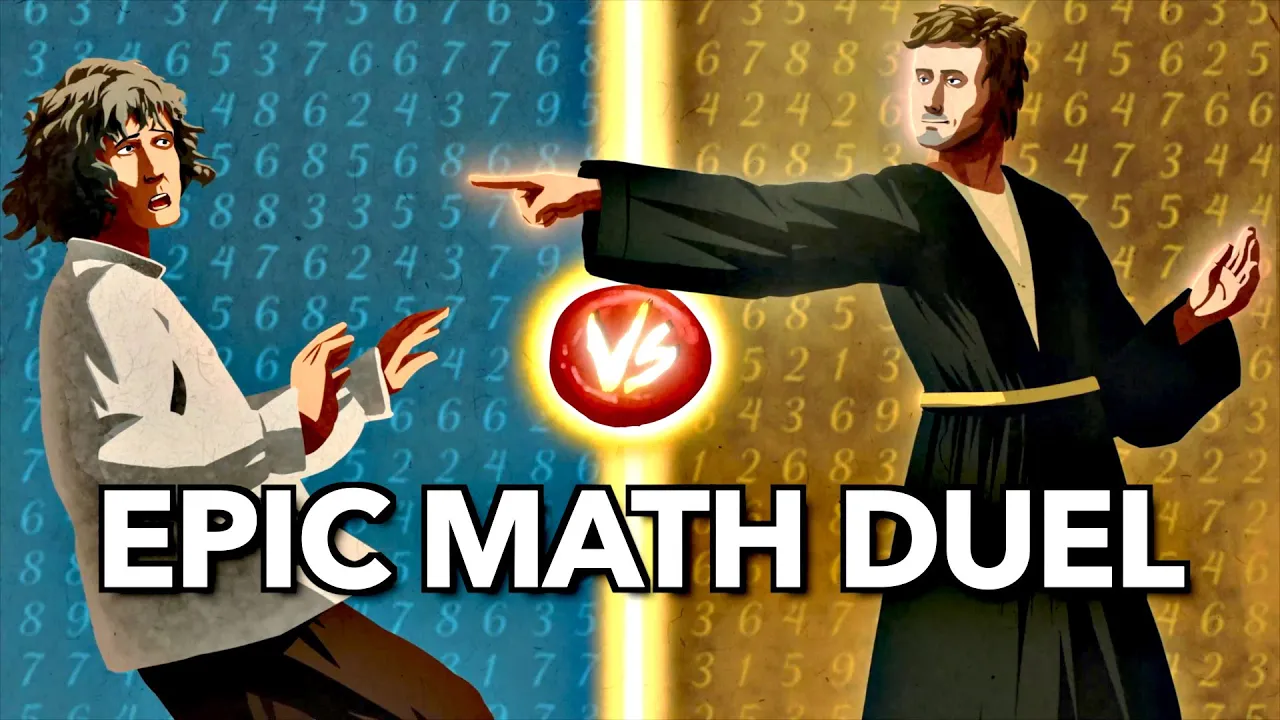
Del Ferro guarded his advantage until he lay dying in 1526, finally passing the secret to his student, Antonio Maria Fior. Fior lacked his mentor’s deep mathematical brilliance, but he had ambition and began openly boasting about his mastery of the depressed cubic. Emboldened by his exclusive knowledge, on February 12, 1535, Fior challenged Niccolò Fontana Tartaglia, an accomplished mathematician who had recently relocated to Venice.
Tartaglia’s life had been forged in extreme hardship. During the French sack of Brescia in 1512, an invading soldier slashed his jaw and palate with a saber, leaving him with a pronounced speech impediment that earned him the nickname "Tartaglia" (the stutterer). Raised in deep poverty and almost entirely self-educated, Tartaglia had painstakingly clawed his way into intellectual respectability.
When Fior issued his challenge, Tartaglia was initially dismissive of his rival’s genuine abilities. Regarding the rumors that Fior had mastered the cubic independently, Tartaglia noted: “I did not deem him capable of finding such a rule on his own.” However, upon hearing credible reports that a deceased master had bequeathed the secret to Fior, Tartaglia realized the danger. Each man exchanged thirty problems with a 40-day deadline. Fior's problems were all depressed cubics, designed to exploit his assumed monopoly. Faced with financial and professional ruin, Tartaglia relentlessly worked to deduce the logic of the depressed cubic himself. His labor paid off: when the contest concluded, Fior failed to solve a single problem Tartaglia had set for him, while Tartaglia solved all thirty of Fior’s depressed cubics in a mere two hours.
---
[07:56](https://www.youtube.com/watch?v=cUzklzVXJwo&t=476s) Tartaglia's Geometric Breakthrough and Cardano's Oath
Tartaglia cracked the depressed cubic by generalizing the classical method of completing the square into three dimensions—completing the cube. Taking a specific problem such as $x^3 + 9x = 26$, he envisioned $x^3$ as a three-dimensional solid cube of edge length $x$, whose volume had to be enlarged by an added volume of $9x$ to reach a total volume of 26. Tartaglia imagined expanding three faces of the original cube outward by an unknown distance $y$, creating a larger bounding cube with sides of length $z = x + y$.
```mermaid flowchart TD accTitle: Tartaglia's 3D Completing the Cube Method accDescr: Step-by-step algebraic and geometric breakdown used by Tartaglia to solve depressed cubics. subgraph Geometry["3D Volume Decomposition"] A["Original Cube: x^3"] B["Padding Volume: 3 prisms of (x^2 * y) + 3 prisms of (x * y^2)"] C["Missing Corner Volume: y^3"] end subgraph Rearrangement["Reassembly & System Setup"] B --> D["Combined Prisms Block: Base (3yz) * Height (x)"] D --> E["Match 9x Term: Set 3yz = 9 -> z = 3/y"] C --> F["Complete the Cube: z^3 = 26 + y^3"] end subgraph Solution["Reduction to Quadratic"] E & F --> G["Substitute z: (3/y)^3 = 26 + y^3"] G --> H["Quadratic in y^3: (y^3)^2 + 26(y^3) = 27"] H --> I["y^3 = 1 -> y = 1; z = 3"] I --> J["Final Solution: x = z - y = 2"] end ```
Adding this padding around the central cube produced seven distinct geometric shapes: - Three square prisms measuring $x \times x \times y$ - Three narrower rectangular prisms measuring $x \times y \times y$ - One tiny corner cube with volume $y^3$
Tartaglia regrouped the six rectangular prisms into a single composite geometric block with a base measuring $3y$ by $(x + y)$ (which is $3yz$) and a height of $x$, yielding a volume of $3yzx$. To make this volume correspond directly to the $9x$ term of his equation, Tartaglia simply set the base equal to the coefficient: $3yz = 9$. Adding the missing corner cube ($y^3$) to both sides completed the global volume, producing the relation $z^3 = 26 + y^3$.
With two conditions and two unknowns—$3yz = 9$ (or $z = 3/y$) and $z^3 - y^3 = 26$—Tartaglia substituted $z$ into the cubic equation: $$(3/y)^3 - y^3 = 26 \implies \frac{27}{y^3} - y^3 = 26 \implies y^6 + 26y^3 = 27$$ Although this introduced a sixth-degree variable, treating $y^3$ as a single quantity revealed that it was merely a disguised quadratic: $(y^3)^2 + 26(y^3) = 27$. Using the classic completion of the square yielded $y^3 = 1$, which meant $y = 1$. From this, $z = 3/y = 3$, and because $x = z - y$, Tartaglia determined that $x = 3 - 1 = 2$—a clean, correct root for $x^3 + 9x = 26$.
Because symbolic algebraic notation was still roughly a century away, Tartaglia recorded this algorithm as a poem rather than a string of formulas. His stunning victory over Fior transformed Tartaglia into an academic sensation, attracting the intense curiosity of scholars across Italy. Most persistent among them was Gerolamo Cardano, an eccentric Milanese polymath, physician, and avid gambler. When Tartaglia firmly refused to share his secrets or even provide samples of the contest problems, Cardano mounted an aggressive campaign that alternated between flattering letters and harsh personal denunciations. Ultimately, Cardano dangled the enticing prospect of introducing Tartaglia to an influential, wealthy Milanese benefactor. Tartaglia took the bait and traveled to Milan. There, on March 25, 1539, Tartaglia finally revealed his algorithmic verses to Cardano—but only after demanding that Cardano swear a sacred, solemn oath never to publish or share the secret solution with anyone.
[11:35](https://www.youtube.com/watch?v=cUzklzVXJwo&t=695s) Cardano's General Solution and the Broken Oath
Niccolò Tartaglia exacts a strict oath from Gerolamo Cardano: Cardano must swear never to publish Tartaglia's method, demanding he record it strictly in cipher, “So that after my death, no one shall be able to understand it.” Cardano is thrilled to acquire the algorithm and immediately begins experimenting with it. He sets his sights on a far more ambitious breakthrough: uncovering a solution to the general cubic equation that includes the $x^2$ term. Remarkably, Cardano cracks it. He observes that by substituting $x - \frac{b}{3a}$ for $x$, every single $x^2$ term cancels out entirely, transforming any general cubic into a depressed cubic that can readily be solved using Tartaglia’s formula.
Having unlocked a puzzle that had baffled the world's greatest mathematical minds for thousands of years, Cardano is eager to publish his discovery. Unlike the calculating mathematicians of his day who guarded trade secrets to secure their livelihoods, Cardano earns his living as an acclaimed physician and intellectual. To him, the lasting prestige of the breakthrough far outweighs any competitive secrecy. Yet he remains bound by his sacred promise to Tartaglia, who flatly refuses to release him from his word.
The stalemate is broken in 1542 during Cardano's visit to Bologna. While there, he meets the son-in-law of Scipione del Ferro—the mathematician who had bequeathed his secret solution of the depressed cubic to Antonio Maria Fior on his deathbed. In del Ferro’s old notebook, Cardano discovers the very same formula, preserved in writing decades before Tartaglia worked it out. Cardano decides that because the method originated with del Ferro, publishing the general solution will not violate his solemn pledge to Tartaglia.
In 1545, Cardano releases *Ars Magna* ("The Great Art"), a milestone mathematical compendium bearing the proud motto: “Written in five years, may it last for five hundred.” The work provides individualized geometric proofs across thirteen separate arrangements of the cubic equation. Although Cardano meticulously credits Tartaglia, del Ferro, and Fior, Tartaglia is enraged. He retaliates by firing off vitriolic letters addressed directly to Cardano and copies a large portion of the contemporary mathematical community. Regardless of Tartaglia's grievances, the technique becomes cemented in mathematical history under the name "Cardano's method."
```mermaid flowchart TD accTitle: Cardano's General Cubic Solution Pathway accDescr: Chart illustrating how Cardano converted the general cubic to a depressed cubic, uncovered del Ferro's prior discovery, and published Ars Magna despite Tartaglia's objection.
subgraph Transform["Equation Reduction"] A["General Cubic:<br/>ax³ + bx² + cx + d = 0"] -->|"Substitute x = x - b/(3a)"| B["Depressed Cubic:<br/>x³ + px = q"] end
subgraph Discovery["Secret Unlocked"] B -->|"Solved via Tartaglia's method"| C["Cardano Bound by Oath"] C -->|"1542 Bologna trip:<br/>Examines del Ferro's notebook"| D["Proof of Prior Discovery<br/>(Predates Tartaglia)"] end
subgraph Publication["Historical Release"] D -->|"Cardano considers oath void"| E["1545: Ars Magna Published"] E --> F["Tartaglia writes public attacks"] end ```
[14:01](https://www.youtube.com/watch?v=cUzklzVXJwo&t=841s) The Paradox of Negative Area and Cardano's Impasse
Despite pushing geometric logic to its outer limits, *Ars Magna* stumbles onto equations that defy the standard method. When Cardano attempts to solve the depressed cubic $x^3 = 15x + 4$, the formula produces expressions containing the square roots of negative numbers. Cardano reaches out to Tartaglia for insight into this anomaly, but Tartaglia deflects, condescendingly suggesting that Cardano is simply not clever enough to apply the formula properly. In truth, Tartaglia is just as baffled.
Tracing the geometric steps of a similar problem back to find where the logic breaks down, Cardano notes that while cutting and rearranging three-dimensional cubes functions smoothly, the subsequent step of completing the square triggers a geometric paradox. He encounters a square section requiring an area of 30 alongside side lengths of 5. Because a full square with sides of length 5 has an area of only 25, completing the square would require conjuring an impossible "negative area." This impossible geometric demand is the precise origin of the negative square roots.
Square roots of negatives were not entirely unprecedented. Earlier in *Ars Magna*, Cardano poses a classic problem: find two numbers that sum to 10 and multiply to 40. Formulating this yields the quadratic equation $x^2 + 40 = 10x$. Applying the quadratic formula forces square roots of negative numbers into the answer, confirming what common sense already reveals: no two real numbers satisfy those requirements. In quadratic equations, a negative radicand served as clear notice that no physical or numerical solution existed.
The cubic $x^3 = 15x + 4$, however, presents a confounding dilemma: trial and error quickly shows that $x = 4$ is an unmistakably valid, real root. Why the proven method failed to surface this real root remained baffling. Lacking an answer, Cardano bypasses the case in *Ars Magna*, dismissing the square roots of negative numbers with the quip that the concept “is as subtle as it is useless.”
[16:16](https://www.youtube.com/watch?v=cUzklzVXJwo&t=976s) Rafael Bombelli and the Birth of Imaginary Numbers
Roughly a decade later, Italian engineer Rafael Bombelli revisits Cardano's unfinished puzzle. Refusing to be deterred by the nonsensical geometry of negative areas, Bombelli commits to forging a path straight through the arithmetic confusion. Observing that the square root of a negative “cannot be called either positive or negative,” Bombelli boldly treats it as a distinct, novel species of number.
Bombelli posits that the two cube-root expressions in Cardano's formula are composed of a standard number paired with this new kind of quantity based on $\sqrt{-1}$. Working through the algebra, he discovers that the two cube roots equate to:
$$2 + \sqrt{-1} \quad \text{and} \quad 2 - \sqrt{-1}$$
When these two terms are added together to find the final value of $x$, the positive and negative imaginary parts cancel out completely, yielding the correct real root: 4. The result feels like a miracle. Cardano's algebraic technique was correct all along, but accepting it required abandoning the traditional geometric constraints that had birthed algebra in the first place. Paradoxical steps that have no meaning in physical space are required as intermediate stepping stones to reach valid real-world answers.
```mermaid flowchart LR accTitle: Bombelli's Complex Resolution of the Cubic accDescr: Flow diagram showing how Bombelli used combinations of real and imaginary numbers to resolve the depressed cubic solution to 4.
A["Cardano's Result for<br/>x³ = 15x + 4:<br/>Cube roots of negative radicands"] --> B["Bombelli assumes split terms:<br/>(2 + √-1) and (2 - √-1)"] B --> C["Add terms together:<br/>(2 + √-1) + (2 - √-1)"] C --> D["Imaginary terms cancel out"] D --> E["Real Root: x = 4"] ```
Over the succeeding century, mathematics sheds its reliance on spatial diagrams: - In the 1600s, François Viète introduces modern symbolic algebraic notation, dismantling the ancient habit of formulating problems as descriptive prose and geometric drawings; geometry is no longer the arbiter of mathematical truth. - René Descartes frequently employs square roots of negatives, christening them "imaginary numbers"—a somewhat dismissive moniker that permanently sticks. - Leonhard Euler later introduces the symbol $i$ to designate $\sqrt{-1}$, formalizing complex numbers as combinations of real and imaginary parts.
[18:17](https://www.youtube.com/watch?v=cUzklzVXJwo&t=1097s) Imaginary Numbers in Modern Physics: The Schrödinger Equation
The emancipation of algebra from spatial geometry proves to be only the beginning of the story. In 1925, Erwin Schrödinger seeks a wave equation to describe quantum particles, inspired by Louis de Broglie’s insight that matter exhibits wave-like behavior. His pursuit yields the Schrödinger equation, one of the central pillars of modern physics, with the imaginary unit $i$ standing right at its center.
Physicists of the era, who had never shared the mathematicians' comfort with complex numbers, are deeply troubled by its presence in basic reality. Schrödinger openly shares this unease, writing: “What is unpleasant here, and indeed directly to be objected to, is the use of complex numbers. The wave function $\Psi$ is surely fundamentally a real function.”
The necessity of $i$ in quantum dynamics stems from its geometric behavior on the complex plane, where imaginary numbers sit perpendicular to the real axis. Successive multiplications by $i$ generate cyclic quarter-turn rotations: - $1 \times i = i$ - $i \times i = -1$ - $-1 \times i = -i$ - $-i \times i = 1$
Continuous rotation across space or time is naturally expressed by the complex exponential $e^{ix}$, which tracks out a three-dimensional helix along an axis. The real component forms a cosine wave, while the imaginary component forms a sine wave. The two foundational trigonometric functions of wave physics are thus packaged directly inside $e^{ix}$.
When constructing a physical wave equation, using the complex plane via $e^{i(kx - \omega t)}$ offers a decisive mathematical advantage: taking spatial or temporal derivatives of the exponential reproduces the exact original function scaled by a constant factor. In contrast, differentiating real sine waves toggles between sine and cosine. Furthermore, because the Schrödinger equation is linear, solutions can be superposed in arbitrary sums to model any wave shape imaginable.
Physicist Freeman Dyson later reflects on this unexpected turn: “Schrödinger put the square root of minus one into the equation, and suddenly it made sense. Suddenly it became a wave equation instead of a heat conduction equation. And Schrödinger found to his delight that the equation has solutions corresponding to the quantized orbits in the Bohr model of the atom. It turns out that the Schrödinger equation describes correctly everything we know about the behavior of atoms. It is the basis of all of chemistry and most of physics. And that square root of minus one means that nature works with complex numbers and not with real numbers. This discovery came as a complete surprise, to Schrödinger as well as to everybody else.”
A concept that originated as a curious algebraic detour to solve sixteenth-century cubic equations became an indispensable pillar of quantum mechanics. Only by abandoning the demand that mathematics resemble immediate sensory reality could mathematics expose the inner workings of nature.
[22:30](https://www.youtube.com/watch?v=cUzklzVXJwo&t=1350s) Interactive Learning with Brilliant
Derek Muller introduces the video's sponsor, Brilliant, explaining that it is a website and mobile application designed to teach a wide range of STEM concepts spanning from basic geometry all the way to quantum mechanics. Rather than relying on passive instruction, the platform emphasizes active learning by doing, using interactive tools and visual manipulation to help users grasp challenging mathematical ideas. To illustrate, Derek points to interactive lessons on calculus, showing how students can explore concepts like surfaces of revolution to visually and intuitively understand how an integral is used to compute three-dimensional volume. As Derek Muller notes: “It's way more fun when you work through the material yourself and get to manipulate it visually.”
The platform scaffolds its learning pathways by offering curated problems that steadily ramp up in difficulty, providing helpful hints whenever a learner gets stuck on a tricky challenge. For viewers intrigued by the story of imaginary and complex numbers, Derek recommends Brilliant's dedicated course covering topics ranging from the Mandelbrot set to Euler's formula. To close the video, Derek thanks both Brilliant for supporting Veritasium and the audience for watching, sharing a special promotional link for viewers.
- **Interactive STEM Topics:** Covers foundational to advanced subjects, including geometry, calculus, surfaces of revolution, and quantum mechanics. - **Complex Numbers Coursework:** Explores advanced visual and mathematical ideas such as Euler's formula and the fractal structures of the Mandelbrot set. - **Viewer Promotion:** The first 200 people to sign up via `brilliant.org/veritasium` receive 20% off an annual subscription.
## Notable quotes > [00:00](https://www.youtube.com/watch?v=cUzklzVXJwo&t=0s) Only by abandoning math's connection to reality could we discover reality's true nature. — Derek Muller
## Mentioned Luca Pacioli, Leonardo da Vinci, Summa de Arithmetica, Geometria, Proportioni et Proportionalita, Omar Khayyam, Scipione del Ferro, Antonio Maria Fior, Niccolò Fontana Tartaglia, Gerolamo Cardano, Ars Magna, Rafael Bombelli, François Viète, René Descartes, Leonhard Euler, Erwin Schrödinger, Louis de Broglie, Freeman Dyson, Niels Bohr, Brilliant, Derek Muller, Veritasium
## Video description A general solution to the cubic equation was long considered impossible, until we gave up the requirement that math reflect reality. This video is sponsored by Brilliant. The first 200 people to sign up via https://brilliant.org/veritasium get 20% off a yearly subscription.
Thanks to Dr Amir Alexander, Dr Alexander Kontorovich, Dr Chris Ferrie, and Dr Adam Becker for the helpful advice and feedback on the earlier versions of the script.
▀▀▀ References: Some great videos about the cubic:
500 years of not teaching the cubic formula. -- https://youtu.be/N-KXStupwsc
Imaginary Numbers are Real -- https://youtu.be/T647CGsuOVU
Dunham, W. (1990). Journey through genius: The great theorems of mathematics. New York. -- https://ve42.co/Dunham90
Toscano, F. (2020). The Secret Formula. Princeton University Press. -- https://ve42.co/Toscano2020
Bochner, S. (1963). The significance of some basic mathematical conceptions for physics. Isis, 54(2), 179-205. -- https://ve42.co/Bochner63
Muroi, K. (2019). Cubic equations of Babylonian mathematics. arXiv preprint arXiv:1905.08034. -- https://ve42.co/Murio21
Branson, W. Solving the cubic with Cardano, -- https://ve42.co/Branson2014
Rothman, T. (2013). Cardano v Tartaglia: The Great Feud Goes Supernatural. arXiv preprint arXiv:1308.2181. -- https://ve42.co/Rothman
Vali Siadat, M., & Tholen, A. (2021). Omar Khayyam: Geometric Algebra and Cubic Equations. Math Horizons, 28(1), 12-15. -- https://ve42.co/Siadat21
Merino, O. (2006). A short history of complex numbers. University of Rhode Island. -- https://ve42.co/Merino2006
Cardano, G (1545), Ars magna or The Rules of Algebra, Dover (published 1993), ISBN 0-486-67811-3
Bombelli, R (1579) L’Algebra https://ve42.co/Bombelli
The Manim Community Developers. (2021). Manim – Mathematical Animation Framework (Version v0.13.1) [Computer software]. https://www.manim.community/
▀▀▀ Special thanks to Patreon supporters: Luis Felipe, Anton Ragin, Paul Peijzel, S S, Benedikt Heinen, Diffbot, Micah Mangione, Juan Benet, Ruslan Khroma, Richard Sundvall, Lee Redden, Sam Lutfi, MJP, Gnare, Nick DiCandilo, Dave Kircher, Edward Larsen, Burt Humburg, Blake Byers, Dumky, Mike Tung, Evgeny Skvortsov, Meekay, Ismail Öncü Usta, Crated Comments, Anna, Mac Malkawi, Michael Schneider, Oleksii Leonov, Jim Osmun, Tyson McDowell, Ludovic Robillard, Jim buckmaster, fanime96, Ruslan Khroma, Robert Blum, Vincent, Marinus Kuivenhoven, Alfred Wallace, Arjun Chakroborty, Joar Wandborg, Clayton Greenwell, Pindex, Michael Krugman, Cy 'kkm' K'Nelson,Ron Neal
Executive Producer: Derek Muller Writers: Derek Muller, Alex Kontorovich, Stephen Welch, Petr Lebedev Animators: Fabio Albertelli, Jakub Misiek, Ivy Tello, Jesús Rascón SFX: Shaun Clifford Camerapeople: Derek Muller, Emily Zhang Editors: Derek Muller, Petr Lebedev Producers: Derek Muller, Petr Lebedev, Emily Zhang Additional video supplied by Getty Images Music from Epidemic Sound and Jonny Hyman
[Source](https://www.youtube.com/watch?v=cUzklzVXJwo)