Michigan Medicine DIY Box Fan Filter Cuts Air Particles 90% in Test
Michigan Medicine
Taping a MERV 13 furnace filter to an ordinary box fan eliminates 90% of fine airborne particles, delivering effective allergy relief at a fraction of the cost of an $800 commercial HEPA unit.
AI-assisted summary of Build a Do-It-Yourself Air Purifier for About $40 — original source. Check the original for full context.
Source published:
Key ideas
- A do-it-yourself air purifier constructed from a 20-inch box fan and a MERV 13 furnace filter reduces 0.3-micron airborne particulate matter by approximately 90%, cutting particle counts from 400,000 to 54,000 per cubic foot. (1:42)
- While an $800 commercial HEPA unit achieves near-total particulate elimination down to zero particles, the DIY design offers an accessible, budget-friendly option for around $25 to $40. (0:00)
- Proper DIY assembly requires aligning the airflow arrows on the furnace filter with the fan's exhaust and taping the perimeter to ensure an airtight seal across the fan housing. (1:42)
- Health specialists recommend prioritizing purifier placement in bedrooms due to the extensive hours spent sleeping, with additional inexpensive units deployable in living areas as needed. (1:42)
Detailed notes
## Background Published on YouTube by Michigan Medicine on June 27, 2011, this educational video features Dr. Jeffrey E. Terrell demonstrating how to construct an affordable do-it-yourself air purifier. The video description explains that building an air cleaner using standard hardware store parts can protect against wildfire smoke, dust, and viruses, providing a cost-effective indoor filtration method when local Air Quality Index ratings rise.
## TL;DR Dr. Jeffrey E. Terrell conducts a side-by-side performance demonstration comparing a premium $800 commercial HEPA air purifier against an inexpensive homemade alternative. Using an optical particle counter, he reveals that while the commercial unit completely eliminates 0.3-micron particles from an ambient baseline of 400,000 per cubic foot down to zero, a DIY rig built from a 20-inch box fan and a MERV 13 furnace filter achieves an impressive 90% reduction down to 54,000 particles. He details how to properly attach and align the filter with the fan's airflow, highlighting the assembly as an accessible, high-impact air cleaning solution for bedrooms and high-use living areas.
## Atmosphere & style The presentation is practical, grounded, and methodically clinical, evoking the feel of an approachable science demonstration directly from a medical professional's workshop. Dr. Terrell delivers straightforward, unpretentious explanations while the audible cadence of the particle counter cycling every six seconds creates an engaging, empirical sense of discovery. Rather than pushing expensive medical hardware, the video feels empowering and accessible, validating a simple household hack with hard, real-time data.
## Bulletin - [01:42](https://www.youtube.com/watch?v=kH5APw_SLUU&t=102s) A do-it-yourself air purifier constructed from a 20-inch box fan and a MERV 13 furnace filter reduces 0.3-micron airborne particulate matter by approximately 90%, cutting particle counts from 400,000 to 54,000 per cubic foot. - [00:00](https://www.youtube.com/watch?v=kH5APw_SLUU&t=0s) While an $800 commercial HEPA unit achieves near-total particulate elimination down to zero particles, the DIY design offers an accessible, budget-friendly option for around $25 to $40. - [01:42](https://www.youtube.com/watch?v=kH5APw_SLUU&t=102s) Proper DIY assembly requires aligning the airflow arrows on the furnace filter with the fan's exhaust and taping the perimeter to ensure an airtight seal across the fan housing. - [01:42](https://www.youtube.com/watch?v=kH5APw_SLUU&t=102s) Health specialists recommend prioritizing purifier placement in bedrooms due to the extensive hours spent sleeping, with additional inexpensive units deployable in living areas as needed.
## Key takeaways - [00:00](https://www.youtube.com/watch?v=kH5APw_SLUU&t=0s) Airborne indoor allergens are a primary trigger for allergy flare-ups, but mechanical air filtration substantially reduces their concentration. - [00:00](https://www.youtube.com/watch?v=kH5APw_SLUU&t=0s) Commercial room air cleaners range widely in price, from entry-level units around $100 up to high-end models costing $800 or more. - [00:00](https://www.youtube.com/watch?v=kH5APw_SLUU&t=0s) Testing ambient indoor room air with an optical particle counter measured baseline concentrations of approximately 400,000 fine particles (0.3 microns) per cubic foot. - [00:00](https://www.youtube.com/watch?v=kH5APw_SLUU&t=0s) A premium $800 commercial HEPA filter demonstrated the ability to scrub fine particulate counts down from 400,000 completely to zero. - [01:42](https://www.youtube.com/watch?v=kH5APw_SLUU&t=102s) A functional homemade air purifier can be assembled using an inexpensive 20-inch box fan and a standard 20x20-inch furnace filter. - [01:42](https://www.youtube.com/watch?v=kH5APw_SLUU&t=102s) Using a high-efficiency filter rating such as MERV 13 is critical because it is specifically rated to trap microscopic 0.3-micron particles. - [01:42](https://www.youtube.com/watch?v=kH5APw_SLUU&t=102s) The filter must be placed against the fan's face matching the directional airflow arrows stamped on the filter frame and secured with tape along all edges. - [01:42](https://www.youtube.com/watch?v=kH5APw_SLUU&t=102s) In direct testing, the DIY filter system reduced fine particle counts from 400,000 to 54,000 particles per cubic foot, representing roughly a 90% filtration efficiency. - [01:42](https://www.youtube.com/watch?v=kH5APw_SLUU&t=102s) The total hardware cost for the DIY solution is approximately $25 to $40, making room-scale air cleaning financially accessible to households on a budget. - [01:42](https://www.youtube.com/watch?v=kH5APw_SLUU&t=102s) Placing air filters in bedrooms provides the greatest health benefit due to prolonged overnight exposure, though multiple DIY units can be distributed across a home.
## Detailed walkthrough ### [00:00](https://www.youtube.com/watch?v=kH5APw_SLUU&t=0s) Commercial Air Cleaners and Particle Counter Testing
Airborne allergens inside a home are a primary driver of allergy symptoms, but their concentrations can be substantially curtailed through mechanical filtration. Domestic air-cleaning hardware spans a broad spectrum of form factors and price points, ranging from in-line furnace filters mounted on a central air handler's blower unit to standalone portable systems designed for single rooms. Commercially manufactured room units typically run from $100 up to $800 for top-tier models. Dr. Jeffrey E. Terrell introduces a side-by-side performance comparison to show how an expensive, high-end commercial device measures up against an inexpensive homemade alternative built from off-the-shelf components.
To demonstrate commercial-grade performance, Dr. Terrell tests a high-end $800 unit loaned by Ann Arbor Vacuum. He pairs it with a specialized optical particle counter configured to measure microscopic particulate matter measuring 0.3 microns in diameter, which takes an air sample once every six seconds. Before filtration, the ambient indoor air measures approximately 400,000 particles per cubic foot. When the commercial HEPA purifier is engaged, the particle count drops rapidly over subsequent sampling cycles, bottoming out at zero. Dr. Terrell observes: “This is an incredibly effective, high-efficiency particulate air filter, or HEPA filter.” He underscores that by completely scrubbing the air from 400,000 particles down to zero, such systems eliminate the particulate triggers that irritate airways and cause allergy flares.
- **Baseline particle count**: Approximately 400,000 particles (0.3 microns in size) per cubic foot of ambient room air. - **Instrument sampling rate**: One particle count recorded every six seconds. - **Commercial unit cost & performance**: An $800 commercial system (loaned from Ann Arbor Vacuum) achieving essentially 0 particles per cubic foot.
---
[01:42](https://www.youtube.com/watch?v=kH5APw_SLUU&t=102s) Building and Testing the DIY Box Fan Filter
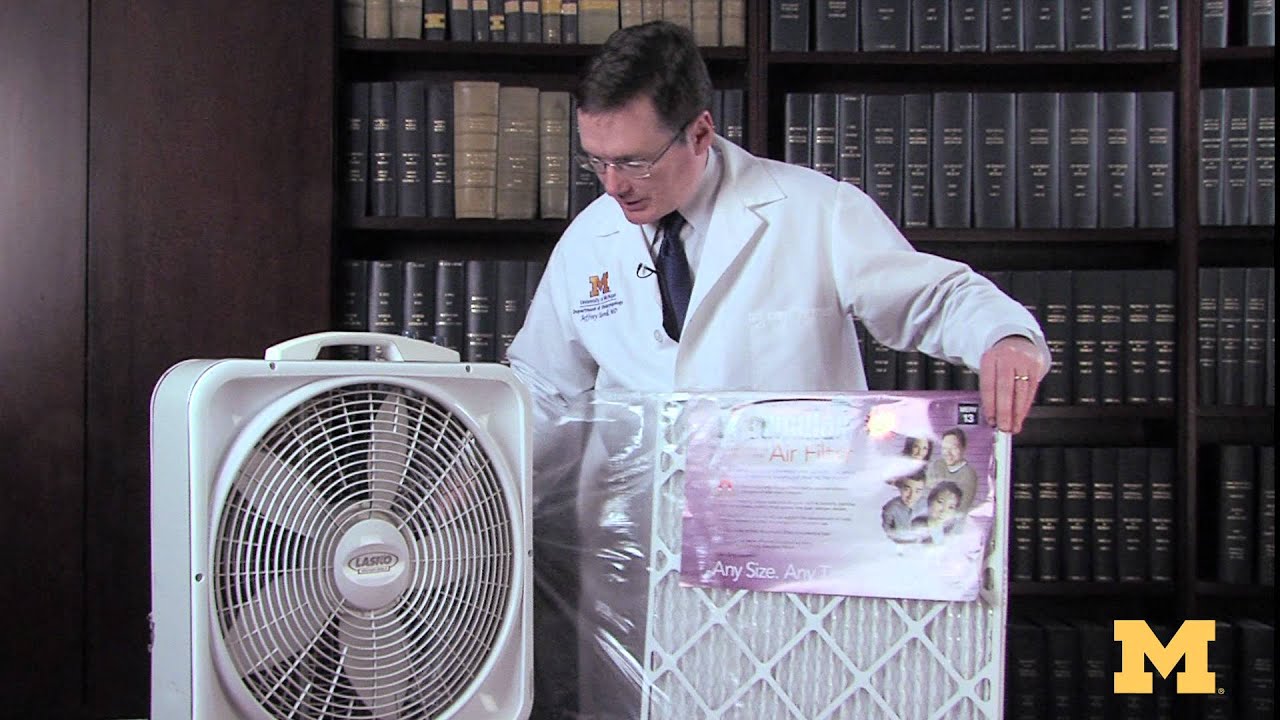
Recognizing that premium commercial air purifiers remain out of financial reach for many households, Dr. Terrell demonstrates how to assemble a functional room filter using ordinary items sourced from a standard hardware store. As Dr. Terrell points out: “But not everyone can afford a 6- or 800-dollar HEPA system.” To bridge the gap, he presents an assembly built around a 20-inch box fan (costing approximately $12 to $15 at the time of recording) and a 20 by 20-inch pleated furnace filter. He highlights the critical role of filtration ratings, advising that consumers select a high-efficiency option like a MERV 13 filter, which is specifically rated to capture small, 0.3-micron particles.
```mermaid flowchart LR accTitle: DIY Air Purifier Assembly and Airflow accDescr: Flow diagram showing room air drawn into a 20-inch box fan and pushed through a taped MERV 13 furnace filter. subgraph Intake["Intake Stage"] A["Ambient Air<br/>(~400k particles/cu ft)"] --> B["20-Inch Box Fan<br/>($12–$15)"] end subgraph Filtration["Filtration Stage"] B -->|"Air blown outward"| C["MERV 13 Filter<br/>(20x20 in, taped to fan)"] C --> D["Cleaned Exhaust Air<br/>(~54k particles/cu ft / 90% drop)"] end ```
The construction process is straightforward: the furnace filter is placed directly against the front face of the box fan so that the fan blows air directly through the filter media. Dr. Terrell uses tape to seal and secure the edges of the filter to the fan housing, cautioning builders to check the printed arrows along the border of the filter frame to ensure the airflow direction matches the fan’s exhaust. When he switches on the fan and places the 0.3-micron particle counter in the exhaust stream, the count drops from an ambient baseline of 400,000 down to 54,000 particles per cubic foot across a few six-second cycles. This represents an approximate 90% reduction in fine particles. Dr. Terrell emphasizes: “So this $30 -- 25, $30 system is filtering 90% of the particles out of the air.” He recommends placing the unit in spaces like bedrooms, where occupants spend prolonged stretches of time sleeping, or setting up multiple units throughout the house for broader coverage.
- **DIY hardware components**: - One standard 20-inch box fan (approximately $12 to $15). - One 20x20-inch furnace filter rated at MERV 13 (or equivalent high-efficiency media). - Standard adhesive tape to seal the filter onto the fan casing. - Overall total assembly cost: approximately $25 to $30 (at original video production). - **DIY empirical performance**: Particulate count drops from ~400,000 to ~54,000 particles per cubic foot, yielding an approximate 90% reduction in 0.3-micron particulate matter. - **Assembly tip**: Observe the directional airflow arrows stamped on the cardboard perimeter of the furnace filter to make sure it aligns with the air blowing out from the front of the fan. - **Placement guidance**: Most beneficial in bedrooms due to the high volume of daily hours spent sleeping there, with additional units deployable in living areas as needed.
## Mentioned Jeffrey E. Terrell, Michigan Medicine, Michigan Sinus Center, Ann Arbor Vacuum, Environmental Protection Agency, Air Quality Index
## Video description **Current as of 2025: While the cost of materials may vary, the process and effectiveness of this option remain up-to-date.
You can build an air purifier with a HEPA filter for about $40 with parts from your local hardware store and protect yourself from dust, viruses, smoke from wildfires and other lung irritants.
The Environmental Protection Agency’s (EPA) Air Quality Index highlights the local air quality in your area. The higher the number, the worse the air pollution. When the AQI is over 100, using an air filter indoors, with HEPA filters or filters rated MERV 12 or higher, can help to clean the air.
Air filters can help protect against colds, flu, and COVID as well.
Jeffrey E. Terrell, former director of U-M Health’s Michigan Sinus Center, demonstrates how to build a DIY air purifier at home.
Read: "Wildfires: How to protect your lung health in poor air quality" and more news from Michigan Medicine’s Health Lab: https://www.michiganmedicine.org/health-lab/wildfires-how-protect-your-lung-health-poor-air-quality
*Note: When this video was made, the cost of materials was approximately $25. This has increased due to inflation.
Follow Us:
Facebook: https://www.facebook.com/MichiganMedicine Instagram: https://www.facebook.com/MichiganMedicine Twitter: https://twitter.com/umichmedicine
#AirQuality #AirPurifier #AirPollution #LungHealth
[Source](https://www.youtube.com/watch?v=kH5APw_SLUU)