Mars Settlers Shift to Enclosed Domes as Terraforming Logistics Fail
Isaac Arthur
Prohibitive interplanetary transport costs and severe nitrogen scarcity make full planetary terraforming impractical, forcing Martian civilization to rely on localized enclosed arcologies, orbital habitats, and biological adaptation.
AI-assisted summary of Colonizing Mars — original source. Check the original for full context.
Source published:
Key ideas
- The intermediate phase of Martian colonization—between small research outposts and a fully terraformed planet—hinges on developing tradeable commodities and interplanetary economic interdependence rather than mere redundant living space. (0:00)
- Martian space elevator logistics are anchored by Port Tharsis at areostationary orbit (17,000 km), using three carbon-nanotube tethers to Pavonis Mons, Olympus Mons, and Valles Marineris to balance dynamic orbital forces. (4:50)
- Full planetary terraforming faces an extreme nitrogen bottleneck: replacing Earth's 5-billion-megaton atmosphere using 1-megaton tankers at one arrival daily would require 100 million years. (23:51)
- Rather than a planetary monoculture, Mars is likely to develop into a multifaceted mosaic of paraterraformed 'worldhouse' domes, enclosed calderas with 10–20 km retaining walls, subsurface lava tubes, and orbital rotating habitats. (26:51)
Detailed notes
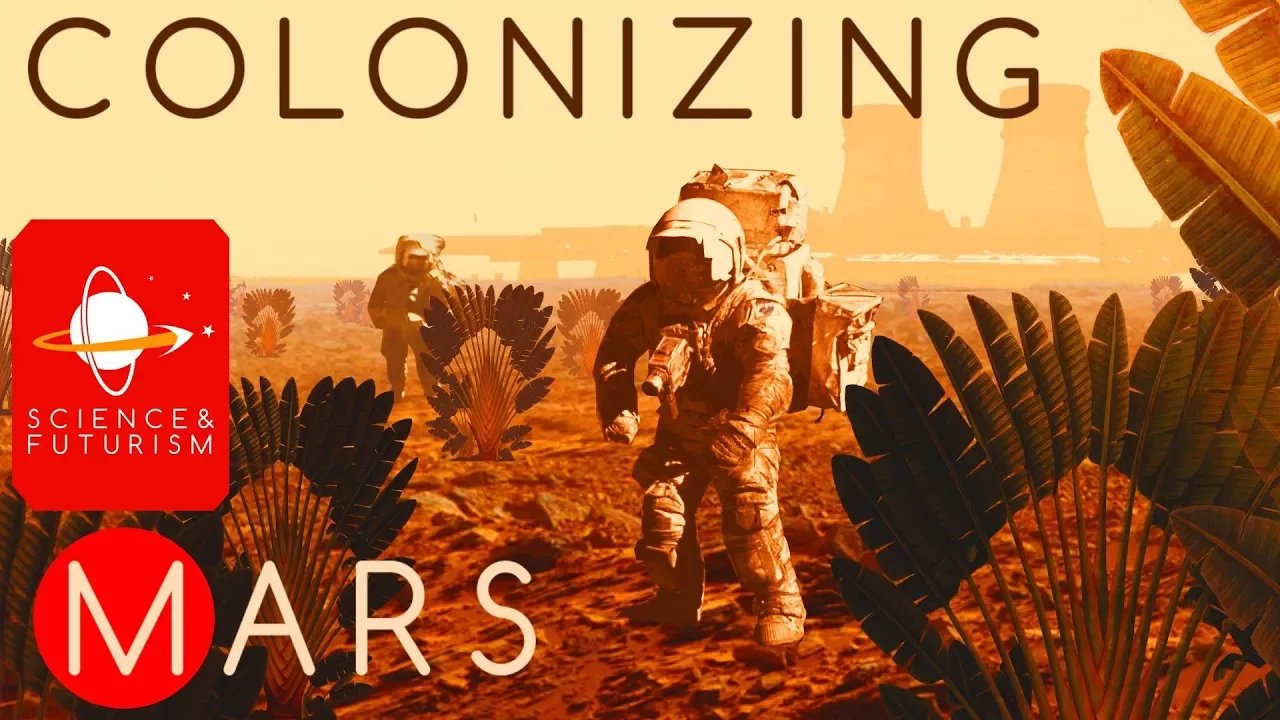
## Background Published on YouTube by futurist Isaac Arthur on August 17, 2017, this episode explores what it will realistically take to forge the Red Planet into a permanent home for humanity as the day of walking on Mars approaches.
## TL;DR Focusing on the often-overlooked middle ground between initial scientific outposts and centuries-distant terraforming, the episode examines how a developing Martian society might function and sustain itself economically. It traces an interplanetary transit network connecting cis-lunar staging hubs like Borman Station to a three-tether space elevator at Port Tharsis, branching down to settlements at Pavonis Mons, Olympus Mons, and Valles Marineris. Arthur contrasts competing colonial philosophies—ranging from localized paraterraforming and radical bioforming to orbital living and brute-force planetary terraforming—while illustrating massive logistical hurdles like nitrogen deficits and atmospheric erosion. Ultimately, the analysis concludes that the trajectory of Martian development should belong to the future generations living on the red dust rather than planners back on Earth.
## Atmosphere & style The presentation carries a pragmatic, contemplative tone that grounds grand speculative megaprojects in hard numbers, resource economics, and logistical realities. Arthur's signature calm, deliberate narration blends worldbuilding with dry realism, walking listeners through subterranean lava tubes, frontier bars, and dust-swept canyons with equal vividness. It feels less like an idealized space-age fantasy and more like an immersive tour of a functioning, somewhat weary frontier settlement grappling with harsh physics, political friction, and existential choices.
## Bulletin - [00:00](https://www.youtube.com/watch?v=kmFOBoy2MZ8&t=0s) The intermediate phase of Martian colonization—between small research outposts and a fully terraformed planet—hinges on developing tradeable commodities and interplanetary economic interdependence rather than mere redundant living space. - [04:50](https://www.youtube.com/watch?v=kmFOBoy2MZ8&t=290s) Martian space elevator logistics are anchored by Port Tharsis at areostationary orbit (17,000 km), using three carbon-nanotube tethers to Pavonis Mons, Olympus Mons, and Valles Marineris to balance dynamic orbital forces. - [23:51](https://www.youtube.com/watch?v=kmFOBoy2MZ8&t=1431s) Full planetary terraforming faces an extreme nitrogen bottleneck: replacing Earth's 5-billion-megaton atmosphere using 1-megaton tankers at one arrival daily would require 100 million years. - [26:51](https://www.youtube.com/watch?v=kmFOBoy2MZ8&t=1611s) Rather than a planetary monoculture, Mars is likely to develop into a multifaceted mosaic of paraterraformed 'worldhouse' domes, enclosed calderas with 10–20 km retaining walls, subsurface lava tubes, and orbital rotating habitats.
## Key takeaways - [00:00](https://www.youtube.com/watch?v=kmFOBoy2MZ8&t=0s) Permanent interplanetary colonies require distinct export commodities and economic integration with other worlds to avoid isolation and political collapse. - [02:36](https://www.youtube.com/watch?v=kmFOBoy2MZ8&t=156s) Staging Mars expeditions from lunar orbit (such as Borman Station spinning at 0.38g) lowers fuel escape requirements and standardizes crews to Martian gravity. - [02:36](https://www.youtube.com/watch?v=kmFOBoy2MZ8&t=156s) If human biology cannot permanently adapt to 38 percent Earth gravity, Mars will invert traditional coastal geography into orbital residence with temporary surface work shifts. - [04:50](https://www.youtube.com/watch?v=kmFOBoy2MZ8&t=290s) A stabilized three-tether elevator dropping from an areostationary altitude of 17,000 km bypasses rocket descents while balancing mechanical forces across non-equatorial settlements. - [09:07](https://www.youtube.com/watch?v=kmFOBoy2MZ8&t=547s) Light-speed communication delays of up to an hour necessitate on-site Martian legal, administrative, and political autonomy from Earth authorities. - [09:07](https://www.youtube.com/watch?v=kmFOBoy2MZ8&t=547s) Martian colonists rapidly fracture into regional rivalries and distinct demographics as civilian tradespeople, retirees, and tourists dilute initial scientific teams. - [11:04](https://www.youtube.com/watch?v=kmFOBoy2MZ8&t=664s) Early Mars settlements face an economic catch-22 because establishing export markets requires customer colonies elsewhere that do not yet exist. - [17:50](https://www.youtube.com/watch?v=kmFOBoy2MZ8&t=1070s) Paraterraforming (the 'worldhouse' concept of doming canyons and craters) requires orders of magnitude less atmospheric gas and construction mass than open-air planetary terraforming. - [17:50](https://www.youtube.com/watch?v=kmFOBoy2MZ8&t=1070s) Because Mars has lower gravity, producing Earth-like sea-level barometric pressure would create a much taller atmospheric scale height, enabling suitless breathing atop Olympus Mons. - [17:50](https://www.youtube.com/watch?v=kmFOBoy2MZ8&t=1070s) An orbital-first faction argues for keeping Mars pristine for automated resource extraction and tourism while housing populations in rotating space stations. - [21:43](https://www.youtube.com/watch?v=kmFOBoy2MZ8&t=1303s) Bioforming advocates propose modifying biology rather than planetary geology, ranging from moderate plant adaptation to radical cyborgs tailored to vacuum and radiation. - [23:51](https://www.youtube.com/watch?v=kmFOBoy2MZ8&t=1431s) Terraforming risks catastrophic side effects: dumping liquid water onto unbound regolith would trigger global mud tsunamis and flash floods, while shielding atmospheres requires artificial orbital magnetospheres. - [23:51](https://www.youtube.com/watch?v=kmFOBoy2MZ8&t=1431s) Volatile nitrogen is critically scarce in the inner solar system, making atmospheric mass transport from bodies like Titan or Venus a monumental logistical hurdle. - [26:51](https://www.youtube.com/watch?v=kmFOBoy2MZ8&t=1611s) Mega-engineering containment walls 10 to 20 kilometers high could seal volcanic calderas into localized, highly pressurized biospheres that gradually vent air to the lowlands. - [32:44](https://www.youtube.com/watch?v=kmFOBoy2MZ8&t=1964s) Ultimately, the development pathway of Mars will be chosen across centuries by permanent Martian residents whose cultural priorities may diverge entirely from replicating Earth.
## Detailed walkthrough ### [00:00](https://www.youtube.com/watch?v=kmFOBoy2MZ8&t=0s) Beyond the First Footsteps: The Neglected Middle Ground of Colonization
Life on Mars has captured human imagination for generations, fueling speculation about what living on the Red Planet might look like long before H.G. Wells published *The War of the Worlds*. Following the Upward Bound series—which focused on the logistics of getting into space faster, cheaper, and safer—the natural follow-up question becomes: once humanity is up there, what comes next? While the conventional answer is planetary colonization, typical discussions tend to get polarized at extreme ends of the timeline. Analysts either dwell endlessly on the initial voyage and tiny research bases of five to a hundred scientists, or leap straight across centuries to a fully terraformed world bustling with billions of inhabitants.
This exploration deliberately targets the intermediate phase that usually gets overlooked: a functioning, developing colonial society before massive terraforming has been completed. True terraforming and planetary engineering are reserved for an in-depth look during the subsequent colonization of Venus, while the extensive role of automated robotics is saved for an analysis of Titan. In linking these worlds, interplanetary trade emerges as the glue binding distant outposts together. A viable colony cannot exist purely as redundant living space; it requires distinct commodities to sell and import. While local self-sufficiency is vital for survival, commercial interdependence optimizes manufacturing output and prevents extraterrestrial outposts from abruptly fracturing along political fault lines.
Isaac Arthur emphasizes the essential economic foundation required for any permanent extraterrestrial presence, noting: “A colony, besides just serving as more living space for us, really needs to have some commodity it offers and others it needs.”
- **Conceptual Continuity:** Builds on foundational concepts from previous episodes, including *Industrializing the Moon*, *Asteroid Mining*, and the *Upward Bound* launch infrastructure series. - **Interplanetary Diplomacy:** Explores the classic science fiction trope of Earth-versus-Mars political fractures, analyzing how economic networks mitigate diplomatic divergence.
---
[02:36](https://www.youtube.com/watch?v=kmFOBoy2MZ8&t=156s) The Cis-Lunar Jumping-Off Point: Borman Station and Low-Gravity Transit
To bypass the repetitive mechanics of rocketry, the scenario opens with colonization already well underway. Orbital infrastructure is firmly established around Earth and the Moon, anchored by Gagarin Station in low Earth orbit, an active Earth orbital ring, and heavy lunar resource extraction centered at Armstrong Base. The true stepping stone into deep space is Borman Station, a rotating transit hub orbiting the Moon named after Apollo 8 commander Frank Borman. Borman Station rotates to simulate roughly 38 percent of Earth’s normal gravity—matching Martian surface gravity. This serves two crucial functions: acclimatizing travelers moving between Earth and Mars, and providing a long-term testing laboratory to determine how the human body, construction materials, and mechanical tolerances handle Martian gravity over multi-decade spans.
Staging the primary passenger pipeline from lunar orbit to Mars provides distinct logistical benefits. Escaping the Moon's shallow gravity well requires far less energy and fuel than lifting heavy expeditions directly from Earth's deep gravity well. Furthermore, proving full habitat viability and industrial extraction on the Moon provides a critical safety buffer relatively close to home before sending thousands of pioneers months away into deep space. Transit networks diverge sharply between passengers and freight: slow, ultra-efficient orbital transfer trajectories carry bulk industrial cargo over journeys lasting multiple years, whereas human crews travel aboard higher-energy passenger liners completing the trip in several weeks.
A critical biological assumption underpins the entire endeavor: that humanity can thrive indefinitely at 38 percent gravity with regular exercise and medical supplements, avoiding the need for continuous centrifuge living or radical cybernetic adaptation. As Isaac Arthur argues: “Should that turn out not to be true, I think Mars would be unlikely to ever become a genuine colony of Earth, or rather, you’d probably have a lot of rotating habitats around Mars that considered themselves Martian, but the planet itself would basically be a place folks spent time down on working there at mining facilities, not a home.”
```mermaid flowchart TD accTitle: Cis-Lunar to Mars Transit Network accDescr: Infrastructure flow showing how transit connects Earth, the Moon, and Mars orbital and surface hubs.
subgraph EarthMoon ["Cis-Lunar Infrastructure"] Gagarin["Gagarin Station & Orbital Ring<br>(Earth Orbit)"] Armstrong["Armstrong Base<br>(Lunar Resource Extraction)"] Borman["Borman Station<br>(Lunar Orbit, 0.38g Spin)"] Armstrong -->|"Raw materials & fuel"| Borman Gagarin -->|"Transiting personnel"| Borman end
subgraph Transit ["Transit Regimes"] Cargo["Bulk Cargo Shipping<br>(Low energy, multi-year duration)"] Passenger["High-Energy Liners<br>(Direct transit, several weeks)"] end
subgraph MarsSystem ["Martian System"] PortTharsis["Port Tharsis Hub<br>(Areostationary Orbit at 17,000 km)"] end
Borman --> Cargo Borman --> Passenger Cargo --> PortTharsis Passenger --> PortTharsis ```
- **Earth-to-Mars Transit Logistics:** Direct flights from Earth would need spin sections dialed down from 1.0g to 0.38g during transit; staging from Borman Station standardizes outbound crews to Martian conditions immediately. - **The Reverse Coastal Analogy:** If Mars gravity proves biologically insufficient for long-term health, Martian civilization would invert historical coastal geography: humans would reside permanently in orbit and commute down to planetary resource pits as hazardous temporary shifts. - **Economic Influx:** The maturation of carbon-nanotube synthesis makes space elevator tether fabrication economically feasible, opening Mars to regular passenger runs carrying several hundred travelers per flight.
---
[04:50](https://www.youtube.com/watch?v=kmFOBoy2MZ8&t=290s) Port Tharsis and the Three-Tether Elevator System
The incoming passenger ship does not perform an atmospheric landing; instead, it anchors directly in an areostationary orbit 17,000 kilometers above the Martian surface—a significantly lower orbital altitude than Earth's geostationary belt due to Mars's lower mass and rotational rate. Once parked directly over the Tharsis volcanic plateau, the ship itself is converted into the primary orbital terminal: Port Tharsis. Lower surface gravity makes tether construction far simpler on Mars than on Earth. While conventional materials suffice for lunar elevators, Martian elevators require high-tensile carbon nanotubes, which are manufactured on the Moon and ferried outward to Port Tharsis.
Rather than dangling a single tether down to an equatorial anchor point, engineers deploy a stabilized multi-tether guy-wire configuration. Isaac Arthur explains the structural strategy behind this planetary infrastructure: “So while a single space elevator just south of Pavonis is an option, we will instead be dropping three tethers down, then moving their ends to connect to the top of Olympus Mons, to Pavonis, and to Marineris canyon settlements.” By dropping three independent elevator lines to equatorial and non-equatorial sites in both northern and southern sectors, the orbital terminal remains dynamically balanced while providing redundant, non-rocket surface access to the planet's three core population centers.
```mermaid flowchart TD accTitle: Port Tharsis Three-Tether Elevator Architecture accDescr: Diagram illustrating the three-cable elevator system descending from Port Tharsis to three Martian surface settlements.
Station["Port Tharsis Station<br>(Areostationary Orbit - 17,000 km)"]
Station -->|"Tether 1 (Equatorial anchor)"| Pavonis["Pavonis Settlement<br>(Pavonis Mons / Capital)"] Station -->|"Tether 2 (Northwest anchor)"| Olympus["Olympus Settlement<br>(Olympus Mons Volcano)"] Station -->|"Tether 3 (Southeast anchor)"| Marineris["Marineris Settlement<br>(Valles Marineris Chasm)"] ```
- **Orbital Anchor Position:** Fixed at 17,000 kilometers over Pavonis Mons, a massive shield volcano standing significantly taller than Mount Everest near the Martian equator. - **Primary Settlements:** - *Pavonis Base:* The earliest surface habitat and historic planetary administrative center. - *Olympus Mons Outpost:* Located northwest of Tharsis atop the solar system's tallest volcano. - *Valles Marineris Base:* Built southeast of Tharsis inside the solar system’s largest canyon rift. - **Engineering Mechanics:** Non-equatorial anchors balance mechanical pull forces symmetrically across the center of mass, eliminating the orbital drift that would disrupt a single off-equator tether.
---
[09:07](https://www.youtube.com/watch?v=kmFOBoy2MZ8&t=547s) Emerging Society: UN Oversight, Local Rivalries, and Martian Law
The arrival of the three-cable elevator marks a turning point in Martian sociology and governance. Historically, the entire base fell under the authority of the United Nations Security Council, represented on-site by an appointed military commander stationed at Pavonis. Because electromagnetic communication between Earth and Mars experiences light-speed delays that can reach an hour for a single round-trip message, local autonomy was an operational reality from the start. Yet during the initial phase of a few hundred astronauts, political self-determination was an irrelevant concern: everyone was an intensively vetted, highly specialized scientist or engineer who relied entirely on mission support from home.
With the new influx of immigrants arriving down the elevator car at Pavonis, the character of the settlement is transformed. As the elevator doors open, the town is celebrating the grand opening of its very first civilian café. The demographic has broadened: these travelers are regular citizens, retirees, tradespeople, and tourists rather than hand-picked specialists. Reflecting on this cultural milestone, Isaac Arthur remarks: “This is no longer a mission where the best and brightest can be selected and screened for stability.”
Political friction has rapidly caught up to the growing population. The outposts at Olympus Mons and Valles Marineris increasingly resist bureaucratic dominance from Pavonis, demanding genuine democratic representation rather than UN decree. The legal system itself is forced to mature. The original magistrate spent years dealing exclusively with domestic probate, divorces, estate trusts, and wills resulting from relatives dying back on Earth—managing virtually no planetary felonies or misdemeanors. That idyllic period abruptly ends as humanity's primal nature reasserts itself on the frontier: a raucous barroom brawl erupts over political independence out at Olympus Mons, prompting the dispatch of a full-time resident magistrate to preside over the dispute.
- **Communication Lag Constraints:** Operational commands cannot be micromanaged from Earth because signal latency ranges up to an hour round-trip, requiring on-site executive power. - **Geopolitical Decentralization:** Olympus Mons and Valles Marineris actively resist the historical primacy of Pavonis, igniting inter-colony tensions over self-governance. - **Frontier Jurisprudence:** The transition from an elite academic research outpost to a multi-thousand-person frontier economy transforms the justice system from administrative contract filing to active law enforcement and dispute resolution.
[11:04](https://www.youtube.com/watch?v=kmFOBoy2MZ8&t=664s) Pavonis Mons and the Realities of Martian Colonization
As an outpost transitions into a permanent colony, its demographic and infrastructural profile must radically shift. While the initial base had a surplus of specialists in certain fields and a shortage of basic survival infrastructure, life at Pavonis Mons reveals an unexpectedly stark daily reality. A newcomer arriving at the settlement sees domes, but far fewer than anticipated for a population of several thousand. The surrounding landscape, though breathtaking, is desolate; the vast majority of the community actually resides underground in the caves and lava tubes carved into the giant shield volcano, with surface domes reserved strictly for hydroponics. The subterranean quarters can feel distinctly dreary, prompting colonists to ponder what truly justifies establishing a civilization on Mars. In the early days, pioneers arrived purely for the sake of the challenge—much like those who summit Mount Everest or winter in Antarctica, though almost no one chooses to establish permanent residency in those terrestrial extremes. In the near term, sheer numbers are not an issue: if even one-hundredth of one percent of Earth’s population chose to emigrate, that would supply one million settlers, and subsequent generations would steadily augment their ranks.
The underlying economic motivation, however, remains elusive. Historical models of terrestrial colonization offer few parallels: Mars will not serve as a penal colony like early Australia, nor are settlers fleeing religious persecution as in early North American settlements. Mars offers no high-value plantation cash crops like sugar or tobacco, and while the planet possesses vast reserves of iron, those are equally abundant on Earth and the Moon. Tourism provides some economic buffer—visitors drawn to the low gravity, colossal volcanoes, and labyrinthine canyons subsidize base operations, and a fraction decide to stay. Nevertheless, Isaac Arthur notes that the colony’s primary commercial engine is intangible: “Its major export right now is curiosity, prestige, and wonder, which keeps the money flowing from Earth, for now, but Earth doesn’t particularly need anything Mars has.”
At the local Pavonis Café, residents debating the future find themselves trapped in an interplanetary economic dilemma. Any goods Mars might profitably export rely on customers on other worlds, yet the only other inhabited body besides Earth and Mars is Venus, which hosts a solitary scientific outpost drifting in its upper atmosphere. Beyond that lie only scattered robotic probes across the outer solar system and nascent, experimental mining outposts in the asteroid belt. Martian trade is stalled in a classic catch-22, as settling Mars depends on trade with other colonies, which themselves cannot thrive without established trade partners. This dilemma spurs intense debate over the physical fate of the mountain: while some advocate eventual planetary terraforming, others argue against granting Mars open oceans and a free atmosphere, contending that the giant volcano should simply be hollowed out into an enormous self-contained arcology—effectively converting Pavonis Mons into a colossal planetary skyscraper.
[14:16](https://www.youtube.com/watch?v=kmFOBoy2MZ8&t=856s) The Trek to Valles Marineris and the Logistical Struggle
Traveling from Pavonis Mons to Valles Marineris could be done by riding the space elevator up to Port Tharsis and transferring back down, but making the journey via ground vehicle highlights the brutal logistical challenges of Martian transit. The razor-thin atmosphere prevents conventional aviation, yet that same lack of air resistance makes high-speed rail highly efficient. However, laying thousands of kilometers of track across Olympus Mons, Pavonis Mons, and Marineris remains a distant prospect. While Mars’s low gravity simplifies engineering by permitting steeper grades on crater slopes and cheaper bridges across chasms, the tiny workforce of a few thousand people is already consumed by basic survival tasks.
Every breath and bite on Mars demands intense industrial labor. Oxygen must be chemically cracked from water ice or baked out of regolith; nitrogen for agriculture is exceptionally scarce; and every hectare of crops requires either a structural dome or artificial lighting inside a lava tube. Furthermore, crops cannot be seeded directly into raw Martian regolith. Food production requires strict hydroponics or the labor-intensive synthesis of artificial soil created by churning raw dirt through giant vats of engineered microbes and algae. When the prospect of transforming Mars into a lush, Earth-like sphere comes up, the rover driver dismisses the concept outright: “It’s not worth doing, says the driver, going on about how at Marineris they’ve decided the future is in robust para-terraforming.”
The drive across the Martian wastes is protracted and constrained. Without an oxygenated atmosphere, internal combustion is impossible, forcing all vehicles to rely on electric battery banks. High-speed rail lines and regional power grids remain stalled because Earth refused to underwrite the massive expense of shipping heavy rail materials, and the local workforce is too small to manufacture them. Back at Pavonis, engineers dream of Earth exporting heavy fusion reactors; though massive and difficult to transport across interplanetary space, fusion power would eliminate the need for surface solar domes entirely, moving all food cultivation into dark, radiation-shielded cavern networks. Arriving at Valles Marineris underscores the incomprehensible scale of the Martian landscape: stretching 4,000 kilometers long, 7 kilometers deep, and over 200 kilometers wide at its greatest expanse, the rift defies any concept of bridging or enclosing it in a single span. Instead, settlement concentrates at Noctis Labyrinthus—the maze of narrower, shallower chasms filled with icy fog on the western fringe nearest Pavonis. Here, engineers are executing a pilot engineering trial: sealing off a canyon branch with massive retaining walls, enclosing it beneath a transparent roof, and melting regional ground ice to fill the very first artificial lake on Mars.
[17:50](https://www.youtube.com/watch?v=kmFOBoy2MZ8&t=1070s) The Four Philosophical Camps of Mars
The engineering effort at Noctis Labyrinthus highlights the fracture of Martian society into distinct ideological factions regarding how the planet should be developed:
```mermaid flowchart TD accTitle: Four Philosophical Camps of Martian Colonization accDescr: Diagram showing the four viewpoints of Martian colonists: Paraterraforming, Full Terraforming, Pessimists, and Orbital Habitat Minimalists.
subgraph Surface["Surface-Focused Visions"] A["<b>Marineris: Paraterraforming</b><br/>• 'Worldhouse' concept<br/>• Segmented domes & laser defense<br/>• Low atmosphere volume needed"] B["<b>Olympus Mons: Full Terraforming</b><br/>• Global breathable atmosphere<br/>• Open-air living without suits<br/>• High atmospheric scale height"] end
subgraph Orbit["Alternative Visions"] C["<b>Pessimists: The Skeptics</b><br/>• Colonization was a mistake<br/>• Planets belong to robots<br/>• Plan to return to Earth"] D["<b>Orbitalists: Minimalist Footprint</b><br/>• Rotating habitats in orbit<br/>• Surface for automated mining only<br/>• Leave Mars pristine"] end
A <--> B C <--> D ```
The first camp, centered at Marineris, champions paraterraforming—often referred to as building a "Greenhouse Mars" or a "worldhouse." Recognizing the immense structural vulnerability of enclosing canyons, their engineers focus on hardening domes against micrometer impacts, abrasive dust storms, and structural failure. They envision defense networks utilizing radar grids and automated lasers to vaporize incoming meteors, tall peripheral curtain walls to shelter glazing from dust erosion, modular domes separated by airlocks, and graphene trusses paired with rapid-curing liquid spray sealants to patch punctures. Their primary argument rests on atmospheric physics: filling a dome only 100 meters high requires a trivial fraction of the gas needed to envelope an entire planet.
On Earth, standard atmospheric pressure is maintained by 14 pounds of air pressing down on every square inch (roughly 10,000 kilograms per square meter). Because Martian surface gravity is so much lower, generating identical barometric pressure without a roof requires an even larger mass of gas per unit area, pushing the atmosphere much higher into space. While terrestrial air thins out so dramatically that Mount Everest is nearly unbreathable and an Earth-bound Olympus Mons (at 22 kilometers high) would sit in less than one-tenth normal density, a fully terraformed Mars would feature a vastly taller atmosphere. Colonists would enjoy breathable air from the floor of the deepest chasms all the way to the peak of Olympus Mons.
This planetary transformation is precisely what the second faction champions: “That’s what the folks at Olympus Mons want, the second philosophical camp for Mars. They want to terraform the whole planet, so you can walk around anywhere without a spacesuit around you or a glass dome above you.” Though dismissed by the pragmatic engineers at Marineris as eccentric "blue sky dreamers," the Olympus Mons faction remains committed to a totally open, uncontained biosphere.
Returning to Pavonis Mons reveals the remaining two perspectives. The third camp is defined by pure pessimism: settlers who view the entire planetary enterprise as a disastrous miscalculation. Stranded temporarily and vocal in their discontent—particularly after the latest transport ship was repurposed to construct Port Tharsis rather than return them—they intend to board the next available vessel home. While still supportive of space exploration in the abstract, they argue that hostile planetary surfaces are suited solely for automated machinery, while human beings should confine themselves to terrestrial arcologies or comfortable orbital habitats. This aligns closely with the fourth camp, which advocates an orbital-first strategy. Leveraging the Port Tharsis space elevator, this group proposes that humans should reside primarily in rotating, Earth-like orbital stations where gravity, ecology, and radiation can be cleanly controlled. Down on the surface, human presence would be strictly limited to small oversight teams supervising automated mining operations, ice harvesting, and catering to high-paying tourists, leaving the pristine landscape of the Red Planet largely untouched.
[21:43](https://www.youtube.com/watch?v=kmFOBoy2MZ8&t=1303s) Competing Visions at Olympus Mons
The planetary purists maintain that future tourists will have zero interest in traveling across the solar system just to look at artificial domes; visitors will come to experience the authentic Martian wilderness. Consequently, this faction advocates containing surface settlement to a handful of domed chasms, hollowed-out mountain caverns, or underground lava tubes, while keeping the bulk of the population and civil infrastructure up in orbit. They are not entirely hostile to terraforming Mars centuries in the future, but they believe the colony must first establish heavy orbital industries and lucrative exports to pay for the staggering quantities of nitrogen and water that would need to be imported from external sources like comets or outer planetary bodies.
```mermaid flowchart TD accTitle: Colonization Factions on Mars accDescr: Diverging philosophies for settling Mars ranging from planetary preservation to biological modification.
subgraph Surface["Surface vs. Orbit"] A["Orbital Industrialists / Purists<br/>Keep wilderness natural, build in orbit"] B["Classical Terraforming Camp<br/>Reshape planet to Earth standard"] end
subgraph Bioforming["Bioforming Alternatives"] C["Moderate Bioforming<br/>Native dirt, thin atmosphere, modified humans"] D["Extreme Bioforming & Cyborgs<br/>Post-biological entities tailored to vacuum"] end
A -.->|"Eventual import funding"| B B <-->|"Clashing philosophies"| Bioforming ```
Following the long and grueling trek across the Martian landscape to the peak of Olympus Mons—the tallest volcano in the solar system—the narrator reaches a settlement that has spread all the way up the mountain. Right at the summit sits a bar, the very establishment where a brawl broke out upon our initial arrival. Sitting down for a drink with our friend, the magistrate, reveals that Olympus Mons is not merely home to standard full-scale terraforming proponents, but is rather a battleground among three vehemently argumentative factions.
The first group insists on traditional full-scale planetary terraforming. The remaining factions dismiss this approach, advocating instead for bioforming the biology rather than the rock. This bioforming movement is itself split into two distinct sub-camps: - **Moderate Bioformers:** Proponents who favor engineering an intermediate ecosystem. They propose genetically engineering plants to process native Martian soil under a modestly thickened, nitrogen-poor atmosphere, while tweaking human biology to tolerate lower pressure and Martian gravity. - **Extreme Radical Bioformers:** Those who advocate engineering organisms suited for Mars entirely as-is, alongside cyborged humans who need no spacesuits, generate their own radiation shielding, and bypass biological respiration altogether. As this group puts it: “Why, they say, should we put all the effort into making this planet livable to humans and earth life, or even meet halfway in the middle, if we can just make new life that can live here?”
---
[23:51](https://www.youtube.com/watch?v=kmFOBoy2MZ8&t=1431s) The Colossal Logistics of Terraforming
The magistrate confesses he has turned against full planetary terraforming due to the sheer engineering absurdity and unintended hazards involved. While Mars currently has virtually no atmosphere, global dust storms periodically induce a nuclear-winter scenario, completely blacking out the sun for weeks and crippling solar power collectors as well as surface farming. Introducing liquid water would tame these dust storms, but without deep root networks to bind the regolith, dumping oceans onto the surface would spark apocalyptic flash floods and continent-wide mud tsunamis. Furthermore, adding mass to alter Martian gravity is wildly impractical; dropping every asteroid from the asteroid belt and every moon orbiting Jupiter directly onto Mars would still fail to produce Earth-equivalent gravity, squandering unimaginable quantities of resources in the process.
```mermaid flowchart LR accTitle: The Nitrogen Import Bottleneck accDescr: Illustration of the logistical hurdle of moving Earth-scale atmospheres across the solar system.
subgraph Sources["Volatile Sources"] Titan["Titan"] Venus["Venus"] Sun["The Sun (Unusable)"] end
subgraph Logistics["Transit Bottleneck"] Fleet["1-Megaton Tankers<br/>Required: Thousands per day<br/>At 1/day: 100 Million Years"] end
subgraph MarsAtmosphere["Mars Target"] Shield["Artificial Magnetosphere Satellites"] Atmo["5 Billion Megaton Atmospheric Shield"] end
Sources --> Fleet Fleet --> Atmo Shield -.->|"Protects from solar wind stripping"| Atmo ```
The resource math becomes even more forbidding when analyzing atmospheric composition. Oxygen is abundant throughout the solar system bound in rock and ice, but volatile nitrogen is profoundly scarce. Beyond Earth, massive nitrogen reservoirs exist only on Venus, Titan, and inside the Sun itself—the last being physically inaccessible for atmospheric mining. The logistics of hauling mass across interplanetary space dwarf any normal shipping enterprise: - Earth's atmospheric envelope masses roughly 5 billion megatons, consisting predominantly of nitrogen gas. - A premier industrial transport vessel or orbital supertanker could carry about one megaton of cargo per trip. - Moving that inventory at a delivery cadence of one megaton per day would take an agonizing 100 million years, during which unshielded Martian atmospheric gas would steadily bleed away into the solar wind. - To complete delivery in any reasonable human timeframe, megaton-class bulk haulers would need to arrive thousands of times per day, or else operate at scales far exceeding any modern vessel. - Shielding the delivered gas requires deploying an orbital constellation of solar-powered satellite electromagnets to generate an artificial global magnetosphere, supplemented by vast orbital mirrors to heat the frigid, distant world.
As Isaac Arthur reminds the listener, terraforming does not merely tint the existing Martian geography green and blue; it fundamentally erases it: “It’s not the existing one just turning blue and green, all but the biggest landmarks are going to cease to exist as sea rises and land slides under torrential storms.”
---
[26:51](https://www.youtube.com/watch?v=kmFOBoy2MZ8&t=1611s) The Colonization Spectrum and Radical Alternatives
Because total terraforming requires orders of magnitude more raw effort than any alternative, settling Mars will likely force colonists to evaluate competing development paths. Traditional terraforming is the brute-force route: altering day length, importing mass, moving orbits, or reshaping terrain. As Isaac Arthur emphasizes regarding this sheer overhead, “it requires orders of magnitude more effort to do that than some of our other options, it’s less finding a cave to live in then building an entire mountain on a plain so you can drill a cave into it.”
Bioforming presents an inverse dilemma regarding where to stop. Modifying human physiology to tolerate low pressures and thin atmospheres invariably leads down a slippery slope toward deeper genetic alterations, cyborgization, and eventual post-biological existence: - If humans are adapted to breathe near-vacuum air, engineering them to need no air at all becomes the obvious next step. - Transitioning to cyborg bodies removes biological vulnerabilities to radiation and nutrient shortages. - Once physical bodies and planetary atmospheres become obsolete, the physical planet is demoted to a mere quarry for raw materials. Humans could adopt digital mind uploads, dwelling within customizable, impossible virtual simulations while automated systems slowly dismantle Mars into rotating O'Neill-style habitats.
Rather than committing to an all-or-nothing planetary transformation, Martians could deploy localized hybrid alternatives:
```mermaid flowchart TD accTitle: Localized Terraforming Strategy accDescr: Concept for enclosing calderas with massive containment walls for localized terraforming.
Caldera["Olympus or Pavonis Mons Caldera Base"] Wall["10 to 20 km High Megastructure Wall<br/>'Great Walls of Mars'"] Atmosphere["High-Density Pressurized Air & Liquid Water"] Leakage["Controlled Atmospheric Leakage<br/>Slowly terraforms exterior lowlands"]
Caldera --> Wall Wall --> Atmosphere Atmosphere -.-> Leakage ```
- **Caldera Enclosures ("The Great Walls of Mars"):** Mega-engineering walls 10 to 20 kilometers high could be built directly atop the rims of calderas like Olympus Mons or Pavonis Mons. These enclosed basins could be pressurized with air and water immediately; any gas leaking over the rim would simply bleed down to feed the broader Martian plains. - **Partial Atmospheric Thickening:** Colonists could dome over chasms or build a low-pressure open-air atmosphere sufficient to burn up incoming meteors, allowing people to walk outdoors using simple breathing masks rather than pressurized spacesuits. - **Indigenous Microbes:** Uncovering native microbial life on Mars would present profound ethical questions regarding ecological contamination, but it would also yield extreme extremophiles uniquely adapted to marginal environments across the cosmos.
Looking forward toward the year 3000, the settlement of Mars will probably not conform to an ideological monoculture. Instead, it will feature a multifaceted mosaic: towering megastructure walls encircling terraformed calderas, self-sealing domed valleys, vast fusion-lit caverns carved into hollowed mountains, cyborgized colonists working the surface alongside biologically altered humans, and a massive orbital superstructure of rotating habitats whose electromagnetic deflector shields and meteor defense grids protect both the space settlements and the developing world below.
[32:44](https://www.youtube.com/watch?v=kmFOBoy2MZ8&t=1964s) The Choice of Future Colonists
Ultimately, early Martian settlers will likely explore the entire spectrum of technological and living options before settling on what works best for them. Isaac Arthur reflects on a recurring principle in space colonization: present-day observers simply cannot determine the ideal path forward because humanity has never undertaken such an endeavor. More fundamentally, modern planners on Earth should not be dictating those choices in the first place. As Arthur emphasizes: “And as I often say when it comes to colonies, it’s not just that we nowadays don’t know for sure which options are best, what with having never done it, but it isn’t our decision anyway, it’s for the folks who live there to decide, and they have centuries to make that decision and they can change it down the road.”
Over generations, Martian society will evolve along its own trajectory. Centuries of living under lower gravity, beneath artificial domes, or inside subsurface lava tubes could alter their culture, psychology, and physiological priorities to such an extent that replicating Earth might no longer hold any appeal. As Arthur points out, “They may be so removed from us by then that they don’t want to be much like Earth.” The final destiny of Mars—whether it becomes a terraformed twin of Earth, a network of enclosed dome cities, or something entirely post-biological—belongs solely to the people who build their lives upon the red dust.
[33:11](https://www.youtube.com/watch?v=kmFOBoy2MZ8&t=1991s) Upcoming Episodes and Outro
Looking ahead to future topics, Arthur notes that the broader challenges and mechanics of terraforming planets to make them more Earth-like will be explored in depth during the upcoming episode on colonizing Venus the following month. In the immediate future, however, the channel turns back toward Earth to address the existential questions surrounding extraterrestrial life. Following up on the core notions of the Rare Earth hypothesis—which posits that Earth-like planets may be exceptionally uncommon in the universe—the next installment will examine whether intelligence itself, particularly human-level intelligence, is an exceedingly rare evolutionary outcome even on hospitable worlds. That upcoming release, titled "Rare Intelligence," serves as the concluding installment of the Fermi Paradox Great Filters series.
Arthur wraps up the episode by inviting viewers to subscribe and set notifications so they do not miss these forthcoming entries, encouraging those who enjoyed the deep dive into Mars to hit the like button and share the video with others. He signs off with his signature farewell: “Until next time, thanks for watching, and have a great week!”
- **Upcoming Schedule Mentioned:** - *Next Week:* "Rare Intelligence" (concluding the Fermi Paradox Great Filters series). - *Next Month:* "Colonizing Venus" (featuring an in-depth look at planetary terraforming).
## Notable quotes > [00:00](https://www.youtube.com/watch?v=kmFOBoy2MZ8&t=0s) A colony, besides just serving as more living space for us, really needs to have some commodity it offers and others it needs. — Isaac Arthur
## Mentioned H.G. Wells, Frank Borman, United Nations Security Council, Gagarin Station, Armstrong Base, Borman Station, Port Tharsis, Pavonis Mons, Olympus Mons, Valles Marineris, Noctis Labyrinthus, Mount Everest, Venus, Titan, Jupiter
## Video description The day comes ever closer when we will walk on Mars, but what will it take to forge the Red Planet it into a home for humanity?
Join this channel to get access to perks: https://www.youtube.com/channel/UCZFipeZtQM5CKUjx6grh54g/join Visit our Website: http://www.isaacarthur.net Join Nebula: https://go.nebula.tv/isaacarthur Support us on Patreon: https://www.patreon.com/IsaacArthur Support us on Subscribestar: https://www.subscribestar.com/isaac-arthur Facebook Group: https://www.facebook.com/groups/1583992725237264/ Reddit: https://www.reddit.com/r/IsaacArthur/ Twitter: https://twitter.com/Isaac_A_Arthur on Twitter and RT our future content. SFIA Discord Server: https://discord.gg/53GAShE Listen or Download the audio of this episode from Soundcloud: https://soundcloud.com/isaac-arthur-148927746/colonizing-mars Cover Art by Jakub Grygier: https://www.artstation.com/artist/jakub_grygier
Graphics Team: Edward Nardella Jarred Eagley Justin Dixon Katie Byrne Kris Holland of Mafic Stufios: www.maficstudios.com Misho Yordanov Murat Mamkegh Pierre Demet Sergio Botero Stefan Blandin
Script Editing: Andy Popescu Connor Hogan Edward Nardella Eustratius Graham Gregory Leal Jefferson Eagley Luca de Rosa Mark Warburton Michael Gusevsky Mitch Armstrong MolbOrg Naomi Kern Philip Baldock Sigmund Kopperud Steve Cardon Tiffany Penner
Music: Markus Junnikkala, "Hail the Victorious Dead" Dan McLeod, "Vacuum" AJ Prasad, "Staring Through" Markus Junnikkala, "A Memory of Earth"
[Source](https://www.youtube.com/watch?v=kmFOBoy2MZ8)