Evaporative Humidifiers Cut Energy Costs Over Ultrasonic Models
Technology Connections
Wick-based evaporative humidifiers disperse moisture at under a fifth of the energy per gallon required by ultrasonic units while avoiding mineral dust deposits.
AI-assisted summary of Humidifiers: Simpler is better? — original source. Check the original for full context.
Source published:
Key ideas
- Warm air at 20 °C (68 °F) holds roughly three times more water vapor (15 g/kg) than air at 0 °C (5 g/kg), meaning heating cold outdoor winter air indoors causes relative humidity to collapse to desert-like levels near 33% or lower. (3:03)
- Large evaporative console humidifiers require roughly 156 watt-hours per gallon of dispersed moisture, consuming less than a fifth of the energy per gallon demanded by continuous ultrasonic misters (768 watt-hours per gallon). (16:46)
- Because ultrasonic humidifiers mechanically atomize liquid water rather than evaporating it, dissolved minerals in tap water are aerosolized directly into the room as chalky limescale 'white dust'. (8:34)
- A basic DIY setup using a desk fan aimed at a submerged terry cloth towel in a bowl of water can maintain 50% relative humidity in an enclosed room, offering a washable alternative to disposable paper wicks. (19:01)
Detailed notes
## Background Published on YouTube on January 13, 2021, by the channel Technology Connections, this video explores why indoor winter air requires artificial humidification and how different technologies accomplish that goal. According to the show notes, the host examines how much water the air holds, why that matters, and how to adjust humidity levels upward.
## TL;DR Addressing the miserable dryness of Midwestern winters, the host examines the physics of relative humidity before comparing the three main types of humidifiers: energy-hogging warm-mist boilers, mineral-dusting ultrasonic misters, and wick-based evaporative units. He demonstrates that evaporative humidifiers offer the best energy efficiency and moisture delivery, scaling from tiny desktop gadgets to large woodgrain console units and even improvised damp-towel setups. While praising the underlying mechanical simplicity of evaporative wicking, he critiques widespread manufacturing flaws like blinding blue LEDs, misleading water capacities, and clunky float switches, while offering practical tips on water treatments and hygienic maintenance.
## Atmosphere & style The video carries Technology Connections' signature wry, accessible, and methodical presentation style, blending everyday household engineering with breezy humor. The host balances patient physics explanations with passionate, comedic grievances directed at modern appliance design—most notably an impassioned rant against piercing blue status LEDs. Watching the piece feels like hanging out with an inquisitive neighbor who tests practical gadgets in his living room, complete with practical life hacks, a smooth jazz conclusion, and charming bloopers of vocal stumbles and thundering cats.
## Bulletin - [03:03](https://www.youtube.com/watch?v=oHeehYYgl28&t=183s) Warm air at 20 °C (68 °F) holds roughly three times more water vapor (15 g/kg) than air at 0 °C (5 g/kg), meaning heating cold outdoor winter air indoors causes relative humidity to collapse to desert-like levels near 33% or lower. - [16:46](https://www.youtube.com/watch?v=oHeehYYgl28&t=1006s) Large evaporative console humidifiers require roughly 156 watt-hours per gallon of dispersed moisture, consuming less than a fifth of the energy per gallon demanded by continuous ultrasonic misters (768 watt-hours per gallon). - [08:34](https://www.youtube.com/watch?v=oHeehYYgl28&t=514s) Because ultrasonic humidifiers mechanically atomize liquid water rather than evaporating it, dissolved minerals in tap water are aerosolized directly into the room as chalky limescale 'white dust'. - [19:01](https://www.youtube.com/watch?v=oHeehYYgl28&t=1141s) A basic DIY setup using a desk fan aimed at a submerged terry cloth towel in a bowl of water can maintain 50% relative humidity in an enclosed room, offering a washable alternative to disposable paper wicks.
## Key takeaways - [00:00](https://www.youtube.com/watch?v=oHeehYYgl28&t=0s) Evaporative 'personal air conditioners' and cool-mist bedroom humidifiers share the exact same underlying mechanism: an absorbent wick drawing water that has ambient air pulled through it by an electric fan. - [03:03](https://www.youtube.com/watch?v=oHeehYYgl28&t=183s) Indoor air becomes exceptionally dry during winter because heating incoming outdoor air dramatically increases its capacity to hold moisture without altering the actual mass of water it contains. - [03:03](https://www.youtube.com/watch?v=oHeehYYgl28&t=183s) Low indoor relative humidity triggers physical irritation like chapped skin, amplifies static electricity, and may keep airborne viral droplets suspended longer as they evaporate into lighter particles. - [06:20](https://www.youtube.com/watch?v=oHeehYYgl28&t=380s) Warm-mist humidifiers operate as uninsulated electrode boilers that demand high energy consumption (up to 200 watts) and rely on dissolved mineral ions or added salt to pass electrical current. - [08:34](https://www.youtube.com/watch?v=oHeehYYgl28&t=514s) Ultrasonic humidifiers use high-frequency piezoelectric ceramic discs to atomize raw water, expelling dissolved minerals as white dust and potentially dispersing airborne bacteria if the water reservoir is not sanitized. - [10:37](https://www.youtube.com/watch?v=oHeehYYgl28&t=637s) Console evaporative humidifiers deliver true water vapor while trapping minerals in their wicks, though physical designs often suffer from sloshing risks, tricky seals, and misleading total capacity ratings. - [13:33](https://www.youtube.com/watch?v=oHeehYYgl28&t=813s) Integrated humidistats allow console humidifiers to synchronize naturally with home heating cycles, running when the furnace expands air capacity and shutting down once target humidity is reached. - [16:46](https://www.youtube.com/watch?v=oHeehYYgl28&t=1006s) Evaporative console humidifiers provide superior efficiency over ultrasonic units, dispersing 2.5 gallons over 6 aggregate daily hours at 156 watt-hours per gallon versus continuous 32-watt ultrasonic operation at 768 watt-hours per gallon. - [19:01](https://www.youtube.com/watch?v=oHeehYYgl28&t=1141s) Because evaporative filters continuously collect dust, mold, and minerals from room air, wicks must be discarded seasonally and treated with bacteriostatic water additive to prevent unpleasant odors. - [21:01](https://www.youtube.com/watch?v=oHeehYYgl28&t=1261s) An effective, reusable DIY evaporative humidifier can be constructed from a bowl of water, a terry cloth towel to provide capillary wicking, and an ordinary desk fan. - [22:49](https://www.youtube.com/watch?v=oHeehYYgl28&t=1369s) Repurposing a calibrated liquid soap dispenser allows clean, repeatable volumetric dosing of bacteriostatic treatment chemicals for each tank refill. - [24:03](https://www.youtube.com/watch?v=oHeehYYgl28&t=1443s) Auto-shutoff float switches in evaporative consoles can be counterproductive, as cutting power when empty prevents the fan from drying out the wick, leaving standing water to stagnate. - [26:00](https://www.youtube.com/watch?v=oHeehYYgl28&t=1560s) Restoring winter indoor humidity to optimal levels creates an evaporative cooling barrier that makes rooms feel warmer at the same thermostat setting while relieving chapped skin.
## Detailed walkthrough ### [00:00](https://www.youtube.com/watch?v=oHeehYYgl28&t=0s) The "Personal Air Conditioner" Epiphany and the Cheap Bedroom Humidifier
The host opens with an epiphany tying back to a past critique of portable cooling gadgets. Over the summer, he reviewed an evaporative device marketed as a "personal air conditioner," which in reality was merely a miniature evaporative swamp cooler. He had dismissed it bluntly, noting: “Unless you live in a really arid place, adding moisture to the air is exactly the wrong way to achieve cooling.” These gimmicks, he argued, are simply a waste of plastic, desk space, and headspace.
Fast-forwarding to winter in the American Midwest, freezing temperatures caused indoor humidity to plummet to miserable levels. Venturing out to Walmart to purchase an inexpensive bedroom humidifier, he picked up an Equate model advertised as emitting "invisible cool mist." Upon unpacking it, he discovered that it is, uncannily, the exact same machine as the ridiculous personal air conditioner, just fitted with a bigger water tank and a larger fan.
The construction of this evaporative humidifier is remarkably simple, consisting of three primary elements resting on a molded plastic base: - **Water tank:** A reservoir shaped to create a central void for the wick, with its carrying handle cleverly serving as the humidifier's fresh-air intake. It constantly replenishes a shallow water pool at a steady height until empty. - **Body and fan:** An upper housing containing an electric fan that actively draws room air inward through the wet wick to accelerate evaporation. - **Water-absorbing matrix:** An absorbent, porous structure (labeled a "filter" by Equate, but more accurately termed a wick) sitting in the shallow water pool. Capillary action draws water upward until the entire matrix is drenched.
```mermaid flowchart LR accTitle: Evaporative Humidifier Operation Flow accDescr: Diagram illustrating how water moves from the tank through the wick while air is pulled through by a fan to produce humidified air. subgraph WaterSupply["Water Supply"] Tank["Water Tank"] -->|"Gravity Feed"| Pool["Shallow Base Pool"] end subgraph EvaporationCore["Wicking & Airflow"] Pool -->|"Capillary Action"| Wick["Porous Wick Matrix"] AirIn["Dry Ambient Air"] -->|"Drawn by Fan"| Wick Wick --> Fan["Internal Fan"] end Fan --> Out["Moist Air Output"] ```
While praising the straightforward engineering, the host points out that this particular cheap model is underpowered. Although the packaging advertises "up to 24 hour" runtime, in practice it takes nearly two full days on its high setting to deplete a single tank. While acceptable for a tiny enclosed bedroom, it cannot manage larger spaces. Seeking a whole-house solution revealed that scaled-up central humidifiers use this exact evaporative wick concept, leading to the conclusion that sometimes the simplest method is genuinely the most effective.
---
[03:03](https://www.youtube.com/watch?v=oHeehYYgl28&t=183s) The Physics of Relative Humidity and Why Winter Air Is Dry
To explain why anyone would deliberately pump moisture indoors, the host explores the physics of humidity. While residents of sweltering tropical climates might consider humidification absurd, the Midwest experiences the worst extremes of both seasons: brutally humid summers followed by bone-dry winters. The fundamental metric used to gauge moisture is **relative humidity**, expressed as a percentage of the total amount of water vapor a volume of air can hold before reaching complete saturation (100%). Relative humidity dictates how humans, animals, and building materials physically perceive moisture levels.
The critical variable is air temperature. Warm air holds significantly more water vapor than cold air: - At **20 °C (68 °F)**, 1 kilogram of air can hold roughly **15 grams** of water vapor. - At **0 °C (32 °F)**, that same kilogram of air holds only about **5 grams**—a third of the warm capacity.
Because indoor air is drawn from outdoors, heating incoming winter air expands its carrying capacity without changing the actual mass of water it contains. Even if freezing outdoor air starts at 100% relative humidity, warming it up to a comfortable 20 °C (68 °F) without adding moisture causes its relative humidity to collapse to a mere 33%.
When outdoor temperatures plunge between 0 °F and 10 °F (-18 °C to -12 °C), indoor air relative humidity drops to desert levels. This extreme dryness causes chapped lips, peeling skin, a scratchy throat, and annoying static electricity shocks. It also appears to exacerbate the transmission of airborne viruses. As the host notes, one popular hypothesis suggests that dry air causes expelled respiratory droplets to evaporate into smaller, lighter particles that float indefinitely rather than falling to the floor. The only way to restore comfortable relative humidity once cold air is heated is to physically evaporate water into the space via humidifiers.
---
[06:20](https://www.youtube.com/watch?v=oHeehYYgl28&t=380s) The Vicks Warm-Mist Boiler: Inefficiency and Electrode Mystery
The host evaluates the classic Vicks warm-mist humidifier, a nursery staple consisting of two parts: a strangely contoured plastic jug that is virtually impossible to scrub clean, and an immersion heating head that rests directly inside the water. Rather than using passive evaporation, this unit acts as a miniature water boiler.
These devices are notoriously temperamental. Because they depend on dissolved mineral ions to pass electrical current, filling them with pure or soft water prevents them from heating, forcing the manufacturer to paste instructions advising users to add table salt if the unit fails to steam after 10 minutes. The host expresses strong disdain for the category: “They’re more of a personal care product meant to be used in conjunction with Vicks' latest cold-fighting rubs or whatever.”
Beyond the finicky behavior, boiling water is fundamentally energy-intensive. While an initial measurement suggested an ongoing draw of roughly 50 watts, descaling the heavily coated heating element with vinegar revealed a startling discovery:
``` Initial reading (scaled): ~50 W Post-vinegar descaling: ~200 W Vaporization output: ~1 gallon every 12 hours (when working properly) ```
Descaling caused the steam production to surge, but power consumption jumped fourfold to 200 watts. Furthermore, the unit displays unusual electrical characteristics: its power draw creeps up gradually upon being plugged in, yet drops immediately to zero the instant the head is lifted out of the water. Suspecting that the device relies on an uninsulated electrode boiler rather than a conventional sealed resistive element—which explains the requirement for salt—the host promises a teardown on his second channel (*Technology Connextras*) to confirm the inner workings. While capable of evaporating a respectable gallon every 12 hours, its heavy electricity consumption makes it an inefficient, annoying choice.
---
[08:34](https://www.youtube.com/watch?v=oHeehYYgl28&t=514s) Ultrasonic Cool-Mist Humidifiers: The White Dust Dilemma
The next major category is the ultrasonic cool-mist humidifier, which the host describes as technically the most fascinating design. At the floor of the water basin sits a piezoelectric ceramic disc. Driven by a high-frequency alternating signal in the megahertz range, the disc vibrates violently against the liquid, shattering surface tension and projecting microscopic water droplets into the air cavity above. A miniature blower fan draws air underneath the unit, funneling the mist upwards through an internal chimney and out of an adjustable directional nozzle.
Because it launches physical droplets of liquid water rather than true water vapor, the device essentially produces artificial clouds that linger briefly in the air before completely evaporating. Key operating traits include: - **Energy consumption:** Extremely efficient, drawing approximately **32 watts** at maximum output. - **Output capacity:** Adequately humidifies a room, vaporizing a full reservoir within roughly **24 hours**.
However, the technology carries notable downsides. Because the machine atomizes raw liquid water into the room, any dissolved mineral content leaves the machine alongside the droplets. As the tiny droplets evaporate mid-air, the dissolved minerals drop out of suspension, settling onto surrounding furniture and floors as a fine, chalky "white dust" composed of limescale.
Using store-bought distilled water solves the white dust problem entirely, but doing so creates ongoing expense and logistics if run every day or across multiple rooms. Additionally, because the ultrasonic disc does not boil or sanitize the reservoir, any mold, bacteria, or chemical contaminants breeding in the water supply are aerosolized directly into the room air for occupants to breathe.
[10:37](https://www.youtube.com/watch?v=oHeehYYgl28&t=637s) The Console Evaporative Humidifier and Its Design Flaws
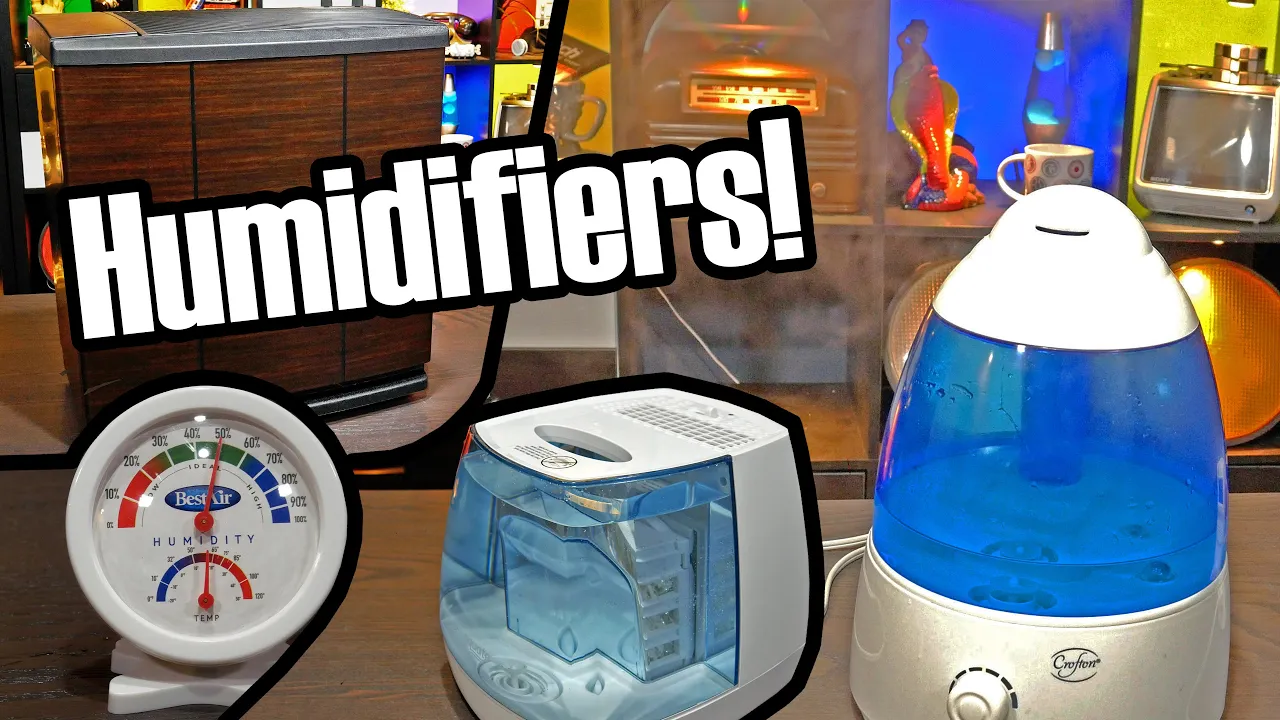
The final category of store-bought humidifier is the evaporative style, frequently marketed under the label "invisible cool mist." Evaporative humidifiers operate on an uncomplicated premise: they help water evaporate by offering a massive surface area for moisture to cling to, combined with a steady airflow for it to hitchhike upon. While a tiny tabletop version from Walmart proved underwhelming because of its minuscule wick, scaling the design up changes everything. The host showcases a massive "console humidifier"—a brown, simulated-woodgrain cabinet on wheels featuring an enormous wick. Despite its retro aesthetic and undeniable capability, the unit comes with a series of design irritations.
The console consists of a large plastic box topped by a fan. When running, the fan pulls air through a rear vent and exhausts it through the top grille. The wick stands directly in front of this rear vent. Crucially, the vent stops a few inches above the bottom panel so the base can act as a reservoir to keep the wick submerged. However, the water level sits so close to the lower edge of the vent cutouts that rolling the unit across the floor becomes "wonderfully stressful" due to sloshing.
```mermaid flowchart LR accTitle: Evaporative Humidifier Airflow accDescr: Air enters the rear vent, passes through a damp wick standing in a water pool, and exits out the top fan. subgraph Console["Console Cabinet"] A["Rear Vent"] --> B["Saturated Wick"] W["Base Reservoir"] -.->|"Wicks up water"| B B --> C["Top Exhaust Fan"] end ```
The machine's physical specs also involve misleading capacity claims and fussy mechanics. The packaging advertises a 5.4-gallon capacity, but that number is deceptive. The removable jug holds only 2.5 gallons, while the remaining volume sits pooled in the bottom reservoir. Because an internal float switch shuts off the unit as soon as the base water level drops about an inch below full, the machine can never actually output 5.4 gallons in a single run. As the host points out:
> “Therefore, in my opinion, for all intents and purposes this has a 2.5 gallon capacity.”
Filling it requires a tedious two-step chore: filling the base tray directly, then filling the bottle. If you fill only the bottle, it empties itself straight into the dry base, forcing an immediate second refill trip. Furthermore, the tank cap routinely fails to seat properly; an improper seal risks overfilling the bottom tray and spilling water straight out through the rear vent.
- **Advertised capacity:** 5.4 gallons (in reality, a 2.5-gallon bottle feeding a 3-gallon reservoir). - **Float switch behavior:** Disables operation when base water level drops just an inch. - **Form factor:** Plastic cabinet on casters with simulated woodgrain.
---
[13:33](https://www.youtube.com/watch?v=oHeehYYgl28&t=813s) Humidistats, Bright Blue LEDs, and Heating Cycles
The console humidifier steps up from basic hardware by incorporating an automated humidistat to govern its four-speed fan. User settings are handled through two front dials (one functioning as a push-button), but this interface immediately triggers an exasperated rant: the screen is illuminated by an aggressively bright blue LED display. The host laments the modern electronics trend of blinding, insomnia-inducing blue indicators, demanding:
> “Manufacturers of apparently literally everything now cut. it. out.”
He pleads for a return to dull, non-intrusive red, amber, or green LEDs before applying an adhesive LightDims sheet to mask the glare.
Beyond the screen, the automation works surprisingly well. The power cord contains an integrated hygrometer that measures ambient relative humidity. The onboard microcontroller triggers the fan when relative humidity drops 3% below the setpoint and powers it down once it climbs 1% above target. Side-by-side comparisons show this built-in sensor tracks within a couple of percentage points of both a standalone analog hygrometer and a smart home thermostat.
This automated control reveals an interesting relationship with the home's forced-air heating: 1. When the furnace is idle, the humidifier stays idle. 2. Minutes after the furnace kicks on, warmer air expands its moisture-carrying capacity, dropping the relative humidity and activating the humidifier fan. 3. The humidifier runs through the heating cycle and stays active for roughly five minutes after the furnace shuts down. 4. Once reaching 1% above the setpoint (e.g., hitting 51% on a 50% target), it cycles off. 5. As the home gradually cools down between furnace runs—even during nighttime thermostat setbacks of 4°F—the relative humidity holds remarkably steady at 49% to 50%, remaining idle for hours until the heat fires up again.
---
[16:46](https://www.youtube.com/watch?v=oHeehYYgl28&t=1006s) Energy Efficiency and Moisture Delivery
When evaluated on operating costs, the large evaporative console massively outperforms ultrasonic misters. While running on its low setting, its hefty fan draws about 65 watts—far more instantaneous power than smaller humidifiers. However, because it moves such an immense volume of air through a huge wick surface, it only runs for roughly six hours total per day.
Over a typical 24-hour cycle, the machine consumes its entire 2.5-gallon reservoir. Factoring in runtime, it uses roughly 156 watt-hours per gallon of water dispersed (noted in text as a correction over the spoken 144 Wh/gal). By contrast, an ultrasonic unit drawing 32 continuous watts takes 24 hours to vaporize a single 1-gallon tank, burning through 768 watt-hours per gallon. The evaporative unit provides equivalent moisture while demanding less than a fifth of the energy per gallon. Furthermore, its standby power is remarkably low at approximately one-third of a watt—beating out the host's old dishwasher, which drew three times that figure just sitting idle.
The physical output is dramatic: - Exhaust air registers at least 70% relative humidity, blowing out a humid, "downright swampy" breeze. - The inverted supply bottle audibly glugs to replenish the base tray more frequently than every five minutes of continuous fan runtime. - Aided by the furnace blower circulating air, the unit stabilizes humidity across the entire house within a tight 5% margin from room to room, despite being dramatic overkill for the home's square footage.
---
[19:01](https://www.youtube.com/watch?v=oHeehYYgl28&t=1141s) Maintenance Realities and DIY Towel Wicks
The major catch with evaporative humidification is sanitation. Because the unit combines an expansive, damp fibrous sponge standing in standing water with a fan drawing in ambient room air, it inherently captures airborne dust, mold spores, and bacteria:
> “Evaporative humidifiers can get… gross.”
To prevent the classic sour, musty odor associated with swampy filters, console wicks must be discarded and replaced seasonally. Owners also need to add bacteriostatic water treatment chemicals to the reservoir to inhibit bacterial growth and mitigate hard-water scale.
```mermaid flowchart TD accTitle: DIY Towel Humidifier Assembly accDescr: Steps to make an evaporative humidifier using a bowl, water, terry cloth towel, and a desk fan. subgraph DIYSetup["Homemade Evaporative Rig"] A["Fill wide bowl 1/3 with water"] --> B["Submerge center of terry cloth towel"] B --> C["Weigh down towel center in basin"] C --> D["Fibers wick moisture across fabric surface"] D --> E["Point desk fan at exposed cloth to accelerate evaporation"] end ```
Because the operating physics of an evaporative humidifier are so straightforward, users can easily construct a homemade equivalent to bypass expensive replacement filters: - Fill a large bowl about one-third full of water. - Submerge the center of a small terry cloth towel, weighing it down in the base so it stays anchored. - The looped fibers of the terry cloth act as natural wicks, pulling water up via capillary action to establish an expansive evaporation surface. - Aim an ordinary desk fan at the exposed, damp fabric to speed up moisture transfer. - Track room changes with an inexpensive $5 digital hygrometer. - Whenever hygiene is a concern, avoid buying replacement media by simply throwing the towel into the washing machine with the laundry.
[21:01](https://www.youtube.com/watch?v=oHeehYYgl28&t=1261s) DIY Towel Humidifiers and the "Mini" Console
Testing in a 100-square-foot office demonstrated that an improvised setup could maintain 50% relative humidity using only a fan and a damp towel—even with what was described as a frankly terrible towel arrangement. This experiment sparks an idea for a commercial or 3D-printed accessory: a vertical zigzag rack designed to hold kitchen towels or shredded cloth, functioning like an evaporative wick cartridge that could be washed and reused rather than thrown away like paper honeycomb filters. While it likely would not match the capillary efficiency of commercial paper wicks, placing such a rack in a shallow water pan directly in front of a fan would make an intriguing, low-waste DIY experiment.
```mermaid flowchart LR accTitle: Airflow in the Mini Console Humidifier accDescr: Air is drawn in through the sides, pulled through two wicks, channeled by a central cowl, and exhausted out the top by a fan. subgraph Intake["Intake Sides"] A["Room Air"] --> B1["Side Wick 1"] A --> B2["Side Wick 2"] end subgraph Core["Internal Assembly"] B1 --> C["Central Cowl"] B2 --> C end subgraph Exhaust["Top Exhaust"] C --> D["Fan"] D --> E["Moistened Air Out Top"] end ```
For people who would rather not engineer their own solution, the manufacturer of the large console (AIRCARE) produces a "mini" console that embraces extreme mechanical simplicity. “It is little more than a bucket, a fan, and two wicks,” the host remarks, praising its stripped-down design. Two wicks slide into side slots, a central cowl directs airflow, and a fan unit mounted on top—governed by the same humidistat (and sadly equipped with the same glaring blue LEDs)—draws dry air through the sides and discharges humidified air out the top.
While it lacks the sheer output of the giant woodgrain floor model, it compensates by being significantly quieter on lower speeds and far more user-friendly to service. Refilling requires no awkwardly shaped tanks or jugs; you simply lift the top fan assembly off and carry the open bucket base straight to the sink. The design has one odd functional quirk: filling the bucket to the brim actually decreases output because it submerges the wicks, leaving less surface area exposed to passing air. To maximize performance, the water level should be kept at or below roughly half the height of the wicks.
[22:49](https://www.youtube.com/watch?v=oHeehYYgl28&t=1369s) Practical Maintenance: Soap Pumps, Chemical Treatments, and Sourcing Supplies
Using a dedicated bacteriostatic water treatment is strongly advised to keep evaporative humidifiers fresh, but measuring it straight out of the bottle can be messy and imprecise. The recommended life hack is to transfer the chemical treatment into a liquid soap dispenser pump. By testing the dispenser beforehand to count how many squirts equal a standard measure (such as a tablespoon), refilling becomes clean and repeatable. In this case, exactly 15 pumps are required for each refill of the water jug. An amber glass pump bottle was chosen on the off-chance the chemicals might be light-sensitive—though that is unlikely given the translucent plastic bottles they ship in—and a repurposed, thoroughly cleaned soap pump works just as well.
Availability of large console humidifiers can be surprisingly regional and channel-specific. In the host’s area of the United States, large units are almost exclusively stocked by home improvement and hardware stores, whereas big-box retailers like Walmart tend to carry only tiny, single-room misting humidifiers. Curiously, Walmart still stocks the exact digital hygrometers and water treatment chemicals needed for console units. Buying replacement wicks well in advance is recommended, and the host notes, “Any large hardware store should carry them, and to my fellow midwesterners, Menards has plenty.”
- Water treatment tip: Measure a soap pump's discharge volume once to establish a repeatable "pumps-per-refill" routine. - Supply sourcing: Large evaporative consoles and replacement wicks are typically found at hardware stores (e.g., Menards) rather than general department stores.
[24:03](https://www.youtube.com/watch?v=oHeehYYgl28&t=1443s) Design Critiques: Swamp Cooler Pumps vs. Janky Float Switches
Evaporative humidifiers accomplish their job with impressive efficiency, but their mechanical implementations leave room for improvement. One theoretical upgrade would be an elevated wick system fed by an active water pump from a deep, 10-gallon reservoir beneath it—a layout borrowed from industrial evaporative swamp coolers. This setup would let a console run for days on end without refilling. However, adding a pump introduces major drawbacks: a mechanical component prone to failure, added noise from trickling water unless an intricate baffling system is engineered, and plumbing tubing that serves as an ideal breeding ground for mold and slime.
The most frustrating element on the large AIRCARE console is its auto-shutoff float switch:
> “See, instead of using it to simply alert you that it’s empty, it shuts the unit off.”
Shutting the motor off when water runs dry prevents the wick from drying out, leaving stagnant water sitting in the paper fibers and the basin bottom. Running the fan continuously would allow the wicks to dry completely and stay hygienic. The physical build of the switch is notoriously crude: a rod attached to a simple styrofoam float, guided loosely by a plastic ring on the cartridge, which pushes upward against an internal switch on the fan assembly. Disabling this mechanism by propping the rod up with a rock is tempting, especially since the smaller mini console lacks a float switch entirely and runs happily regardless of water depth.
[26:00](https://www.youtube.com/watch?v=oHeehYYgl28&t=1560s) Whole-Home Systems, Comfort Benefits, and Outtakes
Portable humidifiers are not the only solution for dry winter air; whole-home humidifiers built into central HVAC ductwork operate on identical evaporative principles. These systems tap directly into household plumbing and use an internal bypass duct to push furnace air through an absorbent pad, rotating wheel, or washable non-porous media. Anyone running a whole-home system who has neglected to inspect or replace that internal pad for years should inspect it, as scale and bacterial growth accumulate over time.
Even with minor design annoyances, running a console evaporative humidifier produces a noticeable improvement in winter living conditions. The painful, chapped lips that routinely set in around Christmas vanished without needing lip balm. Furthermore, keeping indoor humidity at an optimal level changes temperature perception: the living space feels distinctly warmer even with the thermostat left at its standard winter setting, mimicking the muggy sensation of summer air.
The video concludes with a casual "toodles!" over smooth jazz, followed by behind-the-scenes recording outtakes: - Fumbling through script lines regarding the plastic base and capillary action. - Tripping over speech with phrases like "a lot much" and "it's not gonna be do much!" - Getting interrupted by a cat loudly stampeding across the floor upstairs. - A final rant about the intensely piercing blue status LEDs on modern appliances, followed by a meta joke in the closed captions denying the existence of secret end-of-video messages.
## Notable quotes > [00:00](https://www.youtube.com/watch?v=oHeehYYgl28&t=0s) Unless you live in a really arid place, adding moisture to the air is exactly the wrong way to achieve cooling. — Technology Connections
## Mentioned Technology Connections, Walmart, Equate, Vicks, Technology Connextras, AIRCARE, LightDims, Menards
## Video description The air. It holds water! And how much it holds matters! A lot, in fact. Sometimes we need to adjust it in the upwards persuasion. Learn why and how in this little ol’ video! Are you looking for the follow-up where we take apart the Vicks thing? https://youtu.be/TC9-t47tKts And how ‘bout the video on the teeny tiny swamp cooler? https://youtu.be/2horH-IeurA Or howzabout a completely new follow-up video I just did? https://youtu.be/HfFAiCMLJ14
Or were you just looking for these links? Technology Connextras (the second channel that stuff goes on sometimes): https://www.youtube.com/channel/UClRwC5Vc8HrB6vGx6Ti-lhA
This channel is supported through viewer contribution on Patreon. Thanks to the generous support of people like you, Technology Connections has remained independent and possible. It's how I can yell at Cascade with aplomb! If you'd like to join the amazing people who've pledged their support, check out the link below. Thank you for your consideration! https://www.patreon.com/technologyconnections DankPods, Ian McDougall, Derek Watson, Marten van Wezel, Dan Barrett, Kristofer Luck, SingleMaltSloth, Tennavan, Corey W. Anderson, Aaron Teague, Jessie Coan, Nathaniel Caza, Andrew Chappell, Sammie Mammel, Joshua Saxby, Serge Wroclawski, Matthew Hackbarth, Joel Neatrour, John Zelinka, Alfredo Benavente, Jimmy Albin, Jordan Thoms, Bob Leonard, Erik Victory, Kevin , Roger Hosey, Paul Harland-White, Anthanasius, Jeremy Losek, Steven gindler, Theo Bruckbauer, Matt Keaveney, Keegan Carter, TJ , Weixi Zeng, Bennett Colesberry, Ivan Avdeev, Ron Thomas, John Haager, Joshua Gancher, Melody Olvera, Joshua Nahum, Chris Galloway, Sobol, cyberstorm, RUMOKO , Keith Chang, Logan Scott, Brad Feehan, Mitch Brunner, Eric Rakestraw, Brett Caven, h2g2guy , Ken Snider, Charlie Davidson, Noah W., Matthew Abbitt, Chris Boyle, Steve McClellan, Nitin Dahyabhai, Dennis Morhardt, Jelle De Loecker, Michal Miškerník, Ryan Biesemeyer, Jonathan Kade, NobTinker , Devin Edwards, Randy Messinger, Seth Persigehl, Piro606 , Hans Guthrie, Nathan Friedly, Jacco Boven, Robert Hausner, Tomina, Matthew David Chapin, Dominykas D, Bill King, Roadrunner 531, Gareth Brown, Butter Penguin, Maarten De Rocker, John Whitaker, João Pedro Francese, Joseph Russell, Mike Richards, Patrick E Mitchell, ZGryphon , Alton Toth, Eric Walter, Andreas , Lee Sweet, Justin Zakrzeski, Артем Лещев, Jared Julien, Max Maguire, Gunnsteinn Þórisson, RandallA, KeeperofDusk, Lukáš Foral, John Heavisides, Rob Newman, Mark Muir, Andrew Moriarty, Steve Murray, Bendegúz Gellén, Yana M., J.C. Lundberg, Jacob Tuley, Alex Mader, Matthew Barnes, Joel Nichols, Steven Rosen, Brian Thomas Garcia-Luense, Joel Eblin, Sarah Marchesi, Joshua Netterfield, Jim Thoenen, David Cichowski, Ioan Loosley, Hargrimm , jay, Syber-Space, Todd Johnson, Turinggirl , Tanner Smith, Anne Nash, Jordi Pakey-Rodriguez, Lukiday , Marcus LaGrone, RegalRegex, Michael Lehenbauer, James Manes, Mihaly Barasz, Potatoots, David Bednall, Mark Johansson, TheDee , Lee Dedmon, Berwin Xie, Grey Hodge, Jim Kropa, Tony B, David Collins, Alex Carbone, Ben Golus, Luke Goater, Tim Doering, sanlaxsfo, Jonathan Grayum, Kodi , Colin, James Cox, Cody Henthorne, Mark Komarinski, DrSeven , Jeff G, Kevin Reedy, Ryan McLaughlin, J.P. Stewart, NADAV GERBER, Cory Albert, Bryce Swearingen, Anthony Reyes, Ed Taylor, Blair Simpkins, Nathan Fenner, Rittycat , Huub Heijnen, Joseph Dion, Jim Sells, Dustin Gilyard, nils mccarthy, Damione Moore, Jeremy Weeks, Carolyn Gerakines, Patrik Cevela, Graham O'Mara, Nate Gelber, Josh A, Cameron Ross, Etta Spangler, Kyle Boreing, Ben Waxler, Daniel Mattingley, Jason Fortezzo, Joey Zedan, Devan Bailey, Igor Hrcek, Andy Warren, Rowan Parker, Steven Dubnoff, Alexandra Schoof, Keaton Mowery, Father Cadan, Brett Profitt, Alexander K, Martin Haynes, Alipasha Sadri, Dash Buck, Christopher Schreiber, R. Anthony Lorensen, Garrett L. Ward, Shawn, Adam Zaner, Bob , Saurabh Jakate, Emil , Dad , Holden Higgins, David Odell, Zach Orum, HJ , michael waddle, Andrew Wiorek, Tayler Heaney, Ryan, Nate Tangsurat, Anne Gibson
[Source](https://www.youtube.com/watch?v=oHeehYYgl28)