Stanford Inverts Light Transport to Turn Projectors Into Cameras
mm648230
Applying Helmholtz reciprocity to computationally swap the optical paths of emitters and sensors allows systems to relight scenes arbitrarily and photograph objects hidden from direct line of sight.
AI-assisted summary of Dual Photography — original source. Check the original for full context.
Source published:
Key ideas
- Dual photography computationally swaps the roles of cameras and projectors, synthesizing photographs from the optical center of an illuminator using Helmholtz reciprocity. (0:05)
- An adaptive hierarchical subdivision algorithm accelerates the capture of the 4D light transport matrix by determining which disjoint projector pixels can be illuminated simultaneously. (1:55)
- Capturing 6D reflectance functions is streamlined by replacing complex multi-projector arrays with passive, parallel camera sensors or mirror setups. (3:06)
- The framework achieves non-line-of-sight imaging, successfully revealing the face of a hidden playing card purely by measuring subtle diffuse-to-diffuse interreflections off an adjacent book page. (4:20)
Detailed notes
## Background Published on YouTube by mm648230 on March 28, 2009, this video presents research originally showcased at SIGGRAPH 2005 by authors from Stanford University and Cornell University, including Pradeep Sen, Billy Chen, Gaurav Garg, Stephen R. Marschner, Mark Horowitz, Marc Levoy, and Hendrik P. A. Lensch. The video description clarifies that it was uploaded for video blogging and streaming purposes, providing links to the original paper and project website detailing the dual photography technique.
## TL;DR The video introduces dual photography, an optical computational technique that uses Helmholtz reciprocity to interchange the roles of cameras and projectors, rendering virtual photographs from the viewpoint of the light source. By capturing a scene's 4D light transport matrix through an adaptive recursive subdivision algorithm, the system enables complex post-capture relighting effects, including caustic sweeps and specular highlights. The framework expands to multi-camera and mirror configurations to capture 6D reflectance functions, replacing complex projector arrays with passive sensors for augmented reality lighting. Finally, the researchers demonstrate non-line-of-sight imaging by successfully reconstructing the hidden face of an occluded playing card through faint, secondary diffuse reflections off an open book.
## Atmosphere & style The presentation carries the measured, rigorous tone of a classic academic computer graphics showcase, combining dry technical narration with striking visual demonstrations. It methodically builds from foundational optical physics toward increasingly counterintuitive proofs of concept, creating an engaging sense of intellectual discovery. The viewing experience feels both cerebral and quietly astonishing, culminating in an almost magical reveal when an apparently invisible, occluded object is clearly recovered purely through mathematics and scattered light.
## Bulletin - [00:05](https://www.youtube.com/watch?v=p5_tpq5ejFQ&t=5s) Dual photography computationally swaps the roles of cameras and projectors, synthesizing photographs from the optical center of an illuminator using Helmholtz reciprocity. - [01:55](https://www.youtube.com/watch?v=p5_tpq5ejFQ&t=115s) An adaptive hierarchical subdivision algorithm accelerates the capture of the 4D light transport matrix by determining which disjoint projector pixels can be illuminated simultaneously. - [03:06](https://www.youtube.com/watch?v=p5_tpq5ejFQ&t=186s) Capturing 6D reflectance functions is streamlined by replacing complex multi-projector arrays with passive, parallel camera sensors or mirror setups. - [04:20](https://www.youtube.com/watch?v=p5_tpq5ejFQ&t=260s) The framework achieves non-line-of-sight imaging, successfully revealing the face of a hidden playing card purely by measuring subtle diffuse-to-diffuse interreflections off an adjacent book page.
## Key takeaways - [00:05](https://www.youtube.com/watch?v=p5_tpq5ejFQ&t=5s) Dual photography computationally interchanges the positions and roles of cameras and projectors. - [00:05](https://www.youtube.com/watch?v=p5_tpq5ejFQ&t=5s) The primal image is captured directly by the camera under flood illumination from the projector. - [00:05](https://www.youtube.com/watch?v=p5_tpq5ejFQ&t=5s) Helmholtz reciprocity ensures that light transport remains identical along any ray path regardless of whether light travels forward or backward. - [00:05](https://www.youtube.com/watch?v=p5_tpq5ejFQ&t=5s) Pairing a single photo sensor with a scanning projector creates a complete synthetic image from the projector's perspective with matching resolution. - [01:55](https://www.youtube.com/watch?v=p5_tpq5ejFQ&t=115s) Upgrading to a 2D camera array enables the measurement of the full 4D light transport matrix linking every projector pixel to every camera pixel. - [01:55](https://www.youtube.com/watch?v=p5_tpq5ejFQ&t=115s) Sequential brute-force scanning of all projector pixels is replaced by an adaptive subdivision algorithm that lights disjoint regions in parallel. - [01:55](https://www.youtube.com/watch?v=p5_tpq5ejFQ&t=115s) Measuring 4D light transport enables post-capture relighting effects, including virtual light sweeps, moving caustics, and specular highlights. - [03:06](https://www.youtube.com/watch?v=p5_tpq5ejFQ&t=186s) Acquiring a 6D reflectance function under dual photography converts costly multi-projector rigs into parallel multi-camera arrays. - [03:06](https://www.youtube.com/watch?v=p5_tpq5ejFQ&t=186s) Arrays of planar mirrors or motorized gantry-mounted cameras can be used to emulate multiple simultaneous viewpoints with minimal physical hardware. - [03:06](https://www.youtube.com/watch?v=p5_tpq5ejFQ&t=186s) Independent virtual light sources allow post-process adjustment of shadow angles and the synthesis of realistic soft shadows. - [03:06](https://www.youtube.com/watch?v=p5_tpq5ejFQ&t=186s) Calibrated light source positions permit seamless augmented reality compositing with accurate synthetic shadows cast onto real objects. - [04:20](https://www.youtube.com/watch?v=p5_tpq5ejFQ&t=260s) Non-line-of-sight imaging is demonstrated on a playing card completely obscured from the camera's direct line of sight. - [04:20](https://www.youtube.com/watch?v=p5_tpq5ejFQ&t=260s) The dual imaging framework can extract scene information purely through secondary diffuse-diffuse interreflections between matte surfaces.
## Detailed walkthrough ### [00:05](https://www.youtube.com/watch?v=p5_tpq5ejFQ&t=5s) Principles of Dual Photography and Helmholtz Reciprocity
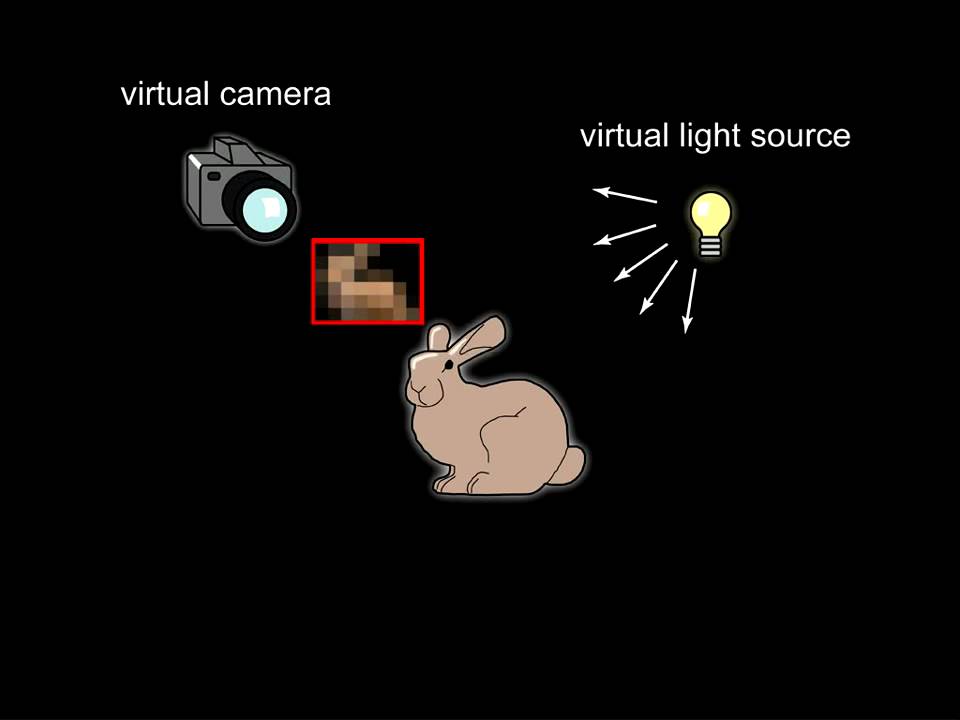
The dual photography technique allows cameras and projectors to be interchanged computationally, making it possible to synthesize photographs from the exact point of view of a projector. In a standard experimental configuration, a scene is illuminated by a projector on the right and observed by a camera positioned on the left. An image recorded directly by the camera while the scene is flood-illuminated by the projector is termed the "primal image." By measuring the light transport between the illumination source and the imaging sensor, the path of light can be inverted mathematically.
```mermaid flowchart LR accTitle: Dual Photography Reciprocity Concept accDescr: Diagram contrasting Primal Image capture with Dual Image reconstruction via Helmholtz reciprocity.
subgraph Primal["Primal Configuration"] P1["Projector (Active Source)"] -->|"Illuminates Scene"| S1["Scene"] S1 -->|"Reflected Light"| C1["Camera (Sensor)"] end
subgraph Dual["Dual Reconstruction"] C2["Virtual Projector (Camera Position)"] -.->|"Virtual Illumination"| S2["Scene"] S2 -.->|"Reciprocal Transport"| P2["Virtual Camera (Projector Position)"] end ```
This optical reversal relies directly on Helmholtz reciprocity, which establishes that light transport remains identical along any given ray path regardless of whether light travels forward or backward. Explaining this fundamental property, the presenter emphasizes:
> “Helmholtz reciprocity specifies that the light transport will be the same along a light path regardless of the direction of the flow of light.”
To understand how this operates in practice, consider an elementary system composed of a projector and a single photo sensor. By activating a single projector pixel at a time, the system records the intensity registered by the photo sensor as a function of that pixel's coordinate. Because the transfer of energy between the pixel and the sensor is invariant to direction, the physical projector acts as a virtual camera, and the photo sensor operates as a virtual point light source. By mapping the measured sensor readings into their corresponding pixel locations, a complete image is formed from the perspective of the projector, matching the native resolution of the projector display.
- **Primal image**: Direct sensor capture taken from the physical camera position under flood illumination. - **Dual image**: Synthesized view rendered from the projector's optical center, illuminated from the physical camera's point of origin. - **Helmholtz reciprocity principle**: Energy transfer between an emitter pixel and a sensor element is identical when the directions of emission and reception are swapped.
---
[01:55](https://www.youtube.com/watch?v=p5_tpq5ejFQ&t=115s) Capturing 4D Light Transport with Adaptive Multiplexing
When the single photo sensor is upgraded to a two-dimensional camera array, the system captures the full four-dimensional light transport matrix linking every projector pixel to every camera pixel. While theoretically comprehensive, a brute-force approach that steps through millions of projector pixels sequentially is impractically slow. To overcome this limitation, the system deploys an adaptive subdivision algorithm that analyzes the scene to identify disjoint projector pixels whose optical contributions can be separated during reconstruction.
> “Our adaptive algorithm subdivides the projector image recursively to determine which pixels can be lit simultaneously.”
This hierarchical multiplexing scheme accelerates acquisition speeds substantially compared to sequential brute-force raster scanning. Once the complete 4D transport matrix is measured, arbitrary post-process relighting becomes possible. For example, a virtual beam of light can be swept across the digital scene after acquisition, accurately revealing moving caustics, diffuse-to-diffuse interreflections, and specular highlights across complex geometries such as cardboard containers and boxes. Furthermore, because the virtual projector matches the resolution of the physical camera, high-resolution graphic patterns can be projected back into the virtualized scene.
- **Dimensionality**: Captures 4D transport functions linking 2D projector coordinates to 2D camera coordinates. - **Adaptive illumination**: Recursively partitions projector space to light multiple non-overlapping regions in parallel. - **Synthetic effects**: Enables dynamic virtual relighting sweeps, specular reflections, high-resolution pattern projection, and caustic movement.
---
[03:06](https://www.youtube.com/watch?v=p5_tpq5ejFQ&t=186s) 6D Reflectance Functions and Multi-Camera Architectures
Dual photography also provides a practical solution for relighting scenes under four-dimensional incident light fields, which requires capturing a six-dimensional reflectance function linking 4D incident illumination to a 2D output image. Under conventional methods, acquiring this 6D data requires coordinating a single camera with an extensive, physically complex array of projectors. Dual photography reverses this requirement, yielding an equivalent optical system driven by a single projector and multiple cameras.
> “Because cameras are passive devices they can operate in parallel and thus their transport to the projector can be measured simultaneously.”
This equivalence delivers significant practical gains. In one implementation, an array of planar mirrors is placed around the scene to emulate multiple camera viewpoints simultaneously while using a single physical camera. In another setup, a camera mounted to a motorized gantry scans the space. Because each camera viewpoint acts as an independent virtual light source in the dual photograph, users can activate individual lights to adjust shadow angles, turn on multiple virtual lights at once to produce realistic soft shadows, and introduce calibrated virtual characters that cast accurate synthetic shadows directly onto real-world objects.
- **6D reflectance capture**: Relates 4D directional incoming light fields to a 2D camera plane. - **Parallel acquisition**: Replaces costly arrays of active projectors with passive, concurrently recording camera sensors or virtual mirror views. - **Augmented reality compositing**: Calibrated light source positions allow seamless integration of synthetic 3D elements and shadows into physical scenes.
---
[04:20](https://www.youtube.com/watch?v=p5_tpq5ejFQ&t=260s) Non-Line-of-Sight Imaging via Diffuse Interreflections
To demonstrate the precision of the transport measurement under challenging optical conditions, an experiment is conducted to image an object hidden from the camera's direct line of sight. A standard playing card is positioned directly facing the projector. The camera is aimed away from the face of the card, viewing only the card's blank back and the matte page of an adjacent open book. Any light traveling from the projector to the camera must execute two consecutive diffuse bounces: first scattering off the face of the card, and then scattering off the paper page of the book.
> “It seems impossible that we could ever identify the card by simply changing the incident illumination however our framework shows that this is indeed possible.”
Under uniform ambient room lighting, the face of the card remains completely invisible to the camera, producing an image where the card's value cannot be perceived. However, as the projector scans structured patterns across the scene, subtle shifts in the color and intensity of the light bouncing off the book's surface are recorded by the camera sensor. Once the full light transport data is collected and inverted using the dual photography framework, the system synthesizes a clear image of the card's face from the projector's perspective, revealing its rank and suit despite the absence of any direct specular reflection.
- **Optical path**: Projector $\rightarrow$ diffuse card face $\rightarrow$ diffuse book page $\rightarrow$ camera sensor. - **Dual reconstruction**: Isolates faint secondary diffuse-diffuse interreflections that are imperceptible under standard room light. - **Outcome**: Successfully reconstructs the hidden face of the playing card from the viewpoint of the illumination source.
## Notable quotes > [00:05](https://www.youtube.com/watch?v=p5_tpq5ejFQ&t=5s) Helmholtz reciprocity specifies that the light transport will be the same along a light path regardless of the direction of the flow of light.
> [03:06](https://www.youtube.com/watch?v=p5_tpq5ejFQ&t=186s) Because cameras are passive devices they can operate in parallel and thus their transport to the projector can be measured simultaneously.
## Mentioned Pradeep Sen, Billy Chen, Gaurav Garg, Stephen R. Marschner, Mark Horowitz, Marc Levoy, Hendrik P. A. Lensch, Stanford University, Cornell University, SIGGRAPH 2005
## Video description Uploaded for video blog: http://quadir.net/
I am not the creator of this video, it is uploaded for streaming purposes: Shown at Siggraph 2005
By: Pradeep Sen - Stanford University Billy Chen - Stanford University Gaurav Garg - Stanford University Stephen R. Marschner - Cornell University Mark Horowitz - Stanford University Marc Levoy - Stanford University Hendrik P. A. Lensch - Stanford University
Website, paper and dl link: http://tinyurl.com/curtby
[Source](https://www.youtube.com/watch?v=p5_tpq5ejFQ)