David Harvey Urges Anti-Capitalist Turn to Break Debt-Crisis Cycle
RSA ANIMATE: Crises of Capitalism — Royal Society of Arts

Royal Society of Arts

Capitalism never resolves its internal crises but merely relocates them geographically through debt substitution after suppressing wages, driving extreme wealth concentration among financiers.

AI-assisted summary of RSA ANIMATE: Crises of Capitalism — original source. Check the original for full context.

Source published:

Key ideas

  • Mainstream explanations for the 2008 crash—ranging from human greed to regulatory failures—overlook core systemic contradictions inherent to capital accumulation. (0:20)
  • The resolution of the 1970s economic crisis through union suppression and wage repression created a demand deficit that was temporarily papered over by tripling household debt. (3:40)
  • Financial profits detached from real production after 1990, driving an extreme concentration of wealth where hedge fund payouts reached $3 billion annually despite broader economic distress. (7:28)
  • David Harvey calls on academics and the public to abandon superficial political platitudes and fundamentally alter their economic modes of thinking through anti-capitalist organization. (9:34)

Detailed notes

## Background Published on YouTube by the Royal Society of Arts on June 28, 2010, this RSA Animate features academic David Harvey examining the systemic roots of financial collapse. According to the video description, Harvey looks beyond capitalism toward a new social order, questioning whether humanity can establish a more responsible, just, and humane economic system.

## TL;DR David Harvey critiques mainstream explanations of the 2008 financial crisis—such as individual greed, institutional missteps, or cultural flaws—and presents a structural Marxist critique centered on the internal contradictions of capital accumulation. He demonstrates how the neoliberal suppression of labor power and wages after the 1970s created a shortfall in consumer demand that was artificially bridged by an explosion of household and mortgage debt. Because capitalism perpetually relocates its systemic crises geographically rather than resolving them, financial elites have detached from productive industry while capturing unprecedented wealth. Harvey concludes that political campaign platitudes fail to address these realities, arguing that academics and the public must abandon business-as-usual thinking and organize against capitalism.

## Atmosphere & style The presentation blends rigorous academic dissection with biting, candid exasperation, juxtaposing Harvey's measured analytical delivery against the brisk kinetic energy of whiteboard animation. Beginning as an intellectual taxonomy of prevailing economic theories, the tone progressively darkens and sharpens into moral outrage over staggering wealth disparities. It feels both intellectually clarifying and unapologetically blunt, discarding polite establishment consensus to deliver an urgent, provocative diagnosis of systemic failure.

## Bulletin - [00:20](https://www.youtube.com/watch?v=qOP2V_np2c0&t=20s) Mainstream explanations for the 2008 crash—ranging from human greed to regulatory failures—overlook core systemic contradictions inherent to capital accumulation. - [03:40](https://www.youtube.com/watch?v=qOP2V_np2c0&t=220s) The resolution of the 1970s economic crisis through union suppression and wage repression created a demand deficit that was temporarily papered over by tripling household debt. - [07:28](https://www.youtube.com/watch?v=qOP2V_np2c0&t=448s) Financial profits detached from real production after 1990, driving an extreme concentration of wealth where hedge fund payouts reached $3 billion annually despite broader economic distress. - [09:34](https://www.youtube.com/watch?v=qOP2V_np2c0&t=574s) David Harvey calls on academics and the public to abandon superficial political platitudes and fundamentally alter their economic modes of thinking through anti-capitalist organization.

## Key takeaways - [00:20](https://www.youtube.com/watch?v=qOP2V_np2c0&t=20s) Popular narratives of the financial crisis focus superficially on human frailty, greed, institutional oversight failures, and flawed economic theories like Hayekian market efficiency. - [00:20](https://www.youtube.com/watch?v=qOP2V_np2c0&t=20s) Cultural explanations wrongly framed the breakdown as an 'Anglo-Saxon disease' or targeted Greek character, distracting from systemic roots. - [00:20](https://www.youtube.com/watch?v=qOP2V_np2c0&t=20s) US homeownership was artificially subsidized by federal policy since the 1930s under the explicit calculation that debt-encumbered homeowners do not go on strike. - [03:40](https://www.youtube.com/watch?v=qOP2V_np2c0&t=220s) When Queen Elizabeth II asked why economists failed to foresee the collapse, the British Academy admitted overlooking 'systemic risk' due to a pervasive politics of denial. - [03:40](https://www.youtube.com/watch?v=qOP2V_np2c0&t=220s) The 2008 crisis originated in the solution to the 1970s crisis, where neoliberal policies disciplined labor and unleashed global labor pools to lower wages. - [03:40](https://www.youtube.com/watch?v=qOP2V_np2c0&t=220s) Wage repression across OECD nations and China suppressed effective consumer demand, creating a structural paradox for commodity realization. - [03:40](https://www.youtube.com/watch?v=qOP2V_np2c0&t=220s) The financial system solved the demand deficit by flooding households with credit cards and mortgages, causing US and UK household debt to triple over 30 years. - [03:40](https://www.youtube.com/watch?v=qOP2V_np2c0&t=220s) Capitalism never resolves its fundamental crises; it merely relocates them geographically, shifting the US mortgage crisis into European sovereign debt. - [07:28](https://www.youtube.com/watch?v=qOP2V_np2c0&t=448s) As described in Marx's Grundrisse, capital cannot tolerate limits and must continually turn them into barriers to circumvent and transcend. - [07:28](https://www.youtube.com/watch?v=qOP2V_np2c0&t=448s) Overcoming circulation bottlenecks concentrated immense social and political power in the financial sector, allowing finance profits to detach from manufacturing after 1990. - [07:28](https://www.youtube.com/watch?v=qOP2V_np2c0&t=448s) British economic policy systematically prioritized the City of London financial sector over domestic manufacturing from the 1950s onward. - [09:34](https://www.youtube.com/watch?v=qOP2V_np2c0&t=574s) Wealth concentration accelerated after the crisis, doubling the number of billionaires in India in a single year and lifting top hedge fund compensations to $3 billion each. - [09:34](https://www.youtube.com/watch?v=qOP2V_np2c0&t=574s) Intellectuals and academics have an urgent duty to challenge empty campaign promises and fundamentally transform their mode of economic thinking.

## Detailed walkthrough ### [00:20](https://www.youtube.com/watch?v=qOP2V_np2c0&t=20s) Popular Explanations for the Economic Crisis

Following the recent economic collapse, David Harvey observes a wide array of competing narratives seeking to make sense of what happened. The first prominent genre blames human frailty: predators, instinctual drives for mastery, personal delusions, investor greed, and inherent human nature. Even Alan Greenspan retreated into this defense, claiming human nature was simply something you cannot do anything about. While an insider look at Wall Street’s everyday conduct certainly reveals a great deal of truth in those behaviors, another major school of thought points instead to institutional failure. Proponents of this view argue that regulatory watchdogs were asleep at the switch while the shadow banking system rapidly engineered innovations outside oversight, concluding that institutions like the G20 must overhaul regulatory frameworks globally.

A third explanation targets flawed economic theory, arguing policymakers became dangerously entranced by Friedrich Hayek and doctrines of market efficiency. In this view, economists must now return to John Maynard Keynes or examine Hyman Minsky’s theories on the systemic instability of financial markets. Meanwhile, a fourth genre turns to cultural origins. In France and Germany, the breakdown was often dismissed as an "Anglo-Saxon disease." Harvey recalls visiting Brazil as the crash unfolded, where President Luiz Inácio Lula da Silva initially celebrated the predicament, seeing poetic justice in the United States enduring the same harsh medicine Latin America suffered eight times across twenty-five years via the IMF—at least until the contagion reached Latin American shores. A parallel cultural finger-pointing emerged around the Greek debt crisis, where the German media aggressively maligned defects in the Greek national character.

Beyond finger-pointing, specific cultural habits did play a material role. The intense American commitment to homeownership—reaching 67% to 68% of households, compared to just 22% in Switzerland—has been artificially propped up by federal policy since the 1930s. The mortgage interest tax deduction provided a colossal subsidy, guided by the explicit Depression-era social calculation that debt-encumbered homeowners do not go on strike. Lastly, a curious policy-failure narrative has formed an odd alliance between the Glenn Beck wing of Fox News and the World Bank, both insisting that excessive, misguided government regulation was the true culprit. Harvey acknowledges each of these accounts possesses plausible threads, but he sets out to construct a different analysis altogether through a Marxist lens.

- “Alan Greenspan took refuge in the fact it's human nature. He said, 'You can't do anything about that.'” — David Harvey - Popular explanatory genres for the crisis: - **Human frailty:** Greed, instincts for mastery, and investor delusions. - **Institutional breakdown:** Asleep-at-the-wheel regulators, shadow banking loopholes, and calls for G20 restructuring. - **Theoretical obsession:** Blind faith in Hayekian market efficiency over Keynesian state interventions or Minsky’s financial instability hypothesis. - **Cultural pathology:** Framing the crisis as an "Anglo-Saxon disease," the German press lambasting Greek character, or the US cultural obsession with homeownership. - **Policy interference:** Strange convergence between Glenn Beck and the World Bank attacking improper regulation.

---

[03:40](https://www.youtube.com/watch?v=qOP2V_np2c0&t=220s) The Queen's Question, Systemic Risk, and the Post-1970s Economy

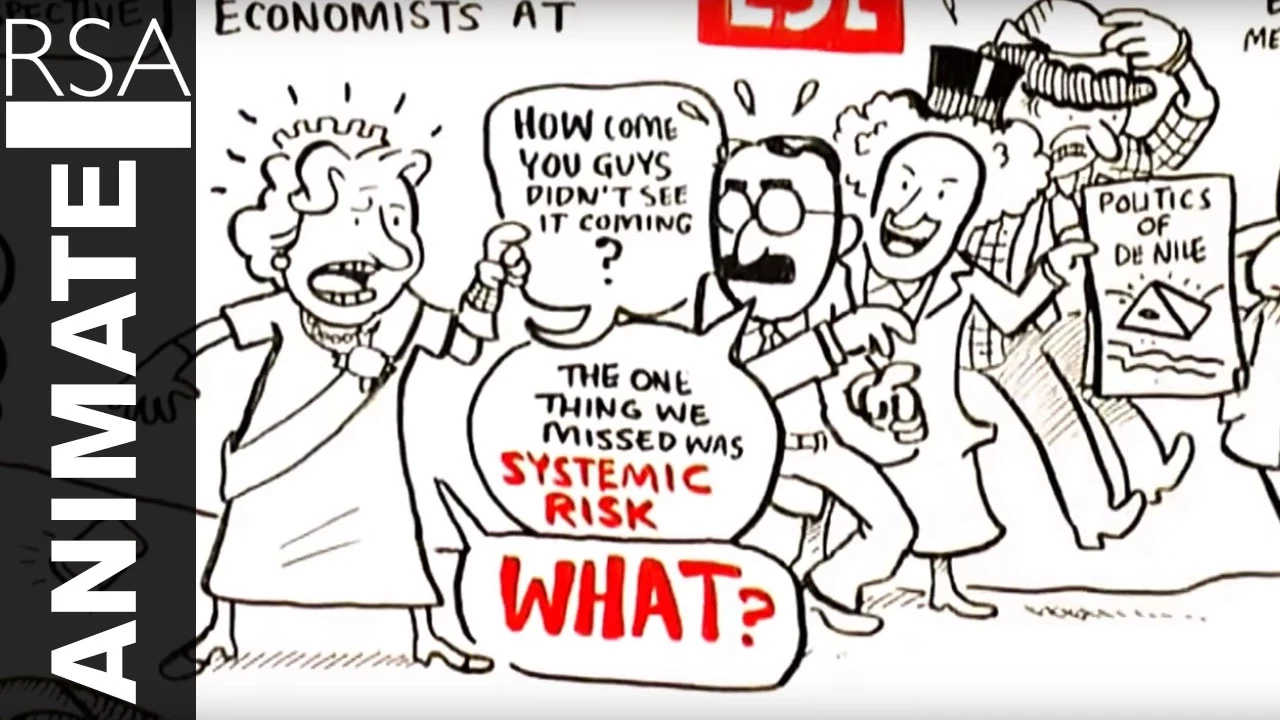
Harvey recounts an episode at the London School of Economics roughly eighteen months earlier, where Queen Elizabeth II candidly asked the assembled economists why none of them had anticipated the economic collapse. Rattled by the query, the establishment gathered its leading thinkers under the British Academy to deliver a formal written response to Buckingham Palace. Their astonishing defense was that while countless brilliant scholars had dedicated their entire careers to individual technical aspects of the economy, the one element they failed to foresee was "systemic risk," exacerbated by a pervasive politics of denial. To a Marxist geographer, systemic risk is simply mainstream code for the internal contradictions of capital accumulation.

Harvey argues that the anatomy of the current crisis was directly shaped by the resolution of the previous major crisis in the 1970s. Back then, capital found itself constrained by the excessive bargaining power of organized labor. The strategy deployed by Margaret Thatcher, Ronald Reagan, and neoliberal policymakers was to crush that power through deregulation, industrial offshoring, and unleashing global labor supplies. By 1985–1986, that task was finished: capital had unbridled access to the world’s working masses. Consequently, nobody during the 2008 collapse blamed greedy labor unions; rather, the crisis originated in the unchecked ascendancy of capital, specifically finance capital.

```mermaid flowchart TD accTitle: Crisis Resolution and Debt Cycle accDescr: Diagram illustrating how disciplining labor in the 1970s led to wage stagnation and debt-fueled crisis.

subgraph Phase1["1970s–1980s: Disciplining Labor"] A["Labor power constraint"] --> B["Offshoring & Neoliberal policies"] B --> C["Suppression of union power"] end

subgraph Phase2["Structural Imbalance"] C --> D["Wage repression across OECD & China"] D --> E["Deficit in consumer effective demand"] end

subgraph Phase3["Debt Substitution & Shift"] E --> F["Credit card & housing debt explosion"] F --> G["2008 Financial system collapse"] G --> H["Sovereign debt crises (e.g., Greece / PIGS)"] end ```

To resolve the earlier dilemma, the global economy instituted wage repression: worker compensation stagnated, and labor’s share of national income steadily plummeted across OECD nations and even within China. However, suppressing wages creates an immediate structural paradox: workers' paychecks provide the purchasing power necessary to consume capitalist commodities. To circumvent this shortfall in effective demand, the financial architecture flooded households with credit cards and mortgages. British and American household debt tripled over thirty years, concentrating massive risk into real estate. As Harvey notes, capitalism never permanently eliminates its core problems; it merely relocates them geographically. Once the initial American mortgage storm appeared to stabilize, the shock shifted into European sovereign debt, sparking panic across Greece and the rest of the so-called PIGS economies.

- “Well, you know, many dedicated people, intelligent, smart, spent their lives working on aspects of this thing very very seriously. But the one thing we missed was systemic risk.” — The British Academy's response to Queen Elizabeth II, as recounted by David Harvey - “That the problem back in the 1970s was excessive power of labor in relationship to capital. That therefore the way out of the crisis last time was to discipline labor.” — David Harvey - “Capitalism never solves its crisis problems. It moves them around geographically.” — David Harvey

---

[07:28](https://www.youtube.com/watch?v=qOP2V_np2c0&t=448s) The Capital Accumulation Cycle and the Tyranny of Finance

Drawing on Karl Marx’s *Grundrisse*, Harvey highlights that capital fundamentally cannot abide limits; it must perpetually turn natural or systemic limits into barriers to circumvent and transcend. In the standard circulation of capital, an owner begins with money capital ($M$), purchases labor power and means of production on the market, puts them to work using specific technologies and organizational structures, and outputs a commodity ($C$) that is sold for the initial principal plus a surplus value or profit ($M'$). To sustain accumulation, portions of that surplus must be recapitalized into continuous expansion.

```mermaid flowchart LR accTitle: Circulation of Capital accDescr: Diagram tracing the circulation of capital from initial money to production, commodity, realized profit, and recapitalization.

M["Money Capital (M)"] --> Buy["Purchase Labor & Means of Production"] Buy --> Prod["Production Process"] Prod --> C["Finished Commodity (C)"] C --> Sale["Market Realization"] Sale --> MPrime["Money + Profit (M')"] MPrime -->|"Recapitalization / Expansion"| M ```

Yet every step in this circulatory pathway poses potential bottlenecks. Assembling massive sums of liquidity at the right time, in the right volume, and at the right location requires financial ingenuity. Over centuries, this functional requirement drove continuous financial innovation, inevitably concentrating extraordinary social power in the hands of financiers. When that leverage reaches extreme levels, financial profits detach from productive activity. From 1990 onward, financial sector profits in the United States skyrocketed, while manufacturing returns dwindled. In Britain, governments systematically prioritized the City of London over domestic industrial manufacturing from the 1950s onward, sacrificing traditional industry to keep bankers happy. Given that the crash did not halt the aggressive concentration of wealth, Harvey contends that joining anti-capitalist organization is the only sensible response to break the ongoing cycle.

- “There's a wonderful language that Marx uses in the Grundrisse where he talks about the way in which capital cannot abide a limit. It has to turn it into a barrier which it then circumvents or transcends.” — David Harvey - “You've actually screwed industry in order to keep you know financiers uh happy.” — David Harvey - “Any sensible person right now would join an anti-capitalist organization and and you have to because otherwise we're going to have this the continuation and notice it's a continuation of all sorts of negative aspects.” — David Harvey

[09:34](https://www.youtube.com/watch?v=qOP2V_np2c0&t=574s) The Obscene Acceleration of Wealth and the Academic Duty to Rethink Capitalism

David Harvey points to the stark divergence between the economic pain felt by the general public and the immense fortunes accumulated at the top following the financial crisis. In places like India, the number of billionaires did not shrink during the turmoil; rather, more billionaires emerged than ever before, with their numbers doubling in the span of a single year. Looking closer to home, Harvey highlights news from that very morning showing that the wealth of the rich has accelerated dramatically, exemplified by the top hedge fund managers pulling in personal remunerations of $3 billion each in a single year. Reflecting on how rapidly standards of excess have shifted, Harvey recalls thinking it was obscene and insane when managers received $250 million just a few years earlier, yet payouts have now reached $3 billion.

Expressing moral outrage at this trajectory, Harvey challenges the audience directly by declaring that this is simply not the kind of society he wishes to inhabit. He laments that society fails to genuinely debate and confront this widening inequality. While acknowledging that he does not have all the answers, he insists that diagnosing the true nature of the problem is essential. He urges the public to look past the empty promises peddled by politicians on the campaign trail, who assure voters that casting a ballot for them will make everything fine the following year, dismissing such rhetoric as utter nonsense that people must call out. For intellectuals and analysts, this moment demands moving past superficial discourse and fundamentally restructuring our analytical frameworks. As David Harvey emphasizes: “And we have a duty, it seems to me, those of us who are academics and seriously involved in the world, to actually change our mode of thinking.”

```mermaid flowchart TD accTitle: Divergence of Elite Wealth and Systemic Crisis accDescr: A diagram illustrating how billionaire wealth accelerated alongside hedge fund payouts, contrasting with political platitudes and prompting Harvey's call for a new mode of thinking.

subgraph WealthConcentration["Accelerating Wealth Concentration"] A["Global Crisis & Austerity"] --> B["Billionaires in India Double in One Year"] A --> C["Hedge Fund Managers Take Home $3B Each"] end

subgraph PublicDiscourse["State of Public Discourse"] D["Political Campaign Pablum: 'Vote for me and all is fine'"] B & C -.->|"Ignored by"| D end

subgraph Alternative["Harvey's Imperative"] E["Acknowledge the Structural Problem"] F["Change Our Mode of Thinking"] D -->|"Reject as nonsense"| E E --> F end ```

- In India, the billionaire population doubled within a single year despite broader economic distress. - Leading hedge fund managers saw individual payouts soar from previous levels of $250 million to personal remunerations of $3 billion each in a single year. - David Harvey sharply critiques political rhetoric, asserting: “Now, that's not a world I want to live in. And if you want to live in it, be my guest.” - Harvey argues that the usual campaign promises are merely political pablum designed to placate voters, stating: “You know, it's crap. You should know it's crap and say it is.”

## Notable quotes > [03:40](https://www.youtube.com/watch?v=qOP2V_np2c0&t=220s) Capitalism never solves its crisis problems. It moves them around geographically. — David Harvey

## Mentioned David Harvey, Alan Greenspan, Friedrich Hayek, John Maynard Keynes, Hyman Minsky, Luiz Inácio Lula da Silva, Glenn Beck, Queen Elizabeth II, Margaret Thatcher, Ronald Reagan, Karl Marx, Grundrisse, G20, International Monetary Fund, World Bank, Fox News, London School of Economics, British Academy, OECD, City of London

## Video description In this RSA Animate, celebrated academic David Harvey looks beyond capitalism towards a new social order. Can we find a more responsible, just, and humane economic system?

The RSA is a 258 year-old charity devoted to creating social progress and spreading world-changing ideas. For more information about our research, RSA Animates, free events programme and 27,000 strong fellowship.

Follow the RSA on Twitter: https://twitter.com/RSAEvents Like the RSA on Facebook: https://www.facebook.com/rsaeventsofficial/ Listen to RSA podcasts: https://soundcloud.com/the_rsa See RSA Events behind the scenes: https://instagram.com/rsa_events/

------ Produced and edited by Abi Stephenson, RSA.

Animation by Cognitive Media. Andrew Park, the mastermind behind the Animate series and everyone's favourite hairy hand, discusses their appeal and success in his blog post, 'Talk to the hand': http://www.thersa.org/talk-to-the-hand/

[Source](https://www.youtube.com/watch?v=qOP2V_np2c0)

中文简报

戴维·哈维呼吁转向反资本主义以打破债务危机循环 资本主义从未解决其内部危机,而是在压制工资后通过债务替代,将危机在地理上进行转移,从而导致财富极度集中于金融家手中。 戴维·哈维对2008年金融危机的主流解释(如个人贪婪、制度失误或文化缺陷)提出了批评,并提出了一种以资本积累内部矛盾为核心的结构性马克思主义批判。他论证了20世纪70年代后新自由主义对劳工力量和工资的压制如何造成消费需求不足,而这一缺口随后被激增的家庭和抵押贷款债务人为填补。由于资本主义始终只是在地理上转移其系统性危机而非真正加以解决,金融精英逐渐脱离实体生产行业,同时攫取了前所未有的财富。哈维总结道,政治竞选中的陈词滥调无法应对这些现实,学者和公众必须摒弃墨守成规的思维,组织起来反抗资本主义。 对2008年崩盘的主流解释(从人类贪婪到监管失败)忽略了资本积累所固有的核心系统性矛盾。 (0:20) 通过打压工会和压制工资来化解20世纪70年代经济危机的做法造成了需求赤字,而家庭债务翻了三倍暂时掩盖了这一问题。 (3:40) 1990年之后,金融利润与实体生产脱节,导致财富极度集中;尽管整体经济陷入困境,对冲基金高管的年收入仍高达30亿美元。 (7:28) 戴维·哈维呼吁学者和公众放弃肤浅的政治口号,通过反资本主义的组织动员从根本上改变其经济思维方式。 (9:34)

Detailed notes — zh

## Background 该视频由英国皇家艺术学会(Royal Society of Arts, RSA)于2010年6月28日发布在YouTube平台上。视频内容由著名学者大卫·哈维(David Harvey)主讲,旨在剖析2008年金融危机的深层根源,超越资本主义框架,探讨建立更具责任感、正义与人道的替代经济秩序的可能性。 ## TL;DR 大卫·哈维首先批判了主流社会对2008年金融危机的五种浅层归因(人性弱点、制度疏漏、错误理论、文化病理和政策失误),指出其本质是资本积累的内在系统性矛盾。他阐述了新自由主义如何通过压制劳工与推行离岸外包解决1970年代危机,却反向导致有效需求不足,进而依赖信用卡与房地产信贷过度扩张。哈维强调资本主义从不解决危机,而只是将其在地理和形态上不断转移(如最终爆发欧猪五国主权债务危机),并呼吁知识分子识破政客的空洞许诺,打破既有思维范式以抵抗极端恶化的贫富分化。 ## Atmosphere & style 整部演讲兼具学术的严谨深刻与强烈的批判激情,节奏紧凑明快,配合RSA标志性的白板手绘动画,将抽象沉重的马克思主义政治经济学理论转化为极具冲击力的视觉叙事。哈维的语气冷静辛辣却饱含道德义愤,从对主流经济学界“否认政治”的讽刺,到直面顶层富豪巨额薪酬时的作呕与抗拒,情绪层层递进。聆听过程中充斥着一种刺破意识形态迷雾的清醒感,带给受众深邃的智识震撼与迫切的行动号召力。 ## Bulletin - [00:20](https://www.youtube.com/watch?v=qOP2V_np2c0&t=20s) 大卫·哈维指出主流经济学界将金融危机归咎于人性弱点或制度失误,本质上是在回避资本积累的内在矛盾与系统性风险。 - [05:05](https://www.youtube.com/watch?v=qOP2V_np2c0&t=305s) 资本主义通过抑制工资化解了1970年代的劳工危机,但随后不得不依靠膨胀的信贷与房贷填补有效需求,英美家庭债务过去二三十年间激增三倍。 - [05:05](https://www.youtube.com/watch?v=qOP2V_np2c0&t=305s) 资本主义从不根治危机,而是将其在形态与地理上转移,私人金融机构危机最终演变为希腊等国的主权债务危机。 - [09:34](https://www.youtube.com/watch?v=qOP2V_np2c0&t=574s) 危机并未减缓顶层财富积累,印度亿万富翁在一年内翻倍,顶级对冲基金经理年薪高达30亿美元,突显财富极化正急剧恶化。 ## Key takeaways - [00:20](https://www.youtube.com/watch?v=qOP2V_np2c0&t=20s) 主流舆论将危机归结为人性弱点、制度失败、错误理论、文化病灶或监管失误等五类流行叙事,以此掩盖深层病因。 - [00:20](https://www.youtube.com/watch?v=qOP2V_np2c0&t=20s) 美国自1930年代起大力补贴购房以提高住房拥有率,其深层政治逻辑在于背负房贷的劳工更驯服且不易罢工。 - [03:40](https://www.youtube.com/watch?v=qOP2V_np2c0&t=220s) 英国学术界在回应女王对未预测到危机的质问时,承认忽略了“系统性风险”,哈维指出这实则是对资本主义内在矛盾的政治性否认。 - [05:05](https://www.youtube.com/watch?v=qOP2V_np2c0&t=305s) 1970年代劳工力量被新自由主义规训后,资本陷入了工资抑制与有效需求不足的长期矛盾之中。 - [05:05](https://www.youtube.com/watch?v=qOP2V_np2c0&t=305s) 金融体系通过大量发放信用卡与房贷维持虚假繁荣,使得英美家庭债务在二三十年内暴增了三倍。 - [05:05](https://www.youtube.com/watch?v=qOP2V_np2c0&t=305s) 资本主义的根本运作规律是将危机在地理与形态上转移,而非真正解决危机,如从次贷危机转移为主权债务危机。 - [07:28](https://www.youtube.com/watch?v=qOP2V_np2c0&t=448s) 按照马克思在《大纲》中的论述,资本必须将所有内在限制转化为可被征服并绕过的障碍。 - [07:28](https://www.youtube.com/watch?v=qOP2V_np2c0&t=448s) 1990年以来美国金融业利润呈现垂直飙升,而实体制造业利润严重萎缩,经济结构严重向金融寡头倾斜。 - [07:28](https://www.youtube.com/watch?v=qOP2V_np2c0&t=448s) 英国自1950年代以来的经济政策长期偏向伦敦金融城,实质上是以牺牲本土工业为代价取悦金融资本。 - [09:34](https://www.youtube.com/watch?v=qOP2V_np2c0&t=574s) 危机期间印度亿万富翁数量在一年内翻倍,主要对冲基金管理者年薪高达30亿美元,显示资本收益与实体经济严重脱节。 - [09:34](https://www.youtube.com/watch?v=qOP2V_np2c0&t=574s) 常规选举政治充斥着麻痹公众的虚伪承诺,无法直面经济危机的体制性根源。 - [09:34](https://www.youtube.com/watch?v=qOP2V_np2c0&t=574s) 知识分子与社会行动者有责任打破既有资本主义思维范式,探索更具正义与人道性的替代秩序。 ## Detailed walkthrough ### [00:20](https://www.youtube.com/watch?v=qOP2V_np2c0&t=20s) 资本主义危机的五种流行解释类型 关于本次金融危机爆发的原因,社会上流传着各种解释流派。大卫·哈维(David Harvey)将其梳理为几种主要类型: 第一种流派归咎于“人性的弱点”(human frailty)。正如美联储前主席艾伦·格林斯潘(Alan Greenspan)将危机推给人类本性时所声称的:“你对此无能为力。”该视角将问题归结为投资者的掠夺本能、掌控欲、贪婪与盲目幻觉。哈维指出,随着华尔街日常操作内幕不断被曝光,这种说法确实有相当的真实性。 第二种流派归因于“制度性失败”(institutional failures)。监管者玩忽职守、睡着了没拉开关,影子银行系统游离于监管之外大肆创新。这一视角的结论是必须重构制度,需要通过二十国集团(G20)等进行全球协作来补救。 第三种流派认为全社会被“错误的理论”所误导。人们过度沉迷于弗里德里希·哈耶克(Friedrich Hayek)的自由市场效率论,现在是时候回归约翰·梅纳德·凯恩斯(John Maynard Keynes),或者严肃审视海曼·明斯基(Hyman Minsky)关于金融活动内在不稳定性的理论了。 第四种流派是“文化根源论”(cultural origins)。在德法两国,许多人将这场灾难斥为纯粹的“盎格鲁-撒克逊病”(Anglo-Saxon disease),坚称与己无关。哈维回忆危机爆发时他恰好在巴西,卢拉(Lula)总统最初甚至幸灾乐祸地表示,谢天谢地,美国终于也尝到了类似国际货币基金组织(IMF)严厉惩戒的滋味,拉美在过去25年里经历了8次,现在轮到美国了——直到危机蔓延至拉美,他们的态度才转变。类似地,德国媒体在对待希腊债务危机时,也恶劣地攻击所谓“希腊人性格缺陷”。不过,文化维度的确起到了一定作用,例如美国文化中对住房拥有率的痴迷:美国约有 67% 至 68% 的家庭拥有自住房,而瑞士仅有 22%;这一现象自 1930 年代起就受到房贷利息税收抵免等巨额政策补贴的强力推动,其背后的政治考量是“背负房贷的房主不会去罢工”。 第五种流派则是“政策失败论”(failure of policy),讽刺的是,福克斯新闻的格伦·贝克(Glenn Beck)阵营居然与世界银行在此达成了默契,双方一致咬定问题的根源在于“存在太多错误的政府监管”。 - 格林斯潘将危机推卸给人性的不可控,称“对此无能为力”。 - 美国自 1930 年代起通过抵押贷款利息减免大力补贴购房,住房拥有率达 67%-68%,而瑞士仅为 22%。 - 推动家庭购房的核心统治逻辑在于:身负房贷债务的房主往往更顺从,不会轻易罢工。 --- ### [03:40](https://www.youtube.com/watch?v=qOP2V_np2c0&t=220s) 女王的质问与马克思主义的“系统性风险”视角 面对上述林林总总的通俗叙事,哈维提出要从被主流遗弃的马克思主义视角构建一个全新的分析框架。他特别提到了约一年半前发生在伦敦政治经济学院(LSE)的一幕标志性事件:英国女王伊丽莎白二世当面质问在场的经济学家们:“既然这场危机如此严重,为什么你们当初都没能预见到它的发生?”随后女王甚至致电英格兰银行行长当面问责。 为此,英国国家学术院(British Academy)召集了一批顶尖经济学家,并在给女王的正式回信中给出了一套令人瞠目结舌的辩词。信中写道,许多极具天赋且聪明敬业的学者一生都在严肃钻研经济的各个切片,“然而我们唯一漏掉的东西,是系统性风险(systemic risk)”。哈维讽刺道,这种说辞背后是一种彻头彻尾的“否认政治”(politics of denial)。在马克思主义语境中,“系统性风险”的真正内涵正是“资本积累的内在矛盾”(internal contradictions of capital accumulation)。 对于主流学界面对危机时的推脱与盲区,大卫·哈维在引用英国学术院给女王的信件时评价道: > “It said, 'Well, you know, many dedicated people, intelligent, smart, spent their lives working on aspects of this thing very very seriously. But the one thing we missed was systemic risk.'” --- ### [05:05](https://www.youtube.com/watch?v=qOP2V_np2c0&t=305s) 从压制劳工到信用扩张:债务危机的空间转移 哈维指出,当代危机的形式在很大程度上取决于资本主义走出上一轮危机的方式。1970年代的危机本质上是劳工阶级力量过强,对资本构成了制约。为了化解这一矛盾,撒切尔(Margaret Thatcher)和里根(Ronald Reagan)推行新自由主义路线,通过海外代工离岸外包(offshoring)等手段残酷驯服并规训了劳工。到了1985至1986年,全球劳动力蓄水池彻底向资本开放,劳工问题已被资本全盘解决。因此,本轮危机根本没人指责工会贪婪,危机真正的病灶在于资本力量的极度膨胀,尤其是金融资本的过度权力。 资本由此陷入了新的矛盾。自1970年代以来,整个经合组织(OECD)国家甚至中国,都进入了长期的“工资抑制”(wage repression)阶段,工资占国民收入的比重持续萎缩。然而,工人的工资正是购买商品并实现市场价值的资金来源。工资被压低后,有效需求不足的危机随即暴露。为了解决“有效需求从何而来”的难题,金融体系给所有人塞满了信用卡。过去二三十年间,英美两国家庭的债务水平暴增了约三倍,且绝大部分债务都沉淀在房地产市场中。 这就印证了一条极为重要的马克思主义空间经济学论断:资本主义从来不会真正解决其危机问题,而只是把危机在地理和形态上到处转移。金融体系的危机表面上被暂时按住,随即就转移爆发为以希腊等欧猪五国(PIIGS)为代表的主权债务危机。 ```mermaid flowchart TD accTitle: 资本主义危机转移机制 accDescr: 展示从1970年代压制劳工、工资停滞、信用杠杆膨胀,最终转移为主权债务危机的演变路径。 subgraph Phase1["1970-1980年代:劳工规训"] A["1970年代危机:劳工力量强"] --> B["新自由主义政策与离岸外包"] B --> C["劳工被全面压制,资本获得全球廉价劳动力"] end subgraph Phase2["1980-2000年代:工资抑制与信贷透支"] C --> D["劳动报酬在国民收入中占比持续萎缩"] D --> E["有效需求不足危机"] E --> F["普及信用卡与房贷信贷扩张"] F --> G["美国家庭债务在20-30年内暴增三倍"] end subgraph Phase3["危机转移与爆发"] G --> H["房地产泡沫破裂引发金融体系危机"] H --> I["危机在地理上转移:爆发主权债务危机(如希腊、欧猪五国)"] end ``` 关于危机从未根治的规律,大卫·哈维总结道: > “And out of this comes a theory which is very very important that that capitalism never solves its crisis problems. It moves them around geographically.” - 自1970年代起,OECD国家和中国的劳动报酬占国民总收入比例均呈下降趋势。 - 英美家庭在过去二三十年里债务规模大约翻了三倍,且绝大多数债务捆绑于住房抵押贷款。 - 救助金融机构的代价是将私人金融危机转化为国家主权债务危机。 --- ### [07:28](https://www.youtube.com/watch?v=qOP2V_np2c0&t=448s) 资本循环的内在界限与反资本主义诉求 哈维引用马克思在《政治经济学批判大纲》(*Grundrisse*)中的精辟阐述指出:资本无法容忍任何内在限制(limit),必须将一切界限转化为障碍(barrier),并不断绕过或超越它们。从资本积累的基本流通逻辑来看:资本家手握货币资本(M),进入市场购买劳动力与生产资料,在特定的技术和组织形式下进行生产,创造出商品(C),再通过市场交换换回更多的货币(M',即原初货币加上利润)。为了生存与扩张,部分剩余价值必须被重新资本化投入下一轮扩大再生产。 这一循环过程布满了潜在的梗阻点。首要难题就是:如何在正确的时间、正确的地点聚集足够体量的流动性资本?这直接催生了金融创新的历史。然而,持续的金融创新极大地赋予了金融家特权与过度权力,助长了金融资本的贪婪。数据显示,1990年之后,美国金融业利润呈现垂直飙升的势头,而实体制造业的利润却急剧滑坡。英国自1950年代以来的政策亦是如此:为了讨好伦敦金融城(City of London)的金融寡头,历届政府不惜彻底牺牲本土工业实体。面对这种财富集中与系统性灾难的不断死灰复燃,哈维呼吁任何有理智的人都应当加入反资本主义的阵营,否则社会的负面恶果只会变本加厉地延续。 大卫·哈维在剖析金融资本与实体经济的失衡时直言: > “Any sensible person right now would join an anti-capitalist organization and and you have to because otherwise we're going to have this the continuation and notice it's a continuation of all sorts of negative aspects.” - 马克思在《大纲》中论证资本必须将所有“限制”转化为被征服的“障碍”。 - 1990年以后,美国金融业利润飙升,与制造业利润的持续衰退形成巨大剪刀差。 - 英国自1950年代以来的经济政策持续偏袒伦敦金融城,实质上以摧毁本土制造业为代价来取悦金融家。 ### [09:34](https://www.youtube.com/watch?v=qOP2V_np2c0&t=574s) 贫富差距的极端恶化与知识分子的思考重塑 大卫·哈维(David Harvey)在剖析资本主义危机时指出,即便在经济动荡与衰退的阴影笼罩下,全球顶层的财富集中与分化不仅没有收敛,反而以惊人的速度进一步加速。他以国际与国内的现实状况为例:在印度,过去一年涌现的亿万富翁数量创下历史新高,其富豪总数在短短一年内就实现了翻倍。与此同时,西方发达国家的财富阶层收益也在急剧膨胀。哈维提到自己当天早晨刚看到的一则报道:主要对冲基金(hedge fund)领头人单人一年的个人薪酬报酬竟高达 30 亿美元。回溯数年之前,当这些金融高管斩获 2.5 亿美元年薪时,哈维就已经觉得荒谬绝伦且令人作呕,而如今这一数字直接跃升至 30 亿美元的惊人量级。哈维对此表达了强烈的道德反感与批判态度,直言这样极度失衡的社会现状绝非自己向往的生活环境,并尖锐地质问台下听众是否愿意接纳这样的世界:“Now, that's not a word world I want to live in. And if you want to live in it, be my guest.” 面对这种严峻的结构性现实,公众舆论与政界却普遍缺失了深入的审视与辩论。哈维坦承自己虽然无法提供现成的全套解决方案,但他确信自己看清了这一系统性困境的本质。他严厉抨击了常规政治竞选中常见的空洞说辞——政客们总是端出诸如“只要投票给我,明年一切都会好转”之类麻痹人心的陈词滥调。哈维毫不客气地将其斥为毫无价值的谎言与垃圾(crap),强调公众理应有能力识破并当面揭穿这种虚妄承诺。最后,他向所有学者以及真切关怀现实世界的行动者发出号召,认为知识阶层肩负着不可推卸的责任:“And we have a duty, it seems to me, those of us who are academics and seriously involved in the world, to actually change our mode of thinking.” 唯有彻底打破既有的资本主义思维范式,跳出政治应声虫式的空泛讨论,全社会才有可能探寻出一种更为正义、人道且具可持续性的替代秩序。 - **财富极化数据**:印度亿万富翁总数在一年之内实现翻倍;顶级对冲基金管理者单人年度薪酬攀升至 30 亿美元,远超数年前被认为荒诞的 2.5 亿美元水平。 - **政治与社会反思**:批判选举政治中粉饰太平的空头承诺(pablum),呼吁学术界与公众打破常规教条,全面更新认知框架以直面资本主义的深层根源。 ```mermaid flowchart TD accTitle: 资本主义危机下的财富极化与思维转变 accDescr: 展示顶层财富急剧积累与常规政治话语失效,进而导向学术界重塑认知模式的逻辑流程。 subgraph WealthInequality["财富极化现象"] A["印度亿万富翁数量翻倍"] --> C["顶层资本加速集聚"] B["对冲基金经理年入30亿美元"] --> C end subgraph SystemicFailure["系统性遮蔽与危机"] C --> D["社会缺乏实质性批判与辩论"] D --> E["政客竞选空谈与虚假承诺"] end subgraph ImperativeAction["认知与行动突破"] E --> F["识破政治修辞与虚妄本质"] F --> G["知识界重塑思维范式"] end ``` ## Notable quotes > [05:05](https://www.youtube.com/watch?v=qOP2V_np2c0&t=305s) And out of this comes a theory which is very very important that that capitalism never solves its crisis problems. It moves them around geographically. — 大卫·哈维 ## Mentioned David Harvey, Alan Greenspan, G20, Friedrich Hayek, John Maynard Keynes, Hyman Minsky, Lula, IMF, Glenn Beck, 世界银行, 伊丽莎白二世, 伦敦政治经济学院, 英格兰银行, 英国国家学术院, Margaret Thatcher, Ronald Reagan, 经合组织 (OECD), 政治经济学批判大纲, 伦敦金融城, Cognitive Media, Andrew Park, Royal Society of Arts (RSA) ## Video description In this RSA Animate, celebrated academic David Harvey looks beyond capitalism towards a new social order. Can we find a more responsible, just, and humane economic system? The RSA is a 258 year-old charity devoted to creating social progress and spreading world-changing ideas. For more information about our research, RSA Animates, free events programme and 27,000 strong fellowship. Follow the RSA on Twitter: https://twitter.com/RSAEvents Like the RSA on Facebook: https://www.facebook.com/rsaeventsofficial/ Listen to RSA podcasts: https://soundcloud.com/the_rsa See RSA Events behind the scenes: https://instagram.com/rsa_events/ ------ Produced and edited by Abi Stephenson, RSA. Animation by Cognitive Media. Andrew Park, the mastermind behind the Animate series and everyone's favourite hairy hand, discusses their appeal and success in his blog post, 'Talk to the hand': http://www.thersa.org/talk-to-the-hand/ [Source](https://www.youtube.com/watch?v=qOP2V_np2c0)

Source quotes

[5:05] 大卫·哈维: And out of this comes a theory which is very very important that that capitalism never solves its crisis problems. It moves them around geographically.

Source quotes

[3:40] David Harvey: Capitalism never solves its crisis problems. It moves them around geographically.

Original transcript

[0:20] Okay, so we've uh been through this [0:22] crisis and uh there are all sorts of uh [0:25] explanatory formats out there and it's [0:28] interesting to look at the different [0:29] genres. genres. One genre is that it's [0:31] all about human frailty. I mean, Alan [0:33] Greenspan took refuge in the fact it's [0:36] human nature. He said, "You can't do [0:37] anything about that." But there's a [0:39] whole world of explanations that kind of [0:42] say it's uh the predatory instincts, [0:44] it's the instincts for mastery, it's the [0:47] delusions of investors and the greed and [0:50] and all the rest of it. So, there's a [0:52] whole range of discussion of that. And [0:54] of course, the more we learn about the [0:56] daily practices on Wall Street, we kind [0:58] of uh figure there's a great deal of [0:59] truth in all of that. The second genre [1:02] is that there's institutional failures. [1:05] The you regulators were asleep at the [1:07] switch. The shadow banking system [1:09] innovated outside of their purview etc [1:12] etc etc and therefore institutions have [1:15] to be reconfigured and it has to be a [1:17] global effort by the G20 something of [1:20] that kind. So we look at the [1:21] institutional level and say that has [1:23] failed and that has to be reconfigured. [1:25] The third genre is to say everybody was [1:27] obsessed with a false theory. They read [1:29] too much Hayek and believed in the [1:31] efficiency of markets and it's time we [1:34] actually got back to something like [1:37] canes or we took seriously uh Hyman [1:41] Minsk's theory about the inherent [1:43] instability of financial activities. The [1:46] next uh genre is that this is it has [1:49] cultural origins. Now, we don't hear [1:51] that much in the United States, but if [1:53] you were in Germany and France, many [1:55] people there would kind of say this is [1:56] an Anglo-Saxon [1:57] disease and and uh it's nothing to do [2:00] with us. Uh and uh I happened to be in [2:03] Brazil when it was going on, and Lula [2:05] was kind of saying, well, first off, he [2:07] was saying, "Oh, thank God the United [2:09] States has been disciplined by the [2:11] equivalent of the IMF. We've been [2:13] through it eight times in the last 25 [2:15] years and now it's their turn. Fantastic [2:17] said Lulu and all the Latin Americans I [2:20] knew until it hit them which it does and [2:23] then they kind of changed their tune a [2:24] little bit. So there's a kind of a way [2:26] of which it got became cultural and you [2:28] can see that by the way in which this [2:29] whole Greek thing is being handled. The [2:31] way the German press is saying well it's [2:33] the Greek character. It's defects in the [2:35] Greek character and and there's a lot of [2:37] rather nasty stuff going on around that. [2:39] But actually there are some cultural [2:41] features which have led into it. For [2:43] instance the US fascination with home [2:45] ownership which is supposedly a deep [2:48] cultural value. So 67 68% of US [2:51] households are homeowners. It's only 22% [2:54] in Switzerland. Of course, it's a [2:56] cultural value in the United States. Has [2:58] been supported by the mortgage interest [2:59] tax deduction, which is a huge subsidy. [3:02] Uh it's been promoted since the 1930s, [3:04] very explicitly in the 1930s has built [3:07] up because theory was that [3:08] debt-inccumbumbered homeowners don't go [3:10] on strike. And then there's a kind of [3:12] notion that is a failure of policy and [3:14] that policy has actually intervened. And [3:16] there's a funny kind of alliance [3:17] emerging between the Glen Beck wing of [3:20] Fox News and the World Bank. Both of [3:22] whom say the problem is too much [3:24] regulation of the wrong [3:27] sort. So there are all of these all of [3:29] these ways and all of them have a [3:30] certain truth and skilled writers will [3:33] take one or other of those perspectives [3:34] and build a story and and actually write [3:37] very plausible kind of story or rip [3:38] about this. And I thought to myself, [3:40] well, what kind of plausible story can I [3:42] write which is none of the above? uh [3:44] which is one of the things I always [3:45] think to myself and it's not hard to do [3:47] particularly if you're coming from a [3:48] Marxist perspective because you know [3:50] there aren't many people who try to do [3:52] this analysis from a Marxist perspective [3:54] and I was really clued into this why by [3:57] this uh uh thing that happened at the [3:59] London School of Economics uh about a [4:01] year and a half ago when her majesty the [4:02] queen asked the economist how come you [4:04] guys didn't see this thing coming I mean [4:06] she didn't say it exactly that way but [4:08] you know it's just the sentiment and and [4:10] they got very upset and then she [4:12] actually called the bank of governor of [4:13] the bank of England and said, "How come [4:14] you didn't see it coming?" And and and [4:16] then the British Academy put forward [4:17] this got all together all these [4:19] economists and they came up with this [4:20] fabulous letter to her majesty and it [4:22] was an an I was it was absolutely [4:25] astonishing. It said, "Well, you know, [4:27] many dedicated people, intelligent, [4:29] smart, spent their lives working on [4:32] aspects of this thing very very [4:33] seriously. But the one thing we missed [4:35] was systemic risk." And you say, [4:38] "What?" And then it went on to talk [4:40] about a politics of denial and all the [4:42] rest of it. So I thought, well, you [4:43] know, systemic risk, you know, I can [4:46] translate it into the Marxian thing. [4:47] You're talking about the internal [4:49] contradictions of capital accumulation [4:51] and maybe I should write a thing about [4:53] the internal contradictions of capital [4:55] accumulation and try to figure out the [4:57] role of crisis in the whole history of [4:59] capitalism and what's specific and [5:01] special about the crisis this time [5:03] around. And there were two ways in which [5:05] I thought I would do that. One was to [5:07] sort of look at what's happened since [5:09] 1970s to now. And the thesis there is [5:13] that in many ways the form of this [5:15] current crisis is dictated very much by [5:17] the way we came out of the last [5:19] one. That the problem back in the 1970s [5:22] was excessive power of labor in [5:24] relationship to capital. That therefore [5:26] the way out of the crisis last time was [5:28] to discipline labor. And we know how [5:31] that was done. It was done by [5:32] offshoring. It was done by you know [5:34] Thatcher and Reagan. And it was done by [5:35] neoliberal doctrine. It was done all [5:37] kinds of different ways. [5:41] But by 1985 or '86, the labor question [5:44] had essentially been solved for capital. [5:46] It had access to all of the world's [5:48] labor supplies. Nobody in this [5:50] particular instance has cited greedy [5:52] unions as the root of the crisis. Nobody [5:54] this instance is saying is has anything [5:56] to do with with excessive power of [5:58] labor. If anything, it's the excessive [6:00] power of capital and in particular the [6:02] excessive power of finance capital which [6:05] is the root of the [6:06] problem. Now, how did that happen? Well, [6:10] we've been since the 1970s in a phase of [6:12] what we call wage repression that wages [6:15] have been remained stagnant. The share [6:16] of wages and national income right [6:18] throughout the OECD countries has has [6:20] steadily fallen. It's even steadily [6:22] fallen in China of all places. So that [6:25] they're less and less being paid out in [6:27] wages. Well, wages turn out to be also [6:30] the money which buys goods. So if you [6:33] diminish wages, then you got a problem [6:34] with where's your demand going to come [6:36] from? And the answer was, well, get out [6:38] your credit cards. We'll give everybody [6:39] credit cards. So, we'll overcome, if you [6:42] like, the problem of effective demand by [6:44] actually pumping up the credit economy. [6:47] And American households, British [6:49] households have all roughly tripled [6:50] their debt over the last 20, 30 years. [6:53] And a vast amount of that debt, of [6:54] course, has been in in within uh the [6:57] housing market. And and out of this [6:59] comes a theory which is very very [7:01] important that that capitalism never [7:02] solves its crisis problems. It moves [7:05] them around geographically. And what [7:07] we're seeing right now is a geographical [7:09] movement of that. Everybody says, "Well, [7:11] okay, everything's beginning to recover [7:12] in the United States." And then Greece [7:14] goes bang and everybody says, "What [7:15] about the pigs?" You know, and it's [7:17] interesting. You had a finance crisis, [7:18] which is in in in the financial system. [7:21] You've sort of half solved that, but at [7:24] the expense expense of a sovereign debt [7:27] crisis. Actually, if you look at the [7:28] accumulation process of capital, you see [7:30] a number of limits and a number of [7:32] barriers. And there's a wonderful [7:33] language that Markx uses in the Grundies [7:35] where he talks about the way in which [7:36] capital cannot abide a limit. It has to [7:40] turn it into a barrier which it then [7:41] circumvents or transcends. And then when [7:44] you look at the accumulation process, [7:46] you look at where the barriers and and [7:47] and limits might lie. And the simple way [7:50] to look at it is to say look a typical [7:53] the typical circulation process of [7:55] accumulation goes like this. You start [7:57] with some money. You go into the market [8:00] and you buy labor power and means of [8:02] production and you put that mean them to [8:05] work with a given technology in [8:07] organizational [8:08] form. You create a [8:11] commodity which you then sell for the [8:13] original money plus a [8:16] profit. Now you then take part of the [8:19] profit and you recapitalize it into an [8:22] expansion for very interesting reasons. [8:24] Now there are two things about this. One [8:26] is there are a number of barrier points [8:27] in here. How is the money got together [8:29] in the right place at the right time in [8:31] the right in the right volume and that [8:33] takes financial ingenuity. So the whole [8:36] history of capitalism has been about [8:38] financial innovation and financial [8:40] innovation has the effect of also [8:42] empowering the financeers and the [8:45] excessive power of the financeers can [8:46] sometimes they get they do get greedy no [8:49] question about it and if you look at [8:50] financial profits in the United States [8:52] they were soaring after 1990 they're [8:54] going up like this profits in [8:56] manufacturing were coming down like this [8:58] and you could see the imbalance in this [9:00] country I think the way in which this [9:02] country has sided with the city of [9:04] London against British manufacturing [9:05] since the 1950s onwards has had very [9:08] serious implications for the economy of [9:10] this country. You've actually screwed [9:12] industry in order to keep you know [9:13] financiers uh happy. Any sensible person [9:17] right now would join an anti- capitalist [9:19] organization and and you have to because [9:22] otherwise we're going to have this the [9:24] continuation and notice it's a [9:26] continuation of all sorts of negative [9:29] aspects. For instance, the racking up of [9:30] wealth. You would have thought the [9:32] crisis would have stopped that. Actually [9:34] more billionaires emerged in India last [9:36] year than ever. They doubled last year. [9:39] The wealth of the rich I just read [9:42] something this morning in this country [9:45] has has has accelerated just two year [9:47] just last year. What happened was the [9:50] main lean leading hedge fund owners got [9:53] personal remunerations of $3 billion [9:55] each in one year. Now, I thought it was [9:59] obscene and insane a few years ago when [10:01] they got 250 million, but they're now [10:04] hauling in 3 billion. Now, that's not a [10:06] word world I want to live in. And if you [10:08] want to live in it, be my guest. I don't [10:10] see us debating and discussing this. I [10:12] don't have the solutions. I think I know [10:14] what the nature of the problem is. And [10:16] unless we're prepared to have a very [10:18] broad-based discussion that gets away [10:19] from, you know, the normal kind of pabum [10:22] you get in the political campaign and, [10:24] you know, everything's going to be okay [10:25] here next year if you vote for me. You [10:27] know, it's crap. You should you should [10:30] you should know it's crap. And and and [10:31] and say it is. And and we have a duty, [10:35] it seems to me, those of us who are [10:36] academics and seriously involved in the [10:38] world, to actually change our mode of [10:40] thinking.