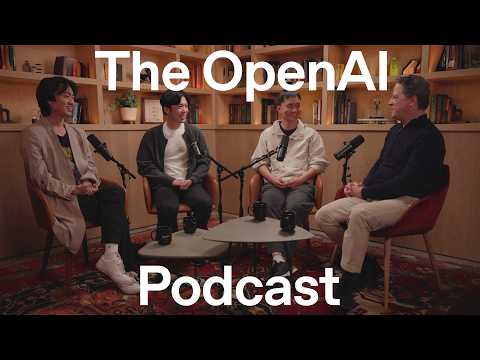
OpenAI Model Disproves 80-Year-Old Erdős Math Conjecture
OpenAI
The breakthrough demonstrates that scaling compute budget at inference time allows general-purpose AI models to generate genuine scientific creativity and solve deep structural problems once thought out of reach.
## Background
Published on YouTube by OpenAI on June 04, 2026, this episode of the OpenAI Podcast features reasoning researchers Alexander Wei, Hongxun Wu, and Lijie Chen. The description outlines their discussion on how a general-purpose model disproved Paul Erdős's 80-year-old unit distance conjecture, what it took to verify the proof, and the implications of this discovery for the future of mathematics and human-AI collaboration.
## TL;DR
The OpenAI reasoning research team details how an internal, general-purpose model successfully disproved a long-standing, 80-year-old conjecture in combinatorial geometry proposed by Paul Erdős. By utilizing test-time compute scaling to think longer and independently cross-referencing concepts like class field theory, the model generated a beautiful, highly symmetric geometric solution that human mathematicians quickly verified and built upon. The breakthrough serves as a powerful validation of letting models process complex problems deeply, while transforming the day-to-day workflow of researchers from manual hand-coding to high-level delegation. Ultimately, the team outlines an optimistic future where AI acts as a scientific equalizer and telescope, accelerating discoveries across mathematics, cryptography, and quantum computing.
## Atmosphere & style
The conversation carries an electric, late-night energy, captured by the revelation that the breakthrough left the entire research team having a hard time sleeping out of sheer excitement. The dynamic between host Andrew Mayne and the researchers is collaborative and deeply intellectual, shifting from initial, healthy scientific skepticism—where colleagues half-expected to find a bug in the code—into a state of dreamlike optimism as the proof held up under rigorous scrutiny. Listening to the episode feels like being flies on the wall in a cutting-edge research lab, balancing dense academic concepts with humorous, grounding anecdotes like the model looking up the definition of 'unit' in a dictionary. It evokes a profound sense of awe and empowerment, framing the rapid, exponential pace of AI progress not as a threat to human ingenuity, but as an exhilarating new frontier for scientific discovery.
## Key takeaways
- [00:00](https://www.youtube.com/watch?v=wNWz5Hbh5VQ&t=0s) Lijie Chen left academia for OpenAI after realizing that AI reasoning models achieving gold-medal performance in the IMO and IOI would have a massive global impact.
- [03:25](https://www.youtube.com/watch?v=wNWz5Hbh5VQ&t=205s) The OpenAI reasoning team developed a model that secured a gold medal in the International Mathematical Olympiad (IMO) by June 2024, far outpacing initial community expectations.
- [06:35](https://www.youtube.com/watch?v=wNWz5Hbh5VQ&t=395s) An general-purpose OpenAI model successfully disproved Paul Erdȃs's 80-year-old unit distance conjecture in discrete geometry, showing that a square grid is not optimal.
- [08:16](https://www.youtube.com/watch?v=wNWz5Hbh5VQ&t=496s) The model's proof was validated internally by OpenAI mathematicians who initially met the result with heavy skepticism before finding no mistakes after rigorous review.
- [14:55](https://www.youtube.com/watch?v=wNWz5Hbh5VQ&t=895s) The breakthrough serves as a validation of test-time compute scaling, showing that accuracy on difficult problems increases significantly as the model is given more time to think.
- [17:35](https://www.youtube.com/watch?v=wNWz5Hbh5VQ&t=1055s) The model exhibited genuine mathematical creativity by successfully connecting and applying class field theory to combinatorial geometry, a link humans had not executed before.
- [19:26](https://www.youtube.com/watch?v=wNWz5Hbh5VQ&t=1166s) AI agents and Codex have transformed the day-to-day workflow of researchers by handling complex coding and execution tasks, significantly reducing friction and increasing productivity.
- [21:08](https://www.youtube.com/watch?v=wNWz5Hbh5VQ&t=1268s) Researchers advise users to avoid human biases and cognitive priors when prompting by asking bold questions directly rather than breaking problems down into smaller pieces.
- [24:33](https://www.youtube.com/watch?v=wNWz5Hbh5VQ&t=1473s) The 'exponential trust heuristic' suggests users should double their trust in a model monthly until it fails, helping human workflows keep pace with rapid AI upgrades.
- [26:53](https://www.youtube.com/watch?v=wNWz5Hbh5VQ&t=1613s) The independent, effective working time horizon of reasoning models is doubling every few months, shifting from short-term problem solving toward long-term field invention.
- [31:17](https://www.youtube.com/watch?v=wNWz5Hbh5VQ&t=1877s) Human collaborators quickly utilized the model's core insights from the unit distance conjecture to disprove a separate, highly significant product conjecture for real numbers within a week.
- [38:39](https://www.youtube.com/watch?v=wNWz5Hbh5VQ&t=2319s) AI models are expected to accelerate quantum computing development by proposing novel, simpler quantum error-correcting codes rather than operating as quantum computers themselves.
- [39:58](https://www.youtube.com/watch?v=wNWz5Hbh5VQ&t=2398s) The interactive nature of reasoning models allows them to act as patient tutors, explaining complex proofs and mathematical steps line by line upon user request.
## Detailed walkthrough
### [00:00](https://www.youtube.com/watch?v=wNWz5Hbh5VQ&t=0s) Introduction and the Journey into Reasoning Research
Andrew Mayne introduces the OpenAI Podcast, welcoming Alexander Wei, Hongxun Wu, and Lijie Chen from the reasoning research team. The team recently achieved a major mathematical breakthrough using an OpenAI model, a feat so exciting that "everyone had a hard time sleeping." Lijie explains his transition into the field of AI reasoning. He was previously an assistant professor at UC Berkeley and a former participant in the International Olympiad in Informatics (IOI). After seeing Alex's breakthrough with models winning gold medals in the IOI and the International Mathematical Olympiad (IMO) in the summer of 2023, Lijie realized that making models smarter would have a massive global impact. Following a conversation with Alex in October, he decided to leave academia and join OpenAI.
Alex unpacks the significance of the IMO and IOI, describing them as "devilishly hard" high school competitions consisting of two sessions lasting four and a half to five hours, where participants must solve just three problems. For a long time, matching top human performance on these exams was considered an implicit grand challenge in AI. Alex, who did his PhD in machine learning, became fascinated with the idea of spending more compute at inference time to solve complex reasoning problems. While playing with GPT-3.5 Turbo via the API yielded no interesting results, he joined OpenAI to work with a team pursuing a similar vision.
- **IMO**: International Math Olympiad.
- **IOI**: International Olympiad of Informatics.
- **Test-time compute**: The paradigm of letting a model "think" longer, try different approaches, and improve its answer before outputting a final response, rather than answering immediately off the cuff.
[03:25](https://www.youtube.com/watch?v=wNWz5Hbh5VQ&t=205s) The Blistering Pace of Progress and the Erdős Unit Distance Conjecture
Reflecting on the timeline of reasoning research, Alex notes that in late 2023 and early 2024, models were still struggling with grade school math. On his first day at OpenAI, researcher Nolan Brown asked him when he thought a model would achieve an IMO gold medal. While many in the research community believed it was out of reach until 2026, Alex hoped they could push for it by April. They ultimately developed a capable model by June, which went on to secure gold when the IMO occurred. "It was just 10 months ago," Alex remarks, "but it feels like the IMO level of problem feels far in the rearview mirror of AI today." Lijie recalls Nolan asking him a similar question about whether a model could solve the famous P versus NP problem, though Lijie believes P versus NP is still far off because it requires building entirely new theories and writing "many books of new ideas."
Hongxun Wu, who also did his PhD at Berkeley and collaborated closely with Lijie in theoretical computer science, shares his own turning point. When OpenAI's o1 model was released, he told his advisor, "Oh, there's no barrier in models solving math problems anymore." His advisor simply smiled, knowing he was about to lose a student to OpenAI.
The conversation shifts to the team's recent breakthrough: disproving the unit distance conjecture proposed by Paul Erdős. This 80-year-old open problem in combinatorial geometry asks: if you have $n$ points on a piece of paper, how many pairs of points can be exactly one inch apart, and how does this number grow asymptotically? Erdős originally conjectured that the optimal arrangement was a square grid. The general-purpose OpenAI model proved that the square grid is not close to optimal, constructing a far superior arrangement using high-powered number theory.
- **Erdős Unit Distance Conjecture**: An 80-year-old open problem in discrete geometry.
- **The Disproof**: The model showed that a square grid is not optimal and constructed a better solution using class field theory.
- **Erdős's Reward**: Erdős had offered a $500 bounty for the solution to this central question in discrete geometry.
[08:16](https://www.youtube.com/watch?v=wNWz5Hbh5VQ&t=496s) Discovering the Proof and the Team's Reaction
Hongxun explains that they did not specifically target this problem to make a statement; rather, they selected a subset of Erdős problems to test the upper bound of their model's capabilities. Both Hongxun and Lijie were testing different internal models when they simultaneously saw correct solutions emerge. To verify the results, they first asked the model to check its own work, but knowing models can be unreliable, they reached out to math experts within OpenAI, including Mehtaab and Mark Sellke.
Initially, the mathematicians were highly skeptical, declaring, "there's no way this can be true." However, after studying the output for a day and failing to find any mistakes, their confidence grew. Mehtaab initially gave it a 50% chance of being correct, prompting Lijie to joke that if they extrapolated the trend, it would be 100% the next night. Once the proof was verified, the excitement kept the team awake. Lijie describes the experience as "dreamlike" but also natural, realizing they had generated a result that "can be published in the best journal of math" and is "way beyond IMO level."
- **Verification Process**: The proof was vetted internally by OpenAI mathematicians Mehtaab and Mark Sellke over several days.
- **Visualizing the Solution**: When plotted on a grid, the model's geometric construction forms a highly symmetric, beautiful design that the team hopes to frame for their desks.
[14:55](https://www.youtube.com/watch?v=wNWz5Hbh5VQ&t=895s) How the Model Thinks: Creativity, Tools, and Grounding
Alex explains that the breakthrough serves as a powerful validation of test-time compute. A plot in their official blog post demonstrates that as the model is given more time to think, its accuracy on this difficult problem scales significantly, reaching nearly 50% correctness with extended thinking time. The model used is not a specialized math model, but a general-purpose system similar to Codex that can write and execute Python code and search the web.
Lijie shares a humorous anecdote about how the model grounded itself before tackling the problem. Upon accessing the web, the very first thing the model did was look up the definition of the word "unit" in the Cambridge Dictionary to ensure it had an absolutely correct, fundamental understanding of the term.
When analyzing the proof, Alex notes that the model displayed genuine mathematical creativity. It bridged two distinct fields—applying class field theory to combinatorial geometry—a connection that some human mathematicians knew was theoretically possible but had never successfully executed. The execution of the proof itself was "a very delicate, careful affair." Rather than feeling intimidated by this capability, Lijie finds it empowering. Since the proof was released, human mathematicians have already improved upon the model's bounds and used its novel construction to crack other open problems. "Model can make good breakthrough on some very hard questions we don't know how to solve," Lijie says, but humans are still essential to digest these ideas and apply them to new domains.
- **Scaling Law**: "More thinking, more correctness." Accuracy scales with increased inference compute.
- **The Cambridge Dictionary Incident**: The model verified the definition of "unit" online to ground its understanding before starting the proof.
- **Human-AI Collaboration**: Mathematicians have already used the model's proof to improve mathematical bounds and solve other open problems.
[19:26](https://www.youtube.com/watch?v=wNWz5Hbh5VQ&t=1166s) Empowering Researchers and Transforming the Day-to-Day Workflow
The discussion begins with a reflection on how AI is fundamentally changing the nature of research. While AI currently struggles to build entirely new mathematical theories from scratch, it excels at pulling together disparate ideas from distinct fields. This capability empowers human researchers to make connections they might have otherwise missed. The speakers, all AI researchers themselves, note that their own day-to-day work has been completely transformed compared to when they first entered the field.
The shift in workflow is dramatic. Tasks that used to require manual coding and digging through Slack channels for direction are now routinely handed off to coding agents. One speaker shares that they now default to asking Codex to handle complex tasks, allowing them to step away for lunch or talk to colleagues while the model works. This constant, tireless availability of AI tools has actually increased their drive to get things done, creating a "magical feeling" of using AI to build AI faster.
- **Coding Agents:** Researchers have transitioned from hand-coding to delegating major tasks to Codex, even monitoring progress from their phones.
- **Increased Productivity:** Rather than working less because the tools are efficient, researchers find themselves wanting to do more because the friction of execution has been removed.
[21:08](https://www.youtube.com/watch?v=wNWz5Hbh5VQ&t=1268s) Demystifying AI for Other Fields and the Power of "Bold Questions"
When explaining these advancements to friends in other fields, such as mathematics, the researchers emphasize empowerment over replacement. The fear of AI replacing mathematicians is common, but the reality is that AI serves as an equalizer. Because it possesses a vast repository of knowledge and can see connections that are difficult for a single human to spot, it can solve the bottleneck problems that hold theoretical researchers back. The ultimate vision is a world where every scientist has access to top-tier reasoning capabilities, dramatically accelerating global scientific discovery.
For researchers looking to get started, the advice is simple: get a ChatGPT Pro subscription and "ask the boldest question you can ask." One speaker shares a personal anecdote about trying to decompose a complex problem into smaller, bite-sized questions for the model. Surprisingly, this approach performed worse than simply asking the bold question directly. Because humans carry cognitive priors and biases about how a problem *should* be solved, their decompositions can introduce blind spots. The AI, free of these specific human priors, can surprise users by discovering hidden paths to a solution.
- **The "Graduate Student" Analogy:** Researchers are advised to treat the model like a capable graduate student—not talking down to it, but communicating at a high level of shared terminology.
- **Avoiding Human Priors:** Decomposing problems based on human assumptions can limit the model; direct, bold prompting often yields more creative and successful results.
[24:33](https://www.youtube.com/watch?v=wNWz5Hbh5VQ&t=1473s) The Exponential Trust Method and the Future of Problem-Solving
To maximize the utility of these rapidly evolving models, the speakers discuss the challenge of overcoming old habits. Researchers who have been in the field for years often carry "bad habits" of underestimating the models, treating them as if they still have the limitations of six months ago. To combat this, a simple heuristic is proposed: "every time you double your trust on a model and see when it fails." If it fails, the user backs off slightly, repeating this calibration monthly to keep pace with exponential improvements.
This rapid advancement brings legitimate concerns for fields like mathematics that are heavily problem-solving oriented, as models are becoming exceptionally good at solving structured problems. However, the speakers offer an optimistic view: mathematics is far more than just problem-solving; it is about understanding structure and building new theories. By offloading tedious calculations and problem-solving to AI, mathematicians can focus on high-level theory generation.
- **Exponential Trust Heuristic:** Double your trust in the model monthly until it breaks, then step back, allowing your workflow to keep pace with rapid AI upgrades.
- **The 10-Idea Paradigm:** Instead of manually testing ideas, a mathematician can soon task 10 different models to run 10 separate ideas simultaneously, mimicking the productivity boom seen in software engineering.
[26:53](https://www.youtube.com/watch?v=wNWz5Hbh5VQ&t=1613s) Unsolved Erdős Problems and the Next Milestones
The conversation turns to the famous mathematical problems posed by Paul Erdős. While some of these problems are highly curious and collaborative, others, like the Collatz conjecture, remain incredibly deep and seemingly out of reach for current mathematical technology. The speakers do not expect all Erdős problems to fall overnight, but they are highly optimistic about what happens when these reasoning models are applied to other data-rich fields like physics and astronomy.
When asked what major milestones they hope to see next, the researchers share distinct, ambitious goals. One hopes the models will finally solve the legendary "P versus NP" problem. Another looks forward to the next major paradigm shift: AI that can do AI research itself, helping to overcome the inherent limitations of human intelligence. A third interest lies in seeing whether AI can move beyond combining existing ideas to generating entirely new, sophisticated concepts from scratch.
- **Creative Traces in Chain of Thought:** Even when a model's final answer is a combination of existing ideas, its internal 125-page chain of thought often displays highly creative, albeit sometimes unsuccessful, intermediate steps.
- **Moore's Law for Time Horizons:** The independent, effective working time of these models is doubling every few months, moving from short-term problem-solving toward the years-long horizons required for inventing new fields of mathematics.
[31:17](https://www.youtube.com/watch?v=wNWz5Hbh5VQ&t=1877s) Test-Time Compute Scaling and Real-World Scientific Collaboration
Reflecting on the breakthrough of solving the Erdős unit distance conjecture, the speakers clarify a key technical detail: the original internal model achieved this result with zero scaffolding or external steering. While subsequent public models like GPT-5.5 and efforts from other labs have replicated the achievement, they often required more structured prompting. The core driver of this capability is "test-time compute scaling"—as more computational budget is poured into letting the model think, its success rate on incredibly difficult problems scales dramatically, reaching up to 50% on this specific conjecture.
The ultimate goal of this research is not for OpenAI to run a closed race to solve every mathematical puzzle, but to put these tools in the hands of the global scientific community. The impact is already tangible: a group of mathematicians reviewing the proof of the unit distance conjecture used the model's core ideas to disprove a related product conjecture for real numbers within a single week. This rapid cross-pollination of ideas demonstrates how AI can act as a telescope for modern scientists.
- **Test-Time Compute:** Giving the model more compute budget to "think" longer yields a virtuous cycle where next-generation models can learn from these deep solutions and become more efficient.
- **Disproving the Product Conjecture:** Within a week of reviewing the AI's proof, human collaborators successfully applied its novel insights to disprove a separate, highly significant conjecture.
- **Cryptography and Security:** Beyond pure math, these models could be used to stress-test the foundations of cryptography, either proving conjectured security protocols or identifying critical loopholes to improve global security.
[38:39](https://www.youtube.com/watch?v=wNWz5Hbh5VQ&t=2319s) Quantum Computing and the Role of AI
One of the speakers reflects on their academic background, noting that they used to study quantum computing and even wrote their first paper on "quantum advantage"—the concept that quantum computers can outperform classical systems on specific tasks. However, they clarify that current AI models are still classical computers. While classical systems can simulate complex quantum effects in chemistry, quantum and classical computing remain two entirely different paradigms, making direct comparisons difficult.
Despite these differences, the speaker is highly optimistic that AI will "greatly accelerate the pace that we develop quantum computers." They point to recent breakthroughs in quantum error-correcting codes that utilize simpler physical operations to speed up implementation. The speaker envisions a collaborative future where AI models propose novel quantum error correction algorithms, dramatically shortening the timeline for building viable quantum hardware.
[39:58](https://www.youtube.com/watch?v=wNWz5Hbh5VQ&t=2398s) Interactive Learning and Overcoming Research Skepticism
Beyond raw, one-shot problem-solving, the interactive nature of these AI models offers a powerful educational tool. When a model solves a complex problem, the user can immediately follow up with questions like "how did you solve it?" or "can you explain this part of the proof to me?" The model will then "patiently try to teach you how everything goes line by line," transforming the technology from a mere calculator into an active, patient tutor.
The conversation wraps up with a relatable reflection on the nature of scientific discovery. In research, a common rule of thumb is that if results look too good to be true, there is almost certainly a bug in the code or experiment. When the speaker first heard about the breakthrough results from Lijie and Hongxun, their immediate instinct was skeptical: "Oh, I'll wait for them to find the bug." However, as the days passed without any errors emerging, a "growing optimism" took over, leading to the thrilling realization that this might actually be that rare "one in a hundred times" where an unbelievable result turns out to be entirely true.
- The speaker's first academic paper focused on quantum advantage.
- AI's primary contribution to quantum computing is expected to be in designing simpler, more efficient quantum error-correcting codes.
- The collaborative research process shifted from initial skepticism to genuine excitement as the breakthrough results held up over time.
## Notable quotes
> [00:00](https://www.youtube.com/watch?v=wNWz5Hbh5VQ&t=0s) everyone had a hard time sleeping. — Andrew Mayne
> [03:25](https://www.youtube.com/watch?v=wNWz5Hbh5VQ&t=205s) It was just 10 months ago, but it feels like the IMO level of problem feels far in the rearview mirror of AI today. — Alexander Wei
> [03:25](https://www.youtube.com/watch?v=wNWz5Hbh5VQ&t=205s) Oh, there's no barrier in models solving math problems anymore. — Hongxun Wu
> [08:16](https://www.youtube.com/watch?v=wNWz5Hbh5VQ&t=496s) there's no way this can be true. — OpenAI mathematicians
> [08:16](https://www.youtube.com/watch?v=wNWz5Hbh5VQ&t=496s) can be published in the best journal of math — Lijie Chen
> [14:55](https://www.youtube.com/watch?v=wNWz5Hbh5VQ&t=895s) More thinking, more correctness. — Alexander Wei
> [14:55](https://www.youtube.com/watch?v=wNWz5Hbh5VQ&t=895s) Model can make good breakthrough on some very hard questions we don't know how to solve, — Lijie Chen
> [21:08](https://www.youtube.com/watch?v=wNWz5Hbh5VQ&t=1268s) ask the boldest question you can ask.
> [24:33](https://www.youtube.com/watch?v=wNWz5Hbh5VQ&t=1473s) every time you double your trust on a model and see when it fails.
> [39:58](https://www.youtube.com/watch?v=wNWz5Hbh5VQ&t=2398s) patiently try to teach you how everything goes line by line,
> [39:58](https://www.youtube.com/watch?v=wNWz5Hbh5VQ&t=2398s) Oh, I'll wait for them to find the bug.
## Mentioned
OpenAI Podcast, Andrew Mayne, Alexander Wei, Hongxun Wu, Lijie Chen, OpenAI, UC Berkeley, International Olympiad in Informatics, International Mathematical Olympiad, GPT-3.5 Turbo, Nolan Brown, P versus NP, o1, Erdős unit distance conjecture, Paul Erdős, Mehtaab, Mark Sellke, Codex, Cambridge Dictionary, ChatGPT Pro, Collatz conjecture, GPT-5.5
OpenAI researchers Alexander Wei, Hongxun Wu, and Lijie Chen report that an internal reasoning model disproved Paul Erdős's 80-year-old unit distance conjecture by applying class field theory to combinatorial geometry. The achievement highlights the efficacy of test-time compute scaling, which allocates more inference compute for extended deliberation, while transforming how researchers approach mathematical discovery.
Disproving Erdős's Unit Distance Conjecture (3:25)
Paul Erdős's open problem in discrete geometry asks how many pairs among n points on a plane can be exactly one unit apart. Erdős conjectured that a square grid yielded the optimal asymptotic bound, offering a $500 bounty for a solution. Rather than relying on a specialized math engine, OpenAI researchers tested an internal, general-purpose model equipped with web search and Python code execution. The model demonstrated that the square grid is not optimal, constructing a superior configuration using class field theory—bridging two distinct mathematical fields in a manner human mathematicians had theorized but never executed.
The result emerged when researchers tested a subset of Erdős problems without targeted steering. Because AI proofs can be unreliable, OpenAI mathematicians Mehtaab and Mark Sellke evaluated the output over several days before confirming its validity. When visualized on a grid, the model's construction formed a highly symmetric geometric design, producing a result that researchers noted was suitable for leading mathematical journals and far beyond competition-level mathematics.
Test-Time Compute and Reasoning Mechanics (14:55)
The researchers attribute this breakthrough to test-time compute, a paradigm where a model spends computation during inference to evaluate hypotheses, explore multiple paths, and self-correct before outputting an answer. While AI models struggled with grade-school math in late 2023, allocating more inference compute enabled systems to achieve International Olympiad in Informatics (IOI) and International Mathematical Olympiad (IMO) gold-medal levels by mid-2024. On the Erdős problem, the model's accuracy scaled steadily with thinking time, reaching nearly 50% correctness.
During its reasoning process, the model produced an internal chain of thought spanning 125 pages, displaying complex intermediate steps. Alex Wei noted that the original internal run succeeded with zero external scaffolding, whereas subsequent public models like GPT-5.5 or external replications often required structured prompts. The model also grounded its work autonomously; upon accessing the web, it first queried the Cambridge Dictionary to confirm the fundamental definition of "unit" before beginning its geometric proof.
Workflow Shifts and Prompting Strategies (21:08)
The rapid advancement of reasoning models has overhauled the research team's daily workflow. Tasks that once required manual coding are now delegated to coding agents like Codex, allowing researchers to monitor work from their phones. To keep pace with exponential improvements, the team recommends an "exponential trust" heuristic: doubling trust in a model each month until it fails, then recalibrating downward.
When interacting with theoretical models, the researchers caution against decomposing problems into small steps based on human intuition. Human decomposition often injects cognitive priors and biases about how a problem should be solved, inadvertently creating blind spots. Instead, treating the model like an advanced graduate student and presenting direct, bold questions allows the AI to discover unconstrained, novel paths to solutions.
Scientific Cross-Pollination and Future Boundaries (31:17)
The researchers frame AI as an equalizer for human scientists rather than a replacement, functioning like a telescope to resolve theoretical bottlenecks. Within a week of reviewing the model's disproof, external mathematicians applied its core insights to disprove a separate product conjecture for real numbers, while others improved the quantitative bounds of the AI's proof. Beyond pure mathematics, researchers anticipate using these reasoning models to stress-test cryptographic assumptions and design simpler quantum error-correcting codes.
However, the team outlines clear boundaries for near-term AI capabilities. Lijie Chen argues that problems like P versus NP remain distant because they require constructing entirely new theoretical frameworks across multiple volumes of work, rather than combining existing concepts. While some open questions like the Collatz conjecture appear currently out of reach, the effective independent working horizon of reasoning models continues to expand rapidly.
While reasoning models can now synthesize distinct disciplines to solve longstanding mathematical conjectures, foundational questions like P versus NP remain constrained by the need for entirely new theoretical structures. The researchers conclude that the immediate value of reasoning models lies in empowering scientists to offload computational and problem-solving friction, accelerating discovery across mathematics, quantum computing, and cryptography.
## Background
本期内容来自 OpenAI 官方 YouTube 播客《the OpenAI Podcast》第 20 期,发布于 2026 年 7 月 3 日。节目由 Andrew Mayne 主持,邀请了 OpenAI 推理研究团队的核心成员 Alexander Wei、吴鸿勋与陈立杰,共同探讨通用推理模型如何成功推翻著名数学家保罗·埃尔德什(Paul Erdős)长达 80 年的经典猜想,以及这一突破背后的技术机制与对未来数学研究的深远影响。
## TL;DR
节目深入复盘了 OpenAI 通用推理模型攻克埃尔德什单位距离猜想(Erdős Unit Distance Conjecture)的全过程。三位核心研究员详细还原了敲下回车得出解法时的震撼、内部顶尖数学家严谨审查后确认无懈可击的心态起伏,并阐明该突破依托的是测试时计算扩展(Test-Time Compute Scaling)而非特化的数学专用架构。模型在推导中创造性地引入代数数论中的类域论跨界解决组合几何难题,甚至在数周内启发数学同行连破相关新猜想。嘉宾们强调,AI 的演进并非为了取代数学家或倾倒无意义的“AI 垃圾”,而是充当如同射电望远镜般的赋能重器,推动人类从机械解题迈向更宏大的底层理论构建。
## Atmosphere & style
对谈在理智严谨的学术求真与难以掩饰的少年意气间流畅切换,充满了前沿突破带来的兴奋与敬畏感。三位兼具奥赛金牌与顶尖学术背景的青年研究员毫无傲气,而是以一种“先怀疑是 Bug,直到排除一切不可能才敢相信奇迹”的极客幽默,坦诚分享彻夜失眠的狂喜、向导师请辞的轶事以及模型查阅《剑桥词典》的呆萌细节。整场播客既有对底层算力飞跃与深奥数论连接的硬核拆解,又弥漫着见证历史奇点来临时的诗意与激动,听来令人手心发热、心潮澎湃。
## Bulletin
- [06:35](https://www.youtube.com/watch?v=wNWz5Hbh5VQ&t=395s) OpenAI 通用推理模型在无脚手架引导的情况下,成功构造反例证伪了保罗·埃尔德什悬置 80 年的单位距离猜想,并经公司内部数学专家严格闭门核验确认无误。
- [14:55](https://www.youtube.com/watch?v=wNWz5Hbh5VQ&t=895s) 该模型并非专用数学求解器,而是通用基座模型,其在推导中创造性地将代数数论中的类域论跨界引入组合几何,展现出超越传统人类直觉的知识融通能力。
- [31:17](https://www.youtube.com/watch?v=wNWz5Hbh5VQ&t=1877s) 测试时计算(Test-Time Compute)扩展定律得到验证:随着长考时间和算力预算增加,模型攻克该 80 年难题的单次成功率可攀升至约 50%。
- [34:29](https://www.youtube.com/watch?v=wNWz5Hbh5VQ&t=2069s) 人类数学同行在审阅该证明后的一周内,借鉴模型的核心构思迅速证伪了另一道关于实数的乘积猜想,验证了 AI 成果对基础科学的启发与外溢价值。
## Key takeaways
- [03:25](https://www.youtube.com/watch?v=wNWz5Hbh5VQ&t=205s) 从 2023 年底勉强应对小学奥数,到 2024 年 6 月在 IMO 斩获金牌表现,再到攻克 80 年历史公开猜想,推理模型的演进速度远超学界此前预期。
- [03:25](https://www.youtube.com/watch?v=wNWz5Hbh5VQ&t=205s) 不同于单纯技巧堆叠的竞赛题,像 P vs NP 这样的计算机科学终极难题需要奠定全新的庞大理论体系,当前 AI 距离解决此类问题仍较为遥远。
- [06:35](https://www.youtube.com/watch?v=wNWz5Hbh5VQ&t=395s) 埃尔德什单位距离猜想曾悬赏 500 美元且被探讨近一个世纪;长期以来数学界普遍认同正方形网格为最优分布,而模型构造出了渐近表现更优的全新点集。
- [14:55](https://www.youtube.com/watch?v=wNWz5Hbh5VQ&t=895s) 模型利用网页浏览和代码执行等通用工具自主探索,在破题前甚至先翻查《剑桥词典》校准“unit”定义,体现出极高的自我锚定与概念严谨性。
- [18:24](https://www.youtube.com/watch?v=wNWz5Hbh5VQ&t=1104s) AI 不应被视作数学家的替代者,而是如同射电望远镜一般的科研杠杆,负责单点突破攻坚,由人类学者提炼理念并拓展理论大厦。
- [25:22](https://www.youtube.com/watch?v=wNWz5Hbh5VQ&t=1522s) 软件工程领域的 Jevons 悖论正在数学研究中重现:AI 工具的大幅增效不会消灭科研需求,反而会指数级催生更多大规模并行假设与概念探索。
- [23:07](https://www.youtube.com/watch?v=wNWz5Hbh5VQ&t=1387s) 研究员提出“每月将对模型的信任度翻倍”法则,通过动态摸索模型崩溃边界来高效逼近系统能力上限,同时建议直接抛出宏大的原始难题而非人为拆解。
- [31:17](https://www.youtube.com/watch?v=wNWz5Hbh5VQ&t=1877s) 该次数学突破完全基于单次 Prompt 触发的端到端超长推理,而非依赖复杂的外部脚手架系统或提示流水线编排。
- [36:09](https://www.youtube.com/watch?v=wNWz5Hbh5VQ&t=2169s) 团队强调探索初衷是向学界展示测试时算力的潜能边界,坚决避免无意义的“AI 垃圾(AI slop)”倾倒与竞赛式的“猜想清单刷题”。
- [37:30](https://www.youtube.com/watch?v=wNWz5Hbh5VQ&t=2250s) 推理模型将充当现代密码学理论基石的“压力测试机”,并在经典计算端赋能新型量子纠错码的设计与优化,降低物理量子硬件落地门槛。
- [39:58](https://www.youtube.com/watch?v=wNWz5Hbh5VQ&t=2398s) 模型支持苏格拉底式的逐行追问交互,使科研人员能详细拆解机器构思逻辑,摆脱单纯输出黑盒答案的局限。
## Detailed walkthrough
### [00:00](https://www.youtube.com/watch?v=wNWz5Hbh5VQ&t=0s) 震惊数学界的突破与研究团队集结
节目开场,主持人 Andrew Mayne 介绍了本期的三位嘉宾:来自 OpenAI 推理研究团队(Reasoning Research Team)的 Alexander (Alex) Wei、吴鸿勋(Hongxun Wu)与陈立杰(Lijie Chen)。他们正是近期利用 OpenAI 通用推理模型打破数学界长期僵局、推翻保罗·埃尔德什(Paul Erdős)一个长达 80 年历史著名猜想的核心成员。谈及当时的发现,整个团队的心情仍久久不能平复——所有人激动得整夜失眠,感叹这一成果“完全可以直接发表在顶尖数学期刊上”,更是一场“百次中难得一遇、美妙到不真实却切实发生了的奇迹”。
陈立杰回顾了自己加入 OpenAI 推理团队的契机。作为曾经的国际信息学奥林匹克竞赛(IOI)金牌得主,他在去年夏天看到 Alex Wei 带领团队让模型在 IOI 和国际数学奥林匹克竞赛(IMO)上斩获金牌级别表现时受到了极大震撼。当时陈立杰正在加州大学伯克利分校(UC Berkeley)担任助理教授,但他敏锐地意识到,投身于让模型变得更聪明的研究,对世界带来的影响力或许远超传统的学术教职。在去年 10 月与 Alex 深入交流后,他怀着极大的兴奋毅然走出学术界象牙塔,正式加入 OpenAI。
- 对谈嘉宾:Alexander Wei、吴鸿勋、陈立杰(OpenAI 推理团队成员)。
- 核心突破背景:推理模型成功证伪了著名数学家保罗·埃尔德什提出已有 80 年之久的数学猜想。
- 职业转变:陈立杰此前为 UC Berkeley 助理教授及 IOI 参赛选手,因模型在顶级竞赛中的惊人表现决定转投工业界前沿研究。
---
### [01:24](https://www.youtube.com/watch?v=wNWz5Hbh5VQ&t=84s) 竞赛基准与思维时间计算(Inference-Time Compute)的兴起
Alex Wei 向听众拆解了 IMO(国际数学奥林匹克)与 IOI(国际信息学奥林匹克)的分量。这两项赛事代表着高中阶段全球最具挑战性的理科竞赛,赛程极其严苛——每场竞赛分两个时段,每段长达 4.5 到 5 个小时,选手却仅仅需要解决三道题目,题目的难度与深度堪称魔鬼级别。多年以来,能否训练出媲美人类顶尖竞赛选手的 AI 模型,一直是人工智能领域长期公认的“大挑战(Grand Challenge)”,也构成了衡量模型高级思维能力的黄金基准。
在分享自己的研究历程时,Alex 提到自己在攻读机器学习博士学位临近毕业时,敏锐地关注到“通过在推理阶段(Inference time / Test time)消耗更多算力来解决复杂推理问题”这一方向。最初,他在 GPT-3.5 Turbo 的 API 上进行尝试,但收效甚微;随后他发现 OpenAI 内部正有一支团队在全力攻坚极其相似的路线,便果断加入。他解释道,在推理时间计算普及之前,大语言模型面对提问往往是“脱口而出”,没有任何构思余地;而给予模型测试期算力(Test-time Compute),本质上就是“允许模型在最终输出答案前先停下来思考、尝试不同路径并自我纠错”,这从根本上解锁了模型解决超高难度问题的能力。
---
### [03:25](https://www.youtube.com/watch?v=wNWz5Hbh5VQ&t=205s) 飞速演进的时间线与 P vs NP 的遥远构想
谈及推理模型的发展速度,Alex 感慨现实完全超出了所有人的预料。就在 2023 年底至 2024 年初,顶尖模型甚至还在被小学水平的应用数学题绊倒,当时团队内部的愿景仅仅是“能不能先让模型在数学上给出合理的表现”。Alex 回忆起入职 OpenAI 的第一天,研究员 Noam Brown 询问他认为模型何时能在 IMO 中摘金。当时多数研究人员悲观地认为这一目标至少要等到 2026 年,而 Alex 虽抱有一丝雄心觉得如果全力冲刺或许能在 2024 年 4 月达成,但实际直到 6 月才训练出高水准模型,并在随后到来的 IMO 竞赛中成功斩获金牌。然而仅仅过去不到一年,如今攻克 IMO 级难题在 AI 的视野中已经成了“后视镜里的风景”。
有趣的是,Noam Brown 也曾向陈立杰抛出过类似的问题:模型是否有朝一日能够解决计算机科学皇冠上的明珠“P vs NP 问题”。对此,理论计算机科学出身的陈立杰表现得非常清醒和严谨。他认为解决 P 与 NP 难题在当前看来依旧遥不可及,因为破解该猜想不可能依靠单纯的计算技巧堆砌,而是必须奠定一整套全新的数学理论基础,甚至需要写出多本充满革命性构想的理论巨著。吴鸿勋随后也谈及自己转向推理研究的经历——他此前在 Berkeley 攻读博士并长期与陈立杰合作,当看到 OpenAI o1 模型发布时,他兴奋地跑去告诉自己的博士生导师:“模型解决数学问题已经不存在任何无法逾越的壁垒了!”而导师只是会心一笑,因为他明白自己注定要“失去”这位优秀的学生了。
- 演进速度:从 2023 年末难以稳定处理小学奥数,到 2024 年 6 月达成 IMO 金牌水准,模型进化速度远超行业预期。
- 理论极限探讨:陈立杰认为 P vs NP 的难度层级不同,需要人类或 AI 建立跨时代的庞大理论体系。
- 导师的预感:吴鸿勋在目睹 o1 表现后认定技术奇点已至,其导师心照不宣地预料到他会提前离开学术界加盟 OpenAI。
---
### [06:35](https://www.youtube.com/watch?v=wNWz5Hbh5VQ&t=395s) 攻克埃尔德什单位距离猜想(Erdős Unit Distance Conjecture)
话题转向了本次访谈的核心事件:模型推翻埃尔德什的单位距离猜想。Alex 解释,这是一个在组合几何领域悬置了 80 年之久的经典未解问题。其基本表述极其直观:如果在平面(例如一张纸)上任意放置 $n$ 个点,其中两点之间距离恰好为 1 英寸的点对最多能有多少对?当总点数 $n$ 趋于无穷时,这个最大对数的渐近增长趋势(Asymptotic Growth)是怎样的?
在过去的大半个世纪中,数学界普遍倾向于支持埃尔德什最初的直觉判断,即在平面上摆放单位距离点对的最优方案是将它们排布在一个规则的“正方形网格(Square Grid)”中。然而,OpenAI 的通用推理模型所给出的反例证明,正方形网格根本不是渐近最优解,甚至离最优情况相去甚远。模型自主构思并构造出了一种完全不同的点集排列方式,并在论证过程中调用了大量高深的数论(Number Theory)工具,漂亮地打破了这一维持了 80 年的认知构想。
```mermaid
flowchart TD
accTitle: 模型证伪埃尔德什单位距离猜想逻辑示意图
accDescr: 展示了从埃尔德什的历史假设到 OpenAI 通用推理模型通过高等数论构建反例并证伪的过程
subgraph Historical["历史猜想 (80 年未决)"]
A["平面上 n 个点之间最多能构成多少对单位距离?"] --> B["埃尔德什直觉假设:<br>正方形网格分布即为最优解"]
end
subgraph ModelBreakthrough["通用推理模型突破"]
C["通用模型接入测试期计算进行深度推演"] --> D["引入深奥数论工具进行全新几何构造"]
D --> E["构造出渐近表现远超正方形网格的点集反例"]
end
B -.->|彻底证伪| E
```
---
### [08:17](https://www.youtube.com/watch?v=wNWz5Hbh5VQ&t=497s) 敲下回车之后:从“绝不可能”到无懈可击的验证过程
吴鸿勋谈到这项探索的开端并非预先设定好的剧本。团队当时的目标仅仅是探寻模型能力的上限边界,因此从埃尔德什遗留的大量开放问题中挑选了一个子集让模型尝试。在那个决定性的时刻,吴鸿勋与陈立杰几乎同时敲下回车,在两款内部略有差异的模型上并行测试,结果两边的运行记录中均吐出了看似正确无误的数学解答。
面对这一过于惊人的输出,团队首先让模型自身进行多轮交叉自查,在确认推导逻辑具备极高合理性后,他们将解法发给了公司内的顶尖数学专家 Mehtaab Sawhney 和 Mark Sellke。起初,数学家们的第一反应都是“这绝不可能,这可是一个重大的历史未解难题”。然而在闭门细致核验了一整天之后,两位顶级学者未能挑出任何逻辑瑕疵或计算漏洞。伴随着验证的推进,怀疑逐渐变成了难以置信的赞叹与折服,当晚整个研究团队由于沉浸在无与伦比的兴奋之中,几乎全员失眠。
- 探索初衷:纯粹为了压榨模型能力极限而选取埃尔德什难题集进行压力测试。
- 现场细节:吴鸿勋与陈立杰在内部不同模型版本上同时跑出可行解。
- 内部核验专家:Mehtaab Sawhney 与 Mark Sellke 参与人工数学审校。
---
### [09:39](https://www.youtube.com/watch?v=wNWz5Hbh5VQ&t=579s) 审慎的数学家与美妙的“百里挑一”
陈立杰生动地还原了与数学家 Mehtaab Sawhney 沟通的心态起伏。当 Mehtaab 最初审阅仅 5 到 10 分钟并断言“这肯定不对”时,陈立杰内心其实并未动摇,因为他深知这种级别的证明绝不可能在几分钟内被看穿。果然,不久后 Mehtaab 给出的置信度调整到了 50%;陈立杰当时便半开玩笑地推想:如果按照这种置信度的上升趋势外推,到明天晚上结论大概率就会变成 100% 正确。
最终的结果正如预料,证明的每个环节都被确认为无懈可击。陈立杰感慨,那一刻的感觉既像在做梦,又带有一种奇妙的必然感——大家早就深信这一天迟早会到来,模型必然会创造出足以登上顶尖数学期刊的重大突破,只是谁也没想到这具有历史意义的一刻竟然来得如此迅猛。通常在科研探索中,“好到不像是真的”的事情往往真的是假的,但这恰恰是那“百次中唯独成真的一次”。
---
### [11:04](https://www.youtube.com/watch?v=wNWz5Hbh5VQ&t=664s) 通用模型的力量:非特化架构带来的科研发现
主持人 Andrew Mayne 指出,OpenAI 的研究哲学一贯强调不针对孤立的细分基准(Benchmark)进行定制化微调或过拟合训练,而是集中力量打造具备普适推理能力的通用大模型。这种通用的智能往往会在各个专业领域中自然涌现出令人意想不到的顶级解决能力。
Alex Wei 对此深表赞同。他透露,这项证明埃尔德什猜想的模型在本质上就是一个高水准的通用大模型,其内部所使用的能力底座并非狭隘的专用数学证明器;实际上,团队成员们平时甚至会直接用该模型来替代现有的编程模型(如用于驱动 Codex 的模型)去处理日常的工程和代码任务。正是这种深厚的通用泛化能力,才赋予了模型跨越特定人类认知死角、挖掘出全新数学构造的非凡力量。
### [11:43](https://www.youtube.com/watch?v=wNWz5Hbh5VQ&t=703s) 轰动学界:各方反响、对称几何构造与悬赏 500 美元的核心猜想
作为通用推理模型,它在解决 Erdős 单位距离(Erdős unit distance)问题上表现出惊人的能力。Alexander Wei 提到,在不久的将来,普通人在家里也能够运行具备这种能力并得出类似研究成果的模型。回顾不久之前,大众和学术界普遍还认为 AI 模型根本不擅长数学,而如今模型已经能够做出重大的数学突破。
陈立杰(Lijie Chen)分享了结果公布后的有趣经历:理论计算机科学(TCS)圈子里的朋友纷纷找上门来,让他用该模型跑跑他们手头的未解难题;甚至连他的博士导师也直接塞给他两三个公开问题(open problems)让他去试。整个学术界的反响极为正面,大家真切感受到当前的 AI 前沿已经能够产出让许多人类数学家都为之自豪的研究成果。主持人还提到,网友们在网上将模型给出的构造(construction)绘制在网格上,展现出一种极其优美且高度对称的几何图案;吴鸿勋(Hongxun Wu)笑着表示,团队甚至打算将其中一幅图案装进相框,摆在办公桌上以纪念这一重要时刻。
关于 Erdős 提出的诸多猜想,吴鸿勋解释说,保罗·埃尔德什(Paul Erdős)一生提出了上千甚至更多的问题,有些纯粹是他吃完午餐后随口一提的杂想,但本项成果攻克的单位距离问题截然不同——它是离散几何(discrete geometry)领域的中心问题之一,在过去近一个世纪的大量离散几何论文中被反复深入探讨。Erdős 曾在上世纪为此题悬赏 500 美元,这在当时是一笔不小的奖金。当主持人打趣问起如何领取这笔奖金、是否会随着 Erdős 的逝世而消失时,大家表示有专门的基金管理机构负责兑现,不过数学家通常的做法是直接把支票装裱起来;吴鸿勋笑称也许可以把这张支票挂在 Sam Altman 的办公室里。
- **反响空前**:陈立杰的导师与 TCS 同行纷纷提供领域内的未解难题要求模型测试。
- **视觉美感**:模型的离散几何构造在网格上呈现出极佳的几何对称美,团队计划裱框留念。
- **问题地位与悬赏**:该问题是离散几何的核心公开难题,Erdős 亲自悬赏 500 美元,远非普通闲聊提出的边缘问题。
---
### [14:55](https://www.youtube.com/watch?v=wNWz5Hbh5VQ&t=895s) 思考时间决定准确率:类域论跨界与查阅剑桥词典的“严谨萌点”
该成果有力证明了“强化推理过程”(reasoning)的有效性。吴鸿勋指出,官方博客展示的图表是最直观的证据:给予模型更多思考时间,它在解决该问题上的准确率就会迅速飙升;如果允许模型进行充分的长考,它的正确率可以逼近 50%。“思考越多,结果越正确”("more thinking, more correctness"),这是推理能力起效的核心佐证。更重要的是,这并不是一个专门训练来做数学的专用模型,而是一个通用模型。Alexander Wei 回忆,团队研发出新模型后想做一次“试驾”(test drive),便拿极具挑战性的数学难题来测试它的极限。
谈到证明本身的创造性,Alexander 坦言其数学难度“远超自己的薪资级别”("well above my own mathematical pay grade")。在宏观层面上,该证明最具开创性的一点在于**将类域论(class field theory)引入并应用于组合几何(combinatorial geometry)问题**中。虽然此前有极少数人意识到这两个领域可能存在潜在桥梁,但从未有人真正实现过。要识别并建立这种跨学科连接,需要深刻的直觉与洞察力;而要将极其微妙、严谨的证明步骤完整执行下来,更是极少数顶尖人类学者才能做到的。吴鸿勋感慨道,最令人震撼的体验莫过于给模型下达任务后自己去吃了个午饭,回来一看,模型交出的成果远超人类预期。
```mermaid
flowchart TD
accTitle: 模型求解 Erdős 猜想的跨领域思考流程
accDescr: 展示通用推理模型如何通过工具调用查证定义、引入代数数论的类域论,并跨界攻克组合几何未解难题。
subgraph Grounding ["定义校准与环境准备"]
A["下达公开数学难题"] --> B["调用浏览器与代码执行工具"]
B --> C["查阅 Cambridge Dictionary<br/>彻底校准 'unit' 核心定义"]
end
subgraph ReasoningEngine ["长考与跨学科创新"]
C --> D["测试时计算扩展(延长思考时间)"]
D --> E["跨学科连接:引入代数数论中的类域论 (Class Field Theory)"]
E --> F["高难度精细推导:映射至组合几何 (Combinatorial Geometry)"]
end
subgraph OutputImpact ["产出与突破"]
F --> G["成功推翻 80 年历史的猜想并给出反例构造"]
G --> H["数学家跟进:进一步收紧上界并破解相关猜想"]
end
```
在工具使用方面,模型并未依赖 Lean 等形式化定理证明器,而是采用了类似 Codex / 通用 ChatGPT 的工作流:能够编写并运行 Python 代码,也能浏览网页查阅资料。陈立杰分享了一个充满幽默感的真实细节:模型进入网页后做的第一件事,竟然是去翻查《剑桥词典》(Cambridge Dictionary)中关于“unit”(单位)的词条解释。这种看似滑稽的行为,实则是大模型为了确保自己百分之百锚定(grounding)概念定义所做的严格自我验证;在最终的答案中,模型也会反复重申并明确定义,绝不留任何歧义。
---
### [18:24](https://www.youtube.com/watch?v=wNWz5Hbh5VQ&t=1104s) 赋能而非替代:人机协同范式与 AI 时代的研究者日常
对于 AI 在数学领域的飞跃是否会给人类带来威胁感,陈立杰与吴鸿勋一致认为这绝非威胁,而是一场巨大的“赋能”(empowering)。吴鸿勋指出,在模型的证明公布后,人类数学家迅速跟进,首先改进了模型给出的界限(bound),随后又借鉴该构造的核心思路,接连攻克了其他相关的未解难题。这清晰地勾勒出未来的趋势:模型负责在人类束手无策的超难关卡上取得单点突破,而人类学者则负责消化理解这些新想法,并将其方法推广迁移到更广阔的科学疆域中。
展望未来五年的数学研究生态,吴鸿勋认为人机协作将成为绝对主流。当前的 AI 拥有博览群书的庞大知识库,能够瞬间连接天各一方的远缘概念,但在长程建构全新数学理论体系方面仍显不足;而人类数学家在深度思考、长期规划上占优。借助 AI 调集各分支数学知识的能力,人类的科研生产力将实现数量级的跃升。而在计算机与 AI 研究内部,这种范式转移早已成为现实:
- **研发模式彻底重构**:Alexander Wei 表示自己的日常工作与几年前完全不同,大量研究由 Coding Agent 自动完成,形成了“用 AI 更快打造下一代 AI”的正向循环。
- **开发习惯的代际断层**:吴鸿勋笑称,自己半年前刚入职 OpenAI 时还在纯手写代码、在 Slack 频道里翻找指引;如今默认工作流变成了“让 Codex 去写代码,自己跑去吃午餐或找人聊天”,甚至随时随地在手机端监控 Codex 的运行进展。
针对外界对“数学家将被 AI 淘汰”的焦虑,陈立杰强调不必恐慌。人类感到棘手的问题,AI 未必觉得难,反之亦然;只要打破壁垒,让每位理论研究者都能平等获取顶尖水平的推理算力,整个基础科学的进步速度都将被大幅缩短。最后在给科研人员的上手建议上,吴鸿勋提出了非常具体的建议:首先去开通 ChatGPT Pro 订阅,因为长思考时间版本带来的推理深度是截然不同的;其次,**务必提出最大胆、最宏大的问题**。他以自身教训指出,过去人类总习惯把复杂问题自行拆解为若干细分步骤再喂给模型,但实际证明人类主观的拆解往往并非最优路径,直接抛出完整的原始大难题,反而能让模型发挥出意想不到的端到端推理潜力。
### [23:07](https://www.youtube.com/watch?v=wNWz5Hbh5VQ&t=1387s) 打破人类先验与“每月将信任度翻倍”的科研法则
人类在尝试解决数学难题时往往带着强烈的先验假设(priors),这种思维定势虽能缩短日常思考时间,却极易产生致命盲点;而 AI 模型由于不受这些认知局限的束缚,常常能发掘出隐藏在盲区中的意外结构。主持人提到物理学家 Alex Lupsasca 曾建议将大模型视作一名研究生——既不能轻视它用太幼稚的语言,也不能期望过高,而是要在适恰的专业层面上对话。Alexander Wei 坦言,如何拿捏对模型的信任尺度是研究人员最关键的课题:既要敢于信任它走得更远,又要清醒认识到它的能力边界。他自嘲在技术采纳上像个“恐龙”,因为早在这些先进工具诞生前就加入了 OpenAI,至今仍留有“低估模型、以为它还停留在六个月前水平”的旧坏习惯,反而是从 Lijie Chen 那里学到了许多高效用好工具的方法。
Lijie Chen 分享了一套极具个人特色的实用法则:“每个月将你对模型的信任度翻倍,看看它在何处崩溃;一旦崩溃就退回一步,下个月再继续测试。”这种动态摸索的策略能让研究人员在不搞砸实际任务的前提下,以最快速度逼近并榨干模型的极限能力。在过去的五个月里,这种能力跃升完全呈现出指数级增长。主持人对此深有共鸣:从 GPT-3 到 GPT-4,大家原本设计了一套渐进式的基准测试题,但到了 o1 出现时,那些测试题已经全变成了毫无挑战性的“玩具问题”,逼得人们不得不持续拿出更庞大、更复杂的难题去测试系统。
```mermaid
flowchart TD
accTitle: 信任度翻倍法则循环
accDescr: 研究人员每月将对AI的信任度翻倍并进行极限测试的迭代流程
subgraph Eval ["能力摸底与进阶"]
A["每月初设定信任预算 (翻倍)"] --> B["指派更高难度的前沿任务"]
B --> C{"模型是否出错崩溃?"}
end
subgraph Adjust ["调整与迭代"]
C -- "是 (触及边界)" --> D["回退到上一安全层级<br/>记录当前能力极限"]
C -- "否 (顺利通过)" --> E["确立为新基准能力"]
D --> F["等待下一周期模型进化"]
E --> F
F --> A
end
```
### [25:22](https://www.youtube.com/watch?v=wNWz5Hbh5VQ&t=1522s) 面对职业焦虑:数学不止是解题,更是构建理论
面对数学界同仁对 AI 迅猛发展的隐忧与冲击感,研究员们给出了理智而乐观的剖析。Hongxun Wu 认为这种担忧完全合情合理,因为当下一个领域若完全以“解题为导向”(problem-solving oriented),必然会首当其冲遭遇模型的降维打击——AI 在解题上的能力实在太强了。然而,数学的本质远比解题广阔得多,它关乎对底层结构的洞察与新理论大厦的奠基。乐观的视角应当是借助模型扫清那些阻碍人类前进的计算与中间难题,从而极大地加速人类提炼新理解、建立新理论的步伐。
Lijie Chen 用编程领域的演进做类比:当辅助编程工具 Codex 变得极强时,人们曾以为程序员的工作量会减少,结果却完全相反——因为门槛降低、效率倍增,人们能做的事情呈几何级数膨胀,实际工作量反而变得更多了。他期待这一现象同样在数学界上演:未来的数学家脑海中冒出 10 个构想时,不必再亲自埋头进行乏味繁冗的计算,而是可以同时吩咐 10 个模型去兵分多路验证,只要其中一个成功即可。
- **问题解决 vs 理论建构**:大模型最先击穿的是纯粹的解题与繁重推演,人类数学家的核心价值正转向结构洞察与宏观理论设计。
- **数学研究的 Jevons 悖论**:参考软件工程师与 Codex 的互动,工具效率的跃迁不会消灭数学工作,反而会大幅释放生产力,催生前所未有的大规模概念探索。
### [27:24](https://www.youtube.com/watch?v=wNWz5Hbh5VQ&t=1644s) 穷尽埃尔德什猜想之后:AI 做 AI 研究与真正的原创思想
保罗·埃尔德什(Paul Erdős)一生随性提出了大量极具趣味的数学猜想,其问题清单看似缺乏严密的自上而下体系,却深深塑造了离散数学的走向。当被问及这些遗留问题何时会被 AI 全部清空时,Alexander 坦言部分极其困难的问题——例如清单中的考拉兹猜想(Collatz conjecture,又称 3x+1 猜想)——在形式上极其简单,但从当今人类拥有的数学工具来看依然遥不可及。谈及未来的终极里程碑,Hongxun 脱口而出希望 AI 能直接解决 "P versus NP";Alexander 则认为自己心中的下一个核心里程碑是“能够自主开展 AI 研究的 AI”(AI that can do AI research),以此打破人类自身生物智能的局限,满足全球对高端智能极其庞大的缺口。
Lijie Chen 抛出了一个更深层次的科学之问:目前的 AI 擅长以极其精巧复杂的手段跨领域融会贯通,但它能否真正做到“从零凭空创造全新的思想”(generate completely new ideas from scratch)?在解决埃尔德什猜想的过程中,模型生成的长达 125 页的思维链(chain of thought)中已经展现出某些极富创造力的闪光点——尽管其中一些尝试最终并未走通,最终证明仍落脚于既有概念的融合。Alexander 强调,模型的有效自主工作时长正以每隔几个月翻倍的摩尔定律演进;虽然突破具体难题所用的逻辑路径可能很短,但要想发明一种全新的数学体系或创立理论,在人类历史上往往需要数年乃至数十年的沉淀,AI 在这一维度上的指数跨越仍需一定的时间积累。
- **考拉兹猜想(Collatz conjecture)**:仍被视为目前数学与 AI 技术短期内无法触碰的高难度天堑。
- **125 页思维链的启示**:模型在推导中展现的创造性并非一蹴而就的单向正确,其在海量错误分支中展现出的跨界联想已具备非凡新意。
- **AI 有效思考时间定律**:模型能够自主独立探索、相当于人类研究时长的能力上限正在呈指数级跃升。
### [31:17](https://www.youtube.com/watch?v=wNWz5Hbh5VQ&t=1877s) 破解背后的秘密:测试时计算(Test-Time Compute)与不可抗拒的望远镜
谈到该猜想的破解与后续复现,主持人提到内部模型最初突破后,GPT-5.5 以及其他研究机构也在数周内完成了验证。Alexander 指出了原版突破的独特之处:原始模型完全不需要任何精巧的外部支架系统(scaffolding)或额外引导,研究人员仅仅输入了原始 Prompt,模型便直接独立吐出了完整解答,所有原始提示与回复细节均已公开在博客附录中。而后续的一些工作往往加入了更多的结构引导。
Alexander 强调,这一里程碑的核心驱动力归根结底在于“测试时计算的扩展定律”(test-time compute scaling)。此前 Lijie 展示的数据曲线清晰表明:只要给予足够充足的测试时计算资源预算,模型成功攻克该猜想的概率能够稳固攀升至 50% 左右。这种计算与经验构成了自我强化的飞轮——让当前模型在更大算力下攻克未知问题,人类借此理解问题结构,进而训练出效率更高的下一代基座模型。面对部分依然对 AI 抱有抵触心理的传统数学家,Hongxun 认为无需雄辩,直接把这份数学猜想的证明摆在他们面前就是最有力的论据。在他看来,追求数学真理的过程漫长而煎熬,而 AI 能够以难以想象的速度指引人们找到苦苦追寻的真相。正如主持人的生动比喻:“作为一名天文学家,你当然可以选择不用望远镜——但所有人都会忍不住问你:到底为什么不用呢?”
- **零脚手架纯净生成**:最初的发现完全依托单次 Prompt 触发的端到端超长推理,而非外部程序流水线拼接。
- **50% 的求解成功率**:在充分倾斜测试时计算算力的情况下,模型解出该 80 年历史猜想的单次概率达到了惊人的约 50%。
- **不可逆的研究范式革新**:AI 不再是取代人类热忱的对手,而是如同当代天文学家无法割舍的射电望远镜,终将成为纯数学研究不可或缺的重器。
### [34:29](https://www.youtube.com/watch?v=wNWz5Hbh5VQ&t=2069s) 从模型的解法中汲取灵感:启发全新数学猜想的攻坚
研究团队在讨论中谈到了一个生动的类比:有些研究员很喜欢旁观计算机彼此对弈国际象棋,并能从中获得对弈甚至更广泛思考上的启发。那么面对推理模型产生的数学解法,人类研究者是否也能借此进化为更优秀的科学家与思考者?嘉宾们直言,如果让人类数学家直接去翻阅长达 125 页的思维链过程(thinking traces),大概率并不会有太大帮助,甚至会让人望而生畏;然而,只要审视模型给出的最终答案与核心构造,数学家们确实能捕获以往未曾涉足的全新思路。这种突破性的思想随后就像投入湖面的石子,迅速激起更广阔的涟漪,启发后续工作并一举攻破其他难题。
最切近的一个例证来自该成果的验证过程:当时 OpenAI 团队邀请了一批数学家及其合作者共同审阅模型的证明过程。令人惊叹的是,在仅仅一周左右的时间里,这群数学家就成功借鉴了模型所展现的精妙核心构想,证伪了另一个关于实数的乘积猜想(product conjecture)。Alexander Wei 强调,这一被顺带解决的新问题其重要性并不亚于原来的 Erdős 单位距离猜想。这生动地证明了顶尖数学家完全可以将 AI 的突破视作思考火花,迅速将这种全新视角迁移并应用到更广泛的数学领地中去。
- **解法思维的迁移价值**:无需逐行研读长达百页的机器推导流水,数学家只需提取解法中的核心思想结构,即可作为攻克未知问题的杠杆。
- **一周内连破第二道难题**:审阅模型的数学家合作者们在短短一周内运用该思路,证伪了实数相关的乘积猜想。
```mermaid
flowchart TD
accTitle: AI推理模型成果的外溢与启发机制
accDescr: 展示从AI生成突破性证明到人类数学家提取核心概念并快速解决新问题的完整链条
subgraph Machine["机器求解阶段"]
A["推理模型自主探索<br/>(125 页思维链)"] --> B["输出核心证明与最终解答"]
end
subgraph Human["人类汲取与迁移阶段"]
B --> C["数学同行审阅并提炼核心 Idea"]
C --> D["迁移到其他数学分支领域"]
D --> E["一周内成功证伪实数乘积猜想"]
end
```
---
### [36:09](https://www.youtube.com/watch?v=wNWz5Hbh5VQ&t=2169s) 拒绝“AI 垃圾”与刷榜心态:让前沿算力赋能学术共同体
关于这一成果对整个数学共同体究竟意味着什么,研究团队表达了相当清晰而谨慎的态度。Alexander Wei 指出,开展此类实验的初衷绝对不是站在外部居高临下地介入数学界,既不是带着傲慢去随意“解决一大堆问题”,也不是给学界倾倒毫无实质价值的“AI 垃圾(AI slop)”。真正的愿景是将强大的测试时算力(test-time compute)和前沿工具交付给学术界的研究人员自己,让他们依据对学科前沿的深刻理解,去主导并瞄准他们心目中真正关键的核心命题。
这番表态澄清了外界关于“AI 正在将纯数学研究变成单纯刷题比赛”的误解。嘉宾们坦言,团队完全无意把解决保罗·埃尔德什(Paul Erdős)留下的所有猜想当成一场竞速通关的清单游戏。这次针对单位距离猜想的尝试,纯粹是因为它是一个极其厚重且里程碑式的经典难题,能够向全世界直观展现当今推理模型所达到的能力高度。与其将其视为对人类学者的取代,不如说是向世界展示一种潜能边界,从而唤起更多研究者将技术融入自身探索的意识。
- **核心定位不是竞争而是赋能**:将测试时算力的调配权交到一线数学家手中,由专业学者决定计算资源的投入方向。
- **非“清单式刷题”**:破除“AI 旨在扫荡一切 Erdős 猜想”的刻板印象,此次攻坚是能力验证与展示,而非学术层面的跑分竞赛。
---
### [37:30](https://www.youtube.com/watch?v=wNWz5Hbh5VQ&t=2250s) 密码学与量子计算:从理论压力测试到纠错码加速
对话随后转向更具前沿颠覆性的领域:这类高阶推理模型是否会对现代密码学以及量子计算产生深远震动。在密码学方面,现代安全协议的基石几乎都建立在某些特定数学难题(例如大整数分解)对传统计算机足够困难的假设之上。但严格来说,这些基础大多建立在猜想之上,缺乏绝对的数学终极证明。Lijie Chen 指出,如果推理模型在算法设计与证明上持续演进,未来可能会有两种关键走向:一种是严格证明这些底层密码学猜想,给出现有协议坚不可摧的数学确证;另一种则是敏锐地揪出未被发现的理论漏洞。无论是哪一种,模型都能充当密码学理论基石的“超级压力测试机”,倒逼人类构建更有安全保障的基础设施。
在量子计算领域,讨论则更加务实和清醒。曾经从事过量子计算与量子优越性研究的嘉宾认为,当前的推理模型依然运行在经典计算架构上,两者是截然不同的范式,谈论“模型能力超越量子计算”在概念上是混淆的。模型无法直接替代量子体系去模拟极端复杂的量子化学效应,但 AI 正在成为加速物理量子计算机落地最强大的“催化剂”。近年来,量子纠错码(quantum error correcting codes)的研究迎来了重大飞跃,科学家们通过寻找仅需更简易操作的纠错算法,极大降低了物理实现的工程难度。可以预见,AI 将深度介入新型量子纠错码的设计与优化,大幅加速量子计算物理实现的研发周期。
- **密码学基石的压力测试**:模型既有望证明底层加密假设的数学完备性,也有可能提前发现深层理论漏洞。
- **经典 AI 与量子计算的共生**:两者并非替代关系;AI 正在通过探索更高效的量子纠错算法,显著降低量子硬件物理落地的门槛。
---
### [39:58](https://www.youtube.com/watch?v=wNWz5Hbh5VQ&t=2398s) 逐行讲授的“苏格拉底式”协作与科研中的“查 Bug”本能
除了端到端的难题攻坚,推理模型在日常科研交互中也展现出令人惊喜的教育与协作属性。研究员提到,模型的价值绝不仅限于“单次提交并给出一个黑盒答案”;一旦模型输出解法,研究者可以像向导师请教一样继续追问:“你是怎么想到这步证明的?”、“请向我详细解释这一节的推导逻辑”。模型会极其耐心、逐行逐句地将背后的构思向人类解释清楚。这种双向沟通的交互模式,让机器从冰冷的定理验证器变成了可以随时深入交流讨论的学术协作者。
在播客的尾声,Alexander Wei 分享了自己最初得知这一成果时的心理轨迹,引发了在场研究者的共鸣。在漫长的科研生涯中,每一个合格的研究员都会形成一种肌肉记忆:**如果一个实验结果好得令人难以置信,那八成是哪里出了严重的 Bug**。当最初从 Lijie Chen 和 Hongxun Wu 那里听到模型攻克了该猜想时,Alexander 的第一反应非常理性:“好吧,我先等他们把代码或者证明里的 Bug 找出来。”然而,随着排查工作一天天推进,所有假设与逻辑链条都被反复验证通过,一种罕见的乐观与震颤开始浮现——大家意识到,这大概就是那“百分之一”真正美妙的奇迹时刻:事情听起来美得不真实,但它居然是真的。
- **交互式教学与深度拆解**:科研人员可通过追问促使模型进行逐行细化推导,摆脱了单纯结果输出的黑盒模式。
- **科研人员的“找 Bug”惯性**:面对颠覆性结果,团队的第一直觉不是狂喜而是怀疑存在 Bug,严密交叉检验后方才确信奇迹成真。
## Notable quotes
> [00:00](https://www.youtube.com/watch?v=wNWz5Hbh5VQ&t=0s) 完全可以直接发表在顶尖数学期刊上 — Alexander Wei
> [03:25](https://www.youtube.com/watch?v=wNWz5Hbh5VQ&t=205s) 模型解决数学问题已经不存在任何无法逾越的壁垒了! — 吴鸿勋
> [08:17](https://www.youtube.com/watch?v=wNWz5Hbh5VQ&t=497s) 这绝不可能,这可是一个重大的历史未解难题 — Mehtaab Sawhney / Mark Sellke
> [14:55](https://www.youtube.com/watch?v=wNWz5Hbh5VQ&t=895s) well above my own mathematical pay grade — Alexander Wei
> [14:55](https://www.youtube.com/watch?v=wNWz5Hbh5VQ&t=895s) more thinking, more correctness — 吴鸿勋
> [23:07](https://www.youtube.com/watch?v=wNWz5Hbh5VQ&t=1387s) 每个月将你对模型的信任度翻倍,看看它在何处崩溃;一旦崩溃就退回一步,下个月再继续测试。 — 陈立杰
> [27:24](https://www.youtube.com/watch?v=wNWz5Hbh5VQ&t=1644s) AI that can do AI research — Alexander Wei
> [31:17](https://www.youtube.com/watch?v=wNWz5Hbh5VQ&t=1877s) 作为一名天文学家,你当然可以选择不用望远镜——但所有人都会忍不住问你:到底为什么不用呢? — Andrew Mayne
> [39:58](https://www.youtube.com/watch?v=wNWz5Hbh5VQ&t=2398s) 如果一个实验结果好得令人难以信,那八成是哪里出了严重的 Bug — Alexander Wei
## Mentioned
OpenAI, Alexander Wei, 吴鸿勋 (Hongxun Wu), 陈立杰 (Lijie Chen), Andrew Mayne, Paul Erdős (保罗·埃尔德什), Mehtaab Sawhney, Mark Sellke, Noam Brown, Alex Lupsasca, Sam Altman, IMO (国际数学奥林匹克), IOI (国际信息学奥林匹克), UC Berkeley, GPT-3.5 Turbo, GPT-4, o1, GPT-5.5, Codex, ChatGPT Pro, Lean, Cambridge Dictionary, Erdős unit distance conjecture (埃尔德什单位距离猜想), P vs NP 问题, Collatz conjecture (考拉兹猜想 / 3x+1 猜想), 类域论 (Class Field Theory), 量子纠错码 (Quantum Error Correcting Codes)
## Video description
Last month AI found something mathematicians had missed for decades. Reasoning researchers Alexander Wei, Hongxun Wu, and Lijie Chen join the podcast to discuss how a general-purpose model helped disprove an 80-year-old conjecture from famed mathematician Paul Erdős.
They walk through the moment the result started looking real, what it took to verify the proof, and what’s happened since sharing the discovery with the world. They also explore what this means for the future of math and for researchers learning to work with AI.
Chapters
0:44 AI and the International Math Olympiad and International Olympiad of Informatics
6:35 An OpenAI model disproves the Erdős unit distance conjecture
8:33 Running the model and checking the proof
11:04 Why general models matter for discovery
15:55 Creativity, tools, and how the proof worked
18:25 Why AI should feel empowering for mathematicians
22:31 Advice for researchers using AI
27:24 What comes next for math and AI research
37:30 Cryptography, quantum computing, and the future
[Source](https://www.youtube.com/watch?v=wNWz5Hbh5VQ)
Source quotes
[0:00] Alexander Wei: 完全可以直接发表在顶尖数学期刊上
[3:25] 吴鸿勋: 模型解决数学问题已经不存在任何无法逾越的壁垒了!
[8:17] Mehtaab Sawhney / Mark Sellke: 这绝不可能,这可是一个重大的历史未解难题
[14:55] Alexander Wei: well above my own mathematical pay grade
[14:55] 吴鸿勋: more thinking, more correctness
[23:07] 陈立杰: 每个月将你对模型的信任度翻倍,看看它在何处崩溃;一旦崩溃就退回一步,下个月再继续测试。
[27:24] Alexander Wei: AI that can do AI research
[31:17] Andrew Mayne: 作为一名天文学家,你当然可以选择不用望远镜——但所有人都会忍不住问你:到底为什么不用呢?
[39:58] Alexander Wei: 如果一个实验结果好得令人难以信,那八成是哪里出了严重的 Bug
Source quotes
[0:00] Andrew Mayne: everyone had a hard time sleeping.
[3:25] Alexander Wei: It was just 10 months ago, but it feels like the IMO level of problem feels far in the rearview mirror of AI today.
[3:25] Hongxun Wu: Oh, there's no barrier in models solving math problems anymore.
[8:16] OpenAI mathematicians: there's no way this can be true.
[8:16] Lijie Chen: can be published in the best journal of math
[14:55] Alexander Wei: More thinking, more correctness.
[14:55] Lijie Chen: Model can make good breakthrough on some very hard questions we don't know how to solve,
[21:08] ask the boldest question you can ask.
[24:33] every time you double your trust on a model and see when it fails.
[39:58] patiently try to teach you how everything goes line by line,
[39:58] Oh, I'll wait for them to find the bug.
Original transcript
[0:00] Hello, I'm Andrew Mayne, and welcome to
the OpenAI Podcast.
[0:03] On today's episode, we're speaking with
Alexander Wei, Hongxun Wu, and Lijie Chen
[0:08] from the reasoning research team behind a
recent math breakthrough from an OpenAI
[0:12] model.
[0:13] They'll tell us the story behind the
discovery and what stood out to them about
[0:17] the reaction.
[0:18] Everyone had a hard time sleeping because
it's so, so exciting.
[0:22] Okay, this model is something that's
really amazing.
[0:25] I mean, this is something that can be
published in the best journal of math.
[0:30] Maybe this is one in a hundred times where
it's too good to be true, but it's
[0:33] actually true.
[0:37] Lijie, tell me what you work on.
[0:39] Oh, I work on reasoning with Alex.
[0:41] Okay.
[0:42] How did you find your way into reasoning?
[0:44] Last summer, Alex had this breakthrough in
like IOI and IMO.
[0:48] You know, I used to be a participant in
IOI.
[0:51] Okay.
[0:52] And then I was like, oh, that's crazy.
[0:54] You know, model can already win medals,
gold medals.
[0:58] At that time, I was an assistant professor
at UC Berkeley.
[1:02] But then I'm thinking maybe I should try
to rethink my career.
[1:07] It seems like making the model smarter
will maybe have some bigger impact on the
[1:11] world.
[1:13] And then I just kind of had a conversation
with Alex back in last October.
[1:20] And then I got super excited about this
thing.
[1:22] And eventually I just joined OpenAI.
[1:23] We hear IOI and IMO come up a lot.
[1:26] Alex, you want to unpack those for
everybody?
[1:28] So IMO and IOI are these two competitions
for high schoolers.
[1:34] They stand for the International Math
Olympiad and International Olympiad of
[1:38] Informatics, respectively.
[1:41] And these are just devilishly hard math
problems.
[1:44] You get two sessions for each of these
exams that are like four and a half to
[1:48] five hours, and you just have to do three
problems.
[1:51] And so for a long time, these were sort of
an implicit grand challenge in AI.
[1:59] When would we be able to get models that
could perform as well as the best humans
[2:04] on these exams?
[2:05] That was a pretty interesting starting
point, I think, for measuring the success
[2:08] of the model.
[2:09] And we're here to talk about how far
things have gone since then, which is
[2:12] pretty incredible.
[2:13] But how did you find your way into
reasoning?
[2:15] So I did my PhD in ML.
[2:19] Towards the end of my PhD, I got excited
about this idea of spending more compute
[2:25] at inference time to solve harder and
harder reasoning problems.
[2:31] At the time, I was playing with GPT-3.5
Turbo in the API, and I didn't really get
[2:37] any interesting results.
[2:39] But there was this team at OpenAI that
seemed to be doing something pretty
[2:43] similar.
[2:44] And so I got super excited about it and
was lucky enough to be able to join.
[2:48] So probably the simplest way to describe
that is like letting it inference time is
[2:52] basically letting the model think longer
about it.
[2:54] Yes, that's right.
[2:55] So basically, before this era of test time
compute, models sort of answered
[3:01] immediately without, like right off the
cuff, without thinking.
[3:07] And what inference time compute, test time
compute does is you now give the model a
[3:12] chance to think and improve its answer and
try different things before having to
[3:17] finally output something.
[3:19] That obviously just helps make the model
smarter, lets them do things that they
[3:23] wouldn't otherwise be able to do
instantly.
[3:25] When you started to work on reasoning, did
you have an idea of where you wanted to
[3:30] see this go?
[3:32] Like what your expectations were?
[3:33] Were you looking at it purely from, hey,
this is very cool from an academic point
[3:36] of view?
[3:37] Or did you have some sort of other vision?
[3:39] I think for me, the draw of reasoning when
I first got excited about it was that
[3:43] this was something that, you know, models
just obviously can't do right now.
[3:49] So this was like end of 2023, start of
2024.
[3:53] Models were, you know, struggling with
grade school math problems.
[3:57] And so at that time, it was just like, can
we just get these models to do something
[4:02] reasonable on math at all, let alone have
them be much, much better than I am at it.
[4:10] I remember my first day at OpenAI, Nolan
Brown asked me when I thought models would
[4:18] get IMO gold.
[4:21] That was just a benchmark we talked about.
[4:24] I think at the time, a lot of people even
within research thought that IMO gold was
[4:30] out of reach this year, but maybe like
2026.
[4:34] I felt like I had an idea that if we just
pushed for it, maybe I thought we could do
[4:41] it by April.
[4:43] It took until June to get a really good
model.
[4:46] And then IMO rolled around and we were
able to get gold.
[4:51] And I think zooming out, I think this
happened a lot faster than I expected.
[4:57] And it's crazy to me that progress since
then has kept up at this same sort of
[5:04] blistering pace.
[5:08] It was just 10 months ago, but it feels
like the IMO level of problem feels far in
[5:14] the rearview mirror of AI today.
[5:17] Nolan asked me the same question.
[5:19] I mean, not about IMO gold, but about
whether a model can solve P versus NP.
[5:25] I think P versus NP might be something
quite hard.
[5:28] Because I think the reason is that I think
for solving P versus NP, you would need
[5:33] to build a new theory.
[5:36] Maybe you have to write many books of new
ideas to get there.
[5:40] So currently, it seems we are still far
from that.
[5:44] But, you know, maybe who knows what will
happen in the future. So, yeah.
[5:47] Hongxun, what do you work on?
[5:48] Oh, I was working on theoretical computer
science.
[5:52] I was collaborating a lot with Lijie in my
PhD.
[5:56] I was at Berkeley.
[5:58] And I remember when o1 came out, I was
talking to my advisor saying, "Oh, there's
[6:04] no barrier in models solving math problems
anymore."
[6:09] I think he just smiles.
[6:10] And he knew that he was going to lose a
student. Oh, wow.
[6:16] So let's talk a bit about that, because
it's an interesting point.
[6:19] Because as you said, it went from the
model would just have a moment to try to
[6:23] figure out the answer.
[6:24] Then all of a sudden, you've given it the
ability to spend longer and to think about
[6:28] it, reasoning.
[6:29] And the results have come pretty quickly,
and I think surprising to a lot of people.
[6:35] You had a model that was able to basically
disprove one of the Erdős conjectures.
[6:40] Could you explain that just a little bit?
[6:42] So our models last week, they were able to
produce a proof of the, or a disproof
[6:48] rather, of the unit distance conjecture
due to Erdős.
[6:53] And this was an 80-year-old open problem
in the field of combinatorial geometry,
[6:59] where basically the question concerns if
you have endpoints, let's say on a piece
[7:06] of paper, how many of them can be one inch
apart exactly?
[7:11] And how many pairs can be one-inch apart
exactly?
[7:17] And how does this number grow
asymptotically with the number of points
[7:20] on the piece of paper?
[7:22] This wasn't a trivial problem.
[7:25] When Erdős put this together, the idea was
to say that it could, you know, I think
[7:28] ideally it had to be only done on a plane
or something like this.
[7:31] But there was, you know, the idea that
maybe there was no better way.
[7:34] And this has been out there because it's a
very interesting problem.
[7:37] And the fact that a model solved this is
pretty profound.
[7:41] And also, this model was a general purpose
model, correct?
[7:45] Yes, that's right.
[7:45] So Erdős's original conjecture was
essentially that the optimal solution to
[7:52] having as many distance one points on the
plane was to arrange them in a square
[7:59] grid.
[8:01] And what the model proved was that the
square grid was not actually close to
[8:05] optimal at all.
[8:07] and that you can do much better with a
different construction using a lot of
[8:13] high-powered number theory.
[8:16] Hongxun, how did you choose these
problems?
[8:19] I guess we didn't really choose the
problem.
[8:22] What happened was we wanted to test the
upper bound of our model's capability.
[8:26] So we just used a selected subset of Erdős
problems and to test the capability of
[8:32] the model.
[8:32] I would love to know, one, who is the one
that hit Enter and asked the model the
[8:38] question.
[8:39] I guess both of us, like Hongxun and I.
[8:41] You guys at the same time, like, press--
[8:44] Yeah, maybe.
[8:45] I think what happened was actually we were
testing like two side different internal
[8:50] models.
[8:52] And we both saw some correct solutions.
[8:55] It was really, really exciting for us.
[8:57] How did you know that it worked?
[8:59] Of course, you first asked the model to
check it.
[9:01] Okay.
[9:02] But of course, you know, models sometimes
are not reliable.
[9:04] I got it. It's good. Don't worry about it.
[9:07] Yeah, so then we just, after we checked
with the model, it seems plausible.
[9:11] Then we just asked a bunch of, you know,
our mathematics friends in the company,
[9:16] you know, Mehtaab and Mark Sellke.
[9:18] And at first they were like, oh, there's
no way this can be true.
[9:21] It's a major open problem.
[9:23] But after, you know, just they think about
it for a day, they couldn't figure out
[9:28] any mistake.
[9:29] Then they become more convinced.
[9:30] Then eventually they're like, actually,
this may be correct.
[9:34] Yeah, then everyone had a hard time
sleeping because it's so exciting.
[9:39] What was the conversation like when you
started getting people saying that this
[9:43] was accurate?
[9:44] For me, I was not that surprised because I
guess when Mehtaab first said, okay, what
[9:49] happened was first Mehtaab said, this is
definitely wrong.
[9:53] But I actually knew that he probably just
spent like five minutes, 10 minutes
[9:56] looking at it.
[9:57] So in my heart, I don't really believe
that.
[10:01] But later he told me it's 50%.
[10:03] I was thinking, okay, if we extrapolate
the trend, then maybe next night it will
[10:08] be 100%.
[10:10] So yeah, it's a little bit dreamlike, but
also it feels a little bit natural that
[10:18] this model would do something amazing.
[10:23] Later, it just become more and more real
that this might actually be correct.
[10:30] might actually be a big deal the first
time they can publish something that would
[10:34] get into
[10:36] top math journals.
[10:37] We knew this day was going to come, but
never knew that it's going to become
[10:43] reality so fast. It's like living a dream.
[10:46] I mean, this is something that can be
published in the
[10:50] best journal of math. It is way beyond IMO
level.
[10:54] So I would expect something to happen at
some time, but at some point.
[11:01] But maybe not just this may.
[11:03] Yeah.
[11:04] One of the things I think that we've seen
emphasized at OpenAI is that OpenAI
[11:08] doesn't try to train two specific
benchmarks and stuff.
[11:12] That OpenAI tries to build really good
general overall models.
[11:15] And I think sometimes people say, well, we
just try to build a generally smart
[11:18] model, and we find these things a lot
away.
[11:20] And when it comes to reasoning, it's the
same thing.
[11:22] Something that's really good reasoning
overall, you find these capabilities.
[11:26] Does that ring true for you?
[11:27] Yeah.
[11:28] I think for this model in particular, I
think it's one that I think all of us have
[11:36] also just used in lieu of the current
model in Codex.
[11:43] And it works quite well as just a general
purpose model.
[11:47] Having the capabilities to do this Erdős
unit distance result, I think people will
[11:53] be able to do this at home in the near
future.
[11:57] It's been exciting to see people react to
this and pay attention to this.
[12:01] We went from just a very short period of
time ago where people said models weren't
[12:06] good at math, and now models are doing
this.
[12:09] What have been some of the more fun things
you've seen online or reactions from
[12:12] people?
[12:13] Ever since we announced the results, my
friend in TCS started to ask me to try
[12:18] their open problems, including my advisor
gave me like two, three open problems to
[12:24] try on.
[12:27] I think the reaction was very positive.
[12:30] I think people really get a sense that the
frontier of AI today can really come up
[12:36] with research output that I think many
human mathematicians would be proud to
[12:41] achieve.
[12:44] And I think it's really great that we're
able to communicate this, that this is the
[12:48] frontier of progress to the rest of the
world.
[12:51] I've seen people make these designs of
trying to sketch out the model's
[12:59] construction.
[13:00] If you plot it on a grid, it's actually
this very pretty, symmetric, geometric
[13:06] design.
[13:06] Yeah, I guess we are thinking maybe try to
make one of the designs, put them in a
[13:13] frame and put them on a desk or something
to celebrate this moment.
[13:18] Yeah, I think it's going to be fun when we
start seeing things like tiling problems
[13:22] and other stuff where we can actually just
look at the artifacts that we need.
[13:26] So we've been hearing more about Erdős
problems lately.
[13:29] And some seem like they weren't as
challenging to solve as perhaps as people
[13:33] thought.
[13:34] They just needed some attention.
[13:35] Yet this one seems to be a little bit more
complicated.
[13:38] Where would you rank this?
[13:39] I think he proposed like a thousand
questions or more, right?
[13:43] So like he, you know, Erdős problem is
this collection of all the problems he has
[13:47] asked.
[13:47] There's some problems where he has offered
some money for a solution.
[13:52] Some problems he just noted.
[13:54] And this problem he offered, I think,
$500, which is from last century.
[14:01] So it was a little bit.
[14:03] And also, this is one of the central
questions in this field of discrete
[14:09] geometry.
[14:10] And this has been heavily discussed by
mathematicians in many discrete geometry
[14:16] papers.
[14:18] And so it's kind of one of the questions
people have thought about a lot and really
[14:21] want to see the answer.
[14:23] So I would say this is more like a major
open problem in a concrete field of
[14:28] mathematics instead of some just like, you
know, many other Erdős questions, which
[14:33] may be just some, you know, something
Erdős asked after lunch or something.
[14:39] So how do you collect that $500?
[14:42] Did it disappear when he passed away?
[14:45] I think there's a special agency for that.
[14:48] But you usually just frame the check.
[14:51] Yeah.
[14:51] Yeah.
[14:51] So maybe we'll just frame the check in
Sam's office. I don't know.
[14:55] How do you feel this proves that reasoning
is effective?
[15:00] Well, I think the biggest proof is that if
you look at the plot in the official
[15:05] blog, if you give the model more time to
think, the accuracy on this problem grows
[15:10] faster.
[15:12] Like if you give it a lot of time, it can
get almost 50% correct.
[15:15] So more thinking, more correctness.
[15:17] I think that's really a proof of reasoning
being effective.
[15:20] But Alex, to go back to this, this isn't a
math model.
[15:22] This is a model that can do many different
things.
[15:25] Do you see a correlation between as these
get better at solving things like
[15:29] mathematics that it works with other
general problems?
[15:33] That's the hypothesis at least is that
this model was not trained specifically
[15:39] for math.
[15:40] And so, and we just wanted to, you know,
like we had this new model, how we came
[15:44] about this.
[15:45] We wanted to take it on a test drive,
essentially.
[15:48] And so we evaluated it on some, you know,
very challenging math problems and to just
[15:53] see like, what can it do?
[15:55] When you go through the proof and you look
at what it came up with, were the things
[15:58] that surprised you, things that you would
describe as creative?
[16:01] So for some context, like the proof is
like well above my own mathematical pay
[16:06] grade.
[16:07] But just at a high level, my understanding
was that this idea of taking class field
[16:14] theory and applying it to problems in
combinatorial geometry hadn't really been
[16:22] done before.
[16:23] Though some people knew that there could
be this bridge between these two fields.
[16:30] Being able to do that and execute it
requires, first of all, to make the
[16:35] connection requires quite a bit of insight
and creativity.
[16:40] And then to execute the proof is also a
very delicate, careful affair that very
[16:45] few people would be able to do.
[16:48] I think the most surprising thing for me
is you tell the model to do something and
[16:52] you want to have a lunch.
[16:55] And when you come back, you'll see that it
actually does much better than you
[16:59] thought.
[17:00] And at that moment, you feel like, Okay,
this model is something that's really
[17:04] amazing.
[17:05] So going back to GPT-3.5 Turbo and working
with that and looking at a model that was
[17:11] doing automatically instant sort of
inference and figuring these things out to
[17:16] now a model that's able to do incredible
mathematical proofs.
[17:21] Is it using tools? Is it using Lean?
[17:23] Is it using some other things like that?
[17:25] Or is this doing purely inside the model?
[17:28] In the case, the model basically is like
Codex.
[17:31] It can code, it can look at the website
and find information.
[17:37] So it's basically a general ChatGPT setup.
[17:40] You can also write Python and execute it.
[17:42] But I don't think the model writes
anything.
[17:46] I think Lijie has a story about the
Cambridge dictionary.
[17:50] Oh, Okay.
[17:51] So the first thing the model do when it
gets to the website is to check what unit
[17:56] means in the Cambridge dictionary.
[17:59] It's a little bit ridiculous.
[18:01] So it looked up the word unit?
[18:03] Yeah, you also make sure it has the
absolute correct understanding of what is
[18:07] unit.
[18:08] Have you seen it do other things like
that, where you're saying, oh, it's trying
[18:11] to ground itself to make sure it
understands the question?
[18:14] I think definitely.
[18:14] A lot of time in the model answer, it will
actually explain the definition again.
[18:19] Yeah.
[18:20] To show that it actually grounded the
definitions.
[18:24] As people who are very knowledgeable about
computer science, people who know a lot
[18:29] about mathematics, is it intimidating to
all of us and see this happen?
[18:34] I think it should not be intimidating.
[18:36] I think it should be empowering.
[18:38] Okay.
[18:38] After the proof actually come out, like
mathematician has improved, first improved
[18:43] the bound it proved.
[18:45] And second, they use the motivation of the
construction to knock down other open
[18:51] problems as well.
[18:53] So I think the trend is going to continue.
[18:57] Model can make good breakthrough on some
very hard questions we don't know how to
[19:01] solve.
[19:03] But then how to digest that idea, how to
use that method for other good things, I
[19:09] think human still has a role in this.
[19:13] So what do you think the role of somebody
working in mathematics is going to be like
[19:16] five years from now?
[19:18] I think there will be a lot of AI and
human collaboration.
[19:21] Because AI, and now AI, they know a lot,
right?
[19:24] They can connect distant ideas.
[19:26] But humans can also think for longer.
[19:29] Currently, it seems AI cannot build a new
theory for math, for example.
[19:34] But I guess humans, once they have the
help of AI, they can just grab all the
[19:38] ideas from distinct fields of math.
[19:41] I think they can empower humans way more.
[19:43] Do you see this working into other fields?
[19:45] Are we going to see discoveries in
physics?
[19:47] So, I mean, I can't speak for physics, but
I mean, I guess like we're all
[19:53] researchers in AI.
[19:55] And I think definitely for me, like my day
to day looks completely different than
[20:00] when I first started doing research in
this field.
[20:06] I think so much of my work is now done by
coding agents.
[20:13] I can just do so much more.
[20:17] And I think that's been a sort of magical
feeling that with AI, you're really
[20:22] starting now to feel like you can use AI
to build AI faster.
[20:26] How much has AI changed the way you do
these sorts of things?
[20:29] I think changing completely.
[20:30] Even when I just joined half a year ago, I
was hand coding the codes, looking up the
[20:38] select channels for directions.
[20:42] But now the default is just ask Codex.
[20:45] And I ask Codex to do a lot of things.
[20:48] And then I just go to lunch.
[20:50] I just go to talk to people.
[20:54] The work completely changes.
[20:56] And now you use Codex on your phone and
you can check on it.
[20:58] Yeah.
[21:00] It's interesting how much more I want to
do things now that you have this sort of
[21:04] tool that can work all the time and do
stuff.
[21:08] Lijie, how do you explain this to your
friends who are sort of trying to
[21:11] understand what this means and how it's
going to impact other fields?
[21:13] So, I mean, I have some mathematician
friends and I have some, you know, friends
[21:18] in other fields.
[21:19] Yeah.
[21:20] So I think the way I want to tell them is
that I feel like, you know, some may be
[21:23] afraid that AI will replace them.
[21:25] You know, AI will just replace
mathematicians.
[21:27] Yeah, but I think it's really about
empowering every theoretical researcher.
[21:33] Because AI really has this advantage of
knowing so many stuff and connections.
[21:38] Currently, it seems like the problem had
for a human may not be had for AI.
[21:43] And that's a really great thing.
[21:45] We can use AI to solve those problems, get
new ideas, and then we can digest them
[21:50] and make new discoveries, just like
Hongxun said.
[21:54] So I think some of them get very excited
about this.
[21:56] And of course, one thing is that, you
know, currently it's only on math, but I
[22:00] believe that because it's a general
reasoning model, like all the at least
[22:04] theoretical researchers, they can benefit
a lot from that.
[22:08] Like, I think the dream world will be like
everyone have some access to the top
[22:12] level reasoning ability.
[22:14] So other researchers can use them to
discover whatever they want to discover.
[22:19] And then basically, OpenAI will accelerate
science a lot, because you are empowering
[22:25] every scientist to accelerate the science
worldwide.
[22:29] And then that's our mission.
[22:30] So if I was a researcher, how would I get
started?
[22:33] What advice would you have to say, Okay,
try this first?
[22:36] We'll start with you, Hongxun.
[22:37] Get a ChatGPT Pro subscription.
[22:39] Of course.
[22:40] It's really, really much better than
thinking without Pro and because they
[22:44] think longer.
[22:47] and try to ask the boldest question you
can ask.
[22:52] I had an experience that sometimes I try
to decompose a problem into a smaller
[22:56] problem and ask the model.
[22:58] And it turns out that it was not as good
as just directly ask the question, because
[23:03] my decomposition was not the best way.
[23:05] Why do you think that was?
[23:07] I think because as humans, we have all
kinds of priors on how problems should be
[23:11] solved.
[23:12] And they are very helpful in reducing the
thinking time.
[23:17] But very often, the prior are wrong, and
there are blind spots.
[23:21] And AI models, they sometimes just can
surprise us with discovering these hidden
[23:27] things.
[23:28] When I spoke to Alex Lupsasca, he talked
about how kind of treating it like a
[23:32] graduate student.
[23:33] Not talking down too low, but not too
high, but at the right level so you could
[23:37] just understand that it knew the terms and
worked for you.
[23:40] Alex, how about for you?
[23:41] What advice would you give somebody who's
a researcher who wants to try to figure
[23:44] out how to be more effective with this?
[23:46] Yeah, I think a lot of it is actually
like, I think these days learning to trust
[23:51] the model and like figuring out like, you
know, how far you can go in trusting the
[23:55] model and also learning like, you know,
what's beyond what the model can do.
[24:00] Because if you don't have a sense of that,
you don't like, you know, maximally use
[24:04] the full capabilities of the model.
[24:07] I think Lijie has taught me a lot about
how to use these tools better.
[24:11] I feel like I'm sort of a dinosaur in some
respects in terms of adoption.
[24:17] Because I think I started working at
OpenAI well before these tools existed.
[24:23] And so I think I have a lot of old bad
habits where I don't trust the models
[24:27] enough.
[24:27] I still think it's like the models of six
months ago or something.
[24:31] That's an interesting paradigm.
[24:32] Okay.
[24:33] So, Lijie, what advice would you give?
[24:35] Oh, I have this method of every time you
double your trust on a model.
[24:41] and see when it fails.
[24:42] And if it fails, you just go back.
[24:45] And you do this every month.
[24:48] Then you can quickly get to the point
where you can maximally trust the model,
[24:53] but also not breaking your stuff.
[24:56] And apparently, for the last five months,
it's going really exponentially.
[25:01] Back in the GPT-3 days, I had a list of
tests and things like this I would do.
[25:06] And I'd watch them incrementally get
better, then GPT-4, And then by the time
[25:10] o1 came out, I had to throw it out because
that was just toy problems at that point.
[25:15] And I feel like I have to continuously
sort of adjust and kind of keep trying
[25:19] bigger and more complicated things to do
that with.
[25:22] Do you think that for somebody who's in
mathematics or in a related field right
[25:26] now who's feeling a little bit concerned
by this, do you think that they should be
[25:29] taking a more optimistic approach?
[25:31] I think it's legit to feel concerned,
especially when a lot of the field is
[25:38] problem-solving oriented, because models
are going to be really good at
[25:44] problem-solving.
[25:48] But mathematics is really, really much
more than problem-solving.
[25:53] It's more about understanding the
structure and building new theories, like
[25:58] Lijie said.
[26:00] And I think we should try to figure out
how to better use the model to help us in
[26:06] solving the problems that we met and then
try to accelerate the speed that we build
[26:12] new theory and come up with new
understandings.
[26:17] I think that's the more optimistic view.
[26:21] When Codex becomes much better, it can do
so much more things for you.
[26:25] You would expect you will work less
because Codex is good.
[26:28] somehow you actually work more because
that's way more thing you can do.
[26:32] So I actually hope this can happen for
math as well.
[26:35] The model becomes so good, I must imagine
you have 10 ideas.
[26:39] You can ask 10 models to try them and see
one of them succeed.
[26:43] And they don't have to do tedious
calculation by themselves.
[26:47] So I would imagine maybe what happened
with coding can happen to mathematicians.
[26:53] It's interesting too because when we talk
about the Erdős problems, Paul was a very
[26:58] interesting person who found a lot of
things curious and said, oh, this is neat.
[27:02] And we have this category of problems he
put together, but there's not a lot of
[27:06] rhyme or reason to them.
[27:08] They were just things that he found
curious or worked with other people on.
[27:12] And I think that's kind of a big thing
that's neat about science in general is
[27:16] often we think that there are these real
specific hierarchies, but literally it can
[27:20] just be things we're curious about.
[27:22] That being said, how long before there are
no more unsolved Erdős problems?
[27:26] Some of them are very, very hard.
[27:28] Yeah.
[27:28] Yeah. So, yeah, I don't know.
[27:30] Do you foresee us, maybe Alex, needing to
come up with a new category of problems?
[27:34] I think probably the hardest problems on
that list, I think that list includes the
[27:39] Collatz conjecture.
[27:40] These are problems that feel very, very
far out of reach of the mathematical
[27:45] technology of today, even though many of
them are quite simple to state.
[27:49] So we'll still have some more things to
work on and continuously move things
[27:52] through. That's good to know.
[27:54] It's exciting, though, too, to think about
what happens when you do start applying
[27:58] this to other areas in physics and
astronomy and start looking at data sets
[28:02] and stuff and what kind of discoveries are
going to be in store.
[28:07] Do you have any particular area that
you're hoping to see?
[28:09] Oh, I hope it just solves P versus NP.
[28:11] Okay.
[28:13] How about you, Alex?
[28:14] I think the next milestone in my head is
really like AI that can do AI research.
[28:21] I think there are so many unsolved
problems here.
[28:25] We are, in a sense, in many ways, limited
by all the limitations of just our own
[28:35] intelligences.
[28:37] I'm optimistic about just having AI
broadly available as a technology because
[28:42] there's just so much more demand for
intelligence in the world that humans can
[28:47] supply.
[28:49] Oh, I wanted to say P versus NP too, but
Hongxun said it.
[28:52] Yeah.
[28:53] So I guess beyond that, like one concrete
thing I'm very interested in is like, no,
[28:58] like it currently assumes AI is trying to
combine ideas from different fields.
[29:02] And of course, in a very novel and, you
know, sophisticated way, but like, can AI
[29:07] actually generate completely new ideas
from scratch?
[29:11] I mean, that's something like we haven't
really seen concretely in AI.
[29:15] And that's something I maybe want to see
next happening.
[29:19] And that can be very cool.
[29:21] Have you seen traces of that yet?
[29:22] I think so.
[29:23] Like, you know, even in this problem, I
mean, I think some-- if you look at the
[29:28] chain of thought, which is like 125 pages,
I think some of the thoughts are pretty
[29:33] creative, although they didn't work out.
[29:36] Yeah.
[29:37] I mean, the final idea is more like
combining all the stuff.
[29:39] But somehow it has some creative thoughts.
[29:41] But it is interesting.
[29:43] Early on, arguments were like, these
models But you could give it two ideas
[29:47] that have never been connected before and
say, what's the relationship?
[29:51] And that would be something very, very
new.
[29:52] It felt like something different.
[29:54] And I feel like we'll probably be seeing
more of that.
[29:57] Do you see us coming up with new forms of
mathematics?
[30:00] I think that actually will be a shorter
way down the line.
[30:06] Next year.
[30:07] Maybe.
[30:09] I think because models now are very, very
good at coming up with some idea to solve
[30:13] a problem.
[30:14] but it's not good at proposing a
completely new different kind of math or
[30:19] proposing new theory.
[30:21] How to get a model to do that is still
very, very open.
[30:25] How I would think about it is we see this
like Moore's law for the time horizon at
[30:32] which these models are effective.
[30:37] And I think you sort of feel that in math
where, you know, there's like every few
[30:42] months, the amount of time these models
can like sort of work independently for
[30:47] doubles, at least the amount of human
equivalent time.
[30:52] And so, you know, for solving problems, if
you're really, really good at it, maybe
[30:56] some problems like you actually have
pretty short paths for the solution.
[31:01] You don't need to take that long.
[31:03] But I think for inventing new ways of
doing mathematics, that's much more like a
[31:09] years or decades long process.
[31:11] And so I think it'll still take a bit of
time for that exponential to get there.
[31:17] This was done by an internal model that
you guys worked on.
[31:20] And since then, GPT-5.5 has been able to
do the same thing.
[31:23] And we've seen other labs have said that
they've been able to do this as well.
[31:27] But this was several weeks ago, which is
now ancient history.
[31:29] What have we seen since then?
[31:31] I think one difference between the
original result and I think what the
[31:36] follow-up findings have been is that
actually for the original model, there was
[31:41] no scaffolding needed.
[31:44] You sort of just asked it to do the
problem and then it gave you the answer.
[31:49] And so actually this is all, you can read
the original prompt and response in the
[31:56] note we uploaded on the blog.
[31:58] Whereas I think the follow-up efforts have
had a little bit more structure or
[32:03] steering of the models.
[32:06] I think one interesting data point here is
that it's really all about test time
[32:12] compute scaling.
[32:14] After we initially solved the problem,
this is a plot Lijie brought up earlier,
[32:20] is that with enough test time compute
budget,
[32:24] the model is able to solve the problem
around 50% of the time.
[32:29] So it's not surprising that you can get
there with other methods.
[32:34] You can find this with other methods as
well.
[32:37] But I think what's really important here
is just that as you pour in more test time
[32:41] compute, you get better results.
[32:43] It seems like it's kind of a virtuous
cycle where you take today's model, give
[32:46] it more compute, let it solve for that,
and you understand how these problems can
[32:50] be solved.
[32:51] Next generation models can learn from that
and just get more and more efficient.
[32:54] And you just have this, basically, it
seems like it just scales forever, right?
[33:00] What do you think we're going to see by
the end of the year?
[33:03] What I want to see is people use our model
to discover lots of new stuff.
[33:09] And not only in math, but also in all of
science.
[33:12] Of course, OpenAI wants to do some cool
math stuff.
[33:14] But I think it would be better if everyone
can use the model to discover their own
[33:18] science.
[33:19] And I would expect like many
mathematicians will use the model.
[33:22] I mean, maybe not completely on the model,
but collaborate with the model to
[33:27] discover a lot of more math results.
[33:30] I think that would be really cool.
[33:31] Hongxun, I've talked to some
mathematicians who know others or who are
[33:35] very reticent to even try using AI in
mathematics.
[33:40] What is the best argument you can give?
[33:43] I think I'll just show them the proof of
the conjecture.
[33:48] I think just about productivity, right?
[33:50] Like we do math not just to enjoy the
pleasure of the problem solving, but also
[33:59] to advance a field and to understand the
truth that we're looking for.
[34:07] And using AI is going to speed up that by
a lot.
[34:13] It's going to tell us what we are really
struggling to find, and it will be hard to
[34:20] resist using it at some point.
[34:23] You could be an astronomer and not use a
telescope, but you kind of have to ask
[34:27] why.
[34:28] Yeah, exactly.
[34:29] I know one of the researchers here likes
to watch computers play chess against each
[34:34] other, and it feels like he sometimes
learns things from that.
[34:38] Do you think that we'll learn to be better
mathematicians or researchers or
[34:41] scientists or just thinkers in general by
watching the solutions the models come up
[34:45] with?
[34:46] Looking at 125 pages of thinking is
probably not very helpful for a
[34:53] mathematician.
[34:55] But just by looking at the answer, you
actually do learn some idea that you
[35:04] didn't know before.
[35:07] And that inspires later mathematical works
that knock down other problems.
[35:12] So I definitely think people learn
something, like mathematicians learn
[35:16] something from AI solutions.
[35:18] Yeah, so some of the mathematicians that
we asked to review the proof together with
[35:24] collaborators, they actually use the idea
to disprove some product conjecture, but
[35:29] for real numbers.
[35:32] I think that's one very good example.
[35:34] AI can crack down important questions and
give us ideas that we can apply elsewhere.
[35:40] Yeah, I think it's remarkable that this
group of mathematicians has already, just
[35:46] in the span of a week, already used it to
disprove this result that I think is maybe
[35:53] of similar importance to the unit distance
conjecture.
[35:57] So I think this is a wonderful example of
mathematicians seeing this and using it as
[36:03] inspiration and bringing the ideas to bear
on a different problem.
[36:09] What does this mean for the mathematical
community?
[36:11] I think for us, like when we do these
experiments, I think we want to like make
[36:18] sure we like,
[36:20] like empower the academic communities we
interact with, where we don't just like go
[36:25] to some community and like, you know, from
the outside, try to like solve a bunch of
[36:31] their problems and like give them a bunch
of like AI slop.
[36:34] But what we really want to do is we want
to make these tools available to
[36:40] researchers and let them direct, you know,
this like all this like AI test time
[36:46] compute at the problems they think are
important.
[36:52] And I think it's not, I think it's like it
really shouldn't be viewed as a race to
[36:57] like, you know, solve as many Erdős
problems as we can.
[37:01] But more like, you know, we want to like
make people aware that the technology is
[37:06] out there. This is what it can do.
[37:08] You're not trying to solve every Erdős
problem.
[37:10] Yeah, I would not say that as our goal.
[37:13] I think this has just happened to be a
particularly significant result that we
[37:17] thought would be important to, you know,
share with the world.
[37:20] that this is the capability level of
models today.
[37:24] But this is like, it's really not the goal
to like, you know, just like go through
[37:28] the list as if it were a race.
[37:30] - Do you foresee things applying to like
cryptography?
[37:34] And there's also some debate too about, do
these models get so good that we kind of
[37:40] surpass even where quantum computing goes,
which sounds kind of crazy.
[37:45] - Yeah, I think cryptography is really an
important topic these days because, you
[37:49] know, the foundation of cryptography is
really about some problems like factoring.
[37:54] It's hard to solve by computers, right?
[37:57] But basically, we only have conjecture.
[38:00] There's no mathematical proof of this
fact.
[38:02] And suppose the model gets really good at
algorithms.
[38:07] Maybe they will prove some of the
cryptography conjecture and say, "Okay,
[38:11] those protocols are actually secure.
[38:14] We don't have to conjecture them to be
secure."
[38:16] Or maybe they'll find some loophole.
[38:19] And that's also very important.
[38:22] I think we need to make sure the
foundation of our security is good.
[38:28] So the model can stress test the
foundation of the cryptography to make
[38:31] sure we have better security.
[38:33] What about quantum computing?
[38:36] I think that's a very different territory.
[38:39] Quantum computing, actually I used to
study quantum computing.
[38:44] My first paper is on quantum advantage,
which shows like for some tasks quantum
[38:48] computers can do better than classical
[38:52] computers, but so far I think the models.
[38:55] I mean that is classical computers.
[38:57] I mean that they do what human can do I
mean maybe a bit better because I'm with
[39:02] that we can sometimes do like more fancy
stuff like simulating some quantum
[39:08] effect in chemistry, which we probably
not.
[39:10] I'm not an expert on that, but that might
not.
[39:14] It's unclear. It is just two different
paradigms.
[39:17] So I'm not super sure how they compare to
each other.
[39:20] But I think AI is going to greatly
accelerate the pace that we develop
[39:26] quantum computers. In recent years,
there's improvement in error correcting.
[39:32] You have quantum error correcting codes
that only uses simpler type of operations
[39:38] and that really speed up the physical
implementation.
[39:43] So I expect more of these to come from
collaboration with AI, that AI can propose
[39:50] new quantum error correction algorithms
and then we can develop the quantum
[39:55] computers much faster.
[39:58] Once you ask the model to solve a
question, you can of course follow up with
[40:02] how did you solve it?
[40:04] can you explain this part of the proof to
me?
[40:08] And then the model will patiently try to
teach you how everything goes line by
[40:14] line. So it's actually not just one-shot
problem solving.
[40:19] You can ask a follow-up question to learn
how the proof works.
[40:24] And I really like that.
[40:26] One thing you learn very quickly as a
researcher is that if your results are too
[40:31] good to be true, you probably have a bug
somewhere.
[40:35] I think every researcher has had an
experience where they see amazing numbers
[40:39] from their experiments and it turns out
the experiment was actually wrong, the
[40:44] numbers were wrong.
[40:46] When I first heard about this from Lijie
and Hongxun, that was my prior.
[40:50] I was like, "Oh, I'll wait for them to
find the bug."
[40:54] But then I think as the days went on um is
you sort of like have this like growing
[41:00] like optimism that oh like you know maybe
this is the one in a hundred times where
[41:06] it's like it's like too good to be true
but it's it's actually true.
[41:10] Well, gentlemen, thank you very much.
[41:13] Yeah, thanks so much. Thank you so much.