General Motors Dismantles US Transit to Force Car Dependency
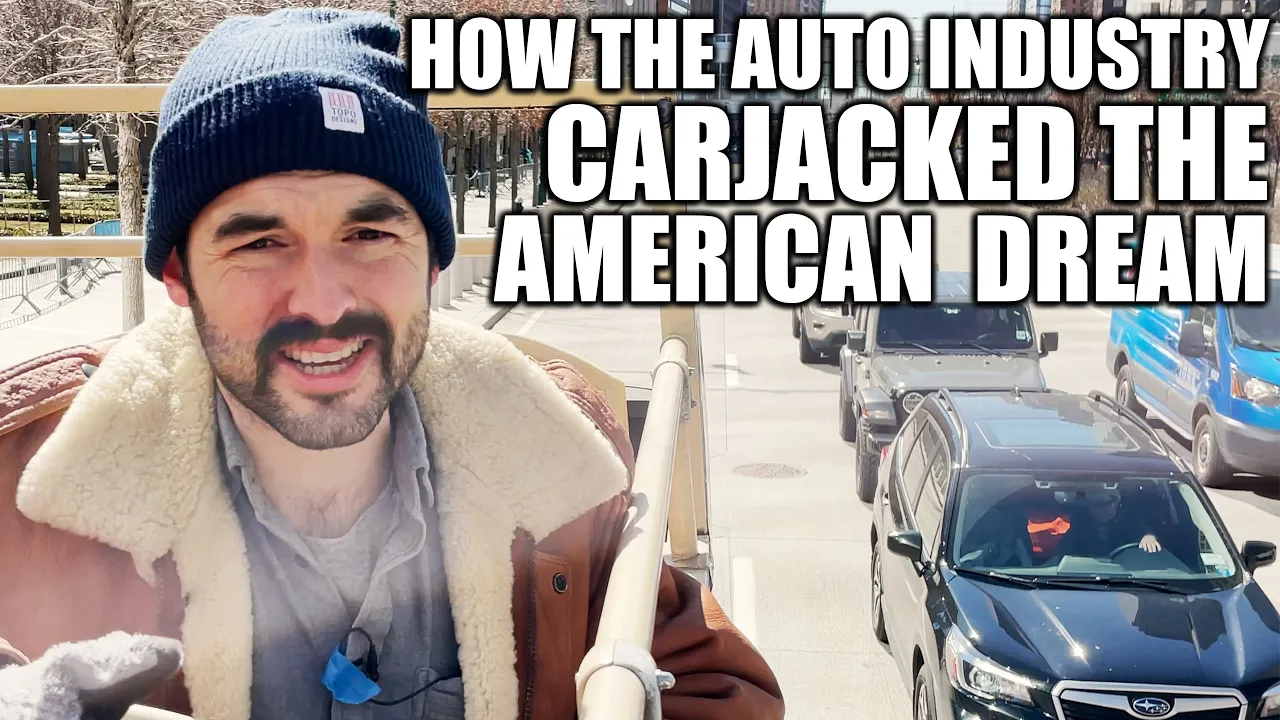
How The Auto Industry Carjacked The American Dream | Climate Town — Climate Town

Climate Town

American car dependency is the direct result of a deliberate, decades-long campaign by automakers to criminalize pedestrians, dismantle mass transit, and secure taxpayer-funded highway subsidies.

AI-assisted summary of How The Auto Industry Carjacked The American Dream | Climate Town — original source. Check the original for full context.

Source published:

Key ideas

  • Before the 1920s, American urban streets were shared public spaces, but rising traffic fatalities prompted the auto industry to lobby for legal frameworks like the 1928 Model Municipal Traffic Ordinance that criminalized pedestrians crossing outside crosswalks. (1:55)
  • Major industrial corporations—including General Motors, Firestone, and Standard Oil—formed front companies to purchase and dismantle electric streetcar systems across the country, resulting in a 1949 federal criminal antitrust conviction that carried only nominal fines. (7:52)
  • The 1956 National Interstate and Defense Highways Act cemented national car dependency after former GM CEO Charles Wilson served as Secretary of Defense, directing massive public subsidies into highway construction that routed through and razed minority neighborhoods. (13:24)
  • Highway construction under mid-century 'urban renewal' programs disproportionately burdened communities of color with long-term public health crises, including elevated rates of asthma, heart disease, and childhood leukemia. (15:08)

Detailed notes

## Background Published on YouTube by Climate Town on April 8, 2021, this video is hosted by Rollie Williams and based on an article by Dr. Spencer R. Scott detailing how the automotive industry reshaped the American landscape. The video's show notes provide supporting research on the historical streetcar conspiracy, car-free urban initiatives, and organizational resources for climate and transit activism.

## TL;DR In the early 20th century, American streets were shared communal spaces until surging traffic fatalities prompted the automotive industry to launch coordinated campaigns to eliminate pedestrian priority and public transit. Carmakers popularized the derogatory concept of 'jaywalking' to blame victims, covertly dismantled electric streetcar systems through front companies, and lobbied for taxpayer-funded freeways. Promoted through spectacle exhibits like GM's 1939 'Futurama' and codified into law via the 1956 Interstate Highway Act, this car-first model razed urban communities of color under the guise of 'urban renewal.' Today, overcoming this century-long corporate takeover requires actively reinvesting in mass transit and rethinking street design to combat systemic inequality and climate change.

## Atmosphere & style The presentation delivers a high-energy blend of irreverent, fast-paced comedy and rigorous investigative history, striking a balance between dry satire and righteous indignation. Rollie Williams uses witty visual gags, sharp cultural commentary, and deadpan meta-humor to expose the calculated corporate lobbying and propaganda behind everyday infrastructure. The viewing experience feels like an entertaining, deeply researched lecture that shifts seamlessly from absurd corporate PR campaigns to the somber public health and racial justice consequences of modern highway design.

## Bulletin - [01:55](https://www.youtube.com/watch?v=oOttvpjJvAo&t=115s) Before the 1920s, American urban streets were shared public spaces, but rising traffic fatalities prompted the auto industry to lobby for legal frameworks like the 1928 Model Municipal Traffic Ordinance that criminalized pedestrians crossing outside crosswalks. - [07:52](https://www.youtube.com/watch?v=oOttvpjJvAo&t=472s) Major industrial corporations—including General Motors, Firestone, and Standard Oil—formed front companies to purchase and dismantle electric streetcar systems across the country, resulting in a 1949 federal criminal antitrust conviction that carried only nominal fines. - [13:24](https://www.youtube.com/watch?v=oOttvpjJvAo&t=804s) The 1956 National Interstate and Defense Highways Act cemented national car dependency after former GM CEO Charles Wilson served as Secretary of Defense, directing massive public subsidies into highway construction that routed through and razed minority neighborhoods. - [15:08](https://www.youtube.com/watch?v=oOttvpjJvAo&t=908s) Highway construction under mid-century 'urban renewal' programs disproportionately burdened communities of color with long-term public health crises, including elevated rates of asthma, heart disease, and childhood leukemia.

## Key takeaways - [00:00](https://www.youtube.com/watch?v=oOttvpjJvAo&t=0s) Prior to the 1920s, city streets were shared civic spaces for pedestrians, children, and vendors rather than vehicle-exclusive thoroughfares. - [01:55](https://www.youtube.com/watch?v=oOttvpjJvAo&t=115s) In the four years following World War I, automobile collisions killed more Americans than combat in the war itself, with young children making up the majority of victims. - [01:55](https://www.youtube.com/watch?v=oOttvpjJvAo&t=115s) In 1923, 42,000 Cincinnati residents petitioned for mandatory 25-mph mechanical speed governors on downtown cars, prompting aggressive auto lobby opposition. - [01:55](https://www.youtube.com/watch?v=oOttvpjJvAo&t=115s) Herbert Hoover convened the 1924 National Conference on Street and Highway Safety, stacking the committee with auto industry delegates and laying the groundwork for the 1928 Model Municipal Traffic Ordinance. - [05:53](https://www.youtube.com/watch?v=oOttvpjJvAo&t=353s) Automakers popularized the pejorative term 'jaywalking' to shift blame for collisions from reckless drivers onto pedestrian victims. - [05:53](https://www.youtube.com/watch?v=oOttvpjJvAo&t=353s) The auto lobby established a dedicated news wire service and organized elementary school safety pledges to control public discourse and normalize car-centric street rules. - [07:52](https://www.youtube.com/watch?v=oOttvpjJvAo&t=472s) Automakers lobbied to allow private vehicles on streetcar tracks, worsening mass transit delays and pushing commuters into car ownership. - [07:52](https://www.youtube.com/watch?v=oOttvpjJvAo&t=472s) In 1949, General Motors, Firestone Tire, and Standard Oil of California were convicted in federal court of criminal conspiracy to monopolize transit through front company National City Lines. - [07:52](https://www.youtube.com/watch?v=oOttvpjJvAo&t=472s) The court fined General Motors just $5,000 for dismantling streetcar networks, while GM's corporate treasurer was personally fined a single dollar. - [09:54](https://www.youtube.com/watch?v=oOttvpjJvAo&t=594s) GM president Alfred P. Sloan founded the National Highway Users Conference in 1932 to replace private toll roads with publicly funded 'freeways' backed by national gasoline taxes. - [11:16](https://www.youtube.com/watch?v=oOttvpjJvAo&t=676s) General Motors' 1939 New York World's Fair exhibit 'Futurama,' designed by Norman Bel Geddes, popularized a car-centric, transit-free suburban vision to over two million attendees. - [13:24](https://www.youtube.com/watch?v=oOttvpjJvAo&t=804s) Dwight D. Eisenhower appointed GM CEO Charles Wilson as Secretary of Defense in 1953, creating a massive conflict of interest during the creation of the 1956 National Interstate and Defense Highways Act. - [15:08](https://www.youtube.com/watch?v=oOttvpjJvAo&t=908s) Federal highway construction routed expressways directly through Black and minority neighborhoods under the banner of 'urban renewal' and 'blight' removal. - [15:08](https://www.youtube.com/watch?v=oOttvpjJvAo&t=908s) Proximity to highway infrastructure correlates directly with persistent public health disparities, including higher rates of asthma, cardiovascular issues, and childhood leukemia. - [16:40](https://www.youtube.com/watch?v=oOttvpjJvAo&t=1000s) Transportation access represents the single most significant factor in enabling individuals to escape poverty.

## Detailed walkthrough ### [00:00](https://www.youtube.com/watch?v=oOttvpjJvAo&t=0s) The Road Wasn't Always for Cars

In 1968, the Beatles released "Why Don't We Do It in the Road," repeating the title question fifteen times. Host Rollie Williams points out that while it is an awful song, it is an even worse question because modern roads are where cars live, and attempting to do anything in the middle of one is an explicit death wish—especially for the Beatles in the 1960s, who were putting up "Chamberlain numbers." Prior to the 1920s, however, standing or fooling around in the middle of the street was merely a regular bad decision rather than suicidal, because streets belonged to people, not motor vehicles.

Everything shifted once the fledgling automotive industry realized the astronomical profits awaiting them if they could capture the public right-of-way and eliminate any competing mode of transit. Their playbook involved buying up municipal streetcar companies through front corporations, tearing up tracks, paying off politicians, running racist advertisements to block auto-safety regulations, and orchestrating extensive public relations blitzes to make it illegal for pedestrians to simply exist in the roadway.

While business majors might argue that outmaneuvering competition is just standard capitalism, Williams emphasizes that this went far beyond ordinary commerce. As Rollie Williams explains, “I'm not mad at the auto industry for business, but I do think that they saw an opportunity to kind of Trojan horse their way into the American infrastructure, and their version of the US is the version we're living in now.”

[01:55](https://www.youtube.com/watch?v=oOttvpjJvAo&t=115s) Blood on the Pavement: The 1920s Safety Crisis and Hoover’s Solution

During the nineteen-aughts, American city streets functioned as bustling communal plazas filled with children playing with hoops, horse-drawn carriages, occasional streetcars, and pedestrians socializing or running small businesses. That shared urban fabric fractured in the 1910s when Henry Ford introduced mass production. Suddenly, over a million automobiles flooded American roadways, running over hundreds of thousands of pedestrians in the process. In fact, more Americans were killed by automobiles in the four years immediately following World War I than died fighting in the war itself—with the overwhelming majority of car casualties being young children.

In that era, the public viewed dead children as an outrage, not an unavoidable accident, and the driver was almost universally held legally liable. As child deaths skyrocketed, cities across the nation began considering speed governors to cap vehicle speeds at 20 miles per hour in downtown areas. In 1923, ten percent of Cincinnati's population—42,000 citizens—signed a physical petition demanding mandatory 25-mph governors on cars. The automotive lobby countered by running aggressive, racist newspaper advertisements attacking Cincinnati, which successfully killed the ballot measure.

By 1924, traffic deaths were so rampant that President Calvin Coolidge directed his Secretary of Commerce, Herbert Hoover, to intervene. Hoover convened the First National Conference on Street and Highway Safety, citing appalling figures: an estimated $600 million in economic losses, 22,600 fatalities, and 678,000 serious injuries in the preceding year alone. Yet the delegates Hoover invited to resolve the crisis were overwhelmingly representatives from automobile manufacturers and motoring lobbies. Predictably, this conference laid the groundwork for the 1928 Model Municipal Traffic Ordinance, which strictly curtailed pedestrian freedom by making it unlawful to cross streets anywhere except at right angles within tightly prescribed crosswalks.

- Four years after World War I, traffic collisions had killed more Americans than combat in the war itself. - 42,000 Cincinnati residents signed a 1923 petition requiring mechanical speed governors on city cars. - Herbert Hoover reported $600 million in economic losses, 22,600 traffic deaths, and 678,000 injuries at the 1924 conference. - The resulting 1928 Model Municipal Traffic Ordinance legally restricted pedestrians to crossing only at right angles inside designated crosswalks.

[05:53](https://www.youtube.com/watch?v=oOttvpjJvAo&t=353s) Shaming the Pedestrian: The Invention of "Jaywalking"

Passing municipal traffic codes proved insufficient on its own, because ordinary citizens refused to obey rules banning them from their own streets, and judges routinely refused to convict pedestrians for the novel offense of walking in the roadway. To force a cultural shift, the auto industry launched a multi-pronged propaganda campaign. First, they ridiculed and dehumanized victims of traffic violence. Drawing on the turn-of-the-century slur "jay"—which referred to an uneducated country bumpkin or doofus—auto groups coined and heavily popularized the pejorative label "jaywalking." Through films and print media, they reframed pedestrians struck by vehicles not as victims of reckless driving, but as careless, stubborn fools who had it coming.

Second, the American Automobile Association (AAA) targeted children by taking over elementary school street-safety curricula, forcing students to sign pledges promising they would never cross outside crosswalks. Third, the National Automobile Chamber of Commerce established and funded a dedicated national wire service for newsrooms. Newspapers relied on this wire service to report traffic accidents, but the auto lobby reserved the right to revoke access from any publisher whose coverage was critical of automobiles or held drivers accountable, thereby forcing journalists to adopt victim-blaming language.

```mermaid flowchart TD accTitle: The Auto Industry Public Relations Strategy accDescr: Three-pronged strategy used by carmakers to push pedestrians off streets in the 1920s.

subgraph Propaganda["PR & Legal Strategy"] A["1928 Model Municipal Traffic Ordinance"] --> B["Low Public Compliance & Lenient Judges"] B --> C["Coordinated Auto Industry Retaliation"]

C --> D["Linguistic Shaming: Popularized 'Jaywalking'"] C --> E["Youth Indoctrination: AAA Safety Pledges in Schools"] C --> F["Media Control: Pro-Car Syndicate Wire Service"] end ```

As Rollie Williams summarizes the PR shift, “See, if a person got hit by a car, it was probably the car's fault. But if that person was, say, some kind of fugly dipsh*t, well, then it was probably their fault.”

[07:52](https://www.youtube.com/watch?v=oOttvpjJvAo&t=472s) Derailing Public Transit: The Great Streetcar Conspiracy

Pedestrians were not the only obstacle standing in the way of complete automotive dominance; urban streetcars and light electric railways occupied prime real estate down the center of city avenues. Unlike private automobiles, these systems provided heavily regulated public services that were legally required to charge affordable fares and connect lower-income neighborhoods. Car manufacturers lobbied city governments to permit private vehicles to drive directly along streetcar tracks. As private cars crowded the rails and routinely cut off streetcars, public transit schedules deteriorated, causing massive delays. Frustrated passengers abandoned transit to purchase private cars, which in turn caused even greater street congestion.

Beyond organic traffic snarls, the auto, tire, and oil industries engaged in outright corporate sabotage. Major industrial giants established front corporations—most notably National City Lines—to buy up municipal electric streetcar networks across the country, dismantle the tracks, scrap the vehicles, and replace them with diesel buses manufactured and fueled by the consortium. In 1949, General Motors, Firestone Tire, Standard Oil of California, Phillips Petroleum, and Mack Trucks were officially convicted in federal court of criminal conspiracy to monopolize the transit market. The judicial punishment, however, was laughably inconsequential: the court levied a meager $5,000 fine against GM, while GM's corporate treasurer was personally penalized exactly one dollar.

Having purged streets of pedestrians and dismantled mass transit systems, the automotive industry set its sights on expanding deeper into the physical geography of the country through an unprecedented national network of highways. As a vintage promotional film clip from the era celebrated, “The family's automobile, which they will probably trade in for a new one next year, not only helps keep the automobile industry thriving, but continually supports the gasoline station, the service garage, the tire dealer.”

- A single public transit bus holds approximately 60 people, whereas the equivalent capacity in personal automobiles occupies dozens of times more road surface. - In 1949, GM, Standard Oil of California, Firestone Tire, Phillips Petroleum, and Mack Trucks were convicted of an antitrust conspiracy to monopolize transit. - The court fined General Motors only $5,000 for the streetcar conspiracy, while GM's treasurer received a fine of just $1.

[09:54](https://www.youtube.com/watch?v=oOttvpjJvAo&t=594s) The Invention of the Freeway and Selling the Dream

In the early 1930s, American highways consisted largely of privately owned toll roads. However, toll roads alone were never going to compel every single citizen to purchase a brand-new vehicle every single year. To orchestrate a massive expansion of road travel, General Motors president Alfred P. Sloan teamed up with auto industry groups in 1932 to establish the National Highway Users Conference. Sloan openly outlined their agenda: to “protect highway funding sources from Depression-born demands.” Rather than relying on private tolls, the automotive lobby realized they required a socialist-style public funding mechanism, pushing successfully to underwrite road infrastructure through a national gasoline tax. This maneuver birthed the modern "freeway"—free not because it cost nothing, but because drivers paid no tolls at the gate, while the government quietly subsidized any deficits left uncovered by gas taxes.

```mermaid flowchart TD accTitle: Highway Policy to Public Propaganda accDescr: Progression from GM lobbying for gas taxes to convincing the public via Futurama. subgraph Funding["Lobbying & Policy"] A["1932: National Highway Users Conference (Alfred P. Sloan)"] --> B["Lobbying for National Gasoline Tax Subsidies"] B --> C["1939: Congressional Report 'Toll Roads and Free Roads'"] end subgraph Promotion["Public Influence"] C --> D["1939 NY World's Fair Exhibit: Futurama"] D --> E["Public accepts car-centric, suburban vision of America"] end ```

By 1939, a Congressional report entitled *Toll Roads and Free Roads* essentially codified the automotive lobby's exact wish list for cutting massive road networks across the nation. Recognizing that ordinary citizens do not read dry government reports, GM decided to package this vision into direct public spectacle by designing an enormous diorama of America’s future at the 1939 New York World's Fair.

- In 1932, Alfred P. Sloan and trade groups founded the National Highway Users Conference. - The term "freeway" referred to roads devoid of direct tolls, masking the reality that taxpayer funding stepped in whenever gasoline taxes proved insufficient. - The 1939 *Toll Roads and Free Roads* federal report outlined the construction blueprints the auto industry desired.

[11:16](https://www.youtube.com/watch?v=oOttvpjJvAo&t=676s) Norman Bel Geddes and the "Futurama" Inception

The 1939 New York World's Fair arrived at a singular moment in American history: a populace reeling from the trauma of the Great Depression, entirely devoid of modern digital technology or color television, stepped into a massive corporate wonderland. General Motors presented the centerpiece of the fair: "Futurama," a 16-minute ride and diorama designed by Norman Bel Geddes. Spectators sat in automated chairs attached to an elevated track system, peering down at an artificial world featuring 1.5 million handcrafted miniature buildings and trees, 50,000 model cars, and a massive 14-lane highway carrying moving miniature vehicles—all conspicuously lacking any form of mass transit.

Over its first three months alone, two million visitors moved through the exhibit, taking in a vision of sprawling interstate thoroughfares, suburban housing developments, and universal car ownership. Futurama effectively standardized the vision of modern urban planning that would materialize across the country by the 1970s, leaving an impression so deep that Walt Disney later cited it as direct inspiration when developing EPCOT. Post-World War II planning took two radically different paths: nations across Europe and Asia heavily prioritized public transit networks, while the United States poured its capital almost exclusively into asphalt.

- Futurama required 1.5 million miniature trees and buildings, alongside 50,000 model vehicles. - The display featured a 14-lane interstate with moving components and omitted public transportation entirely. - Over 2,000,000 visitors experienced the installation within three months of its opening.

[13:24](https://www.youtube.com/watch?v=oOttvpjJvAo&t=804s) The Military-Industrial Revolving Door: Charles Wilson and the 1956 Highway Act

By 1941, General Motors had installed a new chief executive: Charles Erwin Wilson. Wilson took an active role in crafting the 1947 blueprint for the National System of Interstate Highways. In January 1953, President Dwight D. Eisenhower appointed Wilson as United States Secretary of Defense, creating an immediate conflict of interest that sparked intense controversy during his Senate confirmation hearings. When senators pressed Wilson on whether he could ever approve a policy detrimental to General Motors, Wilson famously dismissed the premise:

> “what was good for our country was good for General Motors and vice versa.”

```mermaid flowchart LR accTitle: Charles Wilson Career and Highway Legislation accDescr: The revolving door between General Motors and the Department of Defense. A["Charles Wilson (CEO of GM, 1941)"] -->|"Helps design 1947 Interstate Plan"| B["Appointed US Secretary of Defense (1953)"] B -->|"Eisenhower & Wilson back Highway Act (1956)"| C["Federal funding of Interstate system"] C -->|"Steps down from Pentagon (1957)"| D["Rejoins GM Board of Directors"] ```

With Wilson heading the Department of Defense—an agency uniquely positioned to direct infrastructure spending under the banner of national security—and Eisenhower eager to transport military assets quickly across the continent, the federal government cleared the way for the National Interstate and Defense Highways Act of 1956. This legislation provided near-total federal financing for the most extensive highway network in global history. Wilson left the Pentagon in 1957 and went straight back onto GM's board of directors.

- Charles Wilson was tapped from GM's presidency to become Secretary of Defense in 1953. - The 1956 National Interstate and Defense Highways Act funded construction primarily through federal dollars. - Wilson returned to General Motors as a board member immediately following his government tenure in 1957.

[15:08](https://www.youtube.com/watch?v=oOttvpjJvAo&t=908s) "Urban Renewal," Racial Blight, and Public Health Consequences

Construction commenced swiftly across the nation, following the 1947 designs. Rather than merely connecting distant cities, federal highways were intentionally carved directly through dense urban centers, razing established neighborhoods. Under the banner of 1960s and 1970s municipal programs framed as "urban renewal" or efforts to "remove blight," planners explicitly selected neighborhoods inhabited by people of color for demolition.

These newly paved expressways concentrated exhaust pollution in non-white residential corridors, introducing widespread public health issues. Decades later, residents inhabiting corridors directly adjacent to interstate freeways remain disproportionately non-white and face significantly higher rates of asthma, cardiovascular disease, and childhood leukemia. Concurrently, automakers worked diligently to suppress alternative vehicle technologies that threatened their business model—exemplified by Norman Bel Geddes declining to draft a successor diorama for the year 2000 because he foresaw the phaseout of gas-powered engines, an evolution the industry actively resisted.

- Urban highway routes routinely targeted Black and minority neighborhoods under the cover of "blight" removal and "urban renewal." - Disproportionate exposure to highway corridors correlates directly with elevated rates of asthma, heart disease, and childhood leukemia among nearby communities of color.

[16:40](https://www.youtube.com/watch?v=oOttvpjJvAo&t=1000s) Reimagining Infrastructure and Public Support

Confronting the auto industry's century-long legacy requires communities to actively reconsider transit equity rather than accepting car dominance as inevitable. Empirical research indicates that reliable access to transportation is the single most critical factor determining an individual's ability to escape poverty. Restoring local streets from vehicular domination and restoring mass transit funding represent direct interventions to curb ongoing climate harm.

Viewers are encouraged to scrutinize proposals such as the Green New Deal, study the historical roots of municipal design, and support civic programs reclaiming street space for pedestrians and public ridership. The segment concludes with a comedic, meta exchange about Patreon funding, where the host pitches his "highly-researched, low-budget, super try-hard climate comedy" against his own off-screen persona mocking the idea of paid edutainment outtakes.

- Research confirms transportation access is the single most influential metric enabling individuals to transition out of poverty. - Policy proposals such as the Green New Deal prioritize transit accessibility, environmental reparations, and infrastructure reform.

## Notable quotes > [00:00](https://www.youtube.com/watch?v=oOttvpjJvAo&t=0s) I'm not mad at the auto industry for business, but I do think that they saw an opportunity to kind of Trojan horse their way into the American infrastructure, and their version of the US is the version we're living in now. — Rollie Williams

## Mentioned Rollie Williams, Benjamin Boult, Spencer R. Scott, Henry Ford, Calvin Coolidge, Herbert Hoover, Alfred P. Sloan, Norman Bel Geddes, Walt Disney, Charles Erwin Wilson, Dwight D. Eisenhower, General Motors, American Automobile Association (AAA), National Automobile Chamber of Commerce, National City Lines, Firestone Tire, Standard Oil of California, Phillips Petroleum, Mack Trucks, National Highway Users Conference, First National Conference on Street and Highway Safety, 1928 Model Municipal Traffic Ordinance, 1939 New York World's Fair, Futurama, Toll Roads and Free Roads, National Interstate and Defense Highways Act of 1956, Green New Deal, EPCOT

## Video description Where we're going, we don't need roads. sUbScRiBe FoR mOrE ViDes: https://www.youtube.com/c/climatetown?sub_confirmation=1 PATREON PAGE: https://www.patreon.com/ClimateTown

Shot and co-directed by Benjamin Boult: http://benjaminboult.com/ Ben is unbelievably talented, check out the rest of his work on the website above and hire him for your projects.

Based on an article by Spencer R. Scott P.h.D.: https://blog.usejournal.com/a-grand-theft-auto-industry-stole-our-streets-and-our-future-a2145d6e10e2

Supporting sources, documents, interviews, and articles in this doc: https://docs.google.com/document/d/1-SjpFrBjiEK2gHXzXv_6Ibof6rMwRzRzLuxfPY9OAm8

How GM beefed the electric car: https://www.youtube.com/watch?v=RNvvvVt_628 Read more about the streetcar conspiracy: Car free street resources: https://nyc.streetsblog.org/category/issues-campaigns/car-free-streets/ https://www1.nyc.gov/html/dot/html/pedestrians/openstreets.shtml https://www.bloomberg.com/news/articles/2019-10-17/san-francisco-s-market-street-car-ban-is-overdue

Some reading to do:

The Merchants of Doubt: https://www.merchantsofdoubt.org/ All We Can Save: https://www.allwecansave.earth/ The Uninhabitable Earth: https://www.penguinrandomhouse.com/books/586541/the-uninhabitable-earth-by-david-wallace-wells/ This Changes Everything: Capitalism vs. The Climate: https://thischangeseverything.org/book/

Oh, what's that? We’re also on the larger Internet? Discord server: https://discord.gg/yPpfgSaZeQ Podcast: https://linktr.ee/deniersplaybook Newsletter: https://www.climatetown.news/ Instagram: https://www.instagram.com/climatetown/ TikTok: https://www.tiktok.com/@climatetown Website: https://www.climatetownproductions.com/ LinkTree: https://linktr.ee/ClimateTown

Make a tax-deductible donation to Climate Town: https://www.climatetownproductions.com/support

Join and support some movements! 350.org (https://350.org/) Sunrise Movement (https://www.sunrisemovement.org/) NRDC (https://www.nrdc.org/) Climate Changemakers (https://www.climatechangemakers.org/) Extinction Rebellion (https://extinctionrebellion.us/get-involved/) Climate Action Network (https://climatenetwork.org/)

[Source](https://www.youtube.com/watch?v=oOttvpjJvAo)

中文简报

通用汽车拆解美国公共交通以迫使公众依赖汽车 美国对汽车的依赖,是汽车制造商数十年来蓄意推行的一场行动的直接后果,他们将行人定罪、拆解大众交通,并争取由纳税人资助的公路补贴。 20世纪初,美国街道曾是共享的公共空间,直到激增的交通事故死亡人数促使汽车工业发起协同行动,以取消行人的优先权和公共交通。汽车制造商推广了带有贬损意味的“乱穿马路”(jaywalking)概念将责任推给受害者,通过空壳公司秘密拆除有轨电车系统,并游说争取纳税人资助的高速公路。这一以汽车为先的模式,通过通用汽车1939年“飞向未来”(Futurama)等引人瞩目的展览进行推广,并通过1956年《州际公路法案》正式写入法律,以“城市更新”为幌子夷平了有色人种的城市社区。如今,要克服这场长达一个世纪的企业控制,需要积极对大众交通再投资,并重新审视街道设计,以应对系统性不平等和气候变化。 在20世纪20年代之前,美国城市街道是共享的公共空间,但不断上升的交通事故死亡人数促使汽车行业游说推行诸如1928年《示范市政交通条例》等法律框架,将行人在人行横道外穿行的行为定罪。 (1:55) 包括通用汽车、凡士通和标准石油在内的主要工业巨头组建了空壳公司,以收购并拆除全国各地的有轨电车系统,这导致其在1949年被裁定犯有联邦刑事反垄断罪,但仅被处以象征性罚款。 (7:52) 在通用汽车前首席执行官查尔斯·威尔逊出任国防部长后,1956年《国家州际和国防公路法案》巩固了全国对汽车的依赖,该法案将巨额公共补贴注入高速公路建设,路线穿行并夷平了少数族裔社区。 (13:24) 20世纪中叶“城市更新”项目下建设的高速公路,使有色人种社区不成比例地承担了长期的公共卫生危机,包括哮喘、心脏病和儿童白血病发病率的升高。 (15:08)

Reading summary

Host Rollie Williams argues that the complete dominance of the automobile in the United States was not an inevitable consumer preference, but the outcome of a deliberate, multi-decade campaign by the auto industry to dismantle public transit, criminalize pedestrians, and capture federal infrastructure policy. Criminalizing Pedestrians and Re-Engineering Street Norms (1:55) During the 1910s and 1920s, American streets functioned as shared public plazas until mass-produced automobiles caused an unprecedented pedestrian safety crisis. In the four years following World War I, car crashes killed more Americans than the war itself, with children making up the majority of victims. Public outrage initially blamed motorists and prompted regulatory pushes, such as a 1923 Cincinnati petition signed by 42,000 residents demanding mechanical 25-mph speed governors. In response, Commerce Secretary Herbert Hoover convened the 1924 First National Conference on Street and Highway Safety—heavily attended by auto industry representatives—citing 22,600 annual deaths, 678,000 injuries, and $600 million in losses. This conference produced the 1928 Model Municipal Traffic Ordinance, legally restricting pedestrians to crossing at right-angle crosswalks. Because the public and judges initially resisted punishing walkers, automakers executed a public relations campaign to shift blame. They popularized the turn-of-the-century slur "jay" into the pejorative "jaywalking" to ridicule victims as ignorant bumpkins, while the American Automobile Association instituted school safety pledges to instruct children to yield roadways. Simultaneously, the National Automobile Chamber of Commerce ran a syndicated news service that provided collision reporting only to newsrooms that refrained from blaming drivers. Corporate Sabotage of Urban Transit Networks (7:52) Automakers actively targeted urban streetcars, which offered affordable, regulated service along prime urban corridors. Car manufacturers first lobbied municipalities to allow private motor vehicles into streetcar lanes, intentionally snarling rail schedules and prompting frustrated passengers to buy personal cars. Beyond lobbying, major automotive and fossil fuel interests pursued direct industrial sabotage. Through front companies like National City Lines, General Motors, Firestone Tire, Standard Oil of California, Phillips Petroleum, and Mack Trucks acquired municipal electric streetcar systems across the nation, scrapped the vehicles, tore up tracks, and replaced them with motorized buses. In 1949, these corporations were convicted in federal court of criminal conspiracy to monopolize public transit. However, judicial penalties were negligible: General Motors was fined just $5,000, and its corporate treasurer was penalized one dollar, leaving urban light rail permanently dismantled. Manufacturing Demand: Gas Taxes to Futurama (9:54) In 1932, General Motors president Alfred P. Sloan helped organize the National Highway Users Conference to protect road funding from Depression-era budget diversions. The lobby pushed to replace private toll roads with publicly underwritten "freeways," successfully lobbying for dedicated gasoline taxes while relying on government revenues to cover funding shortfalls. The federal blueprint for this system was codified in the 1939 congressional report Toll Roads and Free Roads. To manufacture public demand for this highway model, General Motors sponsored the centerpiece exhibit of the 1939 New York World's Fair: Norman Bel Geddes's "Futurama." The ride showcased a massive diorama with 1.5 million model buildings and 50,000 miniature vehicles navigating a 14-lane highway, completely omitting mass transit. Over two million fairgoers toured the exhibit in its first three months, cementing a car-centric suburban vision that heavily steered post-war American urban planning. Institutional Capture, Interstates, and Segregated Harm (13:24) The auto lobby solidified its control over federal policy through the revolving door between industry and government. In 1953, President Dwight D. Eisenhower appointed former GM chief executive Charles Erwin Wilson as Secretary of Defense. Wilson, who had helped draft the 1947 Interstate Highway plan and famously defended GM's alignment with national interest, leveraged national security concerns to pass the National Interstate and Defense Highways Act of 1956, which authorized massive federal funding for the interstate system. Wilson returned to GM's board immediately after resigning from the Pentagon in 1957. Under the banner of "urban renewal" and "blight removal," planners routinely routed these interstates directly through dense minority neighborhoods, demolishing Black and brown communities. Decades later, residents living near these freeway corridors remain disproportionately non-white and face significantly higher rates of asthma, cardiovascular disease, and childhood leukemia. Williams concludes that untangling car dependency requires recognizing that the dominance of automobiles was engineered by corporate interests rather than public desire. Pointing to research identifying transportation access as the primary factor in escaping poverty, the program advocates for initiatives like the Green New Deal that invest in public transit and reclaim municipal streets for pedestrians.

精炼阅读摘要

主持人 Rollie Williams 指出,当今美国以汽车为绝对核心的基础设施并非公众自愿选择的必然结果,而是汽车工业在过去一个世纪中通过系统性操纵法规、瓦解公共交通、发动公关宣传及渗透国家政策,将公共道路“劫持”为牟利工具的产物。 街道主权的夺取与行人的污名化 (1:55) 在20世纪初以前,美国城市街道是行人、马车和儿童游戏的公共活动空间。随着福特推行汽车流水线生产,数百万辆机动车涌入街道并造成剧烈的伤亡危机。第一次世界大战结束后的四年内,死于车祸的美国人数量超过了在一战战役中阵亡的人数,其中绝大部分死者为儿童。1923年,辛辛那提有4.2万名市民(占该市人口10%)请愿要求对市区机动车强制加装25英里/小时的机械限速器,但汽车游说集团通过带有种族主义色彩的报刊广告强行扼杀了该议案。1924年,商务部长赫伯特·胡佛(Herbert Hoover)受命介入危机,其公布的数据显示前一年交通事故造成6亿美元经济损失、2.26万人死亡和67.8万人重伤。然而受邀解决危机的代表绝大多数来自汽车制造商和驾驶团体,最终促成了1928年的《示范城市交通法规》(Model Municipal Traffic Ordinance),在法律上严格剥夺了行人自由通行街道的权利,规定其只能在指定的人行横道以直角横穿马路。 由于公众起初拒绝服从限制且法官多拒绝定罪,汽车工业展开了多维度的公关战。他们借用指代愚昧乡巴佬的俚语“jay”,生造并大力推广了“乱穿马路”(jaywalking)一词,在媒体和电影中将车祸受害者丑化为自找苦吃的愚蠢之人,成功将驾驶责任转嫁给行人。同时,美国汽车协会(AAA)接管了小学的交通安全课程,要求儿童签署只在人行横道过马路的保证书;汽车商会还资助全国通讯社,规定只要报社发表追究驾驶者责任或批评汽车的报道便吊销其新闻供稿权限,彻底扭转了新闻舆论导向。 “电车阴谋”与公共交通的蓄意瓦解 (7:52) 在驱逐行人的同时,占据城市核心路权的有轨电车和轻型电气化铁路成为汽车工业扩张的最大障碍。公共电车属于受监管的公共事业,依法提供低廉票价并覆盖低收入社区。一辆公共电车可容纳约60人,而相同载客量的私家车所占用的道路面积是前者的数十倍。汽车制造商首先游说市政当局允许私家车驶入电车轨道,私家车的穿插导致电车站台拥堵、班次严重延误,迫使沮丧的通勤者转而购买私家车,陷入交通进一步恶化的死循环。 除路权侵蚀外,工业巨头更实施了蓄意的垄断破坏。通用汽车(General Motors)、火石轮胎(Firestone Tire)、加州标准石油(Standard Oil of California)、菲利普斯石油(Phillips Petroleum)与麦克货车(Mack Trucks)联合设立了名为“全国城市线路”(National City Lines)的空壳阵线,在全美范围内收购市政有轨电车系统,拆除铁轨并将车辆报废,换成由该财团生产并供应燃料的柴油公交车。1949年,联邦法院正式判定通用汽车等企业犯有垄断交通市场的刑事阴谋罪。然而惩罚微不足道:法院仅对通用汽车处以5000美元罚款,通用汽车财务主管个人仅被象征性罚款1美元,未能改变电车系统被永久摧毁的既成事实。 财政重构与“未来世界”蓝图灌输 (9:54) 20世纪30年代初,美国长途道路主要为私营收费公路,无法支撑让每个家庭年年换新车的销售规模。1932年,通用汽车总裁阿尔弗雷德·P·斯隆(Alfred P. Sloan)联合行业团体成立了全国公路使用者会议(National Highway Users Conference),其主旨是在大萧条背景下保障道路扩建资金。汽车游说团体成功推动了以全国汽油税为基础的基础设施融资机制,创造出所谓的“高速公路”(freeway)——其并非真正免费,而是免除收费站刷卡,不足的资金缺口则由公共税收隐性补贴。1939年的国会报告《收费公路与免费公路》(Toll Roads and Free Roads)全面确立了符合汽车业利益的路网设计蓝图。 为使公众接受这一愿景,通用汽车在1939年纽约世界博览会上推出了由诺曼·贝尔·盖茨(Norman Bel Geddes)设计的标志性展项“未来世界”(Futurama)。参观者通过高架移动座椅俯瞰由150万个微缩建筑与树木、5万辆模型车构成的14车道州际高速公路沙盘,其中完全排除了任何大众轨道交通。开展仅三个月便吸引了200万人次参观。该展览将郊区蔓延和全员汽车依赖固化为现代美国的生活理想,并启发了后来的迪士尼EPCOT建设,直接导致战后美国将绝大多数资本投向沥青路网,而欧亚各国则转向优先发展公共轨道。 政商旋转门与高速路网的种族不平等 (13:24) 汽车行业在战后深度渗透进国家最高防务决策层。1941年出任通用汽车首席执行官的查尔斯·埃尔温·威尔逊(Charles Erwin Wilson)曾主持起草1947年国家州际公路系统蓝图;1953年,艾森豪威尔总统提名威尔逊出任美国国防部长,引发巨大利益冲突争议,威尔逊在参议院听证会上声称“对国家有益的事就对通用汽车有益,反之亦然”。威尔逊利用五角大楼的军权,以国家防御和战备运输为由力推《1956年国家州际和国防公路法案》(National Interstate and Defense Highways Act of 1956),由联邦政府提供绝大部分财政补贴,建成了全球规模最大的跨州高速公路网。法案通过后的1957年,威尔逊卸任防长并迅速重返通用汽车董事会。 工程落地过程中,规划者没有将高速公路仅限于连接城市,而是将其直接切入人口密集的城市核心。在20世纪60至70年代所谓的“城市更新”和“消除贫民窟”(removing blight)名义下,道路选线被蓄意指定穿过黑人及有色人种聚居区,导致繁荣社区被物理撕裂与拆除。数十年来,被迫居住在高速走廊两侧的非白人居民承受了密集的汽车尾气污染,其哮喘、心血管疾病和儿童白血病的发病率显著偏高。在此期间,汽车巨头还极力打压可能威胁燃油车体系的清洁动力技术转型。 Williams 总结道,实证研究表明便利的交通出行是决定个人能否摆脱贫困的最关键指标。面对气候变化与结构性不平等,公众应当打破私家车支配道路的历史神话,支持“绿色新政”等系统性基础设施改革,恢复对公共交通的财政投入,重新将街道空间归还给社区与行人的日常生活。

Detailed notes — zh

## Background 本期视频由 YouTube 频道 Climate Town 的 Rollie Williams 于 2021 年 4 月 8 日发布。视频内容基于 Spencer R. Scott 博士的文章,并在简介中附带了关于车企阴谋、无车街道以及气候变化相关书籍的大量参考资源与行动倡议,深入揭露美国汽车工业如何系统性地劫持街道与公共基础设施。 ## TL;DR 视频系统梳理了 20 世纪初以来美国汽车工业如何通过特洛伊木马般的商业与公关手段彻底主宰城市基础设施。早期汽车频繁撞死行人和儿童,车企便发起公关战炮制“乱穿马路”(Jaywalking)概念以污名化受害者,并通过立法剥夺行人的街道主权;随后,通用汽车等巨头暗中收购并肢解城市有轨电车系统,在 1939 年世博会上通过“飞向未来”展馆洗脑公众拥抱私家车与郊区化模式。战后,车企高管借国防部长之职促成 1956 年高速公路法案,打着“城市更新”的旗号用高架路强行撕裂并毒害少数族裔社区。节目最后呼吁公众打破汽车围城,通过无车街区和公共交通基建夺回属于人民的城市空间。 ## Atmosphere & style 整部影片呈现出一种极具感染力的“严肃搞笑”(infotainment)风格,Rollie Williams 以快节奏的脱口秀语调在刻薄辛辣与义愤填膺之间自如切换。他将大量严谨的历史档案、学术数据与极尽讽刺的视觉玩梗(如调侃商科生游艇、自制讽刺小剧场)熔于一炉,既有揭穿资本与政客利益输送时的锐利批判,又充满对底层社区受害者的深切同情。观看全程既让人因荒诞的现实捧腹大笑,又让人在看清城市如何被汽车绑架后感到脊背发凉和深切反思。 ## Bulletin - [01:55](https://www.youtube.com/watch?v=oOttvpjJvAo&t=115s) 20世纪初汽车普及初期造成极其惨烈的伤亡,仅一战后4年间全美死于车祸的人数就超过了美军一战阵亡总数,其中绝大多数受害者为在街头玩耍的儿童。 - [04:14](https://www.youtube.com/watch?v=oOttvpjJvAo&t=254s) 汽车工业通过1928年《示范市政交通法规》、污名化受害者的“乱穿马路”(Jaywalking)概念推广以及控制新闻报道专线,成功将街道使用权从行人手中彻底夺走。 - [07:52](https://www.youtube.com/watch?v=oOttvpjJvAo&t=472s) 通用汽车联合石油与轮胎巨头暗中收购并暴力拆除全美各地的有轨电车网络,虽在1949年被裁定反垄断罪名成立,但仅被象征性处以5000美元罚款。 - [13:24](https://www.youtube.com/watch?v=oOttvpjJvAo&t=804s) 通用汽车前总裁查尔斯·威尔逊出任美国国防部长,促成1956年《国家州际和国防公路法案》,由联邦财政出资90%修建全国高速公路网络,并借“城市更新”之名大肆强拆少数族裔社区。 ## Key takeaways - [00:00](https://www.youtube.com/watch?v=oOttvpjJvAo&t=0s) 街道在1920年代以前属于行人和公共生活的空间,汽车工业通过游说、公关宣传与摧毁替代出行方式,将自身利益硬生生嵌入美国基础设施核心。 - [04:14](https://www.youtube.com/watch?v=oOttvpjJvAo&t=254s) 早期因汽车导致的死伤极其严重,1924年全美车祸死亡达22,600人并造成约6亿美元经济损失,民意曾一度激烈要求将车速限制在20 mph以内。 - [04:14](https://www.youtube.com/watch?v=oOttvpjJvAo&t=254s) 胡佛主导的第一届全国街道和公路安全会议完全由车企主导,促成了限制行人的《示范市政交通法规》,强行将行人活动限制在极窄的斑马线区域。 - [05:38](https://www.youtube.com/watch?v=oOttvpjJvAo&t=338s) 车企将“Jaywalking”词汇武器化以嘲讽受害者,同时让AAA渗透进学校规训儿童,并以切断电讯专线威胁报社以压制对车祸的负面报道。 - [07:52](https://www.youtube.com/watch?v=oOttvpjJvAo&t=472s) 私家车通过侵占电车轨道导致公共交通延误断崖式恶化,通用汽车、标准石油等巨头更通过皮包公司直接买断并拆毁城市有轨电车系统。 - [09:54](https://www.youtube.com/watch?v=oOttvpjJvAo&t=594s) 通用汽车于1932年成立全国公路使用者大会,游说政府利用全民汽油税及财政补贴兜底来修建无收费站的免费高速公路(Freeways)。 - [11:16](https://www.youtube.com/watch?v=oOttvpjJvAo&t=676s) 通用汽车在1939年纽约世博会上打造“飞向未来”(Futurama)展馆,用微缩沙盘成功向数百万美国人洗脑了“只有高速公路与郊区化私家车”的人造未来图景。 - [13:24](https://www.youtube.com/watch?v=oOttvpjJvAo&t=804s) 政商旋转门助推了汽车霸权的法制化:通用汽车高管查尔斯·威尔逊转任国防部长后,主导通过了由联邦承担90%出资的1956年州际公路法案。 - [15:08](https://www.youtube.com/watch?v=oOttvpjJvAo&t=908s) 高速公路建设以“清除城市衰退区”为由,肆意穿透并摧毁有色人种和低收入社区,导致沿线居民长期承受严重的呼吸系统疾病与健康不公。 - [15:08](https://www.youtube.com/watch?v=oOttvpjJvAo&t=908s) 车企与化石能源寡头联手扼杀电动车等清洁交通技术,巩固了燃油车在全美交通出行中的垄断地位。 - [16:40](https://www.youtube.com/watch?v=oOttvpjJvAo&t=1000s) 便捷廉价的公共交通是底层摆脱贫困的关键因素,呼吁公众通过支持无车街区、完善公交基建和推进绿色新政等举措从汽车手中夺回城市空间。 ## Detailed walkthrough ### [00:00](https://www.youtube.com/watch?v=oOttvpjJvAo&t=0s) 汽车工业的特洛伊木马与被劫持的街道 1968 年,披头士乐队发行了一首名为《Why Don't We Do It in the Road》的歌曲,歌词里把这句问话重复了整整十五遍。在主持人 Rollie Williams 看来,这不仅是一首烂歌,更是一个极其糟糕的提问。因为在现代人尽皆知的常识中,绝对不能在马路中间行事——那是汽车生存的地盘,随时可能冲出一辆车将所有人当场撞死。然而在 1920 年代以前,跑到大马路中间胡闹顶多算是一种普通层面的愚蠢决定,绝非自寻死路。原因很简单:在那个时代,道路根本不是给汽车准备的,而是属于行人的公共空间。 羽翼未丰的汽车工业很快意识到,如果能彻底霸占街道,并抹除任何不依赖汽车的出行方式,他们将获得难以想象的巨额利润。为了达成这个目标,车企展开了一系列惊人的操作:利用空壳公司收购有轨电车系统并将其拆毁拆线,投放带有种族主义色彩的广告,收买政客击杀针对汽车的监管法案,甚至发动铺天盖地的公关运动将行人在街道上的存在定为非法。Rollie Williams 调侃道,杜克大学的大一商科生或许会辩解这只是常规商业竞争,赢家赚了大钱买游艇无可厚非。但汽车工业所做的,是以特洛伊木马的方式硬生生钻进了美国的基础设施核心,让全体美国人被迫生活在车企一手塑造的世界里。正如 Rollie Williams 直言: > “I'm not mad at the auto industry for business, but I do think that they saw an opportunity to kind of Trojan horse their way into the American infrastructure, and their version of the US is the version we're living in now, and that, boating enthusiasts, is the thesis of thi--” ### [01:55](https://www.youtube.com/watch?v=oOttvpjJvAo&t=115s) 街头的大屠杀:当汽车开始收割儿童生命 回看 20 世纪初的头十年,美国的街道上一片热闹混乱:满身泥巴的孩子们在街上滚铁环玩耍,偶尔有几辆马车驶过,夹杂着一两辆有轨电车,街道是行人们散步、摆摊做买卖,或者一言不合动手打架的纯粹公共场所。然而这一切在 1910 年代被彻底颠覆。随着亨利·福特按下流水线“制造汽车”的开关,工业化量产让上百万辆汽车迅速涌入街头,随之而来的,是成千上万被卷入车轮下的普通生命。 第一次世界大战结束后的短短四年时间里,死于汽车轮下的美国人数量,竟然超过了美军在一战战场上的阵亡总数。汽车杀戮美国人的效率甚至高过了严阵以待的德国军队,更残酷的现实在于,德国士兵的目标是美国军人,而汽车杀死的绝大多数是毫无防备的儿童。在那个年代,一旦发生汽车撞人事故,整个社会的普遍共识都是严厉谴责司机,因为驾驶汽车撞倒儿童的行为在道义和法律上几乎全由司机承担过错责任。 面对日益惨烈的死伤,全美各大城市开始酝酿反击。多座城市着手就限制市中心车速不得超过每小时 20 英里的法案进行投票。矛盾在 1923 年的辛辛那提彻底爆发,当地整整 10% 的人口——42,000 名市民——亲笔在一份限制汽车速度的请愿书上签了名。为了击溃这场汹涌的民意,汽车公司不仅没有顺从,反而发起了一波带有种族歧视色彩的宣传攻势攻击辛辛那提,最终成功扼杀了该项限速法令。 - **一战伤亡对比**:一战结束后的四年内,全美因车祸丧生的人数超过了美国在一战中的实际阵亡士兵数。 - **伤亡主体**:早期恶性车祸的最大受害者群体是正在街头玩耍的儿童。 - **辛辛那提请愿**:1923 年,42,000 名辛辛那提市民实体签名请愿,要求强制在汽车上安装限速 20 mph 的机械调速器,随后被车企联手广告公关彻底瓦解。 ### [04:14](https://www.youtube.com/watch?v=oOttvpjJvAo&t=254s) 胡佛的安全会议与把狐狸送进鸡窝的《示范法规》 汽车行业不满足于“周末探视权”式的街道分享,他们要的是对道路永久且绝对的支配权。到了 1924 年,由于车祸死伤惨重到难以忽视,被 Rollie Williams 戏称为“被美国遗忘的总统”卡尔文·柯立芝(Calvin Coolidge)要求时任商务部长赫伯特·胡佛(Herbert Hoover)必须采取行动制止汽车杀人。胡佛为此召开了第一届全国街道和公路安全会议(First National Conference on Street and Highway Safety)。 然而,这场旨在解决汽车杀戮行人问题的全国性会议,受邀参会的组织代表名单清一色全是汽车制造厂商。这场让“狐狸替母鸡守门”的会议,直接催生了 1928 年出台的《示范市政交通法规》(Model Municipal Traffic Ordinance)。这套法规确立了全美有史以来最严苛的限制行人条款,剥夺了行人在街道上自由行走的权利,强行规定行人横穿马路只能在极其狭窄的指定区域内以直角穿行。Rollie Williams 尖锐地指责道: > “Over the past year alone, America had suffered an estimated $600 million in economic losses from death and injury.” - **1924 年全美车祸数据统计**: - 因车祸致死致伤造成的经济损失估算高达 **6 亿美元**。 - 单年汽车导致死亡人数达 **22,600 人**。 - 单年汽车导致严重受伤人数达 **678,000 人**。 - **1928 年《示范市政交通法规》的影响**:将街道的主权彻底转让给机动车,行人的通行空间被大幅压缩至十字路口斑马线,且仅允许直角通行。 ### [05:38](https://www.youtube.com/watch?v=oOttvpjJvAo&t=338s) “乱穿马路”的污名化与舆论封锁三部曲 虽然严苛的交通法规通过了,但车企很快发现市民根本不理睬这些新规,法官们也不愿意判定“走在路上”的行人有罪。为了扭转这种被动局面,汽车工业迅速策划并实施了三套组合拳。第一项策略就是公然嘲弄甚至污名化受害者。他们不惜重金在全社会广泛推广“乱穿马路”(Jaywalking)这一生造概念。在 20 世纪初,“Jay”在俚语中意为没有见识的乡巴佬或蠢蛋;车企通过将违反过街规则的人打上“Jaywalker”的标签,成功在公众心中植入一种有毒的观念:只有愚蠢透顶的白痴才会被车撞到。汽车撞倒正常人是车的责任,但撞倒一个“乱穿马路的乡巴佬”,责任就全在受害者自找倒霉。 第二项策略是把魔爪伸向下一代。1928 年,美国汽车协会(AAA)全盘接管了面向儿童的道路安全教育体系。他们强迫未成年学生在学校签署誓词,承诺自己绝不“乱穿马路”,用一种类似禁欲主义的灌输模式提前规训未来的行人。 第三项策略则是全方位的媒体封锁与信息操纵。全美汽车商会(National Automobile Chamber of Commerce)出资搭建了一套覆盖全美的电讯专线服务,专门为各地报社提供突发车祸事故的通稿信息。但这套机制附带了极具威慑力的审查条款:一旦某家报纸刊登了不利于汽车行业、批评汽车危险性的报道,商会就会立即切断该报社的电报专线支持,让竞争对手在新闻时效上将其彻底击垮。通过这种赤裸裸的资本恐吓,车企牢牢掐死了大众传媒在车祸问题上的批判声音。 ```mermaid flowchart TD accTitle: 车企重塑街道主权的公关操纵手段 accDescr: 展示汽车工业通过污名化词汇、儿童宣誓教育和控制新闻专线三种方式夺取街道使用权的过程。 subgraph Manipulation ["汽车工业的三大操纵策略"] A["词汇武器化:普及 'Jaywalking' 概念<br/>将受害者定性为乡巴佬与愚蠢之徒"] B["学校规训:AAA 接管儿童道路安全教育<br/>强制未成年人签署不横穿马路誓书"] C["媒体钳制:全美汽车商会控制专线网络<br/>威胁撤销报道特权以扼杀批评言论"] end Target["公众认知逆转:<br/>街道归汽车所有,被撞纯属行人自作自受"] A --> Target B --> Target C --> Target ``` ### [07:52](https://www.youtube.com/watch?v=oOttvpjJvAo&t=472s) 肢解公共交通:通用汽车的电车垄断阴谋 街道上除了散步的行人和玩耍的儿童,还有汽车工业眼中最大的眼中钉——有轨电车和城市轨道交通。当时的公共交通系统受到政府严格监管,票价亲民合理,且必须强制覆盖连接低收入社区。为了破坏这套高效的公共系统,车企先是通过政治游说,争取到了允许私家车直接开上有轨电车轨道的权利。大批私家车在街头肆意加塞乱窜,导致有轨电车严重延误,无法按时刻表准点到站。公共交通的服务质量断崖式下跌,许多市民被迫放弃乘车,转而攒钱买私家车,陷入了拥堵加剧、公交进一步衰败的恶性循环。 Rollie Williams 指出,一辆公共汽车可以搭载大约 60 人,而 60 辆私家车所霸占的道路面积是惊人的。更恶劣的不是市场竞争,而是汽车与化石燃料寡头联手策划的系统性破坏。通用汽车(GM)、凡士通轮胎(Firestone Tire)、加州标准石油(Standard Oil of California)、菲利普斯石油(Phillips Petroleum)以及麦克货车(Mack Trucks)联合出资设立皮包公司,在全美暗中大肆收购各城市的公共电车网络,随后迅速将铁轨暴力拆除废弃,强行将大众出行的唯一选择锁死在机动车道上。 这场蓄意摧毁竞争对手的庞大阴谋最终被司法系统识破。1949 年,上述各大工业巨头因合谋垄断被全美联邦法院正式定罪。然而,所谓的司法制裁荒唐到了极点:庞然大物通用汽车被判处的罚款仅仅只有 5,000 美元,而通用汽车的财务主管个人被判处的罚金更是只有屈辱性的 1 美元。车企用微不足道的零钱代价彻底瓦解了全美的公共交通生态,并开始畅想将公路像巨网一样铺满美国每一个角落的宏伟野心。关于车企这套连环打击,Rollie Williams 评价道: > “These moves worked wonderfully to reorient people to a cars-focused version of their own streets, but the auto industry wanted to be woven into the fabric of every city in every state in America, and that meant highways that criss-cross-applesauce” ### [09:54](https://www.youtube.com/watch?v=oOttvpjJvAo&t=594s) 汽油税的诞生与被游说的“免费”高速公路 20世纪30年代初,全美各地尤其是人口稠密的城市中心存在着大量私营收费公路,但这无法实现让每个美国家庭年年买新车的目标。1932年,通用汽车(GM)总裁阿尔弗雷德·P·斯隆(Alfred P. Sloan)联合其他汽车行业组织创立了“全国公路使用者大会”(National Highway Users Conference),其官方宣称的宗旨是保护公路资金来源不受大萧条时期财政需求的挤压。主讲人调侃道,汽车巨头们觉得穷人总是在大萧条里提各种要求,因此他们干脆转向了一种带点社会主义色彩的集资方式:游说政府通过全国汽油税来为道路建设买单。 这也是“Freeway”(高速公路)一词的真正由头:“Free”(免费)并不是说它不用花钱,而只是因为它不设收费站;至于“Way”,则是讽刺当汽油税不足以覆盖建造成本时,政府会掏出财政补贴强行垫付。1939年的一份国会报告《收费公路与免费公路》(*Toll Roads and Free Roads*)彻底勾勒出了汽车工业梦寐以求的蓝图,并且剧透一下——他们几乎全盘得到了想要的一切。然而普通公众根本不看枯燥的国会报告,于是通用汽车决定换个玩法,在1939年纽约世博会上用一个巨型未来沙盘,向公众兜售用高速公路撕裂美国城市、将万物绑架在汽车轮子上的“美国梦”。 - 1932年:通用汽车总裁阿尔弗雷德·P·斯隆等人创立全国公路使用者大会,防止道路资金被大萧条救济挪用。 - 游说策略:推动确立由联邦汽油税资助公共道路建设的机制,并在税收不足时由国家财政补贴兜底。 - 1939年国会报告:《收费公路与免费公路》详细规划了以无收费站公路为主干的全国路网系统。 ### [11:16](https://www.youtube.com/watch?v=oOttvpjJvAo&t=676s) 1939年纽约世博会:通用汽车“飞向未来”的人造幻境 1939年的纽约世博会犹如给刚挨过大萧条创伤、没有手机、互联网或彩色电视的美国大众打了一针极其亢奋的精神狂热剂。在整个展会中最耀眼的当属通用汽车赞助、传奇工业设计师诺曼·贝尔·盖茨(Norman Bel Geddes)操刀的“飞向未来”(Futurama)展馆。观众坐在安装在轨道上的移动座椅上,完成一场长达16分钟的沉浸式未来巡礼,眼前展开的是一个用150万座手工微缩建筑与树木、5万辆模型车以及一条拥有微缩行驶车辆的14车道高速公路所堆砌的世界。 在这座围绕现代化交通体系重组的未来城市中,公共交通被彻底抹除。当时的大多数美国人对未来的城市规划毫无概念,展馆开放前三个月就有200万人排队体验并深深折服,坚信这就是未来的模样:无限延展的州际公路、人手一辆私家车、密密麻麻的郊区住宅,以及彻底归零的公共交通。主讲人评价道,这场展览就像是把迷幻体验塞进水晶球、再塞进通用汽车的电视广告里;它甚至棒到沃尔特·迪士尼后来都承认自己的 EPCOT 中心直接抄袭了 Futurama 的概念。通用汽车通过这场洗脑级的视觉工程,成功将自己的商业未来植入了数百万美国人的集体潜意识中。 ```mermaid flowchart TD accTitle: Futurama 理念传导与社会影响链路 accDescr: 展示通用汽车 Futurama 展览如何从微缩沙盘演变为美国现实的城郊汽车社会 subgraph Design["世博会概念塑造"] A["诺曼·贝尔·盖茨设计 Futurama"] --> B["14车道公路与5万模型车<br/>零公共交通/彻底依赖私家车"] end subgraph Perception["大众认知植入"] B --> C["1939纽约世博会200万人参观"] C --> D["形成全美共识:<br/>小汽车+郊区化即为未来"] end subgraph Realization["战后现实转化"] D --> E["二战后欧洲亚洲投资公共交通<br/>美国全力投资铺设公路"] E --> F["1970年代美国完全演变为<br/>Futurama 沙盘设定的汽车社会"] end ``` - 展馆数据:耗时16分钟的动线,包含150万座微缩建筑与树木、5万辆模型汽车以及14车道自动化高速公路模型。 - 大众传播效应:前3个月吸引200万人次参观,成为当时全美对未来社会最直观的具象化记忆。 - 战后分流:二战结束后欧洲与亚洲国家大举重建并投资公共交通轨道,而美国则将绝大部分公共资本押注在公路扩建上。 ### [13:24](https://www.youtube.com/watch?v=oOttvpjJvAo&t=804s) 查尔斯·威尔逊与1956年《联邦资助公路法案》 1941年,查尔斯·埃尔温·威尔逊(Charles Erwin Wilson)接任通用汽车总裁,并在1947年极力推动并起草了全美州际公路系统最初的规划方案。1953年1月,艾森豪威尔总统提名威尔逊出任美国国防部长,威尔逊因此被迫辞去通用汽车职位。在参议院的任命听证会上,当被问及如果出现冲突能否做出违背通用汽车利益的决策时,威尔逊语出惊人,留下了那句臭名昭著的名言。主讲人引用了他的发言: > “我没法想出那种情况,因为对我们国家好的东西,对通用汽车就好,反之亦然。”(“...what was good for our country was good for General Motors and vice versa.”) 主讲人极其讽刺地梳理了这条利益传送带:先是通用汽车成立游说组织推动高速公路公共投资,接着用世博会向大众洗脑汽车社会的合理性;然后其 CEO 亲自参与起草高速公路穿城方案拉动汽车销量;随后该 CEO 摇身一变成为内阁第三号实权人物——国防部长,并主导军费划拨;最终促成了1956年《国家州际和国防公路法案》(National Interstate and Defense Highways Act)的出台。艾森豪威尔一直以战备运输为由大力支持高速公路,法案确保了联邦政府出资高达90%来建立全球最庞大的高速路网系统。而威尔逊在卸任国防部长后,甚至没假装去哈佛教什么“利益冲突道德课”,而是在1957年直接杀回通用汽车出任董事。 - 关键人物转任:查尔斯·威尔逊历任通用汽车 CEO(1941–1953)→ 美国国防部长(1953–1957)→ 通用汽车董事(1957起)。 - 1956年《国家州际和国防公路法案》:以冷战国防军事调动为名,由联邦政府全额及大比重垫资,修建了横跨全美的高速公路网络。 - 利益勾结机制:国防部借战略防御之名提供建路由头与庞大资金通道,全面兑现1947年通用汽车高管主导的商业交通蓝图。 ### [15:08](https://www.youtube.com/watch?v=oOttvpjJvAo&t=908s) “城市更新”拆迁与被毒害的有色人种社区 1956年法案通过后,工程几乎立刻开工。道路不仅跨越各州荒原,更残暴地径直切开人口密集的既有城市中心,大量老社区被夷为平地。主讲人揭露了这背后残酷的种族与阶级现实:在20世纪60至70年代,政客们打着所谓“城市更新”(Urban Renewal)和“清除城市衰退区”(Remove Blight)的旗号,实际拆除的几乎全是有色人种聚集的非白人社区。主讲人直言,他们把高速路直接通进少数族裔街区,像“哮喘种子约翰尼”(Johnny Asthmaseed)一样四处播撒呼吸疾病,只为了让极少数巨头赚得盆满钵满。 与此同时,技术的其他可能性也被彻底扼杀。当通用汽车打算为2000年构思新一代展览时,设计师诺曼·贝尔·盖茨直言到那时内燃机汽车肯定已经被淘汰了;然而通用汽车和化石燃料巨头不可能接受这种技术路线,他们动用权势与影响力联手将一切可能动摇其利润根基的新清洁能源技术(如电动车项目)扼杀殆尽。这种布局遗留给现代美国的恶果是显而易见的:公共交通奄奄一息,没有车几乎在城市举步维艰,而被迫沿高速公路居住的有色人种群体,其哮喘、心脏病和儿童白血病等严重疾病的患病率均显著高于其他地区。 - 城市更新的本质:以改造贫民窟为借口,高速公路选址专门选择征地阻力最小的少数族裔及低收入社群,导致社区物理撕裂。 - 健康环境不公:沿高速公路居住的弱势群体长期承受汽车尾气与微粒污染,呼吸系统疾病、心血管疾病与白血病发病率居高不下。 - 替代路线被灭:汽车巨头与化石能源资本联手阻击公共交通及早期新能源汽车技术,保障燃油汽车在交通系统的垄断地位。 ### [16:40](https://www.youtube.com/watch?v=oOttvpjJvAo&t=1000s) 夺回街道与走出汽车围城的倡议 主讲人总结道,美国公众目前生活在汽车工业精心编织的梦境里,但对一个不需要“为了自己的游艇再去买艘小游艇”的普通人来说,未来应该拥有不同的可能。大量的社会学与经济学研究早已表明,交通出行的可及性是个人摆脱贫穷的最核心决定性因素。没有便捷平价的交通网络,社会底层就无法真正实现阶级跃升。 面对这一困境,主讲人呼吁公众积极构想一个更公平合理的社会,并参与到从私家车手中夺回城市空间的实际行动中,包括支持无车街区计划、改善公交基础设施,以及关注当时正在推进的联邦大规模公共基建法案。公众必须清醒认识到现有交通基建政策是如何直接加剧气候危机的,并建议关注《绿色新政》(Green New Deal)中有关社会公平与未来基建的主张。随后主讲人插入了一段自嘲式的 Patreon 频道赞助互动短剧,在与画外音关于“气候喜剧/资讯娱乐(infotainment)收费是否合情理”的插科打诨中结束了全片。 - 贫困与出行:多项实证研究指出,获得可靠、负担得起的交通工具是贫困人口逃离贫困陷阱的第一决定因素。 - 行动路径:推广城市“无车街道”实践、支持扩大公共交通投资、监督国家基础设施法案落地并推行《绿色新政》相关倡议。 ## Notable quotes > [13:24](https://www.youtube.com/watch?v=oOttvpjJvAo&t=804s) 对我们国家好的东西,对通用汽车就好,反之亦然。 — 查尔斯·埃尔温·威尔逊 (Charles Erwin Wilson) ## Mentioned Rollie Williams, Benjamin Boult, Spencer R. Scott, 披头士乐队 (The Beatles), 亨利·福特 (Henry Ford), 卡尔文·柯立芝 (Calvin Coolidge), 赫伯特·胡佛 (Herbert Hoover), 美国汽车协会 (AAA), 全美汽车商会 (National Automobile Chamber of Commerce), 通用汽车 (General Motors), 凡士通轮胎 (Firestone Tire), 加州标准石油 (Standard Oil of California), 菲利普斯石油 (Phillips Petroleum), 麦克货车 (Mack Trucks), 阿尔弗雷德·P·斯隆 (Alfred P. Sloan), 全国公路使用者大会 (National Highway Users Conference), 诺曼·贝尔·盖茨 (Norman Bel Geddes), 沃尔特·迪士尼 (Walt Disney), EPCOT, 查尔斯·埃尔温·威尔逊 (Charles Erwin Wilson), 德怀特·D·艾森豪威尔 (Dwight D. Eisenhower), 《示范市政交通法规》 (Model Municipal Traffic Ordinance), 《收费公路与免费公路》 (Toll Roads and Free Roads), 《国家州际和国防公路法案》 (National Interstate and Defense Highways Act), 《绿色新政》 (Green New Deal), Futurama ## Video description Where we're going, we don't need roads. sUbScRiBe FoR mOrE ViDes: https://www.youtube.com/c/climatetown?sub_confirmation=1 PATREON PAGE: https://www.patreon.com/ClimateTown Shot and co-directed by Benjamin Boult: http://benjaminboult.com/ Ben is unbelievably talented, check out the rest of his work on the website above and hire him for your projects. Based on an article by Spencer R. Scott P.h.D.: https://blog.usejournal.com/a-grand-theft-auto-industry-stole-our-streets-and-our-future-a2145d6e10e2 Supporting sources, documents, interviews, and articles in this doc: https://docs.google.com/document/d/1-SjpFrBjiEK2gHXzXv_6Ibof6rMwRzRzLuxfPY9OAm8 How GM beefed the electric car: https://www.youtube.com/watch?v=RNvvvVt_628 Read more about the streetcar conspiracy: Car free street resources: https://nyc.streetsblog.org/category/issues-campaigns/car-free-streets/ https://www1.nyc.gov/html/dot/html/pedestrians/openstreets.shtml https://www.bloomberg.com/news/articles/2019-10-17/san-francisco-s-market-street-car-ban-is-overdue Some reading to do: The Merchants of Doubt: https://www.merchantsofdoubt.org/ All We Can Save: https://www.allwecansave.earth/ The Uninhabitable Earth: https://www.penguinrandomhouse.com/books/586541/the-uninhabitable-earth-by-david-wallace-wells/ This Changes Everything: Capitalism vs. The Climate: https://thischangeseverything.org/book/ Oh, what's that? We’re also on the larger Internet? Discord server: https://discord.gg/yPpfgSaZeQ Podcast: https://linktr.ee/deniersplaybook Newsletter: https://www.climatetown.news/ Instagram: https://www.instagram.com/climatetown/ TikTok: https://www.tiktok.com/@climatetown Website: https://www.climatetownproductions.com/ LinkTree: https://linktr.ee/ClimateTown Make a tax-deductible donation to Climate Town: https://www.climatetownproductions.com/support Join and support some movements! 350.org (https://350.org/) Sunrise Movement (https://www.sunrisemovement.org/) NRDC (https://www.nrdc.org/) Climate Changemakers (https://www.climatechangemakers.org/) Extinction Rebellion (https://extinctionrebellion.us/get-involved/) Climate Action Network (https://climatenetwork.org/) [Source](https://www.youtube.com/watch?v=oOttvpjJvAo)

Source quotes

[13:24] 查尔斯·埃尔温·威尔逊 (Charles Erwin Wilson): 对我们国家好的东西,对通用汽车就好,反之亦然。

Source quotes

[0:00] Rollie Williams: I'm not mad at the auto industry for business, but I do think that they saw an opportunity to kind of Trojan horse their way into the American infrastructure, and their version of the US is the version we're living in now.

Original transcript

[0:00] In 1968, the Beatles released a song-- Okay, let's not shoot this in the literal [0:04] middle of the road, Jesus Christ. In 1968, the Beatles released a song called [0:08] "Why Don't We Do It in the Road," which asked, "Why don't we do it in the road?" fifteen times, [0:13] and it's a bad song, but  it's an even worse question, [0:15] because everyone knows you  don't do it in the road, [0:18] because that's where cars live, and one might come along while you're [0:21] in the middle of doing it  and kill all three of you. [0:24] Remember, this is the Beatles in the '60s. They're putting up Chamberlain numbers; [0:27] three is being conservative. But before the 1920s, getting your rocks off [0:31] in the middle of the street  was just a regular-type [0:33] bad decision and not an explicit death wish, and that's because the road wasn't for [0:37] cars, it was for people. Then the fledgling auto industry realized [0:40] what an insane amount of money it could make if it could just take over the roads and remove [0:44] any other way of getting around  that didn't involve a car. [0:47] All they'd have to do is use  front corporations to buy [0:49] up street car companies, only  to rip up the track and shut [0:52] them down, use racist advertisements  and pay off politicians [0:55] to shoot down laws that regulate cars, and launch PR campaigns to [0:58] make it illegal for people to be in the street, like this one: [1:01] And, believe it or not, they leap in front of moving cars. Most of them suffer from [1:06] an anxiety overdrive, a mania for achievement. [1:09] And more, obviously, this is just the intro. I mean, look at the length of this video, [1:12] there's a ton more. I'm Rollie Williams, climate science grad student [1:16] and happy just to be nominated, and this is the story of how the auto industry [1:20] carjacked the American dream. Welcome to Climate Town. [1:25] And, yes, freshman year business  majors at Duke University, [1:28] I get that's how business works. In business, [1:30] you try to outmaneuver your competition. When you do that, well, you make a ton of money, [1:34] and when you make enough money,  you buy a boat. That's business. [1:37] I'm not mad at the auto industry for business, but I do think that they saw an opportunity to [1:42] kind of Trojan horse their way  into the American infrastructure, [1:45] and their version of the US is the version we're living in now, [1:49] and that, boating enthusiasts, is the thesis of thi-- [♫ peppy horn music ♫] [1:55] In the nineteen-aughts, the  streets of America were crammed [1:58] full of dirty kids taking  their pet hoops for a walk, [2:00] the occasional horse-drawn  carriage, a street car or two, [2:03] and all sorts of people named  Clarence or Guthree or Phyllis. [2:06] Whoa-ho, same street, baby!  That's what I'm talking about. [2:09] Anyway, the streets were mostly  public spaces for walking or [2:13] setting up shop or taking a swing  at someone for calling you a drunk. [2:16] I mean, even if you are a drunk, it  was rude of them to call you one. [2:19] All that changed in the 1910s, when Henry Ford hit [2:22] the "make cars" button, and mass  production put over a million [2:25] cars on the road and subsequently  hundreds of thousands of people [2:29] under the wheels of those very cars. Here's a little stat for you: more Americans [2:34] were killed by cars in the  four years after World War I [2:37] than were killed fighting in World War I. Yeah, cars are better at killing Americans [2:42] than the German soldiers, and they were actually [2:45] trying! That's not exactly fair, German soldiers were trying to [2:48] kill American soldiers, and cars were killing [2:50] mostly -- checks notes -- children. [sparkly upbeat synth music] [3:02] New York, baby! [3:09] And, sure, if a kid is hit by a car nowaday-- oh. And, sure, if a kid is hit by a car nowadays, [3:17] we might think something like,  "well, where were their parents?" [3:20] But back in those days, it was more like [Price is Right sad trombones] [3:25] And America agreed. In the event  that a pedestrian was hit by a car, [3:29] the driver of the car was  almost always held liable, [3:32] because they were a car and they hit a kid. The problem got so bad that cities started voting [3:37] on legislation that would limit a car speed to twenty miles per hour in city centers, so cars [3:41] would stop hitting kids by,  ironically, the boat load. [3:44] It all came to a head in 1923,  when a full ten percent of the city [3:48] of Cincinnati -- 42,000 people  -- physically signed a petition. [3:52] And this wasn't some kind of  change.org petition to outlaw the word [3:56] "slacktivism" online. 42,000  people signed this thing, [4:00] like, with a pen! And not a  good pen, a pen from the 1920s! [4:05] So at this point, car companies had to listen to the will of the people and-- I'm just kidding, [4:09] they launched this series of racist ads attacking Cincinnati and successfully killed the mandate. [4:14] Is this good for sound? I think it's actually [4:17] going to pick up some of that. But the auto industry was after [4:19] permanent custody in the streets, not some kind of weekends and [4:22] holidays visitation rights. Unfortunately, by 1924, [4:26] so many people were getting killed by cars Such a sum is difficult to comprehend [4:31] That Calvin Coolidge, AKA  the President America forgot, [4:34] asked his then-Secretary of  Commerce Herbert Hoover to please [4:37] do something, anything, so people  would stop getting killed by cars. [4:41] Hoover started the First National Conference on Street and Highway Safety and [4:44] kicked the whole thing off with some pretty terrifying statistics. [4:47] Over the past year alone,  America had suffered an estimated [4:50] $600 million in economic  losses from death and injury. [4:55] 22,600 deaths so far that  year, and 678,000 serious [4:59] injuries caused by cars. And  let's just take a quick peek at [5:02] the list of organizations Hoover  gathered to figure out the [5:04] best way to stop cars from  killing pedestria-- oh, it's car [5:07] companies. It's jus-- it's  almost all car companies! Okay! [5:11] But I'm sure putting a bunch  of proverbial foxes in charge [5:13] of metaphorical hen house  security didn't have any lasting [5:16] impac-- Oh, the conference laid  the foundation for the 1928 [5:19] Model Municipal Traffic  Ordinance, a set of the strictest [5:22] anti-pedestrian rules in America.  Okay, that's not fair. It [5:25] gave people the freedom to  do whatever they want in the [5:27] road, as long as what they  wanted was to cross the street in [5:30] only a tiny little designated  area and only at right angles. [5:33] Go around! Go around! Cars, man. [5:38] "Problem solved," thought the auto  industry, until they found out [5:41] that people weren't obeying the law they worked so darn hard to get passed, [5:45] and judges weren't convicting people for the obvious crime of being in the road. [5:53] So they did three things: number one, they made fun of people who got killed by cars. [5:58] Do you wonder at the gentle  chuckling of the undertaker? [6:01] Out they rush, running, jumping,  and skipping across the street. [6:05] Don't take foolish chances. Don't jaywalk. They even spent money popularizing [6:10] the term "jaywalking." See, back in the 1900s, [6:13] a "jay" meant, like, a doofus or a country idiot, so by officially [6:17] labeling the term "jaywalking", car companies cemented the idea [6:20] that only idiots get hit by cars. They aren't pedestrians at all! [6:24] They're jaywalkers with a capital J. See, if a person got hit by a car, [6:28] it was probably the car's fault. But if that person was, say, [6:31] some kind of fugly dipsh*t, well, then it was probably their fault. [6:34] I mean, they were basically asking to be hit. One-track minds just blundering stubbornly ahead. [6:40] Number two, in 1928, the  American Automobile Association, [6:44] or AAA, took over road safety  education for children, [6:47] and they forced kids to sign a pledge  promising they'd never jaywalk. [6:51] Another abstinence-only program that's sure to have no negative [6:54] repercussions later in life. Hey, I wonder why these tickets were so cheap. [7:01] It's horribly cold up here.  It's, like, nine degrees. [7:04] We're whipping across the  streets of New York, wind [7:07] blowing off New Jersey smelling  like a big pile of trash, my god. [7:13] All right. Okay, where were we? And number three, the National [7:16] Automobile Chamber of Commerce built and paid for a national [7:19] wire service that allowed newspapers to report on car [7:22] accidents, but if they didn't like what you wrote about the cars, [7:25] they could take your wire service away, giving your competitors a huge advantage over you. [7:29] It'd be like if you got kicked  off of Facebook just for writing, [7:32] "I got home last night and Mark Zuckerberg was in my house going through my closet," [7:36] even if it was true! [mouths "it is" silently] [7:39] Oh man, unkillable Applebee's.  Pandemic rolls right through, [7:44] construction on the street,  nothing. This guy's jaywalking! [7:48] We got a jaywalker, move it in, boys. All right, you ready to hop off? [7:52] But people weren't the only ones the auto industry needed [7:54] to kick out of the streets. There were also public street cars [7:57] and urban railways, a government regulated public transportation system that required [8:00] reasonable fares and that lower [8:02] income areas be connected and served. Well, after some lobbying, cars were just [8:06] allowed to drive on the tracks,  and with hundreds of cars [8:09] constantly cutting off public  transportation left and right, [8:11] it got pretty impossible for  the trains and street cars to [8:14] make their stops on time. Now  fewer people wanted to take [8:17] public transit, and some of  those people bought cars, which [8:20] made the problem way better.  Oh, I'm sorry, uh, worse. [8:24] Oh, so much worse. Think of it  this way: a bus can hold maybe [8:28] sixty people. Cars... can hold  five? Usually hold one, maybe two. [8:33] The amount of space sixty  cars takes up is-- you're [8:36] looking at it, I mean yo-- it's  way more, right? And all of [8:39] this is maybe just the nature  of competitive business? [8:42] I mean, maybe cars are just  the result of the product [8:44] consumers want, sure, maybe.  But the part that is maybe not [8:49] okay is the part where the  auto and fossil fuel industry [8:52] hired front companies to buy  up public transportation and [8:55] then ripped out the tracks  and purposely destroyed the [8:57] businesses to give the road  to cars I mean, it would maybe [9:00] be illegal for a monopoly to buy  up and destroy the competition. [9:04] It would be and it was, and  in 1949, Firestone Tire, [9:08] Standard Oil of California,  Phillips Petroleum, GM, [9:11] and Mack Trucks were all convicted  of conspiring to monopolize. [9:14] Luckily, the regulators had  enough power to force GM [9:17] to pay the unfathomably high  sum of five thousand dollars. [9:21] And the GM treasurer himself was forced to pay a fine of one dollar. Fu-- [9:26] [♫ soft orchestral string music ♫] The family's automobile, which [9:30] they will probably trade in for a new one next year, not only helps [9:33] keep the automobile industry thriving, [9:35] but continually supports the gasoline station, the service garage, the tire dealer. [9:41] These moves worked wonderfully to  reorient people to a cars-focused [9:45] version of their own streets,  but the auto industry wanted [9:47] to be woven into the fabric of  every city in every state in [9:50] America, and that meant highways  that criss-cross-applesauce [9:54] all over the US and especially  through the dense urban centers. [9:58] In the early 1930s, there were a  bunch of privately-owned toll roads, [10:01] but that wasn't going to get  every American to buy a new car [10:04] every year, so in 1932, the  president of General Motors, [10:07] Alfred P. Sloan, and some other  auto industry groups created [10:10] the National Highway Users  Conference to, in their words, [10:13] "protect highway funding sources  from Depression-born demands." [10:17] Oh, these poors with their demands all the time! Well, it became clear to them that they needed to [10:23] fund highway spending through a  more socialist kind of method, [10:26] so they successfully lobbied to fund roads [10:28] using a national tax on gasoline.  Ever heard the term "freeway"? [10:32] Well, the "free" refers to the  fact that it wasn't a toll road, [10:35] and the "way" is for the way that  it actually wasn't free at all, [10:38] and it was, in fact, subsidized  by the government when [10:40] the gasoline tax didn't cover the cost. There was a 1939 Congressional report called [10:45] Toll Roads and Free Roads. It  really lays out exactly what the [10:48] auto industry was hoping for  and -- spoiler alert -- almost [10:51] exactly what they would get.  But most people don't read [10:53] Congressional reports, so in  1939, GM sold their dream of [10:57] highways chopping apart  American cities and connecting [11:00] everything by cars by sponsoring  a gigantic diorama of their [11:04] idea of the future of America.  And I know what you might be [11:06] thinking: how could a diorama  possibly do something like that? [11:10] Easy! You do it at the 1939  New York World's Fair, babyyy! [11:16] Oh, the World's Fair. Imagine you live in a world with no cell phones, [11:20] internet, or cargo pants. There's  no color TV or modern medicine, [11:24] and you and everyone you know just  went through the Great Depression. [11:26] And then you get to go to a future-themed amusement park-slash-Coachella. [11:30] I mean, it was like if ecstasy did cocaine. People were getting emotional whiplash just [11:35] from walking in the front gates. The New York World's Fair was a banger, [11:39] and the bangin'est exhibit was GM's Futurama, [11:42] a sixteen-minute immersive diorama-slash-ride showcasing the future according to General Motors [11:48] created by the legendary  designer Norman Bel Geddes. [11:51] At an ever-accelerating rate  of progress, a greater world. [11:55] A better world, a world which always will grow. [11:59] 1.5 million handcrafted buildings  and trees, fifty thousand [12:03] model cars, a fourteen-lane highway  with moving miniature vehicles, [12:06] and no public transportation.  Here is an American city [12:10] replanned around a highly  developed modern traffic system. [12:14] People flew along the diorama in  chairs attached to a series of tracks [12:17] and were absolutely blown the f*ck  away by what GM was showing them. [12:22] In America, there was no cohesive understanding of what the future could even look like. [12:25] Within the first three months  of opening, two million people [12:28] had seen the exhibit and were  convinced this was the future. [12:31] Sprawling interstate highways, a car for everyone, no public transportation, [12:35] lots of people living in the suburbs, and basically exactly [12:38] what America ended up looking like by the 1970s. It was so good [12:42] that Walt Disney admitted to ripping it off when [12:45] he created EPCOT, the most culturally sensitive destination in America. It was an [12:49] acid trip inside a crystal ball [12:51] inside of a General Motors commercial, and GM had now successfully incepted their [12:55] dream of the future inside the  minds of millions of Americans. [12:59] And, for the record, I'm not  saying this is a big conspiracy [13:02] or a shadowy cabal of deep state  lizardmen, but after World War II, [13:05] countries in Asia and Europe  invested in their public [13:08] transit infrastructure, and  America invested in roads. [13:11] So,just in case you're out  there wondering why any of this [13:14] matters or what America is  actually missing, it's this. [13:19] [♫ Earth, Wind, and Fire's "September"  with a bad slide whistle ♫] [13:24] By 1941 -- excuse me, excuse  me -- GM had a new CEO, a man [13:29] named Charles Wilson. But not this Charles Wilson. Or this Charles Wilson. This [13:33] Charles Wilson, CEO of GM, and majorly influential in crafting the [13:37] National System of Interstate  Highways plan in 1947. [13:40] Charles Wilson was forced to  leave GM when President Eisenhower [13:44] selected him as Secretary of  Defense in January of 1953. [13:48] The former General Motors president  stirred a controversy in Congress [13:51] During a hearing, Congress asked  Charles Wilson if he could make a [13:54] decision that went against  GM's interests, and he said he [13:56] couldn't possibly think of a  situation because -- and I'm [13:59] quoting here -- what was good  for our country was good for [14:02] General Motors and vice  versa. Okay, guys, come on! [14:05] Just because GM started that  group to get highways funded and [14:08] then they popularized the  idea of a car-centric America, [14:11] and then GM's new CEO helped  craft a plan to make highways cut [14:14] through every part of America  which would result in a huge [14:16] spike in car sales, and then  he became one of the most [14:19] powerful people in the  government, the secretary of the [14:21] Department of Defense, the very  department that would divert [14:24] funds in order to actually  build the highway, doesn't mean [14:26] there's a conflict of interest!  Secretary of Defense Wilson [14:30] with other administration  officials to discuss the nation's [14:33] defense budget for the year  ahead. Secretary Wilson is [14:36] urging a two billion dollar  increase in military spending. [14:40] Anyway, in 1956, the National  Interstate and Defense [14:44] Highways Act passed, which  directly funded the biggest [14:46] system of highways the world  has ever seen. Eisenhower had [14:49] always been hot on highways  as a way to transport troops [14:52] around America, so he ensured  it was almost completely paid [14:55] for with federal funding. And  just to be clear, no special [14:57] interest group could have  single-handedly gotten highways [14:59] built, but did one particular  industry have an outsized hand [15:03] in getting the job done? [slow womp womp trombone] [15:08] So, with Americans bought in, and Congress and the President pushing hard, [15:11] construction began immediately. After serving as Secretary of [15:15] Defense, Charles Wilson retired to teach conflict of interest ethics at Harvar-- [15:19] no, I'm sorry, he joined the board of directors at GM in 1957. [15:23] So, a little different. And so they built the highways [15:27] according to the plan from 1947. They built them across states, [15:30] but more terrifyingly, they built them right [15:32] through cities. Some neighborhoods even got demolished just to put a highway in. [15:36] Guess which ones? Guess who  lived in the neighborhoods that [15:39] got demolished? I'll give you  a hint: uh, it was the 1960s [15:42] and 70s, and politicians  called it "urban renewal" to [15:45] "remove blight." Guess who lived there? [swingy beats] [15:50] Yeah. Yeah, it was people of color. So they built highways [15:53] straight through non-white areas, sprinkling health problems like Johnny Asthmaseed [15:57] just to make a handful of  people a big bag of money. [16:00] Oh and when GM wanted to do  another diorama for the year 2000, [16:04] Norman Belgetti said he couldn't do it because there'd be no more gas-powered cars by then. [16:08] Well, that actually wasn't  going to work for the auto and [16:10] fossil fuel industry, so they  used the twin guns of power [16:14] and influence to destroy any  technology that looked like it [16:16] was going to affect their  bottom line. I did a whole video [16:19] about it, but long story short,  GM kinda *shhk* and here we are. [16:23] And by "here", I mean a world  where cars completely own [16:26] the streets, public  transportation is on life support, [16:29] cities are borderline inaccessible  without a car, and people [16:31] who live along highways -- who  are disproportionately people [16:34] of color -- are more likely  to get asthma, heart disease, [16:36] childhood leukemia, and a whole  host of other health ailments. [16:40] Yikes. Okay, well, I skipped over a ton, but let's [16:44] get to the ending so you can  get back to doing whatever it [16:46] is that you're supposed to be  doing. One thing you can do [16:48] right now without any help  from anybody else is dream your [16:52] own dream of what a fair and  equitable society looks like. [16:55] According to multiple studies,  access to transportation is [16:58] the single greatest factor in  an individual escaping poverty. [17:02] We're currently living in  the auto industry's dream, [17:04] but what does a future look like for someone who's not a rich dude trying to buy a boat for his boat? [17:09] You can also support some of the  initiatives that are trying to take [17:12] city streets back from cars and improve public transportation that I linked in [17:15] the bio We're actually in the middle of a potentially [17:17] very big public investment in infrastructure, so, you know, [17:21] fingers crossed for that going well. But above all, we've got to [17:26] get educated about how the infrastructure and policies we [17:28] live with directly contribute to climate change. Consider [17:31] taking a peek at the Green New Deal and see what that thing has [17:34] to say about equity and the future of America. Now is [17:37] the time to get involved, because we've got to make some huge changes [17:40] to America's infrastructure. We jus-- we have to do it, [17:43] and if we're looking for a good place to start, I mean, why don't we do it in the road? [17:50] Well, that was about four minutes  longer than it needed to be, huh? [17:54] Seriously, thank you so much for  watching, I really appreciate it, [17:56] and I'm going to keep making more videos. But if you do want to support the channel, [18:00] I just started a Climate Town Patreon page, [18:03] and the link is in the bio. Wait, people have to pay for these videos now? [18:06] Oh no, they're still all on YouTube for free, this would just be if you wanted to, like, [18:10] help me make them faster and better. Oh, also, uh, exclusive behind-the-scenes content [18:16] and interviews and, like, [18:17] stuff that gets cut from the final videos. So you want people to pay for the stuff [18:20] that's not good enough to be free? I am just hoping that a few [18:25] people might want to send, like, five bucks a month, [18:27] uh, my way because you appreciate what could be described as highly-researched, [18:32] low-budget, super try-hard climate comedy. *pfffft* Climate comedy? Like edutainment? [18:39] No, like infotainment. And you have to pay for it? [18:41] Only the bad stuff, the good  stuff is still free, right? [18:44] Okay, this-- I feel like this  really went off the rails. [18:47] Hey man, don't look at me. You're  the one trying to get people to [18:49] donate to your climate comedy Patreon  page and the link is in the bio.